Rag Radio : Carl Davidson on Mondragon and Workers’ Cooperatives

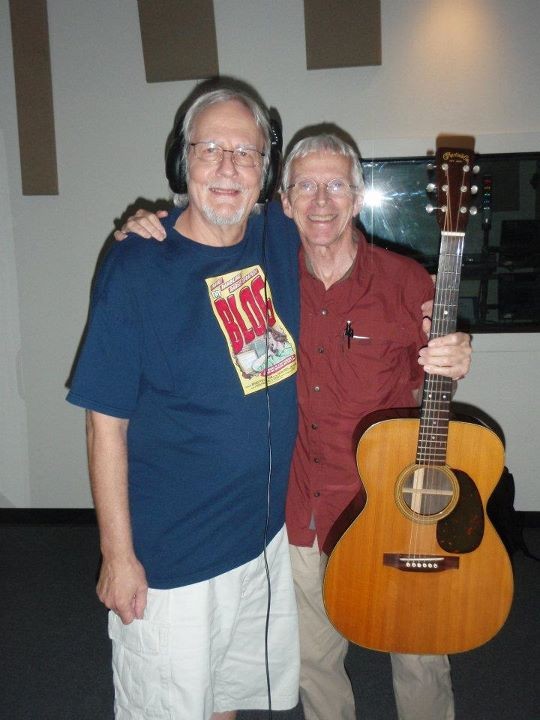
Rag Radio’s Tracey Schulz (left) and Thorne Dreyer, with guest Carl Davidson at the KOOP studios in Austin, Friday, Sept. 9. Photo by Jim Cleveland / KOOP Radio / The Rag Blog.

Noted writer and political activist Carl Davidson on
Rag Radio with Thorne Dreyer. Listen to it here:


The Rag Blog and the New Journalism Project brought writer and political activist Carl Davidson to Austin to give a multi-media presentation on “The Mondragon Corporation and the Workers’ Cooperative Movement” at the 5604 Manor community center last Thursday, Sept. 8, and Carl also discussed the subject with Thorne Dreyer on Rag Radio the next day.

Carl talked about the history of Mondragon, its unique organizational structure — involving factories, schools, and credit unions — and its role as a model and an inspiration for the cooperative movement worldwide. The Mondragon Corporation is a 50-year-old network of factories and agencies, involving close to 100,000 workers (who are also, collectively, the owners) — centered in Spain’s Basque country, but now spanning the globe.

Carl also discussed the thriving cooperative movement in the United States, as well as his concept of 21st century socialism and how it differs from the socialism of the last two centuries. Socialism for a new century, he said, must incorporate ecological thinking and sustainable development; must acknowledge that markets will be a part of any socialist society; and must affirm human rights as a natural “attribute of our humanity.”

Carl Davidson, a regular contributor to The Rag Blog, is a co-chair of the Committees of Correspondence for Democracy and Socialism, a national board member of Solidarity Economy Network, and a local Beaver County, PA member of Steelworkers Associates. In the 1960s, he was a national leader of SDS and a writer and editor for the Guardian newsweekly. He is also author of several books, including, with Jerry Harris, CyberRadicalism: A New Left for a Global Age, and New Paths to Socialism, essays on worker coops, Marxism, and the green economy.

Rag Radio — hosted and produced by Rag Blog editor Thorne Dreyer — is broadcast every Friday from 2-3 p.m. (CDT) on KOOP 91.7-FM in Austin, and streamed live on the web. The show, which has been aired since September 2009, features hour-long in-depth interviews and discussion about issues of progressive politics, culture, and history. After broadcast, all episodes are posted as podcasts and can be downloaded at the Internet Archive. Rag Radio is also rebroadcast on Sundays at 10 a.m. (Eastern) on WFTE, 90.3-FM in Mt. Cobb, PA, and 105.7-FM in Scranton, PA.

Musician Bill Oliver leads a group in singing labor songs after Carl Davidson’s presentation at 5604 Manor in Austin. Photo by Alan Pogue / The Rag Blog.

The Rag Blog

Posted in RagBlog | Tagged , , , , , , | Leave a comment

Don Swift : Perry, Bachmann, and the Threat of Dominionism

Image (without irony) from OpenAirSeattle.

A threat to American liberties:
Dominionism and the Republican Right

Both Rick Perry and Michele Bachmann have clear ties to the Christian Dominionists, who do not believe in the separation of church and state.

By Don Swift / The Rag Blog / September 14, 2011

[This is the first in a series on Dominionism by Don Swift.]

In 1960, Senator John F. Kennedy, then a candidate for the presidency, found it necessary to explain to assembled Baptist ministers in Houston that he would respect the American principle of separation of church and state and that he would not let the Catholic bishops dictate policy to him.

In 2008, many were troubled by the views of Senator Barack Obama’s pastor, the Reverend Dr. Jeremiah Wright, who had a direct way of putting things and sometimes seemed too influenced by racial bitterness. Obama had to distance himself from his friend and leave the congregation.

In this presidential election cycle, two of the leading Republican candidates for the presidency, Rick Perry and Michelle Bachmann, have clear ties to the Christian Dominionists, who do not believe in the separation of church and state. Should one of them become the Republican standard bearer, he or she should be required to answer some probing questions about the separation of church and state and the attitudes of his or her Dominionist friends.

These people are not friends of democracy. Sarah Palin, a very influential Republican who seems to be weighing the possibility of running for the nomination, also is tied to the Dominionists.

In addition, there is The Family or The Fellowship, a semi-secret religious organization comprised almost entirely of Republican politicians who work behind the scenes to translate their religious beliefs into public policy. By all accounts this secretive brotherhood possesses great power and has connections and influence throughout our society.

Although many have claimed these people are Dominionists, it is not at all clear that their ultimate goal is to exclude non-Christians from office. They seem perfectly content to guide others in exercising power. They might better be designated soft Dominionists, but their lust for autocratic power is no less frightening than the desires of the hard Dominionists. Like the hard Dominionists, they see themselves as a spiritual royalty or elite who have a special claim to the right to shape the nation’s affairs.

Their clandestine operations and mingling of religion and politics are not a healthy development and are inconsistent with the separation of church and state.

Dominionism is an academic term that applies to the belief that the saved must battle to take over the world in God’s name and rule it according to Biblical principles and injunctions. It refers to a conservative Protestant movement that is both political and religious.

The basis for Dominionism is found in Genesis 1: 26-27, where God gave Adam dominion over all earthly things. Though Adam and his progeny lost that power through the fall, it is believed that baptism restored that power to true believers. They were meant to rule, and governance by people they consider non-Christians is a kind of sacrilege.

There is a tendency among them to delegitimate other Christian religions and to even hold that demons run some other churches. Some Dominionists hold that unbelievers can be compelled to accept salvation. They adhere to some unusual beliefs that many say are unbiblical. For example, they teach that some of their leaders can somehow incarnate Christ and exercise his power in this world.

In 1994, Frederick Clarkson wrote that Dominionism and Social Darwinism are of the same cloth. Social Darwinism is misnamed; it really goes back to Thomas Malthus, a misguided preacher who thought that intense competitiveness and self-interest were the essence of social evolution. Rejecting any compassion, he thought it right and natural that the strong benefit at the expense of the weak.

Charles Darwin did not think this way and wrote about how compassion and kindness were necessary and part of human nature. The Dominionists believe it is sinful for people in distress to look to government for help; God will provide. Like our Puritan ancestors, they thought that the rich were blessed by God, and the poor deserved their fate.

Scholars have noted that Social Darwinism is frequently associated with authoritarian mindsets and strong suspicion of others. In the case of the Dominionists, they use a distorted form of Christianity and Social Darwinism to define themselves as an elite and to define others in such a negative way that it is easy to generate considerable hostility toward them.

Clarkson added that they expect women to be submissive and stay at home. This outlook has changed because there are so many females among the Dominionist leadership. Even Michele Bachmann, who once defended submission, is now busy defining it away.

Dominionism always involves an element of elitism and more than a small dose of authoritarianism. These people think they have been selected by God to rule. Especially empowered in that way, they tend to think that whatever they do is justified. They see those who disagree as agents of the forces of evil.

The 75 year-old Family or Fellowship, based in the Washington, D.C. area, is an organization that reflects this elitism and authoritarian outlook. Its views smack heavily of theocracy, but a careful student of the cult could conclude that they worship power itself.

Image from a website called “7 Mountains: Fulfilling Your God Given Assignment.”

Dominionists speak in terms of reclaiming the earth from Satan and capturing the seven mountains of church, family, education, arts and entertainment, business, media, and government. Each of the seven mountains should be ruled by Dominionists.

No one knows how many Dominionists there are in the United States. Some of them speak in terms numbering half of one percent of the population. Others claim a growth rate of 9 million a year, which is very unlikely. The number of people who would claim this label is probably small, but Dominionists’ influence among conservative Christians is substantial and growing. They thoroughly understand the mindset of conservative Christians and are very adept at inserting their ideas into many parts of it.

This world of Dominionism can be assessed through television networks like GODTV, DayStar, and the Trinity Broadcasting Network. Dominionists are clearly active, zealous, and well organized, and their numbers appear to be growing among evangelical Protestant clergy. Their ideas are clearly cross-fertilizing with other forms of conservative Protestant Christianity.

Some see Dominionism as a sort of Christian Wahabism They all think that true Christians were given by God a right to rule all human institutions. If one doubts that these people lack influence, recall Senator Charles Grassley’s efforts to look into six religious organizations that were accused of converting religious funds to personal use. He backed off, and his staff recommended that the IRS repeal the rule preventing churches from electioneering.

Dominionists have substantial influence among today’s Tea Party Republican leaders. Recently there were several carefully researched articles on Dominionism, and CNN’s Jack Cafferty even had an essay on it. There followed a stream of articles by right-wing publicists reassuring us that no Christians want to take over government, that they just want to have some influence in it.

Michael Gerson, one of the most capable Republican spokesmen, took the lead in distancing Tea Party leaders from Dominionism. He attributes fear of the Dominionists to the anti-religious attitudes of many liberals. Lisa Miller, Newsweek’s religion editor, also said fear of the Dominionists is unwarranted. And Ralph Reed has said that the Dominionists do not exist: “The notion that Bachmann, Perry or other candidates secretly harbor ‘dominionist’ theology is a conspiracy theory largely confined to university faculty lounges and MSNBC studios.”

Recently, some Dominionist clergymen came forward to say that they really are not seeking a “theocracy.” On the other hand, more than a few respected evangelical spokesmen state that the fears are not unwarranted, and they distinguish between themselves and the Dominionists. Some of them must have read enough to realize that the Dominionists intend to take over their denominations.

Dominionists think God intervenes regularly in earthly matters. Some think that the terrible Japanese earthquake was God’s punishment for not heeding one of God’s decree. On the other hand, they say that God ended mad cow disease in Germany and a drought in Texas. It is said among them that Jezebel and three minor demons run the Democratic Party. In Texas, they have strange ceremonies with plumb lines and branding irons; and they are said to have driven inscribed stakes into the ground in every county.

Michele Bachmann half-joked that God might have sent Hurricane Irene to show his displeasure that Americans have not fixed their debt problem. She seems to think that God has very clear ideas about public policy. On a Truth in Action ministries video, she said that God taught that no tax money should be spent on social welfare. It should all come from charity.

Dominionists present a serious danger to the Republic because they do not believe in the separation of church and state and because they consider themselves a royal priesthood entitled to rule. People who think they are that special will do anything to gain power and will misuse it when they want.

Of course, there are other groups out there who also think they are that special. A problem is that the Dominionists, including the soft Dominionists in The Family or The Fellowship, have a way of allying with these other power-hungry groups such as the corporate elite and extremists in the intelligence and military communities.

[Don Swift, a retired history professor, also writes under the name Sherman DeBrosse. Read more articles by Don Swift on The Rag Blog.]

The Rag Blog

Posted in Rag Bloggers | Tagged , , , , , , , | 3 Comments

The hot potato the beltway wonks avoid:
Tying job creation to industrial policy

By Carl Davidson / The Rag Blog / September 14, 2011

Listen to Thorne Dreyer‘s Rag Radio interview with writer and political activist Carl Davidson — discussing the Mondragon Corporation and the workers’ cooperative movement. To find earlier shows on Rag Radio, go to the Internet Archive.

If you want to be a good policy advocate for jobs these days, two starting points will help you a lot. One is to take off your national blinders and see the economy globally. The second is to grasp how the need for revenues to finance the creation of new jobs can best be filled by increasing taxes on unproductive wealth.

A good example of the problem is Robert’s Samuelson’s “Job Creation 101” op-ed column in the Sept 12 Washington Post. If we were to simply follow his lesson plan, we would end up creating new jobs in the Third World — and doing so mainly at the expense of the wrong people at home.

Samuelson begins his argument wisely enough by stressing how increasing demand for goods and services creates jobs, and government has to have a hand in it. But then he goes astray:

If government taxed, borrowed or regulated less, that money would stay with households and businesses, which would spend it on something else and, thereby, create other jobs. Politics determines how much private income we devote to public services.

To this observation, there’s one glaring exception. In a slump, government can create jobs by borrowing when the private economy isn’t spending.

On the first point, tweaking taxes so both people and businesses have more cash to spend glosses over the matter of where and how the money is spent. Using extra income to pay down your Visa Card doesn’t help job creation much. And if you spend it at Walmart or other big box stores, you’ll create some demand to hire more workers in China or Malaysia, but not much here.

On the second point, it’s not always wise to create jobs simply by borrowing. It certainly adds to the revenues of the banks and bondholders. But it’s much smarter to go after unproductive pools of capital with progressive taxation. The proposal for a financial transaction tax on Wall Street speculators is an excellent example.

The rule of thumb is to tax activities you want to discourage, such as unproductive gambling in derivatives, while subsidizing efforts you want to encourage, such as new green manufacturing startups. It’s called “industrial policy,” and it’s why some countries that have one, like China and Germany, are weathering the economic storms better than others.

If Obama’s new jobs program is going to be thwarted by a hostile Congress anyway, those politicians who are serious about creating jobs would do well to fight for the best options — direct government programs that fund increasing local demand for local labor and raw materials.

If we had every county in the country funded to build a wind farm or solar array as a public power utility, it would be a good start. So would the building of the new and massive “Smart Grid” power lines for clean and green energy.

When finance capital’s opposition in Congress rears its head to crush something that makes perfect sense to everyone else, then we’ll learn exactly who is part of the problem and who is part of the solution. If we get political clarity here in a massive way, we’ll be in a much better position to assemble the popular power required to get what we really need.

[Carl Davidson is a national co-chair of the Committees of Correspondence for Democracy and Socialism, a national board member of Solidarity Economy Network, and a local Beaver County, PA member of Steelworkers Associates. In the 1960s, he was a national leader of SDS and a writer and editor for the Guardian newsweekly. He is also the co-author, with Jerry Harris, of CyberRadicalism: A New Left for a Global Age. He serves as webmaster for SolidarityEconomy.net and Beaver County Blue. This article was first published on Carl’s blog, Keep On Keepin’ On. Read more articles by Carl Davidson on The Rag Blog.]

Source

The Rag Blog

Posted in RagBlog | Leave a comment

MUSIC / John Wilson : Houston Folk Legend Don Sanders is ‘Heavy Word User’


Singer-songwriter and storyteller:
Don Sanders
is still a ‘Heavy Word User’

By John Wilson / The Rag Blog / September 14, 2011

Houston folk legend and children’s entertainer Don Sanders will be Thorne Dreyer‘s guest on Rag Radio, Friday, Sept. 16, from 2-3 p.m. (CST), on KOOP 91.7-FM in Austin, and streamed live here. To listen to earlier shows on Rag Radio, go to the Internet Archive.

I have often wondered how the angel of fame selects the musicians upon whom it bestows its gifts. I have no doubt Justin Bieber is a nice enough young man with a pleasant voice and engaging personality but does he really warrant the rewards flowing his way? And going back in time, what about such stars as Fabian in the 50s and the Archies in the 60s? It seems the fame angel is slightly tone deaf or at least blessed with a delicious sense of irony.

Of the artists with whom I have a personal relationship, Don Sanders is a case in point. He has yet to receive the adulation he so richly deserves. Granted, he is a featured artist with the Texas Commission on the Arts and an honorary board member of the Kerrville Folk Festival, but his music, which compares favorably with any of the recognized folk greats, still exists primarily as the soundtrack to the aging Houston folk crowd.

From the moment I first saw him perform in Houston in the early 70s, I knew he was the real deal. Lots of people agreed with me. He was profiled in depth in numerous articles — from the Houston Chronicle and Houston Post to Texas Monthly and Rolling Stone. (Rolling Stone referred to Don as Houston’s “spritely local folkie.”) He was universally loved and respected by musicians of every stripe in Houston.

One of my favorite articles is by a young Lyle Lovett, writing for the Battalion at Texas A&M in 1978. (In a 1998 interview Lovett would refer to Don Sanders as a “big influence.”)

Over a five year period from 1970 to 1975, Don wrote and performed a suite of songs that pretty much provided the soundtrack for that tumultuous and intensely musical period of Houston’s history. During this time Don expressed his commitment to social change by performing at countless peace rallies and Montrose street festivals, and was also involved with Pacifica’s KPFT-FM in its early days, appearing as “Donnie Jo DJ.”

Don’s repertoire included such classics as “Third Eye,” in which President Nixon and a parrot seek enlightenment; “Coffee Song” (“just waiting for my coffee to boil”), with its bubbling sound-effect chorus; “Roaches” (who are on the pathway down because they live with hippies); and “Heavy Word User,” where he describes himself as a “greasy, sleazy information abuser.” There was ample evidence that Don had, as he claimed in the same song, “a jar of talent and the lid’s unscrewed.”

Yet universal acceptance stayed away.

It wasn’t for lack of effort on Don’s part. During that period, pretty much on his own nickel, he produced a series of recordings (two LPs and one extended play 45) that highlighted the eclectic nature of his work, the strength of his writing, and the beauty of his voice and guitar work.

He was, however, swimming against the tide. The major labels had a lock on the music industry, and while local radio stations were willing to play local artists, getting exposure outside Houston, much less Texas, was really hard. It is much easier today to produce an album on the cheap, but doing it in the 70s was quite an undertaking.

When I broached the subject recently over lunch with Don he gave me a wane smile and said, “Big record companies really wanted an artist with a burning desire to succeed and make money. I had two problems, first I liked to experiment with different voices and ways of constructing songs.” Then he paused. “And, secondly at the time I just wanted to get laid.”

I didn’t really see the second part as a great impediment to fame, except that it might keep you from focusing on business, but the first could definitely cause problems, especially when it was coupled with the prevailing attitude of the day which focused on the idea of trying to avoid selling out your artistic vision for the chance at a quick buck.

Don Sanders in front of the Sam Houston statue in Houston’s Hermann Park. Photo from the Houston Chronicle archives.

“Back around ’78,” said Don, “I was offered the opportunity to go to Nashville and write for Marty Robbins music. It was a pretty standard gig, they would pay a monthly draw and you had to write and pitch two songs a month, but I didn’t really want to write love songs so I turned them down.”

Still, Don kept on plugging through the rest of the decade and into the next, releasing the CD Tourist in 1984, until he decided to do something different. “I just got tired of the format, touring colleges and the bar circuit,” he said, “doing a fast song, slow song, and telling a story.”

It lead, almost naturally, to work in theater — first at Houston’s Main Street Theater and then later with Chocolate Bayou Theater, doing a one-man show of his songs and stories focusing on the troubles in Latin America that grew out of the story “Grunty Mind and the American Love Story” that appeared on the entire side two of one of his LPs.

He had some success touring through Texas. But again, the angel of fame played favorites.

“I just didn’t know how to get it into the larger theaters,” said Don. This once again proves that it’s not what you know but who you know.

In 1992 Don signed a deal with a manager who dealt in children’s music, and it was there that Don found the niche that he occupies to this day, performing for school children. His universally praised shows include:

  • Cuentos y Canciones: Latin American folk tales and songs in Spanish and English;
  • Gusher Times: based on the oral history project conducted at the University of Texas (Oral History of the Texas Oil Industry Collection, 1952-1958); and
  • Sourdough Cowboy: based on the oral history of the WPA workers and songs collected by the Lomax family.

“It’s a lot of fun,” he says “performing for children. You have to learn to compete with the distractions and the different developmental levels of the children. You surf the wave and you either stay on top or you get buried.”

So, in the end maybe the angel of fame knew what it was doing. I have to think that bringing the gift of music and song to school children is a pretty cool thing to do and may be of more lasting value than any of the things most of us will accomplish in our lives.

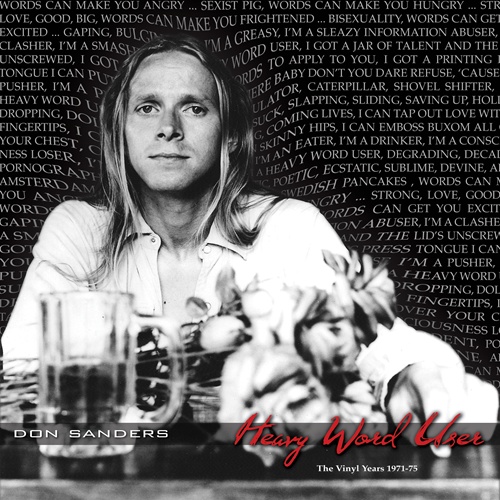
Of course what goes around comes around, and it was after a recent appearance at Houston’s Anderson Fair with Sally Spring that Don and I started talking about re-releasing his vinyl work as a CD. (Incidentally, Don appears in For the Sake of the Song, the acclaimed 2010 documentary about Anderson Fair, the venerable Houston acoustic venue.) We embarked on the project and with the help of Rock Romano at Rock Romano’s Red Shack studio the songs were coaxed off their aging tapes and vinyl to be tweaked and mixed into digital format.

The new CD, Heavy Word User, which came out during the Kerrville Folk Festival, is available at Amazon, Itunes, CDBaby, and YourTexasMusic and recently was accepted by Pandora into the Music Genome Project. It is nice to hear songs by Dylan, the Band, Neil Young, Hoyt Axton and Townes Van Zandt, followed by a Don Sanders tune.

So, if the angel is still looking it has one last shot to help Don get this music to the larger audience it so richly deserves. Of course, if it continues to look away then Don still has the children and his digital music is out there and in the mix, standing shoulder to shoulder with the greats. Nice legacy.

[Music producer John Wilson, who is president of YourTexasMusic, was a music critic for the Houston Chronicle and a contributor to Space City!, Houston’s late 60s/early 70s underground newspaper. He now lives in Johnson City, Texas.]

The Rag Blog

Posted in Rag Bloggers | Tagged , , , , , | 2 Comments

Thomas McKelvey Cleaver : Nagasaki and Responding to Calamity

Shinto Shrine in Atomic Ruins, Nagasaki, Japan 1945. Public domain / National Archives / Flickr.

Responding to calamity and
what it says about our character

The people of Nagasaki dedicated their city to promoting international peace and brotherhood.

By Thomas McKelvey Cleaver / The Rag Blog / September 14, 2011

Watching the Tenth Anniversary celebration of national victimhood over the terrorist attacks of 9/11, I had some mixed thoughts. I thought using all this to celebrate and build support for the failed policies of the Bush-Cheney cabal (i.e., our wars in Iraq and Afghanistan) in the aftermath of those attacks was an insult to the dead.

I thought about how societies remember calamities. It’s said that how one deals with disaster is a better indicator of character than any other event. If that is true, then Americans beating their breasts about how singularly awful 9/11 was, how singularly different and vastly more important our victimhood is to any other anywhere else ever, clearly demonstrates the shallowness of character much of the rest of the world generally ascribes to us as a people.

I thought of another city that experienced a calamity so great it could only be termed a catastrophe, and what their response was to that event, and what it said about their character.

Sixty-six years ago last month, on August 9, 1945, the city of Nagasaki was hit by the last atomic bomb ever dropped in anger. 96,000 people died in the immediate aftermath, with thousands of others dying over the years that followed. It would be difficult to imagine a worse catastrophe that could happen to a city.

But wait, it gets worse.

The bomb was dropped in desperation by a crew that didn’t want to return to base with “unexpended ordnance” aboard, who were desperately afraid that if they didn’t drop the thing, they wouldn’t be able to get back home. They’d tried bombing two other possible targets, but couldn’t comply with the “visual drop only” orders they were operating under.

As it was, they had to make three passes over the city, with the bombardier finally telling the pilot he had “visual contact” at the last moment, which was later exposed as a lie; the bomb was dropped blind by radar fix, a violation of all the rules. “Bock’s Car” had to divert from returning to Tinian and land at Okinawa, where the airplane had to be towed off the runway after running out of gas within moments of touchdown.

They really did have to get rid of the extra weight, and there was certainly no way this particular bomb would be abandoned over the open sea.

But wait, it gets worse.

Of all the cities in Japan to bomb, Nagasaki was the last place to consider. For over 300 years, since the first European explorers finally reached Japan, it had been Japan’s door to the West, and the most traditionally pro-Western city in the country. It was the city that most opposed the military coup d’etat that took over the Japanese government in the late 1920s, and the city most opposed to the Pacific War.

As a result of the European influence beginning in the mid-sixteenth century, Nagasaki was overwhelmingly Christian. When the Shogunate was imposed in the seventeenth century, Nagasaki and the surrounding communities on Kyushu rebelled. Over 200,000 people where killed in the ensuing civil war, and Christianity was outlawed, with the death penalty for its practice. For the next 200 years, until Japan was forcibly opened to the West in 1854 by Commodore Perry’s “black ships,” the Christians of Nagasaki and Kyushu practiced an underground religion.

Following the Meiji Restoration in 1880, the official persecution of Christians was ended. Over the next 30 years, the Christians of Nagasaki built the Urakami Catholic Church, which was the largest Christian church in Asia, built entirely by the donations of the parishioners.

“Ground Zero” for the bomb was the bell tower of that church. The tower was the only structure remaining upright afterwards, and is today the site of the Museum of the Atomic Disaster.

How does all that strike you for terrible irony? Is that worse enough?

You’d pretty much figure the citizens of Nagasaki would never forget that one, wouldn’t you? They’d probably hate the people responsible, too, right?

Wrong.

Unlike Hiroshima, where an American can still be made to feel guilty by the attitude of the citizens today, Nagasaki made a different choice.

The people of Nagasaki looked at what had happened, and concluded (as Americans did after 9/11): “Never again!” But they made a far different choice in how to achieve that. For the people of Nagasaki, the way to be sure such a terrible event never happened again was to work to promote international peace and brotherhood, and they dedicated their city to that principle.

All kinds of cities have all kinds of dedicated mottos, and most of their citizens never know what they are, or if they do, what they mean. That is certainly true here in America.

In Nagasaki, they know. They practice it every day. In 1964, less than 20 years after the event, wearing the uniform of the armed forces of the country that had committed that act, I was in Nagasaki, along with the rest of the ship’s company of the old USS Rustbucket.

The young people of the city came down to the pier where we were docked and waited to meet us as we left the ship, and invited us to allow them to guide us through their city, to go to dinner with them, to even visit their homes (that is an amazing act, that gaijin would be brought into a Japanese home — they’re the most private people on the planet). And they told us why they were doing it.

I don’t think I have ever experienced such a truly Christian act in my life

[Thomas McKelvey Cleaver is an accidental native Texan, a journalist, and a produced screenwriter. He has written successful horror movies and articles about Second World War aviation, was a major fundraiser for Obama in 2008, and has been an activist on anti-war, political reform, and environmental issues for almost 50 years. Read more articles by Thomas Cleaver on The Rag Blog.]

The Rag Blog

Posted in Rag Bloggers | Tagged , , , , , , , | 1 Comment

Robert Jensen : 9/11 and Imperial Delusions

Graphic from SodaHead.

Imperial delusions:
Ignoring the lessons of 9/11

Being right means nothing if we failed to create a more just foreign policy conducted by a more humble nation.

By Robert Jensen / The Rag Blog / September 13, 2011

Ten years ago, critics of America’s mad rush to war were right, but it didn’t matter.

Within hours after the 9/11 terrorist attacks, it was clear that political leaders were going to use the attacks to justify war in Central Asia and the Middle East. And within hours, those of us critical of that policy began to offer principled and practical arguments against aggressive war as a response to the crimes.

It didn’t matter because neither the public nor policymakers were interested in principled or practical arguments. People wanted revenge, and the policymakers seized the opportunity to use U.S. military power. Critical thinking became a mark not of conscientious citizenship but of dangerous disloyalty.

We were right, but the wars came.

The destructive capacity of the U.S. military meant quick “victories” that just as quickly proved illusory. As the wars in Afghanistan and Iraq dragged on, it became clearer that the position staked out by early opponents was correct — the wars not only were illegal (conforming to neither international nor constitutional law) and immoral (fought in ways that guaranteed large-scale civilian casualties and displacement), but a failure on any pragmatic criteria.

The U.S. military has killed some of the people who were targeting the United States and destroyed some of their infrastructure and organization, but a decade later we are weaker and our sense of safety more fragile. The ability to dominate militarily proved to be both inadequate and transitory, as predicted.

Ten years later, we are still right and it still doesn’t matter.

There’s a simple reason for this: Empires rarely learn in time, because power tends to dull people’s capacity for critical self-reflection. While ascending to power, empires believe themselves to be invincible. While declining in power, they cling desperately to old myths of remembered glory.

Today the United States is morally bankrupt and spiritually broken. The problem is not that we have strayed from our founding principles, but that we are still operating on those principles — delusional notions about manifest destiny, American exceptionalism, the right to take more than our share of the world’s resources by whatever means necessary. As the United States grew in wealth and power, bounty for the chosen came at the cost of misery for the many.

After World War II, as the United States became the dominant power not just in the Americas but on the world stage, the principles didn’t change. U.S. foreign policy sought to deepen and extend U.S. power around the world, especially in the energy-rich and strategically crucial Middle East; always with an eye on derailing any Third World societies’ attempts to pursue a course of independent development outside the U.S. sphere; and containing the possibility of challenges to U.S. dominance from other powerful states.

Does that summary sound like radical hysteria? Recall this statement from President Jimmy Carter’s 1980 State of the Union address:

An attempt by any outside force to gain control of the Persian Gulf region will be regarded as an assault on the vital interests of the United States of America, and such an assault will be repelled by any means necessary, including military force.

Democrats and Republicans, before and after, followed the same policy.

The George W. Bush administration offered a particularly intense ideological fanaticism, but the course charted by the Obama administration is much the same. Consider this 2006 statement by Robert Gates, who served as Secretary of Defense in both administrations:

I think the message that we are sending to everyone, not just Iran, is that the United States is an enduring presence in this part of the world. We have been here for a long time. We will be here for a long time and everybody needs to remember that — both our friends and those who might consider themselves our adversaries.

If the new boss sounds a lot like the old boss, it’s because the problem isn’t just bad leaders but a bad system. That’s why a critique of today’s wars sounds a lot like critiques of wars past. Here’s Martin Luther King, Jr.’s assessment of the imperial war of his time:

[N]o one who has any concern for the integrity and life of America today can ignore the present war. If America’s soul becomes totally poisoned, part of the autopsy must read: Vietnam. It can never be saved so long as it destroys the deepest hopes of men the world over.

Will our autopsy report read “global war on terror”?

That sounds harsh, and it’s tempting to argue that we should refrain from political debate on the 9/11 anniversary to honor those who died and to respect those who lost loved ones. I would be willing to do that if the cheerleaders for the U.S. empire would refrain from using the day to justify the wars of aggression that followed 9/11. But given the events of the past decade, there is no way to take the politics out of the anniversary.

We should take time to remember the nearly 3,000 victims who died on 9/11, but as responsible citizens, we also should face a harsh reality: While the terrorism of fanatical individuals and groups is a serious threat, much greater damage has been done by our nation-state caught up in its own fanatical notions of imperial greatness.

That’s why I feel no satisfaction in being part of the anti-war/anti-empire movement. Being right means nothing if we failed to create a more just foreign policy conducted by a more humble nation.

Ten years later, I feel the same thing that I felt on 9/11 — an indescribable grief over the senseless death of that day and of days to come.

[Robert Jensen is a journalism professor at the University of Texas at Austin, where he teaches courses in media law, ethics, and politics — and a board member of the Third Coast Activist Resource Center in Austin. His books include All My Bones Shake: Seeking a Progressive Path to the Prophetic Voice, and Getting Off: Pornography and the End of Masculinity. His writing is published extensively in mainstream and alternative media. Robert Jensen can be reached at rjensen@uts.cc.utexas.edu. Read more articles by Robert Jensen on The Rag Blog.]

The Rag Blog

Posted in Rag Bloggers | Tagged , , , , | Leave a comment

Imperial delusions: Ignoring the lessons of 9/11

By Robert Jensen / The Rag Blog / September 13, 2011

Ten years ago, critics of America’s mad rush to war were right, but it didn’t matter.

Within hours after the 9/11 terrorist attacks, it was clear that political leaders were going to use the attacks to justify war in Central Asia and the Middle East. And within hours, those of us critical of that policy began to offer principled and practical arguments against aggressive war as a response to the crimes.

It didn’t matter because neither the public nor policymakers were interested in principled or practical arguments. People wanted revenge, and the policymakers seized the opportunity to use U.S. military power. Critical thinking became a mark not of conscientious citizenship but of dangerous disloyalty.

We were right, but the wars came.

The destructive capacity of the U.S. military meant quick “victories” that just as quickly proved illusory. As the wars in Afghanistan and Iraq dragged on, it became clearer that the position staked out by early opponents was correct — the wars not only were illegal (conforming to neither international nor constitutional law) and immoral (fought in ways that guaranteed large-scale civilian casualties and displacement), but a failure on any pragmatic criteria.

The U.S. military has killed some of the people who were targeting the United States and destroyed some of their infrastructure and organization, but a decade later we are weaker and our sense of safety more fragile. The ability to dominate militarily proved to be both inadequate and transitory, as predicted.

Ten years later, we are still right and it still doesn’t matter.

There’s a simple reason for this: Empires rarely learn in time, because power tends to dull people’s capacity for critical self-reflection. While ascending to power, empires believe themselves to be invincible. While declining in power, they cling desperately to old myths of remembered glory.

Today the United States is morally bankrupt and spiritually broken. The problem is not that we have strayed from our founding principles, but that we are still operating on those principles — delusional notions about manifest destiny, American exceptionalism, the right to take more than our share of the world’s resources by whatever means necessary. As the United States grew in wealth and power, bounty for the chosen came at the cost of misery for the many.

After World War II, as the United States became the dominant power not just in the Americas but on the world stage, the principles didn’t change. U.S. foreign policy sought to deepen and extend U.S. power around the world, especially in the energy-rich and strategically crucial Middle East; always with an eye on derailing any Third World societies’ attempts to pursue a course of independent development outside the U.S. sphere; and containing the possibility of challenges to U.S. dominance from other powerful states.

Does that summary sound like radical hysteria? Recall this statement from President Jimmy Carter’s 1980 State of the Union address:

An attempt by any outside force to gain control of the Persian Gulf region will be regarded as an assault on the vital interests of the United States of America, and such an assault will be repelled by any means necessary, including military force.

Democrats and Republicans, before and after, followed the same policy.

The George W. Bush administration offered a particularly intense ideological fanaticism, but the course charted by the Obama administration is much the same. Consider this 2006 statement by Robert Gates, who served as Secretary of Defense in both administrations:

I think the message that we are sending to everyone, not just Iran, is that the United States is an enduring presence in this part of the world. We have been here for a long time. We will be here for a long time and everybody needs to remember that — both our friends and those who might consider themselves our adversaries.

If the new boss sounds a lot like the old boss, it’s because the problem isn’t just bad leaders but a bad system. That’s why a critique of today’s wars sounds a lot like critiques of wars past. Here’s Martin Luther King, Jr.’s assessment of the imperial war of his time:

[N]o one who has any concern for the integrity and life of America today can ignore the present war. If America’s soul becomes totally poisoned, part of the autopsy must read: Vietnam. It can never be saved so long as it destroys the deepest hopes of men the world over.

Will our autopsy report read “global war on terror”?

That sounds harsh, and it’s tempting to argue that we should refrain from political debate on the 9/11 anniversary to honor those who died and to respect those who lost loved ones. I would be willing to do that if the cheerleaders for the U.S. empire would refrain from using the day to justify the wars of aggression that followed 9/11. But given the events of the past decade, there is no way to take the politics out of the anniversary.

We should take time to remember the nearly 3,000 victims who died that day, but as responsible citizens, we also should face a harsh reality: While the terrorism of fanatical individuals and groups is a serious threat, much greater damage has been done by our nation-state caught up in its own fanatical notions of imperial greatness.

That’s why I feel no satisfaction in being part of the anti-war/anti-empire movement. Being right means nothing if we failed to create a more just foreign policy conducted by a more humble nation.

Ten years later, I feel the same thing that I felt on 9/11 — an indescribable grief over the senseless death of that day and of days to come.

Type rest of the post here

Source /

The Rag Blog

Posted in RagBlog | Leave a comment

Lamar W. Hankins : What 9/11 Has Taught Us About Our Country

Image from Truth and Shadows.

What we have (and haven’t)
learned about America since 9/11

By Lamar W. Hankins / The Rag Blog / September 13, 2011

The horrific attack on the United States on 9/11/01 brought out America’s essential character traits in ways that bin Laden could not have anticipated. Some of those traits are positive and some negative. Without question, the brightest and most shining period since 9/11 began on that day and continued for many months as all America seemed drawn together by the calamity of massive terrorism on American soil.

1. Rallying together in a time of crisis. The firefighters, police, and ordinary citizens who responded to the disastrous crash of two planes into the World Trade Center showed that many, if not most, Americans care about their fellow human beings. And those who responded came from all over the United States. This happens after most natural disasters as well, demonstrating that part of America’s basic character is to help one another in time of need.

There were (and continue to be) symbolic signs of that concern. Businesses and offices all over America have signs that read something like “9/11, we will never forget.” I paid a bill recently that included this statement on the pre-printed form.

Although I am not sure exactly what it means to suggest that something has happened that we will never forget, I take it as a sincere effort to express a continuing concern for those who died and were injured in the aftermath of that tragedy. If the reference means something about not forgetting who committed the dastardly act of 9/11, I’m not sure that is useful, especially since most of the apparent perpetrators are dead 10 years later.

2. The use of fear to diminish our freedom. As is true of so many opportunists, the Bush administration wasted no time in proposing and having passed laws that have limited our freedoms here in the U.S. No longer do I enjoy air travel because of the ordeal of security screening and suspicion to which air travelers are subjected.

But that is a minor diminution of our freedoms compared to the FBI’s administrative letters, which amount to non-judicial search warrants into our private lives through access without our knowledge to library records, email, and telephonic communications. These laws and many others were gained by appeals to our fear that unless Congress gave the administration these extraordinary powers, we could not be protected from more terrorist acts. Yet there is little evidence that such intrusions into our privacy have actually prevented terrorist acts.

3. American adherence to violence as the default response to violence. Our government decided quickly that Osama bin Laden was responsible for the 9/11 terror, assisted partly by his rush to take credit for the murders, a boast that proves nothing about his guilt. In fact, evidence of his participation in 9/11, if it exists, has never been provided to the public or in a court in sufficient detail to satisfy any criminal standard of proof of guilt. On the other hand, I have no reason to think that bin Laden wasn’t guilty of planning and funding the attacks of 9/11.

US officials demanded that bin Laden and his operatives be turned over to the U.S. government. The Taliban offered to try bin Laden in their courts if we would give them evidence of his responsibility. We refused and began the Afghanistan War to kill or capture bin Laden and punish the Taliban for not doing what we told them to do.

Inexplicably, Bush’s commanders let bin Laden escape into Pakistan, either intentionally or through incompetence. His escape from Afghanistan was remedied nearly 10 years later by the actions of another president who sent 79 Navy SEALs on a mission to kill bin Laden. There was no effort to capture him. Although the early military propaganda suggested that it was a capture or kill mission, we have learned now that it was always a mission to assassinate him.

The SEALs encountered little armed opposition, bin Laden himself was not armed, and one of his wives was shot when she tried to protect him by lunging at the SEALs with her body. The mission was undertaken in violation of U.S. treaties, the principles enunciated at Nuremberg, and widely-accepted international law, all of which we claim to follow.

4. The manipulation of Americans by ideologues. The war in Afghanistan was not our only response to 9/11. It was followed in 2003 by the war in Iraq, an invasion made possible by the actions, misjudgments, lies, and ideology of those in the Bush administration termed neoconservatives.

The U.S. invaded Iraq without provocation or international legal justification. Such an invasion was termed by Justice Robert Jackson, Chief Counsel for the United States at Nuremberg, as a “supreme international crime” — the crime of unprovoked aggression of one country against another. Justice Jackson said in his opening statement to the Nuremberg Tribunal that an aggressor is a state that is the first to invade with “its armed forces, with or without a declaration of war, … the territory of another State.”

I have never read or heard anyone deny that this is precisely what Bush, Cheney, Rumsfeld, and their minions did.

The invasion of Iraq was brought about by appeals to fear, revenge, revulsion at Saddam, and the lie that Saddam had something to do with the atrocities of 9/11, a false belief held by 70% of the American public in 2003.

5. America’s inability to understand the history of another people. Both the war in Afghanistan and the war in Iraq were based on a fundamental failure to understand the history and culture of the people who live in both of those countries.

In Iraq, the U.S. did not appreciate the religious and ethnic divisions in the country. A minority Sunni population (Saddam’s group) had by violence controlled the majority Shiite population and the small Kurdish population for decades. When those controls broke down, decades of pent-up anger exploded into internecine conflict.

Terrorists aligned with al Queda exacerbated the violence and internal conflict in Iraq. Before we started this war, al Queda had never operated in Iraq. Our invasion expanded al Queda operations, rather than diminishing its influence.

In Afghanistan, we failed to appreciate the fact that this country had never had a successful central governmental authority. It was ruled by tribal connections and inter-tribal alliances that shifted from time to time. Although few Afghans liked the Taliban, the Taliban had been able to bring some order to the country, and tribal alliances continued to function.

What we ignored was the history of the last thousand years: no outside power has ever been able to control the Afghan population for long. We should have known this, since we helped bring the Taliban to power and enhanced the role of bin Laden in the region in order to defeat the Soviets, who tried for 10 years to establish control of that country. Trying to control Afghanistan from the outside is a fool’s mission, and we continue to act like fools.

6. Our failure to fulfill our obligations to our military men and women. I have never liked the volunteer military because it fails to spread the burden of war evenly. It exploits people in need of a job — any job. Military recruiters are famous for making false promises to get prospects to sign up. And the military itself is unlike any other employer. It can change the terms of any contracts and require enlistees to work beyond their commitments.

During the early years of the Afghan and Iraq wars, the use of stop-loss practices were widespread. These practices required service men and women to stay in the military against their will. Most people who sign up for military service are not aware of just how difficult their lives may become for them and their families as a result of their service.

At least 150,000 veterans are now homeless. According to a 2008 study, veterans are three times as likely as those in the general population to commit suicide. The VA’s data show that four to five veterans commit suicide every day. Each year, there are about 1,000 suicide attempts among veterans seen in VA medical facilities.

About 300,000 (20%) veterans returning from Iraq and Afghanistan suffer from Post Traumatic Stress Disorder or depression. About 320,000 additional returning veterans of those two conflicts may suffer from traumatic brain injuries incurred during deployment.

In spite of all we ask of members of the military, powerful forces in Congress play games with funding for veterans. Many veterans still report unconscionable delays in getting services from the VA. These two Middle East wars have been hell for those sent to fight them and for their families, yet they have not received the financial, medical, and social support that should be their due when their military service is over.

7. A “War on Terror” was the wrong approach to 9/11 terrorism. Our intelligence services knew enough about the plans for 9/11 to have prevented the terrorism from happening. Their primary failure was their unwillingness to share information among agencies and within agencies. The balkanization of the intelligence services and the lack of focused leadership from the Bush administration kept the right people from seeing what was right before their eyes.

Bush did not take the threat from al Queda seriously, possibly because some of the information was developed before his administration came to power. The failures cascaded through the entire intelligence-gathering apparatus of government from the top down, from down up, and among all levels. We can only hope that these problems have been resolved.

But the greatest failure in approaching terror was to treat it as a war. The best example of this is the process that led to the killing of bin Laden. For several years, intelligence gathering about bin Laden’s network of family, friends, and associates was carefully monitored much as the FBI might investigate an organized crime syndicate. Once sufficient information about bin Laden’s location was discovered, a plan was developed to get him.

While military assets were involved all along the way, the approach was essentially a criminal investigation, not a military approach. Had this approach been undertaken 10 years ago, it is likely that bin Laden would have been killed or captured much sooner, especially if this had been done before the war in Afghanistan had started and while bin Laden was still in that country. And both the wars in the Middle East might have been avoided, saving American taxpayers as much as $3-5 trillion, according to the calculations of economist Joseph Stiglitz and others.

8. Torture of prisoners continues. What we learned about torture at Abu Ghraib, Guantanamo, and at rendition sites all over the world earlier in these two wars is continuing under the Obama administration according to reports from the BBC. Much of the current torture is occurring at secret sites at Bagram Air Base in Afghanistan and at rendition sites, carried out by regimes that don’t pretend to have scruples against torture.

Now that Dick Cheney freely admits in his new book to approving and encouraging torture during the Bush administration, there is no excuse not to hold him and others accountable for their crimes, except that to do so will put members of the Obama administration in jeopardy also.

Cheney’s position on torture is so weak that Colin Powell’s former aide Col. Lawrence Wilkerson has indicated his willingness to testify against him if Cheney is ever prosecuted for his war crimes. The treatment of detainees by Bush, Cheney, Rumsfeld, and those who followed their orders, violated the Geneva Conventions and the Convention Against Torture and Other Cruel, Inhuman, or Degrading Treatment or Punishment. We are signatories to those conventions, meaning that they are the law in the U.S.

There are many more things that 9/11 and the events of these 10 years have taught us about America. I only wish that more positive lessons came to mind. In large part, the U.S. has behaved exceptionally badly, even criminally, but I don’t expect our actions to improve soon, nor do I expect that either this country or its leaders will be held accountable by any international forum, or by anyone else for their criminal conduct. What I do believe is that we squandered the international good will that we had for a few months after 9/11 because of our bellicosity, our criminality, and our arrogance.

But the thought that keeps returning to me as I write about this recent history is that in order to avenge the deaths of 2,977 people who perished in the 9/11 attacks, we have killed over a million innocent civilians in Iraq, Afghanistan, Pakistan, Yemen, Somalia, and elsewhere in the Middle East, and terrorized millions of others. To exact a toll for terrorism committed by a few deluded, if not deranged individuals, we have ourselves become terrorists.

[Lamar W. Hankins, a former San Marcos, Texas, city attorney, is also a columnist for the San Marcos Mercury. This article © Freethought San Marcos, Lamar W. Hankins. Read more articles by Lamar W. Hankins on The Rag Blog.]

The Rag Blog

Posted in Rag Bloggers | Tagged , , , | 1 Comment

I have often wondered how the angel of fame select’s the musicians upon whom it bestows its gifts. I have no doubt Justin Bieber is a nice enough young man with a pleasant voice and engaging personality but does he really warrant the rewards flowing his way? And going back in time, what about such stars as Fabian in the 50s and the Archies in the 60s? It seems the fame angel is slightly tone deaf or at least blessed with a delicious sense of irony.

Of the artists with whom I have a personal relationship, Don Sanders is a case in point. His has yet to receive the adulation he so richly deserves. Granted, he a featured artist with the Texas Commission of the Arts and an Honorary Board Member of the Kerrville Folk Festival, but his music, which compares favorably with any of the recognized folk great, still exists only as the soundtrack to the aging Houston folk crowd.

From the moment I first saw him perform in Houston in early 70s, you knew he was the real deal. Lots of people agreed with me (http://www.redbootmusic.com/donspress.cfm). He was profiled in depth in numerous articles from the Houston Chronicle and Houston Post to Texas Monthly and Rolling Stone. He was universally loved and respected by musicians of every stripe in Houston. One of my favorite articles is by a young Lyle Lovett writing for the Battalion at Texas A&M in 1978.
Over a five year period from 1970 to 1975, Don wrote and performed a suite of songs that pretty much provided the soundtrack for that tumultuous and intensely musical period of Houston’s history.

His repertoire included such classics as Third Eye in which President Nixon and a parrot seek enlightenment, Coffee Song with its bubbling sound affect chorus, Roaches, who now are on the pathway down because they live with hippies, and Heavy Word User where he describes himself as a “greasy, sleazy information abuser.” There is ample evidence that he has, as he claims in the same song, “a jar of talent and the lids unscrewed.”

Yet universal acceptance stayed away.

It wasn’t for lack of effort on Don’s part. During that period, pretty much on his own nickel, he produced a series of recordings (two LPs and one extended play 45) that highlighted the eclectic nature of his work, the strength of his writing, and the beauty of his voice and guitar work.

It was, however, swimming against the tide. The major labels had a lock on the music industry, and while there was still local radio willing to play local artists, getting exposure outside Houston, much less Texas, was really hard. It is much easier today to produce an album on the cheap, but doing it in the 70s was quite an undertaking.

When I broached the subject recently over lunch with Don he gave me a wane smile and said, “Big record companies really wanted an artist with a burning desire to succeed and make money. I had two problems, first I liked to experiment with different voices and ways of constructing songs.” Then he paused. “And, secondly at the time I just wanted to get laid.”

I didn’t really see the second part as a great impediment to fame, except that it might keep you from focusing on business, but the first could definitely cause problems especially when it was coupled with the prevailing attitude of the day which focused on the idea of trying to avoid selling out your artistic vision for the chance at a quick buck.

“Back around ’78,” said Don, “I was offered the opportunity to go the Nashville and write for Marty Robbins music. It was pretty standard gig, they would pay a monthly draw and you had to write and pitch two songs a month, but I didn’t really want to write love songs so I turned them down.”

Still, Don kept on plugging through the rest of the decade and into the next, releasing the CD Tourist in 1984, until he decided to do something different. “I just got tired of the format, touring colleges and the bar circuit,” he said, “doing a fast song, slow song and telling a story.”

It lead, almost naturally, to work in theatre first at the Main Street Theatre and then latter with Chocolate Bayou theatre doing a one man show of his songs and stores focusing on the troubles in Latin America that grew out of the story “Grunty Mind and the American Love Story” that appeared on the entire side two of one of his LPs. He had some success touring through Texas. But again, the angel of fame played favorites.

“I just didn’t know how to get it into the larger theatres,” said Don. This probably proves that it’s not what you know but who you know.

In 1992 Don signed a deal with manager who dealt in children’s music, and it was there that Don found the niche that he occupies to this day, performing for school children. He universally praised shows include:
• Cuentos y Canciones: Latin American folk tales and songs in Spanish and English
• Gusher Times: based on the oral history project conducted at the University of Texas (Oral History of the Texas Oil Industry Collection, 1952-1958)
• Sourdough Cowboy: based on the oral history of the WPA workers and songs collected by the Lomax family.

“It’s a lot of fun,” he says “performing for children. You have to learn to compete with the distractions and the different developmental levels of the children. You surf the wave and you either stay on top or you get buried.”

So, in the end maybe the angel of fame knew what it was doing. I have to think that bringing the gift of music and song to school children is a pretty cool thing to do and may be of more lasting value than the any of the things most of us will accomplish in our lives.

Of course what goes around comes around, and it was after a recent appearance at Anderson Fair with Sally Spring that Don and I started talking about re-releasing his vinyl work as a CD. We embarked on the project and with the help of Rock Romano at Rock Romano’s Red Shack studio the songs were coaxed off their aging tapes and vinyl to be tweaked and mixed into digital format.

The new CD, Heavy Word User, came out during the Kerrville Folk Festival, is available at Amazon, Itunes, CDBaby, and YourTexasMusic and was recently was accepted by Pandora into the music genome project. It is nice to hear songs by Dylan, the Band, Neil Young, Hoyt Axton and Townes Van Zandt followed by a Don Sanders tune.

So, if the angel is still looking it has one last shot to help Don get this music the larger audience it so richly deserves. Of course, if it continues to look away then Don still has the children and his digital music is out there and in the mix standing shoulder to shoulder with the greats. Nice legacy.


Type rest of the post here

Source /

The Rag Blog

Posted in RagBlog | Leave a comment

Paul Robbins : Rick Perry and the Fires of September

Austin skyline dwarfed by Bastrop wildfires. Photo by Deanna Roy / The Rag Blog.

Rick Perry and the fires of September

Hypocrite or leader in crisis?

By Paul Robbins / The Rag Blog / September 13, 2011

AUSTIN — Many of you know that over the Labor Day weekend, wildfires swept several areas of Central Texas affected by the hottest summer in the state’s recorded history. So far, the wildfires have destroyed over 1,600 homes, the majority of them in Bastrop County just east of Austin.

They have directly killed at least two people. Another person, a law enforcement official in Travis County, died after lung complications in a fire stricken area. As of late Sunday, September 11, another eight people were unaccounted for. The Bastrop fires, which have been burning for about a week now, have consumed more about 34,000 acres.

The casualties are only the ones estimated so far. In addition to more destroyed buildings that are not tallied yet, the unmeasured damage includes homes partially damaged, economic and emotional damage from fire displacement on a massive scale, and long-term illness from stress and fire exposure. This fire gives Republican front-runner Rick Perry a chance to show if he is the country’s greatest hypocrite, or to rise to the occasion and set an example for the nation based on self-reliance and independence.

Perry has a love-hate relationship with the federal government. Most of you are familiar with his screed Fed Up, where he has verbally skewered federal programs for their money-wasting ineffectiveness and assault on states’ rights. Attacking “strings attached” funding has become part of his campaign script.

Yet he has no problem taking federal money when he wants or needs it. He balanced his own state’s budgets with hundreds of millions of federal contributions while lobbying for federal stimulus money. During his tenure as governor, Texas received at least 30% of its annual budget from Federal money. This swelled to 42% in 2010, when additional money was lobbied for and won as part of federal stimulus.

One particular sore point has been FEMA contributions to fighting wildfires that have ravaged some 3.6 million acres of Texas since January of this year. This does not include the September fires. Perry has criticized FEMA numerous times for delaying aid or not considering aid surrounding these fires.

Much has been and will continue to be made of the Governor’s ideological schizophrenia. But the man has the chance to show the country what he is made of. Instead of grousing about how the federal government that he detests should be giving his state more money, why not prove that Texas can take care of its own?

The Texas budget has a “Rainy Day Fund.” Established in 1988 and funded largely with a tax on oil and gas revenue, Perry has used it several times during his tenure. But he would not use it in the brutal cutbacks that took place for this year’s Texas budget. The fund now has over $6 billion in it.

Texas is one of the only states in the U.S. without a personal income tax. The state, however, has sales taxes, a corporate tax, and numerous excise taxes and fees. And these could also be a source of revenue for the emergency.

By partially funding uninsured homes, insurance deductibles, and temporary lodging during reconstruction, Perry would be setting a new trend, while being true to his philosophy.

It would take a special session of the Texas Legislature to use the Fund or create a new tax for emergency relief. There would be some amount of lingering anger from earlier this year as people decry him as cynical.

In the 2011 Legislative Session, Perry approved school funding cuts, state employee layoffs, medical care reductions for the poor and elderly, and even rural volunteer fire department reductions. He resisted the desperate need for tapping the Rainy Day Fund or creating new taxes. So if he proposed to do something to help the fire victims, there will be people that arraign the special session as the height of cynicism.

On the other hand, there is a justification. It is an unexpected emergency.

Democrats reading this will wonder why I would recommend this strategy. If I don’t want to see Perry elected President, why suggest something that might help him?

I have two responses. First, emergencies are non-partisan. Even if Perry were to do this for the wrong reasons — with the cynical motivation of proving himself on the national stage, it will help several thousand people who need it badly, and establish a precedent for the future. Second, if he does not take this course or something similar, it is even more of an indictment of the frailty of his small-government convictions.

Democrats should make this a public challenge.

[Paul Robbins is an environmental activist and consumer advocate based in Austin.]

The Rag Blog

Posted in Rag Bloggers | Tagged , , | 3 Comments


Type rest of the post here

Source /

The Rag Blog

Posted in RagBlog | Leave a comment

Ted McLaughlin : Trickle-Down Depression


Trickle-down depression:
Productivity gains are no longer shared

By Ted McLaughlin / The Rag Blog / September 12, 2011

From the end of World War II through 1979 the gains in productivity in the United States were shared between workers and owners — and both benefited as wages rose along with company profits. It was recognized that both capital and labor were important in maintaining a healthy company, and a healthy economy. But with the election of Ronald Reagan in 1980 a different economic theory was put into effect — “trickle-down” economics.

Trickle-down economics was actually not a new theory. It was just a new name for an old economic theory — unregulated capitalism. It was a return to the economic ideas of the 1920’s and before. Workers were no longer rewarded for an increase in productivity. Instead, all of the gains from the increased productivity went to the owners. Once again the 19th century idea of economics took root, which said that capital was the only important thing and labor was little more than a necessary evil (which reduced profits).


As the chart above shows, this resulted in a stagnation of wages in this country. This stagnation was actually a reduction in wages, since the price of nearly everything has risen since 1980 making the buying power of the stagnant wages much less than it had been in 1979. But while the buying power of workers was falling, the profits of corporate owners (the richest 1%) were skyrocketing — an increase of over 240% since 1980.

It was no longer considered good enough to make adequate, reasonable, or even very good profits. The profits had to be massive, and they were created by refusing to let workers share in the productivity gains.

Now one might wonder how the workers let this happen? Why didn’t they just organize and strike for their fair share as they had done in the past? The answer is they couldn’t — because of two things. The first of these is the weakening of unions by the federal and state governments. This started in the Reagan administration (with the busting of the air traffic controllers’ union) and continues to this day. State “right to work” laws (a misnomer for the right to bust unions) have also played their part in the weakening of unions.

The second powerful tool used by capitalists to keep workers from getting their share of productivity gains is outsourcing. If workers unionized and tried to strike (or threatened to strike), the corporate powers countered this with the threat to outsource the jobs to another country (where they could legally abuse workers with poverty-level wages and no benefits).


And this was no idle threat. They began to outsource American jobs and that outsourcing is increasing every year (encouraged by government subsidies and tax breaks to companies that outsource). As the chart above shows, it has now reached the point where American companies are creating more jobs in other countries than they create in the United States.

This hoarding of productivity has resulted in a vast inequality in wealth and income in this country. In 2007, the top 1% of Americans owned about 34% of the nation’s wealth, and the top 10 percent controlled more than 70% of the wealth. Meanwhile, the bottom 50% of the population had only 2.5% of the nation’s wealth. And since 2007 this inequal distribution of wealth has gotten much worse.

There was only one place this unregulated capitalism could ultimately lead to — the same place it lead to the last time it was tried. The Great Depression. This time it has led to what is currently being called the Great Recession (which is actually a second Great Depression). It seems that the American people and their leaders have an innate inability to learn from history, causing us to repeat our mistakes — even the bad ones.

[Ted McLaughlin also posts at jobsanger. Read more articles by Ted McLaughlin on The Rag Blog.]

The Rag Blog

Posted in Rag Bloggers | Tagged , , , , , | 2 Comments