In this report from Paris, The Rag Blog’s David Hamilton contrasts the French and U.S. healthcare systems and it turns out there’s simply no contest. The World Health Organization has France at number one, and the U.S. lags at 37th. On the other hand, our health care is the most expensive and we’re way up there in number of uninsured. David tells us how the French system works and why it’s so successful.

Posted in RagBlog | Leave a comment

David P. Hamilton : French Healthcare is the World’s Best

Image from Yale Journal of Medicine and Law.

CLICK ON IMAGE TO ENLARGE.

Letters from France III:
The French healthcare system
is the best in the world

By David P. Hamilton / The Rag Blog / June 1, 2011

“There are no uninsured in France. That’s completely unheard of. There is no case of anybody going broke over their health costs.” — Victor Rodwin, New York University

[This is the third in a series of dispatches from France by The Rag Blog‘s David P. Hamilton.]

PARIS — President Obama dropped the healthcare “public option” like a hot potato at the very onset of last year’s debate in the U.S. over reforming healthcare. Despite polls of average citizens to the contrary, Obama asserted there wasn’t enough support for it, meaning that there wasn’t enough support among the economic elite, health insurance corporations, pharmaceutical manufacturers, doctors, and other medical capitalists, and hence, not enough support among members of Congress beholden to those interests. Let’s take a look at what they’re so afraid of.

The World Health Organization (WHO) ranks the French health care system as the best in the world. The U.S. system ranks 37th. The complex details of the procedures used to determine these rankings are available on the WHO website. The WHO has hundreds of rankings on health related topics as specific as beer consumption by country. The U.S. fails to distinguish itself favorably in any of them.

Of particular note is the ranking by total health care expenditures as a percentage of the GNP where the U.S. at 15.4% leads the world, only exceeded by the Marshall Islands and far ahead of any other major industrialized nation.

Hence, while the U.S. health care system produces mediocre results, it is the most expensive. For France, with a system rightists consider far too expensive to maintain, the corresponding figure is 11.4%. Different studies show this disparity even greater, at 16% and 10.7%. In the U.S., $6,400 is spent annually per capita on health care costs while the average French person spends barely over half that amount, $3,300.

Other health care assessments tell much the same story. Infant mortality is a principal indicator of the quality of health care. In France, it is 3.9 per 1,000 live births. In the U.S., the rate is nearly 80% higher at 7.0. Life expectancy is 79.4 years in France, two years more than in the U.S. Death from respiratory disease, often preventable, is 31.2 per 100,000 in France while in the US it is 61.5, despite the fact that nearly twice the percentage of French adults smoke tobacco compared to the U.S.

France also has many more hospital beds and doctors per capita than the U.S. A more recent study by researchers at the London School of Hygiene and Tropical Medicine measured “amenable mortality,” a measure of deaths that could have been prevented with good health care, in 19 industrialized nations. France again came in first. The U.S. was last. Not surprisingly, French citizens’ satisfaction with their system is 65%, the highest level among all European countries, compared to 40% in the U.S.

The French pay for their healthcare primarily by paying taxes that cover medical services. These taxes are high. Americans don’t pay as much in taxes, but pay much more when one counts insurance costs and their expenses for medicines, doctors, and hospitals.

The French system offers universal coverage and everyone is required to participate. In the U.S, 15.4% (46.3 million people) have no coverage at all and about twice that many are underinsured. Hence, there are roughly twice as many Americans with inadequate coverage as there are people in France.

The French system doesn’t cover everything. Co-payments in France range from 10 to 40% for most medical services. Hence, 92% of the French have complementary private insurance. This private health insurance makes up 12.7% of French health care expenditures. All private health insurance in France is required to offer guaranteed renewability, so you cannot be dropped if you get sick.

Most private health insurance is provided by non-profit organizations and their “modest” premiums are usually paid by employers. Furthermore, the more sick one is, the higher percentage is paid by the insurance system, 100% for 30 serious and chronic illnesses such as cancer and diabetes.

This feature is known as “solidarity,” a consciousness of community almost altogether absent in the hyper-individualistic U.S. Victor Rodwin, a professor of health polity at New York University states, “There are no uninsured in France. That’s completely unheard of. There is no case of anybody going broke over their health costs.”

How are the French able to accomplish this? First, the insurance system is run by quasi-public, non-profit agencies that cover different sectors of French society. These agencies directly negotiate prices for medicines with manufacturers, homeopathic medicines included. They also negotiate compensation schedules with doctors. Doctors are free to charge whatever they want, but the amount the system will reimburse is fixed.

Another reason for the lower costs is that, in the words of Kerry Capell in Business Week, “France reimburses its doctors at a far lower rate than U.S physicians would accept.” French doctors earn about a third as much as their American counterparts who are the best-paid group of professionals in the world. But French doctors have no student loans to pay since their medical training was paid for by the state.

In addition, France is not tort-friendly, so malpractice insurance is negligible. The French government also pays two-thirds of relatively high social security taxes for doctors. In France, general practitioners are specifically mandated to be concerned with prevention, public health education, and epidemiology.

In France, unlike in the U.S., getting rich is not the principal motive for pursuing a career in medicine. (I have as much education as a typical doctor, but the most I ever earned as a public school teacher in the U.S. was less than $45,000 a year. Stupid me.)

The French health system is financed primarily by a 13.55% payroll tax on income, of which almost 95% is paid by employers. In addition, there is a 5.25% “general social contribution tax” on all forms of income that contributes to health care. This tax is reduced to 3.95% on pensions. Special taxes on alcohol and tobacco also support the health care system.

Most Americans assume that universal coverage means losing one’s choice of doctors. This is not the case in France where one can go to any doctor one chooses. A patient can even go directly to specialists without referral, although the level of government compensation is higher if one goes through a general practitioner to get a referral. Furthermore, there are no lengthy delays in getting an appointment.

Recent cost-cutting “reforms” in France now require mandatory co-pays; 1 euro ($1.42 at today’s exchange rate) for a doctor visit, .5 euro ($.71) for prescriptions, and 16-18 euros ($24) a day for hospital stays. I pay several times more than that at the VA.

According to Joseph Shapiro on NPR, “the French live longer and healthier lives… because good care starts at birth. There are months of paid job leave for mothers [and now fathers] who work. New mothers get a child allowance. There are neighborhood health clinics for new mothers and their babies, home visits from nurses, and subsidized day care.”

How did the French achieve the creation of this system? The simple answer is that they elected governments led by socialists and communists who advocated these programs.

In 1930 the CGT (Confederation Generale du Travail), the largest labor union confederation, began to press for a healthcare program for workers. The CGT was then controlled by the French Communist Party. In 1934, the Communist and Socialist Parties formed the “Popular Front” and two years later won the national elections leading to the presidency of Leon Blum, first socialist and first Jewish president of France.

The Popular Front government instituted a program of healthcare coverage similar to Medicare, but for workers, not the elderly. This system was abolished during the Nazi occupation, but the Free French in London developed plans for an expanded system in the postwar period. Those involved included many CGT leaders, principally communists.

(It is probably necessary to point out to the American reader that after its initial treasonous collaboration during the period of the Nazi/Soviet non-aggression pact, Communist Party members comprised the principal element in the French Resistance.)

In 1945, the provisional government established Securite Sociale, a program of health care and pension benefits. It was a compromise negotiated between Gaullist and Communist representatives in the new French National Assembly. The conservative Gaullists were opposed to a state-run healthcare system, while the communists favored a complete nationalization. The compromise laid the foundation for the current system. Subsequently, expansions in the system have principally occurred during Socialist Party-led governments.

In 1958, a survey of the French asked, “Should the healthy pay for the sick or should everyone get back only what they put into the system?” Eighty-six percent answered that the healthy should pay for the sick and 95% approved of the compulsory nature of health insurance.

This points to a central problem for the implementation of universal healthcare in the U.S. Americans lack social consciousness. Capitalist culture denigrates social solidarity and glorifies individualism. This, of course, favors the highly class conscious capitalists who are quite well organized and who exhibit admirable solidarity.

The “reforms” instituted by Obama represent what the healthcare industry was willing to accept in return for the mandate requiring everyone to buy their defective product. Those measures won’t budge the figures that clearly show the defects of the U.S. system where healthcare remains a commodity. In France, it is an inalienable right that no politician would dare to violate.

[David P. Hamilton has been a political activist in Austin since the late 1960s when he worked with SDS and wrote for The Rag, Austin’s underground newspaper. Read more articles by David P. Hamilton on The Rag Blog.]

The Rag Blog

Posted in Rag Bloggers | Tagged , , , , | 9 Comments

David P. Hamilton :

Letters from France III:
The French healthcare system
is the best in the world

By David P. Hamilton / The Rag Blog / June 1, 2011

“There are no uninsured in France. That’s completely unheard of. There is no case of anybody going broke over their health costs.” — Victor Rodwin, New York University

PARIS — President Obama dropped the healthcare “public option” like a hot potato at the very onset of last year’s debate in the U.S. over reforming healthcare. Despite polls of average citizens to the contrary, Obama asserted there wasn’t enough support for it, meaning that there wasn’t enough support among the economic elite, health insurance corporations, pharmaceutical manufacturers, doctors, and other medical capitalists, and hence, not enough support among members of Congress beholden to those interests. Let’s take a look at what they’re so afraid of.

The World Health Organization (WHO) ranks the French health care system as the best in the world. The U.S. system ranks 37th. The complex details of the procedures used to determine these rankings are available on the WHO website. The WHO has hundreds of rankings on health related topics as specific as beer consumption by country. The U.S. fails to distinguish itself favorably in any of them.

Of particular note is the ranking by total health care expenditures as a percentage of the GNP where the U.S. at 15.4% leads the world, only exceeded by the Marshall Islands and far ahead of any other major industrialized nation.

Hence, while the U.S. health care system produces mediocre results, it is the most expensive. For France, with a system rightists consider far too expensive to maintain, the corresponding figure is 11.4%. Different studies show this disparity even greater, at 16% and 10.7%. In the U.S., $6,400 is spent annually per capita on health care costs while the average French person spends barely over half that amount, $3,300.

Other health care assessments tell much the same story. Infant mortality is a principal indicator of the quality of health care. In France, it is 3.9 per 1,000 live births. In the U.S., the rate is nearly 80% higher at 7.0. Life expectancy is 79.4 years in France, two years more than in the U.S. Death from respiratory disease, often preventable, is 31.2 per 100,000 in France while in the US it is 61.5, despite the fact that nearly twice the percentage of French adults smoke tobacco compared to the U.S.

France also has many more hospital beds and doctors per capita than the U.S. A more recent study by researchers at the London School of Hygiene and Tropical Medicine measured “amenable mortality,” a measure of deaths that could have been prevented with good health care, in 19 industrialized nations. France again came in first. The U.S. was last. Not surprisingly, French citizens’ satisfaction with their system is 65%, the highest level among all European countries, compared to 40% in the U.S.

The French pay for their healthcare primarily by paying taxes that cover medical services. These taxes are high. Americans don’t pay as much in taxes, but pay much more when one counts insurance costs and their expenses for medicines, doctors, and hospitals.

The French system offers universal coverage and everyone is required to participate. In the U.S, 15.4% (46.3 million people) have no coverage at all and about twice that many are underinsured. Hence, there are roughly twice as many Americans with inadequate coverage as there are people in France.

The French system doesn’t cover everything. Co-payments in France range from 10 to 40% for most medical services. Hence, 92% of the French have complementary private insurance. This private health insurance makes up 12.7% of French health care expenditures. All private health insurance in France is required to offer guaranteed renewability, so you cannot be dropped if you get sick.

Most private health insurance is provided by non-profit organizations and their “modest” premiums are usually paid by employers. Furthermore, the more sick one is, the higher percentage is paid by the insurance system, 100% for 30 serious and chronic illnesses such as cancer and diabetes.

This feature is known as “solidarity,” a consciousness of community almost altogether absent in the hyper-individualistic U.S. Victor Rodwin, a professor of health polity at New York University states, “There are no uninsured in France. That’s completely unheard of. There is no case of anybody going broke over their health costs.”

How are the French able to accomplish this? First, the insurance system is run by quasi-public, non-profit agencies that cover different sectors of French society. These agencies directly negotiate prices for medicines with manufacturers, homeopathic medicines included. They also negotiate compensation schedules with doctors. Doctors are free to charge whatever they want, but the amount the system will reimburse is fixed.

Another reason for the lower costs is that, in the words of Kerry Capell in Business Week, “France reimburses its doctors at a far lower rate than U.S physicians would accept.” French doctors earn about a third as much as their American counterparts who are the best-paid group of professionals in the world. But French doctors have no student loans to pay since their medical training was paid for by the state.

In addition, France is not tort-friendly, so malpractice insurance is negligible. The French government also pays two-thirds of relatively high social security taxes for doctors. In France, general practitioners are specifically mandated to be concerned with prevention, public health education, and epidemiology.

In France, unlike in the U.S., getting rich is not the principal motive for pursuing a career in medicine. (I have as much education as a typical doctor, but the most I ever earned as a public school teacher in the U.S. was less than $45,000 a year. Stupid me.)

The French health system is financed primarily by a 13.55% payroll tax on income, of which almost 95% is paid by employers. In addition, there is a 5.25% “general social contribution tax” on all forms of income that contributes to health care. This tax is reduced to 3.95% on pensions. Special taxes on alcohol and tobacco also support the health care system.

Most Americans assume that universal coverage means losing one’s choice of doctors. This is not the case in France where one can go to any doctor one chooses. A patient can even go directly to specialists without referral, although the level of government compensation is higher if one goes through a general practitioner to get a referral. Furthermore, there are no lengthy delays in getting an appointment.

Recent cost-cutting “reforms” in France now require mandatory co-pays; 1 euro ($1.42 at today’s exchange rate) for a doctor visit, .5 euro ($.71) for prescriptions, and 16-18 euros ($24) a day for hospital stays. I pay several times more than that at the VA.

According to Joseph Shapiro on NPR, “the French live longer and healthier lives… because good care starts at birth. There are months of paid job leave for mothers [and now fathers] who work. New mothers get a child allowance. There are neighborhood health clinics for new mothers and their babies, home visits from nurses, and subsidized day care.”

How did the French achieve the creation of this system? The simple answer is that they elected governments led by socialists and communists who advocated these programs.

In 1930 the CGT (Confederation Generale du Travail), the largest labor union confederation, began to press for a healthcare program for workers. The CGT was then controlled by the French Communist Party. In 1934, the Communist and Socialist Parties formed the “Popular Front” and two years later won the national elections leading to the presidency of Leon Blum, first socialist and first Jewish president of France.

The Popular Front government instituted a program of healthcare coverage similar to Medicare, but for workers, not the elderly. This system was abolished during the Nazi occupation, but the Free French in London developed plans for an expanded system in the postwar period. Those involved included many CGT leaders, principally communists.

(It is probably necessary to point out to the American reader that after its initial treasonous collaboration during the period of the Nazi/Soviet non-aggression pact, Communist Party members comprised the principal element in the French Resistance.)

In 1945, the provisional government established Securite Sociale, a program of health care and pension benefits. It was a compromise negotiated between Gaullist and Communist representatives in the new French National Assembly. The conservative Gaullists were opposed to a state-run healthcare system, while the communists favored a complete nationalization. The compromise laid the foundation for the current system. Subsequently, expansions in the system have principally occurred during Socialist Party-led governments.

In 1958, a survey of the French asked, “Should the healthy pay for the sick or should everyone get back only what they put into the system?” Eighty-six percent answered that the healthy should pay for the sick and 95% approved of the compulsory nature of health insurance.

This points to a central problem for the implementation of universal healthcare in the U.S. Americans lack social consciousness. Capitalist culture denigrates social solidarity and glorifies individualism. This, of course, favors the highly class conscious capitalists who are quite well organized and who exhibit admirable solidarity.

The “reforms” instituted by Obama represent what the healthcare industry was willing to accept in return for the mandate requiring everyone to buy their defective product. Those measures won’t budge the figures that clearly show the defects of the U.S. system where healthcare remains a commodity. In France, it is an inalienable right that no politician would dare to violate.

[David P. Hamilton has been a political activist in Austin since the late 1960s when he worked with SDS and wrote for The Rag, Austin’s underground newspaper. Read more articles by David P. Hamilton on The Rag Blog.]

The Rag Blog

Posted in RagBlog | Leave a comment

Dr. Stephen R. Keister : Democrats, Medicare, and the ‘Jaws of Victory’

Jaws: Leaving an opening for the Republicans.

From the jaws of victory…
The Democrats, Medicare and
the ‘winning message’

By Dr. Stephen R. Keister / The Rag Blog / June 1, 2011

“In a country well governed poverty is something to be ashamed of. In a country badly governed wealth is something to be ashamed of.” — Confucius, Analects VIII, c.500 B.C.

I share the great joy of the progressive community at the Democratic victory in the New York 26th District. All of the pundits appearing on TV news, amid the pharmaceutical commercials ad nauseam, inform us that the Democrats have a “winning message” relative to Medicare come 2012. Pause for a moment, please, and consider how in recent years the Democrats have shown an aptitude for grabbing defeat out of the jaws of victory.”

Yes, maintaining Medicare, and Social Security in their present forms is a very inspiring message. But we have some 17 months ahead for the message to be distorted and overwhelmed by the Republican smear machine. We must recall that we are not dealing with a terribly well informed, cognitively alert population.

I have worked in the area of educating the public about single payer health care for some years. At many a seminar I have been approached by a senior citizen who heatedly informs me, “I don’t need government health insurance; I have Medicare! ” A similar situation exists among many of the elderly who have Medicare Advantage plans and feel that they are on Medicare.

They do not realize that they were conned by slick salesmanship into giving up their Medicare and signing up for a private insurance plan underwritten by the government at 17% more per year cost to the Medicare Trust Fund.

They are unaware that their “benefits” are set by a profit-making insurance company (why have an insurance industry except to profit the owners and stockholders?) who have by slight-of-hand modified their “benefits” in a manner that appears on superficial examination to provide something better than Medicare per se.

They overlook the deductions, the exclusions, the co-pays, that are not inherent in regular Medicare. I wonder how many Medicare Advantage members will have their way paid to the Mayo Clinic or Johns Hopkins should they wish? My regular Medicare does not restrict my choices. Many Medicare Advantage plans do limit choice save within a specified area or to specified doctors or institutions.

In any event, the current health care legislation progressively reduces the payout from the Medicare Trust Fund to private insurance companies for underwriting the Medicare Advantage plans. Rest assured that the Republican spin machine will play on the naive Medicare Advantage customers with the slogan “the Democrats are going to cut your Medicare.”

I would hope that the Democrats will immediately take up this discussion and explain in very simple terms that Medicare Advantage is not Medicare and, indeed, in the long run Medicare Advantage plans will worsen the fluidity of the Medicare Trust.

Granted Medicare expenses, when compared to income from the current wage tax, have become excessive, especially in view of the high unemployment. Medicare costs must be reduced. There are many factors involved, but let us begin with a paragraph from Maggie Mahar’s book, Money Driven Medicine:

All too often, hospitals employ some of their most sophisticated tools crudely, even callously, in futile end-of-life care. While roughly 80 percent of Americans hope to die at home, 75 percent end their lives in hospitals or nursing homes. Of these, a third die after 10 days in an ICU. This helps explain why roughly one-quarter of all Medicare dollars are spent during the final year of a patient’s life, thanks in part to the cost of drugs and devices that prolong not just life but pain and suffering.

Perhaps this is a place that rational, fearless, public servants can begin cutting expenses. Here are some suggestions:

  1. A presidential panel consisting of medical ethicists, perhaps from Georgetown, Princeton, and The New School, joined by specialists in geriatric medicine and internists or family doctors with university connections (pray not Liberty or Pat Roberts universities) to study a rational end of life program to be incorporated into the Medicare law. Of course the Republicans, who turn away from the 45,000 Americans who die each year sans health care insurance, will shout “death panels!” There are situations, however, where we must turn to rational planning and ignore the cries of the idiots.
  2. The wage tax must be extended to all income levels and not be arbitrarily cut off for those with an income of $100,000 or thereabouts.
  3. A reasonable additional fee must be enacted for Medicare coverage for those with a joint retirement income over $150,000.
  4. There must be subsidized medical school tuition for those candidates who contract to do general practice, internal medicine, or pediatrics for a period of 10 years after graduation, while at the same time fees paid by Medicare for physicians in these specialities must be increased, and the disproportionate fees for those in the “invasive specialities” must be reduced to reasonable levels.
  5. The payouts of billions in Medicare funds to the pharmaceutical and insurance industries under Medicare Part D must be curtailed.
  6. Medicare fraud must be curtailed and we must take a close look at medical equipment companies that advertise extensively on TV. Are all these gadgets necessary?
  7. A rational plan for prescription medicine costs, like they have in Canada and Europe, must be enacted as a part of the Medicare law.
  8. The cost of procedures must be reviewed. For instance, a CT Scan in the United States costs more than twice what it would cost in most developed nations, and the same can be said for MRI scans. Of course the reason our scans cost more is that every hospital that possibly can has invested in the equipment in the hopes of increasing their profits.

In the meantime another player has appeared on the scene. The hospice industry is now being commercialized. Some 40 years ago the hospice movement began to provide humane end-of-life care to those facing death. This was a movement started by compassionate, dedicated volunteers. Happily, we in Erie, Pennsylvania, have one of the outstanding programs in the country.

Now big business has entered the scene and once again will profit from the dying and their grieving families. Read more about this at the Physicians for a National Health Program website. This article is based on a more detailed study in the Journal of Law, Medicine and Ethics. I felt for many years that the predatory burial industry had stretched the limits of decency in the United States but the advance of corporatism into the realm of dying is beyond my ethical comprehension.

Once again ProPublica is at the forefront in exposing the collusion between the pharmaceutical industry and sections of the medical establishment. We never see generic medications advertised on television — only brand name products, many of which are remakes of older products. Some we see advertised have had limited clinical trials, like the anti-inflammatory medication that was widely marketed several years ago, but was — after prolonged clinical testing — found to be a cause of heart disease and is no longer on the market.

Again quoting Money Driven Medicine:

In 2002, when Families USA, a non-profit health care consumer advocacy group, reviewed the financial reports submitted to the SEC by nine of the largest U.S. based pharmaceutical companies, the group’s analysis showed drugmakers investing only $19 billion in R & D, while shelling out some $45 billion for marketing, advertising, and administration. Meanwhile the industry pocketed $31 billion in profits.

Finally, our elderly population must be informed — and then informed once again — that the Ryan Plan will do away with Medicare as we know it, with its “vouchers” for buying health insurance from private companies. We must remember that no private insurance company is required to insure any specific individual, and that currently private insurance companies do all in their power not to insure the elderly.

So, if an older person is even able to obtain insurance, in all probability with a large deductible, the voucher will be sent directly to the insurance company. Some estimates suggest that, on the average, the individual will be required to spend $6,000 out-of-pocket to supplement the voucher.

I close with a sobering quote from Mahatma Gandhi: ” You assist an evil system most effectively by obeying its orders and decrees.” Let us encourage the average citizen not to fall for the blather of the politicians who are in the pay of the corporations.

[Dr. Stephen R. Keister lives in Erie, Pennsylvania. He is a retired physician who is active in health care reform and is a regular contributor to The Rag Blog. Read more articles by Dr. Stephen R. Keister on The Rag Blog]

The Rag Blog

Posted in Rag Bloggers | Tagged , , , , | 2 Comments

FILM / William Michael Hanks : Turk Pipkin’s ‘Building Hope’


Turk Pipkin’s Building Hope:
A story of how little it takes
to make a big difference

By William Michael Hanks / The Rag Blog / June 1, 2011

Building Hope is the third of a trilogy of films by Austin-based filmmaker Turk Pipkin exploring the challenges facing the youth of the world today.

The first film, Nobelity, gathered together the ideas of a number of Nobel Laureates. The second, One Peace at a Time — subtitled “a film about a messed up world… and how we could fix it” — visited projects around the world that were making a difference for children’s rights, and featured Muhammad Yunus, Steve Chu, Desmond Tutu, and Willie Nelson.

Pipkin’s latest, Building Hope, is the most compelling of all. By following one single project through from concept to completion, the film illuminates the lives of the participants around the light of the event itself.

Beauty is the first emotion that the film evokes. Set in the mountains of Kenya, among some of the most dramatic scenery on Earth, the film reveals the land, the wildlife, and the people as the spectacular photography unfolds. Through good composition and editing, the viewer enters a place of wonder and brighter vision. The photography by Turk, his wife Christy, and his daughters, Katie and Lilly, reveals the love both given to and returned by this rural community.

The project began when Turk met Wangari Maathai while working on One Peace at a Time. She started the Green Belt movement in Africa and Turk went there to plant trees. But what he really wanted to do was plant trees at a school. That’s how he met Joseph Mutongu and visited the Mahiga Primary School. It had mud floors and slat walls. Nevertheless the school’s motto was — and is — “Hard Work Pays.”

After planting his tree at the school, Turk returned home and, through the Nobelity Project — Turk and Christy’s Austin-based nonprofit — raised some money to build a water system for the primary school. The kids and parents did the work.

Two years later Turk returned to Kenya and the Mahiga Primary School to see the finished water system. The electricity needed for the water purification also made it possible to have a computer lab. So he helped put that in place as well. He saw that there was no place for the students to go after they finished primary school so, with a call back home to Christy, they decided to help build a high school for the kids at Mahiga.

The financial requirements were daunting. Turk decided to combine the release of One Peace at a Time, a film about securing children’s rights, with building the high school. He wanted it to be known as “the movie that built a high school.” So he did fundraising for the school at showings of One Peace at a Time. He knew that a bigger school would require more clean water so he decided to build a basketball court to catch rainwater and purify it using solar power.

He recruited his friend, Willie Nelson, to help. Willie’s response was: “That’s a choir I want to sing in.” The court would cost $100,000 so he called on the Nike Gamechangers Award who, together with Cameron Sinclair of Architecture for Humanity, began to design and build the school and basketball court, The whole Mahiga community enthusiastically participated with ideas and labor.

Greg Elsner, was selected to be the on-site architect. He would live in the community and see the project through. As Greg said, when he first came to Mahiga he didn’t know anyone and the future location of the school was an open field. When he left he was part of the community and a two-story stone school house and full rainwater basketball court stood where the field had been.

The project was not without it’s setbacks. Cost overruns, poor roads, and an AWOL contractor all had to be overcome. With the project a month behind schedule, Turk took the only sensible course — a road trip. He wanted to see some of the partnership programs in other parts of Kenya.

One was Comfort the Children which works with special needs kids — some of them going out in the community for the first time. In the Mukuru slum, Nairobi, Kenya, the SIDAREC Community Center will be a model for kids achieving freedom from poverty. And, while he was there, Turk visited with President Obama’s sister, Youth Counselor Auma Obama. She works with the “Sport for Social Change and Youth Empowerment Initiative,” concentrating on building community infrastructure.

On returning, Turk, who is six-foot-seven himself, undertook to teach the kids basketball — a sport they had never played before. Fortunately, the first adult mentor at the school was Ester Diaga, who had toured Africa playing for the Kenyan women’s basketball team. She had the moves, and with the kid’s enthusiasm, Mahiga was well on it’s way to being a serious contender.

One of the students, George Abrahams, was given a journalism scholarship. While Turk was away, Abrahams shot the sequences of raising the rainwater basketball court with a pocket-sized Flip video camera. They built a giant 30-foot-high scaffold from eucalyptus poles to winch the steel trusses in place for the rainwater court. After dropping a truss, a storm came through and shut the operation down. It was a good time to have a safety meeting. George’s scenes cut well with the rest of the film and really show what can be done with very low-cost equipment and a hopeful attitude.

The climax of the film comes with the ribbon-cutting for the school and the first game is played on the new rainwater court. It hadn’t rained in two months and as the game neared the finish it began to pour and the water tanks began to fill. It was like a cosmic alignment of community, time, and place.

Mahiga Hope High School, with capacity for 320 students, is now part of the Kieni West Education District. It will provide a healthy learning environment and pure water for the children of Mahiga for generations to come. Leave the world a little better place? I’ll say. The music and photography alone make the film worth seeing. But seeing the miracle of positive change and feeling in some way a part of it is even better.

Building Hope opens Friday, June 3, 7 p.m., at the Violet Crown Cinema, located at 434 W. 2nd Street in Austin, and is scheduled to run through June 9. The Violet Crown is a lovely new downtown art house theater that features independent films. There are several showings a night, but it would be wise to get tickets early. This is one to see. It will restore your faith in people and in cinema, all for the price of a ticket — not a bad deal all the way around.

Also on The Rag Blog:

Links:

[William Michael Hanks has written, produced and directed film and television productions for the National Aeronautics and Space Administration, The U. S. Information Agency, and for Public Broadcasting. His documentary film,The Apollo File, won a Gold Medal at the Festival of the Americas. Mike, who worked with the original Rag in Sixties Austin, lives in Nacagdoches, Texas. Read more articles by Mike Hanks on The Rag Blog.]

The Rag Blog

Posted in Rag Bloggers | Tagged , , , , , | 2 Comments

Martha Kempner : The Patronizing Lectures of ‘Private Practice’ and Texas Law

The four central female characters of Private Practice: Addison, Naomi, Charlotte and Violet.

Private Practice and public law:

Reproductive rights, and the patronizing lectures that television depicts and Texas now requires.

By Martha Kempner / truthout / May 31, 2011

Last Friday afternoon, I watched an episode of Private Practice that had aired the week before and was not all that surprised when one of the story lines focused on abortion.

The show, which follows the lives of a group of doctors in Los Angeles, has dealt with the topic a number of times before. It is clear that the writers and producers don’t just support a woman’s right to choose but are willing to risk alienating some viewers in order to use the show as a platform to promote reproductive rights.

In fact, though I often find the writing predictable and overly melodramatic (the show is one of those guilty TV pleasures), I think the writers have done a great job with the abortion debate. They have given characters a chance to express both sides of the issue but in the end they always present well-reasoned, and even well-researched, arguments for why the right to “safe, legal abortions, without judgment” is so important.

Still, I was struck by one scene in this episode which reminded me of the mandatory “counseling” some states are now making women go through before they can exercise their legal right to terminate a pregnancy.

The episode, “God Bless the Child,” focused on the clashing views of two OB/GYNs, Dr. Addison Montgomery, who performs abortions (and has had one), and Dr. Naomi Bennett, who is opposed to abortion for religious reasons.

A patient, Patty, comes to Addison with uterine cramping and stomach pains about a month after having had an early abortion. It turns out the procedure was not done correctly and the woman is now 19 weeks pregnant.

Addison explains that she can still legally have an abortion but that at this stage of the pregnancy it is a more complicated procedure. Patty decides to do it, but Naomi approaches her in the waiting room and pretty blatantly tries to talk her out of terminating her pregnancy.

During the scene to which I am referring, Naomi is bouncing her one-year-old granddaughter on her knee. Patty explains that she is not ready to have a baby:

Naomi: No one is ever ready to have a baby. You just do it. My daughter was 16 when she got pregnant with Olivia here, she hadn’t even finished high school and I almost, no I tried, to force her to have an abortion and I’m so grateful that she didn’t. (She looks lovingly at the baby.)

Patty: She had you to help her. My boyfriend, Charlie, couldn’t get away fast enough.

Naomi: That just proves that he wasn’t ready to be a father.

Patty: I can’t be a mother. I have nothing. I have to work all the time.

Naomi: Being a mother isn’t about what you have. It’s about who you are.

So, basically, a wealthy, well-educated woman is trying to convince someone who has had to put off graduate school to work two jobs that being a mother will be fine despite her lack of resources. If that wasn’t bad enough, she moves on to some of the manipulative tactics common to crisis pregnancy centers.

Naomi: At 19 weeks do you know that your child can hear you? It can be startled by loud noises. Your child already has vocal chords, and finger prints, and air sacs in her lungs. She can move her arms and legs not unlike Olivia here. (She looks lovingly at the baby again.) I know you’re confused, which is why I think you need a little more time to think about it.

First of all, a 19-week-old fetus is nothing like a one-year old child. The comparison is unbelievably manipulative, as is having this conversation with a baby in the room to begin with.

Moreover, the character of Patty was not at all confused. She knew that she wanted to terminate her pregnancy. She had made a rational decision based on the circumstances of her life; she had determined that she did not have the emotional or financial resources she needed to carry the pregnancy to term or become a parent.

Suggesting she was confused just because she wasn’t making the same choice that Naomi would have made is patronizing, belittling, and insulting.

And yet, state lawmakers all over the country are doing the same thing when they impose 24-hour waiting periods, mandate ultrasounds, and require “counseling” sessions.

I don’t know if it was irony or coincidence (or totally unrelated) but while I was watching this scene and becoming infuriated — the governor of Texas was signing a law that will force women in his state to sit through a similarly humiliating lecture before they will be able to have an abortion.

The new law, which goes into effect on September 1, says that at least 24 hours before an abortion is performed, a doctor must perform an ultrasound and then provide “in a manner understandable to a layperson, a verbal explanation of the results of the sonogram images, including a medical description of the dimensions of the embryo or fetus, the presence of cardiac activity, and the presence of external members and internal organs.”

Exceptions are made for women who live more than 100 miles from an abortion provider (they only have to wait two hours between procedures) as well as for women who were raped and those who are carrying fetuses known to have “irreversible medical conditions that will cause a disability.” Most women in the state, however, will have to endure the sonogram and the lecture.

When pushing for such laws (Texas is not the first state to enact one), abortion foes argue that they are just enhancing informed consent, making sure women know what they are getting into, and protecting the life and health of the mother (and the fetus, of course).

It’s obvious to me that what they are really doing is trying to put as many roadblocks between women and legal abortions as they can while they work on other fronts to overturn Roe v. Wade and eliminate the right to abortion altogether. What bothers me most about it, however, is how demeaning it is to women.

Most women who seek abortions are like Patty, they have made a well-informed, well-reasoned decision based on their own unique circumstances. Nonetheless, doctors are now forced to say, essentially: “Okay, but are you really sure? Before you really decide, look at this picture of your baby and listen to this description of her development. I know you think you want this, but why don’t you go home and sleep on it and come back tomorrow?”

These laws suggest — not so subtly — that women are not capable of making such decisions on their own. I can’t help wondering whether those who support these laws think women are capable of making any rational decisions. (And, on a slightly different note, whether anyone would ever impose a remotely similar restriction on men.)

In the end, the character of Naomi came through. When Patty affirmed her desire to go through with the procedure but admitted she was scared and lonely, Naomi came into the operating room and held her hand.

Somehow, I doubt the supporters of the Texas law will ever show women that much understanding or compassion.

[Martha Kempner is a writer, consultant, and sexual health expert. She has authored numerous publications for young people, parents, educators, and policymakers. This article was first published at RH Reality Check and was distributed by truthout.]

The Rag Blog

Posted in RagBlog | Tagged , , , , | Leave a comment

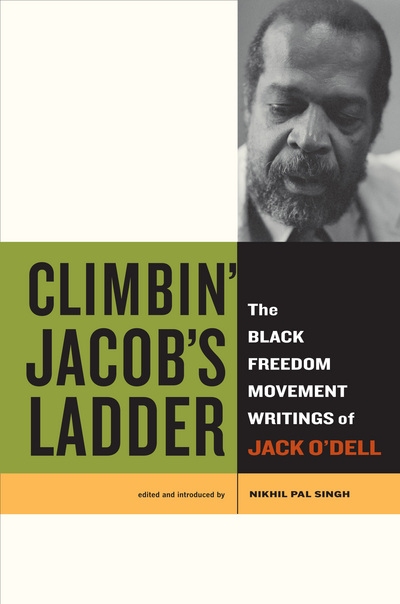
BOOKS / Paul Buhle : ‘Climbin’ Jacob’s Ladder’


Climbin’ Jacob’s Ladder:
The Jack O’Dell Story

By Paul Buhle / The Rag Blog / May 31, 2011

[Climbin’ Jacob’s Ladder: The Freedom Movement Writings of Jack O’Dell, edited by Nikhil Pal Singh (Berkeley: University of California Press, 2010), Hardcover; 298 pp., $34.95.]

Climbin’ Jacob’s Ladder is an important document in political history, even more so in exploring the intimate political and cultural history of the left so often undiscussed, or discussed only among trusted friends.

Speaking as a teacher of social movement history (the 1960s in particular), I often advised students that the simplest primary research they could do was right there on the library shelves: the bound volumes of the preeminent African American progressive quarterly journal Freedomways (1961-85).

There hangs a tale, and not a simple one. It is very much the story of Jack O’Dell, if not by any means his whole story, because he became Freedomways’ associate managing editor early on, wrote a great many of the unsigned editorials, and did much to provide its framework and its connection with the activists and political actions of the time.

A former intimate advisor to Dr. Martin Luther King, Jr., but also a member of the Communist Party during the 1950s, O’Dell represented and also exemplified the survival of what we may call the Popular Front, actually surviving repression to fight on another day.

We need some serious backstory here. Nikhil Pal Singh, one of the outstanding younger Marxist thinkers of today’s academy and an active participant in many projects, intellectual and activist alike, is the perfect editor for this volume. His Introduction provides rare insight into O’Dell’s life and work.

We can start the story with Hunter Pitts O’Dell (his birth name), a blue-collar Detroiter and then Xavier college student, along with his new friend, future New York rent-strike leader Jesse Gray. O’Dell left college to fight fascism, joining the Coast Guard in 1943 and the racially integrated, radical-minded National Maritime Union.

On ship, he read Du Bois and learned more about the complications of colonialism, communism, and the New Deal.

Coming back from the war, O’Dell enthusiastically signed up with “Operation Dixie,” the ill-fated effort to organize Southern workers, black and white, and thus to transform the most conservative region of the country. But, in the new mood of the Cold War, most labor organizations were busily going backward, and the great hopes for the South died with the purge of the CIO’s once-powerful left.

O’Dell moved into that dangerous, volatile region and quickly demonstrated his leadership skills, earning a “Citizen of the Year” award from Miami’s African-American press for his successful mediation of a racial incident in a local grocery store, turning mob rage into an effective boycott.

He got himself invited to a conference of the still-strong Southern National Youth Congress (where he met or came indirectly into contact with some leading African American militants and intellectuals, including Angela Davis’s mother, Sallye Davis).

But it was Du Bois’s address to this 1946 meeting that really hit home with O’Dell: Reconstruction had been betrayed, and now it was time for a new Reconstruction.

These were not socialistic ideas, necessarily, but they were certainly radical, and, as late as 1946, they were vitally alive among the notions within the New Deal coalition that seemed, despite the death of Franklin Roosevelt, still very strong.

Then the tide turned suddenly, and all sorts of public figures who had been treated with respect and admiration found themselves assaulted with red-baiting and, especially in the South, with black-baiting and new anticommunist laws, as well. Lynching was not quite back in style, but Northern liberals of the Truman variety did not seriously object to FBI pursuit of civil rights activists, if they happened to be tainted with “red” records.

Many prominent liberals, including Senator Hubert Humphrey and his sometime speechwriter Arthur Schlesinger, Jr., made it clear that isolation and prosecution of anything resembling sympathy for the Soviet Union — or even resistance to the Cold War machine — was a prerequisite to racial progress. Only the brave or foolish would actually join the Communist Party at a time like this.

Mark O’Dell down among the brave. And not entirely reckless in his bravery. The wider following of the Popular Front — surrounding the Communist Party but less demanding in many ways — in the South stubbornly held on in Birmingham, Alabama, Chapel Hill, North Carolina, New Orleans, Louisiana, and a scattering of other spots. O’Dell did what civil rights organizing could be done, at a time when the Alabama legislature banned the NAACP.

The pressure from authorities was severe, and arrest could come at any time, so O’Dell lived and worked under a variety of pseudonyms, moved often, met secretly with other activists, and moved on. Snagged in 1958 by the FBI at a job with a black-owned insurance company, he used his constitutional right against self-incrimination and refused to testify before the House Un-American Activities Committee, gaining almost instant notoriety as “one of the most belligerent” witnesses ever called.

Leaving the South, he joined his old pal Jesse Gray in tenant organizing and tactically took on a new first name, Jack (his father’s name). Even as the repression got to him, the ground was shifting; the Southern work of Dr. King and others had made all-out suppression of black rights more difficult. Meanwhile, leading liberals now fretted aloud that if the United States could not bring some kind of equality to its minorities, it would face rough going in a world where the new nations were mostly nonwhite, and anticolonialism translated easily into anticapitalism.

Thus O’Dell, the formal intellectual-organizer, emerged and swiftly found himself in the lead, creating, for protest sit-ins, a benefit concert — featuring the likes of Diahann Carroll, Harry Belafonte, Pete Seeger, and Sidney Poitier.

By the time the 1960 presidential campaign opened, he was asked to coordinate get-out-the-vote efforts in the Bronx for Kennedy, and soon thereafter, joined the staff of the Southern Christian Leadership Conference (SCLC). That is, close to King and not far from the FBI’s vendetta against King, which intended to unseat and replace the great leader with someone more malleable.

On the verge of becoming Executive Director of the SCLC, O’Dell was instead forced out by the pressure that Kennedy administration operatives put on King.

A new life began with Freedomways: no one wrote more often, across the next 20 years, essays and unsigned editorials alike. O’Dell was hugely valuable for his contacts with activists, artists, and intellectuals. Freedomways was a truly gorgeous-looking magazine, not large in format but slick and full of illustrations, photos, and art of various kinds. A bit like the old pre-1920 Masses magazine or the New Masses at its late 1930s peak, it also resembled the magazines and newspapers of the “New Negro” in Harlem, 1910s to 1920s, saluting black achievement and style.

To say that Communists were involved was obvious to anyone knowledgeable, and looking closely at the masthead: the editor was Esther Jackson, Southern Negro Youth veteran and wife of Communist leader James Jackson. But “Communism” rarely appeared in print here, and the real topics at hand were in the freedom struggle; likewise in antiwar sentiment and mobilization; also in varieties of Pan-Africanism, from Mother Africa to the Caribbean, United Kingdom, United States, and Canada.

It was not a Black Nationalist magazine, an aspect for which it earned considerable criticism and real hostility (Harold Cruse’s polemical attacks, famous at the time, attacked the magazine for failing to credit black capitalism), but which was also the legacy of the Popular Front.

Freedomways carried the dream of the New Deal 1940s resiliently, no matter what others might do or say.

O’Dell’s work was not confined to Freedomways, nor did it end with its demise in 1987. As a close advisor to Jesse Jackson and the PUSH organization, a member of U.S. delegations visiting sites across the troubled Third World, a key intellectual figure in campaigns, from discrediting South African Apartheid to advancing the Nuclear Freeze, he was especially key in the Rainbow Coalition and Jackson’s run for president in 1988. He decided to leave the United States shortly after, and continues his long-lived engagements from Vancouver, Canada.

By including a selection of his writings, Climbin’ Jacob’s Ladder saves much of O’Dell’s work from being left in libraries and forgotten. These essays were not shortened or excerpted: they are historical documents deserving to be understood in their own time and in ours. Each essay is carefully and tellingly introduced by Singh, who modestly takes on himself the task of explaining its context.

These essays are not easily summarized because the political and historical points are so numerous and so precise that readers are urged to take up particulars especially useful to themselves. Singh observes that Marxism is a major source of insight for O’Dell but by no means the only source; as someone wrote about C.L.R. James, his black Marxism is not an adjunct of Marxism but something different, closer to the overlap of two intimately related, but not identical, trends. Nor, of course, is it limited by what he learned in a decade or so of being in or around the Communist Party.

One crucial thing O’Dell did learn, in my view, more a product of the Popular Front than Marxist ideas or Communist interpretations: that current political wisdom always rests on a careful strategic and tactical assessment of the balance of forces. The Democratic Party, to take the obvious example, is never out of the picture — or the whole of the picture.

Understanding class, racial, and cultural dynamics of social movements offers an organic approach to how things stand and may be changed. Understanding the world picture provides the widest-angle view of the possibilities and dangers.

Thus, the essays here, and Singh’s annotations as well, illuminate a long history of American racism, its connection to slavery days and to colonialism — legacies painfully alive into the present day.

O’Dell lucidly describes the rise of the civil rights movement, and the brutal response of authorities to the late 1960s uprisings, as a second Reconstruction, and a second project to overturn the consequences of Reconstruction. Strategically, O’Dell sees the political world around the Rainbow Coalition as dangerous, but promising, territory; and the narrowing of the movement to electoral politics (worse, the seeking of foundation money to accomplish social change) as part of a downward spiral.

Is there a road back upward? In an optimistic Afterword, written in 2009, O’Dell notes the mass enthusiasm for a certain black presidential candidate. The enthusiasm was more real than the candidate, as it now appears in history’s rearview mirror. But O’Dell was shrewd enough, as always, to point to the movement of history. Things never stay the same.

[Cultural historian Paul Buhle is professor emeritus at Brown University. He publishes radical comic books and graphic novels, and is a contributor to Monthly Review, where this article was also published.]

The Rag Blog

Posted in Rag Bloggers | Tagged , , , , , , , | 1 Comment

Lamar W. Hankins : Austin-Area Funeral Homes Mislead the Public

Illustration from Third Eye Blind.

‘Compassionate care’:
Austin’s Charles Walden and
SCI funeral chain mislead public

By Lamar W. Hankins / The Rag Blog / May 31, 2011

SAN MARCOS, Texas — Austin funeral service icon Charles Walden lent his name to a misleading open letter that appeared, apparently as a paid advertisement, in the Austin American-Statesman, page A6, on May 26, 2011.

The purpose of the letter seems to be to convince Austin area readers that the five Cook-Walden funeral service locations in the Austin area are the same now as they have been for the last 100 years. Of course, this is not the case. Cook-Walden originally had just one funeral home 40 years ago. It is now owned by Service Corporation International (SCI) — the largest funeral and cemetery chain in the world.

According to the history of Cook-Walden funeral services published at its own website, in the late 1800s a funeral home was opened in downtown Austin by Samuel E. Rosengren. In 1920, Charles B. Cook purchased that business. In 1971, Charles Walden purchased Cook Funeral Home. The name was changed to Cook-Walden.

Shortly thereafter, Charles Walden bought two adjacent cemeteries in the Pflugerville area. In 1985, he bought Davis Funeral Home in Georgetown, then Forest Oaks funeral and cemetery in 1992. The two funeral homes at the Pflugerville cemeteries location and on Hwy. 183 at Anderson Mill were built more recently.

In 1997, Cook-Walden sold all of its operations to SCI. The recent open letter in the Statesman claims that in 1993 the Cook-Walden chain joined the Dignity Memorial® network (a registered service mark of SCI). But Cook-Walden could not have joined the Dignity Memorial® network until 2004 because that network did not exist until then, and that network is used only by SCI-owned facilities.

Since SCI’s purchase of the Cook-Walden chain in 1997, Charles Walden has continued to provide some consulting services, though the exact nature of his relationship with SCI is not clear. It is clear that SCI focuses mainly on making profits, which is the primary responsibility of all corporations.

If, as its ad claims, it can provide “compassionate care” in doing so, that is a benefit to families. However, it has a reputation for being extremely uncompassionate to its employees, even when those employees are trying to provide compassionate service to grieving families.

In various on-line forums, employees have long complained about working conditions at SCI. Here are some examples. In May 2011, SCI fired a Washington state employee because she helped transport the body of a five-year-old child to a cemetery after the girl’s family conducted its own home funeral. The employee failed to obtain a needed permit for the transportation of the child’s body, but this is merely a minor “paperwork” violation of state regulations.

Other former employees of SCI have posted notices on-line about their opinions of SCI (these are reproduced with typos intact as written):

“I am a funeral director and embalmer for SCI. It is a terrible company to work for, and I would discourage anyone from applying with them. The management is terrible, from the top all the way down the the location manager. You have no home life, you are expected to get the work done, but get in trouble for getting overtime hours. There is no such thing as christmas bonuses or raises in this company. You are not respected as a professional in your field. Bottom line, in my oppinion, this company cares about nothing but money. I got into this field to help people, not rob them without a gun.”

“This place is horrible! We got baught by SCI about 3 years ago and its been down hill from there. We’ve had 4 different managers. The average employee leaves within a few years. Im on my fourth year and havent even broke a dollar as far as raises. Micro-management, Micro-management. You work your ass off just to keep your job. They will suck the life out of your ability to care for grieving families. STAY AWAY!”

“I worked for this Hell Hole for 6 months…..IT’S ALL ABOUT THE MONEY….NOT THE FAMILIES!”

“I also worked for this company. When Alderwood was bought out by SCI I thought all of these big box companies were alike. I found out how wrong I was. The families were served no longer mattered. I was expected to put in as many hours as it took to do my job, with not compensation for the overtime, and once worked 2 1/2 months without a day off. As the only director/embalmer at my location, I was responsible for every aspect of the funeral from first call to burial alone. I wasn’t even allowed to hire out the night time removals and was accused by my market manager of being too lazy to get out of bed at 3 am to take a call. I don’t care how much money they pay… I would never go back.”

These mostly anonymous posts may be viewed as biased or dishonest, but they are in line with the reputation of SCI that I have heard for the last 15 years. I would not suggest that all the claims made in Charles Walden’s open letter and advertising are false, but many of them are.

Given the personal experiences that I have had with SCI on behalf of my family and others, it is difficult for me to accept that SCI provides “world-class services” or offers “the best value.” Without question, the Dignity Memorial® network has not served “the Georgetown Community for 100 years” as claimed in Charles Walden’s advertisement for SCI.

I am sorry to see Charles Walden allowing himself to be used in such a dishonest way. The only time I recall having contact with him, he was courteous and forthright. He used to have a reputation that such corporate puffery belies.

Local families who need to plan a funeral would be wise to ignore SCI’s self-promotion and shop around. There are many good and fair-priced funeral services available in the Austin area. Cost comparisons are made simple by the annual survey of funeral costs published by AMBIS — the nonprofit Funeral Consumers Alliance affiliate serving central Texas. The 2011 survey can be found online here.

Be sure to read both the narrative and the chart to understand what services are being described.

For example:

  • While some SCI funeral homes charge as much as $2800 for Direct Cremation, that identical service is available for as little as $775 by another funeral home. From personal experience, I can say the lower-cost funeral home gives just as high a quality of service as the most expensive SCI funeral home.
  • For a full-service “traditional” funeral, a family can pay some SCI funeral homes as much as $10,860, while several other funeral homes charge $2,000 to $6,000 less for the same thing.
  • Four SCI funeral homes charge $4,295 for their basic service fee (making arrangements, coordinating with others, and covering overhead costs), while some competitors charge as little as $525 for that service . Likewise, some SCI funeral homes charge $1,395 for embalming (an optional service, not required by law), while others charge as little as $425.

Families have a choice in the Austin area market. With a little research, anyone can find reasonably-priced alternatives to price-gouging. While funeral shopping at a time of grief is no fun, it can be less onerous if you know where to look for information and advice. It’s even better to make these decisions and compare costs ahead of time.

But it is seldom necessary to pay ahead of time. You can set aside funeral funds in a pay-on-death account that names a recipient who will use the money for your funeral upon your death, or you can name a beneficiary of other investments who can use the proceeds for funeral arrangements. You can beat the high cost of dying if you choose to do so.

[Lamar W. Hankins, a former San Marcos, Texas, city attorney, is also a columnist for the San Marcos Mercury. This article © Freethought San Marcos, Lamar W. Hankins. Read more articles by Lamar W. Hankins on The Rag Blog.]

The Rag Blog

Posted in Rag Bloggers | Tagged , , , | 1 Comment

Clancy Sigal : Resisting War Takes Guts

“No More War!” Art by Iván Lira /MRZine.

In our war-loving society:
Conscientious resistance takes guts, bravery

By Clancy Sigal / AlterNet / May 30, 2011

War will exist until that distant day when the conscientious objector enjoys the same reputation and prestige that the warrior does today. — John F. Kennedy

I lost a friend recently with whom I’d grown up. As adolescents, we’d shared enthusiasms, and death-defying leaps into Lake Michigan off the Adler Planetarium, and chased the same girls. He had a puckish sense of humor, sometimes ghoulish, the kind of stuff you laugh at only when you’re 15.

He could crick his neck with a loud snap, as if being hanged from a gallows, a party trick that revolted grownups but we thought hilarious. He could pick out a tune on a banjo on first hearing and sing political parodies of pop songs. As we grew up, we shared a history, not only of our acne-scarred, ego-obsessed selves, but something broader and deeper I best call anti-fascism.

We ran wild in the streets of Chicago itching for showdowns with anyone who disagreed with us — we were young Communist-fronters and couldn’t wait to enlist or be drafted. In the middle of the second world war, it was patriotic to be a red — “communism is 20th-century Americanism,” went the slogan.

Passion, not cynicism or detachment, was our deal.

With his death, I’ve lost a big part of the thread, a connection to the original meaning of things. I’m not alone in this broken thread on Memorial Day.

If you’re in the United States while reading this, try a little test: ask someone, anyone, what Memorial Day memorializes? I’ve queried several friends and none could tell me that Memorial Day, once called “Decoration Day,” began in the aftermath of the civil war to honor the more than 600,000 dead Confederate and Union soldiers — the deadliest war in U.S. history.

Once, Memorial Day was a fairly solemn occasion when local communities lowered the courthouse flag to half-mast in salute to the “fallen,” with jamboree parades to follow. In the 1960s, Congress changed the date to the last Monday in May so that people might have an extra day off on the weekend. Hence the current barbecues and shopping mall mania — and national amnesia.

Except for the boy and girl Scouts, who still place little American flags on grave sites in our veterans’ cemeteries, like the one almost within sight of my house, and a few soldiers’ and sailors’ relatives who come to visit, the original meaning of it has fallen into dust.

Curious, this. Because the publishing industry continues to pump out torrents of civil war books to feed a niche audience with pop biographies of bearded generals and Pickett’s charge-type battle studies. Historians continue to debate the core cause of the war, and movies get made like Glory, Gettysburg, Cold Mountain, and Robert Redford’s recent The Conspirator.

No matter, most of us like to go on a Memorial Day shopping spree, warm up the coals, pull out the cooler and slap shrimp tacos on the broiler.

I don’t care how Memorial Day is spent, whether in a relaxed holiday mood or a visit to the dead. I’ve walked through the military graves at my nearest military graveyard, the 114-acre national cemetery near UCLA with its huge adjacent Veterans Administration hospital and old soldiers’ home, full of sick and traumatized ex-combatants, and a homeless encampment of veteranos under the 405 freeway, a grenade’s throw away from cemetery where some of their buddies lie under white crosses or stars of David.

Meaning no disrespect, but on this “war heroes’ weekend,” isn’t it time to also honor those who have “fallen” in a different battle — against the slaughtering wars?

Over time, my attitude to conscientious objectors and deserters has shifted. Once, I held them in contempt. But the Vietnam war, when I came into contact with war resisters, changed me. I saw then, and see now, that often it takes a different kind of moral and, yes, even physical courage to resist a call to serve your country in a war you believe is a crime, when all your family, friends, teachers and the vast American majority support joining up.

When I was called to my war, I went with shining eyes and revenge in my heart and couldn’t wait to get my hands on a .30-calibre machine-gun to wipe out those Nazi bastards.

But what about those “cowards,” “traitors,” and “slackers” who don’t want to kill other people? They’re an odd breed who count among their number such as Muhammad Ali, Mahatma Gandhi, Sergeant York, David Hockney, three U.S. weapon-refusing combat medics who won the medal of honor, and the 27 Israeli air force pilots who refused orders to “track and kill” civilians in Gaza and the West Bank.

I continue to be amazed at the stupendous bravery of any currently serving soldier or marine who goes out on foot patrol in Afghanistan knowing beforehand that his command — after spending $20 billion on an “anti-IED” project — still has no clue how to protect him from a cheap roadside bomb that causes 80% of our casualties. (On Wednesday, seven Americans on a single patrol were blown up and killed by an IED in Kandahar province.)

But what kind of guts does it take for war objectors, whether they’re Quakers, Jehovah’s Witnesses, Mennonites, or secular, who simply don’t want to kill?

On this Memorial Day, it might be a time to think about the outcasts who refuse to take life.

[Clancy Sigal, is a screenwriter and novelist in Los Angeles. Chicago-born, he has worked precincts for Democratic candidates since his teens. He emigrated to the UK during what David Caute calls the “Great Fear” and returned to America after the 1984 miners’ strike. He is a reformed Fleet Street journalist. This article was distributed by AlterNet.]

The Rag Blog

Posted in RagBlog | Tagged , , , , | 1 Comment

Scott Kimball and Aaron Hughes : Ft. Hood: ‘On Watch’ for Traumatized Soldiers

Memorial Day:
Ft. Hood ‘Watchtower’ on lookout
for mistreatment of soldiers with trauma

By Scott Kimball and Aaron Hughes / The Rag Blog / May 30, 2011

FORT HOOD, Texas — Members of Iraq Veterans Against the War (IVAW), and representatives from Under the Hood GI Outreach Center and Café, erected a three-story watchtower outside Ft. Hood’s East Gate.

“We put up this guard tower to announce that we are putting General Campbell [Lt. Gen. Don Campbell Jr.] on watch for mistreatment of traumatized soldiers. As Third Corps commander, he is now accountable for the treatment of all the soldiers under his command,” said Malachi Muncy, Under the Hood intern and member of IVAW. “This is how we are remembering our brothers and sisters for Memorial Day, by fighting for their right to heal.”

The veterans took turns standing guard on the tower while others handed out purple ribbons to soldiers heading into the East Gate.

“We are asking people to wear the ribbons this Memorial Day in remembrance of the service members we lost to suicide as well as those who are suffering from military sexual trauma, post traumatic stress disorder, and traumatic brain injury” said Sergio Kochergin, member of IVAW and Disabled American Veterans.

Operation Recovery, a campaign led by Iraq and Afghanistan veterans, calls for an end to the deployment of service members who have been diagnosed with trauma. The Operation Recovery campaign has been attempting to meet with General Campbell for over a month, sending certified letters and over 600 emails from supporters urging Campbell to meet with the Operation Recovery organizers at Ft. Hood.

According to representatives from IVAW, General Campbell has not responded to these requests.

On Wednesday, May 25, members of the Operation Recovery team went to Third Corps headquarters in an attempt to meet with Campbell. The organizers were turned away and questioned by security officials about their presence on post.

“We went to Third Corps with the hope that General Campbell would meet with us so that we could hear his plans for making changes at Ft. Hood. Instead, we were denied a meeting and questioned by the MPs,” said Kyle Wesolowski, manager of Under the Hood and member of IVAW.

The team was able to hand deliver a letter that listed Operation Recovery’s specific requests to one of Campbell’s aides. In the letter, the organizers requested a meeting with Campbell as well as information regarding Ft. Hood’s treatment of soldiers with trauma. The letter states specific demands including a threefold increase in the number of healthcare providers, mirroring the same increase in suicides at Ft. Hood last year.

The Operation Recovery campaign team chose Ft. Hood as their base of operations because of its reputation as the post with the highest suicide rate. The Army’s official suicide count for Ft. Hood last year was 22, nearly twice as many suicides as any other post.

“We are now holding General Campbell accountable for each and every suicide under his watch,” said Aaron Hughes, former sergeant, Iraq veteran and the Field Organizing Team Leader for IVAW. “Furthermore, we hold him responsible for every soldier under his command who is forced to deploy with military sexual trauma, traumatic brain injury, or post traumatic stress disorder.”

Members of Ft. Hood’s mental health care staff are burdened with over 4,000 patients every month. The veteran organizers feel that this and other statistics support their claim that mental health care at Ft. Hood is subpar.

“The Ft. Hood command is providing inadequate care for its soldiers,” Said Scott Kimball, veteran of the Iraq War and an Operation Recovery organizer. “As of last year, there was only one counselor for all military sexual trauma cases on Ft. Hood. Current Army-wide statistics report that one in three women in the military report sexual assault.”

According to reporting from the San Antonio Express News, Ft. Hood spokesperson Chris Haug claimed that Campbell would respond when the organizers “are ready for a two way conversation.”

“We are ready and have been ready. This is what we have been asking for, an opportunity to sit down with General Campbell to help him understand the seriousness of these issues and what he can do right now to combat suicides and provide the care his soldiers deserve,” said Wesolowski.

[Scott Kimball is an organizer for Operation Recovery and Aaron Hughes is a field organizer for the Iraq Veterans Against the War. Operation Recovery is a national effort led by IVAW to stop the deployment of traumatized troops and the abuse of troops’ right to heal. For more information, go here.]

The Rag Blog

Posted in Rag Bloggers | Tagged , , , , , | 1 Comment

Type your summary here

Type rest of the post here

Source /

The Rag Blog

Posted in RagBlog | Leave a comment

Arlene Goldbard : Remembering Gil Scott-Heron, 1949-2011

Gil Scott-Heron. Image from Electronic Village.

The revolution will not be televised:
Remembering Gil Scott-Heron

By Arlene Goldbard / The Rag Blog / May 29, 2011

Gil Scott-Heron (1949-2011) died on Friday, and that is a sad, sad sentence to write. If you are familiar with his music, then you know what I’m talking about; and if you’re not, you can begin to remedy that by following the links in this essay. (Listen to the beautiful “Rivers of My Fathers” from 1974′s Winter in America to start your journey.”)

Looking for a way
Out of this confusion
I’m looking for a sign
Carry me home
Let me lay down by a stream
And let me be miles from everything
Rivers of my Fathers
Can you carry me home
Carry me home

I’m listening right now, as I write, to the half-dozen of his songs that stick the hardest to my memory, and there is a certain irony in the word that comes to me when I hear them: Scott-Heron’s music is elegiac.

A mournful spirit permeates his work, whether a particular piece of music is bitingly funny, angry, cautionary, yearning, or — as so much of his music was — cinematic in its expressive storytelling and narrative sweep. What was Scott-Heron mourning all his life? So many answers rise to their feet, waving their hands to be noticed: racism, injustice, the glut of wasted lives in a society that has forgotten what is really of value…

But really, I think it was the chasm that divides what is from what could be, because Gil Scott-Heron was one of those artists who could see both so clearly, heart breaking the whole time, and make something beautiful out of the heartbreak.

Scott-Heron’s intellect and insight shone like beacons, beginning with his first recordings. His life story suggests that his promise was seen early on: a teacher at DeWitt Clinton High School in the Bronx used Scott-Heron’s writing to help obtain a full scholarship to The Ethical Culture Fieldston School, a politically and educationally progressive institution founded in 1878 — where Scott-Heron was nevertheless one of five African American students out of 100 in his class.

Tons of high achievers in the arts and academia attended Fieldston, from photographer Diane Arbus to Sixties activist Staughton Lynd to poet Muriel Rukeyser, composer Stephen Sondheim, and Hollywood mogul Jeffrey Katzenberg. He was a prodigy: by his early twenties, Scott-Heron had already published several books and made several albums.

His breakthrough recording was “The Revolution Will Not Be Televised” in 1970 (he was 19 when he wrote it), less a song and more of what would later be called a rap, a satiric spoken-word monologue excoriating the media culture that had already taken hold of so much public space in this country:

You will not be able to stay home, brother.
You will not be able to plug in, turn on and cop out.
You will not be able to lose yourself on skag and skip,
Skip out for beer during commercials,
Because the revolution will not be televised.

Scott-Heron’s 1974 album Winter in America, co-created like much of his earlier work with Brian Jackson, sees this nation’s demise inscribed in its origins, as the title song describes:

From the Indians who welcomed the pilgrims
And to the buffalo who once ruled the plains
Like the vultures circling beneath the dark clouds
Looking for the rain

Just like the cities staggered on the coastline
Living in a nation that just can’t stand much more
Like the forest buried beneath the highway
Never had a chance to grow

In “The Bottle,” from the same album, carried along on an equally lyrical and lovely tune, the artist speaks directly of the plague of addiction that shaped much of his life and the lives of so many others.

The 1977 recording included “We Almost Lost Detroit,” Bridges about an early nuclear power accident, and was revived as part of the 1979 No Nukes Concert album.

Through the Reagan years and beyond, Scott-Heron kept recording (often other writers’ songs), but the bulk of albums released during the 90s were anthologies and collections of prior recordings. He spiraled into addiction, was jailed twice in his fifties for cocaine possession, and according to profiles in The New Yorker and other publications, he was still smoking crack, half out of his mind with drug-induced paranoia, in recent months. Photographs from the last decade show a skeletal figure, and we know from published accounts that he’d lost his teeth, his composure, and his health to addiction.

“Don’t Give Up,” from the 1994 album Spirits, gives a hint of his story in his own words:

I never really thought of myself as a complex man,
Or as someone who was really that hard to understand.
But it would hardly take a genius to realize
That I’ve always been a lot too arrogant and a little too fuckin’ wise
That was a combination that made folks feel duty bound,
To do whatever they could to try and shoot me down.

This is where the temptation rises to say something facile about the cruelty of the world and the toll it takes on those whose hearts and eyes are open and who hold their heads high.

It’s not that it wouldn’t be true, but it wouldn’t be the only truth, or even the one most worth repeating. The confounding thing about human beings is that — given talent, heart, eyes to see both the beauty and suffering of the world, even those given circumstances that may differ very little, each from the other — some people prosper and some succumb.

Along with the many mysteries of human resilience that station each of us in an appointed place on the spectrum of joy and pain, endurance and embrace, we have this: the artists whose great gifts for beauty and meaning add immeasurably to the texture of life, to our ability to feel it, and whose gifts cannot save them from self-destruction.

So I will just offer thanks for Gil Scott-Heron’s life and work, for his unparalleled ability to braid lovely and sinuous music with knife-sharp lyrics, for his legacy, and for the perseverance that kept him creating, against the odds, for 62 years.

Here is Scott-Heron’s truly harrowing version of Robert Johnson’s song (written in the mid-1930s), “Me and The Devil,” from the album he released last year, I’m Still Here.

[Arlene Goldbard, a writer, speaker, and social activist, is chair of the board of The Shalom Center. Her website is ArleneGoldbarb.com.]

Thanks to Rabbi Arthur Waskow / The Rag Blog

Posted in Rag Bloggers | Tagged , , , , | Leave a comment