Margarita Alarcón : Obama sans Osama

Obama sans Osama:
Now let’s see some ‘hope’

By Margarita / The Rag Blog /

I was on my way to the beach on Monday afternoon when I heard the news this week. I have no internet at home and had managed to skip watching the news during the four day holiday weekend.

The two adults in the car with me mentioned that Osama bin Laden had been caught, shot, and dumped in the ocean all in one brief brush stroke, choreographed by what I imagined were the elite of the elite of the SWAT teams we can only begin to imagine at the cinema.

My first thought? Cuba, of course. For anyone not familiar with Cubans, we always think about ourselves first. It’s a complex reality, but Cubans actually believe the world revolves around them on all levels, so if we emigrate, we are the most important émigrés, if we dance we are the best dancers, if we win we are the utmost winners, if we help we are the handiest helpers; you name it, we’ll the be at the core of it.

So of course, my first thought went to the island. And the thought was: “Now Obama is like a God! He can break the embargo, establish relations, even free the Cuban Five and nobody is gonna mess with him! He got the guy that has been on the FBI´s top 10 most wanted list for the past decade!” My mind was roaring at warp speed, faster than the cars or the waves around me. The conversation in the car had already taken a turn to baseball and the national finals and I was still in my soap opera daydream… Sigh….

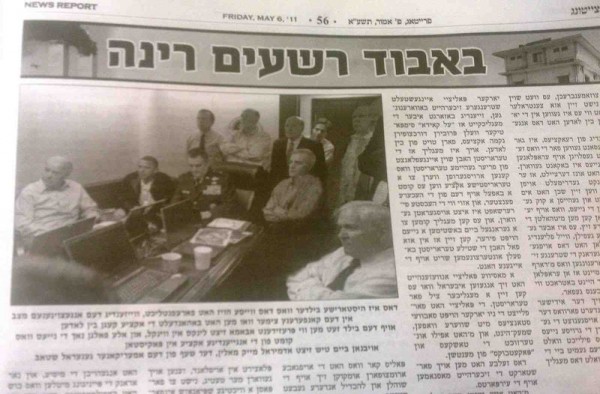
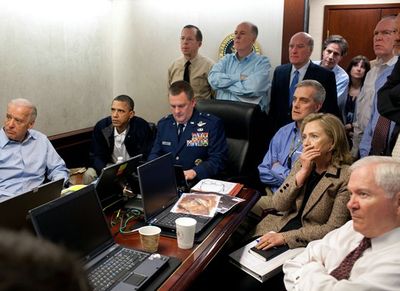
There are no photos; there are no gory images of proof to be seen. There is only the word of the U.S. government to rely on. You know what? Whether we see horrid pictures or not, if the U.S. says he’s out then I’m going to bet he’s out of the picture; whether he is dead or not is of no importance; what is important is that he do no more harm and even more important that others don’t continue in his legacy of hatred.

The candidate of Hope…

President Obama has taken a first step in what should be the path of his true legacy; a president of hope. And since I am Cuban, I have to garner the hope that one more of his steps will be to let the underlying principle of peace and justice reign in this hemisphere. Open up travel Mr President, reestablish relations with all in the hemisphere, and please send back the Cuban Five.

[Margarita Alarcón Perea was born in Havana, Cuba, and raised in New York City. Maggie’s father is Ricardo Alarcón, president of the Cuban National Assembly. She is currently a news analyst for Cubadebate in Havana and contributes to The Rag Blog and The Huffington Post. She also posts at ajiacomix. Read more of Margarita Alarcón’s articles on The Rag Blog.]

The Rag Blog
Posted in RagBlog | Leave a comment

Lamar W. Hankins : A Grave Injustice in Groves, Texas

Graveside greed: Service Corporation International’s Greenlawn Memorial Park in Groves, Texas

Grave injustice:
The rapacious ways of
Service Corporation International

By Lamar W. Hankins / The Rag Blog / May 4, 2011

For the second time since 2000, I have encountered the unrelenting greed of Service Corporation International (SCI). In 1960, my parents, Herman and Arthur Mae “Smitty” Hankins, bought four plots in Greenlawn Memorial Park, a cemetery located in Groves, Texas, adjacent to Port Arthur, where I grew up. Around 1998, SCI acquired the cemetery from the family that had owned it for 100 years.

In 2000, after the death of my younger brother, his cremated remains were buried in one of the plots with the approval of Paul Pond, cemetery manager, and Craig McGee, the Area Manager for SCI at that time. Their approval came only after a prolonged negotiation made necessary by the desire of SCI to extract the most money possible out of every opportunity, often by relying on its own policies.

Most cemeteries, especially corporate ones, reserve the right to change their policies — as reflected in their rules and regulations — at any time. When they do so, the changes often cost families more money and thereby enhance the profits of the corporation.

My brother’s cremated remains were encased in a tube made of PVC pipe sealed on both ends with PVC end caps. My family and some friends held a family-planned and family-directed graveside service, during which my father, an uncle, a cousin, and I took turns digging an appropriate-sized hole with a post hole digger, then lowered the capsule into the hole with a specially-designed bag that I fashioned out of macrame materials that my brother had used to make craft items.

My mother and father (as well as the rest of the family) found the graveside service meaningful and advantageous to them in dealing with their grief. The participation by several family members in the service gave it meaning that it would not have had with the involvement of funeral or cemetery professionals.

My mother and father have now died. When I was in the Beaumont-Port Arthur area on February 25, preparing for my father’s memorial service at Wildwood-Village Mills United Methodist Church held the next day, my wife and I visited with John Davis at Greenlawn to explain that I wanted to make preparations for a similar service for the interment of the cremated remains of both my parents, which are contained together in a container similar to the one I made for my brother’s cremated remains.

John Davis’s initial reaction was that my family’s wishes could not be fulfilled, but he agreed to talk with his supervisor about the matter and call me back within the hour and to provide information, as well, about the cost of a monument for my parents’ gravesite.

When I received no call back from him for four days, I called to find out why I had not received the information I had requested about the service and the cost of a monument for my parents.

I was unable to reach him and got the name of his supervisor, Mark Root. He and I talked by telephone on March 2nd. Root told me that in order to bury my parents’ cremated remains together, I would have to pay a second interment fee because this was required by the Texas Department of Banking, a statement I knew was false, and I told him so.

In addition, Root told me that the Department of Banking does not permit interment of cremated remains in a PVC container, nor do SCI rules. The latter statement I agreed with, but I knew the statement about the PVC pipe and the Banking Department was false. I told Root that I was going to contact the Department of Banking about his statements, which I did right after our discussion.

I called Russell Reese at the Department of Banking, the Director of Special Audits for Prepaid Funeral Contracts and Perpetual Care Cemeteries, and relayed the conversation with Mark Root. Mr. Reese said he would immediately call Mark Root to correct his misrepresentations of Banking Department regulations.

In addition to charging an extra interment fee, SCI required that my family buy an urn vault, an outer burial container made of polystyrene or some similar material, and they wanted to charge me to dig a hole in which the urn vault would fit, an “opening and closing fee” as it is called. Together, all charges would be $3,760, in addition to the cost of the granite marker. All of these charges were based on rules that did not exist when my parents bought the plots.

I have been a funeral consumer advocate for the past 18 years on behalf of the Austin Memorial and Burial Information Society, the Funeral Consumers Alliance (FCA) (which I served as a board member for nearly eight years, four of which were as president), and the Funeral Consumers Alliance of Texas.

During my service as president of the FCA Board, I testified at a hearing held by the U.S. Senate’s Special Committee on Aging that was investigating fraud in the preneed funeral and cemetery business. Over the years, I have worked closely with the Texas Funeral Service Commission and the Banking Department on issues of common concern, so I am not completely ignorant about funeral and cemetery regulations.

The false representations made to me by Mark Root leave me wondering how many misrepresentations, distortions of federal and state regulations, and outright lies are told by cemetery personnel to families who are not as knowledgeable about such matters as I am when they go to SCI to make arrangements for the interment of their family members.

I would like to resolve the needs and preferences of my family amicably with SCI, but the inexcusable deceit, hostility, and evasion that I have encountered to simple requests that create no liability or demands on its cemetery or its corporation lead me to believe that SCI’s greed is the only force that drives its corporate policies and the behavior of its employees.

On March 10, I spoke by telephone with Scott Leffler, another SCI official, about this matter. He was unwilling to give permission for my family to follow their traditions and wishes regarding the interment of my parents’ cremated remains, though he did say that he would speak to Mr. Root about his false statements that I have reported.

On March 10, 2011, I wrote to Jim Kriegshauser, Managing Director for Funeral and Cemetery Services for SCI’s region that includes both the Austin area and the Beaumont-Port Arthur area. His office is in Spicewood, Texas, located between Marble Falls and Austin. I told him in the letter that I would like to discuss these matters with him. To date, he has not replied.

My parents never imagined 50 years ago that their thoughtful advance planning and payment for four gravesites would one day lead to their oldest son’s being forced to deal with a corporation as avaricious, insensitive, indifferent, and callous to the needs of families as is SCI.

This is a corporation, headquartered in Houston, that spends tens of thousands of dollars each year to ensure that the Texas Legislature does nothing to prevent its continuing exploitation of Texas families. Everyone should be aware that if they choose to do business with SCI, they will be contributing to SCI’s abuse of families everywhere.

[Lamar W. Hankins, a former San Marcos, Texas, city attorney, is also a columnist for the San Marcos Mercury. This article © Freethought San Marcos, Lamar W. Hankins. Read more articles by Lamar W. Hankins on The Rag Blog.]

The Rag Blog
Posted in Rag Bloggers | Tagged , , | 3 Comments

Rabbi Arthur Waskow : Do We Rejoice in Death?

Do we rejoice in death? Photo by Matt Sunday / AP.

Bin Laden and beyond:
Addressing our higher selves

By Rabbi Arthur Waskow / The Rag Blog / May 3, 2011

How might we appropriately address the death of a mass murderer?

The Torah describes Moses and Miriam leading the ancient People Israel in a celebratory song after the tyrannical Pharaoh and his Army have been overwhelmed by the waters of the Red Sea. Later, the Rabbis gave a new overtone to the story: “The angels,” they said, “ began to dance and sing as well, but God rebuked them: ‘These also are the work of My hands. We must not rejoice at their deaths!’ “

Notice the complexity of the teaching: Human beings go unrebuked when they celebrate the downfall and death of a tyrant; but the Rabbis are addressing our higher selves, trying to move us into a higher place. (The legend is certainly not aimed at “angels.”)

Similarly, we are taught that at the Passover Seder, when we recite the plagues that fell upon the Egyptians, we must drip out the wine from our cups as we mention each plague, lest we drink that wine to celebrate these disasters that befell our oppressors.

I myself would have been a lot happier to see Bin Laden arrested to stand trial, but assuming the report that he violently resisted arrest is true, I have no objection to his having been killed.

Yet I was dismayed by the quasi-sports-victory tone of the celebrations that arose around the country — chanting “U-S-A, U-S-A,” for instance.

What I myself felt was more like “sad necessity” — and I would have preferred a mournful remembrance of the innocent dead of the Twin Towers and of Iraq and Afghanistan — a thoughtful reexamination of how easy it is to turn abominable violence against us into a justification for indiscriminate violence by us.

Can we now say, “Enough, enough!” — refuse to drink the intoxicating triumphalist wine of celebration, and turn our attention and commitment to ending these wars that take on a deadly “life” of their own?

With blessings of shalom, salaam, peace…

[Rabbi Arthur Waskow is director of The Shalom Center. He is co-author of The Tent of Abraham: Stories of Hope and Peace for Jews, Christians, and Muslims; author of Godwrestling, Round 2 and Down-to-Earth Judaism; and editor of Torah of the Earth. Read more of Rabbi Arthur Waskow’s articles on The Rag Blog.]

The Rag Blog
Posted in Rag Bloggers | Tagged , , , | 3 Comments

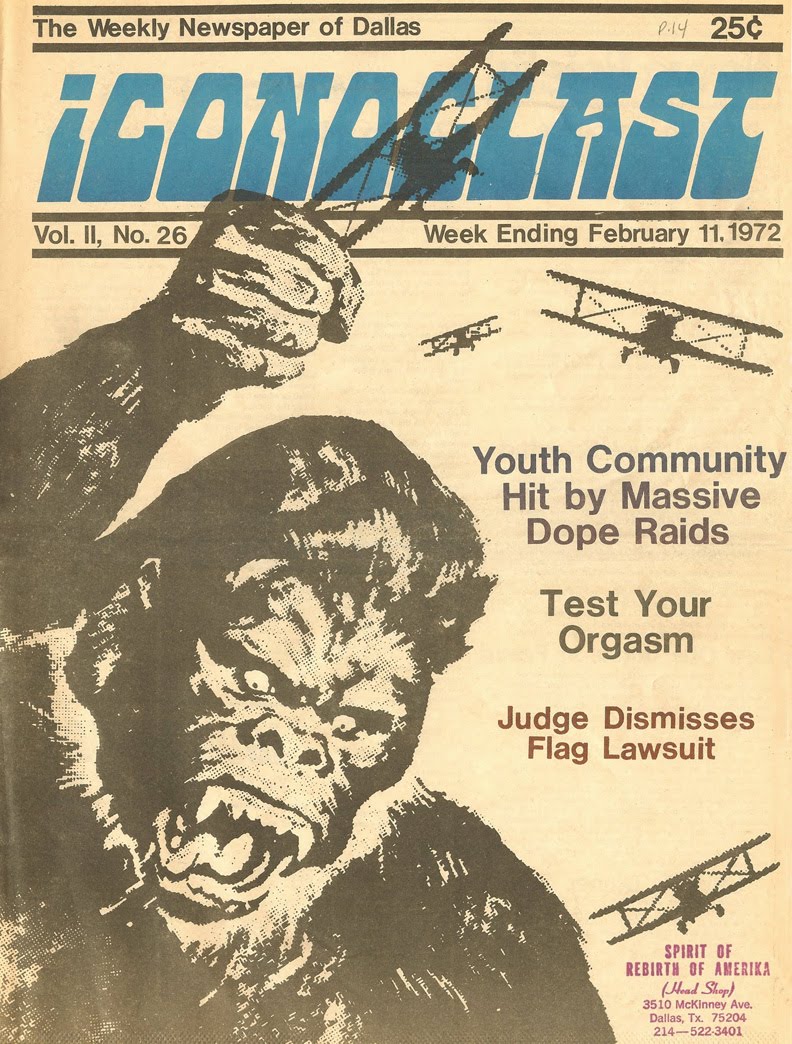
Stoney Burns, a Sixties icon who was a pioneer in the underground press in Texas, died of a heart attack in Dallas on April 28, 2011, at the age of 68. Burns, who was called “King of the Hippies” by some, started several alternative publications including Dallas Notes, the Iconoclast, and the music paper, Buddy. Burns — a colorful figure with an anarchic style — was incessantly harassed by the Dallas authorities, who charged him with obscenity, beat him mercilessly, tore up his offices, and confiscated his equipment — and eventually busted him for a joint’s worth of pot (though his 10-year-and-a-day sentence was later commuted).

Posted in RagBlog | Leave a comment

Tom Hayden : On Bin Laden and Searching for Monsters

Seeking monsters to destroy. Image from Slog.

Searching for monsters:
Bin Laden is dead, but will
the ‘Long War’ on terror live on?

By Tom Hayden / The Rag Blog / May 3, 2011

John Quincy Adams long ago urged that American foreign policy should be based on the principle that “she goes not abroad in search of monsters to destroy.”

The killing of Osama bin Laden is a triumphant moment for President Obama and the CIA, allowing a symbolic claim to victory in the War on Terror, bringing an understandable feeling of closure for the victims of 9/11, and it will almost certainly assure the President’s re-election in 2012.

But as I wrote in The Nation in October 2009, however, the death of bin Laden is not likely to end the Long War on Terror, now spreading from Iraq to Afghanistan, Pakistan, Yemen, and a dozen other theaters of counterterrorism.

If bin Laden is gone, and his network heavily damaged, what is left of the terrorist threat to our national security that justifies so many trillions of dollars and costs in thousands of lives?

Because of a fabricated fear of bin Laden, we invaded Iraq. The invasion of Afghanistan was to deny sanctuaries to bin Laden and Al Qaeda. In response, Al Qaeda moved into Pakistan, where bin Laden was killed on May 2.

So why are the Taliban in Afghanistan a threat to the security of the United States with bin Laden gone? Surely there are terrorist cells with lethal capacity scattered around the world, surely there might be revenge attacks, but there is hardly a centralized conspiratorial threat that justifies the deployment of hundreds of thousands of American troops.

Now we shall learn whether there is another agenda that keeps 150,000 American troops in Afghanistan and Iraq.

John Quincy Adams long ago urged that American foreign policy should be based on the principle that “she goes not abroad in search of monsters to destroy.”

As history turned out, however, our governments have identified and defined many monsters, from Crazy Horse and Geronimo on to the present. The underlying theory has been that demonic conspirators provoke, lead, and manipulate insurgent movements, and that silencing them will end the threat.

The example of Che Guevara is instructive. Detected, hunted, captured, and killed by Bolivians accompanied by the CIA in October 1967, Che was transformed in death into a global symbol of rebellion. His spirit continues to be alive today all over Latin America, and indeed the world. It can be argued that Che’s impact became greater in martyrdom than during his guerrilla campaigns in Africa and Bolivia.

So it could be with the myth of Osama bin Laden. It may depend on whether the U.S. moves away from the War on Terrorism model to more active support of the youthful social revolution sweeping the Arab world today, which has already surpassed Al Qaeda in its scope and momentum.

[Tom Hayden is a former California state senator and leader of Sixties peace, justice, and environmental movements. He currently teaches at Pitzer College in Los Angeles. His latest book is The Long Sixties.This article was also posted at The Nation and was distributed by Progressive America Rising. Read more of Tom Hayden’s writing on The Rag Blog]

Also see:

The Rag Blog

Posted in Rag Bloggers | Tagged , , , , , | 1 Comment

BOOKS / Jonah Raskin : Wachsberger’s ‘Insider Histories’ of the 60’s Underground Press

Keeping the Sixties alive:
Ken Wachsberger’s ‘Insider Histories‘ are
passionate essays about the underground press

By Jonah Raskin / The Rag Blog / May 3, 2011

[Insider Histories of the Vietnam Era Underground Press, Part I, edited by Ken Wachsberger; (Michigan State University Press); Paperback; 398 pp.; $39.95.]

Let me say from the start that this is the most thorough and comprehensive book in print about the underground newspapers of the 1960s. Ken Wachsberger, the editor of the volume, sees the papers of the Vietnam Era as the forerunners of today’s radical blogs and so he means his book to be relevant for the current generation and it is indeed greatly relevant to today.

The authors of the essays — there are 14 of them — are almost all survivors of the Vietnam Era, and all of them are veterans of the underground papers. So, the book lives up to its promise to offer “insider histories.” No one could have written essays so passionate about the 1960s as those who lived the 1960s, and no one could have had memories as rich as these.

Victoria Smith (Holden), the author of the last essay in the book, died in 2008. Her essay is especially rigorous and offers a complex analysis of why the underground newspapers rose quickly and then fell quickly. Rather than summarize her in-depth criticism and self-criticism, I urge readers of The Rag Blog to dive into it for themselves.

Smith writes about Space City!, Houston’s countercultural paper, but many of her ideas apply to papers in other parts of the country that found themselves the victims of their own success. It wasn’t repression from the established order that ended Space City!, according to Smith, but rather the internal politics and philosophy of the paper itself.

Many of the underground papers ascribed to the notion of “permanent revolution,” and no newspaper can long function with that outlook on life. Some — perhaps even a great deal — of stability and order is essential to meet deadlines and publish on schedule.

All of the essays in Wachsberger’s volume are immersed in history and are intellectually vigorous. Reading them feels like being thrown back into the 1960s itself. Suddenly an essay will take one back to June 1967, or August 1969, and so the book as a whole feels vivid, immediate, and intense. It’s a real case of déjà vu.

The wealth of details is truly remarkable: not only dates, names, and places, but also the kinds of arguments that took place at meetings are vividly recalled. Moreover, the essays trace the month-by-month changes that took place in the political and cultural arena in the 1960s. With so much turmoil and upheaval, it is amazing that the underground papers were published as regularly as they were.

I think that Wachsberger’s book will be most valuable to those who want to keep the Sixties alive today as well as to those who weren’t alive in the 1960s but wish they had been there. Wachsberger’s fine anthology will transport them back to the offices of The San Francisco Oracle, The Great Speckled Bird from Atlanta, and to feminist papers like Off Our Backs.

There are superlative essays about Muhammad Speaks, the newspaper of the Black Muslims, and Akwesasne Notes, the newspaper of the Mohawk Nation that, according to author Doug George-Kanentiio, not only reflected the era but also “shaped contemporary Native America.”

There are also essays about The Guardian, which often seemed to be a part of the Old and not the New Left, and about Liberation News Service (LNS) that served as an alternative to the Associated Press (AP) and United Press International (UPI).

Harvey Wasserman, the author of the piece on LNS and a contributor to The Rag Blog, writes with much of the verve of the 1960s. “LNS was a joyous, thrilling, uniquely powerful rocket ship we got to ride, as a blessing of youth and of the rare brilliance of the time” he exclaims. “May we never lose the essential magic and humanity.”

Almost all of the essays in this book capture the innocence of youth in the 1960s, and the unusual historical brilliance of the era. There are trenchant criticisms here, but they are rarely petty or spiteful.

Wachsberger’s wonderfully alive and lively book is scheduled to be followed by three more volumes about the underground press, and so the series as a whole promises to be the definitive work on the subject of the underground press, at least for our time.

[Jonah Raskin is a professor at Sonoma State University and the author of For the Hell of It: The Life and Times of Abbie Hoffman. Read more articles by Jonah Raskin on The Rag Blog.]

Also see:

The Rag Blog

Posted in Rag Bloggers | Tagged , , , , , , , | 2 Comments

Thorne Dreyer / James McEnteer : Dallas Underground Icon Stoney Burns Dead at 68

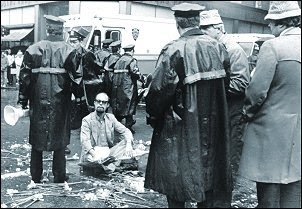
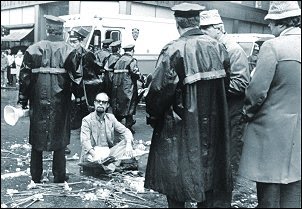
Stoney Burns is arrested by Dallas Police officers at Lee Park on April 12, 1970, after what The Dallas Morning News called “a clash between law officers and young people” that “occurred when police tried to arrest several hippie-types” at the park. Image from The Dallas Morning News.

Stoney Burns dies at 68:
Crusading underground journalist

was incessantly harassed by Dallas officials

By Thorne Dreyer / The Rag Blog / May 2, 2011

See “Stoney Burns used a gentle wit to fight injustice in Dallas,” by James McEnteer, Below.

Sixties icon Stoney Burns passed away Thursday morning, April 28, 2011, in Dallas. Our mutual friend, Angus Wynne, informed us that Stoney died at Baylor Medical Center “of a sudden, massive heart attack.” Burns, 68, was buried on Sunday at the Shearith Israel Cemetery on Dolphin Road in Dallas.

Stoney, who was born Brent LaSalle Stein, was a Sixties activist/journalist and pioneer of the underground press in Texas. When we were publishing The Rag in Austin and Space City! in Houston, he edited a series of publications in Dallas, including Dallas Notes and the Iconoclast — and later the music magazine, Buddy. In its notice about Burns’ death, Pegasus News referred to Stoney as the “King of the Hippies.”

In an April 29 article, The Dallas Morning News said that Burns’ Dallas Notes “decried war, intolerance and hypocrisy with a playful aggression and a cutting edge.”

In his 1992 book Fighting Words, in which he profiled five independent Texas journalists, James McEnteer wrote, “Powered by an anarchic energy and a highly developed sense of the absurd, Stoney personified everything official Dallas loathed.” [See McEnteer’s reflections on Stoney Burns, written for The Rag Blog, below.]

Stoney was incessantly harassed by the Dallas authorities, who charged him with obscenity, beat him mercilessly, tore up his offices, and confiscated his equipment.

Burns’ obscenity case went all the way to the U.S. Supreme Court where Justice William O. Douglas commented on the cops’ ransacking of the Dallas Notes offices: “It would be difficult to find in our books a more lawless search-and-destroy raid.”

Stoney had trouble finding anyone in Dallas to print his newspapers, and, according to Austin’s Steve Speir, a potential printer in Fort Worth backed out after someone threatened to burn down his shop. So Steve set Stoney up with a printer in Waco, “and on the way back to Dallas we’d be stopped by the cops and harassed. They’d throw all the papers on the ground and search the truck.”

According to The Rag Blog’s David P. Hamilton, four Dallas police cars followed him for several miles after one visit to Stoney’s home.

In 1974, Time Magazine wrote, “The law in Dallas, from all appearances, had been bent on getting Stoney Burns for years” when they “found in the glove compartment a tiny stash of marijuana. It was barely enough for one or two joints.” But it was enough to get Stoney a sentence of 10 years and one day — time he never served thanks to Texas Governor Dolph Briscoe who commuted the sentence.

Angus Wynne told the Dallas Observer that Stoney Burns had “gone through so much, between his public battles and private ones, and turned into a sweetheart. He’d had [an earlier] heart attack and cancer and whipped all those… He was just a great guy, one of the generalissimos of the so-called revolution back then. There was something real special about Stoney…”

[Rag Blog editor Thorne Dreyer was a colleague of Stoney Burns in the Sixties underground press.]

Stoney Burns. Photo courtesy of Angus Wynne.

Fighting words:

Stoney Burns used a gentle wit
to fight injustice in Dallas

By James McEnteer / The Rag Blog / May 2, 2011

“Maybe that’s why we’re hated. We tell the truth; we’ve got nothing to lose. We do have something to gain, however. It’s our self-respect. Yeah, we tell the truth. It’s about time some newspaper did.”

— Stoney Burns, Dallas Notes [From James McEnteer: Fighting Words, Independent Journalists in Texas, UT Press, 1992.]

Stoney was not just a brave man — facing down the rigid Dallas Establishment in large part all by his lonesome — but a funny one. He used his gentle wit and sense of the ridiculous as effective weapons for social justice in 1960s Dallas, just about the unfriendliest territory imaginable for stoned longhairs looking to have a good time.

Stoney loved a good time — good music, friends, and laughter. But his easy-going sense of the absurd enraged the humorless conservatives in the Dallas Police Department who considered his satire of local laws and his criticism of usually unmentioned overbearing police tactics as unacceptable threats to their sense of law and order.

Stoney became a cause and a crusader almost by accident, as the sole occupant of the void left by jackboot censorship of all but the most orthodox right-wing cant in the Dallas media.

Stoney Burns in the Iconoclast office, 1972. Photo courtesy of Stoney Burns from Fighting Words: Independent Journalists in Texas, by James McEnteer, University of Texas Press, 1992.

His Notes from Underground started on the SMU campus and was quickly banned. He was the only journalist to describe and photograph police harassment of peaceful long-haired young people in Dallas parks. His various newspapers took different names over the years, but were always an eclectic mix of music reviews, social commentary, and jokes at the expense of local officials, reflecting Stoney’s own sensibilities.

His papers featured outrageous cartoons, guaranteed to offend the white bread, church-bred Folks who Mattered in Dallas. Stoney always professed bewilderment at the passionate hatred his dopey humor aroused among otherwise rather staid, affectless citizens. The brief, final incarnation of Stoney’s journalistic ambitions was a paper he called The Iconoclast, in homage to the Waco rabblerouser, William Brann.

The police harassed Stoney Burns for years, wrecked his newspaper offices, stole his equipment, planted dope on him, and tried every which way to shut him up, finally hounding him into prison for 10 years and a day on a trumped-up charge of marijuana possession, which the governor later quietly dismissed.

But Stoney’s abbreviated prison term ended up accomplishing its goal of silencing a genuine independent voice of Dallas journalism. Stoney went on to publish Buddy, about the local music scene, but made only occasional, rather vague political comments in subsequent years.

Stoney Burns brought light and fresh air into Dallas public discourse of the 1960s. Despite the strange (to him) resistance his journalism conjured in the authorities, Stoney had the courage to continue telling the truth as he saw it for seven years.

He served as an inspiration to many in his own community and beyond, revealing the cowardice of a system ruled by intimidation, not by public assent. He opened up the acceptable limits of free speech in 1960s Dallas. And he paid a price for it.

Dallas and Texas and the country are in Stoney’s debt, now as then. Stoney’s courage and humor are needed today as much as ever. His spirit will always be worth remembering.

[Rag Blog contributor James McEnteer is the author of Fighting Words: Independent journalists in Texas, published by the University of Texas Press. He lives near Durban, South Africa.]

Also see:

Brent Stein (aka Stoney Burns) in the 1962 Hillcrest High yearbook, Dallas. Image from Dallas Observer Blogs.

The Rag Blog

Posted in Rag Bloggers | Tagged , , , , , , , , , , | 4 Comments

Harvey Wasserman : After Fukushima: A Nuclear Industry Meltdown?

A home in Glen Rose, Texas, with the Comanche Peak nuclear power plant hovering behind. Photo from the Fort Worth Star-Telegram.

After the Fukushima nightmare:
Will the nuclear power industry melt down?

By Harvey Wasserman / The Rag Blog / May 2, 2011

“There’s never been a death because of radiation… in a civilian nuclear power plant… In Texas, if there’s any kind of a serious earthquake or natural disaster, I want to be in the control room at Comanche Peak [Nuclear Power Plant] because that is the absolute safest place to be.” — Texas Congressman Joe Barton, April 6, 2011

In the wake of the apocalyptic nightmare at Fukushima, the multi-trillion-dollar global nuclear power industry is looking over the abyss at a long-overdue extinction.

But the issue is far from decided. Japan’s horrifying catastrophe has sent the industry’s spin machine into overdrive. We’ve been shown the script of what reactor-backers — hell-bent on minimizing the dangers of this unprecedented disaster — are willing to say and do to save themselves.

It is not a pretty picture. It focuses on the assertion that there are safe doses of radiation, and that atomic energy has harmed few, if any. Three Mile Island “hurt no one.” There were few casualties at Chernobyl. And Fukushima’s long-term damage will be minimal.

Atomic apologists argue that only nuclear power can fill our long-term “base load,” that renewables are of no real consequence, and our choice is between more nukes and more coal.

Yet the nuclear industry faces significant hurdles in cost and construction lead time, two inescapable factors that are on the brink of killing atomic electricity-generation.

The end is not guaranteed. New reactor construction cannot proceed in the United States without huge federal handouts. There are no private sources willing to fund additional U.S. projects. Wall Street has only been keen on atomic energy when subsidies and ironclad guarantees have been available.

No reactor ordered in this country since 1974 has been completed. In that year, Richard Nixon promised 1,000 atomic reactors licensed to operate by the year 2000. Today there are 104.

There are many reasons those 896 reactors went missing. Number one is the fact that the No Nukes movement stopped the industry from gouging from the government the trillion or more dollars it would have taken to build that fleet.

Local and national public opposition slowed and canceled many projects and created a political atmosphere in which it is impossible for the industry to do what was done in France. There the industry established a radioactive form of national socialism. It is amusing to watch American “free-market advocates” go rhapsodic about the French nuclear industry, when in fact it is owned, insured, operated, monitored, and regulated by the government.

Here the government doesn’t own the reactors, but it does own their liabilities. When atomic power was introduced, utilities refused to invest unless Congress would insulate them from the damage caused by an accident. So the Price-Anderson Act of 1957 required reactor owners to establish a pay-out pool of $540 million: the industry’s liability for an accident whose potential was estimated to be capable of destroying a land mass the size of Pennsylvania.

The protection has been periodically renewed by Congress. Today the pool has grown to $12.6 billion. As Fukushima has demonstrated, that’s a fraction of the potential damage from a disaster at one or more American reactors. Preliminary estimates of the cost for radioactive cleanup at Fukushima mean little, in part because they’re intertwined with destruction from quake and tsunami.

And the accident is far from over. Radioactive emissions seem to be worsening, and five weeks after the earthquake the level of radioactive iodine 131 was 6,500 times the legal limit in the Pacific waters near the plant. Should such fallout occur from a U.S. reactor, beyond the $12.6 billion pool, liability would rest with the victims and the taxpayers.

Without government cash to build reactors that would produce electricity once billed as “too cheap to meter,” the industry has stalled. In recent months, even before Fukushima, local voters have begun to force the shutdown of operating reactors.

In Vermont, Governor Peter Shumlin was elected on a pledge to shut the Yankee reactor. A deal cut by its owner, Entergy, and the state legislature requires official approval for operations beyond March 2012. In New York, newly elected Governor Andrew Cuomo is focused on shutting down Indian Point, 35 miles north of Manhattan.

But as fans of monster movies know, there comes a moment when the beast has been slain, all are celebrating… and then… BAM! It comes back to life.

That resurrection has come to be known as the “nuclear renaissance,” which again rests on federal handouts. The Bush administration provided $18.5 billion in loan guarantees to underwrite the beginning of a new generation of reactors. In 2007, with former Senator Pete Domenici (R-NM), the “senator from nuclear power,” the industry attempted to get $50 billion in additional loan guarantees.

But a grassroots movement arose with help from a NukeFree.org effort, led by singers Bonnie Raitt, Jackson Browne, and Graham Nash. With a website, a YouTube video, a petition drive that gathered 120,000 signatures, and a lobby day in October 2007, Domenici’s $50 billion proposal was defeated.

In 2008, 2009, 2010 and thus far in 2011, similar efforts by the industry to grab federal money have been denied, which is remarkable because, as reported by an investigative team at American University, proponents of reactors have spent some $645 million in the last decade lobbying Congress for more subsidies. For an underfunded grassroots movement to beat a campaign that spent on average $65 million a year (excluding what was spent on media) is miraculous.

Two major factors have contributed.

One is the soaring cost of the reactors. Three years ago, cost projections for a new reactor were as low as $2 billion to $3 billion. Today, with barely a shovel having been turned, they are in the range of $10 billion to $11 billion, and moving relentlessly and rapidly higher. Design and safety considerations coming out of Fukushima are sure to send that figure up even more. A Texas project that was to be bankrolled by the Japanese almost certainly won’t happen now.

The scientific staff at the Nuclear Regulatory Agency — a captive regulatory agency whose budget is provided by the industry — has raised concerns about new designs undergoing constant and often confusing changes proposed by the utilities building the plants, which also increases costs.

The other major factor that helped defeat the loan guarantees is the plunging cost of renewables. When the No Nukes movement began, reactor opponents were forced to argue that “sometime in the future” such green technologies as wind, solar, tidal, geothermal, ocean thermal, and biofuels would be cost competitive.

That time has come. The solartopian vision of a green-powered Earth has, in the last few years, become economically viable within a free-market model. With photovoltaic cells leading the way, and wind power following close behind, the projected price for green-generated electricity has fallen into the range of nuclear power and has drawn closer to coal.

A constant stream of technological breakthroughs in renewables and energy efficiency shows every sign of continuing to accelerate past the tipping point, where what has until now been known as “alternative” technology takes over the mainstream.

With that has come a green industry with political clout of its own, in both lobbying power and job creation. For every month that passes without new reactors coming on line, the renewable-energy lobby gains an increasing ability to flex its muscles in Congress and the marketplace.

Will these factors be sufficient to prevent a renaissance capable of reviving the nuclear industry?

The nuclear renaissance got its most recent big break in 2010, when Barack Obama put up $8.33 billion in loan guarantees for two reactors in Georgia — the first money from the $18.5 billion set aside by Bush to actually go to a reactor project. (Another plant is in the works in South Carolina.)

Serious legal and technical issues have been raised about the loan guarantees. That did not stop Obama from staging a news event to announce the first new reactor projects to break ground in decades. State regulators are forcing ratepayers to fund construction. If the reactors never generate a kilowatt of electricity, the public will still foot the bill.

Waste not

The public always foots the bill. After half a century and more than $10 billion, the Yucca Mountain Nuclear Waste Repository in Nevada has failed, for technical and political reasons. Consequently, more than 60,000 tons of high-level radioactive waste is stored at reactor sites across the U.S. None of the world’s reactor operators have a safe solution for storage of the most lethal substance ever created by human beings. Almost all of it sits onsite, alongside more than 430 reactors worldwide.

But Fukushima has belied the industry line that in the absence of permanent sites waste can be safely stored onsite. Onsite storage of high-level waste in spent-fuel pools at each of six stricken Fukushima reactors, plus a seventh common pool, has created a fiery nightmare.

Spent rods were exposed to air, allowing zirconium alloy cladding to ignite, releasing huge quantities of radiation while endangering the complex cooling systems on which the entire facility depends.

When the quake destroyed critical pump and piping networks, water from the tsunami created short circuits and ruined electrical systems.

Hydrogen explosions at two or more of the reactors may have compromised containment domes, while a crack in at least one reactor pressure vessel indicates a dangerous level of damage to the structures meant to keep the cores intact.

Meanwhile, some of the spent fuel rods sit five stories in the air. They were put there largely to make it easier to move used rods out of the core and directly into the elevated pools. But given the damage done by the quake, tsunami and mechanical failures inside the plants, getting cooling water to them has proven extremely difficult. Some of the rods might have fallen into melting reactor cores. The disaster defies description and won’t be fully understood for decades.

Yet the industry continues to blame its waste problem on opponents they claim have prevented a viable disposal site from being established, not only in the U.S., but in every country where reactors operate.

Fukushima has also raised the specter of an airborne stream of radiation killing people all over the world. This includes the United States, where fallout was detected on the West Coast within days of the disaster in Japan, followed by reports of iodine 131 in milk and water from Maine to Florida. Cesium has been found on vegetables in Vermont, though it’s unclear whether it came from Fukushima or the nearby Yankee reactor, a Fukushima clone that opponents in Vermont are desperately trying to shut.

On April 12, the Japanese government reclassified the Fukushima crisis to Level 7, in a general category with the 1986 Chernobyl disaster, while reassuring the public that most of the airborne radiation has been blown “out to sea.”

There was no sea at Chernobyl, where the heaviest radioactive contamination quickly settled on areas in Ukraine, Belarus, and Russia. The public debate continues regarding the number of Chernobyl fatalities. Last year, three Russian scientists published a book based on a broad literature survey. They reported that by the early years of this century, 985,000 Chernobyl downwinders died as a result of the accident — a number far higher than any previous estimates.

The peaceful atom

Commentator and author Ann Coulter might tell a national TV audience that radiation can actually be good for you, and that small doses can actually improve your health and that of your children. But scientists such as Dr. Karl Z. Morgan and Dr. John Gofman, highly regarded pioneers in the study of radiation health physics, long ago established that there is no identifiable safe dose of radiation. That there is no established threshold below which exposure to x-rays, gamma rays, and alpha or beta emissions is “safe” has been accepted in the radiation health physics field since its inception.

In an effort to deny this reality, the industry and its apologists have discounted health impacts from of the Fukushima fallout in the United States. Typical was Matthew Herper in a Forbes blog, who assured readers that there would be minimal health danger from Fukushima “even if things go horribly wrong.” The line that no dangerous doses of radiation have reached the U.S. has become an article of faith among major media from CNN to NPR.

Yet difficult to ignore is the presence of four California reactors that sit near major earthquake faults, in tsunami zones. The two reactors on the beach at San Onofre are far closer to San Diego and Los Angeles than Fukushima is to Tokyo. Two more at Diablo Canyon, near San Luis Obispo, are within a mile of a newly discovered fault line, and considerably less than that from the shore. Had the Fukushima quake hit either of those sites, southern and central California would be in evacuation mode, and our nation would be blanketed in lethal fallout.

With reactors like Indian Point and San Onofre hauntingly close to major population centers, with some two dozen U.S. plants identical in design to Fukushima, and with still more on or near earthquake faults, industry backers are working to convince the public that however dangerous their nukes might be, coal is worse. Global warming, they say, favors nuclear because it’s “carbon free.”

Both technologies are doomed by cost, supply, and their impact on the environment and human health.

Our survival ultimately depends on burying fossil fuels — and more immediately, the “Peaceful Atom” that has given us Three Mile Island, Chernobyl, Fukushima, and other accidents that will inevitably follow.

Thus far, Barack Obama has been the industry’s best ally. Early into the Fukushima accident — long before it was clear what would happen — he assured the public that there was nothing to worry about here, and that he would continue to push for more reactors. The administration also has failed to establish a national monitoring network that could inform the public about where the radiation is and what individuals might do to protect themselves and their families.

Obama’s non-response may date back to his early days as a state senator, when he allied himself with the Illinois-based Exelon, America’s biggest private nuke owner. The president’s career is rooted in the 11 reactors that ring Chicago. The consulting firm founded by his chief campaign strategist David Axelrod, who would later become a senior White House advisor, represented Exelon.

Obama’s former White House chief of staff Rahm Emanuel (now mayor-elect of Chicago) put together investment packages for Exelon’s Illinois plants when he worked as an investment banker. And Exelon CEO John Rowe has been a longtime financial backer of the president.

A critical moment is coming soon, when Obama goes to Congress to request an additional $36 billion in loan guarantees for new nukes in his 2012 budget.

With them, America’s atomic industry has a chance to build a few more reactors. Without them, a green-powered Earth is within our grasp.

(As we go to press Entergy has filed a complaint in U.S. District Court in Vermont attempting to prevent the state from forcing the Vermont Yankee nuclear power plant to cease operation on March 21, 2012.)

[Harvey Wasserman edits the NukeFree.org website. His most recent book is Solartopia! Our Green-Powered Earth. This article was also published at the Washington Spectator. Read more of Harvey Wasserman’s writing on The Rag Blog.]

The Rag Blog

Posted in Rag Bloggers | Tagged , , , , , | 1 Comment

Paul Beckett : Slouching Towards Democracy in Nigeria

Goodluck Jonathan was elected President of Nigeria on April 16.

The Elections in Nigeria:
Slouching towards democracy

By Paul Beckett / The Rag Blog / April 29, 2011


The perils of democracy

To title (and set) his 1958 novel Things Fall Apart, Nigeria’s great novelist, Chinua Achebe, drew on lines from the poem by William Butler Yeats which begins:

Turning and turning in the widening gyre
The falcon cannot hear the falconer;
Things fall apart; the centre cannot hold;
Mere anarchy is loosed upon the world…

And ends:

And what rough beast, its hour come round at last,
Slouches towards Bethlehem to be born?

— “The Second Coming,” William Butler Yeats, 1920

Nigeria is among the world’s most dangerous countries. Nigeria has the seventh-largest population in the world (nearly 160 million), and that population is a potentially explosive mixture of peoples, regions, and religions — a mixture of almost infinite complexity.

The center’s holding (to paraphrase Yeats) has indeed been challenged throughout Nigeria’s 51 years of independence. At various times, Olusegun Obasanjo, Nigeria’s longest-serving head of state (sometimes military, sometimes elected) has compared his country’s potential for violence to cases like Bosnia, Rwanda or Burundi — but on a much larger scale.

Nigeria came to independence two years after Achebe’s book was published with a British-style parliamentary electoral democracy in place. Unsurprisingly, the country’s experience with democracy since has been rocky. “Mere anarchy” (Yeats uses “mere” in the obsolete meaning of “pure” or “unmixed”) has frequently seemed close by.

As Nigeria celebrated the 50th anniversary of its independence from Britain last year, the country had had elected governments for only about 20 years. The other 30 were accounted for by a succession of military governments, each a bit more dictatorial (and corrupt) than the one before. In its democratic interludes, it took Nigeria only about 40 years to get into its “Fourth Republic” (the present one); reputedly volatile France required about a century and a half to achieve the same.

Nigeria has spent enormous sums of money trying to create fair and transparent electoral systems. Yet rare is the election that has not been condemned as false by the loser (often, by everyone except the winner!). Over the 20-some years of democracy, vote-buying, thuggery, bribery, and ballot box-stuffing have been developed into high art forms. Sometimes the ballot boxes are simply stolen. Or, perhaps, stolen and stuffed. Voter registration, a vast process usually commenced too late, has often verged on chaos (if not “mere anarchy”).

Polling station administration has usually seemed imperfect and sometimes much worse than that. Nigeria’s last round of general elections, in 2007, was condemned universally by observers as almost hopelessly flawed by violence, rigging, and mismanagement. (For one of the reports, go here.)

As we recommend democracy for all countries, we should be conscious that democracy can be dangerous in a country like Nigeria: very dangerous. Democracy has been a significant factor in Nigeria’s horrific communal clashes (stretching from the pogroms against the Igbos in the middle 1960s to the bloody clashes in the Jos area that are on-going now). Scores and sometimes hundreds have been killed in violence in each national election.

By its nature, then, Nigeria does not seem a natural case for Western-style competitive electoral democracy. When I lived in Nigeria in the early 1970s, the number of separate ethnic groups was put at 250; the figure used now is 389. (Imagine for a moment the French, German, British, or American democracies functioning with 389 different national traditions and identities in play.)

Overlaying the ethnic mosaic are traditions of regional hostility (both great and small). Since the 1980s, religion (Muslim or Christian) has become vastly more important as a basis for often violent conflict. Access to education, and therefore literacy, varies widely through the country. Finally, poverty, the national oil wealth not withstanding, is endemic, and wealth differentials are, well, worse than in the U.S.

Just as a reminder, Western-style democracy has generally flourished in — you guessed it! — Western countries characterized by a large middle class, high literacy, and a much higher degree of national integration.

In a sense, the puzzle is that Nigeria has tried so hard and persisted so long in the effort to make democracy work.

The effort to create democracy

But try they certainly have, in a creative, participatory, and deeply serious way which will surprise those who know Nigeria mainly for corruption and “419” email scams.

In the latter 1970s, after a failed First Republic and a decade of military rule, Nigerian military leaders and civil society intellectuals (academics, administrators, doctors, lawyers, journalists) put their heads together to try to figure out how Nigeria could be a democracy. A kind of “great debate” occurred in a constitutional convention and through the media (it reminded yours truly of the Federalist Papers episode in our own history).

A constitution was designed in which electoral success went to the leaders and the parties who best reached across the old divides of region and ethnicity, while punishing those who waged ethnic or regional political warfare. A principle of “federal character,” which essentially means fair representation of Nigeria’s constituent regions and peoples, ran through the constitution. (In some applications, it resembles American affirmative action practices.)

Thus, to illustrate with the presidential election (the one Nigerians care most about), to win a candidate must win by a majority of votes cast (so run-offs are likely), but also must receive at least 25% of the votes cast in two-thirds (24) of the 36 states in the Nigerian federation.

Other features were requirements placed on the political parties to be truly national in scope, a powerful independent, non-partisan electoral commission to prepare and run the elections, and judicial review of challenges.

What is interesting is that, while Nigeria has had three constitutional revisions since the totally disastrous First Republic, the basic elements have carried through each one.

As a distant and somewhat desultory observer, I have felt for some time, and feel more certain all the time, that Nigeria has been subject to a kind of creeping constitutionalism and a growing habit of democracy over more than three decades.

The 2011 general elections

This month Nigeria has completed a mammoth round of elections: for the federal bicameral legislature (April 9), the federal presidency (April 16), and governors of the 36 states (April 26). The scale of the exercise was enormous in every way (very much including cost which has been estimated at more than half a billion dollars).

Some 325,000 poll workers manned many thousands of polling stations scattered throughout a vast country where communications and transportation infrastructure remain limited. Sixty-three political parties were registered; at the presidential level, 21 had fielded candidates. (For more details, go here.)

How did it go?

The ominous precursors were there. The elections, originally scheduled for December 2010, had to be pushed back twice. As usual, registration was a last-minute achievement. There were many problems with ballots, both their preparation and printing (they were complicated with many minor parties that had to be correctly listed) and ballot security.

There were many efforts to rig or otherwise falsify or even to derail the elections completely. Just before the presidential election a vehicle traveling north was found to contain 100,000 ballots marked “tendered ballot papers.” Serious bombings occurred before and during the elections.

Also very ominous was a spike in violence (or arbitrary arrest) directed against reporters. This was reported by the international organization Reporters Sans Frontieres, which noted:

Nigeria has one of the poorest media freedom ratings in Africa and is 145th out of 178 countries in the 2010 Reporters Without Borders worldwide Press Freedom Index.

One could go on and on with such ominous reports. But: surprise!

The Economist (London) almost gushed: “Nigeria’s Successful Elections: Democracy 1, vote-rigging, 0.” They went on, “Gambling on the world’s most expensive voting system has paid off.”

The leader of an international team of observers, Robin Carnahan of the (U.S.) National Democratic Institute, said the vote was “largely free and fair.”

“There were a number of people in our delegation that observed the elections in 2007,” Carnahan said,

and they said they felt like there was a marked difference this year. That there was a determination on the part of the Independent National Electoral Commission to run a real election, [and] a free and fair election. There was determination on the part of the Nigerian people to participate in an election that really reflected their voice.

European Union and Economic Community of West African States (ECOWAS) teams’ reports were similar, as was the verdict of the U.S. State Department.

Sweet music!

But then the music ended.

Serious rioting broke out in most of the far northern states, with hundreds killed. There were renewed bombings on the eve of the last set of elections for governor on April 26 (and they could not be held on schedule in at least two of the states). Meanwhile, the major opposition candidate for President (Muhammadu Buhari of the Congress for Progressive Change party) and many others are charging (what else?) “massive rigging” that falsified the election.

The balance sheet

As the dust clears (and, as the bodies are buried), we see that the damage has been great: more than 500 killed, many more wounded, much property loss, much personal displacement, much loss of personal sense of security. The election and its aftermath have further exacerbated the dangerous combination of anger and fear at the Muslim/Christian interface, especially in the northern states.

If the presidential election of Goodluck Jonathan of the People’s Democratic Party was generally peaceful and fair, as observers tell us, the results may still prove dangerous for the future.

Jonathan (Christian, from a southeast minority ethnic group) represented the dominant party (PDP) and his victory was expected by most. He handily met the constitutional requirements for election taking nearly 60% of the popular vote, and winning 24 states outright.

Meanwhile, his principal opponent, Muhammadu Buhari (Muslim, Hausa-Fulani, from Katsina) swept the 12 most northern states, but failed to carry any states outside that group (including those that in past elections have tended to associate with the “far north”).

Thus, while Jonathon’s election complied easily with the constitutional requirements for national reach, paradoxically this presidential election seemed to result in a situation of stark regional, ethnic, and religious separation that we have not seen before.

Slouching towards democracy?

There were a number of special circumstances in the candidacy of Goodluck Jonathan and the opposition led by Muhammadu Buhari that are too complex to deal with here. Yet, even with allowance being made for these, the 2011 elections are likely to be seen as a watershed in Nigerian politics.

Viewed in national political terms, the far north finds itself (temporarily, at least) in unprecedented isolation. Over most of the previous half century, the Muslim (in ethnic terms, mainly Hausa-Fulani and Kanuri) far north (it was sometimes referred to as the Holy North in the old days) has generally provided the core political leadership for the rest of the huge area of the original Northern Region. During the first political decade, their dominance was absolute.

And throughout the independence period the influence of the far north has been disproportionate at the national level, too. Of the 13 men who have headed the Nigerian government (military or civilian) since 1960 (see list here), eight have been northern Muslims (one other was a northern Christian).

Six of the northern Muslims have been from the core Hausa-Fulani or Kanuri states of the far north. All four of the southern Christian leaders owed their original accession to accidental factors (Jonathan, the latest, became President unexpectedly in May last year after Umaru Yar’Adua (Hausa-Fulani, Katsina) developed a serious illness and finally died in office).

Thus, the landslide election of Jonathan may mark a watershed event in the evolution of Nigerian politics. The historic pattern of at least mild hegemony exerted from the far north may have largely run its course.

This assumes that Nigeria continues its “slouching” progress (borrowing again from Yeats) toward institutionalizing electoral democracy.

Which in turn returns us to the question: Why does Nigeria work so hard and so persistently to create a functioning, stable, permanent democracy?

The costs and dangers, after all, are great. With the country’s complex ethnic makeup, and the now bitter relations between many Christian and Muslim communities, Nigerians know that they live over a political sea of magma that could, at almost any time, erupt.

Yet Nigeria persists in the effort, and, I believe, will continue to persist. At the time that Nigerians were emerging from more than a decade of military rule in the latter 1970s, intellectuals advanced many ideas for a constitutional system that would work for Nigeria, not as one might want Nigeria to be, but as it is. A number advocated indirect, or “guided democracy,” or a benign single-party system.

Ultimately, such compromises were rejected in favor of straight, unadulterated winner-take-all electoral democracy with competitive parties. The preponderance of opinion was that Nigeria was too complex a country to function as a single party system, and their experience with military rule had convinced them that benign dictatorship never remains benign.

One could say that Nigeria needs to be a democracy not in spite of its staggering complexity, but because of it.

[Paul Beckett taught political science at Ahmadu Bello University in Zaria, Nigeria, from 1969 to 1976. He is co-author of Education and Power in Nigeria and co-editor of Dilemmas of Democracy in Nigeria.]

The Rag Blog

Posted in Rag Bloggers | Tagged , , , , | Leave a comment

FILM / William Michael Hanks : Jamie Johnson’s ‘The One Percent’


Documentary film:
Jamie Johnson’s The One Percent is a
revealing statement about wealth in America

By William Michael Hanks / The Rag Blog / April 28, 2011

Jamie Johnson has a conscience if he can keep it. He is heir to one of the largest fortunes in America: Johnson & Johnson. In The One Percent, his second documentary after Born Rich, he combines his interest in economic inequality in America with a skill and talent for filmmaking.

The film is worth seeing. It is a fresh and honest statement about the disparity of wealth in America. The exclusive access the filmmaker’s family name gives him to the very wealthy made some of the surprisingly revealing interviews possible.

Jamie points out that:

Today in America the disparity between the haves and have-nots is greater than it’s ever been. Now the top one percent of Americans like my family and me own 40 percent of all the country’s wealth and we share an aggregate net worth that is greater than the bottom 90 percent of individuals combined.

His family, as do most very wealthy families, has a wealth counselor who meets with the whole family regularly. You have to see this guy. He comes off like a mean-spirited hired gun — like the Jack Palance character in Shane. The deference which Jamie’s father shows this bully is pathetic. But then, every year the story is always the same — the wealth of the family continues to grow and who can argue with success?

Jamie uses his family name to enroll in one of the most exclusive wealth conferences in America — The Lido. Jamie remarks to the conference director: “There are people that are looking for funding for their projects who would absolutely kill to get into this meeting.” The Director, Gregg Kushner, responds “That’s right, absolutely, and we make sure they don’t get to get in.”

It is this “circle the wagons” — the “us and them” mentality — that pervades the attitudes of the very rich. There is a universal refusal to even broach the subject of disparity of wealth. The candid sequences with the very rich in the film reveal this in ways that media coverage and mere commentary cannot.

The mantra of the rich as given by Gregg Kushner, the Lido Conference director, is as follows

There is much greater good done by the people with the wealth in creating jobs, creating business opportunities, and in philanthropy than otherwise, and I would say it makes more sense to me to encourage business ownership, to encourage the wealthy to generate that wealth so that wealth can then be shared rather than take it from individuals to then redistribute it through social policy and transfer policies of medicare and social security or whatever. I hope that didn’t come out sounding crass.

Well, Gregg, it did.

Of course the fallacies — some would say lies — are that the facts belie the myth that wealth is shared. How much sharing is being done if one percent owns 40 percent of the wealth? And how is having a person over the barrel, so he has to accept slave wages, not taking it from individuals? How does charging 600 percent interest on a pay day loan not taking it from individuals?

Apparently taking from some individuals is OK — just not from the wealthy. As Dickens said, “The poor have no right to their good fortune.” The other lie is that rather than being “redistribution” or “transfer” policies, social security and medicare are self-funded programs that are supported by those who participate.

But it is this hedge of false mythology that is the personal cover of most of those who are represented at the conference. The justifications are so weak that most of those who are among the privileged few react very nearly with violence when these questions are even raised.

Jamie runs into these attitudes repeatedly in his interviews. The interview with Milton Friedman is something to see. The duplicity and bullying are astounding. I would like to know who paid for this man’s Nobel Prize. It could not have come from an original contribution to economics; the previous author Attila the Hun should have gotten the prize. He reveals himself to be merely a thug who works as economic muscle for the wealthy and their minions.

These reactions are typical in most of Jamie’s interviews with the very wealthy, but there are some who seem not to be able to silence their conscience so easily. His interviews with Warren Buffet’s granddaughter led Buffet to disown her and his interview with the the Oscar Mayer heir revealed his struggle with economic equity which culminated with giving away his money.

It’s not even that huge profits are a result of hard work and innovation anymore, or real service to the market; more and more, huge profits are the result of favorable laws, regulations, and subsidies. Laws bought and paid for with campaign contributions.

In one interview, Kevin Philips, a former Nixon aide and author, said “It’s been the case for the last 25 years in the United States that the amount of money flowing into the system for political contributions has been a major shaper of who gets what within the economy.” The film shows specific examples of how corporate and individual contributions lead directly to multi-million dollar subsidies for donors.

The most revealing moments of the film are the times when the very wealthy are being interviewed and show a complete lack of self reflection — their mythology, tired and aging as it may be, seems the touchstone of justification for their control of such vast assets. It was always the same song: vast wealth generated all good in society and any form of taxation is socialism.

Most of those interviewed just shut up and refused to comment when the subject of the film was revealed. The fear of addressing the obvious was palpable.

The saddest thing about the film is the portrait of Jamie’s father. When he was Jamie’s age, he had made a film about poverty and apartheid in South Africa. He was so criticized by his family that it appears he never quite got over it. He, one of the wealthiest men in America, was reduced to being a fearful, ineffectual, and indecisive man with faith no more in anything but the bloodless approval of his financial adviser, his croquet games with rich friends at the country club, and an ice cold martini, or two.

But the unseen tragedy that the film holds like a secret box within a box is that Jamie himself will end up like his father. The wolves encircling him — biting, punishing, threatening to alienate him from all he has known in his life. Reminding him of the ultimate price — exclusion, poverty, and isolation. Surely he will come to his senses, surely he will come back into the fold, a chastened member of the club.

But then again, Jamie has a conscience, if he can keep it.

[William Michael Hanks lived at the infamous Austin Ghetto and worked with the original Rag gang in the Sixties. He has written, produced, and directed film and television productions for the National Aeronautics and Space Administration, The U. S. Information Agency, and for Public Broadcasting. His documentary film The Apollo File won a Gold Medal at the Festival of the Americas. Mike lives in Nacagdoches, Texas. Read more articles by Mike Hanks on The Rag Blog.]

The Rag Blog
Posted in Rag Bloggers | Tagged , , , | 1 Comment

The One Percent

By William Michael Hanks / The Rag Blog / April 29, 2011

Jamie Johnson has a conscience if he can keep it. He is heir to one of the largest fortunes in America: Johnson and Johnson. In The One Percent his second documentary after “Born Rich”, he combines his interest in economic inequality in America with a skill and talent for film making. The film is worth seeing. It is a fresh and honest statement about the disparity of wealth in America. The exclusive access the film maker’s family name gives him to the very wealthy made some of the surprisingly revealing interviews possible.

Jamie points out that “Today in America the disparity between the haves and have nots is greater than it’s ever been. Now the top one percent of Americans like my family and me own forty percent of all the country’s wealth and we share an aggregate net worth that is greater than the bottom ninety percent of individuals combined.” His family, as do most very wealthy families, has a wealth counselor that meets with the whole family regularly. You have to see this guy. He comes off like a mean spirited hired gun — like the Jack Palance character in “Shane”. The deference which Jamie’s father shows this bully is pathetic. But then, every year the story is always the same — the wealth of the family continues to grow and who can argue with success?

Jamie uses his family name to enroll in one of the most exclusive wealth conferences in America — The Lido. Jamie remarks to the Conference Director “There are people that are looking for funding for their projects who would absolutely kill to get into this meeting.” The Director, Gregg Kushner, responds “That’s right, absolutely, and we make sure they don’t get to get in.” It is this “circle the wagons” the “us and them” mentality that pervades the attitudes of the very rich. There is a universal refusal to even broach the subject of disparity of wealth. The candid sequences with the very rich in the film reveal this in ways that media coverage and mere commentary cannot.

The mantra of the rich as given by Gregg Kushner, the Lido Conference Director, is as follows “There is much greater good done by the people with the wealth in creating jobs, creating business opportunities, and in philanthropy than otherwise, and I would say it makes more sense to me to encourage business ownership, to encourage the wealthy to generate that wealth so that wealth can then be shared rather than take it from individuals to then redistribute it through social policy and transfer policies of medicare and social security or whatever. I hope that didn’t come out sounding crass.” Well, Gregg, it did.

Of course the fallacies, some would say lies, are that the facts belie the myth that wealth is shared. How much sharing is being done if one percent own forty percent of the wealth? And how does having a person over the barrel, so he has to accept slave wages, is not taking it from individuals? How does charging six hundred percent interest on a pay day loan not taking it from individuals. Apparently taking from some individuals is OK — just not from the wealthy. As Dickens said “The poor have no right to their good fortune.” The other lie is that rather than being “redistribution” or “transfer” policies social security and medicare are self-funded programs that are supported by those who participate. But it is this hedge of false mythology that is the personal cover of most of those who are represented at the conference. The justifications are so weak that most of those who are among the privileged few react very nearly with violence when these questions are even raised.

Jamie runs into these attitudes repeatedly in his interviews. The interview with Milton Friedman is something to see. The duplicity and bullying are astounding. I would like to know who paid for this man’s Nobel Prize — it could not have come from an original contribution to economics — the previous author Attila the Hun should have gotten the prize. He reveals himself to be merely a thug who works as economic muscle for the wealthy and their minions. These reactions are typical in most of Jamie’s interviews with the very wealthy but there are some who seem not to be able to silence their conscience so easily. His interviews with Warren Buffet’s granddaughter led Buffet to disown her and his interview with the the Oscar Mayer heir revealed his struggle with economic equity which culminated with giving away his money. It’s not even anymore that huge profits are a result of hard work and innovation, or real service to the market, more and more huge profits are the result of favorable laws, regulations, and subsidies. Laws bought and paid for by campaign contributions.

In one interview, Kevin Philips, a former Nixon Aide and Author, said “It’s been the case for the last twenty-five years in the United States that the amount of money flowing into the system for political contributions has been a major shaper of who gets what within the economy.” The film shows specific examples of how corporate and individual contributions lead directly to multi-million dollar subsidies for donors. The most revealing moments of the film are the times when the very wealthy are being interviewed and show a complete lack of self reflection — their mythology, tired and aging as it may be, seems the touchstone of justification for their control of such vast assets. It was always the same song: vast wealth generated all good in society and any form of taxation is socialism. Most of those interviewed just shut up and refused to comment when the subject of the film was revealed. The fear of addressing the obvious was palpable.

The saddest thing about the film is the portrait of Jamie’s Father. He had made a film when he was Jamie’s age about poverty and apartheid in South Africa. He was so criticized by his family that it appears he never quite got over it. He, one of the wealthiest men in America, was reduced to being a fearful ineffectual and indecisive man with faith no more in anything but the bloodless approval of his financial adviser, his croquet games with rich friends at the country club, and an ice cold martini, or two.

But the unseen tragedy that the film holds like a secret box within a box is that Jamie himself will end up like his father. The wolves encircling him biting, punishing, threatening to alienate him from all he has known in his life. Reminding him of the ultimate price — exclusion, poverty, and isolation. Surely he will come to his senses, surely he will come back into the fold — a chastened member of the club. But then again, Jamie has a conscience, if he can keep it.

The One Percent Home and Trailer: http://www.hbo.com/documentaries/the-one-percent/index.html#/documentaries/the-one-percent/index.html

On You Tube: http://www.youtube.com/watch?v=JV34oF2EEvA


Type rest of the post here

Source /

The Rag Blog

Posted in RagBlog | Leave a comment

Josh Harkinson : The Making of Michael Dell

Illustrations by Jason Schneider / Mother Jones.

Michael Dell:
The making of an American oligarch

How a homegrown geek outsourced, downsized, and tax-breaked his way to the top.

By Josh Harkinson / Mother Jones / April 20, 2011

Before he became the 15th-richest American, Michael Dell was hailed as a corporate wunderkind. His eponymous computer company’s “dazzlingly efficient” factory in Austin “may be the best hope of keeping blue-collar jobs in the United States,” proclaimed the New York Times in 2004. Recently, Dell Inc. has been better known for gobbling up federal contracts and pulling financial shenanigans to line its executives’ pockets — all while exploiting tax loopholes, outsourcing production, and laying off American workers.

1984

19-year-old Michael Dell builds and sells computers from his University of Texas at Austin dorm room. He drops out, and by 1987 Dell Computer’s sales hit $60 million.

1992

At 27, Dell becomes the youngest CEO to ever make the Fortune 500.

1993

Dell Inc. builds its HQ in an Austin suburb, lured by sales-tax rebates, property-tax cuts, and $50 million in tax-free financing. Austin’s mayor calls Dell, known for his “made in the USA” computers, “a model corporate citizen.”

1997

Dell and his wife, Susan, build a $30 million, 33,000- square-foot granite and stainless-steel mansion with eight bedrooms, a gym, an indoor pool, and (reportedly) 21 bathrooms. Dubbed “the castle” for its elaborate security, it’s appraised at $22 million; the Dells argue it’s worth only $6.5 million, and the county eventually settles at $12 million.

Feds fine Dell Inc. $50,000 for selling computers in Iran in violation of sanctions.


1998

Michael Dell forms a private-equity firm, MSD Capital, to manage his family’s money. Today, their $12 billion in assets includes a $100 million collection of Magnum photos; Dollar Rent-a-Car; real estate in Hawaii, Mexico, and California; and the companies that run Applebee’s, IHOP, and Domino’s.

Dell Inc. opens a production and sales center in China, overseen by a subsidiary. By 2010, it has subsidiaries in 77 countries, including holding companies in tax shelters such as Bermuda and the Caymans that allow it to avoid at least $3.7 billion in U.S. taxes. In 2010, it paid an effective tax rate of 7.5% on its foreign income.

1999

Dell Inc. gets an estimated $200 million in city and state incentives to build a factory in Nashville, Tenn. Three years later, half of the plant’s jobs are relocated to a nearby town, where Dell gets $6 million in tax breaks.

George W. Bush names Michael Dell to head his campaign’s information technology advisory council.

Dell Inc. becomes the country’s top PC seller. Dell writes the bestselling Direct From Dell: Strategies That Revolutionized an Industry.

2000

Dell Inc.’s stock price hits all-time high.

The New York Times declares Michael Dell the richest Texan ever. [He’s now No. 2; Walmart’s Alice Walton of Fort Worth edges him out.]

Dell buys two ranches outside Austin for an estimated $75 million. One gets its property taxes slashed 99.8% by claiming an agricultural exemption (proof: turkey feeders, birdhouses, and deer “habitat control”). Recently asked by Time about reducing his carbon footprint, Dell answered, “I’m sequestering way, way more than I’m using. I have a lot of land and a lot of trees.”

Dell and his wife give $250,000 to the Republican National Committee.

2001

Susan Dell’s personal fashion label, Phi, makes Jenna and Barbara Bush’s inaugural gowns.

President Bush appoints Dell to his President’s Council of Advisors on Science and Technology, which warns that outsourcing is destroying the U.S. tech industry.

Dell builds a four-story villa on the exclusive Caribbean island of Anguilla.

2003

Dell Inc. replaces its call-center employees with part-time temps. Annual turnover soars to 300%.

The Michael and Susan Dell Foundation gives $250,000 to a charity run by then-House Majority Leader Tom DeLay (R-Texas), who’s later convicted of illegally funneling corporate money to candidates.

The “Dell Dude” actor is busted for pot possession.

2004

Dell Inc. employs more workers overseas (23,800) than it does in the U.S. (22,200).

After heavy lobbying by Dell Inc., Congress passes the American Jobs Creation Act, which lets U.S. companies “repatriate” overseas profits at a one-time tax rate of 5.25%, rather than the normal 35%. The company brings home $4 billion.

2005

Michael and Susan Dell give $250,000 for President Bush’s second inaugural celebration.

2006

President Bush: “It’s tough in a time of war, when people see carnage on their Dell television screens.”

Dell Inc. recalls 4.1 million fire-prone laptop batteries.

Dell Inc. discloses that it’s been audited by the SEC, says it won’t reveal details of any “misconduct,” but revises four years’ worth of financials.

Dell Inc. says it’s doubling its factory and call-center staff in India to 20,000.

2007

Michael Dell returns as CEO after a three-year hiatus. Less than six months later, his compensation exceeds $153 million, making him the sixth-highest-paid CEO in the U.S. His benefits include more than $1 million for security, second only to Oracle’s Larry Ellison.

By year’s end, Dell Inc. announces 8,800 layoffs, about 10 percent of its global workforce.

Investors sue Dell Inc.’s executives, alleging inflated profits and billions in secret kickbacks from chip maker Intel. The company will settle for $40 million.

Customer service employees file a class-action lawsuit claiming that Dell Inc. routinely underpaid them. The case also is settled out of court.

New York Attorney General Andrew Cuomo sues Dell Inc. for luring customers into expensive finance plans. In 2009, Dell Inc. settles another case with 34 state AGs and agrees to reform its marketing and financing practices.

2008

Dell Inc. announces $3 billion in cuts, including the closure of an Austin plant, eliminating 900 jobs. It imposes a hiring freeze, offers buyouts, and asks workers to take unpaid days off.

Four former middle managers file a sex- and age-discrimination suit. None of Dell Inc.’s 14 top executives are women.

2009

Dell Inc.’s quarterly profits fall by nearly half; its shares have lost 80% of their value since 2004. The company announces another $1 billion in cuts.

Opposition by Michael Dell helps defeat a proposal that would require federal stimulus money to be spent on American-made goods. Dell Inc., the 43rd-largest federal contractor, now makes most of its computers abroad.

Lebanon, Tenn., threatens to sue Dell Inc. for eliminating 700 of the 1,000 jobs it had offered as part of a tax deal. Dell Inc. then shutters its last large U.S. factory, in North Carolina, and sends its 900 jobs abroad.

Michael Dell’s MSD Capital and other investors buy the remains of the failed IndyMac Bank from the FDIC, putting up $1.3 billion for a $158 billion mortgage-servicing portfolio. The FDIC, which expects to lose up to $9.4 billion on the deal, promises to reimburse the investors for their potential losses. By year’s end, the new bank has made $700 million in profits and a New York judge excoriates its “harsh, repugnant, shocking, and repulsive” practices.

Susan Dell closes Phi, citing the poor market for items such as $1,495 suede harem shorts.

Michael Dell’s net worth hits $14.5 billion. He bills his company $4 million for using his private jet, reportedly the priciest flying habit of any public company’s CEO.

2010

Since 2008, Dell Inc. has cut 7,300 jobs in the U.S. while creating 4,300 jobs overseas.

Dell Inc. announces a “flagship” factory and customer center in China that will employ 3,000. It plans to spend $100 billion in China over the next decade. Foxconn, the Taiwanese company that makes many Dell PCs, erects suicide nets around its dorms’ roofs after 12 workers jump to their deaths.

White House seeks to end a tax loophole that has let Dell Inc. save $546 million in three years by transferring patents and other properties to foreign subsidiaries. According to Bloomberg Businessweek, Dell lobbyists targeted the plan; the company denies it.

Dell Inc. discloses that it’s received nearly $1 billion in “tax holidays” from governments around the world in the past three years.

Dell Inc. and Michael Dell agree to pay $100 million and $4 million, respectively, to settle SEC charges they improperly hid $6 billion in payments from Intel.

Michael Dell gives $2,000 to Senate Republican Leader Mitch McConnell (Ky.), bringing his family’s total federal campaign contributions to more than $920,000 — 99% of which went to Republicans and GOP-leaning groups.

By the end of 2010, Dell Inc. shares have gained nearly 80% from February 2009’s low. Michael Dell tells Reuters that one of his biggest problems is finding skilled American workers: “I want to put a massive ‘we’re hiring’ sign out.”

[Josh Harkinson is a reporter for Mother Jones, where this article first appeared.]

The Rag Blog

Posted in RagBlog | Tagged , , , | Leave a comment