Bob Moser : The White-Power Legislature of Texas


Slash-and-burn:
Texas’ white-power legislature

By Bob Moser / The Texas Observer / May 17, 2011

AUSTIN — Back in February, at a rally protesting anti-immigrant legislation, State Rep. Lon Burnam raised some eyebrows by letting loose with the “R” word. “You are here,” he told the crowd at the Capitol, “to say no to the most racist session of the Texas Legislature in a quarter of a century.”

The Fort Worth Democrat had in mind such bills as Voter ID, which suppresses minority votes, and “Sanctuary City” legislation, which would legalize racial profiling. It had been decades, Burnam argued, since so many laws were aimed at putting non-whites, you know, in their place.

“All of this legislation is really directed that way,” he said. “Everybody knows it.”

I can only pick one bone with Burnam: Sadly, tragically, everybody doesn’t know it. More than out-and-out racism — more than pure hatred, or a determination to subjugate non-whites — what afflicts the majority of our conservative lawmakers is a form of willful race-blindness. It’s that stubborn old “unconscious habit” of white supremacy, as W.E.B. DuBois called it.

Rather than hating other races, the great black scholar and activist wrote in 1930, white people more often unconsciously — and fiercely — hold onto their privileges because of the psychological and economic benefits they get from them.

“I began to realize that in the fight against race prejudice, we were not facing simply the rational, conscious determination of white folk to oppress us,” DuBois wrote, “we were facing age-long complexities sunk now largely to unconscious habit and irrational urge.”

Eighty years later, those urges and habits take different forms. White supremacy is no longer enforced by legal segregation and red-lining, cross-burnings and attack dogs. It’s now perpetuated by the right-wing mania for tax-cutting and government-shrinking.

This is a subtler, less overt form of discrimination, which makes it harder to recognize and tougher to combat. And there is no purer, or more pernicious, model for this 21st-century white supremacy than the state budgets passed this spring by the Texas House and Senate.

Both chambers have approved radical, no-new-taxes budgets that take billions from public schools, Medicaid, and social programs of every description. The House and Senate still have to reconcile their differences, perhaps in a special session this summer. But even if the Senate’s more “generous” budget wins the day — it cuts only $4 billion from schools and merely $3 billion from Medicaid — one thing’s for certain: The budget will perpetuate white privilege in Texas far more effectively than any racial-profiling law, however despicable, could ever do. It will make one of the nation’s most inequitable states the most inequitable. (Eat our dust, Mississippi!)

Am I saying it too strongly? Afraid not. Consider just a few ugly facts. The poverty rate among both African-American and Hispanic Texans is already three times that of Anglos. Drowning public education and health care in Grover Norquist’s bathtub will inevitably widen that obscene gap.

Educational disparities in Texas are already staggering: According to the National Center for Higher Education Management Systems, only 13 percent of Hispanic adults in Texas have college degrees, while 40 percent of Anglos do. Does anybody imagine that gap will close, now that funds for public education and higher education are being cut?

I’m not suggesting anything conspiratorial here — Heaven forbid! — but it does seem mighty suspicious that school funding is being decimated at a time when Texas schools are “browning” at a rapid pace. In the last decade, Hispanic enrollment in public schools jumped by 50 percent, with 775,000 more students. Meanwhile, 6 percent fewer Anglo students are enrolled, as well-off whites opt for private schools.

Why is public-school funding less of a priority for Anglo legislators nowadays? You do the math.

It’s much the same with Medicaid. Of the 3.5 million non-elderly Texans who rely on Medicaid for their health care, 63 percent are Hispanic; just 18 percent are Anglo. Five times more Anglos have health insurance through their employers than African Americans. Fifty-nine percent of Texans without health insurance are Hispanic; 26 percent are Anglo.

So why are Anglo legislators hell-bent on decimating Medicaid? Here again, you can do the math.

In the end, it doesn’t really matter whether our lawmakers are motivated by blatant prejudice or “unconscious habit.” The toll that their slash-and-burn budget will take on Hispanics and African Americans is clear. It’s horrifying. It’s unconscionable. And it will, eventually, wreak economic disaster on the entire state, with millions more poorly educated, unhealthy citizens.

That’s why the budget must be recognized, and called out loud and clear, for what it is: white supremacy masquerading as economic conservatism

[Bob Moser is editor of The Texas Observer, where this article was first published. A native North Carolinian, he edited the Independent Weekly before being named a Knight Fellow at Stanford University. Bob has been a senior writer for the Southern Poverty Law Center and a senior editor at The Nation. He’s the author of Blue Dixie: Awakening the South’s Democratic Majority.]

The Rag Blog

Posted in RagBlog | Tagged , , , , , , | Leave a comment

What Will the GOP Demand in Return for Raising the Debt Ceiling?

By Don Swift / The Rag Blog /

For months Republicans have been threatening to shut down the government if they don’t get what they want as payment for voting to raised the debt ceiling. This is a strange situation because they overwhelmingly control the House and have the responsibility for rounding up the votes to raise the ceiling. The people who are supposed to be producing a solution are threatening legislative terrorism as though they were still the minority. George Packer writes that “the side with a fixed notion of ends and and an unscrupulous approach to means always has the advantage.” Add to this their domination of the public discussion, and it becomes clear why they are likely to get much of what they demand.

Everyone in the financial community seems to agree with Jamie Dimon of JP MorganChase that failure to raise the debt limit would be “catastrophic” and do great harm to financial markets. Despite this, the Republicans have used the threat of shut down to make excessive demands. So far the public has not rewarded their cynical efforts with contempt and revulsion.As The New York Times notes, “the Republicans… now control the federal steering wheel.” They have control of policy, but a huge slice of the public do not understand this and will blame the Democrats for whatever goes wrong. That is why the Democrats have given away so much already.

In setting conditions for raising the debt ceiling, Republicans have several priorities. (1) Above all they will oppose any deal that raises tax rates.

(2) They must get extensive budget cuts because they have repeatedly said that cutting expenses—and even jobs—somehow creates jobs. It makes no economic sense, but this has become dogma for them. They must make cuts and hope that Obama programs will continue to bring recovery and create jobs. Ir there is more recovery by November 2012, the GOP will take credit. If their cuts damage the economy, Obama and the Democrats are to blame.

(3) Protecting their key constituents down the road from tax increases is their top priority. They want to take steps to prevent government from raising taxes on the rich and corporations to meet rising entitlement and medical care expenses. They are worried about the ever increasing cost of taking care of the elderly. In 2010, the Republicans gained many votes by denouncing the Democrats for trimming Medicare of $500 billion over ten years. When the GOP took control of the House, they voted to affirm all $500 billion of that cut. This was consistent with their goal of cutting entitlement costs. Only Republican columnist Richard Morris noted the vote and feared that the voters would remember it. That is most unlikely.

Annual increases in the cost of medical services far exceed overall inflation. The nation has rejected single payer health care, which would have contained costs, and the Republicans are bent on scuttling recently enacted savings mechanisms for Medicaid. Even more threatening than the annual increase in the cost of services is the number of people who are eligible for benefits. From 2007 to 2020, that number will increase by one third.

The long term Republican objective is to reduce federal spending to 16-18% of Gross Domestic Product. This provision in the key to their balanced budget amendment. It sets a ceiling of 18%, but the wording is the GDP figure would be that of the last calendar year within the previous fiscal year. That means that the growth rate of that last calendar year would not be included in the calculations, sop the actual spending limit would be set at about 16.7%. The last time that government spending was at that fraction of the GDP was 1956, a time when Medicare, Medicaid did not exist. Social Security was far less inclusive then. To exceed the spending limit would require 2/3 votes in both houses of Congress. The amendment requires a 3/5 vote in each house to raise the debt limit.

As a down payment on meeting Republican demands, the Democrats gave them $38.5 billion in cuts, which came mainly from the departments of education, labor and health. Those cuts will come out of the hide of the sick and poor and will also cost hundreds of thousands of jobs. In addition, the Democrats agreed to provisions designed to hobble the new consumer protection bureau. There will be numerous audits of the agency conducted by the government and private sector entities. Studies will be made to focus on how much regulations cost financial institutions, but there is not one provision calling for studies of whether the regulations do anything of value for ordinary people. So far, the Republicans swept the field. There were no cuts in Defense or in the myriad of programs providing corporate welfare, and every single tax loophole for corporations remained in place. Budget Chairman Paul Ryan, now famous for his plan to quickly starve Medicare and privatize Medicare in ten years, said he “got 79% of what we wanted.”

Ryan offered a plan that would included all the Republican budget goals. It ended health care reform, made permanent tax cuts for the wealthy, and privatized Medicare in ten years. Its main accomplishment would be sharply reducing Medicaid coverage in many states within a few years. By 2012, the federal government would begin cutting a $100 billion a year from its support of the program. Ryan would kill the health care reform plan and privatize Medicare in ten years. People 55 and over would keep existing Medicare. Essentially they are being bribed with good medical benefits in return for stripping their children and grandchildren of Medicare as we know it. In ten years, Medicare would become a subsidy the federal government mails to one’s health insurer. Each year, that subsidy would buy less coverage, and the person who is covered would pay more out of pocket.

Today, Medicaid is administered by the states, but they must provide certain services to all the people who qualify for assistance. Federal and state money pays for the services, and the beneficiaries might have a small co-payment. Under the Ryan plan, there would no longer the guarantee that the state would take care of as many people as meet federal criteria. There will be a federal block grant, and the states will add money. Then the states decide what to do with the Medicaid money. The idea behind block grants is to allow the federal government to avoid assuming the increased costs of medical care. Annually, the block grant might rise by the amount of inflation for that year, but it would fall short of meeting the inflation rate in medical services. The states would be left with three options or a combination of them: (1) reduce the number of people covered by Medicaid, (2) increase the co-payments, (3) or reduce the number of services covered.

All but four House Republicans voted to support the proposal. However, they ran into stiff citizen opposition to Medicare changes when they returned to their districts. Some said the opposition was mere AstroTurf—not very deep. That may well be true, as they seem able to sell anything to the public these days. Nevertheless, they have decided to defer the destruction of Medicare. It is more likely that they will seek to enact the other part of the Ryan Plan, gradually defunding Medicaid and turning it over to the states through a block grant mechanism.

When the GOP backed away from the Ryan Plan, the party focused on slicing discretionary spending still more and enacting the part of the Ryan Plan that dealt with Medicaid. In the short term, this would not be politically costly as the people most likely to be on Medicaid vote less often than others. Most Americans seem to live under the delusion that Medicaid could not be in their future.

The House Republican Conference, which speaks for 176 members, said it would settle for $381 billion in cuts, $46 billion of which would come from discretionary spending. This would be in addition to the $38.5 billion that has already been accepted.

On May 10, Speaker John Boehner outlined in general terms what the Republicans would demand in return for extending the debt ceiling. He wanted “trillions” in cuts, but he did not say where the cuts would be. He ruled out any tax increases. This far exceeded what the Conference wanted and must be seen as an effort to appease his Tea Bagger members. He ruled out any tax increases. Boehner did not mention the financial system near-meltdown nor the great recession– both products of Republican policies. He blamed the Obama stimulus for slow job growth and never bothered to refute the Congressional Budget Office finding that the stimulus prevented a much worse disaster. He ignored a mountain of evidence –some from the impartial Congressional Budget Office—that Obama and the Democrats headed off a recession and promoted economic growth by at least 1% a quarter—by the most conservative estimates. It is almost impossible to find a real economist who would support Boehner. His argument sells because so many understand it is about putting the president in his place, going after the so-called undeserving poor, and repudiating the dreaded liberals.

The final deal on raising the debt ceiling will probably occur in August.

It would appear that President Barack Obama has been maneuvered into a box when it comes to further negotiations with the Republicans. He has said too often that cutting the deficit is desirable, but he has also said he would not endanger the safety net. This leaves him with little room to maneuver. He should be repeatedly noting cutting spending while the economy is weak risks plunging it back into another recession.

House Republicans made it clear they have not given up on Ryan’s plan to privatize Medicare. More than likely, they are waiting until after they gain control of the Senate in 2012, when 23 Democratic seats are up. For the moment, Senate Republicans will avoid doing much with Medicare and will go for huge cuts in Medicaid. In the short run, that may not prevent them from gaining the 4 or 5 votes they will need to control the Senate in the election of 2012. In the longer run, more and more voters will come to realize that they and their families are seriously threatened by cuts to Medicaid.

The Democrats need to find a way to hang on until the time when the public comes to associate Republicans with painful cuts in Medicare and Medicaid. The best way to do that is to insist on other ways to cut spending and to demand some revenue increases. Unless they are successful here, they will have helped lock into the conventional wisdom the notion that almost all cuts must come from entitlements and out of the hides of the unlucky, poor, and marginalized. They must dig in. This is worth risking re-election over.


Type rest of the post here

Source /

The Rag Blog

Posted in RagBlog | Leave a comment

Lamar W. Hankins : San Marcos, Texas, and the Separation of Church and State

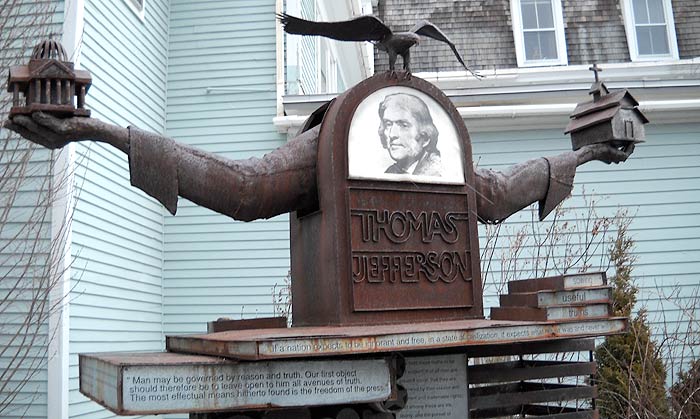
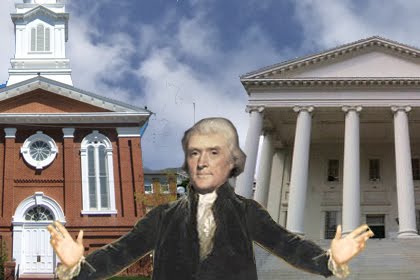
Thomas Jefferson and the separation of church and state. Sculpture outside the Northshire Bookstore, Manchester, Vermont. Image from Artsology.

Thomas Jefferson,
the San Marcos City Council,

and the municipal promotion of prayer

It is a feeble and flaccid religion that needs the imprimatur of government to find its relevance.

By Lamar W. Hankins / The Rag Blog / May 17, 2011

SAN MARCOS, Texas — City councils have no jurisdiction over religion, yet throughout Texas and the rest of the country, they promote it, sometimes fervently. While city councils have no power to deal with religion, they love to use religion’s reflected glory to enhance their own status.

When government officials meddle in religion, they lose all perspective and begin to see themselves as righteous and doers of God’s will, even in every zoning change they approve, every no-parking zone they create, and every pothole they order filled.

These council members reject Thomas Jefferson’s view that it is not in the “interest of religion to invite the civil magistrate to direct its exercises, its discipline, or its doctrine.” Ignoring this view, city councils are sponsoring prayer at the beginning of their meetings as though they have some ecclesiastical mandate to promote such religious exercise.

They quarrel regularly with the author of the First Amendment, James Madison, who stated, “There is not a shadow of right in the general government to intermeddle with religion. Its least interference with it would be a most flagrant violation.”

When President Andrew Jackson was asked to proclaim a national day of prayer and fasting, he said he could not do so “…without transcending the limits prescribed by the Constitution for the President and without feeling that I might in some degree disturb the security which religion nowadays enjoys in this country in its complete separation from the political concerns of the General Government.”

Many mayors and city council members don’t believe that they should have such limits.

Historian R. Freeman Butts reports, “Virtually every state as it came into the Union in the nineteenth century adopted the principles that the state guaranteed freedom of religious conscience and that the state would not use public funds to aid or support any churches or their schools.”

But city councils in all parts of the country regularly use their offices, public property, public employees, and public resources to promote religious activity–namely, prayer.

Dozens of cities over the last few years have been challenged regarding their sponsorship of prayers, especially Christian prayers. The best advice many of these city councils have received is to adopt policies that establish only non-sectarian prayers. The City of San Marcos, Texas, in 2009, was challenged about its prayer policy by Americans United for Separation of Church and State and the ACLU of Texas. In response, the city council adopted a policy that approved only prayers that do “not advance any one religion, disparage any other religion,” or are used to proselytize.

The new policy, adopted in August 2009, was based on the leading Supreme Court decision on the subject, Marsh v. Chambers. In following the Marsh decision, in 2004, the 4th Circuit Court of Appeals held that any sectarian invocations of deities in legislative prayer demonstrate affiliating the government with a particular sect or creed and/or advancing a particular faith or belief: “Marsh does not permit legislators to… engage, as part of public business and for the citizenry as a whole, in prayers that contain explicit references to a deity in whose divinity only those of one faith believe.”

This decision effectively prohibited sectarian prayers, yet the City Council of San Marcos continues to promote mostly Christian prayers offered as invocations.

One flaw in the San Marcos scheme is that it establishes the City Council as the purveyor of a privilege to practice religion in its chambers as a part of official government business, a notion that eats at the heart of the First Amendment’s prohibition against an establishment of religion.

In addition, the policy limits invocation participants to “clergy,” though this provision is ignored at the will of the council or its mayor or city clerk, who is given the responsibility to implement the prayer scheme. For example, several non-clergy associated with one religion or another have been allowed to offer invocations.

But the policy limits participation to those who represent a “faith tradition,” effectively excluding others who are not part of a faith tradition, but who are capable of giving an invocation, which is nothing more than a petition for help or support. This provision makes clear that the city council is promoting religion over non-religion.

Since the adoption of this new invocation scheme in San Marcos and through February of this year, there were 37 invocations at regular City Council meetings. All but four of those prayers were directed to the Judeo-Christian God (at least two prayers were arguably addressed to some other deity, or a generic deity), and two of those invocations — both nonsectarian — were offered by a member and a minister, respectively, of the San Marcos Unitarian Universalist Fellowship.

Twenty-one of the prayers specifically invoked the name of Jesus, with phrases like “In the name of Jesus Christ our Lord and Savior,” “In Jesus’ name we pray,” “in Jesus’ precious name,” “in the name of Jesus as the Christ,” and similar phrases. One of the prayers included a recitation of “The Lord’s Prayer,” recognized as the prayer uttered by Jesus, according to some Gospel accounts. Many of the prayers were fawning and jingoistic, suggesting the righteousness of City Council members, the city, and the country.

At least 33 of the invocations given since the change in the invocation policy before the San Marcos City council were sectarian prayers — acts of religious worship to the Judeo-Christian God. They were done at a time when the chamber was full of citizens who came to participate in the governance of the city. Frequently, visitors and citizens in attendance when the prayers were introduced were directed to behave in a certain manner, e.g., stand and bow their heads, “pray with me,” “let us pray” — clearly religious practices.

Visitors and citizens in attendance were referred to in many of the prayers, if not all of them, as in the use of the inclusive “we” in reference to speaking to God for all in attendance. A new practice introduced by Mayor Daniel Guerrero this past February is to invite an elementary school child to lead those in attendance in the Pledge of Allegiance immediately after the prayer, subjecting the young child to the practice of government-sponsored prayer, something not allowed under the Constitution in our public schools.

The public broadcast of the prayers over the internet and cable television provides the City Council a way to religiously exhort those of its citizens who watch via those media. And the invocation is difficult to avoid if one wants to do so: The agenda is not followed in the order posted; or the actual time the prayer will be given cannot be determined except through guesswork, making it difficult to know when the invocation will be called for.

The invocation is never placed at the beginning of a meeting, but posted often as the fourth, fifth or sixth item, and may be done after a workshop, an executive session, public comments, and after proclamations are issued, so city council members, officials, administrators, and staff, as well as visitors present at the meeting, cannot easily avoid participation by being absent during the prayer.

One of the clergy who regularly offers prayers before the San Marcos City Council asserted before one of his invocations that “it can’t hurt to have a prayer.” On the contrary, the freedom of religion guaranteed by the U.S. Constitution’s First Amendment necessarily carries with it the right to be free from religion imposed by the government, just as the freedom of speech does not permit the government to require me to speak, nor does the freedom of association require me to associate with those the government wants me to associate with.

When the government uses the religious practice of prayer while carrying out its civic functions, it compels all citizens who want to participate in our civic life or observe the government in action to partake of that religious exercise.

One of my favorite quotes about government sponsorship of religious practices is by the late Republican Senator Barry Goldwater of Arizona:

Can any of us refute the wisdom of Madison and the other framers? Can anyone look at the carnage in Iran, the bloodshed in Northern Ireland or the bombs bursting in Lebanon and yet question the dangers of injecting religious issues into the affairs of state?… By maintaining the separation of church and state, the United States has avoided the intolerance which has so divided the rest of the world with religious wars. Throughout our two hundred plus years, public policy debate has focused on political and economic issues, on which there can be compromise…

Most of those who cooperate with city councils to promote prayer do so with noble intentions bereft of an appreciation of how their use of government to advance religion violates the rights of those who have different religious beliefs.

For instance, I do not believe that I should have to participate in another’s religious practice in order to participate in my government, but this is exactly what the San Marcos City Council compels me to do by its sanctioning of official prayer, mostly sectarian, at its meetings.

The early American patriot, abolitionist, and Baptist minister John Leland said,

[W]henever men fly to the law or sword to protect their system of religion and force it upon others, it is evident that they have something in their system that will not bear the light and stand upon the basis of truth.

Another early American patriot and author of “Religion and the Continental Congress, 1774-1789: Contributions to Original Intent,” wrote,

The framers [of the Constitution] sought to divorce religion from government… [T]o make religion dependent upon government was to depreciate true religion; to rely upon government to throw its weight behind religion was to declare God impotent to further his purposes through voluntary means.

While I am encouraged that a long line of American patriots and U.S. presidents from George Washington to Jimmy Carter appreciated the need to keep government out of religion, that history does me no good when no member of the San Marcos City Council will rise to the defense of our forebears and disapprove of government sponsorship of religion in our civic life.

As I have suggested before, one of the greatest ironies of this government prayer promotion is that the most prominent proponents of it are the Christian evangelicals, who believe most literally in the words of the Bible. None of them have ever explained publicly how their behavior can be reconciled with the teachings of Jesus to pray in secret and not in public where they can be seen by others as pious.

It is a feeble and flaccid religion that needs the imprimatur of government to find its relevance. If all who call themselves Christian followed the admonitions of Jesus, we would not have a problem with sectarian prayers at city council meetings throughout the United States.

[Lamar W. Hankins, a former San Marcos, Texas, city attorney, is also a columnist for the San Marcos Mercury. This article © Freethought San Marcos, Lamar W. Hankins. Read more articles by Lamar W. Hankins on The Rag Blog.]

The Rag Blog

Posted in Rag Bloggers | Tagged , , , , , , | 2 Comments


Christian Science Monitor / Thought Theater

Dartmouth Independent

The great municipal religious promotion of the 21st century

By Lamar W. Hankins / The Rag Blog /

City councils have no jurisdiction over religion, yet throughout Texas and the rest of the country, they promote it, sometimes fervently. While city councils have no power to deal with religion, they love to use religion’s reflected glory to enhance their own status.

When government officials meddle in religion, they lose all perspective and begin to see themselves as righteous and doers of God’s will, even in every zoning change they approve, every no-parking zone they create, and every pothole they order filled.

These council members reject Thomas Jefferson’s view that it is not in the “interest of religion to invite the civil magistrate to direct its exercises, its discipline, or its doctrine.” Ignoring this view, city councils are sponsoring prayer at the beginning of their meetings as though they have some ecclesiastical mandate to promote such religious exercise.

They quarrel regularly with the author of the First amendment, James Madison, who stated, “There is not a shadow of right in the general government to intermeddle with religion. Its least interference with it would be a most flagrant violation.”

When President Andrew Jackson was asked to proclaim a national day of prayer and fasting, he said he could not do so “…without transcending the limits prescribed by the Constitution for the President and without feeling that I might in some degree disturb the security which religion nowadays enjoys in this country in its complete separation from the political concerns of the General Government.”

Many mayors and city council members don’t believe that they should have such limits.

Historian R. Freeman Butts reports, “Virtually every state as it came into the Union in the nineteenth century adopted the principles that the state guaranteed freedom of religious conscience and that the state would not use public funds to aid or support any churches or their schools.”

But city councils in all parts of the country regularly use their offices, public property, public employees, and public resources to promote religious activity–namely, prayer.

Dozens of cities over the last few years have been challenged regarding their sponsorship of prayers, especially Christian prayers. The best advice many of these city councils have received is to adopt policies that establish only non-sectarian prayers. The City of San Marcos, Texas, in 2009, was challenged about its prayer policy by Americans United for Separation of Church and State and the ACLU of Texas. In response, the city council adopted a policy that approved only prayers that do “not advance any one religion, disparage any other religion,” or are used to proselytize.

The new policy, adopted in August 2009, was based on the leading Supreme Court decision on the subject, Marsh v. Chambers. In following the Marsh decision, in 2004, the 4th Circuit Court of Appeals held that any sectarian invocations of deities in legislative prayer demonstrate affiliating the government with a particular sect or creed and/or advancing a particular faith or belief: “Marsh does not permit legislators to… engage, as part of public business and for the citizenry as a whole, in prayers that contain explicit references to a deity in whose divinity only those of one faith believe.”

This decision effectively prohibited sectarian prayers, yet the City Council of San Marcos continues to promote mostly Christian prayers offered as invocations.

One flaw in the San Marcos scheme is that it establishes the City Council as the purveyor of a privilege to practice religion in its chambers as a part of official government business, a notion that eats at the heart of the First Amendment’s prohibition against an establishment of religion.

In addition, the policy limits invocation participants to “clergy,” though this provision is ignored at the will of the council or its mayor or city clerk, who is given the responsibility to implement the prayer scheme. For example, several non-clergy associated with one religion or another have been allowed to offer invocations.

But the policy limits participation to those who represent a “faith tradition,” effectively excluding others who are not part of a faith tradition, but who are capable of giving an invocation, which is nothing more than a petition for help or support. This provision makes clear that the city council is promoting religion over non-religion.

Since the adoption of this new invocation scheme in San Marcos and through February of this year, there were 37 invocations at regular City Council meetings. All but four of those prayers were directed to the Judeo-Christian God (at least two prayers were arguably addressed to some other deity, or a generic deity), and two of those invocations — both nonsectarian — were offered by a member and a minister, respectively, of the San Marcos Unitarian Universalist Fellowship.

Twenty-one of the prayers specifically invoked the name of Jesus, with phrases like “In the name of Jesus Christ our Lord and Savior,” “In Jesus’ name we pray,” “in Jesus’ precious name,” “in the name of Jesus as the Christ,” and similar phrases. One of the prayers included a recitation of “The Lord’s Prayer,” recognized as the prayer uttered by Jesus, according to some Gospel accounts. Many of the prayers were fawning and jingoistic, suggesting the righteousness of City Council members, the city, and the country.

At least 33 of the invocations given since the change in the invocation policy before the San Marcos City council were sectarian prayers — acts of religious worship to the Judeo-Christian God. They were done at a time when the chamber was full of citizens who came to participate in the governance of the city. Frequently, visitors and citizens in attendance when the prayers were introduced were directed to behave in a certain manner, e.g., stand and bow their heads, “pray with me,” “let us pray” — clearly religious practices.

Visitors and citizens in attendance were referred to in many of the prayers, if not all of them, as in the use of the inclusive “we” in reference to speaking to God for all in attendance. A new practice introduced by Mayor Daniel Guerrero this past February is to invite an elementary school child to lead those in attendance in the Pledge of Allegiance immediately after the prayer, subjecting the young child to the practice of government-sponsored prayer, something not allowed under the Constitution in our public schools.

The public broadcast of the prayers over the internet and cable television provides the City Council a way to religiously exhort those of its citizens who watch via those media. And the invocation is difficult to avoid if one wants to do so: The agenda is not followed in the order posted; or the actual time the prayer will be given cannot be determined except through guesswork, making it difficult to know when the invocation will be called for.

The invocation is never placed at the beginning of a meeting, but posted often as the fourth, fifth or sixth item, and may be done after a workshop, an executive session, public comments, and after proclamations are issued, so city council members, officials, administrators, and staff, as well as visitors present at the meeting, cannot easily avoid participation by being absent during the prayer.

One of the clergy who regularly offers prayers before the San Marcos City Council asserted before one of his invocations that “it can’t hurt to have a prayer.” On the contrary, the freedom of religion guaranteed by the U.S. Constitution’s First Amendment necessarily carries with it the right to be free from religion imposed by the government, just as the freedom of speech does not permit the government to require me to speak, nor does the freedom of association require me to associate with those the government wants me to associate with.

When the government uses the religious practice of prayer while carrying out its civic functions, it compels all citizens who want to participate in our civic life or observe the government in action to partake of that religious exercise.

One of my favorite quotes about government sponsorship of religious practices is by the late Republican Senator Barry Goldwater of Arizona:

Can any of us refute the wisdom of Madison and the other framers? Can anyone look at the carnage in Iran, the bloodshed in Northern Ireland or the bombs bursting in Lebanon and yet question the dangers of injecting religious issues into the affairs of state?… By maintaining the separation of church and state, the United States has avoided the intolerance which has so divided the rest of the world with religious wars. Throughout our two hundred plus years, public policy debate has focused on political and economic issues, on which there can be compromise…

Most of those who cooperate with city councils to promote prayer do so with noble intentions bereft of an appreciation of how their use of government to advance religion violates the rights of those who have different religious beliefs.

For instance, I do not believe that I should have to participate in another’s religious practice in order to participate in my government, but this is exactly what the San Marcos City Council compels me to do by its sanctioning of official prayer, mostly sectarian, at its meetings.

The early American patriot, abolitionist, and Baptist minister John Leland said,

[W]henever men fly to the law or sword to protect their system of religion and force it upon others, it is evident that they have something in their system that will not bear the light and stand upon the basis of truth.

Another early American patriot and author of “Religion and the Continental Congress, 1774-1789: Contributions to Original Intent,” wrote,

The framers [of the Constitution] sought to divorce religion from government… [T]o make religion dependent upon government was to depreciate true religion; to rely upon government to throw its weight behind religion was to declare God impotent to further his purposes through voluntary means.

While I am encouraged that a long line of American patriots and U.S. presidents from George Washington to Jimmy Carter appreciated the need to keep government out of religion, that history does me no good when no member of the San Marcos City Council will rise to the defense of our forebears and disapprove of government sponsorship of religion in our civic life.

As I have suggested before, one of the greatest ironies of this government prayer promotion is that the most prominent proponents of it are the Christian evangelicals, who believe most literally in the words of the Bible. None of them have ever explained publicly how their behavior can be reconciled with the teachings of Jesus to pray in secret and not in public where they can be seen by others as pious.

It is a feeble and flaccid religion that needs the imprimatur of government to find its relevance. If all who call themselves Christian followed the admonitions of Jesus, we would not have a problem with sectarian prayers at city council meetings throughout the United States.

[Lamar W. Hankins, a former San Marcos, Texas, city attorney, is also a columnist for the San Marcos Mercury. This article © Freethought San Marcos, Lamar W. Hankins. Read more articles by Lamar W. Hankins on The Rag Blog.]

The Rag Blog

Posted in RagBlog | Leave a comment

SPORT / Dave Zirin : Santana Blasts Immigrant Haters at Baseball’s ‘Civil Rights’ Game

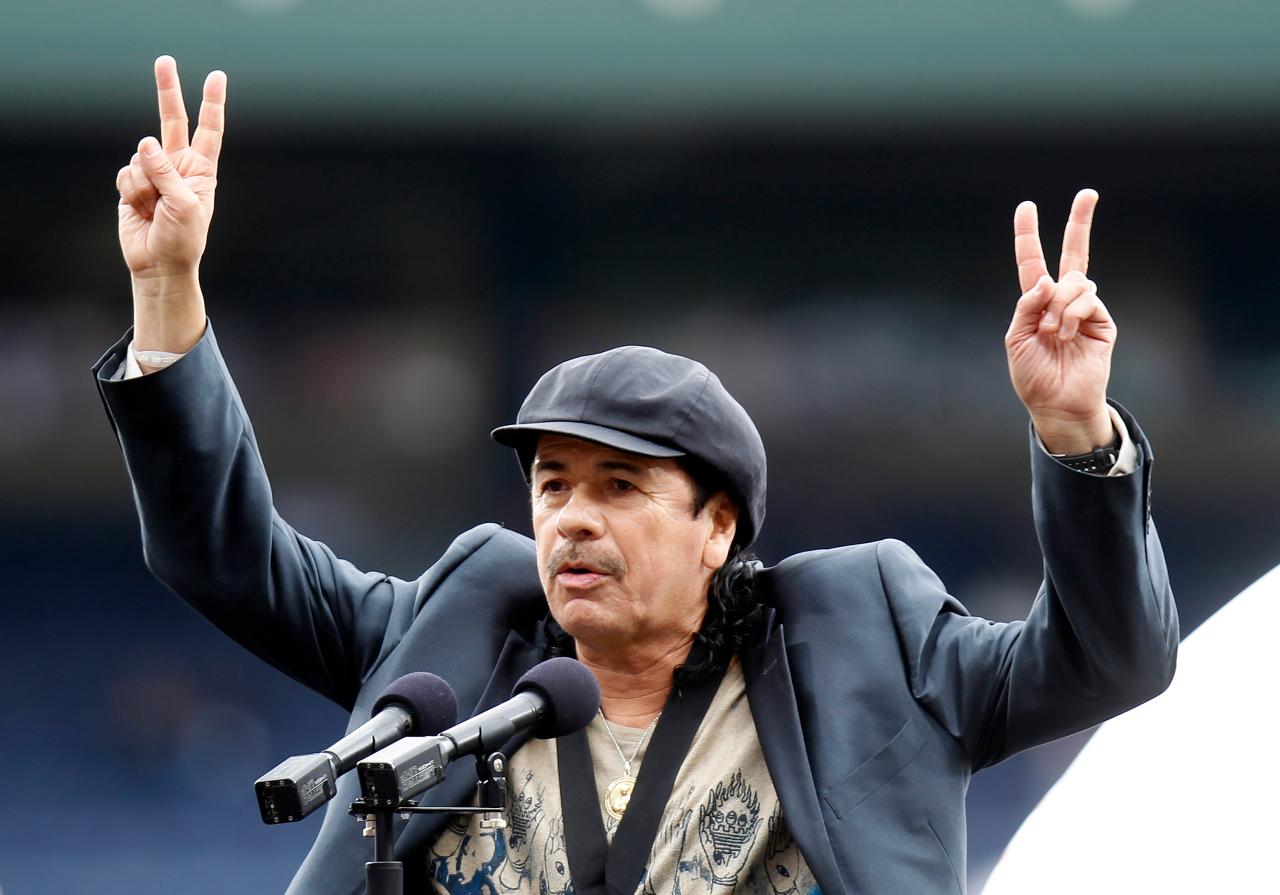
Grammy-winning rock legend Carlos Santana was given the Major League Baseball Beacon of Change Award before Braves-Phillies game Sunday, May 15, 2011, in Atlanta. Photo by John Bazemore / AP.

Atlanta fans boo!
Santana speaks out for Civil Rights
at baseball’s ‘Civil Rights Game’

By Dave Zirin / The Rag Blog / May 16, 2011

ATLANTA — Major League Baseball’s annual Civil Rights Game was poised to be a migraine-inducing exercise in Orwellian irony. Forget about the fact that Civil Rights was to be honored in Atlanta, where fans root for a team called the Braves and cheer in unison with the ubiquitous “tomahawk chop.”

Forget about the fact that the Braves have been embroiled in controversy since pitching coach Roger McDowell aimed violent, homophobic threats at several fans. Forget that this is a team that has done events with Focus on the Family, an organization that is to Civil Rights what Newt Gingrich is to marital fidelity.

The reason Atlanta was such a brutally awkward setting for a Sunday Civil Rights event was that Friday saw the Governor of Georgia, Nathan Deal, sign HR 87, a law that shreds the Civil Rights of the state’s Latino population.

Modeled after Arizona’s horrific and unconstitutional SB 1070, HR 87 authorizes state and local police the federal powers to demand immigration papers from people they suspect to be undocumented. Those without papers on request will find themselves behind bars.

Civil Rights hero John Lewis of Atlanta has spoken out forcefully against the legislation, saying “This is a recipe for discrimination. We’ve come too far to return to the dark past.”

But there was Major League Baseball commissioner Bud Selig, celebrating civil rights in Georgia, and chortling excitedly about the 2011 All-Star game in Arizona. In the hands of Selig, irony becomes arsenic.

Thank God that Commissioner Selig was stupid enough to choose the Civil Rights Game to honor, among others, the great musician Carlos Santana. Santana was supposed to be the Latino stand-in, a smiling symbol of baseball’s diversity. And maybe, he would even play a song!

But Bud picked the wrong Latino. Carlos Santana took the microphone and said that he was representing all immigrants. Then Santana added, “The people of Arizona, and the people of Atlanta, Georgia, you should be ashamed of yourselves.”

In a perfect display of Gov. Nathan Deal’s Georgia, the cheers quickly turned to boos. Yes, Carlos Santana was booed on Civil Rights Day in Atlanta for talking about Civil Rights.

Then in the press box, Santana held an impromptu press conference where he let loose with an improvised speech to rival one of his virtuoso guitar solos. He said,

This law is not correct. It’s a cruel law, actually. This is about fear. Stop shucking and jiving. People are afraid we’re going to steal your job. No we aren’t. You’re not going to change sheets and clean toilets. I would invite all Latin people to do nothing for about two weeks so you can see who really, really is running the economy. Who cleans the sheets? Who cleans the toilets? Who babysits? I am here to give voice to the invisible.

He went on to say,

Most people, at this point, they are either afraid to really say what needs to be said. This is the United States, the land of the free. If people want the immigration law to keep passing in every state then everybody should get out and just leave the American Indians here. This is about Civil Rights.

Where was Bud Selig during all this drama? It seems that Selig slunk out of a stadium backdoor in the fifth inning. If there is one thing Bud has become an expert at, it’s ducking his head when the issues of immigration, civil rights, and Major League Baseball collide.

If Selig really gave a damn about Civil Rights, he would heed the words of Carlos Santana. He would move the 2011 All-Star Game out of Arizona. He would recognize that the sport of Jackie Robinson, Roberto Clemente, and Curt Flood has an obligation to stand for something more than just using their memory to cover up the injustices of the present.

If Bud Selig cared about Civil Rights, he would above all else, have to develop something resembling a spine. But if Bud is altogether unfamiliar with the concept of courage, he received one hell of an object lesson from Carlos Santana.

[Dave Zirin is the author of Bad Sports: How Owners are Ruining the Games we Love (Scribner) and just made the new documentary Not Just a Game. Contact him at edgeofsports@gmail.com. This article was also published at The Nation blogs. Read more articles by Dave Zirin on The Rag Blog.]

The Rag Blog

Posted in Rag Bloggers | Tagged , , , , , | 5 Comments

THEATER / Jonah Raskin : The ‘Reborning’ of Zayd Dohrn

Scene from Zayd Dohrn’s Reborning at the San Francisco Playhouse.

The Reborning of Zayd Dohrn:

A fascinating piece of theater from the son of Bernardine Dohrn and Bill Ayers that speaks to our time now and where we’ve come from as a society…

By Jonah Raskin / The Rag Blog / May 16, 2011

SAN FRANCISCO — What do you do if you’re a young, rising playwright and you’re the son of Bernadine Dohrn and Bill Ayers? You write plays about parents and children and about parenting.

That’s what Zayd Dohrn, the oldest of three sons raised by Dohrn and Ayers, has done in his one-act play Reborning, which is on stage off, off, off Broadway at the San Francisco Playhouse.

If you don’t live in the city or nearby it might be long way to go to see a 75-minute play that races along, but if you can go in the next month or so it’s a fascinating piece of theater that speaks to our time now, and that also shows where we’ve come from as a society.

Part comedy, part tragedy, Reborning mixes satire with real pathos, and makes for laughter and for tears. The play features only three characters: a young woman who has been abandoned by her mother; an older woman who has lost a baby and wants a replacement; and a young man who brings them together tenderly in a kind of family.

The older woman might in fact be the biological mother of the younger woman, but the play leaves the relationships ambiguous, as though to say that we can choose or not choose our parents and our children, and make the families we want to make.

The narratives we tell ourselves and one another are all-important. Nothing is fixed or unalterable in Zayd Dorhn’s world and everything is possible. Secrets come to light, the past is peeled away, and scars are healed almost overnight.

It’s tempting to read Reborning as an autobiographical work, and there’s no doubt that Zayd Dorhn drew upon his own emotional crosscurrents to write his play. Growing up an underground kid with fugitive parents wanted by the FBI gave him plenty of sensational material and dramatic, real life characters to mirror.

Still, his characters aren’t copies of his parents or their contemporaries. Unlike them, his fictional people are pulled to art rather than to ideology, and express themselves in creative work rather than in political struggle.

Reborning takes theatergoers through a kind of emotional hell that includes dumpsters, death, and denial, but it’s a therapeutic work that ends on a note of reconciliation. The characters clash with one another; they shout and they argue, but they don’t hit, shoot, and bomb, and the play offers no big blow-up.

The final scene is an unclimactic kind of climax, but nonetheless genuinely heartfelt. It reflects a world in which mistakes are unmade, and seemingly irreconcilable differences are resolved peacefully.

The tensions between the two women — the mother/daughter figures — drive the play, but it’s the male character who brings them together. He’s also the comedian of the piece and he supplies the sexual energy that can be as funny as it is steamy.

In the first scene of the play, he walks around on stage holding a huge phallus in his hand and that irreverent image sets the tone for much of the play. Could the male character be inspired by his father and could the women be inspired by his mother? Maybe so.

Zayd Dohrn was in the audience the evening Reborning had its premier in San Francisco — the celebrity in the crowd. His parents were in the audience, too, though no one seemed to recognize them. They might still have been anonymous underground fugitives out on the town for the evening, not the infamous Dohrn-Ayers duo in the media at the time of Obama’s election.

Like many of the sons and daughters of former Weather Underground fugitives, Zayd Dohrn has come of age, and put the underground behind him. “Reborning” seems an apt metaphor for his own evolution as a playwright who dramatizes the theater of the human heart.

[Jonah Raskin is the author of For the Hell of It: The Life and Times of Abbie Hoffman, and teaches media at Sonoma State University. Read more articles by Jonah Raskin on The Rag Blog.]

The Rag Blog

Posted in Rag Bloggers | Tagged , , , , , | Leave a comment

Harry Targ : The Media and Ideological Hegemony

The media shape our consciousness. Image from Look for the Words.

Taking on the media:
Challenging ideological hegemony

By Harry Targ / The Rag Blog / May 16, 2011

The media and political, economic, educational, religious, and entertainment institutions shape our consciousness. People are told, inspired, coerced, and manipulated to think in certain ways, usually ways that support the economic and political interests of the rich and powerful.

Sometimes theoretical arguments about “ideological hegemony” are too abstract or too immobilizing. However, specific efforts at thought control at the community level can be understood and identified. And campaigns to challenge them are feasible, as many examples in cities and towns illustrate.

For example, I live in a Lafayette/West Lafayette, Indiana, twin cities with about 100,000 permanent residents. The greater metropolitan area, like most small and big communities, is “served” by one newspaper, the Journal & Courier.

The J & C has a circulation of about 33,000 and is owned by the Gannett Corporation. While its editorial board changes from time to time the general tone and framing of news in the paper is conservative.

From time to time stories appear about trade union events and occasionally stories are published which are critical of the major employer in the area, Purdue University. But for the most part the J & C serves as a booster for conservative politics and values, highlighting patriotism, businesses, religion, sports, personalities, and local crime over serious political issues in the community, the state, or the nation.

The interests and perspectives of working people are almost never reflected in its pages.

To illustrate we can take a look at one issue, Saturday, May 7, 2011. That day the paper had four sections: news and views; local stories; sports and business; and entertainment.

The first section consisted of nine stories, four of them local in content. Page one, with a photo of an American flag in technicolor and a helicopter in the background, featured the honoring of seven medal of honor winners from American wars such as Vietnam who were flown into Lafayette to dedicate the new “Medal of Honor Bridge” in the county. They arrived by Huey helicopter landing at the Faith Baptist Church. “As the recipients carefully exited the helicopter, they mingled with the children and other grateful spectators.”

The second story, with a picture, was of a resident of Monticello, Indiana, 20 miles away, who admitted to a murder. Both these stories jumped to inside pages.

Page three, called “Nation & World,” featured a few longer stories and “In Brief” two paragraph accounts of events going on around the world. The two biggest stories on this page reported on Al Qaida’s warning of revenge and the special role of stealth helicopters in the raid on bin Laden’s residence. Page four was a full-page ad for an auto dealership and five was the “Opinions” page.

The J & C does publish letters to the editor, though edited, and on Saturdays, statements by local residents called “My Life, My Story.” This time the question two residents were asked to address was “If you could live forever, would you? Why?” One respondent said she would live for ever in heaven “as all Christians have been promised eternal life in John 3:16.”

The editorials often endorse conservative politics. On this Saturday it praised a former executive of a local Eli Lilly pharmaceutical laboratory that was going to be closed. He saved the firm from closing, and with it 700 jobs, by finding a German purchaser.

On the back page of the first section were three stories and a large segment of the story of medal of honor winners, helicopters, and the new bridge continued from page one. One of the stories, in my view buried, was about President Obama’s visit to Indianapolis, just 60 miles away. Obama visited Allison Transmission’s Plant No.7 which had received “a heavy flow of federal cash for the President’s vehicle of choice, a hybrid that runs on electricity and less gasoline.”

The article cited the President’s claim that in plants like these the American economy would be rebuilding and new jobs would be created. A smaller story just under the one about the President’s visit was about Governor Mitch Daniel’s welcoming of the President. It said that this was President Obama’s fifth visit to the state and only the first time the Governor welcomed him.

Since the paper I am describing was a Saturday edition it included the glossy magazine insert “US Weekend magazine. The special highlighted story, front cover and all, was on “Our Warrior Moms.” Of course inside the magazine were such features as “Who’s Hot in Hollywood,” and “Birthday Buzz.” (I found out I am just a bit older than half the distance in age between Billy Joel and Don Rickles.)

While the J & C distributes 33,000 of their papers with enormous resources from Gannett and lots of large local advertisers, a new monthly newspaper, Lafayette Independent, has almost completed its first year of publication, based on the hard work of about 20 progressives.

LI prints from 2,000 to 3,000 copies, is produced by a volunteer editorial committee, draws upon local and internet writers, and is distributed by a network of peace and justice activists, progressive Democrats, and others. It replaced another alternative monthly newspaper, The Community Times, which had a 10-year career.

The May issue of LI is dense with copy, perhaps too dense. It is a 12-page paper. The front page included a story about a food drive organized by union letter carriers and an account of the desperate need for prison reform in Indiana.

Interior pages had stories on such subjects as Workers Memorial Day, the Midwest Peace and Justice Summit held in Indianapolis, costs of the war in Iraq and what that has meant for Hoosiers, the threat to public education in Indiana, the consequences to reproductive health due to elimination of funding for Planned Parenthood in the state, and the need to end reliance on nuclear power.

In addition, there was an interesting article on the rich jazz scene in the community.

Ads are inexpensive and draw upon the labor council, crafts persons, community organizations, and local businesses. Each issue has a detailed calendar of events, particularly those sponsored by local progressive groups.

Thinking seriously about local progressive responses to ideological hegemony and its print media expression some ideas come to mind:

  1. Progressives need to rigorously define what that hegemony is. What kinds of information, media frames, and ideologies are being distributed through the dominant news outlets? What are the priorities given to information: through stories, story placement in the papers, photos used, column inches of stories with different emphases AND what items never find their way into news print?
  2. Who pays for the news papers? Who are the local advertisers? Can they be influenced to withdraw their vital financial support from newspapers that do not represent what citizens need and want to know? Can they be prevailed upon to support alternatives?
  3. Who are the 33,000 subscribers to the J & C? Are they avid readers of the news coverage or primarily people checking out community calendars, comics, crossword puzzles, and obituaries? Can alternative papers address these interests as well? Have questions ever been posed to the 33,000 about whether they think the newspaper in town really meets their needs.
  4. Can we create alternative media that appeal to, draw upon, and fulfill the needs of the vast majority of peoples living in our communities: workers, women, minorities, and youth?
  5. As we discuss strategies for change, should we be thinking about alternative newspapers, radio stations, websites, and/or other venues for public communication of our ideas in our communities? Should we invite these potential consumers of progressive media to work for it, write its stories, and pay for its production? And is organizing around a progressive media project at the local level a good way to build networks of activists?

[Harry Targ is a professor of political science at Purdue University who lives in West Lafayette, Indiana. He blogs at Diary of a Heartland Radical. Read more of Harry Targ’s articles on The Rag Blog.]

The Rag Blog

Posted in Rag Bloggers | Tagged , , , , | 1 Comment

Ken Martin : ‘The Austin Bulldog’: Growling at the Powers That Be

Logo from The Austin Bulldog. Graphic by James Retherford / The Rag Blog.

Journalism making a difference:
The Austin Bulldog‘s investigative
reporting shakes up City Hall

By Ken Martin / The Rag Blog / May 12, 2011

AUSTIN — Even if you’ve never heard of The Austin Bulldog, if you live in Central Texas you have no doubt read about or seen television reports based on the work done by this small local 501(c)(3) nonprofit for investigative reporting.

The Austin Bulldog broke a major story on January 25, 2011, about the organized system of private meetings among the Austin mayor and council members that for years have taken place right before every council meeting. County Attorney David Escamilla announced the same day he would launch an inquiry into whether this longstanding practice of deliberating in private constituted a violation of the Texas Open Meetings Act.

That story started a media feeding frenzy. The Austin American-Statesman and most local television stations quickly jumped in to follow the story and spread it to a wider audience.

The mayor and council members immediately quit participating in these private deliberative sessions and for the first time in many years began holding public work sessions in properly posted open meetings.

That’s reporting that gets results.

The Austin Bulldog followed up by publishing the edited transcripts and unedited audio recordings of exclusive interviews with council members that were conducted before breaking the story. These interviews gave each council member the opportunity to explain when these private meetings started and why they never questioned whether they were appropriate or legal.

Most people in our area have heard of the embarrassing e-mails sent by the mayor and some council members, in which these elected officials insulted citizens and members of their own city staff. These documents came to light only because of The Austin Bulldog’s open records requests, triggering profuse apologies from the offending officeholders. A heaping helping of humble pie has been served up and choked down.

But it took more than an open records request to get all these e-mails. The City of Austin flatly refused, in writing, to provide any e-mails about city business that were sent or received on the council members’ private e-mail accounts.

The Austin Bulldog did not take no for an answer and filed a lawsuit against the mayor, council members, and City of Austin, and filed a related civil complaint with the county attorney. The end result was that those e-mails were made public — not willingly, not voluntarily as some of the press releases issued by the mayor and council members claimed, but because of the lawsuit.

More than that, the City Council on April 7 adopted a resolution saying that e-mails about city business, created or received on their private e-mail accounts, will be promptly forwarded to city servers and be made available upon request under the Texas Public Information Act.

The resolution characterizes this reform as being voluntary. That’s just another effort to paper over the fact that this action never would have been taken had The Austin Bulldog not filed its lawsuit.

The Austin Bulldog’s lawsuit and reporting also exposed the fact that the mayor and council members’ records management systems are in shambles — in large part because their staff members have not taken the training courses that are readily available.

For example, the city permits each official or employee to delete e-mails — without review by anyone to ensure that the deletion does not violate records retention laws. That’s important, because these elected officials are custodians of the records created by their offices and if these records are not properly maintained they will never be available to citizens or media who are entitled to see them in accordance with the Texas Public Information Act.

The city’s response to The Austin Bulldog’s lawsuit was to immediately hold two training sessions that were well attended by these staff members.

To date the City of Austin is now committed to pay three outside attorneys a total of $399,000 to address the city’s problems in complying with the Texas Open Meetings Act, Texas Public Information Act, and Local Government Records Act. The total includes $110,000 solely for The Austin Bulldog’s lawsuit, which seeks nothing more than to force the city to comply with the law.

Attorney Bill Aleshire of Riggs Aleshire and Ray PC represents The Austin Bulldog in this lawsuit, as well as the civil complaint filed with the county attorney, and does so without compensation. Our objective is not to prolong the lawsuit but to make the City of Austin a shining example of open government.

Growling at the powers that be: Austin City Council, 2011.

Big results on a small budget

I launched the Bulldog on April Fool’s Day 2010. I announced at the time that we don’t take ourselves too seriously, but we take our journalism very seriously. And we certainly do.

I’m in my 30th year as a journalist in Austin’s three-county metro area, and I have won a couple of national awards for investigative reporting for projects that resulted in felony convictions. But for the ongoing job of investigative reporting in the public interest, launching The Austin Bulldog is the best work I’ve ever done.

I think we’ve proven beyond a doubt that a small nonprofit for investigative reporting can make a big difference in exposing corruption, incompetence, and systems of decision-making that violate every principal of open and honest government.

The Austin Bulldog last year exposed a corrupt city council member and city attorney in Georgetown. The Austin Bulldog exposed a corrupt government in Williamson County. And The Austin Bulldog has exposed actions that may be violations of the Texas Open Meetings Act and Texas Public Information Act by the Austin City Council.

Some of this news has been hard for the community to accept. We like to think of Austin as a liberal oasis — and it is. We like to think of our city government as a model of democracy — but sadly it is not.

The mayor and some council members have said publicly that they are cooperating with the county attorney’s investigation. They have claimed they were voluntarily providing public records. These statements are not entirely true.

Despite the fact that we have four Attorney General opinions that say e-mails about city business sent or received on personal e-mail accounts are public records, the city flatly refused to provide them in response to my open records request, and did not do so until after they were sued by The Austin Bulldog.

The Austin Bulldog has led the pack on these stories since breaking the open meetings story on January 25. The Austin Bulldog has been widely recognized by other media for this work — by the Austin American-Statesman, YNN-TV, KUT-FM radio, and others.

I launched The Austin Bulldog with a $25,000 grant from the Knight Foundation and have kept it going with contributions from community supporters.

On April 1, 2011 The Austin Bulldog was awarded a $25,000 challenge grant jointly funded by the Kirk Mitchell Public Interest Investigative Reporting Fund and the Kirk Mitchell Environmental Law Fund.

Your tax-deductible contribution to support and sustain the important investigative reporting being done by The Austin Bulldog will be matched dollar for dollar by this challenge grant. I hope you will help us reach this important goal by adding your name to the growing list of community supporters by contributing now.

[Ken Martin is the founder, editor, and publisher of The Austin Bulldog. You may e-mail him at ken@theaustinbulldog.org.]

The Rag Blog

Posted in Rag Bloggers | Tagged , , , , | Leave a comment

Tom Miller : Stoney Burns Was Dallas’ Underground Iconoclast


Remembering Stoney Burns:
Dallas’ underground iconoclast

He lived up to his image: longish brillo hair, loads of dope, young cuties by his side, and a great appetite for outrage and graphic explosion.

By Tom Miller / The Rag Blog / May 11, 2011

[Texas underground press pioneer and counterculture icon Stoney Burns died of a heart attack, April 28, 2011, in Dallas.]

In the late 1960s and into the ‘70s I lived in Tucson, but spent a great deal of time traveling the Southwest writing for different underground newspapers. This included Austin’s Rag, Space City! (Houston), Seers Catalog (Albuquerque), and a paper in Denver whose name I don’t recall.

Occasionally this slipped over into the South, where I spent a week or so with both the Kudzu (Jackson, Miss.) and Great Speckled Bird (Atlanta), and north to D.C. where I put in time at the Washington Free Press and Quicksilver Times.

The anti-war movement and the culture it flowered were my main topics, but learning from one paper and passing on information to the next was as important as helping write and edit.

I helped start a paper in Tucson, Mad Funk, which lasted three issues (if you count a one-page broadside call-to-action as an issue). In Phoenix an alternative paper was starting, New Times, and there too I helped out. Yet no paper was as colorful and wildly anarchic as Dallas Notes, later The Iconoclast, run by Stoney Burns.

I called him one day out of the blue, introduced myself, and was invited to the Notes house on — was it McKinney? Live Oak? Lots of Dallas hippies, young runaways, excellent marijuana, the obligatory mattresses on the floor, and a kitchen where, when the cockroaches weren’t having dinner, we did.

It was summer 1969, and I had just visited Melissa, a small Texas town about 40 miles away whose café jukebox carried virulently racist songs. They were so proud of the tunes that they allowed me to tape record one. Stoney loved to run original pieces about stupid Texans, and my piece, “Ruralism, Racism, and Rhythm,” ran in the July 2, 1969 issue of Dallas Notes.

(I was so struck by how uptight and viciously right-wing Dallas was, I wrote a piece about the city for Hard Times, a terrific muckraking broadside published in Washington, D.C. by the late Andrew Kopkind and James Ridgeway.)

Stoney was a piece of work. He lived up to his image: longish brillo hair, loads of dope, young cuties by his side, and a great appetite for outrage and graphic explosion. He took his role as editor/founder seriously, and you could always count on him to do precise pica counts late into the night making sure his provocative headlines fit above cartoons mocking the local police and City Councilmen, promoting SNCC and La Raza.

At a certain hour of the night he’d grab some cash from a shoebox and we’d head out for late-night grub.

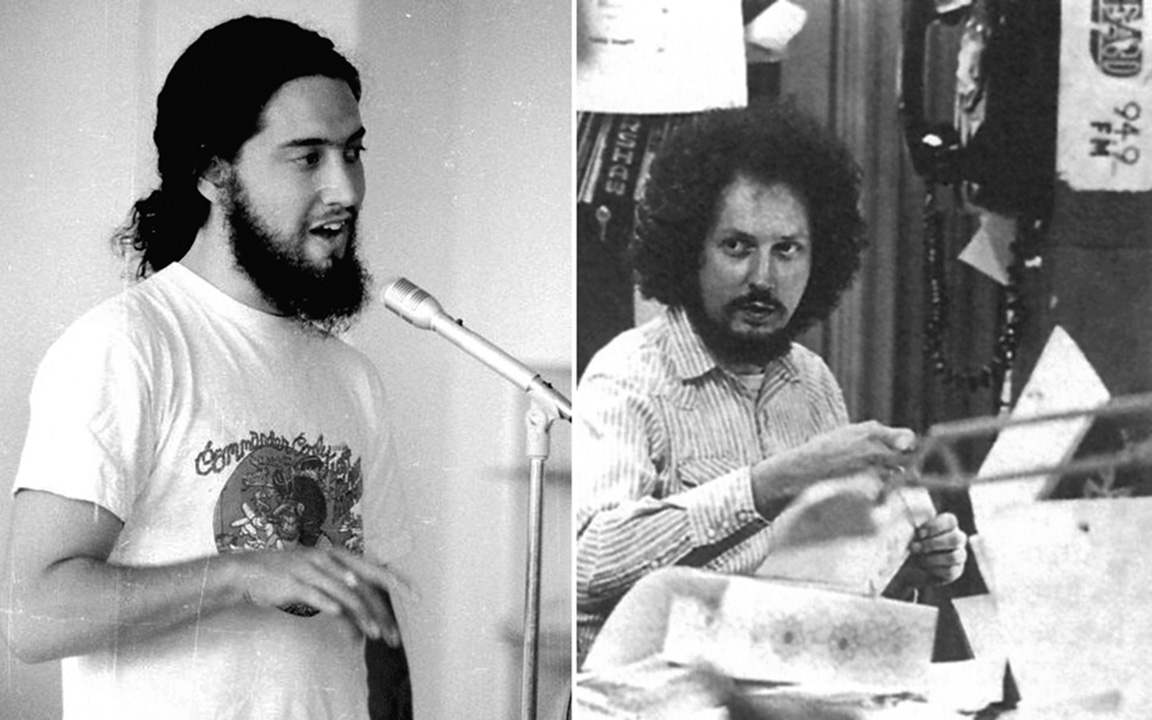
Writer and editor: Tom Miller, left, at underground press conference in Boulder, Colorado, summer of 1973. Photo from Underground Press Archive 1. Right, Stoney Burns in the Iconoclast office, 1972. Photo from University of Texas Press.

Once I flew in to Love Field and, as usual, the first thing I did was to genuflect before the metal statue of the Texas Ranger with the legend: “ONE RIOT, ONE RANGER.” By the time I got to the Notes house Dallas police had already visited and left. Two typewriters were broken on the front yard, having been tossed out of second-floor windows by police.

Middle class Dallas was losing its kids, giving themselves up by the dozen every Sunday at Lee Park. That police in plain clothes and uniform trailed Stoney everywhere amused him. Given the entertainment side of Notes, then Iconoclast, Stoney had warm relations with nightclub and movie theater owners, and often took me along as he dropped in one, then another, then another.

Stoney was gracious enough to reprint pieces I published elsewhere, including a parody I wrote for The Realist about a waterbed that leaked and shocked its owner to death, and another about J. Edgar Hoover’s secret hang-ups.

In all I’d estimate Stoney printed some dozen pieces of mine, and as often as I could, I’d try to pass through Dallas to help with layout and distribution for those and a subsequent issue or two. He was always hospitable, and agog at what was going on elsewhere in the country.

Among the creative contributors to Stoney’s papers was the late illustrator Charles Oldham, known better as Charlie O, who worked on layout and design. One issue I was in had two major front-page headlines: “Youth Community Hit by Massive Dope Raids,” and “Test Your Orgasm.”

The paper also had a running full-page cartoon series about God, called “The Man — The Continuing Story of God.” What sticks out in my mind even today is that in each strip some hippie would offer God a toke, and the good Lord invariably accepted.

By 1972 Stoney had enough credibility that his newspaper challenged FM rock station KRLD to a game of “revolutionary beísbol.”

At some point Stoney tired of being jailed, harassed, calling the ACLU, and getting out again, and soon started a music mag, named for Buddy Holly. Buddy seemed to do well for him — I contributed one piece — but I was more and more tied to writing books and less and less floating through the Southwest.

In 1984, however, I was working on a book that included a factory in Garland, a Dallas suburb. Stoney met me at DFW, we went out for a meal, and at a bar, some weather-beaten once attractive blonde became part of our party.

Just as Stoney was dropping me off at my hotel, and the woman sidled up to me, Dallas police showed up from out of nowhere and cuffed his hands behind his back. As Stoney was being hauled off, he shouted out the name and phone number of his lawyer.

It was the last I ever saw him. The crime he was busted for? Inoperative turn signal. And the blonde? She was a hooker Stoney had hired as a welcoming present for me. What a guy.

[Tom Miller’s most recent book is Revenge of the Saguaro: Offbeat Travels Through America’s Southwest. His web site is www.tommillerbooks.com. Read more articles by Tom Miller on The Rag Blog.]

The Rag Blog

Posted in Rag Bloggers | Tagged , , , , , , , | 2 Comments

Harvey Wasserman : Let’s Join Japan in Junking New Nukes

Workers cycle past a nuclear power plant on a tricycle cart in Changchun, in northeast China’s Jilin province, Dec. 17, 2010. Japan and Germany are limiting or phasing out reliance on nuclear power after the Fukushima accident. Photo from AP.

We’re at a turning point:
Let’s join Japan
and junk new nukes

By Harvey Wasserman / The Rag Blog / May 11, 2011

Japan will build no new nuclear reactors. It’s a huge body blow to the global industry, and could mark a major turning point in the future of energy.

Says Prime Minister Naoto Kan: “We need to start from scratch… and do more to promote renewables.”

Wind power alone could — and now probably will — replace 40 nukes in Japan.

The United States must join them. Axing the $36 billion currently stuck in the 2012 federal budget for loan guarantees to build new reactors could do the trick.

Wind potential alone between the Mississippi and the Rockies could produce 300% of the nation’s electricity. That doesn’t include solar, geothermal, ocean thermal, sustainable biofuels, and the many more renewable sources poised to reshape the American energy future once the prospect of new nukes is discarded.

Japan was set to build 14 new nukes before Fukushima. Six of Japan’s total of 55 reactors were shut by the earthquake and tsunami. Three at Kashiwazaki remain shut from the seven that were hit by an earthquake less than five years ago. Kan wants three more closed at Hamaoka, also in an earthquake/tsunami zone.

Japan’s reactor fleet remains the world’s third-largest, behind the U.S. and France. The General Electric and Westinghouse nuclear divisions, builders of nearly all the commercial reactors in the U.S., are at least partly controlled by Japanese companies. Reactor Pressure Vessels and other major components are built there.

Four California reactors also sit in earthquake zones vulnerable to tsunamis. San Onofre, between Los Angeles and San Diego, has 7.5 million people living within a 50-mile radius. Its two operating reactors and one dead reactor sit less than a mile from the high tide line.

Diablo Canyon, near San Luis Obispo, sits near a series of earthquake faults, including one newly discovered less than two miles from the two reactor cores there.

Numerous other U.S. reactors are perilously close to earthquake faults, including two operating at Indian Point, 35 miles north of Manhattan. The Perry reactor, on Lake Erie east of Cleveland, was damaged by an earthquake in January, 1986.

Massive quantities of heat have poured into the global ecosystem from the multiple explosions, partial meltdowns and spent fuel fires at Fukushima, contributing significantly to global warming.

Highly radioactive fallout has been found miles from the site. Millions of gallons of extremely contaminated water have poured into the ocean.

Radioactive fallout has also been detected in rainwater, milk, and on vegetables throughout the United States, threatening the health of millions of Americans, especially small children and embryos in utero.

Now Fukushima Unit Four appears to be on the brink of physical collapse. Fission may be continuing in at least one spent fuel pool, and possibly in one or more cores. Radiation levels are high enough at the site to guarantee certain near-term death to workers, many of whom have come to consider work at Fukushima to be a virtual suicide mission. A definitive end to the disaster could be years away.

Kan’s decision to shut Hamaoka and then to cancel future nukes came as a shock. Widely criticized for weakness in the wake of Fukushima, he has now redefined Japan’s energy future.

Though dependent on imported fossil fuels, major Japanese corporations have substantial investments in wind, solar, and other Solartopian technologies. This will push them to the forefront of Japan’s energy future.

Likewise Germany. In the wake of huge public demonstrations and a major electoral defeat, Prime Minister Angela Merkel has shut seven old reactors and says 10 more will go down by 2020, making Germany nuke-free. For decades Germany has been pushing wind, solar, and other green technologies harder than any other industrial nation, with enormously profitable results.

In the U.S., renewables are also booming, while the reactor industry has been taking hard hits. Just this week a major French-operated component factory proposed for Virginia has been pushed back two years — which means likely cancellation. A $5 billion taxpayer-funded facility in South Carolina to produce plutonium-based Mixed Oxide reactor fuel faces a lack of customers, and growing doubts about the project’s viability or real purpose.

Overall, Fukushima has complicated an already dark financial picture. A Texas project meant for Japanese financing is now all but dead. So is one proposed for Maryland by the French.

While the Obama Administration continues to push for those $36 billion in loan guarantees, it’s unclear what reactor projects are in credible shape to accept them.

Meanwhile ferocious battles to shut old reactors in Vermont, New York, New Jerse, and elsewhere are heating up. With roughly two dozen of similar design to Fukushima Unit One now operating in the U.S., the public demand for more shutdowns continues to escalate.

We need to finish the job and get to a green-powered Earth.

Nuclear power makes global warming worse, and spells economic as well as ecological doom.

The industry can’t get private financing, can’t get meaningful liability insurance, can’t deal with its wastes, can’t compete in the marketplace, can’t guarantee us we won’t suffer a Fukushima of our own, can’t provide a reliable energy supply into the future.

What lies before us once we kill these loan guarantees is a Solartopian reality powered by the sun, wind, tides, waves, earth’s heat, and more.

Those countries like Germany, Denmark, and now Japan that head definitively toward a nuke-free future are in the process of turning toward survivability and prosperity.

Let’s kill that loan guarantee package, shut the dying nukes like Vermont Yankee and Indian Point, and join them in truly green-powered future.

[Harvey Wasserman’s most recent book is Solartopia! Our Green-Powered Earth. He edits the NukeFree.org website, where this article was also published. Read more of Harvey Wasserman’s writing on The Rag Blog.]

The Rag Blog

Posted in Rag Bloggers | Tagged , , , , | 1 Comment

David McReynolds : The View From Over the Hill

The hill (and beyond). Image from Financial Samurai.

Do not be dismayed:
The view from over the hill

Even in defeat we are victorious, for we have given our lives a meaning others should envy. In struggling for something greater than ourselves, we will be transformed.

By David McReynolds / The Rag Blog / May 10, 2011

[On April 26, 2011, there was a book party in New York City for Martin Duberman’s double biography of Barbara Deming and David McReynolds, titled A Saving Remnant. (Read Doug Ireland’s review of A Saving Remnant on The Rag Blog, and listen to Thorne Dreyer’s interview with McReynolds and Duberman on Rag Radio.) The following article is based on remarks delivered by David McReynolds at that event and notes he made the next day.]

I’m reminded of the day, hitchhiking to UCLA from my parent’s home in Southwest Los Angeles, when I was picked up by a pleasant elderly gentleman with a head of white hair.

At the time I was involved in one of those affairs of the heart which wasn’t going at all well, and I thought, as I looked at the old fellow, how good it must be to be old, past the burdens of the flesh, able to enjoy good food and fine wines, visit museums.

Just then he reached over, put a hand on my thigh and said, “A tall young man like you, I expect you play basketball.” As I gently removed his hand and said I didn’t play any sports, I wanted to tell him that he had destroyed my illusions of old age.

In fact, in reading Marty’s book, which I felt treated me not only accurately but very gently, I sense I probably am less stressed these days than when I was young.

Certainly it is a great honor to find that while you are still alive you are subject of a biography — moreover, one which links you with that major figure of the last century, Barbara Deming. If I do not here deal with the issue of feminism, it is because Barbara dealt with it so well and I refer you to Marty’s book to get her views, with which I am largely in agreement.

It has been a good life in which, looking back, I am moved by the thought that at one time or another I walked in the company of giants such as Alvin Ailey, Norma Becker, Karl Bissinger, Maris Cakars, Sam Coleman, Dave Dellinger, Barbara Deming, Ralph DiGia, William Douthard, Peggy Duff, Allen Ginsberg, Gil Green, Arthur Kinoy, A.J. Muste, Grace Paley, Igal Roodenko, Bayard Rustin, Myrtle Solomon, and Norman Thomas. And was arrested with more than half of them.

I am deeply moved by those who organized this event and by WRL, which put up with me for nearly four decades, and the Socialist Party, which twice honored me with their nomination for President. Given the limits of time, I want to move directly to seven points.

First, do not be dismayed that we are in such troubled time. Large numbers of Americans seem impressed by Sarah Palin, Glenn Beck, or Donald Trump. Would you rather have found yourselves in a comfortable time when your voice wasn’t needed?

Think back to the other times we have lived through. The great war for Four Freedoms when we put Japanese in concentration camps on the West Coast. McCarthyism, when people were jailed for their political beliefs.

I remember, at UCLA, a group of us young radicals met at the beach shack in Ocean Park, 132 ½ Ashland Ave., for a serious discussion of whether we should not all leave for Costa Rica. One of us was taking flying lessons, and one of us was arranging for renting or buying a plane.

We voted not to go — though we were convinced we would all end in prison, as indeed some of my close friends at the time, Vern Davidson and others, did, for refusing the draft. Think of the fact that south of the Mason-Dixon line whites and blacks were separated on buses and trains, and blacks in the South had no vote.

Second, my life has been given to trying to find some combination of Marx and Gandhi. In this I have failed, but let me explain why that effort must continue. Do not blame Marx for Stalin, any more than you can blame Jesus for the Inquisition, or Gandhi for India s nuclear weapons.

Marx showed us that whereas in all previous times we had been the objects on which history was imposed, we now had the chance to consciously enter history as the subjects of it, who could act to change it.

It was Marx who taught us that the future is inevitable, is in our hands. Who helped us see how our consciousness is shaped by the class we are born into, the color of our skin, and, more than Marx realized, the sex we are given. It was Marx who suggested that the great issue is over who controls the means of production, whether they are in the hands of a few, or in some democratic way, in the hands of the many.

Marx came before the Russian Revolution. His vision was not that of the totalitarian state of Stalin, but of a broad and democratic society, one in which we could move from a society of need to one of abundance.

Yes, there were errors in Marx, a failure to examine the problem of the patriarchy, a failure to see the limits beyond which the exploitation of nature could lead to ecological disaster. But it was Marx who taught us we could take charge of our history.

Third, Gandhi gave us the solution to how we can engage in struggle without letting that struggle destroy us. In taking the path of violence, we find ourselves pitted against our brothers and sisters, we find ourselves dealing out murder in hopes of establishing the loving community, of building prisons in hopes we will find universal freedom.

It was Gandhi who reminded us that the means becomes the end. If your method is an organization which hates your opponents, so will the society you construct be shaped by hatred and not by compassion. I am not going to distance myself from those who are violent revolutionaries — it was Gandhi who felt that it was better to resist by violence than not to resist at all.

Pacifism is not for cowards. In fact, one of the main problems I had in becoming, or trying to become, a pacifist was that I knew I lacked the courage needed. In the end, looking back at a life in which I have suffered little for my beliefs, I conclude that God watches over atheists and cowards. We are not required to march farther than we are able, but to at least to take the few steps we can.

It was Gandhi who taught us a lesson which had been there all along, in the Gospels, in the teachings of Buddha, that there is a power in love, or, if you find it easier, the power of compassion. There are some few who we can be exempt from that command — Donald Trump has so much love for himself that he hardly needs mine.

But, friends and comrades, when A.J. Muste stood in a Quaker meeting during World War II and said, “If I cannot love Hitler I cannot love anyone,” do not think Muste was naive about Hitler. If we cannot find compassion for our enemies, we are lost.

Bayard Rustin explained it to me as the soldiers in a foxhole, when a volunteer was needed for an errand which might well be fatal, and the soldier who volunteered did so because, as he looked around at the others with him — one whom he knew was too terrified to make the run safely, one who had a wife waiting him, one who might falter because of an earlier wound — said to himself, let it be me. And all that pacifism does is extend that foxhole to include also the enemies.

David McReynolds at the 2009 Left Forum in New York City. Photo from Wikimedia Commons.

This is not an easy teaching. But it is essential, along with Gandhi’s absolute passion for truth — for holding onto the truth, for basing his analysis on the facts, for being willing to change his mind. This passion for observing the facts and then reaching conclusions was something he held in common with Karl Marx.

The great light that helps us keep life in perspective is death itself. For there is an end for each of us, but not for all of us together, as a human race feeling its way toward the future. All that we really have along this path is compassion and truth.

Think of the power of the Southern Black movement, largely rooted in the Black Church, which not only gave us the blues and jazz, but the extraordinary power of revolutionary change through taking the risks of change through nonviolence. How lucky I have been to have seen a part of that light cast upon America.

Fourth, we are engaged in a struggle to empower the powerless. It has been said that power corrupts, and that is true. But it is easy for pacifists, most of us safely from the white middle class, to overlook the reality that powerlessness also corrupts. Our struggle is not to seize power and centralize it, but to decentralize it, to empower the communities and the people.

Power is a reality. The power to build railroads and dams, to find alternative sources of energy, to build housing for the poor. We want to eliminate the monopoly of power which exists today. The power to make war, to imprison the powerless.

I do not, I’m sorry to say, have the answers. At 81 it is enough if I can suggest the problems. It is clear capitalism has failed, that we have seen a steady, relentless concentration of wealth and power in the hands of the few, while the great mass have less economic security.

Fifth, we also need to struggle to take power away from those who have it. At the moment the United States is still the most powerful military force in the world. We have deluded ourselves with the talk of representing the free world.

What our military power has been used for is the defense of America s economic interests, and on some occasions, out of sheer folly and stupidity. We have in the past 50 years waged wars against nations that never fired a bullet in any of our 50 states or posed any real threat. Korea, Vietnam, Laos, Cambodia, Panama, Grenada, Serbia, Iraq, Afghanistan.

I do not defend those nations but only note our military actions cannot be justified by threats they posed to us. We have killed millions. And we have killed them with weapons created with great skill, from the drones that fly over Pakistan, to the pellet bombs used in Vietnam.

No other nation can match our record of slaughter in the past 50 years.

Sixth, we are truly two Americas. Both in the sense that the late Michael Harrington laid out so well, the nation of wealth coexisting with the nation of poverty, but also the nation of men and women willing to devise the arsenal of death so recklessly used by the elite which governs us, and the nation of women and men willing to vigil, to organize against, to suffer jail for, their opposition to this America of violence and death.

Remember, at this dark time when Donald Trump can score so well in opinion polls, that this is a nation which survived slavery, the Palmer Raids, and McCarthyism. Our hope lies in our willingness to withhold consent, to refuse to be frightened.

It takes courage to confront the worst of this nation and this world — the cowardice of a President, and a British Prime Minister and a French head of State, not one of whom has seen combat, to send others into battle in Libya — and yet to hold onto hope. Hope has been defined as the combination resulting from combining anger with courage.

Even to believe that in the hearts and minds of our opponents there is the possibility of change.

One of the lessons in the Gospels is that no one is beyond hope. Jesus, in his ministry, did not sit with us, but chose to sit with agents of the IRS, and the FBI, to break bread with the bigots. So let us, in our community work, not disdain our enemies but dialogue with them.

Keep in mind that the Tea Party folks are largely middle aged, almost entirely white and Christian, and confused to find their President is black, the Secretary of State is a woman, there is a lesbian commentator on MSNBC cable, and the society pages record men getting married to men, and women getting married to women. The reality is that in a short time whites will be a minority in this country. And there is great fear of this final shift in our nation.

Seventh, let each of us take on the task we can. We are not observers, but participants. That may not mean joining an organization, but it means realizing that organizations are needed. Your work may range from being a good parent – a work of great courage and skill — to being a good artisan or artist, or teacher.

But we are united in rejecting the assumption that the accumulation of wealth is the object of our lives.

And in this task of building a movement for change, let us build it based on the uniqueness of this country, and not on patterns others have set. The lessons of the Russian Revolution do not prove a guide for us. Gandhi’s tactics in India are not a guide to us.

Above, a group of protestors against the War in Vietnam, including David McReynolds (the tall one), burn their draft cards in Union Square, New York, November 5, 1965. (Left to right: Tom Cornell, Mark Edelman, Roy Lisker, McReynolds, Jim Wilson, and A.J. Muste.) Image from Ferment Magazine. Below, McReynolds at Armed Forces Day Parade, 1979. Photo by Grace Hedemann / Nonviolent Activist.

Remember that American socialism was a real force before the Russian Revolution and that the greatest example of nonviolence in this nation did not come from the white pacifists, but from the Black Churches in the South.

Eugene V. Debs is an example of someone who tried to shape a movement based on the exceptionalism of this country, as A.J. Muste also did. Remember, each country is unique and exceptional.

Finally, let me say that we really do not know if we will win or lose. That, depending on your philosophy or religion, is in the hands of history or of God.

But we do know that our lives are defined by having been part of the endless struggle. For Gandhi knew, and Marx knew, that conflict does not end. We can hope, in the words of the old joke, that when we came to this seminar we were confused and uncertain, but we are happy to say, on the conclusion of our weekend of study, that we are confused on a higher level and uncertain about more important things .

The joy of those who flooded Madison, Wisconsin, in the struggle for worker s rights; the joy of those who marched in Washington, D.C., on August 28, 1963, when the streets were filled with hundreds of thousands; the joy of the May Days in 1971 when 15,000 of us were arrested and tear gas floated over the city.

Those were great times — and better times lie ahead. Even in defeat we are victorious, for we have given our lives a meaning others should envy. In struggling for something greater than ourselves, we will be transformed.

And if I have not, in this speech, addressed the questions of gender and gay liberation, let me close by quoting my old friend, Allen Ginsberg, in saying, “America, I am putting my queer shoulder to the wheel.”

Postscript

Reading over these notes I am struck by omissions that were inevitable but need to be briefly discussed.

I do not think socialism must be Marxist . There is religious socialism, utopian socialism, libertarian socialism. I simply want to affirm the debt we owe to Marx and Engels. I do not believe Marxism to be scientific socialism. It is said that at one point an exasperated Marx said, “Thank God I am not a Marxist.”

Lenin, whose views I respect even though I disagree with them, was quite right when he wrote, “Marxism is not a lifeless dogma, not a completed, ready-made immutable doctrine, but a living guide to action.”

But what is socialism? What would it look like? Marx himself was vague on this, and what set him apart from the utopian socialists (who were not, let me note, without a value of their own) was his awareness that social change is a process, not a blueprint.

The closest he came to defining socialism was in his Critique of the Gotha Program. But even to take that up is to waste time — it was written long before the Russian Revolution, long before all of the trauma of the technological and cybernetic revolutions.

We can say that socialism is a way of organizing the economy so that the major means of production are socially owned and democratically controlled. We can say that great fortunes would be a thing of the past, that the huge concentrations of wealth as they exist now would end with estate taxes.

But we can also say that socialism does not mean there will be no small business. Ironically it is capitalism which has proven the great enemy of small business. Socialism does not mean your apartment or your home or your family farm will be seized, much less your toothbrush. Private property would not be abolished. It would be social property which would be dealt with.

Even this, however, requires a lot of new thinking. Our own society today has few great factories that can be turned over to the workers. To a great extent we have become a society of service industries. Ironically our farming is perhaps more collectivized (by large farming corporations) than was true even in the Soviet Union. Socialists might want to find incentives for the revival of family farms.

We can certainly look at the mistakes (and the successes) in the Soviet Union, of the social democracies of the Nordic countries, of Cuba, of China, etc. but we are so very far from having the political power to achieve socialism that it is pointless to waste enormous time now over debating the blueprints.

Clearly — because our survival depends on it — whatever socialism we struggle to create must have much more concern with ecology than the socialist movements of the 19th and 20th centuries.

Economics, whether Marxist, Keynesian, or free market, is extremely complex and extremely unpredictable. What is clear, and has been clear for some time, is that capitalism is a failure.

This has been dramatically shown with the most recent collapse of the free market but it is also inherent in capitalism that human beings become commodities, that they are driven to compete, often wasting their lives in activity that has almost no social or intrinsic value (advertising, dealing in commodities, etc.). Capitalism produces a society in which authentic human freedom is hard to achieve.

Finally, the other necessary postscript concerns How. Not just what is socialism, but how do we get there. Marx thought socialism would come when in the final crisis and collapse of capitalism, the workers would seize power. He was sure that the birth of the new order would be bloody — and he had history on his side, since all other major shifts in how society was organized took place with great violence.

It was not that Marx hoped for violence, simply that he thought it inevitable. (And I might add that if one adds up the millions of lives destroyed in wars due primarily to capitalism, then the violence of revolution looks a bit different).

However the Russian experiment is instructive and tragic. Without trying to reprise that history here, the enormously liberating experience of the first years of the Revolution were replaced by secret police, prisons, brutal repression, and the hideous conformity of Stalinism. Even more sadly, with the collapse of the Soviet Bloc we have seen little remaining that is of value.

It is easy for the ultra-revolutionists to argue for a violent revolution, but I believe, with Debs, that if workers cannot learn to aim their ballots, they wouldn’t aim their bullets any better. Aside from which, a violent revolution inevitably falls upon the young and strong, while a nonviolent revolution is one in which all, young and old, weak and strong, can take part.

In the United States even Karl Marx had thought that it was possible for profound social change to occur through elections.

At this point there is no single party which represents democratic socialism. And we need to think less of parties in the usual sense than of organization, which can educate and organize demonstrations (and civil disobedience) as well as enter the electoral field.

There are groups today which might with profit work more closely together — the Socialist Party, Democratic Socialists of America, the Committees of Correspondence for Democracy and Socialism, would be in this grouping. Nor would I exclude the Greens from dialogue. Nor would I exclude the Communist Party, which is going through serious internal changes.

A final word before the postscript becomes an entirely new venture rather than simply an effort to clarify. While I have no interest of any kind in the Vatican, one must remember figures such as Pope John XXIII, Dorothy Day, the quiet revolutionaries of the Catholic Worker — and of other Christian groups.

And if one despairs at much of the Jewish community for its rigid approach to issues such as Palestinian rights, there are groups such as Jews for Racial and Economic Justice (as well as several others working for peace in the Middle East) which remind us that a rigidly atheist socialist movement will pointlessly isolate itself. Judaism, more than most religions, is based on the concept of law and community.

Marx represented, I realize, an atheist approach to society, and as such he was the enemy not only of capital but of all religious bodies. But Marx was not, himself, a God. On the contrary he dealt with contradictions, as did Gandhi. It may baffle the orthodox mind, but it is quite possible to embrace a generally Marxian approach and also a Christian, Jewish, or Islamic set of beliefs.

Let those who would be offended by this willingness to link spiritual values with material struggle be offended — it is still possible and needs to be said.

Finally, pacifists must not simply resist violence, but seek to build a society which does not treat people violently. If we are not inherently a philosophy of radical social change, I think we have little value. But if we make ourselves a part of a broader movement, most of which may well not be pacifist, we can help to resolve the conflicts, and make dialogue an alternative to endless fracturing and splits.

We may, as people committed to reconciliation, shy from the terrible reality of the class struggle, but there is indeed a class struggle or class war, and as Warren Buffet said, “There is a class war and my class is winning it” (and he wasn’t happy about it — the concentration of economic power in so few hands is profoundly alien to democracy).

The only people who don’t know there is a class war are those at a safe distance from it. Think of it as a war against injustice, but it is real, and we must take our part in it.

A final point (like all radicals, one’s final point is never quite final) concerns State and Government. They are confused by most people who view socialism as the State taking charge of their lives.

There is a crucial difference between the State, which has the power to wage wars and to execute people, and the Government, which collects garbage, educates our children, maintains public safety, builds bridges, and in many other ways does those things which individuals alone cannot do, and which we do not feel comfortable having done for a profit.

Governments can be very decentralized, States tend to seek an absolute monopoly of power. I would hope the democratic socialism we seek is one of diffused power.

(Now you may think this is the end. And it is.)

[David McReynolds is a former chair of War Resisters International, and was the Socialist Party candidate for President in 1980 and 2000. He is retired and lives with two cats on the Lower East Side of Manhattan. He posts at Edge Left and can be reached at dmcreynolds@nyc.rr.com. Read more articles by David McReynolds on The Rag Blog.]

The Rag Blog

Posted in Rag Bloggers | Tagged , , , , , | 2 Comments

Sue Katz : May Day in Vermont

Poet Verandah Porche (left) and author Sue Katz. Photos from Sue Katz, Barry Hock, and Consenting Adult.

May Day in Vermont

By Sue Katz / The Rag Blog / May 10, 2011

I think you’ll get some enjoyment from reading this by Sue Katz, one of my friends from the “old days,” a contributor to the anthology Out of the Closets, and a woman with a lovely checkered past and present (and future!).

I was present at this gathering, too, on April 30, a day short of May Day.

What Sue doesn’t mention is that this is the Packers Corners commune, founded in 1968, one of the pioneering “back to the land” places in our region (about 30 miles from my house in Massachusetts). Many people present resided at the former LNS-MA (Liberation News Service) commune in Montague, Massachusetts, birthplace of the modern no-nukes movement.

The founders were mostly friends from Boston University, only a few years out of college. This is the place made somewhat famous by one of its former residents, Ray Mungo, who wrote about it in a book he titled Total Loss Farm. (His name for the farm, not the farm’s actual name.)

So many wonderful people, and a joyful atmosphere. Sad moments, too, remembering people who have died, including the most recent death (from brain cancer) of Tony Mathews, hippie carpenter extraordinaire of Gill, MA, [LNS founder] Marshall Bloom (I called out his name), Fritz Hewitt, Marty Jezer, and others.

Allen Young / The Rag Blog / May 10, 2011

May Day gathering at Packers Corners. Allen Young is third from the right.

PACKERS CORNERS, Vermont — Although I do not have the time for this, what with trying to get all my work done before my trip abroad, I am unable to deprive myself of my annual trip to Vermont for May Day. The event is held at The Farm, founded by my college posse in 1968, and overseen to this day by my poet darling Verandah Porche. (She’s in the red blouse and long skirt in the photos.)

I arrive on Friday afternoon in time to help unravel the silk streamers still wound tight around our May Pole since last year. We sit outside under the welcome sun hoping for a good day tomorrow, when people will come from all over the surrounding countryside and others, like us, from Boston.

Our main task completed, I take a temporary departure from Verandah to go just down the road to the 1840 home of my book binder friend Susan and my antiques expert friend Gilbert. They are putting me up and feeding and watering me.


“Feeding” is too pale a term for what goes on. We’re talking about delicious cheeses and dips to get the juices going and then a dinner of onion-stuffed roasted moist chicken, rich mashed potatoes, for which Gilbert is famous, asparagus that has been kept on ice until it is time to be cooked to an uncanny perfection, eggplant wraps smothered in tomato (from the garden) sauce, all followed by an exquisite apple pie (with ice cream), the top of which is swollen with crispy deliciousness.

Susan stands up to start to clear the table and freezes. “Everyone,” she says to us in a low voice, “stand up and be still.” We obey, looking out the windows overlooking the rear deck. They keep a bird feeder there, feeding to the tune of 10 pounds of black oil sunflower seeds per week, attracting an ornithologist’s wet dream’s array of birds.

But tonight that is not all the feeder is attracting. On its hind legs, a 300-pound black bear is sucking its dinner from one of the feeders. It sits on the deck on its fat butt, a luxurious fall of shimmery long fur cascading around its back, satiating a big case of the munchies. I am frozen. What do I know? I’m from Pittsburgh, for gawd’s sake. “Camera!” I yell, “someone get a camera.”

Gilbert meanwhile runs outside to have words with the bear, who does not seem to welcome confrontation. The bear returns to four well-padded feet and reluctantly, having been shoo’d loudly a few more times, ambles around the back to the side of the house and then up the lawn to cross the road. No one gets a photo in time.

Susan is unhappy that this beautiful creature has been chased away, while inside the house we follow our precious sighting of the bear by switching from window to window, circling the walls for the best view as the animal gracefully distances itself from us.

We sit outside on the deck around a fire pit on steel legs into which Gilbert feeds board after board to warm us up. Susan cannot get over the bulky beauty of the glorious animal and she and Gil reminisce about the time another black bear came right into their living room. Or was it this same one when it was younger? If so, she is so glad it has survived hunting season.

We turn in around 10 p.m. and sleep in the intense darkness that one only gets in deeply rural settings — and maybe dungeon cells. In the middle of the night there is a screaming crash of glass. I am startled awake and think that it must be a kerosene lamp and perhaps kerosene is all over the floor.

Within seconds the light comes on. It is Susan. I have figured out that some tossing and turning has shifted one of the four pillows sideways, knocking over what used to be a kerosene lamp and what is now an electric lamp, as I know so well, having turned it off when it was sleep-time. In bare feet, Susan tiptoes through the hunks of frosted glass, lifting what is left of the shade to a sideboard. She says that she and Gil were afraid that it was the bear, making its way back in.

We leave the glass with the intention of cleaning it up in the morning light.

Saturday

I wake early and sweep up the glass with a hand brush and dust pan. Gilbert is already preparing a scrumptious breakfast of eggs, sausage, sautéed potatoes and challah. Susan is dressing for her morning climb up the mountain with Verandah and I am checking my email.

Just before one we make our way to The Farm bearing contributions to the pot luck that precedes the annual May Day ceremony. Happily I meet up with my dear niece, nephew, and grandniece Sadie (otherwise known as Verandah’s daughter, son-in-law, and granddaughter, respectively). Out of my little bag of treats, the beach ball is the biggest hit — once poor Matt depletes himself of oxygen blowing it up, and I actually get to play with Sadie, a rare treat for me.

The morning had started foggy but the sun clearly wants to participate in this day of joy and is now burning down on flesh made vulnerable by an endless winter. It is a glorious day — sunny but not scorching. As I explain to one new guest, a young guy, this particular May Day celebration combines three themes: the international day of worker solidarity; the pagan festival of Spring; and the celebration of the end of a harsh Vermont winter that can cause isolation as folks hunker down around their stoves.

I see old friends (like from the ’60s) and newish ones and once the many dozens of guests have cleaned their plates it is time to mount the mountain overlooking our once-and-future commune. One friend hoists the May Pole and many others grab one of the colorful streamers and up we go, followed by music makers and stragglers.

At the top, the May Pole is inserted into its usual hole and propped up until stable, so that the rest of us can wind around and around, weaving in and out, both clockwise and counter, to the tunes of Peter Gould’s hand accordion.


Once done, we stand and sit in a circle while the singing commences. The scope of talents and the range of union, worker, and sentimental tunes is startling, and the support of the amateurs by the professionals — like Patty Carpenter and Melissa Shetler — and Verandah Porche — is emblematic of the kind of supportive, collaborative community these folks have constructed.

As always, Verandah asks us to invite in those who have died — and people around the circle call out names of mutual friends and then individual loved ones. One guy calls out, “My parents!” — and dozens of echoes of “and mine!” reverberate from around the circle. We are orphaned, but we have each other and the generations behind us.

[Sue Katz is an author, blogger, journalist, unionist, and rebel whose rants and reviews are posted on her blog, Consenting Adult.]

The Rag Blog

Posted in Rag Bloggers | Tagged , , , , , , , , , | Leave a comment