
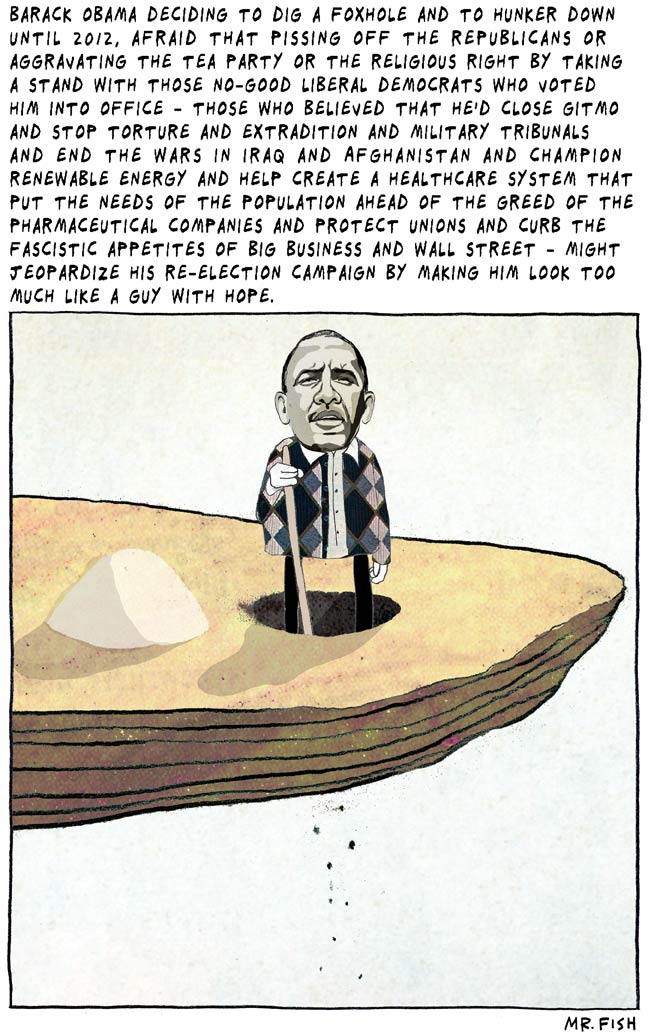
CLICK ON IMAGE TO ENLARGE.
Thanks to Harry Edwards / The Rag Blog
CLICK ON IMAGE TO ENLARGE.
Thanks to Harry Edwards / The Rag Blog

By James Retherford / The Rag Blog / March 16, 2011
The streets belong to the people.
— Diggers, San Francisco, 1967
See more photos, Below.
AUSTIN — The first annual Honk!TX Fest, billed a “festival of community street hands,” marched on Austin Friday through Sunday, March 11-13.
Continuing a Honk! tradition started in 2006 in Somerville, Massachusetts — while also KEEPING AUSTIN WEIRD — some two dozen U.S. and Canadian street bands in gala attire created mobile “liberated zones” in East Austin and the North Campus area with color, costume, cacophony, and collective spirit, carrying “messages of hope, unity, and social change.” The weekend culminated on Sunday with a march from City Hall to East Austin’s Pan American Park, followed by an all-day jam.
(Though not formally associated with Austin’s massive South by Southwest [SXSW] festival, this event is part of hundreds of related music activities happening over the next week here in the “live music capital of the world.”)
The festival was organized by Austin’s Minor Mishap Marching Band, a 30-plus-member “renegade brass band” that describes itself as “Bourbon Street meets Budapest.” MMMP is a truly absurdist spectacle featuring a washboard-playing Roller Derby queen, an (almost) seven-foot-tall Elvis impersonator playing bass drum, a klezmer-shredding clarinet player, dancing tubas, and assorted other freaks of musical nature. Founded two years ago by multi-instrumentalist Datri Bean, this band really kicks it!
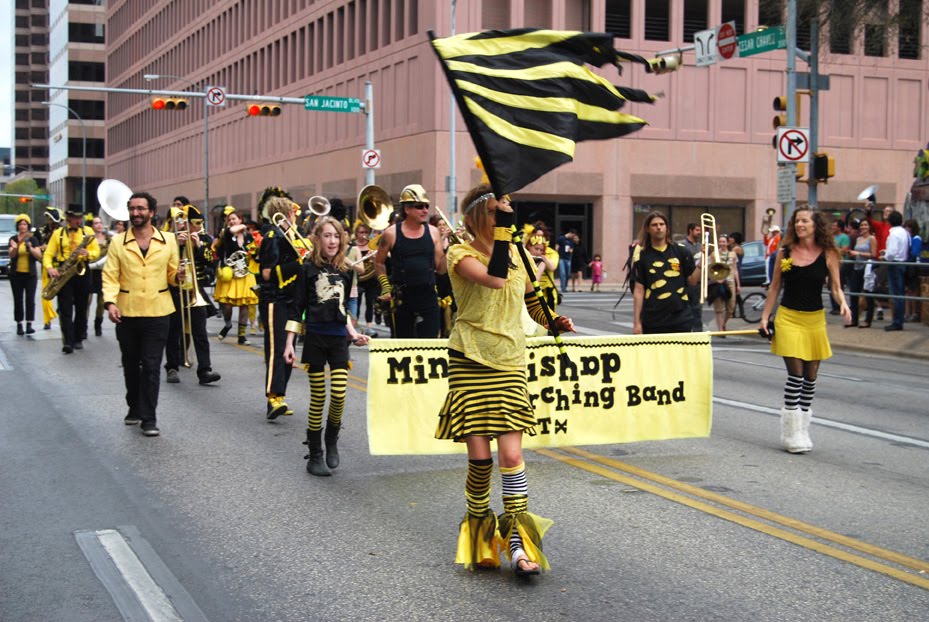
The out-of-town guests brought their own hit-and-run street parties also. The red-and-white-themed Extraordinary Rendition Band from Providence, Rhode Island, the green-clad March Madness Marching Band (with hula-hoop twirlers) from Lexington, Kentucky, the Hubbub Club from Graton, California, Environmental Encroachment from Chicago, and Atlanta’s Seed & Feed Marching Abominable (founded in 1974) combined slapstick guerrilla street theatrics with high-energy funk, heavy metal, Eastern European, and Dixieland marching tunes.
Of special note: Seattle’s ultra-tight Titanium Sporkestra, named after the ubiquitous mutant fast food eating utensil. Their logo features a red spork and sickle.
The medium was unhinged fun, but the message from all of those hard-working, fun-loving musical groups was freedom and justice, starting from each public space liberated through the act of playing and then spiraling outward, with insistent drum beat, to the rest of the world. Ya gotta love it.
Minor Mishap Marching Band will open for White Ghost Shivers at Threadgill’s World Headquarters in Austin on March 26.
[Austin activist-journalist James Retherford was a founder and editor of The Spectator in Bloomington, Indiana, in 1966. A graphic designer, writer, and editor, Retherford is a director of the New Journalism Project, the nonprofit organization that publishes The Rag Blog.]





By Jonah Raskin / The Rag Blog / March 15, 2011
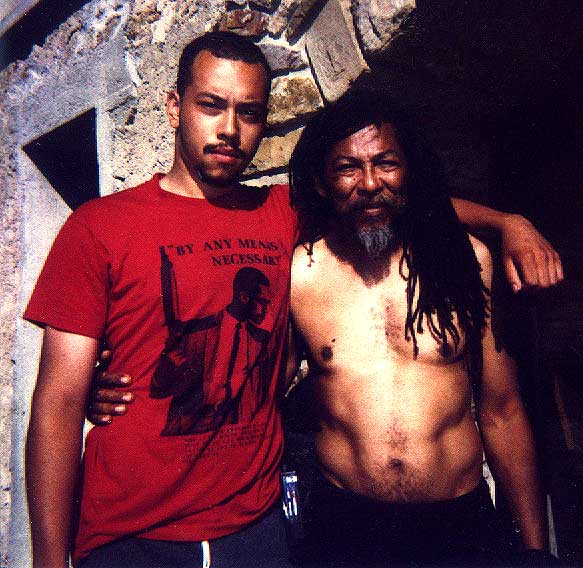
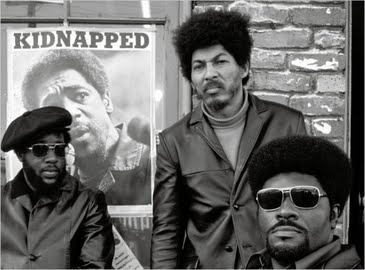
It was sad news that former Black Panther, Don Cox, died in France, February 19, 2011, at the age of 74, but I had to laugh at The New York Times obituary by Bruce Weber that described the Panthers as “the socialist movement founded by Huey P. Newton and Bobby Seale in Oakland, Calif., in 1966.” True, the Panthers were founded by Newton and Seale in 1966 in Oakland, but they were not a socialist movement, not by any stretch of the imagination.
They did for a time provide breakfast for children and they did want community control of institutions, such as police departments and schools, in black neighborhoods, but they did not advocate socialism.
They were part of the Black Nationalist movement that made allies with young, radical whites, and they also shared optimism and the political tactics of the anti-colonial upsurges that spread across the Third World in the 1960s.
I met Donald Cox — “DC” as we called him — and got to know him, briefly, in Algiers in 1970. I had gone to Algiers with a group of Yippies to meet Eldridge Cleaver and Timothy Leary, both of whom were wanted by U.S. authorities and were living in exile.
DC was the mellowest. DC was the coolest, and much less of a megalomaniac or egomaniac than Cleaver or Leary. In fact, he wasn’t a megalomaniac or an egomaniac at all. He didn’t want to change the world with guns or LSD and he didn’t want to run it either. Like Cleaver and Leary, he was also wanted by the FBI and considered “dangerous,” but he seemed wistful to me.
He turned to Jennifer Dohrn and asked her, “What color is that water?” She looked down. I looked down. We all did. “It’s reddish-blue,” Jennifer said. And indeed it was. It looked like the sea was awash in blood. “The Algerians say that it’s their blood that gives it that color,” DC explained. “The red blood of the guerrillas changed the color of the Mediterranean.”
At a feast at a seafood restaurant, DC was our official host and sat at the opposite head of the table from Cleaver. He ordered food for everyone — shrimp and fish and white wine. DC was also made uneasy by two African Americans at the bar who said they were from San Francisco, and whom he suspected worked for the CIA. Sekou, one of the Panthers, spoke softly.
“I got us all covered,” he said. And indeed he did. I looked under the table and saw that he had a gun in his hand. I was confident he’d use it if need be. He had hijacked an airplane at gunpoint to get to Algiers.
DC didn’t have a gun in Algiers. I never saw him with one, either under a table or on his own person, though I did see Cleaver with an AK-47 in his lap. In 1970, DC expressed concern about living in exile. He hoped that he would not have to remain for the rest of his life outside his own native country. He missed San Francisco.
He did live in exile for the next 40 years of his life; his widow noted that before his death, exile had begun to wear on him. I’m sure it did and yet what strikes me most about DC now is his longevity. He lived longer than many of the Black Panthers, such as Huey Newton, and Eldridge Cleaver, who became a born-again Christian, a Republican, and a crack-head in the 1990s in Oakland.
DC never turned his back on his ideals, his passion for justice or his appreciation of beauty.
One night, we all looked up at the moon and admired its beauty.
“In Babylon, you can’t appreciate the moon’s beauty,” DC told us. “But here you have the time and space to dig on it.” That’s the way I’d like to remember DC, the Black Panther Field Marshal, who lived more than half his life in exile, and who learned in exile to appreciate the beauty of the moon.
[Jonah Raskin teaches at Sonoma State University and is the author of For the Hell of It: The Life and Times of Abbie Hoffman.]
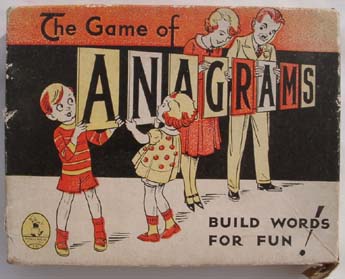
REVOLUTION
Lo, no virtue?
Root, unveil our novel It
O, live no rut. Rev unto oil.
Our violent into velour,
Rune to viol, ruin to love.
Verandah Porche / The Rag Blog
March 14, 2011
[Verandah Porche is a poet and writing partner in Guilford, Vermont. Read more of her work at verandahporche.com.]

By Kate Braun / The Rag Blog / March 14, 2011
Jewel of warmth, Jewel of the Sun/
And the blossoming of Spring has begun.
Sunday, March 20, 2011 is the Vernal (or Spring) Equinox, also named Ostara and Lady Day. The full moon of 3/19/11 will still be exerting her influence but Sunday is the Sun’s day and his growing strength is likely to overpower Lady Moon’s lingering energies.
Use any pastel shades of color in your decorations, but emphasize pink, yellow, and green hues. Also use eggs, crosses with equal arms (solar and Celtic designs), wildflowers, living plants, and rabbit-images. Rabbits were sacred to Diana, one of the goddesses honored on this day; eggs have an association with Eoster, a goddess of Springtime, whose name comes from the same Indo-European root (“Au) as Eos and Aurora (the Greek and Roman dawn goddesses).
Eoster, like Diana, is a maiden aspect of goddessness, signifying youth, new growth, beginnings, and spring. Eoster was fond of sweet things, so incorporating honey and chocolate into your menu will please her as well as your guests.
Eggs are the most important part of this celebration and should be used in the foods eaten, the activities pursued, the decorations for the celebration. One activity that encompasses all these areas is he use of hard-boiled and decorated eggs as place cards/party favors for your guests.
When all are seated, all should crack their eggs (symbolizing the cracking of winter’s ice), peel away the white (symbolizing the melting of winter’s snow), and expose the hard-cooked yolk (symbolizing Lord Sun in all his golden glory). Then all guests should share pieces of their egg with all other guests (symbolizing a sharing of Lord Sun’s glory).
While this is being done, it would be good for you as leader to remind your guests that the eggshell represents Earth, the egg’s membrane represents Air, its yolk represents Fire, its white represents Water; Earth, Air, Fire, and Water are the four elements that are required to create all things so an egg may be considered the symbol of all and everything.
Solstices and Equinoxes are times when we become more aware of the continual balancing and rebalancing of Planet Earth and of ourselves and our souls. Let the concept of balance in all things form the center of your plans, activities, and celebrations.
[Kate Braun’s website is www.tarotbykatebraun.com. She can be reached at kate_braun2000@yahoo.com.]

By Paul Beckett / The Rag Blog / March 13, 2011
[This is the third of Paul Beckett’s reports from Madison for The Rag Blog.]
MADISON, Wisconsin — Saturday, March 12, 2011. The wind off the frozen lakes was often 20 miles an hour (or more) and from the north. Windchills were in the 20s. It was mainly cloudy. Here and there, old snow and ice remained, and where there was no ice, the Wisconsin Capitol grounds had been trampled into a slippery, muddy morass. And it was beautiful!
Absolutely unprecedented crowds gathered for a whole day of protest events. Police estimates were 100,000 (but exact estimates are impossible). The crowd filled the Capitol square streets, sidewalks and what once were lawns, and then flowed down State Street and Wisconsin Avenue.
This time, a powerful sound system was in place and you could hear the speeches from far out in the crowd. In fact, you could hear them twice as the sound reflected off the taller buildings.
The breadth of social groups protesting Governor Scott Walker’s “union-busting” and public service-cutting Budget Repair Bill was truly awesome. The private sector unions were there (often with major leadership figures). The public service unions (AFSCME and the teachers unions) were there. The firemen, policemen and prison staff were there. Teachers and workers had come from Michigan, where things are also bad.

But the dominant impression one got was just of PEOPLE: all kinds of people, from all over Wisconsin, unaffiliated, unorganized. Just people. A feeling of complete like-mindedness and shared values and interests linked 100,000 people together.
Thank you, Scott Walker.
By 3 p.m., when the main program began, no one could move. The 14 Democratic senators who had decamped to Illinois to thwart passage of Walker’s bill were welcomed back. Each gave a speech to tumultuous applause and chants of “Thank you! Thank you!” They had not, in fact, stopped the bill. But they had provided almost three weeks for understanding — and protest — to develop
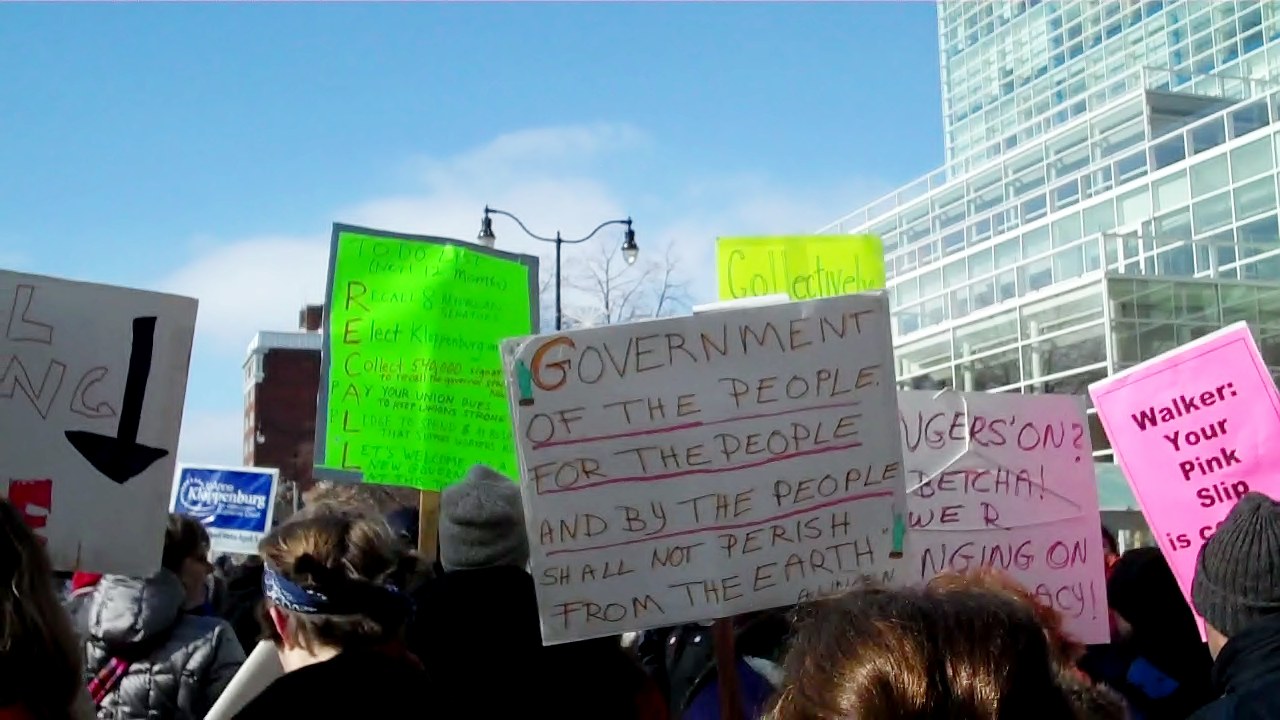
The speakers (besides the 14, they included Jesse Jackson, Tony Shalhoub, and Susan Sarandon) noted that now the battle continues, but the battlefield changes.
Suits are already being brought to challenge the legality of the law in the courts.
More important in the longer run are the recall campaigns . While “Recall Walker” was a constant theme in signs and chants, under Wisconsin law that effort can not begin until next year. But petitions against eight Republican Senators have been filed, with May 2 deadlines for completion. There was an enormous sense of energy for these yesterday.
Meanwhile, a Utah-based anti-immigration group has already invaded Wisconsin (it is perfectly legal, it seems) to organize recalls against members of the Democratic “Fab 14” who got so much thanks and appreciation yesterday.
Control of the Wisconsin Senate will be determined during the coming summer by the outcome of these efforts.
Those who participated Saturday went home elated and politically energized in a way that few of us have been for some time. But all understood, as well, that Saturday did not mark the end of a battle, but its beginning. It will be a long battle for the future of Wisconsin, and no one can be sure of the outcome. And Wisconsin, in turn, clearly is just one battleground in the broader struggle for the country’s future.
[Dr. Paul Beckett lives in Madison, Wisconsin. He can be reached at beckettpa@gmail.com.]
By Ted McLaughlin / The Rag Blog / March 13, 2011
By now everyone knows about the disastrous earthquake that has hit Japan. At a magnitude of 8.9 it is one of the largest earthquakes to hit any country, and it has been a catastrophe to the heavily populated nation.
As I write this the official death toll is around 700 people, but many thousands are still missing and there’s little doubt that the death toll will climb much higher. My thoughts and best wishes go out to the people of Japan in their time of need, and I hope this country will offer Japan all the aid it is possible to give.
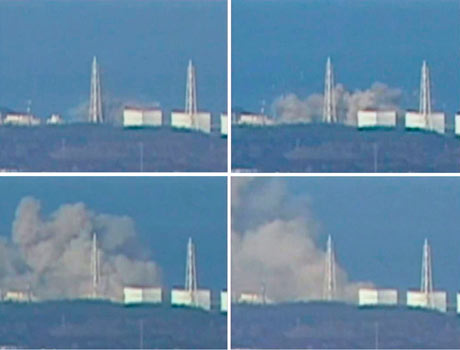
But in this post I want to concentrate on one aspect of the disaster — nuclear power. Japan has invested heavily in nuclear power and currently receives a large portion of its electrical power from this source. But they may now be paying the price for that. At least two nuclear power plants at Fukushima have been heavily damaged and are currently in danger of a “meltdown,” which could cause a large explosion that would release heavy doses of very radioactive material into their environment.
They are trying to cool the nuclear cores down by flooding them with seawater and boron, but that is a desperate measure that will take days and no one knows if the cores can be cooled in time to prevent a meltdown. The authorities have said that little radioactivity has been released so far, but they are evacuating people from within a 12-mile radius of both plants and are issuing iodine tablets to the population living in those areas (iodine is supposed to inhibit the body’s intake of radioactivity).
And that is just what is happening at those two plants. Other plants were also damaged and are currently being evaluated. More may be heading for the same kind of trouble. The earthquake and resulting tsunami were bad enough for the Japanese people — the damaged nuclear plants are just adding to their difficulties.
Here in the United States we are currently having a debate over energy. Currently the country relies heavily on fossil fuels (oil, gas, coal) but those fuels are causing problems. Much of the oil we use comes from foreign countries — countries where the supply is always in danger (as we can see from the current problems in the Middle East).
Many on the right seem to think that this problem can be solved by just drilling more and more. But the fact is that there just aren’t enough American reserves of oil (even if we tap into our protected wilderness areas) to satisfy the addiction this country has to oil. And many experts (including our own military) believe the world is reaching (or has already reached) the point of “peak oil” — the point at which production begins to fall no matter how much drilling is done.
Coal is not a much better alternative. Although it is plentiful right now and could last for many years, it is also one of the dirtiest of the energy-producing fuels. Even with the new technologies (which industry is fighting tooth-and-nail) it continues to destroy our environment.
Using more coal will simply speed up global climate change (which is a looming environmental and economic disaster regardless of what the right-wing climate-deniers claim). Some are talking about the development of a “clean coal” technology, but this is just a myth being advanced by the coal industry. There is no such thing as clean coal, and I doubt that there ever will be.
But even if the fossil fuels weren’t damaging our environment, they will run out in the future. Coal and natural gas may be more plentiful than oil, but there is not an endless supply of any fossil-based fuel. And someday they will all disappear.
The fact is that new sources of energy must be found or developed. The ideal thing is to find renewable and clean sources of energy (like wind, solar, wave, or geothermal). So far, these sources have not been developed to the point where they could completely replace fossil fuels. That is why many in America (and elsewhere) are advocating a return to nuclear power.
After the disasters at Three Mile Island and Chernobyl, nuclear energy was put on the back burner in this country. But now the idea of nuclear power is making a comeback. Many believe it could fill the gap left by renewable sources and help to wean the country off fossil fuels. And they are quick to tell us that the technology has advanced to the point where accidents like Three Mile Island and Chernobyl couldn’t happen again.
I don’t doubt that the technology has advanced. I’m sure it has. I’m also sure that the Japanese were using the best technology available (since they are one of the most technologically-advanced countries in the world). But that 8.9 magnitude earthquake didn’t care about the technology, and the best technology in the world couldn’t have prevented the damage to the Japanese nuclear plants.
This should give Americans pause. Should we go back to building nuclear power plants — knowing the dangers they could pose? And lest we forget, we still haven’t come up with a solution for disposal of nuclear waste from these plants (which is highly radioactive and will remain so for a very long time).
I have to say that I really don’t know what to do about nuclear energy. I like the idea that it doesn’t pollute the environment while producing energy, but I have to wonder if it’s only delaying that pollution since we haven’t solved the disposal problem. I would feel a lot better if we could figure out how to safely dispose of the nuclear waste (for many centuries). And the Japanese experience is showing us, at the very least, that great care must be taken about where any new nuclear power plants are located.
It is time to rethink the usefulness of nuclear power. Maybe it is a viable alternative, but we should carefully consider all the dangers before proceeding with building any new plants.
[Rag Blog contributor Ted McLaughlin also posts at jobsanger.]

INDIANAPOLIS –On Thursday morning, March 10, three buses left the parking lot of a large supermarket in Lafayette, Indiana bound for the huge workers rights rally at the Indianapolis State House.
The buses were sponsored by the United Steelworkers Local 115A and the NAACP. About 100 workers, teachers, and peace and justice activists were on the buses. About two miles away another three buses left for Indianapolis with 100 activists from the Building Trades Council of Tippecanoe County and the Northwest Central Labor Council (AFL-CIO).
The buses were warm, cozy, and the spirit of solidarity pervaded the atmosphere. Travelers were determined to demonstrate their outrage at the rightwing onslaught on workers and education being planned by Indiana Republicans. Arriving about one hour later, riders disembarked from the warm and fuzzy atmosphere of the trip to a bitterly cold, cloudy, and windy rally in downtown Indianapolis.
The rally consisted of speeches, chants, prayers, and exhortations. Thousands of Hoosier workers withstood the cold to express their anger and their clear realization that the quality of their lives was in jeopardy.
Local 115A passed out some literature to articulate the reasons for enduring the cold and shouting for economic justice. They said that:
Another USW Local 115 document made the motivation for action crystal clear:
We stand at the statehouse as one people, one labor movement, one united group of citizens. We are proud to be union members and union supporters because together we have built Indiana! Whether we are construction workers, teachers or students –whether we clean buildings, deliver health care or manufacture useful products — we stand together!
There were different assessments of the State House rally in Indianapolis. The conservative Indianapolis Star, on the one hand estimated that only 8,000 workers rallied in Indianapolis, but on the other hand pointed out how cold, windy, and rainy the weather was, suggesting that attendees were truly committed.
One trade unionist, recalling the rally of 20,000 Building Trades workers in 1995 indicated that he could not tell if this rally was bigger or smaller than that one. Another worker said that we needed at least 100,000 at the rally to make a difference.
Several speakers expressed their appreciation for those that attended the rally. AFL-CIO leaders from Kentucky and Wisconsin pointed out that the Indiana struggle was part of a larger movement involving workers from Wisconsin, Ohio, Illinois, New Jersey, and everywhere that the basic standard of living of workers was being challenged.
Perhaps the most poignant statement came from an Iraq war vet who reminded the crowd that $3 trillion had been spent on two costly, foolish wars in the 21st century that helped create today’s economic crisis.
The outcome of the ferment, anger, and rebelliousness all around the world remains unclear. But one fine folk singer, after leading the crowd in a rendition of “This Land is Your Land,” wished the movement well. He recalled Woody Guthrie’s injunction: “Take it easy, but take it.” Perhaps that is where we are at today.
[Harry Targ is a professor of political science at Purdue University who lives in West Lafayette, Indiana. He blogs at Diary of a Heartland Radical.]
On Thursday morning, March 10, three buses left the parking lot of a large
supermarket in Lafayette, Indiana bound for the huge workers rights rally at the
Indianapolis State House. The buses were sponsored by the United Steelworkers
Local 115A and the NAACP. About 100 workers, teachers, and peace and justice
activists were on the buses. About two miles away another three buses left for
Indianapolis with 100 activists from the Building Trades Council of Tippecanoe
County and the Northwest Central Labor Council (AFL-CIO).
The buses were warm, cozy, and the spirit of solidarity pervaded the atmosphere.
Travelers were determined to demonstrate their outrage at the rightwing
onslaught on workers and education being planned by Indiana Republicans.
Arriving about one hour later, riders disembarked from the warm and fuzzy
atmosphere of the trip to a bitterly cold, cloudy, and windy rally in downtown
Indianapolis.
The rally consisted of speeches, chants, prayers, and exhortations. Thousands of
Hoosier workers withstood the cold to express their anger and their clear
realization that the quality of their lives was in jeopardy.
Local 115A passed out some literature to articulate the reasons for enduring the
cold and shouting for economic justice. They said that:
1. The struggle in Indiana was inspired by the events in Wisconsin.
2. The rally was about worker rights, including so-called Right-to-Work
legislation and proposals to eliminate the right of teachers to organize.
3. The right-to-work bill that was not dead as some media had reported would
negatively impact workers in both the private and public sectors.
4. Public sector rights, which need to be defended, had already been weakened by
Indiana’s governor, Mitch Daniels.
5. The struggle in Indiana was not a publicity stunt, copying the movement in
Wisconsin. Democratic House members walked out of the legislature and traveled
to Illinois to forestall the Indiana body from passing the draconian
legislation.
6. Taxpayers of the state were not funding the walkout by State House Democrats.
7. The so-called Right-to-Work bill was not the only threat posed to workers in
Indiana. One bill would eliminate the secret ballot in union certification
elections. Another would remove the right to collective bargaining from public
employees at the local level. Another bill would prohibit local communities from
establishing living wage laws in excess of the state determined minimum wage.
8.The struggle in Indiana is about protecting public education. Bills would
authorize private firms to be hired to evaluate teacher performance, without any
teacher input. School funding could be used to provide vouchers for use in
private schools. Schools that did not meet certain performance standards would
be transferred to private for-profit corporations.
9.The campaign to protect public education also required resisting the cutting
of funds for colleges and universities.
10.The struggle for workers rights was relevant to the economy of the entire state of Indiana, not just the 300,000 unionized workers.
Another USW Local 115 document made the motivation for action crystal clear:
We stand at the statehouse as one people, one labor movement, one united group of citizens. We are proud to be union members and union supporters because
together we have built Indiana! Whether we are construction workers, teachers or
students–whether we clean buildings, deliver health care or manufacture useful
products-we stand together!id=fullpost a the and in of Another all
Type rest of the post hereSource /

By Paul Beckett / The Rag Blog / March 11, 2011
[This is the second of Paul Beckett’s reports from Madison for The Rag Blog.]
MADISON, Wisconson — In less than 24 hours, in a series of shocking and unprecedented developments, public sector union and collective bargaining rights in Wisconsin have been eviscerated by a Republican legislative majority controlled by Governor Scott Walker.
What seemed to Democratic legislative members and to neutral observers (but there are few of those in Wisconsin now) a putsch, began about 6 p.m. on the evening of Wednesday, March 9. As coups go, this one clearly was carefully — even brilliantly — prepared. The surprise was absolute.
Governor Walker spoke to a news conference on Monday, March 7. He referred to meetings at the Illinois border his staff had had with some of the 14 Democratic state senators who had left Wisconsin on February 17 in order to prevent passage of the “union busting” legislation, SB11. (See my article, “Madison and the Revolution at Home,” on The Rag Blog, March 8, 2010.)
A compromise was brewing, Walker implied. “The problem,” Walker said, “is Senator [Mark] Miller.” (Miller is the titular leader of the Senate Democrats.) Maybe it is time, Walker went on, for the Democratic caucus to elect a new leader.
All eyes turned to the Group of 14 Democratic senators: were they divided? Would one or more accept some form of compromise and enable the Republicans to complete their passage of SB11? (The presence of only ONE Democratic senator in the chamber would legitimate the vote passing SB11.] (Read the full text of SB11 here.)
Meanwhile, unperceived, Republicans prepared a trap that would snap shut on Wednesday. The complicated, 144-page “Budget Repair Bill” (SB11) was being taken apart by staff and reformulated, ostensibly to strip out everything BUT the collective bargaining provisions.
The result was labeled a conference amendment to SB11, and was only six pages shorter than the original. But the point was that this new version could be labeled as non-fiscal and would not carry the quorum requirement of the original.
A bizarre reversal of positions was now apparent. Incorporation of the collective bargaining provisions within the Budget Repair Bill, very definitely a “fiscal” measure, had been stoutly justified by Governor Walker on the grounds that they were inseparable from the fiscal repair provisions. (Opponents had argued that the provisions had nothing to do with fiscal “repair” and should be taken out of the Budget Repair Bill and debated separately.)
Now, the Republican position was the opposite. The new version was NOT fiscal. With the quorum requirement changed, whether the Group of 14 were in the Chamber or in Illinois was immaterial. The bill could be passed with Republican votes alone.
The ambush worked perfectly. Democrats and protesters remained focused on the hold-out by the 14 Senators and on the possibility of compromise. Word of Walker’s plan leaked out only at the last minute, late on Wednesday afternoon. Beginning about 5:30 p.m. a cluster of emails, most of them billed “emergency,” appeared in my email inbox. The following, from the Dane County Democrats, is typical:
Breaking Update: Tonight at 6:00 pm in the Senate Parlor we are hearing that Senate GOP is going to split the budget repair bill, fiscal from non-fiscal, and ram it through in the dark of night. Given that they’re attempting to ram through the bill without any media attention we wanted to let you know that very important developments are likely to occur tonight at 6:00 pm in the Senate Parlor.
Please be at the capital by 6:00PM TONIGHT!
Actually, I did not receive any of the emails until the next day. I was having a quick dinner a block away from the Capitol at Ian’s Pizza (an enterprise that has become known internationally for its role in keeping the protesters in the Capitol Rotunda sustained). I was on the way to a 7 p.m. debate between Madison’s two mayoral candidates.
Suddenly people were shouting, “To the Capitol. They’re going to pass the bill! Tonight!” People in groups of two, four, six, were hurrying up State Street toward the Capitol. I followed. At the top of State Street was a volcano-shaped mountain of snow (some five inches had fallen the night before). On its peak a tall young man stood shouting in an amazing voice: “Everyone to the Capitol! Everyone to the Capitol!” He waved us onward.
The word spread amazingly. By 6 p.m. hundreds were there; very soon thousands. It was dark. Everyone wanted to enter the Capitol. A long line formed at the only entrance that was (in a limited way) open. The line moved glacially. Inside, on the other side of the revolving door, protesters were packed, waiting, apparently, to be taken one-by-one through the security wanding procedure. Noise was deafening: “Whose house? Our house!”
Soon, however, any pretense of an open Capitol was abandoned; the police closed the doors absolutely, leaving some inside and thousands outside. People were angry.

The bill was then instantaneously passed (or “passed”) by the Senate Republicans.
By about 6:25 p.m. it was all done. The session was immediately adjourned, and the Republican Members were reportedly smuggled out of the Capitol building and beyond the crowds through a tunnel. (Their escape and removal by a special Madison Metro bus was not as secret as they would have liked.)
The word spread among the protesters and, more than any other time in the three weeks of protest, the mood was one of deep anger and frustration. Later in the evening some of the inside protesters opened an unguarded outside door. Crowds outside pushed in, brushing aside the police, who had raced to stop them. Thousands ended up inside, chanting, commiserating, venting. Most left by 2 or 3 a.m.
The expectation was that the building would open at 8 a.m. Thursday morning and that the Assembly would begin passage of the “conference amendment” by 9 a.m. In fact, the building did not reopen in the morning. The Department of Administration announced that an “assessment of building security requirements” was in progress. By 11 a trickle of protesters was permitted in as the Assembly slowly began to organize itself for the crucial session to pass the Senate version.
The session, billed a “Special Session” to allow more flexibility with rules and the traditions of the “Body” as it is always called, was brought to order at 12:34 p.m. Incongruously (considering he had been refused entry to the Capitol an hour or so earlier), the Reverend Jesse Jackson was allowed to deliver an opening prayer. He took no sides on the issues, and insisted that the legislators join hands (literally) across the aisle. They did, and then a bitter partisan verbal battle began.
A little over three hours of speeches were allowed. Most of these were from Democratic representatives clad in the bright orange T shirts proclaiming workers’ rights that they had adopted three weeks before. The session was broadcast by WisconsinEye and is available for viewing here.
The Democrats argued the illegality of procedures. They asserted that the bill before the Assembly was not the same one that had been before the Senate, and that senators (they were all Republican) had not been informed, had not been given copies of the new legislation, and could not have understood what they were voting for. They cited the shame brought on “this Body,” and on Wisconsin by all that had been done over the recent days and weeks.
More than that, they condemned the loss of workers’ rights and human rights, and the great harm that would be done to Wisconsin families and communities by the bill. Representative Tamara Grigsby, Democrat from the 18th District, delivered a particularly powerful and moving speech. (Had this reporter been a member of the Republican caucus he would have instantly moved across the aisle, sobbing with shame.)
To no avail. At 3:40 in the afternoon, abruptly, with some 20 representatives still to speak, the chair called for the vote (it is electronic and almost instantaneous), announced that the bill was passed, and adjourned the meeting.
The Republicans once again dematerialized mysteriously from the Capitol building.
It was over. Or, perhaps, just begun. The Democratic Party and labor unions are filing complaints and suits challenging the legality of the bill’s passage. The Governor’s use of the State Patrol (now under the direction of the father of Scott Fitzgerald, leader of the Senate Republicans, and his brother Jeff Fitzgerald, leader of the Assembly Republicans) to enforce the Capitol closures is being challenged.
But it has been understood from the beginning that this is less a legislative battle than a long-term political one that will touch every community and involve every important issue. It is not an exaggeration to say that the future of Wisconsin is at stake. And as Michael Moore has been saying so eloquently, the implications for the nation are huge.
Already planned for Saturday, March 12, is a major protest, bringing together farmers (who will mount a “tractorcade” around the Capitol square), labor, educators, students, liberal-progressives from all over the state, and many members of smaller communities that are becoming aware of the hit their schools and local governments are about to take from the Walker budget. Major speakers are invited, and it is reported that the 14 Democratic Senators will return to thank the public for their support.
Recall campaigns are planned on both sides. Under Wisconsin’s recall law almost a year must go by before a campaign to recall Scott Walker can begin. The same is true of Assembly members. So effectively, only senators are presently subject to recall. A bevy of progressive organizations are organizing campaigns directed against at least four of the Republican senators and, so far, there seems to be enormous energy behind these. Success would shift the Senate back to Democratic hands. The Republican recall campaigns, if they are pursued, would be directed against members of the “Group of 14” representing swing districts.
The political fallout of this tempestuous three weeks events will soon begin to be known. It is interesting, already, that one Republican senator and four Republican representatives voted against the “conference amendment.” And there is speculation that one reason that Scott Walker opted for this radical and legally risky legislative maneuver was that he sensed weakening on the part of other of the Republican senators.
[Dr. Paul Beckett lives in Madison, Wisconsin. He can be reached at beckettpa@gmail.com.]

By Harvey Wasserman / The Rag Blog / March 11, 2011
Had the massive 8.9 Richter-scale earthquake that has just savaged Japan hit off the California coast, it could have ripped apart at least four coastal reactors and sent a lethal cloud of radiation across the entire United States.
The two huge reactors each at San Onofre and Diablo Canyon are not designed to withstand such powerful shocks. All four are extremely close to major faults.
All four reactors are located relatively low to the coast. They are vulnerable to tsunamis like those now expected to hit as many as 50 countries.
San Onofre sits between San Diego and Los Angeles. A radioactive cloud spewing from one or both reactors there would do incalculable damage to either or both urban areas before carrying over the rest of southern and central California.
Diablo Canyon is at Avila Beach, on the coast just west of San Luis Obispo, between Los Angeles and San Francisco. A radioactive eruption there would pour into central California and, depending on the winds, up to the Bay Area or southeast into Santa Barbara and then to Los Angeles. The cloud would at very least permanently destroy much of the region on which most Americans rely for their winter supply of fresh vegetables.
By the federal Price-Anderson Act of 1957, the owners of the destroyed reactors — including Pacific Gas & Electric and Southern California Edison — would be covered by private insurance only up to $11 billion, a tiny fraction of the trillions of dollars worth of damage that would be done. The rest would become the responsibility of the federal taxpayer and the fallout victims. Virtually all homeowner insurance policies in the United States exempt the insurers from liability from a reactor disaster.
The most definitive recent study of the 1986 Chernobyl disaster puts the death toll at 985,000. The accident irradiated a remote rural area. The nearest city, Kiev, is 80 kilometers away.
But San Luis Obispo is some ten miles directly downwind from Diablo Canyon. The region around San Onofre has become heavily suburbanized.
Heavy radioactive fallout spread from Chernobyl blanketed all of Europe within a matter of days. It covered an area far larger than the United States.
Fallout did hit the jet stream and then the coast of California, thousands of miles away, within 10 days. It then carried all the way across the northern tier of the United States.
Chernobyl Unit Four was of comparable size to the two reactors at Diablo Canyon, and somewhat larger than the two at San Onofre.
But it was very new when it exploded. California’s four coastal reactors have been operating since the 1970s and 1980s. Their accumulated internal radioactive burdens could exceed what was spewed at Chernobyl.
Japanese officials say all affected reactors automatically shut, with no radiation releases. But they are not reliable. In 2007 a smaller earthquake rocked the seven-reactor Kashiwazaki site and forced its lengthy shutdown.
Preliminary reports indicate at least one fire at a Japanese reactor hit by this quake and tsunami.
In 1986 the Perry nuclear plant, east of Cleveland, was rocked by a 5.5 Richter-scale shock, many orders of magnitude weaker than this one. That quake broke pipes and other key equipment within the plant. It took out nearby roads and bridges.
Thankfully, Perry had not yet opened. An official Ohio commission later warned that evacuation during such a quake would be impossible.
Numerous other American reactors sit on or near earthquake faults.
The Obama Administration is now asking Congress for $36 billion in new loan guarantees to build more commercial reactors.
It has yet to reveal its exact plans for dealing with a major reactor disaster. Nor has it identified the cash or human reserves needed to cover the death and destruction imposed by the reactors’ owners.
[Harvey Wasserman edits NukeFree.org. He is Senior Advisor to Greenpeace USA and the Nuclear Information and Resource Service. He co-authored Killing Our Own: the Disaster of America’s Experience with Atomic Radiation.]
I want to ask a basic question that unifies religious, labor, and community organizations at the core. Why in this, the richest country in the world, are people poor?
By Anne Lewis / The Rag Blog / March 10, 2011
The labor movement has rarely won anything without the social movement, and the social movement has rarely won anything without the labor movement. One often cited example is Dr. King’s 1963 March for Jobs and Freedom initiated by A. Philip Randolph of the Brotherhood of Sleeping Car Porters.
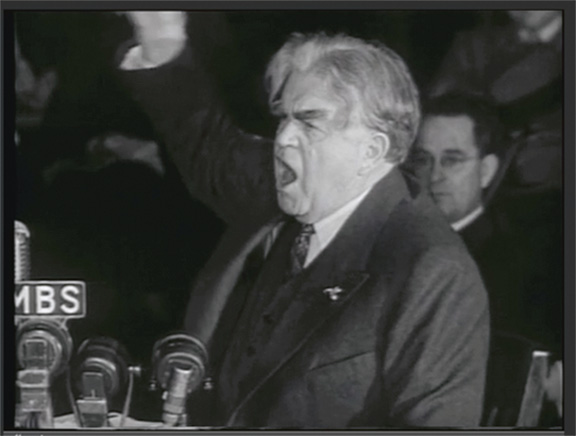
If you have any doubts about the necessity of a combined effort, watch this archival film of John L. Lewis when he testified before Congress in 1947 about health care and pensions for miners paid by the coal companies.
The resulting welfare fund, hard fought at the grassroots level by miners and their families, was the most comprehensive health care that I can think of. I know because I was covered under it from the mid seventies to the eighties when it was lost under Reagan.
We frequently marginalize each other — social movement folks saying unions don’t matter anymore and condemning labor “bureaucrats” and union folks saying that social movement people don’t care about workers and have grandiose ideas of their own power. Some of us get downright schizophrenic dividing our lives into two segments. It’s time we stop this nonsense. We need to speak a common language.
I want to ask a basic question that unifies religious, labor, and community organizations at the core. Why in this, the richest country in the world, are people poor? Please think about how you might respond.
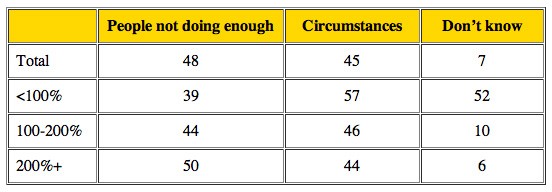
That same question was posed to a wide segment of people, rich and poor, in 2001. The NPR survey provides an analysis of public response to welfare reform (many of us called it deform) during the Clinton administration.
Here’s a table that asks whether it’s circumstances that create poverty or poor people themselves not doing enough. The percentages describe poverty level — we know it’s set way too low. In 2001 200% of poverty for a family of four was $34,000.
Then NPR asked folks to name the most important cause of poverty in the United States.

Number one is “the poor quality of public schools.”
At about the same time, the Heritage Foundation decided to prove poverty in the United States wasn’t a problem after all. The Heritage Foundation survey is titled, “Understanding Poverty in America.” Here’s the starting point.
The next bar graph compares the living space of poor people in the United States favorably to that of the average European.

CLICK ON IMAGES TO ENLARGE.
Here are two more rational definitions of poverty:
Fundamentally, poverty is a denial of choices and opportunities, a violation of human dignity. It means lack of basic capacity to participate effectively in society. It means not having enough to feed and clothe a family, not having a school or clinic to go to, not having the land on which to grow one’s food or a job to earn one’s living, not having access to credit. It means insecurity, powerlessness and exclusion of individuals, households and communities. It means susceptibility to violence, and it often implies living in marginal or fragile environments, without access to clean water or sanitation. — United Nations
To meet nutritional requirements, to escape avoidable disease, to be sheltered, to be clothed, to be able to travel, and to be educated. — Amartya Sen
Better, right? We’re at least getting to the idea of living well and a more humane definition. Notably lacking is the mention of labor unions and collective action, although you could make the argument that the United Nations definition pushes us in that direction with language about effective participation, dignity, and jobs. The lack of worker organization isn’t mentioned in the NPR study. Neither is discrimination, race, ethnicity, or gender or environment or workers’ rights.
Would you have named lack of unionization or lousy labor law or something like that as an important reason why poverty exists in this country?
In July 2002, union members overall had a 20% higher hourly wage ($20.65 vs. $16.42). In blue-collar industry it was $18.88 vs. $12.95; in service occupations, $16.22 vs. $8.98. That’s not counting benefits. Those ratios have remained constant.
Currently nearly one in three public workers are union members compared with 6.9 percent of the workers in private-sector industries. These organized workers are under siege in Wisconsin, Puerto Rico, Indiana, Ohio, and here in Texas. Many work in public schools and universities. The occupation of the Wisconsin capitol started with 2,000 graduate teaching assistants and union members from the University of Wisconsin, Madison, on Feb. 14. The attack on these workers and on the work that they do is tightly connected — and they are fighting back.
First, education is not, in and of itself, a cure for poverty. NPR poll aside, “Poor quality of public schools” is not the most important cause of poverty. We could go on and on about how good or bad our schools are, but lack of education is not the leading indicator of poverty.
As much as we’d like it to be so, there isn’t any substantial difference in the average wage of a high school graduate and a high school drop out. It’s considerably less than the boost from unionization. Remember unionization gave a worker at least a 20% boost in wages. A high school diploma gives a less than 15% boost.
The attack on teachers’ unions in this country has been absolutely barbaric and I believe it violates international standards of dignity and decency.
Unfortunately, the way we’ve been looking at education both at primary and secondary level is supply-side economics: improve the quality of workers through education and grow the quantity of quality workers– all for the rich employers — and they won’t be poor no more because the rich will take care of them. Well it doesn’t work that way any more than tax breaks for the rich have created an economy that benefits all of us.
All this talk about creating a competitive workforce for the global economy and endless debates about whether our public schools and universities do or don’t meet the demands of the marketplace is a bunch of hooey. But most folks believe this nonsense. Me too. When I think about our teen-age son’s future, I immediately think: will he finish high school; will his grades and SAT scores be high enough to get into a good college; what’s a high ranked college we can afford… and so on.
Even though I know darn well that there would be much better ways to go about making sure that our child has a good future — make sure that his nutrition is good, introduce him to cultural expression, work to strengthen our community with public transportation, public space, libraries, and museums, fight for the rights of public school workers and quality public schools, and fight for the rights of all workers, especially their right to organize.
The attack on teachers’ unions in this country has been absolutely barbaric and I believe it violates international standards of dignity and decency. I also believe there are large elements of sexism involved here. 70% of public school teachers are women overall. In Texas about 82% of elementary and middle school teachers are female. At UT, about 80% of full professors are male and about 60% of lecturers are female.
Working conditions for teachers are really lousy. Think about being the only adult in front of a class of 20 eight-year-olds and having to pee. Forced overtime — hours worked without pay are unbelievable — and pay isn’t so great. Wisconsin teachers average about $40,000 a year. Lecturers in my department, which is unusually well paid, start at $6,500 a class and are only allowed two classes a semester and two semesters a year. That’s $26,000 a year for what works out to be full time work with an unpaid leave over the summer.
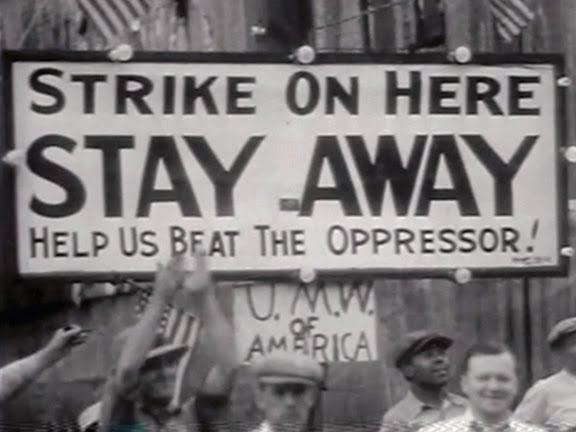
Now I would agree that our public schools have failed Latino and African American and working class children. That’s one of the reasons that so many parents fought for integration. We know that separate is not equal. Now we have further segregation of the schools in a system based on and currently exhibiting apartheid.
I don’t think the language is too extreme. A very interesting study explores the role of the Koch brothers of Wisconsin fame in defeating the Wake County, North Carolina, socio-economic integration plan. That plan was a model of quality education for all children for the country. The Kochs poured money into the school board race, cast the plan as communistic, and put in a new school board. They won and the children and teachers of Wake County lost big.
Then we have “Waiting for Superman,” which I watched at the Alamo Drafthouse South with a “progressive” Austin audience who giggled at those lazy teachers, cried and then rejoiced with the poor little black child who won a school lottery, and really dug the idea that the problem with the public school system was teacher tenure and their union. I resorted to drink.
Here’s a cartoon from Saving Our Schools from Superman that sums up the movie.

Saving our schools from Superman
At UT, our buildings are plastered with plaques that reveal the connections between the corporate world and higher education. We have the Accenture Endowed Excellence Fund; the Arthur Anderson and Co. Centennial Professorship; Austin Smiles Endowed Fellowship in Speech Pathology; Bank of America Centennial Professorship in Petroleum Engineering; Enstar Chair for Free Enterprise; La Quinta Motor Inns, Inc. Centennial Professorship in Nursing; the BP Exploration Classroom Endowment; Conoco Phillips Faculty Fellowship in Law; and so on.
We have a University President whose three legislative priorities are:
We have a legislature and a state governor that doen’t believe in public services at all — not education, not health care — not for children, not for the disabled, not for the elderly. They’re cutting off college scholarships and denying the rights of immigrants as well as working class students an education.
That’s the external world. The internal one at the University of Texas, Austin is that the budget crunch is used as an excuse to do what the higher-ups have wanted to do all along. Raise tuitions and cut programs that serve students and lay off lecturers, graduate students, and staff (we’re down to once a month office cleanings). Do away with the Identity Studies Centers that we fought to bring to the University — African American, Asian, Mexican American, women, and gender. Forget undergraduate education and turn us into an elite research institution.
We need to join every progressive force in this country into a movement that will finally put an end to the systemic destruction of educational opportunity and workers’ rights.
Before I summarize this rant, I wanted you to see a scene from an interview I did with the Director of Public Affairs, Martin Fox, at the National Right to Work Committee. That’s one of the main organizations that the Koch brothers fund and hang out with.
The clip is from a documentary I made in the context of the Pittston coal strike, which was about health care for retired and disabled miners and widows. “Justice in the Coalfields” is about the contradictions between individual and collective rights and what justice means.
The clip begins with a map of right to work states — you’ll be hearing a lot about that in the next few months. It ends with Bradley McKenzie who led a student walkout in support of the miners. He became a non-union coal miner because there were no union jobs, but his ideas express solidarity at its core. In between is Martin Fox who handled press communications for the Committee at the time.
Martin Fox was a proud member of the National Rifle Association. I know this because I watched him get in his car, with a customized license plate that read “GETAGUN.” Martin Fox is now President of the National Pro Life Alliance and a priest. He holds forth on unions on his blog.
Who has the power to challenge these obscene thugs who have taken over our country? Who wants to challenge them?
Well we do. The “we” is organized labor — public worker unions. Really, we’re not providing state “services.” We’re providing public necessities. We’re helping the social movement create a vision of a more decent world that includes the working class. And when we collectively fight for ourselves to have decent pay and decent working conditions and democratic control in the work place, we’re not in contradiction with the public good. We’re supporting it.
There are a lot of us. The Texas State Employees Union TSEU-CWA local 1686 has 12,000 members in Texas. We have large numbers of women and African Americans and Latinos. Discrimination has been slightly less in the public sector and these workers are more likely to join a union because of a history of struggle. AFT has 57,000 members in Texas and TSTA has 65,000 members. And there are state workers organized by AFSCME and other unions.
Those of us in the labor movement and those of us in the social movement have got to get to know each other. We need to practice democracy together and work together. We need to join every progressive force in this country into a movement that will finally put an end to the systemic destruction of educational opportunity and workers’ rights.
There’s a great line at the end of a Committees of Correspondence statement on Wisconsin:
And to the workers of Wisconsin, Indiana and Ohio: our heartfelt thanks — may your occupation of the statehouses foretell the day when you become the governors.
[Anne Lewis is an independent filmmaker associated with Appalshop, senior lecturer at UT-Austin, and member of TSEU-CWA Local 6186 and NABET-CWA. She is the associate director of Harlan County, U.S.A and the producer/director of Fast Food Women, To Save the Land and People, Morristown: in the air and sun, and a number of other social issue and cultural documentaries. Her website is annelewis.org.]
Thorne Webb Dreyer, Editor





