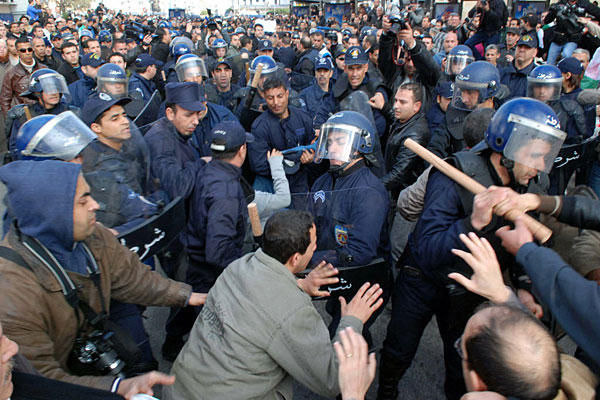
Rick Ayers : ‘Terrible Beauty’ Is Born in Tahrir Square

A terrible beauty. Photo by Tara Todras-Whitehill / AP.

Tahrir Square:
A terrible beauty is born

By Rick Ayers
/ The Rag Blog / February 13, 2011

All changed, changed utterly:
A terrible beauty is born.

William Butler Yeats penned those lines after the Irish Easter uprising of 1916. And how haunting and true they remain. Watch the explosions of joy at Tahrir Square and across the Middle East. The people of Egypt have changed much more than the experts grasp in their cramped little calculations of power and containment can even imagine.

They have shattered the myths of powerlessness, the notion that a regime built on repression and violence is impregnable. For a generation, in the Middle East and around the world, the smothering blanket of cynicism, hung over demonstrations, mobilizations, and activism.

But the people of Tunisia and Egypt have shattered that picture. They have reinvented once again, as every generation must, the innovative dance that is a mass movement. Gone — or at least for a long time — is the idea that the people cannot make history.

And the Egyptian people have changed so much more. For example:

The Israeli authorities like to claim that they are the only democracy in the Middle East. Sadly, though, they seem to balk whenever democratic efforts are attempted. The Egyptians have shattered the myth that Arabs have no interest in, or understanding of democracy.

Hillary Clinton, in a U.S. effort to slow down the struggle, has recently discovered that Egypt has a constitution and decided it must be followed. This had not been a problem to the U.S. for all these years that martial law was imposed. Giving the dictatorship $1.5 billion per year, mainly for military hardware, has been a burden on the people that they won’t soon forget.

Other authoritarian regimes, from Saudi Arabia and Libya to China and Burma, must be wondering when and if the same fate awaits them. And people are stirring in all these places.

Many of us recognize that the U.S. empire, that costly and violent hegemony that each administration seeks to preserve, is slowly crumbling. The Egyptians remind us that this is not something to fear. It can also be something joyful, creative, and hopeful.

Watching Tahrir Square, I’m sure many in the U.S. begin to imagine how much more lovely it would be to live in a world with greater equity in the distribution of resources, with a real participatory democracy, and with the possibility of deep human solidarity.

Many dangers lie ahead. But the genie is out of the bottle and cannot be stuffed back in. It is indeed true: a terrible beauty is born.

[Rick Ayers was co-founder of and lead teacher at the Communication Arts and Sciences small school at Berkeley High School, and is currently Adjunct Professor in Teacher Education at the University of San Francisco. He is author, with his brother William Ayers, of Teaching the Taboo: Courage and Imagination in the Classroom, published by Teachers College Press. He can be reached at rayers@berkeley.edu.This article was also posted at The Huffington Post.]

The Rag Blog

Posted in Rag Bloggers | Tagged , , , | Leave a comment

Karen Lee Wald : Posada Carriles and the Puppies That Got Away

Caricature of Luis Posada Carriles from Progreso Weekly.

Posada Carriles and Cubana 455:
The puppies that got away

By Karen Lee Wald/ The Rag Blog / February 11, 2011

See “The Posada trial takes a historic turn,” by Peter Kornbluh, Below.

Flying through the night on the way back to California from two months of research and interviews in Cuba, I’d dozed off when the voice of the pilot over the intercom woke me up. I almost fell back asleep as he told us our altitude. But when he added that the lights we could see below were the city of El Paso, Texas, I sat bolt upright, a shiver running up my spine.

Somewhere below me was the man who’d escaped from a Venezuelan prison while being tried for masterminding the world’s first mid-flight bombing of a passenger airline — Cubana 455 — killing all 73 aboard.

Years later, that same man boasted to a New York Times reporter that he was behind the string of hotel and restaurant bombings that shook Cuba in 1997 — leaving vast material damage, a number of hotel workers and guests injured or badly shaken, and one Italian hotel guest dead.

But Luis Posada Carriles isn’t facing trial in El Paso for any of those crimes.

He’s been charged only with lying to immigration authorities when he reentered the U.S. secretly in 2005; then he blew his cover by holding a press conference and announcing he wanted political asylum.

All the phases of this Castro-hating, CIA-trained terrorist came rushing back to me as the pilot informed us that we were flying over the city where this man is free to walk the streets until a jury decides whether he should be punished for failing to tell the truth about his exploits. It hit me with special force, because I had just come from interviewing one of his near-victims. This is what she told me:

“Elena, Elena, that man left a bag there!” exclaimed Alex, a 12-year-old boy who was waiting with his two sisters and their tour guide in the lobby of the Triton Hotel in Havana for their father to return from the airlines ticketing office. Moments before, across from them on the lobby couches, an olive-skinned man wearing shorts and a baseball cap had been shuffling through photographs he had removed from his backpack, glancing from time to time at his watch.

Thirty-year old Elena, a divorced mother of a six-year-old girl, loved her work showing visitors from the world the natural beauty of her homeland. Among her recent clients was a Latin American family that had won her heart; three children were left motherless the year before by the ravages of cancer. In the hope that a change of scenery would lift their spirits, their father brought the children to Cuba in September 1997, the first anniversary of their mother’s death.

Elena initially did not respond to Alex’s agitation — she had seen nothing unusual — and his sisters, Sandra and Xochi, laughed and teased him, “There’s nothing there; you’ve been watching too many horror movies!”

But Alex refused to be put off and shouted, “Yes, there is. I saw him put it there. He took a bag out of his backpack and put it behind the couch.”

Finally, to appease him, Elena went over to the couch where the man had been sitting, with the two girls scurrying after her. Finding nothing on the couch, they looked behind it. There they spotted a white plastic shopping bag hidden among the planter shrubs. As Sandra reached for it Elena apprehensively pushed her away.

“I don’t know why I did that. I wasn’t thinking of a bomb,” she recalls years later, the first time she has spoken to the press about that fateful day. “If I thought anything, it was that maybe someone had left something gross, like a headless chicken. Some people in Cuba still practice ‘brujeria,’ and someone could have left something to bless or curse someone in the hotel.”

But when she hurried over to tell the hotel doorman about the bag, he shouted for her to get the children out of there. Just as Elena pushed the children up against a wall and spread her arms to protect them, the bomb exploded.

“There was a tremendous roar, a gust — like nothing I’d ever experienced. People were running around, shouting and crying,” Elena recalls. “We threw ourselves down on the floor. The children were screaming, calling for their father. Alex kept repeating, ‘I told you! I told you!'”

They only found out later that moments earlier two similar time bombs had detonated in other nearby Havana hotels; one was at the Chateau Miramar, the other at the Copacabana where an Italian, Fabio Di Celmo, was killed by flying glass. Elena and the children were lucky: because of the bomb’s positioning the blast force was directed outward towards the windows instead of inwards; otherwise Elena and the children likely would have been badly maimed or killed.

According to the testimony of several captured terrorists and declassified CIA and FBI files, the mastermind behind these and other attacks was CIA operative, Luis Posada Carriles, who emigrated to Venezuela as a passionate anti-Castro militant, perhaps with his long-time co-conspirator Orlando Bosch, head of the Miami-based counterrevolutionary group “CORU.”

Their most horrendous terror attack done together was the two time bombs that exploded aboard Cubana Flight 455 in October 1976, killing all 73 on board: the pilots and flight attendants; five members of a cultural delegation from the Democratic Peoples Republic of Korea; Guyanese teenagers flying to Cuba to begin medical school; and Cuban teens and young adults who had just won gold medals at a fencing competition in Caracas, Venezuela.

After the bomb exploded and the plane crashed into the sea, one of the two men hired by Posada placed a chilling phone call to Posada’s co-conspirator, Orlando Bosch, with the coded message: ”A bus with 73 dogs went off a cliff and all were killed…”

Both had the silent backing of then-president of Venezuela, Carlos Andres Prestes, and the complicity of U.S. government agencies that knew the group was planning to “take out a plane” but said nothing to warn the Cuban government.

CIA documents released in 2005 indicate that the agency “had concrete advance intelligence,” as early as June 1976, on plans by Cuban exile terrorist groups to bomb a Cubana airliner.

Two of Posada’s employees in his private “security” agency in Caracas — Freddy Lugo and Ricardo Hernan — were arrested in Trinidad-Tobago immediately after the bombing, and implicated Posada and Bosch. They were later convicted and served sentences in Venezuela.

Although Posada and Bosch were arrested and held in prison through several mock “trials,” they were never brought to justice. After numerous threats to prosecutors and the attempted murder of one judge which left his son and chauffeur dead, most judges were afraid to convict them. Venezuela’s president at that time, Carlos Andres Prestes, assured the two ringleaders he would intercede on their behalf, and Bosch was eventually released.

Posada — perhaps because he didn’t believe President Prestes would keep his word in freeing him, or because he tired of waiting in jail — escaped from prison mid-trial. Accounts differ, but either the CIA or the Cuban American National Foundation [CANF] in Miami financed his flight out of the country, and Posada soon appeared at a U..S military base in El Salvador as “Ramon Medina,” where he became part of Oliver North’s “drugs for guns” network supplying the Nicaraguan Contras and Central American death squads.

Having gotten away with history’s first mass murder aboard an airliner, both Posada and Bosch were eager for more actions designed to oust or kill their arch enemy, Fidel Castro. Posada was convicted in 2000 of a plot in Panama to blow up a university auditorium where the Cuban president was scheduled to speak. But in 2005, he and four others convicted in the plot were pardoned and released by outgoing President Mireya Moscoso.

Posada remained in hiding for several years, but eventually rumors that he’d secretly returned to Miami proved to be true. At a press conference he announced he wanted to seek political asylum, despite laws barring emigrating criminals from receiving it.

After his press conference, Bush’s immigration authorities were forced to arrest him for illegal entry. Venezuela, which had an outstanding warrant for Posada, asked the U.S. to honor its decades-old extradition treaty. However, a U.S. immigration judge ruled that while Posada should be deported, he could not be sent to either Cuba or Venezuela because he might be subjected to torture.

In 2007, Congressman Bill Delahunt and Jose Pertierra, an immigration lawyer representing the government of Venezuela, argued the hypocrisy of the U.S. policy of extraordinary rendition of suspected terrorists to Syria and Egypt, both of which practice torture.

In an interview with a New York Times reporter in 1998, Posada, boasting that he had planned and financed the bombings of tourist spots in Cuba, qualified his comments by explaining that the bombs were intended only to “break windows and cause minor damage.” When asked about the Italian businessman who’d been killed in the Copacabana, he said that “the poor Italian” had been “in the wrong place at the wrong time.” He added, “I don’t lose any sleep over it. I sleep like a baby.”

Not so for the three children and the tour guide who happened to be in the hotel lobby on September 4, 1997

Elena, recounts that after the explosion she and the still screaming children hid under a table in the hotel lobby. “I kept trying to get the kids to be quiet, because I was afraid that the bomber would come back and kill us. Because we’d seen him. We’d seen who put the bomb there.” Terrified, eventually they were urged by security men to come out from under the table,

Later, she and the children were taken to a room for questioning. She gave a general description of the man they’d seen, but says, “Alex did much better. He’d been staring at the young man, and was able to describe him in detail. He even noticed the kind of watch he was wearing and the insignia on the cap.” Elena was driven to the airport to see if she could recognize the terrorist attempting to flee the country, but she didn’t spot him.

Later that night, the terrorist, eventually identified as Raul Ernesto Cruz Leon, placed another bomb at the popular Bodeguita del Medio restaurant. There, as in other places Cruz Leon had left his timed explosives, people were able to describe someone who looked like Cruz Leon among people in the crowd before the bomb went off. But Elena and the children were the only ones to actually see him place a bomb, which is why, Elena explains,

…we’ve kept so quiet about it all these years, and have never given anyone the names of the children. Their father said they would cooperate with the police in any way they could, but he asked for complete discretion so his children wouldn’t be in danger. He said, “In your country (Cuba), the government will protect you, but in our country terrorists have free reign and I don’t want any of them to know my children were involved here. I don’t know how I could protect them.”

Elena admits that for a long time she was nervous, afraid other killers would come after her. She had trouble sleeping, waking from fearful nightmares.

Over time the memories faded, and after the trial in which the Salvadorian bombers — who testified that Posada paid them to place the bombs — were convicted and sentenced, she felt a sense of relief.

But now a series of events has awakened memories and fears from that fateful day: the appeal of the captured bombers was recently heard by Cuba’s highest court, where their death penalties were commuted to 30-year sentences. And the trial of Luis Posada Carriles in El Paso, Texas, is in the news every day.

While many believe that Luis Posada Carriles should be convicted for murder and terrorism, instead the 82-year-old is currently facing only charges federal perjury, obstruction, and immigration fraud — not crimes that are likely to put him away for life. And despite abundant evidence about how he really entered the country, Posada has pleaded not guilty, claiming to have slipped into the U.S. across the Mexican border into Texas.

Prosecutors insist that he arrived in Miami using a forged passport on the boat of a “benefactor” — a Miami tycoon named Santiago Alvarez. The key witness in the trial against Posada was also the FBI informant who forced Alvarez and another of his violent anti-Castro cohorts to take a plea deal for possession of a veritable arsenal of guns and explosives. But that information has been kept from the jury by a judge who bends over backwards to rule out any testimony that might be “prejudicial” to the terrorist standing trial for lying.

In an about-face from his boastful claims to the New York Times, Posada is now also distancing himself from the hotel bombings in Cuba. He knows that his bragging is what is most likely to undermine his claim to the U.S. as a safe haven. He now claims his English is poor and he was “misunderstood” in that interview.

But U.S. prosecutors have filed numerous FBI documents showing Posada hired two men to plant the hotel bombs as part of his strategy to disrupt tourism in communist Cuba. In a major breakthrough, one of his intermediaries, Francisco Chavez Abarca, was recently captured in Venezuela and extradited to Cuba, where he testified against his boss.

In an unusual cooperative effort, the Cuban government is sending two policemen and the forensic experts who performed the autopsy on the murdered Italian to testify at the Texas trial, along with reams of other evidence against Posada. Likely to antagonize Florida’s powerful Cuban-Americans, the trial also highlights the lax treatment Posada has received compared to others coordinating international terrorist acts.

When asked how she feels about the Posada trial and the commuted death sentences of the bombers, Elena said,

If that bomb blast had gone in the other direction, we wouldn’t be here to talk about it. You’d have had three dead children and a motherless six-year-old [her daughter]… But I blame Posada more than Cruz Leon. He was a victim, too. He was dirt poor, and he saw it as a way to survive, to get out of poverty. Posada was the mastermind. He says he sleeps like a baby. To me, that means he’s a man with no conscience. It just doesn’t matter to him that we could have all been killed.

“A bus with 73 dogs went off a cliff and all got killed.”

Recalling the phoned-in code for the 73 Cubana Airline passengers and crew killed in 1976, she pauses, then adds, “What would his code have been then? ‘Three puppies and a bitch fell off a balcony’?

“If there is any justice in the world, he should pay for what he’s done.”

[Karen Lee Wald is a writer and researcher who has been reporting on Latin America for many decades.]

Luis Posada Carriles leaves court with his lawyers in El Paso last month. Photo by Gonzalez / Reuters.

The Posada trial takes a historic turn

By Peter Kornbluh / The Nation / February 9, 2011

EL PASO — In El Paso, Texas, the perjury trial of the infamous violent Cuban exile Luis Posada Carriles took a historic turn today. For the first time in a long dramatic history dominated by hostility and aggression, U.S. government prosecutors formally presented evidence of terrorism committed against Cuba in a court of law — against one of its own former CIA operatives.

Even more extraordinary, the evidence comes in the form of a Cuban Ministry of Interior investigator explaining photographs and police reports to the jury relating to a series of explosions in Havana hotels, including the Hotel Copacabana which killed a young Italian businessman Fabio Di Celmo on September 4, 1997.

“Cuba Cooperating in U.S. case against ex-CIA agent,” reads tomorrow’s news headlines.

The godfather of anti-Castro Cuban violence over the last four decades, Posada is being prosecuted for immigration fraud relating to how he illegally entered the United States in March 2005. But the Obama Justice Department added three counts of perjury relating to a far more important crime: Posada’s role in a series of seven bombings that rocked Havana hotels and other tourist sites between April and September 1997.

“The defendant is alleged to have lied about his involvement in planning the bombings in Havana,” state court filings by the Justice Department’s Counterterrorism Division. “The United States intends to prove that the bombings in Cuba actually occurred.”

This week marks the first time that concrete evidence is being presented to the jury on how those bombings took place and the damage they wrought. The jury has been shown photographs taken by Cuban authorities of the bloodstained floor of the hotel. Portions of a Cuban investigative study, known as the “Volcan report,” which discusses the cause of, and circumstances surrounding, Fabio Di Celmo’s death, are due to be introduced as evidence during the testimony of Major Roberto Hernandez Caballero — he was Cuba’s lead detective on the hotel bombing investigation — who took the stand today.

The importance of this moment in US-Cuban relations cannot be overstated. Posada was originally trained in demolitions by the U.S. military and put on the CIA payroll in 1965 to train and supervise other exile groups in sabotage, explosives, and violent operations.

Declassified CIA and FBI intelligence reports, posted on the website of the National Security Archive, identify him as a mastermind of a mid-air bombing of a Cuban jetliner that took the lives of all 73 men, women and children on board in October 1976.

Most recently, Posada was arrested in Panama with a carload of C-4 and dynamite in what he admitted to U.S. officials was a plot to assassinate Fidel Castro at the Ibero-American summit in November 2000. By prosecuting him on charges related to his acts of terrorism, even if they are only perjury charges, the United States is effectively repudiating a dark past that its own Cold War officials and covert operatives set in motion.

For Cuba, where Posada is public enemy number one, having its day in court is also a turning point in a longstanding effort to collaborate with U.S. officials to put Posada behind bars. Cuban authorities have been forced to set aside their understandable suspicion that the trial is all for show, not for justice

(After all, how can the United States, which purports to be the leader in the campaign to fight international terrorism, prosecute one of the world’s most infamous terrorists only on perjury charges?)

Since Posada popped up in Miami some six years ago, Cuban authorities have repeatedly welcomed teams of FBI investigators and Justice Department lawyers to Havana. They turned over almost 1,500 pages of investigative records for use in the trial and made Posada’s accomplices, now in prison in Cuba, available for interrogation.

And they have sent three witnesses to El Paso — another police investigator and a forensic doctor to present the autopsy of the murdered Italian to the jury — who have been waiting for over a week to testify.

If this unprecedented level of Cuban judicial support helps convict the 82-year old Posada and he spends the rest of his natural life behind bars, the United States and Cuba will have arrived at a new level of cooperation and collaboration on fighting terrorism.

More importantly, together Washington and Havana will have turned a page on the dark history of US-sponsored violence against the Cuban revolution and Washington can begin what President Obama refers to as “a new chapter” in U.S. relations with Cuba.

The Rag Blog

Posted in Rag Bloggers | Tagged , , , , | 3 Comments

Paul Krassner : I Was a Facebook Junkie

Prison break? Paul Krassner’s Facebook profile pic.

Cold turkey:
I was a Facebook junkie

By Paul Krassner / The Rag Blog / February 10, 2011

I posted this farewell message on Facebook last night, and then I went cold turkey. Look, Ma, no rehab…

I had no friends in high school and college, and now I have 5,000+ Facebook friends. Maybe 25 of them are actual friends, so I assume that the rest of you liked my work. And the irony is that I’m quitting Facebook because it’s become a distraction from my work — what Ken Kesey would’ve called my “current obsession” — writing my first novel, about a contemporary Lenny Bruce-type performer.

I’ve truly appreciated your feedback, wit, imagination, insight, information, argument, and compassion. Incidentally, my decision was made before my Facebook identity was hacked (through my own clueless moment) and you all were spammed as a result. I apologize for that. Although I’m a professional prankster, this wasn’t my prank, or it would’ve had a purpose beyond electronic vandalism.

Recently, when I self-published an expanded edition of my autobiography, which is not available in bookstores, I felt that sharing and spreading an announcement of a link to its existence on my website was simultaneously self-serving and other-serving; ideally, two sides of the same coin. I repeated it at different times of the day for a week because I wanted to reach as many people as possible.

Facebook has enabled communication to span the spectrum from the trivial (what someone vomited for breakfast) to the profound (an organizing tool for the revolution in Egypt), and I have conflicting emotions about leaving. I realize that this isn’t exactly like Dave Chappelle leaving behind his successful Chappelle’s Show and a $50-million development deal, but I do hope that you understand my priorities.

[For years, Paul Krassner edited The Realist, America’s premier satirical rag. He was also a founder of the Yippies. Find Paul’s autobiography, Confessions of a Raving Unconfined Nut: Misadventures in the Counterculture at paulkrassner.com.]

The Rag Blog

Posted in Rag Bloggers | Tagged , , , | Leave a comment

James McEnteer : Our Chickens Will Come Home to Roost

Roosting chicken from Yesteryear’s News

Whose side are we on?
Our chickens come home to roost

The U.S. styles itself a beacon of liberty but has turned its back on the democratic aspirations of human beings in every region of this planet.

By James McEnteer / The Rag Blog / February 10, 2011

The current crisis in Egypt has represented a profound dilemma for the United States, as Brookings Fellow Shadi Hamid, notes in The Atlantic. For 30 years, the U.S. has been the largest supporter of the Mubarak dictatorship. The United States has struck that same devil’s bargain repeatedly all over the world, supporting regimes which abuse the human rights of their own citizens, but which offer regional “stability.” We pay governments to support American political and economic interests over and against the popular will of their own people.

We supported Saddam Hussein for many years, until he crossed us. We support the murderous Colombian government because they protect Chiquita Brands and Coca Cola and Occidental Petroleum. Many such private U.S. corporations are themselves human rights abusers outside their home country, with no fear of reprisal from governments, domestic or foreign.

We bribe repressive Middle Eastern regimes like Egypt to make nice with Israel and repress their own dissidents. And of course, we support the oppressive Israeli regime itself, which seems to be taking its revenge for the Holocaust of World War Two by re-inflicting it on the Palestinians.

The U.S. styles itself a beacon of liberty but has turned its back on the democratic aspirations of human beings in every region of this planet. We want to keep the world safe, not for democracy, but for U.S. corporate profit.

Most Americans, and American mass media, are in denial about our muscular foreign policy, though it has remained consistent at least since the U.S.-Mexican War of the 1840s. Two-time Congressional Medal of Honor winner General Smedley Butler laid out U.S. corporate-military strategy succinctly in his classic War is a Racket.

Mr. Hamid’s article asks: “Could the U.S. find itself on the wrong side of history?” With all due respect, the U.S. has been proudly marching up and down the wrong side of history since World War II. The U.S. military triumph in that conflict proved a Pyrrhic victory. The United States became a world power and adopted a paranoid, proprietary approach to the planet, a tragedy that continues to haunt us. We developed Frankenstein security agencies and mega-weapons: the CIA, the NSA, the atom bomb, the hydrogen bomb and on and on.

Our official paranoia conjured The Communist Menace as a monolithic bogeyman to justify our own interventions on behalf of capitalism worldwide. Tim Weiner’s account of the CIA’s creation and operation in its earliest decades — Legacy of Ashes — details how the early failures of the agency begot ever larger catastrophes as their secret budgets mushroomed.

We began to overthrow democratically elected leaders (starting in Iran and Guatemala) and replace them with authoritarian rulers amenable to bribery, all in the name of national security and regional stability. But the world was neither more stable nor more secure.

We lost the Cold War too, because the process of waging it demanded a cynicism that undermined our American ideals more effectively than any Soviet propaganda ever could. The simplistic Manichean sensibility we developed in the Cold War era — of East vs. West, Us vs. Them — continued after the Soviet Union collapsed under the weight of its own mismanagement. It continues today.

Remember the Peace Dividend? That was supposed to be the glorious redirection of our military expenditures to domestic and humanitarian projects after the Cold War ended and the Berlin Wall came down. We could at last beat our swords into plowshares and rebuild our schools and roads and medical system. Surprise! There was no dividend because peace was a non-starter. The U.S. government could not imagine how to function in a world without enemies.

We still propped up useful despots. George H.W. Bush told Ferdinand Marcos, the Filipino dictator who imposed martial law and jailed or killed his political opponents: “We love your adherence to democratic principles and to the democratic process…” When Bush the younger declared that the 9/11 suicide pilots “hate us for our freedoms,” perhaps it was the Marcos-Mubarak brand of freedom he inadvertently meant. We supplied weapons to both sides in the Iran-Iraq war of the 1980s, but like all good things, it came to an end.

The United States needed a post-Cold War demonic other to justify metastasizing Pentagon budgets and military-industrial bloat. U.S. policymakers declared a war on drugs, but it proved a disappointing stopgap. Drugs were everywhere and nowhere. The more tons of drugs the U.S. interdicted and the more smugglers they busted, the more drugs and smugglers arose to take their place. Every victory showcased more defeat.

The War on Terror — featuring Radical Islam, Al Qaida, Osama bin Laden, and a shadowy cast of millions — proved a godsend for the megadeath war machine the U.S. government has become, justifying Strangelovian expenditures on armaments and foreign bases, along with multiple invasions of “strategic” countries. But the U.S. tendency to support repressive regimes only works if those regimes play ball. We can’t invade them all. Can we?

Popular Democracy — once the acknowledged U.S. brand — now seems to threaten the American political establishment, at home and abroad. Right-wing demagogues and the corporate political stooges in Congress and the Supreme Court have thus far kept the locals in line by misdirecting popular anger, invoking Jesus and stoking nativist fears of foreigners and infidels, including the president.

But Obama wants to show Wall Street he’s a pussycat, not a tiger: Let’s play. I won’t hurt you! The Mad Hatter runs the Tea Party but it doesn’t matter that it makes no sense, only that the party continues, with Glenn Beck as the White Rabbit (o my o my) and Rupert Murdoch as March Hare. One lump or two?

Obama’s Chicago pastor, the Reverand Jeremiah Wright, drew self-righteous media scorn in 2008 when he described the September 11 attacks as payback for U.S. terrorism and said “American’s chickens are coming home to roost.” He was merely stating the obvious, but America failed to learn from that event or to do any soul-searching. The Bush-Cheney junta simply used those attacks to justify more waves of violence which have never ended.

America’s chickens will continue coming home to roost, in Egypt and throughout the Middle East and Latin America. Popular uprisings are not an Islamic plot against The Free World — wherever that may be now — but simply a logical consequence of denying people their basic human rights and hoping they’ll be too intimidated to object. But it is only the majority of Americans who appear intimidated.

We the people have outsourced our own justifiable political outrage and our capacity to protest wrongs. Do we figure others — in say, Egypt and Tunisia — can do it more cheaply that we can? Maybe this time the revolution will be televised and we can just sit back, relax with our favorite beverage, and watch. No one does passivity better than we do. Ask any dittohead. And anyone who tells you any different is a liar or a foreigner or probably both.

So, uh, who we cheering for, again? And… who’s cheering for us?

[James McEnteer lives near Durban, South Africa. “You say it’s weird there. You know it’s weird here too.” — Greg Brown.]

The Rag Blog

Posted in Rag Bloggers | Tagged , , | 2 Comments

Lamar W. Hankins : Foreign Policy ‘By Any Means Necessary’

Holding hands: Egyptian President Hosni Mubarak welcomes U.S. President George W. Bush to Sharm el-Sheikh, Egypt on June 2, 2003. Photo from AP.

By any means necessary:
U.S. foreign policy is about getting our way

History is rife with examples of U.S. foreign policy being directed at overthrowing left-wing regimes and favoring military or right-wing dictators.

By Lamar W. Hankins / The Rag Blog / February 10, 2011

The two-week citizen uprising in Egypt has placed the U.S. government in a difficult position. Its support of dictators who will do our bidding always leads to foreign relations problems when those dictators are overthrown.

Recent American and world history is rife with examples of U.S. foreign policy being directed at overthrowing left-wing regimes and favoring military or right-wing dictators. In almost all such cases we are left with the enmity of the people in those countries.

If we go back just 60 years or so, we find our relations in Cuba were endangered by our embrace of Batista. When the revolution in Cuba led by Fidel Castro drove Batista from power, the government that followed was not to our liking, so we have had 60-plus years of embargoes, assassination attempts, and animosity toward Cuba by a succession of U.S. presidents from Eisenhower through Obama.

Our disdain for Cuba’s form of government, which is dominated by the Cuban Communist Party, and the influence of Cuban emigres in the U.S. have prevented normal relations with the country. This impasse has not worked well for either Cuba or the U.S.

While Castro has always been a Communist dictator, the kind we never support, throughout Central America and South America, the U.S. has embraced many right-wing dictators. But perhaps the worst blunder we have committed is to train and fund vicious militaries in El Salvador, Guatemala, Panama, Honduras, and elsewhere in the Americas.

And at least seven times in the last century we sent American troops to Honduras to protect the banana plantations of American-owned companies. And we have intervened militarily and covertly in Haiti, the Dominican Republic, Panama, and elsewhere.

During Ronald Reagan’s administration, the overt attempt to overthrow the Nicaraguan government by training and arming Contra (anti-Communist) guerrillas located in Honduras was a sorry spectacle. It began as an effort to improve U.S.-Iranian relations by having Israel sell weapons to a select group of Iranians. The U.S. would resupply the weapons to Israel and receive the Israeli payment.

The Iranians promised to try to get the release of six U.S. hostages, who were being held by the Lebanese group Hezbollah, who were protected by a military group in Iran. Some of the proceeds from the weapon sales were diverted illegally to fund the Contras. It was never proved that President Reagan understood the details of the arms-for-hostages deal, especially the diversion of funds to support the Contras, an act prohibited by the U.S. Congress.

Our history in South America during roughly the last 60 years reveals more of the same kinds of practices that were carried out in Central America. We backed the ouster of Allende in Chile in 1973, and more recently the ouster or assassination of Hugo Chavez in Venezuela.

And we supported mostly military dictatorships in Paraguay, Bolivia, Brazil, Uruguay, Peru, Argentina, and Colombia, where U.S. policy has focused on stamping out the drug trade. Many of those countries have now elected democratic socialist governments that we are trying to destabilize.

Recent U.S. foreign policy in Asia and the Pacific Rim has seen U.S. military and CIA support for dictators in Indonesia, South Viet Nam, Myanmar/Burma, the Philippines, and elsewhere.

In Africa, military and CIA activities to undermine regimes have followed patterns similar to those in the rest of the world. The countries of Angola, Libya, Sudan, Somalia, Nigeria, and others (none more so than the Congo — now Zaire — where its prime minister, Patrice Lumumba, was assassinated by order of the Belgian government with U.S. involvement in 1961), have all suffered from the U.S. pursuit of its economic and geopolitical goals.

The Middle East in recent history has fared no better than the rest of the world, perhaps worse, with overt and covert U.S. activity in Iran, Turkey, Iraq, Yemen, Jordan, Syria, Lebanon, Afghanistan, Pakistan, and other countries.

In almost all of these cases, the United States was interfering in the internal affairs of a foreign country to overthrow left-wing regimes or help right-wing regimes rise to power or maintain power. And it hasn’t mattered whether a Democrat or a Republican was president.

With Egypt, we have supported for 30 years the vicious dictatorship of Hosni Mubarak, to whom we have given over a billion dollars a year to sustain his regime, largely because he has been willing to cooperate with U.S. policy in the region, especially policy regarding Israel.

Now he may be deposed by his own people, who have risen up to demand his ouster after decades of political corruption, interference with and killing of journalists, torture of prisoners, and the practice of extralegal arrests and disappearances of dissidents. To protect its perceived interests, the U.S. is swinging its support to the architect of many of those atrocities — Omar Suleiman.

Suleiman, Mubarak’s long-time intelligence chief, was named by Mubarak as his vice-president, and the U.S. is pushing to have Suleiman organize a new process for continuing the government after Mubarak’s term ends this coming September. But the demonstrators calling for Mubarak’s ouster, who have been occupying Tahrir Square for two weeks, rightly suspect a plan backed by the United States and directed by Suleiman.

A plan far better than back-room deals regarding the fate of Egypt’s political future was proposed recently by Tarek Masoud, a political scientist and Middle East specialist and an assistant professor of public policy at the Kennedy School of Government at Harvard. It follows Egypt’s Constitution and provides a way for the Egyptian people to have free and fair elections.

Masoud’s plan is for Mubarak to dissolve parliament, a power only an elected president possesses under the Egyptian Constitution, and call for new parliamentary elections (which presumably could be directed by an independent tribunal to assure that they are fair and honestly reflect the will of the Egyptian people). Masoud’s proposal calls also for a new parliament to enact changes in Egypt’s Constitution that makes the selection this fall of a new president more open and assures that another dictator could not come to power and thwart the will of the people.

Of course, the U.S. does not support the will of the Egyptian people any more than it supported the will of the Iranian people, or the Nicaraguan people, or the Chilean people, or the Venezuelan people in times past. The people’s will may not favor U.S. interests, so the U.S. will take action to make sure that we have our way.

When the world does not bend to our will, we do everything we can to get our way, including resorting to violence, either through our military might or through covert means. And our military might is spread around on over 1,000 installations in 177 countries, along with numerous submarines and battleships at the ready throughout the world.

The use of violence has been the foreign policy of the U.S. since the end of World War II, and it is how we enforce the notion that “what we say goes.”

[Lamar W. Hankins, a former San Marcos, Texas, city attorney, is also a columnist for the San Marcos Mercury. This article © Freethought San Marcos, Lamar W. Hankins.]

The Rag Blog

Posted in Rag Bloggers | Tagged , , , , , , | 1 Comment

Danny Schechter : Mummies and Dummies in Egypt

Cartoon from The English Blog.

Mummies and dummies:
The Egyptian crisis will only get deeper
thanks to lurking economic disaster

By Danny Schechter / The Rag Blog / February 9, 2011

The African journalist Nathanial Manheru chose a quote from French icon Andre Malraux’s Anti-Memoirs to understand current events in Egypt: “It is in Egypt that we are reminded that (man) invented the tomb.”

The tomb may be the appropriate metaphor not only for wannabe President-for-forever Hosni Mubarak but also for the 30-plus year neocolonial economic system that he has presided over. Not surprisingly, Frank Wisner Jr, the former U.S. Ambassador and son of a CIA dirty tricksters, wants the President to stick around — in the country’s interest, of course.

And Western countries are now aligning with the people in the suites — not the streets. So much for the bottom-up democracy that President Obama has appeared to support. We want freedom there — but we can wait!

What’s next for Egypt?

The 82 year old President seems stuck in the final stages of his own mummification. At the same time we might consider the decisions he ratified that in a sense “dummified” the world.

  • He didn’t appear to have seen the crisis coming in the same way so-called “intelligence” agencies from the CIA to the Mossad missed it too. as they had the Iranian Revolution before it, and as the wise men of finance missed the financial crisis.
  • He hasn’t paid attention to Egypt’s imploding economy, firing an internationally respected finance mister and replacing him with Samir Radwan who is expected to turn the economy around miraculously amidst the chaos and uncertainty.
  • He reacted with a series of self-defeating (and country-destroying) measures from shutting down the Internet and crippling commerce to sending in an army of thugs that revealed just how brutal his critics insisted he always was. Not only is Mubarak still in power but his secret police, the Mukhabarat, are torturing away.
  • His violent overreaction against the world media — the arrests and clubbing of journalists in public — insured more coverage, not less, and made certain that the world would be glued to the dramatic confrontation — the very thing TV cameras live for — as Egypt showcased its own Superbowl of confrontation.

We all saw these events despite the efforts to muzzle the media.

But another scene went largely unseen: the crippling of Egypt’s economy that may prove to be more dangerous for the country’s future.

While Mubarak did not depart on the demonstrators’ stated “day of departure,” something else did — currency and investments. It’s been estimated that the country is losing $310 million a day, and that already adds up to several billion dollars.

Stock Market Digital reports that Egyptians and foreign investors have transferred hundreds of millions, much of it to South East Asia or Australia. Its’ assets are at risk, says John Sfakianakis, chief economist at Banque Saudi Fransi. “If it does fail to compress this rioting situation the assets might get depleted soon enough.”

All of this has had a global impact, too, with stock markets battered worldwide and crude prices going up. Many experts fear a run on the banks when they reopen. It is significant that foreign interests now own more than half of Egypt’s banks. They were to open Sunday but fears of a bank run kept most closed. The Egyptian pound was down at its lowest level since 2005.

Former Goldman Sachs managing director Nomi Prins writes about this banking sector:

From 2004 to 2008, as the world economic crisis was being stoked by the U.S. banking system and its rapacious toxic asset machine, Mubarak’s regime was participating in a different way. Mubarak wasn’t pushing subprime loans onto Egyptians; instead, he was embarking on an economic strategy that entailed selling large pieces of Egypt’s banks to the highest international bidder. The result was a veritable grab-fest of foreign bank takeovers in the heart of Cairo…

Egypt attracted $42 billion worth of foreign capital into its borders, as one of the top investment “destinations” in the Middle East and Africa. “Hot” money entry was made easy, with no restrictions on foreign investment or repatriation of profits, and no taxes on dividends, capital gains or corporate bond interest…

Not surprisingly, those foreign speculation strategies didn’t bring less poverty or more jobs either. Indeed, the insatiable hunt for great deals, whether by banks, hedge funds, or private equity funds, as it inevitably does, had the opposite effect.

She reveals that Goldman Sachs invested in a major real estate company for the luxury market with millions living on $2 a day.

Now, a financial crisis threatens.

Reuters reports optimistically:

An exodus of foreign investors would probably be manageable. The central bank says its official reserves are $36 billion. Additional assets held with commercial banks — regarded as unofficial reserves — are estimated at around $20 billion. Before the crisis, foreigners held just 7 percent of Egypt’s total public debt, equivalent to a little over $11 billion.

The bigger worry is if Egyptians also take fright. The rich could decide to shift their money into gold, dollars, or overseas markets. The poor, many of whom are relatively new to banking, may choose to stash their life savings under mattresses instead, There is a serious danger of out of control inflation, Robin Amlot, managing editor of Banker Middle East, says people are starting to “run out of the basics, which will feed into inflation.”

Moody’s Investors Service has downgraded Egypt’s government bond ratings to Ba2 from Ba1. Its outlook went to negative from stable. This will cost the country a significant amount of money.

Why is this happening? Clearly, financial institutions put their own interests before the public interest. The U.S. government may want to stabilize Egypt but the private sector and Wall Street have no compunction about destabilizing it if they think that is the best way to profit.

World Bank President Robert Zoellick admitted to a conference in Germany that rising unemployment and food prices are critical to “the instability in the region.” He did not discuss how World Bank policies had made conditions worse over the years.

Mumbarak’s model of economic growth had helped fund a small middle class without dealing with persistently high unemployment, rising food prices, inflation, and deepening poverty.

Canada’s CTV reports that

one-in-five Egyptians lives below the poverty line with little hope of rising above it as unemployment hovers around 10 percent. And those with jobs can do little to combat inflation soaring at a rate of more 12 percent a year.

Egyptian-born Montrealer Mohamed Kamel says when you factor in his homeland’s inadequate healthcare and a neglected education system combined with a rampant culture of corruption it’s easy to see where the frustration is coming from.

The Guardian reports that one person who has not suffered from these policies is none other than Hosni Mubarak.

President Hosni Mubarak’s family fortune could be as much as $70bn (£43.5bn) according to analysis by Middle East experts, with much of his wealth in British and Swiss banks or tied up in real estate in London, New York, Los Angeles, and along expensive tracts of the Red Sea coast.

These problems and inequalites have long been urgent issues in Egypt, but in the last weeks they were overshadowed by the high-profile protests to oust the president. These economic issues have been almost invisible in the world media but will not be easily resolved with or without Mubarak.

The West now wants to put the brakes on the campaign to oust what many consider a modern Pharaoh. They want to replace him with someone like him. But as the Lebanese editor Rami Khouri puts it, “Just changing generals is not freedom.”

Any real revolution inevevitibly demands a transformation — not just a transfer of power of the strong man at the top. The Egyptian people’s fight for political and economic justice has a long way to go.

[“News Dissector” Danny Schechter is a journalist, author, Emmy award winning television producer, and independent filmmaker. Schechter directed Plunder: The Crime of Our Time, and a companion book, The Crime of Our Time: Why Wall Street Is Not Too Big to Jail. Contact him at dissector@mediachannel.org.]

The Rag Blog

Posted in Rag Bloggers | Tagged , , , | 2 Comments

Jim Hightower : Obama is Waltzing With the Devil

Dancing with the devil. Drawing from Decoded Stuff.

Obama, Inc.:
With Daley and Immelt on board,
our president is waltzing with the devil.

By Jim Hightower / CommonDreams / February 9, 2011

When you dance with the devil, never fool yourself into thinking that you’re leading.

That would be my 50-cents-worth of advice to President Barack Obama as he remakes his presidency into a Clintonesque corporate enterprise. Following last fall’s congressional elections, he immediately began blowing kisses to CEOs and big business lobbyists, and he’s now filled his White House dance card with them.

First came Bill Daley, the Wall Street banker and longtime corporate lobbyist. In early January, Obama brought him to the White House ball to be his chief-of-staff, gatekeeper, and policy coordinator.

Then Obama tapped Jeffery Immelt to lead his Council on Jobs and Competitiveness, which is supposed to “encourage the private sector to hire [Americans] and invest in American competitiveness.” This is a bizarre coupling, for as General Electric’s CEO, Immelt was a leader in shipping American factories and jobs to Asia and elsewhere. Today, fewer than half of GE’s workers are in our country.

As an AFL-CIO official notes, “Highly globalized companies don’t have the same interests as the United States. There is no company more emblematic of this than GE.”

In his recent State of the Union speech, Obama offered only cold comfort to the millions of Americans who are unemployed or barely employed, saying blandly that “The rules have changed.” Well, yes — and who changed them? Self-serving CEOs like Jeffrey Immelt, that’s who.

America’s working families — our endangered middle class — have a right to expect Obama to fight for rules that are fair to them and our country, not meekly accept rules that have been skewed by an elite corporate class to profit them alone. Instead, our president is waltzing with the devil.

He’s rebranding his presidency, all right. It’s becoming Obama, Inc.

[Jim Hightower, a radio commentator, writer, public speaker, and former Texas Agriculture Commissioner, edits the populist newsletter, The Hightower Lowdown. This article was posted to OtherWords and distributed by CommonDreams.

The Rag Blog

Posted in RagBlog | Tagged , , | 3 Comments

Joan Wile : Calling All Grannies!

Another grandmother against the war. Photo from cessemi’s photostream / Flickr.

Calling all peace grannies
to get off their fannies

By Joan Wile / The Rag Blog / February 8, 2011

NEW YORK CITY — There we were, last Wednesday as usual, our little straggly group of elderly grandmothers and supporters standing on Fifth Avenue in front of Rockefeller Center chanting, “BRING THEM BACK… FROM AFGHANISTAN AND IRAQ! STOP THE KILLING NOW!”

We were into our eighth year of our Grandmothers Against the War weekly late-afternoon one-hour vigil, begun on Jan. 14, 2004 and held continuously until now with hardly a single break, no matter what the elements have thrown at us.

On this particular Wednesday we were down to only seven protesters, a disappointing decrease from our usual approximately 15. Of course, the weather had something to do with the meager turnout — New York City was still recovering from the multiple onslaughts of snow crippling people’s ability to get around.

While standing there (our aging bones making it painful after the first half hour), we began discussing the situation in Egypt. We wondered if there were any way at all for there to be a similar eruption of public discontent here in the U.S.

Sadly, we concluded it was extremely unlikely. Oh, yes, we peace grannies and the Veterans for Peace who join us every week are passionate about our cause. We deplore the wars in Iraq and Afghanistan. We are horrified about the loss of American military and civilian life in both countries (still ongoing in Iraq, despite the perception encouraged by the muted reporting in the media that implies otherwise).

We lament the obscene amounts of money tossed away on unwinnable and unjustified wars as the funds for our domestic needs dwindle away to the point where our citizens are in desperate straits. Yes, we are concerned enough to take to the streets and try to bring awareness to the indifferent masses of people passing by us that we are in critical trouble, that we must end these wars and occupations for our very survival. But, we are so few.

There are always a handful of people walking by who acknowledge us, give us a thumbs up or a “Thank you,” as they smilingly continue on their way. Usually, those sympathizers are from other countries — our sense is that people from abroad absolutely hate our wars. But, mostly, passers-by pretty much ignore us.

We assume that this apathy is wide-spread throughout the United States. We marvel at the fact that the Tea Party has been able to mobilize people to hit the streets, and are displeased that their causes are so antipathetic to our beliefs.

Will the Tea Party be able to foment a revolt similar to Egypt’s? I hope not.

But, why can’t WE even begin to goose our population into demanding we end the wars? It’s a strange dichotomy — the issues that people are really heated about — jobs, inferior education, inadequate health care as prime examples — cannot be solved until we bring the money home along with the troops; yet, the unconscionable conflicts are almost never mentioned in politicians’ speeches or media editorials.

PEOPLE DO NOT SEE THE CONNECTION!

I’ve concluded that the anti-war grandmothers’ job is to make that connection in people’s minds. I’m trying to dream up an action that will gain enough attention to start infiltrating into people’s consciousness.

To that end, I am herewith pleading to all grandmothers everywhere reading this article to contact me — joanwile263@aol.com
— with their ideas and suggestions about how we can create a grandmothers’ movement that will wake up America. And, beyond that, let me know if you will join with me and my peer grannnies to make it happen.

Grandmothers are thought of as wise, nurturing, and balanced. People will listen to us if our message is made available to them. Let us take off our night caps and don our thinking ones. We know what’s at stake — the future of our children and grandchildren. We must do all within our power to end these wars and foster a world of peace for them.

Hurry — we have so little time!

[Joan Wile is the author of Grandmothers Against the War: Getting Off Our Fannies and Standing Up for Peace (Citadel Press, May, 2008).]

The Rag Blog

Posted in Rag Bloggers | Tagged , , , , | 3 Comments

Robert Jensen : When Humans Play God

“Human ignorance.” Photo by Lindstol / Crestock.

Technological fundamentalism:
Why bad things happen when humans play God

By Robert Jensen / The Rag Blog / February 8, 2011

If humans were smart, we would bet on our ignorance.

That advice comes early in the Hebrew Bible. Adam and Eve’s banishment in chapters two and three of Genesis can be read as a warning that hubris is our tragic flaw. In the garden, God told them they could eat freely of every tree but the tree of knowledge of good and evil.

This need not be understood as a command that people must stay stupid, but only that we resist the temptation to believe that we are godlike and can competently manipulate the complexity of the world.

We aren’t, and we can’t, which is why we should always remember that we are far more ignorant than we are knowledgeable. It’s true that in the past few centuries, we humans have dramatically expanded our understanding of how the world works through modern science. But we would be sensible to listen to plant geneticist Wes Jackson, one of the leaders in the sustainable agriculture movement, who suggest that we adopt “an ignorance-based worldview” that could help us understand these limits.

[Wes Jackson, “Toward an Ignorance-Based Worldview,” The Land Report, Spring 2005, pp. 14-16. See also Bill Vitek and Wes Jackson, eds., The Virtues of Ignorance: Complexity, Sustainability, and the Limits of Knowledge (Lexington: University Press of Kentucky, 2008).]

Jackson, co-founder of The Land Institute research center, argues that such an approach would help us ask important questions that go beyond the available answers and challenge us to force existing knowledge out of its categories. Putting the focus on what we don’t know can remind us of the need for humility and limit the damage we do.

This call for humility is an antidote to the various fundamentalisms that threaten our world today. I use the term “fundamentalism” to describe any intellectual, political, or theological position that asserts an absolute certainty in the truth and/or righteousness of a belief system.

Fundamentalism is an extreme form of hubris — overconfidence not only in one’s beliefs but in the ability of humans to understand complex questions definitively. Fundamentalism isn’t unique to religious people but is instead a feature of a certain approach to the world, rooted in mistaking limited knowledge for wisdom.

In ascending order of threat, these fundamentalisms are religious, national, market, and technological. All share some similar characteristics, while each poses a particular threat to democracy and sustainable life on the planet.

Religious fundamentalism is the most contested of the four, and hence is the one most often critiqued. National fundamentalism routinely unleashes violence that leads to critique, though most often the critique focuses on other nations’ hyperpatriotic fundamentalism rather than our own. And as the prophets of neoliberalism’s dream of unrestrained capitalism are exposed as false prophets, criticism of market fundamentalism is moving slowly from the left to the mainstream.

Religious, national, and market fundamentalisms are frightening, but they may turn out to be less dangerous than our society’s technological fundamentalism.

Technological fundamentalists believe that the increasing use of evermore sophisticated high-energy, advanced technology is always a good thing and that any problems caused by the unintended consequences of such technology eventually can be remedied by more technology. Those who question such declarations are often said to be “anti-technology,” which is a meaningless insult.

All human beings use technology of some kind, whether stone tools or computers. An anti-fundamentalist position is not that all technology is bad, but that the introduction of new technology should be evaluated carefully on the basis of its effects — predictable and unpredictable — on human communities and the non-human world, with an understanding of the limits of our knowledge.

Our experience with unintended consequences is fairly extensive. For example, there’s the case of automobiles and the burning of petroleum in internal-combustion engines, which give us the ability to travel considerable distances with a fair amount of individual autonomy. This technology also has given us traffic jams and road rage, strip malls and smog, while contributing to climate destabilization that threatens the ability of the ecosphere to sustain human life as we know it.

We haven’t quite figured out how to cope with these problems, and in retrospect it might have been wise to go slower in the development of a system geared toward private, individual transportation based on the car, with more attention to potential consequences. [Jane Holtz Kay, Asphalt Nation: How the Automobile Took Over America and How We Can Take It Back (New York: Crown, 1997).]

Or how about CFCs and the ozone hole? Chlorofluorocarbons have a variety of industrial, commercial, and household applications, including in air conditioning. They were thought to be a miracle chemical when introduced in the 1930s — non-toxic, non-flammable, and non-reactive with other chemical compounds.

But in the 1980s, researchers began to understand that while CFCs are stable in the troposphere, when they move to the stratosphere and are broken down by strong ultraviolet light they release chlorine atoms that deplete the ozone layer. This unintended effect deflated the exuberance a bit. Depletion of the ozone layer means that more UV radiation reaches the Earth’s surface, and overexposure to UV radiation is a cause of skin cancer, cataracts, and immune suppression.

But wait, the technological fundamentalists might argue, our experience with CFCs refutes your argument — humans got a handle on that one and banned CFCs, and now the ozone hole is closing.

True enough, but what lessons have been learned? Society didn’t react to the news about CFCs by thinking about ways to step back from a developed world that has become dependent on air conditioning, but instead looked for replacements to keep the air conditioning running. [Stan Cox, Losing Our Cool: Uncomfortable Truths About Our Air-Conditioned World (and Finding New Ways to Get Through the Summer) (New York: New Press, 2010).]

So the reasonable question is: When will the unintended effects of the CFC replacements become visible? If not the ozone hole, what’s next? There’s no way to predict, but it seems reasonable to ask the question and sensible to assume the worst.

We don’t have to look far for evidence that our hubris is creating the worst. Every measure of the health of the ecosphere — groundwater depletion, topsoil loss, chemical contamination, increased toxicity in our own bodies, the number and size of “dead zones” in the oceans, accelerating extinction of species and reduction of bio-diversity — suggests we may be past the point of restoration.

As Jackson’s example suggests, scientists themselves often recognize the threat and turn away from the hubris of technological fundamentalism. This powerful warning of ecocide came from 1,700 of the world’s leading scientists:

Human beings and the natural world are on a collision course. Human activities inflict harsh and often irreversible damage on the environment and on critical resources. If not checked, many of our current practices put at serious risk the future that we wish for human society and the plant and animal kingdoms, and may so alter the living world that it will be unable to sustain life in the manner that we know. Fundamental changes are urgent if we are to avoid the collision our present course will bring about. [Henry Kendall, a Nobel Prize physicist and former chair of the Union of Concerned Scientists’ board of directors, was the primary author of the “World Scientists’ Warning to Humanity.”]

That statement was issued in 1992, and in the past two decades we have yet to change course and instead pursue ever riskier projects. As the most easily accessible oil is exhausted, we feed our energy/affluence habit by drilling in deep water and processing tar sands, guaranteeing the destruction of more ecosystems. We extract more coal through mountain-top removal, guaranteeing the destruction of more ecosystems. [Naomi Klein, “Addicted to Risk,” TEDWomen conference, December 8, 2010. ]

And we take technological fundamentalism to new heights by considering large-scale climate engineering projects — known as geo-engineering or planetary engineering, typically involving either carbon-dioxide removal from the atmosphere or solar-radiation management — as a “solution” to climate destabilization.

The technological fundamentalism that animates these delusional plans makes it clear why Wes Jackson’s call for an ignorance-based worldview is so important. If we were to step back and confront honestly the technologies we have unleashed — out of that hubris, believing our knowledge is adequate to control the consequences of our science and technology — I doubt any of us would ever get a good night’s sleep.

We humans have been overdriving our intellectual headlights for thousands of years, most dramatically in the twentieth century when we ventured with reckless abandon into two places where we had no business going — the atom and the cell.

On the former: The deeper we break into the energy package, the greater the risks. Building fires with sticks gathered from around the camp is relatively easy to manage, but breaking into increasingly earlier material of the universe — such as fossil fuels and, eventually, uranium — is quite a different project, more complex and far beyond our capacity to control.

Likewise, manipulating plants through traditional selective breeding is local and manageable, whereas breaking into the workings of the gene — the foundational material of life — takes us into places we have no way to understand.

These technological endeavors suggest that the Genesis story was prescient; our taste of the fruit of the tree of knowledge of good and evil appears to have been ill-advised, given where it has led us. We live now in the uncomfortable position of realizing we have moved too far and too fast, outstripping our capacity to manage safely the world we have created.

The answer is not some naïve return to a romanticized past, but a recognition of what we have created and a systematic evaluation to determine how to recover from our most dangerous missteps.

A good first step is to adopt an ignorance-based worldview, to heed the warning against hubris that appears in the most foundational stories — religious and secular — of every culture. That would not only increase our chances of survival, but in Jackson’s words, make possible “a more joyful participation in our engagement with the world.”

[Robert Jensen is a journalism professor at the University of Texas at Austin and board member of the Third Coast Activist Resource Center in Austin. He is the author of All My Bones Shake: Seeking a Progressive Path to the Prophetic Voice, (Soft Skull Press, 2009) and Getting Off: Pornography and the End of Masculinity (South End Press, 2007); Jensen is also co-producer of the documentary film Abe Osheroff: One Foot in the Grave, the Other Still Dancing, which chronicles the life and philosophy of the longtime radical activist. Robert Jensen can be reached at rjensen@uts.cc.utexas.edu. This article was also posted at The Progressive Christian.]

The Rag Blog

Posted in Rag Bloggers | Tagged , , , , , | 1 Comment

Ted McLaughlin : Drug Dogs Don’t Pass Sniff Test

Drug-sniffing dog and pal. Image from Adam Carolla Show.

Establishing probable cause?
Drug dogs just don’t cut it

By Ted McLaughlin / The Rag Blog / February 8, 2011

Here in the Texas Panhandle the Department of Public Safety (Texas’ state police) and sheriff’s departments arrest a lot of people on Interstate 40 for drug possession. It is not unusual for there to be at least one or two of these arrests, usually of people just traveling through the state, every week or two. It’s like the police look for out-of-state license plates and then stop and search those cars.

But how can they legally search the cars? They use drug dogs. If a drug dog “hits” on any part of a car or truck, that is considered to be “probable cause” to search that vehicle (and a search cannot be done without either probable cause or the consent of the owner).

If drugs are then found, the car’s passengers are arrested and charged with smuggling drugs. The case makes the newspaper and everyone is amazed at how good the drug dogs are and what a wonderful law enforcement tool they are. But is that really true?

For one thing, no one knows (except the police) how many times the drug dogs “hit” on a vehicle and nothing is found. That’s because there is no arrest in those cases and therefore no newsworthy story, especially if the driver is from out-of-state and continues his/her journey.

The general public (and the courts) only hear about the incidents where drugs are found, and that gives them a skewed opinion of just how good the drug dogs really are.

Researchers at the University of California, Davis decided to determine just how good the drug dogs are. They performed an experiment using 18 different teams (drug dog and police officer) and it turned out that the dogs had over 200 false “hits” on places where there were no drugs (and never had been any drugs). Here is how the experiment worked:

The researchers took 18 drug dog teams to a church, where it is likely no drugs or explosives had ever been placed in the past. The cops were told there might be up to three target scents in any one of four rooms. If they saw a piece of red construction paper in the room, that indicated where a target scent was placed.

The first room was left untouched. The second room had a piece of red construction paper on a cabinet. The third room had two sausages and two tennis balls placed as decoys. The fourth room had the decoy scents and the red paper. However, none of the rooms had any drugs or explosives.

There shouldn’t have been any alerts, but, in fact, handlers indicated their dog had alerted in every room. There were more alerts in rooms with red paper (which piques the cop’s interest) and no corresponding increase in rooms with sausages and tennis balls (which would pique a dog’s interest).

In other words, at best, dogs are responding to the subtle non-verbal cues of their masters to find drugs or explosives where the human thinks there should be drugs or explosives. The cop suspects you have pot so his body language makes the dog alert. At worst, the cop is purposefully cuing his dog to alert when he wants a handy excuse to violate your Fourth Amendment rights.

I am glad that someone finally performed a test like this. I worked in some branch of law enforcement for most of my working life, and I have believed for a long time now that these dogs are not nearly as good as is advertised by those who use them. They just make too many mistakes.

Years ago, I worked in a juvenile prison. Every few weeks we brought in a drug dog to search for hidden drugs in the institution, and many times it was my duty to accompany the officer and dog on their rounds.

The dog always “hit” on several locations on each trip, but never found any drugs. The officers excuse was always that there had been drugs in the location at one time. After many of these failed excursions, I lost any faith I had in drug dogs.

Probable cause is not established just because an officer suspects something. There must be something more, and in suspected drug stops on the highway, that something else is a “hit” by a drug dog. The courts have been led to believe these dogs are so accurate that they rarely make mistakes, and that is why they take a “hit” by one of these dogs to be worthy of establishing probable cause — thus justifying a legal search. Unfortunately, that is just not true.

Can they sometimes find drugs? Yes. But far too often they are wrong. And they are wrong enough times that they should not be used to establish probable cause. Frankly, if an officer wants to search a car he can always find a dog that will “hit” on that car. That’s not real probable cause, just an excuse that can be used in court to justify the illegal search.

It is time for more research to be done, and then for the courts to stop recognizing a “hit” by a drug dog as probable cause. They simply aren’t reliable enough.

[Rag Blog contributor Ted McLaughlin also posts at jobsanger.]

The Rag Blog

Posted in Rag Bloggers | Tagged , , , | 3 Comments

SPORT / Dave Zirin : Fox Be Damned, It Was a People’s Victory

Packers fans. Image from D.

Fox be damned:
Why a Packers victory is a people’s victory

By Dave Zirin / The Rag Blog / February 7, 2011

The 2011 Super Bowl was between the Green Bay Packers and the Pittsburgh Steelers — two squads whose monikers speak to their roots as factory teams in the industrial heartland.

As these teams prepared to face-off in the almighty spectacle that is the Super Bowl, the game’s pre-game show involved a salute to Ronald Reagan on his 100th birthday. Considering how Reagan gutted the aforementioned industrial heartland, a more appropriate pre-game show would have been an intimate meeting at the 50 yard line between a Reagan-disguised tackling dummy and fearsome Steeler James Harrison.

The Black Eyed Peas at halftime, however, made me long for another Reagan tribute. It was also Bob Marley’s birthday and I’m going to guess that far more Super Bowl parties in this country reflected Marley’s legacy than Reagan’s.

But it wasn’t just the film tribute that reminded viewers of the Reagan 1980s. The sheer tonnage of militaristic bombast with patriotic trimmings was like Top Gun on steroids and might have seemed over the top to the Gipper himself.

Viewers were treated to a reading of the Declaration of Independence, coupled with Marines marching on the field, coupled with that twit from Glee singing America the Beautiful, coupled with more shots of the troops, coupled with a damaged Christina Aguilera stumbling through the National Anthem.

By the time it was done, I was ready to get an American Flag tattoo and send my taxes to Hosni Mubarak like a Fox-Approved Good American. But fortunately for my sanity, I was watching the game with the DC Chapter of Iraq Veterans Against War at their annual Demilitarized Super Bowl Party.

The vets, who booed every time Fox tried to use the troops to build its brand, made it clear that real war in Iraq and Afghanistan doesn’t have a damn thing to do with what the broadcast was selling. As Geoff Millard of Iraq Vets Against the War said to me, “We love sports but hate the way it’s used and hate the way the soldiers are used to sell war.”

According to Rolling Stone, Super Bowl XLV hosted “The Ghastliest Half-Time Show in Sports History.”

And yet somewhere amidst the noise, the smoke, the Reagans, and the Black Eyed Peas, a football game actually broke out and it was a dandy. In no Super Bowl has a team ever come back from more than a 10-point deficit — and before you could blink the Steelers were down 18, 21-3. This was thanks to two costly interceptions by Pittsburgh quarterback and twice-accused rapist Ben Roethlisberger. An electric interception return for a touchdown by Green Bay safety Nick Collins reminded a lot of us why we love this game in the first place.

But Pittsburgh is a team with two dozen players who were part of their Super Bowl championship team two years ago and they refused to quit. The game winded down with Green Bay leading 31-25 and Pittsburgh having the ball with just two minutes to play. Green Bay’s defense held and a fantastic game ended as the Pack came away with the win. Packer quarterback Aaron Rodgers was absolutely brilliant, completing 24-of-39 passes for 304 yards, three touchdowns, no interceptions, and winning the MVP.

Yet for all the celebration of the Packers and their history, there was one brazen decision made by the show’s producers and announcers Joe Buck and Troy Aikman that was an insult to everything the team stands for.

Super Bowl coverage often includes numerous shots of the two teams’ owners fretting in their luxury boxes like neurotic Julius Caesars. But the Packers are a team without an owner. They’re a community-run non-profit owned by 112,000 fans. Rather than celebrate that fact, Fox didn’t mention the Pack’s unique ownership structure once. They also then didn’t include shots of the Rooney family, the most celebrated ownership family in the NFL.

After the game, during the traditional passing of the Lombardi Trophy to the winning team’s owner, the award was handed to the Packers’ “CEO and Chief Executive Officer” Mike Murphy who barely looks old enough to shave. NFL Commissioner Roger Goodell, as he threatens to lock the players out, clearly wants to hide the truth that the Packers have no single billionaire owner.

They want it hidden because the team from Green Bay stands as a living, breathing example that if you take the profit motive out of sports, you can get more than a team to be proud of: you can get a Super Bowl Champion.

It ain’t Tahrir Square, but it’s something — in our over-corporatized and hyper-commercialized sports world — to cheer. It is reason enough to celebrate the fact that the Lombardi Trophy has finally come home to Titletown.

[Dave Zirin is the author of Bad Sports: How Owners are Ruining the Games we Love (Scribner). Contact him at edgeofsports@gmail.com. This article was also posted to The Notion, The Nation‘s group blog.]

The Rag Blog

Posted in Rag Bloggers | Tagged , , , , | 3 Comments

VERSE / Mike Davis : A R I Z O N A

Arizona’s Sheriff Joe. Image from The News Junkie.

ARIZONA

1.

Cochise, son of the oak,
(Guchiish)
Arise
The desert cries for justice

(We must scalp Sheriff Joe)

Lt. Bascom hung your brother and nephews
Fed their eyes to the ravens
And their feet to the coyotes

Cochise of the lance
Call your blood, Mangus Colorado,
(Gandazislichiidn)
Tall as a mountain and unyielding

Johnson massacred 400 Apache women and children
So Mangus, in his grief,
made the white moon scream

Cochise, you craved peace,
But the invaders murdered your children
for gold, copper and real estate

(We must scalp Sheriff Joe)

2.

Arizona is one of God’s great poems
But the pale mad ants
Want only to spill water, asphalt, and hate

Cochise, brother to the Black man,
You defeated the slave owners’ invasion at Dragoon Mountain
But Lincoln sent no congratulations

Instead from Washington came soldiers,
Railroads, pox, and slander
Dams, jails, and ultimately Goldwater

Cochise, Last Poet of free people,
You asked these questions:
“Why do the Apache carry their lives on their fingernails?
Why is it that the Apaches wait to die?”

“Why shut me up on a reservation?
We will make peace; we will keep it faithfully.
But let us go around free as Americans do.
Let us go wherever we please.”

3.

The Secretary of War replied:

“My dear Cochise,
your aboriginal freedom is a disease
that we will cure with gallows,
howitzers, and cheap whiskey

We’re coming to build fences,
make borders, dig holes
Put men’s sweat to work under the earth
Feeding bankers in distant cities

Your people are vagabonds
who drift like clouds in the sky
But the future is already written
In the Prospectus of the Arizona Copper Corporation

If you complain about the reservation,
your starving cattle and sick children
We’ll exile you to a land without mountains
Where, like the Jews, you’ll weep for centuries.”

4.

Great-great grandfather,

They say it has been forever
But your people know it’s only been a day
Since you came down from the Dragoon Mountains

Still, the sky has exploded
And the locusts have eaten our dreams

Syndicates took the ore
And then sold the dirt
To shriveled people craving heat

Millions of lights blind the valleys
The Land can no longer see
Or remember its name

The whites have a new God
Stranger than the last
Who goes by the name
‘No Trespass’

He wears guns to school
And wants to deport
all the children to Mexico

He’s chiseled off the First Commandment
from the church doors
And replaced it with the Second Amendment

5.

Cochise,

Robespierre of the saguaro

Your pony is ready,
Painted for war,

The young girls have finished
Your medicine shirt

Here’s your father’s talisman
Of lightning-struck oak

Cochise,

The people are chanting
And we must go

To take the scalp of Sheriff Joe Arpaio

Mike Davis / The Rag Blog
February 3, 2011

[Mike Davis is a Distinguished Professor in the Department of Creative Writing at the University of California, Riverside. An urban theorist and a social activist, Davis is the author of City of Quartz: Excavating the Future in Los Angeles.]

The Rag Blog

Posted in Rag Bloggers | Tagged , , , , | 10 Comments