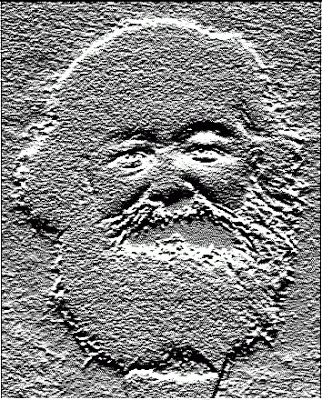
Harry Targ : The 2010 Elections and the Battle of Ideas

Image from UCAN.

Assessing the 2010 elections:
Towards building a progressive majority

First, we need to communicate the basic proposition that the free marketers’ ideas do not make sense.

By Harry Targ / The Rag Blog / November 11, 2010

“Well, the thing is, we’re all interconnected. There are no rich. There are no middle class. There are no poor. We all are interconnected in the economy. You remember a few years ago, when they tried to tax the yachts, that didn’t work. You know who lost their jobs? The people making the boats, the guys making 50,000 and 60,000 dollars a year lost their jobs.

“We all either work for rich people or we sell stuff to rich people. So just punishing rich people is as bad for the economy as punishing anyone. Let’s not punish anyone. Let’s keep taxes low and let’s cut spending.”

Senator-elect Rand Paul, Kentucky, in an election night interview with Wolf Blitzer, CNN

On ideology and consciousness

In an essay, called “The German Ideology” Karl Marx argued that the ideas of the ruling class are the ruling ideas. While the relationship between ideology, dominant societal values, and ruling classes is more complicated today than Marx observed in the 1840s, the basic point is well taken.

The relative legitimacy of ideas is related to the power in society of economic and political elites. If people could hear or read different ideas they would be in a better position to choose which ones best fit their interests.

Six media complexes control more than half of the communications about the world that Americans receive via television, radio, music, movies, and the internet. Today, the “battle of ideas” is fought out between those multinational corporations that speak for the “far rightwing” in American political life (probably most supported by domestic capital, real estate, insurance and energy companies) and those that represent global finance capital.

Media corporations present news and opinions reflecting modest, not fundamental, differences about policies, programs, and institutions. Basically they all represent the interests of the largest sectors of capitalist institutions in the international political economy.

For the most part, mainstream media ignore the peace movement, trade union activism, anti-racist struggles, the environmental movement, and the global connections among all these movements. When working people appear on local television screens, they are usually presented as victims, as the powerless, not the empowered.

In this context building a progressive majority requires multi-level struggles over the communication of diverse ideas about how political and economic structures and processes work and what alternatives there are to them. As difficult as it might be, the coming period requires an escalation of the battle of ideas, a battle for the consciousness of the vast majority of the people.

Commanding Heights: The battle of ideas

A few years ago, PBS aired a six-hour series on the importance of the new age of “globalization.” They framed their portrait of late twentieth century economic and political history around the key “battle of ideas” that shaped the century. Reduced to its most vital core, the broadcast claimed that the greatest debate of the twentieth century was that between free marketer Frederick Hayek and mixed economy capitalist theorist John Maynard Keynes.

In intricate detail, the video pointed out how Keynes captured the consciousness of ruling elites and masses during the Great Depression of the 1930s and influenced the post-war global economic order framed by the International Monetary Fund, the World Bank, and programs such as the Marshall Plan.

In addition, British Labor Party policies after the war were highlighted as examples of the Keynesian approach (which, alas, the video suggests was proven to be erroneous by the rise to power of Margaret Thatcher in the late 1970s). It is interesting to note that revolutionary socialism from the Bolshevik Revolution, to China, to Cuba, to the rise of dependency theories about the global economy were all subsumed under the mantel of Keynesianism.

The polar opposite to the Keynesian model of society was reflected in the personage of Frederick Hayek, obscure Viennese economist who worked, almost by stealth, to build a core of supporters to retake intellectual power when the mixed economy approach of Keynes would falter. Hayek built a network of economic gurus from the University of Chicago, the world of fiction (such as Ayn Rand), and the right wing of the Tory Party in Britain and the Republican Party in the United States.

Their fundamental theoretical proposition was that markets were good for people and government was bad. The video pointed out that this ideology, known around the world as “neoliberalism,” became dominant in these two countries in the 1970s, in international financial institutions, and among marginalized elites, mostly military dictators, from the Global South. The collapse of most Socialist states in the late 1980s confirmed, the documentary claimed, what the followers of Hayek had been arguing since the 1920s.

Neoliberalism doesn’t make sense

Central to the approach of descendants of Hayek is that markets, when “free,” can provide for the greatest good for the greatest number of people. Markets stimulate productivity, growth, equality, and the maximum development of each and every individual who takes advantage of the opportunities that free enterprise offers the citizenry.

When pain and suffering prevail, the theory proposes, the heavy hand of government lurks in the background. Government for these analysts is the problem not the solution. Finally, these theorists claim, history has validated Hayek.

The problem with the free market approach is that it is dead wrong, theoretically, historically, and empirically. There is no question that sectors of the world have experienced enormous growth, technological advancements, and miraculous feats such as space travel but they have all come on the backs of millions upon millions of people who have lived lives of pain, hunger, despair, and brutal dehumanization. Tiny percentages of the world’s elites have thrived on the backs of over 90 percent of the world’s people ever since capitalism emerged from the vestiges of feudalism.

Furthermore, the economic growth and development in the era of capitalism have been intimately connected with the rise of state power, not in the service of humankind, but in the service of economic ruling classes. Navies, armies, munitions all came from state resources. The evil slave trade, the backbone of modern capitalism, could not have been created and sustained without state power. In the Western Hemisphere, it was government armies, serving the interests of emerging capitalist elites, that committed genocide against peoples from the North Pole to the South Pole.

On a more positive note, as a result of mobilizations in support of mass demands, governments have provided some health care, public education, libraries, roads, and research and development that have improved the lives of some of humankind. There never was a time since the rise of capitalism that state power was not central to whatever human development has occurred.

Finally, capitalism is a system based on the maximization of profit, more and more capital accumulation, and increasing power, spatial control, and the control of the minds and actions of all humankind. It is in the very logic of the economic system that this must occur. However, governments from time to time have mitigated the unbridled growth of power and control of capital when the traditionally disenfranchised and exploited have demanded reforms or revolution.

If we return to the “battle of ideas” as portrayed in the documentary Commanding Heights, the claim was made that in the twentieth century the followers of John Maynard Keynes successfully challenged the free marketers’ philosophy. Keynes recognized that capitalism created disruptions both in terms of growth and the well-being of workers. He argued that some governmental intervention was needed to override short-term economic crises.

This perspective gained influence when coupled with mass demands for change from workers. Governments that adopted mixed economies, such as reflected in the New Deal policies of the Roosevelt administration, were designed to mollify militants. The Keynesian “revolution” was designed to “save” the capitalist system from those who demanded a new system.

What does all this mean for building
a progressive majority in 2010 and beyond

We have to find a way to engage more effectively in “the battle of ideas.” First, we need to communicate the basic proposition that the free marketers’ ideas do not make sense. They are not logical. If these ideas were ever relevant it was in tiny villages and rural communities before the capitalist revolution.

In fact, the less the government has been involved in serving the interests of working people, the more it has been involved in promoting exploitation, war, environmental devastation, and all the problems 400 years of capitalism have left us with today.

Second, some government policies within the capitalist system can help people today. We need to allocate much more government money to create jobs — public and private — to build a new green economy. People employed by the state are workers just as are those who work for the private sector. Those who argue that government now has to cut back on expenditures and give more tax breaks to the rich are narrowly self-interested or ill-informed.

Third, we also need to make it clear that while governments representing the interests of working people provide the only alternative to the unbridled accumulation of power by the economic ruling classes at this time, we will have to create a new system in the long run where there are no economic ruling classes.

But for now the first educational and activist priority is convincing the people that the policies advocated by Republicans, most Democrats, and Tea Party spokespersons do not make sense. Saying “YOUR IDEAS DON’T MAKE SENSE” to the claims Rand Paul made in his interview with Wolf Blitzer is a place to start.

[Harry Targ is a professor of political science at Purdue University who lives in West Lafayette, Indiana. He blogs at Diary of a Heartland Radical.]

The Rag Blog

Posted in RagBlog | Tagged , , , , , , , | 1 Comment

Ted McLaughlin : U.S. Leads World in Incarceration Rate

Chart shows skyrocketing rate of incarceration in U.S. as of 2006.

CLICK ON IMAGE TO ENLARGE

We’re number one!
U.S. is off charts in rate of incarceration

By Ted McLaughlin / The Rag Blog / November 11, 2010

The citizens of the United States like to think of this country as a free country, but recent statistics regarding incarceration of its citizens in prison paint a very different picture. The United States has more people in prison (both men and women) than any other nation on earth, including nations we regard as police states or nations that generally have little regard for human rights.

The United States currently incarcerates more than 2.2 million people — a prison population that has exploded since 1980 (see above chart). Some might think that is because we are a very populous country, but that would be wrong. Compared to other high-population countries, the United States prison population is 153% higher than Russia, 505% higher than Brazil, 550% higher than India, and more than 2,000% higher than Nigeria, Indonesia or Bangladesh.

And when the rate of incarceration per 100,000 people is considered, the United States doesn’t look any better. Here are the top 20 countries with the highest incarceration rates:

  1. United States……………738
  2. Russian Federation……………607
  3. Cuba……………487
  4. Ukraine……………360
  5. Singapore……………350
  6. Botswana……………339
  7. South Africa……………335
  8. Taiwan……………259
  9. Thailand……………257
  10. United Arab Emirates……………250
  11. Poland……………228
  12. Israel……………209
  13. Libya……………207
  14. Iran……………206
  15. Mexico……………196
  16. Brazil……………191
  17. Uzbekistan……………184
  18. Lebanon……………168
  19. Columbia……………152
  20. Argentina……………148

Compare the 738 per 100,000 people of the United States to many other developed democratic nations:

  • United Kingdom……………145
  • Spain……………145
  • Australia……………126
  • Canada……………107
  • Italy……………102
  • Germany……………95
  • France……………88
  • Ireland……………78
  • Sweden……………78
  • Japan……………62

Even such countries as China (118), Iraq (60) and Pakistan (57) have much lower rates of incarceration than the United States.

Why do we have so many people in jail? Is the crime rate so much higher in the United States? No. According to criminologists Alfred Blumstein and Allen Beck, the rise in crime can only account for less than 12% of the rise in the prison population since 1980. It is the extremely harsh and long prison sentences being given out in this country that account for much of the other 88% of the prison population explosion.

Sadly, the long prison sentences and the rising prison population have not made this a safer country. The violent crime rate, especially regarding murder, remains one of the highest in the civilized world. And it has put a strain on this country economically. The most conservative estimate is that we spend over $42 billion annually to incarcerate our huge prison population (and we still generally have overcrowded and unsafe conditions in most of our prisons).

Currently there are about 9.2 million people incarcerated worldwide. But if all nations followed United States incarceration policies and regulations, that figure would balloon to over 47.6 million people.

Another reason for our prison population explosion since 1980 is the failed “war on drugs”. The United States incarcerates more people for drug offenses than the European Union incarcerates for all offenses combined, and yet the drug flow into the country and drug use by citizens has not been abated.

Obviously, we are doing something wrong in this country. A free country should not have a prison population so out-of-whack when compared to the rest of the world (the average rate per 100,000 people worldwide is only 166). We need to take another look at our sentencing policies. We also need to stop the failed “war on drugs” and treat drugs like the medical and education problem that it really is.

For too long now the answer to our social problems has been just to “lock them up and throw away the key.” It isn’t working.

[Rag Blog contributor Ted McLaughlin also posts at jobsanger.]

The Rag Blog

Posted in Rag Bloggers | Tagged , , , , , , | 3 Comments

Jordan Flaherty : New Orleans Jail Struggle Could Shape City’s Future

Image of Orleans Parish Prison from BBC documentary, Prisoners of Katrina.

New Orleans:
The nation’s incarceration capital

Struggle over the size of New Orleans’ jail could define the city’s future.

By Jordan Flaherty / The Rag Blog / November 11, 2010

NEW ORLEANS — New Orleans’ criminal justice system is at a crossroads. A new mayor and police chief say they want to make major changes, and the police department is facing lawsuits and federal investigations that may profoundly affect the department. But a simultaneous, and less publicized, struggle is being waged and the results will likely define the city’s justice system for a generation: the city’s jail, damaged in Katrina, needs to be replaced. City leaders must now decide how big the new institution will be.

At first, it seemed like an expansion of OPP was inevitable. This is a city with one of the highest rates of violent crime in the U.S., and politicians rarely lose votes by calling for more jail cells. But in a city that has led the nation in incarceration, residents across race and class lines are questioning fundamental assumptions about what works in criminal justice.

With 3,500 beds in a city of about 350,000 residents, Orleans Parish Prison (OPP) is already the largest per capita county jail of any major U.S. city. Sheriff Marlin Gusman, the elected official with oversight over the jail, has submitted plans for an even larger complex.

A broad coalition is seeking to take the city in a different direction. They want a smaller facility, and they are demanding that the money that would be spent on a larger jail be diverted to alternatives to incarceration, like drug treatment programs and mental health facilities. With two public hearings on the issue scheduled for this week, the battle is heating up.

Criminal justice experts and community leaders are speaking in support of a smaller jail. This is an issue that has allowed the religious foundation Baptist Community Ministries and prison abolition organizers from Critical Resistance to find common ground. The online activist group ColorOfChange.org also recently joined in the conversation, with an appeal that has generated hundreds of emails to the mayor and city council.

“In all the work we’ve been doing on criminal justice reform, this is definitely a pivotal moment,” says Rosana Cruz, the associate director of V.O.T.E., an organization that seeks to build power and civic engagement for formerly incarcerated people. “We’re finally getting local and state government to think about public safety from a perspective of real safety, not an incarceration perspective.”

The OPP Reform Coalition, a pre-Katrina alliance that has recently been revitalized, has led the campaign. In September, when it seemed like the prison expansion was proceeding without public debate, they took out a full-page ad in the city’s daily paper listing other things that the money spent on OPP could be spent on. The ad featured an assortment of New Orleanians — including musicians, local politicians, community leaders, and members of the cast and crew of the HBO show Treme.

The diverse assembly of public figures not only signed the ad, but also helped pay for it, donating $22.39 each, the amount that the jail currently charges the city for every prisoner. In the aftermath of the ad, attention turned to a working group formed by the mayor to address the issue. That body is expected to make its recommendations this month.

Seventh floor of Parish County Prison. Photo by Micahel DeMocker / Times-Picayune.

Incarceration industry

Orleans Parish Prison is a giant complex in Midcity New Orleans, made up of several buildings spread across a dozen blocks employing nearly a thousand nonunion workers. The city jail is a small empire under the absolute control of the city Sheriff, who can use jail employees for election campaigns, and send out prisoners to work for local businesses. The majority of the metropolitan area’s mental health facilities are also located within the jail, meaning that for many who have mental health issues, the jail is their only option for treatment.

Louisiana’s incarceration rate is by far the highest in the world — more than 10 times higher than most European countries, and 20 times higher than Japan. Pre-Katrina, OPP had 7,200 beds. In a city with a population of about 465,000, this came to about one bed for every 65 city residents. Neighboring Jefferson Parish has 100,000 more people than Orleans Parish, and has only 900 beds. Caddo Parish — in the northeast of the state — has more violent crime, but still imprisons far less people. If OPP had the same number of beds as the national average of one for every 388 residents, the jail’s capacity would shrink to about 850.

Aside from its size, OPP is unique in other ways. Under the terms of a lawsuit over prison conditions filed in 1969, the jail’s budget is based on a per diem paid by the city for every inmate in prison. The more people locked in OPP, the higher the funding Sheriff Gusman has at his disposal. “Our current funding structure is creating a perverse incentive to lock more people up,” explains Dana Kaplan, the director of Juvenile Justice Project of Louisiana, a criminal justice advocacy organization and member of the OPP Reform Coalition.

The institution of OPP is also exceptional in that it is a county jail and a state prison combined into one entity. About 2,700 people in the jail are mostly pre-trial detainees — the majority being held for drug possession, traffic violations, public drunkenness, or other nonviolent offenses — who are legally innocent. An additional 800 people are state prisoners who have been convicted in court, who may spend years or even decades at OPP.

Almost 60,000 people passed through OPP in the last 12 months, a staggering figure for a city of this size. The average length of stay was 20 days. The largest portion of pre-trial prisoners in the jail are there for nonviolent, municipal offenses that even under conservative standards should not warrant jail time, including 20,000 arrests this year for traffic violations.

“New Orleans is basically the incarceration capital of the world,” says Kaplan. “You’re hard-pressed to find a resident of New Orleans — especially in poor communities — that hasn’t had their lives disrupted in some way by this institution.”

An article by journalist Ethan Brown in one of the city’s weekly papers noted, “thanks to the profound misallocation of law enforcement resources in New Orleans, you’re more likely to end up in Orleans Parish Prison for a traffic offense than for armed robbery or murder.”

Ultimately, this struggle over the size of the jail is also about the city’s incarceration priorities. If the city builds a larger jail, it will have to keep filling it with tens of thousands of people. If a smaller facility is built, it will change who is arrested in the city, and how long they spend behind bars.

Because much of the jail was underwater during Katrina, many of the buildings have either been closed or need massive renovation. By one estimate, the new jail that the sheriff seeks would cost 250 million dollars, much of that to come in reimbursements from FEMA.

The sheriff has yet to reveal how much of the construction costs would come from federal dollars, although the state affiliate of the ACLU has filed a Freedom of Information Act request for the information. Even if most of the construction were paid for by FEMA, as the Sheriff has indicated, the continued upkeep would fall to the city.

Sheriff Gusman did not respond to requests for comment, but he has said, at a meeting of mayor’s task force on the jail, “I’ve always advocated for a smaller facility,” and spoke of being satisfied with 4,200 beds. The plans he has submitted to various planning bodies, however, indicates otherwise.

The Sheriff has issued several conflicting statements and reports about the size of the jail he is seeking, as well as where the funding will come from. A Justice Facilities Master Plan, prepared in collaboration with the Sheriff’s office, called for 8,000 beds, which would give the jail capacity to imprison nearly one of every 40 people currently in the city. A planning document recently prepared by the Sheriff called for 5,800 beds. No plans or public documents issued by his office have called for building a jail smaller than the current facility.

Criminal Sheriff Marlin Gusman shown during 2009 tour of Orleans Parish Prison. Photo By Michael DeMocker / Times-Picayune.

Spotlight on abuse

With seven reported deaths in jail this year, OPP is under the spotlight for violent and abusive treatment of prisoners. A September 2009 report from the U.S. Department of Justice (DOJ) found, “conditions at OPP violate the constitutional rights of inmates.” The DOJ went on to document “a pattern and practice of unnecessary and inappropriate use of force by OPP correctional officers,” including “several examples where OPP officers openly engaged in abusive and retaliatory conduct, which resulted in serious injuries to prisoners. In some instances, the investigation found, the officers’ conduct was so flagrant it clearly constituted calculated abuse.”

In the aftermath of Hurricane Katrina, thousands of people who had not been convicted of any crime were lost in the city’s prison system. Last month a jury awarded two men from Ohio a $650,000 judgment for their treatment after the storm. The men were on a road trip and stopped in New Orleans for a drink on Bourbon Street. They were arrested for public drunkenness and spent a month disappeared in the system, without being allowed even one phone call to their families.

In a city under fiscal crisis, advocates have focused not only on the decades of evidence that mass incarceration has only made people in the city feel less safe, but also on the financial costs of this massive jail. In addition to calling for reforms that would cause less people to be locked up, the reform coalition demands that, “funds dedicated to building a bigger jail must be reallocated to building the infrastructure of a caring community, including recreational, educational, mental health, and affordable housing facilities.”

Andrea Slocum, an organizer with Critical Resistance, says that when she talks to city residents, the idea of redirecting money from the prison has wide support. “Parents are crying out, saying where’s the recreation for our children?” she says.

“It’s an exciting time for the city in a lot of ways,” says Michael Jacobson of the Vera Institute of Justice, a nonprofit organization that has been advising the City, including the Sheriff. Jacobson, who served as correction commissioner for New York City in the mid-90s, managed to reduce the population of New York City’s jail system even in the midst of the mass arrests of the Giuliani administration. He believes similar change is possible in New Orleans. “You can’t create or innovate unless you’re willing to step out and change what you’re doing,” he says.

The Vera Institute has received funding from the U.S. Department of Justice for a pre-trial services program that has reduced incarceration in other cities, and they project New Orleans will also be able to see a reduction.

But the drive to build more jail cells is hard to stop, and many barriers remain. Sheriffs in Louisiana have no term limits, and there are few leverages on their influence. Sheriff Gusman was first elected in 2004 and has faced little opposition since then. The previous Criminal Sheriff held the position for 30 years, only leaving when he ran for state Attorney General.

As the debate continues, the Sheriff’s department has already begun construction on a building to hold 400 additional beds. He initially told reporters that he would close other facilities and the new construction would not add up to additional capacity. However, in a letter to the State Bond Commission, he predicted increased revenue from holding additional inmates in the new building.

Advocates believe that the tide is beginning to turn, but the new construction already underway indicates that there is still a lot of work to be done and not much time. “We really need to keep the pressure on and the momentum consistent,” says Rosana Cruz of VOTE. “They’ll shake our hands and make these promises but meanwhile these deals are being made behind closed doors.”

[Jordan Flaherty is a journalist, an editor of Left Turn Magazine, and a staffer with the Louisiana Justice Institute. He was the first writer to bring the story of the Jena Six to a national audience, and his award-winning reporting from the Gulf Coast has been featured in a range of outlets including The New York Times, Mother Jones, and Argentina’s Clarin newspaper. His new book is FLOODLINES: Community and Resistance from Katrina to the Jena Six. He can be reached at neworleans@leftturn.org. and more information about his work can be found at floodlines.org. Jordan is currently traveling with the Community and Resistance Tour. For more information on the tour, see communityandresistance.wordpress.com.]

Links and Resources Mentioned in article:

Other Resources:

The Rag Blog

Posted in Rag Bloggers | Tagged , , , , , , | Leave a comment

In his analysis of the 2010 midterms, Hankins tells us that “to draw grandiose conclusions about ‘demands of the American people’ is unsupported by reality and is typical spin-doctoring by Tea Party Republicans and their fellow travelers.” He details how out of step the right wing Republicans are with the American public, as is shown consistently by public polling. The Republicans’ success in the elections came from their ability to stimulate their voters, “helped by Republican-dominated media and hundreds of millions of corporate contributions…” While acknowledging that the Obama presidency is in many ways a failure, Hankins includes an impressive list of Obama’s accomplishments that are in step with the values held by a majority of Americans.

Posted in RagBlog | Leave a comment

FAIR : Election Coverage Misses the Mark by Fairness and Accuracy in Reporting. National media watchdog group FAIR reports that the media got the midterm elections all wrong. The journalists and pundits came up with a familiar analysis: the Democrats had misread their mandate and governed too far to the left and the answer is to move back to the right and reclaim “the center.” Much of the media commentary saw the election as a national referendum on the new healthcare law or the size of government. But all this falls apart under scrutiny. Obama in fact played to the Republicans on healthcare, generally alienated his base, and many Obama voters from two years ago did not participate in 2010.

Posted in RagBlog | Leave a comment

Lamar W. Hankins : 2010 Elections Without the Tea-Colored Glasses

Shading the truth? Tea Partier at Tax Day Rally in Pleaston, California, April 15, 2010. Photo by Justin Sullivan / Getty Images.

Looking at the election
without the Tea-colored glasses

To draw grandiose conclusions about ‘demands of the American people’ is unsupported by reality and is typical spin-doctoring by Tea Party Republicans and their fellow travelers.

By Lamar W. Hankins / The Rag Blog / November 7, 2010

The Republican spin-doctors, talking heads, intellectuals, and factotums want the country to believe that the Republicans got it right this election. They want us to believe that Republicans are in step with the American people; that the policies they promote represent American attitudes and values.

But if we count only those who voted on November 2, they had a 52% unfavorable view of the Republican Party and a 53% unfavorable view of the Democratic Party according to research conducted by the Pew Center for the People and the Press. Like me, a majority of the voters don’t like either major party.

But the more important figures to look at to explain the voting results last Tuesday are the electorate’s views on the general direction the country is going and its views on the national economy.

Sixty-two percent of those voting believe the country is on the wrong track; 52% see the economy as “not good” and 37% see it as poor. Only 9% saw the economy as good and 1% as excellent. That 1% must be the Wall Street bankers and hedge fund operators who voted. Nearly 90% of recent voters believe that the economy is in horrible shape. Washington needs to focus on fixing the economy before it does anything else.

While I agree with the majority view, it fails to account for some realities that were largely ignored in this election and continue to be distorted by right-wing pundits. As a recent political cartoon suggests, Bush failed us for eight years by getting us into two wars, running up huge deficits, and giving tax breaks to the wealthiest 2% of Americans, and now the Republicans are trying to blame it on the black guy. No surprise there. But this recent election was not a repudiation of Obama by an “American majority,” as George Will termed it.

A majority of the “American people” did not say “no” or “yes” to anything on November 2. Only about 41.5% of the voting-eligible population voted (as contrasted with 61.6% who voted in the 2008 general election) according to the United States Election Project. These 2010 voters may have been voting for or against various messages, but they do not represent the sentiments of a majority of Americans.

The recent voters who voted against Obama and the Democrats represent slightly more than 20% of the voting-eligible public, and far less than 20% of the total population. While the Republican Tea Partiers had an impact on who voted, it remains to be seen if they will continue as a force in American politics.

The Republican Tea Partiers were as confused at the start of their movement nearly three years ago as they were on November 2. The main theme of their effort is that they represent the patriotic rebellion that came to be known, some 50 years after the event, as the Boston Tea Party.

Today’s Republican Tea Party thinks that the Boston Tea Party was all about a rebellion against King George’s tax on tea sold in the colonies. They see that Tea Party solely as a rebellion against taxes. What it was, instead, was a rebellion against the government-granted monopoly power of the East India Company, which had been exempted from the tea tax by the Tea Act, passed by the British Parliament in 1773 — an unholy alliance between government and corporate power. The tax exemption allowed the East India Company to undercut the small businesses that sold tea in the colonies.

The only first-person account of the Boston Tea Party is found in the memoir of George R. T. Hewes, published 50 years after the event because of an agreement among the participants that they would not write about it for 50 years. Most of the participants were dead by then, but Hewes penned the story in a book printed on ragged paper, A Retrospect of the Boston Tea-Party, with a Memoir of George R. T. Hewes, a Survivor of the Little Band of Patriots Who Drowned the Tea in Boston Harbour in 1773 (New York: S. Bliss, printer, 1834).

According to author Thom Hartmann, the value of the tea destroyed by the colonists in 1773 was about $1 million in today’s currency — more than a little vandalism even by today’s standards.

But the views of the Republican Tea Partiers differ widely from the views of most Americans. During the last 23 years, Pew Research Center polling has revealed that 77% of Americans believe that there is “too much power in the hands of big companies.” Between 62% and 65% of Americans, over the same time span, believe that “business corporations make too much profit.”

Despite Americans’ long-term concerns about the power of the corporations, the Tea Party Republicans have promoted, almost exclusively, the notion that the only dragon that needs to be slain is the federal government.

It is an old Republican refrain that goes hand in hand with the belief that there is no role for the federal government in promoting the “public welfare,” yet Pew research over the last three decades has shown that Americans believe by a 62% majority that the “government should guarantee food and shelter,” and from 48% to 53% have agreed that “the government should help more needy people, despite debt,” and by 63% to 71% that “government should take care of people who can’t care for themselves.”

The Republicans, including the Tea Party Republicans, enjoyed success in this past election not because the values they pushed were overwhelmingly American values, but because they were able to stimulate their voters to get to the polls, helped along by Republican-dominated media and hundreds of millions of dollars in corporate contributions made by the U.S. Chamber of Commerce, the Karl Rove political groups, and such wealthy Republicans as the oil billionaire Koch brothers, Howard Rich (a New York media mogul), John Templeton, Jr. (the now rich son of a wealthy investor), and many others.

One group that did not vote in this election was a cohort of 14 million young voters who supported Obama in 2008 but chose not to participate in this election. With the opposition to Obama and the Democratic Party serving to motivate those people who did vote, it was expected that the opposition would do very well.

This does not mean, however, that the American people are demanding change that contradicts their core values as measured over the last three decades by the Pew Research Center. It does mean that a majority of voters in 2010 do not approve of Obama’s and the Democrat’s agenda.

But to draw grandiose conclusions about “demands of the American people” is unsupported by reality and is typical spin-doctoring by Tea Party Republicans and their fellow travelers.

One problem for the Democrats in this election was that Americans do not perceive the large number of positive actions taken by Obama and the Democratic-controlled Congress that follow the values held by a majority of Americans (information compiled from various sources):

  • Cut taxes — largely for the middle class — by $240 billion since taking office on Jan. 20, 2009 (Business Week)
  • Provided the Department of Veterans Affairs with more than $1.4 billion to improve services to America’s Veterans
  • Signed the Children’s Health Insurance Reauthorization Act, which provides health care to 11 million kids — 4 million of whom were previously uninsured
  • Signed the Christopher and Dana Reeve Paralysis Act, the first comprehensive legislation aimed at improving the lives of Americans living with paralysis
  • Developed a stimulus package, which includes approximately $18 billion for non-defense scientific research and development
  • Signed the Weapons Systems Acquisition Reform Act to stop fraud and wasteful spending in the defense procurement and contracting system
  • Established a Credit Card Bill of Rights, preventing credit card companies from imposing arbitrary rate increases on customers
  • Passed a Health Care Reform Bill, preventing insurance companies from denying insurance because of a preexisting condition, and allowing children to remain covered by their parents’ insurance until the age of 26
  • Provided tax cuts for up to 3.5 million small businesses to help pay for employee health care coverage
  • Passed tax credits for up to 29 million individuals to help pay for health insurance
  • Expanded Medicaid to all individuals under age 65 with incomes up to 133% of the federal poverty level
  • Added $4.6 billion to the Veterans Administration budget to recruit and retain more mental health professionals to help veterans, especially those with PTSD
  • Eliminated subsidies to private lender middlemen of student loans to reduce costs to students, and protected student borrowers from exploitation by lenders
  • Expanded Pell grants, which help low-income students pay for college
  • Signed a financial reform law establishing a Consumer Financial Protection Bureau to look out for the interests of ordinary Americans
  • Cut prescription drug costs for medicare recipients by 50%
  • Passed the American Recovery and Reinvestment Act of 2009: a $789 billion economic stimulus plan that has helped improve the economy
  • Increased funding for national parks and forests by 10%

While this list is incomplete, it serves to show that much has been done to benefit ordinary Americans during Obama’s presidency, and almost none of it was done with help from Republicans.

But these actions did not serve to motivate most voting-eligible Americans to vote. Most Americans are focused on the economic devastation they have faced for the last 2 1/2 years. The Democrats did little to respond effectively to those economic problems, primarily loss of jobs, foreclosures, and the fear caused by economic insecurity. Most Americans were not motivated to vote on November 2.

I have been a vigorous critic of Obama, and will continue to be, with regard to many issues, including the wars he has continued and expanded, his unwillingness to attempt to secure affordable health insurance for all Americans, his coddling of Wall Street and the bankers, his failure to take more direct action to head off the massive foreclosures that have devastated many segments of the country, his mistaken embrace of corporatism that has led us down the road to plutocracy, his continuation of the Bush policies that diminished our liberties (such as the Patriot Act), his frequent use of the “state secrets” doctrine to hide government misconduct, and his inability to face the reality that nearly all Republicans would rather play politics than make government serve the needs and interests of the people.

Obama’s presidency has been flawed and ugly in many ways, but it is better than most of what we have had for the last 40-plus years. The Democrats are a fickle, cowardly, sorry, and despicable political party, but for those of us who care more about the welfare of ordinary Americans than the welfare of the corporations and the wealthy, Democrats are unfortunately the better alternative among the two major choices now available.

The party will not change without unrelenting pressure by progressive populists pursuing the values held by most Americans, either from within the party or from outside.

[Lamar W. Hankins, a former San Marcos city attorney, is also a columnist for the San Marcos Mercury. This article © Freethought San Marcos, Lamar W. Hankins.]

The Rag Blog

Posted in Rag Bloggers | Tagged , , , , , , | Leave a comment

Lamar W. Hankins : 2010 Elections Without the Tea-Colored Glasses

Shading the truth? Tea Partier at Tax Day Rally in Pleasanton, California, April 15, 2010. Photo by Justin Sullivan / Getty Images.

Looking at the election
without the Tea-colored glasses

To draw grandiose conclusions about ‘demands of the American people’ is unsupported by reality and is typical spin-doctoring by Tea Party Republicans and their fellow travelers.

By Lamar W. Hankins / The Rag Blog / November 7, 2010

The Republican spin-doctors, talking heads, intellectuals, and factotums want the country to believe that the Republicans got it right this election. They want us to believe that Republicans are in step with the American people; that the policies they promote represent American attitudes and values.

But if we count only those who voted on November 2, they had a 52% unfavorable view of the Republican Party and a 53% unfavorable view of the Democratic Party according to research conducted by the Pew Center for the People and the Press. Like me, a majority of the voters don’t like either major party.

But the more important figures to look at to explain the voting results last Tuesday are the electorate’s views on the general direction the country is going and its views on the national economy.

Sixty-two percent of those voting believe the country is on the wrong track; 52% see the economy as “not good” and 37% see it as poor. Only 9% saw the economy as good and 1% as excellent. That 1% must be the Wall Street bankers and hedge fund operators who voted. Nearly 90% of recent voters believe that the economy is in horrible shape. Washington needs to focus on fixing the economy before it does anything else.

While I agree with the majority view, it fails to account for some realities that were largely ignored in this election and continue to be distorted by right-wing pundits. As a recent political cartoon suggests, Bush failed us for eight years by getting us into two wars, running up huge deficits, and giving tax breaks to the wealthiest 2% of Americans, and now the Republicans are trying to blame it on the black guy. No surprise there. But this recent election was not a repudiation of Obama by an “American majority,” as George Will termed it.

A majority of the “American people” did not say “no” or “yes” to anything on November 2. Only about 41.5% of the voting-eligible population voted (as contrasted with 61.6% who voted in the 2008 general election) according to the United States Election Project. These 2010 voters may have been voting for or against various messages, but they do not represent the sentiments of a majority of Americans.

The recent voters who voted against Obama and the Democrats represent slightly more than 20% of the voting-eligible public, and far less than 20% of the total population. While the Republican Tea Partiers had an impact on who voted, it remains to be seen if they will continue as a force in American politics.

The Republican Tea Partiers were as confused at the start of their movement nearly three years ago as they were on November 2. The main theme of their effort is that they represent the patriotic rebellion that came to be known, some 50 years after the event, as the Boston Tea Party.

Today’s Republican Tea Party thinks that the Boston Tea Party was all about a rebellion against King George’s tax on tea sold in the colonies. They see that Tea Party solely as a rebellion against taxes. What it was, instead, was a rebellion against the government-granted monopoly power of the East India Company, which had been exempted from the tea tax by the Tea Act, passed by the British Parliament in 1773 — an unholy alliance between government and corporate power. The tax exemption allowed the East India Company to undercut the small businesses that sold tea in the colonies.

The only first-person account of the Boston Tea Party is found in the memoir of George R. T. Hewes, published 50 years after the event because of an agreement among the participants that they would not write about it for 50 years. Most of the participants were dead by then, but Hewes penned the story in a book printed on ragged paper, A Retrospect of the Boston Tea-Party, with a Memoir of George R. T. Hewes, a Survivor of the Little Band of Patriots Who Drowned the Tea in Boston Harbour in 1773 (New York: S. Bliss, printer, 1834).

According to author Thom Hartmann, the value of the tea destroyed by the colonists in 1773 was about $1 million in today’s currency — more than a little vandalism even by today’s standards.

But the views of the Republican Tea Partiers differ widely from the views of most Americans. During the last 23 years, Pew Research Center polling has revealed that 77% of Americans believe that there is “too much power in the hands of big companies.” Between 62% and 65% of Americans, over the same time span, believe that “business corporations make too much profit.”

Despite Americans’ long-term concerns about the power of the corporations, the Tea Party Republicans have promoted, almost exclusively, the notion that the only dragon that needs to be slain is the federal government.

It is an old Republican refrain that goes hand in hand with the belief that there is no role for the federal government in promoting the “public welfare,” yet Pew research over the last three decades has shown that Americans believe by a 62% majority that the “government should guarantee food and shelter,” and from 48% to 53% have agreed that “the government should help more needy people, despite debt,” and by 63% to 71% that “government should take care of people who can’t care for themselves.”

The Republicans, including the Tea Party Republicans, enjoyed success in this past election not because the values they pushed were overwhelmingly American values, but because they were able to stimulate their voters to get to the polls, helped along by Republican-dominated media and hundreds of millions of dollars in corporate contributions made by the U.S. Chamber of Commerce, the Karl Rove political groups, and such wealthy Republicans as the oil billionaire Koch brothers, Howard Rich (a New York media mogul), John Templeton, Jr. (the now rich son of a wealthy investor), and many others.

One group that did not vote in this election was a cohort of 14 million young voters who supported Obama in 2008 but chose not to participate in this election. With the opposition to Obama and the Democratic Party serving to motivate those people who did vote, it was expected that the opposition would do very well.

This does not mean, however, that the American people are demanding change that contradicts their core values as measured over the last three decades by the Pew Research Center. It does mean that a majority of voters in 2010 do not approve of Obama’s and the Democrat’s agenda.

But to draw grandiose conclusions about “demands of the American people” is unsupported by reality and is typical spin-doctoring by Tea Party Republicans and their fellow travelers.

One problem for the Democrats in this election was that Americans do not perceive the large number of positive actions taken by Obama and the Democratic-controlled Congress that follow the values held by a majority of Americans (information compiled from various sources):

  • Cut taxes — largely for the middle class — by $240 billion since taking office on Jan. 20, 2009 (Business Week)
  • Provided the Department of Veterans Affairs with more than $1.4 billion to improve services to America’s Veterans
  • Signed the Children’s Health Insurance Reauthorization Act, which provides health care to 11 million kids — 4 million of whom were previously uninsured
  • Signed the Christopher and Dana Reeve Paralysis Act, the first comprehensive legislation aimed at improving the lives of Americans living with paralysis
  • Developed a stimulus package, which includes approximately $18 billion for non-defense scientific research and development
  • Signed the Weapons Systems Acquisition Reform Act to stop fraud and wasteful spending in the defense procurement and contracting system
  • Established a Credit Card Bill of Rights, preventing credit card companies from imposing arbitrary rate increases on customers
  • Passed a Health Care Reform Bill, preventing insurance companies from denying insurance because of a preexisting condition, and allowing children to remain covered by their parents’ insurance until the age of 26
  • Provided tax cuts for up to 3.5 million small businesses to help pay for employee health care coverage
  • Passed tax credits for up to 29 million individuals to help pay for health insurance
  • Expanded Medicaid to all individuals under age 65 with incomes up to 133% of the federal poverty level
  • Added $4.6 billion to the Veterans Administration budget to recruit and retain more mental health professionals to help veterans, especially those with PTSD
  • Eliminated subsidies to private lender middlemen of student loans to reduce costs to students, and protected student borrowers from exploitation by lenders
  • Expanded Pell grants, which help low-income students pay for college
  • Signed a financial reform law establishing a Consumer Financial Protection Bureau to look out for the interests of ordinary Americans
  • Cut prescription drug costs for medicare recipients by 50%
  • Passed the American Recovery and Reinvestment Act of 2009: a $789 billion economic stimulus plan that has helped improve the economy
  • Increased funding for national parks and forests by 10%

While this list is incomplete, it serves to show that much has been done to benefit ordinary Americans during Obama’s presidency, and almost none of it was done with help from Republicans.

But these actions did not serve to motivate most voting-eligible Americans to vote. Most Americans are focused on the economic devastation they have faced for the last 2 1/2 years. The Democrats did little to respond effectively to those economic problems, primarily loss of jobs, foreclosures, and the fear caused by economic insecurity. Most Americans were not motivated to vote on November 2.

I have been a vigorous critic of Obama, and will continue to be, with regard to many issues, including the wars he has continued and expanded, his unwillingness to attempt to secure affordable health insurance for all Americans, his coddling of Wall Street and the bankers, his failure to take more direct action to head off the massive foreclosures that have devastated many segments of the country, his mistaken embrace of corporatism that has led us down the road to plutocracy, his continuation of the Bush policies that diminished our liberties (such as the Patriot Act), his frequent use of the “state secrets” doctrine to hide government misconduct, and his inability to face the reality that nearly all Republicans would rather play politics than make government serve the needs and interests of the people.

Obama’s presidency has been flawed and ugly in many ways, but it is better than most of what we have had for the last 40-plus years. The Democrats are a fickle, cowardly, sorry, and despicable political party, but for those of us who care more about the welfare of ordinary Americans than the welfare of the corporations and the wealthy, Democrats are unfortunately the better alternative among the two major choices now available.

The party will not change without unrelenting pressure by progressive populists pursuing the values held by most Americans, either from within the party or from outside.

[Lamar W. Hankins, a former San Marcos city attorney, is also a columnist for the San Marcos Mercury. This article © Freethought San Marcos, Lamar W. Hankins.]

The Rag Blog

Posted in Rag Bloggers | Tagged , , , , , , | 4 Comments

Eric W. Dolan : Rick Perry Says Social Security is ‘Ponzi Scheme’

Texas Gov. Rick Perry. Photo from AP.

Texas Gov. Rick Perry:
Let states opt out of Social Security

Eric W. Dolan / November 7, 2010

See “Yo, America. It’s Texas. We’ve got another one for ya!” by James Moore, Below.

Appearing on television Thursday, Texas Governor Rick Perry, a potential contender for the Republican nomination in 2012, said that he wants states to be able to opt-out of Social Security.

On CNN’s Parker/Spitzer, hosted by Democrat and former New York governor Eliot Spitzer and political columnist Kathleen Parker, Perry compared Social Security to a ponzi scheme and said that Americans want Washington to stop spending so much money.

“Here’s what I think would be a very wise thing,” he began. “In 1981, Matagorda, Brazoria, and Galveston Counties all opted out of the Social Security program for their employees. Today, their program is very, very well-funded and there is no question about whether it’s going to be funded in the out years. It’s there. That’s an option out there.”

“So, you want to let people opt out?” responded Spitzer.

“I think, let the states decide if that’s what’s best for their cities,” Perry replied.

“So the states will let people opt out of Social Security?” Spitzer asked

“They should,” the recently reelected Texas governor said.

In his forthcoming book, Fed Up!: Our Fight to Save America from Washington, Perry is highly critical of federal government policies. Though not on sale until November 15th, excerpts were recently leaked to reporters.

In the book, Perry criticizes government programs such as Social Security, Medicare, Medicaid, and unemployment insurance, but seems to exempt America’s largest expenditures on defense, national security, and foreign military aid.

Instead, Perry attacks social welfare programs as “fraudulent systems designed to take in a lot of money at the front and pay out none in the end.”

“This unsustainable fiscal insanity is the true legacy of Social Security and the New Deal,” he wrote.

The book is also critical of the the 17th Amendment, which established the election of senators by popular vote instead of by state legislatures.

Though posturing himself as a small-government conservative, Perry was behind a scheme to implement a “market-based approach” to the state’s highway congestion by dividing Texas into corridors split by massive toll roads financed by foreign investors. Land would have been seized by eminent domain and tolls would have been collected for 50-plus years.

While the so-called “Trans-Texas Corridor” has been effectively scrapped, critics of the plan say it is still largely in play but renamed and broken into dozens of smaller projects.

Perry was also criticized by Republicans for ordering every school-age girl in the state to receive an injection of the Guardasil vaccine, meant to protect against cervical cancer. His executive order, which the GOP-dominated legislature blocked, came after drug maker Merck doubled lobbying efforts in the state.

At the time of Perry’s reelection, Texas was running an estimated budget deficit of up to $17 billion, according to the state comptroller’s office.

Asked directly if he plans on seeking the presidency, Perry did not offer a concrete answer.

A national survey conducted by the GfK Roper consulting firm found that 90 percent of those ages 18 to 29 considered Social Security “important” and nearly 80 percent of those over 65 considered it “one of the very most important government programs.”

In addition, 80 percent of respondents said contributing to Social Security benefited “the common good.”

RAW STORY editor Stephen C. Webster contributed to this report.

Source / The RAW STORY

…Perry should learn a little history before he raises up the 1981 experiment as a model for Social Security reform. In that experiment, three Texas counties “decided to opt out of Social Security and instead to provide their public employees with a system of privatized accounts.” But this system left participants worse off than they would have been under Social Security.

Moreover, Perry’s proposal closely resembles Alaska GOP Senate candidate Joe “A Noun, a Verb and Unconstitutional” Miller’s economically impossible plan for a state takeover of Social Security and Medicare.

A workable plan to allow states to opt out of Social Security would require draconian provisions, such as a mandate that everyone must retire in the same state that they worked and paid taxes in. Otherwise, workers who are too young to receive Social Security benefits would move to an opt-out state to avoid paying Social Security taxes — and then promptly move to a state with Social Security benefits the moment they became eligible.

Eventually, the entire system would collapse under the weight of too many Social Security beneficiaries who had not paid into the system.

And this isn’t even the first time this week that Perry released a completely unworkable idea whose only virtue is that it will poll well with the Tea Party. Earlier this week, Perry released excerpts from his forthcoming book that attack the Constitution for allowing a national income tax and for requiring senators to be chosen through a radical process known as an “election.”

Ian Millhiser / ThinkProgress / Truthout / November 6, 2010

Dream team? Rick Perry and Sarah Palin during Perry campaign rally February 7, 2010, in Cypress, Texas. Photo by Dave Einsel / Getty Images.

Yo, America. It’s Texas.
We’ve got another one for ya!

By James Moore / November 3, 2010

There are many people hoping the GOP chooses Sarah Palin to run against President Obama and we can finally get a definitive answer to this nagging question of national self-immolation. I do not believe we will be able to make that choice. The electorate tends to dance with radicals and buy them drinks but generally lets them go home alone to have more scary dreams.

Well, here is another frightening notion to all y’all from your friends down here in Texas: President Rick Perry.

Perry painted the state an even brighter red, in part, because his democratic opponent, former Houston Mayor Bill White, suffered from the heartbreak of ineffectuality. Nothing he tried inspired and his strongest messages were, “I’m not Rick Perry,” and “Rick Perry has been governor long enough.”

Coyote-killer Rick, however, was taking credit for the state’s geography and climate, which have been essential to job and business growth. Regardless of what the governor argues, no one is coming here as a result of his or his party’s policies. Property taxes are the worst in the country and the schools that are funded with that money are overwhelmingly mediocre, which has led to a scandalous charter school program.

Roads are falling apart, state parks are suffering decaying infrastructure, our air is the dirtiest in the country, mass transit is resisted by leadership, and we are ranked 48th or 49th in every government consideration other than raising up unqualified presidential candidates.

Perry might be a little light in his Lucchese’s but he has shown a great facility for ignoring standards and even the law without enduring penalty. On the same day his reelection filled the column inches and the web site of the Austin paper, there was also a report that the governor was refusing to release a copy of a $4.5 million contract with the state. The money went to a startup technology company founded by one of Perry’s major donors.

The American Statesman filed a Freedom of Information request but Perry’s office said no and ignored the fact that those millions are tax dollars and the manner in which they are spent is subject to public disclosure.

How money is used and where it comes from makes the kid from Paint Rock a bit nervous, unless, of course, he is the beneficiary. He has become inexplicably wealthy during his term while earning less than $200,000 annually.

Conversely, he has turned down hundreds of millions in education dollars from the federal government that would have provided improvements to Texas schools because he claimed there were “strings attached.” There were: good grades.

The red run of Election Day does more good for Perry’s opaque ambition than it does Sarah Palin’s. As he brags about having the best job in America, the governor begins a national tour for his slim book about being fed up with the feds.

Answers to softball questions will saturate the airwaves from friendly media over the next few weeks and there will be talk of his Texas mandate and it how it compares to the whopping win George W. Bush earned in his race against former Texas Land Commissioner Garry Mauro.

The pretext to begin circulating Perry’s name for a presidential run will be easily established and the Tea Partiers that he energized with his irresponsible talk of secession will slowly turn pragmatic and confront the question of who can win in 2012.

Palin may not have been the personality who sent those Tea Partiers to the polls but she loves them and they have affection for her. That attraction, however, cannot be consummated because there will never be enough Tea Partiers to elect a president. A compromise is inevitable since the GOP cannot field an electable candidate without energizing the party’s Diaspora, which has tipped way right.

What’s a bad speller to do? Palin will do well in several early primary states and if the GOP wants to have any chance against President Obama it will have to engineer a ticket.

No matter what either party suggests, American presidential politics is more about viscera than intellect and issues. Uncertain voters tend to make decisions based upon charisma and aesthetics. Few people trust political ads and when they are busy trying to pay down credit card debt or keep the mortgage banker at bay they do not have time to read party platforms or study issues on candidate web pages. Party activists are the only people paying attention to campaigns until the last few weeks. Which leads us back to Rick Perry.

The GOP is already spending time trying to find a prospect to get Sarah to act a bit more politically demure. Their options are limited. Haley Barbour, the well-wired governor of Mississippi (State motto: Thank god for Texas) has the round face and weary drawl of an old school southern pol. As connected as he is to governors’ mansions and DC insiders, he would have a tough task against Obama if for no other reason than aesthetics.

Mitt Romney is arguably too polished and too Mormon. Whether they will acknowledge it or not there are millions of Christians in the U.S. that still view Mormonism as a cult and it hurts Romney’s chances. (The John Kennedy and first Catholic president analogy is not relevant.)

Jeb Bush will not be able to help himself and will pursue the White House because he wants to prove he is the “smart one” in his family but there are no more than two dozen voters that want to see another Bush or Clinton on a national ticket.

New York Mayor Michael Bloomberg will likely enter the picture as an independent and burn enough money to make E-Bay’s big bucks Meg Whitman look fiscally prudent but he will not travel well in the south; except for Florida.

The compromise ticket will be Perry and Palin. They will make a lovely camera-ready couple from the union’s two biggest states. (The Hair Pair?) Team Tea Party has fondness for both of them and the mainstream party machine can convince donors that Sarah will never get her hands on the nuclear launch codes but that she is necessary to elect the ticket.

The only complication is Karl Rove’s role. He is still ginning up cash and running a big fund-raising operation and he has offended Palin and the Tea Party. Karl, who does not seem to be able to keep friends, led Perry’s campaign when he won his first statewide office in Texas but there has been an alienation of affection. Rove supported Sen. Kay Hutchison in her race for governor against Perry in the Republican primary. Karl will need to be taught to heel but that should not be a problem since he has proven in the past that victory and money are more important than any principle.

So, there you go, America; since you are too busy to get informed we will just turn this into American Idol or maybe Dancing with the Stars. Nothing to read. Just use your cell phone or your remote to vote. Have fun!!!

And we will go ahead and start grooming you another goofball down here in Texas.

[James Moore is an Emmy award-winning former national TV news correspondent and a New York Times best-selling author who now works as a communications strategist, writer, and political analyst.]

Source / MooreThink

Thanks to Steve Russell / The Rag Blog

Posted in RagBlog | Tagged , , , , , , | 4 Comments

Jonah Raskin : Prop 19 Up in Smoke

Photo by Lucretious / stock.xchng.

Up in smoke:
Cannabis initiative post mortem

By Jonah Raskin / The Rag Blog / November 7, 2010

SAN FRANCISCO — I spent Election Day at Prop 19 Headquarters in Oakland, California, and witnessed the final, tumultuous hours of the campaign to legalize marijuana. Not legalize it once and for all. To be precise, legalize possession of one ounce or less by a person over the age of 21, and cultivation in a 25-square-foot area.

Fifty four percent of the voters cast ballots against 19 and 46% of the voters cast ballots for it. It’s hard to argue with those percentages and, if you believe that the number of votes cast for and against is the crucial factor, than 19 lost.

That’s what big media is saying and that’s what law enforcers are also saying. The supporters of 19 have been saying that 19 won, that the 3,350,000 or so people who voted for it shows that marijuana is here to stay, and that sooner or later marijuana will be legalized.

“Demographics, economics and principle all favor the ultimate demise of marijuana prohibition,” Ethan Nadelmann, the founder and executive director of the Drug Policy Alliance, said soon after the votes were counted. He added, “Marijuana isn’t going to legalize itself, but momentum is building like never before among Americans across the political spectrum who think it’s time to take marijuana out of the closet and out of the criminal justice system.”

Nadelmann is absolutely right when he says that marijuana won’t legalize itself. Indeed, it will take ingenuity, organization, and new strategies to persuade some of the nearly 4 million people who voted against 19 to change their minds.

In the 1960s, momentum to legalize pot built like never before, and hippies predicted that it would be legalized very soon. But that didn’t happen. The same could happen again, unless there are profound changes in strategy by the pro-legalization movement.

By and large, law enforcers want marijuana to remain illegal. By and large, commercial marijuana growers, and their friends and neighbors in California, want it to remain illegal too. The police don’t want to lose their funding and their jobs; the growers don’t want a drop in the price of pot and a dent in their pocketbooks.

Prop 19 was poorly written; even advocates for legalization pointed to its inconsistencies, legalese, and confused wording. Prop 19 left it up to individual counties in California to decided whether to implement the measure. Citizens in one county would be able to have an ounce or less if they were 21 years of age or older, while citizens in an adjacent county would not have the same legal protections. That was a recipe for disaster.

Shortly before Election Day, former Mexican President Vicente Fox commented on 19 in a radio interview. “How great it would be for California to set this example,” he said. “May God let it pass. The other U.S. states will have to follow step.” His sentiments were widely appreciated in the movement to end the war on marijuana.

All around the world, the citizens of the world look to California to set a positive example, and California did set the example for medical marijuana, and 13 other states followed its lead. It might not be helpful, however, to look to California to lead the way again. Other states, such as Colorado, have implemented medical marijuana in cleaner, clearer ways that California.

American Puritanism, the American work ethic, and the American suspicion of pleasure and joy also contributed to the Prohibition of marijuana. Millions of Californians don’t like the idea of their fellow citizens smoking pot at parties, driving on pot, arriving at work stoned, having sex stoned, and eating stoned. To make marijuana legal it will also mean eroding American Puritanism — no easy feat.

What seems especially noteworthy of the Prop 19 campaign is that many in law enforcement came out in favor of legalization. They went against the tide of law enforcers who think of marijuana as the drug of choice of the hippies, and who are still fighting the battles of the 1960s.

Meanwhile, in the wake of the defeat of 19, very little seems to have changed in California in the marijuana world. Stoners, heads, and medical marijuana patients are rolling joints and smoking them. Marijuana growers are planting seeds; dispensaries are selling pot. Doctors are recommending marijuana to their patients.

Prop 19 did profoundly change attitudes, and yet now that the election is over it’s as though 19 never happened. After so much time and effort, it’s hard to believe. Prop 19 might be a foundation to build upon, and yet given the volatile political scene and political amnesi, it seems likely that the next time a pro-marijuana measure comes along, activists will have to start all over again with a clean slate.

That might not be a bad idea.

[Jonah Raskin is the author of Field Days: A Year of Farming, Eating and Drinking Wine in California and a professor at Sonoma State University.]

The Rag Blog

Posted in Rag Bloggers | Tagged , , , , , , | 4 Comments

BOOKS / Rabbi Arthur Waskow : Marge Piercy: Science Fiction as Prophetic Vision


Marge Piercy’s ‘He, She and It’:
Science fiction as prophetic vision

By Rabbi Arthur Waskow / The Rag Blog / November 7, 2010

[He, She and It by Marge Piercy (Knopf, 1991); Hardcover; 446 pp.]

Marge Piercy’s novel He, She and It appeared almost 20 years ago. My review appeared in Tikkun magazine in 1992. During these years, many aspects of her novel have loomed more prescient — even prophetic in the sense not of prediction but of accurate warnings spoken by the Spirit.

Anyone concerned with corporate domination, with global scorching, with feminism, with Middle East peace, with the renewal of Jewish peoplehood and Judaism, with the deeper meaning of computer technology and “artificial intelligence,” with Kabbalah, with the nature of humankind — will be drawn to think and feel more deeply by reading her novel. And as I wrote then, it is a novel — joy and sorrow in tales of love and failure, moral conflicts embodied in four-dimensional human brings.

Why do I want to share the review now? We are standing today on the brink of a great choice — for America, for the planet. This book helps us to look across the brink of disaster into a world scorched and flooded, a world nakedly controlled by corporations in outright feudalism, a world in which nevertheless, technological creativity is matched with spiritual creativity.

After a passage from the review itself (the full original review is on-line), I have added a note on my own personal relationship to the book that I did not discover till years later.

Androgyny and Beyond:
‘He, She and It’ by Marge Piercy

I began to read science fiction when I was 12 years old, just a few months after the atomic bomb destroyed Hiroshima, and I’ve never stopped. It wasn’t gee-whiz gadgets that attracted me; it was the dark visions and the rainbow cloudbursts of imagined social transformation, dystopian and utopian. My commitment to healing the world has been shaped as much by science fiction as by those other Prophetic writers whom I discovered much later — Isaiah, Marx, Buber, Heschel.

All that time I have been waiting for Marge Piercy’s new book. Not quite consciously waiting, you understand. Not even in my dreams could I have created this book, but in my heart and kishkes, I’ve been waiting.

So what is so delicious? First of all, it’s Jewish science fiction. Feminist Jewish science fiction. Feminist Kabbalistic Jewish science fiction. Feminist Kabbalistic kibbutznik Jewish science fiction.

Not just casually Jewish, but rooted in a sardonic version of Jewish mysticism and in the profoundly Jewish spiritual wrestle about what social justice means in a world where the Messiah is ever-coming, ever-vanishing.

Feminist, yes, like all of Piercy’s work. The story of the Golem of Prague – that famous artificial “human” being clumsily created by a great rabbi five centuries ago — is at the heart of Piercy’s tale. But the Golem takes a different form when his tale is for the first time told by a woman, Malkah, one of Piercy’s heroines.

The communitarian ethos of the kibbutz is the air that Piercy’s story breathes, but the kibbutz is a different place when it is transformed by a feminist politics and culture. And the science of “artificial intelligence” is transformed by a feminist outlook.

Piercy’s kibbutz arises not in Israel but on the surviving hills of what we know as Boston. Surviving because much of the American coastline has been inundated by a new Flood, a surge of ocean from the melted ice caps, the result of global warming. It’s the mid-twenty-first century, and a lot we take for granted is gone.

The United States, for instance. It collapsed, like the — what was it? –oh yeah, the Soviet Union. The world is ruled by several gigantic corporations that have divided it into feudal fiefdoms. There are a few free cities, and the free Jewish town of Tikva (Hope) is one of them.

The Middle East has also vanished. Not just a government or two, a sovereignty or two, but the entire region, oil fields and fig trees and mountain goats and peoples. It’s the Black Zone now, an empty blotch on the map. Jerusalem is a wilderness of fused green glass, the thermonuclear casualty that set off a totally ruinous bio-chemical-nuclear war.

It turns out that there may be secret survivors — is anybody as stubborn and tenacious as Israelis and Palestinians? As women? But that’s a thread for you to follow when you read the book.

Piercy does give us some gee-whiz gadgets: computer networks deft enough to create planetary virtual realities, through which the corporations can struggle to invade Tikva, through which Tikva can struggle to defend itself, and through which people who explore them can transform themselves — and die. And cyborgs — cybernetic organisms, fusions of computer programming and biology, real live quasi-humans, with intelligence for sure, and maybe, just maybe, with free will. Or maybe not.

Can a cyborg be a citizen and vote in the town meeting of Tikva? Can a cyborg be a Jew and count in a minyan? And here is the neat and powerful question posed by Piercy’s fusion of feminism with science fiction: Who or what is a creature that is programmed with both a woman’s and a man’s mentality? Can a spiritual androgyne be a human? Or is the real question whether anyone who is not androgynous can be fully human?

Piercy’s androgynous cyborg may be the only fully human creature in the world. His name — in outward anatomy this cyborg is fully male, though inwardly also the He/She/It of the title — is Yod, the name of the tenth letter of the Hebrew alphabet. (This model was the tenth in a series of attempts to build a useful cyborg.) But “Yod” is also the first letter of God’s name, which is sometimes written as Yod-Yod. And it is close to the Yid that in Yiddish is the generic word for Jew.

Note the wonderful linguistic problems that Piercy introduces. Yod is the newest model of a cyborg, like the latest car, clearly an invention, a machine. Yet Yod has overtones of the ultra-human, much more fully in the Divine Image than anyone since the original Adam, who was made in Our Image, said God, in the Image of God, male and female, androgynous as God is androgynous. He, She and It.

This is a novel of ideas, but not only of ideas. By introducing a being who is both male and female, both human and machine, Piercy has jiggled and joggled the relationships of all the characters. Not only the ideas, but the people, are delicious. They make love, they get jealous, they fight for custody of their children and for control of their creations, they rebel against their bosses and comply with the rules, they take risks and die and go half-mad with grief.

The book is told from the alternating standpoints of Malkah, a tough and gentle grandmother who is sexually alive and technologically ingenious, and Shira, her bright and frightened granddaughter who is relearning her way toward love and a sense of her own power in the world. It is Malkah who has made sure that Yod has a full womanly as well as manly programming, and who searches for some way to tell him of his own ancestors. (Notice how Jewish is this desire: “Tell it to your child on that day,” says the Passover Haggada.)

But who, or what, is the ancestor of a cyborg? Malkah decides it is the Golem of medieval Prague, that doomed subhero to whom, in Jewish legend, the great Rabbi Judah Loew gave life and a mission to protect the Jewish people from pogroms. The story enters Yod’s consciousness at a level quite different from computer programming, a level that involves what seems to be free will; and after hearing the story, Yod assumes the triumph and tragedy of carrying the Golem’s being to a higher level.

This transmutation of the Golem story becomes a metaphor for Piercy’s own work. If the Golem is Yod’s ancestor, then the Golem story is ancestor to Piercy’s novel. Piercy in effect both locates the Golem story as a kind of early Jewish science fiction, and places her own work in the stream of mythic Judaism.

How can Piercy dare to see a tiny Jewish town in such a bold light? I think it is because her Jewishness and her feminism fuse into a new vision. The Jews are too few to shake the world; women are many. Women are too diffuse and too diverse to make a counter-community; Jews know how. Counting noses on the face of the earth, the Jews are just about the tiniest imaginable community with a transformative vision; women could be the largest. But they cannot transform the earth alone, and they cannot transform it if they work alone, as individuals.

Piercy is saying that women must create communities of women and men in conscious connection with the earth, communities that are intimate and participatory, that so thoroughly share an approach to work, sexuality, money, and spirituality that they can stand together against the powers that be.

The struggle to heal the world may well take generations, Piercy warns, during which time even more of the world may be deeply wounded. An ancient Jewish wisdom for a wider human future: Only painful birth pangs can give birth to the days of Messiah.

Years after the publication of this review, years after Piercy had taught several summers at the Elat Chayyim retreat center where Phyllis Berman (not yet a rabbi) was the director of the summer program, Phyllis and I had Marge as a visitor for dinner. The conversation turned to He, She and It, and I said again how much I loved it.

Marge said, “Did you ever notice that at the end of the book, among the acknowledgements, I thanked you?” “Yes,” I said, “But I never understood it. It said something about my having clued you into some aspects of Kabbalah, but I can’t remember doing that — or even in those days, being able to.”

“Yes,” she said. “Do you also remember that way back in the mid-’60s, I was a Visiting Fellow at the Institute for Policy Studies, where you were a Resident Fellow?

“Yes,” I said, scrunching up my face to recall. “So?”

“You asked people at IPS to look at about 50 pages of a novel you were trying to write. It began with a nuclear attack that destroyed Jerusalem and led to the collapse of both the USSR and the USA, and it included the creation of an independent Jewish commonwealth in New England.”

“Oh My God! Yes, it was around 1965. I was trying to write a novel in the form of letters from and to a future me. I called it “Notes from 1999.” I remember I imagined my grown-up daughter killed when a U.S. Navy sub unintentionally destroyed Jerusalem. Maybe that image was already a dead end. I never got anywhere with the book.”

“I know. But I kept the idea as a seed in my head, and it sprouted into He, She, and It.”

“Ohhh. Oh. My. God.

“Thank God you wrote it. I couldn’t write a novel. You could. You did. Thank God!”

[Rabbi Arthur Waskow is the director of The Shalom Center. He is co-author of The Tent of Abraham: Stories of Hope and Peace for Jews, Christians, and Muslims; author of Godwrestling, Round 2 and Down-to-Earth Judaism; and editor of Torah of the Earth (two volumes, eco-Jewish thought from earliest Torah to our own generation). These pioneering books on eco-Judiasm are available at discount from “Shouk Shalom,” The Shalom center’s online bookstore.]

The Rag Blog

Posted in Rag Bloggers | Tagged , , , , , , | 1 Comment

Lamar W. Hankins : 2010 Elections Without the Tea-Colored Glasses

Shading the truth? Tea Partier at Tax Day Rally in Pleaston, California, April 15, 2010. Photo by Justin Sullivan / Getty Images.

Looking at the election
without the Tea-colored glasses

To draw grandiose conclusions about ‘demands of the American people’ is unsupported by reality and is typical spin-doctoring by Tea Party Republicans and their fellow travelers.

By Lamar W. Hankins / The Rag Blog / November 7, 2010

The Republican spin-doctors, talking heads, intellectuals, and factotums want the country to believe that the Republicans got it right this election. They want us to believe that Republicans are in step with the American people; that the policies they promote represent American attitudes and values.

But if we count only those who voted on November 2, they had a 52% unfavorable view of the Republican Party and a 53% unfavorable view of the Democratic Party according to research conducted by the Pew Center for the People and the Press. Like me, a majority of the voters don’t like either major party.

But the more important figures to look at to explain the voting results last Tuesday are the electorate’s views on the general direction the country is going and its views on the national economy.

Sixty-two percent of those voting believe the country is on the wrong track; 52% see the economy as “not good” and 37% see it as poor. Only 9% saw the economy as good and 1% as excellent. That 1% must be the Wall Street bankers and hedge fund operators who voted. Nearly 90% of recent voters believe that the economy is in horrible shape. Washington needs to focus on fixing the economy before it does anything else.

While I agree with the majority view, it fails to account for some realities that were largely ignored in this election and continue to be distorted by right-wing pundits. As a recent political cartoon suggests, Bush failed us for eight years by getting us into two wars, running up huge deficits, and giving tax breaks to the wealthiest 2% of Americans, and now the Republicans are trying to blame it on the black guy. No surprise there. But this recent election was not a repudiation of Obama by an “American majority,” as George Will termed it.

A majority of the “American people” did not say “no” or “yes” to anything on November 2. Only about 41.5% of the voting-eligible population voted (as contrasted with 61.6% who voted in the 2008 general election) according to the United States Election Project. These 2010 voters may have been voting for or against various messages, but they do not represent the sentiments of a majority of Americans.

The recent voters who voted against Obama and the Democrats represent slightly more than 20% of the voting-eligible public, and far less than 20% of the total population. While the Republican Tea Partiers had an impact on who voted, it remains to be seen if they will continue as a force in American politics.

The Republican Tea Partiers were as confused at the start of their movement nearly three years ago as they were on November 2. The main theme of their effort is that they represent the patriotic rebellion that came to be known, some 50 years after the event, as the Boston Tea Party.

Today’s Republican Tea Party thinks that the Boston Tea Party was all about a rebellion against King George’s tax on tea sold in the colonies. They see that Tea Party solely as a rebellion against taxes. What it was, instead, was a rebellion against the government-granted monopoly power of the East India Company, which had been exempted from the tea tax by the Tea Act, passed by the British Parliament in 1773 — an unholy alliance between government and corporate power. The tax exemption allowed the East India Company to undercut the small businesses that sold tea in the colonies.

The only first-person account of the Boston Tea Party is found in the memoir of George R. T. Hewes, published 50 years after the event because of an agreement among the participants that they would not write about it for 50 years. Most of the participants were dead by then, but Hewes penned the story in a book printed on ragged paper, A Retrospect of the Boston Tea-Party, with a Memoir of George R. T. Hewes, a Survivor of the Little Band of Patriots Who Drowned the Tea in Boston Harbour in 1773 (New York: S. Bliss, printer, 1834).

According to author Thom Hartmann, the value of the tea destroyed by the colonists in 1773 was about $1 million in today’s currency — more than a little vandalism even by today’s standards.

But the views of the Republican Tea Partiers differ widely from the views of most Americans. During the last 23 years, Pew Research Center polling has revealed that 77% of Americans believe that there is “too much power in the hands of big companies.” Between 62% and 65% of Americans, over the same time span, believe that “business corporations make too much profit.”

Despite Americans’ long-term concerns about the power of the corporations, the Tea Party Republicans have promoted, almost exclusively, the notion that the only dragon that needs to be slain is the federal government.

It is an old Republican refrain that goes hand in hand with the belief that there is no role for the federal government in promoting the “public welfare,” yet Pew research over the last three decades has shown that Americans believe by a 62% majority that the “government should guarantee food and shelter,” and from 48% to 53% have agreed that “the government should help more needy people, despite debt,” and by 63% to 71% that “government should take care of people who can’t care for themselves.”

The Republicans, including the Tea Party Republicans, enjoyed success in this past election not because the values they pushed were overwhelmingly American values, but because they were able to stimulate their voters to get to the polls, helped along by Republican-dominated media and hundreds of millions of dollars in corporate contributions made by the U.S. Chamber of Commerce, the Karl Rove political groups, and such wealthy Republicans as the oil billionaire Koch brothers, Howard Rich (a New York media mogul), John Templeton, Jr. (the now rich son of a wealthy investor), and many others.

One group that did not vote in this election was a cohort of 14 million young voters who supported Obama in 2008 but chose not to participate in this election. With the opposition to Obama and the Democratic Party serving to motivate those people who did vote, it was expected that the opposition would do very well.

This does not mean, however, that the American people are demanding change that contradicts their core values as measured over the last three decades by the Pew Research Center. It does mean that a majority of voters in 2010 do not approve of Obama’s and the Democrat’s agenda.

But to draw grandiose conclusions about “demands of the American people” is unsupported by reality and is typical spin-doctoring by Tea Party Republicans and their fellow travelers.

One problem for the Democrats in this election was that Americans do not perceive the large number of positive actions taken by Obama and the Democratic-controlled Congress that follow the values held by a majority of Americans (information compiled from various sources):

  • Cut taxes — largely for the middle class — by $240 billion since taking office on Jan. 20, 2009 (Business Week)
  • Provided the Department of Veterans Affairs with more than $1.4 billion to improve services to America’s Veterans
  • Signed the Children’s Health Insurance Reauthorization Act, which provides health care to 11 million kids — 4 million of whom were previously uninsured
  • Signed the Christopher and Dana Reeve Paralysis Act, the first comprehensive legislation aimed at improving the lives of Americans living with paralysis
  • Developed a stimulus package, which includes approximately $18 billion for non-defense scientific research and development
  • Signed the Weapons Systems Acquisition Reform Act to stop fraud and wasteful spending in the defense procurement and contracting system
  • Established a Credit Card Bill of Rights, preventing credit card companies from imposing arbitrary rate increases on customers
  • Passed a Health Care Reform Bill, preventing insurance companies from denying insurance because of a preexisting condition, and allowing children to remain covered by their parents’ insurance until the age of 26
  • Provided tax cuts for up to 3.5 million small businesses to help pay for employee health care coverage
  • Passed tax credits for up to 29 million individuals to help pay for health insurance
  • Expanded Medicaid to all individuals under age 65 with incomes up to 133% of the federal poverty level
  • Added $4.6 billion to the Veterans Administration budget to recruit and retain more mental health professionals to help veterans, especially those with PTSD
  • Eliminated subsidies to private lender middlemen of student loans to reduce costs to students, and protected student borrowers from exploitation by lenders
  • Expanded Pell grants, which help low-income students pay for college
  • Signed a financial reform law establishing a Consumer Financial Protection Bureau to look out for the interests of ordinary Americans
  • Cut prescription drug costs for medicare recipients by 50%
  • Passed the American Recovery and Reinvestment Act of 2009: a $789 billion economic stimulus plan that has helped improve the economy
  • Increased funding for national parks and forests by 10%

While this list is incomplete, it serves to show that much has been done to benefit ordinary Americans during Obama’s presidency, and almost none of it was done with help from Republicans.

But these actions did not serve to motivate most voting-eligible Americans to vote. Most Americans are focused on the economic devastation they have faced for the last 2 1/2 years. The Democrats did little to respond effectively to those economic problems, primarily loss of jobs, foreclosures, and the fear caused by economic insecurity. Most Americans were not motivated to vote on November 2.

I have been a vigorous critic of Obama, and will continue to be, with regard to many issues, including the wars he has continued and expanded, his unwillingness to attempt to secure affordable health insurance for all Americans, his coddling of Wall Street and the bankers, his failure to take more direct action to head off the massive foreclosures that have devastated many segments of the country, his mistaken embrace of corporatism that has led us down the road to plutocracy, his continuation of the Bush policies that diminished our liberties (such as the Patriot Act), his frequent use of the “state secrets” doctrine to hide government misconduct, and his inability to face the reality that nearly all Republicans would rather play politics than make government serve the needs and interests of the people.

Obama’s presidency has been flawed and ugly in many ways, but it is better than most of what we have had for the last 40-plus years. The Democrats are a fickle, cowardly, sorry, and despicable political party, but for those of us who care more about the welfare of ordinary Americans than the welfare of the corporations and the wealthy, Democrats are unfortunately the better alternative among the two major choices now available.

The party will not change without unrelenting pressure by progressive populists pursuing the values held by most Americans, either from within the party or from outside.

[Lamar W. Hankins, a former San Marcos city attorney, is also a columnist for the San Marcos Mercury. This article © Freethought San Marcos, Lamar W. Hankins.]

The Rag Blog

Posted in RagBlog | Leave a comment

Marc Estrin : Spanking Your Inner Child

Inner Child. Image from Integral Options Cafe.

Have you spanked
your inner child today?

By Marc Estrin / The Rag Blog / November 7, 2010

I’m just beginning the week run of rehearsals and performances in the pit orchestra for Peter Pan. The Lyric Theater production will be extremely professional as usual, and attended by full houses of an enthusiastic community.

I play in these musicals not because I think the dramatic art is great or the music profound, but because they are such wonderful examples of communities coming together — 200 people working for months without pay — to produce a high-spirited event which several thousand people will enjoy.

Nevertheless, I have to admit being irritated by the very thought of Peter Pan. The unthinking enthusiasm with which his motto, “I won’t grow up,” is greeted reflects the destructive childishness, and embrace of that childishness, epidemic in the American public.

And here I’m not thinking of the occasional comico-pathetic gray-hair who earnestly exhorts me to honor my inner child as he or she does, and then trips blithely away in some psychic equivalent of tie dyes and bellbottoms. Rather I am concerned with the rampant embrace of the trivial and superficial.

This pattern has some innocent manifestations such as the recent adult enthusiasm for various children’s books, business-suited women carrying them proudly underarm and assuring questioners that they are “really for adults, too.” The infantilization of the reading public — bad for serious authors, but not all that sinister. Far more so is the dumbing down of news and other information, and the substitution of infotainment and celebrity.

I was reminded of this recently when Obama walked on stage, pre-election, at the Daily Show. The audience cheered and clapped — but in a way far beyond the polite, enthusiastic greetings routinely offered to even villains and semi-villains. The adulation went on and on. Obama tried four times to stop it, and finally just stood there smiling and waving occasionally.

Now remember, Jon Stewart’s audience is made up mostly of lefty liberals who enjoy his satirical critique of the powers that be.

Nevertheless, this very audience offered up an unstoppable standing ovation for a man who stands against everything they presumably stand for: a man who is currently answerable for the worldwide death and starvation of millions; the many domestic losses of home and job; the destruction of climate and disarmament conferences; the ever-increasing expenditures on ever-increasing wars; the now commonplace practice of torture; the undercutting of public healthcare; the shielding of executive crimes past and present; the hoarding of executive power; the resurgence of the nuclear industry; the embrace of Israel’s brutal policies in Palestine; the ever-increasing inequality of wealth; and now, post-election, the inevitable strangulation and death of democratic government.

For starters.

Yet the children cheered him, and cheered him, and cheered him, because he is the president and they were in the same room, behaving not unlike swooning teenage girls at early Beatles concerts. Clap if you believe in fairies. I was embarrassed for them.

Ice Cream Boy. Image from IceScreamer.

Burlington, Vermont, where I live, is the birthplace and main home of Ben & Jerry’s ice cream. Their motto, plastered all over bumper stickers, and inside their Burlington store, is IF IT’S NOT FUN, WHY DO IT? I’ve often pondered this question. And I’ve pondered alongside it another bumper sticker common in our area: Emma Goldman’s face next to the line “If I can’t dance, I don’t want to be part of your revolution.”

Is this a food fight between bumper stickers, or are they finally on the same side? Are they both exhorting us to honor our inner children? I decided to look further into the Goldman quote, and this is what I found — in her autobiography, Living My Life:

At the dances I was one of the most untiring and gayest. One evening a cousin of Sasha, a young boy, took me aside. With a grave face, as if he were about to announce the death of a dear comrade, he whispered to me that it did not behoove an agitator to dance. Certainly not with such reckless abandon, anyway. It was undignified for one who was on the way to become a force in the anarchist movement. My frivolity would only hurt the Cause.

I grew furious at the impudent interference of the boy. I told him to mind his own business. I was tired of having the Cause constantly thrown into my face. I did not believe that a Cause which stood for a beautiful ideal, for anarchism, for release and freedom from convention and prejudice, should demand the denial of life and joy. I insisted that our Cause could not expect me to become a nun and that the movement would not be turned into a cloister.

f it meant that, I did not want it. I want freedom, the right to self-expression, everybody’s right to beautiful, radiant things. Anarchism meant that to me, and I would live it in spite of the whole world — prisons, persecution, everything. Yes, even in spite of the condemnation of my own closest comrades I would live my beautiful ideal. (p.56)

This statement feels significantly different from “IF IT’S NOT FUN WHY DO IT?,” for behind the joy and exuberance, Emma embraces a larger ideal to be joyful about. The playfulness of Ben & Jerry’s, its flavors, its graphics, is more about honoring one’s inner child. and putting out a lot of money — with a smile — for an ice cream cone.

I must say that the figure of Peter Pan is more complex then his motto song “I won’t grow up” might imply. In Barrie’s book, and even in the musical, Peter is a semi-tragic figure, sentenced to repeated loss of the friends who do grow up to leave him, responsible for the parental pain of losing the children kidnapped, and the nostalgic regret of losing one’s childhood.

Peter is as much the villain of the piece as its hero. He is boastful, selfish, distructive, and unreflective. And naturally, the children abducted to Neverland give him a standing ovation at his every appearance.

While I may be a churlish old grouch, I really do think that we, the kidnapped, had better begin to honor our inner adults, and not continually embrace childishness — usually at the expense of others, and ourselves.

Hope is not a method, nor is belief in fairies.

[Marc Estrin is a writer, activist, and cellist, living in Burlington, Vermont. His novels, Insect Dreams, The Half Life of Gregor Samsa, The Education of Arnold Hitler, Golem Song, and The Lamentations of Julius Marantz have won critical acclaim. His memoir, Rehearsing With Gods: Photographs and Essays on the Bread & Puppet Theater (with Ron Simon, photographer) won a 2004 theater book of the year award. He is currently working on a novel about the dead Tchaikovsky.]

The Rag Blog

Posted in Rag Bloggers | Tagged , , , | Leave a comment