Larry Ray : Democrats ‘On a Wing and a Prayer’

Battered Monarch Butterfly resting in Texas on trip home. Photos from Larry Ray / The Rag Blog.

Getting it on:
Monarchs have a tough lesson
for flighty Democrats

By Larry Ray / The Rag Blog / November 16, 2010

These photos were taken in Texas recently. They show a battered migrating Monarch butterfly feeding on milkweed nectar and resting after clearly flying in very windy conditions.

Someone suggested that the beaten up butterfly, merely resting on its 5,000 mile migration flight from Canada back to Central Mexico, literally “on a wing and a prayer,” could be symbolic of “The Democratic Party after their recent election mauling.”

Nice idea, wonderful photos, suggesting strength and determination. But given the Democratic party’s recent implosion, if they were scheduled to all move in one direction, like a mass migration, they would argue, delay, fight, and piddle around, and those who actually got airborne would fly an erratic path probably at the wrong time of year to procreate. Which is why the Monarchs do it.

And speaking of procreation, when today’s Democrats aren’t getting screwed by Republicans they wind up screwing themselves. Even Monarch butterflies are smarter than that.

[Retired journalist Larry Ray is a Texas native and former Austin television news anchor. He also posts at The iHandbill.]

The Rag Blog

Posted in Rag Bloggers | Tagged , , | 3 Comments

Alex Knight : Zombie-Marxism II: What Marx Got Right

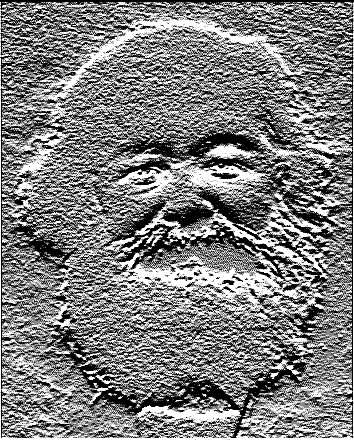
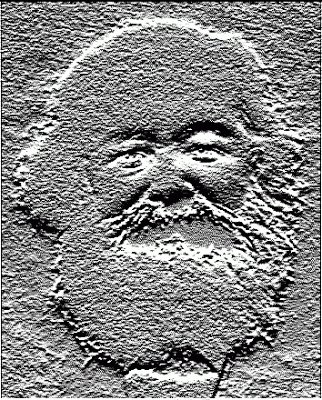
Writ in stone? Image from RalphMag.

Zombie-Marxism II:
What Marx got right

Why Marxism has failed, and
why Zombie-Marxism cannot die

(Or, ‘My rocky relationship with Grampa Karl’)

By Alex Knight / The Rag Blog / November 16, 2010

This is the second part of an essay critiquing the philosophy of Karl Marx for its relevance to 21st century anti-capitalism. The main thrust of the essay is to encourage living common-sense radicalism, as opposed to the automatic reproduction of zombie ideas which have lost connection to current reality.

Karl Marx was no prophet. But neither can we reject him. We have to go beyond him, and bring him with us. I believe it is only on such a basis, with a critical appraisal of Marx, that the Left can become ideologically relevant to today’s rapidly evolving political circumstances. Go here for Part I of this series.

What Marx got right

Boiling down all of Karl Marx’s writings into a handful of key contributions is fated to produce an incomplete list, but here are the five that immediately come to my mind: 1. Class Analysis, 2. Base and Superstructure, 3. Alienation of Labor, 4. Need for Growth, Inevitability of Crisis, and 5. A Counter-Hegemonic Worldview.

(It must be noted that many of these insights were not the unique inspiration of Marx’s brain, but were ideas bubbling up in the European working class movements of the 18th and 19th centuries, which was the political context that educated Marx. Further, Marx’s lifelong collaborator, Friedrich Engels, undoubtedly contributed significantly to Marx’s ideas, although Marx remained the primary theorist.)

1. Class analysis

In the opening lines of the Communist Manifesto (1848), Marx thunders, “The history of all hitherto existing society is the history of class struggles.”

In other words, as long as society has been divided into rich and poor, ruler and enslaved, oppressor and oppressed, capitalist and worker, there have been relentless efforts amongst the powerful to maintain and increase their power, and correspondingly, constant struggles from the poor and oppressed to escape their bondage.

This insight appears to be common sense, but it is systematically hidden from mainstream society. People do not choose to be poor or oppressed, although the rich would like us to believe otherwise. The powerless are kept that way by those in power. And they are struggling to end that poverty and oppression, to the best of their individual and collective ability.

The Manifesto elaborates Marx’s class framework under capitalism:

“Our epoch… possesses this distinctive feature: it has simplified class antagonisms: Society as a whole is more and more splitting up into two great hostile camps…: Bourgeoisie and Proletariat” (Marx-Engels Reader, 474).

Marx relayed the words “bourgeoisie” and “proletariat” directly from the French working class movement he encountered in his 1844 exile in Paris, when he briefly ran with the likes of “anarchist” theorist Pierre-Joseph Proudhon. Marx himself reminds us, “No credit is due to me for discovering the existence of classes in modern society or the struggle between them.” Class analysis pre-dated Marx by many decades. Yet he articulated the class divisions of capitalist society quite clearly.

The “bourgeoisie” are those who own and control the “means of production,” or basically, the land, factories and machines that make up the economy. Today we know them as the Donald Trumps, the Warren Buffets, etc., although most of the ruling class tries to avoid public scrutiny. In short, the ruling class in capitalism are the wealthy elite, who exert control over society (and government) through their dollars.

Opposing them is the “proletariat,” which Marx defines as “the modern working class — a class of labourers who live only so long as they find work, and who find work only so long as their labour increases capital” (479). The working class for Marx is everybody who has to work for a wage and sell their labor in order to survive.

The divide between the bourgeoisie and proletariat as seen by Marx impacts society in deep and rarely understood ways. However, it is clear that as the rich rule society, they design it for their own benefit through politics, the media, the school system, etc. Inevitably, through “trickle up” economics, the rich get richer and the poor get poorer. As the class conflict worsens, for Marx there can only be one solution — revolution:

“This revolution is necessary not only because the ruling class cannot be overthrown in any other way, but also because the class overthrowing it can only in a revolution succeed in ridding itself of all the muck of ages and become fitted to found society anew” (193, The German Ideology, 1845).

How could it happen? Marx rightly answers, “the emancipation of the working classes must be conquered by the working classes themselves.”

This proclamation comes from the Preamble (1864) of the International Workingmen’s Association, also known as the First International. The International, which Marx helped found, was an organization made up of workers and their allies from across Europe, and a few from outside it.

The International’s goal was the solidarity of workers across national boundaries, becoming united and empowered to lay siege to the capitalist system. Through “class consciousness,” the workers would become aware of their “historic mission,” and through organization, they would build the means to accomplish it.

The key is that Marx believed that change would come from below. It was impossible to decree communism from above. This explains Marx’s slogan, still just as relevant today if not for the gendered language, “Working men of all countries, Unite!”

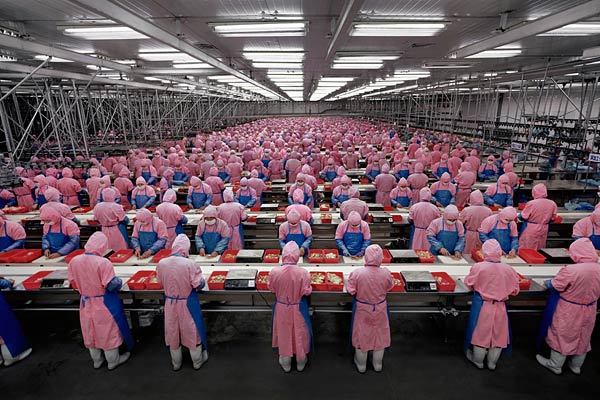
Today, workers in China are perhaps the most successful practitioners of Marx’s class analysis. As China has opened itself up to Western corporations to take advantage of extremely low wages, China over the last 20 years has transformed itself into the sweatshop of the world. Workers make just a few cents per hour, work up to 12-15 hours per day, and are often forbidden from taking bathroom breaks.

With literally nothing to lose, class struggle must appear to be a viable option for these exploited millions. And they have seized the opportunity. Organizing independently of the Communist Party’s official labor union, Chinese workers have self-organized thousands of massive strikes in the past few years.

In the words of Johann Hari, “Wildcat unions have sprung up, organized by text message, demanding higher wages, a humane work environment, and the right to organize freely. Millions of young workers across the country are blockading their factories and chanting ‘there are no human rights here!’ and ‘we want freedom!’”

What if working men and women of the United States were to join in solidarity with the Chinese workers currently rebelling against totalitarian abuse? What if the primary consuming nation and the primary producing nation had to contend with a united, powerful anti-capitalist movement? It could create a force with the power to bring the entire capitalist system to its knees.

2. Base and superstructure

“High on my own list of Marx’s important insights was the understanding that economics cannot be separated from politics.” – Roger Baker, “Is Marx Still Relevant?

Marx locates economics as the motive force of history. Marx called this the “materialist conception of history,” as opposed to the idealist conception of history as articulated by the earlier German philosopher, G.W.F. Hegel. Marx, who had been a member of the “Young Hegelians” while attending university, famously “stood Hegel on his head.” Instead of the material world being an extension of the ideas in people’s heads, Marx saw ideas as reflections of material reality, chiefly the economic “relations of production.”

History, for Marx, can best be explained in the context of the evolution and development of human economy. In an early letter (1846), he explains:

“Assume a particular state of development in the productive faculties of man and you will get a particular form of commerce and consumption. Assume particular stages of development in production, commerce and consumption and you will have a corresponding social constitution, a corresponding organisation of the family, of orders or of classes, in a word, a corresponding civil society” (Marx-Engels Reader, 136-7).

Marx therefore separates the economic “base” (or “foundation”) from a social, political, and ideological “superstructure” built on top of it. He elaborated this more fully in A Contribution to the Critique of Political Economy (1859):

“The totality of these relations of production constitutes the economic structure of society, the real foundation, on which arises a legal and political superstructure, and to which correspond definite forms of consciousness. The mode of production of material life conditions the general process of social, political, and intellectual life. It is not the consciousness of men that determines their existence, but their social existence that determines their consciousness.”

Debates over the extent of Marx’s economic determinism have raged since his death, but Engels clarified his and Marx’s framework in an 1890 letter:

“According to the materialist conception of history, the ultimately determining element in history is the production and reproduction of real life. More than this neither Marx nor I have ever asserted. Hence if somebody twists this into saying that the economic element is the only determining one, he transforms that proposition into a meaningless, abstract, senseless phrase.

The economic situation is the basis, but the various elements of the superstructure: political forms of the class struggle and its results, to wit: constitutions established by the victorious class after a successful battle, etc., juridical forms, and then even the reflexes of all these actual struggles in the brains of the participants, political, juristic, philosophical theories, religious views and their further development into systems of dogmas, also exercise their influence upon the course of the historical struggles and in many cases preponderate in determining their form

We make our history ourselves, but, in the first place, under very definite assumptions and conditions [emphasis added]. Among these the economic ones are ultimately decisive. But the political ones, etc., and indeed even the traditions which haunt human minds also play a part, although not the decisive one” (Marx-Engels Reader, 760-2).1

The core of Marx and Engels’ argument appears self-evident. Agricultural societies worship crop-related gods, and create social structures such that divide people into Lord and peasant. Industrial societies worship technology and money, and create classes such as financier and worker. What good would it have done for an Egyptian pharaoh to attempt to create something like the Internet, if the economic means (microchips, factories, wage labor, international banking) didn’t exist? Or, more precisely, how would the pharaoh have conceived of the Internet without these material conditions existing in front of him?

The concept of base and superstructure has many useful applications. For example, Marx articulated in his essay “The German Ideology,” that those in power materially can also exert ideological control over the rest of society. “The ideas of the ruling class are in every epoch the ruling ideas, i.e. the class which is the ruling material force of society, is at the same time its ruling intellectual force” (M-ER, 172). Today we know this as propaganda and brainwashing.

Building off these ideas, later Marxists such as Antonio Gramsci developed a critique of “hegemony” — the dominance of one group of people, or one ideology, based on consent and persuasion, rather than by brute force. In other words, hegemony means the oppressed accept their oppression, internalizing and perhaps even outwardly arguing for the mythology of their rulers. People are much easier to rule if they believe it is for their own good.

Hegemony is a highly relevant idea to our situation today, especially in the United States where the population is thoroughly indoctrinated with the mythology of capitalism — seeing the system as positive and liberating, rather than violent and destructive as it actually is.

However, if the base of the American economy continues to deteriorate as it has, Marx would suggest the superstructure is sure to follow, and revolutionary change is perhaps not far around the corner.
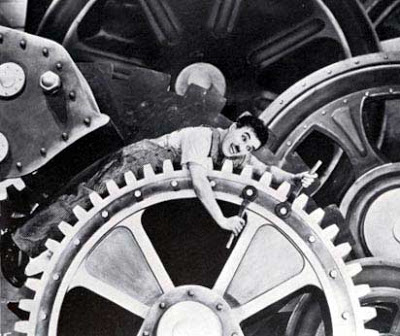
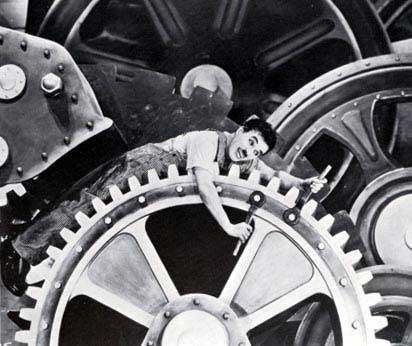
Alienated labor? Charlie Chaplin in Modern Times.

3. Alienation of labor

At the core of Karl Marx’s extensive critique of capitalism is his critique of the alienation of labor.

Marx used to spend weeks on end at the library, thoroughly researching the findings of the major economic theorists of capitalism. One of his important discoveries was Adam Smith’s “labor theory of value,” which posits that the value of a commodity is proportional to the quantity of human labor used to create it. A highly complex product, such as a space shuttle, is valuable (or expensive) in part because of the thousands of work-hours spent by hundreds of workers in the construction of its parts and their assembly. Whereas constructing a wheel-barrow is significantly less labor-intensive, it is therefore worth less money.

Marx extrapolated from this theory, showing that because labor produces everything of value (along with what nature provides), the entire system of capitalist accumulation is sustained by profiting off the backs of workers.

The focal argument of Capital, Volume 1 (1867), is that there would be no capital if not for the exploitation of labor. Marx coins the phrase “surplus value” to show that workers produce a higher value of goods for their bosses than they receive for themselves in wages. In effect, the worker only gets paid for working half a day, which is the amount of pay needed to keep him or her alive, yet he or she works a full day. What they produce in the second half of the day is therefore pure profit for their employer. “The rate of surplus-value is an exact expression for the degree of exploitation of labour-power by capital, or of the labourer by the capitalist” (Chapter IX).

Marx hereby creates the fascinating distinction between the worker’s “living labor,” and the machines, commodities and wealth (capital) created by that living labor, called “accumulated labor” or “dead labor.” While the worker produces surplus value for capital, giving the capitalist an incentive to keep the worker hard at work, the worker’s life diminishes in direct proportion to the work performed. This exploitation is the basis of the entire system: “[W]hat is the growth of productive capital? Growth of the power of accumulated labour over living labour. Growth of the domination of the bourgeoisie over the working class” (Marx-Engels Reader, 210).

I believe “Alienated Labour,” written as part of the “Economic and Philosophical Manuscripts of 1844,” is Marx’s most enduring and relevant essay. It originally went unpublished and was only re-discovered in the 20th century, influencing the “New Left” of the 1960s, which was largely concerned with the pervasive alienation of modern consumer capitalism.

In the essay, Marx elaborates on the distinction between the worker’s active labor and the product of his or her labor:

“The worker becomes all the poorer the more wealth he produces, the more his production increases in power and range. The worker becomes an ever cheaper commodity the more commodities he creates. With the increasing value of the world of things proceeds in direct proportion the devaluation of the world of men. Labor produces not only commodities; it produces itself and the worker as a commodity” (M-ER, 71).

The alienation of labor therefore emerges from the reality that under capitalism, human beings are reduced to commodities, whose value is expressed through wage labor. For most of us, survival is impossible without pimping ourselves out to the highest bidding employer. Unfortunately, when we sell ourselves for a wage, we also give up power over what we do with our time. What we produce is not under our control or discretion. Our work activity and its product are therefore alien to us.

“[T]he worker is related to the product of his labor as to an alien object. For on this premise it is clear that the more the worker spends himself, the more powerful becomes the alien world of objects which he creates over-against himself, the poorer he himself — his inner world — becomes, the less belongs to him as his own” (72).

Because the wage workers are disempowered in the process of work, their labor gives birth not to a world in their own, human, image but to a world in the image of capital. It is an alien world, full of meaningless commodities, but very little humanity. Humanity has been conscripted into the wage labor process, against its will. Workers themselves are ever being produced, as humans who have lost touch with their “intrinsic nature.”

The essay’s climax is prompted by Marx’s question, “What, then, constitutes the alienation of labor?”

“First, the fact that labor is external to the worker, i.e., it does not belong to his intrinsic nature; that in his work, therefore, he does not affirm himself but denies himself, does not feel content but unhappy, does not develop freely his physical and mental energy but mortifies his body and ruins his mind.

The worker therefore only feels himself outside his work, and in his work feels outside himself… His labor is therefore not voluntary, but coerced; it is forced labor. It is therefore not the satisfaction of a need; it is merely a means to satisfy needs external to it. Its alien character emerges clearly in the fact that as soon as no physical or other compulsion exists, labor is shunned like the plague…

Lastly, the external character of labor for the worker appears in the fact that it is not his own, but someone else’s, that it does not belong to him, that in it he belongs, not to himself, but to another… As a result, therefore, man (the worker) only feels himself freely active in his animal functions — eating, drinking, procreating, or at most in his dwelling and in dressing-up, etc.; and in his human functions he no longer feels himself to be anything but an animal” (74).

This is Marx at his most human, and therefore his most relevant. This passage resonates because it speaks directly to our concrete needs, which are not only economic, but mental, emotional, and spiritual. Marx is articulating something core here — the work we do for our bosses creates their profits, but it makes us miserable in the process.

We create commodities and services which are not our own, which are not designed for our concrete needs but based solely on the demands of the market, and as a result, we are alienated from our own humanity. If we did not need wages to survive, we could just as easily quit our worthless, meaningless jobs. Unfortunately, the joke is on us. With each hour of work that deadens our souls, we give more life and power to the very “alien world of objects” that oppresses us.2

The phrase “Work sucks” therefore becomes literal. Our lives are sucked out of us by the vampire of capital.

4. Need for growth, inevitability of crisis

Why does work have to suck in a capitalist society? For the simple reason of the profit motive. By exploiting workers, the system creates profit, and therefore grows. Growth is capitalism’s raison d’etre — reason for being. Without growth, capitalism would wither and die.

In Capital Volume 1, Marx lays out his “General Formula of Capital”: M—C—M’. M=money, C=commodities, M’=more money (Marx Engels Reader, 336).

The formula indicates that on the micro level, capital is nothing but the movement of money into a larger amount of money, producing profit. Marx explains this endless movement of money as the inner workings of the system:

“Value… becomes value in process, money in process, and, as such, capital. It comes out of circulation, enters into it again, preserves and multiplies itself within its circuit, comes back out of it with expanded bulk, and begins the same round ever afresh” (335).

Thus, capital is like a shark — it must keep moving in order to breathe. If it were to sit still, it would quickly suffocate. Only by constantly finding and exploiting investment opportunities can capital accumulate, and thereby, survive. This ever-present need to grow therefore compels each individual capitalist to maximize profit.

“The expansion of value, which is the objective basis or main-spring of the circulation M—C—M, becomes [the capitalist’s] subjective aim, and it is only in so far as the appropriation of ever more and more wealth in the abstract becomes the sole motive of his operations, that he functions as a capitalist, that is, as capital personified and endowed with consciousness and a will (emphasis added)… The restless never-ending process of profit-making alone is what he aims at.” (334).

Here Marx explains that capital’s need for growth determines the actions of each individual capitalist, such as a wealthy financier, or the modern example, a multinational corporation. In Marx’s brilliant language we can therefore understand Wal-Mart or Sony as “capital personified.” Their one and only motive is to profit, to grow. All other considerations, ecological or social, are essentially irrelevant.

Suppose a capitalist/corporation failed to create growth, either mistakenly, or somehow purposely abdicated their role in the system. What would happen? Very simply, capital would work its way around them. Another capitalist would come along, a competitor, to take advantage of the situation, and inevitably put the first capitalist out of business. Marx names this competition between capitalists “the industrial battlefield.”3

This war of competition makes it impossible to simply blame BP, British Petroleum, for its shoddy safety standards which led to the poisoning of the Gulf. If BP prioritized safety over profit, the company would lose a competitive edge to its rivals, Exxon-Mobil or Chevron-Texaco. It is only by obeying the command of capital to constantly grow or die, that a capitalist survives. The entire system must be indicted — “hate the game, not the player.”

As each capitalist serves his master and performs the ritual of profit-making, the system as a whole also necessarily expands “on an ever more gigantic scale” (214). This systemic expansion is famously described in the Communist Manifesto:

“The need for a constantly expanding market for its products chases the bourgeoisie over the whole surface of the globe. It must nestle everywhere, settle everywhere, establish connexions everywhere… The cheap prices of its commodities are the heavy artillery with which it batters down all Chinese walls… It compels all nations, on pain of extinction, to adopt the bourgeois mode of production.” (476-7).

As each capitalist battles for resources, labor, and markets for its goods, every community, every nation, and eventually the entire planet itself, is consumed. Capital therefore creates a global system, organized by the incessant requirement of accumulation. The entire system must grow.

Should capitalism ever cease growing, a crisis would necessarily develop. Investors would cease making investments for fear that they would not get a return. Businesses would cut back, laying off workers, which has the effect of reducing consumer demand. Without a friendly investment environment, things can rapidly enter a downward spiral. And as Marx emphasized, this happens over and over again, through “the commercial crises that by their periodical return put on its trial, each time more threateningly, the existence of the entire bourgeois society” (478).

As Marxist professor David Harvey likes to quote, Marx states in the “Grundrisse” (1857) that capital cannot “abide” limits. Any limit which would stand in the system’s path must be transcended or circumvented in some way to keep the accumulation of capital alive and well. Can this accumulation continue forever? Clearly it cannot. Because we live on a finite planet, the idea of an ever-increasing system of production and consumption is absurd on its face. At some point the limits to growth will be reached.

Marx seemed to sense these limits instinctively in “Wage Labour and Capital” (1847):

“Finally, as the capitalists are compelled… to exploit the already existing gigantic means of production on a larger scale and to set in motion all the mainsprings of credit to this end, there is a corresponding increase in industrial earthquakes… [Crises] become more frequent and more violent, if only because, as the mass of production, and consequently the need for extended markets, grows, the world market becomes more and more contracted, fewer and fewer markets remain available for exploitation (emphasis added), since every preceding crisis has subjected to world trade a market hitherto unconquered or only superficially exploited” (217).

When will capitalism hit the limits to growth? The answer is, in my opinion, quite soon. As David Harvey states dispassionately, “There are abundant signs that capital accumulation is at an historical inflexion point where sustaining a compound rate of growth is becoming increasingly problematic.”

Speaking directly to this question, I propose the End of Capitalism Theory to suggest that at this moment in history, no great new sources of wealth remain to be conquered. We are near or at the global peak of oil production, and the planet is having increased difficulty sustaining the ecological damage produced by capitalist production and waste.

These ecological limits are joined by the social limits to growth, manifest in people’s resistance to capitalism all over the world. The aforementioned Chinese workers’ movement is only the most dramatic example. From Bolivia to Greece to the schools of California, more and more people are rejecting the alienating and dehumanizing roles that capitalism forces them into, and by standing up for themselves are placing limits on the ability of the system to increase its power over them — to grow.

It is natural to try to make sense of the extremely broad and deep crisis we are living through. As the crisis has dragged on over the last few years, sales of Marx’s Capital have skyrocketed. I suspect people are looking for an explanation for why capitalism has failed. The End of Capitalism Theory is one attempt at an explanation. I encourage others to come forward.
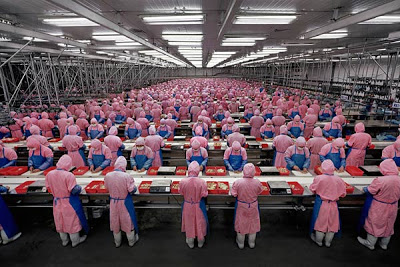
Chinese workers in Guangdong, 2006. Image from Ensaios Imperfeitos.

5. A counter-hegemonic worldview

The name of Karl Marx endures to this day as virtually synonymous with anti-capitalism. In contrast to the hegemonic world-view of capitalism, which sees itself as essentially a meritocracy where people are rewarded for hard work and receive what they deserve, Marx outlined a theory of capitalism that was grounded in exploitation and destruction. This critique formed the basis of an entirely new narrative, a new story about ourselves and our world.

While the core elements of Marx’s narrative were largely spelled out by the working class movement of Europe he immersed himself in, Marx was the transcriber. He put the story of European workers on paper, and adding his own philosophical learnings, deepened and elaborated the story so that these workers’ struggle became emblematic of the dilemma of capitalist development as a whole.

Marx’s “scientific socialism” was distinguished from the approach of other European socialists by his reaching for the big picture. It wasn’t enough to criticize capitalism, Marx felt it was necessary to describe, with as much precision as possible, the conditions that enabled it to exist and which would enable its destruction. In so doing, Marx constructed a counter-hegemonic world-view, a way of seeing the world which was complete enough in itself that it could seriously rival the dominant capitalist explanation of reality.

I want to highlight three aspects of Marx’s world-view that make it so enduring. First, his story gives us meaning and a place in history. Second, it gives us direction and purpose. Third, it is brilliantly told, with poetic and even mystical language weaved alongside the densest of political economic writing.

  • Meaning

Every good story reveals to us something about ourselves. The really great stories — the ones which captivate people for centuries or even millennia — are the ones that provide answers to life’s most fundamental questions: “Who are we?” and “Why are we here?”

Marx’s philosophical education with the Young Hegelians gave him the drive to search for answers to these fundamental questions, as well as the critical tools to deconstruct the popular narratives of the day. He pursued fellow German philosopher Feuerbach in discarding the Christian narrative that predominated in his time, asserting that God was not the creator of humanity, but rather that the inverse was true. Humanity had created God, projecting him into the heavens from our own hopes and fears.

“In direct contrast to German philosophy which descends from heaven to earth, here we ascend from earth to heaven. That is to say, we do not set out from what men say, imagine, conceive, nor from men as narrated, thought of, imagined, conceived, in order to arrive at men in the flesh. We set out from real, active men, and on the basis of their real life-process we demonstrate the development of the ideological reflexes and echoes of this life-process… Life is not determined by consciousness, but consciousness by life” (Marx-Engels Reader, 154-5, “The German Ideology”).

For Marx, then, we lead our own lives as earthly beings. However, we do not start with a blank slate, because we are also historical beings, the inheritors of the past. This past is brought down to us not only in terms of stories and myths, but especially in terms of material activity.

“History is nothing but the succession of the separate generations, each of which exploits the materials, the capital funds, the productive forces handed down to it by all preceding generations, and thus, on the one hand, continues the traditional activity in completely changed circumstances and, on the other, modifies the old circumstances with a completely changed activity” (172).

Who we are, according to Marx, is the descendants of thousands of generations of human-kind and the care-takers of that living legacy, which for Marx is especially an economic (or “productive”) legacy.4 What can be accomplished by the current generation is necessarily a function of the machines, tools, social structures, etc. that our ancestors leave us.

Marx adds an interesting plot-twist when he specifies that in this era of capitalism we are living in unique circumstances which distinguish our present era from all human history. From the “Communist Manifesto”:

“The bourgeoisie, during its rule of scarce one hundred years, has created more massive and more colossal productive forces than have all preceding generations together. Subjection of Nature’s forces to man, machinery, application of chemistry to industry and agriculture, steam-navigation, railways, electric telegraphs, clearing of whole continents for cultivation, canalisation of rivers, whole populations conjured out of the ground — what earlier century had even a presentiment that such productive forces slumbered in the lap of social labour?” (477).

Given that our generation sits atop this dramatic expansion of ‘productive forces,’ it now falls to us to decide what to do with such historic power. Marx makes clear that we have a special responsibility to fulfill.

  • Purpose

“In the earlier epochs of history, we find almost everywhere a complicated arrangement of society into various orders, a manifold gradation of social rank. In ancient Rome we have patricians, knights, plebeians, slaves; in the Middle Ages, feudal lords, vassals, guild-masters, journeymen, apprentices, serfs… The modern bourgeois society that has sprouted from the ruins of feudal society has not done away with class antagonisms. It has but established new classes, new conditions of oppression, new forms of struggle in place of the old ones” (474, “Communist Manifesto”).

Our capitalist era is special not only because of the massive growth of the economy, but also because of the unique and unparalleled class inequality between “bourgeoisie” and “proletariat.” In particular, the proletarians are the protagonists of Marx’s story, who carry within them the seed of a new world.

“A class is called forth, which has to bear all the burdens of society without enjoying its advantages, which, ousted from society, is forced into the most decided antagonism to all other classes; a class which forms the majority of all members of society, and from which emanates the consciousness of the necessity of a fundamental revolution, the communist consciousness” (192-3, “The German Ideology”).

Marx assigns the proletarians the role of liberating not only themselves as a class, but of putting an end to class as such. This is accomplished first through the “ever-expanding union of the workers,” who wage an economic struggle against the capitalists and build their power, and finally through communist revolution. According to Marx, this revolution fulfills the proletarians’ “historic role.”

“[The communist revolution] does away with labour, and abolishes the rule of all classes with the classes themselves, because it is carried through by the class which no longer counts as a class in society, is not recognised as a class, and is in itself the expression of the dissolution of all classes, nationalities, etc., within present society” (193).

Now the narrative reaches its climax. After thousands of years of bondage, the opportunity to put an end to human oppression once and for all is now approaching. Due to the twin emergence of highly developed “productive forces” which offer the possibility of abolishing “material want,” alongside a massive and desperate proletariat, the conditions are ripe, for the first time, for the final victory of the working class. And if the workers are able to liberate themselves, they will likewise liberate all of humanity.

“In the place of the old bourgeois society, with its classes and class antagonisms, we shall have an association, in which the free development of each is the condition for the free development of all” (491).

A communist society would be established to provide for each individual, each community, and each nation, to develop themselves freely, rather than being slaves to the market. And this is how Marx’s story ends:

“[Communism] is the solution of the riddle of history and knows itself to be this solution” (Bottomore 155, “Economic and Philosophical Manuscripts of 1844″).

  • Poetry

The strength of Marx’s narrative is not only that it gives us a meaning that transcends our individual lives to include our common, human, legacy. Nor is limited to providing us with a purpose and mission, so that we can see ourselves as historical actors. The final piece of the puzzle for Marx’s successful story is his poetry, as reflected in passages such as this:

“The proletarians have nothing to lose but their chains. They have a world to win” (500).

For a writer of philosophy and political economy, which is typically the densest and most technical prose, Marx consistently displays a poetic sensibility. His words often have a beauty and an art; they conjure up images that help the reader appreciate the fantastic nature of the story Marx is weaving. Here is one of his most famous sections from the “Communist Manifesto”:

“Constant revolutionising of production, uninterrupted disturbance of all social conditions, everlasting uncertainty and agitation distinguish the bourgeois epoch from all earlier ones. All fixed, fast-frozen relations… are swept away, all new-formed ones become antiquated before they can ossify. All that is solid melts into air, all that is holy is profaned, and man is at last compelled to face with sober senses, his real conditions of life” (476).

Much of Marx’s poetry takes the form of dialectics. Dialectics, which formed much of Hegel’s thought and interest, are a way of thinking about contradicting forces opposing one another within a larger whole, whose contradictions transform that larger whole into something different. These transformations occur through “negations,” as opposites overtake one another. Dialectical thought can be traced back to the ancient Greeks, and is embedded in much Eastern philosophy and religion as well. For example, the Yin and Yang of Taoism represents a whole which contains opposites in contradiction.

Marx was fascinated by the complexity of dialectical thought. Turning to a random page, I can pick many passages to display his interest. Here is another from the “Communist Manifesto”:

“In bourgeois society, therefore, the past dominates the present; in Communist society, the present dominates the past. In bourgeois society capital is independent and has individuality, while the living person is dependent and has no individuality” (485).

In this excerpt, Marx expounds two dialectics: the past vs. the present, both of which exist together in the now, and capital vs. the living person, both of which strive for independence.

The darkness and mystery which surround dialectical ideas grab hold of our imagination, making the impossible appear possible. There is a mystical quality to these ideas. Like television, Marx’s writing both disturbs and fascinates — the complexity of thought pushes the reader away at the same time that its dynamism draws them in.

Here is one of Marx’s most brilliant and memorable uses of dialectics, his attack on the division of labor and specialization:

“[A]s long as a cleavage exists between the particular and the common interest, as long, therefore, as activity is not voluntarily, but naturally, divided, man’s own deed becomes an alien power opposed to him, which enslaves him instead of being controlled by him. For as soon as the distribution of labour comes into being, each man has a particular, exclusive sphere of activity, which is forced upon him and from which he cannot escape.

He is a hunter, a fisherman, a shepherd, or a critical critic, and must remain so if he does not want to lose his means of livelihood; while in communist society, where nobody has one exclusive sphere of activity but each can become accomplished in any branch he wishes, society regulates the general production and thus makes it possible for me to do one thing today and another tomorrow, to hunt in the morning, fish in the afternoon, rear cattle in the evening, criticise after dinner, just as I have a mind, without ever becoming hunter, fisherman, shepherd or critic” (160, “The German Ideology”).

Poetry takes Marx’s narrative to its most important destination — the human heart. Readers are drawn in by the language and internalize this story as their own — seeing themselves for the first time in relation to the historic moment in which we live, and the historic mission with which Marx presents us. This power to reach hearts and minds is the reason Marx’s world-view was able to become counter-hegemonic, and actually challenge the capitalist claim on reality.

However, with this power there is also a danger. As reality is ever-changing, a worldview can either continue to develop and remain relevant, or it can become static and outdated by failing to adapt. The very fascination that a narrative wields can also distract its adherents from asking difficult questions that would breathe new life into the framework.

By defending its weaknesses, one facilitates the narrative remaining hegemonic, but saps it of the potential to evolve and incorporate new, critical perspectives. In the short-term, the narrative survives, but in the long-term, it decays.

The Marxist worldview has fallen victim to this very dynamic. As organs of the narrative have lost circulation with reality and gangrened, they have not been amputated, but allowed to persist as parasites on the elements of Marx’s ideas that remain alive.

Yet, responsibility for today’s Zombie-Marxism cannot be placed entirely on the shoulders of his followers; we must trace the origins of this horror back to the misconceptions in Karl Marx’s writings. The next section of the essay will explore those misconceptions.

Here is an outline of the entire essay. Check back soon for more!

* Introduction

* My Encounter with Grampa Karl

* What Marx Got Right

  1. Class Analysis
  2. Base and Superstructure
  3. Alienation of Labor
  4. Need for Growth, Inevitability of Crisis
  5. A Counter-Hegemonic World-view

*What Marx Got Wrong

  1. Linear March of History
  2. Europe as Liberator
  3. Mysticism of the Proletariat
  4. The State
  5. A Secular Dogma

* Hegemony over the Left

* Zombie-Marxism and its Discontents

* Conclusion: Beyond Marx, But Not Without Him

Footnotes

1. Engels adds this interesting note to the discussion of economic determinism: “Marx and I are ourselves partly to blame for the fact that the younger people sometimes lay more stress on the economic side than is due to it. We had to emphasise the main principles vis-a-vis our adversaries, who denied it, and we had not always the time, the place or the opportunity to allow the other elements involved in the interaction to come into their rights… And I cannot exempt many of the more recent ‘Marxists’ from this reproach, for the most amazing rubbish has been produced in this quarter, too” (Marx-Engels Reader, 760-2).
2. In “Wage Labour and Capital” (a speech delivered to German workers in 1847), Marx brilliantly expanded on the alienation of labor in terms of the division of labor caused by the development of machine industry. “The greater division of labour enables one worker to do the work of five, ten, or twenty; it therefore multiplies competition among the workers fivefold, tenfold and twentyfold. The workers do not only compete by one selling himself cheaper than another; they compete by one doing the work of five, ten, twenty… Further, as the division of labour increases, labour is simplified. The special skill of the worker becomes worthless. He becomes transformed into a simple, monotonous productive force… His labour becomes a labour that anyone can perform. Hence, competitors crowd upon him on all sides, and besides we remind the reader that the more simple and easily learned the labour is, the lower the cost of production needed to master it, the lower do wages sink, for, like the price of every other commodity, they are determined by the cost of production.
Therefore, as labour becomes more unsatisfying, more repulsive, competition increases and wages decrease. The worker tries to keep up the amount of his wages by working more, whether by working longer hours or by producing more in one hour. Driven by want, therefore, he still further increases the evil effects of the division of labour. The result is that the more he works the less wages he receives, and for the simple reason that he competes to that extent with his fellow workers, hence makes them into so many competitors who offer themselves on just the same bad terms as he does himself, and therefore, in the last resort he competes with himself, with himself as a member of the working class.” (214-5).
3. Also in “Wage Labour and Capital,” Marx explains the strategy of this “industrial war of the capitalists among themselves”: produce ever-growing quantities of increasingly cheap commodities. “One capitalist can drive another from the field and capture his capital only by selling more cheaply. In order to be able to sell more cheaply without ruining himself, he must produce more cheaply, that is, raise the productive power of labour as much as possible. But the productive power of labour is raised, above all, by a greater division of labour, by a more universal introduction and continual improvement of machinery. The greater the labour army among whom labour is divided, the more gigantic the scale on which machinery is introduced, the more does the cost of production proportionately decrease, the more fruitful is labour [for the capitalist]. Hence, a general rivalry arises among the capitalists to increase the division of labour and machinery and to exploit them on the greatest possible scale.
The more powerful and costly means of production that he has called into life enable him to sell his commodities more cheaply, they compel him, however, at the same time to sell more commodities, to conquer a much larger market for his commodities.” (211-2).
Noting that profit for the capitalists is inversely proportional to the wages paid out to workers, he adds, “this war has the peculiarity that its battles are won less by recruiting than by discharging the army of labour. The generals, the capitalists, compete with one another as to who can discharge the most soldiers of industry” (215).
4. In a similar passage from an 1846 letter to one P.V. Annenkov, Marx explains: “Every succeeding generation finds itself in possession of the productive forces acquired by the previous generation, which serve it as the raw material for new production, a coherence arises in human history (emphasis added), a history of humanity takes shape which is all the more a history of humanity as the productive forces of man” (137).

[Alex Knight is an organizer, teacher, and writer in Philadelphia. He maintains the website endofcapitalism.com and is writing a book called The End of Capitalism. He can be reached at activistalex@gmail.com.]

Also see:

The Rag Blog

Posted in Rag Bloggers | Tagged , , , , , | 4 Comments

Marc Estrin : GWOT Love

Dedication ceremony for the Vermont Global War on Terror Memorial on Veterans Day, 2010, at the Vermont Veterans Memorial Cemetery in Randolph Center, Vt. Photo by Alison Redlich / AP.

GWOT LOVE

By Marc Estrin / The Rag Blog / November 14, 2010

BURLINGTON, Vermont — I hear on the news this Veterans Day that our thankfully exiting governor — cynically known as Governor Scissorhands for all his ribbon cutting — will be dedicating a new memorial to our Vermont dead in Iraq and Afghanistan.

The “Vermont Global War on Terror Memorial,” planned and funded by the families of “Vermont’s 36 Fallen Global War on Terror Heroes” to the tune of $350,000, is aimed at “marking both the sacrifice of those who served and the heartbreak of the loved ones left behind.”

A memorial to oneself?

The sculptor of the Memorial describes it thus:

In front of the field memorial stands a low sarcophagus etched with the names and representing the body of Vermont’s Fallen Patriots.

Surrounding the field memorial and sarcophagus are three semi-circular bench walls.

In the center of each bench wall stands a monolith. The monolith on the left is dedicated to all those from Vermont who have served in the Global War on Terror. It has a hand tooled War on Terror Service Medal. The monolith on the right is dedicated to the families of the fallen and the great sacrifices they have made. It has a hand tooled Vermont Patriot’s Medal. The monolith in the back has a bronze dedication plaque and expresses the pride and sorrow of the citizens of Vermont.

Together the three monoliths — their family, their comrades and their fellow citizens stand as sentinels ready to guard the sacred honor of the fallen…

The Cemetery Advisory Board of the Vermont Veterans Memorial Cemetery has provided what they call “a reverent location at the entrance to the cemetery.”

The GWOT Memorial will be a lasting tribute to our Fallen Heroes who have made the “ultimate sacrifice” protecting our country and defending our freedom. They will not be forgotten.

It is hard to know where to begin reacting to all this. I cringe at the language — bathetic, maudlin, soupy, cloying, schmaltzy, large-P Patriotic — but the sentiments inscribed in this language are more problematical still.

A guy stopped by at our peace vigil last night and said, “My nephew got back from Iraq and blew his brains out. He couldn’t deal with the stuff he had done — killing civilians and all that.”

This, it seems to me, is a more accurate description of reality.

Our president, of course, made a typical Veterans Day pledge: “As long as I am Commander-in-Chief, I am going to do right by them [our veterans]. America will not let you down. We will take care of our own,” he said.

On the other hand, yesterday’s release of the draft report from the President’s Fiscal Deficit Commission has recommended establishing Veterans Administration health co-pays. From the report:

This option would increase out-of-pocket costs for veterans in Priority Group 5 — those who do not have service-connected disabilities and whose income is below a VA-defined threshold. Currently, those patients pay no fees for inpatient or outpatient medical care. This option requires copayments for medical care provided by the Department of Veterans Affairs to these enrollees, saving 0.7 billion in 2014.

This, it seems to me, is a more accurate description of reality.

And today, Obama exhorted Congress to stop shooting down the deficit proposals before they have been studied.

If people are in fact, concerned about spending, debt, deficits and the future of our country, then they’re going to need to be armed with the information about the kinds of choices that are going to be involved, and we can’t just engage in political rhetoric.

A new rhetorical War on Political Rhetoric?

The question of supporting troops is a vexed one. It is true they have suffered — but they have also caused much suffering. Which of the two do we support? Only the first while ignoring the second? The families too have suffered. But is part of their pain related to their own responsibility in sending their children off to kill and be killed in the interests of a governing elite? Do we support such sending off?

In any case, the language of the Vermont Global War On Terror Memorial is tired, empty, and ever less to any point. It perpetuates a sentimental, obscuring cloud-of-unknowing over the realities we currently face and must radically change.

[Marc Estrin is a writer, activist, and cellist, living in Burlington, Vermont. His novels, Insect Dreams, The Half Life of Gregor Samsa, The Education of Arnold Hitler, Golem Song, and The Lamentations of Julius Marantz have won critical acclaim. His memoir, Rehearsing With Gods: Photographs and Essays on the Bread & Puppet Theater (with Ron Simon, photographer) won a 2004 theater book of the year award. He is currently working on a novel about the dead Tchaikovsky.]

The Rag Blog

Posted in Rag Bloggers | Tagged , , , , , | 13 Comments

BOOKS / Gary Chason : Glenn Jones’ Novel is Paranoiac Psychedelic Memoir


A dark psychedelic flashback:
‘Why Are We in Texas?’

By Gary Chason / The Rag Blog / November 15, 2010

[Why Are We in Texas? A novella by Glenn Jones (Lulu.com, 2010); Softcover; 93 pp.; $14. Also available as an electronic download for $3.99.]

Glenn Jones’ epic yarn, Why Are We in Texas?, is not so much a nostalgic stroll down memory lane as it is an LSD flashback. Drawing on over 60 years of Austin counterculture, it starts on that fateful day in 1966, when Charles Whitman rained hot lead down upon the campus, and ends a (disturbingly) few years in the future at that same, uber-symbolic building: the University of Texas Tower.

In a flash-forward prologue, Texas actually secedes from the United States, setting off a war that pits well-armed Tea Party types, bikers, the National Guard, Aggies, cowboys, gay revelers, liberals, soldiers from Fort Hood, and assorted others in a wild free-for-all of blood and guts. The “big-haired Governor,” the secessionist leader, avoids harm by cross-dressing and escaping on a motorcycle. Jones’ vision of the future is beyond dystopian; it reads like a bad acid trip. (You probably had at least one of those. I know I did.)

Between the beginning and end, the story revolves around Lon, a familiar enough denizen of the Austin underground, who, at the outset, is an underachieving UT student who spends more time discussing esoterica — and paranoid fantasies — in the Chuck Wagon at the Texas Union than he does on his classwork. The naturalism of the social scene, and indeed most of the novel, is in jarring contrast to the opening and closing sequences, which sometimes don’t seem to be part of the same story.

I was reminded of Billy Lee Brammer’s The Gay Place and Hunter Thompson’s Fear and Loathing in Las Vegas in equal measures. It is clear that Jones, a former contributor to The Rag, The Rag Blog’s print media predecessor, didn’t get any of his story ideas from books at the library; he obviously lived it from the inside, ate it up and swallowed it whole.

We are immersed in hippie culture, with all the drugs, booze, free sex, and radical politics that we could ever want. It feels authentic because it is authentic, as anyone who lived in Austin during those decades can attest. The iconic locations are all there: The Plantation, Les Amis, Vulcan Gas Company, Armadillo World Headquarters. And Lon’s residence is a spot-on depiction of the Ghetto, that legendary bastion of counterculture at its most awesome.

The main characters are recognizable, resembling people we all knew, or maybe still know. If you look closely enough, you may see yourself in there somewhere. We encounter rock stars Janis Joplin and Roky Erickson, filmmaker Eagle Pennell, writers Bud Shrake and Billy Lee Brammer, in a mix that somehow summarizes the whole shebang, that attempts (with considerable success) to put the entire Austin experience down on paper. If you can remember the Sixties and Seventies, it has been suggested that you didn’t really live them. This book will help you fill in the gaps in your memory.

It is so Austin-centric, however, that I wonder if readers who live elsewhere will get it. There’s a lot to be said, I suppose, for being time/place specific. It’s a staple of good storytelling. And for those potential readers who have never lived in Austin, I offer my sincere condolences. This book will serve as a primer.

Our hero and his many friends grow up, get married and divorced, screw around on each other, drink too much, smoke too much, party too much, get real jobs, and do all the things that make life happy and miserable simultaneously. Time passes; shit happens. Lon wants to write but never seems to get it together, and he is sometimes hard to like, especially when he’s slamming his wife through the sheetrock in a drunken rage.

In the epilogue, which matches the prologue in tone and paranoia, Lon’s dark side seems to win out. Regarding a stolen nuclear bomb brought up the Colorado River by boat from the Gulf of Mexico and buried on a farm, suspension of disbelief is a big stretch, but let’s give Jones the benefit of the doubt. After all, this is a paranoid fantasy, like many spun out over endless cups of coffee at the Chuck Wagon.

Which makes me wonder: Is that really what it’s been about?

In all, Why Are We In Texas? is a fast, fun read, especially for those of us fortunate enough to have been a part of the culture Jones so accurately depicts. I’m just hoping for a happier ending in real life.

[Gary Chason is an Austin-based independent filmmaker, actor, screenwriter, playwright, and stage director. His article, “Sexual Freedom League: The Naked Truth” was the cover story in the second issue of The Rag, August 17, 1966.]

The Rag Blog

Posted in Rag Bloggers | Tagged , , , , , , , , | 1 Comment

Zombie-Marxism Part 2: What Marx Got Right

Why Marxism Has Failed, and Why Zombie-Marxism Cannot Die
Or My Rocky Relationship with Grampa Karl

by Alex Knight,

This is part of an essay critiquing the philosophy of Karl Marx for its relevance to 21st century anti-capitalism. The main thrust of the essay is to encourage living common-sense radicalism, as opposed to the automatic reproduction of zombie ideas which have lost connection to current reality. Karl Marx was no prophet. But neither can we reject him. We have to go beyond him, and bring him with us. I believe it is only on such a basis, with a critical appraisal of Marx, that the Left can become ideologically relevant to today’s rapidly evolving political circumstances. [Click here for Part 1.]

A brilliant, critical mind in his own time. Not infallible.
What Marx Got Right

Boiling down all of Karl Marx’s writings into a handful of key contributions is fated to produce an incomplete list, but here are the 5 that immediately come to my mind: 1. Class Analysis, 2. Base and Superstructure, 3. Alienation of Labor, 4. Need for Growth, Inevitability of Crisis, and 5. A Counter-Hegemonic World-view.

(It must be noted that many of these insights were not the unique inspiration of Marx’s brain, but were ideas bubbling up in the European working class movements of the 18th and 19th centuries, which was the political context that educated Marx. Further, Marx’s lifelong collaborator, Friedrich Engels, undoubtedly contributed significantly to Marx’s ideas, although Marx remained the primary theorist.)

1. Class Analysis

In the opening lines of the “Communist Manifesto” (1848), Marx thunders, “The history of all hitherto existing society is the history of class struggles.”

In other words, as long as society has been divided into rich and poor, ruler and enslaved, oppressor and oppressed, capitalist and worker, there have been relentless efforts amongst the powerful to maintain and increase their power, and correspondingly, constant struggles from the poor and oppressed to escape their bondage. This insight appears to be common sense, but it is systematically hidden from mainstream society. People do not choose to be poor or oppressed, although the rich would like us to believe otherwise. The powerless are kept that way by those in power. And they are struggling to end that poverty and oppression, to the best of their individual and collective ability.

The Manifesto elaborates Marx’s class framework under capitalism:

“Our epoch… possesses this distinctive feature: it has simplified class antagonisms: Society as a whole is more and more splitting up into two great hostile camps…: Bourgeoisie and Proletariat” (Marx-Engels Reader 474).

Marx relayed the words “bourgeoisie” and “proletariat” directly from the French working class movement he encountered in his 1844 exile in Paris, when he briefly ran with the likes of “anarchist” theorist Pierre-Joseph Proudhon. Marx himself reminds us, “No credit is due to me for discovering the existence of classes in modern society or the struggle between them.” Class analysis pre-dated Marx by many decades. Yet he articulated the class divisions of capitalist society quite clearly.

The “bourgeoisie” are those who own and control the “means of production,” or basically, the land, factories and machines that make up the economy. Today we know them as the Donald Trumps, the Warren Buffets, etc., although most of the ruling class tries to avoid public scrutiny. In short, the ruling class in capitalism are the wealthy elite, who exert control over society (and government) through their dollars.

Opposing them is the “proletariat,” which Marx defines as “the modern working class – a class of labourers who live only so long as they find work, and who find work only so long as their labour increases capital” (479). The working class for Marx is everybody who has to work for a wage and sell their labor in order to survive.

The divide between the bourgeoisie and proletariat as seen by Marx impacts society in deep and rarely understood ways. However, it is clear that as the rich rule society, they design it for their own benefit through politics, the media, the school system, etc. Inevitably, through “trickle up” economics, the rich get richer and the poor get poorer. As the class conflict worsens, for Marx there can only be one solution — revolution:

“This revolution is necessary not only because the ruling class cannot be overthrown in any other way, but also because the class overthrowing it can only in a revolution succeed in ridding itself of all the muck of ages and become fitted to found society anew” (193, “The German Ideology” 1845).

How could it happen? Marx rightly answers, “the emancipation of the working classes must be conquered by the working classes themselves.”

This proclamation comes from the Preamble (1864) of the International Workingmen’s Association, also known as the First International. The International, which Marx helped found, was an organization made up of workers and their allies from across Europe, and a few from outside it. The International’s goal was the solidarity of workers across national boundaries, becoming united and empowered to lay siege to the capitalist system. Through “class consciousness,” the workers would become aware of their “historic mission,” and through organization, they would build the means to accomplish it.

The key is that Marx believed that change would come from below. It was impossible to decree communism from above. This explains Marx’s slogan, still just as relevant today if not for the gendered language, “Working men of all countries, Unite!”

Today, workers in China are perhaps the most successful practitioners of Marx’s class analysis. As China has opened itself up to Western corporations to take advantage of extremely low wages, China over the last 20 years has transformed itself into the sweatshop of the world. Workers make just a few cents per hour, work up to 12-15 hours per day, and are often forbidden from taking bathroom breaks. With literally nothing to lose, class struggle must appear to be a viable option for these exploited millions. And they have seized the opportunity. Organizing independently of the Communist Party’s official labor union, Chinese workers have self-organized thousands of massive strikes in the past few years. In the words of Johann Hari, “Wildcat unions have sprung up, organized by text message, demanding higher wages, a humane work environment, and the right to organize freely. Millions of young workers across the country are blockading their factories and chanting ‘there are no human rights here!’ and ‘we want freedom!’”

What if working men and women of the United States were to join in solidarity with the Chinese workers currently rebelling against totalitarian abuse? What if the primary consuming nation and the primary producing nation had to contend with a united, powerful anti-capitalist movement? It could create a force with the power to bring the entire capitalist system to its knees.

2. Base and Superstructure

“High on my own list of Marx’s important insights was the understanding that economics cannot be separated from politics.” – Roger Baker, “Is Marx Still Relevant?“

Marx locates economics as the motive force of history. Marx called this the “materialist conception of history,” as opposed to the idealist conception of history as articulated by the earlier German philosopher, G.W.F. Hegel. Marx, who had been a member of the “Young Hegelians” while attending university, famously “stood Hegel on his head.” Instead of the material world being an extension of the ideas in people’s heads, Marx saw ideas as reflections of material reality, chiefly the economic “relations of production.”

History, for Marx, can best be explained in the context of the evolution and development of human economy. In an early letter (1846), he explains:

“Assume a particular state of development in the productive faculties of man and you will get a particular form of commerce and consumption. Assume particular stages of development in production, commerce and consumption and you will have a corresponding social constitution, a corresponding organisation of the family, of orders or of classes, in a word, a corresponding civil society” (Marx-Engels Reader 136-7).

Marx therefore separates the economic “base” (or “foundation”) from a social, political, and ideological “superstructure” built on top of it. He elaborated this more fully in A Contribution to the Critique of Political Economy (1859):

“The totality of these relations of production constitutes the economic structure of society, the real foundation, on which arises a legal and political superstructure, and to which correspond definite forms of consciousness. The mode of production of material life conditions the general process of social, political, and intellectual life. It is not the consciousness of men that determines their existence, but their social existence that determines their consciousness.”

Debates over the extent of Marx’s economic determinism have raged since his death, but Engels clarified his and Marx’s framework in an 1890 letter:

“According to the materialist conception of history, the ultimately determining element in history is the production and reproduction of real life. More than this neither Marx nor I have ever asserted. Hence if somebody twists this into saying that the economic element is the only determining one, he transforms that proposition into a meaningless, abstract, senseless phrase. The economic situation is the basis, but the various elements of the superstructure: political forms of the class struggle and its results, to wit: constitutions established by the victorious class after a successful battle, etc., juridical forms, and then even the reflexes of all these actual struggles in the brains of the participants, political, juristic, philosophical theories, religious views and their further development into systems of dogmas, also exercise their influence upon the course of the historical struggles and in many cases preponderate in determining their form…

We make our history ourselves, but, in the first place, under very definite assumptions and conditions (emphasis added). Among these the economic ones are ultimately decisive. But the political ones, etc., and indeed even the traditions which haunt human minds also play a part, although not the decisive one” (Marx-Engels Reader 760-2).1

The core of Marx and Engels’ argument appears self-evident. Agricultural societies worship crop-related gods, and create social structures such that divide people into Lord and peasant. Industrial societies worship technology and money, and create classes such as financier and worker. What good would it have done for an Egyptian pharaoh to attempt to create something like the Internet, if the economic means (microchips, factories, wage labor, international banking) didn’t exist? Or, more precisely, how would the pharaoh have conceived of the Internet without these material conditions existing in front of him?

The concept of base and superstructure has many useful applications. For example, Marx articulated in his essay “The German Ideology”, that those in power materially can also exert ideological control over the rest of society. “The ideas of the ruling class are in every epoch the ruling ideas, i.e. the class which is the ruling material force of society, is at the same time its ruling intellectual force” (M-ER 172). Today we know this as propaganda and brainwashing.

Building off these ideas, later Marxists such as Antonio Gramsci developed a critique of “hegemony” – the dominance of one group of people, or one ideology, based on consent and persuasion, rather than by brute force. In other words, hegemony means the oppressed accept their oppression, internalizing and perhaps even outwardly arguing for the mythology of their rulers. People are much easier to rule if they believe it is for their own good.

Hegemony is a highly relevant idea to our situation today, especially in the United States where the population is thoroughly indoctrinated with the mythology of capitalism – seeing the system as positive and liberating, rather than violent and destructive as it actually is.

However, if the base of the American economy continues to deteriorate as it has, Marx would suggest the superstructure is sure to follow, and revolutionary change is perhaps not far around the corner.

3. Alienation of Labor

At the core of Karl Marx’s extensive critique of capitalism is his critique of the alienation of labor.

Marx used to spend weeks on end at the library, thoroughly researching the findings of the major economic theorists of capitalism. One of his important discoveries was Adam Smith’s “labor theory of value,” which posits that the value of a commodity is proportional to the quantity of human labor used to create it. A highly complex product, such as a space shuttle, is valuable (or expensive) in part because of the thousands of work-hours spent by hundreds of workers in the construction of its parts and their assembly. Whereas constructing a wheel-barrow is significantly less labor-intensive, it is therefore worth less money.

Marx extrapolated from this theory, showing that because labor produces everything of value (along with what nature provides), the entire system of capitalist accumulation is sustained by profiting off the backs of workers.

The focal argument of Capital, Volume 1 (1867), is that there would be no capital if not for the exploitation of labor. Marx coins the phrase “surplus value” to show that workers produce a higher value of goods for their bosses than they receive for themselves in wages. In effect, the worker only gets paid for working half a day, which is the amount of pay needed to keep him or her alive, yet he or she works a full day. What they produce in the second half of the day is therefore pure profit for their employer. “The rate of surplus-value is an exact expression for the degree of exploitation of labour-power by capital, or of the labourer by the capitalist” (Chapter IX).

Marx hereby creates the fascinating distinction between the worker’s “living labor,” and the machines, commodities and wealth (capital) created by that living labor, called “accumulated labor” or “dead labor.” While the worker produces surplus value for capital, giving the capitalist an incentive to keep the worker hard at work, the worker’s life diminishes in direct proportion to the work performed. This exploitation is the basis of the entire system: “[W]hat is the growth of productive capital? Growth of the power of accumulated labour over living labour. Growth of the domination of the bourgeoisie over the working class” (Marx-Engels Reader 210).

I believe “Alienated Labour,” written as part of the “Economic and Philosophical Manuscripts of 1844,” is Marx’s most enduring and relevant essay. It originally went unpublished and was only re-discovered in the 20th century, influencing the “New Left” of the 1960s, which was largely concerned with the pervasive alienation of modern consumer capitalism.

In the essay, Marx elaborates on the distinction between the worker’s active labor and the product of his or her labor:

“The worker becomes all the poorer the more wealth he produces, the more his production increases in power and range. The worker becomes an ever cheaper commodity the more commodities he creates. With the increasing value of the world of things proceeds in direct proportion the devaluation of the world of men. Labor produces not only commodities; it produces itself and the worker as a commodity” (M-ER 71).

The alienation of labor therefore emerges from the reality that under capitalism, human beings are reduced to commodities, whose value is expressed through wage labor. For most of us, survival is impossible without pimping ourselves out to the highest bidding employer. Unfortunately, when we sell ourselves for a wage, we also give up power over what we do with our time. What we produce is not under our control or discretion. Our work activity and its product are therefore alien to us.

“[T]he worker is related to the product of his labor as to an alien object. For on this premise it is clear that the more the worker spends himself, the more powerful becomes the alien world of objects which he creates over-against himself, the poorer he himself – his inner world – becomes, the less belongs to him as his own” (72).

Because the wage worker is disempowered in the process of work, their labor gives birth not to a world in their own, human, image but to a world in the image of capital. It is an alien world, full of meaningless commodities, but very little humanity. Humanity has been conscripted into the wage labor process, against its will. Workers themselves are ever being produced, as humans who have lost touch with their “intrinsic nature.”

The essay’s climax is prompted by Marx’s question, “What, then, constitutes the alienation of labor?”

“First, the fact that labor is external to the worker, i.e., it does not belong to his intrinsic nature; that in his work, therefore, he does not affirm himself but denies himself, does not feel content but unhappy, does not develop freely his physical and mental energy but mortifies his body and ruins his mind. The worker therefore only feels himself outside his work, and in his work feels outside himself… His labor is therefore not voluntary, but coerced; it is forced labor. It is therefore not the satisfaction of a need; it is merely a means to satisfy needs external to it. Its alien character emerges clearly in the fact that as soon as no physical or other compulsion exists, labor is shunned like the plague…

Lastly, the external character of labor for the worker appears in the fact that it is not his own, but someone else’s, that it does not belong to him, that in it he belongs, not to himself, but to another… As a result, therefore, man (the worker) only feels himself freely active in his animal functions – eating, drinking, procreating, or at most in his dwelling and in dressing-up, etc.; and in his human functions he no longer feels himself to be anything but an animal“ (74).

This is Marx at his most human, and therefore his most relevant. This passage resonates because it speaks directly to our concrete needs, which are not only economic, but mental, emotional, and spiritual. Marx is articulating something core here – the work we do for our bosses creates their profits, but it makes us miserable in the process. We create commodities and services which are not our own, which are not designed for our concrete needs but based solely on the demands of the market, and as a result, we are alienated from our own humanity. If we did not need wages to survive, we could just as easily quit our worthless, meaningless jobs. Unfortunately, the joke is on us. With each hour of work that deadens our souls, we give more life and power to the very “alien world of objects” that oppresses us.2

The phrase “Work sucks” therefore becomes literal. Our lives are sucked out of us by the vampire of capital.

4. Need for Growth, Inevitability of Crisis

Why does work have to suck in a capitalist society? For the simple reason of the profit motive. By exploiting workers, the system creates profit, and therefore grows. Growth is capitalism’s raison d’etre — reason for being. Without growth, capitalism would wither and die.

In Capital Vol. 1, Marx lays out his “General Formula of Capital”: M—C—M’. M=money, C=commodities, M’=more money (Marx Engels Reader 336).

The formula indicates that on the micro level, capital is nothing but the movement of money into a larger amount of money, producing profit. Marx explains this endless movement of money as the inner workings of the system:

“Value… becomes value in process, money in process, and, as such, capital. It comes out of circulation, enters into it again, preserves and multiplies itself within its circuit, comes back out of it with expanded bulk, and begins the same round ever afresh” (335).

Thus, capital is like a shark – it must keep moving in order to breathe. If it were to sit still, it would quickly suffocate. Only by constantly finding and exploiting investment opportunities can capital accumulate, and thereby, survive. This ever-present need to grow therefore compels each individual capitalist to maximize profit.

“The expansion of value, which is the objective basis or main-spring of the circulation M—C—M, becomes [the capitalist’s] subjective aim, and it is only in so far as the appropriation of ever more and more wealth in the abstract becomes the sole motive of his operations, that he functions as a capitalist, that is, as capital personified and endowed with consciousness and a will (emphasis added)… The restless never-ending process of profit-making alone is what he aims at” (334).

Here Marx explains that capital’s need for growth determines the actions of each individual capitalist, such as a wealthy financier, or the modern example, a multinational corporation. In Marx’s brilliant language we can therefore understand Wal-Mart or Sony as “capital personified.” Their one and only motive is to profit, to grow. All other considerations, ecological or social, are essentially irrelevant.

Suppose a capitalist/corporation failed to create growth, either mistakenly, or somehow purposely abdicated their role in the system. What would happen? Very simply, capital would work its way around them. Another capitalist would come along, a competitor, to take advantage of the situation, and inevitably put the first capitalist out of business. Marx names this competition between capitalists “the industrial battlefield.”3

This war of competition makes it impossible to simply blame BP, British Petroleum, for its shoddy safety standards which led to the poisoning of the Gulf. If BP prioritized safety over profit, the company would lose a competitive edge to its rivals, Exxon-Mobil or Chevron-Texaco. It is only by obeying the command of capital to constantly grow or die, that a capitalist survives. The entire system must be indicted — “hate the game, not the player.”

As each capitalist serves his master and performs the ritual of profit-making, the system as a whole also necessarily expands “on an ever more gigantic scale” (214). This systemic expansion is famously described in the Communist Manifesto:

“The need for a constantly expanding market for its products chases the bourgeoisie over the whole surface of the globe. It must nestle everywhere, settle everywhere, establish connexions everywhere… The cheap prices of its commodities are the heavy artillery with which it batters down all Chinese walls… It compels all nations, on pain of extinction, to adopt the bourgeois mode of production” (476-7).

As each capitalist battles for resources, labor, and markets for its goods, every community, every nation, and eventually the entire planet itself, is consumed. Capital therefore creates a global system, organized by the incessant requirement of accumulation. The entire system must grow.

Should capitalism ever cease growing, a crisis would necessarily develop. Investors would cease making investments for fear that they would not get a return. Businesses would cut back, laying off workers, which has the effect of reducing consumer demand. Without a friendly investment environment, things can rapidly enter a downward spiral. And as Marx emphasized, this happens over and over again, through “the commercial crises that by their periodical return put on its trial, each time more threateningly, the existence of the entire bourgeois society” (478).

As Marxist professor David Harvey likes to quote, Marx states in the “Grundrisse” (1857) that capital cannot “abide” limits. Any limit which would stand in the system’s path must be transcended or circumvented in some way to keep the accumulation of capital alive and well. Can this accumulation continue forever? Clearly it cannot. Because we live on a finite planet, the idea of an ever-increasing system of production and consumption is absurd on its face. At some point the limits to growth will be reached.

Marx seemed to sense these limits instinctively in “Wage Labour and Capital” (1847):

“Finally, as the capitalists are compelled… to exploit the already existing gigantic means of production on a larger scale and to set in motion all the mainsprings of credit to this end, there is a corresponding increase in industrial earthquakes… [Crises] become more frequent and more violent, if only because, as the mass of production, and consequently the need for extended markets, grows, the world market becomes more and more contracted, fewer and fewer markets remain available for exploitation (emphasis added), since every preceding crisis has subjected to world trade a market hitherto unconquered or only superficially exploited” (217).

When will capitalism hit the limits to growth? The answer is, in my opinion, quite soon. As David Harvey states dispassionately, “There are abundant signs that capital accumulation is at an historical inflexion point where sustaining a compound rate of growth is becoming increasingly problematic.”

Speaking directly to this question, I propose the End of Capitalism Theory to suggest that at this moment in history, no great new sources of wealth remain to be conquered. We are near or at the global peak of oil production, and the planet is having increased difficulty sustaining the ecological damage produced by capitalist production and waste. These ecological limits are joined by the social limits to growth, manifest in people’s resistance to capitalism all over the world. The aforementioned Chinese workers’ movement is only the most dramatic example. From Bolivia to Greece to the schools of California, more and more people are rejecting the alienating and dehumanizing roles that capitalism forces them into, and by standing up for themselves are placing limits on the ability of the system to increase its power over them — to grow.

It is natural to try to make sense of the extremely broad and deep crisis we are living through. As the crisis has dragged on over the last few years, sales of Marx’s Capital have skyrocketed. I suspect people are looking for an explanation for why capitalism has failed. The End of Capitalism Theory is one attempt at an explanation. I encourage others to come forward.

5. A Counter-Hegemonic World-view

The name of Karl Marx endures to this day as virtually synonymous with anti-capitalism. In contrast to the hegemonic world-view of capitalism, which sees itself as essentially a meritocracy where people are rewarded for hard work and receive what they deserve, Marx outlined a theory of capitalism that was grounded in exploitation and destruction. This critique formed the basis of an entirely new narrative, a new story about ourselves and our world.

While the core elements of Marx’s narrative were largely spelled out by the working class movement of Europe he immersed himself in, Marx was the transcriber. He put the story of European workers on paper, and adding his own philosophical learnings, deepened and elaborated the story so that these workers’ struggle became emblematic of the dilemma of capitalist development as a whole.

Marx’s “scientific socialism” was distinguished from the approach of other European socialists by his reaching for the big picture. It wasn’t enough to criticize capitalism, Marx felt it was necessary to describe, with as much precision as possible, the conditions that enabled it to exist and which would enable its destruction. In so doing, Marx constructed a counter-hegemonic world-view, a way of seeing the world which was complete enough in itself that it could seriously rival the dominant capitalist explanation of reality.

I want to highlight three aspects of Marx’s world-view that make it so enduring. First, his story gives us meaning and a place in history. Second, it gives us direction and purpose. Third, it is brilliantly told, with poetic and even mystical language weaved alongside the densest of political economic writing.

Meanin

Every good story reveals to us something about ourselves. The really great stories — the ones which captivate people for centuries or even millennia — are the ones that provide answers to life’s most fundamental questions: “Who are we?” and “Why are we here?”

Marx’s philosophical education with the Young Hegelians gave him the drive to search for answers to these fundamental questions, as well as the critical tools to deconstruct the popular narratives of the day. He pursued fellow German philosopher Feuerbach in discarding the Christian narrative that predominated in his time, asserting that God was not the creator of humanity, but rather that the inverse was true. Humanity had created God, projecting him into the heavens from our own hopes and fears.

“In direct contrast to German philosophy which descends from heaven to earth, here we ascend from earth to heaven. That is to say, we do not set out from what men say, imagine, conceive, nor from men as narrated, thought of, imagined, conceived, in order to arrive at men in the flesh. We set out from real, active men, and on the basis of their real life-process we demonstrate the development of the ideological reflexes and echoes of this life-process… Life is not determined by consciousness, but consciousness by life” (Marx-Engels Reader 154-5, “The German Ideology”).

For Marx, then, we lead our own lives as earthly beings. However, we do not start with a blank slate, because we are also historical beings, the inheritors of the past. This past is brought down to us not only in terms of stories and myths, but especially in terms of material activity.

“History is nothing but the succession of the separate generations, each of which exploits the materials, the capital funds, the productive forces handed down to it by all preceding generations, and thus, on the one hand, continues the traditional activity in completely changed circumstances and, on the other, modifies the old circumstances with a completely changed activity” (172).

Who we are, according to Marx, is the descendants of thousands of generations of human-kind and the care-takers of that living legacy, which for Marx is especially an economic (or “productive”) legacy.4 What can be accomplished by the current generation is necessarily a function of the machines, tools, social structures, etc. that our ancestors leave us.

Marx adds an interesting plot-twist when he specifies that in this era of capitalism we are living in unique circumstances which distinguish our present era from all human history. From the “Communist Manifesto”:

“The bourgeoisie, during its rule of scarce one hundred years, has created more massive and more colossal productive forces than have all preceding generations together. Subjection of Nature’s forces to man, machinery, application of chemistry to industry and agriculture, steam-navigation, railways, electric telegraphs, clearing of whole continents for cultivation, canalisation of rivers, whole populations conjured out of the ground — what earlier century had even a presentiment that such productive forces slumbered in the lap of social labour?” (477).

Given that our generation sits atop this dramatic expansion of ‘productive forces,’ it now falls to us to decide what to do with such historic power. Marx makes clear that we have a special responsibility to fulfill.

Purpose

“In the earlier epochs of history, we find almost everywhere a complicated arrangement of society into various orders, a manifold gradation of social rank. In ancient Rome we have patricians, knights, plebeians, slaves; in the Middle Ages, feudal lords, vassals, guild-masters, journeymen, apprentices, serfs… The modern bourgeois society that has sprouted from the ruins of feudal society has not done away with class antagonisms. It has but established new classes, new conditions of oppression, new forms of struggle in place of the old ones” (474, “Communist Manifesto”).

Our capitalist era is special not only because of the massive growth of the economy, but also because of the unique and unparalleled class inequality between “bourgeoisie” and “proletariat.” In particular, the proletarians are the protagonists of Marx’s story, who carry within them the seed of a new world.

“A class is called forth, which has to bear all the burdens of society without enjoying its advantages, which, ousted from society, is forced into the most decided antagonism to all other classes; a class which forms the majority of all members of society, and from which emanates the consciousness of the necessity of a fundamental revolution, the communist consciousness” (192-3, “The German Ideology”).

Marx assigns the proletarians the role of liberating not only themselves as a class, but of putting an end to class as such. This is accomplished first through the “ever-expanding union of the workers,” who wage an economic struggle against the capitalists and build their power, and finally through communist revolution. According to Marx, this revolution fulfills the proletarians’ “historic role.”

“[The communist revolution] does away with labour, and abolishes the rule of all classes with the classes themselves, because it is carried through by the class which no longer counts as a class in society, is not recognised as a class, and is in itself the expression of the dissolution of all classes, nationalities, etc., within present society” (193).

Now the narrative reaches its climax. After thousands of years of bondage, the opportunity to put an end to human oppression once and for all is now approaching. Due to the twin emergence of highly developed “productive forces” which offer the possibility of abolishing “material want,” alongside a massive and desperate proletariat, the conditions are ripe, for the first time, for the final victory of the working class. And if the workers are able to liberate themselves, they will likewise liberate all of humanity.

“In the place of the old bourgeois society, with its classes and class antagonisms, we shall have an association, in which the free development of each is the condition for the free development of all” (491).

A communist society would be established to provide for each individual, each community, and each nation, to develop themselves freely, rather than being slaves to the market. And this is how Marx’s story ends:

“[Communism] is the solution of the riddle of history and knows itself to be this solution” (Bottomore 155, “Economic and Philosophical Manuscripts of 1844″).

Poetry

The strength of Marx’s narrative is not only that it gives us a meaning that transcends our individual lives to include our common, human, legacy. Nor is limited to providing us with a purpose and mission, so that we can see ourselves as historical actors. The final piece of the puzzle for Marx’s successful story is his poetry, as reflected in passages such as this:

“The proletarians have nothing to lose but their chains. They have a world to win” (500).

For a writer of philosophy and political economy, which is typically the densest and most technical prose, Marx consistently displays a poetic sensibility. His words often have a beauty and an art; they conjure up images that help the reader appreciate the fantastic nature of the story Marx is weaving. Here is one of his most famous sections from the “Communist Manifesto”:

“Constant revolutionising of production, uninterrupted disturbance of all social conditions, everlasting uncertainty and agitation distinguish the bourgeois epoch from all earlier ones. All fixed, fast-frozen relations… are swept away, all new-formed ones become antiquated before they can ossify. All that is solid melts into air, all that is holy is profaned, and man is at last compelled to face with sober senses, his real conditions of life” (476).

Much of Marx’s poetry takes the form of dialectics. Dialectics, which formed much of Hegel’s thought and interest, are a way of thinking about contradicting forces opposing one another within a larger whole, whose contradictions transform that larger whole into something different. These transformations occur through “negations,” as opposites overtake one another. Dialectical thought can be traced back to the ancient Greeks, and is embedded in much Eastern philosophy and religion as well. For example, the Yin and Yang of Taoism represents a whole which contains opposites in contradiction.

Marx was fascinated by the complexity of dialectical thought. Turning to a random page, I can pick many passages to display his interest. Here is another from the “Communist Manifesto”:

“In bourgeois society, therefore, the past dominates the present; in Communist society, the present dominates the past. In bourgeois society capital is independent and has individuality, while the living person is dependent and has no individuality” (485).

In this excerpt, Marx expounds two dialectics: the past vs. the present, both of which exist together in the now, and capital vs. the living person, both of which strive for independence.

The darkness and mystery which surround dialectical ideas grab hold of our imagination, making the impossible appear possible. There is a mystical quality to these ideas. Like television, Marx’s writing both disturbs and fascinates – the complexity of thought pushes the reader away at the same time that its dynamism draws them in.

Here is one of Marx’s most brilliant and memorable uses of dialectics, his attack on the division of labor and specialization:

“[A]s long as a cleavage exists between the particular and the common interest, as long, therefore, as activity is not voluntarily, but naturally, divided, man’s own deed becomes an alien power opposed to him, which enslaves him instead of being controlled by him. For as soon as the distribution of labour comes into being, each man has a particular, exclusive sphere of activity, which is forced upon him and from which he cannot escape. He is a hunter, a fisherman, a shepherd, or a critical critic, and must remain so if he does not want to lose his means of livelihood; while in communist society, where nobody has one exclusive sphere of activity but each can become accomplished in any branch he wishes, society regulates the general production and thus makes it possible for me to do one thing today and another tomorrow, to hunt in the morning, fish in the afternoon, rear cattle in the evening, criticise after dinner, just as I have a mind, without ever becoming hunter, fisherman, shepherd or critic” (160, “The German Ideology”).

Poetry takes Marx’s narrative to its most important destination – the human heart. Readers are drawn in by the language and internalize this story as their own – seeing themselves for the first time in relation to the historic moment in which we live, and the historic mission with which Marx presents us. This power to reach hearts and minds is the reason Marx’s world-view was able to become counter-hegemonic, and actually challenge the capitalist claim on reality.

However, with this power there is also a danger. As reality is ever-changing, a world-view can either continue to develop and remain relevant, or it can become static and outdated by failing to adapt. The very fascination that a narrative wields can also distract its adherents from asking difficult questions that would breathe new life into the framework. By defending its weaknesses, one facilitates the narrative remaining hegemonic, but saps it of the potential to evolve and incorporate new, critical perspectives. In the short-term, the narrative survives, but in the long-term, it decays.

The Marxist world-view has fallen victim to this very dynamic. As organs of the narrative have lost circulation with reality and gangrened, they have not been amputated, but allowed to persist as parasites on the elements of Marx’s ideas that remain alive.

Yet, responsibility for today’s Zombie-Marxism cannot be placed entirely on the shoulders of his followers; we must trace the origins of this horror back to the misconceptions in Karl Marx’s writings. The next section of the essay will explore those misconceptions.

Here is an outline of the entire essay. Check back soon for more!

* Introduction
* My Encounter with Grampa Karl
* What Marx Got Right
1. Class Analysis
2. Base and Superstructure
3. Alienation of Labor
4. Need for Growth, Inevitability of Crisis
5. A Counter-Hegemonic World-view
* What Marx Got Wrong
1. Linear March of History
2. Europe as Liberator
3. Mysticism of the Proletariat
4. The State
5. A Secular Dogma
* Hegemony over the Left
* Zombie-Marxism and its Discontents
* Conclusion: Beyond Marx, But Not Without Him

Footnotes
1. Engels adds this interesting note to the discussion of economic determinism: “Marx and I are ourselves partly to blame for the fact that the younger people sometimes lay more stress on the economic side than is due to it. We had to emphasise the main principles vis-a-vis our adversaries, who denied it, and we had not always the time, the place or the opportunity to allow the other elements involved in the interaction to come into their rights… And I cannot exempt many of the more recent ‘Marxists’ from this reproach, for the most amazing rubbish has been produced in this quarter, too” (Marx-Engels Reader 760-2).
2. In “Wage Labour and Capital” (a speech delivered to German workers in 1847), Marx brilliantly expanded on the alienation of labor in terms of the division of labor caused by the development of machine industry. “The greater division of labour enables one worker to do the work of five, ten, or twenty; it therefore multiplies competition among the workers fivefold, tenfold and twentyfold. The workers do not only compete by one selling himself cheaper than another; they compete by one doing the work of five, ten, twenty… Further, as the division of labour increases, labour is simplified. The special skill of the worker becomes worthless. He becomes transformed into a simple, monotonous productive force… His labour becomes a labour that anyone can perform. Hence, competitors crowd upon him on all sides, and besides we remind the reader that the more simple and easily learned the labour is, the lower the cost of production needed to master it, the lower do wages sink, for, like the price of every other commodity, they are determined by the cost of production.
Therefore, as labour becomes more unsatisfying, more repulsive, competition increases and wages decrease. The worker tries to keep up the amount of his wages by working more, whether by working longer hours or by producing more in one hour. Driven by want, therefore, he still further increases the evil effects of the division of labour. The result is that the more he works the less wages he receives, and for the simple reason that he competes to that extent with his fellow workers, hence makes them into so many competitors who offer themselves on just the same bad terms as he does himself, and therefore, in the last resort he competes with himself, with himself as a member of the working class.” (214-5).
3. Also in “Wage Labour and Capital,” Marx explains the strategy of this “industrial war of the capitalists among themselves”: produce ever-growing quantities of increasingly cheap commodities. “One capitalist can drive another from the field and capture his capital only by selling more cheaply. In order to be able to sell more cheaply without ruining himself, he must produce more cheaply, that is, raise the productive power of labour as much as possible. But the productive power of labour is raised, above all, by a greater division of labour, by a more universal introduction and continual improvement of machinery. The greater the labour army among whom labour is divided, the more gigantic the scale on which machinery is introduced, the more does the cost of production proportionately decrease, the more fruitful is labour [for the capitalist]. Hence, a general rivalry arises among the capitalists to increase the division of labour and machinery and to exploit them on the greatest possible scale.
The more powerful and costly means of production that he has called into life enable him to sell his commodities more cheaply, they compel him, however, at the same time to sell more commodities, to conquer a much larger market for his commodities.” (211-2).
Noting that profit for the capitalists is inversely proportional to the wages paid out to workers, he adds, “this war has the peculiarity that its battles are won less by recruiting than by discharging the army of labour. The generals, the capitalists, compete with one another as to who can discharge the most soldiers of industry” (215).
4. In a similar passage from an 1846 letter to one P.V. Annenkov, Marx explains: “Every succeeding generation finds itself in possession of the productive forces acquired by the previous generation, which serve it as the raw material for new production, a coherence arises in human history (emphasis added), a history of humanity takes shape which is all the more a history of humanity as the productive forces of man” (137).

Type rest of the post here

https://www.theragblog.com/alex-knight-zombie-marxism-i-my-rocky-relationship-with-grampa-karl/

Alex Knight : Zombie-Marxism I: My Rocky Relationship with Grampa Karl nov. 5

Source /

The Rag Blog

Posted in RagBlog | Leave a comment

Alice Embree : Making the War Personal at Under the Hood

Under the Hood GI Coffeehouse, Killeen, Texas. Photo from Under the Hood photostream / Flickr.

We can’t give you anything…
Making the war personal

By Alice Embree / The Rag Blog / November 14, 2010

We can’t give you anything but war, buddy
That’s the only thing we’ll hire you for, buddy…

These lyrics, to the tune of “I can’t give you anything but love, baby,” were on my mind as several of us made a now familiar drive to Killeen, Texas, last weekend. The words were written by Vernell Pratt of the 70s-era Soeur Queens. They have a relevant ring in this recession.

Attend the ‘Hoodstock Flashback’ benefit for Under the Hood at Jovita’s in Austin, Sunday, November 14, 2010, 6-11 p.m. See details below.

I probably wouldn’t have known anyone in our current “volunteer” army if I hadn’t gotten involved with the coffeehouse Under the Hood in Killeen, Texas. Comparisons are often made to the Vietnam-era GI resistance, particularly because Under the Hood’s predecessor, the Oleo Strut, was well known in that resistance.

Yes, there was a Vietnam-era draft that made the war personal for a generation. You could avoid mucking through the jungles in the boot-steps of French colonialists if you were privileged. George W. Bush is certainly an example. But what was markedly different was the economic landscape. This recession has provided a perfect storm for military recruitment. Piled onto the jobless landscape, you have escalating college, health care, and housing costs.

The soldiers entering the military in the post-911 atmosphere do so for reasons of patriotism and pocketbook. They are lured by lies about Iraq’s relationship to the Twin Towers and never told about the previous U.S. relationship with jihadists in Afghanistan while the Russians were there. But the lure of steady pay, bonuses, and benefits is almost a no-brainer given the devastated job market.

Monthly paychecks, housing subsidies, recruitment bonuses, deployment bonuses, medical and dental care for soldiers and their dependents, post-discharge VA care, and assistance for education. It is no accident that soldiers refer to their “job” and their “contract” all the time. It is no accident that any soldier who resists a deployment is forced to make a careful calculus of the monetary cost. An “Other Than Honorable” discharge often means re-paying a bonus, losing healthcare, and losing access to college assistance.

The Baby Boomers who were in Austin remember college with $70 rents, tuition of $50 a semester, coffee for seven cents in the Chuck Wagon. Not so, in this environment where college graduation means the “commencement” of daunting loan payoff.

Meanwhile we veer through the current political landscape with blinders. Does anyone, besides Michael Moore, ever speak about the relationship of mounting deficits and endless war? Does anyone really believe that continuing tax cuts for the wealthy has a relationship to job creation? Haven’t the tax cuts been in place? How’s that been working out for job creation?

We are in one of the best run shill games ever. Stagnant wage growth, transfer of wealth to the wealthiest, a ransacked job market, global companies packing manufacturing jobs off to the lowest bidders on the planet. The “housing bubble” was a Wall Street con man’s paradise with average folks piling on debt and Wall Street trading derivatives of that debt until the house of cards fell down and they got bailed out with taxpayer dollars.

Meanwhile, back at Fort Hood in Killeen, suicides are continuing their record-breaking pace. Multiple deployments with no end in sight have taken their toll with outright casualties and walking casualties, with Traumatic Brain Injury (TBI) and Post Traumatic Stress Disorder (PTSD). We hear about it on Veteran’s Day and then almost everyone tunes it out.

Please don’t tune out an alternative this Sunday. Support Under the Hood’s mission to provide a free speech zone, a pro-soldier, anti-war presence a mile from the gates of the largest military base in the country, Fort Hood. Sunday, November 14th, 6-11, Jovita’s in Austin, $10 dollars. If you can’t attend, you can support Under the Hood through its website, here.

[Alice Embree is a long-time Austin activist and organizer, a former staff member of The Rag in Austin and RAT in New York, and a veteran of SDS and the women’s liberation movement. She is active with CodePink Austin and Under the Hood Café. Embree is a contributing editor to The Rag Blog and is treasurer of the New Journalism Project.]

Also see:

And listen to:

CLICK ON IMAGE TO ENLARGE

The Rag Blog

Posted in Rag Bloggers | Tagged , , , , , , , | 2 Comments

Joan Wile : Afghan Kids and U.S. Grannies Unite for Peace

The Afghan Youth Peace Volunteers in Bamiyam Province. Photo from Joan Wile / The Rag Blog.

Afghan kids to U.S. grannies:
‘Tell your government to stop
bombing and killing our people’

By Joan Wile / The Rag Blog / November 12, 2010

A remarkable Skype conference was held Tuesday, November 9, at which three New York City peace grannies and a California high school peace class spoke at length with seven members of the Afghan Youth Peace Conference (AYPC) in a mutual desire to end the war in Afghanistan.

The conference meant so much to the Afghan kids that they came from distant valleys and stayed overnight in a mud house in order to participate.

For over an hour, the grannies, the U.S. students, and Afghan youthful peacemakers all exchanged ideas and expressions of solidarity and affection in what they hope will be a step toward ending the unjustified hostilities in that besieged country.

The seven Afghan kids spoke over and over of their desire for Americans to recognize that they are human beings just like us; they spoke of the losses they have suffered because of the war and their fervent wish for it to end. “Tell your government to stop bombing and killing our people,” pleaded one of the boys.

The grandmothers were extremely impressed with the intelligence and grasp of issues demonstrated by the youngsters. Two of the grannies, Miriam Poser and Barbara Walker, told the kids they would like to visit them in their small village in the Bamiyam province 100 miles northwest of Kabul, and are now making plans to go in April of 2011 “with bags of healthy treats and all kinds of school supplies.”

A member of New York City’s Grandmothers Against the War conceived the idea of “adopting” the Afghan youths after reading a stirring article on an online blog written by members of Voices for Creative Nonviolence (VFCV) who had spent a week with them.

She contacted as many peace associates as she could find and got an overwhelmingly positive response of support from people and groups as diverse as the Atlanta Grandmothers for Peace and the New York City chapter of the Gray Panthers, plus many individuals such as Gold Star Families activist Dede Miller and her sister, Peace Mom Cindy Sheehan; Lorraine Krofchok, President of Grandmothers for Peace International; Barbara Harris of the Granny Peace Brigade, and so many more.

Kids from the peace club atTracy High School, Cerritos, California, during Skype conference with Afghan Youth Peace Volunteers Nov. 9, 2010. Photo from Joan Wile / The Rag Blog.

Dede Miller suggested organizing for a Peace Summit through Skype between the Afghan kids and U.S. high school peace groups and arranged for the peace club of Tracy High School in Cerritos, led by teacher and Military Families Speak Out member, Pat Alviso, to join in the dialogue.

One Afghan kid made the startling statement, “Please tell them (the U.S. government) to stop sending money to our country” in answer to a California student’s question, “What should our governments do to bring about peace?” The Afghan boy explained that he had heard of widespread corruption and the result that money never reaches its target, the people in need, but instead is gobbled up by the powerful and rich.

He urged instead that we reach out with their message of peace. The children never asked for any material aid, partly because they are skeptical about their postal service, but mostly out of the purity and urgency of their desire to stop the conflict raging around them. The grandmothers promised to reach out in every way possible, and one of the California students said, “We’ll do our best to open the eyes of America.”

Their admirable leader, Hakim, a young doctor from Singapore who has been mentoring the Afghan group for several years and who acted as interpreter for the Skype meeting, stated that they don’t believe either government is listening to the people’s voices and we must change that. We grannies and our Tracy High School compatriots ardently hope that we can in some small measure be an effective part of that change.

As one boy said, quoting an Afghan proverb, “Mountains can’t reach mountains, but man can reach man.”

[Joan Wile is the author of Grandmothers Against the War: Getting Off Our Fannies and Standing Up for Peace (Citadel Press, May, 2008). Anyone interested in lending support to this project, even if only to endorse it, contact Joan at joanwile@grandmothersagainstthewar.org.]

The Rag Blog

Posted in Rag Bloggers | Tagged , , , | Leave a comment

Danny Schechter : Time to Jail the Banksters

Parade of the banksters. Cartoon by Jim Conte.

Time to act:
A campaign to jail the financial fraudsters

By Danny Schechter / The Rag Blog / November 11, 2010

“I’ll have the Chateau Mouton-Rothschild from 1982,” a Wall Street investment banker recently told his waiter at the latest and greatest shi-shi restaurant in Greenwich Village.

“Yes sir, but I want you to know, the cost is $3,950.”

“No Problem.”

(As reported in The New York Times.)

And so it goes at The Lion, where no extravagance is too costly for today’s banksters and Lion Kings.

The men they call the “big swinging dicks” are back. In the words of The New York Times, Wall Street is getting its “groove back,” as the banksters anticipate their latest round of bonuses while gloating about how their strategic and undisclosed campaign donations assured that the overdue regulations they fear will be put on hold.

For them, buying the 2010 election was a small price to pay. Read economist James Galbraith’s column about how they did it.

Oh, happy day.

Meanwhile the rest of us cling to our “jobless recovery” while the prospect of inflation engineered by the Federal Reserve Bank threatens what purchasing power we have.

Increasingly, economists in the know are saying that unless financial fraud is prosecuted, there can be no recovery, as Washington’s Blog reports:

As economists such as William Black and James Galbraith have repeatedly said, we cannot solve the economic crisis unless we throw the criminals who committed fraud in jail.

And Nobel prize winning economist George Akerlof has demonstrated that failure to punish white collar criminals — and instead bailing them out — creates incentives for more economic crimes and further destruction of the economy in the future.

Nobel prize winning economist Joseph Stiglitz just agreed. As Stiglitz told Daily Finance on October 20th:

“The legal system is supposed to be the codification of our norms and beliefs, things that we need to make our system work. If the legal system is seen as exploitative, then confidence in our whole system starts eroding. And that’s really the problem that’s going on.”

OUR RESPONSE: We don’t need more bailouts. We need a jailout.

Support the JAILOUT Economic Justice Campaign by signing the petition at New Dissector.

We need laws enforced, not winked at with financial settlements that allow those who enriched themselves at our expense, and destroyed the lives of so many, to get off scot-free, often with obscene bonuses and promotions.

Now, it is time for all of us to speak out and demand that something is done to stop foreclosures and create jobs.

We can start with a petition to the President, Attorney General, and political, labor, and youth leaders, not in the bag to Wall Street. We can call on the media to do more to cover this story instead of blaming the victims for the crime.

We are saying: ENOUGH IS ENOUGH

  1. Investigate fraudsters and financial criminals.
  2. Indict those responsible.
  3. Prosecute using RICO laws that target criminal enterprises spawned by three industries working together: finance, insurance and real estate.
  4. Incarcerate the guilty.

All of this has been done before. More than 1,500 bankers went to jail after the S&L crisis.

Why not today?

We demand a criminal investigation.

We demand to see the guilty parties indicted. Their illegal gains should be seized and distributed to their victims.

We demand the federal and state governments prosecute these crimes, using RICO laws when possible, not cut deals that allow these crooks to walk free.

We want a national moratorium on foreclosures until all the shady legal issues are sorted out — and not just by the banks

We want our government to be on our side, to stand up for Main Street, not Wall Street.

If you committed these crimes, you would be doing time.

So should they!

Go here to learn more about this effort and to sign the petition.

[“News Dissector” Danny Schechter is a journalist, author, Emmy award winning television producer, and independent filmmaker who also writes, blogs, and speaks about media issues. Schechter directed Plunder: The Crime of Our Time, and a companion book, The Crime of Our Time: Why Wall Street Is Not Too Big to Jail. Contact him at dissector@mediachannel.org.]

Listen to Thorne Dreyer‘s Sept. 28 interview with journalist and filmmaker Danny Schechter on Rag Radio here. To find all shows on the Rag Radio archives, go here.

The Rag Blog

Posted in Rag Bloggers | Tagged , , , , , | 2 Comments

Harry Targ : The 2010 Elections and the Battle of Ideas

Image from UCAN.

Assessing the 2010 elections:
Towards building a progressive majority

First, we need to communicate the basic proposition that the free marketers’ ideas do not make sense.

By Harry Targ / The Rag Blog / November 11, 2010

“Well, the thing is, we’re all interconnected. There are no rich. There are no middle class. There are no poor. We all are interconnected in the economy. You remember a few years ago, when they tried to tax the yachts, that didn’t work. You know who lost their jobs? The people making the boats, the guys making 50,000 and 60,000 dollars a year lost their jobs.

“We all either work for rich people or we sell stuff to rich people. So just punishing rich people is as bad for the economy as punishing anyone. Let’s not punish anyone. Let’s keep taxes low and let’s cut spending.”

Senator-elect Rand Paul, Kentucky, in an election night interview with Wolf Blitzer, CNN

On ideology and consciousness

In an essay, called “The German Ideology” Karl Marx argued that the ideas of the ruling class are the ruling ideas. While the relationship between ideology, dominant societal values, and ruling classes is more complicated today than Marx observed in the 1840s, the basic point is well taken.

The relative legitimacy of ideas is related to the power in society of economic and political elites. If people could hear or read different ideas they would be in a better position to choose which ones best fit their interests.

Six media complexes control more than half of the communications about the world that Americans receive via television, radio, music, movies, and the internet. Today, the “battle of ideas” is fought out between those multinational corporations that speak for the “far rightwing” in American political life (probably most supported by domestic capital, real estate, insurance and energy companies) and those that represent global finance capital.

Media corporations present news and opinions reflecting modest, not fundamental, differences about policies, programs, and institutions. Basically they all represent the interests of the largest sectors of capitalist institutions in the international political economy.

For the most part, mainstream media ignore the peace movement, trade union activism, anti-racist struggles, the environmental movement, and the global connections among all these movements. When working people appear on local television screens, they are usually presented as victims, as the powerless, not the empowered.

In this context building a progressive majority requires multi-level struggles over the communication of diverse ideas about how political and economic structures and processes work and what alternatives there are to them. As difficult as it might be, the coming period requires an escalation of the battle of ideas, a battle for the consciousness of the vast majority of the people.

Commanding Heights: The battle of ideas

A few years ago, PBS aired a six-hour series on the importance of the new age of “globalization.” They framed their portrait of late twentieth century economic and political history around the key “battle of ideas” that shaped the century. Reduced to its most vital core, the broadcast claimed that the greatest debate of the twentieth century was that between free marketer Frederick Hayek and mixed economy capitalist theorist John Maynard Keynes.

In intricate detail, the video pointed out how Keynes captured the consciousness of ruling elites and masses during the Great Depression of the 1930s and influenced the post-war global economic order framed by the International Monetary Fund, the World Bank, and programs such as the Marshall Plan.

In addition, British Labor Party policies after the war were highlighted as examples of the Keynesian approach (which, alas, the video suggests was proven to be erroneous by the rise to power of Margaret Thatcher in the late 1970s). It is interesting to note that revolutionary socialism from the Bolshevik Revolution, to China, to Cuba, to the rise of dependency theories about the global economy were all subsumed under the mantel of Keynesianism.

The polar opposite to the Keynesian model of society was reflected in the personage of Frederick Hayek, obscure Viennese economist who worked, almost by stealth, to build a core of supporters to retake intellectual power when the mixed economy approach of Keynes would falter. Hayek built a network of economic gurus from the University of Chicago, the world of fiction (such as Ayn Rand), and the right wing of the Tory Party in Britain and the Republican Party in the United States.

Their fundamental theoretical proposition was that markets were good for people and government was bad. The video pointed out that this ideology, known around the world as “neoliberalism,” became dominant in these two countries in the 1970s, in international financial institutions, and among marginalized elites, mostly military dictators, from the Global South. The collapse of most Socialist states in the late 1980s confirmed, the documentary claimed, what the followers of Hayek had been arguing since the 1920s.

Neoliberalism doesn’t make sense

Central to the approach of descendants of Hayek is that markets, when “free,” can provide for the greatest good for the greatest number of people. Markets stimulate productivity, growth, equality, and the maximum development of each and every individual who takes advantage of the opportunities that free enterprise offers the citizenry.

When pain and suffering prevail, the theory proposes, the heavy hand of government lurks in the background. Government for these analysts is the problem not the solution. Finally, these theorists claim, history has validated Hayek.

The problem with the free market approach is that it is dead wrong, theoretically, historically, and empirically. There is no question that sectors of the world have experienced enormous growth, technological advancements, and miraculous feats such as space travel but they have all come on the backs of millions upon millions of people who have lived lives of pain, hunger, despair, and brutal dehumanization. Tiny percentages of the world’s elites have thrived on the backs of over 90 percent of the world’s people ever since capitalism emerged from the vestiges of feudalism.

Furthermore, the economic growth and development in the era of capitalism have been intimately connected with the rise of state power, not in the service of humankind, but in the service of economic ruling classes. Navies, armies, munitions all came from state resources. The evil slave trade, the backbone of modern capitalism, could not have been created and sustained without state power. In the Western Hemisphere, it was government armies, serving the interests of emerging capitalist elites, that committed genocide against peoples from the North Pole to the South Pole.

On a more positive note, as a result of mobilizations in support of mass demands, governments have provided some health care, public education, libraries, roads, and research and development that have improved the lives of some of humankind. There never was a time since the rise of capitalism that state power was not central to whatever human development has occurred.

Finally, capitalism is a system based on the maximization of profit, more and more capital accumulation, and increasing power, spatial control, and the control of the minds and actions of all humankind. It is in the very logic of the economic system that this must occur. However, governments from time to time have mitigated the unbridled growth of power and control of capital when the traditionally disenfranchised and exploited have demanded reforms or revolution.

If we return to the “battle of ideas” as portrayed in the documentary Commanding Heights, the claim was made that in the twentieth century the followers of John Maynard Keynes successfully challenged the free marketers’ philosophy. Keynes recognized that capitalism created disruptions both in terms of growth and the well-being of workers. He argued that some governmental intervention was needed to override short-term economic crises.

This perspective gained influence when coupled with mass demands for change from workers. Governments that adopted mixed economies, such as reflected in the New Deal policies of the Roosevelt administration, were designed to mollify militants. The Keynesian “revolution” was designed to “save” the capitalist system from those who demanded a new system.

What does all this mean for building
a progressive majority in 2010 and beyond

We have to find a way to engage more effectively in “the battle of ideas.” First, we need to communicate the basic proposition that the free marketers’ ideas do not make sense. They are not logical. If these ideas were ever relevant it was in tiny villages and rural communities before the capitalist revolution.

In fact, the less the government has been involved in serving the interests of working people, the more it has been involved in promoting exploitation, war, environmental devastation, and all the problems 400 years of capitalism have left us with today.

Second, some government policies within the capitalist system can help people today. We need to allocate much more government money to create jobs — public and private — to build a new green economy. People employed by the state are workers just as are those who work for the private sector. Those who argue that government now has to cut back on expenditures and give more tax breaks to the rich are narrowly self-interested or ill-informed.

Third, we also need to make it clear that while governments representing the interests of working people provide the only alternative to the unbridled accumulation of power by the economic ruling classes at this time, we will have to create a new system in the long run where there are no economic ruling classes.

But for now the first educational and activist priority is convincing the people that the policies advocated by Republicans, most Democrats, and Tea Party spokespersons do not make sense. Saying “YOUR IDEAS DON’T MAKE SENSE” to the claims Rand Paul made in his interview with Wolf Blitzer is a place to start.

[Harry Targ is a professor of political science at Purdue University who lives in West Lafayette, Indiana. He blogs at Diary of a Heartland Radical.]

The Rag Blog

Posted in RagBlog | Tagged , , , , , , , | 1 Comment

Ted McLaughlin : U.S. Leads World in Incarceration Rate

Chart shows skyrocketing rate of incarceration in U.S. as of 2006.

CLICK ON IMAGE TO ENLARGE

We’re number one!
U.S. is off charts in rate of incarceration

By Ted McLaughlin / The Rag Blog / November 11, 2010

The citizens of the United States like to think of this country as a free country, but recent statistics regarding incarceration of its citizens in prison paint a very different picture. The United States has more people in prison (both men and women) than any other nation on earth, including nations we regard as police states or nations that generally have little regard for human rights.

The United States currently incarcerates more than 2.2 million people — a prison population that has exploded since 1980 (see above chart). Some might think that is because we are a very populous country, but that would be wrong. Compared to other high-population countries, the United States prison population is 153% higher than Russia, 505% higher than Brazil, 550% higher than India, and more than 2,000% higher than Nigeria, Indonesia or Bangladesh.

And when the rate of incarceration per 100,000 people is considered, the United States doesn’t look any better. Here are the top 20 countries with the highest incarceration rates:

  1. United States……………738
  2. Russian Federation……………607
  3. Cuba……………487
  4. Ukraine……………360
  5. Singapore……………350
  6. Botswana……………339
  7. South Africa……………335
  8. Taiwan……………259
  9. Thailand……………257
  10. United Arab Emirates……………250
  11. Poland……………228
  12. Israel……………209
  13. Libya……………207
  14. Iran……………206
  15. Mexico……………196
  16. Brazil……………191
  17. Uzbekistan……………184
  18. Lebanon……………168
  19. Columbia……………152
  20. Argentina……………148

Compare the 738 per 100,000 people of the United States to many other developed democratic nations:

  • United Kingdom……………145
  • Spain……………145
  • Australia……………126
  • Canada……………107
  • Italy……………102
  • Germany……………95
  • France……………88
  • Ireland……………78
  • Sweden……………78
  • Japan……………62

Even such countries as China (118), Iraq (60) and Pakistan (57) have much lower rates of incarceration than the United States.

Why do we have so many people in jail? Is the crime rate so much higher in the United States? No. According to criminologists Alfred Blumstein and Allen Beck, the rise in crime can only account for less than 12% of the rise in the prison population since 1980. It is the extremely harsh and long prison sentences being given out in this country that account for much of the other 88% of the prison population explosion.

Sadly, the long prison sentences and the rising prison population have not made this a safer country. The violent crime rate, especially regarding murder, remains one of the highest in the civilized world. And it has put a strain on this country economically. The most conservative estimate is that we spend over $42 billion annually to incarcerate our huge prison population (and we still generally have overcrowded and unsafe conditions in most of our prisons).

Currently there are about 9.2 million people incarcerated worldwide. But if all nations followed United States incarceration policies and regulations, that figure would balloon to over 47.6 million people.

Another reason for our prison population explosion since 1980 is the failed “war on drugs”. The United States incarcerates more people for drug offenses than the European Union incarcerates for all offenses combined, and yet the drug flow into the country and drug use by citizens has not been abated.

Obviously, we are doing something wrong in this country. A free country should not have a prison population so out-of-whack when compared to the rest of the world (the average rate per 100,000 people worldwide is only 166). We need to take another look at our sentencing policies. We also need to stop the failed “war on drugs” and treat drugs like the medical and education problem that it really is.

For too long now the answer to our social problems has been just to “lock them up and throw away the key.” It isn’t working.

[Rag Blog contributor Ted McLaughlin also posts at jobsanger.]

The Rag Blog

Posted in Rag Bloggers | Tagged , , , , , , | 3 Comments

Jordan Flaherty : New Orleans Jail Struggle Could Shape City’s Future

Image of Orleans Parish Prison from BBC documentary, Prisoners of Katrina.

New Orleans:
The nation’s incarceration capital

Struggle over the size of New Orleans’ jail could define the city’s future.

By Jordan Flaherty / The Rag Blog / November 11, 2010

NEW ORLEANS — New Orleans’ criminal justice system is at a crossroads. A new mayor and police chief say they want to make major changes, and the police department is facing lawsuits and federal investigations that may profoundly affect the department. But a simultaneous, and less publicized, struggle is being waged and the results will likely define the city’s justice system for a generation: the city’s jail, damaged in Katrina, needs to be replaced. City leaders must now decide how big the new institution will be.

At first, it seemed like an expansion of OPP was inevitable. This is a city with one of the highest rates of violent crime in the U.S., and politicians rarely lose votes by calling for more jail cells. But in a city that has led the nation in incarceration, residents across race and class lines are questioning fundamental assumptions about what works in criminal justice.

With 3,500 beds in a city of about 350,000 residents, Orleans Parish Prison (OPP) is already the largest per capita county jail of any major U.S. city. Sheriff Marlin Gusman, the elected official with oversight over the jail, has submitted plans for an even larger complex.

A broad coalition is seeking to take the city in a different direction. They want a smaller facility, and they are demanding that the money that would be spent on a larger jail be diverted to alternatives to incarceration, like drug treatment programs and mental health facilities. With two public hearings on the issue scheduled for this week, the battle is heating up.

Criminal justice experts and community leaders are speaking in support of a smaller jail. This is an issue that has allowed the religious foundation Baptist Community Ministries and prison abolition organizers from Critical Resistance to find common ground. The online activist group ColorOfChange.org also recently joined in the conversation, with an appeal that has generated hundreds of emails to the mayor and city council.

“In all the work we’ve been doing on criminal justice reform, this is definitely a pivotal moment,” says Rosana Cruz, the associate director of V.O.T.E., an organization that seeks to build power and civic engagement for formerly incarcerated people. “We’re finally getting local and state government to think about public safety from a perspective of real safety, not an incarceration perspective.”

The OPP Reform Coalition, a pre-Katrina alliance that has recently been revitalized, has led the campaign. In September, when it seemed like the prison expansion was proceeding without public debate, they took out a full-page ad in the city’s daily paper listing other things that the money spent on OPP could be spent on. The ad featured an assortment of New Orleanians — including musicians, local politicians, community leaders, and members of the cast and crew of the HBO show Treme.

The diverse assembly of public figures not only signed the ad, but also helped pay for it, donating $22.39 each, the amount that the jail currently charges the city for every prisoner. In the aftermath of the ad, attention turned to a working group formed by the mayor to address the issue. That body is expected to make its recommendations this month.

Seventh floor of Parish County Prison. Photo by Micahel DeMocker / Times-Picayune.

Incarceration industry

Orleans Parish Prison is a giant complex in Midcity New Orleans, made up of several buildings spread across a dozen blocks employing nearly a thousand nonunion workers. The city jail is a small empire under the absolute control of the city Sheriff, who can use jail employees for election campaigns, and send out prisoners to work for local businesses. The majority of the metropolitan area’s mental health facilities are also located within the jail, meaning that for many who have mental health issues, the jail is their only option for treatment.

Louisiana’s incarceration rate is by far the highest in the world — more than 10 times higher than most European countries, and 20 times higher than Japan. Pre-Katrina, OPP had 7,200 beds. In a city with a population of about 465,000, this came to about one bed for every 65 city residents. Neighboring Jefferson Parish has 100,000 more people than Orleans Parish, and has only 900 beds. Caddo Parish — in the northeast of the state — has more violent crime, but still imprisons far less people. If OPP had the same number of beds as the national average of one for every 388 residents, the jail’s capacity would shrink to about 850.

Aside from its size, OPP is unique in other ways. Under the terms of a lawsuit over prison conditions filed in 1969, the jail’s budget is based on a per diem paid by the city for every inmate in prison. The more people locked in OPP, the higher the funding Sheriff Gusman has at his disposal. “Our current funding structure is creating a perverse incentive to lock more people up,” explains Dana Kaplan, the director of Juvenile Justice Project of Louisiana, a criminal justice advocacy organization and member of the OPP Reform Coalition.

The institution of OPP is also exceptional in that it is a county jail and a state prison combined into one entity. About 2,700 people in the jail are mostly pre-trial detainees — the majority being held for drug possession, traffic violations, public drunkenness, or other nonviolent offenses — who are legally innocent. An additional 800 people are state prisoners who have been convicted in court, who may spend years or even decades at OPP.

Almost 60,000 people passed through OPP in the last 12 months, a staggering figure for a city of this size. The average length of stay was 20 days. The largest portion of pre-trial prisoners in the jail are there for nonviolent, municipal offenses that even under conservative standards should not warrant jail time, including 20,000 arrests this year for traffic violations.

“New Orleans is basically the incarceration capital of the world,” says Kaplan. “You’re hard-pressed to find a resident of New Orleans — especially in poor communities — that hasn’t had their lives disrupted in some way by this institution.”

An article by journalist Ethan Brown in one of the city’s weekly papers noted, “thanks to the profound misallocation of law enforcement resources in New Orleans, you’re more likely to end up in Orleans Parish Prison for a traffic offense than for armed robbery or murder.”

Ultimately, this struggle over the size of the jail is also about the city’s incarceration priorities. If the city builds a larger jail, it will have to keep filling it with tens of thousands of people. If a smaller facility is built, it will change who is arrested in the city, and how long they spend behind bars.

Because much of the jail was underwater during Katrina, many of the buildings have either been closed or need massive renovation. By one estimate, the new jail that the sheriff seeks would cost 250 million dollars, much of that to come in reimbursements from FEMA.

The sheriff has yet to reveal how much of the construction costs would come from federal dollars, although the state affiliate of the ACLU has filed a Freedom of Information Act request for the information. Even if most of the construction were paid for by FEMA, as the Sheriff has indicated, the continued upkeep would fall to the city.

Sheriff Gusman did not respond to requests for comment, but he has said, at a meeting of mayor’s task force on the jail, “I’ve always advocated for a smaller facility,” and spoke of being satisfied with 4,200 beds. The plans he has submitted to various planning bodies, however, indicates otherwise.

The Sheriff has issued several conflicting statements and reports about the size of the jail he is seeking, as well as where the funding will come from. A Justice Facilities Master Plan, prepared in collaboration with the Sheriff’s office, called for 8,000 beds, which would give the jail capacity to imprison nearly one of every 40 people currently in the city. A planning document recently prepared by the Sheriff called for 5,800 beds. No plans or public documents issued by his office have called for building a jail smaller than the current facility.

Criminal Sheriff Marlin Gusman shown during 2009 tour of Orleans Parish Prison. Photo By Michael DeMocker / Times-Picayune.

Spotlight on abuse

With seven reported deaths in jail this year, OPP is under the spotlight for violent and abusive treatment of prisoners. A September 2009 report from the U.S. Department of Justice (DOJ) found, “conditions at OPP violate the constitutional rights of inmates.” The DOJ went on to document “a pattern and practice of unnecessary and inappropriate use of force by OPP correctional officers,” including “several examples where OPP officers openly engaged in abusive and retaliatory conduct, which resulted in serious injuries to prisoners. In some instances, the investigation found, the officers’ conduct was so flagrant it clearly constituted calculated abuse.”

In the aftermath of Hurricane Katrina, thousands of people who had not been convicted of any crime were lost in the city’s prison system. Last month a jury awarded two men from Ohio a $650,000 judgment for their treatment after the storm. The men were on a road trip and stopped in New Orleans for a drink on Bourbon Street. They were arrested for public drunkenness and spent a month disappeared in the system, without being allowed even one phone call to their families.

In a city under fiscal crisis, advocates have focused not only on the decades of evidence that mass incarceration has only made people in the city feel less safe, but also on the financial costs of this massive jail. In addition to calling for reforms that would cause less people to be locked up, the reform coalition demands that, “funds dedicated to building a bigger jail must be reallocated to building the infrastructure of a caring community, including recreational, educational, mental health, and affordable housing facilities.”

Andrea Slocum, an organizer with Critical Resistance, says that when she talks to city residents, the idea of redirecting money from the prison has wide support. “Parents are crying out, saying where’s the recreation for our children?” she says.

“It’s an exciting time for the city in a lot of ways,” says Michael Jacobson of the Vera Institute of Justice, a nonprofit organization that has been advising the City, including the Sheriff. Jacobson, who served as correction commissioner for New York City in the mid-90s, managed to reduce the population of New York City’s jail system even in the midst of the mass arrests of the Giuliani administration. He believes similar change is possible in New Orleans. “You can’t create or innovate unless you’re willing to step out and change what you’re doing,” he says.

The Vera Institute has received funding from the U.S. Department of Justice for a pre-trial services program that has reduced incarceration in other cities, and they project New Orleans will also be able to see a reduction.

But the drive to build more jail cells is hard to stop, and many barriers remain. Sheriffs in Louisiana have no term limits, and there are few leverages on their influence. Sheriff Gusman was first elected in 2004 and has faced little opposition since then. The previous Criminal Sheriff held the position for 30 years, only leaving when he ran for state Attorney General.

As the debate continues, the Sheriff’s department has already begun construction on a building to hold 400 additional beds. He initially told reporters that he would close other facilities and the new construction would not add up to additional capacity. However, in a letter to the State Bond Commission, he predicted increased revenue from holding additional inmates in the new building.

Advocates believe that the tide is beginning to turn, but the new construction already underway indicates that there is still a lot of work to be done and not much time. “We really need to keep the pressure on and the momentum consistent,” says Rosana Cruz of VOTE. “They’ll shake our hands and make these promises but meanwhile these deals are being made behind closed doors.”

[Jordan Flaherty is a journalist, an editor of Left Turn Magazine, and a staffer with the Louisiana Justice Institute. He was the first writer to bring the story of the Jena Six to a national audience, and his award-winning reporting from the Gulf Coast has been featured in a range of outlets including The New York Times, Mother Jones, and Argentina’s Clarin newspaper. His new book is FLOODLINES: Community and Resistance from Katrina to the Jena Six. He can be reached at neworleans@leftturn.org. and more information about his work can be found at floodlines.org. Jordan is currently traveling with the Community and Resistance Tour. For more information on the tour, see communityandresistance.wordpress.com.]

Links and Resources Mentioned in article:

Other Resources:

The Rag Blog

Posted in Rag Bloggers | Tagged , , , , , , | Leave a comment

In his analysis of the 2010 midterms, Hankins tells us that “to draw grandiose conclusions about ‘demands of the American people’ is unsupported by reality and is typical spin-doctoring by Tea Party Republicans and their fellow travelers.” He details how out of step the right wing Republicans are with the American public, as is shown consistently by public polling. The Republicans’ success in the elections came from their ability to stimulate their voters, “helped by Republican-dominated media and hundreds of millions of corporate contributions…” While acknowledging that the Obama presidency is in many ways a failure, Hankins includes an impressive list of Obama’s accomplishments that are in step with the values held by a majority of Americans.

Posted in RagBlog | Leave a comment