U.S. Brutality in War Zones: Protocol, Environment or Both?

The “fog of war” is defined as the ambiguity of situational awareness by participants in military operations. This term is attributed to Prussian military analyst Carl von Clauswitz who stated:

”The great uncertainty of all data in war is a peculiar difficulty, because all action must, to a certain extent, be planned in a mere twilight, which in addition not infrequently—like the effect of a fog or moonshine—gives to things exaggerated dimensions and unnatural appearance.” (Clauswitz, On War, Book 2, Chapter 2, Paragraph 24)

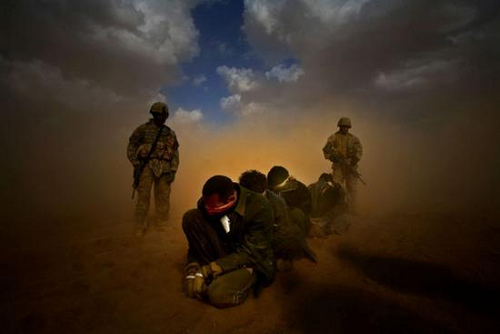
U.S. combat operations in both Iraq and Afghanistan are approaching the ten year mark and recent release of classified documents through Wikileaks has used a floodlight to cut through the “fog of war” and expose the brutality imposed on civilian populations in both of these conflicts.

A recent article in The Nation (“Wikileaks in Bagdad” August 16/23 edition: http://www.thenation.com/article/38034/wikileaks-baghdad ) discuss three soldiers from Bravo Company 2-16 and their deployment in Bagdad in July 2007 and their statements regarding putting up a “wall of steel” or responding to threats with a barrage of fire – even if it put civilians at risk.
Three soldiers from this company (McCord, Stieber and Corcoles) report such incidents as:
“Corcoles describes the first IED death his unit suffered. ‘We did a mission that night till like midnight, and we were actually just sitting down…. I hadn’t even got three or four drags off my cigarette and an IED went off…. We watched the Humvee burn, but we didn’t realize [someone] was still in it.’
The IED attacks left the soldiers angry and scared. McCord recalls one mission to impose curfews. Earlier that day, a popular soldier had died in an IED attack, and the troops took it out on the Iraqis. ‘There were a lot of people who got beat up that night,’ he says bluntly. This anger was turned into policy by the chain of command. ‘We had just lost three guys to an IED when the battalion commander came out to the COP (Combat Outpost),’ says McCord. He went on to explain that the commander gave orders to shoot indiscriminately after IED attacks. ‘He said, ‘Fuck it, this is what I want…anytime someone in your line gets hit by an IED…you kill every motherfucker in the street,’ McCord testifies.
‘When one [IED] went off, you were supposed to open fire on anybody’, says Stieber. ‘At first I would just fire into a field. Then I wouldn’t fire at all.’ He describes an IED that went off near a crowd of teenagers. ‘I said I wouldn’t fire,’ even though ‘other people were firing,’ he recalls. Like Stieber, Corcoles describes incidents in which he purposely aimed his gun away from people. ‘You don’t even know if somebody’s shooting at you,’ he says. ‘It’s just insanity to just start shooting people.’ Stieber pointed out that in incidents like these, it was very rare for US military vehicles to stop to help the wounded or assess how many people had been injured or killed.
Stieber was intimidated and reprimanded by his command for refusing orders to shoot. ‘One time when I didn’t fire, people in my truck were yelling at me for the rest of the mission. When we got back, one or two leaders got up in my face and kept yelling at me and stuff,’ he says. The command eventually stopped sending him on missions as a gunner, and Stieber says he “faced a lot of criticism for it.” Corcoles saw this too. ‘One night our truck got hit by an IED and Josh didn’t fire, and another soldier didn’t fire,’ he says. ‘And they were getting yelled at: ‘Why aren’t you firing?’ And they said, ‘There’s nobody to fire at.’ “
Clearly, there is no ambiguity in this scenario. The chain of command gave orders to fire indiscriminately at civilians even when soldiers made efforts to refuse such orders. This is most likely a very commonly occurring situation in both theaters of conflict for our soldiers.
Anger and frustration remain for soldiers in the field with June 2010 being the highest casualty rate since the beginning of the Afghanistan conflict for coalition forces with July being on track to possibly exceed this number when count is completed (http://www.icasualties.org/oef/).
This begs the question of why do we continue to put our soldiers in impossible scenarios with large civilian populations that result in deaths and injuries to the very people we are “liberating”?
The “rules of engagement” or basically when to pull the trigger is a delicate balance for any soldier in any combat situation. The present U.S. counterinsurgency (known as “COIN”) presents great difficulties for soldiers in the field. COIN is predicated on “winning hearts and minds” of the civilian population and this is not typically achieved through indiscriminate weapons fire or drone missile strikes on unarmed civilians.
General Petraeus was recently discussed in a Salon article (7/1/10 “War Room”) as reviewing the “rules of engagement”:
“… Petraeus also has to appear to stay the course in terms of counterinsurgency (COIN) fundamentals, such as making extensive efforts not to kill innocent people. The tricky part is that the main argument against McChrystal’s rules of engagement is not that they are too bureaucratic; it’s that they are overreaching and potentially dangerous.”
So, the maddening choice by soldiers of firing or not firing on civilian populations always remains. It seems the easy choice is simply not to have combat operations in either Iraq or Afghanistan.
The recent Wikileaks release of over 90,000 classified documents detail Afghan corruption, the use of Stinger surface-to-air missiles by the Taliban, US assassination teams and large numbers of civilian deaths are part of the detailed information.
But a more chilling Wikileaks release in April 2010 is of an Apache helicopter video clip (http://www.youtube.com/watch?v=is9sxRfU-ik) from July 2007 of 30mm cannon fire cutting down two Reuters reporters and killing 10 civilians. For those that have seen this video, its’ horror and nonchalance are breathtaking. It is impossible to describe and requires that you grit your teeth to watch. It is worth noting that the same company (Bravo 2-16) that was described earlier was also involved in this operation. So death occurred from above and below simultaneously for the civilian populations in this area.
Other than “rules of engagement” and other military protocols, what environmental factors drive this brutal behavior towards civilians in war zones? Which is the “chicken” and which is the “egg”?
Why is indiscriminate fire on civilians so prevalent in Iraq and Afghanistan?
The answer lies in the repeated deployment of US military personnel to both Iraq and Afghanistan.
The continuous exposure to combat trauma have led to dramatic increases in the number of post-traumatic stress disorder (PTSD) cases. Since October 2001, with almost 1.8 million U.S. service personnel serving in Iraq and Afghanistan, the VA has predicted 10 – 18% have PTSD or 324,000 individuals. (http://www.ptsd.va.gov/professional/newsletters/research-quarterly/V20N1.pdf)
Even this number may be considered low, with a recent American Journal of Public Health article showing a tripled risk of PTSD for New Jersey based National Guardsmen with repeat deployments. (http://ajph.aphapublications.org/cgi/content/abstract/100/2/276)
In past U. S. wars, PTSD was called “soldiers heart” during the Civil War, in WW I it was named “shell shock” and by WW II, “combat fatigue” or “exhaustion”. It is only on recent years that PTSD in combat zones has been fully understood and recognized by both the military and psychiatric experts.
Diagnostic symptoms of PTSD include: re-experiencing the original trauma(s) through flashbacks or nightmares, avoidance of stimuli associated with the trauma (certain thoughts or feelings associated with an event), and increased arousal such as difficulty falling or staying asleep, or problems with anger, concentration, or hypervigilance. (American Psychiatric Association’s Diagnostic & Statistical Manual of Mental Disorders IV (DSM- IV) 1994).
The symptoms of avoidance, anger and hypervigilance are all a psychological witches’ brew in combat situations and ensure brutality towards civilian populations.
Another outcome has been suicides which are tracking at the highest point in the U.S. Army since the 1970’s. Thirty-two soldiers took their own lives In June 2010, the most Army suicides in a single month since the Vietnam era. Eleven of the soldiers were not on active duty. Of the 21 who were, seven were serving in Iraq or Afghanistan (http://www.defense.gov/releases/release.aspx?releaseid=13715).
In my recent volunteer work at “Under the Hood” Café & Outreach Center at Ft. Hood in Killeen, Texas (www.underthehoodcafe.org), I have had the opportunity to speak to many active duty and veterans of both the Iraq and Afghanistan conflicts. “Under the Hood” is a non-military environment for active duty and veterans to speak out on the effects of war and offers referral to legal and psychological services for all who come through the door, including those active duty soldiers who are “war resisters” and have refused to re-deploy to Afghanistan.
Their stories are similar to the ones above and detail heart rending stories of personal trauma, loss and pain in their own way much like the testimonies at “Winter Soldier”.
“Winter Soldier” which was originally held as testimony in 1971 by Vietnam Veterans Against the War (www.vvaw.org) as a challenge to the morality and conduct of the Vietnam War by publically exposing war crimes and atrocities by the United States Armed Forces.

On the fifth anniversary of the Iraq invasion in March 2008, the Iraq Vets Against the War (www.ivaw.org), resurrected “Winter Soldier” at which more than 200 U.S. military veterans and active duty soldiers as well as Iraqi and Afghani citizens gave testimony on the conflicts in both countries.
“I remember one woman walking by,” said Jason Washburn, a corporal in the US Marines who served three tours in Iraq. “She was carrying a huge bag, and she looked like she was heading toward us, so we lit her up with the Mark 19, which is an automatic grenade launcher, and when the dust settled, we realized that the bag was full of groceries. She had been trying to bring us food and we blew her to pieces.”

Washburn testified on a panel that discussed the rules of engagement in Iraq, and how lax they were, even to the point of being virtually non-existent.

“During the course of my three tours, the rules of engagement changed a lot,” Washburn’s testimony continues. “The higher the threat the more viciously we were permitted and expected to respond.” (9/20/2008 – Asian Times, Book Review (Dahr Jamal): Winter Soldier: Iraq and Afghanistan by Aaron Glantz)
Whether U.S. brutality against civilians in war zones occurred in Vietnam, Iraq or Afghanistan, the common themes remain the same: soldiers repeatedly deployed to war zones with heavy civilian populations with no enforced “rules of engagement” resulting in war crimes.
A quote attributed to Joan Baez seems most appropriate:
“If it’s natural to kill, why do men have to go into training to learn to do it?”


Type rest of the post here

Source /

The Rag Blog

Posted in RagBlog | Leave a comment

Harvey Wasserman : Pete Seeger Sings for Solartopia!

Pete Seeger sings for Solartopia!

By Harvey Wasserman / The Rag Blog / August 3, 2010

See Video and Lyrics to ‘God’s Counting on Me,’ Pete Seeger’s song about the BP oil spill, Below.

“We’ve got a country full of ambitious people,” Pete Seeger tells us. Solar energy is “something direct,” a way to “pay our bills, not tomorrow, but today.”

By “bills” Pete doesn’t just mean the ones from the electric company. He’s talking about the Big Bill, the one from Mother Nature.

At age 91, Pete is American folk activism’s truest bard. It’s no accident that Pete’s new CD is Tomorrow’s Children and that his new music video is for Solartopia!, a holistic, socially just, post-corporate vision of a green-powered Earth.

Solartopia, he says, “is the wonderful, positive way of approaching the problem” of a polluted planet. “Don’t just say ‘don’t, don’t, don’t.’ Say ‘DO! DO! DO!'”

This spring, while finishing up Tomorrow’s Children, he joined singer-songwriters Dar Williams and David Bernz in a Beacon studio filled with singing schoolkids, organized by local music educator Dan Einbender, who co-produced the album.

Pete’s hometown, up the Hudson from Manhattan, is home to the Clearwater, the legendary sloop Pete has helped keep afloat to fight the pollution that’s killing the great river — and our planet. That includes fierce opposition to the Indian Point nuclear plant, a few miles down the river, now in a life-or-death legal battle over the hot water outtakes that kill millions of aquatic organisms every year.

Along with Solartopia!, Pete, David and the kids put some finishing touches on Turn! Turn! Turn!, one of Pete’s great anthems. With its Biblical overtones, it still resonates with the aura of a generational hymn. The Byrds took it electric in the 1960s, but it lives on as a clarion call for a species on the brink.

Pete wrote Solartopia! in his solarized hand-built home, surrounded by woods, overlooking the river. Below the house, his battery-powered pickup quietly recharged from the panels on the rooftop.

With great optimism, I asked if he could possibly put this vision of a green-powered Earth to music. Without so much as a blink, he whipped out that magnificent banjo. In a matter of minutes — forever golden in my soul — he had the song.

Then singer-songwriter David Bernz, who co-produced Pete’s previous Grammy-winning CD, wrote the verses. With award-winning filmmaker Dan Keller shooting in High-Def, and a dozen of Einbender’s kids in joyous chorus, the video was born.

Pete’s presence in the movement for a green-powered Earth has been as essential as it was in the days of Civil Rights (when he wrote We Shall Overcome ) and Vietnam.

In June, 1978, Pete came to Seabrook with Arlo Guthrie and Jackson Browne. To avoid potential mayhem involving thousands of peaceful marchers versus a wacky out-of-control New Hampshire governor named Meldrim Thomson, a deal was cut. Attorney-General Tom Rath agreed to stand by quietly while the Clamshell Alliance would enjoy a peaceful weekend on the construction site — as long as we left on Sunday afternoon.

But who would show up? When Pete said he’d come with Arlo and Jackson, we had an event for the ages. It was America’s biggest anti-nuclear gathering until the melt-down at Three Mile Island nine months later.

That was 30 years ago — already a good four decades into Pete’s career of activism and social change. Since then he’s sung at countless concerts, benefits, marches, and gatherings aimed at shutting the nuclear industry and other polluters while bringing on a green-powered Earth.

For his 90th birthday party, last year, he packed Madison Square Garden with activists and fans, including Bruce Springsteen and a stage full of luminaries. The proceeds, of course, would go to support the Clearwater.

To have Pete now singing for a green-powered Earth, putting our movement once again to music, is enough to give us all hope in yet another “hopeless” movement against yet another “unbeatable” problem… until we dance again in Solartopia.

“Wind power, solar power,” Pete says. “this is the most exciting time in the world to be living….There has never been such an exciting time.”

[Harvey Wasserman’s SOLARTOPIA! Our Green-Powered Earth is at solartopia.org as is Pete’s new video. The song is on Pete’s new CD, Tomorrow’s Children.]

‘God’s Counting on Me’:
Pete Seeger sings about the BP oil spill

On July 23th 2010 Pete Seeger performed live at a Gulf Coast Oil Spill fundraiser at The City Winery in New York City. There he unveiled to the public his new protest song about the BP oil spill entitled “God’s Counting on Me, God’s Counting on You.” Backing up Pete’s singing and banjo picking is the singer/songwriter James Maddock on acoustic guitar. All proceeds of this concert went to the Gulf Restoration Project. The show was produced and hosted by Richard Barone. The video was edited and mixed by Matthew Billy

(Pete Seeger on banjo; James Maddock on guitar.)

Lyrics:

When we look and we can see things are not what they should be
God’s counting on me, God’s counting on you
When we look and see things that should not be
God’s counting on me, God’s counting on you
Hopin’ we’ll all pull through, Hoping we’ll all pull through,
Hopin’ we’ll all pull through
Me and you.

It’s time to turn things around, trickle up not trickle down
God’s counting on me, God’s counting on you
It’s time to turn things around, trickle up not trickle down
God’s counting on me, God’s counting on you
Hopin’ we’ll all pull through, Hoping we’ll all pull through,
Hopin’ we’ll all pull through
Me and you.

And when drill, baby, drill turns to spill, baby, spill
God’s counting on me, God’s counting on you
Yes when drill, baby, drill turns to spill, baby, spill
God’s counting on me, God’s counting on you
Hopin’ we’ll all pull through, Hoping we’ll all pull through,
Hopin’ we’ll all pull through
Me and you.

Don’t give up don’t give in, workin’ together we all can win
God’s counting on me, God’s counting on you
Don’t give up don’t give in, workin’ together we all can win
God’s counting on me, God’s counting on you
Hopin’ we’ll all pull through, Hoping we’ll all pull through,
Hopin’ we’ll all pull through
Me and you.

There’s big problems to be solved, let’s get everyone involved
God’s counting on me, God’s counting on you
There’s big problems to be solved, let’s get everyone involved
God’s counting on me, God’s counting on you
Hopin’ we’ll all pull through, Hoping we’ll all pull through,
Hopin’ we’ll all pull through
Me and you.

When we sing with younger folks, we can never give up hope
God’s counting on me, God’s counting on you
When we sing with younger folks, we can never give up hope
God’s counting on me, God’s counting on you
Hopin’ we’ll all pull through, Hoping we’ll all pull through,
Hopin’ we’ll all pull through
Me and you.

Source / CommonDreams

The Rag Blog

Posted in Rag Bloggers | Tagged , , , | Leave a comment

Will Governor Don Siegelman Get Justice?

The fall-out from the Supreme Court’s recent action in the case of Enron CEO Jeff Skilling has brought a famous political prosecution back into the headlines.

The conviction of former Alabama Governor Donald E. Siegelman for bribery in 2006 had become a cause célèbre in the United States and internationally, with 104 current and past states attorneys general going on record that Siegelman should have a new trial. One of these former AGs was Grant Woods, national co-chairman of the McCain presidential campaign.

Siegelman’s case was the most famous of the Bush Justice Department’s political prosecutions, but the unsuccessful effort to jail Cyril Wecht was probably the most malignant of them. It illustrates the kind of political prosecution that has become common in the Republican South. These prosecutions hinge on a very vague and short piece of legislation — the “honest services” and mail fraud statute — that imposes stiff penalties upon officials and others accused of not providing citizens with “honest services” due to corruption.

The Siegelman case in brief

Siegelman wanted a state lottery to fund education and accepted two bundled donations of $250,000 each to the Alabama Educational Foundation, a non-profit entity, from Richard M. Scrushy, CEO of Health South. The foundation sought voter approval of a lottery. Siegelman then appointed Scrushy to a state hospital board. Three former governors had appointed this CEO to state boards. The prosecutors were unable to prove corrupt intent when they attempted to prove bribery.

There was no paper trail or direct evidence to prove there was quid pro quo, and Scrushy also had been appointed by two former governors. Federal bribery law permits jurors to infer that a deal was made, even in the absence of evidence. The judge instructed the jurors to convict on “the mere conviction that Governor Siegelman ‘intended ‘ to ‘act as a result of the campaign contributions.’”

The case hinged upon testimony of former chief aide, Nick Bailey, who said he negotiated bribes on behalf of the governor in other matters. Bailey admitted he was not present when Siegelman appointed Scrushy. The prosecutors had Bailey rehearse his testimony in 70 practice sessions and did not give the defense their interview notes. Bailey received a light sentence in return for his testimony. His employer, Luther “Stan” Pate said the federal officials got him to testify by threatening to use information he used drugs and by referring to damaging rumors about Bailey’s sex life.

Siegelman was sentenced to seven years in prison. One of the charges against him was depriving the citizens of Alabama of honest services through fraud, and that was linked to mail fraud. The honest services fraud doctrine is used when kickbacks and outright bribery cannot be proven. In this case, it is claimed that Siegelman asked Scrushy to contribute to the Alabama Educational foundation, thus constituting a conspiracy to deprive Alabama citizens of honest services.

Judge Mark E. Fuller, a former political opponent, must have considered Siegelman a flight risk because he deprived the former governor of the customary 45 days to put his affairs in order and sent him off to prison in chains. Fuller had been a district attorney, and his successor, appointed by Governor Siegelman, claimed there had been accounting irregularities under Fuller.

The federal marshal only permitted Siegelman to read the King James version of the Bible while he was being shunted around from prison to prison before settling in Oakdale, Louisiana. When prisoner Siegelman took his case to the press, the prosecutors threatened to charge him with obstruction and conspiring to bring the court into public contempt. Fuller threatened to add five to years years to the sentence.

The former governor served nine months before being released on bond pending his appeals and efforts to get a new trial. These efforts to get the case set aside by the conservative Eleventh Circuit court failed. However, it dropped two counts and sent the case back to Fuller. The Supreme Court refused to take an appeal. However, on June 29, 2010, the high court in the case of Jeff Skilling narrowed the definition of failure to provide honest services.

The problem is that “honest services” are intangible, hard to define, and seem to be described differently in each case where this cover-all charge is deployed. Then the court vacated the convictions of Scrushy and Siegelman and instructed the Eleventh Circuit in Atlanta to take another look at the cases in the light of “Skilling v. the United States.” However, this does not open the door was opened to revisiting the many irregularities in the case. To date Siegelman has spent two and a half million dollars on legal fees.

The Drive to Convict Siegelman: A Story of Selective Prosecution

Siegelman was the most popular Democrat in a very Republican state, and as early as 1999 he became the target of Republican efforts to put him behind bars. He had been Secretary of State, Attorney General, and Lieutenant Governor, and was elected governor in 1998 and served 4 years.

His legal problems began in 1999 when state Attorney General William Prior went after a Siegelman backer, Tuscaloosa physician Philip Bobo, who was charged with Medicaid fraud in 2001. Matthew Hart, the Alabama Assistant Attorney General who handled the case, told a U.S. attorney that he hoped the prosecution would lead to Siegelman. The case against Bobo fell apart, but Hart continued investigating Siegelman and he soon became an assistant U.S.Attorney.

Hart was to have the help of Leura G. Canary, whom President George W. Bush made US. Attorney for the Middle District of Alabama. She made Hart her assistant. Her husband Bill had been a Republican operative and had worked with Karl Rove. Bush appointed Alice Martin U.S. Attorney for the Northern District, and she would assist in the effort to jail Siegelman.

In 2002, Bill Canary ran Representative Bob Riley’s gubernatorial campaign against Governor Siegelman. Canary was president of the Business Council of Alabama and a close friend of Karl Rove. On election night, the Democratic governor appeared to be ahead, but the victory was reversed in a midnight retabulation in Baldwin County that resulted in shifting 6,000 votes to Riley. No Democrat was present when the votes were recounted. Attorney General Prior ruled that there could be no recount and sealed the returns. Siegelman unsuccessfully litigated for two years to unseal the ballots and get a recount. Prior was subsequently appointed to the Eleventh Circuit Court.

Dog tracks and casinos have long played a major role in Alabama politics. Siegelman had angered Republicans by his efforts to fight casinos and to unsuccessfully get the voters to approve a state lottery that would fund public education. Bob Riley said he opposed all gambling but received millions from Jack Abramoff. That matter and corruption at the Dothan casino are currently questions of contention in intra-Republican politics in the state. Using Ralph Reed as a front man, Abramoff inserted himself in the election to protect a casino in Mississippi, which did not need the competition of a lottery. Most of the documents about this were sealed in an investigation conducted by Senator John McCain.

When Siegelman challenged the election results, efforts to convict him were renewed in earnest. In 2004, Hart indicted Bobo, Siegelman, and Paul Hamrick for rigging Medicare bills, but the judge cited Hart for contempt for filing materials that would inflame the jury, and much of his evidence was thrown out. That prosecution fell apart. But Siegelman was indicted again in October, 2005, and his opponents would succeed in jailing him Siegelman in 2006.

Judge Fuller
President Judge Mark Everett Fuller is a very wealthy man and had been a Republican political operative. He controlling 43.7% of Doss Aviation, which did $300 million worth of business with the Defense Department in the George W. Bush years. That fact alone gave the appearance of bias and should have resulted in Fuller removing himself from the case. There is some evidence that he would “hang Don Siegelman.” In one business arrangement, he listed his chambers as his address. When his court reporter died, he used the death to long delay issuing a transcript of the trial, thus delaying an appeal.

Fuller had campaigned against Siegelman and was an election strategist for the Republicans. He could have recused himself by using the well accepted justification that to remain in the trial raised questions about conflict of interest and impartiality.

Two jurors worked together to find evidence on the internet that they could use to persuade other jurors to vote against Siegelman. Some of the arguments they gave their colleagues came from a TV station blog that was critical of Siegelman. In effect, they were introducing information that had not been used in court. When their e-mails were discovered, the judge did nothing about the situation.

Retired Federal District Judge U.C. Clemon complained that the prosecutors poisoned the jury pool, engaged in judge shopping, and were guilty of other forms of misconduct. Seventy –five former Attorneys General from forty states denounced the handling of the Siegelman Case and demanded a retrial. They wrote, in part:

At best, the facts outlined by the Government show that: (1) Governor Siegelman felt that Mr. Scrushy ought to donate more to his favored issue campaign [the state lottery] than Mr. Scrushy donated to the campaign of his competitor; (2) Mr. Scrushy was aware that Governor Siegelman expected at least a $500,000 contribution to the lottery fund; (3) Governor Siegelman was aware that Mr. Scrushy wanted to be reappointed to the CON Board: (4) Governor Siegelman did not think that such an appointment would cause any problems; and (5) Governor Siegelman did, in fact, reappoint Mr. Scrushy to the CON Board. Completely absent from the Trial Record is any evidence that Governor Siegelman and Mr. Scrushy entered into an explicit agreement whereby Mr. Scrushy’s appointment to the CON Board was conditioned upon Mr. Scrushy’s making the political contributions in question. Two previous Governors had appointed Scrushy to the same position without incident. [Emphasis added.]
Siegelman and Scrushy filed papers asking Judge Fuller to remove himself from the case due to his conflicts of interest. Fuller has not ruled on the motion. In May, 2010, Fuller asked the Eleventh Circuit if he should recuse himself because he met federal marshals about the case without defense attorneys present.

Signs of a Political Prosecution
After Siegelman was sentenced, mounting evidence appeared that this was indeed a political prosecution. However, there seemed to be no way to use any of it.
Attorney Dana Jill Simpson, a former Republican operative, came forward with information. Miss Simpson had known Governor Riley since law school. She became disenchanted with politics when she was asked to do research that would essentially frame several Democrats. Since coming forward, she has had some troubling experiences. Her house was accidentally burned to the ground, and she was forced off the road by an Alabama state law enforcement official . Her car was totaled.
She said that she heard William Canary, Riley’s chief advisor, say that he would get “his girls”—meaning Mrs. Canary and Alice Martin- – to work on nailing Shegelman, and he would enlist the help of his friend Karl Rove. The “girls” soon got busy and when their efforts seemed to flag, the Public Responsibilities Division of the DOJ prodded them on to greater exertions. The Justice Department rejected a FOIA request for documents relevant to whether she had a conflict of interest in the case. In a filing against recusal, she questioned the intentions of the opposing attorneys and the Professional Integrity Section of the DOJ took the extraordinary step of signing on to her statement.

When “the girls’” efforts seemed to flag, the DOJ prodded them on to greater exertions. The Justice Department rejected a FOIA request for documents relevant to whether Canary had a conflict of interest in the case. Eventually, Mrs. Canary had to recuse herself, but only after having shaped the case.

Mr. Canary later said under oath that he played a role in getting the federal attorneys to go after Siegelman Canary later testified that he had talked about getting the girls to work against Siegelman. The most recent DOJ filing says he swore under oath that he had not contacted Karl Rove, but none of this appears in his Congressional testimony. After the successful prosecution, Rove threw a party for Steve Feaga, one of the prosecutors, at his Rosemary Beach, Florida home. Feaga is a Reserve Colonel, who served in the legal office at Langley AFB. Perhaps he could have had a role in reviewing the fueling contract held by Judge Fuller’s firm. When the House Judiciary Committee looked into Rove’s possible involvement, it found that his e-mails about the dinner party were among the millions that had been lost.

Acting U.S. Attorney Louis V. Franklin who became the lead prosecutor and sought a 30 year sentence, claimed that he alone made the decision to indict Siegelman and that the Justice Department did not supervise what he was doing He repeatedly insisted that Karl Rove had nothing to do with the case. G. Douglas Jones, a defense attorney and former federal prosecutor, learned that the Professional Integrity Section of the Justice Department carefully supervised the case and insisted that the local prosecutors press on and take another look when the case seemed to be running out of steam. There is evidence that Noel Hillman, chief of the Professional Integrity Section of the Criminal Division, kept a close eye on the case and saw that it moved forward. He is now a federal judge.

Jill Simpson also said that she heard in early 2005 that a federal judge was about to be appointed who “hated” Siegelman and was determined to “hang him.” There was a danger then that Siegelman might try to run again for governor. The new federal judge turned out to be Mark Fuller, a former Republican official and believed Siegelman was responsible for having him audited. Fuller had been very active in the 2002 campaign.

Before she testified before Congress, a helpful Democrat recommended she hire a lawyer who had worked for the GOP for decades. She declined. Her testimony led Representative Randy Forbes ( R., VA.) to demand a Congressional investigation of her.

In 2007 Time magazine came into possession of a transcript of prosecution interview with landfill operator, developer, and lobbyist Clayton Lamar (Lanny) Young who said he passed bribe money to Siegelman and to a number of Alabama Republicans. CNN also covered the story. He explained how money went through people who served as conduits, and he named several Republicans as recipients of bribes. The interview took place in the office of Mrs. Canary and present were representatives of the Alabama Attorney General and the Professional Integrity Section in Washington. Siegelman’s attorneys found some of this evidence in thousands of pages of discovery documents, but Judge Fuller forbade them to use it.

A paralegal named Tamarah Grimes was fired for writing to the Attorney General in 2007 about the continued involvement in the case of a Mrs. Canary, who earlier recused herself. Grimes produced e-mails to prove her point. Ms. Grimes also had evidence that a witness was coached and showed that prosecutors were communicating with jurors during the trial. Some of here evidence was on audiotape, and the DOJ wanted to prosecute her for making the recordings.

The case became intertwined with the politically-motivated firings of federal prosecutors because it was claimed that Karl Rove was involves in these ugly incidents. Rove’s attorneys and Justice Department officials tried to separate the firings from the Siegelman case so as to intimidate witnesses who had testified about both matters. That tactic would have produced sensitive information that Rove could have used.

Recently, Nora Dannehy, a Bush hold-over, has reported that there was nothing wrong with the nine firings. She had prosecuted Republican Governor John Rowland of Connecticut for mail and tax fraud. He faced one count and he served ten months. That governor had nominated her brother for a judicial position. Four days after President Bush appointed her special prosecutor to look into the firings, it was found in Connecticut that her team of attorneys had unlawfully suppressed evidence in another corruption case.

Nick Bailey, Siegelman’s former aide, has now complained that he felt intimidated because so many of his interrogations were conducted at an Air Force Base where prosecutor Stephen Feaga was a JAG. On March 4,2009, he told Investigative Group International that he did not believe Siegelman thought he was being bribed, and he added that, during questioning, he “felt unsafe for his physical person.” Bailey said he was threatened with ten years in prison and legal actions against his brother, Shane.

Legal scholar Bruce Fine, a conservative, complained during the G.W. Bush years, “We have a Justice Department that has substantially been turned into a political arm of the White House.”

Questions About the Holder Justice Department

It is a matter of public record that President Barack Obama inherited a Justice Department in which many civil service attorneys were hired for political reasons. There was also the unresolved matter of whether nine U.S. Attorneys had been removed for political reasons. The House Judiciary Committee had already looked into the some political prosecutions, including the Siegelman Case.

Scott Horton, a law professor who has written about the case in Harpers said he found someone within the prosecution’s ranks who was afraid to provide information about the effort to jail Siegelman. The source said, “ you don’t understand, these people would kill me if they have to to keep the lid on this.” With respect to the DOJ in Washington, , “They’d be happy to learn that I was dead.” Horton thinks that David Margolas, Holter’s Deputy Attorney General is the problem.

There were so many questions about the Siegelman Case that one would expect Eric Holder to take a second look at the Siegelman Case. Instead, he ordered Elana Kegan, the new Solicitor General, to oppose Siegelman effort to obtain a new trial. She did so, claiming on November 13, 2009, that Siegelman’s “corrupt intent” had been proven. There had been no proof unless one takes the assumption of the judge and jury that it existed as proof. Perhaps Kegan cannot be blamed for taking this position. She was following orders and are still many Bush hires in the department, some of whom could have helped write her brief. Maybe she and her aides were thinking about a position they later took in Pottawattamie County v. McGhee and Harrington that people do not have a constitutional protection against being framed.

Holder was appointed D.C. Superior Court Judge by President Ronald Reagan and was an active member of the conservative Federalist Society. He has continued the policies of the Bush Justice Department with respect to the state secret privilege, enforcement of the Patriot Act, military commissions, and the rights of detainees.

The Obama administration and Holder have kept the 93 Bush U.S. Attorneys in their jobs until successors have been confirmed. That has been a very diccicult process because Republicans have worked hard to delay the confirmations. To date, only 57 replacements have been confirmed, and Obama has had to drop a nominee in Utah and replace him with a Republican. Senators Jeff Sessions and Richard Shelby have blocked the the candidate nominated to replace Mrs. Canary. Matthew Hard remains an assistant U.S. Attorney in Birmingham.

It is very possible that the Eleventh Circuit Court will find a way to support the remaining counts of denial of honest services against Siegelman. A count of bribery remains and is not subject to review. Progressives should be demanding that the Obama Justice Department reexamine its position on this case and not vigorously press charges against the wronged governor. Siegelman still could ask certiorari from the Supreme Court on the next Eleventh Circuit decision.

Biographical Line: Donald C. Swift is Professor Emeritus of History at Edinboro University of Pennsylvania

Type rest of the post here

Source /

The Rag Blog

Posted in RagBlog | Leave a comment

Ed Felien : The Holy War that We Can’t Win


The Afghan jihad:
A war that we can’t win

By Ed Felien / The Rag Blog / August 3, 2010

How can war be holy?

What righteous god would welcome the massacre of innocents?

And, yet, the origins and history of Judaism, Christianity, and Islam have their roots in war. The Old Testament and Talmud are catalogs of epic battles. Jesus, who brought the new commandment, Love thy neighbor, also told his followers, “Let him who has no sword sell his mantle and buy one. For I tell you that this scripture must be fulfilled in me, ‘And he was reckoned with transgressors.'” (Luke: 22, 36-37)

Muhammad, not just a prophet and the founder of Islam, was a remarkable general. His continued battles with rival tribes eventually led to a consolidation of most of the Arabian Peninsula into an Islamic confederation during his lifetime. Much of the fire and intensity of the Qur’an is because Muhammad is encouraging his early Muslim supporters to fight to defend the faith.

Combining religious zeal with a sword is a lethal mixture, and, although there are many progressive developments that flow from early Islam: a more enlightened view of women; a rejection of feudal autocracy and privilege; and the development of a uniform code of justice; still, one of the dominant themes of the Qur’an is its effectiveness as a manual of war: “Fight and kill the disbelievers wherever you find them. Take them captive, harass them, lie in wait and ambush them using every stratagem of war.” (Qur’an: 9, 5)

The community of the faithful in Islam is called the ummah. The community spread from the Arabian Peninsula in the Seventh Century to as far east as China and Indonesia and as far west as North and South America. There are now between one and two billion Muslims worldwide, 21% of the world’s people. But, just as Italians feel a sense of ownership of the Roman Catholic Church, Arabs have a similar proprietary reaction to Islam. The major shrines are in Arabia or the Middle East. Devout Muslims are supposed to visit Mecca once in their lifetime. The Qur’an is written in Arabic, the language of Saudi Arabia.

The particular brand of Islam practiced in Saudi Arabia is Wahabbi. This ultra-conservative variant was developed at the end of the eighteenth century as a reaction against the dominance of the Turkish Empire and its more liberal brand of Sufi Islam. Local tribesmen were more likely to fight against Turkish occupation if they felt it was blasphemous, thus skirting the prohibition in the Qur’an of Muslims fighting Muslims.

When the British joined the local rebels (most notably with Lawrence of Arabia), that sealed the fate of the Turkish Ottoman Empire. When oil was found in Arabia, Western countries found a good reason to continue support for the Saud family and all the other petty warlords they had made heads of state in the countries they had drawn on the map of the Middle East.

All this seemed like it would continue forever. The oil companies allowed the Arab countries to become rich, as long as the oil companies became richer. The conservative orthodoxy of Wahabbi Islam allowed the Saud family to rule with autocratic simplicity. They controlled their people and that allowed the British (and soon American interests) to get the oil and make everybody happy.

These fairy tale kingdoms continued in the Middle East until the Iranians threw America’s Shah off the Peacock Throne in February of 1979. Unhappy at losing our perch in the Middle East, President Carter grew jealous of Soviet influence in Afghanistan. He reportedly gave over a billion dollars to the Pakistan ISI (a CIA equivalent) to support a religious group that was fighting to throw out the Soviets. So, the truth of the matter is that the U. S. was the original funder for al Qaeda and Osama bin Laden and the holy war or jihad against Western influences in the ummah.

When Osama bin Laden declared a fatwah against the U. S. and Western influences in the Middle East in 1998, he listed three examples of how the U. S. has attempted to destroy Muslim interests:

First, for over seven years the United States has been occupying the lands of Islam in the holiest of places, the Arabian Peninsula, plundering its riches, dictating to its rulers, humiliating its people, terrorizing its neighbors, and turning its bases in the Peninsula into a spearhead through which to fight the neighboring Muslim peoples.

Second, bin Laden opposed the sanctions and then the war against the people of Iraq, and, third, he opposed the state of Israel and supported a Palestinian state.

But the principal focus of jihad today is the war in Afghanistan. This holy war to throw out the infidel has strong support among Afghan locals. They’ve been doing it for at least a thousand years. And it can draw on the support of millions of Muslims worldwide who see an attack on the ummah as an attack on Islam.

The most explosive ingredient in this already deadly Afghan stew is the influence of Pakistan. The ISI has supported the Taliban and al Qaeda with war materiel for decades. The Taliban are happy to please their benefactors with attempts to blow up the Indian Embassy in Kabul.

The only thing about Pakistan that you can count on is that they hate India and they want Kashmir. All alliances, agreements, treaties, etc. are just temporary steps to facilitate those two objectives. The recent release of military documents by WikiLeaks shows the duplicitous game ISI has been playing with the U. S. and the Taliban. They have no hesitation to sell out one side or the other in the pursuit of their own objectives.

A further complication in the Afghan jihad is the Pashtun influence. The Pashtun are an ethnic group that date back at least to the 8th Century and the introduction of Islam in the area. Currently, they make up about 40% of the population of Afghanistan and 15% of the population of Pakistan. For many years it was the goal of tribal leaders to secede and form their own Pashtunistan. There is no question that tribal and Pashtun loyalties are stronger than national loyalties, and they have no respect for the Afghan/Pakistan international border.

So, what do we have?

We have a holy war waged against the U. S. by millions of Muslims that has as its principal focus a narco-terrorist state that produces 92% of the world’s opium made up mainly of a population that has no interest in being Westernized and resents our invasion. It’s a war that can’t be won, and it is bleeding us dry in terms of the lives of our best soldiers and our national treasury. And, it’s a holy war that we began 30 years ago.

Isn’t it time to declare our prayers have been answered and get out?

[Ed Felien is publisher and editor of Southside Pride, a South Minneapolis monthly.]

The Rag Blog

Posted in Rag Bloggers | Tagged , , , | 2 Comments

Political prisoner and acclaimed poet Marilyn Buck died of cancer early Tuesday, Aug. 3, in a New York hospital. Buck — who served 25 years of an 80-year sentence for politically motivated crimes in support of the black liberation movement — was paroled to New York on July 15 from a Texas prison hospital. Buck, a former Austin activist, was diagnosed late last year with a uterine sarcoma, a rare and aggressive cancer.

Posted in RagBlog | Leave a comment

Mariann G. Wizard : Poet/Political Prisoner Marilyn Buck Dies in New York

UPDATED Wednesday, Aug. 4 at 9:03 a.m. (CST)

Marilyn Buck was released from prison July 15, 2010.

Recently released from Texas prison:
Cancer takes poet Marilyn Buck

By Mariann G. Wizard / The Rag Blog / August 3, 2010

AUSTIN — Friends of long-time political prisoner, former Austinite, and acclaimed poet Marilyn Buck, 62, were saddened by news of her death at the home of her attorney Soffiyah Elija, early Tuesday, August 3.

Buck was released from the federal prison medical center in Carswell, Texas, July 15, 2010, and was paroled to New York City.

Buck served 25 years of an 80-year prison sentence for politically motivated crimes undertaken in opposition to racial injustice and U.S. imperialism. As a prisoner, Marilyn, while moderating her ideas about methods, continued to stand tall for her beliefs.

A selfless advocate for others, especially in the arena of prison medical care, Marilyn was diagnosed late last year with a uterine sarcoma, a rare and aggressive cancer, too late for treatment to save her life.

While attending the University of Texas at Austin, Buck became involved in the civil rights and anti-war movements, and worked with SDS and the underground newspaper, The Rag. In the following years she became increasingly committed to and active in support of the black liberation struggle in this country.

Buck is survived by three brothers; several cousins; her long-time counselor, Jill Soffiyah Elijah; and loving friends worldwide. Her parents, Dr. and Mrs. Louis Buck, who both pre-deceased her, were leading civil rights activists in Austin in the early 1960s.

According to sources close to Marilyn’s family, there will not be a funeral, but memorial gatherings will be scheduled in the future in New York City, in California’s Bay Area, and in Texas. Funds raised for her hoped-for transition to the free world that had not been dispersed at the time of her death will be used according to her wishes to assist other aging prisoners.

The size of the U.S. prison population guarantees that increasing numbers of those released after lengthy sentences will lack savings, health insurance, or the network of friends from all walks of life that sustained Marilyn — and benefited from her generous, principled spirit — throughout her years behind bars.

Marilyn Buck was the recipient of funds raised at a June 25 community support event and benefit in Austin hosted by eight local groups, including NOKOA the observer and The Rag Blog, and supported by many businesses, artists, poets, and compassionate individuals.

Youth Emergency Service, Inc., fiscal sponsor for the event, will continue to accept tax deductible contributions through PayPal at its website, or by check or money order, made out to YES, Inc., at PO Box 13549, Austin, TX 78711.

CORRECTION: The Rag Blog was originally informed that Marilyn Buck died in a New York hospital. Now we have learned that Marilyn in fact died surrounded by friends at the Brooklyn home of her attorney and long-time close friend, Soffiyah Elijah, where she was living after being paroled to New York City. Linda Evans announced the following through Freedom Archives:

Our dear comrade Marilyn Buck made her transition today [August 2] at 1 pm est peacefully and surrounded by friends at home in Brooklyn. Details of memorials and where to send cards and donations will follow soon.

Also see:

The Rag Blog

Posted in Rag Bloggers | Tagged , , , , , , , | 10 Comments

Tom Hayden : Despite WikiLeaks, Congress Votes War Bucks

WikiLeaks founder Julian Assange. Image from The First Post.

Despite WikiLeaks revelations,
Congress votes for war funding

By Tom Hayden / The Rag Blog / August 2, 2010

Never was the case so weak for throwing another $33 billion into the Afghanistan sinkhole, but that’s what a defensive U.S. Congress did anyway on Tuesday evening, July 27. The vote was 308-114, with Republicans supplying most of the pro-war votes.

Washington-based peace groups, after weeks of e-mailing messages to Congress, put the best face possible on the vote, claiming a “significant” gain of 14 additional antiwar votes over the 100 cast for a similar amendment by Representative Barbara Lee two weeks ago.

(The new Democratic votes were cast by Corrine Brown, Kathy Castor, John Conyers, Rosa Delauro, Lloyd Doggett, Anna Eshoo, Chaka Fattah, Eddie Bernice Johnson, Hank Johnson, Marcy Kaptur, Carolyn Cheeks Kilpatrick, Gregory Meeks, James Moran, Christopher Murphy, Carol Shea-Porter, Mike Thompson, Lynn Woolsey and David Wu; while five Republicans joined the opposition: Paul Broun, Vernon Ehlers, Jeff Flake, Phil Gingrey, and John Linder.)

Those casting pro-war votes from safe liberal districts included Lois Capps, James Clyburn, Susan Davis, John Hall, Patrick Kennedy, Nita Lowey, Lucille Roybal-Allard, John Sarbanes, and Joe Sestak. Significantly, Speaker Nancy Pelosi abstained from voting, which meant retreating from the chance to draw an antiwar line more firmly.

The highest measure of House opposition remains the 162 votes, including Pelosi’s, cast in the House recently for Representative Jim McGovern’s amendment requiring an exit strategy including a withdrawal timeline. Only 18 senators voted for an identical amendment by Senator Russ Feingold earlier this spring. The dissenting numbers have almost doubled since last year.

In the moments after Tuesday’s vote, a representative of Barbara Lee’s office said new antiwar measures may be put forward around the defense appropriations bill later in this session. No concrete plan yet exists.

Those Congressional anti-war votes are in part due to years of grassroots work and mobilization, according to Rusti Eisenberg of the legislative committee of United for Peace and Justice. Is the glass half-full or half-empty?, she asks.

What is clear is that there was never a better time to stop or delay this war. The political climate around Afghanistan turned extremely sour in the days leading up to Tuesday’s vote. The Washington establishment was shaken by the spilling of 91,000 classified documents by the independent muckrakers at WikiLeaks.org. The raw documents revealed a much grimmer situation in Afghanistan than portrayed by the White House and the Pentagon with its information-war strategy.

As millions read the WikiLeaks revelations in The New York Times, the Guardian and Der Spiegel, a nervous White House pressed for an immediate House vote. “We don’t know how to react. This obviously puts Congress and the public in a bad mood,” lamented one White House official.

The president could have declared that the newly released materials only add to a growing consensus that the war is unwinnable. Instead he sent his spokesperson Robert Gibbs out to discredit the founder of WikiLeaks, Julian Assange, who is fast becoming a hero in the global info-wars.

Gibbs was offended by a German interview with the elusive Assange, in which he said “I enjoy crushing bastards,” a sentiment that will do him no harm with Assange’s readers and collaborators.

The Pentagon also is seeking to muzzle and imprison the American Private First Class Bradley Manning, 22, charged with downloading the documents and sending them to Assange. Manning, who is known by his hacker name Bradass87, copied the secret information on a CD labeled “Lady Gaga” while pretending to hum along to her music.

“I want people to see the truth, the non-PR version,” said Manning. While downloading the materials, he had discovered “awful things that belong in the public domain and not on some server stored in a darkroom in Washington, DC… I just couldn’t let these things stay inside of the system and inside of my head.”

Manning calls his action “open diplomacy… It’s beautiful and horrifying. It belongs in the public domain.”

WikiLeaks founder Assange announced Monday that he has another 15,000 documents ready to release.

For now, funding for the escalation has been salvaged by the House vote. But the full impact of the documents remains to be seen. If the Pentagon finds a way to shut down WikiLeaks, it is likely that a huge media and public protest will follow. Going forward with upbeat messages about the war becomes hazardous for Obama too, especially with the release of more documents threatened. Pressures thus will increase here and across the NATO alliance to begin reducing the military presence.

On the very day the disclosures were splashed across front pages, American officials were quarreling with Afghanistan’s President Hamid Karzai over whether 52 civilians were killed by Western rockets in Helmand Province, a scene of the current offensive. And, according to official sources interviewed by Dexter Filkins of The New York Times, Karzai is “pressing to strike his own deal with the Taliban and the country’s archrival, Pakistan, the Taliban’s longtime supporter.”

Instead of bending to these apparent realities, Obama instead seems intent on doubling-down with the military offensive in Kandahar and his secret attacks in Pakistan.

No one in the government has found a way to stop him, despite 73 percent of Democrats and a majority of independents opposing his Afghanistan policy. By voting for war funding without conditions, Congress has yielded its checks and balances function, and now is being usurped and outperformed in its oversight responsibilities by the twentysomething geeks of WikiLeaks.

[Tom Hayden is a former California state senator and leader of Sixties peace, justice, and environmental movements. He currently teaches at Pitzer College in Los Angeles. His books include The Port Huron Statement, Street Wars and The Zapatista Reader.]

Thanks to Carl Davidson / The Rag Blog

Posted in Rag Bloggers | Tagged , , , , , | Leave a comment

Marc Estrin : The F-35 and the NIMBYS of Death

F-35 helmet: “Cool” lid for flying our “national treasure.”

NIMBYS of Death

By Marc Estrin / The Rag Blog / August 2, 2010

BURLINGTON, Vermont — This week the Secretary of the Air Force selected the Vermont National Air Guard as one of the top two contenders for housing “a national treasure,” the new F-35 Joint Strike Fighter. Our liberal congressional delegation is jumping with joy, with Sen. Leahy enjoying the “cream rising to the top,” Sen. Sanders basking in the “great national respect and admiration,” and Rep. Welch crowing about “400 full-time and 700 part-time employees, military and civilian, [who] receive about $53 million annually in pay and contribute about $2 million each year in fire and rescue services from their airport base.

Wowie zowie — sounds pretty good.

There have, of course, been some grumblers, the most cited being those airport neighbors complaining about a drop in property values and lives made noisome by unbearable decibels. While the militarized world at large understands and sympathizes with their issues and hopes to “work with them,” their concerns shrink, and are dismissed in the face of the larger issues of jobs and “national security.” They are labled NIMBYs — Not In My Backyarders. “What you’re doing is OK — just go do it elsewhere.”

But what is it it the F-35s are doing, beyond being national treasures and making a hell of a noise? What is it that is OK, as long as it’s elsewhere? There are those of us mean enough to point to its main task — mass murder. That’s why we don’t want F-35s based in Burlington — or anywhere else.

Burlington, Vermont — bobo paradise, the People’s Republic of, — does love its sleek if noisy aircraft. For several years, we enthusiastically hosted an airshow put on by the Navy’s Flight Demonstration Squadron, the Blue Angels.

Although very few of us support mass murder, I had an interesting conversation recently with an intelligent woman, highly critical of the war, who was all excited about this air show.

“I know I shouldn’t really love it — but it’s so exciting. Those planes are so beautiful, the pilots’ skill is so impressive. It triggers off some visceral reaction…”

“Would you be excited to see someone beheaded, or perhaps burned at the stake?” I asked.

“No!” she averred, “But nobody gets killed at the air show.”

What was amazing to me was the screeching to a halt of thought. No, short of a crash, these planes would not kill anyone at the air show. But they are the meanest and most vicious of killing machines, designed to bring fiery death to any persons or structures in their cross-hairs.

They are “smart,” these machines, and their pilots are smart, well-trained, and their bombs are “smart,” and we never intentionally kill innocent civilians. Yet somehow, there is always “collateral damage.” No one gets killed at the air show. Only everywhere else such machines perform.

At the time of the show, and in the face of F-35-like protests, a local columnist wrote a piece in the Burlington Free Press entitled “Cause It’s Cool, Let Airshow Roar”: “C’mon guys,“ he wrote,

all you waterfront zealots, anti-war movers and shakers, environmental sorts. Can’t you just get off your high horses for a day, stop being so stuffy, and, like, just have some fun watching the boys play with their toys? ‘Cause it’s cool, man. Don’t get your undies in a knot. Hey, even the Make-A-Wish Foundation loves it. [The foundation will receive a charitable donation from the proceeds.] Are you against dying kids? Meanies.

He advised the peace-freaks to just “close their eyes and imagine that the jets torching along at 500 mph are on a peace mission promoting sustainable global tranquility.”

But these jets, and worse, the F-35, will not be promoting global tranquility. They are promoting defense profits, over-the-top military macho, and by implication approving the world-wide death and suffering it creates. They are promoting killing kids who have no Make-A-Wish foundation, and whose only wish is that the wars around them would end. And not least, they are enticing our own children to graduate from violent video games to doing the real thing when they grow up.

I know — all those Burlingtonians who are thinking such thoughts are just elitist prigs with twisted undies. Why can’t we just be cool, instead of raining on the party? Besides, think of the jobs.

[Marc Estrin is a writer and activist, living in Burlington, Vermont. His novels, Insect Dreams, The Half Life of Gregor Samsa, The Education of Arnold Hitler, Golem Song, and The Lamentations of Julius Marantz have won critical acclaim. His memoir, Rehearsing With Gods: Photographs and Essays on the Bread & Puppet Theater (with Ron Simon, photographer) won a 2004 theater book of the year award. He is currently working on a novel about the dead Tchaikovsky.]

The Rag Blog

Posted in Rag Bloggers | Tagged , , | 1 Comment

Don’t miss this one! Paul Krassner on Rag Radio Tuesday, 2-3 pm (CST), KOOP 91.7 FM in Austin. The legendary social satirist and Realist editor is my guest, and we’ll discuss Tuli Kupferberg, The Realist, the Yippies, Lenny Bruce, the drug war, the media, and more… See link for streaming…

Paul Krassner, according to The New York Times, is “an expert at ferreting out hypocrisy and absurdism from the more solemn crannies of American culture.” The FBI is less generous: Krassner has “purported to be humorous,” but is in fact “a nut, a raving, unconfined nut.”

An author, journalist, and stand-up comedian, Krassner was the founder and editor of the legendary journal of social and political satire, The Realist – published irregularly in the 60s and more irregularly thereafter — which was a major inspiration for those of us working in the underground press. However, when People Magazine called him the “father of the underground press,” he immediately demanded a paternity suit.

Krassner, who claims to have taken LSD with Groucho Marx, was a founder of the Youth International Party (the Yippies), and was a member of Ken Kesey’s Merry Pranksters. He was a radio personality in San Francisco, known as “Rumpleforeskin.” His writing has appeared in major publications, including Playboy, Rolling Stone, Mother Jones, National Lampoon, Mad Magazine, and The Village Voice. He is a contributor to High Times and The Huffington Post. A close friend of comic and social critic Lenny Bruce, Paul edited his biography, How to Talk Dirty and Influence People.

Paul Krassner has written several critically-acclaimed books and compilations, including his autobiography, Confessions of a Raving, Unconfined Nut: Misadventures in the Counterculture, an expanded edition of which will be released soon. He was honored by the ACLU for his dedication to freedom of expression, and was recently inducted into the Counterculture Hall of Fame.

Paul Krassner is a contributor to The Rag Blog, where he recently wrote about the death of his friend and colleague, Tuli Kupferberg of The Fugs.

Posted in RagBlog | Leave a comment

Harry Targ : Higher Education Headed in Wrong Direction

Editorial cartoon by Mark Weber / iHaveNet.

21st Century higher education:
An institution in crisis

By Harry Targ / The Rag Blog / August 1, 2010

The modern university

At my home university, only Coca-Cola products can be distributed on campus as a result of contractual agreements. Agriculture specialists train military personnel to teach agribusiness to farmers in Afghanistan. Students struggle against university contractors who have purchase agreements with companies such as Nike, which produce t-shirts and hats with university logos made with sweatshop labor. Research and teaching programs are established to highlight the significance of unregulated markets, electoral democracy, religions, and other ideas celebrated in the United States.

The president of the university, the director of athletic programs, and some athletic coaches earn 10 times more than experienced clerical staff and seven or eight times more than new assistant professors. In addition to corporate style salary differentials, members of the administrative staff, like those in corporations, work on logos, “branding,” and lobbying state and national legislators. Human relations bureaucracies, again like those in corporations, make personnel decisions that bear on substantive policy; in this case relating to education.


Shifting finances, academic workers,

And access to higher education

The enduring economic crisis has begun to open up debate on the direction of modern higher education. For example, The Delta Project supported by the Lumina Foundation for Education has recently issued a report, “Trends in College Spending: 1998-2008: Where does the money come from? Where does it go? What does it buy?” that deserves study and reflection. Inside Higher Education (July 9, 2010) summarized some of the project’s major findings:

  • Between 1998 and 2008 public research universities (such as Big Ten institutions) increased rates of expenditure on top administrators, lawyers, and accountants twice that of spending on faculty and instructional materials.
  • Students at what the Project calls, “Public Research Universities” are now subsidized over three times as much per student as those attending community colleges.
  • Resources channeled to instructional purposes have modestly declined while slight increases in moneys find their way to computers, libraries, and administrative expenses.

The 51 page Delta Project report concluded that if the trends identified between 1998 and 2008 (with data that does not include the 2008-2010 recession) continue significant aspects of higher education in the United States will decline, particularly in comparison with other developed countries. The trends increasingly affect access to higher education, job security among educators, and the quality of education. In the project’s words:

Revenue shortfalls in both public and private institutions have become the occasion, once again, for steep increases in student tuition, cutbacks in enrollments, and reductions in course offerings. Employee furloughs are becoming common, along with layoffs and program closures.

Higher education administrators and government officials, the report asserts, have adopted “the dominant model to manage revenue shortfalls,” including tuition increases, expanding class size, and reducing staff and faculty wages and benefits.

And changes in institutions of higher education, as in virtually all institutions, involve questions of class and inequality.

Turning this trajectory around will require huge attention to the deep issues of educational inequality, and the leaky pipeline that persistently disadvantages first-generation and low-income students.


Some proposals for change

In a recent essay in The Chronicle of Higher Education, Andrew Hacker and Claudia Dreifus make a series of proposals to address some of the crises of higher education today. They begin by noting that tuition for public and private colleges has doubled compared with a generation ago. Rising educational costs require parents to commit large financial outlays, second only to house mortgages, to their children’s education. Alternatively students have to take out loans that will burden them for their entire lives.

Among the proposals these authors make are the following:

  • Institute free higher education for all who seek it.
  • Maintain course requirements that lead to knowledge in history, the arts, sciences, and reasoned discourse.
  • Provide secure full-time teaching jobs for every classroom. Eliminate the system of staffing classrooms with graduate students and temporary adjuncts who receive one-sixth the pay of the regular faculty.
  • Pay presidents and other administrators salaries commensurate with public employees, not CEOs of Wall Street banks and corporations.

I would add that the connections between systems of higher education and sports, the military, and the corporate sector must be examined as well.

While our wealthiest and most powerful institutions — corporations and banks, the military, and the health care system — have come under some scrutiny in the new century, until recently higher education has remained hidden behind a wall of mystery even though everyone pays lip service to it as the hope for the future.

With enduring economic stagnation coupled with rising gaps in the distribution of income and wealth, education is offered as an escape route from poverty. We need to broaden public discussion about our assumptions concerning higher education, assessing its costs, accessibility, educational quality, and workplace security.

[Harry Tarq is a professor in American Studies who lives in West Lafayette, Indiana. He blogs at Diary of a Heartland Radical.]

The Rag Blog

Posted in Rag Bloggers | Tagged , , , , , | 3 Comments

Sarito Carol Neiman : Hill Country Environment Threatened by ‘Green Energy’ Transmission

Lattice towers like this one will carry high-voltage electrical power lines from West Texas wind farms through the Texas Hill Country.


Proposed high-voltage power lines

Endanger unique Hill Country habitat

By Sarito Carol Neiman / The Rag Blog / July 31, 2010

When I came back to New York City a couple of years ago after a year’s “sabbatical” in my native Texas, I signed up for wind as the source of my electricity to be delivered by ConEd.

Being a “green” kind of person, I felt somewhat virtuous about this, despite the patent ridiculousness of the very idea that my personal kilowatts would now magically come from a windmill somewhere upstate, while those of my heedless neighbor in the next apartment would still be generated by planet-heating coal.


Then the news came from the folks back home, and the bigger picture was suddenly thrust before my city-dwelling, can’t-see-past-the-next-corner eyes.

On July 29th, the Lower Colorado River Authority (LCRA) submitted its revised “Certificate of Convenience and Necessity” (CCN) to the Texas Public Utilities Commission (PUC) for the construction of high-voltage electric transmission infrastructure across the Texas Hill Country.

After months of hearing from the public about the potential irreversible damage to the environment, the economy, and the livelihoods of those affected by the proposed lines, the revisions looked very much like the original proposals, only just more complicated and with a clearer effort to do a better PR job than the first time around.

Here’s what I posted to my Facebook page as soon as I got the latest, updated aerial photo of the patch of ground in that affected region closest to my heart.

See the three yellow boxes just above and to the left of the words “Llano River.” That’s the family farm. See the white dots… numbered 66 & 67. Those are where I have enjoyed some of the best meals and most loving gatherings I’ve ever experienced in my life, with family and friends. See the big red lines. That’s where the “preferred route” is located for sending West Texas wind energy to the I-35 corridor to light up and air condition urban landscapes where you can’t see the stars or smell the breeze blowing out of the hills. See the big red spot. That’s where one of those big, 14-story made-in-Mexico steel lattice towers will be planted to hold up the lines (those lines where you can stand underneath and hold a fluorescent bulb in your hand and it will light up on its own).

Meantime the bro’ in his Kerrville TV station interview the other day took the lady’s question about his personal property situation and turned it round immediately to the question even closer to his heart, which is about preserving one of the most amazingly ecologically diverse open spaces left in the state of Texas, and among the top 20 in the world. I am not so generous as he is. I am really, really pissed. Because my brother and his family — my family — are the connection of this old city-dweller and rootless vagabond to my roots, and to the land.

Run, Spot, run. Or else I am coming after your head on a platter.

If, like me, you’re a city dweller who wants to support green energy, here are some links to the bigger picture. Between now and the end of August there is an opportunity for more public input — and I’m sure those who live in the Hill Country and will be directly impacted by this very un-green infrastructure would appreciate support from some of the intended consumers living at the end of the line along the I-35 corridor.

[Carol Neiman, a founding editor of the original Rag in Austin, coauthored A Disrupted History: The New Left and the New Capitalism, and has written or edited a number of other books. She lives in New York City but wishes she were back on a front porch in Texas, drinking a margarita.]


The Rag Blog

Posted in Rag Bloggers | Tagged , , , , , , , , | 7 Comments

John Ross : Lopez Obrador’s Mexico City Love Fest

Andres Manuel Lopez Obrador.

Andres Manuel Lopez Obrador:
Massive love fest kicks of presidential run

By John Ross / The Rag Blog / July 29, 2010

MEXICO CITY — On a damp Sunday morning four years from the month in which the presidency of Mexico was stolen from him in the fraud-marred elections of 2006 and two years before the next presidential race kicks in, Andres Manuel Lopez Obrador (AMLO) convoked tens of thousands of supporters to the great Zocalo plaza in the heart of the city of which he was once a wildly popular mayor, to make it abundantly clear that he will again be the candidate of the Left on the 2012 ballot.

The humongous July 25th rally during which AMLO presented what he labeled “an alternative project for the nation” unfolded right under the City Hall windows of Lopez Obrador’s successor as mayor of this monster megalopolis, Marcelo Ebrard, his chief rival to head a coalition of left parties in the 2012 “presidenciales.”

Under the astute guidance of his political Padrino, Manuel Camacho Solis, himself a former mayor of Mexico City, Ebrard has been assiduously positioning himself to lead the left ticket with the connivance of Lopez Obrador’s archrivals, bonded together under the collective logo of “Los Chuchus” (slang for both the Christian savior and mongrel dogs) and headed by the Big Chuchu himself, Jesus Ortega, a PRD senator prone to cutting deals with right-wing President Felipe Calderon’s PAN.

AMLO amassed 17 million votes in the 2006 balloting as the presidential candidate of the left-center Party of the Democratic Revolution (PRD) and two smaller left parties but despite widespread allegations of fraud committed by the ruling PAN party, Calderon was awarded the election by .057% of the total vote when the nation’s Supreme Electoral Tribunal denied a re-count.

A year after Andres Manuel garnered more votes than any other left candidate in Mexican political history, Ortega and his Chuchus took over the structure of the PRD in internal party elections that proved as bogus as the presidential vote-taking. Ballot boxes were swiped and others never counted. Precincts in which no one voted ran up massive tallies for New Left, the Chuchu faction. After several years of internal strife that left the left party badly bruised, Ortega’s group finally consolidated control of the PRD structure if not the base, which still tilts towards AMLO.

Lopez Obrador, who continues to have one leg inside the party of which he was once president, is sharply critical of Ortega’s prolonged game of footsy with Calderon’s PAN. This past July 4th, the Chuchus linked arms with the right-wingers to assemble a coalition that won the governorships of Sinaloa, Puebla, and Oaxaca. The alliance was brokered by Manuel Camacho Solis, Marcelo Ebrard’s guru.

Andres Manuel Lopez Obrador AKA “El Peje” (a gar-like fish from his native Tabasco) has been running for high office ever since he declared himself “the legitimate President of Mexico” in the aftermath of tumultuous protests that followed the 2006 flimflam. He reaffirmed his intentions on July 7th in an exclusive interview with the left daily La Jornada, a longtime champion of his cause and the July 25th convocation in the Zocalo signified the unofficial inauguration of his presidential campaign — according to Mexican electoral law, pre-candidates for party nominations cannot legally launch their campaigns until six months before the actual election.

In presenting his “New Alternative Project for the Nation” to a delirious throng that never ceased to chant “AMLO Presidente!” Lopez Obrador called upon the people to rescue the state from a “mafia” of oligarchs and place it at the service of the majority of Mexicans: “Only the people can save the people.”

El Peje also advocated for the democratization of the nation’s mass media. The corporate press has attacked AMLO with hateful vitriol since he was elected Mexico City mayor in 2000. One recent example: when one of his sons was spotted sporting $80 USD sneakers, Televisa and TV Azteca, the two-headed television monopoly, ran this earth-shaking item at the top of the news during a week when drug war massacres and killer floods were devastating the north of the nation. “If in 2006, they lied that my campaign was funded by Hugo Chavez, a man I’ve never met, then in 2012 they will say that I am Bin Laden’s brother,” Lopez Obrador joked to La Jornada.

Also included in the leftist’s alternative project for the nation that is guaranteed to be dissed by the oligarchs: the abolishment of fiscal privilege — El Peje promises to tax profits on the Mexican stock market and to force national and transnational mega-corporations that now pay minimal taxes, to cough up their fair share. Lopez Obrador, who, in 2008 built a popular movement that slammed shut the door on a Calderon-inspired privatization of the state-run petroleum monopoly PEMEX, demands a strengthening of the energy sector with sharp diminishment of U.S.-bound exports so that Mexico can use its own oil to fuel national development.

Marcelo Ebrard.

AMLO also pledges to strive for nutritional sovereignty to prevent the nation’s increasing dependency on food imports, i.e. eight to 10 million tons of cheap U.S. and Canadian corn that have wrecked Mexican agriculture and driven millions of farmers to seek survival in El Norte. As in 2006, Lopez Obrador seeks the renegotiation of NAFTA.

But what surprised many in AMLO’s flock in the Zocalo was his insistence on incorporating in his presidential platform an emphatic defense of the moral and cultural values of Mexico, urging his followers not to be trapped by materialism and consumerism but rather to cultivate solidarity and nourish family and social relations.

“Kisses harvest kisses,” he preached, encouraging the crowd to hug those around them as at the end of Catholic Mass. This mellowing of the once-crusty Peje may flow from his recent marriage and the birth of a new son who made his debut at the July 25th AMLOVE fest, as some leftish wags have dubbed it.

Aside from this surprising twist, Lopez Obrador emphasized many of the same points in his new project for the nation that he did in 2006. AMLO’s crusades always accompany the underclass — “the poor first” was his 2006 battle cry and race and class distinctions — brown vs. white, poor vs. rich — will again be the subtext of his 2012 campaign.

The upcoming presidential race may not be as lovey-dovey as Lopez Obrador would like. Although AMLO has built a broad-based social movement from the bottom, he tends to put all his eggs in the electoral basket rejecting more militant forms of struggle. Commited to Gandhianesque non-violent civil resistance, AMLO is critical of armed guerrilla movements and his 2006 presidential campaign was seriously bad-mouthed by the Zapatista Army of National Liberation’s Subcomandante Marcos, who has since dropped out of sight. Nonetheless, armed rebellion is always on the agenda here, particularly in 2010, the 100th anniversary of the Mexican revolution.

With the economy in chaos, unemployment at record levels, and out-of-control drug war raging throughout the north of the republic (25,000 dead since Calderon took office), the 2012 presidenciales are expected to be the most violent in the nation’s history. This July’s gubernatorial elections, the last major round of balloting before 2012, were jarred by the open intervention of the drug cartels which in some states used violence to vet candidates, most prominently the assassination of the PRI party front-runner for governor of Tamaulipas.

Crowd estimates for AMLO’s July 25th campaign opener varied wildly from 30,000 to a quarter of a million — the crowd filled the Zocalo floor and spilled out into surrounding streets which suggests the higher numbers. But whatever the real totals are. Andres Manuel Lopez Obrador remains the only politico in the land who can drum out the masses — four years ago on July 30th, at the zenith of post-electoral protest, AMLO drew 2,000,000 citizens to a rally, the largest political demonstration in Mexican history.

This July 25th, tens of thousands of throats never tired of taunting Felipe Calderon’s own feeble powers of convocation: “These are the people of Lopez Obrador/ Where are yours, fucking Calderon?”

Attendance at the huge rally was not confined to Mexico City where Andres Manuel continues to have a deep base. Many thousands of supporters traveled the length and breadth of the country to be on hand for the campaign opener. Since early 2007, Lopez Obrador has visited all 2,400 municipalities or county seats throughout Mexico, relentlessly working his way from border to border and sea to sea “to keep the flame of hope alive” (AMLO) and learn what the “pueblo” is thinking.

Traveling through heartland and outback from Thursdays to Sundays of each week, he held three to five meetings daily, drawing dozens or thousands depending on the size of the venue, signing up 2.2 million citizens as representatives of his legitimate government, and building a network that now includes 9,000 territorial committees stretching from Chihuahua to Chiapas.

At the July 25th rally in the Zocalo, delegates from all 31 states, half of them women, presented an accounting of their achievements, among them the distribution of 35 million copies of the movement’s monthly newspaper, Regeneration, named for a broadsheet edited by Ricardo Flores Magon that sparked the Mexican Revolution, the centennial of which is being celebrated this year.

Lopez Obrador’s protracted journey through Mexico clocked 150,000 kilometers on paved highways and another 25,000 on dirt roads, mostly during 2009 when he visited 570 municipalities in the state of Oaxaca, 418 of them autonomous indigenous counties that have rarely if ever hosted a presidential candidate.

No Mexican politician has embarked upon such an odyssey since Lazaro Cardenas in 1933 before assuming the presidency of the country. Cardenas’s extended travels sensitized him to the devastation of the underclass and infused his administration with a dedication to social justice.

Like Cardenas, Lopez Obrador took copious notes while on the road that have become the core of his ninth book, The Mafia That Has Taken Over Mexic0. Since his presentation of the new book that had thousands hanging from the rafters at the Metropolitan Theater in downtown Mexico City — the literary event of the year — Lopez Obrador has taken the book tour on the road in the provinces to spread the word.

The Mafia That Has Taken Over Mexico is a who’s who of who holds power, listing 30 “potentates” as AMLO labels them as if Mexicans were living in Ali Baba land — 16 oligarchs, including Carlos Slim, the world’s richest tycoon, and “El Chapo” Guzman, reportedly Calderon’s preferred narco-lord; a dozen politicos, leaders of the PAN and the once-ruling PRI (but no Chuchus); and a pair of bankers. At the top of the Mafia pyramid is the Capo de Tutti Capos ex-president Carlos Salinas who El Peje is convinced is responsible for the neo-liberal mutilation of Mexico.

Felipe Calderon.

AMLO’s journey through what sociologist Guillermo Bonfils once termed “Mexico Profundo” shocked him. The ecological destruction of the country weighed heavily on Lopez Obrador as he traveled through this mosaic of poverty:

In Chihuahua, we traveled for five hours through the mountains on terrible dirt roads to reach the gold mine at Tayotita — the Canadian transnational that now runs the mine takes the gold out by air. All over Mexico, these foreign corporations are ripping up the land and stealing the wealth of our country…

How Calderon’s futile drug war has impacted Mexico also stunned AMLO:

…so many have died and yet the worst is the corruption of Mexican values. Materialism is degrading the nation. In Sinaloa, the cradle of narco culture, consumerism contaminates daily life: big trucks (“La Troca“) Hummers, gold jewelry, designer clothes, expensive homes, cheap luxuries and runaway individualism while others live in shacks made of cardboard…

In Cochoapa in the Montana de Guerrero, the most impoverished region in Mexico,

I was startled by the silence of the Indians. They received me with a traditional band but the music was so sad that I couldn’t stop crying…

I still have inscribed on my memory the image of an old woman in San Miguel Huautla in the Mixteca of Oaxaca. She showed me her painfully arthritic hands and with the scrupulous serenity of those who live in profound poverty told me they were dead because she had spent her whole life weaving sombreros for five pesos a day.

AMLO’s travels give him an advantage in building a national movement from the grassroots that his rival for the left nomination for president Marcelo Ebrard, cooped up as he is in Mexico City City Hall juggling the megalopolis’s multiple problems, does not enjoy. Although, like Lopez Obrador, Marcelo has initiated Pharonic public infrastructure projects that put people to work (jobs are votes), he is not universally worshipped by his constituents, as Andres Manuel was when he was mayor.

The “Supervia,” a luxury toll road running from upscale Santa Fe in the west of the city angers an underclass whose homes and colonies have been expropriated and bulldozed for the project as does Metro subway construction in Tlahuac, one of the few rural delegations (boroughs) left in the city.

Yet despite his gaffes, Ebrard should split the capital vote with Lopez Obrador if there is a run-off between the two for the left nomination — Mexico City accounts for a fifth of the nation’s voters. But judging by AMLO’s growing support outside of the city, Camacho Solis and the Chuchus will once again have to resort to fraud to wrest the countryside from El Peje.

Ebrard and Lopez Obrador profess to be friends and claim they have reached a gentleman’s agreement that whoever is “better positioned” to run for the presidency at the end of 2011 will get the nod. How this will be determined verges on vagueness. A party primary run by the Chuchus will not be acceptable to Lopez Obrador. “Will they have a wrestling match in the Zocalo?” jabs Carlos Diaz, proprietor of the La Blanca Café in the city’s old quarter, “and if so, who will get to wear the mask?”

AMLO’s ties to the PRD are shaky at best. He broadcasts weekly on television utilizing time allocated to the Party of Labor or PT, a party instigated by Lopez Obrador’s personal Moriarity, Carlos Salinas, to siphon votes from the PRD in the 1994 presidential elections, and if Marcelo is successful in stealing the PRD nomination, AMLO is liable to channel his campaign through the PT, a strategy that will surely bury the electoral Left in 2012. Some supporters suggest that El Peje should abandon the party system altogether and fight for a constitutional reform that will allow him to run as a candidate of a social movement.

Should the prognosis for his candidacy look bright at the end of next year, Ebrard will no doubt take a leave of absence as mayor of the capitol to campaign nationally. His likely replacement will be Dr. Juan Ramon de la Fuente, a former health secretary under Ernesto Zedillo but not a member of the PRI. De la Fuente, who has a strong base at the National Autonomous University (UNAM), is also mentioned as a compromise left candidate if Lopez Obrador and Marcelo Ebrard cannot sort out their differences.

Meanwhile, Mayor Marcelo uses City Hall as a bully pulpit to enhance his political fortunes. The Mayor, who has excellent posture but little charisma, has taken to promulgating emergency proclamations of late. With a mammoth rainstorm brewing over the city on the weekend of AMLO’s July 25th love-in, the Mayor admonished his constituents not to make unnecessary trips — at least not to the Zocalo for El Peje‘s campaign opener.

[John Ross is at home in the old quarter of Make Sicko City. His latest opus El Monstruo: Dread and Redemption in Mexico City is available at your neighborhood independent bookstore. You can direct all queries, kvetches, and faint praise to johnross@igc.org.]

The Rag Blog

Posted in Rag Bloggers | Tagged , , , | 8 Comments