Climate Change : Ten Times Faster than Predicted

Image from Greenpeace / UK.

Climate change:
Worse than the worst case scenario

By Bruce Melton / The Rag Blog / June 16, 2010

It takes 196,000 pounds of plants to produce a gallon of gasoline. It takes 40 acres of plants, roots, stalks, and leaves, to go 20 miles in the average car. This is how much ancient plant matter had to be buried millions of years ago to produce one gallon of gas. It is just incredible how much buried sunshine, how many fossilized photons it takes to make up a little bit of oil.

Dr. Jeff Dukes published the paper from which these numbers are taken back in 2003 in the journal Climatic Change. This ancient solar energy is normally emitted back into the environment over tens, or even hundreds of millions of years. Mankind is literally releasing this carbon millions of times faster than it is naturally released.

Since 1983 Dr. James Hansen has been the Director of the NASA Goddard Institute for Space Studies (GISS). GISS is the United States’ foremost climate modeling agency. Hansen, who National Public Radio suggests is “almost universally regarded as the preeminent climate scientist of our time,” says that mankind is causing the carbon dioxide concentration in our atmosphere to increase 10,000 times faster than at any time in the last 65 million years — since the giant asteroid struck the Yucatan Peninsula and the dinosaurs went extinct.

Dr. Dennis Darby from Old Dominion University says, in a paper published in 2008 in Paleoceanography, that Arctic sea ice has not been absent in the Arctic in the summer season in 14 million years. Dr. Wieslaw Maslowski is an Arctic sea ice scientist at the U.S. Naval Postgraduate School. He is the scientist in charge of the U.S. Navy’s Polar Ice Prediction System (PIPS).

Maslowksi has been predicting, since 2003, that the Arctic will see ice free conditions in the summer between 2011 and 2016. Carbon dioxide levels in our atmosphere today are as high as they have been in 15 million years says Dr. Aradhna Tripati of UCLA and Cambridge University, in a paper published in the journal Science in 2009.

These proclamations, amazingly, go on and on, but one of the biggest, and almost completely unknown beyond the world of science, is that our CO2 emissions today are worse than the worst-case scenario developed by the Intergovernmental Panel on Climate Change (IPCC).

This was first revealed in the scholarly community in the Proceedings of the National Academy of Science in March of 2007 by a team of seven international scientists led by senior scientist Dr. Michael Raupach at the Australian National Science Program (CSIRO: The Commonwealth Scientific and Industrial Research Organization), and then again in 2009 at the University of Copenhagen before the United Nations Climate Talks in a mega-report by the International Alliance of Research Universities (an alliance of 10 of the world’s top research universities including Berkeley, Oxford, Cambridge, and Yale).

I recently talked with one of the scientists that I interviewed in Greenland in 2007. I had found a previously forgotten quote that appeared to be from him (in my old notes from my trip) and I wanted to confirm. The quote was “Climate change is proceeding 10 times faster than we (the climate scientists) had predicted.” The scientist who made this quote is Dr. Konrad Steffen, Director of the Cooperative Institute for Research in Environmental Sciences (CIRES) at the University of Colorado, Boulder.

When he returned my email he said he was sitting in the same hotel where I had interviewed him (the Hvide Faulk in Ilulissat, Greenland). He had just completed a month-long field session at Camp Swiss, up on the ice sheet. Dr. Steffen founded Camp Swiss in 1990. This is one of those very important ice stations in Greenland that keeps us in touch with climate change in a region where it is likely changing faster than almost anywhere else on the planet.

His email confirmed that he remembered me and our interview, and that indeed, he had made this quote and that climate change was in his opinion progressing 10 times faster than predicted.

For nearly two decades I have been analyzing academic papers on climate science that talk about climate changes that are one, two, or even three orders of magnitude faster than have occurred in millions of years. (One order of magnitude is 10 times faster, two is 100 times faster, three is 1,000 times, etc.)

I have become jaded as to the significance of the concept of “10 times faster,” so I resort to analogy to understand the true meaning. Understanding that climate change is progressing 10 times faster than predicted takes on an entirely different light when put into perspective. “Ten times faster” becomes a chillingly profound statement. How much faster is 10 times faster? What if the average human life happened 10 times faster than normal?

If our human lives evolved 10 times faster than normal, our average life expectancy of 77.7 years (77 years and nine months) would be condensed down to seven years and 9¼ months. In this abbreviated world — this 10 times faster world — we would graduate from high school at the age of 21 months, become middle-aged at five years and retire at six years and six months… Another analogy? If the speed limit on our highways were 10 times faster, we would be traveling at the speed of sound.

The IPCC, which represents six years of work by a super-consensus of over 2,500 climate scientists from 130 countries, is the basis for the predictions of climate change that are understood by the world today. Predictions made by this many specialists in any field have an extremely high likelihood of being significantly conservative.

Think what it would be like getting 2,500 politicians to agree on a global political platform… The platform that is eventually agreed upon is the most basic, simple, and fundamental knowledge in the field. This is what the IPCC represents. The predictions of the IPCC are basically what Dr. Steffen says are being eclipsed at a rate that is 10 times faster than previously understood.

[When Bruce Melton, P.E., isn’t practicing civil engineering, he’s studying climate change and writing about it. Melton was one of eight Austinites named in the “Heroes of Climate Change” article published in The Good Life magazine in July 2007. To read more of his work on climate change, visit his website, Melton Engineering Services Austin.]

References:

Fossil Plants:
Dukes, Burning buried sunshine, Climatic change, 2003.
http://globalecology.stanford.edu/DGE/Dukes/Dukes_ClimChange1.pdf

Conrad Steffen, Director of Cires:
http://cires.colorado.edu/

James Hansen Director of NASA GISS
Hansen, Bjerknes Lecture, American Geophysical Union, December 2008.
Hansen et. al., Target Atmospheric CO2 Where should humanity aim?, Open Atmospheric Science Journal, August 2008.
http://www.columbia.edu/~jeh1/2008/AGUBjerknes_20081217.ppt
James Hansen and Mark Bowen on Censored Science, NPR interview. Fresh Air, WHYY, January 2008.
http://www.npr.org/templates/story/story.php?storyId=17926941
American Geophysical Union (AGU) Fall Meeting Attendance 2008
http://www.agu.org/meetings/

Arctic Sea Ice 14 Million Years:
Darby, Arctic perennial ice cover over the last 14 million years, Paleoceanography, February 2008.
Perovich and Richter-Menge, Loss of Sea Ice in the Arctic, Annual Review of Marine Science, October 2008.
http://arjournals.annualreviews.org/doi/abs/10.1146/annurev.marine.010908.163805?cookieSet=1&journalCode=marine

CO2 concentration is as high any time in 15 million years:
Tripati, et. al., Coupling of CO2 and Ice Sheet Stability Over Major Climate Transitions of the Last 20 million years, Science Express October 8, 2009.
CO2 emissions are worse than the worst-case scenario developed by the IPCC:
Synthesis Report, Climate Change, Global Risks, Challenges and Decisions, Climate Change Congress, International Alliance of Research Universities, University of Copenhagen, March 2009.
Raupach, et. al., Global and regional drivers of accelrating CO2 emissions, PNAS, April 2007.
http://www.pnas.org/content/104/24/10288.full.pdf+html
World economy in the 20th century, International Monetary Fund, World Economic Outlook, 2000
International Energy Agency Data
http://cdiac.ornl.gov/ftp/ndp030/global.1751_2006.ems
IPCC Special Report on Emissions Scenarios
http://www.grida.no/publications/other/ipcc_sr/?src=/climate/ipcc/emission/014.htm

The Rag Blog

Posted in Rag Bloggers | Tagged , , , , | 8 Comments

Harvey Wasserman : Corporate Apocalypse Cometh

Coming your way soon: Horsemen of the corporate apocalypse. Image from TheDailyBite.

Survival means change now:
Stop the corporate apocalypse

By Harvey Wasserman / The Rag Blog / June 16, 2010

BP’s apocalyptic Gulf gusher has put our ability to survive in serious doubt.

We have no reason to believe the end is near — or even in sight. Nor can we begin to calculate the damage to our Mother Earth… to her oceans, to the core of her being… and to each of us as individual organisms.

Only one thing IS clear: we cannot ultimately survive without a rapid conversion to a Solartopian economy that is totally green-powered. That transformation will be forced by biological imperatives, not money or markets.

The powers that be studiously avoid the core reality that this disaster stems from the ability of large corporations to make all of us pay for their irresponsible greed.

The black poisons killing our global body gush from a system that grants corporations human rights but does not demand human responsibility.

It is suicidal to allow corporations to deploy technologies they cannot manage or insure and then make us pay for their greed.

From banking to industry to energy, the system privatizes profits and socializes disaster. It is the essence of what Mussolini called “corporate control of the state.”

Liability at the Deepwater Horizon was set at a paltry $75 million. Had BP been forced to account beforehand for the scale of harm now being done, that well would never have been drilled.

The $20 billion Obama wants BP to ante up won’t cover a fraction of the damages. In fact, BP does not have sufficient assets to pay for what it has done, any more than any owner of any nuclear power plant could cover the downwind horrors of a major meltdown.

The liability pool for an atomic reactor disaster stands at a scant $11 billion. These reactor pushers all claim such an accident is virtually impossible. Just like BP.

The Obama Administration supports these nuclear loan guarantees. But it could no more meet the monetary and logistic challenges of a melt down than it’s done at Deepwater Horizon.

As always, society as a whole, not the corporate perps, would be forced to pay.

For us to survive, technologies that can’t be insured must be replaced with ones that can. That means wind, solar, tidal, geothermal, ocean thermal, sustainable biofuels, wave energy, current energy, and a massive push for increased efficiency and conservation, including a restoration of mass transit.

All the above bear risks of some sort. But all can get liability insurance. None threaten our survival.

Fossil/nukers say such technologies are years away from meeting our needs.

But the barriers are not primarily technological — they are defined by the corporate-run world of money, markets and bureaucratic corruption.

Remove socialized risk while taxing ecological impacts and Solartopian technologies would eventually force fossil/nuclear fuels to extinction.

But could the market make that happen before we terminally pollute our planet?

The BP gusher says: not likely.

After Pearl Harbor, Franklin Roosevelt set completely “undoable” goals for armaments production. All defied a market economy and sober assessments of what we could actually accomplish. And all were met.

In crisis, we’ve conjured military mobilizations, the New Deal, Manhattan Project, Marshall Plan, stimulus package, bank bailouts, public works projects, and whatever else it took to survive.

Now energy consumption must plummet as efficiency and green production rise to supplant the fossil/nuclear technologies that are killing us. Our basic biology demands the twain meet before BP and its buddies kill us all.

The Solartopian scenario requires not just a shift in energy production and consumption. It means an end to war, which is not sustainable anywhere, for any alleged cause. Real peace in turn demands social justice, which can come only with true democracy — paper ballots and all. Our food needs to be raised organically. Our numbers can only be controlled by freely educated, empowered women in bio-conspiracy with our Mother Earth.

Above all, the corporate structure that rules our world must be replaced with a means of organization that serves people and the planet, not the reverse. BP’s black death pouring through our oceans says we cannot afford the free market illusions of a corporate-sponsored apocalypse.

A system that is peaceful, just and totally green-powered is the only way we survive.

Let’s hope we have the time, wisdom and will to get there.

[Harvey Wasserman is author of Solartopia! Our Green-Powered Earth.]

The Rag Blog

Posted in Rag Bloggers | Tagged , , , , , , , , , , | Leave a comment

Obama’s Speech : No News is No News

President Obama: televised speech is weak response. Image from CBS.

No news is no news:
Gulf crisis imploding presidency?

By Greg Moses / The Rag Blog / June 16, 2010

Flanked above his left shoulder by what looked like a pair of turkey legs dressed in a red-striped diaper, the President of the United States spent 20 minutes Tuesday night capitulating to a fight that he refuses to win.

The terms of battle are simple. We need to plug the hole, contain the oil, extract the oil from the water, and swiftly remove the oil that makes it onto beaches and wetlands. Count ’em. Four things.

As far as plugging the hole goes, there was no news from the President’s lips. He avoided using the word August.

For containment and removal, the President directed our attention to future oil. He said we could soon expect to see 90 percent of the future oil captured at the point of the gusher. He didn’t say 90 percent of what.

In terms of the oil that’s already out there, the President illuminated nothing. He didn’t say how much he thought there was or how much capacity we have to extract it. He repeated what he already know: millions of gallons of oily water have been extracted from the Gulf, millions of boom-feet have been deployed. He said nothing to convince us that the effort even halfway matches up to the challenge. He didn’t show any maps or aerial photos.

Either the President does not understand the urgency of the battle against the oil at sea or he thinks that we won’t notice how he left that part ill-defined. But we’ve had eight weeks to notice. The single most important difference that the President can make is the difference in the battle against the oil at sea. Yet this is what he does not clarify, not even speaking prime time from the Oval Office.

As for removal and cleanup of oil at shore, this has been the President’s favorite issue all along, like when he called the cameras closer to him at Grand Isle while he picked up a tiny little tar ball from the beach.

“And sadly,” said the President, “no matter how effective our response is, there will be more oil and more damage before this siege is done.” Therefore, he has meetings scheduled, commissions appointed, and make no mistake about it, he — the President of the United States — has ordered plans to be drawn up!

All by himself and speaking from behind the most powerful desk in the world on Tuesday night, the President of the United States imploded his Presidency. Finally, the only people who make any sense any more are those who said from the very beginning that this man would not stand and deliver.

CNN could have nailed the coverage. They had all the necessary assets in place, including the Carvilles, David Gergen, Anderson Cooper, Billy Nungesser, and a room full of “real people.” But everything was underplayed, chiefly because the people who are most likely to feel the truth are also the people most in need of whatever the President still has to offer.

Nungesser and the Carvilles restrained themselves. The “real people” were given only about a minute to convey their shrewd grasp of the hopelessness they were left in. Nothing will ever be the same again. Didn’t the President confirm that? Quick as they appeared from the Gulf the “real people” were gone. As a sheen of timidity darkened the production values at CNN, you could find yourself clicking to the Palin-O’Reilly channel for a timidity-free zone.

Twenty minutes before the President’s address I got an email from the Plaquemines Parish news service about the latest effects of the BP-led assault on the Gulf Coast.

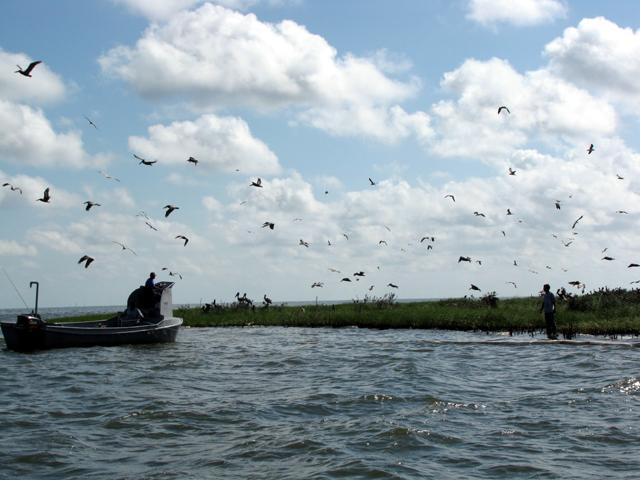
“As you can see in the pictures,” said the text of the email, “plastic bags containing snare boom were recklessly placed without consideration for the natural wildlife” on Queen Bess Island where the Plaquemines Parish Inland Waterways Strike Force recently discovered broken eggs and crushed chicks of the precious Brown Pelicans.

“They (the Brown Pelicans) already have the oil affecting their population during their reproduction time. Now we have the so-called clean-up crews stomping eggs,” said Nungesser. “The lack of urgency and general disregard for Louisiana’s wetlands and wildlife is enough to make you sick.”

[Greg Moses is editor of the Texas Civil Rights Review and author of Revolution of Conscience: Martin Luther King, Jr. and the Philosophy of Nonviolence. He can be reached at gmosesx@gmail.com .]

The Rag Blog

Posted in Rag Bloggers | Tagged , , , , , | 1 Comment

Jordan Flaherty : Cultural Extinction and the Deepwater Spill

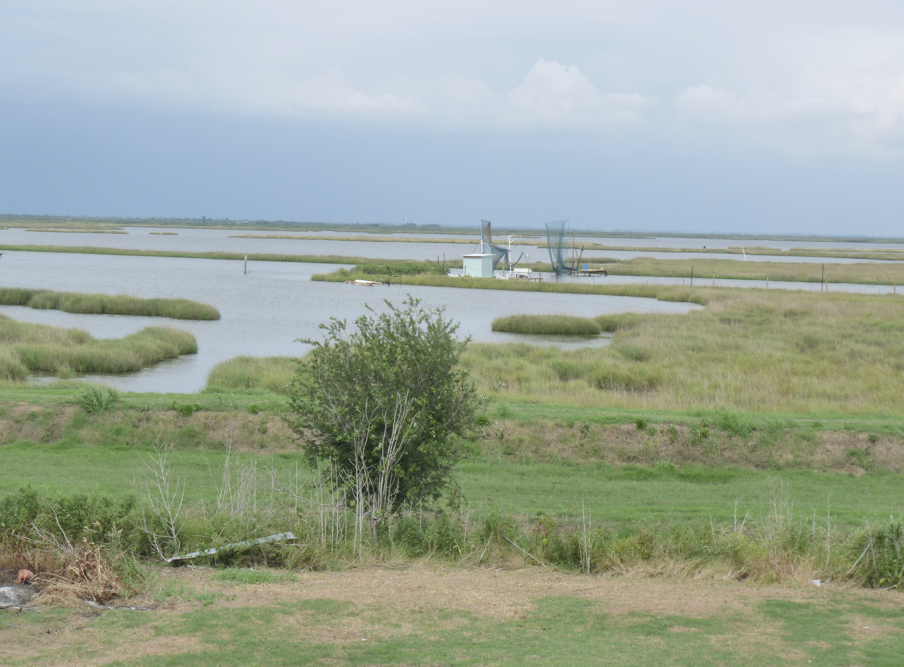
Photo of Bayou Pointe-au-Chien from a backyard in the Louisiana Indian community. Photo by Jordan Flaherty / The Rag Blog.

Cultural extinction and the Deepwater spill

Louisiana’s coastal communities fear they may never recover from BP’s drilling disaster.

By Jordan Flaherty / The Rag Blog / June 15, 2010

As BP’s deepwater well continues to discharge oil into the Gulf, the economic and public health effects are already being felt across coastal communities. But it’s likely this is only the beginning. From the bayous of southern Louisiana to the city of New Orleans, many fear this disaster represents not only environmental devastation, but also cultural extinction for peoples who have made their lives here for generations.

This is not the first time that Louisianans have lost their communities or their lives from the actions of corporations. The land loss caused by oil companies has already displaced many who lived by the coast, and the pollution from treatment plants has poisoned communities across the state — especially in “cancer alley,” the corridor of industrial facilities along the Mississippi River south of Baton Rouge.

“The cultural losses as a consequence of the BP disaster are going to be astronomical,” says Advocates for Environmental Human Rights (AEHR) co-director Nathalie Walker. “There is no other culture like Louisiana’s coastal culture and we can only hope they won’t be entirely erased.”

Walker and co-director Monique Harden have made it their mission to fight the environmental consequences of Louisiana’s corporate polluters. They say this disaster represents an unparalleled catastrophe for the lives of people across the region, but they also see in it a continuation of an old pattern of oil and chemical corporations displacing people of color from their homes.

Harden and Walker point out that at least five Louisiana towns — all majority African American — have been eradicated due to corporate pollution in recent decades. The most recent is the Southwest Louisiana town of Mossville, founded by African Americans in the 1790s.

Located near Lake Charles, Mossville is only five square miles and holds 375 households. Beginning in the 1930s, the state of Louisiana began authorizing industrial facilities to manufacture, process, store, and discharge toxic and hazardous substances within Mossville. Fourteen facilities are now located in the small town, and 91 percent of residents have reported at least one health problem related to exposure to chemicals produced by the local industry.

The southern Louisiana towns of Diamond, Morrisonville, Sunrise, and Revilletown — all founded by former slaves — met similar fates. After years of chemical-related poisoning, the remaining residents have been relocated, and the corporations that drove them out now own their land. In most cases, only a cemetery remains, and former residents must pass through plant security to visit their relatives’ graves.

The town of Diamond, founded by the descendents of the participants of the 1811 Rebellion to End Slavery, the largest slave uprising in U.S. history, was relocated by Shell in 2002, after residents had faced decades of toxic exposure.

Morrisonville, established by free Africans in 1790, was bought out by Dow in 1989.

Residents of Sunrise, inaugurated near Baton Rouge by former slaves in 1874, were paid to move as the result of a lawsuit against the Placid Refining Company.

In the mid-1990s, Chemical producer Georgia Gulf Corporation poisoned and then acquired Revilletown, a town free Africans had started in the years after the civil war.

“We make the mistake of thinking this is something new,” says Harden. She adds that the historic treatment of these communities, as well as the lack of recovery that New Orleanians have seen since Katrina, makes her doubt the federal government will do what is necessary for Gulf recovery. “Since Obama got into office,” she says, “I have yet to see any action that reverses what Bush did after Katrina.”

Harden says Louisiana and the US must fundamentally transform our government’s relationships with corporations. “We’ve got to change the way we allow businesses to be in charge of our health and safety in this country,” she adds. As an example, Harden points to more stringent regulations in other countries, such as Norway, which requires companies to drill relief wells at the same time as any deepwater well.

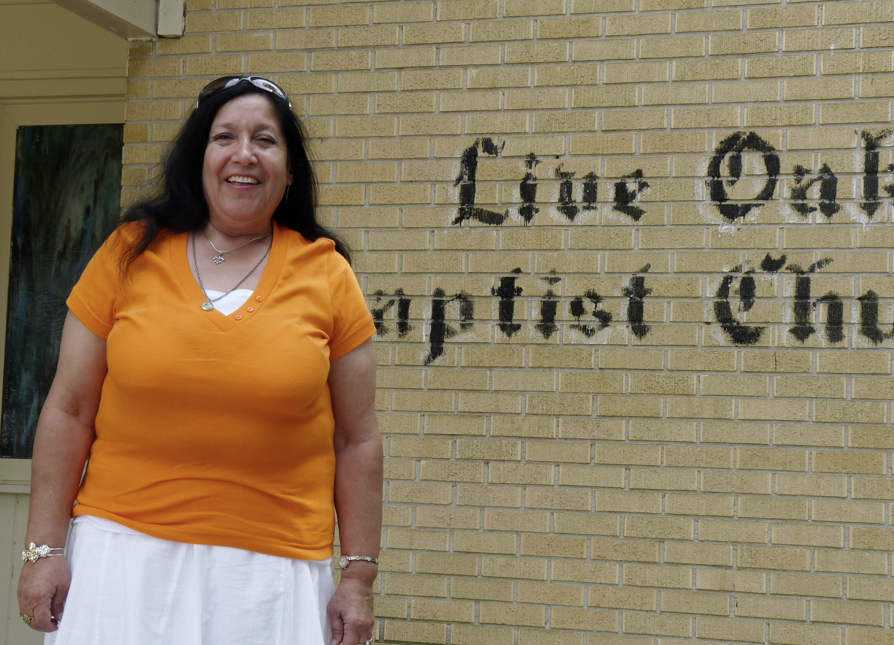
Pointe-au-Chien community leader Theresa Dardar. Photo by Jordan Flaherty / The Rag Blog.


Pointe-au-Chien

Pointe-au-Chien Indian Tribe is a small band of French speaking Native Americans along Bayou Pointe-au-Chien, south of Houma, on Louisiana’s Gulf Coast. Their ancestors settled here three hundred years ago, and for them, the ongoing oil geyser is just the latest step in a long history of displacement and disenfranchisement. “The oil companies never respected our elders,” explains community leader Theresa Dardar. “And they never did respect our land.”

In the early part of this century, the oil companies took advantage of the fact that people living on the coast were isolated by language and distance, and laid claim to their land. Over the past several decades, these companies have devastated these idyllic communities, creating about 10,000 miles of canals through forests, marshes, and homes. “They come in, they cut a little, and it keeps getting wider and wider,” says Donald Dardar, Theresa’s husband and part of the tribe’s leadership. “They didn’t care where they cut.”

The canals have brought salt water, killing trees and plants and speeding erosion. According to Gulf Restoration Network, Louisiana loses about a football field of land every 45 minutes, and almost half of that land loss is as a result of these canals. Meanwhile, Pointe-au-Chien and other tribes have found they have little legal recourse. At least partly as a result of lobbying by oil companies, the state and federal government have refused to officially recognize them as a tribe, which would offer some protection of their land rights.

So late last month, when oil started washing up on the shores of nearby Lake Chien and fishing season was cancelled before it had even begun, members of Pointe-au-Chien took the news as another nail in the coffin of the lifestyle they had been living for generations. On a recent Sunday, a few residents gathered at the Live Oak Baptist Church, on the main road that runs through their community. They described feeling abandoned and abused by the government and corporations. They spoke of losing their language and traditions in addition to their homes.

Sitting on a church pew, Theresa said they had met with indigenous natives from Alaska who discussed their experience in the aftermath of the 1989 Exxon Valdez spill. “We don’t know how long we’ll be without fishing,” said Theresa. “It was 17 years before they could get shrimp.” And, she noted bitterly, this disaster is already much larger than the Valdez, with no end in sight.

BP has promised payouts to those who lose work from the oil, but few trust the company to make good on their promise, and even if they did, they doubt any settlement could make up for what will be lost. “It doesn’t matter how much money they give you,” says Theresa. “If we don’t have our shrimp, fish, crabs and oysters.”

“It’s not just a way of life, its our food,” she added. “It’s the loss of our livelihood and culture.”

The anxiety that Theresa expresses is also increasingly common in New Orleans, a city whose culture is inextricably linked to the Gulf. “How do you deal with this hemorrhaging in the bottom of the Gulf that seems endless?” asks Monique Harden of AEHR. “That is just scary as hell. I’ve been having nightmares about it.”

As the oil continues to flow, people feel both helpless and apocalyptic; depressed and angered. Residents who have just rebuilt from the 2005 hurricanes watch the oil wash up on shore with a building dread. “I never thought I’d be in a situation where I wanted another Katrina,” says Harden. “But I’d rather Katrina than this.”

Drilling economy

Across the street from the church in Pointe-au-Chien is a bayou, where frustrated fishers wait on their boats hoping against all odds that they will be able to use them this season. Behind the church is more water, and a couple miles further down the road ends in swamp. Dead oak trees, rotted by salt water, rise out of the canals. Telephone poles stick out of the water, along a path where once the road continued but now the encroaching waters have taken over.

The miles of swamp and barrier islands that stood between these homes and the Gulf used to slow hurricanes, and now the entire region has become much more vulnerable. Brenda Billiot, another local resident, gestured at her backyard, about a few dozen yards of grass that fades into marshes and water. “This used to be land,” she says, “as far as you could see.” Billiot is still repairing her home from the 2005 flooding, including raising it up a full 19 feet above the ground. She wonders if that will be enough, if there is anything they can do to make themselves safe and hold onto their culture.

A brown rabbit hops across her backyard, and Billiot describes the dolphins and porpoises she has seen swimming nearby. Walking along the bayou here, where generations of people have lived off the land and fought to protect their territory from corporate theft, you begin to sense the gravity of what will be lost.

Theresa believes that the government and oil companies are looking for an excuse to permanently displace the tribe. She believes this latest disaster, and the upcoming hurricane season, may spell the end for their language and culture. “I tell people; if we get another hurricane, take everything you want, because I don’t think they’ll let you back in,” says Dardar. “It’s scary because I don’t know where we’re going to go.”

[Jordan Flaherty is a journalist, an editor of Left Turn Magazine, and a staffer with the Louisiana Justice Institute. He was the first writer to bring the story of the Jena Six to a national audience, and his award-winning reporting from the Gulf Coast has been featured in a range of outlets including the New York Times, Mother Jones, and Argentina’s Clarin newspaper. He has produced news segments for Al-Jazeera, TeleSur, and Democracy Now!. Haymarket Books has just released his new book, FLOODLINES: Community and Resistance from Katrina to the Jena Six. He can be reached at neworleans@leftturn.org.]

Other Resources:

The Rag Blog

Posted in Rag Bloggers | Tagged , , , , , , , | 1 Comment

Jonah Raskin : Sex on Campus and Ulysses Un-Seen

Censored image from Ulysses Seen. Graphic from Literature R Us.

Girls Lean Back:
Sex on campus,
And the ongoing appeal of pornography

By Jonah Raskin / The Rag Blog / June 15, 2010

Don’t the censors of sexually explicit materials get it? Well, apparently not. Not even in this day and age.

Apple has forced the authors of Ulysses “seen” — a web comic book adaptation of James Joyce’s magnificent novel, to remove images of a woman’s breasts for a version to be used with its iPad app.

Can you believe it? I thought that the issue of obscenity had been settled long ago; in the 1920’s, Joyce’s Ulysses was found to be artistic and that it could not be legally censored. But pornography is apparently an intractable problem. It just won’t go away; every time there’s a new technology it comes back.

In his big, thorough book about pornography, which he entitled Girls Lean Back Everywhere: The Law of Obscenity and the Assault on Genius, Edward De Grazia, argued, among other things, that sex was irrepressible and unstoppable. An expert on sex in literature and film, De Grazia argued some of the toughest obscenity cases of the 20th-century and won against the state again and again. The censors at Apple ought to read his book and learn a thing or two.

Every semester for the past 20 years, I’ve used his book in the law class I teach — there’s a week on pornography — and every time I teach the class I can’t help but think about his book and its apt title. I look out at the students, usually 60 or so of them, all seniors, and I notice every time that the girls and the women in the class do lean back. They also lean forward and to the side. They lean every which way, and almost every way they lean, they reveal a part or parts of their bodies — legs, necks, ankles, and breasts.

Sometimes they come to class in slips and negligees, with push-up bras or no bras, and class is a kind of striptease, though nobody disrobes completely. The men in the class lean back too; they lean forward and to the side, and they can be as sexual as the women. They’re all — these students — in their early twenties, and they drink and smoke and have sex. Big surprise!

Isn’t that what college students have been doing for eons? I think so. The students today belong to a post-60’s, post-70’s, post-80’s, post-90’s, post-first decade of the 21st century generation. They have lived with pornography all their lives, pornography on TV and the Internet, and they have come to accept pornography as a part of life, as much a part of life as driving a car, and making calls from a cell phone.

They eat and sleep and dream pornography and the idea that someone, anyone in authority, would try to stop or prevent them from having access to pornography seems ludicrous to them. Because, at this point in time, there’s no way to stop it, though the dinosaurs of the 21st century — college teachers — would like to do just that.

Faculty members, mostly male, are often made uncomfortable by the leaning back and the leaning forward of the students, mostly female, and sometimes they even tell students to dress more appropriately — whatever that means — and not to wriggle about as often or as dramatically as they do. Welcome to the new generation gap!

The faculty members — now in their 40’s and 50’s and 60’s — were once young themselves and did a lot of leaning on their own, and resented members of the older generation who tried to police their bodies. Now, the shoe, the slip, or the negligee is on another body, a younger body, a beautiful body, and the professors don’t like it. They have turned prudish. They’d like the students to cover up.

Now, I can imagine that someone might ask, well, do you teach at a university connected to a church? No, I do not. I teach at one of the 25 campuses in the statewide California State University (CSU) system. This is California, and in California when the sun shines, students take off their clothes, as many different layers and items as they can take off, and not be arrested for indecency. They walk around campus as though they’re in the Garden of Eden — without shame, and without guilt.

Now, the faculty thinks — this is what faculty members have actually said to me — that the students have sex on their minds all the time, and that it’s the job of the teacher to encourage the student not to think about sex. And — so the argument goes — that can best be accomplished if the teacher doesn’t talk about sex or even mention the word “sex.”

Not long ago, a group of faculty members came to my office to request that I remove a photo I had on my wall of Marilyn Monroe. In the photo, Marilyn holds two roses against her breasts so that one can’t see her breasts at all. That photo, I was told, would encourage students to think about sex; it would validate their own thoughts and it would encourage them to go with their sexual daydreams. I was a role model, whether I wanted to be or not, I was told, and I had an obligation to take down the photo.

If I didn’t… well… there was a committee on issues of sexual harassment. So, I took down the photo and brought it home. Marilyn is on the wall in my dining room now. I didn’t want to fight that battle at that time.

One of the things I’ve learned, not surprisingly, is that students have continued to think and talk about sex; the removal of that photo of Marilyn had no influence on them whatsoever because they swim in a media sea of sexuality. Sex is all around them, and inside, too, and faculty members on my campus have the ludicrous notion that the best way to deal with the situation is just to ignore it — not to talk about it. Bury their heads in the sand.

At a meeting recently to talk about a book that will be assigned reading for entering freshman next semester, the issue of sex came up again. The title of the book is Middlesex, by Jeffrey Eugenides, Pulitzer Prize winner. Now, I suggested that someone deliver a lecture to the students about sex — because, well, “sex” is in the very title of the book. The faculty members were shocked that someone would even suggest the idea, and it was swept under the table.

It’s a sad day for academia. A sad comment on a generation that once believed in sexual freedom, sexual liberation and that resented their elders telling them to resist the temptations of sex. I do think that sex ought to be discussed — and not just in the sex education class that they are required to take in which they learn about sexualy transmitted diseases and HIV and AIDS.

I think it might be healthy if the students were to read pornographic books and watch pornographic movies, and talk about them openly. If we did that, it might help to break the unhealthy cycle of Puritanism that comes back again and again no matter how many generations rebel against it — for a time.

At the end of the meeting to discuss Middlesex one faculty member suggested that students would be made uncomfortable if there was an open discussion about sex and sexuality. “Our students don’t think of us as sexual beings,” he said. And without missing a beat, I said, “Speak for yourself, sir.” I hope that my students think of me as a sexual being, much as I think of them as sexual beings because I am and they are sexual, and sex won’t go away and especially if we pretend it’s not there.

So, damn the censors. The girls will lean back and the boys will lean back; it’s part of the mating game, part of being human, and at the age of 19, 20, and 21 leaning back is going to happen no matter what. Maybe some of the teachers should lean back too.

Celibacy isn’t for this generation. Sex is. And that’s on the whole a good thing. I’m happy to say that sex is still with us. I even think it’s here to stay. Case in point: a woman student came to my office on the last day of the semester to tell me that she attended what she called a “private swingers club in San Francisco,” and that if she had not attended she “never would have learned as much as I know about myself today!”

Students are going to “sex clubs.” On their own, because they are one of the few places where they can learn about sex. It might make sense, it might help them, if more of them could and would talk openly on campuses about their own sexual experiences. Sex ought to be far more openly discussed on campuses than it is today.

We have to believe and to recognize too that talking about sex is not the same thing as having sex. In the landmark Ulysses case from the 1930s, Justice John Woolsey ruled that people would read Joyce’s book, have a vicarious experience, and not want to actually go out and have sex. That idea was revolutionary in the 1930s; I guess it’s still revolutionary today.

[Jonah Raskin was a member of the Yippies; he teaches law at Sonoma State University.]

The Rag Blog

Posted in Rag Bloggers | Tagged , , , , , , , , , | 2 Comments

By Robert Jensen. Baylor’s Eagleman, neuroscientist and author who works in the space between the materialist and the mystic — “where anything’s possible” — may well become “the Carl Sagan of the brain, explaining the billions and billions of neurons in our head to a curious public.” In studying the nature of consciousness, Eagleman tells us that the goal of his research “is to reduce the mystery, but that doesn’t reduce the awe.”

Posted in RagBlog | Leave a comment

As Arizona essentially makes racial profiling into state policy and outlaws the teaching of ethnic studies, we revisit John Steinbeck’s literary classic that follows the Joad family as they migrate to California during the Dust Bowl of the 1930s in a desperate search for work — and note remarkable parallels with the current plight of Latino “immigrantes” who face similar harassment, and conflicts with the local population. By Alex Knight.

Posted in RagBlog | Leave a comment

Marc Estrin : The Devil Can Quote Scripture

Image from ChernobylBob / Flickr.

THE DEVIL CAN QUOTE SCRIPTURE

By Marc Estrin / The Rag Blog / June 14, 2010

I am involved in Vermonters for a Just Peace in Palestine/Israel, a group made up of Jews, Palestinians, members of various Christian faiths, and peace groups.

Our work is to “to support the survival of the Palestinian people and to end the illegal, immoral, and brutal Israeli occupation through education, advocacy, and action. We are committed to the principles of self-determination for the Palestinian people, the right of return for Palestinian refugees, and full civil and political rights for all Palestinians in order to promote the equality and safety of both Palestinians and Israelis.” (mission statement)

We host Salaam/Shalom, a weekly hour-long program on community television, and an exemplary, deep website for all levels of interest which gets upward of 30,000 hits a week. I recommend you take a look.

At the moment, we are having a discussion among us which is so interesting I thought I would share it in my weekly blogging:

At our last meeting, one of the Palestinians among us, passionately proposed that we jump on Gen. Petraeus’s recent statements to the effect that America’s unquestioning embrace of Israeli policy is putting our military at greater risk. In a subsequent email to the group he argued that

We should quote the general’s statements because the public trusts our military leaders more than our political leaders who are responsible for putting our troops and officers in harm’s way.

Several members chimed in supporting him. My response to them was:

I do not trust our military leaders, and I don’t think VTJP should fly under their banner just because some may — in this particular case — help our cause for their own, quite different reasons.

VTJP’s endorsing and trumpeting military opinion would be a very cynical, manipulative approach. Petraeus, especially, is a dubious character, toadying when it advances his career, opposing when tactical, and currently angling for a shot at the presidency. He has been a central advocate for escalating in Iraq and Afghanistan, and prepping the country for a decades-long war.

I would not support VTJP marching under his flag, and would myself not do so.

To this, others argued that we would not be flying under a military banner, only buttressing our arguments with their own. To which I responded:

What are Petraeus’s and any other similar statements saying?

That our embrace of Israel threatens the success of our “getting the job done” in Afghanistan and Iraq, and perhaps the actual lives of our “brave men and women” in “harm’s way.”

Yes, we can extract the one part of his (correct) observations for our own uses, but that is just another — and more ethically bankrupt — use of quoting out of context. The critic writes “this play was the most tremendous waste of two hours I’ve ever spent,” and the production lists “tremendous” in it’s ads.

We should not be arguing “from a military standpoint.” We do not embrace our, or Israel’s brutal military solutions. We do not honor our, or Israel’s savage military goals. We jump ship when we quote the military in support of our positions.

It’s not as if we don’t have plenty of other facts and arguments, and plenty of other group support (like the entire world except us, Israel, and the Marshall Islands) to use. Quoting the devil to make the case for scripture seems equally pernicious to me as its converse. We cannot use U.S. generals for our needs without implicitly supporting the context of their statements and their goals.

Red is a beautiful color, but not when it’s streaming from the face of a wounded child.

Another person chimed in with a thoughtful compromise, suggesting that we could include provisos such as “While we strongly oppose the current U.S. wars in Iraq and Aghanistan, we recognize the value of Gen. Petraeus’s opinion about the regional effects of Israel’s constant occupation and aggression, and its potential danger to our soldiers.”

To which I responded with a mailing headed “Take back the Swastika”:

Some of us have been standing five days a week for eight and half years from 5 to 5:30 at the top of Church Street holding various signs against various wars, foreign and domestic.

Occasionally a camo-ed counter protester stands on the other side of the street, with a “Support the Troops” type of sign, and an American flag — which I really like, as it sets up a kind of dialectical arch of discussion over Pearl Street, and raises the visibility of the issues.

Even more occasionally, we are approached by “one of us,” a liberal, progressive, peace and justice oriented passer-by who passionately suggests that we, too, hold an American flag. “Why do you guys want to cede the flag over to the warmongers? It’s our flag, too. We need to take it back. Peace is patriotic.” Stuff like that.

Hearing such suggestions always brings to my thought-experiment mind a parallel demand: Take back the swastika! After all, the Hakenkreuz is an ancient, multi-cultural symbol of beneficent cosmic energy and movement. Why should we cede it to the Nazis?

OK, so then let’s have a peace vigil with someone holding a swastika sign, and explain its true origins and uses to those — if any — who question us about it. It would deepen the discussion, set the peace movement in a wider, timeless, universal context. Why not?

Why not is because certain dissociations can no longer be made. We can add all the “provisos” and footnotes we want to no avail.

In quoting the military with approval, we cannot help but appropriate its goals. And the American public, “cynical” as it may be, is aware of, and attaches those goals to the very statements we propose to tout. As the pop song says, “You can’t have one without the other.” With the horse comes the horse shit.

And I’m not just talking effective, pro-Palestinian tactics. I’m talking self-pollution for VTJP. As I said before, it’s not as if we have such poor soil to work with that we have to dig into the military dung heap.

Another person suggested that we could use the Petraeus material to simply “focus on security,” an issue that “has some emotional and psychological legitimacy.” To which I responded:

I would be equally opposed to arguing “national security” as a reason for BDS or cutting support for Israel. And for the same reasons: “National security” and fear are the trump cards of lying and manipulation. We should not be playing the same hand as Cheney, Obama, and Netanyatu. In using it, we legitimize and support such arguments.

To avoid cynical tactics, our cards must be primarily ethical, appealing to Kant’s difficult “moral law within.” It’s there in everyone, and if it isn’t, we can’t persuade them to become another kind of beast. It’s there in most Americans and Israelis, though it’s buried beneath years of brainwashing, junkshot detritus and ignorance of facts. Our job is to drill deep to get to it. Not every excavation means BP and Halliburton.

I wouldn’t even be opposed to secondarily arguing on a financial level. While it is hardly “the moral law within” to want to keep what’s in your pocket, one can certainly argue for more productive uses of our tax dollars than for slaughter and oppression.

I would ask the few who actually read my blogging to let me know what — beyond the particulars of the Israel/Palestine conflict — you think about this. Can one, should one, use an opponent’s language and the arguments implicit within it, to promote an opposite cause? Do let me know what you think.

In The Lamentations of Julius Marantz, I wrote what I think of as an exquisitely nasty, satirical chapter illustrating warmongers using exact peaceworker language to the T. I won’t take up the space in an already too-long blog entry, too much quoting myself, to include it here. But here‘s a link if you’re interested:

To me, using language or tactics in this way is an example of Orwell’s prophetic elucidations of Newspeak. War is Peace.

[Marc Estrin is a writer and activist, living in Burlington, Vermont. His novels, Insect Dreams, The Half Life of Gregor Samsa, The Education of Arnold Hitler, Golem Song, and The Lamentations of Julius Marantz have won critical acclaim. His memoir, Rehearsing With Gods: Photographs and Essays on the Bread & Puppet Theater (with Ron Simon, photographer) won a 2004 theater book of the year award. He is currently working on a novel about the dead Tchaikovsky.]

The Rag Blog>

Posted in Rag Bloggers | Tagged , , | 2 Comments

Bob Feldman : A People’s History of Afghanistan /10

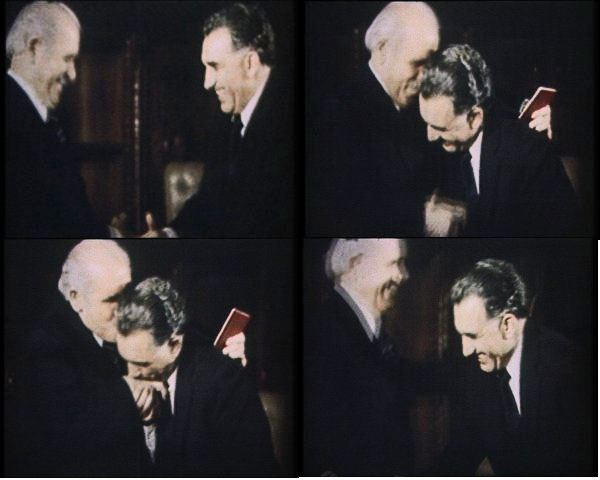
Deputy Premier Hafizullah Amin (on right) is shown in this series of frames swearing his allegiance to Premier Noor Mohammad Taraki in 1979, shortly before arranging to have him assassinated. Image from BBC.

Part 10: 1979-1981
A People’s History of Afghanistan

By Bob Feldman / The Rag Blog / June 14, 2010

[If you’re a Rag Blog reader who wonders how the Pentagon ended up getting stuck “waist deep in the Big Muddy” in Afghanistan (to paraphrase a 1960s Pete Seeger song) — and still can’t understand, “what are we fighting for?” (to paraphrase a 1960s Country Joe McDonald song) — this 15-part “People’s History of Afghanistan” might help you debate more effectively those folks who still don’t oppose the planned June 2010 U.S. military escalation in Afghanistan? The series so far can be found here.]

In 2010 the Democratic Obama Administration is spending another $95 billion on the Pentagon’s endless war in Afghanistan . Yet many viewers of PBS-affiliated television stations or readers of Rolling Stone magazine in the USA still probably know more about the history of rock music since the 1950s than about the hidden history of Afghanistan since 1979.

In September 1979, for example, supporters of People’s Democratic Party of Afghanistan [PDPA]-Khalq Premier Noor Mohammad Taraki discovered that PDPA-Khalq was plotting to kill Taraki — after political disagreements between the two PDPA-Khalq government leaders developed between March 1979 and July 1979, and Amin apparently began appointing just members of his own family to fill important Afghan government posts.

But Amin was still able to force Taraki to resign as Afghan prime minister on September 15, 1979, following Taraki’s return from abroad after attending a conference of leaders of non-aligned nations. And Amin apparently then arranged for former PDPA-Khalq leader Taraki to be killed on October 8 or 9, 1979.

When Taraki had visited Moscow in March 1979 to first request that Soviet ground troops be sent into Afghanistan to help his government’s Afghan army defeat the anti-feminist Mujahdeen guerrillas, the Brezhnev regime had refused at that time to send large numbers of Soviet troops across the border into Afghanistan.

But Taraki — who, along with Amin, had personally signed in Moscow the December 5, 1978, Treaty of Friendship between the Soviet Union and Afghanistan — had apparently been considered friendlier to the Soviet Union than the Columbia University Teachers College and University of Wisconsin-trained Amin

So after Taraki was killed, the Brezhnev regime in the Soviet Union apparently decided that the PDPA-Parcham faction leader that Amin had demoted in late June 1978 — Babrak Karmal — should replace Amin as Afghan head of state (if large-scale Soviet military intervention in Afghanistan was required to prevent the U.S. and Pakistani-backed Afghan Mujahideen militias — which by then controlled 23 of Afghanistan’s 28 provinces — from quickly overthrowing the increasingly unpopular government that had been established by the April 1978 Saur Revolution).

On December 12, 1979, the Brezhnev regime did decide to order large numbers of Soviet ground troops to cross the Soviet-Afghan border and march into Afghanistan on December 23, 1979. One result of this internationally unpopular December 1979 decision was that 13,369 members of the Soviet military would subsequently be killed (and 35,578 troops would be wounded), according to official Soviet government casualty figures.

On December 27, 1979, 300 Soviet commandos then surrounded and attacked Amin’s residence at 7 p.m.– at the same time that other Soviet troops seized Kabul’s radio station. An apparently recorded message from PDPA-Parcham faction leader Karmal, announcing that he was the new head of the Afghan government, was then broadcast over the radio — while Amin and Amin loyalists unsuccessfully fought until 1 a.m. against the 300 Soviet commandos who were attempting to arrest Amin. After being taken to Soviet military headquarters in Kabul, Amin was apparently then executed.

The Democratic Carter Administration next used the Brezhnev regime’s internationally unpopular military response to the Pakistani and U.S. governments’ covert support for regime change and the right-wing Mujahadeen insurgency in Afghanistan as a pretext for once again requiring U.S. men between 18 and 26 years of age to register for a future U.S. military draft. As Democratic President Carter explained in his January 23, 1980 State of the Union speech:

The region which is now threatened by Soviet troops in Afghanistan is of great strategic importance: It contains more than two-thirds of the world’s exportable oil. The Soviet effort to dominate Afghanistan has brought Soviet military forces to within 300 miles of the Indian Ocean and close to the Straits of Hormuz, a waterway through which most of the world’s oil must flow. The Soviet Union is now attempting to consolidate a strategic position, therefore, that poses a grave threat to the free movement of Middle East oil.

This situation demands careful thought, steady nerves, and resolute action, not only for this year but for many years to come… It demands the participation of all those who rely on oil from the Middle East…

I believe that our volunteer forces are adequate for current defense needs, and I hope that it will not become necessary to impose a draft. However, we must be prepared for that possibility. For this reason, I have determined that the Selective Service System must now be revitalized. I will send legislation and budget proposals to the Congress next month so that we can begin registration and then meet future mobilization needs rapidly if they arise…

Former Columbia University Professor and then-National Security Affairs Advisor Brzezinski then visited Pakistan in February 1980 and “met with General Akhtar, the ISI [Inter-Services Intelligence] chief, as well as with [then-Pakistan] president Zia-al-Haq and with CIA station chief in Islamabad John J. Reagan,” according to John Cooley’s Unholy War: Afghanistan, America and International Terrorism.

But because covert CIA aid to the Afghan resistance fighters violated international law, “both Washington and Islamabad went to extraordinary lengths to cover up their” increased military “assistance to the Afghan Mujahideen,” according to Angelo Rasanayagam’s Afghanistan: A Modern History. The same book also noted that “for this reason it was decided that only Warsaw Pact weaponry would be delivered, as such weapons could not be traced back to the US…”

So “the Cold Warriors in Langley, Virginia” then “developed… a top-secret program, codenamed SOVMAT,” which “was probably unknown even to President Zia al-Haq and the holy-war commanders in Pakistan’s ISI,” according to Unholy War. The same book also described how the CIA’s secret SOVMAT program of the early 1980s operated:

Working with a vast army of phony corporations and fronts, the CIA under the SOVMAT program would buy weapons from East European governments and governmental organizations… Their acquisition and testing by the U.S. military and the CIA facilitated development of counter-measures, such as improved anti-tank weapons used by the Mujahideen…

“Officials running the CIA’s SOVMAT program provided wish lists for CIA and ISI officers operating from Pakistan, who sent their Afghan mercenaries to ransack Soviet supply depots… Some Afghan fighters were taught in their CIA-managed training by the ISI in Pakistan to strip Soviet SPETZNAZ or special forces soldiers of their weapons…

Next: “A People’s History of Afghanistan—11: 1981-1987″

[Bob Feldman is an East Coast-based writer-activist and a former member of the Columbia SDS Steering Committee of the late 1960s.]

  • Previous installments of “A People’s History of Afghanistan” by Bob Feldman on The Rag Blog can be found here.

The Rag Blog

Posted in Rag Bloggers | Tagged , , , , , | Leave a comment

Steinbeck Comes to Arizona : Rereading ‘The Grapes of Wrath’


Reading “The Grapes of Wrath” in 2010:
Immigration, capitalism, and
Arizona’s historic moment

By Alex Knight / The Rag Blog / June 14, 2010

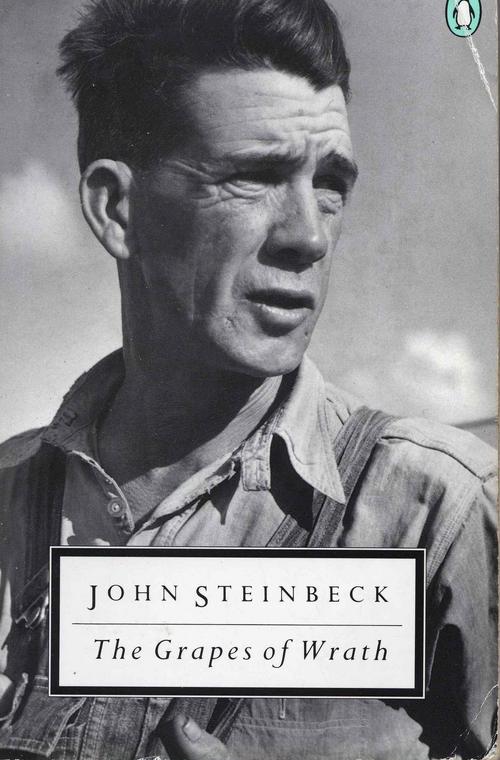
[The Grapes of Wrath by John Steinbeck, published 1939 during the last Great Depression.]

Arizona SB1070, signed into law by Governor Jan Brewer on April 23, 2010, requires Arizona’s local and state law enforcement to demand the immigration status of anyone they suspect of being in the country illegally, and arrest them if they lack documents proving citizenship or legal residency.

Effectively making racial profiling into state policy, this law is the latest in a series of attacks on Latin American immigrants, as well as the entire Latino community, who must live with the fear of being interrogated by police for their brown skin.

Then on May 11, Arizona went one step further, outlawing the teaching of ethnic studies classes, or any classes that “are designed primarily for students of a particular ethnic group or advocate ethnic solidarity.” This same law also states that schools must fire English teachers who speak with a “heavy accent.”

Perhaps these new laws make sense if we imagine that undocumented immigrants are merely “aliens,” a danger to the good, mostly white citizens of this great country. But suppose we look at the problem of immigration from the perspective of the immigrants? Why are they risking life and limb to come to a foreign land, far from their home and families? Why aren’t they deterred from making this trip no matter how many walls we put up, no matter how many police collaborate with ICE, no matter how many angry armed “Minutemen” vigilantes are conscripted to guard the border?

John Steinbeck’s classic novel The Grapes of Wrath, following the Joad family as they migrate to California during the “Dust Bowl” of the 1930s, sheds light on these questions in a way that perhaps every American can relate to. One of the most popular and well-written American books of all time, The Grapes of Wrath gives a very human perspective on the harsh lives of migrants, personified by the Joads — a family of poor sharecroppers from Oklahoma.

Evicted from their family farm, just as the millions of Mexicans who have suffered enclosure from their land and become homeless and jobless because of NAFTA, the Joads travel to California in a desperate search of work, only to encounter the harassment of authorities and the hatred of the local population.

There are important differences between the “Okies” who traveled to the Southwest in the 1930s and Latino inmigrantes of the 2000s. The Joads, of course, were white, and did not cross a national border when they made their exodus. But at its core the story of the Joads is the story of the migrant workers, their troubles, their fears, but also their humanity, and their hope.

It is a story that can inspire us to recognize the historic nature of the moment in which we live, understand why these enormous transformations are occurring, and recognize that justice for the immigrants is justice for everyone, regardless of color or citizenship status.

“Migrant Mother.” Destitute pea picker Florence Thompson with several of her children, photographed in Nipomo, California. Farm Security Administration (FSA) photo by Dorothy Lange (1936) / Wikimedia Commons.

Enclosure

In order to understand the inmigrantes we first have to understand the story of their displacement, or the enclosure of their land, which has left them homeless and with no other options than to leave their homeland in search of a wage. What can The Grapes of Wrath tell us about this reality?

People usually do not resort to risky and desperate moves unless they have nothing left to lose. Steinbeck begins the Joads’ story with the loss of everything they had: the small farm on which they had sustained their family for generations by growing cotton. Young Tom Joad, fresh out of prison, returns to his home to find it deserted.

The Reverend Casy and young Tom stood on the hill and looked down on the Joad place… Where the dooryard had been pounded hard by the bare feet of children and by stamping horses’ hooves and by the broad wagon wheels, it was cultivated now, and the dark green, dusty cotton grew… ‘Jesus!’ he said at last. “Hell musta popped here. There ain’t nobody livin’ there.” (51)

Whether as tenants or small landholders, either for subsistence or for markets, the vast majority of the poor inmigrantes now coming to this country are fleeing the loss of their farms and their livelihoods, just as the Joads. Perhaps for generations, maybe hundreds or even thousands of years, they had lived in connection with the land and had been able to depend on it for the survival of their families and culture. The loss of this land is devastating to those cultures, but larger forces stand to gain by driving these people into homelessness.

The phenomenal book Caliban and the Witch: Women, the Body, and Primitive Accumulation (Autonomedia 2004) details the violent origins of capitalism in 15th-17th century Europe. In it, author Silvia Federici defines the “enclosures” that were necessary for giving birth to capitalism by divorcing the European peasantry from their traditional lands and leaving them with no other choice but to sell their labor for a wage in the emerging industrial economy.

In the 16th century, “enclosure” was a technical term, indicating a set of strategies the English lords and rich farmers used to eliminate communal land property and expand their holdings. [In the footnote she quotes E.D. Fryde:] “[p]rolonged harassment of tenants combined with threats of evictions at the slightest legal opportunity” and physical violence were used to bring about mass evictions… (69)

She goes on, revealing that this enclosure process remains a core element of the capitalist economy we live in:

In the same way in which multinational corporations take advantage of the peasants expropriated from their lands by the World Bank to construct “free export zones” where commodities are produced at the lowest cost, so, in the 16th and 17th centuries, merchant capitalists took advantage of the cheap labor-force that had been made available in the rural areas to break the power of the urban guilds… As soon as they lost access to land, all workers were plunged into a dependence unknown in medieval times, as their landless condition gave employers the power to cut their pay and lengthen the working-day.” (72)

Enclosure is precisely the part of the story we never hear about in the mainstream immigration debate in America. It is never questioned why hundreds of thousands of workers are scrambling to come to the U.S., other than for “our freedom” or to “take our jobs.” But Steinbeck boldly begins The Grapes of Wrath by highlighting the enclosure process as it operated in rural America during the Great Depression.

In the 1930s, Oklahoma was ground zero for the “Dust Bowl.” Unsustainable industrial farming practices such as the monoculture of cotton without crop rotation caused the soil to die, then be picked up by the wind and create enormous dust storms. On page 41, Steinbeck laments, “You know what cotton does to the land; robs it, sucks all the blood out of it.” The settling layers of dust killed the crops and made it harder for small farmers to earn a living, and many were driven into debt and became tenants on land that was then technically owned by the bank.

At the same time, large, wealthy landowners were able to use tractors and other new farming machinery to replace the many tenants who had previously been needed to work the land. “Pa borrowed money from the bank, and now the bank wants the land. The land company — that’s the bank when it has land — wants tractors, not families on the land” (193).

In this passage, Steinbeck brilliantly exposes the evictions as part of the normal functioning of capitalism, as a land owner arrives to evict a tenant family:

Some of the owner men were kind because they hated what they had to do, and some of them were angry because they hated to be cruel, and some of them were cold because they had long ago found that one could not be an owner unless one were cold. And all of them were caught in something larger than themselves…

If a bank or a finance company owned the land, the owner man said, the Bank — or the Company — needs — wants — insists — must have — as though the Bank or the Company were a monster, with thought and feeling, which had ensnared them… [T]he owner men explained the workings and the thinkings of the monster that was stronger than they were. A man can hold land if he can just eat and pay taxes; he can do that. But — you see, a bank or a company can’t do that, because those creatures don’t breathe air, don’t eat side-meat. They breathe profits; they eat the interest on money. If they don’t get it, they die the way you die without air, without side-meat… The bank — the monster has to have profits all the time. It can’t wait. It’ll die. When the monster stops growing, it dies. It can’t stay one size. (40-42)

As far as capitalism is concerned, whatever will maximize profit is the arrangement that must be pursued, regardless of the human consequences. The situation in Mexico today resembles that of Oklahoma 75 years ago. Small family farms are no longer profitable enough, and people are being thrown off their land every year by the thousands.

The North American Free Trade Agreement (NAFTA), signed into law by Bill Clinton on December 8, 1993, created the largest “free trade” zone in the world: Canada, the United States, and Mexico. The treaty stipulated that there could be no “barriers to trade,” such as a tariff/tax on foreign products. In this video [below] MIT professor Noam Chomsky, interviewed by Rage Against the Machine frontman Zack de la Rocha, explains how the modern enclosures in Mexico are a result of NAFTA, which has not had the effect it was promised to have for the U.S. and Mexican economies.

As mentioned by Professor Chomsky, one direct result of NAFTA was the flooding of the Mexican market with artificially cheap agricultural products from the United States, such as corn, which is heavily subsidized by the U.S. government. From 1990-2000, the price of corn in Mexico fell by 58 percent, and as there is simply no way for the vast majority of Mexican tenant farmers to compete with this artificially low cost of American corn and other products, millions were driven into poverty and debt, and soon faced eviction.

This excellent article from the Institute for Food & Development Policy states that “Since NAFTA, 80 percent of rural Mexicans live in poverty, with 60 percent living in extreme poverty.” It also points out that as of 2004, a total of 1.7 million subsistence farmers had been pushed off their land because of NAFTA. So it should be no surprise that the number of Mexican immigrants entering the U.S. increased by 75 percent in the five years after NAFTA became law. The form of the enclosures has changed, but the fact has remained. People driven from their land will search for work in other places.
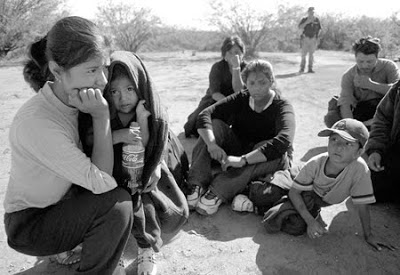
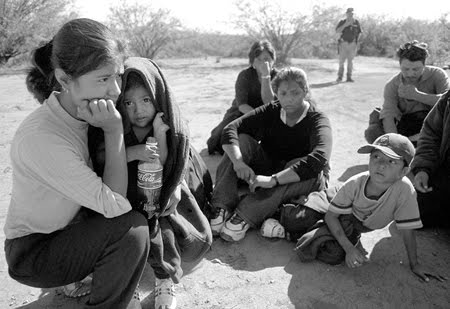
A group of Mexican immigrants await the arrival of authorities after being apprehended in the Arizona desert by members of Civil Homeland Defense, a citizen vigilante group. Photo by Mike Kane (2004) / UT Documentary Center / University of Texas at Austin.

Xenophobia

The second great lesson The Grapes of Wrath reveals about the immigrants is how they are feared and hated, by the local population as well as the authorities, and what it means to endure and overcome this xenophobia.

Once California belonged to Mexico and its land to Mexicans; and a horde of tattered feverish Americans poured in. And such was their hunger for land that they took the land — stole Sutter’s land, Guerrero’s land, took the grants and broke them up and growled and quarreled over them, those frantic hungry men; and they guarded with guns the land they had stolen… And as time went on, the business men had the farms, and the farms grew larger, but there were fewer of them.

Now farming became industry, and the owners followed Rome, although they did not know it. They imported slaves, although they did not call them slaves: Chinese, Japanese, Mexicans, Filipinos. They live on rice and beans, the business men said. They don’t need much. They wouldn’t know what to do with good wages. Why, look how they live. Why, look what they eat. And if they get funny — deport them.
[….]
And then the dispossessed were drawn west — from Kansas, Oklahoma, Texas, New Mexico; from Nevada and Arkansas families, tribes, dusted out, tractored out. Caravans, carloads, homeless and hungry; twenty thousand and fifty thousand and a hundred thousand and two hundred thousand. They streamed over the mountains, hungry and restless — restless as ants, scurrying to find work to do — to lift, to push, to pull, to pick, to cut — anything, any burden to bear, for food. The kids are hungry. We got no place to live…

They had hoped to find a home, and they found only hatred. Okies — the owners hated them. And in the town, the storekeepers hated them because they had no money to spend… The town men, little bankers, hated Okies because there was nothing to gain from them. They had nothing. And the laboring people hated Okies because a hungry man must work, and if he must work, if he has to work, the wage payer automatically gives him less for his work; and then no one can get more. (297-300)

Throughout the book, as the weary Joads meander west on their old jalopy, their eagerness and optimism about finding decent work and a better life in California is dashed against the rocks of poverty and hatred. Early in the book, Tom’s pregnant sister Rose of Sharon Joad goes on about her expectations about life once the family arrives in California.

Well, we talked about it, me an’ Connie… Connie gonna get a job in a store or maybe a fact’ry. An’ he’s gonna study at home, maybe radio, so he can git to be an expert an’ maybe later have his own store… An’ Connie says I’m gonna have a doctor when the baby’s born; an’ maybe I’ll go to a hospiddle. An’ we’ll have a car, little car… (212)

But shortly after crossing the border into California, the Joad family encounters the authorities, who are less than pleased by the arrival of more migrants into their state. After setting up camp by a river, Ma settles down for a nap in the tent, only to be disturbed by a law enforcement agent who gives her a threatening welcome.

“Well, you ain’t in your country now. You’re in California, an’ we don’t want you goddamn Okies settlin’ down.”
Ma’s advance stopped. She looked puzzled. “Okies?” she said softly. “Okies.”
“Yeah, Okies! An’ if you’re here when I come tomorra, I’ll run ya in.” He turned and walked to the next tent and banged on the canvas with his hand. “Who’s in here?” he said. (275)

It becomes clear through the story that the California police and authorities tolerate the presence of the “Okies” so they can be exploited for their extremely cheap labor. Sheriffs and rangers even guard the grounds of large private farms where migrants are bussed in. However, the cops maintain a close eye on the Okies, and are not afraid to resort to violence when they step out of line.

The Joads arrive one night in a “Hooverville,” the name for the slums on the edges of towns during the Great Depression where unemployed would set up camp. Here a contractor comes to find desperate workers, escorted by a deputy sheriff with whom Tom Joad gets into an altercation.

The contractor turned to the Chevrolet and called, “Joe!” His companion looked out and then swung the car door open and stepped out…
“Ever see this guy before, Joe? He’s talkin’ red, agitating trouble…”
“Hmmm, seems like I have. Las’ week when that used-car lot was busted into. Seems like I seen this fella hangin’ aroun’. Yep! I’d swear it’s the same fella.” Suddenly the smile left his face. ‘Get in that car,’ he said, and he unhooked the strap that covered the butt of his automatic.
Tom said, “You got nothin’ on him.”
The deputy swung around. “F you’d like to go in too, you jus’ open your trap once more. They was two fellas hangin’ around that lot.” (338-9).

The goal of the authorities in the story, as in the country today, is to keep immigrants in a constant state of precariousness, where they cannot make waves for fear of being imprisoned or deported. This climate of fear is the real effect of Arizona SB1070, not to actually deport all the undocumented workers from the state, because that would hurt the economy that depends on their cheap labor.

In fact, this CNN video [below] documents that SB1070 has already driven away too many workers from the state and hurting the businesses that had employed them. It seems it has backfired so much that even Russell Pearce, the author of the legislation, has now reversed his stance and is supporting “guest worker” legislation to invite undocumented workers back into the state.

What does the climate of fear surrounding immigrants do for the U.S. capitalist economy and its ruling class?

First, it keeps undocumented immigrants in that precarious state where they will not seek help or point out injustices, nor will they try to organize unions and demand higher pay or working conditions. It guarantees they will mostly toil for less-than-minimum wages and suffer in silence.

Most Americans are not even aware that since NAFTA was enacted, at least 3,000 Mexicans have died trying to cross the border. Every wall that goes up on the border drives the immigrants into more remote deserts to reach their destination, increasing the likelihood of injury and death, but precious few U.S. citizens are willing to stick their necks out to help prevent such unnecessary deaths.

Second, the xenophobia encouraged by measures like SB1070 is useful for the ruling class because it drives a racial wedge into the American working class. Instead of uniting to fight for better jobs, affordable education, health care, housing, an end to environmental nightmare and endless wars, the anger of the common people is directed at the scapegoat of the immigrant.

Steinbeck illustrates this phenomenon when “a crowd of men” “armed with pick handles and shotguns,” confront the Joads after they flee the Hooverville. Interrogating and threatening the Joad family, these self-styled vigilantes act just as the “Minutemen” who today rove the deserts of Arizona, looking for “illegals.”

Though these people’s anger and fear over the state of the U.S. economy is warranted, they are failing to confront the actual thieves and criminals who have plunged the world into a new Great Depression. Because by identifying “foreigners” and people with brown skin and different accents as the reason why wages are low and jobs are lost, corporations and politicians are able to deflect attention away from the real source of economic hardship: themselves.

Conclusion

The crisis in the Southwest in the 1930s is unfortunately similar to the situation today. Hundreds of thousands of poor migrants, their land enclosed and with nowhere to go, facing long trips through the heat of the desert and the ice of xenophobia, are nevertheless persisting to do what they need to do to feed their families.

There is a tidal wave coming north now, which resembles one that three generations ago came west, but like that one there will be no stopping it by putting up walls and threatening people with violence or deportation. Desperate people will always do what they need to do to survive. The only way to stem the flow is to repair the dam that has burst through poverty and enclosure.

Latinos need decent livelihoods in Latin America before they will stop coming here, “scurrying to find work to do.” Repealing NAFTA and ending the massive corn subsidies for U.S. agribusiness would be two huge steps in the right direction. Rather than making the United States into a nasty place that no one will want to come to, why not focus on helping Mexico, Latin America, and the world as a whole, be suitable places to live, work, and raise a family?

The Grapes of Wrath, though it details the hardships of the migrant workers at great length, won the Pulitzer Prize and captured the hearts of the nation because it is ultimately a hopeful book that inspires us to act for positive change.

John Steinbeck, flexing his radical muscles, argues in the book that by targeting the weak and poor with measures such as those currently being enacted in Arizona, capitalism is only putting off its inevitable demise. “The great owners ignored the cries of history.” “[Especially,] the little screaming fact that sounds through all history: repression works only to strengthen and knit the repressed.”

He explains:

The land fell into fewer hands, the number of dispossessed increased, and every effort of the great owners was directed at repression. The money was spent for arms, for gas to protect the great holdings, and spies were sent to catch the murmuring of revolt so that it might be stamped out. The changing economy was ignored; and only means to destroy revolt were considered, while the causes of revolt went on. The tractors which throw men out of work, the machines which produce, all were increased; and more and more families scampered on the highways, looking for crumbs from the great holdings, lusting after the land beside the roads. The great owners formed associations for protection and they met to discuss ways to intimidate, to kill, to gas. And always they were in fear of a principal — three hundred thousand — if they ever move under a leader — the end. Three hundred thousand, hungry and miserable; if they ever know themselves, the land will be theirs and all the gas, all the rifles in the world won’t stop them.” (306-7)

[Alex Knight is an organizer, teacher and writer in Philadelphia. He is currently helping Philly mobilize for the United States Social Forum Source in Detroit this June 22-26. He also maintains the website endofcapitalism.com and is in the process of writing a book called The End of Capitalism. He can be reached at activistalex@gmail.com.]

The Rag Blog

Posted in Rag Bloggers | Tagged , , , , , , , , , , | 2 Comments

VERSE / Larry Piltz : The Wound of the Gulf

The Gulf of Mexico. Photo from Nature’s Portraits.

Oil is the salt in
The wound of the Gulf

By Houma Cayenne

We have saltwater in our veins
and when it pours it biblically rains
God knows we’ve had our losses and gains
had lots of Abels and our share of Cains
but we’re open and we’re warm
and we let our love be our charm
and believe in the power of first do no harm
we believe in the power of first do no harm

There’s a Gulf within
and a Gulf out there
there’s the Gulf my friend
and a Gulf of care
a Gulf between
what we say and do
the silent Gulf we don’t mean
between me and you
the Gulf between
suffering and ease
a wide Gulf that’s bridged
like the old Rigolets

Is ours a Gulf of childhood innocence
or a Gulf of lost dream penitence
or a Gulf of ambiguity
to suffer in perpetuity

A mullet slaps the waves
in the land of the wet and the brave
in a land that cannot be paved
in a land that can still be saved

A black water snake is sunning
and a shrimper’s engine’s gunning
as the tides just keep on running
watch us run on kindness and cunning
in a land where nothing is wanting

Along a backwater mirror glass
a nursery for life from its source to the pass
where fresh and salt make fertile mishmash
the rare conditions for life in a clash
runs a rabbit through the cordgrass
with the hope this day won’t be its last
as hawk circles over the marsh
with an appetite that’s harsh
but the rabbit is hungrier still
for life with her genius stubborn will
and today there’ll be no kill
but for neither will time be standing still
and tomorrow will have its fill
from the rarest cougar to herds of krill
for those with lung and with sifting gill
and with claws and longing and vital quill
in this land without a rock or hill
digesting petroleum’s poison pill
because of a violently negligent spill

Oil is the salt in the wound of the ocean
the salt in the womb of The Gulf in motion
the Womb of Creation not some vague notion
The Gulf a womb of sacred devotion
pierced in its side its bleeding quotient
oil is the salt in the wound of the ocean
the salt in the womb of The Gulf in motion

Huoma Cayenne
As told to Larry Piltz / The Rag Blog
June 14, 2010

The Rag Blog

Posted in Rag Bloggers | Tagged , , , | Leave a comment

Neuroscientist David Eagleman: Portrait of a ‘Possibilian’

David Eagleman. Image from Researchers and Theories / comcast.net.

Baylor’s David Eagleman:
The Carl Sagan of neuroscience

…in the space between the materialist and mystic, anything’s possible.

By Robert Jensen / The Rag Blog / June 14, 2010

[An edited version of this article appeared in the May 28, 2010, issue of The Texas Observer and is online here.]

There’s a struggle going on inside the brain of David Eagleman for the soul of David Eagleman.

That is, there might be such a struggle if Eagleman’s brain believed that Eagleman had a soul, which he is not sure about. In fact, Eagleman’s brain is not completely sure that there is an Eagleman-beyond-Eagleman’s-brain at all, with or without a soul, whatever that term might mean.

Welcome to the world of “possibilian” neuroscientist-writer David Eagleman, to life in the space between what-is and what-if, between the facts we think we know and the fictions that illuminate what we don’t know.

Eagleman-the-scientist would love to rev up his high-tech neuroimaging machines to answer the enduring questions about the brain and the mind, the body and the soul. But Eagleman-the-writer knows that those machines aren’t going to answer those questions.

So, while he reports on what-is in scientific journals, his brain and mind run free pondering the what-ifs, as he did in the 2009 book Sum: Forty Tales from the Afterlives, a playful series of short philosophical imaginings of life beyond death. And, if things work out the way Eagleman hopes, someday he’ll get a shot at a larger stage where he can fulfill his dream of becoming the Carl Sagan of the brain, explaining the billions and billions of neurons in our head to a curious public.

Anything’s possible

Though they might seem different, Eagleman’s scientific and literary lives really are part of the same creative endeavor aimed at deepening our understanding of a complex world we can never really come close to understanding. In the spiritual realm, that leads Eagleman to reject not only conventional religion but also the label of agnostic or atheist. In their place, he has coined the term possibilian: those who “celebrate the vastness of our ignorance, are unwilling to commit to any particular made-up story, and take pleasure in entertaining multiple hypotheses.”

Since scientists mostly talk about what they know, Eagleman’s emphasis on our ignorance may seem strange. So, it’s time for an analogy. Eagleman likes analogies.

The work of science is like building a pier out into the ocean, he says. We excitedly add on to the pier little by little, but then we look around and say, “Wait a minute, I’m at the end of the pier but there’s a lot more out there.” The ocean of what we don’t know always dwarfs what we do know, he emphasizes. “During our lifetimes, we will get further on that pier. We’ll understand more at the end of our lives than we do now, but it ain’t going to cover the ocean.”

Settling in at his office at the Baylor College of Medicine in Houston, Eagleman swivels 180 degrees in his chair, his foot pushing off the various pieces of office furniture to propel him around like a kind of wind-up machine, the verbal velocity moving between fast and faster depending on his fascination with a particular idea. Those ideas can range from the latest experiments he’s running in the five fMRI (functional Magnetic Resonance Imaging) machines down the hall, to age-old philosophical questions about free will and implications for the legal system, to those speculations about an afterlife.

His first book, the co-authored the co-authored Wednesday is Indigo Blue: Discovering the Brain of Synesthesia, analyzed the phenomenon of synesthesia (a condition in which one sense, such as sight, is simultaneously perceived by another sense, such as hearing — “hearing a color,” for example). One reviewer recommended the book for those with “a passion for neurology’s wild territory,” which Eagleman is exploring further for a general audience in his third book, the forthcoming Dethronement: The Secret Life of the Unconscious Brain. His central project in that book, and all his scientific work, is to understand how the human brain constructs reality.

In between those two books came Sum, a surprising success in the United States and Britain that is now out in paperback. It also spawned a theatrical adaptation staged at the Sydney Opera House in Australia with an original score written and performed by avant-garde musician-producer Brian Eno. The book’s speculative musings have captured the imagination of a small but lively group of people who claim the possibilian label, leading Eagleman to begin writing Why I’m a Possibilian to flesh out the ideas.

Taking seriously the old saying “the absence of proof isn’t the proof of absence,” Eagleman recognizes that people who don’t believe in God (at least not in God defined as a supernatural force or entity) can never say with certainty what doesn’t exist. So, the difference between agnostic and atheist is typically a matter of attitude, and such is the case with adding possibilian to the mix. Eagleman is not trying to support or rule out any particular claim but simply suggesting that it’s healthy to imagine possibilities.

What if there is an afterlife where we relive all our experiences but shuffled into a new order? What if in an afterlife we confront all the possible versions of our self that could have been? What if we experience death in stages: when the body stops functioning, when we’re buried, and the moment when your name is spoken by another for the last time? Sum offers 40 such what-ifs. [For a video trailer of the book, go here.]

The stories aren’t meant as serious proposals about what an afterlife may be, and are really just a vehicle for Eagleman’s ruminations on the vexing philosophical questions we face in life. When we talked in his Houston office, Eagleman was finishing the last chapter of Dethronement to send off to the publisher, and those questions were on his mind. One of the most basic concerns the mind: Is our consciousness the product of anything beyond the material realm? Is there anything beyond the physical brain? If there is something beyond, is that what we should call the mind? What does all this mean for the concept of the soul?

Pinning down consciousness

Eagleman acknowledged that in labs such as his, neuroscientists work under the assumption that “you are nothing but your brain,” and many scientists and philosophers come close to suggesting that this is not an assumption but a fact. Eagleman refers to this as the “hardcore” reductionist/materialist view — reducing the mental to the material, reducing the mind to the physical brain. That could be the case, he says, but it makes him nervous.

His first hesitation is common; no one could really look at humans as “just a bunch of atoms, or just a bunch of neurons” because of the concept of emergent properties. Eagleman explains: “If you took any piece of an airplane, that piece of metal does not have the property of flight. It’s only when you put it together in exactly the right way that you get something out of it.” The key is the interaction among the components, the properties that emerge from that specific interaction that the individual components don’t have alone.

Here’s a classic example: At room temperature, hydrogen and oxygen are gases. Combine one oxygen and two hydrogen atoms and you get water. Liquidity is an emergent property, which no chemist could have predicted by analyzing the individual atoms. The same can be said of us — we are made up of material components, but what is interesting about humans is not those components but the emergent properties. Consciousness couldn’t be predicted from a list of the elements that make up each one of us.

Eagleman’s second hesitation is more intriguing. We shouldn’t presume, he says, that we know about all the pieces that make us up or all the forces that structure the world in which we operate. Enter the possibilian.

“Almost certainly, we’re missing giant pieces,” he says, just as previous generations were missing a big piece of the puzzle when they attempted to understand the world without the concept of gravity. “We’re in that situation now, and the reason we know we’re in that situation is because for the most fundamental questions we have, like consciousness, we not only don’t know the answer but we don’t even know what the answer could look like.”

The question of consciousness? “How do you put together a bunch of physical pieces and parts, and get private subjective experience out of that? How do you get the taste of feta cheese or the redness of red or the feeling of pain?”

Neuroscience labs are busy mapping neural circuits — the signals within the brain, and between the brain and the rest of the body — but Eagleman emphasizes “that’s just mechanical stuff, and every single discovery in every neuroscience lab is just mechanical stuff.” He’s happy to tell anyone who will listen about the amazing stuff that neuroscience has figured out, but he doesn’t want to get lost in that.

“We’re stuck with this very deep problem, this 800-pound gorilla: If it’s all just mechanical stuff everywhere we look and if every part of the brain is connected to, and driven by, other parts of the brain, then where’s consciousness?” For most folks, the answer might be, “Well, it’s in my mind.” But that begs the question of what we mean by mind, beyond the physical brain. What is a mind? (A quick quiz: Your brain weighs about three pounds. How much does your mind weigh?)

Long before fMRI machines, philosophers have been debating these questions. David Sosa, a professor and philosophy department chair at the University of Texas at Austin, says the materialists dominate the field these days, though he remains a dualist (a type of theory that argues the mind and the brain, the mental and the physical, are different kinds of thing). Sosa is respectful of the work of neuroscientists and agrees philosophers should be engaging their findings, but he’s unwilling to rush to judgment.

Eagleman shares that caution. He has no glib response about the question of consciousness and says there’s not even a clear way to frame questions about private subjective experience — “there’s no equation that can give us the taste of feta cheese,” he says.

That’s why Eagleman, a hardcore neuroscientist who loves the “stuff” coming out of his lab as much as conventional religious believers love the “stuff” in their holy books, isn’t a hardcore materialist. But what could the missing pieces be? Time for another analogy.

Imagine folks with no exposure to modern gadgets find a radio. They hear a human voice coming out, yet there’s no one speaking. They fiddle with the radio, remove the back cover, pull on a wire, and observe that the voice stops. They reconnect the wire, and the voice is back. They touch other parts and the voice changes. Not knowing about the electromagnetic spectrum, these tinkerers would be tempted to assume the voice is coming from the radio itself.

Back to emergent properties. It might be tempting to conclude that the voice is an emergent property of the radio, of the way the parts and pieces are arranged, but that would miss the invisible radio waves. “The physical integrity of the radio is necessary for its proper functioning, but it’s not about the physical thing. That’s just a receiver for things coming from elsewhere,” Eagleman says.

It’s plausible, he concludes, that we could be waiting for the neuroscience equivalent of discovering the law of gravitation, waiting to discover “whole new — I don’t even know what to call them — forces or dimensions or whatever. A hundred years from now people might say, ‘those poor assholes in the 21st century were trying to solve the consciousness problem and they didn’t even know about force X.’”

Eagleman is quick to make it clear he’s not saying there’s a force X; he doesn’t want to be lumped in with the folks peddling New Age flakiness. He just wants to keep an open mind, which is what he thinks science is all about — extend the pier but don’t forget about the vastness of the ocean, expand what we know but remember that what we know is dwarfed by what we don’t know.

Team Eagleman. Members of David Eagleman’s lab. Image from Baylor College of Medicine.

Scientific story-tellers and lock-pickers

At moments like this, the scientific and the literary Eagleman are most clearly one. Human beings, including scientists, he emphasizes, are storytellers. He believes scientists tell some of the best stories humans have come up with to explain how the world works. But the way that the “facts” of the science of one era are replaced by new discoveries should remind us that science is always just telling stories. The earth is pushed out of the center of the universe, Newtonian physics gets nudged by quantum mechanics — science marches on, with lots of “facts” left by the side of the road to rust.

Throw a stone into any contemporary university English department and you’ll hit at least one postmodern literary theorist who will talk about science as narrative, but it’s rare to hear it from a scientist who is as committed to the scientific project as Eagleman. Here’s someone running a lab with five high-test fMRI machines, 16 employees, and a half-million dollar-a-year budget. And it’s all just stories?

“I don’t want to say ‘just stories.’ These are the best stories we have on the planet,” he asserts, the stories that cure disease and make space travel possible. “I’m just saying that they are narratives that can change. Science is a tremendously successful pursuit, but there’s a lot of wiggle room.”

The awareness that there is always potentially a game-changing discovery around the corner is, for Eagleman, the allure of science. “I don’t think people would want to go into science unless they thought there was something big to be discovered. You go in because you think, ‘I want to kick over the whole fucking chessboard.’ That’s what makes a good scientist.”

Growing up in Albuquerque, New Mexico, with a psychiatrist father and biologist mother who both loved books, Eagleman was exposed to lots of discussion about what makes good science and good literature. When he went off to college to major in literature at Rice University in Houston, he dabbled in space physics and engineering but avoided biology; his last biology class had been in the 10th grade, at which time he pronounced the subject “gross.” But late in his undergraduate career he found himself drawn to questions about the brain, and once he started reading he was hooked.

After doctoral work at the highly rated program in neuroscience at Baylor College of Medicine, he spent five years in San Diego in a fellowship at the Salk Institute before taking a faculty job in the University of Texas-Houston Health Science Center. Baylor lured him back three years ago.

With funding from the National Institutes of Health and a few smaller grants, he pays for a lab in which undergraduates, graduate students, and regular staff members work out of a half-dozen cubicles. Conversations about work, along with various pieces of hardware used in experiments, spill over to the office’s combined conference table/lunch room. The whiteboard walls (which are actually a light blue) sport a kind of scientific graffiti — ideas for projects, questions about projects, lists of things to be done on projects — that reflects the serious but anarchic spirit of the lab.

Eagleman brings a possibilian sensibility to the lab. Over lunch, staff members reflected on that sense of openness.

Research assistant Elyse Aurbach, a Rice University grad who is applying to graduate schools in neuroscience, calls Eagleman and the lab “genuinely scientific” — any idea that is intriguing is worth discussing, no matter who proposes it, and the emphasis is on innovation and collaboration.

Don Vaughn was a high school student in San Diego when he met Eagleman at his school’s Science Day. After graduating from Stanford and working in investment banking for a summer (“Banking really wasn’t for me,” says the mohawk-coiffed Vaughn), he bugged Eagleman to give him a job. Now he’s working on a new study on empathetic responses in the brain as he ponders graduate school.

Greg Bohuslav is a University of Houston undergrad who loves the nimbleness of the lab. When people have ideas, Eagleman will let them run a quick experiment to test it, most of which fail. To do that work without big grants, Bohuslav likes to help design devices used in experiments. “We build a stimulator (device that shoots puffs of air to stimulate the skin) for $2,500 that would have cost $35,000 to buy,” he says proudly. “There’s a value placed on ingenuity here, kind of like lock-pickers.”

Although it’s more freewheeling than most, the lab produces conventional science. For all the talk of humans’ intellectual limits — of small piers and vast oceans, of upended chessboards — there’s no doubt that Eagleman believes deeply in science. In theory, he’ll consider possibilities. But in practice, he bets on science.

Back to the radio analogy. Even if there is a force yet to be discovered that would change the way we think about consciousness, as understanding radio waves would change the understanding of a radio, Eagleman points out that we have to know how the radio works. And he wants to know how the brain works. “Understanding the machinery is not a bad pursuit at all,” he says. “It doesn’t rob the myste…, doesn’t rob the awe from everything.”
Why does he stop himself from saying “mystery”? Why replace it with “awe”?

Eagleman explains that Frances Crick, the Nobel laureate biologist whom he got to know at the Salk Institute, once told him, “What we lose in mystery we gain in awe,” and the phrase stuck with him.

“Our goal in some sense is to reduce the mystery, but that doesn’t reduce the awe,” he says. If scientists could produce a neural map that explains why chocolate ice cream tastes good, it would still taste just as good. The mystery would be gone, but the experience wouldn’t be diminished.

That leads Eagleman to make it clear he is a possibilian, not a mysterian (one who believes that there are things we humans can’t understand, problems we can’t solve). Eagleman acknowledges that in his lifetime we won’t come up with the theories to explain it all and that some of science’s stories may turn out to be wrong, but they usually are better than any alternative stories.

I poke a bit. Eagleman flies the possibilian flag, rejecting fundamentalism in religion, politics, economics. But might he be a technological fundamentalist — someone who believes that humans, using science, will always find high-energy/high-technology solutions to problems, including to the problems created by previous high-energy/high-technology processes and gadgets?

Eagleman certainly is upbeat about the possibility of finding significant ways to replace current sources of energy, for example. He believes that the more dire the problem, the more creative humans are; as we get closer to running out of oil, the incentive to solve the problem will pull us through.

Eagleman has confidence in the species, and confidence in himself. When I asked him about his admiration for the late astrophysicist Carl Sagan, he explained that he “would love to turn people on to the big ideas” the way Sagan did through books and the 1980 PBS series “Cosmos: A Personal Voyage.” Although he’s a boyish 38 years old, Eagleman doesn’t hesitate to acknowledge that he wants to carve out for himself that kind of special public place for himself as a scientist.

“Growing up, me and my parents, we never said ‘Someday you can be the president of the United States.’ We always felt like, ‘Someday you can be the next Carl Sagan.’ That was always the goal. That would be the apex for me.” Why such respect for Sagan? “He took the most beautiful ideas that we have in science and laid them out there in a way that any eighth-grader could understand, and that could bring tears to they eyes of any adult,” says Eagleman, noting that watching a DVD copy of “Comos” he recently bought had, indeed, brought tears to his eyes. [To watch the introduction to the series, go here.]

Beyond the joy of knowing about the world, there also are practical reasons we might want to deepen our understanding of how the brain constructs reality. Eagleman also works in the new interdisciplinary field called neurolaw, sorting through the implications of brain science for culpability, sentencing, and rehabilitation.

Imagine, for example, that Charles Whitman had not been shot dead in 1966 after he killed 14 people and wounded dozens with a rifle from the top of the Main Building at the University of Texas at Austin. What if the brain tumor found by an autopsy had instead been revealed by neuroimaging and it had been demonstrated the tumor caused his murderous rampage? If he had lived and gone to trial, should that have affected a legal determination of guilt? The type of sentence? The evaluation of when he might be paroled?

Consider how controversial the existing insanity plea tends to be (recall John Hinckley, Jr.’s successful insanity plea after shooting Ronald Reagan) and it’s easy to imagine the ruckus that is ahead down this road. [To see a video of Eagleman speaking on “The Brain and The Law,” go here.]

Neurolaw: Brain science and culpability. Image from Baylor College of Medicine.

At the end of the pier

On these subjects, the confident Eagleman is on display, talking fast and then faster, offering elegant summaries of complex scientific theories and constructing analogies to explain the firing of our neurons. He hits roadblocks and thinks through solutions on the fly. Conversation with him is just plain fun.

But the more interesting side of Eagleman comes when he runs up against a truly troubling question, when he’s stopped cold by the overwhelming complexity of the world — both outside and inside us — and the limits of human intelligence. Instead of tossing off glib responses, he slows down and reveals the struggle inside Eagleman, between the confidence-bordering-on-hubris of a neuroscientist and the humility-that-produces-doubt of a writer who knows he’s chewing on age-old questions that won’t be solved in this or any other age.

In five hours of interviews, we ran into those walls a handful of times, most notably when I asked whether our big brains might mean we humans are a tragic species. Might our intellectual capacity to achieve great things contain the seeds of our own destruction? Given the multiple crises and threats, especially to the ability of the ecosystem to sustain life into even the near-term future, I ask, “Is the human story a tragic story?”

“That’s interesting. I would say…” he starts before pausing for 20 seconds, an eternity in Eagleman-time. He reframes the question: “Do we hit the solution or the disaster first?”

Here’s Eagleman’s upbeat answer:

My biggest place of hopefulness is in the fact that we’re leveraging human capital more than we’re ever done before. So I feel like that makes it even more likely for solutions to come along. I don’t mean to be a panglossian scientist and say that science progresses, it’s always going to lead to solutions, but yea, I…

His voice trails off. Eagleman may be an upbeat possibilian, but he remains true to possibilianism. He repeats his confidence that we can meet challenges, but he knows the question can’t be dismissed. Being a serious possibilian is exciting, but it also can be scary. Are there any possibilities that scare Eagleman-the-scientist?

I’ve been doing this for 18 years, and I sometimes feel like, oh my god, what if I’ve gone just a little too far? When you reach your arms down into it, sometimes I feel like I’m seeing the matrix in a sense. Oh my god, this is all a construction. So the same question that excites me [how does the brain construct reality?] can also scare the shit out of me a lot of times.

Because it’s much more comfortable to imagine that you open your eyes and the world is full of color and things just exist and time flows like a river. But when you start breaking all that down and seeing that it’s a construction of the brain, it’s kind of awful, I guess because it makes you feel so alien to everything you’ve ever known and loved.

Does that mean Eagleman-the-writer wants to believe that he has both a brain and a soul? How would he respond to the simple question, “Does David Eagleman have a soul?” He pauses again.

So, I can answer that in two ways. I can tell you from my internal experience, and from my scientific training. Internally, I have felt as I’ve gotten older that I am not the same as my body, despite all of the neuroscience. How do I put this? What’s clear is that I depend entirely on the integrity of my body. As things in my brain change — if I were to develop a tumor, for example — that could completely change who I am, how I think.

So I’m somehow yoked to my brain in a very strong way, and the question for all of us is, are we yoked to it 100 percent or is there some other little bit going on? From the inside, I have an intuition that I’m not just equivalent to my body. That said, intuitions always prove to be a very poor judge of reality. So, if you ask me, “do I have a soul?” I would say “you know, I kind of feel like there’s something about me that’s a little separate from the biology.” But I have no evidence for that.

This struggle between the brain of a scientist and the soul of a writer continues in Eagleman. Maybe the brain allows itself to imagine a soul to take the sting out of mortality of the brain. Maybe the soul allows the brain to pretend to be in control, secure in the knowledge that the soul is immortal.

Hard to say, but in the space between the materialist and mystic, anything’s possible.

[Robert Jensen is a journalism professor at the University of Texas at Austin and board member of the Third Coast Activist Resource Center in Austin. He is the author of All My Bones Shake: Seeking a Progressive Path to the Prophetic Voice, (Soft Skull Press, 2009); Getting Off: Pornography and the End of Masculinity (South End Press, 2007); and The Heart of Whiteness: Confronting Race, Racism and White Privilege (City Lights, 2005); Jensen is also co-producer of the documentary film Abe Osheroff: One Foot in the Grave, the Other Still Dancing. Jensen can be reached at rjensen@uts.cc.utexas.edu and his articles, published regularly on The Rag Blog, can also be found online here.]

The Rag Blog

Posted in Rag Bloggers | Tagged , , , , , , , | 1 Comment