Rabbi Arthur Waskow : Gaza Flotilla as Exodus ’47 Revisited

SS Exodus 1947 after British takever. Banner says “HAGANAH Ship EXODUS 1947.” Image from Wikimedia Commons.

Is the Gaza flotilla story
‘Exodus ’47’ with roles reversed?

By Rabbi Arthur Waskow / The Rag Blog / June 8, 2010

See ‘Kill a Turk and rest,’ by Uri Avnery, and ‘Uri Avnery assaulted by rightist thugs,’ Below.

A very wide spectrum of Jewish as well as world opinion has condemned the Israeli navy’s attack on the Mazi marmara, and have condemned the arrogance of the mindset behind the attack — from Leon Wieseltier of the New Republic, usually a very strong supporter of Israel, to Uri Avnery, Israel’s own oldest and most venerated living peace activist.

(Especially since the death May 30 of Louva Eliav, who died — in a sadly appropriate moment — just as the Israeli Navy was attacking the Gaza Flotilla. “Louva,” whom I knew in the 1970s, was one of the great heroes of decent Labor Zionism, both in growing Israeli society from the grassroots in the first decades of the State, in serving for many years in the Knesset and in Labor Party leadership, and in campaigning day and night in the ‘70s for peace with the Palestinians. I knew him in those days, and mourn his death — almost a signal of the death of that kind of Labor Zionism at the hands of the right-wing, violence-obsessed, Israeli government and right-wing goons.)

I mention the goons for a reason. After a 10,000-person demonstration in Tel Aviv the other day — condemning the Navy’s attack on the Gaza Flotilla — a bunch of right-wingers physically assaulted Uri Avnery, an 86-year-old Israeli peace activist. He had recently written a very strong and smart critique of the Israeli mindset that led to attacking the flotilla. He compared the political effects of that attack to the effects of the British attack on the Exodus 1i47, laden with Jewish refugees — which he lived through. I am including that essay here.

I have known Uri Avnery since 1969, when I spent a summer in Israel, visited Palestinians in Gaza, the West Bank, and East Jerusalem, came home convinced that what people called the “mild occupation” would of necessity not remain mild forever, and began to organize support for a “two-state solution.”

Avnery had been (he says of himself) a “terrorist” against the British Empire and its oppressive mandate/occupation of Palestine in the 1940s. After 1948, he focused his life on making peace with the Palestinians. He edited the biggest-circulation national news-magazine, Haolam Hazeh, and was twice elected to Knesset (once sharing a seat with Eliav). He has ceaselessly campaigned for a two-state peace, opposes whole-society “BDS “ — boycotts, divestment, sanctions) against Israel, and supports the notion of bold U.S. action for Middle East peace.

May the stoney-hearted right-wingers who attacked him find their arms and legs so stone-heavy that they cannot harm him, while their hearts and minds soften and open to hear the need for peace.

Shalom, salaam, peace,

Arthur

[Rabbi Arthur Waskow, director, The Shalom Center; co-author, The Tent of Abraham; author of Godwrestling: Round 2, Down-to-Earth Judaism, Torah of the Earth, and a dozen other books on Jewish thought and practice, as well as books on U.S. public policy. The Shalom Center voices a new prophetic agenda in Jewish, multireligious, and American life. To receive the weekly on-line Shalom Report, click here.]

Ship from the flotilla for Gaza, seen in the Mediterranean Sea, May 31, 2010. Photo by Uriel Sinai / Reuters.

‘Kill a Turk and rest’

By Uri Avnery / June 5, 2010

On the high seas, outside territorial waters, the ship was stopped by the navy. The commandos stormed it. Hundreds of people on the deck resisted, the soldiers used force. Some of the passengers were killed, scores injured. The ship was brought into harbor, the passengers were taken off by force. The world saw them walking on the quay, men and women, young and old, all of them worn out, one after another, each being marched between two soldiers…

The ship was called “Exodus 1947.” It left France in the hope of breaking the British blockade, which was imposed to prevent ships loaded with Holocaust survivors from reaching the shores of Palestine. If it had been allowed to reach the country, the illegal immigrants would have come ashore and the British would have sent them to detention camps in Cyprus, as they had done before. Nobody would have taken any notice of the episode for more than two days.

But the person in charge was Ernest Bevin, a Labour Party leader, an arrogant, rude and power-loving British minister. He was not about to let a bunch of Jews dictate to him. He decided to teach them a lesson the entire world would witness. “This is a provocation!” he exclaimed, and of course he was right. The main aim was indeed to create a provocation, in order to draw the eyes of the world to the British blockade.

What followed is well known: the episode dragged on and on, one stupidity led to another, the whole world sympathized with the passengers. But the British did not give in and paid the price. A heavy price.

Many believe that the “Exodus” incident was the turning point in the struggle for the creation of the State of Israel. Britain collapsed under the weight of international condemnation and decided to give up its mandate over Palestine. There were, of course, many more weighty reasons for this decision, but the “Exodus” proved to be the straw that broke the camel’s back.

I am not the only one who was reminded of this episode this week. Actually, it was almost impossible not to be reminded of it, especially for those of us who lived in Palestine at the time and witnessed it.

There are, of course, important differences. Then the passengers were Holocaust survivors, this time they were peace activists from all over the world. But then and now the world saw heavily armed soldiers brutally attack unarmed passengers, who resist with everything that comes to hand, sticks and bare hands. Then and now it happened on the high seas — 40 km from the shore then, 65 km now.

In retrospect, the British behavior throughout the affair seems incredibly stupid. But Bevin was no fool, and the British officers who commanded the action were not nincompoops. After all, they had just finished a World War on the winning side.

If they behaved with complete folly from beginning to end, it was the result of arrogance, insensitivity and boundless contempt for world public opinion.

Ehud Barak is the Israeli Bevin. He is not a fool, either, nor are our top brass. But they are responsible for a chain of acts of folly, the disastrous implications of which are hard to assess. Former minister and present commentator Yossi Sarid called the ministerial “committee of seven,” which decides on security matters, “seven idiots” — and I must protest. It is an insult to idiots.

The preparations for the flotilla went on for more than a year. Hundreds of e-mail messages went back and forth. I myself received many dozens. There was no secret. Everything was out in the open.

There was a lot of time for all our political and military institutions to prepare for the approach of the ships. The politicians consulted. The soldiers trained. The diplomats reported. The intelligence people did their job.

Nothing helped. All the decisions were wrong from the first moment to this moment. And it’s not yet the end.

The idea of a flotilla as a means to break the blockade borders on genius. It placed the Israeli government on the horns of a dilemma — the choice between several alternatives, all of them bad. Every general hopes to get his opponent into such a situation.

The alternatives were:

(a) To let the flotilla reach Gaza without hindrance. The cabinet secretary supported this option. That would have led to the end of the blockade, because after this flotilla more and larger ones would have come.

(b) To stop the ships in territorial waters, inspect their cargo and make sure they were not carrying weapons or “terrorists,” then let them continue on their way. That would have aroused some vague protests in the world but upheld the principle of a blockade.

(c) To capture them on the high seas and bring them to Ashdod, risking a face-to-face battle with activists on board.

As our governments have always done, when faced with the choice between several bad alternatives, the Netanyahu government chose the worst.

Anyone who followed the preparations as reported in the media could have foreseen that they would lead to people being killed and injured. One does not storm a Turkish ship and expect cute little girls to present one with flowers. The Turks are not known as people who give in easily.

The orders given to the forces and made public included the three fateful words: “at any cost.” Every soldier knows what these three terrible words mean. Moreover, on the list of objectives, the consideration for the passengers appeared only in third place, after safeguarding the safety of the soldiers and fulfilling the task.

If Binyamin Netanyahu, Ehud Barak, the Chief of Staff and the commander of the navy did not understand that this would lead to killing and wounding people, then it must be concluded — even by those who were reluctant to consider this until now — that they are grossly incompetent. They must be told, in the immortal words of Oliver Cromwell to Parliament: “You have sat too long for any good you have been doing lately… Depart, I say; and let us have done with you. In the name of God, go!”

This event points again to one of the most serious aspects of the situation: we live in a bubble, in a kind of mental ghetto, which cuts us off and prevents us from seeing another reality, the one perceived by the rest of the world. A psychiatrist might judge this to be the symptom of a severe mental problem.

The propaganda of the government and the army tells a simple story: our heroic soldiers, determined and sensitive, the elite of the elite, descended on the ship in order “to talk” and were attacked by a wild and violent crowd. Official spokesmen repeated again and again the word “lynching.”

On the first day, almost all the Israeli media accepted this. After all, it is clear that we, the Jews, are the victims. Always. That applies to Jewish soldiers, too. True, we storm a foreign ship at sea, but turn at once into victims who have no choice but to defend ourselves against violent and incited anti-Semites.

It is impossible not to be reminded of the classic Jewish joke about the Jewish mother in Russia taking leave of her son, who has been called up to serve the Czar in the war against Turkey. “Don’t overexert yourself,'” she implores him. “Kill a Turk and rest. Kill another Turk and rest again…”

“But mother,” the son interrupts, “What if the Turk kills me?”

“You?” exclaims the mother, “But why? What have you done to him?”

To any normal person, this may sound crazy. Heavily armed soldiers of an elite commando unit board a ship on the high seas in the middle of the night, from the sea and from the air — and they are the victims?

But there is a grain of truth there: they are the victims of arrogant and incompetent commanders, irresponsible politicians and the media fed by them. And, actually, of the Israeli public, since most of the people voted for this government or for the opposition, which is no different.

The “Exodus” affair was repeated, but with a change of roles. Now we are the British.

Somewhere, a new Leon Uris is planning to write his next book, Exodus 2010. A new Otto Preminger is planning a film that will become a blockbuster. A new Paul Newman will star in it — after all, there is no shortage of talented Turkish actors.

More than 200 years ago, Thomas Jefferson declared that every nation must act with a “decent respect to the opinions of mankind.” Israeli leaders have never accepted the wisdom of this maxim. They adhere to the dictum of David Ben-Gurion: “It is not important what the Gentiles say, it is important what the Jews do.” Perhaps he assumed that the Jews would not act foolishly.

Making enemies of the Turks is more than foolish. For decades, Turkey has been our closest ally in the region, much more close than is generally known. Turkey could play, in the future, an important role as a mediator between Israel and the Arab-Muslim world, between Israel and Syria, and, yes, even between Israel and Iran. Perhaps we have succeeded now in uniting the Turkish people against us — and some say that this is the only matter on which the Turks are now united.

This is Chapter 2 of “Cast Lead.” Then we aroused most countries in the world against us, shocked our few friends and gladdened our enemies. Now we have done it again, and perhaps with even greater success. World public opinion is turning against us.

This is a slow process. It resembles the accumulation of water behind a dam. The water rises slowly, quietly, and the change is hardly noticeable. But when it reaches a critical level, the dam bursts and the disaster is upon us. We are steadily approaching this point.

“Kill a Turk and rest,” the mother says in the joke. Our government does not even rest. It seems that they will not stop until they have made enemies of the last of our friends.

[Parts of this article were published in Ma’ariv, Israel’s second largest newspaper.]

Uri Avnery. Image from Plenetary Movement.

Uri Avnery assaulted by rightist thugs
After Tel Aviv protest of flotilla attack

‘The Government Is Drowning All of Us.’

June 6, 2010

A disaster was averted yesterday (June 5) at Tel-Aviv’s Museum Square, when rightists threw a smoke grenade into the middle of the protest rally, obviously hoping for a panic to break out and cause the protesters to trample on each other. But the demonstrators remained calm, nobody started to run and just a small space in the middle of the crowd remained empty. The speaker did not stop talking even when the cloud of smoke reached the stage. The audience included many children.

Half an hour later, a dozen rightist thugs attacked Gush Shalom’s 86 year old Uri Avnery, when he was on his way from the rally in the company of his wife, Rachel, Adam Keller, and his wife Beate Siversmidt. Avnery had just entered a taxi, when a dozen rightist thugs attacked him and tried to drag him out of the car. At the critical moment, the police arrived and made it possible for the car to leave. Gush spokesman Adam Keller said: “These cowards did not dare to attack us when we were many, but they were heroes when they caught Avnery alone.”

The incident took place when the more than 10,000 demonstrators were dispersing, after marching through the streets of Tel Aviv in protest against the attack on the Gaza-bound aid flotilla.

Not only was this one of the largest peace demonstrations for a long time, but also the first time that all parts of the Israeli peace camp — from Gush Shalom and Hadash to Peace Now and Meretz — did unite for common action

The main slogans were “The Government Is Drowning All of Us” and “We must Row towards Peace!” — alluding to the attack on the flotilla. The protesters called in unison “Jews and Arabs Refuse to be Enemies!”

The demonstrators assembled at Rabin Square and marched to Museum Square, where the protest rally was held. Originally, this was planned as a demonstration against the occupation on its 43th anniversary, and for peace based on “Two States for Two Peoples” and “Jerusalem — Capital of the Two States,” but recent events turned it mainly into a protest against the attack on the flotilla.

One of the new sights was the great number of national flags, which were flown alongside the red flags of Hadash, the green flags of Meretz and the two-flag emblems of Gush Shalom. Many peace activists have decided that the national flag should no longer be left to the rightists.

“The violence of the rightists is a direct result of the brainwashing, which has been going on throughout the last week,” Avnery commented. “A huge propaganda machine has incited the public in order to cover up the terrible mistakes made by our political and military leadership, mistakes which are becoming worse from day to day.”

The Rag Blog

Posted in Rag Bloggers | Tagged , , , , , , , , , , | 5 Comments

Jonah Raskin : Time to Burn Down the Banks?

Mad mini-poster from Mad Magazine Special #4, Fall, 1971. Image from Mad Cover Site.

At least burn a few bucks:
Burn down the banks???

By Jonah Raskin / The Rag Blog / June 7, 2010

Yes, I know the title of this piece is inflammatory. But these are inflammatory times and inflammatory times call for inflammatory words — and perhaps inflammatory deeds. I know burning down banks is against the law, and I also know that for every bank that’s burned down a new bank will be built.

I don’t want to incite violence and I certainly don’t want bank tellers to be injured. But I’m trying to think outside the box, and trying also to think of ways to wake up the bankers themselves, and to come up with ways to express the anger that citizens feel about the robbery by the banks.

I am certainly in favor of demonstrations, and the expression of First Amendment rights outside banks. This past year, citizens all around the country have protested outside American banks including the Bank of America, a branch of which was burned down at Isla Vista in California 40 years ago in 1970. The lawyer for the Chicago Eight, Bill Kunstler, was there, and urged demonstrators to go to the bank and burn it down. “Burn Baby Burn” was as much the cry of a generation as “Tune In, Turn On, Drop out.”

There’s a history of angry citizens burning down barns, tenements, banks and more. Usually burning a building expresses frustration and desperation; nothing else works. All that there is to do is to light a match and to watch the flames spread.

Let’s remember that in the 1960s, even the staid, academic New York Review of Books published on the front page a diagram of a Molotov cocktail, as it was then called, with instructions on how to make one.

The Molotov cocktail — which my dictionary defines as “a makeshift incendiary bomb with flammable material and a wick” — has been used all around the world for at least 100 years. Maybe it’s not necessary to actually make and hurl one of them. Maybe there are other ways of getting the point across.

Abbie Hoffman was once so mad at Random House, which had published his classic, Woodstock Nation and would not publish Steal This Book, that he commissioned and distributed a cartoon showing a kid blowing up Random House. I know Random House didn’t think it was funny, nor did bookstores appreciate the title, Steal This Book, which led to shoppers doing just that — stealing Abbie’s book and not paying for it.

This is what I’d like to say about American bankers, and without recourse to matches, a wick and inflammable material: bankers are thieves; they’ve been getting away with outrageous crimes for decades, robbing from workers, and from the middle class too. They’ve grown fat and corrupt. Cries of anger, and protest might show them that we’re pissed, and that we’re not going to take it anymore. We won’t allow ourselves to go on being fleeced.

Of course, this is the summer of the new Robin Hood movie, and as every kid knows from Nottingham, England to Austin, Texas and Isla Vista, California, Robin Hood robbed from the rich and gave to the poor. Both parts of the equation are essential — robbing from the rich and giving to the poor. You can’t keep the cash for yourself. The bankers have been doing just the opposite: robbing from the poor and giving to the rich. Maybe it’s time to bring Robin Hood back to the ‘hood, put sheriffs on alert and bring some economic justice into our sorry world of billionaires.

Now, I’ll have to admit that as a Yippie, I’ve always believed in the power of guerrilla theater, such as tossing bills on the floor of the Stock Exchange on Wall Street, as well as burning money. Abbie Hoffman and Jerry Rubin did that. I wouldn’t mind a little street theater now, in front of the Bank of America, or at my own piratical financial institution, Citibank.

Not long ago, Arianna Huffington suggested that citizens withdraw money from big banks and put it into smaller — more responsible banks. That idea didn’t go over very well because a bank is a bank — big or small — and because just moving money around from one bank to another bank won’t do the trick.

Maybe we don’t have to start or finish by burning down a bank branch, but with burning five and ten dollar bills in front of a bank. It might be liberating; it might free some of us from the power of the Almighty Dollar. I know money is scarce and that men and women are out of work and can use money. In that case, give it away on the street; give away as much as you can as often as possible. Get it out of your pockets; get its power out of your head.

And of course protest outside of your bank; remind the bankers that, as Woody Guthrie said, “Some will rob you with a six-gun, some with a fountain pen.” These days, bankers are robbing most of us with computers, and maybe the computer can free up some of the money — while it’s still around — because the crisis that happened in Greece could and might very well happen here. Before you lose it all in the deepening recession, and in the next big decline on the Stock Market, you might as well play with it. After all, it’s only play money.

[Jonah Raskin was a Yippie and now teaches law at Sonoma State University.]

The Rag Blog

Posted in Rag Bloggers | Tagged , , , , , , , | 6 Comments

Bill Ayers : I’M SORRY!!! (I Think…)

Bill Ayers’ Sixties history — and his alleged relationship with Barack Obama — hit the top of the news during the 2008 presidential campaign. Image from webcastr.

On notoriety, complexity, and contrition:
I’M SORRY!!!! (I think…)

By Bill Ayers / The Rag Blog

Bill Ayers is Thorne Dreyer’s guest on Rag Radio, Tuesday, June 8, 2-3 p.m. (CST) on KOOP 91.7 FM in Austin. They will discuss social change and the Sixties, the Weather Underground, and educational theory and reform in the U.S. today. For those outside the listening area, go here to stream the show.

[Bill Ayers is Distinguished Professor of Education at the University of Illinois at Chicago and a Senior University Scholar. He is an internationally respected education reform theorist and social justice advocate. Ayers was also active in the Sixties New Left and was a founder of the Weather Underground. Ayers was allegedly involved in the bombings of several buildings and was a federal fugitive starting in 1970, but charges against him were dropped in 1973. There has been pressure on Ayers to disavow his Sixties activities, especially his involvement with the Weather Underground. This is a response he wrote in 2008.]

The episodic notoriety is upon us again. And always the same demand: Say you’re sorry! Of course there is much to regret in any lived life, much to rethink and redo. But opposing the War in Viet Nam with every fiber is not one of them.

Here was the situation: thousands of people a week were being slaughtered by the U.S. military in a sickening and catastrophic imperial adventure. Those of us who opposed the war had worked to convince people of the wrongness of the war, and soon most agreed. But we could not stop the war. It dragged on for a decade and the human and material costs were incalculable. What to do? Whatever one did in opposition, it wasn’t enough, because we did not stop the war. We didn’t do enough, we weren’t smart enough, brave enough, focused enough, or just enough.

“We did the right thing” was taken again and again to be evidence of an obtuse refusal to apologize, proof that my various wrong-doings had not been adequately recognized. I’ve failed to fess up, I’m told, and my transgressions, then, are enduring, on-going. Without a full-throated confession, wholehearted and complete, uncomplicated by fact or detail or even by my own interpretations, and then, without the crucial detail, saying the words, “I’m sorry,” something vital is missing.

I feel like I’m in a bit of a trough here, because I hear the demand for a general apology in the context of the media chorus as a howling mob with an impossibly broad demand, and on top of that I’m not sure what exactly I’m expected to apologize for. The ’68 Convention? The Days of Rage? The Pentagon? Every one of these can be unpacked and found to be a complicated mix of good and bad choices, noble and low motives.

My attitude? Being born in the suburbs? I feel regret for much — I resonate with Bob Dylan singing of “so many things we never will undo; I know you’re sorry, well I’m sorry too.” But, he goes on, “stick with me baby, stick with me anyhow, things are going to get interesting right about now.” Some read my failure to apologize as arrogance, stupidity, and recalcitrance, or worse, but I think, or I hope, that I’m holding on to a more complex, a truer read and memory of that history.

In some part, apologizing is rejecting, letting to or giving up — conversion. There’s something deeply human at stake, something in both the heart and the head, and intellectual severance, an emotional break. And a broad, general apology may be just too much — I am not now nor have I ever been… Even when true, the words are mortifying. They are the end not only of a dream, but of a life. The apology in general is uttered, and suddenly you die.

On top of that the apology is never enough — to be effective it must be enacted every day, its sincerity proved by ongoing symbolic purges, no one of which is ever adequate. David Horowitz, the poster-boy of 60’s apostasy, said that if Bernardine [Dohrn — Bill’s wife, also a founder of the Weather Undergound] and I were to say we’re sorry for everything and then don sackcloth and ashes it would be inadequate. There’s always more to do.

Naming names during the McCarthy years was the prescribed form of apology for a radical youth. People were coerced into providing information when no information was needed — the rift was long past, the names already known — and to disassociate with a ghost already gone. The ritual was one of expiation, isolation, and realignment. Loyalty and subservience was the rite of passage, the price of growing up.

In my case, my actions were all well-known, I’ve resolved the legal charges, and I’ve faced the consequences. The legal system must of necessity hew to a narrow line — the law’s business is to weigh charges, render judgments, and level punishments, nothing more, nothing less. A central moral question remains — the question of individual responsibility and of the nature of moral judgment.

But I still refuse to grow up if the price is to falsely confess a sin I don’t take to be a sin. What is left to do? Those who refused and suffered the lash of McCarthyism, those who “stood on principle,” had a terrible time trying to say what the principle was: Support for the U.S. Communist party? Not exactly. For Stalinism? No, definitely not. Opposition to anything the U.S. government does? The importance of never telling on friends? Free speech? I feel the same bind. What am I defending?

Perhaps it’s simply the importance of defying the ritual abasement and the rewriting of history. I embrace that defiance. Where in all the noise is there any authentic call for a process of truth-telling, a means to reconciliation? Where might we construct an honest chain of culpability?

America is in desperate need of some kind of truth and reconciliation process — not because I want to see Henry Kissinger, for example, wheeled in front of a magistrate and forced to confront his victims. Well… it’s tempting, but not the heart of the matter. We need a process to understand the truth of the past in order to create the possibility of a more just future. We need a history of lesson as a guide to teaching. Its really that simple.

I write about memory, about its tricks and deceptions, about its power to create a powerful or a deformed identity. Individual identity, collective identity, generational and national identity are all built on the memories of shared experiences. Our national identity is a catastrophic, festering sore.

The victims of violations must have the opportunity to tell their stories of suffering; the victimizers must be asked why and how they created that suffering; society must have the opportunity of witnessing all of this in order to understand the extent and depth of the disaster as a step toward putting it behind us. So we need the stories that constitute the truth-telling, and we need the possibility of amnesty in order to move on.

In this truth-telling you can make no convincing moral distinction among victims — suffering is suffering after all. But distinctions are possible, even necessary, among perpetrators: anti-colonial fighters, for example, are struggling for justice against forces of oppression.

Similarly collective guilt and collective punishment are terrible, reactionary ideas whether in the hands of Nazis or French colonialists or Israeli settlers. On the other hand, collective responsibility is an essential and powerful and useful concept. Americans are as a group responsible for war. We must, as a group, do something about it.

So I want to keep it complicated, to defend complexity against the distorting labels that come to us in neat packages and summary forms — apologizing in general is asking too much. As one McCarthy-era resister said: I’d rather be a red to the rats, than a rat to the reds.

Todd Gitlin — he’s everywhere — is quoted, incredibly, as saying, “It’s not that the country is more reactionary.” He goes on, “I think the prevalent feeling is impatience with the claims made back then that violence can contribute to the political good… It’s just a very hard sell today. Acts that seemed to make sense back then seems senseless to us now.” He seems to say that these acts might have been sensible then, or at least seemed so. That’s new. Gitlin warns against “people who have harbored this grudge against the 60’s… Nobody needs to rescue those days, but nobody needs to savage them either.” Still, he seems in a rescuing mode.

Bill Clinton pauses while giving a speech on January 7, 1999, the day his impeachment trial began. Photo from CORBIS.

Confession and apology is a primary pedagogy, a ritual that runs deep within our culture. We are raised on the story of George Washington and the cherry tree, and so we learn at a tender age both that confession is ennobling in itself, and also that it has the power to diminish punishment. On the other side, failure to confess or refusal to do so is proof of arrogance, self-righteousness, and hard-heartedness. In a recent capital case in Illinois the jury said the defendant “cooked himself” by refusing to take responsibility, to show remorse, and to say he was sorry. Refusal invites greater punishment, even, if you’re the president, impeachment. Better to confess, take your raps, and move on. Erase the blackboard — we’re all such easy believers in moving on.

Our earliest instruction includes injunctions to confess and to apologize, to say “I’m sorry” for transgressions large and small. If I ever said something unkind or did something wrong or hurt someone’s feelings, making amends was never enough, never adequate to moving forward. The words themselves, my mom taught me, were essential — I’m sorry.

The ritual extends throughout life — public and private — and apologizing can be an essential part of intimate friendships. When one partner hurts another’s feelings, or a misunderstanding leads to sadness and tension, some semi-formal statement of regret seems necessary. Like saying “I love you,” both an expression and an act of love, or “I hate you,” a hateful gesture in itself, “I’m sorry” carries more weight than two simple words. It’s a form of atonement, it’s the act itself.

We were recently treated to the protracted struggle between a sitting president and his tormentors in the media, the Congress, and the special prosecutor’s office, and it all came down, finally, to whether Bill Clinton would confess. The scope and scale of his misdeeds was never in doubt — his bad behavior was known far and wide, down to the tiniest detail. More than we wanted to know.

While most citizens felt that enough was enough, powerful forces insisted that without an admission to lying under oath, without a specific confession, there could be no honest resolution. In late 1998 the New York Times urged Clinton to just “say the words,” confess as an indication that he recognized his wrongdoing, to say I did it and I’m sorry, and thereby create the basis for rehabilitation and reconciliation.

President Clinton in other cases was the absolute master of the public apology — soaring diplomacy and low-slung politics — the component parts of which an aide called the “four C’s”: confession (admitting fault), contrition (I’m sorry), conversion (seeing the light), and consequences (taking some limited responsibility and moving on). Politicians, of course, opportunistic and adversarial by nature, are practically programmed to never apologize, to never explain. Apologies can then be built on the slick constructions that allow a plea of innocence and guilt at once: If I offended anyone, then I apologize. The offended shake their heads in cold comfort, and try to figure out what they were just given.

The ritual of the Catholic confessional is comforting and reassuring, releasing guilt, cleansing, but at the same time disciplining and policing. The little booth with the flimsy curtain does both kinds of work, and both kinds of work are recreated in the police dramas with their persistent scenes of interrogation and on shock TV, with the noisy beating of breasts and the loud sobs of lament, abject and disingenuous. Today psychotherapy earnestly recapitulates the confessional act for non-believers and the banal theme-song of the self-help gurus urges: “Get it off your chest.”

Apologizing is only a part of the equation, receiving or accepting the apology completes the transaction. For the receiving party the confession and apology allows a sense of justice in meting out punishment, but it can easily become the occasion for building up a full head of indignation: I was wronged, and I want to defend that high ground of self-righteousness as long as possible. This is tricky — to refuse an apology authentically offered, to say or do things that are mean-spirited or overly zealous, can bring their own fresh offense, and then another round of apology is in order — now reversed.

There’s still a deep ambivalence in our society about confessions — we protect people from being made witnesses against themselves, and yet we demand a kind of general openness; we oppose the forced confession, and yet we applaud the detectives of NYPD Blue as they bully or trick some recalcitrant sleaze-ball into signing the statement; we want our courts to be paragons of integrity, and we daily tolerate the most transparent horse-trading — plead to this lesser crime (just say the words, Schmuck) and I’ll give you a better deal. We remember Salem where young girls were threatened into hysterical confessions of festivals of witch-craft, and we know too well the absurdity of young men found innocent after confessing to crimes they could not have committed.

What do we want these confessions to be? What do we want them to do? What purpose is served? What is at stake? What are the persons who receive the confessions or apologies supposed to do with them? I was impressed with Jonathon Franzen’s confession and apology for dissing Oprah and acting like an elitist jerk: “Mistake! Mistake! Mistake!” he said. “I was an idiot and I’ll never do it again.” That didn’t slow down the criticism a single beat.

Fugitive Days [Ayers’ memoir] is I suppose the ultimate non-apology, no matter what’s in it, because, whatever else, it’s the snapshot of that excruciating decade by someone who lived on an extreme edge of it, and survived somehow intact.

Michelle Goodman wrote again to say that I “seemed to want it both ways,” and I guess it’s true, I do want it both ways. Doesn’t everyone? I want to do the heroic thing and I want to survive. I want the romantic fun of the outlaw and still the moral high ground of protesting war and injustice. I want to be right but complicated, opinionated but generous, public and private. Every American seems to want both the good life and a good conscience at the same time. Everyone wants to be a peaceful person and close their eyes tight to the violence erupting all around and in their names. Yes, I definitely want it both ways, and perhaps that’s not possible — shouldn’t be possible.

It’s hard to know what else is at work for me personally, or for Bernardine. One odd response I got again and again as I talked to folks in the media in July and August was this: reporters said to me with a straight face and a slightly surprised tone, “You don’t look anything like a Weatherman.” I’d always ask — What does a Weatherman look like? — and we’d all laugh.

Chicago Magazine reported that for Weathermen, Bernardine and I had raised three remarkable young men, which struck me as a bizarre non sequitur, and the Times reporter kept asking how many square feet our home in Chicago had — I pointed out that she was conditioned to Manhattan, and we laughed — and referred to my mother-in-law’s care-giver consistently as our “house-keeper.” “You certainly don’t live like Weathermen,” she said.

Perhaps for some our successes in our professional lives and our “normal-looking family” constitute a kind of implied apology, and then the book by contrast is so, well, unapologetic. There’s nothing in Fugitive Days that I haven’t said out loud for 30 years — but, of course, who paid attention then? It surprised me that the book sounded like a departure to some, but it did. Perhaps, as a young friend observed, we’re like the punk band that got a record contract — some unstated but assumed agreement is breached; success was never supposed to be part of the deal. Be a punk. Stay a Weatherman.

Another possibility is that people who lived through that decade are still trying to measure their own contributions — Michelle Goodman referred insistently to the marches and the teach-ins and the letters to Congress she’d sent — against the horror of what we had witnessed. We, all of us, including me, recognize how small our contribution to peace really was.

Or perhaps some people have made a kind of unspoken or unacknowledged reconciliation with the world as it is. Slipping to the Right is normal after all — one of my dad’s favorite bon mots has to do with any thoughtful person being a socialist in college and a Republican by middle age — and so Fugitive Days may be a bitter reminder. Yes, and then a challenge.

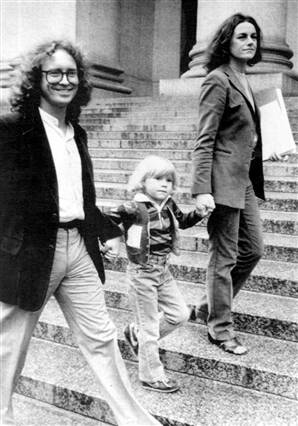
Bill Ayers and Bernardine Dohrn with son outside federal courthouse in New York, 1982. Photo by David Handschuh / AP.

It’s a strange sensation to be assigned a role — in my case “unrepentant terrorist” (wrong on both counts) — to be handed a script, and then to discover that no editing or improvisation is permitted. I read time and again that I’m wandering around saying “guilty as hell, free as a bird,” — unrepentant, triumphant, arrogant — when what I actually wrote was, “among my sins — pride and loftiness — a favorite twinkling line… guilty as hell, free as a bird…” Sins? Oh my, is that repentant enough? Apparently not. This feels more totalizing than a conspiracy. It feels like the suffocating straightjacket of common sense.

What complicates matters, too, is the wide range of vaguely constructed offenses — some internally contradictory, others pitting complaining commentators directly against one another — for which I’m putatively guilty and urged to confess. Inclined to apologize, I’d be hard put to know where to begin; I feel, then, like the man asked by the police inspector if he’s now sorry for beating his wife over all these many years who says, “But I didn’t beat my wife,” to which his interrogator replies, “So you’re still not sorry?”

Any normal person is expected to already know and accept that being a Weatherman is synonymous with fanaticism, violence, and murder. There’s no need for a normal person to read the book — others will read it for them, tell them what it says, and save them the trouble. The campaign around the book pushes forward, and the book itself is but a footnote. Any normal person skips over the footnotes.

Another Big Lie is the famous Charles Manson story. Bernardine was reported to have said in the middle of a speech at an SDS meeting in Flint, Michigan, “Dig it! First they killed those pigs and then they put a fork in their bellies. Wild!”

I didn’t hear that exactly, but words that were close enough I guess. Her speech was focused on the murder just days earlier of our friend Fred Hampton, the Black Panther leader, a murder we were certain — although we didn’t know it yet — was part of a larger government plot, the Gestapo-like tactics of an emerging police state. She linked Fred’s murder to the murders of other Panthers around the country, to the assassinations of Malcolm X and Patrice Lumumba, the CIA attempts on Fidel’s life, and then to the ongoing terror in Viet Nam.

“This is the state of the world,” she cried. “This is what screams out for our attention and our response. And what do we find in our newspapers? A sick fascination with a story that has it all: a racist psycho, a killer cult, and a chorus line of Hollywood bodies. Dig it!…” So I heard it partly as political talk, agitated and inflamed and full of rhetorical overkill, and partly as a joke, stupid perhaps, tasteless, but a joke nonetheless — and Hunter Thompson for one was making much more excessive, and funnier, jokes about Charles Manson then, and so was Richard Pryor.

Not only is it apocryphal and demonizing, it’s irrefutable — every attempt to explain, including possibly what I just wrote above, is held up to further ridicule, as deeper dimensions and meanings are slipped into place and attached to the story. Elizabeth Kolbert of the New Yorker, for example after a three hour conversation, reached over and touched Bernardine’s arm and said, “I just have to ask you about the Manson quote. It’s my duty as a journalist.”

I heard Bernardine respond in full, explaining the context, the perverse humor of it, Fred’s murder and all the rest, her own meaning-making and her sense of its meaning to insiders and outsiders alike. It made no difference: Kolbert reported the received story intact without any mention of any part of their exchange, and with this added fiction: “The Manson murders were treated as an inspired political act.” Not true, not even close, a lie on every level.

And two months later Steve Neal of the Chicago Sun-Times, playing off Kolbert, wrote: “…the Weathermen idolized killer Charles Manson and adopted a fork as their symbol…” Not true, not true. But what’s the use? By the end of the year a Time magazine essayist called me an “American terrorist,” and echoing the New York Times, said that “even today he finds ‘a certain eloquence to bombs.’” It’s all part of the endlessly-repeating official account, the echo that grows and grows as it bounces off the walls. How can it ever be effectively denied?

Also see:

The Rag Blog

Posted in Rag Bloggers | Tagged , , , , , , | 4 Comments

Race and Marriage : New Day Dawning?

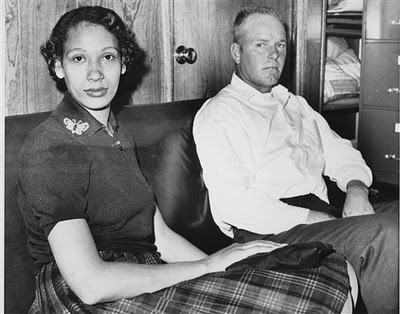
The picture above is of Mildred Loving and her husband Richard. They were arrested in Virginia for marrying outside their race and took their case to the United States Supreme Court. In 1967, the Supreme Court used their case to unanimously strike down all laws preventing interracial marriage. Their love and courage helped make this a better country.

As teabagger racism surges:
Poll shows evolving attitude
Towards interracial marriage

By Ted McLaughlin / The Rag Blog / June 7, 2010

When the people of the United States elected an African-American to be president in 2008, many people viewed this as an example of the progress that has been made in this country’s fight against racism. As a person who grew up in Texas during the dark years of segregation (I was a senior in high school when my city’s high school was desegregated), I was very proud of the election of President Obama. It was an accomplishment that I never expected to see in my lifetime.

While I do think that election showed this country has made progress, we are by no means in a post-racial era. We still exhibit and accept far too much racism in this country, and that is shown by what has happened since President Obama’s election. His election has emboldened and angered many of the remaining racists, and they are now crawling back out from underneath their rocks and making themselves known.

What is sad is that these die-hard racists have been accepted into other political groups — probably to try and increase their numbers. The conservatives (and their largest political party — the Republicans) suffered a crushing defeat in the 2008 election. This combined with the recession that really kicked into high gear during Bush’s last year in office, and suddenly people were very angry at government — a government that failed to protect them and control the greed of Wall Street.

New angry groups of conservatives sprang up (like the various teabagger groups) and were instantly embraced by the Republican Party. Unfortunately, these groups accepted into their ranks many die-hard and open racists. These groups have tried to deny they are racist in nature, but all one has to do is read the signs at their rallies to know that is just not true. While all the members of these groups may not be racist, a large number of them are and in some places the racists are actually among the leaders.

Once again it seems to have become acceptable to view and pass around racist jokes and cartoons — especially among right-wingers. One just has to view the numerous cartoons and jokes about President Obama and his lovely wife that are flying around the internet to know this. Open racism seems to be in vogue again with many people.

There are two possible reasons for this. Either we as a country are regressing to a time when racism was an acceptable way of life, or we are witnessing the death throes of this kind of open and unashamed racism (because any belief that is dying will fight the hardest and be most vocal just before it finally dies out). I sincerely hope we are currently witnessing the latter.

There is some evidence that the latter may be true, and it comes from an unusual source — marriage. It has been known that the younger generation as a whole is not as racist as the generations that have preceeded them, giving credence to the hope that each new generation will be less racist than those that they are replacing. A new study released by the Pew Research Center on June 4 of this year shows that to be true.

The Pew study looked at the incidence of interracial marriage in the United States. The study shows that not only has interracial marriage climbed significantly in the last 30 years, but the rate of interracial marriages among those newly married has climbed even more significantly. Here are the figures:

ALL THOSE CURRENTLY MARRIED
1980………………..3.2%
1990………………..4.5%
2000………………..6.8%
2010………………..8.0%

ALL THOSE NEWLY MARRIED
1980………………..6.7%
2010………………..14.6%

The younger generation is simply not as racist overall as older generations, and they show this when it comes to making a lifetime commitment in a love relationship. This has steadily climbed higher over the last 30 years, and there is no reason to believe it won’t continue to do the same in coming years. And the more that these marriages happen (and interracial children are born), the less it will make sense to discriminate against those of another race (especially the children who have the same family genes and blood).

But there is even more reason for hope. It seems that majorities of all races are perfectly willing to accept these interracial marriages, even among members of their own families. More and more people are discovering there are some decent and really incredible people in other races. Here are the figures (by race) on acceptance of a family member marrying someone of a different race:

I WOULD ACCEPT A FAMILY MEMBER MARRYING A
Black………………..66%
Hispanic………………..73%
Asian………………..75%
White………………..81%

Of course racism will not be defeated until all of these numbers are 100%, and they are certainly not there yet. We still have a long way to go and the road will not be easy. The die-hard racists will fight America’s progress every step of the way. But these new figures give us reason to hope for a brighter and racist-free future.

I could be wrong, but I prefer to be an optimist about America’s future. We have come a long way since the Constitution was written, and fortunately that document was flexible enough to allow that progress. The United States is far from perfect, but we are a better country today than we have ever been before. That’s why I believe we are today witnessing the loud and obnoxious beginnings of the death throes of overt racism.

But we cannot let up. We must keep the faith and continue the fight. A post-racial America is possible — but only if we are willing to fight for it and accept nothing less. And we must each, regardless of our race or color, do our part.

[Rag Blog contributor Ted McLaughlin also posts at jobsanger.]

The Rag Blog

Posted in Rag Bloggers | Tagged , , , | 3 Comments

Fort Hood’s Eric Jasinski was court martialed and is being denied benefits after he went AWOL to seek treatment for serious PTSD. after he was “stop-lossed” by the army. His case is representative of a growing number of soldiers returning form the occupations of Iraq and Afghanistan who are going AWOL after being unable to receive proper mental health care from the military.

Posted in RagBlog | Leave a comment

Dahr Jamail : Eric Jasinski, the Army, and PTSD

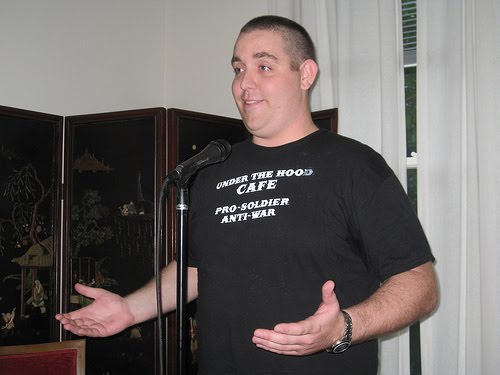
Eric Jasinski at benefit for Under the Hood Cafe, May 24, 2010. Photo by Alice Embree / The Rag Blog.

Ft. Hood’s Eric Jasinski:
PTSD soldier punished by army

Jasinski’s case is representative of a growing number of soldiers returning from the occupations of Iraq and Afghanistan who are going AWOL when they are unable to get proper mental health care treatment from the military for their PTSD.

By Dahr Jamail / June 7, 2010

[This article about Ft. Hood GI Eric Jasinski and the military’s handling of GIs with post-traumatic stress disorder (PTSD) was written by Dahr Jamail and distributed by Truthout. See links below for previous Rag Blog articles about Jasinski, PTSD, and the GI anti-war movement.]

Iraq war veteran Eric Jasinski, after seeking treatment for his post-traumatic stress disorder (PTSD), is being punished by the Army.

Jasinski turned himself in to the Army late last year, after having gone absent without leave (AWOL) in order to seek help for his PTSD. Help, he told Truthout, he was not receiving from the Army, even after requesting assistance on multiple occasions.

He was court-martialed and jailed for 25 days for having gone AWOL, during which time he was escorted in shackles to therapy sessions for his PTSD. After being released from prison, he was informed that he would be given an other-than-honorable discharge, which means he is likely ineligible for full PTSD treatment from the Veterans’ Administration (VA) after he leaves the service.

Jasinski enlisted in the military in 2005, and deployed to Iraq in October 2006 as an intelligence analyst with the U.S. Army. He collected intelligence in order to put together strike packets — where air strikes would take place.

Upon his return to the U.S. after his tour, Jasinski was suffering from severe PTSD due to what he did and saw in Iraq, along with remorse and guilt for the work he did that he knows contributed to the loss of life in Iraq.

“What I saw and what I did in Iraq caused my PTSD,” Jasinski, 23-years-old, told Truthout during a phone interview. “Also, I lost a good friend in Iraq, and I went through a divorce — she left right before I deployed — and my grandmother passed away when I was over there, so it was all super rough on me.”

Upon returning home in December 2007, Jasinski tried to get treatment via the military. He was self-medicating by drinking heavily, and an over-burdened military mental health counselor sent him to see a civilian doctor, who diagnosed him with severe PTSD.

“I went to get help, but I had an eight hour wait to see one of five doctors. But after several attempts, finally I got a periodic check up and I told that counselor what was happening, and he said they’d help me… but I ended up getting a letter that instructed me to go see a civilian doctor, and she diagnosed me with PTSD,” Jasinski explained. “Then, I was taking the medications and they were helping, because I thought I was to get out of the Army in February 2009 when my contract expired.”

As the date approached, Jasinski was stop-lossed (an involuntary extension of his contract), an event that he said “pushed me over the edge” because he was told he was to be sent to Iraq within a month.

During his pre-deployment processing, “They gave me a 90-day supply of meds to get me over to Iraq, and I saw a counselor during that period, and I told him,’ I don’t know what I’m going to do if I go back to Iraq.'”

“He asked if I was suicidal,” Jasinski explained, “and I said not right now, I’m not planning on going home and blowing my brains out. He said, ‘Well, you’re good to go then.’ And he sent me on my way. I knew at that moment, when they finalized my paperwork for Iraq, that there was no way I could go back with my untreated PTSD. I needed more help.”

Jasinski went AWOL, where he remained out of service until Dec. 11, 2009, when he returned to turn himself in to authorities at Fort Hood, in Killeen, Texas.

“He has heavy-duty PTSD and never would have gone AWOL if he’d gotten the help he needed from the military,” James Branum, Jasinski’s civilian lawyer, told Truthout. “This case highlights the need of the military to provide better mental health care for its soldiers.”

Branum, who is also co-chair of the Military Law Task Force, told Truthout in December, “Our hope is that his unit won’t court-martial him, but puts him in a warrior transition unit where they will evaluate him to either treat him or give him a medical discharge. He’d be safe there, and eventually, they’d give him a medical discharge because his PTSD symptoms are so severe.”

But the Army scheduled a Summary Court Martial for March 31. At it, Jasinski was sentenced to 30 days in the Bell County Jail in Texas. Laura Barrett, Jasinski’s mother, told the Temple Herald Telegram, “This has been a total outrage. I cannot believe my son who is diagnosed with PTSD from his deployment to Iraq would be sent to jail.”

Branum submitted a clemency request asking that Jasinski be released on mental health grounds, or that he be transferred to the psych ward at Darnall Army Medical Center to complete his sentence. The Army did not respond.

Branum said, “We, as Americans, need to see how combat vets are treated today. Eric is in jail because he has PTSD and was denied the care he needed. His ‘desertion’ was an act of desperation, the act of a soldier who had no other options.”

Jasinski wrote a letter from the Bell County Jail that said the following:

“When I am taken out of jail back to Fort Hood for any appointments I am led around in handcuffs and ankle shackles in front of crowds of soldiers… which is overwhelming on my mind. My guilt from treating prisoners in Iraq sub-human and I did things to them and watched my unit do cruel actions against prisoners, so being humiliated like that forces me to fall into the dark spiral of guilt. I now know what it feels like to have no rights and have people stare and judge based on your shackles and I feel even more like a monster cause I used to do this to Iraqi people.

“Even worse is the fact that this boils down to the military failing to treat my PTSD but I am being punished for it… I feel as if I am being a threat to others or myself and still the Army mental health professional blow me off just like in 2009 when I felt like I had no choice but to go AWOL, since I received a 5 minute mental evaluation and was stop-lossed despite my PTSD, and was told that they could do nothing for me. The insufficient mental evaluation from a doctor I had never seen before, combined with the insufficient actions by the doctor on 9 April show the Army is not trying to make progress.”

Jasinski was released from jail on April 24, having served 25 days of a 30-day sentence. He has since been informed he will receive an other-than-honorable discharge, which means he will not have full health benefits with the Veterans’ Administration, and thus little to no assistance from the military for treating his PTSD.

According to the Army, every year from 2006 onwards has seen a record number of reported and confirmed suicides. A 2008 Rand Corporation report revealed that at least 300,000 veterans returning from both wars had been diagnosed with severe depression or PTSD.

Jasinski’s case is representative of a growing number of soldiers returning from the occupations of Iraq and Afghanistan who are going AWOL when they are unable to get proper mental health care treatment from the military for their PTSD.

Jaskinski’s experience with the military has inspired him to offer advice for other soldiers who need PTSD treatment but are not receiving it.

When asked what he feels the military needs to do in order to rectify this problem, he said, “A total overhaul of the mental health sector in the military is needed… we had nine psychiatrists at our center, and that’s simply not enough staff, they are going to get burned out after seeing 50 soldiers each in one day. We need an overhaul of the entire system, and more good psychiatrists, not those just coming for a job, but good, experienced mental health professionals need to be involved.”

Chuck Luther, who served 12 years in the military, is a veteran of two deployments to Iraq, where he was a reconnaissance scout in the 1st Cavalry Division. The former sergeant was based at Fort Hood, Texas, where he lives today. Luther told Truthout in November that the military tried to discharge him without assisting him with his PTSD, instead diagnosing him with “personality disorder.”

In response, Luther went on to found and direct “The Soldier’s Advocacy Group of Disposable Warriors.”

“The way things are set up right now in the military is that if a soldier gets a chance to go to mental health, which is something military commanders tend to try to prevent from happening in the first place, but if soldiers go, psychologists and psychiatrists address and diagnose their PTSD and write it up, but this does not mean that they will get treatment,” Luther explained to Truthout.

At the time, he described a situation very similar to that of Jasinski’s.

“The doctors then send it to command, but that doesn’t mean the soldiers will get treatment,” said Luther. “The soldier can push it up to the commander, but the commander can deny it and that’s as high as it gets. Soldiers are listed as not being able to serve by a military doctor, but they are nonetheless medicated and sent out into combat anyway.”

“The military is trying to get everybody these ‘other-than-honorable discharges’ or diagnosing them with ‘personality disorder’ so they don’t have to take care of them after they discharge,” Aaron Hughes, an Iraq war vet, told Truthout.

Hughes, a national organizer for the group Iraq Veteran’s Against the War, said that Jasinski was already involved in the paperwork process required by the military for him to receive a medical discharge.

“This was underway when he went to jail,” Hughes added, “He would do his time for going AWOL, then get a medical discharge. Instead, they are switching this mid-stream and giving him an ‘other-than-honorable’ discharge, which means he gets no benefits. My main concern is that he did his time and did everything he was supposed to do, and they are still not living up to their side of the bargain.”

Kernan Manion is a board-certified psychiatrist who treated Marines returning from war who suffer from PTSD and other acute mental problems born from their deployments, at Camp Lejeune — the largest Marine base on the East Coast. While he was engaged in this work, Manion warned his superiors of the extent and complexity of the systemic problems, and he was deeply worried about the possibility of these leading to violence on the base and within surrounding communities.

“If not more Fort Hoods, Camp Liberties, soldier fratricide, spousal homicide, we’ll see it individually in suicides, alcohol abuse, domestic violence, family dysfunction, in formerly fine young men coming back and saying, as I’ve heard so many times, ‘I’m not cut out for society. I can’t stand people. I can’t tolerate commotion. I need to live in the woods,'” Manion explained to Truthout. “That’s what we’re going to have. Broken, not contributing, not functional members of society. It infuriates me — what they are doing to these guys, because it’s so ineptly run by a system that values rank and power more than anything else — so we’re stuck throwing money into a fragmented system of inept clinics and the crisis goes on.”

“It’s not just that we’re going to have an immensity of people coming back, but the system itself is thwarting their effective treatment,” Manion said.

Jasinski told Truthout that his previous commander, who he referred to as Captain Floer, told his mother that Jasinski was “faking my PTSD symptoms,” since “the job he held {in Iraq] was behind a computer.”

While in jail, Jasinski was denied access to his regular therapy sessions. He was taken periodically to other sessions, but he told Truthout, “The mental health center on Fort Hood told me I had to wait for more help.”

At a later session at the same center, Jasinski said,”I was told upon my follow-up visit that my suicidal ideations were all in my head and was sent on my way.”

“Again the military is casting its soldiers aside, and shows no mercy for soldiers or their families,” Jasinski told Truthout, “I do not want their money, but I want them to at least acknowledge and act upon the problems in order to repair the broken system. I want them to take action instead of worrying about public relations.”

[Houston native Dahr Jamail, an independent journalist, is the author of The Will to Resist: Soldiers Who Refuse to Fight in Iraq and Afghanistan, (Haymarket Books, 2009), and Beyond the Green Zone: Dispatches From an Unembedded Journalist in Occupied Iraq, (Haymarket Books, 2007). Jamail reported from occupied Iraq for nine months as well as from Lebanon, Syria, Jordan and Turkey over the last five years.]

Source / Truthout

Also see:

The Rag Blog

Posted in RagBlog | Tagged , , , , , , | 1 Comment

Marc Estrin : Slaughter of the Innocents

Image from picsdigger.

SLAUGHTER OF THE INNOCENTS

By Marc Estrin / The Rag Blog / June 6, 32010

Toward the end of Bread & Puppet’s marvelous Christmas Story, after the news spreads of Jesus’s birth, King Herod picks up the phone:

“Hello, Third Army? Go straight to Bethlehem and kill all the children.”

In the next scene a large soldier marches in, in full battle array, and knocks on the door of a tiny puppet house.


”Good evening, Ma’am. Do you happen to have any children in the house?”
“Oh, yes, of course,” the little hand-puppet says. “Hansie and Mariechen.”
“Can you bring them out, please?”
“Oh certainly, Sergeant. But…why?
“We want to kill them.”
“Oh.”

The mother then tells the sergeant an amazing story that he’ll “never believe, but…” about how the children were just taking a bath and then — by accident — they were washed down the drain. The sergeant, stupefied, weeps.

“Oh, lady, that’s really terrible. Allow me to extend the condolences of the entire Third Army.”

He marches off to the next house where he finds that the six children happened to have just marched off six weeks ago and haven’t come back yet.

“Men, King Herod isn’t going to be too pleased about this.”

The next house turns out to be the Bethlehem Nursery, “And we have 55 sweet, little darlings fast asleep in their sweet little beddy-byes,” says the Nurse out her window, “AND YOU GORILLAS ARE WAKING THEM UP WITH YOUR SCREAMING. You better go play soldier somewhere else, or I’ll call the authorities.”

“Lady,” says the sergeant, “we are the authorities.”

The Slaughter of the Innocents is not an aspect of the Christmas story dwelt on during our consumerist, Hallmarky season. In fact, it’s not dwelt on at any other time — whether the Innocents be the Iraqi, Afghani, Pakistani, or Palestinian dead, the humanitarians aboard the Mavi Marmara or the recipients of its aid, Rachel Corrie herself, crushed by an Israeli bulldozer, or the newly oiled seabirds, fish and fishermen in the Gulf.

“I’ll call the authorities,” the public says, only to discover that “We” — the perpetrators — “ARE the authorities.”

It was the authorities who set up the enrichment of the rich and the impoverishment of the rest. It is the authorities who promote the mass murders of the military industrial complex with their endless wars and genocides, and who pocket the cash and power. It is the authorities who enable the destruction for profit of the environment, and call for economy on collapsing infrastructures, concrete and human. Is current “authority” any less than a sociopathic criminal enterprise?

The moment captured at the end of the Bread & Puppet Christmas Story provides the insouciant watchword of our time: “Lady, we are the authorities.”

[Marc Estrin is a writer and activist, living in Burlington, Vermont. His novels, Insect Dreams, The Half Life of Gregor Samsa, The Education of Arnold Hitler, Golem Song, and The Lamentations of Julius Marantz have won critical acclaim. His memoir, Rehearsing With Gods: Photographs and Essays on the Bread & Puppet Theater (with Ron Simon, photographer) won a 2004 theater book of the year award. He is currently working on a novel about the dead Tchaikovsky.]

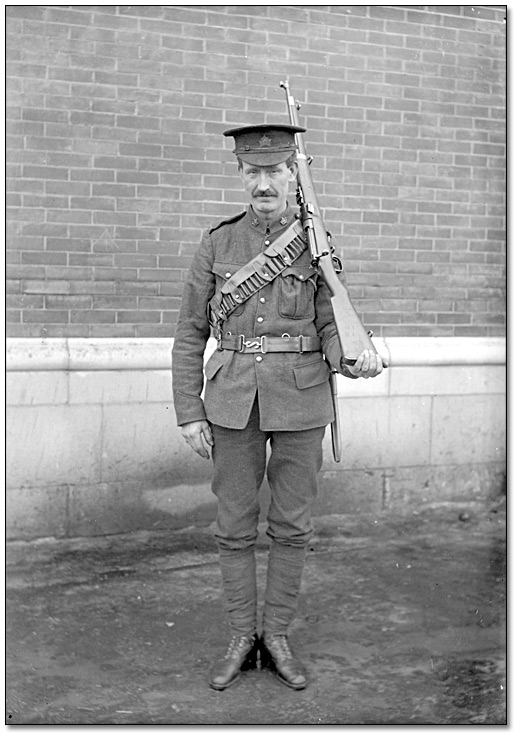
Soldier standing at attention (1914). Photo by A.W. Barton / Archives of Ontario.

The Rag Blog

Posted in Rag Bloggers | Tagged , , | Leave a comment

El Monstruo, or “The Monster,” a work by lefty John Ross, published last fall by Nation Books, is ostensibly a history of Mexico City. As such, faces an insurmountable challenge.
Founded in 1325 and today with a population of about 23 million, Mexico City has over the past century become to its nation what a combined Washington, D.C., New York and Hollywood would be to the United States. It is Mexico’s political, financial and movie capital, and also the seat of light manufacturing. Though it is possible to write an architectural or art history of the city, no one can compile a political history of Mexico City that is not also a chronicle of the rest of Mexico–and nobody has successfully done that in one volume. The 500 pages of El Monstruo rank Ross with the best of them that’s tried.
The problem with any informed accounting of Mexico is that its historical figures, like assassins, are often deadly, swift and seemingly mad. American historians may forever fret over the question, “Who was our worst president?”—Andrew Johnson? Calvin Coolidge? George W. Bush? But none of them held office for more than two terms. Antonio Lopez de Santa Anna, by contrast, was president Mexico 11 times, in periods both before and after his capture at San Jacinto. He’s easy to recognize as Mexico’s worst president, but that only makes the historians’ question more vexing: During which term of office was he at his worst?
The American presidents John F. Kennedy and George H.W. Bush suffered serious injuries in foreign conflicts, but Mexico has had two amputee presidents, both of whom lost their limbs in civil wars. If American history is comparative, Mexico’s history is superlative.
Though he is not a writer whom Mexicans call “indigenist”—one who equates the Conquest with the Fall–in analyzing the Revolution of 1810, Ross sympathizes with Father Hidalgo’s dark-skinned hordes, and he paints the mid-19th-century Zapotec president, Benito Juarez, as nearly a saint. According to Ross, the Revolution of 1910, like a massive freeway pileup, left nothing but death and wreckage in its wake. The Revo, Ross argues, was murdered with Zapata, “although it has lurched around like an untidy zombie ever since.”
By not depicting Mexican history as a series of stumbles towards a better day, he breaks from the tradition of writers on the Left, whose scribes always preach hope. Only a few years ago Ross was an admirer of Subcomandante Marcos and the contemporary Zapatistas, but he has given up most of that. In El Monstruo, he predicts that no revolution is coming in 2010, and that the nation’s dominate left-wing formation, the Partido de la Revolucion Democratico, will probably be mired in internal tiffs when the 2012 presidential election comes.
What especially sets Ross apart from both mainstream and left-wing commentators of both countries in discussing Mexico’s straits is his refusal to grant any quarter—after 1940, anyway–to the Partido Revolucionario Institucional, or PRI, which held congressional majorities and the presidency from 1929 until 2000. His exposition of its evolution is important today because the PRI is climbing into power.
From about 1940 onwards, the orthodoxy upheld by scholars and the press—and even the Mexican Communist Party–was that Mexico was a democracy of a unique kind. Its uniqueness lay in its one-party character. Oddlky, what qualified it as a democracy was its “pluralism:” though communism was often illegal, communists did opine in newspaper and magazine columns, teach at universities and produce films. Mexico was not the home of any Red Channels or Hollywood Ten. But student protestors, union and peasant organizers who tried to distribute handbills risked their lives.
American enthusiasm for PRI peaked, as Ross points out, during the 1988-1992 presidency of Carlos Salinas de Gortari, whom the New York Times billed as a “brilliant theoretician” and the Dallas Morning News called “a man on a white horse.” In contemporary Mexico, though nobody can challenge Santa Anna, Salinas is on the runner-up list of worst presidents. Ross can claim, to his credit, that he never cut any slack to the PRI.
Now 72, he first saw Mexico City in the late ‘fifties as a Beat expatriate and poet. He still publishes in its genre today. His latest chapbook, “Bomba” includes these lines, bound to be of comfort to anybody of his generation and political stripe. Their import is more universal than anything to that has to do with Mexico.
The Revolution does not begin.
The Revolution has no beginning.
The Revolution is unending.
The Revolution is not like a faucet—
You can’t turn it on and off.
The Revolution leaks all the time—
You can’t call a plumber to fix it.

Since his return to Mexico in 1985, Ross has written dozens, perhaps hundreds of dispatches plus a half-dozen books, almost all for the left-wing press. The last third of the El Monstruo is liveliest because it deals with events and practices that he observed, not from the airy perches of the Establishment press, but on the sidewalks outside of the creaky downtown hotel where he lives. His best paragraphs are about daily life, as in these lines from Pages 293-294:
At first glance the ambulantaje or street commerce appears to be chaotic—but the chaos is fine-tuned. Associations of street vendors impose their own order. The juice vendors come out early to catch the predawn breakfast crowd, taqueros … are on the streets in time to feed those rushing for work. General merchandise, fayuca (domestic appliances and other pirated goods), set up by mid-morning and carry on until dark. Merengue (homemade candy) vendors appear in the afternoon, and the camoteros—sweet potato people with their peculiar whistling carts—take over in the evening.”

The best of John Ross, however, is also often the worst of John Ross. The sentence beginning with “General merchandise” is ungrammatical, and he salts his copy with Spanish words and slang, often defined in parentheses, as if El Monstruo were a language text. Sometimes his Spanish is converted into English in a glossary that his editors no doubt compiled. But they missed a lot. Ross once uses the term jipi, which his glossary correctly defines as “hippie”—but what’s the point, to show that the sound of the English ‘h’ is represented by the Spanish ‘j’?
When he mentions that “La mota is for sale 25 hours a day,” most Texans his age probably know that “mota” is marijuana, but it’s unlikely that most Americans do—and his glossary doesn’t translate that.
I don’t think it stands in his defense that he sins bilingually. “Rateros … were sometimes stomped to death by their intended vics,” he writes. Though his glossary correctly identifies rateros as thieves, as a literate American, I was momentarily puzzled by “vics,” a particle that apparently means ‘victims.’
“ … Paco Stanley was whacked in the parking lot of a glitzy taqueria, ” Ross reports. A television personality, Stanley was shot, killed on the spot in 1999, Ross afterward lets us know. But pages later, he avers that “Another luminary whacked by the still-secret plague was … Manuel Camacho Solis.” The politician Camacho, a victim of the swine flue, is still very much alive. In bypassing useful if common words like ‘shot,’ ‘killed,’ ‘murdered,’ or ‘stricken’ in favor of less precise slang like ‘whacked,’ Ross may have thought he was paying homage to the Beat tradition. But in my eyes, slanginess signals the descent of a writer into the discourse of everyday speech.
Throughout his book, even in chapters about colonial days, Ross intersperses reports on conversations with the regulars at his downtown Mexico City hang-out, a restaurant called La Blanca. These pieces are valuable as slices of mundane modern life, but they belong in another volume, perhaps “Chat and Chew with John Ross.” In El Monstruo they take on the character of television or radio commercials, unwelcome breaks from the business at hand.
Despite these flaws, El Monstruo is vital reading, even in a world in which, until a month ago, Islamology was the hottest game in serious journalism. Especially in the days since Sept. 11, 2001, Mexico has been reported as merely the home of hungry hordes and trigger-happy hoodlums. The panic of Arizona is a reflex of a deepening ignorance among Americans of the facts of Mexican life, something which El Monstruo could do a lot to correct.
In my view, however, the book offers something even more important than that. It ought to be required reading—“guilt” reading, even—for the educated class in Texas. Most of the members of this strata, among whose number I include myself, have read a history of New York City, or if not, at least several tomes set in that metropolis. Many literate Texans are fluent in the differences between Chelsea and Queens, but only a few of them can distinguish between Las Lomas and Iztacalco.
Mexico City, my computer tells me, lies 757 miles from Austin; New York is 1515 miles distant, nearly twice as far. Anyone who reads Texas history —or any Texan who merely looks into the nearest restaurant kitchen or onto the nearest construction site, or listens to hallway or airport chatter—knows that Mexico City is a lot more important to our lives than New York ever was; Texans of Mexican ancestry need only sign their surnames to know that. Any future happiness for Texas is inconceivable without taking account of Mexico, and any belief that New York is somehow more relevant to the state stands as an obstacle to our self-understanding. Ross, even though he’s an old beatnik from Manhattan, would readily agree to that.


Type rest of the post here

Source /

The Rag Blog

Posted in RagBlog | Leave a comment

Memorial Day in Texas : Farewell to Nick Travis and Lisa Morris

Nick Travis at the opening of the Under the Hood Café in Killeen, Texas. Photo by Carlos Lowry / The Rag Blog.

Memorial Day:
Texas peace movement
Looses two great friends

By Alice Embree / The Rag Blog / June 6, 2010

Memorial Day 2010 was a day to remember two friends who were mainstays of the Texas peace community. Nick Travis III, 55, passed away suddenly early Monday morning, May 24, in Austin. Lisa Morris, 28, passed away unexpectedly the next day in Copperas Cove.

Nick was a founding member of Instruments for Peace, an organizer along with Richard Bowden, of the annual Million Musicians March for Peace. He was a sustaining member of the Crawford Peace House and a Camp Casey regular. Nick and his wife, Melissa Garner, worked together to rebuild houses in New Orleans after Hurricane Katrina. They were also supporters of Under the Hood Café in Killeen, Texas, a pro-soldier, anti-war space for soldiers and their families, situated less than one mile from Fort Hood, the largest military base in the United States.

Lisa Morris, at the east gate of Fort Hood. Photo by Heidi Turpin / The Rag Blog.

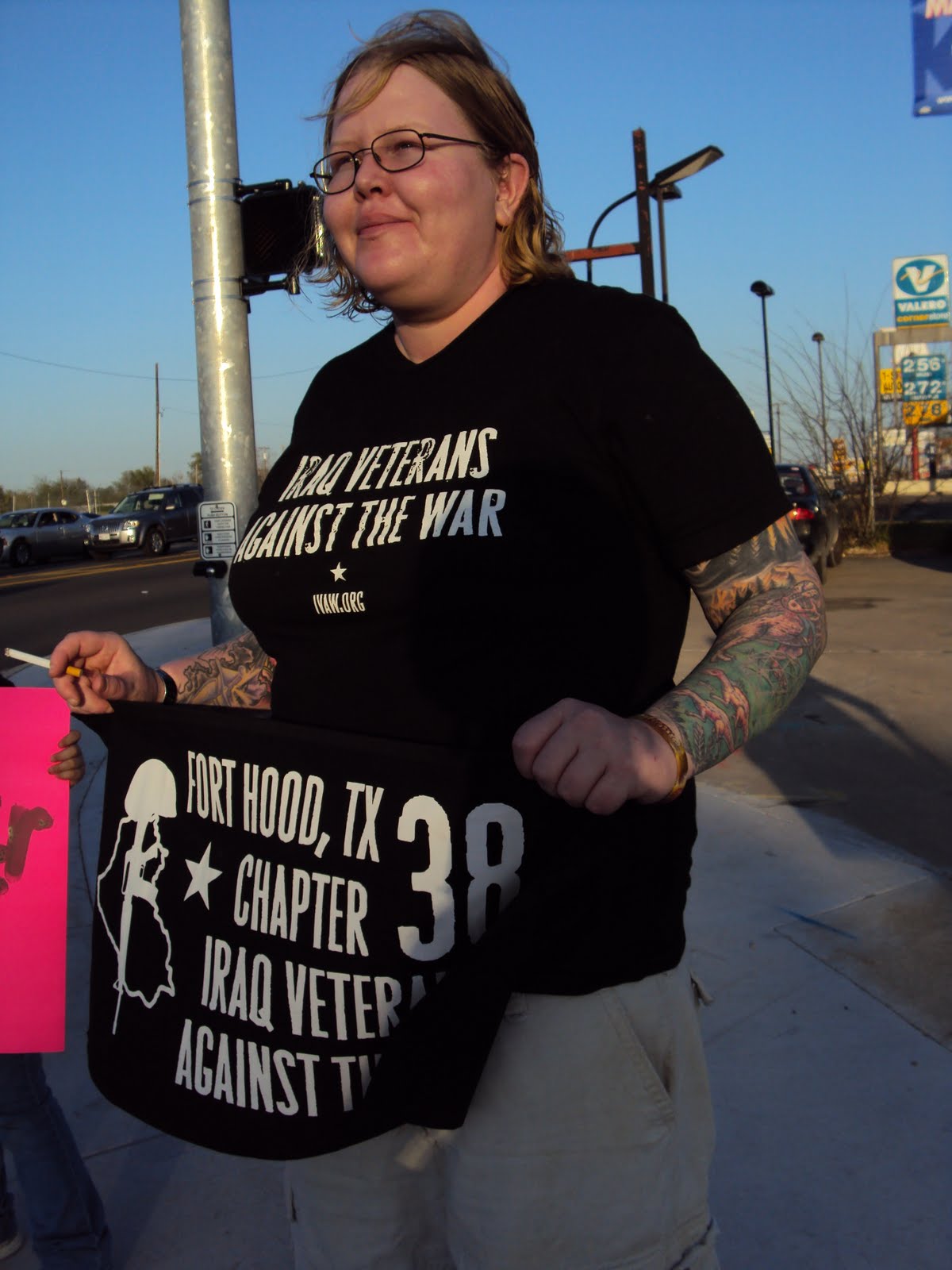
Lisa Morris was an Under the Hood regular. A graduate of Rockford High School in Michigan, Lisa enlisted in the Army and was deployed to Iraq. She was present during the fierce fighting at Sadr City in 2004 when Tomas Young, subject of the documentary Body of War, was paralyzed. The fighting at Sadr City also took the life of Casey Sheehan, peace activist Cindy Sheehan’s son. Lisa was wounded later at Sadr City. She received a Purple Heart.

Lisa was part of the Under the Hood family. After her discharge, she stayed in the Killeen area, buying a home in Copperas Cove where she was known for her barbequing skills, and was beloved by neighborhood children and adored by all cats and dogs that crossed her path. Like many of the soldiers at Under the Hood, Lisa suffered with symptoms of post-traumatic stress disorder. Days before her death she had been hospitalized for an infection. She died in her sleep at home.

Nick was a musician for 30 years in the Austin area, a bassist performing with Natalie Zoe, The Vanguards, Guy Forsyth, the Paul LeMond Band, and Leeann Atherton. In recent years, he accompanied Miss Lavelle White, John Gaar and the Hopeful Soul, and Julieann Banks. Nick was also an actor, appearing in films and commercials and as a body double for Billy Bob Thornton in “Friday Night Lights.”

With his wide grin and big heart, Nick was always there for the benefits and the marches, getting the stage set up at Camp Casey or City Hall. He would serve as the emcee for the Million Musicians Marches and Instrument for Peace gatherings. More than 150 musicians and friends celebrated his life on Memorial Day at Leeann Atherton’s Barn Dance site in Austin. One peace activist there said, “I feel like one side of the tent has fallen.”

Lisa’s life had only begun to take an activist turn after Iraq. She was a member of Iraq Veterans Against the War. For her Under the Hood family, her loss was devastating. At the memorial for Lisa in Killeen, a neighbor sported a fresh tattoo — a fitting permanent tribute to Lisa whose arms were covered with ink. The tattoo shows “America’s High Five,” a map of Michigan in plaid, and carries these words below the map: “R.I.P Lisa Morris, June 9, 1981 – May 25, 2010.”

In the ninth year of the war in Afghanistan, there are now a thousand U.S. dead. There are uncounted civilian deaths. Drone attacks and ambushes on celebrations occasionally make the news. Injured soldiers like Lisa return from the continuous waves of deployment with physical and psychological wounds.

The peace community must honor the lives of Nick Travis III and Lisa Morris. Then, in their memories, renew every effort to stop these endless wars before they morph across more borders and more decades. As Joe Hill urged before his death, “Don’t mourn, organize.”

[Long-time Austin activist Alice Embree is a contributing editor to The Rag Blog and a member of the board of the New Journalism Project.]

The Rag Blog

Posted in Rag Bloggers | Tagged , , , , , , , , , , , | 2 Comments

Nelson Mandela’s group of “Elders” — including six former winners of the Nobel Peace Prize — condemned Israel’s attack on the Gaza aid flotilla as “completely inexcusable” and called the three-year blockade of Gaza “one of the world’s greatest human rights violations.” Our post also includes a report about released German activists contesting the Israeli version of what happened on the ship — and an analysis of how the mainstream media has covered the events from the Israeli point of view.

Posted in RagBlog | Leave a comment

Larry Ray : BP Means You ‘Better Pray’

Time warp photo montage by Larry Ray / The Rag Blog.

Blessing of the Fleet:
Oil spill anxiety accompanies annual ritual

By Larry Ray / The Rag Blog / June 2, 2010

GULFPORT, Mississippi — The uncertainty of the huge BP oil spill out offshore from Biloxi, Mississippi, has not stopped this old world fishing community from holding its annual “Blessing of the Fleet” this coming weekend as it has every year since 1929. But it will not be quite the same. This year there is a palpable anxiety from the threat of the looming offshore disaster which will quietly mix in with the Cajun music, boiled shrimp, and deep fried mullet better known as “Biloxi bacon.”

The festival really gets rolling on a Saturday after Catholic masses for fishermen lost at sea and other recognitions starting on Thursday. But on Saturday the town turns out for a rollicking all day Cajun fais do do street party with lots of delicious seafood and culminates that evening with the coronation of the Shrimp Queen and King on the Biloxi Town Green. The blessing of the fleet takes place early afternoon on Sunday.

Eighty one years ago the fishing boats all rafted up side by side, with the priest climbing from boat to boat to sprinkle holy water and offer blessings for protection from the sea and bountiful catches. More recent blessings of the fleet have taken place with a special dockside altar for the priest who blesses a long and colorfully decorated parade of boats both large and small as they motor past.

This year, the devoutly Catholic ritual of blessing and protecting the fishing fleet and its largely immigrant boat owners and seafood workers should include a new definition of “BP” which now would now seem to mean, “Better Pray.”

For almost a month and a half, all of the oil exploration industry’s best efforts to staunch a high pressure gusher of thick oil and methane gas from a well blowout 5,000 feet beneath the surface of the Gulf of Mexico have come to naught. Oil giant BP’s efforts to crank up their public relations machinery to a loud and preposterous level has served only to offer false hope to an anxiously watching world.

Quickly stopping this disaster seems akin to stopping an erupting volcano. The maelstrom beneath the earth’s mantel, especially on the barely understood deep sea floor invites disaster if provoked. The rage of unstoppable oil seems to prove the point.

Yet, like wind-up talking toys, well groomed and slickly rehearsed BP top dogs continue to tell all who will listen that none of this is as bad as it seems and that great progress is being made in rounding up the miles of floating oil by either burning it or “collecting” it.

Their promises to clean up every drop of oily sludge that has filled sensitive Louisiana marshes and estuaries have not produced any sort of energetic or effective results. Undeterred, BP spews forth statistics and more promises while being careful to first run everything by their lawyers.

BP spokespersons tell one particular story at every possible opportunity as if all listeners were third graders. With confident, and concerned expressions they tell the tale of the hundreds of thousands of gallons of toxic oil dispersant, “like dish washing liquid” that are breaking the oil up into teensie little droplets so that starving bacterial can ravenously eat up all the oil. The BP bacterial buffet is really a wonderful thing, boys and girls!

However, BP denies the recent findings of a half dozen major universities whose marine exploration efforts now suggest that the dispersant being shot directly into the source of the gusher on the sea floor is merely keeping the oil out of sight on the surface. They are finding miles long areas of the broken-up oil hundreds of feet below the ocean’s surface, being moved and swept about like huge dark tendrils by currents at the water column at different depths. The new data suggests that bacteria won’t make a dent in this movable feast.

Strong currents may move these thick oil ribbons onshore at some point way in the future, or even into the “loop current” in the gulf. This would pull some of the tens of millions of gallons of oil between the tip of Florida and Cuba, and then on up the Atlantic coast.

Oil company big shots don’t like to be ordered around. After eight years of basically no meaningful regulation by the Bush-Cheney Minerals Management staff, and having helped formulate Cheney’s secret energy policy, BP and all the other big oil companies have learned that it is easy to outwit and out-wait the bureaucrats and that it is also much better for the bottom line. A steady flow of campaign money to state and national politicians also greases things nicely.

Smellier and dirtier than the oil slicks are the shameless political attacks from the nay-saying, do-nothing Republicans intent upon tearing down President Obama. Their first order of business is to blame it all on Obama. And the crass move is playing well because people want something done, anything, and aren’t capable of grasping the fact that this disaster may be uncontrollable by Obama, or any other mortal. Again, clear and honest explanations of the difficulty of stopping the oil flow, and the reasons why don’t satisfy three-year-olds.

BP was not required to undertake a detailed worst-case scenario environmental study because of their cozy relationship with Bush-Cheney era Mineral Management employees. Angry Americans should be screaming loudly at the drill baby drill Republicans still in office who, in effect, were in lock step with the Bush no regulation approach to environmental protection.

Meanwhile, the Priest and Catholic Bishop on hand this coming weekend better have plenty of holy water for this year’s blessing of the fleet, which includes many boats that have just rejoined the fleet after being destroyed by Hurricane Katrina in 2005.

This year’s hurricane season starts just a few days before BP… Biloxi’s Prayers.

[Retired journalist Larry Ray is a Texas native and former Austin television news anchor. He also posts at The iHandbill.]

The Rag Blog

Posted in Rag Bloggers | Tagged , , , , , , , , , | 3 Comments

Mission Possible? : Visualize Skimmers and Booms

Crude oil collects on the wrong side of an orange containment boom in Pass a Loutre near Venice, Louisiana, May 30, 2010. Photo by A.J. Sisco / UPI.

Skimmers and booms:
Keywords for victory on the Gulf Coast

By Greg Moses / The Rag Blog / June 2, 2010

If Americans want to visualize victory over the oil spill invasion that threatens our beloved Gulf of Mexico, then we should call for a federalized war of skimmers and booms.

We should not be timid about it. We should visualize a series of booms in concentric rings that contain the spill, with skimmers at work within each ring, sucking up the oil. Industry websites claim that extracted oil can then be mixed with chemicals and reused for fuel.

The effort might also be helped by supertankers “that come in empty, with the huge valves and huge pumps that they have to suck the oil off the surface of the sea so it stops drifting into the wetlands,” says former president of Shell Oil John Hofmeister in a recent interview with the BBC.

As part of this winnable war, dispersants must be stopped.

Our winning hope for this war is nicely exemplified by the Coast Guard Cutter Walnut, which just left Hawaii for her 6,000-mile journey to the Gulf.

“The Walnut is 225-feet long, has a crew of about 50 people, and boasts state-of-the-art communications equipment and oil skimming capabilities,” reports Minna Sugimoto for Hawaii News Now. “Designed after the Exxon Valdez disaster in 1989, the Walnut comes equipped with a boom and pump oil collection system.”

“The skimmer sucks the oil in and pumps it into a bladder,” says Jeffrey Randall, U.S. Coast Guard commanding officer. “That bladder is then filled up, transferred to another vessel that takes it away.”

“Coast Guard officials say the crew goes through annual spill response training, but this will be the first time it’ll actually put oil in the equipment,” Sugimoto reports.

As early as April 29 the Los Angeles Times was reporting the Navy’s mobilization of booms and skimmers and the “opening (of) two of its bases in Mississippi and Florida as staging areas.” WLOX- Biloxi reporter Steve Phillips filed an eyewitness account of the activity from the Gulfport Seabee base.

Vice Adm. Kevin McCoy is commander of the U.S. Navy’s Naval Sea Systems Command’s (NAVSEA) which includes the Supervisor of Salvage and Diving (SUPSALV). Within these commands we find initial offerings of equipment, expertise, and training that will be required to defend the Gulf of Mexico against the oil spill invasion.

“A team of NAVSEA professionals are working around the clock to protect the sensitive coast lined with oil booms and perform open-ocean skimming at the source,” says Vice Adm. McCoy at a web page posted by the Naval News Service (NNS).

“NAVSEA’s Chief Engineer for Underwater Salvage (Capt. Patrick Keenan) has been an integral member of BP’s Engineering Command Cell that has assembled the best and brightest minds from around the world to try to stop the leak,” said Vice Adm. McCoy.

“With a single phone call from the U.S. Coast Guard, 66,000 feet of open ocean boom and nine self-contained skimming systems, and the professionals to install and operate them, were dispatched (representing the initial shipment). That’s your Navy — a 24-hour Navy, incredibly ready and trained to respond to a wide variety of national taskings,” boasts Vice Adm. McCoy.

While the Coast Guard and Navy probably do not have enough booms and skimmers on hand to supply the war for the salvation of the Gulf Coast, they do appear to have sufficient knowledge to gather and organize the inventories and people needed. Surely there are enough booms and skimmers in the world that can be air-transported quickly and organized effectively.

Meanwhile, activists and biologists are converging on a consensus that toxic dispersants must be stopped.

“The use of dispersants is a crime on top of a crime, sanctioned by a federal agency, Lisa Jackson, and the EPA,” writes Elizabeth Cook at New Orleans IndyMedia. “It is the rape of the Gulf of Mexico, its sea creatures, and the people who depend on this ecosystem for a living.“

“Diluting the evidence, this (dispersant) solution was designed only for public relations, even as it made the situation much worse,” argues Linh Dinh at CounterPunch. “Imagine Agent Orange in the water. Thousands of people are already sick, with millions more to come.”

With enough booms to contain the spill, and enough skimmers to extract the oil from the water, there would appear to be no need to add the risk of toxic dispersants to the already toxic spill.

When on Sunday’s “State of the Nation” program, CNN’s Candy Crowley asked Joint Chiefs of Staff Chairman Admiral Mike Mullen to describe the military response to the Gulf oil spill, the answer she got was a textbook case of incoherence.

Within the space of 141 words the Chair of the Joint Chiefs zig-zagged between “a support role” that simply responded to BP requests on the one hand to “doing everything we can… with every capability that we have” on the other. His confusing ambivalence was perhaps best expressed in the sentence: “And as best I’ve been able to understand, the technical lead for this in our country really is the industry.”

While it may be true that the deep-water attempt to stop the oil spill belongs primarily to industry engineers (although, along with Dr. John, we may protest why this has to be the case) there is ample evidence that the military is perfectly qualified to take command of pollution control.

Remember Dunkirk or the Berlin Airlift? There are times in military history when impossible missions have been accomplished through mobilized determination. We should not give up hope that the war to the save the Gulf of Mexico can go down in history as one of those remarkable efforts.

Elizabeth Cook of New Orleans IndyMedia helped with research and issue development for this story.

[Greg Moses is editor of the Texas Civil Rights Review and author of Revolution of Conscience: Martin Luther King, Jr. and the Philosophy of Nonviolence. He can be reached at gmosesx@gmail.com.]

The Rag Blog

Posted in Rag Bloggers | Tagged , , , , , | 4 Comments