Sherman DeBrosse provides us with a revealing history of Afghanistan and the role of the drug trade, and informs us that “The U.S. used the international heroin network to serve its geopolitical aims in Afghanistan and elsewhere.” We learn of the parts played by the banks, the arms dealers, the war lords, and the CIA.

Posted in RagBlog | Leave a comment

John Ross reports form the Purepecha Indian village of Santa Cruz Tanaco in the Mexican state of Michoacan — about changes in the nature of agriculture in Mexico. He tells us about migration fueled by the 1994 North American Free Trade Agreement, and major lifestyle changes that have come as a result, including an increased role for women in the fields. This is a “bright light in a [otherwise] dismal prospectus,” as men tend to pin their hopes on the market, and women are more in sync with the land.

Posted in RagBlog | Leave a comment

Houston Alternative Media : Telling It Like It Was

Underground in H-Town. Art by Shelby Hohl / Museum of Printing History.

Underground [history] in H-Town:
Veteran journalists compare notes
On counterculture and alt media

By Raj Mankad / May 24, 2010

[Raj Mankad is the editor of Cite magazine, the “architecture and design review of Houston” that has been published quarterly by the Rice Design Alliance since 1982. OffCite, where this article first appeared, is Cite’s online incarnation.]

“The Knights of the Ku Klux Klan is watching you.”

An arrow bearing that note was shot into the Space City! office. The incident was one among many threats and acts of violence against progressive and radical institutions in Houston. The KPFT station transmitter was bombed off the air twice. Bullets were shot at and yellow paint thrown on the walls of Margaret Webb Dreyer’s gallery, which she ran out of her home from 1961 to 1975. The gallery had served as a counterculture hub according to Thorne Dreyer, her son and an editor of Space City!.

Thorne Dreyer shared these stories at an event on alternative media also featuring veteran writers Tom Curtis, Gabrielle Cosgriff, and Michael Berryhill. The Museum of Printing History hosted the panel discussion in conjunction with “Underground in H-Town,” an exhibition that highlights the importance of minority and alternative publications in local history.

Space City! was published from 1969 to 1972, a part of an international explosion of underground papers set off by the introduction of low-cost offset printing.

Houston in the 60s and 70s is never represented as a hotbed of dissent on par with San Francisco or New York. “The main thing about Houston was that it was all spread out,” Dreyer said in a similar talk at the Houston Zine Fest. “There was no Houston there, [only] community in bits and pieces everywhere. Houston is much more of a city now than it was then. What Space City! did was to help to identify all these pockets of progressive politics and kindred spirits, and pull them together into a cohesive spirit…a network of countercultural stuff.”

Gabrielle Cosgriff picked up the discussion where Dreyer left off. She partnered with Janice Blue to publish Breakthrough from 1976 to 1981. They named it after La Brecha, a book written by Mercedes Valdivieso, a Chilean feminist who taught literature at the University of Houston and Rice University. Cosgriff talked about Breakthrough’s support of Kathy Whitmire in her election to Houston city controller and mayor. The recent election of a lesbian mayor and a city council with an equal gender balance, she argued, can be traced back to efforts three decades earlier.

In its last year of publication, Breakthrough became a general-interest publication –“women’s issues are everybody’s issues” said Cosgriff — and named David Crossley as a co-editor. Crossley has gone on to lead Houston Tomorrow. Cosgriff serves on the editorial board of the Houston Chronicle.

The audience in the small auditorium included activist Gloria Rubac, writer David Theis, and many other notable people. Alternative media scholar and Rice Media Center staffer Tish Stringer recorded the discussion on video. There were some young people absorbing the history including Culturemap writer Steven Thomson and Emily Hall of PH Design.

Organized in partnership with the Houston Metropolitan Research Center, “Underground in H-Town” presents original documents and images from community papers and the alternative press from the second half of the twentieth century, with a special focus on the 1960s, 1970s, and 1980s. Papers presented in the exhibition include historic issues of Forward Times, Voice of Hope, Space City!, The Jewish Herald Voice, El Papel Chicano, El Sol De Houston, Houston Breakthrough, among others. It is worth a visit.

For more information, visit The Rag Blog post on the exhibit by Shane Patrick Boyle. The Rag Blog is edited by Thorne Dreyer.

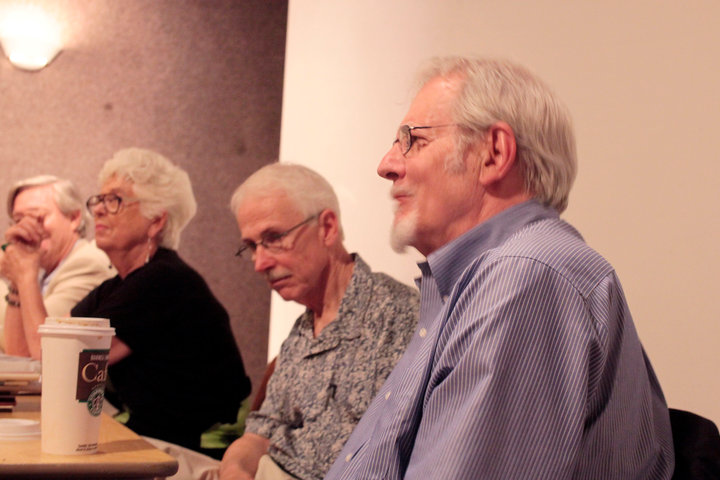
From left: Michael Berryhill, Gabrielle Cosgriff, Tom Curtis, Thorne Dreyer. Photo by F. Carter Smith / The Rag Blog.

Special issue of Cite
Will focus on counterculture

In 1970, Charles Tapley’s architecture firm won a national award for convincing their client, Camille Waters, not to build anything on her site in the Texas Hill Country. The architects’ renderings portray a life camping out of a volkswagon. The upcoming issue of Cite: The Architecture and Design Review of Houston recovers this and other 1960s and 70s sites of counterculture.

This issue of Cite, like many in its 28-year archive at citemag.org , mixes high design with down and dirty civic engagement.

Scheduled for a June release, the special issue covers experimental geodesic domes, the Moody Park riot, underground papers, the Love Street Light Circus, the 1977 march on an Anita Bryant performance that gave birth to Houston’s vibrant GLBT organizations, and other topics. The photography draws from the Space City! archives. Gary Panter, East Texas-born illustrator and set designer of the Pee Wee’s Playhouse, is contributing the cover art.

— Raj Mankad / The Rag Blog

The Rag Blog

Posted in Rag Bloggers | Tagged , , , , , , , , , , , , , | 4 Comments

By Dick J. Reavis / The Rag Blog / May 25, 2010

The current issue of Texas Monthly, a “special edition” whose theme is “Where I’m From” is worth some reading, some scrutiny, and some thought.

Though the funerary photo of Eva von Braun on its cover is an eyesore, its teaser lines carry an eye-raising message. Nineteen contributors and interviewees — mostly notables and novelists- — are named there: four of them are Mexican-American, two of them black.

With luck, the issue’s inclusiveness forecasts a new and better day at the magazine. It’s as if Texans, and all Texans, could produce a national-class magazine without heavy supervision from the non-Texans who dominate the state’s industry of words.

A few weeks ago, Mexican-American writers chastised the editors of both the Texas Observer and the Monthly for accepting slots on a panel of 11 other whites at an Observer-sponsored “Texas Writer’s Festival.” From the sidelines I assailed them for billing non-Texan whites as homefolk.

But the Monthly’s special edition would have already been at its printer — outside of Texas — when the controversy arose, and that might indicate that the magazine, or at least its editor, Jake Silverstein, had already turned a corner, if only for a single issue.

The significance of “Where I’m From,” however, goes beyond questions of color and regional origin. As a commercial product, this artifact is an oddity. Mass-market magazines are generally aimed at prosperous and prospering readers 25 to 40 because that’s the demographic advertisers seek.

The Monthly’s “From” issue mainly carries accounts of life in Texas before 1970, certainly before 1985. In the annals of the industry’s prized readership, anything before 1985 is history, and anything before 1970 is ancient history — and as Henry Ford long ago told us, for Americans “history is bunk.”

If not many young people will turn the pages of this edition, their parents will, and that probably explains either its origin — or merely its commercial convenience. The magazine’s paid pages include a 42-page advertorial from institutions of higher learning: private and public colleges alike are seeking students who pay full tuition. The issue is so fat with ad pages — including eight advertorials, running a total of 78 pages — that getting to its content is like fighting one’s way through the canebrakes along the lower Rio Grande.
The issue describes Texas through memories of childhood and adolescence, and that’s a relief from the usual definitions: Texas as a cluster of Metropolitan Statistical Areas, or markets, and Texas as a collection of electoral districts, a la Texas Tribune. Sadly, of the 10 shorter pieces in the front of the magazine, in sections entitled “Growing Up,” and “Leaving,” six come from people in the environs of New York City. Those contributors are mainly writers who, because the project of Texas publishing was betrayed, have made their careers in the American industry’s hometown. But even expatriate accounts tell us what Texas is like.

The traditional answer to the question, “What Is Texas?,” as founding writers at the Monthly often noted, was to be found in the pages of Texas Highways: nice people doing nice things, especially in county seats. Though some of the same Pollyanna approach is evident in the “Where I’m From” issue, a few of its accounts get closer to the truth, as I see it, anyway.

My observation has been that, when they are sincere, all thoughtful Texans voice a love-hate relationship with their setting, just as people in Northern Mexico do. The state’s turbulent history and even its terrains, like those of Northern Mexico, don’t offer us much choice: Texas is not Maine or Costa Rica or California North.

By that standard, the prize contribution in the “From” issue is an as-told-to piece from Rick Perry, his recollection of his upbringing on a dry-land North Texas cotton farm. Perry told interviewer Silverstein things like:

[The area around Haskell] could be one of the most beautiful places or it could be one of the most desolate, brutal, uninviting and uninspiring places … I spent a lot of time just alone with my dog. A lot.

Perry talks about daylight darkness created by dust storms, about bathing in No. 2 tubs, and, as John Kelso has noted in a Statesman send-up, mother-made underwear. His tale is truly worth telling as fiction- — in a novel by the likes of Cormack McCarthy.

On the other hand, in an interview with Monthly long-timer Mimi Swartz, Democrat Bill White talks in middle-class truisms, Texas Highways style.

The view of Texas as a locale not merely of nostalgia, but also of as a problem or project leaps out, too, contributions of El Paso historian David Dorado Romo, who finds commonalities in the Texas-Mexico and Israeli-Palestinian borders, and of Erykah Badu, who reports that “…in the late eighties crack cocaine came and everything went to hell” in the South Dallas neighborhood of her childhood. For Perry, the question “what was Texas” does not draw an idyllic answer, and for both Romo and Badu, what’s relevant is not only “what was Texas?” but “what is it becoming?” That worry should torment both the Monthly and the 25-to-40 demographic in the issues to follow “Where I’m From.”


Type rest of the post here

Source /

The Rag Blog

Posted in RagBlog | Leave a comment

Bob Feldman : A People’s History of Afghanistan / 7

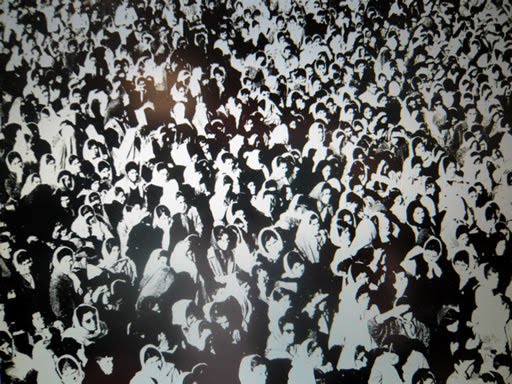
Demonstration at Kabul University, late 1970. Photo by Louis Dupree / BBC.

Part 7: 1968-1976
A People’s History of Afghanistan

By Bob Feldman / The Rag Blog / May 14, 2010

[If you’re a Rag Blog reader who wonders how the Pentagon ended up getting stuck “waist deep in the Big Muddy” in Afghanistan (to paraphrase a 1960s Pete Seeger song) — and still can’t understand, “what are we fighting for?” (to paraphrase a 1960s Country Joe McDonald song) — this 15-part “People’s History of Afghanistan” might help you debate more effectively those folks who still don’t oppose the planned June 2010 U.S. military escalation in Afghanistan? The series so far can be found here.]

Since Barack Obama’s inauguration in January 2009, between 500 and 800 people have been killed by Pentagon drone attacks in Pakistan, as a by-product of the U.S. War Machine’s endless military intervention in Afghanistan. Yet much of the history of people in Afghanistan since 1968 may not still be widely known, even by many readers of Howard Zinn’s People’s History of the United States.

In 1968, for example, when student revolts broke out in the United States at Columbia University, in France, in Mexico, and in other countries of the world, student revolts also broke out in Afghanistan and “student strikes that began in Kabul spread to provincial centers, where students who had returned to teach and work had become carriers of a new politically radicalized militancy,” according to Afghanistan: A Modern History by Angelo Rasanayagam.

The following year, Afghan workers also struck for better pay and better working conditions in the few places in Afghanistan where some factories existed. Between 1965 and 1973, 2,000 meetings and demonstrations — mostly led by activists of the secular leftist People’s Democratic Party of Afghanistan [PDPA] factions/parties — were held in Afghanistan which demanded more democratic reforms and modernization efforts in Afghanistan.

But right-wing Islamic opponents of democratic reforms and modernization efforts in Afghanistan also mobilized between 1965 and 1973 in Afghanistan . In 1971, for example, the University of Kabul “was closed for six months as a result of the bitter confrontation between Islamic and leftist radicals,” according to Afghanistan: A Modern History. The same book also recalled that in the early 1970s in Afghanistan:

The Islamic backlash also took the form of attacks instigated by the mullahs on women wearing Western dress. They were incensed by the campaigns for female literacy and women’s rights led by the All-Afghanistan’s Women’s Council. According to a senior leader of the Council interviewed by George Arney, the mullahs declared in 1971 that women should stay in the house. Reactionaries sprayed acid on women’s faces when they came out in public without a veil. And when women wore stockings they shot at their legs with guns with silencers…

By the early 1970s, dozens of Afghan political groups existed on campus at the University of Kabul. In addition, around 2,500 people in Afghanistan were also members of the PDPA faction/party [Khalq] led by Noor Mohammad Taraki and 1,500 to 2,000 Afghans were members of the PDPA faction/party [Parcham] led by Babrak Karmal.

The number of people in Afghanistan who were members of the secular Maoist party was also between 1,500 and 2,000 in the early 1970s. But the Islamic party in Afghanistan still only had between 1,500 and 2,000 members. Yet, as James Lucas noted in an article titled “America’s Nation-Destroying Mission in Afghanistan,” that was posted on March 5, 2010, on the www.antiwar.org site, “according to Roger Morris, National Security Council staff member, the CIA started to offer covert backing to Islamic radicals as early as 1973-1974.”

Nearly all the members of the PDPA faction/parties, the Maoist party and the Islamic party in Afghanistan in the early 1970s, however, were still just members of the educated urban middle class; and all of these political groups still did not have much of an organizational presence or mass base outside of Kabul, in the rural areas of Afghanistan.

Yet many people in the countryside were suffering from the effects of a drought in Afghanistan between 1964 and 1972, which developed into a famine in 1971 and 1972. One result of this famine in Afghanistan in 1971 and 1972 was that between 50,000 to 500,000 people starved to death. And 75 percent of Afghanistan ’s land was still owned by only three percent of Afghan’s rural population in 1973.

Backed by Afghan military officers, Mohammad Daoud (the brother-in-law of Afghan King Zahir Shah who had previously been the Afghan monarchical regime’s autocratic prime minister between 1953 and 1963) then seized control of the Afghan government from the Afghan king (who had been sitting on the throne since 1933) in a July 17, 1973 coup — while Zahir Shah was on a holiday in Europe.

After his 1973 palace coup abolished the monarchy, Daoud next “set up an authoritarian regime which made the government isolated” and “moved rapidly to undermine all the representative institutions” in Afghanistan “and, in particular, Parliament,” according to Revolution Unending: Afghanistan: 1979 to the Present by Gilles Dorronsoro. The same book also recalled that “to avoid any challenge Daud systematically suppressed the opposition, both legal and illegal” in Afghanistan and “following the coup the former Prime Minister and leader of the social democratic Hezb-I Demokrat-I Mottarki party, Dr. Mohammad Hashim Maiwandwal, who had been in power in 1965-67, was arrested in September 1973 and executed.”

Yet long before the U.S. government began to covertly arm the anti-feminist Mujahideen guerrillas during the Democratic Carter Administration — following the 1978 Afghan Saur (“April”) Revolution and prior to the December 1979 Soviet government’s military intervention in Afghanistan — even the non-communist, autocratic Daoud monarchical regime and the post-1973 non-communist Daoud authoritarian regime felt that it was in Afghanistan’s national economic interest to align itself with the Soviet Union during the 1950s, 1960s, and early 1970s. As Afghanistan : A Modern History recalled:

Economic hardships caused the Afghans to turn to the Soviets for help… A four-year barter agreement was signed in July 1950, with the Soviets providing petroleum products, cement, cotton cloth and other essentials in return for wool, raw cotton and other Afghan products. The Soviets also agreed to the free transit of Afghan exports through their territory, and offered to invest in oil exploration…

After lending the Afghan government money to construct a grain silo, a flour mill, and a bakery in Kabul in 1954, for example, the Soviet government followed up with loans for constructing an oil pipeline and three oil storage facilities, for road-building equipment, and for an asphalt factory and equipment to pave Kabul’s streets. Nearly $1.3 billion in Soviet economic assistance, mostly in the form of loans, was given to the non-communist Afghan government between 1956 and 1978; and an additional $110 million was received by the Afghan government from other Eastern bloc governments during the same period.

The U.S. government, in contrast, only began to provide some economic assistance to the non-communist, autocratic Afghan monarchical regime in 1956; and, after 1956, also began awarding some Afghan students grants to study at certain U.S. universities. But, according to James Lucas’s recent article, “America ’s Nation-Destroying Mission In Afghanistan”:

The CIA… recruited Afghan students in the U.S. to act as agents for them when they returned home. During this period at least one president of the Afghanistan Students Association (ASA), Zia H. Noorzay, was working with the CIA in the U.S. and later became president of the Afghanistan state treasury. One of the Afghan students whom Noorzay and the CIA tried in vain to recruit, Abdul Latif Hotaki, declared in 1967 that a good number of the key officials in the Afghanistan government who studied in the U.S. “are either CIA-trained or indoctrinated.”

Coincidentally, the Afghanistan Student Association [ASA] also apparently received part of its funding from the CIA’s Asia Foundation conduit [on whose board sat then-Columbia University President Grayson Kirk] during the Cold War Era.

In addition, between the mid-1950s and 1978, the Teachers College of Columbia University — under a U.S. Agency for International Development [AID] government contract — was involved in training teachers, developing educational curriculum, and producing textbooks for the Daoud regime’s Ministry of Education in both Afghanistan, at the Ibn Sinn Teacher Training Institute in Kabul, and at Columbia University Teachers College in New York City.

Military assistance was also given by the Soviet Union to the Afghan regime during the 1950s, 1960s, and 1970s. Between 1956 and 1978, for example, the Afghan government “received the equivalent of $1.24 million in military aid from the USSR, mostly in the form of credits” and “by 1978 some 3,725 Afghan military personnel had been trained in the Soviet Union,” according to Afghanistan: A Modern History.

But after the Shah of Iran’s regime agreed to provide the Afghan government with $2 billion in economic aid in 1975 and U.S. Secretary of State Henry Kissinger visited Kabul, Afghanistan, in August 1976, the Daoud regime apparently began to reverse Afghanistan ’s post-1950 policy of aligning with the Soviet Union.

Next: “A People’s History of Afghanistan—Part 8: 1977-1978″

[Bob Feldman is an East Coast-based writer-activist and a former member of the Columbia SDS Steering Committee of the late 1960s.]

  • Previous installments of “A People’s History of Afghanistan” by Bob Feldman on The Rag Blog can be found here.

The Rag Blog

Posted in Rag Bloggers | Tagged , , , , , | 1 Comment

Renowned photojournalist Alan Pogue will be inducted into the Austin Arts Hall of Fame on June 7.

Pogue was staff photographer for Austin’s underground newspaper The Rag from 1971-1977, and has been a frequent contributor to The Rag Blog. His work has appeared in major magazines and newspapers, including Newsweek, Look, Texas Monthly, the L.A. Times, the San Francisco Chronicle, and the International Herald Tribune, and he has been an important contributor to the Texas Observer for four decades.

Alan’s photographs have appeared in major shows in the U.S., Mexico, Europe, and Japan. His portfolio “Agricultural Workers of the Rio Grande and Rio Bravo valleys,” produced for the University of Texas at Austin, is collected internationally. The Texas Institute of Letters awarded him the Dobie-Paisano Fellowship in 1983, an honor usually reserved for writers. In 1995 he was invited to present his photographs of the Texas-Mexico border at The Sorbonne. The University of Texas Press published a book of Pogue’s photographs, Witness for Justice.

Alan Pogue has documented the plight of farm workers in Texas and Northern Mexico for four decades, and has photographed prison conditions in Latin America and the United States. He has worked with peace groups to educate the public on the reality of the culture and conflict in the Middle East. Since 1998 he has been to Iraq, the West Bank, Israel, Jordan, and Pakistan. Alan personally accompanied war-injured Iraqi children to the United States for medical care on three of his eight trips to the Middle East. The Japanese group Global Peace Campaign sent Pogue to report on the plight of Afghan refugees in Pakistan in 2002.

Posted in RagBlog | Leave a comment

Marc Estrin : Wagner — Oi!

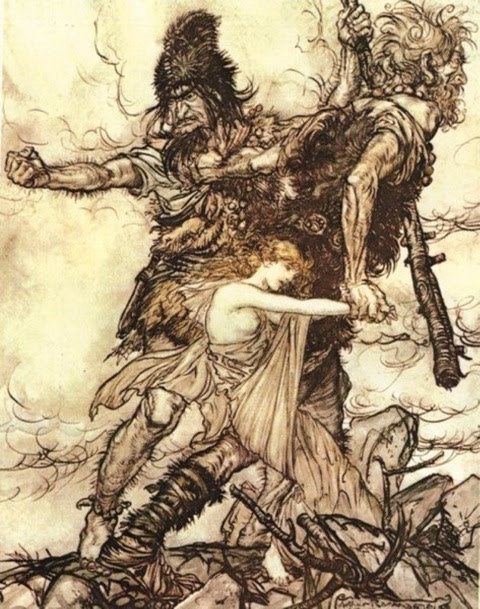
The giants seize Freya. Illustration for Wagner’s Das Rheingold by Arthur Rackham (1910).

WAGNER — OI!

By Marc Estrin / The Rag Blog / May 24, 2010

I didn’t begin “getting into” Wagner till I was 30ish. Who had the time for five-hour operas? And who had the money for 12- or 15-LP sets, or fifty bucks a pop for way-high at the Met? Forget it. Plus I didn’t even like opera, and still mostly don’t.

And what Jew could become a fan of Hitler’s favorite composer? My father wouldn’t even ride in a Volkswagen. Nevertheless, he did name our first family car, a 1950 Dodge, Brünnhilde. I should have known some interesting paradoxes were at large.

Jews, however, are big on Jewish guilt, so sometime in the mid-sixties, to make up for my reprehensible ignorance, I taped a Ring-cycle (at slowest speed, fidelity trumped by pennypinching) and discovered that this stuff did need some looking into. Quite interesting, it was. Quite.

As a musician, I was already familiar with the short, commonly played selections. I loved the various preludes and overtures — the complex stateliness of Meistersinger, the ethereal spirituality of Parsifal and Lohengrin, the drunken passion of Tristan. I was well aware of the revolutionary role of RW in western musical history — his breaking open the tonal paradigm, and clearing the path for complex contemporary music. But other than that, I hadn’t “gotten into” him — which would involve serious listening to, and study of, the operas.

Teaching at Goddard, I had the opportunity to do just that. (In the Goddard model, without departments, one could teach what one wanted to study.) I offered a course in The Ring where we listened with scores, studied the texts, read the criticism and Jungian analyses, and “grokked” the work. THAT was “getting into” it. I didn’t need any more convincing. Even putting its anti-capitalist nature aside, The Ring is big, deep stuff, just meant for me.

It was inevitable that crazed Wagnerians would show up in my fiction. So I share with you in honor of Wagner’s birthday, a little section of a vast chapter from my Insect Dreams.

Gregor Samsa, a six-foot, talking cockroach, having just made a disastrous attempt at lovemaking with Alice Paul, has come to see Dr. Lindhorst about amputating his middle legs so that he might be more attractive to women. Lindhorst tries to dissuade him with the story of Pygmalion — complete with all its subsequent disasters — but Gregor decides to go ahead with the body-sculpting. Gregor is strapped to the operating table, and Lindhorst’s assistant, Miss Mozart, is called in.

I think this will excerpt tolerably, but should you want to see the whole, you can probably find the book at your library (it won all sorts of awards), and you’ll certainly find it at Amazon. Here’s the scene:

Gregor, Love is brother to his sister, Death. Eros and Thanatos, my friend. Longing always leads somewhere, and that somewhere is not always longed for. You must appreciate this — deeply — before you take an irreversible leap of mutilation in the service of love. If you understand and truly accept, your tissues will heal. If you do not understand, if you do not truly accept, you will carry yet another unhealing wound.” He paused to let his words sink in. “Miss Mozart, you may begin.”

The slim, intense woman took off her shoes, and sat down at the Bösendorfer, barefoot. Smoothing back the sides, and reaching behind her neck, she encircled the long fall of her golden hair with her fingers, moved it from her gown, and let it fall loosely onto her half-bare back. Though Gregor could see every detail with his immense peripheral vision, he felt himself drifting back into a hazier space deep inside his cuticle. Long echoes of Lindhorst’s hypnotic voice rippled slowly in circles of ever-softer sound.

Miss Mozart placed her right hand on the keyboard. The first gentle A reached up a plaintive minor sixth, and hung there, suspended in non-time, until it’s own weight eased it down to the supporting net of the note below — only to immediately fall through that net — oh surprise! — to the accented half step below, the awe-full D# of the Tristan chord, the chord of chords, that miraculous find of ambiguous, melancholy longing. Miss Mozart’s left hand joined her right to urge the F and B below, while her right fourth finger struck the G# that would resolve upwards, and upwards again beyond what might have been its goal. The Tristan chord, F-B-D#-G#, a chord so extraordinary that one can search in vain through music to find its like. Search was its name, and its mode, and its function. Search. But for what? The beauty of despair? The despair of beauty? What trembling question was being asked by this voice in the night? In the long pause which followed, Lindhorst whispered,

“Be in the silence, Gregor. Let the sweet pain soak in at your soft joints.” Then he signaled to Miss Mozart to continue.

The second phrase, a step higher, infinitely slow, exaggeratedly, tormentingly slow, left Gregor hanging as did the first, the Sehnsuchtsmotiv, the Leitmotif of Longing, calling him from the vast darkness of What. His wound began to weep into its new dressing. His dorsal gland began to moisten. The meat at his leg joints began to soften, as if to bid welcome to the knife.

“Something is dissolving, Gregor. What is it? Don’t answer.” He couldn’t have.

A third time the phrase called out, higher still, and longer, reaching upwards by two more notes, as if its fingers were stretching from an already outstretched hand.

“It hurts, my friend, does it not?”

As if to answer, the phrase returned, the same last, rising pattern, an octave higher, and then only the last two notes, a half-step reaching upward, and once again, the two reaching notes, an octave above, harmonic tension so great as to be humanly unbearable. And yet it hung there, radiating, in the silence — until beginning again, it pushed beyond itself, and with a final leap, reached beyond itself, above and below, to a land that could be footed, an almost safe place — an accented chord of F-A-C — but with a B above, a skyhook which let gently go, and allowed the hearer — and the universe — to collapse down to the floor of an ever-rising, but graspable flow of molten melody, the Motif of Love.

“Now you can swim, Gregor. Your wings are beginning to spread.” And indeed, G could feel pressure at his back, once associated only with sexual excitement, but now with something more mysterious, sexual in part, but as larger as the sea is to the drop. Miss Mozart’s fingers called forth the Bösendorfer’s magic, and the melody rang forth in quiet, sensuous richness, as if from twelve pianissimo cellos, though there was not a cello in sight.

The clock had ticked off ten minutes, but there were no minutes here, only an expanded, warping space-time, similar to Gregor’s flight, but now colored with the depth of new emotional and spiritual dimensions. The labyrinthine melody rolled on and on, reaching ever higher, falling back and reaching again, a melody of melting and surpassing tenderness, sweeping up in its wake the mists of the sublime — that world so far beyond perceptual or imaginative grasp, that our sense of its beauty is deeply mixed with dread. Alarming and reassuring both, it sweeps along, in ecstatic prolongation, immensely complicated, dissolving tonal language — and any other — as if God himself were exhuding enharmonics. Complicated, yet beyond complicated, and thus simple: exaltation, transformation, an intoxicating brew of idealism and lust, delirious forces striving to embrace, exchanging the Kingdom of Day for the Kingdom of Night.

Fingers flying, Miss Mozart piloted this extraordinary tone poem back to its unsafe harbor, the Sensuchtsmotiv. The Prelude to Tristan and Isolde sank down to its embers.

“After such love, why is there still longing?” Lindhorst whispered, tears in his eyes. Miss Mozart turned quietly to the very last pages of the piano score, and in hushed tones, began Isolde’s song of Love’s triumph over Death. “Mild und leise,” Gregor knew the words, “wie er lächelt, wie das Auge hold eröffnet…” She sang beautifully, as extraordinarily well as she played, and not having to overcome an orchestra, she was able to evoke the most delicate nuances of emotion and inflection as Isolde gazes upon her lover, transforming his death into eternal, living, life. In the intimate murmurings of the first serene phrases, slowly rising through unbelievable ascending passages of modulating sequences, wave upon wave, lyrical, rhapsodic, ecstatic, to climactic heights of passion and transfiguration, Isolde makes her decision to die, to melt with Tristan into ultimate ground of being, to leave behind the torment of the finite doomed to infinite yearning. Together they will be at home in the vast realm of unbounded night, borne on high amidst the stars, and then down, down, to where there is no down

In dem wogenden Schwall,
in dem tönenden Schall,
in des Welt-Atems
wehendem All —
ertrinken,
versinken —
unbewußt —
höchste Lust!

Release! Death powerless against the Inextinguishable — love’s vast, immeasurable redemption. Yet even here, after this inspired surging of metaphysical perception, even here, in the midst of yes, even here, appear the ineffable harmonies of the Sehnsuchtsmotiv, longing beyond longing, even in final exhalation — longing. Then silence. Profound silence.

[Marc Estrin is a writer and activist, living in Burlington, Vermont. His novels, Insect Dreams, The Half Life of Gregor Samsa, The Education of Arnold Hitler, Golem Song, and The Lamentations of Julius Marantz have won critical acclaim. His memoir, Rehearsing With Gods: Photographs and Essays on the Bread & Puppet Theater (with Ron Simon, photographer) won a 2004 theater book of the year award. He is currently working on a novel about the dead Tchaikovsky.]

The Rag Blog

Posted in Rag Bloggers | Tagged , , , , | Leave a comment

Follow the Poppies : Opium, Afghanistan, and U.S. Foreign Policy

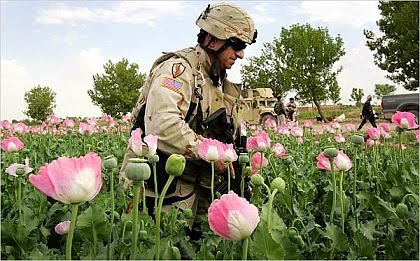
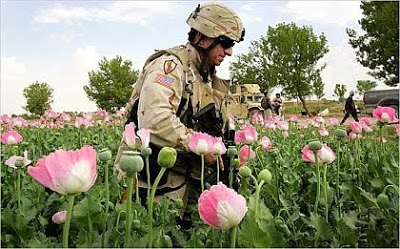
Soldier among the poppies at opium field in Afghanistan. Image from Aftermath News.

Working with the warlords:
Afghanistan and the heroin trade

The U.S. used the international heroin network to serve its geopolitical aims in Afghanistan and elsewhere.

By Sherman DeBrosse / The Rag Blog / May 24, 2010

When George W. Bush and Tony Blair decided to first attack Afghanistan, one consideration was bringing enough stability to run a pipeline down through the country to Pakistan. One wonders if Blair and Bush gave any thought to the heroin trade when they decided to attack the Taliban.

Between 1991 and 2003, about 60 tons of heroin from Afghanistan went to wholesalers along the Volga and in the Urals Districts of Russia. Who knows how much went to the rest of Russia. Northern Afghanistan is the bridgehead for moving drugs into Russia. Far more Afghan heroin went to Europe, the largest single consumer of heroin.

Drugs and banks

In June, 2003, U.N. Secretary General Kofi Annan estimated that the international drug trade was worth between $500 billion and $1 trillion a year. The banks that launder this money have a strong incentive to see that the drug trade continues. The Independent reported on February 28, 2004, that, in cash terms, narcotics ranked third in world trade, following oil and arms. Drugs are particularly important because they constitute a form of currency vital to the underworld, international crime, and intelligence agencies.

Making this point could mislead readers into thinking that a high wall separates legitimate and illegitimate transactions. Today, business transactions have become so complex that many so-called legitimate businesses have found it necessary to deal with international criminal organizations and to use their currency of choice, drugs. All too often it is very hard to distinguish between government intelligence agencies and the criminal elements they must cooperate with, and the welfare of some politicians also depends upon the free flow of drugs. Heroin constitutes but one part of that trade.

By then between 80 and 90% of the world’s heroin was coming from Afghanistan. In 2007, the country produced 8,200 tons of opium poppies. The U.N. Office on Drugs and Crime estimates that the Taliban earns from $90 to $400 million from drugs. Most experts place the figure at $125 billion and add that this includes taxes it imposes upon chemicals used to process opium.

The whole country’s annual drug take is somewhere between $2.8 and $3.4 billion. Much of that money goes to line the pockets of Afghan police and officials. A 2008 U.S. Senate report put the value of the transnational sales of all Afghan opiates at between $400 and 500 billion in street value. Some of that found its way to western chemical companies via doubtful routes. Of that amount, about $70 billion is heroin. Up to 10% of the heroin money moves through an informal banking system called hawala. The rest is laundered through Western banks.

Some financial analysts claim that the hundreds of billions in narco-dollars held by huge financial institutions provided the liquidity that made it possible to pull the world back from the potential wreckage of its financial system.

Antonio Maria Costa of the UN Office on Drugs and Crime said, “Drugs money worth billions of dollars kept the financial system afloat at the height of the global crisis.” Costa added, “In many instances, the money from drugs was the only liquid investment capital. In the second half of 2008, liquidity was the banking system’s main problem and hence liquid capital became an important factor.”

Afghanistan’s poppies are enormously important in today’s world, but it is difficult to sort out how drugs have influenced U.S. policy there.
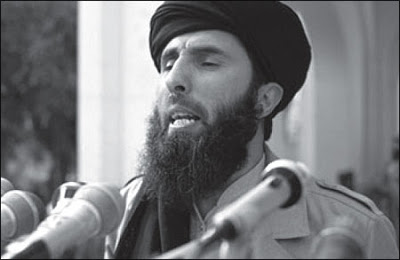
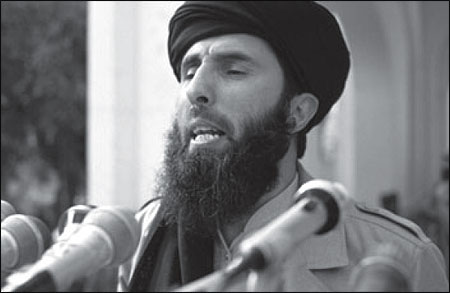
Engineer Gulbuddin Hekmatyar, leader of Hezb-i Islami, addressing a rally in Peshawar, Pakistan, November 1987. Photo by Mohammad Karim / Neiman Reports.

Fighting the Soviets in Afghanistan

In the 1980s, the C.I.A. helped drug lords become mujahidin leaders. One was Gulbuddin Hekmatya who dominated the local drug trade and became the world’s most important heroin trafficker. Of course, these leaders were encouraged to finance their insurgency through drug sales. With the blessing of the Americans, the drug lords ordered the peasants to raise many poppies. The drug barons were also encouraged to spread heroin to the Russian forces, and this effort was largely successful. Within two years, Afghanistan was the world’s main heroin producer.

Drugs moved from the drug lords to Soviet troops with the help of reputed Russian crime figures such as Vladimir Filin and Aleksei Likhvintsev. They were part of what Russians call “OPS,” an organized crime society. According to Indian observer Theruvath Raman, the C.I.A. controlled this flow.

Since then, massive quantities of heroin have made their way into Russia with the help of an international drug network and likely successor to the BCCI that includes the Russian mafia and Islamic extremists there. Drug addiction there is now as serious as the alcohol problem.

While attempting to combat Islamic extremists in the Middle East, the U.S. was probably working with elements of the Hizb ut-Tahrir al-Islami in Russia. It is a “liberation army” intent upon creating an Islamic caliphate in Central Asia. More recently, it appears that elements in the Russian government and military are sharing business with the narco-barons and bringing some order to the trade by squeezing out the ethnic criminal/drug groups.

A worldwide drugs/arms network takes form

The Russian mafia soon became a major player in moving drugs and arms throughout the world. Many of the arms came from the arsenals of the collapsed Soviet Union that were not located on Russian territory. Some of the leaders in this criminal underground were former intelligence officers, and some of them are highly educated and even respected scholars.

These Russians are the most visible element in a worldwide network that seems to control the movement of drugs in most places, other than the route from Burma to South China. There is much speculation about the extent of U.S. cooperation with this network, and especially its Russian members.

In 1994, the U.S. began shipping arms into Angola through Victor Bout of the OPS, whom the U.S. later employed in Iraq, and is now seeking to arrest. The overthrow of the Ceaucescu regime in Romania and the fall of Shevardnadze in Georgia also involved cooperation with the network. It is possible that the “tulip revolution” in Kyrgyzstan was another joint project. Far West, LLC, an arm of the Russian mob that supposedly specializes in intelligence consulting, moved into Kyrgyzstan after the fall of Askar Akayev, and heroin traffic through that land soon trebled.

Whatever U.S. and Western involvement there was in these nasty activities was masked by various cut-outs. As the Wall Street Journal reported in respect to Georgia, that was work of “a raft of non-government organizations… supported by American and other foundations.” One of the officers of Far West has said that an unnamed American firm had invested in it. Far West has done business with Kellogg, Brown and Root (KBR Halliburton), and Diligence Iraq LLC, a private military firm considered a CIA. spin-off. It is tied to Diligence Middle East, which has links to New Bridge Strategies, which is linked to Neil Bush.

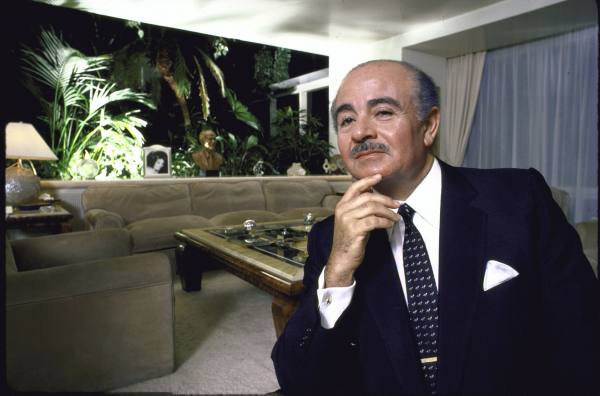
It is known that representatives of the drug network and people close to the CIA met in 1999 under the aegis of Adnan Khashoggi at Beaulieu, France. He has been a CIA asset since the 1960s when he was passing Lockheed money to Saudi officials. One topic at the meeting must have been affairs in the former Yugoslavia, where Kosovo was becoming a major drug entrepot.

Without the knowledge of their defense ministry, Russian paratroopers on June 11, 1999, seized the Slatina airport, giving Russia a base in Kosovo. This was an instance in which the U.S. and the Russian narco-barons were not on the same page. Wesley Clark ordered General Sir Mike Jackson to oust the Russians, but the Brit declined to “start World War Three for him.”

The Russians remained there until 2003, when they shifted their main platform for the export of drugs to Novorossiysk on the Black Sea. That port and St. Petersburg are used to export cocaine brought in from Columbia.
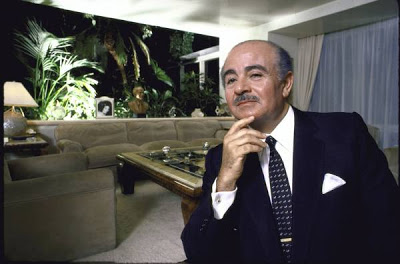
Saudi millionare Adnan Khashoggi in his New York apartment in 1987. Photo by Ted Thai / Life.

The U.S. and the Caucuses

The Caspian area in 1999 was estimated to have a reserve of 200 billion barrels of black gold or oil. Two years later, it appeared that the reserve was about one tenth that amount.

In December, 1999, the United States again began to play a major role in Turcic, in Central Asia. It sent representatives to a meeting in Azerbaijan where arrangements were made to train mujahedeen from the Caucases and Central/South Asia and also Arabs to assist Chechen rebels. U.S. “private security companies” were used to evade the international embargo against helping the Chechen rebels.

The thinking was that higher levels of violence would dissuade Western investors from making oil deals with Russia. The U.S. was promoting the Baku-Tblisi-Ceyhan pipeline to get oil from the Caspian Basin to the Mediterranean. James Baker III, Adnan Khashoggi, and Lord Mc Alpine had created a Caucasian Common Market to serve this effort. It is administering $3 billion in United States development funds for infrastructure projects in the area. The Bush administration spent $11 in Georgia to train a pipeline protection battalion.

The US intervenes in Afghanistan

The Taliban took over the Afghan drug trade in 1994, with the CIA’s consent, and they seized power in 1996. Relations between the Taliban and the U.S. soured, and in July, 2000, the Taliban moved to end poppy cultivation, calling it un-Islamic. Of course, they were probably doing this to put pressure on the West. The long-term consequences of this currency contraction could have dealt a serious blow to Western financial systems.

Drying up that crop deprived Western banks of billions in new deposits. At that time, Afghanistan produced two-thirds of the world’s heroin, and the absence of new narco-dollars could damage the finanCIAl system. Le Monde and the IMF estimated that about $300 billion in Afghan heroin money had been making its way to Wall Street. Narco-dollars provided needed liquidity to the American and Western financial markets.

The Taliban decision also hurt the Pakistani intelligence service, the ISI. Ironically, the ban also made Osama bin Laden and Al Qaeda, major drug operators, far less valuable to the Pakistani spooks. About 60% of Pakistan’s GDP also came from drugs, and the Taliban’s move was a serious blow to its neighbor.

Of course, the Taliban also alienated the Afghan drug lords when they dried up 97% of the opium poppy crop. Banning the drug trade alienated Afghan drug lords, many of whom were in the Northern Alliance. In 2001, the United States began reestablishing close ties with Afghan drug lords, perhaps as preparation for making war in that country.

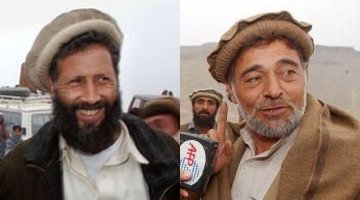
Drug trafficker Ahmad Shah Massoud became very important to American planners because his guerrilla attacks on the Taliban were often successful. Haji Zaman, “Mr. Ten Percent,” another drug lord, was another important American ally then. He fled to Dijon, France, when the Taliban seized Jalalabad, and the U.S. and British representatives persuaded him to return to Afghanistan.
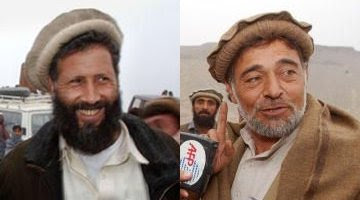
War lords Hazrat Ali, left, and Haji Zaman. Image from Rawa News.

With the help of Afghan and Pakistani drug lords, Hamid Karzai, a former Unocal employee, gathered support in Pashtun areas. The U.S. seems to have turned a blind eye to the heroin reserves and refineries kept maintained by these people.

General Tommy Franks gave drug barons Hazrat Ali and Haji Zaman the job of trapping and bringing in Osama bin Laden, who was known to be at Tora Bora. They moved very slowly, not attacking until the bombing had stopped four days before. There was plenty of time for Osama to escape and leave behind a rear guard.

The intelligence chief of Eastern Shura, Pir Baksh Bardiwal, had warned that it was a great mistake to use the two drug lords. They had no interest in seeing the power of Kabul extend to their operations Nangahar Province. U.S. journalist Philip Smucker heard that one of Hazrat Ali’s low level commanders, Ilyas Khel, provided an escort for Bin Laden and showed the Arabs how to escape.

Afghan war lords and poppies

The successful war restored to power brutal war lords whose rule was worse than that of the Taliban. The U.S. military presence in Afghanistan was sharply diminished, and the Bush administration spent very little on nation-building and development. Afghan poppy growing mushroomed, and very little was done about it.

There was talk about eradicating the poppy crop, but some in Washington said that such a step would destabilize the regime in Pakistan. In 2002, a former Indian official offered another reason why the Americans could not move against the Afghan poppy crop:

…this marked lack of success in the heroin front is due to the fact that the Central Intelligence Agency ( CIA) of the USA, which encouraged these heroin barons during the Afghan war of the 1980s in order to spread heroin-addiction amongst the Soviet troops, is now using them in its search for bin Laden and other surviving leaders of the Al Qaeda.

The country produces 8,250 metric tons of opium poppies every year, and and it is moved by trucks by refineries. If the trucks were stopped, the refineries would go out of business. There are reports that India supports some refineries which generate money for insurgents in Pakistan. The Israelis did the same for insurgents in Iran.

Authorities in neighboring Tajikistan complain that neither the U.S. nor NATO is moving against the Afghan drug lords. The Tajikistan Drug Control Agency’s Avaz Yuldashov noted: “Our intelligence shows there are 400 labs making heroin there, and 80 of them are situated along our border.” He added that drug money from Afghanistan pays for international terrorism. In addition there are many labs in Pakistan to process Afghan poppies. The drugs are then shipped out of Karachi. Most Afghan drugs end up in Turkey, a NATO member, from whence they are moved to Europe.

Some drug lords are allied with President Karzai, and his half-brother Ahmed Wali Karzai, head of the Kandahar provincial council, has been accused of being in the drug trade. It is said that he ships drugs to Iran. If so, he would have to pay some Taliban tolls to keep the product moving.

Those drugs could be used in Iran, but much of that cargo goes to Russia via Iran. Much has been written about warlords tied to Wali benefiting from a $2.16 billion U.S. contract for trucking services. Current and former intelligence officials tell reporters that Wali has been on the C.I.A. payroll for eight years.

Has the U.S. been dealing heroin?

It is difficult to establish whether the U.S is benefiting directly and financially from the Afghan drug trade. Political scientist Vladimir Filin, once head of Far West, told an interviewer that this is the case. He noted that, “They control Bagram airfield from where the Air Force transport planes fly to a U.S. base in Germany.” From there, heroin goes to “other U.S. bases and installations in Europe.” Much is shipped to Kosovo where the Kosovo Albanian mafia move it it “back to Germany and other EU countries.”
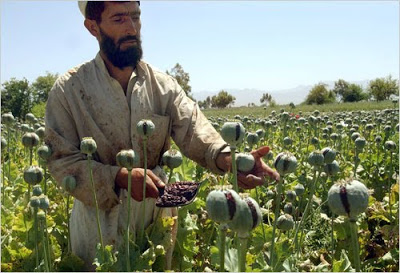
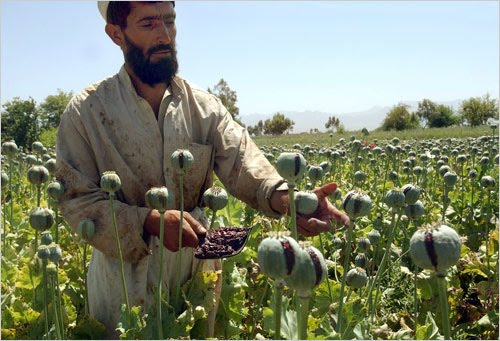
Afghan poppy fields. Photo from Douglas606 / Flickr.

In time, he predicted, U.S. drug centers will be shifted to Pozan, Poland, Romania, and Bulgaria because those host countries tolerate high levels of corruption. He estimated that America was moving between 15 and 20 tons into Europe per year, That is not a huge share of the world drug trade. However, other Russian observers place the tonnage at a much higher level and offer many more details about how the heroin is taken out and where it goes . General Mahmut Gareev, who commanded Soviet troops in Afghanistan, said:

Americans themselves admit that drugs are often transported out of Afghanistan on American planes. Drug trafficking in Afghanistan brings them about 50 billion dollars a year — which fully covers the expenses tied to keeping their troops there. Essentially, they are not going to interfere and stop the production of drugs.

General Khodaidad, the Afghan counternarcotics minister, also said the Americans and British are stockpiling the opium poppies in the provinces they control, and he added that NATO forces often tax the production. Former F.B.I. translator Sybel Edmonds told Congress that some military planes were used to move the heroin, but she was twice silenced by the Bush administration through the state secret privilege.

Dennis Dayle, a former DEA. agent said:

In my 30-year history in the Drug Enforcement Administration and related agencies, the major targets of my investigations almost invariably turned out to be working for the C.I.A.

No one wants to believe that our government is deeply involved in the narcotics trade. Perhaps none of these sources can be believed. However, we do know that the U.S. was selling drugs to its troops in Vietnam and moving some drugs out of Southeast Asia then. At the very least, it was also protecting Nicaraguan Contras who moved drugs into the U.S. to pay for weapons. Maybe there is a pattern here. Conversely, there seems to be a long-standing pattern of mainstream media not looking into these matters.

Two problems

The U.S. used the international heroin network to serve its geopolitical aims in Afghanistan and elsewhere. Peter Dale Scott, upon whose solid work this piece is partially based, has suggested that the drug/arms network may have grown so powerful that it is no longer just a tool to be used by the U.S. government. It may have its own agenda and the ability to bend U.S. policy to serve its objectives.

The present situation is very different from the days when the U.S. relied on private firms run by retired U.S. officials and politicians to carry out illicit weapons transactions or help the Nicaraguan Contras move drugs.

A second problem is that American aims in Afghanistan may have conflicted with those of the local drug lords. The drug industry thrives where state power is weak, where nothing can be done about peasants growing poppies, and the state cannot move against refineries and stockpiles.

The United States claimed that it wanted to expand state power and to bring order and stability to Afghanistan. Order was also needed if headway was to be made on the TAPI pipeline that was critical to U.S.-owned electrical facilities in India. Possibly, American planners thought that these conflicting interests could be reconciled. Clearly, the drug barons thought otherwise. At this moment, it appears that the TAPI venture could be doomed.

[Sherman DeBrosse is a regular contributor to The Rag Blog. A retired history professor, he also blogs at Sherm Says and on DailyKos.]

The Rag Blog

Posted in Rag Bloggers | Tagged , , , , , , | Leave a comment

John Ross : The ‘Feminization’ of Mexican Agriculture

Purepecha woman in reboza, on plate from Tzintzuntzan, Michoacan. Image from Teyacapan / Flickr.

Working the parcela:
‘Feminization’ is hope for Mexican agriculture

By John Ross / The Rag Blog / May 24, 2010

SANTA CRUZ TANACO, Mexico — When I first settled into this tiny Purepecha Indian village high in the Meseta Tarasca of west-central Michoacan state 50 years ago, few women tilled the land. Tending the milpa (corn patch) was strictly a man’s work. The men plowed the fields and planted in the spring and the wives and daughters would help to weed (barbechar) and glean in the harvest — but it was the men who strapped on the tchundi basket as they moved up and down the rows, snapping off the big ears of maiz to be sold in the markets of neighboring cities.

While the men lorded it over the corn patch, women had dominion over the home and the children. They cared for the kids and the chickens and prepared the meals. At mid-day, they wrapped up fresh, warm tortillas in colorful servietas and carried them out to the fields to feed their husbands.

Only two women in Tanaco actually worked their own parcelas (plots.) Dona Teresa Garcia had a handful of fields scattered up and down the valley she had inherited from her murdered husband, and many sons to work them, and although she was known to get her hands dirty, she was more an overseer and administrator. Slight and sprightly, Tere delighted in a full storehouse and was proudest of her purple and red and blue pinto corn she grew from her cache of grandfather seeds.

Nana Eloisa on the other hand was a mountain of a woman who plowed the rocky valley soil at the foot of volcanic mountains and lush pine forests — when she didn’t have an ox or the wherewithal to rent one, Eloisa was known to harness up the plow and pull it herself. Nana Eloisa had no husband although men sometimes hid in her long serge skirts. Unlike Dona Teresa who preferred to negotiate off stage with the men who ruled the community, Eloisa, who was equipped with a stentorian voice, often spoke up at assemblies of the comuneros (indigenous landholders.) The neighbors talked about her in awed whispers.

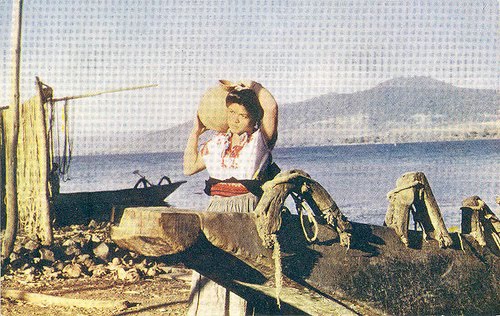
Purepecha woman carrying water, shown on postcard. Lake Patzcuaro in Michoacan is in the background. Image from Teyacapan / Flickr.

Times have changed up in the Meseta — and changed again. In the 1980s, as the first of five neo-liberal regimes took hold far away in Mexico City, the Purepechas who never strayed far from the Meseta unlike their mestizo neighbors in Tangancicuaro and Gomez Farias who first began trekking north a hundred years ago, plunged into the immigration stream with a vengeance. Fathers and sons went off to find their fortunes in El Norte and many never came back.

The women were left in charge of the house and the milpa both, a double workday (doble jornada). Their husbands would send home the remisas (money orders) with instructions on where and how much corn to plant. Any cash left over was destined to pay off loans for the coyotes who charged thousands of pesos to get the men across the border.

Often the women would hire peones and jornaleros to do the fieldwork but others worked the milpas on their own. Gradually the women began to make their own decisions about their husbands’ land. Many stepped out of the traditional long Purepecha skirts and literally and figuratively put on the pantalones.

Women outweigh men in Mexico 53,000,000 to 50,000,000 according to the 2005 half census. Although many are still tied to the home, women now comprise 40% of the workforce. In the rural sector where 28% of the population continues to subsist, the stats are even more skewed. One estimate is that 18 million women are now the primary workers on the land — but only 4.5 million actually have title to it.

Title allows them membership and voice and vote in the ejido (villages that are designated rural production units) and community, access to agricultural credits, and full agrarian rights. But women landholders are often relegated to servant stature in the ejido assemblies where only 2.5% serve as officials of the 28,000 communal farms so designated by the Secretary of Agriculture.

Although many women farmers or campesinas join mixed gender farmers organizations like the PRI party-run National Confederation of Campesinos (CNC) or the more left UNORCA and El Barzan, the dismaying disparity in their recognition as producers have motivated the women to form their own groupings such as the Ecological Campesinas of the Sierra of Petatlan Guerrero and the CONOC (National Council of Women Farmers’ Organizations).

But whether within the male-dominated farmers centrals or those of their own making, equal recognition has been slow in coming for the campesinas. Although agricultural budgets put together by the Secretary of Agriculture (SAGARPA) and the Secretary of Social Development (SEDESO) appear to allocate 42% of their resources to women, the numbers are deceiving — most of the money designated for women farmers is assistencial aid drawn down from the “Oportunidades” poverty program.

Other monies are assigned to crafts collectives such as the ceramicists of Ocumicho just over the mountain from Tanaco where the women throw the much in demand pots and the men bring the wood to keep the ovens fired up. Funds for micro-projects such as keeping chickens are available to women farmers but as Blanca Rubio writes in the left daily La Jornada, the campesinas would rather be recognized as producers of maiz than for their ancillary talents.

Indigenous woman from Michoacan. Image from Arantxamex / Flickr.

In addition to the gender of farming, the gender of out-migration from feeder states like Michoacan, Jalisco, Guanajuato, Zacatecas, and more indigenous Chiapas and Oaxaca, has changed radically. Once upon a time only men headed for El Norte and the potentially mortal consequences of this dangerous migration but women’s numbers in the flow north have tripled in the last decade as neoliberal agrarian policies imposed from Mexico City have devastated the campo and the bottom has fallen out of Mexican agriculture.

Under presidents Carlos Salinas and Ernesto Zedillo (1988-2000), the Constitution was mutilated to allow the privatization of communally-held land, grain distribution was handed over to transnationals like the Cargill Corporation, guaranteed prices were scrapped, and credit for poor farmers dried up. Vicente Fox and Felipe Calderon (2000-2010), presidents chosen from the right-wing PAN party, have hastened the demise of the agricultural sector.

The coffin nail was the 1994 North American Free Trade Agreement. Every year since, millions of tons of cheap U.S. and Canadian corn swamp Mexico forcing small-hold campesinos and campesinas out of business. A Carnegie Endowment investigation into the impacts of NAFTA on poor Mexican farmers published on the tenth anniversary of the trade treaty calculated that 1.8 million farmers had abandoned their milpas in NAFTA’s first decade — since each farm family represents five Mexicans, the real number of expulsees comes in close to 10,000,000, at least half of them women.

One consequence is that women now swim in the migration stream in dramatically increased numbers. Sisters follow their brothers north and wives their husbands, leaving the children at home with the grandmothers. A third of the households in Tanaco and just down the valley in Cucucho have no mother or father at home.

For those women who stay behind, lifestyles have changed. Families have abandoned or sold off their milpas and the remisas from El Norte (which decreased 20% in recession-ridden 2009) are now invested in building up the house, laying cement floors and hooking up electricity lines. Women open changaros, storefronts where they sell knicknacks and snacks to their neighbors.

Women farmers who still till their parcelas now have to work a triple workday (triple Jornada) just to make ends meet, finding jobs outside of the community as domestics or factory workers, taking care of the house and the kids and the chickens, and tending to the milpa. When the husbands do come home, the once rigidly defined roles of men and women in the Mexican countryside have been irreversibly altered. Men are not the sole breadwinners now and decisions must be taken together. Left to their own devices to survive, the campesinas have become empowered. They have feminized agriculture.

The feminization of the Mexican campo is a bright light in a dismal prospectus thinks the much-respected agrarian analyst Armando Bartra. Gender articulates how farmers approach the land, Bartra writes. Men wrest the crops from the soil. They plant to achieve bigger and better harvests and resort to chemical fertilizers and pesticides and genetically modified seed to speed up the bounty. They pin their hopes on the market, Bartra underscores, “and the market has no future” for small farmers.

By way of contrast, women are more in sync with the land. They don’t till the soil for profit as much as to keep their families well nourished. They are commited to auto-sufficiency first and do not poison the land upon which they grow their family’s food with chemicals. The feminization of farming, Bartra concludes, is “the only salvation for Mexican agriculture.”

[John Ross has returned to El Monstruo (Mexico City), the title of his most recent volume (El Monstruo: Dread and Redemption in Mexico City) and the most contaminated, crime-ridden, corrupt, and conflictive megalopolis in the Americas.]

The Rag Blog

Posted in Rag Bloggers | Tagged , , , , | Leave a comment

Burn Down The Banks?

By Jonah Raskin

Yes, I know the title of this piece is inflammatory. But these are inflammatory times and inflammatory times call for inflammatory words — and deeds. This past year, citizens all around the country have protested outside American banks including the Bank of America, a branch of which was burned down at Isla Vista in California 40 years ago in 1970. The lawyer for the Chicago Eight, Bill Kunstler, was there, and urged demonstrators to go to the bank and burn it down. “Burn Baby Burn” was as much the cry of a generation as “Turn on Tune
in Drop out.”

It was a good idea then, and it’s a good idea now. American bankers are thieves; they’ve been getting away with outrageous crimes for decades, robbing from workers, and from the middle class too. They’ve grown fat and corrupt. A little bank burning might show them that we’re pissed and we’re not going to take it anymore. We won’t allow ourselves to go on being fleeced.

Of course, this is the summer of the new Robin Hood movie, and as every kid knows from Nottingham to Austin and Isla Vista, Robin Hood robbed from the rich and gave to the poor. Both parts of the equation are essential — robbing from the rich and giving to the poor. The
banks have been doing just the opposite: robbing from the poor and giving to the rich. Maybe it’s time to bring Robin Hood back to the ‘hood, put sheriffs on alert and bring some economic justice into our sorry world of billionaires.

Now, I’ll have to admit that as a Yippie, I’ve always believed in the power of guerrilla theater, such as tossing bills on the floor of the Stock Exchange on Wall Street, as well as burning money. Abbie Hoffman and Jerry Rubin did that. I wouldn’t mind a little street theater now, in front of the Bank of America, or at my own piratical financial institution, Citibank. Not long ago, Arianna Huffington suggested that citizens withdraw money from big banks and put it into smaller – more responsible banks. That idea didn’t go over very well because a bank is a bank — big or small — and because just moving money around from one bank to another bank won’t do the trick.

Maybe we don’t have to start with burning down a bank branch, but with burning money in front of a bank. It might be liberating; it might free some of us from the power of the Almighty Dollar. I know money is scarce and that men and women are out of work and can use money. In that case, give it away on the street; give away as much as you can as often as possible. Get it out of your pockets; get its power out of your head. And of course protest outside of your bank; remind the bankers that, as Woody Guthrie said, “Some will rob you with a six-gun, some with a fountain pen.” These days, bankers are robbing most of us with computers, and maybe the computer can free up some of the money – while it’s still around – because what happened in Greece could and might very well happen here. Before you lose it all in the deepening recession, and in the next big decline on the Stock Market, you might as well play with it. After all, it’s only play money.

Type rest of the post here

Source /

The Rag Blog

Posted in RagBlog | Leave a comment

Capping Corporate Liability : Who Pays the Piper?

Just the beginning: Oil hitting land along the Louisiana coastline May 20, 2010. Photo by David Mattingly / CNN.

Who pays the piper?
BP’s nuclear-powered liability cap

By Harvey Wasserman / The Rag Blog / May 23, 2010

As BP destroys our priceless planet, its lawyers gear up to save the company from paying for the damage. The same will happen — only worse — with the next atomic reactor disaster.

By law, BP may be liable for only $75 million of the harm done by the Deepwater Horizon.

Ask yourself why the federal government would adopt legislation that limits the liability of an oil driller for the damage it does to us all.

Ask the same question — on another order of magnitude — about nuclear power plants.

Some lawmakers have tried to raise this cap so BP could be made to pay for the wounds they have not yet stopped inflicting.

By any calculation, BP did more than $75 million in harm during the first hour of this undersea gusher. That sum won’t begin to cover even the legal fees, let alone the tangible damage to our only home.

But “free market” Republicans have resisted raising the limit. So BP will walk away virtually scot-free. All this will be tax deductible. So will the millions they’ll spend changing the name of the company, and dumping all those pathetic “Beyond Petroleum” pamphlets.

Now imagine a melt-down alongside the blow-out. See the Deepwater Horizon as a nuclear power plant. Think of the rickety Grand Gulf, a bit to the north, or the two decaying reactors at South Texas, a ways to the west.

Imagine that apocalyptic plume of oil ravaging our seas as an airborne radioactive cloud.

Feel it pouring like Chernobyl over the south coast, enveloping all of Florida, blowing with the shifts of the winds up over the southeast, irradiating Atlanta, then Nashville, then New Orleans, then Houston, all through Mexico and the north coast of South America, the Caribbean, then around again across Florida, through the Atlantic and all over Europe, then around the globe two or three times more.

The instigators of such a nightmare are currently on the hook for a maximum of $11 billion. Ask yourself why the federal government would limit the liability of a reactor owner for the damage it imposes on the public.

There’s a clear historic answer: In the 1950s, when the bomb-making Atomic Energy Commission wanted a civilian PR front, it asked the private utility industry to build commercial reactors. The electric companies refused, fearing that a melt-down could cost them everything.

Image from The Green Miles.

So Congress passed the 1957 Price-Anderson Act, limiting a reactor owner’s liability to a paltry $560 million. They promised that private insurers would soon take up the risk.

A half-century later, taxpayers — and victims — are still on the hook. The feds have raised the liability limit to an utterly inadequate $11 billion.

A melted reactor today would do that much harm in the first hour. By any sane calculation, the non-radioactive Deepwater Horizon has long since done more.

According to the comprehensive study just published by the New York Academy of Sciences, the 1986 explosion at Chernobyl has killed some 985,000 people. The governments of Belarus and Ukraine estimate more than $500 billion in damages just to their countries alone.

Reactor advocates say with a corporate sneer that no such accident is possible in the United States. That’s exactly what those bumbling petro-criminals said before they erupted this gusher.

The current “Climate Bill” would use billions of your taxpayer dollars to fund new nukes all rigged up with all those ancient liability caps. Like Deepwater Horizon, the owners of these “advanced” reactors not yet built will be liable for virtually nothing.

Before tomorrow’s radioactive cloud follows today’s oil-soaked plume… before the next melt-down follows this blow-out… we need a green-powered Earth.

We have no choice. Our economy, our planet, our bodies cannot handle more public-funded corporate-imposed suicide.

[Harvey Wasserman’s Solartopia! Our Green-Powered Earth, is at www.harveywasserman.com. He is senior advisor to Greenpeace USA and senior editor of www.freepress.org, where this article also appears.]

The Rag Blog

Posted in Rag Bloggers | Tagged , , , , , , , | 3 Comments

Susan Van Haitsma : Biking for Life

Susan’s dad, on his trusty steed. Photo from Susan Van Haitsma / The Rag Blog.

Biking for life:
How cool is my dad?

By Susan Van Haitsma / The Rag Blog / May 21, 2010

It’s National Bike Month, and I’m thinking about my dad. He’s 82 and still riding. In fact, he’s still riding the same three-speed Schwinn bicycle that he purchased, used, from a student soon after he began his teaching career at a small college in Wisconsin about 50 years ago.

We lived just six blocks from his office on campus, so he walked to work if there was snow or rain, but otherwise, he preferred to bike because it was faster and easier to carry his satchel of books and files in his big wire baskets. In the years since he retired, he’s continued to bike all around town to do his local business, becoming a loved and familiar figure on that classic Schwinn.

I realized with some surprise that my dad has never locked his bike. Parked almost daily along a busy road near his office for 35 years, his faithful bike remained untethered and unstolen. The frame is rusty, perhaps acting as a theft deterrent, but he’s kept the gears oiled and the tires filled. Over the years, he’s replaced the tires a few times, the brake pads and the pedals, but most other parts are original.

When it comes to carbon footprint, I figure that the resources used to manufacture, maintain, and operate his bike have been amortized over 50 years to zero. Meanwhile, the benefits to the planet have accumulated to produce a rather elegant history of one man taking seriously the promise of a sturdy, green machine to last a lifetime.

My dad hasn’t thought of himself as a bicycle activist. He owns and drives a car and is not keen on the idea of giving that up someday. He has considered his bike use mainly a practical measure to save money, move relatively quickly around a compact downtown, and work out the kinks from grading papers. But, as the years have gone by and the earth has suffered its oil wounds, I’ve come to see my dad’s example as a green beacon of possibility.

When we are urged by local and national governments to take whatever steps we can in our daily lives to reduce our use of fossil fuels, I picture my dad cruising down the driveway on his three-speed, headed to a Kiwanis meeting. If he can do this at age 82, the possibilities for most people to make at least some of their local trips by bicycle are endless. Bike to Work Day could be, as it was for my father, an ordinary day.

While my dad has ridden a single bike through five decades of bicycle design transformation, the evolution from cruiser to racer to mountain to hybrid to cruiser turned a perfect revolution as his 1950s-style model came back into fashion. Without meaning to, my dad became cool.

Actually, he was cool all along. Teaching is best done by example, and his quiet daily practice was an environmental lesson on the leading edge of green living. Chugging up and down hills helped preserve his health and the health of those hills. I’m proud of my cool dad. Happy Bike Half-Century to everyone who has rolled along with him!

[Susan Van Haitsma is active in Austin with Nonmilitary Options for Youth and CodePink. She also blogs at makingpeace.]

The Rag Blog

Posted in Rag Bloggers | Tagged , , , , , | 1 Comment