David P. Hamilton : On the Road in France

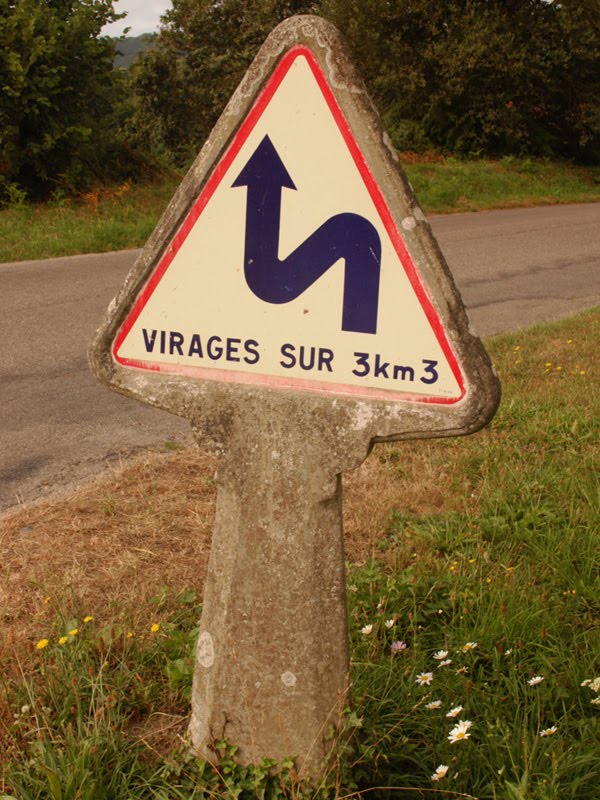
French road sign warns of curves ahead. Photo from photoguide.cz.

On the road in France:
A different approach to getting around

…you will often find yourself passing through villages where the road shrinks to one lane to be shared with pedestrians, bicycles, dogs, restaurant sign boards, and oncoming traffic.

By David P. Hamilton / The Rag Blog / May 12, 2010

[This article was written in consultation with Chris Dobbs, American expatriate artist living in Lyon, France.]

PARIS — When making comparisons between France and the United States, I typically favor France, but not always. France has no Grand Canyon or redwoods. No buffalo or buzzards. The French make a virtue out of force feeding geese, love nuclear power, eat horses, smoke cigarettes too much and pot not enough. Other exceptions escape me.

I was first infected with Francophilia thanks to the U.S. Army, which in 1964 very kindly sent me to France rather than Vietnam. Two months before the Gulf of Tonkin incident, which signaled the beginning of the U.S. assumption of the principal fighting role in Vietnam, I arrived at a major headquarters unit in Orleans, France, to begin my career as an army clerical worker. It was a nice, clean job in a non-combat zone, the very definition of soft duty. Although unaware at the time, I had lucked out beyond my wildest dreams.

Orleans is just upstream from the famed chateau region of the Loire Valley and an hour south of Paris. Although I complained about it for the next two and a half years, it beat being anywhere near Vietnam, or Germany for that matter, by considerably more than a country mile. Only much later did I realize it was a seminal time for me.

Besides our regular army jobs, we were required to do extra duty about once a week, usually struggling to stay awake while “guarding” some empty office building through the night. I volunteered to be a “duty driver” instead. This only meant that I might have to wake up in the middle of the night to drive some drunk lieutenant home from the officer’s club. It was my first experience driving in France.

I have since driven through France several times and have concluded that there are several features of the French road system that are clearly superior to that in the U.S. — and a couple that are not. Although the French are not typically defensive drivers, France has about 40% fewer traffic fatalities per capita than the U.S.

Clearly, they have something positive going for them in this sphere. It is not that they are better drivers or have safer cars. More likely this commendable safety record is due to the traffic system design. American expatriate friends who have lived in France for many years say that it is also due to a cultural undercurrent of patience and civility.

This latter opinion flies in the face of the common American stereotype that the French are rude. I believe this stereotype is pure crap. France is the world’s most popular tourist attraction and an important component of that is its citizens being gracious hosts. I’ve seen Americans in France berating waiters for not speaking English far more often than French waiters being rude to American customers.

Virtually every day French people volunteer to speak their limited English to me even though I’m in their country and speak rudimentary French. Americans who say the French are rude are almost invariably bigoted chauvinists who have never been here. If they have, they probably came on a guided tour with preconceived prejudices and lacked the willingness or ability to speak a word of French. Try to imagine a Frenchman at Denny’s insisting on a French-speaking waiter. Yet that’s the kind of expectation such Americans have.
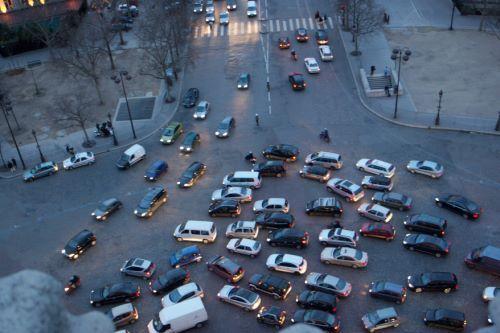
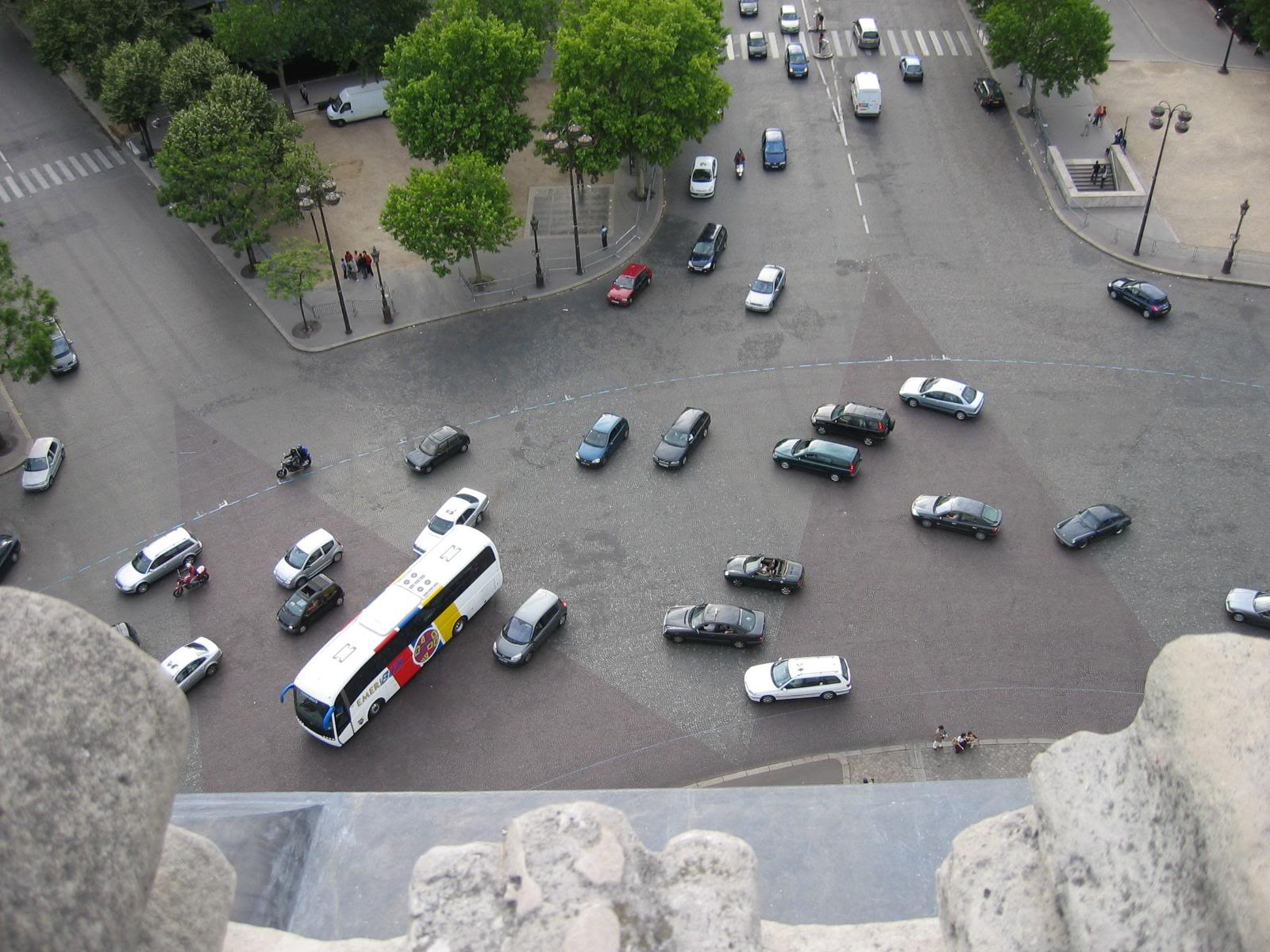
View of traffic circle below the Arc-de-Triomphe. Photo from travelpod.com.

The most noticeable difference in the road system is traffic circles. They are rare in the U.S. but very common in France, especially outside city centers. They replace stop signs and red lights and keep traffic continuously moving. On entering them, you must yield to cars already on them, but usually everything just keeps flowing. One can pass through even medium sized towns without ever stopping, having gone through several circles in the process.

Each circle has clearly marked directional options, both road numbers and towns to be found in the direction indicated. You just need to know the next major town in the direction you want to go and it will appear on a sign pointing to the correct road. If you are uncertain where you’re going, you can keep circling until you decide. French drivers, however, are quick to observe this indecisiveness and may honk, gesture and mouth unintelligible remarks. This is especially true if you have an Avis sticker on your back window.

To the American driver, the main negative feature of these circles is that they have two lanes going around them and often two lanes entering them. This sometimes calls for a certain amount of maneuvering. The maneuver where a car on the inside (left) lane of the circle suddenly realizes it is time to exit right is troublesome to Americans used to precise rules of the road.

To the French, however, it is an event that calls forth the efficacious driving principle in which rigid rules that breed complacency and displace personal responsibility to external institutions are replaced by individual initiative and mutual negotiations. This mix of freedom, caution, and cooperation enables traffic circles to work well.

The French readiness to communicate with other drivers is subtly different from that which typically takes place in the U.S. In the U.S, most people are reticent to express their displeasure with other drivers because the recipient of their remarks may be heavily armed and have an easily offended masculinity. This potential for serious road rage is practically non-existent in France.

For the French — not having the God-given right to possess deadly force at all times — expressing such displeasure isn’t all that risky, so people feel more free to indulge. But these exchanges are a kind of banter with a core of politeness or at least civility. The French have even been known to apologize. If you think they’re saying something nasty, it’s probably because you’re paranoid and don’t understand idiomatic French.

The signage on French roads, unlike that in the U.S., utilizes international symbols. It is in most respects better, at least insofar as telling you where you are going. The signs can, however, be ambiguous, especially for someone unaccustomed to the international signage and who doesn’t read French. It helps to have a navigator with a translation dictionary. Another complication is that the numbers used refer to the metric system. Of course, anyone familiar with both the metric system and the confusing jumble of measurements we use in the U.S. will attest to the superiority and greater simplicity of the former. But it does take getting used to.

The directional signs at traffic circles allow you to travel across France, even on back roads, if you know the next major town along the way to your destination, referring to maps only occasionally to determine the towns along your route. If the town you’re looking for is not found on the signs, there will be one saying “toutes directions” or “autres directions.” Follow those until you arrive at a circle with a sign pointing to the place you want to go. It almost always works
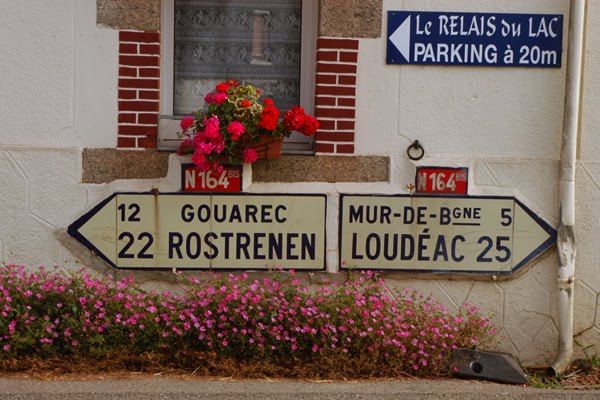
French road signs on the side of a house. Photo from photoguide.cz.

Another feature of French signs that Americans may find bothersome is that they never refer to cardinal directions. There is no highway D15 east and D15 west; only D15. This may be due to D15 winding in several directions as it circumvents some town. We carry a compass.

Another clearly superior feature of the French road system is that large trucks are always obliged to go slower than cars, in some cases much slower. On super highways outside cities cars can go up to130km per hour while trucks are limited to 90. This confines trucks to the right hand lane. It also allows tourists who don’t know where they are going to nestle among them until they figure it out.

On smaller departmental roads, the difference is usually 90 and 80. The maximum speed a truck may go is shown by numbers on its back door. Imagine I-35 in Austin with no semis blazing along at 80mph. And due to reliance on a much better developed rail system for the movement of goods, there are many fewer trucks to deal with.

On French roads the speed limits change automatically when it rains. On super highways, it drops from 130kph to 110 for cars and 90 to 80 for trucks. Corresponding changes are required on smaller roads. Although I’ve never seen it, I have heard that this exists in the U.S., but varies from place to place and is poorly enforced.

However, speed limits are seldom posted on secondary roads except to slow you down when passing through towns. The maximum speeds are uniform for all roads of a certain type and you’re supposed to know what they are without being told. On a D (departmental) road, it’s 90kph on dry roads, dropping to 80 if it’s raining. But no sign will remind you of this.
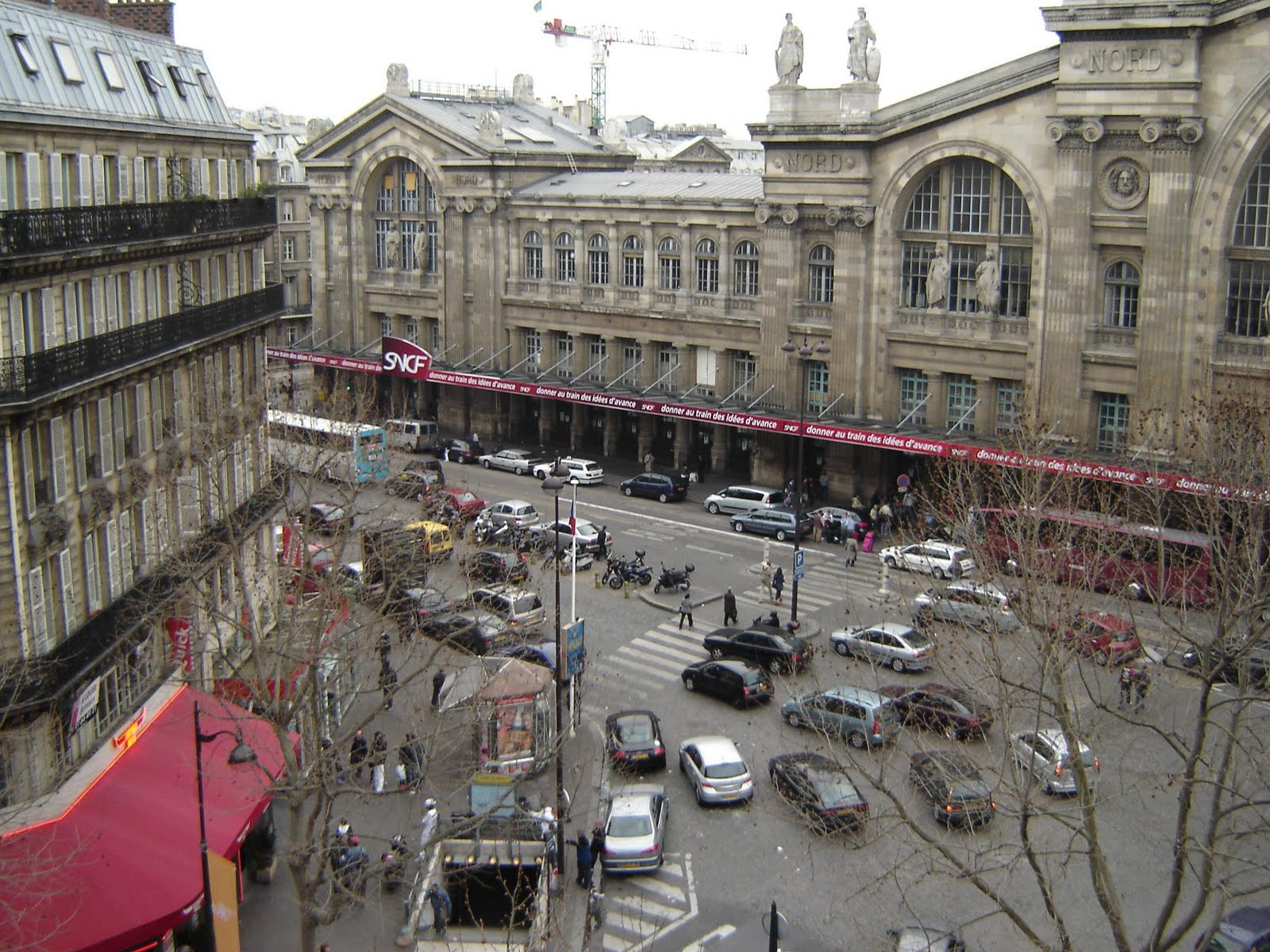
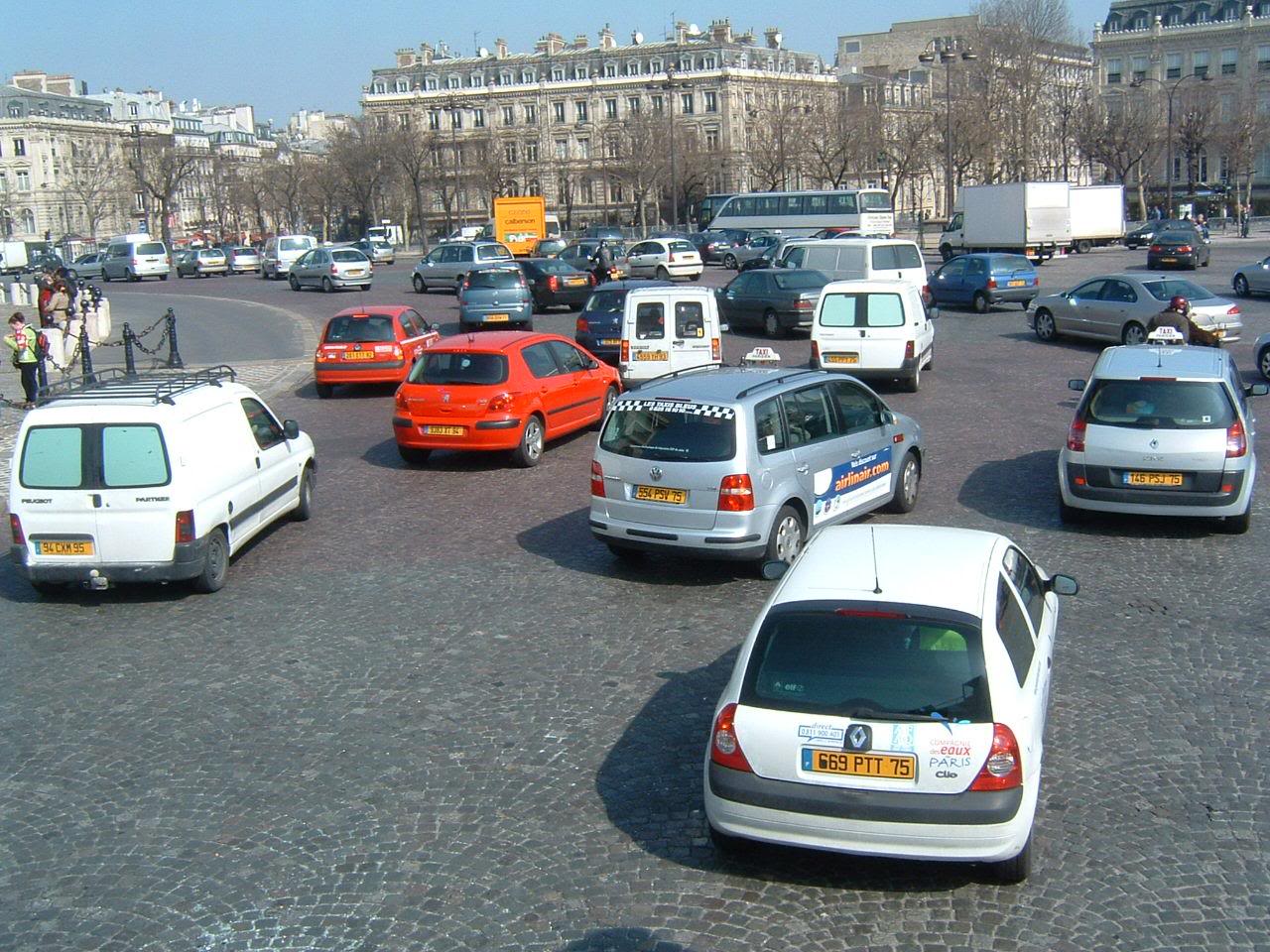
Traffic scene. Photo by nealiousq1 / webshots.

If you learned to drive in France, you were required to know maximum speeds for different types of roads under different conditions. Tourists have to figure it out by other means and it’s best to do so quickly because French police, when they make one of their rare appearances on highways, will give you a ticket for the slightest transgression of the prescribed limit.

Another outstanding feature is the “passage.” These are pedestrian cross walks, a series of white rectangles painted across streets in urban areas. They are very common, not only at corners, and vehicles must stop for pedestrians who are in them. They often do so even for pedestrians near one, when they even look like they might be thinking about crossing. This is especially true for anyone using a cane or pushing a baby carriage.

These events must be anticipated. The question often arises as to who got there first, but the pedestrian has the priority in this game. The driver behind a driver who is about to brake for a pedestrian also must be prepared to act suddenly. Strolling tourists not from California are often timorous about exerting this right, but the French seem to feel confident hurling themselves into the “passage ” without looking or breaking stride.

Another very positive feature of transportation in France is that there are so many alternatives to cars. Towns are more compact and many people actually walk to do daily errands. This contrasts sharply with the U.S., where the invariable first act upon leaving one’s house is to get into one’s car. The arrangement of our urban geography is predicated on the
assumption of individual car use.

Imagine no cars. For many French it isn’t hard to do. Living in compact towns and cities laid out long before the advent of cars, they can walk to nearby stores for all their needs. This has added benefits in terms of reducing pollution, promoting health, and maintaining small enterprises and social integration.

There are many more bicyclists in France, some doing mundane tasks and others out getting exercise. Many older men seem to be preparing for another run at the Tour de France. Bicycles rarely have special lanes and you are actually expected to defer to them.
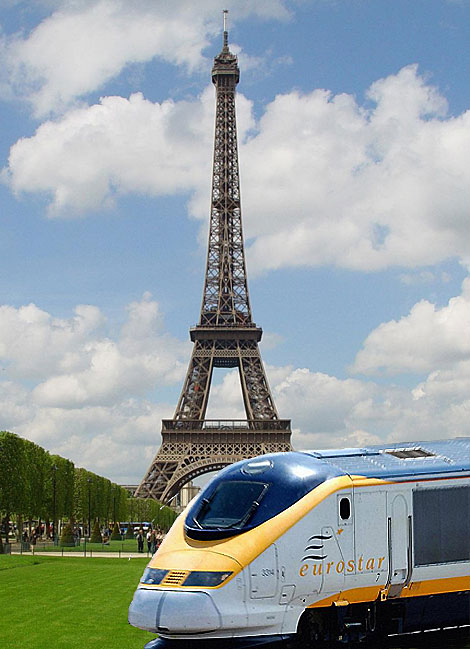
A pair of French landmarks.

Besides these alternatives to driving, France has a vastly better developed system of public transportation. The train system, owned by the government, is especially good. Trains go to even very small towns. We stayed in a town of no more than two thousand, but it had frequent train service to the nearest city and from there to the entire country.

Given the paucity of train service in the U.S., killed off early in the 20th century by car manufacturers and oil companies, I would speculate that the French ride trains a thousand times more per capita than Americans. The trains that run between major cities are now all TGV’s, high speed trains that run close to 200mph. Paris to Marsailles can be as little as a few hours. As the train stations are near the city centers, trains are typically quicker from home to ultimate destination than if you flew.

In Paris especially, few people get around by car. It’s not practical. There isn’t room for them, especially parking places, and municipal authorities look down on their use. This attitude is the opposite of what you find in the U.S, where space for cars is sacrosanct.

In urban France, parking garages are kept out of sight; they are underground and tourists are reluctant to drive down the dark holes leading to them. If you can by some miracle find an above ground parking spot, be ready to spend real money to rent it. There won’t be a parking meter for each space, but on the coveted site “payant” will be written. This means you must find the nearby machine dispensing permits, insert the correct change, take the paper permit it gives you indicating how long you have, and put it in a clearly visible place on your dashboard. This may run you a couple of euro an hour with a two hour limit.

If you get a parking ticket and ignore it, you will get a large bill in the mail, even in the US. If you ignore that too, good luck renting a car next time you come to Europe.

Alternatives to using a car in Paris or within other French cities are many. Besides walking and personal bikes, there is an extensive and well organized metro system that is directly connected to a regional train system that takes you far out into the suburbs. There is an even more extensive bus system that uses the same tickets as the metro and provides you with a view, but moves more slowly. For still more leisurely albeit costly transportation there is the “batobus,” a large public boat covered with clear plastic canopies that runs up and down the Seine through scenic central Paris.
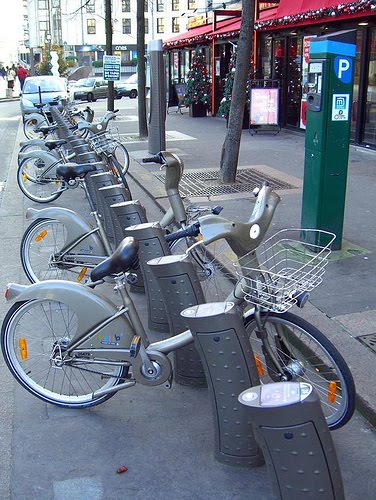
Public bicycle installation. Photo by Graham Coreil-Allen / GPS.

The latest transportation innovation is the public bicycles that can be found at installations all over Paris. You simply put a credit card into the machine found at each bike station as a deposit to get into the system. Then you can take out a bike for 30 minutes free and for very little thereafter, leaving it at any other bike station in the city. These are three speed bikes, but most of Paris is pretty flat.

By these and other means, such as reducing the number of parking spots and lanes for cars, the municipal government is openly and successfully reducing car use within the city.

The result of all these alternatives is that for urban dwellers cars are secondary transportation, a luxury used for special occasions. In contrast, life in the U.S. has been organized in such a way as to make car ownership an absolute necessity, the primary if not the only form of transportation.

But what about the negative features of driving in France? There are only a couple that seriously bother me. One is that they don’t tell you how much to slow down for corners on rural roads. You’ll be on a D (departmental) road where the top speed limit is 90kph and approaching a curve. Nothing says to slow down. There may be blue and silver chevrons pointing in the direction of the curve to warn you, but no sign advises you about the safe speed.

This reflects a gymkhana mentality. You clearly can’t make that corner at 90kph unless you’re a professional race car driver in a formula one vehicle. How fast you can actually do it depends on your car, skill, and nerve. A similar system in the U.S. would produce an epidemic of rollovers. In France, it’s a matter of personal responsibility.

Another major problem on French roads is motorcycles. The rules that apply to cars don’t seem to apply to them. They totally ignore the speed limits, pass at any time and anywhere, park arbitrarily, and often travel in packs that seem to be racing one another for high stakes. Like on California freeways, they drive down the stripes between car lanes at a very high rate of speed, flying by while you’re limited to stop and go.

The difference is that because of high gas prices there are exponentially more of them in France. If you suddenly change lanes without noticing their very rapid approach, bad news. A willingness to constantly risk death seems to be a basic qualification for motorcycle ownership. You would think that the French highway patrol would clamp down on this, but there are very few of them, a fact that has other advantages.
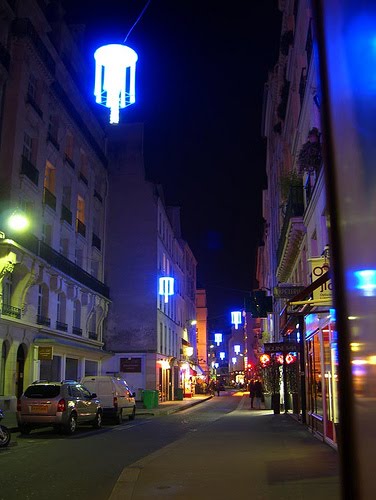
Holiday streetscape. Photo by Graham Coreil-Allen / GP.

The French have a different concept of social space that is much closer and includes the way they drive. Their houses and cars are generally smaller. They stand closer to talk to one another. And they are quite comfortable driving much closer to other cars. If you are a tourist trying to drive leisurely through the countryside, this means that one is very often two feet off your rear bumper and looking impatient. The solution is to merely pull over. On narrow roads, we do it every few kilometers.

This closeness includes the spatial geography of towns and cities. Virtually all of them came into existence centuries before cars and have not been significantly rebuilt to accommodate them. If you choose to get up close and personal with France by driving across it on secondary and tertiary roads, you will often find yourself passing through villages where the road shrinks to one lane to be shared with pedestrians, bicycles, dogs, restaurant sign boards, and oncoming traffic.

Cars belonging to visitors are often not allowed in these villages. You are required to park on the periphery and walk in. Signs confront you saying “interdit sauf riverains,” forbidden except for locals. Other signs inform you about who has the right of way when confronting oncoming traffic on a particularly narrow stretch. These places were not designed with cars in mind, and they now seem to make only minimal compromises. This contrasts sharply with the post-car lay out of American urban geography and our exaltation of the rights of these machines.

Vintage shot of Doubs, Miche (ca. 1930). Not built with cars in mind. Photo from photoguide.cz.

Finally, a major difference between driving in France and the U.S. is that it costs significantly more in France. These greater costs are a result of much higher gas prices due to taxes. Gas is now above $7 a gallon and there are also lots of tolls on superhighways outside cities. The French are OK with this because they understand that the money goes into the road system, just as they are OK with higher taxes in general because they get meaningful benefits for their tax money, not just transfer payments to corporations like in the US.

Given the other transportation options, driving long distances is seen as a luxury. Even the argument that you can pack a whole family in one car doesn’t hold water. The train guys, government employees, have thought of that and offer family based pricing. You can buy a Carte Enfant + card that gets you 50% off for that child and anyone who travels with him or her. Americans would puke at similar gas prices and tolls because they see “free” roads as a right and don’t take into account all the related costs.

If you think that the road system in the U.S. is the best in the world, you’re wrong. Having a passport to go with your driver’s license might enlighten you. But few American tourists venture out on French roads, especially the back roads. As a result, they miss many of the best sights.

There are many features of European roads that could be easily adopted that would save thousands of lives in the U.S. every year. Requiring large trucks to go significantly slower than cars and automatically reducing speed limits when it rains would cost practically nothing. But, these reforms are so very seldom discussed that few Americans are even aware of them.

The trucking industry and its corporate clients find improving your safety costly and inconvenient. In the U.S. where corporations rule, reducing traffic fatalities has little measurable impact on the only thing that really matters: the bottom line. Such concerns are therefore a very low priority.

Vastly expanding public transportation would shift the whole picture, saving thousands of lives, reducing oil consumption, and improving the environment. But expanding the public sphere is heresy in capitalist America, so don’t hold your breath for these obvious reforms to take place.

[David P. Hamilton is an Austin-based activist and writer.]

The Rag Blog

Posted in Rag Bloggers | Tagged , , , , , , , , , | Leave a comment

Harvey Wasserman : The BP Dead Zone

Before the Spill: Gulf of Mexico, 2009, from Destin, Florida. Photo ©2009 Mark Meyer.

While our military rots in the wrong gulf:
BP blows an apocalyptic gusher

By Harvey Wasserman / The Rag Blog / May 12, 2010

See ‘Ripple in still water, ‘ haiku by Richard Lee, Below.

As you read this, the life of our bodies, nation, and planet is being blown out a corporate hole in the Gulf of Mexico and into a BP Dead Zone of no return.

The apocalyptic gusher of oily poison pouring into the waters that give us life can only be viewed — FELT — by each and every one of us as an on-going death by a thousand cuts with no end in sight.

Yet our government — allegedly the embodiment of our collective will to survive — has done NOTHING of significance to fight this mass murder. Not one meaningful thing.

As it did while New Orleans drowned downstream from a willfully neglected levee system, our most potentially effective counterforce dithers on the other side of the world, in the wrong Gulf.

We squander our treasure on the largest conglomeration of people and weapons the world has ever seen. It’s bloated with hardware designed specifically to destroy and kill. Hundreds of thousands of Americans sit on our dime in more than a hundred countries, rotting in the outposts of a bygone empire.

Why aren’t they in the Gulf of Mexico, fighting for our truest “national security”?

The depth and scope of this catastrophe is impossible to grasp because it is just beginning. The entire Gulf, the west coast of Florida, the Everglades, the east coast of Florida and all the way up, wherever the currents go… they are all at risk.

This is the most lethal single attack on the life of this nation since December 7, 1941. It is a time that will live only in infamy.

The moment it happened, a sane president, a functional government, a society worthy of survival, would have marshaled every mobile resource available and moved it down to the Gulf.

Except by hitting a nuclear power plant and rendering this all radioactive, no terrorist could dream of igniting the kind of havoc now destroying our most vital, precious and irreplaceable resources.

Our mass media should be filled with stirring images of a focused, determined President mobilizing all available assets to curb the damage. Instead, Barack Obama defends offshore drilling and endorses the resumption of whaling — if this underwater gusher actually leaves any alive. It is a suicidal tribute to the power of corporate ownership.

Instead of a seeing a Gulf population deputized and mobilized to fight for survival, we are subjected to a loathsome trio of corporate stooges — apparently named Larry, Curly and Moe — blaming each other for the catastrophe. They should all be clamped into orange jumpsuits and locked onto a clean-up vessel.

Thus far the only armies officially mobilized are of the corporate PR departments and ubiquitous lawyers savoring the gusher of billable hours sure to stretch through the decades.

Our collective non-response to this cataclysmic reality now includes the introduction of a pathetic “climate bill,” concocted by another woeful trio, in service to the very corporations that have brought us this lethal gusher.

This bill will do nothing to solve this particular problem. Nor will it address the root cause of our addiction to obsolete and suicidal fossil and nuclear fuels at a time when the clean, cheap renewable alternatives are readily available. It is, in short, Beyond Tragic.

Make no mistake: in our lifetime, the Gulf will not recover. Nor will our species.

There are no corners of the Earth that we can pollute without poisoning it all… and our own bodies. We cannot squander our resources on killing people on the other side of the Earth while leaving ourselves to be destroyed by the mayhem at home.

Either our species learns this lesson, and acts on it — NOW! — or we do not survive.

[Harvey Wasserman’s Solartopia! Our Green-Powered Earth, is at www.harveywasserman.com . He is senior advisor to Greenpeace USA and senior editor of www.freepress.org, where this was also published.]

Ripple in still water

Shrill baby shrill yells
drill baby drill but the spill
will kill babies kill

Richard Lee / The Rag Blog

The Rag Blog

Posted in Rag Bloggers | Tagged , , , , , , , | 6 Comments

Your Good Vibes Are Needed:
Freedom Fighter Marilyn Buck Fights
for Her Life Before August Release

By Mariann Wizard / The Rag Blog / May 12, 2010

AUSTIN, Texas — As I write this, a member of the original Rag family needs our help, and, unprecedented in her tumultuous life, has asked for it. To me, if we ever had a true obligation to respond to such a plea; if our honor as self-proclaimed radicals ever depended on it, this is the one. But then again, Marilyn Buck (http://ragauthorspage.blogspot.com/2007/12/marilyn-buck.html) is a sister of my heart.

We’ve been friends since 1966, a world ago. A political prisoner since 1985, she was a fugitive for eight years before that, living a life with which I had no contact. Since her recapture, our friendship has been expressed in all too few visits, many letters, phone calls, books shared, and poems critiqued. But before that, there were her fabulous boots, Students for a Democratic Society, my husband George Vizard, our well-meant matchmaking, George’s death, GI organizing, hippie dancing, every visit I ever made to San Francisco, and unconditional love.

For all its state-imposed limits, Marilyn is one of my closest and dearest friends, one of those, for me, of whom The Who sang, “You can count ’em on your one hand.” I mention this only to let you know up front that mine is not an unbiased report. But don’t get me wrong — ours is not an exclusive friendship; on the contrary, there are hundreds of people around the world who love her as much as I do. She has earned every bit of their affection.

Not a few of our letters and phone calls concern political matters; Marilyn is a prodigious reader and organizer, and seldom misses a bet to connect people with causes that will interest them, or resources that will help forward a progressive — she would say “anti-imperialist” — vision. She has been a valued adviser to the Board of Directors of Youth Emergency Service, Inc. /The Phogg Phoundation for the Pursuit of Happiness (www.phoggphoundation.info) for years, bringing worthwhile non-profit organizations to our attention, always addressing the most relevant issues of the day.

Marilyn’s Episcopal minister father, Louis Buck, was legendary in Austin civil rights circles when I first got involved, as a college freshman, in 1965. I heard of Dr. Buck, and met him once or twice, before I ever met her. Marilyn had an upper-middle-class private school education, but crosses had been burned on the family lawn north of the University of Texas campus. Her father’s church defrocked him, and he became a veterinarian to support his family.

Early on Marilyn saw that racism was wrong, that she needed to oppose it, and that the establishment could not be counted upon to do the right thing. Ironically, her Dad sent her to college at the University of California at Berkeley to keep her away from the crazy radicals (SDS and others) at UT Austin. Smart as a whip and curious about everything, the innocent young lady who went to “Berzerkeley” soon discovered psychedelics, rock music, and “high society”.

Despite the protection the elder Bucks attempted to provide their cherished daughter, on the college campuses of 1965, there was no hiding place for anyone with a minimal curiosity about national and world affairs. But it was when she returned to Austin in 1966 that we “crazy radicals” met her. She and I, and George, became fast friends. We were fascinated with her West Coast sophistication; she with our close-knit radical community. It was in Austin that she joined SDS, worked on the original Rag, and met a national SDS organizer on his way out of town. She went with him.

In Chicago, she worked in the SDS National Office and edited New Left Notes, the group’s national news organ, then returned by herself to the Bay Area, with a sharply-honed anti-imperialist outlook.

There she worked with Third World Newsreel — this was back when video cameras weighed 30-plus pounds and needed two people to operate, running in tandem through the tear gas-choked streets, taping demonstrations as the San Francisco Tac Squad closed in! — and soon met and became friends with members of Bay Area Black liberation groups.

Now, if you really don’t know who this woman is, that’s still no reason for me to duplicate the “About Marilyn” link at Friends of Marilyn Buck (http://marilynbuck.com/about.html). There is a lot more to Marilyn’s story of activism, self-sacrifice, and achievement, but it is her story to tell, and she’s not yet able to tell it; perhaps not yet able to entirely see it. She is held in the belly of the beast.

After a 1973 arrest for buying two boxes of ammunition under a false name, she was sentenced to 15 years in federal prison. The real accusation was that a middle-class, educated white woman had acted as quartermaster for the Black Liberation Army, an off-shoot of the Black Panther Party. She was charged and convicted for the same reason that UC professor and Communist Angela Davis had been arrested: she helped arm Black people to defend themselves against racist police and white supremacist attacks.

After four years at Alderson Federal Women’s Prison, where she was such a model prisoner that she worked in the prison pharmacy, and after being denied parole for, I think, the third time, she was given a furlough to consult with her lawyers. She didn’t come back.

During the next few years Marilyn allegedly participated in the prison escape of BLA leader Assata Shakur and a bank robbery to assist the New Afrikan independence movement, and, with other white anti-imperialists, was complicit in a smoke-bombing of the U.S. Capitol, to protest our invasion of Grenada and the bombing of Lebanon by U.S. warships. After her capture in 1985, she and three women co-defendants took a plea to secure the release of another, a physician whose non-Hodgkin’s lymphoma had recurred in prison. She received a total sentence of 80 years.

Immediately after sentencing, she was taken to a new, maximum security total lock-down federal women’s prison at Marianna, FL. Eventually, legal appeals by her and other political prisoners at Marianna, and at a similar facility in Lexington, KY, forced closure of both prisons as embodying cruel and unusual punishment.

Marilyn embodies the old-school principle, “Don’t mourn, organize!” Ever since her first arrest, she has steadfastly resisted diverting “movement resources” to her defense or benefit. In her interactions, she directs attention away from her personal inconveniences as a high-security prisoner (she is considered a “terrorist” by the government) to social and political issues, or at least to the personal lives of her friends and correspondents, with whom she unfailingly empathizes even when pointing out that one is being ridiculous. Her character is like the finest steel; it resists corrosion, shakes off the grime of daily use, and shines. Her level-headedness alone is enough to make her a valued friend!

Despite her selflessness, an active support group has grown up with members all over the world, centered in San Francisco, across the Bay from Dublin Federal Correctional Center, where Marilyn was sent after Marianna FCI was closed. Repeated attempts to gain parole have been slapped down through the years, and even her most optimistic supporters feared that she could expect no quarter from the minions of the State. The once-privileged daughter of the white middle class has been upheld throughout her captivity by a multicultural, multi-gendered group of working class supporters, poets, former prisoners, prison reform activists and others, enabled to buy postage stamps, pre-paid phone minutes, paper and pens, and kept in books and periodicals (she’s a daily reader of the New York Times), allowing her to stay in contact with friends and kindred spirits, and with a changing world.

During those years, Marilyn has became an accomplished, highly-acclaimed poet and translator; developed a significant artistic talent as a sculptor; organized prisoners to raise funds for AIDS education through a pledge walk-a-thon; and taught untold hundreds of other women how to read, how to think things through, and how to survive and even transcend their sentences. She has mentored and inspired scores of poets inside and outside the walls.

Both of her parents passed away during her incarceration, and she could neither see them before their deaths nor attend their funeral services. There have been other serious personal hardships, but that was, I think, the most difficult to bear. Even the shock of the 9-11 terrorist attacks in 2000, when Marilyn – along with scores of other prisoners around the country in many facilities, completely uninvolved in the attacks – was suddenly removed from her cell and placed in total solitary confinement, without access even to her attorneys for many days, didn’t really compare with not being able to mourn her parents.

All along, her principled conduct has brought many new friends and supporters along with the old. She had a steady stream of visitors at Dublin FCI, including 60s radical icons and the now-grown children of friends and former neighbors. She corresponds with poets and artists around the world. Thirty or more poets participated in making Wild Poppies (2004, Freedom Archives, www.freedomarchives.org), a CD of her poems, including South Africa’s laureate of liberation, Dennis Brutus, and Amiri Baraka (formerly known as LeRoi Jones), who introduces the compilation.

Finally, a year ago, it looked as if the sun would shine for her once more. A new hearing brought a positive decision: she would be released on parole in August, 2010! Supporters in the Bay Area began to raise funds for her expected transition to circumscribed freedom.

Marilyn has made every effort to stay connected, despite her isolation behind razor wire and the censor’s hand. She had never, ever talked about what she would do when, or if, she was released; when you’re doing an 80-year sentence, you do it, as they say, “one day at a time”. Suddenly she was full of questions: “What kind of computer should I get at first, a laptop or a desk top?” (She’s never been in cyberspace; most prison inmates can’t go online. I told her to get a smart phone for the first 6 months; see if she even needs a computer!) She wasn’t convinced that digital cameras are as good as film; and said she might find work in a photography studio… I held my tongue. She was coming out; nothing else mattered. Whatever changes that had occurred but hadn’t occurred to her, she would roll with ’em.

Then in December, right around her 62nd birthday, she was diagnosed with a rare form of uterine cancer, a sarcoma, dangerous as a rattlesnake, potentially lethal. Another friend sent me a clinical description of the disease; I can’t bear to read it all the way through; it hurts. She had symptoms for months before diagnostic tests were made. The quality of health care, especially for women, in prison is not, shall we say, exemplary! But she kept her “health issues” vague and low-key with most supporters, including, to my chagrin, me; not wanting any “fuss” over herself; not wanting to worry her friends. Penny Schoner, a mutual friend and staunch supporter, reminds me gently, “This is a woman who wakes up every morning thinking about the plight of women in Afghanistan or Palestine, not about herself.”

Marilyn had surgery in the Bay Area, pretty quickly once a diagnosis was made, and should have started chemotherapy six weeks later, when the surgical wounds had healed. But at Carswell Federal Medical Center in Ft. Worth, where thousands of seriously ill federal prisoners are treated, the tests performed when she was finally admitted in mid-March (do the math!) revealed new tumors and growths outside the original cancer site.

Now at last, the chemo has started, and she is full of hope. She has so much pent-up energy, dreams, desires, abilities, concerns, and life to live! Her experiences in America’s prison gulags have illuminated a hundred worthwhile projects and pressing needs to which she wants to contribute, as well as a whole new world of experiences that so far she has been denied.

So why, now, with parole already scheduled and this serious illness, is she still imprisoned at all? She’s been locked up longer than almost every other 60s political prisoner. Former Chicago Panther Party member and Houston’s celebrated “Mayor of Da 5th Ward”, folk artist Robert al-Walee, says, “If Marilyn was a Black woman, she would be free by now; there would have been a public outcry for her release.” Lee compares Buck to famed abolitionist leader John Brown, demonized in the American historical record. Whites who stand steadfastly against racism and discrimination become “race traitors”, and the slander of “terror” drives away liberal support

Assata Shakur, who has lived in exile in Havana, Cuba, for many years, agrees. She wrote, “When I think of Marilyn as a preacher’s daughter, I think of her as someone who wrestled with the moral problems of our times, and who was not afraid to take principled positions around those issues. Marilyn had a choice. She could have remained silent, she could have reaped the benefits of white-skin privilege. But instead she chose the path of righteousness… she has defended the have-nots, the powerless, and as a woman she has struggled for the liberation of all women… the only reason that she remains incarcerated is because of her political activism… She needs and deserves the support of all those who are committed to freedom and the abolition of pain and suffering on this earth. She deserves to be supported, she deserves to be respected and she deserves to be free.”

Austin candyman (smile!) Robert King (http://www.kingsfreelines.com), a former prisoner and Panther activist at Louisiana’s notorious Angola Prison, where his two comrades, Herman Wallace and Albert Woodfox (www.Angola3.org) remain imprisoned, expressing his wishes for Buck’s recovery, remarked on her “indomitable spirit”. He says, “Marilyn’s self-directed commitment shows her evolution towards the ideal of the revolutionary ‘New Wo/Man’ of whom George Jackson spoke. This is what enables her to weather the storms of life. She has given so much, and has asked for nothing. She has kept the faith and continues to fight the good fight.”

Kathleen Cleaver, professor of law at both Yale and Emory Universities and a veteran of both the Black Panther Party and the Student Non-violent Coordinating Committee (SNCC), had this to say: “Marilyn has always been stalwart and devoted in her dedication to the liberation of Black and all oppressed peoples. Unlike some, she never withdrew from that struggle.”

Akwasi Evans, publisher and editor of Austin’s NOKOA: The Observer, is another long-time admirer. He says, “Marilyn Buck is a truly courageous woman who sacrificed her liberty in the struggle for the liberation of all of America’s oppressed. She has paid a great price for her crimes against capitalist exploitation and ought to be released from prison now so she can fight her cancer in freedom instead of incarceration!”

Marilyn’s support has always been strong in the Black community, and among “minorities” in general. But some of us, her white sisters and brothers, have let her slip from mindfulness. She dared to support with deeds what we only said we supported: the right of Black people to defend themselves by any means necessary.

As for her experiences underground, after her 1977 escape from prison, these are of great relevance today. SDS and other Left organizations were crumbling then, under the combined assault of the State and our own lack of credible analysis. Marilyn has had a long time to meditate on the belief, held then by some, that armed revolution was imminent, and on the duties of the revolutionary. Reading her letters, poems, and essays over all these years, I’ve seen her extraordinary evolution, witnessed the maturation of an articulate, disciplined, ethical mind.

In her 1999 Master’s thesis in Fine Arts (she’s earned undergraduate and graduate degrees by correspondence while incarcerated), she wrote, “The artist creates the concept and framework for a different cultural paradigm. Political speeches, leaflets and pamphlets that exhort and condemn the old oppressive order rarely do that. Without the imagination, there is little daring to confront the old.”

We need her out here in the world; need her insight, her experience, and her creative imagination.

And at last, she has asked for a little help.

Here’s what we can all do right now:

1. JOIN Marilyn in meditation for a few minutes every morning at 7 a.m. Texas time. Visualize her healthy, healed, happy, and free. If you can’t wake up that early, do this meditation any time. Do it, if you have to, in your sleep.
• While you’re at it, ask your church, synagogue, or meditation center to put her on their prayer list, and send her a copy of the bulletin (address in next paragraph) so she knows she’s getting those good vibes!

2. SEND a get-well card or brief note to: Marilyn Buck 00482-285, FMC Carswell, PO Box 27137, Ft. Worth, TX 76127. Besides correspondence, the ONLY things she can receive are:
• money orders made out in her name (for small purchases in the prison commissary),
• photos of yourself and your family, newspaper or magazine clippings (but NOT entire periodicals), and
• some paperback books, preferably new.
If you write, don’t be miffed if she doesn’t reply; she is receiving a lot of mail and, d’oh, doesn’t have her usual energy! In a brief recent phone conversation, she said that she is being “upheld” by the love and support people are showing through such messages and her morning meditation. In a strange, horrid place, isolated, uprooted from familiar routines and friends of many, sick and in pain, she said “thank you”, and “please keep writing.”

[Yes, when you write to a prison inmate, even one who is in the hospital, your mail is censored. But sending a get-well card is unlikely to get you put on the Do-Not Fly list, not all by itself anyway!]

3. MONEY was already needed for Marilyn’s secure transition to unemployed freedom. Now, that need has increased, to insure ongoing monitoring of her health, possible follow-up treatments, and access to the healthy foods and supplements she’s been denied in the pen (a circumstance, in addition to the generally unhealthful condition of living in confinement, that no doubt contributed to her illness).

SEND a check or money order in any amount to: Friends of Marilyn Buck, % Legal Services for Prisoners with Children (www.prisonerswithchildren.org), 1540 Market St. – Ste. 490, San Francisco CA 94102, or contribute specifically to her welfare through their website. (If you’re in Austin, a benefit for her is tentatively planned here for June 25, and you’ll be asked to cough up deeply at that time!)
• VOLUNTEER for the anticipated Austin benefit. E-mail me: quinctilis@aol.com.

4. WATCH the Rag Blog and Austin’s other progressive media for updates!

5. And THINK of something else useful we can do; the goddamned injustice of this, as if pain and illness were ever justified, has me open to all kinds of suggestions! Thanks, C.G., for the “Alleged Un-crossing Candle”!

# # #

Type rest of the post here

Source /

The Rag Blog

Posted in RagBlog | Leave a comment

Your Good Vibes Are Needed:
Freedom Fighter Marilyn Buck Fights
for Her Life Before August Release

An “Alleged Un-Crossing Candle” burns before a Dharma Wheel based on the Whirlpool Nebula. The small photo of Marilyn, made when she was incarcerated at Alderson Federal Women’s Prison in the mid-1970s, when she and Wizard had already known each other for 10 years, ordinarily sits near the author’s front door.
The Rag Blog “burned” a similar candle a couple of years ago when former President G “Duhbya” Bush was practically praying that Cuban leader Fidel Castro would die of an intestinal ailment. Our candle is still burning, and Fidel is doing real well for a man his age. We’re not quite ready yet to start beheading chickens – but the time may be near.

by Mariann Wizard

AUSTIN, TX. As I write this, a member of the original Rag family needs our help, and, unprecedented in her tumultuous life, has asked for it. To me, if we ever had a true obligation to respond to such a plea; if our honor as self-proclaimed radicals ever depended on it, this is the one. But then again, Marilyn Buck (http://ragauthorspage.blogspot.com/2007/12/marilyn-buck.html) is a sister of my heart.

We’ve been friends since 1966, a world ago. A political prisoner since 1985, she was a fugitive for eight years before that, living a life with which I had no contact. Since her re-capture, our friendship has been expressed in all too few visits, many letters, phone calls, books shared, and poems critiqued. But before that, there were her fabulous boots, my first acid trip, Students for a Democratic Society, my husband George Vizard, our well-meant matchmaking, George’s death, GI organizing, hippie dancing, every visit I ever made to San Francisco, and unconditional love. For all its state-imposed limits, Marilyn is one of my closest and dearest friends, one of those, for me, of whom The Who sang, “You can count ’em on your one hand.” I mention this only to let you know up front that mine is not an unbiased report. But don’t get me wrong – ours is not an exclusive friendship; on the contrary, there are hundreds of people around the world who love her as much as I do. She has earned every bit of their affection.

Her fabulous boots-San Francisco, 1968-Photo by Jeff Blankfort

Not a few of our letters and phone calls concern political matters; Marilyn is a prodigious reader and organizer, and seldom misses a bet to connect people with causes that will interest them, or resources that will help forward a progressive – she would say “anti-imperialist” – vision. She has been a valued adviser to the Board of Directors of Youth Emergency Service, Inc. /The Phogg Phoundation for the Pursuit of Happiness (www.phoggphoundation.info) for years, bringing worthwhile non-profit organizations to our attention, always addressing the most relevant issues of the day.

Marilyn’s Episcopal minister father, Louis Buck, was legendary in Austin civil rights circles when I first got involved, as a college freshman, in 1965. I heard of Dr. Buck, and met him once or twice, before I ever met her. Marilyn had an upper-middle-class private school education, but crosses had been burned on the family lawn north of the University of Texas campus. Her father’s church de-frocked him, and he became a veterinarian to support his family.

Early on Marilyn saw that racism was wrong, that she needed to oppose it, and that the establishment could not be counted upon to do the right thing. Ironically, her Dad sent her to college at the University of California at Berkeley to keep her away from the crazy radicals (SDS and others) at UT Austin. Smart as a whip and curious about everything, the innocent young lady who went to “Berzerkeley” soon discovered psychedelics, rock music, and “high society”.

Sheltered young lady: Marilyn Buck as a bridesmaid in 1965 wedding of a classmate

Despite the protection the elder Bucks attempted to provide their cherished daughter, on the college campuses of 1965, there was no hiding place for anyone with a minimal curiosity about national and world affairs. But it was when she returned to Austin in 1966 that we “crazy radicals” met her. She and I, and George, became fast friends. We were fascinated with her West Coast sophistication; she with our close-knit radical community. It was in Austin that she joined SDS, worked on the original Rag, and met a national SDS organizer on his way out of town. She went with him.

Austin, Texas, police surveillance photo from an anti-war demonstration, 1966. L-R: Liz Helenchild, unknown woman, Terry Dyke, Marilyn Buck.

In Chicago, she worked in the SDS National Office and edited New Left Notes, the group’s national news organ, then returned by herself to the Bay Area, with a sharply-honed anti-imperialist outlook.

There she worked with Third World Newsreel – this was back when video cameras weighed 30+ pounds and needed two people to operate, running in tandem through the tear gas-choked streets, taping demonstrations as the San Francisco Tac Squad closed in! – And soon met and became friends with members of Bay Area Black Liberation groups.

Now, if you really don’t know who this woman is, that’s still no reason for me to duplicate the “About Marilyn” link at Friends of Marilyn Buck (http://marilynbuck.com/about.html). There is a lot more to Marilyn’s story of activism, self-sacrifice, and achievement, but it is her story to tell, and she’s not yet able to tell it; perhaps not yet able to entirely see it. She is held in the belly of the beast.

After a 1973 arrest for buying two boxes of ammunition under a false name, she was sentenced to 15 years in federal prison. The real accusation was that a middle-class, educated white woman had acted as quartermaster for the Black Liberation Army, an off-shoot of the Black Panther Party. She was charged and convicted for the same reason that UC professor and Communist Angela Davis had been arrested: she helped arm Black people to defend themselves against racist police and white supremacist attacks.

After four years at Alderson Federal Women’s Prison, where she was such a model prisoner that she worked in the prison pharmacy, and after being denied parole for, I think, the third time, she was given a furlough to consult with her lawyers. She didn’t come back.

During the next few years Marilyn allegedly participated in the prison escape of BLA leader Assata Shakur and a bank robbery to assist the New Afrikan independence movement, and, with other white anti-imperialists, was complicit in a smoke-bombing of the U.S. Capitol, to protest our invasion of Grenada and the bombing of Lebanon by U.S. warships. After her capture in 1985, she and three women co-defendants took a plea to secure the release of another, a physician whose non-Hodgkin’s lymphoma had recurred in prison. She received a total sentence of 80 years.

With co-defendant Susan Rosenberg (whose sentence was commuted by former President Bill Clinton before he left office in 2001) during the “Resistance Conspiracy” trial in 1988.

Immediately after sentencing, she was taken to a new, maximum security total lock-down federal women’s prison at Marianna, FL. Eventually, legal appeals by her and other political prisoners at Marianna, and at a similar facility in Lexington, KY, forced closure of both prisons as embodying cruel and unusual punishment.

Marilyn embodies the old-school principle, “Don’t mourn, organize!” Ever since her first arrest, she has steadfastly resisted diverting “movement resources” to her defense or benefit. In her interactions, she directs attention away from her personal inconveniences as a high-security prisoner (she is considered a “terrorist” by the government) to social and political issues, or at least to the personal lives of her friends and correspondents, with whom she unfailingly empathizes even when pointing out that one is being ridiculous. Her character is like the finest steel; it resists corrosion, shakes off the grime of daily use, and shines. Her level-headedness alone is enough to make her a valued friend!

Despite her selflessness, an active support group has grown up with members all over the world, centered in San Francisco, across the Bay from Dublin Federal Correctional Center, where Marilyn was sent after Marianna FCI was closed. Repeated attempts to gain parole have been slapped down through the years, and even her most optimistic supporters feared that she could expect no quarter from the minions of the State. The once-privileged daughter of the white middle class has been upheld throughout her captivity by a multicultural, multi-gendered group of working class supporters, poets, former prisoners, prison reform activists and others, enabled to buy postage stamps, pre-paid phone minutes, paper and pens, and kept in books and periodicals (she’s a daily reader of the New York Times), allowing her to stay in contact with friends and kindred spirits, and with a changing world.

Blooming where she’s planted – Marilyn at FCI Dublin, photo by author, 1994

During those years, Marilyn has became an accomplished, highly-acclaimed poet and translator; developed a significant artistic talent as a sculptor; organized prisoners to raise funds for AIDS education through a pledge walk-a-thon; and taught untold hundreds of other women how to read, how to think things through, and how to survive and even transcend their sentences. She has mentored and inspired scores of poets inside and outside the walls.

Both of her parents passed away during her incarceration, and she could neither see them before their deaths nor attend their funeral services. There have been other serious personal hardships, but that was, I think, the most difficult to bear. Even the shock of the 9-11 terrorist attacks in 2000, when Marilyn – along with scores of other prisoners around the country in many facilities, completely uninvolved in the attacks – was suddenly removed from her cell and placed in total solitary confinement, without access even to her attorneys for many days, didn’t really compare with not being able to mourn her parents.

All along, her principled conduct has brought many new friends and supporters along with the old. She had a steady stream of visitors at Dublin FCI, including 60s radical icons and the now-grown children of friends and former neighbors. She corresponds with poets and artists around the world. Thirty or more poets participated in making Wild Poppies (2004, Freedom Archives, www.freedomarchives.org), a CD of her poems, including South Africa’s laureate of liberation, Dennis Brutus, and Amiri Baraka (formerly known as LeRoi Jones), who introduces the compilation.

Visited by Kwame Ture (formerly known as Stokely Carmichael) at Dublin FCI, 1994. Ture passed on in 1998.

Finally, a year ago, it looked as if the sun would shine for her once more. A new hearing brought a positive decision: she would be released on parole in August, 2010! Supporters in the Bay Area began to raise funds for her expected transition to circumscribed freedom.

Marilyn has made every effort to stay connected, despite her isolation behind razor wire and the censor’s hand. She had never, ever talked about what she would do when, or if, she was released; when you’re doing an 80-year sentence, you do it, as they say, “one day at a time”. Suddenly she was full of questions: “What kind of computer should I get at first, a laptop or a desk top?” (She’s never been in cyberspace; most prison inmates can’t go online. I told her to get a smart phone for the first 6 months; see if she even needs a computer!) She wasn’t convinced that digital cameras are as good as film; and said she might find work in a photography studio… I held my tongue. She was coming out; nothing else mattered. Whatever changes that had occurred but hadn’t occurred to her, she would roll with ’em.

Then in December, right around her 62nd birthday, she was diagnosed with a rare form of uterine cancer, a sarcoma, dangerous as a rattlesnake, potentially lethal. Another friend sent me a clinical description of the disease; I can’t bear to read it all the way through; it hurts. She had symptoms for months before diagnostic tests were made. The quality of health care, especially for women, in prison is not, shall we say, exemplary! But she kept her “health issues” vague and low-key with most supporters, including, to my chagrin, me; not wanting any “fuss” over herself; not wanting to worry her friends. Penny Schoner, a mutual friend and staunch supporter, reminds me gently, “This is a woman who wakes up every morning thinking about the plight of women in Afghanistan or Palestine, not about herself.”

Marilyn had surgery in the Bay Area, pretty quickly once a diagnosis was made, and should have started chemotherapy six weeks later, when the surgical wounds had healed. But at Carswell Federal Medical Center in Ft. Worth, where thousands of seriously ill federal prisoners are treated, the tests performed when she was finally admitted in mid-March (do the math!) revealed new tumors and growths outside the original cancer site.

Now at last, the chemo has started, and she is full of hope. She has so much pent-up energy, dreams, desires, abilities, concerns, and life to live! Her experiences in America’s prison gulags have illuminated a hundred worthwhile projects and pressing needs to which she wants to contribute, as well as a whole new world of experiences that so far she has been denied.

With human rights activist and close friend Yuri Kochiyama, Dublin FCI, 1999

So why, now, with parole already scheduled and this serious illness, is she still imprisoned at all? She’s been locked up longer than almost every other 60s political prisoner. Former Chicago Panther Party member and Houston’s celebrated “Mayor of Da 5th Ward”, folk artist Robert al-Walee, says, “If Marilyn was a Black woman, she would be free by now; there would have been a public outcry for her release.” Lee compares Buck to famed abolitionist leader John Brown, demonized in the American historical record. Whites who stand steadfastly against racism and discrimination become “race traitors”, and the slander of “terror” drives away liberal support

Assata Shakur, who has lived in exile in Havana, Cuba, for many years, agrees. She wrote, “When I think of Marilyn as a preacher’s daughter, I think of her as someone who wrestled with the moral problems of our times, and who was not afraid to take principled positions around those issues. Marilyn had a choice. She could have remained silent, she could have reaped the benefits of white-skin privilege. But instead she chose the path of righteousness… she has defended the have-nots, the powerless, and as a woman she has struggled for the liberation of all women… the only reason that she remains incarcerated is because of her political activism… She needs and deserves the support of all those who are committed to freedom and the abolition of pain and suffering on this earth. She deserves to be supported, she deserves to be respected and she deserves to be free.”

Austin candyman (smile!) Robert King (http://www.kingsfreelines.com), a former prisoner and Panther activist at Louisiana’s notorious Angola Prison, where his two comrades, Herman Wallace and Albert Woodfox (www.Angola3.org) remain imprisoned, expressing his wishes for Buck’s recovery, remarked on her “indomitable spirit”. He says, “Marilyn’s self-directed commitment shows her evolution towards the ideal of the revolutionary ‘New Wo/Man’ of whom George Jackson spoke. This is what enables her to weather the storms of life. She has given so much, and has asked for nothing. She has kept the faith and continues to fight the good fight.”

Kathleen Cleaver, professor of law at both Yale and Emory Universities and a veteran of both the Black Panther Party and the Student Non-violent Coordinating Committee (SNCC), had this to say: “Marilyn has always been stalwart and devoted in her dedication to the liberation of Black and all oppressed peoples. Unlike some, she never withdrew from that struggle.”

With Kathleen Cleaver, visitor at Dublin FCI, about 2008.

Akwasi Evans, publisher and editor of Austin’s NOKOA: The Observer, is another long-time admirer. He says, “Marilyn Buck is a truly courageous woman who sacrificed her liberty in the struggle for the liberation of all of America’s oppressed. She has paid a great price for her crimes against capitalist exploitation and ought to be released from prison now so she can fight her cancer in freedom instead of incarceration!”

Marilyn’s support has always been strong in the Black community, and among “minorities” in general. But some of us, her white sisters and brothers, have let her slip from mindfulness. She dared to support with deeds what we only said we supported: the right of Black people to defend themselves by any means necessary.

As for her experiences underground, after her 1977 escape from prison, these are of great relevance today. SDS and other Left organizations were crumbling then, under the combined assault of the State and our own lack of credible analysis. Marilyn has had a long time to meditate on the belief, held then by some, that armed revolution was imminent, and on the duties of the revolutionary. Reading her letters, poems, and essays over all these years, I’ve seen her extraordinary evolution, witnessed the maturation of an articulate, disciplined, ethical mind.

In her 1999 Master’s thesis in Fine Arts (she’s earned undergraduate and graduate degrees by correspondence while incarcerated), she wrote, “The artist creates the concept and framework for a different cultural paradigm. Political speeches, leaflets and pamphlets that exhort and condemn the old oppressive order rarely do that. Without the imagination, there is little daring to confront the old.”

We need her out here in the world; need her insight, her experience, and her creative imagination.

And at last, she has asked for a little help.

: Published poet Buck at FCI Dublin, 1998

Here’s what we can all do right now:

1. JOIN Marilyn in meditation for a few minutes every morning at 7 a.m. Texas time. Visualize her healthy, healed, happy, and free. If you can’t wake up that early, do this meditation any time. Do it, if you have to, in your sleep.
• While you’re at it, ask your church, synagogue, or meditation center to put her on their prayer list, and send her a copy of the bulletin (address in next paragraph) so she knows she’s getting those good vibes!

2. SEND a get-well card or brief note to: Marilyn Buck 00482-285, FMC Carswell, PO Box 27137, Ft. Worth, TX 76127. Besides correspondence, the ONLY things she can receive are:
• money orders made out in her name (for small purchases in the prison commissary),
• photos of yourself and your family, newspaper or magazine clippings (but NOT entire periodicals), and
• some paperback books, preferably new.
If you write, don’t be miffed if she doesn’t reply; she is receiving a lot of mail and, d’oh, doesn’t have her usual energy! In a brief recent phone conversation, she said that she is being “upheld” by the love and support people are showing through such messages and her morning meditation. In a strange, horrid place, isolated, uprooted from familiar routines and friends of many, sick and in pain, she said “thank you”, and “please keep writing.”

[Yes, when you write to a prison inmate, even one who is in the hospital, your mail is censored. But sending a get-well card is unlikely to get you put on the Do-Not Fly list, not all by itself anyway!]

3. MONEY was already needed for Marilyn’s secure transition to unemployed freedom. Now, that need has increased, to insure ongoing monitoring of her health, possible follow-up treatments, and access to the healthy foods and supplements she’s been denied in the pen (a circumstance, in addition to the generally unhealthful condition of living in confinement, that no doubt contributed to her illness).

SEND a check or money order in any amount to: Friends of Marilyn Buck, % Legal Services for Prisoners with Children (www.prisonerswithchildren.org), 1540 Market St. – Ste. 490, San Francisco CA 94102, or contribute specifically to her welfare through their website. (If you’re in Austin, a benefit for her is tentatively planned here for June 25, and you’ll be asked to cough up deeply at that time!)
• VOLUNTEER for the anticipated Austin benefit. E-mail me: quinctilis@aol.com.

4. WATCH the Rag Blog and Austin’s other progressive media for updates!

5. And THINK of something else useful we can do; the goddamned injustice of this, as if pain and illness were ever justified, has me open to all kinds of suggestions! Thanks, C.G., for the “Alleged Un-crossing Candle”!

# # #


Type rest of the post here

Source /

The Rag Blog

Posted in RagBlog | Leave a comment

From the Massey Blast to the BP Spill : Fossil Fuels are Killing Us

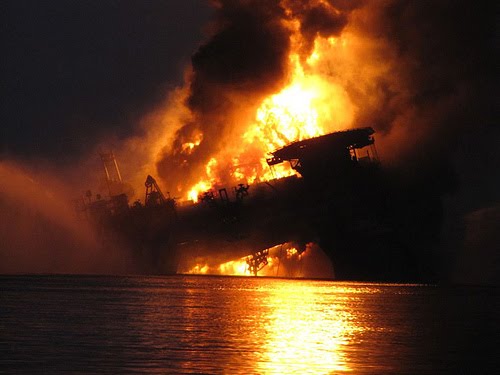
Deepwater Horizon oil rig burning before sinking into the Gulf of Mexico. Photo from U.S. Department of Energy / Leonard Doyle / Flickr.

Global response emerging:
Fossil fuels are killing us

By Alex Knight / The Rag Blog / May 11, 2010

See ‘Government exempted BP from environmental review,’ from Democracy Now!, Below.

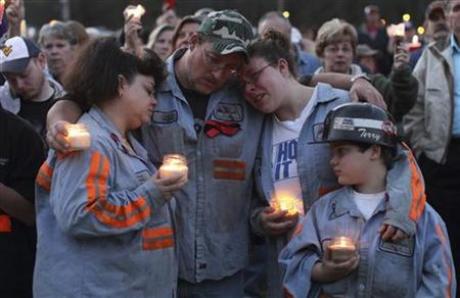
Just two weeks after the Massey Energy coal explosion on April 5 that killed 29 miners in West Virginia, the BP oil rig Deepwater Horizon exploded in the Gulf of Mexico, killing 11 more workers.

These back-to-back tragedies have brought attention to the fossil fuel industry’s terrible safety record — in both cases there were known safety violations on site, but the government did nothing to prevent disaster from occurring. See the interview below which explains how the federal government approved this BP rig and many more without conducting the environmental review they are legally obligated to.

Unlike the industry executives attempting to shift blame and avoid responsibility, we must look beneath the surface to discover the deeper meaning of these horrible crises.

Is the universe giving us a warning that fossil fuels are going to destroy us? Because if global climate change continues at the rate it has, in the not-too-distant future we will see many thousands, or even millions more deaths as crops dry up, floods destroy coastal wetlands, and diseases migrate to temperate regions. This is no joke. Families and communities are being destroyed so coal and oil corporations can boost their profit margins.

We need to be open to hearing the lessons that are all around us, especially from those who have been silenced and beaten down by capitalism.

Immediately after the Massey explosion and the BP explosion, was Earth Day — April 22. And on this date, indigenous and poor people from around the globe were meeting in Cochabamba, Bolivia, for the World People’s Conference on Climate Change, a grassroots response to the corporate fraud that was the Copenhagen Summit.

Bolivian President Evo Morales, who was proclaimed “World Hero of Mother Earth” by the United Nations General Assembly in October, hosted the conference, proclaiming “The capitalist system looks to obtain the maximum possible gain, promoting unlimited growth on a finite planet. Capitalism is the source of asymmetries and imbalance in the world.”

30,000 people from 140 countries convened and approved the “Cochabamba Protocol,” which calls for an International Climate Justice tribunal to prosecute climate criminals, and condemns REDDs which put a price on wild forests and encourage development, along with carbon market schemes. The protocal proposes a Universal Declaration of Mother Earth and demands that industrialized polluting nations cut carbon emissions by 50 percent as part of a new, binding climate agreement.

Global momentum is building towards confronting capitalism in terms of the ecological devastation it is causing. Here in the United States, Rising Tide North America is calling for a “Day of Action, Night of Mourning” this Friday, May 14, to call for BP to pay for all cleanup and long-term ecological effects of their spill, for the abolition of offshore oil drilling, and for “a rapid and just transition away from fossil fuels.”

[Alex Knight is an organizer and writer in Philadelphia. He is currently organizing with Philly Students for a Democratic Society (SDS) and working with others to mobilize Philadelphia for the US Social Forum this June 22-26 in Detroit. He also maintains the website endofcapitalism.com and is in the process of writing a book called The End of Capitalism. He can be reached at activistalex@gmail.com]

Families of miners from Massey Coal comfort each other during candlelight vigil in Montcoal, West Virginia, April 10, 2010. Photo by John Gress / Reuters.

Government exempted BP
From environmental review

By Democracy Now! / May 7, 2010

JUAN GONZALEZ: Well now to the Gulf of Mexico where the enormous oil slick in the Gulf continues to expand. Interior Secretary Ken Salazar has ordered a three-week halt to all new offshore drilling permits. Emphasizing that the companies involved had made “major mistakes,” Salazar spoke to reporters Thursday outside BP’s Houston crisis center. He noted that lifting the moratorium on new permits will depend on the outcome of a federal investigation over the Gulf spill and the recommendations to be delivered to President Obama at the end of the month.

SECRETARY KEN SALAZAR: Minerals Management Service will not be issuing any permits for the construction of new offshore wells. That process will be concluded here on May the 28th. At that point in time, we’ll make decisions about how we plan on moving forward. There is some very major mistakes that were made by companies that were involved. But today is not really the day to deal with those issues. Today and the days ahead really are about trying to get control of the problem.

JUAN GONZALEZ: Secretary Salazar added that the existing offshore oil and natural gas drilling will continue, even as public meetings to discuss new oil drilling off the Virginia coast have been canceled for this month.

AMY GOODMAN: Salazar’s announcement comes on the heel of a Washington Post exposé revealing that the Minerals Management Service had approved BP’s drilling plan in the Gulf of Mexico without any environmental review. The article notes that the agency under Secretary Salazar had quote “categorically excluded” BP’s drilling as well as hundreds of other offshore drilling permits from environmental review.

The agency was able to do this using a loophole in the National Environmental Policy Act created for minimally intrusive actions like building outhouses and hiking trails. Well, for more on this story, we’re joined now from Tucson, Arizona, by Kieran Suckling, executive director of the Center for Biological Diversity. Welcome to DEMOCRACY NOW!, Kieran. Explain this loophole, how you found it, and what it means for the Gulf.

KIERAN SUCKLING: Well, when a federal government is going to approve a project, it has to go through an environmental review. But for projects that have very, very little impact like building an outhouse or a hiking trail, they can use something called a categorical exclusion and say there’s no impact here at all so we don’t need to spend energy or time doing a review.

Well, we looked at the oil drilling permits being issued by the Minerals Management Service in the Gulf, and we were shocked to find out that they were approving hundreds of massive oil drilling permits using this categorical exclusion instead of doing a full environmental impact study. And then, we found out that BP’s drilling permit — the very one that exploded — was done under this loophole and so it was never reviewed by the federal government at all. It was just rubber-stamped.

JUAN GONZALEZ: Well, according to the Washington Post article, in one of its assessments of the agency “estimated that a large oil spill from a deep platform like the Deepwater Horizon would not exceed a total of 1,500 barrels and that a deepwater spill occurring off the intercontinental shelf would not reach the coast.” Obviously, both of those — both of those assessments have proven dramatically off the mark. As many as 250-400 waivers a year for drilling in the Gulf?

KIERAN SUCKLING: Yeah, yeah, absolutely. It’s also important to note that when the government says it’s very unlikely this spill will occur, it’s unlikely the spill will reach shore, those aren’t even the government’s own assessments. They’re just repeating what BP, Exxon, and other oil companies put in their drilling applications. And since there’s no environmental impact study, the government never actually does an independent review. So everyone is just repeating the industry’s statements as they rubber-stamp the approvals.

AMY GOODMAN: Reporters questioned White House press secretary Robert Gibbs on Wednesday about why BP’s Gulf of Mexico drilling operation was exempted from the detailed environmental impact analysis last year.

REPORTER: … Why BP was exempted from the environmental impact analysis?

SECRETARY ROBERT GIBBS: Yeah, well, I — the — there are a series of reviews that have to — that have to — you have to go through in order to get drilling permits. The process by which was referenced in that article is part of the review that Secretary Salazar is undergoing.

REPORTER: Robert, does the White House believe it was a mistake, for this categorical exemption to be granted to BP for Deepwater Horizon?

SECRETARY ROBERT GIBBS: That’s part of the investigation. I don’t know the answer to that.

REPORTER: Ok, so that’s something that you’re looking into presently?

SECRETARY ROBERT GIBBS: I would say as the President asked Secretary Salazar to undertake a thirty-day review of what happened, that that would certainly be part of the process under which he would evaluate.

AMY GOODMAN: Kieran Suckling, that was Robert Gibbs, White House press secretary. Respond to his response.

KIERAN SUCKLING: The White House and the Department of Interior are really sort of ducking their heads on this issue right now because it’s an enormous problem. Especially since just a few months ago the Government Accountability Office came out with the report on MMS’s operations in Alaska, where they also have offshore drilling, and specifically said the agency is not doing these environmental studies properly. They’re avoiding doing them at all. And then they went ahead knowing that the GAO had just done this study and continued to put them out.

So, this is not something new. MMS knew they had a problem. In fact, when Interior Secretary Salazar first came into office, he announced ‘There’s a new Sheriff in town, I’m going to clean up this corrupt agency,’ and instead of doing that, he’s pushed them to put out more offshore oil drilling permits while not cleaning up what is clearly a broken process of doing any environmental review at all.

JUAN GONZALEZ: I want to play a clip of President Obama where he says that oil spills don’t come from rigs, but from refineries. He was speaking on April 2nd, just over two weeks before the explosion of the Deepwater Horizon rig.

PRESIDENT BARACK OBAMA: I want to put out, by the way, that oil rigs today generally don’t cause spills. They are technologically very advanced. Even during Katrina, the spills didn’t come from the oil rigs, they came from the refineries onshore.

JUAN GONZALEZ: Kieran Suckling, your response?

KIERAN SUCKLING: Yeah, I mean, I think what the President has said here is actually just very, very critical, because he is repeating, and I suspect without even knowing it, the big lie of offshore oil drilling. For decades, the oil companies and the Minerals Management Services have told us, ‘Oil drilling is safe, it’s fine, that’s not where oil spills come from.’

In fact, that’s the basis of not doing any environmental review is, you simply assert it will never be a problem, therefore, you don’t even have to study it. When it’s true that they don’t leak often, but when they do leak, it’s absolutely catastrophic. It’s very similar to nuclear power plants. They don’t often fail, but when they fail it’s catastrophic. And, therefore, you have to plan for catastrophe. You have to do very intensive environmental analysis, not simply say, ’It’s rare, so we can ignore it.’

AMY GOODMAN: Kieran Suckling, what do think has to happen right now?

KIERAN SUCKLING: Well, first off, I think that the President should announce a complete moratorium on all new offshore oil drilling. This three-week time-out is really too little, too late. And it’s very important to do that now because the president, under the urging of Secretary of Interior Ken Salazar, has planned to open up new offshore oil drilling in Alaska, in the eastern Gulf of Mexico, and on the Atlantic coast. And that just needs to end. It’s not safe anywhere, anytime.

Secondly, the president should immediately revoke existing oil permits and especially in Alaska. Shell Oil, this July, has… is going to start doing offshore oil drilling in the Chukchi Sea of Alaska. And if you think it’s difficult to clean up oil in the relatively warm, calm Gulf of Mexico, imagine trying to do this with icebergs and sea ice, 20 hours of darkness in the Arctic oceans. It just cannot be done. If this spill had happened in Alaska, its magnitude would have been10 times worse than has happened in the Gulf.

Then, thirdly, the President should start an initiation of an investigation of Ken Salazar and his role in allowing this to happen. Salazar has been a major proponent of the offshore oil drilling industry. He passed legislation as a senator in 2006 to open up the Gulf of Mexico in the first place to offshore oil drilling. He gets campaign contributions by British Petroleum. And then he walks into this agency he is supposed to reform, and instead of reforming it, pushes it to do even more offshore oil drilling. So Ken Salazar is part of the problem here, not the solution. He should not be doing the investigation of MMS. He should be under investigation for helping to cause this crisis.

AMY GOODMAN: Well, Kieran Suckling, we want to thank you very much for being with us, Executive Director of the Center for Biological Diversity speaking to us from Tucson, Arizona. This is Democracy Now!, democracynow.org, the War and Peace Report…

Source / Democracy Now!

The Rag Blog

Posted in Rag Bloggers | Tagged , , , , , , , , , | Leave a comment

On the road in France.

David Hamilton with consultation from Chris Dobbs, American expatriate
artist living in Lyon, France.

When making comparisons between France and the United States, I typically favor France, but not always. France has no Grand Canyon or redwoods. No buffalo or buzzards. The French make a virtue out of force feeding geese, love nuclear power, eat horses, smoke cigarettes too much and pot not enough. Other exceptions escape me.

I was first infected with Francophilia thanks to the U.S. Army, which in 1964 very kindly sent me to France rather than Vietnam. Two months before the Gulf of Tonkin incident, which signaled the beginning of the U.S. assumption of the principal fighting role in Vietnam, I arrived at a major headquarters unit in Orleans, France, to begin my career as an army clerical worker. It was a nice, clean job in a non-combat zone, the very definition of soft duty. Although unaware at the time, I had lucked out beyond my wildest dreams.

Orleans is just upstream from the famed chateau region of the Loire Valley and an hour south of Paris. Although I complained about it for the next two and a half years, it beat being anywhere near Vietnam, or Germany for that matter, by considerably more than a country mile. Only much later did I realize it was a seminal time for me.

Besides our regular army jobs, we were required to do extra duty about once a week, usually struggling to stay awake while “guarding” some empty office building through the night. I volunteered to be a “duty driver” instead. This only meant that I might have to wake up in the middle of the night to drive some drunk lieutenant home from the officer’s club. It was my first experience driving in France.

I have since driven through France several times and have concluded that there are several features of the French road system that are clearly superior to that in the U.S. — and a couple that are not. Although the French are not typically defensive drivers, France has about 40% fewer traffic fatalities per capita than the U.S. Clearly, they have something positive going for them in this sphere. It is not that they are better drivers or have safer cars. More likely this commendable safety record is due to the traffic system design. American expatriate friends who have lived in France for many years say that it is also due to a cultural undercurrent of patience and civility.

This latter opinion flies in the face of the common American stereotype that the French are rude. I believe this stereotype is pure crap. France is the world’s most popular tourist attraction and an important component of that is its citizens being gracious hosts. I’ve seen Americans in France berating waiters for not speaking English far more often than French waiters being rude to American customers.

Virtually every day French people volunteer to speak their limited English to me even though I’m in their country and speak rudimentary French. Americans who say the French are rude are almost invariably bigoted chauvinists who have never been here. If they have, they probably came on a guided tour with pre-conceived prejudices and lacked the willingness or ability to speak a word of French. Try to imagine a Frenchman at Denny’s insisting on a French-speaking waiter. Yet that’s the kind of expectation such Americans have.

The most noticeable difference in the road system is traffic circles. They are rare in the U.S. but very common in France, especially outside city centers. They replace stop signs and red lights and keep traffic continuously moving. On entering them, you must yield to cars already on them, but usually everything just keeps flowing. One can pass through even medium sized towns without ever stopping, having gone through several circles in the process.

Each circle has clearly marked directional options, both road numbers and towns to be found in the direction indicated. You just need to know the next major town in the direction you want to go and it will appear on a sign pointing to the correct road. If you are uncertain where you’re going, you can keep circling until you decide. French drivers, however, are quick to observe this indecisiveness and may honk, gesture, and mouth unintelligible remarks. This is especially true if you have an Avis sticker on your back window.

To the American driver, the main negative feature of these circles is that they have two lanes going around them and often two lanes entering them. This sometimes calls for a certain amount of maneuvering. The maneuver where a car in the inside (left) lane of the circle suddenly realizes it is time to exit right is troublesome to Americans used to precise rules of the road. To the French, however, it is an event that calls forth the efficacious driving principle in which rigid rules that bread complacency and displace personal responsibility to external institutions are replaced by individual initiative and mutual negotiations. This mix of freedom, caution and cooperation enables traffic circles to work well.

The French readiness to communicate with other drivers is subtly different from that which typically takes place in the U.S. In the U.S., most people are reticent to express their displeasure with other drivers because the recipient of their remarks may be heavily armed and have an easily offended masculinity. This potential for serious road rage is practically non-existent in France.

For the French, not having the God-given right to possess deadly force at all times, expressing such displeasure isn’t all that risky, so people feel more free to indulge. But these exchanges are a kind of banter with a core of politeness or at least civility. They have even been known to apologize. If you think they’re saying something nasty, it’s probably because you’re paranoid and don’t understand idiomatic French.

The signage on French roads, unlike that in the U.S., utilizes international symbols. It is in most respects better, at least insofar as telling you where you are going. The signs can, however, be ambiguous, especially for someone unaccustomed to the international signage and who doesn’t read French. It helps to have a navigator with a translation dictionary.

Another complication is that the numbers used refer to the metric system. Of course, anyone familiar with both the metric system and the confusing jumble of measurements we use in the U..S will attest to the superiority and greater simplicity of the former. But it does take getting used to.

The directional signs at traffic circles allow you to travel across France, even on back roads, if you know the next major town along the way to your destination, referring to maps only occasionally to determine the towns along your route. If the town you’re looking for is not found on the signs, there will be one saying “toutes directions” or “autres directions”. Follow those until you arrive at a circle with a sign pointing to the place you want to go. It almost always works.

Another feature of signage is that Americans may find bothersome is that they never refer to cardinal directions. There is no highway D15 east and D15 west; only D15. This may be due to D15 winding in several directions as it circumvents some town. We carry a compass.

Another clearly superior feature of the French road system is that large trucks are always obliged to go slower than cars, in some cases much slower. On super highways outside cities cars can go up to130km per hour while trucks are limited to 90. This confines trucks to the right hand lane. It also allows tourists who don’t know where they are going to nestle among them until they figure it out. On smaller departmental roads, the difference is usually 90 and 80. The maximum speed a truck may go is shown by numbers on its back door. Imagine I-35 with no semis blazing along at 80mph. And due to reliance on a much better developed rail system for the movement of goods, there are many fewer trucks to deal with.

On French roads the speed limits change automatically when it rains. On super highways, it drops from 130kph to 110 for cars and 90 to 80 for trucks. Corresponding changes are required on smaller roads. Although I’ve never seen it, I have heard that this exists in the US, but varies from place to place and is poorly enforced. However, speed limits are seldom posted on secondary roads except to slow you down when passing through towns. The maximum speeds are uniform for all roads of a certain type and you’re supposed to know what they are without being told. On a D (departmental) road, it’s 90kph on dry roads, dropping to 80 if it’s raining. But no sign will remind you of this. If you learned to drive in
France, you were required to know maximum speeds for different types of roads under different conditions. Tourist have to figure it out by other means and it’s best to do so quickly because French police, when they make one of their rare appearances on highways, will give you a ticket for the slightest transgression of the prescribed limit.

Another outstanding feature is the “passage”. These are pedestrian cross walks, a series of white rectangles painted across streets in urban areas. There are very common, not only at corners, and vehicles must stop for pedestrians who are in them. They often do so even for pedestrians near one who look like they might be thinking about crossing, especially those with a cane or are pushing a baby carriage. These events must be anticipated. The question often arises as to who got there first, but the pedestrian has the priority in this game. The driver behind the driver who is about to brake for a pedestrian also must be prepared to act
suddenly. Strolling tourists not from California are often timorous about exerting this right, but the French seem to feel confident hurling themselves into the “passage ” without looking or breaking stride.

Another very positive feature of transportation in France is that there are so many alternatives to cars. Towns are more compact and many people actually walk to do daily errands. This contrasts sharply with the US, where the invariable first act upon leaving one’s house is to get into one’s car. The arrangement of our urban geography is predicated on the
assumption of individual car use.

Imagine no cars. For many French it isn’t hard to do. Living in compact towns and cities laid out long before the advent of cars, they can walk to nearby stores for all their needs. This has added benefits in terms of reducing pollution, promoting health, maintaining small
enterprises and social integration.

There are far more bicyclists in France, some doing mundane tasks and others out getting exercise. Many older men seem to be preparing for another run at the Tour de France. Bicycles rarely have special lanes and you are actually expected to defer to them.

Besides these alternatives to driving, France has a vastly better developed system of public transportation. The train system, owned by the government, is especially good. Trains go to even very small towns. We stayed in a town of no more than two thousand, but it had frequent train service to the nearest city and from there to the entire country. Given the paucity of train service in the US, killed off early in the 20th century by car manufacturers and oil companies, I would speculate that the French ride trains a thousand times more per capita than Americans. The trains that run between major cities are now all TGV’s, high speed trains that run close to 200mph. Paris to Marsailles can be as little as a few hours. As the train stations are near the city centers, trains are typically quicker from home to ultimate destination than if you flew.

In Paris especially, few people get around by car. It’s not practical. There isn’t room for them, especially parking places, and municipal authorities look down on their use. This attitude is the opposite of the US where space for cars is sacrosanct. In urban France, parking garages are keep out of sight by being located underground and tourists are reluctant to drive down the dark holes leading to them. If you can by some miracle find an above ground parking spot, be ready to spend real money to rent it. There won’t be a parking meter for each
space, but on the coveted site “payant” will be written. This means you must find the nearby machine dispensing permits, insert to correct change, take the paper permit it gives you indicating how long you have and put it in a clearly visible place on your dashboard. This may run you a couple of euro an hour with a two hour limit. If you get a parking ticket and
ignore it, you will get a large bill in the mail, even in the US. If you ignore that too, good luck renting a car next time you come to Europe.

Alternatives to using a car in Paris or within other French cities are many. Besides walking and personal bikes, there is an extensive and well organized metro system that is directly connected to a regional train system that takes you far out into the suburbs. There is an even more extensive bus system that uses the same tickets as the metro and provides you with a view, but moves more slowly. For still more leisurely albeit costly transportation there is the “batobus”, large public boats covered with clear plastic canopies that run up and down the Seine through scenic central Paris. The latest transportation innovation is the public bicycles that can be found at installations all over Paris. You simply put a credit card into the machine found at each bike station as a deposit to get into the system. Then you can take out a bike for 30 minutes free and for very little thereafter, leaving it at any other bike station in the city. These are three speed bikes, but most of Paris is pretty flat. By these and other means, such as reducing the number of parking spots and lanes for cars, the municipal government is openly and successfully reducing car use within the city.

The result of all these alternatives is that for urban dwellers cars are secondary transportation, a luxury used for special occasions. In contrast, life in the US has been organized in such a way as to make car ownership an absolute necessity, the primary if not the only form of transportation.

But what about the negative features of driving in France? There are only a couple that seriously bother me. One is that they don’t tell you how much to slow down for corners on rural roads. You’ll be on a D (departmental) road where the top speed limit is 90kph and approaching a curve. Nothing says to slow down. There may be blue and silver chevrons pointing in the direction of the curve to warn you, but no sign advises you about the safe speed. This reflects a gymkhana mentality. You clearly can’t make that corner at 90kph unless you’re a professional race car driver in a formula one vehicle. How fast you can actually do it depends on your car, skill and nerve. A similar system in the US would produce an epidemic of rollovers. In France, it’s a matter of personal responsibility.

Another major problem on French roads is motorcycles. All the rules that apply to cars don’t seem to apply to them. They totally ignore the speed limits, pass at any time and anywhere, park arbitrarily and often travel in packs that seem to be racing one another for high stakes. Like on California freeways, they drive down the stripes between car lanes at a very high rate of speed, flying by while you’re limited to stop and go. The difference is that because of high gas prices, there are exponentially more of them in France. If you suddenly change lanes without noticing their very rapid approach, bad news. A willingness to constantly risk death seems to be a basic qualification for motorcycle ownership. You would think that the French highway patrol police would clamp down on this, but there are very few of them, a fact that has other advantages.

The French have a different concept of social space that is much closer and includes how they drive. Their houses and cars are generally smaller. They stand closer to talk to one another. And they are quite comfortable driving much closer to other cars. If you are a tourist trying to drive leisurely through the countryside, this means that one is very often two feet off your rear bumper and looking impatient. The solution is to merely pull over. On narrow roads, we do it every few kilometers.

This closeness includes the spatial geography of towns and cities. Virtually all of them came into existence centuries before cars and have not been significantly rebuilt to accommodate them. If you choose to get up close and personal with France by driving across it on secondary and tertiary roads, you will often find yourself passing through villages where the road shrinks to one lane to be shared with pedestrians, bicycles, dogs, restaurant sign boards and oncoming traffic. Cars belonging to visitors are often not allowed in these villages. You are required to park on the periphery and walk in. Signs confront you saying “interdit sauf riverains”, forbidden except for locals. Other signs inform you as to who has the right of way when confronting oncoming traffic on a particularly narrow stretch. These places were not designed with cars in mind, and they now seek to make only minimal compromises. This contrasts sharply with the post-car lay out of American urban geography and our exaltation of the rights of these machines.

Finally, a major difference between driving in France and the US is that it costs significantly more in France. These greater costs are a result of much higher gas prices due to taxes. Gas is now above $7 a gallon and there are also lots of tolls on superhighways outside cities. The French are ok with this because they understand that the money goes into the road system, just as they are ok with higher taxes in general because they get meaningful benefits for their tax money, not just transfer payments to corporations like in the US. Given the other transportation options, driving long distance is seen as a luxury. Even the argument that
you can pack a whole family in one car doesn’t hold water. The train guys, government employees, have thought of that and offer family based pricing. You can buy a Carte Enfant + card that gets you 50% off for that child and anyone who travels with him or her. Americans would puke at similar gas prices and tolls because they see “free” roads as a right and don’t see all the related costs.

If you think that the road system in the US is the best in the world, you’re wrong. Having a passport to go with your driver’s license might enlighten you. But few American tourists venture out on French roads, especially the back roads. As a result, they miss many of the best sights.

There are many features of European roads that could be easily adopted that would save thousands of lives in the US every year. Requiring large trucks to go significantly slower than cars and automatically reducing speed limits when it rains would cost practically nothing. But, these reforms are so very seldom discussed that few Americans are even aware of them. The trucking industry and their corporate clients find improving your safety costly and inconvenient. In the US where corporations rule, reducing traffic fatalities has little measurable impact on the only thing that really matters, the bottom line. Such concerns are therefore a very low priority.

Vastly expanding public transportation would shift the whole picture, saving thousands of lives, reducing oil consumption and improving the environment. But expanding the public sphere is heresy in capitalist America, so don’t hold your breath for these obvious reforms to take place.

Type rest of the post here

Source /

The Rag Blog

Posted in RagBlog | Leave a comment

David P. Hamilton : On the Road in France


Paris traffic circle webshots

View of traffic circle below the Arc-de-Triomphe. Photo from travelpod.com.

By David P. Hamilton / The Rag Blog / May 11, 2010

[This article was written in consultation with Chris Dobbs, American expatriate artist living in Lyon, France.]

ON THE ROAD IN FRANCE — When making comparisons between France and the United States, I typically favor France, but not always. France has no Grand Canyon or redwoods. No buffalo or buzzards. The French make a virtue out of force feeding geese, love nuclear power, eat horses, smoke cigarettes too much and pot not enough. Other exceptions escape me.

I was first infected with Francophilia thanks to the U.S. Army, which in 1964 very kindly sent me to France rather than Vietnam. Two months before the Gulf of Tonkin incident, which signaled the beginning of the U.S. assumption of the principal fighting role in Vietnam, I arrived at a major headquarters unit in Orleans, France, to begin my career as an army clerical worker. It was a nice, clean job in a non-combat zone, the very definition of soft duty. Although unaware at the time, I had lucked out beyond my wildest dreams.

Orleans is just upstream from the famed chateau region of the Loire Valley and an hour south of Paris. Although I complained about it for the next two and a half years, it beat being anywhere near Vietnam, or Germany for that matter, by considerably more than a country mile. Only much later did I realize it was a seminal time for me.

Besides our regular army jobs, we were required to do extra duty about once a week, usually struggling to stay awake while “guarding” some empty office building through the night. I volunteered to be a “duty driver” instead. This only meant that I might have to wake up in the middle of the night to drive some drunk lieutenant home from the officer’s club. It was my first experience driving in France.

I have since driven through France several times and have concluded that there are several features of the French road system that are clearly superior to that in the U.S. — and a couple that are not. Although the French are not typically defensive drivers, France has about 40% fewer traffic fatalities per capita than the U.S.

Clearly, they have something positive going for them in this sphere. It is not that they are better drivers or have safer cars. More likely this commendable safety record is due to the traffic system design. American expatriate friends who have lived in France for many years say that it is also due to a cultural undercurrent of patience and civility.

This latter opinion flies in the face of the common American stereotype that the French are rude. I believe this stereotype is pure crap. France is the world’s most popular tourist attraction and an important component of that is its citizens being gracious hosts. I’ve seen Americans in France berating waiters for not speaking English far more often than French waiters being rude to American customers.

Virtually every day French people volunteer to speak their limited English to me even though I’m in their country and speak rudimentary French. Americans who say the French are rude are almost invariably bigoted chauvinists who have never been here. If they have, they probably came on a guided tour with preconceived prejudices and lacked the willingness or ability to speak a word of French. Try to imagine a Frenchman at Denny’s insisting on a French-speaking waiter. Yet that’s the kind of expectation such Americans have.

The most noticeable difference in the road system is traffic circles. They are rare in the U.S. but very common in France, especially outside city centers. They replace stop signs and red lights and keep traffic continuously moving. On entering them, you must yield to cars already on them, but usually everything just keeps flowing. One can pass through even medium sized towns without ever stopping, having gone through several circles in the process.

Each circle has clearly marked directional options, both road numbers and towns to be found in the direction indicated. You just need to know the next major town in the direction you want to go and it will appear on a sign pointing to the correct road. If you are uncertain where you’re going, you can keep circling until you decide. French drivers, however, are quick to observe this indecisiveness and may honk, gesture and mouth unintelligible remarks. This is especially true if you have an Avis sticker on your back window.

To the American driver, the main negative feature of these circles is that they have two lanes going around them and often two lanes entering them. This sometimes calls for a certain amount of maneuvering. The maneuver where a car on the inside (left) lane of the circle suddenly realizes it is time to exit right is troublesome to Americans used to precise rules of the road.

To the French, however, it is an event that calls forth the efficacious driving principle in which rigid rules that bread complacency and displace personal responsibility to external institutions are replaced by individual initiative and mutual negotiations. This mix of freedom, caution, and cooperation enables traffic circles to work well.

The French readiness to communicate with other drivers is subtly different from that which typically takes place in the U.S. In the U.S, most people are reticent to express their displeasure with other drivers because the recipient of their remarks may be heavily armed and have an easily offended masculinity. This potential for serious road rage is practically non-existent in France.

For the French — not having the God-given right to possess deadly force at all times — expressing such displeasure isn’t all that risky, so people feel more free to indulge. But these exchanges are a kind of banter with a core of politeness or at least civility. The French have even been known to apologize. If you think they’re saying something nasty, it’s probably because you’re paranoid and don’t understand idiomatic French.

The signage on French roads, unlike that in the U.S., utilizes international symbols. It is in most respects better, at least insofar as telling you where you are going. The signs can, however, be ambiguous, especially for someone unaccustomed to the international signage and who doesn’t read French. It helps to have a navigator with a translation dictionary. Another complication is that the numbers used refer to the metric system. Of course, anyone familiar with both the metric system and the confusing jumble of measurements we use in the U.S. will attest to the superiority and greater simplicity of the former. But it does take getting used to.

The directional signs at traffic circles allow you to travel across France, even on back roads, if you know the next major town along the way to your destination, referring to maps only occasionally to determine the towns along your route. If the town you’re looking for is not found on the signs, there will be one saying “toutes directions” or “autres directions.” Follow those until you arrive at a circle with a sign pointing to the place you want to go. It almost always works.

Another feature of French signs that Americans may find bothersome is that they never refer to cardinal directions. There is no highway D15 east and D15 west; only D15. This may be due to D15 winding in several directions as it circumvents some town. We carry a compass.

Another clearly superior feature of the French road system is that large trucks are always obliged to go slower than cars, in some cases much slower. On super highways outside cities cars can go up to130km per hour while trucks are limited to 90. This confines trucks to the right hand lane. It also allows tourists who don’t know where they are going to nestle among them until they figure it out.

On smaller departmental roads, the difference is usually 90 and 80. The maximum speed a truck may go is shown by numbers on its back door. Imagine I-35 in Austin with no semis blazing along at 80mph. And due to reliance on a much better developed rail system for the movement of goods, there are many fewer trucks to deal with.

On French roads the speed limits change automatically when it rains. On super highways, it drops from 130kph to 110 for cars and 90 to 80 for trucks. Corresponding changes are required on smaller roads. Although I’ve never seen it, I have heard that this exists in the U.S., but varies from place to place and is poorly enforced.

However, speed limits are seldom posted on secondary roads except to slow you down when passing through towns. The maximum speeds are uniform for all roads of a certain type and you’re supposed to know what they are without being told. On a D (departmental) road, it’s 90kph on dry roads, dropping to 80 if it’s raining. But no sign will remind you of this.

If you learned to drive in France, you were required to know maximum speeds for different types of roads under different conditions. Tourists have to figure it out by other means and it’s best to do so quickly because French police, when they make one of their rare appearances on highways, will give you a ticket for the slightest transgression of the prescribed limit.

Another outstanding feature is the “passage.” These are pedestrian cross walks, a series of white rectangles painted across streets in urban areas. They are very common, not only at corners, and vehicles must stop for pedestrians who are in them. They often do so even for pedestrians near one, when they even look like they might be thinking about crossing. This is especially true for anyone using a cane or pushing a baby carriage.

These events must be anticipated. The question often arises as to who got there first, but the pedestrian has the priority in this game. The driver behind a driver who is about to brake for a pedestrian also must be prepared to act suddenly. Strolling tourists not from California are often timorous about exerting this right, but the French seem to feel confident hurling themselves into the “passage ” without looking or breaking stride.

Another very positive feature of transportation in France is that there are so many alternatives to cars. Towns are more compact and many people actually walk to do daily errands. This contrasts sharply with the U.S., where the invariable first act upon leaving one’s house is to get into one’s car. The arrangement of our urban geography is predicated on the
assumption of individual car use.

Imagine no cars. For many French it isn’t hard to do. Living in compact towns and cities laid out long before the advent of cars, they can walk to nearby stores for all their needs. This has added benefits in terms of reducing pollution, promoting health, and maintaining small
enterprises and social integration.

There are many more bicyclists in France, some doing mundane tasks and others out getting exercise. Many older men seem to be preparing for another run at the Tour de France. Bicycles rarely have special lanes and you are actually expected to defer to them.

Besides these alternatives to driving, France has a vastly better developed system of public transportation. The train system, owned by the government, is especially good. Trains go to even very small towns. We stayed in a town of no more than two thousand, but it had frequent train service to the nearest city and from there to the entire country.

Given the paucity of train service in the U.S., killed off early in the 20th century by car manufacturers and oil companies, I would speculate that the French ride trains a thousand times more per capita than Americans. The trains that run between major cities are now all TGV’s, high speed trains that run close to 200mph. Paris to Marsailles can be as little as a few hours. As the train stations are near the city centers, trains are typically quicker from home to ultimate destination than if you flew.

In Paris especially, few people get around by car. It’s not practical. There isn’t room for them, especially parking places, and municipal authorities look down on their use. This attitude is the opposite of what you find in the U.S, where space for cars is sacrosanct.

In urban France, parking garages are kept out of sight; they are underground and tourists are reluctant to drive down the dark holes leading to them. If you can by some miracle find an above ground parking spot, be ready to spend real money to rent it. There won’t be a parking meter for each space, but on the coveted site “payant” will be written. This means you must find the nearby machine dispensing permits, insert the correct change, take the paper permit it gives you indicating how long you have, and put it in a clearly visible place on your dashboard. This may run you a couple of euro an hour with a two hour limit.

If you get a parking ticket and ignore it, you will get a large bill in the mail, even in the US. If you ignore that too, good luck renting a car next time you come to Europe.

Alternatives to using a car in Paris or within other French cities are many. Besides walking and personal bikes, there is an extensive and well organized metro system that is directly connected to a regional train system that takes you far out into the suburbs. There is an even more extensive bus system that uses the same tickets as the metro and provides you with a view, but moves more slowly. For still more leisurely albeit costly transportation there is the “batobus,” a large public boat covered with clear plastic canopies that runs up and down the Seine through scenic central Paris.

The latest transportation innovation is the public bicycles that can be found at installations all over Paris. You simply put a credit card into the machine found at each bike station as a deposit to get into the system. Then you can take out a bike for 30 minutes free and for very little thereafter, leaving it at any other bike station in the city. These are three speed bikes, but most of Paris is pretty flat.

By these and other means, such as reducing the number of parking spots and lanes for cars, the municipal government is openly and successfully reducing car use within the city.

The result of all these alternatives is that for urban dwellers cars are secondary transportation, a luxury used for special occasions. In contrast, life in the U.S. has been organized in such a way as to make car ownership an absolute necessity, the primary if not the only form of transportation.

But what about the negative features of driving in France? There are only a couple that seriously bother me. One is that they don’t tell you how much to slow down for corners on rural roads. You’ll be on a D (departmental) road where the top speed limit is 90kph and approaching a curve. Nothing says to slow down. There may be blue and silver chevrons pointing in the direction of the curve to warn you, but no sign advises you about the safe speed.

This reflects a gymkhana mentality. You clearly can’t make that corner at 90kph unless you’re a professional race car driver in a formula one vehicle. How fast you can actually do it depends on your car, skill, and nerve. A similar system in the U.S. would produce an epidemic of rollovers. In France, it’s a matter of personal responsibility.

Another major problem on French roads is motorcycles. The rules that apply to cars don’t seem to apply to them. They totally ignore the speed limits, pass at any time and anywhere, park arbitrarily, and often travel in packs that seem to be racing one another for high stakes. Like on California freeways, they drive down the stripes between car lanes at a very high rate of speed, flying by while you’re limited to stop and go.

The difference is that because of high gas prices there are exponentially more of them in France. If you suddenly change lanes without noticing their very rapid approach, bad news. A willingness to constantly risk death seems to be a basic qualification for motorcycle ownership. You would think that the French highway patrol would clamp down on this, but there are very few of them, a fact that has other advantages.

The French have a different concept of social space that is much closer and includes the way they drive. Their houses and cars are generally smaller. They stand closer to talk to one another. And they are quite comfortable driving much closer to other cars. If you are a tourist trying to drive leisurely through the countryside, this means that one is very often two feet off your rear bumper and looking impatient. The solution is to merely pull over. On narrow roads, we do it every few kilometers.

This closeness includes the spatial geography of towns and cities. Virtually all of them came into existence centuries before cars and have not been significantly rebuilt to accommodate them. If you choose to get up close and personal with France by driving across it on secondary and tertiary roads, you will often find yourself passing through villages where the road shrinks to one lane to be shared with pedestrians, bicycles, dogs, restaurant sign boards and oncoming traffic.

Cars belonging to visitors are often not allowed in these villages. You are required to park on the periphery and walk in. Signs confront you saying “interdit sauf riverains,” forbidden except for locals. Other signs inform you about who has the right of way when confronting oncoming traffic on a particularly narrow stretch. These places were not designed with cars in mind, and they now seem to make only minimal compromises. This contrasts sharply with the post-car lay out of American urban geography and our exaltation of the rights of these machines.

Finally, a major difference between driving in France and the U.S. is that it costs significantly more in France. These greater costs are a result of much higher gas prices due to taxes. Gas is now above $7 a gallon and there are also lots of tolls on superhighways outside cities. The French are OK with this because they understand that the money goes into the road system, just as they are OK with higher taxes in general because they get meaningful benefits for their tax money, not just transfer payments to corporations like in the US.

Given the other transportation options, driving long distances is seen as a luxury. Even the argument that you can pack a whole family in one car doesn’t hold water. The train guys, government employees, have thought of that and offer family based pricing. You can buy a Carte Enfant + card that gets you 50% off for that child and anyone who travels with him or her. Americans would puke at similar gas prices and tolls because they see “free” roads as a right and don’t take into account all the related costs.

If you think that the road system in the U.S. is the best in the world, you’re wrong. Having a passport to go with your driver’s license might enlighten you. But few American tourists venture out on French roads, especially the back roads. As a result, they miss many of the best sights.

There are many features of European roads that could be easily adopted that would save thousands of lives in the U.S. every year. Requiring large trucks to go significantly slower than cars and automatically reducing speed limits when it rains would cost practically nothing. But, these reforms are so very seldom discussed that few Americans are even aware of them.

The trucking industry and its corporate clients find improving your safety costly and inconvenient. In the U.S. where corporations rule, reducing traffic fatalities has little measurable impact on the only thing that really matters: the bottom line. Such concerns are therefore a very low priority.

Vastly expanding public transportation would shift the whole picture, saving thousands of lives, reducing oil consumption, and improving the environment. But expanding the public sphere is heresy in capitalist America, so don’t hold your breath for these obvious reforms to take place.

[David P. Hamilton is an Austin-based activist and writer.]

The Rag Blog

Posted in RagBlog | Leave a comment

From Massey to BP : Global Reaction is Building

Deepwater Horizon oil rig burning before sinking into the Gulf of Mexico. Photo from U.S. Department of Energy / Leonard Doyle / Flickr.

Global movement building…
From the Massey Coal to the BP Oil Spill:
Fossil fuels are killing us

By Alex Knight / The Rag Blog / May 11, 2010

See ‘Government exempted BP from environmental review,’ from Democracy Now!, Below.

Just two weeks after the Massey Energy coal explosion on April 5 that killed 29 miners in West Virginia, the BP oil rig Deepwater Horizon exploded in the Gulf of Mexico, killing 11 more workers. These back-to-back tragedies have brought attention to the fossil fuel industry’s terrible safety record — in both cases there were known safety violations on site, but the government did nothing to prevent disaster from occurring. See the interview below which explains how the federal government approved this BP rig and many more without conducting the environmental review they are legally obligated to.

Unlike the industry executives attempting to shift blame and avoid responsibility, we must look beneath the surface to discover the deeper meaning of these horrible crises.

Is the universe giving us a warning that fossil fuels are going to destroy us? Because if global climate change continues at the rate it has, in the not-too-distant future we will see many thousands, or even millions more deaths as crops dry up, floods destroy coastal wetlands, and diseases migrate to temperate regions. This is no joke. Families and communities are being destroyed so coal and oil corporations can boost their profit margins.

We need to be open to hearing the lessons that are all around us, especially from those who have been silenced and beaten down by capitalism.

Immediately after the Massey explosion and the BP explosion, was Earth Day — April 22. And on this date, indigenous and poor people from around the globe were meeting in Cochabamba, Bolivia, for the World People’s Conference on Climate Change, a grassroots response to the corporate fraud that was the Copenhagen Summit.

Bolivian President Evo Morales, who was proclaimed “World Hero of Mother Earth” by the United Nations General Assembly in October, hosted the conference, proclaiming “The capitalist system looks to obtain the maximum possible gain, promoting unlimited growth on a finite planet. Capitalism is the source of asymmetries and imbalance in the world.”

30,000 people from 140 countries convened and approved the “Cochabamba Protocol,” which calls for an International Climate Justice tribunal to prosecute climate criminals, and condemns REDDs which put a price on wild forests and encourage development, along with carbon market schemes. The protocal proposes a Universal Declaration of Mother Earth and demands that industrialized polluting nations cut carbon emissions by 50 percent as part of a new, binding climate agreement.

Global momentum is building towards confronting capitalism in terms of the ecological devastation it is causing. Here in the United States, Rising Tide North America is calling for a “Day of Action, Night of Mourning” this Friday, May 14, to call for BP to pay for all cleanup and long-term ecological effects of their spill, for the abolition of offshore oil drilling, and for “a rapid and just transition away from fossil fuels.”

Government exempted BP
From environmental review

By Democracy Now! / May 7, 2010

JUAN GONZALEZ: Well now to the Gulf of Mexico where the enormous oil slick in the Gulf continues to expand. Interior Secretary Ken Salazar has ordered a three-week halt to all new offshore drilling permits. Emphasizing that the companies involved had made “major mistakes,” Salazar spoke to reporters Thursday outside BP’s Houston crisis center. He noted that lifting the moratorium on new permits will depend on the outcome of a federal investigation over the Gulf spill and the recommendations to be delivered to President Obama at the end of the month.

SECRETARY KEN SALAZAR: Minerals Management Service will not be issuing any permits for the construction of new offshore wells. That process will be concluded here on May the 28th. At that point in time, we’ll make decisions about how we plan on moving forward. There is some very major mistakes that were made by companies that were involved. But today is not really the day to deal with those issues. Today and the days ahead really are about trying to get control of the problem.

JUAN GONZALEZ: Secretary Salazar added that the existing offshore oil and natural gas drilling will continue, even as public meetings to discuss new oil drilling off the Virginia coast have been canceled for this month.

AMY GOODMAN: Salazar’s announcement comes on the heel of a Washington Post exposé revealing that the Minerals Management Service had approved BP’s drilling plan in the Gulf of Mexico without any environmental review. The article notes that the agency under Secretary Salazar had quote “categorically excluded” BP’s drilling as well as hundreds of other offshore drilling permits from environmental review.

The agency was able to do this using a loophole in the National Environmental Policy Act created for minimally intrusive actions like building outhouses and hiking trails. Well, for more on this story, we’re joined now from Tucson, Arizona, by Kieran Suckling, executive director of the Center for Biological Diversity. Welcome to DEMOCRACY NOW!, Kieran. Explain this loophole, how you found it, and what it means for the Gulf.

KIERAN SUCKLING: Well, when a federal government is going to approve a project, it has to go through an environmental review. But for projects that have very, very little impact like building an outhouse or a hiking trail, they can use something called a categorical exclusion and say there’s no impact here at all so we don’t need to spend energy or time doing a review.

Well, we looked at the oil drilling permits being issued by the Minerals Management Service in the Gulf, and we were shocked to find out that they were approving hundreds of massive oil drilling permits using this categorical exclusion instead of doing a full environmental impact study. And then, we found out that BP’s drilling permit — the very one that exploded — was done under this loophole and so it was never reviewed by the federal government at all. It was just rubber-stamped.

JUAN GONZALEZ: Well, according to the Washington Post article, in one of its assessments of the agency “estimated that a large oil spill from a deep platform like the Deepwater Horizon would not exceed a total of 1,500 barrels and that a deepwater spill occurring off the intercontinental shelf would not reach the coast.” Obviously, both of those — both of those assessments have proven dramatically off the mark. As many as 250-400 waivers a year for drilling in the Gulf?

KIERAN SUCKLING: Yeah, yeah, absolutely. It’s also important to note that when the government says it’s very unlikely this spill will occur, it’s unlikely the spill will reach shore, those aren’t even the government’s own assessments. They’re just repeating what BP, Exxon, and other oil companies put in their drilling applications. And since there’s no environmental impact study, the government never actually does an independent review. So everyone is just repeating the industry’s statements as they rubber-stamp the approvals.

AMY GOODMAN: Reporters questioned White House press secretary Robert Gibbs on Wednesday about why BP’s Gulf of Mexico drilling operation was exempted from the detailed environmental impact analysis last year.

REPORTER: … Why BP was exempted from the environmental impact analysis?

SECRETARY ROBERT GIBBS: Yeah, well, I — the — there are a series of reviews that have to — that have to — you have to go through in order to get drilling permits. The process by which was referenced in that article is part of the review that Secretary Salazar is undergoing.

REPORTER: Robert, does the White House believe it was a mistake, for this categorical exemption to be granted to BP for Deepwater Horizon?

SECRETARY ROBERT GIBBS: That’s part of the investigation. I don’t know the answer to that.

REPORTER: Ok, so that’s something that you’re looking into presently?

SECRETARY ROBERT GIBBS: I would say as the President asked Secretary Salazar to undertake a thirty-day review of what happened, that that would certainly be part of the process under which he would evaluate.

AMY GOODMAN: Kieran Suckling, that was Robert Gibbs, White House press secretary. Respond to his response.

KIERAN SUCKLING: The White House and the Department of Interior are really sort of ducking their heads on this issue right now because it’s an enormous problem. Especially since just a few months ago the Government Accountability Office came out with the report on MMS’s operations in Alaska, where they also have offshore drilling, and specifically said the agency is not doing these environmental studies properly. They’re avoiding doing them at all. And then they went ahead knowing that the GAO had just done this study and continued to put them out.

So, this is not something new. MMS knew they had a problem. In fact, when Interior Secretary Salazar first came into office, he announced ‘There’s a new Sheriff in town, I’m going to clean up this corrupt agency,’ and instead of doing that, he’s pushed them to put out more offshore oil drilling permits while not cleaning up what is clearly a broken process of doing any environmental review at all.

JUAN GONZALEZ: I want to play a clip of President Obama where he says that oil spills don’t come from rigs, but from refineries. He was speaking on April 2nd, just over two weeks before the explosion of the Deepwater Horizon rig.

PRESIDENT BARACK OBAMA: I want to put out, by the way, that oil rigs today generally don’t cause spills. They are technologically very advanced. Even during Katrina, the spills didn’t come from the oil rigs, they came from the refineries onshore.

JUAN GONZALEZ: Kieran Suckling, your response?

KIERAN SUCKLING: Yeah, I mean, I think what the President has said here is actually just very, very critical, because he is repeating, and I suspect without even knowing it, the big lie of offshore oil drilling. For decades, the oil companies and the Minerals Management Services have told us, ‘Oil drilling is safe, it’s fine, that’s not where oil spills come from.’

In fact, that’s the basis of not doing any environmental review is, you simply assert it will never be a problem, therefore, you don’t even have to study it. When it’s true that they don’t leak often, but when they do leak, it’s absolutely catastrophic. It’s very similar to nuclear power plants. They don’t often fail, but when they fail it’s catastrophic. And, therefore, you have to plan for catastrophe. You have to do very intensive environmental analysis, not simply say, ’It’s rare, so we can ignore it.’

AMY GOODMAN: Kieran Suckling, what do think has to happen right now?

KIERAN SUCKLING: Well, first off, I think that the President should announce a complete moratorium on all new offshore oil drilling. This three-week time-out is really too little, too late. And it’s very important to do that now because the president, under the urging of Secretary of Interior Ken Salazar, has planned to open up new offshore oil drilling in Alaska, in the eastern Gulf of Mexico, and on the Atlantic coast. And that just needs to end. It’s not safe anywhere, anytime.

Secondly, the president should immediately revoke existing oil permits and especially in Alaska. Shell Oil, this July, has… is going to start doing offshore oil drilling in the Chukchi Sea of Alaska. And if you think it’s difficult to clean up oil in the relatively warm, calm Gulf of Mexico, imagine trying to do this with icebergs and sea ice, 20 hours of darkness in the Arctic oceans. It just cannot be done. If this spill had happened in Alaska, its magnitude would have been10 times worse than has happened in the Gulf.

Then, thirdly, the President should start an initiation of an investigation of Ken Salazar and his role in allowing this to happen. Salazar has been a major proponent of the offshore oil drilling industry. He passed legislation as a senator in 2006 to open up the Gulf of Mexico in the first place to offshore oil drilling. He gets campaign contributions by British Petroleum. And then he walks into this agency he is supposed to reform, and instead of reforming it, pushes it to do even more offshore oil drilling. So Ken Salazar is part of the problem here, not the solution. He should not be doing the investigation of MMS. He should be under investigation for helping to cause this crisis.

AMY GOODMAN: Well, Kieran Suckling, we want to thank you very much for being with us, Executive Director of the Center for Biological Diversity speaking to us from Tucson, Arizona. This is Democracy Now!, democracynow.org, the War and Peace Report…

Source / Democracy Now!

The Rag Blog

Posted in RagBlog | Leave a comment

Bob Feldman : A People’s History of Afghanistan / 5

Muhammad Zahir Shah reigned over Afghanistan from 1933-1973. Photo from AP / Guardian.

Part 5: 1933-1953
A People’s History of Afghanistan

By Bob Feldman / The Rag Blog / May 2, 2010

[If you’re a Rag Blog reader who wonders how the Pentagon ended up getting stuck “waist deep in the Big Muddy” in Afghanistan (to paraphrase a 1960s Pete Seeger song) — and still can’t understand, “what are we fighting for?” (to paraphrase a 1960s Country Joe McDonald song) — this 15-part “People’s History of Afghanistan” might help you debate more effectively those folks who still don’t oppose the planned June 2010 U.S. military escalation in Afghanistan? The series so far can be found here.]

The U.S. War Machine has been bombing Afghanistan for over eight years in its endless war against the Taliban regime’s Afghan government. Yet over 80 percent of Afghanistan’s territory in early 2010 was apparently still controlled by the Taliban regime and other armed Islamic guerrilla groups in Afghanistan that are apparently now allied with the Taliban.

One possible reason neither the Republican Bush II Administration nor the Democratic Obama Administration was able to achieve a quick military victory in the endless war in Afghanistan is that most members of the militaristic U.S. Establishment’s foreign policy-making elite apparently still don’t know very much about the history of the people of Afghanistan.

Nadir Shah’s successor as Afghan King, Muhammad Zahir Shah, sat on the Afghan throne, for example, from 1933 to 1973 — although he apparently never received as much mass media coverage in the USA during his 40 year reign in Afghanistan as did either Queen Elizabeth II or Princess Di of England.

But in the 1930s, “fascist intelligence agents… succeeded in penetrating the government apparatus and particular branches of the Afghan economy as `consultants,’ `advisers’ and `experts,” according to The Truth About Afghanistan by S. Gevortom. The same book also noted that:

The German colony in Afghanistan…greatly increased on the eve of the Second World War… Hitler’s agents Schenk, Fischer, Wenger and Knerlein… infiltrated the war ministry and the ministry of public works of Afghanistan… Nazi Germany managed to spread its influence among tribes in the south of Afghanistan and in the north-western border areas.

And apparently Nazi agents in Afghanistan encouraged increased anti-Semitism in Afghanistan during World War II, so that the economic situation of the remaining Afghans of Jewish background deteriorated when Zahir Shah’s monarchical government restricted their economic activity to local trading only and removed them from the foreign trade positions some had previously held.

But Zahir Shah’s government did not align Afghanistan with Nazi Germany during World War II. Instead, Zahir Shah’s government announced in November 1941 that — like the Irish government of Eamon DeValera — it would remain neutral during World War II.

Yet during Zahir Shah’s 40-year reign, some people in Afghanistan began to demand more democratization and modernization. A secret society of supporters of constitutional reform and democratization, the People of the Afghan Youth (Halqa-yi-Jawani-I Afghanistan) was formed and then broken up by the monarchical regime. But after Zahir Shah appointed his uncle, Shah Mahmud Khan, to be the Afghan monarchy’s prime minister in 1945, Shah Mahmud ordered the release of all Afghan political prisoners.

The first student union in Afghanistan, called the Union of Students, was then founded in 1946 and its political orientation was liberal reformist and anti-imperialist. The following year, the anti-monarchist, Awakened Youth (Weekh–Zalmayan) group of Afghan nationalists was started, which openly discussed the ideal of setting up a democratic republic in Afghanistan.

Then, in 1949, a parliamentary election was held and 40 percent of the elected members of the new Afghan parliament favored democratization and modernization reforms. So, not surprisingly, the Afghan parliament next passed a 1949 law which finally legalized freedom of the press in Afghan society.

Predictably, according to Afghanistan: A Modern History by Angelo Rasanayagam, “the enactment of laws permitting freedom of the press led to the appearance of newspapers and other publications whose favorite targets became the [Afghan] ruling family oligarchy and [Afghan] conservative religious leaders.”

At the same time, between 3,500 and 5,000 Afghans of Jewish background still lived in Afghanistan in 1949 — with more than 2,000 of them residing in the city of Herat and deriving their family incomes from the Persian carpet trade or from employment as tailors and shoemakers. But aside from a few wealthy families, most of the Afghans of Jewish background were forbidden to leave the country between 1933 and 1950. After 1951, however, they were allowed to emigrate from Afghanistan.

So by 1966, many Afghans of Jewish background had moved to either India or Israel/Palestine and only about 800 people of Jewish background now lived in Afghanistan; and by 1967 nearly 4,000 people of Afghan background now lived in Israel/Palestine.

By December 1969 only a few dozen Afghans of Jewish background still lived in either Herat or in Kabul; and, in all of Afghanistan, there were now only about 300 Afghans of Jewish background. And by 2005, according to The New York Times, only one Afghan of Jewish religious background apparently still lived in Afghanistan.

At Kabul University, meanwhile, during the early 1950s, the Union of Students “became a forum for free-wheeling debate and attacks on the status quo” in Afghanistan, according to Afghanistan: A Modern History. A Movement of the Enlightened Youth, the TNB (Tehrik-i-Naujawanan Baidar), was also started by young students in Afghanistan which, in its manifesto, called for:

  1. granting legal rights to Afghan women;
  2. a democratic Afghan government which was accountable to an elected Afghan parliament;
  3. eradication of official corruption in Afghanistan;
  4. the formation of political parties in Afghanistan; and
  5. the economic development of Afghanistan’s economy.

After a 1952 demonstration was held by these groups which demanded that people in Afghanistan be allowed to form political parties, however, the monarchical Afghan government prevented any further protest by these dissident political groups.

According to Afghanistan: A Modern History, for example, just before a 1953 palace revolution in Afghanistan, the Movement of the Enlightened Youth/TNB group of young political dissidents “was suppressed” by the Afghan monarchical regime and “some of its more vocal leftists were jailed.” The same book also recalled that among the Afghan leftist dissidents imprisoned in 1953 were included Dr. Abdul Rahman Mahmoodi (who was “the doyen of Afghan Marxism”), an Afghan historian named Mir Ghulam Mohammad Ghubar and an Afghan Marxist intellectual named Mir Akbar Khyber.

Next: “A People’s History of Afghanistan—Part 6: 1953-1967″

[Bob Feldman is an East Coast-based writer-activist and a former member of the Columbia SDS Steering Committee of the late 1960s.]

  • Previous installments of “A People’s History of Afghanistan” by Bob Feldman on The Rag Blog can be found here.

The Rag Blog

Posted in Rag Bloggers | Tagged , , , , | Leave a comment

Obama’s Natural Choice of Kagan

By Glenn Greenwald / May 10, 2010

It’s anything but surprising that President Obama has chosen Elena Kagan to replace John Paul Stevens on the Supreme Court. Nothing is a better fit for this White House than a blank slate, institution-loyal, seemingly principle-free careerist who spent the last 15 months as the Obama administration’s lawyer vigorously defending every one of his assertions of extremely broad executive authority. The Obama administration is filled to the brim with exactly such individuals — as is reflected by its actions and policies — and this is just one more to add to the pile. The fact that she’ll be replacing someone like John Paul Stevens and likely sitting on the Supreme Court for the next three decades or so makes it much more consequential than most, but it is not a departure from the standard Obama approach.

The New York Times this morning reports that “Mr. Obama effectively framed the choice so that he could seemingly take the middle road by picking Ms. Kagan, who correctly or not was viewed as ideologically between Judge Wood on the left and Judge Garland in the center.” That’s consummate Barack Obama. The Right appoints people like John Roberts and Sam Alito, with long and clear records of what they believe because they’re eager to publicly defend their judicial philosophy and have the Court reflect their values. Beltway Democrats do the opposite: the last thing they want is to defend what progressives have always claimed is their worldview, either because they fear the debate or because they don’t really believe those things, so the path that enables them to avoid confrontation of ideas is always the most attractive, even if it risks moving the Court to the Right.

Why would the American public possibly embrace a set of beliefs when even its leading advocates are unwilling to publicly defend them and instead seek to avoid that debate at every turn? Hence: Obama chooses an individual with very few stated beliefs who makes the Right quite comfortable (even as they go through the motions of opposing her). As Kevin Drum writes:

[R]ight now Obama has the biggest Democratic majority in the Senate he’s ever going to have. So why not use it to ensure a solidly progressive nominee like Diane Wood instead of an ideological cipher like Kagan?… When Obama compromises on something like healthcare reform, that’s one thing. Politics sometimes forces tough choices on a president. But why compromise on presidential nominees? Why Ben Bernanke? Why Elena Kagan? He doesn’t have to do this. Unfortunately, the most likely answer is: he does it because he wants to.

It’s even less surprising that Obama would not want to choose someone like Diane Wood. If you were Barack Obama, would you want someone on the Supreme Court who has bravely and resolutely insisted on the need for Constitutional limits on executive authority, resolutely opposed the use of Terrorism fear-mongering for greater government power, explicitly argued against military commitments and indefinite detention, repeatedly applied the progressive approach to interpreting the Constitution to a wide array of issues, insisted upon the need for robust transparency and checks and balances, and demonstrated a willingness to defy institutional orthodoxies even when doing so is unpopular? Of course you wouldn’t. Why would you want someone on the Court who has expressed serious Constitutional and legal doubts about your core policies? Do you think that an administration that just yesterday announced it wants legislation to dilute Miranda rights in the name of Scary Terrorists — and has seized the power to assassinate American citizens with no due process — wants someone like Diane Wood on the Supreme Court?

One final thought about Kagan for now. As I said from the beginning, the real opportunity to derail her nomination was before it was made, because the vast majority of progressives and Democrats will get behind anyone, no matter who it is, chosen by Obama. That’s just how things work. They’ll ignore most of the substantive concerns that have been raised about her, cling to appeals to authority, seize on personal testimonials from her Good Progressive friends, and try to cobble together blurry little snippets to assure themselves that she’s a fine pick. In reality, no matter what they know about her (and, more to the point, don’t know), they’ll support her because she’s now Obama’s choice, which means, by definition, that she’s a good addition to the Supreme Court. Our politics is nothing if not tribal, and the duty of Every Good Democrat is now to favor Kagan’s confirmation. Conservatives refused to succumb to those rules and ended up with Sam Alito instead of Harriet Miers, but they had a much different relationship to George Bush than progressives have to Obama (i.e., conservatives — as they proved several times [Miers, immigration, Dubai Ports] — were willing to oppose their leader whey they disagreed). The White House knows that progressives will never try to oppose any important Obama initiative, and even if they were inclined, they lack the power to do so (largely because unconditional support guarantees impotence).

All that said, I’ve said everything I had to say about Kagan in the pre-nomination process in order to enable as informed a public discussion as possible, and am not going to endlessly repeat those criticisms now just for the sake of doing so. Perhaps the confirmation process, for once, will yield some valuable information about the nominee and we’ll acquire at least some insight into how she thinks and what her judicial values and methods will be. I’m willing to keep an open mind. NPR’s Nina Totenberg yesterday uncovered (or was provided) a relatively encouraging piece of evidence that no public commentators (including me) had previously discovered: a 2005 letter co-signed by Kagan which opposed a proposal by Lindsey Graham to strip “War on Terror” detainees of the right to habeas corpus on the ground that the proposal was a violation of core American principles (that provision was ultimately included in the Military Commissions Act and struck down in 2008 by a 5-4 Supreme Court as unconstitutional).

The most important point to note about Kagan now is the one highlighted this weekend by Talk Left’s Armando, as first reported by The Los Angeles Times: in 1995, Kagan condemned the Supreme Court confirmation process as “a vapid and hollow charade” and an “embarrassment,” arguing that Senators should “insist that any nominee reveal what kind of Justice she would make, by disclosing her views on important legal issues.” Kagan should absolutely be held to her own position in that regard. Her argument that nominees should be compelled to answer such questions was absolutely right, and that’s especially applicable to Kagan in light of her own glaring lack of a real record on virtually everything. She ought to be held to her own position and “reveal what kind of Justice she would make” and “disclose her views on important legal issues.” I’m certainly willing to listen if she does that and then make a rational assessment of her based on those answers. Anyone wanting to form a rational choice should demand that she do the same.

* * * * *

I’ll be on Democracy Now this morning at 8:10 a.m. EST (live video here) discussing Kagan, and on MSNBC a few times later today, and will post exact times when I know them.
© 2010 Salon.com

Glenn Greenwald was previously a constitutional law and civil rights litigator in New York. He is the author of the New York Times Bestselling book “How Would a Patriot Act?,” a critique of the Bush administration’s use of executive power, released in May 2006. His second book, “A Tragic Legacy”, examines the Bush legacy.

Type rest of the post here

Source /

The Rag Blog

Posted in RagBlog | Leave a comment

Kagan and Obama : Birds of a Feather?


Elena Kagan:
A natural choice for Obama

Nothing is a better fit for this White House than a blank slate, institution-loyal, seemingly principle-free careerist…

By Glenn Greenwald / May 10, 2010

It’s anything but surprising that President Obama has chosen Elena Kagan to replace John Paul Stevens on the Supreme Court. Nothing is a better fit for this White House than a blank slate, institution-loyal, seemingly principle-free careerist who spent the last 15 months as the Obama administration’s lawyer vigorously defending every one of his assertions of extremely broad executive authority.

The Obama administration is filled to the brim with exactly such individuals — as is reflected by its actions and policies — and this is just one more to add to the pile. The fact that she’ll be replacing someone like John Paul Stevens and likely sitting on the Supreme Court for the next three decades or so makes it much more consequential than most, but it is not a departure from the standard Obama approach.

The New York Times this morning reports that “Mr. Obama effectively framed the choice so that he could seemingly take the middle road by picking Ms. Kagan, who correctly or not was viewed as ideologically between Judge Wood on the left and Judge Garland in the center.”

That’s consummate Barack Obama. The Right appoints people like John Roberts and Sam Alito, with long and clear records of what they believe because they’re eager to publicly defend their judicial philosophy and have the Court reflect their values. Beltway Democrats do the opposite: the last thing they want is to defend what progressives have always claimed is their worldview, either because they fear the debate or because they don’t really believe those things, so the path that enables them to avoid confrontation of ideas is always the most attractive, even if it risks moving the Court to the Right.

Why would the American public possibly embrace a set of beliefs when even its leading advocates are unwilling to publicly defend them and instead seek to avoid that debate at every turn? Hence: Obama chooses an individual with very few stated beliefs who makes the Right quite comfortable (even as they go through the motions of opposing her). As Kevin Drum writes:

[R]ight now Obama has the biggest Democratic majority in the Senate he’s ever going to have. So why not use it to ensure a solidly progressive nominee like Diane Wood instead of an ideological cipher like Kagan?… When Obama compromises on something like healthcare reform, that’s one thing. Politics sometimes forces tough choices on a president. But why compromise on presidential nominees? Why Ben Bernanke? Why Elena Kagan? He doesn’t have to do this. Unfortunately, the most likely answer is: he does it because he wants to.

It’s even less surprising that Obama would not want to choose someone like Diane Wood. If you were Barack Obama, would you want someone on the Supreme Court who has bravely and resolutely insisted on the need for Constitutional limits on executive authority, resolutely opposed the use of Terrorism fear-mongering for greater government power, explicitly argued against military commitments and indefinite detention, repeatedly applied the progressive approach to interpreting the Constitution to a wide array of issues, insisted upon the need for robust transparency and checks and balances, and demonstrated a willingness to defy institutional orthodoxies even when doing so is unpopular?

Of course you wouldn’t. Why would you want someone on the Court who has expressed serious Constitutional and legal doubts about your core policies? Do you think that an administration that just yesterday announced it wants legislation to dilute Miranda rights in the name of Scary Terrorists — and has seized the power to assassinate American citizens with no due process — wants someone like Diane Wood on the Supreme Court?

One final thought about Kagan for now. As I said from the beginning, the real opportunity to derail her nomination was before it was made, because the vast majority of progressives and Democrats will get behind anyone, no matter who it is, chosen by Obama. That’s just how things work. They’ll ignore most of the substantive concerns that have been raised about her, cling to appeals to authority, seize on personal testimonials from her Good Progressive friends, and try to cobble together blurry little snippets to assure themselves that she’s a fine pick.

In reality, no matter what they know about her (and, more to the point, don’t know), they’ll support her because she’s now Obama’s choice, which means, by definition, that she’s a good addition to the Supreme Court. Our politics is nothing if not tribal, and the duty of Every Good Democrat is now to favor Kagan’s confirmation.

Conservatives refused to succumb to those rules and ended up with Sam Alito instead of Harriet Miers, but they had a much different relationship to George Bush than progressives have to Obama (i.e., conservatives — as they proved several times [Miers, immigration, Dubai Ports] — were willing to oppose their leader whey they disagreed). The White House knows that progressives will never try to oppose any important Obama initiative, and even if they were inclined, they lack the power to do so (largely because unconditional support guarantees impotence).

All that said, I’ve said everything I had to say about Kagan in the pre-nomination process in order to enable as informed a public discussion as possible, and am not going to endlessly repeat those criticisms now just for the sake of doing so.

Perhaps the confirmation process, for once, will yield some valuable information about the nominee and we’ll acquire at least some insight into how she thinks and what her judicial values and methods will be. I’m willing to keep an open mind. NPR’s Nina Totenberg yesterday uncovered (or was provided) a relatively encouraging piece of evidence that no public commentators (including me) had previously discovered: a 2005 letter co-signed by Kagan which opposed a proposal by Lindsey Graham to strip “War on Terror” detainees of the right to habeas corpus on the ground that the proposal was a violation of core American principles (that provision was ultimately included in the Military Commissions Act and struck down in 2008 by a 5-4 Supreme Court as unconstitutional).

The most important point to note about Kagan now is the one highlighted this weekend by Talk Left’s Armando, as first reported by The Los Angeles Times: in 1995, Kagan condemned the Supreme Court confirmation process as “a vapid and hollow charade” and an “embarrassment,” arguing that Senators should “insist that any nominee reveal what kind of Justice she would make, by disclosing her views on important legal issues.”

Kagan should absolutely be held to her own position in that regard. Her argument that nominees should be compelled to answer such questions was absolutely right, and that’s especially applicable to Kagan in light of her own glaring lack of a real record on virtually everything. She ought to be held to her own position and “reveal what kind of Justice she would make” and “disclose her views on important legal issues.”

I’m certainly willing to listen if she does that and then make a rational assessment of her based on those answers. Anyone wanting to form a rational choice should demand that she do the same.

© 2010 Salon.com

[Glenn Greenwald was previously a constitutional law and civil rights litigator in New York. He is the author of the New York Times Bestselling book How Would a Patriot Act?, a critique of the Bush administration’s use of executive power, released in May 2006. His second book, A Tragic Legacy, examines the Bush legacy.]

Source / Salon.com / Common Dreams

The Rag Blog

Posted in RagBlog | Tagged , , , , , | 1 Comment

Marc Estrin is a writer and peace activist who lives in Burlington, Vermont. His novels,Insect Dreams, The Half Life of Gregor Samsa, The Education of Arnold Hitler, Golem Song, and The Lamentations of Julius Marantz have won critical acclaim. His memoir, Rehearsing With Gods: Photographs and Essays on the Bread & Puppet Theater (with Ron Simon, photographer) won a 2004 theater book of the year award. He is currently working on a novel about the dead Tchaikovsky.

Estrin studied theater directing and worked in repertory theater and continues to be involved with the famed Bread and Puppet Theater, is an ordained Unitarian Universalist Minister, and is a cellist and vocalist who has performed with several symphony orchestras.

I try to deal with political/cultural/philosophical material somewhat laterally — by inserting the issues into fiction settings. It’s my way of writing “political novels” without writing “political novels” — and thus hopefuly reaching an audience which wouldn’t read political novels, or even necessarily have thought about such issues at all. It’s a strategy with a small chance of success, small but not zero.

Posted in RagBlog | Leave a comment