Rabbi Arthur Waskow : Whores in Washington; Blowout in the Gulf

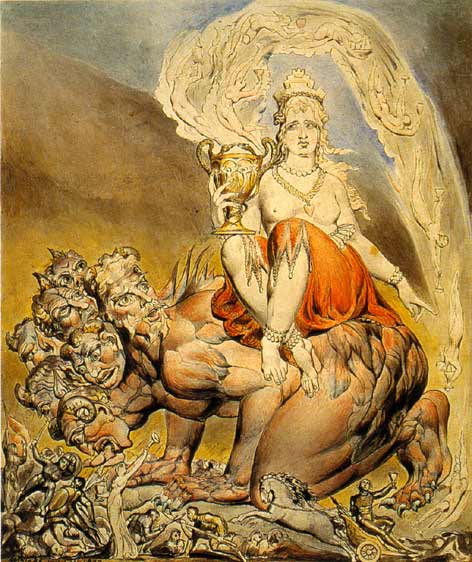
“Whore of Babylon.” Pen and watercolour over pencil. By William Blake (1809) / British Museum.

Blow jobs in DC;
Blowout in the Gulf

By Rabbi Arthur Waskow / The Rag Blog / May 10, 2010

You think that subject line above is just a trick to catch your attention? No, I mean it. Big Oil’s provision of whores in Washington to give blow jobs to U.S. officials helped produce the oil well blowout in the Gulf.

The Gulf oil blowout is only on the surface a technological failure. Much deeper and more to the point, it is a political failure.

Or if you represent Big Oil, it was a political triumph — until the blowout.

(What happened in the Gulf was not a “spill.” A “spill” happens when a finite amount of oil is spilled from a ship. The blowout is more like a geyser, a gusher, a volcano. The oil comes from the enormous undersea reservoir of oil. The oil well pokes a hole into the earth’s covering of that oil reservoir — and unless there is a way to cap the blowout, the oil pours and pours and pours.)

In many of the world’s off-shore oil wells, there is a remote-controlled “acoustic switch,” a shut-off device that is the last resort when the technology malfunctions and a blowout nears. Some countries mandate the acoustic device, and many companies insert them even when they are not required. But the U.S. does not mandate them, and BP did not insert one.

When I say “the U.S.,” in this case I mean a division of the Interior Department called the Minerals Management Service. What do we know about it?

This: On September 10, 2008, Charlie Savage of The New York Times reported that,

In three reports delivered to Congress on Wednesday, the department’s inspector general, Earl E. Devaney, found wrongdoing by a dozen current and former employees of the Minerals Management Service, which collects about $10 billion in royalties annually and is one of the government’s largest sources of revenue other than taxes.

‘A culture of ethical failure’ pervades the agency, Mr. Devaney wrote in a cover memo. …

Two other reports focus on ‘a culture of substance abuse and promiscuity’ in the service’s royalty-in-kind program. That part of the agency collects about $4 billion a year in oil and gas rather than cash royalties…

The investigation also concluded that several of the [Minerals Management Service] officials ‘frequently consumed alcohol at industry functions, had used cocaine and marijuana, and had sexual relationships with oil and gas company representatives.’

In blunter words, Big Oil provided whores to MMS officials who were supposed to be regulating Big Oil.

So MMS prostituted itself in return. And as a result, 11 oil rig workers were killed and the Gulf Coast of the United States faces an ecological and economic catastrophe.

Now that’s whoring on a grand scale, far beyond anything the Bible condemns. (Except maybe when it talks about the Whore of Babylon, an empire not so different from the American Empire. Now it’s not Emperor Nebuchadnezzar but “private” corporations, recently declared by the Supreme Court to be equal to human beings in their right to free speech by way of making unlimited election campaign contributions, who are the culprits, with the legal “government” turned into johns, tricks, for the Corporate whores. Or maybe it’s really the government that has made itself the Whore of Babylon, selling itself to Big Oil? )

The acoustic switch costs half a million dollars, according to the Wall Street Journal. It costs less than that to buy enough whores to keep the MMS happy. Here’s the political balance book: Invest a hundred thousand bucks or so to buy whores for the agencies that oversee you, make billions in profit from the absence of oversight, use the billions to invest in election campaigns if some clueless sheriff starts complaining about your whorehouse. A sweet deal, all around.

I forgot to add: Even in the last few weeks, since the Gulf oil blow-out, the MMS has been exempting new oil well applicants from doing environmental impact statements.

Even the Gulf disaster is small potatoes compared to the global disaster Big Oil is cooking up for us, colluding with Big Coal to see how much they need offer to buy the government.

As for a Climate Healing Act from Congress: Senator Graham is whining that the oil blowout is ruining the chances to pass a bill. Why? Because now the Big Payoff to Big Oil, permission to do off-shore drilling, is in danger. Those permits were to pay for Big Oil’s tolerating a Climate Act full of other sweet goodies for itself. And without the permits, Big Oil will go home sulking, not ready to pay the house of whores called the Senate enough to buy their votes any more.

There is only one answer to this disgusting, lethal — literally lethal — mess. That is public power, enough citizens angry about the poisoning of our planet to blow Big Oil and Big Coal right out of the water.

A democratic blowout. Small “d.”

A movement now as powerful as the civil rights movement was 45 years ago, when it forced Lyndon Johnson to bring Congress the Voting Rights Act.

That movement got laws passed, but it didn’t start there. It started with nonviolent direct action, civil disobedience. Sit-ins. Marches. Freedom Rides. Freedom Schools. Mass mobilizations.

Who is ready now?

Let me know.

Shalom, Arthur

[Rabbi Arthur Waskow, director, The Shalom Center; co-author, The Tent of Abraham; author of Godwrestling: Round 2, Down-to-Earth Judaism, Torah of the Earth, and a dozen other books on Jewish thought and practice, as well as books on U.S. public policy. The Shalom Center voices a new prophetic agenda in Jewish, multireligious, and American life. To receive the weekly on-line Shalom Report, click here.]

The Rag Blog

Posted in Rag Bloggers | Tagged , , , , | 2 Comments

Who Should We Believe? : Faisal Shahzad, and the Gulf of Tonkin

Gulf of Tonkin incident, off the coast of North Vietnam, August 2, 1964. Illustration by E.J. Fitzgerald (1980) / U.S. Navy Historical Center / Wikimedia Commons.

Who should we believe?
How foreign policy lies lead to war

By Harry Targ / The Rag Blog / May 10, 2010

Should we believe ‘intelligence officials’? ‘Western diplomats’? ‘A senior intelligence official’? ‘A senior military official’? Or ‘the official who would speak of the investigation only on condition of anonymity’?

I was reading The New York Times accounts, Friday, May 7, of the ongoing investigation of the attempted Times Square bombing by suspect Faisal Shahzad. I was intrigued by a variety of stories that turned speculation by various anonymous informed sources into complex analyses of Shahzad’s international connections, the transformation of the Taliban from a political force in Afghanistan to one also in Pakistan, the emergence of a variety of other Islamic dissident groups in Pakistan and their connections with Taliban and perhaps Al Queda.

The lead in the front page story on May 7 headlined “Pakistani Taliban Are Said to Expand Alliances” stimulated my curiosity:

The Pakistani Taliban, which American investigators suspect were behind the attempt to bomb Times Square, have in recent years combined forces with Al Qaeda and other groups, threatening to extend their reach and ambitions, Western diplomats, intelligence officials and experts say.

The story indicates that the Pakistani Taliban have reached out to other militant groups, “splinter cells” (which sounds really scary), “foot soldiers,” and guns-for-hire.” The article continues with elaborations of nefarious early connections between the Taliban in Afghanistan and Pakistan, Al Qaeda, and increasing numbers of Pakistani Punjabi militants.

Faisal Shahzad may have received bomb training from one of these groups, a claim reiterated in another article quoting a senior military official who was not authorized to speak in public. The article reported that the leader of the Pakistani Taliban said that “the group had suicide bombers in the United States, who, he said would carry out their mission at an opportune time” while denying complicity in the Times Square bombing attempt.

Reading these stories and viewing a variety of claims about the causes and connections of the failed bombing reminded me of a short essay I wrote for an interesting volume of writings and graphic design images edited by Rebecca Targ titled “Lying,” in Fold: the Reader. I wrote:

Foreign policy lies lead to war

On August 2, 1964, North Vietnamese armed motor boats attacked two U.S. naval vessels off the coast of North Vietnam. The administration of Lyndon Johnson defined the attacks as an unprovoked act of North Vietnamese aggression. Two days later it was announced that another attack on U.S. ships in international waters had occurred and the U.S. responded with air attacks on North Vietnamese targets.

President Johnson then took a resolution he had already prepared to the Congress of the United States. The so-called Gulf of Tonkin resolution declared that the Congress authorizes the president to do what he deemed necessary to defend U.S. national security in Southeast Asia. Only two Senators voted “no.” Over the next three years the U.S. sent over 500,000 troops to Vietnam to carry out a massive air and ground war in both the South and North of the country.

Within a year of the so-called Gulf of Tonkin incidents, evidence began to appear indicating that the August 2 attack was provoked. The two U.S. naval vessels were in North Vietnamese coastal waters orchestrating acts of sabotage in the Northern part of Vietnam. More serious, evidence pointed to the inescapable conclusion that the second attack on August 4 never occurred.

President Johnson’s lies to the American people about the Gulf of Tonkin contributed to the devastating decisions to escalate a U.S. war in Vietnam that cost 57,000 U.S. troop deaths and upwards of three million Vietnamese deaths.

Forty years later, George W. Bush and his key aides put together a package of lies about Iraq imports of uranium from Niger, purchases of aluminum rods which supposedly could be used for constructing nuclear weapons, development of biological and chemical weapons, and connections between Saddam Hussein and Osama Bin Laden.

As the Vietnamese and Iraqi cases show, foreign policies built on lies can lead to imperial wars, huge expenditures on the military, economic crises at home, and military casualties abroad.

Are there any lessons to learn from the Vietnam and Iraqi cases sited above? I think so.

Two of the most damaging, indeed murderous, foreign policies of the United States were built on lies.

The record indicates that key policy-makers in both the Vietnam and Iraq eras made decisions with almost no knowledge of the political cultures of the two countries. In the Vietnam era not more than a handful of Americans had knowledge of the Vietnamese language or history.

In both cases, foreign policy decisions were shaped by frames of reference, or ideologies, that bore little or no relationship to the political reality in the countries targeted for war. The frame shaping Vietnam was the war on international communism; for Iraq it was the war on terrorism.

In both cases, decisions were made based on recommendations of parties interested in war, from Pentagon officials, to military contractors and arms merchants, to academic and think tank “experts,” to media outlets with stories to create, to journalists seeking to establish their careers, to liberal and conservative politicians seeking issues to shape their own quests for power.

Returning to the Times Square incident, we may never learn the truth. But we can assume with confidence that military, economic, academic, and journalistic interests will promote a scenario of a Pakistani Taliban/Al Queda connection to the failed adventure in New York. And we can expect that all these interests will promote the idea that such attacks, perhaps successful next time, can occur anyplace in the United States. We must live in terror of the terrorists.

Finally, we can be sure that “the cure” for perpetual terrorism will not include economic development, a just and humane U.S. foreign policy, ending drone attacks on Pakistani citizens, and stopping the demonization of peoples of color, in this case, those who embrace the Muslim religion.

[Harry Tarq is a professor in American Studies who lives in West Lafayette, Indiana. He blogs at Diary of a Heartland Radical.]

The Rag Blog

Posted in Rag Bloggers | Tagged , , , , , , | 1 Comment

High peak haikus

Gary Snyder was a teenage mountaineer, studied Oriental languages, became a Beat poet in San Francisco with Ginsberg and featured in a Kerouac novel. After moving to Japan he took the vows of a Zen monk and Buddhism remains central to his work, which links ecology to literary values. Now 75, he lives on a remote 100-acre ranch in the Sierra Nevada

* James Campbell
* The Observer, Saturday 16 July 2005
* Article history

Gary Snyder

‘The world is not simply a theatre for human beings’ … Gary Snyder

In October 1955, hand-written posters appeared in the bars and cafés of San Francisco’s bohemian North Beach district: “Invitation to a Reading. 6 Poets at 6 Gallery. Remarkable collection of angels on stage reading their poetry. No charge. Charming event.” The poets that evening half a century ago were Allen Ginsberg, Michael McClure, Philip Whalen, Philip Lamantia, Kenneth Rexroth as MC, and Gary Snyder, described by Ginsberg at the time as “a bearded youth of 26, formerly a lumberjack and seaman, who had lived with the American Indians”. Ginsberg added graciously that Snyder was “perhaps more remarkable than any of the others”.

The Six Gallery reading has gone down in history for the first public performance of Ginsberg’s poem “Howl”. The task of following its apocalyptic declarations (“I saw the best minds of my generation destroyed by madness, starving hysterical naked”) fell to Snyder, who admits to having doubted whether he could hold the suddenly stunned audience. He read parts of a long poem rooted in Native American folklore, “Myths & Texts”, about as far from “Howl” as it is possible to get, swinging between the Buddha and a black bear “married / To a woman whose breasts bleed / From nursing the half-human cubs”. Snyder remembers the evening for “the feeling people had, by the time it was over, that it had been a historical moment. No question about it. From that time on, there was a poetry reading every night somewhere in the Bay area. It launched the poetry reading as a cultural event in American life.”

Jack Kerouac, who was also present, drunkenly winding up the audience, later recalled Snyder as “the only one who didn’t look like a poet”. While the others were “either too dainty in their aestheticism, or too hysterically cynical”, Snyder made Kerouac think of “the oldtime American heroes”. Three years later, Kerouac capped his homage by publishing The Dharma Bums, a novel featuring Snyder as the mountain-climbing, haiku-hatching hero, Japhy Ryder.

Snyder might still be taken for a lumberjack rather than a poet. He wears boots and a cap, keeps a multi-purpose knife looped on to his belt (nowadays next to a mobile phone), and spends a large part of each day outdoors, working with his hands. In the 1960s, he was part of the alternative literary movement that spread across the US and Europe. Seamus Heaney recalls first reading Snyder’s early poems “in a little anthology of Beat poets published in London. By the time I met him in person, at a party in Berkeley in 1971, I had caught up with the work he had published since. He was togged out in jeans and a rough cotton shirt. You could easily imagine him hunkering under a stone wall on the Aran Islands.”

Snyder and his wife Carole live with their frisky poodle pup in a single-storey house he built, with professional help, in the foothills of the Sierra Nevada, four hours’ drive north-east from San Francisco. Deer peep through the foliage at the visitor on the three-mile unpaved road to Snyder’s ranch. On a walk in the surrounding pine and black-oak forest, he points out claw marks on a tree-trunk made by a bear – the same bear, perhaps, that features in a recent poem eating all the pears from a fenced-off tree by the house. A wildcat dispatched his chickens. Until recently, the family had only an outside lavatory some 50 yards away, which, he says wryly, “could be dangerous in the mornings” – pumas also lurk among the pines, though seldom seen – but the Snyders now have the luxury of an inside bathroom with a polished wooden tub. He called the place Kitkitdizze, a local Wintun Indian word for the surrounding low ground-cover bush, also known as mountain misery. “We had our hands full the first 10 years getting up walls and roofs, bathhouse, barn, the woodshed. I set up my library and wrote poems and essays by lantern light.” Kai, Snyder’s eldest son, was a child when work on the house began in 1969. He has memories “of heat and dust and a lot of people working, and me getting underfoot”. In the beginning, says Kai, now in his late 30s, “all our water had to be pumped by hand, which my dad did every day for about 40 minutes. It was good exercise, I guess. All the cooking was done on a wood stove, and our heating was produced by the same method. It was like a 19th-century lifestyle in lots of ways.”

A new wing was added when Snyder received a Bollin-gen prize ($50,000), for “lifetime achievement in poetry”, in 1997. He now has a telephone line, though no TV aerial, and is hooked up to email, whereby he communicates with a worldwide literary and ecological network of friends. “We are off the electrical grid,” he says, not without pride, “but have a stand-alone power system, involving solar panels and generators. We cut our own firewood from the down and dead trees. And of course we keep things in stock, a pantry full of food, half a year’s worth of rice.” He serves tea in the Chinese manner, and for lunch Korean noodles, with local wine freely to hand.

Last year, Snyder published his first collection of new poems in 20 years. Readers of Danger on Peaks soon find themselves in familiar territory: poems about work and nature, frequently with ecological and oriental overtones. A lifelong student of Buddhism, he lived in Japan for 10 years during the 1950s and 60s, where he took the vows of a Zen monk. While serious about his Buddhism, he is undogmatic. The subject is sometimes treated with humour in his work. A poem that begins “The Dharma is like an avocado! / Some parts so ripe”, moves on to “the great big round seed”,

Hard and slippery,
It looks like
You should plant it – but then
It shoots out through your fingers –
gets away.

Even when it goes unmentioned in the verse itself, the meditative tendency sits behind his work and nature poems. He writes about repairing a car with the same attentiveness he gives to Zen ritual. A Snyder poem about sweeping a path, or fiddling with the engine of a pick-up, is about what it says it’s about. “If somebody wants to find some moral interpretation, that’s all right with me. But basically yes, it’s about repairing the car. Who needs more than that?” Some poems, such as “Getting in the Wood”, are made up of the names of tools and accessories: “Wedge and sledge, peavey and maul, / little axe, canteen, piggyback can . . . / All to gather the dead and the down.” The voice emerges from a clear gaze and a clear mind, qualities that have characterised Snyder’s poetry since the opening poem of his first book, Riprap (1959):

Down valley a smoke haze
Three days heat, after five days rain
Pitch glows on the fir-cones
Across rocks and meadows
Swarms of new flies.
I cannot remember things I once read
A few friends, but they are in cities.

Heaney, to whom one of the poems in Danger on Peaks is dedicated, says: “From the start I trusted the unleavened quality of the poems, the materiality of what they started from, and liked them better the closer they hewed to sensation and the vernacular. And hearing him read strengthened my admiration. He wasn’t in a hurry, not out to suck up to the audience or harangue them. The voice gave space and weight to the words, so that they back-echoed a bit.” A poet of a younger generation, Glyn Maxwell, praises what he calls Snyder’s “wide, gladdening openness”. He believes the “laid-back, jotted-down tone of Snyder’s verse masks an acute sensitivity to rhythm and assonance. He has a wonderful ability to convey the physical nature of a moment: ‘Drinking cold snow-water from a tin cup / Looking down for miles / Through high still air.'” Heaney adds: “If a bricklayer’s hand could speak, it might sound like early Snyder. If a buddha backpacked in northern California, he too might sound like Snyder.”

Recently turned 75, Snyder is wiry, his face weathered, with eyes that reminded Kerouac of “an old Chinese sage”. Sleepy some of the time, they widen with curiosity and frequently crease with mirth. The remoteness of the 100-acre ranch is such that Carole, who is Japanese, is excited at the prospect of “meeting someone new”, but the Snyders live in a widespread community of about 40 families, “each place pretty self-sufficient, though we all cooperate and lend each other things”. Kai recalls that he and his brother “walked to school, about 45 minutes through the woods to a one-room schoolhouse. The kids were a mix of original redneck population and the new wave of people who were coming back to the woods to try to live more in touch with nature and in a more sustainable way. My best friend at school was the son of a logging family, very conservative. His family kind of avoided my family. But they were good people.”

Snyder is at pains to distinguish his way of life from “a back-to-the-land, counter-cultural, utopian image of living outside of society. That’s all right if you’re going to just go like Thoreau did for a year, and you can walk over to Emerson’s for dinner. But this is more like what the farm and the ranch in the west is, where people live at a distance, with a certain amount of genuine sustainable skill, though for the time being our life depends on machinery – chainsaws, generators, grass-cutters and so forth. Now, when I first came up here I didn’t have any of that, and there may come a time again when I don’t have it. And so there are other strategies, too.” Kai emphasises his father’s attachment to “doing things in the old ways, using tools that are made locally, things that are made with an intimate understanding of the place where you live. It’s about being rooted in a place, and also understanding that the world is changing very fast and that technologies may only be a transitory crutch, a substitute for a deeper understanding of how to live in a place.”

The nearest shops are 30 miles away, in leafy Nevada City, a creation of the 1849 gold rush, now no larger than a sizeable English village. Greeted on all sides as he makes his way along the main street, reminiscent of Wild West filmsets, Snyder has time for everyone while giving the impression he’d be unhappy anywhere but on his own patch. In a local bar, a large, hearty man recognises him from a poetry reading at a farm almost 40 years ago. His recollection of the event is perfect, while the poet’s is hazy.

“Don’t you remember, you signed the book to me and Ann?”

“I think I do remember,” Snyder says.

“And don’t you remember, the cow took a bite out of the book? And you signed it to the cow as well? And then the cow crapped on the book?”

“I must remember,” Snyder says, unfalteringly polite.

Gary Sherman Snyder was born in San Francisco in 1930 and raised on a farmstead north of Seattle. His parents, Harold and Lois, were “semi-educated, proud, western-American-style working-class. My father’s brothers all went to sea or worked in logging camps. My mother was from a railroad town in Texas, very much a feminist rebel.” The Snyders owned a small dairy farm, but required outside work to keep ticking over. When Snyder was a child, “there was no work for seven years”. Family entertainment consisted of reading aloud in the evenings: “Robert Burns, Edgar Allan Poe – very musical poetry which caught my ear.” Even as a small boy he was known for his love of nature. “I would go and cook and stay alone for a night or two, when I was just eight or nine years old, quite far from the house. At the age of 15, I became a mountaineer and began to climb all the peaks of the Pacific north west. The kind that require ropes and ice axes. Snow peaks. Volcanoes. Big ones.” He read widely throughout childhood and adolescence but “my first interest in writing poetry came from the experience of mountaineering. I couldn’t find any other way to talk about it.” The adventure of scaling summits blended with the aesthetic thrill of viewing oriental landscape paintings at the Seattle Art Museum, to inspire an approach to poetry that, while it has developed over the decades, has not altered fundamentally. In 1996, he finally published Mountains and Rivers Without End, a long poem begun 40 years earlier.

After studying anthropology and literature at Reed College, Oregon, Snyder enrolled at the University of California, Berkeley, in 1953, to study oriental languages. He went on to translate poetry from Chinese and Japanese. His interest in east Asian culture and thought was spurred, he says, by “an ethical realisation that the Judeo-Christian tradition gives moral value only to the human being. I discovered that there were other traditions, including Hindu and Buddhist and Native American, in which all biological life is considered part of the same drama, that the world is not simply a theatre for the human being, in which everything else is just a stage prop. That became a very clear image to me.” In the summer holidays, he worked as a fire-lookout in the Washington Cascade Mountains. “All through July and August. You take just the food you need for that time, and a radio.” There he found the opportunity to practise meditation, study Chinese, and write his first surviving poems. Many years later, on Mount Sourdough, he discovered that a scribbled verse was still pinned to the lookout’s cabin wall: “I, the poet Gary Snyder / Stayed six weeks in fifty-three / On this ridge and on this rock / & saw what every Lookout sees.”

He plays down his work as a translator; the best-known works are the Cold Mountain Poems of the eighth-century hermit Han-Shan, a T’ang dynasty dharma bum. The 24 versions, made in the mid-1950s, read as though straight from the pen of the young Snyder, already planning a life of wood-chopping and water-pumping, off the electrical grid:

Men ask the way to Cold Mountain
… there’s no through trail
In summer, ice doesn’t melt
The rising sun blurs in swirling fog.
How did I make it?

Most translations from Chinese and Japanese are “too wordy”, he says. “The early translators would not believe what was in front of their eyes, which was very short lines. Arthur Waley’s translations are outmoded now, though in their time they were helpful. Ezra Pound was a brilliant amateur, who by luck came up with a few good lines, but not many.” The economy of classical Chinese poetry has influenced his own. “So much occidental poetry is full of religious imagery or mythological reference, both of which are absent from the Chinese. Chinese poetry is secular, logical and unsymbolic.”

An interest in Asian life and culture was “in the air” in San Francisco in the 1950s. “When I got into that scene I realised there were people thinking along similar lines, and also doing similar things in poetry. Of course, there was a big Asian population in the city. The presence was palpable.”

Snyder points out that the San Francisco poetry renaissance was already advanced, in the work of Rexroth, Robert Duncan, Jack Spicer and others, before the subversive Ginsberg gang arrived from the east coast: “They just publicised it.” Ginsberg died eight years ago. While not averse to being classified as one of the survivors of the Beat Generation, Snyder stresses “that it’s a historical term. Indulging a nostalgia for it is not interesting. People say: ‘Are you a Beat writer?’ – I get called a Beat writer all the time – and I say: ‘I was at one time, briefly, but going by what I have done in the past 30 years, no’.” His writing, he says, “belongs in the non-academic wing of contemporary American poetry. Beat is too limiting a word.” The critic Marjorie Perloff, who has written widely on American poetry, says she never thinks of Snyder as a Beat poet. “His poetry has a directness and immediacy that appeals to young people. He started out as a follower of William Carlos Williams, using short, free-verse lines and colloquial diction, but as time has gone on he has shown himself to be first and foremost a nature poet in the Emerson-Thoreau tradition. The Beats were essentially urban, engaged in oppositional social activity, whereas Snyder’s forte is an account of the relationship of man – and I do mean man, because Snyder is rather patriarchal – to his environment.” Heaney feels that “he’s right to resist the Beat label. He loves barehanded encounters with the here and now, but cares deeply for tradition. You might say he knows equally the workings of tanka and tanker. He keeps his ear to the ground, and listens more than he howls.”

Ginsberg remained a lifelong friend -in a late poem, he depicts himself reading Snyder’s Selected Poems unselfconsciously while sitting on the loo – and was a partner in purchasing the land on which the Snyders live. Through the pines, Snyder points out a small house built by Ginsberg, now occupied by Snyder’s younger son Gen, a manual labourer. Kai is an environmental scientist; Carole, whom he married in 1991, has two daughters, Mika, who has recently graduated from law school, and Robin, a student, both in their 20s.

The last letters Snyder received from Kerouac, who died in a broken-down state in 1969, were ranting and insulting, but Snyder remains affectionate towards the man who mythologised him in a cult novel before he reached the age of 30. “Jack was a dedicated person. As a Buddhist he had some very good insights. It was all mixed up with his French-Canadian Roman Catholicism, but so what? It’s hard to know why people self-destruct. They do so for reasons of deep and ancient karma, qualities of their character they were born with.” As for the unwanted burden of being Japhy Ryder, “the only problem I have is that I have to keep reminding people it’s a novel. There’s a lot of fiction woven into The Dharma Bums. And I am not Japhy Ryder.”

As the publicity surrounding the Beat Generation spread, Snyder typically did his own thing and left for Japan. Settled in a bare room – “just a few books and a table” – in the Shokoku-ji Temple in northern Kyoto, one of several temple systems of the Rinzai sect of Zen, he acted as personal assistant to a Roshi, or Zen master. “I spent my first year cooking breakfast and lunch for him, and teaching him English. At the same time, I was studying Japanese and meditating for four or five hours a day.” One week out of each month, he attended the local Zen monastery for intensive meditation, or sesshin, which means “concentrating the mind”. In an essay, Snyder described the typical day: rising at 3am, dashing “icy water on the face from a stone bowl”, then sitting crosslegged for lengthy periods. “One’s legs may hurt during long sitting, but there is no relief until the Jikijitsu rings his bell.” After a 20-minute walking interval, the young monks resume their sitting. “Anyone not seated when the Jikijitsu whips around the hall is knocked off his cushion.” Writing to a friend, Snyder quipped, “I wear me Buddhist robes & look just like a blooming oriental.”

After a brief visit to the US in 1959, he returned to Japan, this time with the poet Joanne Kyger. The pair were soon married (Snyder had previously been married briefly to Alison Gass). Judging by Kyger’s Japan and India Journals (1981), conflicting expectations of life in Asia surfaced immediately. Kyger writes: “Shortly after arriving in Japan, Gary asked me, ‘Don’t you want to study Zen and lose your ego?’ I was utterly shocked: ‘What! After all this struggle to attain one?'” The Journals end with Kyger returning home alone. “He wouldn’t let me keep a wooden spoon,” she writes. In Snyder’s new book there is a complimentary reference to Kyger’s poetry. “I think we can say we are good friends now,” he says.

It is a curiosity of Snyder’s career that while his first full collections – A Range of Poems and The Back Country – were issued by a London publisher, Fulcrum Press, in 1966 and 1967, he has barely been published in Britain since. His early work was welcomed by, among others, Thom Gunn, who wrote appreciatively on Snyder in more than one London journal. Snyder’s British readership has had to depend mostly on American imports (readily available), which puzzles him. “There is more interest in my work in Germany, France, the Czech Republic.” In the US, some of his collections, such as Riprap and The Back Country, have never been out print. Turtle Island, which won a Pulitzer prize in 1975, is reprinted roughly once a year. Heaney and Maxwell lament the absence of British editions of Snyder’s work. Maxwell says: “Perhaps he doesn’t fit, as he’s not seductively obscure or ringingly accessible. And his is a foreign landscape, a faraway country, really: America before us, without us, after us.”

As a writer who, from the beginning, has yoked ecological concerns to literary values, Snyder is often asked about the high-consuming, short-attention-span hazards of modern existence. In short, what’s wrong with the way we live, and what can be done? “I don’t feel inclined to make the first humanistic, easy answer, which is: We must change our values. It would be foolish to put forward simple solutions. However, for those who can, one of the things to do is not to move. To stay put. That doesn’t mean don’t travel; it means have a place and get involved in what can be done in that place. That’s the only way we’re going to have a representative democracy in America. Nobody stays anywhere long enough to take responsibility for a local community.” The present US government is “demonstrably bad” for the environment. “Under the Clinton administration, the Environmental Protection Agency was actually called on to defend and monitor the environment. The Bush administration made it clear it wanted the EPA to be on the side of industry. The fox is in the chicken run, and in this case the fox is the oil industry.” With oil prices rising, he foresees an era of “turmoil and turbulence and probably dictatorships. People and subcultures who have the flexibility and know-how to slip through that will do so. So here is a Thoreauvian answer to the question, What is to be done? Learn to be more self-reliant, reduce your desires, and take care of yourself and your family.”

Gary Sherman Snyder

Born: May 8, 1930, San Francisco.

Education: 1944-47 Lincoln High School, Portland; ’47-51 Reed College, Oregon; ’51 Indiana University; ’53-55 University of California, Berkeley.

Married: 1950 Alison Gass (’52 divorced); ’60 Joanne Kyger (’65 divorced); ’67 Masa Uehara (two sons: Kai and Gen) (’87 divorced); ’91 Carole Koda.

Employment: 1950-57 logger, trail-crew member, fire lookout, merchant seaman; ’86-2001 professor of creative writing at University of California, Davis.

Some poetry: 1959 Riprap; ’60 Myths & Texts; ’66 A Range of Poems; ’67 The Back Country; ’70 Regarding Wave; ’74 Turtle Island; ’86 Left Out in the Rain; ’96 Mountains and Rivers Without End; 2004 Danger on Peaks.

Essays: 1969 Earth House Hold; ’80 The Real Work: Interviews and Talks; ’95 A Place in Space.

Some Awards: 1975 Pulitzer Prize; ’97 Bollingen Prize; 2004 Masaoka Shiki International Haiku Grand Prize.

· Danger On Peaks by Gary Snyder (2004), is published by Shoemaker & Hoard, price $22.

Type rest of the post here

Source /

The Rag Blog

Posted in RagBlog | Leave a comment

Greg Moses : The Sound of Un-Hatched Chickens Crashing

Generation Payback:
The cash value of capitalism

By Greg Moses / The Rag Blog / May 9, 2010

Confronted on Tax Day by satellite visions of free market capitalism led by the American Tea Party, global investors began to exit the building. A 34-point drop in the Global Dow on April 16 was followed by a 42-point fall on April 27 and a plummet of 170 points during the first week of May. Now with a lavish bailout in Europe — of the financiers, by the financiers, and for the financiers — investors are retracing the exit steps.

As the cash value of capitalism fell from the shelf of a shaky rally, precisely in alignment with the televised prognostication of Steven Hochberg at Elliott Wave International, heavyweight voices at the Capitalism Knows Best Channel (CNBC) were pleading for a “new normal” that would allow each and every one of us the time and earnings we needed to pay back everyone we owed.

Restructuring is the magic word that signifies the best hope for the consciousness of the creditor classes that they can have their debt bubble and eat it too. Restructuring is the middle term that makes possible the conclusion of a “new normal” whenever the premise turns out to be California or Greece.

It hardly matters whether you favor the private sector or the public. As Robert Prechter has amply documented, social mania has been pervasive, and on his account it could not have been otherwise. Whether the party in power was Democrat, Republican, Conservative, Labor, Socialist, Enron, Madoff, or Lehman, everybody grabbed at least one imminent duty and placed it on the pay-later plan.

My Aunt Billie who learned her personal finance skills from the Great Depression warned me early in the 1970s that there was something wrong with the baby boom’s approach to dollar bills. For better and worse, prefigured by Joplin, Hendrix, and Morrison, we winged our boom-time destiny straight into the flame.

If there is to be a process of social healing during the debt detox that lies ahead, as all the junk gets flushed down the world commode, a certain maturity will demand acceptance of the pain that comes with any withdrawal of toxic needs.

And if fortitude will be needed from debt payers, then debt collectors also should confront their complicity in a relationship that long ago showed all the symptoms of codependency. On all fronts public and private we have built a world house of debt. Not only the users of toxic assets, but the pushers, too, need to go through their social share of pain in the coming adjustment to sober living.

One annoying aspect of the Tea Party movement is how it pretends to stand apart from the history that got us here or the pain that will get us out. Scapegoats are most necessary where self-guilt is most threatening. Whose wealth have you been counting on? Whose humanity was the source of that wealth?

If the new Parthenon of the global economy is to be a project of collective restructuring, the creditor class must renounce all ideologies that apologize for debt slavery. The world became addicted to debt partly because there were pusher-men eager to get everybody hooked.

As signified on May 5 by the spinning-top candlestick on the S&P chart, we were transfixed in realization that all the debt in this life might never be repaid. Or if it could be repaid it would take so long as to be systemically demoralizing. Alienation is the word Marx used to name lives confined to other people’s motives for profit. Indeed, that spinning-top candlestick appeared on the occasion of Marx’s 192nd birthday — the day of the Greek uprising.

Once a person or generation realizes they have sold themselves into slavery, are they required to keep the contract? And if the lender could foresee the whole slavery debt coming, wouldn’t we call it predatory? Therefore, in the name of a crash and recovery that shall not be the re-alienation of the debtor classes, some systematic reduction in accounts receivable is one thing the “new normal” will require.

Arcane financial instruments called the Credit Default Swaps (CDS) are finally explainable on these terms. Invention of the CDS by JP Morgan in 1995 was a symptom that the system as a whole had gone debt-aholic. The CDS was the class consciousness of debt pushers acting out, insuring each other against the prospect of their junkie clients collapsing from under the weight of delivered services. It was a scheme that presumed dollars themselves would be reality enough to sustain all value in the aftermath of a pusher economy.

Creditor classes have developed pretty good notions of what they expect the debtor classes to give up: things like retirement. In return (pun or not) debtor classes have the inalienable right to remind bond holders of something Poor Richard nearly said: never mark a chicken to market before it’s hatched.

[Greg Moses is editor of the Texas Civil Rights Review and author of Revolution of Conscience: Martin Luther King, Jr. and the Philosophy of Nonviolence. He can be reached at gmosesx@gmail.com.]

A very smug pre-crash H. Dumpty. Bronze statue in Mesa, Arizona, by Kimber Fiebiger. Photo by Gerald Thurman. Image from Roadtrip America.

The Rag Blog

Posted in Rag Bloggers | Tagged , , , , , | Leave a comment

Mother’s Day 2010 : ‘State of the World’s Mothers’

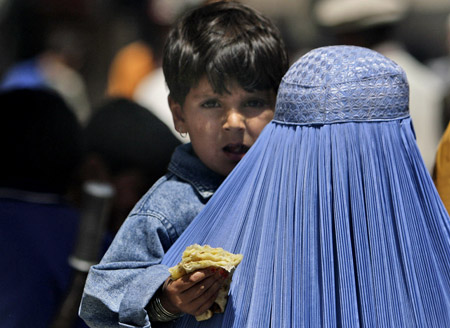
Afghan mother and child. Photo from Center for American Progress.

U.S. ranking not so good…
Reporting on the status of mothers

The dreadful circumstances of so many of the world’s mothers and children on this Mother’s Day are preventable. There is enough money in this world, and technology, talent, and trained people, to alleviate these conditions.

By Jack A. Smith / The Rag Blog / May 9, 2010

On Mother’s Day 2010, what are the best countries in which to be a mother on the basis of the exacting “Mother’s Index” compiled annually by the prestigious international organization Save the Children? You may be surprised.

This year’s “State of the World’s Mothers,” released May 3 at Save the Children headquarters in Fairfield, Conn., weighs such matters as lifetime risk of maternal death, contraceptive use, female life expectancy at birth, expected number of years of formal education for females, maternity leave benefits, ratio of male/female earned income, participation of women in national government, child mortality rate (per 1,000 births), among other factors.

The Save the Children report notes that “Every year, 50 million women in the developing world give birth with no professional help and 8.8 million children and newborns die from easily preventable or treatable causes.” The organization stresses “the critical shortage of health workers in the developing world and the urgent need for more female health workers to save the lives of mothers, newborn babies and young children.”

The 160 countries surveyed are divided into three categories, generally from richest to poorest — Most Developed Countries (43 of them), Less Developed Countries (77), and Least Developed Countries (40).

Leading the top five More Developed Countries is Norway, followed by Australia, Iceland, Sweden, Denmark.

Leading the top five Less Developed Countries is Cuba, followed by Israel, Argentina, Barbados, Republic of Korea.

Leading the Least Developing Countries is Maldives, followed by Rwanda, Lesotho, Malawi, and Uganda.

The United States was number 28 in terms of “the best place to be a mother” in the More Developed Countries, behind nearly all the states in Western and Central Europe and, of course, Scandinavia. Canada was number 20. Greece, Latvia, Austria, and Croatia were the four countries just ahead of the United States.

Dragging down the U.S. ranking are several factors. The American government is the least generous of the 43 More Developed Countries in terms of maternity leave benefits (12 weeks leave, unpaid). No other country provides so little time off after childbirth and only four others do not offer paid leave. The rest pay more benefits for longer leaves. France, for instance, pays full salary for 14 weeks maternity leave, Denmark pays full salary for 52 weeks, Ireland 80% of usual salary for 26 weeks.

Another factor is America’s relatively high rate of lifetime risk of maternal death (1 in 4,800). As USA Today pointed out “A woman in the United States is more than five times as likely as a woman in Bosnia and Herzegovina, Greece or Italy to die from pregnancy-related causes in her lifetime and her risk of maternal death is nearly 10-fold that of a woman in Ireland.” (Ireland has the best ratio in the world — one mother dies in 47,600 births.)

Further, the rate of infant mortality (below age five), 8 per 1,000 births in the U.S., may be lower than that in most of the Less and Least Developing Countries, but it is higher than most countries in its own category. For example, in Serbia it is 7 per 1,000, in the UK it’s 6, in the Netherlands 5, the Czech Republic 4. The world’s lowest rating, 3 deaths per 1,000 births, has been attained by Sweden, Finland, and tiny Luxembourg.

In Cuba, which led the Less Developed Countries, the infant mortality rate is 6 per 1,000, an amazing statistic for a relatively poor developing country. In other Latin American societies the figure is often much higher: Argentina, 16 per 1,000, Brazil 22, Mexico 17.

The U.S. has imposed deep economic, trade and political sanctions on Cuba for over 50 years, which certainly weakens its smaller neighbor, but Cuba has managed to provide good medical care for all women, 19 years of formal schooling for females, compared to 16 for its nemesis to the north, and for women to occupy 43% of seats in the national government compared to 17% in Uncle Sam’s legislature. Health care and eduction through college are free in Cuba.

It is generally within the Least Developed Countries, which are also the poorest, where the world’s mothers suffer the most, though this is not always the case. The worst place in the world for women is Afghanistan, which has been occupied and controlled by the United States and its puppet government in Kabul for nearly nine years. With token exceptions, virtually all of Washington’s efforts and money have focused on war and politics, with the people left to fend for themselves, and the condition of women and girls generally improving little if at all since the days when the Taliban ruled Afghanistan.

According to the State of the World’s Mothers:

Conditions for mothers and their children in the bottom 10 countries are grim. On average, 1 in 23 mothers will die from pregnancy-related causes. One child in 6 dies before his or her fifth birthday, and 1 child in 3 suffers from malnutrition. Nearly 50% of the population lack access to safe water and only 4 girls for every 5 boys are enrolled in primary school.

The gap in availability of maternal and child health services is especially dramatic when comparing Norway and Afghanistan. Skilled health personnel are present at virtually every birth in Norway, while only 14% of births are attended in Afghanistan. A typical Norwegian woman has more than 18 years of formal education and will live to be 83 years old; 82% are using some modern method of contraception, and only 1 in 132 will lose a child before his or her fifth birthday.

At the opposite end of the spectrum, in Afghanistan, a typical woman has just over 4 years of education and will live to be only 44. Some 16% of women are using modern contraception, and more than 1 child in 4 dies before his or her fifth birthday. At this rate, every mother in Afghanistan is likely to suffer the loss of a child.

Zeroing in on the children’s well-being portion of the Mothers’ Index, Sweden finishes first and Afghanistan is last out of 166 countries. While nearly every Swedish child — girl and boy alike — enjoys good health and education, children in Afghanistan face a 1 in 4 risk of dying before age 5. Nearly 40% of Afghan children are malnourished and 78% lack access to safe water.

The dreadful circumstances of so many of the world’s mothers and children on this Mother’s Day are preventable. There is enough money in this world, and technology, talent, and trained people, to alleviate these conditions. Every year, trillions of dollars are invested in destructive wars or are accumulating in the bank accounts of the super rich. An annual portion of these funds is all that is required to greatly reduce the unnecessary annual deaths of millions of children, and to provide health care and education for all the mothers of the world and their beloved offspring.

  • The full text of the report is here.
  • [Jack A. Smith was editor of the Guardian — for decades the nation’s preeminent leftist newsweekly — that closed shop in 1992. Smith now edits the Hudson Valley Activist Newsletter, where this article also appears.]

    The Rag Blog

    Posted in Rag Bloggers | Tagged , , , , , | 1 Comment

    A THOUGHT FOR MOTHER’S DAY
    By Jack A. Smith / The Rag Blog / May 9, 2010

    On Mother’s Day 2010, what are the best countries in which to be a mother on the basis of the exacting “Mother’s Index” compiled annually by the prestigious international organization Save the Children? You may be surprised.

    This year’s “State of the World’s Mothers,” released May 3 at Save the Children headquarters in Fairfield, Conn., weighs such matters as lifetime risk of maternal death, contraceptive use, female life expectancy at birth, expected number of years of formal education for females, maternity leave benefits, ratio of male/female earned income, participation of women in national government, child mortality rate (per 1,000 births), among other factors.

    The Save the Children report notes that “Every year, 50 million women in the developing world give birth with no professional help and 8.8 million children and newborns die from easily preventable or treatable causes.” The organization stresses “the critical shortage of health workers in the developing world and the urgent need for more female health workers to save the lives of mothers, newborn babies and young children.”

    The 160 countries surveyed are divided into three categories, generally from richest to poorest — Most Developed Countries (43 of them), Less Developed Countries (77), and Least Developed Countries (40).

    Leading the top five More Developed Countries is Norway, followed by Australia, Iceland, Sweden, Denmark.

    Leading the top five Less Developed Countries is Cuba, followed by Israel, Argentina, Barbados, Republic of Korea.

    Leading the Least Developing Countries is Maldives, followed by Rwanda, Lesotho, Malawi, and Uganda.

    The United States was number 28 in terms of “the best place to be a mother” in the More Developed Countries, behind nearly all the states in Western and Central Europe and, of course, Scandinavia. Canada was number 20. Greece, Latvia, Austria and Croatia were the four countries just ahead of the United States.

    Dragging down the U.S. ranking are several factors. The American government is the least generous of the 43 More Developed Countries in terms of maternity leave benefits (12 weeks leave, unpaid). No other country provides so little time off after childbirth and only four others do not offer paid leave. The rest pay more benefits for longer leaves. France, for instance, pays full salary for 14 weeks maternity leave, Denmark pays full salary for 52 weeks, Ireland 80% of usual salary for 26 weeks.

    Another factor is America’s relatively high rate of lifetime risk of maternal death (1 in 4,800). As USA Today pointed out “A woman in the United States is more than five times as likely as a woman in Bosnia and Herzegovina, Greece or Italy to die from pregnancy-related causes in her lifetime and her risk of maternal death is nearly 10-fold that of a woman in Ireland.” (Ireland has the best ratio in the world — one mother dies in 47,600 births.)

    Further, the rate of infant mortality (below age 5) 8 per 1,000 births,in the U.S. may be lower than that in most of the Less and Least Developing Countries, but it is higher than most countries in its own category. For example, in Serbia it is 7 per 1,000, in the UK it’s 6, in the Netherlands 5, the Czech Republic 4. The world’s lowest rating, 3 deaths per 1,000 births, has been attained by Sweden, Finland, and tiny Luxembourg.

    In Cuba, which led the Less Developed Countries, the infant mortality rate is 6 per 1,000, an amazing statistic for a relatively poor developing country. In other Latin American societies the figure is often much higher: Argentina, 16 per 1,000, Brazil 22, Mexico 17.

    The U.S. has imposed deep economic, trade and political sanctions on Cuba for over 50 years, which certainly weakens its smaller neighbor, but Cuba has managed to provide good medical care for all women, 19 years of formal schooling for females, compared to 16 for its nemesis to the north, and for women to occupy 43% of seats in the national government compared to 17% in Uncle Sam’s legislature. Healthcare and eduction through college are free in Cuba.

    It is generally within the Least Developed Countries, which are also the poorest, where the world’s mothers suffer the most, though this is not always the case. The worst place in the world for women is Afghanistan, which has been occupied and controlled by the United States and its puppet government in Kabul for nearly nine years. With token exceptions, virtually all of Washington’s efforts and money have focused on war and politics, with the people left to fend for themselves, and the condition of women and girls generally improving little if at all since the days when the Taliban ruled Afghanistan.

    According to the State of the World’s Mothers: “Conditions for mothers and their children in the bottom 10 countries are grim. On average, 1 in 23 mothers will die from pregnancy-related causes. One child in 6 dies before his or her fifth birthday, and 1 child in 3 suffers from malnutrition. Nearly 50% of the population lack access to safe water and only 4 girls for every 5 boys are enrolled in primary school.

    “The gap in availability of maternal and child health services is especially dramatic when comparing Norway and Afghanistan. Skilled health personnel are present at virtually every birth in Norway, while only 14% of births are attended in Afghanistan. A typical Norwegian woman has more than 18 years of formal education and will live to be 83 years old; 82% are using some modern method of contraception, and only 1 in 132 will lose a child before his or her fifth birthday. At the opposite end of the spectrum, in Afghanistan, a typical woman has just over 4 years of education and will live to be only 44. Some 16% of women are using modern contraception, and more than 1 child in 4 dies before his or her fifth birthday. At this rate, every mother in Afghanistan is likely to suffer the loss of a child.

    “Zeroing in on the children’s well-being portion of the Mothers’ Index, Sweden finishes first and Afghanistan is last out of 166 countries. While nearly every Swedish child – girl and boy alike – enjoys good health and education, children in Afghanistan face a 1 in 4 risk of dying before age 5. Nearly 40% of Afghan children are malnourished and 78% lack access to safe water.”

    The dreadful circumstances of so many of the world’s mothers and children on this Mother’s Day are preventable. There is enough money in this world, and technology, talent and trained people to alleviate these conditions. Every year, trillions of dollars are invested in destructive wars or are accumulating in the bank accounts of the super rich. An annual portion of these funds is all that is required to greatly reduce the unnecessary annual deaths of millions of children, and to provide healthcare and education for all the mothers of the world and their beloved offspring.

    — The full text of the report is at http://www.savethechildren.org/publications/state-of-the-worlds-mothers-report/

    Type rest of the post here

    Source /

    The Rag Blog
    Posted in RagBlog | Leave a comment

    Jonah Raskin : A Specter is Haunting Europe

    Is the old Europe history? A cafe in Brussels.

    Crisis in Greece a sign of the times?
    A specter is haunting Europe

    By Jonah Raskin / The Rag Blog / May 8, 2010

    BRUSSELS — The Europe of old is on its way into the history books — not with a sudden bang but with a long, slow whimper.

    That’s the way it feels to me as I sit at this cafe in Belgium on a gray day in May, and after conversations and interviews with longtime friends and new acquaintances. All around me, good Belgians — Dutch speakers and French speakers — are sipping wine, drinking coffee, and conversing politely.

    This is the way I remember Belgium, where I lived and taught American literature as a Fulbright professor in the 1980’s when Ronald Reagan was president, anti-Americanism was at a high point, and when I introduced students to Herman Melville, Emily Dickinson, and to American jazz, the blues, and film noir.

    Of course, Belgium has changed since the 1980’s, and so has Europe. Old buildings that I knew well have had facelifts, Facebook has captured at least one generation, and the culture of the book is endangered more than ever before. That’s what I hear from students and their parents.

    Moreover, all over the continent, Europeans are wondering more than they have for decades how much longer they can go on quietly sipping wine, and drinking coffee. How much longer can cafe life, which has come to define the culture of Europe, remain a reality?

    My Belgian friends are wondering if the financial crisis that caught up with Greece and the Greek people and that led to violent protests in the streets of Greece can catch up with other countries. A new sense of anxiety has quietly descended on Belgium, where Flemish nationalists are on the rise as a political force. A sense of unease has also descended on England too where the long-entrenched Labor Party of Tony Blair failed to win enough votes in the popular election, and the conservatives have staged a major comeback.

    In Ireland the new IRA recently set off explosions and raised the specter of more bombs. From Spain to Poland, there isn’t a country where citizens are sleepîng comfortably at night and dreaming of a wonderful future.

    “Of course what happened in Greece can also happen here,” says a 40-something-year-old Belgian who works for an NGO and who has witnessed natural and human made disasters around the world. “That’s what we’re all afraid of — that the crisis that kicked off in Greece will spread and engulf us all.” His views were echoed by others.

    In the mid-1980s when I last lived here, Europeans blamed many of their social, political and economic woes on the Russians, the Americans and the immigrants. The immigrants are still blamed, and immigrants are pressured to conform to traditional ways. In Belgium and France it is now illegal for Arab women to cover their faces. The burka has been decreed un-European and outlawed.

    There are also new twists to the old story of the immigrants. Now, for example, Moroccans who have been in Europe for decades are pointing a finger at recent arrivals from Poland and Russia and accusing them of taking their jobs away.

    Accompanying the uncertainty about jobs and the economy, there is uncertainty about national and cultural identity. Belgian politicians such as Siegfried Bracke of the New Flemish Alliance are using the crisis of identity to advance their own careers and to fan the flames of wounded ethnic and regional pride. A kind of tribalism seems to be on the rise, even as Europeans see that all things European are connected and that the crisis in Greece does not stop at the Greek borders but spreads outward.

    All this matters intensely to me. My own ancestors came from Europe and it is in Europe that I sense my own roots. I have lived and worked in Europe on and off since the 1960’s, and I feel that Europe and the United States are connected. Their woes are also our woes. The way they respond to issues such as immigration and unemployment will help us or hinder us.

    Right now I am writing the conclusion to this essay at a computer in a comfortable house outside of Brussels, where Vice President Joe Biden recently spoke. It is spring. There are open fields and farms. Local farmers grow strawberries which are coming into season — harvested by hand by immigrant laborers. The teenage son of my friends will play football — soccer as we call it — this afternoon and his father and I will watch from the sidelines. Their teenage daughter will be in an end-of-the-year dance performance at her school. Life goes on in the midst of the crisis. But increasingly it seems to me fewer and fewer individuals can stand on the sidelines.

    There are no barricades in the streets as there were in Europe in 1968. But no matter where one lives in Europe, one is asked or invited or forced to choose sides and to make choices. My old Belgian friend who teaches at a university here is reviewing for a newspaper a new translation of Karl Marx’s classic about capitalism, Das Kapital. A few days ago in Brussels he pointed out to me the place where Marx wrote The Communist Manifesto that begins, “A specter is haunting Europe, the specter of Communism.” It is no longer Communism that is haunting Europe. But Europe is still haunted. It is a place of disquieting ghosts and it does not see that they will soon be exorcised.

    [Jonah Raskin is he author of The Mythology of Imperialism and Field Days.]

    The Rag Blog

    Posted in Rag Bloggers | Tagged , , , , | 2 Comments

    Budd Saunders : Luck, and Dumb Luck

    Sailers in 1946 are shown wearing goggles to shield their eyes from an atomic blast. Dr. Phil Trapp told about how such goggles were expected to protect his World War II Marine flotilla from the effects of a third atomic bomb to be dropped on the beach just ahead of them. Dumb luck saved them. Photo by Bob Landry / Life Magazine.

    (And a whole row of ‘had’s…)
    Luck, and dumb luck

    By Budd Saunders / The Rag Blog / May 8, 2010

    DURHAM, Arkansas — I ran across a note that had been lost for some time and I want to share its content. The note has nothing to do with politics, war, or anything but English grammar. It is a sentence that contains 11 “had”s in a row, and it is perfectly correct.

    My father-in-law wrote it out years ago. My wife Nancy’s father is George Armitage Miller, one of the outstanding intellects of the 20th century. Words and communication were his life. Whatever else the sentence is, it is interesting: “John, where Bill had had ‘had’, had had ‘had had’; ‘had had’ had had the teacher’s approval.”

    When George visited us years ago, Nancy mentioned several things so I would notice them. When her father was sitting in a chair with his head nodding, he wasn’t asleep, he was thinking. He would take out a small notebook from his pocket and write in it. I was told not to ask what he was writing because I wouldn’t understand it. It was to himself. When he would later communicate, you would understand, like WordNet 2.1. You can find it with your computer and download it. It’s free and very useful.

    There have been another two disasters and a near disaster recently affecting our country. The oil blowout in the Gulf of Mexico, Nashville under water, and a car bomb in Times Square. We watched CNN for news on these disasters.

    Actually, I rather think the real disaster in the bomb scene was the character who built the “bomb.” Faisal Shahzad, a naturalized American, had it all worked out. He had placed a vehicle where an explosion would have caused destruction of property and many casualties. His explosives were amateurish at best. But he had transportation to JFK International Airport.

    There was an announcement by some government agency representative extolling the various groups involved and how alert they were. Homeland Security had all of the bus stations at the Port Authority covered, but at JFK, Shahzad got through security. That pretty much put the wraps on those characters as the heroes in this made-for-TV drama in which, just as the villain is about to escape, somebody notices that he is on a plane. I can hear the dramatic music build, until the plane is called back to the gate. I suppose it was TSA who went on board and trundled Mr. Shahzad off to be interrogated.

    Then the story changed. It seems he only got through security once and hadn’t been on the plane after all. The plane was called back because there were “suspected accomplices” on board. I suppose they looked Middle Eastern, which is racial profiling and only permitted in Arizona.

    As I have continued watching and listening to the news I have come to a conclusion. It seems that all of the agencies involved were working together. That’s good. But it’s not so much that they were smarter than the bomber, as that they were very lucky. This guy was just plain dumb.

    Luck reminded me of something a friend of ours wrote and I dug it out of one of the many piles of papers around the house. Dr. Phil Trapp is Emeritus Professor of Psychology from the University of Arkansas. He wrote a letter to the Northwest Arkansas Times in 2007 in which he gave some examples of “dumb luck.”

    In World War II he commanded a flotilla of landing craft destined to invade Japan. They were to invade right after a third Atomic Bomb was “dropped on the beach just ahead of” them. They were to wear goggles to protect them from the “brilliant light” of the bomb. Nobody back then knew about radiation fallout. Fortunately Japan surrendered before the invasion.

    Another example he gives of “dumb luck” is the chlorine compound in aerosols and car air conditioners being discontinued before the ozone layer was completely destroyed. Professor Trapp also commanded Marine landing craft at Red Beach on Iwo Jima Island. He survived. And that was really luck.

    We can’t count on luck, but we can remember (if our attention spans aren’t too short) the words of the man who alerted police to the suspicious SUV in Times Square. He was a street vendor and disabled Vietnam War veteran who sold T-shirts. When asked what he had to say about the event, he replied, “If you see something, say something.” He saw something different and said something for sure. He told a police officer and thus the comedy began. In the classical sense, comedies all have happy endings. This one did. And a clown for the central character.

    Question authority. It’s the American way.

    [Budd Saunders is a Vietnam veteran who lives in Arkansas and writes a regular column for the Durham Dispatch.]

    The Rag Blog

    Posted in Rag Bloggers | Tagged , , , | Leave a comment

    Marc Estrin : The Mathematics of Mother’s Day


    A novel approach:
    Happy Mother’s Day

    By Marc Estrin / The Rag Blog / May 8, 2010

    Novelist and Rag Blog contributor Marc Estrin will be Thorne Dreyer’s guest on Rag Radio, Tuesday, May 11, 2-3 p.m. (CST) on KOOP 91.7 FM in Austin. For those outside the listening area, go here to stream the show.

    They will discuss Marc’s novels, his history with the legendary Bread and Puppet Theater, and more — including his Rag Blog scoop “Got Fascism?: Obama Advisor Promotes ‘Cognitive Infiltration’” that created quite a stir on the internet.

    The following is from Marc Estrin’s novel, Golem Song.

    Having been reminded by Debbie, one of his girlfriends, Alan Krieger walks into a drug store to buy a card for his mother.

    OK, Walgreens. Let’s see, cards over there. Good! Mother’s Day still with us. Holy moly Shazam! I can’t believe it. I can’t fucking believe it. Let’s see — one two three four five six seven eight nine ten times one two three four five sections, that’s fifty columns times one two three four five six seven eight nine ten eleven twelve thirteen rows. That’s fifty times thirteen. Fifty times ten is five hundred plus three times fifty — six hundred and fifty! Six hundred and fucking fifty! Six hundred and fifty different Mother’s Day cards! How can you have six hundred and fifty… oh, I see: categories. Different categories.

    Soooo… here’s MOTHER like my mother, I guess, though who could be like my mother?… then what else? MOTHER-TO-BE. I wonder if they have “Mother-that-was” for miscarriages — there’s a million dollar idea. HUMOROUS MOTHER-TO-BE. How about humorous plain Mother? But she’s not all that funny. OTHER MOTHER. Nice rhyme. GOD MOTHER and GOD MOTHER ADULT. Is that like X-rated? Let’s see. Nope, stodgier. NEW MOTHER, ah, poor thing, should be in the condolence section with little packs of Valium attached. Oh, here’s a good one: LIKE A MOTHER. A Mother’s Day card for my “Like a Mother”? No, that would be too mean. I mean I’m mean, but I’m not that mean. Gottenu — FRIEND’S MOTHER! One isn’t enough? You have to adopt more? I can’t deal with this. FROM MOM TO CHILDREN — for Mother’s Day? What a rabid guilt-trip! I know you won’t remember to send me a Mother’s Day card, so I’m sending one to you, hope you feel terrible, love Mom. CARDS FROM BOTH OF US — for the frugally-minded, no doubt. CARDS ACROSS THE MILES. Dear Mom, thinking of you from Challenger Two. Can you see me waving? SISTER, SISTER’S FIRST. RELIGIOUS SISTER For Mother’s Day? Our Lady of Fornication? Ah, NANA, ooo-la-la. Oop. We’re in the unspeakably hip section — CARDS SUITABLE FOR SINGLE PARENT. Love them 90s! And last but not least, Ladies and Gentlemen, more lethal than a speeding bullet, more powerful than a TV commercial — it’s SUPERMOM, who years ago, in the Orient, learned the secret of clouding men’s minds. How the hell am I going to choose? This is a Ph.D. thesis project. Limit the search, Alan. Back, back. Back, like the aging Goethe, to the simple realm of basic MOTHER.

    OK, so then we’ve got only one two three four and a half sections of ten times thirteen rows. A little less than half the total, the exact arithmetic is beyond me at this hour of mental and spiritual exhaustion, but say three hundred cards to go through. Only three hundred? Well, we’ll do an adjectival inspection for relevance to our very own mother. Courage, Alan, this is no worse than cataloguing Saddam Hussein’s CBW holdings. “Gentle”? No. “Tender?” No. “Soothing?” Oi, oi, oi. “Guiding?” By contrast, perhaps. “Sharing.” A little less would be appreciated. “Understanding.” Possibly. Though what she understands is unclear. “Patient.” Like an adder. “Kind.” Yeah. To quadrupeds. “Undemanding.” Gimme a break. Must not be Jewish. “Dependable.” Like death and taxes. “Strong.” You bet, 200 proof, pH one point oh. “Warm…generous…giving…thoughtful — though what kinds of thoughts they’re not saying — kind — didn’t we have that one before? — unselfish.” Am I on the wrong planet?

    “Am I on the wrong planet?” This is the fundamental question asked by hostages. And hostages are usually ignored.

    “Hey buddy, am I on the wrong… I’m talkin to you, don’t walk away from me.”

    See?

    “Asshole!”

    Jesus, I’m only one row across one section. Two hundred ninety cards to go, I’ll never make it. “Always there.” Well, God knows that’s true. “Never too busy.” On the other hand, might it not be better to be been a latch-key kid? But they don’t hire corporate execs with rolled-down stockings. Oh, look at this. How sweet. She “always finds the sunshine”. And if the rains do come, she “keeps only the rainbows.” Ipecac ahoy. Here’s a mom that “always shows concern for others” and “expects very little in return.”

    That’s it. I’ve had it. My cup of irony runneth over. We’re going to do this by the random method, and grit our decaying teeth at the result. Close your eyes, Alan. Now spin twice around, moving in a trajectory to your right as you spin, trying not to make a fool of yourself by poking your finger into someone’s pupik — there! Got it! My finger directly on a card without falling on my face. Oh praise to your semi-circular canals, Alan, for their faithful service all these years…

    Why, it’s Snoopy! Yes, Snoopy, why not? It matches her literary level, and is thematically appropriate, though she won’t get the obvious reference. What does Snoopy have to say to my sainted mother? Ah, a riddle. A conundrum, as it were. “What does a mother stand for?” Snoopy, my canine-ical friend, do you really want to ask that question? Are you prepared for the answer? But… I give up. What does a mother stand for? Open the card, and the answer is… “She’s so busy she doesn’t have time to sit down.” Good try, old droopy-nose, but avoidance will get you nowhere. You have to get up pretty early in the morning to hoodwink me, and it’s already 8:14 p.m.. But Mother Legree will like such innocence, and take it as a compliment. $1.49? For this devious piece of shit? That’s three and a half White Castle hamburgers? Well, this, plus a small bag of Hershey Kisses to support her habit, and perhaps absolve me of all but one passive peck ought to do it for under five bucks. Laudamus te, oh my sweet, reminding Debeleh, who hath spared us the heartache and nitroglycerine of another forgotten Mother’s Day.

    [Marc Estrin is a writer and activist, living in Burlington, Vermont. His novels, Insect Dreams, The Half Life of Gregor Samsa, The Education of Arnold Hitler, Golem Song, and The Lamentations of Julius Marantz have won critical acclaim. His memoir, Rehearsing With Gods: Photographs and Essays on the Bread & Puppet Theater (with Ron Simon, photographer) won a 2004 theater book of the year award. He is currently working on a novel about the dead Tchaikovsky.]

    Want to read the whole novel? Buy it for a penny!

    The Rag Blog

    Posted in Rag Bloggers | Tagged , , , | 3 Comments

    Bob Feldman : A People’s History of Afghanistan / 4

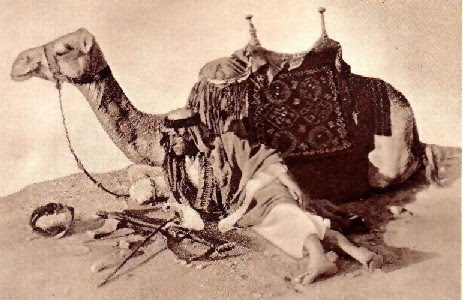
    British Intelligence agent T.E. Lawrence (Lawrence of Arabia) came to Afghanistan in 1928, and virtually directed anti-government activities. Image from Jordan Jubilee.

    Part 4: 1924-1933
    A People’s History of Afghanistan

    By Bob Feldman / The Rag Blog / May 2, 2010

    [If you’re a Rag Blog reader who wonders how the Pentagon ended up getting stuck “waist deep in the Big Muddy” in Afghanistan (to paraphrase a 1960s Pete Seeger song) — and still can’t understand, “what are we fighting for?” (to paraphrase a 1960s Country Joe McDonald song) — this 15-part “People’s History of Afghanistan” might help you debate more effectively those folks who still don’t oppose the planned June 2010 U.S. military escalation in Afghanistan? The series so far can be found here.]

    Between January 2009 and late March 2010, nearly 400 U.S. soldiers lost their lives in the Pentagon’s endless war in Afghanistan. Yet the history of people in Afghanistan is still unknown to many people in the USA.

    In July 1928, for example, Afghan King Amanullah, for a second time, attempted to enact a series of democratic reforms in Afghanistan by convening a loya jirga — a meeting of Afghanistan’s leading tribal and religious leaders — and urging it to support the following reforms:

    1. establishment of a Western-style constitutional monarchy, a cabinet of ministers, an elected lower legislative house of representatives and a nominated upper legislative house;
    2. separation of religious and state power;
    3. legal emancipation of women and abolition of polygamy;
    4. compulsory education for all Afghans; and
    5. establishment of co-educational schools.

    Most of Amanullah’s July 1928 proposed modernization and democratic reforms were rejected, however, by the members of the loya jirga meeting. So Amanullah then convened a new loya jirga meeting that only included his own political supporters, which then approved all his reform proposals and also banned slavery, declared Afghanistan to be a secular state, and legally abolished the use of a chadar or veil by Afghan women.

    But agents of the UK government in Afghanistan such as T.E. Lawrence (a/k/a “Lawrence of Arabia”) apparently then encouraged the religiously conservative Afghan tribal leaders who opposed Amanullah’s democratic reform program — because it reduced their power, privileges and special influence within Afghan society — to start another uprising against Amanullah’s regime. According to The Truth About Afghanistan by S. Gevortom:

    In late 1928 by bribery and deception British agents managed to provoke a rebellion among certain tribes in the eastern part of Afghanistan. A British Intelligence agent, Col. T.E. Lawrence, arrived in the north-western province of India. Under the alias of aircraftsman Shaw he became very active in arranging meetings with Afghan opposition leaders and virtually directed anti-government activities in Afghanistan…”

    By November 1928 Shinwari Pashtun tribesmen in Afghanistan had burned down Amanullah’s winter palace and were marching on Kabul to overthrow his regime. So after fleeing to Kandahar, Amanullah then abdicated in favor of his brother Inayatullah Khan, before eventually going into exile in Italy. But, ironically, the Shinwari Pashtun tribesmen had also burned down the UK government’s consulate in the city of Jalalabad before marching on to Kabul.

    So, not surprisingly, British agents then created “another center of rebellion in northern areas of Afghanistan where their henchman Bacha Saquo was operating,” according to The Truth About Afghanistan. The same book also recalled:

    On the eve of his force’s attack on Kabul his envoys had a secret meeting with British ambassador Humphreys to clarify details of the planned seizure of the Afghan capital. On February 28, 1929, the British Daily Mail wrote that Britain’s representative in Kabul, Humphreys, had helped… Bacha Saquo to come to power…Supporting the rebels…British military aircraft time and again violated the air space… British planes flew over Kabul…

    So only three days after Amanullah’s abdication in January 1929, Saquo — a Tajk bandit from northern Afghanistan — entered Kabul with his followers and “seized Kabul, overthrew the… government and proclaimed himself” the Afghan king, according to The Truth About Afghanistan. But, according to Afghanistan: A Modern History by Angelo Rasanayagam, the UK government-backed Saquo then “subjected the city and its… inhabitants to nine month reign of terror” in which there was much looting, pillage and raping of women by his troops.

    Not surprisingly, in response to the nine-month reign of terror in Kabul, armed Afghan opposition to Saquo’s regime soon developed within Afghanistan and though, initially, “strongly supported by the imperialist and internal reactionary forces,” according to The Truth About Afghanistan, Saquo did not remain in power for long. After the UK government apparently ended its support for Saquo — and began to back the Afghan tribal army of General Mohamad Nadir Khan and his Afghan clan — Saquo’s troops were soon defeated.

    The Afghan tribal army of Nadir Khan and his Afghan clan then occupied Kabul in October 1929; and Saquo and his leading followers were publicly hanged in November 1929 — “despite a pledge to spare Bacha Saquo’s life and a promise of safe passage signed on a copy of the Koran by the victorious general, ”when Saquo had agreed to surrender the previous month, according to Afghanistan: A Modern History.

    Nadir Khan then was placed on the Afghan throne, himself, by his tribal army; and in September 1930 a jirga was convened which officially proclaimed Nadir Khan as Nadir Shah, the new Afghan king. Nadir Shah then built up a regular Afghan army of 40,000 men, opened up the Afghan economy to privately-owned corporations and promulgated a new Afghan Constitution in 1931 — before being assassinated by an Afghan high school student in November 1933.

    Under the Afghan Constitution of 1931, an autocratic monarchical political system linked to Afghan religious conservatives was reestablished and the religious law of the Hanafi School of Sunni Islam was decreed as the official law of Afghanistan. The imams of Afghan mosques were then put on the Afghan government payroll during Nadir Shah’s brief reign and relatives of influential Afghan religious figures were all appointed by Nadir Shah to lucrative government positions.

    It was also during Nadir Shah’s four-year reign that the first Afghan higher educational institution, the Faculty of Medicine, was set up in 1932. But, prior to his assassination in 1933, “there was a perception that Nadir Shah leaned towards” UK imperialism too much, because the UK government had “granted him 170,000 pounds” after his seizure of power in 1929, according to Afghanistan: A Modern History.

    Following Nadir Shah’s assassination in 1933, the remaining Afghans of Jewish religious background were only allowed to live in Herat, Balkh, or Kabul and were prohibited from living in other towns in Afghanistan. In Herat, Balkh, and Kabul, Afghans of Jewish background apparently also only now lived in separate neighborhoods from the neighborhoods in which Afghans of other religious backgrounds lived.

    In addition, after 1933 they were not allowed to leave Herat, Balkh, or Kabul without a permit and were required to pay a special yearly poll tax. Between 1933 and 1950, people of Jewish background in Afghanistan were also not allowed to obtain jobs in the Afghan monarchical government’s civil service, and their children were not allowed to attend Afghan government schools.

    Next: “A People’s History of Afghanistan—Part 5: 1933-1953″

    [Bob Feldman is an East Coast-based writer-activist and a former member of the Columbia SDS Steering Committee of the late 1960s.]

    • Previous installments of “A People’s History of Afghanistan” by Bob Feldman on The Rag Blog can be found here.

    The Rag Blog

    Posted in Rag Bloggers | Tagged , , , , , , | Leave a comment

    Teabaggers in 2010? : Debunking the Political Wisdom

    Image from The Daily Globe.

    Will the right wing seize power?
    Looking ahead to November

    By Ted McLaughlin / The Rag Blog / May 7, 2010

    [The Rag Blog doesn’t post a lot about election predictions, but I think it is important that the right-wingers don’t return to power in November. It is vital for the Democrats (with all their faults) to stay in the majority in both houses of Congress. — Ted McLaughlin.]

    The conventional wisdom among political pundits these days is that the Democrats will suffer a humiliating defeat in the November elections — possibly even a bad enough defeat to cost them control of one or both houses of Congress. While the party out of power usually gains a few seats in an off-year election, I am still failing to see that the seats lost will be an abnormally large number, and the polls continue to support that view.

    The latest poll is a Washington Post/ABC News Poll. The poll was conducted April 22nd through April 25th, and has a margin of error of 3 percentage points. Frankly, the poll shows the Democrats are not in nearly as bad a position as many pundits want people to believe. In fact, the numbers look pretty good for Democrats.

    One interesting aspect of this poll does show that this has the capability to be a very volatile election. Consider the answers given when respondents were asked whether they would vote for their incumbent congressman or look around for an alternative:

    Re-elect………………..32%
    Look around…………57%
    No opinion……………..9%

    But when one looks at other numbers in the poll, it can easily be seen that this volatility is not just in Democratically-held districts. The numbers actually favor Democrats, and those districts that are volatile could well be Republican districts being challenged by teabagger candidates. Here are how the numbers look when respondents were asked which party they would vote for if the election were held today:

    Democrat………………..48%
    Republican………………43%
    No opinion…………………6%

    I think one reason many pundits are predicting a bad November for Democrats is the role of the teabagger movement. The reasoning is that the teabaggers are a broad-based movement made up of people from across the political spectrum, and when combined with Republicans they will outnumber Democrats. Fortunately that is just not true. The teabaggers are actually just an angry element of the Republican Party, and the poll numbers bear that out. Consider the answers to the following questions:

    Which group best represents your own values?

    Democrats………………..48%
    Republicans………………24%
    Teabaggers………………..14%

    Which group is most concerned about needs of people like you?

    Democrats………………..49%
    Republicans………………23%
    Teabaggers………………..17%

    Which group best understands the economic problems people are having?

    Democrats………………..48%
    Republicans………………22%
    Teabaggers………………..17%

    As you can see, even when you add the teabaggers and the Republicans together they can only get 38-40% of the respondents. That doesn’t sound like the makings of a humiliating defeat for Democrats to me. Those numbers look great for Democrats (about triple the margin of error). When considered in their proper perspective, as only being an angry part of the Republican Party, it really doesn’t look like the teabaggers will have much of an effect on the coming election.

    I still believe the most important issue in the coming election will be the economy. The above numbers show that people still trust Democrats with the economy more than Republicans by 48% to 39%. The Republicans still have a long way to go in convincing voters they can handle the economy better than Democrats, and their recent opposition to reforming Wall Street is not going to help them with that. Just consider the answer to the following question:

    Do you support or oppose stricter federal regulations on the way Wall Street firms conduct their business?

    Support………………..63%
    Oppose…………………29%
    No opinion……………..8%

    The main way Republicans are trying to make themselves look better on the economy is their repeated attempts to blame President Obama for the continuing recession and the country’s deficit, but even that effort is failing to gain any traction. The poll asked respondents who they blamed for the current state of the economy and the current deficit. Here’s how they answered:

    Who’s more responsible for the current state of the economy?

    Barack Obama………………..25%
    George W. Bush……………..59%

    Who’s more responsible for the current federal budget deficit?

    Barack Obama………………..22%
    George W. Bush……………..60%

    Right-wing organizations and corporations have sunk a lot of money into advertisements, lobbyists and funding for teabagger protests. The teabaggers have been loud and obnoxious. And the Republicans have told a multitude of lies. But it doesn’t look like it’s done much good so far. They still haven’t convinced a majority of the country that Republicans could rule better than the Democrats.

    Of course, the real key to how the election will go in November is turnout — especially Democratic turnout. The Republicans are angry and desperate, and they will go to the polls. If the Democrats can get their people to the polls they will do well (as the numbers show). If they don’t then they will not do well. It’s as simple as that.

    There’s still six months to go before the election (and something unexpected could still happen). But the question right now is whether the Democrats can get their voters energized in the remaining time. The outcome of the election hangs on that.

    [Rag Blog contributor Ted McLaughlin also posts at jobsanger.]

    The Rag Blog

    Posted in Rag Bloggers | Tagged , , , | 9 Comments

    Happy Birthday Karl

    Birthday card by James Retherford / The Rag Blog / May 5, 2010.

    The Rag Blog

    Posted in Rag Bloggers | Tagged , | 2 Comments