Carry It On

By Alice Embree / The Rag Blog / April 5, 2010

I’m responding to David Hamilton’s retirement notice posted this week. Everyone should get to retire or take leave from the movement for social justice. It’s never been a paid job and the benefits certainly haven’t included major medical or dental care.

We don’t need burn-out. But we desperately need persistence. We all must find a balance between what replenishes and what depletes us. For years I have identified with Marge Piercy’s poem, “To Be Of Use.” But, her guidance in “Spring Offensive of the Snail” may be more important.

“I cannot live crackling
with electric rage always.

This time we have to remember
to sing and make soup.”

We can’t lose faith in the struggle for social justice because Obama delivered an expanded war and a Wall Street bailout and failed (never really trying) to deliver a public option for health care. If our faith was in electoral politics, it was misplaced.

My post-retirement activism has been both rewarding and difficult. Bush’s election in 2000 was discouraging, but was nothing compared to watching the hopes of a worldwide peace movement dashed in March 2003 and Bush re-elected in 2004.

I have found strength in the efforts of others – Cindy Sheehan sitting in a ditch near Crawford; CodePink with their theatrical stunts and dogged determination. I’ve found hope in an emerging GI movement that I support with work on a Killeen coffeehouse. I’ve turned out for Texas State Employee Union campaigns and felt the solidarity of a statewide union. I’ve supported the organizing efforts of immigrant workers. I’ve picketed a private prison that housed children and seen it shut down by persistent community organizing and dedicated attorneys. In El Salvador I was an election observer to an historic left victory. I’ve chronicled some of this for the Rag Blog.

At the same time, I’ve been dismayed by the escalation of war and the inept presidential leadership on health care. I’ve been saddened by the earthquake in Chile and truly disheartened by the election of a right-wing president in a country I care for. There have been plenty of setbacks.

In Austin, the beloved “progressive” city, I’ve watched East Austin get re-shaped by developers with hardly a murmur from progressives. Dismissing the term “gentrification” as too polite, union organizer and writer Bill Fletcher, says: “We need to stop the class and racial cleansing of our cities… where workers are being driven out of cities…” A piece of this might be ending – in the simple name of democracy – the costly, at-large electoral system. Austin is the only large city in Texas with this legacy representation.

Decades ago, Mariann Wizard wrote a farewell poem to Austin entitled “Sweet Suck City.” That is what I often think of this town, so steeped in its own coolness.

On March 8th, I was impressed by the International Women’s Day event in San Antonio – it’s 20-year staying power, its link to the current struggle of hotel workers, its multiculturalism. I’m sure it’s easier to admire that coalition from afar than to invest the day-to-day effort it takes to maintain unity. But, trust me, I haven’t seen anything like that kind of coalition work in Austin, Texas.

So where does this take us? What is to be done? For starters, make some soup, tend the basil, and then read Howard Zinn’s, “You Can’t Be Neutral On a Moving Train.”

Walk the dog and then think about what small thing you can do. Give a donation to the Workers’ Defense Project. Host a fundraiser for Iraq Veterans Against the War. Help Killeen’s Under the Hood Café. Help subsidize community organizers who want to attend the next U.S. Social Forum in Detroit.

This struggle isn’t about Obama. I heard Bill Ayers describe Obama very well at a SXSW panel. “He’s a centrist and an ambitious politician.” Ayers recounted Obama’s answer to a campaign question about whom Martin Luther King, Jr. would support. Obama responded, “He’d be building a movement.”

Bill Fletcher, a labor union strategist said Monday, “As a socialist, I know something about socialism. Obama is not a socialist.” But, Fletcher didn’t apologize for voting for Obama. During the election season, I registered voters, made some calls, walked some precincts and went to a county convention. Those hours spent were a drop in the bucket compared to meetings, vigils, marches, fundraisers and other events invested in social justice causes.

I believe that electoral politics is a game stacked for capitalist centrists. We don’t have proportional voting in this country that allows smaller parties to gain some long-term representation and traction. We have a winner-take-all, electoral-college system. And now, with the Supreme Court decision, corporations will be given event even more decisive electoral power.

Progressive change has always happened in this country through organizing and demanding change of politicians. What we need even more than activists at this time are organizers. We cannot concede organizing to the right wing.

A union friend of mine reminded me that the left often likes to hold up a flag and see who will come to them instead of going to people. Whether it’s through “working people’s assemblies” as Bill Fletcher suggested or through other means, this is a time not to mourn, but to organize. Fletcher reminded a roomful of union folks Monday night that F.D.R.’s New Deal didn’t happen in a vacuum. Union leaders came to him with a set of demands and he said: “Make me do it.” They organized. He responded. That’s how change happens.

But do remember to tend the basil, enjoy the grandchildren and make the soup.


Type rest of the post here

Source /

The Rag Blog

Posted in RagBlog | Leave a comment

Austin Heat : Ain’t Seen Nothin’ Yet?


Report:
Extreme summer heat and
Irreversible ecosystem demise

Austin’s summers will be a third more extreme than those of the Sonoran Desert and about 10 times more extreme than the normal Texas Hill Country summers.

By Bruce Melton / April 5, 2010

[Our colleague, investigative journalist Ken Martin, has just launched an impressive new project called The Austin Bulldog (see below). The Bulldog has just posted an investigative report by Greg M. Schwartz entitled “Who Protects the Texas Environment? Hint: It Isn’t the State Agency That’s Supposed To.” It’s well worth the read.

In its initial number, The Austin Bulldog has also published this rather sobering commentary by Bruce Melton.]

The U.S. Global Change Research Program (USGCRP) coordinates federal research on environmental changes and their implications for society. The program began as a presidential initiative in 1989 during the Reagan — Bush era and called for “a comprehensive and integrated United States research program that will assist the nation and the world in the understanding, assessment, prediction and response to human-induced and natural processes of global change.”

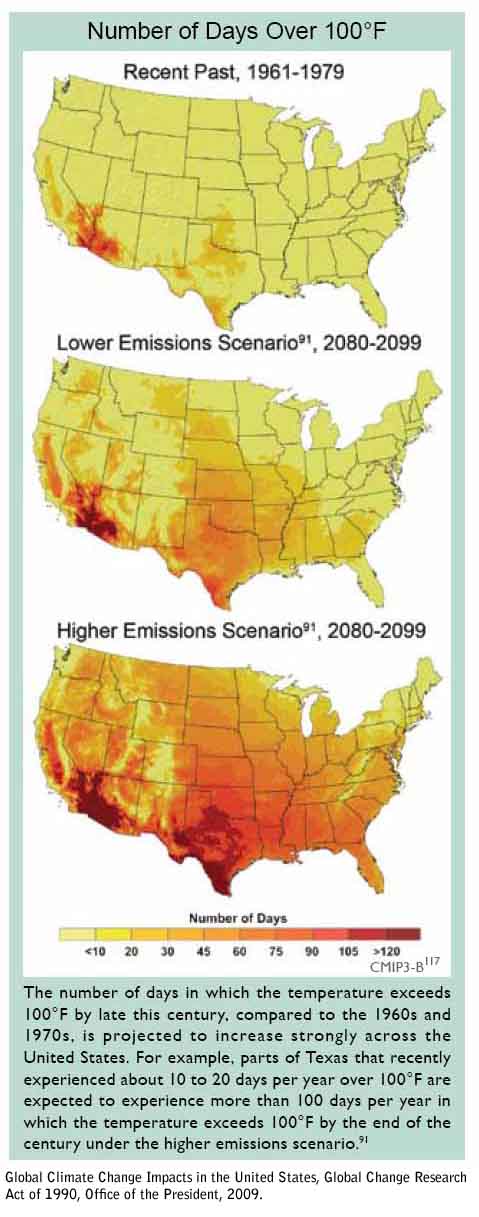
The implications of this report are beyond extreme. Austin (Central Texas) normally has 12 days of 100-degree-plus heat per summer based on temperature records that go back to 1854. In the next 80 to 90 years, Austin is projected to average between 90 and 120 days of 100-degree plus heat every year. (See accompanying chart, Number of Days Over 1000F.) The Sonoran Desert Museum in Phoenix, Arizona, only averages 87 days over 100 degrees.

CLICK ON IMAGE TO ENLARGE

The Sonoran Desert is a traditional thorn and gravel desert with little to no water, blistering temperatures and, except for the natural inhabitants of the desert, is totally inhospitable to life. Austin’s summers will be a third more extreme than those of the Sonoran Desert and about 10 times more extreme than the normal Texas Hill Country summers.

Most life, as we know it in the Hill Country, will be dead by mid century. The transition to a thorn and gravel desert will be well underway. Today the changes have already begun.

Two things complicate the issue. There is a simple scientific concept that says scientists are conservative in their work. This is the “publish or perish” concept. Simply put, a scientist must be absolutely certain about the results of his or her discoveries or they will not be able to publish their papers in the academic journals. If a scientist is found to be wrong after their results are published, the journals will be much more cautious about publishing that scientist’s work in the future. A scientist’s work is therefore conservative to minimize the risk of being wrong.

The second complicating factor is that the rate of change has increased. Not long after the turn of the century, impacts of warming started increasing faster. A quote from the USGCRP Report states the obvious “Some of the changes have been faster than previous assessments have projected.”


The next graphic shows the atmospheric load of carbon dioxide (as carbon) in gigatons, from the USGCRP Report. The colored lines are the computer model’s projections. The black line with the circles shows actual atmospheric measurements. The purple line is the A1F1 scenario (Intergovernmental Panel on Climate Change 2007 Report), more commonly known as “the worst-case scenario.” What the actual measurements show is that carbon dioxide, right now, is greater than and increasing faster than in the worst-case scenario from the climate models.

At the end of the 21st century (2090 to 2100), my grandkids (if I ever get any) will still be alive. But the plants and animals and beautiful Hill Country creeks will have died by mid-century. Desert plants and animals will not have had much time to colonize the area. What will remain will be bleak and lifeless, an ecosystem in limbo between climate states.

Dry preservation will create a tomb-like landscape, stark, bleached and sun-scorched. This may seem far-fetched, but little more than a few degrees of change can completely alter an ecosystem. In Austin this last summer, our average temperature was 4.8 degrees above normal. This small amount of warming set an all-time record, by a large margin, for the hottest summer ever recorded. Thousands of trees died because of the drought. The USGCRP says that parts of North America could see temperature increases of up to 13 degrees.

The brutal reality is, regional ecosystem extinction will not arrive at the end of the century. It will arrive any year now. It will progress in a worsening spiral until the streams and animals are gone and the forests have been reduced to sticks in the blazing sun. Some years, at least in the next decade, may seem somewhat normal. But the death will come unless we start reducing not just our emissions, but also the invisible greenhouse gas load that has been building in our atmosphere for centuries.

It comes down to this: Worse than the worst-case scenario means that our efforts to date have had no impact. Changes will continue beyond the 2090 to 2100 time frame, and much of what has been discussed in this article will happen even if we stop emitting all greenhouse gases this instant. But we can still take CO2 out of the atmosphere and reverse the built-in changes yet to come. This accomplishment will rival the Manhattan and Apollo projects. All we have to do is start spending money on our environment like we are spending it on our institutions that are too big to fail because; the Earth is too big to fail.

[When Bruce Melton, P.E., isn’t practicing civil engineering, he’s studying climate change and writing a book about it, a book for the masses. Melton was one of eight Austinites named in the “Heroes of Climate Change” article published in The Good Life magazine in July 2007. To read more of his work on climate change, visit his website, Melton Engineering Services Austin.]

Editor Ken Martin describes his ambitious new project:

The Austin Bulldog is something new and different hereabouts. We’re mainly concerned with doing hard-hitting investigative reporting for stories that make a difference in the Austin community. We also publish informed commentary and question-and-answer interviews.

The Austin Bulldog is nonprofit, nonpartisan and non-advocacy. We will go where the facts lead us and report accordingly.

A variety of websites have sprung up in Austin over the years. Some are high-dollar subscription newsletters for insiders with a monetary need-to-know. Among the free-to-read sites, some fill a well-defined niche, such as partisan politics or criminal justice. Others provide a wide variety of information by aggregating the work of local bloggers.

None of these sites — subscription or free — are dedicated to investigative reporting by experienced professional journalists. That’s our niche.

Check it out.

The Rag Blog

Posted in RagBlog | Tagged , , , , | 6 Comments

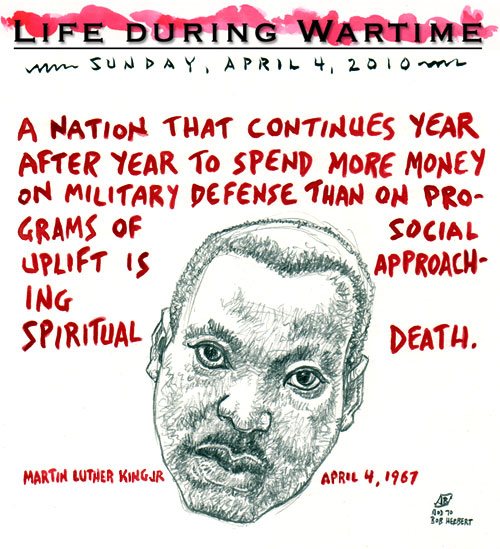
Life During Wartime : Spending on Defense

Political cartoon by Joshua Brown / Historians Against the War / The Rag Blog

The Rag Blog

Posted in Rag Bloggers | Tagged , , , | 8 Comments

Leonardo Boff : Easter for the Crucified Earth

“The Crucified Land,” 1939, oil on canvas by Alexandre Hogue.

Our devastated common dwelling:
Easter for the crucified Earth

By Leonardo Boff / The Rag Blog / April 3, 2010

Easter is a celebration shared by Jews and Christians, and is a metaphor for the present situation of the Earth, our devastated common dwelling.

Etymologically, Easter means passage from slavery to freedom and from death to life. The Planet, as a whole, is passing though a severe Easter. We are within an accelerated process of loss: of air, of soil, of water, of forests, of ice, of oceans, of biodiversity, and of sustainability of the very Earth-system. Terrified, we witnessed the Earthquakes of Haiti and Chile, followed by tsunamis.

How does all of this relate to the Earth? When will the losses end, or where will they lead us? Dare we hope, as in Easter, that after Good Friday of the passion and death, new life and resurrection will always burst forth?

We need a retrospective look at the history of the Earth to shed some light on the present crisis. In the first place, we must recognize that earthquakes and disasters are recurrent in the geologic history of the Planet. There is a basic rate of extinction that is part of the normal process of evolution. Species exist for millions and millions of years, and, then they disappear. Like an individual who is born, lives for a certain time, and dies. Extinction is the destiny of individuals and species, including ours.

But beyond this natural process, mass extinctions exist. The Earth, according to geologists, may have experienced 15 such great extinctions. Two were particularly grave. The first, 245 million years ago, with the rupture of Pangea, that single land mass that broke apart, giving birth to the present continents.

That event was so devastating that it decimated between 75% and 95% of all the living species then in existence. Beneath the continents, the tectonic plates continue to be active, colliding with each other, overriding or drifting apart, in a movement called continental drift, which causes the earthquakes.

The second occurred 65 million years ago, caused by climatic disturbances, rising of the sea levels, and warming — events generated by a 9.6 km asteroid that fell in Central America, causing huge firestorms, tidal waves, poisonous gasses, and a long darkening of the sun. Dinosaurs that had dominated, sovereign, upon the Earth, for 133 million years, totally disappeared, and 50% of other living species as well.

The Earth needed ten million years to completely remake herself. But it allowed for a wide range of biodiversity such as never before in history. Our ancestors who used to live in the treetops, feeding on flowers, shivering with fear of the dinosaurs, could come down to the ground and make their way, culminating in what we are now.

Scientists, like Ward, Ehrlich, Lovelock, Myers, and others, believe that another great extinction is occurring, one that began some 2.5 million years ago when vast glaciers began to cover part of the Planet, altering the climates and the sea levels. That process was greatly accelerated by the appearance of a truly devastating meteor, namely, the human being, through his systematic intervention in the Earth system, particularly in recent centuries. Peter Ward (O fim da evolução, 1977, p. 268), says that this mass extinction is clearly visible in Brazil, where over the last 35 years, four species were definitively extinguished each day. And he ends by warning: “a gigantic ecologic disaster awaits us.”

It is the existence of earthquakes that destroy everything and kill thousands and thousands of people, such as in Haiti and Chile, that creates in us a crisis of meaning. Here we must humbly accept the Earth such as she is, generous mother or cruel stepmother.

She follows the blind mechanisms of her geologic forces and ignores us, which is why the tsunamis and cataclysms are so terrifying. But she passes information to us. Our mission as intelligent beings is to decode that information to avoid damage, or to use it for our own benefit. Animals capture that information, and before a tsunami hits, they fly to the highest places.

Perhaps at one time, long ago, we also knew how to capture that information, and defend ourselves. We have lost that capacity now, but to supplement our deficiency, there is science. Science can decode the information that previously the Earth passed to us, and suggest strategies of self defense and of salvation.

We are the Earth herself, with her consciousness and intelligence, but we are still in the youthful phase with very meager learning. We are entering the adult phase, learning how to better handle the energies of the Earth and of the cosmos. Then, the mechanisms of the Earth, through our knowledge, will stop being destructive. We all must grow, learn and mature.

The Earth hangs from the cross. We must take her from there and resurrect her. Then we will celebrate a true Easter, and we will be able to wish: Happy Easter!

Original in Portuguese; translated into Spanish by Servicios Koinonia; translated into English by Refugio del Rio Grande, Texas.

[A Brazilian theologian, philosopher, educator, and author of more than 60 books, Leonardo Bofff lives in Jardim Araras, an ecological wilderness area in the municipality of Petrópolis, Rio de Janeiro. Boff is Professor Emeritus of Ethics, Philosophy of Religion, and Ecology at the State University of Rio de Janeiro. A former Franciscan priest with a doctorate from the University of Munich, Boff was an early advocate of liberation theology. In 1991, after a series of clashes with the Vatican, Boff renounced his activities as a priest and “promoted himself to the state of laity.”]

The Rag Blog

Posted in Rag Bloggers | Tagged , , , , , , | 1 Comment

A King’s Easter : Reflecting on Jesus and Eggs


A King’s Easter:
Pausing to reflect on Jesus and eggs

By Greg Moses / The Rag Blog / April 3, 2010

This year — for the second time — the sad anniversary of the assassination of Martin Luther King, Jr. falls on Easter, a day that according to Google Trends brings annual peaks of interest in the search terms Jesus and eggs.

Easter is a perfect context for thinking about King’s death in a Kingian way because as a preacher of Easter sermons he would insist that after we pay death its due we should not neglect the fact of life which after all makes death possible in the first place.

Likewise with movement. For King life was movement. And half the hope for life was bound up in hope for the next movement which in his case would have been the Poor People’s Campaign of summer 1968. I say half the hope because as a Sunday preacher King warned against placing your whole hope in human effort.

Paradoxical as it sounds, the great maestro of social movement insisted that human effort could never completely do for itself. That would be like saying Jesus resurrected himself or the egg laid itself. There’s something besides all the things you can do — which you should do — for yourself. Something the movement needs which is not the movement itself.

David Rovics sent out an email yesterday reflecting upon the growing anticipations that people are having. Something is badly needed which is not being provided. Or as the Secretary of the Treasury says, unemployment will remain at unacceptable levels for many more years to come.

A movement of some kind is in the making. What’s not so clear is how people are preparing their half of the responsibility for it. King died while doing too much. Paradoxically the preacher of Easter sermons who said human effort was only half the ingredient of movement was exhausting himself in that half trying heroically to make up for the rest of us who exhaust ourselves doing too little.

In a book of spiritual teachings I recently ran across the term “personal work” and I think King would have liked that term. In the process of nonviolence as practiced by King, “personal work” was required. During the Easter campaign of 1963, protesters were required to meditate on the life of Jesus. They had to sign cards saying they had thought deeply about the example of Jesus. Jesus was required reading.

With our common life scooped out and replaced by mass media velocities — and considering the pattern of our recent debates about health care — there is reason to think that movements have been replaced in the internet age by virtual flame wars. And the thing about flame wars is that they lack all evidence of “personal work.”

Capitalism, once again, has imploded out from underneath millions of people whom it pretended to serve. And socialism even under these conditions finds underwhelming support. Between the cracks of two deflated ideals, a necessary movement grows roots. With so much death around us, King’s Easter reminds us that if we don’t neglect “personal work” there is always hope for birth and rebirth through righteous, organized, and disciplined social movements.

[Greg Moses is editor of the Texas Civil Rights Review and author of Revolution of Conscience: Martin Luther King, Jr. and the Philosophy of Nonviolence. He can be reached at gmosesx@gmail.com.]

The Rag Blog

Posted in Rag Bloggers | Tagged , , , , , , | 1 Comment

Marc Estrin : George’s Messiah


Happy Easter,
But crucify him first

By Marc Estrin / The Rag Blog / April 3, 2010

This morning, the cheery NPR voice announced that today was Good Friday — but not for the Catholic Church, which was reeling from you know what. Good Friday — good.

I suppose it can be seen as good if you like nailing people onto crosses and the institutional power secreted from those wounds, but for most followers of Jesus Who Is Called The Christ, it’s a pretty sad end of the week.

Here in Happy-face Land, we love Easter, pink, white, and blooming. And now even Good Friday has been gobbled by Goodness. But George Fredrick Händel was not so easily scammed.

Most American performances of Messiah offer only the Christmas portion with tacked-on Hallelujah and Amen celebrating a babe not yet messiahed. But Messiah was written as an Easter piece, full of pain, suffering and transcendence. The familiar Christmas portion was a prologue only — to contrast with the anxious and metaphysical burden of the work. But Hallmark will have its way.

I am the president and only member of the National Bring Back Messiah As An Easter Piece Society. I have little influence on American cultural practice. But I do get to write novels with their interior rants.

Tweaking When the Gods Come Home to Roost for possible publication, I came across this short chapter I thought you of classical music persuasion might enjoy:

George’s Messiah

George loved Messiah. It was nothing a Jewish boy in Levittown had been expected to love, but it happened. Until he was fifteen, he had steered clear of this goyish mania. But one day, a lovely young girl with long, dark hair handed him a leaflet for an afternoon performance a busride away in Queens. Maybe she sang in the chorus. It must be all right for a Jew to go into a church, he thought, if it’s for a concert, and not to eat the body and blood. He wouldn’t tell his parents. They’d never know.

The young man was ravished by the experience. He used the word in every possible meaning: he was seized and violently done to; he was overcome by horror, joy and delight; he was pre-sexually bewitched, for the long-haired one was in fact singing soprano in the front row, and never had such an angelic voice issued from such sensuous purity. This concert was of the Easter portion of the work, and from “Behold the Lamb of God” to the last “Amen”; he was transfixed with wonder.

From the three bar mitzvahs he’d attended he knew Jews didn’t make this kind of sound. Synagogues were filled with the discordant rumble of davvenning, each worshipper finding his individual prayer voice and rhythm, chanting, whispering, singing, crying, repeating phrases over and over, lost in the brumming of the crowd. Sometimes a cantor sang. But this — this! It is music, music that hath ravished me! He got home at an unsuspicious five o’clock, and never mentioned his encounter.

He had tried to hear Messiah every year since then, but with all the changes that had occurred along the way, he had managed to bat only about .300. So what a boon — right here, in his own community, that he could conduct an annual Messiah! The sad part was that he could never share this joy with his family, old anti-clerical mom and pop ever more rigid in their disdain for religion. The idea of their very own son promoting Christ the Jew-killer might, he thought, send them each into heart failure. So this was his one activity he never called home about.

Choosing to do the Easter portion of Messiah for Christmas was George’s little revenge on America. Though written as an Easter piece, and traditionally performed in Europe during Easter time, in coming to America Messiah had shifted seasons, and along with them, content. Though the Puritans had banned the celebration of Christmas, post-Puritan America has embraced it with a vengeance, currently exhorting all to worship at the mall of one’s choice.

Perhaps in the land of the Easter Bunny and the lethal injection, crucifixion is seen as barbaric. Christmas, not Easter, is where most American celebration is concentrated, and with it, most concertizing. Messiah has become a Christmas piece, and most American performances restrict themselves to its first section concerning Advent and the birth of Christ. The meat of the oratorio is left out, and the introductory portion is capped with the Hallelujah chorus — a masterwork written to praise Christ’s ascent to his heavenly throne, unreported in these Hallmark card performances.

“A premature ejaculation at best,” George thought when feeling generous. But if Americans were determined to hear part of Messiah at Christmas, he was going to be damn sure it was the Easter portion that attacked them.

At 6:30 on the evening of the concert, Betty cell-phoned in to say that she had had a flat on I-680, that the AAA said they’d be there within fifteen minutes, and that being the case, she’d be at the church by ten after, and could they hold the performance? As if there were a choice.

So George came out at 7:05, and announced that the concert would begin at 7:20 because, as the contemporary world amply demonstrates, the Messiah always comes late. Then he did a remarkable thing, unexpected, certainly, because of his refusal of the first part of Messiah, but unexpected, ever, in any form, under the eye of God. He sat down at the Steinway, and played the slow opening of the opening “Symphony” of the work. Twenty-four stately, double-dotted measures marked grave — this the limit of his keyboard technique.

When the moment came for the Allegro moderato to begin, George stood up, walked to the curve of the piano as if for a vocal recital, placed his right hand on the rim of the case, and performed that three-part fugue all by himself. He whistled the soprano voice out of the right side of his mouth, the alto out of the left, and vocalized the bass part with accurate, wordless humming. You don’t believe this. It is true. Upwards of a hundred people heard it with their own ears. He must have been practicing this in the shower for the last twenty years in preparation for that night.

Now Messiah is one of the grandest works of western culture. It is simply not appropriate for a serious conductor to whistle the overture in public performance. But the effect, rather than being ridiculous, was to create a churchfull of gaping at the wonder that is man. No problem was too great for one who set his mind to it, no achievement too difficult. The room was riddled with people who had dedicated themselves to Bay Area excellence: none could gainsay George Helmstetter’s accomplishment.

Betty arrived, pumped and wired. The chorus filed on to the risers. In spite of George Bernard Shaw’s opinion alleging “the impossibility of obtaining justice for that work in a Christian country,” mid-Messiah instantly summoned the audience to pain and passion including even them, the guilt-free of the world. “Behold the Lamb of God,” the sacrifice upon whom all sins would be heaped and slaughtered into renewal, the Lamb whose blood would be smeared on door jambs to frighten Death away, the Lamb that would conquer the wolves, the conquering Lamb.

What about this Lamb? Handel took great pains to describe its scorn-filled whipping. “He gave his back to the smiters, and his cheeks to them that pluckèd off the hair.” Blood and hair clotting together on the prison floor. Here is perhaps the only major artwork which celebrates saliva as such: “He hid not his face from shame and spitting,” spit in the face, a cadence, ach-ptoo!

The listeners were assured, in no uncertain terms, that the Lamb was burdened with their very own doings: Surely he hath born our griefs, and carried our sorrows. The fierce F-minor cries, the painful, discordant suspensions: He was wounded for our transgressions; he was bruised for our iniquities, a catharsis of pity and terror.

Even the Jewish mothers of many in the audience would not have been able to evoke such a sense of guilt. The thoughtful were carried emotionally along, while at the same time wondering about the phenomenon of the Messiah. Is this suffering lamb the Saviour of the world? How odd.

The Messiah’s function is to be victorious. Christians thought of Christ. Jews thought through their own lens of the “true” reference, the continued oppression and persecution of Israel throughout the Christian and pre-Christian centuries — the Nazi destruction, the pogroms of the nineteenth century which had brought their parents to the New World, the persecutions of the eighteenth century, the seventeenth, and on back to the Exile, where the image of the Lamb converges with that of scattered Israel.

“And with His stripes we are healed.” What is that about? Why should one’s agony be inversely proportional to another’s? Conservation of Wound? Conservation of Tears? Conservation of Pain? Beckett has told us: “The tears of the world are a constant quantity. For each one who begins to weep somewhere else another stops. The same is true of the laugh.”

Handel lingers over the word “healed” as if to lay soothing balm upon Christ’s — and our — wounds. Yet even this very moment, was beyond a definitive scan. The perverse listener — and who is not perverse? — could easily hear the melismatic syllables of “healed” as “hee-hee-hee-hee-heeled,” in effect a subtle but demonic, underlying cackling, as if to say that no matter what the unction, the wound is too great to be cured — you’ll see. Hee-hee-hee. George was haunted by this dopplegängbanging effect, but was unable to phrase his way around it. The Lamb of God, and the sheep who have gone astray.

“All they that see him, laugh him to scorn. They shoot out their lips and shake their heads, saying”: Enter the scornful, the brutal choral metamorphosis from a confessing people of God to an unruly crowd in obscene play at a public execution. So does Jekyll turn unexpectedly to Hyde.

He trusted in God that He would deliver him: let Him deliver him, if he delight in him. Such assertive contemptuousness! The trivializing, de-legitimizing of God, putting his capitalized pronoun on a syncopated weak beat, now ironically, self-flatteringly strong. What pristine nastiness, abundantly clear. Thy rebuke hath broken His heart. He is full of heaviness. He lookèd for some to have pity on him. But there was no man, neither found he any, to comfort him.

Not only was this George’s favorite moment of Messiah, with the single most touching note in music slipping into place in the piano’s middle voice, a pensive entwinement of suffering and beauty. In the pause after pity on him, a luminous E rises half step to a questioning, consoling F, as if at least one human heart might go out to Jesus from the frigid emptiness answering his gaze.

But it was also the theological key to the work: Here was the heart of it. As every culture has known and proclaimed, something is wrong with the human race. Things are not as they should be. There have been many intellectual explanations — mythological, religious, philosophical. But here is the psalmist’s prophetic assessment: the primal fault is that we disdain God. We have turnèd everyone in his own way. The biblical word for this is “sin.”

Since by man came death… The listeners had to interpolate the moment of death. But George found this not egregious. The whole textual strategy of the Messiah is one of brilliant, evocative avoidance. Charles Jennens, an otherwise unremarkable British gentleman, had provided his friend George Fredrick with a libretto of theological genius, portraying every shade of devotion from piety, resignation and repentance to hope, faith and exultation.

And all this without resorting to narrative, as in the Passions of Bach: Christ did this, and then he did that, the misery composed directly into the music. The Messiah commands attention because of what it does not show, for the most part indicating, rather than depicting events. And therefore the death of Jesus, that epoch-making moment, really could exist as a lacuna between his unrewarded search for comfort and the triumphant Lift up your heads which followed. Praise be to Handel for demonstrating this.

Lift up your heads; The Lord gave the word; Their sound is gone out. And so, for the Jews, the Ark takes its place in the Temple, for the Christians, the Son takes his place in Heaven, and the preachers tell the world — but some do not hear. Why do the nations so furiously rage together? Tim Eckleburg stepped out to sing, less than accurately but with conviction, to sing of the kings of the earth, of the rulers that counsel together against the Lord.

Again, the demonic chorus: Let us break any bonds with the Anointed, and cast away their yokes from us. And what will happen? This time Willy Higinbotham, a “real” tenor from the Cal music department, stepped forward to describe the smashing and breaking that will ensue, an image which always reminded George of the piled up debris confronting Walter Benjamin’s Angel of History.

And then, the great moment, the moment incoherently misplaced in American versions, the phenomenal Hallelujah Chorus. The piling up of debris? Hallelujah! For the Lord God Omnipotent reigneth — which at first blush is not a very encouraging vision of the future. But what if it were to become the case — that the kingdom of this world is become the kingdom of our Lord, and that over such a peaceable kingdom He shall reign forever and ever ? It did give one pause, in the midst of the war on drugs and the war on terror.

Almost three hundred years earlier, King George had stood in his excitement, dragging the court to its surprised feet around him, and now the audience at the Mt. Diablo Unitarian-Universalist Church took this traditional ninth inning stretch incapable, however, of diverting the impregnable momentum of the music.

For all the radiance of the performance, there was one moment that stood out above all others. Dr. T.J. Eckleburg, with his strong baritone, came in too soon after George’s breathtaking pause before the final cadence, shattering the loudest silence in creation. After the concert, BB commented to another alto: “I’ve sung Messiah many times in my life,” she said, “and I’ve always waited for someone to come in too soon. It was very satisfying to me.”

[Marc Estrin is a writer and activist, living in Burlington, Vermont. His novels, Insect Dreams, The Half Life of Gregor Samsa, The Education of Arnold Hitler, Golem Song, and The Lamentations of Julius Marantz have won critical acclaim. His memoir, Rehearsing With Gods: Photographs and Essays on the Bread & Puppet Theater (with Ron Simon, photographer) won a 2004 theater book of the year award. He is currently working on a novel about the dead Tchaikovsky.]

The Rag Blog

Posted in Rag Bloggers | Tagged , , , , , | Leave a comment

In 1294, Pope Celestine V issued a decree making it permissible for a Pope to resign. Then he resigned.

By Ted McLaughlin / The Rag Blog / April 2, 2010

There’s been a lot of controversy in the last few years with the Catholic Church and child abuse. It started in the United States, when it was learned that scores of priests were guilty of having sex with young children. At that time, the church was embarrassed when it was revealed that they knew of the abuse and had tried to hide it instead of reporting the criminal priests to the proper authorities.

The church refused at that time to admit just how widespread the problem was. They told the world this was only a problem in America, and tried to blame it on America’s “permissive” society. Well, that excuse has been blown out of the water by recent revelations. It has now been revealed that the problem was just as widespread in other countries (like Ireland, Germany, etc.). It has become obvious now that this is a church problem, and not a problem with the countries in which the church is located.

And right in the middle of this scandal is the church’s current leader — Pope Benedict XVI. It is now known that while he was a Cardinal in Munich, the Pope covered up at least one priest’s pedophilia and transferred him to another church, where he continued abusing children. Then after being promoted to head of the Congregation for the Doctrine of the Faith, where he had responsibility for disciplining priests guilty of bad conduct, he continued to cover up child abuse committed by priests.

There are now many people who believe the Pope should resign. I agree. If there is even a shred of decency and morality left in him, he should apologize for his serious misdeeds and then resign the papacy. The Pope is supposed to be the moral leader and guide for the church. How can he offer moral leadership after his own immoral behavior? And the harboring and protecting of child abusers is egregiously immoral behavior!

Some may believe that the Pope cannot resign since he is supposedly appointed by god to lead the church. That is just not true. It has been permissible by the church’s own canon law for a Pope to resign since the late 13th century. In 1294, Pope Celestine V issued a decree making it permissible for a Pope to resign. Then he resigned.

In 1415, Pope Gregory XII also resigned. He did so in an effort to re-unify the papacy. At the time, there were three claimants to the papacy — Pope Gregory XII in Rome, Pope Benedict XIII in Avignon and Antipope John XXIII.

It is even rumored that during World War II, Pope Pius XII drew up a document stating that if he was captured by the Nazis the church was to consider him as having resigned and choose a new Pope (although this cannot be verified since the church still refuses to release documents from that wartime period).

So it can be seen that the resignation of a Pope is not only permitted by canon law, but there are at least two (and possibly three) precedents for it. It is now time for the current Pope to live up to his moral responsibility — and that moral responsibility demands his immediate resignation. Nothing less will do.

Source /

The Rag Blog

Posted in RagBlog | Leave a comment

Scandal in the Church : Time for Pope to Depart?

In 1294, Pope Celestine V issued a decree making it permissible for a Pope to resign. Then he resigned. Detail from portrait of Celestine V, artist unknown.

There is historical precedent:
Should Benedict apologize and resign?

By Ted McLaughlin / The Rag Blog / April 2, 2010

There’s been a lot of controversy in the last few years with the Catholic Church and child abuse. It started in the United States, when it was learned that scores of priests were guilty of having sex with young children. At that time, the church was embarrassed when it was revealed that they knew of the abuse and had tried to hide it instead of reporting the criminal priests to the proper authorities.

The church refused at that time to admit just how widespread the problem was. They told the world this was only a problem in America, and tried to blame it on America’s “permissive” society. Well, that excuse has been blown out of the water by recent revelations. It has now been revealed that the problem was just as widespread in other countries (like Ireland and Germany). It has become obvious now that this is a church problem, and not a problem with the countries in which the church is located.

And right in the middle of this scandal is the church’s current leader — Pope Benedict XVI. It is now known that while he was a Cardinal in Munich, the Pope covered up at least one priest’s pedophilia and transferred him to another church, where he continued abusing children. Then after being promoted to head of the Congregation for the Doctrine of the Faith, where he had responsibility for disciplining priests guilty of bad conduct, he continued to cover up child abuse committed by priests.

There are now many people who believe the Pope should resign. I agree. If there is even a shred of decency and morality left in him, he should apologize for his serious misdeeds and then resign the papacy. The Pope is supposed to be the moral leader and guide for the church. How can he offer moral leadership after his own immoral behavior? And the harboring and protecting of child abusers is egregiously immoral behavior!

Some may believe that the Pope cannot resign since he is supposedly appointed by god to lead the church. That is just not true. It has been permissible by the church’s own canon law for a Pope to resign since the late 13th century. In 1294, Pope Celestine V issued a decree making it permissible for a Pope to resign. Then he resigned.

In 1415, Pope Gregory XII also resigned. He did so in an effort to re-unify the papacy. At the time, there were three claimants to the papacy — Pope Gregory XII in Rome, Pope Benedict XIII in Avignon and Antipope John XXIII.

It is even rumored that during World War II, Pope Pius XII drew up a document stating that if he was captured by the Nazis the church was to consider him as having resigned and choose a new Pope (although this cannot be verified since the church still refuses to release documents from that wartime period).

So it can be seen that the resignation of a Pope is not only permitted by canon law, but there are at least two (and possibly three) precedents for it. It is now time for the current Pope to live up to his moral responsibility — and that moral responsibility demands his immediate resignation. Nothing less will do.

[Rag Blog contributor Ted McLaughlin also posts at jobsanger.]

The Rag Blog

Posted in Rag Bloggers | Tagged , , , , | 3 Comments

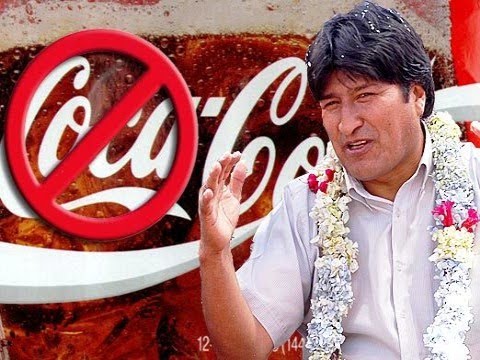
Bolivia’s Evo Morales : Putting the Coca Back in Cola

Bolivian President Evo Morales and Coca Colla. Above, photo from 1buenaidea.com. Below, photo by Red Erbol / Abiding in Bolivia.

Supports new coca-based drink:
Evo Morales tells Coke to take a hike

By Nikolas Kozloff / April 2, 2010

Move over Coca-Cola: here comes Bolivia.

The Andean nation’s indigenous people have long resented the U.S. beverage company for usurping the name of their sacred coca leaf. Now, they are aiming to take back their heritage. Recently, the government of Evo Morales announced that it would support a plan to produce a coca-based soft drink which would rival its fizzy American counterpart.

It’s still unclear whether the new drink will be promoted by a private company, a state enterprise, or some type of joint venture between the two. The new beverage will be called Coca Colla, in reference to age old history: in Bolivia, Quechua, Aymara, and other indigenous peoples descended from the Incas are known as collas.

In a move that will undoubtedly exasperate Coke, Bolivian officials say Coca Colla will feature a black swoosh and red label similar to the classic Coca-Cola insignia. Coca Colla reportedly has a black color, just like normal Coke, and could be sold on the market as early as April.

“Coca Cola robbed from us the name of our coca leaf and moreover has cornered the market all over the world,” says Julio Salazar, Secretary General of the Bolivian Coca Growers’ Federation and Senator from Evo Morales’ Movement Towards Socialism Party (known by its Spanish acronym MAS). “It is high time that the true owners of this natural resource benefit by industrializing our coca,” he added.

Bolivians would like to overturn the negative stigma attached to the coca leaf. Morales, an Aymara Indian, says that coca in its natural state does not harm human health, and that scientific research has demonstrated the plant to be “healthy.” When drug smugglers change coca into cocaine, Morales adds, they change the plant’s chemical composition.

While the Bolivian president condemns such practices, he also touts the commercial uses of coca leaf. Bolivia’s new constitution, drafted by the ruling MAS party, recognizes coca as Bolivia’s “cultural heritage, a natural and renewable resource of biodiversity in Bolivia and a factor of social cohesion” and adds that coca leaf is not a narcotic in its natural state.

Coca leaf, which was domesticated over 4,000 years ago, is usually chewed with a bitter wood-ash paste to bring out the stimulant properties which are mild and similar to caffeine or nicotine. In its pure form, coca serves to ward off hunger and counteracts the effects of high altitude. Many poor peasants earn their livelihoods from cultivation of the leaf, and coca has been used for millennia in cooking, folk remedies, and religious ceremonies.

Indeed, for Andean Indians coca leaf is closely tied to the spiritual world. Offerings to Pachamama, the Mother Earth, begin in August to scare away malevolent spirits of the dry season and to encourage a good harvest. Offerings consist of llama foetuses, sweets of various colors, coca leaf, and other herbs. The yatiri, or indigenous priest, burns the offerings in a bonfire while muttering prayers to the achachilas, Gods that inhabit the mountains.

Vintage print ad for Vin Mariani. Image from cocaine.org.

The restorative powers of coca wine

Though Coca Colla’s launch may have taken Coke’s CEO’s by surprise, it’s certainly not the first time that coca leaf has been incorporated in commercial drinks. When I was in La Paz researching my recent book Revolution! South America and the Rise of the New Left (Palgrave-Macmillan), I stopped by the city’s coca museum where I learned about Mariani, a coca wine. Launched in Europe in 1863, the wine was launched by Corsican chemist and entrepreneur Angelo Mariani. The businessman spawned imitators such as John Styth Pemberton, an Atlanta entrepreneur who launched his own coca wine. Later, the American created a syrup which served as the prototype for Coke.

After gathering information about the Inca and its love of coca, Mariani took up horticulture and began to grow the sacred Andean leaf in his backyard. Ingeniously, he sent samples of his new wine to famous people world wide in search of endorsements.

Mariani’s outreach paid off: the businessman received glowing testimonials from the likes of Emile Zola, Thomas Edison, Buffalo Bill Cody, and even U.S. President William McKinley, Queen Victoria and three Popes. In 1885, when Ulysses Grant was in his final death throes and suffering from throat cancer, he drank coca wine. Reportedly, the treatment helped soothe his pain.

“Vin Mariani is the restorer par excellence,” crowed Le Figaro newspaper in 1877. “It is the king of remedies against anemia… It is a tonic which increases the secretion of gastric juices, produces appetite… Vin Mariani has the rare advantage of stimulating both the muscular and cerebral activities.”

“Just how much of a kick did Mariani deliver?” asks Mark Prendergast, author of For God, Country, and Coca-Cola: The Definitive History of the Great American Soft Drink and the Company That Makes It. “Fortunately,” he says “we can hazard a good guess, since a chemist studying various wine cocas reported in 1886 that Vin Mariani contained 0.12 grain cocaine per fluid ounce. The dosage on the wine’s label called for a ‘claret-glass full’ before or after every meal (half a glass for children). Assuming the wineglass to hold six fluid ounces, three daily glasses would amount to a full bottle of 18 ounces, or 2.16 grains of cocaine per day, enough to make someone feel very good indeed.”

From coca liquors to pasta

Taking up Mariani’s lead, Andean nations have apparently carried out their market research and are now doing their utmost to commercialize other types of alcoholic coca beverages. Take for example the Peruvian brewery Cervecería Peruana, which plans to export a coca beer to countries such as China and South Africa. The beer is called Apu, a magic word signifying God, power and richness in the Quechua indigenous language.

Another Bolivian beverage company recently launched a coca whisky. The drink is called Ajayu, which translates as soul or spirit in the indigenous Aymara language. The whisky packs a punch, with 32% alcoholic content. According to Ajayu’s producer, the whisky conserves all the essential qualities of coca, “including more calcium than milk, more iron than spinach and as much phosphorus as fish.”

Boosters hope that Ajayu winds up being the emblematic brand of Bolivia, much as tequila became identified with Mexico. Each separate bottle of Ajayu contains 25 grams of coca, and the brand’s producers hope to export the drink to Cuba or Venezuela.

Historically, Mariani pioneered the use of coca leaf not only in beverages but also in other products such as cordials and tea. Lozenges meanwhile were marketed toward singers, teachers, and others who sought to ease the throat. Today, Bolivian companies have taken up Mariani’s lead and are using coca to make teas, syrups, toothpaste, liqueurs, candy, and pastry. In one Italian restaurant in La Paz, diners can even order coca spaghetti made from a mixture of wheat flour and coca leaf.

Coca Colla and ethnic pride

Though Bolivia’s promotion of Coca Colla may cause some to chuckle, the move could contribute to a further deterioration in U.S.-Bolivian relations. For years, Bolivia’s indigenous peoples have bristled under the U.S.-fueled drug war which demonized coca leaf. In a snub back at Washington, coca growers from the Chapare region proposed Coca Colla and it is now Evo Morales, himself a former coca farmer from Chapare, who has taken up coca nationalism as a cultural and political rallying cry [for those interested in pursuing this matter further, see my chapter on coca nationalism in my book].

When speaking before adoring crowds, Morales drapes a garland of coca leaves around his neck and wears a straw hat layered with more coca. What’s more, Morales claims that the United States seeks to intervene in Latin American countries by playing up the drug war. Washington’s policy, Morales has charged, is merely “a great imperialist instrument for geopolitical control.” The Bolivian President argues that the only way to do away with drug trafficking is to cut off demand.

Raising eyebrows in Washington, Morales recently requested the removal of coca leaf from a list of banned substances under the 1961 U.N. anti-narcotics convention. Specifically, Bolivia wants to modify two subsections of Article 49 of the 1961 U.N. convention on drugs that prohibit chewing of coca leaf. In a theatrical move, Morales held up coca leaf and actually chewed it in front of a U.N. panel in Vienna to demonstrate that it had no ill effects. Hardly amused, the Obama administration announced its opposition to Morales’ proposal the very next day.

Bolivian President Morales chews coca leaves in the United Nations. Photo from MercoPress / treehugger.

Coca tit-for-tat

The Bolivian president’s U.N. diplomacy is not too surprising given that Morales originally came to power in January, 2006 promising to end forced eradication of coca. In fact, the recent scuffle at the U.N. caps a number of other diplomatic fall outs: in September 2008 Bolivia expelled U.S. ambassador Phil Goldberg, accusing the diplomat of “conspiracy.” Shortly thereafter, Morales suspended official collaboration with the DEA.

Striking back, the Bush administration suspended Bolivia’s participation in a tariff-exemption program for Andean nations, asserting that Morales was not cooperating sufficiently in the war on drugs. Categorically rejecting that assertion, the Bolivian leader cited U.N. statistics demonstrating that his government had done better than Washington allies Colombia and Peru in seizing shipments of cocaine. Indeed, local authorities claim they have confiscated tons of cocaine and destroyed many drug laboratories.

It’s difficult to see a way out of the morass, given that the Obama White House does not seem very interested in reversing the foreign policy course of the earlier Bush years. In fact, Washington says Morales is not doing enough to clamp down on drug smuggling and has continued to exclude Bolivia from the U.S. tariff exemption program.

“An excluded black man can exclude an Indian man,” Morales declared. “The so-called Indians and blacks have historically been the most excluded, the most marginalized,” Morales added. “If he wants to exclude us let him continue to exclude us; that doesn’t matter to us.” In another round of the endless tit-for-tat, Morales recently expelled U.S. diplomat Francisco Martínez, also on charges of conspiracy.

Increased cultivation for Coca-Colla?

Joking aside, the Coca-Colla imbroglio may add yet another twist on the recent diplomatic fall out. Like neighboring Peru, Bolivia permits certain limited cultivation of coca for use in cooking, folk medicine and religious rites. If plans for Coca Colla move forward, however, Bolivia will have to grow more coca, thus putting a further strain on U.S. relations.

Under Bolivia law, up to 30,000 acres of land may be cultivated with coca, but Morales wants to increase that to nearly 50,000 hectares in an effort to further commercialize the leaf. With the new excess cultivation, Bolivia will be well placed to launch its new Coca Colla. While promoting the beverage is sure to irritate Washington, the move is politically smart for Morales as he may drum up support against an unpopular corporation while helping to bring welcome resources to coca growers.

“Whether or not the initiative is a success,” notes a recent column on the environmental website treehugger, “Bolivia may find international support for standing up to a company that many see as an unfeeling capitalist juggernaut with a product that better serves the environment and livelihoods of the people producing it. No word on how Coca-Colla will taste, but there’s already something refreshing about it.”

[Nikolas Kozloff is the author of Revolution! South America and the Rise of the New Left (Palgrave-Macmillan), and No Rain in the Amazon: How South America’s Climate Affects the Entire Planet, to be released by Palgrave-Macmillan in a matter of weeks. Visit his blog here.]

Source / BuzzFlash

The Rag Blog

Posted in RagBlog | Tagged , , , , , , , | 4 Comments

Conspiracy Theories : Exhaust Fumes from the Angry

Photo montage by Larry Ray / The Rag Blog.

Conspiracies:
Exhaust fumes from the angry

What better way to divert attention from the catastrophic eight years of the Bush-Cheney administration than to fan the flames of discontent with renewed conspiracy theories and tacit encouragement for simmering racism…

By Larry Ray / The Rag Blog / April 1, 2010

Some time ago a kid I had years earlier been asked to sponsor at an Eagle Scout awards ceremony invited me to his wedding. Call him Stan. He had razor sharp quick wit and an unquenchable interest in everything around him. From a poor background, Stan was a likable young redneck who had managed to earn the merit badges needed to become an Eagle Scout. He clearly had a high IQ which had gone unchallenged for most of his young life.

I was given a map to the location of the wedding. It was far out in the country up north of the coastal Biloxi-Gulfport metro area. I had always marveled at how in less than half an hour one enters thick pine forests and a totally different world, detached from the tourism, golf courses, beaches, and all the glitz of the casinos “down on the coast.”

The wedding at an old settlement church at the end of a gravel road was brief, plain, and functional. The bride’s full skirt helped conceal her pregnancy. The reception was in a large room beneath the church. Women and kids shuttled in bags of chips and other snacks from the cars and trucks outside.

Stan’s new bride poured me a paper cup full of Hawaiian Punch right out of the can as friends and family gathered for the party. Stan introduced me to his father, a rumpled rather dour man in his 40’s. He shook my hand and almost immediately pulled me aside from the others and looked me in the eye conspiratorially and asked what I knew about “the new world order.”

I didn’t know what he was talking about. Stan walked over briskly before I could answer, and trying for a bit of levity, I said, “Stan your father just asked me if I knew about the new world order. I’m not sure, do you know if that order was for here or to go?”

Stan guffawed. His father stiffened and folded his arms across his chest. Stan quickly led me off to meet his mother and other relatives. He rolled his eyes and said, apologetically, “Man, I forgot to tell you about my old man. Just ignore him. He is all off into that kind of stuff.” I had just met my first conspiracy theorist true believer face to face and it was unsettling.

I later would learn the wide range of beliefs in secret societies and evil plans afoot all designed to bring ruin, harm or even imprisonment. British polemicist, Cristopher Hitchens, defines conspiracy theories as the “exhaust fumes of democracy.”

Those who ramble on about the Freemasons, the Tri-Lateral Commission, satanic cults, “the Clinton body count” and of course, the “birthers” are a duke’s mixture of folks whose angst and anger can be traced back some 2,000 years. Early believers felt that a religious, social, or political group or movement would cause a major transformation of society for better or worse, depending on what one was believing. World domination or end of the world… depending.

Early Christian Millenarian groups proclaimed that the current society and its rulers were corrupt, unjust, or otherwise wrong. The Lutherans in about 1520 condemned the Millenarians. Countless new “we are right and you are wrong” cults and sects have been forming ever since, based upon narrowed religious interpretations, politics, pseudo science, and lots of rumor and wild speculation.

America has its own religious sects with their very own prophets, founders and teachings including Mormons, Jehovah’s Witnesses, Scientologists, and Christian Scientists just to name a few. All seem good folks seeking enlightenment, proclaiming peace and goodwill and devotion to good works.

Former Massachusetts Governor, Mitt Romney, as well as U.S. Senators Orrin Hatch and Harry Reid, are among 16 Mormon members of Congress in both houses who wear “sacred underwear” to remind them of a “continuing need for repentance and obedience to God, the need to honor binding covenants voluntarily made in the temple, and the need to cherish and share truth and virtue in our daily living.” Visitors are not allowed into the inner sanctum of their huge temple in Salt Lake city, however.

Extreme fringe groups may claim a loose Christian connection but they also easily mix in hatred, racism, paranoia, and patriotism. Hundreds of obtuse and extremist groups flood the internet with classic conspiracy beliefs including the American Nazi Party, White Power Worldwide, several skinheads groups and deniers of all sorts. On November 18, 1978, a charismatic psychopath, Jim Jones, founder of the conspiracy-based People’s Temple, led his gullible and devoted followers into one of the largest mass suicides in history, convincing 918 people to drink poison-laced Kool-Aid.

But if we dial down the level of these extreme examples of anger, political confusion, misplaced faith and too often, gullible ignorance, we can get a picture of conspiracy-based protests and activity in America today.

We already have a 2012 doomsday prediction and in the news this week, the Michigan Militia, calling themselves “Christian warriors” and training to battle the Antichrist, were planning to kill a police officer then set off roadside bombs to kill policemen who would gather en masse for the funeral. Nine of those folks have just been rounded up and jailed. Prosecutor, U.S. Attorney Barbara McQuade, said of the group, “They fear this ‘new world order’ and they thought that it was their job to fight against government — the federal government in particular.”

Fifteen years ago Stan’s father’s “new world order” beliefs were less militant but probably not too fundamentally different from those of the Michigan Militia “Christian Warriors.” But 15 years ago he and his buddies mostly railed and fumed amongst themselves, reinforcing their beliefs and forming bonds in their churches, clubs, and civic organizations.

Today conspiracy internet sites and cable TV talking heads like Fox News and Glen Beck, and Rush Limbaugh’s raving radio programs, keep the anger among conservatives stirred up 24 hours a day.

Conspiracy believers, who are so easily influenced by rumors, innuendo, and outright lies, are, however, not easily dissuaded from their view of the world, even after the rumors, innuendo, and outright lies have been totally and repeatedly debunked. They cling to those beliefs because it allows them to be members of a group and it sustains a sense of belonging. Intellectual challenges are seen as threats to what they fiercely already know to be the “real truth.”

The USA’s landing on the moon, for example, is still thought to be a hoax, all filmed on a movie set. Fox news even aired “Conspiracy Theory: Did we land on the moon?” Even with moon rocks having been studied by scientists around the world and proclaimed to be of extraterrestrial origin, conspiracy nuts like Bart Sibrel were still out there screaming about the “government coverup.”

Sibrel might have had some sense knocked into him when he confronted Buzz Aldrin in 2002 and called him a “coward and a liar.” Aldrin, 72 years old at the time, socked Sibrel a good one in the jaw.

Today’s conspiracy theorists have what they feel is a rock-solid target with a black president having been elected by “liberal Democrats.” That he is a constitutional scholar, has worked at the grass roots with the poor and disadvantaged after becoming a Harvard educated attorney, and is extremely bright and “motivates the world” is proof enough for them that he is the Antichrist. And others who don’t believe in Antichrist predictions still don’t like him because he is black. Period.

The Tea Party crowd today certainly contains a large percentage of those disaffected supporters from the McCain-Palin rallies where we heard shouts of “kill him!” and other violent epithets against Barack Obama. Obama’s clear victory validated a mandate for change. But the Republican party has pledged to keep Obama from succeeding, no matter the consequences for the country. Many ultra-conservatives have taken his election as a personal insult.

What better way to divert attention from the catastrophic eight years of the Bush-Cheney administration than to fan the flames of discontent with renewed conspiracy theories and tacit encouragement for simmering racism to come out into the open once again. Tea Party extremists were easily whipped up to scream “nigger, kike, fagot, baby killer” at the nation’s Capitol where some actually spit upon elected officials. Republicans stood on the balconies of the Capitol building holding posters egging on the ranting mob below. What a great Tea Party everyone was having!

President Obama and his administration have had the stamina and calm determination to take on the toxic Bush political and financial disasters with unpopular, costly damage control while also moving forward with other badly needed and long ignored major legislation. Obama’s perseverance resulted in beginning historic health care reform legislation.

Applauded by many at home and around the world, this progress has, however, created increased fear and anger among Obama’s detractors rather than generating hope. The clouds of dissent are thickening, as Hitchen’s noted, from “the exhaust fumes of democracy.”

The last thing soured and riled-up conspiracy theorists and simplistic political protesters need is an even darker cloud over them. Perhaps their hot air will disperse their own exhaust fumes and allow some clear light to shine upon them. Or perhaps not.

[Retired journalist Larry Ray is a Texas native and former Austin television news anchor. He also posts at The iHandbill.]

The Rag Blog

Posted in Rag Bloggers | Tagged , , , , | 35 Comments

Mexico : Fear of ‘Narco Guerrilla’ Haunts Officials

Cieneguillas state prison in Zacatecas, Mexico, where armed commandos freed more than 50 inmates in a raid May 16, 2009. Photo by Oscar Baez / AP / Huffington Post.

Phantom of Mexican narco guerrilla
Haunts U.S. security chiefs

By John Ross / The Rag Blog / April 1, 2010

MEXICO CITY — Last May, in a meticulously planned raid reminiscent of classic guerrilla jail breakouts that are legend in Latin America, a commando of 20 heavily armed fighters freed 53 comrades from a prison in the northern state of Zacatecas. Were the perpetrators in fact guerrilleros from some as-yet unknown revolutionary foco or narcos emulating a guerrilla-style jailbreak intent on freeing their own?

Recent assassination attempts against high-ranking state officials — Sinaloa’s Secretary of Tourism (successful), Coahuila’s Attorney General (the restaurant at which he was dining with a Texas mayor was sprayed with automatic weapon fire), and a Baja California finance undersecretary (hung by the neck from a Tijuana freeway overpass) — suggest revolutionary retribution in a year that marks the 100th anniversary of the Mexican Revolution in which jitters of new uprisings are legion — January 1st was welcomed in with anarchist bombs, sabotage, and “expropriations” in Mexico City and Tijuana on the northern border.

Although the incidents cited suggest revolutionary subversion, they were all the handiwork of Mexico’s five narco cartels locked in an intractable war with both President Felipe Calderon’s military and federal police — and reportedly hundreds of U.S. drug warriors — that has now taken more than 19,000 lives since December 2006.

The jail breakout in Zacatecas and the Sinaloa and Coahuila shootings are attributed to the syndicates headed by Joaquin “El Chapo” Guzman, his former associates in the Beltran Leyva gang, and the notorious Zeta cartel.

The hanging of Baja California state finance official Rogelio Sanchez Jimenez was charged to a blood-drenched capo Teodoro Garcia Simentel aka “El Teo” or “Three Letters” who is deemed responsible for hundreds of hangings, beheadings, and excessively violent homicides — an associate, Santiago Meza (“El Pozalero”) has reportedly confessed to dissolving 300 victims in vats of acid — most allies of the fading Arellano Felix clan with whom El Teo is contesting Tijuana.

Simentel was captured this past January 14 in an upscale residential neighborhood of La Paz in adjouning Baja California Sur state, the second top-rung narco purportedly taken down by Mexican authorities in a month. The bust earned bouquets of kudos from Washington, which is financing Calderon’s drug war under the $3,000,000,000 Merida Initiative.

The U.S, role in the capture of El Teo and Arturo Beltran Leyva, “the Boss of Bosses” who was gunned down by Mexican marines December 16, appears to have been purposefully downplayed. According to an unidentified member of Calderon’s Security Cabinet as reported by Gustavo Castillo, a La Jornada correspondent with exceptional sources, Simentel was located by the U.S. Department of Homeland Security’s Immigration and Customs Enforcement, a first indication that ICE is now being deployed in Mexico’s drug war.

The Drug Enforcement Administration and the FBI are also thought to have armed agents on the ground here under provisions of the Merida Initiative and the North American Security and Prosperity Agreement.

The Calderon government vehemently denies that participation of U.S. agents led to the capture of El Teo or Beltran Leyva although it acknowledges enhanced cooperation between the two nations’ drug fighters. The suggestion that Washington has assets on the ground here is not acceptable to many Mexicans whose country has been repeatedly invaded and even annexed by U.S. troops, and is regarded as a violation of national sovereignty.

The number of U.S. security agents working in Mexico is closely held but observers of Washington’s presence here such as specialist Jorge Camil affirm that it has been rising dramatically since the 9/11 terror attacks on New York and Washington and now totals in the hundreds. The DEA and the FBI now have offices in provincial capitals such as Tuxtla Gutierrez Chiapas, close to the Guatemalan border and multiple smuggling routes.

Mexico is not only in the crosshairs of the U.S. security apparatus because of the flourishing drug trade — the infiltration of terrorists across the porous border also excites attention although all reported incidents to date have proven to be false alarms.

Of increasing interest to Washington is the possible alliance of narco gangs with Mexico’s fledgling guerrilla cells, an interpolation of the Colombian model.

The concept of narco-guerrilla coalescence was first proffered in the mid-1980s soon after Ronald Reagan officially proclaimed the War on Drugs. Then-veep George H.W. Bush, a Navy man, was placed in charge of overseeing interdiction efforts in the Caribbean to stop the Colombian cocaine flow into the southern United States.

Under Bush’s watch, intelligence reports placed the onus on the Marxist-Leninist Revolutionary Armed Forces of Colombia (FARC), the Army of National Liberation (ELN), and M-19, a left nationalist movement later decimated by the Colombian army, for extending protection to such world-class kingpins as Pablo Escobar.

The truth was, however, more diffuse: paramilitary units such as the United Auto-Defenders of Colombia (AUC) armed by right-wing rural “terratenientes” (rich land owners) and the Colombian military were the big players in the so-called “narco-guerrilla” although several FARC fronts openly provided protection to the druglords.

The narco-guerrilla thesis eventually became the underlying reason d’etre for Plan Colombia in which the twin wars on drugs and terrorism were married. Since the late 1990s, Washington has pumped billions into Colombia to sustain this counter-insurgency strategy. The Merida Initiative, signed in that Yucatan city by George Bush and Felipe Calderon in 2007, is often referred to as Plan Mexico. As recipients of billion dollar boodles in U.S. drug war largesse, Colombia’s Alvaro Uribe and Mexico’s Calderon are Washington’s most significant allies on a continent where the left has taken power in a majority of countries.

Today, despite a decade of Plan Colombia, Colombian cocaine production has held steady and the FARC ranks as Latin America’s most powerful narco-guerrilla. Although Mexico has no known counterpart, FARC activities here are closely monitored. FARC offices were shuttered during the presidency of Vicente Fox (2000-2006) — the FARC and Colombian president Andres Pastrana entabled negotiations in Mexico City in the 1990s.

A Colombian-born National University graduate student was deported to Bogotá last year on terrorism charges for sympathizing with the FARC and Uribe has issued extradition warrants for a Mexican student who survived the bombing of the Ecuadorian jungle camp of FARC leader Raul Reyes (not his real name) in 2008.

One connection: FARC operators are said to consort with the Valle del Norte Cartel, the main Colombian supplier for El Chapo‘s Sinaloa Cartel. A purported 2007 jungle tete a tete between Reyes, and an unidentified cartel representative suggested the possibility that the Sinaloa boys would buy cocaine directly from the Colombian rebels rather than deal with a series of middlemen suppliers.

The Zapatistas have waged a crusade against drugs in their autonomous communities in southeastern Chiapas. Photo from latinamericanstudies.org.

Mexico’s armed leftists take pain to steer clear of association with drug gangs. Military intelligence first identified the Zapatista Army of National Liberation (EZLN) as drug and gunrunners on the Guatemalan border, an estimate said to have been backed up by CIA satellite overflights. The Zapatistas have dodged the stigma by waging a vigilant crusade against drugs in their autonomous communities in southeastern Chiapas. Cultivation of marijuana by militants is severely punished by banishment from the EZLN. Nonetheless, the Mexican Army has repeatedly stormed into Zapatista villages on the pretext of marijuana patch sightings.

Mexico’s homegrown guerrilla bands have their roots in the north of the country where this distant neighbor nation’s 1910-1919 revolution first germinated — revolutionary martyrs Francisco Madero, Pancho Villa, Venustiano Carranza, and Alvaro Obregon were all northerners who marched their armies south to seize power.

In 1965, Arturo Gamiz, a disaffected rural schoolteacher, and 12 rebels laid siege to army barracks in Ciudad Madero, Chihuahua — all were killed in the assault. Six years later, the September 23rd Communist League based in the northern industrial city of Monterrey took its name from the date of the assault — 15 armed groups of which the September 23rd league was the most prominent operated throughout Mexico in the 1970s. The Forces of National Liberation (FLN), also based in Monterrey, gave birth to the EZLN in Chiapas. A sister guerrilla, the Villista Army of National Liberation in Chihuahua was never consolidated.

Conditions in the north of Mexico where both the narco cartels and the military concentrate their forces are propitious for a resurgence of guerrilla activity. Unemployment in the region, driven by the decline of the maquiladora industry (many assembly plants have moved to China), is at a 15-year high. The rural economy has been eclipsed by neo-liberal adventures such as the North American Free Trade Agreement and the deepening recession, the worst in 80 years, is forcing campesinos to abandon their land. A hundred years ago in this vast, mineral-rich region of deserts and scarred mountains, landless peasants and displaced farmers formed the nucleus of Pancho Villa’s revolutionary army.

In 2010, many survive the economic crisis by turning to drug cropping — a half million Mexicans are said to earn their living in the drug economy. One indication of increasingly close ties between militant farmers and the drug cartels was the slaying of Margarito Montes Parra, longtime leader of the leftist UGOCEP (General Popular Union of Workers and Farmers) who was ambushed by cartel gunmen in Ciudad Obregon last fall.

Widespread human rights abuses by federal troops who combat the narcos along the northern border has provoked a wave of anti-army, anti-government anger in many northern states and conditions for a Gamiz-like assault on military installations cannot be discounted should drug gangs and armed radicals find common cause.

For prospective guerrilla formations, alliance with narcos has its perks: weapons and money. Both the narcos and the radicals are interested in subverting the state although their motives may be distinct. For anti-imperialist revolutionaries, poisoning the Yanquis with drugs is a weapon of class war. But negatives abound: everything the cartels touch is corrupted by profit-driven mercantile greed that is at odds with revolutionary ideals — although there are always those who will argue that the end justifies the means.

For Homeland Security and Washington’s security apparatus, the nightmare prospect of a coalition of narcos and guerilleros cruising the border is reason enough to sustain agents on the ground south of the border whether or not Mexican authorities are prepared to admit their presence.

Indeed, this January, Obama’s Justice Department announced the merger of its International Terrorism and Narcotics investigation units to prepare for just such an eventuality. The vision of Mexico as a potentially failed narco-state advanced by the Pentagon and the Joint Chiefs of Staff in a 2008 evaluation is a five-star national security issue for Washington and the option of a U.S. preventative invasion is always on the table.

[John Ross continues to slog across Obama’s America now in the second month of his monster book tour. Ross and El Monstruo — Dread and Redemption in Mexico City will visit St. Louis April 4-7, and Millsaps College in Jackson, Mississippi on April 9 for a symposium on Mexico City. He will tour Baltimore, Washington, New York, and Boston April 19 through May 1. For details write johnross@igc.org.]

The Rag Blog

Posted in Rag Bloggers | Tagged , , , , , | 1 Comment

By Rabbi Arthur Waskow / The Rag Blog / April 1, 2010

What’s with Obama?

The President has run true to form in his announcement of ending the moratorium on off-shore drilling in part of the Atlantic Coast.

Some reports suggest he did this in order to get Big Oil support for some version or other of the climate/energy bills before Congress. If so, it’s very like what he did in making private deals with Big Pharma and Big Insurance before the health-care bills came to the floor of either house.

By the time those deals were completed, the bills were compromised far short of what might have been possible with a full-throated fight. For example, it is now clear that a promise not to include the Public Option was part of the deal..

Yes, the final health care bill was a lot better than the status quo, and I supported its passage after efforts to strengthen it failed, but — why did the President go this route of preemptive compromise, and why do it again?

I have a theory about Mr. Obama that is partly psychological and partly political.

The psychological part is of course at a far distance. But I think it fits the public facts.

I think that at his deepest core, he is always trying to reconcile “Kansas” and “Kenya,” the two roots of his being.

I think he cannot bear to accept that some contradictions and oppositions are real — and must be fought out. The will-of-the-wisp of “bipartisanship” with a “party” that is dead set against him and against what his rhetoric might define as his desires is, I think, grounded in his deepest sense of himself.

After discovering that this wasn’t working to get even a half-way decent health bill, and after being pushed hard by Speaker Pelosi against the “baby bill” espoused by his carefully chosen chief of staff, he finally came out swinging. But only on behalf of a bill that had already been greatly narrowed by the earlier deals. (And notice that he didn’t fire the chief of staff.)

And only at the last second did he decide to mobilize the 13-million-address email list “Obama for America” to affect Congress, rather than depending on Rahm Emanuel’s inside-the Capitol-dome strategy.

And now the same pattern.

What is wrong with this off-shore drilling? First, it will do far less, at far greater cost, to make the U.S. less dependent on “foreign oil” than would a sweeping, energetic Presidential campaign for energy efficiency and conservation at every level of American life.

And far less to pass a good bill than would unleashing the email list.

Second, if the drilling ever gets done it will pose great dangers not only to natural beauty and the tourist income rooted in that beauty, but great dangers as well to the oceans and the earth. Oil drilling off the Louisiana coast had a great deal to do with destroying the wetlands that used to absorb huge amounts of rain, and thereby made the Katrina hurricane far more destructive.

These drills may be too far offshore to affect wetlands, but what will they do to the oceans? And what will the extra burning of this extra oil do to CO2 in the atmosphere, to the Interbreathing of all life that is encoded in God’s own Name of YHWH?

Third and most important, this decision will add to the profits and the power of Big Oil, which has been one of the worst opponents of doing anything serious to reduce the impact of global scorching and prevent climate disaster.

There is a political as well as psychological component to Obama’s behavior. Even if he is so desperately committed to “unifying” Kansas and Kenya as I have suggested, why are the deals always with Big Oil, Big Banking, Big Pharma, Big Coal, Big Health UNsurance?

Because these are the Big Powers of our political system. If a Green-Blue alliance of Labor and Environmentalists were as powerful as these Big Corporations, that is where he might have had to turn to satisfy his own need to “unify.”

So that leaves it to us. If you click here, you can send a letter to your Senators and Congressmembers to urge them to resist this give-away of our oceans, our earth. (Add your own words to our draft.)

http://salsa.democracyinaction.org/o/602/p/dia/action/public/?action_KEY=2796

Please also forward the Shalom Center message on oil drilling to your friends, co-workers, and congregants

More information on global scorching & energy policy is on our website home page — click on the Greem Menorah logo at the bottom of the right-hand column, or click here
. http://www.theshalomcenter.org/treasury/43

Thanks!

Blessings of healing to you in affirmation of your efforts to heal our country and our planet.

Shalom, salaam, shantih – peace,
Arthur
(Rabbi Arthur Waskow, The Shalom Center)

Type rest of the post here

Source /

The Rag Blog

Posted in RagBlog | Leave a comment