And in this Corner : The Globalists Vs. the Pragmatists


‘Globalist discourse’ on war and peace:
2010 will be year of ideological struggle

By Harry Targ / The Rag Blog / January 7, 2010

The year ends with the resurgence of what we might call “globalist discourse.” Globalist discourse is a set of ideas or theories about how the world works that justifies United States military and political intervention on a global scale.

Since the United States became a great power, it has sought to expand its influence, power, and economic presence everywhere. But during some periods the policy and the defenses of it (the discourse) have emphasized diplomacy, building relationships with allies, and even, from time to time, currying the favor of potential competitors for world domination.

This represents a kind of “pragmatic approach” to global influence. During other periods the United States has rejected diplomacy, demanded allied obedience, and engaged in bloody military adventures, the globalist approach.

The election of Barack Obama offered the hope to the peace movement, and large sectors of the public that the new administration would reinstate a more “pragmatic” approach to foreign policy. As has been stated by many, however, Obama’s newly announced counterinsurgency policy for Afghanistan and bold proclamation at the Nobel Peace prize awards ceremony that the world is an ugly place and therefore that wars are inevitable suggest that he may be tilting toward the more globalist, interventionist strain in United States policy.

Pressure to continue to move in the globalist direction increased as 2009 came to a close. First, spokespersons for war criticized the Obama administration for not understanding that the United States is in a perpetual global war against terrorists. Former Vice President Dick Cheney spoke for this view after the Christmas Day attempted terrorist attack on a commercial plane flight ending in Detroit. “We are at war and when President Obama pretends we aren’t, it makes us less safe.”

Cheney decried Obama’s reluctance to use the language of “war on terrorism.” Such language Cheney said “doesn’t fit with the view of the world he (Obama) brought with him to the Oval Office.” And, of course, what the Bush/Cheney team brought to the Oval Office, the former Vice President argued, was much preferred. It was the view that the United States, as the last remaining superpower, is constantly threatened by forces more diabolical than the former Soviet Union. 9/11 was just one manifestation of a global war of “Jihadists” who wish to destroy the U.S.

Unfortunately, rather than directly challenging the validity of this view, spokespersons from the Democratic Party, responded by saying that Obama in fact has said that the U.S. is at war. They reminded the public that in his inaugural address Obama proclaimed that; “Our nation is at war against a far-reaching network of violence and hatred.” However, to provide some rationality to the response an adviser to the President for Homeland Security, John O. Brennan, indicated that U.S. policy is targeted at specific threats which are “…tangible-Al Qaeda, violent extremists, and terrorists- rather than at war with a tactic, terrorism.”

An additional byproduct of what may be called “the doctrine of perpetual violence” is the claim that military priorities trump all other policies. In this regard Cheney pointed out that the Obama perspective on the world does not fit the needs of national security because “…it doesn’t fit with what seems to be the goal of his presidency — social transformation — the restructuring of American society.” Cheney implied that Obama is squandering energy, resources, and time on health care reform, global warming, jobs, education, and other vital needs at home rather than engaging what is needed to defeat “the terrorists.”

A parallel set of claims about threats to the United States was aired in a troubling December 31 broadcast segment on National Public Radio. In it, NPR foreign policy analyst Tom Gjelten, interviewed so-called experts who claimed that failure to stop the Taliban in Afghanistan and Pakistan might lead to wider wars in Kazakhstan, Turkmenistan, Kyrgyzstan, Uzbekistan, and Tajikistan. These threats to regional stability were also threats to United States vital economic, political, and military interests.

Gjelten sited Jean-Louis Bruguiere who was identified as a European Union envoy on terrorism. Bruguiere suggested that an “arc of conflict” was emerging that increasingly encompassed Afghanistan, Pakistan, and the former Soviet Republics of Central Asia. He added that radical insurgent groups, which formerly operated only in their own countries now work in collaboration with their counterparts in other countries. If the insurgents win in Afghanistan, it will boost the prospects of radical insurgent victories in the other threatened regimes.

Paul Quinn-Judge, identified as the Central Asia Director for the International Crisis Group, referred to the importance of one insurgent group, the Islamic Movement of Uzbekistan (IMU), which is now operating with the Taliban in Afghanistan. “If the Taliban can consolidate themselves in northern Afghanistan, that’s already going to be an excellent jumping-off point for the IMU and for other Central Asian Islamists” which “…would be a very disturbing development for most of the countries of Central Asia.”

Gjelten then referred to David Sedney, the Deputy Assistant Secretary of Defense for South and Central Asia, who in recent Senate hearings indicated that some supplies for the U.S. war on Afghanistan are brought via road and rail through Central Asia, the so-called Northern Distribution Network. He said that in “…the mindset of the Taliban and other Islamist movements, Central Asia is now part of the general theater of war.”

Whose “mindset” sees Central Asia as “now part of the general theater of war?” Is it really the Taliban? Or is it the globalists who see the world as part of “the general theater of war?”

While many Americans, perhaps most, dismiss the ravings of Dick Cheney, the threat of terrorism, the reminders of the horror of 9/11, the articulation of the view of the world that says nations and peoples are driven by the violent laws of the jungle have some resonance. Even greater weight is given to the “expert” laced analyses of hand-picked “experts” put on display with intellectual reverence by National Public Radio.

As 2010 dawns, the peace movement must begin to attack the fundamental premises of the globalist discourse. Wars are not inevitable. There is no global jihad. U.S. violence in the world generates equal and more threatening responses. And, finally, the whole globalist discourse celebrates and revels in massive violence, military waste, and dehumanization. Therefore as we select our political representatives, consume news and views about the world, and work for a better world, we must demand a discourse that is not wrapped in apocalyptic visions of human affairs.

[Harry Tarq is a professor in American Studies who lives in West Lafayette, Indiana. He blogs at Diary of a Heartland Radical, where this article also appears.]

The Rag Blog

Posted in Rag Bloggers | Tagged , , , , , , | Leave a comment

Ireland : ‘Blasphemy’ Now Against the Law


Irish atheists fight back:
Dissing religion now a secular rap

By Ted McLaughlin / The Rag Blog / January 6, 2010

On January 1st a new law took effect in Ireland — the so-called “Blasphemy Law.” This law makes it a criminal offense to make blasphemous statements regarding any religion. The penalty for this blasphemy is a fine of up to 25,000 euros (or about $35,000 in U.S. currency). The government said the new law was needed because the Irish Constitution only protected Christianity from blasphemy.

Obviously, Ireland is not big on “free speech” — at least as far as religion is concerned. This law would be considered to be an unconstitutional violation of free speech here in the United States, and that’s just how Irish atheists believe it should be in Ireland. This law could criminalize all Irish atheists for just stating their sincerely held beliefs, while the religious folks could say anything at all about atheism (no matter how mean, nasty or untrue their words were).

This really stacks the table against free thought and for religion. But the Irish atheists are already taking the first steps in fighting this new and unfair law. Atheist Ireland chairman Michael Nugent says, “This new law is both silly and dangerous. It is silly because medieval religious laws have no place in a modern secular republic, where the criminal law should protect people and not ideas.”

Now some of you may think that as an American I really don’t have a dog in this fight. I disagree. As you can probably tell by my last name, my ancestry is mostly Irish (with a dash of Scot and Dutch thrown in). I have always been proud of that because those ancestors have never bent their knee to tyranny.

The Irish fought for many centuries for freedom and self-determination for their people, and many brave Irishmen gave their lives for this cause. How is it then that they now seek to criminalize and subjugate the beliefs of many of their own citizens? Are their religions really so weak that they cannot withstand the verbal and written words of honest Irishmen? Isn’t this just religious tyranny?

But there are still Irishmen who believe all Irishmen should have the right to say what they wish. The Irish atheists are fighting back. On the first day the new law went into effect, Atheist Ireland posted 25 blasphemous quotations on their website. The quotations are from famous people and “blaspheme” several religions (Christianity, Judaism, Islam, Buddhism) and religion in general.

Actually it is only 24 “blasphemous” quotations, since one of the 25 actually denigrates atheism. They wanted to show their belief that all ideas should be subject to scrutiny and free speech — even their own.

They are, in effect, daring the government to arrest and charge them with blasphemy. And if this happens, they promise to fight it in the courts in the hope of getting the ridiculous law overturned. They are also scheduling public meetings across the country, where I’m sure they will be issuing more “blasphemous” statements.

I commend these brave Irishmen and wish them success in their endeavor. To see all of the 25 published statements, go to the site of Atheist Ireland. I am only printing one of the statements here because it is one of my favorite quotes — from the entertainer, atheist and Irish-American George Carlin, who said,

Religion easily has the greatest bullshit story ever told. Think about it. Religion has actually convinced people that there’s an invisible man living in the sky who watches everything that you do, every minute of every day. And the invisible man has a special list of 10 things he does not want you to do. And if you do any of these ten things, he has a special place, full of fire and smoke and burning and torture and anguish, where he will send you to live and suffer and burn and choke and scream and cry forever and ever ’til the end of time!

But he loves you. He loves you, and he needs money! He always needs money! He’s all-powerful, all-perfect, all-knowing, and all-wise, but somehow just can’t handle money! Religion takes in billions of dollars, they pay no taxes, and they always need a little more. Now talk about a good bullshit story. Holy Shit!

[Rag Blog contributor Ted McLaughlin also posts at jobsanger.]

The Rag Blog

Posted in Rag Bloggers | Tagged , , , , , , , | 2 Comments

‘TV Everywhere’ : Pulling the Plug on Web-Based Video?


Say goodbye to free online television:
Comcast launches ‘TV Everywhere’

By Josh Silver / January 6, 2010

On Monday, public interest groups called on federal authorities to investigate a plan by the largest cable, satellite and phone companies that threatens the future of Web-based video. “TV Everywhere” gets programmers like TNT, TBS, and CBS to keep their content offline unless a viewer also pays for TV through a traditional company like Comcast or AT&T (phone companies are starting to offer TV service, too).

TV Everywhere is designed to protect the current cable TV subscription model and block competition from upstart online video ventures like Vuze, Roku and Hulu. Cleverly marketed as a consumer-friendly product, TV Everywhere is really a desperate bid by old media giants to crush the emerging market for online TV. Cable giant Comcast just became the first company to launch TV Everywhere under the brand “Fancast Xfinity,” and the other dominant cable, satellite, and phone companies have announced plans to follow suit.

At its core, TV Everywhere is about ensuring consumers don’t cancel their overpriced cable TV subscriptions that provide companies like Comcast with huge profits ($6.7 billion in 2008 alone). But the current scheme also prevents competition among existing TV distributors. Instead of being offered to all Americans, including those living in Cox, Cablevision and Time Warner Cable regions, Fancast Xfinity is only available in Comcast regions. The other distributors plan to follow Comcast’s lead, meaning that the incumbents will not compete with one another outside of their “traditional” regions.

Statements made by cable executives indicate that backroom deals are being cut without asking for permission by regulators — the kind of permission that the nation’s major newspapers recently sought before entering into discussions about a coordinated online “paywall.” So TV Everywhere not only threatens the Net’s potential to break open access and distribution of video content, it also appears to be an illegal collusion meant to block competition. Any way you slice it, it’s bad for consumers. On Monday, public interest groups
released a major report at the same time that they sent a letter to federal regulators requesting an antitrust investigation of TV Everywhere.

New online-only TV distributors and independent channels are excluded from TV Everywhere. The “principles” of the plan, which were published by Comcast and Time Warner (a content company distinct from Time Warner Cable), clearly state that TV Everywhere is meant only for cable operators, satellite companies and phone companies. By design, this plan would exclude new entrants and result in fewer choices and higher prices for consumers.

This deal threatens to stifle the freedom and innovation that are shaping our new media marketplace. The Internet is enabling people to watch video how and when they want it. The programs we watch on TV are increasingly available on your computer: on-demand through Hulu, Fancast and other streaming sites. And the online video you can see on YouTube, Miro, Fancast, Vimeo and other portals are available on televisions and portable devices.

Stranded at the airport, sitting in a coffee shop, on vacation or at work, we can view programs from basically anywhere. And thanks to the Internet’s open, neutral platform, anyone can create and share video, meaning we’re no longer confined to the programs that media executives choose to offer.

TV Everywhere represents a defining moment in the future of radio, television and other media. In one scenario, we break from history and achieve more consumer choice and an explosion of innovative content. We may need to pay for video online, or continue to watch advertisements, but we won’t be forced to buy a traditional cable TV subscription that we don’t want or need.

In another scenario, we allow the big cable, satellite and phone companies to use anti-competitive ventures like TV Everywhere to protect the status quo, and make the Internet more like cable television: where they, not you, pick and choose what you can watch, how and when you can watch it, and how much you pay for it.

The central tenet of TV Everywhere is that it can only exist through collusion among competitors. Our federal antitrust authorities and Congress must launch an immediate investigation.

The Internet offers an unparalleled opportunity to democratize the TV screen now controlled by a handful of powerful media companies. This revolution is televised — and we should be able to view it online, too. Antitrust authorities should start enforcing antitrust laws and protect the public interest.

[Josh Silver is the Executive Director of Free Press a national, nonpartisan organization that he co-founded with Robert McChesney and John Nichols in 2002 to engage citizens in media policy debates and create a more democratic and diverse media system.]

Source / The Huffington Post

The Rag Blog

Posted in RagBlog | Tagged , , , , , | Leave a comment

Colombia : Pablo Emilio Moncayo: A Pawn in Uribe’s Game

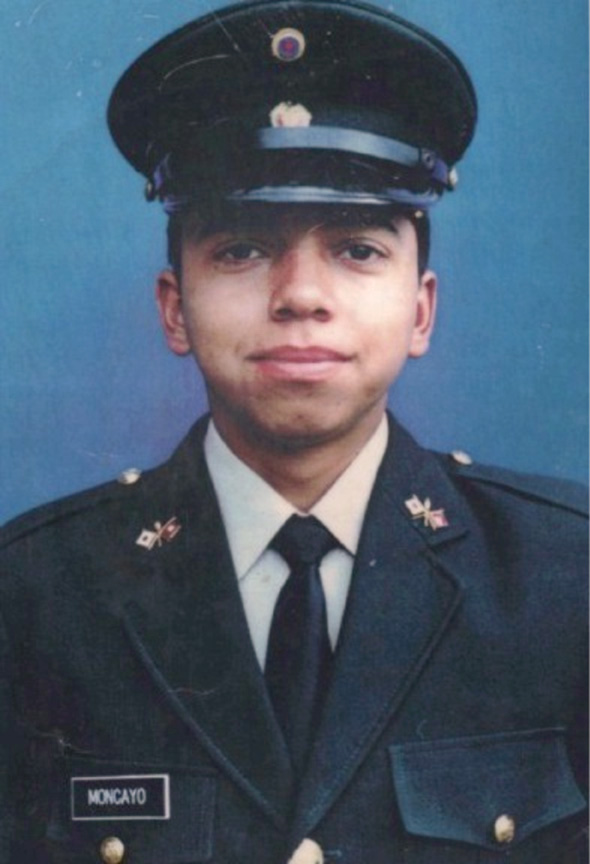
Pablo Emilio Moncayo in 1996, 19 years old.

Colombia’s Uribe:
Playing politics with Pablo

Somewhere in the Amazon jungle tonight, Pablo sleeps chained to a tree stump, his release prevented by the government he served all these long years in order to continue the class warfare that U.S. taxpayers pay for.

By Marion Delgado / The Rag Blog / January 6, 2010

CARTAGENA DE INDIES, Colombia — On 21 December 2009, Pablo Emilio Moncayo marked his 12th year as a captive of Colombia’s Fuerzas Armadas Revolucionarias de Colombia — Ejército del Pueblo (FARC or FARC-EP; Revolutionary Armed Forces of Colombia – Peoples Army).

While President Uribe’s propaganda machine says that he was kidnapped, he was actually captured in battle in 1997. Pablo was a corporal in the Colombian Army (COLAR) then; he has been promoted to sergeant while a POW. Like all stories, Pablo’s began many years before he became a pawn in the decades old military/political class struggle between COLAR and FARC-EP.

Like many revolutionary armies, FARC-EP began as a rag-tag group of campesinos protecting an agrarian class displaced from their land by rich landowners. That was in the late 1950s. Because of the brutal opposition it met, the FARC had to become not just a defensive, protective force for the people, but an army with offensive capabilities. They declared themselves a belligerent army in 1964 and named themselves the FARC in 1966.

Pablo Moncayo was four years old in 1982, when the events that led to his current situation began to take shape.

At the Seventh Guerrilla Conference in 1982, work began to turn the FARC from a guerrilla organization into a rebel army (the “People’s Army”). FARC added ranks and badges to its uniforms, introduced a new inventory system for firearms and ammunition, and provided new weapons and technology for FARC militants.

In theory, a properly organized and trained guerrilla army would thus meet the international requirements for recognition of a “state of belligerence” as defined by the Geneva Conventions of 1949 and later protocols. FARC considers that it lives up to this definition and argues that it has been accepted as a legitimate army, in particular during negotiations with successive Colombian governments.

FARC opponents and the government claim that the group’s practices of civilian kidnapping for ransom and taxing coca crop buyers make it an illegitimate army and point to a wide rejection of FARC positions in national surveys. Assassinations of opponents and forced displacements are inflicted on the general population by all forces involved in the Colombian civil war, making FARC’s belligerent status claim harder to accept. This is further complicated by the coca eradication efforts of the Colombian government that involve U.S. support and that have led to FARC being declared a terrorist organization by the U.S. government and the EU.

FARC maintains that it does not grow or process or transport Colombia’s main agricultural crop, cocaine. It admits that it taxes those who do. It taxes all commerce in the territory ceded to it by the former Pastrana government in a peace agreement, territory that the Uribe government is now trying to retake by force of arms.

Aware of these roadblocks to legitimacy, FARC one year ago released the last of its civilian hostages. Those captured in battle, however, are still held.

On December 21, 1997, COLAR was building a communications station in Patascoy, in the state of Nariño, close to the border of Putumayo, when the construction unit was attacked by the FARC. Twenty-two COLAR soldiers were killed and 19 were captured, among them Corporal Moncayo, almost as low as you can get on the military totem pole. FARC causalities were not reported.

In 2007, Pablo’s father, Gustavo Guillermo Moncayo Rincon, a teacher popularly known as “El caminante por la paz” (“the walker for peace”), walked 1,186 km from his hometown, Sandoná, in the department of Nariño, to the capital, Bogotá, seeking an agreement for the release of his son, who had by then been a prisoner of the guerrilla group for 10 years.

On June 17, 2007, Father’s Day in Colombia, Moncayo began walking from Sandoná accompanied by his daughter, along the Pan-American Highway, stopping in every town along the way to rest and to collect signatures for a petition to President Álvaro Uribe, asking him to conduct a prisoner exchange.

When he arrived in Cali, he was received by Governor Angelino Garzon, who offered him a place to stay. Days after, in Pereira, he was received by the mayor, who decorated him as a “citizen of honour.” He walked across the highest pass of the Andes, and on August 1, 2007, Moncayo walked the last stretch to the historic downtown of the capital city. When he arrived in the Plaza de Bolívar he was cheered by thousands of people. His arrival led to a public exchange of views in the press between him and Uribe, who blamed Pablo Moncayo’s long captivity on the FARC.

After this fruitless exchange, Moncayo said, “Sadly, our children, our loved ones, remain there in the jungle… We are in the middle of this political game between the government and the FARC.” He also criticized Uribe for “making empty offers to the guerrillas in exchange for the captives.”

According to the Washington Post, Fernando Londoño, a far-right former interior minister, criticized Moncayo in an opinion column for El Tiempo, the country’s main daily. (El Tiempo is owned and operated by the family of Colombia’s recent Minister of Defense, Juan Santos, and is a frequent source of government propaganda.) He accused Pablo Moncayo of being an “incompetent soldier,” and wrote that his father was spreading “Marxist venom through Colombia’s veins.”

Gustavo Moncayo continued to work for his son’s release, collecting petitions, visiting politicians, and talking with anyone who would listen. Early in 2009 his work seemed to pay off. An international outcry began to take hold and in April, responding to a call from Hugo Chavez, the president of neighboring Venezuela; President Rafael Correa of Ecuador; Senator Piedad Córdoba, known as the “peace senator”; Amnesty International; the Catholic church; and the International Red Cross, the FARC announced they would “unilaterally” free the soldier they had held hostage for over 11 years as they look for ways to start peace talks with the government.

It looked like Pablo was coming home. Senator Córdoba and the Red Cross were named as intermediaries. Still Uribe was reluctant and dragged his feet over arrangements, all the while keeping up a steady stream of vile and unhelpful statements.

Army corporal Pablo Emilio Moncayo, Age 31, October 9, 2009. Photo from Agencia EFE.

The FARC said it would unilaterally free Pablo Moncayo and turn him over to his father and the left-wing Córdoba, who has brokered hostage handovers in the past, and that it wanted the release to begin the start of peace talks with the government. Uribe responded by insisting that the rebels “first must cease bombing, kidnapping, and drug smuggling.” At every turn he seemed to be trying to derail Pablo’s release.

On December 22, 2009, he saw his chance to nix the deal once and for all. That was the day 10 heavily armed men in civilian clothes kidnapped and murdered the governor of the state of Caquetá, Luis Francisco Cuellar. Without any proof at all, Uribe immediately announced that the perpetrators were the FARC.

In his usual hate-filled rhetorical style the president announced that the assassination of Cuellar gives him great “pain” and “desperation.” Uribe said the crime was the work of the “same bandits who want to make the release of the hostages a show.” The president was referring to a statement that FARC made several months ago about their readiness to free two soldiers (including Pablo Moncayo), and return the remains of a policeman who died in captivity.

Uribe stated that he has done everything required by the FARC and therefore no longer believes in the promises of “these bandits,” insisting that the military will rescue the hostages.

But Uribe has not done anything FARC has asked. He refuses to take this release as an opening for peace talks. He would not even sign an agreement guaranteeing the safety of the people involved in the release, including the senator and Red Cross representatives.

In 2002, when peace talks were initiated; Uribe loosed paramilitary thugs who used the occasion to kill some FARC negotiators. He put an end to that peace process and insured more years of “dirty war” and billions of U.S. taxpayer dollars to fill his and his cronies’ coffers.

The FARC website had this to say:

“Because Uribe and his gang did not sign the decree which guarantees security for guerrillas and guests, you can not believe anything. The only thing stopping this humanitarian act has its own name: Uribe Velez.” The website added, “The FARC knows that the Colombian oligarchy and its transitional form, Uribe, are tráfugas and not ‘a tantico to be trusted’.”

According to information obtained by ANNCOL, the FARC remains ready to fulfill its word, freeing the two soldiers and returning the remains of the policeman.

Meanwhile, Pablo Emilio Moncayo’s father, Gustavo Moncayo, charged that Uribe’s statements “continue to insist on preventing” the release of his son and asked him not to endanger the lives of the hostages with a military type rescue.

Uribe was not to be deterred by the father’s pleading. “The instruction is to rescue,” Uribe said. “I have asked all military and police efforts to rescue the other hostages that were retained from these bandits.”

Uribe got what he wanted. On December 24, the Red Cross announced it had suspended negotiations to release the hostages. A representative of the organization in Colombia (ICRC), Pascal Jequier, told the BBC that the decision was made after President Uribe ordered a military rescue of the governor of Caquetá, Luis Francisco Cuellar, and other hostages. Uribe issued the “rescue” order before Cuellar’s death was known, placing other POWs in danger.

“As long as the order is in force to act through military means to rescue the hostages, there will be no release sponsored by the ICRC,” Jequier said, adding that,”Efforts to seek the release of Corporal Pablo Emilio Moncayo and the soldier Joshua Daniel Calvo remain ‘frozen’ at the moment.”

Somewhere in the Amazon jungle tonight, Pablo sleeps chained to a tree stump, his release prevented by the government he served all these long years in order to continue the class warfare that U.S. taxpayers pay for.

“He’s only a pawn in their game.” — Bob Dylan

The Rag Blog

Posted in Rag Bloggers | Tagged , , , , | 3 Comments

U.S. Government : Six Decades of Spying on its Citizens


It’s a national tradition:

Spying on Americans

  • Part One: LBJ and Nixon

By Sherman DeBrosse / The Rag Blog / January 5, 2010

[This is the first installment of Sherman DeBrosse’s series about the U.S. government’s extensive and inglorious history of spying on its own people.]

Difficult as it is to understand, our government now has a number of detention facilities that could house hundreds of thousands of people. Some say they are to house undocumented immigrants, but one wonders. In recent years, government has also acquired the capability to monitor and store information about millions of telephone calls, faxes, and e-mails made by American citizens.

When we reflect that government has a history of spying on and harassing progressives and people who object to some of our wars, we cannot be blamed for wondering if the detention facilities and electronic surveillance capabilities are not there to be used on progressives.

Operation Chaos

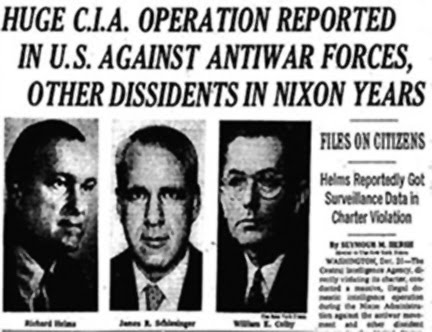
In October, 1967, President Lyndon B. Johnson established “Operation Chaos” in the CIA. Its role largely was to spy on American citizens who objected to the war in Vietnam. Of course, to one extent or another, the CIA has been spying on domestic dissidents since 1959. Chaos relied largely upon people from the Domestic Operations Division, and others were borrowed from European assignments.

The Domestic Operations Division was created sometime between 1962 and 1965, and its first head was Charles Tracy Barnes, a CIA veteran who had coordinated the agency’s activities duiring the 1954 Guatemalan coup and 1961 Bay of Pigs invasion. It was located at 1750 Pennsylvania Avenue, not in Langley, VA.

From the beginning, Richard Helms was its driving force, and Helms removed Barnes when he became director in 1967. It is believed that under George W. Bush and Dick Cheney Domestic Operations was headquartered in Denver. The relocation might be related to the fact that NSA has significant storage facilities in the area for intercepted electronic communications of all kind.

The NSA has moved many of its personnel from Fort Meade to Buckley Air Force Base in Aurora, where its National Resources Division has relocated. The Army’s new Northern Command (NORTHCOM) has its headquarters in Colorado, and it too has significant data storage and analysis facilities there. The CIA insists that the Domestic Operations Division only works within the United States to gather information about foreign governments.

From the beginning, Domestic Operations was comprised of old hands. The agency’s charter forbade domestic police and domestic surveillance operations, but this division had existed for some time. For a time, E. Howard Hunt was assigned to it. It occupied a full floor at 1750 Pennsylvania Avenue in Washington. A major objective was to infiltrate the New Left anti-war circles.

As is well known, the CIA pumped huge amounts of money into the National Students Association, and it infiltrated a number of other student organizations. Even before Johnson established Operation Chaos, the CIA was working with students. Gloria Steinem admitted working for the agency in the late 50s and early 60s. She said she never spied on other Americans, but some say that was only because she was never asked. The official report on Chaos says it began in 1967, so the previous material might be labeled “pre-Chaos.“


By 1967, the unit was pursuing dissidents, black militants, and congressmen. It was to learn all it could about campus anti-war militants and to disrupt their activities. The program was justified as an effort to predict violent activities against the United States government. It was claimed that there was possible foreign involvement in the peace activities, and this was also a basis for justifying the program and CIA activity in domestic matters.

The Pentagon joined the efforts directed against dissidents in 1968 when it established the Directorate of Civil Disturbance and Planning Operations. It established a “domestic war room” manned by 180 people in the basement of the Pentagon.

Federal Bureau of Investigation personnel from its Counter-Intelligence Program (COINTELPRO) cooperated with the CIA’s Operation Chaos. Since 1950, the bureau had a database containing the names of thousands of Americans it considered suspicious and potentially subversive. Among them were teachers, doctors, scientists, lawyers — people from all walks of life.

The bureau had long been watching dissidents — defined as anyone differing from the thinking of FBI director J. Edgar Hoover. Not only was COINTELPRO devoted to keeping track of people considered political radicals, but the program also carried out an illicit campaign to disrupt and destroy peace and justice organizations. The bureau later admitted carrying out 2,218 COINTELPRO operations between 1956 and mid-1974. Eventually, the Senate’s Church Committee unearthed some of these activities and concluded that many security and law enforcement personnel considered themselves guardians of the status quo.

Operation Chaos continued under Richard Nixon, and national security advisor Henry Kissinger combed through these files. In June, 1970, President Nixon greatly ramped up the operation in a meeting with key figures, such as J. Edgar Hoover, NSA director Noel Gaylor, and Richard Helms.

The agents worked with police and college administrators to identify dissidents, and demonstrations were monitored. Agents also joined anti-war organizations. The FBI gave Chaos its reports on peace groups, amounting to about a thousand a month. The Domestic Operations Division had files on 13,000 individuals and 1,000 organizations. It also burglarized foreign embassies.

Local police departments were rewarded for assistance through gifts of high-grade equipment. By 1972, the CIA inspector general’s report reflected growing concern that the program had gone too far.

We also encountered general concern over what appeared to be a monitoring of the political views and activities of Americans not known to be or suspected of being involved in espionage… Stations were asked to report on the whereabouts and activities of prominent persons… whose comings and goings were not only in the public domain, but for whom allegations of subversion seemed sufficiently nebulous to raise renewed doubts as to the nature and legitimacy of the CHAOS program.

Properly we should be talking about the CIA’s Operation Chaos and the activities of the FBI’s Counter-Intelligence Program. These operations worked together to carry out the goals of Chaos, investigating all sorts of dissidents, including “restless youth,” “advocates of new lifestyles,” and the New Left. Over the life of the program, information on over 300,000 persons was shared with other law enforcement people, including the FBI. Deputy Director William Sullivan intended to tell the House Select Committee on Assassinations that he had opposed continuing COINTELPRO, but he died in a hunting accident before he could testify.

The CIA gathered the names of 300,000 people, and thousands of them were put on a watch list. The United States Army joined in the domestic surveillance program, using 1,500 agents in 350 offices, and created its own list. Army Intelligence spearheaded this effort, and many of its offices were on college campuses. The National Security Administration was also involved, but we know next to nothing about its activities.

Defenders of J. Edgar Hoover said he knew little about Operation Chaos, but a review of some remaining files show that the CIA was using many FBI files, most undigested. They simply pulled names out of them and put them in a master index. Many operatives from the agency’s covert division were used in the United States, sometimes dressed up as hippies. They resented doing this work, as did the leadership of the CIA. There was an effort to reduce this kind of activity, and even Hoover came to see that it could damage the FBI’s profile.

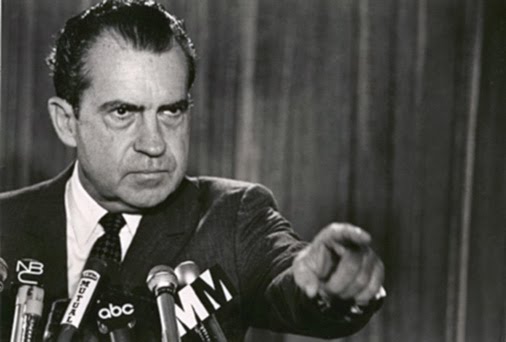
Richard Nixon pointing the way.

The Huston Plan

Richard Nixon greatly expanded the surveillance, and the FBI was ordered to keep track of the private lives of Nixon’s political opponents. When Nixon left office, investigators found hundreds of reports of electronic surveillance and break-ins. None of this was done with warrants. It was illegal, even though Nixon was on record as saying nothing a president does can be illegal.

Under Nixon the Interagency Committee on Intelligence was formed to coordinate domestic spying. It was temporarily chaired by J. Edgar Hoover, but Sullivan, the bureau’s No. 3 man, eventually was to chair it. The committee recommended more mail opening and black bag jobs. It was based on the Huston Plan, which is well known. Tom Charles Huston was a young White House assistant in charge of domestic intelligence.

But few realized it was implemented to some degree because the activities suggested by Tom Huston had been underway for some years. Huston knew about Operation Chaos and wanted to greatly expand the activity. But this occurred at a time when some within the CIA wanted an end to the illegal activity. House majority leader Hale Boggs had an idea of what was going on and denounced the FBI on the House floor for tapping the telephones of representatives and senators.

Under pressure from Attorney General John Mitchell, Nixon rescinded the Huston Plan, giving the appearance the plan was dead. One problem may have been that Huston was simply too young and made the proposal in too open a manner.

But another problem was that the FBI’s aging director had his own agenda and threw a wrench in the works. Hoover claimed to be concerned that there were so many intelligence break-ins that exposure was likely. He quickly fired Sullivan for cooperating too closely with other intelligence agencies.

In March, 1971, a “citizen’s’” break-in at the Media, PA, office of the FBI produced more than a thousand documents that exposed the COINTELPRO operation with its infiltration of student groups and spying on dissenters. Six weeks later, Hoover shut down COINTELPRO.

There was no longer a mechanism to coordinate spying, black bag jobs, etc., but these activities continued anyway. There was the less known Intelligence Evaluation Committee (IEC), also known as the Son of Huston Plan. White House Counsel John Dean organized it. It included people from NSA, DOD, and CIA and essentially adopted the Huston Plan, which appeared to have been officially rejected. G. Gordon Liddy attended in order to initiate investigation of “Pentagon Papers” leaks.

Clearly Operation Chaos established a major precedent for domestic spying. Evidence is beginning to surface about domestic surveillance of peace activists by the FBI during the administration of George W. Bush. The Progressive obtained records demonstrating that the bureau had at least two informers within the Iowa City peace and justice group. They provided very detailed information on its operatives, including information on their appearances, living arrangements, and the automobiles they drove.

We do not know to what extent the government spied on its citizens in the balance of the 1970s. The Pike and Church Commissions revealed some aspects of Operation Chaos, and Jimmy Carter appointed Admiral Stansfield Turner to clean up the CIA. We do know that the Reagan administration, which took office in 1981, was interested in resuming the battle with so-called radicals.

Next installment: “Spying on Americans, Part Two: The Reagan Administration Acquires Promis Software.”

[Sherman DeBrosse is a retired history teacher. Sherm spent seven years writing an analytical chronicle of what the Republicans have been up to since the 1970s. The New Republican Coalition : Its Rise and Impact, The Seventies to Present (Publish America) can be acquired by calling 301-695-1707. On line, go here.]

Also see:

The Rag Blog

Posted in Rag Bloggers | Tagged , , , , , , , , , | 6 Comments

Apocalypse 2010 : Meltdown Under the American Bubble

Planet Earth was coming apart at the seams.

Remembering 2010 (if we must):
Mass amnesia, the Rapture,
and the Palin-Bachmann nuptials

By John Ross / The Rag Blog / January 4, 2010

MEXICO CITY — Book-ended by mass amnesia under the American bubble, 2010 was yet another year to erase from living memory. Although Planet Earth was coming apart at the seams with the usual volcanoes blowing their stacks, earthquakes rearranging the landscape, flood and drought rampaging from one continent to the next, nuclear war raging in the Middle East, and serial economic calamities inducting a billion more sentient human beings into the starvation army, First World elites navigated through daily disaster delusionally convinced that everything was honky dory.

Children played happily with their Chinese mechanical hamsters until the batteries went dead and families gathered around home entertainment centers, even the millions of families who had been evicted from their homes. Neighbors exchanged pleasantries as they cruised empty super market aisles (most brand-name products were recalled because of suspect Chinese-induced E Coli contamination), oblivious of the unseen poor parboiled in their own sweat and tears far beyond American shores. Scientists attributed this massive indifference to the plight of the planet to the presence of toxic amounts of Ambien in the water systems of major U.S. cities.

The majority of U.S. citizens were not even aware of their failing memories and did not know what was missing. Still mass forgetfulness had grave political downsides. One example: no one could remember the name of the U.S. president when just a year ago, it was on the tips of everyone’s tongue. Indeed, no one could recall much of anything anymore. Even after the physical environment collapsed and the faithful were taken up in the Rapture, no one seemed to miss them.

The faithful were taken up in the rapture, but weren’t missed. Artist reconstruction.

The following month-by-month capsule of how the Apocalypse impaled Planet Earth on the Cross of Catastrophe was scraped together from the author’s pitiful scraps of memory before he slipped into total dementia.

JANUARY – The failure of climate change negotiations in Copenhagen (they will reconvene in December 2010 in Mexico City, the most monstrous megalopolis in the Americas) and the formation of a cartel of the world’s pollution leaders had immediate repercussions when Somali pirates captured an iceberg floating in the Red Sea.

In accordance with the U.S. Zero Tolerance For Pirates protocol, President What’s His Name stealth-bombed the dusky buccaneers who were towing the huge block of ice into port and so-called depleted uranium radiation liquefied it, triggering monumental flooding — all of Yemen and parts of east Africa remain underwater and the quat crop has been decimated for years to come, causing wide-spread depression on the Dark Continent.

Further north, global warming had a more fortuitous fallout when the melt-down of a thermo-nuclear power plant in the capital city of Nuuk converted the Greenland Ice Cap to boiling water and the Inuit Riviera caught fire as a hot tourist attraction

Back under the American Bubble, on the first year anniversary of his hope-saturated inauguration on the Capital Mall, 78% of those polled by the Pew Institute On Domestic Dementia could no longer remember the President’s name — 72% referred to him simply as “you know, that black guy.” Another 16% still had the President confused with Osama Bin Laden but 9% could correctly remember his first and last name although not at the same time.

On the other side of the political ledger, the words “Republican Party” had no name recognition for 81% of those who responded to the Pew poll. Alarmed pollsters hypothesized that the results were symptomatic of mass brainwashing, probably due to “something in the water.”

FEBRUARY – Whatever his name was, The President of the United States was confronted with his umpteenth international terrorist crisis when Taliban technicians, employing Sky Grabber technology on sale at Radio Shack for $26 Americano, seized control of an unmanned and unwomanned drone over North Waziristan and redirected it to Kabul where the rebels launched missile attacks against the seat of the puppet government, flattening President Karsai and his entire cabinet, which included three of the world’s most influential heroin dealers.

The obliteration of central authority quickly splintered the Afghan Crusade into a series of local mini-wars. Caught in the crossfire between feuding warlords, the U.S. death toll climbed to 502 for the month, topping even Iraq at the nadir of the illegal American invasion and occupation. Both the Nobel Peace Prize winning president and his Commander-in-Chief Stanley McChrystal extolled the high death toll as proof that the U.S. was winning the war and vowed to dispatch 60,000 more troops to Afghanistan.

When Taliban Sky Grabber gear hijacked two more drones and targeted Blackwater/Xe training facilities in the Great North Carolina swamp, Obama or Osama or whatever his name was closed down all Radio Shacks in the continental U.S.

Also under the bubble, cheap Chinese pork chops were deemed responsible for an outbreak of an inscrutable strain of Swine flu (“Swinear flu”) that convulsed the breadbasket of the country.

The majority of citizens weren’t aware of their failing memories. Image from TheTugboatComplex.

MARCH – A post-midnight coup March 11 in Quito, Ecuador, in which a junta of generals and admirals trained at the former School of the Americas overthrew and subsequently dismembered that tiny Andean country’s elected president, the economist Rafael Correa, was the latest violent “regime change” in Latin America.

Since the White House greenlighted the overthrow of right-wing leftist Mel Zelaya in Honduras in June 2009, 11 Latin countries have suffered “golpes de estado,” 10 of them this year (Guatemala, El Salvador, Costa Rica, Venezuela, Bolivia, Suriname, Trinidad & Tobago, Argentina, Chile, Uruguay and Paraguay). The wave of coup d’etats is almost certainly being orchestrated by the U.S. South Command operating out of seven state-of-the art bases recently installed in Colombia.

In Paraguay, the U.S. 4th Fleet parked itself off the coast while military gorillas dethroned former liberationist bishop and father of 14, Fernando Lugo. Up until January 2010 Paraguay had no coastline but global warming has brought the Atlantic Ocean to that impoverished majority Indian nation’s doorstep.

Meanwhile in Mexico, scattered rebellion has broken out to celebrate the 100th anniversary of the Mexican Revolution. In early January, the Zapatista Army of National Liberation occupied sacred sites throughout the country including Chichen Itza in the Yucatan, Palenque in Chiapas, and Teotihuacan near Mexico City, calling upon ancient Mayan and Mexica deities to join their uprising.

Panicked by the prospect of declining tourist dollars, fraudulently elected president Felipe Calderon pulled 50,000 troops out of his failed war with the drug cartels that has now taken 25,000 Mexican lives, to dislodge the Zapatistas. The strategy backfired when the cartels seized statehouses in Sinaloa, Sonora, and Chihuahua.

On March 18th, the 72nd anniversary of the nationalization of Mexico’s petroleum from the transnational Seven Sisters, President Calderon was found dangling from the rafters at Los Pinos, the Mexican White House, an apparent suicide — however, an autopsy turned up a note apparently pinned to the inside of his tie with a single Mexican expletive inscribed: “RATERO!

Further scandal erupted when photographs emerged of Calderon’s corpse, clad only in jockey shorts and plastered with bloody Mexican and U.S. bills, amulets, crucifixes, and rosaries in classic narco fashion, raising questions about the dead president’s cartel affiliations.

APRIL – Global warming was deemed responsible for the near-biblical migration of small, undocumented mammals abandoning a disintegrating Mexico for El Norte — badgers, gophers, skunks, coyotes, foxes, and bats had little trouble burrowing under the 1,000 kilometer-long Separation Wall between the two distant neighbor countries or flying over it. Hundreds of thousands of acres in the southwest were destroyed by the marauding illegals.

Rabid bat of the type that devoured a Minuteman in Lubbock.

When an anti-immigration Minuteman was devoured by rabid bats in Lubbock, Texas, crusading Mexican killer Lou Dobbs flew to the scene of the crime where he was confronted by several hundred indignant skunks that rendered his campaign for the White House permanently unviable. The stench caused frontrunner Sarah Palin to replace Dobbs on the ticket with hysterical TV paranoid Alex Jones of Austin, Texas.

Passions in the Middle East boiled over in April when Iranian patrol boats sunk a Liberian-flagged tanker carrying 176,000 gallons of Chinese-made flan to Spain. The sinking cargo soon gummed up the Straits of Hormuz through which the bulk of oil destined for Europe, the Americas, and China passes each day. Oil prices immediately shot up from a seasonal low of $50 USD to $250, deflating the dementia-driven euphoria on Wall Street. Acting on the self-interest of his Goldman Sachs advisors, the President floated multi-billion dollar bailouts.

MAY – After five months of testy reconciliation conferences between the House and the Senate during which Dennis Kucinich challenged Michelle Bachman to a duel and was shot dead on the House floor, the U.S. Congress announced that it had reached agreement on a compromise version of all but forgotten health care reform. Indeed all the health care reform provisions in the John Doe Omnibus Health Care Reform bill (named for a bus driver who had to sell both his kidneys in order to feed a starving puppy) had been stripped from the measure before it arrived at the White House for the first Afro-American president’s John Hancock.

Among the provisions of “John Doe”: renewed funding for the wars in Afghanistan, Pakistan, Kerghizstan, and Uzbekistan (two Stans will be added every year though 2018); the criminalization of abortion; and the restitution of the universal mandatory death penalty.

A new Pew poll prepared by the Institute for Domestic Dementia indicated that many Americans (a whopping 77%) had forgotten all about health care reform by May.

Sabotaged by the flan crisis, the economy was again in freefall despite White House lies that the 2009 depression was officially over and the country was growing again. As jobless benefits dried up, many families in the lower socio-economic brackets were forced to reduce their daily caloric intake and unemployed carnivores threatened to eat the rich.

Fortunately, rolling black- and brown-outs as river flows slowed to a trickle due to global warming and shut down hydro-electric power plants, caused widespread refrigeration meltdowns and millions of tons of spoiled meat, fruit, and dairy products poured into dumps and landfills where hungry garbage pickers were eager to harvest the putrefying bonanza.

Also in May, the last U.S. daily print newspaper, Rudolf Murdoch’s New York Wall Street Times Journal Sporting News, closed up shop.

JUNE – Food riots became generalized in such depression-wracked formerly industrial cities as Detroit and Houston and Fox News Chief Albino Glenn Beck encouraged Tea Party Patriots to arm themselves for self-defense — the average white North American family now owns 12 to 15 automatic weapons to hold off their equally heavily armed neighbors, according to the Pew Institute On Domestic Violence.

Beck encouraged Tea Party Patriots coagulated around a doddering George H.W. Bush in Texas and Dick Cheney in the Wyoming-Colorado Theater to seize state armories and hold nominating conventions. With armed insurrection being urged on cable news channels, the first Afro-American President of the United States retreated to a hollowed-out mountain in Virginia to watch the NBA Finals.

The Finals themselves generated alarming news when it was reported that Kobe Bryant had been genetically engineered on a farm in Kansas once owned by assassinated late term abortionist George Tiller — it was not known if embryonic cells were employed in Kobe’s modifications. A federal raid on the “farm” led by General Jeff Novitsky (he won his stripes in the Barry Bonds genocide campaign) uncovered thousands of Kobe clones in various stages of assemblage.

In other sporting news, the World Cup Matches in South Africa had to be called off when starving rioters set stadiums aflame, roasting tens of thousands of first world hooligans.
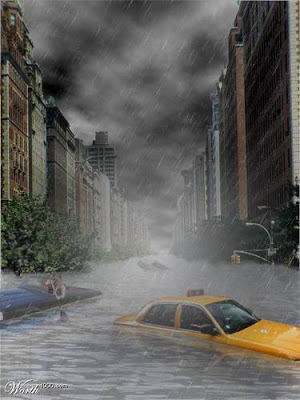
Flood and drought raged from one continent to the next. Image from Worth1000.com.

JULY – Prodded by global broiling, temperatures all across the northern regions of the planet jumped three degrees Celsius in July, one degree higher than the acceptable limits imposed by the polluting nations at the Copenhagen conference. The summer heat was so intense that roadways buckled and bridge struts melted and infrastructure in the U.S. midwest collapsed. The overload on the electricity grid shut down air conditioning units in Chicago, New York, and Philadelphia and sweltering senior citizens dropped like flies. So many old people expired during the month (123,000 according to the Pew Institute On One-Time Senior Citizens) that morgues overflowed and bodies were put out on the street each morning for the dead wagons to collect and carry off to common graves.

By mid-summer with the doomed president’s jobless recovery in full flower, 36% of all American families were living in their cars, according to the Pew Institute On Vehicular Gridlock, transforming the nation’s highway system into a coast-to-coast parking lot. Then cars began to commit suicide, blowing sky-high with no warning. Homeland Security blamed explosives sewn into drivers’ underwear for the plague of car bombings although some experts speculated that the automobile industry was just depressed.

AUGUST – The dog days extended into August with no relief in sight. Despite the intense heat, the Tea Bag Patriots were on the move, traveling mostly at night towards Washington D.C. for the much ballyhooed Palin-Bachman same sex nuptials set for later in the month despite Michelle’s pending indictment for gunning down a liberal congressperson on the House floor.

Sarah Palin announced her engagement to Michelle Bachman who had killed Dennis Kucinich in a duel on the floor of the House. Photo from jezebel.

As U.S. troops abandoned Iraq to its own explosive devices, the summer doldrums were punctured when a terrorist commando, the Universal Unitarian Salvation Squadron (UU’SS) thought to be affiliated with the Al Qaeda-Taliban Axis of Evil overran Pakistan’s nuclear arsenal near Islamabad demanding, among other items, that the United States get out of the Islamic world, Africa, and South and North America. Holed up in his Virginia mountain bunker, President Osama/Obama called for a diplomatic solution. The Palin-Bachman nuptials were called off, reportedly due to domestic dispute.

Diplomats shuttled in and out of Islamabad seeking solutions to this latest geo-political crisis. One no-show: Osama Bin Laden who had passed away many years before trundling his dialysis machine over the Khyber Pass. A proposal offered by Tuvalo’s ambassador that Washington change places with his low-laying Pacific island nation was rejected by the United Nations Security Council on the grounds that moving the U.S. Capital would be an extravagance a bankrupt world could ill afford.

Feeling excluded from the international spotlight, Israel, with a go-ahead from the White House-in-exile, launched a nuclear attack on the Iranian holy city of Qum where the Ayatollahs were putting the finishing touches on their own minaret-tipped nuclear missiles. Mamoud Ahmadinejad, hanging on to power by the skin of his wolf-like teeth, ordered retaliation against the Zionists but his delivery system fell short of Tel Aviv and obliterated Syria and Jordan instead.

SEPTEMBER – By Labor Day weekend, the Tea Party Patriots were encamped on the White House lawn and demanding that the first Afro American President turn over the keys to the executive mansion for the on-again off-again Palin-Bachman nuptials.

The serial catastrophes that now included the incineration of vast swaths of the Middle East had an upside — Americans no longer worried much about global warming. Although world temperature readings had jumped another point, the calamity was no longer an issue on the 24-Hour news cycle or the Sunday morning talk shows. Despite the fact that humpback whales were beaching themselves in record numbers on whatever dry land they could find and birds had begun to fly backwards, a sign that the Apocalypse was in the pipeline, the general public seemed more preoccupied by Palin’s and Bachman’s never-ending domestic disputes.

Finally, fed up with the first Afro-American President’s stonewalling, the Tea Party Patriots broke into the White House and a troika — Sarah Palin, her sometimes lover Michelle Bachman, Dennis Kucinich’s assassin, and George H.W. Bush, now suffering terminal Alzheimer’s Disease — was sworn in. Glenn Beck was appointed Secretary of Defense and Alex Jones got State. Mel Gibson bought the movie rights.

OCTOBER – While the right-wing fanatics squabbled over power in Washington, most of the planet was either underwater or so radioactive that the land could no longer sustain life. Slowly falling ash blotted out the sun and in the feeble light no one could tell if it was dawn or dusk anymore. Water, although there was plenty of it, was undrinkable and the food chain tainted. Cannibals roamed the roads in packs. Indeed, outside of the Washington bubble, the earth had become a road show of Cormac McCarthy’s “The Road.” Inside his Virginia mountain, the former president tried to watch the World Series but he was too depressed.

NOVEMBER – All was not lost yet. Vulture Capitalists saw profit in the new holocaust and took steps to bolster their failing fortunes. Murdoch bought up what news was left and changed the channel. A new television season kicked in and sponsors returned. The slate was wiped clean: no more nuclear war, world hunger, mindless terrorism, and global warming. Ambian dosage was increased for all citizens.

The new shows looked a lot like the old shows but since no one could remember the old shows, reruns became the real thing. New generations were enchanted by Lucy and Desi and Ed Sullivan’s “Toast Of The Town” (“Gilligan’s Island” was submerged deep beneath the graying sea.)

Outside of the bubble, of course, the rainforest was on fire and 39% of all children were born with multiple deformities (the Pew Institute On Monstrous Deformations.) The cities of the world had been abandoned.

Here in Mexico City where 23 million people had once lived cheek by jowl you could spend a whole day without speaking to anyone. On the Day of the Dead, I walked out to where Chapultepec Park lay in ruins behind a curtain of toxic smoke. It was then that I saw my neighbors tramping north towards Mictlan, the direction of the dead, and I tried to stop them. “Wait!” I urged, “Stay! The U.N. Climate Conference will convene here in December and surely, the leaders will fix things up…” But my neighbors just kept marching towards Mictlan.

DECEMBER – Inside the bubble, the Holiday Season was in full swing. Americans went shopping for mechanical hamsters again, not remembering that it was last year’s toy to die for. They went to Church forgetting that God was dead and wagered on the Stock Market as if the bottom had not fallen out of the Big Board long ago. Santa Claus and the Tooth Fairy and the Easter Bunny led parades and made patriotic, optimistic speeches and Santa promised to visit every home.

So the families went home, those who still had one, and set fire to their furniture and hung their stockings by a roaring hearth. They wrote letters to Santa and left out cookies and cocoa for the jolly old fruitcake but although he had promised, Santa Claus never showed up.

Indeed, he would never show up again. Late-breaking film from the Arctic Circle showed the old gentleman and his eight reindeer keeled over in their North Pole sweat lodge.

[John Ross will launch a three-month, coast-to-coast book tour with his latest and much-buzzed cult classic El Monstruo: Dread and Redemption in Mexico City in Fresno, California, this February 4. For further info and suggested venues (Chicago area and east coast dates are solicited) consult johnross@igc.org.]

The Rag Blog

Posted in Rag Bloggers | Tagged , , , , | Leave a comment

Health Care Reform : ‘This Won’t Hurt a Bit’

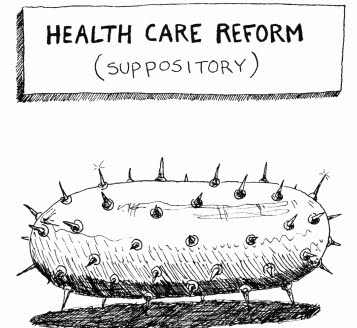
Cartoon by Puckett from Stand Up For America.

Congress’ health care fix:
Cure worse than the disease?

By Dr. Stephen R. Keister / The Rag Blog / January 4, 2010

“History records that the money changers have used every form of abuse, intrigue, deceit, and violent means possible to maintain their control of government.” — James Madison (With thanks to Steve Berry, The Paris Vendetta)

Christmas arrived with the much publicized terrorist “almost” incident in Detroit, thus giving Fox News and the Republicans another issue to distort and with which to further spread fear among the American public. This worked quite well for Bush/Cheney in 2001; however, perhaps, just perhaps, the American people will have a more mature, more sophisticated reaction to the present episode.

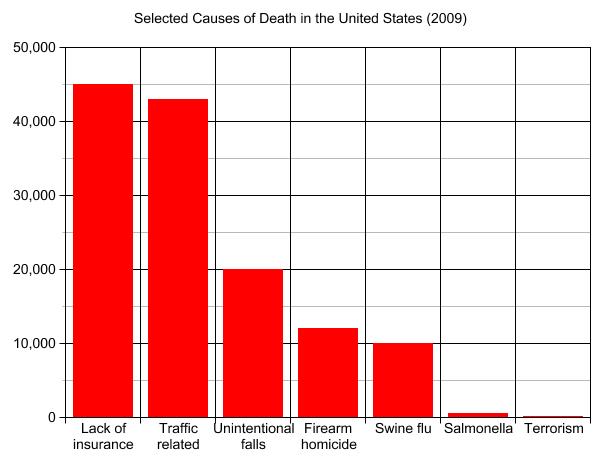
Chart from Firedoglake.

Firedoglake published an article that helps to put the situation into perspective. It charts selected causes of death in the United States for 2009 as follows:

  1. Lack of insurance 45,000
  2. Traffic related 43,000
  3. Unintentional falls 20,000
  4. Firearm homicide 12,000
  5. Swine flu 10,000
  6. Salmonella 1000
  7. Terrorism 16.

With that in mind we return to the ongoing discussion of health care reform, while asking if the pending legislation before Congress will indeed reduce those 45,000 deaths or whether it is, as it has been called by some, “The Health Insurance Enrichment Act.”

In recent days the progressive press has placed more and more attention on the bill’s potential encroachment upon our civil liberties through mandating that an individual be forced by fiat to purchase health insurance from American’s for profit insurance cartel.

An article on Firedoglake by emptywheel entitled “Health Care on the Road to Neo-Feudalism” tells us that “the bill, if it becomes law, would legally require a portion of Americans to pay more than 20% of the fruits of their labor to a private corporation in exchange for 70% of their health care costs.” The author continues,

Consider a family of four making $66,150 — a family at 300% of the poverty level and therefore, hypothetically, at least ‘subsidized.’ That family would be expected to pay $6482.70 (in today’s dollars) for premiums — or $540 a month. But the family could be required to pay $7973 for copays and so on. So if that family had a significant — but not catastrophic — medical event, it would be asked to pay the insurer almost 22% of its income to cover health care.

Senate Democrats are requiring middle class families to give the proceeds of a month of their work to a private corporation — one allowed to make 15% or maybe even 25% profit on the proceeds of their labor. It is one thing to require a citizen to pay taxes — to pay into the commons. It’s another thing to require taxpayers to pay a private corporation, and to have 25% of that go for paying for luxuries like private jets and gyms for the companies CEOs.

Previously on The Rag Blog I have suggested that legislation requiring Americans to buy from a private corporation is unconstitutional.. This question again arises in an article by Ellen Hodgson Brown, J.D. , published in Truthout. Ms. Brown is not a newcomer to the health care discussion; she is co-author of a Forbidden Medicine, Natures Pharmacy, and The Key To Ultimate Health.

Ms. Brown says:

The health reform bills now coming through Congress are not focused on how to make health care cheaper or more effective, how to eliminate waste and fraud or how to cut out expensive middlemen. As originally envisioned, the public option, would have pursued those goals. But the public option has been dropped from the Senate bill and radically watered down in the House bill.

Rather than focusing on making health care affordable, the bills focus on how to force people either to buy health insurance if they don’t have it, or to pay more for it if they do. If you don’t have health insurance and don’t purchase it, you will be subject to a hefty fine. And if you do purchase it, premiums, co-pays, co-insurance payments and deductibles are liable to keep health care cripplingly expensive. Most of the people who don’t have health care can’t afford to pay the deductibles, so they will never use the plans they have been forced to buy.

The author continues,

…compulsory health insurance is like compulsory selective military service (the draft), except that all our numbers have come up. The argument has been made that auto insurance is compulsory so why not health insurance? But the obvious response is that you can choose to drive a car. The only way to escape the vehicle we call a body is to give up the ghost.

Terrance Heath’s lengthy and well-written article at Campaign for America’s Future entitled “The Window or the Stairs: Kill the Mandate or Kill the Bill,” makes this point:

My take is that it is unconscionable to force people to buy a product from a private insurer that enjoys sanctioned monopoly status. It’d be forcing everyone to attend baseball games, but instead of watching the Yankees, they were forced to watch the Kansas City Royals. Or Washington Nationals. It would effectively be a tax — and a huge one — paid directly to a private industry.

Where are the civil libertarians regarding this issue? Where is the ACLU, of which I have been a member for years? Perhaps the ACLU had best forget complaining about total body scanning at our airports and redirect its attention to this much larger issue of personal rights. I prefer to be safe when flying, and did not object to a strip search by El-Al in London some 25-30 years ago. And I did not object to El-Al’s “profiling” that had nothing to do with race or ethnic background, nor to the extra stewards on the flights, well aware that these gentlemen were subtly armed, en route from Kennedy to Tel Aviv, or Tel Aviv to London.

Jane Hampshire in FireDogLake cites reasons that the Senate Bill is unfriendly to the Average American, including the fact that it will be paid for by taxes on the middle class insurance plan you have right now through your employer. It will cause the employers to cut back benefits and increase co-pays.

Many of the taxes to pay for the bill start now, but most Americans won’t see any benefits until 2014 when the program begins. It allows insurance companies to charge older people 300% more than others and grants monopolies to drug companies that keep generic versions of expensive biotech drugs from ever coming to market. It doesn’t allow importation of prescription drugs, which could save consumers $100 billion over 10 years. The cost of medical care will continue to rise, and insurance premiums for a family of four will rise an average of $1,000 a year.

We must remember that this legislation, especially the Senate version, is to a great extent the product of lobbyists for the health insurance and pharmaceutical industries. Common Cause, a nonpartisan, nonprofit watchdog group, blames a “toxic cocktail of insiders and money” for short-circuiting a government-run plan that would have competed with private insurers.

Health industry contributions to congressional candidates have more than doubled so far this decade, rising to $127 million in the 2008 election cycle from $56 million in the 2000 election, with disproportionate sums going to the party in power and to members of committees that oversee health care, according to the Center for Responsive Politics.

If indeed this legislation passes without placing the health insurance industry under the Fair Trade Act, the entire exercise is a sham and a farce. There will be no restrictions on price fixing and collusion among the health insurance carriers. The idea that a few government regulators can control these predators is absurd. Each insurance giant will outmatch the regulators by a personnel ratio of at least 20:1 in defining methods to bypass the regulations and maintain their profits. One can imagine a high school football team playing the New England Patriots. The American public is once again being scammed by their corporate masters and their elected prostitutes.

There is nothing in this legislation that frees the physician to do his duty without interference from the insurance industry. Nothing to free the family doctor from overburdening paper work when he should have that time for seeing the sick. Health care will continue to be rationed to the consumer by the executives and stockholders of the health insurance cartel. The pharmaceutical industry will continue to overcharge the American public and to deprive many folks of lesser means of the medications which they need.

It is not a pretty picture. Our elective representatives have, without shame, taken their constituents to the cleaners.

[Dr. Stephen R. Keister lives in Erie, Pennsylvania. He is a retired physician who is active in health care reform. His writing appears regularly on The Rag Blog.]

The Rag Blog
Posted in Rag Bloggers | Tagged , , , , , | 6 Comments

Stayin’ Alive : Complementary and Alternative Medicine

“Tree of Life,” working design for Stoclet Frieze, Gustav Klimt, 1905/09.

Stayin’ Alive:
Towards a conscious self-health-care continuum

No system of medicine is static, and none has a monopoly on beneficial knowledge or tactics.

By Mariann G. Wizard / The Rag Blog / January 4, 2010

[Introducing a new periodic column by Rag Blogger Mariann G. Wizard, a professional science writer with a wide-ranging knowledge of natural health therapies. Readers may suggest topics for future columns, within the restrictions suggested below, in the Comments section of The Rag Blog.]

“Complementary and alternative medicine” (CAM), in the U.S. and several other nations, refers to health practices that are not currently part of “mainstream” or “conventional” medicine. This flexible definition allows for therapies that accumulate enough scientific evidence — or generate enough patient demand! — to become part of mainstream practices.

In the US, for example, chiropractic, once the domain of energetic and sometimes kooky “bone crackers,” has benefited from the experience of practitioners, the development of comprehensive theory and standards of care, and the establishment of accredited colleges, and is now paid for by most insurance plans — the true test of a treatment’s acceptance! Acupuncture, as well, with demonstrable benefits in pain relief at minimum, has gained mainstream acceptability in the U.S. within very recent memory.

However, the current CAM definition is rather misleading, having been imposed by conventionally-trained and -biased authorities. It is more accurate to think of CAM as all health practices developed over the course of human history, everywhere in the world, before the discovery of microbes, and including many health practices developed since then outside of “Western” medical facilities.

CAM includes, for example, entire multi-modal systems of medicine, such as traditional Tibetan medicine, Ayurveda, naturopathy, and others, some with continuous documentation of use and development over thousands of years. It also includes more recent practices: e.g., aromatherapy, Reiki, and Essiac, each with its own ancient roots.

One difference between most CAM therapies and “conventional” medicine, often cited by CAM skeptics, is a frequent lack of scientific evidence for CAMs, or even “disproof” of their worth. These criticisms are worth a closer look. “Scientific evidence” is not always best acquired in a laboratory setting, and what works in rats doesn’t always have the same effects in people.

Studies are often designed, depending on funding sources, to demonstrate certain hypotheses; their design may not be fair to competitors. Media coverage tends to focus on negative results in science reporting, as it does in other news. For example, a number of studies have found the herb St. John’s wort as effective as prescription drugs in treating mild to moderate depression. However, the most media coverage occurred when the herb was found to be not-so-helpful for serious depression. No one had ever claimed it would be.

So-called “anecdotal evidence” of practitioners and patients provides support for many CAM modalities, and is often discounted by those who understand only randomized, double-blinded, placebo-controlled clinical trials. However, lack of clinical studies is another misleading negative. Such studies are most often funded by pharmaceutical companies, and are extremely costly. Unless a unique, patentable, reproducible compound has been isolated for testing, there is little incentive to fund research on common herbal remedies such as echinacea, ginger, and aloe vera, or even more novel dietary supplements like shark cartilage.

Acupuncture. Image from Phiya Kushi’s Blog.

For some therapies, problems in adequate blinding or other study design factors present substantial obstacles to randomized testing. Acupuncture, for example, is difficult to administer in placebo form. Cannabis medications also present problems in blinding, since experienced cannabis users have no difficulty in distinguishing the real thing from placebo no matter how it is administered; the effects speak for themselves. Different study designs often make it difficult to compare “apples-to-apples” — but this is as true with pharmaceutical drugs as well as with herbal compounds!

Nevertheless, credible research is being done around the world every day on CAMs. For over 10 years, I have reviewed peer-reviewed journal reports of such work for the American Botanical Council’s HerbClips®, and have reported occasionally for ABC’s peer reviewed journal, HerbalGram®, on regulatory and other matters.

During that time, I’ve also — somehow — gotten older, and have begun to experience some of the annoying pitfalls of that process, as well as of ordinary hard knocks and exposure to modern living. While I began my work with ABC without any particular prejudice for or against conventional medicine or CAMs, today, I believe that each has its uses, and its distinct limitations.

I haven’t accepted medical or other advice to “get used to” chronic pain and increasing disability any more than I’ve accepted war, injustice, disharmony, or exploitation. These may all be losing battles in the long run, but what are we doing that’s any more important?

A year or so ago on a rainy day, a homeless guy at the downtown library asked me why so many — pardon the expression, “older ladies in Austin” — were sporting, as I was, a knee or elbow athletic brace. I stopped and thought about it for a minute. “Because,” I finally said, “we are fighting death to the finish!”

No system of medicine is static, and none has a monopoly on beneficial knowledge or tactics. ABC’s knowledge base — including my own work — has been priceless in helping me assess CAM options for my use, and even for friends and family facing health concerns. Like a growing world majority, I now consciously combine CAM practices with conventional medical care in a personal health continuum, making the decisions that affect, literally, my life, for myself, like we used to say in Students for a Democratic Society. I consider myself a “health independent” in the same sense that some voters claim independence from major political parties!

The fact is that conventional medicine is very poor in its ability to treat chronic illnesses, and most CAMs are ineffective or unnecessarily slow in treating acute illnesses such as infections. The fact is that professional health care providers of any kind are becoming less accessible to many of us, and that the costs of health care seemed doomed to skyrocket. The smart thing to do, it seems to me, is to use whatever we can to stay healthy!

Meanwhile, there is a skill to assessing unfamiliar health practices, products, and practitioners that I believe can be applied whether these are “conventional” or CAM-related, and I propose to try to impart some of that skill to readers of The Rag Blog.

If you have questions or suggested topics related to natural health practices, please post them in the Comments section of this article! For the record, I will NOT attempt to diagnose any symptoms, diseases, or medical problems. I will NOT recommend specific products, practices, or practitioners, except as examples of alternatives to be considered. I will NOT answer any questions of an intimate nature, e.g., what to do if you have an erection lasting longer than four hours! If none of you slackers have any interesting questions, I will merely regale you with my own adventures in health care; Lord’a’mercy; we are getting old!

I WILL freely discuss health-protective measures such as diet, exercise, and stress relief. I WILL consult with and drag in health care practitioners, researchers, and patients of all kinds as needed, some of whom may let me quote them. I MAY prescribe familiarity with controversial theories, regulatory policies, and historical tirades; take as directed: always with a grain of salt. Your life and health are your most valuable possessions — guard them well!

Next week: “Osteoarthritis: it takes a village.”

“Bee’s Knees,” by tyrone_31 / photobucket.

Prevention tip of the week:
Save your knees now!

Everybody should do this mild exercise several times a week if at all possible! Especially if you have weak knees, or “bad knees run in the family,” if you’ve had any kind of knee surgery short of a replacement, or if you do any running or jumping, this is a great way to strengthen and protect the most complex joint in your body.

  1. Lie flat on your back on the floor, with feet more or less in line with your shoulders.
  2. Extend your arms comfortably from your shoulders, so that, seen from the ceiling, you make a sort of “t” shape.
  3. Pull your knees up and your feet towards your buttocks as far as you comfortably can, keeping your feet slightly separated and your feet flat on the floor. Seen from the side, you look a little like this: _/\__o
  4. Keeping your upper body flat on the floor, gently lower both bent knees as far as you comfortably can to the right side of your body. Your left hip will lift off the floor. Seen from the ceiling, your knees look like a double chevron: >>. Stretch a little tiny bit closer to the floor with both knees, and hold for 20 seconds.
  5. Return to position 3 and reverse, lowering knees to the left side: . Stretch and hold.
  6. Repeat twice, three times a week, for six months. If you feel the improvement, KEEP DOING IT AS LONG AS YOU CAN GET DOWN ON THE FLOOR AND GET UP AGAIN! Don’t do it in bed or lying on the couch; you may throw your back out, and I don’t want you blaming me for your sciatica!

Hint: If your low-side knee doesn’t go all the way flat to the floor, or the high-side knee doesn’t go parallel to the floor when you stretch to left or right, well, that is a goal you can set. Gently stretch as far as you can without discomfort; and next time go a millimeter further!

This stretch, unlike the bicycling motion often used in post-surgical knee rehab, strengthens muscles and ligaments along both sides of the kneecap that help keep the joint stable — if you’ve ever felt the sickening sideways lurch of thigh-bone or leg-bone pulling away from knee-bone, you know the importance of these supportive structures!

Thanks for this tip to Wendee Whitehead, Doctor of Chiropractic, Austin, Texas, whose exact words to me were, “Knees are totally fixable!” Keep yours strong and flexible with this simple, zero-impact move.

–mgw

The Rag Blog

Posted in Rag Bloggers | Tagged , , , , | 12 Comments

BOOKS / Jonah Raskin : Chinua Achebe’s ‘British-Protected Child’


Chinua Achebe’s sharp and inspiring essays:
The Education of a British-Protected Child

By Jonah Raskin / The Rag Blog / January 4, 2010

[The Education of a British-Protected Child: Essays, by Chinua Achebe. (Knopf, October 6, 2009, 172 pp., $24.95)]

Here’s a contemporary writer of compelling fiction and non-fiction alike with whom I can really identify, and feel a sense of genuine comradeship. In part, that’s because he talks about the “Third World,” “imperialism,” and “neocolonialism” — words that don’t seem to be fashionable in academic circles these days.

The writer’s name is Chinua Achebe, and while he was born in Nigeria, he has spent much of his life in the United States, teaching, writing, and observing American ways and American literature. His latest book — The Education of a British-Protected Child — is a collection of 16 sharp and inspiring essays about politics and language, oppression and the human spirit.

The essays are all written clearly and poetically. They express the perspective of a man of true wisdom, and not just learning or education, and, like the title itself, the essays embody a playful sense of irony. When he was a child the British didn’t protect him at all, he explains, and they didn’t bring democracy to Africa, either, he says. “British colonial administration was not any form of democracy, but a fairly naked dictatorship,” he says.

The author of Things Fall Apart — one of the most widely read and best-known 20th-century African novels — Achebe writes with a sense of compassion and partisanship too. He knows clearly which side he’s on — the side of the oppressed against the oppressors — but he also values what he calls “the middle ground — that place where the human spirit resists an abridgement of its humanity.”

He goes on to say that this quality is “to be found primarily in the camp of the colonized, but now and again in the ranks of the colonizer too.” So, he acknowledges his intellectual debt to British scholars, such as Basil Davidson, the author of The African Slave Trade.

Achebe also gives a nod in the direction of my book, The Mythology of Imperialism, first published in 1971 and reprinted in 2009 by Monthly Review Press. “Mr. Raskin’s title,” Achebe writes, “defines the cultural source out of which Joseph Conrad derived his words and ideas.” Conrad’s work, he adds, “is grounded quite firmly in that mythology of imperialism which has so effectively conditioned contemporary civilization and its modes of education.”

It’s nice to be acknowledged by Achebe, if I do say so myself. What’s more, Achebe’s book provides useful tools for understanding the role of imperialism today, and the ways that individuals buy into it no matter what their skin color.

In an essay entitled “African Literature as Restoration of Celebration,” Achebe describes his own education in Nigeria in a school modeled on the British public school. As a boy, he read books about Africa and Africans by white authors such as John Buchan and Rider Haggard. Achebe came to identity with the white characters not the Africans. “I went through my first level of schooling thinking I was of the party of the white man in his hair-raising adventures and narrow escapes,” he says.

In the 1960s, of course, African Americans who thought they were of the party of the white man were sometimes called “Oreos.” I remembered that word and the image it conjures while reading Achebe’s book, and I thought also of President Obama.

Could it be, I wondered, that like the youthful Achebe, Obama thinks he’s of the party of the white man? And could it be that like Achebe he’ll have an awakening and a kind of conversion? Perhaps Mr. Achebe ought to send Mr. Obama a copy of this book, along with his brilliant first novel Things Fall Apart, which has helped to change the ways that readers around the world see Africa.

Perhaps our president will come to see, along with Achebe, that “Our humanity is contingent on the humanity of our fellows. No person or group can be human alone. We rise above the animal together, or not at all.”

[Jonah Raskin is the author of The Mythology of Imperialism (Monthly Review Press), and Field Days (University of California Press.)]

Find The Education of a British-Protected Child: Essays, by Chinua Achebe, on Amazon.com.

The Rag Blog

Posted in Rag Bloggers | Tagged , , , , , , | Leave a comment

Tom Hayden : Afghanistan and a Reluctant NATO

Cartoon from Florida Times-Union / Netizen News Brief.

The Peace Exchange:
NATO and the Afghan War

By Tom Hayden / The Rag Blog / January 3, 2010

The White House and Pentagon are lobbying hard for an increased NATO troop commitment for the Afghanistan escalation, as public opinion in America, Canada and Europe — and Afghanistan — is increasingly skeptical.

Placing pressure on the U.S. and NATO governments from the bottom up, country by country, will be necessary to reverse the unsustainable dynamic towards militarism and empire.

  • In Afghanistan itself, “nearly everyone agrees that the Afghan government must negotiate with the insurgents,” according to the New York Times [11/6/09]. Even the discredited Afghan president Hamid Karzhai complains that the U.S. is blocking his efforts to talk with the Taliban [see my earlier post in the LA Times], and continues to condemn U.S.-inflicted civilian casualties. In Pakistan, a powerful 64 percent regards the U.S. as their enemy and 72 percent want the American forces out of Afghanistan (here).

    In the United States, President Obama is competing with his critics to win back his Democratic base. So far he has succeeded in winning back about 10 percent, but still depends on Republicans to support his escalation. An AP Dec. 10-14 poll showed 57 percent of Americans opposed overall, while an NBC-Wall Street Journal poll also in mid-December (11-14) found 41 percent against the current Afghanistan approach, and with 44 percent in favor.

  • In Europe and Canada, opposition to the escalation runs highest, with 69 percent of Germans opposed, 66 percent of Canadians, 58 percent of Italians, and 56 percent in the United Kingdom.
  • Troop withdrawals currently are scheduled for Canada [2,800 troops by 2011], the Netherlands [1,770 troops by 2010], while Switzerland has already pulled their 31 troops.

In summary, there are three political battlegrounds of public opinion in addition to the secretive military ones being invaded by foreign troops, Special Ops and drones. The fight against the war is also a fight for democracy and majority rule against the elite global planning for a Long War. [See Hayden on Kilcullen in The Nation.]

The Obama administration’s diplomatic offensive to cement greater NATO support is being under-reported. The British and German governments are planning a late January European conference to “set a timetable for transferring security responsibilities to Afghan forces” at a date uncertain. [Reuters, Nov. 16, 2009]

Like Obama’s two-pronged approach to escalation/de-escalation, the British-German formula is likely to result in short-term escalation of at least 7,000 troops combined with an ambiguous timetable for departure, enough to placate restive public opinion.

In response, the UK’s Stop the War Coalition is sponsoring an anti-war demonstration in London on January 28.

Already the Obama lobbying effort is being hampered by the pressure of public opinion. The U.S. is seeking a commitment of 7,000 new troops from the Europeans, but it appears that 1,500 are those sent to Afghanistan to guard the presidential election this year, and who will not be withdrawn. The 5,000 scheduled by Canada and the Netherlands for withdrawal in the next two years may leave the net numbers approximately the same, but barely increased. The likely increases are from Britain [500], Poland [1000], Italy [600], Spain [400], and smaller nations. Pressure is being applied to Germany and France for another 3,500 [NYT, Dec. 17, 2009]

The logic behind British support for Afghan escalation was expressed recently by the British defense minister, Robert Ainsworth, who offered a domino theory, as follows: “If Afghanistan is not secure, then Pakistan is not secure, and if Pakistan is not secure, Britain is not secure.” [NYT, Nov. 5, 2009] Many European security experts, like Peter Neumann of the Center for Defense Studies at King’s College, claim a “broad agreement” that Europe is a “nerve center for the global jihad.” [Kilcullen, The Accidental Guerrilla, p. 247] Europe and Canada’s human rights laws, they say, create “legislative safe havens” for terrorists to plot and strike.

This argument may gain currency with the recent anxiety over the successful penetration of Western defenses by a 23-year old Nigerian, Umar Farouk Abdulmutallab, who attempted to blow up an airliner flying through Amsterdam to Detroit.

But instead of arguing that bombing Afghanistan and Pakistan, and restricting human rights laws, will make Westerners safe, homeland security officials need to examine once again the institutional incompetence that in this case permitted travel by someone whose own father, a top Nigerian banker, warned American officials that his son had taken a violent and dangerous turn.

After Secretary of Homeland Security Janet Napolitano claimed that “the system worked” in the airline bombing attempt, saying the passengers had played an “important” and “appropriate” role, she could have been forced to resign. Napolitano, a captive of her bureaucracy, was repeating the infamous role of Secretary of State Condoleeza Rice who denied the relevance of a CIA memo warning of al Qaeda attacks shortly before September 11, 2001. As a result, the Obama White House was put on the defensive by the Republican hawks responsible for loopholes in airline security made possible by either incompetence or an ideological commitment to air travel.

There is another explanation for the zealous American lobbying to keep NATO in Afghanistan which is never mentioned. Afghanistan and Pakistan are the glue that holds NATO and the “Western alliance” together and that create incentives for increased militarization in countries like Canada, Germany, and even non-NATO nations like Sweden and Japan. Why, after all, is an armed entity called the North Atlantic Treaty Organization invading and occupying South Asia? The reason was given by Obama’s national security adviser, Gen. James Jones, in 2007, when he previously commanded NATO forces:

In committing the alliance to sustained ground combat operations in Afghanistan…NATO has bet its future. If NATO were to fail, alliance cohesion would be at grave risk. A moribund or unraveled NATO would have a profoundly negative geostrategic impact.” [in Ahmed Rashid, Descent into Chaos, p. 373]

Approvingly, the influential Pakistani journalist Ahmed Rashid, writes that in Afghanistan NATO “would find meaning for its continued existence and recreate the unity that Western Europe showed during the Cold War.” [Rashid, ibid., 372]

This same alarm is voiced by Zbigniew Brzezinski in the current [Jan.-Feb. 2010] issue of Foreign Affairs:

Nothing would be worse for NATO if one part of the alliance [Western Europe] left the other part [the United States] alone in Afghanistan. Such a fissure over NATO’s first campaign initially based on Article 5, the collective defense provision, would probably spell the end of the alliance.

Democracy and domestic priorities will be the casualties in the United States, Canada and Europe if the US-NATO military expansion holds sway.

[A political activist for more than four decades, Tom Hayden is director of the Peace and Justice Resource Center . A founder of SDS and a former California State Senator, Hayden is the author of The Long Sixties (Paradigm, 2009).]

The Rag Blog

Posted in Rag Bloggers | Tagged , , , , , | 1 Comment

South Africa’s Dennis Brutus : A Poet for Human Rights

Dennis Brutus. Photos by Victor Dlamini / Flickr.

He will be remembered for his art and for his life:

Liberation poet Dennis Brutus (1924-2009)

By Mariann G. Wizard / The Rag Blog / January 2, 2010

See ‘The Poetic Justice of Dennis Brutus,’ by Amy Goodman, Below.

South African liberation poet Dennis Brutus passed away during the recent holidays. Of several online obituaries and tributes, the following, from Amy Goodman, best illustrates Brutus’ importance to poets and human rights activists worldwide.

At the Rag Blog, some felt a special kinship with the deceased through his connection with our sister, imprisoned anti-imperialist activist and poet Marilyn Buck. Marilyn’s CD, Wild Poppies (2004, Freedom Archives), was recorded while she was — as she still is — in a federal prison in California. She recorded some of her work for the CD, over the telephone — recording equipment is not allowed in prison visiting rooms — with the chaos and pain around her adding their ragged, random accompaniment.

Many other poets (myself included) contributed to Wild Poppies by reading Buck’s poems for her; Dennis Brutus was by far the best-known. (Kwame Ture, the former Stokely Carmichael, voices a tribute to Buck on the CD.)

Some poets who participated read their own poems, touching on themes that pervade Marilyn’s work, or poems Marilyn has translated from Spanish, but the South African Poet Laureate read one of her poems (“One-Hour Yard Poem”) — a very fine compliment from this man who was himself a prisoner of conscience and of apartheid, alongside Nelson Mandela. He also read one of his own (“Letter #18”). (Listen to Dennis Brutus reading these two poems, below.)

Like the great Chilean poet Pablo Neruda, Brutus will be remembered for his life and times as well as his lines, a poet lucky enough to witness extraordinary events, using his gift to open not only prison doors, but the doors of perception.

From Marilyn Buck’s Wild Poppies:

Dennis Brutus reads Marilyn Buck’s ‘One Hour Yard Poem’:


Dennis Brutus reads his ‘Letter #18’:

Photo by Victor Dlamini / Flickr.

There will come a time
There will come a time we believe
When the shape of the planet
and the divisions of the land
Will be less important;
We will be caught in a glow of friendship
a red star of hope
will illuminate our lives
A star of hope
A star of joy
A star of freedom

Dennis Brutus, Caracas, October 18, 2008

The poetic justice of Dennis Brutus

We are going to say to the world: There’s too much of profit, too much of greed, too much of suffering by the poor… — Dennis Brutus

By Amy Goodman / December 29, 2010

Dennis Brutus broke rocks next to Nelson Mandela when they were imprisoned together on notorious Robben Island. His crime, like Mandela’s, was fighting the injustice of racism, challenging South Africa’s apartheid regime. Brutus’ weapons were his words: soaring, searing, poetic. He was banned, he was censored, he was shot. But this poet’s commitment and activism, his advocacy on behalf of the poor, never flagged.

Brutus died in his sleep early on December 26 in Cape Town, at the age of 85, but he lived with his eyes wide open. His life encapsulated the 20th century, and even up until his final days, he inspired, guided and rallied people toward the fight for justice in the 21st century.

Oddly, for this elfin poet and intellectual, it was rugby that early on nagged him about the racial injustice of his homeland. Brutus recalled being sarcastically referred to by a white man as a “future Springbok.”

The Springboks were the national rugby team, and Brutus knew that nonwhites could never be on the team. “It stuck with me, until years later, when I began to challenge the whole barrier — questioning why blacks can’t be on the team.” This issue is depicted in Clint Eastwood’s new feature film, Invictus. President Mandela, played by Morgan Freeman, embraces the Springboks during the 1995 World Cup, admitting that until then blacks always knew whom to root for: any team playing against the Springboks.

In the late 1950s, Brutus was penning a sports column under the pseudonym “A. de Bruin” — meaning “A brown” in Afrikaans. Brutus wrote, “The column… was ostensibly about sports results, but also about the politics of race and sports.” He was banned, an apartheid practice that imposed restrictions on movement, meeting, publishing, and more. In 1963, while attempting to flee police custody, he was shot. He almost died on a Johannesburg street while waiting for an ambulance restricted to blacks.

Brutus spent 18 months in prison, in the same section of Robben Island as Nelson Mandela, where he wrote his first collection of poems, Sirens, Knuckles, Boots. His poem “Sharpeville” described the March 21, 1960, massacre in which South African police opened fire, killing 69 civilians, an event which radicalized him:

Remember Sharpeville
bullet-in-the-back day
Because it epitomized oppression
and the nature of society
more clearly than anything else;
it was the classic event

After prison, Brutus began life as a political refugee. He formed the South African Non-Racial Olympic Committee to leverage sports into a high-profile, global anti-apartheid campaign. He succeeded in getting South Africa banned from the Olympic Games in 1970. Brutus moved to the United States, where he remained as a university professor and anti-apartheid leader, despite efforts by the Reagan administration to deny him continued status as a political refugee and deport him.

After the fall of apartheid and ascension to power of the African National Congress, Brutus remained true to his calling. He told me,

As water is privatized, as electricity is privatized, as people are evicted even from their shacks because they can’t afford to pay the rent of the shacks, the situation becomes worse… The South African government, under the ANC… has chosen to adopt a corporate solution.

He went on:

We come out of apartheid into global apartheid. We’re in a world now where, in fact, wealth is concentrated in the hands of a few; the mass of the people are still poor… a society which is geared to protect the rich and the corporations and actually is hammering the poor, increasing their burden, this is the reverse of what we thought was going to happen under the ANC government.

Many young activists know Dennis Brutus not for his anti-apartheid work but as a campaigner for global justice, ever present at mass mobilizations against the World Trade Organization, the World Bank and the International Monetary Fund — and, most recently, although not present, giving inspiration to the protesters at the UN climate summit in Copenhagen.

He said, on his 85th birthday, days before the climate talks were to commence: “We are in serious difficulty all over the planet. We are going to say to the world: There’s too much of profit, too much of greed, too much of suffering by the poor… The people of the planet must be in action.”

[Amy Goodman is the host of “Democracy Now!,” a daily international TV/radio news hour airing on more than 800 stations in North America. She is the author of Breaking the Sound Barrier, recently released in paperback and now a New York Times best-seller. Denis Moynihan contributed research to this column.]

© 2009 Amy Goodman

Distributed by King Features Syndicate

Source / truthdig

The Rag Blog

Posted in Rag Bloggers | Tagged , , , , , , , , , , , , | 4 Comments

Life During Wartime : Courts Release Terrorists!

CLICK ON IMAGE TO ENLARGE

Political cartoon by Joshua Brown / Historians Against the War / The Rag Blog

Thanks to Dr. S.R. Keister /The Rag Blog

Posted in RagBlog | Tagged , , , , , , | 1 Comment