
After Copenhagen : Lighting a Candle for Climate Change

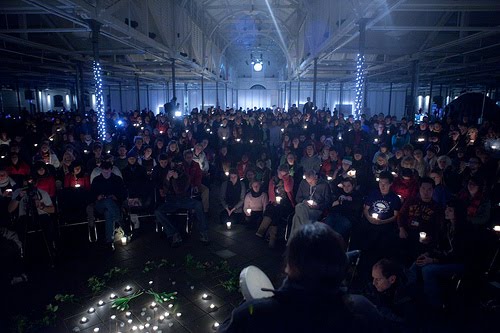
Hundreds of climate activists gathered in Copenhagen December 17, in a candlelight vigil. Photo from tcktcktck.org.

After Copenhagen:
Vigils shine a light on emerging movement

By Rabbi Arthur Waskow / The Rag Blog / December 22, 2009

I am writing from the midst of a great winter storm. It is at moments like this that it is hard to convince our kishkes, our innards, that global “warming” is dangerous. That’s one of the reasons I insist on talking about “global scorching” — more honest to the geological reality and more evocative of the emotional reality.

Copenhagen is over: At the official leadership level, it was a dismal failure. At the grassroots level, it brought another stage of growth.

Which narrative controls the future — top-down failure or grassroots growth — depends on us.

What went wrong in Copenhagen? The officials came up with a vague agreement among five major nations, no binding decisions, a too slowly approached process toward a too-limited target for even the non-binding decisions, anger among many other nations about both being ignored in the process and short-changed in the results, and a very tentative possible success in beginning the creation of a world fund to aid poor nations make the shift into non-fossil economic development.

Four major culprits: Big Oil and Big Coal, which have blocked effective action by the U.S.; the U.S. government (President and Congress), which has kowtowed to them and failed to commit a serious level of money to meet the needs of poor nations; and the Chinese government, which rejected effective outside verification of its promised cuts in CO2 emissions.

Pressure for deeper commitment, coming from African and Latin American nations and small countries most vulnerable to global scorching through drought and flood, fell short because they had too little power to force the rich and large nations to meet the world’s needs.

On the streets in Copenhagen and around the world, however, the summit sparked much more action and much more coherent connection. A true transnational movement is emerging, as will have to happen if the human race is to prevent utter disaster.

In the U.S., attention now turns to the Senate where debate continues on the Kerry-Baker cap-and-trade climate bill and the pressures to water it down. Perhaps most crucial: Will the bill allow the Environmental Protection Administration to establish strong regulations on emitting CO2? If the Senate strips EPA of that power, as some senators are trying to do, it will be better to defeat the bill and get EPA to act.

There will have to be many more people going beyond their own households to address public policy, with much greater effort from those people. In the U.S. especially, climate activists will have to make much closer alliances with health-care, anti-war, and pro-jobs activists if climate healing is to prevail.

One example of grassroots energy that brought together people of different religions and generations: Last Saturday night (12/12), was both the second night of Hanukkah and the night 350.org, a transnational climate-activist network, had urged worldwide candle-lighting vigils to impact Copenhagen.

Around the world, there were more than 3,000 such vigils. Tens of thousands of people gathered in the bitterly cold streets of Copenhagen in night after night of nonviolent demonstrations.

In Philadelphia that evening, about 60 people from various Jewish congregations, some interfaith environmental groups, the local climate-crisis 350.org, and the Philadelphia (high school] Student Union gathered at Independence Hall to light Hanukkah menorahs and other candles as a message to Copenhagen to get serious about a fair, strong, and binding agreement to stop the worsening of the climate crisis.

[Rabbi Arthur Waskow is director of The Shalom Center and is co-author of The Tent of Abraham; author of Godwrestling, Round 2, Down-to-Earth Judaism and a dozen other books on Jewish thought and practice, as well as books on U.S. public policy.]

The Rag Blog

Posted in Rag Bloggers | Tagged , , , , , , , | 1 Comment

James Howard Kunstler : A Blue Christmas with Avatar and Tiger


Blue Christmas

What is most amazing about Mr. Cameron’s holiday blockbuster is the explicit message that America is a society that deserves to be punished (and humiliated!) by others who manage their own relations with reality better than we do.

By James Howard Kunstler / December 21, 2009

As the end-credits rolled for James Cameron’s new movie, Avatar, the audience burst into rowdy applause. It seemed to me that they were applauding the sheer computerized dazzlement of the show — but in the story itself they had just watched the U.S. suffers a humiliating defeat on a distant planet. In the final frames, American soldiers and the corporate executives they had failed to protect were shown lined up as prisoners-of-war about to embark on a death march.

More to the point, the depiction of our national character through the whole course of the film was of a thuggish, cruel, cynical, stupid, detestable, and totally corrupt people bent on the complete destruction of nature. Nice. And the final irony was that Cameron had used theatrical technology of the latest and greatest kind to depict America’s broader techno-grandiosity — as the army’s brute robotic warriors fell to the spears and arrows of the simple blue space aliens.

Altogether, it was a weird moment in entertainment history, and perhaps in the American experience per se. No doubt audiences overseas will go wild with delight, too, but perhaps with a clearer notion of what they are clapping for than the enthralled masses of zombie Americans.

The infatuation with technology, and the disgusting cockiness that goes with it (so well-captured in Avatar), is but one facet of the psychosis gripping the nation — and by that I mean the profound detachment from reality. We have no idea what is happening to us and, naturally, no idea of what we are going to do.

I sat in a bar Friday evening with a financial reporter from a national newspaper, trying to explain the peak oil situation and what it implied for our economy. He had never heard it before. The relationship between energy resources and massive debt was new to him. (It also came up in conversation that he could not tell me what the Monroe Doctrine was about, despite a history degree from Yale.) There you have a nice snapshot of the mainstream media in this land.

This year, America can look for a nice lump of coal in its Christmas stocking. That lump will be called “the recovery.” This recovery consists of a massive self-deception, made up of accounting tricks and falsified statistics, with a sugar-coating on top of sheer disbelief that the outcome could be anything but a particular happy ending — namely, the continued levitation of the unsustainable.

What is most amazing about Mr. Cameron’s holiday blockbuster is the explicit message that America is a society that deserves to be punished (and humiliated!) by others who manage their own relations with reality better than we do. I wonder how much that will secretly account for its popularity. I wonder what the leaders of China will make of it.

The other current embodiment of national character failure, Tiger Woods, golfer, has also dazzled the American public. Personally I find it much more interesting to learn that he was a really lousy tipper than that he got a lot of action on the side with opportunistic bar girls, porn stars, and other denizens of the sports-entertainment netherworld.

Is it not also amusing that golf is even taken seriously as an athletic pursuit? I mean, why not pancake-flipping? Or dice? Or shooting rats at the landfill? This is the kind of knucklehead culture we have become after six decades of the softest life imaginable. Anyway, I’m not shedding any tears for Tiger. Even if all his endorsements dry up and his ex-wife takes him to the cleaners for a hundred million or so, he’ll still be left with enough cash to pay for porn stars and lobster tails until the end of time, especially if he keeps his tipping policy at its current level.

Source / Clusterfuck Nation

Thanks to Roger Baker / The Rag Blog

Posted in RagBlog | Tagged , , , , , | 1 Comment

Mexico City : Christmas not so Merry for Out of Work ‘Electricistas’

At top, Mexico City’s giant Christmas tree. Photo by Gary Denness / Creative Commons. Below, members of the electrical union protest the government’s decision to dissolve the state-run electricity company Luz y Fuerza del Centro in Mexico City on Oct. 11, 2009. Photo by Miguel Tovar / AP.

Feliz Navidad:
Hardscrabble holidays for Mexico’s underclass

By John Ross / The Rag Blog / December 21, 2009

MEXICO CITY — The Christmas season is in full flower in this monster megalopolis. “The World’s Tallest Christmas Tree” (dixit Mayor Marcelo Ebrard) which looks suspiciously like a huge bottle of Pepsi Cola (the sponsor of this Xmas kitsch) towers over the elegant Paseo de la Reforma. Ice skaters pirouette on the great rink that floors the Tiananmen-sized Zocalo plaza — at the heart of the Mexican body politic, Zamboni machines now rule. There is even a dollop of snow on the surrounding volcanoes.

As is traditional, the government has shut down until after January 6, the Day of the Kings, and hordes of glassy-eyed shoppers stampede through the downtown streets. Ersatz Santa Clauses cadge coins on the corners of the Centro Historico and each evening neighborhood Marias and Joses knock on doors pleading for posada, a safe place for Mary to birth the Christ child. The pilgrims are treated to ponche (high-octane alcohol splashed with fruit punch) and piñatas stuffed with candy to the delight of sugar-crazed moppets.

Navidad should be a moment of respite in the hardscrabble lives of the vast majority of Mexicans (80%) who live in and around the poverty line but in a year where the underclass, trapped in a seemingly bottomless downturn has suffered grievously, the holiday season has become a cruel hoax.

The hoax is even crueler for 42,000 members of the Mexican Electricity Workers Union (SME) who two months ago were pushed out of their workplaces at the Luz y Fuerza del Centro (LFC), the state-subsidized enterprise that supplied electricity to Mexico City and five surrounding states. Under orders from President Felipe Calderon, the company was dissolved. Military police continues to occupy the installations.

For the union and the combative social movement that accompanies it, the coup d’grace may have come December 11, two months to the day of the takeover, when the Conciliation and Labor Arbitration Court denied the SME’s request for an injunction to reverse the shutdown. Judge Guillermina Coutino, a young and malleable jurist in her first year on the bench, ruled that the executive branch was in its rights to close down a government enterprise if it imperiled the national economy.

By 2009, Luz y Fuerza del Centro, decapitalized by zero investment during the administration of the past four neo-liberal Mexican presidents, was turning increasingly negative numbers. Calderon argued that the shortfall was costing the federal government billions of pesos in subsidies that could be better used to alleviate the suffering of 26,000,000 Mexicans living in extreme poverty.

One reason why LFC was running so deep in the red: the company was forced to buy its electricity from the Federal Electricity Commission (CFE) at exorbitant prices – 35 to 40% of CFE electricity is now generated by the private sector, particularly transnationals like the Spanish Iberdrola, despite constitutional prohibitions that restricts energy generation to the state. With the shuttering of Luz y Fuerza, energy distribution in Mexico City and adjoining states will be overseen by the CFE.

Despite Calderon’s insistence that he had no option but to close down LFC, many observers see this slight of hand as a pretext for privatization and the installation of a fiber optics network on the old Luz y Fuerza lines to be contracted with W Communications, another Madrid-based transnational fronted here by two former Mexican energy secretaries — Calderon himself is an ex-energy secretary.

The denial of the union’s request for an amparo (injunction) was a critical wound for the SME, which seemed to have put all its eggs in the legal basket and was delusionally confident that the takeover would be deemed an unconstitutional exercise of Calderon’s authority. SME lawyers vowed to appeal the turndown to an unsympathetic Supreme Court.

The union has been further weakened, perhaps mortally so, by the voluntary liquidation of more than half its members — 27,000 out of 42,000 workers, 61% of the membership, have caved in to Calderon’s entreaties to cash out. Despite sugar-coated comeons by hardnosed labor secretary Javier Lozano that liquidated workers would be re-contracted by the CFE, only 3% of the ex-SME members have been signed on — those who have are forced to abandon the SME and affiliate with a company union, the SUTERN, whose charro (sell-out) leaders have a baleful track record in defending workers’ rights.

Older workers were bamboozled into liquidating by Calderon’s promises that they would be first in line for fast food franchises in which to invest their pay-out checks but the cheapest buy-in was reportedly 190.000 pesos to sell ready-made tacos (tacos de canasta) in the street.

In 1914, at the height of the Mexican Revolution with Pancho Villa and the great Zapata occupying the capital, the city’s electricity workers struck the transnational Canadian Light & Power Company, paralyzing trolley car transit over demands for the recognition of a union. The SME was born into social turmoil and has not been a stranger to struggle in its near-century on the march. Always a bastion of working class solidarity, the Sindicato Mexicano de Electricistas has traditionally sent tens of thousands of its workers into the streets to back up citizens’ demands for justice from a government once described as a “perfect dictatorship.”

In 2006, the SME incurred Felipe Calderon’s undying wrath when it backed leftist Andres Manuel Lopez Obrador in the presidential race the right-winger was later dubiously awarded, and urged its members to vote for AMLO. Retribution is one of the subtexts of Calderon’s takeover of Luz y Fuerza del Centro.

Since the October putsch, those SME members who line up with firebrand secretary general Jorge Esparza have mounted nonviolent civil resistance 24-7. Three mass mobilizations have drummed out nearly a million marchers. On October 15, just four days after Calderon’s takeover, a quarter of a million incensed citizens filled the Zocalo. On November 11th, the SME spearheaded another huge turnout that was billed as a national strike — telephone workers shut down Information services for an hour but no other work stoppages were reported.

Although the “strike” was supported by some public employees unions and unions representing workers at former government enterprises grouped together in the National Union of Workers or UNT, it was pointedly ignored by pro-government unions like the Education Workers (SNTE), with 1.3 million members the largest labor organization in Latin America whose leader Elba Esther Gordillo, the virtual czarina of public education, is a Calderon crony. Nonetheless, dissident teachers have provided bulwark back up for the SME.

A third public outpouring December 4, a symbolic takeover of the capital to commemorate the day Zapata and Villa rode into Mexico City (Mexico will celebrate the 100th anniversary of its revolution in 2010) brought out tens of thousands of supporters who marched into the center of the city from the four cardinal directions and tied traffic in knots all day and all night. Indignant at the biased reporting of Televisa, the nation’s television kingpin — Calderon runs spots on primetime news urging SME members to go scab and accept liquidation — workers staged a rare nighttime march on the communication conglomerate’s headquarters to demand airtime. A tense standoff ensued and was only resolved when the SME’s Esparza offered to buy time to present the workers’ side of the story.

The militancy of the SME rank and file has been unrelenting. Eleven electricistas were jailed for a week after they blocked the federal highway from Queretero into the city. Fifteen workers endured a 17-day hunger strike in front of the CFE offices demanding reinstatement. Two women hunger strikers, Cielo Fuentes and Monica Jimenez, are fourth generation SMErs who remember being rocked to sleep at union meetings when they were babies.

Ex-LFC workers shake cans in the subway and on the buses to keep their families fed. Many workers’ families have been forced to sell in the street to make ends meet. “There’s not enough corn in Mexico to supply all the new quesadilla makers Calderon has created,” one union member joked.

On December 12, the day Mexico sets aside to honor the Virgin of Guadalupe, the Aztec nation’s patron saint, Samuel Ruiz, the liberationist Bishop emeritus of San Cristobal de las Casas, conducted Mass at the union hall, imploring the Dark Madonna to help the workers get their jobs back and condemning the corruption of the mal gobierno (bad government.)

As the movement enters into its third month with no resolution in sight, the Virgin of Guadalupe may be one of the few assets the SME can rely on.

International support for the embattled union has not been spectacular. U.S. and Canadian labor federations have made perfunctory pilgrimages to Mexico City in solidarity. Stan Gacek, speaking for Richard Trumpka, the new AFL-CIO chieftain, accused the Calderon government of violating the terms of the labor side-agreements signed along with NAFTA in 1994 and offered to take the matter to the U.N.’s World Labor Organization (OIT by its Spanish initials.) Calderon’s vituperative labor secretary Lozano responded that the North Americans “know nothing about Mexican labor laws” and accused Gacek of interfering in Mexico’s internal politics, a charge that could have gotten the AFL-CIO rep booted out of the country under Article 33 of the Constitution.

Lozano, who has engaged in a long-standing personal feud with the SME’s Esparza, refusing even to validate the union leader’s re-election last spring, has reason to gloat these days. Not only have the electricistas lost their last, best chance for redress with the denial of the injunction but the Conciliation and Arbitration Court also nullified the SME secretary-general’s victory by 300 votes over union treasurer Alejandro Munoz (who has since turned government stooge) and declared the elections null and void. Lozano also accuses the SME of sabotaging the electricity grid after major blackouts in Mexico City and surrounding states plunged the region into darkness.

As labor secretary, Lozano, a Calderon unconditional, has repeatedly lashed out at unions that reject the government’s privatization plans. His never-ending vendetta against Mine and Metal Workers’ union boss Napoleon Gomez Urrutia, now in self-exile in Canada, continues to trouble the industry — miners have been on strike at Cananea in Sonora, the world’s eighth largest copper pit and in Taxco Guerrero and Sombrerete Zacatecas for two years. This week, the miners’ union sent urgent alerts to its locals to be on guard against a Calderon takeover during Christmas week.

Like the electricistas, for many postal workers this is going to be a miserable Christmas. Nearly 3,000 were fired for the holiday season, a moment of maximum volume, and forced to sign off on liquidations far below those guaranteed by law. Meanwhile, the Mexican postal service, always untrustworthy, has undergone a costly makeover — logos and uniforms are now lime green and raspberry sherbet instead of the drab national colors — but service is just as abysmal. The makeover suggests that Calderon is sprucing up the postal service for sale to the highest bidder — DHL is frequently mentioned.

The SME celebrated the 95th anniversary of its founding December 14, 1914, in times that were no less treacherous than they are today, with militant speeches and half-hearted fiesta. A few thousand gathered at the well-worn union hall downtown. Members’ kids competed in potato sack races and rowdy troubadours sang songs of past peoples’ struggles. Workers’ wives dished out homemade tamales and rummaged through piles of old clothes collected by the civil society, looking for warm coats for their kids.

The walls of the SME offices were plastered with hand-scrawled cardboard signs calling Calderon every kind of creep on the books and the floor littered with old leaflets and tamale husks. Every once in a while, exuberant chants – “Aqui Se Ve La Fuerza del SME!” and “Lucha, Lucha, Lucha No Dejan de Luchar!” — would burst forth from the auditorium where proletarian performers serenaded the faithful. But despite the samples of enthusiasm, exhaustion stalked the room.

The next day, the SME announced that it was suspending resistance activities until the holiday season was done with after January 6. Until then, the movement will be immobilized. Whether there will be enough energy to rekindle the struggle remains to be tested.

Can social movements still modify egregious government policies? The SME has carried out months of wall-to-wall fightback and is increasingly ignored by the public and the government. Millions marched after Calderon stole the 2006 election from Lopez Obrador and three years later Calderon is still very much the president. A survey of conflicts during 2008 done by Bishop Ruiz’s non-government think tank SERAPAZ is revealing.Sixty four percent of the conflicts under review went unrecognized by public authorities. In 31% of the incidents, security forces waded in to disperse the protests. Only 4.6% of these conflicts resulted in dialogue or mediation.

Such a dismal success rate indicates that nonviolent civil resistance is not very efficient at sparking change, a conclusion that must bring holiday cheer to those who advocate the armed option.

[John Ross’s new cult classic El Monstruo: Dread and Redemption in Mexico City is now available at your independent bookseller — “(El Monstruo) is addictive!” complains the Ft. Worth Star Tribune. Ross will be launching a monster book tour from sea to stinking sea February-May. Suggestions for venues will be cheerfully accepted at johnross@igc.org. The author extends his best wishes to readers for their viable survival in 2010.]

The Rag Blog

Posted in Rag Bloggers | Tagged , , , , , | Leave a comment

Grannies to Toys’R’Us : War is Not a Game

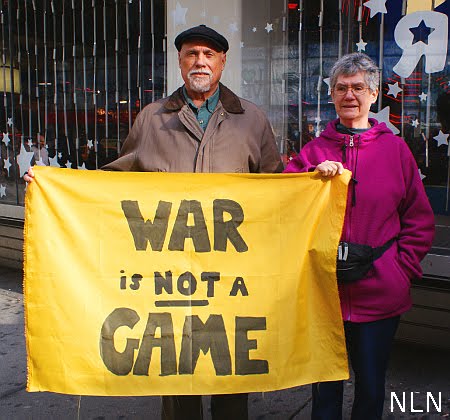
Granny and grandpa at Times Square. Photo by Bud Korotzer / NLN / The Rag Blog.

Grannies at Times Square:
‘No more war toys, no more war’

By Fran Korotzer / The Rag Blog / December 21, 2009

NEW YORK — On December 4, the Raging Grannies and the Granny Peace Brigade created a wonderful holiday peace event at the crossroads of the world, Times Square. The purpose was to send the message: No more war toys and no more war.

They met near the Recruiting Station where two NYPD officers, polite but not particularly interested in the first amendment, told them that they had to move on. Debate was futile. So, they moved to the huge Broadway Toys”R”Us where several grannies had entered minutes earlier, got on the three story high Ferris wheel in the store, and unfurled large yellow banners that read “No More War Toys — No More War.”

The other grannies — and a few grandpas — stood in a central area and sang peace versions of traditional Christmas songs. By then the number of demonstrators had grown to about 25 people — many were wearing peace signs. Shoppers stopped to photograph the happening.

After about 10 minutes the Ferris wheel was stopped and the Grannies were asked to get off while three very respectful and courteous young men were dispatched to ask the demonstrators to either stay and shop without their signs or sing outside the store — as long as entrances were not blocked. And that is what they did.

The weather outside was sunny and mild. Since that area of Broadway was turned into a pedestrian mall last spring, the area in front of the store was full of strolling tourists and people just sitting and relaxing. Educational leaflets were distributed urging people not to buy war toys (many being extremely violent) and military infused clothing (like camouflage prints) for their children. At the same time the Grannies sang their songs, for example:

Rudolph’s Dream

(Tune: “Rudolph the Red Nosed Reindeer”
Words by Corinne Willinger)

Rudolph the red-nosed reindeer
Had a very shiny nose.
Children thought he looked crazy
Because they said that his nose glows.

Rudolph was playing Star Wars
Shooting at strange warrior drones,
He fell and hurt that bright nose
War games made him accident prone.

Then one sunny Christmas day
Santa came to town.
He said war toys can instill
The idea it’s OK to kill.

Santa said that we need practice
In having fun without a fight.
Learn to solve all your problems
By talking about what is right.

People stopped to listen, took pictures, and applauded. The response was extremely positive. It really seemed that people’s hearts and minds welcomed the peace message in the season of peace.

[Fran Korotzer is an independent journalist and a contributor to Next Left Notes, where this article also appears.]

Grannies tell it (and sing it) like it is. Photos by Bud Korotzer / NLN / The Rag Blog.

The Rag Blog

Posted in Rag Bloggers | Tagged , , , , , | 2 Comments

The Individual Mandate : Unconstitutional, and an Alarming Precedent

Health insurance: The individual mandate. Illustration from Slate.

Going too far?

Health care reform and the individual mandate

If Congress gets away with this, there is no stopping point and Big Business will have succeeded in making Americans into involuntary consumers whenever it so chooses.

By Sheldon H. Laskin / December 21, 2009

It is generally agreed, by both proponents and opponents of the administration’s health reform bill, that the linchpin of the legislation is the individual mandate requiring uninsured Americans to obtain health insurance, or pay a penalty on their tax return for failing to do so.

Without the mandate, even the Administration’s wildly exaggerated cost savings estimates simply cannot work. The whole plan is predicated on enlarging the risk pool by bringing in younger, healthier people who currently lack the means or the incentive — or both — to purchase health insurance.

Given the centrality of the mandate, it is somewhat surprising that little attention has been paid to the critical legal question of whether Congress has the constitutional authority to require Americans to purchase a commodity from a private, for-profit corporation.

Other than some limited commentary on the Right — George Will and Orrin Hatch both had columns on this topic in the Washington Post and the Heritage Foundation recently published a detailed legal analysis of the question — there has been almost no critical discussion of the issue. The silence on this issue is even more amazing in view of the fact that the Congressional Budget Office raised a red flag on the question during the Clinton Administration’s abortive effort at health care reform:

A mandate requiring all individuals to purchase health insurance would be an unprecedented form of federal action. The government has never required people to buy any good or service as a condition of lawful residence in the United States.

(Congressional Budget Office, The Budgetary Treatment of an Individual Mandate to Buy Health Insurance,1994.)

Unlike the states, Congress cannot enact any law even if doing so would foster public safety and health. Under our federal system of government, Congress can only enact laws that are of a type authorized by a provision of Article I of the Constitution, which sets forth the powers of Congress. Proponents of the individual mandate typically cite the Commerce Clause of the Constitution as granting Congress the authority to require individual Americans to purchase health insurance.

Article I, Clause 8, Section 3 of the Constitution grants Congress the power “[t]o regulate Commerce with foreign Nations, and among the several States, and with the Indian tribes.” Therefore, in order for Congress to have the authority to require Americans to purchase health insurance, the purchase of health insurance must constitute “commerce” within the meaning of the Commerce Clause. It does not.

In 1982, the Supreme Court declared that, in order for a commodity to be considered an article in commerce, it must be capable of being sold. Sporhase v. Nebraska, 458 U.S. 941 at 949 — 950 (1982). While there is no doubt that the sale of health insurance by an insurer constitutes commerce, it does not follow that the purchase — or more precisely, the failure to purchase — health insurance by a consumer also constitutes commerce. Health insurance, once purchased by a consumer, is not capable of being further sold in commerce because there is no market for it; who would purchase a health insurance policy naming someone else as the insured?

In order to understand the point better, it might be helpful to contrast health insurance with life insurance. Because paid-up life insurance has a cash value, an industry has developed in purchasing life insurance benefits from terminally ill patients. Known as viatical settlement companies, they will pay a percentage of the value of an insurance policy to a terminally ill patient if the corporation is named as the beneficiary of the policy. The patient gets the cash up front, to pay medical bills or to support his family, and the corporation makes a profit on its investment when the insured dies.

Because there is a market for life insurance benefits, the purchase of those benefits may be regulated under the Commerce Clause to make sure that the patient is not coerced by the Tony Soprano Benevolent Society to name it as beneficiary. But there is no market for health insurance benefits once the policy is issued. No one would buy my health insurance, because no one other than I can derive any benefit from it.

Since there is no market, health insurance is not an article of commerce once issued. If it is not an article of Commerce, Congress lacks authority under the Commerce Clause to require me to purchase it.

There are two Supreme Court cases that proponents of the individual mandate often cite in support of their position that Congress may require individuals to purchase health insurance. The first case involved government regulation of the amount of acreage used by farmers to grow wheat. A farmer who was fined for exceeding his acreage allotment challenged the fine, asserting that since he was using the excess acreage for personal consumption (he used it either to feed his chickens or to make bread for his family), Congress lacked authority under the Commerce Clause to regulate that excess acreage.

The Court rejected this argument, pointing out that even wheat grown for personal consumption is marketable and that therefore the farmer’s excess acreage affected the supply and demand for wheat in interstate commerce. Wickard v. Filburn, 317 U.S. 111 at 137 (1942).

Using similar reasoning, the Supreme Court recently affirmed congressional authority under the Commerce Clause to regulate the production and use of marijuana as applied to individuals who personally use marijuana for medicinal purposes under state laws that legalize such use. Gonzales v. Raich, 545 U.S. 1 (2005). Again, Congress had commerce clause authority to regulate personal consumption in this context because marijuana for home consumption is “a fungible commodity for which there is an established, albeit illegal, interstate market.” 545 U.S. at 18.

Unlike wheat or marijuana, health insurance is not a fungible commodity and is therefore not marketable. Again, no one would purchase my health insurance — it is personal to me and cannot be sold for any price.

Finally, proponents of the mandate often cite the fact that states require drivers to purchase auto insurance as justifying a federal individual mandate for health insurance. This is a facile comparison that ignores the constitutional differences between federal and state authority to regulate.

As noted above, Congress can only legislate when there is a specific provision of Article I of the Constitution that authorizes it to enact that type of law. Conversely, the states have virtually unlimited legislative authority to pass laws that foster the public welfare, health and safety.

Driving is a privilege, and the states are free to impose any reasonable condition on the exercise of that privilege that they choose. In any event, the states have limited the auto insurance requirement to the purchase of liability insurance to cover injuries sustained by third parties. No state requires drivers to purchase insurance to cover their own injuries.

For single-payer advocates, a very powerful argument is that, while the individual mandate to purchase private health insurance is unconstitutional, Congress can lawfully tax to support a government financed health insurance program. Article I empowers Congress to use its taxing powers in support of government programs that foster the public welfare; this is the constitutional authority for Social Security and Medicare. But to extend that authority to requiring Americans to purchase a private commodity raises profound civil liberties issues.

If Congress can compel the purchase of insurance from a for profit insurance company, it can compel the purchase of any commodity if there is an arguable public policy to support it. The auto industry is collapsing? Forget Cash for Clunkers, just order Americans to buy cars or tax them if they don’t. Obesity crisis? Order Americans to join health clubs, or tax them if they don’t. If Congress gets away with this, there is no stopping point and Big Business will have succeeded in making Americans into involuntary consumers whenever it so chooses.

[Sheldon H. Laskin is an attorney who has appeared before the United States Supreme Court. He is an Adjunct Professor in the Graduate Tax Program at the University of Baltimore Law School. Mr. Laskin specializes in state tax cases under the Commerce Clause of the U.S. Constitution.]

Source / AfterDowningStreet

Thanks to David Swanson / The Rag Blog

Posted in Rag Bloggers | Tagged , , , , , | 5 Comments

Legalized Loan Sharks : Usury With Fangs

“Shark Attack,” pen and ink illustration by Tom Grady / Pulse.

The spoils of credit card ‘reform’:
Unregulated interest rates skyrocket

By Ted McLaughlin / The Rag Blog / December 21, 2009

According to the Oxford American Desk Dictionary, the definition of a “loan shark” is a person who lends money at exorbitant rates of interest. Earlier in our history, most loan sharks were underworld figures making illegal loans. If you weren’t able to pay the loan back, you ran the risk of some broken bones. It was a very lucrative business for the mob.

But that was before the financial institutions realized just how much money they were missing out on by not engaging in loan sharking. Today, the mob has been replaced by so-called “legal” financial institutions.

For many years, this was kept somewhat in check by state laws that limited yearly interest rates to 35-42%. That still sounds like loan sharking to me, but at least there was a limit. However, in 1980 the United States Congress proved their fealty to corporate financial interests by passing the Depository Institutions Deregulation and Monetary Control Act.

This law exempted federally chartered savings banks, installment plan sellers and chartered loan companies from having to obey state usury laws and limits. And since there is no federal usury limit, that meant there was no longer a limit on what interest rates could be charged.

Since then then interest rates have steadily crept up. This is especially true of the credit card companies (many of whom are also based in states that have eliminated interest rate limits). I guess it was only a matter of time before one or more of them began to throw caution to the wind and go above their normal 30-40% interest rates. Now one of them has done it, and I’m sure more will follow.

First Premier Bank has been offering credit cards with a credit line of $250. Of course that offer comes with first year fees of $256. That is an obvious rip-off to get a credit card where the entire credit limit is taken up with fees owed to the issuer. Congress tried to fix this kind of problem by passing a new law regarding credit card fairness. The new law caps fees like this at 25% of the credit limit.

Well, that should keep First Premier Bank from ripping off its customers, shouldn’t it? Wrong! Congress only half did the job of trying to rein in the credit card companies. They refused to put any limit on the amount of interest a card company can charge.

First Premier Bank was quick to take advantage of the loophole left by Congress. They upped their credit limit to $300 and lowered their fees to $75 (the maximum 25%). Then they took the rather shocking move of raising the annual interest rate for the card to 79.9%.

They try to justify the outrageous new interest rate by saying the cards are offered to people who have credit problems. To me, that excuse just doesn’t fly. To take people who are already having money problems in the middle of a recession and slap an 80% interest rate on them is not just wrong — it’s immoral, unethical and should be illegal.

This is nothing more than legal loan sharking. While these companies may not break any limbs for failure to pay on time, they can certainly ruin the credit rating of a person struggling to repair his/her credit and keep their head above water — and that might be worse. With rates like this, how is a person supposed to get ahead?

Now that First Premier Bank has set an 80% interest rate, how long will it be before other credit card companies follow suit? Most may not instantly go to 80%, but I could see them raising a rate even for good customers to 50% or 60% and continue to creep toward that 80%. Why wouldn’t they? They have already shown they care little for consumers by past actions. If First Premier Bank can get away with it, why shouldn’t the others follow suit?

I wish we could count on Congress to protect consumers, but it doesn’t look like we can. They have “reformed” both credit cards and health care, and consumers are worse off than ever. I don’t think we can afford any more help from our pathetic corporate-owned Congress.

Each year our economy moves closer to exclusive use of electronic funds and credit and away from cash. How much time is left before we are all credit-slaves to the corporations?

[Rag Blog contributor Ted McLaughlin also posts at jobsanger.]

The Rag Blog

Posted in Rag Bloggers | Tagged , , , , , , , , | Leave a comment

Senate Health Care Diagnosis : Bad Medicine

Cartoon from The Political Carnival.

The Senate health care bill:
Time to put it out of it’s misery?

By Dr. Stephen R. Keister / The Rag Blog / December 20, 2009

According to the United Nations Declaration of Human Rights,

“Everyone has the right to a standard of living adequate for the health and well-being of himself and his family, including food, clothing, housing and medical care and necessary social services, and the right to security in the event of unemployment, sickness, disability, widowhood, old age or other lack of livelihood in circumstances beyond his control.”

The Human Development Index is a comparative measure of life expectancy, literacy, education, and standards of living for 177 countries worldwide. It is a standard means of measuring well being and especially child welfare. It is intended to distinguish whether the country is a developed, a developing, or an underdeveloped country, and also to measure the impact of economic policies on quality of life.

The latest update to the Human Development Index was released on December 18, 2008. The United States rated fifteenth, following Iceland, Norway, Canada, Australia, Ireland, Netherlands. Sweden, Japan, Luxembourg, Switzerland, France, Finland, Denmark, and Austria. There is some solace in the fact that we’re ahead of the United Kingdom, Poland, Mexico, Cuba and Panama. The nations listed ahead of the United States all have universal quality health care and are largely secular societies with very active social democratic parties. Of course, it may just be coincidence…!

I write this Rag Blog column in an extreme state of dejection. I tend to agree with Dr. Howard Dean, whom I have followed since his presidential bid in 2000. Dr. Dean has announced his position that the Senate should abandon its effort to pass health care legislation since the remaining, battered, deceitful legislation is nothing better than a taxpayer giveaway to the health insurance industry. However, in view of Saturday’s release of the full legislation, of which I have read only a summary, it is probably wise to reserve final judgment until the debate is complete, the behind the scenes deals revealed, and a vote taken.

The Senate has proven itself corrupt, disingenuous, without honor, and below contempt, save for a handful of progressive idealists who somehow became party to this den of thieves. I imagine myself at a rural Mississippi dog fighting pit, with the locals still cheering, and looking down on a pit bull at the end of the contest — pathetic, lacerated and bleeding.

It would appear to be time to put the poor animal out of its misery. However, we should await final developments before making a final decision about this legislation. It is clear, though, that what was supposed to correct the health care crisis in our nation instead has evolved into a giveaway of taxpayer money to the health insurance and pharmaceutical industries — similar to what was done in 2003 when Medicare Part D and Medicare Advantage were created to underwrite the private insurance and pharmaceutical industrues, under the aegis of the Bush administration, with taxpayer funds.

We have had absolutely no positive leadership from the president in the health care debate. Yes, he mouths platitudes and provides photo ops; however, from the beginning he has kept the true health reformers, especially the doctors, nurses, and other health professionals, at a distance, and has chosen to give his attention to, and receive favors from, the health cartel executives, the PhARMA lobbyists, and such true believers as senators Leiberman, Snow, Nelson, Baucus, and their ilk.

There has been little evidence of the Obama of the presidential campaign: no visionary, no man of the people, but merely an individual who has simpered in front of the corporate masters of our country.

Throughout the ongoing discussion of health care reform, the physician’s voice has been largely absent. For some 20 years the 17,000 members of Physicians for A National Health Program have engaged in an in-depth study of national health care. These dedicated folks feel that once again, after years of domination by non-professional agencies, that our citizens deserve compassionate, informed health care, free of the dictates of a for-profit insurance company. No more rationing of care on the basis of one’s ability to pay.

As the legislation stands now there is no vehicle to provide care for the uninsured and the underinsured. There is no antitrust legislation to control the price manipulations of the health insurance industry. The adherents rationalize that it will cover the folks with pre-existing conditions, but omit the fact that, in such instances, the cost to the individual may be three times the normal charges. There are no hard and fast regulations to control the yearly payments for care of a cancer patient, for example, with the insurer having the option to set a yearly limit on medical payments.

Further, it isn’t even clear in the Senate legislation what percentage of the premium collected will actually be paid out for medical care, and how much can be set aside for executive salaries, stockholder dividends, lobbying, and advertising. Currently only 81% of subscriber premiums actually go to health care costs. If the insurers spent 90% or 95% of the subscribers’ money on health care they could give their customers between $54 and $94 billion in rebates on premiums, according to Jason Rosenbaum, writing in The Seminal.

The legislation requires by fiat that everyone buy health insurance — whether the individual can afford to do so or not. Buy insurance or be fined! What a boon to the insurance industry at the expense of those who cannot afford it. The legislation does not make the insurance affordable. It merely provides the insurance industry a taxpayer subsidy.

As I have previously noted, the constitutionality of such a law is questionable; however, it could take years to get a challenge through the court system and in the meantime poor folks will be required to spend approximately 12% of their income, amounting to a considerable wage cut, on Washington mandated health insurance. And the policies these folks receive will come at a cost they can’t afford — policies with very high deductibles and high co-insurance. I must agree with Keith Olbermann who suggests that such a bill — written for the benefit of the insurance cartel — could result in widespead individual civil disobedience.

The other very sad development is the Senate’s refusal to set aside the current legislation that forbids the individual to import prescription pharmaceuticals. It’s amazing that senators thought of as progressives voted to refuse the public this right. Of course, we cannot say exactly why they voted in this manner; however, there is no reason to assume that the financial corruption that is inherent in this august body should not reach certain of its progressive members.

And then there is the old ploy: tell the public that imported medications are not safe. Yet, the current pharmaceutical manufacturers are multinational corporations who produce their brand name drugs throughout the world, but package them in the United States and the uninformed public thinks that they are buying a made-in-the-USA product.

Humbug! Prescriptions cost 3-4 times more in the United States than they do in Canada or Europe. Other nations have prescription price control; hence, the manufacturers love to do business in the USA. The Canadian pharmaceutical oversight is probably much stricter than that inherent in the Bush era FDA. I know about this personally because I previously obtained medication for my prostate cancer through a Canadian pharmacy. Happily the product is now generic and can be purchased relatively reasonably in this country.

An excellent review of the sell out of health reform appears in SocialistWorker in an article by Andy Coates, M.D, a member, like myself, of Physicians for a National Health Program.

Meanwhile, even if some legislative miracle were to occur and a version of the House bill became law, a Harvard Medical School Study, as cited in the The Raw Story, indicates that during the time before legislation incorporating the public option would take effect, an estimated 135,000 citizens and over 6,600 U.S. veterans would die. Further, with the House bill, even after uninsured Americans begin to receive health care, there would still be another 18 million not covered. We must remember even the House legislation would not come into effect until 2013 or 2014.

In the meantime PNHP reports that the stocks of WellPoint, Cigna, and United Health have surged to a 52 week high. This is their reward for $53 million invested in lobbying in the first three quarters of 2009. The Raw Story points out that the White House has met early and often with these lobbyists. The author cites a plethora of CEOs and lobbyists of Blue Cross Blue Shield, Kaiser Health Plans, and heads of PhARMA , The American Hospital Association, and pharmaceutical companies SanofiPasteur, Takeda Pharmaceuticals America, Pfizer, and Amgen.

In the meantime we in the progressive community are seeking some purpose, some common ground. Yet I am haunted by Eric Hoffer’s long ago observation: “Men of thought seldom work well together, whereas between men of action there is usually an easy camaraderie. Teamwork is rare in intellectual or artistic undertakings, but common and almost indispensable among men of action.”

A worry, yes, but also a fear. A recent poll shows some 40% of Americans either consider themselves “tea-baggers” or are sympathetic towards the tea-baggers — those folks unwittingly following the pied piper of big business. We progressives may smile and make sport of these people, but l remember that some years ago a more cultured, better educated society than ours, at a time of financial and societal turmoil, led and misled by corporate interests, followed a wall paper hanger into the abyss.

[Dr. Stephen R. Keister lives in Erie, Pennsylvania. He is a retired physician who is active in health care reform. His writing appears regularly on The Rag Blog.]

The Rag Blog

Posted in Rag Bloggers | Tagged , , , , , | 7 Comments

Supremes : ‘Suspected Enemy Combatant’ no Longer a ‘Person’

Portrait of a non-person. Image from girloftomorrow.

Dred Scott redux:
Enemy combatants denied legal standing

…once again, 144 years after the Civil War, we have established as the law of the land and the policy of the United States government that whole classes of people can be declared ‘non-persons’ and have their liberty stripped away…

By Chris Floyd / December 19, 2009

While we were all out doing our Christmas shopping, the highest court in the land quietly put the kibosh on a few more of the remaining shards of human liberty.

It happened earlier this week, in a discreet ruling that attracted almost no notice and took little time. In fact, our most august defenders of the Constitution did not have to exert themselves in the slightest to eviscerate not merely 220 years of Constitutional jurisprudence but also centuries of agonizing effort to lift civilization a few inches out of the blood-soaked mire that is our common human legacy. They just had to write a single sentence.

Here’s how the bad deal went down. After hearing passionate arguments from the Obama Administration, the Supreme Court acquiesced to the president’s fervent request and, in a one-line ruling, let stand a lower court decision that declared torture an ordinary, expected consequence of military detention, while introducing a shocking new precedent for all future courts to follow: anyone who is arbitrarily declared a “suspected enemy combatant” by the president or his designated minions is no longer a “person.”

They will simply cease to exist as a legal entity. They will have no inherent rights, no human rights, no legal standing whatsoever — save whatever modicum of process the government arbitrarily deigns to grant them from time to time, with its ever-shifting tribunals and show trials.

This extraordinary ruling occasioned none of those deep-delving “process stories” that glut the pages of the New York Times, where the minutiae of policy-making or political gaming is examined in highly-spun, microscopic detail doled out by self-interested insiders. Obviously, giving government the power to render whole classes of people “unpersons” was not an interesting subject for our media arbiters. It was news that wasn’t fit to print. Likewise, the ruling provoked no thundering editorials in the Washington Post, no savvy analysis from the high commentariat — and needless to say, no outrage whatsoever from all our fierce defenders of individual liberty on the Right.

But William Fisher noticed, and gave this report at Antiwar.com:

In the wake of the U.S. Supreme Court’s refusal Monday to review a lower court’s dismissal of a case brought by four British former Guantanamo prisoners against former defense secretary Donald Rumsfeld, the detainees’ lawyers charged Tuesday that the country’s highest court evidently believes that “torture and religious humiliation are permissible tools for a government to use.”
[….]
Channeling their predecessors in the George W. Bush administration, Obama Justice Department lawyers argued in this case that there is no constitutional right not to be tortured or otherwise abused in a U.S. prison abroad.

The Obama administration had asked the court not to hear the case. By agreeing, the court let stand an earlier opinion by the D.C. Circuit Court, which found that the Religious Freedom Restoration Act — a statute that applies by its terms to all “persons” — did not apply to detainees at Guantanamo, effectively ruling that the detainees are not persons at all for purposes of U.S. law.

The lower court also dismissed the detainees’ claims under the Alien Tort Statute and the Geneva Conventions, finding defendants immune on the basis that “torture is a foreseeable consequence of the military’s detention of suspected enemy combatants.”

The Constitution is clear: no person can be held without due process; no person can be subjected to cruel and unusual punishment. And the U.S. law on torture of any kind is crystal clear: it is forbidden, categorically, even in time of “national emergency.” And the instigation of torture is, under U.S. law, a capital crime. No person can be tortured, at any time, for any reason, and there are no immunities whatsoever for torture offered anywhere in the law.

And yet this is what Barack Obama — who, we are told incessantly, is a super-brilliant Constitutional lawyer — has been arguing in case after case since becoming president: Torturers are immune from prosecution; those who ordered torture are immune from prosecution. They can’t even be sued for, in the specific case under review, subjecting uncharged, indefinitely detained captives to “beatings, sleep deprivation, forced nakedness, extreme hot and cold temperatures, death threats, interrogations at gunpoint, and threatened with unmuzzled dogs.”

Again, let’s be absolutely clear: Barack Obama has taken the freely chosen, public, formal stand — in court — that there is nothing wrong with any of these activities. Nothing to answer for, nothing meriting punishment or even civil penalties. What’s more, in championing the lower court ruling, Barack Obama is now on record as believing — insisting — that torture is an ordinary, “foreseeable consequence” of military detention of all those who are arbitrarily declared “suspected enemy combatants.”

And still further: Barack Obama has now declared, openly, of his own free will, that he does not consider these captives to be “persons.” They are, literally, sub-humans. And what makes them sub-humans? The fact that someone in the U.S. government has declared them to be “suspected enemy combatants.” (And note: even the mere suspicion of being an “enemy combatant” can strip you of your personhood.)

This is what President Barack Obama believes — believes so strongly that he has put the full weight of the government behind a relentless series of court actions to preserve, protect and defend these arbitrary powers. (For a glimpse at just a sliver of such cases, go here.)

One co-counsel on the case, Shayana Kadidal of the Center for Constitutional Rights, zeroed in on the noxious quintessence of the position taken by the Court, and by our first African-American president: its chilling resemblance to the notorious Dred Scott ruling of 1857, which upheld the principle of slavery. As Fisher notes:

“Another set of claims are dismissed because Guantanamo detainees are not ‘persons’ within the scope of the Religious Freedom Restoration Act — an argument that was too close to Dred Scott v. Sanford for one of the judges on the court of appeals to swallow,” he added.

The Dred Scott case was a decision by the United States Supreme Court in 1857. It ruled that people of African descent imported into the United States and held as slaves, or their descendants — whether or not they were slaves — were not protected by the Constitution and could never be citizens of the United States.

And now, once again, 144 years after the Civil War, we have established as the law of the land and the policy of the United States government that whole classes of people can be declared “non-persons” and have their liberty stripped away — and their torturers and tormentors protected and coddled by authority — at a moment’s notice, with no charges, no defense, no redress, on nothing more than the suspicion that they might be an “enemy combatant,” according to the arbitrary definition of the state.

Barack Obama has had the audacity to declare himself the heir and embodiment of the lifework of Martin Luther King. Can this declaration of a whole new principle of universal slavery really be what King was dreaming of? Is this the vision he saw on the other side of the mountain? Or is not the nightmarish inversion of the ideal of a better, more just, more humane world that so many have died for, in so many places, down through the centuries?

Source / Empire Burlesque

Thanks to S.M. Willhelm / The Rag Blog

Posted in RagBlog | Tagged , , , , , , , | 19 Comments

Harry Targ : Season for Hope, Season for Struggle


‘I swear it’s not too late’
Turn! Turn! Turn!

By Harry Targ / The Rag Blog / December 19, 2009

Turn, Turn, Turn

(chorus)

To Everything (Turn, Turn, Turn)
There is a season (Turn, Turn, Turn)
And a time for every purpose, under Heaven

A time to be born, a time to die
A time to plant, a time to reap
A time to kill, a time to heal
A time to laugh, a time to weep

(repeat chorus)

A time to build up, a time to break down
A time to dance, a time to mourn
A time to cast away stones, a time to gather stones together

(repeat chorus)

A time of love, a time of hate
A time of war, a time of peace
A time you may embrace, a time to refrain from embracing

(repeat chorus)

A time to gain, a time to lose
A time to rend, a time to sew
A time to love, a time to hate
A time for peace, I swear it’s not too late

Words from Ecclesiastes; text adapted and music by Pete Seeger

We received a wonderful Chanukah present the other day, a children’s book called Turn! Turn! Turn! It is an illustrated adaptation by designer Wendy Anderson Halperin, of words from the Old Testament and music by Pete Seeger.

This present rekindled for me emotions, as I am sure it does for others, as I remembered things past; youth, family, naïve images of peace and tranquility. There is poignancy for us now too as we move towards the holidays at the same time that we struggle over the range of issues that will shape the destiny of humankind: peace, saving the environment, jobs, and health care reform.

This season progressives are debating whether we have been betrayed by Barack Obama; who is the biggest scoundrel — Joe Lieberman, Ben Nelson, Olympia Snowe; how to revitalize the peace movement; and whether to finally break with the Democrats.

But then “Turn, Turn, Turn” reminds us that “to everything there is a season.” The song suggests that the ebbs and flows of history are not bound by calendars, dates and times, and heroes and villains. A “season” is defined by its historic projects.

And these historic projects, the words suggest, include “a time to reap,” “a time to build,” “a time to break down,” “a time to cast away stones,” and “a time to gather stones together.”

Our projects, our seasons, entail defeats and victories, tears and laughter, but the seasons go on and encompass “a time to love” and “a time to hate.” And in the end the song declares, “I swear it’s not too late.”

So if we are inspired by the song, as we were in the 1960s, we remember that the struggles for peace and justice are not about individuals, political parties, and calendar deadlines but about the continued commitments which we have made to create peace, save the planet, put people back to work, and provide secure health care for all.

[Harry Tarq is a professor in American Studies who lives in West Lafayette, Indiana. He blogs at Diary of a Heartland Radical, where this article also appears.]

The Rag Blog

Posted in Rag Bloggers | Tagged , , , , , , , | Leave a comment

Honduras : Anti-Coup Gay Activist Assassinated

LGBT activist Walter Tróchez was murdered this week.

He documented homophobic violence:
Honduran gay activist
Walter Tróchez murdered

By Doug Ireland / December 18, 2009

Walter Tróchez, 25 years old, a well-known LGBT activist in Honduras who was an active member of the National Resistance Front against the coup d’etat there, was assassinated on the evening of December 13, shot dead by drive-by killers.

Tróchez, who had already been arrested and beaten for his sexual orientation after participating in a march against the coup, had been very active recently in documenting and publicizing homophobic killings and crimes committed by the forces behind the coup, which is believed to have been the motive for his murder. He had been trailed for weeks before his murder by thugs believed to be members of the state security forces.

In an open letter documenting this wave of political assassinations of Honduran queers he’d written last month entitled “Increase in hate crimes and homophobia towards LGTB as a result of the civic-religious-military coup in Honduras,” Trochez had written that “Once again we say it is NOT ACCEPTABLE that in these past 4 months, during such a short period, 9 transexual and gay friends were violently killed, 6 in San Pedro Sula and 3 in Tegucigalpa.”

At the end of this open letter, Tróchez declared that “As a revolutionary, I will always defend my people, even if it takes my life.” Sadly, that’s what happened.

American University Assistant Professor of Anthropology Adrienne Pine has translated into English on her blog a statement about the Tróchez murder by the Centro de Investigación y Promoción de los Derechos Humanos (CIPRODEH — the Center for the Investigation and Promotion of Human Rights in Honduras), which you can find here.

In a moving statement about the Tróchez murder, the influential Honduran youth organization Los Necios said:

We met Walter fighting; we quickly saw within him an indisputable leader in the defense of human rights. As a member of the gay, lesbian, trans, and bisexual community he converted himself into a reference of this struggle in which the Honduran youth has developed with dedication from the breast of the Resistencia Contra el Golpe de Estado (resistance against the coup d’etat).

Recently he felt the direct threat of the fury of the irrationality, the reaction and the stupidity of the obsolete structural power that sadly today exists in Honduras. The repressive forces that serve the businessmen and kill Hondurans kidnapped him and warned him that he should silence himself, Walter, as was to be expected, said no.

It was a relief to know that he bravely escaped from the grip of the beast and it was heartwarming to see him again in the streets this past Friday 11 of December when the force of the La Resistencia was felt in the streets, of course the compañero Tróchez headed the march of the pueblo (nation). Walter Tróchez was shot in betrayal this past December 13; such is the method of cowards…”

(Full text in English of this statement is here.)

Adrienne e-mailed me that “Walter has been one of the most important figures in the LGBT community in Honduras for years. Unfortunately, most of what’s written about him is in Spanish. A volunteer is translating one of his last open letters to the resistance condemning the large number of targeted political assassinations of members of the LGBT community since the coup, which I am pasting below (in case you read Spanish). That letter will be available in English on my website…[here].”

Amnesty International has issued a statement calling for an investigation of the murder, which you can read website here.

Radio Mundo’s web site has a good article, in English, on the murder here .

Walter Tróchez’s November 16 e-mail describing assassinations of Honduran LGBTers since the coup, in Spanish, is here.

© 2009 Doug Ireland

[Doug Ireland is a veteran political journalist. His blog is here.]

Source / CommonDreams

The Rag Blog

Posted in RagBlog | Tagged , , , , , , | 2 Comments

Righteous Cause Dept. : Raising Big Bucks to Neuter Joe Lieberman

Graphic by Larry Ray / The Rag Blog.

For ad campaign aimed at Connecticut voters:
MoveOn raising big bucks to stop Lord Lieberman

By Larry Ray / The Rag Blog / December 18, 2009

MoveOn.org, one of the largest political action committees in the country is, as I post this, just about $75,000 short of raising one million dollars for a campaign to neuter Senator Joe Lieberman’s single-handed attempt to stall or kill historic health care reform.

Their appeal for 10 bucks is unambiguous: “First, we’re going to launch a huge ad campaign to make sure every last Connecticut voter knows that Senator Lieberman is blocking strong reforms. Then, we’ll push Senate leaders to strip him of his chairmanship and seniority. Finally, we’ll work to defeat him in his next election. We can do this.”

MoveOn’s appeal starts with a quick review of Lieberman’s mad shenanigans,

First, Joe Lieberman helped President Bush invade Iraq, and the Democrats in Washington forgave him. Then, he endorsed John McCain, and they forgave him again. Then, he personally attacked Barack Obama at the Republican National Convention, and still the Democrats forgave him. Now, Joe Lieberman is single handedly gutting health care reform. The time for forgiveness is over. It’s time to hold Senator Lieberman accountable.

This has resonated with enough people to make them pitch in almost one million bucks to slow down this supposedly independent Senator who lost his Democratic bid in 2006 and now seems to be representing only his mercurial petty whims instead of the state of Connecticut… which is a solidly blue state. It went 60% for Obama in 2008. Polls in Connecticut show Lieberman is already in trouble. Thirty percent of Lieberman voters in 2006 later said they would not vote for him again, and, in another poll, he trailed one possible Democratic opponent by a whopping 44 points.

Whether it is big buck political donations from the health insurance and pharmaceutical industries that has has caused his total flip flop on health care reform, or a bruised ego, is not clear. His steadily building Little Caesar rage from feeling he has been snubbed by his caucus seems to many to be driving his decisions.

While holding Democrats hostage for his crucial 60th vote he seems oblivious to his pariah status and seems willing to possibly kill health care reform before it can finish the long hammering-out process ahead. What a legacy that would be for proud, independent Joe. But he gets his gold plated Congressional health insurance plus a fat annual retirement no matter what. He and his colossal ego could ride off into the sunset with no health care worries and plenty of walking around money, happy to say to hell with America.

It has to be more than inflated chutzpah. Maybe, in his delusional state, he also sees his reelection as a sure thing because he is so right and so loved.

Or maybe he has been watching too many WWII Kamikaze movies.

If you have had enough of Loony Lieberman and want to donate a couple of bucks to the MoveOn campaign, here’s the link:

DUMP LIEBERMAN CAMPAIGN

[Retired journalist Larry Ray is a Texas native and former Austin television news anchor. He also posts at The iHandbill.]

The Rag Blog

Posted in Rag Bloggers | Tagged , , , , , | Leave a comment

Listen Up, Senate : Health Care Bill Needs Costs Reduction Amendment

Cartoon from the Chattanooga Times Free Press.

How to save the health care bill:
Add a medical costs reduction amendment

By Sherman DeBrosse / The Rag Blog / December 17, 2009

Dr. Howard Dean, a true progressive and advocate of health care reform has given up on the bill now wending its way through the Senate. He thinks it should be scrapped. It makes too many concessions to the insurance industry, does too little to reduce costs, and will force many to buy health insurance they cannot afford.

However, if the Democrats scuttle the bill, they admit failure and their inability to govern. The election results in 2010 would probably be worse than the perfect storm of 1994.

By passing something now, they establish the principle that all citizens have a right to good health coverage. It has taken seven decades to get most Americans to agree to that basic proposition. Whatever is passed now can be amended later when rising costs force Congress to revisit it.

However, progressive Democratic Senators need to make one concerted effort to pass an amendment they might call the Medical Costs Reduction Amendment. If it does not pass, it could be reconsidered as part of the budget reconciliation process because its parts deal with spending and collecting money.

1. At its core would be a provision requiring that a health insurance company’s “medical loss ratio” cannot go below 90%. That means they must spend 90% on actual health care expenses. Anything above that would be subjected to a healthcare excise profits tax. A similar tax would be applied to salaries of everyone in the health care industry.

2. People purchasing insurance in the new insurance exchanges will be able to buy insurance from providers across state lines.

3. Mechanisms will be established for small businesses to combine bargaining power for the purpose of purchasing health care insurance.

4. Operations in the Justice Department devoted to finding Medicare fraud will be vastly expanded with hundreds of millions being set aside to hire, train, and support new fraud hunters. Thomas Reuters has found that there is about $200 billion of fraud every year in the Medicare system. He found similar fraud in the general medical insurance arena. These fraud hunters would search for fraud throughout both system and be assisted by a robust bounty system for whistleblowers.

5. All medical insurance and medical equipment and service accounting must be absolutely transparent. The Health and Human Services Department must be given several thousand new accountants and agents to dig out waste, inaccurate accounting, and dishonesty. What they learn can eventually be used to regulate insurance rates. We have failed to move toward single-payer insurance, so the only other choice is to follow Germany and Switzerland in working through very tightly regulated insurance providers.

6. Eliminate incentives for doctors and hospitals to overtreat by making lump payments for treatments of illnesses, rather than fees for each procedure.

7. Simplify and streamline billing procedures.

There are many other provisions that should be added, but we have already seen that the tolerance of Senate Democrats for real reform and cost cutting is fairly low. Recently, many of them even voted to kill Kent Conrad’s effort to help people get drugs at lower prices. In this they were upholding a tawdry deal President Obama and Rahm Emmanuel entered into with Big Pharm.

The months-long slog toward some sort of health bill has revealed how strategically inept the Democrats are. They are not good at defending themselves, and it took them forever to begin to sort out differences among themselves. They have also sacrificed opportunities to do something about carbon emissions and restoring some of the rights intended for labor under the Wagner Act. Above all, this sad debate demonstrated how center-right this country really is and how even the Congressional Democrats are in the hip pockets of the big interests.

Thirty years ago, scholars were still writing about the differences between Congressional Republicans and Presidential Republicans, etc. These were intricate discussions about how some people had powerful institutional memories and biases and others had deep commitments to governing well.

All that began to change when Newt Gingrich forced his party to put obstruction ahead of governing. Then Bob Dole, who once had contempt for Gingrich, hit on the tactic of using the threatened filibuster for every important matter before the Senate. When a Black community organizer got into the White House, total obstruction became the order of the day and almost no Republican put governance ahead of partisanship.

Governance at any cost is more of a habit for the Democrats, and this commitment also made them look weak when they were out of power. Some of us saw this tendency in people like Lee Hamilton, but now it seems to characterize the Obama administration.

When one observes all the concessions the administration has made to the big banks and the defense establishment, it is difficult to see progressive principles at work. The Justice Department’s inclination to function like the old Bush injustice operation is also deplorable. On the other hand, the situation would be so much worse if Republicans ran Congress and the White House.

If the Democrats want to go into the 2010 elections as the champions of both health care and health care cost cutting, they had better get some backbone and insist on a Medical Costs Reduction Amendment. They need to put the GOP on the record as fighting tooth and nail to prevent true cost cuts. They might also consider a 50% tax on compensation in excess of $500,000 in the financial services industry. The amendment and the tax might enable them to get back in touch with their natural constituency — ordinary Ameericans.

[Sherman DeBrosse is a retired history teacher. Sherm spent seven years writing an analytical chronicle of what the Republicans have been up to since the 1970s. The New Republican Coalition : Its Rise and Impact, The Seventies to Present (Publish America) can be acquired by calling 301-695-1707. On line, go here.]

The Rag Blog

Posted in RagBlog | Tagged , , , , , | 2 Comments