Leonard Cohen’s ‘Concert for Reconciliation’

Leonard Cohen Sings The Anthem

Words to this song are below.

Cohen defies critics with Israeli gig
Veteran plays to 47,000 in Tel Aviv despite accusations of ‘immorality’

By Donald Macintyre / September 26, 2009

It was vintage Leonard Cohen. “We don’t know when we’ll pass this way again,” he told the sell-out audience at the Ramat Gan football stadium: “But we promise to give you everything we’ve got tonight.” And he did.

Any worries fans had after the 75-year-old Canadian poet-singer-songwriter collapsed while performing “Bird on the Wire” in Valencia last week (apparently from food poisoning) quickly dissipated.

Disbelieving laughs rippled through the crowd at those familiar lines in “Chelsea Hotel”, the beguiling elegy to his late Sixties fling with Janis Joplin: “You told me again you preferred handsome men/but for me you would make an exception”. And certainly the maestro, in customary suit and fedora, looked as good as he sounded in the still warmth of this Tel Aviv September night, his first concert in Israel for more than 25 years.

He – literally – danced off the stage before each of three encores, one of which charmed the enraptured crowd to their feet in an excited singalong, thousands waving their green glow sticks in time to “So Long Marianne”. He and his gravelly bass baritone voice were at peak form, from a gloriously funky “I’m Your Man” to the dark and haunting “Famous Blue Raincoat” and, of course, “Hallelujah” (which served as a reminder that none of the many cover versions are as good).

But this is Israel, and the political context cannot be ignored.

Mr Cohen, Jewish like the vast majority of his audience, had billed the gig on Thursday night as “A Concert for Reconciliation, Tolerance and Peace”. And this was not the usual vacuous platitude. For he had also agreed to donate its $1.5m to $2m proceeds to a new fund he is behind to promote coexistence projects.

One of these is the Parents Circle – Families Forum, a unique organisation of bereaved Israeli and Palestinians who have lost close relatives in the conflict and who meet regularly together to share their painful experiences across the divide.

In the face of protests by proponents of a cultural boycott of Israel that he was playing Tel Aviv at all, Mr Cohen had planned a similar concert in the West Bank city of Ramallah, with proceeds earmarked for a Palestinian prisoners’ charity. But that was successfully blocked by boycott campaigners – including, according to his American manager, Robert B Kory, a number of “British academics” – who argue that concerts like this and Paul McCartney’s last year validate Israel as a “normal country” as it tramples Palestinian rights.

The Palestinian Campaign for the Academic and Cultural Boycott of Israel (PACBI) said that such attempts at “balance” not only “immorally equate the oppressor with the oppressed … [but] are conscious acts of complicity in Israel’s violation of international law and human rights”.

The campaign has been given fresh impetus by Israel’s winter offensive on Gaza, which left more than 1,300 Palestinians dead.

But the Parents Circle was undeterred. At a reception before the concert, the writer and long-time peace campaigner David Grossman said: “It seems so easy to believe that war is the only possibility and that Israelis and Palestinians will continue to kill each other.” But Mr Grossman, whose tank commander son was killed on the last weekend of the 2006 Lebanon war, added: “But those gathered here tonight know what we have inflicted upon each other and the price we have paid. Leonard Cohen, through his art, indicates that he understands this suffering.”

Another of the 47,000 at the concert was Ali Abu Awwad, a 37-year-old Palestinian who was jailed for four years for his part in the first intifada, and whose brother Yusef was shot and killed at the outset of the second.

Mr Awwad has since toured mosques and synagogues in Europe and the US on behalf of the Parent’s Circle with Robi Damelin, a 65-year-old Israeli, who has complained that the occupation is “killing the moral fibre of Israel” and whose son David was killed by a Palestinian sniper while serving in the Army in 2002.

“It’s not our destiny to keep dying,” Mr Awwad said. “I can’t boycott a great heart like Leonard Cohen. I was jailed for four years, my mother was jailed for four years. I lost my brother. I am proud that Leonard Cohen is supporting us.”

For PACBI, “those sincerely interested in defending Palestinian rights … should not play Israel, period”. But for Mr Cohen, grassroots reconciliation, however modest in its reach, reflects the words of “Anthem”, the song he pointedly sang straight after plugging Parents Circle work from the stage: “There is a crack, a crack in everything/That’s how the light gets in.”

Source / The Independent

‘Anthem’ by L. Cohen

The birds they sang at the break of day
“Start again”, I seemed to hear them say
Don’t dwell on what has passed away
Or what is yet to be

Now the wars they will be fought again
The holy dove, she will be caught again
Bought and sold and bought again
The dove is never free

Ring the bells that still can ring
Forget your perfect offering
There is a crack, a crack in everything
That’s how the light gets in

We asked for signs, and the signs were sent
The birth betrayed, the marriage spent
Yeah, the widowhood of every single government
Signs for all to see

I can’t run no more with that lawless crowd
While the killers in high places say their prayers out loud
But they’ve summoned up a thundercloud
And they’re going to hear from me

Ring the bells that still can ring
Forget your perfect offering
There is a crack, a crack in everything
That’s how the light gets in

You can add up the parts, but you won’t have the sum
You can strike up the march on your little broken drum,
Every heart, every heart to love will come
But like a refugee

Ring the bells that still can ring
Forget your perfect offering
There is a crack, a crack in everything
That’s how the light gets in

Ring the bells that still can ring
Forget your perfect offering
There is a crack, a crack in everything
That’s how the light gets in

That’s how the light gets in

The Rag Blog

Posted in RagBlog | Tagged , , , | 2 Comments

Naomi Klein : Michael Moore, America’s Teacher

Filmmaker Michael Moore. Art by Ward Sutton / The Nation.

Capitalism: A Love Story
Naomi Klein interviews Michael Moore

Well, people want to believe that it’s not the economic system that’s at the core of all this. You know, it’s just a few bad eggs. But the fact of the matter is that… capitalism is the legalization of this greed.

By Naomi Klein / September 25, 2009

[On September 17, in the midst of the publicity blitz for his cinematic takedown of the capitalist order, Moore talked with Nation columnist Naomi Klein by phone about the film, the roots of our economic crisis and the promise and peril of the present political moment. To listen to a podcast of the full conversation, click here. Following is an edited transcript of their conversation.]

Naomi Klein: So, the film is wonderful. Congratulations. It is, as many people have already heard, an unapologetic call for a revolt against capitalist madness. But the week it premiered, a very different kind of revolt was in the news: the so-called tea parties, seemingly a passionate defense of capitalism and against social programs.

Meanwhile, we are not seeing too many signs of the hordes storming Wall Street. Personally, I’m hoping that your film is going to be the wake-up call and the catalyst for all of that changing. But I’m just wondering how you’re coping with this odd turn of events, these revolts for capitalism led by Glenn Beck.

Michael Moore: I don’t know if they’re so much revolts in favor of capitalism as they are being fueled by a couple of different agendas, one being the fact that a number of Americans still haven’t come to grips with the fact that there’s an African-American who is their leader. And I don’t think they like that.

NK: Do you see that as the main driving force for the tea parties?

MM:
I think it’s one of the forces — but I think there’s a number of agendas at work here. The other agenda is the corporate agenda. The healthcare companies and other corporate concerns are helping to pull together what seems like a spontaneous outpouring of citizen anger.

But the third part of this is — and this is what I really have always admired about the right wing: they are organized, they are dedicated, they are up at the crack of dawn fighting their fight. And on our side, I don’t really see that kind of commitment.

When they were showing up at the town-hall meetings in August — those meetings are open to everyone. So where are the people from our side? And then I thought, Wow, it’s August. You ever try to organize anything on the left in August?

NK: Wasn’t part of it also, though, that the left, or progressives, or whatever you want to call them, have been in something of a state of disarray with regard to the Obama administration — that most people favor universal healthcare, but they couldn’t rally behind it because it wasn’t on the table?

MM: Yes. And that’s why Obama keeps turning around and looking for the millions behind him, supporting him, and there’s nobody even standing there, because he chose to take a half measure instead of the full measure that needed to happen. Had he taken the full measure — true single-payer, universal healthcare — I think he’d have millions out there backing him up.

NK: Now that the Baucus plan is going down in flames, do you think there’s another window to put universal healthcare on the table?

MM: Yes. And we need people to articulate the message and get out in front of this and lead it. You know, there’s close to a hundred Democrats in Congress who had already signed on as co-signers to John Conyers’s bill.

Obama, I think, realizes now that whatever he thought he was trying to do with bipartisanship or holding up the olive branch, that the other side has no interest in anything other than the total destruction of anything he has stood for or was going to try and do. So if [New York Congressman Anthony] Weiner or any of the other members of Congress want to step forward, now would be the time. And I certainly would be out there. I am out there. I mean, I would use this time right now to really rally people, because I think the majority of the country wants this.

NK: Coming back to Wall Street, I want to talk a little bit more about this strange moment that we’re in, where the rage that was directed at Wall Street, what was being directed at AIG executives when people were showing up in their driveways — I don’t know what happened to that.

My fear was always that this huge anger that you show in the film, the kind of uprising in the face of the bailout, which forced Congress to vote against it that first time, that if that anger wasn’t continuously directed at the most powerful people in society, at the elites, at the people who had created the disaster, and channeled into a real project for changing the system, then it could easily be redirected at the most vulnerable people in society; I mean immigrants, or channeled into racist rage.

And what I’m trying to sort out now is, Is it the same rage or do you think these are totally different streams of American culture — have the people who were angry at AIG turned their rage on Obama and on the idea of health reform?

MM: I don’t think that is what has happened. I’m not so sure they’re the same people.

In fact, I can tell you from my travels across the country while making the film and even in the last few weeks, there is something else that’s simmering beneath the surface. You can’t avoid the anger boiling over at some point when you have one in eight mortgages in delinquency or foreclosure, where there’s a foreclosure filing once every 7.5 seconds and the unemployment rate keeps growing. That will have its own tipping point.

And the scary thing about that is that historically, at times when that has happened, the right has been able to successfully manipulate those who have been beaten down and use their rage to support what they used to call fascism.

Where has it gone since the crash? It’s a year later. I think that people felt like they got it out of their system when they voted for Obama six weeks later and that he was going to ride into town and do the right thing. And he’s kind of sauntered into town promising to do the right thing but not accomplishing a whole heck of a lot.

Now, that’s not to say that I’m not really happy with a number of things I’ve seen him do.

To hear a president of the United States admit that we overthrew a democratically elected government in Iran, that’s one of the things on my list I thought I’d never hear in my lifetime. So there have been those moments.

And maybe I’m just a bit too optimistic here, but he was raised by a single mother and grandparents and he did not grow up with money. And when he was fortunate enough to be able to go to Harvard and graduate from there, he didn’t then go and do something where he could become rich; he decides to go work in the inner city of Chicago.

Oh, and he decides to change his name back to what it was on the birth certificate — Barack. Not exactly the move of somebody who’s trying to become a politician. So he’s shown us, I think, in his lifetime many things about where his heart is, and he slipped up during the campaign and told Joe the Plumber that he believed in spreading the wealth.

And I think that those things that he believes in are still there. Now, it’s kind of up to him. If he’s going to listen to the Rubins and the Geithners and the Summerses, you and I lose. And a lot of people who have gotten involved, many of them for the first time, won’t get involved again. He will have done more to destroy what needs to happen in this country in terms of people participating in their democracy. So I hope he understands the burden that he’s carrying and does the right thing.

NK: Well, I want to push you a little bit on this, because I understand what you’re saying about the way he’s lived his life and certainly the character he appears to have. But he is the person who appointed Summers and Geithner, who you’re very appropriately hard on in the film.

And one year later, he hasn’t reined in Wall Street. He reappointed Bernanke. He’s not just appointed Summers but has given him an unprecedented degree of power for a mere economic adviser.

MM: And meets with him every morning.

NK: Exactly. So what I worry about is this idea that we’re always psychoanalyzing Obama, and the feeling I often hear from people is that he’s being duped by these guys. But these are his choices, and so why not judge him on his actions and really say, “This is on him, not on them”?

MM: I agree. I don’t think he is being duped by them; I think he’s smarter than all of them.

When he first appointed them I had just finished interviewing a bank robber who didn’t make it into the film, but he is a bank robber who is hired by the big banks to advise them on how to avoid bank robberies.

So in order to not sink into a deep, dark pit of despair, I said to myself that night, That’s what Obama’s doing. Who better to fix the mess than the people who created it? He’s bringing them in to clean up their own mess. Yeah, yeah. That’s it. That’s it. Just keep repeating it: “There’s no place like home, there’s no place like home…”

NK: And now it turns out they were just being brought in to keep stealing.

MM: Right. So now it’s on him.

NK: All right. Let’s talk about the film some more. I saw you on Leno, and I was struck that one of his first questions to you was this objection — that it’s greed that’s evil, not capitalism. And this is something that I hear a lot — this idea that greed or corruption is somehow an aberration from the logic of capitalism rather than the engine and the centerpiece of capitalism. And I think that that’s probably something you’re already hearing about the terrific sequence in the film about those corrupt Pennsylvania judges who were sending kids to private prison and getting kickbacks. I think people would say, That’s not capitalism, that’s corruption.

Why is it so hard to see the connection, and how are you responding to this?

MM: Well, people want to believe that it’s not the economic system that’s at the core of all this. You know, it’s just a few bad eggs. But the fact of the matter is that, as I said to Jay [Leno], capitalism is the legalization of this greed.

Greed has been with human beings forever. We have a number of things in our species that you would call the dark side, and greed is one of them. If you don’t put certain structures in place or restrictions on those parts of our being that come from that dark place, then it gets out of control. Capitalism does the opposite of that. It not only doesn’t really put any structure or restriction on it. It encourages it, it rewards it.

I’m asked this question every day, because people are pretty stunned at the end of the movie to hear me say that it should just be eliminated altogether. And they’re like, “Well, what’s wrong with making money? Why can’t I open a shoe store?”

And I realized that [because] we no longer teach economics in high school, they don’t really understand what any of it means.

The point is that when you have capitalism, capitalism encourages you to think of ways to make money or to make more money. And the judges never could have gotten the kickbacks had the county not privatized the juvenile hall. But because there’s been this big push in the past twenty or thirty years to privatize government services, take it out of our hands, put it in the hands of people whose only concern is their fiduciary responsibility to their shareholders or to their own pockets, it has messed everything up.

NK: The thing that I found most exciting in the film is that you make a very convincing pitch for democratically run workplaces as the alternative to this kind of loot-and-leave capitalism.

So I’m just wondering, as you’re traveling around, are you seeing any momentum out there for this idea?

MM: People love this part of the film. I’ve been kind of surprised because I thought people aren’t maybe going to understand this or it seems too hippie-dippy — but it really has resonated in the audiences that I’ve seen it with.

But, of course, I’ve pitched it as a patriotic thing to do. So if you believe in democracy, democracy can’t be being able to vote every two or four years. It has to be every part of every day of your life.

We’ve changed relationships and institutions around quite considerably because we’ve decided democracy is a better way to do it. Two hundred years ago you had to ask a woman’s father for permission to marry her, and then once the marriage happened, the man was calling all the shots. And legally, women couldn’t own property and things like that.

Thanks to the women’s movement of the ’60s and ’70s, this idea was introduced to that relationship–that both people are equal and both people should have a say. And I think we’re better off as a result of introducing democracy into an institution like marriage.

But we spend eight to ten to twelve hours of our daily lives at work, where we have no say. I think when anthropologists dig us up 400 years from now — if we make it that far — they’re going to say, “Look at these people back then. They thought they were free. They called themselves a democracy, but they spent ten hours of every day in a totalitarian situation and they allowed the richest 1 percent to have more financial wealth than the bottom 95 percent combined.”

Truly they’re going to laugh at us the way we laugh at people 150 years ago who put leeches on people’s bodies to cure them.

NK: It is one of those ideas that keeps coming up. At various points in history it’s been an enormously popular idea. It is actually what people wanted in the former Soviet Union instead of the Wild West sort of mafia capitalism that they ended up with. And what people wanted in Poland in 1989 when they voted for Solidarity was for their state-owned companies to be turned into democratically run workplaces, not to be privatized and looted.

But one of the biggest barriers I’ve found in my research around worker cooperatives is not just government and companies being resistant to it but actually unions as well. Obviously there are exceptions, like the union in your film, United Electrical Workers, which was really open to the idea of the Republic Windows & Doors factory being turned into a cooperative, if that’s what the workers wanted. But in most cases, particularly with larger unions, they have their script, and when a factory is being closed down their job is to get a big payout–as big a payout as they can, as big a severance package as they can for the workers. And they have a dynamic that is in place, which is that the powerful ones, the decision-makers, are the owners.

You had your US premiere at the AFL-CIO convention. How are you finding labor leadership in relation to this idea? Are they open to it, or are you hearing, “Well, this isn’t really workable”? Because I know you’ve also written about the idea that some of the auto plant factories or auto parts factories that are being closed down could be turned into factories producing subway cars, for instance. The unions would need to champion that idea for it to work.

MM: I sat there in the theater the other night with about 1,500 delegates of the AFL-CIO convention, and I was a little nervous as we got near that part of the film, and I was worried that it was going to get a little quiet in there.

Just the opposite. They cheered it. A couple people shouted out, “Right on!” “Absolutely!” I think that unions at this point have been so beaten down, they’re open to some new thinking and some new ideas. And I was very encouraged to see that.

The next day at the convention the AFL-CIO passed a resolution supporting single-payer healthcare. I thought, Wow, you know? Things are changing.

NK: Coming back to what we were talking about a little earlier, about people’s inability to understand basic economic theory: in your film you have this great scene where you can’t get anybody, no matter how educated they are, to explain what a derivative is.

So it isn’t just about basic education. It’s that complexity is being used as a weapon against democratic control over the economy. This was Greenspan’s argument–that derivatives were so complicated that lawmakers couldn’t regulate them.

It’s almost as if there needs to be a movement toward simplicity in economics or in financial affairs, which is something that Elizabeth Warren, the chief bailout watchdog for Congress, has been talking about in terms of the need to simplify people’s relationships with lenders.

So I’m wondering what you think about that. Also, this isn’t really much of a question, but isn’t Elizabeth Warren sort of incredible? She’s kind of like the anti-Summers. It’s enough to give you hope, that she exists.

MM: Absolutely. And can I suggest a presidential ticket for 2016 or 2012 if Obama fails us? [Ohio Congresswoman] Marcy Kaptur and Elizabeth Warren.

NK: I love it. They really are the heroes of your film. I would vote for that.

I was thinking about what to call this piece, and what I’m going to suggest to my editor is “America’s Teacher,” because the film is this incredible piece of old-style popular education. One of the things that my colleague at The Nation Bill Greider talks about is that we don’t do this kind of popular education anymore, that unions used to have budgets to do this kind of thing for their members, to just unpack economic theory and what’s going on in the world and make it accessible. I know you see yourself as an entertainer, but I’m wondering, do you also see yourself as a teacher?

MM: I’m honored that you would use such a term. I like teachers.

© 2009 The Nation

[Naomi Klein is an award-winning journalist and syndicated columnist and the author of the international and New York Times bestseller The Shock Doctrine: The Rise of Disaster Capitalism, now out in paperback. Her earlier books include the international best-seller, No Logo: Taking Aim at the Brand Bullies; and the collection Fences and Windows: Dispatches from the Front Lines of the Globalization Debate (2002). To read all her latest writing visit www.naomiklein.org.

Michael Moore is an activist, author, and filmmaker. See more of his work at his website MichaelMoore.com.]

Source / The Nation / CommonDreams

Trailer: Michael Moore’s Capitalism: A Love Story

The Rag Blog

Posted in RagBlog | Tagged , , , , , | 1 Comment

Robert Jensen : Is Obama a Socialist?

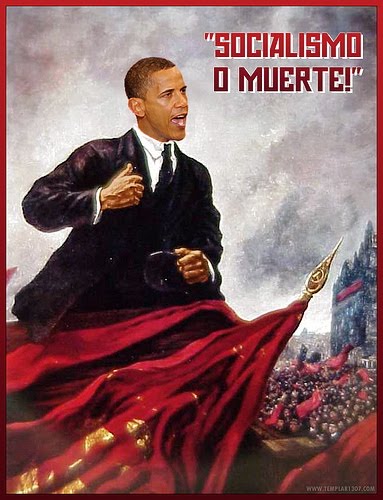
Obama the socialist. The right wing blogosphere overflows with such imagery.

Is Obama a socialist?

Reflection on the degradation of politics and the ecosystem

By Robert Jensen / The Rag Blog / September 25, 2009

[This is an expanded version of a talk given to the University Democrats student group at the University of Texas at Austin, September 23, 2009.]

For months, leftists have been pointing out the absurdity of the claim that Barack Obama is a socialist. But no matter how laughable, the claim keeps popping up, most recently in the form of the Republican Party chairman’s warning of “a socialist power grab” by Democrats.

Within the past year, Republican Sen. Jim DeMint of South Carolina has called Obama “the world’s best salesman of socialism.” Conservative economist Donald J. Boudreaux of George Mason University has acknowledged that Obama isn’t really a socialist, but warns that the “socialism lite” of such politicians “is as specious as is classic socialism.”

Silly as all this may be, it does provide an opportunity to continue talking about the promise and the limits of socialism in a moment when the economic and ecological crises are so serious. So, let’s start with the basics.

As with any complex political idea, socialism means different things to different people. But there are core concepts in socialist politics that are easy to identify, including

  1. worker control over the nature and conditions of their work;
  2. collective ownership of the major capital assets of the society, the means of production; and
  3. an egalitarian distribution of the wealth of a society.

Obama has never argued for such principles, and in fact consistently argues against them, as do virtually all politicians who are visible in mainstream U.S. politics. This is hardly surprising, given the degree to which our society is dominated by corporations, the primary institution through which capitalism operates.

Obama is not only not a socialist, he’s not even a particularly progressive capitalist. He is part of the neo-liberal camp that has undermined the limited social-democratic character of the New Deal consensus, which dominated in the United States up until the so-called “Reagan revolution.”

While Obama’s stimulus plan was Keynesian in nature, there is nothing in administration policy to suggest he is planning to move to the left in any significant way. The crisis in the financial system provided such an opportunity, but Obama didn’t take it and instead continued the transfer of wealth to banks and other financial institutions begun by Bush.

Looking at his economic advisers, this is hardly surprising. Naming neo-liberal Wall Street boys such as Timothy Geithner as secretary of the treasury and Lawrence Summers as director of the National Economic Council was a clear signal to corporate America that the Democrats would support the existing distribution of power and wealth. And that’s where his loyalty has remained.

In short: Obama and some Democrats have argued for a slight expansion of the social safety net, which is generally a good thing in a society with such dramatic wealth inequality and such a depraved disregard for vulnerable people. But that’s not socialism. It’s not even socialism lite. It’s capitalism — heavy, full throttle, and heading for the cliff.

In reaction to the issues of the day, a socialist would fight to nationalize the banks, create a national health system, and end imperialist occupations in Iraq and Afghanistan. That the right wing can accuse Obama of being a socialist when he does none of those things is one indication of how impoverished and dramatically skewed to the right our politics has become.

In most of the civilized world, discussions of policies based in socialist principles are part of the political discourse, while here they are bracketed out of any serious debate. In a recent conversation with an Indonesian journalist, I did my best to explain all this, but she remained perplexed. How can people take seriously the claim that he’s socialist, and why does applying that label to a policy brand it irrelevant? I shrugged. “Welcome to the United States,” I said, “a country that doesn’t know much about the world or its own history.”

Let’s take a moment to remember. Socialist and other radical critiques of capitalism are very much a part of U.S. history. In the last half of the 19th century, workers in this country organized against expanding corporate power and argued for worker control of factories. These ideas were not planted by “outside agitators”; immigrants at the end of the 19th and early 20th centuries contributed to radical thought and organizing, but U.S. movements grew organically in U.S. soil.

Business leaders saw this as a threat and responded with private and state violence. The Red Scare of the 19-teens and ‘20s tried to wipe out these movements, with considerable success. But radical movements rose again during the Great Depression, eventually winning the right to organize.

In the boom times after WWII, management was willing to buy off labor (for a short time, it turned out) with a larger slice of the pie in a rapidly expanding economy, and in the midst of Cold War hysteria the radical elements of the mainstream labor movement were purged. But radical ideas remain, nurtured by small groups and individuals around the country.

One of the reasons that “socialist” can be used as a slur in the United States is because that history is rarely taught. If people never hear about socialist traditions in our history, it’s easy to believe that somehow socialism is incompatible with the U.S. political and social system.

Add to this the classic tactic of presenting “false alternatives” — if the Soviet Union was the epitome of a socialist state and the only other option is capitalism, then capitalism is preferable to the totalitarianism of socialism — and it is easy to see how people might wonder if Obama is a Red to be Scared of.

This long-running campaign to eliminate critiques and/or critics of capitalism — using occasional violence and relentless propaganda — has always been a threat to basic human values and democracy. The promotion of greed and crass self-interest as the defining characteristics of human life deforms all of us and our society. The concentration of wealth in capitalism undermines the democratic features of the society. Socialist principles provide a starting place to craft a different world, based on solidarity and an egalitarian distribution of wealth.

But capitalism is not only inhuman and anti-democratic; it’s also unsustainable, and if we don’t come to terms with that one, not much else matters. Capitalism is an economic system based on the concept of unlimited growth, yet we live on a finite planet. Capitalism is, quite literally, crazy.

But on this question it’s not fair to focus only on capitalism. Industrial systems — whether operating within capitalism, fascism, or communism — are unsustainable. The problem is not just the particular organization of an economy but any economic model based on high-energy technology, endless extraction, and the generation of massive amounts of toxic waste. Extractive economies ignore the health of the underlying ecosystem, and a socialist industrial system would pose the same threat. The possibility of a decent future, of any future at all, requires that we renounce that model.

This reminds us that one of capitalism’s few legitimate claims — that it is the most productive economic system in human history in terms of output — is hardly a positive. The levels of production in capitalism, especially in the contemporary mass consumption era, are especially unsustainable.

We are caught in a death spiral, in which growth is needed to pull out of a recession/depression, but such growth only brings us closer to the edge of the cliff, or sinks the ship faster, or speeds the unraveling of the fabric of life. Pick your metaphor, but the trajectory is clear. The only question is the timing and the nature of the collapse. No amount of propaganda can erase this logic: Unsustainable systems can’t be sustained.

To demand that we continue on this path is to embrace a kind of collective death wish. So, while I endorse socialist principles, I don’t call myself a socialist, to mark a break with the politics associated with the industrial model that shapes our world. I am a radical feminist anti-capitalist who opposes white supremacy and imperialism, with a central commitment to creating a sustainable human presence on the planet. I don’t know any single term to describe those of us with such politics.

I do know that the Republican Party is not interested in this kind of politics, and neither is the Democratic Party. Both are part of a dying politics in a dying culture that, if not radically changed, will result in a dead planet, at least in terms of a human presence.

So, socialism alone isn’t the answer. In addition to telling the truth about the failures of capitalism we have to recognize the failures of the industrial model underlying traditional notions of socialism. We have to take seriously the deep patriarchal roots of all this and the tenacity of white supremacy. We have to condemn imperialism, whether the older colonial style or the contemporary American version, as immoral and criminal. We have to face the chilling facts about the degree to which humans have degraded the capacity of the ecosystem to sustain our own lives.

I’m not waiting for Obama or any other politician to speak about these things. I am, instead, working in local groups — connected in national and international networks — to create alternatives. There is no guarantee of success, but it is the work that I believe matters most. And it is joyful work when done in collaboration with others who share this spirit.

But to get there, we have to find the strength to break from the dominant culture, which is difficult. On that question, I’d like to conclude by quoting Scripture. In the Sermon on the Mount, Jesus said:

“Enter by the narrow gate; for the gate is wide and the way is easy that leads to destruction, and those who enter by it are many. For the gate is narrow and the way is hard that leads to life, and those who find it are few.” [Matt. 7:12-14]

I end with Scripture not because I think everyone should look to my particular brand of radical, non-orthodox Christianity for inspiration, but because I think the task before us demands more than new policies. To face this moment in history requires a courage that, for me, is bolstered by tapping into the deepest wisdom in our collective history, including that found in various religious traditions. We have to ask ourselves what it means to be human in this moment, a question that is deeply political and at the same time beyond politics.

At the core of these traditions is the call for humility about the limits of human knowledge and a passionate commitment to justice, both central to finding within ourselves the strength to pass through that narrow gate.

My advice to any of you who want to be part of a decent future: Find that strength wherever you find it, and step up to the narrow gate.

[Robert Jensen is a professor in the School of Journalism of the University of Texas at Austin and a board member of the Third Coast Activist Resource Center. His latest book is All My Bones Shake: Seeking a Progressive Path to the Prophetic Voice (Soft Skull Press, 2009). Jensen can be reached at rjensen@uts.cc.utexas.edu. His articles on The Rag Blog are here and his writing can also be found here.]

The Rag Blog

Posted in Rag Bloggers | Tagged , , , , , , | 8 Comments

How ACORN Took a Bite Out of Predatory Lending

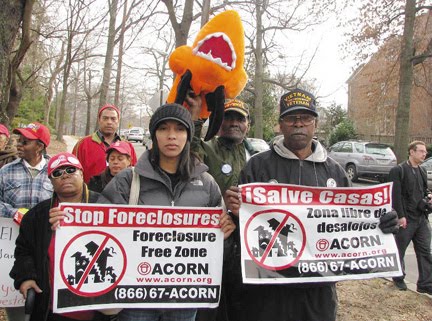
ACORN has organized low income people to fight predatory lending practices since the late 1990’s.

The ACORN I Know…

A handful of ACORN staff people with great expertise and unrelenting effort organized thousands of members to drive this campaign until Household agreed to pay victims $489 million…

By David Swanson / The Rag Blog / September 24, 2009

If someone told you that a bunch of low-income people, most of them African-American or Latino, most of them women, most of them elderly, had been victimized by a predatory mortgage lender that stripped them of much of their equity or of their entire homes, you might not be surprised.

But if I told you that these women and men had gotten together and, after three years of work, brought the nation’s largest high-cost lender to its knees, forced it to sell out to a foreign company, and won back a half a billion dollars of what had been taken from them — one of the largest consumer settlements ever — you’d probably ask me what country this had happened in.

Surely it couldn’t have been in the United States of the Second Gilded Age, the land of unbridled corporate power and radical government activism on behalf of the rich and the greedy.

Yet, it was. These victims identified a problem and named it “predatory lending” in the late 1990s. Their campaign to reform Household International (also known as Household Finance and as Beneficial) played out from 2001 to 2003, concluding with a settlement that includes a ban on badmouthing the company. That’s why more people haven’t heard about this.

The families who fought back and defeated Household are barred from bragging about it or teaching the lessons they learned, because that would require recounting the damage that Household did to homes and neighborhoods. These families are members of ACORN, the Association of Community Organizations for Reform Now.

I was ACORN’s communications coordinator during much of the Household campaign, but left before it ended. No one has asked me not to tell this story.

In low-income minority neighborhoods in the United States, what little wealth there is, is in home equity. Home equity makes up 74.9 percent of the net wealth for Hispanics in the bottom two income quintiles (0-40 percent) and 78.7 percent of the net wealth for African Americans in the second income quintile (20-40 percent).

There have been gains in minority home ownership over the past few decades, in part as a result of the work by community groups like ACORN and National People’s Action to force banks to make loans in these communities, but the home ownership is fragile and not protected by additional savings. Lenders in the past decade have focused on stripping away equity and community groups have been forced to focus on keeping out loans that are worse than no loans at all.

Most high-cost loans are refinance loans. Too often they are marketed aggressively and deceptively, including through live-checks in the mail that result in very high-cost loans that the lender will be only too happy to refinance into a new mortgage. Often these loans are made with excessive, sometimes variable, interest rates, outrageously high fees, and fees financed into the loans so that the borrower pays interest on them and often is not told about them.

They are made with bogus products built in, on which the borrower also pays interest. Hidden balloon payments force repeated refinancings for additional fees each time. Mandatory arbitration clauses attempt to prevent borrowers from taking lenders to court. The practice of loaning more than the value of a home traps borrowers in loans they cannot refinance with a responsible lender. Consolidation of additional debts further decreases equity, placing the home at greater risk. Quiet omission of taxes and insurance from a mortgage that previously included those charges results in a crisis when yearly bills arrive.

Predatory lenders turn the usual logic of lending upside down. They make their money by intentionally making loans that the borrowers will be unable to repay. They charge fees for each refinancing until finally seizing the house. Fannie Mae has estimated that as many as half of all borrowers in subprime (high-cost) loans could have qualified for a lower cost mortgage.

High-cost loans are not just made to people with poor credit. They’re often made to people who have poor banking services in their neighborhoods.

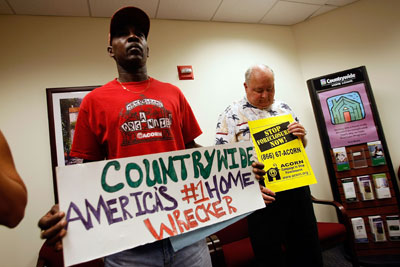
ACORN members don’t take abuse of their neighborhoods lying down, and Household was a leading cause of the rows of vacant houses appearing in ACORN neighborhoods in the 1990s. ACORN launched a campaign to reform Household that included numerous strategies. One, an ACORN stand-by, was direct action. Repeatedly, ACORN members in numerous cities around the country simultaneously protested in Household offices to demand reform.

At the same time, ACORN was working to pass anti-predatory lending legislation in local and state governments and Congress. ACORN members made sure that in each case the victims testifying were victims of Household and that Household’s abuses were highlighted. When ACORN released major reports on predatory lending, the examples included were always from Household.

ACORN also worked with the Coalition for Responsible Wealth to advance a shareholder resolution that would have tied Household’s executives’ compensation to ending its predatory lending. In 2001 Household held its shareholders meeting in an out-of-the-way suburb of Tampa, Florida. A crowd of ACORN members was there with shark suits and shark balloons to protest.

The resolution won 5 percent. Over the next year, ACORN pressured state pension funds and other shareholders. Household held its 2002 meeting an hour and a half from the nearest airport in rural Kentucky. Members made the trip by car from all over the country. The protest may have been the biggest thing the town of London, Kentucky, had seen in years. The resolution won 30 percent.

As a result, various local and state governments threatened to divest from Household. ACORN also put pressure on stores like Best Buy that used Household credit cards. At the same time, ACORN Housing Corporation was assisting many Household victims in either refinancing out of their Household loans or at least canceling some of the rip-off services built into their loans, such as credit insurance. ACORN was also getting the word out to stay away from Household.

ACORN wrote up numerous accounts of Household predatory loans and took them to the attorney generals in state after state urging investigations. ACORN similarly pressured federal regulators to act. ACORN assisted borrowers in filing a number of class-action suits against Household targeting those of its practices that were clearly illegal even under existing law. They let Wall Street analysts know what Household stood to lose from these lawsuits, as well as from various reforms that Household periodically announced in its attempt to hold off the pressure.

But ACORN members never let up. They protested again and again at Household offices and held press conferences in front of homes about to be lost to Household. They protested the secondary market that was putting up capital for these predatory loans and they held a major protest at the trade group that lobbied in Washington for Household and its fellow sharks.

Then, in the summer of 2002, in the wealthy suburbs north of Chicago, victims of Household from around the country poured out of busses by the thousands onto the lawns of the board members and the CEO of Household. They knocked on doors and spoke to those who had hurt them from a distance. When the police made them leave, ACORN members plastered “Wanted” posters all over the neighborhood telling the board members’ neighbors what crimes the Household executives were guilty of.

Through all of this, we worked the media. I kept a database of victims’ stories and contact information and put them in touch with reporters whenever the reporters were willing to tell not just the victimization story but also the story of fighting back. We generated several hundred print articles and several hundred TV and radio stories about Household’s predatory lending practices.

We worked the small neighborhood papers, flyers in churches, posters on walls. We provoked lengthy articles in the New York Times, Washington Post, Wall Street Journal, Los Angeles Times, and Forbes Magazine. We kept up an endless barrage in the trade press: the American Banker, National Mortgage News, etc.

A handful of ACORN staff people with great expertise and unrelenting effort organized thousands of members to drive this campaign until Household agreed to pay victims $489 million through the 50 states attorneys general, and later agreed to pay millions more through ACORN, as well as to reform its practices.

This campaign was an example of what can be done if enough different angles are pursued at once and the company ripping you off is put on the defensive and constantly hit with the unexpected. This campaign increased the size and power of ACORN to effect future progressive change. This is good news for low-income neighborhoods, but bad news for Wells Fargo, the predatory lender next on ACORN’s list.

[David Swanson was communications coordinator for ACORN from 2000 to 2003, and is the author of the new book Daybreak: Undoing the Imperial Presidency and Forming a More Perfect Union by Seven Stories Press. You can order it and find out when tour will be in your town:here. David Swanson was a founder of AfterDowningStreet.org, where this article also appears.]

The Rag Blog

Posted in Rag Bloggers | Tagged , , , | 1 Comment

Prisoner Tortured to Death in Arizona

In this undated photo released by the Arizona Department of Corrections, Marcia Powell, 48, is seen. Powell died Wednesday, May 19, 2009 at a hospital after spending four hours in a holding cell the day before at Arizona State Prison Complex-Perryville in Goodyear, Ariz. Department of Corrections officials did not immediately explain why Powell was placed in the holding cell. Photo: AP.

Details emerge in inmate’s heat-related death: Report describes miscommunications, policy violations
By Casey Newton / September 24, 2009

Disturbing new details emerged Wednesday in the death of Marcia Powell, an Arizona state prison inmate who died of heat-related causes after being left in an outdoor cage for hours.

The Arizona Department of Corrections’ internal investigation of Powell’s death on May 20 runs about 3,000 pages. The department announced this week that it has disciplined 16 people in connection with the incident, with five employees fired or forced to resign. A criminal investigation is ongoing.

Interviews with prison staff members, inmates and medical personnel illustrate how a series of policy violations and miscommunications led to Powell’s collapse at Arizona State Prison Complex-Perryville in Goodyear. She later died at West Valley Hospital.

Among the report’s findings:

  • Powell passed out in her cell on the morning of May 19. A few minutes before, she had announced she was suicidal. She was taken to an outdoor cage to await transfer to a psychiatric unit. But the sergeant who saw Powell lose consciousness never reported the incident to supervisors, despite the fact that Powell said she was having trouble breathing.
  • At least 20 inmates told investigators that Powell was denied water for most or all of the time she was in her cage, despite regular requests. Corrections officers said Powell was given water.
  • Powell was taking psychotropic medications that made her particularly sensitive to the heat, but medical personnel did not convey that fact to corrections officers.
  • After more than two hours in the sun, Powell requested to be taken back to her indoor cell. Her request was denied.
  • Powell was apparently denied a request to use the restroom and defecated in the cage. A corrections officer discovered that Powell had soiled herself but left her where she was. Medical personnel would later discover feces underneath her fingernails and all over her back.
  • The psychiatric unit to which Powell was awaiting transport should have accepted her hours before she died, the report found, but a series of miscommunications prevented her from being taken in.

Powell, who was serving a sentence for prostitution, said she felt suicidal at 11 a.m. on May 19 and was escorted to the outdoor cage to await transportation for psychiatric care at the prison complex detention unit.

Officers seeking to move Powell to the unit were first told that it did not have available beds. Later, another inmate in the unit refused to put handcuffs on to be taken back to her cell, causing the staff to trigger its incident command system. The incident took more than 90 minutes to resolve, during which time no other inmates were brought into the unit.

Officers monitoring Powell were wary of asking psychiatric-unit staffers to accept another inmate during the standoff, even though three beds had become available. But investigators said it would have been possible to transfer Powell, since the uncooperative inmate was locked in a secure cell.

Prison policy calls for inmates to be kept in outdoor cells for a maximum of two hours. The cells had no shade, and on the day Powell died, temperatures hit 107.5 degrees.

Officers did not properly log Powell’s time in the outdoor cell or when they checked on her. When she collapsed, no one could say for certain how long she had been there.

Doctors on the scene said Powell’s body temperature was at least 108 degrees but may have been higher, since their thermometers topped out at 108.

Charles Ryan, corrections department director, called Powell’s death “unconscionable” and “an absolute failure.”

The most bitterly disputed aspect of the case concerns whether Powell was denied water.

Nearly all of the inmates interviewed by investigators reported that Powell screamed out for water regularly but was repeatedly denied. Others said she was granted water only once or twice in nearly four hours.

“I need some water – just a drop,” one inmate overheard Powell tell a corrections officer, who reportedly ignored her.

Another inmate reported that a corrections officer mockingly repeated Powell’s requests for water back to her, without giving her any.

All of the corrections officers interviewed for the report said Powell had been given water throughout her outdoor confinement.

Both inmates and staff members said Powell’s history of mental illness and frequent erratic behavior meant that some of her requests were not taken seriously. She did not get the staff’s undivided attention until she collapsed at 2:40 p.m.

Timothy Johnson, a physician’s assistant who attempted to revive Powell, swore repeatedly at investigators when asked about Powell’s death.

“This should not have happened,” he said.

Source / Arizona Republic

Thanks to Peggy Plews / The Rag Blog

Posted in RagBlog | Tagged , , | 3 Comments

High Noon in Honduras : Zelaya, Golpistas in Standoff

Below, Manuel Zelaya outside the Brazilian embassy in Tegucigalpa, Honduras. Photo from La Prensa, San Pedro Sula. Above, a throng of Zelaya supporters at the embassy. Photo from Indymedia Honduras.

Micheletti responds with curfews, teargas…
Massive demonstrations mark Zelaya’s return

By David Holmes Morris / The Rag Blog / September 14, 2009

See more photos of the action, Below.

What began on Monday as a celebration of Manuel Zelaya’s surprise return to Honduras, on Tuesday turned into yet another struggle against the violent repression of his supporters by the golpista government that had deposed him almost three months earlier.

After he announced several times during his exile that his return was imminent and after two actual attempts to enter the country, word spread quickly on the morning of Monday, September 21, that Zelaya was at the United Nations offices in Tegucigalpa, then that he was in fact at the nearby Brazilian embassy. As zelayistas and contragolpistas gathered in great numbers outside the embassy and others made their way toward Tegucigalpa from across the country, Zelaya told reporters inside that he and four companions had traveled in secret for 15 hours through mountains and forests with the aim of negotiating the terms of his reinstatement with Roberto Micheletti and the rest of the golpista regime.

“I speak to you as commander in chief of the armed forces of Honduras, whom the people elected to lead them and who always offered them a warm handshake,” he declared in a message to supporters and, especially, to the soldiers who would soon surround them. “I appeal peacefully to your wisdom: let there be no violence in the streets. The people here with us are unarmed, shouting joyful slogans because this is a day of celebration.”

When he addressed them directly from the roof of the embassy, supporters sang Las Mañanitas in celebration partly of his return and partly of his birthday, which, coincidentally, had been the day before.

Micheletti at first dismissed news of Zelaya’s return as “media terrorism” propagated by his supporters. Zelaya, he assured reporters, was lounging in a hotel suite in Managua. His own intelligence officers had told him so.

The truth must have shocked Micheletti and would certainly have embarassed him. Zelaya and others in the resistance had been saying all along that many of the country’s military and police officers disapproved of the coup government and would in the end rebel against it. Zelaya might well have had their active support in entering the country and making his way undetected from the Nicaraguan border to the capital.

Resistance leader Juan Barahona predicted that day that the coup government would fall within 24 hours and that Micheletti would be taken prisoner. Rumors that he was already in custody were denied quickly by the pro-coup press later in the day.

Beginning early Monday, helicopters circled over the embassy and police surrounded the zelayistas but matters became more serious later when the de facto government announced a curfew throughout the country from 4:00 that afternoon until 7:00 the next morning. Some left and some stayed, vowing to spend the night outside the embassy. Around 4:00 Tuesday morning, with around 500 demonstrators still at the embassy, the police moved in with tear gas, water cannons, rubber bullets, pepper spray and, according to some, live ammunition. An unknown number were arrested, many were injured.

The curfew was extended the next day from 7:00 in the morning to 6:00 in the evening. The government closed all the airports as well.

Electric power and water to the embassy were cut off.

Zelaya supporters outside the Brazilian embassy. Photo from Indymedia Honduras.

Demonstrations against the coup government continued despite the curfew, as they had throughout the three months since the coup, but with increased determination. Soon residents of outlying neighborhoods filled their own streets, in part to oppose the golpista government and in part to voice their rage that yet another curfew was disrupting their lives, already made more difficult by economic hard times and by shortages brought about by the political crisis. The police arrived and the air began to fill with tear gas. There were more arrests and more injuries.

By the end of the day resistance leaders were saying as many as 400 people had been detained at a sports stadium in Tegucigalpa. They reported there had been at least two deaths, one of a child who died of asphyxiation from breathing tear gas and another of a 65-year-old man shot in the abdomen with a police M-16.

To the surprise of resistance leaders and the de facto government alike, citizens in considerable numbers were not only violating the curfew but were breaking into stores, including a K-Mart, and looting them, taking not just the needed food and medicine the curfew was depriving them of but consumer electronics as well.

By now international condemnation was nearly unanimous, although Hillary Clinton didn’t seem as concerned as most. “I think that the government imposed a curfew, we just learned, to try to get people off the streets so that there couldn’t be unforeseen developments,” she commented.

Micheletti announced that despite fears that he might order an assault on the embassy to arrest Zelaya, he would respect Brazilian sovereignty by allowing him to stay as long as he liked.

The golpista president also announced he was willing to negotiate with Zelaya as long as he agreed to respect the outcome of the November 29 elections. Zelaya rejected the offer as manipulation. Growing numbers of Hondurans had vowed to boycott the elections despite government threats of reprisals for doing so and most other countries had declared they would not recognize them as legitimate.

By Thursday morning, TeleSur was reporting that Zelaya had met informally in the embassy with an unnamed representative of the de facto government. The results of the meeting were not known.

Meanwhile, as of Thursday, the embassy is still without electric power and water, although drinking water has been brought in by truck. Food is being supplied by the United Nations.

[San Antonio native David Holmes Morris is an army veteran, a language major, a retired printer, a sometime journalist, and a gay liberationist.]

Manueal Zelaya in the Brazilian embassy. Photo from La Prensa, San Pedro Sula.

Graffiti: “Sí se pudo – vino Mel” (“Yes we could – Mel came back”). Photo from TeleSur.

Outside the embassy. Photo from Indymedia Honduras.

Police in action. Photo from TeleSur.

Cops fire tear gas. Photo from La Jornada, Mexico City.

Demonstrators flee tear gas. Photo from La Jornada, Mexico City.

Tear gas takes its toll. Photo from La Jornada, Mexico City.

Neighborhood kids protect against tear gas.Photo from Indymedia Honduras.

Beaten by the police. Photo from Indymedia Honduras.

The aftermath. Photo from La Jornada, Mexico City.

The Rag Blog

Posted in Rag Bloggers | Tagged , , | Leave a comment

Rabbi Arthur Waskow: Yom Kippur and the Middle East : Our Misdeeds and Theirs

Rabbi Rebecca Alpert blows Shofar at Fast for Gaza event at Liberty Bell in Philadelphia. At right is Rabbi Arthur Waskow.

We are called to reexamine our actions

Jews — and all others who care for peace — must act in new ways to turn toward compassion, truth, justice, and peace.

By Rabbi Arthur Waskow / The Rag Blog / September 24, 2009

During these days between Rosh Hashanah and Yom Kippur, Jews are called on to reexamine our own actions — our “missings of the mark.” The emphasis is on OUR sins — not those of individuals alone, but of the community — and the sins of ourselves, not of other people, even our enemies. We are also called on not only to confess our misdeeds but CHANGE what we do.

In that light, the Israeli government’s recent behavior flies in the face of this profound Jewish wisdom. So Jews — and all others who care for peace — must act in new ways to turn toward compassion, truth, justice, and peace.

Two major actions we might take NOW, at this solemn time of year:

  • joining the Jewish and Interfaith Fast for Gaza; and
  • signing up for the Conference called by 18 pro-Israel, pro-peace organizations, including The Shalom Center, that will be held in Washington DC October 25-28. Links and details are below.

Against the consensus of almost all decent and democratic opinion in the world, the present Israeli government has:

  1. Continued the blockade of civilian goods from entering Gaza, imposing malnutrition, homelessness, abysmal poverty, and despair on its people;
  2. Denounced the Goldstone report on the commission of probable war crimes by BOTH Hamas and the Israeli government during and since the Gaza War;
  3. Continued to destroy Palestinian homes, disrupt Palestinian neighborhoods, and insert Israeli settlers in East Jerusalem;
  4. Continued sending more settlers into the Palestinian West Bank.

I want to say a bit more about the Goldstone report. Before Goldstone, it had smelly origins — commissioned by an anti-Israel corner of the UN. But through the workings of international politics in the direction of justice, the job was handed to an affirmative Jew with strong Zionist connections, a giant of international law, who insisted on studying the possibility of war crimes by both Hamas and the government of Israel.

The report finds high probability that on both sides there were war crimes, cites the evidence in great detail, and asserts the need for formal judicial investigation by both governments. It proposes giving both six months to do this, and if they fail, asking the Security Council to refer the evidence to the International Criminal Court.

Eminently sensible.

As the ancient rabbis said, the glory of human wisdom begins in a smelly drop (of semen). So what? The content of the report is the point. Its 600-plus pages of evidence are the point. Its truth or falsity, not its smelly origins, are the point.

The U.S. government’s critique of the Goldstone Report, as voiced by Ambassador Susan Rice, is rooted in this fallacy of origins. It almost signals the silliness of this approach by then urging that all action on the report be confined to precisely this smelly corner of the UN, rather than to other places that are far more just. More likely, beneath this fallacious rhetoric was a policy evasion of the duty of all governments to make sure that if war crimes were committed, they are punished.

Goldstone himself is a distinguished South African Jew whose daughter has called him a Zionist, who took an important role in the truth and reconciliation process in South Africa, and who served as chief prosecutor of the United Nations International Criminal Tribunals for the former Yugoslavia and for Rwanda from 1994 to 1996. He was a member of the Commission of Enquiry into the Activities of Nazism in Argentina (CEANA) which was established in 1997 to identify Nazi war criminals who had emigrated to Argentina, and transferred victim assets (Nazi gold) there.

From the beginning, his UN task was to look into possible war crimes by both sides in the Gaza War. He attempted to interview Israelis who had been attacked in Sderot, but his team was denied entry to Israel. So the commission paid to have Israeli witnesses travel to where their evidence could be heard.

The Israeli government’s hostility from the git-go seems to me the behavior of a guilty party that did not want even-handed judgment, even if that meant its enemies as well as itself were judged.

The Goldstone Report indeed said there was serious evidence of specific war crimes by both sides, and called for judicial trials. President Shimon Peres of Israel attacked the report in the following terms:

“War itself is a crime. The aggressor is the criminal. The side exercising self-defense has no other alternative.
[….]
“The report legitimizes terrorist activity, the pursuit of murder and death. The report disregards the duty and right of self defense, held by every sovereign state as enshrined in the UN Charter.”

There are two falsehoods in this statement. First, far from “legitimizing” terrorist activity, the report describes it as a war crime. Secondly, Mr. Peres ignored the truth of international law that even a war of “self-defense” has limits in how it can be fought. For example, white phosphorus cannot be used against civilians. The Palestinians, of course, claim that their war was one of self-defense. But even if it were, it was forbidden to fight it by attacking civilian neighborhoods.

The Israeli government could have responded by saying it welcomed full judicial process and would live by its result. Its actual response therefore compounds its original misdeeds.

Let me then propose an action agenda for tshuvah (repentance and change) for this sacred time, and beyond:

1. Join the Jewish Fast for Gaza (Taanit Tzedek) — a one day a month fast to call for an end to the blockade of civilian items and a decision by the U.S. and Israeli governments to negotiate with the Gaza leadership. Four weeks ago, the founders of the Fast — Rabbis Brian Walt and Brant Rosen — were personally attacked for their work by an Israeli with words like “borderline anti-Semitic.”

In fact, Rabbis Walt and Rosen are Reconstructionist rabbis of great honor and repute. Rabbi Walt founded a vibrant and flourishing congregation in Philadelphia, Mishkan Shalom, and left it to devote full-time work to Rabbis for Human Rights/ North America, directing its support for RHR in Israel and its work to oppose the use of torture by the U.S. government. Rabbi Rosen leads the Jewish Reconstructionist Congregation of Evanston Illinois, which among other notable feats, totally rebuilt its building to the level of green effectiveness worthy to receive the LEED Platinum designation, alone among all U.S. synagogues.

Their response to that attack on them and the Fast for Gaza (which has been affirmed by more than 70 rabbis, as well as a number of Christian clergy and Imams and hundreds of others) has now been published by the Jerusalem Post. Notably, it utterly refrains from name-calling or recriminations against their attacker, and focuses on the facts about Gaza that gave rise to the Taanit Tzedek.

To read their response and join the Fast, click here.

2. Sign up for the unprecedented conference on October 25-28 in Washington DC called by J Street and 17 other pro-Israel, pro-peace organizations, including The Shalom Center, to work for US policy to become serious and unremitting for a two-state peace, including support for the Obama Administration’s demand for a total freeze on all increase of Israeli settlers or settlements on the West Bank and East Jerusalem. Click here.

Shalom, salaam, shantih — Peace!

Arthur

P.S. Meanwhile, part of the American Jewish official leadership has urged all American rabbis to use the High Holy Days to emphasize the sins of the present government of Iran against its own people, against the history and legitimacy of the Jewish people, and against international comity and concern. This effort called for tougher sanctions against Iran. Those sins are real and glaring, and should be addressed not only by Jews but by veryone committed to peace.

But focusing only on them at this moment — when we are wisely taught to address our own misdeeds — encourages American Jews to turn away from acknowledging and addressing the sins of the two governments that might be considered “ours”: the US and Israeli governments.

And when we do turn to the Iranian misdeeds, I think tougher sanctions are likely to unify the Iranian people to support even a government they loathe against what they will see as foreign “oppression,” rather than encouraging them to strengthen their resistance to Ahmadinejad. We should discuss ways to do the second.

P.S. 2. I came through my leg surgery last Friday fairly well, and I expect to leave the hospital Wednesday or Thursday. We are once more seeking the insurance company’s support to go to an intensive rehab facility. I’ll keep you updated. I did make some new discoveries about the relationship of patient pain to physicians’ judgments. That deserves its own report.

  • Written to chevra, from Hahnemann Hospital, September 22 / 4 Tishrei

[Rabbi Arthur Waskow is director of The Shalom Center. He can be reached at awaskow@shalomctr.org.]

The Rag Blog

Posted in Rag Bloggers | Tagged , , , , , , , , , | Leave a comment

Diebold and the Electronic Vote : The Rig is Up

Cartoon by M.e. Cohen / HumorInk.com.

Your electronic vote in the 2010 election has just been bought

The ES&S purchase of Diebold’s voting machine operation is merely the tip of a toxic iceberg…

By Bob Fitrakis and Harvey Wasserman / The Rag Blog / September 24, 2009

Unless U.S. Attorney General Eric Holder intervenes, your electronic vote in 2010 will probably be owned by the Republican-connected ES&S Corporation. With 80% ownership of America’s electronic voting machines, ES&S could have the power to shape America’s future with a few proprietary keystrokes.

ES&S has just purchased the voting machine division of the Ohio-based Diebold, whose role in fixing the 2004 presidential election for George W. Bush is infamous.

Critics of the merger hope Holder will rescind the purchase on anti-trust grounds.

But only a transparent system totally based on hand-counted paper ballots, with universal automatic voter registration, can get us even remotely close to a reliable vote count in the future.

For even if Holder does void this purchase, ES&S and Diebold in tandem will still control four of every five votes cast on touchscreen machines. As the U.S. Supreme Court seems poised to open the floodgates on corporate campaign spending, the only difference could be that those who would buy our elections will have to write two checks instead of one.

And in fact, it’s even worse than that. ES&S, Diebold and a tiny handful of sibling Republican voting equipment and computing companies control not only the touchscreen machines, but also the electronic tabulators that count millions of scantron ballots, AND the electronic polling books that decide who gets to vote and who doesn’t.

Let’s do a quick review:

  1. ES&S, Diebold and other companies tied to election hardware and software are owned and operated by a handful of very wealthy conservatives, or right-to-life ideologues, with long-standing direct ties to the Republican Party;
  2. As votes will be increasingly cast on optiscans, touchscreens or computer voting machines in the United States in 2010, the scant few so-called paper trail mechanisms that are in place will offer little security against electronic vote theft;
  3. The source code on all U.S. touchscreen machines now used for the casting and counting of ballots is proprietary, meaning the companies that own and operate the machines — including ES&S — are not required to share with the public the details of how those machines actually work;
  4. Although there are official mechanisms for monitoring and recounts, none carry any real weight in the face of the public’s inability to gain control or even access to this electronic source code, whose proprietary standing has been upheld by the courts;
  5. With the newly merged ES&S/Diebold now apparently controlling 80% of the national vote through hardware and software, this GOP-connected corporation will have the power to alter virtually every election in the U.S. with a few keystrokes. Unless there is a massive, successful grassroots campaign between now and 2012, the same will hold true for the next US presidential election;
  6. Aside from its control of touchscreen machines, the merged Diebold/ES&S also controls a significant percent of the electronic optiscan tabulators to count cards on which voters use pencils to fill in circles, indicating their vote. Accounts of fraud, rigging, theft and abuse of these optiscan systems are well-documented and innumerable. Any corporation that prints these ballots and runs the machines designated to count them can control yet another major piece of the US vote count;
  7. The merged ES&S/Diebold now also controls the electronic voter registration systems in many counties and states. With that control comes the ability to remove registered voters without significant public accountability. In the 2004 election, nearly 25% of all the registered voters in the Democratic-rich city of Cleveland were purged, including 10,000 voters erased “accidentally” by a Diebold electronic pollbook system. So in addition to controlling the vote counts on touchscreen and optiscan voting machines, the merged Diebold/ES&S and sympathetic hardware and software companies that service computerized voting equipment will control who actually gets to cast a vote in the first place.

Lest we forget: in 2000, long before this ES&S/Diebold purchase was proposed, Choicepoint, a GOP-controlled data management firm, hired by Florida’s Republican Secretary of State Katherine Harris, removed up to 150,000 Florida citizens from voter rolls on the pretense that they were ex-felons. The vast majority of them were not.

Computer software “disappeared” 16,000 votes from Al Gore’s column at a critical moment on election night, allowing George W. Bush’s first cousin John Ellis, a Fox News analyst, to proclaim him the winner. The election was officially decided by less than 700 votes and a 5-4 Supreme Court vote preventing a full recount. An independent audit later showed Gore was the rightful winner.

In 2004, more than 300,000 Ohio citizens were removed from voter rolls by GOP-controlled county election boards (more than one million have been removed since).

Various dirty tricks prevented still tens of thousands more Ohioans from voting. The vote count was marred by a wide range of official manipulations coordinated by then-Ohio Secretary of State J. Kenneth Blackwell.

Diebold was a major player in the 2004 Ohio elections, but was joined by numerous other computer voting firms and their technicians in “recounting the vote” which confirmed the Bush “victory,” despite exit poll results and other evidence to the contrary. In defiance of a federal court order, 56 of 88 Ohio counties destroyed some or all of their ballots or election records. No one has been prosecuted.

In short, the ES&S purchase of Diebold’s voting machine operation is merely the tip of a toxic iceberg. Voiding the merger will do nothing to solve the REAL problem, which is an electronic-based system of voter registration and ballot counting that is potentially controlled by private corporations and contractors whose agenda is to make large profits and protect the system that guarantees them.

Although elections based on universal automatic registration and hand-counted paper ballots are not foolproof, they constitute a start. Stealing an election by stuffing paper ballot boxes at the “retail” level is far more difficult than stealing votes at the “wholesale” level with an electronic flip of a switch.

As it’s done in numerous other countries throughout the world, the only realistic means by which the U.S. can establish a democratic system of ballot casting and counting is to do it the old-fashioned way. With human-scale checks and balances we might even be secure in the knowledge that our elections and vote counts will truly reflect the will of the people. What a concept!

[Bob Fitrakis and Harvey Wasserman have co-authored four books on election protection, available at freepress.org at, where this article also appears, and where Bob’s Fitrakis Files are also available. Harvey Wasserman’s History of the U.S. is at harveywasserman.com.]

The Rag Blog

Posted in Rag Bloggers | Tagged , , , , | 2 Comments

Speaking Tea Bag : English as a Second Language

Graphic statement by Larry Ray / The Rag Blog

The Rag Blog / Sept. 23, 2009

Posted in Rag Bloggers | Tagged , | 3 Comments

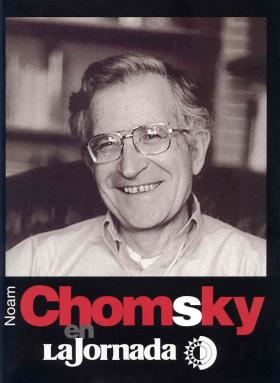
Chomsky on Health Care Reform in America

Despite its age, this video from Noam Chomsky covers some of the key issues and facts concerning the health care reform debate, and in terms that are easy to understand.

Richard Jehn / The Rag Blog

The Rag Blog

Posted in RagBlog | Tagged , , , | 2 Comments

G-20 Pittsburgh: Welcome to Police State America

Police officers go through their initial drills in July 2009 for G-20 protest response.
Photo: Darrell Sapp/Pittsburgh Post-Gazette.

Police Harassment Greets G-20 Protesters
By Robert S. Eshelman / September 22, 2009

Pittsburgh plays host this week to the G-20 summit, a gathering of leaders of the world’s largest national economies and the European Union. And, as with many past international summits, protest groups are embroiled in legal battles over their ability to voice opposition to international political and corporate elites.

On Tuesday morning, lawyers for the ACLU of Pennsylvania and the Center for Constitutional Rights presented arguments before US District Court Judge Gary Lancaster describing a pattern of unconstitutional searches and seizures on the part of local law enforcement against two protest groups–the Seeds of Peace Collective and the Three Rivers Climate Convergence (3RCC).

The ACLU/CCR suit, filed Monday, details how over the past several days Seeds of Peace workers have been systematically harassed by Pittsburgh police. This past Friday, police confiscated a school bus from which the group serves food to demonstrators. The group was able to retrieve the bus later that night but only after paying a fine. On Sunday, the Pittsburgh residence where the group was based was raided by more than thirty police officers armed with submachine guns, who demanded to search the premises for weapons.

Seeds of Peace Collective member Max Granger told The Nation: “By providing logistical support, primarily food and medical assistance for social justice mobilizing, Seeds of Peace is playing an integral role in making it possible for people to express their First Amendment rights. Because of this, we have become a primary target for those who wish to repress this expression, such as the Pittsburgh Police, Secret Service and Homeland Security.”

As of Tuesday at 3 pm, Judge Lancaster had not issued a ruling on the ACLU/CCR request for an injunction against further unconstitutional searches and seizures by Pittsburgh police.

Several groups, including 3RCC, have been denied permits for overnight camping in city parks during the week of demonstrations. The city has restricted use by protesters of several city parks to the hours of 6 am to 11 pm. 3RCC has set up a Climate Convergence Camp in Pittsburgh’s Schenley Park. Another encampment highlighting the plight of women refugees, set up by Code Pink, is located in downtown Pittsburgh’s Point State Park.

Tuesday’s legal arguments are the latest in a long-running legal confrontation with the City of Pittsburgh in the run-up to this week’s protests. For several weeks protest groups have been unable to acquire city permits for use of several public parks and for protest routes that allow demonstrators to march within sight and sound of the G-20 conference.

Meanwhile, even legally permitted protests have faced severe constraints by local law enforcement. On Sunday evening, a 400-person march demanding that the G-20 pay greater attention to the plight of workers who have lost their jobs as a result of the international financial crisis was momentarily halted by police, who alleged that the group did not have a permit, which it did have. Then on Tuesday morning the police similarly blocked an interfaith march downtown, which was also legally permitted. Police said they were responding to a request by convention center staff to route the march away from the facility.

Witold Walczak, state director of the ACLU, pointed out to the Pittsburgh Post-Gazette that the area around the convention center “isn’t private property; it’s public property. It’s a through street, and they had a permit.”

He added: “The more distressing thing for me is that the first two demonstrations that were the subject of a federal court lawsuit got bungled by the police, and bungled in a way that they tried to restrict activity. It’s either sheer incompetence or something more insidious. It’s one or the other, and neither is very flattering.”

David Meieran, an organizer with 3RCC, described to The Nation the level of police intimidation during the group’s activities. “Not only have we not received our permit,” he said, “but the vehicles that are related to our climate camp, including the [vehicle belonging to] Seeds of Peace, have been continually harassed by police, some with assault weapons, from many different law enforcement agencies.”

Explaining the rational for the ACLU/CCR suit, Meieran said, “We’re now back in court demanding that the judge enjoin the city against further harassment, confiscation of vehicles and arrests.”

As barricades are put into place and the police presence downtown becomes more noticeable, few people on the ground in Pittsburgh seem confident that the court will remove impediments to this week’s protests.

© 2009 The Nation

Source / The Nation

The Rag Blog

Posted in RagBlog | Tagged , , | 1 Comment

CodePink in Austin : Mourning the War Dead

CodePink’s Fran Hanlon leads a Mourning March across the Congress bridge Monday in Austin, to inform the public of the war’s death toll. Photo by Michael Baldon / The Daily Texan.

CodePink for peace, not blood
Mourners march against death toll of Afghanistan, Iraq wars

By Hannah Jones / September 23, 2009

Activists walked silently down Congress Avenue in Austin Monday, carrying three small coffins draped in American, Iraqi and Afghan flags.

CodePink Austin, a branch of the national grassroots organization formed by women, organized the memorial as part of the United Nation’s International Day of Peace to honor the lives lost in the wars in Iraq and Afghanistan.

CodePink is a women’s peace and social justice movement that seeks positive change through creative action, according to their Web site.

Eleven members of CodePink assembled at Austin City Hall on Monday evening to begin their procession to and from the Ann Richards Congress Avenue Bridge. The members wore all black, including black veils, to mourn the deaths and neither spoke nor reacted to onlookers.

“It’s really sad there’s not more people here for peace” said member Mac McKaskle. “We keep losing and losing the war.”

In addition to the coffins, the mourners carried tombstones inscribed with the death toll from each of the three countries. According to the tombstones, about 1,000,000 Iraqis, 28,000 Afghans and 5,180 U.S. soldiers have died.

The members of CodePink said that they got their statistics from British Medical Journal, Human Rights Watch and the U.S. Department of Defense. A Sept. 18 Reuters report put the number of Iraqi civilian deaths between 93,108 and 101,608.

“Some numbers people dispute,” said CodePink member Jim Turpin. “We’re trying to make this real for people and for them to see the numbers.”

Although there were fewer than a dozen mourners present at the march, many cars and pedestrians reacted to the 40-minute procession by honking and flashing peace signs.

“It was very respectful,” Turpin said.

Many CodePink members have been active in promoting peace for a long time. As a former UT student, Jamie Josephs said she marched in 1974 on campus to demonstrate against the violence in Cambodia at the time.

“We have to make the idea of peace visible,” Josephs said. “If it doesn’t affect people right here, right now, it doesn’t matter.”

Source / The Daily Texan

Thanks to Heidi Turpin / The Rag Blog

Posted in RagBlog | Tagged , , , , | Leave a comment