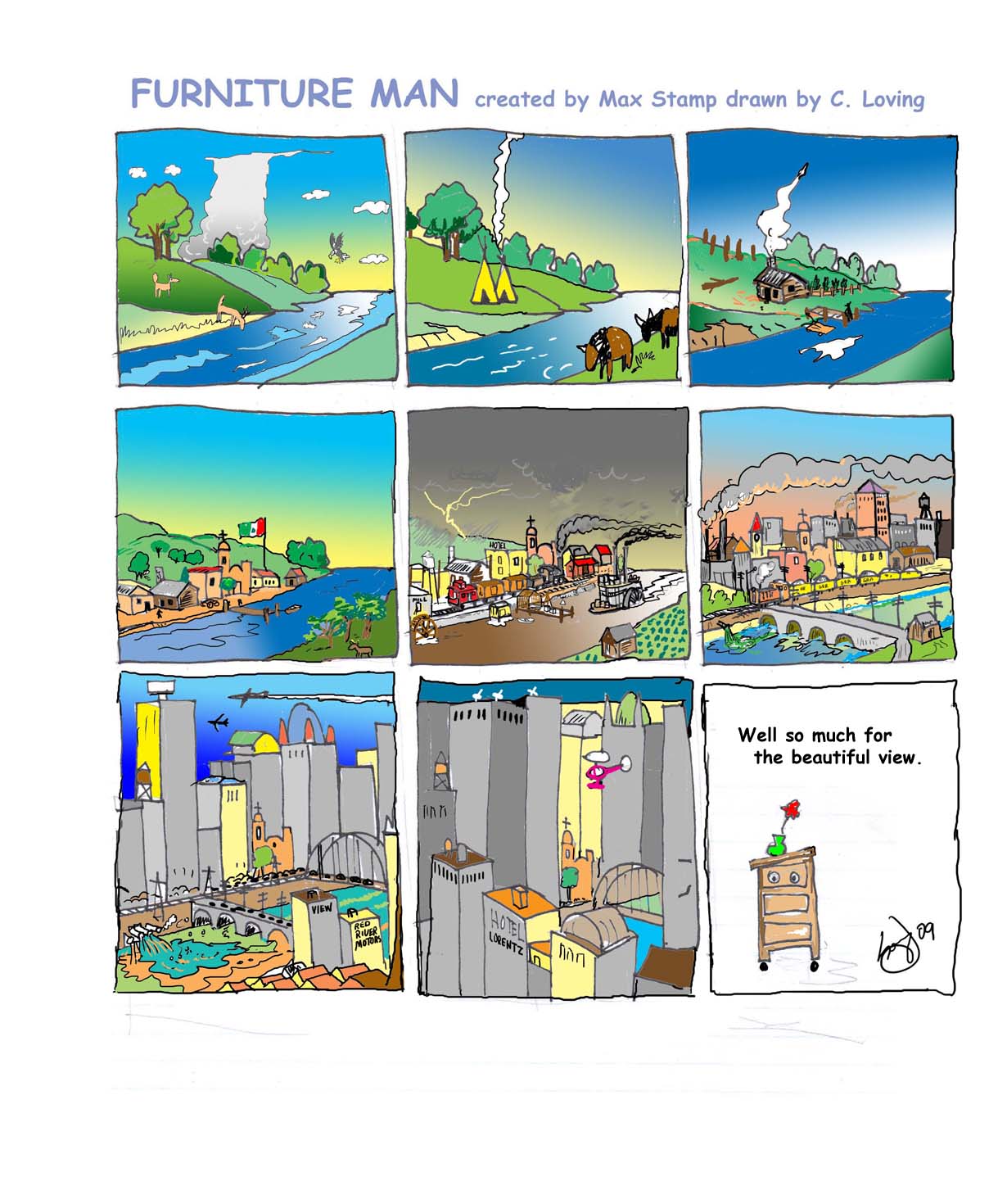
Charlie Loving: The View

Click to Enlarge

Cartoon by Max Stamp & Charlie Loving / The Rag Blog

Posted in Rag Bloggers | Tagged , | 2 Comments

World Hunger Spiralling Out of Control Because of Capitalist Profit System

Copyright: WFP/Rein Skullerud.

UN reports 1 billion of the world’s people going hungry
By Jerry White / September 18, 2009

For the first time in history, more than one billion people, or nearly one in every 6 inhabitants of the planet, are going hungry this year, according to a new report from the United Nations’ World Food Program (WFP). Chronic poverty, still high food prices and the impact of the world economic crisis have led to a sharp increase in the number of hungry people, now larger than the combined populations of the United States, Canada and the European Union.

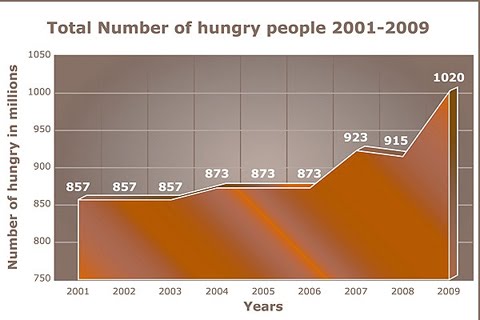
The total number of hungry people has shot up by nearly 200 million over the last decade. After a small decline between 2007 and 2008, world hunger rose sharply as the impact of the economic crisis hit, rising from 915 million in 2008 to an estimated 1.02 billion this year. [See graph]

While disasters, such as floods or droughts, cause temporary food shortages, these emergencies accounted for only 8 percent of the world’s hungry population, the WFP said. Nor is the problem caused by a shortage of food production, which at current levels is sufficient to feed the world’s population.

The source of the catastrophe is the capitalist profit system and, in particular, the continued oppression of the poorest countries in sub-Saharan Africa and Asia. Sixty-five percent of the world’s hungry people live in just six countries: India, China, the Democratic Republic of Congo, Bangladesh, Indonesia, Pakistan and Ethiopia.

The various IMF-dictated “development” programs imposed on these countries have chiefly benefited the banks in London, New York and Tokyo—which have sucked out hundreds of billions in interest payments—as well as the native ruling elites. Falling commodity prices for raw materials have also reduced revenues, while speculation on food has also driven up costs.

According to an article on the WFP report on Livescience.com, aid programs had made certain inroads in fighting hunger at the end of the 20th century. However, rising food prices have all but negated those efforts, causing the number of hungry to rise again everywhere except in Latin America and the Caribbean. The rising cost of food caused the number of hungry to jump by 75 million in 2007 and 40 million in 2008.

“The double whammy of the financial crisis and the still record high food prices around the world is delivering a devastating blow to the world’s most vulnerable,” WFP Executive Director Josette Sheeran told a London press conference Wednesday. “They have been squeezed so much that many have lost what few assets they owned, further exposing them to hunger. Now, it only takes a drought or storm to provoke a disaster.”

The present crisis also underscores the criminal misallocation of financial resources by governments around the world. Sheeren noted that the $3 billion the agency needed to cover its budget shortfall and continue providing food to 108 million people around the world was less than 0.01 percent—or one-hundredth of one percent—the amount spent by world governments on the bailout of the banks and other financial institutions.

While hunger has reached record levels, she said, food aid has fallen to a 20-year low. The WFP said it would have to drastically cut food aid by October because it had only raised less than half of its $6.7 billion budget.

In Kenya, where drought and high food prices have pushed nearly 4 million people into hunger, the WFP said it was preparing to reduce rations.

In Guatemala, its program to provide food supplements to 100,000 children and 50,000 pregnant and lactating women was “hanging by a thread.” Almost half of the children in the Central American country are chronically malnourished—the sixth highest level in the world—and the government has recently declared a “State of National Calamity” due to a shortage of food to feed hungry rural communities.

The WFP reported these stark statistics:

• An estimated 146 million children in developing countries are underweight
• Every six seconds a child dies because of hunger and related causes
• More than 60 percent of chronically hungry people are women

A host of irreversible physical ailments can be caused by undernourishment—the insufficient intake of calories to meet minimum physiological needs—and malnutrition—the lack of sufficient levels of proteins, vitamins and other nutrients.

The most common form of malnutrition is iron deficiency, Livescience.com noted, which affects billions worldwide and can impede brain development. Vitamin A deficiency affects 140 million preschool children in 118 countries and is the leading cause of child blindness. It also kills one million infants a year, according to UNICEF.

Iodine deficiency affects 780 million people worldwide. Babies born to iodine deficient mothers can have mental impairments, the web site noted. Zinc deficiency results in the deaths of about 800,000 children each year and weakens the immune system of young children.

The desperation facing millions produced tragedy Monday when a stampede of people seeking free food in the southern Pakistan port city of Karachi left up to 20 impoverished women and children dead. Officials said they were crushed in a stairwell and alley, as hundreds lined up to get free flour from charity workers.

Police and other witnesses told the Agence France-Presse (AFP) that a private security guard in charge of making sure the women stayed in line charged them with a baton when they became impatient with the long wait. An injured woman, Salma Qadir, 40, said the women wanted to get their rations quickly but were beaten by the guard. “The women got scared and tried to turn back, which scared others and resulted in a stampede,” she told the AFP.

The narrow streets of the market area were reportedly teeming with hundreds of poor people seeking scarce wheat and sugar. Poverty levels in the city of 14 million people have been on the rise along with food prices, which government officials blame on hoarding by mills and large wholesalers. The BBC reported that Pakistan’s government had recently ordered a crackdown against such hoarding, “[b]ut this failed to materialize thus far due to the lobby’s massive influence in Pakistan’s parliament.”

According to the World Food Program, 85 percent of the South Asian country’s 173 million people live on less than US$2 a day. Hunger in the country has been exacerbated by world financial breakdown, skyrocketing food prices and the US-backed war in Pakistan’s North West Frontier Province and tribal areas, which has driven millions from their homes. Currently the WFP is trying to provide daily food rations to 100,000 displaced people in the war-torn area.

Copyright © 1998-2009 World Socialist Web Site

Source / World Socialist Web Site

Thanks to Deva Wood / The Rag Blog

Posted in RagBlog | Tagged , , | 2 Comments

Conspiracy Nation : Barack Obama and the Right-Wing Demagogues

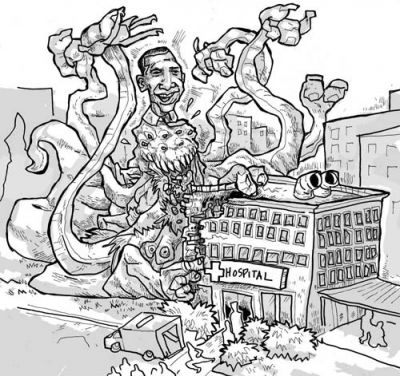
Illustration by Gino Barzizza / The Indypendent.

Conspiracy Nation:

Right-wing demagogues reach out to a supposedly beleagured white middle class, telling them they are being squeezed by parasitic traitors from above and below.

By Chip Berlet / September 18, 2009

Even before Barack Obama was sworn in as the 44th president of the United States, the internet was seething with lurid conspiracy theories exposing his alleged subversion and treachery.

Among the many false claims: Obama was a secret Muslim; he was not a native U.S. citizen and his election as president should be overturned; he was a tool of the New World Order in a plot to merge the government of the United States into a North American union with Mexico and Canada.

Within hours of Obama’s inauguration, claims circulated that Obama was not really president because Supreme Court Chief Justice John Roberts scrambled the words as he administered the oath of office. A few days after the inauguration came a warning that Obama planned to impose martial law and collect all guns.

Many of these false claims recall those floated by right-wing conspiracy theorists in the armed citizens’ militia movement during the Clinton administration — allegations that percolated up through the media and were utilized by Republican political operatives to hobble the legislative agenda of the Democratic Party.

The conspiracy theory attacks on Clinton bogged down the entire government. Legislation became stuck in congressional committees, appointments to federal posts dwindled and positions remained unfilled, almost paralyzing some agencies and seriously hampering the federal courts.

A similar scenario is already hobbling the work of the Obama administration. The histrionics at congressional town hall meetings and conservative rallies is not simply craziness — it is part of an effective right-wing campaign based on scare tactics that have resonated throughout U.S. history among a white middle class fearful of alien ideas, people of color and immigrants.

Unable to block the appointment of Sonia Sotomayor to the U.S. Supreme Court, the right-wing media demagogues, corporate political operatives, Christian right theocrats, and economic libertarians have targeted healthcare reform and succeeded in sidetracking the public option and single-payer proposals.

A talented environmental adviser to the Obama administration, Van Jones, was hounded into resigning Sept. 5 by a McCarthyite campaign of red-baiting and hyperbole. Support for major labor law reform has been eroding.

With a wink and a nod, right-wing apparatchiks are networking with the apocalyptic Christian right and resurgent armed militias — a volatile mix of movements awash in conspiracy theories. Scratch the surface and you find people peddling bogus conspiracy theories about liberal secular humanists, collectivist labor bosses, Muslim terrorists, Jewish cabals, homosexual child molesters and murderous abortionists.

This right-wing campaign is about scapegoating bogus targets by using conspiracy theories to distract attention from insurance companies who are the real culprits behind escalating healthcare costs.

Examples of right-wing conspiracy theories include the false claim that healthcare reform will include government bureaucrat “Death Panels” pulling the plug on grandma. Another is the claim that Obama is appointing unconstitutional project “Czars” More fraudulent conspiracy theories are being generated every week.

The core narrative of many popular conspiracy theories is that “the people” are held down by a conspiracy of wealthy secret elites manipulating a vast legion of corrupt politicians, mendacious journalists, propagandizing schoolteachers, nefarious bankers and hidden subversive cadres.

This is not an expression of a healthy political skepticism about state power or legitimate calls for reform or radical challenges to government or corporate abuses. This is an irrational anxiety that pictures the world as governed by powerful long-standing covert conspiracies of evildoers who control politics, the economy, and all of history. Scholars call this worldview “conspiracism.”

The term conspiracism, according to historian Frank P. Mintz, denotes a “belief in the primacy of conspiracies in the unfolding of history.” Mintz explains:

“Conspiracism serves the needs of diverse political and social groups in America and elsewhere. It identifies elites, blames them for economic and social catastrophes, and assumes that things will be better once popular action can remove them from positions of power. As such, conspiracy theories do not typify a particular epoch or ideology.”

When conspiracism becomes a mass phenomenon, persons seeking to protect the nation from the alleged conspiracy create counter movements to halt the subversion. Historians dub them countersubversives.

The resulting right-wing populist conspiracy theories point upward toward “parasitic elites” seen as promoting collectivist and socialist schemes leading to tyranny. At the same time, the counter-subversives point downward toward the “undeserving poor” who are seen as lazy and sinful and being riled up by subversive community organizers. Sound familiar?

Right-wing demagogues reach out to this supposedly beleaguered white middle class of “producers” and encourage them to see themselves as being inexorably squeezed by parasitic traitors above and below. The rage is directed upwards against a caricature of the conspiratorial “faceless bureaucrats,” “banksters” and “plutocrats” rather than challenging an unfair economic system run on behalf of the wealthy and corporate interests. The attacks and oppression generated by this populist white rage, however, is painfully felt by people lower on the socio-economic ladder, and historically this has been people of color, immigrants and other marginalized groups.

It is this overarching counter-subversive conspiracy theory that has mobilized so many people; and the clueless Democrats have been caught unaware by the tactics of right-wing populism used successfully for the last 100 years and chronicled by dozens of authors.

The techniques for mobilizing countersubversive right-wing populists include “tools of fear”: dualism, demonization, scapegoating, and apocalyptic aggression.

When these are blended with conspiracy theories about elite and lazy parasites, the combination is toxic to democracy.

Dualism

Dualism is simply the tendency to see the world in a binary model in which the forces of absolute good are struggling against the forces of absolute evil. This can be cast in religious or secular story lines or “narratives.”

Scapegoating

Scapegoating involves wrongly stereotyping a person or group of people as sharing negative traits and blaming them for societal problems, while the primary source of the problem (if it is real) is overlooked or absolved of blame. Scapegoating can become a mass phenomenon when a social or political movement does the stereotyping. It is easier to scapegoat a group if it is first demonized.

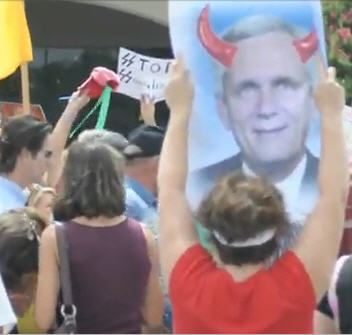
Teabaggers depicted progressive Austin Cong. Lloyd Doggett with devil’s horns.

Demonization

Demonization is a process through which people target individuals or groups as the embodiment of evil, turning individuals in scapegoated groups into an undifferentiated, faceless force threatening the idealized community. The sequence moves from denigration to dehumanization to demonization, and each step generates an increasing level of hatred of the objectified and scapegoated “Other.”

One way to demonize a target group is to claim that the scapegoated group is plotting against the public good. This often involves demagogic appeals.

Conspiracism

Conspiracism frames demonized enemies “as part of a vast insidious plot against the common good, while it valorizes the scapegoater as a hero for sounding the alarm.” Conspiracist thinking can move easily from the margins to the mainstream, as has happened repeatedly in the United States. Several scholars have argued that historic and contemporary conspiracism, especially the apocalyptic form, is a more widely shared worldview in the United States than in most other industrialized countries.

Conspiracism gains a mass following in times of social, cultural, economic, or political stress. The issues of immigration, demands for racial or gender equality, gay rights, power struggles between nations, wars — all can be viewed through a conspiracist lens.

Historian Richard Hofstadter established the leading analytical framework in the 1960s for studying conspiracism in public settings in his essay, “The Paranoid Style in American Politics.” He identified “the central preconception” of the paranoid style as a belief in the “existence of a vast, insidious, preternaturally effective international conspiratorial network designed to perpetrate acts of the most fiendish character.”

According to Hofstadter, this was common in certain figures in the political right, and was accompanied with a “sense that his political passions are unselfish and patriotic” which “goes far to intensify his feeling of righteousness and his moral indignation.”

According to Michael Barkun, professor of political science at Syracuse University, conspiracism attracts people because conspiracy theorists “claim to explain what others can’t. They appear to make sense out of a world that is otherwise confusing.” There is an appealing simplicity in dividing the world sharply into good and bad and tracing “all evil back to a single source, the conspirators and their agents.”

Cover Obama’s back, but kick his butt

Today, when you hear the right-wing demagogues whipping up the anti-Obama frenzy, you now know they are speaking a coded language that traces back to Social Darwinist defenses of “Free Market” capitalism and to xenophobic white supremacy. The voices of Beck, Limbaugh, Hannity, O’Reilly, Coulter, Dobbs and their allies are singing a new melody using old right-wing populist lyrics. The damage they can do is great even if most of these movements eventually collapse.

The centrist Democratic spinmeisters surrounding Obama have no idea how to organize a grassroots defense of healthcare reform. That’s pathetic.

These are the three R’s of civil society: Rebut, Rebuke, Re-Affirm: Rebut false and misleading statements and beliefs without name-calling; rebuke those national figures spreading misinformation; and re-affirm strong and clear arguments to defend goals and proposed programs.

That’s exactly what President Obama did on in his nationally televised address Sept. 9.

While keeping our eyes on the prize of universal, quality healthcare, we must also prevent right-wing populism as a social movement from spinning out of control. Since Obama’s inauguration, there have been nine murders tied to white supremacist ideology laced with conspiracy theories. It is already happening here.

Since centrist Democrats are selling us out, it is time for labor and community organizers to turn up the heat. We should defend Obama against the vicious and racist attacks from the reactionary political right, but we can have Obama’s back while we are kicking his butt.

Vigorous social movements pull political movements and politicians in their direction — not the other way around. We need to raise some hell in the streets and in the suites.

Right Wing Populism

Populist movements frequently adopt conspiracy theories of power, regardless of their ideological position on the political spectrum.

In her book Populism, Margaret Canovan defined four types of political populism. Populist democracy is championed by progressives from the LaFollettes of Wisconsin to Jesse Jackson.

However, the other three types — politicians’ populism, reactionary populism and populist dictatorship — are antidemocratic forms of right-wing populism. These were characterized in various combinations in the 1990s by Ross Perot, Pat Robertson, Pat Buchanan and David Duke — four straight white Christian men trying to ride the same horse.

Two versions of right-wing populism are current in both the United States and Europe: one centered around “get the government off my back” economic libertarianism, coupled with a rejection of mainstream political parties, which is more attractive to the upper-middle class and small entrepreneurs. The other is based on xenophobia and ethnocentric nationalism, which is more attractive to the lower middle class and wage workers. These two groupings unite behind candidates that attack the current regime since both constituencies identify an intrusive government as the cause of their grievances.

[Chip Berlet, senior analyst at Political Research Associates, is the author of the recent study Toxic to Democracy, and is co-author with Matthew N. Lyons of Right-Wing Populism in America: Too Close for Comfort.]

Former House Majority Leader Dick Armey of Texas leads FreedomWorks. Photo by Roger L. Wollenberg / UPI.

The movement behind the mob

By Elizabeth Henderson / September 18, 2009

Former U.S. House Majority Leader Dick Armey chairs FreedomWorks, while Matt Kibbe, who worked for the late Lee Atwater (of Willie Horton ads notoriety), is president and CEO. When accused of encouraging “astroturf” activists to disrupt healthcare town halls, Kibbe responded, “Vocal participating was celebrated when the left would do it. When conservatives do it we’re denounced as thuggish.”

Head of the Coalition to Protect Patients’ Rights, Palmisano has wielded his title as former president of the American Medical Association, the main doctors’ lobby, to oppose a public option.

Phillips started on the astroturf scene in 1997 when he joined former Christian Coalition director Ralph Reed at Century Strategies, a PR and consulting firm. Phillips was named president of Americans for Prosperity in 2006, which describes itself as “one of the premier grassroots citizen lobbyist organizations in the country.”

Scott, the former CEO of Columbia/HCA Healthcare, has shelled out $5 million of his own money to support Conservatives for Patients’ Rights, which he chairs. Also a significant donor to the GOP, Scott was head of Columbia/ HCA when it engaged in criminal practices, including bilking Medicare, leading it to be slapped with a record $1.7 billion in civil and criminal penalties.

Americans for Prosperity (AFP) was involved in the Tea Party protests in April and July and started Patients First, an anti-healthcare reform group. Other recent AFP campaigns include the Cost of Hot Air Tour — complete with a 70-foot-tall hot-air balloon — warning of the negative economic impact of “global warming alarmism,” and NoStimulus. com, an online petition signed by more than 450,000 “concerned citizens” protesting Obama’s stimulus bill. From 2003 to 2006, AFP received $1,181,000 from conservative foundations, including $1 million from the Koch Family Foundation.

Described by The New York Times as “lobbying… vocally against the proposed public option,” the Coalition to Protect Patient’s Rights (CPPR) states, “the government should not be involved in the private, personal discussion between a doctor and patient.” While it is unclear who pays CPPR’s bills, the Republican lobbying firm DCI Group coordinates its PR.

Founded in March 2009 to oppose Obama’s healthcare plan, Conservatives for Patients’ Rights (CPR) has launched a $20 million media campaign calling for reform that values competition between healthcare carriers, lets patients control their own coverage and rewards those who make healthy lifestyle choices. To get its message out, Conservatives for Patients’ Rights turned to CRC Public Relations (formerly Creative Response Concepts), of Swift Boat fame. When CPR is not making ads about the horrors of “rationed” care in Canada and Britain, it is sending out “town hall alert” emails and schedules of meetings. In one mobilization on July 24, CPR sent a list of more than 100 congressional town halls to the Tea Party Patriots Health Care Reform Committee listserve, about a week before the anti-healthcare demonstrations exploded.

According to Think Progress, DCI Group “has specialized in manufacturing ‘grassroots’ support — using telemarketers, PR events, and letter writing campaigns — to achieve policy results for narrow corporate interests.” DCI clients include the Health Benefits Coalition, a trade association of HMOs that wanted to “thwart congressional action on the patients’ bill of rights,” according to The American Prospect. DCI has also worked for Philip Morris and R.J. Reynolds, creating fake smokers’ rights groups to fight smoking bans. DCI has also worked for Burma’s military junta, Exxon-Mobil, the Swift Boat Veterans for Truth and anti-global warming campaigns.

FreedomWorks helped orchestrate this year’s tax day “Tea Parties” by doing everything from contacting conservative activists to training them on media messaging. In 2008, FreedomWorks created Angryrenter.com, which claimed to represent “renters and responsible homeowners” opposed to the “Obama Housing Bailout.” A successor to Dick Armey’s Citizens for a Sound Economy, FreedomWorks was set up to be a GOP version of MoveOn.org. Billionaire Steve Forbes is on the board of directors and funders include the Koch family, ExxonMobil, and the Scaife, Bradley and Olin foundations.

Source / The Indypendent

Thanks to Carl Davidson / The Rag Blog

Posted in RagBlog | Tagged , , , , , , , , | 5 Comments

Charles Dean Hood : Fairness Irrelevant in Texas?

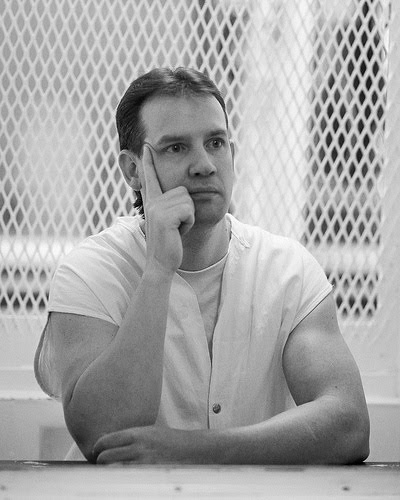
Charles Dean Hood: No new trial. Photo by Brian Birzer.

Prosecutor and judge were having affair…
New trial denied to death row defendant

By Ted McLaughlin / The Rag Blog / September 18, 2009

Yesterday, the Texas Court of Criminal Appeals denied a new trial for a death row defendant. In doing so, they have strengthened the perception that fairness is not important in Texas death penalty trials, and neither is the competence of defense attorneys. If a defendant happens to get an unfair judge and a defense attorney not competent enough to see that, that’s just tough. You go to death row to wait on a needle in the arm.

In 1990, Charles Dean Hood was arrested and tried for the murder of Tracie Lynn Wallace and Ronald Williamson. His fingerprints were found in the home and he was driving Williamson’s car when he was arrested out-of-state. That sounds like pretty good evidence, until you realize that Hood was living with the couple. It would be strange if his fingerprints had not been in the home, and it’s within the realm of possibility that he really did have Williamson’s permission to drive the car (as he claimed).

Is Hood innocent? I don’t have any idea. He may well be guilty, but there is definite doubt as to whether he got a fair trial in Collin county. That’s because the prosecutor who prosecuted the case and the judge who heard the case were in the middle of a rather torrid love affair at the time (they saw each other from 1987 through 1993). This gives at least the strong perception that the judge may have been biased and unable to be absolutely fair to the defendant.

That’s not just my opinion. When news of the affair became public knowledge last year, 30 former prosecutors and federal and state judges signed a letter to Governor Perry stating that the sexual relationship “would have had a significant impact on the ability of the judicial system to accord Mr. Hood a fair and impartial trial.”

The Appeals Court didn’t agree. They said the point was moot since Hood’s trial and appeal attorneys knew of the affair and didn’t bring it up at trial or in early appeals. The court says that meant the defense attorneys thought the affair did not affect the judge’s fairness.

I have to disagree. It may just mean those attorneys were incompetent. They should have asked for a new judge, and if it was denied, they should have appealed the decision much earlier. But an attorney’s incompetent action or lack of action does not mean a defendant had a fair and impartial trial. In fact, it probably means just the opposite.

This might not be so bad, but the defendant was sentenced to death. In death penalty cases, the state of Texas cannot afford the perception that the defendant may not have had a fair trial. The Court of Appeals should have granted a new trial so there would be no doubts about the trial’s fairness.

I don’t believe Hood received a fair trial. Thirty former prosecutors and judges don’t believe it either, and I expect the perception is much more wide-spread than that. That’s a bad thing for the perception of justice in the Lone Star State.

The Texas Court of Criminal Appeals screwed up. I just hope the U.S. Supreme Court will fix it.

The Rag Blog

Posted in Rag Bloggers | Tagged , , | 9 Comments

Health Care Reform, Racism and Memories of Nuremberg

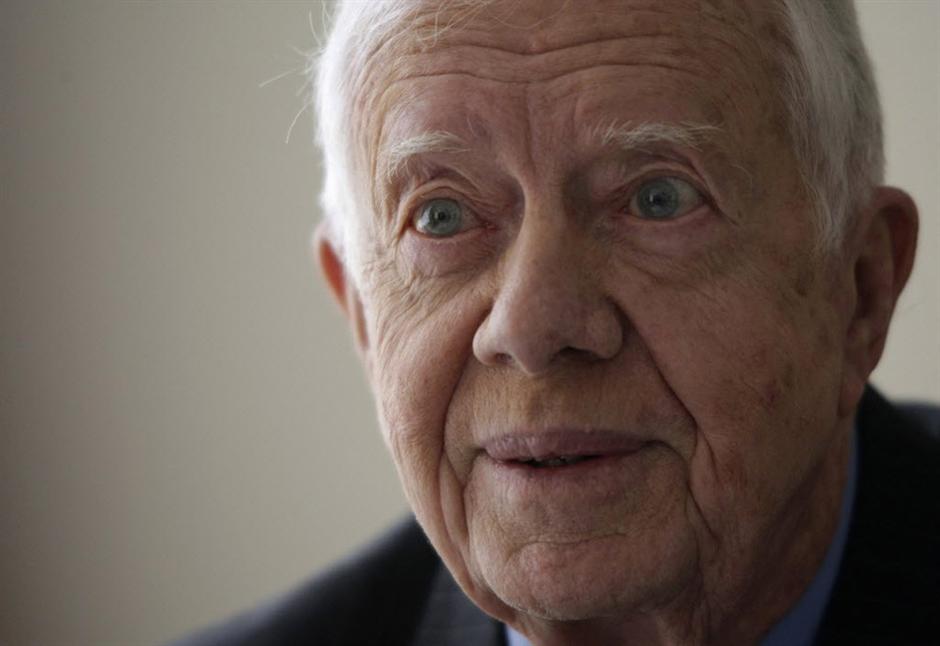
Jimmy Carter says racism is at core of Obama opposition. Photo by David Mercado /Reuters.

One would hope, now that President Carter has cleared the air, that Obama will set aside his effort to please those who cannot be pleased, and concentrate his energies on fulfilling his promises to the American people…

By Dr. Stephen R. Keister / The Rag Blog / September 18, 2009

The statement by President Jimmy Carter on September 14 regarding the latent, and frequently overt, racial hostility to President Obama by the present day purveyors of eugenics, came as a breath of fresh air.

Perhaps we can now face the real issues at hand and dispense with the absurdities of pretense. Perhaps we can now look to the many problems inherent in our society without playing games and evading reality.

I, as many others, watched in dismay the demonstrations of Saturday the 13th in our nation’s capital. I shuddered as I saw a simulation of events in Nuremberg, Germany on September 4, 1934 — as thousands of the unthinking (and proud of it) and uninformed paid tribute to the purveyors of bigotry and misinformation disguised as patriotism and nationalism.

The mobilization of these robots by FreedomWorks, Tea Party Patriots, and ResistNet makes one think of the sponsors and organizers of the 1934 rally, which was also predicated upon a subtle stoking of fear — fear of the Slavs, the Jews and the intellectual liberals. In my subconscious I heard the words of Pastor Martin Niemoller:

“In Germany, they first came for the Communists, And I didn’t speak up because I wasn’t a Communist; And then they came for the trade unionists, And I didn’t speak up because I wasn’t a trade unionist; And then they came for the Jews, And I didn’t speak up because I wasn’t a Jew; and then….they came for me….And by that time there was no one left to speak up.”

Perhaps in my dotage I tend to be a bit overly dramatic; however, in the Summer 2009 Woodrow Wilson Quarterly there is a reproduction of a poster showing masses of the German unemployed with the caption: “Unsere letzte Hoffnung:Hitler.” The graphic accompanies an article reviewing the voting patterns in Germany after the country began sliding into depression in 1927.

The GNP of the Weimar Republic contracted by a quarter; unemployment soared and incomes fell dramatically. Support for the Nazi Party, less than 3% of eligible voters in 1924, rose to 31% in July 1932, 27% in November 1932, and 39% in March 1933. How did the people vote? The unemployed turned primarily to the Communist Party, which catered to them with a program calling for community property. The working poor, including independent artisans, domestic workers, and family members of the working poor, disproportionately supported the Nazis.

These groups responded positively to Hitler’s denunciation of big government, and promises of intensive development of Germany’s own economic resources and support of private property, and plans for expropriation of land from Jewish real estate owners and resettlement of the landless in eastern Germany.

I must note here that we in the United States have no real Communist Party and the Socialists are a miniscule percentage of the population; however, the right wing is well organized behind leaders like Glenn Beck and Rush Limbaugh, with unlimited financing from the major corporations, especially health care, pharmaceuticals, banking, oil and communications. The unthinking and the fearful seek and will follow a leader who plays to their emotions and prejudices.

In the meanwhile the Senate Finance Committee is releasing its report, the product of many months of work, that essentially reinforces the dominance of the health insurance cartel, with no guarantee of health care for the American public. The report hides behind the cost of universal care. If indeed cost is a legitimate factor, perhaps we should take a close look at what the United States is spending on ongoing fruitless foreign wars and on the futile and absurd war on drugs.

Perhaps we should consider the overhead involved in maintaining over 100 golf courses at various military installations throughout the world, provided not only for our own officer class but for the thousands of paid mercenaries, at hundreds of dollars per day, who augment our armed forces. Perhaps we should look at the numerous tax breaks for the extremely wealthy while the working many assume the real burden.

If we truly desire to provide first class universal health care to the American people, Congress should review the plan put forth by Physicians for a National Health Program, which would reduce national health care expenditures by 30-40%, provide care through a public, non-profit insurance company, with non-political government oversight, and give everyone the choice of physician, hospital and pharmacy, dental and mental health care — free of the current rationing of care by the insurance industry, and the price fixing of prescription drugs by the pharmaceutical industry.

As a second choice, of course, there’s President Obama’s government option plan, about which he equivocates depending upon his audience: in short, Medicare for All. Beware, however, of “triggers” attached to the “public option,” for — as pointed out by both David Sirota and Robert Reich — such legislation is a pure and simple copout. Of course the matter of “insurance cooperatives” is merely handing health care back to the insurance industry with the bonus of mandated health care for all.

And then there’s Speaker Pelosi, backing off on the public option after Steve Elemendorf, a lobbyist for United Health Insurance, announces a fundraiser in her honor. This was exposed by David Sirota in AlterNet, on September 11.

One matter about which the public has an extreme misconception is “non-profit” corporations. The average person thinks of a charitable institution. Nothing could be farther from the truth. Non-profit corporations, such as the various Blue Cross/Blue Shields, are tax-free companies which do not show a profit on their books, but instead show “surpluses.” They are money-making companies, without stockholders, which can pay tremendous salaries to the managers, and con the public further, by taking money which should be used for health care but that instead shows up as lavish contributions in the programs of symphony orchestras, etc.

I noted several days ago an announcement of increases in premiums for 2010, by the local BC/BS providers. Their varied regular plans are going to be increased by 20-25% and the Medicare Supplements by 10-12%. Some 4-5 years ago I recall noting in the local paper that this organization was carrying a surplus of one billion dollars. One wonders why, after the President’s speech to Congress, the insurance industry stock suddenly rose. United Health up 17 cents; WellPoint up 19 cents; Aetna up 59 cents; Humana up $1.12. Is there more that we are uninformed about in addition to President Obama’s covert agreement with the pharmaceutical industry?

Let us put aside the perfidy of the politicians for a moment and look at the providers of health care, i.e. the physicians. Once again, I discount any positions taken by the AMA , which does not represent physicians but is merely an arm of the pharmaceutical and insurance industries lobbyists. The New England Journal of Medicine, the ethical and intellectual center for American medical publications, reports on a poll of 2,130 doctors that showed that 55%, regardless of their specialty, would favor expanding Medicare so that it covered people aged 55 and older.

When given a three way choice among private plans that use tax credits or subsidies to help the poor buy private insurance, a new public health insurance plan such as Medicare; or a mix of the two; 63% supported a mix, 27 % said they only wanted private options, and 10% said they exclusively wanted public options.

In discussions I have had with practicing physicians, I’ve seen extreme resentment against private insurers dictating their treatment, or limiting their treatment or diagnostic options. In no other nation of the industrialized world will you find an insurance company dictating diagnostic procedures or treatment. In no other country do we find a for-profit private insurance cartel rationing and delaying treatment.

The Republicans, reflecting their hostility to trial lawyers, paint malpractice costs as a major factor in the cost of health care, when indeed it accounts for less than 1%. Mal-practice insurance costs are indeed a problem; however, there are three facets.

  1. We have the only legal system in the Western world with the “contingency system” of payment. This certainly should be a issue for debate within the profession, and the physicians’ system of pay for service also deserves review.
  2. The physicians’ problem is of their own making. When I started practice in 1950 an older doctor sat down with me and told me that the best way to avoid malpractice was to give the patient plenty of time, communicate, answer questions, return phone calls and try and show a personal interest. His advice served me well for 40 years. Now I find that the patient is rushed through a physician’s office appointment, frequently attended to only by a physician’s assistant, and leaves with unanswered questions — and doctors often do not even return phone calls. This generates anger and an angry patient is much more apt to sue. It is time for some introspection.
  3. When the malpractice insurance companies’ investments decline on the stock market, they increase fees to the physician to maintain their profits.

Finally, the President hasn’t been addressing our depleting supply of primary care physicians. He has referred to nurse practitioners and physician’s assistants, but I have heard no mention of the need to increase our numbers of primary care providers, i.e. family doctors, internists and pediatric specialists.

The American College of Physicians has been very vocal regarding this problem. The ACP — and I — have suggested government subsidies for qualified candidates to go to medical school, or my proposal for a medical academy akin to West Point. Until these questions are addressed we will be unable to match the greater physician population of the European nations.

There is another underlying problem of which I have just become aware — thanks to a report by the Association of Medical Colleges — of decreasing interest among young people, starting back in 1980, in wanting to go to medical school. And 1980 was about the time that medicine ceased to be a profession and doctors became hired “providers” for the insurance industry.

Over the last 20 years, when young folks have asked my advice about pursuing a career in medicine, I have given them a resounding “No,” and have suggested that they look into a life’s work that will provide them a modicum of intellectual independence rather than becoming subservient to the corporations. I am sure other retired physicians are doing the same.

One would hope, now that President Carter has cleared the air, that Obama will set aside his effort to please those who cannot be pleased, and concentrate his energies on fulfilling his promises to the American people — Medicare for All, passing the Employee Free Choice Act, and finally setting aside the foreign policies of President Bush.

Obama promised withdrawal from Iraq and the Afghanistan war has become a travesty that few thinking Americans can comprehend. Professor Andrew J. Bacevich discusses this in Source an article in The Commonweal entitled, “The War We Can’t Win, Afghanistan and the Limits of American Power.” Professor Bacevich had an outstanding military career and is now professor of history and international relations at Boston University. This article once again raises the question of who in fact establishes United States foreign policy — the Defense Department or the State Department.

[Dr. Stephen R. Keister lives in Erie, PA. He is a retired physician who is active in health care reform.]

The Rag Blog

Posted in Rag Bloggers | Tagged , , , , | 2 Comments

The Tea Party Parade: Shouting at Phantoms

Mark Williams speaking during a Tea Party Express rally at the Cape Buffalo Grille in Dallas, Texas, on Sept, 4, before heading to Washington, D.C. Photo: Matt Nager.

Working Class Zero
By Timothy Egan / September 16, 2009

The first nine years of the new century have yet to find a defining label, something as catchy as Tom Wolfe’s “Me Decade” of the 1970s or the “Silent Generation” of 1950s men in gray flannel suits. Bookmarked by the horror of 9/11 and the history of a black president, the aughts certainly don’t lack for drama.

But last week, lost in the commotion over the brat’s cry of Joe Wilson and the shotgun blast of rage in the Washington protest, something definitive was released just as this decade nears its curtain call.

For average Americans, the last 10 years were a lost decade. At the end of President George W. Bush’s eight years in office, American households had less money and less economic security, and fewer of them were covered by health care than 10 years earlier, the Census Bureau reported in its annual survey.

The poverty rate in 2008 rose to 13.2 percent, the highest in 11 years, while median household income fell to $50,303. Ten years earlier, adjusted for inflation, it was $51,295.

Of course this reflects the ravages of a horrid recession. But the decline started before the collapse in the housing and financial sectors — and it was calculated, in the eyes of some.

Harvard economist Lawrence Katz called it “a plutocratic boom.” If anything comes close to defining the era, that would be my nomination. President Bush cut $1.3 trillion in taxes — and the biggest beneficiaries by far were the top 1 percent of earners. At the same time, Wall Street was inflated by the helium of a regulation-free economy that eventually gave us Bernie Madoff and banks begging for bailouts.

Now consider the people who showed up in a state of generalized rage in Washington over the weekend. They have no leaders, save a self-described rodeo clown — Glenn Beck of Fox News — and some well-funded Astroturf outfits from the permanent lobbying class inside the Beltway. They are loosely organized under a Tea Party movement, but these people are closer to British Tories than 18th century patriots with a love of equality.

And they have the wrong target.

Mark Williams, a Sacramento talk radio host, was speaking to CNN on behalf of the demonstrators — many of whom carried signs comparing Obama to a witch doctor, an undocumented worker or a Nazi — when he played the blue collar card.

Who is Williams? A garden variety demagogue who calls Obama “an Indonesian Muslim turned welfare thug” and the Democratic party “a domestic enemy” of America. He also refers to the president as “racist in chief.” That says all you need to know about leaders of the Tea Party movement.

Williams repeatedly invoked the “working stiffs” who feel left out. Working people are always the last to get aboard the gravy train, and the first to be used in campaigns that will not advance their cause. And with these demonstrators, and the hucksters trying to distract them from real issues, history repeats itself.

Where was the Tea Party movement when the tax burden was shifted from the high end to the middle? Where were the patriots when Wall Street, backed in Congress by Senator Phil Gramm of Texas, rewrote securities laws so that the wonder boys of Lehman and A.I.G. could reduce home mortgages to poker chips at a trillion-dollar table?

Where were the angry “stiffs” when the banking industry rolled the 2005 Congress into rewriting bankruptcy law, making it easier to keep people in permanent credit card hock?

Where were they when President Bush started the bailouts, with $700 billion that had to be paid on a few days’ notice — with no debate — to save global capitalism?

They were nowhere, because they were clueless, just as most journalists were.

But now, at a time when a new president wants to reform health care to fix the largest single cause of middle-class economic collapse, he’s called a Nazi by these self-described friends of the working stiff.

“A working class hero is something to be,” John Lennon, that product of ragged Liverpool, sang just after leaving the Beatles. “Keep you doped with religion and sex and T.V.”

As someone who had a union card in my wallet before I owned a Mastercard, I don’t share Lennon’s dark view of blue collar workers. But as long as they can be distracted by people who say all government is bad, while turning a blind eye to manipulation at corporate levels, they’re doomed to shouting at phantoms.

One more detail caught my eye in these new economic reports on the lost decade. People in their prime earning years — age 45 to 54 — took the biggest hit in the last years of the Bush Administration, their median income falling by $5,000. And the region that suffered most — the South.

Older southern whites — that’s who got hit hardest by the freewheeling decade now fading. They should be angry. But they’re five years too late.

Source / New York Times

The Rag Blog

Posted in RagBlog | Tagged , , , | 4 Comments

Trifagura : Corporate Outlaw Dumps Toxic Waste on Ivory Coast

The Probo Koala ship, chartered by Trafigura, docked at the port of Tallinn. Photo from AFP.

Takes human toll in West African nation…
Commodities trader dumps banned substance

By Ted McLaughlin / The Rag Blog / September 17, 2009

This story shows just how little some corporations care about the lives and health of innocent people, as long as they can make lots of money. Trafigura is an international commodities trading company , and they should be ashamed of the horror they unleashed on the people of Ivory Coast just so they could make a lot of money.

In 2006, they made a deal to buy some Mexican coker naptha (a very dirty form of gasoline) extremely cheap. The reason it was so cheap is because it could not be cleaned at the Mexican refinery, and to clean it properly and safely would be very expensive. But the company had no intention to spend the money to do the job properly.

Instead, once the coker naptha was loaded on their tanker, they poured tons of caustic soda and a catalyst into it — a process known as caustic washing. The process works and is cheap, but produces a very toxic waste by-product. It is so toxic that the process is banned nearly all over the world (including the United States).

They tried to off-load the toxic waste in Netherlands, but they were stopped. So they took the toxic waste to Ivory Coast. There they hired a local to dispose of it (who had no facilities to handle the waste), and it was dumped into places around the country. The toxic waste killed at least 16 people and caused a range of health problems for at least another 31,000.

What makes this story so bad is the fact that Trafigura employees (all the way up to the president of the company) knew what they were doing and how dangerous it was. This has been proven by company e-mails obtained by the BBC. The company officials simply didn’t care who they injured as long as they wound up making lots of money.

Don’t think Trafigura is alone in this kind of behavior. There are lots of large companies who would be willing to do things just as bad or worse, if they thought they could get away with it and make a ton of money. The bottom line is the only thing that matters.

And yet, we still let the corporate interests run this country. During the Bush administration, they even wrote their own laws (and I’m not at all sure Obama is doing much better). If we don’t change this, we’re setting ourselves up for a bad future.

[Rag Blog contributor Ted McLaughlin also posts at jobsanger, an excellent Texas political blog.]

Also see:

The Rag Blog

Posted in Rag Bloggers | Tagged , , | 2 Comments

Honduran Resistance : Strong, Nonviolent and Persistent

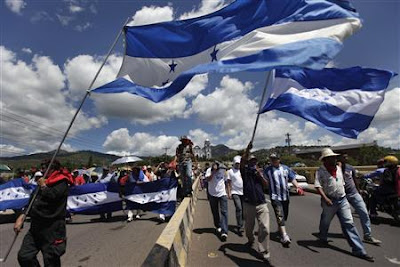
Supporters of Honduras’ ousted president Manuel Zelaya walk during a rally at Suyapa neighborhood in Tegucigalpa, September 9, 2009. Photo by Edgard Garrido / Reuters.

How do we respond?
Honduran resistance remains strong

If it succeeds, especially if it continues its use of nonviolent tactics, it will be a model for long awaited changes in the hemisphere. If the coup leaders succeed… military coups, governmental instability, poverty, and death could spread to other countries in the hemisphere.

By Val Liveoak / The Rag Blog / September 16, 2009

I spent a week in Honduras with the Francisco Morazán Mission for Democracy, Active Nonviolence and Peace in Honduras, a project of the Centro Amigos por la Paz, in San José Costa Rica.

We visited with a large number of organizations and individuals who are active in the resistance to the government which ousted the elected president in a military coup — the first in forty years. This movement has staged street protests in Tegucigalpa and San Pedro Sula, Honduras’ largest cities, daily for almost seventy days (as of this writing).

Except for some rock throwing at demonstrations, and the painting of resistance slogans on walls (a mild form of property damage), the movement has been quite nonviolent. The response of the police and Army has been quite violent, however, with marchers being beaten, tear-gassed, shot with live ammunition, and detainees being tortured, raped, denied food and water, and beaten. Many people told us of receiving death threats by telephone and in person, and several said armed men were stationed outside their families’ homes.

Specific groups have different goals, but many believe, as one leader shared with us, “If we lose now, Honduras will not change for a hundred years.” Another said, “If the coup leaders succeed, my family and I, and all the thousands of protesters, will be forced to flee or will be dead within a year.”

We visited the U.S. Embassy, where we met with the head of the Political Section and the officer in charge of Human Rights. They assured us that the Embassy has a policy of no contact with the government in power, and that the U.S. military on the Palmerola Air Base were not communicating with or aiding the Honduran military. They reiterated their position that the U.S. will not recognize any winner in the Nov. 29th elections if the current government holds them as scheduled.

There was a rumor that ousted President Manuel Zelaya would return to the country on Sept 15th, Independence Day. On the 13th, exiled members of his cabinet were reported to have returned to the airport in Tegucigalpa with the aid of U.S. personnel. Even if the previous government is restored, however, the opposition wants elections postponed at least 6-8 months so that realistic campaigns can be waged. They also would like to see issues of constitutional change discussed, if not voted upon, in new elections.

There is much to discuss. Honduras is the third poorest nation in Latin America, and is ruled by the oligarchy that sponsored the military coup. Media has been strongly censored since the President was ousted, and the desperate struggle for a living wage, safe working conditions, health care, indigenous rights, women’s rights, basic education, and public services have rallied disparate groups into a strong coalition of resistance. They have mobilized big crowds of protestors, excited young people seeking a future, developed alternative media, and created ties of solidarity with groups all over the world.

Our delegation from Costa Rica received strong approval for the statement, “The main reason Costa Rica hasn’t had any coups for 50-plus years is that we abolished the Army.” The resistance movement is strategizing more than just the return of the legal government — it is moving toward what one leader told us is a life or death opportunity to bring Honduras into the 21st century.

If it succeeds, especially if it continues its use of nonviolent tactics, it will be a model for long awaited changes in the hemisphere. If the coup leaders succeed, many Latin Americans and analysts in the U.S. and Europe fear that military coups, governmental instability, poverty, and death could spread to other countries in the hemisphere.

I fear that it may not stop there, however. I believe that the U.S. has practiced the tactics of low-intensity warfare in Latin America for the last half century through the infamous School of the Americas’ training of military officers, economic tactics such as NAFTA, CAFTA, etc., and numerous acts of war, often against unarmed civilian populations. These tactics are now being felt in the U.S. itself under the Patriot Act and other so-called anti-terrorist measures. Support of the Honduran resistance is vital not only to Honduras’ future, but also to that of the U.S.

As a nonviolent activist for over 35 years, it’s exciting to me that the resistance movement has so far been nonviolent, if only by default. I believe that many members of the movement are nonviolent because they do not think they have nearly enough power and weapons to mount an armed opposition. But others, I believe, are truly interested in continuing nonviolent struggle, and learning more about it. They are inventing new tactics and reviving older ones. They are reaching out for solidarity and support from all over the world.

Friends Peace Teams has been invited to help by offering Alternatives to Violence Project (AVP) workshops in Honduras. I hope that we can rise to this challenge posed by the people of Honduras, calling upon the network of AVP facilitators in Latin America that we have helped to develop. Financial and moral support is critical to this effort.

A series of workshops leading to the development of trained Honduran facilitators would cost less than $10,000, and could be completed within two months. We have received invitations to do a workshop from one group in February, and other groups have expressed interest. With adequate funding from new sources, we could respond more quickly and with greater outreach.

Please send your donations, earmarked, “PLA — Honduras,” to Friends Peace Teams, at 1001 Park Ave., St. Louis MO 63104 USA. FPT is a federal tax-exempt 501(c)(3) organization.

[Texan Val Liveoak is a nonviolent activist, currently living in El Salvador and San Antonio. She coordinates Peacebuilding en las Americas, the Latin American Initiative of Friends Peace Teams that also has programs in the African Great Lakes region and in Indonesia.]

The Rag Blog

Posted in Rag Bloggers | Tagged , , , | Leave a comment

If There Is a Future of Peace for Humankind, It Will Come From the Artists


Subject: Why Music?

Welcome address to freshman class at Boston Conservatory given by Karl Paulnack, pianist and director of music division at Boston Conservatory.

“One of my parents’ deepest fears, I suspect, is that society would not properly value me as a musician, that I wouldn’t be appreciated. I had very good grades in high school, I was good in science and math, and they imagined that as a doctor or a research chemist or an engineer, I might be more appreciated than I would be as a musician. I still remember my mother’s remark when I announced my decision to apply to music school – she said, “You’re WASTING your SAT scores.”

On some level, I think, my parents were not sure themselves what the value of music was, what its purpose was. And they LOVED music, they listened to classical music all the time. They just weren’t really clear about its function. So let me talk about that a little bit, because we live in a society that puts music in the “arts and entertainment” section of the newspaper, and serious music, the kind your kids are about to engage in, has absolutely nothing whatsoever to do with entertainment, in fact it’s the opposite of entertainment.. Let me talk a little bit about music, and how it works.

The first people to understand how music really works were the ancient Greeks. And this is going to fascinate you; the Greeks said that music and astronomy were two sides of the same coin. Astronomy was seen as the study of relationships between observable, permanent, external objects, and music was seen as the study of relationships between invisible, internal, hidden objects. Music has a way of finding the big, invisible moving pieces inside our hearts and souls and helping us figure out the position of things inside us. Let me give you some examples of how this works.

One of the most profound musical compositions of all time is the Quartet for the End of Time written by French composer Olivier Messiaen in 1940. Messiaen was 31 years old when France entered the war against Nazi Germany. He was captured by the Germans in June of 1940, sent across Germany in a cattle car and imprisoned in a concentration camp.

He was fortunate to find a sympathetic prison guard who gave him paper and a place to compose. There were three other musicians in the camp, a cellist, a violinist, and a clarinetist, and Messiaen wrote his quartet with these specific players in mind. It was performed in January 1941 for four thousand prisoners and guards in the prison camp. Today it is one of the most famous masterworks in the repertoire.

Given what we have since learned about life in the concentration camps, why would anyone in his right mind waste time and energy writing or playing music? There was barely enough energy on a good day to find food and water, to avoid a beating, to stay warm, to escape torture-why would anyone bother with music? And yet-from the camps, we have poetry, we have music, we have visual art; it wasn’t just this one fanatic Messiaen; many, many people created art. Why? Well, in a place where people are only focused on survival, on the bare necessities, the obvious conclusion is that art must be, somehow, essential for life. The camps were without money, without hope, without commerce, without recreation, without basic respect, but they were not without art. Art is part of survival; art is part of the human spirit, an unquenchable expression of who we are. Art is one of the ways in which we say, “I am alive, and my life has meaning.”

On September 12, 2001 I was a resident of Manhattan. That morning I reached a new understanding of my art and its relationship to the world. I sat down at the piano that morning at 10 AM to practice as was my daily routine; I did it by force of habit, without thinking about it. I lifted the cover on the keyboard, and opened my music, and put my hands on the keys and took my hands off the keys. And I sat there and thought, does this even matter? Isn’t this completely irrelevant? Playing the piano right now, given what happened in this city yesterday, seems silly, absurd, irreverent, pointless. Why am I here? What place has a musician in this moment in time? Who needs a piano player right now? I was completely lost.

And then I, along with the rest of New York, went through the journey of getting through that week. I did not play the piano that day, and in fact I contemplated briefly whether I would ever want to play the piano again. And then I observed how we got through the day.

At least in my neighborhood, we didn’t shoot hoops or play Scrabble. We didn’t play cards to pass the time, we didn’t watch TV, we didn’t shop, we most certainly did not go to the mall. The first organized activity that I saw in New York, that same day, was singing. People sang. People sang around fire houses, people sang We Shall Overcome. Lots of people sang America the Beautiful. The first organized public event that I remember was the Brahms Requiem, later that week, at Lincoln Center, with the New York Philharmonic. The first organized public expression of grief, our
first communal response to that historic event, was a concert. That was the beginning of a sense that life might go on. The US Military secured the airspace, but recovery was led by the arts, and by music in particular, that very night.

From these two experiences, I have come to understand that music is not part of “arts and entertainment” as the newspaper section would have us believe. It’s not a luxury, a lavish thing that we fund from leftovers of our budgets, not a plaything or an amusement or a pass time. Music is a basic need of human survival. Music is one of the ways we make sense of our lives, one of the ways in which we express feelings when we have no words, a way for us to understand things with our hearts when we can’t with our minds.

Some of you may know Samuel Barber’s heart-wrenchingly beautiful piece Adagio for Strings. If you don’t know it by that name, then some of you may know it as the background music which accompanied the Oliver Stone movie Platoon, a film about the Vietnam War. If you know that piece of music either way, you know it has the ability to crack your heart open like a walnut; it can make you cry over sadness you didn’t know you had. Music can slip beneath our conscious reality to get at what’s really going on inside us the way a good therapist does.

I bet that you have never been to a wedding where there was absolutely no music. There might have been only a little music, there might have been some really bad music, but I bet you there was some music. And something very predictable happens at weddings – people get all pent up with all kinds of emotions, and then there’s some musical moment where the action of the wedding stops and someone sings or plays the flute or something. And even if the music is lame, even if the quality isn’t good, predictably 30 or 40 percent of the people who are going to cry at a wedding cry a couple of moments after the music starts. Why? The Greeks. Music allows us to move around those big invisible pieces of ourselves and rearrange our insides so that we can express what we feel even when we can’t talk about it. Can you imagine watching Indiana Jones or Superman or Star Wars with the dialogue but no music? What is it about the music swelling up at just the right moment in ET so that all the softies in the audience start crying at exactly the same moment? I guarantee you if you showed the movie with the music stripped out, it wouldn’t happen that way. The Greeks: Music is the understanding of the relationship between invisible internal objects.

I’ll give you one more example, the story of the most important concert of my life. I must tell you I have played a little less than a thousand concerts in my life so far. I have played in places that I thought were important. I like playing in Carnegie Hall; I enjoyed playing in Paris; it made me very happy to please the critics in St. Petersburg. I have played for people I thought were important; music critics of major newspapers, foreign heads of state. The most important concert of my entire life took place in a nursing home in Fargo, ND, about 4 years ago.

I was playing with a very dear friend of mine who is a violinist. We began, as we often do, with Aaron Copland’s Sonata, which was written during World War II and dedicated to a young friend of Copland’s, a young pilot who was shot down during the war. Now we often talk to our audiences about the pieces we are going to play rather than providing them with written program notes. But in this case, because we began the concert with this piece, we decided to talk about the piece later in the program and to just come out and play the music without explanation.

Midway through the piece, an elderly man seated in a wheelchair near the front of the concert hall began to weep. This man, whom I later met, was clearly a soldier – even in his 70’s, it was clear from his buzz-cut hair, square jaw and general demeanor that he had spent a good deal of his life in the military. I thought it a little bit odd that someone would be moved to tears by that particular movement of that particular piece, but it wasn’t the first time I’ve heard crying in a concert and we went on with the concert and finished the piece.

When we came out to play the next piece on the program, we decided to talk about both the first and second pieces, and we described the circumstances in which the Copland was written and mentioned its dedication to a downed pilot. The man in the front of the audience became so disturbed that he had to leave the auditorium. I honestly figured that we would not see him again, but he did come backstage afterwards, tears and all, to explain himself.

What he told us was this: “During World War II, I was a pilot, and I was in an aerial combat situation where one of my team’s planes was hit. I watched my friend bail out, and watched his parachute open, but the Japanese planes which had engaged us returned and machine gunned across the parachute chords so as to separate the parachute from the pilot, and I watched my friend drop away into the ocean, realizing that he was lost. I have not thought about this for many years, but during that first piece of music you played, this memory returned to me so vividly that it was as though I was reliving it. I didn’t understand why this was happening, why now, but then when you came out to explain that this piece of music was written to commemorate a lost pilot, it was a little more than I could handle. How does the music do that? How did it find those feelings and those memories in me?

Remember the Greeks: music is the study of invisible relationships between internal objects. This concert in Fargo was the most important work I have ever done. For me to play for this old soldier and help him connect, somehow, with Aaron Copland, and to connect their memories of their lost friends, to help him remember and mourn his friend, this is my work. This is why music matters.

What follows is part of the talk I will give to this year’s freshman class when I welcome them a few days from now. The responsibility I will charge your sons and daughters with is this:

“If we were a medical school, and you were here as a med student practicing appendectomies, you’d take your work very seriously because you would imagine that some night at two AM someone is going to waltz into your emergency room and you’re going to have to save their life. Well, my friends, someday at 8 PM someone is going to walk into your concert hall and bring you a mind that is confused, a heart that is overwhelmed, a soul that is weary. Whether they go out whole again will depend partly on how well you do your craft.

You’re not here to become an entertainer, and you don’t have to sell yourself. The truth is you don’t have anything to sell; being a musician isn’t about dispensing a product, like selling used Chevies. I’m not an entertainer; I’m a lot closer to a paramedic, a firefighter, a rescue worker. You’re here to become a sort of therapist for the human soul, a spiritual version of a chiropractor, physical therapist, someone who works with our insides to see if they get things to line up, to see if we can come into harmony with ourselves and be healthy and happy and well.

Frankly, ladies and gentlemen, I expect you not only to master music; I expect you to save the planet. If there is a future wave of wellness on this planet, of harmony, of peace, of an end to war, of mutual understanding, of equality, of fairness, I don’t expect it will come from a government, a military force or a corporation. I no longer even expect it to come from the religions of the world, which together seem to have brought us as much war as they have peace. If there is a future of peace for humankind, if there is to be an understanding of how these invisible, internal things should fit together, I expect it will come from the artists, because that’s what we do. As in the concentration camp and the evening of 9/11, the artists are the ones who might be able to help us with our internal, invisible lives.”

Source / The Musicians of the Columbus Symphony

Thanks to Kate Braun and Jennifer Seth / The Rag Blog

Posted in RagBlog | Tagged , , | 4 Comments

Kate Braun: Fall Equinox Seasonal Message


Fall Equinox Seasonal Message
By Kate Braun / The Rag Blog / September 15, 2009

“Green leaves of summer turn red in the fall…”

Tuesday, September 22, 2009 is the Vernal Equinox, also known as Mabon, Harvest Home, Second Harvest, and Cornucopia. Tuesday is named for Tyr, the one-armed Norse god of single combat, victory, and heroic glory. We draw on Tyr-energy when we look within to find a source of strength and courage. Cerridwen, the Celtic water-oriented Goddess of Autumn, may also preside at this celebration. Cerridwen’s symbol is the cauldron, her fruit is the apple, and all nuts and seeds are sacred to her.

Dress yourself and decorate your altar and table using the colors red, orange, russet, maroon, brown, deep gold, and violet. Pine cones, acorns, gourds, grains, apples, scales, autumn leaves, and textured fabrics such as velvet and corduroy are some additional things that can enhance your decorating. Consider using a cauldron instead of a horn or plenty as your centerpiece: lay down a piece of velvet or corduroy in an appropriate color and lay a cauldron on its side with apples, nuts, and other harvestables spilling out.

Serve breads, nuts, apples, pomegranates, root veggies, all berries, nuts, cider, and fruit wine. Use garlic in your recipes, too.

Many of the rituals used at this celebration involve protection, prosperity, self-confidence, harmony, and balance. You may invoke Tyr to assist you by drawing his symbol, h, on a piece of red paper cut to resemble a leaf and then placing that emblem on your altar. Druids honored trees at this time of year by making offerings to them and you may, also. The drought is such that ceremonially pouring a gallon of water in the drip-line of favored trees would not only be appropriate to the season but also good for the life of the tree!

Equinoxes are times when daylight and darkness use the same number of hours in a day and are a good time to contemplate balance in our lives. One way to do this is to balance an egg on its larger end while contemplating its meaning. The shell represents Earth, the membrane represents Air, the yolk represents Fire, the white represents Water; these are the four elements from which come all things. Ouspensky believed that Four was the “perfect number”, hence, an egg represents perfection. If you choose to make this ritual part of your celebration, you will need one raw egg for each guest to balance and can lead to a general discussion of what “balance” means to each participant. As a group effort, it can be an interesting and enriching experience.

Reminder: I am scheduled to teach a BeginningTarot class on September 30, October October 7, and October 14 as an Informal Class at the University of Texas at Austin. For more information and/or to enroll, go to www.informalclasses.org.

Tarot by Kate 512-454-2293
www.tarotbykatebraun.com
kate_braun2000@yahoo.com

The Rag Blog

Posted in Rag Bloggers | Tagged , | Leave a comment

The Righteous Mob : Like Talking to Children

Photo from registeredmedia.com.

KKK to Tea Parties:
Communicating with the ignorant and angry

By Larry Ray / The Rag Blog / September 15, 2009

If angry outbursts and placard waving protesters against health care reform seem heated today, the idea of planned parenthood and birth control in the early 1900’s caused a raging bonfire.

Margaret Sanger, an activist way ahead of her time, is credited with starting the idea of planned parenthood. Over the years she was arrested more than eight times for expressing her ideas back when speaking out in public in favor of birth control was illegal. She did time in jail in 1916 nine days after opening America’s first birth control and family planning clinic in Brooklyn.

But Margaret Sanger’s message also supported “negative eugenics” saying, “It is a vicious cycle; ignorance breeds poverty and poverty breeds ignorance. There is only one cure for both, and that is to stop breeding these things.”

So, like a modern day Sibyl, her pronouncements could be interpreted by opposing sides, each opting either to hear the positive germ of her message, or to embrace the radical edges of some of her statements as pillars of support for their views… including white supremacy.

In the mid 1920’s she received more than a million letters requesting information on birth control. And she spoke from coast to coast to diverse groups including “cotton workers, churchmen, liberals, socialists, scientists, civic clubs, and fashionable, philanthropically minded women.”

In 1926, she was invited to speak to the ladies axillary of the Ku Klux Klan in Silver Lake, New Jersey. After being driven in a curtain shuttered car for almost an hour, way out into a country field, she gave a lecture to the robed and hooded ladies, as well as a smattering of male Klansmen. In her memoirs she described it as “one of the weirdest experiences I had in lecturing,” noting that she was forced to use only “the most elementary terms, as though I were trying to make children understand.” The KKK ladies and their male attendees were reportedly delighted with the idea of promoting birth control for ‘the colored folks.’

Though she remains to this day a controversial figure it is interesting to note that as the nation became more enlightened, birth control and family planning became accepted, championed by the Rockefeller, Jr.’s Bureau of Social Hygiene. In spite of allegations of racism, she earned the respect and support of of civil rights leaders such as Martin Luther King, Jr. and the American Humanist Association named her Humanist of the Year in 1957.

Today President Barack Obama has undertaken the tough task of renewing a demand for universal health insurance legislation for all Americans. For seventy years political manipulation, crass profit incentives of big business and a whipped up mistrust of “big government” as a convenient devil has blocked health care reform legislation.

Medicare health insurance for our senior citizens finally passed in 1965 after years of being protested and assailed as “socialist” and a “government takeover” by conservative Republicans adverse to any change. A high percentage of today’s protesters have Medicare cards in their pockets.

The busloads of well fed white folks who angrily waved placards in the nation’s capitol last week probably didn’t pay for their bus tickets and their mental carry on baggage was not packed with reasoned ideology based upon clear fact. Rather, it was stuffed with anger, startling ignorance of the facts and, worse, their willingness to believe such political purée.

It is daily becoming more and more clear that much, but not all, of what we are seeing is driven by simmering racism, the idea that the most powerful man in the world, the President of the USA is not a white man. That a black skinned (his white half doesn’t seem to count), calm, educated and persuasive man is deciding what will happen to THEM!

The busloads arriving in Washington D.C. and in the town hall meetings, were all for the most part provided a free ride and a sense of indignant importance, banding together to hate, vent frustration and spout utter nonsense. With Rush Limbaugh, Fox News and the endless babble of knee-jerk talking heads on cable TV, the ignorant are rewarded for their ignorance. They are delighted to hear what they want to hear fed to them daily.

Also, today’s so-called “Tea Parties” which have no relationship whatsoever to the reasons for the Boston Tea Party are a sad testament in themselves to the ignorance of most of the shouting sign carriers of what the historic “Tea Party” actually was. Similarly, a large number of those screaming “Socialist” would, I will wager, be unable to define what a socialist is. But by God, they are mad!

Today’s disgruntled race baiting demonstrators aren’t wearing robes or hoods. Most also are not armed with facts or reasoned opposition. They are armed with anger, wild rumors and a sense of empowerment that harks back some 40 some odd years ago when this same mentality produced sneers and shouts of “Boy!” to make a black move off the sidewalk, or to those who carried “no nigger” placards outside public schools as police dogs strained at their leashes as small black children walked past. Fine law-abiding, church going folks then … and now.

This minority of our citizenry has long been hijacked for cynical purposes. They present a golden opportunity for the struggling, discredited conservative Republican base to recruit and inflame the bigoted and ignorant with poisoned misinformation.

Though this righteous mob is making the most noise and is getting the media coverage that would be bestowed on a fully grown two-headed mule, our elected representatives must hear the louder voice of reason from the overwhelmingly reasonable majority. Maybe it would help if we speak to them “in the most elementary terms, as though we were trying to make children understand.”

[Retired journalist Larry Ray is a Texas native and former Austin television news anchor. He also posts at The iHandbill.]

The Rag Blog

Posted in Rag Bloggers | Tagged , , , , , | 18 Comments

Culture Wars and Witch Hunts : Anne Braden, Van Jones and Yosi Sargent

Rosa Parks Interviewed by Anne Braden. Photo from Wisconsin Historical Images.

The many fronts of the culture wars

The Van Jones resignation has particular meaning for people like me with life experience in the coalfields, where the exploitation of land and people by the coal industry is made even more brutal by the dichotomy between jobs and the environment.

By Anne Lewis / The Rag Blog / September 15, 2009

“Use every attack as a platform…” — Anne Braden

Ask anyone involved in black liberation, peace, gay rights, environmental justice, welfare rights, anti-poverty, or the women’s movement. All of us heard others attacked, if not ourselves, as socialists or communists. Those words were used to distract us, to divide us, to marginalize us, and to destroy effective leadership.

I’m currently working on a film about Anne Braden. Anne Braden had a great deal to say about anti-communism. She put her body and her mind into the struggle for black liberation, beginning in 1951 when she led a delegation of white women to Mississippi to protest the legal lynching of Willie McGee. She said, “We are here because we are determined that no more innocent men shall die in the name of white southern womanhood.”

In 1954, Anne Braden and her husband Carl bought a house for a black couple in a white suburban Louisville neighborhood. The house was fire bombed. In the midst of white backlash against Brown v. Board of Education, the local prosecutor charged the Bradens and five other white progressives with “sedition” for fomenting strife between the races as part of a communist plot. Carl was convicted and sentenced to fifteen years in prison.

Anne Braden and the other defendants traveled across the country to tell the story. They succeeded in freeing Carl at least temporarily. They raised up the issues of open housing and integration. They found new allies and forged a greater unity. When Carl was once more sent to prison for his ideas, Dr. King headed a petition drive for clemency. Please go here for excerpts from the film in progress.

The Van Jones resignation has particular meaning for people like me with life experience in the coalfields, where the exploitation of land and people by the coal industry is made even more brutal by the dichotomy between jobs and the environment.

Last spring, Van Jones told the Ohio Valley Environmental Council, a grassroots environmental group, that Appalachia would be a focus for green jobs. In another statement, Van Jones said, “This movement also has to include the coal miners.” He went on to compare “clean” coal to “unicorns pulling cars.” Jones united environmental and economic justice in terms that working people understand. This unity, reflected in coalitions like the Blue Green Alliance and the Apollo Project, is critical to our movement.

In 1984, I documented a coal strike against A.T. Massey Coal in the area around Matewan. Please go here for a stream of the documentary. I interviewed now CEO Don Blankenship, listed on AlterNet as one of “the 13 scariest Americans” for his destruction of the mountains, denial of global warming, and attempted corruption of the Supreme Court of West Virginia.

It’s ironic that Don Blankenship was conducting a gala Labor Day event at the same time that Van Jones resigned his position. In Holden, West Virginia, to an estimated 75,000 supporters of coal, Blankenship blasted any attempt to control climate change stating, “Only God can change the earth’s climate.”

“Mine War on Blackberry Creek” and the Anne Braden project are produced with Appalshop, an arts and education NGO supported throughout its forty year history by the National Endowment for the Arts.

Another Glenn Beck victim: Yosi Sargent. Photo from SF Gate.

On September 10, Yosi Sargent was removed from his office as Communications Director at the NEA. Glenn Beck attacked both Sargent and the NEA as “Nazi” propagandists, based on tapes of a conference call asking artists to participate in Michelle Obama’s “United We Serve.” (I wonder what Glenn Beck would say about art created in the WPA, which brought us Jackson Pollack as well as Ben Shahn and Russell Lee.)

Sargent brought hip-hop, street artists, and grassroots arts groups to the White House. The attack against him smacks of racism and homophobia and commercialism. And so the culture wars begin once more.

We’re used to fanatic attacks on the National Endowment for the Arts spearheaded by the American Family Association. The American Family Association not only inflict on us their views on “decency,” they lobby against regulation of the oil industry, against hate crime legislation, and against the Employee Free Choice Act. And so attacks against culture and economics combine in a dangerous mix with religion.

The next human targets in the witch hunt are Mark Lloyd, Chief Diversity Officer of the Federal Communications Commission; Cass Sunstein, Director of the White House Office of Information and Regulatory Affairs; and Carol Browner, Director of the White House Office of Energy and Climate Change Policy. Any one of these would be a heart-felt loss.

McCarthyism was far from over when McCarthy was condemned by the U.S. Senate in 1954. It wasn’t over in 1975 with the disbanding of the House Un-American Activities Committee. Assaults on affirmative action, the rise of the Klan and other neo-fascist organizations, Reaganomics and its assault on the working class, welfare deform, the killing of doctors who perform abortions – we really haven’t had a break. These attacks are cultural and ideological as well as economic.

Universal health care is a human right. No human being is “illegal.” Separate but equal is never equal. Young people should be treated with gentleness. The sick elderly should be cared for with dignity. Everyone should have adequate food and housing. The earth must be treated with respect or we will have no clean air to breathe or water to drink. Women have the right to control their bodies. The right questions all of these and calls them “racist,” “socialist,” and “fascist.” We need to reclaim the ground of common sense.

Here are four ideas for action, largely based on Anne Braden’s approach.

  1. Defend the first victims without fear, equivocation, or apology. We lost an opportunity with the Reverend Wright.
  2. Protect the rights of free speech and association. Anne Braden said that the right of free speech combined with freedom of association constitutes the right to organize.
  3. Analyze the attacks and understand their sources. Don’t stop at Glen Beck. Follow the money.
  4. Turn every attack into an opportunity for green jobs, for cultural democracy, for social change.

[Anne Lewis is an independent filmmaker frequently associated with Appalshop and a Senior Lecturer at UT-Austin. Credits include: “Morristown: in the Air and Sun,” a working class response to globalization; “Fast Food Women” (POV and London Film Festival Judges’ Choice); “On Our Own Land” about a citizens’ effort to stop strip mining (duPont Award); and Associate Director, “Harlan County, U.S.A.” “Anne Braden: Southern Patriot” is co-directed with Mimi Pickering. Anne is a proud member of Local 6186 CWA-TSEU and CWA-NABET. Anne’s website is www.annelewis.org.]

The Rag Blog

Posted in Rag Bloggers | Tagged , , , , , , , , , | 5 Comments