Losing or Giving Up the Fight Against Racism?

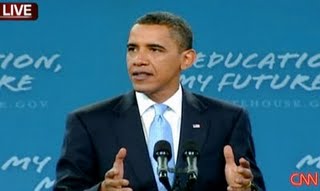
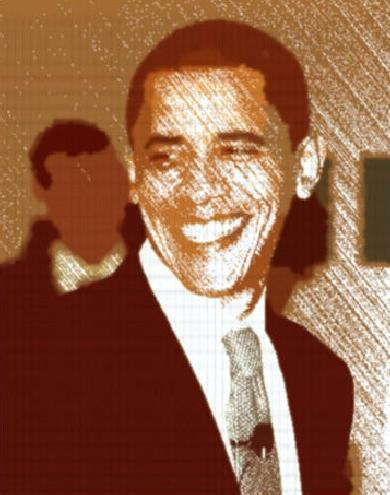
US president Barack Obama: has he gone back on pledges made to black America? Photo: Michael Reynolds/EPA.

Obama’s big silence: the race question: Has the president turned his back on black America?
By Naomi Klein / September 12, 2009

Americans began the summer still celebrating the dawn of a “post-racial” era. They are ending it under no such illusion. The summer of 2009 was all about race, beginning with Republican claims that Sonia Sotomayor, Barack Obama’s nominee to the US Supreme Court, was “racist” against whites. Then, just as that scandal was dying down, up popped “the Gates controversy”, the furore over the president’s response to the arrest of African American academic Henry Louis Gates Jr in his own home. Obama’s remark that the police had acted “stupidly” was evidence, according to massively popular Fox News host Glenn Beck, that the president “has a deep-seated hatred for white people”.

Obama’s supposed racism gave a jolt of energy to the fringe movement that claims he has been carrying out a lifelong conspiracy to cover up his (fictional) African birth. Then Fox News gleefully discovered Van Jones, White House special adviser on green jobs. After weeks of being denounced as “a black nationalist who is also an avowed communist”, Jones resigned last Sunday.

The undercurrent of all these attacks was that Obama, far from being the colour-blind moderate he posed as during the presidential campaign, is actually obsessed with race, in particular with redistributing white wealth into the hands of African Americans and undocumented Mexican workers. At town hall meetings across the US in August, these bizarre claims coalesced into something resembling an uprising to “take our country back”. Henry D Rose, chair of Blacks For Social Justice, recently compared the overwhelmingly white, often armed, anti-Obama crowds to the campaign of “massive resistance” launched in the late 50s – a last-ditch attempt by white southerners to block the racial integration of their schools and protect other Jim Crow laws. Today’s “new era of ‘massive resistance’,” writes Rose, “is also a white racial project.”

There is at least one significant difference, however. In the late 50s and early 60s, angry white mobs were reacting to life-changing victories won by the civil rights movement. Today’s mobs, on the other hand, are reacting to the symbolic victory of an African American winning the presidency. Yet they are rising up at a time when non-elite blacks and Latinos are losing significant ground, with their homes and jobs slipping away from them at a much higher rate than from whites. So far, Obama has been unwilling to adopt policies specifically geared towards closing this ever-widening divide. The result may well leave minorities with the worst of all worlds: the pain of a full-scale racist backlash without the benefits of policies that alleviate daily hardships. Meanwhile, with Obama constantly painted by the radical right as a cross between Malcolm X and Karl Marx, most progressives feel it is their job to defend him – not to point out that, when it comes to tackling the economic crisis ravaging minority communities, the president is not doing nearly enough.

For many antiracist campaigners, the realisation that Obama might not be the leader they had hoped for came when he announced his administration would be boycotting the UN Durban Review Conference on racism, widely known as “Durban II”. Almost all of the public debate about the conference focused on its supposed anti-Israel bias. When it actually took place in April in Geneva, virtually all we heard about was Iranian president Mahmoud Ahmadinejad’s inflammatory speech, which was met with rowdy disruptions, from the EU delegates who walked out, to the French Jewish students who put on clown wigs and red noses, and tried to shout him down.

Lost in the circus atmosphere was the enormous importance of the conference to people of African descent, and nowhere more so than among Obama’s most loyal base. The US civil rights movement had embraced the first Durban conference, held in summer 2001, with great enthusiasm, viewing it as the start of the final stage of Martin Luther King’s dream for full equality. Though most black leaders offered only timid public criticism of the president’s Durban II boycott, the decision was discussed privately as his most explicit betrayal of the civil rights struggle since taking office.

The original 2001 gathering was not all about Israelis v Palestinians, or antisemitism, as so many have claimed (though all certainly played a role). The conference was overwhelmingly about Africa, the ongoing legacy of slavery and the huge unpaid debts that the rich owe the poor.

Holding the 2001 World Conference against Racism in what was still being called “the New South Africa” had seemed a terrific idea. World leaders would gather to congratulate themselves on having slain the scourge of apartheid, then pledge to defeat the world’s few remaining vestiges of discrimination – things such as police violence, unequal access to certain jobs, lack of adequate healthcare for minorities and intolerance towards immigrants. Appropriate disapproval would be expressed for such failures of equality, and a well-meaning document pledging change would be signed to much fanfare. That, at least, is what western governments expected to happen.

They were mistaken. When the conference arrived in Durban, many delegates were shocked by the angry mood in the streets: tens of thousands of South Africans joined protests outside the conference centre, holding signs that said “Landlessness = racism” and “New apartheid: rich and poor”. Many denounced the conference as a sham, and demanded concrete reparations for the crimes of apartheid. South Africa’s disillusionment, though particularly striking given its recent democratic victory, was part of a much broader global trend, one that would define the conference, in both the streets and the assembly halls. Around the world, developing countries were increasingly identifying the so-called Washington Consensus economic policies as little more than a clever rebranding effort, a way for former northern colonial powers to continue to drain the southern countries of their wealth without being inconvenienced by the heavy lifting of colonialism. Roughly two years before Durban, a coalition of developing countries had refused further to liberalise their economies, leading to the collapse of World Trade Organisation talks in Seattle. A few months later, a newly militant movement calling for a debt jubilee disrupted the annual meetings of the World Bank and the International Monetary Fund. Durban was a continuation of this mounting southern rebellion, but it added something else to the mix: an invoice for past thefts.

Although it was true that southern countries owed debts to foreign banks and lending institutions, it was also true that in the colonial period – the first wave of globalisation – the wealth of the north was built, in large part, on stolen indigenous land and free labour provided by the slave trade. Many in Durban argued that when these two debts were included in the calculus, it was actually the poorest regions of the world – especially Africa and the Caribbean – that turned out to be the creditors and the rich world that owed a debt. All big UN conferences tend to coalesce around a theme, and in Durban 2001 the clear theme was the call for reparations. The overriding message was that even though the most visible signs of racism had largely disappeared – colonial rule, apartheid, Jim Crow-style segregation – profound racial divides will persist and even widen until the states and corporations that profited from centuries of state-sanctioned racism pay back some of what they owe.

African and Caribbean governments came to Durban with two key demands. The first was for an acknowledgment that slavery and even colonialism itself constituted “crimes against humanity” under international law; the second was for the countries that perpetrated and profited from these crimes to begin to repair the damage. Most everyone agreed that reparations should include a clear and unequivocal apology for slavery, as well as a commitment to returning stolen artefacts and to educating the public about the scale and impact of the slave trade. Above and beyond these more symbolic acts, there was a great deal of debate. Dudley Thompson, former Jamaican foreign minister and a longtime leader in the Pan-African movement, was opposed to any attempt to assign a number to the debt: “It is impossible to put a figure to killing millions of people, our ancestors,” he said. The leading reparations voices instead spoke of a “moral debt” that could be used as leverage to reorder international relations in multiple ways, from cancelling Africa’s foreign debts to launching a huge develop­ ment programme for Africa on a par with Europe’s Marshall Plan. What was emerging was a demand for a radical New Deal for the global south.

African and Caribbean countries had been holding high-level summits on reparations for a decade, with little effect. What prompted the Durban breakthrough was that a similar debate had taken off inside the US. The facts are familiar, if commonly ignored. Even as individual blacks break the colour barrier in virtually every field, the correlation between race and poverty remains deeply entrenched. Blacks in the US consistently have dramatically higher rates of infant mortality, HIV infection, incarceration and unemployment, as well as lower salaries, life expectancy and rates of home ownership. The biggest gap, however, is in net worth. By the end of the 90s, the average black family had a net worth one eighth the national average. Low net worth means less access to traditional credit (and, as we’d later learn, more sub-prime mortgages). It also means families have little besides debt to pass from one generation to the next, preventing the wealth gap closing on its own.

In 2000, Randall Robinson published The Debt: What America Owes To Blacks, which argued that “white society… must own up to slavery and acknowledge its debt to slavery’s contemporary victims”. The book became a national bestseller, and within months the call for reparations was starting to look like a new anti-apartheid struggle. Students demanded universities disclose their historical ties to the slave trade, city councils began holding public hearings on reparations, chapters of the National Coalition of Blacks for Reparations in America had sprung up across the country and Charles Ogletree, the celebrated Harvard law professor (and one of Obama’s closest mentors), put together a team of all-star lawyers to try to win reparations lawsuits in US courts.

By spring 2001, reparations had become the hot-button topic on US talkshows and op-ed pages. And though opponents consistently portrayed the demand as blacks wanting individual handouts from the government, most reparations advocates were clear they were seeking group solutions: mass scholarship funds, for instance, or major investments in preventive healthcare, inner cities and crumbling schools. By the time Durban rolled around in late August, the conference had taken on the air of a black Woodstock. Angela Davis was coming. So were Jesse Jackson and Danny Glover. Small radical groups such as the National Black United Front spent months raising money to buy hundreds of plane tickets to South Africa. Activists travelled to Durban from 168 countries, but the largest delegation by far came from the US: approximately 3,000 people, roughly 2,000 of them African Americans. Ogletree pumped up the crowds with an energetic address: “This is a movement that cannot be stopped… I promise we will see reparations in our lifetime.”

The call for reparations took many forms, but one thing was certain: antiracism was transformed in Durban from something safe and comfortable for elites to embrace into something explosive and potentially very, very costly. North American and European governments, the debtors in this new accounting, tried desperately to steer the negotiations on to safe terrain. “We are better to look forward and not point fingers backward,” national security adviser Condoleezza Rice said. It was a losing battle. Durban, according to Amina Mohamed, chief negotiator for the Africa bloc, was Africa’s “rendezvous with history”.

Not everyone was willing to show up for the encounter, however, and that is where the Israel controversies come in. Durban, it should be remembered, took place in the aftermath of the collapse of the Oslo Accords, and there were those who hoped the conference could somehow fill the political vacuum. Six months before the meeting in Durban, at an Asian preparatory conference in Tehran, a few Islamic countries requested language in their draft of the Durban Declaration that described Israeli policies in the occupied territories as “a new kind of apartheid” and a “form of genocide”. Then, a month before the conference, there was a new push for changes: references to the Holocaust were paired with the “ethnic cleansing of the Arab population in historic Palestine”, while references to “the increase in antisemitism and hostile acts against Jews” were twinned with phrases about “the increase of racist practices of Zionism”, and Zionism was described as a movement “based on racism and discriminatory ideas”.

There were cases to be made for all of it, but this was language sure to tear the meeting apart (just as “Zionism equals racism” resolutions had torn apart UN gatherings before). Meanwhile, as soon as the conference began, the parallel forum for non-governmental organisations began to spiral out of control. With more than 8,000 participants and no ground rules to speak of, the NGO forum turned into a free-for-all, with, among other incidents, the Arab Lawyers Union passing out a booklet that contained Der Stürmer–style cartoons of hook-nosed Jews with bloody fangs.

High-profile NGO and civil rights leaders roundly condemned the antisemitic incidents, as did Mary Robinson, then UN high commissioner for human rights. None of the controversial language about Israel and Zionism made it into the final Durban Declaration. But for the newly elected administration of George W Bush, that was besides the point. Already testing the boundaries of what would become a new era of US unilateralism, Bush latched on to the gathering’s alleged anti-Israel bias as the perfect excuse to flee the scene, neatly avoiding the debates over Israel and reparations. Early in the conference, the US and Israel walked out.

Despite the disruptions, Africa was not denied its rendezvous with history. The final Durban Declaration became the first document with international legal standing to state that “slavery and the slave trade are a crime against humanity and should always have been so, especially the transatlantic slave trade”. This language was more than symbolic. When lawyers had sought to win slavery reparations in US courts, the biggest barrier was always the statute of limitations, which had long since expired. But if slavery was “a crime against humanity”, it was not restricted by any statute.

On the final day of the conference, after Canada tried to minimise the significance of the declaration, Amina Mohamed, now a top official in the Kenyan government, took the floor in what many remember as the most dramatic moment of the gathering. “Madame President,” Mohamed said, “it is not a crime against humanity just for today, nor just for tomorrow, but for always and for all time. Nuremberg made it clear that crimes against humanity are not time-bound.” Any acts that take responsibility for these crimes, therefore, “are expected and are in order”. The assembly hall erupted in cheers and a long standing ovation.

Groups of African American activists spent their last day at the conference planning a “Millions for Reparations” march on Washington. Attorney Roger Wareham, co-counsel on a high-profile reparations lawsuit and one of the organisers, recalled that as they left South Africa, “people were on a real rolling high” – ready to take their movement to the next level.

That was 9 September 2001. Two days later, Africa’s “rendezvous with history” was all but forgotten. The profound demands that rose up from Durban during that first week of September 2001 – for debt cancellation, for reparations for slavery and apartheid, for land redistribution and indigenous land rights, for compensation, not charity – have never again managed to command international attention. At various World Bank meetings and G8 summits there is talk, of course, of graciously providing aid to Africa and perhaps “forgiving” its debts. But there is no suggestion that it might be the G8 countries that are the debtors and Africa the creditor. Or that it is we, in the west, who should be asking forgiveness.

Because Durban disappeared before it had ever fully appeared, it’s sometimes hard to believe it happened at all. As Bill Fletcher, author and long-time advocate for African rights, puts it: “It was as if someone had pressed a giant delete button.”

When news came that the Durban follow-up conference would take place three months into Obama’s presidency, many veterans of the first gathering were convinced the time had finally come to restart that interrupted conversation. And at first the Obama administration seemed to be readying to attend, even sending a small delegation to one of the preparatory conferences. So when Obama announced that he, like Bush before him, would be boycotting, it came as a blow. Especially because the state department’s official excuse was that the declaration for the new conference was biased against Israel. The evidence? That the document – which does not reference Israel once – “reaffirms” the 2001 Durban Declaration. Never mind that that was so watered down that Shimon Peres, then Israel’s foreign minister, praised it at the time as “an accomplishment of the first order for Israel” and “a painful comedown for the Arab League”.

When disappointed activists reconvened for the Durban Review Conference this April, talk in the corridors often turned to the unprecedented sums governments were putting on the line to save the banks. Roger Wareham, for instance, pointed out that if Washington can find billions to bail out AIG, it can also say, “We’re going to bail out people of African descent because this is what’s happened historically.” It’s true that, at least on the surface, the economic crisis has handed the reparations movement some powerful new arguments. The hardest part of selling reparations in the US has always been the perception that something would have to be taken away from whites in order for it to be given to blacks and other minorities. But because of the broad support for large stimulus spending, there is a staggering amount of new money floating around – money that does not yet belong to any one group.

Obama’s approach to stimulus spending has been rightly criticised for lacking a big idea – the $787bn package he unveiled shortly after taking office is a messy grab bag, with little ambition actually to fix any one of the problems on which it nibbles. Listening to Wareham in Geneva, it occurred to me that a serious attempt to close the economic gaps left by slavery and Jim Crow is as good a big stimulus idea as any.

What is tantalising (and maddening) about Obama is that he has the skills to persuade a great many Americans of the justice of such an endeavour. The one time he gave a major campaign address on race, prompted by controversy over the Reverend Jeremiah Wright, he told a story about the historical legacies of slavery and legalised discrimination that have structurally prevented African Americans from achieving full equality, a story not so different from the one activists such as Wareham tell in arguing for reparations. Obama’s speech was delivered six months before Wall Street collapsed, but the same forces he described go a long way toward explaining why the crash happened in the first place: “Legalised discrimination… meant that black families could not amass any meaningful wealth to bequeath to future generations,” Obama said, which is precisely why many turned to risky sub-prime mortgages. In Obama’s home city of Chicago, black families were four times more likely than whites to get a sub-prime mortgage.

The crisis in African American wealth has only been deepened by the larger economic crisis. In New York City, for instance, the unemployment rate has increased four times faster among blacks than among whites. According to the New York Times, home “defaults occur three times as often in mostly minority census tracts as in mostly white ones”. If Obama traced the Wall Street collapse back to the policies of redlining and Jim Crow, all the way to the betrayed promise of 40 acres and a mule for freed slaves, a broad sector of the American public might well be convinced that finally eliminating the structural barriers to full equality is in the interests not just of minorities but of everyone who wants a more stable economy.

Since the economic crisis hit, John A Powell and his team at the Kirwan Institute for the Study of Race and Ethnicity at Ohio State University have been engaged in a project they call “Fair Recovery”. It lays out exactly what an economic stimulus programme would look like if eliminating the barriers to equality were its overarching idea. Powell’s plan covers everything from access to technology to community redevelopment. A few examples: rather than simply rebuilding the road system by emphasising “shovel ready” projects (as Obama’s current plan does), a “fair recovery” approach would include massive investments in public transport to address the fact that African Americans live farther away than any other group from where the jobs are. Similarly, a plan targeting inequality would focus on energy-efficient home improvements in low-income neighbourhoods and, most importantly, require that contractors hire locally. Combine all of these targeted programmes with real health and education reform and, whether or not you call it “reparations”, you have something approaching what Randall Robinson called for in The Debt: “A virtual Marshall Plan of federal resources” to close the racial divide.

In his Philadelphia “race speech”, Obama was emphatic that race was something “this nation cannot afford to ignore”; that “if we simply retreat into our respective corners, we will never be able to come together and solve challenges like healthcare, or education, or the need to find good jobs for every American”. Yet as soon as the speech had served its purpose (saving Obama’s campaign from being engulfed by the Wright scandal), he did simply retreat. And his administration has been retreating from race ever since.

Public policy activists report that the White House is interested in hearing only about projects that are “race neutral” – nothing that specifically targets historically disadvantaged constituencies. Its housing and education programmes do not tackle the need for desegregation; indeed Obama’s enthusiasm for privately-run “charter” schools may well deepen segregation, since charters are some of the most homogenous schools in the country. When asked specific questions about what his administration is doing to address the financial crisis’s wildly disproportionate impact on African Americans and Latinos, Obama has consistently offered a variation on the line that, by fixing the economy and extending benefits, everyone will be helped, “black, brown and white”, and the vulnerable most of all.

All this is being met with mounting despair among inequality experts. Extending unemployment benefits and job retraining mainly help people who’ve just lost their jobs. Reaching those who have never had formal employment – many of whom have criminal records – requires a far more complex strategy that takes down multiple barriers simultaneously. “Treating people who are situated differently as if they were the same can result in much greater inequalities,” Powell warns. It will be difficult to measure whether this is the case because the White House’s budget office is so far refusing even to keep statistics on how its programmes affect women and minorities.

There were those who saw this coming. The late Latino activist Juan Santos wrote a much-circulated essay during the presidential campaign in which he argued that Obama’s unwillingness to talk about race (except when his campaign depended upon it) was a triumph not of post-racialism but of racism, period. Obama’s silence, he argued, was the same silence every person of colour in America lives with, understanding that they can be accepted in white society only if they agree not to be angry about racism. “We stay silent, as a rule, on the job. We stay silent, as a rule, in the white world. Barack Obama is the living symbol of our silence. He is our silence writ large. He is our Silence running for president.” Santos predicted that “with respect to Black interests, Obama would be a silenced Black ruler: A muzzled Black emperor.”

Many of Obama’s defenders responded angrily: his silence was a mere electoral strategy, they said. He was doing what it took to make racist white people comfortable voting for a black man. All that would change, of course, when Obama took office. What Obama’s decision to boycott Durban demonstrated definitively was that the campaign strategy is also the governing strategy.

Two weeks after the close of the Durban Review Conference, Rush Limbaugh sprang a new theory on his estimated 14 million listeners. Obama, Limbaugh claimed, was deliberately trashing the economy so he could give more handouts to black people. “The objective is more food stamp benefits. The objective is more unemployment benefits. The objective is an expanding welfare state. The objective is to take the nation’s wealth and return it to the nation’s ‘rightful owners’. Think reparations. Think forced reparations here, if you want to understand what actually is going on.”

It was nonsense, of course, but the outburst was instructive. No matter how race-neutral Obama tries to be, his actions will be viewed by a large part of the country through the lens of its racial obsessions. So, since even his most modest, Band-Aid measures are going to be greeted as if he is waging a full-on race war, Obama has little to lose by using this brief political window actually to heal a few of the country’s racial wounds.

[A longer version of this article appears in the September issue of Harper’s Magazine.]

Source / The Guardian

The Rag Blog

Posted in RagBlog | Tagged , , , | 1 Comment

Juan Cole’s Tale of Two (Not So Regular) Joes

All graphics courtesy Health Industry lobby has given $244,196 in campaign contributions, was of course himself lying when he implied that President Obama’s plan will cover illegal immigrants. It will not.

President Obama graciously accepted Wilson’s subsequent apology, even though no modern president has been yelled at that way by a minor rural politician.

On July 6, 2003 another Joe Wilson called a president a liar, in an opinion essay for the New York Times. This Joe Wilson had bravely stared down Saddam Hussein in fall, 1990 as acting ambassador in Baghdad and been commended for his courage by George H. W. Bush.

George W. Bush had falsely alleged in his State of the Union Speech that Iraq had recently bought yellowcake uranium from the West African country of Niger. The allegation was based on a clumsily forged document that had been discounted by the CIA and was proven false within 24 hours when finally shared with the International Atomic Energy Agency.

Wilson’s complaint that the assertion had been false and that he had shown it false before the war was deeply embarrassing to the Bush administration. It responded by smearing Wilson and then attempting to out his wife, Valerie Plame, as an undercover CIA operative working against Iran’s nuclear program. Plame’s career was destroyed and all her known agents and contacts around the world were burned; some of them may have quietly been killed (we have no way of knowing). Ultimately, the truth of the anti-Wilson, anti-Plame campaign came out and Richard Bruce Cheney’s chief of staff, was found guilty of an attempted cover-up. Cheney had ordered the outing of Plame; it happened via another route, but Cheney was conniving at it. Cheney is a traitor and should be rotting in jail.

Note that the first Joe Wilson was dead wrong, but that the Obama administration responded in a gentlemanly way to his charge.

The Bush-Cheney administration, in contrast, attempted to besmirch the reputation and the life of a dedicated lifetime civil servant because he spoke the truth to the president.

The story of the two Joe Wilsons and how they were treated is the story of two visions of America. The Bush-Cheney vision is a nightmarish landscape of blighted lives and cruel indifference to basic human decency. The Obama vision is just the Golden Rule, with which the people who vote for the evil Joe Wilson typically profess acquaintance.

The evil Joe Wilson (R-SC) is the remnant of Cheneyism in this new America, painfully being born from the rubble made by the old. He needn’t remain in office, defiling the halls of the Congress of the United States of America. He has an opponent in the next election, Rob Miller, an Iraq War veteran. An honorable man. Here is his campaign site.

We only need the one kind of Joe Wilson, the one who shouts “truth” to lies; not the one who shouts “lies” to the truth.

Source / Informed Comment

The Rag Blog

Posted in RagBlog | Tagged , , , | 2 Comments

Thousands March Against Their Own Self-Interest

When you see this happening, you just know that big insurance has already won the battle. Health care reform in Amerikkka is a pipe dream. Joe Bageant tried to help me understand why so many vote against their own self-interest, but I still don’t get it. I mean, these people are so misinformed that they think that a public health care plan will break the bank, while attacking innocent nations overseas (i.e., revenge, the most evil of evils) is good for us (and doesn’t seem to have a fiscal implication in their minds). Me, I think I’ll move back to Canada (or maybe Venezuela) where there is still a semblance of sanity.

Richard Jehn / The Rag Blog

Thousands Protest Health Care Plan
By Nafeesa Syeed / September 12, 2009

WASHINGTON – Thousands of people marched to the U.S. Capitol on Saturday, carrying signs with slogans such as “Obamacare makes me sick” as they protested the president’s health care plan and what they say is out-of-control spending.

The line of protesters spread across Pennsylvania Avenue for blocks, all the way to the capitol, according to the D.C. Homeland Security and Emergency Management Agency. People were chanting “enough, enough” and “We the People.” Others yelled “You lie, you lie!” and “Pelosi has to go,” referring to California congresswoman Nancy Pelosi.

Demonstrators waved U.S. flags and held signs reading “Go Green Recycle Congress” and “I’m Not Your ATM.” Men wore colonial costumes as they listened to speakers who warned of “judgment day” — Election Day 2010.

Richard Brigle, 57, a Vietnam War veteran and former Teamster, came from Paw Paw, Mich. He said health care needs to be reformed — but not according to President Barack Obama’s plan.

“My grandkids are going to be paying for this. It’s going to cost too much money that we don’t have,” he said while marching, bracing himself with a wooden cane as he walked.

FreedomWorks Foundation, a conservative organization led by former House Majority Leader Dick Armey, organized several groups from across the country for what they billed as a “March on Washington.”

Organizers say they built on momentum from the April “tea party” demonstrations held nationwide to protest tax policies, along with growing resentment over the economic stimulus packages and bank bailouts.

Many protesters said they paid their own way to the event — an ethic they believe should be applied to the government. They say unchecked spending on things like a government-run health insurance option could increase inflation and lead to economic ruin.

Terri Hall, 45, of Starke, Fla., said she felt compelled to become political for the first time this year because she was upset by government spending.

“Our government has lost sight of the powers they were granted,” she said. She added that the deficit spending was out of control, and said she thought it was putting the country at risk.

Norman Kennedy, 64, of Charleston, S.C., said he wants to send a message to federal lawmakers that America is “deeply in debt.” He said though he’d like everyone to have free health care, he said there’s no money to pay for it.

“We want change and we’re going to get change,” Kennedy said. “I want to see fiscal responsibility and if that means changing Congress that will be a means to that end.”
Other sponsors of the rally include the Heartland Institute, Americans for Tax Reform and the Ayn Rand Center for Individuals Rights.

Copyright 2009 The Associated Press.

Source / America On Line

The Rag Blog

Posted in RagBlog | Tagged , , | 10 Comments

We’re Number Thirty-Seven

Thanks to Jeffrey Segal / The Rag Blog

Posted in RagBlog | Tagged , , , | 3 Comments

Foodie Friday: Food Is Power

Graphic from the Environmental Working Group.

The Carbon Trade
By Janet Gilles / The Rag Blog / September 11, 2009

Seventy percent of the farm subsidy goes to just a small number of states in the upper Mississippi River basin, where farmers are advised to put ten times the amount of nitrates their crops need onto the ground, because most of it will not be held by this land that has received no mulch in a long time.

Mulching puts carbon into the ground, plowing opens the earth and puts the carbon into the atmosphere. The Obama administration is working to change the way farmers are paid. If you saw the movies, Food Inc. or King Corn, you might remember that this type of farming is a big money loser, but the government subsidies make it profitable.

Thus, the government pays to pollute the Mississippi River and the Gulf of Mexico. The United Nations Environmental Group says nitrate pollution is the greatest threat to our fisheries world wide.

In exchange for cheap corn fed beef, fish, chicken, and pork, which have little nutritional value as the animals are no longer getting the rich assortment of greens from their natural diet, we are killing the wild fish.

Right now, farmers are paid for the number of acres under cultivation for “commodity crops”, which are crops that go to a manufacturer, such as Archer Daniels Midlands, before they go to the table.

Real foods, fruits and vegetables and nuts, are not subsidized. In fact, if a farmer getting his $200,000 a year for growing soy or corn decides to grow a few acres of food for the table (specialty foods in the legislation), say he decides to grow some tomatoes, he loses his entire $200K.

No more crop rotation. Only industrial agriculture gets the subsidy.

This is set in stone, even Doggett voted for it, Nancy Pelosi got it through.

Vilsack proposes carbon trading to revive real farming, the kind that puts carbon into the ground, and has been going around speaking to farmers groups to explain to them that a new way to make money is afoot.

The Rodale Institute has been fighting industrial agriculture since the fifties, when the FBI fought to stop the publication of his books by telling the publisher he was a Communist, forcing him to self publish. At that time, he was demonstrating that heart disease was skyrocketing with the advent of large quantities of corn fed beef. The government was trying to help the defense industry move over to a civilian use of their nitrate explosives which became fertilizer, and their nerve gas, which became herbicides and pesticides.

The Rodale Institute recently has published studies, along with Cornell University, showing that organic farming sequesters substantial amounts of Carbon, far more even than anything else imagined, including the far out seeding of the clouds and so on.
US agriculture, according to Rodale, Cornell University, and the Agricultural Research Service have collaborated to develop estimates of carbon sequestration in soils with organic methods.

U.S. agriculture releases 750 million tons of CO2 annually into the atmosphere. Converting all US grasslands to organic production would eliminate agriculture’s massive emissions problem. In fact, 811 million tons would be sequestered.

If just 10,000 medium sized farms in the US, or 2% of the total farmed area, converted to organic, they would store the equivalent of taking 1,174,400 cars off the road.

Our health experts say we can never solve the health crisis in this country so long as the government subsidizes junk foods. Carbon trading will subsidize organic and local and the giant mid-western soy and corn producers will be out of business, along with the manufacturers who cater to them.

Right now, the US Government pays 5 billion dollars a year, or $160 a person, to subsidize junk food (commodities in the legislation). If we took that money and subsidized local organic, that would be $160 million dollars a year in a city the size of Austin, Texas.

Organic fruits and vegetables would be cheap and abundant, and junk food would be effete and expensive.

Here’s what Rodale has said about Agriculture Secretary Vilsack:

Like Nixon to China, Vilsack reshaping USDA landscape

Few of his contemporaries expected President Richard M. Nixon to break with Cold War politics and open full diplomatic relations the People’s Republic of China in 1972. Because he was playing against type (a moderate Republican reaching out to a staunchly Communist regime), he had credibility that a more liberal leader could not have mustered. The breathtaking move stunned conservatives, as it largely jettisoned ideology for more pragmatic considerations in U.S.-China relations.

We’re on the cusp of a similarly noteworthy shift in the posture of the USDA under its new secretary, Tom Vilsack of Iowa. Initially dismissed by many progressive food and farming activists as a tool of corporate agribusiness, the new leader is making waves several times a day in what is starting to feel like a tsunami of positive change. Consider these items:

On February 5, Vilsack says he wants to expand farmers’ choices to include opportunities in energy—such as wind, solar and geothermal power—and in the growing market for organic and whole foods.

On February 21, Vilsack makes his first visit to a farm group outside Washington, addressing 300 farmers and agriculture professionals at the Federation of Southern Cooperatives/Land Assistance Fund’s Georgia Farmer’s Conference. He said he wanted to send a message that the USDA is serious about civil rights issues. He admitted that “some folks refer to USDA as’ the last plantation,’ and it has a pretty poor history of taking care of people of color.”

On February 24, Vilsack announces that Kathleen Merrigan will be his deputy secretary, putting the person who drafted Organic Foods Production Act of 1990 into the Department’s number 2 position.

On February 25, Vilsack is “called out” for skipping the 2009 Commodity Classic in Grapevine, Texas—the annual pow-wow of conventional corn, soybean, sorghum and wheat growers and agri-business powers. The official blog of Hoosier Ag Today radio quoted an American Soybean Association officer as saying of Vilsack: “Even though he is from the state of Iowa, he has a tendency not to lean towards truly production and modern agriculture, and we have to work on that.”

On February 26, Vilsack says cuts to U.S. farm commodity payments will be directed at farmers and ranchers with large incomes and big sales, and could affect 3 percent of U.S. farmers.

Do you feel the earth moving yet? Commodity lobbyists are already swarming Capitol Hill to hogtie their Congressional friends, but the horse of food policy change seems to be out of the barn. However, it will be a long, hard run. If you don’t have a trusted group advocating for organic and sustainable agricultural decisions on your behalf, now is the time to engage one.

The Rag Blog

Posted in RagBlog | Tagged , , | 3 Comments

‘Is Our Children Learning?’

Manhattan Charter School students watch the National Address to Students on Educational Success by U.S. President Barack Obama September 8, 2009 in New York City. Photo: Mario Tama/Getty Images.

Lesson Plans, 2009
By Timothy Egan / September 9, 2009

You’re in third grade, back to school in Texas. Shoes are too tight. Your new shirt is scratchy. And the strange kid sitting next to you — how’s he going to get that pencil out of his nose?

The teachers tell you to file into the gym. They turn on a television. Here comes President Obama. Boorrrrrring. Do you have to listen to this? Is there some kinda test afterward?

Some people in your part of the country didn’t want you to hear the president of the United States. It’s indoctrination. Socialism. Cult of personality. Stuff you’ll learn about on cable news shows.

“This is something you’d expect to see in North Korea or Saddam Hussein’s Iraq,” says Oklahoma State Senator Steve Russell.

Obama starts talking. He says, “If you quit on school, you’re not just quitting on yourself, you’re quitting on your country.”

And then he says, “No one is born being good at things, you become good at things through hard work.”

And finally he says, “So don’t let us down — don’t let your family or your country or yourself down.”

The teacher says the lesson is to take responsibility for your destiny. Great. When’s lunch? Some kids don’t get to see the speech in Texas, because their parents kept them home, or their schools caved to a couple of loud guys in the parking lot. For them, the lesson is: play hooky whenever you feel like it, don’t respect authority, even your commander in chief, and if you say stupid things over and over you can get reasonable people to give in.

Whining works, especially in Texas, which ranked 46th in overall S.A.T. scores last year, falling further behind the national average.

“There are few moments in my life when I’m embarrassed to say I’m from Texas,” says Ron Kirk, the former Dallas mayor and current U.S. trade representative, who watched the speech with high school kids not far from your elementary school. “This is one of them.”

You’re a senior in high school, in Kent, Wash. Senioritis! You’re going to coast, and still get into a bodacious college. Is this year over yet?

But now your teachers are on strike. They were told by a judge that their walkout is illegal. They were ordered to report to class. And yet . . .

“Oftentimes, acts of civil disobedience have to occur to right a wrong,” says the union president, Linda Brackin Johnson.

What’s the wrong? Too many meetings, for one. The teachers hate those mandatory meetings, and who can blame them. All those words that shouldn’t be verbs — prioritize, incentivize, progressivize.

They also want smaller classes. And a raise, of course. Awesome. Except, this year, your school district is broke. Your state is broke. And your country is broke. All the money went to bankers and auto makers and an unnecessary war that will end up costing nearly a trillion dollars.

Besides, the teachers are doing better than most. As the American Federation of Teachers reported in their 2007 wage survey, the average salary now is $51,000, and some make $100,000. While salaries for all U.S. workers fell sharply, to $46,955, teachers saw the highest salary increases in 15 years.

Good for them. This job is so lame. Duh! Is there anything more awful than that look you give them in first period — the half-lidded, blank-faced, don’t-even-think-of-calling-on-me glare? (You’re faking, but it works.)

The teachers should be happy to get raises while everyone else takes a hit. Happy to have a job in the worst recession in 65 years. Not in Kent, Wash.

They vote to ignore the judge’s order, break the law and stay on strike. The lesson is: defy authority when it suits your needs. Take a seat over there with the Texas parents who kept their kids home.

You’re in middle school in New York City. No more braces — the tracks are off the teeth. Sweet! You have a body you don’t understand, and voice you don’t recognize. In a few weeks, you’ll stop talking to your parents. You hate them. They’re the worst parents in the world.

One question: a teacher you were supposed to get for earth sciences, he’s gone. Somebody says he’s in the rubber room, along with 600 or so other teachers.

Frank McCourt was once a New York school teacher. He wrote about it in this book they may force you to read (don’t worry, you can probably get the summary on a SparkNotes link, like everyone else).

“In America, doctors, lawyers, generals, actors, television people and politicians are admired and rewarded,” he wrote. “Not teachers. Teaching is the downstairs maid of professions. Teachers are told to use the service door and go around the back.”

That was then. Now, as Steven Brill showed in The New Yorker, a teacher basically has to hold up the cafeteria cashier to be removed. (As if you’d ever want to eat there!)

The rubber room is purgatory, where bad teachers get their full pay to do nothing all day, awaiting arbitration for things like showing up drunk in class. The average stay for some, he wrote, is three years.

Lesson: maybe everyone should be required to listen to the last president — yeah that guy from Texas. Maybe he had it right — just once — when he said we got one big issue here: “Is our children learning?”

Source / New York Times

The Rag Blog

Posted in RagBlog | Tagged , , | 2 Comments

Michael Pollan: What’s Really Wrong with Health Care in America – Corporate Agribusiness


Big Food vs. Big Insurance
By Michael Pollan / September 9, 2009

TO listen to President Obama’s speech on Wednesday night, or to just about anyone else in the health care debate, you would think that the biggest problem with health care in America is the system itself — perverse incentives, inefficiencies, unnecessary tests and procedures, lack of competition, and greed.

No one disputes that the $2.3 trillion we devote to the health care industry is often spent unwisely, but the fact that the United States spends twice as much per person as most European countries on health care can be substantially explained, as a study released last month says, by our being fatter. Even the most efficient health care system that the administration could hope to devise would still confront a rising tide of chronic disease linked to diet.

That’s why our success in bringing health care costs under control ultimately depends on whether Washington can summon the political will to take on and reform a second, even more powerful industry: the food industry.

According to the Centers for Disease Control and Prevention, three-quarters of health care spending now goes to treat “preventable chronic diseases.” Not all of these diseases are linked to diet — there’s smoking, for instance — but many, if not most, of them are.

We’re spending $147 billion to treat obesity, $116 billion to treat diabetes, and hundreds of billions more to treat cardiovascular disease and the many types of cancer that have been linked to the so-called Western diet. One recent study estimated that 30 percent of the increase in health care spending over the past 20 years could be attributed to the soaring rate of obesity, a condition that now accounts for nearly a tenth of all spending on health care.

The American way of eating has become the elephant in the room in the debate over health care. The president has made a few notable allusions to it, and, by planting her vegetable garden on the South Lawn, Michelle Obama has tried to focus our attention on it. Just last month, Mr. Obama talked about putting a farmers’ market in front of the White House, and building new distribution networks to connect local farmers to public schools so that student lunches might offer more fresh produce and fewer Tater Tots. He’s even floated the idea of taxing soda.

But so far, food system reform has not figured in the national conversation about health care reform. And so the government is poised to go on encouraging America’s fast-food diet with its farm policies even as it takes on added responsibilities for covering the medical costs of that diet. To put it more bluntly, the government is putting itself in the uncomfortable position of subsidizing both the costs of treating Type 2 diabetes and the consumption of high-fructose corn syrup.

Why the disconnect? Probably because reforming the food system is politically even more difficult than reforming the health care system. At least in the health care battle, the administration can count some powerful corporate interests on its side — like the large segment of the Fortune 500 that has concluded the current system is unsustainable.

That is hardly the case when it comes to challenging agribusiness. Cheap food is going to be popular as long as the social and environmental costs of that food are charged to the future. There’s lots of money to be made selling fast food and then treating the diseases that fast food causes. One of the leading products of the American food industry has become patients for the American health care industry.

The market for prescription drugs and medical devices to manage Type 2 diabetes, which the Centers for Disease Control estimates will afflict one in three Americans born after 2000, is one of the brighter spots in the American economy. As things stand, the health care industry finds it more profitable to treat chronic diseases than to prevent them. There’s more money in amputating the limbs of diabetics than in counseling them on diet and exercise.

As for the insurers, you would think preventing chronic diseases would be good business, but, at least under the current rules, it’s much better business simply to keep patients at risk for chronic disease out of your pool of customers, whether through lifetime caps on coverage or rules against pre-existing conditions or by figuring out ways to toss patients overboard when they become ill.

But these rules may well be about to change — and, when it comes to reforming the American diet and food system, that step alone could be a game changer. Even under the weaker versions of health care reform now on offer, health insurers would be required to take everyone at the same rates, provide a standard level of coverage and keep people on their rolls regardless of their health. Terms like “pre-existing conditions” and “underwriting” would vanish from the health insurance rulebook — and, when they do, the relationship between the health insurance industry and the food industry will undergo a sea change.

The moment these new rules take effect, health insurance companies will promptly discover they have a powerful interest in reducing rates of obesity and chronic diseases linked to diet. A patient with Type 2 diabetes incurs additional health care costs of more than $6,600 a year; over a lifetime, that can come to more than $400,000. Insurers will quickly figure out that every case of Type 2 diabetes they can prevent adds $400,000 to their bottom line. Suddenly, every can of soda or Happy Meal or chicken nugget on a school lunch menu will look like a threat to future profits.

When health insurers can no longer evade much of the cost of treating the collateral damage of the American diet, the movement to reform the food system — everything from farm policy to food marketing and school lunches — will acquire a powerful and wealthy ally, something it hasn’t really ever had before.

AGRIBUSINESS dominates the agriculture committees of Congress, and has swatted away most efforts at reform. But what happens when the health insurance industry realizes that our system of farm subsidies makes junk food cheap, and fresh produce dear, and thus contributes to obesity and Type 2 diabetes? It will promptly get involved in the fight over the farm bill — which is to say, the industry will begin buying seats on those agriculture committees and demanding that the next bill be written with the interests of the public health more firmly in mind.

In the same way much of the health insurance industry threw its weight behind the campaign against smoking, we can expect it to support, and perhaps even help pay for, public education efforts like New York City’s bold new ad campaign against drinking soda. At the moment, a federal campaign to discourage the consumption of sweetened soft drinks is a political nonstarter, but few things could do more to slow the rise of Type 2 diabetes among adolescents than to reduce their soda consumption, which represents 15 percent of their caloric intake.

That’s why it’s easy to imagine the industry throwing its weight behind a soda tax. School lunch reform would become its cause, too, and in time the industry would come to see that the development of regional food systems, which make fresh produce more available and reduce dependence on heavily processed food from far away, could help prevent chronic disease and reduce their costs.

Recently a team of designers from M.I.T. and Columbia was asked by the foundation of the insurer UnitedHealthcare to develop an innovative systems approach to tackling childhood obesity in America. Their conclusion surprised the designers as much as their sponsor: they determined that promoting the concept of a “foodshed” — a diversified, regional food economy — could be the key to improving the American diet.

All of which suggests that passing a health care reform bill, no matter how ambitious, is only the first step in solving our health care crisis. To keep from bankrupting ourselves, we will then have to get to work on improving our health — which means going to work on the American way of eating.

But even if we get a health care bill that does little more than require insurers to cover everyone on the same basis, it could put us on that course.

For it will force the industry, and the government, to take a good hard look at the elephant in the room and galvanize a movement to slim it down.

[Michael Pollan, a contributing writer for The Times Magazine and a professor of journalism at the University of California, Berkeley, is the author of “In Defense of Food: An Eater’s Manifesto.”]

Source / New York Times

The Rag Blog

Posted in RagBlog | Tagged , , , , | 2 Comments

A Turning Point? Obama Takes Charge

House chamber: Democrats on the left, Republicans on the right. Natural order of things?

A reassuring tone:
The President lays out his health care plan

I was pleased to see the President face down his critics, exercise leadership, and seemingly inspire the Democratic majority.

By Dr. Stephen R. Keister / The Rag Blog / September 10, 2009

As I watched the House Chamber on the evening of September 9, 2009, I felt that it could be a turning point in the history of our Republic.

As I watched The Republicans I was reminded of the figures at Madame Tussauds, notably those in the basement of the wax museum. I was impressed to see them seated on the right side of the chamber, thus recalling the meeting of the Chamber of Deputies in Paris on May 16, 1877, the founding of The Third Republic, with the peoples’ representatives seated on the left and those representing the Monarchists, the Army and the Church on the right. Thus the political “Left” and “Right.”

Another analogy, from the events of 1877, of which President Obama should be quite familiar, were two very stressful episodes which the Third Republic faced — the Boulanger and Dreyfus Affairs — before competent governance was achieved. For us, hopefully, September 9 is a beginning.

The outburst from the Representative from South Carolina, no doubt a ‘tea-bagger,” brought to mind that the zombies of the August health care town meetings are still there and available to their handlers at very short notice. These folks must not be disregarded in the euphoria engendered by the presidential speech. They in the United States of 2009 are as omnipresent as the Brown Shirts were in Germany in 1934.

They may be stilled for the moment; however, should the necessity arise, their corporate sponsors can activate them at a moment’s notice. They are ever at the ready to vent their hostility on Obama and the liberals with such invectives as “socialist” and “Nazi,” which they do not really understand, but in their atrophic frontal lobes, equivocate with “son-of-a-bitch” or ‘mother f—–.” The hate for things good, ethical and compassionate has not disappeared.

Before turning to President Obama’s generally forthright speech, I must note that during the presentation I was haunted by the resignation of Van Jones. It seemed that President Obama was finally standing up to the right wing; however, as John Nichols pointed out in The Nation, the Van Jones exit isn’t a right-wing win, its an Obama surrender.

I am especially disturbed by the fact that the act of Van Jones signing a petition calling for further examination of the events of 9/11 was suggested as a cause for his removal. Surely any “patriotic” American should be clamoring for a full accounting of the events of 9/11, rather than accepting the policy of sweeping the truth under the rug. For those not familiar with the extensive study already underway I call your attention to Patriots Question 9-11.

Following the speech Steve Hildebrand was interviewed on MSNBC. Mr. Hildebrand, as many of you remember, was Mr. Obama’s first deputy campaign manager, who along with thousands of other campaign workers and donors had placed a full-page ad in the September 9 New York Times requesting that the President fulfill his campaign promises regarding health care reform, including a public option. In the interview with Keith Olbermann, Mr. Hildebrand give his unqualified endorsement of the speech; thus, I as an Obama donor, and signatory of the NYT petition, felt in part vindicated for prior criticism of the President’s half hearted efforts to drive his points home to the public during the summer months.

Many physicians, academics, and labor union members had wanted a single payer/ universal health insurance plan, administered by a public non-profit corporation, not by the federal government. This was documented, on the web site of Physicians for a National Health Program for many years. This, it appears, in the face of the current political environment, will be a dream unfulfilled, since it would mean the demise of the health insurance industry with its obscene profits, executive salaries and bonuses, and the baksheesh paid to our elected representatives.

Such a plan could reduce over all health care costs by some 40% and cover all health care expenses for everyone. Better that our political leaders protect corporate profits than pay attention to the sick, the chronically ill, the disabled, and the poor. Perhaps, just perhaps, at a later date we in the United States can provide health care commensurate with other that in other free world democracies via a single payer program.

I was delighted by the overall tone of Mr. Obama’s speech. He finally defined in detail what his vision of a health plan would include. He finally stood up to his critics, downplayed, but did not exclude, the concept of “bipartisanism,” and spoke to the American people. He hopefully corrected the widespread misconceptions regarding abortion, death panels, and care of illegal immigrants. Whether his opponents will listen, or instead behave in the manner of the Representative from South Carolina is to be seen.

I waited, and waited, for the references to a public option, but they finally came near the end of his presentation. I fear that if such an option is to be included in the plan it will be incumbent upon the Progressive Caucus of the House of Representatives to carry the ball. My feeling at the end was that Mr. Obama was pushing the concept of “insurance exchanges,” where, like our representatives in Congress, one has an option of what insurance to choose. Of course, this analogy is a bit flawed, as our elected officials, once they have made their choice, have the government pay something like 70% of the premiums. Another bit of hypocrisy is inherent in the claims of those elected representatives who condemn “government medicine” but who, when they need surgery, go to Bethesda Naval Hospital, a government hospital, for their own treatment.

I feel that the prime concept in Obama’s plan lies is in regulation of the insurance industry, requiring them to insure those with pre-existing illnesses, and to forbid them from dropping the insured individual once he develops a major illness. This, I am sure, would require intense government oversight of the industry, and the insurance companies doubtless have dozens of employees working on methods of circumventing the anticipated regulations while maintaining the profits and mind-blowing executive salaries.

The plan seemingly will require that by fiat all Americans must buy health insurance. I have addressed this previously in a Rag Blog article, noting that various legal scholars question the constitutionality of such a mandate. Very distressing to me is that those with the least ability to buy insurance will be those sold the policies with the highest deductibles. Let us say a person with a yearly income of $30,000 is sold a policy with a requirement that he pay the first $10,000 of medical expenses before the policy kicks in. Is this really a solution to the problem? Are the insurance and pharmaceutical industries going to concede profits for the national good? It seems that Mr. Obama has already established a secret accord with the pharmaceutical industry.

It would seem that what is envisioned is an excellent program similar to that available in Switzerland. A program implemented by the insurance companies, with various options. The Swiss government has always been a promoter of private enterprise; however, there is also a national attitude of beneficence toward the Swiss citizen. The insurance companies sell the insurance, but are strictly regulated by the government, decent profits are permissible, but there is not the dominance of the government by the corporations; the regulations are in the interest of the Swiss citizen, with corporate profits and salaries kept well within reason.

I was pleased to see the President face down his critics, exercise leadership, and seemingly inspire the Democratic majority. One hopes that the good feelings apparent last evening will carry over to the congressional and senatorial committees. I was pleased to see Mr. Obama highlight the need for revision of the Medicare Advantage programs and the Medicare prescription drug programs, both of which were put in place by the Bush administration in an effort the deplete the Medicare Trust fund through privatization making advance payouts in billions of dollars to the insurance and pharmaceutical industries.

I was also pleased with his passing reference to reducing health care costs utilizing the Gunderson Clinic model, but wish that he had gone further with specifics. He did not mention physician reimbursement for the primary care specialties, i.e. family practice, internal medicine and pediatrics, and I would hope that these specialty groups would be included in any White House think tank deliberations. In addition I wish he had addressed the scarcity of primary care physicians and the need for educational subsidies to alleviate this shortage.

Universal health care is not un-American as many Republicans espouse. Ben Mutschler PhD, from Oregon State University, has an excellent article on the History News Network entitled “Is Health Care For All Really Un-American?” In the meanwhile, until Congress acts, we will continue to see smear ads on TV aimed at the tea party types and the generally uninformed, demeaning national health care, from organizations like the Coalition for Medicare Choices, AHIP, Americans For Prosperity, 60+, Conservatives for Patients Rights, Patients United Now, Patients First, and Freedom Works. These folks are still with us.

The true spirit of what we should be thinking regarding medical care was well expressed by Rev. Jim Rigby in his article on The Rag Blog entitled “Why Is Universal Health Care Un-American? He addresses the moral aspects of health care reform, as was alluded to by The President at the end of his speech. It is fulfilling to finally see the clergy address this issue.

[Dr. Stephen R. Keister lives in Erie, Pennsylvania. He is a retired physician who is active in health care reform.]

The Rag Blog

Posted in Rag Bloggers | Tagged , , | 1 Comment

Austin Street Scene : ‘CAPITALISM SUX!’

Sign of the times. Photo by Roger Baker / The Rag Blog.

Now that hard times are back, I regard this fellow as a reminder that there are smart guys at the bottom who know the score.

By Roger Baker / The Rag Blog / September 10, 2009

One thing that most drivers here are familiar with is the car beggars who frequent the major intersections in Austin, a fairly tolerant city. I see the homeless regulars and some social help ministries. Even firefighters collecting with their boots. Now and then a squeegee windshield washer. The old vets, grandmothers, crippled beggars missing limbs. More women car beggars. I see sad little shelters under freeways that come and go. Occasionally I see the homeless paper peddled at intersections. I see few if any flower vendors that were familiar in years past.

This fellow at 32nd and the southbound frontage road at the IH 35 freeway stood out for sure. So I circled around snapped his picture from the car and gave him a few bucks for his brave message of honesty and class consciousness. You might want to slip him a little change if you see him. Now that hard times are back, I regard this fellow as a reminder that there are smart guys at the bottom who know the score. A reminder that we’re all in the same boat and need to work for social justice and a safety net as poverty and homelessness increase.

Want the latest details on increasing poverty? Go here.

Want to know who has been getting most of the gravy? Go here.

The Rag Blog

Posted in Rag Bloggers | Tagged , , , | 3 Comments

Raving Joe Wilson : The Pride of South Carolina!

Graphic by Larry Ray / The Rag Blog.

Move over, Mark Sanford:
Joe Wilson gets South Carolina ‘Jackass Award’

Wilson made a beeline out of the House chamber immediately after the end of the President’s speech. He must have had a political epiphany and decided to apologize…

By Larry Ray / The Rag Blog / September 10, 2009

When Hugh de Veaux Wilson and Wray Graves Wilson looked at their newborn that July 31, 1947, they knew he was destined for national recognition. They named him Addison Graves Wilson, Sr., but everyone just called him Joe. The crescent moon in the South Carolina flag was his teething ring as he started a career as a conservative Republican. As a teenager he worked on Congressman Floyd Spence’s campaign, and later as as aide to segregationist Senator Strom Thurmond. Joe is a product of South Carolina, and became a U.S. Congressman to represent his state in 2001.

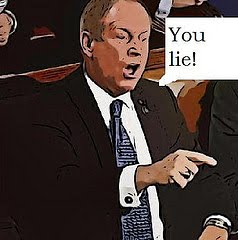
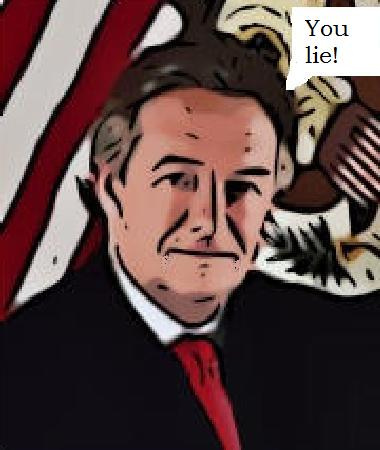
And he did make history last night, stunning a jam-packed joint meeting of both houses in the House chamber as well as millions of TV viewers as he bellowed “You Lie!” as President Obama was delivering his major address on health care reform.

Good old Joe made history because as far as anyone could determine, no one had ever exhibited such crass disrespect for the President of the United States during a presidential address.

Shouting out a crude epitaph in a routine session of the House of Representatives is grounds for a formal reprimand. So what was Joe thinking?

Not quite a year after Joe Wilson became a congressman, during a September 2002 debate on going to war in Iraq, Wilson called Congressman Bob Filner “viscerally anti-American.” During the debate, Filner suggested the United States supplied chemical and biological weapons to Saddam Hussein and Joe exploded that Filner had a “hatred of America.” Joe said later that he “didn’t intend to insult Filner.”

White House Chief of Staff, Rahm Emanuel, was sitting just a few rows in front of Congressman Wilson when he hurled his insult at his boss, the President. Emanuel reportedly made it very clear to Republican leaders that the congressman doing the shouting be identified and issue an apology immediately, noting that “No president has ever been treated like that. Ever.”

Wilson made a beeline out of the House chamber immediately after the end of the President’s speech. He must have had a political epiphany and decided to apologize, just like he had to fellow congressman Filner, by calling the President, to maybe again say “I didn’t mean to insult you.”

Rahm Emmanuel took the call and accepted Joe’s apology on behalf of the president. A formal letter of apology was hastily issued from Wilson’s congressional office but it clearly shows Joe’s wrong-headed hubris. While the letter apologized for “a lack of civility,” it also pointed out that, “While I disagree with the president’s statement, my comments were inappropriate…”

This is actually a classic example of the “flipped conservative lie” where a clearly established fact, is ballyhooed to constituents back home as being just the opposite. It is classic GOP “government is lying to you so we gotta fight this” political trickery.

“While I disagree with the president’s statement…” is Joe’s way of continuing to maintain the President is lying to you because Joe wants so badly to believe that his real lie, instead, is true.

In this case the President of the United States was categorically clearing up a totally false Republican claim that illegal immigrants would be provided free health care under a new health care reform bill. Joe’s ingrained demagoguery automatically made him shout “You lie!” For that instant he forgot he was not in a chummy, fired up town hall meeting in South Carolina, but that he was seated among his peers and his president was debunking a large Republican lie.

So, lets look at this. The president unambiguously declares that the illegal immigrants free health care rumor is false. Joe says he “disagrees” with the president… meaning that somehow Joe is convinced the illegals are going to get free health care no matter what the president or anyone else says. That Barack Hussein Obama is the president, calm, collected, and much bigger than a sputtering, defeated southern white man might be part of what is going on here.

A hometown blog, Carolina Politics Online, reporting on their congressman’s ugly and universally condemned outburst, simply asked:

“Did y’all hear Congressman Joe Wilson stand up and yell ‘You lie!’ to Obama tonight when he said illegal aliens won’t get covered under government health care? It was clearly audible on the television and it made the Dalai Bama pause for a second or two. It’s already hit YouTube. The look on Pelosi’s face is priceless too.”

Yeah, we all heard it, millions of us, and so did your “Dali Bama.” In fact, we’ve all had more than an earful of “Carolina Politics.” Your romance novel, philandering governor holds the South Carolina Jackass Award. Y’all also got all that rumor-mongering betting Governor Sanford’s GOP buddies will not impeach him out of fear of putting a supposedly gay man in his place. That is hard to top, but now Congressman Joe calls the POTUS a liar, in prime time, and takes top jackass spot for a while. Y’all are in a big steamed up glass house. Time to quit throwing rocks, and worry about our country’s real problems don’t you think?

FOLLOW UP: People wanting to leave their thoughts about Rep. Joe Wilson on his Capitol Hill web site are getting this notice after clicking “Contact Us.” Joe really connected with America it seems. And lots of them would like to have a piece of his red neck.


[Retired journalist Larry Ray is a Texas native and former Austin television news anchor. He also posts at The iHandbill.]

The Rag Blog

Posted in Rag Bloggers | Tagged , , , , , | 13 Comments

Beyond Hutto : Reforming Immigrant Detention

Demonstrator at T. Don Hutto detention facility on World Refugee Day, June 20, 2009. Photo by Melissa Del Bosque / The Texas Observer.

Beyond Hutto:
Activists reflect on the continuing struggle against immigrant detention centers.

By DC Tedrow / The Rag Blog / September 10, 2009

In response to mounting criticism of harsh policies, the Obama administration announced in August that the United States would begin reforming the government’s immigrant detention system. Although details are sketchy and changes will be introduced slowly, one immediate and appreciable shift in policy was the announcement that Immigrant and Customs Enforcement (ICE) will no longer send immigrant families to the T. Don Hutto Residential Center in Taylor, Texas, just northwest of Austin.

That the administration mentioned Hutto specifically is not surprising; news media, religious groups, and progressive activists have criticized the facility for locking up children since Hutto began detaining families in May 2006. In 2007, the American Civil Liberties Union filed a lawsuit against ICE on behalf of families detained at Hutto, which led to improved conditions at the facility. After investigating the prison in June 2009, the Inter-American Commission on Human Rights (IACHR) announced in a press release that, even though conditions had improved since the ACLU lawsuit, the continued detention of asylum seekers and their children at Hutto violated principles of international law.

In addition to the ACLU and the IACHR, the organizations Grassroots Leadership and Texans United for Families have helped lead the charge against the Hutto facility. Below, Bob Libal of Grassroots Leadership and Lauren Martin of Texans United for Families discuss Hutto, the Obama administration’s announcement, and prospects for future organizing.

Bob Libal is the Texas coordinator for Grassroots Leadership, a southern based social justice organization taking on private prisons, and an activist in the movement to end immigrant detention at Hutto. Lauren Martin is a member of Texans United for Families, an Austin-based coalition working to end family detention, and is a PhD student in geography at the University of Kentucky.

Talk about the history of the T. Don Hutto facility.

Bob Libal: Basically, Hutto was a medium-security prison that Corrections Corporation of America took over in the late ’90s. It was a failing private prison that couldn’t retain much of a population base. CCA had contracted with U.S. Marshals, with ICE to house adult detainees, and both of those contracts had fallen through. Then, in the spring of 2006 they reopened it with the announcement that they were going to be detaining immigrant families, including small children for ICE. This was a pretty big expansion of the family detention system in this country.

In August, the Obama administration announced that the U.S. government would no longer be holding immigrant families at facilities such as Hutto. Why did they make this move?

Bob Libal: I think they made this decision because of political pressure, because organizers had made Hutto a lightning rod of controversy. The decision basically takes family detention policy back to pre-9/11 levels. Before the announcement last month, there were two family detention centers in the country: Hutto and the Berks County Detention Center in Pennsylvania, which has 80 beds. Last year, ICE proposed three new family detention centers around the country. What we were looking at, up until this announcement, was an expansion of the family detention system.

The announcement is that they would be either transferring families to Berks or releasing them on alternatives-to-detention programs. Berks is full right now: it’s at capacity at 82 beds, so in reality what that’s translated to is they’re releasing families into alternatives-to-detention programs or releasing them with notices to appear at their immigration hearings. They also are taking the new family detention centers off the table. I think it’s a pretty substantial victory. The New York Times described it as the first major departure on immigration policy from the Bush administration.

Is this going back to the idea of “catch and release?”

Bob Libal: I’ve heard John Morten, who is the Assistant Secretary for Homeland Security, say “No, we’re not returning to that.” But I think the people who are getting out of Hutto are getting out on notices to appear. I think that it’s still unclear how this sort of processing is going to take place. Say that you’re apprehended or apply for asylum on the border. What happens to you? Are you then just released into an alternatives-to-detention program, or are you sent to Berks and then released? I think we don’t know that yet. What it does mean is that, at any one time, there are a lot fewer families in detention.

Lauren Martin: I think it’s important to differentiate, too, between “catch and release,” which is really vague and could mean anything, and the bond and parole procedures that have been in place and are available to many immigrant detainees. That’s often what families are released on. There is some degree of supervision, and they also pay quite a bit of money either in bond or for parole to participate in those programs. So “release” is misleading. Just because they’re not in Hutto, there are still other forms of institutional supervision. Alternatives-to-detention programs have a wide range of forms of supervision.

“Catch and release” is this phrase that critics of this policy bandy about.

Lauren Martin: Right. And the justification for opening Hutto was that they need to move from “catch and release” to “catch and return.” There’s a presumption of illegality — that all these families would be released into the population and abscond. Michael Chertoff said that. A vast majority of the families that have been detained at Hutto are asylum seeking families, so it’s a lot more complicated than this simplistic illegal-versus-legal dichotomy.

Hutto has not been shut down, though. It’s been converted into a detention center for women, correct?

Lauren Martin: Yes. After the legal settlement mandated that they do periodic reviews — every 30 days they have to review whether a specific family qualifies to be released on bond or parole — once they started doing that, they did start releasing families a lot faster, which made the population drop. So they filled Hutto halfway with immigrant women. As families are released, it will be filled completely with immigrant women without children. That’s what they’ve announced. It’s not closed.

What now? Will Grassroots Leadership continue to focus on Hutto?

Lauren Martin: I work with Texans United for Families, a coalition of people that have been fighting family detention at Hutto. I can sort of speak for the coalition, but not Grassroots Leadership. We’re trying to figure out what the announcement really means, so we’ve been staying in close contact with Washington, D.C.-based advocates who have closer relationships with ICE, and the attorneys in the lawsuit who are actually representing folks at Hutto, to see what’s going on there and to make sure that everything continues to go well. The next project is to figure out how to use the energy from the victory — because it is still a victory, even it’s a partial one — how to roll that in to serve the next campaign. What are the lessons we’ve learned? How do we build on it and expand it?

We also have to think about, what do we do when there are not families detained? That was clearly something that mattered to a lot of people. And widening the question to detention requires very careful strategies about messaging, although there’s plenty to organize around.

Do you think there’s a climate for expanding this message to include more than just families? To target detention itself?

Lauren Martin: I think so. There have been a lot of really successful campaigns in the United States around other family-related issues, not necessarily family detention. In New York, Families for Freedom is a close ally of ours, and they’ve been organizing around the Child Citizen Protection Act, which is basically an act that says if someone has a citizen child, then the immigration judge will get some discretion to not deport the parents. Right now, in many situations, judges get no discretion. They don’t get to say, “This person clearly has family ties, they have a few kids who need them, so it would be better not to deport this person.” Immigration judges’ hands are tied by the way our legislation is written right now.

Family unity is supposed to the backbone of our immigration system. However heternormative a form a family it may be, it is still what both conservatives and liberals think of as the touchstone of the immigration system. So I think that’s actually a really powerful discourse that we can use to expand to other injustices in the immigration system, because it’s something that everybody understands, whereas immigration law is totally obscure and difficult to understand.

Bob Libal: We will certainly continue to draw attention to the broader issues of immigrant detention and private prisons. And I believe that we will continue to draw attention to Hutto, since it’s right outside of Austin and still a private prison that holds immigrant detainees. But I think that it is important to think strategically about how we can best push back on that system. I don’t think we’ve figured out exactly what the next big campaign is going to be, because there are so many immigrant detention centers. It’s important to both target geographic locations — like a facility — but also work towards policy change.

I think that is one of the lessons of the Hutto campaign: You can target a facility to make it very infamous, which the movement did to Hutto. But at the same time, it was drawing attention to a broader policy, which is family detention. I think we’ve pushed back family detention policy by drawing attention to Hutto. Hopefully we’ll be able to do that again in the future: by targeting a facility and pushing back on a policy like mandatory detention, secure communities, or any of these other really horrendous programs that lead to the incarceration of immigrants on a mass scale.

[DC Tedrow edits The New Texas Radical where this article also appears.]

The Rag Blog

Posted in RagBlog | Tagged , , , , , , , | Leave a comment

Rep. Joe Wilson : Removing Cranium From Colon

Rep. Joe Wilson, R-S.C.: an exercise in decorum. Photo from AP.

Congressman Pants on Fire:
A Blog for Rep. Joe Wilson of South Carolina

By Steve Russell / The Rag Blog / September 10, 2009

Rep. Charles Boustany of Louisiana, who delivered the Republican rebuttal to the President’s health care speech, once got scammed while trying to buy a British title. Apparently, his colleague from South Carolina is taking GOP Anglophile tendencies into his own hands by heckling a speech to a joint session of Congress, which is customary when the House of Commons meets the Prime Minister… but we don’t normally run our Congress that way.

Whether is was “You lie!” or “Liar!” it was the unruly gentleman from South Carolina with his pants on fire, even if the bill did not specifically exclude the undocumented, which it does.

Let me pause to say the heresy: if it were possible to cover undocumented workers, we should. This is not a play for Hispanic votes because I don’t run for office anymore. This is economic reality. The more people in the pool, the more people paying premiums, the cheaper health insurance is. So instead of including undocumented — am I allowed to say human beings? — in the pool, we will continue to treat them in emergency rooms. That’s bad policy and that makes no economic sense.

The anti-immigrant crowd is either too racist or too stupid to wrap their minds around the fact that each person added to the insurance pool costs the ratepayers — us — less money rather than more. Health insurance is not charity.

What has become of politics where it’s necessary to deny being charitable?

Anyway, here’s why Congressman Pants on Fire would be wrong even without the plain language of the bill.

This is a coverage mandate. Everybody is required to buy health insurance. See above. A universal pool is cheapest. As the President said, it works like mandatory automobile liability insurance, complete with an assigned risk pool so people are not required to do the impossible.

To enforce such a mandate, government has to set up a wicket we all pass. In the case of automobile liability insurance, that wicket is registration of your automobile or renewing your driver’s license.

In the case of health insurance, that wicket is going to be form 1040 or 1040EZ, filed every year with the Internal Revenue Service. This is because so much of the bill happens on that form: subsidies for low numbers reported on that form, credits against sums owing on that form.

That wicket will miss the elderly, but they have Medicare.

That wicket will miss children, but they have coverage from their parents or S-Chip.

And it will miss the undocumented because they have no Social Security numbers and their very employment is unlawful. So if the mandate hits them, how will it be enforced?

The nonsense here, alongside the racism, is that medical insurance will, if Obama’s proposal passes, be free.

The other nonsense is that the government will run the entire system, like it does in Great Britain, the country where the two congressmen who set me on this rant will find their hereditary titles and their opportunity to shout down the country’s chief executive. I guess they are Anglophiles in all but health care.

The Rag Blog

Posted in Rag Bloggers | Tagged , , | 4 Comments