Cynthia McKinney : Letter From an Israeli Jail

Former U.S. Rep. Cynthia McKinney is now imprisoned in an Israeli jail after the Israeli stopped a boat with humanitarian supplies bound for Gaza.

Letter from an Israeli jail

I am being held in this prison because I had a dream that Gaza’s children could color and paint, that Gaza’s wounded could be healed, and that Gaza’s bombed-out houses could be rebuilt.

By Cynthia McKinney / July 4, 2009

This is Cynthia McKinney and I’m speaking from an Israeli prison cellblock in Ramle. [I am one of] the Free Gaza 21, human rights activists currently imprisoned for trying to take medical supplies to Gaza, building supplies — and even crayons for children; I had a suitcase full of crayons for children.

While we were on our way to Gaza the Israelis threatened to fire on our boat, but we did not turn around. The Israelis hijacked and arrested us because we wanted to give crayons to the children in Gaza. We have been detained, and we want the people of the world to see how we have been treated just because we wanted to deliver humanitarian assistance to the people of Gaza.

At the outbreak of Israel’s Operation Cast Lead [in December 2008], I boarded a Free Gaza boat with one day’s notice and tried, as the U.S. representative in a multinational delegation, to deliver three tons of medical supplies to an already besieged and ravaged Gaza.

During Operation Cast Lead, U.S.-supplied F-16s rained hellfire on a trapped people. Ethnic cleansing became full-scale, outright genocide. U.S.-supplied white phosphorus, depleted uranium, robotic technology, DIME weapons, and cluster bombs — new weapons [created] injuries never treated before by Jordanian and Norwegian doctors. I was later told by doctors who were there in Gaza during Israel’s onslaught that Gaza had become Israel’s veritable weapons-testing laboratory, people used to test and improve the kill ratio of their weapons.

The world saw Israel’s despicable violence thanks to Al-Jazeera Arabic and Press TV that broadcast in English. I saw those broadcasts live and around the clock, not from the USA but from Lebanon, where my first attempt to get into Gaza had ended because the Israeli military rammed the boat I was on in international water[s]… It’s a miracle that I’m even here to write about my second encounter with the Israeli military, again a humanitarian mission aborted by the Israeli military.

The Israeli authorities have tried to get us to confess that we committed a crime… I am now known as Israeli prisoner number 88794. How can I be in prison for collecting crayons [for] kids?

Zionism has surely run out of its last legitimacy if this is what it does to people who believe so deeply in human rights for all that they put their own lives on the line for someone else’s children. Israel is the fullest expression of Zionism, but if Israel fears for its security because Gaza’s children have crayons then not only has Israel lost its last shred of legitimacy, but Israel must be declared a failed state.

I am facing deportation from the state that brought me here at gunpoint after commandeering our boat. I was brought to Israel against my will. I am being held in this prison because I had a dream that Gaza’s children could color and paint, that Gaza’s wounded could be healed, and that Gaza’s bombed-out houses could be rebuilt.

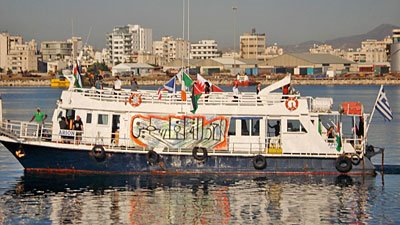
The aid ship Spirit of Humanity as it left for Gaza, before being seized by the Israelis.

But I’ve learned an interesting thing by being inside this prison. First of all, it’s incredibly black, populated mostly by Ethiopians who also had a dream… like my cellmates, one who is pregnant. They are all are in their 20s. They thought they were coming to the Holy Land. They had a dream that their lives would be better… The once proud, never-colonized Ethiopia [has been thrown into] the back pocket of the United States, and become a place of torture, rendition, and occupation. Ethiopians must free their country because superpower politics [have] become more important than human rights and self-determination.

My cellmates came to the Holy Land so they could be free from the exigencies of superpower politics. They committed no crime except to have a dream. They came to Israel because they thought that Israel held promise for them. Their journey to Israel through Sudan and Egypt was arduous. I can only imagine what it must have been like for them. And it wasn’t cheap. Many of them represent their family’s best collective efforts for self-fulfillment. They made their way to the United Nations High Commission for Refugees. They got their yellow paper of identification. They got their certificate for police protection. They are refugees from tragedy, and they made it to Israel, only after they arrived Israel told them, “There is no UN in Israel.”

The police here have license to pick them up and suck them into the black hole of a farce for a justice system. These beautiful, industrious and proud women represent the hopes of entire families. The idea of Israel tricked them and the rest of us. In a widely propagandized slick marketing campaign, Israel represented itself as a place of refuge and safety for the world’s first Jews and Christians. I too believed that marketing and failed to look deeper.

The truth is that Israel lied to the world. Israel lied to the families of these young women. Israel lied to the women themselves who are now trapped in Ramle’s detention facility. And what are we to do? One of my cellmates cried today. She has been here for six months. As an American, crying with them is not enough. The policy of the United States must be better, and while we watch President Obama give 12.8 trillion dollars to the financial elite of the United States it ought now be clear that hope, change, and “yes we can” were powerfully presented images of dignity and self-fulfillment, individually and nationally, that besieged people everywhere truly believed in…

It was a slick marketing campaign as slickly put to the world and to the voters of America as was Israel’s marketing to the world. It tricked all of us but, more tragically, these young women.

We must cast an informed vote about better candidates seeking to represent us. I have read and re-read Dr Martin Luther King, Jr’s letter from a Birmingham jail. Never in my wildest dreams would I have ever imagined that I too would one day have to [write one]. It is clear that taxpayers in Europe and the US have a lot to atone for, for what they’ve done to others around the world.

The Israeli navy is shown stopping “The Spirit of Humanity,” the activists’ boat, off the coast of the Gaza Strip on Tuesday. Photo from AFP.

What an irony! My son begins his law school program without me because I am in prison, in my own way trying to do my best, again, for other people’s children. Forgive me, my son. I guess I’m experiencing the harsh reality which is why people need dreams. [But] I’m lucky. I will leave this place. Has Israel become the place where dreams die?

Ask the people of Palestine. Ask the stream of black and Asian men whom I see being processed at Ramle. Ask the women on my cellblock. [Ask yourself:] What are you willing to do?

Let’s change the world together and reclaim what we all need as human beings: Dignity. I appeal to the United Nations to get these women of Ramle, who have done nothing wrong other than to believe in Israel as the guardian of the Holy Land, resettled in safe homes. I appeal to the United State’s Department of State to include the plight of detained UNHCR-certified refugees in the Israel country report in its annual human rights report. I appeal once again to President Obama to go to Gaza: send your special envoy, George Mitchell there, and to engage Hamas as the elected choice of the Palestinian people.

I dedicate this message to those who struggle to achieve a free Palestine, and to the women I’ve met at Ramle. This is Cynthia McKinney, July 2nd 2009, also known as Ramle prisoner number 88794.

[Cynthia McKinney is a former Democratic US congresswoman, Green Party presidential candidate, and an outspoken advocate for human rights and social justice. The first African-American woman to represent the state of Georgia, McKinney served six terms in the US House of Representatives, from 1993-2003, and from 2005-2007. McKinney’s remarks were transcribed here from a telephone call received and broadcasted by WBAIX.org.]

Source / Ma’an News Agency

Thanks to Mike Klonsky / The Rag Blog

Posted in RagBlog | Tagged , , , , | 2 Comments

Star Spangled Banner : Jimi Hendrix at Woodstock

Jimi Hendrix plays the national anthem

The Rag Blog

Posted in RagBlog | Tagged , , , , | 2 Comments

Sarah Palin Reads Vanity Fair, Resigns as Governor

Illustration by Risko for Vanity Fair.

Even the woman in the red dress who told candidate McCain at a town hall campaign gathering in 2008 she thought Obama ‘was an Arab’ should be able see past Palin’s lip gloss, if she reads the VF article.

By Larry Ray / The Rag Blog / July 3, 2009

Sarah Louise Palin, erratic governor of Alaska and the G.O.P.’s 2008 Vice Presidential candidate, must have felt more than just the heat that is melting the glaciers in her state. She announced her resignation one day before all the real Fourth of July fireworks, from her Wasilla, Alaska home.

I read Todd S. Purdum’s tell-all article, “It Came From Wasilla” just two days ago in the August 2009 issue of Vanity Fair. Purdum’s article was more than telling. It was prophetic. The title could now be “It Never Really Left Wasilla.”

The article carefully documents Palin from all sides, including inside stories now being told by top McCain campaign staff about Palin’s petulant meltdown as a serious candidate. She dazzled the eager conservative base like a master magician during her brief stage appearances, but a look behind the curtain discloses a small town, clueless lightweight former beauty queen whose life, Purdum notes, “has sometimes played out like an unholy amalgam of Desperate Housewives and Northern Exposure.”

The Vanity Fair article is, well, fair. It definitely is not a superficial whack job. It is so on target, and so well documented that one has to wonder if it is more than coincidence that she decided to fold up her political tent. After Vanity Fair, she can expect a steady barrage of even deeper investigative reporting if she decides to run for anything other than head of her church’s glossolalia discussion committee.

Will she leave politics, or will she run for a U.S. Senate seat or the Presidency? Cable TV is having a field day. Interestingly, Palin’s timing in announcing her resignation evidences her utter lack of understanding of the fine points of making political news. Millions of Americans are traveling, taking holiday vacations to visit family and friends. And after the nonstop weekend news coverage of fireworks, parades and celebration of American Independence, constant news coverage immediately shifts to the Michael Jackson memorial free for all in Los Angeles through the end of the following week.

Palin has reportedly gotten a sizeable advance for a book contract. She has chosen a senior writer for conservative Christian World magazine as her co-author. But if you can’t wait for her book to come out, I suggest you grab a copy of Vanity Fair for a more sober look at the real Sarah Louise Palin.

Vanity Fair also has strong presence on the web where you may also read the article.

Even the woman in the red dress who told candidate McCain at a town hall campaign gathering in 2008 she thought Obama “was an Arab” should be able see past Palin’s lip gloss, if she reads the VF article.

[Retired journalist Larry Ray is a Texas native and former Austin television news anchor. He also posts at The iHandbill.]

The Rag Blog

Posted in Rag Bloggers | Tagged , , | 4 Comments

California Homeless : Hundreds March For a Legal Place to Sleep

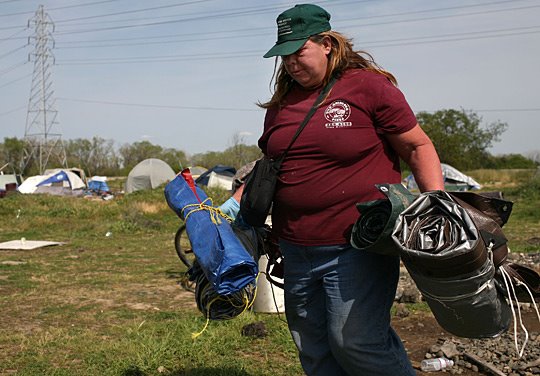
John Kraintz (top), who is homeless, was part of the procession that began at Loaves & Fishes in Sacramento. Photo by Lezlie Sterling / Sacramento Bee. Karen Hersh (below), a homeless woman, carries her belongings at the tent city in Sacramento. She and hundreds of other residents living in the tent city along the American River were issued notices of eviction by Sacramento police. Photo by Justin Sullivan / Getty Images.

Hundreds of California homeless march for land rights

“We’re supposed to be the eyesore, but actually we’re citizens and we’re human beings. We’re supposed to have rights like everybody else; it don’t matter what we have in our pockets.” — Philip Grice, Homeless, 45

By Richard Gonzales / July 3, 2009

It has been about three months since city officials shut down a large “tent city” occupied by Sacramento’s homeless people.

Now, some of the tent city’s residents say they feel like refugees, with no place to go. They staged a loud demonstration Wednesday, in hopes of pressuring Sacramento officials to find them a new place to camp.

‘Where Am I Supposed To Live?’

Philip Grice, 45, has been on the move ever since the tent city closed.

“When we moved out, we moved over to a private area two fields over. They wanted us off of there too. Just like shuttling cattle, that’s all it is,” said Grice, a carpenter by trade, who wears a T-shirt that reads, “Where am I supposed to live?” “We’re supposed to be the eyesore, but actually we’re citizens and we’re human beings. We’re supposed to have rights like everybody else; it don’t matter what we have in our pockets.”

Grice joined about 250 other homeless people and their supporters for a march through the northern end of Sacramento.

Their action coincided with the closure this week of a temporary shelter where many of the tent city residents had found a roof for the winter. Now these individuals say they need a year-round legal camp on what they call “safe ground.”

Rodney Frazier, 43, a single father and disabled brick mason, participated in the march.

“A lot of these people are brick masons, they are tile setters, they are dentists, they had some very nice jobs,” said Frazier. “They contribute to the world, to society, and they had a downfall in life. They need help getting up.”

No Legal Place To Sleep

The march ended up in a hot and dusty city-owned lot next to a police station, where organizers set up a symbolic occupation. Val Jon Farris, founder of a group called iCare America, set up a tent on the lot.

“There is no legal place for people to live unless they own, rent or lease a home. So if you’re homeless it’s illegal to exist. You can’t even lay your head anywhere without getting arrested, prosecuted or criminalized,” said Farris. “So this is a demonstration in order to create a civil liberty that ought to already exist, which is [that] people have the right to be, to live without the threat of being incarcerated in their own country.”

Sacramento police officer Mark Zoulas, who has served on the homeless beat for the past decade, said a legal campground makes sense to him.

“You need something for that immediate need,” said Zoulas. “I like the winter shelter. I’m not saying that’s the best answer in the world necessarily. But at least it gives you a choice. And that’s now closed and everyone using it is out. And that leaves, for the minute, nothing, and nothing is never the answer.”

The idea of a safe ground for homeless campers divides officials in city hall. The mayor, Kevin Johnson, has been receptive, but others, including the city manager, Ray Kerridge, is not. There is also a disagreement over how much it will cost at a time when the city and county are already slashing basic services.

What is not in dispute is that this week Sacramento has 200 more people with no place to sleep.

Source / All Things Considered / NPR / July 2, 2009

Thanks to Jeffrey Segal / The Rag Blog

Posted in RagBlog | Tagged , , , , | 2 Comments

Honduras Still a Democracy? Well, Relatively Speaking…

The Amazing Michelettis: Nephew William Hall Micheletti, left, has been named mayor of San Pedro Sula, by Uncle Roberto Micheletti, right, the post-coup ‘president’ of Honduras.

Coup ‘President’ installs nephew as ‘Mayor’ of Honduras’ second city

By Al Giordano / July 3, 2009

The Oligarch Diaspora shouts, again and again, in its flailing attempt to convince the Honduran people and the world that its coup d’etat was somehow legitimate, “we want democracy!”

Well, here’s a powerful example of the kind of “democracy” they apparently want.

In November of 2008, the voters of San Pedro Sula – with a population of one million, it’s the second largest city in Honduras — elected Mayor Rodolfo Padilla Sunseri (right, in the photo above) to be their Liberal Party candidate for mayor, with 63 percent of the vote.

Another candidate in that contest — William Hall Micheletti (left, in the photo above, and doesn’t that last name sound familiar?) — garnered just 16 percent, coming in third.

Padilla went on to win the mayoralty.

But when your uncle Roberto Micheletti is the newly installed dictator of your country, coming in third is good enough!

At 11 a.m. this morning, workers and citizens in and near San Pedro Sula City Hall heard gunshots and explosions, while riot police attacked a crowd that was demonstrating outside against the coup. More than 50 citizens were reportedly arrested. And nobody has seen Mayor Padilla ever since.

So who is now “mayor” of the city? Telesur reports: the coup “president’s” nephew, William Hall Micheletti.

Ain’t their version of “democracy” grand?

Source / The Field / Narco News

The Rag Blog

Posted in RagBlog | Tagged , , , | Leave a comment

4th of July : Honor our Hemp-Growing Founding Fathers

Graphic from BuzzFlash.

Honor our hemp-raising patriot heroes

Presidents Washington and Jefferson — both of them extremely advanced agronomists — cataloged their techniques for growing hemp at great length. They would simply not comprehend the concept… that hemp might be illegal.

By Thomas Paine / The Rag Blog / July 3, 2009
[As told to Harvey Wasserman]

It is our patriotic duty to honor our Founding Heroes, America’s greatest hemp growers.

George Washington, Thomas Jefferson, James Madison — virtually all Revolutionary Americans who had access to land — embraced hemp’s critical role in our early economy.

Accordingly, they raised it in mass quantities.

We must now honor them by demanding its immediate legalization, to save our economy and our ecology.

For rope, for paper, for clothing, for food, for fuel, this miracle plant has been a critical crop for cash and survival for 6,000 years, since the onset of ancient China.

Today it is a multi-billion-dollar product there and in Germany and Canada, among other major economies.

There is no rational reason for hemp to be illegal. Some law enforcement “experts” say it resembles marijuana, and therefore must be banned.

What are they smoking? Certainly not hemp, which gives its imbibers little more than a splitting headache and a nasty cough.

Today, marijuana is the largest cash crop in many states and regions of the United States. A billion dollars-worth of it was purchased under medical auspices last year in California alone. Properly taxed, its users freed from our overcrowded prisons, pot’s legalization could offer a giant step out of our financial morass.

But as an agricultural staple, marijuana pales alongside hemp. This miracle weed returns on its own year after year, requiring no pesticides, herbicides or special fertilizers. It is hardy, fast-growing and supremely productive.

A single hemp plant can provide the basis for very high-quality rope, sails for ships, cloth for clothing, paper for documents, seeds for food and oil, the cellulosic base for ethanol, and much more. It is the feed of choice for untold numbers of birds and land animals. It can be the basis for innumerable stressed eco-systems where it survives and thrives with virtually no human input.

As a staple spread across the Great Plains and through the rest of America’s battered farmland, it could help restore our shattered crop base and our devastated rural economy.

Presidents Washington and Jefferson — both of them extremely advanced agronomists — cataloged their techniques for growing hemp at great length. They would simply not comprehend the concept — let alone the reality — that hemp might be illegal.

Early drafts of both the Declaration of Independence and Constitution were written on sturdy paper made of hemp.

Now, more than ever, we need the essence of both the documents and the crop.

Save Our Planet! Stimulate Our Economy!!

Honor our Founders!!! Be a Patriot!!!! Legalize Hemp Now!!!!!

[“Thomas Paine’s” Passions of the Potsmoking Patriots is at harveywasserman.com.]

Also read about the Hemp Coalition’s 40th Anniversary 4th of July Smoke-In in Washington, D.C. here.

The Rag Blog

Posted in Rag Bloggers | Tagged , , , , , | 2 Comments

Robert Jensen : Beyond Independence: When We Are Most Free

Photo by ericagirlwonder.

Beyond independence:
We are most free when we are most bound to others

By Robert Jensen / The Rag Blog / July 3, 2009

Power is typically approached as a question of dominance and submission. Power is marked by the ability to impose or the ability to resist that imposition. This is what some have called “power-over,”[1] which assumes a zero-sum game in which individuals are always in competition for that power — someone dominates and someone submits.

In such a world, one can use this kind of power with varying levels of responsibility to others, but in such a world it is inevitable that power routinely will be used unjustly. Because there is always the threat that some other person or group can grab the power, these kinds of systems will encourage people to seek always more power.

This is readily evident, for example, in the emergence of the United States as the dominant power after World War II. Even though it was clear the United States could have lived relatively secure in the world with its considerable wealth and extensive resources, that status was instead a source of anxiety in a power-over world, as seen in this conclusion of the State Department’s Policy Planning Staff in 1947: “To seek less than preponderant power would be to opt for defeat. Preponderant power must be the object of U.S. policy.”[2]

That’s the logic of power-over: One either dominates or eventually is dominated. The potential of a challenge from below means that no amount of power is enough; more always must be accumulated to ward off threats. Along the way, people pursuing these goals tend to justify the concentration of power as in the best interests of all; the enlightened ones with the power tell us that they will use it benevolently in the interests not just of themselves but also those less fortunate.

All of human history argues against having faith in this power-seeking, with its accompanying hubris and self-delusion. But history is conveniently ignored by the powerful as they congratulate themselves on their vision and fortitude, while at the same time they work feverishly to propagandize the powerless, lest those below see the shell game for what it is and rebel.

It’s tempting to say that this power-over exercised on earth is illusory, that real power rests with God or on some other plane of existence. The problem, of course, is that the suffering caused by the exercise of power-over is not illusory and does not exist at some other level. It is felt by people and other living things in the here-and-now.

The need to challenge power-seeking, domination, and injustice is not otherworldly but of this world. Still, it is not merely rhetorical to mark that power-over is dead power. It is ultimately the power of death, and also is a power that comes only to those whose souls are dead. The poet Muriel Rukeyser expressed clearly the nature of this power and why we should reject it:

Dead power is everywhere among us — in the forest, chopping down the songs; at night in the industrial landscape, wasting and stiffening a new life; in the streets of the city, throwing away the day. We wanted something different for our people: not to find ourselves an old, reactionary republic, full of ghost-fears, the fears of death and the fears of birth. We want something else.[3]

We want something else, but our systems and institutions rarely provide it. Even the church itself, where we might assume we could find that “something else,” is mired in a domination/subordination dynamic. Much Christian theology is rooted in the idea that people are so inherently evil that we must subordinate ourselves to God, and then — convenient for church officials — to a calcified dogma and doctrine propagated by the church.

It shouldn’t be surprising that this conception of Christianity coexists comfortably with the power-over exercised by the contemporary nation-state and corporation. These groups of elites — political, economic, religious — take for themselves the right to dominate in their arena, eyeing the other elites nervously, knowing they must collaborate with each other but always aware they also are in nervous competition in the struggle for primacy. Such is the nature of life, even for the ultra-privileged, in a power-over world.

We must give this kind of system its due: Clearly, a system based on power-over can be productive — it can extract resources from the earth and energy from people to produce a vast array of goods and services, which brings some benefits to some people. But just as clearly, such a system can never be truly creative — it cannot create a world in which all people flourish, create new ways of understanding, or create solutions to the problems power-over inevitably generates. Such flourishing, understanding, and problem-solving come not from power-over but from power-with, an understanding of power not based in assertions of independence and destructive dominance but in an embrace of interdependence and creative cooperation.

In a hyper-individualized society based on capitalism’s glorification of greed, it’s not surprising that an adolescent conception of selfish independence would define our political and economic institutions and dominate our cultural imagination. Of course the struggle for a certain kind of independence — being free from the imposition of power-over — is not a trivial matter; we see what inhumanity is possible when people are not truly free to act as individuals, and we know that independence at the personal level matters in our lives. Yet we all know that we are not independent beings but profoundly interdependent with each other, other organisms, and the non-living world.

The task is to create a system that gives us freedom from the illegitimate authority that people and institutions attempt to impose on us, but recognizes our obligations to each other. One way to think through this is to imagine what a world would look like if power were not “over” but “with,” if we understood that our power can be magnified in collaboration with others.

Even in the midst of a capitalist economy structured on power-over, experiments in power-with go forward, such as worker cooperatives that are owned and controlled by members. The United States Federation of Worker Cooperatives estimates that there are more than 300 such democratic workplaces in the United States, employing 3,500 people and generating about $400 million in annual revenues, mostly concentrated in the Northeast, West Coast and Upper Midwest.

Worker cooperatives tend to create stable jobs, foster sustainable business practices, and support linkages among different segments of the community. The principles articulated by the federation capture the spirit behind, and organization of, cooperatives: voluntary and non-discriminatory open membership; control by members; equitable and democratic control of capital; commitment to education and training of members; cooperation with other cooperatives; and a commitment to sustainable community development.[4]

One exciting example of this model is Green Worker Cooperatives, which was established to incubate worker-owned and environmentally friendly cooperatives in the South Bronx. The first cooperative they launched, the ReBuilders Source, is a retail warehouse for surplus and salvaged building materials recovered from construction and demolition jobs. In the Green Worker Cooperatives’ own words:

Our approach is a response to high unemployment and decades of environmental racism. We don’t have the luxury to wait for new alternatives. That’s why we’re creating them. We believe that in order to address our environmental and economic problems we need new ways to earn a living that don’t require polluting the earth or exploiting human labor.[5]

For many, it’s hard to imagine working in institutions based on real cooperation because the society in which we live is structured on such a different notion. Yet if we think of experiences when we feel authentically most at home — not just our home with family, but with friends, in political groups, at church, in a community association — we typically feel powerful not because we can force people to do things or can ignore other people’s needs in our decisions; we feel powerful when we come together with others to create something we couldn’t have created alone.

Though it sounds paradoxical in this culture, this leads to an important insight:

We are most free when we are most bound to others.

When bonds are created under conditions of mutual respect and shared power, our freedom is deepened by such interdependence. Our strength is not sapped by these bonds but is enhanced by the emergent properties of collective human action. The individual efforts of numerous people cannot simply be added together and plugged into an equation to predict the outcome, but rather their simple actions come together in a collective result that is novel and irreducible.

The most creative force does not come from a power, centralized either in one person or one institution and its bureaucracy, which imposes its will on others and treats people as inputs whose energy can be plugged into a formula for production. The most creative force comes from distributed power that channels the contributions of many into ends that people define collectively. This goes against the cultural icon of the heroic figure, who may enlist the help of others but, in the end, draws on a power that is individual and ultimately in conflict with other power in the world.

Heroic figures typically are overrated, as those who are put in that role often understand. In Brecht’s play Galileo, the famed scientist’s assistant is devastated when Galileo recants his scientific beliefs under threat from the Inquisition. Andrea confronts Galileo: “Unhappy is the land that breeds no hero.” Galileo responds, “No, Andrea: Unhappy is the land that needs a hero.”[6]

[This essay is excerpted from Robert Jensen’s new book, All My Bones Shake: Seeking a Progressive Path to the Prophetic Voice, published by Soft Skull Press.

Robert Jensen is a journalism professor at the University of Texas at Austin and board member of the Third Coast Activist Resource Center in Austin, TX. He is the author of several books and is a regular contributor to The Rag Blog. Jensen can be reached at rjensen@uts.cc.utexas.edu and his articles can be found online here.]

References:

  1. The power-over/power-with distinction is usually credited to Mary Parker Follett, a theorist, political organizer, and social activist who wrote several influential books in the first half of the twentieth century. The terms are used today in a variety of academic, political, and business settings. I first encountered this term in discussions with feminist activists. For a review, see “Feminist Perspectives on Power,” Stanford Encyclopedia of Philosophy, October 2005.
  2. Quoted in Melvyn Leffler, A Preponderance of Power: National Security, the Truman Administration, and the Cold War (Stanford, CA.: Stanford University Press, 1992), pp. 18-19.
  3. Muriel Rukeyser, quoted in Adrienne Rich, What is Found There, (New York: W.W. Norton, 1993), page preceding preface. Originally published in The Life of Poetry (New York: Current Books, 1949).
  4. United States Federation of Worker Cooperatives, “About Worker Cooperatives.” See also, International Organization of Industrial, Artisan and Service Producers’ Cooperatives, “World Declaration on Cooperative Worker Ownership,” February 2004.
  5. Green Worker Cooperative, “Advocating Zero Waste.”
  6. Bertolt Brecht, Galileo (New York: Grove Press, 1940), p. 115

The Rag Blog

Posted in Rag Bloggers | Tagged , , | Leave a comment

Foodie Friday: Food Inc., the Movie

“If we squander the ecological capital of the soil, the capital on paper won’t much matter.” Wes Jackson, President of the Land Institute.

Food Inc., the Movie
By Janet Gilles / The Rag Blog / July 3, 2009

Don’t miss the latest incarnation of the company that brought us agent orange. They knew at the time that it was damaging the troops and the villagers in Viet Nam, we all knew. Now they have moved on to control of the food supply. Only a few corporations control almost all the food, where once we had tens of thousands. The few “farmers” left are in debt to the corporations and dare not speak up, and Monsanto leads the pack, taking ownership of the seeds themselves.

If we knew how the food was made, we wouldn’t eat it, and Monsanto goes to a lot of trouble to see that no cameras are allowed in the concentration camps where the animals and their illegal humans are kept, in striking contrast to the pictures of farmhouses and barns and meadows the industry wants us to believe still exist.

It started innocently enough, with government subsidy of corn, and now if you eat beef, chicken, pork, or fish, you are still just eating corn, the incredible cheap feed paid for by the taxpayer. The animals, not intended for corn, are sick, but antibiotics still work enough to keep it going.

We are however, on a precipice.

Twenty thousand years of agriculture transformed in fifty years.

You vote three times a day.

A surprisingly powerful film, with Eric Schlosser and Michael Pollan both telling us how it is.

Here are the Austin show times:

Alamo Drafthouse at the Ritz 4:15, 6:45
Arbor Cinema @ Great Hills 1:00, 3:10, 5:30, 7:40, 9:55

The Rag Blog

Posted in Rag Bloggers | Tagged , , , | 3 Comments

The Amnesty International Report on the Gaza War: Where Is World Outrage?


Gaza report video. © Amnesty International.

Impunity for war crimes in Gaza and southern Israel a recipe for further civilian suffering
July 2, 2009

Israeli forces killed hundreds of unarmed Palestinian civilians and destroyed thousands of homes in Gaza in attacks which breached the laws of war, Amnesty International concluded in a new report published on Thursday. Operation ‘Cast Lead’: 22 days of death and destruction, is the first comprehensive report to be published on the conflict, which took place earlier this year.

“Israel’s failure to properly investigate its forces’ conduct in Gaza, including war crimes, and its continuing refusal to cooperate with the UN international independent fact-finding mission headed by Richard Goldstone, is evidence of its intention to avoid public scrutiny and accountability,” said Donatella Rovera, who headed a field research mission to Gaza and southern Israel during and after the conflict.

A woman and a child made homeless after the destruction of their home, Gaza, January 2009. Photo © Amnesty International.

“The international community, led by the UN Security Council, must use all its leverage to ensure that Israel cooperates fully with the Goldstone inquiry, which now offers the best means to establish the truth.”

The Amnesty International report documents Israel’s use of battlefield weapons against a civilian population trapped in Gaza, with no means of escape and is based on evidence gathered by Amnesty International delegates, including a military expert, during field research in January and February.

The report shows that Hamas and other Palestinian armed groups fired hundreds of rockets into southern Israel, killing three Israeli civilians, injuring scores and driving thousands from their homes. “Such unlawful attacks constitute war crimes and are unacceptable,” added Donatella Rovera.

The scale and intensity of the attacks on Gaza were unprecedented. Some 300 children and hundreds of other unarmed civilians who took no part in the conflict were among the 1,400 Palestinians killed by Israeli forces.

Most were killed with high-precision weapons, relying on surveillance drones which have exceptionally good optics, allowing those observing to see their targets in detail. Others were killed with imprecise weapons, including artillery shells carrying white phosphorus – not previously used in Gaza – which should never be used in densely populated areas.

Amnesty International found that the victims of the attacks it investigated were not caught in the crossfire during battles between Palestinian militants and Israeli forces, nor were they shielding militants or other military objects. Many were killed when their homes were bombed while they slept. Others were sitting in their yard or hanging the laundry on the roof. Children were struck while playing in their bedrooms or on the roof, or near their homes. Paramedics and ambulances were repeatedly attacked while attempting to rescue the wounded or recover the dead.

“The deaths of so many children and other civilians cannot be dismissed simply as ‘collateral damage’, as argued by Israel,” said Donatella Rovera. “Many questions remain to be answered about these attacks and about the fact that the strikes continued unabated despite the rising civilian death toll.”

More than 3,000 homes were destroyed and some 20,000 damaged in Israeli attacks which reduced entire neighbourhoods of Gaza to rubble and left an already dire economic situation in ruins. Much of the destruction was wanton and could not be justified on grounds of “military necessity”.

The Israeli army has not responded to Amnesty International’s repeated requests over the past five months for information on specific cases detailed in the report and for meetings to discuss the organization’s findings.

“For its part, Hamas has continued to justify the rocket attacks launched daily by its fighters and by other Palestinian armed groups into towns and villages in southern Israel during the 22-day conflict. Though less lethal, these attacks, using unguided rockets which cannot be directed at specific targets, violated international humanitarian law and cannot be justified under any circumstance,” said Donatella Rovera.

In addition to locally made Qassam rockets, Palestinian militants often fired longer-range Grad-type rockets smuggled into Gaza via the tunnels on the Egyptian border, which reached deeper into Israel and placed many more Israeli civilians at risk.

“Five months on, neither side has shown any inclination to change its practices and abide by international humanitarian law, raising the prospect that civilians will again bear the brunt if fighting resumes,” said Donatella Rovera.

Under international law, states have a responsibility to exercise universal jurisdiction and start criminal investigations in national courts, wherever there is sufficient evidence of war crimes or other crimes under international law, to arrest and bring to justice alleged perpetrators.

“Those responsible for war crimes and other serious violations must not be allowed to escape accountability and justice,” said Donatella Rovera.

Among other recommendations, the report calls on states to suspend all transfers of military equipment, assistance and munitions to Israel, Hamas and other Palestinian armed groups until there is no longer a substantial risk that such equipment will be used to commit serious violations of international law.

It calls on Israel to commit not to carry out direct, indiscriminate or disproportionate attacks on civilians; or use artillery, mortars and white phosphorus weapons in densely populated areas; and to end its blockade on the Gaza Strip, which is collectively punishing the entire population.

The report urges Hamas to renounce its policy of unlawful rocket attacks against civilian population centres in Israel and to prevent other armed groups from carrying out such attacks.

Source / Amnesty International

The Rag Blog

Posted in RagBlog | Tagged , , , , | 3 Comments

You’re in the Army Now : Despair, Dissent and Refusal

‘Bad apple?’ Soldier with peace symbol on his helmet patrols south of Baghdad, Feb. 4, 2008. Photo by Maya Alleruzzo / AP.

Refusing to comply:
The tactics of resistance in an all-volunteer military

Present-day G.I. resistance to the occupations of Iraq and Afghanistan cannot begin to be compared with the extensive resistance movement that helped end the Vietnam War… Nevertheless, the ongoing dissent that does exist in the U.S. military, however fragmented and overlooked at the moment, should not be discounted.

By Dahr Jamail / July 2, 2009

On May 1st at Fort Hood in central Texas, Specialist Victor Agosto wrote on a counseling statement, which is actually a punitive U.S. Army memo:

“There is no way I will deploy to Afghanistan. The occupation is immoral and unjust. It does not make the American people any safer. It has the opposite effect.”

Ten days later, he refused to obey a direct order from his company commander to prepare to deploy and was issued a second counseling statement. On that one he wrote, “I will not obey any orders I deem to be immoral or illegal.” Shortly thereafter, he told a reporter, “I’m not willing to participate in this occupation, knowing it is completely wrong. It’s a matter of what I’m willing to live with.”

Agosto had already served in Iraq for 13 months with the 57th Expeditionary Signal Battalion. Currently on active duty at Fort Hood, he admits, “It was in Iraq that I turned against the occupations. I started to feel very guilty. I watched contractors making obscene amounts of money. I found no evidence that the occupation was in any way helping the people of Iraq. I know I contributed to death and human suffering. It’s hard to quantify how much I caused, but I know I contributed to it.”

Even though he was approaching the end of his military service, Agosto was ordered to deploy to Afghanistan under the stop-loss program that the Department of Defense uses to retain soldiers beyond the term of their contracts. At least 185,000 troops have been stop-lossed since September 11, 2001.

Victor Agosto joins others in demonstrating across the street from Ft. Hood in Killeen, Texas on Memorial Day. Photo from Dallas Dreamer.

Agosto betrays no ambivalence about his willingness to face the consequences of his actions:

“Yes, I’m fully prepared for this. I have concluded that the wars [in Iraq and Afghanistan] are not going to be ended by politicians or people at the top. They’re not responsive to people, they’re responsive to corporate America. The only way to make them responsive to the needs of the people is for soldiers to not fight their wars. If soldiers won’t fight their wars, the wars won’t happen. I hope I’m setting an example for other soldiers.”

Today, Agosto’s remains a relatively isolated act in an all-volunteer military built to avoid the dissent that, in the Vietnam era, came to be associated with an army of draftees. However, it’s an example that may, soon enough, have far greater meaning for an increasingly overstretched military plunging into an expanding Afghan War seemingly without end, even as its war in Iraq continues.

Avoiding Battle

Writing on his blog from Baquba, Iraq, in September 2004, Specialist Jeff Englehart commented:

“Three soldiers in our unit have been hurt in the last four days and the true amount of army-wide casualties leaving Iraq are unknown. The figures are much higher than what is reported. We get awards and medals that are supposed to make us feel proud about our wicked assignment…”

Over the years, in response to such feelings, some American soldiers have come up with ingenious ways to express defiance or dissent on our distant battlegrounds. These have been little noted in the mainstream media, and when they do surface, officials in the Pentagon or in Washington just brush them aside as “bad apple” incidents (the same explanation they tend to use when a war crime is exposed).

But in the stories of men and women who served in the occupation of Iraq, they often play a different role. In October 2007, for instance, I interviewed Corporal Phil Aliff, an Iraq War veteran, then based at Fort Drum in upstate New York. He recalled:

“During my stints in Iraq between August 2005 and July 2006, we probably ran 300 patrols. Most of the men in my platoon were just in from combat tours in Afghanistan and morale was incredibly low. Recurring hits by roadside bombs had demoralized us and we realized the only way we could avoid being blown up was to stop driving around all the time. So every other day we would find an open field and park, and call our base every hour to tell them we were searching for weapon caches in the fields and everything was going fine. All our enlisted people had grown disenchanted with the chain of command.”

Aliff referred to this tactic as engaging in “search and avoid” missions, a sardonic expression recycled from the Vietnam War when soldiers were sent out on official “search and destroy” missions.

Sergeant Eli Wright, who served as a medic with the 1st Infantry Division in Ramadi from September 2003 through September 2004, had a similar story to tell me. “Oh yeah, we did search and avoid missions all the time. It was common for us to go set camp atop a bridge and use it as an over-watch position. We would use our binoculars to observe rather than sweep, but call in radio checks every hour to report on our sweeps.”

According to Private First Class Clifton Hicks, who served in Iraq with the First Cavalry from October 2003, only six months after Baghdad was occupied by American troops, until July 2004, search and avoid missions began early and always had the backing of a senior non-commissioned officer or a staff sergeant. “Our platoon sergeant was with us and he knew our patrols were bullshit, just riding around to get blown up,” he explained. “We were at Camp Victory at Baghdad International Airport. A lot of the time we’d leave the main gate and come right back in another gate to the base where there’s a big PX with a nice mess hall and a Burger King. We’d leave one guy at the Humvee to call in every hour, while the others stayed at the PX. We were just sick and tired of going out on these stupid patrols.”

These understated acts of refusal were often survival strategies as well as gestures of dissent, as the troops were invariably undertrained and ill-equipped for the job of putting down an insurgency. Specialist Nathan Lewis, who was deployed to Iraq with the 214th Artillery Brigade from March 2002 through June 2003, experienced this firsthand. “We never received any training for much of what we were expected to do,” he said when telling me of certain munitions catching fire while he and other soldiers were loading them onto trucks, “We were never trained on how to handle [them] the right way.”

Sergeant Geoff Millard of the New York Army National Guard served at a Rear Operations Center with the 42nd Infantry Division from October 2004 through October 2005. Part of his duty entailed reporting “significant actions,” or SIGACTS — that is, attacks on U.S. forces. In an interview in 2007 he told me, “When I was there at least five companies never reported SIGACTS. I think ‘search and avoids’ have been going on for a long time. One of my buddies in Baghdad emails that nearly each day they pull into a parking lot, drink soda, and shoot at the cans.” Millard told me of soldiers he still knows in Iraq who were still performing “search and avoid” missions in December 2008. Several other friends deploying or redeploying to Iraq soon assured him that they, too, planned to operate in search and avoid mode.

Corporal Bryan Casler was first deployed to Iraq with the Marines in 2003, at the time of the invasion. Posted to Afghanistan in 2004, he returned to Iraq for another tour of duty in 2005. He tells of other low-level versions of the tactic of avoidance: “There were times we would go to fix a radio that had been down for hours. It was purposeful so we did not have to deal with the bullshit from higher [ups]. In reality, we would go so we could just chill out, let the rest of the squad catch up on some rest as one stood guard. It’s mutual and people start covering for each other. Everyone knows what the hell’s going on.”

Iraq war vet Ronn Cantu spoke out against the war on a panel at the University of Texas in Austin, Nov. 11, 2008. Photo by Susan Van Haitsma / The Rag Blog.

Staff Sergeant Ronn Cantu, an infantryman who was deployed to Iraq from March 2004 to February 2005, and again from December 2006 to January 2008, said of some of the patrols he observed while there: “[They] wouldn’t go up and down the streets like they were supposed to. They would just go to a friendly compound with the Iraqi police or the Kurdish Peshmerga [militia] and stay at their compound and drink tea until it was time to go back to the base.”

As a Stryker armored combat vehicle commander in Iraq from September 2004 to September 2005, Sergeant Seth Manzel had figured out a way to fabricate on screen the movement of their patrol and so could run computerized versions of a search and avoid mission. As he explained:

“Sometimes if they called us up to go and do something, we would swiftly send computer reports that we were headed in that direction. On the map we would manually place our icon to the target location and then move it back and forth to make it appear as though we were actually on the ground and patrolling. This was not an isolated case. Everyone did it. Everyone would go and hide somewhere from time to time.”

Former Sergeant Josh Simpson, who served as a counter-intelligence agent in Iraq from October 2004 to October 2005, said he witnessed instances of faked movement. “I knew soldiers who learned to simulate vehicular movement on the computer screen, to create the impression of being on patrol,” said Simpson. “There’s no doubt that people did it.”

Saying ‘No’ One at a Time

“There was nothing to be done,” Corporal Casler says of his time in Iraq, “no progress to be made there. Dissent starts as simple as saying this is bullshit. Why am I risking my life?”

Sometimes such feelings have permeated entire units and soldiers in them have refused to follow orders en masse. One of the more dramatic of these incidents occurred in July 2007. The 2nd Platoon of Charlie Company, 1st Battalion, 26th Infantry Regiment, in Baghdad had lost many men in its 11 months of deployment. After a roadside bomb killed five more, its members held a meeting and agreed that it was no longer possible for them to function professionally. Concerned that their anger might actually touch off a massacre of Iraqi civilians, they staged a quiet revolt against their commanders instead.

Kelly Kennedy, a reporter with the Military Times embedded with Charlie Company prior to the revolt, described the shape the platoon members were in by that time: “[T]hey went right to mental health and they got sleeping medications, and they basically couldn’t sleep and reacted poorly. And then, they were supposed to go out on patrol again that day. And they, as a platoon, the whole platoon — it was about 40 people — said, ‘We’re not going to do it. We can’t. We’re not mentally there right now.'”

In response, the military broke up the platoon. Each individual involved was also “flagged” so he would not get a promotion or receive any award due.

To this day, troops in Iraq continue to be plagued by equipment and manpower shortages, and work long hours in an extreme climate. In addition, their stress levels are regularly raised by news from home of veterans returning to separations and divorces, and of a Veteran’s Administration often ill-equipped and unwilling to provide appropriate physical and psychological care to veterans.

While no broad poll of troops has been conducted recently, a Zogby poll in February 2006 found that 72% of soldiers in Iraq felt the occupation should be ended within a year. My interviews with those recently back from Iraq indicate that levels of despair and disappointment are once again on the rise among troops who are beginning to realize, months after the Obama administration was ushered in, that hopes of an early withdrawal have evaporated.

With the Afghan War heating up and the Iraq War still far from over, even if fighting there is at far lower levels than at its sectarian heights in 2006 and 2007, with stress and strain on the military still on the rise, dissent and resistance are unlikely to abate. In addition to small numbers of outright public refusals to deploy or redeploy, troops are going absent without official leave (AWOL) between deployments, and actual desertions may once again be on the rise. Certainly, there’s one strong indication that despair is indeed growing: the unprecedented numbers of soldiers who are committing suicide; the Army’s official suicide count rose to 133 in 2008, up from 115 in 2007, itself a record since the Pentagon began keeping suicide statistics in 1980. At least 82 confirmed or suspected suicides have been reported thus far in 2009, a pace that indicates another grim record will be set; and suicide, though seldom thought of in that context, is also a form of refusal, an extreme, individual way of saying no, or simply no more.

According to Sergeant Simpson, here’s how a feeling of discontent and opposition creeps up on you while you’re on duty: The part of the war you’re involved in, interrogating Iraqis in his case, “doesn’t make any sense. You realize that the whole system is flawed and if that is flawed, then obviously the whole war is flawed. If the basic premise of the war is flawed, definitely the intelligence system that is supposed to lead us to victory is flawed. What that implies is that victory is not even a possibility.”

After finishing his tour in Iraq, Simpson joined the Reserves because he believed it would grant him a two-year deferment from being called up, but he was called up anyway. In his own case, he says, “I thought to myself, I can’t do this anymore. First of all, it’s bad for me mentally because I’m doing something I loathe. Second, I’m participating in an organization that I wish to resist in every way I can.

“So,” he says, “I just stopped showing up for drill, didn’t call my unit, didn’t give them any reason for it. I changed my telephone number and they did not have my address.” Eventually, he reached the end date of his contract and managed to graduate from Evergreen State University in Washington. “I don’t know if technically I’m still in the reserves,” he told me. “I don’t know what my situation is, but I don’t really care either. If I go to jail, I go to jail. I’d rather go to jail than go to Iraq.”

Unready and Unwilling Reserves

Sergeant Travis Bishop, who served 14 months in Baghdad with the 57th Expeditionary Signal Battalion – the same battalion as Agosto, who served north of the Iraqi capital — recently went AWOL from his station at Fort Hood, Texas, when his unit deployed to Afghanistan. He insists that it would be unethical for him to deploy to support an occupation he opposes on moral grounds.

Singer/soldier Travis Bishop, who is in the same Ft. Hood unit as Victor Agosto, has joined him in refusing deployment. Photo from Dallas Dreamer
.
On his blog, he puts his position this way:

“I love my country, but I believe that this particular war is unjust, unconstitutional and a total abuse of our nation’s power and influence. And so, in the next few days, I will be speaking with my lawyer, and taking actions that will more than likely result in my discharge from the military, and possible jail time… and I am prepared to live with that…. My father said, ‘Do only what you can live with, because every morning you have to look at your face in the mirror when you shave. Ten years from now, you’ll still be shaving the same face.’ If I had deployed to Afghanistan, I don’t think I would have been able to look into another mirror again.”

I spoke with him briefly after he turned himself in at his base in early June. He said he’d chosen to follow Specialist Agosto’s example of refusal, which had inspired him, and wanted to be present at his post to accept the consequences of his actions. He, too, hoped others might follow his lead. (He and Agosto, now in similar situations, have become friends.)

Agosto, whose hope has been to set an example of resistance for other soldiers, sees Bishop’s refusal to deploy to Afghanistan as a personal success and says, “I already feel vindicated for what I’m doing by his actions. It’s nice to see some immediate results.”

His actions, he’s convinced, have affected the way his fellow soldiers are now looking at the war in Afghanistan. “The topic has come up a lot in conversation, with soldiers on base now asking, ‘What are we doing in Afghanistan? Why are we there?’ People feel compelled to bring this up when I’m around. Even the ones that disagree with me say it’s great what I’m doing, and that I’m doing what a lot of them don’t have the courage to do. If anything, the people I work with have now been treating me better than ever.”

On May 27th, rejecting an Article 15 — a nonjudicial punishment imposed by a commanding officer who believes a member of his command has committed an offense under the Uniform Code of Military Justice — Agosto demanded to be court-martialed.

According to Agosto, the Army has now begun the court martial process, but has not yet set a trial date. Bishop, too, awaits a possible court martial.

On June 1st, a day when four U.S. soldiers were killed in Afghanistan, Agosto told me in a phone call from Fort Hood, “I haven’t had to disobey any orders lately. A sergeant asked me if it’d be okay if I had to follow orders, and I said no, and they didn’t force it.”

Agosto and Bishop are hardly alone. In November 2007, the Pentagon revealed that between 2003 and 2007 there had been an 80% increase in overall desertion rates in the Army (desertion refers to soldiers who go AWOL and never intend to return to service), and Army AWOL rates from 2003 to 2006 were the highest since 1980. Between 2000 and 2006, more than 40,000 troops from all branches of the military deserted, more than half from the Army. Army desertion rates jumped by 42% from 2006 to 2007 alone.

U.S. Army Specialist André Shepherd joined the Army on January 27, 2004. He was trained in Apache helicopter repair and sent first to Germany, then was stationed in Iraq from November 2004 to February 2005, before being based again in Germany. Shepherd went AWOL in southern Germany in April 2007 and lived underground until applying for asylum there in November 2008, making him the first Iraq veteran to apply for refugee status in Europe.

He, too, has refused further military service because he feels morally opposed to the occupation of Iraq. While he awaits word from the German government and is still technically AWOL, Shepherd is being supported by Courage to Resist, a group based in Oakland, California, which actively assists soldiers who refuse to deploy to Iraq or Afghanistan.

A counselor and administrative associate at that organization, Adam Szyper-Seibert, points out that “in recent months there has been a dramatic rise of nearly 200% in the number of soldiers that have contacted Courage to Resist.” Szyper-Seibert suspects this may reflect the decision of the Obama administration to dramatically increase efforts, troop strength, and resources in Afghanistan. “We are actively supporting over 50 military resisters like Victor Agosto,” Szyper-Seibert says. “They are all over the world, including André Shepherd in Germany and several people in Canada. We are getting five or six calls a week just about the IRR [Individual Ready Reserve] recall alone.”

The IRR is composed of troops who have finished their active duty service but still have time remaining on their contracts. The typical military contract mandates four years of active duty followed by four years in the IRR, though variations on this pattern exist. Ready Reserve members live civilian lives and are not paid by the military, but they are required to show up for periodic musters. Many have moved on from military life and are enrolled in college, working civilian jobs, and building families.

At any point, however, a member of the Ready Reserve can be recalled to active duty. This policy has led to the involuntary reactivation of tens of thousands of troops to fight the ongoing wars in Iraq and Afghanistan. Lieutenant General Jack C. Stultz, the Chief of the U.S. Army Reserve and Commanding General of the U.S. Army Reserve Command, told Congress on March 3rd that, since September 11, 2001, the Army has mobilized about 28,000 from the Reserves. There have been 3,724 Marines involuntarily recalled and mobilized during that same period, according to Major Steven O’Connor, a Marine Corps spokesman. (According to Major O’Connor, as of May 2009, the Marines are no longer recalling individuals from the IRR.)

Ironically, under a new commander-in-chief whom many voters believed to be anti-war, the Army is continuing its Individual Ready Reserve recalls. “The IRR recall has not seen any change since Obama became president,” Sarah Lazare, the project coordinator for Courage to Resist, says. “It’s difficult to predict what the Obama administration’s policy will be in the future regarding the IRR, but definitely they haven’t made any moves to stop this practice.”

Needing boots on the ground, according to Lazare, the military continues to fall back on the Ready Reserve system to fill the gaps: “Since these are experienced troops, many of them have already served tours in Iraq and Afghanistan.” Lazare adds, “When Obama announced his Afghanistan surge, we got a huge wave of calls from soldiers saying they didn’t want to be reactivated and to please help them not go.”

The Future of Military Dissent

Right now, acts of dissent, refusal, and resistance in the all-volunteer military remain small-scale and scattered. Ranging from the extreme private act of suicide to avoidance of duty to actual refusal of duty, they continue to consist largely of individual acts. Present-day G.I. resistance to the occupations of Iraq and Afghanistan cannot begin to be compared with the extensive resistance movement that helped end the Vietnam War and brought an army of draftees to the point of near mutiny in the late 1960s. Nevertheless, the ongoing dissent that does exist in the U.S. military, however fragmented and overlooked at the moment, should not be discounted.

The Iraq War boils on at still dangerous levels of violence, while the war in Afghanistan (and across the border in Pakistan) only grows, as does the U.S. commitment to both. It’s already clear that even an all-volunteer military isn’t immune to dissent. If violence in either or both occupations escalates, if the Pentagon struggles to add more boots on the ground, if the stresses and strains on the military, involving endless redeployments to combat zones, increase rather than lessen, then the acts of Agosto, Bishop, and Shepherd may turn out to be pathbreaking ones in a world of dissent yet to be experienced and explored. Add in dissatisfaction and discontent at home if, in the coming years, American treasure continues to be poured into an Afghan quagmire, and real support for a G.I. resistance movement may surface. If so, then the early pioneers in methods of dissent within the military will have laid the groundwork for a movement.

“If we want soldiers to choose the right but difficult path, they must know beyond any shadow of a doubt that they will be supported by Americans.” So said First Lieutenant Ehren Watada of the U.S. Army, the first commissioned officer to publicly refuse a combat deployment to Iraq. (He finally had the military charges against him dropped by the Justice Department.) The future of any such movement in the military is now unknowable, but keep your eyes open. History, even military history, holds its own surprises.

[Dahr Jamail, a Houston native, has reported from Iraq and writes for Inter Press Service, Le Monde Diplomatique, TomDispatch and other outlets. He is the author of
Beyond the Green Zone: Dispatches from an Unembedded Journalist in Occupied Iraq and the forthcoming book he Will To Resist: Soldiers Who Refuse to Fight in Iraq and Afghanistan His website is Dahr Jamail’s Mideast Dispatches. Research support for this article was provided by The Investigative Fund at The Nation Institute

Copyright 2009 Dahr Jamail

Source / TomDispatch

Also on The Rag Blog:

The Rag Blog

Posted in RagBlog | Tagged , , , , , , , , | Leave a comment

Haiti and Honduras : Considering Two ‘Coups d’État’

Two victims of coups d’etat, then and now: Manuel Zeyala of Honduras and Haiti’s Jean-Bertrand Aristide.

Coups Past and Present

The same United Nations that now condemns the coup in Honduras and demands Zelaya’s return occupied Haiti militarily during the coup government of Gérard Latortue, often attacking Haitians demonstrating for Aristide’s return, and occupies it still.

By David Holmes Morris / The Rag Blog / July 2, 2009

The soldiers who forced Manuel Zelaya at gunpoint from his bedroom to an airbase near Tegucigalpa could not have imagined the response their actions would bring. Not only has practically every government in Latin America condemned the coup d’état they carried out and demanded the reinstatement of Zelaya, but so have the Organization of American States and the United Nations, and, in a more guarded way, so has the United States.

More important in the long run is the resistance of countless Honduran people, who have defied the curfew declared by Roberto Micheletti, named by congress to be interim president, and who are facing down the soldiers now in control of the streets of the capital city.

President Manuel Zelaya was taken prisoner early Sunday morning after some 200 soldiers arrived at the presidential residence and disarmed his guards. Zelaya, still in his pajamas, was transported to an airfield and flown to Costa Rica. His ouster was similar, at least in superficial ways, to the last military coup in Latin America, which deposed President Jean-Bertrand Aristide of Haiti, for the second time, in February, 2004.

The two countries, despite important ethnic, historical and linguistic differences, are similar as well. They are of about the same size, with populations of around 7.5 million, and they are both among the poorest three or four countries in the hemisphere. Seventy percent of Hondurans live in poverty. The average annual income is $1600. Honduras and Haiti both have historically powerful military forces that have often shown a disposition for brutality. And they have both long been controlled by small wealthy elites.

But the two men are quite different. Aristide, a priest and practitioner of liberation theology, had a long history of direct involvement with the poor before becoming president and had shown great personal courage in their defense on more than one occasion. He received over 70% of the vote in one presidential election, 90% in another. Zelaya, in contrast, is the wealthy landowning son of wealthy landowners. He came to power in 2005 by a narrow margin through the politically centrist Partido Liberal, whose policies he initially supported, favoring CAFTA, for example, the Central America Free Trade Agreement.

It was only later in his presidency that Zelaya turned leftward, raising the minimum wage by 60% and forming alliances with the leftist and left-leaning Pink Tide governments of Latin America, in particular with that of Hugo Chávez. He agreed to join the Alternativa Bolivariana de las Américas, or ALBA, a regional fair-trade alliance, and somehow persuaded the unicameral legislature, dominated by his own Partido Liberal and the rightist Partido Nacional, to ratify his country’s membership in it. He became openly critical of the Honduran elite and of U.S. business interests in the region. He suggested, scandalously, that legalization of drug use was a saner approach than the U.S. drug wars.

Whatever his personal motives might have been, Zelaya, once in office, won the support of the poor of Honduras, who saw promise of improvement in their lives not only through an increase in wages but through membership in ALBA, which offered lower fuel prices through PetroCaribe, for example, and other benefits from an alliance with Venezuela, like the grant of several hundred tractors for Honduran farmers.

The wealthy of Honduras were not impressed, however, and neither were their armed and uniformed representatives in the military.

A woman holding up a picture of Jean-Bertrand Aristide in protest of the coup d’état in Haiti. Photo © 2004 Dominique Esser.

In Haiti a few years earlier Aristide had also sought to raise the minimum wage and had resisted the imposition by the World Bank and the International Monetary Fund of the privatization of public enterprises. He had tried to protect Haitian farmers and other producers against subsidized imports from the United States.

But in Honduras as elsewhere power is another question. In Venezuela, Ecuador and Bolivia, leftist governments had written new constitutions to insure the poor a voice in their own governments through new forms of democracy. The current Honduran constitution was written in 1982, during the presidency of Ronald Reagan in the United States and during a time of savage warfare in Central America, specifically in Nicaragua, where counterrevolutionaries supported by the United States attacked the Sandinista government from bases just across the border in Honduras. Honduras was heavily militarized and heavily under U.S. influence and the Honduran elite had no intention at such a time of sharing control of the government with the poor, whose counterparts across the border in Nicaragua had brought the Sandinistas to power.

Zelaya wanted a new constitution and, most probably, so did the people of Honduras. To determine the people’s will, though, Zelaya called for a non-binding poll of public opinion, as stipulated in Honduran law, specifically in the Civil Participation Act of 2006. The poll was scheduled to take place on Sunday, June 28. It would have asked participants if they wanted to include in next November’s general election the question of whether to form a constituent assembly for the purpose of writing a new constitution. As in other countries, the assembly would be made up of popularly elected members who would hammer out a new document, which would then be voted on by the population at large, a process that could take many months.

Edmundo Orellano (from left), Manuel Zelaya, Romeo Vásquez. Photo from ABC News.

Since the military in Honduras traditionally takes on the tasks of distributing ballots and ballot boxes for elections, Zelaya ordered the country’s ranking military officer, General Romeo Vásquez to make the arrangements. Vásquez refused. And as was his legal right, Zelaya relieved Vásquez of his duties. Defense Minister Edmundo Orellano quickly resigned in solidarity with Vásquez, as did the heads of the air force and the navy.

Zelaya then organized a group of supporters and marched with them to the air force base where the ballots and ballot boxes were being stored and retrieved them. He announced later that the materials for the polls were being protected by the national police and distributed by volunteers.

It was early in the morning of the day the poll was scheduled that the coup occurred. And almost immediately protest demonstrations began on the streets of Tegucigalpa.

Press accounts in Honduras and later elsewhere described the planned poll as a vote on whether the limit of one four-year term for the presidency should be eliminated, presumably allowing Zelaya to hold office indefinitely, a similar proposal having been voted down in Venezuela. Zelaya denies he has ever had any intention of remaining in office after his term expires next January.

Accounts in the rightist press after the coup said the ballots and ballot boxes had been flown in from Venezuela, that Zelaya had drawn up plans to dissolve the congress after the poll was conducted, and that 500 trained agitators had arrived from Venezuela to demonstrate against the coup. There had already been rumors questioning Zelaya’s sanity, as there had been rumors five years ago about Aristide’s emotional state.

The new government, under former president of the congress Roberto Micheletti, claims Zelaya was arrrested legitimately for attempting to hold an illegal election and that he will be arrested again if he returns to Honduras, as he has pledged to do. But Zelaya points out that no charges have ever been filed against him. The military have attacked journalists covering demonstrations and seven journalists, three from Telesur and four from the Associated Press have been detained briefly, not the actions of a government with nothing to hide.

The United States was clearly behind the Haitian coup of 2004. The United States military was present when Aristide was taken by force out of the country and U.S. troops occupied the country immediately after the coup. The question of direct U.S. involvement in the Honduran coup is naturally a topic of speculation. Honduras has long been almost totally dependent on the U.S. economically and therefore subservient to the U.S. politically. There have long been close ties between the U.S. military and its Honduran counterparts. There are some 500 U.S. servicemen at the Soto Cano Air Base and as many US civilian workers. Many Honduran officers have attended the Western Hemisphere Institute for Security Cooperation at Ft. Benning, formerly the School of the Americas, including General Vásquez and General Luís Javier Prince Suazo, head of the air force.

But considered broadly, it hardly matters whether the U.S. took a direct active part or not. The Honduran elite could have seen their own class interests best served by a coup that happened to correspond with what the U.S. would approve of. And the Honduran military would share the U.S. military’s worries about leftward trends in Latin America.

Demonstrators in Honduras confront military. Photo from Prensa Libre, Guatemala.

If all coups d’état have similarities, there are some puzzling differences in the reaction to the coup in Haiti five years ago and to the coup in Honduras days ago. Many news accounts in this country gave the impression that Aristide had somehow deserved what he got by alienating his own people, who had rebelled against him and run him out of the country or, alternately, that he had resigned of his own volition and fled for his own safety. The United States soldiers were in Haiti merely to keep the peace, as was the United Nations force that replaced them. But the UN forces are seen in Haiti as an army of occupation and there are frequent large demonstrations against them and for the return of Aristide. United Nations troops have been involved in countless acts of violence against Haitians, most recently in the shooting death of one of the thousands of Haitians at the funeral services for Father Gérard Jean Juste, a close associate of Aristide.

News accounts of the coup in Honduras generally describe it accurately as a coup d’état worthy of condemnation. But the same United Nations that now condemns the coup in Honduras and demands Zelaya’s return occupied Haiti militarily during the coup government of Gérard Latortue, often attacking Haitians demonstrating for Aristide’s return, and occupies it still. And the same Brazilian government that has just denounced the coup in Honduras supplies the commander and most of the soldiers for the United Nations occupying army. It was a Brazilian soldier who shot the mourner at Father Jean Juste’s funeral.

A good question these days is whether Latin Americans should now trust the United States and the United Nations. But change is slow and history is the greatest teacher.

[San Antonio native David Holmes Morris is an army veteran, a language major, a retired printer, a sometime journalist, and a gay liberationist.]

See other Rag Blog articles about the Honduran coup d’etat:

The Rag Blog

Posted in Rag Bloggers | Tagged , , , , , | 6 Comments

Larry Ray :
Lt. Dan Choi : Don’t Ask (Or Tell). Just Sign.

Tell the Speaker don't fire Dan!

Bolstered by more than 300,000 signatures to letters of support… Lt. Dan Choi is now taking his fight to repeal the discriminatory ‘Don’t Ask, Don’t Tell’ policy to Congress.

By Larry Ray | The Rag Blog | July 2, 2009

On Tuesday, a military board told Lt. Dan Choi — an Iraq War veteran and Arabic linguist — that it was recommending his discharge from the Army for “moral and professional dereliction” under the military’s “Don’t Ask, Don’t Tell” policy.

Despite this setback, Lt. Choi is not giving up. Bolstered by more than 300,000 signatures to letters of support calling for the repeal of DADT, Dan is now taking his fight to repeal the discriminatory “Don’t Ask, Don’t Tell” policy to Congress.

Dan needs your help as soon as possible. The sooner DADT is repealed, the sooner he can return to service.

I just signed the letter below to Speaker Nancy Pelosi that Lt. Choi is going to personally deliver to her. The letter is being launched on Lt. Choi’s behalf by the Courage Campaign, Knights Out and the Servicemembers Legal Defense Network.

We need Speaker Pelosi to take leadership now and speak out publicly in favor of current legislation in Congress that would repeal the “Don’t Ask, Don’t Tell” policy.

More than 50,000 people, including me, have signed Lt. Choi’s letter in just a few hours. Will you join me in signing it and urge your friends to do the same? Just click on the link below to add your name by clicking here: Courage Campaign

Thanks!

The Rag Blog

Posted in Rag Bloggers | Tagged , , , | Leave a comment