Singin’ on Sunday – Madeleine Peyroux


Madeleine Peyroux – Bare Bones

The third album in four years from song interpreter extraordinaire Madeleine Peyroux, Bare Bones is both an extension of the currents of 2004’s Careless Love and 2006’s Half the Perfect World and a bold step into previously unexplored psychological terrain. Produced, like its two predecessors, by Larry Klein, this fluid and enthralling new work is Peyroux’s most personal yet, hardly surprising considering she had a hand in writing each of the 11 songs, marking the fulfillment of a lifelong dream.

River of Tears – Larry Klein/Madeleine Peyroux, 2009

“This really is a new experience for me. It’s almost as if I got to make my first record again,” she says. “Larry really was the first person who ever said to me, ‘Let’s write every song on the record. You should do this.’ I’d co-written with Larry a couple of times in the past, but this was a big leap for me as a writer, and also a deep exploration as a co-writer,” Peyroux continues, “not only in the experience of writing but also the message I wanted to portray. Like the end of any event being up all night, or when the rain stops and the sun comes out, it’s a transitional moment of getting past some kind of struggle.”

Each of these 11 songs is like a gem, revealing its myriad facets one by one as it turns in the mind of the listener ‘Instead,’ co-written with her friend Julian Coryell, begins the album on a marvelously life-affirming note: “Instead of feelin’ bad, be glad you’ve got somewhere to go,” she purrs in her stunningly evocative alto, “Instead of feelin’ sad, be happy you’re not all alone / Instead of feelin’ low, get high on everything that you love/ Instead of wastin’ time, feel good ’bout what you’re dreamin’ of.”

Madeleine Peyroux Web site

Madeleine on MySpace

Madeleine on Wikipedia

Source / Madeleine Peyroux Bio

The Rag Blog

Posted in RagBlog | Tagged , | Leave a comment

Oil: The Equalizer in US/Cuba Relations?


Cuba’s Undersea Oil Could Help Thaw Trade With U.S.
By Nick Miroff / May 16, 2009

Deep in the Gulf of Mexico, an end to the 1962 U.S. trade embargo against Cuba may be lying untapped, buried under layers of rock, seawater and bitter relations.

Oil, up to 20 billion barrels of it, sits off Cuba’s northwest coast in territorial waters, according to the Cuban government — enough to turn the island into the Qatar of the Caribbean. At a minimum, estimates by the U.S. Geological Survey place Cuba’s potential deep-water reserves at 4.6 billion barrels of oil and 9.8 trillion cubic feet of natural gas, stores that would rank the island among the region’s top producers.

Drilling operations by foreign companies in Cuban waters are still in the exploratory stage, and significant obstacles — technological and political — stand between a U.S.-Cuba rapprochement eased by oil. But as the Obama administration gestures toward improved relations with the Castro government, the national security, energy and economic benefits of Cuban crude may make it a powerful incentive for change.

Limited commercial ties between U.S. businesses and the island’s communist government have been quietly expanding this decade as Cuban purchases of U.S. goods — mostly food — have increased from $7 million in 2001 to $718 million in 2008, according to census data.

Thawing relations could eventually open up U.S. investment in mining, agriculture, tourism and other sectors of Cuba’s tattered economy. But the prospect of major offshore reserves that would be off-limits to U.S. companies and consumers has some Cuba experts arguing that 21st-century energy needs should prevail over 20th-century Cold War politics.

“The implications of this have the potential to be a sea change, literally and figuratively, for the Cubans,” said Jonathan Benjamin-Alvarado, a political scientist at the University of Nebraska-Omaha who studies Cuba’s energy sector.
ad_icon

At a House subcommittee hearing last month on U.S.-Cuba policy, former oil executive Jorge Piñón told lawmakers that the United States has a strategic interest in helping Cuba tap its potentially vast hydrocarbon stores and that U.S. companies should receive special permission to do so.

“American oil and oil equipment and service companies have the capital, technology and operational know-how to explore, produce and refine in a safe and responsible manner Cuba’s potential oil and natural gas reserves. Yet they remain on the sidelines because of our almost five-decade-old unilateral political and economic embargo,” said Piñón, a member of a Brookings Institution advisory group on Cuba policy reform.

Cuba has said it welcomes U.S. investment, but American companies remain largely silent on the issue, at least in public, bound by trade sanctions that were established under the Kennedy administration. When Cuban oil officials and U.S. companies attended a joint energy conference at an American-owned hotel in Mexico in 2006, the Bush administration forced the facility to expel the Cuban delegation, attempting to thwart any potential for partnership.

“Until trade barriers are removed, Chevron is unable to do business in Cuba,” said Chevron spokesman Kurt Glaubitz. “Companies like us would have to see a change in U.S. policy before we evaluate whether there’s interest.”

Robert Dodge, a spokesman for the American Petroleum Institute, said his organization is not lobbying for access to Cuba, and Texas congressional representatives with ties to the oil industry said they are focused on opening U.S. territorial waters to drilling. But observers of U.S.-Cuba relations say American companies haven’t been sitting on their hands and remain in conversations with Cuban counterparts.

At the 2006 Mexico energy conference, U.S. oil companies “all had plans to move forward as soon as the U.S. government gives them the go-ahead,” said Benjamin-Alvarado, who attended the conference.

If that go-ahead is granted, American companies would be entering a drilling contest crowded with foreign competitors. Several global firms, including Repsol (Spain), Petrobras (Brazil) and StatoilHydro (Norway) are exploring in the Gulf of Mexico through agreements with the Castro government, and state companies from Malaysia, India, Vietnam and Venezuela have also signed deals.

Sherritt International, a Canadian company, has had oil derricks pumping heavy crude along Cuba’s north coast for more than a decade, extracting about 55,000 barrels a day, mostly for Cuba’s domestic energy consumption.

But most of Cuba’s undiscovered reserves are thought to be in two offshore areas. The oil and gas that make up the USGS estimate lie in an area known as the North Cuba Basin, a short distance off the island’s northwest coast.

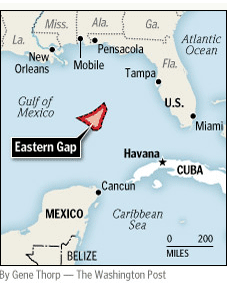
The larger deposit is thought to be in a section of the gulf known as the Eastern Gap, to which Mexico and the United States also have a claim. Cuban officials believe there are 10 billion to 15 billion barrels of crude stored there under more than 5,000 feet of seawater and 20,000 feet of rock– costly to extract but accessible with existing technology. By comparison, U.S. proven reserves total 21 billion barrels.

The Eastern Gap area is also coveted by American companies, but in Florida, where anti-Castro and anti-drilling sentiments run high, the Cuban government’s energy ambitions have alarmed lawmakers who see the threat of ecological calamity in Cuba’s plans to drill in that part of the gulf.

“They’d be drilling right in the Gulf Stream,” Sen. Bill Nelson (D-Fla.) said in a telephone interview, describing a nightmare scenario in which ocean currents could carry spilled crude into Florida’s marine sanctuaries and blacken beaches along the Eastern Seaboard.

“There would be a monumental disaster,” he said. “There simply should not be drilling out there.”
ad_icon

Other U.S. lawmakers said oil deals with the Cuban government would throw a lifeline to the island’s feeble economy and the 50-year rule of Fidel and Raúl Castro. They also question how reliable a partner Cuba would be.

“What if we make those investments and then U.S. assets are nationalized?” Rep. Darrell Issa (R-Calif.) asked after last month’s subcommittee hearing.

Because it would take three or more years for Cuba to fully develop its energy resources, according to Piñón, U.S. participation in the island’s energy sector could benefit a Cuban government not necessarily led by Fidel, 82, or Raúl, 78. Helping Cuba develop its own reserves, he said, would allow the island to gain the political independence and economic footing needed to negotiate a reconciliation with the United States without outside interference.

“Since Fidel Castro’s 1959 revolution, Cuba’s communist government has had to largely rely on foreign providers — first the Soviet Union, now Venezuela — to fulfill its energy needs,” Piñón said.

Cuba’s “petroleum dependency” on Hugo Chávez’s government “could be used by Venezuela as a tool to influence a Cuban government in maintaining a politically antagonistic and belligerent position toward the United States,” he said.

Source / Washington Post

Thanks to Jeff Segal / The Rag Blog

Posted in RagBlog | Tagged , , , | Leave a comment

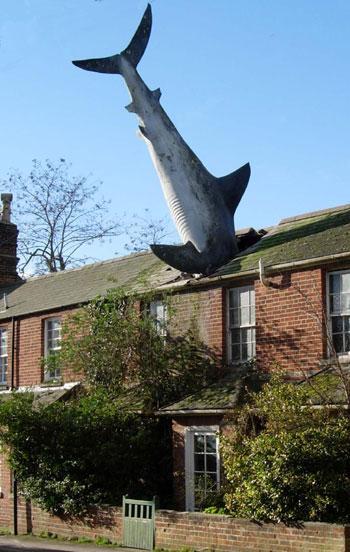
Has Liberalism ‘Jumped the Shark?’

Image from The Lockeroom.

Just like the right-wing would like to force their religion on all Americans ‘for their own good,’ many liberals would like to pass ‘Nanny State’ laws for the good of all Americans.

By Ted McLaughlin / The Rag Blog / May 17, 2009

The 1950’s was a low point for liberalism in the United States. Due to organizations like the House Committee on Un-American Activities and the John Birch Society, and individuals like Joseph McCarthy and Roy Cohn, liberals were driven underground or out of the country. Being a liberal meant losing the right to work or even being imprisoned. By the end of the 50’s, Liberalism was nearly dead in America.

But in the mid-sixties, it experienced a re-birth. It began at the University of California at Berkley, when Mario Savio and his cohorts started what they called the “Free Speech Movement.” It was originally intended just to give students at that university the right to speak freely about their political views. It accomplished that, but became much more, as it spread across the country — first in the colleges and then in society at large.

Fueled by the “baby boomers” born right after World War II, this new liberalism was different than pre-war liberalism. It was no longer socialist-based, although it pushed many of the same causes like economic justice and civil rights, but was a more general freedom-based movement. It preached equality and the right of the individual to believe what they wanted and to act like they wanted and live like they wanted, as long as they didn’t step on the rights of others to do the same.

No longer was the individual expected to be an automaton — a replica of their parents who said and did what they were told. The individual had rights which must be respected by authority and the highest value was freedom. Frankly, it was exciting to be a part of this movement in the 60’s and 70’s.

But some time in the 80’s and 90’s, liberalism began to go “off the track.” I don’t quite know how it happened, but “free speech” gave way to “political correctness.” While mouthing a belief in free speech, many liberals will be quick to condemn and sometimes even try to outlaw certain forms of speech. They seem to have forgotten that when you outlaw offensive speech, you have outlawed freedom (and the very thing that gave birth to modern liberalism).

Just as bad is the “Nanny State.” Just like the right-wing would like to force their religion on all Americans “for their own good,” many liberals would like to pass “Nanny State” laws for the good of all Americans. They want to force Americans to stop smoking with exorbitant tobacco taxes, or tell them where they can and can’t smoke. They want to pass laws punishing Americans for drinking sodas high in sugar. They want to pass laws to outlaw certain cooking oils in resturants. They would like to force all Americans to recycle their trash.

Maybe all these things are good and would probably improve a person’s life and maybe even prolong it, but I have to wonder what ever happened to freedom — the idea that an American has the right to make his/her own choices? In a truly free country, doesn’t a citizen have the right to make a poor choice?

These days, those of us on the left understand that the right-wing can result in tyranny, but many seem to have forgotton that just like you can have a right-wing tyranny, you can also have a left-wing tyranny. And it’s my opinion that both are equally bad.

If you believe something is good and citizens should do it to make their life better or longer or healthier, then by all means do what you can to educate people about it. But when you pass a law forcing that behavior, you have gone too far.

In a free country, each citizen has the right to make their own choices, even if those in power believe those choices to be bad ones. Liberalism used to mean freedom, but for many these days it means something else. That’s why I no longer call myself a liberal. I am a leftist, a radical, a socialist or a progressive, but I believe liberalism has strayed from its meaning and prefer not to be labeled as such.

That’s what I think. What do you think — especially those of you on the left? Am I wrong? Should government have the right to force people into making better decisions?

[Rag Blog contributor Ted McLaughlin also posts at jobsanger, an excellent Texas political blog.]

The Rag Blog

Posted in Rag Bloggers | Tagged , , | 4 Comments

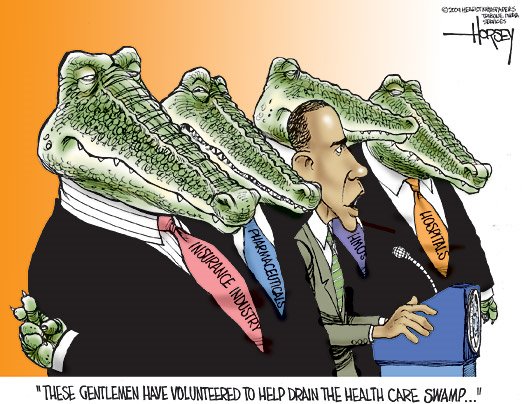
Cartoon: The Health Care Reform Plan


Source / Seattle P-I

Thanks to Jeffrey Segal / The Rag Blog

Posted in RagBlog | Tagged , , | 1 Comment

Dick Cheney and The Curse of the Pomegranate Seeds

Image by Larry Ray / The Rag Blog.

No one is happier than Hades, chortling down in his dark homey hell while topside the earthly GOP, Guardians of Pomegranates, urged on by Hades’ emissary, Dark Dick, pass out the fruit’s sweet seeds to their dwindling hard core members. . .

By Larry Ray / The Rag Blog / May 17, 2009

There are emerging scholarly theories about former Vice President Dick Cheney’s lifelong allergy to pomegranates which could be at the center of his secretive, imperious, angry and delusional behavior and his lifelong health problems.

Mr. Cheney is part of the estimated 1.24% to 16.8% of the population considered “at risk” for having an anaphylactic reaction if they eat, are injected with or even inhale one or more allergens. Anaphylaxis comes from the Greek, meaning “against protection.” Anaphylactic shock can attack those severely allergic to a bee sting, or even a pomegranate, causing a serious blockage of the airway, an extreme drop in blood pressure and can lead to death in a matter of minutes if left untreated.

For this reason, Mr. Cheney has always had within arm’s reach what is commonly called a “bee sting kit” which has a preloaded syringe containing epinephrine (adrenaline) to keep the heart beating, and other compounds to keep one breathing. Early in his political career a staffer, and more recently a Secret Service agent, has constantly been at the ready with the little zippered pouch in case a bit of killer pomegranate makes it down the Veep’s gullet.

So with this bit of basic Mr. Wizard science background under our belts, let’s look at why Dick Cheney might have been a nice guy with, say a peanut or bee sting allergy instead of the curse of the pomegranate. It all has to do with the Greek connection.

The pomegranate features mightily in the complex Greek story of Zeus’s daughter Persephone who was snatched by Zeus’s brother Hades, Lord of the underworld, and taken below to become his Queen. Now, when you get snatched and taken to the dark side, the deal is that if you don’t eat, you can eventually return back up to light and goodness. Persephone’s mother, Demeter, became so distraught at the loss of her daughter she neglected the earth which had droughts and became barren. It got so bad that Hades relented and called Hermes to take Persephone back home to momma.

But, just as Persephone was leaving, Hades gave her a pomegranate to eat. She knew the deal about eating and not being able to return to earth, but she was famished and ate seven pomegranate seeds. Well. . . you can figure out the ending. She got to return to the happy world to be with mom and dad, but poor Persephone had cut a deal with the devil. She wound up having to return to Hades four months out of the year. It wound up giving us winter and summer, but, those damned pomegranate seeds!

Actually pomegranate juice has powerful antioxidant properties and is used to treat a variety of maladies, most notably cardiovascular disease, stroke and heart attack. Medical researchers also claim great benefit in interrupting the process of atherosclerosis which is the clogging of arteries due to excessive fat deposits.

Mr. Cheney has earned the diagnostic title of “vasculopath” with an almost 30-year history of coronary atherosclerosis, with his first heart attack when he was only 37. No one is sure when he ate his first pomegranate seeds, or how many he ate, but clearly he was damned to the dark side early on, and as a result was not even allowed to have any more of the sweet, potentially health benefiting fruit. The deal with Hades was already made.

To many, it is clear that Cheney didn’t get a short four-month deal like Persephone. He clearly spends lots more time down in the underworld’s dark side than she did. Cheney’s official press releases have conveniently described him as being in “an undisclosed location.”

His buddy Hades has lately been giving Mr. Cheney more weekend passes than in years past so he can spend more time up here in the light to appear on radio and TV to spread his dark message. He has been reveling in his angry, convoluted attacks upon truth, transparency and change by America’s new Democratic leaders and majority voters.

Hades and Cheney working together, make Machiavelli’s schemes pale by comparison. They have even cleverly lured Speaker Pelosi into a torturous lose-lose series of public appearances and defensive statements where her political armor has finally been pierced. . . by her own spear.

No one is happier than Hades, chortling down in his dark homey hell while topside the earthly GOP, Guardians of Pomegranates, urged on by Hades’ emissary, Dark Dick, pass out the fruit’s sweet seeds to their dwindling hard core members, and unsuspecting malcontents.

Hopefully Hades will soon cut out the weekend passes, and Dark Dick will return to his undisclosed location. . . for good. But he mustn’t forget his bee sting kit because there is always the possibility he will eventually finally even tee off Hades, who certainly will have his pomegranate waiting for him.

[Retired journalist Larry Ray is a Texas native and former Austin television news anchor. He also posts at The iHandbill.]

The Rag Blog

Posted in Rag Bloggers | Tagged , , | 1 Comment

Meditation Helps Veterans with PTSD

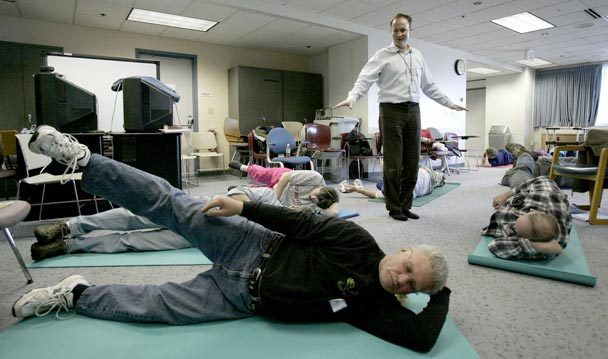
Dr. David Kearney, standing, a veterans-hospital physician, conducts a mindfulness-based stress-reduction class that uses meditation and yoga techniques to combat chronic pain, depression, anxiety and post-traumatic stress disorder. In front is Stephen Brakus. Photo: Courtney Blethen, Seattle Times.

Seattle hospital teaches meditation to troubled vets
By Michelle Ma / May 17, 2009

The Seattle veterans hospital is teaching patients a form of meditation to ease their post-traumatic stress disorder. The technique called mindfulness-based stress reduction helps patients deal with anxiety, chronic pain and other health issues.

After four combat tours — two in Iraq and two in Afghanistan — normal life seemed impossible for one Seattle Army veteran.

His heart raced when driving under an overpass, and he had trouble breathing when stuck in snarled traffic. As a soldier in combat, he wouldn’t dare slow down for fear of being bombed or shot.

Crowded rooms were just as bad. He locked himself away at home and drank instead of facing large groups or loud, sudden noises. He responded to the slightest sense of threat with all-out aggression.

Last summer, the 34-year-old sergeant sought help at the Seattle veterans hospital, enrolling in group and individual therapy and starting medication to treat what doctors diagnosed as post-traumatic stress disorder (PTSD).

He also practices a form of meditation he learned through the VA Puget Sound Health Care System that has eased the horrific memories that bombarded his mind.

The technique, called mindfulness-based stress reduction, seeks to help patients deal with anxiety, chronic pain and other health issues through meditation, yoga and deep-breathing exercises.

“It’s like the thoughts lost their hook,” the Seattle veteran said. “Before, they were just ripping me. With mindfulness, it opens up the blinders, and you realize (those thoughts) are not the totality of your existence forever.”

He asked not to be named because he’s looking for a job and worries employers won’t hire him if they know about his PTSD.

Dr. David Kearney, a veterans-hospital physician and associate professor at the University of Washington, has offered veterans the eight-week course in mindfulness-based stress reduction for more than a year.

Kearney is running the first study of its kind to determine whether the course is effective in treating PTSD among veterans. Those taking classes this spring and summer will contribute to Kearney’s study, which is funded by Puget Sound Partners for Global Health, a local research consortium funded by the Gates Foundation.

Mindfulness treatment asks participants to be aware of their thoughts and physical pain without judgment. It’s easy to stew over negative thoughts, which can cause more stress and frustration.

By simply pausing to pay attention, people can notice patterns in their thinking and put thoughts into perspective to improve their lives. Deep breathing, meditation and yoga help with this process.

Scientific studies have shown the technique can help patients with a range of issues, including anxiety, depression, chronic pain and rheumatoid arthritis. Kearney hopes to add PTSD to that list.

“I quickly found that people with PTSD sought out the class to find additional ways of dealing with this problem,” he said. “We’ve had many patients report to us the ability to be present in the actual moment helped their PTSD.”

Lessens anxiety

PTSD is an anxiety disorder caused by traumatic experiences such as war or sexual assault. At the local veterans hospital, psychologists estimate 10-20 percent of combat veterans have the disorder.

Matthew Brazerol of Bremerton recently retired after serving 20 years in the U.S. Coast Guard. He enrolled in the VA’s mindfulness class last spring after chronic pain and PTSD became debilitating.

“I came in with an open mind willing to try anything,” he said.

Brazerol’s responsibilities included recovering bodies and rescuing people. He said those cumulative experiences probably contributed to his anxiety. As the years progressed, Brazerol, 47, felt jumpy and anxious, and he would flinch at the sound of footsteps from anyone he couldn’t identify.

After completing the mindfulness course, Brazerol said, his symptoms are less frequent. Practicing the meditation throughout the day helps him adjust his reaction to a painful memory, and he isn’t as anxious.

“If you incorporate this into your life, it will help you regardless of what’s going on,” Brazerol said.

Not based on religion

Mindfulness treatment uses some Buddhist meditation principles, but the course isn’t based on religious teachings. The classes were designed several decades ago by a physician at the University of Massachusetts Medical School.

In the last decade, mindfulness treatment has spread to hundreds of hospitals and clinics. In Seattle, Swedish Medical Center, Evergreen Healthcare and the veterans hospital are among those offering the technique.

Studies show that our thoughts can initiate a stress response in our bodies. First, we start thinking about a problem or concern. As we ruminate on these thoughts, the brain can send stress-response signals to other parts of the body, causing a faster heartbeat, shallow breathing and tense muscles. Prolonged stress can cause health problems.

But if we train ourselves to pause when that first thought enters the mind, we can largely control our physical response, studies have shown. Exercises such as deep breathing and meditation also help calm the body.

“The story we tell ourselves has a lot to do with the whole unfolding of the actual situation,” said Dr. Jeff Brantley, director of the mindfulness program at Duke Integrative Medicine at Duke University Health System.

Wary of yoga mats

For people with PTSD, sounds and situations resembling a past traumatic event can trigger an anxious reaction. Kearney says his patients usually don’t forget their traumatic experiences but can learn to live comfortably without having those memories take charge.

In other types of PTSD treatment, patients talk through painful memories and immerse themselves in experiences that cause the anxiety. While that form of therapy can be successful, veterans typically have a 25 percent dropout rate, said Matthew Jakupcak, a psychologist at the local VA’s deployment health clinic.

In Seattle, the mindfulness classes have steadily drawn more interest among veterans — though many at first are wary of the yoga mats and meditation.

“It works, but I was skeptical,” said Herb Washington, 46, who completed the course last year. The Oak Harbor resident fought in the first Gulf War and has suffered from chronic pain and diabetes. Washington was born with a foot condition that became aggravated in the military.

His pain isn’t gone, but he doesn’t depend so much on pain medication. He said he feels anger and frustration slip away when he does his mindfulness routine.

“It’s a structured discipline,” Washington said. “That’s why I think it’ll be effective for veterans.”

More information

Mindfulness-based stress reduction

University of Massachusetts Center for Mindfulness: www.umassmed.edu/content.aspx?id=41252

Swedish Medical Center: www.swedish.org/body.cfm?id=1207

VA Puget Sound Health Care System mindfulness course: 206-277-1721

PTSD information

National Center for Post Traumatic Stress Disorder: www.ncptsd.va.gov/ncmain

Copyright © 2009 The Seattle Times Company

Source / Seattle Times

The Rag Blog

Posted in RagBlog | Tagged , , | 2 Comments

What Will We See with the Democratic Majority? Probably Not Much …

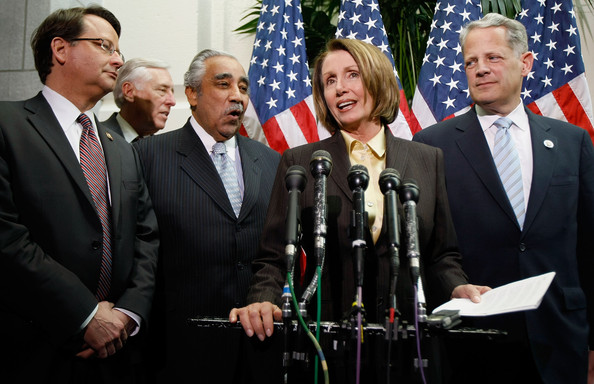
Speaker of the House Nancy Pelosi (D-CA) (2nd R) talks about tax legislation during a news event with (L-R) Rep. Gary Peters (D-MI), Majority Leader Rep. Steny Hoyer (D-MD), Ways and Means Committee Chairman Rep. Charles Rangel (D-NY) and Rep. Steve Israel (D-NY). Photo: Chip Somodevilla/Getty Images.

Excuses You Might Believe In: Democrats Are More Powerful Than Ever. How Will They Justify Doing Nothing?
By Ted Rall / May 15, 2009

NEW YORK – The defection of Pennsylvania’s Arlen Specter and the imminent certification of Al Franken as the winner of Minnesota’s election recount has handed Democrats what they always said they lacked in order to pass a progressive agenda: a filibuster-proof majority in the U.S. Senate. Now they face the awful problem of coming up with new excuses for not doing anything.

How will Obama, Nancy Pelosi, Harry Reid and other fake liberals weasel out of making good on their promises for real action on healthcare, the economy and the war? It won’t be easy. They control both houses of Congress and the White House. Obama is about to fill a new vacancy on the Supreme Court. The Times of London writes that “Mr. Obama, by some assessments, has more political leverage than any president since Franklin Roosevelt in 1937”–at the peak of the New Deal, just before he overreached by trying to pack the Supreme Court.

The Republican Party, on the other hand, is suffering a crisis of faith–too much God-cheering and not enough adherence to core values like small government, fiscal conservatism, isolationism and protectionist trade policy. A mere 21 percent of Americans still call themselves Republicans, the lowest number since 1983. Similarly, reports the latest ABC News/Washington Post poll, “just 21 percent say they’re confident in the Republicans in Congress ‘to make the right decisions for the country’s future,’ compared with 60 percent who express that confidence in Obama.”

Democrats have never been as powerful. Republicans are weak. Obama won with a decisive, sweeping rejection of the Republican status quo. Harry and Louise, call your agents–socialized medicine is on the way! Not.

Be careful what you wish for–what you say you wish for, anyway. “The left is going to push Obama–now that he’s got a veto-proof majority–to drive an agenda that a smart president would realize is a long-term political disaster,” GOP pollster Rick Wilson tells ABC. “Long-term political disaster” is mainstream media code for “stuff that corporations hate.”

Well, yes. What passes for the left in this country (center-right everywhere else, because they read) now has some not-unreasonable questions for Barack Obama. Such as:

Pretty please, can we now live in a country where people don’t have to spend $800 a month to health insurance companies that deny their customers’ claims?

Why are we still in Iraq?

How about some help for the victims of Katrina, many of whom never collected one red cent after losing everything?

Why are we paying billions to banks and still letting them gouge us with 25 interest credit card rates? Speaking of which:

How about doing something that might actually help people who live in the economy, rather than just capital markets?

These queries seem all the more relevant coming, as they do, from the liberal base of the Democratic party–the people who got Obama elected.

The trouble for our cute, charming prez is that he has no intention whatsoever of introducing a true national healthcare plan: one that covers everybody for free. He wants to expand the war in Afghanistan and drag out the one against Iraq. He will not punish Bush or his torturers, rescue homeowners in foreclosure, or nail scumbag banks to the wall. These changes would cost trillions of dollars to multinational insurance companies, defense contractors and other huge financial concerns who donate generously to candidates of both political parties and have a history of using their clout to manipulate elections in favor of their favorite candidates. A classic example is oil companies, who push down gas prices before elections in order to help Republicans.

The most that Democratic voters can expect from Democratic politicians is incremental, symbolic change that doesn’t cost their corporate sponsors any serious coin. The New York Times marked Obama’s 100th day in office with an editorial that approvingly encapsulated his accomplishments to date: “He is trying to rebuild this country’s shattered reputation with his pledge to shut down the prison camp in Guantánamo Bay, Cuba, his offer to talk with Iran and Syria, and, yes, that handshake with Venezuela’s blow-hard president, Hugo Chávez…The government is promoting women’s reproductive rights. It is restoring regulations to keep water clean and food safe. The White House has promised to tackle immigration reform this year.”

Trying. Promoting. Has promised.

Guantánamo isn’t being closed; it’s being moved. Gitmo’s detainees will be transferred to a new harsher gulag under construction in Afghanistan. Thawed relations with Iran and Syria would create new business opportunities for big oil. Defending the right to an abortion is popular and doesn’t cost Bank of America a dime. Immigration reform is code for legalizing illegal immigrants, not closing the border. Safety regulations reassure consumers and pump up the economy. Closing the border would raise wages. Corporations won’t allow that.

Unfortunately for Obama’s Democrats, small-bore initiatives only go so far, especially with the economy in meltdown. When people are desperate and angry they don’t care as much about flag-burning or creationism or a handshake with Hugo Chávez. They want action–real action.

How will the Democrats avoid genuine change now that they enjoy the ability to enact it? Will they blame obstructionist Republicans? Will Democrats cross the aisle to vote with the Republicans? A new war, perhaps?

If nothing else, whatever dog-ate-my-homework excuse they come up with for sitting on their butts is bound to be amusing. If nothing else.

[Ted Rall is the author of the new book “Silk Road to Ruin: Is Central Asia the New Middle East?,” an in-depth prose and graphic novel analysis of America’s next big foreign policy challenge. Visit his website www.tedrall.com.]

Source / Information Clearing House

The Rag Blog

Posted in RagBlog | Tagged , , | Leave a comment

Single Payer Health Insurance: Ending a Parade of Preventable Misery

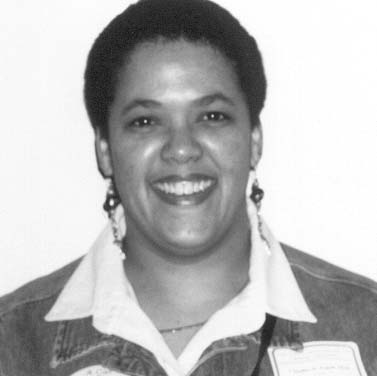
Dr. Claudia Fegan.

Single-payer health insurance is way to go
By Don Terry / May 14, 2009

An army of lawyers and lobbyists is gathering along the Potomac.

The upcoming battle in Washington over national health care reform is going to be fierce.

Billions of dollars are at stake.

There will be blood.

So, I called a doctor.

About 70 percent of the patients who Dr. Claudia Fegan treats at her South Side clinic don’t have health insurance — like the housekeeper whose breasts were purple and rock-hard from cancer.

“She was just waiting at home to die,” Fegan says. “She didn’t have insurance. She didn’t know what to do. Her daughter finally brought her in.”

Fegan, past president of Physicians for a National Health Program, has seen cases like that again and again. A parade of preventable misery. That’s why she supports a single-payer system that would essentially expand Medicare coverage to include every American, regardless of age.

Under such a plan, the government would pay the health-care bills of all Americans. Advocates say the somewhat higher taxes that result would be offset by massive savings in administrative costs rung up by the scores of private insurance companies that dominate the current system.

Yet health-care services would remain private. People would still get their choice of doctors and hospitals — which isn’t always permitted under some of today’s insurance plans.

A single-payer system is not socialism, as its wackier opponents contend. But the S-word has become the far right’s boogey- man of the moment.

No wonder. Big money is at stake. America spends more on health care than any country in the world, about $7,200 a year for every man, woman and child.

France, Germany and Switzerland rank higher than the U.S. in overall health care yet spend only about $3,400 per capita. Like most of the developed world, those countries have single-payer health-care systems.

Under a single-payer system, the private insurance industry would be largely out of the health-care business. That’s what’s keeping them up at night — and at the White House just the other day, when they made sketchy promises to help cut costs.

A single-payer system would do it for them. Fegan says the program would save the country $400 billion a year in administrative costs and other waste. That’s a lot of foreclosed homes and jobs that could be saved.

“The current system,” she says, “allows insurance companies to dictate who gets care and what kind of care they get. We shouldn’t allow the insurance companies to practice medicine without a license.”

Before Barack Obama went to Washington, he supported a single-payer system. He has since backed off that position.

He has proposed a somewhat vague public/private system that would keep the insurance companies in the game — and in the money. That’s the most politically feasible option, he contends.

He barely gives single-payer advocates the time of day and begrudgingly included them at a recent White House health-care reform conference.

“I’m sorry to say, like many before him, Obama is worried about the awesome clout of the insurance industry,” says Dr. Quentin Young, a Hyde Park neighbor of Obama and a physician for more than 50 years. “The fix is in.”

“The economy can’t tolerate this market-based system. There’s a growing awareness that single-payer is the way to go,” says Young, national coordinator for Physicians for a National Health Program.

Fegan says more pressure has to be put on Obama and other officials to support a single-payer plan. “We have to create a movement. . . . He’s still making politically feasible arguments instead of doing what he knows to be right. Issues of social justice are never politically feasible.”

Fegan makes a lot of sense.

Remember, electing a black man from the South Side of Chicago president wasn’t politically feasible, either.

Source / Chicago Sun Times

Thanks to Jeffrey Segal / The Rag Blog

Posted in RagBlog | Tagged , , | 2 Comments

Venezuela Seizes Non-Compliant Cargill Plant

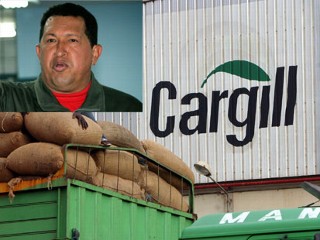
Last March President Chavez nationalised Cargill’s rice plant.

Venezuela seizes US pasta company

Venezuelan officials accompanied by soldiers have seized “temporary” control of a US-owned pasta producer.

Venezuela says the plant, owned by the big US firm Cargill, had violated regulations on price controls intended to guarantee cheap food for the poor.

The move further increases President Hugo Chavez’s hold on the economy, after a series of recent take-overs of private and foreign-owned businesses.

They include a Cargill rice plant, and services companies in the oil industry.

Deputy Food Minister Rafael Coronado said the government would run the factory for 90 days, and would reassess the situation after that.

He said it has not been producing sufficient quantities of a type of pasta sold at cheap, government-established prices.

Price control

A rice mill owned by Cargill was taken over earlier this year, on the grounds that it was not producing rice at government-set prices.

Cargill had said it did not break the government’s pricing rules on rice because the mill did not produce the plain rice which is regulated.

Venezuela has set quotas and prices for 12 basic foods including rice, powdered milk, cheese and tomato sauce.

Under the measure, 80% of all rice produced must be basic white rice. The measure also includes 95% of all cooking oil, coffee and sugar.

Last week Mr Chavez sent troops to take over oil service companies including hundreds of supply boats, and two American owned gas facilities.

He nationalised Venezuela’s oil reserves, one of the largest in the Americas, two years ago.

Source / BBC News

Thanks to Deva Wood / The Rag Blog

Posted in RagBlog | Tagged , , , | Leave a comment

Lest We Forget the Horror That Is Iraq


Statistics
By Dr.Mohammed / May 15, 2009

Yesterday, I was chatting with my colleague about the situation in Iraq and specially regarding the social aspect…we both reached an agreement that we would witness a social crisis or a disaster…the Iraqis’ ethics and manner have really changed in the years after the war…so many people lost the good sides of the Iraqi manners.

And since he is much older than me, he said that after each war Iraqis losses some of their good manners, and I think he is right.

And today I received an email with some very interesting statistics that are gathered together…and I thought those statistics would be a great way to show my point.

1,000,000 widowed women according to a statistic published by the Iraqi woman’s ministry in 2008

4,000,000 orphan child (estimated by the ministry of planning if the average of the Iraqi family is 4-6 children)

2,500,000 killed (according to the statistics of the Iraqi ministry of health and the forensic medicine (morgues) till December 2008)

800,000 missing (according to the ministry of anterior till December 2008)

320,000 prisoners inside the USA and government jails (the USA announced the presence of 120,000 prisoners inside their jails)

4,500,000 refugees outside Iraq (according to the statistics of people who requested the new passport G)

2,500,000 displaced inside Iraq (according to the Iraqi ministry of immigration and refugees)

76,000 cases of HIV (according to the Iraqi ministry of health) (it was 114 cases before the war)

40% of the Iraqi people are under the line of poverty (according to the statistics of the Iraqi human rights’ ministry)

126 foreign security companies (registered at the Iraqi ministry of anterior)

43 armed militias (registered at the Iraqi ministry of anterior and ministry of defense)

Well, it’s really frightening. Just look well at the numbers of orphans, widowed, killed and missing and you would certainly know why I said where are going to have a social crisis.

May God be with you.

Source / Last of the Iraqis

The Rag Blog

Posted in RagBlog | Tagged , , , , | 2 Comments

How Much of the Official 911 Story Is Really True?

With ongoing revelations like these, we cannot be surprised at the continuing influence the 9-11 truth folks have, and are gaining. My suspicious little mind begins to wonder if the REASON the authorities obfuscated and bullshitted from the get-go was not only to cover their own asses (the prime directive of bureaucrats and make-work artists the world over) but maybe… on some level… somewhere… just so people like Alex Jones would gain credibility….. And I’M ONE OF THE RATIONAL PEOPLE!!!

Mariann Wizard / The Rag Blog


Official story of 9/11 ‘almost entirely untrue’
By Inky99 / May 16, 2009

Now, before you get your panties in a bunch, this is about a new book, titled “The Ground Truth: The Story Behind America’s Defense on 9/11.”

And before you get all outraged (The FAQ! The FAQ!), here is the author of the book, John Farmer:

John Farmer served as Senior Counsel to the 9/11 Commission, where his areas of responsibility included assessing the national response to the terrorist attacks and evaluating the current state of national preparedness for terrorist attacks and natural disasters, he also served as attorney general of New Jersey (1999-2002), as chief counsel to Governor Whitman, and as a federal prosecutor. He recently served as a subject matter/rule of law expert on security to the special envoy for Middle East regional security. He is currently a partner of a New Jersey law form and an adjunct professor of national security law at Rutgers University Law School. His editorials and articles have appeared in The New York Times and elsewhere.

And my diary title are the words of Farmer’s publisher, Houghton Mifflin.

I wrote a couple of nights ago, here — “9/11 Commission Report — Info Obtained Through Torture” — as to how much of what was published in the 9/11 Commission report was obtained through torture, and is therefore completely without credibility.

Scandalous enough, right?

Well, it gets worse.

The above described James Farmer has just come out with his new book. It was released April 14. I have not read it (I just heard about it maybe ten minutes ago) and it is difficult to find any reviews of it by any mainstream book reviewers (gee, what a surprise!).

But according to the publisher, it’s quite a bombshell:

Description:

As of the 9/11 Commission’s one of the primary authors report, John Farmer is proud of his and his colleagues’ work. Yet he came away from the experience convinced that there was a further story to be told, one he was uniquely qualified to write.

Now that story can be told. Tape recordings, transcripts, and contemporaneous records that had been classified have since been declassified, and the inspector general’s investigations of government conduct have been completed. Drawing on his knowledge of those sources, as well as his years as an attorney in public and private practice, Farmer reconstructs the truth of what happened on that fateful day and the disastrous circumstances that allowed it: the institutionalized disconnect between what those on the ground knew and what those in power did. He reveals — terrifyingly and illuminatingly — the key moments in the years, months, weeks, and days that preceded the attacks, then descends almost in real time through the attacks themselves, revealing them as they have never before been seen.

Ultimately Farmer builds the inescapably convincing case that the official version not only is almost entirely untrue but serves to create a false impression of order and security. The ground truth that Farmer captures tells a very different story — a story that is doomed to be repeated unless the systemic failures he reveals are confronted and remedied.

So let me just repeat that to let it sink in …. The official story is “almost entirely untrue.” So what IS true? Hell if I know.

And check this out:

Farmer himself states that “at some level of the government, at some point in time … there was an agreement not to tell the truth about what happened.”

So let’s let that sink in …. there was an agreement not to tell the truth about what happened.

This link also develops the story further:

In August 2006, the Washington Post reported, “Some staff members and commissioners of the Sept. 11 panel concluded that the Pentagon’s initial story of how it reacted to the 2001 terrorist attacks may have been part of a deliberate effort to mislead the commission and the public rather than a reflection of the fog of events on that day, according to sources involved in the debate.”

The report revealed how the 10-member commission deeply suspected deception to the point where they considered referring the matter to the Justice Department for criminal investigation.

“We to this day don’t know why NORAD told us what they told us,” said Thomas H. Kean, the former New Jersey Republican governor who led the commission. “It was just so far from the truth. . . . It’s one of those loose ends that never got tied.

Wow. Let’s go to that Washington Post story now, shall we?

It’s 9/11 Panel Suspected Deception by Pentagon, from August 1, 2006:

For more than two years after the attacks, officials with NORAD and the FAA provided inaccurate information about the response to the hijackings in testimony and media appearances. Authorities suggested that U.S. air defenses had reacted quickly, that jets had been scrambled in response to the last two hijackings and that fighters were prepared to shoot down United Airlines Flight 93 if it threatened Washington.

In fact, the commission reported a year later, audiotapes from NORAD’s Northeast headquarters and other evidence showed clearly that the military never had any of the hijacked airliners in its sights and at one point chased a phantom aircraft — American Airlines Flight 11 — long after it had crashed into the World Trade Center.

Maj. Gen. Larry Arnold and Col. Alan Scott told the commission that NORAD had begun tracking United 93 at 9:16 a.m., but the commission determined that the airliner was not hijacked until 12 minutes later. The military was not aware of the flight until after it had crashed in Pennsylvania.

These and other discrepancies did not become clear until the commission, forced to use subpoenas, obtained audiotapes from the FAA and NORAD, officials said. The agencies’ reluctance to release the tapes — along with e-mails, erroneous public statements and other evidence — led some of the panel’s staff members and commissioners to believe that authorities sought to mislead the commission and the public about what happened on Sept. 11.

Farmer was quoted in this story as well. And according to the one review I did find:

Make no mistake, Farmer is not saying that 9/11 was an inside job …

I’m sure I’ll get flamed by a lot of people who don’t even read that quote. But whatever.

Like I said, I haven’t read the book myself, seeing as I just found out about it. But it sure looks interesting.

Sure would be nice to find out what really happened that day. And left wondering HOW such a monumentally huge fuck-up, at every level imaginable, both during the attacks, and after, and during the investigation that followed, could have possibly happened in this country. And why people were tortured to deliberately give false information that could be used in a report everybody knew was bogus anyway.

And why we are now involved in two wars, both unnecessary and without end …

And why we’re being lied to about it all, to this day.

Source / Daily Kos

Thanks to Mariann Wizard / The Rag Blog

Posted in RagBlog | Tagged , , , | 1 Comment

Cheney’s Chief Assassin to Head Afghan Effort

Here’s a little more of that blessed change from the Obama administration. The more things change, the more they look the same.

Richard Jehn / The Rag Blog

General Stanley McChrystal and Tory Clark during Gulf War II.

McChrystal was Cheney’s chief assassin
May 15, 2009

Seymour Hersh says that Dick Cheney headed a secret assassination wing and the head of the wing has just been named as the new commander in Afghanistan.

In an interview with GulfNews on May 12, 2009 Pulitzer prize-winning American investigative journalist, Seymour Hersh, said that there is a special unit called the Joint Special Operations Command (JSOC) that does high-value targeting of men that are known to be involved in anti-American activities, or are believed to be planning such activities.

According to Hersh, the Joint Special Operations Command (JSOC) was headed by former US vice president Dick Cheney and the former head of JSOC, Lieutenant General Stanley McChrystal who has just been named the new commander in charge of the war in Afghanistan.

McChrystal, a West Pointer who became a Green Beret not long after graduation, following a stint as a platoon leader in the 82nd Airborne Division, is currently director of Staff at the Pentagon, the executive to Joint staff to the Joint Chiefs of Staff.

Most of what General McChrystal has done over a 33-year career remains classified, including service between 2003 and 2008 as commander of the Joint Special Operations Command, an elite unit so clandestine that the Pentagon for years refused to acknowledge its existence.

On July 22, 2006, Human Rights Watch issued a report titled “No blood, no foul” about American torture practices at three facilities in Iraq. One of them was Camp Nama, which was operated by the Joint Special Operations Command (JSOC), under the direction of then Major General Stanley McChrystal.

McChrystal was officially based at Fort Bragg in North Carolina, but he was a frequent visitor to Camp Nama and other Special Forces bases in Iraq and Afghanistan where forces under his command were based.

An interrogator at Camp Nama known as Jeff described locking prisoners in shipping containers for 24 hours at a time in extreme heat; exposing them to extreme cold with periodic soaking in cold water; bombardment with bright lights and loud music; sleep deprivation; and severe beatings.

When he and other interrogators went to the colonel in charge and expressed concern that this kind of treatment was not legal, and that they might be investigated by the military’s Criminal Investigation Division or the International Committee of the Red Cross, the colonel told them he had “this directly from General McChrystal and the Pentagon that there’s no way that the Red Cross could get in.”

In the July 2, 2006 report, When Human Rights Watch asked whether the interrogator knew whether the colonel was receiving orders or pressures to use the abusive tactics, Jeff said that his understanding was that there was some form of pressure to use aggressive techniques coming from higher up the chain of command; however neither he nor other interrogators were briefed on the particular source.

“We really didn’t know too much about it. We knew that we were only like a few steps away in the chain of command from the Pentagon, but it was a little unclear, especially to the interrogators who weren’t really part of that task force.”

The interrogator said that he did see Gen. Stanley McChrystal, commander of US Joint Special Operations forces in Iraq, visiting the Nama facility on several occasions. “I saw him a couple of times. I know what he looks like.”

The International Committee of the Red Cross (ICRC) is the international body charged under international law with monitoring compliance with the Geneva Conventions, and it, therefore, has the right to inspect all facilities where people are detained in a country that is at war or under military occupation.

To hide prisoners or facilities from the ICRC or to deny access to them is a serious war crime. But many US prisons in Iraq have held “ghost” prisoners whose imprisonment has not been reported to the ICRC, and these “ghosts” have usually been precisely the ones subjected to the worst torture. Camp Nama, run by McChrystal’s JSOC, was an entire “ghost” facility.

The decision by Obama’s administration to appoint General McChrystal as the new commander in charge of the war in Afghanistan and retaining the military commission for the US war-on-terror detainees held in the Guantanamo Bay prison are the latest examples of the new US administration walking in Bush’s foot steps with regards to torture and denial of habeas corpus.

Source / Press TV

And then there’s this:

Caught in a Lie: US is Using White Phosphorus in Afghanistan as a Weapon
By Dave Lindorff / May 16, 2009

When doctors started reporting that some of the victims of the US bombing of several villages in Farah Province last week—an attack that left between 117 and 147 civilians dead, most of them women and children—were turning up with deep, sharp burns on their body that “looked like” they’d been caused by white phosphorus, the US military was quick to deny responsibility.

US officials—who initially denied that the US had even bombed any civilians in Farah despite overwhelming evidence to the contrary, including massive craters where houses had once stood—insisted that “no white phosphorus” was used in the attacks on several villages in Farah.

Official military policy on the use of white phosphorus is to only use the high-intensity, self-igniting material as a smoke screen during battles or to illuminate targets, not as a weapon against human beings—even enemy troops.

Now that policy, and the military’s blanket denial that phosphorus was used in Farah, have to be challenged, thanks to a recent report filed from a remote area of Afghanistan by a New York Times reporter.

C.J. Chivers, writing in the May 14 edition of the NY Times, in an article headlined “Korangal Memo: In Bleak Afghan Outpost, Troops Slog On,” wrote of how an embattled US Army unit in the Korangal Valley of Afghanistan, had come under attack following a morning memorial service for one of its members, Pfc. Richard Demeter, who had been killed the day before by a mine.

Chivers wrote:

“After the ceremony, the violence resumed. The soldiers detected a Taliban spotter on a ridge, which was pounded by mortars and then white phosphorus rounds from a 155 millimeter howitzer.

“What did the insurgents do? When the smoldering subsided, they attacked from exactly the same spot, shelling the outpost with 30-millimeter grenades and putting the soldiers on notice that the last display of firepower had little effect. The Americans escalated. An A-10 aircraft made several gun runs, then dropped a 500-pound bomb.”

It is clear from this passage that the military’s use of the phosphorus shells had not been for the officially sanctioned purpose of providing cover. The soldiers had no intention of climbing that hill to attack the spotter on the ridge themselves. They were trying to destroy him with shells and bombs. In fact, the last thing they would have wanted to do was provide the enemy spotter with a smoke cover, which would have helped him escape, and which also would have hidden him from the A-10 ground attack planes which had been called in to make gun runs at his position. Nor was this a case of illuminating the target. The incident, as Chivers reports, took place in broad daylight.

Clearly then, this article demonstrates that it is routine for US soldiers to call in phosphorus rounds to attack enemy soldiers, which is supposed to be against US military policy for this material. Whoever was manning the howitzer had a stock of the weapons on hand, and was ready to fire them.

The US initially flatly denied using white phosphorus weapons in Iraq, when reports first began to come out, including from US troops themselves, that they had been used extensively against insurgents defending the city of Fallujah against US Marines in November 2004. Under mounting pressure, the Pentagon first admitted that it had used the chemical in Fallujah but only “for illumination.” Later, the Pentagon added that it had used phosphorus as a “screen” to hide troops. But finally, in 2005, the Pentagon was forced to admit that it had also used white phosphorus directly as a weapon against enemy Iraqi troops in the assault on Fallujah, a city of 300,000 that still held many civilians.

The same pattern of denial and eventual admission regarding the use of this controversial and deadly weapon by US forces now seems to be repeating itself in Afghanistan.

It is odd that given the controversy over the use of white phosphorus weapons, which result in terrible wounds and eventual death as phosphorus particles burn their way down through flesh to the bone and sometimes straight onward through a body, leaving a charred channel of destruction, the New York Times’ Chivers—or more likely his editors back in New York?—ignored any mention of the issue while reporting on the use of the chemical rounds to attack a lone spotter on the ridge.

Given the current controversy over whether the US used white phosphorus shells or bombs in Falah Province only days before, it is hard to understand why the issue wasn’t mentioned in this particular article. Indeed, in the online version of the story, the word phosphorus is set as a hotlink to an article on the controversy over the battlefield use of phosphorus, indicating that at least someone at the Times has integrity and a good news sense.

As for the US government and the Pentagon, it is clear that they know the weapon is a vicious and controversial one, and that besides causing horrific and painful wounds, it is profoundly dangerous for innocent civilians, particularly when used in town or village settings.

It is bad enough that the US is using this weapon. It is even worse that it is forced to lie about it.

Surely if the goal of US policy is to win the hearts and minds of Afghanistan’s people, it shouldn’t be using a weapon that causes such terrible and indiscriminate wounds. Then again, maybe winning those hearts and minds isn’t really the goal. Maybe, as in the so-called “Pacification Program” applied by US forces in rural South Vietnam, the goal is to terrorize Afghan villagers in Taliban-dominated regions into rejecting the Taliban in their midst.

Requests for answers from the press office at the Pentagon, and at military headquarters in Afghanistan, regarding US policy on the use of white phosphorus, and on the specific use of the shells mentioned in the New York Times article were ignored.

[Dave Lindorff is a Philadelphia-based journalist and columnist. He is author of Marketplace Medicine: The Rise of the For-Profit Hospital Chains (BantamBooks, 1992), and his latest book “The Case for Impeachment” (St. Martin’s Press, 2006). His work is available at www.thiscantbehappening.net.]

Source / Common Dreams

The Rag Blog

Posted in RagBlog | Tagged , , | 1 Comment