Hey Paul Krugman !!

#77! About the famous economist, Nobel prize winner and all around cool guy. Featuring my friend Madelyn, who is in an awesome band called The Muffin Brigade.

The Rag Blog

Posted in RagBlog | Tagged , , | Leave a comment

Democrats Are Letting Net Neutrality Die

Graphic from techrepublican.

[Network neutrality is a principle proposed for residential broadband networks and potentially for all networks. A neutral broadband network is one that is free of restrictions on content, sites, or platforms, on the kinds of equipment that may be attached, and on the modes of communication allowed, as well as one where communication is not unreasonably degraded by other communication streams.]

New Bosses Same As the Old Bosses

By Jason Lee Miller / April 15, 2009

Here was what was supposed to happen: With telco-friendly Republican Congress members swept out of the way, Democrats would usher in legislation enshrining Network Neutrality principles and give the FCC the power to enforce them.

Here’s what happened (is happening) instead: The most powerful Net Neutrality supporters (Barack Obama, Hillary Clinton) are kicked upstairs while cable-and-Hollywood-friendly Democrats are killing Network Neutrality legislation in committees.

Meanwhile, both telecom and cable companies are emboldened by the legislation’s quiet death, the deafening sound of non-action covered up nicely by the economic crisis, and both industries are soothed by interim FCC commissioner Michael Copps’ toothless proposal for a fifth unenforceable principle regarding network discrimination.

The Democrat rope-a-dope strategy of the last few years is coming back around to kill Net Neutrality. The initial plan was simply to let Republicans have enough rope to hang themselves. Congressional Democrats ignored calls for investigations and impeachment of members of the Bush Administration because doing so allowed them to drop all blame square on their opponents’ shoulders for everything without putting themselves under undue scrutiny. A few years of doing absolutely nothing was tantamount to lying low while Republicans destroyed themselves so Democrats could take over. . . and continue to do nothing.

It’s a genius plan until people start watching and learning about the new bosses and start understanding how much they look like the old bosses. The Internet Freedom and Preservation Act of 2006, 2007, 2008? All killed by assassins with supposedly opposing goals.

The Senate version is suspicously stuck in a committee of formerly staunch proponents. The House version is under the committee supervision of net neutrality opponent Joe Barton (R-TX) and Henry Waxman (D-CA), who represents West Hollywood and Beverly Hills.

We’re not surprised by Barton, a Texas Republican funded by Comcast and AT&T — that’s historical par for the course. But Waxman’s a Democrat, and Democrats are supposedly pro-net neutrality. Meanwhile, we should also be surprised by Dianne Feinstein’s (D-CA) lame and failed attempt to sneak in “reasonable network management” provisions into the economic stimulus package as Waxman looked the other way.

So what’s going on with our supposed neutral net champions? The answer lies in the other industries opposed to net neutrality, namely the Entertainment industry, the principals of which happen to live in Waxman’s and Feinstein’s districts and donate heavily to their campaigns. Waxman gets lots of money from the cable industry, including TimeWarner and Disney. Feinstein’s donors include Time Warner and Disney as well, but also Qualcomm and GE (which owns NBC).

In the earlier days of the Net Neutrality debate, the argument centered on very technical issues lost on the general public and focused heavily on telecommunications companies like Verizon and AT&T, and some on Comcast. (Though Ted Stevens famously issued a net neutrality push poll asking constituents if they wanted more TV or less TV.)

As it progresses it becomes less about network issues (as if it ever really was about network issues) and more about Web video. Right now, very large, very wealthy, very powerful entities are battling for control of what will become the new TV (and radio and newspaper). It’s not about bandwidth or network operation. It’s about controlling Web media, especially video.

Recently we learned from the CEO of a cable company who says American cable providers won’t allow speeds they’re capable of delivering because they’re afraid people will cancel their cable TV subscriptions. TimeWarner, a maker of films and television content as well as a cable Internet and TV provider, is toeing the line with download caps limiting how much video consumers can download.

AT&T on the other side, quietly updated its terms of wireless service to prevent video transfers. AT&T, of course, is also getting into the video content delivery game with its U-Verse. Despite these most recent instances loudly protested, legislators have cited lack of complaints of abuse as the reason why they’ve backed off. Even former neutral net proponent John Conyers (D-MI) suddenly thinks it’s a non-issue. It’d be nice if we could look at his top donors and not see AT&T, TimeWarner, Sprint, and Cable, but sure enough, there they are, as predictable as the sunset.

You might have also noticed, like we have, that while anything the RIAA and the MPAA want goes right through Congress like crap through a goose, network neutrality legislation (wanted by the people who currently have no money) languishes and dies in committee.

With a setup like this, good luck getting net neutrality legislation passed this year or the next. Maybe in 2010 the country will suddenly favor independents and third parties so the do-nothing bums still remaining will be thrown out. But that may be overly optimistic—the people will likely still be broke by then, and its money that wins elections, and apparently what runs Congress.

Source / WebProNews

Thanks to Media Reform Daily / The Rag Blog

Posted in RagBlog | Tagged , , , , , | Leave a comment

Sacramento : Tea Bagger Hate-Fest

“Tea bagger” protests took place all over the United Sates Wednesday. Pictured is Vince Schuck at a rally in Montpelier, Vt. Photo by Toby Talbot / AP.

Too many liberals are trying to deal with this with dismissive humor, but it’s deadly serious. Too many of the “tea party” spokesmen are calling for the right to become “armed and dangerous,” with their sights aimed at Obama and the progressive left. These people are not fools, and serious people had best develop serious tactics to mobilize against them. Fox and Hannity would be a worthy focus for mass anti-fascist protest.

Carl Davidson / The Rag Blog / April 15, 2009

In the land of Fox News and right-wing talk radio truth and falsehood blend together in an ideological muck that denounces Obama and the Democrats as ‘socialists,’ ‘fascists,’ ‘communists,’ and ‘terrorists’ all at the same time.

By Joseph A. Palermo / April 15, 2009

SACRAMENTO — The hatred was palpable today on the State Capitol’s steps. Hatred for taxes, hatred for government, hatred for state workers, hatred for teachers, hatred for Democrats, and hatred for all of the straw men that leap from the imaginations of talk radio jocks. But the most hated figure of all at today’s “Tea Bag” anti-tax rally in Sacramento was President Barack Obama. One of the first placards I saw as I entered the Capitol grounds read: “Wake Up! Fresh Prince of Belair is Destroying Us — Stop Drinking the Red Koolaid.” A state police officer told me that he thought the crowd was “a couple thousand.”

It was a sea of American flags of all shapes and sizes and many “Don’t Tread On Me” yellow flags as well. The crowd was predictably very white, very Republican, and on the older side. I didn’t see one African American (except for one of the musical performers on the stage who denounced Obama), and I didn’t see any Latinos. George W. Bush could have been the focus of some of this rage because theoretically their hatred could just as well be aimed at him. But since he is a “good” Christian, white Republican Bush remained unscathed. I didn’t see one sign that would indicate that it was anything other than a Republican hate rally.

Several placards called Obama the “Teleprompter in Chief” probably because Glenn Beck denounced the president for using one. The crowd chanted in unison: “No More Bail Outs! No More Stimulus! No More Taxes!” I was given an ice-cold coke from a vender who was handing them out for free and I strolled around for a good hour taking in the scene. There was one Jumbotron television or otherwise I couldn’t see the stage because of the number of people packed into the Capitol grounds. It was a sizeable rally. Bigger than many of the anti-Iraq War protests I attended there. Obama’s name or face was featured with sickles and hammers so much that his likeness became synonymous with something deeply un-American.

An elderly woman on a scooter — I didn’t ask her if Medicare paid for it — had a sign affixed to her chair: “If I wanted Socialism, I’d Move to Europe.” Many of the participants in today’s Tea Bagging protest seemed to be as old as John McCain but there were a smattering of families with little kids and some tweens who were waving American flags.

Speakers from the local right-wing talk radio establishment led the crowd in chants: “Vote Them Out! Vote Them Out!” There were plenty of signs depicting Obama, House Speaker Nancy Pelosi, and Senate Majority Leader Harry Reid as criminals, or the Three Stooges, or terrorists. One local talk radio speaker denounced Homeland Security Secretary Janet Napolitano daring her to come and arrest this crowd. The straw man being that President Obama and the Democrats have somewhere denounced their tax revolt as being “un-American.”

In the land of Fox News and right-wing talk radio truth and falsehood blend together in an ideological muck that denounces Obama and the Democrats as “socialists,” “fascists,” “communists,” and “terrorists” all at the same time. Speakers at the rally attacked labor unions and “card check” (a reference to the Employee Free Choice Act), which was ironic because most of the people in the crowd were clearly working class.

The Right has a monopoly on Sacramento’s AM radio dial (1380 and 1530 where Rush Limbaugh started his career). So it was easy for them to pump up the volume and get people out. There’s no progressive or even liberal information flowing on the public’s AM airwaves in this region of California but somehow the Right always gets to play the “oppressed” victim. Ironically, after denouncing the “Liberal Media” and anyone else who suggested the Tea Bagging phenomenon was a product of cheerleading from Fox News and right-wing talk radio, a local AM jock confirmed to the crowd just that: “A lot of this is because of talk radio and Fox helped us defend ourselves!” This statement brought a huge cheer from the crowd.

The right-wing talker also complimented channels 1380 and 1530 for bringing in people “from Rancho Cordova, Placerville, and El Dorado Hills.” And he said the liberals want to impose the “fairness doctrine” that would undermine the good work of right-wing radio and urged people to go to “Talkback.com” to find out how they can save talk radio from the Democrats.

With the U.S. military base at Mather Field close by the veteran contingent loomed large. They were older vets though, mostly Vietnam, I only saw a few I thought were the age of the average Iraq or Afghanistan vet. There was a contingent of Republican state legislators and their staffers milling about who stood out because they were the only ones wearing suits and ties. Most of the people there were crusty-looking, grizzled biker types with American flag T-shirts and jeans, men with gray beards and baseball caps, women with big sunglasses and cheap jewelry. None of those people looked to me like they earn anywhere near $250,000 a year (like the AM jocks or Republican legislators do).

And therein lies the beauty of the whole Tea Bag “movement.” Affluent people like Michelle Malkin and Grover Norquist and the army of radio “personalities” convince working people, most of who have a relative or are themselves on Medicare or Social Security, to denounce taxes on affluent people. Many of the people at the rally were from the eastern foothill communities that are pretty impoverished and would benefit from Obama’s health care, economic, and education policies. The foreclosure rate alone east of Sacramento would lead one to think that far more people in this region could use some government help.

We will see if the Tea Bag phenomenon can be sustained or if it is just a one-time Republican gimmick. But remember, in 1994, Newt Gingrich took the House of Representatives with a similarly cornball gimmicky set of “principles” that channeled the same kind of blind right-wing hatred and anger. The lesson from today I think is that Congressional Democrats and the Obama Administration should work together to make the public AM radio airwaves more competitive so more diverse voices are heard.

As long as the Republicans and the Right hold on to their monopoly on AM radio they’ll be able to stage these kind of hate-fests easily and more often. I’d take the Tea Baggers seriously and move to use the FCC to open up the public airwaves and also use the Anti-Trust Division of the Justice Department to break up Rupert Murdoch’s media empire along with the other media corporations that have become as dysfunctional to our democracy as the “too big to fail” financial corporations.

George W. Bush’s entire eight years was nothing but a neo-liberal experiment in skewing government and every other public good toward serving the interests of profiteers and the rich. That was apparently fine with these rightwingers as long as the government money was flowing upwards into the hands of the rich and corporations.

But as soon as a Democratic administration is elected to power everything’s different now. The sky was the limit during the Bush spending binge on war and giveaways to Wall Street and lavish contracts for shoddy or nonexistent “government” services and corporate welfare and so on and on. But now with Democrats trying to put a little spare change in the pockets of the other 95 percent of the population who gained nothing from the Bush years all of a sudden the sky is falling!

The Tea Baggers I encountered were very polite and well-mannered, even passive. They need cajoling to act out. They need their anger stoked. They need straw men to knock down and people to hate — people like state workers and teachers and Democrats. I couldn’t help but think that the whole damn thing is just one big constructed product of the propaganda from right-wing talk radio and their ideological soulmates at Fox News.

Source / The Huffington Post

Also see DC Tea Party Protest Shut Down By Secret Service / [With Video] by Jason Linkins / The Huffington Post / April 15, 2009

The Rag Blog

Posted in RagBlog | Tagged , , , , | 6 Comments

Rejecting the Oppression of Women in Afghanistan

Malalai Joya believes the US and other foreign powers are making a mockery of democracy and the liberation of Afghan women by empowering the warlords and fundamentalists.

A voice of hope for Afghanistan’s women
By Frud Bezhan / April 14, 2009

FOR the women of Afghanistan, it is yet another brutal message — that death awaits those who choose a public life.

Sitara Achakzai — a women’s rights campaigner — was gunned down in the streets of Kandahar on Sunday.

She is among several high-profile women assassinated the Taliban have in recent years. But it is merely the most public example of the extreme violence women face in this embattled country, where rape and murder are widespread.

Malalai Joya understands better than most the oppression of Afghan women — and the danger of speaking out. The women’s rights activist and member of Afghanistan’s national parliament has lived in hiding for five years and never spends more than 24 hours at the same house. Her only contact with the world is by infrequent phone calls and, if there is electricity, the internet. She sleeps, eats and breathes in the shadow of six heavily armed bodyguards and wears a burqa to conceal her identity.

Malalai Joya’s plight — and that of the other high-profile women — is symbolic of a country in turmoil. More than seven years after international forces removed the Taliban from power, Afghanistan is slipping further into violence and lawlessness.

For the 1100 Australian soldiers stationed in Oruzgan, in the south, the threat posed by growing insecurity and a resurgent Taliban is very real. Just last week, two Australian soldiers were wounded when their vehicle struck a roadside bomb. Last month, the ninth and 10th Australian soldiers were killed in Afghanistan.

While deeply saddened by the increasing human toll, Shukria Khalil, a prominent member of the large Afghan community in Melbourne, praises the sacrifice and courage of Australian troops serving in Afghanistan.

“By coming to Afghanistan and defending people like Malalai Joya, Australian soldiers are giving ordinary Afghans the strength to endure their pain and the faith to believe and dream of a future without war, death and hunger,” she says.

Joya’s own battle is against the warlords who, she says, are running the country. These men, who Joya refers to as the “Taliban’s brothers in arms”, are former commanders of the various Islamist groups, together known as the mujahideen, who fought and defeated the Soviet Union and communist Afghan government in the 1980s. Soon after coming to power, these groups turned on each other, waging a brutal civil war in which tens of thousands of people were killed, thousands of women and girls were raped, and millions of people were made refugees. The bloodshed only stopped when the Taliban took power.

“Today, because there is no strong central government, Afghanistan is carved up between these same warlords, who have now filled the shoes of the Taliban,” Joya says. “Afghanistan is once again in the hands of rapists, murderers and extremists.”

Asked why the warlords are so desperate to silence her, Joya responds: “I am the fundamentalists’ most unrelenting and outspoken critic. They see women as second-class citizens and are threatened by the idea of a woman openly questioning their authority. The fundamentalists also realise that when I reveal their crimes and demand justice, it is not my voice alone but the voice of all Afghans they hear.”

Joya, now 30, first spoke out more than five years ago. As a delegate at a constitutional convention in Afghanistan she publicly accused the country’s leaders, many of whom were there, of war crimes, human rights violations, involvement in the opium trade and supporting the Taliban. She said they should be prosecuted in national and international courts. Her remarks were met by stunned silence and then uproar from the 300 delegates, most of them former mujahideen commanders and ex-Taliban officials. Joya was branded an infidel and “whore”, while one delegate stood on the floor of the forum and demanded that Joya be taken away and raped.

Joya’s stance against the warlords seemed to be endorsed when she was subsequently elected, at 27, as the youngest member of parliament in Afghanistan’s landmark elections of 2005. There she continued her outspoken ways. She is nearing the end of a two-year suspension from parliament, imposed after she used a television interview in May 2007, to accuse fellow MPs of being criminals opposed to women’s rights, obstructing free speech and intimidating prominent Afghan women.

In response, MPs voted overwhelmingly for her suspension, though their decision has no basis in law.

“Ever since I have started my struggle for human rights in Afghanistan, for women’s rights, these criminals, these drug smugglers, they’ve stood against me,” she says during a phone conversation. “They can kill men but they cannot silence my voice because it is the voice of all the people of Afghanistan calling for change, peace and justice.”

Joya began her campaign for social and political change after returning to Afghanistan 10 years ago. Her family had fled the Soviet invasion 16 years earlier, settling in one of the many refugee camps along Afghanistan’s border with Pakistan. Plunged into a life of poverty and uncertainty, Joya, as a teenager, began humanitarian work for various organisations in Pakistan to help provide for her family — two parents and nine children. During her regular visits to refugee camps she met many ordinary Afghans, saw their suffering and learned of the crimes of the various mujahideen groups vying for power.

“The experience had a profound impact on me,” says Joya, who is still haunted by stories of women being raped, of children being kidnapped in the middle of the night, and of men being beaten, tortured and killed. When Joya went back to Afghanistan in 1998, the country was under Taliban rule. With the help of a non-government group, Organisation of Promoting Afghan Women’s Capabilities, she opened an orphanage and a health clinic for women. Risking death, Joya defied the law against educating girls by opening an underground school in Herat, in western Afghanistan. “Today, more than seven years after the ousting of the Taliban, most women are still too scared to take off their burqas,” Joya says.

She claims that although liberating women was one of the main moral arguments for invading Afghanistan in 2001, the situation for women has continued to deteriorate. “Ninety per cent of women in Afghanistan suffer from domestic violence, 80 per cent of marriages are forced, and the average life expectancy for women is 44 years,” she says.

Joya recounts the harrowing stories of two women she has met. Fatima, the daughter of a poor shopkeeper, was sold to a man, 50, who raped and beat her and then traded her for a dog. Her father did not have the money to buy back his daughter, 23. Shabnum, seven, was kidnapped and raped by three men, who cut her genitals.

“The plight of victims such as these girls is my driving force,” Joya says. “I will never give up my fight for justice, and I’ll continue to try to represent the millions of voiceless Afghan people — especially women and children — who are still being brutalised by warlords and the Taliban. While ordinary women and girls face rape, forced marriages and inhuman acts of abuse daily, women who stand up for their rights and take a public role in society risk being killed or silenced.

Shukria Khalil says Sitara’s murder is an assault not on one individual, “it is an attack on every woman’s fight for justice, freedom and equality in Afghanistan”.

Azra Jafari, who was elected Afghanistan’s first female mayor this year, says women’s rights have worsened since the progress made during the transitional government between 2002 and 2004, when education for girls was promoted and women became ministers and received 25 per cent of the seats in parliament. “We had three or four women ministers during the interim government: now we have one,” she says.

In another blow to women’s rights, Afghan President Hamid Karzai last month signed a law for the Shiite minority that reportedly rules women cannot refuse sex within marriage, and cannot leave home, seek work or visit a doctor without their husband’s permission. Opponents of the law claim Karzai is desperate to retain the support of fundamentalists in presidential elections to be held this year.

Following international condemnation, Karzai ordered a review of the law and said amendments would be made if it contravened the constitution.

Despite the pressure brought to bear by the world community and while acknowledging the contribution of international forces in Afghanistan, Joya believes the US and other foreign powers are making a mockery of democracy and the liberation of Afghan women by empowering the warlords and fundamentalists.

“The US talks about thousands of girls flocking back to school, but the fundamentalists in power are encouraging the destruction of schools, the killing of teachers and the kidnapping of students,” Joya says. “The US also talks about the improving situation for women, but they are committing suicide more than ever. They would rather die than live.”

Although she believes her days are numbered, Joya is not fearful for the future. “I am not frightened because we will all die one day,” she says. “What matters is that we fight despite the risk and we sacrifice despite the cost. Only then can we succeed.”

[Frud Bezhan is a freelance journalist.]

Source / The Age (Australia)

The Rag Blog

Posted in RagBlog | Tagged , , | 4 Comments

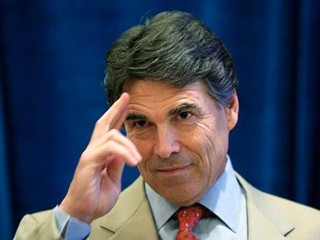
Perry to Limbaugh : ‘Ya’ll Come On Down, Y’Hear?’

Mr. Hospitality his own self: the Hon. Rick Perry, Governor of Texas. Photo by Harry Cabluck / AP.

Gov. Rick Perry: ‘I think Austin would be an awesome place for Rush Limbaugh. You know, keep Austin weird.’

By Eric Zimmermann / April 13, 2009

If Gov. Rick Perry (R-Tex) is looking to shore up the conservative base for his upcoming re-election, his latest move is a masterstroke: the governor says he will personally invite Rush Limbaugh to move to Texas.

The conservative radio host recently announced that high taxes are driving him out of New York.

Perry said he’d welcome Limbaugh with open arms.

“He’s not unlike other people who want to go to a place that’s got low taxes and fair regulations and a balanced legal system and a skilled work force,” Perry told the Dallas Morning News. “Excellence in Broadcasting hires a lot of people. So if he wants to go somewhere where he works hard and keeps more of what he makes, Texas is the place to do that.”

Perry added that he’s in the process of contacting Limbaugh directly.

And the governor has an unusual suggestion for what city the hardcore conservative should settle on, suggesting the liberal bastion of Austin.

“I think Austin would be an awesome place for Rush Limbaugh,” Perry said. “You know, keep Austin weird. Isn’t that the city’s unofficial motto?”

Source / Briefing Room / The Hill

‘I’m concerned that his polarizing influence and his do-almost-anything-to-win behavior will hurt a city that has already lost most of its soul.’

From David Kobierski on Burnt Orange Report:

I’m on the fence about this.

Being a radio talk show host myself, I respect Rush for his talent and the incredible market he has won over his 20+ year career. Having him in Austin, TX might make for some interesting discussions and debates. I welcome that. And overall, I don’t take him too serious. I consider Rush to be mostly info-tainment and a lot more bark than bite lately. But since I don’t agree with him on most of his policies or the way he goes about attacking others that he doesn’t agree with, I’m concerned that his polarizing influence and his do-almost-anything-to-win behavior will hurt a city that has already lost most of its soul.

My favorite Rush quote (great comic relief) “Consensus is the absence of leadership.”

In October of last year, I also remember Rush saying that Obama is endorsed by terrorists. Classic Rush!

What do y’all think?

The Rag Blog

Posted in RagBlog | Tagged , , , , | Leave a comment

Gov. Rick Perry says he’s delighted that Rush Limbaugh has mentioned maybe moving to Texas. And the governor is throwing out the welcome mat to the conservative radio talker. Limbaugh says he’s tired of the taxes in New York and wants to move — and mentioned Texas as a possibility. Perry says he’s in the process of contacting Rush personally to extend the invitation, but we got to him first — so it’s public. Perry told me the Lone Star State would be a great place for El Rushbo.

“He’s not unlike other people who want to go to a place that’s got low taxes and fair regulations and a balanced legal system and a skilled work force. Excellence in Broadcasting hires a lot of people. So if he wants to go somewhere where he works hard and keeps more of what he makes, Texas is the place to do that.”

As we reported last weekend, Limbaugh maintains two residences – New York City and Palm Beach, Florida. He spends most of his time in Florida, but says he wants to maintain two homes/studios to assure he can broadcast uninterrupted during hurricane season.

Apparently, Galveston is out – hurricane season. He’d certainly have no problem finding politically compatible neighbors in Midland or Dallas or, for that matter, much of West Texas. But The Republican governor has another idea for the king of conservative radio to call his second home: Austin.

“I think Austin would be an awesome place for Rush Limbaugh. You know, keep Austin weird. Isn’t that the city’s unofficial motto?”


Type rest of the post here

Source /

Source

The Rag Blog

Posted in RagBlog | Leave a comment

Grassroots Action

Cartoon by Charlie Loving / The Rag Blog

Posted in Rag Bloggers | Tagged , | 2 Comments

Greg Moses : The Perry Laffer Kudlow Report

Whenever the Laffer idea takes hold, as it did in 1980 and 2001, taxes are generally cut to a level below their ability to keep up with actual costs of government. The result is a combination of easy money and a mountain of public debt.

By Greg Moses / The Rag Blog / April 14, 2009

As legend has it, the economic history of the USA was changed on the day that economist Art Laffer drew his famous “Laffer Curve” upon a napkin in order to convince Dick Cheney and Don Rumsfeld that President Gerald Ford’s tax hikes would be a mistake. What the curve intends to teach us is that taxes can be too high.

Laffer’s rationaliztions for low taxes became very popular as banners for the Reagan counter-revolution. And the results of the Laffer idea can be seen quite clearly in a chart of the national debt posted at usgovernmentspending.com. Whenever the Laffer idea takes hold, as it did in 1980 and 2001, taxes are generally cut to a level below their ability to keep up with actual costs of government. The result is a combination of easy money and a mountain of public debt.

Now that the Laffer idea has been run out of town by the current federal administration, you can’t say he didn’t see it coming. In a series of policy studies, some of them done for Texas clients, Laffer has been sandbagging his case for low taxes and small government.

In the latest installment of the Laffer attack, the Texas Public Policy Foundation (TPPF) paid the Laffer associates to produce a rationalization for the state of Texas to send back federal money that was to be funnelled through state agencies. Here’s a link to the pdf at the TPPF website, texaspolicy.com, which, if you have the Netcraft toolbar, you can see is hosted on a server in Canada.

Now the most charming thing about Laffer is that he gets along well with Larry Kudlow, the financial evangelist who can be seen preaching the gospel of wealth most days at CNBC. It’s difficult not to like Kudlow, even when he’s shouting over his liberal guests. But you’d have to get up very early in the morning to find cable news shows these days where the host does not shout over the guest, so in this context the shouting doesn’t seem to harm Kudlow’s charm (that is, until he starts trying to shout over the host of the show that comes after his).

Furthermore, I think we should agree that there is a kernel of truth to the gospel of wealth. If there is such a thing as an American spirit then the gospel of wealth was there at its birth, if only to insist on a quick c-section to get the thing done.

But what happens when the gospel of wealth meets the Laffer Curve is that you get something like the Laffer Cathedral Arch. Instead of placing the curve into a complex field of economic and social analysis, you get led to a place where you have to face private wealth and bow down every time.

On Monday night the Texas Governor, Rick Perry, appeared as a guest on the Kudlow show. True to form for a member of the Laffer posse, the Governor denounced federal stimulus money as counterproductive to state’s rights and private property. The Governor has been speaking in Lafferese most earnestly since he found out that he will have a real fight for re-election against incumbent US Senator Kay Bailey Hutchison. He is pulling what is known in Texas as the Gramm maneuver, which positions each and every opponent as a big-spending liberal.

So these days the Texas Governor is all about the kind of state’s rights that come heavily backed by private wealth. And yes, this is the same Governor who loyally hosted Operation Close the Border or whatever it was called when National Guard troops on Pentagon orders came marching from up North, out West, and back East on down to the Rio Grande. Press two for English if you want to know how that operation worked out.

According to the Governor’s lingo, the stimulus money can only serve to keep more people unemployed longer. And you can see his point insofar as the federal money will not be delivered to some payroll office where it could get right to work making a fortune. What the Governor prefers to brag about is the money he gives directly to entrepreneurs for capital that “creates jobs.” Of course he has to tax somebody to raise that capital. Then the person he gives the money to taxes a bunch of workers, calls it profit, and you have real freedom in the making, not some dreary social oatmeal.

The annoying thing about the Laffer posse is not that they are completely wrong, but that they are so single minded. You give them a chart with a curve on it and they turn it into your one and only train of thought.

In the hands of charming Kudlow, who cannot hide his kitty-cat heart, the Laffer curve can be a healthy counterpoint to big spending liberalism. There is a line we all need to watch. But when the only line that can never be moved is the tax that needs to be paid to do the people’s business, then what we’ll get is more Reaganesque-Bush2 growth that does not, in the words of Mary McLeod Bethune, “Lift as we climb.”

[Greg Moses is editor of the Texas Civil Rights Review and author of Revolution of Conscience: Martin Luther King, Jr. and the Philosophy of Nonviolence. He is a regular contributor to The Rag Blog.]

The Rag Blog

Posted in Rag Bloggers | Tagged , , , , | Leave a comment

Franklin Rosemont, Surrealist Author, Artist and Activist, 1943-2009

Franklin Rosemont at Movement for a Democratic Society (MDS) National Convergence in Chicago, November 9-11, 2007. Photo by Thomas Good / Next Left Notes.

Franklin Rosemont, surrealist revolutionary, died Sunday, April 12, at the age of 65.

Franklin, 65, came from a working class family. He was a surrealist/poet/artist/revolutionary and a big part of the ’60s Chicago cultural and political scene. I first met both of them in Chicago in ’68 where they were SDS activists.

By Mike Klonsky / The Rag Blog / April 14, 2009

See biographical sketch of Franklin Rosemont and more graphics, Below.

CHICAGO — I ran into old friends Franklin and Penelope Rosemont Saturday at the Heartland Cafe where I was doing the “Live From the Heartland” radio show. The two of them had come to hear a young community activist who followed me on the program, to talk about Franklin’s book, The Rise and Fall of The Dill Pickle, the legendary Chicago jazz club and cultural/political hangout of the Jazz Age. Franklin and Penelope both seemed in great spirits seeing their work being taken up by the current generation.

Yesterday I was stunned to hear the sad news that Franklin had died the next day from an aneurysm.

Franklin, 65, came from a working class family. He was a surrealist/poet/artist/revolutionary and a big part of the ’60s Chicago cultural and political scene. I first met both of them in Chicago in ’68 where they were SDS activists.

Inspired by Jack Kerouac’s On the Road, Franklin had hitchhiked 20,000 miles around the USA and Mexico and wound up in San Francisco in 1960, the heyday of the beat generation poetry renaissance.

Franklin and Penelope went on to create the Chicago Surrealist Group in 1966 after traveling to Paris in 1965 to meet André Breton and attend meetings of the Paris Surrealist Group. The group played a major role in organizing the 1976 World Surrealist Exhibition in Chicago, and has published socially active newspapers and materials through the years. Franklin and Penelope also took over the old Kerr Publishing House and brought it back to life, reviving many classic works of labor history.

Many of their experiences together are documented in Penelope’s wonderful book, Dreams & Everyday Life : Andre Breton, Surrealism, the IWW, Rebel Worker, Students for a Democratic Society and the Seven Cities of Cibola in Chicago, Paris & London.

For more on Franklin Rosemont: Encyclopedia of Road Culture; Bibliography.

[Rag Blog contributor Mike Klonsky is an educator, writer and school reform activist who lives in Chicago. Like many of us here at The Rag Blog, he has roots in Sixties activism and had a decades-long friendship and working relationship with Franklin Rosemont and his partner Penelope. Mike blogs at SmallTalk.]

Penelope Rosemont, Franklin Rosemont and historian Paul Buhle. Photo by Thomas Good, NLN.

Franklin Rosemont, 1943-2009

A friend and valued colleague of such figures as Studs Terkel, Mary Low, the poets Philip Lamantia, Diane di Prima, Lawrence Ferlinghetti and Dennis Brutus, the painter Lenora Carrington and the historians Paul Buhle and John Bracey, Rosemont’s own artistic and creative work was almost impossibly varied in inspiration and result.

[The following biographical sketch of Franklin Rosemont was prepared for The Rag Blog by Penelope Rosemont with David Roediger and Paul Garon.]

Franklin Rosemont met André Breton in 1966 and this became a turning point in his life. He became a celebrated, poet, artist, historian, editor, street speaker and surrealist activist. He died on Sunday April 12, 2009, at age 65. With his partner and comrade of more than four decades, Penelope Rosemont, he cofounded in 1966 an enduring and adventuresome Chicago Surrealist Group, making the city a center in the reemergences worldwide of that movement of artistic and political revolt. He has been editing a series on Surrealism for the University of Texas series on surrealism. Most recent in that series is Morning Star by french intellectual Michael Löwy.

Rosemont was born in Chicago on October 2, 1943, to two of the area’s more significant rank-and-file labor activists, the printer Henry Rosemont and the jazz musician Sally Rosemont. Dropping out of Maywood schools, he managed nonetheless to enter Roosevelt University in 1962. There he, already radicalized through family traditions, experiences with miseries inflicted by the educational system and through the reading of momentous political works and comics, entered the stormy left culture of Roosevelt.

The mentorship of the African American scholar St. Clair Drake and his relationship with Penelope led him to much wider worlds. He “hitchhiked 20,000 miles” even as he discovered surrealist texts and art. Soon, with Penelope, he found the surrealist thinker André Breton in Paris. Close study and passionate activity characterized the Rosemonts’ embrace of surrealism as well as their practice in art and organizing.

Active in the 1960s with the Industrial Workers of the World (IWW), the Rebel Worker group and Students for a Democratic Society (SDS), Rosemont helped to lead an IWW strike of blueberry pickers in Michigan in 1964 and began a long and fruitful association with Paul Buhle in publishing a special surrealist issue of Radical America in 1970. Lavish, funny and barbed issues of Arsenal/Surrealist Subversion and special issues of Cultural Correspondence were to follow.

Envelope from Franklin Rosemont to Herbert Marcuse, April 16, 1973, from Marcuse’s papers / Main City Library / Frankfort.

The smashing success of the 1968 world surrealist exhibition at Gallery Bugs Bunny in Chicago announced an ability of the Chicago surrealists to have huge cultural impact without ceasing to be critics of the frozen mainstreams of art and politics. The Rosemonts soon became leading figures in the reorganization of the nation’s oldest radical publisher, the Charles H. Kerr Company. In that role, and in providing coordination for the surrealist Black Swan Press, Rosemont helped to make Chicago a center of nonsectarian revolutionary creativity. In Chicago in 1976 he and Robert Green organized the Largest surrealist exhibition entitled the Marvelous freedom — World Surrealist Exhibition.

A friend and valued colleague of such figures as Studs Terkel, Mary Low, the poets Philip Lamantia, Diane di Prima, Lawrence Ferlinghetti and Dennis Brutus, the painter Lenora Carrington and the historians Paul Buhle and John Bracey, Rosemont’s own artistic and creative work was almost impossibly varied in inspiration and result. Without ever holding a university post, he wrote or edited more than a score of books while acting as a great resource for a host of other writers.


Rosemont’s book, Joe Hill, the IWW & the Making of a Revolutionary Workingclass Counterculture, has recently been translated into French and published in Paris. His coedited volume Haymarket Scrapbook stands as the most beautifully illustrated labor history publication of the recent past. In none of this did Rosemont separate scholarship from art, or art from revolt. His books of poetry include Lamps Hurled at the Stunning Algebra of Ants, The Apple of the Automatic Zebra’s Eye and Penelope. His marvelous fierce, whimsical and funny art work graced countless surrealist publications and exhibitions.

His activity with the Wobblies at Solidarity Bookshop was illustrated in cartoon format in a book by Harvey Pekar edited by Paul Buhle and Nicole Schulman. The SDS activity of Franklin and Penelope was illustrated in another catoon format book by Pekar and Paul Buhle called Students for a Democratic Society, A Graphic History.

Franklin Rosemont and African-American scholar Robin D.G. Kelley have a forthcoming book, Black Brown & Beige, Surrealist Writings from Africa and its Diaspora from University of Texas Press.

Franklin Rosemont with Rag Blog coeditor Thorne Dreyer (left) at the MDS National Convergence in Chicago, November 9-11, 2007. Photo by Thomas Good / NLN.

The Rag Blog

Posted in Rag Bloggers | Tagged , , , , , , , , | Leave a comment

Health Care : ‘I Was Sick and Ye Visited Me’

‘Country Doctor Ernest Ceriani Making House Call on Foot in Small Town.’ Photo by W. Eugene Smith / Life Magazine Archives.

Here we are in 21st Century America and health care must be rationed out to the population by money-driven insurance companies. Here, we have rationed medical care predetermined by one’s ability to buy insurance.

By Dr. Stephen R. Keister / The Rag Blog / April 14, 2009

From The Gospel of Matthew:

34 Then shall the King say unto them on his right hand, Come, ye blessed of my Father, inherit the kingdom prepared for you from the foundation of the world: 35 For I was hungered, and ye gave meat; I was thirsty, and ye gave me drink: I was a stranger, and ye took me in; 36 Naked, and ye clothed me; I was sick and ye visited me; I was in prison, and ye came unto me. 37 Then shall the righteous answer him, saying. Lord, when saw we thee hungered, and fed thee? or thirsty, and gave thee drink? 38 When we saw the a stranger, and took thee in? or naked, and clothed thee? 39 Or when saw thee sick, or in prison, and came unto thee? 40 And the King shall answer and say unto them, verily I say unto you, Inasmuch as ye have done it unto one of the least of these my brethren, ye have done it unto me.

As anyone with a fundamental knowledge of history knows, the original hospital care was given in the medieval hospitals by various orders of nuns, such as at the Hotel Dieu or the Groupe Hospitalier Pitie-Salpetriere in Paris. Here the traveler, the victim of the plague, the wounded and infirm were taken care of without consideration of cost or reimbursement by the good sisters at frequently great physical cost to themselves.

However, here we are in 21st Century America and health care must be rationed out to the population by money-driven insurance companies. Here, we have rationed medical care predetermined by one’s ability to buy insurance. Now Sen. Max Baucus and his ilk would turn over a national health program to these insurance companies that have produced in the United States some of the least desirable health care in the world. Thus, is not only horrid, rationed health care perpetuated but much of the cost will be shifted to the taxpayer.

The hypocrisy of the proponents of turning over universal health care to the insurance industry is boundless. They tell us that the purchase of health insurance should be mandated by the government. Their arguments here are absurd. After all, the highest object of medicine is to heal victims of disease, not to destroy them and their families. Studies indicate that medical bills were a factor in 23% of home foreclosures. This suggests that some 1.5 million households are at risk of losing their homes each year due to high costs of medical care. Health care costs have been rising 6% yearly. Families now spend on an average $13,000 for their insurance. Thus medical debt is a central factor in bankruptcy. Last year more than five million people lost their jobs and their health coverage right along with it, and we are now in danger of adding to the 47 million who already lack insurance.

An excellent example of this is described in an article by Kate Michelman from The Nation, posted on Common Dreams. Mrs. Michelman vividly describes the destruction of a middle class life by inadvertent, unexpected medical bills. This could happen to any of us.

Sen Baucus’s plan, which envisions the government mandated purchase of health insurance by all, akin to the failing Massachusetts health plan, may indeed be unconstitutional as I have noted in earlier columns. The insurance lobby assures us that “insurance” will be available to the less fortunate at less cost. Of course this is pure and simple folderol. We get what we pay for. If some slicker tells you that they can get insurance at $400 per month with coverage comparable to insurance costing $2,000 he is a blooming idiot. Of course the $2,000 insurance is all inclusive; however, for $400 the policy will note, in small print, no doubt, that the “beneficiary” must pay the first $5,000 per person insured before the coverage kicks in. He/she must also pay a co-payment of 30% on each doctor’s visit, X-ray etc. And the insurance company beneficently has assured the Senator that they will not turn patients down for pre-existing conditions!

However, beware, for they may provide a policy for a diabetic, but, in fine print, it will note that they will not pay for “diabetic complications,” i.e. blindness, kidney failure, neuropathy, etc. These folks who sell the insurance, and who underwrite many of our elected officials (mostly Republicans, but many Democrats) are out to make money, not to dally around with true, universal health care. Don’t miss the exposé on this subject by Monica Sanchez in the April 3, 2009, Campaign For America’s Future.

Unfortunately, true single payer, universal health care is being ignored or played down by the media. Not even the progressive commentators on MSNBC weeknights mention it. A recent program on PBS’ Frontline about health care in the United States failed to mention single payer universal care (as envisioned by Physicians for a National Health Program). The show was entitled “Sick around America.” Even the PBS ombudsman has sided with the PBS critic who noted the lack of balance in the presentation. One would anticipate that the mainstream media will never give decent coverage to single payer, universal care because of fear of losing their advertisers in the insurance and pharmaceutical industries.

Not only does the MSM suppress information, but television is now being saturated with inaccurate information. Richard Scott, a free market advocate, a wealthy health care executive, a GOP donor, and former owner of The Hospital Corporation of America. Scott is investing $20 million in an effort to deny decent health care to our citizens. We who desire health care in the United States that is comparable in excellence to that provided in the rest of the Free World have hardly made a dent in informing the public. The Manufacturers Association, the Chamber of Commerce and other groups are spending $200 million to fight the Employees Free Choice Act with propaganda that reeks of lies and deceit. See more discussion of this here.

Among the approximately 65% of Americans who desire single payer universal care are unions, civic organizations, academics, and a few religious groups, but where are all of those “Christians” who rail against using a fertilized ovum for research, in an effort to eliminate disease, instead of flushing it down a drain? Why are these people not speaking up and demonstrating for adequate medical care for the poor and disadvantaged? Why are they not expressing concern about our high rate of fetal mortality in the United States, or the fact that millions of our children go to bed hungry each night?

Of course our entire system of medical care is broken and needs to be fixed. One positive idea being suggested is the electronic exchange of medical data. People also propose more extensive preventive medicine, which is great, but proponents of this approach suggest that it is a solution to the problem. These are great ideas, but neither is a substitute for bedside care by an empathetic physician. See Ellen Goodman’s excellent column, “Put ‘care’ in healthcare,” from the April 3, 2009, Boston Globe.

If we are to provide affordable, universal health care we must cut costs. First let us start with Medicare and do away with Medicare Advantage, revise the Medicare Part D Prescription Act and eliminate the billion dollar giveaway to the insurance and pharmaceutical industries. The rampant fraud must be closely investigated and stopped. We must look as well at the industries that provide medical appliances to the medicare patient — their advertising costs must be tremendous and are passed on to the Medicare carriers.

Forty percent of what we pay for prescription drugs goes for marketing costs (to say nothing of the pharmaceutical executives’ salaries). We should do like the rest of the civilized world and ban television advertising for drugs. In the little bit that I watch TV it seems that every other ad is for some medication. And why? The viewer does not buy the drugs directly, and no self respecting, honest, conscientious physician will order a medication merely because it appears on the Idiot Box. The collusion of the drug companies and the academic researchers must be reviewed; as well as the pharmaceutical companies’ sub rosa payments to certain physicians. And, again, we can’t ignore the baksheesh paid by the pharmaceutical industries to our elected representatives.

The government must also take a very hard look at the “nonprofits.” Here we are talking about insurance companies, nursing homes, assisted living situations, not about charities such as the Salvation Army or the Red Cross. We are discussing the tax-exempt businesses that pay excellent six figure or more salaries to their executives, do not have stockholders, but advertise extensively, give grants to symphony orchestras and the like, and buy executive boxes as sporting events for their “guests.”

We must also give some thought to our “fee for service” method of paying our physicians. Nearly every autumn the question arises concerning whether Medicare should cut fees to the “primary physicians,” i.e. internists and family physicians. Why???? The United States has many fewer primary care doctors than any other country in the western world. We need to pay them and train many more of them. This I have discussed in earlier articles. Unhappily, since the insurance industry has made medicine into a business rather than a profession, it seems that money has become the driving force. One calls a physician for advice, and unlike during my practice days, 1950-1990, the physician frequently does not respond to the call but delegates the task to a nurse or PA. I had a partner for many years, a diabetologist, who had a phone hour at home every evening from 6-7 p.m., Monday through Friday, during which time he answered his patients’ queries, discussed diets, etc.

Finally, the example of X and Y. Both want to be doctors. Both take premedical studies for four years. Both attend medical school for four years. Then they decide on a speciality. X goes into endocrinology, Y goes into cardiac surgery. Both spend 4-5 years as interns or residents. Now the zinger! The cardiac surgeon has ten times the income of the endocrinologist. Why? Glamour, working with his hands? Why? The average layman will say, “but Y is saving lives in the operating room!”. Yet X stays up all night with a child in diabetic coma, and saves his life.

Where, I ask is the difference, except for practice and custom? Note as well that several of our more famous clinics in the United States pay by the hour, years of service, ability to write medical articles, rather than by specialty. One more place to look at cost and arrive at a fair and equitable salary, and thus, hopefully, increase our supply of primary physicians.

[Dr. Stephen R. Keister, a regular contributor to The Rag Blog, lives in Erie, PA. He is a retired physician who is active in health care reform. His previous articles on The Rag Blog can be found here.]

The Rag Blog

Posted in Rag Bloggers | Tagged , , , | 4 Comments

Roger Baker : The Reality of ‘Peak Oil,’ Part 2

ASPO USA.

Peak Oil is the point at which the total world oil production reaches its high point and finally starts to decline… We at last have some pretty convincing data to indicate that world oil production probably peaked forever in the summer of 2008… — From Part 1.

By Roger Baker / The Rag Blog / April 13, 2009

[This is the second installment of a two-part series on Peak Oil by Rag Blog contributor Roger Baker. “The Reality of ‘Peak Oil,’ Part 1,” can be found here.]

Assuming that world oil production has indeed already peaked, how should we best respond to that situation?

Most typical US citizens, who are also aware of the global warming problem, when asked to consider this issue would probably prescribe a crash program of building alternative energy infrastructure like wind and solar energy supplies, and plug-in electric vehicles. Maybe they would suggest various home energy conservation techniques and more local food production. Perhaps they would advocate policies meant to encourage compact development and end urban sprawl surrounding major US metro areas, or a return to energy-efficient rail transportation.

Who, knowing our situation, would not applaud such policies as progress? We need to do all that as fast as we can do it. The problem is that once we start crunching the numbers we will start to see that if these policies are to be very effective, they need to be implemented more than a decade in advance of peak oil. Which peak is probably here already.

The problem is that we now lack the time to restructure very much of our unusually oil-addictive US national economy toward better energy efficiency. The energy crunch is thus likely to hit us much harder, and to force widespread involuntary conservation. That won’t make anyone very happy.

The Hirsch Report by Robert L. Hirsch (“Peaking of World Oil Production: Impacts, Mitigation, and Risk Management”) laid out the interactive problems of trying to institute a crash program of rebuilding a greener economy, while lacking sufficient time to do so properly. The Hirsch report was itself not an isolated revelation. It built on earlier works describing the economic limits to rapid industrial and economic transitions tied to energy, such as “Beyond Oil” by Gever, et al. Here is an introduction to Hirsch’s report:

The peaking of world oil production presents the U.S. and the world with an unprecedented risk management problem. As peaking is approached, liquid fuel prices and price volatility will increase dramatically, and, without timely mitigation, the economic, social, and political costs will be unprecedented. Viable mitigation options exist on both the supply and demand sides, but to have substantial impact, they must be initiated more than a decade in advance of peaking.

Perhaps one proper perspective from which to view the current situation is the understanding that we have, since WWII, become an advertising-driven consumerist culture in denial of any natural limits whatsoever. This leaves us in a situation that causes us to try to use politics to turn back history and restore the old status quo of greater material affluence. All the while trying to operate under the increasingly inappropriate social, economic, legal, and political institutions of a society in denial of its natural limits.

Jim Kunstler often writes about that kind of social dysfunction in arguing for change. He says we should make an abrupt shift toward restructuring the economy for survival in the harder times to come. The following, entitled “Full Commanding Denial,” is from March 23, 2009.

If central casting called for a poised, straight-talking, and capable-seeming president, it would be hard to come up with someone better than the Barack Obama who walked and talked around the White House grounds with Steve Croft on “60-Minutes” Sunday night. He may perfectly represent the majority who elected him, though, because he also appears to be in full commanding denial of the realities overtaking our American experience.

Those realities include the fact that we can’t possibly return to the easy credit and no money down “consumer” economy no matter how many nominal dollars get shoveled into the fiery furnaces of banks too-big-to-fail. As Treasury Secretary Geithner’s underling, Stephanie Cutter, said last week, “Our singular focus is on increasing lending to support economic recovery. Everything we do to stabilize the financial system is done with that goal in mind.”

Lending on the scale that became normal over the last decade is for sure the one thing that we will not recover. We turn around in 2009 to find ourselves a much poorer nation than we thought we were a year ago, especially among that broad range of formerly middle-class wage-earners who lived so luxuriously until yesterday. The public can’t process this reality and the president, for all his relaxed charm, is either not ready to articulate it, or can’t process it himself.

Everything that we’re doing right now is engineered to avoid reality, to sustain the unsustainable, to recover the unrecoverable,when the mandate of reality compels us to face our losses in order to move on to the next chapter of a collective American life. The next chapter would be a society that runs on a much more local and modest scale, centered on essential activities like growing food, requiring harder physical work, and focused attention — in other words, the opposite of a society lost in abstractions, long-range daisy chains of off-loaded responsibility, and incessant pleasure-seeking. . .

There are now a number of admirable efforts and individuals urging fast reform, especially in light of global warming. Al Gore is generally trying to lead us in the right direction. Another good effort is Lester Brown’s Earth Policy Institute. There are probably thousands of broadly similar simultaneous reform and environmental efforts going on, all over the blogosphere and on all levels of internet communication.

That said, not many such efforts have a strong focus on peak oil economics. Many liberal economists like Paul Krugman do not seem willing to acknowledge serious limits to growth.

ASPO-USA is an ASPO International affiliate working hard to raise general public consciousness, and to educate Congress. They sponsor Peak Oil News; a valuable daily oil analysis commentary by a distinguished retired CIA analyst, Tom Whipple.

Also deserving of special praise, there is an excellent new non-profit think tank, the Post Carbon Institute, that is actively studying the energy-constrained economic transition problem we all face. There are lots of top quality links on its site.

Environmental resource scholar, and now Post Carbon Institute Fellow, Richard Heinberg puts out an excellent, long-running monthly analysis and commentary titled “Museletter.” Heinberg’s latest Museletter deals with the most likely economic scenarios resulting from the oil peak, with a special focus on the timing of the situation.

The discussion is tied to the economics of the energy crisis. It is impossible to predict where the current economic crisis will lead, due to the fact that nobody knows how much longer the current global deflationary spiral will continue. At some point, the trillions of dollars being injected by the feds, now printing up money without apology, will probably act to turn around the depressed psychology of consumer saving, partly revive an easy spending psychology, leading to a faster velocity of circulation of money. There are big unknowns at work since there is not a strong link between the amount of money in general circulation and consumer confidence. However much economics strives to be a science, it actually turns out to based on a foundation of psychology and politics.

Printing money to stimulate the economy is a tool of last resort, being employed only after interest rate cuts and bank bailouts have failed. Since the average consumers who make up the bulk of the economy are already deep in debt, injecting lots of money is a bit extreme, perhaps akin to using gasoline to revive a smoldering fire. Money stimulation by the US treasury and Federal Reserve is likely to work at some point, but it is also likely to get out of hand and lead to an uncontrolled turnaround in consumer behavior from saving to spending.

This could easily result in hyperinflation at worst, and nothing a whole lot better at best. It seems likely that a lot of the new federal stimulus dollars might start buying oil, which would increase the price. Which would attract even more investors to the new honeypot. In the absence of rationing, this is likely after a time to initiate another debilitating oil price spike.

Here are a few Museletter snips related to some plausible economic scenarios:

The general picture is clear enough. A combination of peak oil, climate change, and the bursting of the mother of all economic bubbles will result in a collapse of the global economy, perhaps of civilization itself. If we are still to avert the worst of a crisis that could eventuate in untold death, destruction, and tragedy, we need to restructure the world’s energy systems and money systems immediately…

But the enormity of the current economic meltdown raises the question: Is this really just a hiccup, or is it the beginning of the end (not of the world, perhaps, but certainly of life as we have known it for the past decades)?

It’s still a judgment call, at this point.

Maybe Geithner and Bernanke can pull off a miracle and stabilize the economy. In that case, with energy demand having fallen so far below its level of just a year ago, it might take as long as five years from no—who knows, maybe even seven—for depletion and decline to cause oil prices to spike again, giving the economy the coup de grace. At that point, there can indeed be no recovery, only adaptation. That’s the best-case scenario I can imagine (in terms of preserving the status quo).

But I have a hard time picturing that. A much more likely scenario, in my view: We will see a few months of fairly gradual economic deterioration (slowed by the mighty efforts of the Bailout Brigade), followed by a truly ugly global economic meltdown. The result will be a general level of economic activity much lower than the world is accustomed to. Efforts to right the ship will include protectionist legislation (that will provoke international confrontations), the convening of world leaders to create a new global currency and financial system (which probably won’t succeed, at least not the first time around), and various populist uprisings that will lead to political instability around the globe. Energy demand will remain low, but energy production will fall dramatically due to lack of investment. Carbon emissions will therefore fall too, so the world’s attention will be diverted from tackling the greenhouse gas issue, even though climate impacts from previous carbon emissions will continue to worsen.

But here’s the crux of the matter: unlike the situation the world faced in the 1970s, there is no prospect for another cheap-energy bounce this time. It’s too late to muddle. We have run out the clock on proactive adaptation. From now on, collective survival will hinge on the strategies we adopt for emergency response. Some strategies will make matters worse, while others will lay the groundwork for better times to come. This is what it has come to. One doesn’t wish to sound shrill, but there it is. . . .

Assuming that Heinberg is correct, what should intelligent environmental visionaries do about the current situation? The Post Carbon Institute has recently issued a manifesto declaring their intent to help prepare us for what to do, offering guidance on how to best and most gracefully reduce peak world industrial production.

This economic sea change that we face does not imply that everything will stagnate and fall into ruin. But we do need to actively restructure things ASAP, with sustainability and long-range human survival kept very much in mind. This even as global warming and water constraints get worse and disrupt our agriculture. Here are some snips from the Post Carbon Institute that set the tone for their efforts. They may not have all the answers, but the Post Carbon group seems to me to be thinking as clearly as any of the visionaries who are pondering our global resource constraints:

. . .It is no coincidence that so many resource peaks are occurring together. All are causally related by way of the historic reality that, for the past 200 years, cheap and abundant energy from fossil fuels has driven technological invention, increases in total and per-capita resource extraction and consumption (including food production), and population growth. We are enmeshed in a classic self-reinforcing feedback loop.

Our starting point for future planning, then, must be the realization that we are living today at the end of the period of greatest material abundance in human history — an abundance based on temporary sources of cheap energy that made all else possible. Now that the most important of those sources are entering their inevitable sunset phase, we are at the beginning of a period of overall economic contraction. . ..

The Role of Post Carbon Institute

Post Carbon Institute is dedicated to answering the central question of our times: How do we manage the transition to a post-growth, post-fossil fuel, climate-changed world?

It will be Post Carbon Institute’s role to publicly discuss these issues in accessible ways, and as aspects of a systemic, interdependent web of crises. We will gather and analyze response strategies (whether proven or under experimentation), and disseminate them to the individuals, communities, businesses, and governments who need them. We will develop the framing and messaging of these issues so as to significantly raise the visibility and impact of emerging solutions.

We will constantly monitor both challenges and exciting new developments in a range of fields: energy, climate, food systems, land use, green building construction and retrofits, biodiversity and ecological restoration, water, transportation, and new economic systems. We will highlight green-leader cities and businesses, Transition Town 8

Through our close relationships with forward-thinking communities and organizations, Post Carbon Institute is uniquely positioned to both draw from their best practices and provide them with the resources they need to quickly scale up and replicate their work. To our knowledge, there is no other organization taking this important leadership role. . .

Also see Roger Baker : The Reality of ‘Peak Oil,’ Part 1 by Roger Baker / The Rag Blog / April 7, 2009

The Rag Blog

Posted in Rag Bloggers | Tagged , , , , | 4 Comments

Dick Cheney : A Political Madness

Graphic by Larry Ray / The Rag Blog. (Thanks to Hieronymus Bosch for the look into Dick’s Dark Brain.)

Dick Cheney is sadly childlike in his petulant public outbursts. There is a mad gleam in his eye as he insists that his fantasy world and imagined demons are real.

By Larry Ray / The Rag Blog / April 12, 2009

A storm of delusional rage, classic paranoia, frightening pettiness, and political irrelevance continues to characterize former Vice President of the United States of America, Dick Cheney.

And his madness has recently been on public display wherever he can manage a TV interview.

Dick Cheney is sadly childlike in his petulant public outbursts. There is a mad gleam in his eye as he insists that his fantasy world and imagined demons are real. He is both the raving old uncle bursting into the room, ranting wildly and an overindulged child throwing a tantrum, kicking and screaming on the floor.

Cheney is still fuming that W resolutely refused to pardon his former chief of staff, I. Lewis “Scooter” Libby Jr., who was convicted of several federal counts including perjury for his part in leaking the identity of former CIA agent, Valerie Wilson. Cheney will reportedly be a no-show at a Bush gathering next week of the old administration faithful including Condoleezza Rice, Karen Hughes, Dan Bartlett and other loyal insiders.

That George W. Bush would stand up to him in a heated argument during the last hours of their administration remains a stinging, maddening affront and personal defeat to Cheney, the consummate controller. His reluctance to quietly retire after imposing incalculable damage upon this country really should come as no surprise as we look back at his past.

Cheney began his political career in 1969 as an intern for Wisconsin Congressman William A. Steiger. The fall of Richard Nixon and Gerald Ford’s assumption of the presidency inadvertently opened the doors to the White House to Cheney.

Ford chose wunderkind and Nixon cabinet member, Donald Rumsfeld, to help him regain control of a White House in disorder and crisis. On his tapes, Nixon said of Rumsfeld, “at least Rummy is tough enough” and, “He’s a ruthless little bastard. You can be sure of that.”

The bureaucratically saavy Rumsfeld tapped by then Wyoming Congressman Dick Cheney, as his deputy. Early on, Cheney was characterized by insiders for “making himself valuable by initially doing the lowest forms of bureaucratic scutwork.”

Rolling Stone Magazine succinctly described the Rumsfeld-Cheney power grabbing cabal: “Having turned Ford into their instrument, Rumsfeld and Cheney staged a palace coup. They pushed Ford to fire Defense Secretary James Schlesinger, tell Vice President Nelson Rockefeller to look for another job, and remove Henry Kissinger from his post as national security adviser. Rumsfeld was named secretary of defense, and Cheney became chief of staff to the president. The Yale dropout and draft dodger was, at the age of 34, the second-most-powerful man in the White House.”

After years of steadily parlaying his political power, in 1993 Cheney left Washington and the Defense Department after the Democrats returned to power under Bill Clinton. Cheney joined The American Enterprise Institute and in 1995 until 2000 the career politician became CEO of energy sector giant, Haliburton. In those five years, before returning to politics, Cheney’s net worth was estimated to be between $30 million and $100 million, and said to be largely derived from his position at Haliburton. This was in addition to his gross income of nearly $8.82 million. Not bad for a Yale dropout who eventually earned both a BA and MA in political science.

The world is generally very familiar with Cheney’s transformation in 2000, of the basically powerless office of Vice President of the George W. Bush administration into a secretive Dr. Strangelove operation. The Washington Post noted, “Across the board, the vice president’s office goes to unusual lengths to avoid transparency. Cheney declines to disclose the names or even the size of his staff, generally releases no public calendar, and ordered the Secret Service to destroy his visitor logs. His general counsel has asserted that ‘the vice presidency is a unique office that is neither a part of the executive branch nor a part of the legislative branch,’ and is therefore exempt from rules governing either.”

He did not leave office gracefully, being confined to a wheelchair following a fall. His image is forever burned into our memory as he was wheeled into his place at the Obama Inauguration, bundled up in a lap blanket, dressed in black, and wearing a dark fedora. An image of physical defeat, and dour reluctance to acknowledge that the nation was overwhelmingly, joyfully welcoming in a new era of change, openness and rejection of everything he stands for.

Cheney is sadly like a modern-day Norma Desmond substituting Pennsylvania Avenue for Sunset Boulevard. An over-the-hill, discredited political actor who may be ready for his closeup, but does not realize that it would be in High Definition today, showing all his warts and madness in more detail than anyone wants to see. Like Norma, Dick is better remembered silent. He now must head back, deep into the hills of Wyoming and let America get on with its business.

[Retired journalist Larry Ray is a Texas native and former Austin television news anchor. He also posts at The iHandbill.]

The Rag Blog

Posted in Rag Bloggers | Tagged , , , | 2 Comments