Israeli Government Suppressing Dissent; Hundreds Jailed

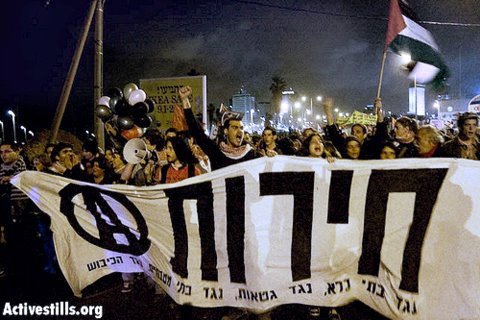
Israeli anarchists demonstrate in Jaffa on Jan. 13, 2009.

news photo

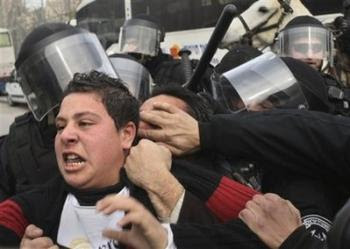
Israeli police officers arrest a Palestinian man during a protest against Israel’s military operation in the Gaza Strip, outside Jerusalem’s Old City, Friday, Jan. 16, 2009. Photo by Atta Awisat / AP.

‘According to Israeli police reports, at least 763 Israeli citizens, the majority of them Palestinian and 244 under 18 years old, have been arrested, imprisoned or detained for participating in demonstrations.’

By Nora Barrows-Friedman | January 19, 2009

JERUSALEM — The Israeli government is stepping up efforts to suppress dissent and crush resistance in the streets. Police have been videotaping the demonstrations and subsequently arresting protesters in large numbers.

According to Israeli police reports, at least 763 Israeli citizens, the majority of them Palestinian and 244 under 18 years old, have been arrested, imprisoned or detained for participating in such demonstrations. Most have been held and then released, but at least 30 of those arrested over the past three weeks are still being held in prison.

Ameer Makhoul, director of Ittijah, the Union of Arab Community-Based Associations in Haifa, tells IPS that these demonstrations “are part of the uprising here inside the Green Line, to share responsibility and to share the challenge with the people in the Gaza strip.”

As an organiser of many of these solidarity demonstrations inside Israel, Makhoul himself was arrested by the Shin Bet (the Israeli secret service). “They called me, came to my home and held me for four hours,” he tells IPS. “They accused me of being a terrorist and supporting terror. They said that they are watching me and monitoring me.” Israel, he said, “has become a terror state.”

The Shin Bet has accused Makhoul and the hundreds of others arrested of “being a rebel, threatening the security of the State of Israel during war time.”

Makhoul believes that such threats are being implemented by Israel’s security forces “(in order to) break our will and the spirit of our people. But I think our spirit is much, much stronger here in Haifa and in Gaza than the Israeli oppression.”

On Jan. 15, a Haaretz-Dialog public opinion poll taken in Israel found that 82 percent of the Israeli population believes that Israel did not go too far in its three-week operation in Gaza, “despite pictures from Gaza depicting massive destruction and a large number of wounded and killed, including women and children,” reports Haaretz.

At a demonstration last week in front of Kishon prison north-east of Haifa, where some of the Palestinian demonstrators are being held, Israeli anarchist and professor of mathematics Kobi Snitz tells IPS that this figure is indicative of the current social climate inside the state.

“People are made to be afraid. Virtually all Israelis, particularly Israeli Jews, are convinced that Hamas was the one that violated the ceasefire. This just isn’t true…(But) you won’t find this in the Israeli media. There is no understanding of the level of violence used on Gaza by the Israeli military. And the police operate under the assumption and guidelines that every political expression now is to be repressed and prevented.”

IPS asked Snitz to describe the momentum of these daily protests across the country. “These demonstrations happened virtually by themselves,” he says. “At this point, anybody who is not severely indoctrinated or ignorant just feels compelled to do something every day. It’s unbearable to sit at home and not do anything.”

Last Saturday night in the coastal town of Jaffa, south of Tel Aviv, several thousand demonstrators – including Palestinians, various peace groups, Israeli anarchists and teenaged Israeli refusniks fresh from jail for refusing to serve in the mandatory military – marched through the main street in the old city with flags, banners, and vociferous determination to keep up the fight inside Israeli society against their government’s lethal operations in Gaza. Israeli security forces, carrying weapons and video cameras, heavily flanked the protesters.

But activists say it is crucial to expand the discussion from this current struggle for Palestinians inside the Gaza strip outward into the larger context. “I’m here to take a stand for Gaza,” Mahmood Jreri of the acclaimed Palestinian hip-hop group DAM, based in Lydd (east of Tel Aviv), tells IPS during the march.

“The main reason (I’m here) is to say that we are not part of what the Israeli government is doing. The Palestinian people are fighting for their freedom and fighting against the occupation. When Palestinians have their freedom, then there will be peace here.”

Source / IPS News

Thanks to David Hamilton / The Rag Blog

Posted in RagBlog | Tagged , , | Leave a comment

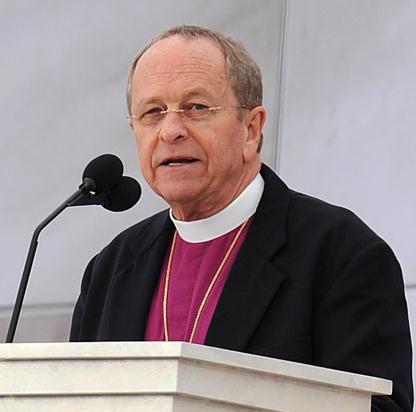
Gay Bishop Gene Robinson a No Show on HBO

Bishop Gene Robinson: If a tree falls in the forest… Photo by Robyn Beck / AFP.

Bishop Gene Robinson asked the nation to pray for the “understanding that our president is a human being and not a messiah.” But only the people AT the concert heard that, because HBO did not televise Robinson’s message.

By Joe.My.God. / January 19, 2009

See Video and full text of Bishop Robinson’s speech at the initial Obama Inauguration ceremony, Below.

[The following article includes updates to include information available at the time of posting.]

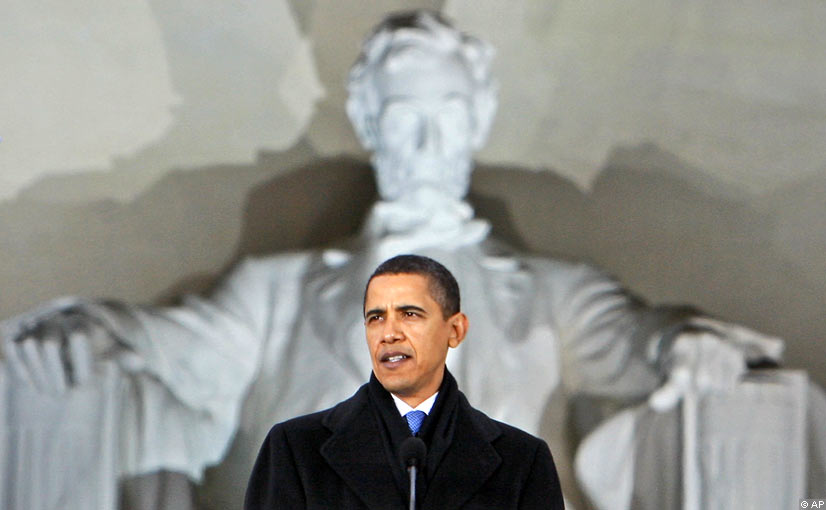
After days of controversy and outrage from the religious right, openly gay Episcopal Bishop Gene Robinson opened Barack Obama’s inauguration concert on the National Mall today with a request that the nation pray for “understanding that our president is a human being and not a messiah.”

But only the people AT the concert heard that, because HBO did not televise Robinson’s message. Who engineered this blackout of Robinson? I suspect we’ll hear lots about this in days to come.

It turns out that a lot the people at the concert did NOT hear Robinson either. There were sound “difficulties” and most of the estimated 500,000 in the audience could not hear his invocation. Only those very close to the stage could hear.

The 7 p.m. rebroadcast of the show was identical, no Gene Robinson.

The full text of Robinson’s prayer is here. If you’d like to express your unhappiness to HBO, you can do that here. My gut tells me the call was made elsewhere.

AfterElton.com has spoken to HBO, who says the decision to cut Robinson was made by the Obama transition team.

Contacted Sunday night by AfterElton.com concerning the exclusion of Robinson’s prayer, HBO said via email, “The producer of the concert has said that the Presidential Inaugural Committee made the decision to keep the invocation as part of the pre-show.” Uncertain as to whether or not that meant that HBO was contractually prevented from airing the pre-show, we followed up, but none of the spokespeople available Sunday night could answer that question with absolute certainty. However, it does seem that the network’s position is that they had nothing to do with the decision.

Somebody seated near the stage recorded Robinson’s invocation:

Source / Joe.My.God

A Prayer for the Nation and Our Next President, Barack Obama
By The Rt. Rev. V. Gene Robinson / January 18, 2009

[Gene Robinson is the Episcopal Bishop of New Hampshire. The following is the full text of Bishop Robinson’s speech at the opening event of Barack Obama’s Inauguration ceremonies, delivered at the Lincoln Memorial, Washington, DC.]

Welcome to Washington! The fun is about to begin, but first, please join me in pausing for a moment, to ask God’s blessing upon our nation and our next president.

O God of our many understandings, we pray that you will…

Bless us with tears – for a world in which over a billion people exist on less than a dollar a day, where young women from many lands are beaten and raped for wanting an education, and thousands die daily from malnutrition, malaria, and AIDS.

Bless us with anger – at discrimination, at home and abroad, against refugees and immigrants, women, people of color, gay, lesbian, bisexual and transgender people.

Bless us with discomfort – at the easy, simplistic “answers” we’ve preferred to hear from our politicians, instead of the truth, about ourselves and the world, which we need to face if we are going to rise to the challenges of the future.

Bless us with patience – and the knowledge that none of what ails us will be “fixed” anytime soon, and the understanding that our new president is a human being, not a messiah.

Bless us with humility – open to understanding that our own needs must always be balanced with those of the world.

Bless us with freedom from mere tolerance – replacing it with a genuine respect and warm embrace of our differences, and an understanding that in our diversity, we are stronger.

Bless us with compassion and generosity – remembering that every religion’s God judges us by the way we care for the most vulnerable in the human community, whether across town or across the world.

And God, we give you thanks for your child Barack, as he assumes the office of President of the United States.

Give him wisdom beyond his years, and inspire him with Lincoln’s reconciling leadership style, President Kennedy’s ability to enlist our best efforts, and Dr. King’s dream of a nation for ALL the people.

Give him a quiet heart, for our Ship of State needs a steady, calm captain in these times.

Give him stirring words, for we will need to be inspired and motivated to make the personal and common sacrifices necessary to facing the challenges ahead.

Make him color-blind, reminding him of his own words that under his leadership, there will be neither red nor blue states, but the United States.

Help him remember his own oppression as a minority, drawing on that experience of discrimination, that he might seek to change the lives of those who are still its victims.

Give him the strength to find family time and privacy, and help him remember that even though he is president, a father only gets one shot at his daughters’ childhoods.

And please, God, keep him safe. We know we ask too much of our presidents, and we’re asking FAR too much of this one. We know the risk he and his wife are taking for all of us, and we implore you, O good and great God, to keep him safe. Hold him in the palm of your hand – that he might do the work we have called him to do, that he might find joy in this impossible calling, and that in the end, he might lead us as a nation to a place of integrity, prosperity and peace.

AMEN.

Source / Episcopal Diosese of New Hampshire

Also see Developing: HBO says theyre not to blame… by Michael Jensen / AfterElton / Jan. 19, 2009

FOR LATE DEVELOPMENTS see ‘Error’ caused gay bishop’s TV blackout by By Lou Chibbaro Jr / Southern Voice / Jan. 19, 2009

Thanks to Jeff Jones and S. M. Wilhelm / The Rag Blog

Posted in RagBlog | Tagged , , , , , | 1 Comment

Obama and Change From the Bottom Up

Photo by Helen Livingstone / Financial Times, UK

‘Obama’s election has revealed a far-reaching hunger for change that had been largely unexpressed. Now is the time to start translating this sentiment into activism — because it is only through struggle that the widespread desire for change can become reality.’

January 19, 2009

THE BUSH days are finally over–dramatically put to an end by the first African American president of a country built on slavery.

With Barack Obama’s inauguration as president on January 20, there will be another wave of the kind of celebration that could be found in cities across the country on Election Night–not only marking the end of a hated regime, but of the history made by its successor.

Millions of people are counting on getting a hearing from the new White House. And that has the new White House…a little worried. Members of the new administration have admitted to the press that they fear hopes in Obama may be running too high–that the millions who celebrated his victory may expect too much, too soon.

In a recent interview, Obama senior adviser Valerie Jarrett said, “You don’t need to have demonstrations in front of the White House to convince this president that there is a disparate impact in the African American community around issues such as health care and education. He’s got that.”

Jarrett’s message appears to contradict the message that Obama carried throughout his campaign–that organizing from the bottom up was the key to progress. “We’re the change we’ve been waiting for,” Obama often said.

But according to Jarrett’s logic, the incoming Obama administration itself will be the agent of change–and because of that, activists don’t need to protest.

Yet a look at U.S. history shows the opposite. Fundamental social change has always come as a result of struggle from below.

On the campaign trail, Obama paid homage to this history with his inspiring campaign rhetoric–complete with references to the sit-down strikers of the 1930s and civil rights activists of the 1960s.

Nevertheless, Obama was the candidate of a party dominated by, and devoted to, the interests of big business. In the White House, he will preside over a vast state machine that’s intertwined with capital in countless ways. He’ll be commander in chief of armed forces that are occupying two countries–Iraq and Afghanistan–and supporting Israel’s war on the Palestinian people. It is this reality that will shape Obama’s policies.

To be sure, Obama has made some important promises–like closing down the U.S. torture center in Guantánamo. He also says he’s willing to sign the Employee Free Choice Act, making it easier for workers to join unions. If he makes good on these promises, it would certainly be a major shift from the Bush administration, which missed no opportunity to attack workers or trash civil liberties.

Nevertheless, Obama himself is warning that we can’t expect all that campaign rhetoric to make it into action. As Obama said in an interview with ABC’s George Stephanopoulos, “George, I want to be realistic here, not everything that we talked about during the campaign are we going to be able to do on the pace we had hoped.”

Thus, in the coming weeks and months, activists will be told that they have to wait for things to improve–to be patient and not expect change overnight.

BUT MANY people understand that our side has to get organized — right now. Protests of thousands around the country to protest Israel’s attack on Gaza are one example. The vibrant new LGBT rights movement that arose in response to the anti-gay marriage Proposition 8 is another.

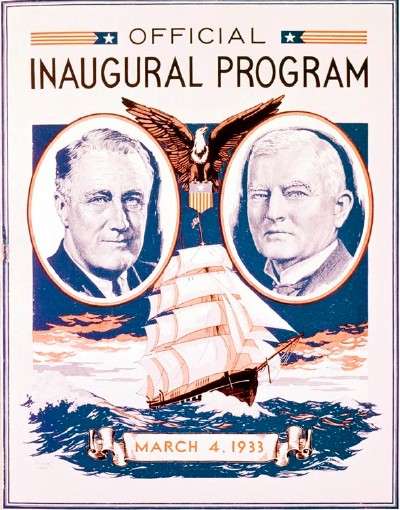
To understand this dynamic, it’s useful to look back at the election of Franklin Delano Roosevelt in 1932. With the country mired in a catastrophic economic crisis, FDR won because of the repudiation of the Republican Herbert Hoover who came before him. Yet FDR came into office with the not-so-radical plan to balance the budget.

The first steps of the new Roosevelt administration were directed toward restoring U.S. businesses and banks. But as workers became more organized, they successfully pressured FDR to put into effect reforms like the Works Progress Administration jobs program, the National Labor Relations Act guaranteeing the right of workers to organize, and, of course, Social Security.

Similarly, Obama’s election has revealed a far-reaching hunger for change that had been largely unexpressed. Now is the time to start translating this sentiment into activism–because it is only through struggle that the widespread desire for change can become reality.

Historian Howard Zinn made this point in a speech at Binghamton University just after the election:

Why is all the political rhetoric limited? Why is the set of solutions given to social and economic issues so cramped and so short of what is needed…And, yes, Obama, who obviously is more attuned to the needs of people than his opponent, you know, Obama, who is more far-sighted, more thoughtful, more imaginative–why has he been limited in what he is saying?

The key to broadening the political horizons, Zinn argues, is what we do next:

If you look at history, you see people felt powerless and felt powerless and felt powerless–until they organized, and they got together, and they persisted, and they didn’t give up, and they built social movements. Whether it was the anti-slavery movement or the Black movement of the 1960s or the antiwar movement in Vietnam or the women’s movement, they started small and apparently helpless; they became powerful enough to have an effect on the nation and on national policy.

Today’s struggles may seem modest by comparison. But they, too, have the potential to mobilize millions of people to fight for the things they urgently need–from health care reform and organizing unions, to ending discrimination based on race, gender and sexual orientation. The time to fight is now.

Source / Socialist Worker

Thanks to Dr. S. R. Keister / The Rag Blog

Posted in RagBlog | Tagged , , , | 3 Comments

1933 / 2009 : Change, and the Repetition of History


‘Misery and insecurity exist to a degree unprecedented in our national life. And spiritually the American people have been debauched by the materialism which made dollar-chasing the accepted way of life and accumulation of riches the goal of earthly existence.’

By Thomas Cleaver / The Rag Blog / January 19, 2009

In March, 1933, The Nation Magazine published the following editorial (emphasis mine):

For twelve years the Republican Party has been in power. During ten of those years it controlled the executive and legislative branches of the government. When, a few years hence, an attempt is made to minimize the disaster of this last quadrennium, and to point to a preceding eight year period of material development and growth, let it be noted that in a purely material sense the American people are much worse off today than they were twelve years ago. Far more than was gained has been swept away. Savings have been dissipated, lives have been blasted, families disintegrated.

Misery and insecurity exist to a degree unprecedented in our national life. And spiritually the American people have been debauched by the materialism which made dollar-chasing the accepted way of life and accumulation of riches the goal of earthly existence. The record of Republicanism must be judged as a whole, although, in fairness, the consequences of the World War and the major responsibility of the Democrats for putting the United States into it must not be forgotten. […]

Moreover, economic disaster has been only a part of this sterile decade’s legacy, the burdens of which will descend to unborn generations. Our worthiest traditions have been impaired; vital tenets of American life have been destroyed. What has become of that fundamental American axiom “salvation by work”? In all our previous history it has been taken for granted that ours was a land of opportunity, and that rewards bore some relation to initiative, effort, and ability. Granting the large mythical content of these beliefs, they were more nearly valid in America in the first century and a half of our national existence than anywhere else on earth. They are no longer true today. The promise of American life has been shattered — possibly beyond repair. […]

Behind the Administration facade, capped by the genial and banal Harding, the insignificant Coolidge, and the erstwhile superman, Hoover, have been the real rulers of America [ed.: there follows a long list.] It was a Grand Old Party — for them — while it lasted. Makers and beneficiaries of our politico-economic system, these are the men whose failure is now written large in the towering empty edifices that scrape the New York sky, in the hundreds of thousands of “For sale” and “To let” signs which adorn our cities, in the closed banks, in the foreclosed farms, in the whole picture of devastation which has come under their rule.

Have these captains and kings departed — not to return? The epoch of their wanton and repulsive leadership is ending. Their incompetence and their betrayal are manifest. But much of the evil they have done lives after them. The coming years will see the struggle to purge America, to reassert the promise of American life, to validate, in consonance with the changed times and conditions, the high aspirations of the founders of the nation.

Mr. Roosevelt has the opportunity to be the leader of this renaissance, but he will have to forge as his instrument a wholly different Democratic Party from that which so long has been indistinguishable from the Republican.

The Rag Blog

Posted in Rag Bloggers | Tagged , , | Leave a comment

U.S. Law : Those Who Authorized Torture MUST Be Prosecuted

Attorney General-designate Eric Holder (shown testifying at hearings on Capitol Hill):”No one is above the law.” Photo by Evan Vucci / AP.

It’s rather difficult to understand how people think that we’re going to ‘send a message to the world’ about the restoration of American values as we deliberately protect the people who have systematically tortured and thereby transparently violate the core provisions of this Convention.

By Glenn Greenwald / January 18, 2009

It seems fairly easy — even for those overtly hostile to the basic rules of logic and law — to see what conclusions are compelled by these clear premises:

Associated Press, April 11, 2008:

Bush administration officials from Vice President Dick Cheney on down signed off on using harsh interrogation techniques against suspected terrorists after asking the Justice Department to endorse their legality, The Associated Press has learned.

The officials also took care to insulate President Bush from a series of meetings where CIA interrogation methods, including waterboarding, which simulates drowning, were discussed and ultimately approved. . . .

The meetings were held in the White House Situation Room in the years immediately following the Sept. 11 attacks. Attending the sessions were Cheney, then-Bush aides Attorney General John Ashcroft, Secretary of State Colin Powell, CIA Director George Tenet and national security adviser Condoleezza Rice.

Agence France-Presse, October 15, 2008:

The administration of US President George W. Bush authorized the CIA to waterboard Al-Qaeda suspects according to two secret memos issued in 2003 and 2004, The Washington Post reported Wednesday.

Soon-to-be U.S. Attorney General Eric Holder, 1/15/2009:

President-elect Barack Obama’s nominee for attorney general said unequivocally Thursday that waterboarding is torture . . .

Early on he was asked whether waterboarding, a technique that makes a prisoner believe he is in danger of drowning, constitutes torture and is illegal.

“If you look at the history of the use of that technique, ” Holder replied, “we prosecuted our own soldiers for using it in Vietnam. . . . Waterboarding is torture.”

Bush official Susan Crawford, 1/13/2009:

The top Bush administration official in charge of deciding whether to bring Guantanamo Bay detainees to trial has concluded that the U.S. military tortured a Saudi national who allegedly planned to participate in the Sept. 11, 2001, attacks, interrogating him with techniques that included sustained isolation, sleep deprivation, nudity and prolonged exposure to cold, leaving him in a “life-threatening condition.”

“We tortured [Mohammed al-] Qahtani,” said Susan J. Crawford, in her first interview since being named convening authority of military commissions by Defense Secretary Robert M. Gates in February 2007. “His treatment met the legal definition of torture. And that’s why I did not refer the case” for prosecution.”

Current Attorney General Michael Mukasey, 1/17/2009:

“Torture is a crime,” Mr. Mukasey said in an interview Friday . . .

.CONVENTION AGAINST TORTURE and Other Cruel, Inhuman or Degrading Treatment or Punishment ( signed by the U.S. under Ronald Reagan):

Article 2

1. Each State Party shall take effective legislative, administrative, judicial or other measures to prevent acts of torture in any territory under its jurisdiction.

2. No exceptional circumstances whatsoever, whether a state of war or a threat or war, internal political instability or any other public emergency, may be invoked as a justification of torture.

3. An order from a superior officer or a public authority may not be invoked as a justification of torture. . . .

Article 4

1. Each State Party shall ensure that all acts of torture are offences under its criminal law. The same shall apply to an attempt to commit torture and to an act by any person which constitutes complicity or participation in torture.

Article 7

1. The State Party in territory under whose jurisdiction a person alleged to have committed any offence referred to in article 4 is found, shall in the cases contemplated in article 5, if it does not extradite him, submit the case to its competent authorities for the purpose of prosecution.

Article 15

Each State Party shall ensure that any statement which is established to have been made as a result of torture shall not be invoked as evidence in any proceedings, except against a person accused of torture as evidence that the statement was made.

Ronald Reagan, 5/20/1988, transmitting Treaty to the U.S. Senate:

The United States participated actively and effectively in the negotiation of the Convention. It marks a significant step in the development during this century of international measures against torture and other inhuman treatment or punishment. Ratification of the Convention by the United States will clearly express United States opposition to torture, an abhorrent practice unfortunately still prevalent in the world today.

U.S. Constitution, Article VI:

This Constitution, and the laws of the United States which shall be made in pursuance thereof; and all treaties made, or which shall be made, under the authority of the United States, shall be the supreme law of the land; and the judges in every state shall be bound thereby, anything in the Constitution or laws of any State to the contrary notwithstanding.

Soon-to-be Attorney General Eric Holder, 1/15/2009 (repeatedly):

“No one is above the law.”

These premises — conclusively established by undisputed news reports and the statements of the person about to become the country’s top law enforcement officer as well as a top Bush official — are clear, and the conclusions they compel are inescapable. The Bush administration authorized, ordered and practiced torture. The U.S., under Ronald Reagan, legally obligated itself to investigate and prosecute any acts of torture committed by Americans (which includes authorization of torture by high level officials and also includes, under Article 3 of the Convention, acts of “rendering” detainees to countries likely to torture, as the Bush administration unquestionably did).

All of the standard excuses being offered by Bush apologists and our political class (a virtual redundancy) — namely: our leaders meant well; we were facing a dangerous enemy; government lawyers said this could be done; Congress immunized the torturers; it would be too divisive to prosecute — are explicitly barred by this treaty (i.e., binding law) as a ground for refusing to investigate and prosecute acts of torture.

This is also why the standard argument now being offered by Bush apologists (such as University of Chicago Law Professor Eric Posner, echoing his dad, Court of Appeals Judge Richard Posner in Chicago) as to why prosecutions are unnecessary — namely: there is “prosecutorial discretion” that should take political factors into account in order not to prosecute — are both frivolous and lawless. The Convention explicitly bars any such “discretion”: “The State Party in territory under whose jurisdiction a person alleged to have committed any offence referred to in article 4 is found, shall . . . submit the case to its competent authorities for the purpose of prosecution.” The principal purpose of the Convention is to remove the discretion involved in prosecuting acts of torture and to bar the very excuses which every torturing society proffers and which our own torturing society is now attempting to invoke (“we were dealing with real threats; there were ‘exceptional circumstances’ that justified it; we enacted laws legalizing the torture; our leaders meant well; we need to move on”).

International treaties which the U.S. signs and ratifies aren’t cute little left-wing platitudes for tying the hands of America. They’re binding law according to the explicit mandates of Article VI of our Constitution. Thus, there simply is no way to (a) argue against investigations and prosecutions for Bush officials and simultaneously (b) claim with a straight face to believe in the rule of law, that no one is above the law, and that the U.S. should adhere to the same rules and values it attempts to impose on the rest of the world. Last week, Paul Krugman stated about as clearly as possible why this is so:

I’m sorry, but if we don’t have an inquest into what happened during the Bush years — and nearly everyone has taken Mr. Obama’s remarks to mean that we won’t — this means that those who hold power are indeed above the law because they don’t face any consequences if they abuse their power.

It’s just as simple as that. Once Eric Holder stated unequivocally that waterboarding is torture, and once a top Bush official used the word “torture” to describe what the U.S. did at Guantanamo using authorized techniques other than waterboarding, the “discretion” to investigate and prosecute disappeared– at least for people who believe in the most basic precepts of the rule of law and equality under it, Western principles of justice established at Nuremberg, and the notion that the U.S. is bound by the treaties it signs. There simply is no way to argue against investigations and prosecutions (and no way to argue that we should use torture-obtained evidence against Guantanamo detainees) without fully rejecting all of those principles.

While many Americans, especially American political elites, may be eager to overlook the implications of immunizing Bush officials for these crimes (as citizens typically are eager to avoid having their leaders branded as torturers and war criminals), it’s rather difficult to understand how people think that we’re going to “send a message to the world” about the restoration of American values as we deliberately protect the people who have systematically tortured and thereby transparently violate the core provisions of this Convention. Doesn’t that conduct rather clearly send the exact opposite message?

UPDATE: Citing the Convention, Hilzoy (a/k/a Johns Hopkins Professor Hilary Bok) wrote:

It seems to me that these facts imply that if Barack Obama, or his administration, believe that there are reasonable grounds to believe that members of the Bush administration have committed torture, then they are legally obligated to investigate; and that if that investigation shows that acts of torture were committed, to submit those cases for prosecution, if the officials who committed or sanctioned those acts are found on US territory. If they are on the territory of some other party to the Convention, then it has that obligation. Under the Convention, as I read it, this is not discretionary. And under the Constitution, obeying the laws, which include treaties, is not discretionary either.

It’s just not possible to argue with that. In light of Holder’s testimony, the “if” component of Hilzoy’s argument — “if Barack Obama, or his administration believe that there are reasonable grounds to believe that members of the Bush administration have committed torture . . . .” — is now a certainty. In Slate, Dahlia Lithwick and Phillipe Sands made a similar argument regarding Bush official Susan Crawford’s statement that the U.S. “tortured” Mohammed al-Qahtani: “These states [who are parties to the Convention] must take any person alleged to have committed torture (or been complicit or participated in an act of torture) who is present in their territories into custody. The convention allows no exceptions.”

While those who argue that the U.S. was right to torture because it’s the U.S. that did it are expressing a repugnant form of exceptionalism, at least they’re being honest — far more so than those who argue that Bush officials shouldn’t be investigated or prosecuted while paying deceitful lip service to “the rule of law” and the idea that “no one is above the law.”

Several commenters note, correctly, that the U.S. Senate, in 1994, ratified the Convention by specifying that its provisions were not self-executing, but instead, required specific legislation implementing its provisions. As this 2004 Report from the Congressional Research Service (.pdf) details (beginning at page CRS-4), Congress enacted legislation to do exactly that, with minor reservations not relevant to the argument here.

Source / salon.com

The Rag Blog

Posted in RagBlog | Tagged , , , , | 2 Comments

Houston Judges Address Cocaine Law Reform

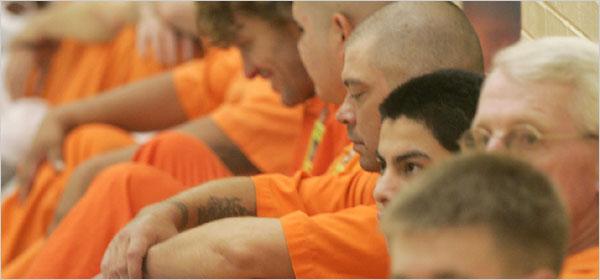
Reform of cocaine laws will seriously address the problem of jail overcrowding.

‘Cocaine is just a chemical. It has no more and no less moral weight than any other chemical. It’s bad for you, but treat it like other chemicals that are bad for you — like ethanol or high fructose corn syrup — and it’s just another commodity.’

By Mark Bennett

Momentum is building in Texas to reduce possession of less than a gram of cocaine from a state jail felony (six months to two years in state jail, day-for-day) to a class A misdemeanor (up to a year in county jail, with time off for good conduct); 16 of 22 Harris County felony court judges publicly support the reform (Brian Rogers in the Houston Chronicle).

“The ‘War on Drugs’ isn’t working, and we as judges realize it,” [Judge Mike] McSpadden said. “And the public realizes it.”

Judge McSpadden has been on the bench for 26 years; he knows whereof he speaks. This position is not new for him, but the public support of 15 other felony judges is. Most of Harris County’s professional criminal bar — prosecutors and defense lawyers — know that he’s right. One particular politician, however, does not; she needs more time to study the problem:

Harris County District Attorney Pat Lykos said the problem is multifaceted, and she is studying the best ways to solve the problems associated with drug abuse, including pre-trial diversion and residential treatment centers.

She said she was looking at the “big picture” and noted that Class A misdemeanors could still involve jail time, which wouldn’t help jail overcrowding, and that small drug arrests lower other crimes in neighborhoods.

Lykos also pointed out that any drug user contributes money to criminal empires, including drug lords in Mexico and terrorists worldwide.

“Anyone who uses illicit drugs has blood on their hands,” she said.

Yes, it’s a multifaceted problem. But WADR, in her 27 years as a judge and retired judge in government service, Pat Lykos has had plenty of time to study the best ways to solve the problems associated with drug abuse.

Changing an offense from a felony with a minimum of six months in jail to a misdemeanor with a maximum (accounting for good time) of six months in jail will help jail overcrowding. That’s not some vague political theory, it’s mathematics.

I’ll give Pat Lykos her last two points — that small drug arrests lower other crimes in neighborhoods, and that users of illicit drugs have blood on their hands. But arresting people for class A misdemeanor possession of cocaine, police are still making the small drug arrests that lower other crimes in neighborhoods.

More importantly, though, the blood that cocaine users have on their hands and (largely) the other crimes committed by illicit drug users are the result not of the use of drugs but of the use of illicit drugs.

Cocaine is just a chemical. It has no more and no less moral weight than any other chemical. It’s bad for you, but treat it like other chemicals that are bad for you — like ethanol or high fructose corn syrup — and it’s just another commodity. Outlaw it, though, and threaten government-sanctioned violence against those who possess it, and you create a black market with its attendant dangers, among which is the use of violence in aid of security and market share.

I’ve known drug lords in Mexico. They’re not making money because they’re trafficking in something intrinsically valuable or inherently immoral, but because they’re trafficking in something with a value artificially inflated by government.

Legalize cocaine, heroin, and methamphetamine, and the drug lords are out of business. (When was the last time you heard of gangs killing each other over alcohol territory? Have you ever heard of Seagram’s giving money to terrorists worldwide?)

So who’s responsible for drug violence? Not only those in the stream of commerce, but also those who support the creation of the black market: those who write and enforce the laws that make drug production, transportation and sales so lucrative.

Reducing cocaine possession from a felony to a misdemeanor is not going far enough. As long as some drugs are illegal, it’ll be both profitable and unregulatable to traffic in them. In the discussion of whether cocaine possession should be felony or misdemeanor, the “blood on their hands” argument has no place.

If all those with blood on their hands for making drug dealing profitable were to be convicted of felonies, a lot of judges, prosecutors, and legislators would be serving time.

Source / Defending People / Posted Jan. 16, 2009

Please see Judge quest to decriminalize minor drug use gets support by Brian Rogers / Houston Chronicle / Jan. 14, 2009

Thanks to Jon Boyd / The Rag Blog

Posted in RagBlog | Tagged , , , , | 4 Comments

Pete Seeger : This Land is Your Land

The video we originally posted here was removed because of copyright claims from HBO. Steve Russell found another version. So enjoy.

Pete Seeger — joined by Bruce Springsteen – Sings ‘This Land is Your Land’ at Inaugural Concert, Jan. 18, 2009

I have to admit, having had the privilege of meeting Pete and getting to know him 20-odd years ago, and knowing his history, this was definitely a Proud Moment to see.

By Thomas Cleaver / The Rag Blog / January 19, 2008

To paraphrase the President-elect on Election night:

“For those who wonder which side won the election of 2008, Pete Seeger leading more than 100,000 people at the Lincoln Memorial in singing ALL the verses of This Land Is Your Land (including the “subversive” ones) is your answer!”

I have to admit, having had the privilege of meeting Pete and getting to know him 20-odd years ago, and knowing his history, this was definitely a Proud Moment to see. In fact, as I was watching the free broadcast on HBO of the entire concert (which continues tonight for those with cable or satellite TV), this was the moment that brought genuine tears to my eyes.

321 years of my family’s involvement in the progressive cause of America (counting from 1688 when my ancestor led the first group of Europeans anywhere to make the non-ownership of slaves a condition of membership in their community, the Germantown Quakers), including participation in the battle that saved the Revolution (crossing the Delaware on Christmas Eve 1776 and taking Trenton Barracks) and the fight within the battle that saved the Union (Little Round Top at Gettysburg), is about to be realized on this coming Tuesday morning. I think I am on pretty strong ground when I say that Peter Klebber of the Germantown Meeting, Isaac Cleaver of the Pennsylvania Militia, and Henry Clay Thomas of the 10th Pennsylvania Volunteer Infantry are pretty damned proud of us all right now.

The Rag Blog

Posted in Rag Bloggers | Tagged , | 4 Comments

Inaugration 2009 : A ‘Citizen’s’ Oath of Office

“I do solemnly pledge…” Photo by Charles Dharapak / AP.

As we celebrate the end of an eight-year disaster, we should recommit to the ongoing work required to create a truly just and sustainable world. With that work in mind, here’s my suggestion for a 2009 Citizen’s Oath of Office.

By Robert Jensen / The Rag Blog / January 19, 2009

Eight long years ago at a counter-inaugural event in Austin, Texas, I administered a “Citizen’s Oath of Office” to the people who had come together on the steps of the state Capitol to challenge the legitimacy of the incoming Bush administration and its right-wing agenda. In 2005 I offered a revised version that expanded on our duties during even more trying times.

In 2009, we welcome a far saner administration but also face far deeper problems, and hence such a citizen’s oath is as necessary as ever. The Obama administration will no doubt step back from the reckless and reactionary policies of the past eight years, but the core problems of empire and economics — U.S. domination around the world and corporate domination at home and abroad — remain as threatening as ever. The robotic talk among Democrats of pressing on in “the right war” in Afghanistan (allegedly to fight terrorism) and a continued faith in the predatory capitalist system (albeit softened slightly in the face of potential collapse) offer little hope for meaningful change at the deep level so desperately needed.

As we celebrate the end of an eight-year disaster, we should recommit to the ongoing work required to create a truly just and sustainable world. With that work in mind, here’s my suggestion for a 2009 Citizen’s Oath of Office, with new language added in brackets:

“I do solemnly pledge that I will faithfully execute the office of citizen of the United States, and that I will, to the best of my ability, help create a truly democratic world by (1) going beyond mainstream corporate news media to seek out information about important political, economic, and social issues; (2) engaging fellow citizens, including those who disagree with me, in serious discussion and debate about those issues; (3) committing as much time, energy, and money as possible to help build [authentic] grassroots political organizations that can pressure politicians to put the interests of people over profit and power; and (4) connecting these efforts to global political and social movements fighting the U.S. empire abroad, where it does the most intense damage. I will continue to resist corporate control of the world, resist militarism, resist any roll-back of civil rights, and resist illegitimate authority in all its forms. [And I will commit to collective efforts in my local community to help build joyful alternatives to an unsustainable consumer society.]”

I think these bracketed additions are crucial. First, adding “authentic” as a modifier of “grassroots political organizations” reminds us that the campaign to elect Obama was not a movement, no matter how many times he uses that term. It was a campaign to elect a candidate from one of the country’s two major parties, both of which are committed to imperial domination and predatory capitalism. That isn’t to argue there is no difference between candidates, but to remind us that a slogan-driven electoral campaign for such a party is not a people’s movement. Authentic movements for justice do not arise out of the Republican or Democratic parties but from people coming together to challenge illegitimate authority rather than accommodate it. Strategic decisions about voting do not replace organizing.

Second, in addition to traditional movement building, it’s clearer than ever that we must focus some of our resources on strengthening on-the-ground alternatives to an extractive industrial economy that is undermining the ability of the ecosystem to sustain life. Those local experiments, such as worker-owned cooperatives and community-supported agriculture, will be increasingly important as the dominant culture proves itself unable to cope with economic and ecological collapse that is no longer a matter for speculation regarding the distant future but a reality we must face now.

We can’t predict the exact texture and timing of that collapse, but we can know it is coming and confront the need for real change. Imagine we are riding on a train hurtling 100 miles per hour on tracks that end at the edge of a cliff. The engineer is replaced by someone who wants to slow the train down to 50 miles per hour but is committed to staying on the same tracks. Slowing down may buy us some time, but the cliff remains.

So, like many others on Tuesday I will breathe a sigh of relief when Obama is sworn in, but I won’t breathe easy.

[Robert Jensen is a journalism professor at the University of Texas at Austin and board member of the Third Coast Activist Resource Center. His latest book, All My Bones Shake, will be published in 2009 by Soft Skull Press. Jensen can be reached at rjensen@uts.cc.utexas.edu and his articles can be found online here.]

The Rag Blog

Posted in Rag Bloggers | Tagged , | 1 Comment

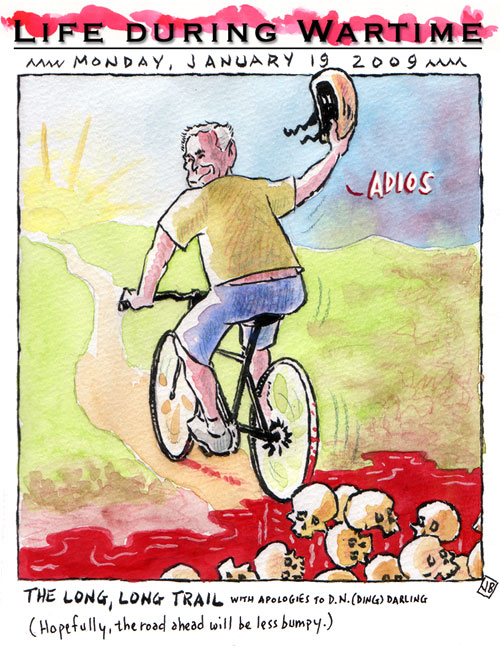
Adios

Political cartoon by Joshua Brown / Historians Against the War / The Rag Blog

Thanks to Dr. S. R. Keister / The Rag Blog

Posted in Rag Bloggers | Tagged , , | Leave a comment

Health Care in the USA : Go Team! We’re 26th!

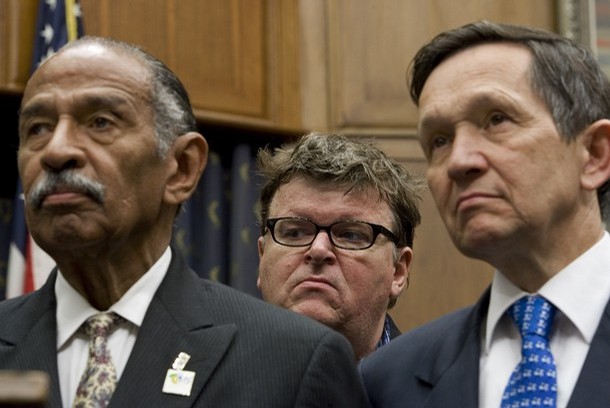
US Rep. John Conyers (D-MI), sponsor of HR 676, with filmmaker Michael Moore and US Rep. Dennis Kucinich (D-OH)on Capitol Hill in June, 2007. All are supporters of single-payer universal health care. Photo by AFP / Getty Images.

As a retired physician I am ashamed of health care in the United States, and having had first hand or collateral experience with health care in France, the U.K., and Italy I can well understand why we rank #26 in the industrialized world.

By Dr. Stephen R. Keister / The Rag Blog / January 18, 2009

As a retired, 87 year old physician, with 40 years of practice behind me, and in addition post-retirement working part time at the V.A. and subsequently at a neighborhood free clinic, I found Luke Mitchell’s article in the February issue of Harpers very comprehensive and illuminating. Yet, one critical element was missing and that was any allusion to Physicians For A National Health Program, a 20 plus year old organization, with 15,000 members, from which evolved Rep. Conyer’s HR 676. PNHP provided the basic studies incorporated in HR 676, and subsequently received the endorsement of the 125,000 member American College of physicians, The California Nurses Association, and numerous civic and labor groups.

As a retired physician I am ashamed of health care in the United States, and having had first hand or collateral experience with health care in France, the U.K., and Italy I can well understand why we rank #26 in the industrialized world. In no other country with universal care is it established for profit of the insurance industry. It is a travesty that any person with any foresight would envision a system in the United States that includes, even in part, the insurance and pharmaceutical industries, rather than being established for the citizenry as a whole.

Unfortunately if one does a bit of research at OpenSecrets.org one will discover how intensely prostituted many of our elected representatives are to the insurance/pharmaceutical complex. Our current health care system is merely a continuation of the economic theories that have currently brought our nation near to a disaster similar to that of 1929.

I have a series of articles on The Rag Blog that explores the problems involved in providing our country with health care. I am sure any one interested can further their knowledge of this area by checking into this web-site.

The Rag Blog

Posted in Rag Bloggers | Tagged , , , | Leave a comment

War Crimes Accusations Going to World Court

A woman cries as she holds the body of one of her relatives at the mortuary of Al-Shifa hospital on January 16, 2009. An international group of lawyers and jurists said Saturday they would ask the International Criminal Court to probe alleged “war crimes” committed by Israel during its offensive in the Gaza Strip. Photo: AFP/File/Mahmud Hams.

Israel accused of war crimes over 12-hour assault on Gaza village
By Fida Qishta in Khuza’a and Peter Beaumont in London / January 18, 2009

White flags ignored and houses bulldozed with families inside, claim residents

Israel stands accused of perpetrating a series of war crimes during a sustained 12-hour assault on a village in southern Gaza last week in which 14 people died.

In testimony collected from residents of the village of Khuza’a by the Observer, it is claimed that Israeli soldiers entering the village:

  • attempted to bulldoze houses with civilians inside;
  • killed civilians trying to escape under the protection of white flags;
  • opened fire on an ambulance attempting to reach the wounded;
  • used indiscriminate force in a civilian area and fired white phosphorus shells.

If the allegations are upheld, all the incidents would constitute breaches of the Geneva conventions.

The denunciations over what happened in Khuza’a follow repeated claims of possible human rights violations from the Red Cross, the UN and human rights organisations.

The Israeli army announced yesterday that it was investigating “at the highest level” five other attacks against civilians in Gaza, involving two UN facilities and a hospital. It added that in all cases initial investigations suggested soldiers were responding to fire. “These claims of war crimes are not supported by the slightest piece of evidence,” said Yigal Palmor, an Israeli foreign ministry spokesman.

Concern over what occurred in the village of Khuza’a in the early hours of Tuesday was first raised by the Israeli human rights group B’Tselem. Although an Israeli military spokesman said he had “no information that this alleged incident took place”, witness statements collected by the Observer are consistent and match testimony gathered by B’Tselem.

There is also strong visible evidence that Khuza’a came under a sustained attack from tanks and bulldozers that smashed some buildings to pieces.

Pictures taken by photographer Bruno Stevens in the aftermath show heavy damage – and still burning phosphorus. “What I can tell you is that many, many houses were shelled and that they used white phosphorus,” said Stevens yesterday, one of the first western journalists to get into Gaza. “It appears to have been indiscriminate.” Stevens added that homes near the village that had not been hit by shell fire had been set on fire.

The village of Khuza’a is around 500 metres from the border with Israel. According to B’Tselem, its field researcher in Gaza was contacted last Tuesday by resident Munir Shafik al-Najar, who said that Israeli bulldozers had begun destroying homes at 2.30am.

When Rawhiya al-Najar, aged 50, stepped out of her house waving a white flag, so that the rest of the family could leave the house, she was allegedly shot by Israeli soldiers nearby.

The second alleged incident was on Tuesday afternoon, when Israeli troops ordered 30 residents to leave their homes and walk to a school in the village centre. After travelling 20 metres, troops fired on the group, allegedly killing three.

Further detailed accounts of what occurred were supplied in interviews given to a Palestinian researcher who has been working for the Observer, following the decision by Israel to ban foreign media from the Gaza Strip. Iman al-Najar, 29, said she watched as bulldozers started to destroy neighbours’ homes and saw terrified villagers flee from their houses as masonry collapsed.

“By 6am the tanks and bulldozers had reached our house,” Iman recalled. “We went on the roofs and tried to show we were civilians with white flags. Everyone was carrying a white flag. We told them we are civilians. We don’t have any weapons. The soldiers started to destroy the houses even if the people were in them.” Describing the death of Rawhiya, Iman says they were ordered by Israeli soldiers to move to the centre of the town. As they did, Israeli troops opened fire. Rawhiya was at the front of the group, says Iman.

Marwan Abu Raeda, 40, a paramedic working for the Nasser hospital in Khan Younis, said: “At 8am we received a phone call from Khuza’a. They told us about the injured woman. I went immediately. I was 60 or 70 metres away from the injured woman when the Israeli forces started to shoot at me.” As he drove into another street, he came under fire again. Twelve hours later, when Rawhiya was finally reached, she was dead.

Iman said she ended up in an area of rubble where a large group of people had sought cover in a deep hole among the debris of demolished houses. It is then, she says, that bulldozers began to push the rubble from each side. “They wanted to bury us alive,” she said.

Source / The Guardian

The Rag Blog

Posted in RagBlog | Tagged , , , , | 2 Comments

BOOKS / ‘We Lost the Vietnam War Because We Didn’t Understand That They Were Poets’

A detail of “Guerrilla Warfare: A Surprise Attack,” 1966. To see several other images from “Mekong Diaries,” click here (PDF file). Graphic: Ho Chi Minh City Fine Arts Museum.

Christian Appy on ‘Mekong Diaries’
By Christian G. Appy / January 16, 2009

“We lost the war because the Vietnamese just flat out beat us. And we lost the war because we didn’t understand that they were poets.” I was offered this Delphic explanation of American defeat in Vietnam by Larry Heinemann, a novelist who survived some of the war’s fiercest fighting in 1967 and 1968 as a soldier with the 25th Infantry Division near the Cambodian border in Tay Ninh province. The inspiration for his enigmatic comment came years later when he revisited Vietnam and met a professor of literature whose wartime service included lectures on American writers to Vietnamese troops as they traveled down the Ho Chi Minh Trail. Professor Lien told the young soldiers about Walt Whitman and Ernest Hemingway and William Faulkner.

“Now what Vietnamese literature did the American military teach to you?” Lien asked in all sincerity. “I laughed so hard I almost squirted beer up my nose,” Heinemann recalls. He explained that American military training did not place a premium on the prose or poetry of any culture, even its own.

But how could poetry, or any kind of art, help explain one of history’s most astonishing victories? I think what Heinemann meant was that the Communist-led cause in Vietnam mobilized not just bodies, but souls. How else to explain the will of millions of Vietnamese to fight for years under unimaginably difficult conditions—under the most massive bombing in world history, in jungle camps and tunnels, on a diet of rice and cassava, for year after year after year. It was common for people to fight for five or even 10 years if they lived long enough. I met one man who was away from home for 29 years fighting the French and then the Americans. When he finally returned, his mother insisted that he show her a familiar mole on the back of his head to confirm that he was, in fact, her son.

To maintain morale, the government of the Democratic Republic of Vietnam (North Vietnam) deployed hundreds of artists, writers, actors, singers, photographers, puppeteers and dancers. These members of the “Literature and Arts” section of the military (Van Nghe) did not just visit combat troops, or lecture to them; they lived with them, moved with them, camped with them, and sometimes fought along with them. They were military artists in residence, only the residence was a war zone, not a campus. When combat was imminent they might move to the rear, but, when necessary, they picked up arms and fought, and died.

What a contrast to the morale-boosting efforts of the U.S. military. In his memoir, commander William Westmoreland, sounding very much like a corporate personnel manager, claimed that the morale of his troops remained high because they had a one-year tour of duty, a one-week R & R in an Asian capital like Bangkok, well-stocked PXs and other “creature comforts.” That, and an occasional USO show featuring Bob Hope and young starlets like Joey Heatherton and Ann-Margret, pretty much exhausted the command’s prescription for morale. Of course, the strongest morale is built on an enduring commitment to a clear and convincing underlying moral purpose, a cause, and the military was no more successful than U.S. policymakers at identifying a cause in Vietnam that could sustain the faith of its citizens and its soldiers.

Sherry Buchanan’s new book, “Mekong Diaries: Viet Cong Drawings & Stories, 1964-1975,” gives us a stunning look at some of the wartime art produced by the Vietnamese soldier-artists who served in the “American War” to drive out the U.S., topple the American-backed government in Saigon and reunite Vietnam. The book’s title is a bit misleading. This is not a collection of diaries. There are a few scraps of moving wartime correspondence and some wartime poems by Nguyen Duy, but this is, primarily, a collection of watercolors and sketches created during the war by soldier-artists.

To provide some context for the images, Buchanan has included several introductory essays and reminiscences from each of the 10 featured artists. The essays are written by Buchanan, a former features editor at The Wall Street Journal who now works independently on Asian art and culture, and two of her collaborators—Nam Nguyen (a Vietnamese-American who left Vietnam as a refugee in 1975 at age 7), and Nguyen Toan Thi, a war artist who was, until 2005, the director of the Ho Chi Minh City Fine Arts Museum.

Most of the featured artists were born in southern Vietnam, and a number of them served in the war of resistance to French rule (1946-1954)—the First Indochina War—as well as the American War. After the Geneva Accords divided Vietnam in 1954, they “regrouped” to the North, where they received training at the Hanoi School of Fine Arts; a few trained in the Soviet Union as well. As the United States escalated its military intervention to prevent the collapse of the government it had backed in South Vietnam since 1954, Hanoi began to send artists on the four-month trip down the Ho Chi Minh Trail to the southern “Front.” During the course of the American War, about 100 soldier-artists served with units of the People’s Liberation Armed Forces (the southern guerrillas known to Americans as the Viet Cong) and units of the People’s Army of Vietnam (the North Vietnamese army). Sixty-two of them died in the war.

Much of the art they produced during the war has been lost or destroyed. Many works that survive were stored in abandoned U.S. ammunition boxes—the driest and tightest containers the artists could find. After the war, what remained was tucked away in trunks and largely forgotten, in part because the postwar artistic establishment regarded most of it as crude and unfinished, created under duress with the most rudimentary supplies—with pencils, worn-out brushes or twigs, with inferior ink, children’s watercolor kits or dirt and saliva, on cheap paper, newsprint or cardboard. In the postwar era some of it was reworked into larger, more polished watercolor, lacquer and oil paintings, but the great bulk of it was ignored for many years. At least part of the explanation for its recovery has been the interest expressed in it by foreigners, especially American veterans, art collectors, scholars and tourists (and quite a lot has been sold to them).

Many of the works gathered here are simply beautiful—amazingly so given the conditions of their creation—the kind of art you could hang in a dining room without risk of distressing your dinner guests. Indeed, one of the most obvious things to say about this work is that it defies almost every common American or Western conception of war-related art. There is very little here that evokes the horrifying human, animal and physical wreckage of war that is the subject of Picasso’s “Guernica,” Goya’s “The Disaster of War” etchings, or Delacroix’s “The Massacre at Chois.” Nor does it resemble the searing and violence-haunted work produced by America’s Vietnam veteran artists and collected by the National Vietnam Veterans Art Museum (examples of this art have been published as “Vietnam: Reflexes and Reflections,” edited by Eve Sinaiko and published by Harry Abrams Inc., 1998). Nor does it even resemble most of the propaganda poster art that was produced in Hanoi during the war and meant to celebrate the heroism and righteousness of “people’s war.”

Instead, most of it is surprisingly serene. For example, several watercolors feature an adolescent boy or girl sitting calmly on the ground. They look perfectly at ease with a tranquil, somewhat faraway gaze, posed as if on a picnic or a school outing with a hint of foliage in the background. The only indication that they are guerrilla fighters is the striking fact that they are holding automatic rifles. Yet, they are holding them as lightly and casually as you might hold a parasol. While a few images depict Vietnamese guerrillas aiming and presumably firing their rifles, there are no exploding bombs or napalm, no scenes of civilian massacres, no images of the bloody aftermath of battle, no severed limbs, no children screaming in agony or grieving mothers, certainly nothing resembling the images (mostly from photography) that most characterize American visual memory of the war. Nor, even, do they match Vietnamese accounts of the war’s harder realities.

Fragment from “Crossing Bas Sac River,” 1970. Graphic: Ho Chi Minh City Fine Arts Museum.

Looking at those calm, well-fed teenagers in the war art made me think of five women I met who had, as teenagers, volunteered to serve in the jungles of the Truong Son Mountains, building and repairing the many branches of the Ho Chi Minh Trail. In the rainy season they were almost never dry. Sometimes they stood for hours up to their waists in water trying to damn rushing streams that threatened the trails. The work was backbreaking. Some girls were rendered infertile. Food was so scarce many became malnourished. Everyone eventually got malaria. It killed some. Most survived, but the disease made their hair fall out. Sometimes after a bombing attack they would form “dare to die” squads to defuse an unexploded bomb. One day, a bomb fell nearby and they had to dig five people out of a shelter that had suffered a direct hit. “We were on our hands and knees clawing at the dirt. Our arms were smeared with blood. There were five people in that shelter. Four of them just turned to porridge. We couldn’t tell them apart. Only one body was recognizable. That woman was holding her child so tightly we couldn’t separate them. We buried them together.” Finally, after years, the girls, now women, were able to go home. “Living in the jungle for so many years made us look terrible. After the war we came home hairless with ghostly white eyes, pale skin, and purple lips.”

How then can we understand what Sherry Buchanan fully acknowledges as the “romantic,” “dreamy” and “idyllic” quality of much of this art? As she points out, “Life in the damp, dark, snake-infested chambers of the Cu Chi tunnels is made to look cozy, with a scarf used as a pillow, a teapot, a bottle of rice wine.” By way of explanation, she and Nam Nguyen suggest that the serenity of the work reflects both an immersion in French-influenced art training along with a deeper Vietnamese cultural predisposition to seek mental peace amid physical and emotional turmoil. And even the length of the war may have reinforced a tendency toward a wishful, wistful art meant to deflect attention from the apparently endless hardship. “I didn’t want to portray suffering,” artist Thai Ha recalled. “You must keep on living an ordinary life to be able to fight a long war.”

There are important exceptions. In 1965, from Hanoi, Le Lam did some drawings of U.S.-supported torture based on reports from the South. One of them shows a woman lying on the ground, naked to the waist, with two snakes crawling out of her trousers and a third posed to strike her face, an image reminiscent of the torture inflicted by South Vietnamese soldiers on Le Ly Hayslip after she was caught spying for the Viet Cong (as described in her memoir, “When Heaven and Earth Change Places”).

And artist Huynh Phuong Dong told Buchanan, “As an artist, I went to record the agony of the war. My drawings are history through painting.” His scarlet and orange watercolor, “Crossing the Saigon River Late at Night,” has a kind of lurid turbulence that powerfully signals impending violence without directly depicting it. The same might be said of Vo Dong Minh’s pastels of the Tet offensive. And perhaps one reason we don’t see more images of combat scenes is that they have been eagerly snapped up by private collectors.

Even so, virtually all of this art avoids death and suffering. Dong’s work doesn’t really evoke much “agony”—the goal he claimed—and even Le Lam seems to dismiss the significance of his torture sketches: “A photographer documents atrocities, the artist must portray life.” Still, the serenity of the art remains puzzling. “What calmness of mind,” Buchanan wonders, “allowed them to create stunning landscapes and elegant portraits as B-52s dropped their arsenals?”

The question she poses circles back on itself, but perhaps extraordinary calmness is a key explanation of this art. As Quach Phong put it, “The soldiers liked to watch me draw. I was calm, it helped calm them down. They asked to have their portraits done in case they died. It made them feel part of history.” Pham Thanh Tam said something very similar: “They liked to have me around to watch me draw. It seemed to calm them, and make them feel special.” After a body of work was completed, the soldier-artists would have an exhibition. They would tie a clothesline between two trees and hang their work with clothespins. It doesn’t take too great a leap to imagine that an art exhibit in the middle of the jungle, in the midst of war, could have a powerful emotional effect.

Though the artists do not say as much, it is also surely true that there were clear orders from political officers to keep this art as positive and inspiring as possible. These were, after all, artists with a political mission. That they produced great work in spite of constrictions on subject matter is a tribute to their skill and passion. And it is also probable that many, if not all of the artists, shared the official desire to accentuate the positive. As Buchanan suggests, the artists’ personal beliefs and artistic vision seem to have “coincided with official propaganda.”

Regardless of why and how this art was produced, Buchanan was clearly drawn to it for the effect it might have on Americans. “If people could see these graceful images by the ‘savage’ Viet Cong,” she thought, “they would understand that war is a psychotic episode … not a policy choice to solve conflicts.” That’s dubious at best, I think, but it is certainly true that American culture has produced way too many cartoon images of the Vietnamese “enemy” as a ruthless and fanatical demon. As Gen. Westmoreland said, “The Oriental doesn’t put the same high price on life as does the Westerner. … Life is cheap in the Orient.”

And yet, does such an exclusive focus on Vietnamese serenity truly humanize them? My only concern is that it might invite us to an equally reductive conclusion: that the Vietnamese were, even in the midst of war, entirely noble and saintly. That is not unlike the image that surfaced in some quarters of the anti-war movement of the 1960s when valiant guerrilla revolutionaries were said to be so pure they “stole neither a needle nor a piece of thread from the people” (to use the Maoist expression). However disciplined and mentally serene, this was not a nonviolent revolution. Communist commanders ordered countless mass-wave attacks on U.S. and South Vietnamese bases, and their troops generally fought with extraordinary commitment. And, like soldiers in all wars, they could be utterly ruthless. One of them, a guerrilla fighter named Nguyen Thi Gung, was the only woman in her unit and one of its most celebrated members. She was given a decoration with the title “Valiant Destroyer of American Infantrymen.” She is not abashed about the killing she did: “I can’t imagine how many GIs I killed. After all, I detonated land mines and threw grenades, both of which could kill many men at a time.”

My point is that we need to consider the possibility that the romantic wartime art was not merely an escape from war, but served the war. Perhaps more effectively than the cant-filled propaganda of political speeches and poster art, these works may well have connected deeply with a people who undeniably believed they were participating in a sacred cause linked to a long history of struggles for national independence and unification. Vietnamese culture has a powerful strain of romanticism that coincides with other “isms,” sometimes serving them, sometimes not. Ho Chi Minh himself deeply reflected that strain. Consider this short poem he wrote in 1948 called “Full Moon in January.” It was written in the midst of war against the French:

Now comes the first full moon of the year

Rivers rise in mists to join spring skies.

We talk of strategy in high places.

Yes, sell the compass, come on the boat of the full moon.

Perhaps Heinemann’s right: We lost because we didn’t understand that they were poets.

[Christian G. Appy, a professor of history at the University of Massachusetts, Amherst, is the author of “Patriots: The Vietnam War Remembered From All Sides” (Penguin).]

Source / TruthDig

Thanks to Jeffrey Segal / The Rag Blog

Posted in RagBlog | Tagged , , , , | 3 Comments