The Real Melamine Story : The FDA Isn’t Protecting Us

Dr. Stephen Sundlof says traces of melanine in baby food “perfectly fine.” Photo by Paul J. Richards / AFP / Getty Images.

Conscientious consumers who have followed the melamine story are appropriately outraged. Some have written off the FDA as hopelessly corrupt and proposed that we all protect ourselves by eating locally grown food. But self-imposed culinary isolationism isn’t going to solve this problem.

By James E. McWilliams / December 29, 2008

It’s been more than a year and a half since the Chinese melamine story first landed in the U.S. press, but the ripple effects continue to spread. Three months ago, the contaminant showed up in baby formula. (The earlier scare was limited to pet food.) In the last couple of weeks, we’ve learned that China is now investigating more than two dozen cases of animal feed contaminated with melamine, and its health officials have identified 17 other illegal food additives that demand scrutiny—including boric acid and Sudan Red dye.

The U.S. Department of Agriculture has now resorted to random spot checks of hot dogs, chicken nuggets, frozen pizzas, and other foods processed with milk powder, and scientific organizations are discussing better ways to detect melamine in the global food supply. From the looks of it, this sprawling scandal will be with us for some time.

The deepening severity of the problem stands in sharp contrast to the continued insouciance of the Food and Drug Administration. When Canada voiced concern over milk-powder imports from the United States in late September, an FDA spokeswoman gave a dismissive response: “The public health crisis is in China.” When, over the next several weeks, the administration finally discovered melamine in baby formula sold here in the United States, its first order of business was to set up a conference call to warn the companies that produce 90 percent of the world’s milk powder—Abbott Labs, Mead Johnson, and Nestlé. But when it came to the general public, the FDA remained silent—at least until the Associated Press filed a Freedom of Information Act request for the test results and published the news in late November. The Department of Agriculture declared (PDF) that it will follow the lead of the FDA on the melamine issue, which is why it’s only just now begun to take action.

Conscientious consumers who have followed the melamine story are appropriately outraged. Some have written off the FDA as hopelessly corrupt and proposed that we all protect ourselves by eating locally grown food. But self-imposed culinary isolationism isn’t going to solve this problem. Once milk power enters the nation’s commercial bloodstream, it’s difficult to avoid. The powder appears in a dizzying array of products—caramelized candies, whey protein supplements, power bars, powdered drinks, nondairy creamers, and baking mixes, among others. We don’t have to persuade every American to avoid every one of these products. Instead, let’s fix some of the obvious flaws with the FDA so the agency can start doing what it’s supposed to do.

Over the course of the scandal, the government made three major mistakes. All of these have become part of the FDA’s standard operating procedure, and each could be remedied with proper legislative action. The first involves the arbitrary adjustment of allowable levels of a contaminant. On Nov. 26, the agency confessed on its Web site to being “currently unable to establish any level of melamine and melamine-related compounds in infant formula that does not raise public health concerns.” A day later, just after the milk-powder news hit CNN, Dr. Stephen Sundlof, head of the FDA’s Center for Food Safety, described the baby formula results as “in the trace range, and from a public health or infant health perspective, we consider those to be perfectly fine.” (The administration made a similarly arbitrary decision a few weeks ago concerning mercury levels in seafood.) Melamine is an adulterant. How can it go from being unsafe one day to being “perfectly fine” the next? If the FDA cannot answer this question—that is, if it has no scientific evidence to justify the flip-flop—the change should not be legally permissible.

The second mistake is to use the risk of acute poisoning as a reference for setting contaminant standards. There is a long tradition of business-friendly regulatory agencies avoiding reference to studies of chronic exposure when setting legal trace limits. The Department of Agriculture, for example, ignored long-term effects when it set fruit-residue limits for arsenic-based insecticides in the 1930s. The situation with melamine has been no different. Legal limits in food other than infant formula sit at 2.5 parts per million, a rate that is by most accounts relatively safe with respect to acute toxicity. As a toxicologist at the Minnesota Department of Public Health recently told me, however, there’s not a single study out there on the impact of long-term, low-dose exposure to melamine. Meanwhile, we have seen a mysterious but dramatic increase in kidney stones among children and young adults. Medical doctors are largely confused about the underlying cause and more often than not blame obesity. But melamine is known to cause kidney problems like these, and long-term exposure could be responsible for the larger trend. In that case, the FDA would be forced to reduce allowable trace amounts to zero—which is exactly where they should be until studies of chronic exposure suggest otherwise.

A third mistake has to do with the FDA’s tendency to regulate finished products at the expense of raw materials. By choosing to monitor the safety of imported food items instead of the ingredients that go into them, the FDA not only ignores the intricate nature of global food production but opens the door for Chinese wheat gluten, rice gluten, and milk powder to enter the U.S. food supply without the benefit of stringent regulation. To make matters worse, our so-called “country of origin” labeling laws don’t apply to individual ingredients in packaged food products. It might seem unwieldy to require a separate label for each foreign ingredient in a can of soup, but the inconvenience would force the FDA to protect our food supply at its most vulnerable points.

These are grave problems, but there’s an achievable regulatory solution for each of them. If the FDA were required by law to provide scientific evidence when it changes adulterant standards and to rely on studies of both acute and chronic toxicity when it set those standards, it would be far more difficult for the bureaucrats to coddle corporate concerns. Add to that a requirement for country-of-origin labeling for all imported foodstuffs, and we’re more likely to escape major health scares like this in the future. Short of becoming a nation of locavores in a globalized world, that may be the best we can do.

[James E. McWilliams is the author of American Pests: Our Losing War on Insects From Colonial Times to DDT and an associate professor of history at Texas State University.]

Source / Slate

The Rag Blog

Posted in RagBlog | Tagged , , , , , | 1 Comment

Israel and Gaza : 100 Eyes for an Eye

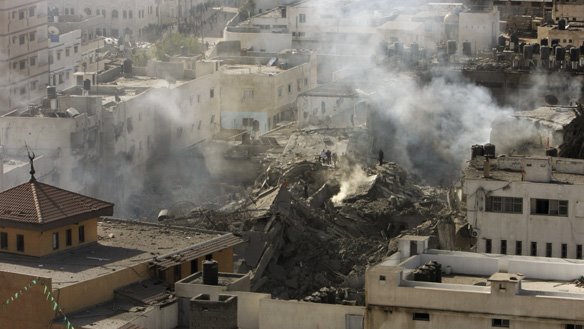
Gaza’s central security headquarters and prison, known as the Seraya, after it was hit in an Israeli missile strike in Gaza City on Sunday. Photo by Adel Hana / AP.

‘Even if you set aside the magnitude of Israel’s violations of the Geneva conventions and the long terrible history of its methodical collective punishment of 1.5 million Palestinians in Gaza, consider the vastly disproportionate carnage in the conflict.’

By Norman Solomon / December 30, 2008

See ‘Israeli patrol boat collides with aid ship off Gaza,’ Below.

Israelis and Arabs “feel that only force can assure justice,” I. F. Stone noted soon after the Six-Day War in 1967. And he wrote, “A certain moral imbecility marks all ethnocentric movements. The Others are always either less than human, and thus their interests may be ignored, or more than human and therefore so dangerous that it is right to destroy them.”

The closing days of 2008 have heightened the Israeli government’s stature as a mighty practitioner of the moral imbecility that Stone described.

Israel’s airstrikes “have killed at least 270 people so far, injured more than 1,000, many of them seriously, and many remain buried under the rubble so the death toll will likely rise,” Phyllis Bennis, of the Institute for Policy Studies, pointed out on Sunday, two days into Israel’s attack. “This catastrophic impact was known and inevitable, and far outweighs any claim of self-defense or protection of Israeli civilians.” She mentioned “the one Israeli killed by a Palestinian rocket attack on Saturday after the Israeli assault began was the first such casualty in more than a year.”

Even if you set aside the magnitude of Israel’s violations of the Geneva conventions and the long terrible history of its methodical collective punishment of 1.5 million Palestinians in Gaza, consider the vastly disproportionate carnage in the conflict.

“An eye for an eye makes the whole world blind,” Gandhi said.

What about a hundred eyes for an eye?

It makes some of the world ill with rage. And it turns much of the United States numb with silence. Routinely, the politicians and pundits of Washington can’t summon minimal decency in themselves or each other on the subject of Israel and Palestinians.

While officialdom inside the Beltway seems frozen in fear of risking “anti-Semitism” charges by actually standing up for the human rights of Palestinian people, some progress at the grassroots level has been noticeable. It includes the growth of groups such as Jewish Voice for Peace, Tikkun and The Shalom Center, where activists have worked to refute the false claims that American Jews are united behind Israeli policies.

At the epicenters of the conflict — where the belief that “only force can assure justice” seems to be even stronger than when I. F. Stone wrote about it 41 years ago — the conclusion has been drawn and redrawn so many times that deadly repetition has become paralytic. While some Palestinian “militants” have terrorized and murdered, the Israeli government has terrorized and murdered on a much bigger scale, using a vast arsenal largely financed by US taxpayers.

From afar, in the United States, it’s too easy to shake our heads at the lethal loss of moral vision. Don’t they know that “an eye for an eye makes the whole world blind”? But the cycle of violence is extremely asymmetrical – while the US government provides Israel with billions of dollars and invaluable “diplomatic” support.

What’s going on in Gaza right now is not just an eye for an eye. It’s a hundred eyes for an eye. And the current slaughter is not only an ongoing Israeli war crime. It has an accomplice named Uncle Sam.

[Norman Solomon is the author of “War Made Easy: How Presidents and Pundits Keep Spinning Us to Death.” To watch video of his recent appearance on C-SPAN’s “Washington Journal,” click here.]Source / truthout

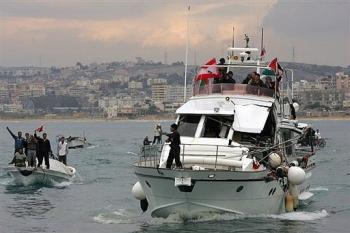
Activists aboard the Dignity boat (R) arrive to the southern Lebanese port city of Tyre. Photo by AFP.

Israeli patrol boat collides with aid ship off Gaza

TYRE, Lebanon — An Israeli naval vessel collided on Tuesday with a boat carrying activists and medical supplies that was trying to break the blockade of Gaza, forcing it to divert to a port in Lebanon.

Passengers on board the 20-metre (66-foot) Dignity said the Israeli patrol boat rammed their vessel causing extensive damage, but Israel insisted the two boats collided as the Israeli navy was trying to contact its captain.

Television pictures of the boat entering the southern Lebanese port city of Tyre showed a large gash in the bow of the boat on the port side, with pieces of wood and broken glass covering the deck.

The boat was struck a “massive” blow, said Australian passenger Renee Bowyer.

“The glass shattered over top us. I was thrown across the room. The tables and benches broke around me,” Bowyer told AFP.

“We were all pretty sure we were being shot at and that we’d sink,” she added saying they quickly grabbed for their life jackets and “prepared for the worst.”

Another activist on the Gaza-bound boat, former American congresswoman Cynthia McKinney, said the Israeli actions had been deliberate.

“Our mission of solidarity and humanitarian relief was deterred by the Israelis purposefully to keep us from delivering the medical supplies to Gaza,” McKinney told AFP.

She described the experience as “absolutely harrowing, but pales in comparison to what the people in Gaza are experiencing right now.”

At least 363 Palestinians — including 39 children — have been killed and 1,720 wounded since an Israeli air offensive began on Saturday, Gaza medics say.

“I wouldn’t call it accosting. I would call it ramming. Let’s call it as it is. Our boat was rammed three times, twice in the front and once on the side,” McKinney told CNN.

No one was injured in the collision between the patrol boat and Dignity — operated by the Free Gaza Movement — which was trying to take three tonnes of medical supplies into Gaza.

Israeli foreign ministry spokesman Yigal Palmor told AFP that the naval vessel tried to contact the aid boat by radio for identification and to inform it that it could not enter Gaza.

“After the boat did not answer the radio, it sharply veered and the two vessels collided, causing only light damage,” Palmor said.

However, the boat’s captain, Briton Denis Healey, 54, said on arriving in Tyre that the Israeli navy had made “no contact” with the Dignity.

“Two Israeli gunboats were on our port side distracting us with their bright lights when another Israeli gunboat with its lights turned off rammed us from the front. I think they were distracting us from the port side,” Healey told AFP.

“The boat initially took in a lot of water,” added Healey who said he was “a bit frazzled.”

The Israeli spokesman accused the international activists of “seeking provocation more than ever.”

But McKinney insisted: “We are on a humanitarian mission… All we want to do is deliver medical supplies… This is the first time that I am aware of that a vessel was attacked for no reason by Israelis.”

The Free Gaza Movement, which has run the blockade six times since August to take humanitarian supplies into Gaza, said the vessel could still sail after the ramming.

Paul Larudee, one of the group’s founders, said the Dignity had been “surrounded” in international waters about 70 kilometres (45 miles) off the Israeli coast and 135 kilometres from Gaza.

“It was surrounded by 11 Israeli naval vessels,” he said.

“They ordered the boat to stop, and we didn’t. They began firing over our boat and into the waters next to the boat. When the boat wouldn’t turn back, one of the naval vessels rammed the boat, but not enough to disable the boat.”

The Dignity was given a rousing welcome when it arrived in Tyre, with hundreds of residents clambering aboard fishing boats to greet the activists with cheers and a colourful display of Lebanese flags as well as flags of the Shiite Hezbollah and Amal movements.

Lebanese President Michel Sleiman had earlier said in a statement that the boat was welcome to dock in any Lebanese port.

Source / AFP

The Rag Blog

Posted in RagBlog | Tagged , , , , , , | Leave a comment

Hundreds Protest in Texas Against Israel’s Assault on Gaza

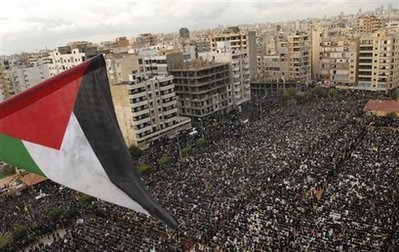
Protesters in Texas joined hundreds of thousands all over the world speaking out against Israel’s assault on Gaza in the last two days. Here, a Palestinian flag flutters in the wind, as people protest in the southern suburb of Dahiyeh, Lebanon, Monday, Dec. 29, 2008.

Stop the bombing, stop the rockets
By Susan Van Haitsma / The Rag Blog / December 29, 2008

See stories about protests in Austin and Houston, Below.

I took part in the demonstration tonight at 11th and Congress in Austin in opposition to the Israeli bombings of Gaza. We stood, a large crowd, around the large Christmas tree and the large menorah, all eight candles and the shammash lit.

It was good to be there in the presence of many persons of Middle Eastern background, as well as others who identify as Jewish, Christian, Muslim, Universalist or non-religious. In the middle of the demonstration, there was a break when some knelt in prayer on the capitol lawn. Jay Janner’s fine photos posted on the American-Statesman site give an idea of those present.

My sign read, “Cease fire – all sides – life is precious.” Some in the crowd believe that armed resistance to the Israeli occupation of Palestine is justified. But, for both moral and practical reasons, I can’t condone violence that takes human life on any side.

Of course, I live comfortably apart from the daily reality of life in an occupied territory. I do know that there are Palestinians, both Muslim and Christian, and Israelies, both religious and secular, who advocate and practice nonviolent forms of resistance to the occupation even in the midst of the deadly violence. Making peace does not mean passive acquiescence. It does mean addressing the conflict without resorting to revenge killing.

In groups that meet to try and reconcile differences between Israeli and Palestinian causes, the most important ingredient seems to be the willingness to walk in the shoes of the other. Everyone has their story to tell, their loss to describe, their pain to express. If these stories can be told, listened to and acknowledged, on all sides, then progress can be made.

When it comes to US relations with Israel and Palestine, there are also questions that must be answered honestly. Who holds the greatest power? Where do business interests translate into political and military power? When do business interests influence media coverage? Who benefits financially when weapons are sold and used? Who pays the cost?

I was glad to see singer/songwriter Eliza Gilkyson present among the crowd tonight because she is able, through her music, to demonstrate what empathy means. She wasn’t there to sing, but many Austinites know her piece, Tender Mercies, in which she gently puts the listener in the shoes of the bomber and the bombed, the parent and the child, so that we understand more than judge. To me, this kind of empathy is a crucial part of what will move us beyond the vicious cycle of war and retributive violence.

[Susan Van Haitsma also blogs as makingpeace at Statesman.com and at makingpeace.]

Hundreds in Austin protest bombings in Gaza
By Miguel Liscano / December 30, 2008

Protesters outside the Texas Capitol on Monday evening yelled “end the occupation” and held signs calling for a halt to an Israeli offensive in the Gaza Strip.

At least 200 people stood for hours at the intersection of Congress Avenue and 11th Street, some waving Palestinian flags and signs that read “free Palestine” or “Cease Fire.” Several said the crowd would be back this evening to again rally against bombings in Gaza that began several days ago.

“We’re just trying to make more Americans aware of what’s going on,” Lezley Hemming of Austin said. “I don’t think if their awareness was at the level it should be that they would be supporting anything like this.”

Some in the crowd said the bombings are illegal and should be stopped. They also said the death toll in Gaza, which was more than 360 by Monday, is not justified.

“This is really out-of-proportion carnage,” said Mara Urich of Austin.

Supporters of the Israeli actions, however, say the bombings are in defense of rockets consistently fired into Israeli towns by members of Hamas, along with the deaths through the years from suicide bombings.

“Israel is engaged in an effort to safeguard its population,” said Jay Rubin, CEO of the Jewish Community Association of Austin, by telephone. “In this particular case, Israel is fully justified.”

He said the assault is an effort to weaken Hamas.

“There cannot be peace with an organization using military force to destroy the state of Israel,” he said.

Rubin said Israel has tried other means of defense, such as limited incursions and economic blockades.

Source / Austin American-Statesman

Hundreds in Houston protest Israel’s strikes on Gaza
By Shern-Min Chow / December 29, 2008

HOUSTON—Hundreds lined the sidewalk around the Galleria Sunday in protest of Israeli airstrikes on the Gaza Strip.

Many of the protesters were draped in Palestinian flags.

“Nobody can justify what is happening in Gaza today. No one,” protester Zuhair Hallail said.

Israel said they launched the deadly airstrikes after Hamas leaders sent missiles into their country.

Israel said it is only defending itself, and the airstrikes are intended only for Hamas leaders.

But the country said it’s difficult not to have civilian casualties because of the nature of their enemy.

“(Hamas leaders) hide among the civilian population. They use women and children as human shields,” Israeli Consul General Asher Yarden said.

Yarden said Israel sent out warnings to citizens about the impending attacks, but that the civilian presence wouldn’t deter them from defending themselves.

“We did distribute leaflets, and we did send text messages to their cell phones, to civilians,” Yarden said.

But the Arab protesters want the U.S. to intervene, and ultimately for Israel to pull out of the Gaza Strip altogether.

“Let’s end the occupation. It is the root cause of all major escalations in the Middle East,” protester Kamal Kahlil said.

“Get out of our land and find somewhere else to live with us in peace and harmony, and don’t live with us and stomp all over our heads with your shoes,” Hallail said.

Israel points to the West Bank, where Palestinian President Mahmoud Abbass, who is supported by the West, leads a rival government to Hamas.

“You can see what is going on in the West Bank is a very good example of how we can co-exist with the Palestinians,” Yarden said.

Source / 11 News / Texas Cable News

The Rag Blog

Posted in Rag Bloggers | Tagged , , , , , , , , | Leave a comment

Bush/Cheney : The Makeover and the Two Myths


Torture saved us and the surge worked. Not.
By Robert Parry

As George W. Bush and Dick Cheney make their case for some positive legacy from the past eight years, two arguments are playing key roles: the notion that torturing terror suspects saved American lives and the belief that Bush’s Iraq troop “surge” transformed a disaster into something close to “victory.”

Not only will these twin arguments be important in defining the public’s future impression of where Bush should rank on the presidential list, but they could constrain how far President Barack Obama can go in reversing these policies. In other words, the perception of the past can affect the future.

Though most current thinking holds that George W. Bush might want to trademark the slogan “Worst President Ever,” America’s powerful right-wing media (and its many allies in the mainstream press) will surely seek to rehabilitate Bush’s reputation as much as possible.

Even elevating Bush to the status of a presidential mediocrity might open the door for a revival of the Bush Dynasty with brother Jeb already eyeing one of Florida’s U.S. Senate seats and possibly harboring grander ambitions.

And even if another Bush in the White House is not realistic, a kinder-gentler judgment on George W. Bush at least could help the Republican Party rebound in 2010 and 2012. So evaluating the Bush-Cheney torture policies and how successful the “surge” are not just academic exercises.

Two recent articles by people with first-hand knowledge also shed important new light on these issues: one by a lead U.S. interrogator in Iraq and the other by former Defense Secretary Donald Rumsfeld.

The interrogator – using the pseudonym “Matthew Alexander” for an article in the Washington Post’s Outlook section on Nov. 30 – wrote that the practice of humiliating and abusing prisoners had proved counterproductive, not only violating U.S. principles and failing to extract reliable intelligence but fueling the Iraqi insurgency and getting large numbers of U.S. soldiers killed.

Indeed, “Alexander,” a U.S. Air Force special operations officer, argued that it was his team’s abandonment of those harsh tactics that contributed to the tracking down and killing of the murderous al-Qaeda in Iraq leader Abu Musab al-Zarqawi in June 2006, an important turning point in reducing levels of violence in Iraq.

“Alexander” said he arrived in Iraq in March 2006, amid the bloody civil war that Sunni extremist Zarqawi had helped provoke a month earlier with the bombing of the golden-domed Askariya mosque in Samarra, a shrine revered by Iraq’s majority Shiites.

“Amid the chaos, four other Air Force criminal investigators and I joined an elite team of interrogators attempting to locate Zarqawi,” he wrote. “What I soon discovered about our methods astonished me. The Army was still conducting interrogations according to the Guantanamo Bay model. … These interrogations were based on fear and control; they often resulted in torture and abuse.

“I refused to participate in such practices, and a month later, I extended that prohibition to the team of interrogators I was assigned to lead. I taught the members of my unit a new methodology — one based on building rapport with suspects, showing cultural understanding and using good old-fashioned brainpower to tease out information.”

Breakthroughs

By getting to know the captives and negotiating with them, his team achieved breakthroughs that enabled the U.S. military to close in on Zarqawi while also gaining a deeper understanding of what drove the Iraqi insurgency, “Alexander” wrote.

“Over the course of this renaissance in interrogation tactics, our attitudes changed. We no longer saw our prisoners as the stereotypical al-Qaeda evildoers we had been repeatedly briefed to expect; we saw them as Sunni Iraqis, often family men protecting themselves from Shiite militias and trying to ensure that their fellow Sunnis would still have some access to wealth and power in the new Iraq.

“Most surprisingly, they turned out to despise al-Qaeda in Iraq as much as they despised us, but Zarqawi and his thugs were willing to provide them with arms and money,” the interrogator wrote, noting that this understanding played a key role in the U.S. military turning many Sunnis against the hyper-violent extremism of Zarqawi’s organization.

“Alexander” added that the new interrogation methods “convinced one of Zarqawi’s associates to give up the al-Qaeda in Iraq leader’s location. On June 8, 2006, U.S. warplanes dropped two 500-pound bombs on a house where Zarqawi was meeting with other insurgent leaders.”

Despite the success in killing Zarqawi, “Alexander” said the old, harsh interrogation methods continued. “I came home from Iraq feeling as if my mission was far from accomplished,” he wrote. “Soon after my return, the public learned that another part of our government, the CIA, had repeatedly used waterboarding to try to get information out of detainees.”

“Alexander” found that the engrained support for using “rough stuff” against hardened jihadists was difficult to overcome despite the successes from more subtle approaches.

“We turned several hard cases, including some foreign fighters, by using our new techniques,” he wrote. “A few of them never abandoned the jihadist cause but still gave up critical information. One actually told me, ‘I thought you would torture me, and when you didn’t, I decided that everything I was told about Americans was wrong. That’s why I decided to cooperate.’”

From hundreds of these interrogations, “Alexander” said he learned that the images from Guantanamo Bay and Abu Ghraib were actually getting American soldiers killed by drawing angry young Arabs into the Iraq War.

“Torture and abuse cost American lives,” the interrogator wrote. “I learned in Iraq that the No. 1 reason foreign fighters flocked there to fight were the abuses carried out at Abu Ghraib and Guantanamo. Our policy of torture was directly and swiftly recruiting fighters for al-Qaeda in Iraq. The large majority of suicide bombings in Iraq are still carried out by these foreigners. They are also involved in most of the attacks on U.S. and coalition forces in Iraq.

“It’s no exaggeration to say that at least half of our losses and casualties in that country have come at the hands of foreigners who joined the fray because of our program of detainee abuse. The number of U.S. soldiers who have died because of our torture policy will never be definitively known, but it is fair to say that it is close to the number of lives lost on Sept. 11, 2001.

“How anyone can say that torture keeps Americans safe is beyond me — unless you don’t count American soldiers as Americans.”

Nevertheless, in a series of candid “exit interviews,” Vice President Cheney – and to a lesser degree President Bush – have defended their actions that included sanctioning brutal methods of interrogation, such as the simulated drowning of “waterboarding.” [See Consortiumnews.com’s “Cheney Defends Waterboarding Order.”]

The ‘Surge’

To this day, the belief that subjecting “bad guys” to physical and psychological abuse makes them crack — and thus saves American lives — remains a central myth that the departing Bush administration won’t abandon. A parallel myth is the notion of the “successful surge.”

It holds that Bush’s brave decision to go against the prevailing political winds in early 2007 and escalate U.S. military involvement in Iraq – with a 30,000-troop “surge” – saved the day. News stories and opinion articles across the U.S. news media, including the New York Times and the Washington Post, have transformed this argument into “conventional wisdom.”

However, as we have pointed out in other stories, the reality is far more complex, with several other key reasons contributing to the drop in Iraqi violence, many predating or unrelated to the “surge,” including:

–The decision by Sunni tribes to turn against al-Qaeda and accept U.S. financial support, the so-called “Anbar Awakening” that began in 2006. Zarqawi’s extremism contributed to this shift, which in turn was a factor in his isolation and death in June 2006.

–Vicious ethnic cleansing had separated Sunnis and Shiites to such a degree that there were fewer targets to kill. Several million Iraqis fled as refugees either into neighboring countries or within their own.

–Concrete walls built between Sunni and Shiite areas made “death-squad” raids more difficult but also “cantonized” much of Baghdad and other Iraqi cities, making everyday life for Iraqis even more exhausting as they sought food or traveled to work.

–An expanded U.S. policy of rounding up so-called “military age males” locked up tens of thousands in prison.

–Awesome U.S. firepower, concentrated on Iraqi insurgents and civilian bystanders for more than five years, had slaughtered countless thousands of Iraqis and intimidated many others to look simply to their own survival.

–With the total Iraqi death toll estimated in the hundreds of thousands and many more Iraqis horribly maimed, the society was deeply traumatized. As tyrants have learned throughout history, at some point violent repression does work.

However, in Washington political circles, it was all about the “successful surge.”

There also was little concern about the 1,000 additional U.S. soldiers who have died in Iraq since President Bush started the “surge” in 2007. The Americans killed during the “surge” represent roughly one-quarter of the total war dead whose numbers have now passed the 4,200 mark.

Rumsfeld’s Doubts

Surprisingly to some Iraq War critics, one of the chief obstacles to Bush’s “surge” was the widely despised Defense Secretary, Donald Rumsfeld, who – in fall 2006 – pushed for a strategy that would have slashed the U.S. military presence in Iraq dramatically by mid-2007.

On Nov. 6, 2006, Rumsfeld sent a memo to the White House, in which he listed his preferred – or “above the line” – options as “an accelerated drawdown of U.S. bases … to five by July 2007” and withdrawal of U.S. forces “from vulnerable positions — cities, patrolling, etc. … so the Iraqis know they have to pull up their socks, step up and take responsibility for their country.”

Two days later, Rumsfeld was forced to submit his resignation and Bush announced Robert Gates as the new Defense Secretary. Not aware of Rumsfeld’s memo, Washington pundits and many leading Democrats misinterpreted the personnel shift as a reaction to the Democratic congressional election victory on Nov. 7, 2006.

The consensus view was that the “realist” Gates would oversee a rapid U.S. military drawdown in Iraq. However, the opposite occurred. Gates became Bush’s front man for the “surge.” [For details, see Consortiumnews.com’s “Robert Gates: As Bad as Rumsfeld?”]

The subsequent conventional wisdom about the “successful surge” catapulted Gates from the ranks of the departing Bush administration into those of the arriving Obama administration, where he will remain Defense Secretary.

On Nov. 23, 2008, less than three weeks after Obama’s Nov. 4 election victory as it was becoming clear that Obama would retain Gates, Rumsfeld shed more light on his own Iraq War strategy in an op-ed for the New York Times.

While bowing to the prevailing conventional wisdom about the “successful surge,” Rumsfeld defended his pre-surge thinking, explaining that a number of factors had set up the “tipping point” that enabled the “surge” to be successful.

Though using more positive language about those preconditions (than we did), Rumsfeld made essentially the same points, adding that previous increases in U.S. troop levels – to numbers comparable to the “surge” levels – had achieved minimal effect in containing the violence.

“As one who is occasionally — and incorrectly — portrayed as an opponent of the surge in Iraq, I believe that while the surge has been effective in Iraq, we must also recognize the conditions that made it successful,” Rumsfeld wrote.

“By early 2007, several years of struggle had created the new conditions for a tipping point:

“–Al Qaeda in Iraq’s campaign of terrorism and intimidation had turned its Sunni base of support against it. The result was the so-called Anbar Awakening in the late summer of 2006, followed by similar awakening movements across Iraq.

“–From 2003 through 2006, United States military forces, under the leadership of Gen. John Abizaid and Gen. George Casey, inflicted huge losses on the Baathist and Qaeda leadership. Many thousands of insurgents, including the Qaeda chief in Iraq, Abu Musab al-Zarqawi, were captured or killed and proved difficult to replace.

“–The Iraqi Security Forces had achieved cohesion, improved operational effectiveness and critical mass. By December 2006, some 320,000 Iraqis had been trained, equipped and deployed, producing the forces necessary to help hold difficult neighborhoods against the enemy. By 2007, the surge, for most Iraqis, could have an Iraqi face.

“–And the political scene in Iraq had shifted. Moktada al-Sadr, the firebrand cleric, declared a cease-fire in February 2007. The government of Prime Minister Nuri Kamal al-Maliki, seated in May 2006, moved against militias and Iranian-backed militias and has imperfectly, but notably, rejected narrow sectarian policies.

“The best indication that timing is everything may be that there had been earlier surges without the same effect as the 2007 surge. In 2005, troop levels in Iraq were increased to numbers nearly equal to the 2007 surge — twice. But the effects were not as durable because large segments of the Sunni population were still providing sanctuary to insurgents, and Iraq’s security forces were not sufficiently capable or large enough.”

In other words, even Rumsfeld would agree that the simplistic conventional wisdom of Washington – that Bush’s “surge” turned everything around and that everyone, including Barack Obama, must accept that “fact” – doesn’t square with the more complex reality.

Still, as Americans should have learned over the past three decades of image-managing – from Ronald Reagan to Karl Rove – perceptions can be a powerful thing. Perception may not be the same as reality but it can become a very dangerous substitute both in defining the present and charting the future.

[Robert Parry broke many of the Iran-Contra stories in the 1980s for the Associated Press and Newsweek. His latest book, Neck Deep: The Disastrous Presidency of George W. Bush, was written with two of his sons, Sam and Nat, and can be ordered at neckdeepbook.com. His two previous books, Secrecy & Privilege: The Rise of the Bush Dynasty from Watergate to Iraq and Lost History: Contras, Cocaine, the Press & ‘Project Truth’ are also available there. Or go to Amazon.com.]

Source / Consortium News / Originally posted Dec. 26, 2008

Thanks to truthout / The Rag Blog

Posted in RagBlog | Tagged , , , , , , , , | Leave a comment

POETRY / Larry Piltz : The Wargazaw Ghetto

A Volcano for a live event at Ruth Eckard Performing Art Center, with Propane Flames, Cyro Jets and LSG / Zigmont / effectspecialist.com.

The Wargazaw Ghetto
has towering furnace buildings
that become exploding volcanos
streaming smoke, fire, and ash
upward to Actual Heaven
a waystation where the innocent
and pure wear living armbands
and watch in holy sacred fire awe
the re-creation of their victimhood
lustily acted out by their descendants
and who staunchly welcome
with open tattooed arms
tads of seared humanity
flung with the ash and smoke
as the close and dear
relations they are.

The Wargazaw Ghetto

Larry Piltz / The Rag Blog

Indian Cove
Austin, Texas
December 30, 2008

The Rag Blog

Posted in Rag Bloggers | Tagged , | 2 Comments

Offshore Drilling Rigs Could Be in California’s Future

The coast off Jenner, north of Bodega Bay, is one area that would be attractive to oil companies, but the Cordell Bank marine sanctuary would still be off limits. Photo: Brian L Frank/The Chronicle.

Drillers eye oil reserves off California coast
By Jane Kay / December 29, 2008

The federal government is taking steps that may open California’s fabled coast to oil drilling in as few as three years, an action that could place dozens of platforms off the Sonoma, Mendocino and Humboldt coasts, and raises the specter of spills, air pollution and increased ship traffic into San Francisco Bay.

Millions of acres of oil deposits, mapped in the 1980s when then-Interior Secretary James Watt and Energy Secretary Donald Hodel pushed for California exploration, lie a few miles from the forested North Coast and near the mouth of the Russian River, as well as off Malibu, Santa Monica and La Jolla in Southern California.

“These are the targets,” said Richard Charter, a lobbyist for the Defenders of Wildlife Action Fund who worked for three decades to win congressional bans on offshore drilling. “You couldn’t design a better formula to create adverse impacts on California’s coastal-dependent economy.”

The bans that protected both of the nation’s coasts beginning in 1981, from California to the Pacific Northwest to the Atlantic Coast and the Straits of Florida, ended this year when Congress let the moratorium lapse.

President-elect Barack Obama hasn’t said whether he would overturn President Bush’s lifting last summer of the ban on drilling, as gas prices reached a historic high. Sen. Ken Salazar, D-Col., Obama’s pick as interior secretary and head of the nation’s ocean-drilling agency, hasn’t said what he would do in coastal waters.

The Interior Department has moved to open some or all federal waters, which begin 3 miles from shore and are outside state control, for exploration as early as 2010. Rigs could go up in 2012.

National marine sanctuaries off San Francisco and Monterey bays are off-limits in California. Areas open to drilling extend from Bodega Bay north to the Oregon border and from Morro Bay south to the U.S.-Mexico border.

Drilling foes say the impacts of explosive blasts from seismic air guns that map rock formations, increased vessel traffic and oil spills should be enough to persuade federal agencies to thwart petroleum exploration. California’s treasured coast, with its migrating whales, millions of seabirds, sea otters, fish and crab feeding grounds, beaches and tidal waters, are at risk, Charter and other opponents say.

Click image to enlarge.

According to the Interior Department, coastal areas nationwide that were affected by the drilling ban contain 18 billion barrels of oil and 76 trillion cubic feet of natural gas in what the agency called yet-to-be-discovered fields. The estimates are conservative and are based on seismic surveys in the late 1970s and early 1980s, before the moratorium went into effect.

California’s share

The agency’s last estimate puts about 10 billion barrels in California, enough to supply the nation for 17 months. That breaks down to 2.1 billion barrels from Point Arena in Mendocino County to the Oregon border, 2.3 billion from Point Arena south to San Luis Obispo County and 5.6 billion between there and Mexico.

“If you were allowed to go out and do new exploration, those numbers could go up or down. In most cases, you would expect them to go up,” said Dave Smith, deputy communications officer of the Interior Department’s Minerals Management Service, which oversees energy development in federal waters.

In California, any exploration and drilling would be close to shore, experts say. In contrast to the Gulf of Mexico, where drilling could occur in waters 10,000 feet deep, California’s holdings lie on its narrow, shallow continental shelf, the underwater edge of land where creatures died over the millennia to produce the oil.

If the Interior Department decides to explore off California’s coast, it could probably do so, some attorneys say. If a state objects to a lease plan, the president has the final say.

Once an area has been leased, the California Coastal Commission may review an oil company’s plan to explore or extract resources to assess if it is consistent with the state’s coastal management program. Conflicts can end up in court, said Alison Dettmer, the commission’s deputy director.

Californians have generally opposed drilling since a platform blowout in 1969 splashed 3 million gallons of black, gooey crude oil on 35 miles of beaches around Santa Barbara, killing otters and seabirds. The destruction of shoreline and wildlife sparked activism and led to the creation of the Coastal Commission.

But when gas prices peaked a few months ago amid cries of “drill, baby, drill” at rallies for GOP presidential candidate John McCain and running mate Sarah Palin, 51 percent of Californians said they favored more offshore drilling, according to a survey by the Public Policy Institute of California.

In July, Interior Secretary Dirk Kempthorne jump-started the development of a new oil and natural gas leasing program and pushed up possible new coastal activity by two years.

The Interior Department is reviewing comments about which coastal areas to include in the next five-year leasing plan. Oil companies want all of the nation’s coastal areas open and say they can produce oil offshore in a way that protects the environment. Gov. Arnold Schwarzenegger, who opposes new offshore development, has offered comments, as have environmental groups.

Obama’s energy plans

Obama’s administration and Congress will have the final say over which regions, if any, would be put up for possible lease sales. In Congress earlier this year, Salazar, Obama’s nominee for interior secretary, supported a bipartisan bill allowing exploration and production 50 miles out from the southern Atlantic coast with state approval. The bill died.

“We’ve been encouraged that the president-elect has chosen Sen. Salazar,” said Dan Naatz, vice president for federal resources with the Independent Petroleum Association of America, a group with 5,000 members that drill 90 percent of the oil and natural gas wells in the United States. “He’s from the West, and he understands federal land policy, which is really key.”

During this year’s presidential campaign, Obama was bombarded by questions about high gas prices and said new domestic drilling wouldn’t do much to lower gasoline prices but could have a place in a comprehensive energy program.

After introducing his green team of environment and energy chiefs recently, Obama said the foundation of the nation’s energy independence lies in the “power of wind and solar, in new crops and new technologies, in the innovation of our scientists and entrepreneurs and the dedication and skill of our workforce.”

He spoke of moving “beyond our oil addiction,” creating “a new, hybrid economy” and investing in “renewable energy that will give life to new businesses and industries.”

Obama didn’t mention oil drilling. When a reporter asked him if he would reinstate the moratorium, he said he wasn’t happy that the moratorium was allowed to lapse in Congress without a broader thought to how the country was going to reduce dependence on fossil fuels.

He reiterated his campaign position that he was open to the idea of offshore drilling if it was part of a comprehensive package, adding that he would turn over the question to his team.

In the 1970s and 1980s, before the moratorium on offshore drilling fully took effect, the federal government produced a series of maps showing areas in California of prospective interest to the oil industry. Those maps offer clues to where oil companies would bid if they had the opportunity.

North Coast

The last proposed lease sale in 1987, thwarted by the moratorium, would have opened 6.5 million acres off the North Coast. Off Mendocino and Humboldt counties, the tracts for sale lay from 3 to 27 miles offshore, and some of the 24 planned platforms, some of them 300 feet tall and each with dozens of wells, would have been visible from land.

Tourism and commercial fisheries would have been affected, according to an environmental review then, while as many as 240 new oil tanker trips from Fort Bragg and Eureka to San Francisco Bay refineries were predicted under the full development scenario. The probability of one or more spills occurring would be 94 percent for accidents involving 1,000 barrels or more, according to documents.

Rep. Lois Capps, D-Santa Barbara, a member of the House Natural Resources Committee, recently said oil drilling will be part of a comprehensive energy policy focusing on renewable sources, but she would like to see drilling occur only on land and in the Gulf of Mexico where infrastructure is in place.

Capps well remembers the Santa Barbara spill almost 40 years ago.

“I was living in Goleta. I just had two children, and my husband was a young professor at UC Santa Barbara. It was a devastating experience,” she said. “The birds and other animals got trapped in the oil. So many people waded out in boots just inch by inch trying to rescue our wildlife. It ruined our tourism for many years.

“I think about it all the time, especially last week when we had had a spill at the same platform. It was a small spill, 1,000 gallons, but it was a wake-up call.”

Source / San Francisco Chronicle

The Rag Blog

Posted in RagBlog | Tagged , , | Leave a comment

BushCo’s Abstinence-Only Program: A Bit Less Than Successful

New research shows that, whether or not they wear purity rings or make other pledges that they will protect their virginity, more than half of American teenagers become sexually active before they get married. Photo: Jonathan Dyer/Hilton Head Island Packet Via Associated Press.

Premarital Abstinence Pledges Ineffective, Study Finds
By Rob Stein / December 29, 2008

Teenagers Who Make Such Promises Are Just as Likely to Have Sex, and Less Likely to Use Protection, the Data Indicate

Teenagers who pledge to remain virgins until marriage are just as likely to have premarital sex as those who do not promise abstinence and are significantly less likely to use condoms and other forms of birth control when they do, according to a study released today.

The new analysis of data from a large federal survey found that more than half of youths became sexually active before marriage regardless of whether they had taken a “virginity pledge,” but that the percentage who took precautions against pregnancy or sexually transmitted diseases was 10 points lower for pledgers than for non-pledgers.

“Taking a pledge doesn’t seem to make any difference at all in any sexual behavior,” said Janet E. Rosenbaum of the Johns Hopkins Bloomberg School of Public Health, whose report appears in the January issue of the journal Pediatrics. “But it does seem to make a difference in condom use and other forms of birth control that is quite striking.”

The study is the latest in a series that have raised questions about programs that focus on encouraging abstinence until marriage, including those that specifically ask students to publicly declare their intention to remain virgins. The new analysis, however, goes beyond earlier analyses by focusing on teens who had similar values about sex and other issues before they took a virginity pledge.
ad_icon

“Previous studies would compare a mixture of apples and oranges,” Rosenbaum said. “I tried to pull out the apples and compare only the apples to other apples.”

The findings are reigniting the debate about the effectiveness of abstinence-focused sexual education just as Congress and the new Obama administration are about to reconsider the more than $176 million in annual funding for such programs.

“This study again raises the issue of why the federal government is continuing to invest in abstinence-only programs,” said Sarah Brown of the National Campaign to Prevent Teen and Unplanned Pregnancy. “What have we gained if we only encourage young people to delay sex until they are older, but then when they do become sexually active — and most do well before marriage — they don’t protect themselves or their partners?”

James Wagoner of the advocacy group Advocates for Youth agreed: “The Democratic Congress needs to get its head out of the sand and get real about sex education in America.”

Proponents of such programs, however, dismissed the study as flawed and argued that programs that focus on abstinence go much further than simply asking youths to make a one-time promise to remain virgins.

“It is remarkable that an author who employs rigorous research methodology would then compromise those standards by making wild, ideologically tainted and inaccurate analysis regarding the content of abstinence education programs,” said Valerie Huber of the National Abstinence Education Association.

Rosenbaum analyzed data collected by the federal government’s National Longitudinal Study of Adolescent Health, which gathered detailed information from a representative sample of about 11,000 students in grades seven through 12 in 1995, 1996 and 2001.

Although researchers have analyzed data from that survey before to examine abstinence education programs, the new study is the first to use a more stringent method to account for other factors that could influence the teens’ behavior, such as their attitudes about sex before they took the pledge.

Rosenbaum focused on about 3,400 students who had not had sex or taken a virginity pledge in 1995. She compared 289 students who were 17 years old on average in 1996, when they took a virginity pledge, with 645 who did not take a pledge but were otherwise similar. She based that judgment on about 100 variables, including their attitudes and their parents’ attitudes about sex and their perception of their friends’ attitudes about sex and birth control.

“This study came about because somebody who decides to take a virginity pledge tends to be different from the average American teenager. The pledgers tend to be more religious. They tend to be more conservative. They tend to be less positive about sex. There are some striking differences,” Rosenbaum said. “So comparing pledgers to all non-pledgers doesn’t make a lot of sense.”

By 2001, Rosenbaum found, 82 percent of those who had taken a pledge had retracted their promises, and there was no significant difference in the proportion of students in both groups who had engaged in any type of sexual activity, including giving or receiving oral sex, vaginal intercourse, the age at which they first had sex, or their number of sexual partners. More than half of both groups had engaged in various types of sexual activity, had an average of about three sexual partners and had had sex for the first time by age 21 even if they were unmarried.

“It seems that pledgers aren’t really internalizing the pledge,” Rosenbaum said. “Participating in a program doesn’t appear to be motivating them to change their behavior. It seems like abstinence has to come from an individual conviction rather than participating in a program.”

While there was no difference in the rate of sexually transmitted diseases in the two groups, the percentage of students who reported condom use was about 10 points lower for those who had taken the pledge, and they were about 6 percentage points less likely to use any form of contraception. For example, about 24 percent of those who had taken a pledge said they always used a condom, compared with about 34 percent of those who had not.

Rosenbaum attributed the difference to what youths learn about condoms in abstinence-focused programs.

“There’s been a lot of work that has found that teenagers who take part in abstinence-only education have more negative views about condoms,” she said. “They tend not to give accurate information about condoms and birth control.”

But Huber disputed that charge.

“Abstinence education programs provide accurate information on the level of protection offered through the typical use of condoms and contraception,” she said. “Students understand that while condoms may reduce the risk of infection and/or pregnancy, they do not remove the risk.”

© 2008 The Washington Post Company

Source / Washington Post

The Rag Blog

Posted in RagBlog | Tagged , , | 1 Comment

The Assault on Gaza and International Law

Hundreds rallied at Rockefeller Center on Sunday in an emergency protest against the Israeli attacks on Gaza. Go here for story, photos and video. Photo by Thomas Good / Next Left Notes.

Talking Points: The Gaza Crisis

If we are serious about ending this carnage, this time, we have no choice but to try to analyze, try to figure out what caused this most recent massacre, how to stop it, and then how to continue our work to end the occupation, end Israel’s apartheid policies, and change U.S. policy to one of justice and equality for all.

By Phyllis Bennis / December 28, 2008

[Phyllis Bennis is a Fellow of the Institute for Policy Studies and of the Transnational Institute in Amsterdam. ]

The death toll in Gaza continues to rise. The carnage is everywhere – city streets, a mosque, hospitals, police stations, a jail, a university bus stop, a plastics factory, a television station. It seems impossible, unacceptable, to step back to analyze the situation while bodies remain buried under the rubble, while parents continue to search for their missing children, while doctors continue to labor to stitch burned and broken bodies back together without sufficient medicine or equipment. The hospitals are running short even of electricity-the Israeli blockade has denied them fuel to run the generators. It is an ironic twist on the legacy of Israel’s involvement in an earlier massacre – in the Sabra and Shatila camps, in Lebanon back in 1982, it was the Israeli soldiers who lit the flairs, lighting the night sky so their Lebanese allies could continue to kill.

But if we are serious about ending this carnage, this time, we have no choice but to try to analyze, try to figure out what caused this most recent massacre, how to stop it, and then how to continue our work to end the occupation, end Israel’s apartheid policies, and change U.S. policy to one of justice and equality for all.

The Israeli airstrikes represent serious violations of international law – including the Geneva Conventions and a range of international humanitarian law.

The U.S. is complicit in the Israeli violations – directly and indirectly.

The timing of the air strikes has far more to do with U.S. and Israeli politics than with protecting Israeli civilians.

This serious escalation will push back any chance of serious negotiations between the parties that might have been part of the Obama administration’s plans.

There is much work to be done.

Violations of International Law

The Israeli airstrikes on the Gaza Strip violate important tenants of international humanitarian law, including violations of the Geneva Conventions. The violations include both obligations of an Occupying Power to protect an Occupied Population, and the broader requirements of the laws of war that prohibit specific acts. The violations start with collective punishment – the entire 1.5 million people who live in the Gaza Strip are being punished for the actions of a few militants.

Israel’s claim that it is “responding to” or “retaliating for” Palestinian rocket attacks is spurious. The rocket fire as currently used is indeed illegal – Palestinians, like any people living under a hostile military occupation, have the right to resist, including the use of military force against the occupation. But that right does not include targeting civilians. The rockets used so far are unable to be aimed with any specificity, so they are in fact aimed at the civilians who live in the Israeli cities and towns, and so are illegal. The rocket fire against civilians should be ended – as many Palestinians believe, because it does not help end the occupation, but also because it is illegal under international law. However, that rocket fire, illegal or not, does not give Israel the right to punish the entire population for those actions. Such vengeance is the very essence of “collective punishment” and is therefore unequivocally prohibited by the Geneva conventions.

Another Israeli violation involves targeting civilians. This violation involves three aspects. First, Israel claims the airstrikes were targeted directly at “Hamas-controlled” security-related institutions. Since the majority Hamas party controls the government in Gaza, virtually all the police departments and other security-related sites were hit. Those police and security agencies are civilian targets – not military. They are run by the Hamas-led government in Gaza, an institution completely separate from Gaza’s military wing that has carried out some (though by no means the majority) of the rocket attacks. Second, some of the attacks directly struck incontestably civilian targets: a plastics factory, a local television broadcasting center. And third, the incredibly crowded conditions in Gaza, one of the most densely populated sites in the world, mean that civilian casualties on a huge scale were an inevitable and predictable result. Such targeting of civilian areas is illegal.

The U.S. is also directly complicit in the violations of the Geneva Convention inherent in Israel’s blockade of the Gaza Strip. Israel’s actions – keeping Gazans locked in the Strip; closing the border crossings to almost all fuel, food, equipment and other basic humanitarian goods; preventing UN and other international human rights monitors and journalists from entering, and more – have all been backed and supported by the U.S. and others in the international community. The resulting humanitarian crisis – reaching catastrophic proportions even before the current air attacks – is partly the responsibility of the United States.

Still another violation involves the disproportionate nature of the military attack. The airstrikes have killed at least 270 people so far, injured more than 1,000, many of them seriously, and many remain buried under the rubble so the death toll will likely rise. This catastrophic impact was known and inevitable, and far outweighs any claim of self-defense or protection of Israeli civilians. (It should be noted that this escalation has not made Israelis safer; to the contrary, the one Israeli killed by a Palestinian rocket attack on Saturday after the Israeli assault began, was the first such casualty in more than a year.)

Key human rights officials, in particular the UN’s Special Rapporteur for Human Rights in the Occupied Territories, Professor Richard Falk, as well as Father Miguel d’Escoto, President of the General Assembly, have issued powerful statements identifying Israeli violations of international law as well as the UN’s obligations to protect the Palestinian population. (Falk statement) But so far there has been no operative response from the UN Security Council. The Council statement, issued 28 December, was completely insufficient, essentially equating the culpability of the Occupying Power and of the occupied population for the violence that has so devastated Gaza. And the statement makes no reference to violations of international law inherent in the Israeli assaults, or in the siege of Gaza that has so drastically punished the entire population. There is a clear need for the General Assembly to step in to reclaim the UN’s role of protecting the world’s people, certainly including the Palestinians, and not just responding to the demands of the world’s powerful.

U.S. Complicity

The United States remains directly complicit in Israeli violations of both U.S. domestic and international law through its continual provision of military aid. The current round of airstrikes have been carried out largely with F-16 bombers and Apache attack helicopters, both provided to Israel through U.S. military aid grants of about $3 billion in U.S. taxpayer money sent to Israel every year. Between 2001 and 2006, Washington transferred to Israel more than $200 million worth of spare parts for its fleet of F-16’s. Just last year, the U.S. signed a $1.3 billion contract with the Raytheon corporation to provide Israel with thousands of TOW, Hellfire, and “bunker buster” missiles. In short, Israel’s lethal attack today on the Gaza Strip could not have happened without the active military support of the United States.

Israel’s attack violated U.S. law – specifically the Arms Export Control Act, which prohibits U.S. arms from being used for any purpose beyond a very narrowly-defined set of circumstances: use inside a country’s borders for self-defense purposes. The Gaza assault did not meet those criteria. Certainly targeting police stations (even Israel did not claim Gazan police forces were responsible for the rockets) and television broadcast centers do not qualify as self-defense. And because the U.S. government has confirmed it was fully aware of Israeli plans for the attack before it occurred, the U.S. remains complicit in the violations. Further, the well-known history of Israeli violations of international law (detailed above) means U.S. government officials were aware of those violations, provided the arms to Israel anyway, and therefore remain complicit in the Israeli crimes.

The U.S. is also indirectly complicit through its protection of Israel in the United Nations. Its actions, including the use and threat of use of the U.S. veto in the Security Council and the reliance on raw power to pressure diplomats and governments to soften their criticism of Israel, all serve to protect Israel and keep it from being held accountable by the international community.

Timing of Israel’s Attack on Gaza

The Israeli decision to launch the attacks on Gaza was a political, not security, decision. Just a day or two before the airstrikes, it was Israel that rejected Hamas’s diplomatic initiative aimed at extending the six-month-long ceasefire that had frayed but largely stayed together since June, and that expired 26 December. Hamas officials, working through Egyptian mediators, had urged Israel to lift the siege of Gaza as the basis for continuing an extended ceasefire. Israel, including Foreign Minister Tsipi Livni, of the “centrist” (in the Israeli context) Kadima Party, rejected the proposal. Livni, who went to Egypt but refused to seriously consider the Hamas offer, is running in a tight race for prime minister; her top opponent is the further-right Benyamin Netanyahu of the officially hawkish Likud party, who has campaigned against Livni and the Kadima government for their alleged “soft” approach to the Palestinians. With elections looming in February, no candidate can afford to appear anything but super-militaristic.

Further, it is certain that the Israeli government was eager to move militarily while Bush was still in office. The Washington Post quoted a Bush administration official saying that Israel struck in Gaza “because they want it to be over before the next administration comes in. They can’t predict how the next administration will handle it. And this is not the way they want to start with the new administration.” The Israeli officials may or may not be right about President Obama’s likelihood of responding differently than Bush on this issue – but it does point to a clear obligation on those of us in this country who voted for Obama with hope, to do all that’s necessary to press him to make good on the “change” he promised that gave rise to that hope.

Obama and Future Options

The escalation in Gaza will make it virtually impossible for any serious Israeli-Palestinian negotiations aimed at ending the occupation. It remains uncertain whether sponsorship of an immediate new round of bilateral negotiations was in fact on Barack Obama’s initial post-inauguration agenda anyway. But the current crisis means that any negotiations, whether ostensibly Israeli-Palestinian alone or officially involving the U.S.-controlled so-called “Quartet,” will be able to go beyond a return to the pre-airstrike crisis period. That earlier political crisis, still far from solved, was characterized by expanding settlements, the apartheid Wall and crippling checkpoints crippling movement, commerce, and ordinary life across the West Bank, and a virtually impenetrable siege of Gaza that even before the current military assault, had created a humanitarian catastrophe.

So What Do We Do?

The immediate answer is everything: write letters to Congressmembers and the State Department, demonstrate at the White House and the Israeli Embassy, write letters to the editor and op-eds for every news outlet we can find, call radio talk shows, protest the U.S. representatives at the UN and their protection of Israeli crimes. We need to engage with the Obama transition process and plan now for how we will keep the pressure on to really change U.S. policy in the Middle East. We should all join the global movement of outrage and solidarity with Gaza. There are a host of on-line petitions already – we should sign them all. The U.S. Campaign to End Israeli Occupation is compiling action calls on our website, endtheoccupation.org. We have to do all of that.

But then. We can’t stop with emergency mobilizations. We still have to build our movement for BDS – boycott, divestment and sanctions, to build a global campaign of non-violent economic pressure to force Israel to comply with international law. We have to challenge U.S. military aid that scaffolds Israel’s military aggression, and U.S. political and diplomatic support that prevents the UN and the international community from holding Israel accountable for its violations. We have to do serious education and advocacy work, learning from other movements that have come before about being brave enough to call something what it is: Israeli policies are apartheid policies, and must be challenged on that basis.

We have a lot of work to do.

[Phyllis Bennis’ books include Understanding the Palestinian-Israeli Conflict: A Primer in FAQ format which many will find useful for education work in this urgent period. Go to interlinkbooks.com Thanks to Josh Ruebner of the U.S. Campaign for some of the background on U.S. military aid.]

Source / United for Peace and Justice

Thanks to CodePink Austin / The Rag Blog

Posted in RagBlog | Tagged , , , , , | 1 Comment

The Dynamics of a Deflationary Spiral

Goody’s Family Clothing appears to be the first retail casualty of a tough holiday season. Above, a store in Knoxville, Tenn., in 2005 during better times. Photo by AP.

One problem in engineering an eventual recovery is that so much of US trade is global, whereas the US is not very competitive in the basic potential recovery strengths like manufacturing, raw materials, or labor costs, while its population is meanwhile relatively old.

By Roger Baker / The Rag Blog / December 29, 2008

This piece below allows you to see the dynamics of a deflationary spiral. Just think of the impact if 10-20% of the retailing jobs disappeared and all of the unemployed clerks cut back on their own shopping. That would be about 1.5-3 million out of work in an industry that already has a lot of retail space by comparison with other countries. Total US employment is about 138 million out of a total population of 300 million. About 2/3 of the total US economy is consumer spending.

From Retail Industry Information on About.com.

…According to the US Department of Labor, Nearly 15.5 million people worked in the US Retail Industry in Q4 2007. That number has dropped to 15.3 million as of May, 2008…

As Keynes noted, there is no inherent factor within capitalism operating so that employment comes to rest at a high level; it can come to rest in a permanently depressed state so that it is seen as a task of government to try to re-stimulate the economy above a depressed state until things turn around. But right now, it appears to be collapsing into a state of greater efficiency whereby people only buy what they actually need. This non-discretionary spending centers around food and energy, and not what the shopping malls typically sell, like jewelry and frills.

One problem in engineering an eventual recovery is that so much of US trade is global, whereas the US is not very competitive in the basic potential recovery strengths like manufacturing, raw materials, or labor costs, while its population is meanwhile relatively old. What kind of a restructured trade bargain can a debtor nation like the US strike with other countries that would prevent the dollar from being devalued?

From the Wall Street Journal:

Analysts estimate that from about 10% to 26% of all retailers are in financial distress and in danger of filing for Chapter 11. AlixPartners LLP, a Michigan-based turnaround consulting firm, estimates that 25.8% of 182 large retailers it tracks are at significant risk of filing for bankruptcy or facing financial distress in 2009 or 2010. In the previous two years, the firm had estimated 4-7% of retailers then tracked were at a high risk for filing.Retailers are particularly vulnerable to a recession because of their high fixed costs….

Store Closings: The International Council of Shopping Centers estimates that 148,000 stores will close in 2008, the most since 2001, and it predicts that there will be an additional 73,000 closures in the first half of 2009.

The Rag Blog

Posted in Rag Bloggers | Tagged , , , | 1 Comment

BOOKS / 1,000 Recordings to Hear Before You Die

When John W. Wilson wrote about music and film for the Houston Chronicle back in the early 70s he’d slip articles to us at Space City! under a pseudonym. Space City! was an underground newspaper that wrote about things in Houston that weren’t otherwise being covered and that helped to coalesce and inform a counterculture and left community there. While doing it, and having a lot of fun in the process — except when we were dodging bullets from the Knights of the Ku Klux Klan — we ruffled a feather or three. Expect to see John’s byline here in the future.

Thorne Dreyer / The Rag Blog / December 29, 2008

One book to read in 2009, about 1,000 recordings to hear before you die.
By John W. Wilson
/ The Rag Blog / December 29, 2008

1,000 Recordings to Hear Before You Die, A Listeners Life List, a new book by Tom Moon published by Workman Publishing, is a monumental achievement. Released in August of 2008 it represents a prodigious amount of work encompassing three years of Moon’s life. He listened to countless recordings, culled those down to 3,000 titles, then finished the job and got the list to its final number.

It makes for some interesting reading. Tom Moon, an award-winning music journalist, is a regular contributor to National Public Radio’s All Things Considered as well as Rolling Stone, Blender and other publications. He is an excellent writer and it is fun to read his short descriptions of the selected works, because as a curious fellow I like to know what I’ve missed and why I might want to catch up with it.

Curiously all of Moon’s selections are albums. This is a conscious choice. “Spend a while inside an album, and a deeper impression immerges — of the artist, and the time of the work’s creation,” he writes.

Curious, I say, because a lot of great recordings are singles from the days of 78s and 45s and should have been covered individually. The album as a work of art is a 60’s construct, and viewing all of this music through that lens is limiting.

The musical works are presented alphabetically which I applaud because doing it by genre would mean that lot of folks might have skipped right past the classical and jazz titles in favor of the rock. It really is much more fun to read it front to back and get the odd juxtapositions of dissimilar works that Moon intended.

Then there is the quirky pleasure of questioning the author. Why is the Beach Boy’s Good Vibrations classed as Pop while Pet Sounds is Rock? How come there’s no John Denver or Tom Jones? How come I think this is an oversight?

Personally, I think The Wild, The Innocent and the E-Street Shuffle is a more nuanced, stronger Springsteen album than Born to Run. Even if a Bluegrass genre only had two members, Bill Monroe and Allison Krause, that would be fine; they should never be lumped with country.

Porgy and Bess should have been in with musicals and the list could have done with about 25 fewer operas which would have lowered the number of essential operas for the casual music fan to about three. And how does he explain overlooking the musical Oklahoma? I think every American of a certain age can sing, “Oh, What a Beautiful Morning.”

I would eliminate the entire pop category. Pop in most circles is a derogatory term and the artists he put in that category include Joni Mitchell, Michael Jackson, Dionne Warwick, and Alanis Morissette to name a few. Folk and Rock and R&B could have handled the load.

He also needed a soundtrack category because that’s where the soundtracks for Trainspotting, O Brother, Where Art Though, Saturday Night Fever, and Dazed and Confused belong. Which brings up the question of how did he overlook The Big Chill, Dream Catcher, The Breakfast Club, and American Graffiti? This is why he needed fewer operas.

The World category contains music from 50 countries, but he does some strange things like using the terms Latin America and Middle East even though there are plenty of listings for countries within both regions. So, why not list the countries?

All of this is the fun of the book — the discussion that goes along with the why of the author’s musical choices.

But as I sit here thumbing through the book I can’t help but feel that it represents an artifact of a previous era. As a one-time book publisher, I appreciate the tidiness of this sort of project. It’s so easy to explain to a buyer. “This is a book that’s a list of things and its sure to be of interest to….” and you fill in the blank.

But the people interested in music these days are out surfing the web and getting their information real-time and they want it updated as new information comes in. That’s why the Wikipedia has replaced paper encyclopedias.

The good news here is that there’s a website based on the book and Moon is blogging there and he’s added his ten best for 2008. So, this might be an evergreen project.

So all is not lost and perhaps we’ll be saved from the specter of 20 years of What Color is Your Parachute or the 2000th iteration of Chicken Soup for the (fill in the blank).

Given the ease with which information flows these days, people also have little need for an expert to tell them what music should be on their playlists or an aggregator such as Workman Publishing to pull it all together and print a book.

Websites such as Pandora and ILike can match a listener to a variety of music based on the listener’s preferences. Then there are the social networking sites such as Facebook and MySpace where members post their favorite songs for their friends to discover. And getting recommendations from friends is way better than getting them from a stranger.

Tom Moon may be a great guy and he certainly appears to have plenty of credentials from his playing experience right through his critical experience writing for magazines such as Rolling Stone but you and he might have exceptionally different tastes in music and you’d probably rather not spend $20 to find this out.

The title is also a bit of a misnomer. This is going to sound pedantic and nitpicky but the title says it is a list of 1,000 recordings to hear before you die which sounds inclusive but these are all musical recordings.

If a publisher is going to title a book in that fashion there ought to be a mention of Edison’s first recordings, or King’s “I have a Dream Speech,” or MacArthur’s “Old Soldiers Never Die” speech just to name a few memorable recordings which, if you’re interested, can be found at the Library of Congress courtesy of the National Recording Preservation Board (http://www.loc.gov/rr/record/nrpb/).

And finally, why do we have to hear this music before we die? I’d be willing to bet no one is going to heaven or hell or qualify for reincarnation based on the recordings they listened to prior to their death.

If you’re going to take your things-to-do-before-you-die guidance from pop culture I’d recommend Earl’s approach in the TV show “Leave it to Earl”. Make a list of all the people you’ve wronged in life and try to make amends. You can listen to the recommended recordings on your IPod while you’re making the rounds if you want, but either way, take care of Earl’s list and you dramatically improve your chances in the afterlife.

[John W. Wilson is a publisher and writer who lives in Houston. He was editor of the Daily Cougar at the University of Houston and wrote about music and film for the Houston Chronicle while writing on the sly for Space City!, the Houston underground paper founded in 1969. (That’s where we first knew him: one of Space City!’s editors was The Rag Blog’s Thorne Dreyer.) John also directed Gulf Publishing’s book division. His websites are yourtexasmusic.com and yourtexasmusicnotes.com .]

Go to the the official site of 1,000 Recordings to Hear Before You Die.

Find 1,000 Recordings to Hear Before You Die by Tom Moon on amazon.com.

The Rag Blog

Posted in Rag Bloggers | Tagged , , | 1 Comment

Dan Rather Lawsuit Will Linger After Junior’s Gone


CBS Newsman’s $70m Lawsuit Likely to Deal Bush Legacy a New Blow
By Christopher Goodwin / December 28, 2008

As George W Bush prepares to leave the White House, at least one unpleasant episode from his unpopular presidency is threatening to follow him into retirement.

A $70m lawsuit filed by Dan Rather, the veteran former newsreader for CBS Evening News, against his old network is reopening the debate over alleged favourable treatment that Bush received when he served in the Texas Air National Guard during the Vietnam war. Bush had hoped that this controversy had been dealt with once and for all during the 2004 election.

Eight weeks before the 2004 presidential poll, Rather broadcast a story based on newly discovered documents which appeared to show that Bush, whose service in the Texas Air National Guard ensured that he did not have to fight in Vietnam, had barely turned up even for basic duty. After an outcry from the White House and conservative bloggers who claimed that the report had been based on falsified documents, CBS retracted the story, saying that the documents’ authenticity could not be verified. Rather, who had been with CBS for decades and was one of the most familiar faces in American journalism, was fired by the network the day after the 2004 election.

He claims breach of contract against CBS. He has already spent $2m on his case, which is likely to go to court early next year. Rather contends not only that his report was true – “What the documents stated has never been denied, by the president or anyone around him,” he says – but that CBS succumbed to political pressure from conservatives to get the report discredited and to have him fired. He also claims that a panel set up by CBS to investigate the story was packed with conservatives in an effort to placate the White House. Part of the reason for that, he suggests, was that Viacom, a sister company of CBS, knew that it would have important broadcasting regulatory issues to deal with during Bush’s second term.

Among those CBS considered for the panel to investigate Rather’s report were far-right broadcasters Rush Limbaugh and Ann Coulter.

“CBS broke with long-standing tradition at CBS News and elsewhere of standing up to political pressure,” says Rather. “And, there’s no joy in saying it, they caved … in an effort to placate their regulators in Washington.”

Rather’s lawsuit makes other serious allegations about CBS succumbing to political pressure in an attempt to suppress important news stories. In particular, he says that his bosses at CBS tried to stop him reporting evidence of torture at Abu Ghraib prison in Iraq. According to Rather’s lawsuit, “for weeks they refused to grant permission to air the story” and “continued to raise the goalposts, insisting on additional substantiation”. Rather also claims that General Richard Meyers, then head of the Joint Chiefs of Staff, the top military official in the US, called him at home and asked him not to broadcast the story, saying that it would “endanger national security”.

Rather says that CBS only agreed to allow him to broadcast the story when it found out that Seymour Hersh would be writing about it in the New Yorker magazine. Even then, Rather claims, CBS tried to bury it. “CBS imposed the unusual restrictions that the story would be aired only once, that it would not be preceded by on-air promotion, and that it would not be referenced on the CBS Evening News,” he says.

The charges outlined in Rather’s lawsuit will cast a further shadow over the Bush legacy. He recently expressed regret for the “failed intelligence” which led to the invasion of Iraq and has received heavy criticism over the scale and depth of the economic downturn in the United States.

© Guardian News and Media Limited 2008

Source / The Guardian Observer

The Rag Blog

Posted in RagBlog | Tagged , , | 4 Comments

A History Lesson from Cuba: The PIC

Members of the Party: the Independents of Color. Photo: © Gloria Rolando, 2001.

Cuba marks centennial of Independent Party of Color
By Mike Taber / December 29, 2008

Two presentations on little-known history of party that championed black rights in Cuba in early 1900s

The story of the Independent Party of Color (PIC) in Cuba, from its founding in 1908 to the massacre in 1912 of more than 3,000 of its black and mulatto members and supporters, is a chapter of history largely unknown within Cuba and abroad.

Knowledge of the PIC and the 1912 massacre was buried by the various capitalist regimes in Cuba between then and 1958. Even after the Cuban Revolution’s triumph in 1959, these events remained little-known.

The story of the Independent Party of Color is intertwined with the legacy and reality of racism in Cuba. The 1959 revolution eliminated all legal forms of discrimination, including Jim Crow practices imposed on Cuba during the U.S. military occupation following 1898. And by eliminating the source of institutionalized racism—capitalism—it opened the door to unprecedented gains by blacks and mulattos and their fuller integration into all aspects of Cuban society.

But many deep-rooted prejudices nonetheless remained. With the collapse in 1990-91 of the Soviet and Eastern European regimes, Cuba lost 85 percent of its foreign trade. Cuba’s increased exposure to the world capitalist market and the economic measures the government had to take in response to this crisis have led to increased inequalities, leading to the reinforcing of racial prejudices that had long been diminishing.

The decision last year by the Communist Party of Cuba to establish a commission to commemorate the 100th anniversary of the PIC’s founding was thus of great importance, not just in rescuing this historical chapter from oblivion, but as part of addressing the challenge of combating the legacy of racism today.

The commission’s president is Fernando Martínez Heredia, a noted Marxist author and essayist and winner of the 2006 National Social Sciences Award. Other members include Digna Castañeda Fuertes, professor of Caribbean studies at the University of Havana; Marta Cordies Jackson, director of the Fernando Ortiz African Cultural Center; Eusebio Leal, official historian of Havana; Rogelio Martínez Fure, National Folkloric Ensemble of Cuba; author and poet Nancy Morejón; Leida Oquendo, the commission’s executive secretary and a member of the Cuban Academy of Sciences; veteran journalist Marta Rojas; and filmmaker Gloria Rolando.

Below are major excerpts from presentations to two events organized by the commission this year, reviewing the history of the PIC and its importance for today. The first, titled “Social Diversity Is Not a Weakness of the Nation, but Rather a Very Important Example of its Richness,” was given by Fernando Martínez Heredia at the opening session of the commission’s work on January 14. The second, titled “Preserving Memory,” was given by Miguel Barnet on August 7 to a meeting in Havana commemorating the 100th anniversary of the PIC’s founding. Miguel Barnet is president of the Union of Writers and Artists of Cuba (UNEAC) and author of Biography of a Runaway Slave.

The translation and subheadings are by the Militant.

* * * * *

BY FERNANDO MARTÍNEZ HEREDIA

The great export-based economy that led Cuba to advance so far materially during the 19th century was built on the bases of a massive slave population numbering a million Africans, the chief labor force of that mode of production. It was a horrific form of exploitation and cultural plunder, embodying a social order of oppression, deep inequalities, castes, and antiblack racism. That social order was the antithesis of the great advances in technology, enterprise, ideas, literature, and art of that era. But at the same time it furnished the material basis that made these possible. Such terrible contradictions could not be overcome through evolution, because the only concern of the ruling class of Cuba was capitalist profits and maintaining its social power. It therefore defended at all times the system that enabled it to be the exploiter, and it did not hesitate to be antinational when necessary.

Insurrections against Spanish rule

A new situation was created by the armed insurrections of 1868 and 1898.1 The revolution of 1868 united abolitionism with the fight for independence, and forged ties between the races based on shared blood, sacrifice, and heroism. The revolution of 1895, with its popular liberation war and mass sacrifices by the Cuban people to defeat Spanish colonialism, attacked the root of the colonial order and developed fraternal relations between the races, mutual respect, and the ideal of equality of all before the law and in social life. Decades of evolution and reforms could never have obtained what was achieved during those years of combat and mobilization. Blacks and mulattos participated in that war on a vast scale.

But the imperialist intervention and occupation stymied the revolution and cut short the country’s sovereignty. The republic of 1902 remained under a new form of domination by neocolonialism and by the Cuban bourgeoisie, an accomplice and subordinate of imperialism.

Cuba attained its independence as a republic and the popular masses achieved citizenship, but under those conditions there were no social changes in the interests of working people or small farmers. Black and mulatto Cubans suffered permanently from the very disadvantageous social situation in which slavery and colonialism had left them, and they lacked the possibilities to pressure, negotiate, and obtain their rights. Racism was able to preserve great strength both in work and in society as a whole, as well as in the political arena. There was a great contradiction between this situation and the ideals of the mambí effort,2 and with the democratic character that the republic should have had. Dissatisfaction among the old combatants and among the black and mulatto population often found expression during those first years of the century… .

On Aug. 7, 1908, the Independent Group of Color was founded in Havana. Chairing the meeting was war veteran Evaristo Estenoz Corominas, and the secretary was journalist Gregorio Surín. Following the elections of November of that year, intensive organizational work was conducted. Soon the Independent Party of Color was constituted in virtually the entire country, coming to have thousands of sympathizers and followers. In February 1910 Colonel Pedro Ivonet joined. A mambí hero from the Invasion and the Pinar del Río campaign, he assumed the chairmanship of the party in Oriente.

Pedro Ivonet, a founder of the PIC
Photo: © 2007 Bohemia. Images source.

The new party organized its activities utilizing legal methods of public expression and electoral activity. Like many other blacks and mulattos, the Independents linked their republican and democratic nationalism to demands and efforts for social advancement and to achieve civil rights as men and women “of color.” But they tried to achieve these goals and confront racism through a political party, as a tool that could theoretically be used within the norms of the system.

I call attention to the demands of their program, because these were very advanced and went far beyond the racial dimension. The Independents always identified themselves as Cubans, and demanded a sovereign, egalitarian republic, defending jobs for the native-born, for the return to Cuba of economic emigres, and for immigration without racial discrimination. They advocated the eight-hour day and labor courts to hear disputes between workers and bosses; distribution of state and other lands to poor Cubans who worked them; and defense of farmers against land grabbers. They called for free education on all levels, and state control of education. They called for changes in the administration of justice and the prison system that favored fairness and education of the poor. And they advocated other measures that transcended racial questions.

Together with other Cubans, the Independents criticized U.S. domination, the usurpation of territory by the Guantánamo base, and the prevailing racism in the U.S. But the relations between nationalism and the racial question were complex and uncertain, because racism clearly expressed the country’s retreat with regard to the revolutionary practices and program of 1895. Social conservatism was the necessary counterweight to the existence of the republic and economic liberalism. Patriotism had to be blind to races, and therefore keep quiet in face of injustices committed for racial reasons. The idea of risking the loss of sovereignty at the hands of the U.S. was linked to the untouchability of the existing order, and every movement that genuinely or supposedly threatened this order was condemned. “National interest” could be used to wall off demands and organizations of social or racial struggle, with the oppressor and oppressed having common interests. This wasn’t simply imposed. The nation had meaning and it had values that were very important for the majority of the country. Therefore the majority of persons “of color” kept apart from, or rejected, political actions based on race in the case of the Independents of Color, even during the great crime of 1912. Some undoubtedly had little consciousness. But many did not agree with racial mobilization as a basis of political action.

From 1908 to 1912 the members of the PIC confronted all this—indifference or incomprehension, but above all the systematic attacks of the neocolonial bourgeois power and its instruments. Slandered in a thousand ways, cynically accused of being racists, the PIC was outlawed in 1910 through an amendment to the Electoral Law (the Morúa Amendment), with many leaders and activists imprisoned for six months. With great tenacity and consistency, they defended their cause in the newspaper Previsión, and every way they could, without getting involved in political wheeling and dealing as was common at the time. Harassed and prevented from utilizing the electoral road, they opted finally to hold an armed protest on May 20, 1912, the 10th anniversary of the establishment of the Republic. Their aim was to demand the party’s legalization. In Oriente thousands of Independents rose up with very few arms, and without a real plan of war, with Estenoz and Ivonet in charge. In Las Villas there were also uprisings.

That tactic turned out to be disastrous. The government of José Miguel Gómez went from political juggling to mobilizing thousands of troops against them, while a very dirty press campaign demonized them. During June and July a bloodbath was carried out with impunity by the republican government. Estenoz, Ivonet, and at least 3,000 nonwhite Cubans were murdered, the majority in Oriente province. This served only to repress a broad sector of the Oriente peasantry that was dispossessed and impoverished by capitalist expansion. A great wave of repression, prisons, persecutions, and an intensification of antiblack racism swept over the entire country. The official republic celebrated the great crime at the end of that summer, and then immediately consigned it to oblivion, a situation that lasted almost half a century.

In 1959 the victorious insurrection put forward for all Cubans a supraracial egalitarianism. The vast transformation of life, social relations, and institutions created the foundation for that goal to be attainable. In the struggles and intensive work that followed, the unity of the people was extolled as a higher political virtue. Brotherhood among Cubans of different races and social origins was considered an ideal that could be realized quickly, and a clear announcement of definitive liberation. In the midst of concrete work and the development of consciousness that offered equal opportunities, racism was rejected and condemned as a scourge of the past. And confidence grew that the advance of socialism would eliminate defects among individuals and social remnants.

In the 1960s some publications referred to the great racist repression of 1912 as part of an abominable past, but there was little analysis of its meaning and its place in the history of racism and capitalist rule in Cuba.3 Following this, 1912 returned to the shadows in the historical culture that was becoming socialist in the country, even though a number of authors were doing historical research into this event, something that in recent years has made significant contributions.

Initiative by Cuban leadership

Nevertheless, the initiative of the Communist Party in creating this commission is not the result of such advances, but rather of the realities, needs, and plans of Cuba today. The great crisis that hit the country 15 years ago—and the measures adopted to overcome it—have produced notable changes in a number of aspects of material and spiritual life, and have had an impact on behavior, values, ways of living, motivations, and expectations. Social disintegration has brought to light many diversities—and in some cases has fueled them. But we are not observing such processes with fear. Social diversity is not a weakness of the nation, but rather a very important example of its richness. It’s not a question of simply admitting these things, or tolerating them. They must be understood as a force with extraordinary potential. The socialist road will become strong and will deepen if it is capable of embracing these diversities and living with them, of leading them and learning from them simultaneously, of respecting their identities and attending to their demands—at the same time as they are asked to contribute to the effort of all and to give a large part of their virtues and their work to the community.

The racial question has been raised increasingly in recent years. We note again that a large part of those who continue to be the most disadvantaged are blacks and mulattos, and that racism flourishes when ties of solidarity and socialist values weaken. In the muffled but tremendous cultural battle taking place between those ties and the relations and values of capitalism, it’s clear which side should be taken by those who are conscious of their position in society and of the social process they must defend. Today a part of the Cuban population are Cuban above all, like the Independents of Color almost a century ago, but also identify themselves as blacks and mulattos. We need those identities and that consciousness to march hand in hand, and to strengthen the socialist revolution and its work. Like all important things, this is very difficult to realize in practice… .

It’s the job of this commission to help recover the historical memory of a stage of the struggles and aspirations of the Cuban people for their rights and their liberation from all domination, broadening one part of the national consciousness and helping to better understand the painful and tenacious cultural legacy of racism in our country.

It must thus encourage an understanding of the pluralistic character of the nation’s culture, and turning that complex richness into a greater force in our way of life and of the social undertaking we defend… .

If we work as brothers and sisters, in an organized way and without faltering, and we advance along this road, then we will fulfill this task.

Thank you very much.

* * * * *

BY MIGUEL BARNET

As is almost always the case, history is written by the conquerors, and the conquered are therefore described through the eyes and psychology of the ruling classes. Such was the fate of the Independent Party of Color, humiliated and outraged by bourgeois politics and history during the neocolonial republic. All Cubans owe a great debt to those patriots who, on Aug. 7, 1908, exactly 100 years ago today, led by Pedro Ivonet and Evaristo Estenoz and meeting in the latter’s home, founded a party that was stigmatized for almost 100 years… .

The party, apart from calling for civil rights for Cuban blacks and mulattos, had a broad social program to benefit the poorest strata, irrespective of color. This included the right to strike, the eight-hour day, the right to education up to the highest levels, health care, and other benefits that, if achieved, would have been a social conquest unprecedented in the history of the continent.

Not only did “persons of color”—the term of the day—constitute the members and sympathizers of the party, but it was essentially a Cuban party. Those who did not act like patriots were their oppressors, the veritable traitors who committed an unforgivable holocaust.

In 1908 Cuba was undergoing its second military occupation by Yankee troops. As we know, the newly emerging empire employed all methods at its disposal to economically and politically dominate our country. Racial and social discrimination played a part in its strategy, just as it did in the United States itself. This schema was mechanically imposed on Cuba, which left traces that have still not been erased… .

History has not done justice to the movement of the Independents of Color. Cuba’s history has been a history of genocide. Of our aboriginal peoples—the first inhabitants of the island—whose numbers decreased by several hundred thousand during the sixteenth century. Of the Ladder Conspiracy.4 Of Valeriano Weyler’s concentration camps in the last battle for liberty.5 Of the tyrant Fulgencio Batista, who showed off his methods of torture and terror at Moncada,6 in city streets, and during a rash of murders committed during the Bloody Christmas massacre.7 Of the genocide of military aggression and terrorist acts against the revolution. What is almost never mentioned, however, is the genocide of those courageous Cubans who, between 1908 and 1912, defended the rights of the Cuban people to join a political party that at the time was the only one that genuinely represented them.

Our best tribute to them in this centennial year is the commemorative plaque unveiled this morning as part of other activities that have taken place at various times throughout this year, and that will continue over the following months.

Making a reality, with ever increasing revolutionary consciousness, of the social justice advocated by those of us who carry forward our Martí-ist, and Fidelista socialist undertaking—embodying within it full social equality, is to also recall Ivonet and Estenoz and all the patriots who followed them. It is to recognize the human right to knowledge of the historical truth. It is to prevent crimes like that of the Little War of 1912 from recurring. It is to preserve the memory of men like Aponte,8 Estenoz, and Ivonet, who must not remain, even a single day longer, in oblivion.

Glory to them

Notes

1. From 1868 to 1898 Cubans waged a series of wars for independence from Spain. The first, the Ten Years War, lasted from 1868 to 1878, followed by the “Little War” in 1879-80. The final war for independence was fought from 1895 to 1898, leading to the end of Spanish colonial rule. It was immediately followed, however, by a U.S. military occupation of the country.

2. Mambí was the name given to fighters against Spanish colonial rule in Cuba’s wars of independence.

3. The main proponents of this line were leaders of the former pro-Moscow Popular Socialist Party (PSP), who asserted that going back to this history would be “divisive.” For example, the only serious work on the Independents of Color until recently was a 1950 book by a PSP member whose father had been a leader of the PIC (Los independientes de color by Serafín Portuondo). But immediately after publication, the book was attacked in the PSP’s press as being “un-Marxist,” with criticisms of the PIC for “dividing the working class.”

4. In 1844 Spanish colonial authorities announced they had discovered plans for a slave revolt organized by free Blacks and slaves, which became known as the “Ladder Conspiracy,” referring to the ladders to which suspects were bound as they were whipped until they “confessed” or died. Although the existence of such a conspiracy is in doubt, 98 people were sentenced to death, and many others were imprisoned, exiled, or died under torture.

5. During the 1895-98 war, Spanish general Valeriano Weyler was appointed governor of Cuba, with orders to suppress the independence struggle. His most notorious act was herding more than 300,000 rural residents into concentration camps to prevent them from aiding the independence fighters. At least 200,000 died from starvation and disease.

6. On July 26, 1953, some 160 revolutionaries under the command of Fidel Castro launched an insurrectionary attack on the Moncada army garrison in Santiago de Cuba together with a simultaneous attack on the garrison in Bayamo, opening the revolutionary armed struggle against the Fulgencio Batista dictatorship. After the attack’s failure, Batista’s forces massacred more than 50 of the captured revolutionaries. Fidel Castro and 27 others, including Raúl Castro and Juan Almeida, were tried and sentenced to up to 15 years in prison. They were released on May 15, 1955, after a public defense campaign forced the regime to issue a general amnesty for political prisoners.

7. On Christmas Eve 1956, Batista’s police in a number of towns in eastern Cuba kidnapped and murdered 23 members of the July 26 Movement and Popular Socialist Party.

8. José Aponte led a slave rebellion in 1812. He was captured and hanged.

Source / The Militant

Thanks to Jeff Segal / The Rag Blog

Posted in RagBlog | Tagged , , , | Leave a comment