The Vatican: Working Their Way Back in Time

Pope Benedict XVI. Photo: roblisameehan via Flickr.

Will a New Vatican Document Affect Science and Reproductive Health?
By Brendan Borrell / December 12, 2008

Mischaracterizations of science lurk in the Vatican’s latest instructions on bioethics, but Catholics probably won’t follow them anyway

The Vatican released a striking bioethics document today that condemns not only embryonic stem cell research, human-animal hybrids, and human cloning, but also the commonplace practice of in vitro fertilization that many couples depend on to have children.

The document, titled “The Dignity of the Person,” was released by the Congregation for the Doctrine of the Faith, which is charged under Pope Benedict XVI to develop moral instructions for handling bioethical issues of the day. Few expected the instructions, whose official title is in Latin, to be forward-looking, but their striking position against in vitro fertilization (IVF) and surrogate motherhood may take many by surprise.

These instructions stem from two fundamental theological principles: that life begins at conception and that the origin of human life is the “fruit of marriage.”

The first principle is well known for driving opposition to abortion and embryonic stem cell research. The document now makes clear that the morning-after pill, RU-486, and intrauterine devices (IUDs), which either intercept the embryo before implantation or eliminate it after implantation, “fall within the sin of abortion.” While embryonic stem cell research is “a grave moral disorder,” the document notes that parents may make use of a “vaccine which was developed using cell lines of illicit origin” when the health of a child is at stake as long as they voice their disapproval and request alternatives. And while the document supports somatic cell gene therapy — that is, in cells other than reproductive cells — it comes down against genetic modifications of the reproductive cell lines “in the present state of research” because they are too risky and would be transmitted to potential offspring. Genetic engineering, it also warns, may promote a “eugenic mentality” which would contrast with the Vatican’s fundamental view of equality.

More difficult to grapple are the scientific and policy implications of that second principle, which links the creation of life to marriage and calls into question the morality of IVF. To find out more, we talked to Josephine Johnston, a lawyer and expert on reproductive ethics at The Hastings Center in Garrison, New York.

[An edited transcript of the interview follows.]

What was the most surprising guideline issued in the document?

The most difficult thing for me to understand was the judgments on assisted reproduction, particularly in vitro fertilization. The document also mischaracterizes in vitro fertilization in a number of ways.

The Vatican says that in vitro fertilization is wrong at its core because it involves conception outside of a woman’s body. Unblocking fallopian tubes, undoing a vasectomy, or giving fertility medicine that boosts egg production so the woman is more likely to conceive through intercourse is okay. But anything that involves conception happening in the lab: taking the eggs out of a woman, fertilizing the eggs with the sperm, and then putting one or two or three embryos back inside the woman. It is opposed to that for two reasons. It doesn’t like the embryo loss that is often involved. That I don’t agree with, but I understand the Vatican’s rationale. But it also opposes IVF even if it doesn’t involve embryo loss, because the Vatican is committed to conception that involves the conjugal act. This I don’t really understand.

There are multiple descriptions of in vitro fertilization that make it sound as though couples going through IVF and the doctors and technicians involved are doing it in a heartless way. My understanding is that many couples and doctors involved have a huge amount of respect and awe for the embryos they create. They are very attached to the embryos they create. They are highly invested in their survival. They do everything they can to make sure as many embryos develop after fertilization. The idea that they are doing it in this detached, technical, love-free environment is really a mischaracterization.

The Vatican’s instructions also describe other aspects of IVF in a way that is misleading. They talk about pre-implantation diagnosis, which is where you do tests on embryos before you transfer them to the woman’s body. They describe it as being done to ensure that embryos are free from defects or other particular qualities. Sometimes it is done for that reason, but they don’t mention the most important reason that people do pre-implantation diagnosis, which is to make sure they only transfer embryos that will survive. A friend of mine had two miscarriages late in third trimester because there were serious genetic defects with the fetus incompatible with its continuing to live. She had IVF, and they did pre-implantation diagnosis and of the six embryos they created all had multiple genetic problems that would have prevented them from surviving for birth. That’s probably better than having six more miscarriages. That is not even mentioned in this document and it seems extremely important.

Were there parts of the document that you may not have agreed with but did not find quite as surprising?

There’s an opposition to embryonic stem cell research because it involves the destruction of embryos, which makes sense because they are opposed to the destruction of embryos for whatever reason. It’s also not a surprise to see opposition to a number of frozen embryos that are not going to be transferred to a woman’s body that will never become a child. We all know that the Catholic church considers life to begin at conception.

There were some things I was really happy to see in here. I do think some of the genetic modification of humans that has been proposed is a little troubling. Insofar as the Vatican is very committed – at least in the document – to the dignity of all human beings and equality of human beings, it is opposed to selecting against embryos because they have a disability.

One of the things the instructions say which I wholeheartedly agree with is they wish adoption would be encouraged and facilitated by appropriate legislation. They are opposed to using another person’s gametes (eggs or sperm) and opposed to gamete donation, but they are in favor of adoption of children. They are right: there are children that need families and we should try harder to make sure they are raised in loving families.

What sort of impact is this going to have on Catholics and policymakers around the world?

That’s a really hard question. An interesting press release came out today from Catholics for Choice. The pro-choice group reported results for a study it had done showing that nearly one in seven Catholics in the U.S. favor stem cell research. There was support for decoupling religion from science. And 73 percent believe Catholic politicians are under no obligation to vote on issues the way that Bishops recommend. Another study put out by the Genetics and Public Policy Center reported on attitudes toward assisted reproduction, and it didn’t find a difference between the way that Catholics feel about assisted reproduction and the way everyone else feels about it. It was also reported that Catholic hospitals that offer these services are not going to stop offering them.

I don’t know enough about how Catholicism works in practice, but it seems that thus far these kind of pronouncements don’t have a huge amount of impact on the way Catholics behave. While I know the Church has had a big impact on law in Italy on religious issues, you don’t see that in a lot of other countries. It’s hard for me to really predict the impact of the document, but I’d be surprised if you saw any dramatic changes in the behavior of Catholics seeking fertility treatment or the behavior of doctors or clinics. The Church thinks it is right regardless of whether people do what it says, but it seems to be somewhat out of step with the behavior of modern Catholics.

Source / Scientific American

Thanks to Diane Stirling-Stevens / The Rag Blog

Posted in RagBlog | Tagged , | 3 Comments

A Neo-Con’s Take on a Not-So-Centrist Obama

Obama the transformer?

I almost never agree with neo-con Charles Krauthammer on anything, but about this column, I hope he’s right. If so, it’ll open tremendous space to act, that is, if we can get our act together.

Jay Jurie / The Rag Blog / December 14, 2008

The Real Obama
A Centrist? No. A Transformer

By Charles Krauthammer / December 12, 2008

Barack Obama has garnered praise from center to right — and has highly irritated the left — with the centrism of his major appointments. Because Obama’s own beliefs remain largely opaque, his appointments have led to the conclusion that he intends to govern from the center.

Obama the centrist? I’m not so sure. Take the foreign policy team: Hillary Clinton, James Jones and Bush holdover Robert Gates. As centrist as you can get. But the choice was far less ideological than practical. Obama has no intention of being a foreign policy president. Unlike, say, Nixon or Reagan, he does not have aspirations abroad. He simply wants quiet on his eastern and western fronts so that he can proceed with what he really cares about — his domestic agenda.

Similarly his senior economic team, the brilliant trio of Tim Geithner, Larry Summers and Paul Volcker: centrist, experienced and mainstream. But their principal task is to stabilize the financial system, a highly pragmatic task in which Obama has no particular ideological stake.

A functioning financial system is a necessary condition for a successful Obama presidency. As in foreign policy, Obama wants experts and veterans to manage and pacify universes in which he has little experience and less personal commitment. Their job is to keep credit flowing and the world at bay so that Obama can address his real ambition: to effect a domestic transformation as grand and ambitious as Franklin Roosevelt’s.

As Obama revealingly said just last week, “This painful crisis also provides us with an opportunity to transform our economy to improve the lives of ordinary people.” Transformation is his mission. Crisis provides the opportunity. The election provides him the power.

The deepening recession creates the opportunity for federal intervention and government experimentation on a scale unseen since the New Deal. A Republican administration has already done the ideological groundwork with its unprecedented intervention, culminating in the forced partial nationalization of nine of the largest banks, the kind of stuff that happens in Peronist Argentina with a gun on the table. Additionally, Henry Paulson’s invention of the number $700 billion forever altered our perception of imaginable government expenditure. Twenty billion more for Citigroup? Lunch money.

Moreover, no one in Congress even pretends that spending should be pay as you go (i.e., new expenditures balanced by higher taxes or lower spending), as the Democrats disingenuously promised when they took over Congress last year. Even some conservative economists are urging stimulus (although structured far differently from Democratic proposals). And public opinion, demanding action, will buy any stimulus package of any size. The result: undreamed-of amounts of money at Obama’s disposal.

To meet the opportunity, Obama has the political power that comes from a smashing electoral victory. It not only gave him a personal mandate. It increased Democratic majorities in both houses, thereby demonstrating coattails and giving him clout. And by running on nothing much more than change and (often contradictory) hopes, he has given himself enormous freedom of action.

Obama was quite serious when he said he was going to change the world. And now he has a national crisis, a personal mandate, a pliant Congress, a desperate public — and, at his disposal, the greatest pot of money in galactic history. (I include here the extrasolar planets.)

It begins with a near $1 trillion stimulus package. This is where Obama will show himself ideologically. It is his one great opportunity to plant the seeds for everything he cares about: a new green economy, universal health care, a labor resurgence, government as benevolent private-sector “partner.” The first hint came yesterday, when Obama claimed, “If we want to overcome our economic challenges, we must also finally address our health care challenge” — the perfect non sequitur that gives carte blanche to whatever health-care reform and spending the Obama team dreams up. It is the community organizer’s ultimate dream.

Ironically, when the economy tanked in mid-September, it was assumed that both presidential candidates could simply forget about their domestic agendas because with $700 billion drained by financial system rescues, not a penny would be left to spend on anything else.

On the contrary. With the country clamoring for action and with all psychological barriers to government intervention obliterated (by the conservative party, no less), the stage is set for a young, ambitious, supremely confident president — who sees himself as a world-historical figure before even having been sworn in — to begin a restructuring of the American economy and the forging of a new relationship between government and people.

Don’t be fooled by Bob Gates staying on. Obama didn’t get elected to manage Afghanistan. He intends to transform America. And he has the money, the mandate and the moxie to go for it.

Source / Washington Post

Here’s an interesting piece with a totally different perspective.

The Rag Blog

Posted in RagBlog | Tagged , , , | 2 Comments

Iraq: A War Crime of Immense Proportions: The (Non-)Reconstruction Saga

Unbelievable: trash the nation, murdering thousands and thousands of innocent civilians, allowing the looting of invaluable artifacts, allowing ethnic cleansing to occur unabated, allowing the country to sink to Third World status, allowing basic services to vanish, allowing corrupt officials to infiltrate the government and deploy death squad police units, and on ad nauseum. The United States government no longer recognises shame, no longer understands criminality, no longer acknowledges basic international human rights law.

What makes it even more remarkable is that, at least to some extent, Iraq reconstruction was driven by considerations of US electoral politics. This makes the entire debacle even more repugnantly disgusting.

Shame, shame, George W. Bush !! You have no morals, no values, no conscience.

Richard Jehn / The Rag Blog

WATER: Students used water from a faucet at the Khulafa al-Rashideen school in Baghdad in October. Access to potable water plummeted after the 2003 invasion. Photo: Max Becherer/Polaris, for The New York Times.

Official History Spotlights Iraq Rebuilding Blunders
By James Glanz and T. Christian Miller / December 13, 2008

BAGHDAD — An unpublished 513-page federal history of the American-led reconstruction of Iraq depicts an effort crippled before the invasion by Pentagon planners who were hostile to the idea of rebuilding a foreign country, and then molded into a $100 billion failure by bureaucratic turf wars, spiraling violence and ignorance of the basic elements of Iraqi society and infrastructure.

The history, the first official account of its kind, is circulating in draft form here and in Washington among a tight circle of technical reviewers, policy experts and senior officials. It also concludes that when the reconstruction began to lag — particularly in the critical area of rebuilding the Iraqi police and army — the Pentagon simply put out inflated measures of progress to cover up the failures.

In one passage, for example, former Secretary of State Colin L. Powell is quoted as saying that in the months after the 2003 invasion, the Defense Department “kept inventing numbers of Iraqi security forces — the number would jump 20,000 a week! ‘We now have 80,000, we now have 100,000, we now have 120,000.’ ”

Mr. Powell’s assertion that the Pentagon inflated the number of competent Iraqi security forces is backed up by Lt. Gen. Ricardo S. Sanchez, the former commander of ground troops in Iraq, and L. Paul Bremer III, the top civilian administrator until an Iraqi government took over in June 2004.

Among the overarching conclusions of the history is that five years after embarking on its largest foreign reconstruction project since the Marshall Plan in Europe after World War II, the United States government has in place neither the policies and technical capacity nor the organizational structure that would be needed to undertake such a program on anything approaching this scale.

COMMUNICATION: Landline phone service plunged after the invasion, forcing Iraqis to rely on cellphone companies, above. Photo: Wathiq Khuzaie/Getty Images.

The bitterest message of all for the reconstruction program may be the way the history ends. The hard figures on basic services and industrial production compiled for the report reveal that for all the money spent and promises made, the rebuilding effort never did much more than restore what was destroyed during the invasion and the convulsive looting that followed.

By mid-2008, the history says, $117 billion had been spent on the reconstruction of Iraq, including some $50 billion in United States taxpayer money.

The history contains a catalog of revelations that show the chaotic and often poisonous atmosphere prevailing in the reconstruction effort.

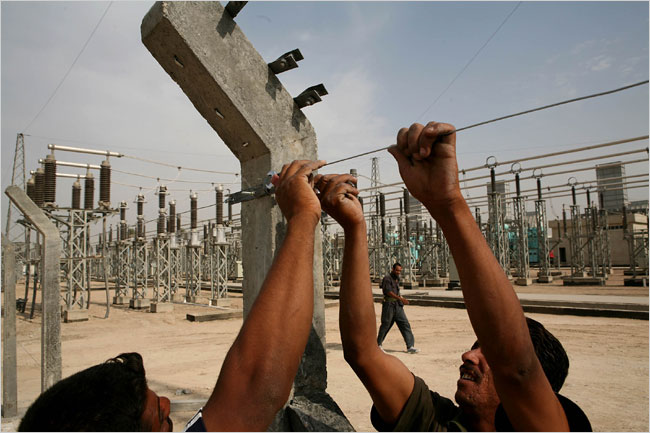
ELECTRICITY: A new generator in Baghdad in 2007. Electricity output is now only slightly higher than it was before the war. Photo: Michael Kamber for The New York Times.

Titled “Hard Lessons: The Iraq Reconstruction Experience,” the new history was compiled by the Office of the Special Inspector General for Iraq Reconstruction, led by Stuart W. Bowen Jr., a Republican lawyer who regularly travels to Iraq and has a staff of engineers and auditors based here. Copies of several drafts of the history were provided to reporters at The New York Times and ProPublica by two people outside the inspector general’s office who have read the draft, but are not authorized to comment publicly.

Mr. Bowen’s deputy, Ginger Cruz, declined to comment for publication on the substance of the history. But she said it would be presented on Feb. 2 at the first hearing of the Commission on Wartime Contracting, which was created this year as a result of legislation sponsored by Senators Jim Webb of Virginia and Claire McCaskill of Missouri, both Democrats.

The manuscript is based on approximately 500 new interviews, as well as more than 600 audits, inspections and investigations on which Mr. Bowen’s office has reported over the years. Laid out for the first time in a connected history, the material forms the basis for broad judgments on the rebuilding program.

In the preface, Mr. Bowen gives a searing critique of what he calls the “blinkered and disjointed prewar planning for Iraq’s reconstruction” and the botched expansion of the program from a modest initiative to improve Iraqi services to a multibillion-dollar enterprise.

Mr. Bowen also swipes at the endless revisions and reversals of the program, which at various times gyrated from a focus on giant construction projects led by large Western contractors to modest community-based initiatives carried out by local Iraqis. While Mr. Bowen concedes that deteriorating security had a hand in spoiling the program’s hopes, he suggests, as he has in the past, that the program did not need much outside help to do itself in.

Despite years of studying the program, Mr. Bowen writes that he still has not found a good answer to the question of why the program was even pursued as soaring violence made it untenable. “Others will have to provide that answer,” Mr. Bowen writes.

“But beyond the security issue stands another compelling and unavoidable answer: the U.S. government was not adequately prepared to carry out the reconstruction mission it took on in mid-2003,” he concludes.

The history cites some projects as successes. The review praises community outreach efforts by the Agency for International Development, the Treasury Department’s plan to stabilize the Iraqi dinar after the invasion and a joint effort by the Departments of State and Defense to create local rebuilding teams.

OIL: The production of oil at Iraqi fields, like the one above, 370 miles southeast of Baghdad, has been below prewar levels. Photo: Nabil al-Jurani/Associated Press.

But the portrait that emerges over all is one of a program’s officials operating by the seat of their pants in the middle of a critical enterprise abroad, where the reconstruction was supposed to convince the Iraqi citizenry of American good will and support the new democracy with lights that turned on and taps that flowed with clean water. Mostly, it is a portrait of a program that seemed to grow exponentially as even those involved from the inception of the effort watched in surprise.

Early Miscalculations

On the eve of the invasion, as it began to dawn on a few officials that the price for rebuilding Iraq would be vastly greater than they had been told, the degree of miscalculation was illustrated in an encounter between Donald H. Rumsfeld, then the defense secretary, and Jay Garner, a retired lieutenant general who had hastily been named the chief of what would be a short-lived civilian authority called the Office of Reconstruction and Humanitarian Assistance.

The history records how Mr. Garner presented Mr. Rumsfeld with several rebuilding plans, including one that would include projects across Iraq.

“What do you think that’ll cost?” Mr. Rumsfeld asked of the more expansive plan.

“I think it’s going to cost billions of dollars,” Mr. Garner said.

“My friend,” Mr. Rumsfeld replied, “if you think we’re going to spend a billion dollars of our money over there, you are sadly mistaken.”

In a way he never anticipated, Mr. Rumsfeld turned out to be correct: before that year was out, the United States had appropriated more than $20 billion for the reconstruction, which would indeed involve projects across the entire country.

Mr. Rumsfeld declined to comment on the history, but a spokesman, Keith Urbahn, said that quotes attributed to Mr. Rumsfeld in the document “appear to be accurate.” Mr. Powell also declined to comment.

The secondary effects of the invasion and its aftermath were among the most important factors that radically changed the outlook. Tables in the history show that measures of things like the national production of electricity and oil, public access to potable water, mobile and landline telephone service and the presence of Iraqi security forces all plummeted by at least 70 percent, and in some cases all the way to zero, in the weeks after the invasion.

Subsequent tables in the history give a fast-forward view of what happened as the avalanche of money tumbled into Iraq over the next five years.

Dashed Expectations

By the time a sovereign Iraqi government took over from the Americans in June 2004, none of those services — with a single exception, mobile phones — had returned to prewar levels.

And by the time of the security improvements in 2007 and 2008, electricity output had, at best, a precarious 10 percent lead on its levels under Saddam Hussein; oil production was still below prewar levels; and access to potable water had increased by about 30 percent, although with Iraq’s ruined piping system it was unclear how much reached people’s homes uncontaminated.

Whether the rebuilding effort could have succeeded in a less violent setting will never be known. In April 2004, thousands of the Iraqi security forces that had been oversold by the Pentagon were overrun, abruptly mutinied or simply abandoned their posts as the insurgency broke out, sending Iraq down a violent path from which it has never completely recovered.

At the end of his narrative, Mr. Bowen chooses a line from “Great Expectations” by Dickens as the epitaph of the American-led attempt to rebuild Iraq: “We spent as much money as we could, and got as little for it as people could make up their minds to give us.”

[James Glanz reported from Baghdad, and T. Christian Miller, of the nonprofit investigative Web site ProPublica, reported from Washington.]

Source / New York Times

The Rag Blog

Posted in RagBlog | Tagged , , | 2 Comments

POETRY / Larry Piltz : People of a Jealous God

move Air Wing One to Sector Nine
and Air Wing Two just across the line
refresh the map at Sector R
now flood the field with hover car
click it once to enlarge the grid
encrypt the code for Captain Kidd
delete and clear each square of land
before they try to make a stand
prepare to embed nuke barrage
from specs I wrote in my garage
three two one is HTML
a language for a living hell?
let the software count the till
let the software send the bill
let the software write your will
let the software make the kill
for the software what a thrill
let the software make…the kill

have you seen combat today
no but the fire’s heading this way
really too bad about the drought
no way to put the fire out
the ocean rise is way too slow
to stop the fire at Tupelo
that’s Memphis in that reddened glow
good thing tonight’s a heavy snow
the summer’s first big heavy snow
could stop the fire by Tupelo
let the software count the till
let the software send the bill
let the software write your will
let the software make the kill
for the software what a thrill
let the software make…the kill

it’s gravity that’s brings the pain
these 40 years of missile rain
the plans that were programmed so true
had been uplinked and chaos grew
it’s more than science and less than God
how things turn out so very odd
philosophers will search their souls
religious folk will look in holes
but answers lie in depths unplumbed
the truth’s just that we act so dumb
in answer to the warbeat drum
mostly the ones opposed were thumbs

let the software count the kill
let the software foot the bill
let the software spend its fill
let the software what it will
for the software ever still
let the software make…the kill

we lived online and spent offshore
and always craved a little more
we hid our thoughts and masked our sin
and woke each day in the same skin
we watched the skies and watched our backs
we watched for Jesus and paid our tax
and hid each others’ children when
the tax collectors came again
and when the morning brought the winds
we called each others’ next of kin
yes more than science still very odd
these People of a Jealous God
it’s gravity that brings the pain
but it’s 40 years of this manmade rain

we log in every blessed morning
and sweep for every virus warning
while just beyond our virtual sight
our true code’s working day through night
it’s not the science God shares the blame
what’s done is done in all our names
and programming’s always resumed
once all the bodies are exhumed
let the software count the till
let the software send the bill
let the software write your will
let the software make the kill
for the software what a thrill
let the software make

I love our City on a Hill
its every single rock and rill
but seeing from my windowsill
the kindnesses that count for nihil
the missing love you know the drill
one question from my heart does spill
when will the software make a pill
to cure us of our software ill
let the software

People of a Jealous God
(Software is Peace)

Larry Piltz / The Rag Blog

Indian Cove
Austin, Texas
December 14, 2008

The Rag Blog

Posted in RagBlog | Tagged , , | 2 Comments

Perfect Fit : Iraqi Journalist Throws Shoes at Bush

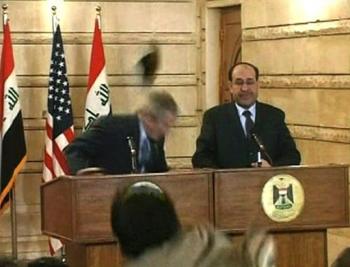
‘Muntazer al-Zaidi jumped up as Bush held a press conference with Iraqi Prime Minister Nuri al-Maliki, shouted “It is the farewell kiss, you dog” and threw his footwear.’
December 14, 2008

BAGHDAD — A journalist hurled two shoes at President George W. Bush on his farewell visit to Iraq on Sunday, highlighting hostility still felt toward the outgoing US leader who acknowledged that the war is still not won.

Muntazer al-Zaidi jumped up as Bush held a press conference with Iraqi Prime Minister Nuri al-Maliki, shouted “It is the farewell kiss, you dog” and threw his footwear.

The president lowered his head and the first shoe hit the American and Iraqi flags behind the two leaders. The second was off target.

Zaidi, a reporter with the Al-Baghdadia channel which broadcasts from Cairo, was immediately wrestled to the ground by security guards and frogmarched from the room.

Soles of shoes are considered the ultimate insult in Arab culture. After Saddam Hussein’s statue was toppled in Baghdad in April 2003, many onlookers beat the statue’s face with their soles.

Bush laughed off the incident, saying: “It doesn’t bother me. If you want the facts, it was a size 10 shoe that he threw”.

He later played down the incident. “I don’t know what the guy’s cause is… I didn’t feel the least bit threatened by it.”

Bush, on his fourth and final official trip to Iraq since he ordered the March 2003 invasion that toppled Saddam, admitted: “There is still more work to be done.”

As he and Maliki signed a security pact setting out new guidelines for US troops in Iraq, the president said: “The war is not over, but with the conclusion of these agreements… it is decisively on its way to being won.”

Earlier, Bush ventured out in a motorcade through Baghdad streets, the first time he has gone somewhere other than a military base or the heavily protected Green Zone.

Pool reports said the unmarked motorcade passed through darkened streets that appeared heavily guarded, before arriving at Maliki’s residence.

Bush hands over the delicate task of overseeing the US withdrawal from Iraq in five weeks to Barack Obama, who has pledged to turn the page on the deeply unpopular war.

“I’m so grateful that I’ve had a chance to come back to Iraq before my presidency ends,” he said at a meeting with Iraqi President Jalal Talabani.

Bush has staunchly defended the invasion that triggered years of deadly insurgency and sectarian violence that has killed tens of thousands of Iraqis and more than 4,200 American troops.

On Saturday, US Defense Secretary Robert Gates visited Iraq and said that the US mission was in its “endgame.”

The signing ceremony by Bush and Maliki marks the adoption of the Status of Forces Agreement approved by Iraq’s parliament in November after months of political wrangling.

The pact will govern the presence of 146,000 US troops at more than 400 bases when their UN mandate expires at the end of the year, giving the Iraqi government veto power over virtually all of their operations.

Gates, who Obama has picked to stay on at the Pentagon in the new administration, told US troops on Saturday: “We are in the process of the drawdown.”

“We are, I believe, in terms of the American commitment, in the endgame here in Iraq.”

The pact envisages US combat troops leaving Iraq by the end of 2011 and departing from all urban areas by June 30 next year.

But the top US commander in Iraq, General Raymond Odierno, who met with Gates, said that troops will stay in Iraqi cities in a support and training role after June.

The Shiite radical movement of Moqtada Sadr, which strongly opposed the security deal, said Odierno’s remarks showed that Washington had no intention of sticking by the deadlines.

“As we predicted, the comments fly in the face of the security agreement,” the head of the movement’s political bureau, Liwaa Sumeissim, told AFP just before Bush’s arrival.

Sadr’s movement said it plans a protest on Monday in the holy city of Najaf.

Obama has said he favours “a responsible withdrawal from Iraq” within 16 months of taking office.

While security in Baghdad and other parts of the country has significantly improved, there are still almost daily bomb attacks.

Problems also dog the massive economic reconstruction programme undertaken since the invasion.

The New York Times reported on Sunday that an unpublished US government report concluded that US-led efforts to rebuild Iraq were crippled by bureaucratic turf wars, violence and ignorance of the basic elements of Iraqi society, resulting in a 100-billion-dollar failure.

By mid-2008, the document said, 117 billion dollars had been spent on the reconstruction of Iraq, including about 50 billion in US taxpayer money, the newspaper reported.

Source / AFP / Google News

Video from Talking Points Memo.

Thanks to Carlos LowryThe Rag Blog

Posted in RagBlog | Tagged , , , | 3 Comments

Potential Afghan War Crime Ignored by US


As possible Afghan war-crimes evidence removed, U.S. silent
By Tom Lasseter / December 11, 2008

DASHT-E LEILI, Afghanistan — Seven years ago, a convoy of container trucks rumbled across northern Afghanistan loaded with a human cargo of suspected Taliban and al Qaida members who’d surrendered to Gen. Abdul Rashid Dostum, an Afghan warlord and a key U.S. ally in ousting the Taliban regime.

When the trucks arrived at a prison in the town of Sheberghan, near Dostum’s headquarters, they were filled with corpses. Most of the prisoners had suffocated, and others had been killed by bullets that Dostum’s militiamen had fired into the metal containers.

Dostum’s men hauled the bodies into the nearby desert and buried them in mass graves, according to Afghan human rights officials. By some estimates, 2,000 men were buried there.

Earlier this year, bulldozers returned to the scene, reportedly exhumed the bones of many of the dead men and removed evidence of the atrocity to sites unknown. In the area where the mass graves once were, there now are gaping pits in the sands of the Dasht-e-Leili desert.

A U.N.-sponsored team of experts first spotted two large excavations on a visit in June, one of them about 100 feet long and more than 9 feet deep in places. A McClatchy reporter visited the site last month and found three additional smaller pits, which apparently had been dug since June.

Faqir Mohammed Jowzjani, a former Dostum ally and the deputy governor of Jowzjan province, where the graves were located, told McClatchy that it’s common knowledge that Dostum sent in the bulldozers.

He speculated that Dostum wanted to destroy the evidence because of local political trouble that could have made him more prone to prosecution for the killings.

Last year, Dostum and the then-Jowzjan governor became embroiled in a feud that killed seven people and wounded more than 40. This year, Dostum and his men kidnapped and reportedly beat a rival Afghan leader.

“Maybe General Dostum did it because of a fear of prosecution in the future,” Jowzjani said.

Another local Afghan official said that Dostum had begun to worry that the 2001 killings could come back to haunt him. “Everyone in the city (Sheberghan) knows that the evidence has been removed,” said the official, who spoke on the condition of anonymity because of worries about being killed for talking about the subject.

“When the crime happened, (Dostum and his commanders) didn’t think they would ever be prosecuted,” the official said. “But later they began to worry . . . they have taken all the bones and thrown them into the river” that’s about half a mile from the graves.

NATO — which has command authority over a team of troops less than three miles from the grave site — the United Nations and the United States have been silent about the destruction of evidence of Dostum’s alleged war crimes.

“The truth is that General Dostum went out with bulldozers and dug up those graves,” Jowzjani charged. “I don’t know why UNAMA” — the U.N. mission in Afghanistan — “hasn’t said anything in this regard . . . maybe because of fears about his power, or maybe they made a deal.”

Gen. Ghulam Mujtaba Patang, the commander of Afghanistan’s national police in the north, said that he knew that the graves had been emptied. He noted that “the digging was done very professionally” and said that U.N. and NATO-led teams in the area were also aware. (While provincial reconstruction teams are led by individual nations, their military components are under NATO command.)

“I don’t understand why they didn’t secure the area,” Patang said in an interview. Perhaps, he said, Western officials “are nervous” about the power that Dostum has locally and don’t want to upset local security by pushing him on the matter.

Dostum was unavailable for comment, and one of his senior aides, Gen. Ghani Karim Zada, declined several interview requests.

The Bush administration, too, has remained silent. U.S. officials claimed that they had no knowledge of the deaths of the prisoners in the convoy until the news media revealed them in 2002, and now the administration has remained silent about Dostum’s reported effort to destroy the evidence of them, which also would be a major violation of international law.

American officials say that Dostum’s alleged war crimes are a matter for the Afghan authorities. But the U.S.-backed government of President Hamid Karzai is weak and depends on American and NATO troops to fight a growing Taliban insurgency that now operates in most of Afghanistan and all but surrounds Kabul, the capital.

However, the fact that U.S. special forces and CIA operatives were working closely with Dostum in late 2001, when the killings took place, has fueled suspicions that the warlord got a free pass.

The U.S. Defense Department has said that it found no evidence of American involvement or presence during the 2001 incident. If there was an investigation, however, its findings have never been made public.

“At the time, we had a handful of special forces and CIA, and there was no way we could have exercised any oversight” of the thousands of detainees under Afghan control, said Joseph Collins, who was then the deputy assistant secretary of defense for stability operations.

When he was asked about the detainees suffocating in metal shipping containers, Collins, who’s now a professor at the National War College, said that “I think most people just took for granted what he (Dostum) said: that it was a horrible accident.”

McClatchy interviewed eight Pakistani men last year who said that Dostum’s gunmen had stuffed them in the containers. The men, mostly low-level Taliban volunteers, said they’d had to climb over dozens of dead bodies to get out of the containers.

“We were all sitting on the dead bodies which were lying on the floor; they were lifeless,” said Abdul Haleem, who said that many of the approximately 200 men in his container died. “An arm was sticking up in the air here, a leg was sticking up in the air there.”

Another man who said he’d made the trip to Sheberghan in a container full of dead and dying men was Tariq Khan. He said that when Dostum’s men shot into the metal box, “some people were shot in the eye; some were shot in the neck.”

Dostum offered to take Pierre-Richard Prosper, who was then the U.S. ambassador-at-large for war crimes issues, on a tour of the grave site in late 2002, but Prosper declined. He was pressing a reluctant Afghan government and the U.N. to take the lead in investigating the killings.

“We felt the Afghans needed to play a role,” Prosper said in a telephone interview. “If you’re a new government, and you want to move forward, you have to deal with the past.”

However, no investigation was likely without strong U.S. backing, and Prosper said that he couldn’t recall whether Washington ever gave funding for a probe.

Farid Mutaqi, a senior investigator for the Afghanistan Independent Human Rights Commission in the nearby city of Mazar-e-Sharif, said that it was almost impossible to visit the site because of Dostum’s power in northern Afghanistan.

Mutaqi said there’d been threats on his life and those of his staff members from Dostum. There are rumors that the site was mined and that Dostum’s men would torture or kill people if they were caught researching in the area. At least three Afghans who witnessed the original digging of the mass grave or who investigated it later reportedly were killed, and a handful of others were beaten.

Mutaqi said that he told officials at the United Nations and the local provincial reconstruction team that Dostum’s men had disturbed the mass graves this year. They did nothing, he said.

Now, Mutaqi said, “You can see only a hole. In the area around it you can find a few bones or some clothes. The site is gone . . . as for evidence, there is nothing.”

A spokesman for the United Nations in Afghanistan, Adrian Edwards, acknowledged in an e-mail statement that the U.N. had known that the graves had been dug up but had kept quiet.

“You’re right that we don’t always make public statements, but that’s because we’re in a conflict environment and have to weigh up whether doing so will stall chances of progress against impunity in other areas or put lives at risk,” the statement said. “It’s a judgment call we constantly strive to get right, and this is not the only instance where the choices we have to make can be extraordinarily tough ones.” Edwards noted that the U.N. is awaiting a report about the site by a forensic specialist.

The spokesman for the U.N.’s Office of the High Commissioner for Human Rights, Rupert Colville, said that while he didn’t know the details of the digging at the site, “there cannot be impunity for war crimes of this nature and scale . . . it’s a real shame.”

Spokesmen for NATO and the U.S. Embassy in Kabul denied knowing that the remains of hundreds of men had been removed from the site, and had no further comment.

“We have no information about bulldozers or digging at the site,” said Lt. Cmdr. James Gater, a spokesman for the NATO mission in Afghanistan. The U.S. general who heads NATO forces in Afghanistan, Gen. David McKiernan, wouldn’t do an interview, Gater said.

U.S. Embassy spokesman Mark Stroh said that he’d checked with several officials at the embassy and “nobody seemed to have any visibility on this.” Stroh added that “We don’t necessarily monitor all of Dostum’s behavior.”

A McClatchy reporter, traveling without official escort, took GPS readings of the open pits last month, and a forensic investigator with Physicians for Human Rights, a group contracted by the U.N. to examine the site, confirmed that they were in the same area where the grave site was found in early 2002.

In May 2002, the U.N. announced that a Physicians for Human Rights team had dug a test trench in the area and found 15 bodies, three of which had been exhumed and found to have died recently of asphyxiation

In November 2002, amid the Physicians for Human Rights findings and news reports, a top-secret cable from the State Department’s Bureau of Intelligence and Research said that the number of people killed during transport to Sheberghan “may approach 2,000.”

The cable also said that while there was no security at Dasht-e Leili, U.N. personnel from Mazar-e-Sharif were monitoring the grave ” ‘every few days’ for signs of tampering.” There’d been plans for a detailed forensic investigation of the site in spring 2003.

“The hope had been to do a full exhumation in 2003,” said Nathaniel Raymond, a senior investigator at Physicians for Human Rights. “It didn’t happen.”

The U.N. monitoring of the site stopped. Edwards, the U.N. spokesman, said that he was still trying to reach officials who’d been present to get an explanation. The U.N., NATO, U.S. forces and the Afghan government never took any formal responsibility for patrolling the grave site.

Physicians for Human Rights made several requests to top U.S. officials to secure the mass graves, including an August 2002 letter to then-Secretary of Defense Donald H. Rumsfeld asking that he “reconsider the position of the Defense Department and assure security at the grave site.” Four months later, the organization sent a letter to then-Deputy Defense Secretary Paul Wolfowitz saying that it was crucial to provide a small security detachment.

“From the time we discovered the site in January 2002, we had been advocating privately and publicly to the United Nations, the U.S. and the Afghan government to ensure consistent site protection and protection of forensic evidence,” Frank Donaghue, the chief executive officer of Physicians for Human Rights, said in a statement to McClatchy. “And clearly that did not happen.”

Dostum has long experience with mass graves being used in the Afghan political arena. In 1997, he revealed the discovery of mass graves of Taliban members killed by a former ally turned rival, Gen. Abdul Malik Pahlawan, in the Dasht-e Leili desert. The grave sites, which Dostum’s men brought in international journalists to document, helped cement Pahlawan’s exile from the area at the time.

Afghanistan’s attorney general, its top law enforcement official, said that given the bad security conditions in the country it was hard to think about investigating possible war crimes.

“So for the time being, we have put these issues off for the future,” Mohammed Ishaq Aloko said in an interview at his Kabul office.

Aloko, who’s seen as being very close to President Karzai, didn’t respond directly to repeated questions about Dostum.

“I believe that those who committed crimes against humanity will be prosecuted one day,” Aloko said. Just not anytime soon, he said.

Source / McClatchy

The Rag Blog

Posted in RagBlog | Tagged , | Leave a comment

US, Russia, China Refuse to Sign Cluster Treaty

Just a reminder: this is what cluster bomblets do to people.

Cluster Bomb Treaty and The World’s Unfinished Business
By Ramzy Baroud / December 13, 2008

The United States, Russia and China are sending a terrible message to the rest of the world by refusing to take part in the historic signing of a treaty that bans the production and use of cluster bombs. In a world that is plagued by war, military occupation and terrorism, the involvement of the great military powers in signing and ratifying the agreement would have signaled – if even symbolically – the willingness of these countries to spare civilians’ unjustifiable deaths and the lasting scars of war.

Nonetheless, the incessant activism of many conscientious individuals and organizations came to fruition on December 3-4 when ninety-three countries signed a treaty in Oslo, Norway that bans the weapon, which has killed and maimed many thousands of civilians.

The accord was negotiated in May, and should go into effect in six months, once it is ratified by 30 countries. There is little doubt that the treaty will be ratified; in fact, many are eager to be a member of the elite group of 30. Unfortunately, albeit unsurprisingly, the US, Russia, China, Israel, India and Pakistan – a group that includes the biggest makers and users of the weapon – neither attended the Ireland negotiations, nor did they show any interest in signing the agreement.

The US argues that cluster bombs are a legitimate weapon, essential to repel the advancing columns of enemy troops. If such a claim carried an iota of legitimacy, then the weapon’s use should have ended with the end of conventional wars in the mid twentieth century. However, cluster bombs are still heavily utilized in wars fought in or around civilian areas.

Most countries that have signed the accords are not involved in any active military conflict and are not in any way benefiting from the lucrative cluster munition industry. The hope, however is that once a majority of countries, including the Holy See, sign the agreement, the use of the lethal weapon will be greatly stigmatized.

The treaty was the outcome of intensive campaigning by the Cluster Munition Coalition (CMC), a group of non-governmental organizations. CMC is determined to carry on with its campaigning to bring more signatories to the fold.

But without the involvement of the major producers and active users of the weapon, the Oslo ceremony will remain largely symbolic. However, there is nothing symbolic about the pain and bitter losses experienced by the cluster bombs’ many victims. According to the group Handicap International, one-third of cluster-bomb victims are children. Equally alarming, 98 percent of the weapon’s overall victims are civilians. The group estimates that about 100,000 people have been maimed or killed by cluster bombs around the world since 1965.

It certainly is unconscionable that countries who have the chutzpa to impose themselves as the guardians of human rights are the same who rebuff such initiatives and insist on their right to utilize such a killing tool. Unlike conventional weapons, cluster bomblets survive for many years, luring little children with their attractive looks. Children have often mistaken them for candy or toys.

Steve Goose, the arms director of Human Rights Watch described the countries that refused to sign as standing “on the wrong side of history. Some of them are clinging to what is now a widely discredited weapon.”

But there is more to that refusal than clinging onto an outdated military philosophy. The cluster munition industry is thriving. The weapon was used in massive quantities by the US army in Afghanistan, Iraq, Israel in Lebanon and both parties in the S. Ossetia conflict. The British also used it in Iraq, making handsome deals with the weapons’ Israeli manufacturer.

13 year-old Ayat Suliman now lives in Sweden. In an AFP report, she complained, referring to her peers: “Nobody understands me. They all think I’m ugly.” It was on May 5, 2003 that Ayat’s brother came running with what he thought was a dazzling toy. “I remember that it was very colorful and very nice,” said Ayat. The explosion that rocked the little girl’s house in Iraq claimed the lives of her four brothers and cousin, aged 3 to 15. Most of Ayat’s body was burned as a result, and she is still unable to walk independently.

Ahmad Mokaled of the Lebanese town of Nabatieh at the border with Israel was about to celebrate his fifth birthday when he too found a shiny object. Ahmad’s last words, according to his father, who was busily setting up his son’s birthday picnic in a park, were: ‘Dad, Help me.’ He died, but after “four long hours of suffering.”

The tragic stories of Ahmad and Ayat are repeated throughout the world, almost everyday, with some countries paying a much more disproportionate price than others, notably, again, Iraq, Afghanistan and Lebanon.

But neither terrible statistics nor the heart- wrenching personal stories of the many victims seem enough to compel manufactures and active users of the weapon to quit. Countries with sizable military power tend to avoid any entanglement in international law or treaties that limit their flexing or application of their military muscle. The US and Israeli attitudes towards international law carry similar traits, both act as entities above the law, tirelessly infusing ‘national security’ as an excuse for their rebuffing of such international initiatives. It’s also no surprise that the US, Israel, but also Russia refuse to ratify the 1997 Ottawa Treaty, signed by 158 countries – as of 2007 – which prohibits the production, transfer or use of landmines.

Of course, neither the Ottawa nor the Oslo treaties are the exception to the rule as far as Washington’s attitude towards positive international initiatives are concerned. The US under the Bush administration developed a mind-set of animosity towards the rest of the international community, reaching the point of dubbing the UN irrelevant.

Needless to say, CMC, world governments and citizens throughout the world are hoping that the new American administration of Barack Obama will truly bring an end and reverse Bush’s ruinous legacy. Realists say it will take years for an effective change of policy to take place. In the meantime, the millions of unexploded cluster bomblets and landmines scattered the world over, wait for no one. They will continue to claim lives and maim thousands, just like Ahmad of Lebanon, and Ayat of Iraq.

[Ramzy Baroud (www.ramzybaroud.net) is an author and editor of PalestineChronicle.com. His work has been published in many newspapers, journals and anthologies around the world. His latest book is The Second Palestinian Intifada: A Chronicle of a People’s Struggle (Pluto Press, London).]

Source / Common Dreams

The Rag Blog

Posted in RagBlog | Tagged , | 3 Comments

Loving: What Are You Looking At ?

Cartoon by Charlie Loving / The Rag Blog

Posted in Rag Bloggers | Tagged , | Leave a comment

Rogers: "We’re Going to Have a Lost Decade"


Jim Rogers calls most big U.S. banks “bankrupt”
By Jonathan Stempel / December 11, 2008

NEW YORK – Jim Rogers, one of the world’s most prominent international investors, on Thursday called most of the largest U.S. banks “totally bankrupt,” and said government efforts to fix the sector are wrongheaded.

Speaking by teleconference at the Reuters Investment Outlook 2009 Summit, the co-founder with George Soros of the Quantum Fund, said the government’s $700 billion rescue package for the sector doesn’t address how banks manage their balance sheets, and instead rewards weaker lenders with new capital.

Dozens of banks have won infusions from the Troubled Asset Relief Program created in early October, just after the Sept 15 bankruptcy filing by Lehman Brothers Holdings Inc (LEHMQ.PK: Quote, Profile, Research, Stock Buzz). Some of the funds are being used for acquisitions.

“Without giving specific names, most of the significant American banks, the larger banks, are bankrupt, totally bankrupt,” said Rogers, who is now a private investor.

“What is outrageous economically and is outrageous morally is that normally in times like this, people who are competent and who saw it coming and who kept their powder dry go and take over the assets from the incompetent,” he said. “What’s happening this time is that the government is taking the assets from the competent people and giving them to the incompetent people and saying, now you can compete with the competent people. It is horrible economics.”

Rogers said he shorted shares of Fannie Mae (FNM.P: Quote, Profile, Research, Stock Buzz) and Freddie Mac (FRE.P: Quote, Profile, Research, Stock Buzz) before the government nationalized the mortgage financiers in September, a week before Lehman failed.

Now a specialist in commodities, Rogers said he has used the recent rally in the U.S. dollar as an opportunity to exit dollar-denominated assets.

While not saying how long the U.S. economic recession will last, he said conditions could ultimately mirror those of Japan in the 1990s. “The way things are going, we’re going to have a lost decade too, just like the 1970s,” he said.

Goldman Sachs & Co analysts this week estimated that banks worldwide have suffered $850 billion of credit-related losses and writedowns since the global credit crisis began last year.

But Rogers said sound U.S. lenders remain. He said these could include banks that don’t make or hold subprime mortgages, or which have high ratios of deposits to equity, “all the classic old ratios that most banks in America forgot or started ignoring because they were too old-fashioned.”

Many analysts cite Lehman’s Sept 15 bankruptcy as a trigger for the recent cratering in the economy and stock markets.

Rogers called that idea “laughable,” noting that banks have been failing for hundreds of years. And yet, he said policymakers aren’t doing enough to prevent another Lehman.

“Governments are making mistakes,” he said. “They’re saying to all the banks, you don’t have to tell us your situation. You can continue to use your balance sheet that is phony…. All these guys are bankrupt, they’re still worrying about their bonuses, they’re still trying to pay their dividends, and the whole system is weakened.”

Rogers said is investing in growth areas in China and Taiwan, in such areas as water treatment and agriculture, and recently bought positions in energy and agriculture indexes.

[For summit blog: summitnotebook.reuters.com. Reporting by Jonathan Stempel; Additional reporting by Jennifer Ablan and Herbert Lash.]

Source / Reuters

The Rag Blog

Posted in RagBlog | Tagged , , , | 1 Comment

Shades of Whitewater : Media Attempts to Tie Obama to ‘Blagogate’

Media Frenzy by Amer Sahoury of Clio High School in Michigan, from the 2008 Congressional Art Competition.
 

The similarities between the media’s current behavior and their shameful performance in the 1990s doesn’t stop with their bizarre suggestions that geography is destiny. …One of the central flaws of the media’s coverage of the Clintons was that they portrayed nearly everything as evidence of guilt.

Media Matters: Media pick up where they left off 8 years ago
by Jamison Foser / December 12, 2008

To anyone who lived through the media feeding frenzy of the 1990s, during which the nation’s leading news organizations spent the better part of a decade destroying their own credibility by relentlessly hyping a series of non-scandals, the past few days, in which the media have tried to shoehorn Barack Obama into the Rod Blagojevich scandal, have been sickeningly familiar.

Whenever reporters think — or want you to think — they’ve uncovered a presidential scandal, they waste little time in comparing it to previous controversies.

Yesterday, CNN’s Rick Sanchez tried desperately to get the phrase “Blagogate” to stick — the latest in a long and overwhelmingly annoying post-Watergate pattern of ham-handed efforts to hype a scandal by appending the suffix “-gate” to the end of a word.

Sanchez’s efforts to create a catchphrase aside, the criminal complaint filed against Blagojevich this week isn’t the Watergate of the 21st century — though it shows signs that it may become this decade’s Whitewater.

Right about now, you may be scratching your head, trying to remember what, exactly, the Whitewater scandal was. Didn’t it have something to do with a bank? Or a land deal? But didn’t the Clintons lose money? How did the congressman who shot the pumpkin fit in?

But Whitewater is quite simple, when it is understood as it should be — as a media scandal, not a presidential scandal.

As an endless series of investigations, costing taxpayers tens of millions of dollars, revealed, the Clintons broke no law and violated no ethics regulations in connection with Whitewater. They lost money on a failed land deal in which their business partner cheated them. That’s all there was. Republicans Ken Starr, Robert Fiske, Robert Ray, Al D’Amato, and Jim Leach, among others, investigated the matter, and none of them found illegality. There was simply nothing there — except year after year of obsessive, and often dishonest, media coverage, fueled by conservatives who would stop at nothing to destroy the president.

As Joe Conason explains today, “The madness that was eventually classified under the quasi-clinical rubric of ‘Whitewater’ began, in no small degree, with the dubious idea that Arkansas, the Clintons’ home state, was a peculiarly corrupt place — and that any politician from Arkansas by definition was suspect (but only if he or she happened to be a Democrat).”

Arkansas journalist Gene Lyons noted in Fools for Scandal, his 1994 book about how the media invented Whitewater, “Scarcely a Whitewater story has appeared in the national press that hasn’t made references to the state’s uniquely ‘incestuous’ links between business, government, and the legal establishment — concepts utterly foreign to places like Washington, D.C., and New York City, of course.” (Conason and Lyons co-wrote The Hunting of the President, a book that — along with Fools for Scandal — are must-reads for anyone interested in the media or politics.)

By portraying Arkansas as thoroughly, and uniquely, corrupt, the media (and Clinton’s political opponents) tied him to a long line of misbehavior that had nothing to do with him — and created the impression that Clinton must be corrupt merely for being from such an ethical cesspool.

Of course, Arkansas was neither thoroughly nor uniquely corrupt.

In addition to the ages-old clichés — big cities like New York and Chicago; the anything-goes Wild West of Las Vegas and Texas; perennial whipping boy New Jersey — countless other states and cities have reputations for “unparalleled” corruption. People experienced in Connecticut politics will forcefully argue that their state takes a back seat to no other when it comes to the frequency with which public officials are caught in various degrees of wrongdoing. Then there’s Florida, about which the less said, the better. And on and on and on.

Such reputations stem not only from actual examples of actual corruption — California gave us Nixon; Maryland gave us Agnew; two of the Keating Five, including John McCain, hailed from Arizona — but from the fact that many people, particularly those who work in politics and the media, tend to engage in a bit of tongue-in-cheek bragging about their home city or state’s propensity for scandal.

The point isn’t that everyplace is corrupt, or that nowhere is. It’s that no location has a monopoly on crooked politicians (nor has there yet been a location over which crooked politicians held a monopoly) — and that any claim of a city or state’s unique history of public officials abusing their office should be taken with a whole shaker of salt. (For what it’s worth, USA Today determined this week that “[o]n a per-capita basis … Illinois ranks 18th for the number of public corruption convictions the federal government has won from 1998 through 2007,” behind both Dakotas, Alaska, Alabama, Florida and several other states.)

And yet, here we are again, with an incoming Democratic president who hails from a city we are all supposed to believe is the most corrupt place this side of Dick Cheney’s undisclosed location. Chicago, we are told, is a den of villainy so irredeemable it defies credulity to suggest anyone could emerge from so much as a long layover at O’Hare without a closet full of skeletons.

This nonsense was well under way during the presidential campaign, during which John McCain suggested a lack of integrity on Obama’s part simply because he is from Chicago. You might think that a man who was a participant in one of the most notorious scandals in the history of the U.S. Senate would be laughed at if he tried to claim his opponent lacked integrity simply because of his ZIP code. Instead, the national media laughed along with McCain, endlessly repeating his witty zinger about Chicago.

And so this week, we’ve heard over and over how politics in Illinois are rotten to the core.

At Obama’s press conference yesterday, the third questioner asked, “What’s wrong with politics in Illinois?” Chris Matthews made sure viewers knew that “Barack Obama, of course, rose to political power in a city, Chicago, in a state, Illinois, known for corruption.”

ABC’s Rick Klein chimed in: “[W]ith one stiff wind, Chicago has grabbed Obama and his transition — and blown it off-course. … The underbelly of the Obama political operation, with all its Chicago tints and taints, is now fair game for reporters looking for a story.” (Nonsense. If the “Obama political operation” has an “underbelly” featuring actual wrongdoing, it’s fair game whether or not a governor is busted in a scandal that has nothing to do with Obama. And if that “underbelly” hasn’t actually done anything wrong, Blago’s bust doesn’t change that — regardless of tint or taint.)

On his radio show, Bill O’Reilly asked Chicago Tribune columnist John Kass if it is even possible for Obama to have existed in Chicago without being dishonest, leading Kass to reply: “Yes, that is possible. It’s also possible that he was found as an infant in a reed basket floating in the Chicago River.”

The similarities between the media’s current behavior and their shameful performance in the 1990s doesn’t stop with their bizarre suggestions that geography is destiny.

One of the central flaws of the media’s coverage of the Clintons was that they portrayed nearly everything as evidence of guilt. Perhaps most perverse was the suggestion that the conviction of Clinton Justice Department official Webster Hubbell was evidence of wrongdoing by the Clintons. What made that so perverse? Hubbell was convicted, essentially, of stealing money from the law firm in which he and Hillary Clinton were both partners. Hubbell, in other words, stole from Hillary Clinton. The Clintons were Hubbell’s victims — and yet many journalists portrayed his conviction as evidence of their guilt.

Which brings us to Tuesday’s New York Times. As Will Bunch has explained, the Times reported that Obama supported an Illinois ethics reform package that passed over Blagojevich’s veto, which led to Blagojevich pressing state contractors for contributions before the reform takes effect, which “indirectly contributed to the downfall.” Good news for Obama, right? He supported a reform package, even urging the state Senate to pass it over Blagojevich’s veto. And yet the Times concludes that this story demonstrates that Obama “has never quite escaped the murky and insular world of Illinois politics” — as though the fact that Blagojevich allegedly did something improper in an effort to avoid the effects of the reform Obama championed somehow taints Obama. Bizarre.

Most telling is the tendency of many journalists to speculate that the Blagojevich scandal may ensnare Obama without acknowledging that the complaint against Blagojevich contained absolutely no evidence of wrongdoing by Obama, or that U.S. Attorney Patrick Fitzgerald has said, “I should make clear, the complaint makes no allegations about the president-elect whatsoever, his conduct.” (You may remember The New York Times’ reaction to the Resolution Trust Corporation investigation that exonerated the Clintons of Whitewater wrongdoing in 1995: The “paper of record,” which had been relentlessly hyping the non-scandal, all but ignored the RTC report and continued pushing Whitewater.)

Even worse than ignoring Fitzgerald’s exculpatory comments, Time actually suggested they are bad news for Obama:

On more than one occasion during his stunning press conference on Tuesday, U.S. Attorney Patrick Fitzgerald bluntly said he has found no evidence of wrongdoing by President-elect Barack Obama in the tangled, tawdry scheme that Illinois Governor Rod Blagojevich allegedly cooked up to sell Obama’s now vacant Senate seat to the highest bidder. But for politicians, it’s never good news when a top-notch prosecutor has to go out of his way to distance them from a front-page scandal.

Got that? Fitzgerald said there’s no evidence Obama did anything wrong. Bad news for Obama! (For the record: The reason Fitzgerald “has to go out of his way” to distance Obama from the scandal is that news organizations like Time keep going out of their way to baselessly link Obama to the scandal.)

Such attempts to link Obama to scandal via tortured logic and geography rather than more substantive ties were necessary because of the complete lack of substantive ties.

Perhaps the most striking aspect of the media’s attempts to link Obama to the Blagojevich scandal has been the volume of news reports that are purely speculative — and not only speculative, but vaguely speculative. That is, they don’t even consist of conjecture about specific potential wrong doing. They simply consist of completely baseless speculation that Obama might in some way become caught up in the investigation at some point in the future, for some reason. It’s little more than, “Maybe Obama will be involved.” Well, sure. And maybe he’ll play shortstop for the Washington Nationals next year.

Associated Press reporter Liz Sidoti set the standard for pointlessly speculative news reports with an “analysis” piece declaring that “President-elect Barack Obama hasn’t even stepped into office and already a scandal is threatening to dog him.” In the very next sentence, Sidoti had to admit that “Obama isn’t accused of anything” — but that didn’t stop her from continuing to offer ominous warnings that Obama could be implicated in the scandal, interspersed with concessions that he, you know … isn’t.

Not that Sidoti was unique in stringing together a bunch of coulds and mights and maybes and ifs to create something that vaguely resembles — but is certainly not — an actual news report.

ABC’s Rick Klein, for example:

The scandal surrounding Blagojevich, the Democratic governor of Illinois, may or may not implicate members of Congress, in addition to at least the outer ring of advisers in the incoming Obama administration.

Got that? The scandal may or may not implicate members of Congress. Awfully hard to argue with that. The modifier “at least” is a nice touch, too — suggesting that the outer ring of Obama advisers has already been implicated in the scandal (they haven’t).

That was par for the course this week, as reporters breathlessly asked what Obama knew and when he knew it (the decidedly non-scandalous answers are apparently “very little” and “very recently”).

If you want to make a “scandal” stick to someone despite the inconvenient truth that they aren’t actually guilty of the purported wrongdoing in question, one thing you do — if you’re the media covering a Democratic president, or an overzealous conservative — is continually expand the scandal’s definition. So the “scandal” grows and evolves into an amorphous mass of innuendo as political opponents and journalists begin throwing everything against the wall, hoping something will stick.

Eventually what begins as a land deal (in which the Clintons did nothing wrong and lost money) includes an investigation of the tragic suicide of a White House staffer — and the next thing you know, some B-list congressman is traipsing into his backyard with a shotgun, taking aim at a perfectly innocent pumpkin because the voices in his head told him that gunning down some produce would somehow “prove” that the staffer was murdered as part of an elaborate cover-up of … well, of nothing. There was nothing to cover up, and no murder to cover it up. The pumpkin died in vain.

And so on Wednesday, the Associated Press issued an article headlined “Questionable associations of Obama.” Prompted by the Blagojevich scandal — which, again, involves no indication that Obama did anything wrong — the article announces, “In his life and career in Illinois, President-elect Barack Obama has crossed paths with some notable figures who have drawn scorn and scrutiny.”

From there, the AP proceeds to describe several such “notable figures,” most of whom have little if anything to do with Obama — or the Blagojevich scandal. What, for example, is Jeremiah Wright doing here? None of their connections to Obama involve so much as a hint of an allegation of legal or ethical wrongdoing. To the extent they are controversial, it is for their views. They couldn’t possibly have less to do with the Blagojevich scandal; there is no conceivable reason for the AP to bring them up now — except to try to fling a bunch of garbage against the wall in hopes of something, somehow, sticking. It’s as though the AP, recognizing how tenuous Obama’s ties to the Blagojevich scandal are, tried to make it look more substantial by tossing in a bunch of other “notable” ties.

Washington Post media critic Howard Kurtz complained that it took Obama “24 hours” to decide that Blagojevich should resign, worrying “that kind of excessive caution” could “define his presidency.”

Obama called for Blagojevich’s resignation within 24 hours, and Howard Kurtz thinks that wasn’t fast enough. It’s so fast, Kurtz had to measure the time elapsed in hours rather than days. And yet, Kurtz thinks it constituted excessive foot-dragging. This is simply not a sane assessment. It’s a desperate attempt to find something to criticize about Obama. Obama is not involved in the scandal, so Kurtz sits by with a stopwatch, trying to document Obama’s slow response to it.

CNN’s Wolf Blitzer announced yesterday that “some are calling this Obama’s first presidential scandal.” It isn’t. There is no evidence he has done anything wrong. This is not Obama’s first presidential scandal — but it shows signs of becoming the first media scandal of the Obama presidency.

Obviously, the news media should aggressively investigate and report on actual involvement in actual wrongdoing by public figures. There was far too little of that reporting during the Bush administration. (Remember when the media refused to report on the Downing Street Memo? Good times.)

If the news media regains a bit of the skepticism so many of them set aside for the past eight years, that would be an unequivocally good thing, and it should be applauded.

But this week brought signs that much of the media is set to resume the absurd and shameful behavior that defined the 1990s — guilt by association, circular analysis whereby they ask baseless questions about non-scandals, then claim they have to report on the “scandal” because the White House is “besieged by questions,” grotesque leaps of logic, downplaying exculpatory information, and too many other failings to list.

If that happens — if the media continue to behave as they did in covering Whitewater — they will damage the country. It’s really that simple. We cannot afford to be distracted from serious problems by overheated conjecture and baseless insinuation masquerading as journalism.

Not to mention the outright fabrications. To take just one of many examples, Jeff Greenfield and ABC selectively edited Hillary Clinton’s comments during a Whitewater press conference, then accused her of lying — an accusation that, based on Clinton’s full comments, was clearly false. It was a shockingly dishonest report; Greenfield and ABC were simply lying about Clinton — there’s really no other way to put it. Those involved should have seen their reputations take a serious hit — at the very least. Yet they suffered no consequences due to their dishonorable and unprofessional actions.

That’s how the media behaved the last time we had a Democratic president. They devoted wall-to-wall coverage to invented “scandals,” ignored exculpatory evidence, saw evidence of guilt everywhere, took people out of context in order to accuse them of lying, and generally behaved like a pack of wild animals who couldn’t tell right from wrong or truth from fiction — or who simply didn’t care. As a group, they behaved without ethical standards and without regard for the truth.

It’s our responsibility — all of us — to make sure it doesn’t happen again.

[Jamison Foser is Executive Vice President at Media Matters for America.]

Source / Media Matters

The Rag Blog

Posted in RagBlog | Tagged , , , , , , , | 2 Comments

Drag Queen Daddy : What Do We Tell the Kid?

We are running the following important advice as a special service to our readers. It comes from ‘Dear Prudence: Advice on Manners and Morals’ from the online magazine Slate. Go here to read more from Prudence, to get her to answer your own ridiculous question or to get her much needed advice delivered to your mailbox.

Drag Queen Daddy…
How do we explain my husband’s cross-dressing to our child?

Dear Prudence,

I have been happily married for several years, and we are expecting our first child. The only problem is that my husband is a cross-dresser. This is a fetish that I know he could never give up. We keep this behind closed doors so as not to alienate friends and family and to keep his work associates from finding out (if they did, he could lose his job).

Our question is how do we incorporate this facet of our life with a new child? If we keep it hidden, our child will most likely find out someday—when mom is doing the wash for two dress sizes—and then feel betrayed and hurt. If we keep on as we are, then our child will likely tell someone that daddy wears dresses, and it wouldn’t be fair to burden anyone with that secret. What is the best thing for us to do?

—Daddy in Dresses

Dear Daddy in Dresses,

I know that when you’re expecting, you feel a need to get everything perfect for your new addition, but you’re getting way ahead of yourself if you think you should dress a teddy bear in a peignoir so you can start explaining to the baby that, just like Teddy, Daddy likes to wear pretty ladies’ clothes. Let’s say you two were into bondage and had a closetful of whips and chains. I would advise you to keep the closet secured and get a heavy-duty lock for the bedroom door, rather than try to “incorporate this facet” of your life with your child by teaching your toddler how to snap Daddy into handcuffs for Mommy. If your husband lounges around at home every night in a bustier, palazzo pants, and a wig, then I’m voting for repression.

It’s time for your husband to limit his dressing up to times when he’s not with the baby. As your child gets older and mobile, your husband will have to take more steps to separate his fetish from your family life. Perhaps he will need to check into a motel occasionally when he just can’t stifle the need to dress up as Madonna. Your husband has to live with this compulsion, but surely you both want to do your best to keep your child from growing up amid such sexual confusion. You feel this aspect of your private lives is none of your family’s business, or your husband’s colleagues’, and that is an excellent attitude to maintain with your child.

—Prudie

Source / Slate

The Rag Blog

Posted in RagBlog | Tagged , | 1 Comment

A Lesson From Canada (and Detroit) : Single Payer Health Care is Way to Go


‘Canada pays LESS for health care per person than the US — with far better results in terms of general wellness of the population.’
By Tommie Sue Montgomery
/ The Rag Blog / December 13, 2008

See ‘If G.M. Were a Canadian Company It Wouldn’t Be Asking for Help’ by Dean Baker, and ‘Obama and Daschle should opt for single-payer’ by Rose Ann DeMoro, Below.

I have no idea where you are on the health care issue but I can tell you that the first article is accurate, at least in so far as Canadian companies do NOT have the burden of health care costs. More important, Canada pays LESS for health care per person than the US — with far better results in terms of general wellness of the population. In fact, the US has a partial single-payer system: Medicare.

Living in Canada for the last 7.5 years, I can tell you that the single-payer system is the only rational way to go. This is NOT “socialized medicine.” We have our choice of doctors, including specialists; while there is often a waiting list — especially in high-population southern Ontario — for elective care, there is NEVER a wait for critical care.

Charles, my stepson, who had a heart transplant last May, is our No. 1 example. He has never had to wait for anything. His care, at the Hospital for Sick Children in Toronto, has cost, over the last four years (since diagnosis) at least a million dollars. The entire family, put together, could not have paid this. Nor did we have to deal with insurance companies with the power to decide what care would be paid for. Decisions regarding care were made by his doctors. His anti-rejection drugs are also covered, with a deductible calculated on income. We have never seen a bill and never will.

Yes, we pay higher taxes and in Ontario we pay an additional $800/year “health tax.” But we see a doctor when we need one; we do not have to rely on emergency rooms for non-critical care; we get a physical once a year with all the tests the doc feels we need; eye exam every 2 years; and now that we’re over 65, we pay the first $100 for our prescriptions each year; the rest is covered. If I wanted to move back to the states (I don’t), I could not do so at this point because I could not afford the supplemental health insurance—and I am still quite healthy.

Below is an article and a call to action.

If G.M. Were a Canadian Company It Wouldn’t Be Asking for Help
By Dean Baker / December 11, 2008

The Detroit automakers have made many mistaken business decisions that have been important factors contributing to their current crisis. However, they are not responsible for some of the factors that have brought them to the brink of bankruptcy.

Most obviously, they are not responsible for the collapse of the housing bubble and the subsequent loss of more than $15 trillion in housing and stock wealth. This falloff in wealth has sent consumption plummeting. The auto industry has been especially hard hit, with sales falling by more than 30 percent year over year in the last two months.

The Big Three are also not responsible for the broken U.S. health care system. If we paid the same amount for health care as Canada, G.M. would have accumulated an additional $22 billion in profits over the last decade.

That would be the savings if we assumed that General Motor’s health care expenditures were reduced by roughly 48 percent to be in line with expenses in Canada. Of course, not all the savings in this counterfactual would have gone to profits. Some of it would have gone to workers in the form of higher wages or to consumers in the form of lower car prices.

On the other hand, G.M. is also picking up the tab for many spouses and dependent children. It would not have to pay these health care expenses in a Canadian type system. So the $22 billion figure is probably not a bad first approximation of the additional money that G.M. might have today if the United States had a more efficient health care system.

Even with these additional profits G.M. and the other domestic manufacturers would still face serious problems. They have made some bad choices in betting their future on SUVs and other low-mileage vehicles. They also have lagged foreign manufacturers in producing high quality, reliable cars.

But the real reason that Big Three are on their deathbeds right now is the economic crisis created by the Wall Street crew and their friends in Washington. It will be tragic if the people of the Michigan, Indiana, and Ohio are made to suffer through a depression because of the failed financial dealings of the Wall Street crew.

This situation is made even worse by virtue of the fact that most of the Wall Street executives who are directly responsible for this disaster are still quite wealthy, in large part because of the generosity of Congress and the Bush administration. While they demanded that the auto manufacturers produce plans for returning to profitability in exchange for providing loans, no similar conditions were imposed on Citigroup and the rest of the Wall Street gang.

As the autoworkers at the Big Three look at their last paychecks before an indeterminate period of unemployment, they should think about the portion deducted for income taxes. With this money, they have helped to ensure that Robert Rubin and other Wall Street types continue to enjoy pay packages in the millions or even tens of millions of dollars.

Happy Holidays!

[Dean Baker is the co-director of the Center for Economic and Policy Research (CEPR). He is the author of The Conservative Nanny State: How the Wealthy Use the Government to Stay Rich and Get Richer ( www.conservativenannystate.org). He also has a blog, “Beat the Press,” where he discusses the media’s coverage of economic issues. You can find it at the American Prospect’s website.]

Source / Talking Points Memo

Obama and Daschle should opt for single-payer
By Rose Ann DeMoro / December 11, 2008

Barack Obama needs to make good on his campaign pledge to reform health care. It is not enough to throw the issue off to former Senator Tom Daschle, Obama’s choice to head the Department of Health and Human Services.

Daschle says he wants to hear from us, the American people, on this issue. So we should oblige him.

Obama and Daschle have a choice: Rely on a private insurance-based plan that does little to mitigate the escalating health care crisis, or solve the problem once and for all and adopt universal, single-payer health care.

Many in Congress, the media, conservative think tanks and some advocacy groups — led by the Service Employees International Union and its business allies — are stumping for piecemeal changes.

Such a path would perpetuate the crisis and deal a cruel blow to the hopes of Americans for real reform. Those in Congress and liberal policy organizations who are embracing caution or promoting more insurance, not more care, are playing a risky game. It could jeopardize the health security of tens of millions of Americans and, in the process, fatally erode public support for the Obama administration.

Hardly a day passes without fresh signs of the health-care implosion.

Just days after the election, the New York Times reported a sharp increase in cost-shifting in employer-paid health plans, with more employers pushing high deductible plans that typically cost workers thousands of dollars in out-of-pocket payments.

Similarly, the Wall Street Journal reported a huge spike in health care premiums for small businesses, which prompted many to raise deductibles or cut coverage.

The consequences are chillingly apparent. In October, the Washington Post cited a study that found one-fourth of Americans are skipping doctors’ visits, and 10 percent could not take their child to the doctor because of cost.

That same month, USA Today reported that one in eight patients with advanced cancer turn down recommended treatment because of the bills.

America is falling embarrassingly behind.

A study by the Commonwealth Fund in November compared adults with chronic conditions, such as high blood pressure, diabetes, or heart disease, in seven major industrialized countries. A stunning 54 percent of the American respondents said they were likely to go without recommended care, compared to just 7 percent of chronically ill patients in the Netherlands. Over 40 percent of the Americans spent more than $1,000 on medical bills, compared to just 4 percent of British and 5 percent of French patients.

If we adopted a universal, single-payer system like these European countries, or if we simply expanded Medicare to all Americans, we would rectify this problem.

The need is urgent. Today 46 million Americans are without health care.

Millions more are at risk of losing it during this recession. And huge numbers of Americans with insurance can’t afford the cost hikes.

At some point, our government must stop subsidizing these private companies and start investing in the American people.

The time to do so is now.

The best way to get it done is to guarantee all Americans health care in a single-payer system.

Tell Obama and Daschle to support improved Medicare for all.

[Rose Ann DeMoro is executive director of the 85,000-member California Nurses Association/National Nurses Organizing Committee.]

Source / The Progressive

Thanks to Mercedes Lynn de Uriarte / The Rag Blog

Posted in Rag Bloggers | Tagged , , , , , | Leave a comment