P. Cockburn: Iraq SOFA* Hands US Total Defeat


It’s All Spelled Out in Unpublicized Agreement: Total Defeat for U.S. in Iraq
By Patrick Cockburn / December 11, 2008

On November 27 the Iraqi parliament voted by a large majority in favor of a security agreement with the US under which the 150,000 American troops in Iraq will withdraw from cities, towns and villages by June 30, 2009 and from all of Iraq by December 31, 2011. The Iraqi government will take over military responsibility for the Green Zone in Baghdad, the heart of American power in Iraq, in a few weeks time. Private security companies will lose their legal immunity. US military operations and the arrest of Iraqis will only be carried out with Iraqi consent. There will be no US military bases left behind when the last US troops leave in three years time and the US military is banned in the interim from carrying out attacks on other countries from Iraq.

The Status of Forces Agreement (SOFA), signed after eight months of rancorous negotiations, is categorical and unconditional. America’s bid to act as the world’s only super-power and to establish quasi-colonial control of Iraq, an attempt which began with the invasion of 2003, has ended in failure. There will be a national referendum on the new agreement next July, but the accord is to be implemented immediately so the poll will be largely irrelevant. Even Iran, which had furiously denounced the first drafts of the SOFA saying that they would establish a permanent US presence in Iraq, now says blithely that it will officially back the new security pact after the referendum. This is a sure sign that Iran, as America’s main rival in the Middle East, sees the pact as marking the final end of the US occupation and as a launching pad for military assaults on neighbours such as Iran.

Astonishingly, this momentous agreement has been greeted with little surprise or interest outside Iraq. On the same day that it was finally passed by the Iraqi parliament international attention was wholly focused on the murderous terrorist attack in Mumbai. For some months polls in the US showed that the economic crisis had replaced the Iraqi war as the main issue facing America in the eyes of voters. So many spurious milestones in Iraq have been declared by President Bush over the years that when a real turning point occurs people are naturally sceptical about its significance. The White House was so keen to limit understanding of what it had agreed in Iraq that it did not even to publish a copy of the SOFA in English. Some senior officials in the Pentagon are privately criticizing President Bush for conceding so much to the Iraqis, but the American media are fixated on the incoming Obama administration and no longer pays much attention to the doings of the expiring Bush administration.

The last minute delays to the accord were not really about the terms agreed with the Americans. It was rather that the leaders of the Sunni Arab minority, seeing the Shia-Kurdish government of prime minister Nouri al-Maliki about to fill the vacuum created by the US departure, wanted to barter their support for the accord in return for as many last minute concessions as they could extract. Some three quarters of the 17,000 prisoners held by the Americans are Sunni and they wanted them released or at least not mistreated by the Iraqi security forces. They asked for an end to de-Baathication which is directed primarily at the Sunni community. Only the Shia cleric Muqtada al-Sadr held out against the accord to the end, declaring it a betrayal of independent Iraq. The ultra-patriotic opposition of the Sadrists to the accord has been important because it has made it difficult for the other Shia parties to agree to anything less than a complete American withdrawal. If they did so they risked being portrayed as US puppets in the upcoming provincial elections at the end of January 2009 or the parliamentary elections later in the year.

The SOFA finally agreed is almost the opposite of the one which US started to negotiate in March. This is why Iran, with its strong links to the Shia parties inside Iraq, ended its previous rejection of it. The first US draft was largely an attempt to continue the occupation without much change from the UN mandate which expired at the end of the year. Washington overplayed its hand. The Iraqi government was growing stronger as the Sunni Arabs ended their uprising against the occupation. The Iranians helped restrain the Mehdi Army, Muqtada’s powerful militia, so the government regained control of Basra, Iraq’s second biggest city, and Sadr City, almost half Baghdad, from the Shia militias. The prime minister Nouri al-Maliki became more confident, realizing his military enemies were dispersing and, in any case, the Americans had no real alternative but to support him. The US has always been politically weak in Iraq since the fall of Saddam Hussein because it has few real friends in the country aside from the Kurds. The leaders of the Iraqi Shia, 60 per cent of the total population, might ally themselves to Washington to gain power, but they never intended to share power with the US in the long term.

The occupation has always been unpopular in Iraq. Foreign observers and some Iraqis are often misled by the hatred with which different Iraqi communities regard each other into underestimating the strength of Iraqi nationalism. Once Maliki came to believe that he could survive without US military support then he was able to spurn US proposals until an unconditional withdrawal was conceded. He could also see that Barack Obama, whose withdrawal timetable was not so different from his own, was going to be the next American president. Come the provincial and parliamentary elections of 2009, Maliki can present himself as the man who ended the occupation. Critics of the prime minister, notably the Kurds, think that success has gone to his head, but there is no doubt that the new security agreement has strengthened him politically.

It may be that, living in the heart of the Green Zone, that Maliki has an exaggerated idea of what his government has achieved. In the Zone there is access to clean water and electricity while in the rest of Baghdad people have been getting only three or four hours electricity a day. Security in Iraq is certainly better than it was during the sectarian civil war between Sunni and Shia in 2006-7 but the improvement is wholly comparative. The monthly death toll has dropped from 3,000 a month at its worst to 360 Iraqi civilians and security personnel killed this November, though these figures may understate the casualty toll as not all the bodies are found. Iraq is still one of the most dangerous places in the world. On December 1, the day I started writing this article, two suicide bombers killed 33 people and wounded dozens more in Baghdad and Mosul. Iraqis in the street are cynical about the government’s claim to have restored order. “We are used to the government always saying that things have become good and the security situation improved,” says Salman Mohammed Jumah, a primary school teacher in Baghdad. “It is true security is a little better but the government leaders live behind concrete barriers and do not know what is happening on the ground. They only go out in their armoured convoys. We no longer have sectarian killings by ID cards [revealing that a person is Sunni or Shia by their name] but Sunni are still afraid to go to Shia areas and Shia to Sunni.”

Security has improved with police and military checkpoints everywhere but sectarian killers have also upgraded their tactics. There are less suicide bombings but there are many more small ‘sticky bombs’ placed underneath vehicles. Everybody checks underneath their car before they get into it. I try to keep away from notorious choke points in Baghdad, such as Tahrir Square or the entrances to the Green Zone, where a bomber for can wait for a target to get stuck in traffic before making an attack. The checkpoints and the walls, the measures taken to reduce the violence, bring Baghdad close to paralysis even when there are no bombs. It can take two or three hours to travel a few miles. The bridges over the Tigris are often blocked and this has got worse recently because soldiers and police have a new toy in the shape of a box which looks like a transistor radio with a short aerial sticking out horizontally. When pointed at the car this device is supposed to detect vapor from explosives and may well do so, but since it also responds to vapor from alcohol or perfume it is worse than useless as a security aid.

Iraqi state television and government backed newspapers make ceaseless claims that life in Iraq is improving by the day. To be convincing this should mean not just improving security but providing more electricity, clean water and jobs. “The economic situation is still very bad,” says Salman Mohammed Jumah, the teacher. “Unemployment affects everybody and you can’t get a job unless you pay a bribe. There is no electricity and nowadays we have cholera again so people have to buy expensive bottled water and only use the water that comes out of the tap for washing.” Not everybody has the same grim vision but life in Iraq is still extraordinarily hard. The best barometer for how far Iraq is ‘better’ is the willingness of the 4.7 million refugees, one in five Iraqis who have fled their homes and are now living inside or outside Iraq, to go home. By October only 150,000 had returned and some do so only to look at the situation and then go back to Damascus or Amman. One middle aged Sunni businessman who came back from Syria for two or three weeks, said: “I don’t like to be here. In Syria I can go out in the evening to meet friends in a coffee bar. It is safe. Here I am forced to stay in my home after 7pm.”

The degree of optimism or pessimism felt by Iraqis depends very much on whether they have a job, whether or not that job is with the government, which community they belong to, their social class and the area they live in. All these factors are interlinked. Most jobs are with the state that reputedly employs some two million people. The private sector is very feeble. Despite talk of reconstruction there are almost no cranes visible on the Baghdad skyline. Since the Shia and Kurds control of the government, it is difficult for a Sunni to get a job and probably impossible unless he has a letter recommending him from a political party in the government. Optimism is greater among the Shia. “There is progress in our life, says Jafar Sadiq, a Shia businessman married to a Sunni in the Shia-dominated Iskan area of Baghdad. “People are cooperating with the security forces. I am glad the army is fighting the Mehdi Army though they still are not finished. Four Sunni have reopened their shops in my area. It is safe for my wife’s Sunni relatives to come here. The only things we need badly are electricity, clean water and municipal services.” But his wife Jana admitted privately that she had warned her Sunni relatives from coming to Iskan “because the security situation is unstable.” She teaches at Mustansariyah University in central Baghdad which a year ago was controlled by the Mehdi Army and Sunni students had fled. “Now the Sunni students are coming back,” she says, “though they are still afraid.”

They have reason to fear. Baghdad is divided into Shia and Sunni enclaves defended by high concrete blast walls often with a single entrance and exit. The sectarian slaughter is much less than it was but it is still dangerous for returning refugees to try to reclaim their old house in an area in which they are a minority. In one case in a Sunni district in west Baghdad, as I reported here some weeks ago, a Shia husband and wife with their two daughters went back to their house to find it gutted, with furniture gone and electric sockets and water pipes torn out. They decided to sleep on the roof. A Sunni gang reached them from a neighboring building, cut off the husband’s head and threw it into the street. They said to his wife and daughters: “The same will happen to any other Shia who comes back.” But even without these recent atrocities Baghdad would still be divided because the memory of the mass killings of 2006-7 is too fresh and there is still an underlying fear that it could happen again.

Iraqis have a low opinion of their elected representatives, frequently denouncing them as an incompetent kleptocracy. The government administration is dysfunctional. “Despite the fact,” said independent member of parliament Qassim Daoud, “that the Labor and Social Affairs is meant to help the millions of poor Iraqis I discovered that they had spent only 10 per cent of their budget.” Not all of this is the government’s fault. Iraqi society, administration and economy have been shattered by 28 years of war and sanctions. Few other countries have been put under such intense and prolonged pressure. First there was the eight year Iran-Iraq war starting in 1980, then the disastrous Gulf war of `1991, thirteen years of sanctions and then the five-and-a-half years of conflict since the US invasion. Ten years ago UN officials were already saying they could not repair the faltering power stations because they were so old that spare parts were no longer made for them.

Iraq is full of signs of the gap between the rulers and the ruled. The few planes using Baghdad international airport are full foreign contractors and Iraqi government officials. Talking to people on the streets in Baghdad in October many of them brought up fear of cholera which had just started to spread from Hilla province south of Baghdad. Forty per cent of people in the capital do not have access to clean drinking water. The origin of the epidemic was the purchase of out of date chemicals for water purification from Iran by corrupt officials. Everybody talked about the cholera except in the Green Zone where people had scarcely heard of the epidemic. .

The Iraqi government will become stronger as the Americans depart. It will also be forced to take full responsibility for the failings of the Iraqi state. This will be happening at a bad moment since the price of oil, the state’s only source of revenue, has fallen to $50 a barrel when the budget assumed it would be $80. Many state salaries, such as those of teachers, were doubled on the strength of this, something the government may now regret. Communal differences are still largely unresolved. Friction between Sunni and Shia, bad though it is, is less than two years ago, though hostility between Arabs and Kurds is deepening. The departure of the US military frightens many Sunni on the grounds that they will be at the mercy of the majority Shia. But it is also an incentive for the three main communities in Iraq to agree about what their future relations should be when there are no Americans to stand between them. As for the US, its moment in Iraq is coming to an end as its troops depart, leaving a ruined country behind them.

[Patrick Cockburn is the author of ‘The Occupation: War, resistance and daily life in Iraq’, a finalist for the National Book Critics’ Circle Award for best non-fiction book of 2006. His new book ‘Muqtada! Muqtada al-Sadr, the Shia revival and the struggle for Iraq’ is published by Scribner.]

Source / CounterPunch

Thanks to David Hamilton / The Rag Blog

* SOFA = Status of Forces Agreement

Posted in RagBlog | Tagged , , | Leave a comment

On Revoking Israel’s UN Membership Pending Compliance with International Law

Of course, one key issue with this proposal is that UN membership of a whole bunch of nations would have to be revoked for consistency, starting with the US. Can’t see too many folks going along with that scenario.

Richard Jehn / The Rag Blog

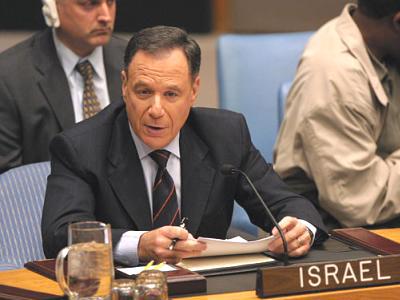
Israeli Ambassador to United Nations, Dan Gillerman. Photo: AP.

Revoking Israel’s UN Membership
By Snorre Lindquist and Lasse Wilhelmson / December 3, 2008

Israel membership at the UN is conditional on its respect for international law.

The Gaza Strip is now the largest concentration camp in the world. The situation grows steadily more insufferable for the 1.5 million Palestinians who live there. Deliveries of food, medicine and fuel are made difficult or stopped altogether. Child malnutrition is increasing. Water supplies and drainage have ceased to function. Children die for lack of healthcare. Tunnels to Egypt, dug by hand, are the only breathing space. Journalists and diplomats are denied entry. Israel is planning more military efforts. The Palestinians in Gaza are now to be starved into surrender and become an Egyptian problem.

The UN should use the word apartheid in connection with Israel and consider sanctions with the former South Africa serving as a model. Miguel dÉscoto Brockman, president of the UN General Assembly, conveyed this message at a meeting on November 24th 2008 with the UN General Secretary Ban Ki-moon present.

The 1976 Nobel peace prize laureate, Mairead McGuire from Ireland, recently suggested a popular movement demanding that the UN revoke Israel’s membership. The international community now needs to put tangible pressure on Israel in order to stop its war crimes.

Not once, during the past 60 years, has Israel shown any intention of living up to the requirements stipulated by the UN, in connection with the country’s membership in 1948, namely that the Palestinians who had been evicted from their homes should be allowed to return at the earliest possible opportunity. Moreover, Israel holds the hardly flattering world record of ignoring UN resolutions.

It can be questioned from the aspect of human rights legislation whether Israel is a legitimate state. Established practice between states usually requires borders that are legally maintained and a constitution, neither of which Israel has. These requirements are also named in the UN resolution (181) Partition Plan for Palestine, approved by the General Assembly in November 1947. The plan was accepted by the Zionists Jews in Palestine but rejected for excellent reasons as unjust by the Arab states. Only decisions made by the UN Security Council are mandatory. Later on, Israel unilaterally laid claim to a considerably larger portion of land than that suggested by the UN.

The eviction of eighty per cent of the Palestinians who lived west of the 1947 armistice line, and Israel’s refusal to allow them to return is the human rights argument for expelling Israel from the UN. Not only has Israel played the Partition Plan false but has, by its actions, thwarted the grounds – fragile from the start – for its UN membership.

Israel makes use of various strategies to achieve its goals, the same goals as for over a hundred years ago: As few and as well controlled and weakened Palestinians as possible in areas as small as possible between the Mediterranean and the River Jordan. And to try and get acceptance worldwide for the theft of land that is vital to the “state” that calls itself “Jewish and democratic”. This obviously bears no similarity to a peace process.

Why does nobody ever comment on the fact that Israel’s prime minister never misses an opportunity to harp on about how important it is that the rest of the world and the Palestinians recognise Israel, not as a democratic country for all its citizens, but as a “Jewish state”?

What would we have said if South Africa’s Prime Minister, in a similar way, had demanded recognition of South Africa as a “white and democratic state”, thus de facto accepting the racist apartheid system that allowed non-whites to be classified as lesser human beings?

In the article The end of Zionism, published in the Guardian on September the 15th 2003 the Jewish dissident and former speaker of Knesset, Avraham Burg wrote:

“Diaspora Jews for whom Israel is a central pillar of their identity must pay heed and speak out … We cannot keep a Palestinian majority under an Israeli boot and at the same time think ourselves the only democracy in the Middle East. There cannot be democracy without equal rights for all who live here, Arab as well as Jew … The prime minister should present the choices forthrightly: Jewish racism or democracy.”

No support can be found in The UN recommendation concerning a Jewish and a Palestinian state for unequal rights for the citizens of each country. Neither is there any indication as to how a “Jewish” state could become Jewish. There is support, however, for the intention that demographic conditions should be held intact at partition. Interpreting into the text an intention concerning characteristics of a “Jewish state” tailored to the ideology of Zionism is wholly in contradiction with the text of the resolution.

Even the Balfour Declaration, which entirely lacks human rights status, notes that the Jewish national home in Palestine should in no way encroach upon the rights of the Palestinians. Neither did US President Truman recognise Israel as a Jewish state. On the contrary, he ruled out precisely that formulation before making his decision to recognise Israel.

Thus, the legitimacy of a “Jewish state” so urgently sought by Israel lacks support in international documents that concern the building of the state. Israel’s government is, of course, fully aware of this. Why else would it keep on searching for this recognition?

The UN should now embark on a boycott of the apartheid state of Israel and, with the threat of expulsion from the UN, demand that Israel allows the evicted Palestinian refugees to return in accordance with the UN resolutions 194 and 3236.

With this done, meaningful peace talks can proceed and various solutions be reached for co-habitation with equal rights for all people between the Mediterranean and the River Jordan. No such solution can be compatible with the preservation of a Jewish apartheid state.

[- Snorre Lindquist is a Swedish Architect of, among other things, the House of Culture in front of the Nativity Church in Bethlehem on the West Bank. Contact him at snorre_lindquist@hotmail.com.

– Lasse Wilhelmson is a commentator on the situation in the Middle East, and is a member of a local government in Sweden for 23 years, four of which in an executive position. Contact him at: lasse.wilhelmson@bostream.nu.]

Source / Palestine Chronicle

The Rag Blog

Posted in RagBlog | Tagged , , | 1 Comment

Juan Cole: Obama’s Greatest Foreign Policy Challenge: The Complexity of Pakistani Politics

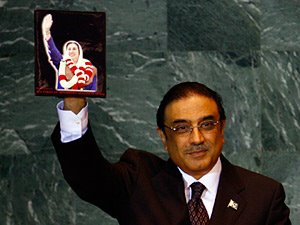
President Asif Ali Zardari of Pakistan holds up a picture of his late wife, Benazir Bhutto, before addressing the 63rd United Nations General Assembly Sept. 25 in New York. Photo: Reuters/Eric Thayer.

Does Obama understand his biggest foreign-policy challenge?
By Juan Cole / December 12, 2008

The president-elect wants to work with the Pakistani government to “stamp out” terror. It’s not nearly that simple.

A consensus is emerging among intelligence analysts and pundits that Pakistan may be President-elect Barack Obama’s greatest policy challenge. A base for terrorist groups, the country has a fragile new civilian government and a long history of military coups. The dramatic attack on Mumbai by members of the Pakistan-based Lashkar-e Tayiba, the continued Taliban insurgency on the Pakistan-Afghanistan border, the frailty of the new civilian government, and the country’s status as a nuclear-armed state have all put Islamabad on the incoming administration’s front burner.

But does Obama understand what he’s getting into? In his “Meet the Press” interview with Tom Brokaw on Sunday, Obama said, “We need a strategic partnership with all the parties in the region — Pakistan and India and the Afghan government — to stamp out the kind of militant, violent, terrorist extremists that have set up base camps and that are operating in ways that threaten the security of everybody in the international community.” Obama’s scenario assumes that the Pakistani government is a single, undifferentiated thing, and that all parts of the government would be willing to “stamp out” terrorists. Both of those assumptions are incorrect.

Pakistan’s government has a profound internal division between the military and the civilian, which have alternated in power since the country was born from the partition of British India in 1947. It is this military insubordination that creates most of the country’s serious political problems. Washington worries too much about other things in Pakistan and too little about the sheer power of the military. United States analysts often express fears about an internal fundamentalist challenge to the chiefs of staff. The main issue, however, is not that Pakistan’s military is too weak, but that it is too strong. And that is complicated by the fact that elements within the military are at odds, not just with the civilian government, but also with each other.

Gen. Pervez Musharraf ruled the country with an iron fist from the fall of 1999 (when he staged his coup against an elected prime minister) until he resigned under threat of impeachment in August of this year. His civilian rival, Asaf Ali Zardari, was elected president in September. Zardari had become the de facto head of the left-of-center Pakistan People’s Party after his wife, Benazir Bhutto, was assassinated while campaigning for Parliament in late December 2007. In the parliamentary elections of February 2008, which were relatively free and fair, the PPP emerged as the largest party in Parliament.

Zardari and his prime minister, Yousuf Raza Gilani, have vowed to crack down on terrorism. Zardari is said to be committed to vengeance against the Pakistani Taliban, since he blames them for his wife’s assassination. The possibility that a Western-educated woman liberal might again become Pakistan’s prime minister had been unbearable for the fundamentalist Taliban. Since Zardari became president, the Pakistani military has vigorously pursued a massive campaign against the Taliban in the tribal agency of Bajaur. The fierce fighting is said to have displaced some 300,000 persons. Of these operations against the Pakistani Taliban, Obama said on “Meet the Press” that “thus far, President Zardari has sent the right signals. He’s indicated that he recognizes this is not just a threat to the United States but is a threat to Pakistan as well.”

Likewise, after the attack on the Indian financial and cultural center of Mumbai on Nov. 26-29 of this year, Zardari argued that Pakistan as well as India has been targeted by terrorism, and that it is a legacy of the ways in which the U.S. used radical Islam to fight the Soviet Union during the Cold War. Zardari wrote: “The Mumbai attacks were directed not only at India but also at Pakistan’s new democratic government and the peace process with India that we have initiated. Supporters of authoritarianism in Pakistan and non-state actors with a vested interest in perpetuating conflict do not want change in Pakistan to take root.”

But Zardari will find it difficult to get control of the entire Pakistani government and the various “non-state actors” it has spawned to pursue Pakistani military interests in Afghanistan and Kashmir. Among his biggest challenges will be to gain the loyalty not only of the regular military but also of those officers detailed to the Directorate of Inter-Services Intelligence, an organization of some 25,000 that was founded in 1948 to promote information-sharing among the army, navy and air force. In the 1960s, military dictator Ayoub Khan used the ISI to spy on domestic rivals, and over time it developed a unit focusing on manipulating civilian politics. Zardari tried to abolish that political unit in late November.

During periods of military dictatorship, the ISI has tended to be given a much-expanded role, both domestically and abroad. During the 1980s, Gen. Zia ul-Haq created an Afghanistan bureau in the ISI, through which the Reagan administration funneled billions to the mujahedin to fight the Soviet occupation. In the late 1980s, dictator Zia initiated an ISI-led covert operation, Operation Tupac, aimed at detaching the disputed Muslim-majority state of Kashmir from India.

Kashmir had been a princely state in British India, ruled by a Hindu raja who took it into Hindu-majority India during partition. The Pakistanis fought an inconclusive war but failed to annex it to Pakistan, and the United Nations called for a referendum to allow the Kashmiris to decide their fate. India, which viewed Jammu and Kashmir as an Indian state, never allowed such a plebiscite to be held. Obama has suggested that he might send former President Bill Clinton as a special envoy in a bid to resolve the Kashmir dispute once and for all.

From a Pakistani nationalist point of view, Indian rule over Kashmir differed only in longevity from the Soviet occupation of Afghanistan, and both involved the illegitimate occupation of a Muslim people by an infidel government. The ISI helped create six major guerrilla groups to operate against India in Kashmir, including the Lashkar-e Tayiba (Army of the Good), a paramilitary arm of the Center for Missionizing and Guidance (Da’wa wa Irshad) of former Islamic studies professor and mujahed in Afghanistan, Mohammad Hafiz Saeed.

From 1994, the ISI backed the Taliban in the quest to take over Afghanistan from the warlords who came to power after the fall of Soviet-installed Muhammad Najibullah in the early 1990s. Elements in the ISI favored a hard-line form of fundamentalist Islam and so were pleased to support the Taliban on ideological grounds. Others were simply being pragmatic, since the Taliban, from the Pushtun ethnic group, had been refugees who attended seminary or madrasah in Pakistan. They were pro-Pakistan, while many of the warlords had become clients of India, Iran or, ironically, Russia.

In 2001, immediately after the 9/11 attacks, the Bush administration gave Pakistani military dictator Pervez Musharraf an ultimatum. He had championed the Taliban policy despite being a secularist himself, but was forced to turn against his former allies, who were then overthrown by the U.S.-backed warlords of the Northern Alliance.

Elements in the ISI and the military, however, continued to back the Taliban. They were deeply dismayed that the Karzai government in Kabul was independent of Islamabad and had strong ties to India. Under U.S. and Indian pressure, in 2004 the Musharraf government blocked the Pakistan-based guerrilla groups from further attacking Indian Kashmir from Pakistan, causing many of their members to go fight instead alongside the resurgent Taliban in northwestern Pakistan and southern Afghanistan. In response to the need to distance themselves from the terrorist groups, the Pakistani government and the ISI are alleged to have created cells made up of former officers who covertly give training, arms and other support to the Taliban and to the organizations fighting India in Kashmir.

To some extent, then, Pakistan’s powerful national-security apparatus has been divided against itself for much of the past decade. The contradictory agendas of various parts of the Pakistani government and of its shadowy networks of retired or ex-officers have created policy chaos. Even while the army is engaged in intense fighting against the Pakistani Taliban of Bajaur, it appears to be backing other Taliban groups that have struck at targets inside Afghanistan from south Waziristan, another tribal agency on the border of the two countries. Last June, when U.S. forces engaged in hot pursuit of these Taliban staging cross-border raids, they came under fire from Pakistani troops who sided with the Taliban.

The complex layers of the ISI, a state within the state, make it questionable whether Musharraf ever really controlled it. Now Pakistan’s new civilian president is even less well-placed to control it, or to discover how the militant cells work, both inside the ISI and among the retirees. It is not even clear whether the ISI is willing to take orders from Zardari and other officials in the new government. When Prime Minister Gilani announced that the ISI would have to report to the civilian Interior Ministry, the decree was overturned within a day under “immense pressure from defense circles.” When the government pledged to send the head of the ISI to India for consultations on the Mumbai attacks in late November, it was apparently overruled by the military.

The captured terrorist in Mumbai, Amir Ajmal Qassab, appears to have told Indian interrogators that his group was trained in Pakistani Kashmir by retired Pakistani officers. It is certain that President Zardari, Prime Minister Gilani, and Army Chief of Staff Ashfaq Kiyani were uninvolved in the terrorist strike on Mumbai. But were there rogue cells inside the ISI or the army officer corps that were running the retirees who put the Lashkar-e Tayiba up to striking India? On Sunday, Zardari’s forces raided the Lashkar-e Tayiba camps in Pakistani Kashmir and arrested a major LeT leader, Zaki-ur-Rehman Lakhvi, whom Indian intelligence accused of masterminding the Mumbai attacks. The move was considered gutsy in Pakistan, where there is substantial popular support for the struggle to free Muslim Kashmir of India, a struggle in which the Lashkar has long been the leading organization.

This murky Chinese puzzle raises the question of how Obama can hope to cooperate with the Pakistani government to curb the groups mounting attacks in Afghanistan and Kashmir. The government itself is divided on such policies, and there appear to be cells both within the state and outside it that have their own, militant foreign policy. The United States, going back to the Cold War, has long viewed the Pakistani army as a geopolitical ally, and Washington tends to prefer that the military be in power. Since Gen. Musharraf was forced out, U.S. intelligence circles have been lamenting the country’s “instability,” as though it were less unstable under an unpopular dictatorship. If Pakistan — and Pakistani-American relations — are to have a chance, it will lie in the incoming Obama administration doing everything it can to strengthen the civilian political establishment and ensure that the military remains permanently in its barracks. The military needs to be excluded from political power, and it needs to learn to take orders from a civilian president. At the same time, Obama should follow through on his commitment to commit serious diplomatic resources to helping resolve the long-festering Kashmir issue.

Source / Salon

The Rag Blog

Posted in RagBlog | Tagged , , , , | Leave a comment

Constitutional Conventions: The Power to Reform Government to Eliminate Corruption


Illinois Citizens Deserve Corrupt Government
By Joel Hirschhorn / December 12, 2008

Public Corruption Runs Rampant Because Americans Do Not Seek Genuine Political Reforms

The current Illinois governor, Rod Blagojevich, recently charged with crimes by the federal government, just follows in the footsteps of previous convicted Illinois governors and a huge number of other Illinois officials convicted of crimes. What is remarkable is that in the 2008 election Illinois voters had the opportunity to recognize that they needed to use their constitutional convention opportunity to reform state government. They voted not to use it.

Which raises the question: How stupid or brainwashed are most Illinois citizens?

Here is the story behind the headlines. According to the Illinois state constitution, voters must be given the opportunity every twenty years to vote for or against having a state constitutional convention that can be used to amend the constitution or rewrite it altogether. Considering an incredibly long history of public corruption you would think that Illinois voters would be inclined to give serious thought to how they could improve their government by means of a state constitutional convention. Many prominent people and groups worked hard to educate citizens why they should vote in favor of a constitutional convention.

In November, two-thirds voted against having a convention. Twenty years earlier they also voted against one. But even with twenty more years of public corruption, Illinois citizens could not be convinced to pursue a path to political reform free from the chains of their corrupt state government. The last convention was in 1970.

Those advocating passage of the convention measure included: Lieutenant Governor Pat Quinn, the Chicago Tribune, the Springfield State Journal Register, state representatives Mike Boland and Jack Franks, former state treasurer Judy Baar Topinka, political journalists Rich Miller and Scott Reeder, and several groups with websites.

Back in January 2008 this is what John Bambenek, who wrote a book supporting the convention, had the good sense to say: “Gov. Rod Blagojevich has done something remarkable in Illinois. He has managed to unite people across the political spectrum to create consensus that he absolutely stinks as a governor. Illinois deserves better than Rod Blagojevich. Because of his low approval in both parties and the budget fiasco of last year, legislators (even those in his own party) are talking about amending the constitution to allow recall votes of sitting politicians. The timing for such talk is opportune because on the November ballot this year there will be a question on whether to have a constitutional convention for Illinois to rewrite or amend the state constitution.” Like other pro-convention advocates, Bambenek wanted to return power to Illinois citizens. Most of them did not listen.

A key argument in favor of convention was that the cost of a no-frills convention (around $23 million) would surely be repaid by the savings to taxpayers of constitutional amendments that could get the state out of the lobbyist-run budget crisis it was in. Not to mention the possibility of an amendment that could make it easier to get rid of corrupt governors and other officials by, for example, recall by citizens. How sensible, considering that even before the charges against the current governor three previous Illinois governors had been convicted of crimes.

Otto Kerner (D) governor 1961-1968 was convicted on 17 counts of bribery, conspiracy, perjury, and related charges. He was sentenced to three years in federal prison and fined $50,000. Daniel Walker (D) governor 1973-1977 was convicted of improprieties related to a savings and loan association. He reportedly received over a million dollars in fraudulent loans for his business and repairs on his yacht. He pleaded out to three felonies and was freed after 17 months in prison because he was supposedly frail and chronically ill, but is still living 20 years later and living near the ocean in Mexico. And George Ryan (R) governor 1999-2003 was convicted on 20 federal counts that included racketeering, bribery, and extortion

And consider this amazing statistic: From 1995 to 2004, 469 politicians from the federal district of Northern Illinois were found guilty of corruption.

And then there was the famous case of Rep. Dan Rostenkowski (D) who was indicted in 1994 on 17 felony charges, including the embezzlement of $695,000 in taxpayer and campaign funds. The longtime powerful House ways and means committee chairman plea-bargained his way down to just two counts of mail fraud and served only 17 months in a minimum-security prison.

So what did the opponents to the convention use to sway voters? And why did they oppose a convention? They lied a whole lot and tried to instill fear, and succeeded. But what they feared was losing political power that they had used for so long to corrupt state government. Opponents included most of the state’s influential lobbying organizations: American Insurance Association, Associated Fire Fighters of Illinois, Center for Tax and Budget Accountability, Chicago Urban League, Chicagoland Chamber of Commerce, Citizen Action/Illinois, Illinois Association of Convenience Stores, Illinois Association of School Administrators, Illinois Business Round Table, Illinois Civil Justice League, Illinois Education Association, Illinois Farm Bureau, Illinois Federation of Teachers, Illinois Hispanic Chamber of Commerce, Illinois Manufacturers Association, Illinois Petroleum Marketers Association, Illinois Retail Merchants Association, Illinois Retired Teachers Association, Illinois State AFL-CIO, Illinois State Chamber of Commerce, Illinois State Black Chamber of Commerce, Illinois Trial Lawyers Association, League of Women Voters of Illinois, Lincoln Park Chamber of Commerce, National Federation of Independent Businesses/Illinois, Peoria Area Chamber of Commerce, Police Benevolent and Protective Association of Illinois, SEIU Illinois, State University Annuitants Association, Taxpayers’ Federation of Illinois, Tooling and Manufacturing Association, Union League Club of Chicago, Illinois Rifle Association. The convention was also opposed by House Speaker Michael Madigan (D) and former governor Jim Edgar (R) who both represented the corrupt status quo political establishment.

There is an important lesson from what happened in Illinois and several other states, as well as why the US Congress has refused to obey Article V of the federal constitution that prescribes a convention of state delegates to propose constitutional amendments when two-thirds of states ask for one, which has happened long ago. It is this: those with political power fear constitutional conventions that can truly reform our corrupt political system. What Americans need to constantly remember is that “we the people” must use constitutional conventions to improve our government and political system. All constitutions are meant to be revisited and amended if necessary.

We must not depend on electing individuals to public office to truly reform the system. We have a corrupt two-party plutocracy. It is time to stop believing the lies of both Democrats and Republicans. We can keep putting many of them in prison, but all that happens is that more corrupt and dishonest politicians get elected. Just as it has happened for the Illinois governorship.

Finally, you might ask whether Illinois Senator Barack Obama supported the 2008 convention proposal. What do you think? Obama’s key advisor, David Axelrod, who crafted his “change” message, shared a multimillion dollar contract provided by opponents to the convention who feared change.

Source / Associated Content

Thanks to Joel Hirschhorn / The Rag Blog

Posted in RagBlog | Tagged , , , | Leave a comment

Ricardo Rachell and Criminal Justice in Harris County

The victim never mentioned facial scars when he identified Ricardo Rachell, above. Photo: Harris County Sheriff’s Office / Houston Chronicle.

‘This form of justice has become commonplace in Harris County with its history of unforgivable crime lab mistakes and outright malfeasance, of evidence lost or withheld, of bloodthirsty prosecutors and juries eager to keep the lethal injections flowing.’

By Thorne Dreyer / The Rag Blog / December 12, 2008

Ricardo Rachell has spent five years in prison, even though DNA evidence existed all along that could have proven his innocence. According to the Houston Chronicle, DNA tests now prove that Rachell could not have committed the crime of which he was accused, and, as a result, he was scheduled for release today.

This is another mind-boggling example of justice misfired: in this case, a man convicted of sexual assault of a child based only on the testimony of an eight year old and his friend who didn’t even mention the man’s severely disfigured face in their testimony.

The District Attorney’s office admits it was aware of the DNA evidence all along, but says that its existence was mentioned in offense reports and that the defense could have requested testing. Defense attorneys however say they were not made aware of the evidence. And what kind of justice system is it anyway when prosecutors feel driven to seek convictions at all costs, where their response to the existence of possibly exculpatory evidence is, “Well, they didn’t ask.”

This form of justice has become commonplace in Harris County with its history of unforgivable crime lab mistakes and outright malfeasance, of evidence lost or withheld, of bloodthirsty prosecutors and juries eager to keep the lethal injections flowing.

The Houston Press described the qualifications for Harris County District Attorney as follows: “The job description was clear — kill as many defendants as possible, talk tough on crime, have an ‘R’ after your name on the ballot and you’re there for life.” But DA Chuck Rosenthal didn’t have the charm and political skills – or the exquisite mustache – of his predecessor, the legendary John B. Holmes, though they shared the same “hang ‘em” approach. And his “life” as Harris County DA was cut short.

The clumsy Rosenthal stumbled out of office in the face of a scandal involving a proliferation of racist and pornographic emails. And, even though Harris County largely turned to Democrats in the recent election, Rosenthal’s successor is Pat Lykos, a Republican district judge who professes a commitment to reform.

In recent years virtually all Harris County judges have been Republicans, and they have a proven “law and order” track record, inclined, as a rule, toward convictions, long sentences and parole revocation based on technical violations. They do a fine job of feeding the Texas prison complex, a voracious big bucks operation designed as a continually self-fulfilling prophecy.

But this is not a Houston or a Texas problem; it’s symptomatic of a major crisis in our criminal justice system with its cockamamie “war on drugs,” its tunnel-visioned and racially-charged mega drive to imprison first and foremost. Rehabilitation isn’t even in the equation. The whole thing’s fueled by money.

As for the case of Ricardo Rachell, it highlights the extreme unreliability of eyewitness accounts and the sloppiness with which evidence is handled. But bottom line, it points to a serious societal question of professional ethics, as district attorneys, politically driven, become so willing to overlook the “justice” part of criminal justice.

5 Years Lost in Prison Before DNA Got Tested
Evidence stored in 2002 clears Houston man in child sex case
By Roma Khanna / December 12, 2008

Five years after he was wrongfully convicted of sexually assaulting a child, Ricardo Rachell will be released from custody today.

Prosecutors and Rachell’s attorney appeared before state District Judge Susan Brown this morning to request the 51-year-old Rachell’s release on a personal recognizance bond after DNA tests cleared him of committing the 2002 attack.

The judge agreed and the Harris County Sheriff’s Office began the process of organizing his release.

Rachell, who was brought to Houston Wednesday night from a prison in Tennessee Colony, in East Texas, did not attend the hearing, nor did any members of his family.

After the hearing, Assistant District Attorney Roe Wilson said her office will work to ensure that Rachell’s conviction is overturned.

“Our goal is to make sure justice is done. And today, that means making sure Mr. Rachell is out of custody and returned to his family,” Wilson said.

Wilson could not say why DNA evidence available in 2002 was not tested until this year.

“That is a really good question,” she said. “It should have been tested. The defense attorney also could have requested testing.”

Rachell’s original defense attorney, Ron Hayes, said he knew nothing of the biological samples before the 2003 trial.

“It was not disclosed in any offense report that I saw,” Hayes said. “If I had been aware, I would have pushed for DNA testing, without question. I am disappointed that somehow it did not come to somebody’s attention who could have done something about it sooner.”

But Wilson said today that Houston police offense reports, which were available to defense counsel, included the fact that biological evidence had been collected.

In 2003, jurors convicted Rachell, who was severely disfigured by a shotgun blast to the face years before, largely based on eyewitness testimony from the 8-year-old victim and one of his friends.

Five years later, DNA tests show that Rachell could not have committed the crime and instead point to another man who is serving time for committing similar attacks, Rachell’s lawyer Deborah Summers said.

“This is the last case I thought would come back this way,” Summers said on Thursday. “When I took this case, I didn’t even know if there would be evidence to test. But (Rachell) just kept fighting and plugging away and kept demanding his rights. I am really pleased this worked out for him.”

Rachell is the fifth Harris County man exonerated with DNA evidence in recent years.

The biological samples that cleared his name were collected by the Houston Police Department after the October 2002 attack on the boy, who had been lured into a vacant south Houston home by a stranger.

Until recently, however, those samples hadn’t been tested. Their existence was never mentioned at trial.

The district attorney’s office confirmed today that it knew of the evidence in 2002. District Attorney Kenneth Magidson said in a written statement on Thursday that it was a mistake not to test the rape kit before trial.

“As soon as the evidence was found to exonerate him, we acted as swiftly as possible to see that justice is done in this case,” he said.

Summers, who was not available for comment after this morning’s hearing, said on Thursday that she did not know of any physical evidence when she atook the case.

“I wasn’t giving Mr. Rachell a great deal of encouragement because I thought, if there had been DNA collected, surely it would have been raised before now,” she said.

HPD has a history of not testing biological evidence despite its availability in a high number of cases, according to an independent investigation of its crime lab, which officials shuttered two months after the attack in which Rachell was accused.

“The crime lab’s failure to generate … results in cases where it was possible to conduct such testing … is very troubling,” wrote a former U.S. Justice Department official at the conclusion of a $5.3 million investigation of the crime lab. “This failure has implications both for ensuring that the guilty are convicted and that the innocent are exonerated.”

Seen around neighborhood

Rachell’s legal troubles began Oct. 20, 2002, when a stranger asked the child victim if he would be interested in earning money by helping move some trash, according to prosecutors. The boy agreed. The man took him to a vacant house and sexually assaulted him.

The next day, the boy’s family called HPD to say the youngster saw his attacker, Rachell — a man with a disfigured face known to some for riding his bicycle around the neighborhood, according to his attorneys.

Police arrested Rachell and he was charged with aggravated sexual assault of a child. Biological evidence was collected, as was a reference sample from Rachell, for comparison to the evidence. But it never was used.

The core of the case against Rachell were the identifications from the 8-year-old and his friend. He went to trial in June 2003 and began serving his 40-year sentence, all the while pursuing various appeals.

Shawna Reagin, a defense attorney recently elected state district judge, handled Rachell’s first appeal.

“I always had questions about this whether he was innocent,” she said. “The child omitted any mention of the facial disfigurement.”

Other similar crimes

In addition, Reagin said, there was another man known to be committing similar crimes in the area at the same time.

Reagin raised those arguments, but Rachell’s conviction was affirmed. Rachell then pursued the possibility of post-conviction DNA testing and a judge appointed Summers to his case.

This March, prosecutors contacted Summers to say they had located evidence and wanted to move forward with testing. The results came back last month. Prosecutors have not said whom the tests implicates, but they have reopened the case.

Prosecutors also said they will support Rachell should he seek a full pardon. That would fully clear his name and entitle him to almost $300,000 in reparations from the state, if he agrees not to file any lawsuits.

Copyright 2008 Houston Chronicle

Source / Houston Chronicle

Read follow-up story: Cleared of child sex assault, Houston man is free by Roma Khanna, Lise Olsen and Dane Schiller / Houston Chronicle / Dec. 13, 2008

The Rag Blog

Posted in RagBlog | Tagged , , , , , | Leave a comment

Sherman DeBrosse : Our Economic Trainwreck

‘The financial crisis involves a great deal more than shaky home mortgagers. The key problem is that our financial markets have been deregulated and, lacking policing, have engaged in a massive speculative binge.’

By Sherman DeBrosse / The Rag Blog / December 12, 2008

[This is the first of a three-part series on the economy by The Rag Blog’s Sherman DeBrosse.]

Almost 70 years ago, the Great Depression began after the stock market collapsed. This time, a recession came first in December, 2007. Then a mortgage crisis in 2008 triggered a meltdown of the financial system. After the collapse of Lehman Brothers on Sept. 15, the markets entered uncharted territory, and it soon became clear that financial houses held trillions in worthless paper. Moreover, bad paper from America had poisoned markets abroad.

Overwhelmed by their own debts and bad assets, banks and financial houses protectively dried up all credit. This development deepened the recession. At this juncture, a third blow to the domestic economy looms large and could push the economy into a deep pit. It depends on how many more bankruptcies there are and whether the Big Three automakers are allowed to go under.

We were months into the economic collapse of 2008, and we still do not quite know what has hit us. Four years ago, Paul Krugman warned that the housing bubble carried with it the seeds of disaster. There were bad sub-prime loans and home owners refinanced their homes to get extra cash to spend. The sub-prime market fell apart in the summer of 2007, and the larger mortgage market collapsed this year.

This is clearly the worst financial crisis since 1929, there are more safety nets in place now than in 1929, so it is unlikely that the current bad times will match the Great Depression. Cushions are in place such as Social Security and insured savings. Another difference is that even conservatives know that the people expect government to act to improve conditions. Had the GOP had another ten years to stamp out the New Deal heritage, this public expectation might have been considerably diminished.

It is difficult to determine how many people have lost or will lose their jobs as a result of the economic melt-down. So far, more than 2 million have lost their jobs this year. Productivity dropped to a 26 year level. We cannot trust our unemployment figures because we only include in the work force those officially looking for work. If unemployment benefits are not extended, those whose benefits have run out simply disappear from the equation. The Bureau of Labor Statistics recognizes this and generates another estimate of real unemployment, which stood at 9.2 % in April, and must be much higher now.

We are told that as many as 3 million home mortgages are in danger of forfeiture. Assume that each has lost $100,000 in value, and we would have about $300,000,000, 000 in lost value. Even if my estimate of loss per home is wrong by half, we would still be looking at a mortgage bail-out of $600,000,000. The fact is that much more is involved than mortgage defaults.

The problem is that in the financial casino, it is possible to take $600 of bad mortgages and create trillions of bad assets. Of course, traders also have used other bad assets to create still other bad securities. Wall Street had built an elaborate and very fragile house of cards built on speculation which was made far less stable when the mortgage crisis occurred.

The mortgages were bundled and turned into collateralized debt obligations (CDOs); they were securitized, and sold as investments. Then other instruments, that derived their worth from the CDOs, were created and traded. These securities that derive their value from other securities are called derivatives, and, at first, they were designed to spread risk. They could be stacked on top of one another. Soon, ways were found to use them for gambling. This is how bubbles are created, and soon, a mortgage based bubble was created. A huge housing bubble was created; then it burst. Now 12 million home owners have mortgages valued at more than their home were worth. Only the people who created it, profited. It could be that they did nothing illegal due to legislation passed in 1999 and 2000. Lax enforcement of whatever regulatory legislation there was added to the problem.

One kind of transaction called credit default swaps was intended to protect against default on the bundled mortgages. The amount of value assigned to these swaps, before they began to come apart, was $62 trillion. Swaps also involve other securities, and are essentially bets on whether the issuers can make good on their obligations. Warren Buffett called the swaps and similar instruments “financial Weapons of mass destruction.”

A very serious problem with securitizing these mortgages and other loans occurs at the local level, where it becomes difficult for people to renegotiate their mortgages when they are held by some far distant bank. Often in the past, a motel owner or gas station proprietor could go to the local bank to renegotiate the terms of his mortgage in rough times. The same is true of commercial paper, which also gets securitized. This time around, these people will have great problems keeping their businesses open by renegotiating the terms of their loans. Focusing mainly on Wall Street problems will not address these Main Street problems and will eventually increase the former.

When the crisis came, many Republicans blamed it on Jimmy Carter and the Democrats who wanted to help minorities own their own homes. The idea was that 1977 legislation against blue-lining somehow forced bankers to make bad loans. No sensible person can believe that the largest part of bad home loan debt was incurred by blacks and Hispanics. That’s a very powerful argument for people who don’t like Blacks and Hispanics. Most of these folks will not look into the problem any further, even if they lost half their stocks and bonds portfolio.

The financial crisis involves a great deal more than shaky home mortgagers. The key problem is that our financial markets have been deregulated and, lacking policing, have engaged in a massive speculative binge. Now the taxpayer is being asked to pay for the damages. We have spent more than two trillion dollars patching up the financial system, and the government is said to be potentially liable for from $7.76 to 8.5 trillion, according to Bloomberg. That includes what has already been provided. CitiBank alone was just given a second loan and the promise to guarantee $300 billion of its questionable debt. There is no guarantee that the liability for casino capitalism will be capped at between $7.76 billion and 8.5 trillion. Most of this debt came not from sub-prime borrowing or other weak mortgage. It is a product of casino capitalism.

[Sherman DeBrosse, the pseudonym for a retired history professor, is a contributor to The Rag Blog and also blogs at Sherm Says and on DailyKos.]

The Rag Blog

Posted in Rag Bloggers | Tagged , , , , | 2 Comments

Foodie Friday: Buckwheat Pancakes


Staff of Life
By Janet Gilles / The Rag Blog / December 12, 2008

I have been cooking pancakes a lot lately. Really, you need them every meal if you are avoiding wheat flour bread from the Evil Empire. Last Sunday night, these buckwheat pancakes were a great hit, served to arriving guests on a plate I kept refilling with fresh pancakes. I could make about eight 4 or 5 inch pancakes at a time in a lovely very heavy skillet. Accompanied by shredded roast chicken in a beautiful bowl, chopped green onions and with both Hoisan and salsa on the side, arriving guests ate the pancakes almost as soon as they hit the platter. No washing necessary afterwards as they had also eaten their plates! Buckwheat pancakes are thin and flexible and delicious, like corn tortillas used to be. This of course was before Nixon re-engineered the farm program to maximize bushels, accidentally minimizing taste, destroying the protective lands along the rivers, and totally eliminating nutrients from half the food supply.

Remember when Mexican restaurants gave out corn tortillas instead of chips?? Back then, tortillas were delicious They were still delicious in Mexico for awhile after that, before we also drove their farmers and their diverse corn crops off the land as they could no more compete with the billions of dollars in federal subsidies our industrial farmers receive annually, anymore than our own farmers could.

So I am cooking with the ancient grains that have proven their worth over time. Not the recently developed ones whose only achievement is large numbers of bushels per acre, combined with an almost total lack of any benefit to human consumption, beyond calories. And in this country, even the poor do not need calories.

Remember, an excellent buffet needs a fresh hot bread. The crowning touch.

Buckwheat Pancakes

• 2 cup buttermilk
• 2 eggs
• 6 tablespoons butter, melted
• 2 teaspoons maple syrup
• 3/4 cup sorghum flour
• 3/4 cup buckwheat flour
• 1 teaspoon salt
• 2 teaspoons baking soda

Directions

1. In a medium bowl, whisk together the buttermilk, eggs, syrup and melted butter.

2. In another bowl, mix together sorghum flour, buckwheat flour, salt and baking soda. Pour the egg mixture into the dry ingredients, holding back a few dry tablespoons to make sure you get a thin batter as flours vary in absorption.

3. Stir until the two mixtures are just incorporated. Add a little more flour mixture if it needs it.

4. Heat a griddle or large frying pan to sizzling, and place 1 tablespoon of butter, margarine or oil into it. Let the butter melt before spooning the batter into the frying pan, form 4 inch pancakes out of the batter. Once bubbles form on the top of the pancakes, flip them over, and cook them on the other side for about 3 minutes. Continue with this process until all of the batter has been made into pancakes.

5. Then sit down and have a lovely meal.

The Rag Blog

Posted in Rag Bloggers | Tagged | 1 Comment

Gender Equity at UT-Austin : Still a Lot of Work to be Done

Gender equity on campus: Still a little behind?

‘Across colleges and ranks women’s salaries are lower than men’s by thousands of dollars, even when qualifications are the same.’

By Mercedes Lynn de Uriarte / The Rag Blog / December 12, 2008

A comprehensive report examining gender issues at the University of Texas at Austin gives evidence that UT defies US EEO legislation in its treatment of women.

Across colleges and ranks women’s salaries are lower than men’s by thousands of dollars, even when qualifications are the same. This not only harms women in the present, but because contributions to retirement are based on a capped percentage of one’s salary, it harms women in the future as well.

Gender Equity Task Force Report Recommends Creation Of Plan to Eliminate Faculty Gender Inequity

AUSTIN, Texas — The Gender Equity Task Force, created by the provost of The University of Texas at Austin in March 2007, has recommended in its report that the university develop and enact a 5-10 year gender equity plan to “reduce or eliminate faculty gender inequity—specifically with respect to hiring, promotion, salaries and governance.”

The report, presented to Provost Steven Leslie, found gender gaps at The University of Texas at Austin in areas of faculty representation, promotion and attrition for faculty advancing through the ranks, salary and leadership. It also noted concerns about the “climate” for women faculty on campus, departmental governance structures, a lack of clear knowledge by faculty and administrators about “family-friendly policies” on campus, and a need to improve the situation of senior women faculty members. The report said senior women at the university are more likely to feel isolated and less recognized for their professional achievements and that they receive significantly lower salaries than do their male colleagues.

“I asked the task force to conduct a deep and thorough assessment of gender equity and work environment on our campus and they delivered one of the most probing and data-driven reports I have seen in all of higher education,” said Leslie, who formed the task force a few weeks after he took office as provost of the university. “There are some recommendations that we will be able to address soon and others that will take a while to work through, but we will begin immediately to tackle the recommendations.”

In forming the committee, Leslie asked the 22-member group to consider what work “remains to be done in order to make The University of Texas at Austin an inviting and productive place for women faculty members in all areas.” Leslie’s creation of the task force was consistent with an announcement by the university’s new president, William Powers Jr., that recruitment and retention of a diverse student body and faculty body would be a core area of emphasis for his presidency.

“I applaud the work of the Gender Equity Task Force,” said Powers. “Its members have performed a valuable service for the university by identifying issues we must address to support the professional growth of our faculty. In order to compete for, recruit and retain the very best faculty, we must be committed to policies, programs and leadership built on fairness, equity and equal opportunity.”

The co-chairs of the task force are Professors J Strother Moore, chair of the Department of Computer Science, and Gretchen Ritter, a professor of government and director of the Center for Women’s and Gender Studies. The committee included faculty members from Architecture, Business, Communication, Education, Engineering, Fine Arts, Law, Liberal Arts, Natural Sciences, Pharmacy, Public Affairs and Social Work. Two deans, a vice provost, a graduate student, a staff member and a vice president also were members of the committee.

“Promoting gender equity is central to the university’s mission of becoming the nation’s leading public university,” said Ritter. “Recruiting faculty from all sectors of the population allows us to draw on a broader pool of talent in building academic excellence. If we fail to recruit and retain women faculty in all fields, then we deny ourselves the opportunity to benefit from the talent and insights of half of the population.”

“Gender discrimination is pervasive in our society, including in higher education,” said Moore. “The university should be applauded for confronting such a problem head-on. As advances in fields like computer science shape our economy and our society, it is essential that women and minorities be recruited into those fields as scientific leaders.”

Leslie has appointed Vice Provost Judith Langlois as administrative leader to oversee the next phase of implementing Gender Equity Task Force recommendations. He said Langlois, the Charles and Sarah Seay Regents’ Professor of Developmental Psychology, is highly regarded on campus for her vision and ability to get things done.

The findings of the Gender Equity Task Force will be presented to the university’s Faculty Council during a meeting in January, and will be discussed in a panel discussion with the Faculty Women’s Organization in February 2009.

Key recommendations of the task force report propose that the provost develop and enact a 5-10 year gender equity plan to reduce or eliminate faculty gender inequity—specifically with respect to hiring, promotion, salaries and governance. The task force said the plan should include a time line, an annual budget, ongoing accountability mechanisms and a budget justification. The committee said specific goals should be set with the dean of each school and college in the areas discussed. It also recommended that a Gender Equity Plan for the university, which should include goals and timetables for each school and college, be finalized and announced by the fall 2009.

The recommendations included hiring initiatives such as creating a provost’s opportunity fund for hiring and retention of faculty who contribute to intellectual diversity by, for instance, increasing the proportion of women in fields in which they are underrepresented. The report said progress toward gender equity in hiring by field should be benchmarked against the proportion of women faculty members at the top 20 research universities in a given field. The task force also suggested the provost’s office oversee a proposed program of training schools and colleges on the best practices for recruiting and retaining a diverse faculty. The report also recommended that a dual-career assistance office be created with the Division of Diversity and Community Engagement to aid hiring efforts.

In the area of retention and promotion, the report said deans and chairs should be required to report and explain significant gender differentials in retention and promotion rates. It said gender equity should be part of the annual reviews for deans and department chairs and that the availability of supplemental resources for hiring and retention under the provost’s opportunity fund should be tied to a demonstrated commitment to the promotion of gender equity by deans and chairs.

Recommendations on salary included a proposal that a “best-practice model” be established for awarding merit raises, endowed chairs and professorships in a gender equitable fashion. The report said that, on average across the university in 2007, female professors earned $9,028 less than men. Among non-tenure-track faculty, on average, female faculty members earned $4,507 less than their male counterparts, the report said.

The task force found women constitute a slightly smaller proportion of the tenured and tenure-track faculty at the university than they do at doctoral institutions nationwide. It said women constitute 19 percent of the full professors, 25 percent of the tenured faculty, and 39 percent of the university’s tenure track faculty. In comparison, at doctoral institutions nationwide, women constitute 26 percent of the tenured faculty and 41 percent of the tenure-track faculty. The report said American Association of University Professors data for 2006 show the university ranked 11th out of 12 peer institutions in the percentage of women ranked as full professors.

The “climate” survey included reports of harassment and discrimination and more than 14 percent of women faculty members said they have been subjected to sexual harassment. Women faculty members also were much more likely than male faculty members to report they have experienced discrimination related to gender, race, age or family status.

Addressing the “leadership gap,” the report said women are underrepresented as department chairs, who can provide discretionary resources for faculty and are influential in hiring, salary and promotion decisions. It also noted that only 9 percent of the university’s endowed chairs are held by women, even though women constitute 19 percent of the full professors at the university.

The Gender Equity Task Force was convened at a moment when concerns about gender equity in higher education had risen nationally. Many of The University of Texas at Austin’s peer institutions over the last decade have conducted studies similar to the one conducted by the task force, finding similar problems and issues that were addressed to result in “substantial progress in recent years in increasing the level of gender equity within their faculties,” the report said.

The report said that, wherever possible, the task force endeavored to compare data from The University of Texas at Austin with information from the 11 public research universities typically treated as the university’s peer group. These include: the University of California, Berkeley; the University of California, Los Angeles; the University of Illinois, Urbana-Champaign; Indiana University, Bloomington; Michigan State University; the University of Michigan; the University of Minnesota, Twin Cities; the University of North Carolina, Chapel Hill; Ohio State University; the University of Washington, Seattle; and the University of Wisconsin at Madison.

Read the final report of the Gender Equity Task Force (PDF). [Download Adobe Reader.]

Source / University of Texas at Austin / Originally released Nov. 3, 2008

The Rag Blog

Posted in Rag Bloggers | Tagged , , , , | 2 Comments

Bailout Bust : Southern Republicans Strike Out at Unions

Sen. Debbie Stabenow, D-Mich, left, listens to Sen. Sherrod Brown, D-Ohio, speaking about the Senate’s rejection of an emergency $14 billion loan bailout for US auto companies, Thursday, Dec. 11, 2008, on Capitol Hill in Washington. Photo by Haraz N. Ghanbari / AP.

The Republican Party, now the Party of ‘Southernism,’ always aimed at killing the UAW in this ‘bailout.’ As low as the wages are that the UAW agreed to in their 2007 contract, they are not as low as the non-union wages paid by Toyota, Honda, Hyundai and Mercedes-Benz in their factories spread through the Old Confederacy, land of the ‘right to work.’

By Thomas Cleaver / The Rag Blog / December 12, 2008

See ‘From the front lines in the class war’ by Steve Russell. and ‘Auto bailout talks collapse as Senate deadlocks over wages’ by Paul Kane, Below.

Republicans killed the auto bailout Thursday night when Democrats refused to agree to the Big Three automakers being required to achieve wage parity with Japanese car factories in the South by the end of the 2009.

Well, now we have the real deal, out on the table for all to see.

The Republican Party, now the Party of “Southernism,” always aimed at killing the UAW in this “bailout.” As low as the wages are that the UAW agreed to in their 2007 contract, they are not as low as the non-union wages paid by Toyota, Honda, Hyundai and Mercedes-Benz in their factories spread through the Old Confederacy, land of the “right to work.”

The Southern Republicans who control the party now are terrified of the Employee Free Choice Act, which will be passed next year, and which would give the UAW a strong tool to break the back of the Southern reactionaries who have always dominated the Southern economy. Unionism might have brought the thing the old slaveocracy (however it’s disguised itself in the past 140 years) has always, always feared: that the lower classes in the South might finally open their eyes and start acting in their own best economic interests, which would mean the end of Southernism. They’re so afraid of this, they’re willing to see the country fall apart, which is the course they have set us on.

From the front lines in the class war

So, last night after prime time, senate Repugs killed the Detroit bailout over….the guys on the line making too much money.

This is the most flagrant shell heaved at the working class since Reagan claimed the way to balance the budget was to make people who waited tables pay all the taxes due on their tips.

No, the Dems did not even come close to having the votes for cloture. But I, for one, would have loved the symbolism of a real live filibuster running over Christmas where the major issue is American workers making too much money!

The last blows of the negotiation, if I am correctly informed, was the Repugs demanding that the UAW take wage cuts immediately that are currently contracted to hit in 2010.

The UAW agreed provided they be given a seat on the GM board.

So you can see the union was hell bent on class warfare, eh?

Steve Russell / The Rag Blog / December 12, 2008

Auto bailout talks collapse as Senate deadlocks over wages
Without a deal, carmakers face bankruptcy threat

By Paul Kane / December 12, 2008

An eleventh-hour effort to salvage a proposed $14 billion rescue plan for the auto industry collapsed late last night as Republicans and Democrats failed to agree on the timing of deep wage cuts for union workers, killing the legislative plan and threatening America’s carmakers with bankruptcy.

“We’re not going to get to the finish line. That’s just the way it is. There’s too much difference between the two sides,” Senate Majority Leader Harry M. Reid (D-Nev.) announced after 10 p.m., concluding a marathon negotiating session that ended in gridlock. Reid warned that financial markets could plummet when trading opens this morning.

“I dread looking at Wall Street tomorrow. It’s not going to be a pleasant sight,” he said.

The legislation would have provided emergency loans to General Motors and Chrysler, which have said they face imminent collapse without federal help. The high-stakes talks broke down over when the wages of union workers would be slashed to the same level as those paid to nonunion workers at U.S. plants of foreign automakers such as Toyota and Honda.

Sen. Bob Corker (Tenn.), the lead GOP negotiator, said the sides were on the brink of a deal on the amendment he had offered. Representatives from the United Auto Workers — who were present for most of the negotiations — would not agree to a specific date, Corker said.

“We offered any day — any day — in 2009,” Corker said.

Minutes after the talks failed, the Senate voted on the bailout measure that had been approved Wednesday by the House on a largely party-line vote, 237-170. In the Senate, the vote was 52-35, eight votes short of the 60 needed to override a Republican filibuster. Of those voting yes, 10 Republicans joined 42 Democrats.

“It’s disappointing that Congress failed to act tonight,” the White House said in a statement. “We think the legislation we negotiated provided an opportunity to use funds already appropriated for automakers and presented the best chance to avoid a disorderly bankruptcy while ensuring taxpayer funds only go to firms whose stakeholders were prepared to make difficult decisions to become viable.”

GM said last night it was “deeply disappointed” that negotiations failed to produce an agreement. “We will assess all of our options to continue our restructuring and to obtain the means to weather the current economic crisis,” the company said in a statement.

A Chrysler spokeswoman said the company would “continue to pursue a workable solution to help ensure [its] future viability.”

The Senate closed out its legislative session for the year but will stay open for pro forma sessions until the next Congress begins Jan. 6. Reid and Senate Minority Leader Mitch McConnell (R.-Ky.) agreed that the auto rescue would not happen this year.

Stock markets in Asia tumbled on the news. Japan’s benchmark Nikkei average fell more than 6 percent in midday trading, while stocks in Hong Kong slipped more than 7 percent.

Auto industry executives and lawmakers supportive of the industry have said they hope that the Federal Reserve might step in with a loan or that Treasury Secretary Henry M. Paulson Jr. might provide emergency funding from the government’s financial rescue program. But Paulson and others in the Bush administration — which had urged the Senate to pass the bailout measure approved by the House — have argued that the rescue program is intended to stabilize the financial services industry and should not be used for other purposes.

“That is the only viable option available at this time,” House Speaker Nancy Pelosi (D-Calif.) said in a statement after the Senate vote.

In discussions with the White House this week, congressional Democrats again raised the idea of funding the automaker bailout out of the rescue program. White House spokesman Tony Fratto said yesterday before the talks collapsed that the administration “has not engaged” lawmakers on the proposal.

The failed negotiations came despite a plea earlier in the day from President-elect Barack Obama for passage of the legislation to spare GM or Chrysler from having to file for bankruptcy protection, a prospect that has grown real enough for both firms to hire lawyers to deal with such a scenario. Chrysler acknowledged last week that it was working with Jones Day; last night, sources said GM had hired Weil, Gotshal & Manges, as well as turnaround veterans William Repko of Evercore Partners, Arthur Newman of Blackstone Group and Jay Alix.

It wasn’t clear whether GM, in particular, could survive until January. If the industry can hang on that long, Reid said last night, the legislation would be revived next year — when a Democratic majority in the Senate might be large enough to defeat any GOP filibuster attempts.

Corker and Sen. Christopher J. Dodd (D-Conn.), chairman of the Banking Committee, had led negotiations all afternoon and into the evening trying rescue the faltering proposal.

“Nothing is agreed to until everything is agreed to,” said Dodd, who appeared to be somewhat optimistic as he exited the negotiations after 8 p.m.

The negotiations were based on a plan advanced by Corker, the most junior member of the Banking Committee. His proposal sought to reduce the wages and benefits of union workers by requiring the automakers’ total labor costs to be “on par” with Honda and Toyota.

The two sides agreed to most other issues, including those requiring automakers to reduce their debt obligations by at least two-thirds through an equity swap with bondholders. Payouts to workers who are laid off or temporarily furloughed would have been terminated.

Ford, unlike General Motors and Chrysler, has said it does not need bridge loans at this point and would not need to agree to those conditions.

But no agreement could be reached on the wage reductions. “It sounds like UAW blew up the deal,” Sen. Jim DeMint (R-S.C.) said afterward.

The initial agreement in the House called for the government to issue the loans to GM and Chrysler as early as next week and for President Bush to immediately name a “car czar” to oversee the bailout. The companies would be required by March 31 to cut costs, restructure debt and obtain concessions from labor sufficient to report a positive net present value.

If the firms failed to make progress toward that goal, the agreement would have required the car czar to revoke the loans and develop a new plan that could have included the option of seeking Chapter 11 bankruptcy protection. If the companies had failed to agree on steps to guarantee their long-term survival, they would have been denied additional federal assistance.

Corker — a freshman senator who a few years ago was mayor of Chattanooga — was a strong opponent of the House plan to save the automakers.

He and other Republicans had revolted against the earlier plan because they thought it did not go far enough in forcing contracts on the UAW. GM officials have told Congress, for instance, that under the most recent contract, labor costs would be about $62 per hour in 2010 — $30 per hour in wages and slightly more than that in benefits to current workers and retirees. That’s about $14 per hour more than at Toyota’s U.S. plants.

Some Republicans said they doubted that the automakers could remain viable and return to profitability. Others, frustrated with the Treasury’s financial rescue program, were skeptical of approving another bailout.

The Corker plan was the last chance at passing any legislation for the auto industry, senators said.

“Absent that,” said Sen. Jon Kyl (R-Ariz.), the minority whip, “nothing’s going to pass.”

[Washington Post staff writers Kendra Marr, David Cho and Steven Mufson contributed to this report.]

Source / Washington Post

The Rag Blog

Posted in Rag Bloggers | Tagged , , , , , | 1 Comment

Homophobic Hip Hopper Trick Trick Promotes Anti-Gay Violence

Gay hater Trick Trick opens for Ice Cube at Texas clubs.

“He goes both ways. Either way he’s gay. Ain’t no other way to say, he’s a f**king faggot so I’m lettin’ off my AK. Bust ’em in his forehead. He ain’t worth lettin’ live. A man and man shouldn’t raise another man’s kids!

Trick Trick lyrics.

December 11, 2008

Homophobic HipHop artist Trick Trick is on a multi-city tour of Texas this week, with stops in Houston, Dallas and Austin. [Trick Trick opens for Ice Cube at Austin’s Mohawk Sunday, Dec. 14.]

In an interview with AllHipHop.com , Trick Trick stated:

“I’ma go on the record right now with this. Homosexuals are probably not gonna like this album. I don’t want your faggot money any g**d*** way. I don’t like it [homosexuality]. Carry that sh*t somewhere else. It’s just that every time that you turn on the TV, that sissy sh*t is on…and they act like its f**king okay. The world is changing for the worst (sic) when sh*t like that happens. And I address that issue. I address it hard as hell.” [Asterisks not added by The Rag Blog.]

Free speech is free speech. Trick Trick has a right to make his own personal views about gay people heard. But, where is the line between free speech and inciting acts of violence?

Trick Trick’s lyrics target gay people:

“He goes both ways. Either way he’s gay. Ain’t no other way to say, he’s a f**king faggot so I’m lettin’ off my AK. Bust ’em in his forehead. He ain’t worth lettin’ live. A man and man shouldn’t raise another man’s kids!”

Do these lyrics cross the legal line? Could these lyrics incite someone to commit a violent act?

Free speech facilitates the exchange of ideas. The threat of violence halts any free exchange of ideas.

These lyrics seek to justify violence against gay people. These lyrics are exactly the type of threats and intimidation that incite violence against people based on actual or perceived sexual orientation or gender identity/expression.

These lyrics are beyond reprehensible.

Trick Trick is the opening act for the popular Ice Cube. For its part, the Austin venue, The Mohawk, has issued the following statement on its website.

Although we are monster fans of Ice Cube and his records over the years, we personally do not support the views of his opening act, Trick Trick, when it comes to gay rights and more simply put, human rights. Openers generally come with the package on big events like this, and to be honest, we didnt even check this guy out until last week. He is clearly an idiot.

At the Mohawk, as it always has been, and will always be a policy of ALL ARE WELCOME. This includes geeks, politicians, homosexuals, heterosexuals, teachers, students, hipsters, punks, freaks, squares, bankers, lawyers, artists, metal heads, moms, dads, sons and daughters…and yes…sometimes even assholes like Trick Trick. I don’t think he will feel too welcome at this event though, and I hope he doesn’t. His personal statements are counter to the culture that has developed at the Mohawk, so my guess is he will be there for the electricity on stage, get heckled, and leave.

As you know, as a music venue, we can’t get in the business of policing free speech or projecting our personal religious or political beliefs on shows because we would probably have to cancel half of what is booked if we really looked into certain lyrics, records, etc. Essentially, everything we know about great music is that it comes from the freedom to scream, yell, speak your mind, and sometimes…piss people off. We don’t like or agree with everything we hear, but we love the fact that this country allows everyone to speak freely and without abandon. It is that ideal that makes music great.

With that said, as a live music venue we don’t believe in censorship…but as individuals, we feel like Trick Trick crosses a very important line and it’s not OK with us. As for me, I will be showing up when the headliner begins and not before.

AS FOR ICE CUBE…WE FRIGGIN LOVE THAT KID AND ARE STOKED TO SEE HIM ON OUR STAGE.

Thanks to Equality Texas.

The Rag Blog

Posted in RagBlog | Tagged , , , , , , | 4 Comments

Joseph E. Stiglitz on the Economic Crisis : Capitalist Fools

Treasury Secretary Henry Paulson and former Federal Reserve Board chairman Alan Greenspan bookend two decades of economic missteps. Photo illustration by Darrow / Vanity Fair.

Behind the debate over remaking U.S. financial policy will be a debate over who’s to blame. It’s crucial to get the history right, writes a Nobel-laureate economist, identifying five key mistakes—under Reagan, Clinton, and Bush II—and one national delusion.

By Joseph E. Stiglitz

[This article appears in the January issue of Vanity Fair magazine. Joseph E. Stiglitz, a Nobel Prize winning economist, is a professor at Columbia University.]

There will come a moment when the most urgent threats posed by the credit crisis have eased and the larger task before us will be to chart a direction for the economic steps ahead. This will be a dangerous moment. Behind the debates over future policy is a debate over history—a debate over the causes of our current situation. The battle for the past will determine the battle for the present. So it’s crucial to get the history straight.

What were the critical decisions that led to the crisis? Mistakes were made at every fork in the road—we had what engineers call a “system failure,” when not a single decision but a cascade of decisions produce a tragic result. Let’s look at five key moments.

No. 1: Firing the Chairman

In 1987 the Reagan administration decided to remove Paul Volcker as chairman of the Federal Reserve Board and appoint Alan Greenspan in his place. Volcker had done what central bankers are supposed to do. On his watch, inflation had been brought down from more than 11 percent to under 4 percent. In the world of central banking, that should have earned him a grade of A+++ and assured his re-appointment. But Volcker also understood that financial markets need to be regulated. Reagan wanted someone who did not believe any such thing, and he found him in a devotee of the objectivist philosopher and free-market zealot Ayn Rand.

Greenspan played a double role. The Fed controls the money spigot, and in the early years of this decade, he turned it on full force. But the Fed is also a regulator. If you appoint an anti-regulator as your enforcer, you know what kind of enforcement you’ll get. A flood of liquidity combined with the failed levees of regulation proved disastrous.

Greenspan presided over not one but two financial bubbles. After the high-tech bubble popped, in 2000–2001, he helped inflate the housing bubble. The first responsibility of a central bank should be to maintain the stability of the financial system. If banks lend on the basis of artificially high asset prices, the result can be a meltdown—as we are seeing now, and as Greenspan should have known. He had many of the tools he needed to cope with the situation. To deal with the high-tech bubble, he could have increased margin requirements (the amount of cash people need to put down to buy stock). To deflate the housing bubble, he could have curbed predatory lending to low-income households and prohibited other insidious practices (the no-documentation—or “liar”—loans, the interest-only loans, and so on). This would have gone a long way toward protecting us. If he didn’t have the tools, he could have gone to Congress and asked for them.

Of course, the current problems with our financial system are not solely the result of bad lending. The banks have made mega-bets with one another through complicated instruments such as derivatives, credit-default swaps, and so forth. With these, one party pays another if certain events happen—for instance, if Bear Stearns goes bankrupt, or if the dollar soars. These instruments were originally created to help manage risk—but they can also be used to gamble. Thus, if you felt confident that the dollar was going to fall, you could make a big bet accordingly, and if the dollar indeed fell, your profits would soar. The problem is that, with this complicated intertwining of bets of great magnitude, no one could be sure of the financial position of anyone else—or even of one’s own position. Not surprisingly, the credit markets froze.

Here too Greenspan played a role. When I was chairman of the Council of Economic Advisers, during the Clinton administration, I served on a committee of all the major federal financial regulators, a group that included Greenspan and Treasury Secretary Robert Rubin. Even then, it was clear that derivatives posed a danger. We didn’t put it as memorably as Warren Buffett—who saw derivatives as “financial weapons of mass destruction”—but we took his point. And yet, for all the risk, the deregulators in charge of the financial system—at the Fed, at the Securities and Exchange Commission, and elsewhere—decided to do nothing, worried that any action might interfere with “innovation” in the financial system. But innovation, like “change,” has no inherent value. It can be bad (the “liar” loans are a good example) as well as good.

No. 2: Tearing Down the Walls

The deregulation philosophy would pay unwelcome dividends for years to come. In November 1999, Congress repealed the Glass-Steagall Act—the culmination of a $300 million lobbying effort by the banking and financial-services industries, and spearheaded in Congress by Senator Phil Gramm. Glass-Steagall had long separated commercial banks (which lend money) and investment banks (which organize the sale of bonds and equities); it had been enacted in the aftermath of the Great Depression and was meant to curb the excesses of that era, including grave conflicts of interest. For instance, without separation, if a company whose shares had been issued by an investment bank, with its strong endorsement, got into trouble, wouldn’t its commercial arm, if it had one, feel pressure to lend it money, perhaps unwisely? An ensuing spiral of bad judgment is not hard to foresee. I had opposed repeal of Glass-Steagall. The proponents said, in effect, Trust us: we will create Chinese walls to make sure that the problems of the past do not recur. As an economist, I certainly possessed a healthy degree of trust, trust in the power of economic incentives to bend human behavior toward self-interest—toward short-term self-interest, at any rate, rather than Tocqueville’s “self interest rightly understood.”

The most important consequence of the repeal of Glass-Steagall was indirect—it lay in the way repeal changed an entire culture. Commercial banks are not supposed to be high-risk ventures; they are supposed to manage other people’s money very conservatively. It is with this understanding that the government agrees to pick up the tab should they fail. Investment banks, on the other hand, have traditionally managed rich people’s money—people who can take bigger risks in order to get bigger returns. When repeal of Glass-Steagall brought investment and commercial banks together, the investment-bank culture came out on top. There was a demand for the kind of high returns that could be obtained only through high leverage and big risktaking.

There were other important steps down the deregulatory path. One was the decision in April 2004 by the Securities and Exchange Commission, at a meeting attended by virtually no one and largely overlooked at the time, to allow big investment banks to increase their debt-to-capital ratio (from 12:1 to 30:1, or higher) so that they could buy more mortgage-backed securities, inflating the housing bubble in the process. In agreeing to this measure, the S.E.C. argued for the virtues of self-regulation: the peculiar notion that banks can effectively police themselves. Self-regulation is preposterous, as even Alan Greenspan now concedes, and as a practical matter it can’t, in any case, identify systemic risks—the kinds of risks that arise when, for instance, the models used by each of the banks to manage their portfolios tell all the banks to sell some security all at once.

As we stripped back the old regulations, we did nothing to address the new challenges posed by 21st-century markets. The most important challenge was that posed by derivatives. In 1998 the head of the Commodity Futures Trading Commission, Brooksley Born, had called for such regulation—a concern that took on urgency after the Fed, in that same year, engineered the bailout of Long-Term Capital Management, a hedge fund whose trillion-dollar-plus failure threatened global financial markets. But Secretary of the Treasury Robert Rubin, his deputy, Larry Summers, and Greenspan were adamant—and successful—in their opposition. Nothing was done.

No. 3: Applying the Leeches

Then along came the Bush tax cuts, enacted first on June 7, 2001, with a follow-on installment two years later. The president and his advisers seemed to believe that tax cuts, especially for upper-income Americans and corporations, were a cure-all for any economic disease—the modern-day equivalent of leeches. The tax cuts played a pivotal role in shaping the background conditions of the current crisis. Because they did very little to stimulate the economy, real stimulation was left to the Fed, which took up the task with unprecedented low-interest rates and liquidity. The war in Iraq made matters worse, because it led to soaring oil prices. With America so dependent on oil imports, we had to spend several hundred billion more to purchase oil—money that otherwise would have been spent on American goods. Normally this would have led to an economic slowdown, as it had in the 1970s. But the Fed met the challenge in the most myopic way imaginable. The flood of liquidity made money readily available in mortgage markets, even to those who would normally not be able to borrow. And, yes, this succeeded in forestalling an economic downturn; America’s household saving rate plummeted to zero. But it should have been clear that we were living on borrowed money and borrowed time.

The cut in the tax rate on capital gains contributed to the crisis in another way. It was a decision that turned on values: those who speculated (read: gambled) and won were taxed more lightly than wage earners who simply worked hard. But more than that, the decision encouraged leveraging, because interest was tax-deductible. If, for instance, you borrowed a million to buy a home or took a $100,000 home-equity loan to buy stock, the interest would be fully deductible every year. Any capital gains you made were taxed lightly—and at some possibly remote day in the future. The Bush administration was providing an open invitation to excessive borrowing and lending—not that American consumers needed any more encouragement.

No. 4: Faking the Numbers

Meanwhile, on July 30, 2002, in the wake of a series of major scandals—notably the collapse of WorldCom and Enron—Congress passed the Sarbanes-Oxley Act. The scandals had involved every major American accounting firm, most of our banks, and some of our premier companies, and made it clear that we had serious problems with our accounting system. Accounting is a sleep-inducing topic for most people, but if you can’t have faith in a company’s numbers, then you can’t have faith in anything about a company at all. Unfortunately, in the negotiations over what became Sarbanes-Oxley a decision was made not to deal with what many, including the respected former head of the S.E.C. Arthur Levitt, believed to be a fundamental underlying problem: stock options. Stock options have been defended as providing healthy incentives toward good management, but in fact they are “incentive pay” in name only. If a company does well, the C.E.O. gets great rewards in the form of stock options; if a company does poorly, the compensation is almost as substantial but is bestowed in other ways. This is bad enough. But a collateral problem with stock options is that they provide incentives for bad accounting: top management has every incentive to provide distorted information in order to pump up share prices.

The incentive structure of the rating agencies also proved perverse. Agencies such as Moody’s and Standard & Poor’s are paid by the very people they are supposed to grade. As a result, they’ve had every reason to give companies high ratings, in a financial version of what college professors know as grade inflation. The rating agencies, like the investment banks that were paying them, believed in financial alchemy—that F-rated toxic mortgages could be converted into products that were safe enough to be held by commercial banks and pension funds. We had seen this same failure of the rating agencies during the East Asia crisis of the 1990s: high ratings facilitated a rush of money into the region, and then a sudden reversal in the ratings brought devastation. But the financial overseers paid no attention.

No. 5: Letting It Bleed

The final turning point came with the passage of a bailout package on October 3, 2008—that is, with the administration’s response to the crisis itself. We will be feeling the consequences for years to come. Both the administration and the Fed had long been driven by wishful thinking, hoping that the bad news was just a blip, and that a return to growth was just around the corner. As America’s banks faced collapse, the administration veered from one course of action to another. Some institutions (Bear Stearns, A.I.G., Fannie Mae, Freddie Mac) were bailed out. Lehman Brothers was not. Some shareholders got something back. Others did not.

The original proposal by Treasury Secretary Henry Paulson, a three-page document that would have provided $700 billion for the secretary to spend at his sole discretion, without oversight or judicial review, was an act of extraordinary arrogance. He sold the program as necessary to restore confidence. But it didn’t address the underlying reasons for the loss of confidence. The banks had made too many bad loans. There were big holes in their balance sheets. No one knew what was truth and what was fiction. The bailout package was like a massive transfusion to a patient suffering from internal bleeding—and nothing was being done about the source of the problem, namely all those foreclosures. Valuable time was wasted as Paulson pushed his own plan, “cash for trash,” buying up the bad assets and putting the risk onto American taxpayers. When he finally abandoned it, providing banks with money they needed, he did it in a way that not only cheated America’s taxpayers but failed to ensure that the banks would use the money to re-start lending. He even allowed the banks to pour out money to their shareholders as taxpayers were pouring money into the banks.

The other problem not addressed involved the looming weaknesses in the economy. The economy had been sustained by excessive borrowing. That game was up. As consumption contracted, exports kept the economy going, but with the dollar strengthening and Europe and the rest of the world declining, it was hard to see how that could continue. Meanwhile, states faced massive drop-offs in revenues—they would have to cut back on expenditures. Without quick action by government, the economy faced a downturn. And even if banks had lent wisely—which they hadn’t—the downturn was sure to mean an increase in bad debts, further weakening the struggling financial sector.

The administration talked about confidence building, but what it delivered was actually a confidence trick. If the administration had really wanted to restore confidence in the financial system, it would have begun by addressing the underlying problems—the flawed incentive structures and the inadequate regulatory system.

Was there any single decision which, had it been reversed, would have changed the course of history? Every decision—including decisions not to do something, as many of our bad economic decisions have been—is a consequence of prior decisions, an interlinked web stretching from the distant past into the future. You’ll hear some on the right point to certain actions by the government itself—such as the Community Reinvestment Act, which requires banks to make mortgage money available in low-income neighborhoods. (Defaults on C.R.A. lending were actually much lower than on other lending.) There has been much finger-pointing at Fannie Mae and Freddie Mac, the two huge mortgage lenders, which were originally government-owned. But in fact they came late to the subprime game, and their problem was similar to that of the private sector: their C.E.O.’s had the same perverse incentive to indulge in gambling.

The truth is most of the individual mistakes boil down to just one: a belief that markets are self-adjusting and that the role of government should be minimal. Looking back at that belief during hearings this fall on Capitol Hill, Alan Greenspan said out loud, “I have found a flaw.” Congressman Henry Waxman pushed him, responding, “In other words, you found that your view of the world, your ideology, was not right; it was not working.” “Absolutely, precisely,” Greenspan said. The embrace by America—and much of the rest of the world—of this flawed economic philosophy made it inevitable that we would eventually arrive at the place we are today.

Source / Vanity Fair

Thanks to Jim Retherford / The Rag Blog

Posted in RagBlog | Tagged , , , , , | Leave a comment

Senate Report on Torture : Blood on Rummy’s Hands

Rummy the Impaler. Photo by Roger L. Wollenberg / UPI

Senate places blame on Rumsfeld:
‘The abuse of detainees in U.S. custody cannot simply be attributed to the actions of “a few bad apples” acting on their own.’

By Joby Warrick / December 11, 2008

WASHINGTON – A bipartisan Senate report released today says that former Defense Secretary Donald Rumsfeld and other top Bush administration officials are directly responsible for abuses of detainees at Guantanamo Bay, Cuba, and charges that decisions by those officials led to serious offenses against prisoners in Iraq and elsewhere.

The Senate Armed Services Committee report accuses Rumsfeld and his deputies of being the principal architects of the plan to use harsh interrogation techniques on captured fighters and terrorism suspects, rejecting the Bush administration’s contention that the policies originated lower down the command chain.

“The abuse of detainees in U.S. custody cannot simply be attributed to the actions of ‘a few bad apples’ acting on their own,” the panel concludes. “The fact is that senior officials in the United States government solicited information on how to use aggressive techniques, redefined the law to create the appearance of their legality, and authorized their use against detainees.”

The report, released by Sens. Carl Levin, D-Mich., and John McCain, R-Ariz., and based on a nearly two-year investigation, said that both the policies and resulting controversies tarnished the reputation of the United States and undermined national security. “Those efforts damaged our ability to collect accurate intelligence that could save lives, strengthened the hand of our enemies, and compromised our moral authority,” it said.

The panel’s investigation focused on the Defense Department’s use of controversial interrogation practices, including forced nudity, painful stress positions, sleep deprivation, extreme temperatures and use of dogs. The practices, some of which had already been adopted by the CIA at its secret prisons, were adapted for interrogations at Guantanamo Bay and later migrated to U.S. detention camps in Afghanistan and Iraq, including the infamous Abu Ghraib prison.

“The Committee’s report details the inexcusable link between abusive interrogation techniques used by our enemies who ignored the Geneva Conventions and interrogation policy for detainees in U.S. custody,” McCain, himself a former prisoner of war in Vietnam, said in a statement. “These policies are wrong and must never be repeated.”

White House officials have maintained the measures were approved in response to demands from field officers who complained that traditional interrogation methods weren’t working on some of the more hardened captives. But Senate investigators, relying on documents and hours of hearing testimony, arrived at a different conclusion.

The true genesis of the decision to use coercive techniques, the report said, was a memo signed by President Bush on Feb. 7, 2002, declaring that the Geneva Convention’s standards for humane treatment did not apply to captured al-Qaida and Taliban fighters. As early as that spring, the panel said, top administration officials, including National Security Adviser Condoleezza Rice, participated in meetings in which the use of coercive measures was discussed. The panel drew on a written statement by Rice, released earlier this year, to support that conclusion.

In July 2002, Rumseld’s senior staff began compiling information about techniques used in military survival schools to simulate conditions that U.S. airmen might face if captured by an enemy that did not follow the Geneva conditions. Those techniques – borrowed from a training program known as Survival, Evasion, Resistance and Escape, or SERE – included waterboarding, or simulated drowning, and were loosely based on methods adopted by Chinese communists to coerce propaganda confessions from captured U.S. soldiers during the Korean war.

The SERE program became the template for interrogation methods that were ultimately approved by Rumsfeld himself, the report says. In the field, U.S. military interrogators used the techniques with little oversight and frequently abusive results, the panel found.

“It is particularly troubling that senior officials approved the use of interrogation techniques that were originally designed to simulate abusive tactics used by our enemies against our own soldiersand that were modeled, in part, on tactics used by the Communist Chinese to elicit false confessions from U.S. military personnel,” the report said.

Defenders of the techniques have argued that such measures were justified because of al-Qaida’s demonstrated disregard for human life. But the panel members cited the views of Gen. David Petraeus, now the head of U.S. Central Command, who in a May, 2007 letter to his troops said humane treatment of prisoners allows Americans to occupy the moral high ground.

“Our values and the laws governing warfare teach us to respect human dignity, maintain our integrity, and do what is right,” wrote Petraeus, who at the time was the top U.S. commander in Iraq. “Adherence to our values distinguishes us from our enemy.”

Source / CommonDreams

The Rag Blog

Posted in RagBlog | Tagged , , , , , , | Leave a comment