Hunger: Not Just an Overseas Problem


50 Percent More US Kids Hungry in 2007
By Michael J. Sniffen / November 17, 2008

WASHINGTON – Some 691,000 children went hungry in America sometime in 2007, while close to one in eight Americans struggled to feed themselves adequately even before this year’s sharp economic downturn, the Agriculture Department reported Monday.

The department’s annual report on food security showed that during 2007 the number of children who suffered a substantial disruption in the amount of food they typically eat was more than 50 percent above the 430,000 in 2006 and the largest figure since 716,000 in 1998.

Overall, the 36.2 million adults and children who struggled with hunger during the year was up slightly from 35.5 million in 2006. That was 12.2 percent of Americans who didn’t have the money or assistance to get enough food to maintain active, healthy lives.

Almost a third of those, 11.9 million adults and children, went hungry at some point. That figure has grown by more than 40 percent since 2000. The government says these people suffered a substantial disruption in their food supply at some point and classifies them as having “very low food security.” Until the government rewrote its definitions two years ago, this group was described as having “food insecurity with hunger.”

The findings should increase pressure to meet President-elect Barack Obama’s campaign pledge to expand food aid and end childhood hunger by 2015, said James Weill, president of the Food Research and Action Center, an anti-hunger group.

He predicted the 2008 numbers will show even more hunger because of the sharp economic downturn this year.

“There’s every reason to think the increases in the number of hungry people will be very, very large based on the increased demand we’re seeing this year at food stamp agencies, emergency kitchens, Women, Infants and Children clinics, really across the entire social service support structure,” said James Weill, president of the Food Research and Action Center, an anti-hunger group.

Weill said the figures show that economic growth during the first seven years of the Bush administration didn’t reach the poorest and hungriest people. “The people in the deepest poverty are suffering the most,” Weill said.

The number of adults and children with “low food security” — those who avoided substantial food disruptions but still struggled to eat — fell slightly since 2000, from 24.7 million to 24.3 million. The government said these people have several ways of coping — eating less varied diets, obtaining food from emergency kitchens or community food charities, or participating in federal aid programs like food stamps, the school lunch program or the Women, Infants and Children program.

Among other findings:

  • The families with the highest rates of food insecurity were headed by single mothers (30.2 percent), black households (22.2 percent), Hispanic households (20.1 percent), and households with incomes below the official poverty line (37.7 percent).
  • States with families reporting the highest prevalence of food insecurity during 2005-2007 were Mississippi (17.4 percent), New Mexico (15 percent), Texas (14.8 percent) and Arkansas (14.4 percent).
  • The highest growth in food insecurity over the last 9 years came in Alaska and Iowa, both of which saw a 3.7 percent increase in families who struggled to eat adequately or had substantial food disruptions.

On the Net: Report (PDF format)

Copyright 2008 The Associated Press.

Source / America On Line

The Rag Blog

Posted in RagBlog | Tagged , , , | Leave a comment

Afghanistan: Breaking from BushCo Policy and Catastrophe to a Viable Future

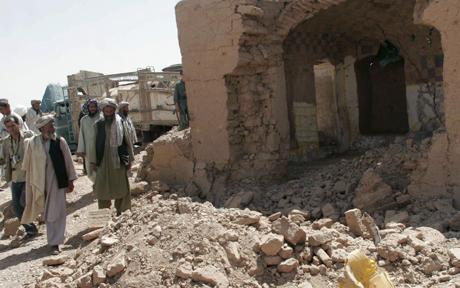
The Afghan government says that at least 70 people including women and children were killed in the ‘careless’ attack by US forces on Azizabad village in northwest Afghanistan. Photo: AP.

Operation Enduring Disaster: Breaking with Afghan Policy
By Tariq Ali / November 16, 2008

Afghanistan has been almost continuously at war for 30 years, longer than both World Wars and the American war in Vietnam combined. Each occupation of the country has mimicked its predecessor. A tiny interval between wars saw the imposition of a malignant social order, the Taliban, with the help of the Pakistani military and the late Benazir Bhutto, the prime minister who approved the Taliban takeover in Kabul.

Over the last two years, the U.S./NATO occupation of that country has run into serious military problems. Given a severe global economic crisis and the election of a new American president — a man separated in style, intellect, and temperament from his predecessor — the possibility of a serious discussion about an exit strategy from the Afghan disaster hovers on the horizon. The predicament the U.S. and its allies find themselves in is not an inescapable one, but a change in policy, if it is to matter, cannot be of the cosmetic variety.

Washington’s hawks will argue that, while bad, the military situation is, in fact, still salvageable. This may be technically accurate, but it would require the carpet-bombing of southern Afghanistan and parts of Pakistan, the destruction of scores of villages and small towns, the killing of untold numbers of Pashtuns and the dispatch to the region of at least 200,000 more troops with all their attendant equipment, air, and logistical support. The political consequences of such a course are so dire that even Dick Cheney, the closest thing to Dr. Strangelove that Washington has yet produced, has been uncharacteristically cautious when it comes to suggesting a military solution to the conflict.

It has, by now, become obvious to the Pentagon that Afghan President Hamid Karzai and his family cannot deliver what is required and yet it is probably far too late to replace him with UN ambassador Zalmay Khalilzad. On his part, fighting for his political (and probably physical) existence, Karzai continues to protect his brother Ahmad Wali Karzai, accused of being involved in the country’s staggering drug trade, but has belatedly sacked Hamidullah Qadri, his transport minister, for corruption.

Qadri was taking massive kickbacks from a company flying pilgrims to Mecca. Is nothing sacred?

A Deteriorating Situation

Of course, axing one minister is like whistling in the wind, given the levels of corruption reported in Karzai’s government, which, in any case, controls little of the country. The Afghan president parries Washington’s thrusts by blaming the U.S. military for killing too many civilians from the air. The bombing of the village of Azizabad in Herat province last August, which led to 91 civilian deaths (of which 60 were children), was only the most extreme of such recent acts. Karzai’s men, hurriedly dispatched to distribute sweets and supplies to the survivors, were stoned by angry villagers.

Given the thousands of Afghans killed in recent years, small wonder that support for the neo-Taliban is increasing, even in non-Pashtun areas of the country. Many Afghans hostile to the old Taliban still support the resistance simply to make it clear that they are against the helicopters and missile-armed unmanned aerial drones that destroy homes, and to “Big Daddy” who wipes out villages, and to the flames that devour children.

Last February, Director of National Intelligence Michael McConnell presented a bleak survey of the situation on the ground to the House Permanent Select Committee on Intelligence:

“Afghan leaders must deal with the endemic corruption and pervasive poppy cultivation and drug trafficking. Ultimately, defeating the insurgency will depend heavily on the government’s ability to improve security, deliver services, and expand development for economic opportunity.

“Although the international forces and the Afghan National Army continue to score tactical victories over the Taliban, the security situation has deteriorated in some areas in the south and Taliban forces have expanded their operations into previously peaceful areas of the west and around Kabul. The Taliban insurgency has expanded in scope despite operational disruption caused by the ISAF [NATO forces] and Operation Enduring Freedom operations. The death or capture of three top Taliban leaders last year — their first high level losses — does not yet appear to have significantly disrupted insurgent operations.”

Since then the situation has only deteriorated further, leading to calls for sending in yet more American and NATO troops — and creating ever deeper divisions inside NATO itself. In recent months, Sir Sherard Cowper-Coles, the British Ambassador to Kabul, wrote a French colleague (in a leaked memo) that the war was lost and more troops were not a solution, a view reiterated recently by Air Marshal Sir Jock Stirrup, the British Defense Chief, who came out in public against a one-for-one transfer of troops withdrawn from Iraq to Kabul. He put it this way:

“I think we would all take some persuading that there would have to be a much larger British contingent there… So we also have to get ourselves back into balance; it’s crucial that we reduce the operational tempo for our armed forces, so it cannot be, even if the situation demanded it, just a one for one transfer from Iraq to Afghanistan, we have to reduce that tempo.”

The Spanish government is considering an Afghan withdrawal and there is serious dissent within the German and Norwegian foreign policy elites. The Canadian foreign minister has already announced that his country will not extend its Afghan commitment beyond 2011. And even if the debates in the Pentagon have not been aired in public, it’s becoming obvious that, in Washington, too, some see the war as unwinnable.

Enter former Iraq commander General David Petraeus, center stage as the new CentCom commander. Ever since the “success” of “the surge” he oversaw in Iraq (a process designed to create temporary stability in that ravaged land by buying off the opposition and, among other things, the selective use of death squads), Petraeus sounds, and behaves, more and more like Lazarus on returning from the dead — and before his body could be closely inspected.

The situation in Iraq was so dire that even a modest reduction in casualties was seen as a massive leap forward. With increasing outbreaks of violence in Baghdad and elsewhere in Iraq, however, the talk of success sounds ever hollower. To launch a new “surge” in Afghanistan now by sending more troops there will simply not work, not even as a public relations triumph. Perhaps some of the 100 advisers that General Petraeus has just appointed will point this out to him in forceful terms.

Flight Path to Disaster

Obama would be foolish to imagine that Petraeus can work a miracle cure in Afghanistan. The cancer has spread too far and is affecting U.S. troops as well. If the American media chose to interview active-duty soldiers in Afghanistan (on promise of anonymity), they might get a more accurate picture of what is happening inside the U.S. Army there.

I learned a great deal from Jules, a 20-year old American soldier I met recently in Canada. He became so disenchanted with the war that he decided to go AWOL, proving — at least to himself — that the Afghan situation was not an inescapable predicament. Many of his fellow soldiers, he claims, felt similarly, hating a war that dehumanized both them and the Afghans. “We just couldn’t bring ourselves to accept that bombing Afghans was no different from bombing the landscape” was the way he summed up the situation.

Morale inside the Army there is low, he told me. The aggression unleashed against Afghan civilians often hides a deep depression. He does not, however, encourage others to follow in his footsteps. As he sees it, each soldier must make that choice for himself, accepting with it the responsibility that going AWOL permanently entails. Jules was convinced, however, that the war could not be won and did not want to see any more of his friends die. That’s why he was wearing an “Obama out of Afghanistan” t-shirt.

Before he revealed his identity, I mistook this young soldier — a Filipino-American born in southern California — for an Afghan. His features reminded me of the Hazara tribesmen he must have encountered in Kabul. Trained as a mortar gunner and paratrooper from Fort Benning, Georgia, he was later assigned to the 82nd Airborne at Fort Bragg. Here is part of the account he offered me:

“I deployed to Southeastern Afghanistan in January 2007. We controlled everything from Jalalabad down to the northernmost areas of Kandahar province in Regional Command East. My unit had the job of pacifying the insurgency in Paktika, Paktia, and Khost provinces — areas that had received no aid, but had been devastated during the initial invasion. Operation Anaconda [in 2002] was supposed to have wiped out the Taliban. That was the boast of the military leaders, but ridiculed by everyone else with a brain.”

He spoke also of how impossible he found it to treat the Afghans as subhumans:

“I swear I could not for a second view these people as anything but human. The best way to fashion a young hard dick like myself — dick being an acronym for ‘dedicated infantry combat killer’ — is simple and the effect of racist indoctrination. Take an empty shell off the streets of L.A. or Brooklyn, or maybe from some Podunk town in Tennessee… and these days America isn’t in short supply… I was one of those no-child-left-behind products…

“Anyway, you take this empty vessel and you scare the living shit out of him, break him down to nothing, cultivate a brotherhood and camaraderie with those he suffers with, and fill his head with racist nonsense like all Arabs, Iraqis, Afghans are Hajj. Hajj hates you. Hajj wants to hurt your family. Hajj children are the worst because they beg all the time. Just some of the most hurtful and ridiculous propaganda, but you’d be amazed at how effective it’s been in fostering my generation of soldiers.”

As this young man spoke to me, I felt he should be testifying before the Senate Foreign Relations Committee. The effect of the war on those carrying out the orders is leaving scars just as deep as the imprints of previous imperial wars. Change we can believe in must include the end of this, which means, among other things, a withdrawal from Afghanistan.

In my latest book, The Duel: Pakistan on the Flight Path of American Power, I have written of the necessity of involving Afghanistan’s neighbors in a political solution that ends the war, preserves the peace, and reconstructs the country. Iran, Russia, India, and China, as well as Pakistan, need to be engaged in the search for a political solution that would sustain a genuine national government for a decade after the withdrawal of the Americans, NATO, and their quisling regime. However, such a solution is not possible within the context of the plans proposed by both present Secretary of Defense Robert Gates and President-elect Barack Obama, which focus on a new surge of American troops in Afghanistan.

The main task at hand should be to create a social infrastructure and thus preserve the peace, something that the West and its horde of attendant non-governmental organizations have failed to do. School buildings constructed, often for outrageous sums, by foreign companies that lack furniture, teachers, and kids are part of the surreal presence of the West, which cannot last.

Whether you are a policymaker in the next administration or an AWOL veteran of the Afghan War in Canada, Operation Enduring Freedom of 2001 has visibly become Operation Enduring Disaster. Less clear is whether an Obama administration can truly break from past policy or will just create a military-plus add-on to it. Only a total break from the catastrophe that George W. Bush, Dick Cheney, and Donald Rumsfeld created in Afghanistan will offer pathways to a viable future.

For this to happen, both external and domestic pressures will probably be needed. China is known to be completely opposed to a NATO presence on, or near, its borders, but while Beijing has proved willing to exert economic pressure to force policy changes in Washington — as it did when the Bank of China “cut its exposure to agency debt last summer,” leaving U.S. Treasury Secretary Paulson with little option but to functionally nationalize the mortgage giants — it has yet to use its diplomatic muscle in the region.

But don’t think that will last forever. Why wait until then? Another external pressure will certainly prove to be the already evident destabilizing effects of the Afghan war on neighboring Pakistan, a country in a precarious economic state, with a military facing growing internal tensions.

Domestic pressure in the U.S. to pull out of Afghanistan remains weak, but could grow rapidly as the extent of the debacle becomes clearer and NATO allies refuse to supply the shock-troops for the future surge.

In the meantime, they’re predicting a famine in Afghanistan this winter.

Tariq Ali, writer, journalist, filmmaker, contributes regularly to a range of publications including the Guardian, the Nation, and the London Review of Books. His most recent book, just published, is The Duel: Pakistan on the Flight Path of American Power (Scribner, 2008). In a two-part video, released by TomDispatch.com, he offers critical commentary on Barack Obama’s plans for Afghanistan and Pakistan, as well as on the tangled U.S.-Pakistani relationship.

Copyright 2008 Tariq Ali

Source / TomDispatch

The Rag Blog

Posted in RagBlog | Tagged , , , | Leave a comment

Roger Baker :
Austin : Where real estate drives the
political machine

The most profitable short term growth for land speculators is the opposite of a wise policy when you are moving into a period of scarce resources.

Low Density Sprawl

Low density sprawl: this from the Houston area, where they know their sprawl.

By Roger Baker | The Rag Blog | November 17, 2008

What I have been waiting for is here. A real estate insider lays out the basics of what is going on in Austin real estate trends.

Anyone who knows much about Austin politics knows that money made on real estate development drives Austin politics and the prevailing patterns of political special interest influence in this region, largely involving roads, water and growth policy that bankrolls the publicly funded subsidies for the special interests that thrive on existing trends.*

The way the game works is that politicians try to recruit non-union industry so they can keep the houses selling and the suburbs sprawling, which is how the big local money is made. Meanwhile the money made by industry goes back to the corporate headquarters in Round Rock or wherever.

But the most profitable short term growth for land speculators is the very opposite of a wise policy when you are moving unto a period of scarce resources. What is worse is that the politics is wired in such a way as to perpetuate the old system and to shield it from pressure for change, typically in any shorter time frame than it takes the real estate investments to pay off.

Low density sprawl type growth outside the city, never the Travis county taxing area, may not benefit Austin and its residents, but it certainly does benefit those who have planned for roads secured by US 290 E bonds; the toxic waste debt of tomorrow in the making.

*(Rumors and gossip: I think Mayor Will Wynn is a semi-successful downtown ex-developer who married into money. CAMPO chair, ex Chamber of Commerce director/Austin registered lobbyist Sen. Kirk Watson is trying to get 290E built as a toll road out to him and Sen. Armbrister’s Frontier bank in Elgin. TxDOT also needs SH290 E to help bail out its SH 130 bonds tied to its current lack of road capacity from Williamson into Austin. Deals were cut in the expectation that…)

The Rag Blog

Posted in RagBlog | Tagged , , , , , , , , , | Leave a comment

Austin : Toll Road Situation a Mess


Transportation policy: CAMPO about to make a big mistake.
By Roger Baker / The Rag Blog / November 17, 2008

AUSTIN — The Capital Area Metropolitan Planning Organization (CAMPO) may be about to make a great historic mistake in transportation policy; it would directly affect US 290 West too. There may be a December CAMPO vote on this.

JP Morgan Chase Securities is teaming up with the Central Texas Regional Mobility Authority (CTRMA) as the latter’s unofficial bond counsel partner. They are telling CAMPO that they have to change Austin’s metro roadway planning policy fast or they won’t set up the toll road bond deals.

Even though there are no deals on the table!

The public can’t even see the revenue numbers behind the deals until 90 days before the bonds are sold. 40 years of toll debt is envisioned as the local transportation burden from tolls to pay off the bonds.

There is no contract between the bank in control and the CTRMA, which is closely controlled by the Texas Department of Transportation (TxDOT). Morgan is a relatively unregulated investment bank trying to set up bond deals on which it gets a cut. How? By matching investors with the road lobby; TxDOT and the real estate/road promoters consultants and road contractors.

In fact, Morgan is telling the CTRMA, without leaving much of a paper trail, that CAMPO needs to quickly approve a sweeping change in transportation policy to tie ALL the CTRMA’s proposed toll roads, ringing and crisscrossing Austin, into one giant toll road system to get Morgan’s help with road bonds.

This policy change is based on totally speculative virtual deals promised by Morgan. The public is not being allowed to see the traffic and revenue studies, and won’t be until just before the bonds are issued, which must mean the numbers don’t look very good. This ties into the fact that the bonds cannot be insured according to CTRMA director Mike Heiligenstein due to the high cost of bond insurance, which is obviously related to high bond default risk.

So CAMPO is urged to sign fast to shift the toll money between corridoras, as is now prohibited by the Eckhardt amendments unanimously approved by CAMPO a year ago. Or else CAMPO won’t get the pot of toll road bond cash that Morgan says is waiting, if only they would shift to more banker-friendly road funding policies.

Meanwhile the CTRMA is trying to pressure CAMPO to change policy with pretty blatantly dishonest funding claims applying to all the tollroads roads in the new “Statement of Purpose” it wants CAMPO to adopt.

One of the worst of a number of the false and unsubstantiated and shaky claims passed from the bankers to the CTRMA and then to CAMPO for approval is posted on CAMPO’s web site here.

Then go to: “Public Hearings for Statement of Purpose and the Financial Plan for a Portion of 290E” and download the PDF file and read the text in the ‘Statement’ on the toll road justification and the reason for setting up the new and much bigger system that the bank wants.

“Lower borrowing costs – the financing can be obtained with lower interest rates due to a stronger financial position resulting from the created system”

Then click on this link and then on the public hearings of which the CTRMA ‘Statement” is the focus:

The CTRMA Director repeats this clearly false assurance of future bond funding at this link:

“Given the severe transportation financing limitations our nation is facing, we are proud to be able to make the investment needed to bring these critical projects to the region,” said Heiligenstein.

The truth is that the CTRMA is assuming that about a third of the toll road money in the form of federal TIFIA loans for toll roads will be available. If not, the CTRMA’s whole toll road funding plan falls apart.

But our new president assures us a change is coming. What will Obama do? Obama’s enviro web site (thanks Bruce Melton) says that he will favor a shift in public spending, on page 11, “Reform Federal Transportation Funding”, to favor smart sustainable growth and put a new emphasis on public transportation alternatives to building roads as usual.

But what if CAMPO shifts its policies to favor the bank, but then Morgan, who has no contract or stake in the deal, walks away? Tough luck; it’s then up to CAMPO and local taxpayers to pick up the pieces and start over.

The Rag Blog

Posted in Rag Bloggers | Tagged , , , , , , | Leave a comment

Spain to Consider Charges Against Former Salvadoran President Christiani in Jesuit Killings

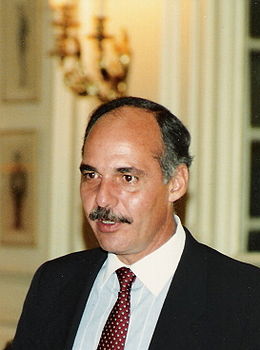
Former president of El Salvador Alfredo Cristiani Burkard, photographed in 1989 in London.

Spanish human rights organization files suit against Alfredo Cristiani and 14 others for involvement in Jesuit massacre of 1989.
By Leah Wilson / The Rag Blog / November 17, 2008

SAN SALVADOR — The Association for Human Rights in Spain (APDHE, its initials in Spanish), with the support of the San Francisco-based Center for Justice and Accountability (CJA), has filed a criminal complaint with the Spanish High Court against former president of El Salvador Alfredo Cristiani Burkard and 14 former members of El Salvador’s armed forces for the murder of six Jesuit priests, their housekeeper, and her daughter on November 16, 1989 by the US-trained and equipped Atlacatl Battalion.

The news comes just as Salvadorans commemorate the 19th anniversary of the massacre. The complaint will now go before the Spanish High Court who will decide whether to press charges against and seek the extradition of Cristiani and the 14 former military officials and soldiers for trial.

Spanish courts made history in 1998 by securing the arrest in England of former Chilean dictator Augusto Pinochet, following a Spanish legal principle that crimes against humanity may be prosecuted in any country. Cristiani, member of the right-wing Nationalist Republican Alliance party (ARENA) and president of El Salvador from 1989-94, is being charged with aiding in the cover-up of a crime against humanity. General René Emilio Ponce, who as army chief ordered the murder of one of the priests and any witnesses to the crime, is being charged along with 13 other military officials and soldiers for crimes against humanity, murder, and state-sponsored terrorism. The APDHE and CJA confirm that there is sufficient proof including eyewitness accounts and government documents to prove the guilt of those charged.

Regarding the charges against Cristiani, current president of El Salvador Tony Saca of the ARENA party said, “Definitively, president Cristiani had absolutely nothing to do with this,” and added, “we are with him and support him, and we will support him until the last moment because he is an historic man for our country.”

The 1991 trials and convictions in El Salvador of two military officers for the massacre of the Jesuits was followed up by a 1993 Amnesty Law — granting amnesty to crimes committed during the Civil War — and the officers’ release. The Spanish criminal complaint brings hope that justice will be brought to the victims of the murders, massacres and human-rights abuses committed by the US-backed and US-funded Salvadoran military and death squads. It also brings hope that a renewed effort to do away with the Amnesty Law could bring justice to the countless victims of crimes and human rights abuses here in El Salvador.

The Rag Blog

Posted in Rag Bloggers | Tagged , , , | Leave a comment

Junior Doesn’t Really Want to Catch Bin Laden


Afghan article says US Bin-Ladin hunt phoney
By Juan Cole / November 17, 2008

The USG Open Source Center translates an article from the Persian Afghan press alleging that French troops were at one point close to capturing Usamah Bin Ladin in Afghanistan, but that American forces stopped them from doing so. It says that a forthcoming French documentary containing interviews with the French soldiers provides proof for the allegation. The argument is that the Bush administration needed Bin Ladin to be at large in order to justify its military expansionism.

Afghan article says US Bin-Ladin hunt phoney
Hasht-e-Sobh / October 3, 2008

Document Type: OSC Translated Text; Afghan article says US Bin-Ladin hunt phoney;
Text of article, “Bin-Ladin on the run? The rumour which was fact”, by Afghan independent secular daily newspaper Hasht-e Sobh on 29 September

So, the rumour was right: French soldiers trapped Usamah Bin-Ladin, but were not allowed by the Americans to arrest the apparent fugitive leader of Al-Qa`idah. A Bin-Ladin documentary just released by French documentary cinema examines this issue, an issue which has led to heated debate in the French media.

This French documentary shows how the Americans are interested in continuing the game, a bloody and expensive game whose victims are only the unprotected and local people of our dry and dusty country. It was last year that rumours spread about this report in Kabul, but it has not been taken seriously by the media. But watching this revealing French documentary changes the rumours into disturbing facts. “Bin Laden, the failings of a manhunt”, produced by Emmanuel Razavi and Eric de Lavarene, two French filmmakers and reporters, assesses and confirms the claims of French soldiers that they could have killed Usamah within two operations, but the American forces prevented them. This film has not been broadcast publicly yet and is to be broadcast by Planet, a French network.

Even though French soldiers have insisted on this in the battlefield many times, the Elysees Palace in Paris and the White House in America have rejected this, and the Afghan leadership does not have any information about it yet!

The main question that arises is the extent to which the “Bin Laden on the run” project is a problem for America and Afghanistan. Seven years of suicide bombing and explosions, blood and violence, unmanned fighter planes, and old vehicles full of explosives, all to catch a long-bearded Arab whom America apparently hates? And an Arab who worked for the CIA in the name of Allah, and who now, also in the name of that same Allah, has conducted a jihad against that same CIA?

Facing the facts in this Usamah film is a bitter and disturbing experience and will make you nervous and wish that what it is that you are watching is just a baseless rumour, or a figment of Hollywood’s imagination. But it is not. The pictures are real and you are facing a debate in documentary form. The only justification for the bloody presence of America in Afghanistan is the ambiguous existence of Usamah Bin-Ladin and the Al-Qa’idah terrorist network.

George Bush, with his “war on terror” project, has transformed the middle east and Afghanistan into an inflamed bomb ready to explode, but has not found out anything about his beloved lost Usamah Bin-Ladin so far.

What is seen, and the film also emphases this, is that all these slogans, this fighting and killing are a game, a painful and prolonged game whose end even the players do not know and which is running out of control. Apparently, it is a game of cat and mouse, just like “Tom and Jerry”, the famous cartoon. But it is a reality that the stubborn one from Texas does not want to catch the mouse – unlike credulous Tom – and that the long-bearded Wahhabi Arab does not want to hide – unlike the intelligent and roaming Jerry. Their prolonged game has made not only the audiences tired but has also transformed the playground into a big pool of blood.

There have always been questions that neither the politicians have been willing to answer, nor the independent western media to raise. If Usamah is not the lost one of the Americans, then who is? What are the Americans searching for in Afghanistan and who are they looking for? The main media in the West remained silent before the report of the Usamah Bin-Ladin arrest by French soldiers. And, through a news boycott, they reduced a certain fact to a rumour.

Certainly, they will do the same before this film, too. But instead they will try to complicate the scenario. More painful than anything else is the political fair in Kabul, a poor fair where everyone offers his despicable commodity – a combination of generous western customers and thankful sellers of the country. Everyone knows the fact, like “an obvious secret”, but no one wants to irritate the delicate minds of their nervous guests, guests who will be staying at home until the new year.

Politicians try to forget such news in Kabul, and this is the advice they give to the people. Forgetting and ignoring such facts is possible, but how can we forget and ignore the bombs exploding next to our houses every day?

Bombs which sometimes rise from the ground and sometimes descend from the air.

(Description of Source: Kabul Hasht-e-Sobh in Dari Kabul Hasht-e Sobh in Dari – Eight-page secular daily launched in May 2007; editor-in-chief, Qasim Akhgar, is a political analyst and Head of the Association for the Freedom of Speech.)

Source / Informed Comment

The Rag Blog

Posted in RagBlog | Tagged , , | 1 Comment

Type your summary here


Type rest of the post here

Source

The Rag Blog

Posted in RagBlog | Leave a comment

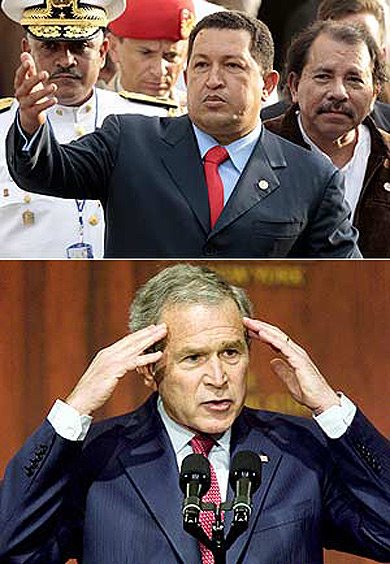
Houston Venezuelan Consulate Closed : Bush’s Last Shot at Chavez


Bush and Venezuela: Closed consulates and closed minds
By Robert Buzzanco / November 17, 2008

Robert Buzzanco is Professor and Chairman, Department of History, University of Houston. He is the author of Masters of War: Military Dissent and Politics in the Vietnam Era and Vietnam and the Transformation of American Life, and numerous other publications on foreign policy and political economy.

Last Friday, November 7th, the Department of State closed the Venezuelan consulate in Houston and gave the consul general and staff 72 hours to leave the country, another distressing development in the continuing U.S. program to isolate and destabilize the government of Hugo Chávez. While Chávez’s personal dislike for President George Bush may make diplomacy between the two nations difficult, the history of U.S.-Venezuelan relations complicates matters and breeds Venezuelan distrust even more. As U.S. power has waned, Latin America has turned more to the left than at any time in its history, with the Venezuelans establishing credible alternatives to American hegemony after a long century of suffering under regimes propped up by Washington.

The United States long backed military dictators in Latin America as a bulwark against nationalism and socialism and because they adhered to the U.S. principles of “free” trade and investment. In reality, this meant that the Americans recognized leaders produced by military coups, such as Marcos Pérez Jiménez in Venezuela, who had overthrown elected governments. President Dwight Eisenhower, in fact, awarded Pérez Jiménez the Legion of Honor, the highest honor given to a foreign national.

Key to U.S. support of the Venezuelan dictator was his coziness to U.S. business interests. By the 1950s, Americans held up Venezuela as a “showcase” for Latin America, proof of the benefits of economic cooperation with Washington. U.S. investments there rose to about $2.5 billion, or about a third of all American investment in the entire region.

Most of that money went into the oil industry, as Venezuela was one of the biggest exporters of petroleum to the United States [and is still third today, after Canada and Saudi Arabia]. Inside the country, the “oil-garchy,” as it was labeled, lived lavishly while the average Venezuela survived on $500 a year and about half of the adults remained illiterate. With his oil money, Pérez Jiménez spent huge amounts on military programs and other benefits to the elite, while poverty was stifling.

It was amid this history that Hugo Chávez emerged, promising independence from the Americans and social benefits to the mass of those mired in poverty. Not surprisingly, Chávez understood that control of oil resources was the key to economic autonomy, and he has taken steps to nationalize Venezuelan petroleum and remove the overwhelming American control of the oil industry there. He also led the creation of the Banco del Sur, an investment and development institution for Latin America to challenge the U.S.-led International Monetary Fund and World Bank.

In return the U.S. government and media has waged a virulent campaign against Chávez, calling him a “dictator” (particularly ironic since he has been elected several times, has accepted elections that his side has lost, and has more claim to being democratically chosen than Bush did in the U.S. election of 2000) or “crazy.” His associations with other Latin American leftists like the Castro brothers in Cuba or Evo Morales in Bolivia raise the fear of an independent Latin America unwilling to any longer be an economic colony of the United States, so much so that the U.S. supported and abetted a failed coup against the Venezuelan leader in 2002.

But Chávez has pulled back too. Despite warning that he might cut off oil exports to the United States, the Venezuelans still send about 1.25 million barrels a day to the United States and its national company, Citgo, continues to operate throughout the U.S.

Still, the tensions are escalating. In a show of solidarity with the Bolivians and due to his continued fears that the Bush administration would try to oust him, Chávez expelled the U.S. ambassador to Caracas on September 10th , and the Americans expelled the Venezuelan ambassador immediately thereafter.

The more recent closing of the Houston consulate, apparently because of a technicality about moving without State Department permission, was the latest escalation in this political battle and a final salvo by Bush as he prepares to leave office. However, during this latest episode, Chávez has removed Padrino as consul general due to his diplomatic faux pas. Clearly, and contrary to media caricatures, the Venezuelan leader has approached relations with the U.S. on the whole in a reasonable manner and is abiding by diplomatic protocol.

I have met the ex-Venezuelan consul general, Antonio Padrino, and he is an impressive man, with a degree in economics, a background in petroleum, and a desire for better relations with Washington. Various U.S. officials to whom I have spoken say much the same, that it is time to take a more realistic and mature approach to Venezuela. Their hope is that the end of the Bush administration will create the conditions for diplomacy with Caracas. After all, as both sides understand, Venezuela has oil to sell and the Americans are good consumers.

President-elect Barack Obama caught heat during the campaign for saying he would meet with Chávez to improve U.S-Venezuelan relations. But that is the only realistic approach that both sides can take, especially given the U.S. need for more oil and the drop in global petroleum prices that imperils Chávez’s social programs. Ironically, the current economic calamity may provide a chance for Obama to reopen relations with Venezuela, since he, the media, and the public are preoccupied with the crises in banking, the auto industry, pensions, and unemployment, and may have little stomach for petty escalations of this cold war with Caracas.

It is absurd for the United States, a country with a $671 billion military budget, to fear Venezuela, but Caracas has legitimate reasons to be very wary of a country which has supported a coup, openly backs the political opposition, the remnants of the “oil-garchy,” and has waged an incessant public relations campaign against it.

Hopefully, the grown ups will triumph, the Houston consulate, which serves several states and is vital to the lives of Venezuelans in the U.S.–and American businesses seeking to trade and invest in Venezuela–will reopen, and the Americans and Venezuelans will put their mutual need for each other ahead of political differences. Continued tit-for-tat attacks will only damage everyone. Instead of closing the consulate, U.S. officials should open their minds to a new relationship with Caracas.

Source / History News Network

Also see U.S. orders diplomats to leave country after dispute over Houston office by Susan Carroll and John Otis / Houston Chronicle / Nov. 7, 2008

And Chavez fires Venezuela’s Houston consul in U.S. spat / Reuters / Nov. 11, 2008

Thanks to Steve Russell / The Rag Blog

Posted in RagBlog | Tagged , , , , , , | 1 Comment

The Sunday Funnies: 52 Pickup


Cartoon by Charlie Loving / The Rag Blog

Posted in Rag Bloggers | Tagged , | 1 Comment

SCULPTURE / Kris Kuksi : The Theocon State

The Theocon State by Kris Kuksi.

Sculptor Kris Kuksi in his own words:

I get inspired by the industrial world, all the rigidity of machinery, the network of pipes, wires, refineries, etc. Then I join that with an opposite of flowing graceful, harmonious, and pleasing design of the Baroque and Rococo. And of course I add a bit weirdness and the macabre.

It’s all about how I see the evolution of what man makes his created environment look like. I had such a major emphasis in painting and drawing earlier in my career, and had a great time with it but I always felt something was missing. I knew deep inside I was a builder, and so my 3-d work is the expansion into that realm. I still enjoy painting and doing figurative work, but those moments are reserved for special times. Yet sculptural works are wonderfully intricate constructions of pop culture effluvia like plastic model kits, injection molded toys, dolls, plastic skulls, knick-knack figurines, miniature fencing, toy animals, mechanical parts and ornate frames or furniture parts; assembled into grotesque tableaux that look a bit like an explosion in Hieronymus Bosch’s attic.

Source / Andrew Sullivan / The Daily Dish / The Atlantic / November 16, 2008

Thanks to Larry Piltz / The Rag Blog

Posted in RagBlog | Tagged , , | 2 Comments

Supremes : Mummified Dogs, Homophobes Figure into Decision on Religious Freedom

Signs from Westbury Baptist Church in Kansas: They want to build a statue of slain gay student Matthew Shepherd, with an inscription claiming he’s in Hell. Photo from Westboro website godhatesfags.com

Mummified Maggie. The Supreme Court is hearing “Pleasant Grove City v. Summum.” Summum is a fringe Gnostic sect that mummifies pets. Photo from Animal Mummy Gallery at Summum website.
.

The Summum of All Fears…

Can a fringe religious sect that believes in mummifying pets and their owners force a landmark Supreme Court decision on free speech?
By Stephanie Mencimer / November 13, 2008

Reverend Fred Phelps, the infamous head of the Westboro Baptist Church in Kansas, runs a website called www.godhatesfags.com and wants to erect a monument in Casper, Wyoming’s Historical Monument Plaza depicting Matthew Shepard, the gay University of Wyoming student who was murdered in 1998. The caption would read, “Matthew Shepard entered Hell October 12, 1998, in defiance of God’s warning ‘thou shalt not lie with mankind as with womankind; it is abomination.'”

The city of Casper has declined to host Phelps’ monument. But whether the city can keep it out hinges on how the US Supreme Court decides a major free speech case involving a fringe religious sect that specializes in mummification of its adherents and, occasionally, their pets. If the court comes to the rescue of the religious group, whose cause civil libertarians would normally support, cities and towns across the country might have no choice but to showcase all manner of bizarre or hateful monuments, like the one proposed by Phelps.

On Wednesday, the court heard oral arguments in Pleasant Grove City v. Summum, a case that is essentially forcing the justices to decide which is worse: letting the likes of Phelps fill public plazas with a parade of horrors, or allowing governments like Pleasant Grove to discriminate against religious minorities when it comes to adorning public space. The case got its start in Utah, a perennial hotbed of church/state separation litigation, and centers on a Ten Commandments monument in Pleasant Grove’s Pioneer Park. The monument is one of many erected around the country by the Fraternal Order of Eagles in the 1960s and ’70s with backing from Cecile B. DeMille, who was promoting his Charlton Heston movie. The monuments have generated a host of litigation in the past few years, and at least one previous Supreme Court decision.

Summum is a small religious sect founded in 1975 by the late Summum Bonum Amon Ra (who also went by Corky). The group operates out of a pyramid in Salt Lake City and is most famous for carrying on the Egyptian tradition of mummification, a practice that is also the sect’s primary source of income. Over the past 15 years, the group has become a thorn in the side of Mormon Utah towns that have public displays of the Ten Commandments. Summum first sued several towns to have the monuments removed in the mid-1990s. When those efforts failed, the group sought to erect monuments of its own, displaying its “Seven Aphorisms.” Summum believe that God gave Moses the Aphorisms before he handed down the Ten Commandments, but that Moses destroyed the original tablets because the people weren’t ready for the received wisdom. The Aphorisms, in the shortened version, are “Psychokinesis, Correspondence, Vibration, Opposition, Rhythm, Cause and Effect, and Gender.”

As you might expect, the Utah towns, including Pleasant Grove, all said no to the Aphorism monuments. In response, Summum sued them for violating the Establishment Clause, the constitutional wall between church and state that bars the government from favoring one religion over another. These would normally be slam-dunk cases because the towns so clearly discriminated against the sect. (In Pleasant Grove’s case, the town elders made up new rules for monuments after Summum’s request that conveniently excluded the Aphorisms.) This being Utah, where other nontraditional religious theories are mainstream, the case is anything but simple.

In 1973, the 10th Circuit Court of Appeals, which covers Utah, ruled in Anderson v. Salt Lake City that the Ten Commandments aren’t a religious symbol at all but are principally secular in nature, so governments can display them at will without any fear of violating the Establishment Clause. The case was one of the first to challenge a religious display and has remained the law of the Land of Zion ever since, even though the Supreme Court has found otherwise since then. That’s why Summum’s original attempts to eradicate these monuments initially failed.

Stymied, the Summum changed tactics. To get around the 10th Circuit’s finding, the group argued that favoring one faith over another in public monument selection constitutes not religious discrimination under the Establishment Clause but “viewpoint discrimination,” a free speech violation. That decision proved pivotal, and timely, as it was the same argument that many Christian-right groups were using to score big victories in the Supreme Court to win permission for religious groups to use public school facilities, among other things. Under its free speech argument, Summum won a trio of lawsuits, though still failed to get the Aphorisms installed. The cities of Ogden and Salt Lake chose to remove the Ten Commandments rather than install the Aphorisms. In 2003, the city of Duchesne took the extraordinary measure of privatizing a 10-by-10-foot square around its Ten Commandments monument to prevent a Summum installation.

In 2003, the group sued Pleasant Grove for violating its free speech rights. Again, the case went to federal court. But this time, the court ruled against Summum. The group appealed to the 10th Circuit, where a three-judge panel ordered Pleasant Grove to let Summum install their monument. Pleasant Grove asked for a rehearing on the case by the full circuit, which was denied. But the conflicting opinions of the judges on the rehearing issue, particularly that of Judge Michael McConnell, who is regarded as one of the country’s leading experts on religion and the law, practically begged the Supreme Court to take up the case. (The decision also emboldened Reverend Phelps to make his request for the Matthew Shepard monument.) The case attracted the attention of the religious right and its leading public interest law firm, the American Center for Law & Justice, which had pioneered the use of free speech arguments to expand religion into the public sphere. But in this case it took the exact opposite position, coming out against the sect. With help from the well-known ACLJ lawyer Jay Sekulow, Pleasant Grove appealed, and Wednesday, Sekulow argued the case before the Supreme Court.

Sekulow’s position in the case conflicts with his earlier arguments against religious discrimination. Based on his litigation record, you’d think he’d support more religion in public space, not less. But Sekulow and his supporters don’t want just any religion in public space—just their own. They want the government to be able to discriminate among religious faiths. Christian-right groups also fear that if Pleasant Grove loses this case, Ten Commandment monuments nationwide will be threatened, and ultimately removed, as they were in Ogden and Salt Lake. Hence the brief in Summum filed by Roy Moore, the former Alabama Supreme Court chief justice who lost his job after he ignored a federal court order to remove an enormous Decalogue from his courthouse. Now head of the Foundation for Moral Law, Moore issued a statement on the Summum case saying, “Neither the U.S. Constitution nor the radical opinions of federal courts give judges a right to act as park managers to install the beliefs of a new age religion foreign to our culture and heritage.”

You’d think that in a case like this, civil liberties groups would be eager to defend Summum’s free speech rights from the right wingers in the high court. Instead, the case has totally befuddled the usual defenders of religious minorities. Sadly for Summum, most of those groups are sitting this one out. Americans United for Separation of Church and State and other civil liberties groups filed amicus briefs, but supporting neither side. They simply argued that the case should not be decided on free speech grounds at all and suggested that the court instead correct the 10th Circuit’s screwy 1970s-era decision on the Establishment Clause that said the Ten Commandments weren’t a religious icon. The ACLU chose to abstain from the case altogether. Summum’s supporters are few and far between. The reason, of course, is Fred Phelps. A win for Summum would bar governments from discriminating in its choice of monuments in places like the National Mall, and essentially force federal and state authorities to either let everyone in or get rid of the monuments altogether.

As much as the ACLU and Americans United oppose the government’s discrimination against a religious minority, in this case, there is simply no good outcome for them. “You’re dammed if you do, you’re dammed if you don’t,” says Ayesha Khan, the lawyer for Americans United.

The only hope for Summum is Chief Justice John Roberts’ prediction in oral arguments on Wednesday: They’ll be back. The current case only involves the First Amendment free speech rights. Summum never asked the court to consider whether Pleasant Grove had violated the Establishment Clause by turning down its Seven Aphorisms, which it appears the city clearly did. Roberts noted that the court could expect to see Summum before the court in about five years after it litigates the other issue. After all, Roberts asked, “What is the government doing supporting the Ten Commandments?”

[Stephanie Mencimer is a reporter in Mother Jones’ Washington, DC, bureau and the author of Blocking the Courthouse Door: How the Republican Party and Its Corporate Allies Are Taking Away Your Right to Sue (Free Press, 2006).]

Source / Mother Jones

The Rag Blog

Posted in RagBlog | Tagged , , , , | Leave a comment

Eschenbach: Solving the Subprime Crisis


Treating the disease, not the symptoms: a comparison of proposed solutions to the problems resulting from the bursting of the housing bubble.
By Sid Eschenbach / The Rag Blog / November 16, 2008

There have been a variety of proposals for this line of attack, including recently by Martin Feldstein in the WSJ. I have also proposed a plan, outlined below. Following my plan is a précis of Feldstein’s plan, followed by a comparison of both. There is great merit in a strategy of treating the disease and not the symptoms.

First, some pertinent data points:

  • Number of families who now hold a subprime mortgage: 7.2 million
  • Proportion of subprime mortgages in default: 14.44 percent
  • Proportion of subprime mortgages made from 2004 to 2006 that come with “exploding” adjustable interest rates: 89-93%
  • Proportion of completed foreclosures attributable to adjustable rate loans out of all loans made in 2006 and bundled in subprime mortgage backed securities: 93%
  • Number of subprime mortgages set for an interest-rate reset in 2007 and 2008: 1.8 million Valued at: $450 billion

There are 7.2 million subprime mortgages out there worth 1.3 trillion, of which possibly 70% of them have exploding rate mortgages, which means about 5 million have exploding rates. Exploding rate mortgages account for 93% of the bad mortgages, which means that possibly 4.5 million of these will go bad, or 63% of the total, at a value of $820 billion and an average value of $180,000. If the ARMs reset from 7% to 12%, the increase in monthly payments is about $590 per month. $590 per month times the total of 5 million is about 3 billion dollars per month. Therefore, $700 billion would pay for 233 months, or nearly 20 years of payments… and this without renegotiating the loans so that maybe they just go to… say… 9% with the government picking up the difference. The holders of all the CDO’s would then be able to value them, mark them back to market, solve their balance sheet problems… financial problems solved.

From the housing markets point of view, it would relieve the pressure of the foreclosure spiral forcing down prices more than ‘normal’, and provide the time cushion necessary for the economy to recover and housing to rebound. Any homeowner who elected to avail himself of the help would give up all or a part of the appreciation of the property over time, penalizing them for getting jammed up, but not penalizing the guy who is paying his mortgage, playing by the rules, and betting that his home is indeed a good investment over the long term.

If the sub-prime ARMS were renegotiated down to 9%, the monthly payments the government would be liable for would be an average of $225 per house per month, or $1.1 billion annually. The $700 billion under those circumstances would be good for 636 months, or 53 years…

So in review, the proposal is to:

  • Allow the Government to become an ‘investment partner’ in troubled mortgages:
    • have the government guarantee payment of particular mortgages by
    • taking over the portion of the payment of the amount above the ‘teaser’ rate, leaving the existing mortgagee paying the original rate while the government pays the increase,
    • while simultaneously renegotiating that ARM rate down so the difference is smaller.
  • In exchange for this help from their new ‘partner’, the original mortgagee gives up rights to future appreciation of the asset, penalizing him for a bad decision, not rewarding him for it.

Benefits of the action:

  • Stabilization of the housing market by ending foreclosures
    • Slows the fall in house values, shoring up all real estate assets both residential and commercial
  • Small relative rescue price for the government, as the payments are monthly, not lump sum.
    • No budget busting huge amounts of capital required in any one year, but rather very nominal amounts in any particular year.
    • No bankruptcy interventions necessary.
  • Homeowners who can’t pay are saved and penalized, while homeowners who can are not penalized.
  • The market in all mortgage related securities will be reestablished, as payment is now guaranteed, allowing all holders of all financial products based on the mortgages to have confidence in their value.
    • No need to try and ‘untangle’ all of the bundled, sold, sliced and diced mortgages… they will be paid.
    • Market liquidity and company balance sheets will be reestablished through the market itself.
    • Allows Mark to Market rule to continue to be used
  • Moral hazard: companies that participated in selling the bubble take a hit for their reckless behavior through the discount in the ARM through the revaluing downwards of their assets.

This would be a much cheaper and more effective way to solve the problem… renegotiate the exploding rate, paying the difference and profiting from the increase in asset value over time.

The following is the proposal advanced by Feldstein in the WSJ:

The Problem Is Still Falling House Prices
By Martin Feldstein / October 4, 2008

The bailout bill doesn’t get at the root of the credit crunch.

A successful plan to stabilize the U.S. economy and prevent a deep global recession must do more than buy back impaired debt from financial institutions. It must address the fundamental cause of the crisis: the downward spiral of house prices that devastates household wealth and destroys the capital of financial institutions that hold mortgages and mortgage-backed securities.

We need a firewall to break the downward spiral of house prices. Here’s how it might work. The federal government would offer any homeowner with a mortgage an opportunity to replace 20% of the mortgage with a low-interest loan from the government, subject to a maximum of $80,000. This would be available to new buyers as well as those with mortgages. The interest on that loan would reflect the government’s cost of funds and could be as low as 2%.

Consider a homeowner who has a mortgage equal to 90% of the value of his home. The 15% decline in the value of his house that may be needed to bring it back to its prebubble level would shift that homeowner into negative equity. Further price declines would make default attractive. But the 20% mortgage replacement loan would take the loan-to-value ratio to 72% from 90%, making it unlikely that prices would fall far enough to push him into negative equity. An interest saving that could be as large as $3,000 a year would provide a strong incentive to accept the mortgage-replacement loan, even if the individual thinks that he might temporarily have a moderate level of negative equity.

Below is a comparison of the advantages of the two plans point by point:

  • No budget busting huge amounts of capital required in any one year, but rather nominal amounts in any particular year.
    • Feldstein’s plan would require huge outlays of capital, a trillion dollars by his own estimate, in order to protect the 5,000,000 threatened mortgages, which is a totally unnecessary budget buster
  • No need to try and ‘untangle’ all of the bundled, sold, sliced and diced mortgages… they will be paid.
    • A benefit of both plans.
  • Slows the fall in house values, shoring up all real estate assets both residential and commercial
    • A benefit of both plans
  • Doesn’t penalize those who ‘play by the rules’
    • The Feldstein plan rewards those who for what ever reason can’t make their payments by making them eligible for a very cheap very long term loan. This penalizes those who are paying and is unfair on its face.
  • Allows Mark to Market rule to continue to be used
    • A benefit of both plans
  • By establishing a value for all the mortgage-related assets, the markets in them will restart, liquidity problem solved.
    • This is less clear under Feldstein’s plan, as there still could be defaults. Payment is left to the original mortgagee, and what if they decided to take that $80,000 and pay off some other more pressing bill. Because of that threat, the trillions of dollars in derivatives would not be as secure and thus would not be as valuable. They may be as liquid, but at a risk induced lower price… not a good thing.
  • Moral hazard: companies that participated in selling the bubble take a hit for their reckless behavior through the discount in the ARM through the revaluing downwards of their assets.
    • Feldstein’s plan does not recognize the need to lower the ARM (more appropriately an ERM – exploding rate mortgage) increases through a blanket one time renegotiation with all holders. This is equivalent to what happens when someone secures a better deal rescuing a company than the deal originally offered to the original stock holders… such is life.
  • The program could be expanded to include anyone who was threatened with foreclosure due to ARMs… not just sub-prime, but Alt-A, etc.
    • A benefit of both plans.
  • No bankruptcy interventions necessary.
    • A benefit of both plans.

The Subprime Crisis Index

Number of families who now hold a subprime mortgage: 7.2 million
Proportion of subprime mortgages in default: 14.44 percent
Dollar amount of subprime loans outstanding: $1.3 trillion
Dollar amount of subprime loans outstanding in 2003: $332 billion
Percentage increase from 2003: 292%
Number of subprime mortgages made in 2005-2006 projected to end in foreclosure: 1 in 5
Families with a subprime loan made from 1998 through 2006 who have or will lose their home to foreclosure in the next few years: 2.2 million
Projected maximum equity that will be lost through foreclosure by families holding subprime mortgages: $164 billion
Proportion of subprime mortgages made from 2004 to 2006 that come with “exploding” adjustable interest rates: 89-93%
Proportion approved without fully documented income: 43-50%
Proportion with no escrow for taxes and insurance: 75%
Proportion of subprime loans bundled into mortgage-backed securities made to speculators (those who own but don’t occupy a home) in 2006: 5%
Difference in delinquency rates between speculators and owner-occupants: 0.1 percentage points, or virtually no difference
Difference in delinquency rates between subprime adjustable-rate and fixed-rate mortgages: 14.7 percentage points
Proportion of completed foreclosures attributable to speculators among all adjustable rate loans made in 2006 and bundled in subprime mortgage backed securities: 7%
Proportion of completed foreclosures attributable to adjustable rate loans out of all loans made in 2006 and bundled in subprime mortgage backed securities: 93%
Percentage increase of interest rate on an “exploding” ARM resetting to 12% from 7%: 70%
Typical increase in monthly payment (3rd yr): 30% to 50%
Number of subprime mortgages set for an interest-rate reset in 2007 and 2008: 1.8 million, valued at: $450 billion
Proportion of 2006 home loans to African American families that were subprime: 52.44%
Proportion of 2006 home loans to Hispanic and Latino families that were subprime: 40.66%
Proportion of 2006 home loans to white non-Hispanic families that were subprime: 22.20%

Subprime vs. Prime Loans

Subprime share of all mortgage originations in 2006: 28%
Subprime share of all mortgage origination in 2003: 8%
Subprime share of all home loans outstanding: 14%
Subprime share of foreclosure filings in the 12 months ending June 30, 2007: 64%
Year-over-year increase in foreclosure filings on subprime loans with adjustable rates (2nd quarter 2006 to 2007): 90%
Increase in foreclosure files on prime fixed-rate loans during the same period: 23%
Proportion of subprime mortgages with prepayment penalties: 70%
Proportion of prime mortgages with prepayment penalties: 2%
Estimated proportion of subprime loans made by independent mortgage lenders not affiliated with a federally insured bank

  • In 2004 51%
  • In 2005 52%
  • In 2006 46%

The negative effects of subprime foreclosures are spreading.

  • Nearly 45 million homes NOT facing foreclosure will decline in value by an
    estimated $223 billion, with most of the decline hitting in 2008 and 2009, as
    subprime foreclosures lower the prices of surrounding homes.
  • Because of property devaluations caused by subprime foreclosures, 24 states and 42 counties will lose over $1 billion each in local house prices and tax bases.
  • More than 90 subprime mortgage lenders have gone out of business as of July.
  • Up to half of the 450,000 families whose subprime adjustable rate mortgages will reset in the next three months will lose their home in foreclosure.
  • Foreclosures cost lenders an estimated $50,000 per home in processing fees, liquidation-sale price cuts and other costs. “In 2003 this translated into approximately $25 billion in foreclosure-related costs for lenders alone—well before the 2006 foreclosure spike.”

The Rag Blog

Posted in RagBlog | Tagged , , , | Leave a comment