Global War on Terror : A Report Card


F is for Failure:
The Bush Doctrine in Ruins
By Tom Engelhardt / October 21, 2008

On the brief occasions when the President now appears in the Rose Garden to “comfort” or “reassure” a shock-and-awed nation, you can almost hear those legions of ducks quacking lamely in the background. Once upon a time, George W. Bush, along with his top officials and advisors, hoped to preside over a global Pax Americana and a domestic Pax Republicana — a legacy for the generations. More recently, their highest hope seems to have been to slip out of town in January before the you-know-what hits the fan. No such luck.

Of course, what they feared most was that the you-know-what would hit in Iraq, and so put their efforts into sweeping that disaster out of sight. Once again, however, as in September 2001 and August 2005, they were caught predictably flatfooted by a domestic disaster. In this case, they were ambushed by an insurgent stock market heading into chaos, killer squads of credit default swaps, and a hurricane of financial collapse.

At the moment, only 7% of Americans believe the country is “going in the right direction,” Bush’s job-approval ratings have dropped into the low 20s with no bottom in sight, and North Dakota is “in play” in the presidential election. Think of that as the equivalent of a report card on Bush’s economic policies. In other words, the Yale legacy student with the C average has been branded for life with a resounding domestic “F” for failure. (His singular domestic triumph may prove to be paving the way for the first African American president.)

But there’s another report card that’s not in. Despite a media focus on Bush’s wars in Iraq and Afghanistan, the record of his Global War on Terror (and the Bush Doctrine that once went with it) has yet to be fully assessed. This is surprising, since administration actions in waging that war in what neoconservatives used to call “the arc of instability” — a swath of territory running from North Africa to the Chinese border — add up to a record of failure unprecedented in American history.

On June 1, 2002, George W. Bush gave the commencement address at the U.S. Military Academy at West Point. The Afghan War was then being hailed as a triumph and the invasion of Iraq just beginning to loom on the horizon. That day, after insisting the U.S. had “no empire to extend or utopia to establish,” the President laid out a vision of how the U.S. was to operate globally, facing “a threat with no precedent” — al-Qaeda-style terrorism in a world of weapons of mass destruction.

After indicating that “terror cells” were to be targeted in up to 60 countries, he offered a breathtakingly radical basis for the pursuit of American interests:

“We cannot put our faith in the word of tyrants, who solemnly sign non-proliferation treaties, and then systemically break them. If we wait for threats to fully materialize, we will have waited too long… [T]he war on terror will not be won on the defensive. We must take the battle to the enemy, disrupt his plans, and confront the worst threats before they emerge. In the world we have entered, the only path to safety is the path of action. And this nation will act… Our security will require transforming the military you will lead — a military that must be ready to strike at a moment’s notice in any dark corner of the world.”

This would later be known as Vice President Dick Cheney’s “one percent doctrine” — even a 1% chance of an attack on the U.S., especially involving weapons of mass destruction, must be dealt with militarily as if it were a certainty. It may have been the rashest formula for “preventive” or “aggressive” war offered in the modern era.

The President and his neocon backers were then riding high. Some were even talking up the United States as a “new Rome,” greater even than imperial Britain. For them, global control had a single prerequisite: the possession of overwhelming military force. With American military power unimpeachably #1, global domination followed logically. As Bush put it that day, in a statement unique in the annals of our history: “America has, and intends to keep, military strengths beyond challenge — thereby making the destabilizing arms races of other eras pointless, and limiting rivalries to trade and other pursuits of peace.”

In other words, a planet of Great Powers was all over and it was time for the rest of the world to get used to it. Like the wimps they were, other nations could “trade” and pursue “peace.” For its pure folly, not to say its misunderstanding of the nature of power on our planet, it remains a statement that should still take anyone’s breath away.

The Bush Doctrine, of course, no longer exists. Within a year, it had run aground on the shoals of reality on its very first whistle stop in Iraq. More than six years later, looking back on the foreign policy that emerged from Bush’s self-declared Global War on Terror, it’s clear that no President has ever failed on his own terms on such a scale or quite so comprehensively.

Here, then, is a brief report card on Bush’s Global War on Terror:

High-Value Targets

1. Osama bin Laden and al-Qaeda: The Global War on Terror started here. Osama bin Laden was to be brought in “dead or alive” — until, in December 2001, he escaped from a partial U.S. encirclement in the mountainous Tora Bora region of Afghanistan (and many of the U.S. troops chasing him were soon enough dispatched Iraqwards). Seven years later, bin Laden remains free, as does his second-in-command Ayman al-Zawahiri, probably in the mountainous Pakistani tribal areas near the Afghan border. Al-Qaeda has been reconstituted there and is believed to be stronger than ever. An allied organization that didn’t exist in 2001, al-Qaeda in Mesopotamia, was later declared by President Bush to be the “central front in the war on terror,” while al-Qaeda branches and wannabe groups have proliferated elsewhere.

Result: Terror promoted.

Grade: F

2. The Taliban and Afghanistan: The Taliban was officially defeated in November 2001 with an “invasion” that combined native troops, U.S. special operations forces, CIA agents, and U.S. air power. The Afghan capital, Kabul, was “liberated” and, not long after, a “democratic” government installed (filled, in part, with a familiar cast of warlords, human rights violators, drug lords, and the like). Seven years later, according to an upcoming National Intelligence Estimate, Afghanistan is on a “downward spiral”; the drug trade flourishes as never before; the government of President Hamid Karzai is notoriously corrupt, deeply despised, and incapable of exercising control much beyond the capital; American and NATO troops, thanks largely to a reliance upon air power and soaring civilian deaths, are increasingly unpopular; the Taliban is resurgent and has established a shadow government across much of the south, while its guerrillas are embedded at the gates of Kabul. American and NATO forces promoted a “surge” strategy in 2007 that failed and are now calling for more of the same. Reconstruction never happened.

Result: Losing war.

Grade: F

3. Pakistan: At the time of the invasion of Afghanistan, the Bush administration threw its support behind General Pervez Musharraf, the military dictator of relatively stable, nuclear-armed Pakistan. In the ensuing years, the U.S. transferred at least $10 billion, mainly to the general’s military associates, to fight the Global War on Terror. (Most of the money went elsewhere). Seven years later, Musharraf has fallen ingloriously, while the country has reportedly turned strongly anti-American — only 19% of Pakistanis in a recent BBC poll had a negative view of al-Qaeda — is on the verge of a financial meltdown, and has been strikingly destabilized, with its tribal regions at least partially in the hands of a Pakistani version of the Taliban as well as al-Qaeda and foreign jihadis. That region is also now a relatively safe haven for the Afghan Taliban. American planes and drones attack in these areas ever more regularly, causing civilian casualties and more anti-Americanism, as the U.S. edges toward its third real war in the region.

Result: Extremism promoted, destabilization in progress.

Grade: F

4. Iraq: In March 2003, with a shock-and-awe air campaign and 130,000 troops, the Bush administration launched its long-desired invasion of Saddam Hussein’s Iraq, officially in search of (nonexistent) weapons of mass destruction. Baghdad fell to American troops in April and Bush declared “major combat operations…ended” from the deck of a U.S. aircraft carrier against a “Mission Accomplished” banner on May 1st. Within four months, according to administration projections, there were to be only 30,000 to 40,000 American troops left in the country, stationed at bases outside Iraq’s cities, in a peaceful (occupied) land with a “democratic,” non-sectarian, pro-American government in formation. In the intervening five-plus years, perhaps one million Iraqis died, up to five million went into internal or external exile, a fierce insurgency blew up, an even fiercer sectarian war took place, more than 4,000 Americans died, hundreds of billions of American taxpayer dollars were spent on a war that led to chaos and on “reconstruction” that reconstructed nothing. There are still close to 150,000 American troops in the country and American military leaders are cautioning against withdrawing many more of them any time soon. Filled with killing fields and barely hanging together, Iraq is — despite recently lowered levels of violence — still among the more dangerous environments on the planet, while a largely Shiite government in Baghdad has grown ever closer to Shiite Iran. Thanks to the President’s “surge strategy” of 2007, this state of affairs is often described here as a “success.”

Result: Mission unaccomplished.

Grade: F

5. Iran: In his January 2002 State of the Union address, Bush dubbed Iran part of an “axis of evil” (along with Iraq and North Korea), attaching a shock-and-awe bull’s-eye to that nation ruled by Islamic fundamentalists. (A neocon quip of that time was: “Everyone wants to go to Baghdad. Real men want to go to Tehran.”) In later years, Bush warned repeatedly that the U.S. would not allow Iran to move toward the possession of a nuclear weapons program and his administration would indeed take numerous steps, ranging from sanctions to the funding of covert actions, to destabilize the country’s ruling regime. More than six years after his “axis of evil” speech, and endless administration threats and bluster later, Iran is regionally resurgent, the most powerful foreign influence in Shiite Iraq, and continuing on a path toward that nuclear power program which, it claims, is purely peaceful, but could, of course, prove otherwise.

Result: Strengthened Iran.

Grade:
F

Unlawful Enemy Combatants

6. Lebanon: Vowing to encourage a “democratic,” pro-western Lebanon and crush the Shiite Hezbollah movement, which it categorized not only as a tool of Iran but as a terrorist organization, the administration green-lighted Israel’s disastrous air assault and invasion in the summer of 2006. From that destructive war, Hezbollah emerged triumphant in its southern domain and strengthened in Lebanese national politics. Today, Lebanon is once again close to a low-level civil war and the influence of Syria, essentially the unmentioned fourth member of the President’s “axis of evil,” is again on the rise.

Result: Hezbollah ascendant.

Grade: F

7. Gaza: As part of the President’s “freedom agenda,” the administration promoted Palestinian elections on the West Bank and in the Gaza Strip meant to fend off the rising strength of the Hamas movement, which it considered a terrorist organization, and promote the power of Fatah’s president Mahmoud Abbas. Hamas, however, won the election. The U.S. promptly refused to accept the results and, with Israel, tried to strangle Hamas in its Gaza stronghold. Hamas today remains entrenched in Gaza, while Abbas is a weakened figure.

Result: Hamas ascendant.

Grade: F

8. Somalia: In 2006, using U.S. trained and funded Ethiopian troops, the Bush administration intervened by proxy in a Somali civil war to oust a relatively moderate Islamist militia on the verge of unifying that desperate country for the first time in a long while. Two years later, the situation has only deteriorated further: the capital Mogadishu is in chaos, militant Islamists have retaken much of the south, those Ethiopian troops are preparing to withdraw, and the Bush-backed government to fall. At least, ten thousand Somalis have died and more than a third of the population, a jump of 77%, needs aid just to survive.

Result: Catastrophe.

Grade: F

9. Georgia: Promoting Georgian democracy — and an oil pipeline running through its territory that brought Central Asian energy to Europe while avoiding Russia — the administration armed, trained, and advised the Georgian military, backed the country for NATO membership, and looked the other way as its leader launched an invasion of a breakaway region (where Russian troops were stationed). Support for Georgia was part of a long-term Bush administration campaign to rollback Russian influence in its “near abroad,” especially in Central Asia (where results would, in the end, prove hardly more promising). The Russian military promptly crushed and then demolished the Georgian military, brought the future usefulness of the oil pipeline into question, and sidelined NATO membership for the foreseeable future. In response, the Bush administration could do nothing at all.

Result: Humiliating defeat.

Grade: F

Axis of Evil Extra Credit Target

10. North Korea: Calling North Korean dictator Kim Jong-il variously a “dwarf,” a “pygmy,” and simply “evil,” and his regime “the world’s most dangerous,” Bush targeted it in his “axis of evil” speech. As an invasion of Iraq loomed, Secretary of Defense Donald Rumsfeld made clear that the U.S. was willing to fight and win wars “on two fronts.” The administration turned its back on modestly successful, Clinton-era two-party negotiations that froze North Korea’s plutonium-processing program, began overt — and possibly covert — campaigns to undermine the regime, and regularly threatened it over its nuclear weapons program. The invasion of Iraq evidently led North Korean dictator Kim Jong-il to the obvious shock-and-aweable conclusion and he promptly upped the pace of that program. In 2006, the country tested its first nuclear weapon and became a nuclear power.

Result: Nuclear proliferation encouraged.

Grade: F

Collateral Damage

11. Global Public Opinion: In the 2003 National Security Strategy of the United States was this infamous line: “Our strength as a nation-state will continue to be challenged by those who employ a strategy of the weak using international fora, judicial processes and terrorism.” In other words, the U.N., the International Criminal Court, and al-Qaeda were all thrown into the same despised category, along with, implicitly, international public opinion. Who needed any of them? The result? With the help of its torture policies and its prison camp at Guantanamo for public relations, the Bush administration achieved wonders. Never has global opinion of the U.S. been lower (or anti-Americanism more rampant) than in these years — and when the administration needed allies, they were hard to find (or expensive to buy).

Result: Public diplomacy in the tank.

Grade: F

12. The American Taxpayer: The Bush administration estimated that the war in Iraq might cost the U.S. $50-60 billion, the war in Afghanistan far less. By now, those wars have officially cost more than $800 billion, close to $200 billion in the last year (at an estimated $3.5 billion a week). Their real long-term costs are almost incalculable, though they will certainly reach into the trillions. The full price tag of the Global War on Terror, including the costs of extraordinary renditions, as well as the building and maintaining of offshore prisons in Iraq, Afghanistan, Cuba, and elsewhere, is unknown, but historians looking back will undoubtedly conclude that the squandering of such sums helped push the U.S. toward financial meltdown.

Result: Priceless.

Grade: F

Evaluation

If you want a final taste of pathos — to deal with the disasters it created, the Bush administration has finally turned to the most un-Global-War-on-Terror-like diplomatic maneuvers. It rushed an envoy to North Korea to save a disintegrating nuclear deal (while agreeing to remove that country from the State Department’s list of state sponsors of terror), is preparing the way for possible negotiations with parts of both the Afghan and Pakistani Taliban (call it “reconciliation”), and is evidently considering setting up a “U.S. Interest Section” in Teheran soon after the election.

In these last years, the Bush administration’s deepest fundamentalist faith — its cultish belief in the efficacy of military force above all else — has proven an empty vessel. With its “military strengths beyond challenge” all-too-effectively challenged, Bush’s second-term officials are finally returning to some of the most boringly traditional methods of diplomacy and negotiation — under far more extreme circumstances and from a far weaker position — while their former neocon supporters scream bloody murder from right-wing think tanks in Washington and the editorial pages of the Wall Street Journal. “Having bent the knee to North Korea,” former U.N. ambassador John Bolton wrote recently in that paper, “Secretary [of State] Rice appears primed to do the same with Iran, despite that regime’s egregious and extensive involvement in terrorism and the acceleration of its nuclear program.”

And they do have a point. This administration does now seem to be on bended knee to the world.

As with Pandora’s Box, however, what the Bush administration unleashed cannot simply be taken back. A new administration will not only inherit an arc of instability that is truly aflame, but the paradigm, still remarkably unexamined, of a Global War on Terror. Now, there is a disaster-in-the-making for you.

Tom Engelhardt, co-founder of the American Empire Project, runs the Nation Institute’s TomDispatch.com. He is the author of The End of Victory Culture, a history of the American Age of Denial. The World According to TomDispatch: America in the New Age of Empire (Verso, 2008), a collection of some of the best pieces from his site and an alternative history of the mad Bush years, has recently been published. To listen to a podcast in which he discusses this article, click here.

Copyright 2008 Tom Engelhardt

Source / TomDispatch

Thanks to David Hamilton / The Rag Blog

Posted in RagBlog | Tagged , , , | Leave a comment

Sarah Louise : A Reality Check List

Sarah Louise, cover girl: Easy to look at, but…

‘Eight years of one socially inept moron has caused enough international cringing wouldn’t you think?’
By Larry Ray
/ The Rag Blog / October 22, 2008

Sarah Louise, as she would be called if she was a Southern girl, is real easy to look at. A great talker too, an animated, articulate beauty queen. Sarah Palin’s good looks and personality, plus her huge drive for power and control have made her mayor of a small town in Alaska and ultimately the Governor of that state for the past 22 months. Now she could possibly be Vice President of the USA. It is time for a voter reality check list. Would you vote for any Vice Presidential candidate who:

* Was plucked from relative obscurity and offered as a candidate less than two months before you are to vote, and who refused to release any medical records whatsoever?

* Who has been cloistered from the press except for a couple of national interviews which showed embarrassing ignorance of basic facts, a clueless inability to answer even softball questions and who thinks the Vice President, “Runs the Senate?”

* Who has recently been judged by bipartisan peers to have abused power as a State Governor and who is under continuing investigation for alleged petty and personal pressuring of underlings and other actions?

* A person about whom you really know nothing at all except the carefully orchestrated campaign hoopla and that he or she can easily reel off lies, half truths and the nastiest rabid fear mongering character assassination in recent Republican history?

* A mother of five children, with three of them still adolescents and one of those a Down Syndrome baby who demands extra special parental care?

* A fundamentalist, glossolalia speaking Pentecostal, whose teen aged daughter will be giving birth to a bastard child unless a rushed up wedding can be planned right after the election? Would it dare be a White House wedding if the the candidate won?

Now, imagine the Veep and her oilfield worker hubby, who lacks a college degree, in the real world of white tie state dinners making small talk with learned dignitaries and leaders from around the world. Eight years of one socially inept moron has caused enough international cringing wouldn’t you think?

Senator McCain’s desperate, cynical selection of Sarah Palin should be reason enough to run like you had seen a pink snake if asked to vote Republican. But as a final test, take McCain and Palin’s own campaign key words and hold them both up to those claims. If you think they pass then go to the polls with a clear conscience:

. . .Transparency – Leadership – Responsible Change – Ready on Day One . . .

Ready to vote now?

[Retired journalist Larry Ray is a Texas native and former Austin news anchor. He also posts at The iHandbill.]

The Rag Blog

Posted in Rag Bloggers | Tagged , , , , | 5 Comments

Iraqi Cabinet Rejects Revised SOFA*

Well, this will make things interesting insofar as the Bush administration is not especially willing to concede any further points in the agreement. As Juan Cole points out,

By the time a draft agreement was circulated last week (text courtesy Raed Jarrar), the US military had found itself confined to bases by next June and constrained to leave by 2011; civilian contractors were open to prosecution in Iraqi courts; and off-duty US troops who commit crimes might also find themselves before a qadi or Muslim court judge. There was no mention of long-term bases.

Behind the scenes, Grand Ayatollah Ali Sistani mobilized opposition to the original Bush demands, as an infringement on Iraqi national sovereignty.

In all likelihood, Iraq will go to the UN Security Council for a one-year renewal of the Multinational Forces Mandate. But the Iraqi politicians and people are voting, by their reluctance to acquiesce in the Bush/ al-Maliki plan for a SOFA, for something much closer to Obama’s plan.

Something’s got to give, and I hope it isn’t the Iraqi government.

Richard Jehn / The Rag Blog

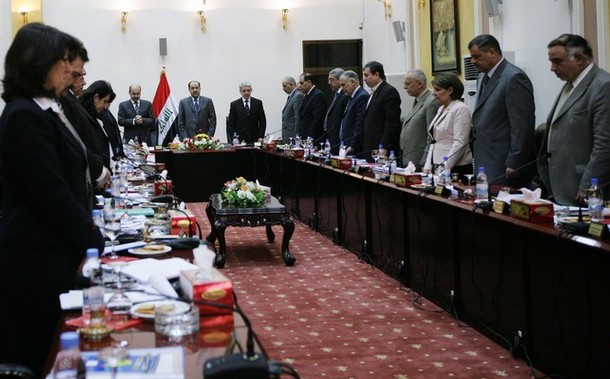
Iraqi Prime Minister Nuri al-Maliki (C) and Iraqi cabinet ministers, March 16, 2008 in Baghdad, Iraq. Photo: Getty Images.

Iraq’s cabinet rejects current draft of U.S. troop accord
By Leila Fadel / October 21, 2008

BAGHDAD — Shiite Muslim government ministers raised objections Tuesday to a “final draft” of an agreement to authorize U.S. troops to remain in Iraq, and after a four-and-a-half-hour cabinet meeting Iraq’s government spokesman said that the agreement wouldn’t be finalized in its current form.

The clock is ticking: The United Nations mandate under which U.S. troops are in Iraq expires on Dec. 31.

The agreement, which has been the subject of negotiations between the U.S. and Iraq for more than seven months, sets the end of 2011 as when U.S. troops are to be gone from Iraq.

However, Humam Hamoudi, the Shiite lawmaker who chairs the parliament’s foreign affairs committee, said that Shiite representatives found the wording on the U.S. troop departure too vague and subject to unacceptable conditions. Lawmakers also want to strike a clause that would give the Iraqi government the right to extend the agreement without parliamentary approval if it felt that was advisable.

Hamoudi said that Prime Minister Nouri al Maliki himself raised objections to the draft agreement. “The prime minister said ‘What (the Americans) have given with the right hand they have taken away with the left hand,’ ” Hamoudi said.

Government spokesman Ali al Dabbagh made it clear the current draft won’t be approved as written. “There are amendments that need to be made to the current draft in order to raise the agreement to a nationally acceptable level,” he said in a written statement after the meeting of the cabinet, which is formally known as the Council of Ministers.

It wasn’t clear what would happen next.

U.S. officials said they weren’t disposed to continue negotiating an agreement that was supposedly already in its final form and which U.S. officials have been circulating to members of Congress and talking up to the news media. If there’s no agreement when the U.N. mandate expires, however, U.S. troops would be in the country illegally and probably would be confined to their bases, Iraqi officials have said.

“There is great reluctance to engage further in the drafting process,” Defense Secretary Robert Gates told reporters at the Pentagon. “I don’t think you slam the door shut, but I would say it’s pretty far closed.”

Adm. Michael Mullen, the chairman of the Joint Chiefs of Staff, who was traveling in Latvia, warned that the Iraqi security forces can’t secure Iraq on their own.

“We have pushed this as the top priority for months now,” Mullen said. “It’s time for the Iraqis to make this decision.”

Maliki’s been publicly critical of the agreement since the start of the negotiations and has hinted numerous times that Iraq has the option not to sign the agreement or renew the U.N. mandate.

A senior Iraqi official, who asked not to be named because of the sensitivity of the topic, said he doubts Maliki would press for the agreement to be approved by parliament if his cabinet doesn’t agree to its terms. Maliki asked that officials submit their objections to the agreement in writing by Wednesday afternoon.

The cabinet is the second government group to object to the agreement. The country’s Political Council for National Security also couldn’t come to a decision. Both groups include representatives from nearly all Iraq’s political parties. Neither, however, includes followers of radical Shiite cleric Muqtada al Sadr, who wholly rejects the accord and has demanded that U.S. troops leave now.

“He genuinely understands that there needs to be an agreement,” the official said of Maliki. “But he feels that he has been passed a hot potato.”

According to an official who was present, Maliki made no effort to defend the agreement or to press for its approval during the hours-long cabinet session where minister after minister voiced objections to specific clauses. Only the Kurdish alliance endorsed the latest draft.

The agreement has changed significantly in the favor of the Iraqi government during the months-long negotiations, which Americans began by asking for hundreds of bases inside the country and immunity from Iraqi laws for both American troops and private security contractors.

Those requests were pared down. The current agreement calls for the Americans to leave Iraqi cities by June 30 and to be gone from the country by the end of 2011. American troops would be immune from prosecution by Iraqi authorities as long as they were on duty, but private contractors would be subject to Iraqi law.

(Nancy A. Youssef in Washington contributed to this article.)

Source / McClatchy

The Rag Blog

* SOFA = Status of Forces Agreement

Posted in RagBlog | Tagged , , , | Leave a comment

The Bailout Monster : Feed Me!


Just wait until next month, sucker.
By Roger Baker / The Rag Blog / October 22, 2008

See ‘Fed to Provide Up to $540 Billion to Aid Money Funds’ by Craig Torres and Christopher Condon, Below.

Dividing $540 billion by the US population of 300 million equals $1800 per capita for just this one bailout aimed to stop a run on money market funds. While you weren’t looking, your long term tax burden just got that much higher. But it is worth it to prevent “Great Depression II,” right? Just wait until next month, sucker.

The lenders to the capitalists (the investment bankers and hedge funds) are now drowning in an ocean of the bad debt and failing securitized derivatives they issued. The more fair weather credit deals that got done, the more profits that were made by everyone while the bubble economy was booming.

Paulson and Bernanke will swear to god that this latest money market bailout will be enough to stop a widening panic that might otherwise bring down the whole US economy, so we naturally agree. The federal reserve and treasury team can never run out of enough money to use to try to revive capitalism.

Note that we are really talking about generating and injecting enough strategic bailout dollars to overcome investor fear. But how many dollars might be required is not economics; its about psychology. Nobody can say whether it might not take a big enough dose of dollar liquidity to cause hyperinflation as the side effect of trying to restore investor confidence. The feds risk crippling the economy by adding either too much money or not enough, with stagflation a likely element leading to the final outcome.

Everyone familiar with finance knows that the banks don’t hold nearly enough ready cash or callable reserves to actually pay back all their lenders. Thus keeping lenders happy depends on using psychology to keep everyone from trying to take their money out and discovering it just isn’t there. All the bank may really is a bunch of increasingly bad long term loans that were based on a booming economy that likewise
isn’t there anymore.

Therefore, if everyone really did try to draw out their money all at once, they might have to wait a long time and even then might only get back fifty cents on the dollar. Deflationary psychology tends to feed on itself (look at Japan), much like the optimism of booms. Whatever the correct numbers on eventual payout, the feds will have to try to use financial manipulations that generally reduce and dilute the value of dollars to try to hide what is sooner or later going to be bad news.

Why bad news rather than even slow recovery? It takes ever more oil to keep expanding our oil-addictive global economy, but now oil is peaking. This fact alone is enough to ensure that a large part of current global investments will never earn the profits to pay back their loans.

Fed to Provide Up to $540 Billion to Aid Money Funds
By Craig Torres and Christopher Condon / October 21, 2008

The Federal Reserve will provide up to $540 billion in loans to help relieve pressure on money-market mutual funds beset by redemptions.

“Short-term debt markets have been under considerable strain in recent weeks” as it got tougher for funds to meet withdrawal requests, the Fed said today in a statement in Washington. A Fed official said that about $500 billion has flowed since August out of prime money-market funds, which with other money-market mutual funds control $3.45 trillion.

The initiative is the third government effort to aid the funds, which usually provide a key source of financing for banks and companies. The exodus of investors, sparked by losses following the bankruptcy of Lehman Brothers Holdings Inc., contributed to the freezing of credit that threatens to tip the economy into a prolonged recession.

“The problem was much worse than we thought,” Jim Bianco, president of Chicago-based Bianco Research LLC, said in a Bloomberg Television interview. Policy makers are trying to prevent ‘Great Depression II’ by stemming the financial industry’s contraction, he said.

JPMorgan Chase & Co. will run five special units that will buy up to $600 billion of certificates of deposit, bank notes and commercial paper with a remaining maturity of 90 days or less. The Fed will provide up to $540 billion, with the remaining $60 billion coming from commercial paper issued by the five units to the money-market funds selling their assets, central bank officials told reporters on a conference call.

‘Lot of Pressure’

“This will take a lot of pressure off the Fed and the Treasury,” David Glocke, head of taxable money market funds for Valley Forge, Pennsylvania-based Vanguard Group Inc. Glocke said he’ll be more willing to shift money he’s invested in U.S. Treasuries back into financial-sector commercial paper covered by the plan.

U.S. money-market mutual funds held more than 63 percent of outstanding unsecured commercial paper and 39 percent of asset- backed commercial paper at the beginning of September, according to Alex Roever, a New York-based analyst at JPMorgan.

Commercial paper, which typically matures in 270 days or less, is used by companies to finance payroll, rent and other daily expenses.

The new program is called the Money Market Investor Funding Facility, and officials said it’s intended as a backstop for money-market mutual funds to use as needed to meet redemptions.

Liquidity Buffer

Today’s action shows that two programs set up last month by the Fed and U.S. Treasury to help money-market funds haven’t stabilized the industry. A Fed official told reporters today that the funds don’t have much of a liquidity buffer remaining.

Last month, the Fed agreed to give loans to banks so they can buy asset-backed commercial paper from money funds. There was $122.8 billion of such loans outstanding as of Oct. 15. The Treasury separately used a $50 billion emergency pool to offer money funds guarantees against losses.

The central bank’s announcement today “is a big event,” BlackRock Inc. Chief Executive Officer Laurence Fink said during an earnings conference call with analysts and investors. “It is the first thawing.”

BlackRock and JPMorgan were members of the consortium of money managers that put together the plan and presented it to the Fed, people briefed on the matter said.

Money-market funds have been hurt by their inability to sell back at par the commercial paper they bought from banks and other issuers, Fed officials said.

The new program “should improve the liquidity position of money market investors,” the Fed said in its statement.

Special Units

Each of the five special units will buy assets from up to 10 separate bank and financial company issuers. The program may be expanded to include purchases from other money-market investors.

The special-purpose vehicles will finance 10 percent of their purchases by selling asset-backed commercial paper. That paper won’t be eligible for the Fed program that extends credit to banks to buy such assets, a central-bank official said.

The New York Fed will lend the remaining 90 percent to the facilities on an overnight basis at the discount rate, which stands at 1.75 percent.

Each special-purpose vehicle will only purchase debt with the top short-term ratings of A-1, F1 and P-1 given by Standard & Poor’s, Fitch Ratings and Moody’s Investors Service respectively.

The Fed said the facility will be in place until April 30 unless extended by the Board of Governors. Fed officials said they will announce a start date by the end of the week.

In addition to the three programs to aid money funds, the Fed next week will start an unlimited program to purchase commercial paper directly from issuers, after companies had to pay more to borrow or were cut off from that market.

Turmoil Worsened

Turmoil worsened among money-market funds after the bankruptcy of Lehman Brothers on Sept. 15, and the breakdown of the oldest money-market fund the following day.

The $62.5 billion Reserve Primary Fund announced Sept. 16 that losses on debt issued by Lehman had reduced its net assets to 97 cents a share, making it the first money fund in 14 years to break the buck, the term for falling below the $1 a share that investors pay.

Institutional investors have since pulled $341 billion from funds that can invest in corporate debt, or 28 percent of assets in those funds.

The Treasury responded to the initial run three days after the Reserve fund faltered by introducing the guarantee program. While that calmed investors, fund managers didn’t resume buying commercial paper because it can’t be sold quickly without realizing a loss.

“There have been very few or no bids at all” in the secondary market, Debbie Cunningham, head of taxable money funds for Pittsburgh-based Federated Investors Inc. Federated had $231.1 billion in money-market funds at the end of August.

“This is another important piece in the puzzle,” Cunningham said. “It will be very helpful in bringing more normal market tendencies back for investors.”

Source / Bloomberg

The Rag Blog

Posted in Rag Bloggers | Tagged , , , , , | 1 Comment

Karl Rove: Still a Criminal, No Matter How Many Times He Escapes

Embedded video from CNN Video
Protester Tries to Handcuff Karl Rove
October 22, 2008

SAN FRANCISCO – An anti-war protester confronted former Bush administration aide Karl Rove while he spoke at a San Francisco mortgage bankers’ meeting.

A statement by the group Code Pink identified the woman as 58-year-old Janine Boneparth, who tried to handcuff Rove in what she called a citizen’s arrest for “treason.”

Rove, who was speaking Tuesday at the Mortgage Bankers Association’s annual convention, elbowed Boneparth away as she was escorted off the stage.

In total, five Code Pink members were removed from the hall during Rove’s appearance. The organization says none of the five women were charged.

Source / AP / America On Line

The Rag Blog

Posted in RagBlog | Tagged , | Leave a comment

Kate Braun: Samhain Seasonal Message


Tarot by Kate: Samhain Seasonal Message
By Kate Braun / The Rag Blog / October 22, 2008

“Yippie -i-yay, yippie-i-oh; Ghost Riders In The Sky

Friday, October 31, 2008 is Samhain, Halloween, 3rd Harvest, All Hallows Eve. Lady Moon is in her first quarter, in Sagittarius, presenting a waxing presence on Freya’s day. This celebration is a fire festival, calling for bonfires, backyard bar-be-cues, fragrant wood burning cozily in a fireplace or chiminea. If possible, I urge you to celebrate outdoors.

In addition to black and orange, colors associated with this festival are red, brown, and golden yellow. You (and your guests) may choose to wear these colors and they may also be used in your decorating scheme. Altar candles should be black, orange, white, silver, and gold. Any or all of these colors of candles will enhance your evening. Other decorations may include: pumpkins, gourds, cornstalks, cauldrons, apples, pomegranates, black cats, and brooms.

Plan your menu to include pumpkin, apples, mulled wines, and beef, pork, or poultry. Nuts, turnips, squash, beets, corn, gourds, and cider are also favorites to consider. Carving pumpkins into jack-o-lanterns is a popular activity, but originally it was turnips that were carved; the hollowed-out turnip with openings on the sides was used as a lantern while out after dark. The carrying of this turnip-lantern symbolized Lord Sun in the womb waiting to be born; the pumpkins we carve and illuminate from within also serve this purpose.

Samhain marks the beginning of a spiritual year, marking the onset of a time of transformation and growth of the soul while in a type of hibernation during the “time of no time” that exists between Samhain and Yule. Just as gestation of the body occurs in the womb’s dark warmth, so does the soul require a time to rest, reflect, and grow. This is a time when the veil between the worlds is thin, and many of the activities enjoyed at this time relate to divination. If you live near to or have access to a boundary stream (one that separates property owned by different people), you may perform this ritual: go to the boundary stream and, with closed eyes, take from the water 3 stones using your middle finger and thumb, saying as each is chosen: “I will lift the stone as Mary lifted it for her Son, For substance, virtue, and strength; May this stone be in my hand till I reach my journey‘s end.” Carry the stones home carefully and place them under your pillow. That night, ask for a dream that will give you guidance or a solution to a problem, and the stones will bring it to you.

Include time in your celebration to sit around the fire and tell stories from your past. Share family lore, recount the tales told to you by your grandmother. This is a time of honoring the past with such remembrances; they become more meaningful with each year’s repetition.

There are many, many activities that can be enjoyed at Samhain. A few are: bobbing for apples, scrying, making a Dumb Supper, candle divination, stone divination. One easy ritual for prosperity for the coming year is to throw the bones from your dinner into the bonfire (originally “bone-fire) to ensure healthy and plentiful lovestock in the year to come. In the morning, when the ashes are cool, spread them over your garden to bless the land.

Through food and activities we set the stage for this gestative growth; while many are fun to do and will engender laughter, the purpose is serious. Enjoy your party, but do not lose sight of the lessons.

Tarot by Kate 512-454-2293
www.tarotbykate.bigstep.com
kate_braun2000@yahoo.com

The Rag Blog

Posted in Rag Bloggers | Tagged , , , | 1 Comment

Corporate Contrition Is an Outdated Concept?

Members of the activist group ‘Code Pink’ waved signs marked with the words “shame” and “greed” when Richard S. Fuld Jr., CEO of now-bankrupt Lehman Brothers, arrived to testify before the U.S. House Oversight and Government Reform Committee on Oct. 6. Photo: Karen Bleier, AFP / Getty Images

Why CEOs Don’t Say ‘Sorry’ Anymore
By Del Jones / October 21, 2008

Elected officials in the past have said “I’m sorry” for everything from marital affairs to cross-dressing to corruption, and CEOs tossed around apologies like horseshoes at the company picnic.

Not anymore. As the world comes to grips with the biggest financial crisis in seven decades, the mea culpa machine has ground to a halt. Apologies, encouraged in recent years by the crisis-management industry, have dried up – even apologies deployed as a business or political strategy.

Legal concerns weigh heavily on any words that might be construed as an admission of guilt. But also weighing heavily is the silence from politicians, regulators and past and present CEOs at Fannie Mae, Freddie Mac, AIG, Bear Stearns, Countrywide Financial, Merrill Lynch and Washington Mutual. It’s been clear for weeks that the financial crisis has dammed the free flow of credit. But with each passing day, it’s also appears that the crisis has likewise dammed the free flow of taking responsibility.

When Lehman Bros. CEO Richard Fuld testified on Capitol Hill this month, members of Congress grilled him to own up. Fuld said he takes full responsibility for his decisions, that he “felt horrible about it,” but that the largest bankruptcy in history was due to circumstances beyond his control. Likewise, a trio of former AIG chief executives – Hank Greenberg, Martin Sullivan and Robert Willumstad – deflected blame in oral and written testimony to Congress.

Finger-pointers in Congress have found cover in public opinion polls that show most people blame CEOs for the crisis. But there is blame to go around, with Democrats choosing to ignore warnings about the possible implosion of Fannie Mae and Freddie Mac and Republicans supporting less regulation, says Harvard leadership expert Barbara Kellerman, who wrote a 2006 article in the Harvard Business Review titled, “When Should a Leader Apologize – and When Not?”

The absence of apologies has fed widespread outrage. Even CEOs in other industries are upset that they must now negotiate their companies through what appears to be an inevitable recession. While few CEOs in the USA have been outwardly critical of their counterparts in the financial sector, the founder and chairman emeritus of Kyocera, an electronics giant in Japan – where there is a culture of admitting mistakes – says what others may be thinking. CEOs who had a hand in the mess “should acknowledge their role and apologize, unreservedly, to their shareholders, stakeholders and the U.S. taxpayers,” Kazuo Inamori told USA TODAY through an interpreter. “They should sincerely reflect on their own management methods. They were too preoccupied with their own desires. They should acknowledge their own faults and, yes, apologize.”

However, no one in the U.S. believes they can get to the top by falling on their swords, says Dan McGinn, CEO of TMG Strategies, a public relations firm that counsels companies on threats to their reputations. McGinn says his personal belief is that there is more room for humility and honesty than most executives realize, and that the public hungers for candor and authenticity. Apologies, McGinn says, are wrongly perceived as a sign of weakness.

Yet, in the years before the crisis, apologies had become common, almost a sport, and examples can be found on YouTube from everyone from Don Imus to Jesse Jackson to Mel Gibson to Seinfeld’s Michael Richards, to Jim Cramer of CNBC’s Mad Money. Lawyers recommend against admitting wrongdoing, but companies had come to discount that advice to save reputations and get past bad news. In 2004, professors from the University of Michigan and Stanford University found that companies that accepted blame for poor performance in annual reports were more likely to outperform the market the following year.

Companies have found that heart-felt apologies can decrease the likelihood of lawsuits if they’re well crafted and don’t come off as “Sorry I got caught,” but express regret, assume responsibility and map out a plan to avoid repeating the offense, says Leslie Gaines-Ross, chief reputation strategist at public relations firm Weber Shandwick and a longtime student of apologies in crisis management.

Great apologies of the past

Past corporate apologies have come from JetBlue, Amazon, Nielsen, Seagate Technology, Sun Microsystems, Southwest Airlines, Texaco, Procter & Gamble, United Airlines, Ford Motor, Toshiba, Merck, Mattel, Taco Bell and Nike. Even Hank Paulson, now Treasury secretary and a key player in the global attempt at economic resuscitation, apologized to employees in 2003 when he was CEO of Goldman Sachs for implying that most of them were irrelevant to the firm’s success.

Steve Jobs issued an apology when Apple sold iPhones to its most eager customers for $599, then slashed the price two months later to $399. Whole Foods CEO John Mackey apologized for writing anonymous posts on financial message boards. Steve Hughes, the former CEO of tea-maker Celestial Seasonings, once wrote a letter of apology in the Boulder, Colo., Daily Camera for poisoning prairie dogs on company property.

Those may have seemed like bad deeds at the time, but they pale compared with the pink slips about to be distributed as a result of the credit crunch. The clock can’t be turned back, but a few sincere “I deeply regrets,” would help shift focus from what has happened to what needs to happen next, Gaines-Ross says. A 2006 Weber Shandwick study found that apologies had become so commonplace that their ability to allay public concern may be eroding. Even so, “CEOs should realize that an apology is not a sign of weakness, but an act of strength,” Gaines-Ross says.

Not sorry, and proud of it

Golden Gate University psychologist Kit Yarrow says both CEOs and elected officials operate in dog-eat-dog worlds where strength is rewarded and those with self doubt and regret don’t make it to the top. “It’s entirely possible that these individuals haven’t internalized that they’ve made mistakes and therefore, don’t feel responsible,” Yarrow says. “Many of the folks involved have trained themselves to avoid introspection and second-guessing. It gives you a thick skin and a sense of superiority that shields you from caring what people think of you. And if you don’t care what people think, you certainly wouldn’t feel the need to apologize.”

Other dynamics may be at play. The magnitude of the crisis has leaders frightened into taking the Martha Stewart/Pete Rose path of stubborn denial, which may have helped put one in prison and blocked the other from baseball’s Hall of Fame. The bigger the injury, the longer the wait. By the time Bridgestone CEO Masatoshi Ono apologized to the Senate Commerce Committee in 2000 for faulty tires, four years had passed since the problem first appeared and the Bridgestone/Firestone incident had become a case study in how not to handle a crisis. Ono retired shortly afterward. In 1995, Helge Wehmeier, then CEO of Bayer U.S., expressed deep regret on behalf of Bayer’s original parent company, I.G. Farbenindustrie, for its having been complicit in the Holocaust. Ten years later, then-CEO of Wachovia Ken Thompson apologized that two companies the bank acquired had owned slaves.

A key reason for the sudden lack of apologies may be that there is so much cover afforded. The financial problem is complex, and culprits abound, Kellerman says.

“When the waters are this muddy, it’s difficult to assign blame,” Kellerman says. She calls such cover “the blessing of many hands,” saying it allows those people and institutions responsible to hide, or even go on the offense and blame others.

“Individuals can ultimately convince themselves that they did what anyone would do in the same situation,” Yarrow says. “With so many players, it’s easy to shift blame. Under stress, the mind finds ways to protect itself from truths that can damage a positive self-image.”

Silence is golden during litigation

The strongest argument for silence may be the courtroom. Grand jury investigations have begun, Fuld and other executives have received subpoenas, and the standard advice of criminal defense lawyers is to say nothing, says Columbia law professor John Coffee. “Everyone remembers that six months after the fall of Enron and WorldCom, indictments began to come down, and it rained indictments for the next year,” he says. “Those who accept responsibility might become the lightning rod that attracts the first bolt of lightning from the prosecutors.”

“After two decades of class-action litigation, most general counsels will caution their CEOs against apologizing until the facts are thoroughly investigated and liabilities are determined,” McGinn says. “This is in conflict, of course, with the expectations of the media and the public.”

There is also a fresh crop of leaders running companies most often implicated in the crisis, which has so far allowed old leaders to step into the shadows. Edward Liddy replaced Willumstad at AIG, Herbert Allison replaced Dan Mudd at Fannie Mae, and David Moffett replaced Richard Syron at Freddie Mac, all last month. “Time is running out for apologies to be effective,” Gaines-Ross says. “If a few CEOs act contrite and take action, shareholders might breathe a sigh of relief and move on.”

Wrongdoers will have cover only for so long, and some CEOs and politicians eventually will be identified as key culprits, Kellerman says. She predicts they will likely be exposed by shareholder activists and Internet bloggers. Few hold hope of apologies from elected officials, who don’t have to protect the viability of a company and have only their own personal reputations to defend. Congressional apologies often require smoking guns and more often involve sexual scandal than acts of public harm. In Congress, harmful actions are blamed on others, Gaines-Ross says.

“It’s hard for most of us to imagine how someone could be responsible for such damage and loss to others and not feel an urgent need to apologize,” psychologist Yarrow says. “Obviously some of those investment bankers and politicians aren’t like the rest of us.”

“I think that the heavens, or natural common wisdom, may be suggesting that we try to live more down-to-earth and honest lives, ” says Kyocera’s Inamori, who is a Zen Buddhist priest. He says profit is society’s reward for serving its interests.

“In order to restore and revitalize capitalism, it is crucial that business executives regain this attitude,” Inamori says.

Copyright 2008 USA TODAY

Source / America On Line

The Rag Blog

Posted in RagBlog | Tagged , , | Leave a comment

Welcome to the United States of Christianity


And the walls come tumbling down.
By Jeff Schweitzer / October 21, 2008

The last crumbling stones supporting the weakened wall separating Church and State have tumbled to ground. The Bush Administration no longer even pretends to honor the primary founding principle of our country. Religion has dominated Bush’s domestic and foreign policies from the start, but now Christianity has become a functioning arm of the federal government.

Bush has determined that he is above secular law, answerable only to god. We learn in a recently-disclosed memorandum, issued by the Department of Justice in 2007 but hidden until now, that King W declared himself able to bypass laws that forbid the use of taxpayer dollars to support religious groups hiring only like-minded faithful. Contemplate for a moment the significance and arrogance of that disdain for the rule of law. In subverting this particular bit of legislation, Bush has removed the last vestiges of secularism from our government. Despite the best efforts of our Founding Fathers, the United States is now officially a Christian Nation.

The memorandum granting Bush these extraordinary powers to topple our Constitution has a bad odor and sour taste but good pedigree in Bush’s long war on reason. In a perverted twist of logic, the memo concludes absurdly that even federal programs clearly covered by anti-discrimination laws can fund groups that blatantly discriminate against those who share a different faith. Giving taxpayer dollars to one sect that allows no non-sect members into the club is establishing religion. The First Amendment explicitly and precisely prohibits such acts. But to Bush the Constitution is nothing but old parchment to be ignored at will, whenever convenient.

Listen to the sick arguments made in defense of a deep intrusion of religion into government. Bush granted $1.5 million to World Vision, a group that has an open policy of hiring only fellow Christians. The money comes from a Justice Department program that prohibits the use of funds for any group that uses discriminatory hiring practices. Immediately that would disqualify World Vision from this DOJ pot of tax dollars. Well, then, how did Bush fund World Vision when clearly prohibited by law from doing so? The Justice Department invoked a 1993 law, the Religious Freedom Restoration Act, which allows for some exceptions to anti-discrimination legislation if a federal statute would create a substantial barrier to the free exercise of religion. In other words, Bush argued that by not giving $1.5 million to World Vision, the federal government would create a “substantial burden” on that organization’s right to practice its religion. Only with complete surrender to faith, and by cutting all ties to logic, could that argument be made palatable. The bizarre conclusion is that the lack of federal dollars itself creates a burden to religious practice.

Bush has inverted the idea of separating Church and State. The default position now is that Church and State are one and the same, and that the two shall be separate only under extraordinary circumstances. Taxpayers must now fund discriminating religious organizations as a normal function of government. If we do not send our money to these organizations, we are preventing them from practicing their religion. By this perversion of our Constitution, anything less than open funding for religion would prohibit the free exercise thereof, destroying the words and meaning of the First Amendment.

Let us be clear about the ramifications here. The pillars on which this amazing country was built have been shaken by a powerful earthquake of anti-secularism. We are becoming ever more like the theocracies of the Middle East we claim to disdain. The logic, impetus, and drive to form these United States into a functioning union are now under attack. We should all tremble in fear as the ground shifts beneath us. Be afraid. Be very afraid for the future of our country. Iran is not a good model for us to follow.

Source / The Huffington Post

The Rag Blog

Posted in RagBlog | Tagged , , , | 1 Comment

Know Your Candidates and Their Endorsements

I agonised about posting this article, but I feel it is important to relate the facts without bias. There is another article below from McClatchy that suggests that the endorsement from Powell is not just an average endorsement. This is an important issue.

Richard Jehn / The Rag Blog


The Bagman Cometh: Obama Embraces War Criminal’s Endorsement
By Chris Floyd / October 20, 2008

Come, let’s away to prison:
We two alone will sing like birds i’ the cage:
When thou dost ask me blessing, I’ll kneel down,
And ask of thee forgiveness: so we’ll live,
And pray, and sing, and tell old tales, and laugh
At gilded butterflies, and hear poor rogues
Talk of court news; and we’ll talk with them too,
Who loses and who wins; who’s in, who’s out;
And take upon’s the mystery of things,
As if we were God’s spies: and we’ll wear out,
In a wall’d prison, packs and sects of great ones,
That ebb and flow by the moon.

I.

Democratic Party circles are in raptures over Colin Powell’s endorsement of Barack Obama. One can see the heavily-blinkered logic behind their elation; now that our national politics has been reduced to a petty squabble over spoils among shifting factions in the imperial court, a nod from a consummate courtier like Powell is indeed a glittering prize for an ambitious prince.

But out in the real world, where the operations of imperial power have left smoking trails of murder and ruin across the globe, the “endorsement” of a man who played an indispensable role in the slaughter of more than a million innocent people in a war of Hitlerian aggression should be regarded as a thing of shame, and vociferously rejected by anyone with a scintilla of honor or morality.

In fact, it is not too much of a stretch to say that Colin Powell is more responsible for the mass murder spree in Iraq than any other person except George W. Bush, who gave the actual order for the hit. For it was Powell who “made the sale” for the Bush Faction’s deceitful warmongering campaign, with his infamous February 2003 presentation to the UN, laying out the false evidence about Iraq’s non-existent weapons of mass destruction. After that farrago of artfully delivered lies, the American Establishment – urged on by the fawning, bloodthirsty commentariat – lined up solidly behind the war. After all, if Colin Powell – so “reasonable,” so “honorable,” so “honest” and “bipartisan” – stood foursquare behind the Bush case for war, then it must be ironclad.

This was, again, the logic of courtiers, with little connection to reality. Powell’s reputation as a wise, moderate, impartial statesman – the very thing that made him the most effective shill for the war crime in Iraq – was itself almost entirely a fiction. By the time he made his shameless UN appearance, Powell had already spent almost four decades as a bagman – and frontman – for some of the most vicious and ugly elements in American politics and government. From the My Lai massacre to Iran-Contra, from Washington’s long and murderous collusion with Saddam to its long and murderous campaigns to remove him, Powell has been instrumental in perpetrating or covering up atrocities and abominations on a gigantic scale. [For details, see Robert Parry’s investigation, “The Truth About Colin Powell.”]

Since his departure from the Administration – after staying on long enough to see Bush reconfirmed in power – Powell and his legion of apologists have peddled the myth that he was “stabbed in the back” in his UN presentation: given a false bill of goods with assurances they were true, misled and manipulated by incompetent intelligence analysts and Machiavellian White House insiders, etc., etc. Such stories may help Powell sleep better at night, and they have certainly helped rehabilitate his fictional reputation to the extent that his endorsement is once more considered a worthy prize. But they suffer from one small defect: they are blatantly false.

Powell knew – knew beyond a shadow of a doubt – that he was offering rank lies, cooked intelligence and dubious assertion to the world at his UN presentation before the war. Earlier this year, Jonathan Schwarz provided a devastating demolition of Powell’s UN testimony, showing how it was belied at almost every point by the actual intelligence reports – which Powell had read before the presentation. Powell knew the case for war against Iraq was riddled with holes – holes patched with outright fabrications and the knowing manipulation of data. He presented it anyway; he made the sale. And a million innocent human beings have die for it.

II.

But Powell was selling aggression against Iraq long before his UN fan-dance in February 2003. In fact, he was the mouthpiece that the Administration used in May 2002 – even before the White House began to “roll out the product” of a concentrated warmongering campaign – to signal Washington’s firm intent to invade Iraq even if UN inspectors went into the country and found no weapons of mass destruction. The cat of war crime was out of the bag – and out in open – in the spring of 2002, and it was Powell who untied the strings.

Here’s what I wrote on May 17, 2002, in The Moscow Times:

Quietly, without fanfare, in a bland statement issued by its most “moderate” front man, the Bush Regime crossed another moral Rubicon last week, carrying the once-great republic they have usurped deeper into the blood-soaked mire of international criminality.

The move – committing the United States of America to a policy of Hitlerian military aggression – was little noted at the time. A quick soundbite, maybe, on a couple of the more wonky TV news shows; a brief quote buried somewhere in the thick gray sludge of the “serious” papers. The Regime guaranteed its poison pill would go down sugarcoated by picking Secretary of State Colin Powell as its mouthpiece.

It was a masterstroke of propaganda, really. The former general has long been regarded by the “serious” media on both sides of the Atlantic as a “moderate” maverick on Bush’s hard-right team. Liberal commentators praise Powell as a “restraining influence” on more bellicose insiders like Cheney and Rumsfeld, and a wise, guiding hand for a president unschooled in the subtleties of world diplomacy.

It’s all a sham, of course. Powell is nothing more than a lifelong bagman for powerful interests. His willingness to play ball, to look the other way, has made him a convenient tool for the some of the most violent and undemocratic forces ever to pollute American society.

His first job on the Inside was an attempted whitewash of the My Lai massacre in Vietnam; it didn’t quite work, but he won points for his obfuscatory efforts and went on to a plum job in the crime-ridden Nixon White House. Then came Iran-Contra, the criminal conspiracy of drug-running and terrorism operated directly out of the Reagan-Bush White House. Powell illicitly sent missiles to the terrorist regime of Ayatollah Khomeini, then helped with the ensuing cover-up. For this service, he was made head of the entire U.S. military.

He then directed the illegal American aggression against Panama, when President George H.W. Bush killed hundreds, perhaps thousands of innocent civilians in a hissy fit against his old CIA employee Manuel Noriega. Powell, like Bush, had long known Noriega was a murderous drug dealer, but they found him useful, and plied him with plaudits and cash – until Bush needed to prove his tough-guy cojones to Reaganite critics in the Republican Party….

So what better man to announce George W. Bush’s adoption of Adolf Hitler’s moral code? Powell sat down with the media sycophants on ABC’s “This Week” and calmly – moderately – laid out the new doctrine. The subject, of course, was Iraq. The UN was working on a deal that would allow international inspectors back into the country to verify that Saddam Hussein no longer possessed weapons of mass destruction.

These inspections were vital because, as George W. never ceases to remind us, Saddam Hussein is so evil that he “gassed his own people.” …But Junior always omits the inconvenient fact that one year [the attack], Daddy Bush signed an executive order mandating closer U.S. ties to Saddam’s regime. Daddy Bush showered Saddam with endless financial credits and mountains of “dual-use technology” – which the dictator duly used to develop his WMDs – right up until the day before Iraq’s invasion of Kuwait. Needless to say, Powell, as head of Daddy’s military, was complicit in this lunatic operation and raised no demur, “moderate” or otherwise.

Flash forward to the present day. Junior Bush is now in the White House. For months, he has threatened military action against Iraq if Hussein fails to verify the destruction of his WMD capacity. (At the same time, of course, Junior undercuts international treaties that would require monitoring of his own biochemical warfare facilities. There’s a good reason for that: the Regime is now preparing to develop offensive biochemical weapons, in contravention of international and U.S. law, the Village Voice reports.)

The world braces for another conflagration in the Mesopotamian sands. But then Saddam blinks. He starts talking with the UN. He renounces aggression. He tries to make up with Kuwait. Sooner or later, the inspectors will go back in – no cause for war now, right?

Wrong, Powell told the sycophants last week. The “moderate” secretary said that even if UN inspectors go in and verify compliance, the Bush Regime still “reserves its options” to do anything necessary, including military invasion, to effect a “regime change.” Bush himself has already acknowledged that nuclear force is among those “options.”

So there it is. The United States now openly claims the right to launch an all-out attack on any nation in the world whose regime it doesn’t like – even if that nation is not engaged in active military aggression or terrorism – and even if the mere threat of aggression has been defused by UN monitoring.

No provocation necessary. No legality required. Just a thuggish elite raining death on the world, for profit and power, sowing hatred for the once-great nation they have hijacked – and ensuring more death and terror for its people.

This then is the bloodstained hand that Barack Obama has clasped so warmly, so triumphantly, on his march to power. As for Powell, he has proven himself once more the ultimate courtier. In the latest intramural tussle in the imperial court, his keen and practiced eye has picked out the coming man – and so he has jettisoned the faction he has served for so long, and latched on to the winning side yet again. (As he did previously for a while with Bill Clinton.) And why not? Powell has always been a faithful servant of America’s militarist empire – no matter who its temporary manager might be.

Chris Floyd is the author of Empire Burlesque: The Secret History of the Bush Regime.

Source / Information Clearing House

Source / McClatchy

The Rag Blog

Posted in RagBlog | Tagged , , | 3 Comments

High, High Hopes : Turning Houston Blue

Larry Joe Doherty, Congressional candidate from Houston, maps out a strategy. Photos by Dave Mann.

Can the Democrats sweep Houston? (Maybe. But don’t hold your breath…)
By Dave Mann

This article appears in the Oct. 17, 2008, issue of The Texas Observer.

You normally don’t think of Houston as a bastion of Democratic Party politics. For years the city has been dominated by the oil industry and the GOP—they’ve often seemed one and the same. Houston gave us George H.W. Bush, Tom DeLay and Lt. Gov. David Dewhurst, and some of the nation’s most prolific Republican campaign donors call the city home.

Democrats are hoping to overcome that profile. They’re pouring tons of money into a campaign to transform the Houston area into a Democratic stronghold they hope will help swing future state and national elections. Their goals aren’t small. Many within the party believe Houston is the key not only to recapturing Texas for Democrats but also to putting the state back in play in presidential elections. All of which makes Houston one of the most important battlegrounds in the country this year.

That may sound grandiose, but to understand the Democrats’ strategy, you have to consider that Houston is essentially its own swing state within Texas. Harris County, which encompasses the city and its suburbs, is home to 3.9 million people, outnumbering the populations of 23 states, and is roughly the same population as Oregon. Now consider that Harris County—in theory, at least—is already Democratic. Surveys and polls repeatedly show that more of its eligible voters identify with Democrats. It’s just that many of those people don’t vote. Moreover, the area is growing. Subdivisions are sprouting at the city’s edge like weeds. The people moving in are mostly Democrats. Harris County is undergoing a demographic shift that will soon put Anglos in the minority.

Practically speaking, a Democrat can’t win a statewide race in Texas without carrying Harris County. If the party can increase its turnout just enough in this presidential year to turn Harris County blue, Democrats will control five of the state’s largest counties and could become competitive again in races for governor, lieutenant governor, and U.S. Senate. Democrats are feeling the urgency to capture a statewide race and at least one chamber of the Texas Legislature by 2010 to gain a say in the next round of legislative and congressional redistricting.

But Houston’s size and shifting demographics have local Democrats dreaming well beyond the Governor’s Mansion. They talk of a day when Houston could be for Texas what Philadelphia has been for Pennsylvania—a metro area that votes so overwhelmingly Democratic it provides a large enough advantage to deliver the state almost by itself. (In the 2004 election, Philadelphia handed Democrats a 400,000-vote edge in the state’s largest population center—a margin Republican areas of Pennsylvania couldn’t surmount.)

Big Hopes in Big H: Gerry Birnberg is chairman of the Harris County Democratic Party.

Harris County Democratic Party Chair Gerry Birnberg points out that if big margins in Houston could help a Democratic presidential candidate capture Texas, the Electoral College map would shift decisively. He says New York and California likely will vote Democratic for a generation. “If you can start a presidential cycle with California, New York and Texas already in your column, there is not an electoral map you can draw that a Republican candidate can win,” Birnberg says. “Harris County is ground zero. We don’t get there without Harris County.”

Democrats have never lacked for grandiose plans. Execution is usually the problem. In the here and now, Harris County Republicans still hold every county office and every district judge position. The GOP has carried Harris County in every presidential election since 1964.

For the past two years, though, local Democrats have worked toward flipping Harris County in 2008. They’ve recruited more candidates than ever before, raised money specifically for the effort, and designed a comprehensive campaign that coordinates the state and county party apparatuses with candidates on advertising, voter registration, and get-out-the-vote operations.

At the same time, circumstances seem to have conspired to favor Democratic gains. Corruption scandals engulfed a county commissioner, the county judge, the sheriff, and the district attorney (who eventually had to resign)—Republicans all.

And in March, the Democratic presidential primary ignited unprecedented voter interest and turnout, which seem likely to carry over into the general election.

It all seemed like the proverbial perfect storm to sink Houston Republicans in 2008—that is, until a very real storm arrived September 12. Hurricane Ike devastated the area, knocking out electricity for nearly three weeks in some neighborhoods. The storm and its aftermath precluded weeks of campaigning and voter registration, a period when no one, including campaign staff, was thinking about politics—the sort of interruption that typically benefits an incumbent.

If Democrats don’t sweep Harris County this year, it might take a while. In 2010, statewide campaigns for governor, lieutenant governor and perhaps U.S. Senate may suck up much of the Democratic campaign money in the state, and Barack Obama won’t be at the top of the ballot to bolster turnout. Ike or no Ike, Harris County’s Democrats think this is their year.

For inspiration, Houston Democrats need only look north to Dallas County, where Republicans also dominated local politics, at least until 2006, when Democrats swept every administrative and judicial office in the county. Although the area had been trending Democratic, the GOP was somehow caught off-guard, and the rout stunned Republican strategists statewide. Strategists in both parties realized immediately where the next battleground would be.

The GOP retained control in Harris County two years ago, but the margin was already shrinking. Democrats won 48.5 percent of the countywide vote in 2006, an increase from previous years. “They were competitive, but they all lost,” says Richard Murray, political scientist at the University of Houston.

For Gerry Birnberg, the improved 2006 showing was an important first step. A lawyer by trade, he’s been involved in county politics since the early 1970s. Back then, Houston was so thoroughly Democratic that some political operatives didn’t even want to admit to working for Republicans. The first case Birnberg argued before the U.S. Supreme Court involved printers who feared that if they put their names on Republican political mailers—as state disclosure laws required—their careers would be finished.

Read all of it here.

Source / The Texas Observer

The Rag Blog

Posted in RagBlog | Tagged , , , , , | Leave a comment

McCain on Iraq : Ignorant and Contradictory

Republican presidential candidate Sen. John McCain, tells a crowd in Columbus, Ohio on May 15, 2008, that the Iraq War can still be “won.” Photo by AP.

A Confused McCain Lunges About on Iraq and the Occupation
By Sherman De Brosse / The Rag Blog / October 21, 2008

This is the third in a series by Rag Blog contributor Sherman De Brosse, a retired history professor, on John McCain, his shady involvements, past and present, and his wrong-headed and ill-informed political positions.

John McCain was in Iraq, seemed confused, and Joseph Lieberman had to lean over and prompt him. Iraq is a complicated situation, so it was easy to misspeak, and we overlooked the matter. Now he is confused about what job General Petraeus has and is talking about the Iraq/Pakistan border. He has repeatedly said that Al Qaeda operatives in Iraq were trained in Iran; although, there is no evidence to prove this. Indeed, Al Qaeda people are Sunni and would be uncomfortable in Shiite Iran. Moreover, McCain must not have known that Iran is still holding one of Osama’s eleven sons under house arrest.

The problem has become that Senator McCain misspeaks so often on this subject and contradicts himself (flip-flops?) so frequently that it has become a troubling pattern. His pronouncements on the Iraq war are so frequently simplistic and uninformed that they call into serious questions his claims about foreign policy expertise.

Just before the invasion, he put on his military expert hat, and said, “I have no qualms about our strategic plans.” It would be a quick victory and another glorious chapter in United States military history.

The ”expert” Mc Cain now brags about criticizing and rejecting Secretary of Defense Donald Rumsfeld. The fact is that it took McCain 18 months to reach that conclusion. All that time and beyond, he said George W. Bush was doing just fine. True, he did call for an increase in troop level all along.

He thought then and still believes that the Iraq War could be won if more troops on the ground increased the level of physical security. That seems to be his definition of “victory.” Even many with stars on their shoulders claim victory must be defined as a political settlement that brings peace and reconciliation between the different factions in Iraq. That has not come about, and McCain has never explained how he would accomplish this. Barack Obama has always defined victory in these terms; and he has set the standard for the defense of the surge in the same way. McCain does not seem to see any relationship between a good political settlement and victory. So maybe his criticisms of Barack Obama on the success of the surge are honest and not some cheap political slight of hand.

McCain also claims too much credit for the surge, itself — the introduction of more troops. Things have improved on the streets because David Petraeus started putting troops in the neighborhoods. He had long advocated this but had been restrained from doing so. In claiming too much for the surge, McCain slights Petraeus and indirectly claims too much credit for himself.

Maybe McSame reaches the conclusion that the Iraq insurgence and war will be imposed on the ground by military force because he sees this through the prism of a foreign policy fundamentalist—good v. evil. Simple as that.

For quite a while, he was warning that the Shiites could take over Iraq. He sang this odd song long after the Bush Administration had decided to ally with the pro-Iran Shiites. One wonders if he knew that Shiites and the Sunni Al Queda do not get along over a significant period of time.

Of late, he sounds the alarm that Al Qaeda could take over. Al Qaeda was never more than a tiny presence there. We and some of the Sunni states in the region touted Abu Musab al-Zarqawi as a powerful Al Qaeda leader, even though he did not get along with Osama bin Laden. Since the Jordanian intelligence killed Zarqawi, his small organization in Ramadi has collapsed and other wannabe Al Qaeda leaders cannot even be found there.

Still McCain droned on about Al Qaeda in Iraq and how Iraq is the center of the War on Terrorism. In an interview with Bill Bennett, he said of Al Qaeda, “These guys want to follow us home… It is not Iraq they are after, my friend. It is us.” His insistence on that central role of Al Qaeda in Iraq suggests that he might still think that Iraq was somehow behind 9/11.

In February he again warned that the Al Qaeda could take over Iraq. Al Qaeda had only appealed to a tiny segment in the radical religious element among the Sunnis.

And now almost no one identifies himself as Al Qaeda. An aid, who must have understood a little more, tried to explain the claim by saying the Senator meant that Sunni extremists might create a small state there. Of course, the Shiite majority would destroy it and would even have the help of Jordan and the Kurds, neither of whom can brook Sunni religious extremists.

Lately, McCain has been claiming that the surge made possible the “Anbar awakening” — the decision of some sheiks to come over as US allies. The problem was that the “Anbar awakening” occurred four months before the Surge began. McCain insisted to Katie Couric that his position was an historical fact and CBS cut that segment rather than air footage that would embarrass McCain. That occurred the same day that his campaign distributed information that the media was overwhelmingly in support of Obama.

He has also bragged how the Surge has protected those sheiks even though their leader, Abddul Sattar Abu Riisha was murdered in September, 2007, during the surge.

Months ago, 141 members of the Iraqi parliament voted that the US should establish a timeline for withdrawal. Now Prime Minister al-Maliki has all but endorsed Obama’s 16 month time frame, and the Bush administration might be moving closer to that position.

One wonders if Mc Cain can find a way to get in line with these new developments. Perhaps, since he has been able to take positions that are completely inconsistent with the facts in Iraq. He may well get away with flip flopping, clinging to historical inaccuracies, and a policy that does not really define victory. Most people do not know much about Iraq and there is no evidence that the corporate media will call him on flip flopping or misinformation, There is widespread opposition to the war, but it is pretty thin. Current polling information suggests that McCain may not have to pay for Republican mistakes in Iraq so long as casualties there remain relatively low.

McCain put the Iraq question on ice by repeating his angry assertion that Obama will not recognize the Surge was a success. He probably is not confused — simply dishonest — when he overlooks the fact that the Sunni chieftains allied with the United States — the so-called “awakening” — before the Surge began. This is also true of our decision to pay fighters $300 a month to refrain from violence. So, he still has some truth on his side as American casualties are down. But the main criteria for success was buying times for the Kurds, Sunnis, and Shia to resolve their differences. There has been no progress here.

The surge has had some success because it has placed large parts Iraq on lockdown. Our policy there permitted ethnic cleansings in neighborhoods to be completed long before the surge started. With neighborhoods cleansed, all that was left was for the US to come in and wall it off or lock it down, like a cell block. That will reduce the level of violence for a time, but it is not a long term solution. Now people trying to return to their homes are being killed or subjected to violence. The flow of Christians out of the country or into monasteries and protected enclaves has now reached a floodtide. In this matter McCain’s lack of accuracy probably represents a combination of confusion, opportunism, and disinterest in specifics.

Barack Obama must show that the Surge has only worked in a limited way and demonstrate that McCain’s many misstatements on Iraq are not mere gaffes. They show genuine confusion and — yes — almost profound ignorance. After all McCain’s trips to Iraq and attendance at Senate hearings, it seems to be a sad fact that he is either a prisoner of an outworn ideology, or worse, he has a very poor learning curve. This is no time to put foreign affairs in the hands of an impulsive man who cannot master specific information. We honor this hero for his service to this great republic, but it is too dangerous to reward him with the presidency.

The Rag Blog

Posted in Rag Bloggers | Tagged , , , , , | Leave a comment

Keith Olbermann : Special Comment: Divide and Conquer, Again?

Keith Olbermann offered a “Special Comment” tonight on his show Countdown, criticizing the McCain campaign and other Republicans, like Michele Bachmann, for their use of divisive politics during the campaign. The full text follows.

‘A Special Comment tonight about the last five days of the divisive, ugly, paranoid bleatings of this Presidential race.’
By Keith Olbermann / October 20, 2008

I have frequently insisted I would never turn the platform of the Special Comment into a regular feature.

But as these last two weeks of this extraordinary, and extraordinarily disturbing, presidential campaign project out in front of us, I fear I may have to temporarily amend that presumption.

I hope it will be otherwise, but I suspect this will be the first of nightly pieces, most shorter than this… until further notice.

And thus culminating in the sliming of Colin Powell for his endorsement of Senator Obama.

There was once a very prominent sportswriter named Dick Young whose work, with ever-increasing frequency, became peppered with references to “my America.”

“I can’t believe this is happening in My America”… — “we do not tolerate these people in My America” — “this man does not belong in my America”.

His America gradually revealed itself.

Insular. Isolationist. Backwards-looking. Mindlessly flag-waving. Racist. No second chances. A million rules, but only for the other guy.

Dick Young died in 1987, but he has been re-born in the presidential campaign as it has unfolded since last Thursday night.

In that time, Governor Sarah Palin, Congresswoman Michelle Bachmann, McCain spokesperson Nancy Pfotenhauer, and Rush Limbaugh, have revealed that there is a measurable portion of this country that is not interested in that which the vast majority view as democracy or equality or opportunity.

They want only… control — and they want the rest of us, symbolically, perhaps physically… out.

Governor Palin:

“We believe that the best of America is not all in Washington D.C.,” you told a fund-raiser in North Carolina last Thursday, to kick off this orgy of condescending elitism.

“We believe that the best of America is in these small towns that we get to visit, and in these wonderful little pockets of what I call the real America, being here with all of you hard working very patriotic, very pro-America areas of this great nation.”

Governor, your prejudice is overwhelming.

It is not just “pockets” of this country that are “pro-America” Governor.

America… is “pro-America.”

And the “Real America” of yours, Governor, is where people at your rallies shout threats of violence, against other Americans, and you say nothing about them or to them.

What you are seeing is not patriotism, Governor.

What has surrounded you since your nomination, has been the echoing shout of mob rule.

Indeed, that shout has echoed to Minnesota, where the next day an unstable Congresswoman named Michele Bachmann added to the ugly cry.

“I wish the American media would take a great look at the views of the people in Congress and find out, are they pro-America, or anti-America. I think people would love to see an expose’ like that.”

For nearly two years, Ms. Bachmann, who made her first political bones by keeping the movie “Aladdin” from being shown at a Minnesota Charter School because she thought it promoted paganism and witchcraft, has had a seat in the government of this nation, a seat from which she has spewed the most implausible, hateful, narrow-minded garbage imaginable.

Well, Congresswoman, you have gotten that “expose'” you wanted, have you not?

Though not perhaps in the way you imagined.

Since giving voice to your remarkable delusion that there are members of Congress who are “anti-America,” and the extraordinary tap-dance of sleaze and innuendo about Senator Obama which followed…

…the challenger for your house Seat, Elwyn Tinklenberg, has been inundated by donations — 700 thousand dollars in the three days after you spoke.

Because the America you perceive, Congresswoman — with its goblins and ghosts and vast unseen hordes of traitors and fellow travelers and Senators who won’t ban “Aladdin” — exists only in your head, and in the heads of the others who must rationalize the failures in their own lives and of their own policies as somebody else’s fault — as a conspiracy to deny them an America of exclusionism and religious orthodoxy and prejudice, about which they must accuse, and murmur, and shout threats, and cleave the nation into pro-America and anti-America.”

And back it comes to the McCain campaign.

And Senator McCain’s talking head, Ms. Pfotenhauer, who on this very network Saturday, and seemingly without the slightest idea that dismissive prejudice dripped from every word, analyzed the race in Virginia.

“I can tell you that the Democrats have just come in from the District of Columbia and moved into northern Virginia,” she said. “But the rest of the state, ‘real Virginia,’ if you will, I think will be very responsive to Senator McCain’s message.”

Again, a toxic message…

The parts of the country that agree with Nancy Pfotenhauer… are real — the others, not.

Ms. Pfotenhauer, why not go the distance on this one?

It was Senator McCain’s own brother who called that part of Virginia nearest Washington “communist country.”

Cut to the chase, Madam.

No matter the intended comic hyperbole of Joe McCain…

This is the point — isn’t it?

Leave out the real meaning of “Communism,” Madam — Joe McCain reduced it to a buzz-word; it has no more true definition right now than does “Socialism,” or the phrase “a man who sees America like you and I see America.”

It’s about us… and them.

The pro-… and the anti.

Never mind, Madam, that the bi-secting of this country you would happily inspire, means taking a tiny crack in a dam and not repairing it but burrowing into it.

It is not enough that Senator McCain and Senator Obama might differ.

One must be real and the other false.

One must be pro-America and the other anti.

Go back and — as your boss Rick Davis said today — “re-think,” Mr. McCain’s insistence not to drag the sorry bones of Jeremiah Wright into this campaign.

And whatever you do, Ms. Pfotenhauer, allow no one enough time to think… about the widening crack in the dam.

And now all of this comes together to attack Colin Powell.

“Secretary Powell says his endorsement is not about race,” writes Rush Limbaugh… the grand wizard of this school of reactionary non-thought.

“OK, fine. I am now researching his past endorsements to see if I can find all the inexperienced, very liberal, white candidates he has endorsed. I’ll let you know what I come up with.”

It is not conceivable that Powell might reject McCain for the politics of hate and character assassination, or just for policy.

In the closed, sweaty world of the blind allegiances of Limbaugh — one of “us” who endorses one of “them,” must be doing so for some other blind allegiance, like the color of skin.

The answer to this primordial muck, must be addressed to one man only.

Senator McCain — where are you?

I disagree with you on virtually every major point of policy and practice.

And yet I do not think you “anti-America.” I would not hesitate to join you in time of crisis in defense of this country.

Fortunately you did not echo this chorus of base hatred.

But neither have you repudiated it.

What is “pro-America”, Senator?

Is it pro-America to call a man a racist because he endorses a different candidate?

Senator, you have based your campaign on many premises, but the foremost (and the most nearly admirable) of all of them, have been the pitches about “reaching across the aisle,” and putting, as your ubiquitous banners reed, “country first.”

So when Colin Powell endorses your opponent, you say nothing as your supporters and proxies paint him in this “Anti-America” frame and place him in Governor Palin’s un-real America.

Senator McCain — did not General Powell just “reach across the aisle?” Did he not, in his own mind at least, “put country first?”

Is it not your responsibility, Senator, to, if not applaud, then at least quiet those in your half of our fractured political equation?

Is it not your responsibility, Senator, to say “enough” to Republican smears without end?

Is it not your responsibility, Senator, to insist that, win or lose, you will not be party to a campaign that devolves into hatred and prejudice and divisiveness?

And Senator McCain, if it is not your responsibility… whose is it?

Source / MSNBC

The Rag Blog

Posted in RagBlog | Tagged , , , , , , , , , | Leave a comment