Fidel: The Developed Capitalist System Is in Crisis


The Law of the Jungle
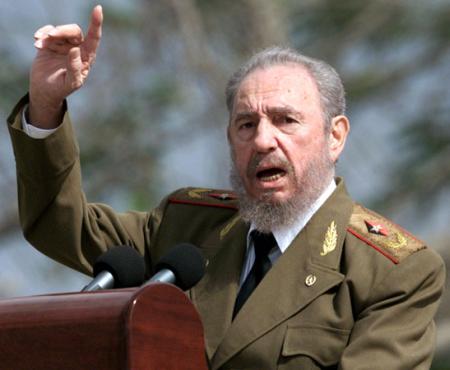
By Fidel Castro / October 13, 2008

Trade, within a society and among countries, is the exchange of goods and services produced by human beings. The owners of the means of production appropriate the profits. As a class, they are the leaders of the capitalist state and they boast of fostering development and social well-being through the market. This they worship as an infallible God.

In every country there is competition between the strongest and the weakest; those with more physical energy, those who are better fed, those who learned how to read and write, those who attended school, those who have more accumulated experience, more social relations and more resources, and those in society who do not have these advantages.

Among countries: those with a better climates and more arable land, more water and more natural resources in the area where they are located, when there are no more territories to conquer; those that master technology, have greater development and handle unlimited media resources, and those that, in contrast, do not enjoy any of these prerogatives. These are the sometimes enormous differences between countries described as rich or poor.

It is the law of the jungle.

There are no differences among ethnic groups in terms of human beings’ mental faculties. This has been thoroughly proven by science. Today’s society is not the natural evolution of human life, but a creation of mentally-developed humans; without that society, their life would be inconceivable. Therefore, what is at stake is whether or not human beings will be able to survive the privilege of possessing creative intelligence.

The developed capitalist system, epitomized by the country privileged by nature to which European whites brought their ideas, dreams and ambitions, is today in crisis. But, it is not the usual crisis that happens once every certain number of years, or even the traumatic crisis of the 1930s; rather, the worst of all since the world started to pursue this model of growth and development.

The current crisis of developed capitalism is taking place as the empire is about to change its leadership in the elections that take place in 25 days; it was the only thing that remained to be seen.

The candidates of the two main parties who will decide these elections are trying to persuade the bewildered voters — many of whom have never bothered to cast a vote — that as presidential candidates, they can guarantee the well-being and consumerism of what they describe as a middle-class people, without the least intention of making real changes to what they consider to be the most perfect economic system that the world has ever known. It is the same world, of course, in the minds of each and every one of them, which is less important than the happiness of some 300 million people who account for less than five percent of the world population. The fate of the remaining 95% of humanity, war and peace, air that may be the fit to breathe or not, will depend to a great extent on the decisions of the empire’s institutional leader, whether or not that constitutional office has any real power in a period of nuclear weapons and computer-controlled space shields, in circumstances where every second counts and ethical principles are increasingly less important. Still, the more or less disastrous role played by presidents of that country cannot be overlooked.

Racism is deeply rooted in the United States, and the minds of millions of white people cannot accept the idea of a black man, with his wife and children, occupying the White House, which is precisely what it’s called: White.

It’s a miracle that the Democratic candidate has not met the same fate as Martin Luther King, Malcolm X and others who dreamed of justice and equality in recent decades. Moreover, he tends to look at his adversary with serenity and to laugh at the dialectic predicaments of an opponent who gazes into space.

The Republican candidate, on the other hand, who cultivates his reputation as a belligerent man, was one of the worst students in his class at West Point. He has confessed that he knows nothing about Mathematics, and presumably far less about complicated economic sciences.

There is no doubt that his rival surpasses him in intelligence and serenity.

Something McCain has the most of is age, and his health is not at all secure

I mention this information to indicate the eventual possibility — if anything should happen in terms of the candidate’s health, given that he is elected — of the rifle lady, the inexperienced former governor of Alaska, becoming president of the United States. It is obvious that she knows nothing about anything.

Meditating on the current U.S. public debt that President Bush is laying on the shoulders of the new generations in that country — $10.3 trillion — it occurred to me to calculate the time it would take somebody to count the debt that he, Bush, has practically doubled in eight years.

Somebody working eight hours per day, without missing a second, at the rapid pace of 100 one-dollar bills per minute, in 300 days of work per year, would need 715,000 years to count that amount of money.

I could not find a more graphic way of describing the volume of that sum of money that is now mentioned almost every day.

In order to avert a general state of panic, the U.S. administration has declared that it will secure deposits that do not exceed $250,000. It will administrate banks and sums of money that Lenin, with his abacus, could never have imagined counting.

We might be wondering now about what contribution Bush’s administration might make to socialism. But let’s not entertain any illusions. Once banking operations go back to normal, the imperialists will return the banks to private enterprise, as some other countries in this hemisphere have already done. The people always foot the bill.

Capitalism tends to reproduce itself under any social system because it is based on egotism and on human instincts.

Human society has no other alternative but to overcome this contradiction; otherwise, it would not be able to survive.

At this time, the flood of money being poured into world finances by the central banks of developed capitalist countries is dealing a heavy blow to the stock exchanges of countries that are trying to overcome their economic underdevelopment by resorting to these institutions. Cuba has no stock exchange. Undoubtedly, we will find more rational and more socialist ways of financing our development.

The current crisis and the brutal measures of the U.S. administration to save itself will bring more inflation, more devaluation of national currencies, more painful losses in the markets, lower prices for exports and more unequal exchange. But they will also bring to the peoples a better understanding of the truth, more awareness, more rebelliousness and more revolutions.

We will see now how the crisis develops and what happens in the United States in 25 days.

Source / Granma

The Rag Blog

Posted in RagBlog | Tagged , | 2 Comments

Palin Mixes State With Religion, Adds a Dash of Extremism

Tattoo art by Flames – Skin Flixx Ink.

She used state money to pay for religious activities; has ties to Dominionism and Alaska Independence Party
By Sherman DeBrosse / The Rag Blog / October 13, 2008

Sarah Palin has said that she would not let her religious views “bleed over into politics,” but she has done just that. Many have seen the video of Governor Sarah Palin addressing a graduation class of young missionaries. She had every right to do that. The problem was she charged the trip, plane fare and per diem, to the state. That speech cost the taxpayers of Alaska $639.50.

So far, she and her family have spent about $13,000 in state funds attending religious events, including a meeting with Reverend Franklin Graham. Some of these events included other stops, so to be fair we can trim that figure to $3022, which applies entirely to religious events. Even the Baptist Joint Committee for Religious Liberty has raised questions.

When she was mayor, she used the prestige of her office to join a hospital board to see that abortions were not performed there. Lloyd Eggan, an Anchorage advocate of the separation of church and state, worries that her Alaska Office of Faith-Based and Community Initiatives had not done enough to see that its funds do not pay for ministry.

Palin has ties with three churches that are clearly part of the Dominionist New Apostolic Reformation. As Dominionists, these people are completely opposed to the separation of church and state. In 2006, Palin said that the tax code provision preventing ministers from endorsing candidates should be repealed.

Dominionists also look forward to the day when the United States will be a theocratic state. They also do not have a favorable view of other religions, particularly Roman Catholicism. Yet, the Palin administration did spend $20,000 of its $500,000 budget helping a Catholic charity.

Sarah Palin was never a member of the secessionist Alaska Independence Party, but she had close ties to it, attending some of its conventions and winning its support in 2006. The Alaska Independence Party has close ties with neo-Confederate and white supremacy groups in the lower 48 states.

Her husband, Todd, was a member from 1995 to 2002. As we know, he has great influence with her and played a major role in Troopergate. When Max Blumenthal and David Neiwart visited Wasilla, they were told that “Sarah Palin is far more intimately associated with the extreme right-wing fringe of Alaska than the media has acknowledged or that she is willing to acknowledge.” Palin used Alaska Independence Chairman Mark Chryson and John Birch Society actrivist Steve Stoll, whom locals “Black Helicopter” to launch her local and state political careers. She attempted to reward Stoll by appointing him to her old council seat, but another council member blocked the move, fearing that Stoll would be a “violent influence.”

In her first campaign for mayor, these men steered an ugly campaign of character assasination against the incumbent. Sounds familiar?

This woman has extremist connections, and probably extremist beliefs. Combine those with a tendency to abuse power, and we have a recipe for disaster.

Sherman De Brosse, the peudonym for a retired history professor, is a contributor to The Rag Blog and also blogs at Sherm Says and on DailyKos.

The Rag Blog

Posted in Rag Bloggers | Tagged , , , , , , | Leave a comment

Jokers Wild

Cartoon by Joshua Brown

Thanks to S. R. Keister / The Rag Blog

Posted in RagBlog | Tagged , , , , , | Leave a comment

Liberals Sneaking Into Canada : Border Officials Concerned

Liberal sociology professor sneaking into Canada

‘Canadian border farmers say it’s not uncommon to see dozens of sociology professors, animal-rights activists and Unitarians crossing their fields at night.’
Updated October 13, 2008

The flood of American liberals sneaking across the border into Canada has intensified in the past week, sparking calls for increased patrols to stop the illegal immigration. The actions of President Bush are prompting the exodus among left-leaning citizens who fear they’ll soon be required to hunt, pray, and agree with Bill O’Reilly.

Canadian border farmers say it’s not uncommon to see dozens of sociology professors, animal-rights activists and Unitarians crossing their fields at night.

“I went out to milk the cows the other day, and there was a Hollywood producer huddled in the barn,” said Manitoba farmer Red Greenfield, whose acreage borders North Dakota. The producer was cold, exhausted and hungry. He asked me if I could spare a latte and some free-range chicken. When I said I didn’t have any, he left. Didn’t even get a chance to show him my screenplay, eh?”

In an effort to stop the illegal aliens, Greenfield erected higher fences, but the liberals scaled them. So he tried installing speakers that blare Rush Limbaugh across the fields. “Not real effective,” he said. “The liberals still got through, and Rush annoyed the cows so much they wouldn’t give any milk.”

Officials are particularly concerned about smugglers who meet liberals near the Canadian border, pack them into Volvo station wagons, drive them across the border and leave them to fend for themselves.

“A lot of these people are not prepared for rugged conditions,” an Ontario border patrolman said. “I found one carload without a drop of drinking water. They did have a nice little Napa Valley cabernet, though.”

When liberals are caught, they’re sent back across the border, often wailing loudly that they fear retribution from conservatives. Rumors have been circulating about the Bush administration establishing re-education camps in which liberals will be forced to drink domestic beer and watch NASCAR races.

In recent days, liberals have turned to sometimes-ingenious ways of crossing the border. Some have taken to posing as senior citizens on bus trips to buy cheap Canadian prescription drugs. After catching a half-dozen young vegans disguised in powdered wigs, Canadian immigration authorities began stopping buses and quizzing the supposed senior-citizen passengers on Perry Como and Rosemary Clooney hits to prove they were alive in the ’50s.

“If they can’t identify the accordion player on The Lawrence Welk Show, we get suspicious about their age,” an official said.

Canadian citizens have complained that the illegal immigrants are creating an organic-broccoli shortage and renting all the good Susan Sarandon movies. “I feel sorry for American liberals, but the Canadian economy just can’t support them,” an Ottawa resident said. “How many art-history majors does one country need?”

In an effort to ease tensions between the United States and Canada, Vice President Dick Cheney met with the Canadian ambassador and pledged that the administration would take steps to reassure liberals. A source close to Cheney said, “We’re going to have some Peter, Paul & Mary concerts. And we might put some endangered species on postage stamps. The President is determined to reach out.” he said.

Source / Manitoba Herald / Blue Funk Blog

Thanks to Jeff Jones / The Rag Blog

Posted in RagBlog | Tagged , , , | 3 Comments

Towards Market Fascism : America’s Political Cannibalism

Even got too hot for John: McCain takes the microphone from a woman at a rally Friday in Lakeville, Minn., after she said: “I don’t trust Obama. … He’s an Arab.” Photo by Jime Mone / AP.

This should be read by everybody, IMHO. The social dynamics of fascism and its origin in economic crisis, from Polanyi’s important book, are outlined below.

Roger Baker / The Rag Blog

‘The rage bubbling up from our impoverished and disenfranchised working class, glimpsed at John McCain rallies, presages a looming and dangerous right-wing backlash.’
By Chris Hedges / October 13, 2008

It is no longer our economy but our democracy that is in peril. It was the economic meltdown of Yugoslavia that gave us Slobodan Milosevic. It was the collapse of the Weimar Republic that vomited up Adolf Hitler. And it was the breakdown in czarist Russia that opened the door for Vladimir Lenin and the Bolsheviks. Financial collapses lead to political extremism.

As the public begins to grasp the depth of the betrayal and abuse by our ruling class, as the Democratic and Republican parties are exposed as craven tools of our corporate state, as savings accounts, college funds and retirement plans become worthless, as unemployment skyrockets and as home values go up in smoke we must prepare for the political resurgence of a reinvigorated radical Christian right. The engine of this mass movement—as is true for all radical movements—is personal and economic despair. And despair, in an age of increasing shortages, poverty and hopelessness, will be one of our few surplus commodities.

Karl Polanyi in his book “The Great Transformation,” written in 1944, laid out the devastating consequences—the depressions, wars and totalitarianism—that grow out of a so-called self-regulated free market. He grasped that “fascism, like socialism, was rooted in a market society that refused to function.” He warned that a financial system always devolved, without heavy government control, into a Mafia capitalism—and a Mafia political system—which is a good description of the American government under George W. Bush. Polanyi wrote that a self-regulating market, the kind bequeathed to us since Ronald Reagan, turned human beings and the natural environment into commodities, a situation that ensures the destruction of both society and the natural environment. He decried the free market’s belief that nature and human beings are objects whose worth is determined by the market. He reminded us that a society that no longer recognizes that nature and human life have a sacred dimension, an intrinsic worth beyond monetary value, ultimately commits collective suicide. Such societies cannibalize themselves until they die. Speculative excesses and growing inequality, he wrote, always destroy the foundation for a continued prosperity.

We face an environmental meltdown as well as an economic meltdown. This would not have surprised Polanyi, who fled fascist Europe in 1933 and eventually taught at Columbia University. Russia’s northern coastline has begun producing huge qualities of toxic methane gas. Scientists with the International Siberian Shelf Study 2008 describe what they saw along the coastline recently as “methane chimneys” reaching from the sea floor to the ocean’s surface. Methane, locked in the permafrost of Arctic landmasses, is being released at an alarming rate as average Arctic temperatures rise. Methane is a greenhouse gas 25 times more powerful than carbon dioxide. The release of millions of tons of it will dramatically accelerate the rate of global warming.

Those who run our corporate state have fought environmental regulation as tenaciously as they have fought financial regulation. They are responsible, as Polanyi predicted, for our personal impoverishment and the impoverishment of our ecosystem. We remain addicted, courtesy of the oil, gas and automobile industries and a corporate- controlled government, to fossil fuels. Species are vanishing. Fish stocks are depleted. The great human migration from coastlines and deserts has begun. And as temperatures continue to rise, huge parts of the globe will become uninhabitable. The continued release of large quantities of methane, some scientists have warned, could actually asphyxiate the human species.

The corporate con artists and criminals who have hijacked our state and rigged our financial system still speak to us in the obscure and incomprehensible language coined by specialists at elite business schools. They use terms like securitization, deleveraging, structured investment vehicles and credit default swaps. The reality, once you throw out their obnoxious jargon, is not hard to grasp. Banks lent too much money to people and financial institutions that could not pay it back. These banks are now going broke. The government is frantically giving taxpayer dollars to banks so they can be solvent and again lend money. It is not working. Bank lending remains frozen. There are ominous signs that the government may not be able to hand over enough of our money because the losses incurred by these speculators are too massive. If credit markets remain in a deep freeze, corporations such as AT&T, Ford and General Motors might go bankrupt. The downward spiral could spread like a tidal wave across the country, especially since our corporate elite, including Barack Obama, seem to have no real intention of bailing out families who can no longer pay their mortgages or credit card debts.

Lenin said that the best way to destroy the capitalist system was to debauch its currency. If our financial disaster continues there will be a widespread loss of faith in the mechanisms that regulate society. If our money becomes worthless, so does our government. All traditional standards and beliefs are shattered in a severe economic crisis. The moral order is turned upside down. The honest and industrious are wiped out while the gangsters, profiteers and speculators amass millions. Look at Lehman Brothers CEO Richard Fuld. He walks away from his bankrupt investment house after pocketing $485 million. His investors are wiped out. An economic collapse does not only mean the degradation of trade and commerce, food shortages, bankruptcies and unemployment; it means the systematic dynamiting of the foundations of a society. I watched this happen in Yugoslavia. I fear I am watching it happen here in the United States.

The Patriot Act, the FISA Reform Act, the suspension of habeas corpus, the open use of torture in our offshore penal colonies, the stationing of a combat brigade on American soil, the seas of surveillance cameras, the brutal assaults against activists in Denver and St. Paul are converging to determine our future. Those dark forces arrayed against American democracy are waiting for a moment to strike, a national crisis that will allow them in the name of national security and moral renewal to shred the Constitution. They have the tools. They will use fear, chaos, the hatred for the ruling elites and the specter of left-wing dissent and terrorism to impose draconian controls to extinguish our democracy. And while they do it they will be waving the American flag, singing patriotic slogans and clutching the Christian cross. Fuld, I expect, will be one of many corporatists happy to contribute to the cause.

This is a defining moment in American history. The next few weeks and months will see us stabilize and weather this crisis or descend into a terrifying dystopia. I place no hope in Obama or the Democratic Party. The Democratic Party is a pathetic example of liberal, bourgeois impotence, hypocrisy and complacency. It has been bought off. I will vote, if only as a form of protest against our corporate state and an homage to Polanyi’s brilliance, for Ralph Nader. I would like to offer hope, but it is more important to be a realist. No ethic or act of resistance is worth anything if it is not based on the real. And the real, I am afraid, does not look good.

[Chris Hedges, a Pulitzer prize winner and a former foreign correspondent for The New York Times, is the author of “American Fascists: The Christian Right and the War on America.” His column appears Mondays on Truthdig.]

Source / truthdig

Thanks to CommonDreams / The Rag Blog

Posted in RagBlog | Tagged , , , , , | Leave a comment

Gambling on McCain : The Stakes are Big


John McCain the High Roller
By Sherman De Brosse / The Rag Blog / October 13, 2008

This is the first of several articles by Sherman De Brosse on John McCain and his shady involvements, past and present.

Senator John Mc Cain is known for his love of gambling and frequently engages in gambling marathons in Vegas. He is probably an addict with a serious problem. It is no secret, that he is given to taking great risks at the tables. Sometimes a gambling stint for him will last 14 hours. He does not gamble every day but is prone to monthly binges.

By all accounts, he gambles a lot, and Obama recently criticized McCain for gambling in a Connecticut casino with a lobbyist representing the Mashantucket Pequot tribe. At that time, he chaired the Senate Indian Affairs Committee, which oversaw Native American casinos. The Arizona senator should have refrained from voting on matters that affected that tribe.

However, the Senator, who gambles a few thousand at a time, tried not to take loans or markers from the house. So he is not entirely reckless, yet, some wonder if a legislator should be gambling in the casinos he regulates is proper. Forty of his fundraisers are in the gambling industry. Lately, to avoid publicity he has taken to playing craps in a private room, a right he has as a high roller.

Citizens for Ethics and Responsibility in Government filed a complaint with the Senate Ethics Committee on October 9, claiming McCain never reported on his taxes gambling losses or gains. Reporting losses should be a personal option. Yet it is bothersome that someone with so much influence in this area is not entirely open. Of course, the complaint will not be dealt with until long after the election.

Many of us have noticed over the years that gambling establishment seem to be more often linked with unsavory people than, say, dry cleaning establishments or donut shops. One might wonder what kinds of people Mc Cain meets in these dens for high rollers?

John and Cindy McCain are very rich people, so his gambling habit is not something that will take food off the family table. Some good psychologists claim it may not even be a major character disorder. However, a Swedish study suggests these gamblers are likely to be more impulsive than non gamblers and to be somewhat more dishonest. They are also inclined to extravagant behavior. Gamblers are somewhat less inclined than non-gamblers toward responsible behavior. We do not have enough iron-clad evidence to say McCain is a compulsive gambler. Decide for yourself if Mc Cain seems more impulsive and less responsible and truthful than most people.

Gamblers Anonymous says that compulsive gamblers have problems with emotional security, immaturity, and accepting reality. Think a little about McCain’s explosive temper, and you might see a connection.

McCain is considered one of the founding fathers of the Native American casino industry and he has close ties with many gambling interests. In May, 2007, J. Terrence Lanni, a Vegas casino executive, raised $400,000 for his pal John MC Cain. In 2000, the Bush campaign complained about McCain’s close ties to Native American casinos.

Though his committee, oversees gambling, he does not recuse himself when gambling comes up. He oversaw the investigation of Jack Abramoff’s abuse of Native Americans, which resulted in helping Abramoff’s rivals — McCain’s pals — and also smited some folks in the GOP who had opposed McCain in 2000. He found that Abramoff and others took over $66 million from the Native Americans and promised to get to the bottom of the matter. But the investigation ended there and McCain let the “perps” walk because much of the money was funneled to his Republican Party. He did not even call Ralph Reed to testify, though the Christian Right was deeply involved in Abramoff’s abuse of the Native Americans. In 2008, McCain used Reed in his campaign.

Its up to the reader to decide if the man who has a hand in regulating gambling should be so close to the industry and then fill his presidential campaign with gambling and communications lobbyists. He also has a big role in regulating communications. It does not seem prudent. There is more than a touch of arrogance here. He seems to be saying that everyone should know that John McCain has so much integrity that he need not avoid appearances of impropriety. It is absolutely true that McCain has had a masterful publicity campaign running over more than two decades burnishing his image as Mr. Integrity, but an examination of the facts reveals many chinks in his armor.

Sherman De Brosse, the peudonym for a retired history professor, is a contributor to The Rag Blog and also blogs at Sherm Says and on DailyKos.

Sources for this article.

Temperament and Character in Pathological Gambling / Journal of Gambling Studies

About the Problem of Compulsive Gambling / Gamblers Anonymous

John McCain’s gambling addiction (and tax “issues” too”) / Blog for Arizona

CREW files ethics complaint against Senator John McCain / Citizens for Responsibility and Ethics in Washington

John McCain’s Gambling Problem — and Ours? / By Greg Mitchell / July 7, 2008 / The Huffington Post

John McCain Criticized For Casino Game Playing / by Grant Nelson / Oct. 1, 2008 / 777 Gaming News

John McCain, Gambling Addict by Matthew Yglesias / Oct. 8, 2008, The Atlantic

John McCain’s gambling habit / by Alex Spillius / Sept. 29, 2008 / i report

McCain forged close ties to Las Vegas, tribal casinos / by Jo Becker and Don van Natta Jr. / Sept. 28, 2008 / NY Times News Service / boston.com

Senatorial Courtesy: Will John McCain Let Republican Perps Walk? / By Louis Dubose / Aug. 26, 2008 / Texas Observer

The Rag Blog

Posted in Rag Bloggers | Tagged , , | 1 Comment

Knee-Jerk Bailout Policy as Financial Cure-All? Here’s a Moderate Alternative.

Lower the hammer on knee-jerk policies.

‘The following economic essay is an intelligent alternative to the current economic crisis response under Paulson and Bernanke.’
By Roger Baker
/ The Rag Blog / October 13, 2008

Would the following moderate but sensible approach, offered as an alternative to Federal policy actually work to slowly restore the US economy, as we have known it, back to health?

Even a smart approach to US economic management is unlikely to succeed because it is blind to peak oil/energy constraints. An imbalance between inflexible oil supply and an inflexible but increasing demand for same is a sure prescription for cost-push inflation in the food and energy sector, which simultaneously tends to depress other consumer spending, even if no new money is added to the system. Oil shortages thus naturally tend to lead to stagflation. For the moment oil prices have crashed, but as world oil demand recovers while oil supply contracts, we are soon back to an even worse oil cost crisis.

But at least the following economic essay is an intelligent alternative to the current economic crisis response under Paulson and Bernanke. The point being made by the “Stalinist” reference is that the feds are as rude and crude as Stalin in applying a knee-jerk bailout policy as a financial cure-all.

Federal policy had initially involved bailouts of those stuck with vast derivatives obligations, via buying their bad paper debts. But now a banking or liquidity panic has spread internationally. The dynamics of fear cannot be measured in the numbers of dollars that Bernanke needs to add to the system to cause the fear to subside. If Bernanke’s helicopters start dumping cash on a large scale, it is as likely as not to reduce public confidence in the soundness of the system.

This injection of credit and cash and liquidity is bound to contribute to the other variety of inflation: demand-pull inflation. Bailouts that make good on bad paper, on the required scale, will put vast amounts of new dollars into circulation. These bailout dollars soon diffuse everywhere, causing a more generalized type of inflation.

With these two kinds of inflation are added together, naturally they tend to make the value of the dollar fall in value relative to other currencies. So OPEC will tend to raise the price of oil, which will further depress the US economy because of acute US addiction. That impact will require further bailouts, etc.

While the following prescription does fall well short of the nationalization of US banks and the treasury under public control, it offers a picture of what might be done by a government considerably wiser in its attempts to save the existing system than any that we are likely to have in the near future:

“…Regulating the level of economic activity and counteracting recession should fall under fiscal policies. The government has better means, agencies and fiscal instruments to fight economic recession than central bank monetary policy. The recent world crisis has shown that governments have to address shortages in food, energy, infrastructure, and social programs. Each government can draw a comprehensive stabilization program with properly designed fiscal and sectoral policies without compromising monetary stability…”

Monetary Stalinism in Washington
By Hossein Askari and Noureddine Krichene / October 11, 2008

Amongst the worst tragedies of Soviet collectivization was the Ukraine famine of 1932-33, which took six million lives as Joseph Stalin practiced forced appropriation of crops and imposed very low prices for agricultural products in favor of industrialization. Interference with the pricing mechanism and Stalinism in the form of very low prices for agricultural products also caused famines in India in 1965 and in China in 1969, with a human death toll well into the millions.

Monetary policy as practiced by the US Federal Reserve for the past decade is but a form of financial Stalinism, forcing ridiculously low or negative real interest rates, with catastrophic results that are now plaguing the world. Fed policy has disabled the price mechanism in capital markets and set off uncontrolled credit expansion at the expense of capital productivity and creditworthiness, pushing housing, food, and energy prices to prohibitive levels, and triggering food and energy riots in vulnerable countries. It has undermined the dollar and made the US highly dependent on foreign financing.

The dramatic consequences of Fed policy are unfolding before our very eyes. The financial crisis that broke out in August 2007 has recently taken a turn for the worse. After claiming international and well-established banks and investment banks, it has now reduced the financial savings of ordinary Americans (in retirement accounts) by over 30%.

The fiscal bill for past, ongoing and future bailouts by Fed chairman Ben Bernanke and Treasury Secretary Henry Paulson will be staggering; the US fiscal deficit will be blown up to unthinkable proportions, public debt will be pushed to unprecedented levels, and most public resources will be destined to absorb financial losses at the expense of social and economic programs.

Last, but not least, the long-term inflationary consequences may turn out to be even more dramatic. All these consequences are real and were in part predictable.

So far Bernanke and Paulson have failed miserably in stemming the financial crisis and have brought the US economy to a standstill, in part because Bernanke does not have a feel for the free-market mechanism and in part because he is not a prudent central banker.

It would appear that Bernanke has read a great deal about the Great Depression of 1929-1933 and perhaps very little, or nothing, about the German hyperinflation of 1920-1923. His view is that the Fed was liquidationist of banking institutions during 1929-33. In his view, if the Fed had injected sufficient liquidity during 1929-1932, it would have precluded thousands of bank failures. Therefore, Bernanke is determined not to let that mistake happen again. Consequently, his response to the financial crisis has been a blind and aggressive monetary policy in form of negative interest rates, massive liquidity injection, and massive bailouts.

Bernanke is like the medical doctor who is familiar with one drug, and who prescribes it to every patient he sees at full dose without diagnosis of what ails the patient or thinking what will happen if he takes the wrong medication.

Thinking that the US economy was in a deep recession in 2007, one similar to the Great Depression, he precipitously unleashed monetary policy. His rushed actions have destabilized the financial system, sent commodity prices skyrocketing, and crippled economic growth. The US economy in 2007 had no resemblance to either the institutional setting of the Great Depression or to the immense role and expansionary stance of fiscal policy. Namely, today, there are institutions that can prevent bank runs, such as the Federal Deposit Insurance Corporation, and the federal and state governments (both relatively far bigger than 1929) are running large deficits that should preclude a deep recession, especially if they adopt appropriate policies.

Hence, his inflationary approach was ill-designed and will be very costly in bank failures, high inflation and rising unemployment.

The Fed chairman is by far the most important personality on the US economic and financial landscape. In fact, both Wall Street and Main Street read his statements more carefully than reading the words of a president or the laws of the land. His words and actions are the most influential in the financial and economic world. Being in large part an independent institution, the Fed, largely under Bernanke’s predecessor Alan Greenspan, grasped absolute power over economic policymaking and decided to abandon its regulatory power, enabling the development of financial anarchy under the guise of financial engineering and innovations.

Such myopic faith in the free market has turned the US financial markets into a casino. The US president has negligible influence on economic policymaking and has become merely a symbolic figure. By subscribing fully to Bernanke and Paulson policies, the two presidential contenders have renounced their future economic role. The US Congress has become a rubber stamp of Fed policies. It applauded Greenspan�s policies and it now supports Bernanke-Paulson knee-jerk and costly bailouts. The US public is not so much interested in the presidential debates as in how Bernanke and Paulson policies will affect their jobs, retirement savings, tax liabilities and the very livelihoods of their children.

Wrong course will continue

Once the Fed follows a policy path, it hardly changes course, which means the Fed will perpetuate its cheap monetary policy indefinitely. After institutionalizing negative real interest, the Fed wants to institutionalize high housing prices and rents, and a depreciated dollar. While US banks are in the process of strengthening their balance sheets and opting for safe banking, the Fed is forcing them to extend credit regardless of risk and profitability, and to finance with short time resources long-term loans.

Recent desperate actions by the Fed consist of bypassing the banking system and extending directly low-cost loans to borrowers regardless of risk and nationalizing the banking system. The Fed sees no limit for issuing trillions of dollars by electronically crediting borrowers.

The Fed has arguably created the most uncertain and unstable economic environment in US history. No one would have predicted that the value of shares would tumble by nearly 5,000 points, or approaching a decline of 40%, in the past three months. There is no basis for making sound financial or economic forecasts. No rational entrepreneur can undertake investment plans under such uncertainties. Foreign investors are scared of inflation and a depreciating dollar and are rushing to gold and safer currencies. It is at best a wait and see attitude.

Central bankers are this week convening for their semi-annual meeting in Washington DC, only to find that the world is no better than it was six months ago. Certainly, they will not surrender their excessive powers and most likely will not accept blame for their imprudent monetary policies that have led to the worst financial crisis in the post-war period.

Interest rate setting by central banks has long been repudiated by monetary economists; it creates distortion between the market and natural interest rates, and triggers a self-cumulative inflationary process. As a form of price control, it creates considerable inefficiencies and misallocation of resources into non-productive uses. With a view to unlocking credit markets, it is an utmost priority both in the US and Europe to free interest rates. Such a step will enable banks to mitigate credit risk, improve their earnings, and for productive borrowers to have access to borrowing. It will dispel inflation fear and pave the way for financial consolidation and recovery. If they reject this step, central banks will only aggravate the current crisis.

Central banks’ misguided role

The role of central banks has never been to regulate the economy or promote full employment. It is a simple truth that an economy needs safe money, which serves as a medium of exchange and store of value. The central banks should be principally in charge of managing liquidity and regulating the banking system.

These are the most important functions of a central bank. If properly done, they will contribute to a stable macroeconomic framework conducive to economic growth and employment. Given their total neglect of bank regulation in the past two decades, central banks have a long way to go in updating the regulatory framework, streamline financial products, and mitigating sources of risks and speculation.

Regulating the level of economic activity and counteracting recession should fall under fiscal policies. The government has better means, agencies and fiscal instruments to fight economic recession than central bank monetary policy. The recent world crisis has shown that governments have to address shortages in food, energy, infrastructure, and social programs. Each government can draw a comprehensive stabilization program with properly designed fiscal and sectoral policies without compromising monetary stability.

A 10-year spending program on infrastructure, including education and alternative energy development, would be appropriate today, especially in the United States. At the same time, federal credit should be urgently extended to state and local governments until financial order is restored. However, excessive reliance on credit or ex-nihilo money creation is wrong and hazardous.

Central banks should not interfere with the price mechanism; in this respect, institutionalizing long-term housing price controls would be detrimental to the economy. Central banks have to put in place monetary programming consisting of safe limits on credit and money aggregates. Monetary economists never claim that fixed rules for credit and money supply are free of instability. However, if instability were to occur, it can be addressed by fine-tuning.

The US economic ship could capsize in the coming days and weeks. There is urgency for action before chaos spreads farther a field. The same central banks that have announced a coordinated rate cut should admit that this measure is not the proper solution. It will be damaging to financial institutions and will exacerbate world inflation and economic recession.

Instead, they should announce a coordinated decision for freeing up interest rates. They have to allow banks to undertake orderly and long-term recapitalization, relying in the first instance on shareholders or other private holders of capital and only on a case-by-case basis on federal injections of capital with preferred share ownership for the public. And they must adopt urgent regulatory reform, accompanied by strict supervision and enforcement.

Finally, Bernanke and Paulson must jettison their policy of one bailout at a time. with the intention of addressing other issues later, and adopt a comprehensive plan to address all issues now, including support for state and local governments.

Unfortunately, it would appear that the notion that monetary policy is the panacea for addressing all economic problems has gained total currency among central bankers and politicians.

[Hossein Askari is professor of international business and international affairs at George Washington University. Noureddine Krichene is an economist at the International Monetary Fund and a former advisor, Islamic Development Bank, Jeddah.]

Copyright 2008 Asia Times Online (Holdings) Ltd.

Source / Asia Times

The Rag Blog

Posted in Rag Bloggers | Tagged , , , , | Leave a comment

Tomorrow Is Monday – Time to Buy These Stocks!

Click to enlarge

Source / 23/6

Thanks to Diane Stirling-Stevens / The Rag Blog

Posted in RagBlog | Tagged , | Leave a comment

A Strait Shot…

Thanks to S. R. Keister / The Rag Blog

Posted in RagBlog | Tagged , , | 2 Comments

Europe Blames US for Financial Crisis; Failure of Government Oversight

Failed British bank, Northern Rock.

As crisis spreads, Europe points finger at America
By Jenn Abelson / October 11, 2008

LONDON – Financial firms are reeling in the United Kingdom, Ireland, and the Netherlands. Iceland is on the brink of national bankruptcy. A continent that has enjoyed steady growth for years is watching it all melt away.

And everyone is pointing the finger of blame across the Atlantic Ocean.

In the financial district of London, the pubs of Dublin, and on the campuses of Holland, people are citing reckless lending in the US mortgage market, unbridled American consumption, and a lack of government oversight for the financial meltdown that has engulfed Europe. Many dismiss the US bailout as an unwise and hypocritical move that rewards the greedy bankers who caused the crisis and breaches the ideals of the country that pioneered market-driven capitalism.

“It seems to me that the US government supports the people that least deserve it,” said Sanne Castro, 28, a student at the Delft University of Technology in the Netherlands. “But it does prove that even the most hard-core free-market capitalists would rather turn in their fundamental beliefs than their money.”

Europeans are watching the value of their investments plummet, their banks collapse, their ability to borrow or get a mort gage diminish, their currency slide, and their job security become more fragile than ever. In short, they look just as shell-shocked as Americans.

The financial free fall in Europe is, in part, due to a shift in economic philosophy by the major European nations, said William Keylor, director of the International History Institute at Boston University. European nations, seeking to emulate the formula for growth and financial innovation that has propelled the American economy, gave up tight control over financial markets and privatized formerly state-run major industries, such as gas and transportation. When stock markets were advancing and economies were growing, Europeans embraced the changes, Keylor said. But the current crisis has caused many to have second thoughts. Now, some are insisting that the Europeans had it right all along, and government ownership would have limited the risks and curbed the catastrophes now enveloping the region.

“It is hard for them to play the ‘blame game’ when they chose this path freely and continued to follow it when times were good,” Keylor said.

It is clear that times have changed.

The Euro Stoxx 50 Index, which measures 50 European blue-chip stocks, plunged 22 percent just in the past week, mirroring precipitous drops in exchanges in London, Germany, and Paris. As the panic spreads across oceans and national borders, many Europeans are criticizing US leaders for not doing enough to stabilize the global market.

Even British Prime Minister Gordon Brown took a swipe at Americans as he proposed his government’s own roughly $800 billion bailout of its banks earlier this week.

“This problem started in America with irresponsible actions and lending by some institutions,” Brown told a press conference on Wednesday. “The global financial market has ceased to function.”

The anger marks a drastic change among Europeans, who gleefully looked on as the early stages of the US crisis seemed to show the weaknesses of America’s unfettered capitalism, according to Nigel Gault, an economist at Global Insight in Lexington, Mass. But as the economic storm has ripped through Europe, schadenfreude is being replaced by anger.

The most severe excesses came from America, Gault said, but the greed and reckless behavior weren’t confined to the United States, Gault said. Although European banks were much more conservative, their lending policies fueled housing booms in parts of the United Kingdom, Spain, and Ireland that are now going bust. And some European banks, including a state-owned firm in Germany, held billions of dollars in risky mortgage-backed securities.

“Is that America’s fault for selling them toxic assets?” Gault said. “Or Europe’s fault for not more thoroughly investigating just what they were buying?”

Some Europeans, noting the response of the Bush administration to Wall Street’s woes, have chided US leaders who have railed against the European model of managed capitalism for suddenly embracing government intervention in the financial sector.

“These people were the first to state that government regulation in the market is in the long run bad for the economy, for example when it comes to environmental laws, social welfare, and of course Wall Street,” Castro said. “And what are they doing now?”

In London, the wreckage of the US crisis looms over Canary Wharf, the city’s new financial district. A skyscraper here until recently was the main office of Lehman Brothers. At a nearby Starbucks, next to what used to be the headquarters of First Boston Bank, Alastair Green, 50, an investment banker, expressed concern about the relentless market mayhem.

“Everybody assumes there is a solution out there,” Green said. “But what if there’s not?”

Emily Springford, a lawyer who specializes in bankruptcy and insolvency litigation in London, said it’s obvious the United States is the main driver behind the current upheaval here, but Europe cannot escape blame entirely. She supports the US bailout because it was “necessary to take action,” but says British leaders are doing a better job at protecting the people’s interests.

“There is still a sense of disbelief here about how fast the crisis is spreading,” Springford said.

The question for European leaders, Keylor said, is whether the crisis will cause them to reconsider American-style capitalism.

But for Phillip Massey, an information-technology worker in Dublin, the question is not what Europe can do for itself, but whether the American bailout of its financial institutions will mean a worldwide recovery.

“When America sneezes, the whole world catches a cold,” Massey said. “But chicken soup and home remedies aren’t going to fix this one. The world as a whole needs treatment.”

Globe correspondent Michael Goldfarb contributed to this report. Jenn Abelson can be reached at abelson@globe.com.

© Copyright 2008 Globe Newspaper Company.

Source / Boston Globe

The Rag Blog

Posted in RagBlog | Tagged , , | Leave a comment

Sixth Anniversary Anti-War Protest in Boston

Hundreds of protesters gathered on Boston Common yesterday, the sixth anniversary of the congressional vote to authorize the invasion of Iraq. Photo: Wendy Maeda/Globe Staff.

Antiwar activists gather on Common
By Sarah M. Gantz / October 12, 2008

Mark anniversary of vote authorizing the Iraq invasion

Carlos Arredondo has traveled across 20 states with his portable memorial to his son, a Marine who died in Iraq during his second tour of duty in 2004. But yesterday, Arredondo was home in Boston, where he shared his memorial of hundreds of scrap-wood crosses, combat boots, synthetic flowers, and photographs of Alexander Arredondo at an antiwar rally.

Hundreds of protesters, some carrying “war is terrorism” posters, others wearing fluorescent yellow “stop the war” stickers, gathered on Boston Common for a National Day of Action Against the War rally, on the sixth anniversary of the congressional vote that authorized the invasion of Iraq. Veterans, student activists, and politicians were among those who spoke against the war.

“As a father it is my responsibility to honor my son, to let people know how I feel about it,” Arredondo, 48, of Roslindale, said as he gazed at his son’s 20-year-old face staring out from poster-size photographs hanging at his booth. “That’s how wonderful the democracy in this country [is] – why we are all here today.”

Dozens of antiwar groups set up booths to sell T-shirts and hand out pamphlets. In the background, bands and solo performers performed on stage.

Jabbar Magruder, who served as a sergeant with the National Guard in 2005, came from Los Angeles to work as the coordinator for Military Families Speak Out, a Boston antiwar group. Magruder, 25, said he is working to debunk the glorified “Hollywood image” of war that too many people believe to be reality.

He said he felt deceived as a soldier in Iraq, where he said he thought he was defending the Constitution against foreign enemies, when the real threat to democracy was politicians at home who didn’t see his service in the same way.

President Bush has insisted that the invasion of Iraq, which began in March 2003, has made the world better and the United States safer.

But yesterday, local activists and politicians, including District 7 Boston City Councilor Chuck Turner, said the money spent on the war would be better used to benefit Americans, going to such issues as education and healthcare.

Turner encouraged people to look beyond a troop withdrawal. “We can create change, but not just by ending the war, but by pulling the roots out,” Turner yelled into the stage microphone. The roots, he said, is “a foreign policy that does not focus on peace” and an inflated military budget.

Liza Behrendt, a sophomore at Brandeis University, weaved through the crowds of antiwar paraphernalia and protesters dressed in a white Haz-Mat jumpsuit with a bright pink peace sign painted on the front and a Sharpie marker taped to the back. Behrendt said her “walking petition” outfit – she collected signatures on her back – was her effort to meet like-minded people outside her student group.

“Even if [the rally] doesn’t make concrete change, it energizes people,” said Behrendt, 19, who was disappointed only 13 students from her school attended. “How can people not be angry?”

Gabriel Payan, who said he deserted the Army in 2005 while in Germany, was angry. Profanities peppered the 29-year-old veteran’s speech about why he was “sick and tired of this war that has claimed the lives of my brothers and sisters.”

Despite his frustration, Payan said he speaks out because he thinks it gives people hope of change and encourages them to take action themselves.

“I’m not relying on my vote November 4th to make change,” said Payan, referring to the presidential election.

He said he believes it will be the footwork of Americans that brings peace.

© Copyright 2008 Globe Newspaper Company.

Source / Boston Globe

The Rag Blog

Posted in RagBlog | Tagged , , | Leave a comment

The Problem with Projecting Power


Blowback from Afghanistan
By Rick Salutin / October 10, 2008

In the U.S. “debates,” it was the bleakest moment for me so far when Barack Obama said he lamented the war in Iraq because it “weakened our capacity to project power around the world.” Not because it was wrong to invade and occupy a distant country, or even because it was a failed war. But because it hampered U.S. ability to invade and occupy other places. In this, he agrees with John McCain, who says the United States has a “sacred duty to suffer hardship and risk danger to protect the values of our civilization and impart them to humanity” by military might. It is a core component of U.S. political culture. You don’t get to run for president without it.

What is the problem with projecting power – aside from the slaughter, pillage and backlash it routinely generates? Well, the effects on the projectors themselves are often overlooked. Israel, for instance, has occupied Palestinian land for 41 years. An Israeli I knew, long ago, described serving in the West Bank and kicking a Palestinian kid, hard, with his army boot, because the kid held a prohibited Palestinian flag.

To his amazement, the kid stood there, so he kicked again. The shame of it never left him. He dreamed of returning to the village, finding the kid and apologizing.

Canada has been ambivalent about its role in military projections by great powers. We’re never sure whether we belong with the empire or the natives. Our view of our soldiers as peacekeepers was an effort to straddle that dilemma. But in the Afghan occupation, we seem to have tilted: We now identify with the big guys, against the little scumbags.

It hasn’t worked well. Insecurity there has increased. Sixty per cent want foreign troops out. Social progress has been minimal. The Taliban are resurgent. But what I really want to talk about are the “blowback” effects on us, at home, from our big military adventure. Let me take one example.

Stephen Harper’s view for years has been that Canada’s social programs are overblown and humiliatingly socialist. (You can Google it.) Yet they’re awfully popular. How do you combat that as a minority prime minister? Try this: We can’t afford it. Except we seem able to. Hmm, okay. Then lower the GST a couple of points, making less money available for the programs. Not bad. But what next?

Enter the Afghan mission. The parliamentary budget office reported yesterday on its total cost: $14-billion to $18-billion, maybe more: two to three times what the government claimed.

When asked about it, Stephen Harper held his palms up and said it was all “budgeted.” As in: Sorry kids, but there’s no money left at the end of the month for a trip to the zoo. He’d just announced a meagre $10-million for pulmonary diseases, much like yesterday’s $5-million to lure Canadian doctors home. He calls these outlays modest. How about piddling? They are pathetic compared to what’s required for national child care, pharmacare, the cities or aboriginals. Then add his plan to spend $490-billion on the military in the next 20 years, anticipating future Afghanistans.

It may not be why we went in. But military (over)spending is a superb way to tilt an economy away from social goals. It’s the only big public spending neo-cons like Stephen Harper are comfy with. It’s the U.S. model. They spend $700-billion a year on “defence,” more than the rest of the world combined and the very amount of the big bailout – which itself is related to those projections into Iraq and Afghanistan and will severely hamper a President Obama from doing much domestically – but that’s another several stories.

So there you have it: Canadian blowback from Afghanistan. A solution to Stephen Harper’s dilemma: how to place beloved social programs out of reach. And all this even before the shrivelling effects of a global economic crunch. Imagine what the guy could do with a majority.

Source / Globe and Mail

The Rag Blog

Posted in RagBlog | Tagged , | Leave a comment