The Con-Servative Way: Privatize the Profits and Socialize the Losses


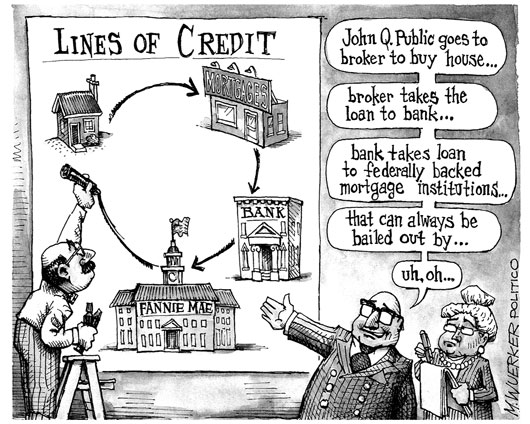
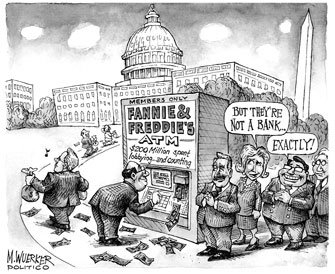
Fannie Mae, Freddie Mac: Phase two of financial crisis
By Jack Rasmus / September 1, 2008

Despite repeated efforts during the past year by the Federal Reserve (Fed), the U.S. Treasury, regulatory agencies, and global central banks, the current financial crisis has not been contained—let alone resolved. In the months since the Bear Stearns investment bank bailout in March 2008, the instability of the U.S. financial system has continued to deteriorate.

This past July, a second major financial instability event occurred—the near collapse of the two quasi-government housing market agencies, Fannie Mae and Freddie Mac. Like Bear Stearns, the collapse of Fannie/Freddie was barely averted by an announcement from Fed Chair Ben Bernanke and U.S. Treasury Secretary Henry Paulson that the government would bail out the two agencies. Unlike Bear Stearns, the bailout requires Congressional action and its estimated cost may be as high as $300 billion, according to independent estimates. That’s nearly ten times the $29 billion bailout cost of Bear Stearns.

Evolution of the Fannie/Freddie Collapse

It is often noted in the business press that Fannie/ Freddie are liable for more than $5.3 trillion of total mortgage debt outstanding, or roughly half of total mortgage debt in the U.S. which totaled $10.6 trillion as of March, according to the U.S. Fed’s Flow of Funds data. Less often noted is that since 2001 this same mortgage debt had ballooned from $4.8 trillion to $10.6 trillion. That’s an increase of approximately $6 trillion in just 7 years. Between 2003-06 alone mortgage debt recorded a net growth of more than $1 trillion a year. Nearly half of that was “bad” subprime mortgage debt.

While banks and mortgage companies reaped super-profits from multi-trillion dollar mortgage lending during 2003-2006, they simultaneously pushed for the full privatization of Fannie/Freddie. They were not able to achieve that, but were able to keep Fannie/Freddie underfunded and freeze the latter’s share of mortgages purchased at no more than 40 percent of the total mortgage market.

But once the subprime mortgage bust began in late 2006, the same banking and mortgage lenders sought to have Fannie/Freddie buy up their bad debt in greater and greater volumes, including their so-called securitized packages of bad subprime mortgages. Fannie/Freddie’s bad debt load quickly accelerated. Its share of the mortgage debt market in turn rose rapidly, from less than 40 percent in 2005 to more than 70 percent. By the first quarter of 2008, more than 80 percent of all mortgages issued were purchased or guaranteed by Fannie/Freddie.
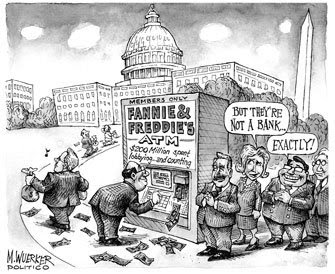
Fannie/Freddie’s debt load rose quickly, but their funding and reserves on hand to cover the debt did not. By summer 2008 the agencies found themselves with more than $5 trillion in liabilities, of which $1.7 trillion was direct debt, with only $81 billion in reserves.

Created in 1938 to rescue homeowners and mortgages from a similar bout of banking speculation gone bust, in 1968 Fannie/Freddie were partly privatized, which means they were no longer purely government agencies, but became corporations in which private investors purchased stock. Their private investors range from other financial institutions, wealthy independent investors, private equity funds, hedge funds, pension funds, and various foreign banks and institutions. Fannie/Freddie’s directly liable debt (called agency debt) of $1.7 trillion (of the total $5.3 trillion) is heavily owned by foreign central banks.

Should Fannie/Freddie collapse, their investors would suffer major financial losses as well as possible defaults and bankruptcies of their own. Foreign central banks would be especially hard hit. That would mean spreading and deepening the financial crisis further, not only in the U.S. but globally.

Investors became concerned that the two agencies could not cover their multi-trillion dollar liabilities with their miniscule liquid funds on hand. With housing prices continuing to fall and foreclosures rising, in early July analysts estimated Fannie/Freddie losses over the coming year of $100 to $300 billion depending on how far housing prices might fall. Investors did what most investors in any company do in such circumstances—they began a wholesale dumping of their Fannie/Freddie stock. The break came on Friday, July 11, as Fannie/Freddie stock prices plummeted by 50 percent.

Amazingly, even though Fannie/Freddie’s reserves had been declining throughout the current financial crisis, particularly in the first half of 2008, instead of taking action, U.S. government regulators repeatedly eased the amount of funds the agencies were required to keep on hand to cover emergencies such as that which occurred in July. From 30 percent at the outset of 2008, regulators reduced required reserves to 20 percent and then to 15 percent, with talk of a further cut to 10 percent in September 2008 on the agenda.

An opportunity to do something about the situation arose in mid-May, in the form of proposed housing assistance legislation for homeowners facing foreclosure. But Congress did nothing. Instead, it accepted promises that Fannie/Freddie would voluntarily raise capital to add to their reserves. Even tepid proposals to change the agencies’ regulators—a kind of rearranging of deck chairs on the Titanic—failed to pass Congress last spring.

In the days leading up to July 11, government regulators, the Fed, and the Treasury repeatedly proclaimed that the two agencies had sufficient capital, were voluntarily raising more, and that no rescue of the agencies was necessary. Of course, Paulson/Bernanke never bothered to explain how companies with such a collapse in stock prices might be able to raise capital and thus avert the crisis. Even before the near collapse, both agencies were jointly able to raise only $20 billion. By the end of the week of July 7-11, Fannie Mae’s stock price was down 76 percent over the previous year, and Freddie’s had fallen 83 percent.

Over the weekend of July 12-13, Paulson/Bernanke and regulators did another about-face. When markets opened on Monday, July 14, they announced a plan to guarantee a government bailout of Fannie/Freddie. The plan required neither the Fed nor the Treasury to directly fund the bailout (neither had sufficient funds, in any event). Instead, Congress would be asked to provide the bailout funding. Until such funds were forthcoming, however, the Fed would provide interim emergency loans to the two agencies. Paulson also proposed the U.S. Treasury buy the two agencies’ public stock, thus propping up their stock prices, if necessary.

The moribund housing bill, which had earlier failed to pass Congress, was quickly resurrected following July 14. The Bush administration also proposed to repopulate the boards of directors of the two agencies with more Wall Street bankers. And Paulson/Bernanke made public assurances that “all necessary lines of credit” would be open to the agencies until Congress provided more substantial and permanent funding. The Congressional bill that eventually passed in late July ultimately provided for a $300 billion line of credit—just about what is projected by analysts as the total losses of the two companies over the next period. The $300 billion is to be disbursed by the Treasury to Fannie/Freddie as needed, either as loans or as government direct purchases of the companies’ stock.

Despite the bailout announcement, a further general fall in the New York stock market and a further crisis in confidence in the banking system and financial institutions followed. The California bank, IndyMac, failed soon after, and stock prices of other regionals like WaMu, National City, and others significantly declined. The Standard & Poor’s 500 bank stock index suffered its worst decline since 1989. Many banks and mortgage lending companies now teeter on the edge of default and bankruptcy.

The Strategic Significance of Fannie/Freddie

The near collapse and proposed bailout of Fannie/Freddie represents several important developments in the current financial crisis. First, it means the current financial crisis has not been stabilized, but has actually gotten worse. According to Bill Gross, manager of PIMCO, the world’s biggest bond fund, falling U.S. home prices will require financial institutions to write off more than $1 trillion in losses. The two to three million projected foreclosures may even be larger, given the estimated 25 million whose homes are now in negative equity (worth less than the purchased price) and the remaining mortgage costs.

It also means that the Fed, is no longer able to deal with the crisis on its own—as it essentially did with Bear Stearns. It has now clearly passed the buck to Congress. How much more will the bailout cost? According to a July Standard & Poor’s estimate, the cost would run somewhere between $420 billion and $1.1 trillion. That compares to the last housing market bailout that occurred in the late 1980s with the Savings & Loan debacle of around $250 billion.

To date the Fed has committed more than $400 billion of its roughly $800 billion to bail out Bear Stearns and prevent the collapse of other banks in the U.S. and abroad. In July it extended prior deadlines to provide special funding to banks and financial institutions still in trouble into 2009 and it will no doubt have to extend that guarantee as the crisis deepens.

The Fed has also lowered interest rates as far as it believes it can—to 2 percent. Its policy of engineering short term interest rate reductions has clearly failed. Lowering rates has not generated a recovery in the real economy or even assisted bank lending much. Banks continue to be reluctant to lend to each other, let alone to other non bank businesses or homeowners. All that lower Fed interest rates have accomplished is to fuel the devaluation of the dollar, feed currency speculators preying upon that devaluation, raise all types of commodity prices in the U.S., and in effect export part of the U.S. slowdown to other economies.

This shifting of the burden for bailing out the financial system to the U.S. Treasury and Congress signals an important shift in capitalist financial strategies for dealing with the crisis. It means monetary (Fed) solutions to the financial crisis have been effectively put on hold. Fannie/Freddie thus represents the shift into the second phase of financial crisis, while Bear Stearns represented the end of the first phase of the crisis.

They also represent a strategic crossroads. It is clear the Fannie/Freddie bailout is inevitable so long as housing prices continue to drop, which they will, foreclosures continue to rise, and housing market losses continue to grow. It remains to be seen how successful a proposed future bailout by Congress and the Treasury will be in stabilizing the two agencies. Should Fannie/Freddie fail to raise at least another $100 billion in capital or should their stock prices continue to decline, the two agencies might be forced to sell assets at fire sale prices. This very same development began occurring at the end of July among investment and commercial banks also unable to raise capital to cover losses. The hybrid giant bank, Merrill Lynch, began fire sales of its assets at the end of the month, dumping $31 billion in bad loans and mortgages for only $7 billion—a move almost certain to be copied by other banks. Fannie/Freddie might not be able to avoid similar action.

Fannie/Freddie also marked the entry of the New York stock markets into clear bear territory. Stock prices have now crossed a threshold. Despite occasional recoveries, they will proceed to decline further. In even typical postwar recessions, stock prices have fallen 30-40 percent. The current recession is anything but normal, so stock prices can be expected to fall at least as far.

Perhaps one of the more important strategic representations of Fannie/Freddie, and one of the least understood, are their tie-ins to the global derivatives markets. There are three critical numbers associated with Fannie/Freddie. First is their total liability of more than $5.3 trillion in mortgage debt. Second is their combined direct so-called agency debt of $1.7 trillion (which is part of that $5.3 trillion total). Third is the more than $2 trillion in derivatives they own, which were taken on to hedge their risks in their mortgage portfolio. The derivatives positions connect them to countless (and mostly unknown) global financial institutions. Were Fannie/Freddie to default or go bankrupt on their direct agency debt, the global impact via the derivatives market would be enormous. The magnitude of the current financial crisis would grow several-fold.

Read the rest of it here. / Z-Net

The Rag Blog

Posted in RagBlog | Tagged , , , | Leave a comment

Unaccountable Privatization: Your Tax Dollars Hard at Work


One Fifth of Iraq Funding Goes to Private Contractors
By Willam Fisher / September 6, 2008.

If spending continues at the current rate, the U.S. will have spent 100 billion dollars on military contractors in Iraq by the end of the year.

As a new report forecasts that the 190,000 private contractors in Iraq and neighboring countries will cost U.S. taxpayers more than 100 billion dollars by the end of 2008, an under-the-radar Florida court case suggests that U.S. President George W. Bush — a staunch contractor supporter — is preparing to throw security contractors such as Blackwater under the political bus.

In the Florida case, relatives of three American servicemen killed in the 2004 crash of an aircraft owned by Blackwater Aviation in Afghanistan are suing the company for damages, based in part on U.S. government reviews that concluded that errors committed by Blackwater staff were responsible for the deaths. Last month, despite Bush’s support for what he has called the critical roles played by overseas contractors, his administration failed to meet a deadline for presenting the court with any defense of Blackwater.

The administration’s silence has caused consternation for Blackwater and its supporters. Erik Prince, Blackwater’s chairman, told Time magazine, “After the president has said that, as commander-in-chief, he is ultimately responsible for contractors on the battlefield it is disappointing that his administration has been unwilling to make that interest clear before the courts.”

Some observers have speculated that the Administration’s silence can be attributed to the controversial nature of the contractor issue and a reluctance to address it during a hotly contested presidential election year.

The Florida battle, which could eventually find its way to the U.S. Supreme Court, turns on the question of whether Blackwater and other overseas contractors are subject to U.S. law. That question arises because of a decree issued in 2005 by the then U.S. Iraq administrator, L. Paul Bremer, granting contractors legal immunity.

The Iraqi government claims that Blackwater and other contractors have been responsible for the deaths of Iraqi civilians and wants to make them subject to Iraqi law. The U.S. has resisted this move, which is thought to be part of the ongoing stalemate in negotiations with Iraq over the future status of U.S. forces in that country.

The White House has also attacked a bill recently passed by the House of Representatives that would place combat-zone contractors under the jurisdiction of U.S. courts. It called the measure an unacceptable extension of federal jurisdiction overseas, and said it would place additional burdens on the military.

Blackwater’s argument is that the company should be covered by the same “sovereign immunity” that protects the U.S. military from lawsuits because the downed flight in question in the Florida case was under the command and control of the U.S. military.

Last month, this argument was rejected by three federal judges, who cited the U.S. government’s failure to take a position in defense of Blackwater as one of their reasons. In their decision to allow the lawsuit to proceed, the judges ruled, “The apparent lack of interest from the United States … fortifies our conclusion that the case does not yet present a political question.”

Lawyers for many major contractors including DynCorp, Kellogg Brown and Root (KBR), Blackwater and others, say a dangerous precedent would be established if this and similar cases are allowed to go forward. Such a decision, they say, would open contractors to large money damages and greatly higher risk insurance costs that could adversely affect their ability to carry out the jobs the U.S. government has hired them to do.

As the Florida case made its way through the U.S. legal system, a new report from the Congressional Budget Office (CBO) contends that the cost of having military personnel provide security services in Iraq might be little different from the prices charged by private security contractors.

The report said that 6-10 billion dollars has been spent on security contractors thus far in 2008 and estimated that about 25,000-30,000 employees of security firms were in Iraq as of early this year. It estimates that, if spending for contractors continues at about the current rate, 100 billion dollars will have been paid to military contractors for operations in Iraq.

The CBO report revealed that about 20 percent of funding for operations in Iraq has gone to contractors. Currently, it said, there are at least 190,000 contractors in Iraq and neighboring countries — a ratio of about one contractor per U.S. service member. It noted that the U.S. has relied more heavily on contractors in Iraq than in any other war for functions ranging from food service to guarding diplomats.

The report also noted that the legal status of contractor personnel is a grey area of U.S. law, particularly for those who are armed. It said that military commanders have less direct authority over contractors because a government contracting officer rather than a military commander manages their contracts.

The CBO review was requested by Senator Kent Conrad, a North Dakota Democrat who is chairman of the Senate Budget Committee. In a statement, Conrad said the Bush administration’s reliance on military contractors has set a dangerous precedent. The use of contractors “restricts accountability and oversight; opens the door to corruption and abuse; and, in some instances, may significantly increase the cost to American taxpayers,” he said.

The report comes at a time when the actions of contractors in Iraq and Afghanistan are coming under increased scrutiny. Contractors — including Blackwater and KBR — have been investigated in connection with shooting deaths of Iraqis and the accidental electrocutions of U.S. troops. The Senate Democratic Policy Committee heard testimony a few weeks ago from a former Defence Contract Audit Agency (DCAA) contract overseer who was effectively fired because he refused to authorize 1 billion dollars in unsubstantiated charges from KBR. The Government Accountability Office released a report that confirmed whistleblower complaints of DCAA supervisors issuing unsupported findings that were favourable to contractors. And last week, Government Executive magazine reported that nearly a dozen former DCAA employees see DCAA as a very troubled agency that is more concerned with performance goals than actually overseeing contracts.

The death of a U.S. soldier, who was electrocuted in January while showering in Iraq, prompted a House committee oversight hearing last month into whether KBR has properly handled the electrical work at bases it maintains. The military has also said that five other deaths were due to improperly installed or maintained electrical devices, according to a congressional report.

Contractors’ activities have drawn sharp criticism from private non- governmental watchdog groups, such as OMB Watch. OMB stands for the Office of Management and Budget, which prepares and presents the president’s budget to congress.

Craig Jennings, OMB’s Federal Fiscal Policy Analyst, told IPS, “100 billion dollars is a very large amount of money — in fact, Iraq’s GDP was just over 100 billion dollars in 2007. But what staggers my imagination is how sober adults would be willing to divert such vast sums of America’s financial resources to the bank accounts of private firms whose dealings are opaque to taxpayers and, for the most part, held unaccountable.”

Jennings added, “I think advocates of unaccountable privatization are beginning to reap what they have sown: defending privatization of war-making on such an enormous scale is becoming tenuous. It’s hard to paint a picture of contractors providing taxpayers value when so many instances of contractor misconduct have found their way into the public’s consciousness.”

Jennings also called attention to the shortcomings of the military auditing process. He told IPS, “This magnitude of expenditures on private contractors is especially striking in light of recent government and media reports of dysfunction in the DCAA. The protection of the interests of American taxpayers is apparently suffering a number of impediments.”

William Fisher has managed economic development programs in the Middle East, Africa, Latin America and Asia for the U.S. State Department and the U.S. Agency for International Development.

Note: DCAA = Defense Contract Audit Agency

Source / AlterNet

Thanks to Diane Stirling-Stevens / The Rag Blog

Posted in RagBlog | Tagged , , | Leave a comment

New Media Targeted With Harassment, Arrests at RNC

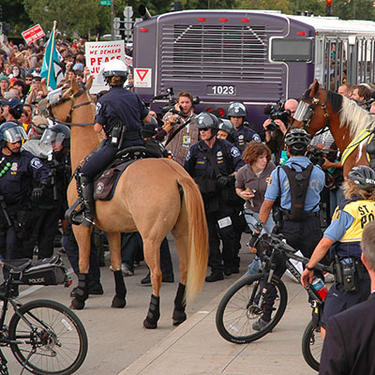
Using horseback officers, police moved to cut off demonstrators during GOP convention in St. Paul. Photo by Nick Vlcek / City Pages.

‘Dozens of journalists, photographers, bloggers and videomakers arrested in an orchestrated round up of independents covering the Republican National Convention’
By Timothy Karr / September 3, 2008

In St. Paul this week, a new generation of media makers is under assault by the city’s mayor and law enforcement officers.

These local officials think freedom of the press extends only to their allies in mainstream media.

For the rest of us, practicing journalism is a crime.

While reports of brutal police arrests and home invasions are still coming in, by Tuesday night the picture became clear.

Targeting the New Press

The list of those detained ranges from the well-known (Democracy Now’s Amy Goodman) and well-established (Associated Press photographer Matt Rourke) — to the bootstrapping bloggers and video makers who are covering local protests for TheUptake.org, Twin Cities Indymedia, I-Witness and other outlets.

Police — with firearms drawn — raided a meeting of the video journalists and arrested independent media, bloggers and videomakers. Journalists covering protests have been pointed out by authorities, blasted with tear gas and pepper spray, and brutalized while in custody.

Democracy Now’s Goodman reports that a U.S. Secret Service agent ripped her press credentials from her neck the moment she identified herself to him as a member of the media. Her producers emerged yesterday from their jail cells bloodied and scarred, reporting unusually harsh treatment at the hands of local and federal authorities.

Mayor Coleman’s Silence

St. Paul Mayor Chris Coleman hasn’t responded to repeated phone and e-mail requests for comments on the targeting of journalists. Instead he praised the work of Police Chief John Harrington and painted those arrested as a small band of outsiders and vandals intent upon committing felonies against the good people of his city.

In less than a day, more than 35,000 people have signed a letter from Free Press (my employer) to Mayor Coleman condemning the arrests and demanding that he and local prosecutors immediately “free all detained journalists and drop all charges against them.”

But when Salon.com’s Glenn Greenwald pressed Harrington and Coleman to respond to widespread reports of journalist arrests, Harrington claimed ignorance while Coleman stood silent at his side.

Police spokesman Don Walsh intervened only to say that “arrest have been made” and that all those arrested were involved in criminal activities and not “simply non-participants.”

Strib Forgets About Free Speech

In a bizarre editorial on Tuesday, the Minneapolis St. Paul Star Tribune hailed the police crackdown as “appropriate,” blaming unrest on outsiders from beyond the Twin Cities.

“Many of those arrested in St. Paul weren’t carrying IDs or wouldn’t give their names. Those who were identified came from Lexington, Ky.; Brooklyn, N.Y.; Portland, Ore., and dozens of other U.S. cities,” they wrote. “These weren’t the sons and daughters of Highland Park and south Minneapolis.”

The Star Tribune itself is owned by out-of-towners from Avista Capital Partners, a New York City private equity firm specializing in energy, healthcare and media investments.

Other than a brief story about Goodman’s arrest, the paper has failed to report on the apparent targeting of independent reporters, even though groups like the Committee to Protect Journalists, Reporters Without Borders and the National Association of Hispanic Journalists have sounded the alarm.

Sweeping Real Journalism Under the Carpet

Here we have every indication of an orchestrated assault by federal and local law enforcement agencies to stifle independent sources of information. As shocking as this conduct is, more disturbing is the fact that the mayor’s office and the local daily seem so unconcerned.

It’s not difficult to understand why. With local leaders making every effort to roll out the welcome mat for mainstream media and the GOP, they’d rather sweep beneath the carpet those pesky independents who are showing us a side of the spectacle that is less scripted for prime time.

As an elected representative, Mayor Coleman should take a stand on behalf of a free press, rein in aggressive and violent tactics by local law enforcement, stop the targeting of journalists and immediately drop all charges against them.

As a powerful news organization, the Star Tribune should know better, and should be sticking up for a free press, regardless of the form it takes.

For now, the democratic spirit of journalism is alive not in the Star Tribune newsroom, but among the video-blogs and cellphone reports that are bubbling up from outside the convention.

Timothy Karr is Campaign Director for Free Press and SavetheInternet.com. Tim served as executive director of MediaChannel.org and vice president of Globalvision New Media and the Globalvision News Network. He has also worked extensively as an editor, reporter and photojournalist for the Associated Press, Time Inc., New York Times and Australia Consolidated Press. Karr critiques, analyzes and reports on media and media policy in his popular blog, MediaCitizen.

Source / The Huffington Post

Thanks to Mercedes Lynn de Uriarte / The Rag Blog

Posted in RagBlog | Tagged , , , , , , , , , | Leave a comment

Where Iraqi Spending Priorities Lie

Please keep this in perspective: Iraq does not provide potable water for the majourity of its citizens, there are still 4 million Iraqis displaced because of ethnic cleansing (termed “civil war” by the US), cholera has become a majour concern (again) in the past few days, violence is still rampant with nearly 400 people dying (and rather more being wounded) from bombers, gunshots, and other murders in the last month in the country.

What is wrong with this picture?

Richard Jehn / The Rag Blog


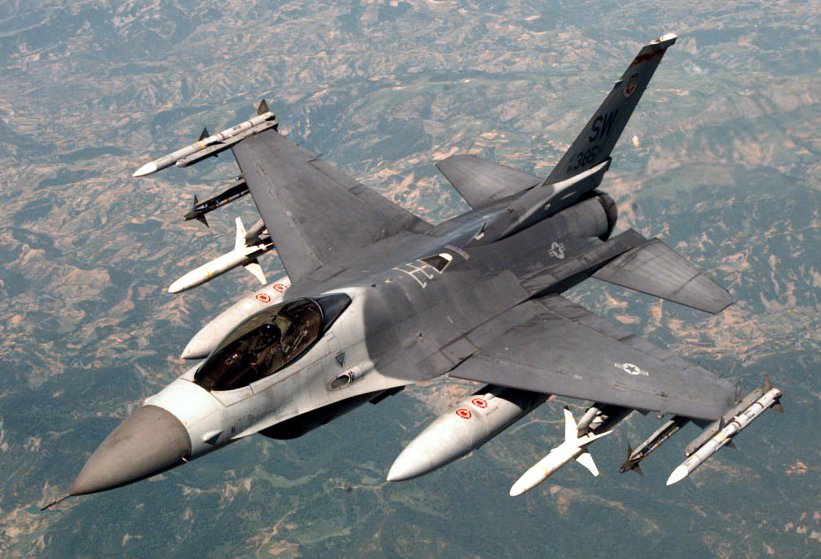
Iraq eyes Lockheed F-16 fighter aircraft purchase
By Jim Wolf / September 5, 2008

WASHINGTON, Sept 5 (Reuters) – The Iraqi government has asked for information about buying 36 F-16 fighter aircraft built by Lockheed Martin Corp, the U.S. Defense Department said on Friday.

The request, received Aug. 27, is being reviewed “in the normal course of business” as part of the U.S. government-to-government arms sale process, said Air Force Lt. Col. Patrick Ryder, a Pentagon spokesman.

Updated F-16s are among the world’s most advanced multirole fighters and a powerful symbol of military ties to the United States.

Iraq’s interest in the fighter jet, reported first by The Wall Street Journal, could spark concerns among neighbors worried about advanced arms in the hands of a country still facing major internal challenges.

U.S. reviews of possible arms sale can take a year or more. They involve the departments of State and Defense as well as Congress and weigh power balances, technology security and other thorny issues. If a contract were ultimately signed, deliveries could take another year or more, depending on the model in question.

The Pentagon did not specify which F-16 version Iraq was eyeing, nor whether it was new or refurbished. A Lockheed spokesman referred questions to the Pentagon.

F-16C/D Block 50/52 models are now being produced for Poland, Israel, Greece and Pakistan. The United Arab Emirates was the maiden customer for the Block 60 version, the most sophisticated F-16 produced to date.

More than 4,400 F-16s have been delivered worldwide, according to Bethesda, Maryland-based Lockheed Martin. Morocco this year became the 25th and latest overseas buyer with a deal for 24 new Block 50/52 models and related gear said by the Pentagon to be worth as much as $2.4 billion.

Iraq’s request for pricing and availability data might not necessarily lead to a sale. Sometimes governments seek such information for planning purposes only, the Pentagon’s Ryder said.

Flush with billions of dollars from oil sales, Iraq is emerging as the biggest client for a wide range of U.S. weapons — a shot in the arm for defense contractors such as Lockheed, Boeing Co, Northrop Grumman Corp, General Dynamics Corp and Raytheon Co.

Among other systems, Iraq is seeking more than 400 armored vehicles plus six C-130 transport planes built by Lockheed, the Pentagon’s No. 1 supplier.

On July 30, the Pentagon notified Congress that Iraq also was seeking to buy 24 Textron Inc Bell Armed 407 or 24 Boeing AH-6 helicopters along with 565 120mm mortars, 665 81mm mortars, 200 AGM-114M Hellfire missiles and other arms that could be worth $2.4 billion.

Baghdad and Washington are working on a long-term security pact that calls for U.S. military forces to quit Iraq’s cities by next summer as a step toward a broader withdrawal from the country that U.S.-led forces invaded in 2003 to topple President Saddam Hussein.

F-16s would let Iraqi forces conduct airstrikes of their own on insurgent positions rather than relying on U.S. forces to do so, as is now the case.

Overseas sales have kept Lockheed’s F-16 production line open after the U.S. military shifted to more advanced fighters, including the radar-evading F-22 also built by Lockheed.

“The program is healthy and full of activity, with firm production through 2012 and a strong likelihood of new orders that will extend the line for several more years,” John Larson, vice president for Lockheed’s F-16 programs, told reporters in July at the Farnborough Air Show outside London.

(Editing by Lisa Von Ahn, John Wallace, Phil Berlowitz)

© Thomson Reuters 2008

Source / Reuters

And there’s this from three weeks ago:

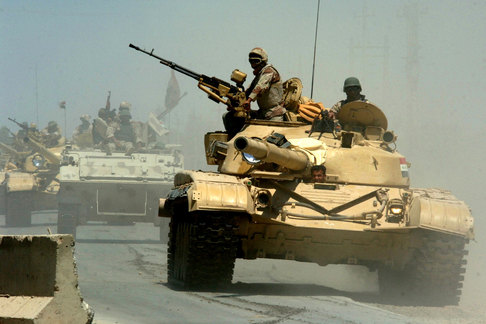
Iraqi Army T-72 tanks and an M113.

Iraqi Army beefs up armored forces
By DJ Elliott / August 15, 2008

The Iraqi government’s announcement it will spend nearly $11 billion on weapons systems highlights its desire to upgrade the capabilities of the Iraqi armed forces from a primarily counterinsurgency force to a military capable of protecting its own borders from outside threats. Included in the purchase are 24 light attack helicopters, mortar systems, six C-130 transports, various support vehicles, 392 Light Armored Vehicles, and above all else, 140 M1A1 Abrams tanks. The initial purchase of the Abrams tanks indicates the Iraqi Army is starting to transform from a light motorized force into a mixed force with armored, mechanized, and cavalry divisions capable of countering the Iranian and Syrian armies.

Read the rest of it here. / Long War Journal

The Rag Blog

Posted in RagBlog | Tagged , , | 2 Comments

ART : R. Crumb: Mr. Natural Goes to the Museum

“Mr. Natural” (1974), paint on plywood, from “R. Crumb’s Underground.” Image courtesy of John Lautemann / NYT.

R. Crumb’s Underground One of the more than 100 works in this exhibition at the Institute of Contemporary Art in Philadelphia. Image courtesy of Denis Kitchen Art Agency / NYT.

R. Crumb’s Underground: ‘The exhibition is full of wild sex’
By Ken Johnson / September 4, 2008

PHILADELPHIA — What a long, strange trip it’s been. Over the course of his five-decade career the comic artist R. Crumb has gone from hero of the hippie underground to toast of the international art world. Founder of the deliriously psychedelic and ribald Zap Comix during the Haight-Ashbury wonder years, he has more recently contributed comic strips made in collaboration with his wife, Aline Kominsky Crumb, to The New Yorker. In 2004 he was included in the Carnegie International and had a career retrospective at the Ludwig Museum in Cologne, Germany.

Now the Institute of Contemporary Art here offers “R. Crumb’s Underground,” an excellent opportunity to ponder Mr. Crumb’s incredible journey. This enthralling selection of more than 100 works from all phases of his career was organized by Todd Hignite, the publisher and editor of Comic Art magazine, for the Yerba Buena Center for the Arts in San Francisco, where it was on view in 2007.

Mr. Crumb is not the only artist to cross over from the comic-book ghetto to the fine-art museum. Gary Panter, Chris Ware and Daniel Clowes are just three of the better-known contemporary cartoonists who have helped to make the comic book a form to be taken seriously by sophisticated adults. But Mr. Crumb — a draftsman of transcendent skill, inventiveness and versatility, a fearlessly irreverent, excruciatingly funny satirist of all things modern and progressively high-minded, and an intrepid explorer of his own twisted psyche — remains the genre’s gold standard.

Born in Philadelphia in 1943, Mr. Crumb (first name, Robert) never went to art school. He learned to draw under the tutelage of his older brother, Charles, also an aspiring comic artist. In the early 1960s he designed greeting cards for the American Greetings Corporation in Cleveland. In 1967 he moved to San Francisco, where he would create some of the most memorable characters in cartoon history, including the irascible guru Mr. Natural and his hapless foil Flakey Foont; the suave, shamelessly randy Fritz the Cat; the angry amazon Devil Girl; and R. Crumb himself, a figure comparable to the autobiographical alter egos of Woody Allen and Philip Roth. Since the early 1990s Mr. Crumb and his wife have lived in the South of France.

The exhibition is full of wild sex. Mr. Crumb makes no bones about his lust for big, muscular women, and his uncensored erotic fantasy life is not only entertaining but also liberating. See “How to Have Fun With a Strong Girl” (2002), a suite of 12 drawings in which the scrawny Mr. Crumb climbs like a monkey all over a powerfully built young woman. We should all be so open to, and forgiving of, our libidinous fantasies.

But sex is not Mr. Crumb’s only preoccupation. He is also a great lover of early-20th-century popular music and a fanatical collector of old 78-r.p.m. records. A section of the exhibition devoted to his musical interests includes extended narratives about the sadly foreshortened lives of the blues musicians Charlie Patton and Tommy Grady. There is a humane, deeply moving tenderness to these works.

The influence of LSD, which Mr. Crumb has called his “road to Damascus,” is evident in works of funky surrealism from the ’60s and ’70s. The classic “Meatball” (1967), in which ordinary people from all walks of life are hit from out of the blue by consciousness-altering meatballs, is mysteriously trippy.

But what is also appealing in Mr. Crumb’s work is how often it is grounded in mundane reality. “Lap o’ Luxury” (1977), at 10 pages one of his longer productions, tells in detail all the events in one afternoon in the life of a little boy at home with his mom and his pesky younger brother. At one point he becomes sexually aroused by the cowboy boots on a woman who comes for a brief visit, but otherwise it is all good, clean fun.

Viewers should set aside two or three hours to take in this show. It requires a lot of reading, which brings up another of Mr. Crumb’s virtues: he is a gifted writer with a great ear for vernacular speech. An argument can be made that Mr. Crumb’s work is best consumed in book form. But there really is no substitute for seeing the original drawings, most of which are made with a fine black Rapidograph pen. The liveliness of his curiously old-fashioned draftsmanship comes across in print, but no reproduction can capture his subtlety of touch and alertness to the act of drawing.

Whatever the aesthetic and formal attractions of his work, Mr. Crumb’s penchant for barging past the limits of good taste and political correctness into psychologically juicy and dangerously complicated territory is still the main draw. His most amazingly provocative creation is Angelfood McSpade, a young, inky black, big-breasted African woman in a palm leaf skirt who was inspired by racist caricatures of the ’20s and ’30s. Sweet-tempered and dimwitted, the long-suffering Angelfood is subjected to all kinds of sexual abuse in various episodes Mr. Crumb has drawn. In one hilarious strip in the exhibition she is abducted and molested by aliens in a U.F.O.

Mr. Crumb’s outrageous play with the Angelfood character hinges on a theory that all people are at least unconsciously racist and that bringing racist fantasies fully to light is the best way to expose how stupid and cruel yet insidiously compelling they can be, especially when mixed with sexual fantasies. Kara Walker and Robert Colescott have toyed with racist stereotypes to similar ends.

But Angelfood represents something else for Mr. Crumb too. At the end of a zanily eventful four-page narrative from 1968 we see her dancing in the forest. “She spends her time bopping around in the jungle,” reads the caption, “just a simple, primitive creature! But if you dig her, go get her! If you dare!” In the final panel a man in a suit and tie hurries along a path in the opposite direction from a sign pointing to “Schmarvard Law School.” The words on his suitcase say, “Darkest Africa or Bust!”

Angelfood, in other words, is a symbol of modern man’s yearning for reconnection to his own misplaced instinctual life. In a sense that has been Mr. Crumb’s own lifelong mission: to stay imaginatively alive to his own deepest and most urgent desires, however embarrassing, distasteful or offensive they may appear to polite society. Angelfood is R. Crumb’s soul.

[“R. Crumb’s Underground” continues through Dec. 7 at the Institute of Contemporary Art, 118 South 36th Street, Philadelphia; (215) 898-7108, icaphila.org.]

Source / New York Times

Thanks to Harry Edwards / The Rag Blog

Posted in RagBlog | Tagged , , , , , , , | 1 Comment

Sarah Palin : ‘So Sambo Beat the Bitch!’


‘Being openly racist is only the tip of the Palin iceberg’
by Charley James / September 5, 2008

“So Sambo beat the bitch!”

This is how Republican Vice Presidential nominee Sarah Palin described Barack Obama’s win over Hillary Clinton to political colleagues in a restaurant a few days after Obama locked up the Democratic Party presidential nomination.

According to Lucille, the waitress serving her table at the time and who asked that her last name not be used, Gov. Palin was eating lunch with five or six people when the subject of the Democrat’s primary battle came up. The governor, seemingly not caring that people at nearby tables would likely hear her, uttered the slur and then laughed loudly as her meal mates joined in appreciatively.

“It was kind of disgusting,” Lucille, who is part Aboriginal, said in a phone interview after admitting that she is frightened of being discovered telling folks in the “lower 48” about life near the North Pole.

Then, almost with a sigh, she added, “But that’s just Alaska.”

Racial and ethnic slurs may be “just Alaska” and, clearly, they are common, everyday chatter for Palin.

Besides insulting Obama with a Step-N’-Fetch-It, “darkie musical” swipe, people who know her say she refers regularly to Alaska’s aboriginal people as “Artic Arabs” – how efficient, lumping two apparently undesirable groups into one ugly description – as well as the more colourful “mukluks” along with the totally unimaginative “fucking Eskimo’s,” according to a number of Alaskans and Wasillians interviewed for this article.

But being openly racist is only the tip of the Palin iceberg. According to Alaskans interviewed for this article, she is also vindictive and mean. We’re talking Rove mean and Nixon vindictive.

No wonder the vast sea of white, cheering faces at the Republican Convention went wild for Sarah: They adore the type, it’s in their genetic code. So much for McCain’s pledge of a “high road” campaign; Palin is incapable of being part of one.

It’s not easy getting people in the 49th state to speak critically about Palin – especially people in Wasilla, where she was mayor. For one thing, with every journalist in the world calling, phone lines into Alaska have been mostly jammed since Friday; as often as not, a recording told me that “all circuits are busy” or numbers just wouldn’t ring. I should think a state that’s been made richer than God by oil could afford telephone lines and cell towers for everyone.

On a more practical level, many people in Alaska, and particularly Wasilla, are reluctant to speak or be quoted by name because they’re afraid of her as well as the state Republican Party machine. Apparently, the power elite are as mean as the winters.

“The GOP is kind of like organized crime up here,” an insurance agent in Anchorage who knows the Palin family, explained. “It’s corrupt and arrogant. They’re all rich because they do private sweetheart deals with the oil companies, and they can destroy anyone. And they will, if they have to.

“Once Palin became mayor,” he continued, “She became part of that inner circle.”

Like most other people interviewed, he didn’t want his name used out of fear of retribution. Maybe it’s the long winter nights where you don’t see the sun for months that makes people feel as if they’re under constant danger from “the authorities.” As I interviewed residents it began sounding as if living in Alaska controlled by the state Republican Party is like living in the old Soviet Union: See nothing that’s happening, say nothing offensive, and the political commissars leave you alone. But speak out and you get disappeared into a gulag north of the Arctic Circle for who-knows-how-long.

Alright, that’s an exaggeration brought on by my getting too little sleep and building too much anger as I worked this article. But there’s ample evidence of Palin’s vindictive willingness to destroy people she sees as opponents. Just ask the Wasilla town administrator she hired before firing him because he rebelled against the way Palin demanded he do his job, or the town librarian who refused to hold the book burning Walpurgisnach Mayor Palin demanded.

Ironically, Palin was pushed into hiring the administrator by the party poo-bah’s who helped get her elected after she got herself into trouble over a number of precipitous firings which gave rise to a recall campaign.

“People who fought her attempt to oust the librarian are on her enemies list to this day,” states Anne Kilkenny, a Wasilla resident and one of the few Alaskans willing to speak on-the-record, for attribution, about Palin. In fact, Kilkenny actually circulated an e-mail letter about Palin that was verified and printed by The Nation.

For good measure, Palin booted the Wasilla police chief from office because, she told a local newspaper, he “intimidated” her.

Sarah Palin drew early attention from state GOP apparatchiks when, during her first mayoral campaign, she ran on an anti-abortion platform. Normally, political parties do not get involved in Alaskan municipal elections because they are non-partisan. But once word of her extreme fringe evangelical views made its way to Juneau, the state capitol, state Republicans tossed some money behind her campaign.

Once in office, Palin set out to build a machine that chewed up anyone who got in her way. The good, Godly Christian turns out to be anything but.

“She’s doesn’t like different opinions and she refuses to compromise,” Kilkenny notes. “When she was Mayor, she fought ideas that weren’t hers. Worse, ideas weren’t evaluated on their merits but on the basis of who proposed them.”

Sound familiar? Palin may well be Dick Cheney’s reincarnate.

Something else has a familiar Republican ring to it: Her tax policies, and a “refund surpluses but borrow for the future” attitude.

According to Kilkenny and others in Wasilla as well as Juneau, Palin reduced progressive property taxes for businesses while mayor and increased a regressive sales tax which even hits necessities such as food. The tax cuts she promoted in her St. Paul speech actually benefited large corporate property owners far more than they benefited residents. Indeed, Kilkenny insists that many Wasilla home owners actually saw their tax bill skyrocket to make up for the shortfall. Two other Wasillian’s with whom I spoke said property taxes on their modest, three bedroom homes rose during the Palin regime.

To an outsider, it would seem hard to do, but an oil-rich town with zero debt on the day she was inaugurated mayor was left saddled with $22-million of debt by the time she moved away to become governor – especially since nothing was spent on things such as improving the city’s infrastructure or building a much-needed sewage treatment plant. So what did Mayor Palin spend the taxpayer’s money on, if not fixing streets and scrubbing sewage?

For starters, she modelled her office. Several times over, as a matter of fact.

Then Palin spent $1-million on an unnecessary, new park that no one other than the contractors and Palin seemed to want. Next, Sarah doled out more than $15-million of taxpayer money for a sports complex that she shoved through even though the city did not own clear title to the land; now, seven years later, the matter is still in litigation and lawyer fees are said to be close to at least half of the original estimated price of the facility.

She also worked hard to get voters approval of a $5.5-million bond proposal for roads that could have been built without borrowing. Anchorage may not be the center of the financial universe but, like good Republicans everywhere, Sarah Palin knows how to please Alaskan bankers and bond dealers.

For good measure, she turned Wasilla into a wasteland of big box stores and disconnected parking lots.

En route to the governor’s igloo, Palin managed to land what Anne Kilkenny says is the plumb political appointment in the state: Chair of Alaska’s Oil and Gas Conservation Commission (OGCC), a $122,400 per year patronage slot with no real authority to do anything other than hold meetings. She took the job despite having no background in energy issues and, as it turned out, not liking the work.

“She hated the job,” an OGCC staff member who is not authorized to speak with the news media told me. “She hated the hours and she hated what little work there was to do. But she couldn’t figure out a way to get out of the thing without offending Gov. Murkowski” and the state Republican Party regulars, some of whom were pissed off they didn’t get appointed.

But ever the opportunist, Palin quickly concocted a way. First, she waged a campaign with the local news media claiming that the position was overpaid and should be abolished – despite the fact that she lobbied Murkowski hard to get it. Then, mounting what she saw as a white horse, Palin raised a cloud of dust by resigning from the OGCC and riding away with an undeserved reputation as a “reformer.”

But when a local reporter dared to suggest that the reformer Empress has no clothes, Palin tried to get her fired.

“She came at me like I was trying to steal her kids,” said the targeted reporter, who now works for an oil company in Anchorage. “I heard she had a wild temper and vicious mean streak but it’s nothing like you can imagine until she turns it on you.”

Not surprising since some of her high school classmates still openly call her “Sarah Barracuda,” Kilkenny insists.

Still, as a Republican Party hack Palin managed to get herself elected running under the false flag of a “reformer.”

And what did she bring to the job? No legislative experience other than a city council of a village of 5,000 people, which is smaller than some high schools in Chicago. Little hands-on supervisory or managerial experience; after all, she needed to hire a city administrator to run Wasilla. No executive experience, except for almost being recalled as mayor. A philosophy of setting public policy based on one word: No.

And what has she done since winning the job?

According to Kilkenny, nothing. Well, nothing other than suggesting the state’s multi-multi-million dollar, oil-generated surplus be distributed to residents and finance future state needs by borrowing money. Gee, doesn’t that sound precisely what George Bush did with the surplus he inherited from Bill Clinton in 2001 and we all know in what great shape Bush’s economic policies left the nation.

It may explain why, when asked by reporters including me what she thought about Palin being picked to be McCain’s running mate, her mother-in-law replied with a sardonic, “What has Sarah done to qualify her to be vice president?” Of course, when the woman – said by many I spoke with to be well-respected in Wasilla – was running to succeed Palin as mayor, Sarah refused to endorse her so that may explain the family tension.

As Governor, Palin gave the legislature no direction and budget guidelines, according to the chair of a legislative committee. But then she staged a huge grandstand play of line-item vetoing countless projects, calling them pork. “They were restored because of public outcry and legislative action,” the aide said. “She vetoed them mostly because she had no idea what they were or why they were important.”

But it was enough to get the McCain, who is mostly unobservant of the world around him anyway, to think Palin has a reputation as being “anti-pork”.

In fact, Juneau observers note that Palin kept her hand stuck out as far as anyone for pork ladled out by indicted Sen. Ted Stevens. She only opposed the “bridge to nowhere” after it became clear that it would be politically unwise to keep supporting it, these same insiders assert. Then, Palin fell back on her old habits and publicly humiliated him for pork-barrel politics.

As for being “ready on day one” to be commander in chief, despite the repeated public claims she’s made, the Alaska National Guard commander said that, “she has made no command decisions, other than sending some troops to help fight a few brush fires and march in parades at county fairs.”

“Palin is a conniving, manipulative, asshole,” someone who thinks these are positive traits in a governor told me, summing up Palin’s tenure in Alaska state and local politics.

“She’s a bigot, a racist and a liar,” is the more blunt assessment of Arnold Gerstheimer who lived in Alaska until two years ago and is now a businessman in Idaho.

“Juneau is a small town, everybody knows everyone else,” he adds. “These stories about what she calls blacks and Eskimos, well, anyone not white and good looking actually, were around long before she became a glint in John McCain’s rheumy eyes. Why do I know they’re true? Because everyone who isn’t aboriginal or Indian in Alaska talks that way.”

“Sambo beat the bitch” may be everyday language up in the bush. Whether it – and the outlook, politics and worldview Palin reflects when she says such things in public – should be part of a presidential campaign is another thing altogether. The comment says as much about McCain as it does about Palin, and it says a lot of things about Americans who overlook such statements (as well as her record) and vote anyway for McCain.

[Charley James is an independent investigative journalist and essayist from Milwaukee who now lives in Toronto.]

Source / The Progressive Curmudgeon

Thanks to Carl Davidson / The Rag Blog

Posted in RagBlog | Tagged , , , , | 6 Comments

Musician John Gourley of Wasilla, AK : Why We Don’t Need Sarah Palin

John Gourley of Portugal. The Man. Photo by anthonydicap.

Palin. Because we don’t need it.
September 4, 2008

So, the MOST famous person from Wasilla, Alaska is GOP Vice Presidential candidate Sarah Palin. But, RIGHT behind her are Wasilla natives John Baldwin Gourley and Zachary Scott Carothers, two members of indie-rock band Portugal. The Man, who, in its four-and-a-half-star review of the band’s new album, “Censored Colors,” Alternative Press called “one of the truly great bands of this generation.”

John Gourley has just posted a blog on the band’s website where he writes a passionate and touching essay about HIS Alaska, what is a TRUE Alaskan, and why we, the American people, don’t need Sarah Palin.

Gourley and Carothers grew up in the tiny town of Wasilla, fishing, hiking, and playing music together. Gourley and his hippie parents lived outside of town in a remote log cabin that was powered by a generator and had no phone. His mom and dad, a team of dog sled mushers, ran Alaska’s annual Iditarod, dubbed the “last great race on earth.” And Carothers remembers his frequent banter with Palin, then Wasilla’s Mayor, about building a town skate park (never happened). Gourley and Carothers’ families still live in Wasilla, and both return home whenever their touring schedule allows. Gourley has said that Alaska, with its breathtaking, ice-filled landscapes, has had a huge impact on the band’s music.

With their third album, “Censored Colors” set for release September 16, and their fall U.S. headline tour kicking off October 14, the critically-acclaimed blusey/folkie/indie/progy/poppy rock band has been making their own mark in the Lower Forty-Eight. Cutting-edge media, from Filter to Absolute Punk to Alternative Press to theTripwire have raved about the band, and put P.TM in some pretty heady company, comparing their music to the music of artists like the White Stripes, the Mars Volta, Jeff Buckley, Led Zeppelin and even the Beatles.

Source / The Gauntlet

Sarah Palin. Because we don’t need it.

“Because we don’t need it” was something that has been taught to me every day of my life through these amazing people and to watch Sarah Palin get so much attention based on what? 2 years as Governor of the State of Alaska? Or is it based on her time as the mayor of Wasilla? The town of 5,000 at the time.

“Because we don’t need it.”

We don’t need drilling in some of our most beautiful and untouched land. We need to work towards options. We should be investing and working towards clean fuels. We don’t need to be draining our planet of every last drop before moving on to the next. Sarah Palin disagrees

We needed votes to add the polar bear to the endangered species list. (I know, I know, that polar bear rug would really bring the room together!). Sarah Palin disagreed

We don’t need aerial hunting… Again. We do NOT need this. I don’t know of any true Alaskan that feels it is good sport to shoot an animal from a plane. Sarah Palin disagrees

We don’t need book burners and censors. Sarah Palin pushed to get the librarian of Wasilla fired when certain books were not removed from the public library. Who else in history has banned books? Not very good company is it?

We don’t need more debts. Palin spent 15 million on a new sports center in the valley, leaving the small town of Wasilla, Alaska in debt to the amount of 22 million. (That’s 22 million more than the debt she took on when taking on this lovely playtime as mayor.) 15 million just for a new sports center.

We don’t need family feuds interfering with duties. I know you feel your ex-brother-in-law was a dick… but trying to get him fired based on this may cause a little trouble. Sarah?

We don’t need another vote against gay marriage. This is just standard every day equal rights being overlooked. Sarah Palin disagrees.

We don’t need to overlook global warming. Science can now tell us “Yup. That is happening.” Not my words, that is science speak. Sarah Palin disagrees.

We don’t need a wolf in sheep’s clothing… or a sheep in wolves clothing, depending on how you look at it. She has billed her self as this overly average “hockey mom” and it is just not what I see. I see the sport hunter, the censor, choice taker, the revelations reader, and the high school cheerleader. It is endlessly embarrassing to watch people fall all over this idea. This is not my Alaska. The Alaska I know.

What we do need is love and respect for one another and respect for the world we live in.

[Read John Gourley’s full story of his first hunting trip in which he didn’t shoot the moose because “we don’t need it,” at Portugal. The Man]

Thanks to Carlos Lowry / The Rag Blog

Posted in RagBlog | Tagged , , , , , | Leave a comment

Sarah Palin’s Aerial War on Wolves

Source / Red State Rebels

The Rag Blog / Posted September 5, 2008

Posted in RagBlog | Tagged , | Leave a comment

Why Is This No Surprise Whatsoever?

Screen grab of stock footage of soldiers
funeral used in RNC video. (GETTY IMAGES)

Fake Soldiers Used In RNC Video
By Michael Rey / September 4, 2008

Patriotic Montage Shown At RNC Featured Actors Hired For One Day Shoot, Not Military

It was a video that was supposed to elicit soaring patriotism and real emotions about the Pledge of Allegiance. But to do that, it used fake soldiers and a staged military funeral instead of the real thing.

On Tuesday night, 15-year-old Victoria Blackstone, a sophomore at the St. Agnes School in St. Paul, led the crowd at the Xcel Energy Center in the Pledge of Allegiance. The audience heard her 434-word essay, “Pledging myself to the Flag of the United States of America,” an essay she’d entered in the “Wave the Stars & Stripes” essay contest and won. The RNC turned that essay into a three and a half minute video, a visually stirring montage rolling over Victoria’s words about sharing the Pledge with Americans who have stood at important moments in history.

There’s the Continental Congress…A real WWII vet…Photos of workers at Ground Zero. A close-up of a folded flag presented to a grieving widow at a military funeral… profiles of soldiers swelling with pride in slo-motion.

But CBS News found that the footage of the ‘funeral’ and soldiers is what is called ‘stock’ footage. The soldiers were actors and the funeral scene was from a one-day film shoot, produced in June. No real soldiers were used during production.

The footage, sold by stock-film house Getty Images was produced by a commercial filmmaker in Chicago. Both Getty and the production company, Mr. Big Films, confirmed that the footage was shot on spec and sold to the Republican National Committee.

One of the actors, Perry Denton of Chicago, Ill. also confirmed that he was hired on a day-rate as an actor for the shoot and told CBS News he was surprised to learn the footage was shown at the convention.

A veteran’s advocate said that with soldiers still deployed and in harm’s way, there is an obligation not to sugar coat reality.

“What it does reveal is a serious lack of understanding and a lack of personal connection to the military,” said Paul Rieckhoff, Executive Director of the Iraq and Afghanistan Veterans of America.

Rieckhoff, who is at the convention with a contingent of veterans added that a video tribute to Medal of Honor winner Michael Monsoor, a Navy Seal killed in Iraq, shown on Tuesday night, used combat video that appeared to him and several other veterans of the Iraq war to have been staged.

After a Web search of videos played at the Democratic National Convention last week, CBS News found no obvious use of stock footage.

The RNC did not respond to CBS News’ request for a comment.

Source / CBS News

Thanks to Diane Stirling-Stevens / The Rag Blog

Posted in RagBlog | Tagged | 1 Comment

FILM : ‘WHY WE FIGHT’ — The Dominant Role of the Military in American Life


WHY WE FIGHT: ‘We must understand the underlying disease itself’
By William Michael Hanks
/ The Rag Blog / September 5, 2008

One may scarcely witness the cascading events of the last decade without feeling a sense that something is going terribly wrong with America. Our government tells us that we stand for democracy. Yet, for over half a century we have overthrown democratically elected regimes and installed repressive dictators friendly to U.S interests.

We are told that we stand for human rights, yet we ignore genocide in Africa and train Central and South American terrorists in the School of the Americas. Government leaders decry the deceitful regimes of our enemies while perpetrating one of the grandest deceptions in American history upon our own people – a deception that has wasted our economy and cost the lives of thousands of young American men and women and hundreds of thousands of lives in other countries.

This would all read like George Orwell or Phillip K. Dick fictions of the future except for two things – it’s not fiction and it’s not the future, it’s now. One’s first instinct is to react to the visible symptoms of this malignancy: protest the war; expose individual hypocrisies; espouse human rights and social justice. But we can do all these things, and even be successful, without curing the disease. We stopped the Vietnam War only to see a sequence of others made in the same mold – each one more egregious than the last.

Certainly we must continue to oppose each unjust war, expose deceit, and act for social justice and human rights. But we must do much more if we are to bequeath a better world to future generations. We must understand the underlying disease itself – the DNA of forces and combinations that come together invisibly to create the visible symptoms of war, injustice, and oppression.

We need more informed thought and discourse about what has gone wrong in America. One good source is a documentary, WHY WE FIGHT, (Grand Prize, 2005, Sundance Film Festival) directed by Eugene Jarecki. The film follows the evolving thoughts of a Vietnam veteran, who lost a son when the World Trade Center towers fell, and the actions of a young man who is joining the military. It begins with the last address of President Eisenhower warning of the dangers of the Military-Industrial Complex. It is intercut with surprisingly candid interviews with military and intelligence officers who document the evolving deceptions of American citizens and the reasons for them.

WHY WE FIGHT addresses the underlying causes of war and injustice that we are supporting as taxpaying citizens. We, the American people, are making all this possible. Without the tax dollars and will of the people none of these things could be done. We are not only responsible we are accountable to future generations. It is our duty to understand the causes of war and injustice and, by confronting them at their source, reveal their true nature. If the majority of the people can understand the real enemy and act in solidarity we can leave the world a little better place.

WHY WE FIGHT shines new light on where the real fight is.

Go here for a clip.

And go here to see the film.

Also go to Until the Sun Stops.

The Rag Blog

Posted in Rag Bloggers | Tagged , , , , , , , | 2 Comments

Is This a Reckless New Policy Targeting Pakistan?


US attack inside Pakistan threatens dangerous new war
By Peter Symonds / September 5, 2008

A ground assault by US Special Forces troops on a Pakistani village on Wednesday threatens to expand the escalating Afghanistan war into its neighbour. Pakistan is already confronting a virtual civil war in its tribal border regions as the country’s military, under pressure from Washington, seeks to crush Islamist militias supporting the anti-occupation insurgency inside Afghanistan.

The attack, which left up to 20 civilians dead, marks a definite escalation of US operations inside Pakistan. While US Predator drones and war planes have been used previously to bomb targets, Wednesday’s raid was the first clear case of an assault by American ground troops inside Pakistani territory. The White House and Pentagon have refused to comment on the incident but various unnamed US officials have acknowledged to the media that the raid took place and indicated that there could be more to come.

The attack was unprovoked. US troops landed by helicopter in the village of Jalal Khei in South Waziristan at around 3 a.m. and immediately targetted three houses. The engagement lasted for about 30 minutes and left between 15 and 20 people dead, including women and children.

A US official acknowledged to CNN that there may have been women and children in the immediate vicinity but when the mission began “everyone came out firing from the compound”. Even this flimsy justification for a naked act of aggression is probably a lie. “It was very terrible as all of the residents were killed while asleep,” a villager Din Mohammad told the Pakistan-based International News.

The newspaper provided details of the dead and injured: nine family members of Faujan Wazir, including four women, two children and three men; Faiz Mohammad Wazir, his wife and two other family members; and Nazar Jan and his mother. Two other members of Nazar Jan’s family were seriously wounded.

The US and international media have described the Angoor Adda area around the village as “a known stronghold of the Taliban and Al Qaeda” but offered no evidence to support the claim. A villager, Jabbar Wazir, told the International News: “All of those killed were poor farmers and had nothing to do with the Taliban.”

In comments to the International Herald Tribune, a senior Pakistani official branded the raid a “cowboy action” that had failed to capture or kill any senior Al Qaeda or Taliban leader. “If they had gotten anyone big, they would be bragging about it,” he commented.

The attack has provoked outrage in Pakistan. Pakistan’s Foreign Ministry issued a statement branding the attack as “a gross violation of Pakistan territory” and summoned US ambassador Anne Patterson to provide an explanation. North West Frontier Province (NWFP) governor Owais Ahmed Ghani declared that “the people expect that the armed forces of Pakistan would rise to defend the sovereignty of the country”. He put the number killed at 20.

Pakistani military spokesman Major General Athar Abbas said the raid was “completely counterproductive” and risked provoking an uprising even among those tribesmen who have previously supported the army’s operations in the border areas.

The International News reported: “Angry villagers later blocked the main road between Pakistan and Afghanistan in Angoor Adda by placing the bodies of their slain tribesmen on the road. They chanted slogans against the US and NATO military authorities for crossing the border without any provocation and killing innocent people.”

The US raid has compounded the political crisis inside Pakistan, where the selection of a new president is due to take place tomorrow. The ruling Pakistan Peoples Party (PPP) has been engaged in a delicate balancing act—continuing to support US demands for a crackdown by the Pakistani military along the border with Afghanistan, while trying to defuse widespread anger and fend off accusations that it is a US puppet.

Reaffirming his support for the Bush administration’s bogus “war on terror”, PPP presidential candidate Asif Ali Zardari declared in a column in yesterday’s Washington Post: “We stand with the United States, Britain, Spain and others who have been attacked.” Zardari went on to promise that he would ensure that Pakistani territory would not be used to launch raids on US and NATO forces inside Afghanistan.

However, as PPP spokesman Farhatullah Babar explained, the US attack was politically compromising. “We have been very clear that any action on this side of the border must be taken by Pakistani forces themselves,” he told the Associated Press. “It is very embarrassing for the government. The people will start blaming the government of Pakistan.”

An expanded war

The decision to launch Wednesday’s attack was undoubtedly taken at the top levels of the White House and Pentagon. As the New York Times reported in articles earlier this year, a high-level debate has been taking place in Washington over the use of US Special Forces inside Pakistan as well as the intensification of existing CIA operations, which include Predator missile strikes.

A meeting in early January involved Vice President Dick Cheney, Secretary of State Condoleezza Rice, Joint Chiefs of Staff chairman Admiral Mike Mullen and top national security and intelligence officials advisers. According to the New York Times on January 6, options discussed included “loosening restrictions on the CIA to strike selected targets in Pakistan” and operations involving US Special Operations forces, such as the Navy Seals.

The Times reported on January 27 that then Pakistani President Pervez Musharraf rejected proposals put by US Director of National Intelligence Mike McConnell and CIA Director Michael Hayden for an expanded American combat presence in Pakistan, either through covert CIA missions or joint operations with Pakistani security forces. While apparently accepting the refusal, the US intensified pressure on Pakistan to bring its border areas under control.

As the anti-occupation insurgency has expanded in Afghanistan, claiming a growing number of US and NATO casualties, Pakistan has become a convenient scapegoat. Washington has repeatedly accused the Pakistani military of failing to suppress Islamist militia and alleged that Pakistani military intelligence is actively supporting anti-US guerrillas inside Afghanistan.

Admiral Mullen has held five meetings since February with his Pakistani counterpart, army chief General Ashfaq Parvez Kayani, to press for tougher action. The most recent took place last weekend aboard the aircraft carrier USS Abraham Lincoln, stationed in the Arabian Sea. In comments to CNN, a US official “declined to say” whether there were any new agreements for US troops to operate inside Pakistani airspace or on the ground to attack Taliban and Al Qaeda.

Whether the Pakistani military quietly approved Wednesday’s attack or not, the Bush administration is making clear that it intends to extend the war into Pakistan. Citing top American officials, the New York Times reported on Wednesday that the raid “could be the opening salvo in a much broader campaign by Special Operations forces against the Taliban and Al Qaeda inside Pakistan, a secret plan that Defence Secretary Robert Gates has been advocating for months within President George W. Bush’s war council”.

This utterly reckless policy, which risks the eruption of a US war against Pakistan, is bipartisan in character. In fact, Democratic presidential candidate Barack Obama has repeatedly declared his support for broadening the “war on terror” through unilateral US attacks on insurgents based inside Pakistan. His candidacy has been strongly backed by sections of the US establishment that have been critical of the Bush administration’s invasion of Iraq for undermining US interests. Far from opposing aggressive US military action, Obama has become the political vehicle for shifting its focus to Afghanistan and Pakistan as the means of advancing US strategic interests in Central Asia and the Indian subcontinent.

The US attack on the village of Jalal Khei is another demonstration that the shift in policy, with all its potentially catastrophic consequences, is already underway.

Source / World Socialist Web Site

And there’s this:

Turning Away From American State Terrorism
By Peter Chamberlin / 5 September 2008

“The American people realize this election represents a turning point. In two months they will decide the future direction of our nation. It’s a decision to follow one path or another.” Rudy Giuliani

The choice we face in November is very clear. It is a choice to continue to support the US terror war, or to turn away from this path of unlimited destruction. This lie-based war is all about terrorism – whether America actually fights terrorism or promotes its use. To find the answer to this conundrum all we have to do is turn our gaze to Pakistan.

In Pakistan we find the complete history of the American “war on terrorism,” from its Cold War origins nearly thirty years ago to its present incarnation in the illegal American aggression in Pakistan’s Frontier region (FATA, Federally Administered Tribal Areas) and in American attempts to reignite the Cold War with Russia. The latest cross-border attack against Pakistan in South Waziristan, which involved American helicopters and ground troops, costing 15 villagers their lives, represents the first steps in American attempts to escalate its war into a reasonable facsimile of another world war.

Once again, America claims that its aggression against Pakistan is a legitimate act of self-defense against the “Pakistani Taliban” (TTP,Tehrik-e-Taliban Pakistan), who, it is claimed, are responsible for America’s faltering war effort in Afghanistan. Wednesday’s aggression was another attempt to get TTP leader Baitullah Mehsud (branded “public enemy number one” by the US) or one of his top commanders. Mehsud is the key to understanding America’s true role in the terror war, that of state terrorism planner and facilitator, in order to later assume the role of defender against the terrorism it causes.

Baitullah Mehsud assumed control of the TTP from its founder, his infamous cousin Abdullah Mehsud. Abdullah was a prisoner at Guantanamo before being inexplicably released to return to Pakistan, where he founded the new Taliban splinter group. On his second day in S. Waziristan he instigated the kidnapping of two Chinese engineers from the building of the Gomal Zam Dam, beginning the TTP fight against America’s adversaries in the region.

Setting the pattern for all future American terror attacks, the American media reported that America’s secret allies, the TTP, were “al Qaida linked.” Whenever and wherever the Western media uses the expression “al Qaida linked,” to describe terrorist attacks, they are referring to American terrorism. This is also painfully true about those sinister forces that killed 3,000 American civilians on September 11, 2001. American/“al Qaida” terrorism always targets civilians, even American civilians. Next to the US military, al Qaida is the greatest killer of innocent Muslims in the world.

Now we have American covert forces busily killing Pakistani civilians by the hundreds, in order to justify the planned overwhelming American assault upon Pakistan, which is conveniently situated between the main target Iran and all that juicy fuel located in the “Stans,” the former Soviet satellites where America’s Georgian mercenaries are busily committing acts of genocide to restart the new Cold War.

The American destabilization of nuclear-armed Pakistan has been the key to the planned destruction of Iran and the seizure of the Caspian region oil and gas fields and the pipeline routes for marketing the stolen booty. Targeting American-backed militants, who are using the same terrorist training camps created by the CIA to launch a “jihad” against the Soviets, American interests are seeking to topple the Pakistani government and to seize their nuclear arsenal.

The corporate American government cannot survive the debt-based collapse of its own economy and the world economy without a massive military expansion of its power, gaining control of the world’s energy reserves. America cannot continue bullying the world to have its way without this key asset.

The Republican and Democratic co-conspirators understand the dilemma created by America’s greed and attempts to forge a global empire. This means that no matter who wins the November election will continue this policy of international piracy and terrorism. It is up to the American people to decide whether these policies of state terrorism continue. It is our decision to make, whether we allow America to destroy the world to save itself, or whether we suffer the economic consequences for our actions in the past. By our inaction, or by the wrong action, we allow the evil that our government continually sows. By participating in our farcical “free elections,” casting a vote for either man, we vote to destroy a large portion of the world and its people.

We can no longer give our assent to the crimes against humanity committed against the world by our government on a daily basis. Non-participation in the affairs of this government on any level, will deny it the cover of legitimacy and support it needs to continue on its terror rampage. We must become the “monkey wrench” in the works of government and in American life, in general. We begin by overwhelming the Congress with our righteous anger against governmental plans to unleash hell on earth.

All it will take to do this is a unified signal from the people that we will no longer silently abide its immoral actions. The Congressional parasites who feed at the public trough fear a non-complacent electorate, a united people committed to reclaiming our rightful positions as “watchdogs” of government.

All we have to do to sway a chicken hawk Congress is to convince them that we are now awake. We must focus our antiwar efforts to disrupt the aggression against Pakistan. It is time to join with the democratic antiwar resistance forces in Pakistan, to put an end to the American empire of terror.

Fight the evil that we have become!

peter.chamberlin@yahoo.com

Source / Information Clearing House

The Rag Blog

Posted in RagBlog | Tagged , , | Leave a comment

Bleak News on Employment Front : Jobless Rate Soars

Theodore Harmon, left, helps Solomon Boyd with a job application as the two look for work at the New York State Department of Labor office in Harlem. Photo by David Goldman / NYT.

Economist Jared Bernstein: ‘Working families are in trouble’
By Michael M. Grynbaum

The unemployment rate jumped to 6.1 percent in August, its highest level in five years, pushing the job troubles of American workers onto the political stage as the presidential campaign enters its final eight weeks.

So far, 605,000 jobs have disappeared since the start of the year, with employers slashing 84,000 jobs in August alone, the Labor Department reported on Friday. And even Americans who are still employed are facing tough times.

Raises have not kept up with the rising cost of living, putting more pressure on workers as high gasoline and food prices curtail their spending power.

The bleak data, which came as the two presidential candidates began a two-month sprint to Election Day, clearly raised the challenge facing Senator John McCain, the Republican candidate. Economic downturns are almost always bad for the incumbent party. In 1980, when unemployment rose more than a percentage point during the year, and several months showed year-over-year declines, the incumbent, Jimmy Carter, lost. In 1992, jobs were down, although the unemployment rate did not rise that much, and President Bush lost his bid for re-election.

In a statement Friday, Mr. McCain said that “Washington has failed to act” to improve the poor economy.

“Americans are hurting and we must act to create jobs,” he said. He vowed to enact a jobs program and help retrain workers for the changing market.

While Mr. McCain has tried to distance himself from President Bush, Senator Barack Obama, the Democratic candidate, tried again Friday to link the Republican candidate to the current administration. Mr. Obama argued that his opponent was “intent on continuing the economic policies that just this year have caused the American economy to lose 605,000 jobs.”

“Today’s jobs report is a reminder of what’s at stake in this election,” Mr. Obama said in a statement.

The Obama campaign called on Congress, which returns next week, to enact another stimulus package, using the senator’s $100 billion proposal as a starting point.

An economic adviser for Mr. McCain, Douglas J. Holtz-Eakin, speaking for the campaign, said Congress should consider another short-term stimulus, but did not specify whether that should be more rebate checks or come in some other form, like tax cuts.

The unemployment rate, which rose from 5.7 percent in July and from 5 percent in April, is at its highest level since September 2003. While teenagers accounted for most of the earlier increase, the job losers in August were mostly over 25 and college educated as well as high school graduates.

“These numbers just cry out to me that the job market is in a recession,” Stuart Hoffman, the chief economist of PNC Bank, said.

Stocks on Wall Street fell after the release of the report, but the Dow Jones industrials recovered and was up slightly in afternoon trading.

Production workers in the manufacturing industry were hit hardest in August, with 61,000 workers losing their jobs. Nearly 60,000 administrative workers, including secretaries and temp workers, were laid off.

Gains came in the education and health care industries, which added a total of 55,000 jobs. But those were offset by broad job cuts at restaurants, auto dealers and factories that make parts for cars and other transportation equipment.

It was the eighth consecutive month that the economy has shed jobs, which is, historically, a symptom of recession.

Layoffs have picked up speed in the last three months, contrary to earlier estimates that they had begun to plateau. The government now says that 100,000 jobs were lost in June, double its original estimate.

“Working families are in trouble,” Jared Bernstein, an economist at the Economics Policy Institute in Washington and an adviser to Senator Obama, said. “This spike in the unemployment rate occurred exclusively among adults who are 25 and older. These are not teens; many of these folks depend on their jobs and their paychecks, and in this climate that means they’re suffering.”

Most workers are effectively earning less than they were a year ago. Hourly wages for rank-and-file workers — those not in supervisory or managerial positions — grew 3.6 percent between last month and August 2007. That was a faster growth rate than July, but below the rate of inflation.

The clear signs of pain in the labor market come as the economy continues to grow; between April and July, the economy expanded at a relatively brisk pace of 3.3 percent, according to the Commerce Department.

Businesses have been benefiting from high foreign demand for American-made goods, which has kept production high. But little of that activity, analysts said, has translated into assistance for the average American worker.

“Whatever is growing the economy, it’s not showing up in the jobs market in any way at all,” Mr. Bernstein said.

Companies may be terminating workers to cut costs in anticipation of tougher times ahead. Many analysts believe the global economy has entered a broad slowdown, which could depress export sales and put a dent into American business activity. Officials at the Federal Reserve believe activity will slow sharply for the rest of the year before returning to a faster growth rate in 2009.

The Labor Department’s jobs report is considered the most reliable snapshot of the nation’s economy in any given month. The unemployment rate is estimated by surveying thousands of households, while the data on job cuts is compiled from reports from employers.

Also on Friday, a new report showed that the outlook for the housing market remained troubling, though there are some early signs of improvement. The number of home loans in foreclosure jumped in the second quarter to another record but the percentage of borrowers who are starting to fall behind declined, according to data from the Mortgage Bankers Association.

[Louis Uchitelle contributed reporting.]

Source / New York Times

The Rag Blog

Posted in RagBlog | Tagged , , , , | Leave a comment