Khyber Pass Reopens for Traffic to NATO Troops

I cannot resist remarking that this is eerily similar to the Pakistani reaction following the events of September 11, 2001: instant acquiescence. Recall that there was rumour of a threat from the reigning US Vice-Emperor that Pakistan would be bombed into the stone age if they refused to cooperate in the newly-minted US “War of on Terror.”

Is it possible that a similar threat surfaced over the weekend in consequence of Pakistan’s closure of the Khyber Pass?

Richard Jehn / The Rag Blog

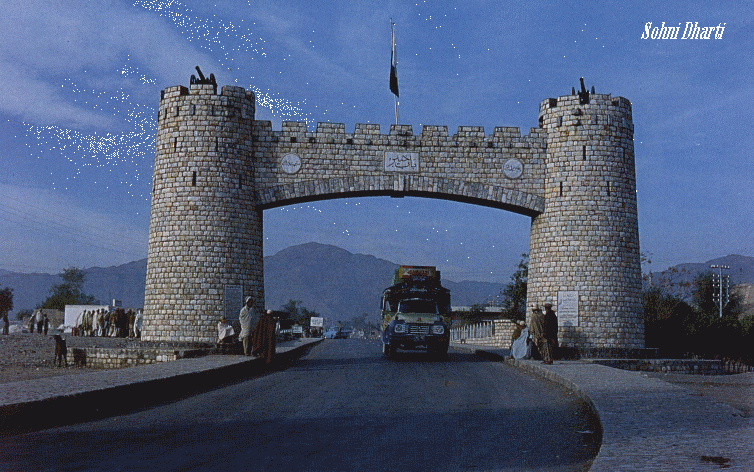
Khyber Pass

Pakistan reopens supply lines to Western forces
Mon Sep 8, 2008 11:54am IST

ISLAMABAD, Sept 8 (Reuters) – Pakistan has reopened supply lines to Western forces in Afghanistan, after the road through the Khyber Pass was blocked on Saturday, days after a raid by U.S. commandos on a Pakistani village, a minister said on Monday.

Rehman Malik, the top Interior Ministry official, said the road was unblocked after a few hours, and traffic had only been halted for security reasons, although the country’s defence minister had earlier said the action was taken in response to violations of Pakistani territory by Western forces.

“There was a suspension for a few hours due to security reasons but later, supplies to Afghanistan were resumed after clearing the road,” Malik told Reuters.

Militants have been attacking trucks in the Khyber Pass, on the way to Torkham, the main crossing point on the Pakistani-Afghan border near Peshawar, the capital of North West Frontier Province.

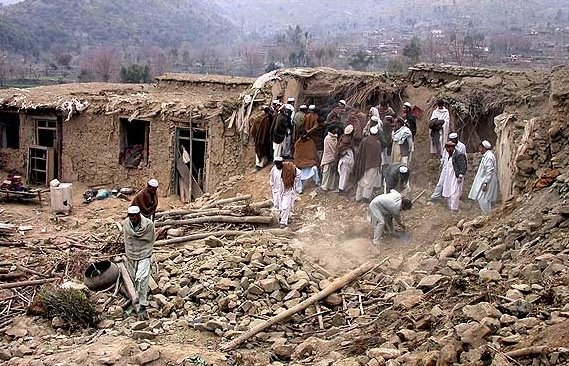
But the move to stop tankers carrying fuel came after the new government expressed outrage over the killing of 20 people, including women and children, during a U.S. commando raid on a remote border village in Pakistani tribal lands on Sept. 3.

Defence Minister Chaudhry Ahmed Mukhtar told Dawn Television on Saturday that the fuel supply route through Torkham had been blocked “to tell how serious we are”.

Pakistan has been a close U.S. ally in the unpopular campaign against terrorism and it has tens of thousands of soldiers battling militants. But it forbids incursions by foreign forces.

The five-month-old civilian coalition is more sensitive to public opinion than former army chief Pervez Musharraf, who was forced out of office in August.

While the brief interruption to fuel supplies demonstrated the West’s dependence on Pakistani cooperation to keep troops in landlocked Afghanistan supplied, Pakistan’s leverage is limited.

The government gets paid by the United States for expenditure and logistical support in fighting militancy in the region, and needs billions of dollars of foreign assistance to stave off a looming balance of payments crisis.

Most fuel and other supplies for U.S. forces in Afghanistan are trucked through Pakistan, crossing the border at two points: Torkham and Chaman, to the southwest.

The Chaman crossing, used to supply foreign forces in southern Afghanistan, was operating normally on Saturday.

In April, Russia agreed to allow NATO to transport non-lethal supplies through its territory and into northern Afghanistan.

(Reporting by Kamran Haider; Writing by Simon Cameron-Moore)

Source / Reuters

The Rag Blog

Posted in RagBlog | Tagged , , | Leave a comment

A Little Succession History from an Expert

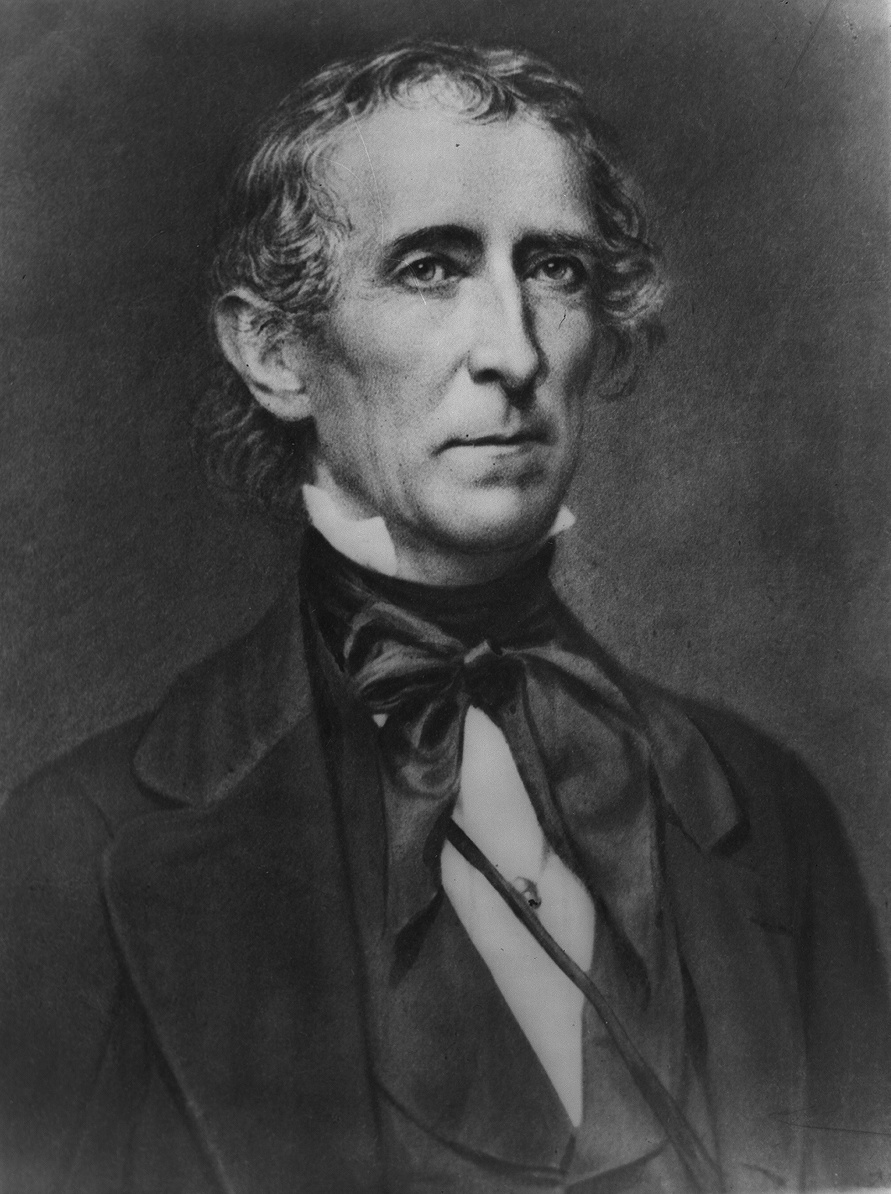
John Tyler, the first US Vice President who succeeded to the Presidency in 1841

The Sarah Palin selection: Why McCain’s inexperienced running mate falls short of meeting the implicit constitutional qualifications for vice presidents
By John W. Dean / September 5, 2008

In truth, the Vice President of the United States is important for only one reason: He or she will become President of the United States upon the death, incapacity or resignation of the President. Nine times in our history, vice presidents have succeeded to the presidency: John Tyler (1841), Millard Fillmore (1850), Andrew Johnson (1865), Chester A. Arthur (1881), Theodore Roosevelt (1901), Calvin Coolidge (1923), Harry Truman (1945), Lyndon Johnson (1963), and Gerald Ford (1974). Of course, the vice president also has a significant secondary role: It is he or she, acting with a majority of the Cabinet, who can declare the president incapable of carrying out the duties of the office, and then take charge – until the action is either ratified or rejected by a majority of the Congress. So far in our history, however, this has never occurred.

Given the fact that the 2008 GOP standard-bearer John McCain is seventy-two years of age, his selection of an inexperienced Vice Presidential running mate, Alaska Governor Sarah Palin, has again focused attention on the process and procedures for selecting vice presidents – or, to put it more bluntly, the utter lack of process or procedures in selecting the person who is a heartbeat away from the presidency. McCain, not unlike others before him, selected a less than fully vetted running mate for political reasons. That is surely a concern for voters to think over in the upcoming election – but it raises a systemic concern, too, for the long run.

Consider this parallel: Does anyone believe that if John McCain were president and had selected Governor Sarah Palin under the Twenty-fifty Amendment to fill a vacancy in the vice presidency, Congress would have confirmed her? Not likely. In fact, it is even less likely that McCain would have even attempted to do so, for he would have embarrassed himself.

While the Constitution does not expressly set forth qualifications for the vice-presidency, it strongly implies them — and Palin falls short.

How Our Constitutional Process for Selecting Vice Presidents Evolved

Our founders gave little thought to the vice presidential selection process. Initially, the candidate who placed second in Electoral College votes became vice president. While this worked for the first three presidential elections, the election of 1800 produced a tie in the Electoral College, between Thomas Jefferson and Aaron Burr (both of the same party), and although Burr was the announced candidate for vice president, when he came up with a tie vote, he refused to step aside, forcing the resolution of the contest in the House of Representatives, which proved to be a messy affair.

This clear flaw in the system was corrected by the Twelfth Amendment, which requires electors to vote separately for president and vice president. It was the Twelfth Amendment (adopted in 1804), along with the growth of political parties, that encouraged the pairing of candidates in the presidential election. Since then, the vice presidential selection process has evolved from party leaders’ making the selection to the current system, under which the party’s presidential nominee is given the power to select a vice presidential running mate.

The Twenty-fifth Amendment (adopted in 1967) indirectly codified the power of a candidate for president to select his vice president, for the Amendment states that when there is a vacancy in the office of the Vice President, “the President shall nominate a Vice President who shall take office upon confirmation by a majority vote of both Houses of Congress.” A Vice President, like a President, must be a natural born citizen, at least thirty-five years of age, and a resident of the United States for fourteen years.

Of course, Sarah Palin, McCain’s running mate, meets the minimum constitutional requirements. But there also exists a clear subtext within the Constitution, and related statutes, that suggests that there are other, implicit qualifications for the Vice President, as well – qualifications as to which Governor Palin falls short. While this subtext is plainly not formally binding on either a presidential candidate or president, candidates and presidents have traditionally followed the implicit qualifications suggested by the Constitution.

The Twenty-fifth Amendment Suggests the Primary Qualifications for Vice Presidents: Be Equipped to Serve as President Starting, if Necessary, on Day One

I served as minority counsel to the House Judiciary Committee when the Committee was working on the Twenty-fifty Amendment. Accordingly, I recall well the difficult debates and discussions on how vacancies in the vice presidency should be filled. The procedures under discussion ranged from a special national election for the vice president, to a convening of the Electoral College to make the decision, to the selection of a vice president by the Congress.

The process that was actually settled on, as I mentioned earlier, codified the procedure that had evolved over the years, through which the candidate selected his running mate. In line with that procedure, presidents were similarly given the power to fill vacancies in the office of the vice president. But there was a crucial difference: Under the Twenty-fifth Amendment, presidents can only fill that office with the approval of a majority vote of both the House and Senate. Confirmation thus entails not only ratification by the public, but also scrutiny by political pros who assure Americans that the new vice president is up to the task of taking charge.

Twice, the Twenty-fifty Amendment has been employed to fill a vacancy in the vice presidency. Nixon appointed Gerald Ford to fill the office when Vice President Spiro Agnew resigned (under threat of indictment). Then, after Nixon resigned, and Ford succeeded to the presidency, Ford used it to appoint Nelson Rockefeller his Vice President.

Both Nixon and Ford explained their decisions, and the criteria at the top of their lists. Nixon wrote in RN: Memoirs of Richard Nixon that from “the outset of the search for a new Vice President I had established four criteria for the man I would select: qualification to be President; ideological affinity; loyalty and confirmability.” (Emphasis added.) Nixon’s first choice was his Secretary of Treasury John Connally, who was dropped because he would have confirmation problems. (Connally was, in fact, later indicted but acquitted.) New York Governor Nelson Rockefeller and California Governor Ronald Reagan were taken off Nixon’s list because the selection of either one over the other would have split the Republican Party. Finally, also on the list was Jerry Ford, the Minority Leader of the House, on whom Nixon settled.

Ford explained in A Time To Heal: The Autobiography of Gerald R. Ford that he had given considerable thought to filling the vice presidency when he became president, and his staff developed a ranking system. “There was one overriding criterion,” he wrote to explain his baseline: “[H]e had to be a man fully qualified to step into my shoes should something happen to me.”

Ford’s top aides eliminated George H. W. Bush, who had served in the House of Representatives and headed the Republican National Committee, “as not yet ready to handle the rough challenges of the Oval Office.” And when Ford settled on one of the wealthiest men in America, Nelson Rockefeller, it resulted in protracted confirmation hearings because of the extent of Rockefeller’s holdings (which might have raised conflicts of interest). But in the end, Rockefeller was confirmed.

Congress Has Also Suggested Vice Presidential Qualifications Indirectly In the Succession Statutes It Has Passed

The Twenty-fifth Amendment only covers succession to the presidency or vice presidency when one of these offices is vacant – not both. It is silent if there are vacancies in both of the offices of the President and Vice President. The scenario of concurrent vacancies has, however, been addressed by Congress, most recently in a 1947 law.

The line of succession to the presidency begins with the Speaker of the House of Representatives (currently, Nancy Pelosi of California). Next is the President pro tempore of the Senate (currently, Robert Byrd of West Virginia). Finally, if neither of these officers is willing or able to take the post, the succession law turns to the President’s Cabinet members.

The current order of succession is Secretary of State (currently, Condoleezza Rice), Secretary of the Treasury (Henry Paulson), Secretary of Defense (Robert Gates), Attorney General (Michael Mukasey), Secretary of the Interior (Dirk Kempthorne ), Secretary of Agriculture (Edward Schafer), Secretary of Commerce (Carlos Gutierrez, who was born in Cuba, and thus not “natural born”), Secretary of Labor (Elaine Chao, who was born in Taiwan, and thus not “natural born”), Secretary of Health and Human Services (Mike Leavitt), Secretary of Housing and Urban Development (Steven Preston), Secretary of Transportation (Mary Peters), Secretary of Energy (Samuel Bodman), Secretary of Education (Margaret Spellings), Secretary of Veterans Affairs (James Peake) and Secretary of Homeland Security (Michael Chertoff). Under the succession statute, the presidency is filled for the remainder of the president’s term.

Although this 1947 succession statute has been appropriately criticized, Congress has been reluctant to change it. The Congressional consensus has been that if there is a dual vacancy in the Executive branch’s elected officials, it should be temporarily filled by a seasoned elected official from the Legislative Branch. In practice, while the full line of succession has been stipulated, it is unlikely that we will ever need to go beyond the Speaker of the House to fill the vacancy temporarily.

If neither the Speaker nor the President pro tempore is up to the task of serving, Congress has been comfortable with the caliber of appointees serving as Secretaries of State, Treasury, or Defense to serve as temporary president – for no one believes (absent a dramatic situation such as a massive attack on the seat of government that would call into force continuity-of-government plans) that the succession process would ever proceed beyond the “big three” Cabinet posts.

Governor Sarah Palin Does Not Qualify Under the Implicit Constitutional Standards

When Nixon selected Ford to be his Vice President, and Ford selected Rockefeller, the government was divided, with the Democrats controlling Congress. Yet a Democratic Congress approved both Ford and Rockefeller to be Vice President based on inter-branch comity. Surely no one would argue that Sarah Palin is in a league with Ford and Rockefeller when it comes to experience.

Nor does Palin possess anything close to the experience qualifications of the Speaker of the House, Nancy Pelosi, or the President pro tempore of the Senate, Robert Byrd. Indeed, I feel confident that Palin could not get confirmed for any of the top presidential succession posts, namely the posts of Secretary of State, Treasury and Defense. Palin’s lack of qualifications have been widely noted. Newspapers from her state have raised questions of her qualifications.

Recently, I was in Alaska, just after Palin’s name was first floated as a possible McCain running mate. Although I am not a Democrat, I gave a keynote speech at the Democrats’ state convention. During my visit, a senior Democratic Party official said to me that he sure hoped McCain would select Palin, because based on his observation of her record Alaska, he opined that, : “She’s screwing up Alaska big time, and she could probably assure defeat for McCain.” His wish may be coming true.

John W. Dean, a FindLaw columnist, is a former counsel to the president.

Source / FindLaw’s Writ

Thanks to Diane Stirling-Stevens / The Rag Blog

Posted in RagBlog | Tagged , , | 1 Comment

The Economic Vocabulary Was Turned Into Double-Think


An Interview with Economist Michael Hudson…

The worsening debt crisis: Who got us into this mess and what are the real political options?
By Mike Whitney / September 8, 2008

Michael Hudson is a former Wall Street economist specializing in the balance of payments and real estate at the Chase Manhattan Bank (now JP Morgan Chase & Co.), Arthur Anderson, and later at the Hudson Institute (no relation). In 1990 he helped established the world’s first sovereign debt fund for Scudder Stevens & Clark. Dr. Hudson was Dennis Kucinich’s Chief Economic Advisor in the recent Democratic primary presidential campaign, and has advised the U.S., Canadian, Mexican and Latvian governments, as well as the United Nations Institute for Training and Research (UNITAR). A Distinguished Research Professor at University of Missouri, Kansas City (UMKC), he is the author of many books, including Super Imperialism: The Economic Strategy of American Empire (new ed., Pluto Press, 2002).

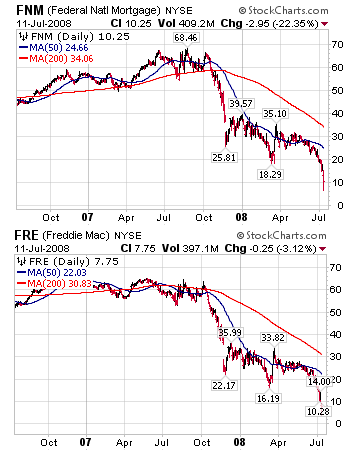
Mike Whitney: On Friday afternoon the government announced plans to place the two mortgage giants, Fannie Mae and Freddie Mac, under “conservatorship.” Shareholders will be virtually wiped out (their stock already had plunged by over 90 per cent) but the US Treasury will step in to protect the companies’ debt. To some extent it also will protect their preferred shares, which Morgan-Chase have marked down only by half.

This seems to be the most sweeping government intervention into the financial markets in American history. If these two companies are nationalized, it will add $5.3 trillion dollars to the nation’s balance sheet. So my first question is, why is the Treasury bailing out bondholders and other investors in their mortgage IOUs? What is the public interest in all this?

Hudson: The Treasury emphasized that it was under a Sunday afternoon deadline to finalize the takeover details before the Asian markets opened for trading. This concern reflects the balance-of-payments and hence military dimension to the bailout. The central banks of China, Japan and Korea are major holders of these securities, precisely because of the large size of Fannie Mae and Freddie Mac – their $5.3 trillion in mortgage-backed debt that you mention, and the $11 trillion overall U.S. mortgage market.

When you look at the balance sheet of U.S. assets available for foreign central banks to buy with the $2.5 to $3.5 trillion of surplus dollars they hold, real estate is the only asset category large enough to absorb the balance-of-payments outflows that U.S. military spending, foreign trade and investment-capital flight are throwing off. When the U.S. military spends money abroad to fight the New Cold War, these dollars are recycled increasingly into U.S. mortgage-backed securities, because there is no other market large enough to absorb the sums involved. Remember, we do not permit foreigners – especially Asians – to buy high-tech, “national security” or key infrastructure. The government would prefer to see them buy harmless real estate trophies such as Rockefeller Center, or minority shares in banks with negative equity such as Citibank shares sold to the Saudis and Bahrainis.

But there is a limit on how nakedly the U.S. Government can exploit foreign central banks. It does need to keep dollar recycling going, in order to prevent a sharp dollar depreciation. The Treasury therefore has given informal assurances to foreign governments that they will guarantee at least the dollar value of the money their central banks are recycling. (These governments still will lose as the dollar plunges against hard currencies – just about every currency except the dollar these days.) A failure to provide investment guarantees to foreigners would thwart the continuation of U.S. overseas military spending! And once foreigners are bailed out, the Treasury has to bail out domestic American investors as well, simply for political reasons.

Fannie and Freddie have been loading up on risky mortgages for ages, under-stating the risks largely to increase their stock price so that their CEOs can pay themselves tens of millions of dollars in salary and stock options. Now they are essentially insolvent, as the principal itself is in question. There was widespread criticism of this year after year after year. Why was nothing done?

Hudson: Fannie and Freddie were notorious for their heavy Washington lobbying. They bought the support of Congressmen and Senators who managed to get onto the financial oversight committees so that they would be in a position to collect campaign financing from Wall Street that wanted to make sure that no real regulation would take place.

On the broadest level, Treasury Secretary Paulson has said that these companies are being taken over in order to reflate the real estate market. Fannie and Freddie were almost single-handedly supporting the junk mortgage market that was making Wall Street rich.

The CEOs claimed to pay themselves for “innovation.” In today’s Orwellian vocabulary financial “innovation” means the creation of special rent-extracting privilege. The privilege was being able to get the proverbial “free ride” (that is, economic rent) by borrowing at low-interest government rates to buy and repackage mortgages to sell at a high-interest markup. Their “innovation” lies in the ambiguity that enabled them to pose as public-sector borrowers when they wanted to borrow at low rates, and private-sector arbitrageurs when they wanted to get a rake-off from higher margins.

The government’s auditors are now finding out that their other innovation was to cook the accounting books, Enron-style. As mortgage arrears and defaults mounted up, Fannie and Freddie did not mark down their mortgage holdings to realistic prices. They said they would do this in a year or so – by 2009, after the Bush Administration’s deregulators have left office. The idea was to blame it all on Obama when they finally failed.

But at the deepest level of all, the “innovation” that created a rent-extracting loophole was the deception that making more and more bad-mortgage loans could continue for a prolonged period of time. The reality is that no exponential rise in debt ever has been able to be paid for more than a few years, because no economy ever has been able to produce a surplus fast enough to keep pace with the “magic of compound interest.” That phrase is itself a synonym for the exponential growth of debt.

The Road to Debt Peonage

In an earlier interview you said: “The economy has reached its debt limit and is entering its insolvency phase. We are not in a cycle but the end of an era. The old world of debt pyramiding to a fraudulent degree cannot be restored.” Would you expand on this in view of today’s developments?

Hudson: How long more and more money can be pumped into the real estate market, while disposable personal income is not growing by enough to pay these debts? How can people pay mortgages in excess of the rental value of their property? Where is the “market demand” to come from? Speculators already withdrew from the real estate market by late 2006 – and in that year they represented about a sixth of all purchases.

The best that this weekend’s bailout can do is to postpone the losses on bad mortgage debts. But this is a far cry from actually restoring the ability of debtors to pay. Mr. Paulson talks about more lending to support real estate prices. But this will prevent housing from falling to levels that people can afford without running deeper and deeper into mortgage debt. Housing prices are still way, way above the traditional definition of equilibrium – prices whose carrying charges are just about equal to what it would cost to rent over time.

The Treasury’s aim is to revive Fannie and Freddie as lenders – and hence as vehicles for the U.S. economy to borrow from the foreign central banks and large institutional investors that I mentioned above. More lending is supposed to support real estate prices from falling quite so far as they otherwise would – and in fact, the aim is to keep the debt pyramid growing. The only way to do this is to lend mortgage debtors enough to pay the interest and amortization charges on the existing volume of debt they have been loaded down with. And since most people aren’t really earning any more – and in fact are finding their budgets squeezed – the only basis for borrowing more is to inflate the price of real estate that is being pledged as collateral for mortgage refinancing.

It is pure hypocrisy for Wall Street’s Hank Paulson to claim that all this is being done to “help home owners.” They are vehicles off whom to make money, not the beneficiaries. They are at the bottom of an increasingly carnivorous and extractive financial food chain.

Nearly all real estate experts are in agreement that for the next year or two, many of today’s homeowners will find themselves locked into where they are now living. Their situation is much like medieval serfs were tied to their land. They can’t sell, because the market price won’t cover the mortgage they owe, and they don’t have the savings to pay the difference.

Matters are aggravated by the fact that interest rates are scheduled to reset at higher non-teaser rates for the rest of this next year and 2010, increasing the financial burden. You may remember that Alan Greenspan recommended that homebuyers take out adjustable-rate mortgages (ARMs) because the average American moves every three years. By the time the mortgage interest rate jumped, he explained, they could sell to a new buyer in this game of musical chairs – presumably with more and more chairs being added all the times, and plusher ones to boot.

But homeowners can’t move today, so they find themselves stuck with rising interest charges on top of their rising fuel and heating and electricity charges, transportation charges, food costs, health insurance and even property taxes as these begin to catch up with the rise in Bubble Prices.

The government has carefully avoided nationalizing the companies and thereby taking them onto its own balance sheet. It has created a “conservatorship” (a word that my spellchecker does not recognize). So the bailout of Fannie and Freddie looks like the Republicans are trying to play the financial just-pretend game simply until they leave office in February, after which time they can blame the failure of the “miracle of compound debt interest” on the incoming Democratic Congress.

So it’s politics as usual: play for the short run. In the long run – even next year – the real estate market will continue to drift down.

The economic news keeps getting grimmer and grimmer, but you’d never know it by listening to the politicians at the Republican Convention. The only time the economy was brought up at all was in the context of praise for free markets and globalization. The housing crash and credit market meltdown were not mentioned. Could you tell us what you think the rising unemployment numbers, falling consumer demand, skyrocketing foreclosures and ongoing troubles in the credit markets mean for America’s future? Is this just a blip on the radar or are we in the middle of a major retrenchment that will result in falling living standards and a deep, protracted recession?

Hudson: The Republicans prefer to distract attention from how the Bush regime has failed over the past eight years. If attention can be focused on Iraq and terrorism, on personalities and style, serious discussion of such matters may be crowded out. That’s what the news media are for.

When politicians do talk about the economy, the basic strategy is to fight the November election over who has the nicest dream for what people would like to believe. Amazing as it seems, a large number of Americans actually expect to have a good chance of becoming millionaires. They’re simply not looking at the debt side of the balance sheet.

The most striking economic dynamic today is polarization between those who live off the returns to wealth (finance and property extracting interest and rent, plus capital gains as asset prices are inflated) and those who live off what they can earn, struggling to pay the taxes and debts they are taking on. The national income and product accounts – GNP and national income – don’t say anything about the polarization of property, and doesn’t include capital gains, which are how most wealth is being achieved these days, not by actual direct investment to increase the means of production as lobbyists for trickle-down economic theory claim.

Here’s how things look today: The richest 1 per cent of the population receive 57.5 per cent of all the income generated by wealth – that is, payment for privilege, most of it inherited. These returns – interest, rent and capital gains – are not primarily a return for enterprise. They are pure inertia, weighing down markets. They do not “free” markets, except by providing a free lunch to the wealthiest families. The richest 20 per cent of the population receives some 86 per cent of all this income – that is, what actually is increasing household balance sheets.

What people still view as an economic democracy is turning into a financial oligarchy. Politicians are looking for campaign support mainly from this oligarchy because that is where the money is. So they talk about a happy-face economy to appeal to American optimism, while being quite pragmatic in knowing who to serve if they want to get ahead and not be blackballed.

During the 1990s the bottom 90 per cent of the population tried to catch up by going into debt to buy homes and other property. What they didn’t see was that an insatiable growth in debt is needed to keep a real estate and finance bubble expanding. All this credit imposes financial charges, which have been largely responsible for polarizing wealth ownership so sharply in recent decades.

These debt charges have grown so heavy that debtors are able to pay only by borrowing the interest that is falling due. They have been able to borrow for the past few years by pledging real estate or other collateral whose prices are being inflated by Federal Reserve policy. The Treasury also contributes by giving tax favoritism, un-taxing property and finance. This forces labor and tangible industrial capital to pick up the fiscal slack, even as they are being forced to carry a heavier debt burden.

Homeowners do not gain by this higher market “equilibrium” price for housing. Higher prices simply mean more debt overhead. Rising price/rent and price/earnings ratios for debt-financed properties, stocks and bonds oblige wage earners to go deeper and deeper into debt, devoting more and more years of their working life to pay for housing and to buy income-yielding stocks and bonds for their retirement.

Debt expansion to buy property seems self-justifying as long as asset prices are rising. This asset-price inflation is euphemized as “wealth creation” by focusing on real estate, stock and bond prices – even as disposable personal income and living and working conditions are eroded.

So to come back to your broad question, I don’t see consumer demand rising much, except by foreign tourists coming over and spending their money as the dollar falls. Here in New York, foreign buyers are supporting the real estate market. The Wall Street downturn already has forced the city to postpone its promised property tax cuts and its subway expansion. My wife and I just got our condo tax bill this week. There was an explanatory note telling us that the only tax cuts will be for commercial property owners. Residential property tax rates rise.

It gets worse. Without better transportation, wage earners will be squeezed across the country. Higher gas prices, electricity, health care and food are crowding out spending on output and forcing people into even more debt. That’s why arrears and defaults are rising. Even rents are rising, despite falling real estate prices. This is because houses under foreclosure can’t be rented out, so millions of houses may be taken off the market.

What exactly do you mean by “modern debt peonage”?

Hudson: This is what happens when wage earners are obliged to turn over all their income above basic subsistence needs to the FIRE sector – mainly for debt service but also to pay for compulsory insurance and, most recently, the tax burden that finance and property have shifted off themselves.

The distinguishing feature about peonage is its lack of choice. It is the antithesis of free markets. As I mentioned above, many families today find themselves locked into homes that have negative equity. Their mortgage debt exceeds the market price. These homes can’t be sold – unless the family can pay the difference to the banker who has made the bad mortgage loan. The gap may exceed all the income the family earns in an entire year – just as it was making on paper a price gain larger than its annual take-home pay.

But what did all this matter, in retrospect, if the house was for living, not for buying and selling? This dimension of use value was left out of account by focusing on paper wealth.

In a nutshell, debt peonage is the other side of the coin in a rentier economy. The negative equity we are seeing today is a key component of debt peonage. It forces debt peons to spend their lives trying to work their way out of debt. The more desperate they get, the more risks they take, and the deeper they end up. In Kansas City, one of my students wrote his class paper on how the immediate cause of many mortgage defaults is gambling debt. Missouri has a lot of fundamentalist Christians who think of God as watching carefully over them. Being good people, they want to give God a chance to reward them for living an honest life. So they go to the gambling boats that are moored along the river. But the odds are against them, and it looks like Einstein was wrong when he said that God doesn’t play dice. Gambling – and much financial speculation – is all about probability, and the odds are as much against gamblers as they are against debtors. Being laws of nature, the laws of probability are like the privilege of land ownership: a gambling license provides the house with an opportunity to rake economic rent off the top.

Debt deflation and the tax shift off finance and property onto labor

In the short run it looks like slow growth and deflation will be bigger problems than inflation. Commodities, including gold and oil, are tumbling almost daily, while bank assets are being steadily downgraded, foreclosures are soaring and the stock market is reeling. The financial crisis that began in the real estate market has triggered a boycott of structured products and is now rippling through the broader economy.

The Federal Reserve has already dropped interest rates by 3.5 per cent and has used up half its balance sheet ($450 billion) to shore up the faltering banking system. But the situation keeps getting worse. The banks have curtailed their lending, and consumer spending is off in nearly every area. It looks like the Fed is out of ammo. Is it time to consider fiscal alternatives to the present downturn, such as cutting payroll taxes to give families more money to increase demand, or initiating massive infrastructure projects?

Hudson: By “deflation” I assume you mean debt deflation – draining purchasing power as a result of rising debt service and compulsory insurance, plus the wage squeeze that the government praises for “raising productivity” to “create wealth” for the CEOs who pay themselves what they have cut back from labor’s paycheck. There will be less consumer spending – but even so, consumer prices may not come down if the dollar resumes its fall, especially if monopoly pricing continues to be permitted.

Your solution is indeed what is needed, and Mr. Obama has promised to raise the wage and salary limit subject to FICA withholding. I think that an even better idea would be to go back to the original 1913 income tax and exempt wages that merely cover subsistence. I would restore a cut-off point at $102,000 in today’s dollars, matching the terms of America’s 1913 income tax. People earning less would not have to file an income-tax return at all.

This truly conservative idea would free income to be spent on improving living standards. Instead, high income brackets and property are being un-taxed today, and their tax savings are being spent mainly in making loans that are used to bid up the price of wealth and luxury goods.

This is what the classical economists warned against, yet the tax shift off property onto labor is being done hypocritically in their name. To get the kind of free markets they advocated, taxes should fall on the FIRE sector (finance, insurance and real estate) and monopolies, not wages or bona fide industrial profits stemming from tangible capital investment and employment.

This June you wrote a groundbreaking paper for a recent Post-Keynesian conference at the University of Missouri in Kansas City, where you’re an economics professor. Its title was “How the Real Estate Bubble drives Home buyers into Debt Peonage.” You earlier wrote a now famous May 2006 Harpers cover story on debt peonage. Your Kansas City paper produces charts showing how tax favoritism for real estate and other clients for the banking and financial sector stimulates asset-inflation, leading to massive equity bubbles like the one we are currently experiencing in the housing market. Would you give us a brief summary of your thesis?

Hudson: My paper explained how the money the tax collector gives up is “freed” to be paid to banks as interest. This is the motto of real estate investors: “Rent is for paying interest.” The FIRE sector has adopted a populist rhetoric to persuade homeowners to believe that lowering the property tax will end up giving them more money. It seems at first blush that this would happen. But in practice, new buyers – and speculators – come into the market and pledge the tax cuts to bid up housing prices all the more. The winner in this new anti-tax marketplace is the buyer who pledges to pay the tax cut to the banks as interest on a mortgage loan to buy the property.

As my paper describes:

“Tax favoritism for real estate, corporate raiders and ultimately for bankers has freed income to be pledged to carry more and more debt, which has been used to fuel asset-price inflation that raises the price of home ownership, corporate stocks and bonds – but not to increase production and output. … Shaping the marketplace to favor finance and property over industry and labor does not create a ‘free market.’ It favors the debt-leveraged buying and selling of real estate, stocks and bonds, distorting markets in ways that de-industrialize the economy. [And] shifting taxes off property and finance is more a distortion than a virtue, unless debt leveraging is deemed virtuous.

“This is the tragedy of our economy today. Credit creation, saving and investment are not being mobilized to increase new direct investment or raise living standards, but to bid up prices for real estate and other assets already in place and for financial securities (stocks and bonds) already issued. This loads down the economy with debt without putting in place the means to pay it off, except by further and even more rapid asset-price inflation.

This is largely the result of relinquishing planning and the structuring of markets to large banks and other financial institutions, political lobbyists have rewritten most of today’s tax laws and sponsored general public deregulation of the checks and balances that were being put in place by the late 19th century. At that time, just over a hundred years ago, it seemed that wealth – and banking – were being industrialized, while landed wealth and monopolies would become more socialized and their rents fully taxed. Instead of real estate prices rising, the rental ‘free lunch’ would provide the basic source of public finance. Technology and productivity would increase industrial capital formation and raise labor’s living standards. These policies would free markets from rent extraction and also from taxes as the fiscal burden was shifted back onto property.

But this is not what has occurred. The financial system has used its power to extract fiscal favors for real estate and to press for deregulation of monopolies as the major source of its interest and collateral for its loans.”

What do you think the positive effects would be of taxing property rather than income and industrial profit?

Hudson: It would have two major positive effects. First, it would free labor and industry from the tax burden. And by the same token, it would require the economic rent currently used to pay interest and depreciation to be paid instead as a property rent tax. This would free an equivalent sum from having to be raised in the form of income and sales tax. That was the classical idea of free markets. As matters stand today, the tax subsidy for real estate and finance leaves more net rental income to be capitalized into bank loans. This is a travesty of the “free markets” that lobbyists for the banks and the wealthy in general claim to advocate.

Replacing income and sales taxes by a land-rent “free lunch” tax would make real estate prices more affordable, because the interest now “free” to be paid to banks to support a high debt overhead would instead be collected and used to lower the tax burden on labor and industry. This would reduce the cost of production and living, I estimate by about 16 percent of national income.

Homeowners and renters would pay the same amount as they now do, but the public sector would recapture the expense of building transportation and other basic infrastructure out of the higher rental value this spending creates. The tax system would be based on user fees for property, falling on owners in a way that collects the rising value of their property resulting from the rent of location, enhanced by public transportation and other infrastructure, and from the general level of prosperity, for which landlords are not responsible but merely are the passive beneficiaries under current practice.

A Neo-Progressive fiscal policy would aim at recapturing the land’s site value created by public infrastructure spending, schooling and the general level of prosperity. The debt pyramid would be much smaller, and savings could take the form of equity investment once again. Slower growth of debt, housing and office prices, and lower taxes on income and sales would make the economy more competitive internationally.

I’d like to expand on what you have said in your article and you can correct me if I’ve got it wrong. You say that today’s tax code poses an obstacle to progressive political change, and puts more and more power in the hands of bankers and speculators who profit from “boom and bust” cycles. In other words, reworking the tax system has to be the cornerstone of any progressive platform? Is this the bigger point you are trying to make?

Hudson: It’s certainly the tax point I want to make. But I think that my most important point is the analysis of how the mathematics of compound interest intrudes increasingly into the economy. The fiscal link is that as finance strips more and more wealth, Wall Street converts its economic power into political power. Its main aim is to free itself from taxation – by shifting the burden onto labor.

One way to achieve this tax shift has been to re-define taxes as a “user fee.” This is what the Greenspan Commission did in 1983 when it imposed heavy regressive taxation on labor via FICA wage withholding for Social Security and Medicare instead of funding these programs out of the general budget, to be paid for largely by the higher brackets. The Social Security Trust Fund generated a heavy tax surplus, which was used to cut tax rates on the upper wealth brackets.

The tax code’s “small print” made commercial real estate free of having to pay income tax by pretending that landlords were losing money on their property as buildings depreciated – as if the land’s rising site value did not more than compensate. Most important, interest was treated as a tax-deductible expense. This encouraged debt leveraging rather than equity investment, creating an enormous market for bankers creating credit and collecting interest on it.

You say in your article that there’s “a symbiosis between finance, insurance and real estate” which is at the core of the Bubble Economy. And that this creates a “a feedback between bank credit and asset prices. The quickest and easiest path to wealth is not to earn profits by investing in industry, but to go into debt to ride the wave of asset-price inflation. The result is a shift of wealth seeking away from industry to financial maneuvering on credit to ride the wave of asset-price inflation.”

Is this financialization trend irreversible, or is there a way we can revitalize America’s industrial base? Should we consider nationalizing the failing auto industry and putting people to work while we build vehicles for the future?

Hudson: Nationalization may not be the answer as long as financial interests have replaced the government as society’s new central planners. I fear that nationalization under today’s political conditions would mean “socializing the losses,” having the government bear them and then sell off the companies at the usual give-away price to new buyers on credit, all to the benefit of Wall Street.

If there is any sector to be nationalized, it should be the FIRE sector – finance, insurance and industry – along with taking basic infrastructure back into the public domain by de-privatizing it. The Progressive Era’s plan that made America so rich and dominant a nation was for the government to supply basic services such as railroads, phone systems, the post office and roads or canals at cost or at a subsidy. This lowered the price structure across the economic spectrum, enabling the United States to undersell and out-produce other economies.

We are now in Year 2 of the so-called credit crisis, what Bloomberg News calls “the worst financial crisis since the Depression.” More and more pundits are pointing at the Fed’s monetary policies as the source of the troubles. Surprisingly, even the New York Times has joined in the finger pointing by admitting that Greenspan played a central role in the housing bubble.

Here’s what The New York Times recently said: “Who’s to blame? In the estimation of many economists, it starts with the Federal Reserve. The central bank lowered interest rates following the calamitous end of the technology bubble in 2000, lowered them more after the terrorist attacks of Sept. 11, 2001, and then kept them low, even as speculators began to trade homes like dot-com stocks. Meanwhile, the Fed sat back and watched as Wall Street’s financial wizards engineered diabolically complicated investments linked to mortgages, generating huge amounts of speculative capital that turned real estate into a conflagration.”

How would you characterize Greenspan’s part in the present crisis?

Hudson: He was its cheerleader, with backup from the University of Chicago and a slew of right-wing think tanks. Mr. Greenspan gave all this trickle-down economics a patina of rationale and also a rhetoric pretending that the financial bubble was helping homeowners rather than mortgage lenders and Wall Street. His role was to translate Ayn Rand propaganda into populist euphemism.

The role of a financial cheerleader is to confuse the economic issues, above all by depicting running into debt as “debt leverage” to accelerate “wealth creation.” Looking backward, we now can see that this was really debt creation. When Mr. Greenspan spoke about wealth, he didn’t mean the kind that Adam Smith referred to in The Wealth of Nations – tangible means of production. Mr. Greenspan meant balance-sheet financial claims on this wealth in the form of stocks, bonds and property claims. Adam Smith said that to count these monetary forms of wealth alongside the actual land and capital of Britain would be double counting. For Greenspan, the liabilities side of the economy’s balance sheet – what its producers owed to financial and property owners – became the only kind of wealth he really cared about.

This inside-out perspective was largely responsible for de-industrializing, downsizing and outsourcing the U.S. economy. Mr. Greenspan’s idea of “free markets” was simply to deregulate them – covertly, to be sure, by appointing non-regulators to the government’s key regulatory positions. This resulted in asset stripping, which created some conspicuous billionaires (corporate raiders, re-christened as “shareholder activists” these days) and hence won the praise of Mr. Greenspan for ostensibly playing a positive role in “wealth creation.”

The bottom line is that the economic vocabulary was turned into double-think.

The Political dimension

I have no background in economics, and never had any particular interest in the topic. My frustration with the direction of the country – particularly the Iraq war and the dismantling of civil liberties – led me to search for answers in places that I never otherwise would have looked. Now I am convinced that the war in Iraq and the rapid shift towards a police state here in America are logical corollaries of the economic polarization that has its root in policies that are fundamentally flawed and serve the narrow interests of corporatists, bankers and other vested interests.

Hudson: With regard to your abhorrence of economics, some of my best students at the New School withdrew from the discipline as they found that it wasn’t addressing the problems they were most concerned about. The field has been sterilized by more than a generation of Chicago School intolerance.

The economics profession does not seem to be amenable to reform along the lines that would get you interested in it. It has become mainly a rhetorical gloss to depict financial oligarchy as if it were populist economic democracy. Many people have tried to expand its scope, and have failed. Thorstein Veblen made an attempt a century ago, his analysis – basically, classical political economy – was exiled to the academic sub-basement of sociology. Economists preferred to put on blinders when it came to looking at wealth distribution and the classical distinction between “earned” and unearned” (that is, parasitic) income. Just while sex was becoming un-repressed, wealth distribution became the new politically incorrect topic to discuss.

In the old movies about invaders from outer space such as The Thing, there usually was a near-sighted scientist who said, “Let’s try to reason with it. It’s smarter than we are, because it’s come in a flying saucer with all that great technology.” The monster from outer space then would simply whack the man aside, killing him brutally.

It’s much like the Terminator from the future. “It doesn’t feel compassion. It doesn’t feel pain. You can’t reason with it,” says the movie’s hero. “All it does is kill.”

This is the task the Chicago Boys have taken on in their defense of financialized markets as being “free.” You can’t reason with them. Reason is not their job. They are not there to be fair.

But to achieve its censorial role, today’s economic orthodoxy pretends that markets work in a fair way to provide everyone with opportunity – something like a sperm with a chance to inherit a billion dollars from a Russian kleptocrat or American real estate magnate or Wall Street operator. To promote this worldview, one needs to craft a rhetoric pretending that markets are “free,” not leading to serfdom. One has to pretend that is government regulation of the kleptocrats that is leading to serfdom rather than protecting the population from predatory finance.

Regarding your concern with the police state and, ultimately military aggression that is required to promote “free markets” at gunpoint, Pinochet-style, empire building always has gone hand in hand with impoverishing the population of the imperial center as well as its periphery. For starters, empires and wars don’t pay, at least not in modern times. At best, it is like the war in Iraq – a vehicle for the Bush administration to channel billions of “missing” dollars to its campaign supporters, to recycle back into new Republican campaign funding. The economy at large is taxed as imperialism turns into asset stripping.

A second and more purely political dimension of imperial warfare is to distract the attention of voters away from economic issues, by appealing to their nationalism and chauvinism.

Hobson’s theory of imperialism was that the domestic population lacked the income to consume what it produced, so that producers had to seek out foreign markets. This led to war. But today, the “postindustrial” mode of imperialism is more about recycling wealth to produce capital gains, mainly by globalizing and privatizing the Bubble Economy. The most important markets for “wealth creation” are not for goods and services, but for real estate and financial assets. So we are brought back to your initial questions today, about how Fannie Mae and Freddie Mac will sponsor more sales of mortgage-backed securities.

I think your article offers a straightforward way to avoid disaster and to transform society by changing the tax code so that it strengthens the middle class and levels the playing field between “the haves and the have-nots.” But how can this be achieved without breaking your ideas into snappy sound-bytes and building a broad-based grassroots movement devoted to working class issues and economic justice? Is there a way to make these transformative social changes without starting a third political party; an American Labor Party perhaps?

Hudson: If the incoming Democratic administration proves to be more of the same, pressure will indeed arise to create a new party. More often economic reform has come from the top, but I don’t see it from the Republicans, given their corruption. Within the Democratic Party the question is whether the Wall Street Democratic Leadership Committee (who gave us Gore and Lieberman after the Clintons) will continue to impose its stranglehold.

Any real improvement will need an educational campaign to prepare the ground for making economic reform the centerpiece of major elections. This educational role often has been filled by third parties. In the 1890s, for instance, the main Progressive Era campaigning occurred outside of the Democrats and largely outside of the Republicans as well.

[Mike Whitney lives in Washington state. He can be reached at: fergiewhitney@msn.com. ]

Source / CounterPunch

The Rag Blog

Posted in RagBlog | Tagged , , , | 1 Comment

Iran, Nuclear Research, and the American Press

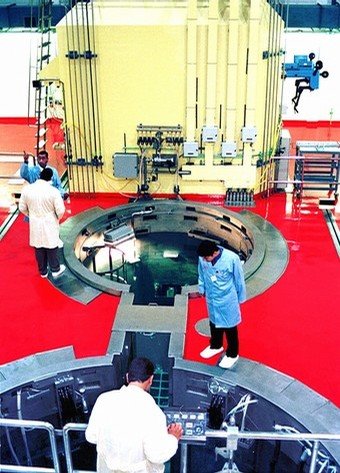
What I would like to know is why all these analysts and pundits cannot take Iran at face value when they claim they are interested in developing peaceful uses of nuclear energy. Despite my deep misgivings about such pursuits owing to negative environmental consequences, under the terms of the Nuclear Non-Proliferation Treaty, to which Iran is a signatory (unlike Israel), they are entitled to the peaceful pursuit of nuclear energy.

The fact of the matter is that the IAEA has found no indication that Iran is trying to build nuclear weapons, and certain imperial western nations continue to insist that they are. Frankly, given the track record of deceit associated with the wars in Iraq and Afghanistan, I will take the word of the Iranian government over that of the Bush administration any day of the week, hands down. Anyone who looks honestly at the facts rather than the BushCo patriotic empty rhetoric will reach the same conclusion: Iran is the impugned party in this discussion.

Richard Jehn / The Rag Blog


Building While Bailing
By Dave Schuler / September 8, 2008

David Kay, former U. N. weapons inspector, has an op-ed in the Washington Post on the Iranian nuclear development program which I take as a veiled campaign advertisement for John McCain. In the op-ed Dr. Kay’s assessments are that, judging by the known knowns, Iran is likely to have a nuclear weapon in two to four years. Taking into account the known unknowns Iran may well have a nuclear weapon within a year or two. And the unknown unknowns? Who knows?

My humble best guess is that Iran is pushing toward a nuclear-weapons capability as rapidly as it can. But if Tehran were to believe that American — not Israeli — military action is imminent, it might slow work on the elements of its program that it thinks the world can observe. Yet such temporizing would only be tactical. Its strategic goal is to acquire nuclear weapons to counter what it views as a real U.S. threat. Iran appears to believe that the United States is not willing to accept the validity and survival of the Iranian revolutionary state.

So, what next? That’s what’s missing from the Iran debate and that forms the crux of Dr. Kay’s op-ed.

Two concerns seem to be most absent from discussion of Iran’s “nuclear future,” whatever it is: First, what policies would limit any advantage, political or military, that Iran might gain from such weapons? Second, how do we begin to craft, with all the states of the region — including Israel and Iran — political, economic and security arrangements that recognize their varied interests and concerns and their often very different perspectives on what these are? In the end, we need to decide how we can perform damage control and create arrangements that take into account states’ varied interests.

I seem to be one of the relative few who believe that neither the U. S. nor Israel is likely to attack Iran whether it has nuclear weapons or not in the near term and that it would be highly imprudent if they did. However, formulating a policy that prevents or discourages Iran from seeking or acquiring nuclear weapons that doesn’t include the use of military force certainly would seem to require a greater willingness to accept pain than we’ve exhibited lately.

UPDATE

Charles Ferguson, senior fellow for science and technology at the Council on Foreign Relations, writing in the Christian Science Monitor proposes a novel approach to breaking the logjam of negotiations with Iran:

A potential trust-building deal would bind the US and other nuclear energy states to Iran as clients under the condition that Iran accepts more rigorous safeguards on its nuclear program.

The clients would agree to buy Iranian enriched uranium and spent fuel containing plutonium for a competitive price. This would ensure that Iran would not amass a large stockpile of enriched uranium and plutonium but would continually ship this nuclear fuel material to clients.

Iranian leaders would show that their intentions are truly peaceful if they accepted this deal. And by accepting it Iran would gain international recognition for its enrichment program and could crow that they have the world’s superpower as a client. It would be a win-win situation.

He also re-states a point I’ve been making for years: Iran does not have enough indigenous uranium to achieve the self-sufficiency that’s the stated aim of their nuclear development program:

A country needs adequate supplies of natural uranium to begin the process. Also, it needs a fuel fabrication facility to turn the enriched uranium into fuel that can be placed inside the core of a nuclear reactor. Iran has neither of these major components. But the limited supplies of indigenous natural uranium and the pilot scale enrichment plant now in operation are enough to allow Iran to eventually make dozens of nuclear bombs.

That’s one of the many troubling things about Iran’s nuclear development program: either they’re nuts or they’re hiding something. Neither is particularly comforting.

Source / Outside the Beltway

Thanks to Diane Stirling-Stevens / The Rag Blog

Posted in RagBlog | Tagged , | 1 Comment

But We Are At the End of Our Rope

It is not a good thing that al-Maliki is pressuring Iraqi refugees in Egypt and Jordan to return. The UNHCR says it is too dangerous for them as yet. Some returnees in Diyala Province were recently evicted from their homes yet again by militia action. Since Iraqis are still leaving Iraq for Jordan and Syria in some numbers, the whole thing is a publicity stunt. Thousands came to Jordan last May alone. More are certainly leaving than returning.” Juan Cole, Informed Comment

Iraqi refugees in Amman tried to register their children for a program that would allow them to attend private schools this fall. Photo: Shawn Baldwin for The New York Times

Slowly, Iraq brings refugees home as security improves
By Ellen Knickmeyer, / September 8, 2008

But many say another reason they are coming back is that they have run out of money

CAIRO — Iraqi refugee Jenan Adnan Abdel-Jabbar arrived for the Iraqi government’s free airlift back home with eight suitcases, five children and a knotted skein of hope and fear in her heart.

At she stepped onto the curb at Cairo’s airport, hope rose. About 250 other returning Iraqis were outside the terminal—as many of her compatriots as Abdel-Jabbar had seen together in her two years in Egypt.

“All Iraq is here!” Abdel-Jabbar exclaimed. A smile was on her face. But worry creased her forehead.

More than 1,000 Iraqi refugees in Egypt have returned home since Aug. 11, when Iraqi Prime Minister Nouri al-Maliki began sending his state jet to fetch them. Iraq will expand its no-cost return program to Jordan this month, dispatching planes and buses to bring back more than 500 refugees there, Iraq’s envoy in Amman, Jordan, said Friday.

While Iraq’s leaders say their country is safe again and government ministers are welcoming returnees on red carpets at Baghdad’s airport, the International Organization for Migration says 13,000 refugees had returned to Iraq before last month’s airlift. That is just a small fraction of the estimated 2.5 million people who fled Iraq in the violence following the 2003 U.S.-led invasion.

Iraqis taking advantage of the airlifts here said they had been motivated by the free flights and by reports of diminished violence in Iraq—Abdel-Jabbar said she and her husband had received weekly e-mails from their two married daughters in Iraq’s Diyala province, urging them, “Come home!”

But for Abdel-Jabbar and all of half a dozen other returning refugee families interviewed, fear of returning remained strong, overridden by only one factor. Years of living abroad as refugees had exhausted their savings—and their options.

“Of course we are afraid,” Abdel-Jabbar said in her apartment four days before the family’s departure. “But we are at the end of our rope.”

Source / Chicago Tribune

The Rag Blog

Posted in RagBlog | Tagged , | Leave a comment

A Browbeaten, More Passive Press Corps

White House press corps acquiescing to another line of bullshit.

The mighty, scary press corps
By Glenn Greenwald / September 6, 2008

Criticizing the McCain campaign for refusing to allow reporters to question Sarah Palin, Time’s Jay Carney writes:

Political operatives love to talk about circumventing the media and other co-called “elites” — i.e., independent specialists, observers and thinkers. The operatives convince themselves they can take their candidate’s message directly to the people — on their terms, without all that poking and prodding and skepticism. That’s propaganda. In a democratic society, it rarely works for long.

If only that were true. But if there’s one indisputable lesson from the last eight years, it’s that political propaganda works exceedingly well — not despite an aggressively adversarial press but precisely because we don’t have one. Carney’s idealistic claims about the short life-span of propaganda in American democracy are empirically false:

“Half of Americans now say Iraq had weapons of mass destruction when the United States invaded the country in 2003 — up from 36 percent last year, a Harris poll finds” (Washington Times, 7/24/2006); “Nearing the second anniversary of the Sept. 11, 2001, terrorist attacks, seven in 10 Americans continue to believe that Iraq’s Saddam Hussein had a role in the attacks” (Washington Post, 9/6/2003); “The same poll in June showed that 56% of all Republicans said they thought Saddam was involved with the 9/11 attacks. In the latest poll that number actually climbs, to 62%” (USA Today/Gallup poll, 10/6/2004); “The latest Harris Poll has some interesting results on public opinions of Saddam Hussein’s possible links to al Qaeda. Of those Americans polled, 64% agree that Saddam Hussein had ‘strong’ links to al Qaeda” (Harris poll, July 21, 2006); “49 percent of Americans think the president has the authority to suspend the Constitution . . . Only a third of Americans understood that much of the rest of the world opposed our invasion [of Iraq]. Another third thought the rest of the world was cheering our invasion, and a third thought the rest of the world was neutral” (Rick Shenkman, June, 2008).

Of course Carney is right in theory that anyone running for Vice President ought to submit to questioning from the media. But the idea that her doing so will be some great blow against propaganda is wrong for numerous reasons. Who are these great, aggressive journalists who are going to question her in a meaningfully adversarial way in order to expose the falsehoods behind the image that is being created around her?

When they decide in a couple of weeks that Palin is ready to do so, she’ll go and sit down with Brit Hume or Larry King or Charlie Gibson or some other pleasant, accommodating person who plays a journalist on TV and have a nice, amiable, entertaining chat about topics that are easily anticipated. Having been preceded by all sorts of campaign drama about her first interview and the excitement that she’s not up to the task, her TV appearance will be widely touted, score big ratings, and will be nice entertainment for the network that presents it. It will achieve many things. Undermining propaganda isn’t one of them.

This idea that she’s some sort of fragile, know-nothing amateur who is going to quiver and collapse when subjected to the rough and tumble world of American journalism is painfully ludicrous, given that — as the Canonization of the endlessly malleable Tim Russert demonstrated — that imagery is a fantasy journalists maintain about themselves but it hardly exists. The standard journalistic model of “balance” means that the TV journalist asks a few questions, lets the interviewee answer, and then moves on without commenting on or pointing out false claims, i.e., without exposing propaganda (Carney can check his own magazine to see how that sad, propaganda-boosting process works — here, here, and here). Few things are easier than submitting to those sorts of televised rituals.

Moreover, Sarah Palin isn’t Dan Quayle. She is extremely smart — much smarter than the average media star who will eventually be interviewing her — and she is very politically skilled as well. She didn’t go from obscure small-town city council member to Governor to Vice Presidential nominee by accident. She’ll be more than adequately prepared for the shallow, 30-second, rote exchanges that pass for political interviews in our Serious mainstream discourse. Anyone expecting her to fall on her face or be exposed as some drooling simpleton is going to be extremely disappointed. That might (or might not) happen with real questioning, but she’s not going to face that.

If anything, this growing drama about Palin’s supposed fear of facing America’s super-tough “journalists” who are chomping at the bit to expose her is going to help her greatly, for exactly the reason Digby wrote here, after highlighting Chris Matthews’ complaints that Palin won’t yet submit to interviews:

As if submitting to Chris Matthews’ questions ever told voters anything meaningful about the candidates.

They are going to work themselves into a frenzy over this. And the right will hold Palin off just long enough for the outcry to become deafening. And then Palin will appear in front of a gargantuan television audience (again) on something like 60 Minutes — and do quite well. They are already working the media hard to make sure they don’t go for the jugular — and they won’t.

People need to get over the idea that Palin’s some kind of Britney Spears bimbo. She’s a professional politician and from the looks of it, a pretty good one. She’s not going to fall on her face on TV. They will build the expectations accordingly.

Carney is exactly wrong. Propaganda thrives — predominates — in our democracy for many reasons, the principal reason being that we don’t have the sort of journalist class devoted to exposing it. Anyone who wants to contest that should examine the empirical data above, or more convincingly, just look at what the Bush administration has easily gotten away with over the last eight years — the systematic deceit, the radicalism, the corruption, the crimes.

The ideological extremism and growing ethical questions that define Sarah Palin — and especially the discredited, rejected core beliefs of John McCain — means that the McCain campaign should have much to worry about in this election. Having Sarah Palin face the mighty, scary American press corps certainly isn’t one of them. That’s just a melodramatic distraction, one that will redound to the GOP’s benefit. Palin will “face” our media soon enough, and it will probably be the easiest thing she’ll have to do between now and November.

* * * * *

UPDATE: Several people in comments suggest/hope that Palin’s refusal to submit to press questioning will alienate journalists and make them more intent on investigating her and subjecting her claims to scrutiny. A healthy journalistic instinct would indeed produce that reaction. But is that what we have?

It isn’t just that the Bush administration has been the most secretive in modern history (though it has been), but Dick Cheney seemed to take sadistic pleasure in purposely concealing from reporters even the most innocuous information, just to show he could. He even refused to say how many people worked in his office, or who worked there, or even where he was and what he was doing on any given day. Did that propel journalists to investigate him more aggressively or subject his claims to greater investigative scrutiny? Yes, that is a rhetorical question. A properly functioning press corps would become more adversarial and aggressive when treated with such contempt by the GOP. Ours becomes more browbeaten, more passive, more eager to please.

UPDATE II: From the AP, an hour or so ago:

Palin offers first television interview to ABC

Republican vice presidential running mate Sarah Palin is offering her first televised interview to ABC News in the coming week in Alaska.

Palin, the surprise pick of Republican presidential nominee John McCain, has been giving campaign speeches alongside the Arizona senator since the GOP convention but has not sat down for an interview about her views.

A McCain-Palin adviser says an interview was offered to ABC’s Charlie Gibson several days ago and that they expect it to happen in the latter part of the week in Alaska.

It’s not prescience when you simply describe the bleeding obvious. If I were a McCain adviser and wanted to have Palin sit with someone who is perceived as a “journalist” while knowing that no damage could possibly occur, I’d pick Charlie Gibson, too. There are many, many other equally good alternatives, but when it comes to wretched passivity and sycophantic establishment worship, the former “Good Morning America” host — whose career was built on oozing amiability and inoffensiveness — is as good as it gets.

Source / Salon

The Rag Blog

Posted in RagBlog | Tagged , , | 1 Comment

Pakistan Shuts Down Khyber Pass Supply Line

Lawyers in Multan burn an effigy of President Bush during a protest against U.S. attacks in Pakistan’s tribal areas, Sept. 6. U.S. forces have conducted a raid inside Pakistan in the first known foreign ground assault in Pakistan against a suspected Taliban haven. A good number of innocent civilians were killed.

“The gesture from Pakistan is immensely important. The country simply cannot stand idly by and allow foreign invasions … For Washington, these deaths are nothing more than ‘collateral damage.’ For Pakistan, they amount to the senseless murder of innocent people.”

Civilian Deaths Justify Pakistan’s Cutoff of NATO Supply Line
Daily Jang, Pakistan / September 7, 2008

The trucks carrying goods and fuel supplies to allied forces based in Afghanistan through the border point at Torkham will no longer roll through Khyber agency each morning. In what is being interpreted as a response to the US ground attack in South Waziristan that killed 20 people, including women and children, orders have been issued to political authorities in Khyber to halt this supply line. Growing unrest in tribal areas and the possibility of attacks on the vehicles is being cited by local authorities as a possible reason for the decision. If indeed this measure has been taken to express anger over the US assault on its territory, it seems strange the Pakistan government has not seen it fit to make a more open announcement to its people. Instead, reports have filtered through to the media from Khyber. The orders have been issued verbally; there has been no clear-cut statement as to the reasons. Public outrage over the killing of innocent civilians and the audacious violation of sovereignty is acute. The government must say how it plans to counter the American actions. The cutting off of supplies, as a concrete action, would appear to be one means to do this.

Khyber Pass

Surely it offered the government an opportunity to prove something was being done. It is uncertain how far the cutting off of supplies will hamper US-led forces in Afghanistan. It seems likely alternative routes to acquire goods can be set up by them, even if this involves greater costs and more complex logistics. But for all this, the gesture from Pakistan is immensely important. The country cannot stand by and allow foreign invasions. The third US attack in three days took place on Sept 5, as US planes bombed North Waziristan. Three children were among those killed. For Washington, these deaths are nothing more than ‘collateral damage’. For Pakistan, they amount to the senseless murder of innocent people. Fury across northern areas is rising. Islamabad cannot allow such US action to go unchallenged. The decision to stop the transportation of goods is one step. It must also be backed by others so the message can get through Washington’s seemingly impenetrable walls.

Source / WorldMeets.US

The Rag Blog

Posted in RagBlog | Tagged , | 1 Comment

Community College Students Need Not Apply : Our Reward for Bailing Out the Banks


‘The following lenders have started turning away from community college students: Citibank, JPMorgan Chase, SunTrust, and PNC’
by Kesi Foster / September 3, 2008

“Since so many students at community college work full-time, I bet we’re actually paying a great deal more in taxes than students at 4-year universities.”

The American Dream deferred-that’s what national lenders announced recently when they told Americans they were significantly reducing their lending to students who attend community college. Education is the great equalizer, but there was no equality in their decision: they targeted community colleges for cuts while extending their lending programs at distinguished 4-year schools.

According to the New York Times (6/6/08), the following lenders have started turning away from community college students: Citibank, JPMorgan Chase, SunTrust, and PNC. In the case of Citibank, it has stopped offering loans to all community college students in the state of California. The banks’ reasoning is that community college students are more likely to default and are taking out smaller loans, while the students at elite universities are more likely to take out bigger loans and to re-pay them, since they are expected to earn more in the job market. This might sound like solid reasoning were it not for the fact (duly pointed out in the article) that the government ensures all student loans up to 95%. Thus there is essentially no risk involved for the lending companies.

We’ve been told that a college degree will set a person on the path for success. Not everyone takes the same path, however. People enroll in community college for many different reasons. Some didn’t get the grades in high school to qualify for a 4-year school, while others have to work full-time and need the flexibility that community colleges offer. Most simply cannot afford to enroll in a 4-year school. I am one of them.

After high school, I enrolled in St. John’s University because I got decent grades in high school and I was expected to go to college. I had no understanding of what I wanted to be in life and didn’t grasp the importance of the college experience and a higher education. I pretty much picked a major out of a hat and then spent my first two semesters skipping one too many a class. By the summer I decided not to enroll for the fall, and took a full-time job instead. It wasn’t anyone’s fault-in truth, I was not ready to attend college and made my decision accordingly.

Yet, in my household education has always been stressed, and so I knew in the front of my mind that I would return to college. After a few years of working, I matured a great deal and had a better sense of where I wanted to go in life. So I reapplied to St. Johns and was accepted once again. I quickly realized, though, that my situation had changed dramatically. The tuition was now double what it was when I had left, and I did not qualify for financial aid since I was no longer a dependent but the sole taxpayer. With basically no other choice, I turned to the best alternative available: community college.

“The banks’ reasoning is that community college students are more likely to default and are taking out smaller loans.”

At first I was discouraged. There is a stark difference between the administration of St. John’s and that of my new school, Bronx Community College. Whereas it took only about 30 minutes to sign up for classes at St. John’s, it can take a whole day at BCC. And they may even ask you to come back due to of some mysterious hold on your record that can be taken care of only by an obscure faculty member who is often never on campus when you are. In my admission process, I asked three different faculty members the same question and I got back three completely different answers. There was also this stigma I was carrying around that somehow an education at a community college is inferior-some people refer to it as the 13th grade.

After attending for more than three semesters now, I would say the administration process has improved some, but it is still in disarray. Moreover, basic resources are badly lacking, such as water fountains. Oddly, not a single functioning water fountain can be found on the entire campus, though there are soda machines in every building. The heating and AC systems are hit and miss and the menu at the food hall is less than appealing. As for the education, I couldn’t have been more wrong. It has been rigorous and very well rounded-great preparation for any baccalaureate program.

I was embarrassed to qualify only as a freshman even though I was legally old enough to drink, that is, until I got to class and met my classmates. This is the beauty of community college, the student body. Many of us have returned to community college as a second chance to help us achieve our goals. I met single mothers, fathers, grandmothers, first generation immigrants, people of all nationalities, the majority clearly focused and very eager to learn-all of us striving equally to get a piece of the American Dream, using community college as the springboard. When people would raise their hands to answer questions, you would hear West Indian accents, Eastern European accents, East Indian accents, Latino accents, and some I just couldn’t place.

“I met single mothers, fathers, grandmothers, first generation immigrants, people of all nationalities, the majority clearly focused and very eager to learn.”

Since I was still working, the flexible schedule was a necessity for me. Like me, many of my classmates came to class right after their full-time job. I don’t think most of us could afford to leave our jobs and without community college we couldn’t continue our higher education.

The student body at community colleges should be an inspiration to America. When I see a single mother who takes care of her children, works a full-time job, and finds time on the nights and weekends to attend school, I am inspired to continue despite at times feeling overwhelmed. Yet when it was discovered that lenders were turning their backs on these hardworking students, America didn’t blink an eye. Since the credit companies are now turning their backs on us, does that not mean we should have no problem turning our backs on the banks when they want the government to bail them out?

Perhaps we should do as economist Dean Baker has recently suggested and put into law as one of the terms of the bailout that Congress impose a strict cap on management compensation of $2m a year, including salary, bonuses, stock options, and personal use of company jets. As Baker says, “This can be a good first step toward reining in the outrageous salaries at financial institutions that have come at the expense of ordinary workers. We can apply the same salary caps for managers at other financial institutions that feed at the government trough.” He notes that under the current bailout, which naturally was written by the banks themselves, “the government is explicitly subsidizing the pay of incompetent bank managers. It is the effective use of lobbyists that ensures the pay of the executives of Fannie and Freddie, not their skill and hard work.”

“The government is explicitly subsidizing the pay of incompetent bank managers.”

In terms of college loans, why not downsize lending at the distinguished 4-year schools? After all, students at the wealthy 4-year schools have far more net worth than those attending community college. Also, since so many students at community college work full-time, I bet we’re actually paying a great deal more in taxes than students at 4-year universities.

When it was discovered that a local congressman, my local congressman, was hoarding rent-stabilized apartments it became a weeklong media circus, with news conferences and special features on the 6 and 11 o’clock news. It seems like you can’t turn on the news without a politician convening a press conference to defend their indefensibly corrupt behavior. Yet when it comes to the corruptions of the big banks the government rushes in to save their skin, that is, their hugely bloated salaries, and the media looks the other way.

As it is, in many inner cities and low-income communities too many students fall through the cracks before they even get a chance to attend community college. As a society, we can’t allow even more holes for them to fall through. What happens to people when more unnecessary obstacles are placed in front of them on their path to success?

The big banks want us to help them out in tough times, after having made extremely irrational lending decisions, but when we need help to purse a very sound and rational course, the attainment of a college degree, America’s politicians sit in the back of the classroom and nod off to sleep, squandering yet another chance for us to improve ourselves.

It makes one wonder if that is not the whole plan.

[Kesi Foster was raised in New Rochelle, NY and is currently a student at Bronx Community College.]

Source / Black Agenda Report

Thanks to Mercedes Lynn de Uriarte / The Rag Blog

Posted in RagBlog | Tagged , , , , , , | 1 Comment

The Moose-Hunting Pitbull with Lipstick


This cynical choice has left McCain’s honour in shreds
By Minette Marrin / September 7, 2008

I’m an American, California born. It’s true my mother was English and that I was brought up here from early childhood and think myself exceptionally lucky to belong here; I feel as English as I think anyone possibly can. Yet all the same, America is the land of my forebears on my late father’s side. I would even qualify to be a Daughter of the American Revolution, since one of my ancestors in North Carolina fought in the American war of independence. My grandmother travelled as a little girl in a covered wagon in the Wild West with my great-grandfather, who was an army officer. I have close family living in America still, and I have the right to vote there.

So I have always felt a strong sentimental attachment to the United States. I’ve felt proud of American achievements and generosity, and resented the unthinking antiAmericanism everywhere in Europe, ever since the first child in the playground of my first school shouted at me “Yanks go home”. Admittedly the spectacle of electioneering is a painful test of anyone’s respect for the United States. In their ghastly harrumphing electoral extravaganzas the Americans show themselves at their worst – vulgar, venal, naive, dishonest, stupid, wasteful, tasteless and vicious. Priggish though it may sound, I prefer to ignore these periods of national hysteria; after all, politics is nasty everywhere, it’s just that America does everything in extremes.

But last week everything changed. John McCain’s choice of Governor Sarah Palin was the last straw. It makes American politics look like a sick comedy. My faith in my native country had already been shaken by other elections and by other wrongs, such as the Iraq war (which I at first supported, to my shame). But the moose-hunting pitbull with lipstick is too much. I have never used my vote in the past, but if I had, I would usually have voted Republican. Today no rational conservative can vote for the Palin and McCain ticket. It makes America an international laughing stock. The fact that there has been a Palin bounce, after her charismatic speech, fills me with dismay.

This has little to do with Palin’s views. I disagree passionately with some of them, but the Republicans are entitled to present any views they choose to the electorate. Nor do I share the objections to Sarah Barracuda of the liberal sisterhood; unlike them I don’t in the least object to an ambitious woman being right-wing. I am rather right-wing myself, and Margaret Thatcher is one of my heroines.

Unlike the lily-livered liberal intelligentsia, I admire Palin for being a good shot and a good fisherwoman, and capable of butchering large wild animals in her basement, though I do not share her rather unsporting enthusiasm for shooting wolves out of small aircraft. I admire her for her determination, for her energy and her self-possession. I admire the virtues of small-town and frontier America. As for her grooming and her cunningly chosen glasses, if I don’t admire the results, I do admire the self-discipline and self-respect behind them.

All the same, her selection was a shock. What horrified me was not so much the woman herself, though she is clearly entirely unfit to be vice-president or president. It was McCain’s cynical and sudden choice of her. Would you give power of attorney over your entire life to someone you had only met once, or possibly twice? Of course not. You would give the matter and the person very serious consideration. Yet McCain in effect is offering power of attorney over all the affairs of the United States and over all Americans, including me, to a woman he had barely met. I myself wouldn’t hire a house-sitter on such scant acquaintance.

Palin herself may not know what a vice-president is for, but McCain surely must. He must know that a vice-president needs to be someone the president can trust and rely on and work with. Such a person is not easy to find, even when highly qualified in other ways. It takes time. It’s a personal matter, a question of psychological fit and mutual understanding.

Obviously McCain’s public relations people have been scouring the country for libertarian babes. But politics is not painting by numbers. McCain doesn’t know Palin at all, nor it seems did his vetting people; revelations keep emerging about her all the time. But he showed himself willing to hand the free world over to a stranger because his people think she is a psephological paragon.

I had thought that McCain was, for a politician, an honourable man. Certainly honour is one of his top selling points. But who can think so now? In choosing a woman he doesn’t know or understand, purely for electoral advantage, he reveals a dishonourable lust for office, a disrespect for women generally and a dishonourable indifference to the future of his country. After all, if this known unknown woman does become president, it will almost certainly be because he himself is dead – quite possible given his age and health – and past caring.

Though he didn’t know Palin personally, he must have known a few facts about her. He must have known that she compares feebly with previous vice-presidential candidates. Her education is minimal, her real political and managerial experience very slight. The only previous woman candidate for vice-president, the Democrat Geraldine Ferraro, was well qualified, well educated and experienced; Palin can’t hold a candle to her. Palin’s experience is as nothing compared to that of Dick Cheney (congressman, secretary of defence and White House chief of staff), Al Gore (senator and congressman) or George Bush Sr (congressman, ambassador to the United Nations and China, head of the CIA). Being a vice-president is not just a matter of PR and homespun rhetoric, or used not to be.

Even a brief consideration of Palin might suggest that she is not the straightforward redneck hockey mom she claims to be. It’s not possible to be much of a mom to five children, including a baby with Down’s syndrome, if you have a more than full-time job. Like other people with working responsibilities, you have to hand your children over to someone else to bring up. There’s nothing wrong with that, but it denies you the right to exploit your image as a yummy downhome mummy.

In short Palin is an ill-educated, inexperienced hypocrite. The Republicans are trying to sell her to the voters as something she isn’t, and McCain hardly cares what she is. It’s a bad day for my native land.

Source / Times OnLine

Many thanks to Diane Stirling-Stevens and her Friends Maria and Stephanie for the graphic.

The Rag Blog

Posted in RagBlog | Tagged , , | 1 Comment

Go Tell Sarah : Celebrate the Freedom to Read


Banned Books Week
Celebrating the Freedom to Read
September 27–October 4, 2008

Banned Books Week: Celebrating the Freedom to Read is observed during the last week of September each year. Observed since 1982, this annual ALA event reminds Americans not to take this precious democratic freedom for granted. This year, 2008, marks BBW’s 27th anniversary (September 27 through October 4).

BBW celebrates the freedom to choose or the freedom to express one’s opinion even if that opinion might be considered unorthodox or unpopular and stresses the importance of ensuring the availability of those unorthodox or unpopular viewpoints to all who wish to read them. After all, intellectual freedom can exist only where these two essential conditions are met.

BBW is sponsored by the American Booksellers Association, American Booksellers Foundation for Free Expression, American Library Association, American Society of Journalists and Authors, Association of American Publishers, National Association of College Stores, and is endorsed by the Center for the Book in the Library of Congress.

To learn more about Banned Books Week and this year’s activities, go to the American Library Association website.

The Rag Blog

Posted in RagBlog | Tagged , , , , , , | 2 Comments

Team McCain and the Trooper : Attempt to Derail Palin Probe

Alaska state trooper Mike Wooten tells CNN he never drank while driving his patrol car during inverview.

Obstruction of Justice Dept: McCain allies seek to avoid ‘October surprise’ in ‘Troopergate’ investigation
By Michael Isikoff and Mark Hosenball / September 5, 2008

Key Alaska allies of John McCain are trying to derail a politically charged investigation into Gov. Sarah Palin’s firing of her public safety commissioner in order to prevent a so-called “October surprise” that would produce embarrassing information about the vice presidential candidate on the eve of the election.

In a move endorsed by the McCain campaign Friday, John Coghill, the GOP chairman of the state House Rules Committee, wrote a letter seeking a meeting of Alaska’s bipartisan Legislative Council in order to remove the Democratic state senator in charge of the so-called “troopergate” investigation.

Coghill charged that the senator, Hollis French, had “politicized” the probe by making a number of public comments in recent days, including telling ABC News that Palin had a “credibility problem” and that the investigation into the firing of public safety commissioner Walter Monegan was “likely to be damaging to the administration” and could be an “October surprise.” Wrote Coghill: “The investigation appears to be lacking in fairness, neutrality and due process.”

The investigation, authorized by the Legislative Council last July, revolves around charges that Palin abused her power by embroiling the governor’s office in a bitter family feud involving her ex-brother in law, a state trooper named Mike Wooten. Specifically, the council is investigating whether Palin fired Monegan when he refused to dismiss Wooten (who at the time was involved in an ugly custody battle with Palin’s sister) after getting repeated complaints about him from the governor and her husband, Todd Palin. (Among the allegations that were raised against Wooten by Palin’s sister: he had Tasered his ten-year-old stepson and shot a moose without a permit.) Palin has denied wrongdoing; Monegan has said he believes his firing was connected to his refusal to fire Wooten.

French, the Democrat overseeing the probe, has hired a special counsel to determine, in effect, whether Palin “used her public office to settle a private score,” he recently said. He has also suggested that the probe may turn up evidence that state laws were violated by Palin’s aides because they pulled confidential personnel files on the trooper.

But Coghill, who told NEWSWEEK that he has the backing of Republican Speaker of the House John Harris in his effort to remove French, suggested Friday that the investigation into Palin’s firing of Monegan should be shut down entirely. “If this has been botched up the way it has, there’s a question as to whether it should continue,” Coghill told NEWSWEEK.

The move underscored the huge political stakes in the outcome of a legislative investigation that is being closely monitored by both the McCain and Obama campaigns because of its potential impact on the fall election. “How can this possibly be read as anything but a partisan attempt to shut down a legitimate investigation that was approved and funded with bipartisan support?” said one state Democratic legislative aide, who asked not to be identified because of the political sensitivities. Coghill told NEWSWEEK that he decided to write his letter to strip French of his position on his own-without any coaxing by McCain campaign officials.

But a top McCain campaign official acknowledged that the GOP lawyer had given the campaign a “heads up” about his letter and that the McCain campaign approved of the effort to remove French.

“An investigation that was supposed to be non-partisan has become a political circus and has gotten out of control,” said Taylor Griffin, a top communications aide dispatched from McCain campaign headquarters to Alaska this week to monitor the investigation and related matters. (Griffin also said that Palin has “nothing to hide” about the Wooten matter.)

As a further sign of the sensitivity of the probe, a lawyer for Palin told NEWSWEEK Friday that Todd Palin, the governor’s husband, was in the process of hiring his own separate counsel to represent him in the legislature’s probe. Thomas Van Flein, Governor Palin’s lawyer, would not identify who is now representing the governor’s husband. But he sought to deflect charges that Todd Palin, a commercial fisherman and oil company worker, had improperly intervened in state business by inviting Monegan to the governor’s office and asking him to look into Wooten’s status on the state police force. (For his part, Wooten has acknowledged that he “made mistakes,” but that he was “punished appropriately” when he was suspended from the police force for five days in 2006.)

In an interview on Friday, Van Flein sought to deflect charges that Todd Palin may have acted improperly by talking to the state public safety commissioner about Wooten. Todd was “the governor’s husband and a citizen of the state and he has every right to an opinion as [does] everyone else,” Van Flein said.

One major reason the probe is so sensitive is that it raises the prospect that Governor Palin’s credibility could be called into a question in a major state probe on the eve of the election. When the “troopergate” story broke over the summer, Palin adamantly denied that anybody in her administration exerted any pressure on Monegan to fire Wooten. But only weeks later, a tape recording surfaced in which another one of her top aides, Frank Bailey, was heard telling a police lieutenant, “Todd and Sarah are scratching their heads, ‘Why on earth hasn’t this, why is this guy [Wooten] still representing the department?'”

French today acknowledged that some of his public comments about the ongoing probe may have been out of bounds. “I said some things I shouldn’t have said,” he told NEWSWEEK. But he insisted he had no intention of stepping down because the investigation was really being conducted by Steve Branchflower, a retired state prosecutor who was hired as the special counsel in the probe. French also said today he had moved up the deadline for Branchflower to produce his report. Although it was originally due Oct. 31, the Friday before the election, it will now be completed Oct. 10-in order to be “as far away from the election” as possible.

In the interview with NEWSWEEK, Van Flein, Governor Palin’s lawyer, raised other objections to the troopergate probe. He said the legislative investigation ran counter to the Alaska Constitution because it was being conducted in secret and without strict procedural rules. He said that in the “post-McCarthy era”, he would have expected more due process guarantees.

Van Flein also told NEWSWEEK that as part of defense preparations for the investigation, he had taken his own depositions from potential witnesses—including one this week who refused to give testimony to the Legislature’s special counsel. That was Frank Bailey, the former senior Palin aide who was recorded mentioning the concerns of Palin and her husband that Wooten was still on the police force.

In the deposition taken by Van Flein, which Palin’s lawyer made available to NEWSWEEK, Bailey acknowledged he had “overstepped my boundaries… I should not have spoken for the governor, or Todd, for that matter. I went out on my own on this discussion.”

But Bailey also confirmed in the deposition that Palin had herself raised Wooten’s name with the state police during her first security briefing after she won election as governor in November 2006. Bailey said he sat in on the briefing with Gary Wheeler, then head of the governor’s security detail. Wheeler asked Palin and her husband whether they were aware of any threats against her that the new bodyguards should be concerned about. “They specifically brought up only one person, and that was Mike Wooten,” Bailey testified. “There was a serious genuine concern about not only their safety but the safety of their family, their kids, their nieces, nephews, her father, regarding Trooper Wooten.” Bailey testified that Sarah Palin never asked him to do anything about Trooper Wooten, but that Todd Palin did talk to him about “issues about Trooper Wooten,” and expressed “frustration” that the state police were doing nothing to respond to the Palins’ concerns.

Source / Newsweek

Also see Subpoenas to be issued for Palin-trooper probe / AP / September 5, 2008

The Rag Blog

Posted in RagBlog | Tagged , , , , , | 1 Comment

Extraordinary Rendition: The Grief Isn’t Yet Over


Rendered to Egypt for torture, Mohammed Saad Iqbal Madni is released from Guantánamo
By Andy Worthington / September 6, 2008

News that three more prisoners have been released from Guantánamo is cause for celebration, as all three men should never have been held in the first place. In a report to follow, I’ll look at the stories of the two Afghans released — one a simple farmer, the other a juvenile at the time he was seized — but for now I’m going to focus on the extraordinary story of the prisoner released to Pakistan, Mohammed Saad Iqbal Madni, whose grotesque mistreatment involves “extraordinary rendition” and torture spanning several continents.

A Pakistani-Egyptian national and the son of an Islamic scholar, Madni was 24 years old when he arrested in Jakarta by the Indonesian authorities on January 9, 2002, after a request from the CIA. He was then rendered to Egypt, apparently at the urging of the Egyptian authorities, working in cooperation with the CIA. In Egypt, he was tortured for three months, and was flown back to Afghanistan on April 12, 2002 with Mamdouh Habib, an Australian prisoner, seized in Pakistan, who was released in January 2005, and who has spoken at length about his torture in Egypt. Eleven months later, Madni was transferred to Guantánamo.

Although Madni did not speak about his treatment during any of his military reviews at Guantánamo, several prisoners confirmed that he was tortured by the Egyptians. Rustam Akhmyarov, a Russian prisoner released in 2004, said that Madni told him of his time “in an underground cell in Egypt, where he never saw the sun and where he was tortured until he confessed to working with Osama bin Laden,” and added that he “recalled how he was interrogated by both Egyptian and U.S. agents in Egypt and that he was blindfolded, tortured with electric shocks, beaten and hung from the ceiling.”

Akhmyarov also said that Madni was in a particularly bad mental and physical state in Guantánamo, where he “was passing blood in his faeces,” and recalled that he overheard U.S. officials telling him, “we will let you go if you tell the world everything was fine here.” Mamdouh Habib confirmed Akhmyarov’s analysis, recalling how Madni had “pleaded for human interaction.” He said that he overheard him saying, “Talk to me, please talk to me … I feel depressed … I want to talk to somebody … Nobody trusts me.” On the 191st day of his incarceration, according to Madni’s own account, he attempted to commit suicide.

The Tipton Three — Rhuhel Ahmed, Asif Iqbal and Shafiq Rasul, British citizens released in 2004 — also recalled Madni in Guantánamo. They said that “he had had electrodes put on his knees: and that “something had happened to his bladder and he had problems going to the toilet,” but explained that he had been told by interrogators that he would not receive treatment unless he cooperated with them, in which case he would be “first in line for medical treatment.”

Quite what Madni was supposed to have done to justify this torture and abuse was never adequately explained at Guantánamo. The U.S. authorities urged the Indonesians to arrest him after they claimed to have discovered documents that linked him to Richard Reid, the inept and mentally troubled British “shoe bomber,” who was arrested, and later received a life sentence, for attempting to blow up an American Airlines flight from Paris to Miami in December 2001, but Madni persistently denied the connections. In his Combatant Status Review Tribunal — in which he pointed out that he is from a wealthy and influential family, is fluent in nine languages and is a renowned Islamic scholar — he maintained that he was betrayed by one of four radical Islamists whom he met by accident on a trip to Indonesia in November 2001 to sort out family business after his father’s death.

This account was backed up during an investigation by the Washington Post, who concluded that he rented a house in Jakarta, and did nothing more sinister than visiting the local mosque, handing out business cards “identifying him as a Koran reader for an Islamic radio station,” and spending “hours on end watching television at a friend’s house.” Succinctly summing up what happened to him, he told his tribunal, “After I went to Indonesia, I got introduced to some people who were not good. They were bad people. Maybe I can say they were terrorists. When someone gets introduced to someone, it is not written on their foreheads that they are bad or good.”

According to Ray Bonner of the New York Times, the entire basis for Madni’s capture, rendition and torture was that Madni, described by an uncle in Lahore as a young man who “had a childish habit of trying to portray himself as important,” had made the mistake of telling the men he had met — members of the Islamic Defender Front, an organization that espoused anti-Americanism, but had not been involved in an terrorist attacks — that bombs could be hidden in shoes.

The comment was picked up by Indonesian intelligence agents, who were monitoring the men, and was relayed to the CIA, who decided to pick him up after Richard Reid’s failed shoe bomb attack a few weeks later. Although a U.S. intelligence official confirmed Madni’s uncle’s account, calling Madni a “blowhard,” who “wanted us to believe he was more important than he was,” and another thought that he would be held for a few days, “then booted out of jail,” more senior officials clearly had other plans. Madni’s six and a half year ordeal, therefore, was based on a single ill-advised comment.

If Madni’s family are sufficiently well connected, it may well be that we haven’t heard the last of this particular story of the gruesome impact of torture arrangements between the United States and Egypt, based on inadequate intelligence, and the quiescent role of the Indonesian authorities. On the other hand, Madni, if released in Pakistan, may just want to rebuild his life in seclusion. This would be understandable, of course, but his abominable treatment deserves to be more than a mere footnote in the history of the Bush administration’s vile and unprincipled policies of “extraordinary rendition” and torture.

Andy Worthington is the author of The Guantanamo Files: The Stories of the 774 Detainees in America’s Illegal Prison. His website is: http://www.andyworthington.co.uk/.

Source / Z-Net

The Rag Blog

Posted in RagBlog | Tagged , , , | Leave a comment