Direct From Wasilla : Whassup With Sarah…


Speaking of Sarah Palin : From one who knows her
By Anne Kilkenny / The Rag Blog / September 3, 2008

So many people have asked me about what I know about Sarah Palin in the last two days that I decided to write something up . . . Basically, Sarah Palin and Hillary Clinton have only two things in common: their gender and their good looks. 🙂

ABOUT SARAH PALIN

I am a resident of Wasilla, Alaska. I have known Sarah since 1992. Everyone here knows Sarah, so it is nothing special to say we are on a first-name basis. Our children have attended the same schools. Her father was my child’s favorite substitute teacher. I also am on a first name basis with her parents and mother-in-law. I attended more City Council meetings during her administration than about 99% of the residents of the city.

She is enormously popular; in every way she’s like the most popular girl in middle school. Even men who think she is a poor choice and won’t vote for her can’t quit smiling when talking about her because she is a “babe”.

It is astonishing and almost scary how well she can keep a secret. She kept her most recent pregnancy a secret from her children and parents for seven months.

She is “pro-life”. She recently gave birth to a Down’s syndrome baby.

There is no cover-up involved, here; Trig is her baby.

She is energetic and hardworking. She regularly worked out at the gym.

She is savvy. She doesn’t take positions; she just “puts things out there” and if they prove to be popular, then she takes credit.

Her husband works a union job on the North Slope for BP and is a champion snowmobile racer. Todd Palin’s kind of job is highly sought-after because of the schedule and high pay. He arranges his work schedule so he can fish for salmon in Bristol Bay for a month or so in summer, but by no stretch of the imagination is fishing their major source of income. Nor has her life-style ever been anything like that of native Alaskans.

Sarah and her whole family are avid hunters.

She’s smart.

Her experience is as mayor of a city with a population of about 5,000(at the time), and less than 2 years as governor of a state with about 670,000 residents.

During her mayoral administration most of the actual work of running this small city was turned over to an administrator. She had been pushed to hire this administrator by party power-brokers after she had gotten herself into some trouble over precipitous firings which had given rise to a recall campaign.

Sarah campaigned in Wasilla as a “fiscal conservative”. During her six years as Mayor, she increased general government expenditures by over 33%. During those same six years the amount of taxes collected by the City increased by 38%. This was during a period of low inflation (1996-2002). She reduced progressive property taxes and increased a regressive sales tax which taxed even food. The tax cuts that she promoted benefited large corporate property owners way more than they benefited residents.

The huge increases in tax revenues during her mayoral administration weren’t enough to fund everything on her wish list though, borrowed money was needed, too. She inherited a city with zero debt, but left it with indebtedness of over $22 million.

What did Mayor Palin encouragethe voters to borrow money for? Was it the infrastructure that she said she supported? The sewage treatment plant that the city lacked? or a new library? No. $1m for a park. $15m-plus for construction of a multi-use sports complex which she rushed through to build on a piece of property that the City didn’t even have clear title to, that was still in litigation 7 yrs later–to the delight of the lawyers involved! The sports complex itself is a nice addition to the community but a huge money pit, not the profit-generator she claimed it would be. She also supported bonds for $5.5m for road projects that could have been done in 5-7 yrs without any borrowing.

While Mayor, City Hall was extensively remodeled and her office redecorated more than once.

These are small numbers, but Wasilla is a very small city.

As an oil producer, the high price of oil has created a budget surplus in Alaska. Rather than invest this surplus in technology that will make us energy independent and increase efficiency, as Governor she proposed distribution of this surplus to every individual in the state.

In this time of record state revenues and budget surpluses, she recommended that the state borrow/bond for road projects, even while she proposed distribution of surplus state revenues: spend today’s surplus, borrow for needs.

She’s not very tolerant of divergent opinions or open to outside ideas or compromise. As Mayor, she fought ideas that weren’t generated by her or her staff. Ideas weren’t evaluated on their merits, but on the basis of who proposed them.

While Sarah was Mayor of Wasilla she tried to fire our highly respected City Librarian because the Librarian refused to consider removing from the library some books that Sarah wanted removed. City residents rallied to the defense of the City Librarian and against Palin’s attempt at out-and-out censorship, so Palin backed down and withdrew her termination letter. People who fought her attempt to oust the Librarian are on her enemies list to this day.

Sarah complained about the “old boy’s club” when she first ran for Mayor, so what did she bring Wasilla? A new set of “old boys”. Palin fired most of the experienced staff she inherited. At the City and as Governor she hired or elevated new, inexperienced, obscure people, creating a staff totally dependent on her for their jobs and eternally grateful and fiercely loyal–loyal to the point of abusing their power to further her personal agenda, as she has acknowledged happened in the case of pressuring the State’s top cop (see below).

As Mayor, Sarah fired Wasilla’s Police Chief because he “intimidated” her, she told the press. As Governor, her recent firing of Alaska’s top cop has the ring of familiarity about it. He served at her pleasure and she had every legal right to fire him, but it’s pretty clear that an important factor in her decision to fire him was because he wouldn’t fire her sister’s ex-husband, a State Trooper. Under investigation for abuse of power, she has had to admit that more than two dozen contacts were made between her staff and family to the person that she later fired, pressuring him to fire her ex-brother-in-law. She tried to replace the man she fired with a man who she knew had been reprimanded for sexual harassment; when this caused a public furor, she withdrew her support.

She has bitten the hand of every person who extended theirs to her in help. The City Council person who personally escorted her around town introducing her to voters when she first ran for Wasilla City Council became one of her first targets when she was later elected Mayor. She abruptly fired her loyal City Administrator; even people who didn’t like the guy were stunned by this ruthlessness.

Fear of retribution has kept all of these people from saying anything publicly about her.

When then-Governor Murkowski was handing out political plums, Sarah got the best, Chair of the Alaska Oil and Gas Conservation Commission: one of the few jobs not in Juneau and one of the best paid. She had no background in oil & gas issues.

Within months of scoring this great job which paid $122,400/yr, she was complaining in the press about the high salary. I was told that she hated that job: the commute, the structured hours, the work. Sarah became aware that a member of this Commission (who was also the State Chair of the Republican Party) engaged in unethical behavior on the job. In a gutsy move which some undoubtedly cautioned her could be political suicide, Sarah solved all her problems in one fell swoop: got out of the job she hated and garnered gobs of media attention as the patron saint of ethics and as a gutsy fighter against the “old boys’ club” when she dramatically quit, exposing this man’s ethics violations (for which he was fined).

As Mayor, she had her hand stuck out as far as anyone for pork from Senator Ted Stevens. Lately, she has castigated his pork-barrel politics and publicly humiliated him. She only opposed the “bridge to nowhere” after it became clear that it would be unwise not to.

As Governor, she gave the Legislature no direction and budget guidelines, then made a big grandstand display of line-item vetoing projects, calling them pork. Public outcry and further legislative action restored most of these projects–which had been vetoed simply because she was not aware of their importance–but with the unobservant she had gained a reputation as “anti-pork”.

She is solidly Republican: no political maverick. The State party leaders hate her because she has bit them in the back and humiliated them. Other members of the party object to her self-description as a fiscal conservative.

Around Wasilla there are people who went to high school with Sarah. They call her “Sarah Barracuda” because of her unbridled ambition and predatory ruthlessness. Before she became so powerful, very ugly stories circulated around town about shenanigans she pulled to be made point guard on the high school basketball team. When Sarah’s mother-in-law, a highly respected member of the community and experienced manager, ran for Mayor, Sarah refused to endorse her.

As Governor, she stepped outside of the box and put together of package of legislation known as “AGIA” that forced the oil companies to march to the beat of her drum.

Like most Alaskans, she favors drilling in the Arctic National Wildlife Refuge. She has questioned if the loss of sea ice is linked to global warming. She campaigned “as a private citizen” against a state initiaitive that would have either a) protected salmon streams from pollution from mines, or b) tied up in the courts all mining in the state (depending on who you listen to). She has pushed the State’s lawsuit against the Dept. of the Interior’s decision to list polar bears as threatened species.

McCain is the oldest person to ever run for President; Sarah will be a heartbeat away from being President.

There has to be literally millions of Americans who are more knowledgeable and experienced than she.

However, there’s a lot of people who have underestimated her and are regretting it.

CLAIM VS FACT

“Hockey mom”: True for a few years.

“PTA mom”: True years ago when her first-born was in elementary school, not since.

• “NRA supporter”: Absolutely true.

Social conservative: Mixed. Opposes gay marriage, BUT vetoed a bill that would have denied benefits to employees in same-sex relationships (said she did this because it was unconsitutional).

Pro-creationism: Mixed. Supports it, BUT did nothing as Governor to promote it.

“Pro-life”:Mixed. Knowingly gave birth to a Down’s syndrome baby BUT declined to call a special legislative session on some pro-life Legislation.

“Experienced”:Some high schools have more students than Wasilla has residents. Many cities have more residents than the state of Alaska. No legislative experience other than City Council. Little hands-on supervisory or managerial experience; needed help of a city administrator to run town of about 5,000

Political maverick: Not at all.

Gutsy: Absolutely!

Open and transparent: ??? Good at keeping secrets. Not good at explaining actions.

Has a developed philosophy of public policy: No

A “Greenie”: No. Turned Wasilla into a wasteland of big box stores and disconnected parking lots. Is pro-drilling off-shore and in ANWR.

Fiscal conservative: Not by my definition!

Pro-infrastructure: No. Promoted a sports complex and park in a city without a sewage treatment plant or storm drainage system. Built streets to early 20th century standards.

Pro-tax relief: Lowered taxes for businesses, increased tax burden on residents.

Pro-small government: No. Oversaw greatest expansion of city government in Wasilla’s history.

Pro-labor/pro-union: No. Just because her husband works union doesn’t make her pro-labor. I have seen nothing to support any claim that she is pro-labor/pro-union.

WHY AM I WRITING THIS?

First, I have long believed in the importance of being an informed voter. I am a voter registrar. For 10 years I put on student voting programs in the schools. If you google my name (Anne Kilkenny + Alaska), you will find references to my participation in local government, education, and PTA/parent organizations.

Secondly, I’ve always operated in the belief that “Bad things happen when good people stay silent”. Few people know as much as I do because few have gone to as many City Council meetings.

Third, I am just a housewife. I don’t have a job she can bump me out of. I don’t belong to any organization that she can hurt. But, I am no fool; she is immensely popular here, and it is likely that this will cost me somehow in the future: that’s life.

Fourth, she has hated me since back in 1996, when I was one of the 100 or so people who rallied to support the City Librarian against Sarah’s attempt at censorship.

Fifth, I looked around and realized that everybody else was afraid to say anything because they were somehow vulnerable.

CAVEATS

I am not a statistician. I developed the numbers for the increase in spending & taxation 2 years ago (when Palin was running for Governor) from information supplied to me by the Finance Director of the City of Wasilla, and I can’t recall exactly what I adjusted for: did I adjust for inflation? for population increases? Right now, it is impossible for a private person to get any info out of City Hall–they are swamped. So I can’t verify my numbers.

You may have noticed that there are various numbers circulating for the population of Wasilla, ranging from my “about 5,000”, up to 9,000. The day Palin’s selection was announced a city official told me that the current population is about 7,000. The official 2000 census count was 5,460. I have used about 5,000 because Palin was Mayor from 1996 to 2002, and the city was growing rapidly in the mid-90’s.

The Rag Blog

Posted in Rag Bloggers | Tagged , , , | 4 Comments

Iraq Report: the al Anbar Handover

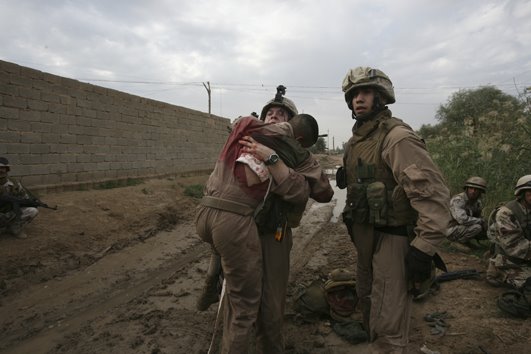
Sergeant Jesse E. Leach carries Lance Corporal Juan Valdez-Castillo after he was shot by a sniper during a patrol in Anbar Province, Iraq on October 31, 2006. (Photo: Joao Silva for The New York Times)

The Fake U.S. Victory in Iraq
By Patrick Cockburn / September 3, 2008

Political events in Iraq are seldom what they seem. The hand-over by the US military of control of Anbar province, once the heartland of the Sunni rebellion, to Iraqi forces is a case in point. The US will keep 25,000 American soldiers in Anbar, so the extent to which the Iraqi government will really take over is debatable. But the future of Anbar is a crucial pointer to the fate of Iraq. It is a vast area and one of the few parts of Iraq that is overwhelmingly Sunni.

The Iraqi government is dominated by Shia Islamic parties in alliance with Kurdish nationalists. The vital question now is whether or not this Shia-dominated government can reassure the Sunni minority that they are not going to be overrun as the US withdraws its forces. The Prime Minister, Nouri al-Maliki, is in a very confident mood. In the past four months he feels he has successfully faced down the Shia militiamen of Muqtada al-Sadr’s Mahdi Army by taking back control of Basra, Sadr City and Amarah. Then he refused to sign a new security accord with the US which President George Bush wanted to see agreed by August 31.

In the past few weeks he has been confronting his Kurdish allies over the future of the oil city of Kirkuk and the town of Khanaqin.

Mr Maliki may be overplaying his hand but there is no doubt that the Iraqi state is becoming more powerful in Iraq and the Mahdi Army, the Americans and the Kurds less so. The Americans in particular feel that he exaggerates the extent to which his success against the Mahdi Army was because of the new strength of the Iraqi security forces.

These troops were doing badly until they received American support. Nevertheless, Mr Maliki’s position is strong. He seems to have realized that he may need the US, but the US also cannot do without him and is in no position to replace him as it did with his predecessor, Ibrahim al-Jaafari.

Much of what the White House is now doing is done to help the Republicans in the presidential election. The aim is to give the impression that Iraq has finally come right for the US and victory is finally in its grasp. The surge is promoted as the strategy by which the tide was turned and it is true that the Sunni uprising against the US occupation has largely ended.

But it has done so for reasons that have little to do with the surge or American actions of any kind. Crucial to the success of the government against the Mahdi Army has been the support of Iran. It is they who arranged for the Shia militiamen to go home.

It takes real cheek for Mr Bush to claim yesterday that “Anbar is no longer lost to al-Qa’ida” since during the last presidential election in 2004, he was claiming that the media was exaggerating the success of the insurgents.

Patrick Cockburn is the Ihe author of “Muqtada: Muqtada Al-Sadr, the Shia Revival, and the Struggle for Iraq.”

Source / CounterPunch

The Rag Blog

Posted in RagBlog | Tagged , , | Leave a comment

Ron Paul : My Convention is Bigger Than Your Convention

Joyous Ron Paul supporters lined the street Tuesday in front of the Target Convention Center in Minneapolis. Paul appeared on stage to the roars of fervent followers, most of whom traveled long distances and waited as long as eight hours to see him. Photo by John Tlumacki / Boston Globe.

Ron Paul draws more people and more excitement than John McCain’s show across town — but he also attracts some scary ‘old friends.’
By Alex Koppelman / September 3, 2008

MINNEAPOLIS — If you were in the Twin Cities on Tuesday, you could be forgiven for thinking that Republicans had to come to Minnesota to nominate Ron Paul instead of John McCain. At St. Paul’s Xcel Center, where the real Republican convention is being held, a substantial number of seats remained empty. Next door in Minneapolis, however, a wildly enthusiastic crowd came close to filling the Target Center, capacity 10,000, where the Paul-ist faithful had gathered for their own quasi-convention to pay tribute to the Texas congressman, failed GOP presidential candidate and Libertarian hero.

The event, dubbed the “Rally for the Republic,” was a daylong affair that marked the formal end of Paul’s quixotic presidential run as well as, attendees hoped, the beginning of a Paul-sparked revolution in American government. The crowd defied the easy stereotypes that attached themselves to Paul’s supporters during the Paul-mania of winter and spring — the conspiracy-addled Web dweller, the Libertarian eccentric, the kid who only knows that Paul opposed the war. Sure, there was the occasional coonskin cap (and Daniel Boone-style frontier outfit), one man who appeared to be in Colonial dress and at least a couple of dreadlocked youths. The most striking thing about the people at the Target Center, however, was that they seemed so damn normal. But underneath the normality, and unbeknown to many in attendance, there lurked some of the dark undercurrents that have been present in the Paul movement all along.

Much of the energy that propelled Paul to the spotlight earlier this election cycle came from passionate neophytes. Many of those at the Target Center said they hadn’t cared about politics before they first heard the Texas Republican speak. Some had come hundreds of miles just to be there — like 23-year-old Tim Regnier and 21-year-old Nicole Wagner, who had driven seven hours from the Chicago suburbs. “We just wanted to show that the movement’s not going to die,” Regnier said. Justin Spyres, 27, said he “flew out from California just to be a part” of the rally. “I’m unemployed, I don’t have any income,” Spyres said, “but we made it work.”

Others at the Target Center, however, have deeper roots in American politics, specifically its far-right fringe, and longer ties with the star of the show. For years, Paul has attracted support from right-wing radicals and even white supremacists, and he hasn’t exactly run from that part of his fan base. Newbies like Regnier were on the floor, but some of the radicals were onstage, hidden in plain sight.

There was a furor earlier this year when the New Republic’s Jamie Kirchick dug up some old newsletters put out under Paul’s name that smacked of racism. (In some, African-Americans were called “animals.” One issue, Kirchick noted, “ridiculed black activists who wanted to rename New York City after [Martin Luther] King, suggesting that ‘Welfaria,’ ‘Zooville,’ ‘Rapetown,’ ‘Dirtburg,’ and ‘Lazyopolis’ were better alternatives.”) Onstage at the Paul rally on Tuesday was Lew Rockwell; credible evidence suggests Rockwell may have ghostwritten much of the controversial material in those newsletters. (Rockwell denies this.)

There, also, was Howard Phillips, a self-described “old friend” of Paul’s, and one of the founders of, and a former presidential candidate for, the far-right Constitution Party. Phillips has long maintained ties to the Christian reconstructionist movement, and has advocated a “return to Godly, Biblically based constitutional government.” His party’s platform includes dark mentions of the “New World Order.”

And there was a special guest, whose name was kept secret until he hit the stage: John McManus, president of the John Birch Society. The JBS is perhaps best known for having opposed fluoridation of drinking water as a communist plot; it was kicked out of the American political conversation decades ago after — among other things — its founder called Dwight Eisenhower “a dedicated conscious agent of the communist conspiracy.” But at the Target Center, McManus was one of the stars of the day, and he was clearly enjoying himself, basking in the applause. He got a grateful response when he announced that Paul will headline JBS’s 50th anniversary dinner this fall.

A good many of those in attendance had not yet been born when the JBS had its heyday, and a fair number of the people Salon spoke with afterward had never heard of it. A few, however, had become familiar with the group, even joined it, because of their association with the Paul campaign.

The mainstream, however, at least the conservative division, was well represented. Grover Norquist, president of Americans for Tax Reform and a prominent GOP activist, spoke. MSNBC’s Tucker Carlson served as emcee. “I’m not endorsing anybody,” Carlson told Salon, adding that there “are things I disagree with” about Paul’s philosophy. He was there, he said, because they’d asked him to be and because he admires Paul for sticking up for personal liberties. He also praised the people who’d come to the Target Center. “I admire the fact that they don’t get anything out of it — nobody’s going to be ambassador to Belgium for supporting Ron Paul.”

“I don’t like the thing we do in the media,” said Carlson, “this dismissive thing — ‘Oh, they’re just crazy.’ And I do it too. That’s a low impulse. I think if you’re going to say that, you should be required to offer some proof.”

Another semi-mainstream figure almost stole Paul’s show. Former pro wrestler and Minnesota Gov. Jesse “The Body” Ventura was a clear crowd favorite — a diversion into some 9/11 Truther rhetoric didn’t hurt him — and he got some attention for hinting at a presidential run, promising that if the U.S. “shows me that it’s worth it, in 2012, we’ll give them a race they’ll never forget.”

There were plenty of delegates from that other convention in attendance as well, most pledged to Paul but some to McCain. The GOP delegates with whom Salon spoke were universally more excited about Tuesday’s event than they were about the rest of the week, and said their fellow GOP delegates had been supportive. “We agree on so much … we’re trying to build bridges,” said David Fischer, an alternate Paul delegate from Iowa who described himself as a “lifelong Republican” who hadn’t been inspired to become a delegate to the GOP convention until Paul’s candidacy. Some of the GOP Paul delegates, like Fischer, said they’d vote for McCain in November, but others weren’t sure.

Marc Lucca, a Paul supporter and delegate from Oregon who’d been a field director with Victory 2004, the Republican effort to reelect President Bush, said, “I would likely support McCain if he is the nominee,” but added, “I would like to see John McCain not take my vote and the votes of millions of other conservatives for granted.”

Thomas Kiene of Oklahoma, a reluctant McCain delegate — he preferred Paul, he said, but his district went for McCain — was less generous. He called the GOP convention itself a “railroaded show.”

“I was over there yesterday and it made me sick,” Kiene said. His vote is pledged to McCain, but he’s not happy about it, and says he’s considering not voting at all. “I’ll be there. Maybe as an observer more than a participant. Whether I let my alternate cast my vote or not, I don’t know.”

At least one longtime Libertarian was excited to see the turnout, and to see the wide array of people and opinions the movement is now attracting, even if he doesn’t agree with the philosophies of some of the groups represented. “It’s a wide, weird tent,” said Kerry Welsh of Redondo Beach, Calif., who says he’s donated more than $100,000 to Paul and other Libertarians over the years. “All I can say is that freedom brings in a wide assortment of people … Imagine what would happen if someone like Mike Huckabee or Mitt Romney held a rally like this now? Nobody would attend, because they don’t stand for anything.”

Source / salon.com

The Rag Blog

Posted in RagBlog | Tagged , , , , , , , | Leave a comment

Joseph Stiglitz on the Economy : Falling Down

‘London Bridge’ (1616) by Claes Van Visscher. This engraving shows Old London Bridge in 1616, with Southwark Cathedral in the foreground. The spiked heads of executed criminals can be seen above the Southwark gatehouse. Some of Old London Bridge did indeed fall down. The rest succumbed to war and progress.


No manufacturing. No new ideas. What’s our economy based on?
By Joseph Stiglitz / September 3, 2008

More than 75 years ago, confidence in the market economy got a rude shock as the world sank into the Great Depression. Adam Smith had said that the market led the economy, as if by an invisible hand, to economic efficiency and societal wellbeing. It was hard to believe that Smith was right when one in four Americans was out of a job. Some economists held true to their faith in self-regulating markets; they said, just be patient, in the long run the market’s restorative forces will take hold, and we will recover. But Keynes’s retort ruled the day: In the long run, we are all dead. We could not wait. Today, even conservatives believe that government should intervene to maintain the economy at or near full employment

Those who believe in free markets have now received another rude shock: We have not yet sunk into an “official” recession, but it has been more than half a year since any new jobs were created, and, meanwhile, our labor force continues to grow. If the Great Depression undermined our confidence in macroeconomics (the ability to maintain full employment, price stability, and sustained growth), it is our confidence in microeconomics (the ability of markets and firms to allocate labor and capital efficiently) that is now being destroyed. Resources were misallocated and risks were mismanaged so severely that the private sector had to go running to the government for help, lest the entire system melt down. Even with federal intervention, I have estimated the cumulative gap between what our economy could have produced–had we invested in actual businesses, rather than, say, mortgages for people who couldn’t afford their homes–and what we will produce over the period of our slowdown to be more than $1.5 trillion.

Blame has rightly fallen on the financial markets because it is their responsibility to allocate capital and manage risk, and their failure has revived several old concerns of the political (and economic) left. Some looking at the U.S. economy’s decreasing reliance on manufacturing and increasing dependence on the service sector (including financial services) have long worried that the whole thing was a house of cards. After all, aren’t “hard objects”–the food we eat, the houses we live in, the cars and airplanes that we use to transport us from one place to another, the gas and oil that provides heat and energy–the “core” of the economy? And if so, shouldn’t they represent a larger fraction of our national output?

The simple answer is no. We live in a knowledge economy, an information economy, an innovation economy. Because of our ideas, we can have all the food we can possibly eat–and more than we should eat–with only 2 percent of the labor force employed in agriculture. Even with only 9 percent of our labor force in manufacturing, we remain the largest producer of manufactured goods. It is better to work smart than to work hard, and our investments in education and technology have enabled us to enjoy higher standards of living–and to live longer–than ever before. America’s dominance in so many aspects of high-tech is testimony to the real returns to these soft expenditures. Indeed, I would argue that we would do even better if we had more resources in these sectors.

But the view that our recent success is based on a house of cards has more than a grain of truth to it. In recent years, financial markets created a giant rich man’s casino, in which well-off players could take trillion dollar bets against each other. I am among those who believe that consenting adults should be allowed great freedom in what they do–as long as they don’t harm others. But there’s the rub. These high-rollers weren’t just gambling their own money. They were gambling other people’s money. They were putting at risk the entire financial system–indeed, our entire economic system. And now we are all paying the price.

Financial markets have been likened to the brain of the economy. They are supposed to allocate capital and manage risk. When they do their job well, economies prosper. When they do their job badly, as we are once again learning, everyone suffers. Financial markets are amply rewarded for their work–in recent years, they have received over 30 percent of corporate profits–and the standard mantra in economics was that these rewards were commensurate with their social return. That is, financial wizards might walk off with a great deal of money, but the rest of society is better off because our capital generates so much more productivity than in societies with less well-developed–and less rewarded–financial markets. Part of the rewards that accrue to financial markets are thus for encouraging innovation–through venture capital firms and the like.

But not all innovations enhance welfare, even when they increase profits. For instance, cigarette profits may have increased when the tobacco industry developed products that were more addictive, but those who died as a result, and their families, were hardly better off; nor were the taxpayers who had to pick up the tab for the increased health care costs. Food companies that, today, taking a page out of the same playbook, develop products that lead to compulsive eating–and the resulting obesity epidemic–may be increasing profits, but not societal well-being. Microsoft was ingenious in its strategies to leverage the monopoly power it had from controlling the PC operating system; it increased its profits, but, in killing rivals like Netscape, it had a chilling effect on innovation.

The task of unraveling all that went wrong in our financial system is a difficult one, but in essence the financial system’s latest innovation was to devise fee structures that were often far from transparent and that allowed it to generate enormous profits–private rewards that were not commensurate with social benefits. The imperfections of information (resulting from the non-transparency) led to imperfections in competition, helping to explain why the usual maxim that competition drives profits to zero seemed not to hold. One should have suspected that something was wrong when bank after bank made so much money year after year. One should have suspected that something was wrong with the economic system when millions of Americans owed billions to credit card companies and banks in “late fees,” “penalties,” and a variety of other charges, transforming a high annual interest rate of 20 percent into a truly usurious effective interest rate of 100 percent or more for those who fell behind in their payments.

Perhaps the worst problems–like those in the subprime mortgage market–occurred when non-transparent fee structures interacted with incentives for excessive risk-taking in which financial managers got to keep high returns made one year, even if those returns were more than offset by losses the next. Behind the subprime crisis were mortgages designed to encourage repeated refinancing of homes–a pyramid scheme that generated billions of dollars in fees for the mortgage company as long as home prices continued to soar. It was inevitable that the bubble would break. But, by then, the profits that had been pocketed would make these financial wizards secure for life–or, at least, that was their hope.

To put it another way, had those in the financial sector allocated capital and risk in a way that fueled the economy, they would have had handsome profits. But they wanted more, and so established incentive structures that encouraged gambling. If they gambled and won, they could walk away with a share of the profits. If they gambled and lost, the investors would bear the consequences. It was almost as if the entire financial system was converted into a giant casino in which the system was rigged to guarantee those running the games huge returns, at the expense of the players. But in Las Vegas and Atlantic City, the games are near zero-sum: The gains of the casino owners approximately equal the losses of the players. The financial-system-as-casino, on the other hand, is a negative-sum game. Those on Wall Street may have walked off with billions, but those billions are dwarfed by the costs to be paid by the rest of us. Some have lost their homes and life savings–to say nothing of their dreams for their own futures and those of their children. Others are innocent bystanders who resisted the false promises of the mortgage brokers and the credit card companies, but now find themselves out of jobs as the economy weakens. And the poor are hurt as state revenues plummet, forcing cutbacks in public services.

The current woes in America’s financial system are not an isolated accident–a rare, once-in-a-century event. Indeed, there have been more than one hundred financial crises worldwide in the last 30 years or so. Here in the United States alone, we have had the S&L crisis in 1989, the dot-com/WorldCom/Enron problems of the early years of this decade, and now the subprime-morphing-into-the-beyond-subprime collapse. In addition to these national problems, there were regional troubles–real-estate crises fed by excessive lending in Texas and the Southwest in the mid-’80s, and in California and New England in the early ’90s. In each of these instances, financial markets failed to do what they were supposed to do in allocating capital and managing risk. In the late ’90s, for instance, so much capital was allocated to fiber optics that, by the time of the crash, it was estimated that 97 percent of fiber optics had seen no light.

In short, the problem with the U.S. economy is not that we have allocated too many resources to the “soft” areas and too few to the “hard.” It is not necessarily that we have allocated too many resources to the financial sector and rewarded it too generously–though a strong argument could be put forward to that effect. It is that too little effort was devoted to managing real risks that are important–enabling ordinary Americans to stay in their homes in the face of economic vicissitudes–and that too much effort went into creating financial products that enhanced risk. Too much energy has been spent trying to make an easy buck; too much effort has been devoted to increasing profits and not enough to increasing real wealth, whether that wealth comes from manufacturing or new ideas. We have learned a painful lesson, both in the 1930s and today: The invisible hand often seems invisible because it’s not there. At best, it’s more than a little palsied. At worst, the pursuit of self-interest–corporate greed–can lead to the kind of predicament confronting the country today.

[Joseph Stiglitz is University Professor at Columbia University, winner of the 2001 Nobel Memorial Prize in Economics, and co-author of The Three Trillion Dollar War.]

© The New Republic 2008

Source / The New Republic / Post date September 10, 2008

Thanks to Carl Davidson / The Rag Blog

Posted in RagBlog | Tagged , , , , , , , | 1 Comment

Sarah Palin : Soldiers in Iraq on ‘Task From God’

I find this very, very disturbing.

Alyssa Burgin / The Rag Blog

Sarah Palin, her church and her messianic world view
By Nico Pitney and Sam Stein / September 2, 2008

Three months before she was thrust into the national political spotlight, Gov. Sarah Palin was asked to handle a much smaller task: addressing the graduating class of commission students at her one-time church, Wasilla Assembly of God.

Her speech in June provides as much insight into her policy leanings as anything uncovered since she was asked to be John McCain’s running mate.

Speaking before the Pentecostal church, Palin painted the current war in Iraq as a messianic affair in which the United States could act out the will of the Lord.

“Pray for our military men and women who are striving to do what is right. Also, for this country, that our leaders, our national leaders, are sending [U.S. soldiers] out on a task that is from God,” she exhorted the congregants. “That’s what we have to make sure that we’re praying for, that there is a plan and that that plan is God’s plan.”

Religion, however, was not strictly a thread in Palin’s foreign policy. It was part of her energy proposals as well. Just prior to discussing Iraq, Alaska’s governor asked the audience to pray for another matter — a $30 billion national gas pipeline project that she wanted built in the state. “I think God’s will has to be done in unifying people and companies to get that gas line built, so pray for that,” she said.

Palin’s address, much of which was spent reflecting on the work of the church in which she grew up and was baptized, underscores the notion that her world view is deeply impacted by religion. In turn, her remarks raise important questions: mainly, what is Palin’s faith and how exactly has it influenced her policies?

A review of recorded sermons by Ed Kalnins, the senior pastor of Wasilla Assembly of God since 1999, offers a provocative and, for some, eyebrow-raising sketch of Palin’s longtime spiritual home.

The church runs a number of ministries providing help to poor neighborhoods, care for children in need, and general community services. But Pastor Kalnins has also preached that critics of President Bush will be banished to hell; questioned whether people who voted for Sen. John Kerry in 2004 would be accepted to heaven; charged that the 9/11 terrorist attacks and war in Iraq were part of a war “contending for your faith;” and said that Jesus “operated from that position of war mode.”

It is impossible to determine how much Wasilla Assembly of God has shaped Palin’s thinking. She was baptized there at the age of 12 and attended the church for most of her adult life. When Palin was inaugurated as governor, the founding pastor of the church delivered the invocation. In 2002, Palin moved her family to a nondenominational church, but she continues to worship at a related Assembly of God church in Juneau.

Moreover, she “has maintained a friendship with Wasilla Assembly of God and has attended various conferences and special meetings here,” Kalnins’ office said in a statement. “As for her personal beliefs,” the statement added, “Governor Palin is well able to speak for herself on those issues.”

Clearly, however, Palin views the church as the source of an important, if sometimes politically explosive, message. “Having grown up here, and having little kids grow up here also, this is such a special, special place,” she told the congregation in June. “What comes from this church I think has great destiny.”

And if the political storm over Barack Obama’s former pastor Jeremiah Wright is any indication, Palin may face some political fallout over the more controversial teachings of Wasilla Assembly of God.

If the church had a political alignment, it would almost surely be conservative. In his sermons, Kalnins did not hide his affections for certain national politicians.

During the 2004 election season, he praised President Bush’s performance during a debate with Sen. John Kerry, then offered a not-so-subtle message about his personal candidate preferences. “I’m not going tell you who to vote for, but if you vote for this particular person, I question your salvation. I’m sorry.” Kalnins added: “If every Christian will vote righteously, it would be a landslide every time.”

Months after hinting at possible damnation for Kerry supporters, Kalnins bristled at the treatment President Bush was receiving over the federal government’s handling of Hurricane Katrina. “I hate criticisms towards the President,” he said, “because it’s like criticisms towards the pastor — it’s almost like, it’s not going to get you anywhere, you know, except for hell. That’s what it’ll get you.”

Much of his support for the current administration has come in the realm of foreign affairs. Kalnins has preached that the 9/11 attacks and the invasion of Iraq were part of a “world war” over the Christian faith, one in which Jesus Christ had called upon believers to be willing to sacrifice their lives.

What you see in a terrorist — that’s called the invisible enemy. There has always been an invisible enemy. What you see in Iraq, basically, is a manifestation of what’s going on in this unseen world called the spirit world. … We need to think like Jesus thinks. We are in a time and a season of war, and we need to think like that. We need to develop that instinct. We need to develop as believers the instinct that we are at war, and that war is contending for your faith. … Jesus called us to die. You’re worried about getting hurt? He’s called us to die. Listen, you know we can’t even follow him unless you are willing to give up your life. … I believe that Jesus himself operated from that position of war mode. Everyone say “war mode.”

Now you say, wait a minute Ed, he’s like the good shepherd, he’s loving all the time and he’s kind all the time. Oh yes he is — but I also believe that he had a part of his thoughts that knew that he was in a war.
As for his former congregant and current vice presidential candidate, Kalnins has asserted that Palin’s election as governor was the result of a “prophetic call” by another pastor at the church who prayed for her victory. “[He made] a prophetic declaration and then unfolds the kingdom of God, you know.”

Even Palin expressed surprise at that pastor’s advocacy for her candidacy. “He was praying over me,” she said in June. “He’s praying, ‘Lord make a way, Lord make a way…’ And I’m thinking, this guy’s really bold, he doesn’t even know what I’m gonna do, he doesn’t know what my plans are, and he’s praying not, ‘Oh Lord, if it be your will may she become governor,’ or whatever. No, he just prayed for it. He said, ‘Lord, make a way, and let her do this next step.’ And that’s exactly what happened. So, again, very very powerful coming from this church.”

In his sermons, Pastor Kalnins has also expressed beliefs that, while not directly political, lie outside of mainstream Christian thought.

He preaches repeatedly about the “end times” or “last days,” an apocalyptic prophesy held by a small but vocal group of Christian leaders. During his appearance with Palin in June, he declared, “I believe Alaska is one of the refuge states in the last days, and hundreds of thousands of people are going to come to the state to seek refuge and the church has to be ready to minister to them.”

He also claims to have received direct “words of knowledge” from God, providing him information about past events in other people’s lives. During one sermon, he described being paired with a complete stranger during a golf outing. “I said, I’m a minister from Alaska and I want you to know that your wife left you — you know that your wife left you and that the Lord is gonna defend you in a very short time, and it wasn’t your fault. And the man drops his clubs, he literally was about to tee off and he dropped his clubs, and he says, ‘Who the blank are you?’ And I says, ‘well, I’m a minister.’ He says, ‘how do you know about my life? What do you know?’ And I started giving him more of the word of knowledge to his life and he was freaked out.”

Kalnins has, of course, preached on a bevy of topics ranging from humility to “overcoming bitterness.” But the more controversial remarks reported above were not out of the norm, appearing in numerous sermons spanning the four years of available recordings.

As for Palin, her views on these topics is more opaque. In the wake of the controversy over Jeremiah Wright, a debate has raged about whether political figures should be held responsible for the comments of their religious guiders. Clearly, however, Kalnins, like many national conservative religious leaders, sees Alaska’s governor as one of his own. “Gov. Sarah Palin is the real deal,” he told his church this past summer. “You know, some people put on a show…but she’s the real deal.”

Source / The Huffington Post

The Rag Blog

Posted in RagBlog | Tagged , , , , | Leave a comment

Is John McCain Really Just Sarah Palin’s Bitch?

From the creative mind of YouTuber LisaNova.

Thanks to Diane Stirling-Stevens | The Rag Blog | Posted September 2, 2008

Posted in RagBlog | Tagged , , | 1 Comment

Jim Hightower : The Price of Autocratic Arrogance

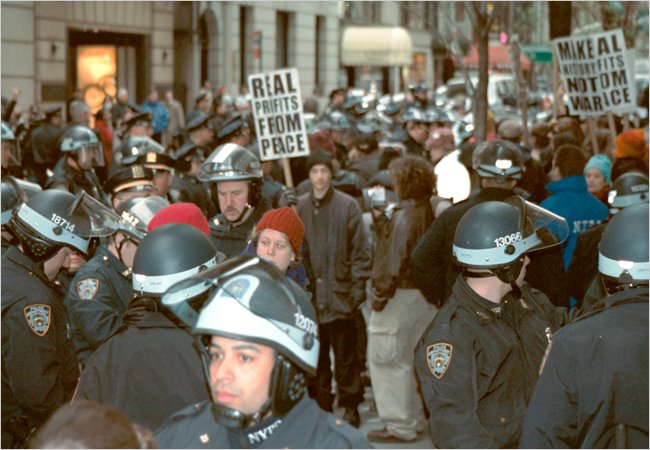
A mass arrest under way at an antiwar protest in Manhattan on April 7, 2003. Convictions: zero. Cost: $2 million. Photo by Dawn Reel / NYT.

Running a police state is expensive
By Jim Hightower / September 2, 2008

To your list of reasons not to support a police state in America, add this one: It’s expensive.

I’m not talking about the obvious costs of deploying police agents in high-tech riot gear, the tab for prison cells, and whatnot. Rather, I’m talking about paying for lawyers, court costs, and the inevitable damage awards to the people whose rights get trampled. It happens again and again in our country that politicians get spooked when We The People dare to protest their policies, so they resort to the brute force of a police crackdown – essentially using an ax to peel a grape. What they forget in their rush to crush is that America – thank goodness – has a Bill of Rights.

The latest to learn this are New York City officials who unleashed the police state on war protesters in April 2003, right after George W invaded Iraq. Mayor Mike Bloomberg sent the helmeted and booted NYPD to bust a gaggle of peaceful protesters in Midtown Manhattan. They encircled, arrested, and jailed 52 of these citizens, charging them with the heinous crime of “blocking pedestrians.”

But, wait: there were videos of the protest! And – guess what? – no pedestrians had been blocked, and the Republic was not at all endangered by this exercise of First Amendment rights. Yet, city prosecutors pushed hard, spending more than a million dollars of taxpayer funds to try to imprison innocent Americans. Their case was so weak, however, that only two protesters were even brought to trial, and both were found innocent. The other 50 had their charges dropped, and now – five years later – the city has had to pay more than two million dollars to settle the case.

Politicians like Bloomberg are wiping their feet on our Constitution by jailing legitimate protestors – then taxing you and me to cover up their mistakes.

See “52 Arrests, a $2 Million Payout, and Many Questions,” by Jim Dwyer / New York Times / August 20, 2008

Source / Jim Hightower

The Rag Blog

Posted in RagBlog | Tagged , , , , , , | Leave a comment

Cuba: Still Much More Concerned with the Things That Truly Matter


CUBA: Shoring Up the Educational System
By Patricia Grogg / August 29, 2008

HAVANA, Aug 29 — In the new school year, which begins next Monday, Cuba’s educational system will be trying out several changes aimed at overcoming the decline in the quality of teaching, blamed on a shortage of teachers and other problems.

“I am waiting to see what happens. My daughter begins secondary school now, and if she doesn’t get good teachers and her grades drop, I’ll have to find another school or pay for private tutoring. These are the most difficult years,” a Cuban journalist who asked to remain anonymous told IPS.

This week, Education Minister Ena Elsa Velázquez said there would be more teachers on the payroll this year. A shortage of more than 8,000 teachers, identified as one of the most pressing challenges facing the educational system, has begun to be reduced as a result of the return to the classroom of retired teachers.

Velásquez said that 4,948 retired teachers were returning to work, under a decree issued in mid-July by President Raúl Castro. The emergency measure offers retired educators the opportunity to continue drawing their pensions while teaching and earning a full-time salary.

“There will be 235,943 teachers working this year, 32,070 of whom are teachers-in-training. The exodus is 30 percent lower than last year, with nearly 2,000 fewer teachers filing for retirement,” said the minister, as reported by the local press.

There are 2,549,845 preschool, primary and secondary school students enrolled for the 2008-2009 school year in Cuba.

Velázquez also announced that teachers would be given more time to prepare their classes. “That was sorely needed. Now we can also dedicate more time to studying,” Kruskalia Masa, a 45-year-old primary school teacher, commented to IPS.

In her view, the quality of teaching in Cuba has gone down because teachers are given very little time to prepare their classes, a problem that only worsened as the number of educators shrank. “In addition, we will now have more assistants, who obviously don’t replace teachers, but do provide support for their work,” Masa added.

A report by the education minister on performance in the 2007-2008 school year states that among the main challenges that students in the first few years of secondary school must overcome are difficulties in spelling and writing, and poor reading habits.

Veláquez was named education minister in April after the sudden removal of Luis Ignacio Gómez, who headed the ministry for 18 years.

“He had lost energy and revolutionary consciousness,” wrote ailing former president Fidel Castro in a column in which he backed Gómez’s replacement.

The deterioration of education, especially due to the shortcomings of the teachers-in-training system, courses taught by video, and distance learning courses offered on television, was a frequent complaint voiced in the popular debates called by Raúl Castro in a key Jul. 26, 2007 speech, when he was still acting president.

Such criticism was also voiced at the 7th Congress of the Union of Writers and Artists of Cuba (UNEAC) in April, by intellectuals like Alfredo Guevara, one of the veteran cultural leaders of the Cuban revolution.

“Can our primary, secondary and prep schools properly educate children and adolescents and thus lay the foundation for the future as they are at present, governed by misconceived criteria and practices that ignore elementary pedagogical and psychological principles and violate family rights?” he asked.

During the congress, which was held behind closed doors, Guevara also reportedly warned that the teacher-in-training programme has produced “young student teachers whose training is lacking and incomplete and whose maturity level is far short of what it should be.”

Teachers-in-training are used to complete the teaching staff of schools, which have also been equipped with TV sets, VCRs and computers as learning aids. The changes introduced include a reduction of video classes to half an hour, with 15 minutes left for the teacher to provide explanations.

“Television is a support for teachers, it should not replace us,” said Masa, who stressed that “a sense of vocation and dedication” are indispensable in her profession. “Unfortunately, the mass training of young people as teachers does not ensure that they all have these two qualities,” she added.

In the plans for the new school year, the main task of retired teachers who return to the classroom will be to supervise and advise the young teachers-in-training.

In Masa’s view, that is an “essential” step towards strengthening education in Cuba.

Education, which has been universal and free in Cuba since the 1960s, is considered one of the main accomplishments of the 1959 revolution. But like other sectors in Cuba, it was unable to escape the impact of the severe economic crisis that hit Cuba in the wake of the collapse of the Soviet Union and East European socialist bloc.

Nevertheless, in the latest study on scholastic performance carried out by the Latin American Laboratory for Assessment of the Quality of Education (LLECE), which is coordinated by the United Nations Educational, Scientific and Cultural Organisation (UNESCO) regional bureau, Cuba was found to have the highest performance levels among the 17 nations studied in Latin America and the Caribbean.

In the study released in June, “Student achievement in Latin America and the Caribbean; Results of the Second Regional Comparative and Explanatory Study (SERCE)”, Cuba was the only country whose third-grade pupils attained math and reading scores more than one standard deviation higher than the regional average, that is, over 100 points above the 500 points representing the average of all the countries studied.

Source / IPS News

GRANMA: Maintaining Cuba’s Social Security and Welfare Commitments
By Maria Julia Mayoral / August 29, 2008

The Cuban government allocates a sizeable sum of the national budget to maintain the Social Security and Welfare System for its aging population.

TODAY, SIXTEEN PRECENT OF THE POPULATION IS 60 OR OLDER.

Neither of the two spheres lacked financial support during the economic crisis that besieged Cuba following the collapse of Socialist Eastern Europe and the economic hardships of an intensified US blockade. Far from diminishing, the budgetary allocations for the two continued to grow. In 2007, for example, their combined expenditures equaled 10.56 percent of the Gross Domestic Product.

The system currently in force offers protection to workers and their families and to the population in general. It covers risks and contingencies: industrial accidents, diseases, disability and maternity, death of workers, welfare, and old age.

According to statistics from the Ministry of Labor and Social Security, there were 1,133,229 Social Security beneficiaries in 1990. At present, the figure of retirees alone is close to 1.6 million. Welfare is similarly on the rise.

Increased outlay is also due to the government’s decision to increase the still depressed incomes of retirees and other families receiving financial assistance. Thus, between 2004 and 2008, minimum Social Security and Welfare pensions increased 3.6 and 2.4 times, respectively.

It would be hard to find anyone in Cuba who differs on the need to continue raising pensions, but how can such huge expenditures be maintained or increased?

Today, 16.6 percent of the population is 60 or older and by 2050 this ratio could go over 30 percent. Aging, along with the notable decrease in birthrate would lead to having, in 2025, approximately 770,000 less people in the work force as compared to the present, if by then the norms established in the Social Security Law currently in force have not changed.

The reduction in the number of citizens in the work force (producers of good and services) and at the same time the increase of pensioners due to age is not a new problem. Cuba has been facing this for several decades now: in 1980, more than 238,000 young people arrived at working age, and during 2007 the figure dropped to approximately 166,000 as a result of the constant reduction of the birthrate. If this trend continues, under the current legislation more people could retire in a single year by 2020, than those incorporated into the work force.

It’s impossible to maintain such an imbalance. Therefore, the proposal to increase the retirement age and the years of service to deserve it, is part of the multiple alternatives the government is considering to achieve a better use of the country’s human resources. Otherwise, it would be harder for the Cuba to achieve greater economic development, which is the only way to continue supporting its high social expenditures, among them those of Social Security and Welfare.

The Cuban government will never negate its responsibilities. Neither budget cuts nor the privatization of social security —applied in many countries taking neo-liberal recipes as a starting point— will be resorted to here. Huge expenditures in the two spheres will continue to come from the wealth the working population is capable of creating. In this regard, the new Social Security Law, presently a bill, will now be discussed by workers throughout Cuban society. This, at a time when better organization and labor discipline are needed, as well as expanding payment systems according to results, coupled with increasing productivity and more rigorous management practices.

Source / United Black Untouchables Worldwide

Thanks to Mariann Wizard / The Rag Blog

Posted in RagBlog | Tagged , , | Leave a comment

It Doesn’t Have to Be This Way


Ecological Food For Thought … The Progress Of Destruction
By Jim Otterstrom / September 2, 2008

A friend once sent me a link to a composite photo of the nighttime lights of North America as seen from space.

She found the photo to be very comforting in the fact that she could see the lights of all the places in America where she had friends.

But I found the photo to have a somewhat opposite effect on my emotions. It caused a discomforting knot in my gut!

I saw the lights as countless gaping holes in the biotic communities of the continent I call home.

The more numerous, and brighter the lights, the bigger the holes in the living diversity of the natural world.

To most people, I suppose, these lights represent progress in the development of humankind.

But, to me, they dramatically illustrate the destructive imbalance between human organisms and our environments.

Where there are lights, there are buildings, shopping malls, sprawling suburbs, monstrous cities, millions of acres of roads slathered in asphalt & concrete, factories, plastic, landfills & waste management facilities, power generation plants, sewage treatment plants, schools, hospitals, prisons, machinery, automobiles, internal combustion engines, wrecking yards, toxic chemicals, pollution, oil fields, corporate headquarters & the seats of governments, police stations, courthouses, military bases and nuclear weapons facilities.

Every second of every day the exponential growth of our human creation lays waste to more of the biosphere as our species trudges forward in its relentless destruction of the planet.

What we’re doing to planet Earth literally mirrors what insects did to the leaf above. We are eating away large bits of our habitat, but, we have no other leaf, or, in our case, planet, to move to when this one is stripped bare.

The results upon the victim are similar to those of a plague of locusts or a rampantly malignant cancerous growth. And, unfortunately, our victim is this magnificent place we call home, the sole source of our sustenance.

It doesn’t have to be this way.

Our imaginations are simply boxed-in, blinded by the overwhelming monolithic hierarchical structure of the civilization we were born into.

But things may be changing, as more and more people seem to be realizing that the way we live just doesn’t work, and doesn’t feel good either.

Life on Earth is a vast assemblage of complex organisms, but we’re all evolved from one single-celled common ancestor.

We are one family,

The Family Of Earth.

Our species lays claim to sentience, consciousness, and self-awareness.

So, as I daily witness the continuing degradation and destruction of the biosphere, the loss of diversity, of natural habitat, and the species who live there. I can’t help but sense that these holes in our biotic communities are also metaphors for holes our hearts, for the longing in our souls, our spirit. A longing to be whole, to be complete, to be home. And I believe that some of us are beginning to understand this, and that many more of us feel it subconsciously.

Yes, the future may yet hold a place for humanity, for the surviving descendants of the Agricultural, Industrial, and Petroleum Ages.

The Ages of Empire and World Domination.

Once the heavy burden of this all-consuming civilization is off our backs, perhaps the collective memories of our DNA, our native intuition, will help us remember that there are many ways to live.

And certainly, among those ways, there are some which are sustainable, that would allow our species to live, in much more realistic numbers, for many generations to come.

Nighttime Lights of North America (courtesy of NOAA)

This is not the photo my friend sent several years ago. That one had an all black background. But you get the idea…

Post Script

The leaf in the image at top is from a Hollyhock that’s growing near a faucet in the garden. It caught my eye, and my imagination, for several days before I realized what it reminded me of. I then decided to scan it and was moved to write this post.

Nature, speaking through me, I guess you might say.

Source / Earth Home Garden

The Rag Blog

Posted in RagBlog | Tagged , , | 1 Comment

Nilin: Stopping Israel’s Plans to Steal Their Land

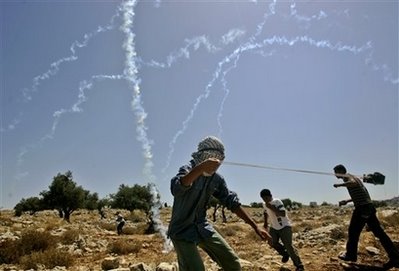
Nilin, Palestine exchanges of “fire”

Palestinian village faces army reign of terror
By Jonathan Cook / September 2, 2008

NILIN — The window through which Salam Amira, 16, filmed the moment when an Israeli soldier shot from close range a handcuffed and blindfolded Palestinian detainee has a large hole at its centre with cracks running in every direction.

“Since my video was shown, the soldiers shoot at our house all the time,” she said. The shattered and cracked windows at the front of the building confirm her story. “When we leave the windows open, they fire tear gas inside too.”

Her home looks out over the Israeli road block guarding the only entrance to the village of Nilin, located just inside the West Bank midway between Jerusalem and Tel Aviv. It was here that a bound Ashraf Abu Rahma, 27, was shot in the foot in July with a rubber bullet under orders from an Israeli regiment commander.

The treatment of the family stands in stark contrast to the leniency shown to the soldier and his commander involved in that incident.

B’Tselem, an Israeli human rights group, has accused the Israeli army of seeking “revenge” for the girl’s role in exposing the actions of its armed forces in the West Bank.

It may also be hoping to dissuade other families from airing similar evidence of army brutality, particularly since B’Tselem began distributing dozens of video cameras to Palestinians across the West Bank.

Scenes captured on film of hooded settlers attacking Palestinian farmers near Hebron came as a shock to many early this summer.

The village of Nilin has been the focus of the Israeli army’s actions since May, when its 4,700 inhabitants began a campaign of mainly non-violent demonstrations to halt the building of Israel’s separation wall across their land.

After the wall is completed, the village will be cut off from 40 per cent of its remaining farmland, effectively annexing it to half a dozen large Jewish settlements that encircle Nilin. The settlements are all illegal under international law.

Several times a week the villagers, joined by small numbers of Israeli and international supporters, congregate in olive fields where bulldozers are tearing up the land to make way for the wall.

The people of Nilin have tried various non-violent forms of protest, including praying in the path of the heavy machinery, using mirrors to reflect sunlight at the construction workers, banging pots and pans, and placing rocks in the way of the bulldozers during the night.

The army has responded with tear gas and stun grenades, as well as on occasion, with rubber-coated steel bullets and live ammunition. Last month it was reported that Israel was also experimenting with a new crowd dispersal method called “skunk”, which involves firing a foul-smelling liquid at demonstrators.

In the past few weeks, two youngsters have been shot dead by the army, including one, Ahmed Moussa, who was 10. The army claimed he was throwing stones. An autopsy showed he was hit in the head by a bullet from an M-16 rifle.

This week a soldier fired from close range three rubber bullets at Awad Surur, a mentally disabled man, as he tried to prevent his brother from being arrested. Two bullets penetrated his skull, according to B’Tselem, which denounced the army as increasingly “trigger-happy” and “reckless”.

Salam’s family, like many other villagers, bear the injuries from attendance at protests. Most of her five brothers have been hit by rubber bullets, as has her father, Jamal Amira, 53. The army has sealed the village off on several occasions and, according to villagers, beaten and terrorised inhabitants.

Mr Amira is among at least 100 farmers whose livelihoods will be devastated by the wall. He will lose all 14 hectares of his land, fields on which his ancestors have made their living by growing olives, cucumbers, aubergine and tomatoes.

But Salam’s five-minute film of the roadblock incident, taken during a four-day curfew imposed on the village, has only intensified the family’s troubles.

Three days after the video was aired, the army arrested her father during a peaceful protest. He was the only one seized after the army claimed the demonstrators had entered a closed military zone. Mr Amira was also charged with assaulting a soldier.

He was held for three and a half weeks before an Israeli military judge rejected the army’s demand that he be remanded for a further three months until his trial.

In an almost unprecedented rebuke to the prosecution, the judge questioned the army’s case, saying he could see no evidence of an assault. He also asked why Salam’s father was singled out from all of those protesting.

Mr Amira’s lawyer, Gabi Laski, said the decision confirmed “our preliminary claim that the arrest was out of vengeance and punishment for the video filmed by the girl”.

Nonetheless, Mr Amira still faces a military trial. A report last year by Yesh Din, a human rights group, found that in only 0.25 per cent of cases heard by military tribunals was the defendant found innocent. Even if acquitted, Mr Amira is expected to face legal costs amounting to nearly US$10,000 (Dh36,700), a sum the family says it cannot pay.

In contrast, the two soldiers responsible for the shooting of the detainee at the roadblock have been reprimanded with the minor charge of “unbecoming conduct”. Neither will stand criminal trial. B’Tselem has called the decision “shameful”.

According to the legal group the Association of Civil Rights in Israel, the punishment under Israeli law for aggravated abuse of a detainee is seven years imprisonment. ACRI’s lawyers have submitted a petition arguing the lenient charge “transmits to officers and other soldiers an extremely grave message of contempt for human life”.

Lt Col Omri Borberg, the commander who gave the order to shoot Abu Rahma, resigned his post but was immediately moved sideways to a senior post in a different unit. In a show of support, Gabi Ashkenazi, the head of the army, said Lt Col Borberg may be reinstated to a command position.

Meanwhile, the villagers said the army’s behaviour would not dissuade them from protesting or cause them to renounce their commitment to non-violence.

Salah Hawaja, a protest organiser, said: “When we started our demonstrations, maybe 50 soldiers showed up. Now there are hundreds stationed permanently around us. Israel is treating us like a major war zone, even though we are using non-violence.

“The people of Nilin have accepted that the best strategy to stop Israel’s plans to steal our land and leave us inside a ghetto is non-violence,” said Mr Hawaja.

“We need to show the world who is the occupier and who the occupied. Israel understands how threatening this is, which is why it is using so much force against us.”

A fund has been established to help the Amira family. Donations can be sent to: Amira Legal Defense Fund, PO Box 1335, Kfar Saba, Israel 44113, made out to “Matte Hacoalitsia”. Alternatively, you can donate through PayPal: donate.

Jonathan Cook is a writer and journalist based in Nazareth, Israel. His latest books are “Israel and the Clash of Civilisations: Iraq, Iran and the Plan to Remake the Middle East” (Pluto Press) and “Disappearing Palestine: Israel’s Experiments in Human Despair” (Zed Books). His website is www.jkcook.net.

[This article originally appeared in The National (www.thenational.ae), published in Abu Dhabi.]

Source / Information Clearing House

The Rag Blog

Posted in RagBlog | Tagged , | Leave a comment

Democracy Now!’s Amy Goodman and Producers Released After Illegal Arrest at RNC

Democracy Now!’s Amy Goodman.

Goodman Charged with obstruction; Felony riot charges pending against Kouddous and Salazar
September 1, 2008

See videos of arrests and link to petition to ‘Stop the Arrests of Journalists,’ below.

ST. PAUL–Democracy Now! host Amy Goodman and producers Sharif Abdel Kouddous and Nicole Salazar have all been released from police custody in St. Paul following their illegal arrest by Minneapolis Police on Monday afternoon.

All three were violently manhandled by law enforcement officers. Abdel Kouddous was slammed against a wall and the ground, leaving his arms scraped and bloodied. He sustained other injuries to his chest and back. Salazar’s violent arrest by baton-wielding officers, during which she was slammed to the ground while yelling, “I’m Press! Press!,” resulted in her nose bleeding, as well as causing facial pain. Goodman’s arm was violently yanked by police as she was arrested.

On Tuesday, Democracy Now! will broadcast video of these arrests, as well as the broader police action. These will also be available on Democracy Now!.

Goodman was arrested while questioning police about the unlawful detention of Kouddous and Salazar who were arrested while they carried out their journalistic duties in covering street demonstrations at the Republican National Convention. Goodman’s crime appears to have been defending her colleagues and the freedom of the press.

Ramsey County Sheriff Bob Fletcher told Democracy Now! that Kouddous and Salazar were arrested on suspicion of rioting, a felony. While the three have been released, they all still face charges stemming from their unlawful arrest. Kouddous and Salazar face pending charges of suspicion of felony riot, while Goodman has been officially charged with obstruction of a legal process and interference with a “peace officer.”

Democracy Now! forcefully rejects all of these charges as false and an attempt at intimidation of these journalists. We demand that the charges be immediately and completely dropped.

Democracy Now! stands by Goodman, Kouddous and Salazar and condemns this action by Twin Cities’ law enforcement as a clear violation of the freedom of the press and the First Amendment rights of these journalists.

During the demonstration in which the Democracy Now! team was arrested, law enforcement officers used pepper spray, rubber bullets, concussion grenades and excessive force against protesters and journalists. Several dozen demonstrators were also arrested during this action, including a photographer for the Associated Press.

Amy Goodman is one of the most well-known and well-respected journalists in the United States. She has received journalism’s top honors for her reporting and has a distinguished reputation of bravery and courage. The arrest of Goodman, Kouddous and Salazar and the subsequent criminal charges and threat of charges are a transparent attempt to intimidate journalists.

Democracy Now! is a nationally-syndicated public TV and radio program that airs on over 700 radio and TV stations across the US and the globe.

Source / Democracy Now

Stop the Arrests of Journalists. Sign the Letter.

Police in St. Paul arrested several journalists yesterday, including Democracy Now! host Amy Goodman and an AP photographer as they were covering protests of the Republican National Convention. And earlier this weekend, police raided a meeting of the video journalists’ group I-Witness with firearms drawn to arrest independent media, bloggers and videomakers.

Go here to sign petition.

Source / freepress.net

Amy Goodman Arrested at RNC

Democracy Now! Producer Nicole Salazar Arrested

Also see ‘Democracy Now!’ host back at work day after arrest by Anthony Lonetree / Star Tribune / September 2, 2008

The Rag Blog

Posted in RagBlog | Tagged , , , , | Leave a comment

Preventive Detention Violates the 4th Amendment

A documentary filmmaker screamed as he underwent treatment for pepper spray. Photo: Damon Winter/The New York Times

Preemptive Strikes Against Protest at RNC
by Marjorie Cohn / September 2, 2008

In the months leading up to the Republican National Convention, the FBI-led Minneapolis Joint Terrorist Task Force actively recruited people to infiltrate vegan groups and other leftist organizations and report back about their activities. On May 21, the Minneapolis City Pages ran a recruiting story called “Moles Wanted.” Law enforcement sought to preempt lawful protest against the policies of the Bush administration during the convention.

Since Friday, local police and sheriffs, working with the FBI, conducted preemptive searches, seizures and arrests. Glenn Greenwald described the targeting of protestors by “teams of 25-30 officers in riot gear, with semi-automatic weapons drawn, entering homes of those suspected of planning protests, handcuffing and forcing them to lay on the floor, while law enforcement officers searched the homes, seizing computers, journals, and political pamphlets.” Journalists were detained at gunpoint and lawyers representing detainees were handcuffed at the scene.

“I was personally present and saw officers with riot gear and assault rifles, pump action shotguns,” said Bruce Nestor, the President of the Minnesota chapter of the National Lawyers Guild, who is representing several of the protestors. “The neighbor of one of the houses had a gun pointed in her face when she walked out on her back porch to see what was going on. There were children in all of these houses, and children were held at gunpoint.”

The raids targeted members of “Food Not Bombs,” an anti-war, anti-authoritarian protest group that provides free vegetarian meals every week in hundreds of cities all over the world. They served meals to rescue workers at the World Trade Center after 9/11 and to nearly 20 communities in the Gulf region following Hurricane Katrina.

Also targeted were members of I-Witness Video, a media watchdog group that monitors the police to protect civil liberties. The group worked with the National Lawyers Guild to gain the dismissal of charges or acquittals of about 400 of the 1,800 who were arrested during the 2004 Republican National Convention in New York. Preemptive policing was used at that time as well. Police infiltrated protest groups in advance of the convention.

Nestor said that no violence or illegality has taken place to justify the arrests. “Seizing boxes of political literature shows the motive of these raids was political,” he said.

Further evidence of the political nature of the police action was the boarding up of the Convergence Center, where protestors had gathered, for unspecified code violations. St. Paul City Council member David Thune said, “Normally we only board up buildings that are vacant and ramshackle.” Thune and fellow City Council member Elizabeth Glidden decried “actions that appear excessive and create an atmosphere of fear and intimidation for those who wish to exercise their first amendment rights.”

“So here we have a massive assault led by Federal Government law enforcement agencies on left-wing dissidents and protestors who have committed no acts of violence or illegality whatsoever, preceded by months-long espionage efforts to track what they do,” Greenwald wrote on Salon.

Preventive detention violates the Fourth Amendment, which requires that warrants be supported by probable cause. Protestors were charged with “conspiracy to commit riot,” a rarely-used statute that is so vague, it is probably unconstitutional. Nestor said it “basically criminalizes political advocacy.”

On Sunday, the National Lawyers Guild and Communities United Against Police Brutality filed an emergency motion requesting an injunction to prevent police from seizing video equipment and cellular phones used to document their conduct.

During Monday’s demonstration, law enforcement officers used pepper spray, rubber bullets, concussion grenades and excessive force. At least 284 people were arrested, including Amy Goodman, the prominent host of Democracy Now!, as well as the show’s producers, Abdel Kouddous and Nicole Salazar. “St. Paul was the most militarized I have ever seen an American city to be,” Greenwald wrote, “with troops of federal, state and local law enforcement agents marching around with riot gear, machine guns, and tear gas cannisters, shouting military chants and marching in military formations.”

Bruce Nestor said the timing of the arrests was intended to stop protest activity, “to make people fearful of the protests, but also to discourage people from protesting,” he told Amy Goodman. Nevertheless, 10,000 people, many opposed to the Iraq war, turned out to demonstrate on Monday. A legal team from the National Lawyers Guild has been working diligently to protect the constitutional rights of protestors.

[Marjorie Cohn is president of the National Lawyers Guild and a professor at Thomas Jefferson School of Law. She is the author of Cowboy Republic: Six Ways the Bush Gang Has Defied the Law and co-author of Rules of Disengagement: The Politics and Honor of Military Dissent (with Kathleen Gilberd), which will be published this winter by PoliPointPress. Her articles are archived at http://www.marjoriecohn.com/.]

Source / Common Dreams

The Rag Blog

Posted in RagBlog | Tagged , , , | Leave a comment