Where Fear of Tradition Rules Women’s Lives

In some parts of Pakistan, the marriage of young girls still takes place depite laws banning the practice. Photo: Kamila Hyat/IRIN

PAKISTAN: Buried alive in the name of tradition
September 1, 2008

QUETTA — Several weeks ago armed tribesmen in Balochistan forced five women out of their village, shot and injured them, and buried them alive in the scrub.

According to the Hong Kong-based Asian Human Rights Commission (AHRC), the five were from the village of Babakot, about 80km from Usta Mohammad, the main city of Jaffarabad District, Balochistan Province.

Three of the women were teenagers. The other two were their mothers. The AHRC said wild animals had left the bodies half eaten.

They were killed because the girls had attempted to make their own choice in marriage, a right legally available in Pakistan to every adult, male or female.

“There is nothing in law that can prevent a woman over 18 making her own decision regarding marriage. That has been decided by the Supreme Court, and there is no ambiguity about this. But still, today, women continue to be killed in the name of the ‘honour’ of their families for making such decisions,” said Naila Hassan, a Quetta-based lawyer.

According to the Lahore-based non-governmental organisation (NGO) Aurat Foundation, 90 women were killed in so-called “honour” killings in the first three months of 2008. The same NGO said that in 2007 over 400 such deaths occurred in Sindh Province alone.

The independent Human Rights Commission of Pakistan said there were 636 “honour” killings in 2007. Its secretary-general, I. A. Rehman, said: “The number could be higher as many cases go unreported.”

Matter raised in parliament

The gruesome murders in Balochistan have focused attention on crimes committed against women in the name of “tradition”. Yasmin Bibi, a senator, raised the matter in parliament, arguing that “our religion gives a right to women to wed freely.” An attempt by another senator, from Balochistan, to defend the murders as “tribal custom” provoked outrage.

Tradition continues to detrmine the life – and death – of women of all ages in Pakistan. Photo: Kamila Hyat/IRIN

“This is just unacceptable. It is one of the paramount functions of democratic institutions to get rid of these outrageous Stone Age practices and ensure the rights, life and property of citizens as guaranteed by the constitution,” Iqbal Haider, a leading human rights activist, told IRIN.

The government has ordered an investigation.

Settling scores

Women fall victim to violence and abuse on a daily basis. The Aurat Foundation has reported 1,321 cases of violence against women in the first three months of 2008.

Apart from “honour” killings – in which women are killed because they are perceived to have injured the “honour” of their families by choosing to marry someone of their choice, or by engaging in behaviour deemed “illicit” – such violence takes the form of customs in which women may be handed over to rival groups to settle a feud. Such traditions are known as ‘swara’ or ‘vani’.

Child marriages, in which girls as young as eight or 10 may be wed, are also not unknown.

“We need someone to come forward and make an effort to change these traditions. Though laws exist, they are ineffective. We keep hearing of more and more `honour’ killings while feudal and tribal leaders defend such practices,” Gulnar Tabussum, coordinator of the Women’s Action Forum, an NGO campaigning for women’s rights, told IRIN.

Shot on suspicion of having an affair

Crimes committed in the name of tradition take place almost daily. This week, near the town of Sukkur in Sindh Province, a woman was allegedly shot dead by her husband as she slept. Apparently, the husband said, he suspected her of extra-marital relations.

The killing of women – and often the man they are suspected of having relations with – is known as ‘karo-kari’, or ‘black woman, black man’, in the parts of Sindh, Punjab and Balochistan where it is most often practiced.

The fear of tradition is a powerful influence on the lives of women. “I never let my daughter, who is 17, leave the house alone or walk home from her college on her own. If she even accidentally exchanges a glance with a man she faces being labelled ‘immoral’. This, in our society, could mean death for her, said Rabea Bibi, 45, as she waited outside the gates of a Quetta college to escort her daughter home.

Source / IRIN News

Thanks to Diane Stirling-Stevens / The Rag Blog

Posted in RagBlog | Tagged , , | Leave a comment

Victory Is Pledging Allegiance to Peace


Turning the Power Off: Stars, Stripes, War and Shame
By Missy Comley Beattie / August 30, 2008

The Pentagon says “only” five civilians were killed Friday, a week ago, by US aerial bombardment. According to Afghan officials and a United Nations report, 90 Afghan civilians died, 60 of whom were children.

Just days after this carnage, the Democrats, so many dressed in red, white, and blue, opened their convention in Denver. In the wake of the barbarity in Afghanistan and the continued suicide bombings in Iraq, the revelry and flag waving in Colorado seemed inappropriate. Sure, I understand that hope was and is in the air, but I reached for the remote and powered off.

Thursday night, I tuned in to hear a sweet, young voice, pledging allegiance to the flag of the United States of American. “With freedom and justice for all.”

Freedom and justice are concepts we can no longer take for granted. They aren’t guaranteed by stars, stripes, and platitudes. The truth is that George and Dick have sucked the life out of our Constitution, aided by Congressional Republicans and Democrats as well as too many among the electorate who are guilty by reason of fear or complacency.

The events of 9/11 sent masses rushing to either purchase or dust off their Bibles and reference scripture for guidance and to to justify “an eye for an eye.” Never mind that we leveled a country with no link to those who used our commercial airplanes as weapons. The attack on our soil provided the neocons the excuse they needed to implement their plan for domination of Earth’s bounties. Add to this the groupies convinced that George Bush was chosen by God to be president at this particular time of crisis. That Bush himself believed this should have been a red-flag warming that the path he demanded we follow would lead us, not to an Eden of security and prosperity but, to a miasma of endless conflict and contempt from most of the world.

The warmongers forgot the song learned in childhood:

“Jesus loves the little children, all the children of the world. Red and yellow, black and white, they are precious in His sight. Jesus loves the little children of the world.”

The lyrics crawl through my consciousness as war rages on and candidates for the highest office in our land spar in their own war of words for the power prize, which is the authority to declare war. To John Bomb Bomb McCain, war is something about which to joke, promote, and accelerate. He reminds us repeatedly of his years as a tortured prisoner of war. Yet he never mentions the targets whose eyes he didn’t see–all those Vietnamese peasants, men, women, and children, whose bodies he melted. For Barack Obama who opposed the invasion of Iraq but, without fail, has voted to fund it, the prudent foreign policy strategy is to send more troops to the “right” hotspot, Afghanistan. Russia must love this.

Monday is the beginning of the Republican version of Denver. When McCain, who seems to have a “thing” for beauty queens, speaks, we’ll probably hear about that trip he’s going to take to the “gates of hell.” Also, he’ll offer the usual “we’re fighting them over there so we don’t have to fight them over here,” and “if we leave too soon, they’ll follow us home,” and that we “must achieve victory.”

But no one is defining victory, so allow me: Victory is pledging allegiance to peace.

Imagine if we had a candidate who said:

So much of the history of our country has been sanitized. The truth is that we have battled unnecessarily, illegally, immorally. We have sent our sons and daughters to die, to return maimed, to sustain traumatic brain injuries and post traumatic stress disorder while destroying the lives of those we call the enemy, the other. We have invaded for resources that we call our “interests” and for superior positioning. Just to show we can. Just to show our might. Not to defend ourselves. I say no more. Not on my watch. As your president, I pledge allegiance to the people. I pledge allegiance to peace.

Actually, we do have aspirants who have said as much. Ralph Nader and Cynthia McKinney certainly are transformational choices. Bob Barr, the Libertarian, gets it, too, when he says that war “should be the last rather than the first resort.” But our corporate media give them little credibility and even less airtime.

So, we wait. Some wave their flags and hope while others feel despair and shame at what continues to be done in our names.

[Missy Beattie lives in New York City. She’s written for National Public Radio and Nashville Life Magazine. An outspoken critic of the Bush Administration and the war in Iraq, she’s a member of Gold Star Families for Peace. She completed a novel last year, but since the death of her nephew, Marine Lance Cpl. Chase J. Comley, in Iraq on August 6,’05, she has been writing political articles. She can be reached at: Missybeat@aol.com.]

Source / CounterPunch

The Rag Blog

Posted in RagBlog | Tagged , | Leave a comment

Border Patrol Busts Continue on Olympic Peninsula

More Border Patrol action on the Olympic Peninsula reminds me that the permanent war on terror is simply the excuse for the permanent destruction of American democracy in favour of the Amerikkkan police state. Here is another example of innocent folks being bulldozed by the broken system. I am grateful to see that there are also those willing to protest actively against such police action.

See also this previous article on the blog about our local Olympic Peninsula Border goons.

Richard Jehn / The Rag Blog

Demonstrators line South Forks Avenue near the transit center in Forks on Saturday to protest U.S. Border Patrol arrests and dention resulting from last week’s highway checkpoint. — Photo by Lonnie Archibald/for Peninsula Daily News

60 demonstrate in Forks against Border Patrol checkpoints, detention of two youths
By Jim Casey and Leah Leach / August 31, 2008

FORKS — About 60 people protested Saturday in the wake of U.S. Border Patrol detention of Forks residents, including a recent high school honors graduate and a 16-year-old boy.

“Border Patrol Terrorizes Children!” read one sign held outside the Transit Center on South Forks Avenue.

“Honk if you support immigration,” said another.

“Edgar lost his chance,” said a sign held by Nenita Bocanegra.

“He was sent back to Mexico,” Bocanegra said. “I got sad . . . and we made a sign for him.”

Edgar Ayala, a Forks High School athlete who graduated with honors in June, was arrested during a Border Patrol checkpoint near Forks on Aug. 20, said Forks Mayor Nedra Reed.

Since then, he has been returned to his father in Mexico, she said Friday.

He had been in the United States since infancy, she added.

Meanwhile, 16-year-old Carlos Bernabe was in federal detention in the Seattle area, said Border Patrol, spokesman Michael Bermudez in Seattle.

Lorie Dankers, spokeswoman for Immigration and Customs Enforcement in Seattle, said she was not certain which facility the youth was in.

The boy could be released to a relative, Reed said, but his stepmother “would not go to pick him up because she was an illegal.

“I found out that his family, out of fear, have returned to Mexico,” she said.

Bernabe’s father was in Mexico, she said, and the teenager had lived in the United States.

“He’s scheduled to appear before an immigration judge to determine what to do with this child,” Reed said.

“What I’ve been trying to do for the last two days is get hold of someone and find out if they will release him to someone in town.

“I have someone who will take care of this child.”

Stepped up enforcement

The Border Patrol is stepping up enforcement with checkpoints at three places on the North Olympic Peninsula, said Joseph Giuliano, deputy chief border patrol agent last week.

One is on U.S. Highway 101 at Milepost 198 between Forks and Beaver. Checkpoints reportedly were set up there on Aug. 20 and last Monday.

Another location is on state Highway 104 near the Hood Canal Bridge. Border Patrol agents ran a checkpoint there for about five hours on Aug. 22.

The third location — which had yet to be used last week — is on U.S. Highway 101 south of Discovery Bay in Jefferson County, Giuliano said.

At the checkpoints, agents are looking for terrorists and illegal immigrants, he said.

Agents also arrest people who have outstanding warrants.

Giuliano said the Peninsula is receiving additional attention from the Border Patrol because its long, remote coastline makes it difficult to secure by boat.

“When we can’t cover all that ground up front, we rely on checkpoints,” he said.

Said Bocanegra, “I want it to stop, because there’s a lot of people who have been separated and who are scared.

“There are a lot of kids that are scared, that have seen families separated,” she said.

“Some kids don’t want to go to school because they are afraid.”

The arrests of the two young people again brought to a head again the issue of illegal immigration to the West Ends of Clallam and Jefferson Counties.

Here, migrant workers harvest salal for florists as avidly as loggers fall trees for mills.

Tanya Ward, one of the organizers of Saturday’s protest, is a member of the Hoh tribe who told Peninsula Daily News that illegal immigrants are treated with the same unfairness she said is shown to Native Americans.

“I don’t think it’s right for them to be taken out of their homes when their children are here and they’re not doing anything wrong,” she said.

Sanctuary city?

Ward said she wanted to propose that Forks declare itself a sanctuary city.

Such cities — an undetermined number of them across the country, starting with San Francisco in the 1980s — discourage municipal employees from enforcing or aiding enforcers of federal immigration laws.

To that degree, Forks already is such a city, Reed said, because city police “are not immigration officers. We are not employing any immigration activities on our own.”

However, Forks officers will provide assistance and backup when asked to do so by Border Patrol officers or agents of the Immigration and Customs Enforcement division of the Department of Homeland Security.

“That’s our mandate; that’s our job; that’s our role and responsibility,” she said.

More poignant and perhaps more pressing, Reed said, is the fear that pervades Forks’s Hispanic community as more Border Patrol officers take up duties on the North Olympic Peninsula.

Forty-five officers currently work out of the Port Angeles headquarters.

Although it is against the agency’s policy to search for illegal immigrants in schools and churches, some parents are afraid to leave their homes to buy school supplies for their children, Reed said, or to send them to school when classes resume.

Others have taken to shopping for groceries in the small hours of the morning to avoid what they fear are roaming Border Patrol officers, she said.

Afraid she’ll lose ‘Auntie’

Reed said she’d had a 7-year-old girl in her office Friday, weeping because she feared her “Auntie” would be arrested and deported.

And while the mayor said the parents of such children place them at risk, “My God, what happens to the kids?”

Concerning declaring Forks a sanctuary city, Reed said no one officially had posed the idea to her or the city council.

“I’m not sure what our legal standing would be,” she said.

But she was certain the issue of illegal immigration has divided Forks citizens.

“You have those people who are trying very hard to live up to their moral perception that they need to do something to help these folks,” she said.

Other residents are in favor of deporting illegal immigrants immediately, she said.

Reed angry at Congress

As for the Border Patrol, Bermudez said agents have no choice but to arrest people they find are in the country illegally.

“We are obligated to take action,” he said. “We swore an oath.

“It would be malfeasance if we did not do our job. It would subject us to punitive action.”

Forks was the scene of a march by 700 people protesting immigration policies on May 1, 2006. Since then, its city council has had presentations from the Border Patrol on its policies and performance.

Reed, however, is angry — at Congress.

“We need a federal immigration policy,” she said.

“Our federal government and our Congress have got to do something about illegal immigration.

“We hired them to do a job. We hired them to make the tough decisions.”

As for the fate of Carlos Bernabe, Reed said Friday, “I’ve been waiting for a call all day and I’ve received nothing. It’s so frustrating.

“We’ll begin the process again on Tuesday.”

Source / Peninsula Daily News

The Rag Blog

Posted in RagBlog | Tagged , , | 1 Comment

Junior Has Declared a Permanent State of War (But Mostly on Democracy)

follow link to slide show

Click the image to see the entire slide show.

Bush quietly seeks to make war powers permanent, by declaring indefinite state of war
By John Byrne / August 30, 2008

As the nation focuses on Sen. John McCain’s choice of running mate, President Bush has quietly moved to expand the reach of presidential power by ensuring that America remains in a state of permanent war.

Buried in a recent proposal by the Administration is a sentence that has received scant attention — and was buried itself in the very newspaper that exposed it Saturday. It is an affirmation that the United States remains at war with al Qaeda, the Taliban and “associated organizations.”

Part of a proposal for Guantanamo Bay legal detainees, the provision before Congress seeks to “acknowledge again and explicitly that this nation remains engaged in an armed conflict with Al Qaeda, the Taliban, and associated organizations, who have already proclaimed themselves at war with us and who are dedicated to the slaughter of Americans.”

The New York Times’ page 8 placement of the article in its Saturday edition seems to downplay its importance. Such a re-affirmation of war carries broad legal implications that could imperil Americans’ civil liberties and the rights of foreign nationals for decades to come.

It was under the guise of war that President Bush claimed a legal mandate for his warrantless wiretapping program, giving the National Security Agency power to intercept calls Americans made abroad. More of this program has emerged in recent years, and it includes the surveillance of Americans’ information and exchanges online.

“War powers” have also given President Bush cover to hold Americans without habeas corpus — detainment without explanation or charge. Jose Padilla, a Chicago resident arrested in 2002, was held without trial for five years before being convicted of conspiring to kill individuals abroad and provide support for terrorism.

But his arrest was made with proclamations that Padilla had plans to build a “dirty bomb.” He was never convicted of this charge. Padilla’s legal team also claimed that during his time in military custody — the four years he was held without charge — he was tortured with sensory deprivation, sleep deprivation, forced stress positions and injected with drugs.

Times reporter Eric Lichtblau notes that the measure is the latest step that the Administration has taken to “make permanent” key aspects of its “long war” against terrorism. Congress recently passed a much-maligned bill giving telecommunications companies retroactive immunity for their participation in what constitutional experts see as an illegal or borderline-illegal surveillance program, and is considering efforts to give the FBI more power in their investigative techniques.

“It is uncertain whether Congress will take the administration up on its request,” Lichtblau writes. “Some Republicans have already embraced the idea, with Representative Lamar Smith of Texas, the ranking Republican on the Judiciary Committee, introducing a measure almost identical to the administration’s proposal. ‘Since 9/11,’ Mr. Smith said, ‘we have been at war with an unconventional enemy whose primary goal is to kill innocent Americans.'”

If enough Republicans come aboard, Democrats may struggle to defeat the provision. Despite holding majorities in the House and Senate, they have failed to beat back some of President Bush’s purported “security” measures, such as the telecom immunity bill.

Bush’s open-ended permanent war language worries his critics. They say it could provide indefinite, if hazy, legal justification for any number of activities — including detention of terrorists suspects at bases like Guantanamo Bay (where for years the Administration would not even release the names of those being held), and the NSA’s warantless wiretapping program.

Lichtblau co-wrote the Times article revealing the Administration’s eavesdropping program along with fellow reporter James Risen.

He notes that Bush’s language “recalls a resolution, known as the Authorization for Use of Military Force, passed by Congress on Sept. 14, 2001… [which] authorized the president to ‘use all necessary and appropriate force’ against those responsible for the Sept. 11 attacks to prevent future strikes. That authorization, still in effect, was initially viewed by many members of Congress who voted for it as the go-ahead for the administration to invade Afghanistan and overthrow the Taliban, which had given sanctuary to Mr. bin Laden.”

“But the military authorization became the secret legal basis for some of the administration’s most controversial legal tactics, including the wiretapping program, and that still gnaws at some members of Congress,” he adds.

Source / Raw Story

The Rag Blog

Posted in RagBlog | Tagged , , | 1 Comment

Police State Amerikkka: Minneapolis-St. Paul’s Turn

Police officers watch a house that is being searched during the Republican National Convention in Minneapolis, Saturday, Aug. 30, 2008. Protesters said police raided several Minneapolis homes on Saturday, just a few hours after Ramsey County sheriff’s deputies raided an organizing site of a group seeking to disrupt the convention.
(AP Photo/Matt Rourke)

Massive police raids on suspected protestors in Minneapolis
By Glenn Greenwald / August 30, 2008

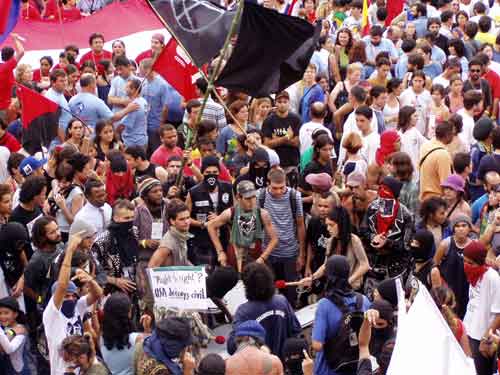
Protesters here in Minneapolis have been targeted by a series of highly intimidating, sweeping police raids across the city, involving teams of 25-30 officers in riot gear, with semi-automatic weapons drawn, entering homes of those suspected of planning protests, handcuffing and forcing them to lay on the floor, while law enforcement officers searched the homes, seizing computers, journals, and political pamphlets. Last night, members of the St. Paul police department and the Ramsey County sheriff’s department handcuffed, photographed and detained dozens of people meeting at a public venue to plan a demonstration, charging them with no crime other than “fire code violations,” and early this morning, the Sheriff’s department sent teams of officers into at least four Minneapolis area homes where suspected protesters were staying.

Jane Hamsher and I were at two of those homes this morning — one which had just been raided and one which was in the process of being raided. Each of the raided houses is known by neighbors as a “hippie house,” where 5-10 college-aged individuals live in a communal setting, and everyone we spoke with said that there had never been any problems of any kind in those houses, that they were filled with “peaceful kids” who are politically active but entirely unthreatening and friendly. Posted below is the video of the scene, including various interviews, which convey a very clear sense of what is actually going on here.

In the house that had just been raided, those inside described how a team of roughly 25 officers had barged into their homes with masks and black swat gear, holding large semi-automatic rifles, and ordered them to lie on the floor, where they were handcuffed and ordered not to move. The officers refused to state why they were there and, until the very end, refused to show whether they had a search warrant. They were forced to remain on the floor for 45 minutes while the officers took away the laptops, computers, individual journals, and political materials kept in the house. One of the individuals renting the house, an 18-year-old woman, was extremely shaken as she and others described how the officers were deliberately making intimidating statements such as “Do you have Terminator ready?” as they lay on the floor in handcuffs. The 10 or so individuals in the house all said that though they found the experience very jarring, they still intended to protest against the GOP Convention, and several said that being subjected to raids of that sort made them more emboldened than ever to do so.

Several of those who were arrested are being represented by Bruce Nestor, the President of the Minnesota chapter of the National Lawyers’ Guild. Nestor said that last night’s raid involved a meeting of a group calling itself the “RNC Welcoming Committee”, and that this morning’s raids appeared to target members of “Food Not Bombs,” which he described as an anti-war, anti-authoritarian protest group. There was not a single act of violence or illegality that has taken place, Nestor said. Instead, the raids were purely anticipatory in nature, and clearly designed to frighten people contemplating taking part in any unauthorized protests.

Nestor indicated that only 2 or 3 of the 50 individuals who were handcuffed this morning at the 2 houses were actually arrested and charged with a crime, and the crime they were charged with is “conspiracy to commit riot.” Nestor, who has practiced law in Minnesota for many years, said that he had never before heard of that statute being used for anything, and that its parameters are so self-evidently vague, designed to allow pre-emeptive arrests of those who are peacefully protesting, that it is almost certainly unconstitutional, though because it had never been invoked (until now), its constitutionality had not been tested.

There is clearly an intent on the part of law enforcement authorities here to engage in extreme and highly intimidating raids against those who are planning to protest the Convention. The DNC in Denver was the site of several quite ugly incidents where law enforcement acted on behalf of Democratic Party officials and the corporate elite that funded the Convention to keep the media and protesters from doing anything remotely off-script. But the massive and plainly excessive preemptive police raids in Minnesota are of a different order altogether. Targeting people with automatic-weapons-carrying SWAT teams and mass raids in their homes, who are suspected of nothing more than planning dissident political protests at a political convention and who have engaged in no illegal activity whatsoever, is about as redolent of the worst tactics of a police state as can be imagined.

UPDATE: Here is the first of the videos, from the house that had just been raided:

Jane Hamsher has more here, and The Minnesota Independent has a report on another one of the raided houses, here.

Read the rest of the horror story here. / Salon

The Rag Blog

Posted in RagBlog | Tagged , , | Leave a comment

Fontaine Maverick : John McCain is no Maverick!

Former Texas Congressman and San Antonio mayor Maury Maverick — the real thing.

McCain’s just talking ‘gobbledygook
By Fontaine Maverick
/ The Rag Blog / August 31, 2008

I just got a call from my brother, Maury Maverick, who said that if he hears that John McCain is a Maverick ONE MORE TIME, he is going to shoot the TV. Well, my brother doesn’t even own a gun, but I know exactly how he feels. Every time we hear that use of our name, it is like fingernails on a blackboard times ten.

We kicked around the idea of doing a web page but good old Monkey Cage has beat us to the punch:

The Real Original Maverick

John McCain is running this new ad (see video below) touting himself as the “original maverick.”

This led Jason Zengerle and Christopher Orr over at TNR’s The Plank to debate whether Tom Cruise or James Garner is the real original maverick.

In fact, the original maverick was Maury Maverick, the grandson of Samuel Maverick, from whom the name maverick first entered the American lexicon. Maury was a radical politician from San Antonio who served two terms in Congress (1935-1939). There, he led a bloc of progressive Democrats who sought to push Roosevelt and the New Deal to the left. The press quickly labeled this group “The Mavericks.” While hugely popular with the the many poor Hispanics in his district, Maverick was far too liberal for the conservative Texas Democratic establishment. In 1938 he lost the Democratic party primary after being slandered as a communist. Maverick then went on to serve as mayor of San Antonio before once again losing in the primary after being red-baited.

During World War II, he served in various defense agencies. It was at this time that he coined the term “gobbledygook,” saying that incomprehensible government bureaucratese sounded like turkey noise.

Online Etymology Dictionary

gobbledygook

1944, Amer.Eng., first used by U.S. Rep. Maury Maverick, D.-Texas, (1895-1954), a grandson of the original maverick (q.v.) and chairman of U.S. Smaller War Plants Corporation during World War II. First used in a memo dated March 30, 1944, banning “gobbledygook language” and mock-threateaning, “anyone using the words activation or implementation will be shot.” Maverick said he made up the word in imitation of turkey noise.

Online Etymological Dictionary, © 2001 Douglas Harper.

This site has a nice description of Maverick’s congressional career along with links to the online version of his 1937 autobiography, A Maverick American.

Phil Klinkner / The Monkey Cage / August 5, 2008

John McCain ‘Maverick’ Commercial

Also see This Maverick The Real Deal by Joe Holley / The Rag Blog / March 1, 2008

The Rag Blog

Posted in RagBlog | Tagged , , , , , , , , | 4 Comments

The Pursuit of Justice for Those Still Languishing in Guantanamo: Binyam Mohamed

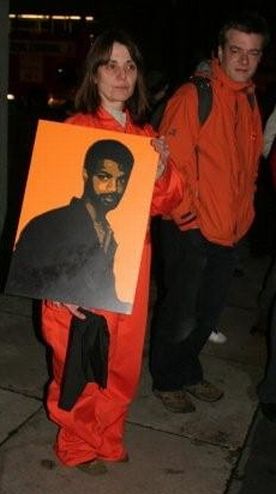
Jackie Chase (left) of Brighton’s Save Omar campaign, with a picture of Binyam Mohamed, and Andy Worthington (right).

London’s High Court Strikes a Blow at CIA: Shining a Light on the Dark Prison
By Andy Worthington / August 30, 2008

In the lawless world of Guantánamo — and the United States’ even murkier network of secret prisons run by or on behalf of the CIA — it has taken six years and four months for British resident Binyam Mohamed to secure anything resembling justice.

Seized in Pakistan in April 2002, Binyam was rendered to Morocco three months later, where he was tortured on behalf of the US for 18 months, in sessions that regularly included having his genitals cut with a razor, and was then held for nine months in Afghanistan, first at the “Dark Prison,” a secret prison run by the CIA, where he was also tortured, and then at Bagram airbase. He has been held at Guantánamo since September 2004.

When justice finally came for Binyam, it was not at Guantánamo, but in London’s High Court, where, last Thursday, Lord Justice Thomas and Mr. Justice Lloyd Jones delivered a stinging rebuke to both the British and the American governments: to the British for the complicity of the UK intelligence services in the US administration’s post-9/11 policies of “extraordinary rendition” and torture, and to the Americans for the lawless conduct of the trials by Military Commission that were established in the wake of the 9/11 attacks to deal with “terror suspects” like Binyam (even though the judges professed in their ruling that they “did not consider it necessary to form any view about the overall fairness of the Military Commissions procedure”).

The road to the High Court opened up in May this year, when Binyam’s lawyers at the legal action charity Reprieve, who represent over 30 Guantánamo prisoners, teamed up with solicitors at Leigh Day & Co. to sue the British government, seeking the release of information relating to British knowledge of Binyam’s rendition and torture, in preparation for his impending trial at Guantánamo.

In the event, this was prescient, as charges were leveled against Binyam on May 28, in connection with the spectral “dirty bomb” plot that was dropped years ago against US citizen Jose Padilla. It was, therefore, imperative that potentially exculpatory evidence — which the British possessed, and which they had also handed over to the Americans — was made available to his lawyers so that they could begin preparing a defense, and, preferably, discover evidence of torture, which would back up Binyam’s claims that the charges against him were based solely on confessions obtained through torture, and would, therefore, make the US administration call off his forthcoming trial.

It was an indication of how far removed the Military Commissions are from legal norms that, although Binyam’s lawyers contended that he had been tortured, and had discovered the records of “extraordinary rendition” flights that matched his accounts, the US administration had not only provided no information to enable them to defend him, but had also categorically refused to account for his whereabouts before his arrival at Bagram.

Whatever information they and the British possessed would, it was stated, be made available to Binyam’s military defense lawyer, Lt. Col. Yvonne Bradley, at the discovery stage, should his trial go ahead, but as the trial of Salim Hamdan demonstrated last month, some evidence was withheld from the defense until the last possible moment, and other evidence — relating, for example, to coercive interrogations of Hamdan conducted by the CIA in Afghanistan — was ruled off-limits by the military judge presiding over the trial, and was, essentially, regarded as though it didn’t exist at all.

In Binyam’s case, his lawyers sued the British government after an earlier attempt to secure potentially exculpatory evidence from the British government was turned down, when the Treasury Solicitors, acting on behalf of the government, attempted to brush aside British complicity in Binyam’s rendition, torture and false confessions by claiming that “the UK is under no obligation under international law to assist foreign courts and tribunals in assuring that torture evidence is not admitted,” and adding that “it is HM Government’s position that … evidence held by the UK Government that US and Moroccan authorities engaged in torture or rendition cannot be obtained” by his British lawyers.

Last Thursday, following a judicial review in the High Court that was triggered when Binyam’s lawyers sued the government, Lord Justice Thomas and Mr. Justice Lloyd Jones demolished the government’s defense of its actions in a 75-page judgment (PDF).

The judges made clear that, after Binyam was captured and US agents came to regard him as “a serious potential threat to the security of the United Kingdom,” the British intelligence services had “every reason to seek to obtain as much intelligence from him as was possible in accordance with the rule of law and to cooperate as fully as possible with the United States authorities to that end.” They concluded, however, that the actions of the intelligence services from May 2002, when a British agent visited Binyam in US-supervised Pakistani custody, until February 2003, when the British last received information from the US regarding his interrogations, had placed the British government in a position where it “was involved, however innocently, in the alleged wrongdoing,” which it had helped facilitate.

Regarding Binyam’s time in Pakistan, where the British agent who visited him on May 17, 2002 made it clear that the British government “would not help [him] unless he cooperated fully with the US authorities,” the judges ruled that Binyam’s detention was “unlawful” under Pakistani law, because he “was being detained by the United States incommunicado and without access to a lawyer.” Furthermore, the judges noted that the British intelligence services “provided further information to the United States and further questions to be asked of BM [Binyam]” for nine months after this visit, even though he “was still incommunicado and they must also have appreciated that he was not in a United States facility and that the facility in which he was being detained was that of a foreign government (other than Afghanistan).”

The judges noted that all of the above was particularly significant because the information obtained from Binyam was “sought to be used as a confession in a trial where the charges … are very serious and may carry the death penalty,” and that it is “a long-standing principle of the common law that confessions obtained by torture or cruel, inhuman or degrading treatment cannot be used as evidence in any trial.” They therefore ruled that “by seeking to interview BM in the circumstances found and supplying information and questions for his interviews, the relationship between the United Kingdom Government and the United States authorities went far beyond that of a bystander or witness to the alleged wrongdoing.”

The gravity of this was brought home during the judicial review, when the agent who had interviewed Binyam in Pakistan was cross-examined for several days in closed sessions that were clearly so perilous for the agent, in terms of potential criminal liability for war crimes under the International Criminal Court Act of 2001, that he brought his own legal adviser with him, and, it was revealed in the judgment, initially refused to answer the judges’ questions, fearing self-incrimination. This, of course, is in marked contrast to the position held by the US administration, which has refused to sign up to the International Criminal Court, and which, in addition, maintains that it “does not torture” and continues to do all in its power to deny that it has been responsible for gross human rights abuses.

In the second part of their ruling, the judges took as their starting point an admission by British Foreign Secretary David Miliband, which took place “after the commencement of this application but before the hearing,” that he had “identified documents which he considers could be considered exculpatory or might otherwise be relevant in the context of the proceedings before the Military Commission.” After stating that David Miliband had informed Binyam’s lawyers and had “provided these documents to the United States Government,” the judges added, “It is a matter of regret that the documents have not been made available in the proceedings under the Military Commissions Act in confidence to BM’s lawyers, who have security clearance from the United States authorities to at least secret level.”

This was not the judges’ only thinly-veiled criticism of the behavior of the US authorities, but it was for three specific reasons that they proceeded to rule that the Foreign Secretary was “under a duty” to disclose “in confidence” to Binyam’s legal advisers the requested information, which was “not only necessary but essential for his defense”: firstly, because the Foreign Secretary had not made the documents available to Binyam’s lawyers; secondly, because the US authorities had also refused to do so; and thirdly, because the Foreign Secretary had accepted that Binyam had “established an arguable case” that, until his transfer to Guantánamo, “he was subject to cruel, inhuman and degrading treatment by or on behalf of the United States,” and was also “subject to torture during such detention by or on behalf of the United States.”

Having demolished the cases put forward by both the British and American governments, the judges nevertheless held out a lifeline for the Foreign Secretary, pointing out that they would “make no order for the provision of the information” until he “had an opportunity to consider the interests of national security in the light of these judgments,” and set a date for a second hearing on Wednesday August 27.

On the day, what was initially regarded as a straightforward hearing for the Foreign Secretary to announce his response to the judges’ ruling turned into another long session as the government responded to the security concerns mentioned by the judges by filing a Public Interest Immunity (PII) Certificate seeking to suppress disclosure of the documents on the grounds of national security, and the US State Department attempted to strike a deal through correspondence with the Foreign and Commonwealth Office (FCO).

John Bellinger, the State Department’s Legal Adviser, claimed that public disclosure of the documents was “likely to result in serious damage to US national security and could harm existing intelligence information-sharing arrangements between our two governments.” His only concession to the judges’ ruling was to note that the Office of the Chief Prosecutor in the Office of Military Commissions had agreed to provide the British intelligence documents (44 in total) to the Commissions’ Convening Authority, Susan Crawford, if she requested them, “subject only to the condition that the names of American and British government officials and the locations of intelligence facilities will be redacted from the documents prior to their being provided.” He added that, if Binyam’s trial were to go ahead, the redacted documents would be made available to his military lawyer at the “normal discovery phase” of the process.

In a separate email to the FCO, Stephen Mathias, one of John Bellinger’s deputies, offered a further concession “by way of update,” in which he stated that the Legal Adviser had now decided to present the documents to Susan Crawford, without waiting for her to ask for them. Describing this as “a significant development,” Stephen Mathias proceeded to claim, with a degree of force that appeared rather intimidating, “Ordering the disclosure of US intelligence information now would have only the marginal effects of serious and lasting damage to the US-UK intelligence sharing relationship, and thus the national security of the United Kingdom, and of aggressive and unprecedented intervention in the apparently functioning adjudicatory processes of a longtime ally of the United Kingdom, in contravention of well established principles of international comity.”

As Ben Jaffey (for Binyam) argued in court, neither the State Department’s “carefully calibrated concessions” nor the British government’s claim of Public Interest Immunity were tenable. He pointed out, as the judges did in their ruling, that the case did not involve public disclosure of the documents, but only the confidential disclosure to Binyam’s lawyers, Lt. Col. Yvonne Bradley and Clive Stafford Smith, Reprieve’s Director, who both have US security clearance. He added that the supposed concessions demonstrated merely that the US government was determined to find any method possible to prevent disclosure, and added that nothing offered by the State Department addressed the “central question” relating to Binyam’s rendition and torture. “Where,” he asked, “was Mr. Mohamed between 2002 and 2004?”

Ben Jaffey was equally dismissive of the British government’s PII claims, noting, in particular, that David Miliband had effectively conceded that the British government was going to hand over the intelligence documents to Binyam’s lawyers until the State Department intervened, and calmly dismissing the government’s national security claims. His composure was in marked contrast to that of the government’s representative, Tim Eicke, who struggled to maintain a coherent argument, despite the best efforts of the many representatives of the government and the intelligence services at the back of the court, who kept slipping him notes suggesting new twists on the spurious national security case.

On Friday, the judges delivered their second judgment on Binyam’s case (PDF). Noting that the correspondence from the State Department effected a “significant change” in the US position, they nevertheless refused to accept the British government’s position regarding its Public Interest Immunity Certificate. They were, it seemed, convinced in particular by submissions from the Special Advocates who represented Binyam in the various sessions of the court that were closed to the public when confidential material was being discussed. In the opinion of the Special Advocates, the PII Certificate, and other proposals presented in a closed session on Wednesday, “failed to address, in the light of allegations made by BM, the abhorrence and condemnation accorded to torture and cruel, inhuman or degrading treatment.”

Adding that this issue was something whose significance had been “accepted on behalf of the Foreign Secretary,” the judges proceeded to note that the Foreign Secretary “nevertheless contended that the issues arising out of BM’s allegations of torture and cruel, inhuman or degrading treatment were implicitly dealt with in his Certificate,” and in the documentation used in the closed session. “Having carefully considered this matter,” the judges wrote, “we do not consider that the issue arising out of the allegations made by BM is implicitly dealt with in these documents.”

Refusing to push the matter further, the judges commended the Foreign Secretary and the FCO’s Legal Adviser, Daniel Bethlehem QC, for having “gone to very considerable lengths to provide BM with assistance,” noting that it was “evident” that they had “been engaged in lengthy discussions which have led to the important changes” summarized in the second judgment. “This,” they added, “has been time-consuming and burdensome, and has rendered very real assistance to the interests of justice in this case.”

As a result, the judges concluded their second judgment by giving the Foreign Secretary another week to come up with a response to their initial ruling and the developments since. They suggested that this could be in the form of another security certificate, although I hope, of course, that, having been thrown another lifeline, the government might find it preferable, bearing in mind the Special Advocates’ description of “the abhorrence and condemnation accorded to torture and cruel, inhuman or degrading treatment,” either to give Binyam’s lawyers what they require, or, preferably, to convince the US administration that, in order to keep the door to the torture chambers firmly shut, the only available course of action is to drop the charges against Binyam and return him to the UK.

Andy Worthington is a British historian, and the author of ‘The Guantánamo Files: The Stories of the 774 Detainees in America’s Illegal Prison’ (published by Pluto Press). Visit his website at: http://www.andyworthington.co.uk/. He can be reached at: andy@andyworthington.co.uk.

Source / CounterPunch

The Rag Blog

Posted in RagBlog | Tagged , , , , | Leave a comment

Gustav: Two Million People May Be Displaced

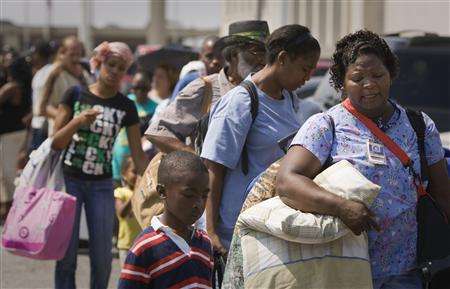
Waiting for the bus

Another Journey Begins … Waiting in New Orleans
By Bill Quigley / August 30, 2008

In the blazing midday sun, hot and thirsty little children walk around bags of diapers and soft suitcases piled outside a locked community center in the Lower Ninth Ward. Military police in camouflage and local police in dark blue uniforms and sunglasses sit a few feet away in their cars. Moms and grandmas sit with the children quietly. Everyone is waiting for a special city bus which will start them on their latest journey away from home.

Hundreds of buses are moving people away from the Gulf Coast. Hurricane Gustave is heading for the Louisiana coast nearly three years to the day after Hurricane Katrina destroyed hundreds of thousands of homes across the Gulf Coast. Many now face mandatory evacuation.

Dozens died in Haiti and the Dominican Republic after Gustave visited. After Katrina, few underestimate the potential of Gustave, now a Category 5 (out of a maximum of 5) storm.

Yesterday marching brass bands led commemorations for those who died and for those who lost so much in Katrina.

Today, Humvees crawl amid the thwack thwack thwack of plywood boards being nailed over windows.

Soldiers with long guns and police of all types are everywhere. Fifteen hundred police are on duty and at least that many National Guard are also here.

One estimate says two million people may be displaced.

In the lower nine, still no bus even after a wait of over two hours. Another mom clutching an infant walks up to the center with a small suitcase and adds another diaper bag to the pile. Children ask for water but nothing is provided. An African American nun named Sister Greta drives up with a few bags of ice and some water and paper cups and everyone happily shares.

This is the first step of displacement. Those with cars drive away. Those without walk to a community center with their children and wait for a bus. The first of many buses they will take in their journey to who-knows-where. The bus that people are waiting for will take them to the train station where people will get off the bus, be entered into computers, be given bar code bracelets, and then put on other buses for a trip to public shelters in places like Shreveport, Alexandria and Memphis.

New Orleans expects 30,000 people need help evacuating.

Many waiting for this bus were in the Superdome when Katrina hit. One of the men shows a picture of himself on a bridge surrounded by flood waters where hundreds waited for boats.

There are still big problems. A 311 call system for the disabled and seniors never properly functioned, crashed and has been abandoned.

Though the wait for the bus is rough, this appears to be a huge improvement. When Katrina hit, there were no buses and no way out of town for the 25 per cent of the city who had no cars. As a result, nearly 100,000 people were left behind. This time the hospitals and nursing homes are emptying, the prisoners are already moved out, and there are buses to carry out tens of thousands. There are still big problems, but people do have a chance to get out.

Seniors worry about their social security checks, due the first of the month. Others worry about leaving behind pets. (One semi-rural area announced that each person getting on the buses could bring one pet, a dog or cat, no roosters, no pigs). Others worry about the looming 24 hour curfews. St. Bernard Parish promises that those out during curfew will be arrested and immediately transported to Angola, the Louisiana State Penitentiary.

Back at the community center, the bus finally pulls up. No one complains that it is late. Holding bags and children, people line up quietly in the sun to climb into their first bus. A blind man is guided into the bus. Little kids pull smaller children. Forty-three get on the bus. There are three nine-year old children, one seven-year old, one six, four three year olds, three one year olds, one infant is 11 months, a 3-month old, and a couple of young teenagers. All the moms and grandmas and kids and bags and diapers make it onto the bus and it pulls away.

Across the Gulf Coast, another journey starts.

[Bill Quigley is a human rights lawyer and law professor at Loyola University New Orleans. His essay on the Echo 9 nuclear launch site protests is featured in Red State Rebels: Tales of Grassroots Resistance from the Heartland, published by AK Press. He can be reached at quigley77@gmail.com.]

Source / CounterPunch

The Rag Blog

Posted in RagBlog | Tagged , | Leave a comment

Iraqi-US SOFA* Talks in Jeopardy

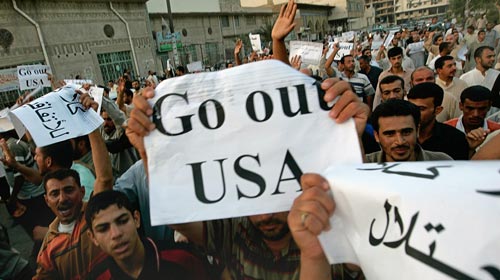
Shiite Muslims march in Najaf on Aug. 21 to denounce the presence of U.S. troops and talks with Washington. Photo: Qassem Zein / AFP/Getty Images

Agreement on U.S. withdrawal from Iraq said to be in peril as Maliki ousts negotiators
By Ned Parker / August 31, 2008

The Times is told that the prime minister has replaced the team with loyalists at the ‘make-or-break’ stage of talks. The two sides reportedly remain deadlocked on key issues.

BAGHDAD — At the “make-or-break” stage of talks with the U.S. on the withdrawal of American troops from Iraq, Prime Minister Nouri Maliki has swept aside his negotiating team and replaced it with three of his closest aides, a reshuffle that some Iraqi officials warn risks sabotaging the agreement.

The decision on the team negotiating the pact, which the Americans have described as the basis of a long-term strategic alliance between the United States and Iraq, remains so sensitive that it has not been announced. In disclosing the switch to the Los Angeles Times this weekend, a senior Iraqi official close to Maliki also suggested that the two sides remained deadlocked on key issues.

The shake-up comes just four months before the expiration of the United Nations mandate that authorizes the U.S. troop presence in Iraq. When Secretary of State Condoleezza Rice visited the country recently, expectations rose that an agreement was imminent. But Iraq and the United States remain far apart on the matter of immunity for U.S. forces in Iraqi courts, the official said.

“People gave the impression we were close when Rice was here, but it’s not over. We would have a serious problem if we took it to the parliament right now,” said the official, who spoke on condition of anonymity because he wasn’t authorized to discuss the issue.

The official insisted that if U.S. troops remained exempt from Iraqi rule of law, the pact would never get passed by the lawmakers.

The sides also are still negotiating a withdrawal date, the official said.

The latest version of the agreement, which was read to The Times by the Maliki confidant, says all U.S. forces will leave Iraq by the end of 2011, unless Iraq requests otherwise. It also says the Americans will withdraw from cities in June 2009, unless the Iraqis ask them to stay.

The new wording is a departure from the White House’s insistence on a conditions-based timeline for a pullout. Under the new language, Iraq, not the U.S. military, decides when the troops will leave. U.S. officials have gone back to Washington to consult on the language, the Maliki confidant said.

Some Iraqi lawmakers have reacted angrily to the dismissal of the original negotiating team.

“These are diversionary tactics to avoid a decision. It’s not a question of negotiating teams. It’s a matter of, do you want it or don’t you?” said an Iraqi familiar with the talks. “They are avoiding the issue. They don’t want a status of forces agreement. They don’t want a security agreement.”

Maliki’s confidant defended the shake-up, saying the prime minister needs those closest to him to lead the talks because they have the authority to make decisions that the original team did not possess.

Iraqi and Western officials monitoring the talks have said Maliki is afraid of accepting terms that could brand him as an American puppet. Iran, which is fiercely opposed to an agreement, has also exerted intense pressure.

Shiite Muslim lawmakers have also said some members in the prime minister’s Islamic Dawa Party believe that Iraq can survive without the Americans if the White House doesn’t meet Maliki’s demands.

In the reshuffle last week, Maliki dismissed the delegation headed by the Foreign Ministry and picked his national security advisor, Mowaffak Rubaie; his chief of staff, Tariq Najim; and political advisor Sadiq Rikabi to conduct the negotiations’ final stage, the Maliki confidant said.

“The talks have reached a critical point now. They need a political decision, not a technical one,” the official said. “The discussions have reached the make-or-break stage.”

Rikabi, Rubaie and Najim report directly to the prime minister; Deputy Foreign Minister Mohammed Haj Hamoud, who led the original negotiations, has been removed, the official said. Western diplomats previously have criticized the prime minister for governing through his inner circle and shutting out other factions.

“Hamoud had to deal with too many people and then comes to a meeting with the prime minister,” the official said. “It was a big process.”

Iraq’s politics are often turbulent, with the country’s Sunni, Shiite and Kurdish politicians regularly plotting against one another. Until he took on the Mahdi Army, a Shiite militia, in the southern city of Basra in March, Maliki was considered politically weak and had been accused by Sunni Arab and Kurdish officials of hoarding power and executing a sectarian agenda.

U.S. Embassy spokeswoman Susan Ziadeh declined to comment on the shake-up, saying the Iraqi government had the right to choose the negotiators that it wanted.

A State Department spokesman in Washington told reporters last week that the United States hoped to finish an agreement by December. The sides had aimed to complete it by July. The Iraqi official close to Maliki said Iraq could always request an extension from the U.N. if they did not reach a deal before the end of the year.

Some Western and Iraqi officials blame the Americans for sending a team in the spring that demanded more than 50 long-term bases, the ability to launch operations without permission from the Iraqi government and immunity for security contractors and U.S. troops. Their opening stance played into the hands of Shiite lawmakers in Maliki’s coalition, who want the Americans to leave, officials said.

Mithal Alusi, an independent Sunni lawmaker who has advised Maliki in the past, accused the prime minister of trying to wreck the talks.

“Why does he have to change the leaders of the negotiating team, and now? Why? We had reached the last part. Why does he have to change it?” Alusi asked. “He doesn’t want it.”

Source / Los Angeles Times

The Rag Blog

* Note: SOFA = Status of Forces Agreement

Posted in RagBlog | Tagged , , | Leave a comment

We Are Iraqis and No One Cares About Our Safety

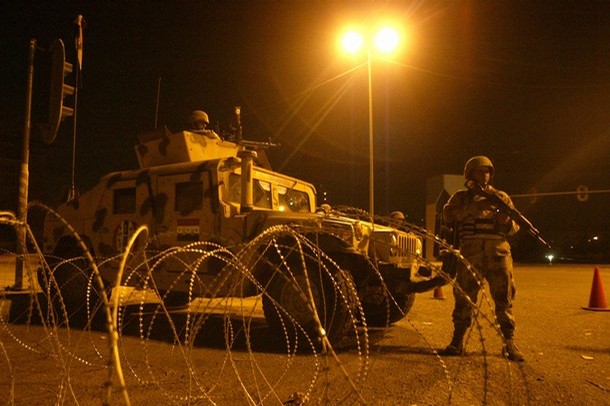
Iraqi checkpoint at night

The Late Iraq
By Anwar Ali / August 30, 2008

It was only my second time out of Iraq traveling to a foreign country. It was night and from above Turkey we could see lights, like millions of colorful diamonds scattered around. When we were flying over Iraq, below we could see only a dust cloud and darkness.

Our flight to Turkey was six hours late and arrived at 3.30 a.m. I was very worried because the word “late” in Iraq means you expect to be shot. Not by terrorists, but by the Iraqi army or the Americans, unless you have a good excuse or are very lucky.

When we arrived to Istanbul, my wariness vanished as I found an entirely different world there. The airport was so fancy, the Turkish people were so nice; the streets were all surrounded by red and blue and different colors of flowers.

And although it was late we could see cars in the streets and people walking nearby, and when entering the neighborhood where we were staying, I thought it was only sunset as I saw many, many people walking around and sitting in restaurants.

Returning to Iraq, our flight was also late, by four hours. I was so worried since our arrival to Baghdad was at 10.30 p.m. and that was not safe.

The streets in Baghdad after 9 p.m. are very dangerous and full of army, police and American checkpoints. Sometimes they can’t understand why you are out late and shoot, and sometimes they understand.

It took more than an hour to land, to be searched, to have our passports stamped and to wait for our bags. I wonder why they didn’t think of the security situation for the passengers who arrived at such a late hour?

Maybe the airplane is more important than the passengers. Well, we are Iraqis and no one cares about our safety. They care more about their interests and our oil. I totally understand that, and have got used to living with this reality.

At 11.20 p.m. we finished everything and we headed to look for any means of transportation that could take us to the square where my husband and my brother were waiting.

We drove through the darkness and passed through several checkpoints. The first one was a warm greeting from two American tanks pointing their barrels at us. The others were the Iraqi army, each time asking us, ‘Where are you coming from?’ and ‘Where are you going to?’ and opening the trunk to search our bags.

The streets were empty, shops were closed. There was only us, the army and the blast walls. As we were driving in this dead city and empty neighborhood we saw a man who was only wearing shorts sitting half-naked in the middle of the road, at midnight.

Of course he was not like all the tourists that I saw that morning wearing shorts in Turkey. He was planting a bomb. And when he saw us, he ran away.

Anwar J. Ali is an Iraqi journalist who works for The New York Times in Baghdad. This is the second of two articles on her recent trip to Turkey. The first was published on Baghdad Bureau on Thursday.

Source / The New York Times Baghdad Bureau Blog

The Rag Blog

Posted in RagBlog | Tagged , | Leave a comment

Singin’ on Sunday – Clapton and Baby Face

Eric Clapton & Babyface – Change the World

Thanks to Diane Stirling-Stevens / The Rag Blog

Posted in RagBlog | Tagged , | Leave a comment

Gustav: Another Chance for BushCo to Shine

CNN Breaking News, 6:09 PM PDT, 30 August 2008: “Mayor Ray Nagin orders New Orleans evacuated, calling Hurricane Gustav ‘the mother of all storms.'”

And more CNN Breaking News, 8:14 AM PDT, 31 August 2008: “President Bush, Vice President Cheney to skip Republican convention because of Hurricane Gustav, White House says.”


Blackwater Gearing Up for Hurricane Gustav
By R.J. Hillhouse / August 29, 2008

Gustav Blackwater Worldwide is currently seeking qualified law enforcement officers and security personnel to potentially deploy to provide security in the possible aftermath of Hurricane Gustav. This is the first time Blackwater has mobilized under its controversial Homeland Security contracts. Blackwater did deploy security personnel to assist New Orleans in wake of Hurricane Katrina and this resulted in great controversy since it was the first time a private military corporation had deployed on US soil.

Blackwater issued the following call for personnel late Friday afternoon:

Blackwater is compiling a list of qualified security personnel for possible deployment into areas affected by Hurricane Gustav. Applicants must meet all items listed under the respective Officer posting and be US citizens. Contract length is TBD.

Law Enforcement Officers (all criteria must apply)

1. Current sworn [may be full time, part time or reserve]

2. With arrest powers

3. Armed status (must indicate Armed and/or Semi Auto. Revolver only not accepted) expiration must be greater than 60 days out

4. Departmental credentials (not just a badge)

Armed Security Officers (all criteria must apply)

Only from the following states: OR, WA, CA, NV, NM, AZ, TX, FL, GA, SC, NC, VA, MD, IL, OK

1. Current/active/licensed/registered armed security officer

2. All training verification [unarmed and armed certificates of completion]

3. Current state issued face card indicting armed status [expiration must be greater than 60 days out]

Applicants will be required to provide an electronic copy of the above required credentials/documents, recent photo within the last six months with response to this AD prior to consideration for deployment.

Personnel who meet the above qualifications and are interested, please send resumes and files to: 25505@blackwaterusa2.hrmdirect.com

Source / The Spy Who Billed Me

And there’s this:

Gustav is gathering strength, heading towards Gulf Coast states
By Joe Sudbay (DC) August 30, 2008

From the National Hurricane Center:

DATA FROM AN AIR FORCE RECONNAISSANCE AIRCRAFT INDICATE THAT MAXIMUM SUSTAINED WINDS HAVE CONTINUED TO INCREASE AND ARE NOW NEAR 120 MPH…195 KM/HR…WITH HIGHER GUSTS. GUSTAV IS A DANGEROUS CATEGORY THREE HURRICANE ON THE SAFFIR-SIMPSON HURRICANE SCALE. GUSTAV IS EXPECTED TO PASS OVER WESTERN CUBA AS A MAJOR HURRICANE…AND COULD REACH CATEGORY FOUR STATUS BEFORE MAKING LANDFALL THERE. ADDITIONAL STRENGTHENING IS POSSIBLE OVER THE SOUTHERN GULF OF MEXICO

And, the latest projected track has it hitting the coast of Louisiana in the very early hours of Tuesday:

Scott McClellan thinks this good be good for the Republican Party. Seriously:

“If it’s a major hurricane, I think that they certainly need to show they learned lessons from three years ago, both from a policy and perception standpoint,” McClellan said.

He also suggested that McCain could benefit politically from such a scenario: It would allow Bush to mount an effective GOP response to a disaster while removing the unpopular president from the convention roster.

It could be a two-fer,” McClellan said.

Source / America Blog

Thanks to Diane Stirling-Stevens / The Rag Blog
Posted in RagBlog | Tagged , , | Leave a comment