Garrison Keillor : Rolling With the Punches

‘Californians remind me of Londoners. They’re less jittery than the rest of us, and disaster doesn’t terrify them’ By Garrison Keillor / Aug. 27, 2008

California is another country. You wake up in the morning and New York is already on its first coffee, and the first scandal has broken in Washington, one more Republican crony caught with his hand in the honey pot. It all feels very far away. You wake up, your laptop is full of e-mails but you’re in California so you don’t have to reply to them. Your e-mailers imagine that you are busy attending some sort of Mayan fertility ceremony on a beach, bare-chested men whanging on little drums, dinging bells, naked children strewing blossoms in the surf, a priestess in a white caftan playing a Peruvian flute. Stereotypes live forever: Minnesota is cold, California is ditzy. Whereas the California I know is a land of gorgeously normal people, serious, reverent, clean, agile men and women, athletic nerds who love to surf and hike and shoot hoops and also read Frederick Buechner, listen to Bach. I grew up thinking you had to choose between smart and sexy; in California they think you can have it all. They are less jittery than us flatlanders: Disaster does not terrify them. They roll with earthquakes, the landscape ripples, the china clinks, and so what, it’s only an earthquake. Giant mudslides and brush fires — you ride them out and you move on. They remind me of Londoners, who are famous for rolling with the punches. The night of the horrible bombing in the Underground, the streets of London were full of people who came out to show each other and themselves that they would not be intimidated by a bunch of suicidal maniacs. And even though the danger of terrorism is very real in London, much more so than in Omaha, Neb., or Kenosha, Wis., or Tuscaloosa, Ala., the English have been stubborn in defending their freedom. You cannot be required to carry a photo ID in the U.K. The police still don’t walk around with pistols on their belts. In this country, the attacks by terrorists opened the doors to the darkness of Dick Cheney and furtive vicious men just like him who unleashed an assault on constitutional law, hoping to turn a traumatic occasion — the twin towers burning, smoke billowing over Manhattan — into a permanent Republican majority. As so often happens, vicious men were in the saddle for a time while decent men blithered and dithered. But the ignominious fall of Mr. Giuliani was evidence that Americans have gotten over it. You can’t wave the bloody shirt anymore and expect people to fall into line. And that’s a problem for John McCain. A great candidate for hustling neocons and owners of five or more homes, he is dead wrong about Iraq, dead wrong about the economy, and he was born 20 years too soon. But Republicans feel sorry for how he was savaged eight years ago and so they will prop the old man up, retrain him as best they can, keep him on message, stuff a rag in him when he starts kidding around. People have lots of questions about Barack Obama and that’s as it should be. The man inspires curiosity. The problem for McCain is that Barack explains himself so well. Those people jamming basketball arenas aren’t going there to look at his shoes. If you listen to the man speak, you’re likely to vote for him. If you listen to McCain, you’re reminded of your great-uncle Elmer hashing over the injustice of MacArthur getting canned by Harry Truman. Who cares? And then there is the Current Occupant. He’s kept quiet for a while, cutting brush, playing speed golf, treadmilling, but he’s bound to emerge in the fall, make a speech, issue a statement, do something, and this will not be good for McCain. America has paid a terrible price for one family’s decision to take a boy out of the public schools of Midland, Texas, and send him off to Chutney or Amway or whatever his prep school was called, and then to Yale, where he picked up a permanent grudge against people who were smarter than he. A Yalie who learned to pass for redneck, a Methodist who learned to pass for evangelical, he was cut out for politics, but what a lousy administrator and what a dull, uninspiring leader. Fewer people want more bushiness than want to see the return of infantile paralysis. And the truth is marching on. [Garrison Keillor’s “A Prairie Home Companion” can be heard Saturday nights on public radio stations across the country.] © 2008 by Garrison Keillor. All rights reserved. Distributed by Tribune Media Services, Inc. Source / salon.com The Rag Blog

Posted in RagBlog | Tagged , , , , , | Leave a comment

The DNC Sponsors List Is Rather Enlightening

The list I’ve posted here barely scratches the surface of what the Rocky Mountain News dug out of the public record. I note that this article was published on 12 May, but it is still very timely information. Such notables as Lockheed Martin, Anheuser Busch, Coca Cola, State Farm Insurance, Google, Xerox, Lilly, and a myriad of other giant corporate interests are listed. Click the link below for the complete list. It is enlightening. Remember, these are the guys who are represented at the Democratic convention. Try checking the lists for the Green Party or the Socialist Workers’ Party. I’m just sayin’ …

Richard Jehn / The Rag Blog


List of Democratic National Convention sponsors
Rocky Mountain News / Monday, May 12, 2008

The Democratic Convention Host Committee has released a list of sponsors that includes some of the biggest companies in the nation, and most of them have business with the federal government or long lists of issues they are trying to influence on Capitol Hill.

Below are the sponsors’ names, followed by their federal business interests or lists of issues they are trying to influence through lobbying, according to the most recent Lobbying Disclosure Act forms available from the Senate Office of Public Records.

Note that a company’s “interest” in an issue could mean advocating either support or opposition, although that is not always indicated in lobbying forms.

* Qwest

General business issues; rewrite of the 1996 Telecommunications Act; Universal Service reform; video franchise relief; broadband deployment; protection of customer records; Networx.

* ForestCity

Military housing; completion of Southeast Federal Center Development under S.F.C. Public-Private Development Act of 2000; navigational servitude for Southeast Federal Center, Washington, D.C.; Transportation; federal funding for project; FEMA flood mapping issue; nuclear energy development; states use of eminent domain; funding of real estate development; project infrastructure.

* Union Pacific

Rail safety issues; rail homeland security issues; rail freight rate regulation and rail capacity issues; Rail Competition and Service Improvement Act; Freight Rail Infrastructure Capacity Expansion Act; Surface Transportation and Rail Security Act; Railroad Antitrust Enforcement Act.

* Xcel Energy

Climate change, renewable energy, related issues; Clean Energy Act of 2007; Renewable Energy and Energy Conservation Tax Act of 2007; New Direction for Energy Independence, National Security and Consumer Protection Act; Energy Savings Act of 2007, including a clean energy portfolio standard; rail transportation of coal; solar investment tax credit; wind production tax credit; Climate Security Act; pole attachment and related electric utility issues; appropriations for carbon capture and storage research; Clean Energy Portfolio Standard proposals; Provisions in Economic Stimulus Act of 2008 to extend renewable energy production tax credit; Tax issues regarding uranium enrichment and renewable energy; The Climate Stewardship and Innovation Act; Electric Utility Cap and Trade Act of 2007; appropriations bills; Clean Air Act; Clean Water Act, including requirements for electric utility industry.

* SEIU

Contracting out of security guard functions by Federal Agencies; National Defense Authorization Act (extension of temporary authority for contract security guard functions in Department of Energy).

* Vail Resorts

No 2008 reports. (Most recent 2005, lobbying on Small Community Air Service program issues.)

* United Health Group

Medicare Modernization Act implementation; Health Savings Accounts; Medicare Part D; Healthcare IT; Mental health parity; Medicare Advantage; genetic non-discrimination; Health insurance issues; issues concerning federal payments to Medicare Advantage Plans; Medicare, Medicaid and SCHIP Extension Act; Legislation and regulation concerning industrial loan companies.

* Molson Coors (Filed as Coors Brewing Co.)

Tax policy; alcohol advertising and self regulation; beer industry’s advertising compliant resolution program, including scope of FTC inquiry into self regulatory compliance activities; exise tax on beer; The Clean Energy Act; Renewable Energy and Energy Conservation Tax Act; Farm Bill Extension Act; Small Business Tax Reform legislation; ethanol production provisions;

* AT&T

Telecom issues, including implementation of The Telecommunications Act of 1996; congressional oversight and video franchise reform; FISA (Foreign Intelligence Surveillance Act) Amendments Act; Improving Foreign Intelligence Surveillance to Defend the Nation and the Constitution Act; liability provisions re. federal authorization for acquisition of foreign intelligence information from or with the assistance of a communications service provider; network neutrality issues; cash balance issues in the Pension Protection Act; telecommunications competition; Defense appropriations for telecommunications; SAFE Act of 2007; Small Business Tax Relief Act of 2007; retiree health benefits (concerning prohibitions on companies reducing benefits under ERISA covered group plans); various health plan issues; arbitration issues in commercial contracts; the Cell Phone Tax Moratorium Act (supporting ban on new state taxes on cell phone services); Global Online Freedom Act of 2007; various telecommunications issues; billing and contract regulations in Cell Phone Consumer Empowerment Act of 2007; proposed importation ban on certain handsets; legislation allowing wireless competition on WMATA; broadband deployment issues; E-911 programs; Telephone Excise Tax Repeal Act of 2007; Internet Tax Freedom Act; Bellsouth merger issues; Video franchise reform; Truth in Caller Act; Universal Service Reform issues; International trade issues; FCC wireless spectrum rules; local telephone exchange issues; aviation telecommunications issues; federal communications spending (defense, homeland security, etc.) ; Air Traffic Control Modernization; company interests in Alaska; Rural Broadband Deployment Act; Internet tax issues; etc.

Read all of it here. / Rocky Mountain News

Thanks to Diane Stirling-Stevens / The Rag Blog

Posted in RagBlog | Tagged , , | 1 Comment

We’ve Come a Long Way, Baby : Strip-Search Nation


The Ballad of the Panhandler and Smokey the Bear: Remembering When the Government was at Least Approachable
By Dave Lindorff / August 27, 2008

We’ve come a long way towards imperial government in the US—towards a view of the relationship between the federal government, and especially the administration, and the citizenry that has more of a ruler-subjects than a democratic feel to it.

Now I know it is easy to gloss over the way things were, and since I spent a few days in federal prison for protesting the Indochina War at the Pentagon in 1967, after being beaten by federal marshals for doing nothing more than exercising my constitional right to protest on public ground, I am well aware that 40 years ago we were also often treated like serfs. But that said, there was something different back then—a sense that you could deal with powerful officials as an equal.

Back in the summer of 1968, I spent one of several summers on the road (something more young people should do today). I had hitch-hiked across the country from Connecticut to Washington state with Allen Baker, a college buddy, and then, towards the end of that summer break, had bought an old pick-up truck for $100, which we were driving home via the West Coast and the central route. Not having much cash, we were stopping at cities along the way, where I would play guitar for gas money.

This was the late ‘60s, and there was a major and sometimes violent culture war underway between the long-hairs like me and the clean-cut American “Silent Majority,” and my travel companion, Allen, and I were concerned that it would be tough scaring up much cash in the vast Republican stretches of desert, mountains and prairie that lay between Nevada and Missouri. So when we passed through Yosemite National Park, we decided to spend a day in the valley’s main parking lot, raising donations from tourists.

While Allen dozed in the back of the truck, I opened my guitar case and put up the “Gas Money” sign, and then, sitting on the running board of the old Dodge, started to play.

The money poured in—over a hundred dollars in a fairly short amount of time. It was really astounding. People walking by really enjoyed the music and wanted to help us out.

Then a park ranger, an older fellow with a friendly smile, drove up. “I’m sorry,” he said apologetically, “but I have been told to arrest you.”

“What for?” I asked, genuinely shocked.

“There’s no panhandling allowed in the park,” he responded.

“What’s panhandling?” I asked him, genuinely unaware of the meaning of the term, which I, an Easterner, thought must have to do with cooking with a skittle on an open fire.

“It’s what you’re doing right now,” the ranger said.

By that point, Allen had woken up and sat up in the truck bed, rubbing his eyes.

“You’ll have to come in too,” the ranger told him.

We followed him back to the ranger station, where he proceeded to write up our tickets. I noticed that there were two actual jail cells in the station. Thankfully, at least we weren’t going to be locked up. Then there was a loud bang outside. Suddenly, a younger ranger, looking like a recent Marine veteran, muscled and crewcut, ran in. “Where’s the first aid kit,” he yelled. “ I was just bringing in a kid on a marijuana charge and he tried to run. I shot him in the leg.”

Whoa! I thought. This is Dodge City!

The older ranger told his partner where to get the kit, and then turned his attention back to us. “Here are your tickets,” he said. “And don’t skip out on them. This is a federal offense, and the FBI will come after you if you don’t pay it.”

We left the building, and only then did I look at my ticket closely. The fine: $500! It was a fortune back then. Even today it is a big whopper—especially as a penalty for being poor.

I was pretty upset. That was about how much I had earned towards college that whole summer.

Well, the $100 I’d earned panhandling in the park got us back across the country, at least.

When I got home to Connecticut, though, my fine was rankling. Angry at the injustice of it all, I typed up a letter to the Secretary of the Interior, who at the time was Stewart Udall. I wrote about the shooting incident, saying that I thought it was an outrage that an unarmed young man arrested on a minor charge like marijuana possession would be shot in a national park, and I also wrote that it was unfair to fine someone $500 for simply playing music in a park parking lot. “I wasn’t bothering people,” I wrote. “In fact, they were coming up to me to hear the music, and the $100 they tossed into my guitar case is testimony to the fact that they liked what I was doing. That isn’t panhandling, and in any case, it’s pretty nasty to fine someone $500 when he’s doing something because he needs money.”

About two weeks later, I got my letter back from the Department of Interior. On it, in red ink, Udall himself had written, “I agree. Forget your ticket. It’s been taken care of. Stewart Udall.”

I have tried to imagine that same situation happening today. First of all, the unfortunate hippie who got shot that time long ago would probably have been killed, because the ranger would have been carrying a more high-powered weapon, and wouldn’t have even been aiming to disable. Second, Allen and I would probably have been put on some database at the Pentagon, the FBI and the Transportation Security Administration, and would have been barred from flying or entering any national parks. More importantly, though, I tried to imagine the response I would have gotten writing to current Interior Secretary Dirk Kempthorne to complain about an arrest for panhandling. Or to his predecessor, Gale Norton. This is, after all, a department that has instructed its rangers at the Grand Canyon and other parks not to talk about evolution, and those at the Everglades National Park not to talk about global warming and the inevitability that rising ocean levels will swallow that sea-level park in this generation. Under both secretaries, the Interior Department has played a key role in the Bush administration’s efforts to alter and to selectively censor government scientific reports on evidence of climate change.

I’m not saying it was all sweetness and light back in the ‘60s, or even that Stu Udall was representative of all government officials in the Johnson years, but there clearly was a different sense back then that ordinary citizens had a right to communicate directly with their leaders and to expect some kind of response.

Nixon began the end of all that, with his Imperial Presidency. It wasn’t just his penchant for secrecy, though that was legendary. It was his desire to make the government something more remote and feared, something imposing and awesome, rather than down-to- earth and accessible. President Carter, to his credit, went a long way towards reversing that trend, but over the years it has continued, with Bush and Cheney taking it to an extreme. Today the White House is a bunker. Federal police carry assault weapons. Snipers man the roof of the White House. People who write letters of complaint to minor federal officials can end up being strip-searched and arrested.

And from the looks of things, it may not be much better even if Obama takes over the White House. The first day of the Democratic Convention in Denver saw anti-war protesters penned into the same kinds of “free-speech zones” that the Bush/Cheney administration has made into standard features of any “public” appearance they put in, while AT&T, the company that brought us the convention, kept even credentialed reporters away from a private party the company threw for those Democrats in Congress who obligingly passed immunity legislation to protect the company from lawsuits by those whose communications were spied on by Bush’s National Security Agency. (Obama supported the immunity legislation.)

So even as we are all being reduced to a nation of panhandlers, it may be a long time before we can expect a handwritten letter from the secretary of the Interior Department for help in getting off an unfair ticket.

[DAVE LINDORFF is a Philadelphia-based journalist and columnist. His latest book is “The Case for Impeachment” (St. Martin’s Press, 2006). His work is available at www.thiscantbehappening.net]

Source / counterpunch

The Rag Blog

Posted in RagBlog | Tagged , , , , | Leave a comment

We’re Number One: Texas Leads Nation in Lack of Health Insurance


Texas Continues To Shine At Being Uninsured
By Olivia Flores Alvarez / August 26, 2008

Texas is at the top of the heap again – this time we are the most uninsured state, health care-wise, in the country. Woo hoo! Oh, snap, wait, that’s not a good thing, is it?

The U.S. Census Bureau released a report today stating that the number of uninsured in America was down to just 15.3% in 2007. But not in Texas. In 2007, Lone Star state residents went from 23.9% uninsured to 24.8%.

John Greeley, public information officer for the Texas Department of Insurance told Hair Balls:

Some of the things that we have identified as contributing to the number of uninsured in Texas, with regards to health insurance, are the high number of small businesses that are paying a relatively low wage that we have in the state. Our number of people getting employer coverage is less than in other states. There’s an economic climate in Texas that is very much free enterprise, which affects that. Other factors are that health care cost more here. Also, we have overall lower household wages. Those are some of the factors that we looked at last year and they haven’t really changed.

Race and place of birth are definitely factors in getting – or rather not getting – health insurance. 32.1% of Hispanics in Texas are uninsured, but in all 49 other states, that rate was less than 20%. (Only Native Americans and Alaskan Natives rivaled the Hispanic rates, at 31.9%.)

For the country as a whole, 43.8% of non-citizens are uninsured, while U.S.-born citizens have only a 12.7% uninsured rate. Greeley said he didn’t have any comments on the possible correlation between race/place of birth and health insurance percentages.

But all hope is not lost.

Greeley says the state’s lack of health care coverage hasn’t gone unnoticed: “Texas has had a number of initiatives started to address the problem of the uninsured. There’s a lot of activity, a lot of legislative activity that is happening. We’re finishing up two interim studies.”

(Be still, our hearts!!)

He continues:

One of them is more affordable options for small businesses to offer health insurance, ways to make it easier for them including premium subsidies, help to cover the cost to the business. We’re also looking at that for individuals, other sources of funds that might be used to cover their health insurance premiums. We’ve also been involved, the Governor’s Office and other state agencies, in seeking a waiver from Medicare that would allow qualified individuals to use funds from Medicare to buy private health insurance.

Those programs should be in place in the next five to ten years.

Hope we can stay healthy that long. (Quick, nobody sneeze!)

Source / Houston Press

The Rag Blog

Posted in RagBlog | Tagged , , | Leave a comment

Police Trap Peaceful Protesters in Denver

Denver cops use pepper gas on demonstrators
By Davin Hutchins / August 25, 2008

A calm political protest quickly turned chaotic as anxious Denver police surrounded protesters peacefully marching toward the Democratic National Convention Center. After trapping the crowd between two buildings, hundreds of officers used pepper spray, batons and unwarranted aggression. After being surrounded for 20 minutes, two ANP producers managed to escape after recording the whole affair.

Source / American News Project

Thanks to Common Dreams / The Rag Blog

Posted in RagBlog | Tagged , , , , , , | Leave a comment

The Rio Grande : ‘That Damned Border Fence’

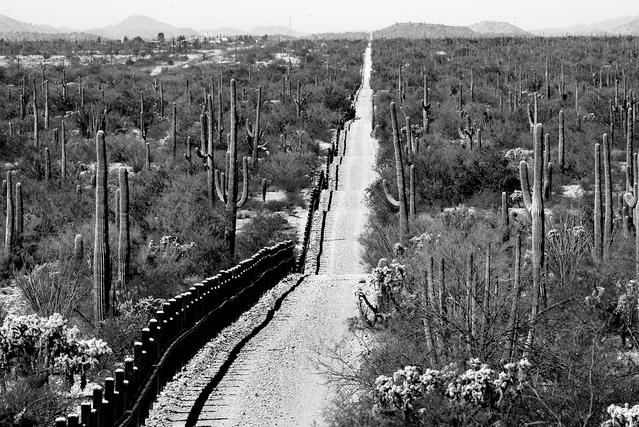
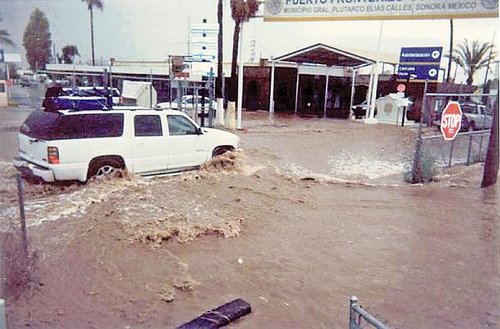
Each mile of fence cost Organ Pipe Cactus National Monument $430,000, said superintendent Kathy Billings. Photo by Rich-Joseph Facun / Arizona Daily Star

Faulty design turned border fence into dam, Organ Pipe Cactus National Monument.

‘The project almost ensures problems with erosion, runoff and flooding, not to mention disrupting the environment’
By Grits for Breakfast / August 26, 2008

From the moment Congress first proposed putting a wall along the Rio Grande on Texas’ southern border to reduce illegal immigration, I thought it was not just a bad idea but an insane one. As far as I can tell, when it’s finished the United States will be the first nation state in the history of the planet to wall off a major river and leave the river on the other side!

Anyone who’s spent time along the border knows that limiting river access – whether for crops, livestock or recreation – will cause the locals big problems. Plus, by building the fence in a river basin, the project almost ensures problems with erosion, runoff and flooding, not to mention disrupting the environment.

Local officials and landowners in the Rio Grande Valley fought construction of the wall, but have not succeeded in stopping it. Elsewhere, we can already see what’s in store along the Rio Grande. Via one of my favorite bloggers, Bryan Finoki at Subtopia: A Field Guide to Military Urbanism, I saw this report that:

A 5.2-mile border fence recently constructed along Organ Pipe Cactus National Monument’s southern border in southwestern Arizona became a dam in a recent flash flood, monument officials say.

Writes Bryan:

Apparently, the new $21.3 million, 5.2-mile fence along the monument’s southern border, basically turned into a dam during the storms on July 12th. The wire-mesh construction, meant to prevent crossers and vehicles but allow water to pass through, halted the natural flow of floodwater along the border when, according to a National Park Services report (pdf), “Debris piled up against the fence, including in drainage gates designed to prevent flooding, and the 6-foot deep fence foundation stopped subsurface water flow.” So, instead of flowing north to south, as I understand it naturally should, the floodwater carried laterally through the port of entry pooling 2 to 7 feet high and causing tons of damage to the ecology and nearby businesses.

What’s a crime is that none of this came as a surprise to anyone. The DHS had been warned of this sort of potential before they chose to ignore the severity of that discussion, and decided to build a fence regardless, even though they claimed the design would not hamper this flow in any significant way. You can read the full report here (pdf) outlaying the ecological and infrastructural damage that was caused by the border fence, and what can be expected in the future.

That was as predictable as the sunrise. And what will be any different, exactly, about Texas’ fence? If the feds can’t contain runoff on a flat plain, how in the world do they expect the fence to interact with the environment along an actual, large river in the event of a flash flood? Where will this fence divert runoff otherwise headed for the river? There’s no telling, but it’s a safe bet we won’t find out until the fence is built, the first gullywasher hits, and 2-7 feet of floodwaters back up into some Texas border town as happened in Arizona.

See the full post including an excellent batch of links at the end from Subtopia.

Grits for Breakfast is the private weblog and nom de plume of Scott Henson, a former journalist turned opposition researcher/political consultant, public policy researcher and blogger.

Source / Grits for Breakfast

The Rag Blog

Posted in RagBlog | Tagged , , , , , | Leave a comment

Dennis Kucinich : Wake up America

Rep. Dennis Kucinich, D-Ohio, preaches “Wake up, America!” to the Democratic National Convention in Denver on Tuesday, Aug. 26. Photo by Charlie Neibergall /AP

See “Kucinich wakes up Democratic Convention” by Rochelle Riley and video of Kucinich’s speech, below.

‘We Democrats are giving America a wake-up call’
By Dennis Kucinich / August 26, 2008

[Dennis Kucinich gave the following speech during the Democratic Convention today.]

It’s Election Day 2008. We Democrats are giving America a wake-up call. Wake up, America. In 2001, the oil companies, the war contractors and the neo-con artists seized the economy and have added 4 trillion dollars of unproductive spending to the national debt. We now pay four times more for defense, three times more for gasoline and home heating oil and twice what we paid for health care.

Millions of Americans have lost their jobs, their homes, their health care, their pensions. Trillions of dollars for an unnecessary war paid with borrowed money. Tens of billions of dollars in cash and weapons disappeared into thin air, at the cost of the lives of our troops and innocent Iraqis, while all the president’s oilmen are maneuvering to grab Iraq’s oil.

Borrowed money to bomb bridges in Iraq, Afghanistan and Pakistan. No money to rebuild bridges in America. Money to start a hot war with Iran. Now we have another cold war with Russia, while the American economy has become a game of Russian roulette.

If there was an Olympics for misleading, mismanaging and misappropriating, this administration would take the gold. World records for violations of national and international laws. They want another four-year term to continue to alienate our allies, spend our children’s inheritance and hollow out our economy.

We can’t afford another Republican administration. Wake up, America. The insurance companies took over health care. Wake up, America. The pharmaceutical companies took over drug pricing.

Wake up, America. The speculators took over Wall Street. Wake up, America. They want to take your Social Security. Wake up, America. Multinational corporations took over our trade policies, factories are closing, good paying jobs lost.

Wake up, America. We went into Iraq for oil. The oil companies want more. War against Iran will mean $10-a-gallon gasoline. The oil administration wants to drill more, into your wallet. Wake up, America. Weapons contractors want more. An Iran war will cost 5 to 10 trillion dollars.

This administration can tap our phones. They can’t tap our creative spirit. They can open our mail. They can’t open economic opportunities. They can track our every move. They lost track of the economy while the cost of food, gasoline and electricity skyrockets. They skillfully played our post-9/11 fears and allowed the few to profit at the expense of the many. Every day we get the color orange, while the oil companies, the insurance companies, the speculators, the war contractors get the color green.

Wake up, America. This is not a call for you to take a new direction from right to left. This is a call for you to go from down to up. Up with the rights of workers. Up with wages. Up with fair trade. Up with creating millions of good paying jobs, rebuilding our bridges, ports and water systems. Up with creating millions of sustainable energy jobs to lower the cost of energy, lower carbon emissions and protect the environment.

Up with health care for all. Up with education for all. Up with home ownership. Up with guaranteed retirement benefits. Up with peace. Up with prosperity. Up with the Democratic Party. Up with Obama-Biden.

Wake up, America. Wake up, America. Wake up, America.

Source / truthout

Kucinich wakes up Democratic Convention
By Rochelle Riley / August 26

DENVER — Who lit a fire under U.S. Rep. Dennis J. Kucinich?

The Ohio Democrat went to church at the Democratic National Convention today, lighting up the 4 o’clock hour as time marched toward Sen. Hillary Clinton’s much anticipated appearance.

Kucinich preached.

I mean he preached like he’d had some lessons from the Rev. Jesse Jackson. And he woke up an audience that until that moment appeared to be mostly waiting to hear anybody else.

“We Democrats are giving America a wake-up call,” he preached. “Wake up, America. In 2001, the oil companies, the war contractors and the neo-con artists seized the economy and have added $4 trillion of unproductive spending to the national debt. We now pay four times more for defense, three times more for gasoline and home heating oil, and twice what we paid for health care.”

Sleepy delegates in a half-empty arena began to take notice. A couple of them pointed.

“If there was an Olympics for misleading, mismanaging and misappropriating, this administration would take the gold,” Kucinich said. “World records for violations of national and international laws … we can’t afford another Republican administration. Wake up, America.

“The insurance companies took over health care. Wake up, America. The pharmaceutical companies took over drug pricing. Wake up, America. The speculators took over Wall Street. Wake up, America. They want to take your Social Security. Wake up, America.

He had them. Where was this speech when the tiny Ohio congressman was running for president? Or did we really just not pay attention?

“This administration can tap our phones. They can’t tap our creative spirit,” he said. “They can open our mail. They can’t open economic opportunities. They can track our every move. They lost track of the economy while the cost of food, gasoline and electricity skyrockets. They skillfully played our post-9/11 fears and allowed the few to profit at the expense of the many. Every day we get the color orange while the oil companies, the insurance companies, the speculators, the war contractors get the color green.

“Wake up, America! This is not a call for you to take a new direction from right to left. This is call for you to go from down to up. Up with the rights of workers. Up with wages.”

And Dennis Kucinich began to bounce, the way the ministers of my girlhood churches did.

“Up with fair trade. Up with creating millions of good paying jobs, rebuilding our bridges, ports and water systems,” he said, his voice rising, people rising and grinning at the Dennis Kucinich who was surprising them.

“Up with health care for all,” he said. “Up with education for all. Up with homeownership. Up with guaranteed retirement benefits. Up with peace. Up with prosperity. Up with the Democratic Party. Up with Obama-Biden!”

Hmmmmm. Did the Democrats miss something along the way from the only man with the courage to introduce a resolution in June to impeach President George W. Bush and whose speech reminded those gathered who their fight actually was with?

Source / Freep.com

Dennis Kucinich addresses the Democratic Convention, August 26, 2008

The Rag Blog

Posted in RagBlog | Tagged , | 1 Comment

What We Need Is A Digital Bill Of Rights


‘It is time to really think about a comprehensive national technology policy for the Internet Age’
By Erick Schonfeld / August 25, 2008

As the Democrats and Republicans gather at their national conventions, it is time to really think about a comprehensive national technology policy for the Internet Age. Many laws and policies governing the Internet and digital property are inadequate attempts to transplant rules from a different era.

The problems that arise are not just about Net Neutrality (see Comcast) or copyright infringement or digital privacy. They are about all of these things. What we need is a Digital Bill of Rights that spells out what freedoms and rights consumers can expect from Internet service providers, content companies, device manufacturers, and the government itself.

Both Presidential candidates have already outlined their technology platforms. (Obama did so last year; McCain only got around to unveiling a formal tech policy earlier this month. Both Obama and McCain also spoke to TechCrunch about their thoughts on tech policy during the primaries). But McCain’s technology platform is a bit vague, and Obama’s choice of tech-challenged Joe Biden as his running mate is not exactly a confidence builder. The fact is that nobody in either party has pulled together a focused set of principles that can truly guide both lawmakers and policymakers.

It’s a tall order, but it is important to have a consistent policy governing everything from Internet Protocol regulations to intellectual property on the Web. With suggestions from serial tech entrepreneur Austin Hill, I’ve come up with a first stab at such a bill of rights. Help me to further refine them in comments below, or add your own suggestions.

The Digital Bill of Rights

The Right to Use and Reuse Content: Consumers know that digital copies of songs, words, and videos are qualitatively different than physical copies, yet copyright law treats them the same way. When the economics of scarcity no longer apply, consumers start to behave differently. They copy and reuse content in unforeseen ways. The pendulum has swung so far that normal consumer behavior has now been criminalized. The concept of fair use needs to be updated and clarified, while still balancing the fundamental right of copyright holders to profit from their creations.

The Right To Control Digital Property On Your Own Device: Possession may be nine tenths of the law, but digital devices don’t follow that rule. When it comes to digital property, who owns what is ill-defined. This can become especially complicated when content is tied to a specific device. If I download a digital book to my Kindle or an app to my iPhone, Amazon or Apple (to pick on them again) have the ability to pull any content from my device without notice or permission. Even if I’ve paid for the content in question. Copyright law and DRM technologies are so intertwined and confused that both consumers and companies could benefit from clearer rules of the road.

The Right To The Free Flow Of Information: Internet service providers, especially those who benefit from public rights of way, should not be allowed to discriminate against information by data type. Debates about Net Neutrality can get bogged down in discussions about content filtering, packet prioritization, and backbone peering rules. But the issue here is basic access to the Internet and all the data that it contains. Data is information and artificial limits on what kinds of data can flow through the Internet’s pipes can amount to a form of censorship.

The Right To (Some) Privacy: For the most part, the expectation of privacy is dead on the Web. But the privacy of certain types of information (health, financial) will always need to be protected. Federal guidelines for how to protect consumer data is preferable to a hodgepodge of industry and state regulations that are currently failing us. (Who wants to book a room at the Best Western?) Privacy laws are also inconsistent in the physical and digital worlds. The Bork law, for instance, makes it illegal for physical video stores to share my rental records, but iTunes or Amazon could sell my digital video or music purchases without running afoul of the law.

The Right to Control Your Digital Identity: And what happens when the “content” in question is your own digital identity. Who owns that? The answer should be that you do. Congress is certainly interested in this issue, and wants to make sure that online advertising networks don’t abuse their possession of your identity data to bombard you with ads. In fact, Google and Yahoo, have been making preemptive moves in an attempt to stave off regulation. But politicians may want to take a closer look at the EU’s privacy directive, which has been in effect for more than decade. Citizens should be able certify that the digital identity associated with their name in a given database is in fact theirs and to revoke access to that identity information on a case-by-case basis.

Source / TechCrunch

The Rag Blog

Posted in RagBlog | Tagged , , , , , , | Leave a comment

The Fight Against Gentrification in Harlem

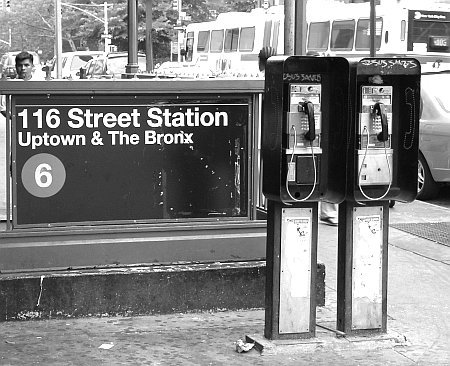
Photo by Thomas Good / NLN.

The battle for the soul of El Barrio
By Thomas Good / August 26, 2008

NEW YORK — In November of 2006, City Council member Melissa Mark Viverito spoke out against police commissioner Ray Kelly’s parade permitting rules. Mark Viverito felt the rules would violate the civil rights of activists. Ironically, on Sunday she faced a large contingent of protesters – permits in hand – at her own front door. Calling Viverito a “serpent” and a “sellout”, members of Movement for Justice in El Barrio visited her luxury townhouse to express their outrage with her support of the 125th Street rezoning plan. To many of the protesters Mark Viverito seemed to personify the gentrification going on in Harlem.

According to her website, “Melissa Mark Viverito made history in November 2005 by becoming the first Puerto Rican woman elected to serve District 8 on the City Council” in 2005. District 8 includes Manhattan Valley, East Harlem, and part of Mott Haven in the Bronx.

Council Member Mark Viverito was born and raised in Puerto Rico. She worked for 1199 SEIU in New York City before being elected to the City Council. Her campaign promised greater transparency in city government. But by 2008, Mark Viverito and her constituency were estranged. On April 30th, Viverito and 41 other City Council members approved a controversial rezoning plan that will bring condominiums and 21 story skyscrapers to Harlem’s historic 125th Street. Only two members of the council, Charles Barron and Tony Avella, voted against the plan. Speaker Christine Quinn called in police to remove protesters from the council chambers when tempers flared in response to the vote. The vote was seen as a victory for real estate developers and was supported by Mayor Bloomberg.

Standing against the gentrification of East Harlem is a grassroots organization called Movimiento por Justicia del Barrio (Movement for Justice in El Barrio). MJB is a self described organization of “immigrants and low-income people of color” who have made their views known and presence felt.

In an effort to avoid being displaced from their neighborhood, members of MJB have filed a groundbreaking lawsuit against property investment giant Dawnay Day Group. The London based firm has a stated goal of increasing the rent sharply in its 47 Harlem properties. MJB alleges that Dawnay Day Group has conducted a campaign of neglect and tenant harrassment in an attempt to force the current residents out so that it may raise the rent. In its suit MJB argues that Dawnay Day has charged current residents “thousands of dollars in false fees” as part of its efforts to drive out low income residents.

In the battle for the soul of East Harlem, Movement for Justice in El Barrio has kept up the pressure on Dawnay Day Group and those politicians, including Mark Viverito, who vote against the interests of their poorer constituents. Complementing its lawsuit and a well run media campaign, MJB has taken to the streets to get their message out.

On Sunday a large contingent of MJB and its supporters rallied at 116th Street and Lexington Avenue – not far from Mark Viverito’s office. The rally was the first stop in what MJB called a “March for Dignity and against Displacement.”

The second stop was the home of City Council member Melissa Mark Viverito.

Carrying signs that said, “Harlem no se vende” (Harlem is not for sale), “We will not be moved” and “El Barrio will not be sold”, the protesters marched down Third Avenue to Viverito’s home. Mothers, fathers and young children held vigil outside the townhouse as activists spoke out against Viverito’s support of gentrification. Protesters spoke through a makeshift bullhorn – a rolled up sign – pointing out that, in addition to voting for the rezoning of 125th Street, Mark Vierito also voted for the Columbia University expansion into West Harlem. The announcement was met with jeers and boos.

The final stop of the protest was the Vertical City realty office on Third Avenue and 99th Street. Here protesters spoke out against the ongoing gentrification of their neighborhood – Vertical City rents Dawnay Day Group’s East Harlem properties. Several speakers vowed to defeat those who would gentrify Harlem as other demonstraters held signs that said, “estamos en la lucha” – we are in a struggle.

See more photos and video at Next Left Notes.

The Rag Blog

Posted in RagBlog | Tagged , , , , | Leave a comment

Rachel Papo : Face of the Day

See Rachel Papo’s statement about this series below.

One photograph from Rachel Papo’s photo series on female Israeli soldiers.

At an age when social, sexual, and educational explorations are at their highest point, the life of an eighteen-year-old Israeli girl is interrupted. She is plucked from her home surroundings and placed in a rigorous institution where her individuality is temporarily forced aside in the name of nationalism. During the next two years, immersed in a regimented and masculine environment, she will be transformed from a girl to a woman, within the framework of an army that is engaged in daily war and conflict.

Almost fifteen years after my mandatory military duty ended, I went back to several Israeli army bases, using the medium of photography as a vehicle to re-enter this world. Serial No. 3817131 represents my effort to come to terms with the experiences of being a soldier from the perspective of an adult. My service had been a period of utter loneliness, mixed with apathy and pensiveness, and at the time I was too young to understand it all. Through the camera’s lens, I tried to reconstruct facets of my military life, hopeful to reconcile matters that had been left unresolved.

Walking onto an army base after all these years was very disorienting, as memories began to surface, and blend with feelings of estrangement. The girls who I encountered during these visits were disconnected from the outside world, completely absorbed in their paradoxical reality. They spoke a language now foreign to me, using phrases like “Armored Cavalry Regiment” and “Defense Artillery.” Would it have made any difference to explain to them that in a few years the only thing they might remember is their serial number? Photographing these soldiers, I saw my reflection; I was on the other side of a pane of glass—observing a world that I had once been a part of, yet I could not go back in time or change anything. It felt like a dream.

The photographs in this project serve as a bridge between past and present—a combination of my own recollections and the experiences of the girls who I observed. Each image embodies traces of things that I recognize, illuminating fragments of my history, striking emotional cords that resonate within me. In some way, each is a self-portrait, depicting a young woman caught in transient moments of introspection and uncertainty, trying to make sense of a challenging daily routine. In striving to maintain her gentleness and femininity, the soldier seems to be questioning her own identity, embracing the fact that two years of her youth will be spent in a wistful compromise.

Rachel Papo

More images here.

Source / Andrew Sullivan / Daily Dish / The Atlantic

Thanks to Harry Edwards / The Rag Blog

Posted in RagBlog | Tagged , , , , | Leave a comment

Chasing The Clean Coal Dragon : A DNC Lobby Adventure


‘Clean coal’ is in an experimental stage and at best hypothetical
August 26, 2008

DENVER — Greetings from from the Mile High City! It’s a beautiful day here in Denver. The DNC is in full swing, and excitement is in the air…

… and the dirty energy lobbyists are walking the streets. Literally.

For those of you who haven’t heard of them, the American Coalition for Clean Coal Electricity (ACCCE) is a coal industry front group. They’re the ones with the pretty ads on CNN. They even brought you the Democratic debate at the end of January.

They virtually greet Denver visitors with a series of ads at the airport, and they’re rolling around town with their mobile billboard.

We’ve even heard that they’re handing out pieces of “coal”… painted green.

If you’re easily convinced by such silly swag, I have a bridge to sell you.

You see, here’s the background story. When coal industry lobbyists say “clean coal”, they’re mainly talking about carbon capture and storage (CCS), which, in reality, is only in the experimental stages, and a hypothetical success at best:

A study by the Massachusetts Institute of Technology called The Future of Coal, published last year, suggests that the first commercial CCS plants won’t be on stream until 2030 at the earliest. Thomas Kuhn of the Edison Electric Institute, which represents most US power generators, half of whose fuel is coal, takes a similar line. In September [2007], he told a House Select Committee that commercial deployment of CCS for emissions from large coal-burning power stations will require 25 years of R&D and cost about $20 billion.

[…]

The most detailed published assessment [pdf], by Peter Viebahn of the German Aerospace Center in Stuttgart, estimates that at best CCS will reduce greenhouse gas emissions from coal-fired power stations by little more than two-thirds. That compares with life-cycle emissions for most renewable energy technologies that are 1 to 4 per cent of those from burning coal.

We are unlikely to give up burning coal any time soon, and CCS could eventually have an important part to play by allowing coal to be used without doing unacceptable damage to the global climate. But that isn’t going to happen tomorrow. And as to the dream of coal becoming a zero-emissions source of power – forget it.

So, it’s fitting that the ACCCE is handing out bits of fictitious fuel. Although we still haven’t scored any, Devilstower and I had a chance to chat with several of the ACCCE representatives.

What we learned in our hour-long interview can, unfortunately, be easily condensed into a few paragraphs. I’ll let Devilstower take over from here.

Thanks, Page. Our interview rambled over several topics, and there’s no doubt that the coal lobbyists are personable guys who know how to make their argument — after all, that’s their job. But when it comes to a few areas, their answers are a lot less than satisfying. (note: while I’ve tagged my bits and those from Page, I’ve lumped all the clean coal lobbyists together as “CC,” not out of disrespect, but because I can’t distinguish their voices on my high quality $9 recorder).

DT: Let’s go back to that sign in the airport, which says that “the next president” can count on clean coal to protect the environment and keep the economy strong. But is the next president going to be able to count on clean coal in the next four or even eight years?

CC: We’re going to be closer, yes.

DT: But being closer doesn’t really help the next president protect the environment or the economy.

CC: We never said that. This is not an answer for the very next president.

DT: That’s what the sign says.

CC: It’s certainly an issue for whoever is the next president to start working on it.

Page: But you’re saying our next president won’t have to choose between a clean environment and the economy. That’s a huge statement. And very clever.

CC: The issue is simply this. In this country, you could stop using coal tomorrow, but it won’t make a dent in global CO2 and it’ll greatly raise energy prices. You’ll have to build nuclear plants, which will take years, or use natural gas, which would be very costly.

If you stopped using coal tomorrow, this country would shut down.

DT: I don’t think anyone’s proposing that we turn all the plants off overnight, but that existing 51% of our electrical grid that you’re talking about is not “clean coal.” It’s coal, but it’s not clean.

CC: It has to start somewhere.

And that’s where the argument becomes circular. Clean Coal would be a great boon to the country if it existed, but it doesn’t. Clean coal is a hypothetical fuel, something that might be possible, in a decade or two, with the investment of several billion dollars.

So, while the clean coal lobby presses the idea of their fuel as an inexpensive solution to both maintaining a strong economy and protecting the environment, what they’re really pushing is a choice. We can choose to invest our funds in sources of clean electricity that exist right now, today, or we can invest in carbon capture in the hopes that someday, decades from now, it might work. The proposal really ends up having all the downside of investing in fusion (the power source of the future, and always will be) and little of fusion’s upside (low overall environmental impact).

The question we’re left with is how we handle the power sources we have today, the ones that are powered by not-clean-coal. And the clean coal they talk about is one alternative that’s not on the table.

When we got around to talking about the fate of existing plants, we got closer to the real agenda of the clean coal lobby.

CC: Kansas is a prime example. The big story missed in that whole fiasco was that when that plant was cancelled, six wind projects went with it, because the wind developers were going to use the transmission infrastructure from that coal plant.

And that kept the old plants in service, because they can’t take them off line to build a new plant with modern technology. When that got stopped, it insured one thing—that the old plants continued to chug along. They had to to keep the lights on.

Page: So you’re saying that it’s the environmentalists’ fault, basically?

CC: Are we saying it’s anybody’s fault? Absolutely not.

Page: But the Sierra Club’s opposition means that people are going to go without electricity or be stuck with old plants?

CC: There needs to be a give and take. When your policy says “no, not under any circumstances,” that obviously becomes very contentious.

Page: So Kathleen Sebelius was a real inhibitor to any progress? That’s the issue here?

CC: No, not at all, but that’s only one instance. We can pick incidents all over the United States right now where they put up legal challenges.

And now we’re back to another circular argument: we can’t eliminate old coal plants, because there’s opposition to building new coal plants. The assumption here is that only coal can replace coal, and while these new plants are certainly cleaner than those they replace in the sense of lowering many other emissions, they make no effort at carbon capture. None. The proposed new plants are not clean coal plants.

The real goal is to promote the building of new plants, clean or not. What they’re handing out is a perfect example of what they’re doing: plain old coal, with a coat of green paint.

Source / Plutoniam Page and Devilstower / Daily Kos

The Rag Blog

Posted in RagBlog | Tagged , , , , , , | Leave a comment

Nothing Fair About the Trade Deals Made with Chequebooks and Lawyers


Rich countries once used gunboats to seize food. Now they use trade deals
By George Monbiot / August 26, 2008

The world’s hungriest are the losers as an old colonialism returns to govern relations between wealthy and poor nations

In his book Late Victorian Holocausts, Mike Davis tells the story of the famines that sucked the guts out of India in the 1870s. The hunger began when a drought, caused by El Niño, killed the crops on the Deccan plateau. As starvation bit, the viceroy, Lord Lytton, oversaw the export to England of a record 6.4m hundredweight of wheat. While Lytton lived in imperial splendour and commissioned, among other extravagances, “the most colossal and expensive meal in world history”, between 12 million and 29 million people died. Only Stalin manufactured a comparable hunger.

Now a new Lord Lytton is seeking to engineer another brutal food grab. As Tony Blair’s favoured courtier, Peter Mandelson often created the impression that he would do anything to please his master. Today he is the European trade commissioner. From his sumptuous offices in Brussels and Strasbourg, he hopes to impose a treaty that will permit Europe to snatch food from the mouths of some of the world’s poorest people.

Seventy per cent of the protein eaten by the people of Senegal comes from fish. Traditionally cheaper than other animal products, it sustains a population that ranks close to the bottom of the human development index. One in six of the working population is employed in the fishing industry; about two-thirds of these workers are women. Over the past three decades, their means of subsistence has started to collapse as other nations have plundered Senegal’s stocks.

The EU has two big fish problems. One is that, partly as a result of its failure to manage them properly, its own fisheries can no longer meet European demand. The other is that its governments won’t confront their fishing lobbies and decommission all the surplus boats. The EU has tried to solve both problems by sending its fishermen to west Africa. Since 1979 it has struck agreements with the government of Senegal, granting our fleets access to its waters. As a result, Senegal’s marine ecosystem has started to go the same way as ours. Between 1994 and 2005, the weight of fish taken from the country’s waters fell from 95,000 tonnes to 45,000 tonnes. Muscled out by European trawlers, the indigenous fishery is crumpling: the number of boats run by local people has fallen by 48% since 1997.

In a recent report on this pillage, ActionAid shows that fishing families that once ate three times a day are now eating only once or twice. As the price of fish rises, their customers also go hungry. The same thing has happened in all the west African countries with which the EU has maintained fisheries agreements. In return for wretched amounts of foreign exchange, their primary source of protein has been looted.

The government of Senegal knows this, and in 2006 it refused to renew its fishing agreement with the EU. But European fishermen – mostly from Spain and France – have found ways round the ban. They have been registering their boats as Senegalese, buying up quotas from local fishermen and transferring catches at sea from local boats. These practices mean that they can continue to take the country’s fish, and have no obligation to land them in Senegal. Their profits are kept on ice until the catch arrives in Europe.

Mandelson’s office is trying to negotiate economic partnership agreements with African countries. They were supposed to have been concluded by the end of last year, but many countries, including Senegal, have refused to sign. The agreements insist that European companies have the right both to establish themselves freely on African soil, and to receive national treatment. This means that the host country is not allowed to discriminate between its own businesses and European companies. Senegal would be forbidden to ensure that its fish are used to sustain its own industry and to feed its own people. The dodges used by European trawlers would be legalised.

The UN’s Economic Commission for Africa has described the EU’s negotiations as “not sufficiently inclusive”. They suffer from a “lack of transparency” and from the African countries’ lack of capacity to handle the legal complexities. ActionAid shows that Mandelson’s office has ignored these problems, raised the pressure on reluctant countries and “moved ahead in the negotiations at a pace much faster than the [African nations] could handle”. If these agreements are forced on west Africa, Lord Mandelson will be responsible for another imperial famine.

This is one instance of the food colonialism that is again coming to govern the relations between rich and poor counties. As global food supplies tighten, rich consumers are pushed into competition with the hungry. Last week the environmental group WWF published a report on the UK’s indirect consumption of water, purchased in the form of food. We buy much of our rice and cotton, for example, from the Indus valley, which contains most of Pakistan’s best farmland. To meet the demand for exports, the valley’s aquifers are being pumped out faster than they can be recharged. At the same time, rain and snow in the Himalayan headwaters have decreased, probably as a result of climate change. In some places, salt and other crop poisons are being drawn through the diminishing water table, knocking out farmland for good. The crops we buy are, for the most part, freely traded, but the unaccounted costs all accrue to Pakistan.

Now we learn that Middle Eastern countries, led by Saudi Arabia, are securing their future food supplies by trying to buy land in poorer nations. The Financial Times reports that Saudi Arabia wants to set up a series of farms abroad, each of which could exceed 100,000 hectares. Their produce would not be traded: it would be shipped directly to the owners. The FT, which usually agitates for the sale of everything, frets over “the nightmare scenario of crops being transported out of fortified farms as hungry locals look on”. Through “secretive bilateral agreements”, the paper reports, “the investors hope to be able to bypass any potential trade restriction that the host country might impose during a crisis”.

Both Ethiopia and Sudan have offered the oil states hundreds of thousands of hectares. This is easy for the corrupt governments of these countries: in Ethiopia the state claims to own most of the land; in Sudan an envelope passed across the right desk magically transforms other people’s property into foreign exchange. But 5.6 million Sudanese and 10 million Ethiopians are currently in need of food aid. The deals their governments propose can only exacerbate such famines.

None of this is to suggest that the poor nations should not sell food to the rich. To escape from famine, countries must enhance their purchasing power. This often means selling farm products, and increasing their value by processing them locally. But there is nothing fair about the deals I have described. Where once they used gunboats and sepoys, the rich nations now use chequebooks and lawyers to seize food from the hungry. The scramble for resources has begun, but – in the short term, at any rate – we will hardly notice. The rich world’s governments will protect themselves from the political cost of shortages, even if it means that other people must starve.

Source / The Guardian, UK

The Rag Blog

Posted in RagBlog | Tagged , , | Leave a comment