Medea Benjamin: "Both Parties Have Kept Us Down This Militaristic Path and Neglected Our Basic Needs"

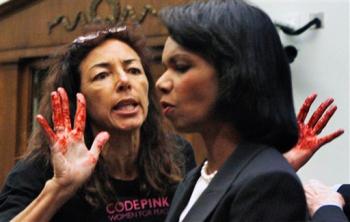
In this Oct. 24, 2007 file photo, Secretary of State Condoleezza Rice, right, is confronted by Code Pink member Desiree Anita Ali-Fairooz, her hands painted red, as she arrives to testify on Capitol Hill in Washington. (AP Photo/Charles Dharapak)

CodePink Faces Tough Odds For Public’s Attention
by Christine Simmons / August 26, 2008

WASHINGTON – Kelly Jacobs will be wearing dresses made from a “peace flag” every day at the Democratic National Convention. As a delegate and a CodePink activist, she’ll don bright pink earrings, shoes and backpacks – and hundreds of peace and pink-colored buttons.

“There’s no getting away from the peace message. It’s on my neck down to my waist,” said Jacobs, 49.

The Mississippi activist, who is a delegate for Hillary Rodham Clinton, is one of about 20 CodePink women attending the Democratic convention. They probably won’t be disruptive inside. But CodePink members outside the Denver convention are planning to stage parades, protests, concerts and other theatrics – anything to keep the anti-war message alive.

These are hard times for peace activists. Despite CodePink’s flashy costumes and willingness to disrupt campaign events and congressional hearings – sometimes facing arrest for it – the women are finding it more difficult to maintain public attention on the Iraq war.

Americans are now focused more on the gasoline prices they’re paying, declining values of their homes and other economic issues. The ups and downs in a highly contested presidential election also have edged Iraq off the front page and evening newscasts most days.

“We do feel to some extent that these elections have sabotaged our peace actions and messaging because … the media is completely focused on the two candidates,” said CodePink activist Liz Hourican, who moved here from Arizona a year and a half ago to devote her time to ending the war. “It’s a lot more challenging.”

And while Iraqi and American officials are discussing a pullout of U.S. combat troops from major Iraqi cities by next June and a broader withdrawal by 2011, CodePink members say they won’t be satisfied until all U.S. forces are back from Iraq. “We’d like a timeline that is shorter,” said co-founder Medea Benjamin.

Congress’ decision this summer to fund U.S. operations in Iraq and Afghanistan into next year with $162 billion was a setback, but CodePink already was on the campaign trail, “bird-dogging” presidential candidates and unfurling anti-war banners at their events.

Republican John McCain is a favorite target. “Just about every place McCain goes, we have somebody confronting him,” Benjamin said. “We want the undecided voters … to see we associate McCain with more war and with the failed Bush policy, and, of course, we want the media to cover it.”

The activists’ campaign on Capitol Hill didn’t stop. Before Congress left for recess, the women in their pink outfits scoured the halls almost daily. They seated themselves behind witnesses at hearings unrelated to the war, flashing pink anti-war posters at TV cameras recording, for example, Federal Reserve Chairman Ben Bernanke talking about the collapse of investment bank Bear Stearns.

“There’s a lot of very creative people in the group,” Hourican said. “They make so many different crafty, visually brilliant things, and they love using their talents to push this along and see their costume on the news.”

Obama’s people haven’t exactly welcomed them. A group of women went to his Washington office last month seeking to meet with a foreign policy aide but only got a promise in the hallway they would be contacted and given more information on the Democratic candidate’s policies. His office never called back.

When Congress returns in September, so will the women in their pink garb. Without a war funding bill to protest, they’ll lobby against going to war in Iran and protest alleged abuses by military contractors. “As long as Congress is sitting and not doing the people’s bidding, then we’re going to be here,” said Gael Murphy, another CodePink co-founder.

CodePink – a mocking reference to the government’s color-coded terror alert system – started as a vigil in front of the White House in November 2002 to protest a war with Iraq. The vigil culminated in a women’s peace march to the Capitol four months later when the war began.

Soon afterward, other chapters “spontaneously started all over the country,” Murphy said. The group now has 250 chapters and 200,000 people on its mailing list.

At any given time, at least six CodePink members live in a three-story group house near Capitol Hill that is decorated with pink curtains and “peace” banners. Times and locations of major congressional hearings and demonstrations for the day are written on a self-erase board. Just as prominent is the phone number for U.S. Capitol Police, a source for learning which activists have been arrested, the charges against them and the bail needed.

In Denver this week and at the Republican nominating convention next week in St. Paul, Minn., CodePink has orchestrated an array of anti-war protests. “Pink Police” riding in-line skates who will hold signs reading “stop war, yield for peace” and bicycle brigades will rally against what the activists call America’s addiction to oil and war.

“You can’t be green and be pro-war,” said co-founder Benjamin. “In general, both parties have kept us down this militaristic path and neglected our basic needs.”

Source / Common Dreams

The Rag Blog

Posted in RagBlog | Tagged , , | Leave a comment

Quote of the Day

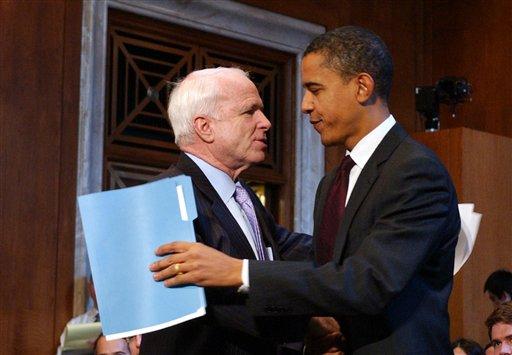
Eeewwwwhh, these guys look comfortable, eh??

From a letter to the Editor in August 26, 2008 Boston Globe,

If Barack Obama’s selection of Joe Biden as his running mate is ‘ceding the point that he doesn’t have the foreign policy experience to be president,’ according to John McCain spokesman Tucker Bounds, then I guess it would follow that if McCain picks a running mate who is younger than he, he would be acknowledging that he is too old to be president.

Source / Boston Globe

Thanks to Kate Braun and Mariann Wizard / The Rag Blog

Posted in RagBlog | Tagged , , | Leave a comment

Those Who Manipulate The Machines Will Manipulate the Elections

‘In NM the ballot boxes are apparently moved about on a burro.’

By Gerry Storm / The Rag Blog / August 25, 2008

See “Warning on Voting Machines Reveals Oversight Failure” by Greg Gordon, below.

How can they not have straightened this out by now? If they can still manipulate the machines they can still manipulate the elections. While the Demos in Denver cheer and wave and pump themselves up at the convention, the voting machine control is still held by Connell and fellows. Through the fog and all the headlines and new reform legislation not all that much has changed on the ground, or so it would appear.

In NM the ballot boxes are apparently moved about on a burro. It regularly takes weeks to count the ballots–and come up a count that is favorable to powers who control the state. There is little doubt that a real audit would reveal layers of time honored patronage that is much like the mafia. A friend of mine who was a city councilman in the only city around here told me that he estimated the count could be influenced as much as 20-25% in a statewide election. The power behind the throne is the traditional state bureaus and association of county clerks, virtually all of them Hispanic, who are on the ground. The boys and girls at the bureau, some with an attitude, run the state business and count the ballots. The Hispanic/Rancher coalition is the ruling faction, the patrons (ranchers) lead the peons (and their votes) to power of a fundamental type. Being challenged by the Anglos who are fairly recent arrivals. In places like Santa Fe’s local politics it was defeated and its influence trounced, in the rural areas of the state it is normally well-entrenched. It is the way of the West. Works pretty well too.

A few years ago I had an application in the IN basket of some state bureau. I waited for months and could get no response, it was a dead letter. Then I tracked down the supervisor of the department and wrote a personal letter. I signed it Gerald Cortez Storm. Took it maybe 10 days to get a reply and an approval. Not saying anyone does it on purpose, but when you see a “so” in a name, you can automatically assume it is Hispanic.

For the record, I like living in a Hispanic/Anglo American Southwest culture. There is much beauty herein, the rhythm is easy, and the dealing with nature is a guiding light to the wisdom.

Warning on Voting Machines Reveals Oversight Failure

By Greg Gordon / August 25, 2008

[Editor’s Note: Premier Elections Solutions is the new name for the notorious electronic voting system manufacturer Diebold. mr/TO]

WASHINGTON – Disclosure of an election computer glitch that could drop ballot totals for entire precincts is stirring new worries that an unofficial laboratory testing system failed for years to detect an array of flaws in $1.5 billion worth of voting equipment sold nationwide since 2003.

Texas-based Premier Elections Solutions last week alerted at least 1,750 jurisdictions across the country that special precautions are needed to address the problem in tabulation software affecting all 19 of its models dating back a decade.

Voting experts reacted skeptically to the company’s assertion that election workers’ routine crosschecks of ballot totals would have spotted any instances where its servers failed to register some precinct vote totals when receiving data from multiple memory cards.

Like nearly all of the nation’s modern voting equipment, Premier’s products were declared “qualified” under a voluntary testing process overseen from the mid 1990s until 2005 by the National Association of State Election Directors.

Computer scientists, some state officials and election watchdog groups allege that the NASED-sponsored testing system was a recipe for disaster, shrouded in secrecy, and allowing equipment makers to help design the tests.

The federal Election Assistance Administration, created in 2002, took over the testing responsibility in 2005, but has yet to certify a single voting machine.

As a result, charged Susan Greenhalgh, a spokeswoman for watchdog group Voter Action, the systems on which Americans will decide the race between Barack Obama and John McCain in November are “scandalously flawed”‘ and “the integrity of this election is in question.”

David Beirne, executive director of the Election Technology Council, which represents the leading makers of voting machines, said there’s no reason for concern. Without mentioning NASED, he said that members’ products “have all been certified” as meeting 2002 voluntary federal standards.

NASED officials took on the testing in the mid 1990s, after the Federal Election Commission adopted voluntary federal standards for voting machines but Congress failed to create a testing agency. The industry was frustrated, too, by being governed by a hodge-podge of state standards.

“We had two choices: To try to do something or to do nothing,” said Thomas Wilkey, who headed NASED’s volunteer Voting Systems Committee for several years while executive director of New York’s elections board. “We had a set of standards. It was a crime to let them sit on a shelf.”

NASED watched over the issuance of “qualified” reports from Independent Testing Laboratories, but with little control over the testing. The vendors secretly negotiated payments with the labs, helped design the tests, got to see the results first and only shared the codes driving their software with three NASED technical experts who signed non-disclosure agreements.

NASED officials posted only “qualified” ratings on the group’s Web site.

The lab endorsements aided vendors in selling nearly $1.5 billion in equipment to states and counties from 2003-2007, most of it financed by a gush of federal dollars under the 2002 Help America Vote Act.

Wilkey says the labs’ approval was never a “certification.” But EAC members have referred publicly to NASED’s “certification” of voting machines, and numerous states enacted laws barring purchases of equipment unless it passed the NASED-sponsored tests.

Questions about NASED’s testing grew in intensity over the last couple of years, after independent tests for the states of California, New York, Ohio, Florida and Connecticut found performance defects and security gaps in both systems that will serve most voters this fall: touch-screens and optical scanners.

The concerns prompted New York’s elections board to scrap a $60 million contract to buy new touch screens to replace its decades-old lever voting machines. Vice Chair Douglas Kellner said it’s now clear that a “qualified” rating from NASED is “meaningless … a piece of toilet paper.”

David Jefferson, a voting machine security expert who works at the Lawrence Livermore National Laboratory, said NASED’s tests were “of no value if your concern is security against insider threats,” such as tampering by election officials.

John Washburn, a software tester in the Milwaukee suburb of Germantown, predicts that nearly all of the machines bought in recent years will have to be replaced in a process he likened to the early 20th Century Teapot Dome scandal “as just the epitome of how government money goes down a rat hole,” he said.

Worries about the touch-screens’ lack of a verifiable paper trail have already prompted states to replace thousands of barely used machines costing hundreds of millions of dollars in favor of the scanners, which preserve each voter’s original paper ballot for use in a recount.

Congress passed the HAVA law and allotted billions of dollars for new equipment in the wake of the tumultuous 2000 presidential election battle that hinged on the validity of machine-counted punch-card ballots with “hanging chads” in Florida.

Ironically, the rush to buy voting machines to avoid a recurrence has triggered a new wave of public distrust because of questions about the testing and new reports of election regularities, including allegations of 18,000 missing votes in a 2006 congressional race in Florida.

Meantime, the EAC has made slow progress in setting up a federal testing and certification system – still voluntary, as directed by Congress. With help from the National Institute of Standards and Technology, the commission toughened standards in 2005 and again last year.

In an interview, Commission Chairwoman Rosemary Rodriguez said the agency feels the pressure, but “we’re not going to sacrifice any of our stringent requirements to satisfy election administrators or manufacturers.”

A couple of voting systems could be certified soon, she said, but not in time for the November election.

Rodriguez conceded that the commission fumbled its handling of a 2006 report raising questions about the qualifications of NASED’s most controversial software-testing laboratory, operated in Huntsville, Ala., by Colorado-based CIBER, Inc. The report criticizing CIBER’s inadequate testing resources and lack of documentation was issued in August, 2006, but was kept secret until that December, after the general election.

The secrecy was a mistake, she said, and the commission decided to “peel off the scab” and face public criticism. She vowed to keep the process more transparent in the future.

A spokesperson for CIBER, which is on the verge of winning EAC accreditation to resume testing voting equipment, did not respond to requests for comment.

Critics also have questioned the agency’s hiring of Wilkey as its executive director and of former FEC official Brian Hancock to oversee voting system certification, since both were involved in the much-criticized NASED process.

The agency, however, has taken a tough regulatory stance, angering manufacturers and county election officials by refusing to certify any NASED-approved machine or recent upgrades without fully testing the entire system.

“We’re trying,” Rodriguez said, “not to repeat any mistakes.”

Source / McClathy Newspapers / truthout

The Rag Blog

Posted in RagBlog | Leave a comment

For the West, Mistake Has Become Second Nature


We tilt at windmills as world war looms
By Simon Jenkins / August 24, 2008

Is the world drifting towards a new global war? From this week the dominant super-power, America, will for three months pass through the valley of the shadow of democracy, a presidential election. This is always a moment of self-absorption and paranoia. Barack Obama and John McCain will not act as statesmen but as politicians. They will grandstand and look over their shoulders. Their eye will stray from the ball.

Meanwhile, along history’s fault line of conflict from Russia’s European border to the Caucasus and on to Iran, Afghanistan and Pakistan, diplomats are shifting uneasily in their seats, drums are sounding and harsh words are spoken. The world is now run by a generation of leaders who have never known global war. Has this dulled their senses?

Dan McNeill, an American general, was recently interviewed in Kabul on how to beat the Taliban. He was not the first to conclude that this could not be done militarily but only by “winning hearts and minds”. The problem, he said, lay in the answer to the question, “Whose hearts and minds?” Was it those of the Afghan people or was it rather those of the American Congress and voters?

Both Obama and McCain have claimed that the war in Iraq has been allowed to distract attention from the war in Afghanistan. This is different from the neoconservatives, who felt the war in Afghanistan was a distraction from the more important war in Iraq.
Related Links

* Moscow ups the ante in poker game with West

America now thinks it has won in Baghdad and must return to Kabul – and possibly even Tehran. At the same time it must face the possibility that these conflicts may in turn be a distraction from the reemergence as world powers of Russia and China, who are already gaining the initiative in Iran and Africa. Moscow is also precipitating a nationalist resurgence in eastern Europe and among Russian minorities in the Caucasus.

The question is critical. Has the West misjudged the fault line of an impending conflict? Its global strategy under George Bush, Tony Blair and a ham-fisted Nato has declared the threat to world peace as coming from nonstate organisations, specifically Al-Qaeda, and the nations that give them either bases or tacit support. Western generals and securocrats have elevated these anarchist fanatics to the status of nuclear powers. Policing crime has become “waging war”, so as to justify soaring budgets and influence over policy, much as did America’s military-industrial complex during the cold war.

Might it be that a raging seven-year obsession with Osama Bin Laden and his tiny Al-Qaeda organisation has blinded strategists to the old verities? Wars are rarely “clashes of civilisation”, but rather clashes of interest. They are usually the result of careless policy, of misread signals and of mission creep closing options for peace.

Terrorists, wherever located and trained, can certainly capture headlines and cause overnight mayhem, but they cannot project power. They cannot conquer countries or peoples, only manipulate democratic regimes into espousing illiberal policies, as in America and Britain. By grossly overstating the significance of terrorism, western leaders have distracted foreign policy from what should be its prime concern: securing world peace by holding a balance of interest – and pride – among the great powers.

To any who lived through the cold war, recent events along Russia’s western and southern borders are deeply ominous. Moscow initially spent the 17 years since the fall of the Soviet Union flirting with the West. It had been defeated and had good reason for disarming and putting out feelers to join Nato and the European Union. It took part in such proto-capitalist entities as the G8.

In the case of Nato and the EU it was arrogantly rebuffed, while its former Warsaw Pact allies were accepted. Moscow was told it would be foolish to worry about encirclement. A nation that had never enjoyed democracy should content itself with basking in its delights. Russians in the Baltic states and in Ukraine should make their peace with emerging governments. The political clutter of the cold war should be decontaminated.

Suddenly this has not worked. The world is showing alarming parallels with the 1930s. Lights are turning to red as the world again approaches depression. The credit crunch and the collapse of world trade talks are making nations introverted. Meanwhile, the defeated power of the last war, Russia, is flexing its muscles and finding them in good working order.

On Thursday Gordon Brown told his troops in Afghanistan that “what you are doing here prevents terrorism coming to the streets of Britain”. He cannot believe this any more than do his generals. Afghanistan poses no military threat to Britain. Rather it is Britain’s occupation and the response in neighbouring Pakistan that fosters antiwestern militancy in the region. Like the impoverishment of Germany between the wars, the stirring of antiwestern and antiChristian sentiment in the Muslim world can only be dangerous and counter-productive. Yet we do it.

The Taliban are fighting an old-fashioned insurgent war against a foreign invader and recruiting Pakistanis and antiwestern fanatics to help. They have succeeded in tormenting Washington and London with visions of a destabilised nuclear Pakistan, a blood-drenched Middle East and an Iran whose leaders may yet turn to jihad. For Brown – or the American presidential candidates – to imply that these conflicts with the Muslim world are making the world “safer” is manifestly untrue.

Worse, it distorts policy. Rather than calming other foes so the West can concentrate on the conflicts in hand, it is pointlessly stirring Russian expansionism to life.

There is no strategic justification for siting American missile systems in Poland and the Czech Republic. It is nothing but right-wing provocation. Nato’s welcome to Georgia and Ukraine, for no good reason but at risk of having to come to their aid, has served only to incite Georgia to realise that risk while also infuriating Moscow.

Russia is well able to respond recklessly to a snub without such encouragement, so why encourage it? The more powerful state – America – surely has an obligation to show the greater caution. Any strategic decision, such as the goading of Moscow, must plan for its response. Nato’s bureaucracy, lacking coherence and leadership, has been searching for a role since the end of the cold war. That role is apparently now to play with fire.

Western strategy is dealing with a resurgent, rich and potent Russia. It has played fast and loose with Moscow’s age-old sensitivity and forgotten the message of George Kennan, the American statesman: that Russia must be understood and contained rather than confronted. The naive remarks welcoming Georgia to Nato by David Miliband, the foreign secretary, show a West far detached from such analytical truths.

Any student of McCain or Obama, of Russia’s Vladimir Putin and Dmitry Medvedev, or of the leaders of Britain, France and Germany, might conclude that these are not people likely to go to war. They are surely the children of peace. Yet history shows that “going to war” is never an intention. It is rather the result of weak, shortsighted leaders entrapped by a series of mistakes. For the West’s leaders at present, mistake has become second nature.

Source / Times Online

The Rag Blog

Posted in RagBlog | Tagged , , | Leave a comment

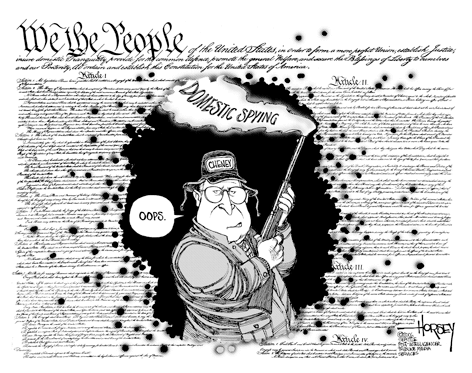
Further Confirmation That We Now Live in a Fascist Police State


Bush administration widens domestic spy agency powers
By Naomi Spencer / August 25, 2008

In recent weeks, Bush administration officials have introduced a number of provisions that substantially widen the powers of intelligence and law enforcement agencies to conduct spying and other operations within the US against American citizens.

Last week, several news outlets reported that the Justice Department had drafted new rules on intelligence gathering operations which it plans to ratify on October 1, the first day of the new fiscal year and one month before the November elections.

Although details of the draft have not been made publicly available, officials told the Associated Press (AP) that the changes give explicit permission to the Federal Bureau of Investigation (FBI) to spy on Americans even if there is no basis for suspicion of criminal activity or allegations of wrongdoing. According to an August 20 report by the AP, officials speaking on condition of anonymity said “the new policy would let agents open preliminary terrorism investigations after mining public records and intelligence to build a profile of traits that, taken together, were deemed suspicious.”

Among factors the officials said could be used as the basis for spying, according to the AP, were “travel to regions of the world known for terrorist activity and access to weapons or military training, along with the person’s race or ethnicity.”

The FBI would be authorized to conduct activities such as “long-term surveillance, interviewing neighbors and work-mates, recruiting informants and searching commercial databases for information on people.”

Four members of the Senate Judiciary Committee who were briefed on the new rules—Democrats Russ Feingold of Wisconsin, Dick Durbin of Illinois, Edward Kennedy of Massachusetts and Sheldon Whitehouse of Rhode Island—wrote in an August 18 letter to Attorney General Michael Mukasey that the new rules opened the way for “intrusive surveillance” against innocent Americans based on “race, ethnicity, national origin, religion, or on protected First Amendment activities.”

An August 22 editorial by the New York Times, citing comments of Senate staffers familiar with the new rules, reported that the FBI would be authorized to carry out “pretext interviews, in which agents do not honestly represent themselves while questioning a subject’s neighbors and work colleagues.”

There can be little doubt that among those targeted will be the sizable and growing segment of the population actively opposed to the government’s policies. “Pretext interviews” and the use of “recruited informants”—who infiltrate targeted organizations—are deeply anti-democratic and unconstitutional tactics that the FBI, in the anti-communist Cold War era, widely employed against socialists and civil rights groups.

In their letter, the senators merely urged Mukasey not to ratify the guidelines until they have been publicly announced—an indication that they have no any serious intention of blocking the action. Only last month, the Democratic-controlled House of Representatives and Senate passed, by an overwhelming margin, legislation legitimizing the Bush administration’s ongoing domestic wiretapping and surveillance operations and granting immunity to telecommunications companies participating in the illegal programs. (See: “Obama joins Senate vote to legitimize Bush’s domestic spying operation”).

In an August 20 reply to the Senate Judiciary Committee, the Attorney General’s office gave an assurance that Mukasey would not sign the guidelines in advance of a September 17 appearance before the committee by FBI Director Robert Mueller.

However, the letter made clear that the Justice Department considered the delay little more than a grace period. It stated, “Although we have not traditionally worked with Congress in developing Attorney General guidelines, and as you note in your letter, we are not obligated to do so, we appreciate the laudable and thoughtful suggestions we have already received…” In the meantime, the Attorney General’s office said the department would “continue to train FBI employees in preparation for the October 1, 2008 implementation date.”

In tandem with more aggressive FBI spying, the Justice Department last week introduced a proposal to further integrate state and local law enforcement agencies into the intelligence apparatus by allowing police forces to collect intelligence about American citizens. The proposal would allow police to share data with federal agencies and retain information for at least ten years.

As an August 16 Washington Post article reported, in the past few years numerous instances of police infiltration of peace and other protest groups have come to light. The article noted that “undercover New York police officers infiltrated protest groups before the 2004 Republican National Convention… California state agents eavesdropped on peace, animal rights and labor activists,” and “Denver police spied on Amnesty International and others before being discovered.”

Michael German, a former FBI agent turned whistleblower who is now a policy counsel for the American Civil Liberties Union (ACLU), told the Post, “If police officers no longer see themselves as engaged in protecting their communities from criminals and instead as domestic intelligence agents working on behalf of the CIA, they will be encouraged to collect more information… It turns police officers into spies on behalf of the federal government.”

On August 20, the Post reported that the federal government has been compiling information on land, sea, and air border-crossings by Americans via a previously undisclosed Border Crossing Information system run by the Department of Homeland Security. The data—including name, birth date, gender and photographic documentation—will be held for 15 years and can be used by intelligence agencies in investigations. The newspaper commented, “The same information is gathered about foreign travelers, but it is held for 75 years.”

This month, the Bush administration also announced the creation of a new unit within the Defense Department’s Defense Intelligence Agency, called the Defense Counterintelligence and Human Intelligence Center. Without giving details, Mike Pick, appointed to direct the program, told reporters at a Pentagon press conference that the office would carry out “strategic offensive counterintelligence operations” within the United States. Pentagon officials have insisted that the agency would target only “foreign intelligence officers” on US soil.

The announcement closely followed a July 30 executive order by President Bush ordering a restructuring of intelligence agencies to more tightly centralize spying and other so-called “counterintelligence operations” under the Office of the Director of National Intelligence. The purpose of the change is to consolidate and solidify the huge intelligence apparatus that has grown massively in the period since the September 11, 2001 attacks.

See Also:
Obama joins Senate vote to legitimize Bush’s domestic spying operation
[10 July 2008]
US: Democratic Congress approves war funding, legalizes domestic spying
[21 June 2008]

Source / World Socialist Web Site

The Rag Blog

Posted in RagBlog | Tagged , , | 1 Comment

And There Is No Government Shame for This


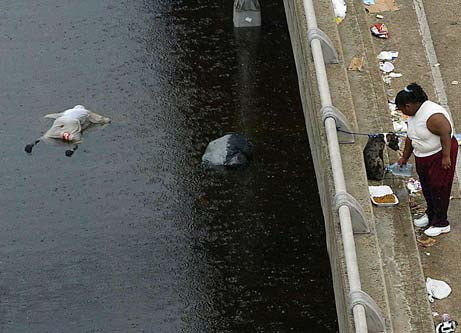
Katrina Pain Index: New Orleans Three Years Later
By Bill Quigley / August 25, 2008

0. Number of renters in Louisiana who have received financial assistance from the $10 billion federal post-Katrina rebuilding program Road Home Community Development Block Grant — compared to 116,708 homeowners.

0. Number of apartments currently being built to replace the 963 public housing apartments formerly occupied and now demolished at the St. Bernard Housing Development.

0. Amount of data available to evaluate performance of publicly financed privately run charter schools in New Orleans in 2005-2006 and 2006-2007 school years.

.008. Percentage of the rental homes that were supposed to be repaired and occupied by August 2008 which were actually completed and occupied — a total of 82 finished out of 10,000 projected.

1. Rank of New Orleans among U.S. cities in percentage of housing vacant or ruined.

1. Rank of New Orleans among U.S. cities in murders per capita for 2006 and 2007.

4. Number of the 13 City of New Orleans Planning Districts that are at the same risk of flooding as they were before Katrina.

10. Number of apartments being rehabbed so far to replace the 896 apartments formerly occupied and now demolished at the Lafitte Housing Development.

11. Percent of families who have returned to live in Lower Ninth Ward.

17. Percentage increase in wages in the hotel and food industry since before Katrina.

20-25. Years that experts estimate it will take to rebuild the City of New Orleans at current pace.

25. Percent fewer hospitals in metro New Orleans than before Katrina.

32. Percent of the city’s neighborhoods that have fewer than half as many households as they did before Katrina.

36. Percent fewer tons of cargo that move through Port of New Orleans since Katrina.

38. Percent fewer hospital beds in New Orleans since Katrina.

40. Percentage fewer special education students attending publicly funded privately run charter schools than traditional public schools.

41. Number of publicly funded privately run public charter schools in New Orleans out of total of 79 public schools in the city.

43. Percentage of child care available in New Orleans compared to before Katrina.

46. Percentage increase in rents in New Orleans since Katrina.

56. Percentage fewer inpatient psychiatric beds than before Katrina.

80. Percentage fewer public transportation buses now than pre-Katrina.

81. Percentage of homeowners in New Orleans who received insufficient funds to cover the complete costs to repair their homes.

300. Number of National Guard troops still in City of New Orleans.

1080. Days National Guard troops have remained in City of New Orleans.

1250. Number of publicly financed vouchers for children to attend private schools in New Orleans in program’s first year.

6,982. Number of families still living in FEMA trailers in metro New Orleans area.

8,000. Fewer publicly assisted rental apartments planned for New Orleans by federal government.

10,000. Houses demolished in New Orleans since Katrina.

12,000. Number of homeless in New Orleans even after camps of people living under the bridge has been resettled — double the pre-Katrina number.

14,000. Number of displaced families in New Orleans area whose hurricane rental assistance expires March 2009.

32,000. Number of children who have not returned to public school in New Orleans, leaving the public school population less than half what is was pre-Katrina.

39,000. Number of Louisiana homeowners who have applied for federal assistance in repair and rebuilding who have still not received any money.

45,000. Fewer children enrolled in Medicaid public healthcare in New Orleans than pre-Katrina.

46,000. Fewer African American voters in New Orleans in 2007 gubernatorial election than 2003 gubernatorial election.

55,000. Fewer houses receiving mail than before Katrina.

62,000. Fewer people in New Orleans enrolled in Medicaid public healthcare than pre-Katrina.

71,657. Vacant, ruined, unoccupied houses in New Orleans today.

124,000. Fewer people working in metropolitan New Orleans than pre-Katrina.

132,000. Fewer people in New Orleans than before Katrina, according to the City of New Orleans current population estimate of 321,000 in New Orleans.

214,000. Fewer people in New Orleans than before Katrina, according to the U.S. Census Bureau current population estimate of 239,000 in New Orleans.

453,726. Population of New Orleans before Katrina.

320 million. The number of trees destroyed in Louisiana and Mississippi by Katrina.

368 million. Dollar losses of five major metro New Orleans hospitals from Katrina through 2007. In 2008, these hospitals expect another $103 million in losses.

1.9 billion. FEMA dollars scheduled to be available to metro New Orleans for Katrina damages that have not yet been delivered.

2.6 billion. FEMA dollars scheduled to be available to State of Louisiana for Katrina damages that have not yet been delivered.

Bill is a human rights lawyer, a law professor at Loyola University New Orleans and author of the forthcoming book, STORMS STILL RAGING: Katrina, New Orleans and Social Justice. A version with all sources included is available.

Bill’s email is quigley77@gmail.com. For more information see the Greater New Orleans Community Data Center and Policy Link.

Source / Information Clearing House

The Rag Blog

Posted in RagBlog | Tagged , | Leave a comment

Resistance to War: It Is One Struggle

Robin Long

War Resister Robin Long Sentenced to 15 Months in Prison
By Sarah Lazare / August 25, 2008.

Robin Long, an Iraq War resister deported from Canada into U.S. military custody last month, was sentenced today to 15 months of confinement and dishonorable discharge, receiving credit for 40 days of time served.

Long’s supporters, who flooded the Fort Carson, Colorado courtroom where the court martial was held and held a vigil in his honor, expressed dismay at the harsh verdict. “It sets a very chilling precedent that someone who is brought back gets the book thrown at them,” said Ann Wright, a retired U.S. Army Colonel who publicly resigned in opposition to the invasion of Iraq and served as a witness at Long’s trial. “I hope the Canadian government recognizes that.”

Three years ago, Robin Long fled to Canada rather than fight a war in Iraq he deems immoral and illegal. On July 15th, the Canadian government forcibly returned Long to U.S. military custody, making him the first war resister deported from Canadian soil since the Vietnam War.

The Canadian government’s actions flaunt its long-standing tradition of providing safe haven for U.S. war resisters and ignore a non-binding parliamentary resolution to allow U.S. soldiers to stay in Canada.

Long is a part of a growing movement of GI resistance against the Iraq War, and his case has been met with widespread support from friends and allies throughout the United States and Canada

Court Martial

Long’s court martial was held near Colorado Springs, where he was charged with desertion “with intent to remain away permanently.” He was given the maximum time of confinement negotiated in a pre-trial agreement, despite the testimony of several supporters, including Colonel Ann Wright and Matthis Chiroux, an army journalist who recently refused to deploy to Iraq. Long’s sentence stands as one of the longest handed to an Iraq War resister.

Long gave an impassioned testimony at his trial, in which he declared that he was still convinced that he had done the right thing morally, even if he did not make the most prudent legal and tactical decisions. He said that he was glad that he did not go to Iraq but wishes that there was another option available to him other than facing court martial and confinement.

The trial was packed with Long’s supporters, including members from Iraq Veterans Against the War, Veterans for Peace, and the Peace and Justice Coalition of Colorado Springs. The courtroom was so full that many of his supporters had to wait outside. When Long stepped out of the courtroom, he was met with throngs of people who cheered him on loudly, despite being pushed across the street by military police. Long’s supporters have spent months rallying on his behalf, and Courage to Resist raised funds for his civilian lawyer, James Branum.

“I think it was a long sentence but it was positive that he got his day in court and got to speak up and say what he believed,” said Mr. Branum. “His spirits were relatively good. Having two war resisters show up at his trial meant a lot to him.”

Colonel Wright says that she is disappointed in the steep verdict, but she believes the outcome would have been far worse if Long had not received such overwhelming support. “Once soldiers are returned to military control, it is in the best interest of everyone if there is support for war resisters.

Who is Robin Long?

Born in Boise, Idaho, Robin Long was raised in a military family, playing with G.I. Joes and dreaming of one day joining the service. Upon enlisting in the Army in June 2003, the recruiter promised that Long would not be sent to Iraq. Long was excited about this chance to serve his country and finally make something with his life, and he headed off for basic training feeling he had made the right decision. “When the United States first attacked Iraq, I was told by my president that it was because of direct ties to al Qaeda and weapons of mass destruction,” Long told Courage to Resist in an interview in January. “At the time, I believed what was being said.”

Over the next few months, Long’s enthusiasm began to wane. His drill sergeant repeatedly referred to Iraqi people as “ragheads” and led the troops in racist cadences. When Long protested, he was punished by senior officers and alienated by his peers. At this point, Long began to suffer a crisis of conscience. “I was hearing on mainstream media that the U.S. was going to Iraq to get the weapons of mass destruction and to liberate the Iraqi people, yet I’m being taught that I’m going to the desert to, excuse the racial slur, ‘kill ragheads.'”

After basic training, Long was transferred to the nondeployable unit at Fort Knox. Upon meeting soldiers returning from Iraq, Long was horrified by their stories of violence and brutality. Soldiers bragged about their “first kills” and showed pictures of people they shot or ran over with tanks. “I had a really sick feeling to my stomach when I heard about these things that went on,” he said.

In 2005, Long received orders to go to Iraq. The only soldier to be deployed from his unit, Long received a month’s leave to check out of Fort Knox and report to Fort Carson, Colorado. He was scheduled to deploy to Iraq a few weeks later.

While on leave, Long educated himself about the “behind the scenes” story of the Iraq invasion. He talked to friends about whether to go through with his deployment. By his scheduled departure day, Long had made the decision not to go. He skipped his flight and stayed in a friend’s basement in Boise over the next few months. From there he caught a ride to Canada. “I knew that my conscience couldn’t allow me to go over there (to Iraq),” he said.

Long spent the next three years building a life for himself in Canada. He met a woman, had a child and established contact with other war resisters in Canada. Long applied for refugee status on the grounds that he was being asked to participate in an illegal war and would suffer irreparable harm if he returned to the United States. Not only was his bid rejected, but Canadian authorities responded by mandating that Long report his whereabouts every month. He eventually settled in Nelson, a small town in British Columbia.

Orders for Deportation

Robin Long found his new life in Canada to be increasingly precarious.

He was issued a warrant for arrest by the Canadian Border Services Agency on July 4 of this year, on the grounds that he did not adequately report his whereabouts to the authorities, and he was told a few days later that he would be deported to the United States. Long appealed the order, and his supporters rallied throughout the United States and Canada, urging Canadian authorities to let him stay. Despite these efforts, Long was deported on July 15, after the judge ruled that he would not suffer irreparable harm if returned to the United States.

Long’s family remains in Canada, and before the trial, he expressed concern about the separation, which could last a number of years. “I have a son I wouldn’t be able to see. It’s kind of hard to think about that,” he told Courage to Resist.

Canada is home to an estimated 200 U.S. soldiers refusing to serve in the Iraq War, and 64 percent of Canadians favor granting them permanent residence, according to a June 27 Angus Reid Strategies poll. The Canadian House of Commons passed a non-binding resolution June 3rd, calling for a stop to the deportation of U.S. soldiers and allowing them to apply for permanent residency in Canada, but the resolution was ignored by the conservative Harper administration. Several other war resisters living in Canada face the immediate threat of deportation, including Jeremy Hinzman, who received a deportation order for September 23rd.

“We would hope that the Canadian government allow the men and women who refuse to fight a war that Canadians also refuse to fight to stay up there, especially after seeing the heavy punishment that Robin Long faces,” said Ann Wright.

A Growing Movement Against the War

The high profile of Long’s case is also a sign of the growing significance of the GI movement against the Iraq War. As the war effort becomes increasingly unpopular, more and more soldiers are speaking publicly against the invasion and refusing to serve out their contracts, with high-ranking military officials like Ehren Watada publicly denouncing military atrocities, despite facing harsh penalties for doing so.

Meanwhile, Iraq War veterans are teaming up with war resisters and other civilian and veteran supporters to build the GI movement against the war. Iraq Veterans Against the War, whose membership consists of people who have served in the U.S. military since September 11th, 2001, has been active in supporting Long and other war resisters. Several other groups, such as Courage to Resist and the War Resisters Support Campaign (Canada), have risen to support soldiers willing to take a stand. The orders for Long’s deportation were met with protests throughout the United States and Canada.

“Veterans and war resisters are beginning to see that they are in the same boat, that they are brothers and sisters, and it is one struggle,” said Gerry Condon, a Vietnam War resister and active supporter of the GI movement against the Iraq War. “The fact that people are showing this kind of solidarity with each other is really profound. Resistance within the military is certainly growing.”

Source / AlterNet

The Rag Blog

Posted in RagBlog | Tagged , , , | Leave a comment

What Are We So Afraid Of?


Canadian border no longer invisible in Vermont
Keith B. Richburg / August 24, 2008

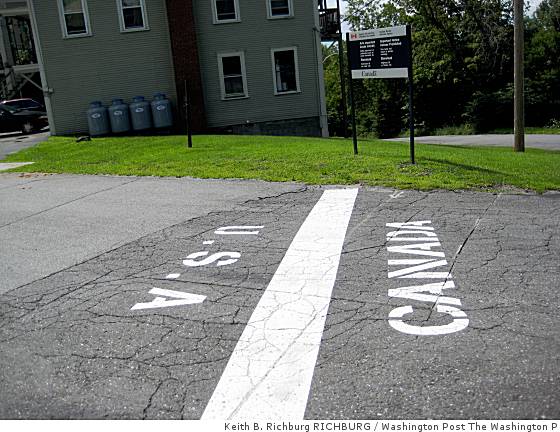
DERBY LINIE, Vt. — The changes started coming slowly to this small town where the U.S. border with Canada runs across sleepy streets, through houses and families, and smack down the middle of the shared local library.

First was the white, painted lettering on the pavement on three little side streets – “Canada” on one side, “U.S.A.” on the other. Then came the white pylons denoting which side of the border was which. After that, signboards were erected on some streets, ordering drivers to turn back and use an officially designated entry point.

And along with the signposts came an influx of American Border Patrol agents, cruising through the town in their sport-utility vehicles with sirens, chasing down cars and mopeds that ignored the posted warnings.

For longtime residents accustomed to a simpler life that flowed freely across a largely invisible border, the final shock – and what made most people really take notice – was a proposal by the border agents last year to erect fences on the small streets to officially barricade Derby Line from Stanstead, Quebec, and neighbor from neighbor.

“They’re stirring up a little hate and discontent with that deal,” said Claire Currier, who grew up in this border area and works at Brown’s Drug Store, which has operated on the same spot since 1884. “We’ve all intermingled for years.”

For the Department of Homeland Security, the changes are part of a gradual fortification of America’s northern border that began shortly after the Sept. 11, 2001, terrorist attacks and has accelerated in recent years.

The hardening of the northern frontier is unsettling to many in the small towns along the border. For as long as most of these people can remember, the line between the United States and Canada has been little more than a historic curiosity, rather than the hard and fast demarcation that is America’s southern border.

Named the Secure Border Initiative, the project calls for more than tripling the number of agents along the northern border, adding boats and helicopters, and deploying sophisticated new technology including hundreds of millions of dollars in new communications equipment, radiation detectors and three different types of camera-mounted sensors in the uninhabited wooded areas.

“It was freer before, but we live in a different world now,” said agent Mark Henry, the operations officer at the Border Patrol’s Swanton Sector, headquartered in Swanton, Vt. The sector encompasses about 24,000 square miles, extending from the town of Champlain, in upstate New York, on the east all the way across to the border with Maine. The sector now has 250 agents, up from 180 three years ago, and the number is scheduled to reach 300 next year. In 2001, there were 340 agents along the entire border with Canada.

“9/11 changed everything,” said Border Patrol agent Fernando Beltran, the operations chief for Swanton Sector’s Newport station, which includes Derby Line. “This may have been Mayberry before, but it’s not anymore.”

Residents of this town of 776 understand the need for enhanced security. They also wistfully remember a time when neighbors easily crossed into another country to visit neighbors. People went to church and to school on either side of the line. Members of the same family lived on either side. Some streets, an old factory, the local library and opera house, and a few houses straddle the line.

“I have one brother – he’s American. He was born on the U.S. side. I was born on the Canadian side,” said Arthur Brewer, who is 76. “It was like there was no border.”

Townsfolk are concerned about practical issues with fences. The two sides share a water system, a sewer system and snow-removal services. For years, the fire departments of both sides have helped each other without regard to a border, and fences, they fear, might disrupt travel routes for emergency vehicles.

“It hasn’t been an easy issue for either side to digest,” said lifelong resident Karen Jenne, the Derby Line town clerk and treasurer. “But we understand that Border Patrol and Homeland Security have a job to do.”

The new vigilance has led to more arrests of people crossing illegally and interdiction of contraband, mostly drugs. Border agents in this sector said that last year they arrested people from 117 different countries trying to enter the United States illegally.

The resources here are still a small fraction of what is deployed on the southern border with Mexico. But with the increased Border Patrol presence, the North is starting to look more like what border residents of Texas, California and Arizona have been seeing for years.

Source / San Francisco Chronicle

The Rag Blog

Posted in RagBlog | Tagged , , | 1 Comment

Slow Food Nation : You Are What You Eat


The Slow Food Nation gathering promises to be a Woodstock for food lovers and enviros concerned with our food system.
By Kerry Trueman / August 25

SAN FRANCISCO — A swarm of 40,000 to 50,000 locavores will descend on San Francisco this Labor Day weekend to attend Slow Food Nation, a four-day extravaganza of teach-ins and tastings that’s being billed as a kind of “Woodstock for gastronomes.”

I’d rather go to a Woodstock for garden gnomes, myself — at least those Lilliputian lawn ornaments share my fondness for front yard farming. Gastro gnomes, on the other hand, sound like elitist elves who are overly fond of artisanal cheeses and grass-fed beef. Do we really need a celebration of such highfalutin culinary novelties at a time when high fuel and food costs are making it harder for people to keep their pantries stocked with even the most basic staples?

Well, yes, we do, because we need to remember that the fresh, unadulterated, minimally processed, locally produced foods that Slow Food Nation is showcasing were our pantry staples, before the military-industrial complex annexed our food chain a half a century or so ago in the name of progress.

Our great-grandparents would be flabbergasted to learn that grass-fed milk in glass bottles bearing the local dairy farm’s logo is now a rare luxury item available to only the affluent few who are willing to pay $4 for a half-gallon of milk.

Back in the day, our breads were fresh-baked and free of high fructose corn syrup, and our eggs and bacon came from chickens and hogs that rolled around in the dirt and saw the light of day. The word “farm” still evokes nostalgic pastoral images for most Americans, but there’s nothing even remotely benign or bucolic about the fetid, brutal factory farms that supply us with most of our meat, poultry, eggs and dairy products today. And unmasking this unsavory reality is as much a part of Slow Food Nation’s agrarian agenda as dishing out local delicacies.

So don’t be distracted by the aroma of wood-fired focaccia wafting from the Fort Mason Center “Taste Pavilions”; Slow Food Nation has the potential to spark a crucial dialogue about where our food comes from, how it’s grown, and why all that matters. With forums featuring the good food movement’s marquee names, including Wendell Berry, Vandana Shiva, Michael Pollan, Marion Nestle and Eric Schlosser, this Alice Waters-sponsored shindig could be the watershed event that puts America’s foodsheds on the map.

Don’t know what a “foodshed” is? Don’t worry, nobody else does, either — the word is still so obscure it hasn’t earned an entry on Wikipedia. It means, essentially, the area through which food travels to get from the farm to your plate. That would have been a pretty short trip a few generations ago, but in this era of globalization, our foodshed now encompasses the whole world, more or less.

This far-flung food chain has enslaved us with a false sense of abundance, turning the produce aisles of our supermarkets into a seasonless place where you can find berries and bell peppers all year round. But this apparent bounty diverts us from the fact that industrial agriculture has actually drastically reduced the diversity of the foods that our farmers grow.

As small and mid-size farms got swallowed up by the massive monoculture operations we now call “conventional,” the varieties of fruits and vegetables grown on those farms got whittled down to just those few that shipped the best and had the longest shelf life. Breeders chose to focus on species of livestock and poultry that fatten up the fastest, such as big-breasted but bland Butterball turkeys so top-heavy they can’t reproduce naturally and have to be artificially inseminated. For this we give thanks each November?

This focus on economies of scale, and the illusory “efficiency” of a food system dependent on cheap fossil fuels and perpetual subsidies, gave us, the richest nation in the world, the cheapest food. And we are all the poorer for it.

Along the way, we lost hundreds of different kinds of plants and animals; currently, “at least 1,060 food varieties unique to North America are threatened, endangered or functionally extinct in the marketplaces of the United States, Canada, and northern Mexico,” Gary Paul Nabhan writes in Renewing America’s Food Traditions, a new book that celebrates the distinctive culinary regions of our country that Agribiz almost obliterated in recent decades.

But Renewing America’s Food Traditions is not just a book; it’s an alliance: Called RAFT for short, it’s a collaborative effort from Slow Food USA and six other sustainably minded organizations. RAFT’s mission is to inspire what the folks at Slow Foods USA call “eater-based conservation” by preserving and promoting the culinary heritage and extraordinary biodiversity that blessed this country for centuries before we shifted gears and became a fast food nation.

Nabhan is participating in a Slow Food Nation forum, “Re-Localizing Food,” along with Pollan, Dan Barber and Winona LaDuke, but this powerhouse panel is, alas, already sold out, along with most of the other forums featuring the rock stars of the real food movement.

Thankfully, the Slow Food Nation folks are offering some free events and exhibits, too, including the Marketplace, which promises “to transform San Francisco’s Civic Center Plaza into an urban garden, farmers market, outdoor food bazaar and soapbox,” and the Slow Food Nation Victory Garden in front of City Hall, whose impressive array of organic heirloom vegetables is being donated to local food banks.

In keeping with its goal to promote all things sustainable, Slow Food Nation aspires to be a “zero waste event:” In addition to recycling and composting food waste, plates, flatware and packaging, Slow Food Nation is joining forces with Food and Water Watch to banish bottled water from the four-day festival. Echoing Food and Water Watch’s Take Back the Tap campaign, the event will instead offer five tap water stations where folks can refill their water bottles — or, if you didn’t bring your own, you can buy a reusable, eco-friendly stainless steel canteen.

Not content to just spare us the spectacle of 50,000 good food fanatics washing down all those sustainable snacks with bottled water, Food and Water Watch has posted a much-needed guide on its Web site for the rest of us on how to “Free Your Event From Bottled Water.” Pair this with Slow Food Nation’s Declaration for Healthy Food and Agriculture, to be unveiled on Aug. 28 at San Francisco’s City Hall, and you’ve got a virtual road map to a real revolution, even if you’re not going to San Francisco.

Source / AlterNet

Thanks to David Hamilton / The Rag Blog

Posted in RagBlog | Tagged , , , , , | 1 Comment

Cyndi Lauper on Obama’s Brand of Hope : One Size Fits All


‘We as a society, LGBT or straight, can show that civil rights are important and discrimination is wrong across the board through our vote.’
By Cyndi Lauper / August 24, 2008

As I toured all over the country this summer with True Colors, I saw something in the eyes of the audience I have not seen in a very long time, it was hope. Each night as I talked about the power of voting, it was evident through their reactions that the crowd wanted to change how this country is run. That is the one good thing that President Bush has done in the past seven years, he has created a movement within the country to change how things are done in Washington DC. But, what mattered to me the most is that everyone cared enough about their own lives and the future to register and vote.

I believe we are at a crossroads and the next ten years will determine the future of this country. Like I said from the stage, this is not voting for the American Idol, it is much more important, this is voting for the American President. And now that I’m home again, and off stage, I wonder, will we become the country that respects the diversity that is our backbone or will we continue down this path of the few ruling the many? I wonder to myself are we gonna make that change in a big way and when I think about it I believe that the change can happen in the form of Senator Barack Obama.

Because, America is a quilt of many fabulous fabrics and we have a sorted history that has not always respected that. And because, for far too long groups of people have been singled out and discriminated against simply because of such things as the color of their skin, their religious beliefs or whom they love. And, that these very acts undermine the basic principles this country was founded on, the time has come to finally break down the barriers that keep America from fulfilling its destiny.

In particular, the lesbian, gay, bisexual and transgender community is closer than ever to gaining full equality. We are teetering back and forth right now, and we need to act together to push us in the right direction. What we are asking for is only fair and right. We as a society, LGBT or straight, can show that civil rights are important and discrimination is wrong across the board through our vote. I believe by voting for Barack Obama we will do just that.

Like Obama, I grew up with a loving, hard-working single mom, in a neighborhood mixed with all races and different backgrounds. And like Obama, I knew that was our strength and not our weakness.

I see in Barack Obama a real fighter for fairness and inclusion, a person who overcame every obstacle growing up to achieve an education and to become the leader he is today. He battles against discrimination of all kinds, from race and gender to sexual orientation and gender identity. He is the most inclusive candidate who has a real chance at the White House that we ever have had. He is a true American who commands respect and more importantly respects Americans – all of us.

I believe that a President Obama would deliver on the promises that have been made to the LGBT community for so long, like inclusive workplace non-discrimination legislation, the end of “Don’t Ask, Don’t Tell”, and finally the passage of hate crimes legislation that includes everyone, not just some. It saddens me in ways I cannot begin to describe just to know that hate crimes still occur in our society. Under President Obama, the Matthew Shepard Hate Crimes Act will finally become law.

When I talk to young people I believe the time has come. It reminds me of my generation in the 1960’s who made a promise to make the world better. The young people today have dedicated themselves as well to this goal and have truly embraced change. They are working harder than ever to elect Barack Obama President because he is a voice of a new and more imaginative generation. They are hungry for new ways of thinking, and to put away old labels, fears, prejudices and bigotries. They believe you can change the world one person at a time. And so do I.

Simply look around, and talk to every young voter you meet, and then vote because you care what happens to them and you care what happens to the world and this country. We all deserve better.

Lastly, I implore you to share your lives with the people you love and care about. Your vote is powerful, but the work cannot end there. Americans are mostly fair-minded people, but are disconnected from the everyday struggles of your life. We are one society and if we are disconnected we fall, but connected we stand tall. If you want people to understand the reality of being LGBT in society today, you need to share your story.

If you are LGBT, share with them the discrimination you still face in America, and if you are a straight ally, share with them the discrimination you have seen inflicted upon your friends and family. Explain that discrimination not only affects the one it is directed towards, but it affects us all. Show through your example what LGBT people truly are like and break down the misconceptions and stereotypes that fuel the prejudices that have plagued our community and society for far too long.

I am an example of what can happen when you share your story. When my sister Elen came out to me and told me about her life, my eyes were opened to the fact that I needed to be a part of changing this country for the LGBT community and have taken that responsibility very seriously.

So, the time has come to stand up and use your voice. It is time that we push ourselves over the edge towards full equality. It is time that we have a President who will work for us and not against us.

All my best,
Cyndi Lauper

Source / The Huffington Post

The Rag Blog

Posted in RagBlog | Tagged , , , , , , | Leave a comment

We Are Propelled Forward By Fear

An Afghan soldier stands near a destroyed vehicle after an explosion on the outskirts of Kabul. Photo: AP photo / Rafiq Maqbool

Pouring Gas on the Afghanistan Bonfire
By Chris Hedges / August 25, 2008

The wars in Iraq and Afghanistan grind forward with their terrible human toll, even as the press and many Americans play who gets thrown off the island with Barack Obama. Coalition forces carried out an airstrike that killed up to 95 Afghan civilians in western Afghanistan on Friday, 50 of them children, President Hamid Karzai said. And the mounting bombing raids and widespread detentions of Afghans are rapidly turning Afghanistan into the mirror image of Iraq. But these very real events, which will have devastating consequences over the next few months and years, are largely ignored by us. We prefer to waste our time on the trivia and gossip that swallow up air time and do nothing to advance our understanding of either the campaign or the wars fought in our name.

As the conflict in Afghanistan has intensified, so has the indiscriminate use of airstrikes, including Friday’s, which took place in the Azizabad area of Shindand district in Herat province. The airstrike was carried out after Afghan and coalition soldiers were ambushed by insurgents while on a patrol targeting a known Taliban commander in Herat, the U.S. military said. Hundreds of Afghans, shouting anti-U.S. slogans, staged angry street protests on Saturday in Azizabad to protest the killings, and Karzai condemned the airstrike.

The United Nations estimates that 255 of the almost 700 civilian deaths in fighting in Afghanistan this year have been caused by Afghan and international troops. The number of civilians killed in fighting between insurgents and security forces in Afghanistan has soared by two-thirds in the first half of this year.

Ghulam Azrat, the director of the middle school in Azizabad, said he collected 60 bodies after the bombing.

“We put the bodies in the main mosque,’’ he told the Associated Press by phone, sometimes pausing to collect himself as he wept. “Most of these dead bodies were children and women. It took all morning to collect them.”

Azrat said villagers on Saturday threw stones at Afghan soldiers who arrived and tried to give out food and clothes. He said the soldiers fired into the crowd and wounded eight people, including one child.

“The people were very angry,” he said. “They told the soldiers, ‘We don’t need your food, we don’t need your clothes. We want our children. We want our relatives. Can you give [them] to us? You cannot, so go away.’ ”

We are in trouble in Afghanistan. Sending more soldiers and Marines to fight the Taliban is only dumping gasoline on the bonfire. The Taliban assaults, funded largely by the expanded opium trade, are increasingly sophisticated and well coordinated. And the Taliban is exacting a rising toll on coalition troops. Soldiers and Marines are now dying at a faster rate in Afghanistan than Iraq. In an Aug. 18 attack, only 30 miles from the capital, Kabul, the French army lost 10 and had 21 wounded. The next day, hundreds of militants, aided by six suicide bombers, attacked one of the largest U.S. bases in the country. A week before that, insurgents killed three foreign aid workers and their Afghan driver, prompting international aid missions to talk about withdrawing from a country where they already have very limited access.

Barack Obama, like John McCain, speaks about Afghanistan in words that look as if they were penned by the Bush White House. Obama may call for withdrawing some U.S. troops from Iraq, but he does not want to send them all home. He wants to send them to Afghanistan, or to what he obliquely terms “the right battlefield.” Obama said he would deploy an additional 10,000 troops to Afghanistan once he took office.

The seven-year war in Afghanistan has not gone well. An additional 3,200 Marines were deployed there in January. Karzai’s puppet government in Kabul controls little territory outside the capital. And our attempt to buy off tribes with money and even weapons has collapsed, with most tribal groups slipping back into the arms of the Taliban insurgents.

Do the cheerleaders for an expanded war in Afghanistan know any history? Have they studied what happened to the Soviets, who lost 15,000 Red Army soldiers between 1979 and 1988, or even the British in the 19th century? Do they remember why we went into Afghanistan? It was, we were told, to hunt down Osama bin Laden, who is now apparently in Pakistan. Has anyone asked what our end goal is in Afghanistan? Is it nation-building? Or is this simply the forever war on terror?

Al-Qaida, which we have also inadvertently resurrected, is alive and well. It still finds plenty of recruits. It still runs training facilities. It still caries out attacks in London, Madrid, Iraq and now Afghanistan, which did not experience suicide bombings until December 2005. Al-Qaida has moved on. But we remain stuck, confused and lashing about wildly like a wounded and lumbering beast.

We do not have the power or the knowledge, nor do we have the right under international law, to occupy Iraq and Afghanistan. We are vainly trying to transplant to these countries a modern system of politics invented in Europe. This system is characterized by, among other things, the division of the Earth into independent secular states based on national citizenship. The belief in a secular civil government is to most Afghans and Iraqis an alien creed. It will never work.

We have blundered into nations we know little about. We are caught between bitter rivalries among competing ethnic and religious groups. We have embarked on an occupation in Iraq and Afghanistan that is as damaging to our souls as it is to our prestige and power and security. And we believe, falsely, that because we have the capacity to wage war we have the right to wage war.

We divert ourselves in our dotage and decline with images and slogans that perpetuate fantasies about our own invulnerability, our own might, our own goodness. We are preoccupied by national trivia games that pass for news, even as the wolf pants at our door. These illusions blind us. We cannot see ourselves as others see us. We do not know who we are.

“We had fed the heart on fantasies,” William Butler Yeats wrote, “the heart’s grown brutal from the fare.”

We are propelled forward not by logic or compassion or understanding but by fear. We have created and live in a world where violence is the primary form of communication. We have become the company we keep. Much of the world—certainly the Muslim world, one-fifth of the world’s population, most of whom are not Arab—sees us through the prism of Iraq, Afghanistan and Palestine. We are igniting the dispossessed, the majority of humanity who live on less than two dollars a day. And whoever takes the White House next January seems hellbent on fueling our self-immolation.

Chris Hedges’ column, now weekly, appears Mondays on Truthdig.

Source / TruthDig

The Rag Blog

Posted in RagBlog | Tagged , | Leave a comment

Junior’s Endless Litany of Broken Promises

Iraqi child runs for water when the truck appears

After 5 years of war, Iraqis desperate for water
By Missy Ryan and Sattar Rahim / August 24, 2008

BAGHDAD, Aug 24 (Reuters) – At a communal water station in a Baghdad slum, a young boy’s skinny arms fly up and down as he uses a bicycle pump to coax water from the dry ground.

His efforts produce a languid stream that will tide over his family — and the families of the children waiting near him to fill their cooking pots — until the next day.

This is a daily ritual for millions of Iraqis who lack access to sufficient clean water and proper sewage five years after the U.S.-led invasion to topple Saddam Hussein.

Water and sewage are perennial challenges in this arid country, where the overhaul of decrepit public works has been hindered by years of war and neglect.

Nearly a billion litres of raw sewage is dumped into Baghdad waterways each day — enough to fill 370 Olympic-sized pools.

The United Nations estimates that less than half of Iraqis get drinking water piped into their homes in rural areas. In the capital, people set their alarm clocks to wake them in the middle of the night so they can fill storage tanks when water pressure is under less strain.

New investments in water and sanitation are only slowly bearing fruit even as Iraq seeks to capitalise on a dramatic drop in violence over the past year.

Iraqi and U.S. officials have been working to refurbish existing water plants, distribution lines and sewage works, but they say major infrastructure improvements will take years.

Since 2003, the United States has spent about $2.4 billion on Iraq’s water and sanitation sector, and the Iraqi government has now taken over funding major construction. But the World Bank estimates that at least $14 billion is needed.

In the apartment bloc where Suhad Mohammed lives in eastern Baghdad, water pressure is so weak that water doesn’t reach the top floors. Each morning, her husband and son help her fill plastic jugs from a communal tap downstairs and lug them up several flights of stairs.

“It gets even more complicated in the summer,” she said.

The shortages are also causing health problems.

Acute cases of diarrhoea are three times more common in eastern Baghdad, where water service is most problematic, than in the rest of the city, the United Nations says. That side of the city has also seen a higher incidence of cholera.

OUT OF SIGHT, OUT OF MIND

Officials say the water system was neglected for decades under Saddam Hussein and was ill-equipped to keep pace with a rapidly growing population in the Iraqi capital.

Electricity, which flickers on in Baghdad for just a few hours a day, is another major problem. Back-up power systems at water plants are not designed to operate as often as they do.

“Every power cut, even if it lasts for just a few minutes, delays water production by three hours,” said Sadiq al-Shimari, director general of water facilities for Baghdad.

He said water production now amounts to about 2.8 million cubic metres a day in Baghdad, still far below daily demand of 4 million cubic metres.

The state of Baghdad’s sewage system may be even more bleak.

“Out of sight and out of mind,” an official at the U.S. embassy said on condition of anonymity. “There wasn’t a lot of focus from the (former) regime on the long-term consequences of dumping raw sewage onto river banks,” he said.

The United Nations says that sewage seeping and being dumped into water supplies has “grave implications” for Iraqis’ health and the environment.

Waste and illicit use of water supplies abound, too, as they do in electricity distribution and other basic services.

“We have people illegally siphoning water from the pipelines, using potable water to irrigate their gardens and fill their fish pools,” complained one Baghdad official.

“Even water used by car washes — this wasted water could be used in areas already suffering from shortages.”

NO OTHER CHOICE

At the northern edge of Sadr City, a poor, largely Shi’ite area, a man named Ali points across a dusty, trash-strewn yard to the murky canal where he and his children bathe.

“The water is dirty, but what can we do? We don’t have any other choice,” he says, laughing bitterly.

“People like us, who earn three or four dollars a day, we spend it all on generators,” he said, referring to the informal network of neighbourhood diesel generator operators who supply Baghdad’s electricity when the power goes out.

The recently opened Sadr City water treatment plant, still in its pilot phase, is expected to provide a major boost to the city’s water supply once it is operating fully.

Other government renovation and construction projects are underway, and city officials say the volume of water moving through the system has already increased substantially.

“As soon as you build new plants, and you lay down new networks, you will be able to service more people,” another U.S. official said. “It’s as simple as that, but it takes time.”

In the meantime, the government, the United Nations, and some aid groups dispense water from trucks in some of the neediest areas of Baghdad, said Vinod Alkari, a water and sanitation expert with the United Nations Children’s Fund.

The Iraqi government has been criticised for dragging its feet in spending money budgeted for vital reconstruction.

“Now they apparently have enough resources, and they’re slowly moving toward using those resources,” Alkari said.

“But the task is immense. Even with all the money in the world, it would still take time.”

(Additional reporting by Wisam Mohammed, Aws Qusay, Aseel Kami and Khalid-al Ansary; writing by Missy Ryan; editing by Clar Ni Chonghaile)

Source / Reuters

The Rag Blog

Posted in RagBlog | Tagged , | 3 Comments