BOOKS : Bob Dylan’s Poetic Pause in Hollywood on the Way to Folk Music Fame

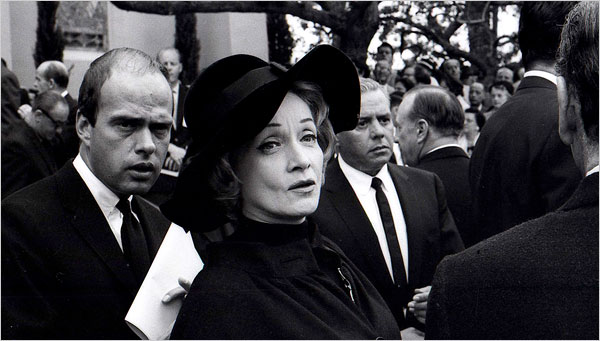
‘T dare not ask your sculpturer’s name/with glance back hooked, time’s hinges halt.’ BOB DYLAN From a text in “Hollywood Foto-Rhetoric: The Lost Manuscript,” accompanying a photo of Marlene Dietrich at Gary Cooper’s funeral in 1961. Photo by Barry Feinstein / from Simon & Schuster.

New book, ‘Hollywood Foto-Rhetoric: The Lost Manuscript’ by Barry Feinstein, features recently discovered Bob Dylan prose poems.
By Julie Bosman / August 15, 2008

Barry Feinstein, the rock ’n’ roll photographer, was digging through his archives last year when he came across a long-forgotten bundle of pictures, dozens of dark, moody snapshots of Hollywood in the early 1960s.

And tucked next to the photographs was a set of prose poems, written around the same time by an old friend: Bob Dylan.

“It was the lost manuscript,” Mr. Feinstein recalled in a telephone interview from his home in Woodstock, N.Y. “Everybody forgot about it but me.”

The poems were so lost that Mr. Dylan, when told of the discovery, had forgotten that he had written them. (In his defense, it was the ’60s.)

But after languishing in storage for more than 40 years, the text and photographs will be published in November in a collection titled “Hollywood Foto-Rhetoric: The Lost Manuscript.”

It is the latest installment in Mr. Dylan’s seemingly never-ending body of work, which includes more than 50 albums, a critically acclaimed autobiography and a recently published collection of arty sketches called “Bob Dylan: The Drawn Blank Series.”

The new book, to be published by Simon & Schuster, includes more than 75 of Mr. Feinstein’s photographs and 23 of Mr. Dylan’s prose poems, which are each marked alphabetically to correspond to a photo.

The book was created during a period in the 1960s when Mr. Feinstein was a 20-something “flunky” at a movie studio, he said, having arrived in Hollywood eager to be part of the industry and having landed a job working for Harry Cohn, the legendarily abrasive president of Columbia Pictures.

“I was living in California, in Hollywood, working at the studio, and I thought there was something there journalistically in taking these pictures that were not at all glamorous,” Mr. Feinstein said. “They were really the dark side of glamour.”

He roamed around movie sets, snapping pictures backstage and in dressing rooms, and during off hours he drove around Hollywood with his camera in tow.

The result is a collection of pictures that are sometimes dreary and sometimes tongue-in-cheek, shots of movie props and roadside stands, topless starlets and headless mannequins. In one photo a young woman, visible only from the ankles down, crouches on Sophia Loren’s star on the Hollywood Walk of Fame, a hand pressed onto the cement. In another photo a parking lot at 20th Century Fox, marked by a large sign for “Talent,” is completely empty.

After assembling the photographs, Mr. Feinstein thought of Mr. Dylan, whom he had met before on the East Coast. “I asked him as a joke, ‘Wanna come out and maybe write something about these photographs?’ ” Mr. Feinstein said. “So he came out and wrote some text.”

Mr. Dylan, then in his 20s, arrived in Hollywood, examined the photographs and wrote his own prose poems to accompany them.

No one involved in the book can recall exactly when Mr. Dylan wrote the poems, which are by turns sparse, playful, witty and sarcastic. But the words faintly recall “Tarantula,” Mr. Dylan’s book of prose poems (or “Dadaist novel,” as some would call it) that was written in 1966, and they bear a strong resemblance to the “11 Outlined Epitaphs” in the liner notes of “The Times They Are A-Changin,” his 1964 album.

As the “11 Outlined Epitaphs” begin:

“I end up then

in the early evenin’

blindly punchin’ at the blind

breathin’ heavy

stutterin’

an’ blowin’ up

where t’ go?

what is it that’s exactly wrong?

The “Foto-Rhetoric” poems use similar punctuation and style. In the text accompanying a photo of Marlene Dietrich appearing stricken at Gary Cooper’s funeral in 1961, Mr. Dylan wrote: “t dare not ask your sculpturer’s name/with glance back hooked, time’s hinges halt.”

After the photos and text were pulled together into a rough manuscript, Mr. Dylan and Mr. Feinstein took it to a publisher, Macmillan, where executives expressed interest but were afraid that the pictures would bring a lawsuit from the studio.

So the manuscript was put aside, and Mr. Feinstein kept it for more than four decades in his vast collection of photographs, books and other papers.

“I knew it was an important document,” he said. “So I kept it in the back of my head all that time.”

Mr. Feinstein went on to develop a close collaboration with Mr. Dylan. He shot the cover photo for “The Times They Are A-Changin,” and dozens of photos of Mr. Dylan throughout the years.

Through his manager, Jeff Rosen, Mr. Dylan declined to comment on the book, and he is not expected to promote it.

But at 67, Mr. Dylan is just as prolific as ever, writing, touring and releasing albums. Just this week, he performed in Prospect Park, Brooklyn, and in October he is expected to release another collection of songs, “Tell Tale Signs: The Bootleg Series Vol. 8.”

“Hollywood Foto-Rhetoric” is the fourth book that David Rosenthal, the publisher of Simon & Schuster, has worked on with Mr. Dylan, including “Chronicles: Volume One,” his 2004 memoir, which sold nearly 750,000 copies.

“They’re lyrical, they’re funny, they’re singular,” Mr. Rosenthal said of the prose poems. “And everybody looking at them, when we first saw them, knew they could be by no one other than Bob.”

David Remnick, the editor of The New Yorker, said that this fall the magazine will publish two of the poems and perhaps a photograph or two.

Christopher Ricks, a professor of the humanities at Boston University and the author of “Dylan’s Visions of Sin,” an admiring study of Mr. Dylan, noted the contrast between the Hollywood book, in its black-and-white starkness, and Mr. Dylan’s most recent book, the collection of cheerful, brightly colored paintings.

“From the beginning, he’s been a mixed medium artist,” Mr. Ricks said. “He’s never been a straight linear person. He’s had a whole lot of miscellany.”

Source / New York Times

Preorder Hollywood Foto-Rhetoric: The Lost Manuscript by Barry Feinstein at Amazon.com.

Thanks to Harry Edwards / The Rag Blog

Posted in RagBlog | Tagged , , , , , | Leave a comment

Pat Buchanan : Blowback From Bear-Baiting

Raging Bear: Vladimir Putin.

‘Saakashvili’s blunder probably means permanent loss of South Ossetia and Abkhazia.’
By Pat Buchanan / August 15, 2008

Mikheil Saakashvili’s decision to use the opening of the Olympic Games to cover Georgia’s invasion of its breakaway province of South Ossetia must rank in stupidity with Gamal Abdel-Nasser’s decision to close the Straits of Tiran to Israeli ships.

Nasser’s blunder cost him the Sinai in the Six-Day War. Saakashvili’s blunder probably means permanent loss of South Ossetia and Abkhazia.

After shelling and attacking what he claims is his own country, killing scores of his own Ossetian citizens and sending tens of thousands fleeing into Russia, Saakashvili’s army was whipped back into Georgia in 48 hours.

Vladimir Putin took the opportunity to kick the Georgian army out of Abkhazia, as well, to bomb Tbilisi and to seize Gori, birthplace of Stalin.

Reveling in his status as an intimate of George Bush, Dick Cheney and John McCain, and America’s lone democratic ally in the Caucasus, Saakashvili thought he could get away with a lightning coup and present the world with a fait accompli.

Mikheil did not reckon on the rage or resolve of the Bear.

American charges of Russian aggression ring hollow. Georgia started this fight — Russia finished it. People who start wars don’t get to decide how and when they end.

Russia’s response was “disproportionate” and “brutal,” wailed Bush.

True. But did we not authorize Israel to bomb Lebanon for 35 days in response to a border skirmish where several Israel soldiers were killed and two captured? Was that not many times more “disproportionate”?

Russia has invaded a sovereign country, railed Bush. But did not the United States bomb Serbia for 78 days and invade to force it to surrender a province, Kosovo, to which Serbia had a far greater historic claim than Georgia had to Abkhazia or South Ossetia, both of which prefer Moscow to Tbilisi?

Is not Western hypocrisy astonishing?

When the Soviet Union broke into 15 nations, we celebrated. When Slovenia, Croatia, Macedonia, Bosnia, Montenegro and Kosovo broke from Serbia, we rejoiced. Why, then, the indignation when two provinces, whose peoples are ethnically separate from Georgians and who fought for their independence, should succeed in breaking away?

Are secessions and the dissolution of nations laudable only when they advance the agenda of the neocons, many of who viscerally detest Russia?

That Putin took the occasion of Saakashvili’s provocative and stupid stunt to administer an extra dose of punishment is undeniable. But is not Russian anger understandable? For years the West has rubbed Russia’s nose in her Cold War defeat and treated her like Weimar Germany.

When Moscow pulled the Red Army out of Europe, closed its bases in Cuba, dissolved the evil empire, let the Soviet Union break up into 15 states, and sought friendship and alliance with the United States, what did we do?

American carpetbaggers colluded with Muscovite Scalawags to loot the Russian nation. Breaking a pledge to Mikhail Gorbachev, we moved our military alliance into Eastern Europe, then onto Russia’s doorstep. Six Warsaw Pact nations and three former republics of the Soviet Union are now NATO members.

Bush, Cheney and McCain have pushed to bring Ukraine and Georgia into NATO. This would require the United States to go to war with Russia over Stalin’s birthplace and who has sovereignty over the Crimean Peninsula and Sebastopol, traditional home of Russia’s Black Sea fleet.

When did these become U.S. vital interests, justifying war with Russia?

The United States unilaterally abrogated the Anti-Ballistic Missile treaty because our technology was superior, then planned to site anti-missile defenses in Poland and the Czech Republic to defend against Iranian missiles, though Iran has no ICBMs and no atomic bombs. A Russian counter-offer to have us together put an anti-missile system in Azerbaijan was rejected out of hand.

We built a Baku-Tbilisi-Ceyhan pipeline from Azerbaijan through Georgia to Turkey to cut Russia out. Then we helped dump over regimes friendly to Moscow with democratic “revolutions” in Ukraine and Georgia, and tried to repeat it in Belarus.

Americans have many fine qualities. A capacity to see ourselves as others see us is not high among them.

Imagine a world that never knew Ronald Reagan, where Europe had opted out of the Cold War after Moscow installed those SS-20 missiles east of the Elbe. And Europe had abandoned NATO, told us to go home and become subservient to Moscow.

How would we have reacted if Moscow had brought Western Europe into the Warsaw Pact, established bases in Mexico and Panama, put missile defense radars and rockets in Cuba, and joined with China to build pipelines to transfer Mexican and Venezuelan oil to Pacific ports for shipment to Asia? And cut us out? If there were Russian and Chinese advisers training Latin American armies, the way we are in the former Soviet republics, how would we react? Would we look with bemusement on such Russian behavior?

For a decade, some of us have warned about the folly of getting into Russia’s space and getting into Russia’s face. The chickens of democratic imperialism have now come home to roost — in Tbilisi.

Copywright 2008 Creators Syndicate Inc.

Source / Creators.com

Thanks to Carl Davidson / The Rag Blog

Posted in RagBlog | Tagged , , , , | 1 Comment

Dem Convention Protesters Call Makeshift Jail ‘Gitmo On Platte’


Police build massive ‘holding cell’ inside warehouse
By Russell Haythorn / August 16, 2008

DENVER — The discovery of a makeshift jail in Denver’s warehouse district is causing outrage among some protesters.

The jail was apparently constructed to house protesters during the Democratic National Convention but the city never publicly announced plans to construct this kind of facility.

Members of the group Recreate ’68 are calling the detention center “Denver’s inhumane and dirty little secret,” “Guantanamo Bay on the Platte” or “Gitmo on the Platte.” The warehouse is just feet from the South Platte River.

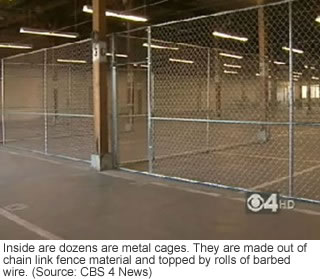
The jail is made up of large fenced-in cages with razor wire on top. The city said those cages are for the safety of law enforcement agents and those who are arrested. Activists call it a concentration camp unfit and inappropriate for human detainees.

“We’re going to be locked in cages in the same building that they already said doesn’t have a safe fire suppression system,” said activist Glenn Spagnuolo.

“Some of us are calling this the dog pound,” said Mark Cohen, with Recreate ’68.

Clad in trench coats, bandannas and sunglasses, activists protested outside the detention center Friday in the driving rain. They are asking the city for a public explanation.

“We’re trying to shine the light on this little secret political prisoner camp that was being set up in the city of Denver,” said Spagnuolo.

“The community surrounding this is primarily poor, people of color, that live around here, who I am sure nobody asked before this was put here,” said activist Larry Hales.

Several protestors came with their faces concealed for fear of police retaliation.

“The idea is to protect ourselves from police profiling,” said Harold Maude.

The DNC is 10 days away, but it appears the clash of protesters and police has already begun.

The city said it is planning a public tour of the facility in the next few days.

Recreate ’68 is calling for the mayor’s office to shut down this facility before it even opens.

Copyright 2008 by TheDenverChannel.com.

Source / TheDenverChannel

Thanks to Jay D. Jurie / The Rag Blog

Posted in RagBlog | Tagged , , , , , , | Leave a comment

The First Casualty of War : The Truth

U.S. Marines Invade Manhattan, New York!

For more information, visit Iraq Veterans Against the War.

Thanks to Diane Stirling-Stevens / The Rag Blog

Posted in RagBlog | Tagged , , | 1 Comment

Palestinian Travel to US: Can You Say Hypocrisy?

Palestinian Fulbright scholars Zuhair Abu Shaaban, 24, second from right, Osama Daoud, 25, third from right, and Fidaa Abed 23, fourth from right, wait to cross the Erez Border crossing between Israel and Gaza Strip in order to meet U.S. consular officials at the Israeli side of the border, Thursday, July 10, 2008. U.S. consular officials have traveled to the Gaza border to process the visa applications of three Palestinian Fulbright scholars whose scholarships were at risk because of Israeli travel restrictions.

Blocking a Gazan’s Path to San Diego
By Fidaa Abed / August 16, 2008

As a young Palestinian from Gaza, I had been eagerly anticipating the opportunity to study at the University of California San Diego on a Fulbright scholarship. The chance to escape Gaza’s confines and immerse myself in an American education was deeply thrilling. With Israel controlling Gaza’s border exits, air space and sea access — notwithstanding its “pullout” of 2005 — I imagined the long, open roads of the United States and its people’s unchallenged freedom of movement.

I love my people and my homeland, but a young person needs opportunities. These are far more abundant in the United States than in the besieged Gaza Strip.

Last week, I landed in Washington, D.C., brimming with optimism. Upon arrival, I was whisked into a separate room. An American official informed me that he had just received information about me that he could not reveal. However, it required him to put me on the next plane home. I was shocked. And I was taken aback at the cruelty of snatching away my educational dreams at the last possible moment.

My mistreatment was particularly unexpected because in late May, when Secretary of State Condoleezza Rice learned that I and six other Fulbright students were being stripped of our Fulbright scholarships, she leapt to our assistance. One by one, Israel let other Palestinians Fulbright scholars out of Gaza, and they made their way to American universities. Then I was mysteriously singled out for last-minute denial based on “secret evidence.” Two others had their visas canceled on account of secret evidence before they could even leave Gaza.

William J. Fulbright was the only U.S. senator to vote against funding for Sen. Joseph McCarthy’s Un-American Activities Committee. It is ironic, then, that my remarkable educational opportunity is being stripped from me on the basis of the sort of secret — and fabricated — evidence that Fulbright opposed in the hands of McCarthy. Unopposed, McCarthy destroyed lives. I do hope the United States will side with the openness of Fulbright and not the fear-mongering of McCarthy.

Israel routinely locks up Palestinians based on secret charges. All sorts of outrageous claims can be leveled based on information that Israeli officials garner coercively. Could the secret evidence against me have been extracted through the torture of some young Palestinian? Was I even the one denounced, or someone with a similar name? Was my “crime” sharing a classroom or a lunchtime conversation with someone Israel believes poses a danger? I have no way of knowing, and thus no way of defending myself.

My education is my gateway to the future. The master’s degree I would have earned at UC San Diego in computer science certainly cannot be attained in Gaza. And I am not alone. Hundreds of Palestinian students with dreams of improving their lives are stagnating intellectually in Gaza. The doors to our open-air prison have largely been slammed shut.

Israel tightened economic restrictions in 2006 following the election victory of Hamas. Hoping to weaken Hamas, Israel has gradually tightened restrictions on freedom of goods and people from the Gaza Strip to the outside world, maintaining a near total blockade on some 1.5 million Palestinian civilians for more than a year.

Thankfully, I have received support from people around the world. Journalists have wanted to hear my story. The American officials who saw me in Amman and Jerusalem upon my return were friendly and seemed embarrassed by my predicament.

Despite my treatment, I know that most Americans are kind people who mean well. What happened to me runs contrary to the good will exhibited by the American people. Israeli policies that relegate Palestinians in Gaza to prison-like conditions and Palestinians in the West Bank to an apartheid-like existence do not advance the cause of peace. The United States should use its tremendous sway with Israel to advance the cause of freedom and equal rights for Palestinians and Israelis alike.

We Palestinians have been stripped of our land for 60 years. But with educational opportunity we have persevered and made what we could of our lives. Limiting our educational prospects only perpetuates our status as a subordinate people. Nothing is served by confining our best and our brightest to Gaza. A better future for everyone lies in unlocking the gates to Gaza and allowing us to learn and gain exposure to the broader world – with all of the challenges, controversies and diverse perspectives it offers.

Fidaa Abed, recipient of a Fulbright scholarship, lives in the Gaza Strip.

Source / Dissident Voice

The Rag Blog

Posted in RagBlog | Tagged , , , | Leave a comment

A Video Series on World Agriculture: Monsanto, Part 5

The World According to Monsanto (Part 5 of 8)

Right now, there is probably no other company that is doing more to endanger the health of this planet, and it’s inhabitants, than Monsanto. With Nazi-like attitude, they are leading the world in shear destructive evil greed. First they were a drug company, and then they expanded to become a drugs and genetic engineering company, and now Monsanto is attempting to acquire water rights in countries with water shortages in a move to control the people’s basic means of survival, and production of the global food supply. Giant transnational corporations like Monsanto, in collusion with the World Bank and the World Trade Organization, seek to commodify and privatize the world’s water and put it on the open market for sale to the highest bidder. Millions of the world’s citizens are being deprived of this fundamental human right, and vast ecological damage is being wrought as massive industry claims water once used to sustain communities and replenish nature.

Click here for more information.

Thanks to Diane Stirling-Stevens / The Rag Blog

Posted in RagBlog | Tagged , | Leave a comment

Just As the Hangman Partners with the Condemned Man


Saving the World to Save Some of Ourselves
By Case Wagenvoord / August 16, 2008

Dear George,

The high point of my day is getting off on the National Security Strategy for the United States (NSS). This is the baby that tells the world just how we’re going to fuck with them. It beats porn any day.

The NSS leads with that fundamental biblical truth, “Economic freedom is a moral imperative,” even if some must die so we can protect it. The right to own property is fundamental to human nature (our kind). Economic freedom promotes social stability by keeping the masses so impoverished and weakened that their sole concern is survival, not political agitation.

Free governments govern their states through the marginalization of the poor, which is why the best form of government is Authoritarian Democracy in which a free people freely elect the tyrant of their choice.

America does not attack free nations, which we define as any nation that allows us to shamelessly exploit it. Nations that resist this exploitation are evil and may be attacked preemptively. This is how we protect the American (corporate) people and preserve the American (corporate) way.

The NSS proposes a new Cold War whose aim is to spread Authoritarian Democracy to the world. Condi calls it “transformational democracy.” She elaborates by adding, “The fundamental character of regimes now matters more than the international distribution of power.”

So it’s in with paranoia and out with the balance of power diplomacy that has governed international relations since the Peace of Westphalia. It matters not that the world is against us as long as it’s our kind of world.

We don’t oppress; we partner, just as the hangman partners with the condemned man.

We must muster all of our assets for the struggle to come, from our missiles to our tanks to our prisons to our waterboards to our electrodes. Ours is the noblest mission the world has seen since the Europeans spread Christianity with the rack and the stake.

Your admirer,
Belacqua Jones

Source / Open Letters to George W. Bush from His Ardent Admirer, Belacqua Jones

Thanks to Diane Stirling-Stevens / The Rag Blog

Posted in RagBlog | Tagged , , | 2 Comments

Iraq Report: The US Hegemonic View of the SOFA

Nouri al-Maliki

IRAQ: U.S. Officials Admit Worry over a ‘Difficult’ al-Maliki
By Gareth Porter / August 15, 2008

WASHINGTON — U.S. officials privately admit being concerned that Iraqi Prime Minister Nuri al- Maliki has become “overconfident” about his government’s ability to manage without U.S. combat troops, according to an Iraq analyst who just returned from a trip to Iraq arranged by U.S. commander General David Petraeus.

Colin Kahl, a fellow at the Centre for a New American Security (CNAS) — which has supported a long-term U.S. military presence in Iraq — told the press this week that there was “a certain degree of grudging respect for al- Maliki” among officials with whom we met, “but more often concern about his emerging overconfidence which is making it difficult to interact with him.”

That assessment contrasts with statements of George W. Bush administration officials implying that al-Maliki’s public demands for a timetable for U.S. military withdrawal are merely negotiating ploys or political grandstanding.

U.S. officials admitted that al-Maliki’s overconfidence has influenced the status of forces negotiations, according to Kahl. None of the U.S. officials in Baghdad would “lead off with badmouthing the prime minister,” Kahl said in an interview with IPS, but upon probing further, “you get a sense they are concerned that the al-Maliki regime has an inflated sense of his power.”

The Bush administration hoped negotiations with al-Maliki on a status of forces agreement would legitimise a long-term U.S. military presence in Iraq and control over a number of military bases, but the Iraqi leader refused to go along with an agreement that lacked a timetable for withdrawal of all U.S. troops.

Al-Maliki’s new sense of confidence has been accompanied by a new political identity as a nationalist foe of the occupation, according to Kahl. “He is successfully fashioning himself as an Iraqi hero who kicked the Americans out. That makes him difficult to negotiate with.”

One of the consequences of al-Maliki’s perception of the new power relations in Iraq is that he is even less inclined than before to make accommodations with former Sunni insurgents now on the U.S. payroll in the militias called ‘Sons of Iraq’.

Kahl said in the briefing that, of the 103,000 Sunnis belonging to those militias, the Iraqi government had promised to take into the security forces only about 16,000. But in fact, it has approved only 600 applicants thus far, according to Kahl, and most of those have turned out to be Shi’a rather than Sunni militiamen.

“There’s even some evidence that [al-Maliki] wants to start a fight with the Sons of Iraq,” said Kahl. “Al-Maliki doesn’t believe he has to accommodate these people. He will only do it if we twist his arm to the breaking point.”

Kahl said al-Maliki has made a series of moves that have consolidated his personal power position within the state apparatus as well as in relation to various armed groups in the country. He has put intelligence agencies directly under his control and has set up major military operation centres around the country which report directly to the prime minister’s office.

Even more important, however, Al-Maliki’s power position has also been bolstered by the decisions by nationalist Shiite leader Moqtada al-Sadr not to launch a concerted military resistance to U.S. and Iraqi government campaigns to weaken his Mahdi Army in 2007 and then to give up his political-military power positions in Basra, Sadr City and Amarah in 2008 without having been militarily defeated.

Petraeus and the U.S. military command in Iraq have asserted that al-Sadr’s decisions reflected the fact that the Mahdi Army had been weakened by U.S. military pressures. However, the broader set of developments over the past year suggests that the primary reason for Sadr’s willingness to give up military resistance was a strategic understanding with Iran to shift to political and diplomatic resistance to the U.S. military presence.

High officials in the al-Maliki regime asserted repeatedly last fall that it was Iran’s intervention with al-Sadr that brought about the unilateral ceasefire of Aug. 27, 2007. Sadr’s decisions to give up military control of Basra and Sadr City before his forces were defeated were taken in the context of Iranian mediation between al-Sadr and the al-Maliki regime.

Iran’s strategic relationship with al-Sadr accomplished what the U.S. military never believed would be possible even in its most optimistic scenario — the neutralisation of the most potent political-military threat to the regime’s stability. The ability of Iran to deliver that benefit to al-Maliki — as part of a broader shift to an anti-occupation regime policy — almost certainly strengthened the case that Iran made to al-Maliki for a demand for a timetable for U.S. troop withdrawal in the status of forces negotiations.

Kahl is sympathetic to the official U.S. concerns about al-Maliki. Both Kahl and CNAS have called for negotiation of a U.S. military presence in Iraq going well beyond the 2010 deadline for complete U.S. withdrawal that al-Maliki has put forward publicly.

In an unpublished paper for CNAS last April, Kahl advocated that the U.S. should keep 60,000 to 80,000 troops in Iraq into late 2010 in what he called a “sustainable over-watch posture”.

Despite the change in the power situation, Kahl and CNAS still takes the position that Iraq needs long-term U.S. support so badly that the Bush administration should use its leverage to get the al-Maliki regime to make the political accommodations necessary to achieve longer-term stability in the country. For example, the Iraq government’s need for U.S. help in recovering illegally exported funds and properties, which were included in the statement of principles governing the negotiations last November at Iraqi insistence.

Then there is the threat of immediate troop withdrawal if al-Maliki does not toe the line. Kahl said he was told in Iraq that, in one of the regular videoconferences Bush holds with al-Maliki, he said, “If the negotiations crash and burn, I will be forced to pull out all U.S. troops by Jan. 1.”

That Bush threat “got al-Maliki’s attention,” Kahl believes. He advocates the use of such threats to force al-Maliki to accommodate the interests of the Sunnis as well as those of the Sadrists, in order to bring them fully into the political system. Otherwise, Kahl argues, the security gains of 2007 and 2008 will ultimately be reversed.

Al-Maliki is no longer dependent on Washington as he was a year or two ago. That major shift in power relations — now reluctantly acknowledged by the Bush administration — has brought into sharper relief the contradictions between the interests of the Iraqi government and those of the administration.

The al-Maliki regime is a Shiite-dominated government that views its Sunni Arab neighbours — who have generally opposed Shiite rule in Iraq — with intense distrust and looks to Iran for support against them. The Bush administration, on the other hand, has forged closer relations with Sunni regimes against Iran. The short-term Shiite dependence on the U.S. occupation to establish Shiite control of the state apparatus is giving way to a more fundamental distrust toward U.S. power in Iraq and the region.

Source / IPS News

The Rag Blog
* Note: SOFA = Status of Forces Agreement

Posted in RagBlog | Tagged , , | 1 Comment

A Flash from the Past – Interview with Ben Morea

With the US government on a permanent war footing overseas whilst simultaneously cracking down on civil liberties and dissent at home it sometimes seems as if the left wing movements of the 1960s never existed. What do you see as the legacy of groups like Black Mask and the New Left in general?

Ben Morea: Part of the reason I re-emerged [after more than 30 years of anonymity] to talk about what we did back in the 1960s is the fact that things have gotten so bad in the US. It’s at a point where you can’t ignore it, it’s worse than ever.

I figured that I’d start letting people know about our history and then go from there. All I can tell people is that when it looked pretty dismal in the past we took action and it did have an effect. A lot was achieved and yet a few years beforehand no one would have expected that we could take on the behemoth of American capitalism. It’s counter-productive to sit back and say “You can’t do anything.” It’s not my place to tell people exactly what they should do, but there is always some way to respond and take action, just look around.

Up Against The Wall Motherfucker! – Interview with Ben Morea
By Ret Marut / March 17, 2008

Morea talks of the 1960s Black Mask and Up Against The Wall Motherfucker! groups and their activities – such as busting into the Pentagon during an anti-war protest, and “assassinating” a famous poet. He also discusses friendships with various characters, including the late Valerie Solanas – who shot Andy Warhol and wrote the SCUM Manifesto.

Morea has a blog at http://e-blast.squarespace.com/

========

Ben Morea: An Interview

Ben Morea was interviewed by lain McIntyre in 2006.

Tell us about your background and how you came to find yourself involved in the radical scenes of New York during the 1960s.

Ben Morea: I was raised mostly around the Virginia/Maryland area and New York. When I was ten years old my mother remarried and moved to Manhattan. I was basically a ghetto kid and got involved in drug addictions as a teenager spending time in prison. At one point when I was in a prison hospital I started reading and developed an interest in art. When I was released I completely changed my persona. In order to break my addiction I made a complete break from the kids I grew up with and the life I knew.

In the late 1950s I went looking for the beatniks because they seemed to combine social awareness with art. I met the Living Theatre people and was highly influenced by their ideas despite never being theatrically oriented myself. Judith Malina and Julian Beck were anarchists and they were the first people to put a name to the way I was feeling and leaning philosophically.

I also met an Italian-American artist named Aldo Tambellini who was very radical in his thinking and who channelled all of that into his art rather than social activism. He would only hold shows in common areas like churchyards and hallways in order to bring art to the public. He influenced me a lot in seeing that having art in museums was a way of rarefying it and making it a tool of the ruling class.

I’m self educated and continued my pursuit of anarchism and art through reading and correspondence. I became aware of Dada and Surrealism and the radical wing of twentieth century art and sought out anyone who had information about it or who had been involved. I really felt comfortable with the wedding of social thought with aesthetic practice. I corresponded quite a bit with one of the living Dadaists Richard Huelsenbeck who was living in New York, but whom I never met.

At the same time I became friendly with the political wing of the anarchists meeting up with people who had fought in Spain, from the Durutti Brigade and other groups. They were all in their 60s and I was in my 20s.

I was also a practising artist working at my own art and aesthetic. I was mainly painting in an abstract, but naturalistic form as well as doing some sculpture. There was some influence from the American expressionists, but Zen was also an influence.

When did Black Mask come together as a group? How were you organised and who was involved?

Ben: It’s hard to say whether we started in 1965 or 1966, but the magazine definitely started in 1966. Black Mask was really very small. It started off with just a few people. As anarchists, and not very doctrinaire ones, we had no leadership although I was the driving force in the group. Both Ron Hahne and I had already been working together with Aldo doing art shows in public to promote the idea of art as an integral part of everyday life, not an institutionalised thing. Ron and I became close friends and found that we had a more socially polemical view than Aldo in wanting to go closer to the political elements of Dada and Surrealism as well as to the growing unrest in Black America. We wanted to find a place where art and politics could coexist in a radical way. Once we started publishing Black Mask and holding actions other artists and people on a similar wavelength were attracted to what we were doing. I’ve always favoured an organic approach where you don’t have meetings and people just associate informally rather than having a hierarchy and recruiting members.

Over time Ron became less interested in the political sphere and I became more interested in working with the people who were involved in fighting for civil rights and against the Vietnam war. I can honestly say that in both Black Mask and then later The Family we never held a meeting where we consciously sat down to decide our direction or exactly how we would deal with a particular action or situation. It all developed as a very spontaneous, organic outgrowth of whatever we thought was appropriate at the time.

One of Black Mask’s first actions was to shut down the Museum Of Modern Art (MOMA). Tell us about what happened and the group’s approach to direct action in general.

Ben: We felt that art itself, the creative effort, was an obviously worthwhile, valuable and even spiritual experience. The Museum and gallery systern separated art from that living interchange and had nothing to do with the vital, creative urge. Museums weren’t a living house, they were just a repository. We were searching for ways to raise questions about how things were presented and closing down MOMA was just one of them.

The action was a success. We’d announced our plans in advance and they closed the museum in fear of what we might do. A lot of people stopped and talked with us about what we were doing and this action and others attracted radical artists to our fold.

At other times we disrupted exhibitions, galleries and lectures. Most of these actions were just thought up on the spot and a lot of what we did was part of a learning process. Things weren’t completely thought out, but were a way for us to develop an understanding of our place in the ongoing struggle. A lot of political groups would have these big grandiose strategies and plans, but for us the actions were just a way of expressing ourselves and seeing how we could make a dent in society.

In 1966 the group also targeted the Loeb Centre at New York University (NYU). What happened with that action?

Ben: We had a strong sense of humour and of guerrilla theatre. I used to disrupt art lectures at NYU to raise issues other than those that the lecturers wanted to discuss. As a result I was challenged to a debate by some of the academics. I remember that particular event had such a pretentious approach that we had to do something. It was incredibly stratified and only meant for the elite and it seemed like they’d done everything possible to keep it away from the public at large. We handed out loads of leaflets advertising this free event with food and alcohol and they had to block off the streets all around because so many people showed up. We went down to the Bowery and handed out flyers so that all the drunks and street people would show up.

Black Mask clearly drew inspiration not only from the Dadaists, Surrealists and avant-garde movements of the past, but also from the contemporary black insurrections and youth movements of the 1960s. Tell us a little more about these influences and about your ideas and approach to politics and art in general.

Ben: From my perspective and that of the people I worked with we saw a need to change everything from the way we lived to the way we thought to the way we even ate. Total Revolution was our way of saying that we weren’t going to settle for political or cultural change, but that we want it all, we want everything to change. Western society had reached a stalemate and needed a total overhaul. We knew that wasn’t going to happen, but that was our demand, what we were about.

It also meant seeing that you need all types of people involved, not just political activists. Poets and artists are just as important. Revolution comes about as a cumulative effect and part of that is a change in consciousness, a new way of thinking.

How did Black Mask fit into the New York political and arts scenes because it seems as if you went out of your way to ridicule and challenge ideologues of all stripes?

Ben: A lot of political people questioned what we did saying we should only attack society on the political front and that we shouldn’t care about art. However we felt it was best to take action in the place where you were and that as artists these issues were important to us.

Many of the hippies distrusted us and the politicos hated us because they couldn’t control us or understand what we were doing. As for the people in the art world I’m sure most of them thought we were crazy.

Black Mask seems to have issued various challenges to the peace movement in criticising the moderates for their lack of militancy whilst also attacking the Left for its unconditional support of the National Liberation Front (NLF). Many radicals from the 1960s are now somewhat regretful or appear reticent to speak about their support for the North Vietnamese regime.

Ben: We supported the right of the Vietnamese people to resist American invasion, but were not going to support the North Vietnamese government’s own oppressive behaviour. It was a subtle point and most of the left couldn’t understand it. We knew the history of Spain where both the Francoists and Stalinists executed anarchists. We refused to support one side or the other.

I hated the knee jerk reaction of much of the Left who delighted in waving the NLF flag around. We didn’t cheer the killing of American troops who were stuck over there as cannon fodder like some others did.

In a sense we didn’t fit in anywhere and that meant we became a pole of attraction for all those other people who weren’t interested in a dogmatic or pacifistic approach. Much of the later evolution of Black Mask into The Family came about through more and more of these people joining with us and affecting where we were going.

Black Mask and later The Family were some of the first groups to encourage the concept of affinity groups as a way of organising. One Family member famously defined an affinity group as a “street gang with analysis.” How did this approach develop and the use of term come about?

Ben: Although we associated in similar circles with Murray Bookchin our group was always very different because we were very visceral and he was very literate. Murray was keen on using the Spanish term aficionado de vairos to describe these non-hierarchical groupings of people that were happening. We said “Oh my god, can you really imagine Americans calling themselves aficionado de vairos?” (laughter) “Use English, call them affinity groups.”

Tell us about the Black Mask magazine you produced which ran from 1966 to 1968 and spanned ten issues.

Ben: Ron and I mainly put the magazine together, but there was a. wider group who helped produce, print and distribute it. We sold it for a nickel, which wasn’t much money, but we figured if people had to pay for it then they would actually want and read it rather than just take one look and throw it in the trash.

We tended to sell it on the Lower East Side, which was the most fertile ground for us as there were many artists and activists. We occasionally went up town as well although that was more to stir the pot.

Black Mask was one of the first groups to take on countercultural figures like Timothy Leary and Allen Ginsberg for their timidity, orientation towards religion and status seeking, labelling them at one point “The New Establishment.” From 1967 onwards it seems as if Black Mask moved a lot of its critique away from the arts establishment and towards the growing hippy movement and New Left.

Ben: Although we were critical of them I was close to Allen Ginsberg and became close to Timothy Leary years later. What we were trying to say at that moment was that they were allowing themselves to be used as a safety valve. We wanted to attack the core of society and believed they weren’t doing that. At the time we thought they were being used by the likes of Time and Life magazine although in hindsight Time and Life probably wish they had never covered them, especially Timothy.

We were always trying to shake things up, to push everyone else as well as ourselves. There was always a lot of interchange with all sorts of other radicals and sometimes there was fratricide in that we would strike out at people we otherwise liked just to make a point.

Read all of it here. / LibCom.org

Thanks to Mariann Wizard / The Rag Blog

Posted in RagBlog | Tagged , , , | 1 Comment

Explanations That Do Not Mollify Anti-War Activists

“Doctored” photo courtesy Moonbattery.com, a radical conservative site

The Why-Haven’t-You Impeached-the-President Tour
By CARL HULSE / August 15, 2008

WASHINGTON — When House Speaker Nancy Pelosi set out to promote her new motivational book this month, she simultaneously touched off her national why-haven’t-you-impeached-the-president tour.

As she made the coast-to-coast rounds of lectures, television interviews and radio chats the past two weeks, Ms. Pelosi found herself under siege by people unhappy that she has not been motivated to try to throw President Bush out of office – even if only a few months remain before he leaves voluntarily.

In Manhattan and Los Angeles, at stops in between, on network television and on her home turf of Northern California, Ms. Pelosi has been forced to defend her pronouncement before the 2006 mid-term elections that impeachment over the administration’s push for war in Iraq was off the table.

Pressed on ABC’s “The View” about whether she had unilaterally disarmed, the author of “Know Your Power: A Message to America’s Daughters” said she believed the proceedings would be too divisive and be a distraction from advancing the policy agenda of the new Democratic majority.

Then she added this qualifier: “If somebody had a crime that the president had committed, that would be a different story.”

That assertion only threw fuel on the impeachment fire as advocates of removing Mr. Bush cited the 35 articles of impeachment compiled by Representative Dennis Kucinich, Democrat of Ohio, as well as accusations in a new book by author Ron Suskind of White House orders to falsify intelligence, an accusation that has been denied.

“There’s an opportunity now for us to come forward and to lay all the facts out so that she can reconsider her decision not to permit the Judiciary Committee to proceed with a full impeachment hearing,” Mr. Kucinich said in an interview with the Web site Democracy Now!

Mr. Kucinich, long a proponent of starting hearings to impeach both Mr. Bush and Vice President Dick Cheney, earlier this week applauded signals that the Judiciary Committee would look into the claims made by Mr. Suskind in his book.

While the Judiciary Committee might do exactly that, the chances that such an inquiry would culminate in an impeachment proceeding are, according to top Democratic officials, virtually nil.

At the moment, the House is officially scheduled to meet for less than three weeks in September before adjourning for the elections and perhaps the year – hardly enough time to mount an impeachment spectacle even if top Democratic lawmakers wanted one.

And they do not.

Despite whatever resonance pursuing the president might have in progressive Democratic circles, it is not the message Democrats want to carry into an election where they need to appeal to swing voters to increase their Congressional majorities and win the White House. They would rather devote their final weeks to pushing economic relief and health care, even if they thought Mr. Bush and the conduct of the war merited impeachment hearings.

And leading Democrats argue anyway that Mr. Bush has already been tried and convicted in the court of public opinion.

“He has been impeached by current history,” said Representative Rahm Emanuel of Illinois, chairman of the House Democratic Caucus. “He is going down as the worst president ever. The facts are in.”

Republicans have previously shown some appetite for luring Democrats into what they see as an impeachment trap, a set of hearings they could use to portray Democrats as bitter partisans. But Republican strategists also recognize the political danger in getting too deep in defending Mr. Bush right before the election or in justifying the buildup to the Iraq war. They might not be as eager as they once were for an impeachment fight.

Both parties know full well that the Republican push to impeach President Bill Clinton in 1998 did not work out for Republicans in the way they had hoped, giving many lawmakers pause when it comes to gaming out the political ups and downs of such an action.

The impeachment unrest among progressives dovetails with their profound disappointment that Democrats failed to cut off spending for the war in Iraq or impose a timetable for withdrawal after winning control of Congress in 2006. It is a disappointment that Ms. Pelosi has acknowledged she shares and one she attributes to the thin Democratic majority in the Senate and Republican determination to support Mr. Bush on the war, explanations that do not mollify staunch anti-war activists.

The disillusionment has crystallized in a challenger for Ms. Pelosi in the person of Cindy Sheehan, the anti-war activist whose son was killed in Iraq. Ms. Sheehan and her allies collected more than 17,000 signatures to qualify her as an independent for the November ballot in San Francisco.

While Ms. Pelosi has been navigating the impeachment issue on her book tour, House Republicans have been assailing her on the floor for refusing to allow a vote on lifting a ban on oil drilling along much of the nation’s coast. Democrats are back-tracking a bit on that stance, opening the door to a September vote on relaxing the restrictions on drilling as part of a broader energy bill that would also include Democratic initiatives to reduce subsidies for oil companies and encourage more use of natural gas.

These have not been easy weeks for Ms. Pelosi as she juggled promoting her book with defending her impeachment stance and fending off the Republicans. But party strategists say she’s in a strong enough political position to weather the attacks, while taking some of the political heat off more vulnerable Democrats. She might be under fire from the left and the right, but there is no talk of impeaching her.

Source / The New York Times

Thanks to Diane Stirling-Stevens / The Rag Blog

Posted in RagBlog | Tagged , | 1 Comment

Yugoslavia : Precursor to the Bloodbaths in Afghanistan and Iraq

Kosova Liberation Army (KLA) regulars

John Pilger digs beneath the received wisdom for the break-up of Yugoslavia and points to a largely ignored memoir by the former chief prosecutor in The Hague – and an echo from current events in the Caucasus.

Don’t Forget Yugoslavia
By John Pilger / August 15, 2008

Even as Blair the war leader was on a triumphant tour of “liberated” Kosovo, the KLA was ethnically cleansing more than 200,000 Serbs and Roma from the province

The secrets of the crushing of Yugoslavia are emerging, telling us more about how the modern world is policed. The former chief prosecutor of the International Criminal Tribunal for Yugoslavia in The Hague, Carla Del Ponte, this year published her memoir The Hunt: Me and War Criminals. Largely ignored in Britain, the book reveals unpalatable truths about the west’s intervention in Kosovo, which has echoes in the Caucasus.

The tribunal was set up and bankrolled principally by the United States. Del Ponte’s role was to investigate the crimes committed as Yugoslavia was dismembered in the 1990s. She insisted that this include Nato’s 78-day bombing of Serbia and Kosovo in 1999, which killed hundreds of people in hospitals, schools, churches, parks and tele vision studios, and destroyed economic infrastructure. “If I am not willing to [prosecute Nato personnel],” said Del Ponte, “I must give up my mission.” It was a sham. Under pressure from Washington and London, an investigation into Nato war crimes was scrapped.

Readers will recall that the justification for the Nato bombing was that the Serbs were committing “genocide” in the secessionist province of Kosovo against ethnic Albanians. David Scheffer, US ambassador-at-large for war crimes, announced that as many as “225,000 ethnic Albanian men aged between 14 and 59” may have been murdered. Tony Blair invoked the Holocaust and “the spirit of the Second World War”. The west’s heroic allies were the Kosovo Liberation Army (KLA), whose murderous record was set aside. The British foreign secretary, Robin Cook, told them to call him any time on his mobile phone.

With the Nato bombing over, international teams descended upon Kosovo to exhume the “holocaust”. The FBI failed to find a single mass grave and went home. The Spanish forensic team did the same, its leader angrily denouncing “a semantic pirouette by the war propaganda machines”. A year later, Del Ponte’s tribunal announced the final count of the dead in Kosovo: 2,788. This included combatants on both sides and Serbs and Roma murdered by the KLA. There was no genocide in Kosovo. The “holocaust” was a lie. The Nato attack had been fraudulent.

That was not all, says Del Ponte in her book: the KLA kidnapped hundreds of Serbs and transported them to Albania, where their kidneys and other body parts were removed; these were then sold for transplant in other countries. She also says there was sufficient evidence to prosecute the Kosovar Albanians for war crimes, but the investigation “was nipped in the bud” so that the tribunal’s focus would be on “crimes committed by Serbia”. She says the Hague judges were terrified of the Kosovar Albanians – the very people in whose name Nato had attacked Serbia.

Indeed, even as Blair the war leader was on a triumphant tour of “liberated” Kosovo, the KLA was ethnically cleansing more than 200,000 Serbs and Roma from the province. Last February the “international community”, led by the US, recognised Kosovo, which has no formal economy and is run, in effect, by criminal gangs that traffic in drugs, contraband and women. But it has one valuable asset: the US military base Camp Bondsteel, described by the Council of Europe’s human rights commissioner as “a smaller version of Guantanamo”. Del Ponte, a Swiss diplomat, has been told by her own government to stop promoting her book.

Yugoslavia was a uniquely independent and multi-ethnic, if imperfect, federation that stood as a political and economic bridge in the Cold War. This was not acceptable to the expanding European Community, especially newly united Germany, which had begun a drive east to dominate its “natural market” in the Yugoslav provinces of Croatia and Slovenia. By the time the Europeans met at Maastricht in 1991, a secret deal had been struck; Germany recognised Croatia, and Yugoslavia was doomed. In Washington, the US ensured that the struggling Yugoslav economy was denied World Bank loans and the defunct Nato was reinvented as an enforcer. At a 1999 Kosovo “peace” conference in France, the Serbs were told to accept occupation by Nato forces and a market economy, or be bombed into submission. It was the perfect precursor to the bloodbaths in Afghanistan and Iraq.

www.johnpilger.com

Source / Information Clearing House

The Rag Blog

Posted in RagBlog | Tagged , , , | 2 Comments

Drug Policy: Dictated by Tabloid Irrationality

Although this article is about British drug policy, its basic content and conclusions apply perfectly to US drug policy. Richard Jehn / The Rag Blog


The Case is Overwhelming: All Experts Agree: Legalize Drugs
By JULIAN CRITCHLEY / August 15, 2008

Eight years ago, I left my civil service job as director of the UK Anti-Drug Co-Ordination Unit. I went partly because I was sick of having to implement policies that I knew, and my political masters knew, were unsupported by evidence. Yesterday, after a surreal flurry of media requests referring to a blog I wrote that questioned the wisdom of the UK’s drug policies, I found myself in the thick of the debate again, and I was sorry to discover that the terms hadn’t changed a bit.

I was being interviewed on the BBC World Service, and after I tried to explain why I believe that drugs should be decriminalised, the person representing the other side of the argument pointed out that drugs are terrible, that they destroy lives. Now, I am a deeply boring, undruggy person myself, and I think the world would be a better place without drugs. But I think that we must live in the world as it is, and not as we want it to be. And so my answer was, yes, I know that drugs are terrible. I’m not saying that drugs should be decriminalised because it would be fun if we could all get stoned with impunity. I’m saying that we’ve tried minimising harm through a draconian legal policy. It is now clear that enforcement and supply-side interventions are largely pointless. They haven’t worked. There is evidence that this works.

Unfortunately, evidence is still not a major component in our policy. Take cannabis. When I was in the Anti-Drug Unit, the moves towards making it a class C drug began, and I hoped that our position on drugs was finally moving in a rational direction. But then Gordon Brown ignored his scientific advisers to make it a class B again. It was a decision that pandered to the instincts of the tabloids, and it made no sense whatsoever.

There is no doubt at all that the benefits to society of the fall in crime as a result of legalisation would be dramatic. The argument always put forward against this is that there would be a commensurate increase in drug use as a result of legalisation. This, it seems to me, is a bogus point: tobacco is a legal drug, whose use is declining, and precisely because it is legal, its users are far more amenable to Government control, education programmes and taxation than they would be otherwise. Studies suggest that the market is already almost saturated, and anyone who wishes to purchase the drug of their choice anywhere in the UK can already do so. The idea that many people are holding back solely because of a law which they know is already unenforceable is ridiculous.

Ultimately, people will make choices which harm themselves, whether they involve diet, smoking, drinking, lack of exercise, sexual activity or pursuit of extreme sports. In all these instances, the Government rightly takes the line that if these activities are to be pursued, society will ensure that those who pursue them have access to accurate information about the risks; can access assistance to change their harmful habits should they so wish; are protected by a legal standards regime; are taxed accordingly; and – crucially – do not harm other people. Only in the field of drugs does the Government take a different line.

The case is overwhelming. But I fear that policy will not catch up with the facts any time soon. It would take a mature society to accept that some individuals may hurt, or even kill themselves, as a result of a policy change, even if the evidence suggested that fewer people died or were harmed as a result. It would take a brave government to face down the tabloid fury in the face of anecdotes about middle-class children who bought drugs legally and came to grief, and this is not a brave government.

I think what was truly depressing about my time in the civil service was that the professionals I met from every sector held the same view: the illegality of drugs causes far more problems for society and the individual than it solves. Yet publicly, all those people were forced to repeat the mantra that the Government would be “tough on drugs”, even though they all knew that the policy was causing harm.

I recall a conversation I had with a Number 10 policy advisor about a series of announcements in which we were to emphasise the shift of resources to treatment and highlight successes in prevention and education. She asked me whether we couldn’t arrange for “a drugs bust in Brighton” at the same time, or “a boat speeding down the Thames to catch smugglers”. For that advisor, what worked mattered considerably less than what would play well in the right-wing press. The tragedy of our drugs policy is that it is dictated by tabloid irrationality, and not by evidence.

Julian Critchley was the former director of the UK Anti-Drug Co-Ordination Unit.

Source / CounterPunch

The Rag Blog

Posted in RagBlog | Tagged , , | 1 Comment