HEALTH : More Good News About Cannabis


Cannabis-linked cell receptor might help prevent colon cancer
August 1, 2008

A cannabinoid receptor lying on the surface of cells may help suppress colorectal cancer, say U.S. researchers. When the receptor is turned off, tumor growth is switched on.

Cannabinoids are compounds related to the tetrahydrocannabinol (THC) found in the cannabis plant.

It’s already known that the receptor, CB1, plays a role in relieving pain and nausea, elevating mood and stimulating appetite by serving as a docking station for the cannabinoid group of signaling molecules. This study suggests that CB1 may offer a new path for cancer prevention or treatment.

“We’ve found that CB1 expression is lost in most colorectal cancers, and when that happens, a cancer-promoting protein is free to inhibit cell death,” senior author Dr. Raymond Dubois, provost and executive vice president of the University of Texas M.D. Anderson Cancer Center, said in a university news release.

In their study of human colorectal tumor specimens, the researchers also found that the drug decitabine can restore CB1 expression.

In addition, mice that are prone to developing intestinal tumors and also have functioning CB1 receptors developed fewer and smaller tumors when treated with a drug that mimics a cannabinoid receptor ligand, the researchers found. Ligands are molecules that function by binding to specific receptors.

“Potential application of cannabinoids as anti-tumor drugs is an exciting prospect, because cannabinoid agonists (synthetic molecules that mimic the action of natural molecules) are being evaluated now to treat the side effects of chemotherapy and radiation therapy,” DuBois said. “Turning CB1 back on and than treating with a cannabinoid agonist could provide a new approach to colorectal cancer treatment or prevention.”

The study was published in the Aug. 1 issue of the journal Cancer Research.

Source / HealthDay News / Yahoo News

Thanks to Harry Anderson / The Rag Blog

Posted in RagBlog | Tagged , , , , , , , | Leave a comment

Electric Cars Are the Key to Energy Independence

German electric car.

‘Anyone who drives an electric car falls in love with an electric car’
By David Morris / August 2, 2008.

Renewables won’t give us energy independence unless that electricity is used as a substitute for oil in our transportation system.

Al Gore’s heroic speech challenging us to make our electrical system 100 percent renewable promised it would simultaneously address three major crises: the weak economy, catastrophic climate change and the dire national security problems inherent in our dependence on imported oil.

He got two out of three right. A crash renewable electricity initiative would provide an immediate boost to our economy and could slow climate change, since electricity accounts for about a third of our overall greenhouse gas emissions.

But it would do little to enhance our national security.

Oil generates only 3 percent of our electricity. Therefore a 100 percent renewable electricity system does little to reduce our oil dependency — unless that electricity is used to substitute for oil in our transportation system.

Al Gore knows this. In other venues he has mentioned electrified vehicles. But he needs to make electrifying our transportation the central element in his 10-year plan, for at least two reasons.

One is that it is an initiative that would prove far more compelling to the vast majority of Americans. Climate change is abstract, and the strategies to resolve it are remote. Our relationship to our vehicles, on the other hand, is both concrete and visceral. We desperately want to get off oil, especially when gasoline prices rise to $4 per gallon.

But it is more than a pocketbook issue for many of us; it is a moral issue. Americans hate being dependent for our mobility, and therefore for our livelihoods, on countries often hostile to our way of life. Electric cars promise to end that dependency.

And as a bonus, with rooftop solar cells, we can become independent not only from OPEC but from remote and often unresponsive utility companies. We can become energy producers as well as energy consumers.

And then there is the plain fact that once significant numbers of electric vehicles are on the roads, word of mouth will be a powerful marketing tool. The reason? As Marc Geller, a longtime advocate of electric vehicles, told me a year ago as we were traveling up Route 1 in Northern California in his all-electric small SUV, “.” That love affair will be aided and abetted by a population eager to embrace a homegrown fuel and vehicles that offer quicker propulsion, a quiet drive and zero tailpipe emissions.

There is another persuasive reason for Gore to focus on an electrified transportation system: It is simply physically impossible to convert our entire electricity system to renewables in 10 years, but it is possible to convert our entire ground transportation system to renewable electricity within a similar time frame. That would require a national mobilization, to be sure, but it can be done.

Converting our electric system fully to renewables would require us to shut down about 80 percent of our current electricity-generating capacity, much of it low-cost, already paid off and capable of generating electricity for another 25 years or more. Moreover, to reach very high penetration rates of renewable electricity would require that we overcome the principal shortcoming of wind and sunlight: intermittency.

To electrify our transportation system, on the other hand, we could displace rather than shut down the existing system, and we would be replacing a physical stock with a relatively short life expectancy. Given the average seven-year life expectancy of existing vehicles and the high probability that we would offer an incentive for owners of older gasoline-powered vehicles to trade them in, new electric vehicles could constitute the entire fleet within a decade, and that doesn’t take into account the potential for conversions of existing vehicles.

Powering 100 percent of our transportation system would require about 30 percent of the electricity generated in 2006. With a massive effort, using a combination of solar and wind power, we could generate about that much electricity by 2020.

The fact that we can even contemplate the rapid electrification of transportation is a testament to 20 years of grassroots activism at the local and state level. The enactment by Congress of a renewable electricity tax incentive in 1992 was important, but the wind energy industry did not take off until states began to mandate renewable electricity. Today more than 25 states boast such mandates. A recent report put together by a task force of California leaders urges the state to double its renewable electricity mandate to 50 percent by 2020.

We have done a great deal, from the bottom up, to increase the supply of renewable electricity. Less well known is how much we have done on the demand side of the equation, that is, the use of electricity in transportation.

A brief historical review might be in order here. The first electric utilities were born largely to serve the transportation sector, which in the late 19th century meant urban streetcars. Until 1920, transportation remained the nation’s utilities’ single largest customer. And as the birth of the automobile age began, electric vehicles were by far the most popular. In the late 1890s electric vehicles (EVs) outsold gasoline cars 10 to 1. Many of the first car dealerships were exclusively for EVs.

The future of transportation abruptly changed in the 1910s. Mass production of gasoline-powered cars dramatically lowered their price. The introduction of automatic ignition removed the difficult and dangerous task of cranking to start the gasoline engine. Meanwhile the infrastructure for electricity was almost nonexistent outside city boundaries, limiting the utility of electric vehicles.

For the next 70 years, electric transportation all but disappeared.

Then, in 1990, two events occurred to revive the prospects of electrified vehicles. One was a private sector initiative; the other a public sector initiative. One was technology driven; the other politically driven.

In 1990, Sony introduced the lithium ion battery. Its higher energy density quickly made it the battery of choice for electronic equipment. Over the next 10 years, as portable electronic equipment demanded more powerful and longer-lasting batteries, the lithium ion battery industry saw many technological advances. In the last five years, many variations of that battery have begun to vie for supremacy as the foundation for a new generation of electric vehicles.

The public initiative was California’s Zero Emission Vehicle (ZEV) Mandate. Enacted in 1990, the mandate required that 2 percent of all new vehicles sold by major car manufacturers in that state be all-electric by 1998, and 10 percent by 2003. By 1994, 12 additional states had adopted its mandate.

If that mandate had remained in place, more than 10 million EVs might be traveling our roads today. But as the marvelous documentary “Who Killed the Electric Car?” reveals in depressing detail, the ZEV mandate was weakened in the 1990s and finally killed in 2003.

Notwithstanding its demise, the mandate did result in several important and positive outcomes. One was the hybrid vehicle, whose development was in part an outgrowth of the vigorous developments in electrical and electronic vehicle systems spurred by the ZEV mandate. Another was the advance in large-format battery technology after many decades of stagnation. The new Nickel Metal Hydride (NiMH) battery replaced the lead acid battery for ZEVs sold in California, and by the late 1990s, a second-generation NiMH promised to last the life of the car, almost halving the capital cost of an electric vehicle. (Tragically, patent disputes have stifled NiMH development.)

Perhaps the most important enduring legacy of the ZEV mandate was the creation of tens of thousands of Californians who experienced the pleasure of driving or being driven in full-size electric vehicles capable of high-speed, long-distance highway driving. “Who Killed the Electric Car?” portrays what seemed to be a futile grassroots effort to stop car companies from taking back their EVs and crushing them.

Yet even as the movie ends, the uprising began to gain traction. GM proved incorrigible. But creative and extensive protests here and abroad persuaded Ford and then Toyota to cease crushing their vehicles and begin offering them for sale. Reportedly, Chris Paine, the director of “Who Killed the Electric Car?” is making a new movie titled “Who Saved the Electric Car?” It promises to be a very uplifting sequel.

At its peak, the ZEV mandate brought some 5,500 electric vehicles onto California roads, ranging from Ford’s small Think Car to Toyota’s small SUV, the RAV4, to Ford’s light pickup truck, the Ranger.

After the protests ended and the dust cleared, more than 800 electric vehicles were saved, most of them RAV4s. Some have now traveled more than 110,000 miles, validating both the durability of the batteries and the vehicles’ remarkably low maintenance costs.

The EV movement was aided and abetted by the introduction, in 2004, of the second iteration of the Toyota Prius. The best-selling car sported a mysterious blank button on the dashboard. Via the Internet, Americans were told that in Japan the button was operational. Pushing it allowed the car to travel solely by electricity for a mile or so. Engineers in Texas and California quickly learned how to convert the Prius to drive solely on electricity, and they added sufficient battery capacity to travel 10 and then 20 and then 30 miles before recharging was needed.

Several start-ups began to offer plug-in hybrid electric (PHEV) conversions. Felix Kramer, the Paul Revere of the movement, spent the next two years trying to convince national reporters, members of Congress, Silicon Valley businesses and even EV advocates, many of whom believed a car with a gas engine was a sacrilege, that a plug-in hybrid electric vehicle could become the foundation for a transition to an electrified transportation sector. Kramer convinced a leading car industry reporter based in Michigan to run a story, which quickly translated into dozens of stories in the national media. In the spring of 2006, he spent $15,000 to transport his own converted Prius PHEV to DC and allow several senators and leading policymakers and opinion leaders to literally kick the tires and drive in it.

At the time fewer than a dozen Prius conversions existed in the entire country. But the work of organizations like Plug-In America and Plug-In Partners and Kramer’s own CalCars began to seize the popular imagination.

In just the last 12 months, the dam against electrified vehicles seems to have broken. For the first time since 1910, an oil-free transportation system is on the table.

New announcements by businesses large and small have become almost a weekly occurrence. Hymotion, a small company affiliated with Internet giant Google and the MIT spin-off, battery maker A123, has begun to roll out a nationwide network of certified plug-in hybrid converters.

Toyota, which for the first six years of Prius sales used the advertising tag line, “You Never Have to Plug It In,” announced in 2007 an abrupt change of mind. In 2010, Toyota will begin leasing plug-in Priuses in Japan. GM, which had originally loudly and sarcastically dismissed the concept of hybrids, announced it will offer a plug-in hybrid with a 40-mile driving range in 2010. Nissan, VW, Renault and other car manufacturers have all announced their intention to introduce electric vehicles in the same time frame.

In July 2008, San Jose announced the beginning of a network of easily accessible and useable EV-charging stations in parking garages around the city. San Francisco followed with its own request for proposals for a similar citywide network.

On the political front, the current energy bill stalled in Congress because of Republican opposition: The bill contains a tax incentive for plug-ins sufficient to make the first cost of such vehicles nearly competitive with conventional vehicles.

The energy bill signed into law just before Christmas in 2007 includes a little-noticed but very powerful incentive for all-electric vehicles. For purposes of meeting the new higher fuel efficiency standards, all-electric vehicles will be awarded an efficiency rating based largely on the amount of gasoline displaced, which translates into an overall fuel efficiency rating for a typical mid-size EV of about 350 miles per gallon.

And on the customer level, gasoline prices of $4 per gallon have generated a palpable hunger for alternatives and changed the comparative economics of EVs and gasoline-powered vehicles. Driving a mile on electricity today costs about 3 cents while traveling a mile on gasoline costs about 15 cents. This can translate into annual fuel savings of more than $1,000.

The advent of EVs may change not only the contours of our transportation system but also the structure of our electricity system. The unique characteristic of the electricity system is that the product must be instantaneously transmitted and no storage capacity is available. This is the reason Enron and others were able to manipulate the system in deregulated California 10 years ago, a manipulation that led to the near bankruptcy of the state and continues to burden the state budget.

The prospect of a large battery capacity contained in tens of millions of electrified vehicles could be, in the words of one utility executive, “a game changer.” Utilities, eager to nurture a potentially large new customer, are also vigorously assessing how this new electric capacity can be integrated into the existing distribution and subtransmission parts of the grid system.

Some studies have estimated that utilities could pay an EV owner several thousand dollars a year to tap into the car’s batteries when needed for energy used to keep the local grid stable. The vehicle would be available for such tapping a considerable percentage of the time. A typical vehicle sits idle some 23 of 24 hours a day. Millions sit in commuter parking lots for eight hours a day.

A large storage capacity could also ameliorate the intermittency problem of renewable energy, which in turn could allow a much higher proportion of renewable electricity on the grid. One study of the Sacramento, Calif., electricity network concluded that a significant penetration of battery-powered vehicles could boost the potential wind energy contribution to about 50 percent of total electricity generation.

EVs might spur a profound relocalization of our electricity system. I discovered the intimate link between electric vehicles and decentralized electricity in the spring of 2007, when I spent a week in California driving or being driven in a variety of electrified vehicles, from glorified golf carts to PHEVs to the “0 to 60 in less than 4 seconds” Tesla. I was invited by a national travel magazine to investigate the future of the car based on my 2003 report on the subject, “A Better Way.” Everyone I met who had an EV or a PHEV also had solar cells on their roofs. And why not? Not only does it make them more energy self-reliant, but the value of the electricity generated by the solar array is far higher when it displaces gasoline than when it displaces conventional electricity.

Indeed, a symbiotic relationship between car and house may be emerging. California has time-of-day tariffs under which electricity consumed at peak hours, say, midday on a hot summer’s day, can be several times more expensive than electricity consumed during nighttime odd-peak hours. If EV owners must use electricity at peak times, they can tap into the stored electricity in their vehicles. The EV serves as a source of backup power for the house. More than one EV owner boasted about how his was the only house with lights on when the neighborhood suffered a blackout.

If Congress enacts its electrified vehicle incentive, we should see an immediate surge in conversions and new PHEV and EV sales. In 2010 several EV and PHEV models should be available from major car companies, albeit in small quantities, and these should allow us to gauge the costs of an all-electric transportation system.

Read all of it here / AlterNet

Thanks to David Hamilton / The Rag Blog

Posted in RagBlog | Tagged , , , , , | Leave a comment

Security Was Not Part of the Master Plan, Ever


Blackwater’s Not Going Anywhere
By Jeremy Scahill / July 30, 2008

It seems that executives from Blackwater Worldwide, the Bush Administration’s favorite hired guns in Iraq and Afghanistan, are threatening to pack up their M4 assault rifles, CS gas and Little Bird helicopters and go back to the Great Dismal Swamp of North Carolina whence they came. Or at least that’s how it is being portrayed in the media.

This story broke on July 21, when the Associated Press ran an article based on lengthy interviews with Blackwater’s top guns. Since then, the story has picked up considerable steam and generated a tremendous amount of buzz online and in the press. After all, Blackwater has long been a key part of the US occupation and has been at the center of several high-profile scandals and deadly incidents. Add to that its owner’s ties to the White House and the radical religious right in the United States and it is clear why this is news. On top of that, Barack Obama-a critic of Blackwater-had just completed a tour of Iraq, where he was touting his “withdrawal plan.”

Among the headlines: “Blackwater Plans Exit From Guard Work,” “Blackwater Getting Out Of Security Business,” “Blackwater Sounds Retreat From Private Security Business,” and “Blackwater to Leave Security Business.” One blogger slapped this headline on his post: “Blackwater, Worst Organization Since SS, To End Mercenary Work.”

Frankly, this is a whole lot of hype.

Anyone who thinks Blackwater is in serious trouble is dead wrong. Even if-and this is a big if-the company pulled out of Iraq tomorrow, here is the cold, hard fact: business has never been better for Blackwater, and its future looks bright. More on this in a moment.

Back to the matter at hand:

Complaining that negative media attention and Congressional and criminal investigations are hurting business and that the Blackwater name had become a catch-all target for antiwar protesters, the company’s brass told the AP Blackwater was shifting its focus to its other areas of government contracting, like law enforcement and military training, as well as logistics.

“The experience we’ve had would certainly be a disincentive to any other companies that want to step in and put their entire business at risk,” said Erik Prince, Blackwater’s reclusive, 39-year-old founder and owner. Company president Gary Jackson said Blackwater has become like the “Coca-Cola” of war contractors, a brand representing all private companies servicing the Iraq occupation. Jackson charged the company had been falsely portrayed in the media, saying, “If [the media] could get it right, we might stay in the business.”

All of this sounds a bit like whining on a children’s playground.

Shame on journalists for not recognizing the noble work of the gallant heroes and patriots (who happen to be paid much more than US troops, have not been subjected to any system of law and can leave the war zone any moment they choose) and forcing Blackwater to consider abandoning its (very profitable, billion-dollar) charitable humanitarian campaign in Iraq. Remember, according to Blackwater, it is not a mercenary organization, it is a “Peace and Stability” operation employing “Global Stabilization Professionals.”

While they were at it, Jackson and Prince should have blamed those wretched seventeen Iraqi civilians who had the audacity to step in front of the bullets flying out of Blackwater’s weapons in Baghdad’s Nisour Square last September. After all, following those killings, Erik Prince told the US Congress that the only innocent people his men may have killed or injured in Iraq died as a result of “ricochets” and “traffic accidents.” If that is true, Nisour Square might have been the most lethal jaywalking incident in world history.

As for the current hype, the day after the AP story broke, Blackwater’s longtime spokesperson Anne Tyrrell was quick to clarify the matter. Blackwater, she said, has no immediate plans to exit the security business. “As long as we’re asked, we’ll do it,” she said. Meanwhile, the State Department, which renewed Blackwater’s contract for another year in April, says it has received no communication from the company indicating it is not going to continue on in Iraq. “They have not indicated to us that they are attempting to get out of our current contract,” said Undersecretary of State Patrick Kennedy.

As of 2005-2006, according to the company, about half of Blackwater’s business was made up of its security work in places like Iraq, Afghanistan and post-Katrina New Orleans. Today, Jackson says it is about 30 percent. “If I could get it down to 2 percent or 1 percent, I would go there,” he said in the interview.

Blackwater, like all companies operating in US war zones, is following political developments very closely. The company may be bracing for a possible shift in policy should Obama win in November. Blackwater could be contemplating resignation before termination. On the other hand, Obama has sent mixed messages on the future of war contractors under his Iraq policy. While he has been very critical of the war industry in general-and Blackwater specifically-he has also indicated he will not “rule out” using private armed contractors at least for a time in Iraq.

Perhaps Blackwater has already gotten what it needed from Iraq: more than a billion dollars in contracts and a bad-ass reputation, which has served it well. In May, Blackwater boasted of “two successive quarters of unprecedented growth.” Among its current initiatives:

Erik Prince’s private spy agency, Total Intelligence Solutions, is now open for business, placing capabilities once the sovereign realm of governments on the open market. Run by three veteran CIA operatives, the company offers “CIA-type services” to Fortune 1000 companies and governments.

Blackwater was asked by the Pentagon to bid for a share of a whopping $15 billion contract to “fight terrorists with drug-trade ties” in a US program that targets countries like Colombia, Bolivia, Afghanistan and Uzbekistan. The New York Times said it could be the company’s “biggest job” ever.

Blackwater is wrapping up work on its own armored vehicle, the Grizzly, as well as its Polar Airship 400, a surveillance blimp Blackwater wants to market to the Department of Homeland security for use in monitoring the US-Mexico border.

On top of this, Blackwater affiliate Greystone Ltd., registered offshore in Barbados, is an old-fashioned mercenary operation offering “personnel from the best militaries throughout the world” for hire by governments and private organizations. It also boasts of a “multi-national peacekeeping program,” with forces “specializing in crowd control and less than lethal techniques and military personnel for the less stable areas of operation.” Greystone’s name has been conspicuously absent in this current news cycle.

At the end of the day, maybe this is just a story, a whole lot of hype and a dash of misdirection from a pretty savvy company. Safe money would dictate that Blackwater plans on continuing to be, well, Blackwater.

Consider this: the other day Blackwater president Gary Jackson told the AP, “Security was not part of the master plan, ever.”

Interesting claim. It was, in fact, Jackson himself who, back at the beginning of the Iraq occupation, described his goal for Blackwater as such: “I would like to have the largest, most professional private army in the world.”

Jeremy Scahill, a Puffin Foundation Writing Fellow at The Nation Institute, is the author of the bestselling “Blackwater: The Rise of the World’s Most Powerful Mercenary Army,” published by Nation Books. He is an award-winning investigative journalist and correspondent for the national radio and TV program Democracy Now!.

Source / The Nation

The Rag Blog

Posted in RagBlog | Tagged , | Leave a comment

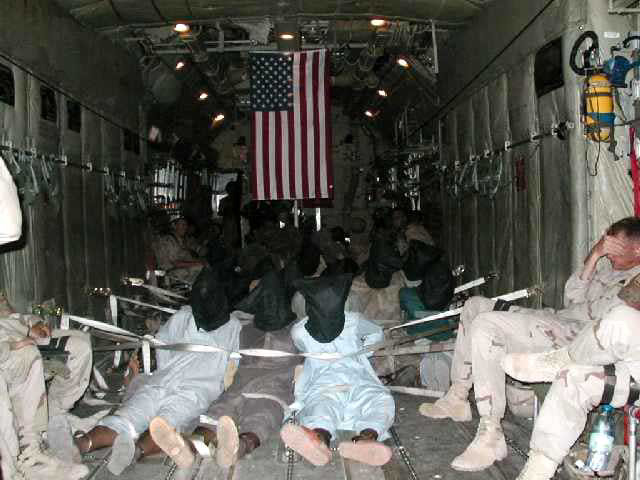
BushCo: Violations of Geneva Conventions Persist


Secret “War on Terror” Prison on Diego Garcia Confirmed
By Andy Worthington / August 02, 2008

Six “High-Value” Guantánamo Prisoners Held, Plus “Ghost Prisoner” Mustafa Setmariam Nasar

The existence of a secret, CIA-run prison on the island of Diego Garcia in the Indian Ocean has long been a leaky secret in the “War on Terror,” and yesterday’s revelations in TIME — based on disclosures by a “senior American official” (now retired), who was “a frequent participant in White House Situation Room meetings” after the 9/11 attacks, and who reported that “a CIA counter-terrorism official twice said that a high-value prisoner or prisoners were being interrogated on the island” — will come as no surprise to those who have been studying the story closely.

The news will, however, be an embarrassment to the U.S. government, which has persistently denied claims that it operated a secret “War on Terror” prison on Diego Garcia, and will be a source of even more consternation to the British government, which is more closely bound than its law-shredding Transatlantic neighbor to international laws and treaties preventing any kind of involvement whatsoever in kidnapping, “extraordinary rendition” and the practice of torture.

This is not the first time that TIME has exposed the existence of a secret prison on Diego Garcia. In 2003, the magazine broke the story that Hambali, one of 14 “high-value detainees” transferred to Guantánamo in September 2006, was being held there, and in the years since confirmation has also come from other sources. Twice, in 2004 and 2006, Barry McCaffrey, a retired four-star US general, who is now professor of international security studies at the West Point military academy, revealed the prison’s existence. In May 2004, he blithely declared on MSNBC’s Deborah Norville Tonight, “We’re probably holding around 3,000 people, you know, Bagram air field, Diego Garcia, Guantánamo, 16 camps throughout Iraq,” and in December 2006 he spoke out again, saying, in an NPR interview with Robert Siegel, “They’re behind bars … we’ve got them on Diego Garcia, in Bagram air field, in Guantánamo.”

The prison’s existence was also confirmed by Dick Marty, a Swiss senator who produced a detailed report on “extraordinary rendition” for the Council of Europe in June 2007 (PDF) and by Manfred Novak, the UN’s Special Rapporteur on Torture, in March this year. Having spoken to senior CIA officers during his research, Marty told the European Parliament, “We have received concurring confirmations that United States agencies have used Diego Garcia, which is the international legal responsibility of the UK, in the ‘processing’ of high-value detainees,” and Manfred Novak explained to the Observer that “he had received credible evidence from well-placed sources familiar with the situation on the island that detainees were held on Diego Garcia between 2002 and 2003.” The penultimate piece of the jigsaw puzzle came in May, when El Pais broke the story that “ghost prisoner” Mustafa Setmariam Nasar, whose current whereabouts are unknown, was imprisoned on the island in 2005, shortly after his capture in Pakistan — although the English-speaking press failed to notice.

Despite these previous disclosures, yesterday’s article, by Adam Zagorin, is particularly striking because of the high-level nature of the source, and his admission that “the CIA officer surprised attendees by volunteering the information, apparently to demonstrate that the agency was doing its best to obtain valuable intelligence.” In addition, the source noted that “the U.S. may also have kept prisoners on ships within Diego Garcia’s territorial waters, a contention the U.S. has long denied.”

Read all of it here. / Z-Net

The Rag Blog

Posted in RagBlog | Tagged , , | Leave a comment

Frankly, This Isn’t Really News: Iraq War Stupid

David Kilcullen

Iraq war stupid, Aussie David Kilcullen tells US
Geoff Elliott / August 2, 2008

DAVID Kilcullen, the Australian counter-insurgency expert who advises US Secretary of State Condoleezza Rice, has stepped into a political minefield after being quoted as saying the decision to invade Iraq was “f..king stupid”.

The comments were seized on by left-leaning blogs as lending weight to Democratic presidential candidate Barack Obama, whose early opposition to the war is one of the central themes of his campaign.

Dr Kilcullen told The Weekend Australian yesterday that he had been misquoted, but in a lengthy blog he posted this week on the Small Wars Journal website he did not deny the comment, saying the journalist reporting it “did not clear the quote with me”.

Dr Kilcullen, 41, has had a rapid rise to the top of the US military and diplomatic establishment, in part because of his straightforward approach.

He had said previously the Iraqi invasion would be tougher than the Bush administration had anticipated, but his blunt statement this week shocked Washington insiders.

Dr Kilcullen, the chief author of Counterinsurgency: A Guide for Policy-makers, explained to the online newspaper the Washington Independent that the handbook, to be released late this year, tells policy-makers to “think very, very carefully before intervening”.

Journalist Spencer Ackerman then wrote: “More bluntly, Kilcullen, who helped (General David) Petraeus design his 2007 counterinsurgency strategy in Iraq, called the decision to invade Iraq “stupid’ – in fact, he said ‘f..king stupid’ – and suggested that if policy-makers apply the manual’s lessons, similar wars can be avoided in the future.”

Dr Kilcullen said on Small Wars that the journalist “did not seek to clear that quote with me, and I would not have approved it if he had”.

“If he had sought a formal comment, I would have told him what I have said publicly before: in my view, the decision to invade Iraq in 2003 was an extremely serious strategic error.

“But the task of the moment is not to cry over spilt milk, rather to help clean it up: a task in which the surge, the comprehensive counterinsurgency approach, and our troops on theground are admirably succeeding,” he said.

Asked if the comments damaged his position at the State Department, a spokesman told The Weekend Australian: “David never claims to have said what you say he said. I believe this is much ado about nothing. As he says himself, his views in general have been pretty clear.”

Dr Kilcullen, who has been described as one of the most influential Australian military minds of his generation, grew up on Sydney’s north shore.

He studied counterinsurgency as a cadet at Duntroon, served for more than 20 years in the Australian army and was awarded a PhD in political science from the University of NSW for a thesis on Indonesian insurgent and terrorist groups and counterinsurgency methods.

Senator Obama has consistently stated that he opposed the war and that it would stoke anti-US feelings in the Muslim world. But he opposed the surge in troops, while his Republican opponent John McCain supported the invasion and a surge well before the Bush administration finally decided to send more soldiers in January last year.

Source / The Australian

The Rag Blog

Posted in RagBlog | Tagged , | 1 Comment

Faiz :
Playing High School with 5000 Nuclear Warheads

photo of gunboat

One of the Iranian gunboats from the incident

To Provoke War: Cheney Considered Proposal To Dress Up Navy Seals As Iranians And Shoot At Them

By Faiz | August 1, 2008

Speaking at the Campus Progress journalism conference earlier this month, Seymour Hersh — a Pulitzer-Prize winning journalist for The New Yorker — revealed that Bush administration officials held a meeting recently in the Vice President’s office to discuss ways to provoke a war with Iran.

In Hersh’s most recent article, he reports that this meeting occurred in the wake of the overblown incident in the Strait of Hormuz, when a U.S. carrier almost shot at a few small Iranian speedboats. The “meeting took place in the Vice-President’s office. ‘The subject was how to create a casus belli between Tehran and Washington,’” according to one of Hersh’s sources.

During the journalism conference event, I asked Hersh specifically about this meeting and if he could elaborate on what occurred. Hersh explained that, during the meeting in Cheney’s office, an idea was considered to dress up Navy Seals as Iranians, put them on fake Iranian speedboats, and shoot at them. This idea, intended to provoke an Iran war, was ultimately rejected:

HERSH: There was a dozen ideas proffered about how to trigger a war. The one that interested me the most was why don’t we build — we in our shipyard — build four or five boats that look like Iranian PT boats. Put Navy seals on them with a lot of arms. And next time one of our boats goes to the Straits of Hormuz, start a shoot-up.

Might cost some lives. And it was rejected because you can’t have Americans killing Americans. That’s the kind of — that’s the level of stuff we’re talking about. Provocation. But that was rejected.

Watch it:

Sy Hersh and Faiz Shakir at Campus Progress Journalism Conference

Hersh argued that one of the things the Bush administration learned during the encounter in the Strait of Hormuz was that, “if you get the right incident, the American public will support” it.

“Look, is it high school? Yeah,” Hersh said. “Are we playing high school with you know 5,000 nuclear warheads in our arsenal? Yeah we are. We’re playing, you know, who’s the first guy to run off the highway with us and Iran.”

Source, including additional transcript / Information Clearing House

The Rag Blog

Posted in RagBlog | Tagged , , , | Leave a comment

BOOKS : Markos Moulitsas’ ‘Taking on the System’


“Rules for Radicals” Meets the 21st Century
by Paul Hogarth / July 31‚ 2008

Markos Moulitsas’ new book, Taking On the System, is not really about political blogs. One would expect the founder of Daily Kos to write about the netroots (and his book offers plenty of anecdotes about how they’ve changed politics), but it’s really a guide for how ordinary people can make an impact in the 21st Century. Moulitsas writes about how the Internet has democratized the process – making old gatekeepers like party bosses, media moguls and even record companies less powerful and relevant than before. But modeling himself after the late Saul Alinsky, Moulitsas offers plenty of pragmatic advice for political activists – like “stay on message,” “how to handle your enemies,” and “pick your battles” – that was applicable in an earlier era. In the 21st Century, however, more can play this game. Taking On the System is a resource for progressives hopeful about November – but anxious about how to keep that momentum going in an Obama Administration

The impact Daily Kos and other blogs have had is so well established that anyone picking up Taking On the System will probably be familiar with it already. But what Moulitsas argues is that he’s really no one special: any citizen can use the Internet to bypass the traditional gatekeepers who once decided which political candidates were legitimate, what wisdom was conventional and even which songs became hits.

Activists don’t need to hold press conferences and hope the media shows up – they can create their own media with a blog. Political candidates getting started don’t have to kowtow to the same rich donors – if they have a compelling grass-roots message, the netroots will embrace them. Even musicians don’t need to be “discovered” by recording executives to make it big – now they can use social networking sites like MySpace.

It’s not about destroying the gatekeepers, says Moulitsas. It’s about using the Internet (along with a compelling product) so you can simply by-pass them. “Technology has unlocked doors and facilitated a genuine democratization of our culture,” he writes. You don’t need anyone’s permission to start an online movement: it was ordinary people who stepped out of their comfort zone to recruit Jim Webb for the US Senate, create MoveOn, and launch an annual blogger convention that culminated with Netroots Nation.

What activists need to understand, said Moulitsas, is what technology medium is most effective in their time period at getting out a message that will influence conventional wisdom. Gandhi used newsreels to push the narrative that the British were exploiting the Indian people. Television helped dramatize the civil rights movement in the 1960’s that galvanized a country to its cause. But the era of mass visual rallies that grab attention on the evening news are over, he says. Another thousand people in the street just isn’t news today.

In fact, Moulitsas is very critical of anti-war activist Cindy Sheehan – because she too quickly fell into the obsolete model of ‘60s protest no longer conducive for the digital era. After activists spent years marching in the streets against the Iraq War without changing public opinion, Sheehan’s plea to meet President Bush in Crawford, Texas put on a human face that most Americans could relate to. But once Camp Casey became a circus for every left-wing group, it devolved into the same type of ineffectual protest we’ve all seen before.

The book’s passage on Camp Casey is likely to infuriate Code Pink (the first group that set up camp with Sheehan), which Moulitsas describes their set-up as “neon pink banners, tables and paraphernalia, in the manner of a corporate sponsor at a sports facility.” But his point is well taken: Sheehan’s failure to keep a disciplined message allowed the protest to become yet another anti-war rally that the public had long since seen time and again.

Moulitsas also criticizes Sheehan because she violated a cardinal rule of activism: keep your ego in check. Sheehan failed to understand that, while she was an important part of the anti-war movement, it was more than just about her. “This wasn’t the world of the ‘60s where we needed Walter Cronkite and visible antiwar national leaders to captivate media coverage,” he writes. “In today’s fragmented world thousands of people were doing their part, aided by the tragic reality of Iraq, toward changing public opinion.”

Bloggers are not likely to be egomaniacs, argues Moulitsas, because “there’s virtually no danger of living in a bubble surrounded by sycophants. Every time I write anything on my own site, I have dozens of people telling me what an idiot I am.” I’m a bit skeptical about that point. While bloggers do face criticism every day, blogs can also foster a “navel-gazing” atmosphere of self-congratulation and inflated importance. Even with a democratized activism online where anyone can be a “leader,” those who strive to be effective can’t take themselves too seriously. It’s important to stay grounded with the offline world.

One place where Moulitsas will get in trouble with local Bay Area activists is on the battle for a transgender-inclusive ENDA. Urging progressives to take a long-term approach and pick their battles, Moulitsas faults the “all-or-nothing” line that LGBT activists took against the Human Rights Campaign for pushing an anti-discrimination law on sexual orientation – but not gender identity. His general advice on incremental progress is sound, but he failed to consider specific facts around ENDA that didn’t make it all that simple.

First, Moulitsas says transgenders “had come late to the battle” – which is simply untrue. Three years before Stonewall, it was trannies who staged the Compton Cafeteria Riots in San Francisco. Second, an incremental strategy may have earned the trust of the LGBT community – if the Human Rights Campaign did not have such an “inside-the-Beltway” track record of endorsing Republican legislators. Moulitsas actually mentions HRC’s tendency to do so when he criticizes environmental and pro-choice groups for doing the same thing (an utterly doomed strategy) – but he never makes the connection as to how this practice played a role with ENDA.

Nevertheless, Moulitsas has written a compelling book that illustrates the democratizing impact that digital media has had on political activism, and offers sound advice for how to navigate this medium for your cause. His passage on crafting a narrative and handling your opponents is especially instructive in our fast-moving news cycle where bloggers must stay on the ball, and he gives plenty of anecdotal examples that keep it entertaining.

Taking On the System hits the bookstores on August 20th, and is now available for pre-order online. It should be equally successful – if not more so – than Moulitsas’ first book, which was also worth reading.

Source / BeyondChron / Next Left Notes

Find Taking On the System at Amazon.com.

The Rag Blog

Posted in RagBlog | Tagged , , , , , , , | Leave a comment

Introducing DisneyIraq : The Unhappiest Place on Earth

An American financier is pitching a vast theme park in Baghdad, not out of kindness, but as he says, “for profit.”

‘I’m not here because I think you’re nice people. I think there’s money to be made’
By Scott Thill / August 1, 2008

An American financier is pitching a vast theme park in Baghdad, not out of kindness, but as he says, “for profit.”

“I’m a businessman. I’m not here because I think you’re nice people. I think there’s money to be made,” explained Llewellyn Werner in his pitch for a vast recreational complex to be built in, of all places, Baghdad. “I also have this wonderful sense that we’re doing the right thing — we’re going to employ thousands of Iraqis. But mostly everything here is for profit.”

It has come to this. We’re not even pretending anymore. As the years, memories and excuses have fallen away like dead skin, America’s invasion of Iraq has revealed itself for what it truly is: a consumerist pipe dream. The Great American Mall of the Middle East. Disneyland in the desert.

And since we’re already giving away billions in duffel bags, why not throw another billion or two down the money pit? Where there’s funding, there is fire. And in the case of the Baghdad Zoo and Entertainment Experience (BZEE), there may also be firefights. If you can ignore the bullets, IEDs, power outages and, well, the entire occupation, you might just have yourself a good time.

“In Southern California, there’s drive-bys and everything else,” reasoned Ride and Show Engineering Executive Vice President John March, whose company has been contracted to develop the site, which is adjacent to the Green Zone and fast-tracked by the Pentagon. “So there’s danger everywhere. I think the key thing is this will be tremendous for Baghdad,” he explained to Fox News chatterhead Bill Hemmer.

If by “tremendous” he means a huge target, then March, who refused to participate in this article, is dead right. It is also financially tremendous for C3, the hedge fund holding company that Werner oversees: Already given a green light from the Pentagon and an endorsement from Gen. David Petraeus, Werner secured a 50-year lease on what used to be acreage containing Baghdad’s looted and left-for-dead zoo for “an undisclosed sum,” according to the UK’s Times Online. He is quickly building everything from a skate park, museum, concert arena and rides to future diversions. So far, Werner has collared $500 million from his elusive investors, who are practically impossible to find (a rarity in the Internet age) and secured joint partnerships across Iraq for a variety of projects. The million-dollar skate park is scheduled to open this month, and further hotel and housing developments will follow, especially since Werner has exclusive rights to them.

And although they may be managed by Iraqis, their profits belong to America. Just like most of country’s oil reserves.

“Even the idea of bringing U.S.-style escapism entertainment to the hell of Baghdad is absurd,” explains author and journalist Dahr Jamail, who, unlike the majority of his peers, has actually ventured outside the Green Zone without being embedded in a military detail. “Just watch how much of this infrastructure even gets built.”

That’s just the beginning of the problems, explains journalist Sharon Weinberger, who covers the Pentagon and other disaster capitalist complexes for Wired’s Danger Room. (Full disclosure: I cover music for Wired’s Listening Post.) The BZEE may get built after all, but who’s to say it’ll be left standing when the smoke clears?

“Even if they do pull this off, then the park’s immediate survival, like any private business, is going to depend on stability and the ability of the Iraqi government to control violence and ensure public safety,” Weinberger says. “If the situation in Baghdad deteriorates, I think the idea that the park will somehow be spared violence is, sadly, naive at best.”

What seems most naive, however, is the idea that any American business venture launched in the miasma of Iraq’s reconstruction is dealing in good faith. From Halliburton to Bechtel and on to Blackwater and beyond, the place has been an epicenter of fraud and corruption, and that’s just the so-called private sector. Our collective public enterprise has been as daunting a failure: So far, the war has cost hundreds of billions in dollars and hundreds of thousands of lives. By the time it’s all over, those numbers could skyrocket, and the last thing anyone is going to want is a Los Angeles hedge fund looking to stash its money in a private-public partnership that serves no real purpose.

Even though Werner landed the acreage with the blessing of Iraqi politicians and officials, it was not them who shut down the nation’s state-owned factories after the invasion. That was L. Paul Bremer, a U.S. official in charge of the pillage. In other words, if America and its business partners want the BZEE bad enough, they will get it. No questions asked.

And it is leading to further criticism that American economic interests are living in Disneyland, rather than looking to build one in the most dangerous metropolis in the entire Middle East.

“The Bush junta has already attempted to impose a neo-liberal economic Disneyland upon the Iraqi people,” Jamail asserts, “but they have flatly rejected the neurosis of its brand-conscious, failed capitalism. The two geographies meet nowhere in my imagination, nor in reality. The not-so-Green Zone is barely inured from the death, destruction and suffering which surrounds it. The point is that no gated community is safe from mortars and rockets. I believe we are looking at the next evolution of the gated community, albeit grossly failed.”

With one caveat: Failure is merely the end of this economic stratagem, not its beginning. It has all the earmarks of a successful scam, from its suspicious fast-tracking all the way down to its undisclosed sums changing hands over territories that once belonged to someone else and may indeed be taken back by force shortly after the ink on the contracts dries. It is enough for some economic players to merely get something this compromised off the ground; success is a mere side effect to the financial interchange, which will have already taken place and been pocketed once the BZEE is judged an unmitigated disaster. Just like the invasion itself.

Milo Minderbinder would be proud. It’s like his chocolate-covered cotton, only vastly more lethal.

“I think I’d file this under ‘zoo allegory,'” Weinberger concludes. “People are fascinated by the effects of wars on zoos. Think of Emir Kusturica’s 1995 movie, ‘Underground,’ or Marjan, the one-eyed lion of the Kabul zoo. Right now, people are following this as a ‘News of the Weird’ story, but I hope you or someone revisits it in a few years. If the Baghdad Zoo and Entertainment Experience is thriving and Iraqis are visiting, then it will be a wonderful testament to the country’s progress. If, however, it’s an empty space, then it will be a testament to a larger self-delusion.”

Source / AlterNet

The Rag Blog

Posted in RagBlog | Tagged , , , , | Leave a comment

Travelers’ Laptops May Be Detained At Border

No suspicion required under Homeland Security policies
By Ellen Nakashima / August 1, 2008

Federal agents may take a traveler’s laptop computer or other electronic device to an off-site location for an unspecified period of time without any suspicion of wrongdoing, as part of border search policies the Department of Homeland Security recently disclosed.

Also, officials may share copies of the laptop’s contents with other agencies and private entities for language translation, data decryption or other reasons, according to the policies, dated July 16 and issued by two DHS agencies, U.S. Customs and Border Protection and U.S. Immigration and Customs Enforcement.

“The policies . . . are truly alarming,” said Sen. Russell Feingold (D-Wis.), who is probing the government’s border search practices. He said he intends to introduce legislation soon that would require reasonable suspicion for border searches, as well as prohibit profiling on race, religion or national origin.

DHS officials said the newly disclosed policies — which apply to anyone entering the country, including U.S. citizens — are reasonable and necessary to prevent terrorism. Officials said such procedures have long been in place but were disclosed last month because of public interest in the matter.

Civil liberties and business travel groups have pressed the government to disclose its procedures as an increasing number of international travelers have reported that their laptops, cellphones and other digital devices had been taken — for months, in at least one case — and their contents examined.

The policies state that officers may “detain” laptops “for a reasonable period of time” to “review and analyze information.” This may take place “absent individualized suspicion.”

The policies cover “any device capable of storing information in digital or analog form,” including hard drives, flash drives, cellphones, iPods, pagers, beepers, and video and audio tapes. They also cover “all papers and other written documentation,” including books, pamphlets and “written materials commonly referred to as ‘pocket trash’ or ‘pocket litter.’ “

Reasonable measures must be taken to protect business information and attorney-client privileged material, the policies say, but there is no specific mention of the handling of personal data such as medical and financial records.

When a review is completed and no probable cause exists to keep the information, any copies of the data must be destroyed. Copies sent to non-federal entities must be returned to DHS. But the documents specify that there is no limitation on authorities keeping written notes or reports about the materials.

“They’re saying they can rifle through all the information in a traveler’s laptop without having a smidgen of evidence that the traveler is breaking the law,” said Greg Nojeim, senior counsel at the Center for Democracy and Technology. Notably, he said, the policies “don’t establish any criteria for whose computer can be searched.”

Customs Deputy Commissioner Jayson P. Ahern said the efforts “do not infringe on Americans’ privacy.” In a statement submitted to Feingold for a June hearing on the issue, he noted that the executive branch has long had “plenary authority to conduct routine searches and seizures at the border without probable cause or a warrant” to prevent drugs and other contraband from entering the country.

Homeland Security Secretary Michael Chertoff wrote in an opinion piece published last month in USA Today that “the most dangerous contraband is often contained in laptop computers or other electronic devices.” Searches have uncovered “violent jihadist materials” as well as images of child pornography, he wrote.

With about 400 million travelers entering the country each year, “as a practical matter, travelers only go to secondary [for a more thorough examination] when there is some level of suspicion,” Chertoff wrote. “Yet legislation locking in a particular standard for searches would have a dangerous, chilling effect as officers’ often split-second assessments are second-guessed.”

In April, the U.S. Court of Appeals for the 9th Circuit in San Francisco upheld the government’s power to conduct searches of an international traveler’s laptop without suspicion of wrongdoing. The Customs policy can be viewed here..

Source / Washington Post

Thanks to Shelia Cheaney / The Rag Blog

Posted in RagBlog | Tagged , , , , , , | Leave a comment

Arresting Report From Roving Reporter

Karl Rove arrested. Image by Fo’teau Shoppe.

Four Iowan Citizens Arrested for Trying to Arrest Karl Rove
July 30, 2008

You didn’t read about this in the mainstream media – wouldn’t want to encourage anyone, would they? This news, however, is certainly huge. Four Iowans were arrested on July 25th for attempting to make a Citizen’s Arrest of Karl Rove in Des Moines at the Wakonda Country Club.

Rev. Chet Guinn, a Methodist minister, and Catholic Workers Edward Bloomer, Kir Brown, and Mona Shaw were arrested at the gate of the Country Club and cited for trespassing. They were citing Iowa Code provisions for Citizen’s Arrests and Federal Statute violations against Rove.

Karl Rove refused to cooperate with a Congressional subpoena in the Valerie Plame CIA leak investigation. He’s also been linked to a federal bribery case against former Governor Don Siegelmen. He was given a subpoena to testify before a House Committee on the matter and refused to testify, citing “executive privilege.” A Congressional subcommittee voted that executive privilege does not protect him from testifying; however he has still not come forward and the matter is unresolved.

Rove had a “strategic communications” task force that helped write and coordinate speeches for senior Bush administration officials that emphasized the supposed nuclear threat of Iraq. Rove was involved in administration energy policy meetings at the same time that he held more than $100,000 of stock in Enron, Boeing, General Electric, and Pfizer.

Source / OB Rag

The Rag Blog

Posted in RagBlog | Tagged , , , | Leave a comment

Democrats and Labor : Wal*Mart Running Scared

Of all companies to be whining about money. WAL*MART the so-called American company with 600 factories in CHINA and zero in America, they have the audacity to be pushing this line on their underpaid front-line employees.

While Lee Scott and the Waltons live in huge mansions and travel with bodyguards, paid for by the labor of their employees, these folks have the audacity to “fear” their employees into voting AGAINST their own pocketbook.

This is the same company that encourages its underpaid workers to seek out gov’t assistance.

This company is as tolitarian as any country could be. If you are a manager or supervisor at WAL*MART, you are expected to “goose-step”…

truthtolies / Daily Kos / August 1, 2008

Wal-Mart Warns of Democratic Win
By Ann Zimmerman and Kris Maher / August 1, 2008

Wal-Mart Stores Inc. is mobilizing its store managers and department supervisors around the country to warn that if Democrats win power in November, they’ll likely change federal law to make it easier for workers to unionize companies — including Wal-Mart.

In recent weeks, thousands of Wal-Mart store managers and department heads have been summoned to mandatory meetings at which the retailer stresses the downside for workers if stores were to be unionized.

According to about a dozen Wal-Mart employees who attended such meetings in seven states, Wal-Mart executives claim that employees at unionized stores would have to pay hefty union dues while getting nothing in return, and may have to go on strike without compensation. Also, unionization could mean fewer jobs as labor costs rise.

The actions by Wal-Mart — the nation’s largest private employer — reflect a growing concern among big business that a reinvigorated labor movement could reverse years of declining union membership. That could lead to higher payroll and health costs for companies already being hurt by rising fuel and commodities costs and the tough economic climate.

The Wal-Mart human-resources managers who run the meetings don’t specifically tell attendees how to vote in November’s election, but make it clear that voting for Democratic presidential hopeful Sen. Barack Obama would be tantamount to inviting unions in, according to Wal-Mart employees who attended gatherings in Maryland, Missouri and other states.

“The meeting leader said, ‘I am not telling you how to vote, but if the Democrats win, this bill will pass and you won’t have a vote on whether you want a union,'” said a Wal-Mart customer-service supervisor from Missouri. “I am not a stupid person. They were telling me how to vote,” she said.

“If anyone representing Wal-Mart gave the impression we were telling associates how to vote, they were wrong and acting without approval,” said David Tovar, Wal-Mart spokesman. Mr. Tovar acknowledged that the meetings were taking place for store managers and supervisors nationwide.

Wal-Mart’s worries center on a piece of legislation known as the Employee Free Choice Act, which companies say would enable unions to quickly add millions of new members. “We believe EFCA is a bad bill and we have been on record as opposing it for some time,” Mr. Tovar said. “We feel educating our associates about the bill is the right thing to do.”

Other companies and groups are also making a case against the legislation to workers. Laundry company Cintas Corp., which has been fighting a multiyear organizing campaign by Unite Here, relaunched a Web site July 14 called CintasVotes. The site instructs visitors to take action by telling members of Congress to oppose the legislation.

“We feel it’s important that our employee partners fully understand the implications that the Employee Free Choice Act could have on their work environment and benefits,” said Heather Trainer, a Cintas spokeswoman.

Business-backed organizations are also running ads aimed at building opposition to the bill, including the Coalition for a Democratic Workplace, which counts several hundred industry associations as members. Another group, the Employee Freedom Action Committee, is run by former tobacco lobbyist Rick Berman. The groups, which aren’t affiliated with each other, say they have a total of $50 million in funding. Neither will disclose which companies or individuals have provided funding.

The U.S. Chamber of Commerce has made defeat of the legislation a top priority. In the past six months, it has flown state and local Chamber members to Washington to lobby members of Congress. On Thursday, the Chamber began airing a television ad in Minnesota and plans to run ads in other states as part of a broader campaign.

The bill was crafted by labor as a response to more aggressive opposition by companies to union-organizing activity. The AFL-CIO and individual unions such as the United Food and Commercial Workers have promised to make passage of the new labor law their No. 1 mission after the November election.

First introduced in 2003, the bill came to a vote last year and sailed through the Democratic-controlled House of Representatives, but was blocked by a filibuster in the Senate and faced a veto threat by the White House. The bill was taken off the floor, and its backers pledged to reintroduce it when they could get more support.

The November election could bring that extra support in Congress, as well as the White House if Sen. Obama is elected and Democrats extend their control in the Senate. Sen. Obama co-sponsored the legislation, which also is known as “card check,” and has said several times he would sign it into law if elected president. Sen. John McCain, the likely Republican presidential nominee, opposes the Employee Free Choice Act and voted against it last year.

Wal-Mart’s labor-relations meetings are led by human-resources managers who received training from Wal-Mart on the implications of the Employee Free Choice Act.

Fine Legal Line

Wal-Mart may be walking a fine legal line by holding meetings with its store department heads that link politics with a strong antiunion message. Federal election rules permit companies to advocate for specific political candidates to its executives, stockholders and salaried managers, but not to hourly employees. While store managers are on salary, department supervisors are hourly workers.

However, employers have fairly broad leeway to disseminate information about candidates’ voting records and positions on issues, according to Jan Baran, a Washington attorney and expert on election law.

Both supporters and opponents of the Employee Free Choice Act believe it would simplify and speed labor’s ability to unionize companies. Currently, companies can demand a secret-ballot election to determine union representation. Those elections often are preceded by months of strident employer and union campaigns.

Under the proposed legislation, companies could no longer have the right to insist on one secret ballot. Instead, the Free Choice, or “card check,” legislation would let unions form if more than 50% of workers simply sign a card saying they want to join. It is far easier for unions to get workers to sign cards because the organizers can approach workers repeatedly, over a period of weeks or months, until the union garners enough support.

Employers argue that the card system could lead to workers being pressured to sign by pro-union colleagues and organizers. Unions counter that it shields workers from pressure from their employers.

On June 30 the National Labor Relations Board ruled that Wal-Mart illegally fired an employee in Kingman, Ariz., who supported the UFCW and illegally threatened to freeze merit-pay increases if employees voted for union representation. The decision came eight years after the organizing campaign failed, and four years after the case was originally heard.

“We’ve always maintained the termination was not related to the union and that there was nothing unlawful about an answer provided an associate about merit pay,” said Mr. Tovar, the Wal-Mart spokesman. “Following the decision, we were considering offering reinstatement, but that is on hold, since the [union] appealed the decision.”

Unions consider the Employee Free Choice Act as vital to the survival of the labor movement, which currently represents 7.5% of private-sector workers, half the percentage it did 25 years ago. The Service Employees International Union said the legislation would enable it to organize a million workers a year, up from its current pace of 100,000 workers a year.

The Underdogs

The business-backed lobbying groups are running ads in states where a win by a Democratic Senate candidate would boost support for the legislation in the Senate, saying the loss of secret ballots exposes workers to bullying labor bosses. In one, they use an actor from the “Sopranos” TV series about mob life to hammer home their point.

Business groups say they’re the underdogs since they will be outspent by unions by a wide margin. Labor has pledged to spend $300 million on the election and securing passage of the Employee Free Choice Act, compared with under $100 million by business groups, according to Steven Law, chief legal officer of the U.S. Chamber of Commerce. The Chamber’s strategy is to focus on the Senate, where labor needs eight more supporters of the legislation to reach the 60 votes needed to overcome a filibuster.

“This is a David-and-Goliath confrontation, but we believe we’ll have enough stones in the sling to knock this out,” said Mr. Law.

Wal-Mart is a powerful ally. Through almost all of its 48-year history, Wal-Mart has fought hard to keep unions out of its stores, flying in labor-relations rapid-response teams from its Bentonville, Ark., headquarters to any location where union activity was building. The United Food and Commercial Workers was successful in organizing only one group of Wal-Mart workers — a small number of butchers in East Texas in early 2000. Several weeks later, the company phased out butchers in all of its stores and began stocking prepackaged meat. When a store in Canada voted to unionize several years ago, the company closed the store, saying it had been unprofitable for years.

Labor has fought back with a campaign to portray Wal-Mart as treating its workers poorly. The UFCW helped employees file a series of complaints about the company’s overtime, health-care and other policies with the National Labor Relations Board. Dozens of class-action lawsuits were filed on behalf of workers, many of which are still winding their way through the courts.

Wal-Mart has been trying to burnish its reputation by improving its worker benefits and touting its commitment to the environment. On the political front, it’s hedging its bets, spreading its financial contributions on both sides of the political divide.

Twelve years ago, 98% of Wal-Mart’s political donations went to Republicans. Now, as the Democrats seem poised to gain control in Washington, 48% of its $2.2 million in political contributions go to Democrats and 52% to Republicans, according to the Center for Responsive Politics, a nonpartisan organization that tracks political giving.

Source / Wall Street Journal

Go here to tell the FEC to investigate Wal-Mart.

The Rag Blog

Posted in RagBlog | Tagged , , , , , , , | 1 Comment

Singin’ on Thursday – Roy Zimmerman

“Thanks For the Support” by Roy Zimmerman

Available for download at royzimmerman.com. Recorded on 9/11/07 at “Mark Pitta and Friends,” 142 Throckmorton Theatre in Mill Valley, CA.

The Rag Blog / Posted August 1, 2008

Posted in RagBlog | Tagged , | Leave a comment