Fabulous Furry Freak Brothers : They’re B-a-a-a-a-ck!

Updated July 31, 2008


40th Anniversary ‘Freak Brothers Omnibus’: complete works plus previously unpublished material
By Steve Bunche

This August, the U.K. comics publisher, Knockabout Comics will answer the prayers of classic underground comics aficionados with the publication of a massive 40th anniversary Freak Brothers Omnibus, a 624-page leviathan of laughs, straight from the mind of creator Gilbert Shelton. The book collects every adventure of the hirsute trio since their inception in 1968, as well as previously unpublished material.

The book’s first printing of 10,000 copies will feature an extra dust jacket and an insert detailing how the interested fan can donate funds and invest in Grass Roots, an upcoming animated film featuring the characters, and even get their names inserted into the corner of one of the film’s frames in a promotion called “Name That Frame.” (The investor purchases a frame and their name will be visible only when the film is slowed down on a DVD player). American distribution of the book will be handled by Diamond, Last Gasp, and Rip Off Press for the comics shop specialty market and by Atlas books for Barnes & Noble, Amazon, Borders and independent general book retailers.

But exactly what is the Freak Brothers series and why does it warrant such red carpet treatment? Simply put, The Fabulous Furry Freak Brothers is the Rosetta Stone (no pun intended) of “stoner” humor as we now understand the genre, predating Cheech & Chong’s THC-based antics by a few years and offering narratives that are often hilarious without the aid of various illegal “party favors.” The series revolves around the eponymous characters, a trio related not by blood, but by a common interest—the need for weed—and loony adventures in a rollicking counter-culture universe. The trio includes Phineas (the leftist intellectual), Freewheelin’ Franklin (the baked cowboy), and Fat Freddy (the “Curly” of the bunch). Their lives are driven by marijuana and they spend virtually all of their time trying to get stoned while avoiding the police or getting ripped off by unscrupulous dealers.

But unlike many of its underground contemporaries that wallowed in explicit sex, ultra-violence, and sometimes outright misogyny, the Freak Brothers strips concentrated on solid laughs and earned them and their creator an enduring following among the underground comix cogniscenti and beyond. When asked about how he settled upon his approach to the material Shelton reminisced, “I used to sell strips to weekly leftist newspapers. I was in sympathy with them but they were deadly dull, so I felt they could use a comic strip modeled on old comics.”

Shelton said at the time that he was “more into traditional comic strips like Chester Gould’s Dick Tracy, which seemed outrageously weird when seen from a grownup perspective. Other strips I enjoyed included Bob Montana’s Archie, Peanuts, B.C., The Wizard of Id, Miss Peach, and the old E.C. stuff, especially the original run of Mad when it was still a comic book.” That last influence must have been particularly strong since Shelton’s work on the Freak Brothers seemed like the next logical step from its 1950’s antecedent. The Freak Brothers comics were infused with the same anarchic energy and endearing silliness, only now unleashed in an era of free love and psychedelic mind-expansion. As for the inspiration behind the trio’s comedic adventures, Shelton said, “I took the ambience from real life and used gags that used to be based around alcohol and substituted marijuana for the booze. Take the one about the hippy getting busted on a possession charge and being told by the arresting officer that he had one phone call. The guy uses that call to get a pizza delivery.” And when not focusing on the Brothers themselves, Shelton turns his humorous eye to the antics of Fat Freddy’s Cat, a side-strip also featured in the omnibus that’s every bit as entertaining as the book’s main event.

The enduring popularity of the Freak Brothers has led to the production of Grass Roots, a stop-motion animated feature, but the project has not had smooth sailing; according to Shelton. “Grass Roots has been in progress for five years and Bolex Brothers, a hugely talented studio in Bristol, England, is handling it while actively raising money to fund it,” Shelton explained. He said this was the “6th or 8th time” the rights to a Freak Brothers film have been sold, “including once having been in the hands of Universal some thirty years ago. Obviously nothing came of that.”

Hopefully the combined efforts of the Bolex Brothers and the series’ rabid fan base will result in a happy ending for Shelton and Freak Brothers enthusiasts everywhere and the trio will finally make their bong-hitting way onto the silver screen alongside such stoner descendants as Cheech & Chong and Harold and Kumar. But until then, there are always Shelton’s stories to get us through these Freak-less times. In fact, the book serves as an echo of Shelton’s timeless credo: “Dope will get you through times of no money better than money will get you through times of no dope.” Words to live by, especially in the waning days of Dubya’s America.

Source / Publisher’s Weekly / Posted July 22, 2008

Hi gang,

The Bristol, England film production company Bolexbrothers is still trying to raise money to do their feature-length stop-action animated movie of the Freak Brothers in Grass Roots. They did a few minutes of test footage a couple of years ago which can be seen at Grass Roots the Movie.

If you manage to find this site, you might recognize the voice of Telebob in the intro. Bolexbrothers (and I, too) thought that money would come raining in from rich ex-hippies, but maybe there’s no such thing.

Gilbert Shelton / July 31, 2008

Find the Freak Brothers Omnibus at Atomic Books.

Thanks to radman / The Rag Blog

Posted in RagBlog | Tagged , , , , , , | Leave a comment

Drawn and Quartered

R.J. Matson / The New York Observer and Roll Call.

The Rag Blog / Posted July 30, 2008

Posted in RagBlog | Tagged , , , | Leave a comment

Strained by War, U.S. Army Promotes Unqualified Soldiers

U.S. Army photo by Pfc. Sarah De Boise.

A shortage of skilled sergeants has led to dubious promotions for inexperienced soldiers — even jeopardizing some operations in Iraq.
By Bill Sasser / July 30, 2008

America’s military commitment in Iraq and Afghanistan is certain to remain a key issue in the presidential race — and soon that could include renewed focus on a “stretched thin” U.S. Army. According to a Salon investigation, the Army is facing a troubling shortage of qualified sergeants, the noncommissioned officers considered to be the backbone of training and combat operations. In fact, a new Army policy intended to boost this critical leadership corps of NCOs has prompted a wave of promotions for apparently unqualified soldiers — and even jeopardized some combat operations in Iraq.

In essence, an Army policy implemented in 2005 and expanded this year lowered the bar for enlisted soldiers with the rank of E-4 to gain the rank of sergeant, or E-5, by diminishing the vetting process. According to more than a half dozen current and former Army sergeants interviewed by Salon, the policy has produced sergeants who are not ready to lead. In some cases, soldiers were promoted even after being denied advancement by their own unit commanders. While awarding a promotion once required effort on the part of a commander, those interviewed say, the Army’s current policy actually requires effort to prevent a promotion, and has had negative consequences on the battlefield.

A sergeant interviewed recently at Ft. Hood for this article recounted how he watched his commander feed the promotion papers for one E-4 through a shredder shortly before their unit deployed to Iraq in 2006. After two months in the field, that solider and another E-4 who had also been passed over for promotion were automatically promoted to sergeant anyway, despite their commander’s earlier judgment. Problems soon arose during a combat patrol involving “action on contact,” an encounter with the enemy in which fire is exchanged. “These two NCOs were immature and not ready as far as leading other soldiers, and there were some ‘oh shit’ moments,” said the sergeant, who asked not to be identified and declined to provide specific details about the combat incident because of security restrictions. “We had to have a powwow and pull back on what was going on. Fortunately, no casualties occurred.”

The newly promoted E-5s, he said, also had problems with calling in reports from the field — which, in a combat scenario, could involve such life and death decisions as requesting suppressive fire or determining if an area is safe for medical helicopters to land. “We had to spend a lot of time counseling and mentoring these new E5s in the field,” he said. “They have their sergeant rank and they still have a lot to learn.”

Sgt. Colin Sesek, a medic in the 82nd Airborne Division who returned from a 15-month deployment to Iraq in November 2007, said automatic promotions affected both the morale and effectiveness of medical units in which he served and in combat units he observed. “There was an E-4 in my platoon who was very disorganized and didn’t care about anyone else — he always delegated down the line, even when it was his job to do,” said Sesek. “I’m trying to think of the civilian equivalent of how to describe him — ‘shit bag’ is what we called him. He had been in the Army for a while and boom, he got paper boarded” — a term referring to the Army’s expedited promotions process. “When I heard he got promoted I said, yep, that’s the only way he would have gotten it.”

Sesek said the promotion had wider effects within his unit, as other platoon leaders followed this example and began promoting their own E4s without hesitation. “In infantry platoons, too, I saw people get promoted who shouldn’t have been. The squad leaders told me, ‘Well, if that screwup in that platoon got promoted, then we’ll promote ours too.'”

After six years of war, with multiple tours of duty commonplace, the Army continues struggling to retain and recruit quality soldiers. After failing to meet its recruitment goals in 2005, the Army undertook measures to boost its numbers, with some success. That included stop-loss orders (compulsory postponement of retirements), bonuses of up to $50,000 for re-enlisting, and the loosening of standards on criminal backgrounds, education and age. It also began automatically promoting enlisted personnel with the rank of E-4 to sergeant, or E-5 in the Army’s hierarchy of service ranks, based on a soldier’s time in service, while waiving a requirement that candidates for E-5 appear before a promotions board.

Under the current policy, after 48 months of service E-4s serving in military specialties with shortages are automatically placed on a promotions list. Although a soldier’s name can be removed by his or her commander, each month that soldier’s name is placed back on the list. This was termed “automatic list integration” by the Army (or what the soldiers call “paper boarding”). This April, the policy was expanded to include promotions to staff sergeant, or E-6.

Sgt. Selena Coppa, a communications specialist in the 105th Military Intelligence Battalion, said she has noted a marked lowering of standards for E-4s being promoted to sergeant. “The doctrine now is that you just need to be trainable, and people who are not competent and not good leadership material are being promoted,” said Coppa, who has expressed her concerns through unit performance surveys and spoken directly to her superiors. “A sergeant major told me, ‘Yes, you’re right, but there’s nothing I can do about it.'”

Lt. Col. Elizabeth Edgecomb, branch chief for the Army personnel team at the Department of Defense, explained in an interview with Salon that the Army was short 1,549 sergeants, mostly in combat occupations, when the policy was implemented in February 2005. It has reduced the number of NCO occupational specialties with shortages by 74 percent since then, according to Edgecomb. She added that in many cases promotions are awarded to E-4s who, due to manpower shortages, are already doing the work of E-5s. “The policy does not change Army standards for promotion,” said Edgecomb. “Commanders have the responsibility to stop a potential promotion when they determine a soldier is not trained or is in some way unqualified in accordance with standards.”

Perhaps no part of the U.S. military has carried as heavy a burden in Iraq as Army sergeants, who directly train, mentor, discipline and lead boots-on-the-ground soldiers. After years of war, many of the Army’s most experienced sergeants have retired, left the service, transferred to noncombat posts, or are recovering from battlefield injuries.

“Army NCOs lead on a very personal level and are the backbone of how the U.S. Army is run,” says Lt. Col. Gian Gentile, a former commander in the 4th Infantry Division who teaches military history at West Point. “In combat specialties such as armor and infantry, doing two to three tours is having an effect on NCOs. They have been through a lot and it puts tremendous stress on them and their families.”

The current promotion policy is causing some doubts and bitterness among veteran NCOs. “If these guys don’t work for it and you give it to them, we’re not making leaders, we’re making stripe wearers,” says Staff Sgt. Charles Bunyard, a senior scout in the 1st Cavalry Division at Ft. Hood who commands a unit of Bradley fighting vehicles.

Bunyard has over 15 years of service in the Army, including two deployments to Iraq, where he survived nearly a dozen IED blasts, was grazed in the head by a sniper’s bullet and broke a leg in three places in a training accident. Sent home last year from Diyala province after suffering a dislocated shoulder and a severe concussion in an IED attack, he was diagnosed with post-traumatic stress disorder and traumatic brain injury. But after healing, he returned to duty and volunteered for a third combat tour. After five months of recuperation, he was cleared by Army doctors to return to duty and has volunteered for a third combat tour.

At Ft. Hood, Bunyard is spending 16-hour days training his squad of new recruits for their first deployment later this year. Married and the father of five children, several months ago he stopped going to his scheduled doctor and therapy appointments, which he says interfered with his duties. “I have a large responsibility to these guys, and when I’m gone I’m cheating them out of leadership and ways to learn better,” said Bunyard, who still has memory problems and sometimes speaks with a slur as a result of his brain injury.

While the Army needs thousands of new NCOs to replenish the existing ranks, thousands more are also needed as the force expands. The Army plans to add 65,000 soldiers to its ranks by 2010, as declared by President Bush in his State of the Union Address in January 2007.

Quality and morale issues notwithstanding, official figures from the Defense Department on re-enlistment show that the Army has exceeded its retention goals for the past three years. But the planned expansion will only increase the Army’s need for NCOs and junior officers, who have also been leaving the military in waves. A shortage of qualified NCOs is tied to a shortage of junior officers, as many choose not to re-enlist in order to move up the ranks by becoming officers, says Gentile. “The Army has holes in its officer corps as well, and enlisted soldiers who would have become NCOs — the cream of the crop — are going to Officer Candidate School rather than becoming sergeants,” he explained. According to Gentile, who served two combat tours in Iraq, it’s now not uncommon to see 26-year-olds with seven years of service who are first sergeants in charge of a platoon of 30 soldiers. Before the war, he says, achieving that rank would have taken twice as long.

Some military experts doubt the force’s capability at present, particularly if it is needed to perform on a third war front. Two former undersecretaries of defense for personnel question the ability of the all-volunteer Army to meet its manpower needs in coming years. “Our volunteer Army was not set up to fight a long war,” says Lawrence Korb, who served in that role in the Reagan administration. “The idea was that an active Army would fight when needed and the National Guard and Reserve were on standby as a ready reserve. They’ve all been in constant rotation for over five years, and we no longer have a reserve. What we’re doing is mortgaging the future of our Army.” Edward Dorn, who served in the Clinton administration, sees trouble on the horizon. “I think an increase of 65,000 by 2010 is out of reach with a volunteer force, unless you have a very significant downturn in the economy,” he said.

Not all E-4s are eager for automatic promotions to sergeant, according to Bandon Neely, who served in a military police battalion at Ft. Hood before leaving the service May 2005. When the policy began in 2005, the Army also had begun to impose stop-loss orders to prevent sergeants from leaving the service, “so a lot of E-4s did not want it,” Neely said. “Guys were being put up for promotion who refused to take it.”

Patrick Campbell, a sergeant in the District of Columbia’s National Guard who was recently awarded an automatic promotion, said he has seen both the benefits and drawbacks of the policy. Campbell, who served as a combat medic in Iraq in 2004 to 2005, said battlefield experience quickly turned new sergeants into competent leaders. “Being in combat forces you to learn fast — your life depends on it,” he said. “At the same time, leadership training is needed but it’s being delayed because of the pressure of deployments. If you promote people without training, what does it mean to be a sergeant?”

John Hagedorn, a sergeant who served in 2007 as a forward observer in the 82nd Airborne Division assigned to an artillery unit in Tikrit, said the high rate of NCO promotions disrupted the chain of command in the platoons to which he was attached. Out of 70 personnel in three platoons, only five soldiers returned without having been promoted to sergeant, he said.

“The artillery soldiers I was assigned to would normally be operating 105-mm Howitzer canons, but most of them had no idea how to fire one,” said Hagedon, 23, who served 15 months in Iraq under stop-loss orders and left the Army after his return in 2007. “The guys who were promoted to E-5 would normally be the crew chief in charge of one of these guns, and when they came home they were thrust into the position where they were untrained in their mission. They would be transferred to other posts and would get somewhere else and not know how to use the gun.”

Sgt. Hagedon’s experience appears to point to another Army problem, documented by an internal Pentagon report co-authored this year by Lt. Col. Gentile. The report, which raises concerns that the Army’s current focus on counterinsurgency has weakened its ability to fight conventional wars, cites among other statistics that 90 percent of Army artillery units are unqualified to fire their weapons accurately — the lowest rating in history.

In Iraq, Sgt. Hagedon said, “All those promotions lessened the significance of being in a position of leadership. It brought junior leaders down to Joe Private level and stole thunder from the older NCOs, who didn’t like seeing all these young guys getting promoted so fast.”

Hagedon said consideration of leadership potential played no part in the promotion process, as the new policy created pressure on senior sergeants to promote, regardless of performance. “If all the other E4s are getting promoted, it will look bad if you don’t promote your guy,” he said. “And if everyone else is getting it, they don’t want to cut an E4 out of the pay raise you get — $200 a month.”

The result in the platoons he observed was a breakdown in the chain of command, which followed the soldiers home: “There was really no difference between the enlisted guys and the junior leadership [in Iraq]. They’re hanging out together, being buddies, not like back in the U.S. where the NCOs are constantly correcting soldiers of a lesser rank. Then you come home to a training environment like Ft. Bragg and it’s a problem. You can’t be hanging out drinking beer with the enlisted guys one night and chewing their ass out the next morning. You end up showing favoritism.”

Such concerns may be exacerbating morale problems caused by multiple deployments. In Hagedon’s own platoon of forward observers, part of the 82nd’s Headquarters Division, only two out of 12 sergeants chose to remain in the Army when their enlistment ended.

Sgt. Major Tom Gills, chief of Army enlisted promotions, says that the current policy has returned promotion rates to what the Army had prior to the end of the Cold War. “Over the years, individual units had adopted their own standards that were higher than official standards,” he said. “A lower and lower percentage of soldiers were going before promotion boards. Through the 1980s, 25 percent of soldiers were going up for promotion, while until recently only 5 percent were coming up for promotion.”

But Andrew Bacevich, a retired Army colonel who served in Vietnam and now teaches U.S. military history and foreign policy at Boston University, said soldiers in the all-volunteer Army will continue to be overtaxed, even with the planned expansion. The strength and morale of noncommissioned officers, he said, has always been a critical measure of the Army. “When the Army began to fall apart during Vietnam one of the red flags was the deterioration of the NCO corps,” said Bacevich. “Experienced NCOs began leaving in large numbers, and the Army tried to make up for it with ‘shake and bake NCOs’ — enlisted men who went through a 90-day school. It didn’t work very well and it didn’t stop the erosion.”

Bacevich, whose son, 1st Lt. Andrew J. Bacevich, served in the 1st Cavalry Division and was killed in Iraq in 2007, added, “We don’t have an Army that is large enough to continue with this sustained rate of deployment, particularly if some other conflict arises elsewhere. The best solution I see is to lessen our commitments abroad.”

Source / salon.com

The Rag Blog

Posted in RagBlog | Tagged , , , , | Leave a comment

MUSIC : Toby Keith’s Ode to Lynching


‘Hang them high in the street / For all the people to see’
By Max Blumenthal / July 29, 2008

Despite his background as a comedian, Stephen Colbert is known by many of the authors who have appeared on his show as one of the toughest interviewers in the business. But on July 28, when country music superstar Toby Keith stepped on the set of the Colbert Report to promote his movie, Beer For My Horses, he was greeted by his host with nothing less than reverential admiration. After a jovial, back-slapping sit-down with Keith, Colbert turned the stage over to his guest for a performance of the song that inspired the title and theme of his forthcoming “Southern comedy.”

While Keith belted out “Beer For My Horses,” Colbert’s studio audience clapped to the beat, blithely unaware that they were swaying to a racially tinged, explicitly pro-lynching anthem that calls for the vigilante-style hanging of car thieves, “gangsters doing dirty deeds…crime in the streets,” and other assorted evildoers.

The lyrics to Keith’s ode to lynching are as follows:

Well a man come on the 6 o’clock news
said somebody’s been shot
somebody’s been abused
somebody blew up a building
somebody stole a car
somebody got away
somebody didn’t get to far yeah
they didn’t get too far

Grandpappy told my pappy back in my day, son
A man had to answer for the wicked that he’d done
Take all the rope in Texas
Find a tall oak tree, round up all of them bad boys
Hang them high in the street
For all the people to see

That Justice is the one thing you should always find
You got to saddle up your boys
You got to draw a hard line
When the gun smoke settles we’ll sing a victory tune
And we’ll all meet back at the local saloon
And we’ll raise up our glasses against evil forces singing
whiskey for my men, beer for my horses

We got too many gangsters doing dirty deeds
too much corruption and crime in the streets
It’s time the long arm of the law put a few more in the ground
Send ’em all to their maker and he’ll settle ’em down
You can bet he’ll set ’em down…

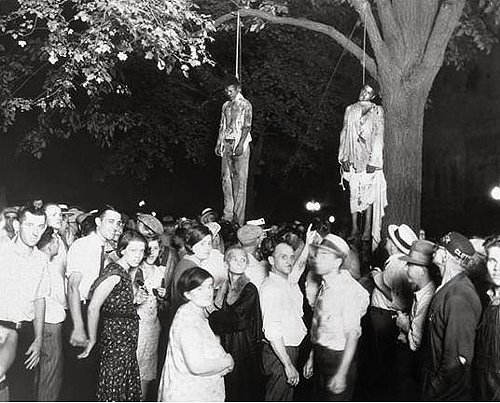
During the days when Toby Keith’s “Grandpappy” stalked the Jim Crow South, lynching was an institutional method of terror employed against blacks to maintain white supremacy. According to the Tuskegee Institute, between the years 1882 and 1951, 3,437 African-Americans were lynched in the United States, mostly in the heart of Dixie. Felonious assault and rape (read: corrupting “the flower of white womanhood”) were the two most frequent justifications for lynch mob actions.

Toby Keith: “Hang ’em high in the street, for all the people to see”

Georgia was ground zero for lynch mob activity. Though most of the Peach State’s victims were black, one of its most high-profile hangings claimed the life of a Jew, Leo Frank. Frank, a college-educated Northerner, was wrongly convicted in 1913 of murdering a 13-year-old girl after a show trial in which his prosecutor portrayed him to a grand jury as a bisexual pervert. Before the trial, one juror remarked, “If I get on that jury, I’ll hang that Jew for sure.”

A crowd gathered outside the courtroom as soon as the verdict came down. “Hang the Jew!” they chanted. Above the mob’s cries rose the voice of a country fiddler named John Carson who had come to debut his ode to Frank’s supposed victim, Mary Phagan. He sang:

Leo Frank he met her
With a brutish heart, we know;
He smiled, and said, “Little Mary,
You won’t go home no more.”

The terrifying spectacle outside the courtroom prompted Jewish families to flee Atlanta in droves. Two years later, after the governor commuted Frank’s sentence, a lynch mob spirited Frank from his prison cell, dragged him into the woods and lynched him — from “a tall oak tree,” as Toby Keith sang.

Those who doubt the presence of racist undertones in Keith’s “Beer For My Horses” should see the song’s video. (The embed link to the video’s Youtube version was disabled by Keith’s record label so you have to click here to watch it). Cue ahead to 3:00 and watch as Keith intones, “We got too many gangsters doin’ dirty deeds.” The singer’s words are not-so-subtly accompanied by the image of a swaggering black man sporting short dreads and baggy clothes. Thus the profile of Keith’s ideal lynching candidate is revealed.

Keith’s whirlwind publicity tour continues on July 30 with his appearance on CBS’s Early Show, then sit-down interviews with Esquire Magazine and Us Weekly. The following week, Jay Leno will play host to another raucous rendition of “Beer For My Horses.” Thanks to Keith and his unsuspecting hosts, lynching is becoming cool again.

Update: The trailer to Keith’s “Beer For My Horses” identifies the film’s lead villian: a dark-skinned “Mexican guy” who traffics drugs and kidnaps the girlfriend of Keith’s character.

Source / The Huffington Post

The Rag Blog

Posted in RagBlog | Tagged , , , , , , , , | 1 Comment

Pvt. LaVena Johnson ‘Committed Suicide’ and ‘Was Not Brutally Raped and Murdered’

Pvt. LaVena Johnson.

Another cover-up in a war full of cover-ups and lies
by Meg White / July 29, 2008

They don’t care. They put on a uniform and they say honor and integrity and they have no morals, no honor and no integrity, and I don’t even know how to sleep at night.

Linda Johnson, mother of Pvt. LaVena Johnson

Pvt. LaVena Johnson, 19, was so excited to tell her mother that she was definitely going to be home from Iraq for Christmas, her favorite time of year. The next day, she was dead.

The military’s casualty liaison told the Johnson family she committed suicide, found dead in her barracks with a gunshot wound to the head. However, two separate contacts told LaVena’s father, Dr. John Johnson, that she was found dead in a contractor’s tent. Allegedly, a trail of blood led from the contractor’s tent into her tent, suggesting she was dragged there. Her tent was lit on fire, according to the witness who found her body.

This was back in July 2005. Over the years, more information has slowly come to light. Some of the evidence that contradicted the Army’s version of events was obvious.

“She’s right handed, and the bullet hole was on the left side of her head,” Dr. Johnson said in an interview with Amy Goodman on Democracy Now. When he brought up the bullet wound, a military investigator told him it was actually an exit wound from an M-16 rifle.

In addition to being a doctor, Johnson is also a veteran. He knows an M-16 is 40 inches long and that a woman his daughter’s size (she was 5’1″) would have trouble getting such a weapon into her mouth. Even if she did, the force of an M-16 would do much more damage than the small bullet wound on her left temple.

Moreover, the military’s own residue tests indicate she may not have even handled the weapon that supposedly killed her, and the bullet was never found.

He said that once he was able to examine his daughter’s body, he saw that plastic surgery had been done to disguise wounds to her face, including a broken nose, loose teeth, and a busted lip. Her gloves had been glued to her hands to hide burns on her skin.

At first, Dr. Johnson received only airbrushed, black-and-white photos of the scene of his daughter’s death when he requested information from the Army. There was also a mysterious photocopy of a CD. Dr. Johnson went through a letter-writing war with the Army to get more information from the investigation, eventually having to file a Freedom of Information Act request to get a copy of the CD.

“It was a horrible sight,” Johnson said of the uncensored, color photos of his daughter’s body on the CD. The photos showed bruises, scratches and teeth marks on her body. Her elbow was distended. He said the pictures showed what looked like lye or some other caustic substance had been poured on his daughter’s vaginal area, ostensibly to eliminate DNA evidence of rape.

Dr. Johnson said some of LaVena’s colleagues in Iraq told him she had been murdered. One friend told Johnson the Army was actively covering up for his daughter’s murderer. Two others said she had a great deal of money on her person at the time of her murder, but her family was given only three pennies. Also, her military debit card was never found, though she had used it hours earlier. When Johnson’s father mentioned the money, military investigators did not respond.

Despite all the evidence, the Army says the Johnson case is closed. The Johnsons say they received a letter from the House Armed Services Subcommittee concluding an investigation into the matter that stated satisfaction with the military’s version of events.

According to Col. Ann Wright, a retired 29-year veteran of the U.S. military who is working with the Johnson family, 98 military women have died in the current wars in Iraq and Afghanistan. Of those deaths, 40 have been non-combat related. Of those, 19 have been considered suspicious. After investigation, 13 of those suspicious deaths were ruled suicides.

In an article for CommonDreams.org, Wright tells the stories of 15 suspicious deaths of military women deployed overseas since 2003 that still require investigation; eight are classified as suicides.

One case showed striking similarities to Johnson’s. Pvt. Tina Priest was raped and later found dead in her room. The military said she died from a self-inflicted bullet wound from an M-16. When Priest’s mother questioned how that would be physically possible (Priest was about the same height as Johnson), the Army said Priest must have fired the weapon with her toe.

There is an online petition from the group ColorOfChange.org calling Congress to push for further investigation of Johnson’s death. The group explains that this effort is about more than just Johnson’s case:

“LaVena’s death is part of a disturbing pattern of cases where female soldiers have been raped and killed, and where the military has hidden the truth and labeled the deaths suicides. In virtually all cases, Congress has been slow to investigate or hold the military accountable in any way. Unfortunately, most families simply don’t have the resources, time, and psychological strength to push back.”

Andre Banks, deputy director at ColorOfChange.org said that the petition, which already has 25,000 signatures, hasn’t been delivered to Congress yet. He said the House Oversight Committee hasn’t agreed to have a hearing specifically about Johnson’s death, but that a hearing on sexual assault in the military scheduled to occur this Thursday in the committee’s National Security and Foreign Affairs Subcommittee may yield news:

“We’re hoping LaVena’s case will come up then.”

Rep. Henry Waxman (D-CA), Oversight Committee chair, held a hearing last year on the military lying to the public in the cases of Cpl. Pat Tillman’s death and Pvt. Jessica Lynch’s rescue. Those infamous cases had already received a great deal of media coverage by the time Waxman held the hearing. Before the hearing, Pat Tillman’s mother Mary was quoted by The New York Times as dismayed by the treatment her son’s case received, but also worried about what other military families could be going through.

“This is how they treat a family of a high-profile individual,” she said. “How are they treating others?”

The fact that Pat Tillman was a well-known figure helped the truth emerge about the events surrounding his death. The fact that Pvt. Johnson’s father was a doctor with the courage to examine his own daughter’s broken corpse might be the only reason the truth may eventually come out about her death.

Pushing for the truth from the U.S. military takes more resources than some people can sacrifice. How many families without famous faces or special expertise have been lied to?

Military culture encourages lying about the instances of rape in the military, while the chances of being sexually assaulted by military personnel are on the rise. The military has gone from covering up suicides to using them to cover up for murder. The culture of deception that has flourished in this administration clearly knows no bounds, not even the tearful anguish of military families that just want to know the truth.

Source / BuzzFlash

The Rag Blog

Posted in RagBlog | Tagged , , , , | 1 Comment

Bigots (Mambo #1)

Graffiti from Barcelona, Spain. “Los cerdos?” “The Pigs.” Photo by Duncan Cumming.

‘I think he saw a dark woman, a human darkness, and that’s all he needed to see’
By Lisa Sanchez Gonzalez

A few days ago I went with a friend to a posh little town near the Connecticut shoreline. It was a gorgeous day, not quite perfect (too muggy) but we take what we can get during New England summers.

The point was to enjoy the drive in my convertible and to see the boats in the marina. Wealthy people in Connecticut all seem to have boats, or ships I should say (because they are big). The really wealthy ones have homes on the shoreline or near the mouth of the Connecticut River, where they can harbor their ships and presumably take them out to the Long Island Sound, maybe even cruise the ocean. Some of the super wealthy also have summer homes on Block Island coves, where they can dock their ships at their very own beaches.

I don’t have a ship, a boat, or even a canoe, but I love gazing at them on the water. I don’t really wish I had one, and I don’t envy those who do, but I do enjoy just looking at them. Those ships, especially the ones with the massive sails, are a majestic sight from the shore.

I also enjoy looking at the most mundane things as well. I window shop a lot. Which is why I was curious about this little crockery shop we passed on the way to the marina.

I should have known better, should have just gone home, but curiosity got the better of me, like the cat. So in I walked. I was dressed in a pair of jeans and an elegant long white cotton blouse. In honor of the visit to gaze at the ships, I was wearing my pearls, a beautiful double strand. I had on my Red Sox cap, my hair jutting out the back of the cap in its pony tail like the flower of a smoke tree. I had an inconspicuous designer handbag on my shoulder, pricey cork-soled sandals on my feet. Basically, I was casually well-groomed and wearing a few thousand dollars worth of things. All of which I mention only because if you gauged my appearance by the reception I got from the shopkeeper, you would have thought I’d just snuck off a banana boat.

Like I said, I should have known better. I should have known that going into a boutique like that in a town like that meant the risk of one of those distressing encounters that require me to see myself through a bigot’s eyes.

What did he see? I know he was hearing too with his eyes. I started counting the insults: one, two, three…

I think he saw a dark woman, a human darkness, and that’s all he needed to see to jump to a billion conclusions and start jabbing at me with rudeness. Little barbed spears. Little man. Why does seeing a human with darker skin (or otherwise different features) prompt some people to behave like, well, assholes? I swear, it must be a peculiar variation of Turrets disease. His spears piled up. He implied I didn’t belong in the boutique; I had no appreciation for the things for sale in it and I couldn’t afford them anyway. One of his jabs, something to do with a simple five-word question I asked him about a milk jug, implied that I was stupid.

What to do? There are so many options in a situation like that. Engage the man in a conversation, for example, and blow him away with erudition. Stare at him real hard, up and down, until he wilts. Buy the most expensive thing in the store, cash-money. Or just leave.

I went silent and kept looking.

I held that silence like the snake-edged shield of Athena.

When I was much younger, I would get furious in these situations. Being a human darkness in the eyes of others is often like living under a heavy presumption of guilt and worthlessness. Toni Morrison captures this dreadful dehumanizing dynamic so brilliantly in THE BLUEST EYE, when Pecola Breedlove tries to buy some candy at the corner store. She has the money, but the real cost of the Mary Janes is a profound humiliation from the shopkeeper. Every time I read that novel, my heart is crushed into splinters. I can only read it once a decade; it takes me a month to recover from it.

Nowadays I don’t get angry, just a little sad sometimes when I’m trapped into gazing at myself through the eyes of a bigot. I try to manage to laugh it off. Why let the ignorance and neuroses of others wear you down? In my many years on this planet, I’ve learned that anger is a poison and sadness can be cathartic, but that laughter cures just about everything.

So what did I do? I was in a good mood, after all the boat gazing and the lovely drive, and I didn’t want to let this guy ruin it. I was feeling a bit mischievous too. So I said to my friend, who came into the shop after me, “Darling, let’s not sail to the Island this afternoon. Let’s go instead to the cottage. I suddenly crave a good read and a nap in the hammock. This shopping has become tedious.” I paused for dramatic effect. “Quelle,” I said, as I squinted at a particularly gauche piece of crockery, then laid it back carefully on the shelf with the slightest hint of disgust, “barbarie.”

The shopkeeper had to pick his chin up off the ground.

Did that even the score? Probably not. But my friend and I had a good laugh over it all the way home with the top down, the wind tugging at our hair, and the scent of the sea breeze still lingering on our skin.

Source / Lisa’s Blog / Posted July 25, 2008

Thanks to Mercedes Lynn de Uriarte / The Rag Blog

Posted in RagBlog | Tagged , , | 1 Comment

Texas Beach Study Finds Increase In Fecal Contamination

Galveston beach: everyone in!

‘Texans should not be swimming in human and animal waste’
By Jay Root / July 29, 2008

AUSTIN — A day after state officials declared water quality on the rise at Texas beaches, an environmental group reported today it found a 12 percent increase in confirmed outbreaks of dangerous fecal contamination along the coast last year.

The results issued today by Environment Texas, part of a national study released from the Natural Resources Defense Council, reported 532 beach closings and health advisory days in Texas in 2007, up from 473 in 2006. Several beaches near Corpus Christi exceeded maximum bacteria levels by more than 25 percent.

A day earlier, a state report using partial test results claimed water quality was on the rise. Officials acknowledge they only counted bacteria outbreaks during peak swimming months. Authorities and environmentalists alike largely blame storm water runoff and aging drainage infrastructure for the pollution.

“Texans should not be swimming in human and animal waste,” said Brittany Ballard, citizen outreach director for Environment Texas. “Not only are the beaches polluted, the way they were tested is also failing the American public.”

The national report, entitled Testing the Waters, showed there were 25,571 days in which U.S. beaches were closed or advisories were issued, the second highest level since the National Resources Defense Council began tracking the data gathered from periodic water sampling 18 years ago. About 7 percent of the 2007 tests nationwide showed excessive bacteria levels; in Texas, 9 percent exceeded the standard, according to the study.

“Our beaches are really not that great compared to the rest of the nation,” Ballard said. The group is pushing for expanded sampling and faster tests.

Only two Texas beaches showed up on the national group’s list of highly rated beaches, which received one to five stars based on sampling methods and water quality ratings. They were Stewart Beach Park in Galveston and McGee Beach at Corpus Christi Bay, both of which received one star based on prompt reporting of poor water quality.

Otherwise, the Corpus Christi area has some of the worst beach water ratings in the study. Of the six beaches that exceeded the national standard for bacteria 25 percent of the time or more in 2007, five were in Nueces County: Cole Park (44 percent), Ropes Park (38 percent), Emerald Beach (35 percent) and Poenisch Park (33 percent) and Laguna Shores (26 percent). McGee Beach, despite its one-star rating, exceeded standards 19 percent of the time last year, the study found.

A day before the environmental group released its report, the Texas General Land Office, which compiles the testing data, issued an upbeat news release touting the “safer, cleaner Texas beaches.”

“Fewer beach advisories were required in 2007 than in 2006,” the agency said. The reason for the discrepancy: the land office only counted the peak swimming months of May-September and the popular Spring Break period.

“It’s clear in there we’re talking about the summer months,” agency spokesman Jim Suydam said. “The idea is to capture the best data from when people are at the beach.”

Source / Houston Chronicle

The Rag Blog

Posted in RagBlog | Tagged , , , , , | Leave a comment

Amnesty International : China Using Olympics As ‘Pretext’ For Crackdown

A Chinese paramilitary policeman tries to block photos being taken outside the Olympic Stadium. Photo by AFP.

Repression of ‘human rights defenders, journalists and lawyers has intensified’
July 29, 2008

HONG KONG – China is using the Beijing Olympics as a pretext to pursue — and in some cases tighten — a crackdown on human rights, notably ridding the capital of “undesirables,” Amnesty International charged Monday.

Reporting 11 days ahead of the August 8 opening ceremony, the rights group said that despite some minor reforms, authorities had stepped up repression of activists and lawyers to present a picture of stability and harmony.

Amnesty urged the International Olympic Committee and political leaders to do far more to challenge China, warning of even more repressive measures once the spotlight on the Games has faded away.

“Unless the authorities make a swift change of direction, the legacy of the Beijing Olympics will not be positive for human rights in China,” it warned.

“In fact, the crackdown on human rights defenders, journalists and lawyers has intensified because Beijing is hosting the Olympics.”

Amnesty’s report, citing specific cases, said activists who had tied their cause to the Games had been singled out for the pre-Olympics “clean-up,” while many others were being detained, imprisoned or placed under house arrest.

“Authorities have used the Olympic Games as a pretext to continue and in some respects, intensify existing policies and practices that have led to serious and widespread violations of human rights,” the report added.

It listed a series of recommendations urging China to:

* release all prisoners of conscience;

* stop police arbitrarily detaining activists and dissenters;

* impose a moratorium on the death penalty;

* allow complete media freedom; and

* account for those killed or detained in Tibet.

“It is very disturbing that Chinese authorities have indulged in such a big crackdown on the activists,” Mark Allison, China researcher for Amnesty, told AFP.

“These are people who represent many many more people in China.”

Officials were also extending the use of punitive administrative detention, notably of activists and petitioners as well as beggars and peddlers, Amnesty said.

In January, Beijing police launched a campaign against “illegal activities that tarnish the city’s image and affect the social order,” it noted.

In May, authorities adopted a “re-education through labour” law to control various types of “offending behaviour.”

In June, authorities in Shanghai sent notices to activists and petitioners ordering them to report to the police every week and barring them from leaving without permission or visiting Beijing until after the Games.

A clampdown on journalists has also intensified in recent months, Amnesty said, citing figures from the Foreign Correspondents Club of China showing as many as 230 cases of reporters being obstructed from interviews this year so far, compared to 180 cases in the whole of last year.

Internet controls have also been tightened up and many websites closed down for providing information deemed sensitive, the group noted.

Amnesty said that journalists working from Beijing’s Olympic press centre were unable to access the group’s website, as well as those of the BBC, Germany’s Deutsche Welle, Hong Kong newspaper Apple Daily, and Taiwan newspaper Liberty Times.

“This flies in the face of official Chinese promises to ensure ‘complete media freedom’ for the Games,” said Allison.

Such tactics raised concerns that officials would seek to block broadcasts of anything deemed sensitive or inappropriate, despite public commitments by organisers not to cut coverage.

Amnesty said China’s crackdown in Tibet earlier this year, and restrictions on reporting there, highlighted the authorities’ ongoing censorship.

It urged the IOC and the international community to express concerns publicly and press China to fulfil its obligations on human rights and dissent.

“The danger now becomes that after the Olympic Games, these patterns of serious human rights violations may continue or intensify with even less attention paid by the international community than has been the case so far,” it said.

© 2008 Agence France Presse

Source / AFP / CommonDreams

The Rag Blog

Posted in RagBlog | Tagged , , , , , | 1 Comment

BOOKS : Justice, Texas Style


Read About It While You Can
By Craig Malisow / July 28, 2008

Authorities in Smith County (Tyler) might not be happy to learn that Smith County Justice, a book alleging systemic corruption and unusually harsh sentences in the county — that virtually disappeared after its 1985 publication — is now available online. For free.

Since the book appeared on Wikileaks earlier this year, it’s gained quite a following. (For those who want the original hardcover, four used copies are available on Amazon – starting at $595.)

Critics have long pointed to Smith County as one of the worst examples of “Texas-style” justice. It’s the county where a jury gave a guy 16 years for stealing a candy bar. (Fortunately, that sentence was overturned and a new trial was ordered. But that kinda gives you an idea of what Smith County juries are all about.)

The folks at Wikileaks were kind enough to explain why they think this book needs to be available:

The guilty authorities in Smith County have never acknowledged the evil of their ways or expressed remorse for the lives they ruined. Instead, legal and public relations firms have been engaged to mount a campaign to watch the used book markets for any used copies that might appear. Whenever such copies are found they are usually bought at whatever price is required and destroyed. As a result, used copies today have become rare and expensive. Eventually, almost all original printed editions can be expected to disappear.

And that’s where this electronic edition, published outside the US, comes into play. It is our hope that this electronic edition will continue to live on despite the efforts of certain corrupt individuals in Tyler and Smith County who want to eradicate it.

Part of Ellsworth’s book focuses on a notoriously bogus series of drug busts in the late 1970s, which eventually became the basis for a novel and the 1991 movie Rush. But Smith County seemingly continued its time-honored tradition well after Ellsworth’s book came out, perhaps best illustrated in the case of Kerry Max Cook, who was tried four times in Smith County for the 1977 rape and murder of a 21-year-old woman. Cook spent about 20 years in prison – 13 on death row – before prosecutors allowed him to plead “no contest” for a time-served sentence. (Yes, it’s extremely confusing. It is apparently the only instance in a Texas death penalty case where the defendant was allowed to maintain innocence while technically being convicted). Kerry later recounted his prison experiences, which included being forced into sexual slavery, in his book Chasing Justice.

Hopefully, there won’t be any more scandals coming down the pike – but in case there are, you might want to download the book so you can brush up on your Smith County history.

Source / Houston Press

Find Smith County Justice at Amazon.com.

Read Smith County Justice online at Wikileaks. at .

The Rag Blog

Posted in RagBlog | Tagged , , , , | Leave a comment

Guantanamo : Two Trials in One

Boots of Military Police at Camp Delta, a Long-Term Detention
Center at Guantanamo.

Salim Hamdan trial also test of military tribunal system
By Willian Glaberson / July 29, 2008

GUANTÁNAMO BAY, Cuba — On the surface, the proceedings unfolding inside a makeshift courthouse on a hill here resemble an American trial. A judge wearing a black robe presides. There is a public gallery and a witness stand. Prosecutors present witnesses, and defense lawyers cross-examine them. Objections are made and ruled upon.

But behind the judicial routine at the first trial for a Guantánamo detainee lies a parallel universe of law and lawyers. Secret evidence held in red folders is not revealed in open court. The gallery is mostly empty, because there are no members of the public. In what would be the jury box, every occupant wears a military uniform.

In the first week of the trial of Salim Hamdan, Osama bin Laden’s driver, law enforcement officials recounted what he had said during interrogations in the years since he was detained in 2001. But it was also disclosed that some of the interrogations had been conducted in the middle of the night and by men wearing masks, and that Mr. Hamdan did not have a lawyer during those sessions, nor was he warned that he might be prosecuted.

Mr. Hamdan’s trial is, in a sense, two trials. Mr. Hamdan is being tried on accusations of conspiracy and material support of terrorism. And the Bush administration’s military commission system itself is on trial. After years of debate, protest and litigation, the legal standing of the tribunal system at Guantánamo remains a question for American courts and officials around the world.

The chief Guantánamo prosecutor, Col. Lawrence J. Morris of the Army, said this first Guantánamo tribunal was “the most just war crimes trial that anybody has ever seen.”

Matt Pollard, a legal adviser for Amnesty International who is an observer here, sees it differently. He said he was struck by a sense that the proceedings were more of a replica of a trial than a real one.

“We are within a frame of a beautiful picture,” created by the Pentagon, Mr. Pollard said. “When you’re inside that frame, everything looks nice.”

The Guantánamo legal system was intended to try “unlawful enemy combatants” caught on the post-Sept. 11 battlefield. Prosecutors say there is little room for the usual legal restrictions in interrogations intended to prevent a terrorist attack. The administration’s strategy in using the Guantánamo naval station was based on its belief that the Constitution would not apply here.

Legal challenges to that assertion are among a number of factors that have delayed the government’s efforts to conduct trials here for years.

A federal judge in Washington, James Robertson, refused a last-minute plea by Mr. Hamdan’s lawyers to stop this trial. But in his July 18 ruling, Judge Robertson said serious questions remained about the system here, calling it “startling” that evidence obtained through coercive interrogations was permitted to be used in trials.

But with the trial inaccessible to the public and no broadcast television cameras in the courtroom, reporters are the only way for the wider world to know what is happening. The Pentagon’s public relations theme has been “transparency,” yet the freedom of the press has its limits at Guantánamo.

Legal documents are often released months after they are filed with the military commission, if at all. Military officials run and attend news conferences, both for the prosecution and the defense. Reporters are accompanied by military escorts almost everywhere, including to meals and court.

The spokeswoman for the detention camp, Cmdr. Pauline Storum, said it was “standard policy to require media be escorted,” and that the military sought to provide journalists access in a way “that balances the protection of operation security with providing information.”

With few seats designated for reporters in the courtroom, the Pentagon set up closed-circuit televisions at a news media center in an old hangar. During some critical moments in the first week of testimony, the courtroom camera was pointed away from witnesses’ faces and the evidence, including documents and videotapes.

When a reporter noted that in America reporters were permitted to see witnesses and evidence, a spokeswoman for the Office of Military Commissions at the Pentagon, Maj. Gail Crawford, responded, “This is not America.”

Without explanation, the camera was soon back on the witnesses.

One after another, Federal Bureau of Investigation agents and other criminal investigators took the witness stand last week to describe damaging admissions they said Mr. Hamdan had made in interrogations, including his descriptions of attending a terror training camp and Mr. bin Laden’s preparations for attacks.

The agents acknowledged that it was official policy to deviate from their normal procedure of informing Mr. Hamdan of any constitutional rights.

One of the agents, George M. Crouch Jr., testified that he had helped arrange in June 2002 for Mr. Hamdan to call his family. Mr. Hamdan, who had been in custody for seven months and had been allowed no contact with the outside world, “was concerned that they would think he was dead,” the agent testified.

Mr. Pollard said holding someone incommunicado for months sounded like the kind of “disappearances” practiced by other countries. But in the court at Guantánamo, the reference did not cause a ripple.

The interrogations of Mr. Hamdan have caused him to sometimes think the trial is just another method of interrogation, a psychiatrist who interviewed him here testified. “He doesn’t know if this court is real,” the psychiatrist, Dr. Emily A. Keram, said.

In June, the Supreme Court ruled that detainees here had a constitutional right to challenge their detentions in federal court. Some lawyers said the ruling suggested that other parts of the Constitution, like the Fifth Amendment’s right against self-incrimination, might apply here.

That could have undercut the case against Mr. Hamdan. But the military judge, Capt. Keith J. Allred of the Navy, ruled that “the Fifth Amendment of the Constitution does not apply to protect Mr. Hamdan.”

Even so, the judge excluded some of Mr. Hamdan’s statements, saying they were given in the “highly coercive environment” of an Afghan prison. But he allowed many other statements by Mr. Hamdan to be entered as evidence, including some that defense lawyers contend were coerced. One of the F.B.I. agents, Ammar Y. Barghouty, said Mr. Hamdan seemed to realize during the interrogations that he had few options. “A drowning man will reach for a twig, and I am a drowning man,” Mr. Barghouty quoted Mr. Hamdan as saying.

Mr. Hamdan’s lawyers say appeals are likely from any conviction here, setting the stage for rulings, perhaps years from now, about whether the courts here meet American standards.

However the American courts eventually sort out the Guantánamo legal claims, the trial here is proceeding with its own idiosyncrasies. A prosecution witness presented an organizational table of Al Qaeda’s leadership from when Mr. Hamdan was part of Mr. bin Laden’s security detail. The chart included an entry for the head of the detail, a Moroccan, Abdellah Tabarak, who himself was held at Guantánamo. He was released in 2004, four years before the start of Mr. Hamdan’s trial.

Asked about the unusual circumstance that an employee was on trial while a man who may have been his boss had been released, a Pentagon spokesman, Cmdr. Jeffrey D. Gordon, said, “The transfer of detainees takes various factors into consideration,” including a receiving country’s promise “to mitigate the threat.”

Ben Wizner, an American Civil Liberties Union lawyer who is an observer here, said the experiences of Mr. Tabarak and Mr. Hamdan seemed to underscore the contradictions of the legal system here.

Mr. Wizner said there was a more fundamental contradiction underlying the trial. The Bush administration insists that even if a detainee is acquitted, officials could hold him indefinitely.

“Where else in the world,” Mr. Wizner said after court one day, “is someone being prosecuted for a crime who is already serving a life sentence and will continue to serve one if he’s acquitted?”

Source / New York Times

The Rag Blog

Posted in RagBlog | Tagged , , , , , , , | Leave a comment

CITIES : Trading Places

The Angel of Gentrification.

The demographic inversion of the American city
by Alan Ehrenhalt

Thirty years ago, the mayor of Chicago was unseated by a snowstorm. A blizzard in January of 1979 dumped some 20 inches on the ground, causing, among other problems, a curtailment of transit service. The few available trains coming downtown from the northwest side filled up with middle-class white riders near the far end of the line, leaving no room for poorer people trying to board on inner-city platforms. African Americans and Hispanics blamed this on Mayor Michael Bilandic, and he lost the Democratic primary to Jane Byrne a few weeks later.

Today, this could never happen. Not because of climate change, or because the Chicago Transit Authority now runs flawlessly. It couldn’t happen because the trains would fill up with minorities and immigrants on the outskirts of the city, and the passengers left stranded at the inner-city stations would be members of the affluent professional class.

In the past three decades, Chicago has undergone changes that are routinely described as gentrification, but are in fact more complicated and more profound than the process that term suggests. A better description would be “demographic inversion.” Chicago is gradually coming to resemble a traditional European city–Vienna or Paris in the nineteenth century, or, for that matter, Paris today. The poor and the newcomers are living on the outskirts. The people who live near the center–some of them black or Hispanic but most of them white–are those who can afford to do so.

Developments like this rarely occur in one city at a time, and indeed demographic inversion is taking place, albeit more slowly than in Chicago, in metropolitan areas throughout the country. The national press has paid very little attention to it. While we have been focusing on Baghdad and Kabul, our own cities have been changing right in front of us.

Atlanta, for example, is shifting from an overwhelmingly black to what is likely to soon be a minority-black city. This is happening in part because the white middle class is moving inside the city borders, but more so because blacks are moving out. Between 1990 and 2006, according to research by William Frey of the Brookings Institution, the white population of Atlanta has increased from roughly 30 percent to 35 percent while the black population has declined from 67 percent to 55 percent. In this decade alone, two of Atlanta’s huge suburban counties, Clayton and DeKalb, have acquired substantial black majorities, and immigrants arriving from foreign countries are settling primarily there or in similar outlying areas, not within the city itself. The numbers for Washington, D.C. are similar.

Race is not always the critical issue, or even especially relevant, in this demographic shift. Before September 11, 2001, the number of people living in Manhattan south of the World Trade Center was estimated at about 25,000. Today, it is approaching 50,000. Close to one-quarter of these people are couples (nearly always wealthy couples) with children. The average household size is actually larger in lower Manhattan than in the city as a whole. It is not mere fantasy to imagine that in, say, 2020, the southern tip of Manhattan will be a residential neighborhood with a modest residual presence of financial corporations and financial services jobs. What’s happening in Lower Manhattan isn’t exactly an inversion in the Chicago sense: Expensive condos are replacing offices, not poor people. But it is dramatic demographic change nevertheless.

If you want to see this sort of thing writ large, you can venture just across the Canadian border to Vancouver, a city roughly the size of Washington, D.C. What makes it unusual–indeed, at this point unique in all of North America–is that roughly 20 percent of its residents live within a couple of square miles of each other in the city’s center. Downtown Vancouver is a forest of slender, green, condo skyscrapers, many of them with three-story townhouse units forming a kind of podium at the base. Each morning, there are nearly as many people commuting out of the center to jobs in the suburbs as there are commuting in. Two public elementary schools have opened in downtown Vancouver in the past few years. A large proportion of the city’s 600,000 residents, especially those with money, want to live downtown.

No American city looks like Vancouver at the moment. But quite a few are moving in this direction. Demographic inversions of one sort or another are occurring in urban pockets scattered all across America, many of them in seemingly unlikely places. Charlotte, North Carolina, is in the midst of a downtown building boom dominated by new mixed-use high-rise buildings, with office space on the bottom and condos or rental units above. Even at a moment of economic weakness, the condos are still selling briskly.

We are not witnessing the abandonment of the suburbs or a movement of millions of people back to the city all at once. But we are living at a moment in which the massive outward migration of the affluent that characterized the second half of the twentieth century is coming to an end. For several decades now, cities in the United States have wished for a “24/7” downtown, a place where people live as well as work, and keep the streets busy, interesting, and safe at all times of day. This is what urbanist Jane Jacobs preached in the 1960s, and it has long since become the accepted goal of urban planners. Only when significant numbers of people lived downtown, planners believed, could central cities regain their historic role as magnets for culture and as a source of identity and pride for the metropolitan areas they served. Now that’s starting to happen, fueled by the changing mores of the young and by gasoline prices fast approaching $5-per-gallon. In many of its urbanized regions, an America that seemed destined for everincreasing individualization and sprawl is experimenting with new versions of community and sociability.

Why has demographic inversion begun?

For one thing, the deindustrialization of the central city, for all the tragic human dislocations it caused, has eliminated many of the things that made affluent people want to move away from it. Nothing much is manufactured downtown anymore (or anywhere near it), and that means that the noise and grime that prevailed for most of the twentieth century have gone away. Manhattan may seem like a loud and gritty place now, but it is nothing like the city of tenement manufacturing, rumbling elevated trains, and horses and coal dust in the streets that confronted inhabitants in the early 1900s. Third-floor factory lofts, whether in Soho or in St. Louis, can be marketed as attractive and stylish places to live. The urban historian Robert Bruegmann goes so far as to claim that deindustrialization has, on the whole, been good for downtowns because it has permitted so many opportunities for creative reuse of the buildings. I wouldn’t go quite that far, and, given the massive job losses of recent years, I doubt most of the residents of Detroit would, either. But it is true that the environmental factors that made middle-class people leave the central city for streetcar suburbs in the 1900s and for station-wagon suburbs in the 1950s do not apply any more.

Nor, in general, does the scourge of urban life in the 1970s and ’80s: random street violence. True, the murder rates in cities like Chicago, Philadelphia, and Cleveland have climbed in the last few years, but this increase has been propelled in large part by gang- and drug-related violence. For the most part, middle-class people of all colors began to feel safe on the streets of urban America in the 1990s, and they still feel that way. The paralyzing fear that anyone of middle age can still recall vividly from the 1970s–that the shadowy figure passing by on a dark city street at night stands a good chance of being a mugger–is rare these days, and almost nonexistent among young people. Walk around the neighborhood of 14th and U streets in Washington, D.C. on a Saturday night, and you will find it perhaps the liveliest part of the city, at least for those under 25. This is a neighborhood where the riots of 1968 left physical scars that still have not disappeared, and where outsiders were afraid to venture for more than 30 years.

The young newcomers who have rejuvenated 14th and U believe that this recovering slum is the sort of place where they want to spend time and, increasingly, where they want to live. This is the generation that grew up watching “Seinfeld,” “Friends,” and “Sex and the City,” mostly from the comfort of suburban sofas. We have gone from a sitcom world defined by “Leave It to Beaver” and “Father Knows Best” to one that offers a whole range of urban experiences and enticements. I do not claim that a handful of TV shows has somehow produced a new urbanist generation, but it is striking how pervasive the pro-city sensibility is within this generation, particularly among its elite. In recent years, teaching undergraduates at the University of Richmond, the majority of them from affluent suburban backgrounds, I made a point of asking where they would prefer to live in 15 years–in a suburb or in a neighborhood close to the center of the city. Few ever voted for suburban life.

I can’t say that they had necessarily devoted a great deal of thought to the question: When I asked them whether they would want to live in an urban neighborhood without a car, many seemed puzzled and said no. Clearly, we are a long way from producing a generation for whom urban life and automobile ownership are mutually exclusive. In downtown Charlotte, a luxury condominium is scheduled for construction this year that will allow residents to drive their cars into a garage elevator, ride up to the floor they live on, and park right next to their front door. I have a hard time figuring out whether that is a triumph for urbanism or a defeat. But my guess is that, except in Manhattan, the carless life has yet to achieve any significant traction in the affluent new enclaves of urban America.

Not that cars and the demographic inversion aren’t closely related; they are. In Atlanta, where the middle-class return to the city is occurring with more suddenness than perhaps anywhere in the United States, the most frequently cited reason is traffic. People who did not object to a 20-mile commute from the suburbs a decade ago are objecting to it now in part because the same commute takes quite a bit longer. To this, we can add the prospect of $5-per-gallon gasoline. It’s impossible at this point to say with any certainty just what energy costs will do to American living patterns over the next decade. Urbanists predicted a return to the city during previous spikes in the cost of gasoline, notably during shortages in the 1970s. They were wrong. Gas prices came down, and the suburbs expanded dramatically. But today’s prices at the pump are not the result of political pressures by angry sheiks in the Persian Gulf. They are the result of increased worldwide demand that is only going to continue to increase. Some suburbanites will simply stay where they are and accept the cost. But many will decide to stop paying $100 every few days for a tank of gasoline that will allow them to commute 40 or 50 miles a day, round-trip.

Read all of this article here. / The New Republic

The Rag Blog

Posted in RagBlog | Tagged , , , , , | Leave a comment

Response to Hard Times : The Suicide Solution


Two hours before her home was to be auctioned off, Carlene Balderrama killed herself with her husband’s rifle
By Barbara Ehrenreich / July 28, 2008

A few days before Congress passed its Housing Bill, Carlene Balderrama of Taunton MA found her own solution to the housing crisis. Just a little over two hours in advance of the time her mortgage company, PHH Mortgage Corporation — may its name live in infamy — was to auction off her home, Balderrama killed herself with her husband’s rifle.

This is not the kind of response to hard times that James Grant had in mind when he wrote his July 19 Wall Street Journal essay entitled “Why No Outrage?” “One might infer from the lack of popular anger,” the famed Wall Street contrarian wrote, “that the credit crisis was God’s fault rather than the doing of the bankers and the rating agencies and the government’s snoozing watchdogs.” For contrast, he cites the spirited response to the depression of the 1890s, when lawyer/agitator Mary Lease stirred crowds with the message that “We want the accursed foreclosure system wiped out…. We will stand by our homes and stay by our firesides by force if necessary…”

Grant could have found even more bracing examples of resistance in the 1930s, when farmers and tenants used mob power — and sometimes firearms — to fight foreclosures and evictions. For more on that, I consulted Frances Fox Piven, co-author of the classic text Poor People’s Movements: Why They Succeed, How They Fail, who told me that in the early 30s, a number of cities were so shaken by the resistance that they declared moratoriums on further evictions. A 1931 riot by Chicago tenants who had fallen behind on their rent, for example, had left three dead and three police officers injured.

According to Piven, these actions were often spontaneous. A group of unemployed men would get word of a scheduled eviction and march through the streets, gathering crowds as they went. Arriving at the site of the eviction, they would move the furniture back into the apartment and stay around to protect the threatened tenants. In one instance in Detroit, it took 100 cops to evict a single family. Also in Detroit, Piven said, “two families protected their apartments by shooting their landlord and were acquitted by a sympathetic jury.”

What a difference 80 years makes. When the police and the auctioneers arrived at Balderrama’s house, the family gun had already been used — on the victim of foreclosure herself. I don’t know how “worthy” a debtor she was — the family had been through bankruptcies before, though probably not as a result of Caribbean vacations and closets full of designer clothes. It was an Adjustable Rate Mortgage that did them in, and Balderrama, who managed the family’s finances, had apparently been unwilling to tell her husband that their ever-rising monthly mortgage payments were eating up his earnings as a plumber.

Suicide is becoming an increasingly popular response to debt. James Scurlock’s brilliant documentary, Maxed Out, features the families of two college students who killed themselves after being overwhelmed by credit card debt. “All the people we talked to had considered suicide at least once,” Scurlock told a gathering of the National Assocition of Consumer Bankruptcy Attorneys in 2007. According to the Los Angeles Times, lawyers in the audience backed him up, “describing clients who showed up at their offices with cyanide, or threatened, ‘If you don’t help me, I’ve got a gun in my car.'”

India may be the trend-setter here, with an estimated 150,000 debt-ridden farmers succumbing to suicide since 1997. With guns in short supply in rural India, the desperate farmers have taken to drinking the pesticides meant for their crops.

Dry your eyes, already: Death is an effective remedy for debt, along with anything else that may be bothering you too. And try to think of it too from a lofty, corner-office, perspective: If you can’t pay your debts or afford to play your role as a consumer, and if, in addition — like an ever-rising number of Americans — you’re no longer needed at the workplace, then there’s no further point to your existence. I’m not saying that the creditors, the bankers and the mortgage companies actually want you dead, but in a culture where one’s credit rating is routinely held up as a three-digit measure of personal self-worth, the correct response to insoluble debt is in fact, “Just shoot me!”

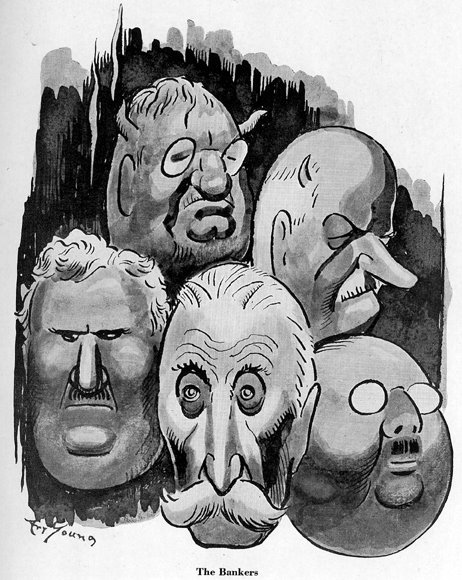
The alternative is to value yourself more than any amount of money and turn the guns, metaphorically speaking, in the other direction. It wasn’t God, or some abstract economic climate change, that caused the credit crisis. Actual humans — often masked as financial institutions — did that, (and you can find a convenient list of names in Nomi Prins’s article in the current issue of Mother Jones.) Most of them, except for a tiny few facing trials, are still high rollers, fattening themselves on the blood and tears of ordinary debtors. I know it’s so 1930s, but may I suggest a march on Wall Street?

Source / The Huffington Post

The Rag Blog

Posted in RagBlog | Tagged , , , , | 2 Comments