Karl Rove : FOX in the Hen House?

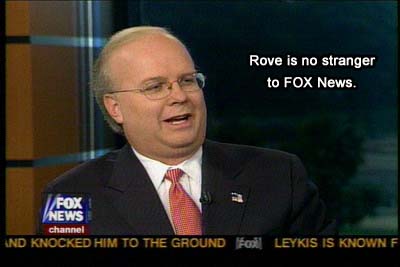
Here is a succinct statement of what’s wrong with The System, as we used to call it. Karl Rove is an election analyst for Fox News.

“Fox News host Chris Wallace also came to Rove’s defense, asking rhetorically, ‘Why it is that if Congress and the White House are having a fight about executive power, that that should in any way constrain an independent news organization’s decision as to who is it going to have on its payroll?'”

Aren’t such close ties between government and private industry a hallmark of fascism?

Bill Meacham / The Rag Blog / July 15, 2008

Karl Rove denies political ties taint Fox News role
By Steve Gorman / July 15, 2008

LOS ANGELES – Former White House aide Karl Rove denied on Monday that his close ties with Republican politics and John McCain’s presidential campaign undermine his credibility as an election analyst for the Fox News Channel.

Appearing at a gathering of television critics in Beverly Hills, Rove and network executive John Moody brushed aside suggestions that Rove’s continued involvement in the presidential race, informal or not, might pose a conflict in his capacity as a Fox News contributor.

Rove, the chief strategist for U.S. President George W. Bush’s 2000 and 2004 election victories and former deputy chief of staff in his administration, left the White House last August and joined the Fox News team in February 2008.

“I do talk to people in politics all across the country, some of whom are very active in the campaign (but) I play no official role, or ongoing role,” he said in answer to a question about whether he works for the McCain operation in any way.

“I do get phone calls,” he added. “I’m having dinner later this week with a great friend of mine who just happens to be the Republican state chairman of a battleground state. He’s going to be in Washington, and it’s not just the quality of steak I’m going to fix him that’s caused him to stop by the house and pick my brain. So that’s just a reality.”

Asked whether Rove was on “the honor system” regarding his contacts with top McCain campaign operatives such as Steve Schmidt, Moody replied: “He’s always on the honor system. All of our employees are.”

“We get most of our information about the McCain campaign from our correspondents,” Moody added. “I don’t think Karl would cross an ethical line like that.”

Rove also dismissed the notion that his refusal to answer congressional subpoenas to testify in a probe of the Bush administration’s firing of federal prosecutors amounted to too much political baggage for a network news analyst to carry.

“It is not between me and Congress,” he said. “This is between the White House and Congress. This is long-standing battle over the principle of executive privilege and the ability of the president to receive advice from senior advisors and for senior advisors not to be at the beck and call of Congress to testify.”

He also said that like fellow Fox News analyst Howard Wolfson, a former top strategist and communications director for Senator Hillary Clinton’s presidential campaign, his job was to help viewers “better understand” the political process based on his experience.

Fox News host Chris Wallace also came to Rove’s defense, asking rhetorically, “Why it is that if Congress and the White House are having a fight about executive power, that that should in any way constrain an independent news organization’s decision as to who is it going to have on its payroll?”

Source. / Reuters / Yahoo! News

The Rag Blog

Posted in RagBlog | Tagged , , , , , , , , | Leave a comment

Could Alabama Gov. Siegelman Bring Down the House of Cards?

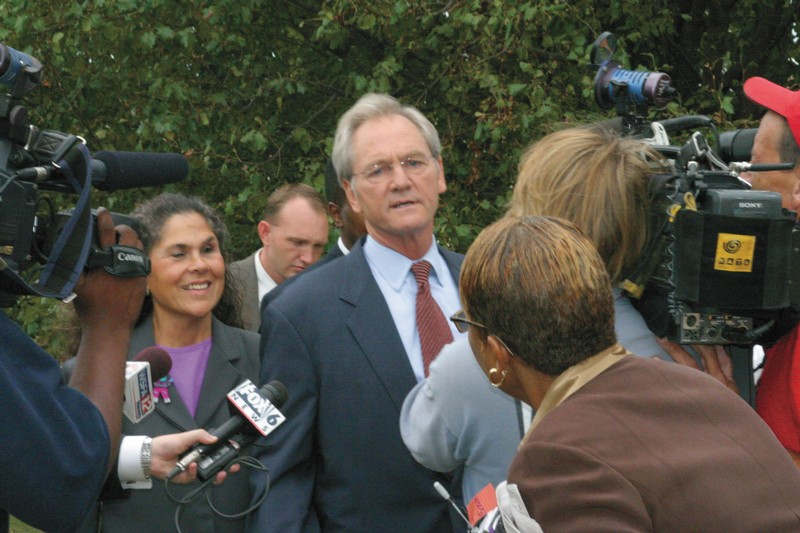
Former Alabama govenor Don Siegelman accompanied by his wife Lorie reports to the Federal building in downtown Tuscaloosa in 2004.

Gov. Siegelman at Netroots Nation: Bush’s Undoing?
By Sam Seder / July 14, 2008

As more and more corruption and law breaking at the highest reaches of our Government reveal themselves, will the scandal surrounding the use of the Department of Justice as an electoral tool be the one that finally holds the Bush administration to account? If so, there is one man who’s story may seal the unraveling of this criminal regime.

Former political prisoner and former Governor of Alabama Don Siegelman will be making a court sanctioned trip out of Alabama to join me at Netroots Nation to discuss his case and what it can tell us about the unprecedented corruption that exists in our nation’s chief law enforcement agency, the Department of Justice.

By now many are familiar with the case of Don Siegelman.. A very popular former Democratic Alabama Governor seen as an electoral threat to unseat Republican Bob Riley. Faced with the most popular Democrat in generations, Congressional testimony reveals that Republican operatives in Alabama and Karl Rove’s dirty tricks shop in the White House used the prosecution powers of the DOJ’s United States Attorneys to send Don Siegelman to jail on trumped up charges.

The dogged reporting by on-line journalists like Talking Points Memo, Larisa Alexandrovna and Scott Horton, Congressional hearings and a sixty minutes interview forced an appellate Court to reexamine the Siegelman case. Within days Siegelman was released from prison pending his appeal and the court found “that his appeal raises substantial questions of law or fact…”. Reagan’s Attorney General Richard Thornburgh and 54 former US Attorneys of all political stripes from across the country smell a rat. Not surprisingly, that rat smells a lot like Karl Rove, the Fox news commentator and former White House dirty trickster.

For over a year and a half now we have known of the US Attorney firings scandal that has forced the resignations of countless DOJ officials. The Siegelman case is the other side of the coin of the corruption of the Department of Justice under the Bush administration. Those US attorney firings took place because those US Attorney’s would not play ball with a DOJ hell bent on using it’s powers to provide Republicans an advantage at the ballot box. Some refer to this scandal as the politicization of the Department of Justice, but the Siegelman case and other such prosecutions over the past six years go well beyond a mere infraction of the Hatch act. These cases are indicative of an agenda that has literally torn at the fabric of a nation built upon the rule of law and justice for all. This is a corruption of the very foundations of how the United States of America is supposed function as a democracy. When the chief law enforcement agency has become crooked, who do you call?

Fox commentator Karl Rove, through his attorney, has claimed that simply because he once worked at the White House he need not comply with a Congressional subpoena to testify as to his involvement with this prosecution. Karl Rove may not be traveling to Washington anytime soon, but Don Siegelman will be traveling to Austin Friday at Netroots Nation to give us some insight as to just how far we have fallen as a a nation.

If you have any questions you’d like me to ask of the former Governor, feel free to head over here and offer them up.

[Catch it live. This conversation with Sam Seder and Gov. Siegelman will be streaming live exclusively at AirAmerica on Friday, July 18th 10:30 AM – 11:45 AM.]

Source. / The Huffington Post

Also go to Free Don Siegelman.

The Rag Blog

Posted in RagBlog | Tagged , , , , , | 1 Comment

Clear-Cut Logging: Not Such a Good Thing

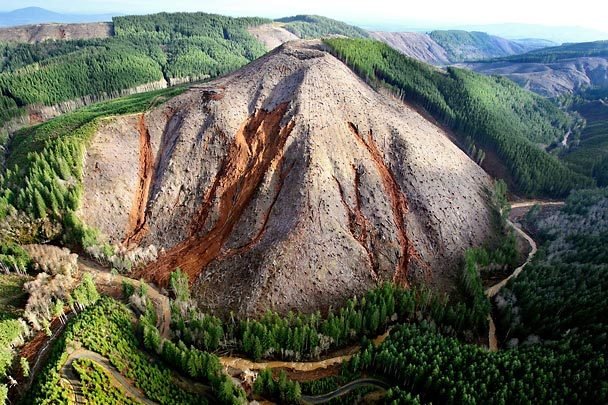
The aerial photo of the bare slope and slide areas in the Stillman Creek drainage raised concerns at Weyerhaeuser, enough so that corporate officials did their own flyover, scouting landslides there and elsewhere in the Northwest. Photo: Steve Ringman, Seattle Times

Logging and landslides: What went wrong?
By Hal Bernton and Justin Mayo / July 13, 2008

BOISTFORT VALLEY, Lewis County — When Weyerhaeuser began clear-cutting the Douglas firs on the slopes surrounding Little Mill Creek, local water officials were on edge.

Some of these lands had slid decades ago, after an earlier round of logging. They worried new slides could dump sediments into the mountain stream and overwhelm a treatment plant.

Those fears came true last December when a monster storm barreled in from the Pacific, drenching the mountains around the Chehalis River basin and touching off hundreds of landslides. Little Mill Creek, filled with mud and debris, turned dark like chocolate syrup.

More than three months passed before nearly 3,000 valley residents could drink from their taps again.

“I have never seen anything like this before, and I hope I never do again,” said Fred Hamilton, who works for the Boistfort Valley Water Corp.

State forestry rules empower the Department of Natural Resources (DNR) to restrict logging on unstable slopes when landslides could put public resources or public safety at risk.

But in Little Mill Creek and elsewhere in the Upper Chehalis basin, a Seattle Times investigation found that Weyerhaeuser frequently clear-cut on unstable slopes, with scant oversight from the state geologists who are supposed to help watchdog the timber industry.

The December storm triggered more than 730 landslides in the Upper Chehalis basin, according to a state aerial survey. Those slides dumped mud and debris into swollen rivers, helping fuel the floods that slammed houses, barns and farm fields downstream.

A disproportionate number of those landslides started on slopes that had been clear-cut.

The Seattle Times, using information from state aerial surveys, examined 87 of the steepest sites that had been clear-cut. Nearly half of them suffered landslides during the storm. Those sites represented less than 8 percent of the total acreage — both logged and forested — in the Upper Chehalis and its tributary drainages. But the sites produced about 30 percent — 219 — of the landslides.

Among the other findings:

• Weyerhaeuser routinely downgraded slide risks on those sites in logging applications submitted to the state. In watershed plans financed by Weyerhaeuser and approved by the state in 1994, more than half the acreage in the sites was rated at moderate- or high-hazard potential for landslides. But in a second round of site reviews before logging, Weyerhaeuser geologists concluded that most acreage had little or no potential for landslides.

• State forestry officials often noted “unstable slopes” or “unstable soils” in checklists that accompanied their harvest approvals. But there is no record in the files of any field visits by state geologists to scrutinize the logging plans in the 42 sites that later had landslides. Forty of those sites were logged by Weyerhaeuser, two by other companies.

David Montgomery, a University of Washington geomorphology professor who reviewed The Seattle Times’ findings, believes Weyerhaeuser underestimated the risks of clear-cutting.

He notes that several logged areas included features specifically defined in state rules as potentially unstable.

Logging these areas removes trees that help intercept the rain and bind the soil. Decades of studies, which have been used to help shape state forest-practice rules, show logging such slopes can increase the number and size of slides.

Montgomery wrote some of those studies. His blunt assessments of the connection between logging and landslides have sometimes rankled state and industry officials.

“If the policy is not to increase landsliding, then they have no business cutting on some of these slopes,” Montgomery said. “There is not a mechanistic model on this planet that would predict cutting down those trees would do anything other than reduce stability. The only question is how much.”

Catastrophic flooding

The December 2007 flood walloped Lewis County, causing more than $57 million in property damage to homes, farms and businesses. A Seattle Times photo of landslides on a clear-cut mountainside helped ignite a public debate about whether logging practices had worsened the flood’s effects.

Weyerhaeuser and the state Forest Practices Board, which sets state logging rules, are both funding studies to look at the relationship between logging and landslides in the December storm.

In interviews, Weyerhaeuser officials place most of the blame for last year’s landslides on the extraordinary amount of rainfall. Over the decades, they say, the company has made improvements in its forestry practices — some of which were credited in a 2000 report commissioned by the state with helping reduce erosion and landslide risks in the Upper Chehalis. And in some areas, they believe their logging may have made little — or no — difference in the number of landslides.

The Chehalis River’s peak flood flow was more than double the previous record tracked by gauges in place since 1939. Some areas got especially soaked: The Stillman Creek drainage, for example, got 8 inches of rain in 10 hours.

Within the Chehalis River basin, the company said, there were also numerous slides in forested areas, and the company noted such slides may be underreported because they are hard to spot in aerial surveys. By contrast, Weyerhaeuser clear-cuts in other drainages that received less rain had few landslides.

“This storm was so intense that we had no basis for making judgments about what is likely to be stable or unstable. So that is kind of what we are struggling with here,” said Bob Bilby, Weyerhaeuser’s chief environmental scientist.

“At the same time, we are not trying to absolve us of any guilt. … We are mounting a fairly large project to take a look at the procedures we use to deal with unstable slopes.”

The DNR also is reviewing its oversight, according to Lenny Young, manager of the agency’s Forest Practices Division.

In 2001, new rules more strictly defined the kinds of unstable slopes where logging could be limited. In areas that already had watershed plans, such as the Chehalis basin, timber companies were exempted from the new rules, according to Young.

That exemption, which has been in place as Weyerhaeuser clear-cut in the basin, will be re-examined by the Forest Practices Board, said Young. Still, state Lands Commissioner Doug Sutherland, who heads DNR, defends his agency’s enforcement record.

“Do we have enough oversight?” Sutherland said. “With the folks available, with the data available. With the technology available. My answer would be yes, we do. Can we improve it? Definitely.”

Read the rest of it here. / The Seattle Times

For extended coverage, click here.

The Rag Blog

Posted in RagBlog | Tagged , , | 2 Comments

The Court Decision Disappointed Even the Victors


Decisions Shut Door on Bush Clean-Air Steps
By Felicity Barringer / July 12, 2008

Any major steps by the Bush administration to control air pollution or reduce emissions of heat-trapping gases came to a dead end on Friday, the combined result of a federal court ruling and a decision by the head of the Environmental Protection Agency.

In the morning, a federal appeals court struck down the cornerstone of the administration’s strategy to control industrial air pollution by agreeing with arguments by the utility industry that the E.P.A. had exceeded its authority when it established the Clean Air Interstate Rule in 2005. The court, the United States Court of Appeals for the District of Columbia Circuit, said the rule, which set new requirements for major pollutants, had “fatal flaws.”

A few hours later, the E.P.A. chief rejected any obligation to regulate heat-trapping gases like carbon dioxide under existing law, saying that to do so would involve an “unprecedented expansion” of the agency’s authority that would have “a profound effect on virtually every sector of the economy,” touching “every household in the land.”

Taken together, the developments make it clear that any significant new effort to fight air pollution will fall to the next president.

The comments by the E.P.A. administrator, Stephen L. Johnson, reinforced a message that the administration had been sending for months: that it does not intend to impose mandatory controls on the emissions that cause climate change. John Walke, a lawyer with the Natural Resources Defense Council, a leading environmental group, said, “As a result of today, July 11, the Bush administration has failed to achieve a single ounce in reductions of smog, soot, mercury or global warming pollution from power plants.”

Mr. Johnson said he was “extremely disappointed” in the court decision “because it’s overturning one of the most significant and health-protective rules in our nation’s history.”

But on climate change, he said laws like the Clean Air Act were “ill-suited” to the complexities of regulating greenhouse gases.

Mr. Johnson’s comments appeared as a preface to a report by the E.P.A. staff sketching out how the emission of heat-trapping gases, particularly by vehicles, might be handled under the Clean Air Act. The report was intended to address a Supreme Court directive that the agency decide whether such gases threaten people’s health or welfare. But it also reflects the deep disapproval of controls on such gases by the White House and agencies like the Transportation, Agriculture and Commerce Departments.

In effect, Mr. Johnson was simultaneously publishing the policy analysis of his scientific and legal experts and repudiating its conclusions.

The Clean Air Interstate Rule, which covered states in the eastern half of the country, set new requirements for controls on major pollutants emitted by industry, particularly the electric utilities. At its most stringent, it would have required, beginning in 2015, 70 percent reductions in sulfur dioxide and 60 percent reductions in nitrogen oxide from 2003 levels.

At the time the interstate pollution rule was adopted, the E.P.A. estimated that, when fully in effect after 2015, it would cut by 13,000 annually the number of premature deaths from breathing polluted air.

The court ruling, combined with a court decision this year striking down an E.P.A. rule controlling mercury emissions from power plants, means that virtually all controls on the electric utility industry by the Bush administration have no force.

“The implications are huge,” said Lisa Heinzerling, a professor at Georgetown University Law Center. “This is the administration’s major air pollution initiative.”

The restrictions were designed, Ms. Heinzerling said, to deal comprehensively with a variety of air pollution issues, including the interstate transport of pollutants and the states’ obligations to enforce standards to protect the public health.

But with the court’s decision, she said, all of the administration’s efforts, aside from those involving vehicles, “are gone.”

“Anything they’ve done that has any relation to pollution control has been invalidated,” she said.

The court decision disappointed even the victors.

Jim Owen of the Edison Electric Institute said, “In our industry, one of the things we crave is certainty, and this goes in the other direction.”

Brent W. Dorsey, the director of corporate environmental programs at Entergy, the large energy producer, added, “With this thing thrown out, we’ve basically thrown the baby out with the bathwater.”

Entergy, one of the companies that brought the case to court, emphasized on Friday that it did not want the whole rule thrown out and that it had challenged only the part that allocated permits for emissions of pollutants around the industry. The company said an 11th-hour change by the E.P.A. had put too much of the cleanup burden on areas using oil and gas for power generation, as Entergy does, and not enough on utilities that burn coal.

Thomas Williams, a spokesman for Duke Energy, which had sued the E.P.A., contesting how the rule allocated the pollution allowances among industries, said in an e-mail message, “It was not the intent of Duke Energy’s participation in this litigation to overturn E.P.A.’s Clean Air Interstate Rule.”

Mr. Williams pointed out that North Carolina, where Duke has several power plants, enacted a law in 2002 that set limits on sulfur dioxide and nitrogen oxide that were even tougher than those in the now-defunct federal rule.

Bill Becker, executive director of the National Association of Clean Air Agencies, said on Friday that few states, aside from North Carolina, had laws that would fill the void created by the court ruling.

“Right now we find ourselves in the twilight zone,” Mr. Dorsey, of Entergy, said. “How do you proceed now? Do we continue to buy emissions allowances? Do we work on putting scrubbers on, or what?”

Entergy backs a legislative remedy proposed by Senator Thomas R. Carper, Democrat of Delaware, that would set long-term limits on pollutants.

While industry and environmental lobbyists both expressed concerns about the impact of the court ruling, they divided along more customary lines on Friday’s second decision, the declaration by Mr. Johnson of the E.P.A. that existing federal laws were “ill-suited” to the regulation of heat-trapping gases.

The Association of International Automobile Manufacturers released a statement saying, in part, “We share concerns that the Clean Air Act, which underwent its last major amendment 18 years ago, does not include all of the tools and criteria needed to address the global issue of climate change, including requirements to balance the economic effects and impacts on U.S. manufacturing jobs along with the environmental considerations.”

Mr. Johnson alluded to the difficulty of applying the Clean Air Act, designed for conventional pollutants like sulfur dioxide and nitrogen oxide, to greenhouse gases.

Because interagency consensus could not be reached on a road map for such regulation, Mr. Johnson said, he was simultaneously publishing his staff’s work and the comments of its critics, which had a definite tinge of hostility toward the E.P.A. regulators.

For instance, the chairman of the Council on Environmental Quality, James Connaughton, wrote that the E.P.A.’s staff “myopically focuses on the Clean Air Act and ignores or understates major intended and unintended consequences that would flow from misapplying decades-old regulatory tools.”

The final E.P.A. document, known as an advance notice of proposed rule making, did not contain a staff analysis about the economic benefits of regulation that had been in an earlier draft. That May 30 draft, which circulated widely in Washington, set the benefits of regulation at up to $2 trillion. The final version, based on the revised assumption that gasoline would cost about $2.20 per gallon in the foreseeable future, estimated the economic benefit at no more than about $830 billion.

Source. / The New York Times

Thanks to Betsy Gaines / The Rag Blog

Posted in RagBlog | Tagged , , | Leave a comment

Bill Moyers: "Communitainment" and Other Media Wonders


Is the Fourth Estate a Fifth Column? Corporate media colludes with democracy’s demise
By Bill Moyers / July 14, 2008

I heard this story a long time ago, growing up in Choctaw County in Oklahoma before my family moved to Texas. A tribal elder was telling his grandson about the battle the old man was waging within himself. He said, “It is between two wolves, my son. One is an evil wolf: anger, envy, sorrow, greed, self-pity, guilt, resentment, lies, false pride, superiority and ego. The other is the good wolf: joy, peace, love, hope, serenity, humility, empathy, generosity, truth, compassion and faith.”

The boy took this in for a few minutes and then asked his grandfather, “Which wolf won?”

The old Cherokee replied simply, “The one I feed.”

Democracy is that way. The wolf that wins is the one we feed. And in our society, media provides the fodder.

Our media institutions, deeply embedded in the power structures of society, are not providing the information that we need to make our democracy work. To put it another way, corporate media consolidation is a corrosive social force. It robs people of their voice in public affairs and pollutes the political culture. And it turns the debates about profound issues into a shouting match of polarized views promulgated by partisan apologists who trivialize democracy while refusing to speak the truth about how our country is being plundered.

Our dominant media are ultimately accountable only to corporate boards whose mission is not life, liberty and the pursuit of happiness for the whole body of our republic, but the aggrandizement of corporate executives and shareholders.

These organizations’ self-styled mandate is not to hold public and private power accountable, but to aggregate their interlocking interests. Their reward is not to help fulfill the social compact embodied in the notion of “We, the people,” but to manufacture news and information as profitable consumer commodities.

Democracy without honest information creates the illusion of popular consent at the same time that it enhances the power of the state and the privileged interests that the state protects. And nothing characterizes corporate media today more than its disdain toward the fragile nature of modern life and its indifference toward the complex social debate required of a free and self-governing people.

Let’s look at what is happening with the Internet. This spring the cable giant Comcast tried to pack a Federal Communications Commission (FCC) hearing on network neutrality by hiring strangers off the street to ensure that advocates of net neutrality would not be able to get a seat in the hearing room.

SaveTheInternet.com — a bipartisan coalition — and its supporters helped expose the ruse. Soon after, there was a new hearing, this time without the gerrymandering seating by opponents of an open Internet.

Now Rep. Ed Markey (D-Mass.) has introduced a bill to advance network neutrality, and it has become an issue in the presidential campaign.

We must be vigilant. The fate of the cyber-commons — the future of the mobile Web and the benefits of the Internet as open architecture — is up for grabs. And the only antidote to the power of organized money in Washington is the power of organized people at the net roots.

When Verizon tried to censor NARAL’s (National Abortion Rights Action League) use of text messaging last year, it was quick action by Save the Internet that led the company to reverse its position. Those efforts also led to an FCC proceeding on this issue.

Wherever the Internet flows — on PCs, cell phones, mobile devices and, very soon, new digital television sets — we must ensure that it remains an open and nondiscriminatory medium of expression.

By 2011, the market analysts tell us, the Internet will surpass newspapers in advertising revenues. With MySpace and Dow Jones controlled by News Corporation’s Rupert Murdoch, Microsoft determined to acquire Yahoo!, and with advertisers already telling some bloggers, “Your content is unacceptable,” we could potentially lose what’s now considered an unstoppable long tail of content offering abundant, new, credible and sustainable sources of news and information.

So, what will happen to news in the future, as the already tattered boundaries between journalism and advertising is dispensed with entirely and as content programming, commerce and online communities are rolled into one profitably attractive package?

Last year, the investment firm of Piper Jaffray predicted that much of the business model for new media would be just that kind of hybrid. They called it “communitainment.” (Oh, George Orwell, where are you now that we need you?)

Across the media landscape, the health of our democracy is imperiled. Buffeted by gale force winds of technological, political and demographic forces, without a truly free and independent press, this 250-year-old experiment in self-government will not make it. As journalism goes, so goes democracy.

Mergers and buyouts change both old and new media. They bring a frenzied focus on cost-cutting, while fattening the pockets of the new owners and their investors. The result: journalism is degraded through the layoffs and buyouts of legions of reporters and editors.

Advertising Age reports that U.S. media employment has fallen to a 15-year low. The Los Angeles Times alone has experienced a withering series of resignations by editors who refused to turn a red pencil into an editorial scalpel.

The new owner of the Tribune Company, real estate mogul Sam Zell, recently toured his new property Los Angeles Times, telling employees in the newsroom that the challenge is this: How do we get somebody 126 years old to get it up? “Well,” said Zell, “I’m your Viagra.”

He told his journalists that he didn’t have an editorial agenda or a perspective about newspapers’ roles as civic institutions. “I’m a businessman,” he said. “All what matters in the end is the bottom line.”

Zell then told Wall Street analysts that to save money he intends to eliminate 500 pages of news a week across all of the Tribune Company’s 12 papers. That can mean eliminating some 82 editorial pages every week just from the Los Angeles Times. What will he use to replace reporters and editors? He says to the Wall Street analysts, “I’ll use maps, graphics, lists, rankings and stats.” Sounds as if Zell has confused Viagra with Lunesta.

Former Baltimore Sun journalist and creator of HBO’s The Wire, David Simon, chronicled the effect that crosscutting and consolidation has had in media businesses and on the communities where those businesses have made so much money. He wrote in a Washington Post op-ed, “I did not encounter a sustained period in which anyone endeavored to spend what it would actually cost to make the Baltimore Sun the most essential and deep-thinking and well-written account of life in central Maryland. The people you needed to gather for that kind of storytelling were ushered out the door, buyout after buyout.”

Or as journalist Eric Alterman recently wrote in the New Yorker: “It is impossible not to wonder what will become of not just news but democracy itself, in a world in which we can no longer depend on newspapers to invest their unmatched resources and professional pride in helping the rest of us to learn, however imperfectly, what we need to know.”

For example, we needed to know the truth about Iraq. The truth could have spared that country from rack and ruin, saved thousands of American lives and hundreds of thousands of Iraqi lives, and freed hundreds of billions of dollars for investment in the American economy and infrastructure.

But as reporters at Knight Ridder — one of the few organizations that systematically and independently set out to challenge the claims of the administration — told us at the time, and as my colleagues and I reported in our PBS documentary Buying the War, and as Scott McClellan has now confessed, and as the Senate Intelligence Committee confirmed in June, the Bush administration deceived Americans into supporting an unprovoked war on another country. And it did so using erroneous and misleading intelligence — and with the complicity of the dominant media. It has led to a conflict that, instead of being over quickly and bloodlessly as predicted, continues to this day into its sixth year.

We now know that a neoconservative is an arsonist who sets a house on fire and six years later boasts that no one can put it out. You couldn’t find a more revealing measure of the state of the dominant media today than the continuing ubiquitous presence on the air and in print of the very pundits and experts, self-selected message multipliers of a disastrous foreign policy, who got it all wrong in the first place. It just goes to show, when the bar is low enough, you can never be too wrong.

The dominant media remains in denial about their role in passing on the government’s unverified claims as facts. That’s the great danger. It’s not simply that they dominate the story we tell ourselves publicly every day. It’s that they don’t allow other alternative competing narratives to emerge, against which the people could measure the veracity of all the claims.

Now the dominant media is saying, “Well, we did ask. We did do our job by asking tough questions during the run-up to the war.”

But I’ve been through the transcripts. And I’ll tell you, you will find very few tough questions. And if you come across them, you will discover that they were asked of the wrong people.

John Walcott, Washington bureau chief for McClatchy, formerly Knight Ridder, recently said of his colleagues in the dominant media, “They asked a lot of questions, but they asked even the right questions of the wrong people.” They were asked of the sources who had cooked the intelligence books in the first place or who had memorized the White House talking points and were prepared to answer every tough question with a soft evasion or an easy lie, swallowed by a gullible questioner.

Following the March 2003 invasion, Vice President Dick Cheney dropped into a media dinner to thank the guests for their all-the-war-all-the-time coverage of the contrived and manufactured war.

Sadly, in many respects, the Fourth Estate has become the fifth column of democracy, colluding with the powers that be in a culture of deception that subverts the thing most necessary to freedom, and that is the truth.

But we’re not alone and we know what we need to say. So let us all go tell it on the mountains and in the cities. From our websites and laptops, the street corners and coffeehouses, the delis and diners, the factory floors and the bookstores. On campus, at the mall, the synagogue, sanctuary and mosque, let’s tell it where we can, when we can and while we still can.

Democracy only works when ordinary people claim it as their own.

[This article was adapted from Bill Moyers’ keynote address at the National Conference for Media Reform Conference in Minneapolis on June 7. You can read and respond to the full speech at www.pbs.org/moyers.]

Source / Information Clearing House

Also see Bill Moyers : A Texan’s Take on the Journalist’s Job The Rag Blog / May 4, 2008

The Rag Blog

Posted in RagBlog | Tagged , , | Leave a comment

Warning to Obama: Avoid the ‘Great Game’

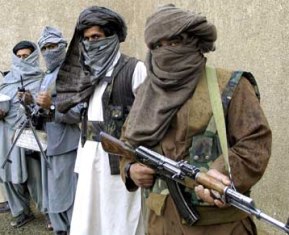
Afghan fighters.

Stop one war by starting two more?
By Tom Hayden / July 14, 2008

Barack Obama restated his Iraq phased withdrawal play in response to public questioning today but committed himself to expanding the wars in Afghanistan and Pakistan.

Any proposal to transfer American troops from Iraq to Afghanistan and Pakistan is sure to cause debate and questions among peace activists and rank-and-file Democrats. The proposal potentially represents a wider quagmire for the US government and military.

On Iraq, Obama said nothing especially new in his July 14 New York Times’ op-ed piece, but it was a forceful restatement of his commitment to combat troop withdrawals after his recent statements suggesting that he would “refine” his views when he consults military commanders on the ground.

Obama neglected to address how many American “residual forces” he would leave behind in Iraq to fight al-Qaeda and “protect American service members,” though he made additional US trainers conditional on the Iraqis making “political progress.” It was a proposal that seemed to promise a phased diminishing of the American military presence, not a complete withdrawal.

Many independent analysts question leaving some 50,000 American troops as advisers, trainers and counter-terrorism units in Iraq after the withdrawal of 140,000 by 2010. Those forces will be protecting a sectarian political regime that is linked to death squads, militias and a detention system now holding 50,000 Iraqis in violation of human rights standards.

It is quite possible that Obama’s regional diplomacy, including hard-bargaining with Iran, could facilitate a decent interval for American troop withdrawals and a more stabilized Iraq, as suggested by former CIA director John Deutch. [interview with Deutch, in Ending the War in Iraq, 2007]

Obama smartly exploited the recent call by Iraqi prime minister Nuri al-Malaki for a US withdrawal deadline, although al-Maliki’s time line was twice as long as Obama’s. In this face-saving scenario, the Pentagon would follow “the Philippine option” in which the client government formally requested that the US close its bases. This option was advocated openly by the Marines’ commander in Iraq in 2004. [NYT, Nov. 29, 2006]. The US only withdrew obsolete naval forces from the Philippines, however; today the US spends hundreds of millions on a secret war against Islamic forces in the southern Philippines. Obama might do the same.

These public policy ambiguities are not simply Obama’s problem, but are caused by a mainstream media which stubbornly refuses to ask any questions about those “residual forces.” For example, how will “residual forces,” tied to the regime the Americans put in power, be more successful on the battlefield than the departing 170,000 combat troops?

But Obama’s proposals for Afghanistan and Pakistan are far more problematic. They can described in everyday language as either out of the frying pan and into the fire, or attacking needles by burning down haystacks.

The Pentagon paradigm is to defeat al-Qaeda militarily while refusing to address, and thereby worsening, the dire conditions that gave rise to the Taliban and al-Qaeda operatives in the first place. Ahmed Rashid’s new Descent into Chaos [Viking, 2008] provides a horrific portrait of Afghanistan in careful prose based on reputable sources:

* It is estimated by RAND that $100 per capita is the minimum required to stabilize a country evolving out of war. Bosnia received $679 per capita, Kosovo $526, while Afghanistan received $57 per capita in the key years, 2001-2003;

* When the US installed the Hamid Karzai government, Afghanistan ranked 172nd out of 178 nations on the United Nation’s Human Development Index, having the highest rate of infant mortality in the world, a life expectancy rate of 44-45 years, and the youngest population of any country; in 2005 95 percent of Kabul’s residents were living without electrical power.

* Seven hundred civilians were killed in the first five months of 2008 alone, according to the United Nations.

Despite some gains in media and currency reform, plus a modest increase in children in school, this was the path of least reconstruction.

And despite images of Afghan democracy that made loya jirga tribal gatherings appear to be the birth of participatory democracy, a warlord state was entrenched by the CIA.

There are some 36,000 US troops stretched across Afghanistan, another 17,500 under NATO command, and 18,000 in counterinsurgency and training roles [NYT, July 14]. They are so aggressively combat-oriented that the Afghan government itself continually objects to the rate of civilian casualties. It costs the Pentagon $2 billion per month to support 30,000 American troops. According to Rashid, “Afghanistan is not going to be able to pay for its own army for many years to come — perhaps never.”

As of 2006, Afghanistan’s economy still rested on producing 90 percent of the world’s opium, an eerie narco-state parallel with the US counterinsurgency in Colombia from where most of America’s supply of cocaine originates.

Afghanistan is an unstable police state. By 2005, the Afghan Independent Human Rights Commission cited 800 cases of detainee abuse at some thirty U.S. firebases. “The CIA operates its own secret detention centers, which were off limits to the US military.” Ghost prisoners, known as Persons Under Control [PUCs] are held permanently without any public records of their existence. Warlords operate their own prisons with “unprecedented abuse, torture, and death of Taliban prisoners.” And as the US lowered the number of prisoners at Guantanamo, it increased the numbers held at Bagram, near Kabul. As of January, 2008, there were 630 incarcerated at Bagram, “including some who had been there for five years and whom the ICRC had still not been given access to.” After weeks of hunger strikes about detention conditions, the Taliban recently orchestrated a jailbreak of hundreds of Afghanis from the Kandahar prison, an inside job.

As in Iraq, the US contracted for police training in Afghanistan with DynCorp International; between 2003 and 2005, the US spent $860 million to train 40,000 Afghan police, “but the results were totally useless” according to Rashid. Even Richard Holbrooke described the DynCorp training program as “an appalling joke…a complete shambles.”

When the Taliban government was overthrown, the US installed a Westernized Pashtun, Hamid Karzai, a former lobbyist for Unocal, who had been out of the country during the jihad against the Soviet Union. But the Pashtun tribes themselves were violently displaced from power for the first time in 300 years. They remain by far the largest Afghan minority at 42 percent of the population, heavily concentrated in Kandahar and the southern provinces and across the federally-administered tribal areas in western Pakistan. These are the areas that the Pentagon, the New York Times, and Barack Obama [like John Kerry before him] designate as the central battlefront of the war on terrorism.

The question is not simply a moral one, but whether the expanding war in Afghanistan and Pakistan, fueled by troop transfers from Iraq, is winnable, and in what sense?

Transferring 10,000 American troops from Iraq to Afghanistan, which Obama proposes, is symbolic, a potential downpayment on the treadmill of further escalation. [In his statement, Obama supports “at least” two additional brigades for Afghanistan]. The future of the Pentagon’s “rear” in Iraq will be questionable if 15 combat brigades are withdrawn under Obama’s plan, while the Pentagon’s new “front” line cannot be secured with two brigades sent to southern and eastern Afghanistan. At best these might be holding actions until the next administration makes a decision about its ultimate strategy. Obama may be proposing an escalation simply in order not to lose, a pattern well-documented in Daniel Ellsberg’s history of the Vietnam War.

But the US escalation policy already is deepening rapidly, with bipartisan support [or silence, so far]. In keeping with counterinsurgency strategies going back to America’s long wars against native tribes, the Pentagon has fostered the ascension of a new Pakistani general, Ashfaq Parvez Kayani, whose background includes training at Fort Benning and Fort Leavenworth. An unnamed US military official praises Kayani “for embracing new counterinsurgency training and tactics that could be more effective in countering militants in the country’s tribal areas. [NYT, Jan. 7. 2008] Over $400 million is being spent to recruit a “frontier corps” of to “turn local tribes against militants” [NYT, Mar. 4, 2008] CIA and Special Forces operatives already have invaded Pakistan to set up a secret base from which to hunt Osama bin Laden “before Mr. Bush leaves office” as well as fighting al Qaeda and the Taliban on the ground and from pilotless Predator drones. [NYT, Feb. 22, 2008].

All this constitutes yet another preventive war by the United States, this one in violation of Pakistan’s sovereignty and against the stated policies of the newly-elected Pakistani government, not to mention the overwhelming sentiment among Pakistan’s people. On the Afghan front, the Taliban will be able to retreat in the face of greater US firepower, or attack like Lilliputians from multiple sides if the US concentrates its forces around the Pakistan border. Further violence and tides of anti-American sentiment could sweep across the region into Pakistan with unpredictable results.

Michael Scheuer, the former CIA official once charged with tracking down Osama bin Laden, suggests that the American delusion is that “by establishing a minority-dominated semisecular, pro-Indian government [in Kabul], we would neither threaten the identity nor raise the ire of the Pashtun tribes nor endanger Pakistan’s national security.” Scheuer wrote this year that “for the United States, the war in Afghanistan has been lost. By failing to recognize that the only achievable US mission in Afghanistan was to destroy the Taliban and al-Qaeda and their leaders and get out, Washington is now faced with fighting a protracted and growing insurgency. The only upside of this coming defeat is that it is a debacle of our own making. We are not being defeated by our enemies; we are in the midst of defeating ourselves.” [Marching Toward Hell, 2008]

The beginning of an alternative may require unfreezing American diplomacy towards Iran and considering a “grand bargain” instead. Teheran is the single power, according to CIA director Deutch, who could destabilize the US withdrawal from Iraq. It happens that they were America’s ally against Afghanistan not so long ago. The Iranians have lost thousands of police and soldiers themselves in a border war against Afghan drug lords. According to William Polk, “ironically, the only effective deterrent to the trade is Iran.” [Violent Politics, 2008] In exchange for security guarantees against a US-directed regime change, Iran may be willing to discuss cooperation with the “Great Satan” to stabilize its borders with Iraq and Afghanistan. Improbable? That depends on whether one thinks the alternative is unthinkable.

Only a short time ago, historically, the US was supporting the jihadists in the same tribal areas as they ventured to destroy the Soviet occupation. In the same years, the US was hosting the Taliban for talks on a possible oil pipeline across Afghanistan. Since twists and turns seem to be the only pattern in divide-and-conquer strategies, it is possible that Obama thinks being tough towards Afghanistan and Pakistan is a defensive cover for withdrawing from Iraq, and he later will follow up with unspecified diplomacy after he takes office. But history shows that creeping escalations create a momentum and constituency of their own. Obama might get lucky, lower the level of the visible wars, and embrace a diplomatic offensive. But North and South Waziristan could be his Bay of Pigs.

In summary, to borrow a popular phrase of the season, ending one war [Iraq] to start two more [in Afghanistan and Pakistan] seems to be a dumb idea.

[Tom Hayden is the author of Ending the War in Iraq (2007), The Voices of the Chicago Eight (2008), and Writing for a Democratic Society, the Tom Hayden Reader (2008).]

Source. / Huffington Post / Progressives for Obama

The Rag Blog

Posted in RagBlog | Tagged , , , , | Leave a comment

Cultural Clash in Rural Texas

Adriel Arocha’s parents consider his waist-length hair “sacred” and contend it reflects Native American religious beliefs. Photo by Eric Kayne / Houston Chronicle.

Long hair doesn’t cut it, school says…

Native American beliefs up against rural district’s dress code
By Eric Hanson / July 15, 2008

A small rural school district in Fort Bend County and a determined mother are tangled in a dispute over hair.

Michelle Betenbaugh says her 5-year-old son, Adriel Arocha, wears his hair long because of religious beliefs tied to his Native American heritage.

But the leaders of the Needville school district have strict rules about long hair on boys and don’t see any reason to make an exception in his case.

The dispute illustrates a problem American schools have faced for decades: how to balance individual student rights against rules designed to maintain order and discipline in the classroom.

The case also shows that some rural Texas school districts often have stricter grooming codes that reflect the traditional or old-fashioned values of small-town America when compared to those in big-city school districts such as Houston’s.

According to a legal expert, courts have repeatedly backed school districts in numerous lawsuits. But the same courts have granted students and parents some rights when it comes to hairstyles tied to religion.

“Every sort of legal challenge that could spring into the creative mind of a lawyer has been brought,” said Joy Baskin, an attorney for the Texas Association of School Boards. “Time after time, courts have said that it is not unreasonable to regulate dress and grooming.”

Baskin said legal rulings regarding challenges to hair codes on religious grounds let school districts grant exceptions.

Appeal to school board

Betenbaugh’s fight started in May when she told Needville school officials she planned to move to Needville from her Meadows Place home over the summer and enroll her son in kindergarten.

She told officials that Adriel had waist-length hair and she wanted to keep it that way. She said her husband is of Apache heritage and the tribe’s religious practices call for men to wear their hair long.

“His dad is of Native American descent, so we have chosen to raise him with certain beliefs in place, one of them being that his hair is sacred and we don’t cut it,” she said.

But Needville administrators said the boy’s hair would have to be cut.

Betenbaugh said she plans to appeal the decision to the school board Wednesday, and if the board rules against her she will fight in court.

Betenbaugh will be taking on the Needville Independent School District, a system of 2,596 students surrounded by farm and ranch country. The town is tight-knit, and many of the children at the Needville schools are third- and fourth-generation students.

Superintendent Curtis Rhodes, a Needville High graduate himself, said he talked to Betenbaugh about the dispute and decided no exception should be granted to the rule.

“What is their religious belief that defies cutting hair and following our policies?” Rhodes said. “They have not produced any information except they are Native American Indians.”

Rhodes said if the family can provide more specifics, the district would reconsider the case.

Needville’s dress and grooming code, which does not allow hair past the collar or eyes, is similar to other rural districts’ in the Houston region.

In the Devers school district in Liberty County, boys cannot wear hair below the collar.

“I would consider it pretty much a rural community with the basic tenets and beliefs that go with that,” said superintendent Larry Wadzek.

Wadzek said controversies over hair rarely come up and the district has never had to go to court over it.

Houston school district spokesman Norm Uhl said the district has no hair code and that individual school administrators set dress policies.

Baskin said school districts have had more success enforcing dress codes because courts have ruled that clothing can be disruptive, which creates distractions in the classroom.

No plans to move

A federal appeals court has said schools can also set rules about hair but that accommodations can be made for religious reasons.

“Religion is probably one of the few or only areas where students are going to be afforded a greater protection,” Baskin said.

Baskin said the reason rules regarding dress and grooming are imposed is that educators believe the classroom environment is more orderly with those guidelines in place.

“The students have better attendance, have better disciplinary behavior, and it has alleviated tension among students who might be distracted by dress,” she said.

Baskin said Texas has a religious freedom law that basically says a governmental unit can’t pass a rule that infringes on a person’s good-faith exercise of religion unless an exemption would cause an undue hardship for the governmental unit.

Baskin said many Native American tribes include hair length as a religious belief and if the case is litigated, a court will have to consider a number of factors. “Where does the religious tenet come from? Is it an organized religion or a personal set of beliefs?” she said.

Meanwhile, Betenbaugh said she is ready to fight the Needville rule and has not considered moving to another school district with a less stringent hair code.

“It would just teach our son that it is easier to roll over and do what you’re told and not stand up for your rights,” she said.

Copyright 2008 Houston Chronicle

Source. / Houston Chronicle

The Rag Blog

Posted in RagBlog | Tagged , , , , | 1 Comment

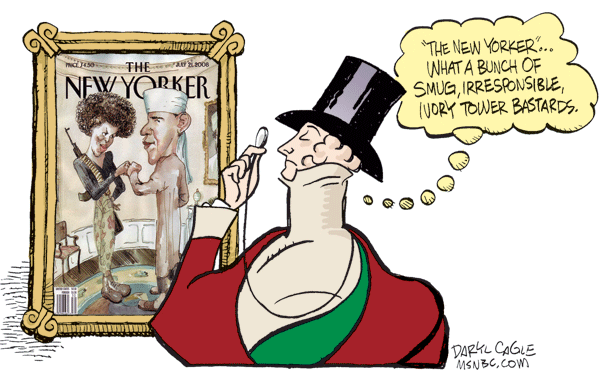
Drawn and Quartered

Daryl Cagle / MSNBC.com.

The Rag Blog / Posted July 15, 2008

Posted in RagBlog | Tagged , , , , | Leave a comment

Outsourcing the Iraq War


Mercenary recruiters turn to Latin America
By Eric Stoner

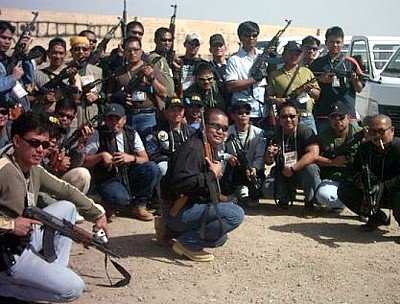
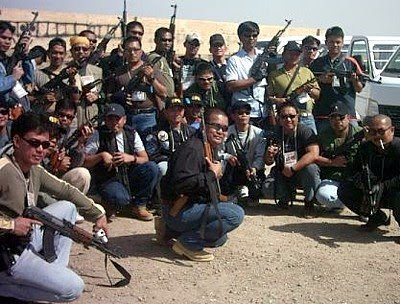
In October, Erik Prince, the 39-year-old CEO of Blackwater Worldwide, a leading private security company operating in Iraq, went into damage-control mode. Blackwater employees in Baghdad’s Nisour Square had killed 17 Iraqi civilians the previous month, causing an uproar and the suspension of official diplomatic convoys throughout the country for four days. Making the rounds with the media and testifying before Congress, Prince repeatedly said that his employees are not mercenaries, as critics contend. Citing the definition of a mercenary as “a professional soldier working for a foreign government,” Prince told the House Oversight Committee that in contrast, Blackwater’s employees are “Americans working for America, protecting Americans.”

This statement would come as a surprise—and a slap in the face—to the thousands of Latin Americans and others from outside the United States whom the company has hired to fill its contracts in Iraq since the war began. Greystone Limited, a Blackwater affiliate set up in 2004 in the tax haven of Barbados, has recruited Iraq security guards from countries throughout Latin America, including Chile, Colombia, Ecuador, Peru, El Salvador, Honduras, and Panama, as journalist Jeremy Scahill has reported.

But Blackwater is far from the only such company hiring “third-country nationals,” or employees who are not from the United States or Iraq. In the interest of improving profit margins, private military firms in Iraq are increasingly turning to the developing world for armed guards. Peter Singer, a leading expert on the private security industry at the Brookings Institution, has estimated that there are citizens from 30 countries employed as security contractors in Iraq. While ex-soldiers from the Balkans, Fiji, Nepal, the Philippines, South Africa, and Uganda are all common in Iraq, Latin America has proven to be a particularly fertile recruiting ground for these companies.

Latin America, says Adam Isacson, director of programs at the Center for International Policy, is a predictable site for U.S. mercenary companies to recruit personnel. In “what other region of the world are you going to find reasonably westernized people with military experience, in some cases with combat experience, who will work for low wages, who speak a language that a lot of our own military personnel speak,” he asks, noting that the U.S. Army is about a quarter Latino and that Latin America accounts for about 40% of U.S. military training programs worldwide. “It’s their natural ground to find people with military experience for whom $1,000 a month is a lot of money.”

One of the first people to recognize the role that Latin America could play in the booming new mercenary industry was José Miguel Pizarro Ovalle, a former arms broker. Indeed, it was Pizarro who “opened the door” for these firms to recruit in the region, as José Luis Gómez del Prado, head of the United Nations Working Group on the Use of Mercenaries, told Mother Jones magazine. A dual citizen of Chile and the United States, Pizarro served in the militaries of both countries and to this day defends the Pinochet dictatorship. After leaving the Marines as a translator for the U.S. Southern Command in 1999, Pizarro decided to cash in on his unique connections and began facilitating arms deals between Latin American militaries and U.S. manufacturers. Shortly after the United States invaded Iraq, he set his eyes on a new lucrative business opportunity: the provision of Chileans to mercenary companies.

In October 2003, Pizarro traveled to Blackwater’s headquarters in Moyock, North Carolina, to pitch the idea. Prince was receptive during their meeting and gave him the go-ahead. Pizarro returned immediately to Chile and placed a discreet ad in El Mercurio, the Santiago daily, looking for former military officers for “work abroad.” More than 1,000 applicants quickly responded, and by February 2004, Blackwater’s first batch of Chilean commandos, 77 of them, was on its way to Iraq. Offering the unusually high salary of about $3,000 per month, Blackwater began hiring a steady stream of Pizarro’s men for the “static protection” of State Department and Coalition Provisional Authority buildings. The Chileans were still a relative bargain, considering that former U.S. or British special forces can be paid as much as $1,000 per day in Iraq, according to The New York Times.

Pizarro soon branched out and began providing Chileans to Triple Canopy, another large private military company in Iraq, offering salaries of only $1,000 per month. This paltry sum—though an enormous amount for many Latin Americans—has since become the going rate for recruits throughout the region. All told, Pizarro says he contracted 756 Chileans for the two companies, and possibly others, while he was in business, Scahill reported. The actual number of Chileans in Iraq is undoubtedly higher, since mercenary firms also operate there clandestinely. Chilean senator Alejandro Navarro, an outspoken critic of the private war industry, has estimated that about 2,200 Chileans have been to Iraq and that 1,000 remain there, according to the Buenos Aires–based newspaper Página 12 and Chile’s Santiago Times.

The money may have been good for Pizarro, but controversy was never far behind. In order to skirt Chilean law, which prohibits “the act of providing or offering the services of private armed guards, in any form or designation, by any natural or artificial person,” Pizarro hired Chileans for Blackwater through Neskowin, a firm he set up in Uruguay, while using a different company called Global Guards, registered in Panama, for his business with Triple Canopy. And since paramilitary activity is also banned in Chile, the limited training that recruits received often took place either in Amman, Jordan, or in Iraq, once the Chileans arrived, as the UN Working Group found.

Reports surfaced shortly after this paramilitary pipeline between Chile and Iraq began flowing that Pizarro was posting flyers on military bases and using e-mail to lure active-duty military personnel to the private sector. One Chilean contractor who went to Iraq through one of Pizarro’s companies told the UN Working Group that 17 of his fellow active-duty soldiers “had requested leave to be recruited.”

Given the recent history of repressive regimes throughout the region, it is likely that many Latin Americans working for private military firms in Iraq have been responsible for human rights abuses in their home countries. For instance, Louis E. V. Nevaer reported in 2004: “Newspapers in Chile have estimated that approximately 37 Chileans in Iraq are seasoned veterans of the Pinochet era.” Some argue that this is merely a result of poor vetting, while others do not see it as an accident. As Tito Tricot, a former political prisoner who was tortured under the dictatorship in Chile, told Scahill, the Chileans working for these firms in Iraq “are valued for their expertise in kidnapping, torturing, and killing defenseless civilians.”

“What should be a national shame,” Tricot added, “turns into a market asset due to the privatization of the Iraq war.” In the end, Pizarro was fined and sentenced to 61 days in jail for his recruitment activity, a punishment that is not likely to dissuade many from following in his shoes. Nonetheless, he has appealed the sentence and is currently walking free. Meanwhile, Triple Canopy, which according to State Department figures relies far more on foreign hiring than Blackwater, filled its contract to protect the U.S. Embassy and other sites in Baghdad’s Green Zone by hiring recruits almost exclusively from Latin America (especially El Salvador, Nicaragua, Colombia, Chile, Peru, and Honduras), as Foreign Policy magazine noted. In 2005, a local subsidiary of Chicago-based Your Solutions began recruiting for the company in Honduras.

The company trained its recruits—including a group of Chileans who entered the country with tourist visas—at the former military base in Lepaterique. Located just outside Tegucigalpa, the base is a notorious legacy of the Contra war, having been used by Washington in the 1980s to train Nicaraguan counter-insurgents, as well as Honduras’s infamous Battalion 316 death squad. Echoing this gruesome past, one Triple Canopy trainee explained that he and his fellow recruits were instructed “to be heartless when it was up to us to kill someone, even if it was a child,” Agence France-Presse reported. After only several months in operation, the Honduran government fined Your Solutions and kicked the company out of the country for violating the law, which prohibits the training of foreign soldiers on its soil. Nevertheless, before the ax fell, Triple Canopy trained and sent at least 189 Hondurans and 105 Chileans to Iraq, according to the UN Working Group.

In the spring of 2003, public opinion in Latin America was vehemently, and overwhelmingly, opposed to the U.S. invasion of Iraq. Despite significant pressure from the Bush administration, only a handful of countries in the region joined the so-called Coalition of the Willing, contributing a combined total of slightly more than 1,000 soldiers to the U.S.-led war effort. While Latin America government officials’ recalcitrance on the war may have dealt a diplomatic blow to the United States, it did not stop thousands of poor ex-soldiers and former police officers throughout the region from performing essentially military functions in Iraq—under a corporate logo rather than their country’s flag.

The unprecedented privatization of the war in Iraq has given rise to a private military industry that was all but nonexistent 20 years ago. In the 1991 Gulf War, for example, there was one contractor for every 60 soldiers on the ground. While the exact number of private personnel in Iraq today is likely higher than official estimates, at least 180,000 private contractors are working there, according to recent government figures cited in the Los Angeles Times. As Scahill noted in congressional testimony, this makes the U.S. military—with roughly 160,000 troops in the country—the “junior partner in the coalition that’s occupying Iraq.”

Not only are far more contractors operating in war zones than in the past, but they are now responsible for many tasks that used to be carried out exclusively by the military. One of the most controversial roles being outsourced is armed protection for convoys, government facilities and diplomats. According to the Private Security Company Association of Iraq there are more than 180 such companies in operation that now employ 70,000 armed private security contractors in the country, and that number is only growing.

Established in 2005 to monitor this new industry, the UN Working Group on the Use of Mercenaries has warned that these so-called “security guards” are “in fact private soldiers militarily armed,” and that the companies that employ them in Iraq constitute “new expressions of mercenarism in the twenty-first century.”

One of those mercenaries was Mario Urquía, a 30-year veteran of the special forces in Honduras. Hired by Triple Canopy, Urquía guarded the U.S. Embassy in Iraq for a year and claims the company promised him U.S. citizenship once he completed his contract. Not only did that prove false, but he also says that he was never paid. “Not a single penny,” he told the Salt Lake Tribune. Urquía filed a complaint against Your Solutions with the Honduran authorities, as have at least 16 others, but his case is not being pursued because he is not currently in the country. After receiving death threats for sharing his story with the Honduran press and exposing those involved in Your Solutions’ operations there, Urquía was forced to flee the country.

Another Honduran guard badly injured his foot while in Iraq. Despite signing a contract that states the employer is responsible for providing medical and hospital insurance, he was not declared unfit for work and forced to man his lookout tower on crutches. Stories like these are not unique for those in the region who have worked for private security companies. According to the UN Working Group, the Hondurans who went to Iraq with Triple Canopy reported “irregularities in contracts, harsh working conditions with excessive working hours, wages partially paid or unpaid, ill-treatment and isolation, and lack of basic necessities such as medical treatment and sanitation.”

In a recent statement, Triple Canopy said it no longer recruits from either Honduras or Chile, but “continues to hire security personnel from Latin America to work in Iraq because they are diligent workers, reliable, professional and in some instances specifically requested by our U.S. government customers.” Since 2005, when the company was booted out of Honduras, most its recruits have come from Peru. In February 2007, one of Triple Canopy’s subcontractors indicated that the company had 1,130 Peruvians working in Iraq at the time. The stories of exploitation that they bring home, however, vary little from those of Hondurans and others. One group of five guards, for example, has filed a complaint against the company for sending them to work in Baghdad’s Red Zone, despite being hired to protect the Green Zone. Another guard says that for six days he was held in custody and isolation in degrading conditions after telling his supervisors that he planned on returning home.

Peruvian contractors, much like those from other countries, have little legal recourse when something goes wrong. Their contracts stipulate that they voluntarily accept every risk “known and unknown,” and exonerate Triple Canopy from any liability even if the contractor is harmed by the company itself. Often signing their contracts in a rush on the way to the airport, the Peruvians are also likely unaware that any claims against the company must be filed in a court in Virginia, where Triple Canopy is headquartered. In fact, in some countries security contractors have said that they were given a contract to sign only once they were on the plane, at which point they realized that their salary would be much less than promised.

While private security outfits have run into trouble in some countries, many others continue with business as usual. “Not only has this phenomenon not stopped,” says Amada Benavides de Pérez, a member of the UN Working Group, but recruitment in Latin America actually “has been increasing.” To address this problem, Benavides proposes a two-pronged strategy: strengthening laws at both the national and international level, and passing a regional treaty, similar to the 1977 convention against mercenaries that exists for Africa.

In the end, however, it comes down to supply and demand. Without reversing the radical privatization agenda that has taken hold in Washington, the U.S. war machine will inevitably continue to rely on private forces. Indeed, it is in the interest of pro-war U.S. policy makers to outsource the human costs of war for as long as possible.

[Eric Stoner is a freelance journalist whose work has appeared in The Nation and Yahoo News. He recently served as a researcher on the revised, updated version of Jeremy Scahill’s Blackwater: The Rise of the World’s Most Powerful Mercenary Army (Nation Books, 2008). This article was published by the North American Congress on Latin America.]

Source. / NACLA / Posted July 1, 2008

The Rag Blog

Posted in RagBlog | Tagged , , , , | Leave a comment

ART : The Writing’s On the Wall

Charlie Halsey, co-founder of Alphabeta, stands in the graffiti store’s art space. Photo by Margot Adler / NPR.

Brooklyn Store Celebrates The Art Of Graffiti
by Margot Adler / July 14, 2008

Graffiti has always had a double edge. Often reviled as a symbol of lawlessness and the deterioration of neighborhoods, it can also be a form of cultural and artistic awakening. There’s even evidence of graffiti in ancient Ephesus in Greece and in ancient Rome.

“Who knows why people write on the wall, or where that instinct comes from,” says Charlie Halsey, one of the founders of Alphabeta, a new Brooklyn-based community art space and event space that also sells graffiti art materials. “As far as I know, people have been writing graffiti since the dawn of mankind.”

Alphabeta has only been open for three weeks — it’s so new that it doesn’t have a phone number or a Web site — but one New York City official is already sounding the alarm.

The store is a single room on Greenpoint Avenue in Brooklyn. It features a larger outdoor space where murals can be painted on high walls and painted over and over again. Inside, there are racks of T-shirts, spray-painted hats and boxes of deadstock sneakers that were popular with graffiti and hip-hop artists in the 1980s and 90s.

There are also locked metal cages to hold the aerosol cans that come in a wealth of colors, some imported from Europe. Halsey says the cages have to be locked as part of the fire code, because “any combustible materials have to be locked in metal cages.”

New York City Councilman Peter Vallone Jr. has made the eradication of graffiti a personal mission. Vallone says it’s naive to believe the store will “cater to legal graffiti art, because there is just not enough of that to turn a profit.” Vallone believes that only a small fraction of graffiti art is legitimate.

“Eighty-five percent of graffiti is just tags,” says Vallone. “Another 10 percent is gang communication.”

Councilman Vallone came of age in the 1970s, when graffiti was associated with New York’s rising crime rate and the deterioration of neighborhoods. But recently, the Tate Modern Museum in London had graffiti artists paint the building.

Andrew Michael Ford, the director of the Ad Hoc Art Gallery in Brooklyn, says he knows street art has come of age when there are art shows like the one at the Tate:

“It sent a wave around the world that it’s legitimate, relevant and people need to pay attention to it,” says Ford, who adds that he believes graffiti art and other forms of street art will be appearing in more museums in the future.

The people who run Alphabeta want to ensure that the store is a success by riding that wave. Its founders hope that it will be as much an art space and event space as it is a store. To this end, Alphabeta has hosted five parties in its first three weeks of existence.

At a recent event, sponsored by the international graffiti art magazine Overspray, eight Austrian artists from the Inoperable Gallery in Vienna were doing “live” painting on three walls of the store’s outdoor space. When asked what he was doing, an artist who goes by the name of Franke, said that what he does is only for fun, “and pure joy.”

“The real graffiti artists,” says Franke, “are in dictatorships, where writing on a wall is a courageous act. What I do is child’s play. But a real graffiti artist risks a lot to make people think.”

Source. / All Things Considered / NPR

The Rag Blog

Posted in RagBlog | Tagged , | Leave a comment

World Hunger : Do the Math


A Shortage of Democracy, Not Food
By Frances Moore Lappé

Forty years ago, squirreled away in the basement “Ag” library at U.C. Berkeley, I wanted answers to one question: Why were 960 million people going hungry?

At the time, newspaper headlines and experts from academia to the United Nations had their straightforward answer: Human numbers had hit the Earth’s limits. But using my dad’s slide rule, I put two and two together: Our “modern” farm economy was actively creating scarcity from abundance, in part by feeding a third of the world’s grain to livestock.

I could hardly believe it. Could this Ph.D-less twenty-something be right and the experts wrong? Stuffing my self-doubt, I composed a one-page handout. I assumed that if people just understood that hunger was needless, of course they’d get busy changing the economic rules creating it. The handout became Diet for a Small Planet.

I was right that hunger would worsen unless we dug to its roots. I was wrong, though, about what would happen next.

Four decades on, the World Food Program predicts the number of hungry people in the world will rise this year to what it was at that first Berkeley “a-ha!” moment.

Over these decades, the forces generating hunger from plenty have intensified. Food production has kept ahead of population growth, but now not only do we feed a third of grain and most of soy to livestock, but we’ve turned more than a third of the global fish catch into feed as well. Of course, I couldn’t have guessed we’d also be “feeding” crops to cars via ethanol.

I’d hoped readers of Diet for a Small Planet would see this waste built into the post-World War II food system as only the surface layer explaining hunger. Beneath lies the deeper cause: the scarcity not of food but of democracy. Because no human being chooses hunger, hunger is proof that a person has been denied a voice in meeting survival needs. And, since a say in one’s future is the very essence of democracy, the existence of hunger belies democracy.

And what is killing democracy, while generating hunger? It is a belief system.

The belief is two-fold: first, that an effective market works only by one rule, highest return to shareholder—that is, highest return to existing wealth; and second, that government is anathema to a market’s effectiveness. From this stance, control over resources inexorably tightens to the point that it warps public decision-making to benefit narrow, private ends. We end up with a frightening oxymoron: “privately held government.”

And from it flows what I call “faith-based economics” because it is detached from real-world evidence. History demonstrates that only a government accountable to citizens can keep a market competitive and open so that all citizens are able to access it.

Today’s headlines, though, repeat the myth that weather and the inexorable increase in demand, especially among the new “middle classes” in India and China, explain the crisis—along with the unforeseen consequences of enlisting cropland in ethanol production. Wrong. Our worsening democracy deficit has continued to set the world up for disaster, undermining production and access to food worldwide.

Let us count the ways.

Unaccountable international agencies, including the World Bank and the International Monetary Fund, made loans on the condition that recipient countries reduce public support for local producers and food buyers. So African governments cut help to small farmers, and India said only the poorest of the poor could access its public “fair-price” shops that sell below-market-price grain.

Meanwhile, large agricultural interests in the North secured subsidies—almost half a billion dollars a day—making their grain so cheap its sales undercut markets for poor farmers in the South, ultimately driving many from the land.

And it gets worse. Trade agreements—most notably the 1994 North American Free Trade Agreement—ended tariffs that protected local farmers. In Mexico, for example, more than a million farmers went under in the decade following the agreement.

Then, in recent years, speculators have turned futures trading—set up to protect farmers and wholesalers from extreme weather-caused price swings—into their private bonanza, pushing up the short-term price of food.

Finally, while analysts talk as if the uptick in demand for wasteful grain-fed meat is inevitable, it isn’t. Democracy deficits in India and China have generated massive inequalities, heightening demand for costly grain-fed meat. With more equitable advancement that empowered rural dwellers, demand for meat could likely be met by small farms using the long-held, ecological, and cost-effective practice of feeding waste, like corn stalks and rice husks, to livestock.

The democracy crisis produces predictable and avoidable tragedy. But forty years later, what keeps me getting up in the morning is how much more we now know about sustainable growing and eating. We can turn today’s tragedy into a breakthrough for common sense and real democracy as we:

•Get money out of—and citizens’ voices into—governance.

•Shift public support to family farmers using sustainable agroecology. A 2007 University of Michigan study concluded that moving globally to sustainable, organic farming methods could increase food output by about 57 percent. A four-year study to evaluate the impact of such practices—involving almost thirteen million farmers and more than ninety million acres in fifty-seven countries—showed on average a 79 percent production increase.

•Grow the number of family farmers. One of the world’s largest democratic social movements, Brazil’s Landless Workers Movement, has succeeded in transferring almost twenty million acres to almost a third of a million rural landless families, creating thousands of new farmers and enterprises and greatly reducing hunger.

We can end hunger.

Forever.

We know how.

It depends, however, on citizens building confidence in their power to create democracies truly accountable to us.

[Frances Moore Lappé is the author of sixteen books, most recently “Getting a Grip: Clarity, Creativity and Courage in a World Gone Mad,” winner of the Gold “Best of Small Press” Nautilus Award 2008. Her website is www.smallplanet.org. This article appears in the July, 2008, issue of The Progressive.]

Source. / The Progressive

The Rag Blog

Posted in RagBlog | Tagged , , , , | Leave a comment

Pat Tillman : Administration Forgot to Remember

Cpl. Pat Tillman.

House Oversight investigation of Tillman and Jessica Lynch
By Kate Klonick / July 14, 2008

The House Oversight Committee released its proposed report (pdf) on the investigation this afternoon, on the death of Corporal Patrick Tillman and the capture of Private Jessica Lynch.

Unfortunately the report says that the Committee was unable to resolve “the key issue of what senior officials knew” because of the “universal” memory loss suffered by Tillman’s chain of command upon testifying before Congress:

Despite receiving information from all the top military leaders in Corporal Tillman chain of command — including Secretary Rumsfeld, General Myers, and General Abizaid — the Committee could not determine if any of the officials had communicated with President Bush or White House officials about fratricide in Corporal Tillman’s case. The lack of recollection also prevented the Committee from understanding how information about Corporal Tillman was handled within the Defense Department and how the Defense Department and the White House shared information on this matter.

As we’ve previously reported, the White House was very interested in the initial reports of Tillman’s death. In fact, the report details that White House exchanging almost 200 e-mails relating to Pat Tillman on April 23, 2004, during the first reports of Tillman’s death. But once the death was suspected to be caused by friendly fire, there was no further discussion of Tillman at the White House, according to the report.

So what did all of the silence convey to Oversight?

If the testimony the Committee received is accurate and if the documents submitted are complete, then the intense interest that initially characterized the White House’s and Defense Department’s reaction to Corporal Tillman’s death was followed by a stunning lack of curiosity about emerging reports of fratricide and an incomprehensible carelessness and incompetence in handling this sensitive information.

Source. / TPM Muckraker

The Rag Blog

Posted in RagBlog | Tagged , , | Leave a comment