Tom Englehardt : Why Cheney Won’t Take Down Iran


Reality Bites Back
Why the U.S. won’t attack Iran

By Tom Engelhardt / July 9, 2008

It’s been on the minds of antiwar activists and war critics since 2003. And little wonder. If you don’t remember the pre-invasion of Iraq neocon quip, “Everyone wants to go to Baghdad. Real men want to go to Tehran…” — then take notice. Even before American troops entered Iraq, knocking off Iran was already “Regime Change: The Sequel.” It was always on the Bush agenda and, for a faction of the administration led by Vice President Cheney, it evidently still is.

Add to that a series of provocative statements by President Bush, the Vice President, and other top U.S. officials and former officials. Take Cheney’s daughter Elizabeth, who recently sent this verbal message to the Iranians: “[D]espite what you may be hearing from Congress, despite what you may be hearing from others in the administration who might be saying force isn’t on the table… we’re serious.” Asked about an Israeli strike on Iran, she said: “I certainly don’t think that we should do anything but support them.” Similarly, former U.N. Ambassador John Bolton suggested that the Bush administration might launch an Iranian air assault in its last, post-election weeks in office.

Consider as well the evident relish with which the President and other top administration officials regularly refuse to take “all options” off that proverbial “table” (at which no one bothers to sit down to talk). Throw into the mix semi-official threats, warnings, and hair-raising leaks from Israeli officials and intelligence types about Iran’s progress in producing a nuclear weapon and what Israel might do about it. Then there were those recent reports on a “major” Israeli “military exercise” in the Mediterranean that seemed to prefigure a future air assault on Iran. (“Several American officials said the Israeli exercise appeared to be an effort to develop the military’s capacity to carry out long-range strikes and to demonstrate the seriousness with which Israel views Iran’s nuclear program.”)

From the other side of the American political aisle comes a language hardly less hair-raising, including Hillary Clinton’s infamous comment about how the U.S. could “totally obliterate” Iran (in response to a hypothetical Iranian nuclear attack on Israel). Congressman Ron Paul recently reported that fellow representatives “have openly voiced support for a pre-emptive nuclear strike” on Iran, while the resolution soon to come before the House (H.J. Res. 362), supported by Democrats as well as Republicans, urges the imposition of the kind of sanctions and a naval blockade on Iran that would be tantamount to a declaration of war.

Stir in a string of new military bases the U.S. has been building within miles of the Iranian border, the repeated crescendos of U.S. military charges about Iranian-supplied weapons killing American soldiers in Iraq, and the revelation by Seymour Hersh, our premier investigative reporter, that, late last year, the Bush administration launched — with the support of the Democratic leadership in Congress — a $400 million covert program “designed to destabilize [Iran’s] religious leadership,” including cross-border activities by U.S. Special Operations Forces and a low-level war of terror through surrogates in regions where Baluchi and Ahwazi Arab minorities are strongest. (Precedents for this terror campaign include previous CIA-run campaigns in Afghanistan in the 1980s, using car bombs and even camel bombs against the Russians, and in Iraq in the 1990s, using car bombs and other explosives in an attempt to destabilize Saddam Hussein’s regime.)

Add to this combustible mix the unwillingness of the Iranians to suspend their nuclear enrichment activities, even for a matter of weeks, while negotiating with the Europeans over their nuclear program. Throw in as well various threats from Iranian officials in response to the possibility of a U.S. or Israeli attack on their nuclear facilities, and any number of other alarums, semi-official predictions (“A senior defense official told ABC News there is an ‘increasing likelihood’ that Israel will carry out such an attack…”), reports, rumors, and warnings — and it’s hardly surprising that the political Internet has been filled with alarming (as well as alarmist) pieces claiming that an assault on Iran may be imminent.

Seymour Hersh, who certainly has his ear to the ground in Washington, has publicly suggested that an Obama victory might be the signal for the Bush administration to launch an air campaign against that country. As Jim Lobe of Inter Press Service has pointed out, there have been a number of “public warnings by U.S. hawks close to Cheney’s office that either the Israelis or the U.S. would attack Iran between the November elections and the inaugural of a new president in January 2009.”

Given the Bush administration’s “preventive war” doctrine which has opened the way for the launching of wars without significant notice or obvious provocation, and the penchant of its officials to ignore reality, all of this should frighten anyone. In fact, it’s not only war critics who are increasingly edgy. In recent months, jumpy (and greedy) commodity traders, betting on a future war, have boosted these fears. (Every bit of potential bad news relating to Iran only seems to push the price of a barrel of oil further into the stratosphere.) And mainstream pundits and journalists are increasingly joining them.

No wonder. It’s a remarkably frightening scenario, and, if there’s one lesson this administration has taught us these last years, it’s that nothing’s “off the table,” not for officials who, only a few years ago, believed themselves capable of creating their own reality and imposing it on the planet. An “unnamed Administration official” — generally assumed to be Karl Rove — famously put it this way to journalist Ron Suskind back in October 2004:

“[He] said that guys like me were ‘in what we call the reality-based community,’ which he defined as people who ‘believe that solutions emerge from your judicious study of discernible reality.’ I nodded and murmured something about enlightenment principles and empiricism. He cut me off. ‘That’s not the way the world really works anymore,’ he continued. ‘We’re an empire now, and when we act, we create our own reality. And while you’re studying that reality — judiciously, as you will — we’ll act again, creating other new realities, which you can study too, and that’s how things will sort out. We’re history’s actors…. and you, all of you, will be left to just study what we do.'”

A Future Global Oil Shock

Nonetheless, sometimes — as in Iraq — reality has a way of biting back, no matter how mad or how powerful the imperial dreamer. So, let’s consider reality for a moment. When it comes to Iran, reality means oil and natural gas. These days, any twitch of trouble, or potential trouble, affecting the petroleum market, no matter how minor — from Mexico to Nigeria — forces the price of oil another bump higher.

Possessing the world’s second largest reserves of oil and natural gas, Iran is no speed bump on the energy map. The National Security Network, a group of national security experts, estimates that the Bush administration’s policy of bluster, threat, and intermittent low-level actions against Iran has already added a premium of $30-$40 to every $140 barrel of oil. Then there was the one-day $11 spike after Israeli Deputy Prime Minister Shaul Mofaz suggested that an Israeli attack on Iranian nuclear facilities was “unavoidable.”

Given that, let’s imagine, for a moment, what almost any version of an air assault — Israeli, American, or a combination of the two — would be likely to do to the price of oil. When asked recently by Brian Williams on NBC Nightly News about the effects of an Israeli attack on Iran, correspondent Richard Engel responded: “I asked an oil analyst that very question. He said, ‘The price of a barrel of oil? Name your price: $300, $400 a barrel.'” Former CIA official Robert Baer suggested in Time Magazine that such an attack would translate into $12 gas at the pump. (“One oil speculator told me that oil would hit $200 a barrel within minutes.”)

Those kinds of price leaps could take place in the panic that preceded any Iranian response. But, of course, the Iranians, no matter how badly hit, would be certain to respond — by themselves and through proxies in the region in a myriad of possible ways. Iranian officials have regularly been threatening all sorts of hell should they be attacked, including “blitzkrieg tactics” in the region. Oil Minister Gholam Hossein Nozari typically swore that his country would “react fiercely, and nobody can imagine what would be the reaction of Iran.” The head of Iran’s Revolutionary Guard, Mohammed Jafari, said: “Iran’s response to any military action will make the invaders regret their decision and action.” (“Mr. Jafari had already warned that if attacked, Iran would launch a barrage of missiles at Israel and close the Strait of Hormuz, the outlet for oil tankers leaving the Persian Gulf.”) Ali Shirazi, Iranian Supreme Leader Ayatollah Ali Khamenei’s representative to the Revolutionary Guards, offered the following: “The first bullet fired by America at Iran will be followed by Iran burning down its vital interests around the globe.”

Let’s take a moment to imagine just what some of the responses to any air assault might be. The list of possibilities is nearly endless and many of them would be hard even for the planet’s preeminent military power to prevent. They might include, as a start, the mining of the Strait of Hormuz, through which a significant portion of the world’s oil passes, as well as other disruptions of shipping in the region. (Don’t even think about what would happen to insurance rates for oil tankers!)

In addition, American troops on their mega-bases in Iraq, rather than being a powerful force in any attack — Iraqi Prime Minister Nouri al-Maliki has already cautioned President Bush that Iraqi territory cannot be used to attack Iran — would instantly become so many hostages to Iranian actions, including the possible targeting of those bases by missiles. Similarly, U.S. supply lines for those troops, running from Kuwait past the southern oil port of Basra might well become hostages of a different sort, given the outrage that, in Shiite regions of Iraq, would surely follow an attack. Those lines would assumedly not be impossible to disrupt.

Imagine, as well, what possible disruptions of the modest Iraqi oil supply might mean in the chaos of the moment, with Iranian oil already off the market. Then consider what the targeting of even small numbers of Iranian missiles on the Saudi and Kuwaiti oil fields could do to global oil markets. (It might not even matter whether they actually hit anything.) And that, of course, just scratches the surface of the range of retaliatory possibilities available to Iranian leaders.

Looked at another way, Iran is a weak regional power (which hasn’t invaded another country in living memory) that nonetheless retains a remarkable capacity to inflict grievous harm locally, regionally, and globally.

Such a scenario would result in a global oil shock of almost inconceivable proportions. For any American who believes that he or she is experiencing “pain at the pump” right now, just wait until you experience what a true global oil shock would involve.

And that’s without even taking into consideration what spreading chaos in the oil heartlands of the planet might mean, or what might happen if Hezbollah or Hamas took action of any sort against Israel, and Israel responded. Mohamed ElBaradei, the sober-minded head of the International Atomic Energy Agency, considering the situation, said the following: “A military strike, in my opinion, would be worse than anything possible. It would turn the region into a fireball…”

This, then, is the baseline for any discussion of an attack on Iran. This is reality, and it has to be daunting for an administration that already finds itself militarily stretched to the limit, unable even to find the reinforcements it wants to send into Afghanistan.

Can Israel Attack Iran?

Let’s leave to the experts the question of whether Israel could actually launch an effective air strike against Iranian nuclear facilities on its own — about which there are grave doubts. And let’s instead try to imagine what it would mean for Israel to launch such an assault (egged on by the Vice President’s faction in the U.S. government) in the last months, or even weeks, of the second term of an especially lame lame-duck President and an historically unpopular administration.

From Iran’s foreign minister, we already know that the Iranians would treat an Israeli attack as if it were an American one, whether or not American planes were involved — and little wonder. For one thing, Israeli planes heading for Iran would undoubtedly have to cross Iraqi air space, at present controlled by the United States, not the nearly air-force-less Maliki government. (In fact, in Status of Forces Agreement negotiations with the Iraqis, the Bush administration has demanded that the U.S. retain control of that air space, up to 29,000 feet, after December 31, 2008, when the U.N. mandate runs out.)

In other words, on the eve of the arrival of a new American administration, Israel, a small, vulnerable Middle Eastern state deeply reliant on its American alliance, would find itself responsible for starting an American war (associated with a Vice President of unparalleled unpopularity) and for a global oil shock of staggering proportions, if not a global great depression. It would also be the proximate cause for a regional “fireball.” (Oil-poor Israel would undoubtedly also be economically wounded by its own strike.)

In addition, the latest American National Intelligence Estimate on Iran concluded that the Iranians stopped weaponizing parts of their nuclear program back in 2003, and American intelligence reputedly doubts recent Israeli warnings that Iran is on the verge of a bomb. Of course, Israel itself has an estimated — though unannounced — nuclear force of about 200 such weapons.

Simply put, it is next to inconceivable that the present riven Israeli government would be politically capable of launching such an attack on Iran on its own, or even in combination with only a faction, no matter how important, in the U.S. government. And such a point is more or less taken for granted by many Israelis (and Iranians). Without a full-scale “green light” from the Bush administration, launching such an attack could be tantamount to long-term political suicide.

Only in conjunction with an American attack would an Israeli attack (rash to the point of madness even then) be likely. So let’s turn to the Bush administration and consider what might be called the Hersh scenario.

Will the Bush administration Attack Iran If Obama Is Elected?

The first problem is a simple one. Oil, which was at $146 a barrel last week, dropped to $136 (in part because of a statement by Iranian President Mahmoud Ahmadinejad dismissing “the possibility that war with the United States and Israel was imminent”), and, on Wednesday rose a dollar to $137 in reaction to Iranian missile tests. But, whatever its immediate zigs and zags, the overall pattern of the price of oil seems clear enough. Some suggest that, by the time of any Obama victory, a barrel of crude oil will be at $170. The chairman of the giant Russian oil monopoly Gazprom recently predicted that it would hit $250 within 18 months — and that’s without an attack on Iran.

For those eager to launch a reasonably no-pain campaign against Iran, the moment is already long gone. Every leap in the price of oil only emphasizes the pain to come. In turn, that means, with every passing day, it’s madder — and harder — to launch such an attack. There is already significant opposition within the administration; the American people, feeling pain, are unprepared for and, as polls indicate, massively unwilling to sanction such an attack. There can be no question that the Bush legacy, such as it is, would be secured in infamy forever and a day.

Now, consider recent administration actions on North Korea. Facing a “reality” that first-term Bush officials would have abjured, the President and his advisors not only negotiated with that nuclearized Axis of Evil nation, but are now removing it from the Trading with the Enemy Act list and the State Sponsor of Terrorism list. No matter what steps Kim Jong Il’s regime has taken, including blowing up the cooling tower at the Yongbyon reactor, this is nothing short of a stunning reversal for this administration. An angry John Bolton, standing in for the Cheney faction, compared what happened to a “police truce with the Mafia.” And Vice President Cheney’s anger over the decision — and the policy — was visible and widely reported.

It’s possible, of course, that Cheney and associates are simply holding their fire for what they care most about, but here’s another question that needs to be considered: Does George W. Bush actually support his imperial Vice President in the manner he once did? There’s no way to know, but Bush has always been a more important figure in the administration than many critics like to imagine. The North Korean decision indicates that Cheney may not have a free hand from the President on Iran policy either.

The Adults in the Room

And what about the opposition? I’m not talking about those of us out here who would oppose such a strike. I mean within the world of Bush’s Washington. Forget the Democrats. They hardly count and, as Hersh has pointed out, their leadership already signed off on that $400 million covert destabilization campaign.

I mean the adults in the room, who have been in short supply indeed these last years in the Bush administration, specifically Secretary of Defense Robert Gates and Chairman of the Joint Chiefs of Staff Mike Mullen. (Condoleezza Rice evidently falls into this camp as well, although she’s proven herself something of a President-enabling nonentity over the years.)

With former Carter National Security Advisor Zbigniew Brzezinski, Gates tellingly co-chaired a task force sponsored by the Council on Foreign Relations back in 2004 which called for negotiations with Iran. He arrived at the Pentagon early in 2007 as an envoy from the world of George H.W. Bush and as a man on a mission. He was there to staunch the madness and begin the clean up in the imperial Augean stables.

In his Congressional confirmation hearings, he was absolutely clear: any attack on Iran would be a “very last resort.” Sometimes, in the bureaucratic world of Washington, a single “very” can tell you what you need to know. Until then, administration officials had been referring to an attack on Iran simply as a “last resort.” He also offered a bloodcurdling scenario for what the aftermath of such an American attack might be like:

“It’s always awkward to talk about hypotheticals in this case. But I think that while Iran cannot attack us directly militarily, I think that their capacity to potentially close off the Persian Gulf to all exports of oil, their potential to unleash a significant wave of terror both in the — well, in the Middle East and in Europe and even here in this country is very real… Their ability to get Hezbollah to further destabilize Lebanon I think is very real. So I think that while their ability to retaliate against us in a conventional military way is quite limited, they have the capacity to do all of the things, and perhaps more, that I just described.”

And perhaps more… That puts it in a nutshell.

Hersh, in his most recent piece on the administration’s covert program in Iran, reports the following:

“A Democratic senator told me that, late last year, in an off-the-record lunch meeting, Secretary of Defense Gates met with the Democratic caucus in the Senate. (Such meetings are held regularly.) Gates warned of the consequences if the Bush Administration staged a preemptive strike on Iran, saying, as the senator recalled, ‘We’ll create generations of jihadists, and our grandchildren will be battling our enemies here in America.’ Gates’s comments stunned the Democrats at the lunch.”

In other words, back in 2007, early and late, our new secretary of defense managed to sound remarkably like one of those Iranian officials issuing warnings. Gates, who has a long history as a skilled Washington in-fighter, has once again proven that skill. So far, he seems to have outmaneuvered the Cheney faction.

The March “resignation” of CENTCOM commander Admiral William J. Fallon, outspokenly against an administration strike on Iran, sent both a shiver of fear through war critics and a new set of attack scenarios coursing through the political Internet, as well as into the world of the mainstream media. As reporter Jim Lobe points out at his invaluable Lobelog blog, however, Admiral Mike Mullen, the Chairman of the Joint Chiefs and Gates’s man in the Pentagon, has proven nothing short of adamant when it comes to the inadvisabilty of attacking Iran.

His recent public statements have actually been stronger than Fallon’s (and the position he fills is obviously more crucial than CENTCOM commander). Lobe comments that, at a July 2nd press conference at the Pentagon, Mullen “repeatedly made clear that he opposes an attack on Iran — whether by Israel or his own forces — and, moreover, favors dialogue with Tehran, without the normal White House nuclear preconditions.”

Mullen, being an adult, has noticed the obvious. As columnist Jay Bookman of the Atlanta Constitution put the matter recently: “A U.S. attack on Iran’s nuclear installations would create trouble that we aren’t equipped to handle easily, not with ongoing wars in Iraq and Afghanistan. Adm. Mike Mullen, the chairman of the Joint Chiefs of Staff, drove that point home in a press conference last week at the Pentagon.”

The Weight of Reality

Here’s the point: Yes, there is a powerful faction in this administration, headed by the Vice President, which has, it seems, saved its last rounds of ammunition for a strike against Iran. The question, of course, is: Are they still capable of creating “their own reality” and imposing it, however briefly, on the planet? Every tick upwards in the price of oil says no. Every day that passes makes an attack on Iran harder to pull off.

On this subject, panic may be everywhere in the world of the political Internet, and even in the mainstream, but it’s important not to make the mistake of overestimating these political actors or underestimating the forces arrayed against them. It’s a reasonable proposition today — as it wasn’t perhaps a year ago — that, whatever their desires, they will not, in the end, be able to launch an attack on Iran; that, even where there’s a will, there may not be a way.

They would have to act, after all, against the unfettered opposition of the American people; against leading military commanders who, even if obliged to follow a direct order from the President, have other ways to make their wills known; against key figures in the administration; and, above all, against reality which bears down on them with a weight that is already staggering — and still growing.

And yet, of course, for the maddest gamblers and dystopian dreamers in our history, never say never.

[Tom Engelhardt, co-founder of the American Empire Project, runs the Nation Institute’s TomDispatch.com. The World According to TomDispatch: America in the New Age of Empire (Verso, 2008), a collection of some of the best pieces from his site, has just been published. Focusing on what the mainstream media hasn’t covered, it is an alternative history of the mad Bush years. A brief video in which Engelhardt discusses American mega-bases in Iraq can be viewed by clicking here.]

Copyright 2008 Tom Engelhardt

Source. / TomDispatch

I think this article does not prove that the US or Israel will not attack, but it does show what the consequences will be: $400/barrel oil, $12/gallon at the pump; increased vulnerability of American forces in Middle East, much more violence in the region. All predictions in the last eight years that “the Adults” would inevitably take charge (e.g., Frank Rich before the 2006 election) have been wrong. So if there is an attack before or after November, the results will be disastrous. Bring it on!

The greatest probability, however, is that the attack on Iran will be a “low-intensity war,” as in Central America in the Eighties. That’s the real emphasis of Hersh’s piece. The consequences may be endurable by the U.S., since it’s in the interest of the Iranians to limit things. Also, the American people will not notice a low-intensity war.

Tom Hayden had a great piece a few weeks ago on the primacy of “special ops” in the future U.S. military strategy, “Meet Dr. Strangelove,” http://www.huffingtonpost.com/tom-hayden/meet-the-new-dr-strangelo_b_108288.html It focused on an Australian Lt. Colonel who is Petraes’ advisor. American conventional forces are obviously useless, plus they run the problem of being noticed by the American people.

All these thousands of special ops people running around with murky mandates to murder people and foment terrorism will inevitably have a blowback effect in the U.S.: the rise of death squads to eliminate effective dissent. Thank god we’re so ineffective.

Mark Rudd / The Rag Blog / July 10, 2008

Thanks to David Hamilton / The Rag BLog

Posted in RagBlog | Tagged , , , , | 2 Comments

CodePink Flotilla Confronts Congressman About Iran Sanctions

Members of Code Pink protested Rep. Gary Ackerman’s (D-NY) house boat with a canoe blockade Wednesday morning. Ackerman embraced the protesters, calling it the most creative protest he had ever seen and engaged in a lengthy discussion with them about the Iran sanctions proposed in Congress. Photo by Michael Temchine / Newsday / July 9, 2008.

Protesters blockade Rep. Ackerman’s houseboat
BY Janie Lorber / July 9, 2008

WASHINGTON – Rep. Gary Ackerman might be the only member of Congress who really knows what a naval blockade feels like — thanks to peace activists who early Wednesday morning gathered around his Potomac River houseboat with a naval blockade of their own.

It wasn’t much, a mini-flotilla of three canoes and an inflatable raft — not even enough to surround Ackerman’s aquatic home. But the 15 activists from Code Pink wanted to encourage Ackerman (D-Jamaica Estates) to tone down his rhetoric against Iran.

After enduring nearly 30 minutes of sirens, whistles, drumbeats and megaphone chanting, Ackerman — wearing his trademark carnation in his lapel and a floral tie — emerged with a kiss and a hug for the ringleader.

But he said he would go ahead with a resolution calling for stiffer sanctions against Iran.

The Ackerman measure Code Pink wants Ackerman to withdraw the legislation because it believes it symbolizes the first step on a path to war. The group wants direct talks with Iran’s government instead.

“This House resolution — they claim that it’s a diplomatic measure and we say its not. It’s a very provocative measure,” said Desiree Fairooz, who received national attention for trying to smear fake blood on Secretary of State Condoleezza Rice during a congressional hearing last year.

Ackerman, whose district covers part of Nassau County, said he would be willing to meet with any Iranian government official without pre-conditions, including President Mahmoud Ahmadinejad, but would not retreat from his legislation.

“This is not an embargo,” Ackerman told the protestors. “We’re not calling for a blockade. It is basically what the UN is doing. The UN has imposed sanctions on Iran.”

The legislation asks President George W. Bush to “increase economic, political and diplomatic pressure on Iran.” But as a nonbinding resolution, it will never be presented to the president for signature and does not have the force of law.

Source. / Newsday

Thanks to Jeff Webster and Susan Van Haitsma / The Rag Blog

Posted in RagBlog | Tagged , , , , , | Leave a comment

Stopping Capitalism in Mexico – Calderon Will Lose

Sunday, thousands of Mexicans turned out to protest the oil reforms.

Confrontation Over Mexican Oil Privatization Plan Intensifies
By Alan Benjamin / July 10, 2008

MEXICO CITY — Proposals to privatize Mexico’s state-owned oil industry have sparked a powerful movement in the streets, led by a leftist political leader who narrowly lost the 2006 presidential election.

The National Movement in Defense of Oil (Movimiento Nacional en Defensa del Petróleo or MNDP), headed by former presidential candidate Andrés Manuel López Obrador, formally presented a resolution to the Mexican Congress on June 3. It calls on the Congress to organize a Nationwide Referendum to let the people vote on the six privatization planks in the energy “reform” plan initiated by Mexican President Felipe Calderón.

The conservative majority in Mexico’s Congress has refused to approve such a referendum, saying it would be unconstitutional. Ironically, Mexico was the first Latin American nation to nationalize its oil reserves in 1938, and is now moving to loosen state control of the industry just as oil prices are hitting record highs. The privatization plan is also being pushed at a time when other Latin American nations, such as Venezuela, Bolivia and Ecuador, are moving to assert greater state control over their own oil resources.

Mexico is the world’s sixth largest oil producer and oil revenues fund 40 percent of the government’s budget.

Lopéz Obrador officially lost the 2006 presidential election by 0.2 percent of the vote, amid widespread allegations of fraud by Calderón’s ruling conservative party.

Critics have accused the promoters of the national referendum — and López Obrador in particular — of “fomenting instability, violence and chaos” across Mexico. In addition, both Calderón and Jesus Reyes Heroles, the director of Pemex, Mexico’s state-owned oil corporation, have insisted that a referendum is out of the question, as their reform plan is too complicated for the Mexican people to be able to understand. Such accusations have not prevented defenders of Mexico’s oil resources from moving forward.

Pushing a People’s Referendum

In early June, a wing of López Obrador supporters in the leftist Party of the Democratic Revolution (PRD), all mayors, announced that in their cities and villages, they will convene referendums on the national energy reform plan. Marcelo Ebrard, the mayor of Mexico City (which holds about 10 percent of the country’s population and is its nerve center), announced that he would convene a referendum July 27.

Ebrard’s announcement was met with protests by top-level Calderón government officials, who warned Ebrard not to go ahead with the referendum, hinting that he might face impeachment proceedings.

López Obrador has since announced that — no matter what is decided in the Congress or what happens with the municipalities where local referendums are already being organized — the MNDP will hold a national referendum Aug. 7 in the country’s remaining 2,500 electoral districts. “The people are sovereign, the people must decide,” López Obrador said.

An outdoor assembly of the MNDP will be held in Mexico City June 27 and plans for organizing the Aug. 7 nationwide referendum will soon be announced.

The move toward an unauthorized national plebiscite follows months of agitation and organizing by López Obrador and his forces. In April, López Obrador’s congressional allies occupied the legislative chambers for 18 days while tens of thousands of mostly female oil defense “brigadistas” rallied in the streets outside. These efforts stalled Calderón’s initial attempt to rush the privatization plan into law and forced a national discussion.

Ten debates have followed in Congress and López Obrador’s forces have demolished Calderón’s supporters. Although the debates have only been covered on pay-per-view TV stations, privatization opponents have made videos available on YouTube and are selling inexpensive DVDs all across Mexico. They are also distributing a popular comic book by the well-known cartoonist El Fisgón, which explains the privatization plan simply and clearly.

Read all of it here. / Upside Down World

The Rag Blog

Posted in RagBlog | Tagged , , | Leave a comment

Bringing Palestinian Justice to Canadian Courts

Typical activity in Bi’lin, Palestine

Palestinian village sues Canadian contractors
By Zosia Bielski / July 10, 2008

They Want Their Land

The Palestinian village of Bil’in in Israel’s Occupied West Bank has launched a lawsuit against two Canadian construction companies accusing them of committing war crimes by building houses in the area.

In a lawsuit filed in Quebec Superior Court Monday, the village claims that the companies are acting as an agent of the state of Israel. It wants $2-million in punitive damages, as well as an immediate order from the Canadian court that would stop construction. If the order is successful, Bil’in will petition the Israeli Court to enforce it in the West Bank.

“What we’re endeavouring to do is quite unprecedented in Canada. We hope the Canadian court will take jurisdiction over this Canadian company that’s registered to do business in Quebec but is carrying on business in the Middle East on the occupied territories,” Mark Arnold, Canadian counsel to Bil’in, said yesterday.

Bil’in — a flashpoint in the Middle East conflict that has been the site of numerous protests, including one earlier this week — alleges that Green Park International Inc. and Green Mount International Inc., both registered corporations in Quebec, are building illegally on lands under the jurisdiction of the village.

The suit also alleges that the companies are marketing and selling condominium units to Israeli civilians, “thereby creating a new dense settlement neighbourhood on the lands of the Village of Bil’in. In so doing, the defendants are aiding, abetting, assisting and conspiring with the State of Israel in carrying out an illegal purpose.”

Bil’in insists that its land and the companies are subject to international law because the West Bank is occupied territory from the Middle East war of 1967. The claim points to the Rome Statute of the International Criminal Court, which states that war crimes include a nation transferring its civilian population into territory that it has occupied as a result of war.

“It has to do with what appears to be the policy of the government of Israel, which is to populate the occupied territory, former Palestinian land, with the population of Israel. That is contrary to international law, and that’s really the crux of this case,” Mr. Arnold said.

“This particular village is passionate about the land that they say belongs to them historically. … They say [the construction] amounts to a war crime. They don’t want any money — they want their land back. And as an afterthought, yes, they would like the wrongdoer to be punished with a financial punitive award.”

Ed Morgan, a University of Toronto international law professor, said the case faces several legal obstacles.

“They plead that the company has done this both as an agent of the state of Israel and on their own behalf. If they’ve done it as an agent of the state of Israel, they may run into a sovereign state immunity problem: you can’t sue states or other agencies in Canadian court. But if it’s [building on its own behalf ], then it’s not a violation of the Geneva Convention. Private companies operating in the market are not addressed by the Geneva Convention. They may be in a legal Catch-22.”

Prof. Morgan, who is past president of the Canadian Jewish Congress, argued that the village may not be the right party to bring a claim: “I don’t think these are village lands, these are Jordanian crown lands and they’re now taken over by the Israeli military administration.”

The companies could not be contacted for comment.

Source / National Post

The Rag Blog

Posted in RagBlog | Tagged , | Leave a comment

More Evidence of the Amerikkkan Police State


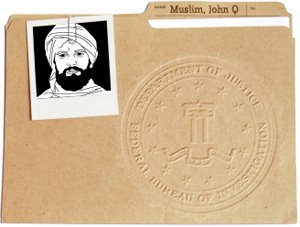
The FBI’s plan to “profile” Muslims
By Juan Cole / July 10, 2008

It’s unconstitutional, un-American — and it might hurt, rather than help, the FBI’s effort to stop real acts of terror.

The U.S. Justice Department is considering a change in the grounds on which the FBI can investigate citizens and legal residents of the United States. Till now, DOJ guidelines have required the FBI to have some evidence of wrongdoing before it opens an investigation. The impending new rules, which would be implemented later this summer, allow bureau agents to establish a terrorist profile or pattern of behavior and attributes and, on the basis of that profile, start investigating an individual or group. Agents would be permitted to ask “open-ended questions” concerning the activities of Muslim Americans and Arab-Americans. A person’s travel and occupation, as well as race or ethnicity, could be grounds for opening a national security investigation.

The rumored changes have provoked protests from Muslim American and Arab-American groups. The Council on American Islamic Relations, among the more effective lobbies for Muslim Americans’ civil liberties, immediately denounced the plan, as did James Zogby, the president of the Arab-American Institute. Said Zogby, “There are millions of Americans who, under the reported new parameters, could become subject to arbitrary and subjective ethnic and religious profiling.” Zogby, who noted that the Bush administration’s history with profiling is not reassuring, warned that all Americans would suffer from a weakening of civil liberties.

In fact, Zogby’s statement only begins to touch on the many problems with these proposed rules. The new guidelines would lead to many bogus prosecutions, but they would also prove counterproductive in the effort to disrupt real terror plots. And then there’s Attorney General Michael Mukasey’s rationale for revising the rules in the first place. “It’s necessary,” he explained in a June news conference, “to put in place regulations that will allow the FBI to transform itself as it is transforming itself into an intelligence-gathering organization.” When did Congress, or we as a nation, have a debate about whether we want to authorize the establishment of a domestic intelligence agency? Indeed, late last month Congress signaled its discomfort with the concept by denying the FBI’s $11 million funding request for its data-mining center.

Establishing a profile that would aid in identifying suspects is not in and of itself illegal, though the practice generally makes civil libertarians nervous. When looking for drug couriers, Drug Enforcement Agency agents were permitted by the Supreme Court in United States v. Sokolow (1989) to use indicators such as the use of an alias, nervous or evasive behavior, cash payments for tickets, brief trips to major drug-trafficking cities, type of clothing, and the lack of checked luggage. This technique, however, specifically excluded the use of skin color or other racial features in building the profile.

In contrast, using race and ethnicity as the — or even a — primary factor in deciding whom to stop and search, despite being widespread among police forces, is illegal. Just this spring, the Maryland State Police settled out of court with the ACLU and an African-American man after having been sued for the practice of stopping black and Latino men and searching them for drugs. New Jersey police also got into trouble over stopping people on the grounds of race.

The New Jersey Supreme Court ruled last year in State v. Calvin Lee that a defendant’s plausible allegation that the arrest was initiated primarily because of race would be grounds for discovery: The defense attorney could then request relevant documents from the prosecution that might show discriminatory attitudes and actions on the part of the police. Because racial profiling is most often felt by juries to be inappropriate, its use could backfire on the FBI. Suspects charged on the basis of an investigation primarily triggered by their race could end up being acquitted as victims of government discrimination.

If the aim is to identify al-Qaida operatives or close sympathizers in the United States, racial profiling is counterproductive. Such tiny, cultlike terror organizations are multinational. Richard Reid, the shoe bomber, is a Briton whose father hailed from Jamaica, and no racial profile of him would have predicted his al-Qaida ties. Adam Gadahn, an al-Qaida spokesman, is from a mixed Jewish and Christian heritage and hails from suburban Orange County, Calif. When I broached the topic of FBI profiling to some Muslim American friends on Facebook, a scientist in San Francisco replied, “Profiling Muslims or Arabs will just make al-Qaida look outside Islam for its bombers. There are many other disgruntled groups aside from those that worship Allah.”

It is a mystery why the Department of Justice has not learned the lesson that terrorists are best tracked down through good police work brought to bear on specific illegal acts, rather than by vast fishing expeditions. After Sept. 11, the DOJ called thousands of Muslim men in the United States for what it termed voluntary interviews. Not a single terrorist was identified in this manner, though a handful of the interviewees ended up being deported for minor visa offenses. Once it became clear that the interviews might eventuate in arbitrary actions against them, the willingness of American Muslims to cooperate declined rapidly, and so the whole operation badly backfired.

Read all of it here. / Salon

The Rag Blog

Posted in RagBlog | Tagged , , | Leave a comment

Assurances Economists Gave Made No Sense


A Work Force Betrayed: Watching Greed Murder the Economy
By Paul Craig Roberts / July 9, 2008

The collapse of world socialism, the rise of the high speed Internet, a bought-and-paid-for US government, and a million dollar cap on executive pay that is not performance related are permitting greedy and disloyal corporate executives, Wall Street, and large retailers to dismantle the ladders of upward mobility that made America an “opportunity society.” In the 21st century the US economy has been able to create net new jobs only in nontradable domestic services, such as waitresses, bartenders, government workers, hospital orderlies, and retail clerks. (Nontradable services are “hands on” services that cannot be sold as exports, such as haircuts, waiting a table, fixing a drink.)

Corporations can boost their bottom lines, shareholder returns, and executive performance bonuses by arbitraging labor across national boundaries. High value- added jobs in manufacturing and in tradable services can be relocated from developed countries to developing countries where wages and salaries are much lower. In the United States, the high value-added jobs that remain are increasingly filled by lower paid foreigners brought in on work visas.

When manufacturing jobs began leaving the US, no-think economists gave their assurances that this was a good thing. Grimy jobs that required little education would be replaced with new high tech service jobs requiring university degrees. The American work force would be elevated. The US would do the innovating, design, engineering, financing and marketing, and poor countries such as China would manufacture the goods that Americans invented. High-tech services were touted as the new source of value-added that would keep the American economy preeminent in the world.

The assurances that economists gave made no sense. If it pays corporations to ship out high value-added manufacturing jobs, it pays them to ship out high value-added service jobs. And that is exactly what US corporations have done.

Automobile magazine (August 2008) reports that last March Chrysler closed its Pacifica Advance Product Design Center in Southern California. Pacifica’s demise followed closings and downsizings of Southern California design studios by Italdesign, ASC, Porsche, Nissan, and Volvo. Only three of GM’s eleven design studios remain in the US.

According to Eric Noble, president of The Car Lab, an automotive consultancy, “Advanced studios want to be where the new frontier is. So in China, studios are popping up like rabbits.”

The idea is nonsensical that the US can remain the font of research, innovation, design, and engineering while the country ceases to make things. Research and product development invariably follow manufacturing. Now even business schools that were cheerleaders for offshoring of US jobs are beginning to wise up. In a recent report, “Next Generation Offshoring: The Globalization of Innovation,” Duke University’s Fuqua School of Business finds that product development is moving to China to support the manufacturing operations that have located there.

The study, reported in Manufacturing & Technology News, acknowledges that “labor arbitrage strategies continue to be key drivers of offshoring,” a conclusion that I reached a number of years ago. Moreover, the study concludes, jobs offshoring is no longer mainly associated with locating IT services and call centers in low wage countries. Jobs offshoring has reached maturity, “and now the growth is centered around product and process innovation.”

According to the Fuqua School of Business report, in just one year, from 2005 to 2006, offshoring of product development jobs increased from an already significant base by 40 to 50 percent. Over the next one and one-half to three years, “growth in offshoring of product development projects is forecast to increase by 65 percent for R&D and by more than 80 percent for engineering services and product design-projects.”

More than half of US companies are now engaged in jobs offshoring, and the practice is no longer confined to large corporations. Small companies have discovered that “offshoring of innovation projects can significantly leverage limited investment dollars.”

It turns out that product development, which was to be America’s replacement for manufacturing jobs, is the second largest business function that is offshored.

According to the report, the offshoring of finance, accounting, and human resource jobs is increasing at a 35 percent annual rate. The study observes that “the high growth rates for the offshoring of core functions of value creation is a remarkable development.”

In brief, the United States is losing its economy. However, a business school cannot go so far as to admit that, because its financing is dependent on outside sources that engage in offshoring. Instead, the study claims, absurdly, that the massive movement of jobs abroad that the study reports are causing no job loss in the US: “Contrary to various claims, fears about loss of high-skill jobs in engineering and science are unfounded.” The study then contradicts this claim by reporting that as more scientists and engineers are hired abroad, “fewer jobs are being eliminated onshore.” Since 2005, the study reports, there has been a 48 percent drop in the onshore jobs losses caused by offshore projects.

One wonders at the competence of the Fuqua School of Business. If a 40-50 percent increase in offshored product development jobs, a 65 percent increase in offshored R&D jobs, and a more than 80 percent increase in offshored engineering services and product design-projects jobs do not constitute US job loss, what does?

Academia’s lack of independent financing means that its researchers can only tell the facts by denying them.

The study adds more cover for corporate America’s rear end by repeating the false assertion that US firms are moving jobs offshore because of a shortage of scientists and engineers in America. A correct statement would be that the offshoring of science, engineering and professional service jobs is causing fewer American students to pursue these occupations, which formerly comprised broad ladders of upward mobility. The Bureau of Labor Statistics’ nonfarm payroll jobs statistics show no sign of job growth in these careers. The best that can be surmised is that there are replacement jobs as people retire.

The offshoring of the US economy is destroying the dollar’s role as reserve currency, a role that is the source of American power and influence. The US trade deficit resulting from offshored US goods and services is too massive to be sustainable. Already the once all-mighty dollar has lost enormous purchasing power against oil, gold, and other currencies. In the 21st century, the American people have been placed on a path that can only end in a substantial reduction in US living standards for every American except the corporate elite, who earn tens of millions of dollars in bonuses by excluding Americans from the production of the goods and services that they consume.

What can be done? The US economy has been seriously undermined by offshoring. The damage might not be reparable. Possibly, the American market and living standards could be rescued by tariffs that offset the lower labor and compliance costs abroad.

Another alternative, suggested by Ralph Gomory, would be to tax US corporations on the basis of the percentage of their value added that occurs in the US. The greater the value added to a company’s product in America, the lower the tax rate on the profits.

These sensible suggestions will be demonized by ideological “free market” economists and opposed by the offshoring corporations, whose swollen profits allow them to hire “free market” economists as shills and to elect representatives to serve their interests.

The current recession with its layoffs will mask the continuing deterioration in employment and career outlooks for American university graduates. The highly skilled US work force is being gradually transformed into the domestic service workforce characteristic of third world economies.

Source / Information Clearing House

The Rag Blog

Posted in RagBlog | Tagged | Leave a comment

Among the Topics That Cannot Be Discussed


It’s the Oil, stupid!
By Noam Chomsky / July 8, 2008

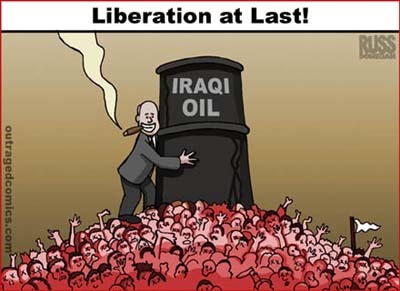
The deal just taking shape between Iraq’s Oil Ministry and four Western oil companies raises critical questions about the nature of the US invasion and occupation of Iraq — questions that should certainly be addressed by presidential candidates and seriously discussed in the United States, and of course in occupied Iraq, where it appears that the population has little if any role in determining the future of their country.

Negotiations are under way for Exxon Mobil, Shell, Total and BP — the original partners decades ago in the Iraq Petroleum Company, now joined by Chevron and other smaller oil companies — to renew the oil concession they lost to nationalisation during the years when the oil producers took over their own resources. The no-bid contracts, apparently written by the oil corporations with the help of U.S. officials, prevailed over offers from more than 40 other companies, including companies in China, India and Russia.

“There was suspicion among many in the Arab world and among parts of the American public that the United States had gone to war in Iraq precisely to secure the oil wealth these contracts seek to extract,” Andrew E. Kramer wrote in The New York Times.

Kramer’s reference to “suspicion” is an understatement. Furthermore, it is highly likely that the military occupation has taken the initiative in restoring the hated Iraq Petroleum Company, which, as Seamus Milne writes in the London Guardian, was imposed under British rule to “dine off Iraq’s wealth in a famously exploitative deal.”

Later reports speak of delays in the bidding. Much is happening in secrecy, and it would be no surprise if new scandals emerge.

The demand could hardly be more intense. Iraq contains perhaps the second largest oil reserves in the world, which are, furthermore, very cheap to extract: no permafrost or tar sands or deep sea drilling. For US planners, it is imperative that Iraq remain under U.S. control, to the extent possible, as an obedient client state that will also house major U.S. military bases, right at the heart of the world’s major energy reserves.

That these were the primary goals of the invasion was always clear enough through the haze of successive pretexts: weapons of mass destruction, Saddam’s links with Al-Qaeda, democracy promotion and the war against terrorism, which, as predicted, sharply increased as a result of the invasion.

Last November, the guiding concerns were made explicit when President Bush and Iraq’s Prime Minister Nouri Al Maliki signed a “Declaration of Principles,” ignoring the U.S. Congress and Iraqi parliament, and the populations of the two countries.

The Declaration left open the possibility of an indefinite long-term U.S. military presence in Iraq that would presumably include the huge air bases now being built around the country, and the “embassy” in Baghdad, a city within a city, unlike any embassy in the world. These are not being constructed to be abandoned.

The Declaration also had a remarkably brazen statement about exploiting the resources of Iraq. It said that the economy of Iraq, which means its oil resources, must be open to foreign investment, “especially American investments.” That comes close to a pronouncement that we invaded you so that we can control your country and have privileged access to your resources.

The seriousness of this commitment was underscored in January, when President Bush issued a “signing statement” declaring that he would reject any congressional legislation that restricted funding “to establish any military installation or base for the purpose of providing for the permanent stationing of United States Armed Forces in Iraq” or “to exercise United States control of the oil resources of Iraq.”

Extensive resort to “signing statements” to expand executive power is yet another Bush innovation, condemned by the American Bar Association as “contrary to the rule of law and our constitutional separation of powers.” To no avail.

Not surprisingly, the Declaration aroused immediate objections in Iraq, among others from Iraqi unions, which survive even under the harsh anti-labour laws that Saddam instituted and the occupation preserves.

In Washington propaganda, the spoiler to US domination in Iraq is Iran. U.S. problems in Iraq are blamed on Iran. US Secretary of State Condoleezza Rice sees a simple solution: “foreign forces” and “foreign arms” should be withdrawn from Iraq — Iran’s, not ours.

The confrontation over Iran’s nuclear programme heightens the tensions. The Bush administration’s “regime change” policy toward Iran comes with ominous threats of force (there Bush is joined by both US presidential candidates). The policy also is reported to include terrorism within Iran — again legitimate, for the world rulers. A majority of the American people favours diplomacy and oppose the use of force. But public opinion is largely irrelevant to policy formation, not just in this case.

An irony is that Iraq is turning into a US-Iranian condominium. The Maliki government is the sector of Iraqi society most supported by Iran. The so-called Iraqi army — just another militia — is largely based on the Badr brigade, which was trained in Iran, and fought on the Iranian side during the Iran-Iraq war.

Nir Rosen, one of the most astute and knowledgeable correspondents in the region, observes that the main target of the US-Maliki military operations, Moktada Al Sadr, is disliked by Iran as well: He’s independent and has popular support, therefore dangerous.

Iran “clearly supported Prime Minister Maliki and the Iraqi government against what they described as ‘illegal armed groups’ (of Moktada’s Mahdi army) in the recent conflict in Basra,” Rosen writes, “which is not surprising given that their main proxy in Iraq, the Supreme Iraqi Islamic Council dominates the Iraqi state and is Maliki’s main backer.”

“There is no proxy war in Iraq,” Rosen concludes, “because the U.S. and Iran share the same proxy.”

Teheran is presumably pleased to see the United States institute and sustain a government in Iraq that’s receptive to their influence. For the Iraqi people, however, that government continues to be a disaster, very likely with worse to come.

In Foreign Affairs, Steven Simon points out that current US counterinsurgency strategy is “stoking the three forces that have traditionally threatened the stability of Middle Eastern states: tribalism, warlordism and sectarianism.” The outcome might be “a strong, centralised state ruled by a military junta that would resemble” Saddam’s regime.

If Washington achieves its goals, then its actions are justified. Reactions are quite different when Vladimir Putin succeeds in pacifying Chechnya, to an extent well beyond what Gen. David Petraeus has achieved in Iraq. But that is THEM, and this is US. Criteria are therefore entirely different.

In the US, the Democrats are silenced now because of the supposed success of the US military surge in Iraq. Their silence reflects the fact that there are no principled criticisms of the war. In this way of regarding the world, if you’re achieving your goals, the war and occupation are justified. The sweetheart oil deals come with the territory.

In fact, the whole invasion is a war crime — indeed the supreme international crime, differing from other war crimes in that it encompasses all the evil that follows, in the terms of the Nuremberg judgment. This is among the topics that can’t be discussed, in the presidential campaign or elsewhere. Why are we in Iraq? What do we owe Iraqis for destroying their country? The majority of the American people favour US withdrawal from Iraq. Do their voices matter?

Noam Chomsky’s writings on linguistics and politics have just been collected in “The Essential Noam Chomsky,” edited by Anthony Arnove, from the New Press. Chomsky is emeritus professor of linguistics and philosophy at the Massachusetts Institute of Technology in Cambridge, Mass.

Source / Khaleej Times

The Rag Blog

Posted in RagBlog | Tagged , , | Leave a comment

Run Up the Flag, Boys…

Congress passed the FISA Bill

The Rag Blog / Posted July 9, 2008

Posted in RagBlog | Tagged , , , | Leave a comment

You Tube and the Hagee Videos


Pastor Hagee’s Desperate News Suppression Campaign Backfires
By Max Blumenthal / July 9, 2008

See video below.

During the week of July 1, lawyers representing far-right Pastor John Hagee demanded that YouTube remove scores of videos supposedly infringing on the copyright of John Hagee Ministries. YouTube acceded to Hagee’s attorneys without even a cursory review of their claims. As the Huffington Post’s Sam Stein reported, the maneuver resulted in the immediate disappearance of over 120 videos from YouTube — almost all of which depicted the preacher in a negative light.

Among the videos removed by YouTube was my mini-documentary, “Rapture Ready: The Christians United For Israel Tour.” Considering that my piece contained no copyrighted material whatsoever, it became apparent to me that Hagee’s minions were guided by ulterior political motives. Instead of guarding their copyrights, they sought to stifle legitimate reporting on Hagee’s far-out End Times ideology.

See the video Pastor John Hagee doesn’t want you to see.

Rapture Ready: The Unauthorized Christians United for Israel Tour from huffpost on Vimeo.

After a series of contentious calls to Hagee’s top PR flack, Juda Engelmeyer, who initially accused me of “conspiratorial” motives for daring to ask if Hagee’s people were behind the video removals, I finally confirmed the obvious: The Hagee video slaughter was a naked exercise in news suppression orchestrated by high-level operatives from the preacher’s headquarters in San Antonio, Texas.

Video has proven a particularly effective medium for generating mainstream media coverage of Hagee’s political agenda. In the past, reporters from the national press corps generally ignored print exposes of Hagee by progressive reporters (including me). But when presented with explicit visual evidence, these reporters found it difficult to dispute the notion that he sought to advance a radical End Times agenda for America and the world.

When I published “Rapture Ready” here on the Huffington Post in July 2007, I was immediately beseeched with interview requests from outlets including the Forward and Hagee’s hometown paper, the San Antonio Express-News. This year, when progressive bloggers turned John McCain’s endorsement by Hagee into a national controversy, the YouTube edition of my “Rapture Ready” video became one of their most effective tools. Thanks to widespread online dissemination, its hit count spiked from just over 20,000 hits to close to nearly 150,000 in less than a week (its Vimeo version had already been viewed by hundreds of thousands).

Then, after a video produced by progressive blogger Bruce Wilson prompted McCain to discard Hagee’s endorsement, members of Hagee’s political team concocted a desperate strategy to stanch their public relations disaster. They trolled YouTube for hours, identifying videos that seemed critical of Hagee, then demanded that YouTube remove them one by one on the grounds of copyright infringement. Besides my documentary, Hagee’s minions flagged videos by Bruce Wilson and People For The American Way which reproduced some of the preacher’s most hysterical sermons. (In one PFAW video, Hagee is seen predicting that Jesus will one day punish the ACLU “with a rod of iron;” a video by Wilson contains an audio clip of Hagee calling the Holocaust the will of God.)

Hagee’s operatives correctly assumed that YouTube would approve their copyright infringement claims without even reviewing them. They were also keenly aware that once YouTube removed the videos, users like me would be limited to only one means of recourse: filing a counter-claim that would take at least two weeks to process.

Hagee’s YouTube slaughter was carefully timed to provide PR cover for his Christians United for Israel Washington-Israel Summit, which convenes in Washington on July 21. By the time the Summit begins, YouTube will still not have been able to process counter-claims by me and others whose videos were scrubbed. Thus, “Rapture Ready” will remain off YouTube’s server until Hagee’s summit is over.

But Hagee’s news suppression campaign will do little to reverse the damage he has already done to himself. Candidates seeking a broad-based national constituency now recognize his endorsement as the political equivalent of a malignant cancer. He is simply too toxic to participate in mainstream American life. Among high-profile lawmakers, only Joseph Lieberman is still willing to share a stage with him, though that may eventually change as well.

The end may be nigh for Hagee’s Armageddon-based agenda.

Source. / The Huffington Post

The Rag Blog

Posted in RagBlog | Tagged , , , , , , , | Leave a comment

FOX News Smears Michelle Obama

Sorry FOX, We Won’t Let You Trash Michelle Obama
By Robert Greenwald / July 9, 2008

You’re not going to believe what FOX is up to now—we could hardly believe it ourselves. Not only are they smearing Michelle Obama with racist stereotypes, but then they offer a feeble apology that they believe gives them the right to slander her again. That’s what happened when FOX called Michelle and Barack Obama’s fist bump a “terrorist fist jab,” apologized, and then less than a week later referred to Michelle Obama as Barack’s “Baby Mama.”

FOX’s long history of racism is nothing new, but it has been particularly egregious when it comes to their coverage of the Obamas. Racism and fearmongering have no place in our country or its politics, despite what FOX would have you believe. That’s why we put together this video, FOX Attacks Michelle Obama.

We cannot allow FOX’s heinous smears and scare tactics to continue. Sign our petition and stop FOX from injecting racism, prejudice, and fear into our political dialogue. Then, send it to all your friends and family members for them to sign as well. And spread it on sites like Digg to create an uproar.

We cannot allow FOX to make politics about stereotypes, misinformation, and flat-out dishonesty. Not now. Not ever.

Source. / Brave New Films

Thanks to Jeff Jones / The Rag Blog

Posted in RagBlog | Tagged , , , , , , , | Leave a comment

Raleigh : State Employee Defies Directive to Honor Jesse Helms

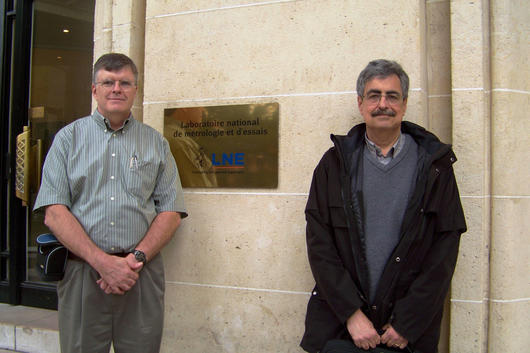
L. F. Eason III, left, with Dr. Richard Davis of the International Bureau of Weights and Measures, standing in front of the French National Measurement Institute.

Jesse Helms was buried here yesterday.

A white state employee of 21 years refused to lower the flag to half-mast because, he said, Helms was a racist. The poor man was forced to retire.

I was inspired by the man’s defiance.

Dick J. Reavis / The Rag Blog / July 9, 2008

He quit rather than lower flag for Helms
Ryan Teague Beckwith / July 9, 2008

RALEIGH – L.F. Eason III gave up the only job he’d ever had rather than lower a flag to honor former U.S. Sen. Jesse Helms.

Eason, a 29-year veteran of the state Department of Agriculture, instructed his staff at a small Raleigh lab not to fly the U.S. or North Carolina flags at half-staff Monday, as called for in a directive to all state agencies by Gov. Mike Easley.

When a superior ordered the lab to follow the directive, Eason decided to retire rather than pay tribute to Helms. After several hours’ delay, one of Eason’s employees hung the flags at half-staff.

The brouhaha began late Sunday night, when Eason e-mailed eight of his employees in the state standards lab, which calibrates measuring equipment used on things as widely varied as gasoline and hamburgers.

“Regardless of any executive proclamation, I do not want the flags at the North Carolina Standards Laboratory flown at half staff to honor Jesse Helms any time this week,” Eason wrote just after midnight, according to e-mail messages released in response to a public records request.

He told his staff that he did not think it was appropriate to honor Helms because of his “doctrine of negativity, hate, and prejudice” and his opposition to civil rights bills and the federal Martin Luther King Jr. holiday.

Eason said in an interview Tuesday that he did not typically lower the flag himself, but that, as head of the lab, he supervised the technician who did. He also trained new employees on proper flag etiquette, including a one-person folding technique he learned in Boy Scouts.

When the lab opened Monday morning, the flags were not out at all. An employee called Eason’s boss, Stephen Benjamin, who worked in another building in Raleigh. About 10:45 a.m., Benjamin told one of Eason’s co-workers to put the flags at half-staff.

Another of Eason’s superiors later drove by the lab to make sure the flags were up properly.

No one in the Governor’s Office was aware of any time in recent memory when a state employee refused to lower a flag. Brian Long, a spokesman for the Agriculture Department, said Eason’s refusal was unexpected.

“We’ve never had any conversations like that,” he said.

An ultimatum

In a string of e-mail messages with his superiors, Eason was told he could either lower the flags or retire effective immediately.

Though he’s only 51, Eason chose to retire, although he pleaded several times to be allowed to stay at the lab. Eason, who had worked for the Agriculture Department since graduating from college, was paid $65,235 a year as the laboratory manager.

Several people, including his wife, argued to Eason that the flags belonged to the state, as did the lab. But Eason said he felt a strong sense of ownership.

Eason and a previous boss had sketched out the building’s rough design on a napkin at the Atlanta airport in 1984 after attending a national conference on weights and measures.

He then worked to get funding for it in the state budget, and he recently helped snag state money to study building another lab.

“I designed and built that lab,” he said. “Even though technically the bricks and mortar belong to the state of North Carolina, I feel very strongly that everything that comes out of there is my responsibility.”

It was not the first time Eason felt uneasy about lowering the flag.

A registered Democrat who frequently votes a split ticket, he said he had no problems lowering the flag for former Sen. Terry Sanford or President Reagan. But he remembers wondering whether he would be willing to lower the flag after President Nixon’s death.

He never had to make that decision, since it rained both days.

Monday was sunny. And Eason was out of a job.

Source. / Raleigh News & Observer

The Rag Blog

Posted in RagBlog | Tagged , , , | 1 Comment

Breaking the Beast : The abuse of Circus Animals

PETA members, like the one pictured here, have led the way in terms of exposing and educating people about circus animal cruelty.

The circus is coming to town…
by Andrea Afra / July 07, 2008

The circus is coming to town.

“Tear that foot off! Sink it in the foot! Tear it off! Make ’em scream!”

“When I say rip his head off, rip his fucking foot off…it’s very important that you do it.”

In 1999, Tim Frisco, a Carson & Barnes circus elephant trainer was caught on video by an undercover PETA (People for the Ethical Treatment of Animals) cameraman during a training demonstration for new employees. As he screams, curses, and stabs at the elephant students he is ‘training’ with bullhooks and electrically charged prods, his goal is to evoke cries of pain and fear from the giant beasts.

“When you hear that screaming, then you know you got their attention.”

Frisco learned his techniques from his father, Joe Frisco Sr., a former trainer for the Ringling Brothers and Barnum and Bailey Circus. Owned by Feld Entertainment, Inc., the same company that puts on other family shows like Disney on Ice, the Ringling Bros. Red Tour is coming to Houston’s Reliant Stadium in July and they’ll do anything to hide what takes place behind the scenes…

“Right here in the barn, you can’t do it on the road…I’m not gonna touch her in front of a thousand people…she’s gonna fucking do what I want and that’s just fucking the way it is…I am the boss, I will kick your fucking ass…I’ll kick the shit out of you, you little prick.”

Austin, July 2006: Closer to home

Ringling Bros. is caught on video as elephants are being paraded through a neighborhood. An elephant named Tonka is being made to hold onto another elephant’s tail but she lets go and the person guiding her has a bullhook behind her left ear. He yanks on it eliciting several of the most horrific panting cries, like someone trying to breath heavily through a trumpet. A close up shot of the back of her ear shows a bleeding wound where the hook has ripped into her flesh. Austin police illegally confiscated the tape from PETA.

Animal rights groups such as PETA have been documenting circus animal abuse for over two decades. As a result the Ringling Bros. FAQ link on their website leads to a seven page, poorly written rebuttal, every single entry a defensive response against accusations made against the circus. For example, they claim their animals get ample exercise and care and have a better, longer life than those in the wild. This could be true if in the wild they enjoyed activites such as riding in cramped box cars for up to seventy hours without a break, fifty weeks a year, being chained with shackles long enough to leave deep gashes on their ankles, and learning stupid pet tricks under the force and threat of violence.

In retaliation for whistleblowers like PETA and other animal rights groups such as PAWS and The Elephant Alliance, Feld Entertainment, Inc., hired none other than former CIA Covert Operations Director Claire George to oversee an undercover operation to infiltrate those organizations that were most deemed to be a threat to ticket sales. Worse than Ringling’s spy games are its treatment of animals. In 1998 USDA formally charged Ringling in the death of Kenny, a baby elephant who was forced to perform while ill. They settled out of court for $20,000. In 1999, the USDA cited Ringling for the injuries of two baby elephants that had suffered severe rope burns during the separation from their mothers. After consulting with experts and in opposition to Ringling’s denial that the separation process was ethical, the USDA stated “there is sufficient evidence that the handling of these animals caused unnecessary trauma, behavioral stress, physical harm, and discomfort to these two elephants.”

This incident took at the Ringling Bros. and Barnum and Bailey Center for Elephant Conservation in central Florida, which is nothing more than a pachyoderm farm for future circus animal acts. Video footage revealed the birthing process that takes place there. Shirley, the seven year old under-age mother elephant, stands shackled to a fence as her newborn baby slips from her body and falls to the concrete floor. She is frightened and as the keepers try to pull the baby away she accidentally kicks it. She is then yanked away as she tries to reach out with a searching trunk to feel and smell her baby, which they named Riccardo. He was euthanized 8 months later when he fell off a circus pedestal during a training exercise and fractured both of his hind legs. Many ex-employees of Ringling have spoken out as witnesses to the daily violence that takes place out of the ring.

Several companies and cities and countries have gotten wise to the mistreatment of circus animals and have stopped collaborating with Ringling. Yet in 2000, when Seattle tried to pass a bill against allowing circus animal acts, Feld Entertainment, Inc. threatened to pull all of their productions from the city forever. The Seattle City Council thought life without Disney on Ice would be unbearable so they nixed the bill that would have set an honorable example for the rest of us.

There are many ways that people can take action against acts that use animals. You can boycott and picket such circuses and attend shows that use live people instead. Cirque du Soleil is much more impressive than any live animal act. Also, if you find a business that offer free tickets don’t be afraid to tell them to do a little research before continuing to associate with the circus. For the true guerilla, if you see free tickets left out on a display, pocket them all and throw them away. Yet the most effective way to help these animals is to tell their story to a kid. Circuses like Ringling Bros. cling to the hope that there will be several more generations that are brainwashed by tradition and lies, the old notion that since we went to the circus we should take our kids too. If kids knew how the animals are treated, they will tell their friends and so on and attendance numbers would drop significantly. Children shouldn’t be made spectators of these broken wild animals and if given the choice and told the truth, their generation will be the death of this tradition.

Circus Glossary

Ankus/Bullhook: A device used to inflict painful reinforcement on circus elephants. A long metal prod with an inconspicuously sharp steel hook and tip, nearly identical to a fireplace poker. Some of these are equipped with electric prongs.

Wonder Dust: A blood coagulant used to stop bleeding and conceal flesh wound caused by bullhooks.

Free Tickets: Sneak attack! If you see a stack of tickets being given away, take them all and then throw them away (recycle, of course).

Spanky the Clown: Thomas Allen Riccio, former Ringling clown known as “Spanky” was charged with 10 counts of child sexual exploitation

Sacha Houcke: Ringling’s ringmaster was charged after witnesses saw Houcke choke his daughter, push her to the ground and punch her in the face in a park in Pennsylvania.

Source. / Free Press Houston / Houston Indymedia

The Rag Blog

Posted in RagBlog | Tagged , , , | 3 Comments