Kucinich : OK, Let’s Just Impeach Him on Iraq


Kucinich to bring single article of impeachment for misleading US into war
By Nick Juliano / July 8, 2008

Rep. Dennis Kucinich (D-OH) is sticking to his drive to impeach President Bush.

Few in the House of Representatives have any intention of doing anything with the last 35 articles of impeachment Kucinich set before them last month, so the former presidential candidate appears to be lightening the load. Kucinich sent a letter to colleagues Tuesday asking them to support a single article of impeachment, to be introduced Thursday, which accuses President Bush of leading the country to war based on lies.

“There can be no greater offense of a Commander in Chief than to misrepresent a cause of war and to send our brave men and women into harm’s way based on those misrepresentations,” Kucinich wrote in the “Dear Colleague” letter.

“There has been a breach of faith between the Commander in Chief and the troops. Iraq had nothing to do with 9/11 or with Al Qaeda’s role in 9/11. Iraq had neither the intention nor the capability of attacking the United States,” he continued. “Iraq did not have weapons of Mass of Destruction. Yet George W. Bush took our troops to war under all of these false assumptions. Given the profound and irreversible consequences to our troops, if his decision was the result of a mistake, he must be impeached. Since his decision was based on lies, impeachment as a remedy falls short, but represents at least some effort on our part to demonstrate our concern about the sacrifices our troops have made.”

Last month, Kucinich presented 35 articles of impeachment. Those have since been referred to the Judiciary Committee, where they are expected to die. Kucinich threatened to double the number of impeachment articles if the Judiciary Committee did not act…

To read Kucinich’s letter to his colleagues, go here.

Source. / the raw story / Democratic Underground

The Rag Blog

Posted in RagBlog | Tagged , , , , , , , | 1 Comment

POETRY : Five by Shane

“Charles Gandy”

You were nothing but a parable to me.
Your sad, short story was the basis for my novel;
my accidental life contrasting with your accidental death.
Looking back, I see there was more to you than a nonsensical ending.
So now I’m gathering up the pages that you left behind.

“Katrina I”

beneath my street clothes

logo emblazoned on chest,

no one the wiser

“Katrina II”

serve others in need

and ask nothing in return,

is its own reward

“Katrina III”

I am overwhelmed

having lost my home and car,

you flood me with hope

“Katrina IV”

the house is gone now

your foundation still standing,

ask her to sit down

Shane O’Neal

The Rag Blog / July 9, 2008

Posted in Rag Bloggers | Tagged , | 2 Comments

Introducing : Sonic Ray and Killer Goo!


‘Science fiction like’ weapons on tap for political conventions
By David Edwards and Stephen C. Webster / July 7, 2008

See video below.

The political parties are arming themselves, in preparation for their respective conventions

Congress has approved $100 million to pay for security expenses at this summer’s presidential nominating conventions, with $50 million dedicated to each party.

CNN’s Ed Lavendera reports that Denver and St. Paul officials have said that the types of weapons being purchased are “top secret.”

Apart from the traditional pepper spray and rubber bullets employed by police for controlling large protests, Denver, Colorado and St. Paul, Minnesota officials may be spending large sums on weapons CNN calls ‘science fiction like’.

Weapons such as the sonic ray gun, which emits a head-splitting frequency and deafens large groups of people. Also rumored for the conventions is the goo gun — which shoots a gel that can coat and wrap people whole, or stop a moving vehicle in its path — and a microwave pulse emitter — a radio frequency device that makes one’s skin feel it is on fire, previously deployed in the streets of Baghdad, Iraq.

The ACLU is suing both cities to disclose how security money is being spent, with hopes as to determine what specific weapons may be deployed against Americans. However, officials say it is important they be secretive about the technologies employed by their security forces, lest the crowds which will inevitably surround the conventions gain the upper hand.

This video is from CNN’s American Morning, broadcast July 7, 2008.

CNN: ‘Top secret’ weapons to be used at political conventions

Source. / the raw story

The Rag Blog

Posted in RagBlog | Tagged , , , , | Leave a comment

Carcinogens Found in Gulf Coast Trout, Catfish

Catfish, like this one caught Tuesday by Mark Arnett of Alvarado, are now on the state’s consumption warning list. Photo by Julio Cortez / Houston Chronicle

Texas issues health warning on some Galveston Bay fish
By Allan Turner and Rosanna Ruiz / July 9, 2008

See Video Below.

Texas health officials Tuesday issued a stern warning against unlimited consumption of speckled trout and catfish from Galveston Bay, saying that high levels of industrial pollutants found in their fatty tissue have been linked to learning difficulties in newborns and cancer.

The advisory marked the first time that the Texas Department of State Health Services warned against eating fish caught in any portion of the bay. Earlier warnings dating to 1990 had addressed concerns about fish or crabs taken from the Houston Ship Channel or the bay’s upper reaches.

Adults should eat no more than eight ounces of the fish per month, said health department spokeswoman Emily Palmer. Children, nursing mothers and women who are pregnant or might become pregnant should not eat the fish at all.

Texas speckled trout are considered non-commercial gamefish, which means they aren’t sold in retail establishments. Farm-raised catfish dominate the retail market.

A two-year study of fish caught at 10 sites in the bay found significant levels of PCBs (polychlorinated biphenyls) and dioxins in the fish. Flounder, red drum and black drum were found to be safe. Swimming in most of the bay isn’t considered dangerous.

Fishing guides expressed concern that the warning will harm the bay’s sport fishing industry, which, one said, is heavily dependent on people who intend to eat their catch. Galveston Bay attracts about half the money spent for recreational fishing in Texas.

“This will have a tremendous impact on the whole area — fishing guides, restaurants, motels,” said longtime fishing guide Bob Leonard. “People come down here to Galveston and Kemah to go fishing.”

All of his clients, most of whom live with a 100-mile radius of Houston, fish for food.

“There’s no catch and release,” he said. “It’s 100 percent catch and chew.”

Leonard said he’s eaten the fish for 50 years and is “healthy as a horse.”

“I think certain people are just more susceptible,” he said. “It’s certain you’ll get sick if you eat too many grapes, too many oranges. A scare like this … could be the economic downfall of the whole coast.”

Fishing guide Lynn Waddell said many of his customers are trophy fishermen, who release their catch.

“I’m going to wait and see what happens,” he said of the new warning, adding that, as a matter of policy, he warns clients about eating fish from the upper portions of the bay. “I never let them keep those fish. I’ve caught some pretty strange fish up there.”

Health authorities are worried about the impact of eating contaminated fish on those who routinely supplement their diets by fishing — a group estimated at 10 percent of licensed fishermen.

“It’s not a matter of one meal is going to make you sick,” said Kirk Wiles, manager of the health department’s Seafood and Aquatic Life Group. “The concern is for eating large amounts over a long period of time.”

Generally older, larger fish tend to be more heavily contaminated. The recent study found some younger, smaller fish that were significantly contaminated. Contaminated fish were found in all sections of the bay, a phenomenon Wiles said suggests fish migrate freely throughout the bay.

PCBs were commonly used as coolants and lubricants in electrical equipment. Although the Environmental Protection Agency banned PCBs in 1979, equipment containing them was not recalled. The chemicals have been linked to cancer and reproductive, immune system, developmental and liver problems.

Dioxins, unwanted byproducts of a number of chemical processes, have been linked to skin rashes, liver or reproductive damage and cancer.

Both contaminants degrade slowly in the environment.

Despite the pollution, Helen Drummond, director of the Galveston Bay Estuary Program, said the quality of Galveston Bay’s water is “generally good.” The estuary program is a consortium of conservation groups, government agencies, scientists and businesses administered by the state.

“We found most of the contamination in the tributaries and specific areas,” Drummond said. Forceful currents flush the bay of pollutants, she said, although bay sediments may contain problematic chemicals.

Tuesday’s warning was an extension of earlier advisories that urged limited consumption of crabs and certain types of fish from the upper bay, Houston Ship Channel and portions of Clear Creek.

Anglers seemed to take the warning in stride.

“We don’t eat any of the fish. We fish for sport only,” said Evelia Fernandez, who was among those lining the Texas City dike Tuesday.

And at Curl’s, a bait shop in the 1400 block of Dike Road, employees had not heard about the warning. Clerk Mary Hernandez said she frequently dines on bay catfish.

“I’m still alive,” she said. “I’m still here.”

Copyright 2008 Houston Chronicle

Source. / Houston Chronicle

Carcinogenic chemicals found in fish

The Rag Blog

Posted in RagBlog | Tagged , , , , , , , | Leave a comment

BOOKS : Howard Zinn Goes Graphic


A People’s History of American Empire
By John Pietaro

By Howard Zinn, Mike Konopacki, and Paul Buhle (with additional scripting by Dave Wagner); Metropolitan Books/Henry Holt & Co; 2008; 288 pp.

See Video Below

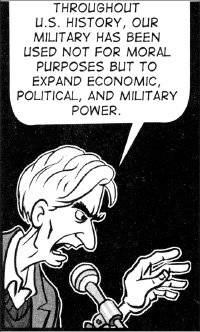
A People’s History of American Empire brings the visionary writings of Howard Zinn to life. While Zinn has, in the past few decades, been accepted as the dean of left historians, co-author Paul Buhle has been making his own contributions to history, writing, or editing over 30 books that tell the tale of workers, artists, the blacklist, and resistance to it. Recently, Buhle has presented his people’s histories in book-length comic format. Successes with graphic histories of the IWW, SDS, and Emma Goldman led to a desire to do the same with A People’s History of the United States. Buhle took chunks of Zinn’s writings from it and added pieces of his life story, all of which became part of A People’s History of American Empire.

Editor Buhle developed this project with Zinn, labor cartoonist Mike Konopacki, and writer/unionist Dave Wagner. The book’s drawings, photos, and historic prints meld into a strong collaborative effort. The results are jarring. With all of the flair of a classic film, we are transported to a lecture hall bedecked with anti-war banners. The reader becomes witness to a Zinn speech which artfully explains the rise of the United States as an empire. Zinn stands at center stage. His humanity is as apparent as the urgency in his message, as his podium’s top reveals papers, a watch, a bottle of water. We observe from all angles including a birds-eye view.

Zinn’s voice looms large as the story of Wounded Knee unfolds. This 1890 tragedy where Native American families were slaughtered by U.S. Cavalry is illustrated in gory reality—particularly the grainy photograph of a slain chief lying frozen in the snow.

Like its predecessor, this People’s History should be a staple for teachers. The Monroe Doctrine, which sought to “protect American interests,” sounds eerily familiar, though enacted in the 1850s. Quotes from politicians and military leaders throw egg on the face of those who would hide behind a flag pin. “Third World” nations as U.S. pawns, humiliated and silenced native leadership—it’s an old story. The World Wars, Hiroshima, the Cold War, Civil Rights battles, Vietnam, Nixon, the hostage crisis, Reagan, Iran-Contra, Iraq, and George W. Bush as Nero all stink of the greed that created them. At strategic points, we are enlightened with “Zinnformation” frames where parallels are drawn between historic events and today’s injustices. While walking through history, brandish this tool to also reach across generations.

Source. / ZMag / Posted July 1, 2008

A People’s History of American Empire by Howard Zinn

Find A People’s History of American Empire at Amazon.com.

The Rag Blog

Posted in RagBlog | Tagged , , , , | Leave a comment

The Biggest NAFTA Problem : the Assumed Commonality of Interests


The New Geography of Trade: North America Doesn’t Exist
By Laura Carlsen / July 8, 2008

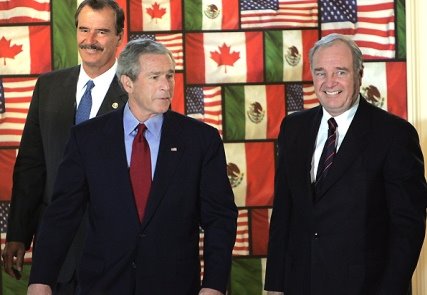
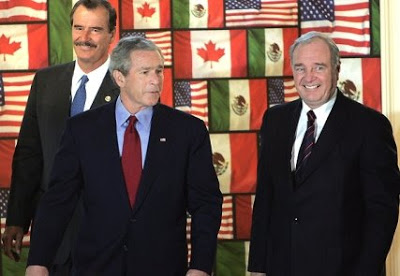
About every six months or so, the media provide a fleeting show of North American unity. Whether on the shores of the Mexican Caribbean, the forests of Quebec, or the hurricane-torn streets of New Orleans, the script is pretty much the same. It includes a lot of back-slapping and almost no public information.

These encounters—the trilateral summits—would be imminently forgettable if not for what happens behind the photo ops.

Business leaders and government officials from the United States, Canada, and Mexico have been meeting to expand on the 1994 North American Free Trade Agreement since the trinational summit in Waco, Texas in March of 2005. Ostensibly, the premise is that this great continent of three nations must bond to create a safe, free, and prosperous haven in a threatening world.

The only problem is, North America—at least as portrayed in the summits—doesn’t exist.

Flunking Geography

There is a North American land mass—a fact confirmed by any one of the 515 million people who at this moment are compelled by gravity to stand, sit or lie upon it. But nobody can even agree on its borders.

To the North, the mass breaks up into a vast expanse of ice, impossible to draw on a map as its boundaries recede due to global warming. This is creating consternation and confusion—and not just among polar bears. For the first time since modern science began recording, the fabled Northwest Passage that connects Asia and Europe via North America is free of ice, causing an international dispute over who controls it.

The confusion is even worse regarding the southern edge of our shared continent.

Children in the United States are taught that the North American continent begins in the North—which is always the “top,” passes through a gray area called “Canada,” to reach a vibrant, multi-colored zone divided into 50 states that most good students can name. It then begins its decline, gradually petering out below the Rio Grande. If the kids were to ask their parents where the southern limit is, they too would probably just shrug.

Mexican school children, however, will answer immediately that there really is no North America. They are taught that North and South America are a single continent—”America,” without the “s.” That’s why if you say you’re “American,” they will reply, “But what country are you from?”

Turning to the experts, most geographers have decided that North America extends down through Panama. (To make matters worse, Panama used to be part of South America when it belonged to Colombia, but that’s another story). That means that North America encompasses 23 sovereign nations and 16 colonies, or “dependencies” as they are referred to in this not-so-post-colonial era.

So why this brief geography lesson? Because the ongoing geographical debate offers important insights into what’s wrong with the North American Free Trade Agreement and the son-of-NAFTA—the Security and Prosperity Partnership (SPP).

The problems of defining the region begin with geography, but they get way worse when politics, economics, and culture are thrown in.

Commercial Bloc-heads

The “North American Free Trade Agreement” is actually a compound misnomer. The “North America” in NAFTA is an invention of a particular point in history and a particular set of economic and geopolitical motivations.

“Trade” under the agreement has been liberalized but is far from “free.” Politically powerful sectors in the United States maintain protections, whether openly in the form of tariffs or covertly as phytosanitary barriers or subsidies. All countries maintain some barriers for strategic sectors and products—often a reasonable practice, especially in the case of developing countries like Mexico.

Finally, the “agreement” did involve the Congress and civil society organizations at the moment of approval in the United States, but in the negotiating stages and certainly in Mexico, civil society was shut out of the process. NAFTA’s extension into the SPP was even more non-consensual since it did not involve congressional approval or signed agreements. In Mexico, NAFTA isn’t legally an agreement but rather a treaty, giving it a higher juridical stature than in the United States.

But the biggest problem here is the assumed commonality of interests. The most touted rationale for NAFTA is that the United States, Canada, and Mexico must join to form a trade bloc to compete in the global market with other trade blocs. This assumes that the three nations are on the same team. The Security and Prosperity Agreement even formed a “North American Competitiveness Council” made up of Walmart, Chevron, Ford, Suncor, Scotiabank, Mexicana, and other major corporations to represent the team interests.

But when we look at the play on the field, there is very little teamwork involved. In multilateral forums each country plays by its own game plan. In the World Trade Organization, Mexico forms part of the Group of 20 to protest U.S. and Canadian agricultural subsidies. Canada and the United States have faced off on numerous trade conflicts among themselves, many of them—like the softwood lumber case—the subject of drawn-out and bitter negotiations. Mexico has also had disputes with its supposed team mates, including the tuna-dolphin dispute, the entry of Mexican trucks into the United States under the agreed-to terms of NAFTA, and the tomato wars between northern Mexico and Florida.

If the bloc fails to act as a bloc of nations on the international level, its lack of cohesiveness is even more obvious from the point of view of its major corporations. Globalization opens up a world where everyone is out for themselves in search of cost-cutting production, cheaper resources, and closer markets. Corporations based in the United States, Canada, or Mexico have no loyalty whatsoever to building North America as a competitive bloc. An executive of a Hewlett-Packard subsidiary described how the company decided to move operations from the Mexican border to Indonesia. It was a no-brainer, he said, the labor was cheaper and it was closer to the expanding Chinese market. Like a game of Chinese checkers, the company now seeks to leap production from Indonesia directly into China as its next strategic move. NAFTA partner Mexico is left with nothing but unemployment.

Even the most regionally integrated industries, like the auto industries, measure their success not in terms of integration but by how successfully they can break down the production process into ever-cheaper components. This allows them to offshore labor intensive phases to Mexico where labor is cheap, while maintaining sales and research, management, and research and development in the United States. If anything changes in that formula, the whole concept of regional integration would be thrown out the window in search of a different global strategy. Recent negotiations to reduce wages in Mexican auto plants of Ford and General Motors based on the threat to move production to China are good examples of the logic.

Although corporate strategies are global not regional, corporations do have a reason to push the NAFTA-SPP agenda. Corporations that have operations in the three nations have an interest in developing mechanisms to lower all costs and barriers. In this sense they seek to create not a trade bloc to compete against their operations in other countries, but a pilot project for territorial reorganization along the lines of a corporate wish list. In this conception, “North America” is not a block of countries defined by a common geography and purpose, so much as a territory delineated for the optimal use of capital.

This realization explodes the first myth of “regional integration” under NAFTA. Far from a homogeneous process of integration, it promotes a curious blend of integration and fragmentation of territory. Mexico, for example, has been split in two. The North, where irrigation, climate, and topography provide advantages in agriculture and industrialization is more advanced, is tightly integrated into the U.S. economy. U.S. companies selling in U.S. markets now control much of production and Mexican export companies are concentrated in this region.

Southern Mexico remains outside this scheme and always will. Even the World Bank has recognized this in a study called “Why NAFTA did not reach the South.” The response is the Plan Puebla-Panama, with a focus on public-sector loans for major infrastructure development, resource extraction, and energy grids. Since the region is too indigenous, too remote, and too rebellious for productive investment, the southern states of Mexico have been shunted off to join Central America as a facilitator region to provide natural resources and serve as a conduit for the North-South movement of goods. The local populations are considered largely extraneous.

Security for Who?

The issue of security is where the myth of a unified North America is most starkly revealed. Security didn’t figure into the original NAFTA agenda, although it was implied that greater economic integration would result in harmonization of foreign policy agendas. Sept. 11 and the Bush National Security Doctrine created a strong U.S. security agenda while at the same time creating tensions with the NAFTA partners.

Canadian business sought to avoid another border closure like the one following the World Trade Center attacks and was willing to concede on other issues to assure uninterrupted trade. The government was forced to accept U.S. Homeland Security measures such as a “no-fly” list that bars “suspect individuals,” including dissidents, from air travel between the two nations.

The Mexican people, as in all of Latin America, reacted to U.S. unilateralism and the invasion of Iraq with a rise in anti-American sentiment and suspicion. But both National Action Party (PAN) presidents Vicente Fox and Felipe Calderon shared much of the Bush agenda and have entered into commitments under the SPP on security issues.

The security plan put forth in the SPP is an extension of the agenda of a nation that is the world’s pre-eminent military power, a major target for international terrorist attacks, a proponent of unilateral action and pre-emptive strikes, and an advocate of military over diplomatic responses and U.S. hegemony the guarantee of global governance.

Mexico is a nation that is not a target of international terrorism, has had a foreign policy of neutrality, and whose primary security threat has historically been—the United States. Nonetheless, Mexico has had to accept the failure of the binational immigration reform agenda and cooperate in aspects of the U.S. Homeland Security agenda and other counter-terrorism programs. The latest and most radical project to come out of the SPP security agenda is Plan Mexico, or the Merida Initiative—a regional security plan developed in the context of the SPP that bundles counter-narcotics, counter-terrorism, and border security measures into a new national security program for Mexico led by Washington.

The concept that Canada, the United States, and Mexico should forge a single security agenda as a non-existent continent is absurd and dangerous. Yet this is exactly what the SPP does. It is an agreement built on a convenient myth, a partnership that really consists of two countries subordinated to a superpower that agree to this subordination due to economic dependencies and the interests of corporations that cross borders seeking to maximize profits.

The New Geography

When the North American Free Trade Agreement was conceived, it was not a trinational—much less continental—affair. The negotiations focused on pasting together three separate agreements: the U.S.-Canada Free Trade Agreement—already in effect since 1989, a new U.S.-Mexico agreement and, to a lesser degree, a series of Canada-Mexico rules.

Few people realize that the resulting NAFTA reflects these differences. Critical goods for the United States, such as oil and corn, are traded under completely separate rules with Canada and with Mexico in the context of NAFTA depending on the relative bargaining power.

What has happened in the 14 years since NAFTA has fractured the continent even more. Led by the transnational corporations for whom it was designed, in practical terms NAFTA today covers an expanse of territory that runs roughly from Mexico City in the south, to mid-Canada. Through a growing network of consolidated production chains, trade links, and infrastructure development, this region—with the exception of poverty zones of little interest for capital expansion—has undergone rapid processes of concentration and integration.

Under the “vision” of North America forged under NAFTA and its follow-up, the Security and Prosperity Partnership, the three governments have attempted to convince their people that their fate lies along a common path—a path defined by geography, cemented by shared values, and marked by the assumption that just one road leads to the fulfillment of everyone’s goals. But it has become increasingly clear that instead of being a pact between three nations, NAFTA constitutes a roadmap for U.S. regional hegemony.

Not So Fast …

Right wing organizations like the John Birch Society that have been up in arms over the supposed creation of a North American Union and the construction of NAFTA superhighways, may find comfort in the thesis that North America doesn’t—and shouldn’t—exist. But just because I argue that each nation must define and defend its public good, doesn’t mean I agree that there is a neo-Aztec conspiracy to take over the United States. The greatest threat to every country in the region is the attempt of the Bush administration to impose its failed trade and security agenda at home and abroad, and the supranational powers of transnational corporations.

Should We All Go Home Now?

The question remaining is: if North America doesn’t exist, why should Canadians, U.S. citizens, and Mexicans work together to shape the NAFTA and SPP processes?

The trinational networks that have formed to monitor and question both NAFTA and the SPP play a critical role. Although each nation has its own priorities and demands, the networks serve to share information and compare notes on how regional integration affects citizens’ interests.

Grassroots organizations from the three countries face common challenges and common threats. The indisputably high levels of trade, investment, immigration, and cultural exchange that exist between our countries mean that we live daily lives that overlap across borders. Maybe it isn’t a region or a trading bloc in the terms conceived of under the SPP and the differences between us are many and a source of strength. But we are neighbors—as nations, as communities, and as families.

These organizations, meeting in binational or trinational conferences and to protest at official summits, explode the myth of regional homogeneity while at the same time making common cause. They expose the lie that there is only one path forward by developing alternatives in policy and practice. Precisely on the basis of their different political contexts and geographical, ethnic, and economic diversity, they have the potential to build a crossborder movement for social justice to counteract plans for regional integration designed and implemented exclusively in the upper echelons of business and government.

Fourteen years after implementation of the North American Free Trade Agreement, a majority of the population in all three countries believes the agreement has had a net negative effect on their nation and it turns out that the North American Free Trade Agreement is a misnomer in every one of its terms—it wasn’t an agreement, it isn’t free trade, and North America doesn’t exist. So now what?

First, stop extending it. The SPP must be thoroughly reviewed and revamped. Most likely this review will lead to construction of different forums for trinational coordination that separate the trade/investment and security areas, balance out the preponderant influence of the United States government, and open up proceedings and representation to the public.

Second, stop copying it. Although NAFTA is the only trade agreement to extend into an SPP, the Free Trade Agreement model enshrined there has become a template for other agreements and, in the case of the United States, pressures to impose security plans tend to follow close behind. The Merida Initiative contains resources for Central American countries to integrate the CAFTA region into the regional security plan.

Finally, analyze and evaluate the SPP—the forces behind it, the decisions it makes that affect us, and the directions it plans for the future. Citizens have the right and the obligation to know about and participate in mapping the future, and when they do it’s likely to look far different from the future mapped for us by corporate and government leaders behind the closed doors of the Security and Prosperity Partnership.

[Laura Carlsen (lcarlsen(a)ciponline.org) is director of the Americas Policy Program in Mexico City. This piece was part of a talk at the Lessons from NAFTA Conference. Check out the Americas Mexico blog at http://www.americasmexico.blogspot.com/.]

Source / Counterpunch

The Rag Blog

Posted in RagBlog | Tagged , , | Leave a comment

The Neverending Story : Bush’s Assault on Our Civil Liberties


The New Snoops: Terrorism Liaison Officers
By Matthew Rothschild

The full scale of Bush’s assault on our civil liberties may not be known until years after he’s left office.

At the moment, all we can do is get glimpses here or there of what’s going on.

And the latest one to come to my attention is the dispatching of police officers, firefighters, paramedics, and utility workers as so-called “terrorism liaison officers,” according to a report by Bruce Finley in the Denver Post.

They are entrusted with hunting for “suspicious activity,” and then they report their findings, which end up in secret government databases.

What constitutes “suspicious activity,” of course, is in the eye of the beholder. But a draft Justice Department memo on the subject says that such things as “taking photos of no apparent aesthetic value” or “making notes” could constitute suspicious activity, Finley wrote.

The states where this is going on include: Arizona, California, Colorado, Florida, Illinois, Tennessee, Wisconsin, and Washington, D.C.

Dozens more are planning to do so, Finley reports.

Colorado alone has 181 Terrorism Liaison Officers, and some of them are from the private sector, such as Xcel Energy.

Mark Silverstein of the Colorado ACLU told Amy Goodman of Democracy Now that this reminds him of the old TIPS program, which “caused so much controversy that Congress eventually shut it down. But it is reemerging in other forms.” Silverstein warns that there will be thousands and thousands of “completely innocent people going about completely innocent and legal activities” who are going to end up in a government database.

On the web, I found a description for a Terrorism Liaison Officer Position in the East Bay.

Reporting to the Alameda and Contra Costa Counties and the city of Oakland, these officers “would in effect function as ad hoc members” of the East Bay Terrorism Early Warning Group, which consists of local police officers and firefighters.

The “suggested duties” of these Terrorism Liaison Officers include: “source person for internal or external inquiry,” and “collecting, reporting retrieving and sharing of materials related to terrorism. Such materials might include . . . books journals, periodicals, and videotapes.”

Terrorism Liaison Officers would be situated not only in agencies dealing with the harbor, the airports, and the railroads, but also “University/Campus.”

And the private sector would be involved, too. “The program would eventually be expanded to include Health Care personnel and representatives from private, critical infrastructure entities, with communication systems specifically tailored to their needs.”

In this regard, Terrorism Liaison Officers resemble InfraGard members. (See “The FBI Deputizes Business”.) This FBI-private sector liaison group now consists of more than 26,000 members, who have their own secure channels of communication and are shielded, as much as possible, from scrutiny.

Terrorism Liaison Officers connect up with so-called “Fusion Centers”: intelligence sharing among public safety agencies as well as the private sector. The Department of Justice has come up with “Fusion Center Guidelines” that discuss the role of private sector participants.

“The private sector can offer fusion centers a variety of resources,” it says, including “suspicious incidents and activity information.”

It also recommends shielding the private sector. “To aid in sharing this sensitive information, a Non-Disclosure Agreement may be used. The NDA provides private sector entities an additional layer of security, ensuring the security of private sector proprietary information and trade secrets,” the document states.

As if that’s not enough, the Justice Department document recommends that “fusion centers and their leadership encourage appropriate policymakers to legislate the protection of private sector data provided to fusion centers.”

Source. / The Progressive / Posted July 2, 2008

The Rag Blog

Posted in RagBlog | Tagged , , , , | 1 Comment

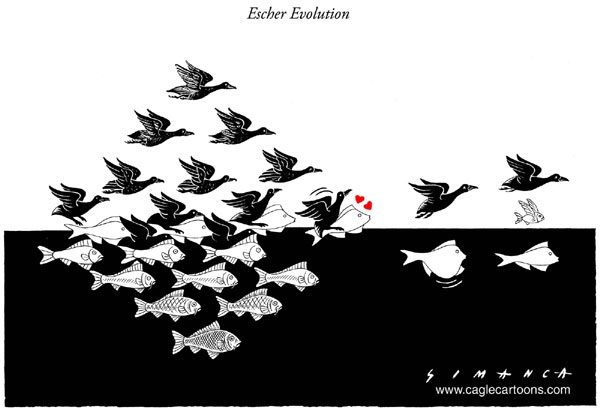
Drawn and Quartered

Simanca Osmani, Brazil

The Rag Blog / Posted July 8, 2008

Posted in RagBlog | Tagged , , , | 1 Comment

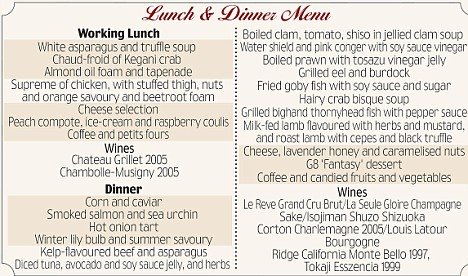
Summit That’s Hard to Swallow

Hungry? CLICK on menu to enlarge.

World leaders enjoy 18-course banquet as they discuss how to solve global food crisis
By James Chapman / July 8, 2008

Just two days ago, Gordon Brown was urging us all to stop wasting food and combat rising prices and a global shortage of provisions.

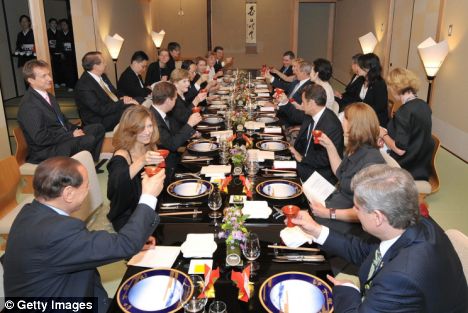
But yesterday the Prime Minister and other world leaders sat down to an 18-course gastronomic extravaganza at a G8 summit in Japan, which is focusing on the food crisis.

The dinner, and a six-course lunch, at the summit of leading industrialised nations on the island of Hokkaido, included delicacies such as caviar, milkfed lamb, sea urchin and tuna, with champagne and wines flown in from Europe and the U.S.

But the extravagance of the menus drew disapproval from critics who thought it hypocritical to produce such a lavish meal when world food supplies are under threat.

G8 leaders discussing the world food crisis in Japan raise their glasses ahead of an 18-course dinner.

On Sunday, Mr Brown called for prudence and thrift in our kitchens, after a Government report concluded that 4.1million tonnes of food was being wasted by householders.

He suggested we could save up to £8 a week by making our shopping go further. It was vital to reduce ‘unnecessary demand’ for food, he said.

Last night’s dinner menu was created by Katsuhiro Nakamura, the first Japanese chef to win a Michelin star. It was themed: Hokkaido, blessings of the earth and the sea.

But Dominic Nutt, of the charity Save the Children, did not approve.

‘It is deeply hypocritical that they should be lavishing course after course on world leaders when there is a food crisis and millions cannot afford a decent meal,’ he said.

‘If the G8 wants to betray the hopes of a generation of children, it is going the right way about it. The food crisis is an emergency and the G8 must treat it as that.’

In 2005, at the G8 summit in Gleneagles, Scotland, world leaders promised to increase global aid by £25billion a year by 2010 and raise aid to Africa, the world’s poorest continent, by £12.5billion. But the bloc of rich nations is only 14 per cent of the way towards hitting its target.

Britain is meeting its commitments in full, but other countries are understood to be dragging their feet – and there are fears the figures on global aid could be watered down.

French President Nicolas Sarkozy and Italian leader Silvio Berlusconi, who face pressure to cut spending at home, are understood to be leading the charge to weaken the Gleneagles proposal.

Tory international development spokesman Andrew Mitchell said: ‘The G8 have made a bad start to their summit, with excessive cost and lavish consumption.

‘Surely it is not unreasonable for each leader to give a guarantee that they will stand by their solemn pledges of three years ago at Gleneagles to help the world’s poor.

‘All of us are watching, waiting and listening.’

The G8 Summit is addressing world food shortages

A World Bank study released last week estimated that up to 105million more people, including 30million in Africa, could drop below the poverty line because of rising food prices.

Yesterday the European Union agreed to channel £800million in unused European farm subsidies to African farmers, as part of its response to the global food crisis.

‘The EU really can give a boost to agriculture in developing countries,’ Jose Manuel Barroso, president of the European Commission, told the meeting.

The money will be used to buy seed and fertiliser and fund agriculture projects in Africa.

The meal was served at the Windsor Hotel, on the shores of Lake Toya, where the presidential suite costs £7,000 a night.

Japan has spent a record sum of money and deployed about 20,000 police to seal off the remote lakeside town of Toyako for the three-day talks.

Source. / The Huffington Post

The Rag Blog

Posted in RagBlog | Tagged , , , , | 3 Comments

Keep Your State Out of My Church…


Obama, Keep Your Hands Off My Faith-Based Initiative
by Jim Moss / July 6, 2008

[Jim Moss is a Presbyterian minister from York, South Carolina. He publishes a blog and a quarterly newsletter called “Discipline for Justice,” which focuses on ways North Americans can live lives that promote peace and economic justice.]

Last week, Obama spoke out in favor of expanding Bush’s faith-based initiative program, part of a predictable and consistent move to the center.

“I’m not saying that faith-based groups are an alternative to government or secular non-profits. I’m not saying that they’re somehow better at lifting people up. What I’m saying is that we all have to work together — Christian and Jew, Hindu and Muslim; believer and non-believer alike — to meet the challenges of the 21st Century.”

Naturally, the secular left is not happy about this development. But neither are many on the spiritual left. Speaking as a progressive, as an ordained minister in the Presbyterian Church (USA), and as someone who has successfully organized a church-based food pantry, I have a message for Obama and any other politician who is making the sacred task of outreach ministry a tool of political pandering:

Get your hands off my faith-based initiative! We don’t want any of your government money getting in the way of our work.

It’s a bad idea for a number of reasons:

1) Over-Regulation. The government never just gives you money. There are always rules and regulations, mountains of paperwork, and any number of hoops to jump through – sometimes they make sense, sometimes they don’t. This extra work always seems to stand in the way of doing the real work at hand.

2) The Fickle Nature of Politics. Government funding can get turned on and off like a faucet, depending on the political climate . Entire agencies can get the ax simply because a new administration comes in with different priorities. Charities need to depend on consistent money sources that are not politicized.

3) Strings Attached. There really is no such thing as a free lunch. Government funding equals a government agenda, and the political issues of the day will certainly affect where the funding goes. Instead of the meeting the greatest needs of the people, the money will tend to go where it makes the elected officials look best.

4) Separation of Church and State. This is one area where I agree with atheists. Looking back through history, it’s clear that when government and religion are in cahoots, bad things tend to happen. They need to be a check on one another’s power, and the line between them needs to stay crystal clear. This program blurs that line.

5) A Higher Calling. Feeding the poor, tending the lame, caring for the widow and the orphan. These are some of the most sacred tasks for Christians and for other religions. Using government money to do these tasks is not acceptable. Individuals are called to give of their time and money because giving is a central part of what we believe. It is part of building a community that takes care of one another. Being funded with government money raised through taxation cheapens this noble task. The government certainly has its role in meeting the needs of the people, but this does not come through doing for the faithful what they should be doing themselves.

So thanks, Barack, but no thanks. Our charities are not another pawn in the chess game of this election.

Source. / The Seminal

Also see Obama’s Faith-Based Folly / The Progressive

The Rag Blog

Posted in RagBlog | Tagged , , , | Leave a comment

Robert Pardun : In Support of Barack

Robert Pardun, back in the day.

And the words that are used for to get the ship confused will not be understood as they are spoken…
And like Pharaoh’s tribe they’ll be drowned in the tide and like Goliath they’ll be conquered.

Money doesn’t talk it swears. Propaganda all is phony

Bob Dylan

Why we need Barack Obama now
By Robert Pardun / The Rag Blog / July 8, 2008

[Robert Pardun — an activist in Austin in the sixties and a contributor to the underground paper, The Rag — was a national officer of Students for a Democratic Society (SDS). He is the author of Prairie Radical : A Journey Through the Sixties. Robert now lives in the mountains near Santa Cruz, California.]

This is to express my solidarity with those of us out there working for the election of Barack Obama. I have seen many election cycles come and go and in general what we learned during the sixties is still true today—those with money use government for their own private ends. The Bush Administration has been the most blatant I can remember in taking from the poor and giving to the rich. One has only to look at the war in Afghanistan and Iraq to see this. With the money spent to occupy and then militarily control those two countries we could have rebuilt every school, every bridge, and every road in the United States. In addition we could have universal health care for everyone and funded research in alternative energy sources. In the movie “The Graduate” Dustin Hoffman is told that the wave of the future was in plastics. Today it is in batteries.

About ten years ago I read about a survey of attitudes of the American people concerning work, war, family and the like. The conclusion was that there is within America a sizable contingent of people who maintain the attitudes of the counterculture of the 1960s and 70s. These people make up a substantial part of Obama’s support and many are actively involved in his campaign. These are people who send in the checks for fifteen or twenty dollars and who sit behind card tables at the local grocery store encouraging people to vote. They are us and a new generation that learned from us.

During the sixties we wondered why defacto slavery still existed in parts of the South even though the Civil War had been fought a hundred years before. Culture changes slowly as new ideas become commonly accepted. Obama represents the ideals of the sixties even though he wasn’t there, and the younger generations like Obama because he represents a different way of looking at the world.

Is Obama a revolutionary? Hardly! If he was you would never have heard of him. Besides we are not in a revolutionary period. But he does stand for a more open government and that is important. We have a much better chance of getting the draconian drug laws changed with Obama. The drug war is known to have been a campaign gimmick of Nixon targeted at the black liberation movement and the anti-war movement. We should concentrate on repealing those laws. We used to say that we needed to work to stop the seventh war from now. Well we’ve already passed that point but with a President who is willing to think about alternatives we stand a chance of stopping the automatic reflex of attacking what we don’t like first and talking about it later. In addition we must change the way the government treats the people it “puts in harm’s way.” The treatment of veterans is absolutely scandalous and must be changed.

This election is the third in my lifetime in which I thought the democratic candidate might actually make a difference. After wondering why anyone would say that he smoked marijuana but didn’t inhale I voted for Clinton. With Obama we stand a change of actually changing things for the benefit of the people. Instead of taking the people’s money and using it to benefit the military-industrial complex we could actually use it to better the condition of the people who work hard to keep body and soul together.

The Rag Blog

Posted in Rag Bloggers | Tagged , , , , , , , , | 4 Comments

Christian Right Uses Slavery Image to Attack Obama on Abortion!

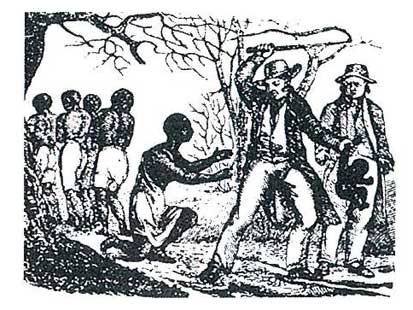
Image of slavery in Christian Defense Coalition’s literature.

Conservative Christian Group Invokes Slavery In Opposing Obama
By Jake Topper / July 8, 2008

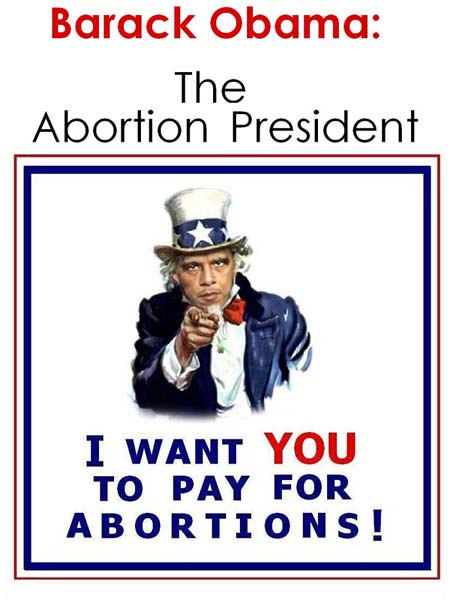
The Christian Defense Coalition held their anti-Obama press conference today — “An Appeal to Catholics Regarding the 2008 Presidential Election” — complete with the “I want you to pay for abortions” Obama-as-Uncle-Sam picture (see below)… as well as some other interesting material.

Such as: this image of slavery (above), invoked in the CDC’s literature to argue that there is nothing wrong with Catholics being “single issue” voters on abortion.

Argues the CDC: “if that issue involves a fundamental right, such as the right to life for a certain group of human beings, and there is only one morally legitimate position on that issue…no faithful Catholic would vote for a candidate who, although ‘personally opposed to slavery,’ supported ‘a white man’s right to choose’ to own slaves.”

Click HERE to see the context of the slavery mention as well as the other controversial materials. (Note: we did blur out one image of an aborted fetus.)

Obama’s Abortion Kerfuffle

Sen. Barack Obama, D-Illinois, and his views on abortion have been confounding some observers these days.

And perhaps that’s in no small way the reason why the controversial Christian Defense Coalition is launching a new campaign focused on painting Obama as “The Abortion President.”

Check out THIS IMAGE of Obama as Uncle Sam: “I Want YOU To Pay for Abortions,” courtesy of CBN’s Brody File.

Rev. Patrick J. Mahoney, director of the Christian Defense Coalition, says Obama would have “the most extremist policies on abortion of any President in history. Senator Obama’s views on abortion are so radical that he even wants American citizens to pay for them. This would include Catholics, Evangelicals and all people of faith. He would also expand abortion rights through his passionate support of The Freedom of Choice Act.”

This ad becomes relevant within the context of Obama’s attempts to win over evangelical voters — some of whose votes may be up for grabs given Obama’s comfort discussing his Christian faith and their distrust of Sen. John McCain, R-Ariz. — Obama’s support for abortion rights will assuredly be a sticking point.

Obama’s desire to win these voters may be why, in a recent interview with Relevant magazine, (“Covering God, Life, and Progressive Culture”) Obama seemed to be moving rightward on the issue — rhetorically, at least — saying:

“I have repeatedly said that I think it’s entirely appropriate for states to restrict or even prohibit late-term abortions as long as there is a strict, well-defined exception for the health of the mother. Now, I don’t think that ‘mental distress’ qualifies as the health of the mother. I think it has to be a serious physical issue that arises in pregnancy, where there are real, significant problems to the mother carrying that child to term. Otherwise, as long as there is such a medical exception in place, I think we can prohibit late-term abortions.”

The language Obama used in that response seemed to remove “mental distress” as an allowable exception justifying a post-22 week abortion.

To some observers, that would seem to go against the Supreme Court decision Doe v. Bolton — handed down the same day as the more famous (or infamous) Roe v Wade decision legalizing abortion, though the Court said the decisions were to be “read together.”

Doe holds that the health exception permitting abortion after viability should be based on a “medical judgment…exercised in the light of all factors — physical, emotional, psychological, familial, and the woman’s age — relevant to the wellbeing of the patient,” as ABC News’ Supreme Court reporter Jan Crawford Greenburg noted over the weekend.

So was Obama suggesting to Relevant that he disagrees with Doe?

That would seem to contradict Obama’s support for the “Freedom of Choice Act,” which codifies in law a mental health exception for post-viability abortions, legislation that Obama has publicly supported.

The Obama campaign says no, that’s not what he was saying, and spokesfolk explained that the senator’s use of “mental distress” in the Relevant interview was not a reference to “mental illness.”

On Saturday, after a reporter noted to Obama that he had said that mental distress shouldn’t be a reason for late-term abortion, Obama clarified, “historically I have been a strong believer in a women’s right to choose with her doctor, her pastor and her family…I have consistently been saying that you have to have a health exception on many significant restrictions or bans on abortions including late-term abortions. In the past there has been some fear on the part of people who, not only people who are anti-abortion, but people who may be in the middle, that that means that if a woman just doesn’t feel good then that is an exception. That’s never been the case.”

Obama continued: “I don’t think that is how it has been interpreted. My only point is that in an area like partial-birth abortion having a mental, having a health exception can be defined rigorously. It can be defined through physical health, It can be defined by serious clinical mental-health diseases. It is not just a matter of feeling blue. I don’t think that’s how pro-choice folks have interpreted it. I don’t think that’s how the courts have interpreted it and I think that’s important to emphasize and understand.”

But if Obama is saying that “mental distress” is already not a legal exception for abortion bans, then what was the point of what he told Relevant? He maintains he wasn’t discussing any view that runs contrary to current abortion law, so it would seem he was just discussing a personal view — that a woman, 8 1/2 months pregnant, shouldn’t be able to get an abortion just because she’s feeling blue.

Some abortion opponents suggest that Obama was merely trying to muddy the waters and sound more centrist on the issue — as if his mind were open to some abortion bans, when in fact he was merely stating current law wrapped in some triangulating language.

J.P.T. / July 7, 2008

Source. / Political Punch / ABC News

The Rag Blog

Posted in RagBlog | Tagged , , , , , | Leave a comment