Quote of the Day – NAFTA – Don’t Bend Over

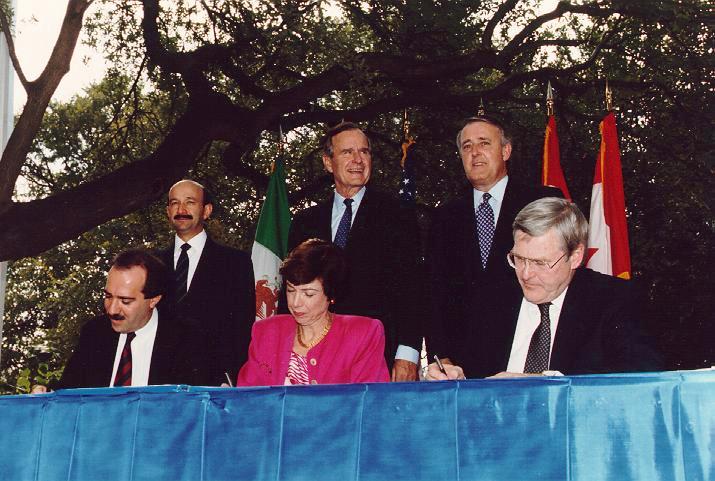
NAFTA Signing Ceremony

“They debated the NAFTA bill for a long time; should we sign it or not? Either way, the people get fucked. Trade always exists for the traders. Anytime you hear businessmen debating ‘which policy is better for America,’ don’t bend over.”

George Carlin, 1937 – 2008.

h/t Bad Attitudes

The Rag Blog

Posted in RagBlog | Tagged , | Leave a comment

Making You Safer Through Personal Invasion


U.S. border agents copying contents of travelers’ laptops
By Federica Narancio / June 25, 2008

WASHINGTON — U.S. border agents are copying and seizing the contents of laptops, cell phones and digital cameras from U.S. and foreign travelers entering the United States, witnesses told a Senate subcommittee Wednesday.

The extent of this practice is unknown despite requests to the Department of Homeland Security from the Senate Subcommittee on the Constitution and several nonprofit agencies.

The department also declined to send a representative to the hearing. Subcommittee Chairman Russ Feingold, D-Wis., said Homeland Security had told him that its “preferred” witness was unavailable Wednesday.

Feingold added that he’d submitted written questions about the seizures of electronic data — and of some devices — to Homeland Security Secretary Michael Chertoff in April. To date, Feingold said, he’s gotten no reply.

Chertoff’s department provided a written statement that said it wasn’t its intention to infringe on Americans’ privacy but to protect the country from terrorists and criminals, whose electronic devices can reveal incriminating materials.

During border searches of laptops, according to the statement, the department’s Customs and Border Protection officers have found “jihadist material, information about cyanide and nuclear material, video clips of improvised explosive devices being exploded, pictures of various high-level al Qaida officials and other material associated with people seeking to do harm to U.S. and its citizens.”

Jayson Ahern, the deputy commissioner of Customs and Border Protection, signed the statement.

Some witnesses noted that the 9th U.S. Circuit Court of Appeals in San Francisco had ruled in a recent child-pornography case that federal agents could seize a laptop computer at the border without reasonable suspicion that its owner was engaged in unlawful activities.

However, several witnesses said that the ruling, by the most liberal of U.S. appeals courts, didn’t end their concerns about Homeland Security’s refusal to explain the standards for its searches, how it protects privacy, how the seized material is used and who can see or use it.

Three nonprofits — the Electronic Frontier Foundation, the Asian Law Caucus and the Association of Corporate Travel Executives — filed a Freedom of Information Act request last year seeking Homeland Security’s answers to those questions. They’ve gotten none thus far.

They and other groups consider seizures made without probable cause to be an invasion of privacy that leaves the door open to ethnic and racial profiling.

Farhana Khera, the president of Muslim Advocates, a San Francisco nonprofit, said they’d received complaints from Muslim, Arab and South Asian Americans. She said they also had been questioned about their political, religious and personal views.

Retaining confidential computer files also worries business travelers and companies, said Susan Gurley, the executive director of the Association of Corporate Travel Executives, an international group based in Alexandria, Va..

Her organization surveyed its 2,500 members in February, Gurley said. Of 100 respondents, seven said border agents had seized their laptops or their files. Four out of five, she said, were unaware that border agents could seize their electronic data and devices.

Source / McClatchy

The Rag Blog

Posted in RagBlog | Tagged , | Leave a comment

Shell Shock, Battle Fatigue, and Wor(d)se

Horrors Of War Hit Home

Kelly Kennedy, George Carlin, and the Reason for Traumatized Iraq Veterans
By Juan Cole / June 25, 2008

The late George Carlin did not like the phrase “post-traumatic stress disorder.” He famously said,

‘ I don’t like words that hide the truth. I don’t like words that conceal reality. I don’t like euphemisms, or euphemistic language. And American English is loaded with euphemisms. Cause Americans have a lot of trouble dealing with reality. Americans have trouble facing the truth, so they invent the kind of a soft language to protect themselves from it, and it gets worse with every generation. For some reason, it just keeps getting worse. I’ll give you an example of that.

There’s a condition in combat. Most people know about it. It’s when a fighting person’s nervous system has been stressed to it’s absolute peak and maximum. Can’t take anymore input. The nervous system has either (click) snapped or is about to snap.

In the first world war, that condition was called shell shock. Simple, honest, direct language. Two syllables, shell shock. Almost sounds like the guns themselves.

That was seventy years ago. Then a whole generation went by and the second world war came along and very same combat condition was called battle fatigue. Four syllables now. Takes a little longer to say. Doesn’t seem to hurt as much. Fatigue is a nicer word than shock. Shell shock! Battle fatigue.

Then we had the war in Korea, 1950. Madison avenue was riding high by that time, and the very same combat condition was called operational exhaustion. Hey, we’re up to eight syllables now! And the humanity has been squeezed completely out of the phrase. It’s totally sterile now. Operational exhaustion. Sounds like something that might happen to your car.

Then of course, came the war in Viet Nam, which has only been over for about sixteen or seventeen years, and thanks to the lies and deceits surrounding that war, I guess it’s no surprise that the very same condition was called post-traumatic stress disorder. Still eight syllables, but we’ve added a hyphen! And the pain is completely buried under jargon. Post-traumatic stress disorder.

I’ll bet you if we’d of still been calling it shell shock, some of those Viet Nam veterans might have gotten the attention they needed at the time. I’ll betcha. I’ll betcha.’

I have concluded that Carlin was right about that issue. Being traumatized by war is not a disorder. In fact, if you are not traumatized by the sight of body parts flying all around you as you are splattered with the blood of people you know, then you would have a disorder. Why not just say “war-traumatized”? Or better yet, “war-scarred”? The PTSD phrase has the unfortunate effect of making it seem abnormal for people to be negatively affected by wartime violence.

It is like the phrase “Vietnam syndrome,” in which the understandable reluctance of the Baby Boom generation to launch big, long-lasting land wars in Asia was medicalized, as though there was something wrong with them that they were not warmongers. Why not say that they had ‘learned the lessons of Vietnam,’ or were ‘Vietnam-scarred’? Why suggest that there is something wrong with them for it?

So below is a report from CBS on how the US networks have sanitized the Iraq War for viewers, and how we cannot understand the long-term trauma suffered by US troops who served in Iraq unless we understand what they’ve been through. Warning: her description of what she and others saw in Iraq is explicit and disturbing. Carlin would be proud of her:

“Army Times reporter Kelly Kennedy saw first hand the horrors of the war in Iraq. She spoke to CBS News about her experiences and about how post traumatic stress disorder is affecting the troops.”

Source / Informed Comment

The Rag Blog

Posted in RagBlog | Tagged , , | 1 Comment

Pentagon : The Five Secret Billion-Dollar Companies

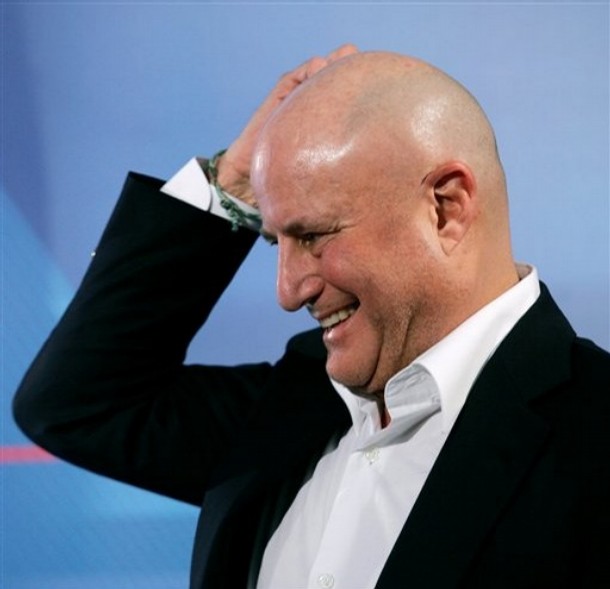
Billionaire Ronald Perelman’s holding company MacAndrews & Forbes Holdings Inc. received $3,360,739,032 from the Department of Defense in 2007.

Sucking Obscene Amounts of Taxpayer Money
By Nick Turse / June 26, 2008

At $34 billion, you’re already counting pretty high. After all, that’s Harvard’s endowment; it’s the amount of damage the triple hurricanes — Charley, Ivan, and Jeanne — inflicted in 2004; it’s what car crashes involving 15-to-17-year-old teenage drivers mean yearly in “medical expenses, lost work, property damage, quality of life loss and other related costs”; it’s the loans the nation’s largest, crippled, home lender, Countrywide Financial, holds for home-equity lines of credit and second liens; it’s Citigroup’s recent write-off, mainly for subprime exposure; it’s what New Jersey’s tourism industry is worth — and, according to the Center for Strategic and Budgetary Assessments, it’s the minimal figure for the Pentagon’s “black budget” for fiscal year 2009 — money for, among other things, “classified weapons purchases and development,” money for which the Pentagon will remain unaccountable because almost no Americans will have any way of knowing what it’s being spent for.

Now, imagine that, due to a little more Pentagon/Bush administration wizardry, even this black budget estimate is undoubtedly a low-ball figure. One reason is simple enough: The proposed $541 billion Pentagon 2009 budget doesn’t even include money for actual wars. George W. Bush’s wars are all paid for by “supplemental” bills like the $162 billion one Congress will soon pass — so the Department of Defense’s $34 billion black budget skips “war-related funding.” This means that even the overall figure for that budget remains darker than we might imagine (as in “black hole”). The Pentagon not only produces stealth planes, it is, in budgetary terms, a stealth operation. If honestly accounted, the actual Pentagon yearly budget, including all the “military-related” funds salted away elsewhere, is probably now more than $1 trillion a year.

There is, however, another stealth side to the Pentagon — the corporate side where a range of giant companies you’ve never heard of are gobbling up our tax dollars at phenomenal rates. Nick Turse, author of the single best account of how our lives are being militarized, our civilian economy Pentagonized, and the Pentagon privatized — I’m talking about The Complex: How the Military Invades Our Everyday Lives — now turns to the stealth corporate side of the Pentagon to give us a glimpse into the larger black hole into which our dollars pour.

Tom Engelhardt / TomDispatch / June 26, 2008

Billion-Dollar Babies
By Nick Turse

The top Pentagon contractors, like death and taxes, almost never change. In 2002, the massive arms dealers Lockheed Martin, Boeing, and Northrop Grumman ranked one, two, and three among Department of Defense contractors, taking in $17 billion, $16.6 billion, and $8.7 billion. Lockheed, Boeing, and Northrop Grumman did it again in 2003 ($21.9, $17.3, and $11.1 billion); 2004 ($20.7, $17.1, and $11.9 billion); 2005 ($19.4, $18.3, and $13.5 billion); 2006 ($26.6, $20.3, and $16.6 billion); and, not surprisingly, 2007 as well ($27.8, $22.5, and $14.6 billion). Other regulars receiving mega-tax-funded payouts in a similarly clockwork-like manner include defense giants General Dynamics, Raytheon, the British weapons maker BAE Systems, and former Halliburton subsidiary KBR, as well as BP, Shell, and other power players from the military-petroleum complex.

With the basic Pentagon budget now clocking in at roughly $541 billion per year — before “supplemental” war funding for Iraq, Afghanistan, and the President’s Global War on Terror, as well as national security spending by other agencies, are factored in — even Lockheed’s hefty $28 billion take is a small percentage of the massive total. Obviously, significant sums of money are headed to other companies. However, most of them, including some of the largest, are all but unknown even to Pentagon-watchers and antiwar critics with a good grasp of the military industrial complex.

Last year, in a piece headlined “Washington’s $8 Billion Shadow,” Vanity Fair published an exposé of one of the better known large stealth contractors, SAIC (Science Applications International Corporation). SAIC, however, is just one of tens of thousands of Pentagon contractors. Many of these firms receive only tens or hundreds of thousands of dollars from the Pentagon every year. Some take home millions, tens of millions, or even hundreds of millions of dollars.

Then there’s a select group that are masters of the universe in the ever-expanding military-corporate complex, regularly scoring more than a billion tax dollars a year from the Department of Defense. Unlike Lockheed, Boeing, and Northrop Grumman, however, most of these billion-dollar babies manage to fly beneath the radar of media (not to mention public) attention. If appearing at all, they generally do so innocuously in the business pages of newspapers. When it comes to their support for the Pentagon’s wars and occupations in Afghanistan and Iraq, they are, in media terms, missing in action.

So, who are some of these mystery defense contractors you’ve probably never heard of? Here are snapshot portraits, culled largely from their own corporate documents, of five of the Pentagon’s secret billion-dollar babies:

1. MacAndrews & Forbes Holdings Inc.

Total DoD dollars in 2007: $3,360,739,032

This is billionaire investor Ronald Perelman’s massive holding company. It has “interests in a diversified portfolio of public and private companies” that includes the cosmetics maker Revlon and Panavision (the folks who make the cameras that bring you TV shows like 24 and CSI). MacAndrews & Forbes might, at first blush, seem an unlikely defense contractor, but one of those privately owned companies it holds is AM General — the folks who make the military Humvee. Today, says the company, nearly 200,000 Humvees have been “built and delivered to the U.S. Armed Forces and more than 50 friendly overseas nations.” Humvees, however, are only part of the story.

AM General has also assisted Carnegie Mellon University researchers in developing robots for the Pentagon blue-skies outfit, the Defense Advanced Research Projects Agency’s “Grand Challenge,” an autonomous robot-vehicle competition. Last year, AM General and General Dynamics Land Systems, a subsidiary of mega-weapons maker General Dynamics, formed a joint venture “to compete for the U.S. Army and Marine Corps Joint Light Tactical Vehicle (JLTV) program.” AM General has even gone to war — dispatching its “field service representatives” and “maintenance technical representatives” to Iraq where they were embedded with U.S. troops.

As such, it’s hardly surprising that, earlier this year, the company received one of the Defense Logistics Agency’s Outstanding Readiness Support Awards. Nor should anyone be surprised to discover that a top MacAndrews & Forbes corporate honcho, Executive Vice Chairman and Chief Administrative Officer Barry F. Schwartz, contributed a total of at least $10,000 to Straight Talk America, the political action committee of presidential candidate John McCain, who famously said it would be “fine” with him if U.S. troops occupied Iraq for “maybe a hundred years” (if not “a thousand” or “a million”).

Perhaps hedging their bets just a bit, MacAndrews & Forbes is diversifying into an emerging complex-within-the-Complex: homeland security. Recently, AM General sold the Department of Homeland Security’s Border Patrol “more than 100 HUMMER K-series trucks for use in border security operations.”

2. DRS Technologies, Inc.

Total DoD dollars in 2007: $1,791,321,140

Incorporated during the Vietnam War, DRS Technologies has long been “a leading supplier of integrated products, services and support to military forces, intelligence agencies and prime contractors worldwide”; that is, they have been in the business of fielding products that enhance some of the DoD’s deadliest weaponry, including “DDG-51 Aegis destroyers, M1A2 Abrams Main Battle Tanks, M2A3 Bradley Fighting Vehicles, OH-58D Kiowa Warrior helicopters, AH-64 Apache helicopters, F/A-18E/F Super Hornet and F-16 Fighting Falcon jet fighters, F-15 Eagle tactical fighters… [and] Ohio, Los Angeles and Virginia class submarines.” They even have “contracts that support future military platforms, such as the DDG-1000 destroyer, CVN-78 next-generation aircraft carrier, Littoral Combat Ship and Future Combat System.”

In addition to 2007’s haul of Pentagon dollars, DRS Technologies has continued to clean up in 2008 for a range of projects, including: a $16.2 million Army contract for refrigeration units; $51 million in new orders from the Army for thermal weapon sights (part of a five-year, $2.3-billion deal inked in 2007); a $10.1 million contract to build more than 140 M989A1 Heavy Expanded Mobility Ammunition Trailers (to transport “numerous and extremely heavy Multiple Launch Rocket System pods, palletized or non-palletized conventional ammunition and fuel bladders”); and a $23 million deal “to provide engineering support, field service support and general depot repairs for the Mast Mounted Sights (MMS) on OH-58 Kiowa Warrior attack helicopters,” among many other contracts.

Fitch Ratings, an international credit rating agency, recently made a smart, if perhaps understated, point — one that actually fits all of these billion-dollar babies. DRS, it wrote, “has benefited from the conflicts in Iraq and Afghanistan…”

3. Harris Corporation

Total DoD dollars in 2007: $1,501,163,834

Harris is “an international communications and information technology company serving government, defense and commercial markets in more than 150 countries.” It has an annual revenue of more than $4 billion and an impressive roster of former military personnel and other military-corporate complex insiders on its payroll. Not only does Harris assist and do business with a number of the Pentagon’s largest contractors (like Lockheed Martin and BAE Systems), it is also an active participant in occupations abroad. On its website, the company boasts that “Harris technology has been used for a variety of commercial and defense applications, including the War in Iraq where the [Harris software] system provided detailed, 3-D representations of Baghdad and other key Iraqi cities.”

Last year, Harris signed multiple deals with the military, including contracts to create a high-speed digital data link that transmits tactical video, radar, acoustic, and other sensor data from Navy MH-60R helicopters to their host ships. It also supplies the Navy with advanced computers that provide the “highly sophisticated moving maps and critical mission information via cockpit displays” used by flight crews.

In the first six months of this year, Harris has continued its hard work for the Complex. In January, the company was “selected by the U.S. Air Force for the Network and Space Operations and Maintenance (NSOM) program” for “a base contract and six options that bring the potential overall value to $410 million over six-and-a-half-years” to provide “operations and maintenance support to the 50th Space Wing’s Air Force Satellite Control Network at locations around the world.”

In May, the company was “awarded a three-year, $20 million contract by [top 10 Pentagon contractor] L3 Communications to provide products and services for a next-generation Tactical Video Capture System (TVCS)” — a system that integrates real time video streams to enhance tactical training exercises — “that will support training at various U.S. Marine Corps locations across the U.S. and abroad.” That same month, Harris was also “awarded a potential five-year, $85 million Indefinite Delivery/Indefinite Quantity (IDIQ) contract from the U.S. Navy for multiband satellite communications terminals that will provide advanced communications for aircraft carriers and other large deck ships.”

In addition, Harris is now hard at work in the Homeland. Not only did the company pick up more than $3 million from the Department of Homeland Security last year, but national security expert Tim Shorrock, in a 2007 CorpWatch article, “Domestic Spying, Inc.,” specifically noted that Harris and fellow intelligence industry contractors “stand to profit from th[e] unprecedented expansion of America’s domestic intelligence system.”

4. Navistar Defense

Total DoD dollars in 2007: $1,166,805,361

Still listed in Pentagon documents under its old name, International Military and Government, LLC, Navistar is the military subsidiary of Navistar International Corporation — “a holding company whose individual units provide integrated and best-in-class transportation solutions.” While the company has served the U.S. military since World War I, it’s known, if at all, by the public for making some of the Mine Resistant Ambush Protected (MRAP) vehicles designed to thwart Iraqi roadside bombs. As of April 2008, the U.S. military had “ordered 5,214 total production MaxxPro MRAP vehicles” from Navistar and, that same month, the company was awarded “a contract valued at more than $261 million… for engineering upgrades to the armor used on International MaxxPro MRAP vehicles.”

But Navistar makes more than MRAPs. Just last month, the company signed a “multi-year contract valued at nearly $1.3 billion” with the U.S. Army “to provide Medium Tactical Vehicles and spare parts to the Afghanistan National Police, Afghan National Army, and the Iraqi Ministry of Defense.” This followed a 2005 multi-year Army contract, worth $430 million, “for more than 2,900 vehicles and spare parts.”

Quite obviously, the company is significantly, profitably, and proudly involved in the occupations of Iraq and Afghanistan. As Tom Feifar, the Global Defense and Export general manager for Navistar Parts, put it late last year, “It’s an honor to be a part of the effort to support our troops.”

5. Evergreen International Airlines

Total DoD dollars in 2007: $1,105,610,723

A privately held global aviation services company, it has subsidiaries in related industries such as helicopter aviation (Evergreen Helicopters, Inc.), as well as a few unrelated efforts like producing “agricultural, nursery and wine products” (Evergreen Agricultural Enterprises, Inc.). Evergreen has been on the Pentagon’s payroll for a long time. Back in 2004, Ed Connolly, the executive vice president of Evergreen International Airlines, stated, “Evergreen has flown continuously for the [U.S. Air Force] Air Mobility Command since 1975 and is proud to continue its long standing history of supporting the U.S. Armed Forces global missions with quality and reliable services.”

Not surprisingly, Evergreen has been intimately involved in the occupation of Iraq. In fact, in 2004, the company received “approximately 200 awards for its support of international airlift services during the Iraq war” from the Air Force’s Air Mobility Command. An Air Force general even handed out these medals and certificates of achievement to Evergreen’s employees.

In Amnesty International’s 2006 report, “Below the Radar: Secret Flights to Torture and ‘Disappearance,'” the human rights organization noted that Evergreen was one of only a handful of private companies with current permits to land at U.S. military bases worldwide. That same year, the company even airlifted FOX News personality Bill O’Reilly and his TV show crew to Kuwait and Iraq to meet and greet troops, sign books and pictures, and hand out trinkets. And just last year the company was part of a consortium, including such high profile commercial carriers as American, Delta, and United Airlines that the Pentagon awarded a “$1,031,154,403 firm fixed-price contract for international airlift services… [that] is expected to be completed September 2008.”

Under the Radar

All told, these five stealth corporations from the military-corporate complex received more than $8.9 billion in taxpayer dollars in 2007. To put this into perspective, that sum is almost $2 billion more than the Bush administration’s proposed 2009 budget for the Environmental Protection Agency. Put another way, it’s about nine times what one-sixth of the world’s population spent on food last year.

Tens of thousands of defense contractors — from well-known “civilian” corporations (like Coca-Cola, Kraft, and Dell) to tiny companies — have fattened up on the Pentagon and its wars. Most of the time, large or small, they fly under the radar and are seldom identified as defense contractors at all. So it’s hardly surprising that firms like Harris and Evergreen, without name recognition outside their own worlds, can take in billions in taxpayer dollars without notice or comment in our increasingly militarized civilian economy.

When the history of the Iraq War is finally written, chances are that these five billion-dollar babies, and most of the other defense contractors involved in making the U.S. occupation possible, will be left out. Until we begin coming to grips with the role of such corporations in creating the material basis for an imperial foreign policy, we’ll never be able to grasp fully how the Pentagon works and why we so regularly make war in, and carry out occupations of, distant lands.

[Nick Turse is the associate editor and research director of Tomdispatch. He has written for the Los Angeles Times, the San Francisco Chronicle, the Nation, the Village Voice, and regularly for Tomdispatch.com.]

Source. / AlterNet

The Complex: How the Military Invades Our Everyday Lives by Nick Turse on Amazon.com.

The Rag Blog

Posted in RagBlog | Tagged , , | Leave a comment

Maybe He’s With Waldo…

Where the Hell is Matt? (2008)

14 months in the making, 42 countries, and a cast of thousands. Thanks to everyone who danced with me.

Matt

[Matthew (Matt) Harding is an American video game developer and Internet celebrity known as Dancing Matt. This is fun stuff.]

Thanks to Larry Piltz / The Rag Blog / Posted June 26, 2008

Posted in RagBlog | Tagged , , , , | Leave a comment

The Earth : Love It Or Lose It, Solar Energy Dept.

Photovoltaic electrical generation array.

Solar Power to the Rescue
By Paul Spencer / The Rag Blog / June 26, 2008

Paul Spencer is a former Austin activist and staff member of sixties/seventies underground newsppaper The Rag, who has been running for president as a way of addressing the serious issues facing our society and the world.

The nice thing about imperialism is that it motivates others to defeat it. For now, most countries are still tip-toeing around the U.S.A. because of the nuclear arsenal and due to the destabilizing effect on international economic activity of cutting off the U.S. markets. In one particular, though, the rest of the industrialized world has an anti-imperialist strategy – even Great Britain is in on this one.

Exploitation of renewable energy is the main feature of this strategy – particularly solar-derived power. Ten years ago, largely as a function of government (NASA and military) contracts, the U.S. was the world’s leading producer of photovoltaic generation devices. Now there is no U.S. manufacturer in the top 10, although there are a lot of start-ups and GE is talking a good game. The U.S. ranks third in cumulative, installed capacity; but, if it were not for tax breaks and other incentives in California and New Jersey (of all places), this country would be declining rapidly in the ranking.

Japan is now number one in installed capacity and in manufacturing output. Germany is number two. Japan has more than three times the installed capacity of the U.S. and produced five times the solar cell capacity in 2005; Germany has double the U.S. numbers in both categories. Four of the top five manufacturers in terms of rated output are Japanese, four of the top 10 are European (including the solar division of British Petroleum), one is based in Taiwan, but at the top of the list is a Chinese company that wasn’t even on the list three years ago.

Germany has rebates and incentives that cut the cost of modules roughly in half. Japan has energy (petroleum-based) prices at an unsubsidized level – the upshot is that their manufacturing output for “solar modules” is sold out for some time to come. Spain has promulgated policy to require new roofs to be constructed with photovoltaic capability. Shanghai has a similar “100,000 roofs” policy.

These are the numbers that are reported by “Western” interests. China, India and Russia all have extensive policy and capacity development projects designed to diminish reliance on hydrocarbon-based energy production. China in particular aims to become the world’s chief solar power producer and purveyor. The Chinese government instituted a policy at the beginning of 2006 that includes reducing the cost of solar modules by about 60 percent in the next six years. The Chinese intend to invest $180 billion USD (billion, not million) in photovoltaics (and wind-based-generation) over the next 14 years with a target of 80 percent (45 percent in terms of compound rate) growth in manufacturing and use per year over the next five years, as a starter. Chinese and Japanese technical papers seem now to dominate both the engineering and the scientific conferences, and Indian researchers are just getting warmed up.

One of the myths that the anti-solar (oil-supported, of course) contingent promotes is that the energy cost of solar cell production is more than the cell’s output during its operational lifetime. Research now shows between one and four years of energy payback, depending on the technology. As to cost per se, payback ranges from four to 10 years, depending on local rebates, tax credits, and other subsidies. When China succeeds in cost reduction (and the other big suppliers are forced to price compete), the payback will be two to four years – without applying the price increases for petroleum and natural gas. The lifetime of most modules is generally rated at about 20 years, but experience with actual installations is showing that this is an underestimate. Do we get the picture?

And these are just the standard, silicon-based solar cells. Interestingly, there are a large number of new developments here in the U.S., too, despite virtually no federal support for research or development. Some of the new approaches are cosmetic to some degree, such as integration with roofing material, window glass, or coatings; but, when you consider that roofs, windows, and outside walls make up a lot of single-purpose surface area, why not expand their functionality?

Much of the improvement is driven by the goal of increasing conversion efficiency. Materials such as gallium arsenide tolerate higher temperatures, which permits the use of relatively cheap light-concentration methods and materials, such as plastic Fresnel lensing. Some others, such as nitrides of gallium, indium, and copper make use of a wider spectrum of sunlight than the standard silicon material.

Much of the R&D has been done in the U.S. over the last 30-plus years in support of the space program. All of a sudden, however, the rest of the world has apparently all realized at once how they can escape the giant thumb. I don’t know if they whispered this to one another at UN cocktail parties or how this movement arose. I’m guessing, however, that the Japanese figured it out first.

Meantime, the Russians re-federalized their oil and gas industry to finance their re-engagement with science and industry; and the Chinese put together an overall strategy to exploit the U.S. retail market to raise capital, make nice with the hydrocarbon suppliers for the short-term, and develop renewable energy resources for the long-term.

I know that it’s Pollyanna-ish, but I’m still optimistic. I think that imperialism is finally being seen for the anchor that it is in the U.S. domestic sectors that tried to play along in the past. And I think that a broad segment of the world is doing something about it. The petro-sector of the U.S. ruling class appears to have overplayed its hand with its hired-hand federal government. One outcome is that the world’s oil producers figured out in a hurry that they could sell to someone else besides U.S. energy companies – even if on credit – while the U.S. was pummeling the southwest Asian tar-baby.

One practically revolutionary strategy for fundamental political change (i.e., diminishing the influence of the petroleum industry) in this country is to push for rapid alternative energy development at every level. Almost nobody will disagree with the purpose of this movement. Before long it must be allied with public power to prevent the usual co-optation, but in the short run it’s radical in its own right.

The Rag Blog

Posted in RagBlog | Tagged , , , , , | Leave a comment

Mesmo’s Desert Digest : The Beat Goes On

Professor Longhair his own self.

Bo Diddley, Professor Longhair and Drumming the Clave Beat
By Gerry Storm / The Rag Blog / June 26, 2008

Gerry, aka Mesmo, is a former Austin activist and musician who now lives in harmony with the Shamanic rhythms of the southwestern New Mexico desert. He shares bits and pieces of his wisdom with us on The Rag Blog.

It came to pass that I was pushed onto the drums by fate. A guru drum teacher entered my young life and explained it all to me.

“It’s all rhythm, man, the universe, all of it.”

I kind of understood what he meant, and have spent the rest of my life trying to understand it more deeply, to find supporting evidence. Now I tell my occasional students the same thing. Now I know about the solar system and the rhythms of the planets, about the rhythms of the seasons, about the rhythms of life itself.

So while I did not immediately embrace the idea of becoming a drummer, I was fascinated with rhythms and their associations. Playing them was a rush. I learned to play the 3-2 clave beat with one hand and the 2-3 clave beat with the other (not all that difficult). In this execution there is a cosmic connection. 2.0 against 1.67, the basics against infinity, the even against the odd. You can’t explain it but everyone can hear it. It’s not just the notes, it’s the way the silences between the notes are arranged as well. There is a push and a pull, a constant rotation. It is all rather mystical. And for pure fun it has few competitors amongst the rhythms.

The late great Bo Diddley

Most recently a universal recognition of this phenomenon surfaced when the great entertainer, Bo Diddley died. “The Bo Diddley Beat” was again celebrated. All the headlines gave Mr. Diddley credit for “inventing” the beat. He did not. It is the 3-2 clave beat played on the electric guitar, while the drums rumble a loose 2-3 clave beat on the tom toms. The likely source of Mr. Diddley’s inspiration was the New Orleans school of whorehouse piano players, like Professor Longhair.

Longhair’s famous “Mardi Gras in New Orleans” released in the early ‘50’s can lay claim to many firsts. Some say it is the first rock and roll record. Some say it is still the best rock and roll record. It has the feel of the rumba, a blues rumba. When one listens carefully one hears the 3-2 clave beat played very prominently on a clave, out in the front of the mix, through the chorus, and then an answer comes rolling in from the saxophone section, playing the 2-3 clave beat in double time, two repetitions. And back and forth these patterns go, call and response. Longhair continued to play his gem throughout his career, often changing the arrangement, even changing the words into a kind of tourism promotion for the city. Some of his later arrangements feature horn sections and showy arrangements. But none of them is better than the original which has a feeling of the primitive that is mysterious and infectious.

According to fable these “professors” of the piano heard the beat in Caribbean music and translated it onto their instrument. The rumba was a big craze back in the ‘30’s and carved itself a niche in American popular music. The source was Havana, by way of Miami, the two being sister cities in those days with daily cruise ships running between them. If you study Latin dancing you will learn to use the clave beat in your basic steps. But the beat is also found in children’s games which are said to be traceable all the way back to Africa. You can still find it there today. To get the blues rumba feeling the piano players played the 2-3 clave in the bass with the left hand and the 3-2 above it with the right. One had a difficult time not dancing when the beat was being played. The 2-3 clave in the bass was modified slightly and became the famous early rock and roll bass line, the roll in rock and roll. This beat is prevalent in New Orleans music. You could say it’s the basis of New Orleans rhythm. It may well be much more than that. It may be the path to understanding the rhythms of the universe.

In trying to teach the beat to young wannabe hand drummers I had to find different ways to explain it. They heard the magic in the beat and could execute either of the elements quite competently but did not yet have the confidence to play both at once, kind of a duel between the left and right brains. I came up with the attached graphic illustration to show them pictorially how the beat looked. And what I came up with explained the beat to me with a new clarity.

Observe in the drawing that there are 16 equal subdivisions of the circle, 8 above the horizon line and 8 below. There 3 elements, the black, the white, and the red. Observe also that the black and red elements are identical, each with 5 parts. The white element has an extra slice, 6 parts.

If one notates the Bo Diddley interpretation of the beat, the 16 slices are 8th notes. So there would be two bars of 8th notes. The accents in the first bar are on 1, 4, and 7 (the black slices). The accents in the second bar are on 3 and 5. The response or red notes is the opposite, accents on the 3 and 5 in the first bar and on 1, 4, and 7 in the second.

Here’s the way to read the drawing: the beginning is the western horizon line. The black “note” there is 1. The remaining spaces in the upper hemisphere are numbered consecutively up to 8 moving clockwise. The first note of the second sequence of 8 is the red note just below the eastern horizon and the numbering is consecutive and clockwise. The white notes are rests or silences. Normally one would play the black notes with the right hand and the red notes with the left.

I invite one and all to give it a try.

In Africa the rhythms are tribal, they do not follow the national boundaries. I am not a student of African tribal cultures. I have not tried to pin the clave beats down to a certain place of origin beyond Cuba. The only culture I know a little about is the Madinke. I have studied the rhythms of this ancient culture. They are absolutely amazing. According to fable there are about 200 of them, each played for a specific purpose, a specific ceremony. Most are a combination of five rhythm lines, each drum and bell assigned an individual line. These musicians do not jam, they play the lines the same way, over and over, find the trance space and lie there. But you will not find the clave beats in these rhythms. I suspect they came from another culture to the south of the Madinkes, probably the Yoruban culture.

A widely accepted theory is that the original African clave beat was notated in 12/8 time. This beat was transformed to 4/4 time by the Cubans to make the music “more danceable”. In other words, it was westernized. So that is what we have today, the westernized clave, made for dancing. You can hear it in all the Cuban dances like the Son, Mambo, and Rumba. If you grew up in the past century listening to American pop music you probably have it in your soul.

Mesmo / The Rag Blog
Greater Chihuahuan Desert / June 26, 2008

Professor Longhair, Bo Diddley and More

The Rag Blog

Posted in Rag Bloggers | Tagged , , , , | Leave a comment

You Wanna Win or Not?


Thanks to Harry Edwards / The Rag Blog

Posted in RagBlog | Tagged , , , , | Leave a comment

Hope Is Sometimes Green

An agreement between Florida and United States Sugar could help restore water flows through the Everglades’ mangrove-lined creeks. Photo: Barbara P. Fernandez for The New York Times.

Florida Buying Big Sugar Tract for Everglades
By Damien Cave — June 25, 2008

LOXAHATCHEE, Fla. — The dream of a restored Everglades, with water flowing from Lake Okeechobee to Florida Bay, moved a giant step closer to reality on Tuesday when the nation’s largest sugarcane producer agreed to sell all of its assets to the state and go out of business.

Under the proposed deal, Florida will pay $1.75 billion for United States Sugar, which would have six years to continue farming before turning over 187,000 acres north of Everglades National Park, along with two sugar refineries, 200 miles of railroad and other assets.

It would be Florida’s biggest land acquisition ever, and the magnitude and location of the purchase left environmentalists and state officials giddy.

Even before Gov. Charlie Crist arrived to make the announcement against a backdrop of water, grass and birds here, dozens of advocates gathered in small groups, gasping with awe, as if at a wedding for a couple they never thought would fall in love. After years of battling with United States Sugar over water and pollution, many of them said that the prospect of a partnership came as a shock.

“It’s so exciting,” said Margaret McPherson, vice president of the Everglades Foundation. “I’m going to do cartwheels.”

The details of the deal, which is scheduled to be completed over the next few months, and does not require legislative approval, may define how long the honeymoon lasts. Previous acquisitions took longer to integrate than initially expected and because United States Sugar’s fields are not all contiguous, complicated land swaps with other businesses may be required.

The purchase will be paid for with bonds and from fees already added to water bills. But if the price goes up or environmental remediation enters the picture, the state could have to renegotiate or find other money.

The fate of the company’s 1,900 workers also remains in question and some former company executives have suggested that the state is overpaying, bailing out a company burdened with debt, a troubled new sugar mill and a lawsuit from former employees who said they were bilked out of retirement money.

Company officials said the deal would amount to $350 a share, after taxes and other obligations were paid, a premium over two previous offers of $293 per share that the company had dismissed as inadequate.

The accusations and concerns, however, did not dampen the mood. Even as workers from the mill in Clewiston tried to get a handle on their futures, and some cried foul, Mr. Crist emphasized the land’s environmental value.

He said the deal was “as monumental as the creation of the nation’s first national park, Yellowstone.” Declining to provide details of how the state arrived at the price of $1.7 billion, he said it was a terrific bargain.

“I can envision no better gift to the Everglades,” he said, “the people of Florida and the people of America — as well as our planet — than to place in public ownership this missing link that represents the key to true restoration.”

The impact on the Everglades could be substantial. The natural flow of water would be restored, and the expanse of about 292 square miles would add about a million acre-feet of water storage. That amount of water — enough to fill about 500,000 Olympic size swimming pools — could soak the southern Everglades during the dry season, protecting wildlife, preventing fires, and allowing for a redrawing of the $8 billion Everglades restoration plan approved in 2000.

It would essentially remove some of the proposed plumbing. Many of the complicated wells and pumps the plan relied on might never have to be built, water officials said, because the water could move naturally down the gradually sloping land.

Kenneth G. Ammon, deputy executive director of the South Florida Water Management District, which would assume control of the land, said it would be a “managed” flow-way, with reservoirs and other engineered mechanisms to control water flow. David G. Guest, a lawyer for Earthjustice Legal Defense Fund, joked that he might have to go to blows to keep the area all natural.

Read all of it here. / The New York Times

Thanks to Betsy Gaines / The Rag Blog

Posted in RagBlog | Tagged , | Leave a comment

No Shit! George W. Bush Sewage Plant


An Honor That Bush Is Unlikely to Embrace
By Jesse McKinley / June 25, 2008

SAN FRANCISCO — Reagan has his highways. Lincoln has his memorial. Washington has the capital (and a state, too). But President Bush may soon be the sole president to have a memorial named after him that you can contribute to from the bathroom.

From the Department of Damned-With-Faint-Praise, a group going by the regal-sounding name of the Presidential Memorial Commission of San Francisco is planning to ask voters here to change the name of a prize-winning water treatment plant on the shoreline to the George W. Bush Sewage Plant.

The plan, naturally hatched in a bar, would place a vote on the November ballot to provide “an appropriate honor for a truly unique president.”

Supporters say that they have plenty of signatures to qualify the initiative and that the renaming would fit in a long and proud American tradition of poking political figures in the eye.

“Most politicians tend to be narcissistic and egomaniacs,” said Brian McConnell, an organizer who regularly suits up as Uncle Sam to solicit signatures. “So it is important for satirists to help define their history rather than letting them define their own history.”

Not surprisingly, those Republicans in a city that voted 83 percent Democratic in 2004 are not thrilled with the idea. Howard Epstein, chairman of the ever-outnumbered San Francisco Republican Party, called the initiative “an abuse of process.”

“You got a bunch of guys drunk who came up with an idea,” Mr. Epstein said, “and want to put on the ballot as a big joke without regard to the city’s governance or cost.”

The renaming would take effect on Jan. 20, when the new president is sworn in. And regardless of the measure’s outcome, supporters plan to commemorate the inaugural with a synchronized flush of hundreds of thousands of San Francisco toilets, an action that would send a flood of water toward the plant, now called the Oceanside Water Pollution Control Plant.

“It’s a way of doing something physical that’s mentally freeing,” said Stacey Reineccius, 45, a software consultant and entrepreneur who supports the plan. “It’s a weird thing, but it’s true.”

Source. / New York Times

Thanks to Richard Kendrick / The Rag Blog

Posted in RagBlog | Tagged , , , | 1 Comment

Iraq : Closing the Deal


Deal Allows U.S. To Attack Any Country From Iraq
June 24, 2008

BAGHDAD – A Sunni legislator said on Monday that the security agreement to be signed between Baghdad and Washington would allow the latter to attack any country from Iraqi territories.

“The Iraqi-U.S. agreement contains several items that impinge upon the sovereignty of Iraq, including the right of the U.S. forces in Iraq to attack any nation and raid any Iraqi house and arrest people without prior permission from the Iraqi government,” Khalaf al-Alyan, a member of parliament from the Iraqi Accordance Front (IAF), told Aswat al-Iraq – Voices of Iraq – (VOI).

U.S. President George W. Bush had signed a declaration of principles with Iraqi Prime Minister Nouri al-Maliki on December 1, 2007. It was planned to be ratified on July 31, 2008 to be effective as of January 1, 2009.

“The agreement grants the United States the right to set up a large number of bases in Iraq, ranging between 50 and 58 bases,” said Alyan.

The IAF is composed of three key political components: Vice President Tareq al-Hashimi’s Iraqi Islamic Party (IIP), IAF leader Adnan al-Dulaimi’s Iraq People’s Congress (IPC) and Alyan’s National Dialogue Council (NDC).

The IAF, which has 40 out of a total 275 seats, is the main bloc representing Arab Sunnis in the country’s political process.

Meanwhile, Labid Abbawi, the undersecretary for foreign affairs, denied that the agreement contained an item allowing U.S. forces to use Iraqi territories as a springboard to threaten other countries.

“This item does not exist in the agreement because it simply runs counter to the policies of both Baghdad and Washington governments,” Abbawi told VOI.

The deal governs the presence of U.S. forces in Iraq after the year 2008. The U.S. presence in Iraq is currently relying on a mandate by the United Nations, renewed annually upon the request of the Iraqi government.

The agreement would not enter into effect if the Iraqi parliament did not approve it.

Source. Information Clearing House

Thanks to Devra Morice / The Rag Blog

Posted in RagBlog | Tagged , , | Leave a comment

Hell No, We Won’t Go!


McCain: World War III Would Justify Draft
June 25, 2008

John McCain said last night during a campaign tele-conference that he would bring back a military draft in the United States only in the case of a ‘World War III’ scenario.

Reuters reported:

Many Americans are fearful the U.S. government will be forced to reinstitute the draft given the prolonged Iraq and Afghanistan wars.
Asked about that possibility by a potential voter in Florida during a telephone “town hall meeting,” McCain said: “I don’t know what would make a draft happen unless we were in an all-out World War III.” …

McCain, a Vietnam veteran, said the draft during that conflict weighed most heavily on lower-income Americans, and that this should not be repeated.

But McCain may be more open to the draft than it seems. During a July 2006 interview on CNN, McCain was asked about the following statement by Newt Gingrich: “We’re in the early stages of what I would describes as the Third World War and, frankly, our bureaucracies aren’t responding fast enough.” Asked whether he agreed, McCain said:

“I do to some extent. I think it’s important to recognize that we have terrorist organizations which — who are dangerous by themselves, are now being supported by radical Islamic governments, i.e., the Iranians, which makes them incredibly more dangerous because they are trained, equipped, motivated and assisted in every way by the Iranians.”

Also, as ThinkProgress noted, “Last October, President Bush himself warned of a coming ‘World War III’ with Iran. ‘I’ve told people that if you’re interested in avoiding World War III,’ said the President. ‘It seems like you ought to be interested in preventing them from have the knowledge necessary to make a nuclear weapon.'”

Source. / The Huffington Post

The Rag Blog

Posted in RagBlog | Tagged , , , , | Leave a comment