War in Iraq? What War in Iraq?

For the people in Iraq, the war is full time. A woman wept as the body of a relative was borne to burial in Najaf. Photo by Alaa Al-Marjani/AP

Reporters Say Networks Put War on Back Burner
By Brian Stelter / June 23, 2008

Getting a story on the evening news isn’t easy for any correspondent. And for reporters in Iraq and Afghanistan, it is especially hard, according to Lara Logan, the chief foreign correspondent for CBS News. So she has devised a solution when she is talking to the network.

“Generally what I say is, ‘I’m holding the armor-piercing R.P.G.,’ ” she said last week in an appearance on “The Daily Show,” referring to the initials for rocket-propelled grenade. “ ‘It’s aimed at the bureau chief, and if you don’t put my story on the air, I’m going to pull the trigger.’ ”

Ms. Logan let a sly just-kidding smile sneak through as she spoke, but her point was serious. Five years into the war in Iraq and nearly seven years into the war in Afghanistan, getting news of the conflicts onto television is harder than ever.

“If I were to watch the news that you hear here in the United States, I would just blow my brains out because it would drive me nuts,” Ms. Logan said.

According to data compiled by Andrew Tyndall, a television consultant who monitors the three network evening newscasts, coverage of Iraq has been “massively scaled back this year.” Almost halfway into 2008, the three newscasts have shown 181 weekday minutes of Iraq coverage, compared with 1,157 minutes for all of 2007. The “CBS Evening News” has devoted the fewest minutes to Iraq, 51, versus 55 minutes on ABC’s “World News” and 74 minutes on “NBC Nightly News.” (The average evening newscast is 22 minutes long.)

CBS News no longer stations a single full-time correspondent in Iraq, where some 150,000 United States troops are deployed.

Paul Friedman, a senior vice president at CBS News, said the news division does not get reports from Iraq on television “with enough frequency to justify keeping a very, very large bureau in Baghdad.” He said CBS correspondents can “get in there very quickly when a story merits it.”

In a telephone interview last week, Ms. Logan said the CBS News bureau in Baghdad was “drastically downsized” in the spring. The network now keeps a producer in the country, making it less of a bureau and more of an office.

Interviews with executives and correspondents at television news networks suggested that while the CBS cutbacks are the most extensive to date in Baghdad, many journalists shared varying levels of frustration about placing war stories onto newscasts. “I’ve never met a journalist who hasn’t been frustrated about getting his or her stories on the air,” said Terry McCarthy, an ABC News correspondent in Baghdad.

By telephone from Baghdad, Mr. McCarthy said he was not as busy as he was a year ago. A decline in the relative amount of violence “is taking the urgency out” of some of the coverage, he said. Still, he gets on ABC’s “World News” and other programs with stories, including one on Friday about American gains in northern Iraq.

Anita McNaught, a correspondent for the Fox News Channel, agreed. “The violence itself is not the story anymore,” she said. She counted eight reports she had filed since arriving in Baghdad six weeks ago, noting that cable news channels like Fox News and CNN have considerably more time to fill with news than the networks. CNN and Fox each have two fulltime correspondents in Iraq.

Richard Engel, the chief foreign correspondent for NBC News, who splits his time between Iraq and other countries, said he found his producers “very receptive to stories about Iraq.” He and other journalists noted that the heated presidential primary campaign put other news stories on the back burner earlier this year.

Ms. Logan said she begged for months to be embedded with a group of Navy Seals, and when she came back with the story, a CBS producer said to her, “One guy in uniform looks like any other guy in a uniform.” In the follow-up phone interview, Ms. Logan said the producer no longer worked at CBS. And in both interviews, she emphasized that many journalists at CBS News are pushing for war coverage, specifically citing Jeff Fager, the executive producer of “60 Minutes.” CBS News won a Peabody Award last week for a “60 Minutes” report about a Marine charged in the killings at Haditha.

On “The Daily Show,” Ms. Logan echoed the comments of other journalists when she said that many Americans seem uninterested in the wars now. Mr. McCarthy said that when he is in the United States, bringing up Baghdad at a dinner party “is like a conversation killer.”

Coverage of the war in Afghanistan has increased slightly this year, with 46 minutes of total coverage year-to-date compared with 83 minutes for all of 2007. NBC has spent 25 minutes covering Afghanistan, partly because the anchor Brian Williams visited the country earlier in the month. Through Wednesday, when an ABC correspondent was in the middle of a prolonged visit to the country, ABC had spent 13 minutes covering Afghanistan. CBS has spent eight minutes covering Afghanistan so far this year.

Both Ms. Logan and Mr. McCarthy noted that more coalition soldiers were killed in Afghanistan in May than in Iraq. No American television network has a full-time correspondent in Afghanistan, although CNN recently said it would open a bureau in Kabul.

“It’s terrible,” Ms. Logan said in the telephone interview. She called it a financial decision. “We can’t afford to maintain operations in Iraq and Afghanistan at the same time,” she said. “It’s so expensive and the security risks are so great that it’s prohibitive.”

Mr. Friedman said coverage of Iraq is enormously expensive, mostly due to the security risks. He said meetings with other television networks about sharing the costs of coverage have faltered for logistical reasons.

Journalists at all three American television networks with evening newscasts expressed worries that their news organizations would withdraw from the Iraqi capital after the November presidential election. They spoke only on the condition of anonymity in order to avoid offending their employers.

Source. / New York Times

Thanks to Harry Edwards / The Rag Blog

Posted in RagBlog | Tagged , , , | Leave a comment

Liposuction: The Key to Energy Independence


Living off the fat of the land
By Barbara Ehrenreich / June 24, 2008

Everyone talks about our terrible dependency on oil — foreign and otherwise — but hardly anyone mentions what it is. Fossil fuel, all right, but whose fossils? Mostly tiny plants called diatoms, but quite possibly a few Barney-like creatures went into the mix, like Stegosaurus, Brontosaurus and other giant reptiles that shared the Jurassic period with all those diatoms. What we are burning in our cars and keeping our homes warm or cool with is, in other words, a highly processed version of corpse juice.

Think of this for a moment, if only out of respect for the dead. There you were, about 100 million years ago, maybe a contented little diatom or a great big Brontosaurus stumbling around the edge of a tar pit — a lord of the earth. And what are you now? A sludge of long-chain carbon molecules that will be burned so that some mammalian biped can make a CVS run for Mountain Dew and chips.

It’s an old human habit — living off the road kill of the planet. There’s evidence, for example, that early humans were engaged in scavenging before they figured out how to hunt for themselves. They’d scan the sky for circling vultures, dash off to the kill site — hoping that the leopard that did the actual hunting had sauntered off for a nap — and gobble up what remained of the prey. It was risky, but it beat doing your own antelope tracking.

We continue our career as scavengers today, attracted not by vultures but by signs saying “Safeway” or “Giant.” Inside these sites, we find bits of dead animals wrapped neatly in plastic. The killing has already been done for us — usually by underpaid immigrant workers rather than leopards.

I say to my fellow humans: It’s time to stop feeding off the dead and grow up! I don’t know about food, but I have a plan for achieving fuel self-suffiency in less time than it takes to say “Arctic National Wildlife Refuge.” The idea came to me from reports of the growing crime of French fry oil theft: Certain desperate individuals are stealing restaurants’ discarded cooking oil, which can then be used to fuel cars. So the idea is: why not could skip the French fry phase and harvest high-energy hydrocarbons right from ourselves?

I’m talking about liposuction, of course, and it’s a mystery to me why it hasn’t occurred to any of those geniuses who are constantly opining about fuel prices on MSNBC. The average liposuction removes about half a gallon of liquid fat, which may not seem like much. But think of the vast reserves our nation is literally sitting on! Thirty percent of Americans are obese, or about 90 million individuals or 45 million gallons of easily available fat — not from dead diatoms but from our very own bellies and butts.

This is the humane alternative to biofuels derived directly from erstwhile foodstuffs like corn. Biofuels, as you might have noticed, are exacerbating the global food crisis by turning edible plants into gasoline. But we could put humans back in the loop by first turning the corn into Doritos and hence into liposuctionable body fat. There would be a reason to live again, even a patriotic rationale for packing on the pounds.

True, liposuction is not risk-free, as the numerous doctors’ websites on the subject inform us. And those of us who insist on driving gas guzzlers may soon start depleting their personal fat reserves, much as heroin addicts run out of useable veins. But the gaunt, punctured, look could become a fashion statement. Already, the combination of a tiny waist and a huge carbon footprint–generated by one’s Hummer and private jet — is considered a sign of great wealth.

And think what it would do for our nation’s self-esteem. We may not lead the world in scientific innovation, educational achievement, or low infant mortality, but we are the global champions of obesity. Go here and you’ll find America well ahead of the pack when it comes to personal body fat, while those renowned oil-producers — Saudi Arabia, Venezuela and Iran — aren’t even among the top 29. All we need is a healthy dose of fat pride and for CVS to start marketing home liposuction kits. That run for Mountain Dew and chips could soon be an energy-neutral proposition.

Source. ZNet

Visit Barbara’s Blog.

The Rag Blog

Posted in RagBlog | Tagged , , , , , , | Leave a comment

Books : Gore Vidal’s Inconvenient Truths

Gore Vidal at his house in Malibu, Calif., in September 2006. Photo by Joshua Lutz/Redux.

“The Selected Essays of Gore Vidal” reminds us that this combative political provocateur is also one of our finest literary critics.
By Louis Bayard / June 23, 2008

“Is he still alive?” a friend asked me not long ago.

Casual observers might be excused for thinking of Gore Vidal in posthumous terms. A twilight pall suffused his most recent memoir, “Point-to-Point Navigation,” which described the death of Vidal’s longtime companion even as it ladled out retribution against longtime enemies. Many of those enemies have likewise passed on, and in recent appearances, Vidal has had to squeeze his proud, patrician figure into a wheelchair.

The old lion may be enfeebled, but he still has teeth. Doubters are referred to Deborah Solomon’s recent New York Times Magazine interview, in which Vidal responded to the question “Were you chaste?” with a line that Groucho Marx might have coveted — “Chased by whom?” — and succinctly described his feelings on the death of William F. Buckley: “I thought hell is bound to be a livelier place, as he joins forever those whom he served in life, applauding their prejudices and fanning their hatred.”

In the course of what must have been a terrifying conversation, Solomon managed to ask Vidal why critics prefer his essays to his novels. “That’s because they don’t know how to read,” he replied. By now he has schooled us in the dangers of conventional wisdom, but in this case, the conventioneers have it right. Vidal has never produced a great novel (though not for want of trying) because he was, from the start, an essayist manqué.

It was his misfortune, perhaps, to come of age in postwar America, when the novel was still the royal road to glory. His first book, “Williwaw,” was published when he was still 19. Several more followed, among them the succes de scandale of “The City and the Pillar,” one of America’s first fictional depictions of homosexuality (and barely readable today). But the field-clearing fame that the young Vidal clearly hungered for, the kind his rival Truman Capote snatched up right out of the gate — all this eluded him.

Vidal would later blame his arrested development on the homophobia of mainstream review outlets, especially the New York Times. (To this day, the Gray Lady remains high on his shit list.) But he would also write, revealingly, of William Dean Howells, who, unable to get his poems published, “went off the deep end, into prose.” Something similar happened to Vidal. Unable to claim his seat in Valhalla by fictional means, he came at it subterraneously — through the literary journal — brandishing not a sword but a quiver of aphorisms, smeared at the tips with invective.

Vidal, of course, would go on to write a great many more novels, most of them historical, a good many of them bestsellers. What he could never do was convince us that we were reading about someone other than Gore Vidal. “Burr,” to cite one of his best works, was lively and rebarbative, and yet there was no way to reconcile its cynical, astringent protagonist with the quixotic historical figure who leapt from folly to folly. Burr was, of course, Vidal. As was Lincoln, as was Grant. As was Myra Breckinridge (though, in retrospect, she might better be described as Vidal’s countercultural alter ego, which may explain why she is the most persuasive of his fictional personae).

Vidal’s essays, by contrast, have all the strengths of his novels with this additional grace: They don’t have to make a show of inhabiting other minds. And so the qualities of the originating mind — wit, phrasemaking, autodidacticism, a talent to inflame — stand out all the more starkly.

For proof, we may call up “The Selected Essays of Gore Vidal,” assembled by Jay Parini, the author’s literary executor (more whiffs of the posthumous). That word “selected,” of course, implies a certain amount of cherry-picking. Juvenilia, senilia, outmoded usages, casual tribalisms have all presumably been cast away. Or have they? To Parini’s credit, more than enough remains to show why and how Vidal gets under people’s skin.

There is enough, too, to show that Vidal was, in some respects, well ahead of his time. His defense of homosexuality as “a matter of taste” (in the midst of the ’60s), his calls for limits on executive power, his attack on “the National Security State” … these still walk the razor’s edge of topicality. Mere weeks after the Iraq war was joined, Vidal was calling attention to the prisoners in Guantánamo Bay. Some 15 years before Christopher Hitchens’ “God Is Not Great,” Vidal was declaring that monotheism was “the great unmentionable evil at the center of our culture.”

He was not always so prescient. Taking his cues, probably, from Paul Ehrlich, he predicted that the entire planet would be overrun with famine by … 2000. Some 28 years before that, he was declaring with great confidence that “the South is not about to support a party which is against federal spending … Southern Democrats are not about to join with Nixon’s true-blue Republicans in turning off federal aid.”

But federal aid was the least of it. Southerners were breaking from the fold for cultural, not economic reasons, and American culture, in general, is one of Vidal’s most notable blind spots. By his own choosing. Like Sinclair Lewis, he speaks of “our brainwashed majority,” of the “hypocrisy and self-deception” that mark our “paradigmatic middle-class society.” Unlike Lewis, he gives no signs of having actually lived there. The grandson of a U.S. senator, he was raised in privilege in Washington, D.C., and absconded as quickly as he could to Europe, sequestering himself for many years in a villa in Ravello, Italy, where he could get the right altitude on his native land.

But an aerial shot won’t show you where all the bunkers are. No surprise, then, that wherever Vidal actually enters the bunker, his political reportage sparks to life. There’s a deft analysis of Theodore Roosevelt that draws on conversations with Alice Longworth, and a wry and splendid take on his one-time pals the Kennedys (“The Holy Family,” he calls them) that offers welcome ballast to the hagiographies of Schlesinger and Sorensen.

The old injunction to “write what you know” can be crippling for a writer of fiction, but for a writer of essays, it is close to an imperative. And there are clearly places Vidal hasn’t been — the corporate boardroom, for instance — and things he doesn’t know (though he doesn’t always know it). His broad-brushed attacks on American power elites have earned him a reputation in many quarters for paranoia. In reality, he is simply vague (although vagueness is a prerequisite for paranoia). “The Few who control the Many through Opinion,” he announces, “have simply made themselves invisible.” A mercy for him, because he is excused from describing them at any length. He mutters darkly of “cash in white envelopes” and the “1 percent that owns the country” and the “elite” that is “really running the show.” Beyond that level of signifying, he rarely ventures.

Which means that he can’t exactly be proven right or wrong — although history has done a fine job of vindicating him. If anything, the backroom corporate dealmaking of the current administration has shown that Vidal wasn’t paranoid enough. We might venture to conclude, then, that he has been right more often than he has been wrong. The only problem is that he’s often right for the wrong reasons. He disdains the U.S. power elite not because it oppresses the common man but because it savages his own vision of America, a history-steeped mythos that ignores (when it doesn’t condemn) the multicultural realities of today’s nation.

But if it’s difficult to fix Vidal’s standing as a political intellectual, there is no such difficulty in measuring his ability to read and assay literature. Indeed, the real contribution of Parini’s collection is to remind us — how exactly did we forget? — that Vidal has been from the start one of our finest literary critics. Not simply because of those lancing quips. (“Might Updike not have allowed one blind noun to slip free of its seeing-eye adjective?” he wonders in a review of “In the Beauty of the Lilies.”) But because the act of reading other people’s books frees Vidal from having to swallow all the oxygen in the room. In much of his political writing, knowingness passes for knowledge. Here, that tends to fall away, and what’s left is a man genuinely engaged with the matter at hand and willing to be changed by it.

In his long analysis of the French New Novelists, for example, Vidal cogently makes the case for theoreticians like Alain Robbe-Grillet and Nathalie Sarraute before parting ways, reluctantly but firmly. “There is something old-fashioned and touching,” he writes, “in [the] assumption … that if only we all try hard enough in a ‘really serious’ way, we can come up with the better novel. This attitude reflects not so much the spirit of art as it does that of Detroit.”

“The French mind,” he adds, “is addicted to the postulating of elaborate systems in order to explain everything, while the Anglo-American mind tends to shy away from unified-field theories. We chart our courses point to point; they sight from the stars. The fact that neither really gets much of anywhere doesn’t mean that we haven’t all had some nice outings over the years.”

There is a refreshing lack of doctrine in that judgment, and Vidal’s strength as a critic is that he refuses to matriculate into anyone’s school. An exhaustive study of the “Art Novels” of Barth, Barthelme and Gass leads him back to his first conclusion: “I find it hard to take seriously the novel that is written to be taught.” But the road that leads him there is cobbled with dazzling insights. “I suspect that the energy expended in reading ‘Gravity’s Rainbow’ is, for anyone, rather greater than that expended by Pynchon in the actual writing. This is entropy with a vengeance. The writer’s text is ablaze with the heat/energy that his readers have lost to him.”

With other authors, Vidal can be quite startlingly generous. I was surprised to learn that he considers Thornton Wilder “one of the few first-rate writers the United States has produced.” Kudos are likewise extended to Italo Calvino and to Edgar Rice Burroughs (a boyhood favorite). Vidal almost single-handedly salvaged the fortunes of the late Dawn Powell, who, in his perfect formulation, “hammered on the comic mask and wore it to the end.”

Vidal even has a grudging word or two for smut merchants. “By their nature,” he writes, “pornographies cannot be said to proselytize, since they are written for the already hooked. The worst that can be said of pornography is that it leads not to ‘antisocial’ sexual acts but to the reading of more pornography. As for corruption, the only immediate victim is English prose.”

On at least one occasion, as I recall, Vidal has confessed that his primary passion in life is not writing but reading, and judging from these deeply informed essays, I can well believe it. Others may suspect him of less pure motives. His social circle has been notable for its glamour, and his willingness to grant audiences to every reporter who comes calling has passed well beyond compulsion. Interviews, in general, bring out his very worst grandstanding impulses and goad him into his most insupportable statements (a bizarre defense of Timothy McVeigh, for instance, and the usual cockamamie theorizing about 9/11).

Vidal’s well-documented reputation as a go-to provocateur has made it all too easy to overlook his astonishing work ethic: 24 novels, five plays, two memoirs, screenplays, television dramas, short stories, pamphlets and more than 200 essays. As this particular collection makes clear, Vidal writes to live. Approvingly, he recalls the final days of Edmund Wilson: “He was perfect proof of the proposition that the more the mind is used and fed the less apt it is to devour itself. When he died, at seventy-seven, he was busy stuffing his head with irregular Hungarian verbs. Plainly, he had a brain to match his liver.”

Plainly, too, Vidal has a brain to match his self-regard. And late at night, when the blandishments of ego subside and a new book lies open in his lap, his lifelong, half-requited love for the novel still burns bright — no matter that the novel itself is fading into insignificance. “Our lovely vulgar and most human art is at an end,” he wrote in 1967, “if not the end. Yet that is no reason not to want to practice it, or even to read it. In any case, rather like priests who have forgotten the meaning of the prayers they chant, we shall go on for quite a long time talking of books and writing books, pretending all the while not to notice that the church is empty and the parishioners have gone elsewhere to attend other gods, perhaps in silence or with new words.”

Source. / salon.com

The Selected Essays of Gore Vidal at Amazon.com.

The Rag Blog

Posted in RagBlog | Tagged , , , , , | Leave a comment

Russ Feingold Stands Alone


Why Can’t Dems Be Tough On
Security And Civil Liberties?

By Seth Colter Walls / June 24, 2008

If you are a hardcore civil libertarian — the kind of citizen whose heart rate goes up at the mention of obscure legislative acronyms like FISA (the Foreign Intelligence Surveillance Act) or PAA (the Protect America Act) — then Sen. Russ Feingold is one of your heroes. His unwavering commitment to first principles has left him on the solitary end of many a vote in the Senate, where he was the lone voice of opposition to the Patriot Act’s debut incarnation.

But even as his national constituency thrills to Feingold’s gadfly voting record, the important question to ask is why, with Democrats now in control of Congress, he still finds himself alone so frequently. Or, more accurately, why the Democratic caucus is so often split on national security votes.

As FISA returns to the Senate this week — now with a near-certain immunity clause for the telephone companies that aided President Bush’s warrantless wiretapping program — Feingold himself said Monday that he expects to lose “too many Democrats” to the Republican block in the Senate.

“I’m blue in the face already,” he told a gathering at the New America Foundation in Washington, D.C on Monday. “We’re gonna fall over on this and I’m very unhappy about that.”

The cynic’s explanation for the “falling over” phenomenon holds that, on any national security issue, there are enough Democrats who are nervous about being painted as weak — or who actually are not conflicted in the slightest about valuing security over civil liberties — that they can be easily peeled away from their caucus in order to give united Republicans a filibuster-proof majority, despite the fact that the GOP no longer controls the Senate.

That intellectual state of affairs in the Democratic Party amounts to an either-or choice between viability on matters of civil liberties or national defense. In the post 9/11 era, it’s a decision that has appeared to be a slam dunk in favor of the latter. Instead of trying to make the argument in reverse, it’s clear that Sen. Feingold is now trying to do away with that unappealing dichotomy once and for all by staking out new ground on the security frontier.

To demonstrate how the two priorities are not mutually exclusive, Feingold has picked this week to roll out new legislation, co-sponsored by Republican Sen. Chuck Hagel, to create an independent commission to investigate and improve the nation’s intelligence gathering operation. The significance of the timing is unmistakable, as Feingold is virtually certain to kick up a stink in the Senate over FISA at the same time he’s rolling out his new proposal.

The implicit message: you can stick up for civil liberties and national security simultaneously.

Should the Feingold-Hagel commission on intelligence ever come into being, the Wisconsin Democrat believes it will note how the Bush-era view of foreign intelligence as principally derived from clandestine operations has short-changed America’s ability to exploit non-covert diplomatic reporting and what Feingold calls “open source information” available by simply having a presence in any given country.

Describing a 2001 congressional trip to Nigeria, Sen. Feingold recounted seeing postcards of Libyan leader (and then official terrorist) Moammar Ghaddafi and Osama bin Laden selling briskly on the Muslim street (literally). “‘I want to get briefed on this,'” Feingold said he told his staff at the time, adding that the northern town was an important city in Islamic history, sitting on a major trade route, but had no U.S. consulate with “ears on the ground.”

Feingold’s briefing on regional sympathy for bin Laden was scheduled for Sept. 13, 2001.

But by simultaneously invoking the specter of America’s unpreparedness before 9/11 and what he calls its “distraction” in Iraq starting in 2003, Feingold is hoping that a critique of the Republicans’ handling of security issues will not block out from the public’s mind his own proposals for making America stronger in the fight against terrorism.

As The Huffington Post has previously reported, many progressive scholars and foreign policy analysts are hoping that more Democrats will stop running from the fight with Republicans over national security — no less an authority than Gen. Wesley Clark said he saw Democrats creating a more “full-service party” on security issues — but while these figures may all hope for this change or sense some ground shifting, as yet there’s little empirical evidence to validate those positions.

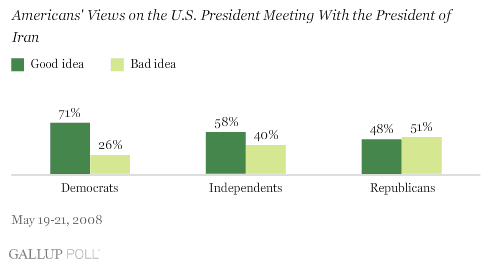
Indeed, two recent polls conducted by Gallup reveal the strange position that Democrats still find themselves in on security issues. In mid-May, the firm found that a majority of Democrats and Independents (as well as nearly half of Republicans) thought it would be “a good idea for the president of the United States to meet with the president of Iran” — an idea that sounds very close to a plank in Barack Obama’s national security platform.


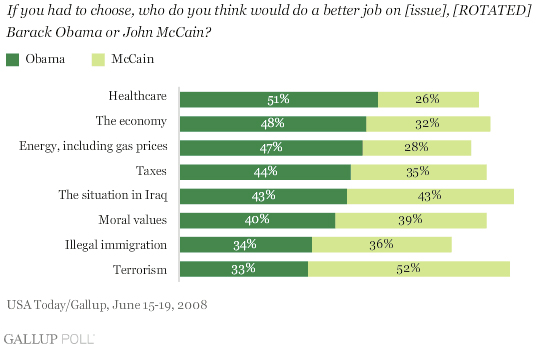
Given that the issue of diplomacy with Iran has been one of John McCain’s favored bludgeons over the past few weeks, you might expect Gallup’s polling to show that the same Americans who support Obama’s policies might view McCain as less well equipped to handle the threat of terrorism overall. Not so. In a June Gallup survey, McCain’s only issue area of dominance was on the question of which candidate would do a “better job” on terrorism, on which he beat Obama to the tune of 19 points.


What this suggests is that while the Democrats’ hoped-for resurgence on national security could possibly be underway, it has thus far failed to materialize in the electorate.

Still, the maverick Feingold is set to chip away at the existing stereotypes Democrats face on national security. Just because he’s trying to gain traction as a thoughtful proponent of stronger intelligence gathering doesn’t mean he’ll hang up his spurs on the FISA bill when it passes back through the Senate. Asked after his Monday address whether he and others might mount a filibuster on FISA, Feingold ducked the issue deftly by saying “I’m not in a position to talk about exactly what’s going on with that in the committee.”

Still, he noted that both he and Senator Chris Dodd met with Senate Majority Leader Harry Reid last Friday and indicated their joint desire that “this thing not just be jammed through.” According to Feingold, “we will be requiring key procedural votes,” he said, “and also be taking some time on the floor this week to indicate the problems with this legislation. We’re not just going to let it quickly pass.”

Source. / The Huffington Post

The Rag Blog

Posted in RagBlog | Tagged , , , , , | Leave a comment

Thorne Dreyer & Margaret Moser :
Austin Rock Musician Benny Thurman Dead at 65

photo of Benny Thurman

Benny Thurman. Photo By John Anderson / Austin Chronicle.

By Thorne Dreyer | The Rag Blog | June 24, 2008

Benny Thurman, a founding member and bassist of the famed sixties rock group the Thirteenth Floor Elevators, died this past Sunday, June 22 in Austin. Thurman was in intensive care at Austin’s Seton Hospital for two and a half weeks before his passing from undisclosed illnesses. He was 65.

Thurman played bass for the Elevators from the band’s beginning in late 1965 until mid-1966.

Austin’s Thirteenth Floor Elevators, the first band to openly embrace the concept of “psychedelic rock” and whose live concerts became a thing of legend, never gained mass popularity or much commercial success but were headliners in the early days of San Francisco’s psychedelic rock scene. The band’s legacy continues, its songs covered by a new generation of bands, and the Elevators are often cited as a major influence by musicians like Bruce Springsteen and the Rolling Stones.

Benny Thurman, also a violinist, later played for Mother Earth and Plum Nellie but eventually gave up performing.


Before the Elevators: Benny Thurman, Stacy Sutherland, and John Ike Walton in their Lingsmen days. Photo courtesy Austin Chronicle.

The following article by Margaret Moser appeared in the Austin Chronicle on August 20, 2004.

Benny Thurman of the Thirteenth Floor Elevators

“I wasn’t too much on bass, I was a fiddle player, violin. I couldn’t play bass worth a darn, but I said I’d learn. It was hard, but I got a big ol’ jazz bass from John Ike [Walton]. I could keep up and was on a lot of the fast rock stuff, but then they got into those romantic love songs, with Roky singing.”

So reflects Benny Thurman on his two years as the original bassist for the 13th Floor Elevators. Retired from a state job and caring for his mother, Thurman jokes about spending his days watching Jerry Springer and living with “three cats, two dogs, and a redbird nest outside the window with little blue eggs in it.”

Thurman was classically trained as a violinist, playing in his high school orchestra before joining the Marines. He returned to Austin after the service and one fortuitous afternoon sauntered into Dirty’s Hamburgers on the Drag where he met John Ike Walton and Stacy Sutherland. The three teamed up, found a singer, and relocated to the coast, where they called themselves the Lingsmen and played “the Dunes, a concession stand on the beach, Wednesday nights and weekends” with great success.

After Tommy Hall drafted the band’s rhythm section for the Elevators, Thurman found his world and music had changed.

Compared to everyone else, we were smashing! We had the sound, the image – you can hear the gap between us and what else was going on in 1965. It’s the basic beat. When you first get hip, it’s what you feel. We were inspired by Dylan. And Janis. Janis really tore it up. Tommy was the main instigator. I remember sweating it out, rehearsing for gigs.

The music was so new, they called it the 13th floor – everyone else had only gone to 12. It was the movement of the spirit – Owsley, Leary, the Dead. People were tired of the Kingston Trio and ‘Where Have All the Flowers Gone?’ and the Elevators were on the pinnacle. We went out to San Francisco and L.A. twice in a Volkswagen and stayed with Clementine. She was so kind with us when we were there.

Believe me, nobody wants to stay on the 13th floor. It’s too weird. It was bedlam, that Armageddon-in-your-mind type music. And we were the first, the original. We were onto the pyramid, with its mystical Egyptian connection. Incense, hash, peyote were introduced into the culture. Amphetamines and barbiturates. I liked Desoxyn; I’m drug-free now. After the bust, I broke away. I was about to get married and they needed a better bass player.

Thurman went on to play with other Austin acts, notably Plum Nelly in the mid-Seventies, but with family responsibilities looming, he left music behind.

Nevertheless, his time as an Elevator is a source of great pride for him.

“I’d like to see Tommy again someday,” he commented wistfully. “We caught the wave and held onto our surfboard. It was all an experiment, but it was a great experience. A lot of people never get to experience anything at all. Not just performing, but the life around it, the sparkle of it, the groove. I got some of it.”

— Margaret Moser

Source / Austin Chronicle

Special thanks to Fontaine Maverick / The Rag Blog

Posted in Rag Bloggers | Tagged , , , , , , , , | 4 Comments

Republicans – aka "The Sick Fuck Party"

Charlie Black

Charlie Black, McCain aide,
stirs a flap with a frank comment
By Don Frederick / June 23, 2008

Charlie Black has had his moment of straight talk … and chances are he’s not going to let it happen again.

Longtime Republican strategist and operative Charlie Black reflected on how a terrorist attack would help the candidacy of presumptive Republican presidential nominee John McCain A recent Washington Post piece on Black aptly described him as “John McCain’s man in Washington,” a “longtime uber-lobbyist” and “political maestro” who hopes “to guide his friend, the senator from Arizona, to the presidency this November.”

Now comes a Fortune magazine article that, even more aptly, notes the “startling candor” with which Black discussed how a spotlight on national security would serve McCain’s political purposes.

First, he provided some background.

The assassination of Pakistani political leader Benazir Bhutto in late December was an “unfortunate event,” Black told Fortune, but it boosted McCain’s stock in the fast-approaching New Hampshire Republican primary that he absolutely, positively had to win. The candidate’s “knowledge and ability to talk about it reemphasized that this is the guy who’s ready to be commander in chief. And it helped us,” Black said.

Then, the longtime political pro got a bit too honest. Asked about the political impact of another terrorist attack on U.S. soil, Black replied: “Certainly it would be a big advantage to him.”

Black may be correct, but he’s not supposed to be quite so blunt in coldly calculating the upside for McCain of harm coming to Americans. Others — unconnected with the campaign — could offer such an assessment, but he should have dodged the question.

He knows it, and The Times’ Maeve Reston reports that outside a McCain fundraiser today in Fresno, Black said: “I deeply regret the comments — they were inappropriate. I recognize that John McCain has devoted his entire adult life to protecting his country and placing its security before every other consideration.”

McCain, for his part, did what he’s supposed to do — stressing his lifelong commitment to protecting America and flat out disputing Black’s premise. “It’s not true,” he said when asked in Fresno about his aide’s remark.

McCain, for his part, did what he’s supposed to do — stressing his lifelong commitment to protecting America and flat out disputing Black’s premise. “It’s not true,” he said when asked in Fresno about his aide’s remark.

Barack Obama’s campaign played its role, taking great umbrage to Black’s comment while using it to stress one of its talking points.

Spokesman Bill Burton said, “The fact that John McCain’s top advisor says that a terrorist attack on American soil would be a ‘big advantage’ for their political campaign is a complete disgrace, and is exactly the kind of politics that needs to change.”

But Burton also said Obama “welcomes a debate about terrorism with John McCain, who has fully supported the Bush policies that have taken our eye off of Al Qaeda, failed to bring Osama bin Laden to justice, and made us less safe.”

The Fortune article that sparked the flap (and in which Black is tangential) can be read here. Our colleague Jill Zuckman over at the Swamp has her take on the incident here.

Source. / Los Angeles Times Blog

The Rag Blog

Posted in RagBlog | Tagged , | Leave a comment

Stories of Criminal Injustice and the Black Panther Party

Louisiana State Penitentiary

Judge: Mistakes led to ‘Angola 3’ conviction
By Mariann Wizard / The Rag Blog / June 23, 2008

Mariann Wizard is a long-time Austin activist, a member of MDS/Austin and a regular contributor to The Rag Blog

AUSTIN, TX. — Two still-imprisoned members of the Angola 3, men who spent 36 years in solitary confinement in Louisiana’s notorious Angola State Penitentiary, appeared to move a step closer to freedom when Federal Magistrate Christine Nolan recommended on June 10 that Albert Woodfox’s murder conviction be overturned, according to the June 18, 2008 San Francisco Bay View. Woodfox and Herman Wallace, who also remains jailed, were moved into a dormitory in March, but the Associated Press reported that Wallace was returned to a one-man holding cell inmates call “the dungeon” on June 13 (abc26.trb.com). A spokesperson for the defense committee said this apparently resulted from a minor violation of telephone rules.

Judge Nolan moved to throw out Woodfox’s conviction due to incompetent counsel. Her recommendation must be accepted or rejected by a U.S. District Judge. A state commission made a similar ruling in Wallace’s case last year, but was overruled by a state judge, a decision now under appeal.

Woodfox and Wallace, along with Robert “King” Wilkerson, were convicted in 1972 of killing a prison guard, Brent Miller. Wilkerson, who now goes by the name Robert King, spent 29 years in solitary before his conviction was overturned in 2001. He wasn’t even in prison when the guard was killed, but had become active in the Black Panther Party chapter started by Woodfox and Wallace inside Angola, the first BPP prison chapter. BPP members were challenging the corrupt rule of racist guards, a warden later convicted of murdering his own wife, and so-called “trustees” who managed traffic in the sexual abuse of weaker convicts, when Miller was murdered. A fourth BPP activist indicted, Gilbert Montegut, was acquitted. No evidence ever connected any of the men to the crime except the perjured testimony of two jail house snitches – one of whom was also indicted — who received preferential treatment and reduced sentences on their original crimes for testifying against the three.

Just starting to rebuild his life in New Orleans when Hurricane Katrina struck, Robert King’s home was destroyed. He has since re-located to Austin, where his sales of “Freelines” – a pecan and brown sugar treat he perfected in his years in prison – help raise funds and consciousness for the remaining Angola brothers’ legal appeals. Angola is still one of the most oppressive and brutal prisons in the United States. The majority of inmates work as slave labor on the prison’s vast agricultural lands, wielding hoes under armed guard in the broiling Louisiana sun.


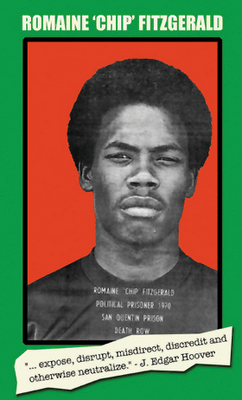
* In a related story, Romaine “Chip” Fitzgerald, a Black Panther Party member who, after 38 years, is the longest-held BPP prisoner of war remaining in U.S. detention, will have a parole hearing on July, again according to the Bay View. Typical of many attacks by police forces around the nation on BPP members during the late 1960s, Fitzgerald was involved in a shoot-out with police in Los Angeles in 1969, in the course of which he was shot in the head. Arrested and sentenced to death for assaulting the police and the murder of a security officer, Chip’s sentence was later commuted to life in prison. According to the Bay View, his hearing is “one of the most anticipated dates for many community leaders, students and supporters around the world, all waiting to see if the California Board of Parole Hearings will employ justice in this hearing, particularly in consideration of the era and climate of Chip’s arrest, conviction and sentencing in late 1969”. For more information, and to sign an online petition supporting Fitzgerald’s parole, visit Freechip.org..

* Prosecutors in San Francisco have thrown up “vindictive and mean-spirited procedural delays,” according to the Committee for the Defense of the San Francisco 8, to the removal of defendants Herman Bell and Jalil Muntaqim (aka Anthony Bottom) to New York for parole hearings set to begin September 8. Bell and Muntaqim, two of the eight BPP defendants charged last year with murder in the unsolved 35-year-old shooting of a San Francisco police sergeant, have been serving time in the Empire State for the past 30 years on unrelated charges; that is, unrelated to the police sergeant’s death, but definitely related to their BPP advocacy of community pride and self-defense! Judge Philip Moscone had signed an order on May 22 allowing Bell and Muntaqim to attend the parole hearings, but prosecutors later reneged on an agreement with the defense team, and Moscone ordered a stay of his earlier order.

Defense attorney Bob Boyle of New York told the San Francisco court that missing the hearings could mean that the men would not have another opportunity for parole “for years”. Arguments resume in Moscone’s court this week.

The Rag Blog

Posted in Rag Bloggers | Tagged , , , , | Leave a comment

Let the Oil Execs Answer to the Facts

James Hansen

Put oil firm chiefs on trial, says
leading climate change scientist
By Ed Pilkington /June 23, 2008

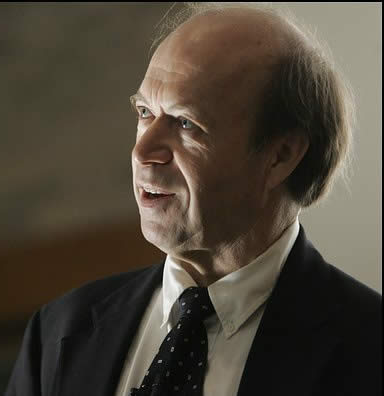
James Hansen, one of the world’s leading climate scientists, will today call for the chief executives of large fossil fuel companies to be put on trial for high crimes against humanity and nature, accusing them of actively spreading doubt about global warming in the same way that tobacco companies blurred the links between smoking and cancer.

Hansen will use the symbolically charged 20th anniversary of his groundbreaking speech (pdf) to the US Congress – in which he was among the first to sound the alarm over the reality of global warming – to argue that radical steps need to be taken immediately if the “perfect storm” of irreversible climate change is not to become inevitable.

Speaking before Congress again, he will accuse the chief executive officers of companies such as ExxonMobil and Peabody Energy of being fully aware of the disinformation about climate change they are spreading.

In an interview with the Guardian he said: “When you are in that kind of position, as the CEO of one the primary players who have been putting out misinformation even via organisations that affect what gets into school textbooks, then I think that’s a crime.”

He is also considering personally targeting members of Congress who have a poor track record on climate change in the coming November elections. He will campaign to have several of them unseated. Hansen’s speech to Congress on June 23 1988 is seen as a seminal moment in bringing the threat of global warming to the public’s attention. At a time when most scientists were still hesitant to speak out, he said the evidence of the greenhouse gas effect was 99% certain, adding “it is time to stop waffling”.

He will tell the House select committee on energy independence and global warming this afternoon that he is now 99% certain that the concentration of CO2 in the atmosphere has already risen beyond the safe level.

The current concentration is 385 parts per million and is rising by 2ppm a year. Hansen, who heads Nasa’s Goddard Institute for Space Studies in New York, says 2009 will be a crucial year, with a new US president and talks on how to follow the Kyoto agreement.

He wants to see a moratorium on new coal-fired power plants, coupled with the creation of a huge grid of low-loss electric power lines buried under ground and spread across America, in order to give wind and solar power a chance of competing. “The new US president would have to take the initiative analogous to Kennedy’s decision to go to the moon.”

His sharpest words are reserved for the special interests he blames for public confusion about the nature of the global warming threat. “The problem is not political will, it’s the alligator shoes – the lobbyists. It’s the fact that money talks in Washington, and that democracy is not working the way it’s intended to work.”

A group seeking to increase pressure on international leaders is launching a campaign today called 350.org. It is taking out full-page adverts in papers such as the New York Times and the Swedish Falukuriren calling for the target level of CO2 to be lowered to 350ppm. The advert has been backed by 150 signatories, including Hansen.

Source / The Guardian

The Rag Blog

Posted in RagBlog | Tagged , , , | Leave a comment

Protesting High Fuel Prices, Samarindan-Style

East Kalimentan is in Indonesia. The report below is exactly as dragono has written it.

Sealed Lips for Fuel Price..
by dragono / June 23, 2008

Seven students of Universitas Mulawarman in Samarinda (capitol of East-Kalimantan), continues the protest upon the raising of fuel price by sealing their lips (sewing it, literally) and avoid to eat and drink for several days ahead..

Unfortunately, they avoided to tell the press, who has professionally permitted them to do that action.. And they also said that this action will be continued until one of them falls down..

They are Edi Susanto, Heri Setiawan, Gito Gamas, Eka Fauzi, Ronny, students of Faculty of Social and Political Science. Next to them there’s Ahmad Syafii from Independent Community and Yono, one of high school student.

Until now they’ve been holding the protest in front of the main gate of Universitas Mulawarman. In a small tent, they’ve been accompanied by several students that giving oration and spreading the fliers..

Moreover, the protesters said that their parents support and allow them to do this action.

Source / NowPublic

Thanks to Betsy Gaines / The Rag Blog

Posted in RagBlog | Tagged , , | Leave a comment

William Broyles : Mission Impossible in Iraq

Last updated June 27, 2008

Screenwriter and former Texas Monthly editor William Broyles.

William Broyles was the founding editor of Texas Monthly – back when this magazine about and for Texas was actually edited by a Texan. Broyles produced an innovative, adventuresome publication that created a splash on the national journalism scene, and I had the honor of being associated with Bill and the magazine in those early days. Bill was an honorable man, an excellent editor, a true friend and a dream to work with.

Bill Broyles later edited Newsweek and is the author of Brothers in Arms, an account of his return to Vietnam as a journalist 15 years after leading a platoon there as a young Marine lieutenant. He has since become a highly regarded screenwriter with one academy award nomination under his belt (for Apollo 13, which he wrote with Al Reinert).

Bill has returned to write a guest editorial in the July, 2008, issue of Texas Monthly in which he – as current editor Evan Smith puts it – “makes a passionate case for an immediate end to the Iraq war, in which his son, David, served honorably.” And what an eloquent case he makes.

The text of that column appears below.

Thorne Dreyer / The Rag Blog / June 24, 2008

Why we should end the war in Iraq — now.
by William Broyles

My grandfather served in World War I, my father in World War II. I was a Marine in Vietnam. The longest love affair of my life is with the United States Marine Corps. I believe in its values, its commitment, its ethic of sacrifice and excellence. In a soft world of self-indulgence, there’s no fat in the Marine Corps soul. I’m so proud of my service that forty years later tears still come to my eyes when I hear the first words of the Marine Corps hymn: “From the halls of Montezuma, to the shores of Tripoli.”

Shortly after 9/11, my son David, who had just graduated from the University of Texas with a degree in English, enlisted with great idealism. He endured grueling training to become an Air Force pararescueman (which is like a Navy SEAL) and served three tours in Iraq and one in Afghanistan with elite Special Operations troops. When he was in the war zone, I couldn’t answer the phone at night. I couldn’t watch the news. I couldn’t understand how the rest of the country was acting as if there weren’t a war on. And I was one of the lucky ones. My son came home.

With each tour in Iraq, my son’s idealism eroded. He no longer believed the war was crucial to America’s security. He still served with pride and dedication, but his dedication was no longer to the elusive goals of the war—it was to his own honor, to the men in his unit, and to its lifesaving mission. His team members were some of the finest Americans I’ve ever met. They did their duty and then some. But they deserved better. Everyone who has served and sacrificed in Iraq does.

When David finished his enlistment, he dedicated himself to helping wounded American veterans. He started a nonprofit and swam the Strait of Gibraltar with another military buddy to raise money. Matt Cook, whose story of his own service in Iraq appears in this issue (“Soldier”), produced Swim, a documentary about their effort. The film features real men and women who were terribly injured and disfigured. They are among thousands of Iraq war veterans whose faces look like melted wax, who can’t see or hear or walk, whose disability benefits were delayed or denied, whose spouses lost their jobs trying to take care of them, who’ve lost their homes and been forgotten. More than a thousand a month attempt suicide. Twenty percent are affected with post-traumatic stress disorder or traumatic brain injuries, including David’s best friend.

When you send men and women to war, you don’t just ask them to risk their lives. You ask them to do what every fiber of their being and every value tells them not to do: You ask them to kill. There’d better be a good reason. You’d better be willing to use overwhelming force, and you’d better have clear objectives and a sound exit strategy. You’d better not run the war with such incompetence that many of its former military leaders believe it’s been botched (Texas Monthly Talks). Because if you abuse the patriotism and the sacrifice of the men and women you send to war, you create a hole in their souls—and in the soul of America.

When I see friends from the National Guard or the Reserves called up, then called up again, then called up yet again; when I see former troops who served multiple tours in the war zone pulled out of civilian life and sent back to the war; when I see talk show hosts and politicians cheerleading for a war they wouldn’t dream of serving in themselves, I take it personally. When the remains of dead young Americans are brought home in secret and some are cremated in pet cemeteries; when we’ve created nearly 5 million refugees in Iraq and taken in just 692; when we cage people without trials for years and treat them like animals; when supporters of the war oppose a new GI Bill that would give enough money for veterans like my son to go to college—when they say the men and women who served three and four war tours deserve only enough to cover a fraction of their college education, even though they gave 100 percent of their service—that’s personal too.

I’ve had enough of this war. I’ve had enough of the pictures of good American families, the mom with her arms around her children and the caption saying she’d just celebrated her wedding anniversary when she was killed in Iraq. I’ve had enough of the pictures of wounded Americans trying to learn to walk or talk or eat again. I’ve had enough of the pictures they won’t let us see but which I can too vividly imagine. Of the Iraqi children dead in our bombings, their homes destroyed, their families blown away. Of the millions of Iraqi refugees without homes or jobs. Of the return of Islamic fundamentalism to Iraq in our wake, with women murdered for not being married or not wearing a head scarf.

I’ve had enough of throwing billions of our hard-earned dollars down a rat hole of corruption. Fifteen billion unaccounted for by the Pentagon. Nine billion unaccounted for by the Coalition Provisional Authority. Another $1.8 billion in seized Iraqi assets that simply disappeared. When I’d finished my year in Vietnam, I couldn’t wait to get on that freedom bird and go home, but they wouldn’t let me leave. You know why? Because I’d signed out a shovel and hadn’t returned it. A shovel! The supply sergeant told me the taxpayers had paid for that shovel and I’d better bring it back or he wouldn’t sign my departure papers. I had to buy one for five bucks on the black market and turn it in before I got my ticket home. That’s how America used to do things.

How much will this war cost, all in? Three trillion dollars? Four (the current long-term estimate)? Think of what we could do with that. We could provide universal health care, fix Social Security, rebuild America’s crumbling dams and bridges, fund an energy policy to free us from foreign oil, and on and on. We could truly invest in our security and prosperity before it’s too late. Instead, we’re squandering our precious blood and resources in Iraq, a country the size of California, trying to determine the destiny of 27 million people who are riven by tribal and religious differences we can’t fathom and who speak languages we don’t understand.

Our brave American troops can overthrow Saddam Hussein, they can “surge” to provide temporary security in selected areas, they can train and advise the Iraqis. They’ve done all that, and done it well. But they can’t control the destiny of Iraq. We’ve been fighting there longer than we fought in World War I and World War II put together. That’s long enough. It’s time for the Iraqis to step up and take over their own country. It’s time for us to get out and let them.

Every day we stay we spend lives and treasure we can’t afford to lose. Every day we stay we strengthen our adversaries. Iran, Hamas, and Hezbollah are all far stronger today than when the war began. The president of  Iran tours Baghdad and is greeted with the flowers Dick Cheney promised us. Our leaders visit in secret and seldom dare leave the Green Zone. The main Shiite leader forbids his millions of followers to sell Americans a single grain of rice. Our allies today are the same Sunni warlords we fought yesterday, who support us for the same reason Osama bin Laden once supported us against the Russians in Afghanistan—because it’s good for them, for now.

Once we’re gone, we won’t continue to fuel the hatred of the Muslim world. We won’t make more terrorists with each bomb we drop and each carful of civilians we blast apart, and we won’t alienate people around the world who used to look to us for moral leadership. The president warns that if we were to leave tomorrow, the terrorists would be emboldened, those bent on genocide would be empowered, and our prestige would plummet. But our presence has already done that. If we stay five or ten more years, the same things could happen the day we leave.

The truth is, no one can predict what’s going to happen when we get out. In 1968 presidential candidate Richard Nixon said he had a plan to end the Vietnam War. He changed his mind after he was elected. He said we couldn’t settle for defeat. We had to win. If we got out right away, he told us, our mortal enemies would win. The Soviet Union would be strengthened around the world, and Chinese Communists would establish a beachhead in Southeast Asia. America would be on the road to disaster. Sound familiar? Nixon kept the war going another five years. Some 22,000 more Americans died, and so did as many as a million more Vietnamese.

Was Nixon right? Was that terrible carnage worth it? Well, four years after the last American helicopter left Saigon, the Vietnamese went to war against . . . guess who? The Chinese Communists. And fourteen years after America pulled out, the Berlin Wall fell. It was the Soviet Union that collapsed, not America. Everything that Nixon had predicted was wrong. We were stronger after we got out of Vietnam, not weaker. The same could happen when we get out of Iraq.

Yes, everyone wants freedom. But they also want to be safe in their homes. They want their children to be safe in their schools. And they love their countries the same way we do. They don’t want foreigners telling them how to run their country, kicking down their doors, and dropping bombs on their villages any more than we would. Because even if we believe that we’re doing it for them, that we’re America and we’re the good guys, their children are still dead, their parents are still buried in the rubble, and they will still hate us—until the day we leave.

So let’s bring our troops home now. Let’s give them parades and take care of them and their families. They deserve it. Let’s give the Iraqis economic, technical, and diplomatic support to help them stand up for themselves. Let’s play the Marine Corps hymn and call a whole new generation of Americans to the honor of military service, and this time let’s give them the leadership they deserve.

Source. / Texas Monthly

Rag Blogger responses:

This is a pretty good editorial for the middle of the road, uninformed, somewhat racist, and reflexively patriotic out there. I’m glad it is in that upscale Sears & Roebuck catalogue, Texas Monthly. William Broyles went to Vietnam and said he really liked war, in his article “Why Men Love War”, Esquire, Nov. 1984. He had a great male bonding/identity building experience and he is not about to give it up. Because of this he cannot finally explain why war is essentially wrong. What if the U.S. had used overwhelming force, great body armor, well armored Humvees, and had “won” the war decisively and quickly? What if every soldier was given the best GI Bill and great medical service? What if the U.S. had rebuilt everything it broke in Iraq? And in the end Exxon/Mobil still got control of Iraq’s oil and our gasoline was fifty cents a gallon instead of four dollars a gallon? Would that be o.k.?

The war was essentially wrong and there is no way it could be anything other than wrong. The problem is not that troops were disrespected, money was wasted or even that lives were lost but that war is murder for profit. War is theft on a large scale. Nationalism and patriotism exist to manipulate the majority for the profit of the few. I don’t want to sing the Marine anthem or any other, ever. I volunteered for Vietnam and volunteered to be a combat medic with an Army infantry company. I was thoroughly disgusted by what I experienced. I have not one good thing to say about any of it. I do not secretly think being in the Army in Vietnam was the high point of my life, or openly as Broyles does. Vietnam caused me to completely re-think, reconstruct, my worldview but I do not thank the Army for that. Did not William Broyles tell his son that the U.S. only fights wars for the profit of the war mongers at the expense of everyone else? Did he not beg his son not to join the military? And if he did not, why not? The military is not a sports team. One cannot serve honorably while murdering people or helping others to murder. I am not excused because I was a medic (or cook or clerk) rather than a rifleman or a bomber pilot.

Doug Zachary and I discussed this at length and agree whole heartedly that using the abuse of our soldiers as an argument against this, or any war, without a sharp critique of war itself, can still serve the empire.

Those who are injured in combat should get the best medical care as every American and non-American should receive. Everyone, including soldiers, should have an equal opportunity to as much education as they can usefully absorb. I don’t mind pointing out contradictions between what is promised to soldiers and what they actually get but even if they got it all war would still be absolutely wrong, sick, and the antithesis of our humanity. There will be a next war until a great majority of people come to understand why war itself is wrong. The “why” includes words and phases people who think like Broyles cannot utter: class struggle, imperialism, wage slavery, surplus value, racism and all demonizing/dehumanizing stereotyping , no nationalism/patriotism but simply one human family.

Alan Pogue / The Rag Blog

I completely agree with you, Alan, regarding the horror of war and the simple, unadorned fact that everyone who participates in it is an accessory to the murder it perpetrates.

And what you state in the beginning of your post is so true–that’s precisely what makes a piece like this incredibly valuable. Middle-of-the-roaders, fence-sitters, and even conservatives might be moved to give their chiseled-in-stone opinion of the war another thought as a result of this effort by Mr. Broyles. And for that, I thank him, despite his not embracing the peace movement. I’m afraid he doesn’t “get it.”

Speaking of which…I ran into General Ricardo Sanchez on Saturday while buying groceries. He was signing books at one of our larger HEB’s, and there wasn’t a line, so he and I talked for quite a while. His story of growing up on the “edge of America” in Rio Grande City, a town I am very familiar with, is very compelling; he was one of many children in a family of Mexican immigrants and he had to maintain incredible discipline in his life to avoid ending up picking cotton, as he describes in his book. He is certainly to be commended for that drive. Unfortunately, he does not grasp that the amazing industry he showed by working so hard, by achieving so much, is for the wrong cause–for that of militarism. Ironically, he gets that the unrestrained sprees undertaken by corporations like KBR are at least partially responsible for the mess in Iraq–but he can’t see the bigger picture of corporate greed and military might, working in tandem.

But the most amazing thing happened at the end–when I bought one of his books and he wrote an inscription for me. I told him what I do, that I work for Texans for Peace, I described Charlie Jackson’s trips to Iraq, I explained what part I played in the survival of Christian Peacemaker Teams hostages–and what did this all add up to for him? “Thank you for your part in the war effort on behalf of the United States of America,” he began. Because to him, as he explained, and I marveled, it’s all the same thing. Peace is part of the war effort. Working to save hostages is part of the war effort. People here at home–part of the war effort. I just smiled and shook my head. He’s not going to change. He’s fifty-six years old, and he believes he has lived his entire adult life in the service of his country, he believes he has done his country “proud.” Okay, so some morons in the White House screwed up what he worked hard to achieve in Iraq–a military victory–but that is all he will ever understand.

I can’t begin to think how many more there are just like him.

Alyssa Burgin / The Rag Blog

Friends,

I went to college with Bill (as he was known then). He was Editor of the student newspaper in 66(?) the year he graduated. He was very active. I recall later being surprised to learn he served in Viet Nam.

I think his pride in the Marine Corps, and by extension in military service is perhaps understandable, but as misplaced as any sort of pride in military activity. It isn´t just this war, or this one and Viet Nam which have been mistakes. It is not just the wars the US has lost that have caused problems, and have built the empire. Pres. Eisenhower, as he was LEAVING office warned of the military industrial complex, but it is too bad he didn´t begin efforts to overcome it while he was in power. As long as we keep preparing for war, we will use military force to resolve problems or to enforce the American way of life, meaning our empire. Most people see some of the wars we have fought, and won, as necessary. But if want to stop the necessity of wars, we must work against militarism in all forms.

Yes, the TM, and Bill, should have stood against the war much much earlier.

Paz,
Val Liveoak

The Rag Blog

Posted in RagBlog | Tagged , , , , , | Leave a comment

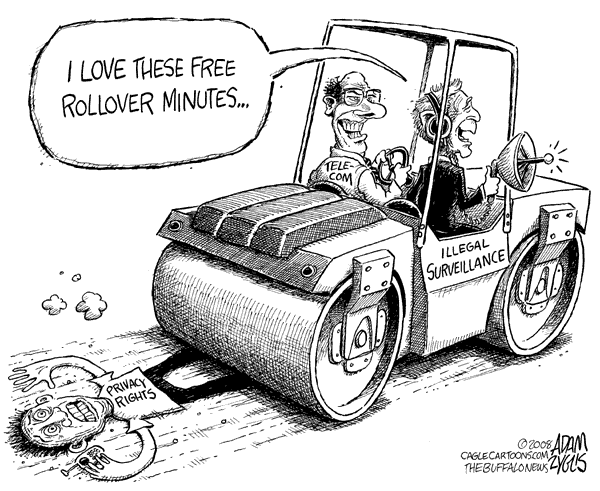
Just Like Congress Rolled Over

Adam Zyglis.

Posted in RagBlog | Tagged , , , , , , | Leave a comment

House Resolution Calls for Naval Blockade against Iran


Proposed actions could lead to war with Iran
by Andrew W Cheetham

A US House of Representatives Resolution effectively requiring a naval blockade on Iran seems fast tracked for passage, gaining co-sponsors at a remarkable speed, but experts say the measures called for in the resolutions amount to an act of war.

H.CON.RES 362 calls on the president to stop all shipments of refined petroleum products from reaching Iran. It also “demands” that the President impose “stringent inspection requirements on all persons, vehicles, ships, planes, trains and cargo entering or departing Iran.”

Analysts say that this would require a US naval blockade in the Strait of Hormuz.

Since its introduction three weeks ago, the resolution has attracted 146 cosponsors. Forty-three members added their names to the bill in the past two days.

In the Senate, a sister resolution S.RES 580 has gained co-sponsors with similar speed. The Senate measure was introduced by Indiana Democrat Evan Bayh on June 2. In little more than a week’s time, it has accrued 19 co-sponsors.

AIPAC’s Endorsement

Congressional insiders credit America’s powerful pro-Israel lobby for the rapid endorsement of the bills. The American Israel Public Affairs Committee (AIPAC) held its annual policy conference June 2-4, in which it sent thousands of members to Capitol Hill to push for tougher measures against Iran. On its website, AIPAC endorses the resolutions as a way to ”Stop Irans Nuclear Proliferation” and tells readers to lobby Congress to pass the bill.

AIPAC has been ramping up the rhetoric against Iran over the last 3 years delivering 9 issue memos to Congress in 2006, 17 in 2007 and in the first five months of 2008 has delivered no less than 11 issue memos to the Congress and Senate predominantly warning of Irans nuclear weapons involvement and support for terrorism.

The Resolutions put forward in the House and the Senate bear a resounding similarity to AIPAC analysis and Issue Memos in both its analysis and proposals even down to its individual components.

Proponents say the resolutions advocate constructive steps toward reducing the threat posed by Iran. “It is my hope that…this Congress will urge this and future administrations to lead the world in economically isolating Iran in real and substantial ways,” said Congressman Mike Pence(R-IN), who is the original cosponsor of the House resolution along with Gary Ackerman (D-NY), Chairman of the sub committee on Middle East and South Asia of the Foreign Affairs Committee.

Foreign policy analysts worry that such unilateral sanctions make it harder for the US to win the cooperation of the international community on a more effective multilateral effort. In his online blog, Senior Fellow in the Middle East Program at the Center for Strategic and International Studies Ethan Chorin points out that some US allies seek the economic ties to Iran that these resolutions ban. “The Swiss have recently signed an MOU with Iran on gas imports; the Omanis are close to a firm deal (also) on gas imports from Iran; a limited-services joint Iranian-European bank just opened a branch on Kish Island,” he writes.

These resolutions could severely escalate US-Iran tensions, experts say. Recalling the perception of the naval blockade of Cuba during the Cuban Missile Crisis, and the international norms classifying a naval blockade an act of war, critics argue endorsement of these bills would signal US intentions of war with Iran.

Last week’s sharp rise in the cost of oil following Israeli Deputy Prime Minister Shaul Mofaz’s threat to attack Iran indicated the impact that global fear of military action against Iran can have on the world petroleum market. It remains unclear if extensive congressional endorsement of these measures could have a similar effect.

In late May, Israeli Prime Minister Ehud Olmert reportedly urged the United States to impose a blockade on Iran. During a meeting with House Speaker Nancy Pelosi (D-CA) in Jersusalem, Olmert said economic sanctions have “exhausted themselves” and called a blockade a “good possibility.”

Source. / Global Research / Posted June 18, 2008. Go there for text of resolution.

Proposed bill needs attention, opposition
By Robert Naiman and Mike Lynn / June 23, 2008

The U.S. House of Representatives is considering a new resolution that could effectively demand a blockade against Iran — an act that would be widely seen as an act of war and could invite Iranian retaliation, possibly leading us into a shooting war.

Over the last three weeks, 77 House Democrats and 92 Republicans have agreed to cosponsor this resolution, but we think many do not realize its dangerous implications.

This resolution (H. Con. Res. 362) was introduced by Representative Gary Ackerman. The most alarming provision “demands that the President initiate an international effort to immediately and dramatically increase the economic, political, and diplomatic pressure on Iran to verifiably suspend its nuclear enrichment activities by, inter alia, prohibiting the export to Iran of all refined petroleum products; imposing stringent inspection requirements on all persons, vehicles, ships, planes, trains, and cargo entering or departing Iran; and prohibiting the international movement of all Iranian officials not involved in negotiating the suspension of Iran’s nuclear program.”

Such a blockade imposed without United Nations authority (which the resolution does not call for) would be seen as an act of war. Congressional sources say the bill might first go to committee, which gives us a little more time to pressure our representatives. But whether or not it goes first to committee, or directly to the floor of the House, action on H. Con. Res. 362 is needed now. We urge you to ask your representative not to support this dangerous step toward war with Iran.

Congressional leaders seem to have assumed that there would be little opposition to this punitive measure against Iran, and they have put it on a fast track to passage. But due to the threat of war, many organizations and reasonable members of Congress are working overtime to stop this bill.

Please take action now — ask your representative to oppose this dangerous path that could lead directly to war with Iran.

You can find the full text of the resolution and list of co-sponsors
here.

Source. / United for Peace and Justice

Thanks to Carl Davidson / The Rag Blog

The Rag Blog

Posted in RagBlog | Tagged , , , , | Leave a comment