The Hard Human Surface


I’m doing a brave pushup
near the middle of the road
with my back legs paralyzed
and folded under me helplessly
under my newly crushing weight
as I hold my head up high
looking for danger though
unable to move out the way
of the next car already
rapidly approaching

I’m stunned and shocked
and surprisingly calm
after all what can I do
I always do my best
I’m very careful as a rule
and run so very fast that
no others ever catch me
running up and down trees
looking just a blur speeding
upside down the underside
of long stiff branches
until you see me leaping
into mid air as if gravity
weren’t real and landing
on a distant bending twig
then on the ground and onto
the hard human surface
and quickly dash across
in a flow of short athletic hops
into the heavy moving wall
that appeared out of nowhere
and just as quickly disappeared

I partly stand here tall as can be
more frozen than in deep winter
in treetop nest in wild blue norther
with my mind clear again even
on this 100-degree summer day
when I’d simply been trying
to conduct my business
I have an acorn to dig up
I’m hungry and now I hurt
I’m scared and hope for the best
maybe I can try again to move now

The Hard Human Surface

Larry Piltz
June 2008
Indian Cove / Austin, Texas

The Rag Blog / Posted June 23, 2008

Posted in Rag Bloggers | Tagged , | Leave a comment

Food For Thought


Turning Your Lawn into a Victory Garden
Won’t Save You — Fighting the Corporations Will

By Stan Cox / June 23, 2008

The corporate agriculture industry would like nothing better than to see us spend all of our free time in our gardens and not in political dissent.

I didn’t mean to lead anyone down the garden path. Adding my small voice to those urging Americans to replace their lawns with food plants wasn’t, in itself, a bad idea. But now that food shortages and high costs are in the headlines, too many people are getting the idea that the solution to America’s and the world’s food problems is for all of us in cities and suburbia to grow our own. It’s not.

Don’t get me wrong: Growing food just outside your front or back door is an extraordinarily good idea, and if it’s done without soil erosion or toxic chemicals, I can think of no downside. Edible landscaping can look good, and it saves money on groceries; it’s a direct provocation to the toxic lawn culture; gardening is quieter and less polluting than running a power mower or other contraption; the harvest provides a substitute for industrially grown produce raised and picked by underpaid, oversprayed workers; and tending a garden takes a lot of time, time that might otherwise be spent in a supermarket or shopping mall.

So it was in 2005 that our family volunteered our front lawn to be converted into the first in a now-expanding chain of “Edible Estates,” the brainchild of Los Angeles architect/artist Fritz Haeg. We already had a backyard garden, but growing food in the front yard (which, as Haeg himself points out, is a reincarnation of a very old idea) has been a wholly different, equally positive experience.

Our perennials and annuals are thriving, we’ve gotten a lot of publicity, and I’ve been talking about the project for almost three years. Yet neither of our gardens, front or back, can stand up to the looming agricultural crisis. Good food’s most well-read advocate, Michael Pollan, has written that growing a garden is worth doing even though it can make only a tiny contribution to curbing carbon-dioxide emissions. He might have added that growing food is worth it even if it does very little to revive the nation’s food system.

World cropland: the pie is mostly crust

The edible-landscaping trend is catching on across the country, and with food prices rising, it has taking sadly predictable turns. A Boulder, Colo. entrepreneur, for example, has tilled up his and several of his neighbors’ yards and started an erosion-prone, for-profit vegetable-farming operation. It will supplement his income, but it won’t make a nick in the food crisis.

That’s because the mainstays of home gardening — vegetables and fruits — are not the foundation of the human diet or of world agriculture. Each of those two food types occupies only about 4 percent of global agricultural land (and a smaller percentage in this country), compared with 75 percent of world cropland devoted to grains and oilseeds. Their respective portions of the human diet are similar.

Suppose that half of the land on every one-acre-or-smaller urban/suburban home lot in the entire nation were devoted to food-growing. That would amount to a little over 5 million acres (pdf) sown to food plants, covering most of the space on each lot that’s not already covered by the house, a deck, a patio, or a driveway. (And in many places it couldn’t be done without cutting down shade trees and planting on unsuitably steep slopes).

That theoretical 5 million acres of potential home cropland compares with about 7 million acres of America’s commercial cropland currently in vegetables, fruits, and nuts, and 350 to 400 million acres of total farmland. The urban and suburban area to be brought into production would not approach the number of healthy acres of native grasses and other plants that are slated to be plowed up to make way for yet more corn, wheat, soybeans, and other grains under the newly passed federal Farm Bill.

A nationwide grow-your-own wave would send good vibes through society, ripples that could be greatly amplified by community and apartment-block gardening. But front- and backyard food, even if everyone grew it, would not cover the country’s produce needs, much less displace our huge volume of fresh-food imports.

We could, instead, plant every yard to wheat, corn, or soybeans, which would account only for a little over two percent of the US land sown to those crops. Other policies, like dispensing with grain-fed meat and fuel ethanol, would free up far more grain-belt land than that.

Not even a poke in the eye

I’ve played a part in the promotion of domestic food-growing, and I now I seem to hear daily from people who believe that it’s the best alternative to industrial agriculture (as in, “I’ll show Monsanto and Wal-Mart that I don’t need their food!”). Even though most prominent home-lot food efforts, like the “100-Foot Diet Challenge,” also try to draw attention to bigger issues, the wider message can get lost in the excitement. Whatever its benefits, replacing your lawn with food plants will not give Big Agribusiness the big poke in the eye that it needs, nor will it save the agricultural landscapes of the nation or world.

To do that, the big-commodity market must be not just modified but overthrown. Until then, most of that two-thirds or more of the human calorie and protein intake that comes from grains and oilseeds (directly in most of the world or among Western vegetarians, largely via animal products for others in this country) will continue to be served up by a dirty, cruel, unfair, broken system.

Essential for providing vitamins, minerals, and other compounds, a highly varied diet is important, and home gardens around the world help provide such a diet. But with a world population now approaching seven billion people and most good cropland already in use, only rice, wheat, corn, beans, and other grain crops are productive and durable enough to provide the dietary foundation of calories and protein.

Grains made up about the same portion of the ancient Greek diet as they do of ours. We’ve been stuck with grains for 10,000 years, and our dependence won’t be broken any time soon.

The United States emulate Argentina and a handful of other countries by raising cattle that are totally grass-fed instead of grain-fed and thereby consuming less corn and soybean meal. But most of the world is utterly dependent on grains. The desperate people we saw on the evening news earlier this year, filling the streets in dozens of countries, were calling for bread or rice, not cucumbers and pomegranates.

Capitalism: It doesn’t go well with food

Humanity’s attachment to cereals, grain legumes, and oilseeds has acquired a much harder edge in the industrial era, but as a base for political and economic power, the staple grains have always been unsurpassed. Because they hold calories and nutrients in a dense package that can be easily stored for long periods and transported, the more fortunate members of ancient societies could accumulate surpluses. Those surpluses are recognized by the majority of scholars as necessary to the birth of market economies, which allowed the prosperous to exercise control over society’s have-nots. Eventually, states used control over grains to exert political power over entire populations.

Few foods could have filled that role. Noting that before grain agriculture came along, ancient Egyptians might have gathered a surplus of various foods from nature, most of them highly perishable, economic historian Robert Allen once wrote, “If all a tax collector could get from foragers was a load of waterlilies that would wilt by next morning, what was the point of having them?” The Pharaohs managed to exert control over the area’s population only after people started farming wheat and barley.

The even bigger problem with grains — which are short-lived annual plants, grown largely in monoculture — is that they supplanted the diverse, perennial plant ecosystems that covered the earth before the dawn of agriculture. We’ve been living with the resulting soil erosion and water pollution ever since.

Then, when grains became fully commodified a couple of centuries ago, things really started to go downhill. In discussing his new book Stuffed and Starved: The Hidden Battle for the World Food System, Raj Patel cited India as an example: “The social safety nets that existed in India under feudal society had been knocked away by the British. If people couldn’t afford food, they didn’t get to eat, and if they couldn’t buy food, they starved. As a result of the imposition of markets in food, 13 million people across the world died in the 19th century. They died in the golden age of liberal capitalism. Those are the origins of markets in food.”

Indeed, if capitalism were a wine, it would be a wine that doesn’t go well with any type of food.

Most food today is produced not as an end in itself but as a by-product of a global economy with the singular goal of turning maximum profit. That is a dysfunctional arrangement, as Nicholas Georgescu-Roegen, the founder of ecological economics explained almost 40 years ago in his book The Entropy Law and the Economic Process: “So vital is the dependence of terrestrial life on the energy received from the sun that the cyclic rhythm in which this energy reaches each region on the earth has gradually built itself through natural selection into the reproductive pattern of almost every species, vegetal or animal … Yet the general tenor among economists has been to deny any substantial difference between the structures of agricultural and industrial productive activities.”

Industrial or commercial output can be increased by building more capacity, stepping up the consumption of inputs, taking on more workers, and pushing workers harder and for longer hours. Farming, by contrast, is inevitably bound by the calendar — by month-to-month variation in the capacity of soil and sunlight to support the growth of plants. It depends fundamentally on the productivity and the habits of non-human biological organisms over which humans can exert control only up to a point.

That clearly isn’t the ideal pattern for efficient wealth generation, so the past century has seen relentless efforts to mold agriculture into the factory model as closely as possible and, where that can’t be done, to graft more easily regimented industries — farm machinery, fertilizers, chemicals, food processing, the restaurant industry, packaging, advertising — onto an agricultural rootstock. In the US, the dollar outputs of those dependent industries are growing at two to four times the rate of agriculture’s own dollar output, putting ever-greater demands on the soil.

With a wholesale shift toward mechanization of US agriculture, 75 percent of economic output now comes from fewer than 7 percent of farms; furthermore, there has been a steep rise in the proportion of farms owned by investors living in distant cities (some of them perhaps avid urban gardeners).

Because, as Georgescu-Roegen showed, there’s a fundamental difference between the farm and the factory, the well-used term “factory farming” represents more an aspiration than an accomplished fact. Nevertheless, agribusiness’s attempts to defy natural rhythms and achieve industrial efficiency have been ecologically devastating. The biofuel craze, encouraged by subsidies that continue in the new Farm Bill, compounds the problem.

“We must cultivate our garden,” and …

To repair the broken system that supplies the bulk of the nation’s diet will require Americans to step out of the garden and into the public arena. Beyond working to get a better Farm Bill passed five years from now, we have to work together to break the political choke-hold that agribusiness has on federal and state governments.

With land and wealth being concentrated in fewer and fewer hands (and with more prisoners than farmers in today’s America) we have actually reached a point at which land reform is as necessary here as it is in any nation of Latin America or Asia. Only when we get more people back on the land, working to feed people and not Monsanto, will the system have a chance to work. Most home gardeners know that the root of the problem is political, but the agricultural establishment would like nothing better than to see us spend all of our free time in our gardens and not in political dissent.

Ironically, it’s that great troublemaker Voltaire who has too often been trotted out (and too often misquoted) as an advocate of withdrawing from the tumult of society, into tending one’s own property. Voltaire was indeed a gardener, and he did end his most famous novel by having Candide, after surviving so many far-flung hazards, utter those famous words to his fellow wanderer Dr. Pangloss: “We must cultivate our garden.”

However, with the publication of Candide in 1759, Voltaire entered the most politically active part of his life, as he “went on to a series of confrontations with the consequences of human cruelty that, two hundred-odd years later, remain stirring in their courage and perseverance,” in the words of Adam Gopnik.

If Voltaire could find the time for both gardening and radical political action, then all of us can do it.

[Stan Cox is a plant breeder and writer in Salina, Kansas. His book, Sick Planet: Corporate Food and Medicine, was just published by Pluto Press.]

Source. / AlterNet

The Rag Blog

Posted in RagBlog | Tagged , , , , , , | Leave a comment

Another One Bites the Dust


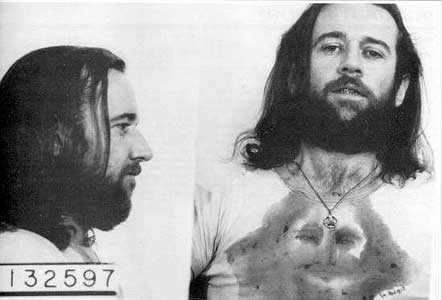
George Carlin: American Radical
By John Nichols / June 23, 2008

I think it’s the duty of the comedian to find out where the line is drawn and cross it deliberately. — George Carlin.

The last vote that George Carlin said he cast in a presidential race was for George McGovern in 1972.

When Richard Nixon, who Carlin described as a member of a sub-species of humanity, overwhelmingly defeated McGovern, the comedian gave up on the political process.

“Now, there’s one thing you might have noticed I don’t complain about: politicians,” he explained in a routine that challenged all the premises of today’s half-a-loaf reformers. “Everybody complains about politicians. Everybody says they suck. Well, where do people think these politicians come from? They don’t fall out of the sky. They don’t pass through a membrane from another reality. They come from American parents and American families, American homes, American schools, American churches, American businesses and American universities, and they are elected by American citizens. This is the best we can do folks. This is what we have to offer. It’s what our system produces: Garbage in, garbage out. If you have selfish, ignorant citizens, you’re going to get selfish, ignorant leaders. Term limits ain’t going to do any good; you’re just going to end up with a brand new bunch of selfish, ignorant Americans. So, maybe, maybe, maybe, it’s not the politicians who suck. Maybe something else sucks around here… like, the public. Yeah, the public sucks. There’s a nice campaign slogan for somebody: “The Public Sucks. Fuck Hope.”

Needless to say, George Carlin was not on message for 2008’s “change we can believe in” election season.

His was a darker and more serious take on the crisis–and the change of consciousness, sweeping in scope and revolutionary in character, that was required to address it.

Carlin may have stopped voting in 1972. But America’s most consistently savage social commentator for the best part of a half century, who has died at age 71, did not give up on politics.

In recent years, in front of audiences that were not always liberal, he tore apart the neo-conservative assault on liberty with a clarity rarely evidenced in the popular culture.

Recalling George Bush’s ranting about how the endless “war on terror” is a battle for freedom, Carlin echoed James Madison’s thinking with a simple question: “Well, if crime fighters fight crime and fire fighters fight fire, what do freedom fighters fight? They never mention that part to us, do they?”

Carlin gave the Christian right–and the Christian left–no quarter. “I’m completely in favor of the separation of Church and State,” Carlin said. “My idea is that these two institutions screw us up enough on their own, so both of them together is certain death.”

Carlin’s take on the Ronald Reagan administration is the best antidote to the counterfactual romanticization of the former president–in which even Barack Obama has engaged–remains the single finest assessment of Reagan and his inner circle. While Carlin did not complain much about politicians, he made an exception with regard to the great communicator. Recorded in 1988 at the Park Theater in Union City, New Jersey, and later released as an album–What Am I Doing in New Jersey?–his savage recollection of the then-concluding Reagan-Bush years opened with the line: “I really haven’t seen this many people in one place since they took the group photograph of all the criminals and lawbreakers in the Ronald Reagan administration.”

But there was no nostalgia for past fights, no resting on laurels, for this topical comedian. He read the papers, he followed the news, he asked questions–the interviews I did with Carlin over the years were more conversations than traditional Q & A’s–and he turned it all into a running commentary that focused not so much on politics as on the ugly intersection of power and economics.

No one, not Obama, not Hillary Clinton and certainly not John McCain, caught the zeitgeist of the vanishing American dream so well as Carlin. “The owners of this country know the truth: It’s called the American dream because you have to be asleep to believe it.”

Not just aware of but steeped in the traditions of American populism–more William Jennings Bryan and Eugene Victor Debs than Bill Clinton or John Kerry–Carlin preached against the consolidation of wealth and power with a fire-and-brimstone rage that betrayed a deep moral sense that could never quite be cloaked with four-letter words.

“The real owners are the big wealthy business interests that control things and make all the important decisions. Forget the politicians, they’re an irrelevancy. The politicians are put there to give you the idea that you have freedom of choice. You don’t. You have no choice. You have owners. They own you. They own everything. They own all the important land. They own and control the corporations. They’ve long since bought and paid for the Senate, the Congress, the statehouses, the city halls. They’ve got the judges in their back pockets. And they own all the big media companies, so that they control just about all of the news and information you hear. They’ve got you by the balls. They spend billions of dollars every year lobbying–lobbying to get what they want. Well, we know what they want; they want more for themselves and less for everybody else,” ranted the comedian whose routines were studied in graduate schools.

“But I’ll tell you what they don’t want,” Carlin continued. “They don’t want a population of citizens capable of critical thinking. They don’t want well-informed, well-educated people capable of critical thinking. They’re not interested in that. That doesn’t help them. That’s against their interests. They don’t want people who are smart enough to sit around the kitchen table and figure out how badly they’re getting fucked by a system that threw them overboard 30 fucking years ago. You know what they want? Obedient workers–people who are just smart enough to run the machines and do the paperwork but just dumb enough to passively accept all these increasingly shittier jobs with the lower pay, the longer hours, reduced benefits, the end of overtime and the vanishing pension that disappears the minute you go to collect it. And, now, they’re coming for your Social Security. They want your fucking retirement money. They want it back, so they can give it to their criminal friends on Wall Street. And you know something? They’ll get it. They’ll get it all, sooner or later, because they own this fucking place. It’s a big club, and you ain’t in it. You and I are not in the big club.”

Carlin did not want Americans to get involved with the system.

He wanted citizens to get angry enough to remake the system.

Carlin was a leveler of the old, old school. And no one who had so public a platform–as the first host of NBC’s “Saturday Night Live,” a regular on broadcast and cable televisions shows, a best-selling author and a favorite character actor in films (he was even the narrator of the American version of he provided the narrative voice for the American version of the children’s show “Thomas the Tank Engine & Friends”)–did more to challenge accepted wisdom regarding our political economy.

“Let’s suppose we all just materialized on Earth and there was a bunch of potatoes on the ground, okay? There’s just six of us. Only six humans. We come into a clearing and there’s potatoes on the ground. Now, my instinct would be, let’s everybody get some potatoes. “Everybody got a potato? Joey didn’t get a potato! He’s small, he can’t hold as many potatoes. Give Joey some of your potatoes.” “No, these are my potatoes!” That’s the Republicans. “I collected more of them, I got a bigger pile of potatoes, they’re mine. If you want some of them, you’re going to have to give me something.” “But look at Joey, he’s only got a couple, they won’t last two days.” That’s the fuckin’ difference! And I’m more inclined to want to share and even out,” he explained in an interview several years ago with the Onion.

“I understand the marketplace, but government is supposed to be here to redress the inequities of the marketplace,” Carlin continued. “That’s one of its functions. Not just to protect the nation, secure our security and all that shit. And not just to take care of great problems that are trans-state problems, that are national, but also to make sure that the inequalities of the marketplace are redressed by the acts of government. That’s what welfare was about. There are people who really just don’t have the tools, for whatever reason. Yes, there are lazy people. Yes, there are slackers. Yes, there’s all of that. But there are also people who can’t cut it, for any given reason, whether it’s racism, or an educational opportunity, or poverty, or a fuckin’ horrible home life, or a history of a horrible family life going back three generations, or whatever it is. They’re crippled and they can’t make it, and they deserve to rest at the commonweal. That’s where my fuckin’ passion lies.”

Like the radicals of the early years of the 20th century, whose politics he knew and respected, Carlin understood that free-speech fights had to come first. And always pushed the limit–happily choosing an offensive word when a more polite one might have sufficed. By 1972, the year he won the first of four Grammys for best comedy album, he had developed his most famous routine: “Seven Words (You Can’t Say on Television).”

That summer, at a huge outdoor show in Milwaukee, he uttered all seven of them in public – and was promptly arrested for disturbing the peace.

When a version of the routine was aired in 1973 on WBAI, the Pacifica Foundation radio station in New York,. Pacifica received a citation from the FCC. Pacifica was ordered to pay a fine for violating federal regulations prohibiting the broadcast of “obscene” language. The ensuing free-speech fight made its way to the U.S. Supreme Court, which rile 5-4 against the First Amendment to the Constitution, Pacifica and Carlin.

Amusingly, especially to the comedian, a full transcript of the routine ended up in court documents associated with the case, F.C.C. v. Pacifica Foundation, 438 U.S. 726 (1978).

“So my name is a footnote in American legal history, which I’m perversely kind of proud of,” recalled Carlin. Proud enough that you can find the court records on the comedian’s website: www.georgecarlin.com.

There will, of course, be those who dismiss Carlin as a remnant of the sixties who introduced obscenity to the public discourse–just as there will be those who misread his critique of the American political and economic systems as little more than verbal nihilism. In fact, George Carlin was, like the radicals of an earlier age, an idealist–and a patriot–of a deeper sort than is encountered very often these days.

Carlin explained himself best in one of his last interviews. “There is a certain amount of righteous indignation I hold for this culture, because to get back to the real root of it, to get broader about it, my opinion that is my species–and my culture in America specifically–have let me down and betrayed me. I think this species had great, great promise, with this great upper brain that we have, and I think we squandered it on God and Mammon. And I think this culture of ours has such promise, with the promise of real, true freedom, and then everyone has been shackled by ownership and possessions and acquisition and status and power,” he said. “And perhaps it’s just a human weakness and an inevitable human story that these things happen. But there’s disillusionment and some discontent in me about it. I don’t consider myself a cynic. I think of myself as a skeptic and a realist. But I understand the word ‘cynic’ has more than one meaning, and I see how I could be seen as cynical. ‘George, you’re cynical.’ Well, you know, they say if you scratch a cynic you find a disappointed idealist. And perhaps the flame still flickers a little, you know.

Source. / The Nation

Also see A Littany for George Carlin in Seven Words / The Rag Blog / June 23, 2008

The Rag Blog

Posted in RagBlog | Tagged , , , , , | Leave a comment

A Litany for George Carlin in Seven Words

George Carlin, who died of heart failure Sunday at 71, leaves behind not only a series of memorable routines, but a legal legacy: His most celebrated monologue, a frantic, informed riff on those infamous seven words, led to a Supreme Court decision on broadcasting offensive language.Associated Press / June 24, 2008

The Seven Words You Can Never Say On TV
by George Carlin

I love words. I thank you for hearing my words.

I want to tell you something about words that I think is important.

They’re my work, they’re my play, they’re my passion.

Words are all we have, really. We have thoughts but thoughts are fluid.

Then we assign a word to a thought and we’re stuck with that word for that thought, so be careful with words. I like to think that the same words that hurt can heal, it is a matter of how you pick them.

There are some people that are not into all the words.

There are some that would have you not use certain words.

There are 400,000 words in the English language and there are seven of them you can’t say on television. What a ratio that is.

399,993 to seven. They must really be bad. They’d have to be outrageous to be seperated from a group that large. All of you over here, you seven, Bad Words. That’s what they told us they were, remember?

“That’s a bad word!” No bad words. Bad thoughts, bad intentions… and words. You know the seven, don’t you, that you can’t say on television?

“Shit, Piss, Fuck, Cunt, CockSucker, MotherFucker, and Tits”

Those are the heavy seven. Those are the ones that’ll infect your soul, curve your spine, and keep the country from winning the war.

“Shit, Piss, Fuck, Cunt, CockSucker, MotherFucker, and Tits” Wow! …and Tits doesn’t even belong on the list. That is such a friendly sounding word. It sounds like a nickname, right? “Hey, Tits, come here, man. Hey Tits, meet Toots. Toots, Tits. Tits, Toots.” It sounds like a snack, doesn’t it? Yes, I know, it is a snack. I don’t mean your sexist snack. I mean new Nabisco Tits!, and new Cheese Tits, Corn Tits, Pizza Tits, Sesame Tits, Onion Tits, Tater Tits. “Betcha Can’t Eat Just One.”

That’s true. I usually switch off. But I mean, that word does not belong on the list. Actually none of the words belong on the list, but you can understand why some of them are there. I’m not completely insensetive to people’s feelings. I can understand why some of those words got on the list, like CockSucker and MotherFucker. Those are heavyweight words. There is a lot going on there. Besides the literal translation and the emotional feeling.

I mean, they’re just busy words. There’s a lot of syllables to contend with. And those Ks, those are agressive sounds. They just jump out at you like “coCKsuCKer, motherfuCKer. coCKsuCKer, motherfuCKer.”

It’s like an assualt on you. We mentioned Shit earlier, and two of the other 4-letter Anglo-Saxon words are Piss and Cunt, which go together of course. A little accidental humor there. The reason that Piss and Cunt are on the list is because a long time ago, there were certain ladies that said “Those are the two I am not going to say. I don’t mind Fuck and Shit but ‘P’ and ‘C’ are out.”, which led to such
stupid sentences as “Okay you fuckers, I’m going to tinkle now.”

And, of course, the word Fuck. I don’t really, well that’s more accidental humor, I don’t wanna get into that now because I think it takes to long. But I do mean that. I think the word Fuck is a very imprortant word. It is the beginning of life, yet it is a word we use to hurt one another quite often. People much wiser than I am said,
“I’d rather have my son watch a film with two people making love than two people trying to kill one another. I, of course, can agree. It is a great sentence. I wish I knew who said it first. I agree with that but I like to take it a step further.

I’d like to substitute the word Fuck for the word Kill in all of those movie cliches we grew up with. “Okay, Sherrif, we’re gonna Fuck you now, but we’re gonna Fuck you slow.”

So maybe next year I’ll have a whole fuckin’ ramp on the N word. I hope so. Those are the seven you can never say on television, under any circumstanses. You just cannot say them ever ever ever. Not even clinically. You cannot weave them in on the panel with Doc, and Ed, and Johnny. I mean, it is just impossible. Forget tHose seven. They’re out.

But there are some two-way words, those double-meaning words.

Remember the ones you giggled at in sixth grade? “…And the cock CROWED three times” “Hey, tha cock CROWED three times. Ha ha ha ha. Hey, it’s in the bible. Ha ha ha ha. There are some two-way words, like it is okay for Curt Gowdy to say “Roberto Clemente has two balls on him.”, but he can’t say “I think he hurt his balls on that play, Tony. Don’t you? He’s holding them. He must’ve hurt them, by God.” and the other two-way word that goes with that one is Prick. It’s okay if it happens to your finger. You can prick your finger but don’t finger your prick. No,no.

Source. / LyricsBox

Quite a wordsmith, he was. A scholar of the language. I note that he and I are the same age…I had the pleasure of his company one evening in about 1973. He was playing at the Marin Civic Center, around the corner from where I lived.

The Sons of Champlin opened the show. They rented a space across the court from my space and rehearsed, hung out there. We were all good friends. When George approached one of them about perhaps scoring some cocaine, they called me. I happened to have some and proceeded quickly over to the Center not knowing who my customer was. I was ushered in to his dressing room which was cleared of all company as we went through the score procedure. He immediately went to work on the new purchase and the two of us had a short time together, flying in the zone of the leaf.

He got so ready that he went out on stage before the roadies were finished, found a live mike and started his show. No introduction, just started rapping. Needless to say he was hilarious and did a great show. I really enjoyed being around him and became a lifelong fan. He was a genuine wizard.

Gerry / The Rag Blog / June 23, 2008

George Carlin, 71, Irreverent Standup Comedian, Is Dead / by Mel Watkins / New York Times / March 24, 2008

George Carlin Reads More Blogs Than You Do / Interview by Rachel Sklar / March 1, 2008 / The Huffington Post

Religion is Bullshit Video / The Rag Blog

Video highlights from George Carlin’s Career / The Huffington Post

The Rag Blog

Posted in RagBlog | Tagged , , , , , , , , , , | Leave a comment

Amsterdam : To Have Such Problems!

Coffee shop for cannibis smokers in Amsterdam

You can’t get busted for smoking weed, but tobacco is another matter.

Roger Baker / The Rag Blog

Marijuana Is In, Tobacco Is Out
Under Netherlands’ Smoking Ban

By Martijn van der Starre / June 20, 2008

AMSTERDAM — Starting July 1, marijuana will be the only leaf that can be smoked in public places in the Netherlands. Cannabis devotees aren’t celebrating.

Local pot smokers, who usually cut joints with tobacco, and owners of the “coffee shops” where they are allowed to light up will have to change their habits when the nation implements the indoor tobacco ban. Puffing a pure marijuana cigarette in public will still be permitted; smoking one with tobacco will merit coffee shop owners a 300-euro ($466) fine for the first offense and 2,400 euros for a fourth.

“Every customer will have to learn how to smoke pure,” said Robert Kempen, co-owner of The NooN and Mellow Yellow in Amsterdam, which sell marijuana and hashish. The rule makes him “sick to death,” he said, rolling himself a joint.

Coffee-shop proprietors say the ban will put some of them out of business as smokers stay away. The nation’s 720 outlets that serve marijuana smokers generate a large portion of their revenue from selling drinks, food and rolling papers to their patrons. Dutch sales of cannabis alone totaled 1.2 billion euros ($1.86 billion) in 2001, according to the most recent figures available from the nation’s statistics bureau.

To permit tobacco smoking, shops will have to build separate, unstaffed rooms, and many say they don’t have the space or money to do so. Others are investing in water pipes and $400 vaporizers, initially intended to aid people with lung problems inhale medicine, to help smokers light up without tobacco.

Times Have Changed

“It’s a bad year for marijuana smokers,” said Gwydion Hydref while smoking in Coffee Shop Johnny. The Welshman works for Wickedtrips, a company that offers vacation packages, including a “no holds barred’ weekender” to Amsterdam ahead of the smoking ban. “Times have changed.”

The Netherlands follows other European countries in banning tobacco. Ireland was the first country in the region to forbid smoking in public places in 2004. Sweden, Italy, Malta, France, Belgium, Finland, Lithuania, Portugal and England and others have followed, with full or partial restrictions.

The Dutch ban, which prohibits tobacco smoking in all public places of employment to protect workers’ health, is only for tobacco and makes no change to marijuana policy, said Saskia Hommes, a spokeswoman for Dutch Health MinisterAb Klink. The government will have to see if the law is enforceable, she said.

The Netherlands decriminalized the use of marijuana in 1976, though it stopped short of fully legalizing the drug because international treaties prohibited it from doing so. The country’s first coffee shop, named after Donovan’s song “Mellow Yellow,” had opened its doors four years earlier.

Bloody Awful

Government policy toward the shops has become less lenient in recent years, with the number dropping by 39 percent in a decade as authorities cracked down on sale to young people and revoked the licenses of owners who commit crimes.

Still, the shops have devoted patrons who are upset about the latest development.

The ban is “bloody awful,” said Nima Gani, a musician smoking at The NooN. Gani plans to stop visiting The NooN and smoke his “Blueberry” marijuana and tobacco joints on the street. “I feel like my freedom is getting smaller and smaller,” he said.

To enforce the new policy, the government has more than doubled its number of food and consumer product inspectors to 200, said Bob Kiel, a spokesman for the Food and Consumer Product Safety Authority. The agents will make unannounced visits to bars, restaurants and cafes, as well as coffee shops. There are no guidelines to help inspectors distinguish between a mixed joint and a pure one, he said.

Hashish and Joints

Coffee shops sell everything from pre-rolled joints for 3.50 euros each to hashish for as much as 18 euros a gram, said Mark Jacobsen, chairman of the Amsterdam Association of Cannabis Retailers. The ban will make it even harder for the shops to stay in business as visitors and revenue will drop, said Jacobsen, who is building a wall to divide The Rookies, a shop he co-owns.

“Sales will definitely fall,” said Rida Oulad, who works behind the counter at Ibiza in Amsterdam. “Why would you go to a coffee shop where you can’t smoke and the only remaining activities are sitting and watching television?”

Gani, for one, isn’t happy about the changes. He says he can’t smoke at his real home because his mother would hit him “over the head with a pan.”

Still, he has no plans to stop rolling joints mixed with tobacco: “Smoking pure grates my throat.”

Source.UZs&refer=exclusive / Bloomberg News

Thanks to Roger Baker / The Rag Blog

Posted in RagBlog | Tagged , , , | Leave a comment

Mariann Wizard’s Political Wisdom


Obama will open new
opportunities for progressives
By Mariann Wizard / The Rag Blog / June 22, 2008

I had a long conversation recently with a close friend who is usually a few steps ahead of me in political facts and analysis, and thought I would share a few thoughts with the Raglist that I took away from this discussion:

1. Be serious for a minute: Barack Obama is a progressive and even left candidate whose election should, at a bare minimum, open new opportunities for progressive ideas to prosper, but he is not a revolutionary or a radical politician. We here in the US are not in a revolutionary time quite yet, and nobody becomes President (or US Senator!!) without significant, substantial establishment support and ties. By “establishment”, and looking closely at the US economy, that is going to include some elements of the defense industry and of the oil industry. In order for progressives to work successfully during an Obama administration, it should be our prime order of business to determine exactly what elements of the establishment back him, and on what hopes and expectations that support is based. (We used to call it “power structure research”).

2. Karl Marx theorized, and history amply demonstrates, that advanced capitalist societies produce a surplus labor force (too many unemployed young people) which must be siphoned off periodically in order to avert revolution, and that war is the most efficient way to do so, since it simultaneously creates markets for products that must be replaced quite frequently, e.g., bombs, mortars, helmets, posthumous medals. I see nothing to indicate that we are anywhere close to overthrowing capitalism, and therefore will expect not only an end to the Iraq debacle in an Obama administration, but an expanded US presence in other parts of the world, say, in East Africa, where US advisors are already on the ground*. Had Hillary won the Democratic nomination, as she made abundantly clear in speeches beginning (to public knowledge) last January, a resumption of the Cold War would be in order; she doesn’t trust the Russians to “safeguard the resources of Siberia”. The real opponent in both scenarios is China, with skirmishes (hopefully) fought mostly by surrogates, without disrupting the flow of trade.

3. I firmly believe there is more opportunity to achieve important goals in any Democratic administration than in any Republican one. I’ve said since Dubya’s election in 2000 that I would vote for the Democratic donkey over him; that is, I would vote for whoever the Dems nominated. The last 8 years have been an unmitigated disaster for US citizens and for many other human beings, as well as other species. John McCain’s election would give us more of the same, and I will work to prevent it. However, I’m not a Democratic Party activist. I’m a peace and justice activist. Let us please not be surprised if an Obama administration, hopefully bringing about a welcome and speedy end to the Iraq conflict, finds its own bones to pick abroad, and is willing to leave the bones of US servicemen and women there, sacrifices to economic advantage for corporations whose interests trump yours and mine.

* From the standpoint of US propaganda, having a Black, half-African President while adventuring in Africa could be really great! “Racism? What racism?”

“It’s not just about Vietnam — we’ve got to set in motion a process that will also stop the seventh war from now.” — Robert M. Pardun, Oleo Strut Coffeehouse, Killeen, TX, 1969

http://www.awizardslife.com/

The Rag Blog

Posted in Rag Bloggers | Tagged , , , , , | Leave a comment

Juan Cole’s Requiem for Iraq

And he shreds the MSM while he enumerates the litany of horrors and grief in Iraq. It is disgusting how the American press chooses the things we are allowed to know. And their complicity in the lead up to this war of lies is criminal in every respect. No one should dare have any sympathy.

Richard Jehn / The Rag Blog

The Real State of Iraq
By Juan Cole / June 22, 2008

By now, summer of 2008, excess deaths from violence in Iraq since March of 2003 must be at least a million. This conclusion can be reached more than one way. There is not much controversy about it in the scientific community. Some 310,000 of those were probably killed by US troops or by the US Air Force, with the bulk dying in bombing raids by US fighter jets and helicopter gunships on densely populated city and town quarters.

In absolute numbers, that would be like bombing to death everyone in Pittsburgh, Pa. Or Cincinnati, Oh.

Only, the US is 11 times more populous than Iraq, so 310,000 Iraqi corpses would equal 3.4 million dead Americans. So proportionally it would be like firebombing to death everyone in Chicago.

The one million number includes not just war-related deaths but all killings beyond what you would have expected from the 2000-2002 baseline. That is, if tribal feuds got out of hand and killed a lot of people because the Baath police were demobilized or disarmed and so no longer intervened, those deaths go into the mix. All the Sunnis killed in the north of Hilla Province (the ‘triangle of death’) when Shiite clans displaced from the area by Saddam came back up to reclaim their farms would be included. The kidnap victims killed when the ransom did not arrive in time would be included. And, of course, the sectarian, ethnic and militia violence, even if Iraqi on Iraqi, would count. And it hasn’t been just hot spots like Baghdad, Basra, Mosul and Kirkuk. The rate of excess violent death has been pretty standard across Arab Iraq.

As for the Iraqis killed by Americans, like the 24 civilians in Haditha, the survivors are not going to be pro-American any time soon. The US can always find politicians to come out and say nice things on a visit to the Rose Garden. But the people. I don’t think the people are saying nice things in Arabic behind our backs.

The wars of Iraq– the Iran-Iraq War, the repressions of the Kurds and the Shiites, the Gulf War, and the American Calamity, may have left behind as many as 3 million widows. Having lost their family’s breadwinner, many are destitute.

Although it is very good news that the number of Iraqis killed in political violence fell in May to 532 according to official sources, the number was twice that in March and April. And,it should be remembered that independent observers have busted the Pentagon for grossly under-reporting attacks and casualties. If someone shows up dead and they aren’t sure exactly why, it isn’t counted as political violence, just as an ordinary murder. Attacks per day are measured by whether the mortar shell scratches any US equipment when it explodes. If not, it didn’t happen. McClatchy estimated a year and a half ago that attacks were being underestimated by a factor of 10.

By the way, isn’t is a little odd that the death rate fell in the month of the Great Mosul Campaign? I conclude that either it can’t have been much of a campaign or someone is cooking the death statistics.

Read all of it here. / Informed Comment

The Rag Blog

Posted in RagBlog | Tagged , , | Leave a comment

Blessed are the Peacemakers

Members of the Austin peace movement demonstrate outside the Texas state capitol Friday afternoon, June 20, 2008. The vigil, organized by CodePink and MDS/Austin, was part of the monthly Iraq Moratorium demonstrations held around the country. Photo by Heidi Turpin / The Rag Blog.

The Rag Blog / Posted June 22, 2008

Posted in RagBlog | Tagged , , , , , | 1 Comment

Inside the Solar-Hydrogen House : No More Power Bills–Ever

Power Plant: Computers, inverters and other controls help Strizki harvest as much as 90 kilowatt-hours of electricity on a sunny June day. Photo by David Biello / Scientific American.

A New Jersey resident generates and stores all
the power he needs with solar panels and hydrogen

By David Biello / June 19, 2008

EAST AMWELL, N.J.—Mike Strizki has not paid an electric, oil or gas bill—nor has he spent a nickel to fill up his Mercury Sable—in nearly two years. Instead, the 51-year-old civil engineer makes all the fuel he needs using a system he built in the capacious garage of his home, which employs photovoltaic (PV) panels to turn sunlight into electricity that is harnessed in turn to extract hydrogen from tap water.

Although the device cost $500,000 to construct, and it is unlikely it will ever pay off financially (even with today’s skyrocketing oil and gas prices), the civil engineer says it is priceless in terms of what it does buy: freedom from ever paying another heating or electric bill, not to mention keeping a lid on pollution, because water is its only by-product.

“The ability to make your own fuel is priceless,” says the man known as “Mr. Gadget” to his friends. He boasts a collection of hydrogen-powered and electric vehicles, including a hydrogen-run lawn mower and car (the Sable, which he redesigned and named the “Genesis”) as well as an electric racing boat, and even an electric motorcycle. “All the technology is off-the-shelf. All I’m doing is putting them together.”

“I’m a self-sufficiency guy,” he adds. Strizki, a civil engineer, has been interested in alternative energy sources since 1997 when he began working on vehicles fueled by alternative means during his tenure with the New Jersey Department of Transportation.

Strizki’s two-story colonial on an 11-acre (4.5 hectare) plot 12 miles (19 kilometers) north of Trenton is the nation’s first private hydrogen-powered house, which he now shares with his wife, two dogs and a cat. (His two daughters and son, all in their 20s, have left the nest.) It has been running entirely on electricity generated from the sun and stored hydrogen since October 2006, when Strizki—in a project that his wife Ann fully supports—built an off-grid energy system with $100,000 of his own cash and $400,000 in grants from the New Jersey Board of Public Utilities, along with technology from companies such as Sharp, Swagelok and Proton Energy Systems.

The Strizki’s personalized home-energy system consists of 56 solar panels on his garage roof, and housed inside is a small electrolyzer (a device, about the size of a washing machine, that uses electricity to break down water into its component hydrogen and oxygen). There are 100 batteries for nighttime power needs along the garage’s inside wall; just outside are ten propane tanks (leftovers from the 1970s that are capable of storing 19,000 cubic feet, or 538 cubic meters, of hydrogen) as well as a Plug Power fuel cell stack (an electrochemical device that mixes hydrogen and oxygen to produce electricity and water) and a hydrogen refueling kit for the car.

On a typical summer day, the solar panels drink in and convert sunlight to about 90 kilowatt-hours of electricity, according to Strizki. He consumes about 10 kilowatt-hours daily to run the family’s appliances, including a 50-inch plasma television, along with his three computers and stereo equipment, among other modern conveniences.

The remaining 80 kilowatt-hours recharge the batteries—which provide electricity for the house at night—and power the electrolyzer, which splits the molecules of purified tap water into hydrogen and oxygen. The oxygen is vented and the hydrogen goes into the tanks where it is stored for use in the cold, dark winter months. From November to March or so Strizki runs the stored hydrogen through the fuel cell stacks outside his garage or in his car to power his entire house—and the only waste product is water, which can be pumped right back into the system.

“I can make fuel out of sunlight and water—and I don’t even use the water,” he notes. “If it’s raining, it’s fuel. If it’s sunny, it’s fuel. It’s all fuel.”

The modular home—built in 1991—looks like a typical suburban house; its top-of-the-line insulation and energy-efficient windows look no different, and the facade hides the hydrogen-powered clothes dryer and geothermal system for heating and cooling, which pumps Freon gas underground to harvest heat in winter and cool in summer.

“Geothermal is another piece of free energy,” Strizki says, noting that he dug eight feet (2.4 meters) down into the granite under his home to take advantage of the constant 56-degree Fahrenheit (13-degree Celsius) temperature underground. In summer he can use the lower temperatures underground to cool his entire house, and in winter he can capture those warmer temperatures, supplementing them with a heat pump powered by electricity from hydrogen. “Nothing goes to waste.”

This year, Strizki is hardly running his $78,000 Hogen electrolyzer (manufactured by Proton Energy Systems in Connecticut, a company that makes hydrogen-generation equipment) because last year’s mild winter left him with full tanks. When he does turn it on, the excess hydrogen vents from a small pipe on the roof with the sound of an impolite burp.

That vented hydrogen speeds at 45 miles (72 kilometers) per hour through the atmosphere on its way off the planet—one of only two gases, the other being helium, that escapes into space entirely because it is lighter than air. In fact, Strizki’s quarter-inch thick propane tanks weigh less when filled with hydrogen than when depleted.

Of course, hydrogen is a highly flammable gas, but its quick escape eases Strizki’s fears that it might ignite or explode. It “disperses faster than any other gas,” he notes. “Hydrogen won’t sit around waiting for a flame.”

The final piece of Strizki’s energy solution is dubbed “Genesis,” his $3-million aluminum Mercury Sable, one of 10 that carmaker Ford produced in the 1990s to test how well the lighter metal would fare in crash tests. Ford gave Strizki the special model to drive in the Tour de Sol solar car race in New Jersey in 2000. Strizki installed a 104-horsepower electric engine (compared with a Toyota Prius’s 44-horsepower motor) that can reach speeds of 140 miles (225 kilometers) per hour. Pop the hood and next to the electric engine sit two fuel cell stacks that convert hydrogen and oxygen into water and electricity, propelling the electric engine forward smoothly and quickly.

The car never competed because it was not ready in time, but the unique vehicle does hold the world record for farthest travel on a single charge: 401.5 miles (646.2 kilometers), a distance which Strizki drove in December 2001. Today, Genesis shares the road with a variety of less costly fuel cell cars: Honda’s new hydrogen-powered FCX Clarity, which hit the market this week leasing for $600 a month, as well as the hydrogen-powered Chevrolet Equinox test-vehicle fleet from General Motors—part of a pilot program that aims to determine how hydrogen cars might function in everyday life. Both the Japanese and U.S. automakers are betting that these nonpolluting cars will one day replace the internal combustion engine.

Hydrogen car: This AIV (aluminum-intensive vehicle) from Ford, dubbed “Genesis,” was personally retrofitted to run on hydrogen by Strizki in 2000, when it set a range record of 401.5 miles (646.2 kilometers)Photo by David Biello / Scientific American.

GM is committed to building a “mass volume” of its hydrogen fuel cell powered Equinoxes in coming years, according to Larry Burns, GM’s vice president of research and development, but only if a way to refuel them exists. As it stands, the entire nation has just 122 hydrogen stations—compared with 170,000 gasoline and diesel stations.

This is part of the reason that not everyone is a fan of hydrogen. Former U.S. Department of Energy official Joseph Romm, a physicist, notes that it’s a waste of time and electricity to split water into hydrogen and oxygen instead of just using the electricity directly in an all-electric, plug-in hybrid car. The debate boils down to whether batteries or hydrogen are a better way to store and deliver electrical energy.

But Strizki argues that hydrogen offers benefits that batteries do not. For example, GE Global Research found that hydrogen might prove a better way to store electricity generated by renewable resources in remote areas—such as wind farms in North Dakota or solar arrays in New Mexico—than building expensive and costly electric transmission lines. Instead, the hydrogen generated in such locations could be pumped nationwide through existing natural gas pipelines, providing fuel for a fleet of hydrogen-powered vehicles.

Regardless of whether those future vehicles are powered by hydrogen or rechargeable batteries, both would move using an electric motor that does not require polluting (and newly expensive) fossil fuels. And they would come with another important extra benefit: the batteries or hydrogen fuel cells that run the car could also serve as a backup energy source for the home. “I can plug this car into my home and run it,” Strizki notes.

Strizki is now working to bring the price down enough to make homes powered by the sun and hydrogen affordable for average consumers. He says that he can build a solar-hydrogen system for as little as $90,000, thanks to dipping costs for solar panels and lessons learned in building his home. Even at that price, however, the off-grid system would be expensive compared with annual electric bills in New Jersey that average $1,500, although that number has been increasing every year, including a jump of as much as 17 percent this year.

But add gasoline costs to that—which average more than $3,000 annually, according to the U.S. Energy Information Administration—and the price becomes more reasonable, particularly because the EIA figures were calculated back when gasoline was $2 per gallon rather than the present $4. “It didn’t make sense when gas was $1 but now at $4? A lot of things that didn’t make sense, now make a lot of sense,” Strizki says.

He is already overseeing construction of the second such home-energy system—estimated to cost $150,000—for a wealthy client in the Caribbean.

The backyard tinkerer is also working with several potential clients to construct off-grid homes in New Jersey, New York State and even Colorado, and has quit his most recent job as an installer of solar energy systems to concentrate full-time on the company he co-founded to promote the homes: Renewable Energy International. The key to bringing the price down will be newer, better generations of the component technology, particularly the electrolyzer. Fuel cell manufacturers such as ReliOn in Spokane, Wash., are already taking a page from the computer industry—employing removable individual fuel cells, known as “blades,” similar to the computer blades in data centers, that can be changed individually if problems occur.

Ultimately, this suburban home may become the first of a coming hydrogen-electric economy—one that eliminates or sharply reduces the greenhouse gas emissions causing climate change—or merely another technological dead end, like Buckminster Fuller’s geodesic dome or dymaxion car.

“The only way to get a zero-carbon footprint is to grab the big power plant in the sky,” Strizki says. “Maybe [the solar-hydrogen house] is too expensive, maybe not as efficient as they like, but no one is saying it doesn’t work.”

Source. / Scientific American

Thanks to Kathy / The Rag Blog

Posted in RagBlog | Tagged , , , , | Leave a comment

The Return of the Neocons

Former Undersecretary of Defense for Policy Douglas Feith, an architect of the neocon philosophy. Illustration by Paul Giambarba / Courtesy truthout.

Bush Hawks Aggressively Working to
Rewrite Accepted Iraq War History

By James Risen / June 19, 2008

Ever since the Rumsfeld era at the Pentagon ended abruptly in the aftermath of the Democratic victory in the 2006 mid-term elections, the civilian hawks who ruled the Defense Dept. during the early years of the Iraq war have remained largely silent. They have not engaged publicly even as their culpability for the Iraq war’s myriad failures has congealed into accepted wisdom.

But for the Pentagon troika most identified with Iraq – former Defense Secretary Donald Rumsfeld, former Deputy Secretary of Defense Paul Wolfowitz and former Undersecretary of Defense for Policy Douglas Feith — silence has not equaled happiness. It certainly has not meant acceptance of their fate at the hands of the many journalists, former generals and assorted ex-members of the Bush administration who have taken to the cable talk fests and the nation’s media outlets to reject and denounce them. Nor does it mean they walk the aisles at Barnes & Noble with equanimity while scanning shelves filled with books that lay the fault for George W. Bush’s failed presidency at their doorstep.

This anti-Pentagon historical narrative is straightforward and seems well established: Wolfowitz and Feith ran a neoconservative frat house while an arrogant, fiddling Rumsfeld roared against anyone who dared try to bring him the truth.

Neoconservatives — a loose association of pundits, politicians and analysts who put a right-wing spin on American exceptionalism and coupled that with an embrace of the doctrine of pre-emptive war — began pushing for regime change in Iraq in the 1990s. Wolfowitz and Feith brought this desire to oust Saddam Hussein with them when they joined the Bush administration.

After 9/11, neoconservatives inside and outside the administration argued for war; Washington must act because Saddam had weapons of mass destruction and might share them with terrorists. Inside the government, Rumsfeld, not a neoconservative himself, embraced and advanced these arguments, following the lead of President George W. Bush and Vice President Dick Cheney. Perhaps Rumsfeld also sensed that the war in Afghanistan had been too quick and remote to serve as a true demonstration of U.S. power in the Middle East.

And so, during the critical 18 months between the Sept. 11 attacks and the invasion of Iraq, Rumsfeld, Wolfowitz and Feith were united at the forefront of the administration’s march to war.

Five years later, 4,000 young Americans have died. No Pentagon leaders have been so thoroughly repudiated since the days of Robert McNamara and the Vietnam War.

When the Iraq war was young, and they were at the height of their power, few men in America seemed less concerned by or more disdainful of their public critics. The image created by a compilation of Rumsfeld’s most famous quotations, words that will surely appear in the first paragraphs of his obituary — “stuff happens,” “democracy is messy,” “You go to war with the Army you have” — is of a man too busy and important to do anything other than casually mock the little people getting in his way.

Perhaps being out of power makes one more susceptible to the slings and arrows; perhaps at night they wake with visions of a future in which some young filmmaker comes to them with a request to remake “The Fog of War.” For whatever reason, it is clear that the incoming fire from the left, right and center has finally gotten to be too much. Feith, in particular, is now willing to reveal how much it all has hurt.

“You wind up having the first, second and third drafts of history shaped by the first set of leaks,” Feith lamented. “You can imagine, from my point of view, that is grim to see.”

Now, the Rumsfeld team is starting to fight back. Rumsfeld recently announced that he is writing his memoirs, while Feith’s account, “War and Decision: Inside the Pentagon at the Dawn of the War on Terrorism,” came out this spring.

In a series of lengthy interviews over several weeks, Feith explicitly stated that his objective in writing his book was to start the process of altering the accepted history of the Iraq war, to adjust the Rumsfeld team’s place in history. He wants to change the narrative — before it is too late.

Feith sees his book as nothing less than the opening salvo in what he and many of his allies hope will be a major and prolonged campaign by Bush administration hawks to develop a new school of revisionist history of the early 21st century, in which they will be heroes, rather than the villains. They see this fight for historical dominance as the last battle of the war in Iraq.

How far this devolves into the “stabbed in the back” school of history remains to be seen. But the outlines are already clear.

Feith argues that the Pentagon team’s historical standing has been victimized by its unilateral disarmament in the leak and access wars of the Bush administration, even as their foes at the State Dept. and the Central Intelligence Agency whispered to the press about the evil men at the Pentagon. Rumsfeld so hated leaks and leakers, Feith says, that the Pentagon team allowed themselves to be Swiftboated by the forces under Secretary of State Colin L. Powell and CIA Director George Tenet.

“It caused enormous damage to me personally,” Feith said. “I wasn’t in a position to contradict false and damaging things said about me.”

And yet, he added, top State and CIA officials were too cowardly to raise any objections to the war during White House meetings.

Feith does not view this as journalists did at the time — which was that many in the Bush administration were reluctant to criticize Iraq policy out of fear of retribution from a powerful vice president and an intimidating secretary of defense. He sees hypocrites who went along with the war, who told the president to his face that they supported his policies, but then through bureaucratic petulance made sure that critical decisions were never made, that paralysis was the order of the day. Meanwhile, they sought to convince friends outside the administration that they were not really allied with the neoconservatives.

“What I find interesting is that they chose to not take on the strategic questions in the Situation Room when they had a chance,” says Feith. “If Powell or Tenet, or somebody like that, wanted more meetings, more debates, they could have had them.”

Instead, State and CIA sulked and pouted and refused to collaborate, effectively sabotaging post-war planning, Feith says. The best-laid plans for Iraq’s political reconstruction put forth by the Pentagon were left stillborn in a confused inter-agency process in the weeks leading up to the invasion, he argues; and no one, certainly not National Security Adviser Condoleezza Rice, ever tried to bring order out of the bureaucratic chaos.

Yet it is Rumsfeld, Wolfowitz and Feith who were left holding the bag for the failures in Iraq, while pretty much everyone else seems to have skated from the judgment of history, Feith seethes. “The now-standard story portrays the president and his supporters in the administration as militaristic and reckless, closed-minded and ideological, thoughtless at best and even dishonest – and hell bent on war with Iraq from the administration’s inception,” he writes in his book. It is a false narrative, he writes, that “has swept the field.”

Other top officials from Rumsfeld’s inner circle agree that the truth is far more complex and has yet to come out. “The pundits have it pretty much wrong about Rumsfeld,” said retired Air Force Gen. Richard Meyers, chairman of the joint chiefs during Rumsfeld’s tenure, who is now also writing his memoirs. “I think they have it 85 percent wrong. Not many people who have written about Rumsfeld have worked with him and been in the room. I don’t think anybody has captured it yet.”

Feith and former Deputy Secretary of Defense Paul Wolfowitz.

Wolfowitz is pleased that the counter-offensive has begun, noting that he believes that Feith, through his book, finally, “explodes some of the myths that have become conventional wisdom.” Wolfowitz added, “it’s a beginning point,” for a serious discussion.

As the first out of the gate with a book, Feith is setting the tone for the Pentagon counter-campaign. He begins by recognizing the need to tackle big, damning issues head on. So he focuses on what he describes as the most damaging lie — that the Pentagon team was trying to anoint Ahmed Chalabi as ruler of Iraq.

“I’m putting out a bold challenge – I have gone through the documents, senior level Pentagon documents, and I can’t find any documents supporting the extremely important conspiracy charge that we were plotting to anoint Chalabi,” said Feith. “It is frustrating to me to deal with these canards, because no senior person at the Pentagon was proposing that.”

As head of the largest Iraqi exile group operating in the West in the years before the invasion, Chalabi had gained prominence through his success at convincing key political leaders in Washington and London of the rightness of ousting Saddam. Yet he had also won powerful enemies, notably at the CIA, where officers who worked with Chalabi had concluded that he was a liar and a crook. During the run-up to the 2003 invasion, Chalabi’s group, the Iraqi National Congress, began to force-feed Washington many Iraqi “defectors,” who claimed to have information about Saddam’s supposed weapons of mass destruction. His information found its way through the Pentagon right to the president, and was crucial in bolstering the public case for war.

But Chalabi’s star began to fall when it turned out that there were no weapons of mass destruction in Iraq, and that his defectors had been feeding disinformation to the U.S. intelligence community. The Americans broke with him in 2004, when the CIA and the National Security Agency alleged that he had told Iran that the United States had broken their codes.

His relations with the Bush administration have run hot and cold since. But it is now clear that the men who ran the Pentagon at the time of the invasion are eager to disown Chalabi.

That is easier said than done. Feith recognizes that the notion the Pentagon wanted Chalabi to rule Iraq is not only accepted as fact today, it was conventional wisdom within large swaths of the Bush administration during the run-up to the war. And the impression that Pentagon neoconservatives were pushing a huckster destroyed the Rumsfeld team’s ability to gain acceptance of its post-war plans throughout the administration, he argues.

“The view that we were doing that was enormously important in influencing policy at the time,” Feith said, “because the State Department and CIA opposed a series of specific measures that were designed to facilitate the political transition and general reconstruction of Iraq because they saw them all through their particular prism of antagonism to Chalabi. Every time we denied that we were trying to anoint Chalabi, people at State or CIA would say that was just part of the cover-up of our conspiracy.”

Feith adds that the Pentagon leadership was actually agnostic about Chalabi. “We didn’t think of ourselves as pro-Chalabi,” Feith insisted, “but we didn’t think of ourselves as anti-Chalabi, either.”

Rather than simply pushing to anoint Chalabi, Feith says his office developed a formal plan for political reorganization built around an entity to be known as the Iraq Interim Authority. The plan — abandoned by the White House in the immediate aftermath of the invasion — called for a temporary government that would include U.S. officials, leading Iraqi exiles and Iraqis who had remained in Iraq during Saddam Hussein’s rule. Chalabi was to be among the exiles playing a leading role, but Feith insists that no one in the Pentagon leadership ever sought to impose Chalabi as the leader.

He says that the Chalabi conspiracy charge can be disproven by the fact that the two men sent to run the post-war reconstruction – former general Jay Garner, followed by former ambassador L. Paul Bremer – were never given orders to anoint Chalabi. “If they were not told to favor Chalabi, then there couldn’t have been a conspiracy,” Feith said. “Then there was no drive shaft connecting the engine to the wheels.”

Both Garner and Bremer said in interviews that they were never given directions by the Pentagon to anoint Chalabi. Garner, briefly in charge of reconstruction in Iraq after the invasion, said, “I heard Rumsfeld say several times I have no candidate,” for ruler of Iraq. “I never saw any inclination he was pushing Chalabi.”

Garner observed that “Feith, I think, was a friend of Chalabi. And he took me through the positives and negatives of the exiles and candidates, but he never told me to appoint Chalabi. It never happened that he said, ‘Make Ahmed the premier.’ But he respected him. He told me that he, Perle (Richard Perle, former chairman of the Defense Policy Board for Rumsfeld) and Wolfowitz had met frequently with Chalabi in the past to discuss the freedom of Iraq.”

“For me, I don’t like Chalabi,” Garner volunteered. “He and I instantly disliked each other. He’s a crook, a man who can’t be trusted.”

Bremer added, “Nobody ever said to me the plan was for Chalabi to have the job. Nobody ever told me to put Chalabi in power.”

In an interview from Baghdad, Chalabi also insisted, “I know of no discussion at all between me and the Pentagon or any one in the U.S. government and anyone close to me, to install me in any capacity in Iraq.” He complained that “the adversaries of Feith and Wolfowitz seemed to fear that I would emerge as a leader in post-war Iraq, and so they had an ABC doctrine — ‘Anybody But Chalabi.’”

But while Feith sees this as solid evidence dispelling the Chalabi conspiracy charge, his legion of critics from the Bush administration remain unconvinced. They say these arguments – no orders to Garner and Bremer, no Pentagon documents supporting Chalabi’s ascension — are only used by Feith as part of a legalistic effort to obscure what happened.

“Do you really think they would have written it down?” asked one former senior administration official.

The critics say that, to varying degrees, Wolfowitz and Feith at the Pentagon, Cheney at the White House, and Perle on the outside all promoted Chalabi before the war. But, they were unable to convince either Rumsfeld or, more important, Bush.

“Bush was very clear,” said one former top administration official, critical of the neoconservatives, “he said, I will not put my thumb on the scales. He wasn’t going to favor one guy.”

And no matter how badly Wolfowitz, Feith and the others might have wanted Chalabi, they didn’t have the power to install him.

Perle, perhaps Chalabi’s most vocal and influential patron in Washington at the time of the invasion, said in an interview that he believes that the fact that Rumsfeld was never a Chalabi supporter was critical — since that meant the Pentagon was not going to push him on Bush.

“Rumsfeld’s view was that the cream will rise to the surface,” recalled Perle. “He did not want to get into the business of picking leaders for Iraq, although I don’t think he ever thought that meant Iraq would be leaderless. But Rumsfeld never fought for Chalabi. The idea that he was the Pentagon’s boy is wrong. One person made decisions at the DOD, and that was Don Rumsfeld. Those people who kept saying the Pentagon’s policy was Chalabi didn’t understand how DOD worked.”

Asked whether he thought Feith and Wolfowitz would have installed Chalabi if they had been in charge, Perle said: “Early on, they would have supported a government-in-exile and the INC [the Iraqi National Congress, Chalabi’s group] would certainly have been at the center of it. And to do it right there would have had to have been a transparent process. …They certainly thought that Chalabi was, if not the most competent Iraqi, at least in the top two or three.”

But Chalabi was not installed, and a U.S. occupation, through Bremer’s Coalition Provisional Authority, was launched instead.

An anti-American insurgency followed, and now, five bloody years later, Rumsfeld, Wolfowitz and Feith are just beginning their long struggle for historical redemption.

[James Risen is an investigative reporter for The New York Times and the author of “State of War: The Secret History of the CIA and the Bush Administration.” He won a Pulitzer Prize for national reporting, for his pieces about government surveillance programs.]

Source. / The Washington Independent

The Rag Blog

Posted in RagBlog | Tagged , , , , , , , , , , , | Leave a comment

Peak Copper in New Mexico


Not Worth a Pretty Penny
By Gerry Storm / The Rag Blog / June 22, 2008

Prices of all metal are skyrocketing these days as investors realize that peak copper, peak nickel, peak silver, peak gold, have likely already occurred. China will buy any and all metals for premium prices.

The county in which I reside [in southwest New Mexico] is copper country. Huge pits in the Earth all around here, have been for hundreds of years. When this was Mexico they operated the mines and hauled the paydirt south. Even the mines that played out are under scrutiny again as the price soars. There is a process in which copper can be recovered from old tailings which are tower tall and miles long in this part of the country. So they are both mining and recovering it as fast as they can.

The copper mines are the main economic resource and biggest employer in the county. County government thrives on their production, all the business’ boom when the mines are in full operation. Lots of new Chevy pickups in the WalMart parking lot these days. Peak employment in the area. I have seen it when just the opposite was true. Makes the recession even stranger, local economy booming while the national economy struggles. I don’t believe the real estate prices have fallen, certainly not much. The food prices have soared. Gas is holding temporarily at $4.09.

There were gold mines in this area a long time ago. They didn’t mine all the gold, cut back on production when they got to the veins that were difficult to extract, prices went down and they left it alone. Now there are towns sitting atop those old veins…and rumblings about their value.

Did you know that a penny is worth $0.017 cents. All our coinage is worth more than the face value. The mints can’t find cheap metals to make it from. Next thing you know the prospectors will be back in the hills again, this time driving 4 wheelers and using electronic devices.

On my, the future looks so complicated. We were lucky to have been around for the best days of all, economically. I dare say all of us had a bit of wealth come our respective ways at one time or another, far more than most of the occupants of the planet ever saw. But toward the end of the journey it becomes clear that our dues have not been paid. The last chapter is going to be strange.

What you say is undoubtedly true. I say that after I have thought it over from four directions.

Clearly one we need is cheaper money. We could make pennies into nickels, but why not make biodegradable pennies, understanding that pennies could have a cool rainbow hologram of an eagle on each one.

Like lets keep the penny but lets make it biodegradable like cardboard core with with shiny holograms on the surface. That way you could carry around a whole pocket full of pennies without feeling weighted down too bad, enough to buy a candy bar maybe.

Better government is on the way.

Roger Baker / The Rag Blog

The Rag Blog

Posted in Rag Bloggers | Tagged , , | Leave a comment

Doug Zachary in the 70s : Girls Say Yes to Men Who Say NO


Confessions of an ex-Marine on Acid
By Doug Zachary
/ The Rag Blog / June 22, 2008

It is 1970, I am 20 years old, and I have been out of the Marine Corps for about a year. Finally, women are paying attention to me. I’m a fuckin’ Hero, having “won” a discharge as a Conscientious Objector. I am attending school at the University of Texas in Arlington and have become a piece of the pro-peace community there. I am an activist with the Vietnam Veterans Against the War (VVAW) and I write an entirely nonsensical article for The Free University Press (Arlington’s very tame Rag) from time to time.

Remember “Girls say Yes to Men who say NO!”? A young woman who had been born a few days before me but who was easily 20 years my elder (in experience) takes me home on my 21st Birthday and shows me “everything you’ll ever need to know about women, Doug.” Life is good. We, the VVAW, get the pick of the crop.

I have become a favorite of Dr. Suzanne Katsikas, a Post-Marxist eco-feminist (“Whut da hell is that, Zachary?” — this from my VVAW comrades). Suzanne teaches International Theory and has very little respect for other academics (“Hacks, Apologists, all of them”), nurturing a special repugnance for anyone who would want to call our field “political science”. She also holds in utter disdain not just the right wing and the Rockefeller Republicans in the department; she also disrespects the old liberals and teaches her small core of “visionaries” to do so.

By the end of my sophomore year I have learned quickly and I am grading the graduate level theory essays for Suzanne. I get some evil kind of pleasure giving failing grades to all the Dallas commuter students who would not find the time to read Das Kapital or anything the least bit challenging. I am dissing anyone and everyone in sight who is not on the unofficial Central Committee, including the Detroit White Panthers who come to town armed to the teeth and move in next door to our grocery coop in a Black church on the Hill (Arlington’s ghetto). Smart — and smart-ass — mutha-fucker, I am. There is this one ol’ boy, Sam Hamlett, who had been a guerilla warrior on some island near Austrailia for two years during WWII, a man who detested state violence… I never slow down enough to hear his story and gain his wisdom. Ten years later I will return to seek him out and listen.

I am running a weekly coffee shop called “The Belly of The Whale” which takes place in the Wesley Foundation, an ecumenical building just off campus. Each Friday night I handle anywhere from fifty to 500 hits of LSD (the record was about 1,000 hits of this particularly powerful Orange Barrel stuff) in the upstairs library while my girlfriend watches the door and sends a message should any “adult” start up the stairs. Our house band, “The Saint James Version,” — so named as to pull the wool over the eyes of the progressive pastors who fund our activities — holds forth every Friday with a rockin’ blend of blues and psychedelia, although when they began to peak they often walk, or fall, off the stage before finishing the first set. One night I count 300 trippers on the dance floor and two nervous pastors and a priest sitting near the door as if planning their escape.

I have absolutely no respect for anyone in a suit, which is defined as a shirt with a collar and/or buttons and a full-length pair of pants without holes, but I have somehow become the go-between for the Freaks and the Liberal Establishment. One story that will haunt (and entertain) me many years later: I have been convinced to initiate a study group which will watch and critique Ingmar Bergman films (an easy three college credits, I figured). After the first of six films, I drop one, two … is it three?… hits of window pane and set off hitchhiking for California one Friday at noon, straight into the first winter cold front, bare-footed and dressed only in a T-shirt and a pair of cut off shorts. Damn, we must be a bunch of idiots, if I am the one who teaches Hitchhiking (and Shoplifting) in the Free University. I damn near freeze to death in a ditch in near-west Texas and hitch a ride back to Ft Worth the next day with a Charlie Manson-looking bunch; four in the cab and six in the bed of an old pickup, this smelly crew makes me feel like a runway model.

That semester and the next I make 1,000 promises, each one of which I fail to keep, let the Police confiscate an ol’ ’54 Ford in pristine condition, spend a night in the Arlington city jail with thirteen friends tripping and singing Kris Kristofferson and Willis Alan Ramsey songs, get summarily dismissed by three of the most delightful women I will ever have the privilege of knowing, and “earn” the 30 semester hours of “Fs” that bring my GPA from a 3.99 to a 3.22 upon graduation four years later.

I won’t go on any longer; just wanted to point out that because I remember ME, I have a hard time judging these young people today. I get my feelins hurt. I get tired from the constant vigilance I have to exercise to see that they show up for anything. I am often hurt by the not-all-together things they say about me and my generation. Overall, though, they seem to have more sense, and greater sensibilities, than I did at their age.

Respectfully … after all these years,

Doug

[Doug Zachary, who has grown up a little, is president of the Austin chapter of Veterans for Peace and is a regular contributor to The Rag Blog]

The Rag Blog

Posted in Rag Bloggers | Tagged , , , , , , , , , , | 1 Comment