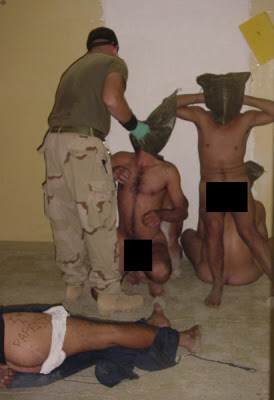
Torture Is a War Crime – When Will We Act?


Top Pentagon Officials Developed Brutal Interrogation Methods at Guantanamo
By Jason Leopold / June 19, 2008

Top Pentagon officials developed the harsh interrogation methods used against detainees at Guantanamo less than a month before the Justice Department issued two now repudiated memorandums that gave interrogators legal cover to employ the tactics, according to documents released Tuesday by the Senate Armed Services Committee.

The documents undercut assertions by President Bush, Vice President Dick Cheney, former Defense Secretary Donald Rumsfeld, and other senior administration officials that the brutal interrogations were the result of “a few bad apples” who acted on their own accord.

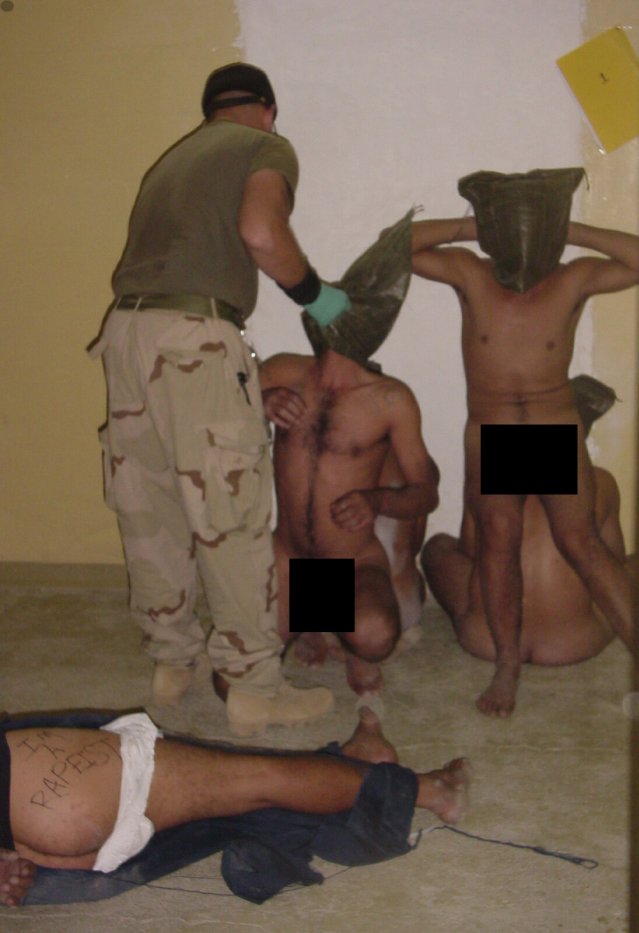
“How did it come about that American military personnel stripped detainees naked, put them in stress positions, used dogs to scare them, put leashes around their necks to humiliate them, hooded them, deprived them of sleep, and blasted music?” said Sen. Carl Levin, the Michigan Democrat who chairs the Armed Services Committee, in an opening statement before the hearing.

“Were these actions the result of ‘a few bad apples’ acting on their own? It would be a lot easier to accept if it were,” Levin added. “But that’s not the case. The truth is that senior officials in the United States government sought information on aggressive techniques, twisted the law to create the appearance of their legality, and authorized their use against detainees. In the process, they damaged our ability to collect intelligence that could save lives.”

Tuesday’s hearing provided the most revealing look yet at the White House’s so-called “enhanced interrogation” program and offers up new details about the time frame in which the policy was drafted.

The hearing comes two weeks after a letter signed by 56 House Democrats was sent to Attorney General Michael Mukasey, requesting that he appoint a special prosecutor to investigate whether White House officials, including President Bush, violated the War Crimes Act when they allowed interrogators to use brutal interrogation methods against detainees suspected of ties to terrorist organizations.

“The Bush administration may have systematically implemented, from the top down, detainee interrogation policies that constitute torture or otherwise violate the law,” the letter to Mukasey says. “We believe that these serious and significant revelations warrant an immediate investigation to determine whether actions taken by the President, his Cabinet, and other Administration officials are in violation of the War Crimes Act, the Anti-Torture Act, and other U.S. and international laws.”

The Armed Services Committee’s 18-month investigation, which generated 38,000 pages of documents, singled out former Secretary of Defense Donald Rumsfeld and William “Jim” Haynes II, the Pentagon’s former general counsel, as the officials who sought guidance on implementing more aggressive interrogation methods.

The committee is expected to release a full report later this year. So far, the probe has found that Rumsfeld and Haynes solicited input from military psychologists in July 2002, far earlier than they had previously acknowledged, about developing harsh methods interrogators could use against detainees held at Guantanamo Bay.

The report states that as early as July 2002, Rumsfeld, Haynes and other officials queried military psychologists about the use of waterboarding, and other brutal methods, interrogators could use against detainees at Guantanamo in order to easily extract information that would otherwise not be gained through more conventional interrogations methods.

Rumsfeld and Haynes’ questions were raised one month before John Yoo, a former deputy in the Justice Department’s Office of Legal Counsel, issued two memos that authorized interrogators to use stress positions, military dogs, and other still unknown methods against suspected terrorists being held at Guantanamo.

Interrogation methods developed in July 2002, a summary of the Armed Services Report says, derived from the Army and Air Force’s Survival, Evasion, Rescue, and Escape (SERE) training program. But those techniques were meant to prepare U.S. soldiers for abuse they might suffer if captured by a brutal regime, not as methods for U.S. interrogations.

The documents contradicted previous statements made by Haynes who told a Senate committee in 2006 that lower-level military personnel were responsible for raising questions with the DOD in October 2002 about the possibility of using more aggressive techniques against detainees.

Richard Shiffrin, Haynes’ former deputy on intelligence issues testified to the committee that in July 2002 Haynes became interested in using the SERE techniques, such as waterboarding and sleep deprivation, as a form of interrogation against detainees, which Rumsfeld signed off on in December 2002.

Haynes was grilled by the committee Tuesday and repeatedly said he could not recall receiving written and oral communications from military attorneys who warned that the methods being implemented at Guantanamo appeared to be illegal.

“We did not operate in a vacuum,” Haynes said in response to questions by Sen. Jack Reed, (D-RI). The secretary of defense made the final decision” on interrogation methods.

Haynes repeated said he “could not recall,” and “I don’t remember” dozens of times in response to specific questions about interrogation methods. Haynes hired a criminal attorney after he resigned from the Pentagon. He is now an executive at Chevron.

In one document, Jonathan Fredman, who was chief counsel to the CIA’s Counterterrorism Center, discussed how interrogators could use the “wet towel” technique, also known as waterboarding, against detainees to extract information.

“It can feel like you’re drowning. The lymphatic system will react as if you’re suffocating, but your body will not cease to function,” Fredman said in October 2002 during a meeting with military officials where specific techniques were discussed, according to a copy of the meeting minutes released by the Armed Services Committee.

Fredman added that the “wet towel” technique would only be defined as torture “if the detainee dies.”

“It is basically subject to perception,” Fredman said, according to the minutes of the meeting. If the detainee dies you’re doing it wrong.”

Fredman’s comment during the October 2002 meeting prompted Lt. Col. Diane Beaver, then the chief military lawyer at Guantanamo, to respond “We will need documentation to protect us.”

Following the October 2002 meeting, Beaver drafted a legal memo that authorized military personnel at Guantanamo to use some of the harshest methods during interrogations at the facility.

Beaver testified Tuesday that she was surprised the Defense Department implemented the interrogation methods contained in her legal opinion.

“I did not expect that my opinion, as a lieutenant colonel in the Army Judge Advocate General’s Corps, would become the final word on interrogation policies and practices within the Department of Defense,” Beaver said. “For me, such a result was simply not foreseeable. Perhaps I was somewhat naïve, but I did not expect to be the only lawyer issuing a written opinion on this monumentally important issue.”

At the same meeting, Beaver discussed hiding detainees from the International Committee of the Red Cross (ICRC). The ICRC visited Guantanamo to ensure interrogators were complying with the Geneva Conventions. Beaver, according to the minutes of the meeting, urged interrogators to “curb the harsher operations while ICRC is around.”

“Officially it is not happening,” Beaver is quoted as saying, according to minutes of an Oct. 2, 2002 meeting between the CIA and military officials. “It is not being reported officially. The ICRC is a serious concern. They will be in and out, scrutinizing our operations, unless they are displeased and decide to protest and leave. This would draw a lot of negative attention.”

Sen. Lindsey Graham, (R-SC), said during Tuesday’s hearing that the revelations about the brutal interrogation methods will” go down in history as some of the most irresponsible and shortsighted legal analysis ever provided to our nation’s military and intelligence community.”

Earlier Reports Scrutinized Rumsfeld

Rumsfeld was first identified as authorizing specific interrogation methods in a Dec. 20, 2005, Army Inspector General report, related to the capture and interrogation of Mohammad al-Qahtani, which included a sworn statement by Lt. Gen. Randall M. Schmidt. It said Secretary Rumsfeld was “personally involved” in the interrogation of al-Qahtani and spoke “weekly” with Maj. Gen. Geoffrey Miller, the commander at Guantanamo, about the status of the interrogations between late 2002 and early 2003.

Gitanjali S. Gutierrez, an attorney with the Center for Constitutional Rights who represents al-Qahtani, said in a sworn declaration that his client, imprisoned at Guantanamo, was subjected to months of torture based on verbal and written authorizations from Rumsfeld.

“At Guantánamo, Mr. al-Qahtani was subjected to a regime of aggressive interrogation techniques, known as the ‘First Special Interrogation Plan,’ that were authorized by U.S. Secretary of Defense Donald Rumsfeld,” Gutierrez said.

“Those techniques were implemented under the supervision and guidance of Secretary Rumsfeld and the commander of Guantánamo, Major General Geoffrey Miller. These methods included, but were not limited to, 48 days of severe sleep deprivation and 20-hour interrogations, forced nudity, sexual humiliation, religious humiliation, physical force, prolonged stress positions and prolonged sensory over-stimulation, and threats with military dogs.”

According to the Schlesinger report, orders signed by Bush and Rumsfeld in 2002 and 2003 authorizing brutal interrogations “became policy” at Guantanamo and Abu Ghraib.

DOJ IG: Rumsfeld Authorized Methods

Last week, the Justice Department’s inspector general, Glenn Fine, gave last week before the Senate Judiciary Committee.

During that hearing, Fine testified that Rumsfeld authorized the use of brutal interrogation techniques despite warnings from the FBI that the methods amounted to inhumane treatment, was possibly illegal, and would not produce reliable intelligence.

“The FBI believed that these techniques were not getting actionable information, that they were unsophisticated and unproductive,” said Glenn Fine, the DOJ’s inspector general, in testimony before the Senate Judiciary Committee. “They raised their concerns with the Department of Defense, but the Department of Defense, from what we were told, dismissed those concerns and that no changes were made in the Department of Defense’s strategy.”

Rumsfeld, who resigned immediately after the 2006-midterm elections, has vehemently denied that he approved of the brutal interrogation methods.

But Fine’s 437-page report last month on the Bush administration’s interrogation policies, concluded that Rumsfeld and other top White House officials ignored FBI concerns about the treatment of detainees and signed off on the interrogations.

In October 2002, Fine said, FBI agents raised concerns with Marion Bowman, the Justice Department’s deputy general counsel in charge of national security, about the methods used during interrogations at Guantanamo Bay. An FBI agent stationed at Guantanamo then sent the agency an analysis on November 27, 2002, calling into question the legality of the interrogation techniques, stating that the methods used appeared to violate the U.S. Torture statute. Bowman then alerted Jim Haynes, the DOD’s general counsel.

The same day Bowman raised concerns with Haynes, Haynes advised Rumsfeld to approve of “enhanced interrogation” methods, according to Sen. Dianne Feinstein, (D-Calif.), who chaired last Tuesday’s committee hearing.

“According to Mr. Bowman, Haynes claimed he didn’t know anything about the coercive interrogation techniques that were occurring at Guantanamo, despite the fact that he recommended on November 27, 2002, that Secretary Rumsfeld formally approve the very techniques that were being used at Guantanamo,” Feinstein said.

On Nov. 23, 2002, four days before the FBI agent alerted the DOJ about interrogation tactics he witnessed, Rumsfeld verbally authorized interrogators to used harsh methods during their interrogation of Mohammed al-Qahtani, the so-called 20th hijacker, who was being held at Guantanamo. The Pentagon initially wanted the death penalty for Al-Qahtani, but dropped war-crimes charges against him last month.

Rumsfeld, Fine told the committee, ignored FBI agents’ warnings and on Dec. 2, 2002, signed an action memorandum approving the use of “enhanced techniques” against prisoners at Guantanamo, concluding that the tactics stopped short of torture.

JAG’s Opposed Methods

In January 2003, Rumsfeld asked Haynes to form a “working group” to draft a report on legally permissible interrogation techniques to use at Guantanamo after the legal memo Beaver drafted in October 2002 was withdrawn.

The members of the group included former Undersecretary of Defense for Policy Douglas Feith, officials from the Defense Intelligence Agency, representatives of the Joint Chiefs of Staff, and judge advocate generals (JAGs) from all four branches of the military.

Early drafts of the report advocated intimidating prisoners with dogs, removing prisoners’ clothing, shaving their beards, slapping prisoners in the face and waterboarding.

Though some of the more extreme techniques were dropped as the list was winnowed down to 24 from 35, the final set of methods still included tactics for isolating and demeaning a detainee, known as “pride and ego down.”

Stress positions were prohibited at Guantanamo under DOD policy beginning in January 2003. However, Fine testified that FBI agents’ “observations confirm that prolonged short-shackling continued at Guantanamo for at least a year after the revised DOD policy took effect.”

“Short-shackling in which a detainee’s hands were shackled close to his feet to prevent him from standing or sitting comfortably, was another of the most frequently reported techniques observed by FBI agents at Guantanamo. This technique was sometimes used in conjunction with holding detainees in rooms where the temperature was very cold or very hot in order to break the detainees’ resolve,” Fine testified last week.

The more extreme interrogation methods that made it into the final draft of the report rankled some of the JAGs, who feared the methods would put U.S. soldiers in danger if they were captured – and would tarnish the reputation and image of the U.S. abroad. “Will the American people find we have missed the forest for the trees by condoning practices that, while technically legal, are inconsistent with our most fundamental values,” wrote Rear Adm. Michael Lohr, a member of the “working group,” wrote in a February 2003 letter to the working group’s chairwoman, Mary Walker, the Air Force general counsel.

“How would such perceptions affect our ability to prosecute the Global War on Terrorism,” asked Lohr.

The admiral was so upset with the draft report and the advice provided by the Justice Department that he requested Walker include a sentence in the final report making it clear that the legal findings were based exclusively on attorneys in the Justice Department’s Office of Legal Counsel.

Lohr was not alone. Maj. Gen. Jack Rives, who at the time was judge advocate general of the Air Force, also wrote a letter to Walker warning that the interrogation techniques in the report would violate military law.

“Several of the exceptional techniques, on their face, amount to violations of domestic criminal law and the [Uniform Code of Military Justice],” Rives wrote. “Treating detainees inconsistently with the [Geneva] Convention arguably ‘lowers the bar’ for the treatment of U.S. POW’s in future conflicts.”

Maj. Gen. Thomas Romig, an Army JAG, and Brig. Gen. Kevin M. Sandkuhler, a Marine Corps JAG, also voiced concerns, specifically the determination that the President has the power to override the Uniform Code of Military Justice and other federal statutes and international treaties in the name of national security.

Despite the grave concerns by the legal officials in the military community, Rumsfeld signed off on the final 81-page working group report on April 2, 2003.
Though some of the more extreme techniques were dropped as the list was winnowed down to 24 from 35, the final set of interrogation methods Rumsfeld approved still included tactics for isolating and demeaning a detainee, known as “pride and ego down.”

“The most commonly reported technique used by non-FBI interrogators on detainees at Guantanamo was sleep deprivation or disruption,” Fine testified last Tuesday. “Sleep adjustment” was explicitly approved for use by the military at Guantanamo under the policy approved by the Secretary of Defense in April 2003. Numerous FBI agents told the OIG that they witnessed the military’s use of a regimen known as the “frequent flyer program” to disrupt detainees’ sleep in an effort to lessen their resistance to questioning and to undermine cell block relationships among detainees.”

Alberto Mora, the former general counsel of the Navy, criticized Rumsfeld’s approval of certain interrogation methods outlined in the December 2002 action memorandum.

“The interrogation techniques approved by the Secretary [of Defense] should not have been authorized because some (but not all) of them, whether applied singly or in combination, could produce effects reaching the level of torture, a degree of mistreatment not otherwise proscribed by the memo because it did not articulate any bright-line standard for prohibited detainee treatment, a necessary element in any such document,” Mora wrote in a 14-page letter to the Navy’s inspector general.

Mora, who was a member of the working group, testified Tuesday that the “policy decision to use so-called ‘harsh’ interrogation techniques during the war on terror was a mistake of massive proportions.”

Mora also took issue with the use of the words “harsh” and “enhanced” to describe interrogations that he believed amounted to torture and a “policy of cruelty.”

“The choice of the adjectives “harsh” or “enhanced” to describe these interrogation techniques is euphemistic and misleading,” Mora said in an opening statement. “The more precise legal term is “cruel.” Many of the “counter-resistance techniques” authorized for use at Guantanamo in December 2002 constitute “cruel, inhuman, or degrading” treatment that could, depending on their application, easily cross the threshold of torture.

Source / Z-Net

The Rag Blog

Posted in RagBlog | Tagged , , , | Leave a comment

Twist and Shout…

Daryl Cagle
.
The Rag Blog / Posted June 19, 2008

Posted in RagBlog | Tagged , , , | Leave a comment

"The Whole World is Watching…."


Waiting For Obama: The First Global Election
By Derek Shearer / June 18, 2008

Nothing could be more accurate today than the political chant from Chicago in 1968: “The Whole World is Watching.” The level of interest in the upcoming U.S. presidential contest is incredibly high, greater than at any time in post-Cold War history. This is due to the rapid decline of America’s reputation abroad during the Bush administration and to the hope that Democratic candidate Senator Barack Obama will restore America’s image not with public relations, but with new internationalist policies.

In the past month, I have seen this phenomenon first hand. I have traveled to Syria, Peru and Bolivia as a speaker in the State Department’s public diplomacy program. In each country, I heard from US embassy staff about how a record number of foreign journalists have requested travel to the US to cover the elections. I met with some of these reporters during my trips. I also encountered the same interest among students who attended my university lectures — and of course, business and government leaders wanted to know in detail what an Obama presidency might mean.

In Syria, for example, students at the elite public policy school at Damascus University were fascinated to learn that Obama’s middle name is Hussein, and that his mother’s second husband was a Muslim who took young Barack to live for years in Indonesia. These young Syrians seemed amazed that the United States which many in the region see as the Great Satan would actually nominate such a person to be president — and the thought that he might be the next president of the US was almost beyond belief. Of course, I got the not unexpected questions about whether Obama too would would be under the thumb of the Jewish lobby — but overall, a sense of hope and optimism seemed to prevail. Almost every Syrian whom I met felt that Obama might bring a new beginning to US-Syrian relations, and perhaps usher in a genuine and wider Middle East peace.

In Peru and Bolivia, students not surprisingly were focused on their own region. They wanted to know if Obama would pay greater attention to Latin America — perhaps rekindling the spirit of JFK and the Alliance for Progress. Government officials asked tougher questions about Obama and the Democratic Party’s commitment to the global trading system, and whether US special interests might force Obama to close US markets to foreign goods. They also wanted to know what a President Obama might do about about drugs in Latin America, and about the danger that some states, perhaps even Bolivia, might come to be dominated by narco politics and anti-democratic groups. Of course, they were curious about Obama’s offer to meet with Venezuela’s populist leader Hugo Chavez, and about how US-Cuban relations might change under Obama.

As a Democrat and former US ambassador, I made it clear that I did not speak for the Obama campaign (I supported Senator Clinton in the primary), but that I knew and respected him, that he had studied at Occidental College where I hold a chair in diplomacy, and that many of my friends serve on his foreign policy team. I told audiences that my students at Occidental, inspired by Obama’s success, recently completed a memo for the next president entitled Rebranding America (available online at: www.oxyworldwide.com) and that copies were sent to Obama and his team, as well as to McCain and his. Many students seemed intrigued about how they could “rebrand” their own nations.

In every talk and interview abroad, I made these basic points:

* There are significant differences between Senator McCain and Senator Obama on the two most important issues of the campaign: the economy and the war in Iraq. In the past two decades, US foreign policy has become highly partisan and emotionally charged — politics no longer stops at the water’s edge as it largely did during the Cold War — and it will matter a great deal, depending on which candidate is elected. If Obama becomes president, he will first focus on responsibly removing American troops from Iraq — one of his key campaign promises and a signature commitment of his political career. He will also have to manage and ameliorate the economic distress of the American people. On both these key issues, Obama and McCain are light years apart.

* The world beyond Iraq will not (and cannot) be ignored. Obama will be able to multi-task because he will have a reservoir of talent on call. All of his foreign policy advisors — notably Anthony Lake, Susan Rice, and Greg Craig — are experienced hands from the Bill Clinton administration. As I told foreign audiences and journalists, one of the secrets of the campaign is that all of Obama’s people are Clinton people — and this is a good thing. Under the leadership of Tony Lake, the Obama campaign has a assembled a top notch group of professionals. On the Middle East, there are pros such as Dennis Ross, Martin Indyk, and Robert Malley, among others, to call on. They are among our most experienced negotiators.

On Latin America, there are not only the usual advisors from the Council on Foreign Relations, but also younger scholars such as Russell Crandall from Davidson College, a leading expert on drug wars in the region. As President, Obama would have an impressive stable of very senior officials whose services he can engage. For Secretary of State or Secretary of Defense, think Senators Biden, Kerry, Dodd or Mitchell, and former General Wesley Clark. Think former President Bill Clinton as special envoy to the Middle East (perhaps in tandem with former British PM Tony Blair). Think Nobel Prize winner Al Gore as special envoy to renewed global warming talks. Think former Senator Sam Nunn as special emissary to Putin’s Russia, or former Centcom commander Admiral William Fallon as special emissary to Iran. And still on the bench to be deployed would be Richard Holbrooke, Madeleine Albright, and Strobe Talbott. The point is that President Obama would have a wealth of talented and experienced Americans at his disposal — an arsenal of “smart power”, the envy of any nation and any leader.

* Globalization is not Americanization — but it does require American leadership to work more fairly and effectively. Democrats are not economic nationalists or isolationists — but they understand that a sustainable globalization requires activist government inside each nation, as well as greater international cooperation. In my lectures at foreign business schools, I started off by explaining the good news and the bad news. The good news is that contrary to the beliefs of some anti-American voices, there is no American Ruling Class Committee in charge of pushing globalization on an unwilling world. The bad news, of course, is that no one is in charge of the global economy. We still live inside national borders, but the post-Cold War economy is global and is not constrained by international borders, nor are the environmental and social consequences.

This is the central political problem of our age. It is vital for the US to lead, but not dominate in making globalization more equitable and more environmentally friendly — both within our borders and for the entire world. Senator Obama seems to understand this challenge, although his economic advisors are less diverse than I would expect. He has some talented younger economists such as Austan Goolsbee from the University of Chicago, and he has brought in the predictable Clinton pros like Robert Rubin and Larry Summers. He still needs to reach out to other international economists who combine progressive views with practical experience — experts such as Sebastian Edwards at UCLA, Martin Carnoy at Stanford, Dani Rodik at Harvard. Manuel Pastor at USC, and Jamie Galbraith at Texas. I also tell foreign business students and foreign business leaders that it is not simply a matter of waiting for Obama to come to power. They can start working for better economic and social policies in their own countries, and arguing for new regional initiatives in the Middle East and Latin America. If Obama comes to power, they will be ready with home grown initiatives to present to him and his team.

I have no idea if my public diplomacy — I also spoke last year in Kazakhstan, Chile and New Zealand, and I go to Australia his fall — is having much impact, but my message is always clear and simple: I come in peace and bring fraternal greetings from progressive Americans. Barack Obama seems to embody this message, and to carry with him in the upcoming presidential contest the hopes not only of Americans, but of citizens in almost every country of the world. It is a heavy responsibility, and not to be taken lightly. If Obama can prevail, and can govern with strength, compassion and political wisdom, then he might turn out to be the first truly global president.

The whole world will be watching.

Source. / The Huffington Post

The Rag Blog

Posted in RagBlog | Tagged , , , , | Leave a comment

Taguba : Bush Ordered Systematic Regime of Torture

U.S. Army Maj. Gen. Antonio Taguba, now retired, author of an Army internal report on abuses at the Abu Ghraib prison near Baghdad, reacts as he testifies during a hearing before the Senate Armed Services Committee on Capitol Hill May 11, 2004 in Washington, DC. A Red Cross report claimed that as many as 90 percent of Iraqi prisoners were arrested by mistake. Photo by Alex Wong/Getty Images.

General who probed Abu Ghraib says
Bush officials committed war crimes

By Warren P. Strobel / June 19, 2008

WASHINGTON — The Army general who led the investigation into prisoner abuse at Iraq’s Abu Ghraib prison accused the Bush administration Wednesday of committing “war crimes” and called for those responsible to be held to account.

The remarks by Maj. Gen. Antonio Taguba, who’s now retired, came in a new report that found that U.S. personnel tortured and abused detainees in Iraq, Afghanistan and Guantanamo Bay, Cuba, using beatings, electrical shocks, sexual humiliation and other cruel practices.

“After years of disclosures by government investigations, media accounts and reports from human rights organizations, there is no longer any doubt as to whether the current administration has committed war crimes,” Taguba wrote. “The only question that remains to be answered is whether those who ordered the use of torture will be held to account.”

Taguba, whose 2004 investigation documented chilling abuses at Abu Ghraib, is thought to be the most senior official to have accused the administration of war crimes. “The commander in chief and those under him authorized a systematic regime of torture,” he wrote.

A White House spokeswoman, Kate Starr, had no comment.

Taguba didn’t respond to a request for further comment relayed via a spokesman.

The group Physicians for Human Rights, which compiled the new report, described it as the most in-depth medical and psychological examination of former detainees to date.

Doctors and mental health experts examined 11 detainees held for long periods in the prison system that President Bush established after the 9-11 terrorist attacks. All of them eventually were released without charges.

The doctors and experts determined that the men had been subject to cruelties that ranged from isolation, sleep deprivation and hooding to electric shocks, beating and, in one case, being forced to drink urine.

Bush has said repeatedly that the United States doesn’t condone torture.

“All credible allegations of abuse are thoroughly investigated and, if substantiated, those responsible are held accountable,” said Navy Cmdr. J.D. Gordon, a Pentagon spokesman. The Defense Department responds to concerns raised by the International Committee for the Red Cross, he said, which has access to detainees under military control.

“It adds little to the public discourse to draw sweeping conclusions based upon dubious allegations regarding remote medical assessments of former detainees, now far removed from detention,” Gordon said.

The physicians’ group said that its experts, who had experience studying torture’s effects, spent two days with each former captive and conducted intensive exams and interviews. They administered tests to detect exaggeration. In two of the 11 cases, the group was able to review medical records.

The report, “Broken Laws, Broken Lives,” concurs with a five-part McClatchy investigation of Guantanamo published this week. Among its findings were that abuses occurred — primarily at prisons in Afghanistan where detainees were held en route to Guantanamo — and that many of the prisoners were wrongly detained.

Also this week, a probe by the Senate Armed Services Committee revealed how senior Pentagon officials pushed for harsher interrogation methods over the objections of top military lawyers. Those methods later surfaced in Afghanistan and Iraq.

Former Defense Secretary Donald H. Rumsfeld didn’t specifically approve of the worst abuses, but neither he nor the White House enforced strict limits on how detainees would be treated.

There was no “bright line of abuse which could not be transgressed,” former Navy general counsel Alberto Mora told the Senate committee.

Leonard Rubenstein, the president of Physicians for Human Rights, said there was a direct connection between the Pentagon decisions and the abuses his group uncovered. “The result was a horrific stew of pain, degradation and … suffering,” he said.

Detainee abuse has been documented previously, in photos from Abu Ghraib, accounts by former detainees and their lawyers and a confidential report by the International Committee for the Red Cross that was leaked to the U.S. news media.

Of the 11 men evaluated in the Physicians for Human Rights report, four were detained in Afghanistan between late 2001 and early 2003, and later sent to Guantanamo. The remaining seven were detained in Iraq in 2003.

One of the Iraqis, identified by the pseudonym Laith, was arrested with his family at his Baghdad home in the early morning of Oct. 19, 2003. He was taken to a location where he was beaten, stripped to his underwear and threatened with execution, the report says.

“Laith” told the examiners he was then taken to a second site, where he was photographed in humiliating positions and given electric shocks to his genitals.

Finally, he was taken to Abu Ghraib, where he spent the first 35 to 40 days in isolation in a small cage, enduring being suspended in the cage and other “stress positions.”

He was released on June 24, 2004, without charge.

The Physicians for Human Rights report.

McClatchy’s investigation of Guantanamo Bay detainees.

Source. / McClatchy

The Great Torture Scandal

By Juan Cole / June 19, 2008

McClatchy and other reporters are abruptly pulling the curtain away from the Bush team’s illegal practices in arresting people arbitrarily, declining to offer proof that they were guilty of anything, detaining them indefinitely without trial or charges, and deliberately torturing them to the extent of leaving long-term scars and disabilities. The torture practices originated not with lower-level officers but with Donald Rumsfeld and others in Bush’s inner circle, who then later blamed lower-level officials for developing the ideas that Rumsfeld ordered them to develop. Nothing they have done has survived a court challenge where one has been permitted.

Go to Informed Comment for links to related material.The Rag Blog

Posted in RagBlog | Tagged , , , , , , , | Leave a comment

Hot Shots and Classic Takes

Photo by Bob Simmons / The Rag Blog

The Rag Blog / Posted June 19, 2008

Posted in Rag Bloggers | Tagged , , , | Leave a comment

Blackwater Plane Crash Defense : Use Islamic Law

On Nov. 27, 2004, a Presidential Airlines flight, known as “Blackwater Flight 61 crashed into a mountain in Afghanistan, killing all six on board: three crew members and three U.S. soldiers. The families of the soldiers have sued the contractor. Photo: National Transportation Safety Board

Want “Blackwater 61” lawsuit
determined by religious doctrine

by Joseph Neff and Jay Price / June 19, 2008

RALEIGH – To defend itself against a lawsuit by the widows of three American soldiers who died on one of its planes in Afghanistan, a sister company of the private military firm Blackwater has asked a federal court to decide the case using Islamic law, known as Shari’a.

The lawsuit “is governed by the law of Afghanistan,” Presidential Airways argued in a Florida federal court. “Afghan law is largely religion-based and evidences a strong concern for ensuring moral responsibility, and deterring violations of obligations within its borders.”

If the judge agrees, it would essentially end the lawsuit over a botched flight supporting the U.S. military. Shari’a law does not hold a company responsible for the actions of employees performed within the course of their work.

Erik Prince, who owns Blackwater and Presidential Airways, briefly discussed the lawsuit in a meeting Wednesday with editors and reporters at The News & Observer. Prince was asked to justify having a case involving an American company working for the U.S. government decided by Afghan law.

“Where did the crash occur?” Prince said. “Afghanistan.”

Joseph Schmitz, Prince’s general counsel, said Presidential Airways was asking the federal judge to follow past U.S. cases where courts have applied another country’s laws to resolve damages that occurred overseas.

The crash of Blackwater Flight 61 occurred in the rugged mountains of central Afghanistan in 2004, killing three soldiers and the three-man crew.

The widows of the soldiers sued Presidential Airways, Blackwater’s sister company, which was under contract with the U.S. military to fly cargo and personnel around Afghanistan.

Presidential Airways argued that the lawsuit must be dismissed; legal doctrine holds that soldiers cannot sue the government, and the company was acting as an agent of the government.

Last year, a series of federal judges dismissed that argument.

In April, Presidential asked a federal judge in Florida to dismiss the lawsuit because the case is controlled by Afghanistan’s Islamic law. If the judge agrees that Afghan law applies, the lawsuit would be dismissed. The company also plans to ask a judge to dismiss the lawsuit on the constitutional grounds that a court should not interfere in military decision-making.

The National Transportation Safety Board has blamed the crash on Presidential for its “failure to require its flight crews to file and fly a defined route” and for not providing oversight to make sure its crews followed company policies and Pentagon and federal aviation safety regulations.

Source. / newsobserver.com

Speaking of Blackwater: Jeremy Scahill: Blackwater is Still in Charge, Deadly, Above the Law and Out of Control / AlterNet / June 19, 2008

Thanks to Ted Samsel / The Rag Blog

Posted in RagBlog | Tagged , , , , , | Leave a comment

Jim Hightower : Help Russ Feingold Reform the Patriot Act


Rewriting Some Patriot Act Stupidity
By Jim Hightower / June 19, 2008

Empirical evidence notwithstanding, stupidity is not a requirement for membership in the U.S. Congress. Also, stupid acts by Congress do not have to be forever.

Witness the infamous, freedom-busting, Orwellian piece of legislative stupidity known as the Patriot Act. Passed by a panicked Congress right after 9/11, and reauthorized by a cowed Congress in 2006, this thing empowers the FBI to make wholesale, secrete invasions of the American people’s privacy – grossly violating one of our country’s core values.

As we’ve learned from investigative reports by the bureau’s own inspector general, concerns about intrusive and abusive actions by a bulked up FBI were not theoretical. This national police agency has been found guilty of “widespread and serious misuse” of the Patriot Act’s most invasive provisions. For example, the act opened up our private records to government agents, enabling them to write their own authorizations for poking into our personal business without having to show any reasonable cause for spying on us. Hundreds of cases of the FBI sweeping up information it has no authority to collect have now been documented.

Did no one foresee the stupidity of granting such broad unchecked power? Yes. Sen. Russ Feingold did, and he cast the one, courageous vote against the Patriot Act in 2001. Now Feingold is back with S. 2088, a bill to rein in the FBI and restore the people’s Constitutional rights. As he puts it, we’ve learned the hard way that “trust us” doesn’t cut it when it comes to preventing government snoops from abusing their power.

Congress has the responsibility to put appropriate restraints on government authorities, and that’s what Feingold’s “National Security Reform Act” does. To help put some real patriotism in the misnamed and misguided Patriot Act, contact Feingold’s office 202-224-5323.

“Powering Down the Patriot Act,” / Mother Jones / April 29, 2008.

“S. 2088 – National Security Reform Act of 2007,” / Sen. Russ Feingold / Bill of Rights Defense Committee.

Source. / Jim Hightower

The Rag Blog

Posted in RagBlog | Tagged , | Leave a comment

Chafed Texan in the Naked City : Too Many Boobs!

Boobs at Dupont Circle, Washington, D.C.

Says he’ll videotape the evidence
By Amy Argetsinger and Roxanne Roberts / June 16, 2008

Washington is a town filled with boobs.

They’re everywhere, from the bare-breasted ladies who decorate the fountain at Dupont Circle to the peekaboo statue in the Justice Department’s Great Hall to the countless nudes in our museums. But while those of us who live here hardly blink at the public nudity, it can shock some of our visitors. Such was the case for Robert Hurt, who last week tried to add the issue of artistic indecency in the nation’s capital to the platform of the Texas GOP.

“You don’t have nude art on your front porch,” the Dallas Morning News quoted the delegate as telling the platform committee at the state party convention. “So why is it important to have that in the common places of Washington, D.C.?”

Hurt, 54, a Kerrville, Tex., rancher and father of 14, told us in a phone interview he first came to Washington a decade ago for a gathering of the evangelical Promise Keepers on the Mall. “It was probably not much different than ‘The Beverly Hillbillies’ going to Beverly Hills,” he joked. At the National Gallery, he was appalled to see statues of unclothed people. “I found it very inappropriate,” he said. Returning a few years later, he discovered Arlington Memorial Bridge, flanked by the bare-chested figures of Valor and Sacrifice.

“The Lady Godiva thing — that’s what it conjured up, and that’s not what our country’s about,” he said.

Hurt notified his elected officials of his concerns but believes nothing was done. While he said he respects free speech, “I believe art affects a country indirectly. I have been studying the decline of morals in this country. It’s sending the wrong message to children that nudity is fine, that nakedness is fine. . . . There are degrees of vulgarity, and it opens up the door for the other stuff.”

The platform committee did not adopt Hurt’s recommendation on Washington nudity (nor his proposal to extend the 22nd Amendment — presidential term limits — to spouses). But Hurt said he’ll pursue the issue, possibly with another trip here to videotape the evidence. “I’m not going to stop until I succeed. I’m prepared for a long fight.”

Source. / washingtonpost.com

Thanks to Carol Petrucci / The Rag Blog

Posted in RagBlog | Tagged , , , , , | 2 Comments

Will He Thank God For this Honor?

George Carlin will be awarded the Mark Twain Prize for American Humor, the John F. Kennedy Center for the Performing Arts said Tuesday. Carlin, 71, will be the 11th recipient of the award, which will be presented Nov. 10, a tribute performance that will be televised by PBS. Kennedy Center Chairman Stephen Schwarzman said Carlin makes people laugh and makes them think. Past recipients of the prize include Billy Crystal, Whoopi Goldberg, Steve Martin and Neil Simon.

George Carlin – Religion is bullshit.

The Rag Blog / June 18, 2008

Posted in RagBlog | Tagged , , , , , | Leave a comment

Insisting on the Pursuit of Justice

Lawrence Velvel

Law School to Plan Bush War Crimes Prosecution
June 17, 2008

A conference to plan the prosecution of President Bush and other high administration officials for war crimes will be held September 13-14 at the Massachusetts School of Law at Andover .

“This is not intended to be a mere discussion of violations of law that have occurred,” said convener Lawrence Velvel, dean and cofounder of the school. “It is, rather, intended to be a planning conference at which plans will be laid and necessary organizational structures set up, to pursue the guilty as long as necessary and, if need be, to the ends of the Earth.”

“We must try to hold Bush administration leaders accountable in courts of justice,” Velvel said. “And we must insist on appropriate punishments, including, if guilt is found, the hangings visited upon top German and Japanese war-criminals in the 1940s.”

Velvel said past practice has been to allow U.S. officials responsible for war crimes in Viet Nam and elsewhere to enjoy immunity from prosecution upon leaving office. “President Johnson retired to his Texas ranch and his Defense Secretary Robert McNamara was named to head the World Bank; Richard Nixon retired to San Clemente and his Secretary of State Henry Kissinger was allowed to grow richer and richer,” Velvel said.

He noted in the years since the prosecution and punishment of German and Japanese leaders after World War Two those nation’s leaders changed their countries’ aggressor cultures. One cannot discount contributory cause and effect here, he said.

“For Bush, Richard Cheney, Donald Rumsfeld, and John Yoo to spend years in jail or go to the gallows for their crimes would be a powerful lesson to future American leaders,” Velvel said.

The conference will take up such issues as the nature of domestic and international crimes committed; which high-level Bush officials, including Federal judges and Members of Congress, are chargeable with war crimes; which foreign and domestic tribunals can be used to prosecute them; and the setting up of an umbrella coordinating committee with representatives of legal groups concerned about the war crimes such as the Center for Constitutional Rights, ACLU, National Lawyers Guild, among others.

The Massachusetts School of Law at Andover was established in 1988 to provide an affordable, quality legal education to minorities, immigrants and students from low-income households that might otherwise be denied the opportunity to obtain a legal education and practice law. Its founder, Dean Velvel, has been honored by the National Law Journal and cited in various publications for his contributions to the reform of legal education.

Further information Jeff Demers at demers@msl.edu 978) 681-0800; or Sherwood Ross, media consultant to MSL, at sherwoodr1@yahoo.com.

Source / Information Clearing House

The Rag Blog

Posted in RagBlog | Tagged , , | Leave a comment

And They’re Off and Running…

But, of course, racism and hatred and vicious lies won’t play a major role in this election. We’re beyond all that, right?

Well, just read the next four articles for a taste of what we’re facing in this election campaign.

Thorne Dreyer / The Rag Blog

Posted in RagBlog | Tagged , , , | Leave a comment

At Texas Republican Convention…


Vendor who sold racist Obama pin:
Just meant to be funny

By Christy Hoppe / June 18, 2008

AUSTIN – The vendor who sold a racist pin at the Texas Republican Party convention last weekend in Houston apologized today and said he had no intention of creating the firestorm that has ensued.

“It’s just been crazy,” said Jonathan Alcox, who runs republicanmarket.com and had buttons and other items for sale at the GOP gathering. “The point is we made a mistake. I realize that now. And I apologize.”

The Republican Party of Texas announced today that it will donate to charity the $1,500 it received for leasing the booth to Mr. Alcox. The offending pin stated: “If Obama is president…Will we still call it the White House?”

The Dallas Morning News wrote about the pin being sold Saturday on its Trail Blazers blog and posted a picture of the pin. The story drew attention from several national news sites and blogs Tuesday and caused a firestorm of reaction, particularly at Texas GOP headquarters.

In a telephone interview from Florida, Mr. Alcox acknowledged the controversy but said it was unintentional.

“Obviously, it’s been offensive to people. It was not meant to be that way. We’re into humor – not racism,” Mr. Alcox said.

He said that he is neither Republican nor Democrat and that “there’s no agenda here.” He also runs a site offering Democratic merchandise, democratmall.com, and sells at Democratic gatherings.

He said after the blog post, his Web site was hacked, he was threatened, and the Texas Republican Party – his biggest customer — said it would never use his services again. He received so many abusive calls that he had to disconnect his phone. It’s the strongest reaction he’s gotten in 17 years in the business, he said.

Mr. Alcox said he made 12 of the pins after seeing a comic strip where Barack Obama was standing in front of a sign saying “The White House,” with the building behind him. Mr. Obama is depicted thinking, “That’s the first thing we’ll change.”

“We just changed it around a little bit and everyone went crazy. I was shocked,” Mr. Alcox said.

He said after having a conversation with a black man who called him about the blog post, he came to understand more about the nerve he had hit.

He said the Houston convention was the first time he had offered the pins, and he intended to see how they sold before putting them up on his Web site. He sold four pins – two of them to a reporter from The News.

Texas GOP spokesman Hans Klingler said the state party is sending a letter saying in “very strong terms” that Mr. Alcox need not apply to sell items at any further state GOP events.

He said that the party, while approving the lease to the vendor, was unaware of offensive merchandise being sold there.

The GOP plans to donate the money to the American Red Cross Disaster Relief Fund to help flood victims in the Midwest.

Mr. Klingler said he and party leaders believe the pin is distasteful and they hated that it was being sold at their event, which he said was upbeat and dedicated to unity.

Source. / Dallas Morning News

First of all, that’s a lie there in the body of the story–the party certainly does vet vendor merchandise. How would I know? We’ve tried to be a vendor at the GOP convention–just for the hell of it–three times, and three times we’ve failed in the hunt. They told us they would have to see samples of all merchandise sold and then they would check it against a manifest when we moved into the hall. Obviously, with merchandise that says “End the war in Iraq” and “Army Wrong”–we’re not going to get in any time soon.

And oh, yes, I am writing the reporter to tell her the “real story.”

Alyssa Burgin / The Rag Blog

Thanks to Leslie Cunningham / The Rag Blog

Posted in RagBlog | Tagged , , , , | Leave a comment