Resolved that George W. Bush be impeached…

Congressman Dennis Kucinich of Ohio. Photo/Charlie Neibergall / AP.

Dennis Kucinich’s 35 Articles of Impeachment Against George W. Bush

On June 9, 2008, Rep. Dennis Kucinich, (D.,Ohio) made a remarkable presentation before the Congress of the United States calling for the impeachment of George W. Bush. Below are Kucinich’s 35 articles of impeachment, followed by the full text of Article I. In the ensuing days, The Rag Blog will present further texts from Kucinich’s impeachment resolution.

These articles of impeachment were introduced in the U.S. House of Representatives by Congressman Dennis Kucinich on June 9, 2008, as H. Res. 1258

Dennis J. Kucinich of Ohio
In the United States House of Representatives
Monday, June 9th, 2008
A Resolution

Resolved, that President George W. Bush be impeached for high crimes and misdemeanors, and that the following articles of impeachment be exhibited to the United States Senate:

Articles of impeachment exhibited by the House of Representatives of the United States of America in the name of itself and of the people of the United States of America, in maintenance and support of its impeachment against President George W. Bush for high crimes and misdemeanors.

In his conduct while President of the United States, George W. Bush, in violation of his constitutional oath to faithfully execute the office of President of the United States and, to the best of his ability, preserve, protect, and defend the Constitution of the United States, and in violation of his constitutional duty to take care that the laws be faithfully executed, has committed the following abuses of power.

Article I
Creating a Secret Propaganda Campaign to Manufacture a False Case for War Against Iraq.

Article II
Falsely, Systematically, and with Criminal Intent Conflating the Attacks of September 11, 2001, With Misrepresentation of Iraq as a Security Threat as Part of Fraudulent Justification for a War of Aggression.

Article III
Misleading the American People and Members of Congress to Believe Iraq Possessed Weapons of Mass Destruction, to Manufacture a False Case for War.

Article IV
Misleading the American People and Members of Congress to Believe Iraq Posed an Imminent Threat to the United States.

Article V
Illegally Misspending Funds to Secretly Begin a War of Aggression.

Article VI
Invading Iraq in Violation of the Requirements of HJRes114.

Article VII
Invading Iraq Absent a Declaration of War.

Article VIII
Invading Iraq, A Sovereign Nation, in Violation of the UN Charter.

Article IX
Failing to Provide Troops With Body Armor and Vehicle Armor.

Article X
Falsifying Accounts of US Troop Deaths and Injuries for Political Purposes.

Article XI
Establishment of Permanent U.S. Military Bases in Iraq.

Article XII
Initiating a War Against Iraq for Control of That Nation’s Natural Resources.

Article XIIII
Creating a Secret Task Force to Develop Energy and Military Policies With Respect to Iraq and Other Countries.

Article XIV
Misprision of a Felony, Misuse and Exposure of Classified Information And Obstruction of Justice in the Matter of Valerie Plame Wilson, Clandestine Agent of the Central Intelligence Agency.

Article XV
Providing Immunity from Prosecution for Criminal Contractors in Iraq.

Article XVI
Reckless Misspending and Waste of U.S. Tax Dollars in Connection With Iraq and US Contractors.

Article XVII
Illegal Detention: Detaining Indefinitely And Without Charge Persons Both U.S. Citizens and Foreign Captives.

Article XVIII
Torture: Secretly Authorizing, and Encouraging the Use of Torture Against Captives in Afghanistan, Iraq, and Other Places, as a Matter of Official Policy.

Article XIX
Rendition: Kidnapping People and Taking Them Against Their Will to “Black Sites” Located in Other Nations, Including Nations Known to Practice Torture.

Article XX
Imprisoning Children.

Article XXI
Misleading Congress and the American People About Threats from Iran, and Supporting Terrorist Organizations Within Iran, With the Goal of Overthrowing the Iranian Government.

Article XXII
Creating Secret Laws.

Article XXIII
Violation of the Posse Comitatus Act.

Article XXIV
Spying on American Citizens, Without a Court-Ordered Warrant, in Violation of the Law and the Fourth Amendment.

Article XXV
Directing Telecommunications Companies to Create an Illegal and Unconstitutional Database of the Private Telephone Numbers and Emails of American Citizens.

Article XXVI
Announcing the Intent to Violate Laws with Signing Statements.

Article XXVII
Failing to Comply with Congressional Subpoenas and Instructing Former Employees Not to Comply.

Article XXVIII
Tampering with Free and Fair Elections, Corruption of the Administration of Justice.

Article XXIX
Conspiracy to Violate the Voting Rights Act of 1965.

Article XXX
Misleading Congress and the American People in an Attempt to Destroy Medicare.

Article XXXI
Katrina: Failure to Plan for the Predicted Disaster of Hurricane Katrina, Failure to Respond to a Civil Emergency.

Article XXXII
Misleading Congress and the American People, Systematically Undermining Efforts to Address Global Climate Change.

Article XXXIII
Repeatedly Ignored and Failed to Respond to High Level Intelligence Warnings of Planned Terrorist Attacks in the US, Prior to 911.

Article XXXIV
Obstruction of the Investigation into the Attacks of September 11, 2001.

Article XXXV
Endangering the Health of 911 First Responders.

Bush Article of Impeachment I

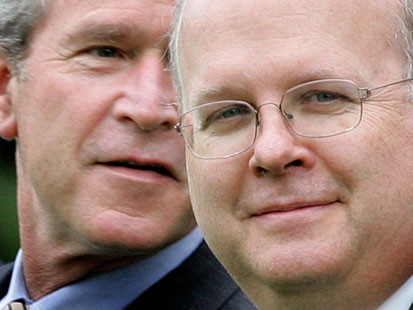
George W. Bush and Karl Rove.

ARTICLE I
CREATING A SECRET PROPAGANDA CAMPAIGN TO MANUFACTURE A FALSE CASE FOR WAR AGAINST IRAQ

In his conduct while President of the United States, George W. Bush, in violation of his constitutional oath to faithfully execute the office of President of the United States and, to the best of his ability, preserve, protect, and defend the Constitution of the United States, and in violation of his constitutional duty under Article II, Section 3 of the Constitution “to take care that the laws be faithfully executed”, has both personally and acting through his agents and subordinates, together with the Vice President, illegally spent public dollars on a secret propaganda program to manufacture a false cause for war against Iraq.

The Department of Defense (DOD) has engaged in a years-long secret domestic propaganda campaign to promote the invasion and occupation of Iraq. This secret program was defended by the White House Press Secretary following its exposure. This program follows the pattern of crimes detailed in Article I, II, IV and VIII.. The mission of this program placed it within the field controlled by the White House Iraq Group (WHIG), a White House task-force formed in August 2002 to market an invasion of Iraq to the American people. The group included Karl Rove, I. Lewis Libby, Condoleezza Rice, Karen Hughes, Mary Matalin, Stephen Hadley, Nicholas E. Calio, and James R. Wilkinson.

The WHIG produced white papers detailing so-called intelligence of Iraq’s nuclear threat that later proved to be false. This supposed intelligence included the claim that Iraq had sought uranium from Niger as well as the claim that the high strength aluminum tubes Iraq purchased from China were to be used for the sole purpose of building centrifuges to enrich uranium. Unlike the National Intelligence Estimate of 2002, the WHIG’s white papers provided “gripping images and stories” and used “literary license” with intelligence. The WHIG’s white papers were written at the same time and by the same people as speeches and talking points prepared for President Bush and some of his top officials.

The WHIG also organized a media blitz in which, between September 7-8, 2002, President Bush and his top advisers appeared on numerous interviews and all provided similarly gripping images about the possibility of nuclear attack by Iraq. The timing was no coincidence, as Andrew Card explained in an interview regarding waiting until after Labor Day to try to sell the American people on military action against Iraq, “From a marketing point of view, you don’t introduce new products in August.”

September 7-8, 2002:

NBC’s “Meet the Press: Vice President Cheney accused Saddam of moving aggressively to develop nuclear weapons over the past 14 months to add to his stockpile of chemical and biological arms.

CNN: Then-National Security Adviser Rice said, regarding the likelihood of Iraq obtaining a nuclear weapon, “We don’t want the smoking gun to be a mushroom cloud.”

CBS: President Bush declared that Saddam was “six months away from developing a weapon,” and cited satellite photos of construction in Iraq where weapons inspectors once visited as evidence that Saddam was trying to develop nuclear arms.

The Pentagon military analyst propaganda program was revealed in an April 20, 2002, New York Times article. The program illegally involved “covert attempts to mold opinion through the undisclosed use of third parties.” Secretary of Defense Donald Rumsfeld recruited 75 retired military officers and gave them talking points to deliver on Fox, CNN, ABC, NBC, CBS, and MSNBC, and according to the New York Times report, which has not been disputed by the Pentagon or the White House, “Participants were instructed not to quote their briefers directly or otherwise describe their contacts with the Pentagon.”

According to the Pentagon’s own internal documents, the military analysts were considered “message force multipliers” or “surrogates” who would deliver administration “themes and messages” to millions of Americans “in the form of their own opinions.” In fact, they did deliver the themes and the messages but did not reveal that the Pentagon had provided them with their talking points. Robert S. Bevelacqua, a retired Green Beret and Fox News military analyst described this as follows: “It was them saying, ‘We need to stick our hands up your back and move your mouth for you.'”

Congress has restricted annual appropriations bills since 1951 with this language: “No part of any appropriation contained in this or any other Act shall be used for publicity or propaganda purposes within the United States not heretofore authorized by the Congress.”

A March 21, 2005, report by the Congressional Research Service states that “publicity or propaganda” is defined by the U.S. Government Accountability Office (GAO) to mean either (1) self-aggrandizement by public officials, (2) purely partisan activity, or (3) “covert propaganda.”

These concerns about “covert propaganda” were also the basis for the GAO’s standard for determining when government-funded video news releases are illegal:

“The failure of an agency to identify itself as the source of a prepackaged news story misleads the viewing public by encouraging the viewing audience to believe that the broadcasting news organization developed the information. The prepackaged news stories are purposefully designed to be indistinguishable from news segments broadcast to the public. When the television viewing public does not know that the stories they watched on television news programs about the government were in fact prepared by the government, the stories are, in this sense, no longer purely factual — the essential fact of attribution is missing.”

The White House’s own Office of Legal Council stated in a memorandum written in 2005 following the controversy over the Armstrong Williams scandal:

“Over the years, GAO has interpreted ‘publicity or propaganda’ restrictions to preclude use of appropriated funds for, among other things, so-called ‘covert propaganda.’ … Consistent with that view, the OLC determined in 1988 that a statutory prohibition on using appropriated funds for ‘publicity or propaganda’ precluded undisclosed agency funding of advocacy by third-party groups. We stated that ‘covert attempts to mold opinion through the undisclosed use of third parties’ would run afoul of restrictions on using appropriated funds for ‘propaganda.'”

Asked about the Pentagon’s propaganda program at White House press briefing in April 2008, White House Press Secretary Dana Perino defended it, not by arguing that it was legal but by suggesting that it “should” be: “Look, I didn’t know look, I think that you guys should take a step back and look at this look, DOD has made a decision, they’ve decided to stop this program. But I would say that one of the things that we try to do in the administration is get information out to a variety of people so that everybody else can call them and ask their opinion about something. And I don’t think that that should be against the law. And I think that it’s absolutely appropriate to provide information to people who are seeking it and are going to be providing their opinions on it. It doesn’t necessarily mean that all of those military analysts ever agreed with the administration. I think you can go back and look and think that a lot of their analysis was pretty tough on the administration. That doesn’t mean that we shouldn’t talk to people.”

In all of these actions and decisions, President George W. Bush has acted in a manner contrary to his trust as President and Commander in Chief, and subversive of constitutional government, to the prejudice of the cause of law and justice and to the manifest injury of the people of the United States. Wherefore, President George W. Bush, by such conduct, is guilty of an impeachable offense warranting removal from office.

Documentation:

David Barstow, Behind TV Analysts: Pentagon’s Hidden Hand, New York Times, April 20, 2008.

Pentagon Pundit Scandal Broke the Law, the Center for Media and Democracy.

Joshua Bolton, Memorandum For Heads of Departments and Agencies: Use of Government funds for Video News Releases, March 11, 2005.

Steven G. Bradbury, Memorandum For The General Counsels of the Executive Branch, March 1, 2005.

Carl Levin’s Letter to Secretary of Defense Robert Gates, April 22, 2008.

Congresswoman Rosa L. DeLauro’s letter to major news outlets asking them to disclose Ethics Standards for Military Analysts, April 24, 2008.

NBC Meet the Press, Interview with Dick Cheney, September 8, 2002.

New York Times, Parts of the Message Machine: Excerpts from Documents, April 19, 2008.

Rep. Paul Hodes, Congressman Hodes Calls for Hearing on Bush Administration Manipulation of Iraq War News Analysts, April 24, 2008.

David Barstow, Two Inquiries Set on Pentagon Publicity Effort, May 24, 2008.

Source. / AfterDowningStreet.org. With links to all the articles in full..

Go here for a PDF chart listing and summarizing the articles, by Elizabeth de la Vega.

Read all of the articles in a PDF.

Also see The Crimes of George W. Bush. / Next Left Notes

And, to pressure Congress to take up the Articles of Impeachment, go to 35 Reasons To Call (202) 225-5126 / CommonDreams

Thanks to CodePink/Austin / The Rag Blog

Posted in RagBlog | Tagged , , , , , , , | Leave a comment

Some Ideological Housecleaning of His Own to Do


Obama’s Chicago Boys
by Naomi Klein / June 12, 2008

Barack Obama waited just three days after Hillary Clinton pulled out of the race to declare, on CNBC, “Look. I am a pro-growth, free-market guy. I love the market.”

Demonstrating that this is no mere spring fling, he has appointed 37-year-old Jason Furman to head his economic policy team. Furman is one of Wal-Mart’s most prominent defenders, anointing the company a “progressive success story.” On the campaign trail, Obama blasted Clinton for sitting on the Wal-Mart board and pledged, “I won’t shop there.” For Furman, however, it’s Wal-Mart’s critics who are the real threat: the “efforts to get Wal-Mart to raise its wages and benefits” are creating “collateral damage” that is “way too enormous and damaging to working people and the economy more broadly for me to sit by idly and sing ‘Kum-Ba-Ya’ in the interests of progressive harmony.”

Obama’s love of markets and his desire for “change” are not inherently incompatible. “The market has gotten out of balance,” he says, and it most certainly has. Many trace this profound imbalance back to the ideas of Milton Friedman, who launched a counterrevolution against the New Deal from his perch at the University of Chicago economics department. And here there are more problems, because Obama–who taught law at the University of Chicago for a decade–is thoroughly embedded in the mind-set known as the Chicago School.

He chose as his chief economic adviser Austan Goolsbee, a University of Chicago economist on the left side of a spectrum that stops at the center-right. Goolsbee, unlike his more Friedmanite colleagues, sees inequality as a problem. His primary solution, however, is more education–a line you can also get from Alan Greenspan. In their hometown, Goolsbee has been eager to link Obama to the Chicago School. “If you look at his platform, at his advisers, at his temperament, the guy’s got a healthy respect for markets,” he told Chicago magazine. “It’s in the ethos of the [University of Chicago], which is something different from saying he is laissez-faire.”

Another of Obama’s Chicago fans is 39-year-old billionaire Kenneth Griffin, CEO of the hedge fund Citadel Investment Group. Griffin, who gave the maximum allowable donation to Obama, is something of a poster boy for an unbalanced economy. He got married at Versailles and had the after-party at Marie Antoinette’s vacation spot (Cirque du Soleil performed)–and he is one of the staunchest opponents of closing the hedge-fund tax loophole. While Obama talks about toughening trade rules with China, Griffin has been bending the few barriers that do exist. Despite sanctions prohibiting the sale of police equipment to China, Citadel has been pouring money into controversial China-based security companies that are putting the local population under unprecedented levels of surveillance.

Now is the time to worry about Obama’s Chicago Boys and their commitment to fending off serious attempts at regulation. It was in the two and a half months between winning the 1992 election and being sworn into office that Bill Clinton did a U-turn on the economy. He had campaigned promising to revise NAFTA, adding labor and environmental provisions and to invest in social programs. But two weeks before his inauguration, he met with then-Goldman Sachs chief Robert Rubin, who convinced him of the urgency of embracing austerity and more liberalization. Rubin told PBS, “President Clinton actually made the decision before he stepped into the Oval Office, during the transition, on what was a dramatic change in economic policy.”

Furman, a leading disciple of Rubin, was chosen to head the Brookings Institution’s Hamilton Project, the think tank Rubin helped found to argue for reforming, rather than abandoning, the free-trade agenda. Add to that Goolsbee’s February meeting with Canadian consulate officials, who left with the distinct impression that they had been instructed not to take Obama’s anti-NAFTA campaigning seriously, and there is every reason for concern about a replay of 1993.

The irony is that there is absolutely no reason for this backsliding. The movement launched by Friedman, introduced by Ronald Reagan and entrenched under Clinton, faces a profound legitimacy crisis around the world. Nowhere is this more evident than at the University of Chicago itself. In mid-May, when university president Robert Zimmer announced the creation of a $200 million Milton Friedman Institute, an economic research center devoted to continuing and augmenting the Friedman legacy, a controversy erupted. More than 100 faculty members signed a letter of protest. “The effects of the neoliberal global order that has been put in place in recent decades, strongly buttressed by the Chicago School of Economics, have by no means been unequivocally positive,” the letter states. “Many would argue that they have been negative for much of the world’s population.”

When Friedman died in 2006, such bold critiques of his legacy were largely absent. The adoring memorials spoke only of grand achievement, with one of the more prominent appreciations appearing in the New York Times–written by Austan Goolsbee. Yet now, just two years later, Friedman’s name is seen as a liability even at his own alma mater. So why has Obama chosen this moment, when all illusions of a consensus have dropped away, to go Chicago retro?

The news is not all bad. Furman claims he will be drawing on the expertise of two Keynesian economists: Jared Bernstein of the Economic Policy Institute and James Galbraith, son of Friedman’s nemesis John Kenneth Galbraith. Our “current economic crisis,” Obama recently said, did not come from nowhere. It is “the logical conclusion of a tired and misguided philosophy that has dominated Washington for far too long.”

True enough. But before Obama can purge Washington of the scourge of Friedmanism, he has some ideological housecleaning of his own to do.

Source / The Nation

The Rag Blog

Posted in RagBlog | Tagged , , | Leave a comment

Ghost of Election Past


Thanks to Harry Edwards / The Rag Blog

Posted in RagBlog | Tagged , , , , | Leave a comment

Iraqi Poetry Now Is About Death and Separation

Mass Marriage: Couples at a reception hosted by a businessman promoting
Iraqi reconciliation. Khalid Mohammed/AP

IRAQ: The Love Stories Are Gone
By Ali al-Fadhily* / June 14, 2008

BAGHDAD — As statistics go, at least 655,000 Iraqis have died as a result of the occupation, now in its fifth year. Every one of them has left behind once loved ones to mourn the loss and to think of what might have been.

This is the land of the Arabian Nights, and of love stories that became fables far and wide. In these stories, in the traditions of which they were born, the lover thought nothing of giving up his life for a beloved. But no one thought death would come to this land under the present circumstances.

All who have died had their own love stories, if not all romantic ones. And that must be a million of them. The figure of 655,000 – of Iraqis who died as a result of the U.S.-led invasion and occupation — came from the British medical journal Lancet based on a study in July last year. The number would have risen significantly after one of the bloodiest years of the occupation.

The deaths are not the only tragedies to have fallen upon Iraq’s love stories.

“We were engaged to be married after the end of the war,” Hussam Abdulla, a 28-year-old engineer from Baghdad told IPS. “We thought the war would not last more than a month, and so we planned our marriage for May 2003. But everything went wrong. I was detained for two years, and my fiancée’s family had to flee to Egypt because her father was a senior army officer whose life was threatened first by occupation forces and later by death squads.”

Abdulla’s engagement never led to marriage.

And it was the lucky ones who fled the country early. Others stayed on to face death, detention, or a living hell at home. Army officers, doctors, journalists and artists came particularly to be targeted by death squads.

“I thought the man I loved simply dumped me,” a 25-year-old woman, who asked to be called Arwa, told IPS. “He told me he will call me as soon as he finds a job in Jordan, but he just disappeared. His family told me they did not know where he is.”

Much later, she was told he had been detained by U.S. forces near the Jordanian border. “The U.S. authorities said his name did not exist on their files. But I will wait for him, even if I have to wait all my life.”

Tens of thousands of detained Iraqis have never been found on any U.S. military records. Their families still do not know whether they are dead or alive.

“I told my fiancée to find herself someone else for a husband,” 32-year-old Khalik Obeidy, who was visiting Baghdad from Fallujah, told IPS. “I lost my job as an army officer, and my family house was blasted during the U.S. siege of Fallujah, so our marriage seems to be next to impossible.

“But also, getting married in such a situation will only mean more agony. And bringing up children is more than difficult. My fiancée still says things will improve, she says she will wait. She’s crazy.”

Stories of broken engagements and marriages are everywhere in Baghdad.

“In 2006, I sent my wife and two daughters to Jordan for work, and I was supposed to follow them after selling the car and the furniture,” 40-year-old teacher Tariq Khalaf from Baghdad told IPS. “But my father died, and I had to stay here to look after the rest of the family. Now I don’t know whether to bring them back to this Iraqi hell, or just stay separated.”

Jassim Alwan, who recently made the dangerous trip to Baghdad from Samarra, 90km north of the capital city, tells the story of 23-year-old Abdullah that everyone in Samarra seems to know.

“He has a scruffy beard, and he keeps wandering the streets,” Alwan told IPS. “Abdullah is now better known than the mayor of the city. He was a wonderful guy. And then his bride was shot by U.S. and Iraqi soldiers at a checkpoint. The poor guy could not stand the shock.”

This is the kind of love story Iraqis tell nowadays. “The country of the Arabian Nights and of wonderful poetry is no longer good for love,” Maki al-Nazzal, political analyst and poet, told IPS. “All Iraqi poetry under occupation is now about death and separation.”

[*Ali, our correspondent in Baghdad, works in close collaboration with Dahr Jamail, our U.S.-based specialist writer on Iraq who travels extensively in the region.]

Source / IPS

The Rag Blog

Posted in RagBlog | Tagged , , | Leave a comment

Film : John Cusack’s War, Inc

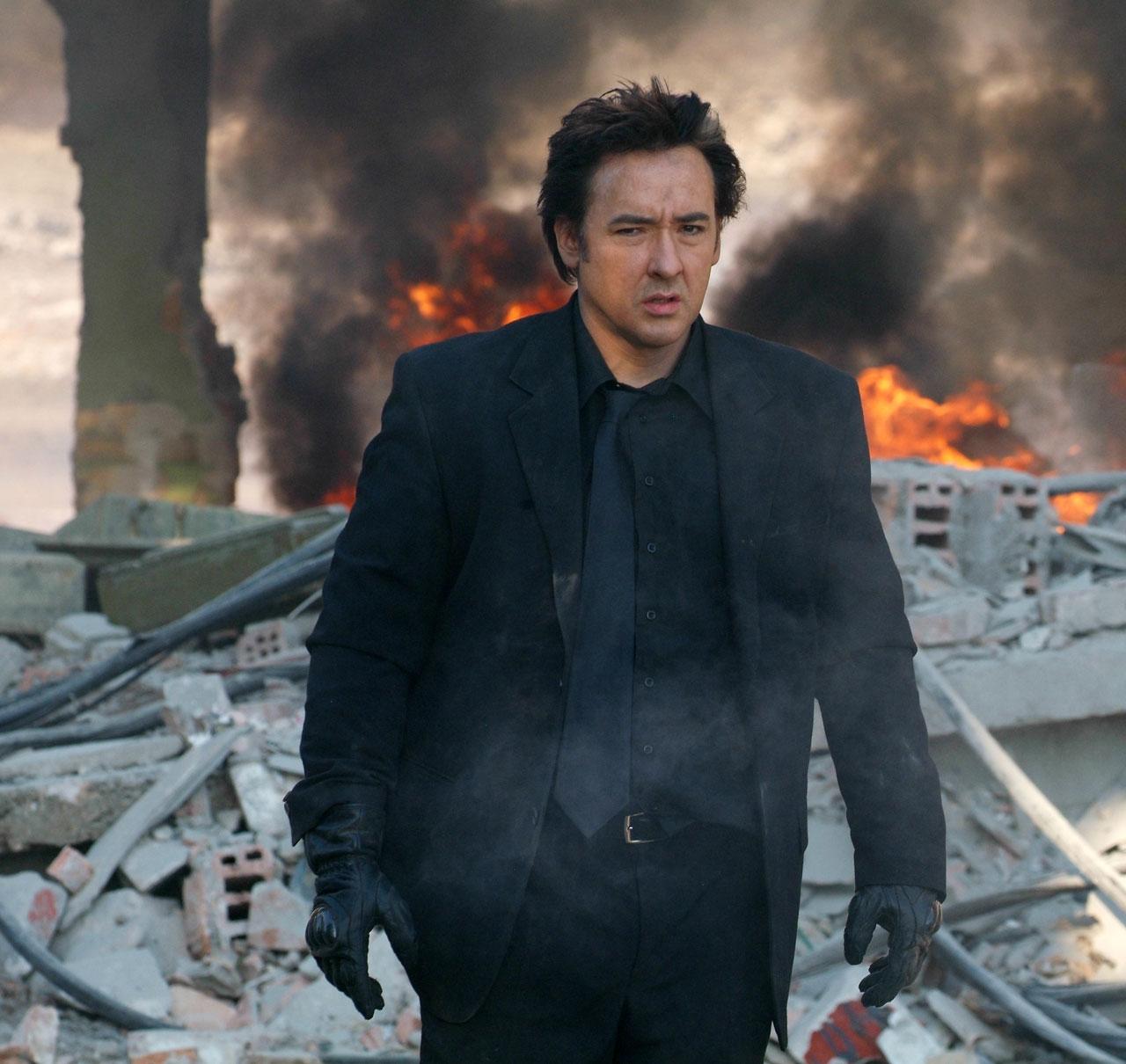
John Cusack stars as a hit-man Brand Hauser in war-torn Turagistan in War, Inc.

Cusack’s Savage Satire Strikes a Chord
with Soldiers and Their Families
By Arianna Huffington / June 12, 2008

“Whose top advisers are linked to war profiteers?” asks John Cusack in a new TV ad linking John McCain and George Bush (“Both…Bet you can’t tell them apart”). The ad, produced by MoveOn.org, starts airing today and is already being passed around the Internet.

Cusack’s righteous rage over the billions being pocketed in Iraq by companies like Blackwater, Halliburton, and Bechtel is the beating heart of his brilliant War Inc. The film, a corrosive, audaciously funny takedown of the Right’s push toward privatized war, has become a surprise, grassroots-driven hit — despite having almost no ad money behind it.

I saw the film before it was finished, and even before the final edit, the music, etc., I was overwhelmed by how it captured the insanity going on in Iraq. War Inc. has pulled off the near-impossible: it has a found a savage, reality-altering humor amidst the tragedy of Iraq.

It masterfully wields my favorite creative weapon: satire. It punches you in the gut, making you laugh, wince, and become outraged all at the same time. Naomi Klein rightly calls War, Inc. “one of those rare satires with the danger left in.”

Political satire designed to confront the powers-that-be with painful truths and to produce not just laughs but change is rarely seen in today’s multiplexes. And that’s not surprising; it’s a high-wire act few even dare to attempt. But when someone does and succeeds at it — think Stanley Kubrick, Paddy Chayefsky, Joseph Heller, Billy Wilder — the effect is indelible.

Lewis Lapham identified the satirist’s project as “the crime of arson, meaning to set a torch of words to the hospitality tents of pompous and self-righteous cant.” And that great satirical arsonist Mark Twain wrote that exposure to good satire made citizens less likely to be “shriveled into sheep.”

The great satirists have always been passionate reformers challenging the status quo. “Sometimes,” says Paul Krassner, whose satiric and radical journalism inspired Cusack and his co-creators, “humor is just a way of calling attention to the contradictions or the hypocrisy that’s going on officially. … That’s the function of humor — it can alter your reality.” Which is exactly what War, Inc. does.

When in 1729, Jonathan Swift wrote the most famous work of political satire of all time, “A Modest Proposal,” he was seeking to light a fire under the indifference toward the twin Irish crises of hunger and over-population. His proposal was to feed young children to hungry men. “I have been assured,” he wrote, “that a young healthy child, well-nursed, is at a year old a most delicious, nourishing and wholesome food, whether stewed, roasted, baked or boiled; and I make no doubt that it will equally serve in a fricassee or a ragout.”

You can imagine the blowback from those who failed to grasp the satiric point Swift was trying to make. Similarly, the satire-challenged Right has tried to attack Cusack and War, Inc. as (all together now) unpatriotic and a slam on American troops. They’ve also gotten their knickers in a twist, outraged that someone would try to find humor in the death and suffering of U.S. soldiers.

But Cusack’s targets are not our troops but private military contractors, war profiteers, and flag-waving politicians who, as Cusack puts it, support “keeping our troops in harm’s way in Iraq but not the bipartisan G.I. bill of rights to support them when they return home.” (And, yes, he’s talking about you, Messrs Bush and McCain).

Indeed, since the film’s release Cusack has received many moving emails and postings on his MySpace page from soldiers and military family members supporting the film and its message. Their missives run from disappointment to disillusionment and fury over being asked to serve and sacrifice while mercenaries are better paid — and often better treated.

Among the emails:

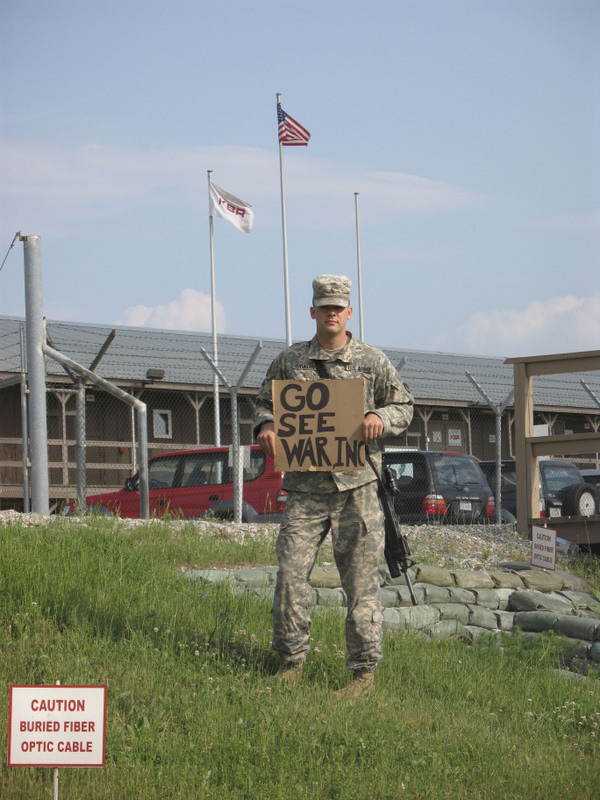
Sgt. Brent Sammann, US Army.

From Sgt. Brent Sammann, an active-duty soldier in the US Army:

I’m a first-hand witness to the exploitation by KBR and other companies lending their services to the war effort — services us soldiers are fully capable of doing ourselves…. The military is being overcharged by these companies on a regular basis. Also, the poor service and treatment we get from some of their employees who make three times as much as those of us serving our country that are not in it for the money but are trying to make the world a better place for everyone.

From SPC (P) Johnny Rhodes in 3/2 SCR Infantry based in Diyala, Iraq:

After being awake for 3 days I may be a little bit out of it, so excuse any rambling or incoherence on my part. Off the top of my head, I can easily say that KBR in particular is of no help here in my area of Iraq. They do, jobs soldiers could do, get paid way better for it, but the work is almost always substandard…. at any given time there are hordes of these guys tying up the phones and internet, cramming the chow hall, etc. Which makes the soldiers have to wait. And wait. And wait. They also paid way more than me, for a job, I could do with my eyes closed.

From Brenda Clampitt, of Baton Rouge, LA, the wife of a soldier stationed at Camp Adder in Tallil, Iraq:

[My husband] drives the trucks and Humvees and escorts the KBR around where they need to go. He doesn’t understand why they get paid way more then he does when [he and his fellow soldiers] are the ones doing the protecting, and are the ones getting shot at and blown up. He has seen soldiers die in front of him; he has seen lives destroyed and the country torn apart. My husband would serve his country whether he got paid or not, that is just how he is. He loves his country and wants to protect it but he sees first hand what is going on over there and he doesn’t like it…. I myself am sick and tired of this war. It is dragging on and on and it is all about the money. I am not anti war. But I am FOR everything your movie is about.

Today’s lead editorial in the New York Times, titled “Interrogation for Profit,” decries “one of the Bush administration’s most blatant evasions of accountability in Iraq — the outsourcing of war detainees’ interrogation to mercenary private contractors” and calls on Congress to approve “measures to make war-zone contractors liable for criminal behavior.” The editorial concludes: “The way out of the Iraq fiasco must include an end to the outsourced shadow armies.”

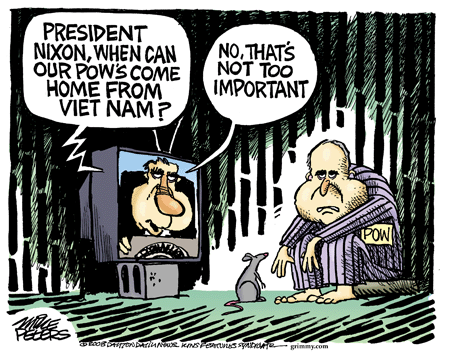
This indictment has the same urgency of War Inc. Especially with John McCain reminding us that it’s “not that important” to him when our troops come home.

Source. / The Huffington Post

The Rag Blog

Posted in RagBlog | Tagged , , , , | Leave a comment

Summer Solstice Seasonal Message – Kate Braun


Tarot by Kate

“Hark! Hear the children sing/Glory to the Holly King”


Friday, June 20, 2008 is the Summer Solstice, also known as Midsummer, Litha, St. John‘s Day and Day of the Green Man. Friday is Freya’s day, bringing feminine powers into play as we celebrate not only the longest day/shortest night of the year but also the beginning of the half of the year when feminine energy becomes a more dominant part of the planet’s balance. The old folklore calendar lists summer as beginning on May 1 and ending on August 1, so to identify this date as Midsummer is appropriate in more meanings than one.

Once again the Oak King and Holly King enact their ritual dance. This is the season for the Holly King to win. He is god of the Waning year and will rule until the Winter Solstice. We are now entering the dark half of the year, when we contemplate our actions and make the plans we will implement in the coming year. It is important to remember that the words Dark and Light have no reference to Evil and Good; they serve to indicate the perspective of activity or contemplation in the course of the year, nothing more. Both are necessary.

Decorate your altar and table with the colors white, red, golden yellow, green, blue, and tan. Dress yourself using these colors and encourage your guests to do likewise. For a centerpiece, you could fill and surround your cauldron with fresh flowers and ivy, but use fresh, not artificial. If you have a pot of heliotrope in the garden, use it as your centerpiece as heliotrope is especially good to use on this day. The preferred candle colors to use are light blue, green, and yellow; red and gold are also acceptable.

This is a fire festival. A backyard barbeque pit will serve city-dwellers’ purposes quite nicely; country celebrants have the option for a bigger fire, possibly a bonfire. If neither option is available to you, light a lot of candles. Remember to include animals in your celebrations, be they pets, familiars, or work beasts. It is also important to include fairies, elves, and sprites in your plans as they are more prominent in their activities on this day. Leaving some food, herbs, fruit juice, etc. for them will suffice and if any should present themselves during your celebration, drink a toast to them.

As you bless yourself, your friends, pets and plants, remember that this is also a time to destroy any amulets you have made that have outlived their usefulness. The preferred method is to cast them into the ceremonial fire. When the ashes cool, scatter these ashes throughout the garden. This brings blessings to the land. You may also perform magick for love, healing, and prosperity. Yellow is the color signifying prosperity at this festival, not green.

Serve your guests lots of fresh fruits and vegetables, especially yellow and orange food. Lemons and oranges are appropriate, as are summer squash and pumpernickel bread. All flaming foods are also appropriate, so your menu could include shish-ke-bob. Traditional drinks for this festival are ale, mead, and fresh fruit juice.

At this celebration it is important to have fun and play. We are filled with delight and joy, life is good, food is in abundance, the future lies before us as an unrolling path that will take us to delightful places. Adventure abounds. The possibilities are infinite. The only taboos are: do not give away any fire, do not sleep away from home, do not neglect your animals. Respect these taboos and have a Wonderful Time!


512-454-2293
kate_braun2000@yahoo.com
http://www.tarotbykateinaustin.com/

Reminder: I will be Elaine Ireland’s guest on her live-on-the-internet-radio-talk-show, Going Global For Spirit, on Thursday, June 19, at 9 PM CDT. Log on to www.bbsradio.com , select channel 1 and from the drop-down menu select Going Global For Spirit. There is a toll-free number for listeners to use to call in with questions, comments, or to get a short Tarot reading from me.

Kate Braun / The Rag Blog

Posted in Rag Bloggers | Tagged | Leave a comment

The Promise of a Better Future Is a Distant Dream


Unfulfilled promises haunt Afghanistan
By Bilal Sarwary / June 13, 2008

KABUL — Gone are the days when the Afghan summer was the season of plenty.

Now, as the snow melts off the Afghan peaks, a sense of foreboding hangs in the air. The summer in Afghanistan is fighting season.

Over a traditional Afghan dinner of rice, lamb and delicious Afghan bread, a senior Afghan official in his Kabul mansion admits he expects Taleban attacks to rise, but insists that they will not win.

“They can’t take over any place,” he says, as he struggles with a bony piece of meat.

After a few seconds he forgets the food and repeats in a serious tone the Afghan government line that continuing Taleban suicide bombings shows their “weakness”.

But he says the fighting is at stalemate and blames alleged outside support.

“We are fighting a war whose very source is based outside of Afghanistan, inside of Pakistan. As long as the Taleban has a base, we won’t be able to win this war.”

Chaotic

While the doubts about the fight against the Taleban continue, so too do the doubts among ordinary Afghans about life since the Taleban were toppled in 2001.

One morning I took an early tour of Kabul.

At 0700 there was already a chaotic traffic jam at Charahi Malak Azghar in the heart of the city.

Land cruisers belonging to the United Nations, warlords and government officials sit alongside taxis and vehicles belonging to common Afghans.

All of these vehicles are competing for space. There are no traffic lights, and no traffic rules. Street children and beggars were gathered along the main road.

Saqib Baghlani, 43, a high school teacher, sits on his old Chinese bicycle.

He welcomes the demise of the Taleban. “Afghanistan has made remarkable progress compared to its pre-war and Taleban days,” declares the tall, confident, blue-eyed teacher.

But he says the failures of his government are unacceptable.

He insists that President Hamed Karzai should fire corrupt officials and provide people with basic services, such as health care and clean drinking water, as this could bring peace.

“Go and see who owns these expensive houses in (the suburb of) Wazir Akbar Khan and who is driving land cruisers,” he says. “Karzai should ask these officials how they got so rich overnight, instead of making empty promises again and again.”

He castigates government ministers. “We are not asking for skyscrapers. The demands of our people are simple. Millions of dollars are going towards land cruisers and salaries. Everyone is corrupt.”

What puzzles poorer Afghans is why so many basic problems haven’t been solved, despite the billions of dollars of international aid.

A short walk from the affluent neighbourhoods of Wazir Akbar Khan and Shari Naw, in the streets of downtown Kabul, Afghanistan’s unemployed are gathered in their hundreds.

Most say they have to wait for days, hoping to find one day’s work to feed their entire family.

Kabul is considered the safest spot in the country, but basic services such as clean drinking water, electricity, and sewage systems remain unavailable to most people.

Waiting outside one of Kabul’s main government hospitals is Haji Baz Mohammad. He has accompanied a patient from his home province in northern Afghanistan. He is busy praying and is visibly sad.

”We are not politicians or people who have the aid money,” he says. “Where are the roads, clinics and reconstruction that were promised to us?”

Climate of mistrust

Driving through west Kabul, you can still see the destruction wrought during the factional infighting between warring Mujahideen factions in 1992, which left at least 70,000 Kabulis dead and the Afghan capital destroyed.

One of the most pervasive problems in post-Taleban Afghanistan is corruption.

Cabinet ministers and parliamentarians vow to fight it at every level. President Hamid Karzai has established several anti-corruption offices.

But, for Afghans like Ajmal Haidary, 42, a shopkeeper in West Kabul, this is another empty promise. “Every night, I hear ministers and MPs talk about corruption; this is all talk.”

One aide to President Karzai admits the government has failed and that it needs to attend to the plight of the people.

But he says you have to remember the strains on Kabul, a city originally built for 400,000 that is now home to almost four million people.

“From traffic jams to corruption to a lack of electricity, it’s a failure that needs to be fixed before it is too late,” he says. “However, don’t forget the improvements we have achieved.”

One judicial official warns that there is a culture of impunity in Afghanistan now that creates a climate of mistrust among common Afghans.

Seven years after the Taleban were removed from power, the worry is that for many Afghans the promises of a better future seem to be becoming a distant dream.

Source / BBC News

The Rag Blog

Posted in RagBlog | Tagged , | Leave a comment

When Will This Man Stand Trial?

President Bush at news conference in Rome, 12 Jun 2008

Now here’s a surprise – Junior is contemptuous of the Supremes’ decision to uphold habeas corpus. In his own words, “It’s just a god damned piece of paper.”

As Juan Cole points out, this 5-4 Supreme Court ruling mimics the one that brought Junior to the White House in 2000.

Richard Jehn / The Rag Blog

Bush Disagrees with High Court Guantanamo Bay Ruling
By Paula Wolfson / June 12, 2008

ROME — U.S. President George Bush says he disagrees with a Supreme Court ruling that prisoners at the Guantanamo Bay detention facility have the right to challenge their detention before civilian judges. VOA’s Paula Wolfson reports Mr. Bush spoke out on the high court ruling while in Rome for talks with Italian Prime Minister Silvio Berlusconi.

While the president was meeting with Italian leaders, the U.S. Supreme Court handed down its latest ruling on Guantanamo.

The president said he disagrees. “We will abide by the court’s decision. That doesn’t mean I have to agree with it.”

Speaking at a joint news conference with Prime Minister Berlusconi, Mr. Bush said the White House will study the narrow 5-4 court opinion to see if new legislation is needed.

“It was a deeply divided court. And I strongly agree with those who dissented,” he said.

The status of the prisoners at the military facility at Guantanamo Bay has been a source of friction between the United States and Europe.

Throughout his European tour, Mr. Bush has been urging European leaders to look beyond such differences and work with the United States on global issues, such as the diverse challenges found in the Middle East.

During their talks in Rome, Prime Minister Berlusconi said once again that Italy wants to be included in the group of countries working to convince Iran to suspend uranium enrichment.

The five permanent members of the U.N. Security Council and Germany are already involved in the initiative. President Bush said in Rome he will consider the Italian request. But White House National Security Adviser Stephen Hadley says Italy, which is one of Iran’s biggest trading partners, might not make a good addition to the negotiating team.

“Italy has a very robust set of commercial relations with Iran. This is always a problem for countries when their commercial ties sometimes seem to be at variance with their national security requirements,” he said.

During his appearance with President Bush, Prime Minister Berlusconi dismissed that notion, saying those commercial ties are an asset.

“Our offer [to join the negotiations] is based on the fact we know Iran very well from the inside, we have some leading companies that are in these countries [this country] and therefore we think this would be very useful,” he said.

Mr. Bush’s official welcome in Rome was warm. But the reception was very different in the streets of the Italian capital where the president is very unpopular, mainly because of the Iraq war.

Security is extremely tight for his visit, with thousands of extra policemen deployed throughout the city.

Demonstrators greeted the president when he arrived in Rome Wednesday, and there were protest banners hanging across the street from a hillside villa where he held a morning meeting with Italian entrepreneurs.

The president will meet with Pope Benedict at the Vatican on Friday before heading on to Paris, London and Belfast – the last stop on his so called “farewell tour” of Europe.

Source / Voice of America News

The Rag Blog

Posted in RagBlog | Leave a comment

There’s Just Something Wrong About Profit on Water


Tapped Out
By Lisa Margonelli / June 15, 2008

To paraphrase an old axiom: You don’t buy water, you only rent it. So why did Americans spend nearly $11 billion on bottled water in 2006, when we could have guzzled tap water at up to about one ten-thousandth the cost? The facile answer is marketing, marketing and more marketing, but Elizabeth Royte goes much deeper into the drink in “Bottlemania: How Water Went on Sale and Why We Bought It,” streaming trends cultural, economic, political and hydrological into an engaging investigation of an unexpectedly murky substance. Partway through her undoctrinaire book, Royte, a lifelong fan of tap water, refills her old plastic water bottle, reflecting that “what once seemed so simple and natural, a drink of water, is neither. All my preconceptions about this most basic of beverages have been queered.” And by the end of the book she will have discarded the old plastic bottle too, but not the tap.

“Bottlemania” is an easy-to-swallow survey of the subject from verdant springs in the Maine woods to tap water treatment plants in Kansas City; from the grand specter of worldwide water wars, to the microscopic crustaceans called copepods, whose presence in New York’s tap water inspired a debate by Talmudic scholars about whether the critters violated dietary laws, and whether filtering water on the Sabbath constituted work. (Verdict: no and no.) Water is a topic that lends itself to tour-de-force treatment (the book “Cadillac Desert” and the movie “Chinatown” come to mind), as well as righteous indictments and dire predictions (“Thirst: Fighting the Corporate Theft of Our Water,” “When the Rivers Run Dry: Water — The Defining Crisis of the Twenty-First Century”). Where others are bold, “Bottlemania” is subversive, and after you read it you will sip warily from your water bottle (whether purchased or tap, plastic or not), as freaked out by your own role in today’s insidious water wars as by Royte’s recommended ecologically responsible drink: “Toilet to tap.”

BOTTLEMANIA: How Water Went on Sale and Why We Bought It.
By Elizabeth Royte.
248 pp. Bloomsbury. $24.99.
Related
Op-Ed Contributor: A Fountain on Every Corner (May 23, 2008)
The ‘Bottlemania’ Web Site

Eww. Sorry. Let’s talk about those evil marketers. In 1987, Americans drank only 5.7 gallons of bottled water per person per year, but the cumulative impact of ad campaigns and the vision of Madonna fellating a bottle of Evian in “Truth or Dare” more than doubled consumption by 1997. In 2000 the chief executive of Quaker Oats bragged to analysts that “the biggest enemy is tap water.” By 2005, the enemy had become the consumer’s bladder; and in 2006, Pepsi, which owns Aquafina, spent $20 million suggesting that Americans “drink more water.” That year we drank 27.6 gallons each at a rate of about a billion bottles a week.

But marketing swings both ways. As quickly as bottled water became a symbol of healthy hyperindividualism — sort of an iPod for your kidneys — a backlash turned it into the devil’s drink. In 2006, the National Coalition of American Nuns came out against bottled water for the moral reason that life’s essential resource should not be privatized. New numbers surfaced: each year the bottles themselves require 17 million barrels of oil to manufacture, and, one expert tells Royte, “the total energy required for every bottle’s production, transport and disposal is equivalent, on average, to filling that bottle a quarter of the way with oil.” Mayors from San Francisco to New York suddenly became aware of the new symbolism of bottled water as a waste of taxpayer money, a diss of local tap water and a threat to the environment. Some canceled their city’s bottled water contracts. Chicago began taxing the stuff. And celebrities — among them Matt Damon and … Madonna — started backing a dazzling array of water charities in support of domestic tap and African water supplies, associating themselves with the magical ur-brand of “pure water” just as marketers and Madonna did in the early ’90s.

Royte asks, perceptively, if the pro-bottle and anti-bottle movements aren’t cut from the same plastic: “Is it fashion or is it a rising awareness of the bottle’s environmental toll that’s driving the backlash? I’m starting to think they’re the same thing.” To Royte, the author of “Garbage Land,” righteousness requires a greater commitment.

She finds it in Fryeburg, Me., a town of 3,000 that is trying to stop Nestlé’s Poland Spring from sucking 168 million gallons of water a year out of the pristine aquifer buried under its piney woods. As Royte arrives the town is in an uproar, with neighbor pitted against neighbor and rumors of secret planning-board meetings and of dummy corporations. Fryeburg is a “perfect example of water’s shift from a public good to an economic force,” she observes. The locals are more blunt: “This is what a water war looks like.” Fryeburg bears the burden of living at the other end of the giant green Poland Spring pipe. Residents of nearby Hiram count 92 water tankers rolling through their town in one typical 24-hour period; they feel themselves under siege precisely because their watershed is clean, while 40 percent of the country’s rivers and streams are too polluted for swimming or fishing, let alone drinking. Fryeburg residents try to repel the water company. They demand tests, throw a Boston Tea Party by dumping Poland Spring in a local pond, take the issue to Maine’s Supreme Judicial Court and hold a town meeting straight out of Norman Rockwell. Here I wish Royte had devoted more energy to the narrative. The people of Fryeburg and their complaints feel tentative — a sketch where a portrait could have been. And although her writing always flows, I sometimes wished for something less utilitarian.

That comes, unexpectedly, as Royte stands at the edge of the Ashokan Reservoir in upstate New York. “Ignoring the bluish mountains that form its backdrop and the phalanx of security guards in our foreground,” she gazes “down onto the spillway which curves and drops like a wedding cake, in four tiers, before sending its excess through a granite passage,” supplying 1.2 billion gallons a day through 300 miles of tunnels and aqueducts and 6,200 miles of distribution mains. There once was grandeur in public works, and Royte captures the mythic heroism that inspired the politicians and engineers to build great reservoirs more than a century ago. Their outsize civic largesse makes our current culture of single-serving bottles feel decidedly crummy. But returning to public water’s golden age, if it’s possible, will not come cheap. Royte says the country needs to invest $390 billion in our failing water infrastructure by 2020.

By the time I finished “Bottlemania” I thought twice about drinking any water. Among the risks: arsenic, gasoline additives, 82 different pharmaceuticals, fertilizer runoff sufficient to raise nitrate levels so that Iowa communities issue “blue baby” alerts. And in 42 states, Royte notes, “people drink tap water that contains at least 10 different pollutants on the same day.” The privatization of pristine water is part of a larger story, a tragic failure to steward our shared destiny. And if you think buying water will protect you, Royte points out that it too is loosely regulated. And there is more — the dangers of pipes and of plastic bottles, the hazards of filters, and yes, that “toilet to tap” issue. But there is slim comfort: Royte says we don’t really need to drink eight glasses of water a day. Drink when you’re thirsty, an expert says. That’s refreshing.

Lisa Margonelli is an Irvine fellow at the New America Foundation and the author of “Oil on the Brain: Petroleum’s Long Strange Trip to Your Tank.”

Source / The New York Times

Thanks to Betsy Gaines / The Rag Blog

Posted in RagBlog | Tagged , , | Leave a comment

Sen. Bond’s "Compromise" on Warrantless Wiretapping


Act now to save our rights
By Jim Retherford / The Rag Blog / June 13, 2008

Remember the Bill of Rights? Habeas corpus? Rule of law? It seems the New Corporatists view these concepts as “relics” of a bygone past.

Senator Kit Bond of Missouri is now floating legislation that he
calls a “compromise” on warrantless wiretapping. Unfortunately, the
bill would be a disaster for our civil rights and the rule of law. It
gives the President everything he’s demanded, including retroactive
immunity for telecom companies that spied on us without the warrants required by the current FISA law.

I just signed a petition calling on my representative to reject
Senator Bond’s legislation when it gets to the House. I hope you will
too.

Please have a look and take action.

Say No to Senator Bond’s FISA Capitulation
For over 30 years, the Foreign Intelligence Surveillance Act (FISA) has dictated necessary and appropriate ways for the U.S. government to collect intelligence on its own citizens for the sake of national security. Two key provisions of this law are that:

*The government must obtain a warrant from the Foreign Intelligence Surveillance Court (FISC) before spying on a citizen.

*Citizens have the right to sue if they believe they were spied upon illegally.

FISA provided broad leeway for every President from Carter to Clinton to conduct extensive intelligence-gathering operations. However, President Bush has decided that he is above warrants and judicial review, and major newspapers have reported that he has been using big telecoms like AT&T to spy on Americans without warrants for years.

Now, there are over 40 lawsuits against this arguably unconstitutional practice, and rather than taking his chances in court, President Bush is looking to his allies in Congress for a legislative back door solution. In February, the House of Representatives stood up to President Bush and protected the Constitution, but now the Senate is getting ready to cave in again. Senator Kit Bond is proposing a complete overhaul of FISA — he calls it a “compromise,” but we call it a catastrophe.

Here are some features of Senator Bond’s attack on civil liberties:

*Unlimited warrantless wiretapping for this President and every President for the next six years.

*Retroactive immunity for all the telecoms that helped President Bush wiretap illegally during the past 8 years — this time dressed up as a “trial” in the secret Foreign Intelligence Surveillance Court where a note from the President amounts to a get out of jail free card.

*No future judicial review for the President, either: the Attorney General gets to decide whether the President’s warrantless wiretapping is legal or not.

In order to avoid this disastrous legislation, all the House has to do is stand strong on their February vote, and stick with the current version of FISA. Send a message to your representative today, and him or her to vote for the Constitution by voting against Senator Bond’s catastrophic FISA “compromise” when it comes to the House.

Go here to sign the petition: Source. / Credo Action

The Rag Blog

Posted in Rag Bloggers | Tagged , , , | Leave a comment

Jim Hightower on The Media and a War Gone Missing

“And not a word about the war…”

And now a word about the war…
By Jim Hightower / June 11, 2008

George W keeps telling us that America is at war. But if were at war, he wouldn’t need to tell us, for we’d be fully engaged in the national effort.

In fact, America is not at war. Oh, our troops and their families most certainly are deep in the hell of George W’s war, but 99 percent of us have no personal involvement in it. We are making no sacrifices whatsoever, not even being taxed to pay for it. We’re at beaches, bars and barbeques this summer – not at war.

Neither is America’s media establishment. Media monitor David Carr reports that coverage of the war has fallen to a mere three percent of print and broadcast news, down from 25 percent as recently as September. Collectively, network TV is now devoting only four minutes a week to a war that already has killed 4,100 of our soldiers and is draining $12 billion a month out of our national treasury.

Why this big media yawn? Some publishers and editors have decided that the “story” isn’t that interesting anymore (of course, if their families were the ones at war, they undoubtedly would find the story riveting). Also, conglomerate owners are cutting newsroom budgets to jack up their profits, so they have fewer reporters to bring us war news.

But perhaps the biggest reason for the drop in coverage is this: the government does not allow it. At White House insistence, the Pentagon has so severely restricted the movements and freedoms of reporters and photographers in Iraq that most can’t do their jobs. Frustrated, many media outlets have simply withdrawn, choosing not to pay for reporters who aren’t allowed to report. I can certainly appreciate their frustration – but, wait a minute, isn’t this government lockdown of our media a rather huge story in itself? Surly that’s worthy of intensive reporting?

Meanwhile, people keep dying in a war that practically no one supports.

Source. / JimHightower.com

Cpl. Jessica Ann Ellis, 24, a medic, was injured in Iraq but wanted to return to the field. She was killed on May 11.

The Media Equation
The Wars We Choose to Ignore
By David Carr / May 26, 2008

Gen. John A. Logan was a Union officer, a fierce Republican partisan, an early advocate of the kind of volunteer army the United States now fights wars with. He is also one of the people credited with coming up with the holiday that we celebrate today. A statue in Logan Circle in Washington shows the general on horseback flanked by two female figures said to represent America at war and America at peace.

Given public indifference to a war that refuses to end, perhaps a third statue should be added: America at peace with being at war.

Even as we celebrate generations of American soldiers past, the women and men who are making that sacrifice today in Iraq and Afghanistan receive less attention every day. There’s plenty of blame to go around: battle fatigue at home, failing media resolve and a government intent on controlling information from the battlefield.

According to the Project for Excellence in Journalism’s News Coverage Index, coverage of the wars in Iraq and Afghanistan has slipped to 3 percent of all American print and broadcast news as of last week, falling from 25 percent as recently as last September.

“Ironically, the success of the surge and a reduction in violence has led to a reduction in coverage,” said Mark Jurkowitz of the Project for Excellence in Journalism. “There is evidence that people have made up their minds about this war, and other stories — like the economy and the election — have come along and sucked up all the oxygen.”

But the tactical success of the surge should not be misconstrued as making Iraq a safer place for American soldiers. Last year was the bloodiest in the five-year history of the conflict, with more than 900 dead, and last month, 52 perished, making it the bloodiest month of the year so far. So far in May, 18 have died.

Television network news coverage in particular has gone off a cliff. Citing numbers provided by a consultant, Andrew Tyndall, the Associated Press reported that in the months after September when Gen. David H. Petraeus testified before Congress about the surge, collective coverage dropped to four minutes a week from 30 minutes a week at the height of coverage, in September 2007.

It was also pointed out that when Katie Couric, CBS’s embattled anchor, went to Iraq to report the story, she and her network were rewarded with their lowest ratings in over 20 years. Hollywood producers who had hoped there would be a public interest in cinematic perspectives on this war have been similarly punished.

The war remains on the front burner for some outlets. On Sunday, The Los Angeles Times gave over much of its front page to chronicling Californians who have died fighting in Iraq and Afghanistan. The Washington Post continues to personalize the war with a series called Faces of the Fallen.

Earlier this spring, Alissa J. Rubin of The New York Times wrote about flying in a C-130 in Iraq, accompanied by soldiers, including one in a coffin at the back of the plane.

“I wondered what exactly he had died for. And although I did not know him, I felt melancholy as we flew onward, accompanied now by ghosts and memories of loss,” she wrote.

She may have been haunted by her proximity, but the rest of us? Not so much. I asked Bill Keller, the executive editor of The Times, how a war that had cost thousands of lives and over $1 trillion was losing news salience.

“There is a cold and sad calculation that readers/viewers aren’t that interested in the war, whether because they are preoccupied with paying $4 for a gallon of gas and avoiding foreclosure, or because they have Iraq fatigue,” he wrote in an e-mail message, adding that The Times stays on the story as part of an implied contract with its readers.

Other news editors have made the judgment — perhaps prodded by falling revenue and slashed news budgets — that public attitudes toward the war have become so calcified that few are interested in learning more. Why bother when things don’t change?

Except that they do, in a heartbeat. Last Thursday, Steve and Linda Ellis of Baker City, Ore., held a funeral for their daughter, Army Cpl. Jessica Ann Ellis. Corporal Ellis, a 24-year-old combat medic, died May 11 in Baghdad, a victim of a roadside bomb during her second tour of Iraq. She had been injured just three weeks before in a similar attack, but chose to go back out. She was assigned to the Second Brigade Special Troops Battalion, Second Brigade Combat Team, 101st Airborne Division and had curly, unruly hair, which brought her the nickname “Napoleon Dynamite” early in her military career.

More than 300 people gathered around this collective wound at St. Francis de Sales Cathedral, according to The Baker City Herald. In the funeral Mass, Bishop Thomas Connolly spoke plainly of her contribution.

“She was a good medic, well-trained and as brave as could be,” the newspaper quoted him as saying.

Hanging in the building where I work, there is a striking picture from the newspaper’s archives (by Angel Franco, a New York Times photographer) of a young soldier in Arizona looking up into the eyes of her father, saying goodbye, her eyes shiny with love and fear. I look at the picture every day as I walk by and think of my 20-year-old twin girls, safe at college. The feeling of gratitude is always followed by guilt. My girls are out of harm’s way, but what about that man’s daughter? What about Ms. Ellis?

On Saturday, her parents received an e-mail message from one of the colleagues in Iraq she was charged with looking after.

“There are wounds that don’t show on the outside,” he wrote. “She gave me the best medicine for what I had — hope and love.”

In a phone call Sunday, Mr. Ellis set aside his grief to describe his loss and the loss to the country she served.

“She wanted to be there for her guys; she told us that,” he said. “She gave the largest sacrifice a person possibly could, selflessly, like she did every day of her life.”

He added, “Jessica was a child who had no care in the world, none, besides making you smile, besides making you feel better.”

And although the Pentagon and the current administration will go to great lengths today to talk about the pride we should all feel in the fighting women and men of this country, increasingly onerous rules of engagement for the news media and the military make it difficult for the few remaining reporters and photographers to do their job: showing soldiers doing theirs.

Yes, the message seems to be, we honor the dead, but do not show them in your pictures. Of course, we care deeply about the wounded, but you now need their signed permission to depict their sacrifice. As the number of reporters and photographers has gone down, the efforts to control those who remain have gone up.

Ashley Gilbertson, a freelance photographer who has covered the war for Newsweek, Time and The New York Times and has written about covering the conflict in a book called “Whiskey Tango Foxtrot,” will be going back to Iraq in June. It will be his sixth time there, temperatures will range up to 130 degrees, and each time he has gone back there have been new restrictions.

“Many of my colleagues have turned away from the story because it has gotten to the point where they feel they just aren’t going to get anything useful, which I completely understand,” he said, adding that nonetheless, when the surge ends this summer, he wants to be there to chronicle what follows.

General Logan wrote long ago that both the glories and the consequences of war needed to be shared by all. He warned against “the dangers of confining military knowledge to a comparatively small number of citizens, constituting the select few who may hold the destinies of the country in their hands.”

Source. / New York Times

The Rag Blog

Posted in RagBlog | Tagged , , , , , | 1 Comment

Surprise!

We’re Voting Republican!

Thanks to Rik Sternberg / The Rag Blog

Posted in RagBlog | Tagged , , , | Leave a comment