Like a Forced Marriage, It Probably Won’t Work


U.S. seeking 58 bases in Iraq, Shiite lawmakers say
By Leila Fadel / June 9, 2008

BAGHDAD -Iraqi lawmakers say the United States is demanding 58 bases as part of a proposed “status of forces” agreement that will allow U.S. troops to remain in the country indefinitely.

Leading members of the two ruling Shiite parties said in a series of interviews the Iraqi government rejected this proposal along with another U.S. demand that would have effectively handed over to the United States the power to determine if a hostile act from another country is aggression against Iraq. Lawmakers said they fear this power would drag Iraq into a war between the United States and Iran.

“The points that were put forth by the Americans were more abominable than the occupation,” said Jalal al Din al Saghir, a leading lawmaker from the Islamic Supreme Council of Iraq. “We were occupied by order of the Security Council,” he said, referring to the 2004 Resolution mandating a U.S. military occupation in Iraq at the head of an international coalition. “But now we are being asked to sign for our own occupation. That is why we have absolutely refused all that we have seen so far.”

Other conditions sought by the United States include control over Iraqi air space up to 30,000 feet and immunity from prosecution for U.S. troops and private military contractors. The agreement would run indefinitely but be subject to cancellation with two years notice from either side, lawmakers said.

“It would impair Iraqi sovereignty,” said Ali al Adeeb a leading member of Prime Minister Nouri al Maliki’s Dawa party of the proposed accord. “The Americans insist so far that is they who define what is an aggression on Iraq and what is democracy inside Iraq… if we come under aggression we should define it and ask for help.”

Both Saghir and Adeeb said that the Iraqi government rejected the terms as unacceptable. They said the government wants a U.S. presence and a U.S. security guarantee but also wants to control security within the country, stop indefinite detentions of Iraqis by U.S. forces and have a say in U.S. forces’ conduct in Iraq.

The 58 bases would represent an expansion of the U.S. presence here. Currently, the United States operates out of about 30 major bases, not including smaller facilities such as combat outposts, according to a U.S. military map.

” Is there sovereignty for Iraq – or isn’t there? If it is left to them, they would ask for immunity even for the American dogs,” Saghir said. “We have given Bush our views – some new ideas and I find that there is a certain harmony between his thoughts and ours. And he promised to tell the negotiators to change their methods.”

Maliki returned Monday from his second visit to Iran, whose Islamic rulers are adamantly opposed to the accord. Iran’s Supreme leader Ayatollah Ali Khamanei said following meetings with Maliki that we have “no doubt that the Americans’ dreams will not come true.”

Hoshyar Zebari, the Iraqi foreign minister, criticized the lawmakers for poisoning the public discussion before an agreement is concluded. He said U.S. officials had been flexible in the talks, as well as “frank and honest since the beginning.”

“This is an ongoing process,” Zebari said. “There is no agreement yet. Proposals have been modified, they have been changed and altered. We don’t have a final text yet for them to be judgmental.”

Zebari, who said a negotiating session was held with U.S. officials on the new accord Monday, said any agreement will be submitted to the Iraqi parliament for approval. Leaders in the U.S. Congress have also demanded a say in the agreement, but the Bush administration says it is planning to make this an executive accord not subject to Senate ratification.

Republican presidential candidate John McCain didn’t respond for requests for comment, but the presumptive Democratic nominee, Barack Obama, said through a spokesman that he believes the Bush administration must submit the agreement to Congress and that it should make “absolutely clear” that the United States will not maintain permanent bases in Iraq.

Lee Hamilton, a former Democratic congressman from Indiana, said he had not heard of a plan to seek 50 or more bases in Iraq, and that if it is the case, Congress is likely to challenge the idea. “Congress would have a lot of questions, and the president should be very careful in negotiating,” Hamilton, who now directs the Woodrow Wilson Center for Scholars, told McClatchy.

The top U.S. Embassy spokesman in Iraq rejected the latest Iraqi criticism.

“Look, there is going to be no occupation,” said U.S. spokesman Adam Ereli. “Now it’s perfectly understandable that there are those that are following this closely in Iraq who have concerns about what this means for Iraqi sovereignty and independence. We understand that and we appreciate that and that’s why nothing is going to be rammed down anybody’s throat.

“It’s kind of like a forced marriage. It just doesn’t work. They either want you or they don’t want you. You can’t use coercion to get them to like you,” he added.

U.S. officials in Baghdad say they are determined to complete the accord by July 31 so that parliamentary deliberations can be completed before the Dec. 31 expiration of the UN mandate.

The agreement will not specify how many troops or where they will be deployed, said a U.S. official who asked not to be named due to the sensitivity of the subject, but the agreement will detail the legal framework under which U.S. troops will operate. The U.S. official said that in the absence of a UN resolution authorizing the use of force, “there have to be terms that are in place. That’s the reality that we’re trying to accommodate.”

Iraqis are determined to get their nation removed from the purview of the U.N. Security Council under Chapter 7 of the U.N. Charter, which allows the international body to declare a country a threat to international peace, a step the U.N. took after Saddam Hussein invaded Kuwait. Iraqi officials say that designation clearly is no longer appropriate.

But even on that basic request, the U.S. has not promised to support Iraq, Saghir said, and is insteadn withholding that support as a pressure point in negotiations.

U.S. demands “conflict with our sovereignty and we refuse them,” said Hassan Sneid, a member of the Dawa party and a lawmaker on the security committee in the parliament. “I don’t expect these negotiations will be done by the exact date. The Americans want so many things and the fact is we want different things.”

“If we had to choose one or the other, an extension of the mandate or this agreement, we would probably choose the extension,” Saghir said. “It is possible that in December we will send a letter the UN informing them that Iraq no longer needs foreign forces to control its internal security. As for external defense, we are still not ready.”

Margaret Talev in Washington contributed.

Source / McClatchy

The Rag Blog

Posted in RagBlog | Tagged , , , | Leave a comment

Reasons to Redefine the Word "Murder"


Burma, Food Crisis, Wall Street and the World Economy: Drawing Your Last Breath Hungry
By Allan Nairn / June 9, 2008

In parts of Burma before the cyclone hit the heat was so severe that you could walk around on a hazy day and run the risk of sunstroke.

On Thingyan the Buddhist holiday in which people dunk each other with water you could get a full-face full-pail drenching and be crisply sundried in minutes.

But when the storm water rose on the Irrawaddy Delta drying out became secondary because the sun’s rays were largely gone and so was much of the land, housing, and plantings.

No one really knows how many people died but the world press has made the point that it would have been far fewer if Burma had a better government.

The point could also be made, though, that far fewer still would have died if the world had a better system of producing and allocating its wealth.

It’s hard to come up with solid figures but it seems safe to estimate that the entire disposable wealth of the Irrawaddy Delta before the storm, that of its’ 3.5 million residents, could have been less than that of one table-full of diners at New York’s Four Seasons Grill Room.

Actually, it’s more dramatic than that.

Working with figures from Forbes magazine, the IMF, and the UNDP, it’s possible to estimate that there are between three hundred and a thousand individuals whose accumulated wealth is so vast that any one of them alone could pay each person in the Irrawaddy Delta for a year, and in the case of the richest, like Warren Buffett, could do it for six decades running and still have billions left.

One could get a visualization of this notion and its implications when flying over the Netherlands. Looking down from the Royal Dutch Airline a few weeks after Irrawaddy sank, you could see another delta, a country with much land below sea level, but where long infusions of wealth — much of it extracted from Southeast Asia by whip (see the histories of the Dutch East and West Indies Companies) — have made possible the building, behind strong dikes, by the sea, of nice, glassy homes and offices.

A cyclone Nargis would have killed anywhere — viz. the recent storms in the US midwest — but whether you survive a storm depends in important part on whether you and your ancestors were rich or poor and were able to build good infrastructure (even in the US, see New Orleans).

So the rich world is right to flagellate the Burmese generals for holding back resources as people die (a BBC World TV interviewer yesterday called it “criminal neglect”) but wrong to fail to note that they do the same thing daily, on a global, far more deadly, scale.

The rich do pass out some of their spare wealth during a cyclone or other covered crisis, but on a daily basis withhold enough of it such that 850 million people routinely go hungry.

The recent food price hike has upped that statistic by perhaps a hundred million, and so it is said that we are in a “food crisis” and that “the era of cheap food is over.”

The world would indeed be in a food crisis if there were not enough food to feed the people. But that is not the case.

The problem is that many millions of people can’t afford food. That, clearly, is not a food crisis, but rather a wealth crisis, more precisely a wealth distribution crisis that can be solved by shifts from rich to poor, and a crisis that can be kept from recurring if laws and economies are then modified to institutionalize a new, more realistic, system that doesn’t happen to starve people — an objective which, one would think, is a fairly modest, and perhaps popular, goal.

Today in Rome there is a world summit on food and there has been a political stir over an attempt to exclude Robert Mugabe, Zimbabwe’s liberator and despot.

The point is made correctly that Mugabe runs a failed economic system that kills many people who could have been saved if he had made different choices.

But the same could also be said of a number of others at the summit — those who run the world economy –, which is certainly failed from the point of view of those who draw their last breath hungry.

UN people from FAO (Food and Agriculture Organization) and other agencies have also caused a flutter by talking about $50 billion, over many years, for various food projects, which is a tenfold increase but still less than the personal holdings of Buffett, Bill Gates, and Carlos Slim, who got quite rich essentially overnight when Mexico gave him its cell phone system. It’s also what the US goes though in about five months of occupying Iraq, where child malnutrition has risen in rough correlation with precision bomb drops and Iraqui democracy.

If someone’s dying and you have a dollar that could save them and you withhold it, you have killed them. It’s so extreme it sounds ridiculous, but it happens to be true, and will continue to be true so long as surplus coexists with bodies living on the cliff of death, or, for the luckier young ones, the cliff of mere body stunting and underdevelopment of their brains.

The big story before the food crisis was the US Wall Street financial crisis. For some weeks sober economists were fearing 1929-style panic. But Ben Bernanke, the US Federal Reserve chairman, stepped in to save the day by essentially imagining into existence several hundreds of billions of dollars worth of money that was effectively made available to some of the world’s richest institutions and people.

The coverage focused on the fact that Bernanke did this cleverly, and succeeded, but it could also have noted that this is a remarkable aspect of today´s economy: while most people have to work for their money incrementally, bending in mud to plant their rice, a few can imagine it into existence in large blocks, and give it to their friends and colleagues.

By printing money, issuing bonds, making loans, creating new financial instruments, and by other means, these few create notions that have the power to buy goats, or anything else one wants, and can continue doing so indefinitely so long as rich society buys the pretense.

Which is to say that though, say, getting food to people, requires rearranging some physical things, most of the task involves rearranging the notions that govern actions from people’s heads.

It´s simply a choice as to whether the power to conjure funds will be used for hungry people, and not just the juridical, imaginary persons that are investment corporations (US judicial precedent gives corporations the legal rights of persons, but like persons become ghosts it´s impossible to jail them if they transgress).

And it is likewise simply a choice whether or not to save expiring people by allowing resources to be shifted from an aid ship off Burma´s shore, or from the guys having drinks and lunch at the Four Seasons, table four.

Allan Nairn writes the blog News and Comment at http://www.newsc.blogspot.com/.

Source / CounterPunch

The Rag Blog

Posted in RagBlog | Tagged , | Leave a comment

"Ain’t Gonna Study War No More…"


Vets for Peace hold “Sangha” for Ft. Hood GI’s
By Doug Zachary / The Rag Blog / June 9, 2008

[Doug Zachary is a regular contributor to The Rag Blog. A veteran, he is president of the Austin chapter of Veterans for Peace and is a member of MDS/Austin.]

This weekend (June 7-8) we gathered for the first session of “Cline’s Corner,” a veterans’ writing workshop sponsored by Veterans for Peace (VPF), Chapter 66 and held in Austin, Texas at the home of venerable VFP member and noted photographer, Alan Pogue, and fierce warrior/lawyer D’Ann Johnson.

The writers’ “sangha” is conducted in a Zen Buddhist form inherited from Thich Nhat Hahn, a world renowned Buddhist monk from Hue, Viet Nam, who has been working for 40 years among United States Veterans to heal the wounds of the American War through meditation and self-expression via poetry and prose. For fifteen years Maxine Hong Kingston has brought this sangha form to military veterans and has led us, through “deep listening” and the development of compassionate and awakened hearts, to heal ourselves and each other and to publish an astonishing collection of our stories.

Four active duty soldiers from Fort Hood joined us, along with a member of Military Families Speak Out whose husband is on his third tour in Iraq. During the check-in period the soldiers each spoke of childhoods weighted with class inequities, loneliness and violence, of the propaganda that led them to join the military, and of their personal awakenings. The MFSO wife told us about her husband’s Purple Heart and of how it felt to have her husband redeployed for his third tour, even when his wounds prevented him from wearing protective gear. One soldier announced that, although he had been applying for warrant officer status and a lIfetime in the military when we met six weeks ago, he was now submitting his application for conscientious objector status. Laura Beth, the founder of Daughters of Viet Nam Veterans, wrote a truly amazing piece in which she told her personal story, about a childhood with (hah, actually without) a father who had been destroyed psychologically and spiritually in Viet Nam.

Other participants included Alan (Pogue), combat medic in Viet Nam who set the stage by speaking from deep within his heart about the suffering he witnessed in Viet Nam and which he had felt powerless to stop. David Hamilton of MDS/Austin (Movement for a Democratic Society) told us (too briefly, for my taste) about the day that he and David Cline were attacked by shotgun toting KKK members on a country road in Central Texas. One of the soldiers told about an incident in Iraq where he had almost killed a seven year old girl, only to have the incident end with his looking deep within her sweet and innocent eyes and how in that moment he had begun to know himself.

Two other soldiers, not yet sent to Iraq, told us of their spiritual struggles with the meaning of responsible citizenry and the ever-diminishing role of military authority in their lives. Another veteran of 23 years in the military told us about the over 1,300 days that he had spent in the Middle East and how he had come to realize that the United States was NOT deployed in the region to promote world peace. Another participant spoke of her 25-year marriage to an F-111 pilot and how he had seen through the macho image of fighter pilot which the mainstream consciousness had offered him as an identity and how she had known him for the sweet transcendent poet hidden within. I will soon publish a feature article in the Texas Observer where you will be able to hear the other stories we shared and witnessed. The sangha, at the end of an emotionally charged and spiritually transcendent day together, elected to meet monthly rather than quarterly. We are launched; we are blessed.

Saturday night we reconvened at Jovita’s [an Austin Mexican restaurant and music venue] for a fundraiser for Texans For Peace. Charlie Jackson and Alyssa Burgin had organized an event which turned out to be THE precise tonic needed by our soldier allies. Brady Coleman, an attorney for the Oleo Strut [GI anti-war coffee house in Killeen, Texas, near Ft. Hood, during the Viet Nam war], led off the night with his band, the Melancholy Ramblers. They played their usual collection of labor/love/peace songs and the soldiers from Fort Hood were moved by the love shown them by members of the audience. Bill Johns played a song he had written after meeting an infantry soldier on an airplane in the Mideast.

Finally, Shelley King, the Texas Musician of the Year, took the stage with her rockin-ass blend of R&B, southern rock, Texas swing and psychedelia and rocked our souls. Laura Beth took to the dance floor with all the Fort Hood soldiers and brought the place alive with her beauty, charm and grace. The soldiers were recognized by name and progressive Austin poured its love into their hearts. At the end of the night, an Iraq veteran took the stage and read the note he had submitted to his Top Sergeant three days ago announcing his spiritual awakening. He then ripped off his dogtags and announced, “I am a soldier no more!”

Sunday the Fort Hood soldiers came to the monthly meeting of our recently-resurrected chapter of Veterans For Peace and spoke gratefully about the Engagement Project. They pleaded with us to continue this work and promised to get us into the barracks for audiences with growing numbers of disgruntled, wounded soldiers. Cathy Doggett, the daughter of U.S. Rep. Lloyd Doggett (D, Texas) offered to help us to reach out with our message of love and responsible citizenry.

Joyce Pohlman spoke to us about the growing numbers of veterans on the streets of Austin whose lives have been destroyed by the current regime and who have been tossed aside and promised to help to connect us with them.

The Neil Bischoff chapter of Veterans For Peace became the Neil Bischoff-Utah Phillips chapter [legendary folksinger, VFP member and peace activist Phillips recently passed away] . The chapter is revived, we are engaged in the lives of active duty soldiers, and we are connected to each other in a new and deeper way on our prophetic journeys. Tomorrow we will return to the barricades near Fort Hood.

I’m grateful, beyond my wildest dreams.

The Rag Blog

Posted in Rag Bloggers | Tagged , , , , , , , , | 1 Comment

Tom Hayden on Hillary’s Endorsement of Obama


Hillary’s Winning Speech
By Tom Hayden / June 7, 2008

Hillary Clinton’s moving and brilliant speech today cemented an independent place for herself and feminists in general in the unfolding historical drama of the 2008 presidential election.

The speech, which situated her more firmly than ever in women’s history, provided a powerful endorsement for Barack Obama while at the same time reinforcing her position as virtually his equal in the Democratic primary race.

Clinton essentially empowered her audience by implying they, more than anyone, could make the historic difference by electing an African-American president on the rising, tide of the women’s vote. She assured them that the two candidacies had shattered all gender and racial barriers to democracy’s highest office.

Hers was not the surrender pose traditionally expected of “losers” but a redefinition of what winning ultimately means. It suggested that she will be treated as a full partner in the process, and it was a victory speech for the power of social movements.

She bravely rejected the bitter destructiveness that gnaws within all campaigns that lose closely, and held the high ground.

Characterizing her decision as a “suspension”, however, still left open the prospect of hard bargaining with Obama over a range of issues, but apparently in a greater atmosphere of unity.

One wonders if she would be the nominee if she had pursued the tone of today’s speech more and the advice of her [male] advisors less. It took a year, and a string of campaign disasters, before she threw out Mark Penn, though still leaving in place a cast of male operatives like Lanny Davis who only blighted her image as an experienced, pragmatic representative of the Sixties student, antiwar and women’s movements.

Her 2002 vote to authorize the Iraq War, which opened the door for Obama’s candidacy, was advised as the way to prove that a woman could be commander-in-chief. So were her later comments about obliterating Iran. Her male advisers incessantly pressured the media to play up Rev. Jeremiah Wright and Bill Ayers, race-baiting and red-baiting positions she never would have adopted in the late Sixties.

This wasn’t a problem unique to Clinton alone, of course. If Bill Clinton had not promoted NAFTA and the WTO, there would have been no space for Ralph Nader to run in 2000. Had John Kerry followed his 1970 anti-war, anti-establishment instincts in 2004, he probably would have been president today. The Democratic Party consultant class has been counseling retreat from the Sixties ever since…the Sixties. It has been a risk for Obama’s centrist campaign as well, although his 2002 antiwar stance and the unified enthusiasm of the black community position him firmly within a progressive history.

This basic identity confusion at the center of the Clinton strategy was the crucial reason, next to Obama’s superlative campaign, for her narrow defeat. The irony is that her resurrection can now begin.

Source. / Progressives for Obama

The Rag Blog

Posted in RagBlog | Tagged , , , , | Leave a comment

Torture? Bet You Can’t Prove It!

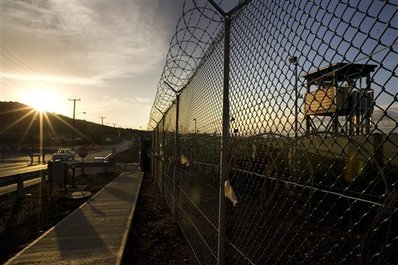
In this image reviewed by the U.S. Military, the sun rises over Camp Delta detention compound which has housed foreign prisoners since 2002, at Guantanamo Bay U.S. Naval Base, in Cuba, Friday, June 6, 2008. Photo by Brennan Linsley.

Pentagon Told Guantanamo Interrogators To Trash Evidence
By Michael Melia / June 8, 2008

SAN JUAN, Puerto Rico — The Pentagon urged interrogators at Guantanamo Bay to destroy handwritten notes in case they were called to testify about potentially harsh treatment of detainees, a military defense lawyer said Sunday.

The lawyer for Toronto-born Omar Khadr, Lt. Cmdr. William Kuebler, said the instructions were included in an operations manual shown to him by prosecutors and suggest the U.S. deliberately thwarted evidence that could help terror suspects defend themselves at trial.

Kuebler said the apparent destruction of evidence prevents him from challenging the reliability of any alleged confessions. He said he will use the document to seek a dismissal of charges against Khadr.

A Pentagon spokesman, Navy Cmdr. Jeffrey Gordon, said he was reviewing the matter Sunday evening.

The “standard operating procedures” manual that contained the purported instructions was made available to Kuebler last week as part of a pretrial review of potential evidence, the Navy lawyer said.

“The mission has legal and political issues that may lead to interrogators being called to testify, keeping the number of documents with interrogation information to a minimum can minimize certain legal issues,” the document is quoted as saying in an affidavit signed by Kuebler.

The document could support challenges by other detainees to suppress confessions at Guantanamo, where the U.S. military says it plans to prosecute as many as 80 of roughly 270 detainees before the first U.S. war-crimes tribunals since World War II.

The case against Khadr, who was captured in Afghanistan when he was 15, is on track to be one of the first to trial. He faces war-crimes charges including murder for allegedly throwing a grenade that killed a U.S. Special Forces soldier during a 2002 firefight.

Kuebler said the nature of the interrogations is particularly relevant in Khadr’s case because prosecutors are relying on evidence “extracted” from him at Bagram air base in Afghanistan and at Guantanamo.

“If handwritten notes were destroyed in accordance with the SOP, the government intentionally deprived Omar’s lawyers of key evidence with which to challenge the reliability of his statements,” Kuebler said in an e-mail to reporters.

The operations manual, which dates to January 2003, was attached to a 2005 report on an investigation into detainee abuse allegations at Guantanamo, Kuebler said. A summary of the findings was released at the time, but the defense lawyer said the section including the manual has not been made available publicly.

The so-called Schmidt-Furlow report documented degrading treatment, including one instance of a top terror suspect forced to dance with another man and behave like a dog. But investigators stopped short of saying torture occurred.

Source. The Huffington Post / AP

The Rag Blog

Posted in RagBlog | Tagged , , , , , , | Leave a comment

Another One Bites the Dust

Caribbean monk seal: just a memory. Photo from U.S. National Museum.

Caribbean Monk Seal Gone for Good
By Jessica Marshall / June 9, 2008

The Caribbean monk seal is officially extinct.

Last seen in 1952 on a small group of reef islands between Jamaica and Mexico’s Yucatan Peninsula, the seal — covered in brown fur tinged with gray, and with a yellow belly — was easy prey for European settlers in the 1600s and 1700s, who killed it for meat, oil, and to seal the bottoms of boats.

The crew of Columbus’ second voyage was the first to kill the seals. “It’s one of the first mammals that Columbus saw when he discovered this region, and it’s the first one to go extinct,” said Kyle Baker of the National Oceanographic and Atmospheric Association’s Fisheries Service in Saint Petersburg, Fla.

“By the mid 1800s, they were very rare,” Baker said.

The seal was the only subtropical seal native to the Caribbean.

Several seal sightings were reported in the Caribbean between 1952 and the present, but until the 80s and 90s — when people began carrying cameras and cell phones — it was difficult to verify whether those sightings really were Caribbean monk seals.

“Reviewing the data, we’ve identified most of these as hooded seals, which are Arctic species coming down from the northeast,” Baker said. Other sightings have turned out to be bearded seals and harbor seals, but none have been Caribbean monk seals.

With better information, “we decided it was time to do the status review [under the Endangered Species Act] and to come to the conclusion, unfortunately, that the species is now gone,” Baker said.

Two other species of monk seal remain: the Hawaiian monk seal and the Mediterranean monk seal, both also endangered with only 1,200 and 500 seals remaining, respectively.

The Hawaiian monk seal suffers from different threats than hunting by humans, according to Bud Antonelis, who heads the Protected Species Division at NOAA Fisheries Service in Honolulu, Hawaii. The Hawaiian seals face threats from habitat loss, food limitation, marine debris and shark predation.

“We expect in the next couple of years, the numbers will be below 1,000,” Antonelis said. The population is declining by about 4 percent a year.

Removing marine debris and sharks that threaten unweaned pups is part of the recovery plan, Antonelis said. Some seals have been brought into captivity and fed to treat malnourishment, then released.

In many places, the seal’s habitat could be restored, Antonelis said. Erosion has been the major cause of habitat loss. “There’s a lot of conservation work that remains to be done,” he added.

“While the loss of the Careibbean monk seal is extremely disappointing, it serves as a lesson for us to pay attention to the resources that are still here and to do everything we can so that the same problem doesn’t happen to them,” Antonelis said. “I don’t think it’s too late for the Hawaiian monk seal.”

Source. / Discovery News

The Rag Blog

Posted in RagBlog | Tagged , , | Leave a comment

Zbigniew Brzezinski on Israel and Palestine

Zbigniew Brzezinski has been accused of being ‘anti-Israel’ by some Jewish academics, writers and bloggers.

Barack Obama supporter accuses Jewish lobby members of McCarthyism
By Alex Spillius

A foreign policy expert consulted by Senator Barack Obama, the leading contender for the Democratic presidential nomination, has accused members of the American Jewish establishment of “McCarthyism” in its attitude towards critics of Israel.

Zbigniew Brzezinski, a former national security adviser, said that the pro-Israel lobby in the US was too powerful, while the slur of anti-Semitism was too readily used whenever its power was called into question.

Presenting a solution for the Middle East, he listed historical compromises that had to be made by Israelis and Palestinians but accused the American Israel Public Affairs Committee (Aipac) – the largest and most influential Jewish lobby group – of obstructing peace efforts.

He said: “Aipac has consistently opposed a two-state solution and a lot of members of Congress have been intimidated and I don’t think that’s healthy.”

He added that other country-specific lobbies, such as the Cuban-Americans, the Armenians and the Irish, had also exerted undue influence in Washington.

Mr Brzezinski, who served under President Jimmy Carter, was a key player in the 1978 Camp David Accords and remains an important voice in the US foreign policy establishment.

An active author and analyst at 80, he is close enough to Mr Obama that his remarks may feed fears in the American-Jewish community that the senator would soften America’s traditional strong pro-Israeli stance if he became president.

This perception has been created in part by Mr Obama’s professed willingness to talk to Iran and partly by other foreign policy associates.

In recent weeks, Mr Obama has courted the Jewish vote and, on Israel’s 60th anniversary, underlined the need for the US to show “unshakeable” support.

Mr Brzezinski has been accused of being “anti-Israel” by some Jewish academics, writers and bloggers after criticising Israel for excessive use of force and unwillingness to compromise.

Last year, censure of him reached new heights when he defended John Mearsheimer and Stephen Walt, two academics who had criticised the pro-Israel lobby and were accused of questioning the right of the state of Israel to exist.

Mr Brzezinski said “it’s not unique to the Jewish community – but there is a McCarthyite tendency among some people in the Jewish community”, referring to the Republican senator who led the anti-Communist witch hunt in the 1950s.

“They operate not by arguing but by slandering, vilifying, demonising. They very promptly wheel out anti-Semitism. There is an element of paranoia in this inclination to view any serious attempt at a compromised peace as somehow directed against Israel.”

Although Mr Brzezinski is not a formal day-to-day adviser and stressed he doesn’t speak for the campaign, he said that he “talks to” Mr Obama.

He endorsed the Illinois senator, lauding him as “head and shoulders” above his opponents. He said that he was the only candidate who understood “what is new and distinctive about our age”.

In turn, Mr Obama has praised Mr Brzezinski as “someone I have learned an immense amount from” and “one of our most outstanding scholars and thinkers”.

They share very similar views on the folly of the Iraq war.

Robert Malley, a Middle East expert, recently quit as an Obama adviser after it emerged that he was talking to Hamas, the militant Palestinian group, as part of his work for the International Crisis Group.

Senator John McCain, who would be Mr Obama’s Republican opponent for the White House, is expected to focus on the 46-year-old senator’s lack of foreign policy experience and supposed weakness towards enemies.

But as president, he will need the support of Aipac and other groups, which may be hard to achieve given his associations.

In Mr Brzezinski’s view, whoever is the next US leader must persuasively propose the following dramatic steps to peace: a) Palestinians give up the right of return from Jordan b) demilitarise of the Palestinian state c) Israel share Jerusalem d) Israel return to its pre-1967 war borders with “equitable adjustments”.

If this agenda is pursued, in time “Israel and Palestine could be the Singapore of the Middle East and that is in the interests of the US”, he said.

Source. / Telegraph, UK / May 27, 2008

Thanks to David Hamilton / The Rag Blog

Posted in RagBlog | Tagged , , , , , | 2 Comments

Frat Boy Graverobbers


Hey Dubya!
Surrender the Bones of Geronimo!

By Michael Dinkinson / June 8, 2008

How would you feel if you knew that the skull of your great grandfather, stolen from his tomb, was being used in the secret ceremonies of a spoilt elite brat pack whose members have included some of the most powerful men in the world? A bit pissed off, right?

And if you also learned that the American President, George W Bush, his father George and his brother Jonathan, have taken part in these ceremonies, and, what’s more, in fact, that the President’s great grandfather, Prescott Bush, was one of those who had stolen the skull from its grave in the first place, it wouldn’t be surprising if you felt a little outraged.

Sounds unlikely? But this is precisely the situation which faces Harlyn Geronimo, great grandson of the iconic Native American Apache rebel leader, whose name he has inherited.

After the massacre of his wife and three children by Spanish troops in 1858, the original Geronimo, (real name Goyathlay, “One who Yawns”), took up arms against the Mexicans and Americans as they broadened their horizons on the continent, forcing the original inhabitants to be confined to arid, government-sanctioned ‘reservations’ where they could be taught to obey the rules of their new dollar bosses.

Geronimo was one of the last tribal leaders of Native Americans to remain defiant, rebellious and free until the colonization of the country by the whites was complete. After being captured by the American army with his 35 braves at Skeleton Canyon, Arizona in 1886, Geronimo was held as a prisoner of war at Fort Sill, Oklahoma, until his death in 1909, apart from the occasional outing to be exhibited at shows and pageants as a national attraction. He even rode in President Roosvelt’s 1905 inaugural parade. They paid him in dollars, of course.

Throughout his imprisonment , Geronimo never stopped asking to be allowed to return to his homeland in the Southwest, but his request was never granted. When he died, his body was buried in the Apache cemetery of Fort Sills.

There it lay until 9 years later when the grave was disturbed by members of a secret student society (including Prescott Bush) who were stationed at the fort on military duty at the time. The skull and thigh bones of Geronimo’s corpse were stolen and taken to a sombre stone windowless edifice in New Haven, Connecticut known as ‘the Tomb’, where Yale university’s elite student’s ‘order’ ‘Skull and Bones’, holds its secret meetings every week. On arched walls inside are carved slogans in German: “Wer war der Thor, wer Weiser, Bettler oder Kaiser? Ob Arm, ob Reich, im Tode gleich,” or, “Who was the fool, who the wise man, beggar or king? Whether poor or rich, all’s the same in death.” Nearly a hundred years after the robbery of his grave, the skull and bones of Geronimo remain captive in the Tomb of his enemies.

It wasn’t until Ned Anderson, former Chairman of the San Carlos Apaches of Arizona, started agitating in the eighties to have Geronimo’s remains returned to his native Arizona that he learned the true state of affairs. An anonymous letter from a Bones member sent him a photo of the skull and bones on show in a glass case inside the Tomb building at Yale, and the copy of an old Bones log book which recorded the robbery of the grave. Outraged, and describing the news as “a sacrilege and national disgrace”, Anderson asked the FBI to investigate. They said they would, if he turned over all his evidence to them, which he refused to do. In an attempt to retrieve the documentary evidence from Anderson, Bones member Jonathan Bush, brother of George W, met and offered him a skull which he claimed to be Geronimo’s as a swap. On examination the skull was identified as that of a ten year old child. Anderson, naturally, again refused to hand over the evidence. He asked senator John McCain to arrange a meeting with George Bush senior, but the request was refused.

In 1990 the Native American Graves Protection and Repatriation Act was signed into law. In accordance with this bill Yale’s Peabody Museum was forced to return certain artifacts it had held. Unfortunately the Act only applies to organizations that receive federal funding, and Yale’s secret societies are not directly affiliated to the University, exempting them from jurisdiction.

Still, members of Skull and Bones have violated laws preventing the desecration of graves and should be held responsible. If they continue to hold these remains they are participating in a continuing conspiracy to be in possession of stolen property.

In 2006 Harlyn Geronimo wrote to President Geoge W Bush to ask for his help in recovering the bones of his great grandfather so that they may be buried near his birthplace in the Gila Wilderness.

“Geronimo died as a prisoner of war, and he is still a prisoner of war because his remains were not returned to his homeland,” said Harlyn. “According to our traditions the remains, especially in this state when the grave was desecrated, need to be reburied with the proper rituals. With the higher learning of these individuals, I don’t know why they could resort to desecrating something that’s very sacred to Native American people.”

Two years later, the President has not responded.

Sign this Petition to Congress and demand the skull from the Bones!

Let Geronimo’s spirit rest in peace!

Go here for Geronimo petition.

[Michael Dickinson, whose artwork graces the covers of Dime’s Worth of Difference, Serpents in the Garden and Grand Theft Pentagon, lives in Istanbul. He can be contacted via his website, or at: michaelyabanji@gmail.com.

Source. / counterpunch

Thanks to Jeff Jones / The Rag Blog

Posted in RagBlog | Tagged , , | Leave a comment

Another Government Challenge to First Amendment


U.S. Government Sought Customer Book Purchasing Records from Amazon.com
By David Gutierrez / June 7, 2008

Recently unsealed court records shed more light on the federal government’s attempts to secure the online book purchase records of 24,000 Amazon.com customers.

In 2006, federal prosecutors investigating Robert D’Angelo, a Madison, WI official accused of fraud and tax evasion, subpoenaed online book retailer Amazon.com for transaction records on anyone who had purchased books from him through Amazon Marketplace since 1999. Prosecutors said they were hoping to find witnesses to testify against D’Angelo.

Amazon agreed to tell prosecutors what books D’Angelo had sold, but refused to turn over information on the buyers, citing its customers’ First Amendment rights to privacy. The government came back with a request for only 120 customers, but Amazon still refused. The case went before U.S. Magistrate Judge Stephen Crocker, who ruled in June to strike down the subpoena on First Amendment grounds.

“The subpoena is troubling because it permits the government to peek into the reading habits of specific individuals without their knowledge or permission,” Crocker wrote in his ruling. “It is an unsettling and un-American scenario to envision federal agents nosing through the reading lists of law-abiding citizens while hunting for evidence against somebody else.”

Crocker also expressed concerns that allowing the government to pry into people’s reading habits could function as intimidation, thereby depriving them of their right to read what they wish.

“The chilling effect on expressive e-commerce would frost keyboards across America,” he wrote.
Under Crocker’s urging, prosecutors reached a compromise with Amazon in which the company would send letters to the 24,000 customers sought in the initial subpoena, inviting them to contact prosecutors if they wished to testify.

Crocker also criticized prosecutors for seeking to force Amazon’s hand rather than seeking a compromise on their own.

“If the government had been more diligent in looking for workarounds instead of baring its teeth when Amazon balked, it’s probable that this entire First Amendment showdown could have been avoided,” he said.

Source. / Natural News

The Rag Blog

Posted in RagBlog | Tagged , , , | Leave a comment

Assessing the Fourth (Amerikkkan) Reich

Welcome Celebration for Bishop Konrad Graf von Preysing in the Sportpalast, Berlin, 8 Sept. 1935

The Empire — A Status Report
By William Blum / June 7, 2008

There are a number of expressions and slogans associated with the Nazi regime in Germany which have become commonly known in English.

“Sieg Heil!” — Victory Hail!
“Arbeit macht frei” — Work will make you free.
“Denn heute gehört uns Deutschland und morgen die ganze Welt” — Today Germany, tomorrow the world
But none perhaps is better known than “Deutschland über alles” — Germany above all.

Thus I was taken aback when I happened to come across the website of the United States Air Force — http://www.airforce.com/ — and saw on its first page a heading “Above all”. Lest you think that this refers simply and innocently to planes high up in the air, this page links to another — www.airforce.com/achangingworld/ — where “Above all” is repeated even more prominently, with links to sites for “Air Dominance”, “Space Dominance”, and “Cyber Dominance”, each of which in turn repeats “Above all”. These guys don’t kid around. They’re not your father’s imperialist war mongers. If they’re planning on a new “thousand-year Reich”, let’s hope that their fate is no better than the original, which lasted 12 years.

The events of recent years indicate that the world is wising up to and becoming less intimidated by Washington’s overarching ambition for world dominance. Latin America is increasingly attempting to escape the empire’s clutches. Leaders keenly aware of how US imperialism works and determined to keep it out of their own country are in power in Venezuela, Uruguay, Ecuador, Bolivia, Argentina, Brazil, Cuba, Guatemala, Nicaragua, Panama, and perhaps the latest addition, Paraguay.

And now Africa has turned down Washington’s offer to be part of the imperial family. African governments have refused to host Africom, the US Africa Command. The Washington Post reported that “worry swept the continent that the United States planned major new military installations in Africa”, and despite the promise of new development and security partnerships, many Africans concluded that Africom was primarily an extension of US counterterrorism policy, intended to keep an eye on Africa’s large Muslim population. The United States “equates terrorism with Islam,” said a senior Kenyan diplomat, and few African governments wanted to be seen as inviting US surveillance on their own people. [note from your editor: It would be more instructive to equate anti-American terrorism with American foreign policy, including building military bases in other people’s countries.]

When Bush visited Africa in February, he was told by the Ghanian president: “You’re not going to build any bases in Ghana.” US-funded aid groups protested plans to expand the American military’s role in economic development in Africa, sharply objecting to working alongside US troops. Said an Africom officer: “[Africom] was seen as a massive infusion of military might onto a continent that was quite proud of having removed foreign powers from its soil.”[1]

There’s also the oil factor. The US imports more oil from African nations than from Saudi Arabia, and the continent has huge unexplored areas. This undoubtedly is a major motivation behind Washington’s desire for an expanded military presence in the region. The United States is not about to take Africa’s rejection of Africom as the last word; indeed, some of the tough rhetoric by African officials may be for public consumption, for the US already has somewhat of a military presence on the continent. It will be interesting to observe the ongoing tug of war between Washington and African nationalists/anti-imperialists over expansion of the American presence.

Democracy American Style. You gotta problem wit dat?

Here’s White House spokeswoman Dana Perino at a recent press briefing:

Reporter: The American people are being asked to die and pay for this, and you’re saying that they have no say in this war?
Perino: I didn’t say that … this President was elected —
Reporter: Well, what it amounts to is you saying we have no input at all.
Perino: You had input. The American people have input every four years, and that’s the way our system is set up.[2]

In 1941, Edward Dowling, editor and priest, commented: “The two greatest obstacles to democracy in the United States are, first, the widespread delusion among the poor that we have a democracy, and second, the chronic terror among the rich, lest we get it.”

Can we look forward to Perino’s memoir after she leaves the White House in which, like her predecessor Scott McClellan recently, she confesses that she was part of a “permanent campaign” mode to deceive the American public? I’m prepared to welcome her into the fold as I have McClellan. I have a soft spot in my heart for political late bloomers. I used to work for the State Department when I was a good, loyal anti-communist.

Washington’s grand and noble new ally in the Free World

Scott McClellan has been criticized for not expressing his reservations about Bush administration policies while still at the White House. This would have indeed taken a measure of courage few people have, and likely meant his job and career committing suicide. I’m reminded of Carla Del Ponte, the Swiss diplomat who in 1999 became Chief Prosecutor for the International Criminal Tribunal for the former Yugoslavia, located in The Hague, Netherlands. In accordance with her official duties, she looked into possible war crimes of all the participants in the conflicts of the 1990s surrounding the breakup of Yugoslavia and the NATO (read the United States) 78-day bombing of Serbia and its province of Kosovo, where ethnic Albanians were trying to secede. In late December 1999, in an interview with The Observer of London, Del Ponte was asked if she was prepared to press criminal charges against NATO personnel (and not just against the former Yugoslav republics). She replied: “If I am not willing to do that, I am not in the right place. I must give up my mission.”

The Tribunal then announced that it had completed a study of possible NATO crimes, declaring: “It is very important for this tribunal to assert its authority over any and all authorities to the armed conflict within the former Yugoslavia.”

Was this a sign from heaven that the new millennium (2000 was but a week away) was going to be one of more equal international justice? Could this really be?

No, it couldn’t. From official quarters, military and civilian, of the United States and Canada, came disbelief, shock, anger, denials … “appalling” … “unjustified”. Del Ponte got the message. Her office quickly issued a statement: “NATO is not under investigation by the Office of the Prosecutor of the International Criminal Tribunal for the former Yugoslavia. There is no formal inquiry into the actions of NATO during the conflict in Kosovo.”[3]

Del Ponte remained in her position until the end of 2007, leaving to become the Swiss ambassador to Argentina; at the same time writing a book about her time with the Tribunal — “The Hunt: Me and War Criminals”, published two months ago but available at the moment only in Italian. It hasn’t been much reported yet what del Ponte has said about NATO, but the book has already created a scandal in Europe, for in it she reveals how the Kosovo Liberation Army (KLA) abducted hundreds of Serbs in 1999, and took them to Kosovo’s fellow Muslims in Albania where they were killed, their kidneys and other body parts then removed and sold for transplant in other countries.

Read the rest of it here. / Information Clearing House

The Rag Blog

Posted in RagBlog | Tagged , | Leave a comment

Blackwater : New Markets for Corporate Thugs


Blackwater’s Private Spies
By Jeremy Scahill

This past September, the secretive mercenary company Blackwater USA found its name splashed across front pages throughout the world after the company’s shooters gunned down seventeen Iraqi civilians in Baghdad’s Nisour Square. But by early 2008, Blackwater had largely receded from the headlines save for the occasional blip on the media radar sparked by Congressman Henry Waxman’s ongoing investigations into its activities. Its forces remained deployed in Iraq and Afghanistan, and business continued to pour in. In the two weeks directly following Nisour Square, Blackwater signed more than $144 million in contracts with the State Department for “protective services” in Iraq and Afghanistan alone and, over the following weeks and months, won millions more in contracts with other federal entities like the Coast Guard, the Navy and the Federal Law Enforcement Training Center.

Blackwater’s Iraq contract was extended in April, but the company is by no means betting the house on its long-term presence there. While the firm is quietly maintaining its Iraq work, it is aggressively pursuing other business opportunities.

In September it was revealed that Blackwater had been “tapped” by the Pentagon’s Counter Narcoterrorism Technology Program Office to compete for a share of a five-year, $15 billion budget “to fight terrorists with drug-trade ties.” According to the Army Times, the contract “could include antidrug technologies and equipment, special vehicles and aircraft, communications, security training, pilot training, geographic information systems and in-field support.” A spokesperson for another company bidding for the work said that “80 percent of the work will be overseas.” As Richard Douglas, a deputy assistant secretary of defense, explained, “The fact is, we use Blackwater to do a lot of our training of counternarcotics police in Afghanistan. I have to say that Blackwater has done a very good job.”

Such an arrangement could find Blackwater operating in an arena with the godfathers of the war industry, such as Lockheed Martin, Northrop Grumman and Raytheon. It could also see Blackwater expanding into Latin America, joining other private security companies well established in the region. The massive US security company DynCorp is already deployed in Colombia, Bolivia and other countries as part of the “war on drugs.” In Colombia alone, US military contractors are receiving nearly half the $630 million in annual US military aid for the country. Just south of the US border, the United States has launched Plan Mexico, a $1.5 billion counternarcotics program. This and similar plans could provide lucrative business opportunities for Blackwater and other companies. “Blackwater USA’s enlistment in the drug war,” observed journalist John Ross, would be “a direct challenge to its stiffest competitor, DynCorp–up until now, the Dallas-based corporation has locked up 94 percent of all private drug war security contracts.” The New York Times reported that the contract could be Blackwater’s “biggest job ever.”

As populist movements grow stronger in Latin America, threatening US financial interests as well as the standing of right-wing US political allies in the region, the “war on drugs” is becoming an increasingly central part of US counterinsurgency efforts. It allows for more training of foreign security forces through the private sector–away from Congressional oversight–and a deployment of personnel from US war corporations. With US forces stretched thin, sending private security companies to Latin America offers Washington a “small footprint” alternative to the politically and militarily problematic deployment of active-duty US troops. In a January report by the United Nations working group on mercenaries, international investigators found that “an emerging trend in Latin America but also in other regions of the world indicates situations of private security companies protecting transnational extractive corporations whose employees are often involved in suppressing the legitimate social protest of communities and human rights and environmental organizations of the areas where these corporations operate.”

If there is one quality that is evident from examining Blackwater’s business history, it is the company’s ability to take advantage of emerging war and conflict markets. Throughout the decade of Blackwater’s existence, its creator, Erik Prince, has aggressively built his empire into a structure paralleling the US national security apparatus. “Prince wants to vault Blackwater into the major leagues of U.S. military contracting, taking advantage of the movement to privatize all kinds of government security,” reported the Wall Street Journal shortly after Nisour Square. “The company wants to be a one-stop shop for the U.S. government on missions to which it won’t commit American forces. This is a niche with few established competitors.”

In addition to providing armed forces for war and conflict zones and a wide range of military and police training services, Blackwater does a robust, multimillion-dollar business through its aviation division. It also has a growing maritime division and other national and international initiatives. Among these, Blackwater is in Japan, where its forces protect the US ballistic missile defense system, which, according to Stars and Stripes, “points high-powered radio waves westward toward mainland Asia to hunt for enemy missiles headed east toward America or its allies.” Meanwhile, early this year, Defense News reported, “Blackwater is training members of the Taiwanese National Security Bureau’s (NSB’s) special protection service, which guards the president. The NSB is responsible for the overall security of the country and was once an instrument of terrorism during the martial law period. Today, according to its Web site, the NSB is responsible for ‘national intelligence work, special protective service and unified cryptography.'” Former Pakistani Prime Minister Benazir Bhutto reportedly tried to hire Blackwater to protect her as she campaigned for the presidency in 2007. Conflicting reports indicated that either the US State Department or the Pakistani government vetoed the plan. She was assassinated in December.

What could prove to be one of Blackwater’s most profitable and enduring enterprises is one of the company’s most secretive initiatives–a move into the world of privatized intelligence services. In April 2006, Prince quietly began building Total Intelligence Solutions, which boasts that it “brings CIA-style” services to the open market for Fortune 500 companies. Among its offerings are “surveillance and countersurveillance, deployed intelligence collection, and rapid safeguarding of employees or other key assets.”

A Blackwater USA bodyguard protects former Coalition Provisional Authority head Paul Bremer in Iraq in 2004.

As the United States finds itself in the midst of the most radical privatization agenda in its history, few areas have seen as dramatic a transformation to privatized services as the world of intelligence. “This is the magnet now. Everything is being attracted to these private companies in terms of individuals and expertise and functions that were normally done by the intelligence community,” says former CIA division chief and senior analyst Melvin Goodman. “My major concern is the lack of accountability, the lack of responsibility. The entire industry is essentially out of control. It’s outrageous.”

Last year R.J. Hillhouse, a blogger who investigates the clandestine world of private contractors and US intelligence, obtained documents from the office of the Directorate of National Intelligence (DNI) showing that Washington spends some $42 billion annually on private intelligence contractors, up from $17.5 billion in 2000. That means 70 percent of the US intelligence budget is going to private companies. Perhaps it is no surprise, then, that the head of DNI is Mike McConnell, the former chair of the board of the Intelligence and National Security Alliance, the private intelligence industry’s trade association.

Total Intelligence, which opened for business in February 2007, is a fusion of three entities bought up by Prince: the Terrorism Research Center, Technical Defense and The Black Group–Blackwater vice chair Cofer Black’s consulting agency. The company’s leadership reads like a Who’s Who of the CIA’s “war on terror” operations after 9/11. In addition to the twenty-eight-year CIA veteran Black, who is chair of Total Intelligence, the company’s executives include CEO Robert Richer, the former associate deputy director of the agency’s Directorate of Operations and the second-ranking official in charge of clandestine operations. From 1999 to 2004, Richer was head of the CIA’s Near East and South Asia Division, where he ran clandestine operations throughout the Middle East and South Asia. As part of his duties, he was the CIA liaison with Jordan’s King Abdullah, a key US ally and Blackwater client, and briefed George W. Bush on the burgeoning Iraqi resistance in its early stages.

Total Intelligence’s chief operating officer is Enrique “Ric” Prado, a twenty-four-year CIA veteran and former senior executive officer in the Directorate of Operations. He spent more than a decade working in the CIA’s Counterterrorist Center and ten years with the CIA’s “paramilitary” Special Operations Group. Prado and Black worked closely at the CIA. Prado also served in Latin America with Jose Rodriguez, who gained infamy late last year after it was revealed that as director of the National Clandestine Service at the CIA he was allegedly responsible for destroying videotapes of interrogations of prisoners, during which “enhanced interrogation techniques,” including waterboarding, were reportedly used. Richer told the New York Times he recalled many conversations with Rodriguez, about the tapes. “He would always say, ‘I’m not going to let my people get nailed for something they were ordered to do,'” Richer said of his former boss. Before the scandal, there were reports that Blackwater had been “aggressively recruiting” Rodriguez. He has since retired from the CIA.

The leadership of Total Intelligence also includes Craig Johnson, a twenty-seven-year CIA officer who specialized in Central and South America, and Caleb “Cal” Temple, who joined the company straight out of the Defense Intelligence Agency, where he served from 2004 to ’06 as chief of the Office of Intelligence Operations in the Joint Intelligence Task Force–Combating Terrorism. According to his Total Intelligence bio, Temple directed the “DIA’s 24/7 analytic terrorism target development and other counterterrorism intelligence activities in support of military operations worldwide. He also oversaw 24/7 global counterterrorism indications and warning analysis for the U.S. Defense Department.” The company also boasts officials drawn from the Drug Enforcement Agency and the FBI.

Total Intelligence is run out of an office on the ninth floor of a building in the Ballston area of Arlington, Virginia. Its “Global Fusion Center,” complete with large-screen TVs broadcasting international news channels and computer stations staffed by analysts surfing the web, “operates around the clock every day of the year” and is modeled after the CIA’s counterterrorist center, once run by Black. The firm employs at least sixty-five full-time staff–some estimates say it’s closer to 100. “Total Intel brings the…skills traditionally honed by CIA operatives directly to the board room,” Black said when the company launched. “With a service like this, CEOs and their security personnel will be able to respond to threats quickly and confidently–whether it’s determining which city is safest to open a new plant in or working to keep employees out of harm’s way after a terrorist attack.”

Black insists, “This is a completely legal enterprise. We break no laws. We don’t go anywhere near breaking laws. We don’t have to.” But what services Total Intelligence is providing, and to whom, is shrouded in secrecy. It is clear, though, that the company is leveraging the reputations and inside connections of its executives. “Cofer can open doors,” Richer told the Washington Post in 2007. “I can open doors. We can generally get in to see who we need to see. We don’t help pay bribes. We do everything within the law, but we can deal with the right minister or person.” Black told the paper he and Richer spend a lot of their time traveling. “I am discreet in where I go and who I see. I spend most of my time dealing with senior people in governments, making connections.” But it is clear that the existing connections from the former spooks’ time at the agency have brought business to Total Intelligence.

Take the case of Jordan. For years, Richer worked closely with King Abdullah, as his CIA liaison. As journalist Ken Silverstein reported, “The CIA has lavishly subsidized Jordan’s intelligence service, and has sent millions of dollars in recent years for intelligence training. After Richer retired, sources say, he helped Blackwater land a lucrative deal with the Jordanian government to provide the same sort of training offered by the CIA. Millions of dollars that the CIA ‘invested’ in Jordan walked out the door with Richer–if this were a movie, it would be a cross between Jerry Maguire and Syriana. ‘People [at the agency] are pissed off,’ said one source. ‘Abdullah still speaks with Richer regularly, and he thinks that’s the same thing as talking to us. He thinks Richer is still the man.’ Except in this case it’s Richer, not his client, yelling ‘show me the money.'”

In a 2007 interview on the cable business network CNBC, Black was brought on as an analyst to discuss “investing in Jordan.” At no point in the interview was Black identified as working for the Jordanian government. Total Intelligence was described as “a corporate consulting firm that includes investment strategy,” while “Ambassador Black” was introduced as “a twenty-eight-year veteran of the CIA,” the “top counterterror guy” and “a key planner for the breathtakingly rapid victory of American forces that toppled the Taliban in Afghanistan.” Black heaped lavish praise on Jordan and its monarchy. “You have leadership, King Abdullah, His Majesty King Abdullah, who is certainly kind towards investors, very protective,” Black said. “Jordan is, in our view, a very good investment. There are some exceptional values there.” He said Jordan is in a region where there are “numerous commodities that are being produced and doing well.”

With no hint of the brutality behind the exodus, Black argued that the flood of Iraqi refugees fleeing the violence of the US occupation was good for potential investors in Jordan. “We get something like 600, 700,000 Iraqis that have moved from Iraq into Jordan that require cement, furniture, housing and the like. So it is a–it is an island of growth and potential, certainly in that immediate area. So it looks good,” he said. “There are opportunities for investment. It is not all bad. Sometimes Americans need to watch a little less TV…. But there is–there is opportunity in everything. That’s why you need situation awareness, and that’s one of the things that our company does. It provides the kinds of intelligence and insight to provide situational awareness so you can make the best investments.”

Black and other Total Intelligence executives have turned their CIA careers, reputations, contacts and connections into business opportunities. What they once did for the US government, they now do for private interests. It is not difficult to imagine clients feeling as though they are essentially hiring the US government to serve their own interests. In 2007 Richer told the Post that now that he is in the private sector, foreign military officials and others are more willing to give him information than they were when he was with the CIA. Richer recalled a conversation with a foreign general during which he was surprised at the potentially “classified” information the general revealed. When Richer asked why the general was giving him the information, he said the general responded, “If I tell it to an embassy official I’ve created espionage. You’re a business partner.”

In May, Erik Prince gave a speech in front of his family and supporters in his home state of Michigan. Security was extremely tight, and Blackwater barred cameras and tape recorders from the event. “The idea that we are a secretive facility, and nefarious, is just ridiculous,” Prince told the friendly crowd of 750 gathered at the Amway Grand Plaza. In Iraq, Blackwater has banked on the idea that it is a sort of American Express card for the occupation. But for the future, Prince has a different corporate model, as he indicated in his speech. “When you send something overseas, do you use FedEx or the postal service?” he asked.

There are serious problems with this analogy. When you send something by FedEx, you can track your package and account for its whereabouts at all times. You can have your package insured against loss or damage. That has not been the case with Blackwater. The people who foot the sizable bill for its “services” almost never know, until it is too late, what Blackwater is doing, and there are apparently no consequences for Blackwater when things go lethally wrong. “We are essentially a robust temp agency,” Prince told his fans in Michigan. He’s right about that one. A temp agency serving the most radical privatization agenda in history.

Source. / The Nation / June 5, 2008

Thanks to telebob / The Rag Blog

Posted in RagBlog | Tagged , , , , | Leave a comment

The Hummer Dumber Song


The Hummer Dumber Song
(All Over Utopia)

(This is satire; not an instruction manual.)

blow up a Hummer, as it rolls off the line
blow up a Hummer, and pay a small fine
blow up a Hummer, and all of its kind
blow up a Hummer on your street or mine

blowing up Hummers all over utopia
all over the streets of godly Myopia
our nearsighted utopia

Hummer Hummer, what a gas
Hummer owner, what an ass
hauling groceries from the store
Hummer hauling giant whore

Hummer runs into a wall
Hummer flaming fireball
toast of the town, money to burn
Hummer owner Postmodern

Hummer Hummer burning bright
go to blazes this good night
reeking ugly moral blight
get thee Hummer from my sight

Hummer hurdles over wall
Hummer smashes in the fall
on its way to shopping mall
Hummer still a bit too small

Hummer selfishness on crack
turn a car onto its back
driving on a soldier’s grave
oil’s its god with a zombie slave

Hummer Hummer, set me free
free me now from my TV
drive with it into the sea
blowing up eternally

Hummer easy to carjack
just hide up top on the luggage rack
then park Hummer on railroad track
I heard about this from a colonel in Iraq

Hummers drive the blue or the red one
drive it to work and to Armageddon
drive it whether you’re Mars or Venus
drive it like it’s your big steel penis

O sweet Myopia
what friend would I be
to let a friend drive so stupid
now hand me that key
stand down from your sin
leave the door just ajar
you’re forgiven my friend
now stand in front of my new car
we love you, Myopia
our nearsighted utopia

Larry Piltz
Indian Cove / Austin, Texas

The Rag Blog / Posted June 8, 2008

Posted in Rag Bloggers | Tagged , , , | 1 Comment