Mexican’s Cry: Legalize It!


Mexico’s Narco Opera Reaches for High Note
By John Ross / May 25, 2008

Mexico’s on-going Narco Opera is straining to reach new dramatic heights. Springtime 2008 has been for killing. Since Good Friday (March 21st) when 22 citizens were slaughtered in gun battles from Quintana Roo to Chihuahua, the daily body count has left Baghdad in the dust. Headless bodies and bodies without heads like the one abandoned on a Sinaloa highway with a note attached that read “give my regards to the kids”, are regularly sighted throughout this not-so-distant neighbor nation’s narco-geography. At least once a week, Tijuana and Ciudad Juarez have erupted in a bloody border ballet and one after another, the Fat Lady sings for President Felipe Calderon’s star drug cops in the capital of the country

The Diva (Divo) at center stage in this homicidal opus is well known to narco-fans everywhere. Joaquin “El Chapo” Guzman broke out of the maximum security Puente Grande Jalisco federal prison in January 2001, just days after the inauguration of then-president Vicente Fox and has not been seen since except in government wanted posters. But all spring, the absent Chapo (“short guy”) has been engaged in high-octane melodrama.

After courts freed him of money laundering charges April 10th, Archibaldo Guzman, AKA “El Chapito”, the Chapo’s youngest son, was escorted out of a Jalisco jail by a posse of ski-masked cops at midnight, shoved into a big gray car, and disappeared off the face of the earth. Who is holding the Chapito is not clear.

On a second tremulous note, another son Edgar was blown to smithereens in a Culiacan Sinaloa supermarket May 9th by a commando that reportedly included 40 gunsills armed with bazookas and grenade launchers. Arturo Beltran Leyva AKA “El Barbas”, a disaffected Chapo associate plus elements of the Juarez Cartel with which “Barbas” (Beards) is now allegedly aligned are considered facilitators in Chapito II’s wild demise.

Wait, there is more. Days later, someone unknown dropped a dime on a Chapo cousin Alfonso Guzman who was trapped in a Culiacan safe house after a shoot-out with federal police and is now said to be singing like Maria Callas. Don Chapo himself is supposed to be currently ensconced at the top of the rough-hewn sierra between Colima and Michoacan states, a roadless tract with limited access – 500 troops were dispatched to the area last week (May 5th.)

On the other hand, the drug lord may be in Guatemala where he is sometimes sighted. Or in La Jolla California where his fellow Sinaloa boys, the Arellano Felix brothers, hid out for years.

Alfonso Guzman is not the only singing sensation in this narco opera although most of the belters like the late Chelino Sanchez, Swiss-cheesed back in the ’90s during a Sinaloa concert (Chelino pioneered personalizing narco-corridos) are defunct – at least six musicos, mostly grupero and banda performers, have been whacked in the past six months. Even narco executions these days come accompanied with music. The Culiacan daily “Noroeste” reports that narco killers hired a “tambor” (a Sinaloa nortena band) to serenade a victim with his favorite narco-corridos (drug ballads) during his Mother’s Day execution.

If El Chapo owns the circus then the Beltran Leyvas were his ringmasters to paraphrase a still-popular 1990s Los Tigres del Norte narco ballad. El Barbas and his three brothers ran Chapo’s day to day business for a decade but as is so often the tonic in such narco-dramas, a lot of “mala leche” (bad milk) has been spilled between the two of late. For one, Guzman reportedly gave up Alfredo Beltran Leyva, “El Mochomo”, to the Feds – El Mochomo is currently cooling his heels in Puente Grande, the same prison which El Chapo walked out of seven years ago, and Brother Barbas is said (nothing is verifiable in the miasma of the narco world) to have organized 300 gunslingers into the FEDA (“Special Forces In Defense of Arturo”) to bust him out of the joint. Federal troops are now posted on the perimeter of Puente Grande.

One example of the bad blood between the Beltran Leyvas and The Big Divo: last December, four bodies were dumped from a small airplane near Imala Sinaloa (30 kilometers from Culiacan.) One was inscribed with a note addressed to “Chaputo” insinuating that Guzman is homosexual.

The bizarre exchange of notes continued May 3rd when banners draped from a Culiacan freeway overpass announced “I am the Chief of this Plaza little soldiers of straw and Federales made out of lead. This is the territory of the Beltran Leyvas.” Another warned “Let it be known that El Mochomo still carries a lot of weight around here. Attentively yours, A. Beltran Leyva “El Barbas.”

The reply appeared the next day when anonymous responses apparently posted by local police accused Beltran Leyva of being pals with Mexico Public Security Secretary Genero Garcia Luna, the discredited Juarez Cartel, and a certain “General Miranda.”

Culiacan de las Maravillas (its official title), where the narcos boast their own lay saint, the legendary Jesus Malverde, has been the historic stage for Mexican Narco-Operatics ever since the 1920s when Chinese immigrants planted opium poppies in the hills outside of town. Today, its arias reverberate around the world wherever better drugs are sold. Mexico City, where the Beltran Leyvas are battling for control of Benito Juarez International Airport, a key drug destination center, is no exception.

Last December, the heads of four freight forwarding company employees were found rolling around airport property. Then in February, a powerful bomb apparently intended for a top-drawer police commander, exploded prematurely on teeming Chapultepec Avenue here, instantly whacking the delivery boy.

Also in the capital, three of President Calderon’s star drug cops have been taken out since May 3rd when Jose Aristeo Gomez, a federal police (PFP) commander was gunned down in what the government at first pretended was a car jacking. Three days later, Roberto Velasco, the chief of the Mexico City office of the Federal Investigation Agency (AFI, modeled on the FBI) was cut down in front of his home.

But the big hit came down on May 8th when Edgar Millan, third in command at the Federal Public Security Secretariat and the “brains” of Calderon’s faltering drug war according to Proceso magazine, was blown away in the living room of his apartment in the drug-saturated center-city Colonia Guerrero where he was considered a neighborhood hero.

Millan, who won his bones with the high profile collar of serial kidnapped Andres Calatri and was called in to oversee the investigation into the still-unsolved hit on ex-president Carlos Salinas’s brother, had been responsible for a number of important airport drug seizures of late, including a 50 kilo ephedrine drop just in from Argentina. The Millan killing was carried out on the same day as nine presumed Beltran Leyva associates engaged police in a lethal shoot-out in neighboring Morelos state.

The indomitable Millan made it a point to sleep in different domiciles each night and it appears that the killer, a petty thief high on Ice (speed) who carried two brand-new machine pistols and a duplicate set of keys to the apartment, was tipped off as to the top cop’s imminent arrival by someone very very close to Millan inside the Public Security Secretariat – no one has been pinned for the job as of this writing.

It is publicly acknowledged that Mexico’s narco-cartels have infiltrated the various drug war bureaucracies as well as federal and state police forces and the military from which hundreds of soldiers each year defect to the drug gangs.

The day after Edgar Millan went down, a visibly nervous Felipe Calderon (some say he too sleeps in a different bed each night) appeared on national television to denounce the killing as a “cowardly” crime and vow vengeance – Calderon often sees the bloodshed in black and white, Us vs. Them, Good vs. Heinous Evil. The Mexican president was joined by U.S. ambassador Tony Garza who lamented the passing of another Mexican “hero,”
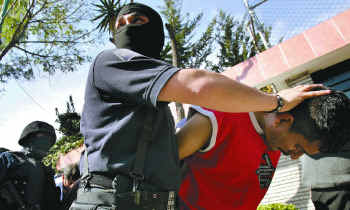
Eleven men were arrested Jan. 22, accused of planning a high-level assassination with the possible collaboration of Mexico City police and former army soldiers. Photo by Gregory Bull / AP.

This latest act in Mexico’s Narco Opera had resonance in Washington too where White House security spokesperson Gordon Johndroe spotlighted the Millan killing to urge the U.S. Congress to pass the Bush administration’s so-called Merida Initiative, AKA Plan Mexico, a $1.4 billion USD drug war boondoggle ostensibly modeled on the more ambitious counter-insurgency scheme Plan Colombia.

Synchronistically, Plan Mexico popped out of committee and sailed through the House May 15th. The Merida Initiative would provide a first installment of $400 million to pay for a fleet of second hand helicopters, troop transports, and surveillance technology capable of eavesdropping on every Mexican with a telephone and Internet access. But, like all Washington’s arms deals, Plan Mexico is, in reality, a bait and switch con whereby Washington pretends to give Mexico drug funds but instead pays off U.S. defense contractors and subsidizes the sale of their weaponry south of the border.

Mexico’s fulminating Narco Opera is playing to packed houses on the border. Things had gotten so hectic in Ciudad Juarez by late April that Calderon had to dispatch 3000 more troops (30,000 are in the field) to that beleaguered border town where 210 citizens had been killed from January to March and narco graves regularly turn up on quiet backstreets – 36 decaying cadavers were recently unearthed.

Local police have been ubiquitous targets: a note left at a monument to fallen officers in January listed 22 names, 18 of whom have since been cut down. The daily body count peaked at 12 during Easter and 50 unidentified corpses are moldering in the city morgue.

One motive for the mayhem: the Chapos have been horning in on the debilitated Juarez Cartel’s control of the “plaza”, a crucial platform for the shipment of drugs to El Norte. In recent years, the Juarez gang has linked up with the Gulf Cartel and its bloodthirsty enforcers, “Los Zetas”, ex-military thugs trained in the U.S. as drug fighters who are masters of the art of beheading their rivals.

The toll at the western end of the U.S. border in Tijuana January to April is 190 homicides, the high water mark being 19 on April 26th when two factions of the moribund Arellano Felix cartel riding around in dueling fleets of armor-plated SUVs emptied their Uzis at each other, leaving the dead scattered along an eight kilometer stretch of a downtown boulevard. Some of the martyred reportedly wore large gold rings stamped with the image of “Santa Muerte” – the sainted “Lady Death” is said to protect its bearers from the bullets of their enemies.

At the eastern end of the border in Matamoros where police chiefs are sworn in in the morning and are D.O.A. by nightfall, the ambiance is not cordial but the open warfare between the Gulf Cartel and Chapo’s Sinaloa boys during the winter months, has softened this spring under the guns of thousands of Mexican army troops.

The deadly border ballet is also being played out in the deep desert where Palomas Chihuahua connects up with Columbus New Mexico. Palomas, a cow town (drug czar Rafael Caro Quintero ran cattle stuffed with cocaine-filled condoms across the border there in the 1980s), is down to 7000 residents from 12,000 just last year and row after row of abandoned homes paint a desolate picture. As the cartels transfer their business from a militarized Juarez, the kill rate has zoomed – 23 so far this year.

When Police Chief Javier Perez Ortega resigned this spring and fled to the U.S. border station in Columbus to ask political asylum, his eight cops followed him, leaving Palomas more lawless than ever. 10 bullet-riddled bodies have been dumped at the Columbus border station according to a Reuters report – those who are still breathing are taken to nearby New Mexico hospitals but the dead are denied entry to the U.S.

The War on Drugs has been a deadly flop on both sides of the border since it was declared by Ronald and Nancy Reagan back in 1986. The U.S. security crackdown following 9/11 in 2001 has kept cocaine in Mexico, a transshipment point for South American blow, for much longer than the narcos can afford and the drugs have leaked onto the streets with a vengeance – crack addiction here has tripled since 2001. Moreover, the militarization of the border has intensified competition to exploit cracks in the security barrier, which has quintupled the kill rate.

On the Mexican side of the ledger, Calderon’s drug war, declared soon after he took office following the highly questionable 2006 election, has ratcheted up the body count – more than 4000 Mexicans have been killed in the first 18 months of Calderon’s offensive and 2008 in which total deaths at the current rate extrapolate out to about 3300, will be the bloodiest year yet. 12,745 victims have been slain in Mexico’s drug war between 2001 and 2008, including 33 military officers. According to the Federal Security Secretariat, 438 Mexican police officers have bitten the dust in the first five months of this year alone.

Despite the gristly statistics, Calderon’s rookie Interior Secretary Juan Camilo Mourino, a kind of Paliachi in this tragic-comic opera (comic-tragic opera?) insists to reporters that the president’s strategy is working and the escalating carnage is proof of how desperate the cartels have become. Mourino indignantly denies that his boss is negotiating with the narco-divas (divos?)

Now with Plan Mexico worming its way through their congress, U.S. taxpayers will soon have an opportunity to underwrite all this slaughter.

The difference between narco-war and narco-peace has everything to do with the product being transacted and by how much added value its illegality inflates profits – this is, after all, a war on drugs and not one on tomatoes. The more than obvious solution: Legalize It!

That’s just what several hundred “pachecos” (potheads) were chanting as they marched through Mexico City’s downtown Alameda Park this May 3rd in a cloud of green smoke. Mexico City cops assigned to monitor the annual parade made no move to arrest smokers. Under Mexican law, marijuana users are considered addicts and up to three grams of weed can land the guilty party in prison for ten to 16 months. Despite the May 3rd one-day amnesty, Mexico City’s liberal mayor Marcelo Ebrard has jailed 21,000 pachecos since he took office in 2006.

Now the tiny Alternative Social Democratic Party intends to introduce marijuana decrim legislation in the fall session of the Mexican congress, allowing for possession of up to five grams of herb, and encouraging medical marijuana treatment and the use of hemp fibers in cottage industries. In 2006, Congress actually passed a decriminalization measure and sent it on to then-president Fox who promptly vetoed it after receiving an emergency phone call from an alarmed George Bush.

How much this prolonged Narco Opera has cost both Mexico and the U.S. in blood and money is incalculable. The vast boodles it has taken to mount this absurd production has drained cash from already threadbare education, health and other social services and undermined the credibility of the state. One modest proposal for defraying expenses would be to emulate the Brazilian model posed by a Rio de Janero travel agency, which is now booking narco-tours of impoverished, crime-ridden favelas where tourists get to be photographed with local drug gang bosses for $54 USD per head.

{John Ross is in Mexico City pounding away on “El Monstruo – Tales of Dread & Redemption In the World’s Most Terrifying Urban Monster” (working title) to be published in 2009 by Nation Books. Ross himself is available at johnross@igc.org.]

Source. / counterpunch

Thanks to David Hamilton / The Rag Blog

Posted in RagBlog | Tagged , , , , | 1 Comment

Fox News’ Liz Trotta Jokes About Killing Obama

Fox commentator slams Clinton, jokes about killing Obama
By Nick Langewis / May 25, 2008

This morning, while discussing the media uproar surrounding Senator Clinton’s latest invocation of Senator Robert F. Kennedy’s assassination, Liz Trotta, former New York bureau chief of the Washington Times, unsubtly confused U.S. Senator and presidential candidate Barack Obama with Saudi jihadist and purported 9/11 mastermind Osama bin Laden… and perhaps placed similar value on their lives on live television.

“For years, the media has told us that Hillary Clinton is the smartest person in the world,” Trotta said, “and that’s up for grabs now. And the media’s catching on to that, as well. The ‘vast right-wing conspiracy’ blame has been undermined by her evasions, by her outright lies, if I may say; by her pandering, by her race-baiting–and now we have what some are reading as a suggestion that somebody knock off Os–Osama–um, uh–Obama. Well, both, if we could…”

Source. / The Raw Story

The Rag Blog

Posted in RagBlog | Tagged , , , , | Leave a comment

R.I.P. Utah Phillips


One of the great hobos, labor organizers, union men and singer/writer/mentors Utah Phillips passed away on Friday night. He was 73 years old and I suspect any reader of Songs:Illinois will be well aware of the work of Utah. Newer fans may have heard of him first though his work with Ani DiFranco. In fact it’s this association that has always kept Ani in my good graces despite her uneven output. If you’ve never heard of him, think of him as an older, saltier, American version of Billy Bragg.

He was loved by the hundreds of performers he encountered, tutored, befriended and mentored. He’ll be sorely missed. And impossible to replace.

Source. / Songs:Illinois.net. Go there for links to “Talkin’ NPR Blues,” “Moose Turd Pie,” “Railroading On The Great Divide,” and “Stupid’s Pledge.”

Also go to Austin Vets for Peace Fete Folk Legend Utah Philips
/ The Rag Blog

Thanks to Carlos Lowry / The Rag Blog

Posted in RagBlog | Tagged , , , , | 3 Comments

US "Superpower": Not Without Foreign Money


War Abroad and Poverty at Home
By Paul Craig Roberts / May 23, 2008

The US Senate has voted $165 billion to fund Bush’s wars of aggression against Afghanistan and Iraq through next spring.

As the US is broke and deep in debt, every one of the $165 billion dollars will have to be borrowed. American consumers are also broke and deep in debt. Their zero saving rate means every one of the $165 billion dollars will have to be borrowed from foreigners.

The “world’s only superpower” is so broke it can’t even finance its own wars.

Each additional dollar that the irresponsible Bush Regime has to solicit from foreigners puts more downward pressure on the dollar’s value. During the eight wasted and extravagant years of the Bush Regime, the once mighty US dollar has lost about 60% of its value against the euro.

The dollar has lost even more of its value against gold and oil.

Before Bush began his wars of aggression, oil was $25 a barrel. Today it is $130 a barrel. Some of this rise may result from run-away speculation in the futures market. However, the main cause is the eroding value of the dollar. Oil is real, and unlike paper dollars is limited in supply. With US massive trade and budget deficits, the outpouring of dollar obligations mounts, thus driving down the value of the dollar.

Each time the dollar price of oil rises, the US trade deficit rises, requiring more foreign financing of US energy use. Bush has managed to drive the US oil import bill up from $106 billion in 2006 to approximately $500 billion 18 months later–every dollar of which has to be financed by foreigners.

Without foreign money, the US “superpower” cannot finance its imports or its government’s operation.

When the oil price rises, Americans, who are increasingly poor, cannot pay their winter heating bills. Thus, the Senate’s military spending bill contains more heating subsidies for America’s growing legion of poor people.

The rising price of energy drives up the price of producing and transporting all goods, but American incomes are not rising except for the extremely rich.

The disappearing value of the US dollar, which pushes up oil prices and raises the trade deficit, then pushes up heating subsidies and raises the budget deficit.

If oil was the reason Bush invaded Iraq, the plan obviously backfired. Oil not merely doubled or tripled in price but quintupled.

America’s political leaders either have no awareness that Bush’s wars are destroying our country’s economic position and permanently lowering the living standards of Americans or they do not care. McCain says he can win the war in Iraq in five more years and in the meantime “challenge” Russia and China. Hillary says she will “obliterate” Iran. Obama can’t make up his mind if he is for war or against it.

The Bush Regime’s inability to pay the bills it is piling up for Americans means that future US governments will cut promised benefits and further impoverish the people. Over a year ago The Nation reported that the Bush Regime is shedding veteran costs by attributing consequences of serious war wounds to “personality disorders” in order to deny soldiers promised benefits.

Previous presidents reduced promised Social Security benefits by taxing the benefits (a tax on a tax) and by rigging the cost of living adjustment to understate inflation. Future presidents will have to seize private pensions in order to make minimal Social Security payments.

Currently the desperate Bush Regime is trying to cut Medicaid health care for the poor and disabled.

The Republican Party is willing to fund war, but sees everything else as an extravagance. The neoconized war party is destroying the economic prospects of American citizens. Is “war abroad and poverty at home” the Republican campaign slogan for the November election?

Paul Craig Roberts wrote the Kemp-Roth bill and was assistant secretary of the Treasury in the Reagan administration. He was associate editor of the Wall Street Journal editorial page and contributing editor of National Review. He is author or co-author of eight books, including The Supply-Side Revolution (Harvard University Press). He has held numerous academic appointments, including the William E. Simon chair in political economy, Center for Strategic and International Studies, Georgetown University, and senior research fellow, Hoover Institution, Stanford University. He has contributed to numerous scholarly journals and testified before Congress on 30 occasions. He has been awarded the U.S. Treasury’s Meritorious Service Award and the French Legion of Honor. He was a reviewer for the Journal of Political Economy under editor Robert Mundell.

Source / Information Clearing House

The Rag Blog

Posted in RagBlog | Tagged , | 1 Comment

To Play the VGC Opening for Velvet Underground

This just discovered today, a new Austin e-mag called the Blunderbuss. Randy Kirchhoff is part of the effort, and a fine one it looks to be. Our congratulations to all involved.

Richard Jehn / The Rag Blog


Vulcan Gas Company Danish Style
by Darina Neyret

The first time I heard the Copenhagen band Viva Vertigo was pretty stunning. And weird. Not weird in the bad sense but weird in the I am thirteen years old blowing my mind by listening to The Velvet Underground on my headphones weird. In the sense that this is something new, bizarre and captivating.

This record, their second, is titled “Vulcan Gas Company”. It starts out with a clanging symphony of resonating guitars and the exclamation “Finally, it’s here!” In some weird way it reminds me of the intro to the 70’s masterpiece “Maggot Brain” by Funkadelic. The eclectic, sonic party continues with guitar heavy, chunk-a-chunk songs followed by melodic ballads (of sorts) all filled with reverb-rich personality. The last song is a swirl of promises to us that “I will be here ’til the end of the night.” Sounds about right.

I received the disc in the mail from your friend and mine, Don Hyde, founder of The Vulcan. I pulled the disc out of the envelope and noticed the title. Was this a joke? (For those of you who may not know, the Vulcan was a club in downtown Austin, open from 1967 to 1970. Probably the first club that really started freaking out the establishment, paving the way for The Armadillo. But it was so much more than that.) From the first few notes coming from the stereo I realized that this was no joke at all. Not that the record is devoid of humor.

So intrigued was I by this record that I figured an interesting story must be within. Soon, the emails were flying back and forth between myself and founder of Viva Vertigo, Simon Beck. The Blunderbuss reaches out its artist musings across the sea to find that they do know about The Armadillo, The Vulcan, Jim Franklin’s (and others’) posters, and so much more.

Darina Neyret: When did you first hear about the Vulcan Gas Co.?

Simon Beck: I read about the club “The Vulcan Gas Company” on the cover of the green Velvet Underground live album “1969″. Part of the record was recorded there. I think Lou Reed said something about doing one long set “…and pull up your pincushions, or whatever you do to make life palatable here in Texas…” I always imagined a couple of cowboys getting that sentence mid-drink and spitting it out, being upset about witty Lou. Anyways, the name always popped up in my mind. And I finally got to read something about it on the net.

Read all of it here. / The Blunderbuss

The Rag Blog

Posted in RagBlog | Tagged , , | Leave a comment

Maureen Dowd : All About Eve


Hillary’s inelegant misspeak
By Maureen Dowd / May 25, 2008

Maybe it was the proximity of Mount Rushmore and Deadwood, but something caused Hillary’s inner Eve Harrington to leap out in South Dakota.

Venturing into Daschle-Obama territory, she inadvertently and inelegantly illuminated her thinking on why she wants to keep running as long as she can: stuff happens.

In politics, there are many unpredictable and unsavory twists and turns. That’s why she’s hanging around, and that’s why she and Bill want to force Barack Obama to take her as his vice president, even if he doesn’t want her, even if Michelle can’t stand her, even if she has to stir the sexist pot, and even if she tarnishes his silvery change message.

In an interview with The Argus Leader in Sioux Falls, Hillary disagreed that she’s hurting party unity: “My husband did not wrap up the nomination in 1992 until he won the California primary somewhere in the middle of June, right? We all remember Bobby Kennedy was assassinated in June in California.”

She was talking about the timeline for June, not wishing physical harm upon her rival. But many Democrats were upset. Congressman James Clyburn of South Carolina called her words “beyond the pale.”

Maybe a tired, stressed Hillary was giving an unfiltered version of a blunt conversation that she’s had with her husband and advisers about staying in the race, using R.F.K. as an anything-can-happen example, in the same way she fantasizes about Sean Hannity breaking a story that would demolish Obama.

She’s made the tasteless assassination comment before, including in a March interview with Time.

But coming right after the anniversary of the King assassination, right before the anniversary of the Bobby Kennedy assassination, right in the midst of the wrenching news about Teddy Kennedy’s brain tumor, and right in the middle of Billary’s hostile takeover attempt on the vice president’s mansion, the image was jarring.

Senator Clinton apologized and, in a fairly inspired reach, suggested that it was the awful diagnosis for Teddy that had put the dark thought in her head.

Standing incongruously in front of the salad-dressing section of a Sunshine Foods, she said, “The Kennedys have been much on my mind the last days because of Senator Kennedy” and pointed out that she holds Bobby Kennedy’s Senate seat.

Teddy Kennedy decided to endorse Obama in part because he was upset that Hillary sat silently when Francine Torge introduced the New York senator at a New Hampshire event saying: “Some people compare one of the other candidates to John F. Kennedy. But he was assassinated. And Lyndon Baines Johnson was the one who actually” signed the civil rights bill into law.

Hillary knows that in politics, bimbos erupt. Tapes leak. Husbands disappoint. Friends commit suicide. Rivals get sick. Her Senate race against Rudy Giuliani suddenly turned in her favor when he got prostate cancer and dropped out.

The macabre story of 2008 is that the vice presidential picks are important. On the Republican side, it’s because of John McCain’s age and history of skin cancer, and that’s openly discussed.

But on the Democratic side, it is, as The Times’s Obama reporter Jeff Zeleny has written, a “hushed worry.” Barack Obama has fused two of the most powerful narratives in American history — those of Martin Luther King Jr. and Camelot — and that makes him both magical and vulnerable.

He was only 6 years old in the spring of 1968, when Dr. King and Bobby Kennedy were assassinated. But the unspoken fear that he is in some danger as their spiritual heir hovers over his race. He got a Secret Service cordon last May, the earliest a candidate has ever been given it.

Alma Powell’s worries about assassination helped influence Colin Powell not to run. Michelle Obama expressed concern before her husband’s election to the Senate but said on “60 Minutes,” “I don’t lose sleep over it, because the realities are that, you know, as a black man, you know, Barack can get shot going to the gas station.”

Mike Huckabee had to apologize after making a joke at the National Rifle Association convention about a noise, saying it was Obama tripping off a chair when “somebody aimed a gun at him and he dove for the floor.”

Obama now has the perfect excuse not to pick Hillary as his running mate. She has been too unseemly in her desire to be on the scene if he trips, or gets hit with a devastating story. She may want to take a cue from the Miss America contest: make a graceful, magnanimous exit and wait in the wings.

That’s where the runners-up can be found, prettily lurking, in case it turns out the girl with the crown has some naked pictures in her past.

Source. / New York Times

Also see Clinton’s Very Bad Day. / The Huffington Post
And Hillary Clinton’s candidacy has done feminism no favours
/ Telegraph.co.uk

The Rag Blog

Posted in RagBlog | Tagged , , | Leave a comment

Barack Obama wants Bill to heal Hillary Clinton wounds

Obama’s team think their man and Bill Clinton can reunite the party

An assassination remark is the latest twist to sour relations between the two rivals
By Sarah Baxter / May 25, 2008

WASHINGTON — Barack Obama, the probable Democratic presidential nominee, wants Bill Clinton to help him heal the deep party rifts created by his wife Hillary’s divisive campaign – culminating in her dramatic claim this weekend that the 1968 assassination of Robert F Kennedy was a reason not to be pushed out of the race.

The tension between Hillary Clinton and Obama intensified after she told the Sioux Falls Argus Leader in South Dakota, which holds the last primary contest in 10 days’ time: “We all remember Bobby Kennedy was assassinated in June.”

She quickly apologised, ashen-faced, for a comment which appeared dangerously close to wishful thinking about Obama, but the damage was done.

Senior officials on Obama’s campaign believe Bill Clinton has the unique status and political gifts to reunite the party after such gaffes. They expressed confidence that the former president would rise above the perceived slights and grudges of a hard-fought campaign and work flat out for an Obama victory in November’s presidential election.

“If anybody can put their arms around the party and say we need to be together, it is Bill Clinton,” a senior Obama aide said.

“He’s brilliant, he has got heart and he cares deeply about the country. It’s tricky because of his position as Hillary’s spouse, but his involvement is very important to us.

“Bill Clinton will give permission to Hillary supporters to come into our camp and become one party. He is critical to this effort.”

Hillary, 60, claimed that her remark about the assassination had arisen because the “Kennedys have been much on my mind” after Senator Edward Kennedy, Robert’s younger brother, was diagnosed with a brain tumour last week.

She insisted she was referring to the timing of his assassination in June, when he was still a presidential candidate, rather than his killing, to make the point that there was nothing unusual about her determination to take this year’s race for the nomination into the summer.

However, while she expressed regret for “referencing that moment of trauma for our entire nation”, she did not apologise to Obama, who has been receiving secret security protection for the past year after death threats.

“We have seen an x-ray of a very dark soul,” wrote Michael Goodwin, a New York Daily News columnist. “One consumed by raw ambition to where the possible assassination of an opponent is something to ponder in a strategic way. Otherwise, why is murder on her mind?”

The outburst joins “Sniper-gate” – Hillary’s imaginary landing under fire in war-torn Bosnia – as one of the most memorable mistakes of a historic fight to the finish between two remarkably evenly matched candidates.

With just three contests to go – in Puerto Rico, Montana and South Dakota in early June – Obama, 46, is ahead of Clinton by 158 pledged delegates after winning the most states.

His lead is insurmountable unless superdelegates – the party leaders who will determine the outcome of the vote at the Democratic National Convention in August – break in her favour.

After the Kennedy gaffe, however, the implausible has become the unthinkable.

It is a delicate matter to bring Bill Clinton on board. The former president believes that Obama should offer his wife the vice-presidential slot as a mark of respect after she proved her electoral strength in the big must-win states for Democrats, but her latest error is widely perceived to have squandered what little chance she had.

“It would be hard to take the country in a new direction with the Clintons in the White House,” a source in the Obama campaign said. “They bring controversy.”

Discreet merger talks between key campaign staff and leading fundraisers in both camps are already under way. But the process of healing is fraught with friction after accusations of sexism, racism and other insults.

Bill Clinton has been stung by accusations that he played the “race card” by referring to Obama’s story as a “fairy-tale” and comparing his early success in South Carolina with that of the Rev Jesse Jackson, the failed black presidential candidate, in the 1980s.

Nevertheless, friends said they expected the former president to campaign hard for Obama once the nomination is settled.

“In my experience, he is someone who doesn’t really carry political grudges to the end of the line,” said Leon Panetta, who served as Clinton’s White House chief of staff. “He will get mad and angry but ultimately he comes around.”

He added that Clinton was “hurt” by the defeats of Al Gore in 2000 and John Kerry in 2004: “He knows that in the end his legacy within the Democratic party rests not just on his victories but the victories that follow.”

In an interview in People magazine, Clinton, 61, extended a small olive branch to Obama. “There have been some rumbles about leaving this party divided but not one of them has come out of our camp. Not one. Ever,” he said. He went on to speak warmly about his wife’s opponent, although he said Obama lacked experience.

Betsy Myers, a former White House official under Bill Clinton who is now with the Obama campaign, said: “They have very similar stories. They both came from lower-income families with a strong mother and went on to become very well educated and devoted their lives to public service. Had Hillary not been in the race, Barack is exactly the sort of candidate Bill Clinton would have embraced and supported.”

Obama has an important bargaining chip which could tempt Bill Clinton into the fold. Friends say the former president is distressed by the rift in his relationship with the African-American community after he was affectionately described in the 1990s as the “first black president”.

His wife’s reference to Robert Kennedy’s shooting touched a raw nerve among a community which has long feared that the first black candidate to have a serious chance of entering the White House will be assassinated, just as earlier champions such as Martin Luther King and Malcolm X were.

William Galston, a former White House official and Hillary Clinton supporter, said: “One part of him [Bill Clinton] deeply regrets the schism that has opened up with the black community and he would welcome the opportunity to redeem himself.” Campaigning for Obama would go a long way to restoring good relations.

Don Fowler, a former chairman of the Democratic national committee during Bill Clinton’s presidency and a leading Hillary supporter in South Carolina, said: “I don’t know of any two white people who have been more inclined to support causes of interest to the African-American community than Hillary and Bill Clinton. I’m certain they will want to soothe the ruffled feelings that have occurred during this campaign.”

Fowler is a member of the party’s 30-member rules and bylaws committee, which meets on May 31 to decide whether to seat disputed delegations from Michigan and Florida at the Democratic National Convention, as Hillary Clinton is insisting.

The two states were disqualified after holding their primaries early in defiance of party rules but are likely to have their status partially restored.

Fowler’s wife Carol, who chairs the South Carolina Democratic party, also sits on the rules committee but supports Obama. The couple – a microcosm of the split in the party – believe that a “peaceful resolution” to the conflict is possible.

Don Fowler said Hillary Clinton did not have to be Obama’s running mate to unite the Democrats: “She has lots of options and is a very talented woman. I don’t know if that would be a good choice for her or for the party.” A senior member of Obama’s campaign team suggested the former president could deploy his skills on the stump to help Obama woo white working-class voters in key swing states.

“When this primary is over, we’re going to unite as one and Bill Clinton will play a huge role,” said Patrick Murphy, a congressman who chaired the Obama campaign in Pennsylvania, a battleground state.

In a sign that the two camps are drawing together, Al Gore, the former vice-president and winner of the Nobel peace prize, is hosting a fundraiser for the Democratic party on May 31, co-chaired by Orin Kramer, a prominent Obama fundraiser, and Maureen White, one of Clinton’s top financial backers.

The Clinton dynasty may yet play its part. Bill Clinton predicted last week that Chelsea, his 28-year-old daughter, could one day enter politics.

“If you had asked me this before Iowa [which held its caucus in January], I would have said: no way – she is too allergic to anything we do. But she is really good at it.”

If the entire Clinton family can be persuaded to campaign for Obama, their supporters will surely follow.

Source. / Sunday Times, London

The Rag Blog

Posted in RagBlog | Tagged , , , , | Leave a comment

U.S. Economy On Very Shaky Ground

Tim Backshall, chief credit derivatives strategist at Credit Derivatives Research LLC, sits for a photo in his office in Walnut Creek, California, on May 6, 2008. Photo by Andy Freeberg/Bloomberg Markets via Bloomberg News.

A long but very good analysis about the very shaky underpinnings of the US economy. If you think collateralized debt obligations backing up sub-prime loans were a problem, then read about the far bigger problem of collateralized default swaps. It looks like Bear Stearns may be only the first domino to fall. I’ve concentrated some juicy parts from the original article linked below.

Roger Baker / The Rag Blog

Hedge Funds in Swaps Face Peril With Rising Junk Bond Defaults
By David Evans / May 20, 2008

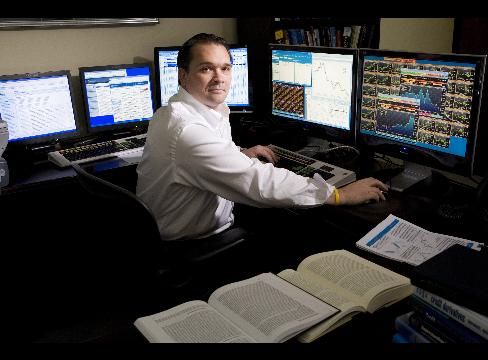
It’s Friday, March 14, and hedge fund adviser Tim Backshall is trying to stave off panic. Backshall sits in the Walnut Creek, California, office of his firm, Credit Derivatives Research LLC, at a U-shaped desk dominated by five computer monitors..

On this day, a CDS-market meltdown doesn’t happen. In a frenzy of weekend activity, the Federal Reserve and JPMorgan Chase & Co. rescue Bear Stearns from bankruptcy — removing the need for the sellers of credit-default protection to pay up on their contracts.

Chain Reaction

Backshall and his clients aren’t the only ones spooked by the prospect of a CDS catastrophe. Billionaire investor George Soros says a chain reaction of failures in the swaps market could trigger the next global financial crisis.

CDSs, which were devised by J.P. Morgan & Co. bankers in the early 1990s to hedge their loan risks, now constitute a sprawling, rapidly growing market that includes contracts protecting $62 trillion in debt.

The market is unregulated, and there are no public records showing whether sellers have the assets to pay out if a bond defaults. This so-called counterparty risk is a ticking time bomb.

“It is a Damocles sword waiting to fall,” says Soros, 77, whose new book is called “The New Paradigm for Financial Markets: The Credit Crisis of 2008 and What It Means” (PublicAffairs).

“To allow a market of that size to develop without regulatory supervision is really unacceptable,” Soros says…

…The Fed was worried about the biggest players in the CDS market, Mason says. “It was a JPMorgan bailout, not a bailout of Bear,” he says.

JPMorgan spokesman Brian Marchiony declined to comment for this article.

Credit-default swaps are derivatives, meaning they’re financial contracts that don’t contain any actual assets. Their value is based on the worth of underlying loans and bonds. Swaps are similar to insurance policies — with two key differences.

Unlike with traditional insurance, no agency monitors the seller of a swap contract to be certain it has the money to cover debt defaults. In addition, swap buyers don’t need to actually own the asset they want to protect.

It’s as if many investors could buy insurance on the same multimillion-dollar home they didn’t own and then collect on its full value if the house burned down.

Bigger Than NYSE

When traders buy swap protection, they’re speculating a loan or bond will fail; when they sell swaps, they’re betting that a borrower’s ability to pay will improve.

The market, which has doubled in size every year since 2000 and is larger in dollar value than the New York Stock Exchange, is controlled by banks like JPMorgan, which act as dealers for buyers and sellers. Swap prices and trade volume aren’t publicly posted, so investors have to rely on bids and offers by banks…

…Banks are the largest buyers and sellers of CDSs. New York- based JPMorgan trades the most, with swaps betting on future credit quality of $7.9 trillion in debt, according to the OCC. Citigroup Inc., also in New York, is second, with $3.2 trillion in CDSs.

Goldman Sachs Group Inc. and Morgan Stanley, two New York- based firms whose swap trading isn’t tracked by the OCC because they’re not commercial banks, are the largest swap counterparties, according to New York-based Fitch Ratings, which doesn’t provide dollar amounts…

…Fitch Ratings reported in July 2007 that 40 percent of CDS protection sold worldwide is on companies or securities that are rated below investment grade, up from 8 percent in 2002. On May 7, Moody’s wrote that as the economy weakened, high-yield-debt defaults by companies worldwide would increase fourfold in one year to 6.1percent by April 2009.

The pressure is building. On May 5, for example, Tropicana Entertainment LLC filed for bankruptcy after the casino owner defaulted on $1.32 billion in debt.

‘Complicate the Crisis’

A surge in corporate defaults may leave swap buyers scrambling, many unsuccessfully, to collect hundreds of billions of dollars from their counterparties, says Satyajit Das, a former Citigroup derivatives trader and author of “Credit Derivatives: CDOs & Structured Credit Products” (Wiley Finance, 2005).

“This is going to complicate the financial crisis,” Das says. He expects numerous disputes and lawsuits, as protection buyers battle sellers over the technical definition of default – – this requires proving which bond or loan holders weren’t paid — and the amount of payments due.

“It’s going to become extremely messy,” he says. “I’m really scared this is going to freeze up the financial system.”…

“I think there’s a major risk of counterparty default from hedge funds,” Cicione says. “It’s inconceivable that the Fed or any central bank will bail out the hedge funds. If you have a systemic crisis in the hedge fund industry, then of course their banks will take the hit.”

The Joint Forum of the Basel Committee on Banking Supervision, an international group of banking, insurance and securities regulators, wrote in April that the trillions of dollars in swaps traded by hedge funds pose a threat to financial markets around the world.

“It is difficult to develop a clear picture of which institutions are the ultimate holders of some of the credit risk transferred,” the report said. “It can be difficult even to quantify the amount of risk that has been transferred.”

Counterparty risk can become complicated in a hurry, Das says. In a typical CDS deal, a hedge fund will sell protection to a bank, which will then resell the same protection to another bank, and such dealing will continue, sometimes in a circle, Das says…

…Michael Greenberger, director of trading and markets at the Commodity Futures Trading Commission from 1997 to 1999, says the Fed is fully aware of the risk banks and the global economy face if CDS holders can’t cover their losses.

“Oh, absolutely, there’s no doubt about it,” says Greenberger, who’s now a professor at the University of Maryland School of Law in Baltimore. He says swaps were very much on the Fed’s mind when Bear Stearns started sliding toward bankruptcy.

“People who were relying on Bear for their own solvency would’ve started defaulting,” he says. “That would’ve triggered a series of counterparty failures. It was a house of cards.”…

…In the calmest of times, making reasoned decisions about swap prices is a challenge. Now, it’s impossible. Traders don’t have access to any company data more recent than Bear’s February annual report. Sharp-eyed investors looking through that filing might have spotted a paragraph that’s strangely prescient.

“As a result of the global credit crises and the increasingly large numbers of credit defaults, there is a risk that counterparties could fail, shut down, file for bankruptcy or be unable to pay out contracts,” Bear wrote…

…When it bailed out Bear Stearns, the Federal Reserve effectively deputized JPMorgan to monitor the credit-default- swap market, says Edward Kane, a finance professor at Boston College. Because regulators don’t know where the risks lie, they’re helpless, Kane says.

Default swaps shift the risk from a company’s credit to the possibility that a counterparty might fail, says Kane, who’s a senior financial Research.

‘Off Balance Sheet’

“You’ve really disguised traditional credit risk, pushed it off balance sheet to its counterparties,” Kane says. “And this is not visible to the regulators.”

BNP analyst Cicione says regulators will be hard-pressed to prevent the next potential breakdown in the swaps market.

“Apart from JPMorgan, there aren’t many other banks out there capable of doing this,” he says. “That’s what’s worrying us. If there were to be more Bear Stearnses, who would step in and give a helping hand? You can’t expect the Fed to run a broker, so someone has to take on assets and obligations.”

Banks have a vested interest in keeping the swaps market opaque, says Das, the former Citigroup banker. As dealers, the banks see a high volume of transactions, giving them an edge over other buyers and sellers.

“Dealers get higher profitability through lack of transparency,” Das says. “Since customers don’t necessarily know where the market is, you can charge them much wider margins.”…

…By the middle of 2007, mortgage defaults in the U.S. began reaching record highs each month. Banks and other companies realized they were holding hundreds of billions in toxic debt. By August 2007, no one would buy CDOs. That newly devised debt market dried up in a matter of months.

In the past year, banks have written off $323 billion from debt, mostly from investments they created.

Now, if corporate defaults increase, as Moody’s predicts, another market recently invented by banks — credit-default swaps — could come unstuck. Arturo Cifuentes, managing director of R.W. Pressprich & Co., a New York firm that trades derivatives, says he expects a rash of counterparty failures resulting in losses and lawsuits…

For now and for some time in the future, CDSs will remain unregulated and their trades will be done in the secrecy of Wall Street’s biggest securities firms. That means counterparty risk will stay out of the sight of the public and regulators.

“In order for us to get away from worries about counterparty risk, in order for us to encourage more trading and more transparency, there’s got to be some way to bring all the price data together with exchange trading or a central clearinghouse,” Backshall says.

Until that happens, the sword of Damocles will remain poised to fall, as banks, hedge funds and insurance companies can only guess whether their trillions of dollars in swaps are covered by anything other than darkness.

To read the entire story, go here. / Bloomberg.com

The Rag Blog

Posted in RagBlog | Tagged , , | Leave a comment

Will You Explain the Surgical Use of a Five-Hundred Pound Bomb in a Densely Populated Suburb?


On Generals Testifying Before Congress: A Mash Note
By Fred Reed, April 14, 2008

Whenever I see that some dismal general will testify to Congress regarding the war against Iraq, I imagine the first paragraph of his Power Point presentation:

“All metrics show a downsurge in the violence in Iraq, and a continuing improvement in indicators of the production of a better life. Next slide. The Iranians are aiding the enemies of America, and must be bombed. This is a recording.”

What solemn, fraudulent, emetic mummery. Congressmen will—do—ask the General puffball questions, after which they will do whatever the President tells them to do. I can make no criticism of this. It is the American way. Still, may I suggest a few questions I would like to see the General, any general, asked?

1) General, five years ago the Commander in Chief said that combat operations in Iraq had ended. Since this isn’t true, the Commander in Chief was either lying, delusional, or simply a fool. Which do you believe to be the case?

2) You have said on various occasions that Iran is meddling in Iraq, that it is supplying weapons, fighters, and training to the warring factions. Others have charged that the United States is meddling in Iraq, that it is supplying weapons, troops, and training in Iraq. Which of these assertions do you believe to be the more accurate? Have you seen any evidence of American involvement?

3) You have expressed a commendable admiration for our soldiers, saying that they are the finest young men of our nation. Would you let your daughter date a black Pfc. with a GED? A kid named Gonzalez with tattoos?

4) Permit me a personal question, General. Have you ever said anything but “yes” to anyone who could affect your chances of promotion? Can you give us examples?

I have received a letter from a squad leader in Baghdad who suggests that always saying “yes” qualifies you as a streetwalker but not as a soldier. I am sure this isn’t true. That is, I am sure you could be a soldier as well. Will you explain to us why the sergeant is wrong? Can you give the Congress a reason to believe that anything other than your career matters to you?

Read all of it here. / Fred on Everything

The Rag Blog

Posted in RagBlog | Tagged , , | Leave a comment

War: A Plague on the Minds of Those Who Fight It

Memorial Day, 2008
By Juan Cole

Memorial Day is about honoring those who have sacrificed themselves for the nation, in our armed forces. We cannot honor them properly unless we know the full extent of their sacrifice.

We have to count the victims of Post Traumatic Distress Syndrome, what we used to call being shell-shocked, as victims of the war. The number of those victims has been covered up.

Investigative reporters at CBS News found that in 2005, 6,250 veterans took their lives, nearly 18 a day. Emanuel Margolis writes,

‘Dr. Ira Katz, chief of mental health services for the Department of Veterans Affairs, sent an e-mail to a VA colleague this past February that read:

“Shh! Our suicide prevention coordinators are identifying about 1,000 suicide attempts per month among the veterans we see in our medical facilities. Is this something we should (carefully) address ourselves in some sort of release before somebody stumbles on it?”‘

Margolis charges that Katz covered up this startling statistic, showing 12,000 attempted suicides a year while in VA care, when he testified before Congress.

Have 30,000 veterans died of suicide in the past 5 years? Have 60,000 tried to? Shouldn’t these deeply depressed men and women be added to the casualty tolls? Is war a plague on the mind of those who fight it?

Margolis writes,

‘ • 120 veterans commit suicide every week.

• 1,000 veterans attempt suicide while in VA care every month.

• Nearly one in five service members returning from Iraq and Afghanistan (approximately 300,000) have post-traumatic stress disorder symptoms or major depression.

• 19 percent of post-Iraq and Afghanistan veterans have been diagnosed with possible traumatic brain injury, according to a Rand Corp. Study in April.

• A higher percentage of these veterans suffer from post-traumatic stress disorder than from any previous war because of “stop loss” or an involuntary extension of service in the military (58,300), multiple tours, greater prevalence of brain injuries, etc. ‘

19 percent of returning vets from Iraq and Afghanistan would also be nearly 300,000 persons, suffering from traumatic brain injury.

Wounded vets often face quality of life issues for the long term.

Others face profound moral dilemmas growing out of a conviction that they have been ordered to commit atrocities. The warping of the moral being may not be an inevitability of war but it is a severe risk.

Active duty soldiers in a war zone have a fear of becoming mere statistics, a fear I’ve had expressed to me in correspondence from Iraq. The LA Times profiles those soldiers from California who have given their lives to this war. The LAT says,

‘ Kelsey Johnson remembered that her husband, Marine Cpl. Stephen P. Johnson, 24, told her that he had “a really bad feeling” about an upcoming mission. Johnson, of Yreka, was among 31 troops killed when their helicopter crashed in the Iraqi desert.

“I dropped down on the ground and started screaming,” she said. She was 19 when her husband was killed. . .

Army Spc. Daniel F. Reyes told his mother that if he died, he wanted to be buried next to his brother, Roberto Esparza, who was 21 when he was killed in a bike accident in San Diego.

Reyes was survived by his wife, Rebekah, 23, and year-old son, Daniel Fernando. “He was always thinking of us,” she said. “He called me every morning in Iraq.”

Like many of those killed, the severity of Reyes’ wounds from an explosion precluded an open-casket service. Mortuary affairs personnel in the war zones have developed a word for such cases: unviewable.’

But in a way, all of the casualties from the Iraq War are “unviewable.”

We aren’t told the scale of the sacrifice by our corporate media or Washington officials. Michael Munk has done a fine job of focusing in like a laser on the real numbers of casualties for the Iraq War. Here is the last dispatch I have from him, dated May 6, 2008:

‘US military occupation forces in Iraq suffered at least 108 combat casualties in the week ending May 6, as the official casualty total reached at least 65,500. The total includes 33,325 dead and wounded by what the Pentagon classifies as “hostile” causes and 32,175 (since over a month ago on March 1) dead and injured from “non-hostile” causes.*

The actual total is over 85,000 because the Pentagon chooses not to count as “Iraq casualties” the approximately 20,000 casualties discovered only after they returned from Iraq -mainly brain trauma from explosions.**

In addition, a rare report showed that 1,123 “US civilian contractors” has been killed since the invasion, including a record 353 in 2007. No numbers are available on the wounded and injured, nor about casualties among the “contractors” who are not US citizens. (Houston Post, Feb. 9, 2008.)

US media divert attention from the actual cost in American life and limb by routinely reporting only the total killed (4,073 as of May 6) and rarely mentioning the 30,004 wounded in combat. To further minimize public perception of the cost, they cover for the Pentagon by ignoring the 31,325 (as of March 1)*** military victims of accidents and illness serious enough to require medical air evacuation, although the 4,058 reported deaths include 752 (no change last week ) who died from those same causes, including 145 suicide as of March 1.

* The number of wounded is updated weekly (usually Tuesdays) by the Pentagon at this site (pdf). The dead are reported by Iraq Coalition Casualties.

** see USA Today, Nov. 23, 2007

*** the number of “non combat” injured is reported by Iraq Coalition Casualties. ‘

I think all of us Americans fall down crying this time every year. We want it to be over with.

Source / Informed Comment

The Rag Blog

Posted in RagBlog | Tagged , | Leave a comment

With Equal Parts Grace and Calamity

The Conlin-Beavan family experiment requires that lights be low in their Fifth Avenue apartment. Photo: Nicole Bengiveno/The New York Times

The Year Without Toilet Paper
By Penelope Green / March 22, 2008

DINNER was the usual affair on Thursday night in Apartment 9F in an elegant prewar on Lower Fifth Avenue. There was shredded cabbage with fruit-scrap vinegar; mashed parsnips and yellow carrots with local butter and fresh thyme; a terrific frittata; then homemade yogurt with honey and thyme tea, eaten under the greenish flickering light cast by two beeswax candles and a fluorescent bulb.

A sour odor hovered oh-so-slightly in the air, the faint tang, not wholly unpleasant, that is the mark of the home composter. Isabella Beavan, age 2, staggered around the neo-Modern furniture — the Eames chairs, the brown velvet couch, the Lucite lamps and the steel cafe table upon which dinner was set — her silhouette greatly amplified by her organic cotton diapers in their enormous boiled-wool, snap-front cover.

A visitor avoided the bathroom because she knew she would find no toilet paper there.

Meanwhile, Joseph, the liveried elevator man who works nights in the building, drove his wood-paneled, 1920s-era vehicle up and down its chute, unconcerned that the couple in 9F had not used his services in four months. “I’ve noticed,” Joseph said later with a shrug and no further comment. (He declined to give his last name. “I’ve got enough problems,” he said.)

Welcome to Walden Pond, Fifth Avenue style. Isabella’s parents, Colin Beavan, 43, a writer of historical nonfiction, and Michelle Conlin, 39, a senior writer at Business Week, are four months into a yearlong lifestyle experiment they call No Impact. Its rules are evolving, as Mr. Beavan will tell you, but to date include eating only food (organically) grown within a 250-mile radius of Manhattan; (mostly) no shopping for anything except said food; producing no trash (except compost, see above); using no paper; and, most intriguingly, using no carbon-fueled transportation.

Mr. Beavan, who has written one book about the origins of forensic detective work and another about D-Day, said he was ready for a new subject, hoping to tread more lightly on the planet and maybe be an inspiration to others in the process.

Also, he needed a new book project and the No Impact year was the only one of four possibilities his agent thought would sell. This being 2007, Mr. Beavan is showcasing No Impact in a blog (noimpactman.com) laced with links and testimonials from New Environmentalist authorities like treehugger.com. His agent did indeed secure him a book deal, with Farrar, Straus & Giroux, and he and his family are being tailed by Laura Gabbert, a documentary filmmaker and Ms. Conlin’s best friend.

Why there may be a public appetite for the Conlin-Beavan family doings has a lot to do with the very personal, very urban face of environmentalism these days. Thoreau left home for the woods to make his point (and secure his own book deal); Mr. Beavan and Ms. Conlin and others like them aren’t budging from their bricks-and-mortar, haut-bourgeois nests.

Mr. Beavan looks to groups like the Compacters (sfcompact.blogspot.com), a collection of nonshoppers that began in San Francisco, and the 100 Mile Diet folks (100milediet.org and thetyee.ca), a Vancouver couple who spent a year eating from within 100 miles of their apartment, for tips and inspiration. But there are hundreds of other light-footed, young abstainers with a diarist urge: it is not news that this shopping-averse, carbon-footprint-reducing, city-dwelling generation likes to blog (the paperless, public diary form). They have seen “An Inconvenient Truth”; they would like to tell you how it makes them feel. If Al Gore is their Rachel Carson, blogalogs like Treehugger, grist.org and worldchanging.com are their Whole Earth catalogs.

Andrew Kirk, an environmental history professor at the University of Nevada, Las Vegas, whose new book, “Counterculture Green: The Whole Earth Catalog and American Environmentalism,” will be published by University Press of Kansas in September, is reminded of environmentalism’s last big bubble, in the 1970s, long before Ronald Reagan pulled federal funding for alternative fuel technologies (and his speechwriters made fun of the spotted owl and its liberal protectors, a deft feat of propaganda that set the movement back decades). Those were the days when Stewart Brand and his Whole Earth writers, Mr. Kirk said, “focused on a brand of environmentalism that kept people in the picture.”

“That’s the thing about this current wave of environmentalism,” he continued. “It’s not about, how do we protect some abstract pristine space? It’s what can real people do in their home or office or whatever. It’s also very urban. It’s a critical twist in the old wilderness adage: Leave only footprints, take only photographs. But how do you translate that into Manhattan?”

With equals parts grace and calamity, it appears. Washed down with a big draught of engaging palaver.

Before No Impact — this is a phrase that comes up a lot — Ms. Conlin and Mr. Beavan were living a near parody of urban professional life. Ms. Conlin, who bought this apartment in 1999 when she was still single, used the stove so infrequently (as in, never, she said) that Con Edison called to find out if it was broken. (Mr. Beavan, now the family cook, questioned whether she had yet to turn it on. Ms. Conlin ignored him.)

In this household, food was something you dialed for.

“We would wake up and call ‘the man,’ ” Ms. Conlin said, “and he would bring us two newspapers and coffee in Styrofoam cups. Sometimes we’d call two men, and get bagels from Bagel Bob’s. For lunch I’d find myself at Wendy’s, with a Dunkin’ Donuts chaser. Isabella would point to guys on bikes and cry: ‘The man! The man!’ ”

Since November, Mr. Beavan and Isabella have been hewing closely, most particularly in a dietary way, to a 19th-century life. Mr. Beavan has a single-edge razor he has learned to use (it was a gift from his father). He has also learned to cook quite tastily from a limited regional menu — right now that means lots of apples and root vegetables, stored in the unplugged freezer — hashing out compromises. Spices are out but salt is exempt, Mr. Beavan said, because homemade bread “is awful without salt; salt stops the yeast action.” Mr. Beavan is baking his own, with wheat grown locally and a sour dough “mother” fermenting stinkily in his cupboard. He is also finding good sources at the nearby Union Square Greenmarket (like Ronnybrook Farm Dairy, which sells milk in reusable glass bottles). The 250-mile rule, by the way, reflects the longest distance a farmer can drive in and out of the city in one day, Mr. Beavan said.

Read all of it here. / New York Times

Thanks to Betsy Gaines / The Rag Blog

Posted in RagBlog | Tagged , | Leave a comment

The War on Terror Meets the War on Immigrants


From the H-Blocks to a Texas Jail
by Sandy Boyer and Shaun Harkin / May 24, 2008

Twenty-six years ago, Pol Brennan was an Irish Republican Army (IRA) prisoner in the H-Blocks of Long Kesh, watching his friends die on hunger strike. Today, he is in solitary confinement in a Texas immigration holding center.

His story reveals a great deal about the evolving Anglo-American attitude toward the IRA wrought by the Northern Ireland Peace Process. It is also where the war on “terrorism” meets the war on immigrants in the United States.

Pol Brennan was born in 1953 in one of the poorest neighborhoods of Belfast, Northern Ireland. While growing up, being detained and beaten by British soldiers or the pro-British police force was almost routine. By 1972, when he was 19, like many of his generation, he joined the IRA to end British rule in Northern Ireland.

In 1976, Brennan was convicted of possessing explosives and immediately joined the blanket protest in the H-Blocks of Long Kesh prison. Here, IRA men refused to wear the prison uniform, demanding to be recognized, rightly, as political prisoners. They lived for years in cold prison cells, covered in nothing but a blanket.

Brennan shared a cell with Bobby Sands, the first man to die on the 1981 hunger strike for political status. As 10 men died, he lost several other friends. Along with British miners, Irish hunger strikers were on the vicious cutting edge of the Thatcher regime’s attack on working people everywhere.

In 1983, two years after the hunger strike ended, Brennan was one of 38 IRA prisoners who escaped from the H-Blocks. It was the largest prison break in British history from Her Majesty’s Prison Maze, considered one of the most secure prisons in Europe.

Pol made his way to the Bay Area, where he met and married Joanna Volz, a U.S. citizen. They lived quietly until January 1993, when federal agents arrested Brennan on a British extradition warrant. He was forced to spend more than seven years fighting extradition, and was imprisoned for three of those years, half the time in a building with no windows. A campaign to block his extradition received wide support, with Noam Chomsky, Christy Moore and Alexander Cockburn among the many who spoke out on his behalf.

The British government finally withdrew its extradition request in October 2000. By that time, Northern Ireland had changed dramatically. The IRA had ended its war. Sinn Fein, the main Republican political party, had agreed to govern Northern Ireland in coalition with Unionist political parties whose bottom line has always been preserving British rule in Ireland. In this new environment, Britain released IRA prisoners and withdrew its extradition requests.

The U.S. government also dramatically changed its attitude toward the IRA. In response to the 1994 IRA ceasefire, it suspended deportation proceedings against some former Republican prisoners. However, even after the extradition request was withdrawn, Pol Brennan still faced deportation proceedings. But they were put on hold while his application for political asylum was pending.

Pol, Joanna and her daughter Molly were able to live a peaceful and relatively normal life in the Bay Area. He worked legally as a carpenter, she as a legal clerk with the public defender’s office. Brennan was able to indulge his passion for astronomy by volunteering at the local planetarium. The couple adopted two whippets. They named one Marley, after Pol’s late friend Larry Marley, the architect of the escape from Long Kesh.

Their normal life was suddenly interrupted on January 26. Brennan and Volz were driving from Oakland to Texas to visit her relatives when they were stopped at an immigration checkpoint, 100 miles inside the U.S. border. Brennan produced his work authorization, but the two were detained because it had expired. Brennan was able to reach his lawyer, who faxed the Border Patrol agents documentation that he had an asylum case pending and had applied to renew the work permit.

But the agents ran Brennan’s name through their computers and came up with the 1983 escape from Long Kesh. Brennan says, “They acted as if they had caught the terrorist al-Zarqawi, as they as they huddled around their computer screens. Their little eyes were jiggling in their heads with excitement.”

The Border Patrol agents ignored the evidence faxed to them by Brennan’s lawyer. As Brennan describes it, “They said, ‘Well, just because you have an application pending doesn’t mean you have a legal right to be in the United States. So we are going to detain you.’”

Pol Brennan was taken to the Port Isabel Detention Center in Los Fresnos in southern Texas. He was initially placed in the general population with men from Central and South America, Trinidad and Jamaica, and even Palestine.

Brennan was soon moved to solitary confinement, because, apparently, he was considered an escape risk since he broke out of Long Kesh 25 years earlier. It was as if they expected the IRA to invade South Texas to free him.

Today, Pol is locked in a cell 23 hours a day. He spends the other hour in the TV room. He sustains himself with books and phone calls to the outside world. When it is his turn to use the phone, the guards bring it on a trolley and hand it to him through the cell door. Brennan then has to hold the phone at an angle and punch in the 10-digit code for the prison phone system. He can only make collect calls or use a phone card.

Joanna Volz has moved to Texas, where she can be near Pol. She visits for half an hour once a week. They talk through a telephone, separated by a plastic wall. Sometimes, he has been handcuffed throughout the visit.

An immigration judge denied Brennan bail, saying he is a “flight risk” and “a danger to the community.” The judge, who is notoriously anti-immigrant, ignored numerous letters of support from the Bay Area, including one from Brennan’s employer saying his job was being held open for him. Brennan was deemed a “flight risk” despite the fact that he had twice reported back to prison in California after his bail was revoked.

Now Brennan will have to go through a pro-forma hearing before the same judge on his political asylum application. From there, he will go to the Board of Immigration Appeals and, if necessary, to the Court of Appeals. He will almost certainly remain in prison at least through September.

Pol Brennan is collateral damage in the war on “terrorism.” His 32-year-old IRA conviction and the escape from Long Kesh are keeping him from receiving a green card or U.S. citizenship. In the present political climate, unlike when the IRA declared its ceasefire, there is no great urgency to helping former Republican prisoners.

Brennan is also a victim, like many millions of others, of the U.S. government’s anti-immigrant dragnet. Pol was stopped at the immigration checkpoint because the Department of Homeland Security hadn’t renewed his work authorization. His bail application was refused by an immigration judge so biased that he routinely rules against all immigrants, even Cubans.

Now, Brennan’s asylum application will almost certainly be decided by the Board of Immigration Appeals. Pol describes what’s happening to immigrants in this situation:

Regretfully, current policy has been shaped by post-9/11 paranoia, and to some extent xenophobia that we can see in such actions as the USA PATRIOT Act and the hundreds of miles of border fencing and walls now under construction along the U.S.-Mexico border.

The vast majority of detainees here are from Central and South America (Mexico included). who suffer the ill effects of U.S. trade, industrial and agricultural policies that undercut key sectors of their home economies and directly necessitate their seeking greener pastures to survive. Meanwhile, my case inches along.

Joanna Volz sums up Pol’s situation: “This is just old news. The war is over. It’s time this was over. The incident Pol was involved in happened 30-odd years ago. But this all keeps repeating itself. It’s like a roundabout. Everybody else is trying to move on, but he’s held back. It’s just not fair.”

The Irish government can certainly demand Brennan’s release and call for an end to deportations proceedings. Born in Belfast, under the Irish Constitution, he is as much an Irish citizen as if he was born in Dublin. The then-Taoiseach (Prime Minister) Albert Reynolds convinced Bill Clinton to let Gerry Adams visit the U.S. over the heated objections of the British government. On April 30, the outgoing Taoiseach, Bertie Ahern, was given the unusual honor of addressing a joint session of Congress.

Ireland’s economic importance to the U.S. should guarantee a hearing. U.S. companies have invested $84 billion in Ireland, more than double the total for China and India combined. In 2005, U.S. exports to Ireland were valued at $9 billion, while Irish exports to the U.S. totaled $28 billion. Unfortunately, the Irish government has shown no interest in fighting for Pol Brennan, and it will require political pressure at home to change their minds.

Popular mobilization and political pressure aimed at both the U.S. and Irish government is the best way to fight for Pol’s release. The California Ancient Order of Hibernians, the largest Irish organization in the U.S., has passed a resolution urging the “Department of Homeland Security to withdraw its opposition to bail and allow Pol Brennan to live and work legally in the U.S, until his political asylum case is adjudicated.” His neighbors in Oakland are pressing his Congresswoman, Barbara Lee, to intervene.

*****

What you can do

For more information on Pol Brennan’s case and to find out how you can show your support, go to the Pol Brennan Support Web site. Supporters are circulating an online petition demanding that Pol not be deported from the U.S.

Sandy Boyer is the co-host of Radio Free Eireann on WBAI in New York City and a veteran organizer for Irish political prisoners. Shaun Harkin is an immigrant rights activist in Chicago and contributor to Socialist Worker.

Source / Dissident Voice

The Rag Blog

Posted in RagBlog | Tagged , | Leave a comment