The War on Terror Meets the War on Immigrants


From the H-Blocks to a Texas Jail
by Sandy Boyer and Shaun Harkin / May 24, 2008

Twenty-six years ago, Pol Brennan was an Irish Republican Army (IRA) prisoner in the H-Blocks of Long Kesh, watching his friends die on hunger strike. Today, he is in solitary confinement in a Texas immigration holding center.

His story reveals a great deal about the evolving Anglo-American attitude toward the IRA wrought by the Northern Ireland Peace Process. It is also where the war on “terrorism” meets the war on immigrants in the United States.

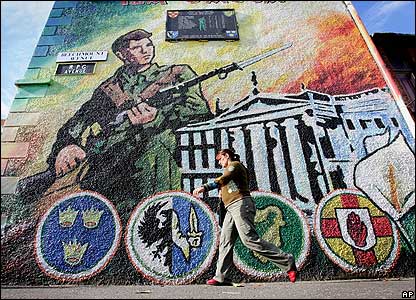
Pol Brennan was born in 1953 in one of the poorest neighborhoods of Belfast, Northern Ireland. While growing up, being detained and beaten by British soldiers or the pro-British police force was almost routine. By 1972, when he was 19, like many of his generation, he joined the IRA to end British rule in Northern Ireland.

In 1976, Brennan was convicted of possessing explosives and immediately joined the blanket protest in the H-Blocks of Long Kesh prison. Here, IRA men refused to wear the prison uniform, demanding to be recognized, rightly, as political prisoners. They lived for years in cold prison cells, covered in nothing but a blanket.

Brennan shared a cell with Bobby Sands, the first man to die on the 1981 hunger strike for political status. As 10 men died, he lost several other friends. Along with British miners, Irish hunger strikers were on the vicious cutting edge of the Thatcher regime’s attack on working people everywhere.

In 1983, two years after the hunger strike ended, Brennan was one of 38 IRA prisoners who escaped from the H-Blocks. It was the largest prison break in British history from Her Majesty’s Prison Maze, considered one of the most secure prisons in Europe.

Pol made his way to the Bay Area, where he met and married Joanna Volz, a U.S. citizen. They lived quietly until January 1993, when federal agents arrested Brennan on a British extradition warrant. He was forced to spend more than seven years fighting extradition, and was imprisoned for three of those years, half the time in a building with no windows. A campaign to block his extradition received wide support, with Noam Chomsky, Christy Moore and Alexander Cockburn among the many who spoke out on his behalf.

The British government finally withdrew its extradition request in October 2000. By that time, Northern Ireland had changed dramatically. The IRA had ended its war. Sinn Fein, the main Republican political party, had agreed to govern Northern Ireland in coalition with Unionist political parties whose bottom line has always been preserving British rule in Ireland. In this new environment, Britain released IRA prisoners and withdrew its extradition requests.

The U.S. government also dramatically changed its attitude toward the IRA. In response to the 1994 IRA ceasefire, it suspended deportation proceedings against some former Republican prisoners. However, even after the extradition request was withdrawn, Pol Brennan still faced deportation proceedings. But they were put on hold while his application for political asylum was pending.

Pol, Joanna and her daughter Molly were able to live a peaceful and relatively normal life in the Bay Area. He worked legally as a carpenter, she as a legal clerk with the public defender’s office. Brennan was able to indulge his passion for astronomy by volunteering at the local planetarium. The couple adopted two whippets. They named one Marley, after Pol’s late friend Larry Marley, the architect of the escape from Long Kesh.

Their normal life was suddenly interrupted on January 26. Brennan and Volz were driving from Oakland to Texas to visit her relatives when they were stopped at an immigration checkpoint, 100 miles inside the U.S. border. Brennan produced his work authorization, but the two were detained because it had expired. Brennan was able to reach his lawyer, who faxed the Border Patrol agents documentation that he had an asylum case pending and had applied to renew the work permit.

But the agents ran Brennan’s name through their computers and came up with the 1983 escape from Long Kesh. Brennan says, “They acted as if they had caught the terrorist al-Zarqawi, as they as they huddled around their computer screens. Their little eyes were jiggling in their heads with excitement.”

The Border Patrol agents ignored the evidence faxed to them by Brennan’s lawyer. As Brennan describes it, “They said, ‘Well, just because you have an application pending doesn’t mean you have a legal right to be in the United States. So we are going to detain you.’”

Pol Brennan was taken to the Port Isabel Detention Center in Los Fresnos in southern Texas. He was initially placed in the general population with men from Central and South America, Trinidad and Jamaica, and even Palestine.

Brennan was soon moved to solitary confinement, because, apparently, he was considered an escape risk since he broke out of Long Kesh 25 years earlier. It was as if they expected the IRA to invade South Texas to free him.

Today, Pol is locked in a cell 23 hours a day. He spends the other hour in the TV room. He sustains himself with books and phone calls to the outside world. When it is his turn to use the phone, the guards bring it on a trolley and hand it to him through the cell door. Brennan then has to hold the phone at an angle and punch in the 10-digit code for the prison phone system. He can only make collect calls or use a phone card.

Joanna Volz has moved to Texas, where she can be near Pol. She visits for half an hour once a week. They talk through a telephone, separated by a plastic wall. Sometimes, he has been handcuffed throughout the visit.

An immigration judge denied Brennan bail, saying he is a “flight risk” and “a danger to the community.” The judge, who is notoriously anti-immigrant, ignored numerous letters of support from the Bay Area, including one from Brennan’s employer saying his job was being held open for him. Brennan was deemed a “flight risk” despite the fact that he had twice reported back to prison in California after his bail was revoked.

Now Brennan will have to go through a pro-forma hearing before the same judge on his political asylum application. From there, he will go to the Board of Immigration Appeals and, if necessary, to the Court of Appeals. He will almost certainly remain in prison at least through September.

Pol Brennan is collateral damage in the war on “terrorism.” His 32-year-old IRA conviction and the escape from Long Kesh are keeping him from receiving a green card or U.S. citizenship. In the present political climate, unlike when the IRA declared its ceasefire, there is no great urgency to helping former Republican prisoners.

Brennan is also a victim, like many millions of others, of the U.S. government’s anti-immigrant dragnet. Pol was stopped at the immigration checkpoint because the Department of Homeland Security hadn’t renewed his work authorization. His bail application was refused by an immigration judge so biased that he routinely rules against all immigrants, even Cubans.

Now, Brennan’s asylum application will almost certainly be decided by the Board of Immigration Appeals. Pol describes what’s happening to immigrants in this situation:

Regretfully, current policy has been shaped by post-9/11 paranoia, and to some extent xenophobia that we can see in such actions as the USA PATRIOT Act and the hundreds of miles of border fencing and walls now under construction along the U.S.-Mexico border.

The vast majority of detainees here are from Central and South America (Mexico included). who suffer the ill effects of U.S. trade, industrial and agricultural policies that undercut key sectors of their home economies and directly necessitate their seeking greener pastures to survive. Meanwhile, my case inches along.

Joanna Volz sums up Pol’s situation: “This is just old news. The war is over. It’s time this was over. The incident Pol was involved in happened 30-odd years ago. But this all keeps repeating itself. It’s like a roundabout. Everybody else is trying to move on, but he’s held back. It’s just not fair.”

The Irish government can certainly demand Brennan’s release and call for an end to deportations proceedings. Born in Belfast, under the Irish Constitution, he is as much an Irish citizen as if he was born in Dublin. The then-Taoiseach (Prime Minister) Albert Reynolds convinced Bill Clinton to let Gerry Adams visit the U.S. over the heated objections of the British government. On April 30, the outgoing Taoiseach, Bertie Ahern, was given the unusual honor of addressing a joint session of Congress.

Ireland’s economic importance to the U.S. should guarantee a hearing. U.S. companies have invested $84 billion in Ireland, more than double the total for China and India combined. In 2005, U.S. exports to Ireland were valued at $9 billion, while Irish exports to the U.S. totaled $28 billion. Unfortunately, the Irish government has shown no interest in fighting for Pol Brennan, and it will require political pressure at home to change their minds.

Popular mobilization and political pressure aimed at both the U.S. and Irish government is the best way to fight for Pol’s release. The California Ancient Order of Hibernians, the largest Irish organization in the U.S., has passed a resolution urging the “Department of Homeland Security to withdraw its opposition to bail and allow Pol Brennan to live and work legally in the U.S, until his political asylum case is adjudicated.” His neighbors in Oakland are pressing his Congresswoman, Barbara Lee, to intervene.

*****

What you can do

For more information on Pol Brennan’s case and to find out how you can show your support, go to the Pol Brennan Support Web site. Supporters are circulating an online petition demanding that Pol not be deported from the U.S.

Sandy Boyer is the co-host of Radio Free Eireann on WBAI in New York City and a veteran organizer for Irish political prisoners. Shaun Harkin is an immigrant rights activist in Chicago and contributor to Socialist Worker.

Source / Dissident Voice

The Rag Blog

Posted in RagBlog | Tagged , | Leave a comment

What’s That in His Hand?


The Wool Over Our Eyes: A Nation of Sheep
By Richard Rhames

“The Labour proposal is modeled on a compulsory system in America where parents are threatened with jail if children are not immunized.” “No MMR jab, no school under new plans,” Telegraph, UK, 5/10/08

Against my better judgment, Monday evening last, I attended a local city budget meeting where officials cut about a million dollars from public education next fiscal year. The audience, largely composed of public school staff and advocates applauded the final decision. (The earlier proposed cuts were closer to $2 million.)

It was all quite civil really as such matters often are, here in the land of the allegedly “free” and “brave.” Well behind most of the developed world by many reasonable measures of civilized life and civic engagement, the US population has apparently been effectively neutered and now more or less serenely accepts each new application of the lash administered by those above them in the reigning political/economic order.The resolutely grasping pay-or-die American medical profit machine leaves 47 million people without medical insurance annually, and kills a minimum 18,000 of these uninsured each year. Yet the public, despite occasional squeaks of mild objection, placidly tolerates the steadily mounting body count.

Ralph Nader, in a recent article, (CounterPunch, 5/6/08) cites a Wall Street Journal piece detailing the sad story of one Lisa Kelly, afflicted with both leukemia and “limited insurance.”Shackled to a health care system rated only 37th in the world, that makes for a grim prognosis. Nader mentions the reaction of a “Dutch visitor” who, when shown the WSJ article “blurted in anger — ‘you are a nation of sheep.’”

Yes, people in civilized countries are often shocked by the US public’s acquiescence in routine totalitarian cruelties and usurpations practiced here. And when pieces of The American Way are floated for implementation overseas, the democratic reaction is worthy of note. Uppity and free publics resist such crap.

As noted recently in this space, Britain’s Labour party got badly beaten in the May Day election, largely because they tried to squeeze and punish their base (as the Democratic party does here).Now, as Labour readies for parliamentary elections, it appears that part of their “health manifesto” may propose compelling primary schools “to demand proof that pupils have had a full range of jabs — including measles, mumps and rubella — before allowing them to register.” (Telegraph, UK)

Here, such a policy has smoothed the way for routine mercury-laced vaccine injection of pregnant mothers, newborns and pre-schoolers. It is apparently linked with the current epidemic of autism in the young which now dwarfs the polio “epidemics” of the 40s and 50s in scope.

But Britain’s rascal public isn’t particularly receptive. Dr. Hamish Meldrum, chairman of the British Medical Association told the Telegraph that mandating forced vaccination was “morally and ethically dubious” and would march the nation “beyond the nanny state to a police state.”Meldrum deplored the proposal as “a Stalinist approach” which would likely “backfire on an unprecedented scale, and…increase opposition to vaccination.” Based on current “jab” rates it’s projected that nearly 100,000 kids would be barred from British schools.

Jackie Fletcher, speaking for the parent support group Jabs, protested, “This is scandalous. Parents will fight it tooth and nail. To bully families by threatening children’s schooling is appalling.”

In March, before May’s electoral thumping the Labour government also floated the idea of mandating a pledge of national “allegiance” for schoolchildren. The International Herald Tribune quoted Welsh Labour MP Paul Flynn: “It’s a non-starter. It will rank as one of the more foolish government proposals…I’ve seen newspaper polls showing the support is zero. And it will upset the 2.5 million republicans in this country.”

Flynn characterized the idea of pledging allegiance to Britain “a weak attempt to copy the American practice” which “does not reflect the reality of the United Kingdom.”On March 12, the BBC published a few cheeky draft “pledges” penned by the apparently underwhelmed and insurgent citizenry.

Kiltie Jackson suggested: “I pledge my oath of allegiance to my Queen and my country. I promise to watch all reality TV and to emulate those who are put before us as examples of fine citizens. I will honour all sporting figures and raise them upon pedestals until such times as they make an error where upon I will pillory them and mock them to the ends of the earth.

As an upstanding member of British society I vow to claim as much social benefit as possible to ensure that my binge drinking does not sink to sub-standard levels. But most importantly, and over everything else, I swear that I will not take myself, or my country, too seriously because I am proud to be British and that is how we do it.” Steven Jones: “I’m not British, English or anything other than human, I belong to one race – the human race, I worship no god, and kneel before no false monarch, I’m a free human and shall do what I please with no regard to the laws set in place by the Roman usurpers that invaded our shores.”

Darren Maxwell suggests something almost American-ish — until the subversive bit at the end: “I pledge allegiance to the Flag of the United Kingdom of Great Britain and Northern Ireland, the British Constitution and its laws, one Nation, with liberty justice and equality for all.” In the US, of course, we’ve fallen into a herd mentality. We wait eagerly for the new-told lie: Who to hate, who to kill, which brand to buy, which corporate lackey to support. We offer up our children to injection, indoctrination, technical training, and cut-rate preparation for cog-in-the-wheeldom. We lay waste to other lands while ours rusts, and tumbles to ruin. We stoically arrange voluntarist “walks” and bake sales for the sick and dying. We graze. We lift our heads. Here comes the herdsman.

What’s that in his hand?

Richard Rhames lives in Biddeford, Maine. He can be reached at: rrhames@xpressamerica.net.

Source / CounterPunch

The Rag Blog

Posted in RagBlog | Tagged | Leave a comment

Inner Strength That Will Carry His Family Forever

Ilse Ackerman, Meeno Peluce and their daughters get cozy in the nest the couple built from repurposed eucalyptus in the yard of their Lincoln Heights home.

A Lincoln Heights fixer-upper is transformed into a country escape in urban L.A.
By Lisa Boone / May 22, 2008

THE classified ad caught Ilse Ackerman’s eye: “Lincoln Heights Fixer-Upper. Artist Vision Required. On cul-de-sac.” No address was listed.

Intrigued — and determined — she and husband Meeno Peluce drove to every cul-de-sac in the area in search of “For Sale by Owner” signs. When the couple finally saw the 1926 house — atop a steep, winding dirt road on the outskirts of downtown Los Angeles — they found a condemned structure. The backyard featured a discarded black Naugahyde couch and some yucca plants. Everything else was dead.

Ackerman and Peluce, however, were not deterred.

“We didn’t see it as a wreck,” Ackerman remembers. “It always looked like it does in our minds.”

In their minds, they saw a magical outdoor space for their growing family. After six years of the couple’s planting, transplanting, building and tending, visitors can see it too: a wild jungle of blooming Pride of Madeira, cascading white roses, flowering bougainvillea reaching toward the sky. Thriving vegetable gardens are filled with chard, squash, tomatoes, basil and sunflowers, some bursting from simple bales of hay and compost with eye-popping color.

Ilse Ackerman and Meeno Peluce turn their once-dead yard in Lincoln Heights into Skyfarm — an oasis for their family, their 15 animals and 60,000 bees.

Then there are the animals of Skyfarm, as the couple has dubbed their home. Two dogs, three cats, one tortoise. A couple of cockatiels in an aviary, six chickens in a coop, a pet squirrel with the Spanish name Quince — “because he is the 15th animal,” Peluce says. And that’s not counting the 60,000 to 90,000 bees in three hives kept by Ackerman, a sculptor and former art teacher turned amateur beekeeper.

For her, Skyfarm is where her creative energy takes flight. For Peluce, a professional photographer, it is his “decompression chamber” — a country escape in the heart of urban L.A.

At the time Ackerman saw the classified ad, the couple was living in a loft at the Brewery industrial arts complex near downtown and were looking for an affordable house with more room. Ackerman, a New England native, pined for a garden.

They hired an inspector to look at the Lincoln Heights house, and his assessment was grim. “He assumed it was a tear-down,” Peluce says. “He also told me the house was ‘a marriage breaker.’ But for us, it was just another adventure.”

They purchased the property, their first home, in October, and moved in by December. The house was barely inhabitable, with holes in the wall, buckled floors and no hot water. Enough debris had been dumped on the property to fill the equivalent of eight railroad cars. Undaunted, the couple cooked meals on a camp stove, prompting them to call this period their “homesteading” phase.

Friends and family thought they were nuts.

“I was terrified,” says Sondra Peluce, Meeno’s mother, remembering her first impression of the house. “I thought they had taken leave of their senses. I actually think I went and threw up. It was like an out-of-control fun house that was not fun.”

Her dismay turned to pride, however, as she watched the home’s transformation over the succeeding months.

“When I saw my son hoisting railroad ties on his shoulder, I thought to myself, ‘He is building an inner strength that will carry his family forever,’ ” she says.

Read all of the article here, and click here for all the photos. / Los Angeles Times

The Rag Blog

Posted in RagBlog | Tagged , | Leave a comment

A Counterweight to the Northern Imperial Power


South America Creates Regional Union, Parliament
By Marco Sibaja / May 23, 2008

BRASILIA, Brazil — A new South American union was born Friday as leaders of the region’s 12 nations set out to create a continental parliament.

Some see the new organization, Unasur, as a regional version of the European Union. Summit host Brazil wants it to help coordinate defense affairs across South America and Venezuela’s Hugo Chavez calls it a counterweight to the United States.

“The number one enemy of the union of the south is the empire of the United States,” Chavez said after arriving in Brazil’s capital. “It’s very elementary: divide and conquer.”

The socialist crusader said the United States was “trying to generate wars in South America and tries to halt advances in the this project.”

Brazil’s president, Luiz Inacio Lula da Silva, invited other Latin American and Caribbean nations to join the venture. “Unasur is born, open to all the region, born under the signs of diversity and pluralism,” he said.

But South American leaders still found their own reasons for division.

Unasur’s first secretary-general, Rodrigo Borja, resigned Thursday, before the organization was formally born. He complained that some leaders had balked at his vision of putting other regional trade blocs, including Mercosur and the Andean Community, under Unasur’s authority.

The union’s inaugural meeting was moved from Colombia after that nation raided a guerrilla camp in Ecuador, sparking a crisis in regional relations. The gathering, now in Brasilia, is meant to formally establish an organization first proposed at a 2004 summit in Peru.

Experts say Unasur could ease future political tensions, promoting development on a continent where intra-regional trade topped US$72 billion (euro54.6 billion) in 2006.

South America’s economy is expected grow by 4.7 percent this year, according to the U.N.’s Economic Commission on Latin America. It grew 5.7 percent in 2007, when foreign direct investment reached a record US$106 billion (euro72 billion) as global demand for the region’s natural resources soared.

Source / Information Clearing House / AP

The Rag Blog

Posted in RagBlog | Tagged | Leave a comment

Election of Judges : Only in America

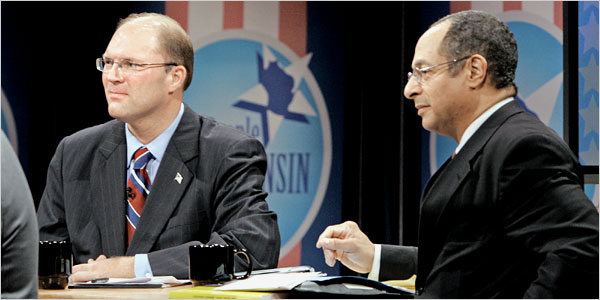
Michael J. Gableman, left, defeated Justice Louis B. Butler Jr. of the Wisconsin Supreme Court, right, after a campaign in which he falsely suggested Justice Butler had helped free a rapist.

American Exception
For American Judges, Rendering Justice, With One Eye on Re-election
By Adam Liptak / May 25, 2008

Last month, Wisconsin voters did something that is routine in the United States but virtually unknown in the rest of the world: They elected a judge.

The vote came after a bitter $5 million campaign in which a small-town trial judge with thin credentials ran a television advertisement falsely suggesting that the only black justice on the state Supreme Court had helped free a black rapist. The challenger unseated the justice with 51 percent of the vote, and will join the court in August.

The election was unusually hard-fought, with caustic advertisements on both sides, many from independent groups.

Contrast that distinctively American method of selecting judges with the path to the bench of Jean-Marc Baissus, a judge on the Tribunal de Grand Instance, a district court, in Toulouse, France. He still recalls the four-day written test he had to pass in 1984 to enter the 27-month training program at the École Nationale de la Magistrature, the elite academy in Bordeaux that trains judges in France.

“It gives you nightmares for years afterwards,” Judge Baissus said of the test, which is open to people who already have a law degree, and the oral examinations that followed it. In some years, as few as 5 percent of the applicants survive. “You come out of this completely shattered,” Judge Baissus said.

The question of how best to select judges has baffled lawyers and political scientists for centuries, but in the United States most states have made their choice in favor of popular election. The tradition goes back to Jacksonian populism, and supporters say it has the advantage of making judges accountable to the will of the people. A judge who makes a series of unpopular decisions can be challenged in an election and removed from the bench.

“If you want judges to be responsive to public opinion, then having elected judges is the way to do that,” said Sean Parnell, the president of the Center for Competitive Politics, an advocacy group that opposes most campaign finance regulation.

Nationwide, 87 percent of all state court judges face elections, and 39 states elect at least some of their judges, according to the National Center for State Courts.

In the rest of the world, the usual selection methods emphasize technical skill and insulate judges from the popular will, tilting in the direction of independence. The most common methods of judicial selection abroad are appointment by an executive branch official, which is how federal judges in the United States are chosen, and a sort of civil service made up of career professionals.

Outside of the United States, experts in comparative judicial selection say, there are only two nations that have judicial elections, and then only in limited fashion. Smaller Swiss cantons elect judges, and appointed justices on the Japanese Supreme Court must sometimes face retention elections, though scholars there say those elections are a formality.

“To the rest of the world,” Hans A. Linde, a justice of the Oregon Supreme Court, since retired, said at a 1988 symposium on judicial selection, “American adherence to judicial elections is as incomprehensible as our rejection of the metric system.”

Sandra Day O’Connor, the former Supreme Court justice, has condemned the practice of electing judges.

“No other nation in the world does that,” she said at a conference on judicial independence at Fordham Law School in April, “because they realize you’re not going to get fair and impartial judges that way.”

The new justice on the Wisconsin Supreme Court is Michael J. Gableman, who has been the only judge on the Burnett County Circuit Court in Siren, Wis., a job he got in 2002 when he was appointed to fill a vacancy by Gov. Scott McCallum, a Republican.

The governor, who received two $1,250 campaign contributions from Mr. Gableman, chose him over the two candidates proposed by his advisory council on judicial selection. Judge Gableman, a graduate of Hamline University School of Law in St. Paul, went on to be elected to the circuit court position in 2003.

Gableman Attack Ad

The much more rigorous French model, in which aspiring judges are subjected to a battery of tests and years at a special school, has its benefits, said Mitchel Lasser, a law professor at Cornell and the author of “Judicial Deliberations: A Comparative Analysis of Judicial Transparency and Legitimacy.”

“You have people who actually know what the hell they’re doing,” Professor Lasser said. “They’ve spent years in school taking practical and theoretical courses on how to be a judge. These are professionals.”

“The rest of the world,” he added, “is stunned and amazed at what we do, and vaguely aghast. They think the idea that judges with absolutely no judge-specific educational training are running political campaigns is both insane and characteristically American.”

But some American law professors and political scientists say their counterparts abroad should not be so quick to dismiss judicial elections.

“I’m not uncritical of the American system, and we obviously have excesses in terms of politicization and the campaign finance system,” said Prof. David M. O’Brien, a specialist in judicial politics at the University of Virginia and an editor of “Judicial Independence in the Age of Democracy: Critical Perspectives from Around the World.”

“But these other systems are also problematic,” Professor O’Brien continued. “There’s greater transparency in the American system.” The selection of appointed judges, he said, can be influenced by political considerations and cronyism that are hidden from public view.

A working paper from the University of Chicago Law School last year tried to quantify the relative quality of elected and appointed judges in state high courts in the United States. It found that elected judges wrote more opinions, while appointed judges wrote opinions of higher quality.

“A simple explanation for our results,” wrote the paper’s authors — Stephen J. Choi, G. Mitu Gulati and Eric A. Posner — “is that electoral judgeships attract and reward politically savvy people, while appointed judgeships attract more professionally able people. However, the politically savvy people might give the public what it wants — adequate rather than great opinions, in greater quantity.”

Herbert M. Kritzer, who was until recently a professor of law and political science at the University of Wisconsin, said judicial elections had deep roots in the state and the nation.

“It’s a remnant of the populist Jacksonian image of public office,” he said. “We’re crazy about elections. The number of different offices we elect is enormous.”

There is reason to think, though, that the idea of popular control of the government associated with President Andrew Jackson is an illusion when it comes to judges. Some political scientists say voters do not have anything near enough information to make sensible choices, in part because most judicial races rarely receive news coverage. When voters do have information, these experts say, it is often from sensational or misleading television advertisements.

“You don’t get popular control out of this,” said Steven E. Schier, a professor of political science at Carleton College in Minnesota. “When you vote with no information, you get the illusion of control. The overwhelming norm is no to low information.”

Still, judges often alter their behavior as elections approach. A study in Pennsylvania by Gregory A. Huber and Sanford C. Gordon found that “all judges, even the most punitive, increase their sentences as re-election nears,” resulting in some 2,700 years of additional prison time, or 6 percent of total prison time, in aggravated assault, rape and robbery sentences over a 10-year period.

In common law countries, judges are generally appointed by executive branch officials, though lately judicial commissions made up of lawyers and lay people are taking a larger role in the initial selection of candidates. Scotland adopted that method in 2002, and England and Wales in 2006.

Alan Paterson, a Scottish law professor who serves on the Judicial Appointments Board for Scotland, said his country’s system was transparent and worked well, though he acknowledged that the idea behind judicial elections was attractive.

“Part of me likes it,” he said. “It follows from the separation of powers. But in practical terms, it’s very difficult. They have to raise a lot of money.”

“The theory is a nice theory,” he said. “The practice of it is unworkable. We’re not going to do it.”

In some nations, of course, the judiciary is neither independent nor accountable to the public.

“Take a country like Vietnam,” Professor O’Brien said. “Those poor judges are controlled by party officials even at the trial level. That’s even worse than we have in Pennsylvania, Ohio and Texas, where the cost of judicial campaigns has just escalated over the last couple of decades.”

Judge Gableman did not respond to phone messages seeking comment. In answer to a question about his qualifications in an online forum on The Milwaukee Journal Sentinel’s Web site, he acknowledged that he had no appellate court experience but said he had argued a case, concerning zoning, before the state Supreme Court.

In the recent election, Judge Gableman’s campaign ran a television advertisement juxtaposing the images of his opponent, Justice Louis B. Butler Jr., in judicial robes, with a photograph of Ruben Lee Mitchell, who had raped an 11-year-old girl. Both the judge and the rapist are black.

“Butler found a loophole,” the advertisement said. “Mitchell went on to molest another child. Can Wisconsin families feel safe with Louis Butler on the Supreme Court?”

Justice Butler had represented Mr. Mitchell as a lawyer 20 years before and had persuaded two appeals courts that his rape trial had been flawed. But the state Supreme Court ruled that the error was harmless, and it did not release the defendant, as the advertisement implied. Instead, Mr. Mitchell served out his full term and only then went on to commit another crime.

In an interview, Justice Butler — a graduate of the University of Wisconsin law school who served for 12 years as a judge in Milwaukee courts — said the past few months had tested his commitment to elections.

“My position historically has been that there is something to be said for the public to be selecting people who are going to be making decisions about their futures,” Justice Butler said.

“But people ought to be looking at judges’ ability to analyze and interpret the law, their legal training, their experience level and, most importantly, their impartiality,” he continued. “They should not be making decisions based on ads filled with lies, deception, falsehood and race-baiting. The system is broken, and that robs the public of their right to be informed.”

Judge Baissus, the French judge, said his nation had once considered electing its judiciary.

“It’s an argument that was largely debated after the French revolution,” he said. “It was thought not to be a good idea. People seeking re-election would not be independent. They are indeed close to the electorate, but sometimes uncomfortably so.”

Source. / New York Times

This is part of a series of articles by Adam Pitak on the American Justice System. Go here for links to the other articles.

Butler Blasts Election Process, Calls For Campaign Reform

The Rag Blog

Posted in RagBlog | Tagged , | Leave a comment

Corn Dog Cornyn : War Yes, GI’s No!

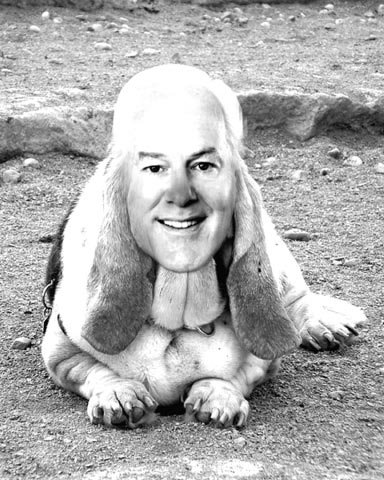
Sen. John (Corn Dog) Cornyn, R-Texas, aka “Lap Dog to the President.” Graphic by Bill Narum / The Rag Blog

John Cornyn Funds the War But Not Those Who Fought It
By Karl-Thomas Musselman/ May 23, 2008

The first paragraph from this article in the Fort Worth Star-Telegram says it all.

U.S. Sen. John Cornyn, R-Texas, voted to approve $165 billion for the wars in Iraq and Afghanistan but provided one of 22 votes against the domestic spending measure that is paired with the war spending bill. The Senate bill would add about $50 billion through 2017 for veterans’ education benefits.

John Cornyn provided one of just 22 votes against this bill which was an expanded version of the GI Bill, called the Post-9/11 Veterans Educational Act, to increase education benefits for veterans returning from Iraq and Afghanistan. Even Texas’ other Senator, Kay Bailey Hutchison voted for it along with many of the Republican Senators up for re-election this year who are trying to moderate their positions in an election year.

But not John Cornyn. Here’s what he’s had to say about this bill.

“The anti-war crowd is determined to use our men and women in uniform for their political advantage, even if our national security is jeopardized in the process,” Cornyn campaign spokesman Kevin McLaughlin said.

And again on his reasons to oppose it.

The updated GI Bill would hurt re-enlistment rates because troops will be eager to take advantage of it.

The Austin American-Statesman replied to this line of argument on their editorial page today. Simply put…

While those arguments will no doubt be repeated often between now and November, they are as empty as the arguments that the World War II era GI Bill cost too much. How much is too much for people we ask to walk into bullets?

Supporting the troops is more than plastering a yellow decal on a car. Real support means a commitment of money. Mere money doesn’t match the commitment we asked the troops to make.

President Bush is now threatening to veto the legislation. But Cornyn has already indicated he’s willing to vote against overriding the veto. You should sign Rick Noriega’s petition calling on Cornyn to vote to override that veto.

As Rick Noriega said…

“If that GI Bill was good enough for the Greatest Generation, why is it not good enough for the latest generation?

Source. / Burnt Orange Report

The Rag Blog

Posted in RagBlog | Tagged , , , , | Leave a comment

The Kernel of Solidarity Exists in Every Workplace


The Myth of the Reactionary Working Class
by Adam Turl / May 23, 2008

The working class is back–or at least the words “working class” are.

For decades, an army of pundits and academics argued that the majority of people in the United States comprised an expanding, satiated and upwardly mobile middle class–and that the very idea of a working class belonged to an industrial past long ago. The word “working class” went down the memory hole, and couldn’t be brought out–even in roundabout ways–without invoking the specter of “class war” in mainstream politics.

As University of Illinois-Chicago Professor Leon Fink wrote in the Chicago Tribune:

When Al Gore unveiled a modest appeal to “working families” at the 2000 Democratic National Convention… [h]is Republican opponent, George W. Bush, immediately counterattacked, accusing Gore of unleashing “class war” on the country. The preferred term of address had long been “middle class”; even the AFL-CIO avoided the shoals of class rhetoric to try to co-opt the conservative family-values agenda.

Yet, today, virtually every commentator, from William Kristol to Paul Krugman, unblinkingly invokes the once-dreaded terminology in suggesting that Sen. Barack Obama cannot, as the director of the Quinnipiac University Polling Institute put it, “penetrate working-class voters.”

If “working class” has become common parlance again, it may be because there is a crisis facing the working-class majority in the U.S.–those who work for wages. Hourly wages, adjusted for inflation, have fallen over the past three decades, while the size of the gross domestic product (GDP) almost tripled–a growth of riches that has accrued almost solely to big business.

But if the “working class”–and its much debated “bitterness” and grievances–is at the forefront of the 2008 presidential election, this “rediscovery” has brought along with it the reprise of longstanding myths–that the working class is, generally speaking, flag-waving, conservative, church-obsessed, tradition-oriented and mostly white.

As Fink continued in his article:

Today, “working class” has been effectively defanged of any radical, let alone subversive, intent. In fact, today’s working class looks less the modernist, rationalizing force that Marx projected than a bastion of tradition–that unmoving “sack of potatoes” he identified with the peasantry.

Whether explicit or not, today’s invocation of the working class is preceded by the word “white.” And the resulting construct–white men and women who have not gone to college–are regularly presented as a mostly conservative bloc… [T]he working class that Obama can’t reach looks to be populated by Archie Bunker and his like-minded descendants.

This is a stereotype, of course, and one with a long history. Fink invokes a distorted view of the working class–”Archie Bunker and his like-minded descendants”–that was an invention of the ruling class and mass media when it arose in the 1960s as part of an ideological counter to the growing influence of the 1960s social movements.

As International Socialist Review contributor Joe Allen has written, “In the late 1960s, the U.S. media and political establishment ‘rediscovered’ the working class, though not the real working class–which was white, Black, Latino and increasingly made up of women… The working class that they claim to have discovered was really a middle-class stereotype that portrayed the working class as white men who were in rebellion against the civil rights and antiwar movements and liberalism in general.”

Images of workers in hard hats attacking activists were broadcast to in an attempt to show that “hard-working” Americans rejected “ungrateful” and “privileged” antiwar students. But surveys in the late 1960s and early 1970s showed that manual workers opposed the Vietnam War in similar numbers to the youths who made up the student antiwar movement and the GI resistance.

Read all of it here. / Dissident Voice

The Rag Blog

Posted in RagBlog | Tagged , | Leave a comment

No Torture. No Exceptions


“No Torture. No Exceptions” means:

* reaffirming America’s commitment to existing federal laws and international treaties that ban torture and cruel, inhuman or degrading treatment under all circumstances.

* renouncing all legal interpretations and executive orders that redefine torture and permit such acts as sensory and sleep deprivation, stress positions, sexual humiliation, and mock executions.

* enforcing full transparency of information about how America treats any and all detainees held by our personnel and those in our employ anywhere in the world.

* rejecting and abolishing the practice of rendering detainees abroad.

* establishing a single standard of interrogation procedures to apply to all persons held in U.S. custody or by those under U.S. control, whether C.I.A., military, or civilian.

* treating our detainees as we would have others treat detained Americans.

TOGETHER WE CAN HALT TORTURE.

STEP 1: Call each presidential candidate NOW.
INSIST: “No Torture. No Exceptions.”

John McCain:
Phone: (202) 224-2235 • Fax: (202) 228-2862

Barack Obama:
Phone: (202) 224-2854 • Fax: (202) 228-4260

Hillary Clinton:
Phone: (202) 224-4451 • Fax: (202) 228-0282

For more information, click here.

Thanks to The Guantanamo Blog / The Rag Blog

Posted in RagBlog | Tagged , | Leave a comment

If You Mess Up, People Get Hurt

How much we blatantly and consciously minimise the effects of this war in Iraq. It is unconscionable to me that we almost refuse to acknowledge the death in Baghdad of innocent civilians every day as a direct consequence of planned US air strikes. Remember for each Hellfire missile fired, the statistics tell us that 9 civilians will die for every combatant killed. We so ignore this horrifying fact.

It is time to acknowledge the war crimes, bring the criminals to justice, and get the hell out of Iraq.

Richard Jehn / The Rag Blog

Different Perspectives: from the air before death strikes

In Iraq, a Surge in U.S. Airstrikes
By Ernesto Londoño and Amit R. Paley / May 23, 2008

Military Says Attacks Save Troops’ Lives, but Civilian Casualties Elicit Criticism; Since clashes broke out in eastern Baghdad in late March the U.S. Army has fired more than 200 hellfire missiles in Baghdad, killing over 251 people. A pilot describes his experiences.

CAMP TAJI, Iraq — From an Apache helicopter, Capt. Ben Katzenberger’s battlefield resembles a vast mosaic of tiny brown boxes.

“The city looks like a bucket of Legos dumped out on the ground,” the 26-year-old pilot said. “It’s brown Legos, no color. It’s really dense and hard to pick things out because everything looks the same.”

He uses a powerful lens to zoom in on tiny silhouettes, trying to identify people with “hostile intent” among hundreds of ordinary citizens in Baghdad.

In recent weeks, Katzenberger and other pilots have dramatically increased their use of helicopter-fired missiles against enemy fighters, often in densely populated areas. Since late March, the military has fired more than 200 Hellfire missiles in the capital, compared with just six missiles fired in the previous three months.

The military says the tactic has saved the lives of ground troops and prevented attacks, but the strikes have also killed and wounded civilians, provoking criticism from Iraqis.

On Wednesday, eight people, including two children, were killed when a U.S. helicopter opened fire on a group of Iraqis traveling to a U.S. detention center to greet a man who was being released from custody, Iraqi officials said.

The U.S. military said in a statement that it had targeted men linked to a suicide bombing network. “Unfortunately, two children were killed when the other occupants of the vehicle, in which they were riding, exhibited hostile intent,” the statement said.

U.S. officials say they go to great lengths to avoid harming civilians in airstrikes.

Different Perspectives: on the ground after death and mayhem strike

“It’s not Hollywood and it’s not 110 percent perfect,” said Col. Timothy J. Edens, the commander of the 12th Combat Aviation Brigade, of the accuracy of his unit’s strikes. “It is as precise as very hardworking soldiers and commanders can make it. These criminals do not operate in a clean battle space. It is occupied by civilians, law-abiding Iraqis.”

Those civilians include people like Zahara Fadhil, a 10-year-old girl with a tiny frame and long brown hair. Relatives said she was wounded by a missile on April 20 at approximately 8 p.m. in Baghdad’s Shiite enclave of Sadr City. The U.S. military said it fired a Hellfire missile in Zahara’s neighborhood at that time, targeting men who were seen loading rockets into a sedan.

Her face drained of color and her legs scarred by shrapnel, Zahara spoke haltingly when asked what she thought of U.S. troops.

“They kill people,” she said. Lying in bed, she gasped for air before continuing. “They should leave Iraq now.”

Shortly after Prime Minister Nouri al-Maliki launched an operation in late March to crack down on Shiite militias in the southern city of Basra, Shiite fighters in Baghdad stepped up mortar and rocket attacks against the Green Zone, the fortified area housing many U.S. and Iraqi officials. A handful of Americans were killed in those attacks.

The U.S. military responded by targeting fighters from the air, firing Hellfire missiles almost daily into Sadr City, a vast and impoverished district that is the Baghdad stronghold of anti-American cleric Moqtada al-Sadr. U.S. forces have also supported Iraqi troops on the ground.

Many residents described the recent military operations in Sadr City as indiscriminate attacks. Civilian deaths and damage to homes were key reasons Sadrist leaders demanded that U.S. troops remain on the sidelines of an Iraqi Army incursion into Sadr City this week that has significantly reduced violence there.

At a sprawling air base on the outskirts of Baghdad, Edens, Katzenberger and their colleagues live in small trailers surrounded by blast walls, play volleyball on sand courts and eat at an outdoor food court. Many of the pilots are in their 20s.

The pilots sometimes scrawl messages on the five-foot-long missiles strapped to their “birds.” During a recent visit to the base, a reporter saw a missile addressed to “Haji,” an honorific for people who have made the pilgrimage to Mecca. Many U.S. soldiers use it to refer dismissively to Iraqis and Arabs in general. Someone wrote “rock this thang” on another.

The small, white trailers adjacent to the airfield where the pilots do paperwork have Christmas lights strung from the ceiling. Two bumper stickers on windows say: “I [heart] Sadr City.”

Just before the missile hit, Zahara was returning home from delivering food to neighbors. She was near the door when her grandmother yelled: “Get inside the house!”

As she began to move, the missile crashed into the house, throwing her behind a set of stairs.

One of Zahara’s uncles, Dhia Rahi Shaie al-Koreishi, 34, a taxi driver, and her grandmother, Um Fadhil al-Koreishi, were killed by the blast.

“The heart of this family has been ripped out,” said Alaa Rahi Shaie, 29, another uncle, who was stoic in describing the death of his brother. “This is his blood,” he said, indicating red splotches in front of his home. “And the remains of his head are over there.”

He pointed at a large mound of dirt. A group of young boys dug out the remains and then showed visitors a black bag filled with clumps of hair and scalp.

Family members and neighbors said they didn’t see anyone in the area fire rockets. Two black funeral banners hung outside the battered home to honor the dead.

Read all of it here. / Washington Post

US strike kills children north of Baghdad
By Kim Gamel, May 23, 2008

BAGHDAD – A US helicopter strike north of Baghdad killed eight people in a vehicle, including at least two children, Iraqi officials said Thursday, insisting all the dead were civilians. The US military said six were al-Qaida militants but acknowledged children were killed.

The attack threatened to further alienate Sunni Arabs at a time when the US is working to keep them on their side in the fight against the terror network.

Associated Press Television News footage showed the bodies of three children in blood-drenched clothes – the eldest appearing to be in his early teens – along with the bodies of five men, at the hospital in Beiji, where the dead were taken after Wednesday evening’s strike.

Iraqi and US officials each put the number of slain children at two, and the reason for the discrepancy was not known.

It was the latest incident threatening to alienate Sunnis, who have played a key role in the steep decline in violence over the past year by joining forces with the Americans against al-Qaida in Iraq. Beiji, an oil hub 250 kilometers (155 miles) north of Baghdad, lies in a largely Sunni Arab area.

The strike came as the US was trying to ease Iraqi anger over the shooting of a copy of the Quran by an American sniper, who used Islam’s holy book for target practice.

In Afghanistan, a protest over the Quran shooting turned violent, leaving a NATO soldier and two demonstrators dead, after protesters began throwing stones at police and troops, a NATO spokesman said. Police opened fire on the protesters, killing two. The soldier was also killed by gunfire but it was not clear by whom.

Iraq has not seen any street protests over the Quran shooting, which took place earlier this month in a Sunni Arab area west of Baghdad. But Iraqi leaders have loudly denounced the act, prompting a series of apologies from US military commanders and US President George W. Bush. The US military says the sniper was disciplined and removed from Iraq.

In the attack near Beiji, the military said its forces were targeting members of an al-Qaida suicide bombing network. The forces engaged the occupants of a vehicle after they refused to surrender and “exhibited hostile intent.”

It said five suspected “terrorists” were killed along with two children in the vehicle. A sixth militant was killed in a field next to the road, according to a statement.

Beiji police Col. Mudhher al-Qaisi, however, said the dead were six civilian farmers and two children who were fleeing in their vehicle from the area after the US forces launched their raids. He said a US helicopter became suspicious of their vehicle and opened fire on it.

A resident of the area, Mohammed al-Shimmari, said the raid occurred when a group of his relatives had gathered at the home of his cousin, who is being held by the US military on suspicion of insurgent ties, after hearing he would be released soon.

Read the rest here. / New Zealand Herald

The Rag Blog

Posted in RagBlog | Tagged , | Leave a comment

Musical Remarks About the Big Five Oil Companies

Pain at the Pump by Brent Burns

“This song is self-explanatory. It’s hard not to believe that a few people are making billions off a lot of regular folks who are just getting by! These ridiculous prices are a real burden on the working class. ‘The Man’ knows we have to have gas and he’s jackin’ us around again. I’ll be damned if I’ll be quiet about it!” Brent Burns

For more, click here.

Thanks to Mariann Wizard / The Rag Blog

Posted in RagBlog | Tagged , , | Leave a comment

It’s Larry Craig "Bobblefoot" Day!

Minor league promotion is homage to senator’s airport bathroom bust
May 22, 2008

Capitalizing on Senator Larry Craig’s restroom bust, a Minnesota minor league baseball team this Sunday is giving away a promotional item celebrating the Republican politician’s arrest last year at the Minneapolis-St.Paul airport.

Dubbed a “bobblefoot” (as opposed to a bobblehead doll), the polyresin giveaway depicts an occupied bathroom stall (the inhabitant’s pants and shoes can be seen below the stall’s panels). When the St. Paul Saints’s “bobblefoot” is shaken, one of the spring-loaded feet taps. The keepsake, which will be handed out to the first 2500 fans attending the Saints’s May 25 game against the Fort Worth Cats, is pictured above.

According to an undercover cop’s account, while in the airport bathroom, Craig “tapped his toes several times and moved his foot closer to my foot.” The officer, Sgt. Dave Karsnia, was seated in an adjoining stall and believed Craig’s footsie was a signal that the politician was seeking sex. Craig has denied this, blaming his “wide stance” for Karsnia’s unfortunate misinterpretation.

Source. / The Smoking Gun

What caught my attention about this story is that I have actually seen the St. Paul Saints play baseball. While attending a family reunion in Minneapolis, where my oldest nephew was getting married, we went to see the Saints at their stadium next to the railroad tracks in St. Paul.

They are an independent minor league team, unaffiliated with any major league team; their stadium has the best food (I loved the moose bratwurst), and, as the article verifies, the best promotions. On the night we attended, they had suspended a randomly-selected fan over the center-field fence, and promised all in attendance some prize if the fan was hit by a home run during the game. Truly wacky!

Their stadium is a really old, rickety structure, and the fans are incredibly laid back. But the brats – that’s the best part!

Thanks for running that story and awakening these pleasant memories!

David Ross / The Rag Blog

The Rag Blog

Posted in RagBlog | Tagged , , , , | 2 Comments

Americans: Cowering from Our Responsibility to Defend the Constitution


For His Treatment of Children in the ‘War on Terror’ : Bush Is a War Criminal
By Dave Lindorff / May 22, 2008

Surely nothing that President Bush has done in his two wretched terms of office — not the invasion and destruction of Iraq, not the overturning of the five-centuries-old tradition of habeas corpus, not his authorization and encouragement of torture, not his campaign of domestic spying — nothing, can compare in its ugliness as his approval, as commander in chief, of the imprisoning of over 2500 children.

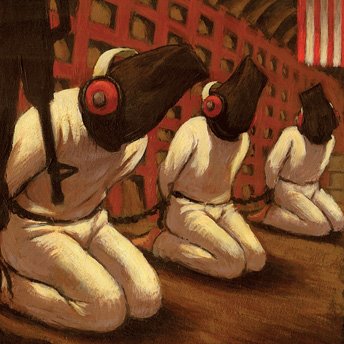
According to the US government’s own figures, that is how many kids 17 years and younger have been held since 2001 as “enemy combatants” — often for over a year, and sometimes for over five years. At least eight of those children, some reportedly as young as 10, were held at Guantanamo. They even had a special camp for them there: Camp Iguana. One of those kids committed suicide at the age of 21, after spending five years in confinement at Guantanamo. (Ironically and tragically, that particular victim of the president’s criminal policy, had been determined by the Pentagon to have been innocent only two weeks before he took his own life, but nobody bothered to tell him he was slated for release and a return home to Afghanistan.)

I say Bush’s behavior is criminal because since 1949, under the Geneva Conventions signed and adopted by the US, and incorporated into US law under the Constitution’s supremacy clause, children under the age of 15 are classed as “protected persons,” and even if captured while fighting against US forces are to be considered victims, not POWs. In 2002, the Bush administration signed an updated version of that treaty, raising the “protected person” age to all those “under 18.”

Treaties don’t mean much to this president, to the vice president, or to the rest of the administration, but they should mean something to the rest of us.

But capturing and imprisoning children isn’t even the worst of this president’s war crimes when it comes to the abuse of the young. Under Bush’s leadership as commander in chief, the US military in Iraq and Afghanistan has been considering any male child in Iraq of age 14 or older to be a potential combatant. They have been treated accordingly — shot by US troops, imprisoned as “enemy combatants,” and subjected to torture.

In the 2004 assault by US Marines on the city of Fallujah, things were even worse. Dexter Filkins, a reporter for the New York Times, reported that before that invasion, some 20,000 Marines encircled the doomed city, which the White House had decided to level because it harbored a bunch of insurgents and had angered the American public by capturing, killing and mutilating the bodies of four mercenaries working for US forces. The residents of the 300,000-population city were warned of the coming all-out attack. Women and children and old people were allowed to flee the city and pass through the cordon of troops. But Filkins reported that males determined to be “of combat age,” which in this case was established as 12 and up, were barred from leaving, and sent back into the city to await their fate. Young boys were ripped from their screaming mothers and sent trudging back to the city to face death.

In the ensuing slaughter, as the US dumped bombs, napalm, phosphorus, anti-personnel fragmentation weapons and an unimaginable quantity of machine gun and small arms fire on the city, it is clear that many of those young boys died.

This was a triple war crime. First of all, it was a case of collective punishment — a practice popular with the Nazis in World War II, and barred by the Geneva Conventions. The international laws of war also guarantees the right of surrender, so those men and boys who tried to leave, even if suspected of being enemy fighters, should have been allowed to surrender and be held as captives until their loyalties could be established. The boys, meanwhile, were “protected persons” who were by law to be treated as victims of war, and protected from harm.

Instead they were treated as the enemy, to be destroyed.

For these crimes, the president should today be impeached by the Congress and then tried as a war criminal.

After watching this Congress cower from its responsibility to defend the Constitution, I have little hope of that happening. But I do harbor the hope that once Bush has left office, some prosecutor in another country — perhaps Spain, or Canada or Germany — will use the doctrine of universal jurisdiction to indict him for war crimes, and, should he leave the country for some lucrative speaking engagement, arrest him, the way former dictator Augusto Pinochet was arrested by a Spanish prosecutor on a visit to the UK.

For his abuse, imprisonment and killing of children, this president should stand trial for war crimes.

Dave Lindorff’s most recent book is “The Case for Impeachment” (St. Martin’s Press, 2006). His work is available at http://www.thiscantbehappening.net/.

Source / Information Clearing House / Common Dreams

The Rag Blog

Posted in RagBlog | Tagged , | Leave a comment